EP0802500B1 - Berührungssensor ohne Kissen - Google Patents
Berührungssensor ohne Kissen Download PDFInfo
- Publication number
- EP0802500B1 EP0802500B1 EP97400846A EP97400846A EP0802500B1 EP 0802500 B1 EP0802500 B1 EP 0802500B1 EP 97400846 A EP97400846 A EP 97400846A EP 97400846 A EP97400846 A EP 97400846A EP 0802500 B1 EP0802500 B1 EP 0802500B1
- Authority
- EP
- European Patent Office
- Prior art keywords
- resistor
- earth
- conductive plate
- touch
- potential
- Prior art date
- Legal status (The legal status is an assumption and is not a legal conclusion. Google has not performed a legal analysis and makes no representation as to the accuracy of the status listed.)
- Expired - Lifetime
Links
Images


Classifications
-
- G—PHYSICS
- G06—COMPUTING OR CALCULATING; COUNTING
- G06F—ELECTRIC DIGITAL DATA PROCESSING
- G06F3/00—Input arrangements for transferring data to be processed into a form capable of being handled by the computer; Output arrangements for transferring data from processing unit to output unit, e.g. interface arrangements
- G06F3/01—Input arrangements or combined input and output arrangements for interaction between user and computer
- G06F3/03—Arrangements for converting the position or the displacement of a member into a coded form
- G06F3/041—Digitisers, e.g. for touch screens or touch pads, characterised by the transducing means
- G06F3/044—Digitisers, e.g. for touch screens or touch pads, characterised by the transducing means by capacitive means
-
- H—ELECTRICITY
- H03—ELECTRONIC CIRCUITRY
- H03K—PULSE TECHNIQUE
- H03K17/00—Electronic switching or gating, i.e. not by contact-making and –breaking
- H03K17/94—Electronic switching or gating, i.e. not by contact-making and –breaking characterised by the way in which the control signals are generated
- H03K17/96—Touch switches
- H03K17/962—Capacitive touch switches
- H03K17/9622—Capacitive touch switches using a plurality of detectors, e.g. keyboard
Definitions
- capacitive touch sensing systems employ a passive form of detection.
- a key touch representing a change to the circuit capacitance, results in attenuating the potential and resulting voltage level change indicates a key touch.
- This capacitive circuit is usually implemented by the deposition of opposing conductive key pads to opposite sides of a dielectric element.
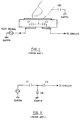
- FIG. 1 shows an example of a conventional capacitive coupled touch sensor according to the prior art.
- FIG. 2 shows the equivalent circuit of the sensor shown in FIG. 1.
- Plastic membrane switches are not suitable for applications where they are located close to high temperature sources, such as on a cooktop surface. When a plastic membrane is located in the vicinity of a heat source, it would have a tendency to warp or separate. They are also susceptible to easy damage by heat and abrasion in a situation where it is normal that objects are used nearby or can be placed on the membrane. Actuation of this type of switch is mechanical in nature and reliability is inherently reduced with use.
- Infra-red detection methods are sensitive to extraneous or even ambient light sources. Accumulation of foreign matter or objects placed over the sensing locations can affect sensitivity or produce erroneous detections. Moreover, the front plate or panel in front of the infra-red transmitters and detectors must be transparent for the technology to function.
- US-A-3 857 100 discloses an electronic switching arrangement having a touch contact, particularly for switching preselected channels in radio or television receivers.
- the alternating voltage which occurs across the contact when it is touched is rectified in a rectifier having such a long charge time constant that switching over is effected after a plurality of cycles of the alternating voltages.
- the object of the present invention is to provide a padless touch sensor employing direct capacitive coupling under a dielectric element, such as a glass window, a ceramic plate, etc.
- a dielectric element such as a glass window, a ceramic plate, etc.
- test pulses are sent to earth and when a user, standing by a sensor, touches the dielectric element at one sensing location, pulses are supplied to a conductive plate located under the dielectric element and in registry with the sensing location. These pulses are due to the capacitive reaction of the body of the user to the test pulses sent into earth. A coupling path is thus formed through the body capacitance with reference to earth.
- One of the important advantages of the present invention is that it is only the touch of the user that is actively coupling the circuit and activating the sensor, unlike the traditional sensing systems that depend on disturbing an existing capacitive circuit.
- the proposed touch sensor and method have several major impacts on overall system design. No conductive pads need to be deposited over the sensing location of the dielectric element for the system or method to function.
- the conductive plate of each sensor is instead provided in close contact with the opposite side of the dielectric element. This results in greater simplicity and flexibility with regards to the production and installation of a keyboard combining one or a plurality of sensors. Greater key density and a considerably smaller sensing location are possible compared to traditional capacitive sensing systems.
- the present invention features a padless touch sensor for detecting a touch at a sensing location onto a dielectric element by a user coupled to earth.
- the sensor comprises a conductive plate attached under the dielectric element and in registry with the sensing location.
- a means is provided for applying a predetermined potential on the conductive plate.
- Test pulses are injected into earth using a pulse test generating means and a means responsive to a potential variation in the conductive plate produces an output signal indicative of that variation.
- a potential variation occurs in the conductive plate during a test pulse due to a capacitive circuit formed between earth, the user and the means responsive to the potential variation.
- the present invention also provides a padless touch sensor for detecting a touch at sensing locations onto a dielectric element by a user coupled to earth.
- the sensor comprises a plurality of conductive plates, one for each sensing location. Each conductive plate is attached under the dielectric element and in registry with a respective sensing location. A predetermined potential is successively applied on one of the conductive plates at once. A test pulse is produced into earth while one of the conductive plates receives the predetermined potential. A means responsive to a potential variation in the conductive plate with the predetermined potential is then provided for producing an output signal indicative of the potential variation in that conductive plate.
- the present invention also provides a padless touch sensor for detecting a touch at sensing locations onto a dielectric element by a user coupled to earth.
- the sensor comprises a plurality of conductive plates, one for each sensing location. Each conductive plate is attached under the dielectric element and in registry with a respective sensing location.
- a means for applying a predetermined potential on the conductive plates is provided and test pulses are injected into earth.
- a means responsive to a potential variation in the conductive plates with the predetermined potential is then provided for producing output signals indicative of the potential variation in each of the conductive plates.
- a method for detecting a touch at a sensing location onto a dielectric element by a user coupled to earth comprises the steps of applying a predetermined potential on a conductive plate attached under the dielectric element and in registry with the sensing location. Test pulses are produced into earth and a potential variation on the conductive plate is sensed. An output signal indicative of the potential variation is then produced.
- a method for detecting a touch at sensing locations onto a dielectric element by a user coupled to earth Each sensing location is provided with a corresponding conductive plate attached under the dielectric element and in registry with the respective sensing location.
- the method comprises the steps of successively applying a predetermined potential on one of the conductive plates at once.
- a test pulse is produced into earth each time the predetermined potential is applied on one conductive plate.
- a potential variation in each of the conductive plates is sensed while the predetermined potential is applied thereon.
- An output signal is then produced. The output signal is indicative of the potential variation in each of the conductive plates while the predetermined potential is individually applied thereon.
- a method for detecting a touch at sensing locations onto a dielectric element by a user coupled to earth each sensing location being provided with a corresponding conductive plate attached under the dielectric element and in registry with the respective sensing location, the method comprising the steps of:
- the basic sensor (10) is mounted under a dielectric element (20) and is illustrated in a "touch" condition since the sensing location (22) on the dielectric element (20) is touched by a finger (24) of a user.
- the basic sensor (10) can be divided in two main parts, namely a test pulse generator section and a receiver section. Those parts are described in detail hereinbelow.
- the test pulse generator section produces test pulses into earth.
- the test pulse generating means comprises a resistor having an input terminal connected to a DC source and an output terminal connected to earth.
- the output terminal of the resistor is also connected to the collector of a transistor.
- the emitter of the transistor is then connected to the circuit ground.
- a pulsed signal is generated at the base of the transistor.
- FIGS. 3, 4 and 12 show such construction.
- a +24 volts DC potential is applied through a resistor R1 that is connected to earth.
- a typical value for the resistor R1 would be 10 Kohms.
- a transistor Q1 alternatively connects and disconnects the circuit ground to and from earth.
- a pulse signal V P of +5 volts for instance arrives at the base of the transistor Q1.
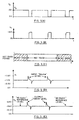
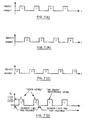
- FIGS. 5A and 5B respectively show the pulse signal V P and the resulting test pulse signal V t that is injected into earth.
- Earth in the context of the present invention means the real earth or any other mass acting as a virtual ground.
- the sensor can be connected to the real earth by means of a wire electrically connected to the grounding prong of the appliance, itself connected to the earth wire of the building.
- the virtual ground an example could be the metallic body of a vehicle.
- the receiver section of the basic sensor (10) comprises a conductive plate (30) located under the dielectric element (20).
- the plate (30) is in registry with the sensing location (22) onto the dielectric element (20).
- the sensing location (22) and the corresponding conductive plate (30) are also referred to as a "key". If appropriate, markings may be provided to indicate to the user the exact location where the finger (24) has to touch to achieve a touch condition at the key.
- markings may be provided to indicate to the user the exact location where the finger (24) has to touch to achieve a touch condition at the key.
- a person skilled in the art would realize that the term "finger” may be substituted for any body part that can be used for touching a key. For instance, a handicapped person may have to use his or her toes instead of one finger.
- the present invention may also work in applications where animals are involved.
- the receiver section further comprises a means for applying a predetermined potential on the plate (30). This sets a reference voltage, referred to as a "no touch" reference level. Then, a means responsive to a potential variation in the plate (30) is used to produce a signal indicative of the potential variation. It is this signal that will be used to determine if there is a touch condition or not.
- the plate (30) is attached under the dielectric element (20).
- the connection There are many ways of achieving the connection. One is to provide the plate (30) on a circuit board (32) and to connect the circuit board (32) with, for instance, an adhesive strip (34) or with screws (not shown). Of course, other kinds of attachments may be used, according to the particular needs and environment.
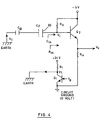
- FIG. 3 shows a possible embodiment of the present invention, where the means for applying a predetermined potential and the means responsive to a potential variation in the plate (30) are combined together using a transistor Q2.
- FIG. 4 shows the equivalent circuit when there is a touch condition, also referred to as a "key touch".
- the transistor Q2 is connected in a high input impedance emitter follower configuration.
- the voltage gain of the circuit is slightly less than 1.
- a resistor R b is connected between the base of the transistor Q2 and a second supply voltage source.
- the resistor R b serves as a termination and bias for the input and sets the "no touch" reference level at an output resistor R o .
- the other end of the resistor R o is connected to the circuit ground.
- a typical second supply voltage would be +5 volts DC.
- the input resistance R in at the base of the transistor Q2 is approximately given by the formula h FE x R o .
- the input resistance R in is then approximately between 0.5 Mohm and 2 Mohms for a typical transistor when the resistor R o is 4.7 Kohms and h FE between 100 and 400.
- Decreasing the value of the resistor R b raises the potential at the base of the transistor Q2 and also the "no touch" reference level. For instance, this level can be adjusted from +0.6 volt to +3.4 volts by adjusting the resistor R b from 5.6 Mohms to 200 Kohms.
- the detection level at the output resistor R o can also be adjusted by changing the value of the resistor R b to compensate for different coupling levels for various sizes of the conductive plates (30). Any convenient reference level can be chosen depending on the application and power supply voltage available.
- the V P test pulse signal drives the transistor Q1 which alternatively connects and disconnects the circuit ground to and from earth.
- the first supply voltage is +24 volts DC and when the transistor Q1 is switched off, the +24 volts DC is applied through the resistor R1 to earth for producing the test pulse signal V t .
- FIGS. 5A and 5B show the typical waveforms.
- the test pulse signal V t is applied once every 1 ms.
- the test pulse signal V t is coupled from earth to the capacitance CB of the body of the user.
- the potential at the conductive plate (30) will not change. Nevertheless, the est pulse V t is always being injected into ground and coupled to the user's body.
- the distance between the user and the test pulse generator section may be as far as 50 meters.
- a shielded cable was used to connect the plate (30) to the remote circuit board (32).
- the touch detection is achieved by coupling the +24 volts DC test pulse signal through the user's effective body capacitance, to the plate (30), by way of earth.
- the test pulse signal V t is applied to earth and to one side of body capacitance C B .
- the value of the capacitance C B is typically between 200 and 500 pF.
- the capacitance C B is connected in series to the capacitance C F , which represents the capacitance formed by the user's contact area at the sensing location (22), the dielectric element (20) and the conductive plate (30).
- a typical value of the capacitance C F is 20 pF for a 3 mm (1/8 inch) thick glass-ceramic with a dielectric constant of 22 and a plate area of about 3 mm 2 (0.5 square inch).
- a material with a higher relative dielectric constant increases the capacitance C F and produces improved signal coupling to the sensor or alternatively, allows the use of a thicker dielectric element (20).
- the area of the conductive plate (30) and the contact area of the finger (24) determines the value of the capacitance C F .
- Increasing the contact area will increase the capacitance and improve coupling of the test pulse signal V t to the sensor.
- the maximum area is however limited by the contact area for a typical human finger, beyond which increasing the area of the plate (30) has no effect.
- a circular plate of 13 mm (1/2 inch diameter) is a reasonable maximum useable limit to set for finger actuation.
- a 6 mm (1/4 inch) diameter plate works very reliably.
- the capacitance C B and C F acts instantly as a "short" and +24 volts would normally be applied to the base of the transistor Q2.
- the effective capacitance of C B and C F in the example is approximately 18 pF. Since the input base capacitance C in of the transistor Q2, which is in the range of 5 pF to 10 pF for a typical transistor, is comparable to the coupling capacitance of C B and C F combined, the signal level that the transistor Q2 receives is actually lower than +24 volts.
- the input resistance of the transistor Q2 also acts to reduce the level depending on the coupled resistance.
- the rise time of the test pulse signal V t also acts to further reduce this level.
- the coupled signal level is further reduced.
- the transmitted test pulse signal V t from earth generally does not have a very sharp rise time.
- the effective signal coupled to the transistor Q2 is thus much lower than +24 volts, and typically is ⁇ 0.3 volt.
- FIG. 5C shows an example of a key touch period with reference to the test pulse signal V t shown in FIG. 5B.
- FIG. 5D then shows the resulting variation of the potential in the plate (30).
- FIG. 5E shows how the potential variation is felt at the emitter of the transistor Q2.
- the output signal V o is sent to an appropriate device to determine whether or not the potential variation is sufficient to initiate a positive key touch status and, for instance, actuate a corresponding switch (not shown).
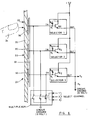
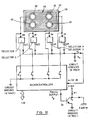
- FIG. 6 shows a multiple key configuration.
- the keys are each individually scanned to determine whether there is a key touch or not.
- the input to the base of the selected key transistor is left active (enabled) while the inputs to the other keys are disabled by grounding their input bases through a multiplexer.
- the individual key transistor Q2 and resistance R b are called a "selector".
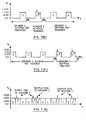
- FIGS. 7A, 7B and 7C illustrate schematically the selection of the individual keys.
- the test pulse signal is coupled to that key only if there is a touch at the corresponding sensing location. It should be noted that the test pulse generator section was omitted from FIG. 6 for simplification.
- FIG. 12 shows the complete system with "N" keys.
- FIG. 7D shows an example of the input voltage V i for the first key.
- the first key is touched in the first two readings of that key, while there is no key touch for the other two readings.
- FIG. 7E shows the input voltage V i for the second key, showing the signal if only the second key is touched during the second reading.
- FIG. 7F shows the output voltage V i for the third key, showing the signal if only the third key is touched during the last two readings.
- FIG. 7G shows the resulting output signal V o in function of time. It should be noted that any stray or inadvertent coupling to any of the other disabled keys has no effect on the output voltage V o at the resistor R o for the time period that the first key is selected, for instance. Only the first key contributes to the voltage V o for that time period. Every other key is then subsequently scanned in a similar manner with the voltage level present at a common output resistor R o , indicative of the presence of a key touch for that particular key. When there is no key touch, the output signal V o remains at its reference no touch level for the scanned key. It should be noted at this point that it is possible to provide an output resistor R o for each key.
- One of the advantages of the present invention is that no deposition of conductive films on the dielectric element (20) or other special processes are required.
- the dielectric element (20) not only protects the sensor from the external operating environment, it acts in completing the capacitance construction of C F .
- the only conductive plates contributing to the coupling capacitance are behind the dielectric element (20) and are then protected from the action of chemicals and abrasion.
- the circuit board (32) does not have the same tendency to warp or distort like the conventional plastic membrane switch type construction. Moreover, foreign matter or objects placed directly on top of the dielectric element (20) will not erroneously actuate any of the keys. Infra-red based systems do not preclude this possibility.
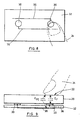
- a circuit ground plane Surrounding the sensing locations (22) on the outward facing or user side of the circuit board (32) by a circuit ground plane (40), as shown in FIGS. 10 and 11, has the effect of shielding all conductive traces behind it.
- a key touch at a sensing location (22) which also overlaps another trace now has its capacitance C FC to the overlapped trace (36) coupled to circuit ground.
- C FC capacitance
- FIG. 12 illustrates conductive plates (30) and circuit ground plane (40) that are etched on the outward facing side of a circuit board (32).
- a dielectric element (20) covers and is in close contact with the keys.
- the outputs of all the corresponding selectors are connected to a common output resistor R o .
- R o common output resistor
- a microcontroller provides the necessary signals for scanning the selector of each key of the array. Measurement and analysis of the potential variations at the output resistor R o is performed by the microcontroller. A determination of whether a valid key touch has been received and the appropriate reaction is then performed.
- the keys in FIG. 12 are scanned in succession, in an order prescribed by the microcontroller program.
- the microcontroller sends a pulse to the transistor Q1.
- the transistor Q1 raises earth potential to +24 volts above circuit ground when the input pulse V P is zero Volt.
- the microcontroller disables all the other keys. This may be done by grounding every transistor base of the selectors except the one that it is scanning if one output resistor R o is used.
- the output voltage V o is connected to the A/D input channel of the microcontroller which is read and recorded in memory.
- the microcontroller then enables the next key and disables all the others and proceeds in the same manner as previously described until all the keys have been scanned.
- the microcontroller then suspends the scanning in order to evaluate the potential levels for V o detected during each key scan period.
- the microcontroller initially records the "no key touch" reference level V o for each key.
- the current recorded V o level for a particular key is then compared with the reference "no key touch” value. If the potential V o is greater than the reference by a predetermined reference value, then a "possible key touch" is recognized as to have occurred. This "difference level" represents the detection level range for the key.
- the recorded "no key touch” reference level in memory for the respective keys will be adjusted to a new value such that the potential variation calculated by the microcontroller will always be less than the "possible key touch” detection range. Those keys will thus be forced to be seen as “not touched” and be effectively locked out. The scanning of the keys then proceeds normally. When the multiple touch condition disappears, the "no touch" reference levels for those keys are returned to their normal values in memory.
- the microcontroller is provided with a proper program to perform the steps of the method according to the present invention.
- An example of such a program is as follows. This program was written for a sensor used in conjunction with an electric range having a ceramic cooktop surface.
Landscapes
- Engineering & Computer Science (AREA)
- General Engineering & Computer Science (AREA)
- Theoretical Computer Science (AREA)
- Human Computer Interaction (AREA)
- Physics & Mathematics (AREA)
- General Physics & Mathematics (AREA)
- Electronic Switches (AREA)
- Switches That Are Operated By Magnetic Or Electric Fields (AREA)
Claims (17)
- Padloser Berührungssensor (10) zum Erfassen einer Berührung an einer Taststelle (22) durch einen Benutzer (24), der mit Erde Verbindung hat, wobei der Sensor (10) dadurch gekennzeichnet ist, daß er folgendes aufweist:wodurch bei Berührung des dielektrischen Elements (20) an der Taststelle (22) durch den Benutzer (24) eine Potentialänderung in der leitfähigen Platte (30) während eines Prüfimpulses (Vt) aufgrund eines kapazitiven Schaltkreises auftritt, der zwischen Erde, dem Benutzer (24) und der auf die Potentialänderung ansprechenden Einrichtung gebildet wird.ein dielektrisches Element (20);eine leitfähige Platte (30);eine Einrichtung zum Anbringen der leitfähigen Platte (30) unter dem dielektrischen Element (20) und in Ausrichtung mit der Taststelle (22);eine Einrichtung zum Anlegen eines vorbestimmten Potentials an die leitfähige Platte (30);eine Prüfimpuls-Erzeugungseinrichtung zum Erzeugen von Prüfimpulsen (Vt) zur Erde; undeine auf eine Potentialänderung in der leitfähigen Platte (30) ansprechende Einrichtung zum Erzeugen eines Ausgangssignals (V0), das die Potentialänderung anzeigt;
- Padloser Berührungssensor (10) nach Anspruch 1, wobei die Prüfimpuls-Erzeugungseinrichtung folgendes aufweist:einen Widerstand (R1) mit einem Eingangsanschluß und einem Ausgangsanschluß, wobei der Eingangsanschluß mit einer Gleichstromquelle verbunden ist und der Ausgangsanschluß mit Erde verbunden ist;einen Transistor (Q1) mit einem Kollektor, einem Emitter und einer Basis, wobei der Kollektor mit dem Ausgangsanschluß des Widerstands (R1) verbunden ist und der Emitter mit Schaltungsmasse verbunden ist; undeine Einrichtung zum Erzeugen eines Impulssignals (Vp) an der Basis des Transistors (Q1).
- Padloser Berührungssensor (10) nach Anspruch 1 oder 2,
wobei die Einrichtung zum Anlegen eines vorbestimmten Potentials und die auf eine Potentialänderung ansprechende Einrichtung folgendes aufweisen:wodurch das Ausgangssignal (V0) an dem Eingangsanschluß des zweiten Widerstands (R0) abgenommen wird.einen ersten Widerstand (Rb) mit einem Eingangsanschluß und einem Ausgangsanschluß, wobei der Eingangsanschluß des ersten Widerstands (Rb) mit einer Gleichstromquelle verbunden ist und der Ausgangsanschluß des ersten Widerstands (Rb) mit der leitfähigen Platte (30) verbunden ist;einen Transistor (Q2) mit einem Kollektor, einem Emitter und einer Basis, wobei der Kollektor mit der Gleichstromquelle verbunden ist und die Basis mit der leitfähigen Platte (30) und mit dem Ausgangsanschluß des ersten Widerstands (Rb) verbunden ist; undeinen zweiten Widerstand (R0) mit einem Eingangsanschluß und einem Ausgangsanschluß, wobei der Eingangsanschluß des zweiten Widerstands (R0) mit dem Emitter des Transistors verbunden ist und der Ausgangsanschluß des zweiten Widerstands (R0) mit Schaltungsmasse verbunden ist; - Padloser Berührungssensor (10) zum Erfassen einer Berührung an Taststellen (22) durch einen Benutzer (24), der mit Erde Verbindung hat, wobei der Sensor (10) dadurch gekennzeichnet ist, daß er folgendes aufweist:wodurch bei Berührung des dielektrischen Elements (20) an einer der Taststellen (22) durch den Benutzer (24) eine Potentialänderung in der leitfähigen Platte (30) während eines Prüfimpulses (Vt) aufgrund eines kapazitiven Schaltkreises auftritt, der zwischen Erde, dem Benutzer (24) und der auf die Potentialänderung ansprechenden Einrichtung gebildet wird.ein dielektrisches Element (20);eine Mehrzahl leitfähiger Platten (30), und zwar je eine für jede Taststelle (22);eine Einrichtung zum Anbringen jeder leitfähigen Platte (30) unter dem dielektrischen Element (20) und in Ausrichtung mit einer jeweiligen Taststelle (22);eine Einrichtung zum sukzessive Anlegen eines vorbestimmten Potentials unmittelbar an eine der leitfähigen Platten (30);eine Prüfimpuls-Erzeugungseinrichtung zum Erzeugen eines Prüfimpulses (Vt) zur Erde, während eine der leitfähigen Platten (30) mit dem vorbestimmten Potential beaufschlagt wird; undeine auf eine Potentialänderung in der leitfähigen Platte (30) mit dem vorbestimmten Potential ansprechende Einrichtung zum Erzeugen eines Ausgangssignals (V0), das die Potentialänderung in dieser leitfähigen Platte (30) anzeigt;
- Padloser Berührungssensor (10) nach Anspruch 4, wobei die Prüfimpuls-Erzeugungseinrichtung folgendes aufweist:einen Widerstand (R1) mit einem Eingangsanschluß und einem Ausgangsanschluß, wobei der Eingangsanschluß mit einer Gleichstromquelle verbunden ist und der Ausgangsanschluß mit Erde verbunden ist;einen Transistor (Q1) mit einem Kollektor, einem Emitter und einer Basis, wobei der Kollektor mit dem Ausgangsanschluß des Widerstands (R1) verbunden ist und der Emitter mit Schaltungsmasse verbunden ist; undeine Einrichtung zum Erzeugen eines Impulssignals (Vp) an der Basis des Transistors (Q1).
- Padloser Berührungssensor (10) nach Anspruch 4 oder 5,
wobei die Einrichtung zum Anlegen eines vorbestimmten Potentials und die auf eine Potentialänderung ansprechende Einrichtung folgendes aufweisen:wodurch das Ausgangssignal (V0) an dem Eingangsanschluß des zweiten Widerstands (R0) abgenommen wird.eine Mehrzahl erster Widerstände (Rb) mit jeweils einem Eingangsanschluß und einem Ausgangsanschluß, wobei der Eingangsanschluß jedes ersten Widerstands (Rb) mit einer Gleichstromquelle verbunden ist und der Ausgangsanschluß jedes ersten Widerstands (Rb) mit einer jeweiligen leitfähigen Platte (30) verbunden ist;eine Mehrzahl von Transistoren (Q2), deren jeder einen Kollektor, einen Emitter und eine Basis aufweist, wobei der Kollektor jedes Transistors (Q2) mit der Gleichstromquelle verbunden ist und die Basis jedes Transistors (Q2) mit einer jeweiligen leitfähigen Platte (30) und mit dem Ausgangsanschluß des jeweiligen ersten Widerstands (Rb) verbunden ist;einen zweiten Widerstand (R0) mit einem Eingangsanschluß und einem Ausgangsanschluß, wobei der Eingangsanschluß des zweiten Widerstands (R0) mit dem Emitter jedes Transistors (Q2) verbunden ist und der Ausgangsanschluß des zweiten Widerstands (R0) mit Schaltungsmasse verbunden ist; undeine Einrichtung zum selektiven Verbinden der leitfähigen Platten (30), mit Ausnahme von derjenigen mit dem vorbestimmten Potential, mit Schaltungsmasse; - Padloser Berührungssensor (10) nach Anspruch 4, 5 oder 6,
witerhin mit einer Schaltungserdungsebene (40), die die Taststellen (22) umgibt, um von den leitfähigen Platten (30) wegführende Leiterbahnen (36) abzuschirmen. - Padloser Berührungssensor (10) zum Erfassen einer Berührung an Taststellen (22) durch einen Benutzer (24), der mit Erde Verbindung hat, wobei der Sensor (10) dadurch gekennzeichnet ist, daß er folgendes aufweist:wodurch bei Berührung des dielektrischen Elements (20) an einer der Taststellen (22) durch den Benutzer (24) eine Potentialänderung in der entsprechenden leitfähigen Platte (30) während eines Prüfimpulses (Vt) aufgrund eines kapazitiven Schaltkreises auftritt, der zwischen Erde, dem Benutzer (24) und der auf die Potentialänderung ansprechenden Einrichtung gebildet wird.ein dielektrisches Element (20);eine Mehrzahl leitfähiger Platten (30), und zwar je eine für jede Taststelle (22);eine Einrichtung zum Anbringen jeder leitfähigen Platte (30) unter dem dielektrischen Element (20) und in Ausrichtung mit einer jeweiligen Taststelle (22);eine Einrichtung zum Anlegen eines vorbestimmten Potentials an die leitfähigen Platten (30);eine Prüfimpuls-Erzeugungseinrichtung zum Erzeugen von Prüfimpulsen (Vt) zur Erde; undeine auf eine Potentialänderung in den leitfähigen Platten (30) mit dem vorbestimmten Potential ansprechende Einrichtung zum Erzeugen von Ausgangssignalen (V0), die die Potentialänderung in jeder der leitfähigen Platten (30) anzeigen;
- Padloser Berührungssensor (10) nach Anspruch 8, wobei die Prüfimpuls-Erzeugungseinrichtung folgendes aufweist:einen Widerstand (R1) mit einem Eingangsanschluß und einem Ausgangsanschluß, wobei der Eingangsanschluß mit einer Gleichstromquelle verbunden ist und der Ausgangsanschluß mit Erde verbunden ist;einen Transistor (Q1) mit einem Kollektor, einem Emitter und einer Basis, wobei der Kollektor mit dem Ausgangsanschluß des Widerstands (R1) verbunden ist und der Emitter mit Schaltungsmasse verbunden ist; undeine Einrichtung zum Erzeugen eines Impulssignals (Vp) an der Basis des Transistors (Q1).
- Padloser Berührungssensor (10) nach Anspruch 8 oder 9,
weiterhin mit einer Schaltungserdungsebene (40), die die Taststellen (22) umgibt, um von den leitfähigen Platten (30) wegführende Leiterbahnen (36) abzuschirmen. - Verfahren zum Erfassen einer Berührung an einer Taststelle (22) auf einem dielektrischen Element (20) durch einen Benutzer (24), der mit Erde Verbindung hat, wobei das Verfahren folgende Schritte aufweist:Anlegen eines vorbestimmten Potentials an eine leitfähige Platte (30), die unter dem dielektrischen Element (20) und in Ausrichtung mit der Taststelle (22) angebracht ist;Erzeugen von Prüfimpulsen (Vt) zur Erde;Erfassen einer Potentialänderung an der leitfähigen Platte (30); undErzeugen eines Ausgangssignals (V0), das die Potentialänderung anzeigt.
- Verfahren zum Erfassen einer Berührung nach Anspruch 11,
weiterhin mit folgenden Schritten:Vergleichen des Ausgangssignals (V0) mit einem Bezugspegel;undErzeugen eines eine Berührung an der Taststelle (22) anzeigenden Signals, wenn die Potentialänderung an der leitfähigen Platte (30) größer ist als der Bezugspegel. - Verfahren zum Erfassen einer Berührung an Taststellen (22) auf einem dielektrischen Element (20) durch einen Benutzer (24), der mit Erde Verbindung hat, wobei jede Taststelle (22) mit einer entsprechenden leitfähigen Platte (30) versehen ist, die unter dem dielektrischen Element (20) und in Ausrichtung mit der jeweiligen Taststelle (22) angebracht ist, wobei das Verfahren folgende Schritte aufweist:sukzessives Anlegen eines vorbestimmten Potentials unmittelbar an eine der leitfähigen Platten (30);Erzeugen eines Prüfimpulses (Vt) zur Erde, während das vorbestimmte Potential an eine leitfähige Platte (30) angelegt wird;Erfassen einer Potentialänderung an jeder der leitfähigen Platten (30), während das vorbestimmte Potential an diese angelegt wird; undErzeugen eines Ausgangssignals (V0), das die Potentialänderung bei jeder der leitfähigen Platten (30) anzeigt, während das vorbestimmte Potential einzeln an diese angelegt wird.
- Verfahren zum Erfassen einer Berührung nach Anspruch 13,
wobei der Schritt des sukzessiven Anlegens eines vorbestimmten Potentials unmittelbar an eine der leitfähigen Platten (30) ein Verbinden der leitfähigen Platten (30), mit Ausnahme von derjenigen mit dem vorbestimmten Potential, mit Schaltungsmasse beinhaltet. - Verfahren zum Erfassen einer Berührung nach Anspruch 13 oder 14,
weiterhin mit folgenden Schritten:Vergleichen des Ausgangssignals (V0) mit einem Bezugspegel; undErzeugen eines eine Berührung an einer der Taststellen (22) anzeigenden Signals, wenn die Potentialänderung an der entsprechenden leitfähigen Platte (30) größer ist als der Bezugspegel. - Verfahren zum Erfassen einer Berührung an Taststellen (22) auf einem dielektrischen Element (20) durch einen Benutzer (24), der mit Erde Verbindung hat, wobei jede Taststelle (22) mit einer entsprechenden leitfähigen Platte (30) versehen ist, die unter dem dielektrischen Element (20) und in Ausrichtung mit der jeweiligen Taststelle (22) angebracht ist, wobei das Verfahren folgende Schritte aufweist:Anlegen eines vorbestimmten Potentials an die leitfähigen Platten (30);Erzeugen von Prüfimpulsen (Vt) zur Erde;Erfassen einer Potentialänderung an jeder der leitfähigen Platten (30); undErzeugen von Ausgangssignalen (V0), die die Potentialänderung bei jeder der leitfähigen Platten (30) beim Tasten derselben anzeigen.
- Verfahren zum Erfassen einer Berührung nach Anspruch 16,
weiterhin mit folgenden Schritten:Vergleichen der Ausgangssignale (V0) mit einem Bezugspegel; undErzeugen eines eine Berührung an einer der Taststellen (22) anzeigenden Signals, wenn die Potentialänderung an der entsprechenden leitfähigen Platte (30) größer ist als der Bezugspegel.
Applications Claiming Priority (2)
| Application Number | Priority Date | Filing Date | Title |
|---|---|---|---|
| US1463896P | 1996-04-15 | 1996-04-15 | |
| US14638 | 1996-04-15 |
Publications (3)
| Publication Number | Publication Date |
|---|---|
| EP0802500A2 EP0802500A2 (de) | 1997-10-22 |
| EP0802500A3 EP0802500A3 (de) | 1998-10-07 |
| EP0802500B1 true EP0802500B1 (de) | 1999-08-18 |
Family
ID=21766735
Family Applications (1)
| Application Number | Title | Priority Date | Filing Date |
|---|---|---|---|
| EP97400846A Expired - Lifetime EP0802500B1 (de) | 1996-04-15 | 1997-04-15 | Berührungssensor ohne Kissen |
Country Status (4)
| Country | Link |
|---|---|
| US (1) | US5760715A (de) |
| EP (1) | EP0802500B1 (de) |
| CA (1) | CA2202789C (de) |
| DE (2) | DE802500T1 (de) |
Cited By (1)
| Publication number | Priority date | Publication date | Assignee | Title |
|---|---|---|---|---|
| US8665077B2 (en) | 2002-08-15 | 2014-03-04 | Ident Technology Ag | Circuit for selectively producing switching signals, especially for a vehicle door locking, a vehicle, system and method equipped therewith for protecting areas of risk as well as a system, system components and method for hermetically transferring validatable data |
Families Citing this family (65)
| Publication number | Priority date | Publication date | Assignee | Title |
|---|---|---|---|---|
| US6084638A (en) * | 1996-10-08 | 2000-07-04 | Hare; Charles S. | Computer interface extension system and method |
| JPH11202998A (ja) * | 1998-01-08 | 1999-07-30 | Fujitsu Takamisawa Component Ltd | 情報処理装置 |
| US7906875B2 (en) * | 1999-01-19 | 2011-03-15 | Touchsensor Technologies, Llc | Touch switches and practical applications therefor |
| US6320282B1 (en) | 1999-01-19 | 2001-11-20 | Touchsensor Technologies, Llc | Touch switch with integral control circuit |
| WO2000044018A1 (en) * | 1999-01-26 | 2000-07-27 | Harald Philipp | Capacitive sensor and array |
| FR2817581B1 (fr) † | 2000-12-01 | 2006-08-25 | Valeo Electronique | Poignee d'ouvrant de vehicule comprenant un capteur d'approche et un capteur tactile cooperant avec un systeme d'acces mains libres |
| US20030019886A1 (en) * | 2001-01-19 | 2003-01-30 | Lancer Partnership. Ltd | Customer interface for a beverage dispenser |
| US6657616B2 (en) * | 2001-03-16 | 2003-12-02 | Invensys Appliance Controls Company | Capacitive touch keyboard |
| US6944018B2 (en) * | 2001-05-07 | 2005-09-13 | Touchsensor Technologies, Llc | Control system input apparatus and method |
| DE10127595A1 (de) * | 2001-05-30 | 2002-12-05 | Ego Elektro Geraetebau Gmbh | Schaltungsanordnung für mehrere Sensorelemente |
| US7242393B2 (en) * | 2001-11-20 | 2007-07-10 | Touchsensor Technologies Llc | Touch sensor with integrated decoration |
| US6943705B1 (en) * | 2002-05-03 | 2005-09-13 | Synaptics, Inc. | Method and apparatus for providing an integrated membrane switch and capacitive sensor |
| US7477242B2 (en) * | 2002-05-20 | 2009-01-13 | 3M Innovative Properties Company | Capacitive touch screen with conductive polymer |
| DE10340761B3 (de) * | 2003-09-02 | 2005-07-07 | Ritto Gmbh & Co. Kg | Türstadion mit geschlossener Bedienerfläche |
| US20050116020A1 (en) * | 2003-11-07 | 2005-06-02 | Smolucha Walter E. | Locating individuals and games in a gaming establishment |
| US20050122119A1 (en) * | 2003-12-05 | 2005-06-09 | Touchram Llc | Low noise proximity sensing system |
| US6960735B2 (en) * | 2004-03-17 | 2005-11-01 | Lear Corporation | Multi-shot molded touch switch |
| US7221359B2 (en) * | 2004-03-17 | 2007-05-22 | Lear Corporation | Illuminated touch switch |
| US20060287078A1 (en) * | 2004-04-22 | 2006-12-21 | Smolucha Walter E | Identifying components of a casino game |
| JP2005308341A (ja) * | 2004-04-23 | 2005-11-04 | Rinnai Corp | コンロ |
| US20060015284A1 (en) * | 2004-07-15 | 2006-01-19 | Fry Charles D | Contaminant detecting touch sensitive element |
| US7330108B2 (en) * | 2005-02-24 | 2008-02-12 | Wms Gaming Inc. | Security zones for casino gaming |
| EP1696404A1 (de) | 2005-02-25 | 2006-08-30 | Electrovac, Fabrikation elektrotechnischer Spezialartikel Gesellschaft m.b.H. | Leuchtdiodenanordnung |
| US20060221061A1 (en) * | 2005-03-31 | 2006-10-05 | Tyco Electronic Corporation | Touch sensor and control with random pulse spacing |
| US20060227115A1 (en) * | 2005-03-31 | 2006-10-12 | Tyco Electronic Corporation | Method and apparatus for touch sensor with interference rejection |
| US20060258442A1 (en) * | 2005-05-13 | 2006-11-16 | Ryan Chad A | Multi-purpose casino chips |
| US20070018965A1 (en) * | 2005-07-22 | 2007-01-25 | Tyco Electronics Canada, Ltd. | Illuminated touch control interface |
| US20070024592A1 (en) * | 2005-07-27 | 2007-02-01 | Tyco Electronics Corporation | Touch sensor circuitry and system |
| US20070024591A1 (en) * | 2005-07-27 | 2007-02-01 | Tyco Electronics Corporation | Retrofit touch sensor controls |
| DE102006005581B4 (de) * | 2006-02-06 | 2007-10-04 | Diehl Ako Stiftung & Co. Kg | Kapazitiver Berührungsschalter |
| ES2310089B1 (es) * | 2006-05-18 | 2009-08-27 | Bsh Electrodomesticos España, S.A. | Unidad de placa de cocina. |
| KR100748469B1 (ko) * | 2006-06-26 | 2007-08-10 | 삼성전자주식회사 | 키패드 터치에 의한 사용자 인터페이스 방법 및 그 휴대단말기 |
| US20080007529A1 (en) * | 2006-07-07 | 2008-01-10 | Tyco Electronics Corporation | Touch sensor |
| US20080018604A1 (en) * | 2006-07-19 | 2008-01-24 | Tyco Electronics Canada, Ltd. | Touch detection method and system for a touch sensor |
| US20080088592A1 (en) * | 2006-10-11 | 2008-04-17 | Tyco Electronics Corporation | Contamination detection in touch based sensor arrays |
| US20080143559A1 (en) * | 2006-12-18 | 2008-06-19 | Dietz Paul H | Appliance Control Panel |
| US20080150705A1 (en) * | 2006-12-20 | 2008-06-26 | Tyco Electronics Canada, Ltd. | Contaminant detecting touch sensitive element |
| DE102006062404A1 (de) * | 2006-12-21 | 2008-07-03 | Prettl, Rolf | Vorrichtung und Verfahren zur Positionsbestimmung bezogen auf eine Oberfläche |
| DE102007004889B4 (de) * | 2007-01-31 | 2009-04-16 | BSH Bosch und Siemens Hausgeräte GmbH | Kapazitiver Inkrementalgeber und Haushaltsgerät mit einem solchen |
| US8253425B2 (en) * | 2007-05-08 | 2012-08-28 | Synaptics Incorporated | Production testing of a capacitive touch sensing device |
| FI121979B (fi) * | 2008-03-26 | 2011-06-30 | Elsi Technologies Oy | Sovitinkomponentti mittausjärjestelmään |
| JP4816668B2 (ja) * | 2008-03-28 | 2011-11-16 | ソニー株式会社 | タッチセンサ付き表示装置 |
| CN102124429B (zh) | 2008-06-20 | 2015-06-24 | 美泰有限公司 | 电容性触摸板和结合了相同触摸板的玩具 |
| US8159467B2 (en) * | 2008-08-21 | 2012-04-17 | Wacom Co. Ltd. | Meshed touchscreen pattern |
| US8711105B2 (en) * | 2008-08-21 | 2014-04-29 | Wacom Co., Ltd. | Touchscreen with extended conductive pattern |
| DE102008049176B4 (de) * | 2008-09-26 | 2011-01-27 | Diehl Ako Stiftung & Co. Kg | Bedienblende für ein Haushaltsgerät sowie Haushaltsgerät mit einer solchen Bedienblende |
| DE102008057823A1 (de) * | 2008-11-18 | 2010-08-19 | Ident Technology Ag | Kapazitives Sensorsystem |
| US8711121B2 (en) * | 2008-12-12 | 2014-04-29 | Wacom Co., Ltd. | Architecture and method for multi-aspect touchscreen scanning |
| CA2753680C (en) | 2009-03-25 | 2016-02-16 | Alsentis, Llc | Apparatus and method for determining a touch input |
| AU2010281418A1 (en) * | 2009-07-27 | 2012-02-02 | Touchsensor Technologies, Llc | Level sensing controller and method |
| US8481873B2 (en) * | 2009-09-30 | 2013-07-09 | Freescale Semiconductor, Inc. | Capacitive touch sensor device configuration systems and methods |
| CA2779373C (en) * | 2009-11-23 | 2017-10-24 | Touchsensor Technologies, Llc | User interface panel |
| US20110128154A1 (en) * | 2009-12-01 | 2011-06-02 | Flow-Rite Controls, Ltd. | Battery electrolyte level indicator |
| KR101144724B1 (ko) | 2009-12-17 | 2012-05-24 | 이성호 | 터치패널의 터치셀 구조 |
| US20110147973A1 (en) * | 2009-12-17 | 2011-06-23 | Kuo-Hua Sung | Injection Molding of Touch Surface |
| DE102009060207A1 (de) * | 2009-12-23 | 2011-06-30 | Diehl AKO Stiftung & Co. KG, 88239 | Kapazitiver Berührungsschalter |
| CN103109135B (zh) * | 2010-09-10 | 2015-09-30 | Bsh家用电器有限公司 | 家用电器操作设备 |
| DE102010042690A1 (de) * | 2010-10-20 | 2012-04-26 | Bayerische Motoren Werke Aktiengesellschaft | Eingabevorrichtung zur Steuerung eines elektronischen Geräts |
| KR101347375B1 (ko) * | 2010-11-18 | 2014-01-06 | 삼성디스플레이 주식회사 | 터치 스크린 패널 및 이를 구비한 표시 장치 |
| DE102011075083B4 (de) * | 2011-05-02 | 2019-06-13 | BSH Hausgeräte GmbH | Kapazitive Bedieneinrichtung für ein Haushaltsgerät, Haushaltsgerät und Verfahren zum Betreiben einer kapazitiven Bedieneinrichtung in einem Haushaltsgerät |
| EP2827496A1 (de) * | 2013-07-15 | 2015-01-21 | Electrolux Appliances Aktiebolag | Berührungsschalter für eine Steuerungsvorrichtung einer elektrischen und/oder elektronischen Vorrichtung |
| US9851834B2 (en) | 2013-09-10 | 2017-12-26 | Alsentis, Llc | Time domain differential techniques to characterize various stimuli |
| DE102016102392A1 (de) * | 2016-02-11 | 2017-08-17 | Valeo Schalter Und Sensoren Gmbh | Bedienvorrichtung für ein Kraftfahrzeug mit kapazitiver Annäherungssensorik sowie Kraftfahrzeug |
| CN106817117A (zh) * | 2017-01-17 | 2017-06-09 | 深圳市伏茂斯科技开发有限公司 | 一种用于键位隔空反应的方法、装置及键盘 |
| US12130977B2 (en) * | 2023-03-27 | 2024-10-29 | Cirque Corporation | Pressure capacitive reference fixed to a housing |
Family Cites Families (27)
| Publication number | Priority date | Publication date | Assignee | Title |
|---|---|---|---|---|
| NL7204999A (de) * | 1972-04-14 | 1973-10-16 | ||
| DE2460057B2 (de) * | 1974-12-19 | 1977-02-10 | Robert Bosch Gmbh, 7000 Stuttgart | Schaltanordnung mit einem streufeldkondensator |
| CH623195B (fr) * | 1978-04-11 | 1900-01-01 | Ebauches Sa | Montre electronique avec moyens de commande et de selection des fonctions. |
| US4175239A (en) * | 1978-04-12 | 1979-11-20 | P. R. Mallory & Co. Inc. | Detection means for touch control switches |
| US4221975A (en) * | 1978-04-19 | 1980-09-09 | Touch Activated Switch Arrays, Inc. | Touch activated controller and method |
| US4321479A (en) * | 1978-04-19 | 1982-03-23 | Touch Activated Switch Arrays, Inc. | Touch activated controller and method |
| US4353552A (en) * | 1979-02-23 | 1982-10-12 | Peptek, Incorporated | Touch panel system and method |
| US4550310A (en) * | 1981-10-29 | 1985-10-29 | Fujitsu Limited | Touch sensing device |
| JPS6029969B2 (ja) * | 1982-06-18 | 1985-07-13 | 富士通株式会社 | タッチ検出装置 |
| US4561002A (en) * | 1982-08-30 | 1985-12-24 | General Electric Company | Capacitive touch switch arrangement |
| JPS59197933A (ja) * | 1983-04-25 | 1984-11-09 | Fujitsu Ltd | 座標入力装置 |
| JPS6065620A (ja) * | 1983-09-21 | 1985-04-15 | Fujitsu Ltd | タッチ検出装置 |
| FR2566209B1 (fr) * | 1984-02-16 | 1990-01-05 | Louis Frederic | Procede pour scruter un clavier a touches capacitives, et clavier assorti de moyens pour scruter ce clavier selon ce procede |
| US4651133A (en) * | 1984-12-24 | 1987-03-17 | At&T Technologies, Inc. | Method and apparatus for capacitive keyboard scanning |
| US4806809A (en) * | 1986-06-12 | 1989-02-21 | Kabushiki Kaisha Tokai Rika Denki Seisakusho | Rotary shaft coupling device |
| JPH0539755Y2 (de) * | 1988-03-24 | 1993-10-08 | ||
| JP2733300B2 (ja) * | 1989-04-28 | 1998-03-30 | 松下電器産業株式会社 | キー入力装置 |
| US5012124A (en) * | 1989-07-24 | 1991-04-30 | Hollaway Jerrell P | Touch sensitive control panel |
| GB2245708A (en) * | 1990-06-29 | 1992-01-08 | Philips Electronic Associated | Touch sensor array systems |
| FR2670635B1 (fr) * | 1990-12-13 | 1993-03-19 | Sextant Avionique | Dispositif de commutation a double mode de fonctionnement. |
| FI942177A0 (fi) * | 1991-11-12 | 1994-05-11 | Security Domain Pty Ltd | Menetelmä ja järjestelmä hajallaan olevien älykorttien identifioimiseksi |
| DE69324067T2 (de) * | 1992-06-08 | 1999-07-15 | Synaptics Inc | Objekt-Positionsdetektor |
| US5526428A (en) * | 1993-12-29 | 1996-06-11 | International Business Machines Corporation | Access control apparatus and method |
| US5457289A (en) * | 1994-03-16 | 1995-10-10 | Microtouch Systems, Inc. | Frontally shielded capacitive touch sensor system |
| US5508700A (en) * | 1994-03-17 | 1996-04-16 | Tanisys Technology, Inc. | Capacitance sensitive switch and switch array |
| FR2717917B1 (fr) * | 1994-03-24 | 1996-05-03 | Asulab Sa | Montre comportant un dispositif de commande manuelle. |
| US5577121A (en) * | 1994-06-09 | 1996-11-19 | Electronic Payment Services, Inc. | Transaction system for integrated circuit cards |
-
1997
- 1997-04-15 US US08/843,365 patent/US5760715A/en not_active Expired - Lifetime
- 1997-04-15 CA CA002202789A patent/CA2202789C/en not_active Expired - Fee Related
- 1997-04-15 EP EP97400846A patent/EP0802500B1/de not_active Expired - Lifetime
- 1997-04-15 DE DE0802500T patent/DE802500T1/de active Pending
- 1997-04-15 DE DE69700422T patent/DE69700422T2/de not_active Expired - Lifetime
Cited By (1)
| Publication number | Priority date | Publication date | Assignee | Title |
|---|---|---|---|---|
| US8665077B2 (en) | 2002-08-15 | 2014-03-04 | Ident Technology Ag | Circuit for selectively producing switching signals, especially for a vehicle door locking, a vehicle, system and method equipped therewith for protecting areas of risk as well as a system, system components and method for hermetically transferring validatable data |
Also Published As
| Publication number | Publication date |
|---|---|
| CA2202789A1 (en) | 1997-10-15 |
| EP0802500A3 (de) | 1998-10-07 |
| CA2202789C (en) | 2001-06-26 |
| DE802500T1 (de) | 1998-10-22 |
| DE69700422D1 (de) | 1999-09-23 |
| EP0802500A2 (de) | 1997-10-22 |
| DE69700422T2 (de) | 2000-03-02 |
| US5760715A (en) | 1998-06-02 |
Similar Documents
| Publication | Publication Date | Title |
|---|---|---|
| US5760715A (en) | Padless touch sensor | |
| US4954823A (en) | Touch keyboard systems | |
| CA1217542A (en) | Capacitive touch switch arrangement | |
| US4567480A (en) | Touch-sensitive overlay | |
| US4290052A (en) | Capacitive touch entry apparatus having high degree of personal safety | |
| US5457289A (en) | Frontally shielded capacitive touch sensor system | |
| JP4162717B2 (ja) | 差動式タッチセンサーおよびそれの制御回路 | |
| US4771276A (en) | Electromagnetic touch sensor input system in a cathode ray tube display device | |
| KR101237640B1 (ko) | 기생 캐패시턴스 방지 구조를 구비한 터치스크린 장치 | |
| US5872561A (en) | Fast scanning switch matrix | |
| KR100550413B1 (ko) | 화상판독장치 및 그 구동방법 | |
| US4263592A (en) | Input pen assembly | |
| US8823675B2 (en) | Capacitive matrix touch sensor | |
| US6081259A (en) | Method and apparatus for reducing noise in an electrostatic digitizer | |
| US4543564A (en) | Interference suppression apparatus for a capacitive keyboard | |
| CN110456947A (zh) | 用于触摸敏感和非接触的界面的切换电极电容式测量装置 | |
| JPH09511086A (ja) | 多入力近接検出器およびタッチパッドシステム | |
| US7777502B2 (en) | Capacitive proximity switch, and domestic appliance equipped with the same | |
| EP0712090B1 (de) | Berührungsfühlereingabesystem für Rechnerbildschirm | |
| US7782069B2 (en) | Capacitive proximity switch, and domestic appliance comprising the same | |
| US20060227119A1 (en) | Touch sensing apparatus with differential signal source | |
| JP2013004102A (ja) | 多周波の容量検出を伴うマルチタッチのタッチセンサー式装置 | |
| CN110032289A (zh) | 触摸指纹复合传感器和包括触摸指纹复合传感器的电子装置 | |
| EP2013693B1 (de) | Sensoranordnung | |
| KR102886848B1 (ko) | 고감도 정전용량성 감지 응용예들을 위한 이중 측정 및 관련 시스템들, 방법 들 및 디바이스들 |
Legal Events
| Date | Code | Title | Description |
|---|---|---|---|
| PUAI | Public reference made under article 153(3) epc to a published international application that has entered the european phase |
Free format text: ORIGINAL CODE: 0009012 |
|
| AK | Designated contracting states |
Kind code of ref document: A2 Designated state(s): DE FR GB IT |
|
| EL | Fr: translation of claims filed | ||
| PUAL | Search report despatched |
Free format text: ORIGINAL CODE: 0009013 |
|
| AK | Designated contracting states |
Kind code of ref document: A3 Designated state(s): DE FR GB IT |
|
| DET | De: translation of patent claims | ||
| 17P | Request for examination filed |
Effective date: 19980914 |
|
| 17Q | First examination report despatched |
Effective date: 19981105 |
|
| GRAG | Despatch of communication of intention to grant |
Free format text: ORIGINAL CODE: EPIDOS AGRA |
|
| GRAG | Despatch of communication of intention to grant |
Free format text: ORIGINAL CODE: EPIDOS AGRA |
|
| GRAH | Despatch of communication of intention to grant a patent |
Free format text: ORIGINAL CODE: EPIDOS IGRA |
|
| GRAH | Despatch of communication of intention to grant a patent |
Free format text: ORIGINAL CODE: EPIDOS IGRA |
|
| GRAA | (expected) grant |
Free format text: ORIGINAL CODE: 0009210 |
|
| AK | Designated contracting states |
Kind code of ref document: B1 Designated state(s): DE FR GB IT |
|
| ITF | It: translation for a ep patent filed | ||
| REF | Corresponds to: |
Ref document number: 69700422 Country of ref document: DE Date of ref document: 19990923 |
|
| ET | Fr: translation filed | ||
| PLBE | No opposition filed within time limit |
Free format text: ORIGINAL CODE: 0009261 |
|
| STAA | Information on the status of an ep patent application or granted ep patent |
Free format text: STATUS: NO OPPOSITION FILED WITHIN TIME LIMIT |
|
| 26N | No opposition filed | ||
| REG | Reference to a national code |
Ref country code: GB Ref legal event code: IF02 |
|
| REG | Reference to a national code |
Ref country code: GB Ref legal event code: 732E |
|
| REG | Reference to a national code |
Ref country code: FR Ref legal event code: TP |
|
| PGFP | Annual fee paid to national office [announced via postgrant information from national office to epo] |
Ref country code: GB Payment date: 20130521 Year of fee payment: 17 |
|
| PGFP | Annual fee paid to national office [announced via postgrant information from national office to epo] |
Ref country code: IT Payment date: 20130423 Year of fee payment: 17 Ref country code: FR Payment date: 20130507 Year of fee payment: 17 |
|
| GBPC | Gb: european patent ceased through non-payment of renewal fee |
Effective date: 20140415 |
|
| REG | Reference to a national code |
Ref country code: FR Ref legal event code: ST Effective date: 20141231 |
|
| PG25 | Lapsed in a contracting state [announced via postgrant information from national office to epo] |
Ref country code: GB Free format text: LAPSE BECAUSE OF NON-PAYMENT OF DUE FEES Effective date: 20140415 |
|
| PG25 | Lapsed in a contracting state [announced via postgrant information from national office to epo] |
Ref country code: FR Free format text: LAPSE BECAUSE OF NON-PAYMENT OF DUE FEES Effective date: 20140430 |
|
| PG25 | Lapsed in a contracting state [announced via postgrant information from national office to epo] |
Ref country code: IT Free format text: LAPSE BECAUSE OF NON-PAYMENT OF DUE FEES Effective date: 20140415 |
|
| PGFP | Annual fee paid to national office [announced via postgrant information from national office to epo] |
Ref country code: DE Payment date: 20150508 Year of fee payment: 19 |
|
| REG | Reference to a national code |
Ref country code: DE Ref legal event code: R119 Ref document number: 69700422 Country of ref document: DE |
|
| PG25 | Lapsed in a contracting state [announced via postgrant information from national office to epo] |
Ref country code: DE Free format text: LAPSE BECAUSE OF NON-PAYMENT OF DUE FEES Effective date: 20161101 |