EP0790583B1 - Bildverarbeitungsverfahren und bildprozessor - Google Patents
Bildverarbeitungsverfahren und bildprozessor Download PDFInfo
- Publication number
- EP0790583B1 EP0790583B1 EP96921106A EP96921106A EP0790583B1 EP 0790583 B1 EP0790583 B1 EP 0790583B1 EP 96921106 A EP96921106 A EP 96921106A EP 96921106 A EP96921106 A EP 96921106A EP 0790583 B1 EP0790583 B1 EP 0790583B1
- Authority
- EP
- European Patent Office
- Prior art keywords
- viewpoint
- projection screen
- virtual
- dimensional
- moving object
- Prior art date
- Legal status (The legal status is an assumption and is not a legal conclusion. Google has not performed a legal analysis and makes no representation as to the accuracy of the status listed.)
- Expired - Lifetime
Links
Images



Classifications
-
- G—PHYSICS
- G06—COMPUTING OR CALCULATING; COUNTING
- G06T—IMAGE DATA PROCESSING OR GENERATION, IN GENERAL
- G06T15/00—Three-dimensional [3D] image rendering
-
- A—HUMAN NECESSITIES
- A63—SPORTS; GAMES; AMUSEMENTS
- A63F—CARD, BOARD, OR ROULETTE GAMES; INDOOR GAMES USING SMALL MOVING PLAYING BODIES; VIDEO GAMES; GAMES NOT OTHERWISE PROVIDED FOR
- A63F13/00—Video games, i.e. games using an electronically generated display having two or more dimensions
- A63F13/50—Controlling the output signals based on the game progress
- A63F13/52—Controlling the output signals based on the game progress involving aspects of the displayed game scene
- A63F13/525—Changing parameters of virtual cameras
- A63F13/5258—Changing parameters of virtual cameras by dynamically adapting the position of the virtual camera to keep a game object or game character in its viewing frustum, e.g. for tracking a character or a ball
-
- A—HUMAN NECESSITIES
- A63—SPORTS; GAMES; AMUSEMENTS
- A63F—CARD, BOARD, OR ROULETTE GAMES; INDOOR GAMES USING SMALL MOVING PLAYING BODIES; VIDEO GAMES; GAMES NOT OTHERWISE PROVIDED FOR
- A63F13/00—Video games, i.e. games using an electronically generated display having two or more dimensions
- A63F13/40—Processing input control signals of video game devices, e.g. signals generated by the player or derived from the environment
- A63F13/42—Processing input control signals of video game devices, e.g. signals generated by the player or derived from the environment by mapping the input signals into game commands, e.g. mapping the displacement of a stylus on a touch screen to the steering angle of a virtual vehicle
-
- A—HUMAN NECESSITIES
- A63—SPORTS; GAMES; AMUSEMENTS
- A63F—CARD, BOARD, OR ROULETTE GAMES; INDOOR GAMES USING SMALL MOVING PLAYING BODIES; VIDEO GAMES; GAMES NOT OTHERWISE PROVIDED FOR
- A63F13/00—Video games, i.e. games using an electronically generated display having two or more dimensions
- A63F13/50—Controlling the output signals based on the game progress
- A63F13/52—Controlling the output signals based on the game progress involving aspects of the displayed game scene
-
- A—HUMAN NECESSITIES
- A63—SPORTS; GAMES; AMUSEMENTS
- A63F—CARD, BOARD, OR ROULETTE GAMES; INDOOR GAMES USING SMALL MOVING PLAYING BODIES; VIDEO GAMES; GAMES NOT OTHERWISE PROVIDED FOR
- A63F13/00—Video games, i.e. games using an electronically generated display having two or more dimensions
- A63F13/80—Special adaptations for executing a specific game genre or game mode
- A63F13/803—Driving vehicles or craft, e.g. cars, airplanes, ships, robots or tanks
-
- G—PHYSICS
- G06—COMPUTING OR CALCULATING; COUNTING
- G06T—IMAGE DATA PROCESSING OR GENERATION, IN GENERAL
- G06T15/00—Three-dimensional [3D] image rendering
- G06T15/10—Geometric effects
-
- G—PHYSICS
- G09—EDUCATION; CRYPTOGRAPHY; DISPLAY; ADVERTISING; SEALS
- G09B—EDUCATIONAL OR DEMONSTRATION APPLIANCES; APPLIANCES FOR TEACHING, OR COMMUNICATING WITH, THE BLIND, DEAF OR MUTE; MODELS; PLANETARIA; GLOBES; MAPS; DIAGRAMS
- G09B9/00—Simulators for teaching or training purposes
-
- G—PHYSICS
- G09—EDUCATION; CRYPTOGRAPHY; DISPLAY; ADVERTISING; SEALS
- G09B—EDUCATIONAL OR DEMONSTRATION APPLIANCES; APPLIANCES FOR TEACHING, OR COMMUNICATING WITH, THE BLIND, DEAF OR MUTE; MODELS; PLANETARIA; GLOBES; MAPS; DIAGRAMS
- G09B9/00—Simulators for teaching or training purposes
- G09B9/02—Simulators for teaching or training purposes for teaching control of vehicles or other craft
- G09B9/04—Simulators for teaching or training purposes for teaching control of vehicles or other craft for teaching control of land vehicles
- G09B9/05—Simulators for teaching or training purposes for teaching control of vehicles or other craft for teaching control of land vehicles the view from a vehicle being simulated
-
- G—PHYSICS
- G09—EDUCATION; CRYPTOGRAPHY; DISPLAY; ADVERTISING; SEALS
- G09B—EDUCATIONAL OR DEMONSTRATION APPLIANCES; APPLIANCES FOR TEACHING, OR COMMUNICATING WITH, THE BLIND, DEAF OR MUTE; MODELS; PLANETARIA; GLOBES; MAPS; DIAGRAMS
- G09B9/00—Simulators for teaching or training purposes
- G09B9/02—Simulators for teaching or training purposes for teaching control of vehicles or other craft
- G09B9/08—Simulators for teaching or training purposes for teaching control of vehicles or other craft for teaching control of aircraft, e.g. Link trainer
- G09B9/30—Simulation of view from aircraft
- G09B9/301—Simulation of view from aircraft by computer-processed or -generated image
-
- A—HUMAN NECESSITIES
- A63—SPORTS; GAMES; AMUSEMENTS
- A63F—CARD, BOARD, OR ROULETTE GAMES; INDOOR GAMES USING SMALL MOVING PLAYING BODIES; VIDEO GAMES; GAMES NOT OTHERWISE PROVIDED FOR
- A63F2300/00—Features of games using an electronically generated display having two or more dimensions, e.g. on a television screen, showing representations related to the game
- A63F2300/60—Methods for processing data by generating or executing the game program
- A63F2300/64—Methods for processing data by generating or executing the game program for computing dynamical parameters of game objects, e.g. motion determination or computation of frictional forces for a virtual car
-
- A—HUMAN NECESSITIES
- A63—SPORTS; GAMES; AMUSEMENTS
- A63F—CARD, BOARD, OR ROULETTE GAMES; INDOOR GAMES USING SMALL MOVING PLAYING BODIES; VIDEO GAMES; GAMES NOT OTHERWISE PROVIDED FOR
- A63F2300/00—Features of games using an electronically generated display having two or more dimensions, e.g. on a television screen, showing representations related to the game
- A63F2300/60—Methods for processing data by generating or executing the game program
- A63F2300/66—Methods for processing data by generating or executing the game program for rendering three dimensional images
-
- A—HUMAN NECESSITIES
- A63—SPORTS; GAMES; AMUSEMENTS
- A63F—CARD, BOARD, OR ROULETTE GAMES; INDOOR GAMES USING SMALL MOVING PLAYING BODIES; VIDEO GAMES; GAMES NOT OTHERWISE PROVIDED FOR
- A63F2300/00—Features of games using an electronically generated display having two or more dimensions, e.g. on a television screen, showing representations related to the game
- A63F2300/60—Methods for processing data by generating or executing the game program
- A63F2300/66—Methods for processing data by generating or executing the game program for rendering three dimensional images
- A63F2300/6661—Methods for processing data by generating or executing the game program for rendering three dimensional images for changing the position of the virtual camera
-
- A—HUMAN NECESSITIES
- A63—SPORTS; GAMES; AMUSEMENTS
- A63F—CARD, BOARD, OR ROULETTE GAMES; INDOOR GAMES USING SMALL MOVING PLAYING BODIES; VIDEO GAMES; GAMES NOT OTHERWISE PROVIDED FOR
- A63F2300/00—Features of games using an electronically generated display having two or more dimensions, e.g. on a television screen, showing representations related to the game
- A63F2300/80—Features of games using an electronically generated display having two or more dimensions, e.g. on a television screen, showing representations related to the game specially adapted for executing a specific type of game
- A63F2300/8017—Driving on land or water; Flying
Definitions
- This invention relates to an image processing method and an image processing system which project computer-controlled images on image display means and to an experience simulation system which uses the method and the system.
- Simulation systems such as computer-controlled video game systems and experience-simulation systems have been used.
- experience-simulation systems for controlling moving object such as a car or an airplane to move in the three dimensional space and competing in scores and times or experiencing unusual experiences such as motorcycles games, driving games, flight simulation games are popular.
- This type of experience simulation system has a program processing unit which processes programs and data, an image display means such as a CRT or liquid crystal display screen on which computer-generated video is projected, and an operation section which allows the player to control the program processing unit.
- Video images are displayed on the image display means of the experience simulation system.
- a driving game a plurality of previously-stored, three-dimensional objects are arranged in a virtual three-dimensional space called a game field.
- Fig. 5 is an example of a game field where three-dimensional objects are arranged.
- three-dimensional objects such as the building 500, trees 501, guardrail 502, and vehicle 503.
- the experience simulation system displays the three-dimensional objects on the image display means as follows: that is, it looks through the virtual three-dimensional space containing the three-dimensional objects from a given viewpoint, projects image information about each object represented as the perspective coordinates onto the projection screen some distance away from the viewpoint, and draws the two-dimensional projection images on the projection screen in the image display means. For example, as shown in Fig. 6, the system looks through the object 301 arranged in the three-dimensional space from the viewpoint 0 and projects it onto the projection screen 300 that is "h" away from the viewpoint 0 in the form of two-dimensional projection image 302.
- the system divides the three-dimensional object 301 into a plurality of polygons and, based on the coordinates (X, Y, Z) of the vertexes of each polygon, calculates the coordinates (XS, YS) of each vertex of the image to be displayed on the projection screen, using the formula (1).
- the player controls the operation section of the experience simulation system to drive a motorcycle or a racing car or to pilot an airplane to participate in a race or a combat, and competes for times and scores.
- the position of the viewpoint 0, which is relatively associated with the moving object also moves. That is, as the distance between the viewpoint 0 and each object 301 changes, the shape of the two-dimensional projection image 302 displayed on the image display means 300 also changes, giving the player an illusion that the object moves in the three-dimensional space.
- moving a moving object as well as the viewpoint at a high speed reduces the effective visual area on the projection screen, makes three-dimensional objects difficult to recognize in the three-dimensional space, and decreases the reality of the image produced by the experience simulation system.
- the movement distance of the object closer to the viewpoint is larger than that of the object more distant from the viewpoint.
- the object closer to the projection screen is projected in a location closer to the circumference of the projection screen.
- the viewpoint is always on a moving object and the projected direction always keep track of an object that is moving.
- the image processing method used in the traditional experience simulation system reduces the visual area as the speed of a moving object increases, because it does not allow the player to look at something surrounding the moving object. It permits the player to recognize only objects in the center of the image display means and therefore degrades the reality of the game when the moving object is moving at high speed.
- JP-A-6301749 discloses a three-dimensional picture image generation system wherein the size of a visual field is changed according to the travelling speed of a view by making the visual field small when the travelling speed of a view is quick, and by enlarging the visual field when the travelling speed of the view is slow.
- the present invention seeks to solve the problems associated with the prior art described above. It is an object of this invention to provide an experience simulation system which makes a player feel an object moving faster or slower than it actually does at virtual speed. It is another object of this invention to provide an experience simulation system which does not reduce the effective visual area on the projection screen even when a moving object moves fast as well as an image processing method and an image processing system for use with the above-mentioned experience simulation system and other types of image display system.
- an image processing method comprising the steps of providing a virtual three-dimensional space containing three-dimensional objects, providing a virtual viewpoint relatively associated with a virtual moving object moving in said virtual three-dimensional space, providing a virtual projection screen on which the objects in said virtual space viewed from said viewpoint are projected, and displaying the two-dimensional projection image of said three-dimensional objects, projected on said projection screen, onto image display means, characterized in that the view filed angle of said viewpoint to the projection screen varies according to the movement speed of said virtual moving object so that, when the virtual moving object moves faster, the view field angle to the projection screen becomes larger, allowing a larger range of the virtual three-dimensional space to be projected in the same area on the projection screen, and the two-dimensional projection image on the projection screen is displayed in a fixed-sized display area on the image display means.
- an image processing system comprising: a coordinate conversion unit providing a virtual three-dimensional space containing three-dimensional objects and providing a viewpoint coordinate system based on a viewpoint relatively associated with a virtual moving object moving in the virtual three-dimensional space; and a perspective conversion unit outputting the two-dimensional projection image of said object image display means based on the distance between the viewpoint and the projection screen and the coordinates output from said coordinate conversion unit, characterized in that said perspective conversion unit varies the distance between said viewpoint and the projection screen according to the movement speed of said virtual moving object so that, when the virtual moving object moves faster, the view field angle to the projection screen becomes larger, allowing a larger range of the virtual three-dimensional space to be projected in the same area on the projection screen.
- FIG. 1 there is shown an embodiment in which the present invention is used in a video game system. This embodiment corresponds to claims 1, 3, 4, 6, 8, and 9.
- the experience simulation system in this embodiment comprises the program processing section 100 which includes a computer, operation section 200 which is an input means for the program processing section 100, and image display means 300, such as a CRT, on which output images from the program processing section 100 are displayed.
- a unit used for the operation section 200 varies according to the game system.
- a home video game system it is a small control panel such as a control pad or a keyboard; in a game system in a penny arcade, it is a control panel modeled after that in a vehicle used in the game in order to make a player fell more realistic.
- a handlebar such as an accelerator grip and a brake lever, as well as an angle meter are used.
- a steering wheel, brake pedal, gear shift, etc. are used.
- a control stick and a launch switch modeled after those in a cockpit are used.
- a game player operates the operation section 200 to send to the program processing section 100 the signals necessary for game program execution. Those signals are required to start or end the game, select the contents of the game, and control the direction, speed, and acceleration of the moving object.
- the program processing section 100 comprises the central processing unit 102 connected to the data bus 101, the input interface 103 connecting the operation section 200 to the data bus 101, and various memory sections and processing units controlled by the central processing unit 102 via the data bus 101. That is, the system has the program data ROM 104, data RAM 105, and backup RAM 106 that are used by the central processing unit 102 to execute the game program.
- the program data ROM 104 contains the game program
- the data RAM 105 contains data that is read or written during the execution of the game program.
- the backup RAM 106 contains data such as program setup data and other information.
- the polygon parameter memory 107 and the polygon data memory 108 are provided to arrange the objects in the virtual three-dimensional space and to represent each object as a polygon.
- the polygon parameter memory 107 contains the parameters specifying the points in the absolute coordinate system for each object in the virtual three-dimensional space, information on the moving object location sent from the central processing unit 102, information on the viewpoint location, and associated coordinate conversion formulas.
- the polygon data memory 108 contains polygon data on each object. Each polygon data item is composed of the vertex locations of the polygon and its associated data.
- the coordinate conversion unit 109 converts the coordinates of the vertexes of each polygon in the three-dimensional space into the viewpoint coordinates (viewpoint-based coordinate system) according to the parameters stored in the parameter memory.
- the perspective conversion unit 110 converts polygon data, already converted to the viewpoint coordinates by the coordinate conversion unit 109, into the two-dimensional coordinates on the projection screen some distance away from the view point.
- This perspective conversion unit 110 uses the following formulas to convert the viewpoint coordinates (X, Y, Z) of each polygon in the three-dimensional space into the coordinates of the vertexes (XS, YS) of the graphic displayed on the projection screen.
- S is the velocity of the moving object entered from the operation section 200, that is, the movement speed of the three-dimensional object relative to the viewpoint 0 in the viewpoint coordinate system.
- h is the distance between the viewpoint 0 and the projection screen
- H is the base distance between the viewpoint 0 and the projection screen
- d is the change ratio of the focal distance h to the movement speed S.
- the screen memory 111 contains two-dimensional projection data, coordinates (XS, YS), on each polygon obtained by the perspective conversion unit 110.
- the priority assignment unit 112 checks the Z values of a plurality of polygons stored in the screen memory, and sorts the polygons into the ascending order of Z values; that is, the closer to the viewpoint, the higher the priority. Usually, this is called Z sorting.
- the polygon drawing unit 113 writes the polygons into the frame memory 114 in the order in which they are Z-sorted. Then, the polygon drawing unit 113 reads the polygons from the frame memory 114 and sends them to the image display means 300.
- the frame memory 114 contains image data, one screenful data at a time, which is sent to the image display means 300 when the image display means 300 draws a polygon.
- control data entered from the operation section 200 is sent to the central processing unit 102 via the input interface 103 and the data bus 101.
- the central processing unit 102 executes the game program stored in the program data ROM 104 based on data from the data RAM 105 and the backup RAM 106, and. That is, the central processing unit 102 creates a virtual three-dimensional space based on control data from the operation section 200, reads the game program, and reads parameters from the polygon parameter memory 107.
- the central processing unit 102 then fetches polygon data from the polygon data memory 108, processes (magnifies, rotates, or moves) it in the virtual three-dimensional space to arrange each object in the three-dimensional space.
- the central processing unit 102 also stores the parameters, such as moving object positions, viewpoint position, and associated coordinate conversion formulas, into the polygon parameter memory 107.
- the position of an moving object moving in the virtual three-dimensional space and polygon data on each object are represented using the absolute coordinate system with a particular point in the virtual three-dimensional space as its origin.
- the coordinate conversion unit 109 reads polygon data on each three-dimensional object from the polygon data memory 108 and reads data on the position of a moving object and the viewpoint as well as the associated coordinate formulas from the polygon parameter memory 107. The coordinate conversion unit 109 then converts polygon coordinate data from the absolute coordinate system in the virtual three-dimensional space into the viewpoint coordinate system, based on the viewpoint which is fixed relative to the moving object.
- the perspective conversion unit 110 projects polygon coordinate data, represented in the viewpoint coordinate system, onto the projection screen some distance away from the viewpoint.
- the distance h from the projection screen to the viewpoint 0 is determined using the formulas (2) with the speed of the moving object entered from the operation section 200 as the parameter. More specifically, when the player operates the game machine, for example, by turning on the accelerator, the speed data S on the moving object is sent from the operation section 200 to the perspective conversion unit 110.
- the base distance H and the change ratio d of the distance h to the movement speed which are determined by the program, stored in the program data ROM 104.
- the perspective conversion unit 110 generates two-dimensional data of each polygon on the projection screen as described above and stores it in the screen memory 111. Then, the priority assignment unit 112 references polygon data stored in the screen memory 111 to check the Z value, and performs Z sorting on polygon data to arrange a plurality of polygon data items in the ascending order with respect to the viewpoint 0.
- the polygon drawing unit 113 writes Z-sorted polygon data into the frame memory 114 in the priority order.
- the frame memory 114 contains image data, one screenful data of the image display means 300 at a time, and outputs it when the image display means 300 draws it.
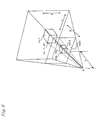
- the experience simulation system projects the object in the virtual three-dimensional space onto the projection screen Z2 which is set closer to the viewpoint than the projection screen Z1 onto which the system projects an object that moves slowly.
- the two objects, the object P and the object R which is more distant from the viewpoint along the z axis but which has the same coordinates X and Y as those of P, have moved toward the viewpoint 0 for the distance of M and that they have reached P and Q respectively.
- the new positions of the points on the projection screen Z2 are P2, Q2, and R2, and the movement distances of the objects P and R are DP2 and DR2.
- This enables our eyes to recognize a larger movement distance on the projection screen per unit time.
- an object whose movement distance per unit time is large (the movement speed is high) and who is out of the effective visual area can go into the effective visual area when the projection screen is closer to the viewpoint.
- the ineffective visual area becomes large as the projection screen is closer to the viewpoint, the player can recognize an object that moves a longer distance in the three-dimensional space.
- changing the projection screen from Z1 to Z2 changes the points P1, Q1, and R1 to P2, Q2, and R2 respectively, as shown in Fig. 2, while the distance between the viewpoint and the object P remains the same.
- the range of the virtual three-dimensional space projected on the projection screen Z2 becomes large, but each object in the space becomes smaller when projected.
- This makes the effective visual area on the projection screen Z2 smaller than that on the projection screen Z1. That is, the surrounding image becomes more difficult to recognize on the projection screen Z2 and, therefore, the surrounding landscape is displayed as if it was flowing, making the player feel the object moving faster.
- this embodiment makes the effective visual area smaller and makes the player feel the object moving faster, it projects a larger three-dimensional virtual space in a smaller effective visual area. This makes the player feel the object moving faster by a stricture of a visual field and makes the game more realistic.
- the visual angle 'a' to the projection screen is large, a larger part of the object 301 is displayed on the projection screen (B) which has a large visual angle than on the projection screen (A) which has a smaller visual angle, as shown in Fig. 3.
- a larger visual angle 'a' makes the object 301 look smaller on the projection screen (B) which has a larger visual angle than on the projection screen (A) which has a smaller visual angle.. This makes the player feel as if the object was in the distance. However, because it takes less for a fast-moving object to reach the object 301, the player feels as if the moving object was approaching the distant object more speedily.
- This change in the visual angle occurs while the moving object is moving in the three-dimensional space. Therefore, the player cannot distinguish between a change in the image that occurs when the moving object is approaching another object and a change in the image that is caused by the visual angle, thus making the player feel the speed increased more naturally.
- the invention may be embodied in other specific forms without departing from the spirit or essential characteristics thereof.
- the invention includes an embodiment, such as the one shown in Fig. 4, in which the distance between the viewpoint 0 and the projection screen Z is constant and the visual angle to the projection screen variable.
- This embodiment corresponds to claims 2, 5, and 7.
- Fig. 4 when a moving object moves slowly, a virtual three-dimensional space is projected on the projection screen Za, which has a small visual angle. It is then displayed on the image display means 300.
- a virtual three-dimensional space is projected on a projection screen Zb which is located in the same position as the projection screen Za but has a larger visual angle 'b'.
- the projected image data is then reduced and is drawn within the same display area on the image display means 300 as that used for a slow moving object.
- this method makes the range of the virtual three-dimensional space displayed on the image display means larger and the projected image of each object in the virtual three-dimensional space smaller, giving the same effect as that it gives when the distance from the viewpoint to the projection screen is changed.
- this invention combines the speed of the image of a moving object with an additional speed caused by a change in the visual angle to the projection screen, making the player feel the object moving faster or more slowly than it actually does at the virtual speed and making the game more realistic.
Landscapes
- Engineering & Computer Science (AREA)
- Multimedia (AREA)
- Theoretical Computer Science (AREA)
- Physics & Mathematics (AREA)
- General Physics & Mathematics (AREA)
- Educational Technology (AREA)
- Educational Administration (AREA)
- Business, Economics & Management (AREA)
- Computer Graphics (AREA)
- Aviation & Aerospace Engineering (AREA)
- Geometry (AREA)
- Computer Hardware Design (AREA)
- Human Computer Interaction (AREA)
- Processing Or Creating Images (AREA)
- Image Generation (AREA)
Claims (7)
- Bildverarbeitungsverfahren, mit den Schritten, einen virtuellen, dreidimensionalen Raum mit dreidimensionalen Objekten bereitzustellen, angeben eines virtuellen Standpunktes, welcher einem virtuellen, sich bewegenden Objekt zugeordnet ist, welches sich in dem virtuellen, dreidimensionalen Raum bewegt, bereitstellen eines virtuellen Projektions-Bildschirmes, auf welchen die von dem Standpunkt betrachteten Objekte in dem virtuellen Raum projiziert werden, und anzeigen des zweidimensionalen Projektionsbildes der dreidimensionalen Objekte, projiziert auf den Projektions-Bildschirm, auf einer Bildanzeigeeinrichtung, wobei der Blickfeldwinkel des Standpunktes auf den Projektions-Bildschirm entsprechend der Bewegungsgeschwindigkeit des virtuellen, sich bewegenden Objektes variiert, dadurch gekennzeichnet, dass, wenn sich das virtuelle, sich bewegende Objekt schneller bewegt, der Blickfeldwinkel auf den Projektions-Bildschirm größer wird, um zu ermöglichen, dass ein größerer Bereich des virtuellen, dreidimensionalen Raumes auf den Projektions-Bildschirm projiziert wird, und das zweidimensionale Projektionsbild des Projektions-Bildschirmes wird in einem Anzeigenbereich fester Größe auf der Bildanzeigeeinrichtung angezeigt.
- Bildverarbeitungsverfahren nach Anspruch 1, bei welchem der Blickfeldwinkel des Standpunktes auf den Projektions-Bildschirm entsprechend der Bewegungsgeschwindigkeit des virtuellen, sich bewegenden Objektes variiert, zum Vergrößern oder Verkleinern des Projektionsbereiches des auf den Projektions-Bildschirm zu projizierenden virtuellen, dreidimensionalen Raumes.
- Bildverarbeitungsverfahren nach Anspruch 1 oder 2, bei welchem jedes der dreidimensionalen Objekte aus einer Mehrzahl von Polygonen zusammengesetzt ist und, wenn die Polygon-Spitzen-Koordinaten (X, Y, Z) in dem Standpunkt-Koordinatensystem basierend auf dem Standpunkt in die zweidimensionalen Projektionsbild-Koordinaten (XS, YS) in dem Koordinatensystem auf dem Projektions-Bildschirm h beabstandet von dem Standpunkt umgewandelt werden, werden die Koordinaten (XS, YS) des zweidimensionalen Projektionsbildes unter Verwendung der unten angegebenen Formeln erhalten, wobei S die Bewegungsgeschwindigkeit des sich bewegenden Objektes ist, h ist die Distanz zwischen dem Standpunkt und dem Projektions-Bildschirm, H ist die Grund-Distanz zwischen dem für eine gegebene Bewegungsgeschwindigkeit S eingegebenen Standpunkt und dem Projektions-Bildschirm und d ist eine Änderungsgeschwindigkeit der Distanz h für die Bewegungsgeschwindigkeit S:
- Bildverarbeitungssystem, mit:dadurch gekennzeichnet, dass, wenn sich das virtuelle, sich bewegende Objekte schneller bewegt, der Blickfeldwinkel auf den Projektions-Bildschirm größer wird und ermöglicht, dass ein größerer Bereich des virtuellen, dreidimensionalen Raumes in den gleichen Bereich auf dem Projektions-Bildschirm projiziert wird.einer Koordinaten-Umwandlungseinheit, welche einen virtuellen, dreidimensionalen Raum bereitstellt, mit dreidimensionalen Objekten, und welche ein Standpunkt-Koordinatensystem angibt, basierend auf einem Standpunkt, der einem virtuellen, sich bewegenden Objekt zugeordnet ist, welches sich in dem virtuellen, dreidimensionalen Raum bewegt; undeiner Perspektiv-Umwandlungseinheit, welche das zweidimensionale Projektionsbild der Objekt-Bildanzeigeeinrichtung basierend auf der Distanz zwischen dem Standpunkt und dem Projektions-Bildschirm und den von der Koordinaten-Umwandlungseinheit ausgegebenen Koordinaten ausgibt, wobei die Perspektiv-Umwandlungseinheit die Distanz zwischen dem Standpunkt und dem Projektions-Bildschirm entsprechend der Bewegungsgeschwindigkeit des virtuellen, sich bewegenden Objektes variiert,
- System nach Anspruch 4, mit:wobei die Programm-Verarbeitungseinheit umfasst:einer Programm-Verarbeitungseinheit, welche ein Programm verarbeitet, welches ein sich bewegendes Objekt veranlasst, sich in einem virtuellen, dreidimensionalen Raum mit dreidimensionalen Objekten zu bewegen;eine Ablauf-Sektion, welche Informationen über die Bewegungsgeschwindigkeit des sich bewegenden Objektes in den virtuellen, dreidimensionalen Objekten, erzeugt durch die Programm-Verarbeitungseinheit, sendet, wird angezeigt,eine zentrale Verarbeitungseinheit;eine Mehrzahl von Speichern;die Koordinaten-Umwandlungseinheit; unddie Perspektiv-Umwandlungseinheit, wobei die Ablauf-Sektion Informationen über die Bewegungsgeschwindigkeit des sich bewegenden Objektes, welche die Distanz zwischen dem Standpunkt und dem Projektions-Bildschirm bestimmt, zu der Perspektiv-Umwandlungseinheit sendet und die Perspektiv-Umwandiungseinheit variiert die Distanz zwischen dem Standpunkt und dem Projektions-Bildschirm entsprechend der von der Ablauf-Sektion eingegebenen Bewegungsgeschwindigkeit des virtuellen, sich bewegenden Objektes.
- System nach Anspruch 5, bei welchem die Programm-Verarbeitungseinheit umfasst:in welchem die Perspektlv-Umwandlungseinheit das zweidimensionale Projektionsbild der Objekte basierend auf der Distanz zwischen dem Standpunkt und dem Projektions-Bildschirm und den von der Koordinaten-Umwandlungseinheit ausgegebenen Koordinaten zu dem Anzeige-Bildschirm auf der Bildanzeigeeinrichtung ausgibt.einen Speicher, mit einem Spielprogramm;einen Polygondaten-Speicher, mit Daten über eine Mehrzahl von Polygonen, welche ein dreidimensionales Objekt bilden;einen Polygon-Parameter-Speicher mit Parametern, welche durch die zentrale Verarbeitungseinheit zu verwenden sind, um die Polygondaten zu verarbeiten und die dreidimensionalen Objekte in dem virtuellen, dreidimensionalen Raum anzuordnen, undeine Koordinaten-Umwandlungseinheit, welche die Polygondaten der in dem virtuellen, dreidimensionalen Raum angeordneten dreidimensionalen Objekte in das auf dem Standpunkt basierende Standpunkt-Koordinatensystem umwandelt;
- System nach Anspruch 5, bei welchem, wenn die Perspektiv-Umwandlungseinheit die Spitzen-Koordinaten (X, Y, Z) jedes Polygons in dem Standpunkt-Koordinatensystem in die Spitzen-Koordinaten (XS, YS) eines auf dem h von dem Standpunkt beabstandeten Projektions-Bildschirm zu zeichnenden, zweidimensionalen Bildes umwandelt, die Spitzen-Koordinaten (XS, YS) des zweidimensionalen Bildes berechnet werden unter Verwendung von
Applications Claiming Priority (4)
| Application Number | Priority Date | Filing Date | Title |
|---|---|---|---|
| JP22378895A JP3635729B2 (ja) | 1995-08-31 | 1995-08-31 | 画像処理方法、画像処理装置および疑似体験装置 |
| JP223788/95 | 1995-08-31 | ||
| JP22378895 | 1995-08-31 | ||
| PCT/JP1996/001784 WO1997008657A1 (en) | 1995-08-31 | 1996-06-27 | Image processing method, image processor, and pseudo-experience device |
Publications (3)
| Publication Number | Publication Date |
|---|---|
| EP0790583A1 EP0790583A1 (de) | 1997-08-20 |
| EP0790583A4 EP0790583A4 (de) | 1997-12-29 |
| EP0790583B1 true EP0790583B1 (de) | 2002-08-21 |
Family
ID=16803728
Family Applications (1)
| Application Number | Title | Priority Date | Filing Date |
|---|---|---|---|
| EP96921106A Expired - Lifetime EP0790583B1 (de) | 1995-08-31 | 1996-06-27 | Bildverarbeitungsverfahren und bildprozessor |
Country Status (10)
| Country | Link |
|---|---|
| US (1) | US6404436B1 (de) |
| EP (1) | EP0790583B1 (de) |
| JP (1) | JP3635729B2 (de) |
| KR (1) | KR100280853B1 (de) |
| CN (1) | CN1157691C (de) |
| AU (1) | AU6242396A (de) |
| CA (1) | CA2204182C (de) |
| DE (1) | DE69623105T2 (de) |
| ES (1) | ES2179203T3 (de) |
| WO (1) | WO1997008657A1 (de) |
Families Citing this family (26)
| Publication number | Priority date | Publication date | Assignee | Title |
|---|---|---|---|---|
| JP3344555B2 (ja) | 1997-11-20 | 2002-11-11 | コナミ株式会社 | ビデオゲーム装置、ビデオゲームにおける画面表示制御方法及び画面表示制御プログラムが記録された記録媒体 |
| JP2001126085A (ja) * | 1999-08-16 | 2001-05-11 | Mitsubishi Electric Corp | 画像生成システム、画像表示システム、画像生成プログラムを記録したコンピュータ読み取り可能な記録媒体および画像生成方法 |
| JP3321570B2 (ja) | 1999-09-14 | 2002-09-03 | 株式会社ソニー・コンピュータエンタテインメント | 動画作成方法、記憶媒体およびプログラム実行装置 |
| JP3286633B2 (ja) | 1999-09-14 | 2002-05-27 | 株式会社ソニー・コンピュータエンタテインメント | 画像作成方法、記憶媒体およびプログラム実行装置 |
| JP2001155176A (ja) | 1999-09-14 | 2001-06-08 | Sony Computer Entertainment Inc | 画像作成方法、記憶媒体およびプログラム実行装置 |
| EP1125609A3 (de) | 2000-01-21 | 2005-03-30 | Sony Computer Entertainment Inc. | Unterhaltungsvorrichtung, Aufzeichungsmedium und Objektdarstellungsverfahren |
| US6670957B2 (en) * | 2000-01-21 | 2003-12-30 | Sony Computer Entertainment Inc. | Entertainment apparatus, storage medium and object display method |
| JP3843242B2 (ja) * | 2002-02-28 | 2006-11-08 | 株式会社バンダイナムコゲームス | プログラム、情報記憶媒体、およびゲーム装置 |
| US7117135B2 (en) * | 2002-05-14 | 2006-10-03 | Cae Inc. | System for providing a high-fidelity visual display coordinated with a full-scope simulation of a complex system and method of using same for training and practice |
| US8715058B2 (en) | 2002-08-06 | 2014-05-06 | Igt | Reel and video combination machine |
| JP4039676B2 (ja) * | 2004-03-31 | 2008-01-30 | 株式会社コナミデジタルエンタテインメント | 画像処理装置、画像処理方法及びプログラム |
| JP4560711B2 (ja) * | 2004-06-22 | 2010-10-13 | 株式会社セガ | 画像処理 |
| JP4487188B2 (ja) * | 2004-10-25 | 2010-06-23 | ソニー株式会社 | 情報処理装置および方法、プログラム、並びにナビゲーション装置 |
| JP4312737B2 (ja) * | 2005-05-13 | 2009-08-12 | 任天堂株式会社 | ゲームプログラムおよびゲーム装置 |
| JP2007047972A (ja) * | 2005-08-09 | 2007-02-22 | Ast J:Kk | 交通流シミュレーション装置 |
| US8357033B2 (en) | 2006-11-13 | 2013-01-22 | Igt | Realistic video reels |
| US8360847B2 (en) | 2006-11-13 | 2013-01-29 | Igt | Multimedia emulation of physical reel hardware in processor-based gaming machines |
| US8210922B2 (en) | 2006-11-13 | 2012-07-03 | Igt | Separable game graphics on a gaming machine |
| JP4521836B2 (ja) * | 2008-12-26 | 2010-08-11 | 株式会社バンダイナムコゲームス | ゲーム装置及び情報記憶媒体 |
| US8425316B2 (en) | 2010-08-03 | 2013-04-23 | Igt | Methods and systems for improving play of a bonus game on a gaming machine and improving security within a gaming establishment |
| CN102566752A (zh) * | 2010-11-06 | 2012-07-11 | 吴小平 | 一种模拟无穷远点像的仿真方法 |
| US20130057536A1 (en) * | 2011-09-02 | 2013-03-07 | Xiaoyun Li | Method for relieving eye strain using animation |
| CN111480342B (zh) * | 2017-12-01 | 2024-04-23 | 索尼公司 | 编码装置、编码方法、解码装置、解码方法和存储介质 |
| JP6407460B1 (ja) | 2018-02-16 | 2018-10-17 | キヤノン株式会社 | 画像処理装置、画像処理方法およびプログラム |
| CN112604282B (zh) * | 2020-12-25 | 2022-09-02 | 珠海金山数字网络科技有限公司 | 虚拟镜头控制方法及装置 |
| CN115634452A (zh) * | 2022-10-19 | 2023-01-24 | 网易(杭州)网络有限公司 | 游戏场景交互方法、装置、电子设备及存储介质 |
Family Cites Families (3)
| Publication number | Priority date | Publication date | Assignee | Title |
|---|---|---|---|---|
| JPH06301794A (ja) * | 1993-04-15 | 1994-10-28 | Matsushita Electric Ind Co Ltd | 3次元画像生成表示装置 |
| JPH0744735A (ja) * | 1993-08-02 | 1995-02-14 | Namco Ltd | 画像処理装置 |
| US6275236B1 (en) * | 1997-01-24 | 2001-08-14 | Compaq Computer Corporation | System and method for displaying tracked objects on a display device |
-
1995
- 1995-08-31 JP JP22378895A patent/JP3635729B2/ja not_active Expired - Lifetime
-
1996
- 1996-06-27 CA CA002204182A patent/CA2204182C/en not_active Expired - Fee Related
- 1996-06-27 EP EP96921106A patent/EP0790583B1/de not_active Expired - Lifetime
- 1996-06-27 ES ES96921106T patent/ES2179203T3/es not_active Expired - Lifetime
- 1996-06-27 AU AU62423/96A patent/AU6242396A/en not_active Abandoned
- 1996-06-27 KR KR1019970702843A patent/KR100280853B1/ko not_active Expired - Fee Related
- 1996-06-27 DE DE69623105T patent/DE69623105T2/de not_active Expired - Lifetime
- 1996-06-27 CN CNB961910097A patent/CN1157691C/zh not_active Expired - Fee Related
- 1996-06-27 WO PCT/JP1996/001784 patent/WO1997008657A1/ja not_active Ceased
- 1996-06-27 US US08/817,227 patent/US6404436B1/en not_active Expired - Lifetime
Also Published As
| Publication number | Publication date |
|---|---|
| EP0790583A1 (de) | 1997-08-20 |
| CN1164903A (zh) | 1997-11-12 |
| KR970707511A (ko) | 1997-12-01 |
| AU6242396A (en) | 1997-03-19 |
| JP3635729B2 (ja) | 2005-04-06 |
| DE69623105D1 (de) | 2002-09-26 |
| JPH0969169A (ja) | 1997-03-11 |
| MX9703200A (es) | 1997-07-31 |
| CN1157691C (zh) | 2004-07-14 |
| ES2179203T3 (es) | 2003-01-16 |
| WO1997008657A1 (en) | 1997-03-06 |
| CA2204182A1 (en) | 1997-03-06 |
| DE69623105T2 (de) | 2003-05-08 |
| CA2204182C (en) | 2001-08-07 |
| US6404436B1 (en) | 2002-06-11 |
| EP0790583A4 (de) | 1997-12-29 |
| KR100280853B1 (ko) | 2001-02-01 |
Similar Documents
| Publication | Publication Date | Title |
|---|---|---|
| US6404436B1 (en) | Image processing method, image processor, and pseudo-experience device | |
| JP2667656B2 (ja) | ドライビングゲーム機 | |
| EP0802508B1 (de) | Eingabegerät für bilderzeugungsverfahren und -gerät | |
| US5764232A (en) | Three-dimensional simulator apparatus and image synthesis method | |
| JP3056256B2 (ja) | 3次元シミュレータ装置及び画像合成方法 | |
| US5604848A (en) | Viewpoint setting apparatus for a computer graphics system for displaying three-dimensional models | |
| JPWO1995035139A1 (ja) | 3次元シミュレータ装置及び画像合成方法 | |
| US6142871A (en) | Apparatus, method and recorded programmed medium for simulating driving using mirrors displayed in a game space | |
| US6384834B1 (en) | Three-dimensional simulator apparatus and image synthesis method using texture computation and texture information storage | |
| JP3273729B2 (ja) | ドライビングゲーム機 | |
| US6336864B1 (en) | Game machine, method for checking hit and information storage medium | |
| KR100816622B1 (ko) | 화상 처리 장치 및 화상 처리 방법 | |
| JPH08276074A (ja) | ゲーム装置及びそのデータ処理方法 | |
| JPH11146978A (ja) | 3次元ゲーム装置及び情報記憶媒体 | |
| AU740459B2 (en) | Image processing method, image processing system and experience simulation system | |
| JP3783735B2 (ja) | 画像処理装置及びこれを備えたゲーム装置 | |
| JP3254091B2 (ja) | 3次元シミュレータ装置及び画像合成方法 | |
| JP2747427B2 (ja) | ゲーム装置及びその衝突判定方法 | |
| JPH08276070A (ja) | ゲーム装置 | |
| MXPA97003200A (en) | Image processing method, image processing system and virt reality system | |
| JP3179739B2 (ja) | ドライビングゲーム機及びドライビングゲームプログラムが格納された記録媒体 | |
| JP2001113040A (ja) | ゲーム装置、ゲーム画像生成方法および情報記憶媒体 | |
| JP3638669B2 (ja) | 画像合成方法及びゲーム装置 | |
| JPH11134515A (ja) | ゲーム装置及びゲーム画面合成方法 | |
| CN106377898A (zh) | 基于可视化编程的vr飞行游戏制作与体验系统 |
Legal Events
| Date | Code | Title | Description |
|---|---|---|---|
| PUAI | Public reference made under article 153(3) epc to a published international application that has entered the european phase |
Free format text: ORIGINAL CODE: 0009012 |
|
| 17P | Request for examination filed |
Effective date: 19970528 |
|
| AK | Designated contracting states |
Kind code of ref document: A1 Designated state(s): DE ES FR GB IT |
|
| A4 | Supplementary search report drawn up and despatched | ||
| AK | Designated contracting states |
Kind code of ref document: A4 Designated state(s): DE ES FR GB IT |
|
| 17Q | First examination report despatched |
Effective date: 20010516 |
|
| GRAG | Despatch of communication of intention to grant |
Free format text: ORIGINAL CODE: EPIDOS AGRA |
|
| RIC1 | Information provided on ipc code assigned before grant |
Free format text: 7G 06T 15/00 A, 7A 63F 13/06 B, 7G 09B 9/34 B, 7G 09B 9/058 B, 7G 06T 15/10 B |
|
| RTI1 | Title (correction) |
Free format text: IMAGE PROCESSING METHOD AND IMAGE PROCESSOR |
|
| GRAG | Despatch of communication of intention to grant |
Free format text: ORIGINAL CODE: EPIDOS AGRA |
|
| GRAH | Despatch of communication of intention to grant a patent |
Free format text: ORIGINAL CODE: EPIDOS IGRA |
|
| RIC1 | Information provided on ipc code assigned before grant |
Free format text: 7G 06T 15/00 A, 7A 63F 13/06 B, 7G 09B 9/34 B, 7G 09B 9/058 B, 7G 06T 15/10 B |
|
| RTI1 | Title (correction) |
Free format text: IMAGE PROCESSING METHOD AND IMAGE PROCESSOR |
|
| GRAH | Despatch of communication of intention to grant a patent |
Free format text: ORIGINAL CODE: EPIDOS IGRA |
|
| GRAA | (expected) grant |
Free format text: ORIGINAL CODE: 0009210 |
|
| AK | Designated contracting states |
Kind code of ref document: B1 Designated state(s): DE ES FR GB IT |
|
| REG | Reference to a national code |
Ref country code: GB Ref legal event code: FG4D |
|
| REF | Corresponds to: |
Ref document number: 69623105 Country of ref document: DE Date of ref document: 20020926 |
|
| RAP2 | Party data changed (patent owner data changed or rights of a patent transferred) |
Owner name: SEGA CORPORATION |
|
| ET | Fr: translation filed | ||
| REG | Reference to a national code |
Ref country code: ES Ref legal event code: FG2A Ref document number: 2179203 Country of ref document: ES Kind code of ref document: T3 |
|
| PLBE | No opposition filed within time limit |
Free format text: ORIGINAL CODE: 0009261 |
|
| STAA | Information on the status of an ep patent application or granted ep patent |
Free format text: STATUS: NO OPPOSITION FILED WITHIN TIME LIMIT |
|
| 26N | No opposition filed |
Effective date: 20030522 |
|
| PGFP | Annual fee paid to national office [announced via postgrant information from national office to epo] |
Ref country code: ES Payment date: 20120627 Year of fee payment: 17 Ref country code: IT Payment date: 20120628 Year of fee payment: 17 |
|
| PG25 | Lapsed in a contracting state [announced via postgrant information from national office to epo] |
Ref country code: IT Free format text: LAPSE BECAUSE OF NON-PAYMENT OF DUE FEES Effective date: 20130627 |
|
| REG | Reference to a national code |
Ref country code: ES Ref legal event code: FD2A Effective date: 20140707 |
|
| PGFP | Annual fee paid to national office [announced via postgrant information from national office to epo] |
Ref country code: GB Payment date: 20140618 Year of fee payment: 19 |
|
| PGFP | Annual fee paid to national office [announced via postgrant information from national office to epo] |
Ref country code: DE Payment date: 20140619 Year of fee payment: 19 |
|
| PG25 | Lapsed in a contracting state [announced via postgrant information from national office to epo] |
Ref country code: ES Free format text: LAPSE BECAUSE OF NON-PAYMENT OF DUE FEES Effective date: 20130628 |
|
| PGFP | Annual fee paid to national office [announced via postgrant information from national office to epo] |
Ref country code: FR Payment date: 20140619 Year of fee payment: 19 |
|
| REG | Reference to a national code |
Ref country code: DE Ref legal event code: R119 Ref document number: 69623105 Country of ref document: DE |
|
| GBPC | Gb: european patent ceased through non-payment of renewal fee |
Effective date: 20150627 |
|
| REG | Reference to a national code |
Ref country code: FR Ref legal event code: ST Effective date: 20160229 |
|
| PG25 | Lapsed in a contracting state [announced via postgrant information from national office to epo] |
Ref country code: DE Free format text: LAPSE BECAUSE OF NON-PAYMENT OF DUE FEES Effective date: 20160101 Ref country code: GB Free format text: LAPSE BECAUSE OF NON-PAYMENT OF DUE FEES Effective date: 20150627 |
|
| PG25 | Lapsed in a contracting state [announced via postgrant information from national office to epo] |
Ref country code: FR Free format text: LAPSE BECAUSE OF NON-PAYMENT OF DUE FEES Effective date: 20150630 |