EP0788872B1 - Dispositif et procédé pour la fabrication d'un moule de lentilles pour la fabrication de lentilles de contacts - Google Patents
Dispositif et procédé pour la fabrication d'un moule de lentilles pour la fabrication de lentilles de contacts Download PDFInfo
- Publication number
- EP0788872B1 EP0788872B1 EP97300782A EP97300782A EP0788872B1 EP 0788872 B1 EP0788872 B1 EP 0788872B1 EP 97300782 A EP97300782 A EP 97300782A EP 97300782 A EP97300782 A EP 97300782A EP 0788872 B1 EP0788872 B1 EP 0788872B1
- Authority
- EP
- European Patent Office
- Prior art keywords
- gate
- mold cavity
- lens
- polymer
- approximately
- Prior art date
- Legal status (The legal status is an assumption and is not a legal conclusion. Google has not performed a legal analysis and makes no representation as to the accuracy of the status listed.)
- Expired - Lifetime
Links
- 238000004519 manufacturing process Methods 0.000 title claims abstract description 24
- 229920000642 polymer Polymers 0.000 claims abstract description 47
- 238000000034 method Methods 0.000 claims abstract description 22
- 230000003287 optical effect Effects 0.000 claims abstract description 9
- 230000015572 biosynthetic process Effects 0.000 claims abstract description 6
- 239000000523 sample Substances 0.000 claims description 25
- 239000007788 liquid Substances 0.000 claims description 17
- 238000001746 injection moulding Methods 0.000 claims description 12
- 238000002347 injection Methods 0.000 claims description 11
- 239000007924 injection Substances 0.000 claims description 11
- 230000036961 partial effect Effects 0.000 claims description 5
- 239000004743 Polypropylene Substances 0.000 claims description 4
- -1 polypropylene Polymers 0.000 claims description 4
- 229920001155 polypropylene Polymers 0.000 claims description 4
- 230000004323 axial length Effects 0.000 claims description 2
- 239000002861 polymer material Substances 0.000 claims 1
- 238000005516 engineering process Methods 0.000 abstract description 4
- 239000000155 melt Substances 0.000 abstract description 3
- 238000005259 measurement Methods 0.000 description 4
- 239000004033 plastic Substances 0.000 description 3
- 206010065553 Bone marrow failure Diseases 0.000 description 2
- 208000015943 Coeliac disease Diseases 0.000 description 2
- PXHVJJICTQNCMI-UHFFFAOYSA-N Nickel Chemical compound [Ni] PXHVJJICTQNCMI-UHFFFAOYSA-N 0.000 description 2
- 239000004793 Polystyrene Substances 0.000 description 2
- 239000000463 material Substances 0.000 description 2
- 230000013011 mating Effects 0.000 description 2
- 238000000465 moulding Methods 0.000 description 2
- 229920002223 polystyrene Polymers 0.000 description 2
- 229920001169 thermoplastic Polymers 0.000 description 2
- 229910001369 Brass Inorganic materials 0.000 description 1
- 230000002411 adverse Effects 0.000 description 1
- 230000004075 alteration Effects 0.000 description 1
- QVGXLLKOCUKJST-UHFFFAOYSA-N atomic oxygen Chemical compound [O] QVGXLLKOCUKJST-UHFFFAOYSA-N 0.000 description 1
- 230000005540 biological transmission Effects 0.000 description 1
- 239000010951 brass Substances 0.000 description 1
- 230000003247 decreasing effect Effects 0.000 description 1
- 229910052759 nickel Inorganic materials 0.000 description 1
- 229910052760 oxygen Inorganic materials 0.000 description 1
- 239000001301 oxygen Substances 0.000 description 1
- 230000002093 peripheral effect Effects 0.000 description 1
- 230000000704 physical effect Effects 0.000 description 1
- 230000002829 reductive effect Effects 0.000 description 1
- 230000002441 reversible effect Effects 0.000 description 1
- 229910001220 stainless steel Inorganic materials 0.000 description 1
- 239000010935 stainless steel Substances 0.000 description 1
- 238000006467 substitution reaction Methods 0.000 description 1
- 239000012815 thermoplastic material Substances 0.000 description 1
- 239000004416 thermosoftening plastic Substances 0.000 description 1
- 239000002699 waste material Substances 0.000 description 1
Images

Classifications
-
- B—PERFORMING OPERATIONS; TRANSPORTING
- B29—WORKING OF PLASTICS; WORKING OF SUBSTANCES IN A PLASTIC STATE IN GENERAL
- B29D—PRODUCING PARTICULAR ARTICLES FROM PLASTICS OR FROM SUBSTANCES IN A PLASTIC STATE
- B29D11/00—Producing optical elements, e.g. lenses or prisms
- B29D11/00009—Production of simple or compound lenses
- B29D11/0048—Moulds for lenses
-
- B—PERFORMING OPERATIONS; TRANSPORTING
- B29—WORKING OF PLASTICS; WORKING OF SUBSTANCES IN A PLASTIC STATE IN GENERAL
- B29C—SHAPING OR JOINING OF PLASTICS; SHAPING OF MATERIAL IN A PLASTIC STATE, NOT OTHERWISE PROVIDED FOR; AFTER-TREATMENT OF THE SHAPED PRODUCTS, e.g. REPAIRING
- B29C33/00—Moulds or cores; Details thereof or accessories therefor
- B29C33/0077—Moulds or cores; Details thereof or accessories therefor characterised by the configuration of the mould filling gate ; accessories for connecting the mould filling gate with the filling spout
-
- B—PERFORMING OPERATIONS; TRANSPORTING
- B29—WORKING OF PLASTICS; WORKING OF SUBSTANCES IN A PLASTIC STATE IN GENERAL
- B29C—SHAPING OR JOINING OF PLASTICS; SHAPING OF MATERIAL IN A PLASTIC STATE, NOT OTHERWISE PROVIDED FOR; AFTER-TREATMENT OF THE SHAPED PRODUCTS, e.g. REPAIRING
- B29C45/00—Injection moulding, i.e. forcing the required volume of moulding material through a nozzle into a closed mould; Apparatus therefor
- B29C45/17—Component parts, details or accessories; Auxiliary operations
- B29C45/26—Moulds
-
- B—PERFORMING OPERATIONS; TRANSPORTING
- B29—WORKING OF PLASTICS; WORKING OF SUBSTANCES IN A PLASTIC STATE IN GENERAL
- B29C—SHAPING OR JOINING OF PLASTICS; SHAPING OF MATERIAL IN A PLASTIC STATE, NOT OTHERWISE PROVIDED FOR; AFTER-TREATMENT OF THE SHAPED PRODUCTS, e.g. REPAIRING
- B29C45/00—Injection moulding, i.e. forcing the required volume of moulding material through a nozzle into a closed mould; Apparatus therefor
- B29C45/17—Component parts, details or accessories; Auxiliary operations
- B29C45/26—Moulds
- B29C45/27—Sprue channels ; Runner channels or runner nozzles
-
- B—PERFORMING OPERATIONS; TRANSPORTING
- B29—WORKING OF PLASTICS; WORKING OF SUBSTANCES IN A PLASTIC STATE IN GENERAL
- B29D—PRODUCING PARTICULAR ARTICLES FROM PLASTICS OR FROM SUBSTANCES IN A PLASTIC STATE
- B29D11/00—Producing optical elements, e.g. lenses or prisms
- B29D11/00009—Production of simple or compound lenses
- B29D11/00038—Production of contact lenses
- B29D11/00125—Auxiliary operations, e.g. removing oxygen from the mould, conveying moulds from a storage to the production line in an inert atmosphere
-
- B—PERFORMING OPERATIONS; TRANSPORTING
- B29—WORKING OF PLASTICS; WORKING OF SUBSTANCES IN A PLASTIC STATE IN GENERAL
- B29C—SHAPING OR JOINING OF PLASTICS; SHAPING OF MATERIAL IN A PLASTIC STATE, NOT OTHERWISE PROVIDED FOR; AFTER-TREATMENT OF THE SHAPED PRODUCTS, e.g. REPAIRING
- B29C45/00—Injection moulding, i.e. forcing the required volume of moulding material through a nozzle into a closed mould; Apparatus therefor
- B29C45/0025—Preventing defects on the moulded article, e.g. weld lines, shrinkage marks
- B29C2045/0027—Gate or gate mark locations
- B29C2045/0029—Gate or gate mark locations gates on the central optical axis of lenses
-
- B—PERFORMING OPERATIONS; TRANSPORTING
- B29—WORKING OF PLASTICS; WORKING OF SUBSTANCES IN A PLASTIC STATE IN GENERAL
- B29L—INDEXING SCHEME ASSOCIATED WITH SUBCLASS B29C, RELATING TO PARTICULAR ARTICLES
- B29L2011/00—Optical elements, e.g. lenses, prisms
- B29L2011/0016—Lenses
-
- Y—GENERAL TAGGING OF NEW TECHNOLOGICAL DEVELOPMENTS; GENERAL TAGGING OF CROSS-SECTIONAL TECHNOLOGIES SPANNING OVER SEVERAL SECTIONS OF THE IPC; TECHNICAL SUBJECTS COVERED BY FORMER USPC CROSS-REFERENCE ART COLLECTIONS [XRACs] AND DIGESTS
- Y10—TECHNICAL SUBJECTS COVERED BY FORMER USPC
- Y10S—TECHNICAL SUBJECTS COVERED BY FORMER USPC CROSS-REFERENCE ART COLLECTIONS [XRACs] AND DIGESTS
- Y10S425/00—Plastic article or earthenware shaping or treating: apparatus
- Y10S425/808—Lens mold
Definitions
- This invention relates generally to improved high precision lens molds for use in the manufacture of very thin contact lenses and to the method and apparatus for making the improved lens mold.
- Lens molds are usually produced in matched pairs from thermoplastics and the combination of matched pairs forms the mold cavity to define the optical contact lens. More particularly, the invention relates to precision lens molds made by filling a mold cavity through a center gate on the central axis of the mold cavity rather than through a side gate on the edge of the mold cavity.
- optical contact lenses are typically manufactured by dosing a UV curable polymer into a concave front, or optical, curve lens mold and mating a convex back or base curve lens mold onto the front lens mold to create a filled mold cavity.
- the front lens mold and base lens mold are injection molded from a thermoplastic polymer, such as polystyrene. Standard practice is to form the front and back lens molds by injecting the liquid polymer into a closed mold through a side gate along the edge of the closed mold cavity, with a corresponding outlet gate positioned on the opposite side of the closed mold cavity.
- the liquid polymer enters the edge of the cavity and flows across the cavity to completely fill it.
- This side gate method for formation of a circular spherical part leads to a lack of precision from non-uniform, asymmetric flow and non-uniform plastic shrinkage in different directions with respect to radius. dimensional instability, surface radius irregularity, flatness, roundness and especially knife edge radius uniformity.
- the lack of knife edge uniformity subsequently leads to misalignment, known as decentration or tilt, when the base lens mold is joined to the front lens mold in the manufacture of the actual contact lens. Tilt adversely affects the lens center thickness and the resulting contact lens is not within acceptable tolerance values and must be rejected.
- the percentage loss of contact lenses can be maintained within acceptable levels since the tolerances are relatively large for lenses with thicknesses of 70 to 230 microns or more.
- Such lenses require a lens center thickness tolerance in the range of only +/-5 microns.
- Such a precise thin lens cannot be consistently manufactured using lens molds produced from present side gate methodology, the irregularities resulting in the lens molds from asymmetrical polymer flow across the curved mold cavity being well outside the small tolerance ranges for various measurement parameters.
- center gating has not been considered possible for production of mold curves used to make precision optical lenses because of the inherent flow disturbances and sink mark aberrations occurring near the gate location, which in the case of the lens mold is an extremely critical area. Additionally, since the center gate must by necessity be on the non-critical side of the lens mold, the injection molding processing would be more difficult due to the reduced amount of polymer subjected to proper melt pressure. It has been found however that such problems can be overcome and that a lens mold within precise tolerances can be manufactured using center gate methodology.
- the use of center gating for delivering liquid polymer into a circular spherical mold cavity as herein described better ensures uniform filling of the cavity because of axisymmetric flow, which results in more uniform shrinkage and therefore improved physical properties of the resulting lens mold.
- the invention is an apparatus and method of manufacturing lens molds for the production of optical contact lenses, the lens mold being center gated at the central axis, as well as the resulting lens molds formed by this process.
- the lens molds are manufactured of a thermoplastic material, which may be either crystalline or non-crystalline due to the axisymmetrical nature of the lens mold configuration.
- the lens mold has a circular perimeter formed by a flat annular flange which surrounds and extends from a spherical central portion having a convex side and a concave side.
- One side of each lens mold, the concave side for a front lens mold and the convex side for a back or base lens mold, is defined as the critical side and must pass extremely tight tolerance parameters.
- the lens molds are typically between approximately 0.8 to 1.0 mm thick, the molding cavity being formed by a mated core member and an insert member, the insert member forming the critical side of the part and being manufactured to extremely high tolerances of less than 1 micron.
- a center gate is located in the core member at the central axis of the mold cavity, the gate comprising a tubular conduit between approximately 0.8 to 1.2 mm in length and from approximately 0.5 to 1.2 mm in diameter, with a slight flaring of approximately 2 degrees, the diameter of the gate being slightly larger at the exit end adjacent the mold cavity than at the gate entrance.
- the edge at the juncture of the gate and the mold cavity is chamfered or radiused.
- the core member expands and enlarges backward in a conical, bell-shaped or flared manner beginning at the entrance of the gate to form a reserve area to receive any excess liquid polymer after the mold cavity has been filled and to provide space to receive the liquid polymer delivery means.
- the polymer delivery means is comprised of a polymer delivery probe or nozzle configured with a tapering nose, having a delivery conduit of between approximately 0.5 to 1.2 mm in diameter, and is positioned with its tip between approximately 0.5 to 1.3 mm from the entrance of the gate.
- the probe and insert member are composed of a material having high heat conductivity and the polymer dosing is performed using high precision injection molding equipment.
- the lens mold produced by the apparatus is extremely precise due to axisymmetrical flow and shrinkage, having measurable critical values with much smaller deviation than the deviation of similar values in lens molds produced with side gated technology.
- Figure 1 is a cross-sectional detail view of the critical area of the injection molding apparatus for production of a front lens mold.
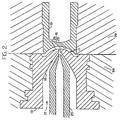
- Figure 2 is a cross-sectional detail view of the critical area of the injection molding apparatus for production of a back lens mold.
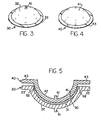
- Figure 3 is a perspective view of a front lens mold.
- Figure 4 is a perspective view of a base lens mold.
- Figure 5 is a cross-sectional view of a contact lens as formed within the mold cavity created by combining a front lens mold and a base lens mold produced according to the invention.
- FIGS 1 and 2 are details illustrating the critical portion of a melt delivery apparatus in the vicinity of the mold cavity, the melt delivery apparatus being a precision injection molding apparatus for delivering molten polymer into a mold cavity under heat and pressure for formation of a plastic part, in this case a lens mold for subsequent use in the manufacture of a contact lens.
- FIG 1 illustrates the apparatus for production of a front lens mold 30, shown in Figure 3, under the methodology of the invention.
- the front lens mold 30 is configured as a partially spherical object with a concave side 31 and a convex side 32, defined in general as a portion of a sphere sliced by an imaginary plane to provide a generally circular perimeter.
- An annular. generally planar flange 33 surrounds and extends from the partial spherical portion around the circular perimeter.
- a mold cavity 11 is created by mating a front curve insert 12 and a core member 13 within separable mold block halves 98 and 99.
- the mold cavity 11 is configured as a portion of a sphere having a convex side 14 and a concave side 15, with a peripheral portion to form the annular flange 33 of the front lens mold 30 centered on the central axis.
- the front curve insert 12 is a precisely machined member fixed within the mold block back half 99 of the injection molding apparatus, the convex surface 14 of the front curve insert 12 forming the curved mold wall for the critical concave side 31 of the front lens mold 30 to be produced.
- the front curve insert 12 may be of the standard multi-part stacked assembly requiring one or more shims or bushings for proper alignment, but is preferably constructed as a unitary member precisely machined to provide correct alignment and positioning relative to the core member 13.
- the core member 13 is a member fixedly inserted within the mold block front half 98 of the injection molding apparatus.
- the forward concave surface 15 of the core member 13 forms the curved mold wall for the non-critical side 32 of the mold cavity 11.
- center gate 16 Coaxially positioned on the central axis of the spherical concave surface 15 is center gate 16.
- generally circular in cross-section which comprises a gate exit 51 having a radiused or chamfered edge 52 along the juncture between the gate 16 and the concave surface 15 of the mold cavity 15, a slightly tapered channel 53 and a gate entrance 54 for receiving the liquid polymer, the channel 53 increasing in diameter at the rate of approximately 2 degrees from the gate entrance 54 to the gate exit 51.
- a polymer receiving reservoir 17 formed by a conical wall 18 which adjoins the entrance 54.
- Conical wall 18 is preferably formed at an angle of approximately 45 degrees to the central axis.
- the polymer receiving reservoir 17 is constructed to receive excess liquid polymer when the center gate 16 and the mold cavity 11 are completely filled during the injection step, and also provides the access means for positioning of the polymer injection probe or nozzle 20 which delivers the liquid polymer under heat and pressure to the center gate 16 and the mold cavity 11.
- the injection probe 20 has a tapered nose 21 having a conical wall 22 and ending in a probe tip 23 containing a cylindrical delivery conduit 24.
- the probe wall 22 and the polymer reservoir wall 18 are substantially parallel or increasingly separated in the direction away from the center gate 16 in order to create a non-restricting flow channel for the excess polymer.
- the probe wall 22 is configured at a 30 degree angle off the central axis.
- the probe 20 is connected to the general liquid polymer delivery means of the injection molding apparatus.
- the probe 20 and front curve insert 12 are composed of high strength, high heat conductivity materials, such as nickel coated brass or stainless steel.
- the dimensions of the various components are critical, as is the relationship between the dimensions of the components.
- the internal diameter of the center gate 16 should be between approximately 0.6 to 1.2 mm, with a preferred diameter of approximately 0.75 mm, and the axial length of the channel 53 should be between approximately 0.8 to 1.2 mm, with a preferred length of approximately 1.0 mm.
- Increasing the center gate 16 diameter to greater than 1.2 mm results in unacceptable enlargement of the sink mark depression on the critical side 31 of the front lens mold 30. Decreasing the diameter of the center gate 16 reduces the sink mark depression, but the diameter must be kept greater than approximately 0.6 mm to insure sufficient flow volume to completely fill the mold cavity 15.
- the internal diameter of the delivery conduit 24 of the probe 20 should be generally equal to or greater than the diameter of the entrance 54 of the center gate 16.
- the internal diameter of the delivery conduit 24 is preferably 1.0 mm.
- the distance between the probe tip 23 and the entrance 54 of the center gate 16 is very critical to insure proper flow into the mold cavity 16, the precise distance being dictated by the dimensions of the center gate and the polymer flow characteristics.
- the distance from probe tip 23 to center gate entrance 54 is between approximately 0.8 to 1.3 mm, and is preferably approximately 1.06 mm in the heated state for the front lens mold.
- the overall apparatus is very similar to that described above, with the required change in the configuration of the mold cavity 15 as shown in Figure 2, such that the polymer flow direction is reversed within the mold cavity 15 instead of being a continually forward flow as in the mold cavity 15 for the front lens mold 30.
- the back lens mold 40 has a convex side 41, a concave side 42 and an annular flange 43.
- the back curve insert 19 member has a concave surface 25 which becomes the mold wall for the critical convex side 41 of the base curve mold 40.
- the core member 13 is now configured such that the cavity end has a convex surface 26 to form the non-critical concave side 42 of the base lens mold 40.
- the mold cavity 15 for a base lens mold 40 is typically approximately 0.8 mm in thickness.
- the dimensions and spatial relationship for the center gate 16 and probe 20 are adjusted due to the reverse flow required to fill the mold cavity 15 of the base lens mold 40.
- the center gate 16 diameter is smaller, being between approximately 0.5 to 1.0 mm, and preferably approximately 0.6 mm.
- the internal wall 18 of the polymer receiving reservoir 17 is radiused rather than planar, and the conical wall 22 of the injection probe 20 is narrower, angled at approximately 22.5 degrees off the central axis.
- the delivery conduit 24 is also smaller, being sized at approximately 0.8 mm for a 0.6 mm center gate 16.
- the distance between the probe tip 23 and the center gate entrance 54 is between approximately 0.5 to 1.0 mm, and preferably approximately 0.72 mm in the heated state.
- the injection molding apparatus is assembled with the components set forth above. Processing parameters are determined by the particular characteristics of the polymer being utilized.
- polystyrene a polymer commonly used in the formation of lens molds
- the probe 20 is heated to approximately 300°C (570 degrees F) and the core member 13 and curve insert 12 or 19 is heated to approximately 66°C (150 degrees F).
- peak pressure is preferably approximately 124 MN/m 2 (18,000 psi) and hold pressure is maintained at approximately 41 MN/m 2 (6,000 psi). Cure time is between approximately 6 and 10 seconds.
- polypropylene is not suitable for use with side gated technology because its highly directional shrinkage results in unacceptable variations in the finished product.
- the temperatures are slightly lower - the probe 20 being maintained at approximately 216°C (420 degrees F) and the core member 13 and curve insert 12 or 19 being maintained at approximately 54°C (130 degrees F).
- the polymer is dosed in a predetermined volume to insure complete fill of the mold cavity 15. with excess polymer flowing into the receiving recess 17.
- the resulting front lens mold 30 and base lens mold 40 produced by this methodology are shown in Figures 3, 4 and 5.
- the lens molds 30 and 40 separate from the waste material adjacent the entrance 54 of the center gate 16. such that a sprue 61 of cured polymer extends from the non-critical sides 32 and 42 of each of the front lens mold 30 and base lens mold 40. Because the molding of the contact lens 90 occurs between the critical sides 31 and 41, the sprues 61 do not interfere. Since production of contact lenses with center of lens thicknesses in the range of 50 microns requires tolerances at most of +/-5 microns, there are a number of critical areas on the lens molds 30 and 40 which must be maintained within precise parameters. Of particular importance are the surface and edge characteristics of the critical sides 31 and 41.
- a front lens mold 30 and a base lens mold 40 are produced according to the process set out above.
- the apparatus is constructed such that multiple lens molds are produced simultaneously.
- the front lens mold 30 is then placed in a holding fixture and dosed with a UV-polymerizable polymer of a type well-known in the art.
- the base lens mold 40 is then combined with the front lens mold 30 as shown in Figure 5 to create the mold cavity of correct shape. Pressure is applied to the base lens mold 40 to properly seat and maintain it in correct alignment with front lens mold 30, and the liquid polymer is exposed to UV energy to cure the polymer. After curing, the mold cavity is opened and the cured polymer contact lens 90 is removed for subsequent processing.
Landscapes
- Engineering & Computer Science (AREA)
- Mechanical Engineering (AREA)
- Manufacturing & Machinery (AREA)
- Health & Medical Sciences (AREA)
- Ophthalmology & Optometry (AREA)
- Moulds For Moulding Plastics Or The Like (AREA)
- Eyeglasses (AREA)
- Casting Or Compression Moulding Of Plastics Or The Like (AREA)
Claims (13)
- Appareil destiné à être utilisé dans un dispositif de moulage par injection pour la fabrication de moules de lentilles (30) utilisés pour la formation de lentilles de contact optiques, ledit appareil comprenant :(A) un élément d'insertion courbe (12) et un élément de noyau (13) adaptés pour former en combinaison une cavité de moule ayant un axe central, caractérisé en ce que ladite cavité de moule est configurée comme une sphère partielle avec une bride annulaire généralement plane fixée à et s'étendant depuis ladite sphère partielle, ledit élément de noyau (13) comprend une porte centrale (16) alignée sur ledit axe central et en ce que l'appareil comprend :(B) des moyens pour injecter un polymère liquide à travers ladite porte centrale (16) le long dudit axe central et dans ladite cavité de moule.
- Appareil selon la revendication 1, où lesdits moyens pour injecter un polymère liquide comprennent une sonde d'injection de polymère (20) constituée d'un nez effilé (21), une paroi conique (22), une conduite de fourniture (24) et une pointe de sonde (23).
- Appareil selon la revendication 2, où ladite porte centrale (16) comprend une entrée de porte (54) et ladite pointe de sonde (23) est séparée d'une certaine distance de ladite entrée de porte (54).
- Appareil selon la revendication 3, où ladite pointe de sonde (23) est positionnée approximativement de 0,5 à 1,3 mm par rapport à ladite entrée de porte (54).
- Appareil selon l'une quelconque des revendications 1 à 4, où ladite porte centrale (16) comprend un canal effilé (53).
- Appareil selon l'une quelconque des revendications 1 à 4, où ladite porte centrale (16) comprend une sortie de porte (51) ayant un bord chanfreiné (52).
- Appareil selon l'une quelconque des revendications 1 à 6, où ladite porte centrale (16) a un diamètre approximativement de 0,5 à 1,2 millimètres.
- Appareil selon l'une quelconque des revendications 1 à 8, où ladite porte centrale (16) a une longueur axiale approximativement de 0,8 à 1,2 millimètres.
- Procédé de fabrication d'un moule de lentille (30) pour produire des lentilles de contact optiques, le procédé comprenant les étapes consistant à fournir un appareil de moulage par injection, selon l'une quelconque des revendications précédentes, capable de fournir un polymère liquide dans une cavité de moule ayant un axe central, caractérisé en ce que ladite cavité de moule est configurée comme une sphère partielle avec une bride annulaire généralement plane fixée à et s'étendant depuis ladite sphère partielle, de fournir un élément d'insertion courbe (12) et un élément de noyau (13) dans ledit appareil de moulage par injection, qui forment en combinaison ladite cavité de moule et de fournir un matériau polymère liquide dans la cavité de moule formée, ledit élément de noyau comporte une porte centrale (16) alignée sur ledit axe central.
- Procédé selon la revendication 9, comprenant en outre l'étape consistant à fournir une sonde d'injection de polymère (20) et positionner ladite sonde d'injection de polymère (20) de façon à être séparée de ladite porte centrale (16).
- Procédé selon la revendication 10, comprenant en outre l'étape consistant à munir ladite porte centrale (16) d'une entrée de porte (54), d'un canal et d'une sortie de porte (51), où ladite porte centrale (16) a une longueur approximativement de 1,0 mm et un diamètre compris approximativement entre 0,7 et 1,0 mm.
- Procédé selon la revendication 11, où ladite sonde d'injection de polymère (20) est positionnée approximativement à 0,7 mm de ladite entrée de porte (54).
- Procédé selon l'une quelconque des revendications 9 à 12, où ladite étape de fourniture de polymère liquide comprend la fourniture d'un polymère cristallin, tel que du polypropylène.
Applications Claiming Priority (2)
| Application Number | Priority Date | Filing Date | Title |
|---|---|---|---|
| US08/598,883 US5716540A (en) | 1996-02-09 | 1996-02-09 | Apparatus and method for producing center gated lens molds for contact lens manufacture |
| US598883 | 1996-02-09 |
Publications (3)
| Publication Number | Publication Date |
|---|---|
| EP0788872A2 EP0788872A2 (fr) | 1997-08-13 |
| EP0788872A3 EP0788872A3 (fr) | 1997-10-15 |
| EP0788872B1 true EP0788872B1 (fr) | 2002-06-05 |
Family
ID=24397314
Family Applications (1)
| Application Number | Title | Priority Date | Filing Date |
|---|---|---|---|
| EP97300782A Expired - Lifetime EP0788872B1 (fr) | 1996-02-09 | 1997-02-07 | Dispositif et procédé pour la fabrication d'un moule de lentilles pour la fabrication de lentilles de contacts |
Country Status (9)
| Country | Link |
|---|---|
| US (1) | US5716540A (fr) |
| EP (1) | EP0788872B1 (fr) |
| JP (1) | JPH09327845A (fr) |
| AT (1) | ATE218436T1 (fr) |
| AU (1) | AU699549B2 (fr) |
| CA (1) | CA2196962C (fr) |
| DE (1) | DE69712934T2 (fr) |
| SG (1) | SG106030A1 (fr) |
| TW (1) | TW552191B (fr) |
Cited By (3)
| Publication number | Priority date | Publication date | Assignee | Title |
|---|---|---|---|---|
| US9904074B2 (en) | 2010-04-13 | 2018-02-27 | Johnson & Johnson Vision Care, Inc. | Pupil-only photochromic contact lenses displaying desirable optics and comfort |
| US10894374B2 (en) | 2010-04-13 | 2021-01-19 | Johnson & Johnson Vision Care, Inc. | Process for manufacture of a thermochromic contact lens material |
| US11724471B2 (en) | 2019-03-28 | 2023-08-15 | Johnson & Johnson Vision Care, Inc. | Methods for the manufacture of photoabsorbing contact lenses and photoabsorbing contact lenses produced thereby |
Families Citing this family (28)
| Publication number | Priority date | Publication date | Assignee | Title |
|---|---|---|---|---|
| WO1997026124A1 (fr) * | 1996-01-18 | 1997-07-24 | Hoya Corporation | Procede de fabrication de verres, moule pour moulage par injection de verres, et verres moules |
| US6432511B1 (en) * | 1997-06-06 | 2002-08-13 | International Business Machines Corp. | Thermoplastic adhesive preform for heat sink attachment |
| KR100561502B1 (ko) * | 1997-06-30 | 2006-03-17 | 바슈 앤드 롬 인코포레이티드 | 콘택트 렌즈 몰드 및 그것의 사출 성형용 조립체와 사출성형 방법 |
| US6592356B1 (en) | 1999-05-05 | 2003-07-15 | Johnson & Johnson Vision Care, Inc. | Mold, molding system and molding machine for making ophthalmic devices |
| WO2001015883A1 (fr) * | 1999-09-01 | 2001-03-08 | Tomey Corporation | Procede et dispositif de production d'elements de lentilles de contact, et moule a preforme utilise pour former lesdits elements |
| JP4166397B2 (ja) * | 2000-01-13 | 2008-10-15 | アルプス電気株式会社 | 光学部材の製造方法 |
| IT1317239B1 (it) * | 2000-04-13 | 2003-05-27 | Andrea Fallini | Metodo e apparecchiatura per la realizzazione di lenti spesse inmateriale plastico. |
| US6708397B2 (en) * | 2001-08-09 | 2004-03-23 | Johnson & Johnson Vision Care, Inc. | Inlay station with alignment assemblies and transfer tubes |
| US6976639B2 (en) * | 2001-10-29 | 2005-12-20 | Edc Biosystems, Inc. | Apparatus and method for droplet steering |
| JP2003287604A (ja) * | 2002-03-27 | 2003-10-10 | Japan Science & Technology Corp | 光学レンズの製造方法および光ファイバコネクタの製造方法 |
| JP2006058850A (ja) * | 2004-07-22 | 2006-03-02 | Alps Electric Co Ltd | 光学レンズ及びその製造方法 |
| US7499220B2 (en) * | 2003-08-08 | 2009-03-03 | Alps Electric Co., Ltd. | Optical lens and method of manufacturing the same |
| US7278173B2 (en) | 2004-04-08 | 2007-10-09 | Nike, Inc. | Adjustable baseball cap |
| US7585167B2 (en) * | 2004-12-30 | 2009-09-08 | Bausch + Lomb Incorporated | Core locking assembly and method for orientation of asymmetric tooling |
| US20060145372A1 (en) * | 2004-12-30 | 2006-07-06 | Jones Thomas G | Optical tool assembly for improved RCW and lens edge formation |
| US7704069B2 (en) * | 2005-12-20 | 2010-04-27 | R&D Tool & Engineering Co. | Injection molding apparatus having swiveling nozzles |
| US7771189B2 (en) * | 2008-03-03 | 2010-08-10 | R&D Tool & Engineering Co. | Injection molding apparatus with replaceable gate insert |
| CN101618589B (zh) * | 2008-06-30 | 2012-09-19 | 鸿富锦精密工业(深圳)有限公司 | 镜片模具 |
| NL2006921C2 (nl) * | 2011-06-09 | 2012-12-11 | Innovalens B V | Gietmal voor het vervaardigen van contactlenzen of intra-oculaire lenzen. |
| US9283718B2 (en) | 2012-05-25 | 2016-03-15 | Johnson & Johnson Vision Care, Inc. | Reduced-tilt back plastic feature for a contact lens mold |
| EP3043988A1 (fr) * | 2013-09-11 | 2016-07-20 | Novartis AG | Dispositif de préhension d'une lentille de contact et procédé de transport d'une lentille de contact |
| JP6050801B2 (ja) * | 2014-10-30 | 2016-12-21 | 双葉電子工業株式会社 | バルブゲート装置及び射出成形用金型 |
| US10029402B2 (en) | 2014-12-19 | 2018-07-24 | Coopervision International Holding Company, Lp | Method and apparatus for manufacturing contact lenses |
| US9937640B2 (en) | 2014-12-19 | 2018-04-10 | Coopervision International Holding Company, Lp | Apparatus and method for closure of ophthalmic lens molds |
| US10137612B2 (en) | 2014-12-19 | 2018-11-27 | Coopervision International Holding Company, Lp | Methods and apparatus for manufacture of ophthalmic lenses |
| US9938034B2 (en) | 2014-12-19 | 2018-04-10 | Coopervision International Holding Company, Lp | Method and apparatus relating to manufacture of molds for forming contact lenses |
| US9764501B2 (en) | 2014-12-19 | 2017-09-19 | Coopervision International Holding Company, Lp | Contact lens mold parts, contact lens mold assemblies, and methods of making contact lenses |
| TW202328768A (zh) * | 2021-10-19 | 2023-07-16 | 瑞士商愛爾康公司 | 用於接觸鏡片製造的製劑投配裝置 |
Family Cites Families (11)
| Publication number | Priority date | Publication date | Assignee | Title |
|---|---|---|---|---|
| US4284591A (en) * | 1980-04-28 | 1981-08-18 | Neefe Optica Lab Inc. | Injection molding of optical lenses and optical molds |
| US4640489A (en) * | 1981-04-30 | 1987-02-03 | Mia-Lens Production A/S | Mold for making contact lenses, either the male or female mold sections being relatively more flexible |
| JPS60122128A (ja) * | 1983-12-06 | 1985-06-29 | Ricoh Co Ltd | 射出圧縮成形型 |
| JPS61258718A (ja) * | 1985-05-10 | 1986-11-17 | Matsushita Electric Ind Co Ltd | プラスチツク光学装置 |
| DE3543357A1 (de) * | 1985-12-07 | 1987-06-11 | Bayer Ag | Verfahren und vorrichtung zur herstellung von kontaktlinsen-rohlingen mit fertig ausgebildeten rueckflaechen-geometrien |
| US4836960A (en) * | 1987-10-05 | 1989-06-06 | Sola Usa, Inc. | Fabrication of thermoplastic optical components by injection/compression molding |
| DE3833868A1 (de) * | 1988-10-05 | 1990-04-12 | Hofstetter Ag Otto | Verfahren zum spritzgiessen von pet-formlingen und anguss-system |
| JPH0447912A (ja) * | 1990-06-15 | 1992-02-18 | Matsushita Electric Ind Co Ltd | プラスチックレンズの射出成形用金型及びその製造方法 |
| KR100259225B1 (ko) * | 1992-09-29 | 2000-06-15 | 스티븐 에이. 헬렁 | 플라스틱 주형 제조 방법 |
| US5601759A (en) * | 1993-10-05 | 1997-02-11 | Bausch & Lomb Incorporated | Method for molding contact lenses |
| US5632936A (en) * | 1994-05-04 | 1997-05-27 | Ciba-Geigy Ag | Method and apparatus for molding ophthalmic lenses using vacuum injection |
-
1996
- 1996-02-09 US US08/598,883 patent/US5716540A/en not_active Expired - Lifetime
-
1997
- 1997-02-06 SG SG9700263A patent/SG106030A1/en unknown
- 1997-02-06 CA CA002196962A patent/CA2196962C/fr not_active Expired - Lifetime
- 1997-02-07 DE DE69712934T patent/DE69712934T2/de not_active Expired - Lifetime
- 1997-02-07 AT AT97300782T patent/ATE218436T1/de not_active IP Right Cessation
- 1997-02-07 EP EP97300782A patent/EP0788872B1/fr not_active Expired - Lifetime
- 1997-02-07 JP JP9038602A patent/JPH09327845A/ja active Pending
- 1997-02-07 AU AU12588/97A patent/AU699549B2/en not_active Expired
- 1997-03-11 TW TW086102961A patent/TW552191B/zh not_active IP Right Cessation
Cited By (9)
| Publication number | Priority date | Publication date | Assignee | Title |
|---|---|---|---|---|
| US9904074B2 (en) | 2010-04-13 | 2018-02-27 | Johnson & Johnson Vision Care, Inc. | Pupil-only photochromic contact lenses displaying desirable optics and comfort |
| US10310293B2 (en) | 2010-04-13 | 2019-06-04 | Johnson & Johnson Vision Care, Inc. | Pupil-only photochromic contact lenses displaying desirable optics and comfort |
| US10816822B2 (en) | 2010-04-13 | 2020-10-27 | Johnson & Johnson Vision Care, Inc. | Pupil-only photochromic contact lenses displaying desirable optics and comfort |
| US10894374B2 (en) | 2010-04-13 | 2021-01-19 | Johnson & Johnson Vision Care, Inc. | Process for manufacture of a thermochromic contact lens material |
| US11391965B2 (en) | 2010-04-13 | 2022-07-19 | Johnson & Johnson Vision Care, Inc. | Pupil-only photochromic contact lenses displaying desirable optics and comfort |
| US11724472B2 (en) | 2010-04-13 | 2023-08-15 | Johnson & Johnson Vision Care, Inc. | Process for manufacture of a thermochromic contact lens material |
| US11789291B2 (en) | 2010-04-13 | 2023-10-17 | Johnson & Johnson Vision Care, Inc. | Pupil-only photochromic contact lenses displaying desirable optics and comfort |
| US11724471B2 (en) | 2019-03-28 | 2023-08-15 | Johnson & Johnson Vision Care, Inc. | Methods for the manufacture of photoabsorbing contact lenses and photoabsorbing contact lenses produced thereby |
| US12128641B2 (en) | 2019-03-28 | 2024-10-29 | Johnson & Johnson Vision Care, Inc. | Methods for the manufacture of photoabsorbing contact lenses and photoabsorbing contact lenses produced thereby |
Also Published As
| Publication number | Publication date |
|---|---|
| CA2196962A1 (fr) | 1997-08-10 |
| US5716540A (en) | 1998-02-10 |
| ATE218436T1 (de) | 2002-06-15 |
| MX9701082A (es) | 1998-05-31 |
| AU1258897A (en) | 1997-08-14 |
| SG106030A1 (en) | 2004-09-30 |
| DE69712934D1 (de) | 2002-07-11 |
| DE69712934T2 (de) | 2002-11-21 |
| JPH09327845A (ja) | 1997-12-22 |
| AU699549B2 (en) | 1998-12-10 |
| EP0788872A3 (fr) | 1997-10-15 |
| TW552191B (en) | 2003-09-11 |
| EP0788872A2 (fr) | 1997-08-13 |
| CA2196962C (fr) | 2009-04-14 |
Similar Documents
| Publication | Publication Date | Title |
|---|---|---|
| US5716540A (en) | Apparatus and method for producing center gated lens molds for contact lens manufacture | |
| KR100259225B1 (ko) | 플라스틱 주형 제조 방법 | |
| JP4948094B2 (ja) | コンタクトレンズ型及びそれを生成するためのシステム及び方法 | |
| JP3179539B2 (ja) | 円環状レンズ成形型アーバ | |
| CA1220908A (fr) | Methode et dispositif de faconnage d'elements pour l'optique | |
| CA1092307A (fr) | Moule a lentilles | |
| CA1258756A (fr) | Methode et dispositif de moulage de verres d'optique | |
| US5928682A (en) | Annular gated mold for the injection molding of contact lenses | |
| CN101094764A (zh) | 用于改进的直立柱形壁和镜片边缘结构的光学工具组件 | |
| EP1146370B1 (fr) | Procédé de fabrication d'un embout plastique pour un connecteur optique | |
| JP2686122B2 (ja) | プラスチックレンズの高精度成形方法及びその成形装置 | |
| JP2004038005A (ja) | フェルール及びフェルールの製造方法 | |
| US20040191353A1 (en) | Forming mold for contact lens, and method of manufacturing contact lens by using the forming mold | |
| JPH06238711A (ja) | プラスチックの射出成形方法および装置 | |
| EP2892712B1 (fr) | Procédé pour fabriquer un insert optique destiné à un moule d'injection pour la réalisation d'un dispositif ophtalmique | |
| US6488413B1 (en) | Gating system for high precision molding | |
| US8540907B2 (en) | Methods for producing ophthalmic lens molds and molded ophthalmic lenses | |
| MXPA97001082A (en) | Apparatus and method to produce molds for lens with conduit of label in the center for the manufacture of conta's lenses | |
| JP3111004B2 (ja) | 射出成形用金型 | |
| JP2003136561A (ja) | 環状成形品の射出成形用金型及び環状成形品の成形方法 | |
| JP4226886B2 (ja) | 環状成形品の射出圧縮成形装置及び射出圧縮成形方法 | |
| JPH0416303A (ja) | セラミック製品の射出成形用金型装置 | |
| JPH07266391A (ja) | プラスチックレンズの製造方法および製造装置 | |
| JPH04298315A (ja) | フェルール成形金型 | |
| JPH05253975A (ja) | 射出成形によるレンズの製造方法 |
Legal Events
| Date | Code | Title | Description |
|---|---|---|---|
| PUAI | Public reference made under article 153(3) epc to a published international application that has entered the european phase |
Free format text: ORIGINAL CODE: 0009012 |
|
| AK | Designated contracting states |
Kind code of ref document: A2 Designated state(s): AT BE CH DE DK ES FR GB GR IE IT LI NL PT SE |
|
| PUAL | Search report despatched |
Free format text: ORIGINAL CODE: 0009013 |
|
| AK | Designated contracting states |
Kind code of ref document: A3 Designated state(s): AT BE CH DE DK ES FR GB GR IE IT LI NL PT SE |
|
| 17P | Request for examination filed |
Effective date: 19980320 |
|
| 17Q | First examination report despatched |
Effective date: 20000315 |
|
| GRAG | Despatch of communication of intention to grant |
Free format text: ORIGINAL CODE: EPIDOS AGRA |
|
| GRAG | Despatch of communication of intention to grant |
Free format text: ORIGINAL CODE: EPIDOS AGRA |
|
| GRAH | Despatch of communication of intention to grant a patent |
Free format text: ORIGINAL CODE: EPIDOS IGRA |
|
| GRAH | Despatch of communication of intention to grant a patent |
Free format text: ORIGINAL CODE: EPIDOS IGRA |
|
| GRAA | (expected) grant |
Free format text: ORIGINAL CODE: 0009210 |
|
| AK | Designated contracting states |
Kind code of ref document: B1 Designated state(s): AT BE CH DE DK ES FR GB GR IE IT LI NL PT SE |
|
| PG25 | Lapsed in a contracting state [announced via postgrant information from national office to epo] |
Ref country code: NL Free format text: LAPSE BECAUSE OF FAILURE TO SUBMIT A TRANSLATION OF THE DESCRIPTION OR TO PAY THE FEE WITHIN THE PRESCRIBED TIME-LIMIT Effective date: 20020605 Ref country code: LI Free format text: LAPSE BECAUSE OF FAILURE TO SUBMIT A TRANSLATION OF THE DESCRIPTION OR TO PAY THE FEE WITHIN THE PRESCRIBED TIME-LIMIT Effective date: 20020605 Ref country code: GR Free format text: LAPSE BECAUSE OF FAILURE TO SUBMIT A TRANSLATION OF THE DESCRIPTION OR TO PAY THE FEE WITHIN THE PRESCRIBED TIME-LIMIT Effective date: 20020605 Ref country code: CH Free format text: LAPSE BECAUSE OF FAILURE TO SUBMIT A TRANSLATION OF THE DESCRIPTION OR TO PAY THE FEE WITHIN THE PRESCRIBED TIME-LIMIT Effective date: 20020605 Ref country code: BE Free format text: LAPSE BECAUSE OF FAILURE TO SUBMIT A TRANSLATION OF THE DESCRIPTION OR TO PAY THE FEE WITHIN THE PRESCRIBED TIME-LIMIT Effective date: 20020605 Ref country code: AT Free format text: LAPSE BECAUSE OF FAILURE TO SUBMIT A TRANSLATION OF THE DESCRIPTION OR TO PAY THE FEE WITHIN THE PRESCRIBED TIME-LIMIT Effective date: 20020605 |
|
| REF | Corresponds to: |
Ref document number: 218436 Country of ref document: AT Date of ref document: 20020615 Kind code of ref document: T |
|
| REG | Reference to a national code |
Ref country code: GB Ref legal event code: FG4D |
|
| REG | Reference to a national code |
Ref country code: CH Ref legal event code: EP |
|
| REG | Reference to a national code |
Ref country code: IE Ref legal event code: FG4D |
|
| REF | Corresponds to: |
Ref document number: 69712934 Country of ref document: DE Date of ref document: 20020711 |
|
| PG25 | Lapsed in a contracting state [announced via postgrant information from national office to epo] |
Ref country code: SE Free format text: LAPSE BECAUSE OF FAILURE TO SUBMIT A TRANSLATION OF THE DESCRIPTION OR TO PAY THE FEE WITHIN THE PRESCRIBED TIME-LIMIT Effective date: 20020905 Ref country code: PT Free format text: LAPSE BECAUSE OF FAILURE TO SUBMIT A TRANSLATION OF THE DESCRIPTION OR TO PAY THE FEE WITHIN THE PRESCRIBED TIME-LIMIT Effective date: 20020905 Ref country code: DK Free format text: LAPSE BECAUSE OF FAILURE TO SUBMIT A TRANSLATION OF THE DESCRIPTION OR TO PAY THE FEE WITHIN THE PRESCRIBED TIME-LIMIT Effective date: 20020905 |
|
| ET | Fr: translation filed | ||
| NLV1 | Nl: lapsed or annulled due to failure to fulfill the requirements of art. 29p and 29m of the patents act | ||
| REG | Reference to a national code |
Ref country code: CH Ref legal event code: PL |
|
| PG25 | Lapsed in a contracting state [announced via postgrant information from national office to epo] |
Ref country code: ES Free format text: LAPSE BECAUSE OF FAILURE TO SUBMIT A TRANSLATION OF THE DESCRIPTION OR TO PAY THE FEE WITHIN THE PRESCRIBED TIME-LIMIT Effective date: 20021220 |
|
| PLBE | No opposition filed within time limit |
Free format text: ORIGINAL CODE: 0009261 |
|
| STAA | Information on the status of an ep patent application or granted ep patent |
Free format text: STATUS: NO OPPOSITION FILED WITHIN TIME LIMIT |
|
| 26N | No opposition filed |
Effective date: 20030306 |
|
| REG | Reference to a national code |
Ref country code: FR Ref legal event code: PLFP Year of fee payment: 20 |
|
| PGFP | Annual fee paid to national office [announced via postgrant information from national office to epo] |
Ref country code: IE Payment date: 20160209 Year of fee payment: 20 Ref country code: IT Payment date: 20160222 Year of fee payment: 20 Ref country code: DE Payment date: 20160202 Year of fee payment: 20 |
|
| PGFP | Annual fee paid to national office [announced via postgrant information from national office to epo] |
Ref country code: GB Payment date: 20160203 Year of fee payment: 20 Ref country code: FR Payment date: 20160108 Year of fee payment: 20 |
|
| REG | Reference to a national code |
Ref country code: DE Ref legal event code: R071 Ref document number: 69712934 Country of ref document: DE |
|
| REG | Reference to a national code |
Ref country code: GB Ref legal event code: PE20 Expiry date: 20170206 |
|
| REG | Reference to a national code |
Ref country code: IE Ref legal event code: MK9A |
|
| PG25 | Lapsed in a contracting state [announced via postgrant information from national office to epo] |
Ref country code: GB Free format text: LAPSE BECAUSE OF EXPIRATION OF PROTECTION Effective date: 20170206 Ref country code: IE Free format text: LAPSE BECAUSE OF EXPIRATION OF PROTECTION Effective date: 20170207 |