EP0781761B1 - Verfahren und Vorrichtung zur Reinigung von handelsüblichem Diphenyl-p-phenylendiamin (DPPD) - Google Patents
Verfahren und Vorrichtung zur Reinigung von handelsüblichem Diphenyl-p-phenylendiamin (DPPD) Download PDFInfo
- Publication number
- EP0781761B1 EP0781761B1 EP96117239A EP96117239A EP0781761B1 EP 0781761 B1 EP0781761 B1 EP 0781761B1 EP 96117239 A EP96117239 A EP 96117239A EP 96117239 A EP96117239 A EP 96117239A EP 0781761 B1 EP0781761 B1 EP 0781761B1
- Authority
- EP
- European Patent Office
- Prior art keywords
- dppd
- process according
- extraction
- silica gel
- purified
- Prior art date
- Legal status (The legal status is an assumption and is not a legal conclusion. Google has not performed a legal analysis and makes no representation as to the accuracy of the status listed.)
- Expired - Lifetime
Links
- UTGQNNCQYDRXCH-UHFFFAOYSA-N N,N'-diphenyl-1,4-phenylenediamine Chemical compound C=1C=C(NC=2C=CC=CC=2)C=CC=1NC1=CC=CC=C1 UTGQNNCQYDRXCH-UHFFFAOYSA-N 0.000 title claims description 67
- 238000000034 method Methods 0.000 title claims description 44
- 238000000746 purification Methods 0.000 title claims description 8
- 238000000605 extraction Methods 0.000 claims description 54
- VLKZOEOYAKHREP-UHFFFAOYSA-N n-Hexane Chemical group CCCCCC VLKZOEOYAKHREP-UHFFFAOYSA-N 0.000 claims description 29
- 239000002904 solvent Substances 0.000 claims description 22
- VYPSYNLAJGMNEJ-UHFFFAOYSA-N Silicium dioxide Chemical group O=[Si]=O VYPSYNLAJGMNEJ-UHFFFAOYSA-N 0.000 claims description 21
- 239000000741 silica gel Substances 0.000 claims description 15
- 229910002027 silica gel Inorganic materials 0.000 claims description 15
- 238000001179 sorption measurement Methods 0.000 claims description 15
- 229930195733 hydrocarbon Natural products 0.000 claims description 11
- 239000000047 product Substances 0.000 claims description 11
- 239000003463 adsorbent Substances 0.000 claims description 10
- 150000002430 hydrocarbons Chemical class 0.000 claims description 10
- 239000000203 mixture Substances 0.000 claims description 9
- 239000004215 Carbon black (E152) Substances 0.000 claims description 6
- 239000000706 filtrate Substances 0.000 claims description 4
- 238000002844 melting Methods 0.000 claims description 4
- 230000008018 melting Effects 0.000 claims description 4
- 239000002245 particle Substances 0.000 claims description 2
- 239000012043 crude product Substances 0.000 claims 3
- 238000004140 cleaning Methods 0.000 description 9
- IJGRMHOSHXDMSA-UHFFFAOYSA-N Atomic nitrogen Chemical compound N#N IJGRMHOSHXDMSA-UHFFFAOYSA-N 0.000 description 6
- 239000000843 powder Substances 0.000 description 6
- 239000000463 material Substances 0.000 description 5
- 208000001840 Dandruff Diseases 0.000 description 4
- IJKVHSBPTUYDLN-UHFFFAOYSA-N dihydroxy(oxo)silane Chemical compound O[Si](O)=O IJKVHSBPTUYDLN-UHFFFAOYSA-N 0.000 description 4
- UHOVQNZJYSORNB-UHFFFAOYSA-N Benzene Chemical compound C1=CC=CC=C1 UHOVQNZJYSORNB-UHFFFAOYSA-N 0.000 description 3
- RGSFGYAAUTVSQA-UHFFFAOYSA-N Cyclopentane Chemical compound C1CCCC1 RGSFGYAAUTVSQA-UHFFFAOYSA-N 0.000 description 3
- YXFVVABEGXRONW-UHFFFAOYSA-N Toluene Chemical compound CC1=CC=CC=C1 YXFVVABEGXRONW-UHFFFAOYSA-N 0.000 description 3
- 125000004122 cyclic group Chemical group 0.000 description 3
- 238000004821 distillation Methods 0.000 description 3
- DMEGYFMYUHOHGS-UHFFFAOYSA-N heptamethylene Natural products C1CCCCCC1 DMEGYFMYUHOHGS-UHFFFAOYSA-N 0.000 description 3
- 239000007788 liquid Substances 0.000 description 3
- 229910052757 nitrogen Inorganic materials 0.000 description 3
- 239000007787 solid Substances 0.000 description 3
- XDLMVUHYZWKMMD-UHFFFAOYSA-N 3-trimethoxysilylpropyl 2-methylprop-2-enoate Chemical compound CO[Si](OC)(OC)CCCOC(=O)C(C)=C XDLMVUHYZWKMMD-UHFFFAOYSA-N 0.000 description 2
- XEEYBQQBJWHFJM-UHFFFAOYSA-N Iron Chemical compound [Fe] XEEYBQQBJWHFJM-UHFFFAOYSA-N 0.000 description 2
- IMNFDUFMRHMDMM-UHFFFAOYSA-N N-Heptane Chemical compound CCCCCCC IMNFDUFMRHMDMM-UHFFFAOYSA-N 0.000 description 2
- OFBQJSOFQDEBGM-UHFFFAOYSA-N Pentane Chemical compound CCCCC OFBQJSOFQDEBGM-UHFFFAOYSA-N 0.000 description 2
- 125000002015 acyclic group Chemical group 0.000 description 2
- 238000009835 boiling Methods 0.000 description 2
- 150000008280 chlorinated hydrocarbons Chemical class 0.000 description 2
- MGNZXYYWBUKAII-UHFFFAOYSA-N cyclohexa-1,3-diene Chemical compound C1CC=CC=C1 MGNZXYYWBUKAII-UHFFFAOYSA-N 0.000 description 2
- HGCIXCUEYOPUTN-UHFFFAOYSA-N cyclohexene Chemical compound C1CCC=CC1 HGCIXCUEYOPUTN-UHFFFAOYSA-N 0.000 description 2
- LPIQUOYDBNQMRZ-UHFFFAOYSA-N cyclopentene Chemical compound C1CC=CC1 LPIQUOYDBNQMRZ-UHFFFAOYSA-N 0.000 description 2
- 238000010586 diagram Methods 0.000 description 2
- DMBHHRLKUKUOEG-UHFFFAOYSA-N diphenylamine Chemical compound C=1C=CC=CC=1NC1=CC=CC=C1 DMBHHRLKUKUOEG-UHFFFAOYSA-N 0.000 description 2
- 239000004744 fabric Substances 0.000 description 2
- 238000001914 filtration Methods 0.000 description 2
- 239000007789 gas Substances 0.000 description 2
- 239000011261 inert gas Substances 0.000 description 2
- 239000007791 liquid phase Substances 0.000 description 2
- 238000004519 manufacturing process Methods 0.000 description 2
- SYSQUGFVNFXIIT-UHFFFAOYSA-N n-[4-(1,3-benzoxazol-2-yl)phenyl]-4-nitrobenzenesulfonamide Chemical class C1=CC([N+](=O)[O-])=CC=C1S(=O)(=O)NC1=CC=C(C=2OC3=CC=CC=C3N=2)C=C1 SYSQUGFVNFXIIT-UHFFFAOYSA-N 0.000 description 2
- 238000000926 separation method Methods 0.000 description 2
- VZGDMQKNWNREIO-UHFFFAOYSA-N tetrachloromethane Chemical compound ClC(Cl)(Cl)Cl VZGDMQKNWNREIO-UHFFFAOYSA-N 0.000 description 2
- LIKMAJRDDDTEIG-UHFFFAOYSA-N 1-hexene Chemical compound CCCCC=C LIKMAJRDDDTEIG-UHFFFAOYSA-N 0.000 description 1
- OXYZDRAJMHGSMW-UHFFFAOYSA-N 3-chloropropyl(trimethoxy)silane Chemical compound CO[Si](OC)(OC)CCCCl OXYZDRAJMHGSMW-UHFFFAOYSA-N 0.000 description 1
- ZAMOUSCENKQFHK-UHFFFAOYSA-N Chlorine atom Chemical compound [Cl] ZAMOUSCENKQFHK-UHFFFAOYSA-N 0.000 description 1
- XDTMQSROBMDMFD-UHFFFAOYSA-N Cyclohexane Chemical compound C1CCCCC1 XDTMQSROBMDMFD-UHFFFAOYSA-N 0.000 description 1
- 238000005481 NMR spectroscopy Methods 0.000 description 1
- 239000004952 Polyamide Substances 0.000 description 1
- 241000589614 Pseudomonas stutzeri Species 0.000 description 1
- -1 acyclic hydrocarbons Chemical class 0.000 description 1
- 125000001931 aliphatic group Chemical group 0.000 description 1
- 150000004945 aromatic hydrocarbons Chemical class 0.000 description 1
- 125000003118 aryl group Chemical group 0.000 description 1
- QVGXLLKOCUKJST-UHFFFAOYSA-N atomic oxygen Chemical compound [O] QVGXLLKOCUKJST-UHFFFAOYSA-N 0.000 description 1
- 239000003990 capacitor Substances 0.000 description 1
- 125000004432 carbon atom Chemical group C* 0.000 description 1
- 239000000919 ceramic Substances 0.000 description 1
- 229910010293 ceramic material Inorganic materials 0.000 description 1
- 239000000460 chlorine Substances 0.000 description 1
- 229910052801 chlorine Inorganic materials 0.000 description 1
- 239000000356 contaminant Substances 0.000 description 1
- 238000001035 drying Methods 0.000 description 1
- 238000005429 filling process Methods 0.000 description 1
- 239000012065 filter cake Substances 0.000 description 1
- 238000010438 heat treatment Methods 0.000 description 1
- 239000012535 impurity Substances 0.000 description 1
- 229910052742 iron Inorganic materials 0.000 description 1
- FBAFATDZDUQKNH-UHFFFAOYSA-M iron chloride Chemical compound [Cl-].[Fe] FBAFATDZDUQKNH-UHFFFAOYSA-M 0.000 description 1
- 229910052751 metal Inorganic materials 0.000 description 1
- 239000002184 metal Substances 0.000 description 1
- 238000002156 mixing Methods 0.000 description 1
- 239000001301 oxygen Substances 0.000 description 1
- 229910052760 oxygen Inorganic materials 0.000 description 1
- YWAKXRMUMFPDSH-UHFFFAOYSA-N pentene Chemical compound CCCC=C YWAKXRMUMFPDSH-UHFFFAOYSA-N 0.000 description 1
- 239000012071 phase Substances 0.000 description 1
- 229920002647 polyamide Polymers 0.000 description 1
- 229920000728 polyester Polymers 0.000 description 1
- 229920000642 polymer Polymers 0.000 description 1
- LLLCSBYSPJHDJX-UHFFFAOYSA-M potassium;2-methylprop-2-enoate Chemical compound [K+].CC(=C)C([O-])=O LLLCSBYSPJHDJX-UHFFFAOYSA-M 0.000 description 1
- 230000001681 protective effect Effects 0.000 description 1
- 238000004064 recycling Methods 0.000 description 1
- 229920006395 saturated elastomer Polymers 0.000 description 1
- 239000007790 solid phase Substances 0.000 description 1
- 230000006641 stabilisation Effects 0.000 description 1
- 238000011105 stabilization Methods 0.000 description 1
- 239000003381 stabilizer Substances 0.000 description 1
- 239000007858 starting material Substances 0.000 description 1
- 239000000126 substance Substances 0.000 description 1
- 239000000725 suspension Substances 0.000 description 1
- 239000004753 textile Substances 0.000 description 1
- 231100000331 toxic Toxicity 0.000 description 1
- 230000002588 toxic effect Effects 0.000 description 1
Images

Classifications
-
- C—CHEMISTRY; METALLURGY
- C07—ORGANIC CHEMISTRY
- C07C—ACYCLIC OR CARBOCYCLIC COMPOUNDS
- C07C211/00—Compounds containing amino groups bound to a carbon skeleton
- C07C211/43—Compounds containing amino groups bound to a carbon skeleton having amino groups bound to carbon atoms of six-membered aromatic rings of the carbon skeleton
- C07C211/54—Compounds containing amino groups bound to a carbon skeleton having amino groups bound to carbon atoms of six-membered aromatic rings of the carbon skeleton having amino groups bound to two or three six-membered aromatic rings
- C07C211/55—Diphenylamines
-
- B—PERFORMING OPERATIONS; TRANSPORTING
- B01—PHYSICAL OR CHEMICAL PROCESSES OR APPARATUS IN GENERAL
- B01D—SEPARATION
- B01D11/00—Solvent extraction
- B01D11/02—Solvent extraction of solids
- B01D11/028—Flow sheets
-
- B—PERFORMING OPERATIONS; TRANSPORTING
- B01—PHYSICAL OR CHEMICAL PROCESSES OR APPARATUS IN GENERAL
- B01D—SEPARATION
- B01D11/00—Solvent extraction
- B01D11/02—Solvent extraction of solids
- B01D11/0288—Applications, solvents
-
- C—CHEMISTRY; METALLURGY
- C07—ORGANIC CHEMISTRY
- C07C—ACYCLIC OR CARBOCYCLIC COMPOUNDS
- C07C209/00—Preparation of compounds containing amino groups bound to a carbon skeleton
- C07C209/82—Purification; Separation; Stabilisation; Use of additives
- C07C209/84—Purification
Definitions
- the present invention relates to a method and an apparatus for cleaning of crude diphenyl-p-phenylenediamine (DPPD) and the use of purified DPPD.
- DPPD diphenyl-p-phenylenediamine
- DPPD will a. in the reaction of potassium methacrylate with 3-chloropropyltrimethoxysilane used on an industrial scale as a stabilizer.
- the use of commercially available DPPD can affect product quality here, especially with regard to on the color number.
- industrial quantities of DPPD are currently only in technical quality available.
- the raw DPPD - d. H. commercially available or technically pure - usually has one Purity in the range around 85 wt .-%, the rest of approx. There is essentially 15% by weight from unreacted or incompletely reacted starting materials, such as, for. B. diphenylamine, and from inorganic components, such as iron and chlorine, for example in the form of Iron chloride.
- the merchandise is a gray material that is in the form of a powder or is offered in the form of scales. In contrast, pure DPPD is white and crystalline.
- Another cleaning method is solid distillation. This method can be used successfully in the laboratory. For the purification of raw DPPD on an industrial scale, however, solid distillation is not a suitable process because it is technically too complex.
- the present invention was therefore based on the object of a method To provide raw DPPD in a simple and economical way to clean and provide for industrial scale applications.
- the present invention therefore relates to a method for cleaning crude N, N'-diphenyl-p-phenylenediamine (DPPD), which is characterized in that raw DPPD with a hydrocarbon or a hydrocarbon mixture extracted, the extract passes through an adsorption layer and purified DPPD this solution wins.
- the cleaning is preferably carried out under protective gas.
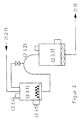
- Figure 1 is the flow diagram of a preferred embodiment of the device shown in which the inventive method can be carried out.
- the subject is therefore also a device for purifying N, N'-diphenyl-p-phenylenediamine (DPPD), which is characterized by a solvent evaporator (1.1), a downstream capacitor (1.2), which is connected via a solvent line (1.2.1) is connected to an extraction unit (1.3), which in turn is connected to an internal one and liquid-permeable container for receiving raw product (1.3.1) and a subsequent adsorption unit (1.3.2), which is connected to the solvent evaporator (1.1) via an extract line (1.3.3) in turn coupled to a filter unit (1.4) on the bottom side via a lock (1.1.2) is, a filtrate line (1.4.1) via a pump (1.4.2) to the Solvent evaporator (1.1) leads.
- DPPD N, N'-diphenyl-p-phenylenediamine
- DPPD N, N'-diphenyl-p-phenylenediamine
- DPPD N, N'-diphenyl-p-pheny
- the extraction unit from a liquid permeable extraction container (2.3.1) for receiving raw product and a hereby connected via a line system (2.3.2) container (2.3.3), the one Contains adsorbent.
- the extraction unit is suitably equipped with a Raw product feed (2.3.4) and / or a residue outlet (2.3.5).
- the solvent evaporator (1.1), the extraction unit (1.3) and the filtration unit (1.4) with a material feed or a material removal lock be equipped.
- a device according to the invention can be used with regard to the units (1.3.1), (2.3.1) and (1.1) also equip with a stirrer or mixer unit.
- an inventive one can Device instead of the filtration unit (1.4) also with other known ones Separation procedures for the separation of solid / liquid systems, e.g. B. with a centrifuge or a decanter.
- hydrocarbons or hydrocarbon mixtures be presented.
- the amount of extractant presented here is usually based on the size of the available equipment or facility.
- cyclic or acyclic hydrocarbons such as cyclopentene, pentene, cyclohexene, cyclohexadiene, hexene, and the like.
- v. m. can serve as extractants in the process according to the invention.
- Mixtures of aliphatically saturated, aliphatically unsaturated, cyclic, acyclic and aromatic hydrocarbons for the invention Procedures are used.
- the solvent evaporator (1.1) is at a temperature in the range of Operated at 40 to 110 ° C under normal pressure.
- the so converted into the gas phase The proportion of solvent is suitably run over a condenser (1.2) and that condensate accumulating through a solvent line to the extraction tank (1.3) fed.
- the liquid-permeable extraction container (1.3.1 and 2.3.1) and the floor for receiving an adsorbent (1.3.2 and 2.3.3) of the extraction unit can be made of a textile fabric made of a polyester, polyamide or can be made of another polymer, and / or from a metal mesh consist.
- the mesh size of such fabrics is usually in the range of 0.01 up to 0.2 mm.
- the extraction container or base that is permeable to liquids for receiving an adsorbent can also be made of ceramic materials exist, e.g. B. from a G 1 - G 4 frit.
- silica gel is preferably used as the adsorbent, for example a silica gel from MERCK. Layer thicknesses in the range from 2 cm to 30 cm are preferred for such adsorption layers, but the layers can also be thicker.
- silica gel with an average grain size of 0.063 to 3.00 mm can be used here, preferably silica gel with an average grain size of 0.063 to 0.5 mm is used.
- a silica gel with an average grain size of 0.20 mm to 0.5 mm in the process according to the invention, in particular one with a BET surface area of 450 to 550 m 2 / g.
- a liquid-permeable extraction container (1.3.1), which is filled with commercially available DPPD, can be placed over the adsorption layer (1.3.2).
- the extraction unit (1.3) prepared in this way is generally sealed gas-tight and solvent is applied via the condensate line (1.2.1).
- the extraction container (1.3.1) and the container for the adsorbent material (1.3.2) can of course also be arranged separately from each other, the Raw extract from the extraction container (2.3.1) via a pipe system (2.3.2) Containers for the adsorbent material (2.3.3) can be supplied; of Figure 2 see a preferred embodiment.
- the Extraction containers (1.3 and 2.3.1) usually fill up to a height of corresponds to the highest point in the extract removal (1.3.3 or 2.3.2). will this When the level is reached, the extract flows into the Solvent evaporator (1.1) or via the adsorption unit (2.3.3) in the Solvent evaporator (1.1).
- extraction is generally carried out at a temperature in the range from 40 to 100.degree.
- the adsorption is usually carried out at a temperature in the range of 40 to 100 ° C.
- the adsorption layer (1.3.2 and 2.3.3) in a suitable way absorbs the particles and turbidity-causing impurities in the extract, so that the solution flowing into the solvent evaporator (1.1) is clear.
- the process according to the invention can be carried out either under normal pressure, under reduced pressure or also under slightly increased pressure.
- the extraction unit (1.3 and 2.3.1 and 2.3.3) including the lines (2.3.2 as well as 1.3.3 and 1.1.2) against Insulate heat loss.
- the extraction unit (1.3 as well as 2.3.1 and 2.3.3) including the lines (2.3.2 as well as 1.3.3 and 1.1.2) can also be a Accompanying heating can be provided.
- the feeding of raw DPPD into the extraction container (1.3.1 and 2.3.1) can be discontinuous or continuously. Especially for continuous The extraction container (1.3 and 2.3.1) with a product feed device for raw DPPD (e.g. 2.3.4) and a discharge device for the extraction residue (e.g. 2.3.5).
- the adsorbent containers e.g. 2.3.3 can also be used to remove spent silica gel and the task of fresh silica gel with suitable Locks are equipped. Such an arrangement for increasing is advantageous the plant capacity for the production of cleaned DPPD.
- the device according to the invention is advantageously with inert gas, for. B. nitrogen, over-veiled (1.2.2 or 1.4.3) so that there are no ignitable mixtures in the system may occur.
- the process according to the invention for the purification of raw DPPD can be carried out batchwise as well as be carried out continuously.
- the extraction container (1.3.1 and 2.3.1) is suitably emptied several times during discontinuous operation of the system and filled with raw DPPD again before stopping the extraction and cleaning Product isolated from the extractant. 2 or 3 are preferred here Emptying or filling processes, only then is the pure DPPD isolated.
- the The adsorption layer (1.3.2 and 2.3.3) can be partially or completely replaced However, it is also possible to have multiple extractions over the same adsorption layer to drive without contaminants getting into the solvent evaporator (1.1).
- the Extraction time is usually 20 to 60 hours, so that in general the average residence time of the product in the cleaning process is 20 to 60 hours.
- the filtrate is clear and can generally be used without further purification further extractions are used (cf. 1 4.1 and 1.4.2).
- the filtrate can also be driven via distillation before recycling.
- the cleaned, present DPPD can, for example, be dried in vacuo or isolated with the introduction of nitrogen as a white to light beige microcrystalline powder become.
- the product purified by the process according to the invention has in generally a purity of> 90%, preferably> 95% and very particularly preferably 97 to 99% (determination by NMR spectroscopy).
- the DPPD cleaned according to the invention preferably has a melting range in the Temperature range from 142 ° C to 154 ° C, particularly preferred is cleaned DPPD with a melting range in the temperature range from 144 ° C to 148 ° C. in the The difference is that the commercially available raw DPPD with a purity of approx. 85% a melting range of 124 to 126 ° C.
- Another advantage of the method according to the invention is that through the use largely environmentally friendly hydrocarbons based on methods that use chlorinated hydrocarbons use as an extractant, can be dispensed with.
- the extraction container equipped with a liquid-permeable bottom, is also used 5.5 kg of silica gel 60 (grain size 0.2 to 0.5 mm) from MERCK, which with 4 kg Ceramic saddle bodies with a diameter of 15 mm is mixed, filled. about this adsorption layer becomes a liquid-permeable extraction container, which contains 10 kg of raw DPPD from G ⁇ BEL and PFRENGLE, on the lid of the Extraction container hung.
- the extractant is heated to boiling. You measure a temperature in the bladder of 68 ° C.
- the condensate flows through the condensate line into the extraction tank and from there depending on the level in the extraction container with dissolved DPPD back into the solvent evaporator.
- the extraction cycles are over a Repeated period of 60 h. Then you open the extraction unit for removal of the extraction container.
- the residue is removed from the extraction container After drying, the weight results in a residue of 1.5 kg.
- the silica gel is exchanged for 6 kg of new silica gel, containing 4 kg of saddle body.
- the extraction container is filled with 10 kg of raw DPPD and returned to the extraction container used. After an extraction period of 36 h, 1.5 kg of residue are obtained.
- the content from the solvent evaporator is drained onto a filter.
- the Filter cake is washed twice with approx. 18 kg hexane and in a vacuum simultaneous introduction of a little nitrogen dried. 16 kg of DPPD are obtained as a light beige microcrystalline powder. This corresponds to a yield of 80%, based on the total amount of raw DPPD used
Landscapes
- Chemical & Material Sciences (AREA)
- Organic Chemistry (AREA)
- Chemical Kinetics & Catalysis (AREA)
- Organic Low-Molecular-Weight Compounds And Preparation Thereof (AREA)
- Treatment Of Liquids With Adsorbents In General (AREA)
- Solid-Sorbent Or Filter-Aiding Compositions (AREA)
Description
Die Adsorptionsschicht (1.3.2 sowie 2.3.3) nimmt dabei in geeigneter Weise im Extrakt enthaltene Partikel und Trübungen verursachende Verunreinigungen auf, so daß die in den Lösemittelverdampfer (1.1) abfließende Lösung klar ist. Das erfindungsgemäße Verfahren kann sowohl unter Normaldruck, bei vermindertem Druck oder auch bei leicht erhöhtem Druck durchgeführt werden.
Claims (18)
- Verfahren zur Reinigung von rohem N,N'-Diphenyl-p-phenylendiamin (DPPD),
dadurch gekennzeichnet,
daß man Roh-DPPD mit einem Kohlenwasserstoff oder einem Kohlenwasserstoffgemisch extrahiert, das Extrakt über eine Adsorptionsschicht leitet und gereinigtes DPPD aus dieser Lösung gewinnt. - Verfahren nach Anspruch 1,
dadurch gekennzeichnet,
daß man die Reinigung unter Schutzgas durchführt. - Verfahren nach Anspruch 1 oder 2,
dadurch gekennzeichnet,
daß man technisches DPPD einsetzt. - Verfahren nach mindestens einem der Ansprüche 1 bis 3,
dadurch gekennzeichnet,
daß man bei einer Temperatur im Bereich von 40 bis 100°C extrahiert. - Verfahren nach mindestens einem der Ansprüche 1 bis 4,
dadurch gekennzeichnet,
daß man mit Hexan extrahiert. - Verfahren nach mindestens einem der Ansprüche 1 bis 5,
dadurch gekennzeichnet,
daß man als Adsorptionsmittel Kieselgel einsetzt. - Verfahren nach Anspruch 6,
dadurch gekennzeichnet,
daß man ein Kieselgel mit einer BET-Oberfläche von 450 bis 550 m2/g einsetzt. - Verfahren nach Anspruch 6 oder 7,
dadurch gekennzeichnet,
daß man ein Kieselgel mit einer mittleren Korngröße von 0,063 bis 0,5 mm einsetzt. - Verfahren nach mindestens einem der Ansprüche 1 bis 8,
dadurch gekennzeichnet,
daß man die Adsorption bei einer Temperatur im Bereich von 40 bis 100°C durchführt. - Verfahren nach mindestens einem der Ansprüche 1 bis 9,
dadurch gekennzeichnet,
daß die mittlere Verweilzeit des Produktes im Reinigungsprozeß 20 bis 60 Stunden beträgt. - Verfahren nach mindestens einem der Ansprüche 1 bis 10,
dadurch gekennzeichnet,
daß die Reinigung von Roh-DPPD kontinuierlich durchgeführt wird. - Verfahren nach mindestens einem der Ansprüche 1 bis 11,
dadurch gekennzeichnet,
daß das gereinigte DPPD eine Reinheit von > 90 % aufweist. - Verfahren nach Anspruch 12,
dadurch gekennzeichnet,
daß das gereinigte DPPD eine Reinheit von > 95 % aufweist. - Verfahren nach mindestens einem der Ansprüche 1 bis 13,
dadurch gekennzeichnet,
daß das gereinigte DPPD einen Schmelzbereich im Temperaturbereich von 142 bis 148 °C aufweist. - Vorrichtung zur Reinigung von N,N'-Diphenyl-p-phenylendiamin (DPPD)
nach Anspruch 1, gekennzeichnet durch
einen Lösemittelverdampfer (1.1), einen nachgeschalteten Kondensator (1.2), der über eine Lösemittelleitung (1.2.1) mit einer Extraktionseinheit (1.3) verbunden ist, die ihrerseits mit einem innenliegenden und Flüssigkeiten durchlassenden Behältnis für die Aufnahme von Roh-Produkt (1.3.1) und einer nachfolgenden Adsorptionseinheit (1.3.2) ausgestattet ist, die über eine Extraktleitung (1.3.3)
mit dem Lösemittelverdampfer (1.1) verbunden ist, der seinerseits bodenseitig über eine Schleuse (1.1.2) mit einer Filtereinheit (1.4) gekoppelt ist, wobei eine Filtratleitung (1.4.1) über eine Pumpe (1.4.2) zu dem Lösemittelverdampfer (1.1) führt. - Vorrichtung nach Anspruch 15,
gekennzeichnet
durch eine oder mehrere Schutzgaszuleitungen (1.2.2 und/oder 1.4.3). - Vorrichtung nach Anspruch 15 oder 16,
dadurch gekennzeichnet,
daß die Extraktionseinheit aus einem Flüssigkeiten durchlassenden Extraktionsbehälter (2.3.1) für die Aufnahme von Roh-Produkt und einem hiermit über ein Leitungssystem (2.3.2) verbundenen Behälter (2.3.3), der ein Adsorptionsmittel enthält, besteht. - Vorrichtung nach mindestens einem der Ansprüche 15 bis 17,
dadurch gekennzeichnet,
daß die Extraktionseinheit mit einer Roh-Produktaufgabe (2.3.4) und/oder einem Rückstandsauslaß (2.3.5) ausgestattet ist.
Applications Claiming Priority (2)
| Application Number | Priority Date | Filing Date | Title |
|---|---|---|---|
| DE19549032A DE19549032A1 (de) | 1995-12-28 | 1995-12-28 | Verfahren und Vorrichtung zur Reinigung von handelsüblichem Diphenyl-p-phenylendiamin |
| DE19549032 | 1995-12-28 |
Publications (2)
| Publication Number | Publication Date |
|---|---|
| EP0781761A1 EP0781761A1 (de) | 1997-07-02 |
| EP0781761B1 true EP0781761B1 (de) | 2001-03-21 |
Family
ID=7781584
Family Applications (1)
| Application Number | Title | Priority Date | Filing Date |
|---|---|---|---|
| EP96117239A Expired - Lifetime EP0781761B1 (de) | 1995-12-28 | 1996-10-28 | Verfahren und Vorrichtung zur Reinigung von handelsüblichem Diphenyl-p-phenylendiamin (DPPD) |
Country Status (5)
| Country | Link |
|---|---|
| US (3) | US5763666A (de) |
| EP (1) | EP0781761B1 (de) |
| JP (1) | JPH09194440A (de) |
| DE (2) | DE19549032A1 (de) |
| ES (1) | ES2156972T3 (de) |
Families Citing this family (4)
| Publication number | Priority date | Publication date | Assignee | Title |
|---|---|---|---|---|
| US6398917B1 (en) | 1995-12-28 | 2002-06-04 | Degussa-Huels Aktiengesellschaft | Apparatus for the purification of commercially available diphenyl-p-phenylenediamine (DPPD) |
| DE19549032A1 (de) * | 1995-12-28 | 1997-07-03 | Huels Chemische Werke Ag | Verfahren und Vorrichtung zur Reinigung von handelsüblichem Diphenyl-p-phenylendiamin |
| US6656404B2 (en) * | 2001-05-17 | 2003-12-02 | Milliken & Company | Methods of making low-shrink polypropylene fibers |
| CN105348115B (zh) * | 2015-12-23 | 2017-10-20 | 山西翔宇化工有限公司 | 一种橡胶防老剂次品的重反应及提纯处理装置 |
Family Cites Families (6)
| Publication number | Priority date | Publication date | Assignee | Title |
|---|---|---|---|---|
| US2744938A (en) * | 1952-07-24 | 1956-05-08 | Universal Oil Prod Co | Removal of color impurities from organic compounds |
| US2833824A (en) * | 1956-04-10 | 1958-05-06 | Hoffmann La Roche | Purification of n, n'-diphenyl-p-phenylenediamine |
| SU595295A1 (ru) * | 1974-03-26 | 1978-02-28 | Днепропетровский химико-технологический институт им.Ф.Э.Дзержинского | Способ очистки - дифенил-пара-фенилендиамина |
| US4946977A (en) * | 1987-09-25 | 1990-08-07 | Huels Troisdorf Ag | Method for the preparation of organosilanes containing methacryloxy or acryloxy groups |
| JPH03166241A (ja) * | 1989-11-24 | 1991-07-18 | Ohtsu Tire & Rubber Co Ltd :The | スタッドレスタイヤ用トレッドゴム組成物 |
| DE19549032A1 (de) * | 1995-12-28 | 1997-07-03 | Huels Chemische Werke Ag | Verfahren und Vorrichtung zur Reinigung von handelsüblichem Diphenyl-p-phenylendiamin |
-
1995
- 1995-12-28 DE DE19549032A patent/DE19549032A1/de not_active Withdrawn
-
1996
- 1996-10-28 EP EP96117239A patent/EP0781761B1/de not_active Expired - Lifetime
- 1996-10-28 ES ES96117239T patent/ES2156972T3/es not_active Expired - Lifetime
- 1996-10-28 DE DE59606628T patent/DE59606628D1/de not_active Expired - Fee Related
- 1996-12-20 US US08/777,702 patent/US5763666A/en not_active Expired - Fee Related
- 1996-12-25 JP JP8345869A patent/JPH09194440A/ja not_active Abandoned
-
1998
- 1998-01-09 US US09/004,851 patent/US5945554A/en not_active Expired - Fee Related
-
1999
- 1999-04-29 US US09/301,601 patent/US6026880A/en not_active Expired - Fee Related
Also Published As
| Publication number | Publication date |
|---|---|
| EP0781761A1 (de) | 1997-07-02 |
| US5945554A (en) | 1999-08-31 |
| DE19549032A1 (de) | 1997-07-03 |
| DE59606628D1 (de) | 2001-04-26 |
| JPH09194440A (ja) | 1997-07-29 |
| ES2156972T3 (es) | 2001-08-01 |
| US6026880A (en) | 2000-02-22 |
| US5763666A (en) | 1998-06-09 |
Similar Documents
| Publication | Publication Date | Title |
|---|---|---|
| DE69221610T2 (de) | Verfahren zur herstellung von terephtalsäure | |
| DE69928903T2 (de) | Verfahren zur Herstellung von E-Caprolaktam | |
| DE69507215T2 (de) | Reinigung von Bisphenol-A | |
| EP0638580B1 (de) | Verfahren zur Herstellung von Triphenylphosphin | |
| DE3111335A1 (de) | "verfahren zur herstellung von terephthalsaeure" | |
| DE69515036T2 (de) | Verfahren zur herstellung von difluormethan | |
| DE3881012T2 (de) | Verfahren zur Produktion von 4,4'-Diaminodicyclohexylmethan mit niedrigem trans-trans-Isomergehalt durch katalytische Hydrogenierung von 4,4'-Diaminodiphenylmethan. | |
| DE2203945C3 (de) | ||
| EP0781761A1 (de) | Verfahren und Vorrichtung zur Reinigung von handelsüblichem Diphenyl-p-phenylendiamin (DPPD) | |
| DE1593539A1 (de) | Verfahren zur Herstellung reiner aromatischer Di- und Polycarbonsaeuren | |
| DE69708481T2 (de) | Verfahren zur Herstellung von sehr reinen 2,6-Dimethylnaphthalin | |
| DE19704614A1 (de) | Verfahren zur Abtrennnung eines Imins aus einer Mischung enthaltend ein Amin und ein Imin | |
| DE2909797A1 (de) | Verfahren zur herstellung von 2.2'.4.4'.6.6'-hexanitrostilben | |
| DE2422969C2 (de) | Verfahren zur Abtrennung von C↓1↓ - C↓3↓-Chloralkanen | |
| DE2817509C2 (de) | Verfahren zur Isolierung von Terephthalonitril | |
| EP0003570B1 (de) | Verfahren zur kontinuierlichen Aufarbeitung von bei der Phosgenierung von Monoaminen anfallenden Lösungen | |
| DE60100870T2 (de) | Verfahren zur Gewinnung von 2,6-Dimethylnaphthalen aus Mischungen die es enthalten | |
| DE1593541A1 (de) | Verfahren zur Herstellung reiner aromatischer Di- und Polycarbonsaeuren | |
| DE68909118T2 (de) | Verfahren zur Ausscheidung von 2,6-Dimethylnaphthalin. | |
| DE1805957A1 (de) | Verfahren zur Reinigung von Xylylendiisocyanat | |
| DE69504616T2 (de) | Verfahren zur Herstellung von N-Formyl-L-asparginsäureanhydrid | |
| EP0238958B1 (de) | Verfahren zur Reinigung von Tetraacetylethylendiamin | |
| DE1445932C3 (de) | Verfahren zur Reinigung von 4,4'-Bipyridyl | |
| EP0014406B1 (de) | Verfahren zur Abtrennung von Selen, Selenverbindungen, Schwefel und/oder Schwefelverbindungen aus diese Elemente bzw. Verbindungen aufweisenden Urethanen | |
| DE4226282C2 (de) | Verfahren zur Gewinnung von Octadecandiol-1,12 |
Legal Events
| Date | Code | Title | Description |
|---|---|---|---|
| PUAI | Public reference made under article 153(3) epc to a published international application that has entered the european phase |
Free format text: ORIGINAL CODE: 0009012 |
|
| AK | Designated contracting states |
Kind code of ref document: A1 Designated state(s): BE CH DE ES FR GB IT LI NL |
|
| 17P | Request for examination filed |
Effective date: 19970707 |
|
| RAP1 | Party data changed (applicant data changed or rights of an application transferred) |
Owner name: DEGUSSA-HUELS AKTIENGESELLSCHAFT |
|
| 17Q | First examination report despatched |
Effective date: 19990429 |
|
| GRAG | Despatch of communication of intention to grant |
Free format text: ORIGINAL CODE: EPIDOS AGRA |
|
| GRAG | Despatch of communication of intention to grant |
Free format text: ORIGINAL CODE: EPIDOS AGRA |
|
| GRAH | Despatch of communication of intention to grant a patent |
Free format text: ORIGINAL CODE: EPIDOS IGRA |
|
| GRAH | Despatch of communication of intention to grant a patent |
Free format text: ORIGINAL CODE: EPIDOS IGRA |
|
| GRAA | (expected) grant |
Free format text: ORIGINAL CODE: 0009210 |
|
| AK | Designated contracting states |
Kind code of ref document: B1 Designated state(s): BE CH DE ES FR GB IT LI NL |
|
| REG | Reference to a national code |
Ref country code: CH Ref legal event code: NV Representative=s name: SCHMAUDER & PARTNER AG PATENTANWALTSBUERO Ref country code: CH Ref legal event code: EP |
|
| REF | Corresponds to: |
Ref document number: 59606628 Country of ref document: DE Date of ref document: 20010426 |
|
| GBT | Gb: translation of ep patent filed (gb section 77(6)(a)/1977) |
Effective date: 20010406 |
|
| RAP2 | Party data changed (patent owner data changed or rights of a patent transferred) |
Owner name: DEGUSSA AG |
|
| ITF | It: translation for a ep patent filed | ||
| ET | Fr: translation filed | ||
| NLT2 | Nl: modifications (of names), taken from the european patent patent bulletin |
Owner name: DEGUSSA AG |
|
| REG | Reference to a national code |
Ref country code: ES Ref legal event code: FG2A Ref document number: 2156972 Country of ref document: ES Kind code of ref document: T3 |
|
| REG | Reference to a national code |
Ref country code: GB Ref legal event code: IF02 |
|
| PLBE | No opposition filed within time limit |
Free format text: ORIGINAL CODE: 0009261 |
|
| STAA | Information on the status of an ep patent application or granted ep patent |
Free format text: STATUS: NO OPPOSITION FILED WITHIN TIME LIMIT |
|
| 26N | No opposition filed | ||
| REG | Reference to a national code |
Ref country code: GB Ref legal event code: 732E |
|
| PGFP | Annual fee paid to national office [announced via postgrant information from national office to epo] |
Ref country code: GB Payment date: 20021115 Year of fee payment: 7 |
|
| PGFP | Annual fee paid to national office [announced via postgrant information from national office to epo] |
Ref country code: ES Payment date: 20021118 Year of fee payment: 7 |
|
| PGFP | Annual fee paid to national office [announced via postgrant information from national office to epo] |
Ref country code: CH Payment date: 20021119 Year of fee payment: 7 |
|
| PGFP | Annual fee paid to national office [announced via postgrant information from national office to epo] |
Ref country code: FR Payment date: 20021120 Year of fee payment: 7 |
|
| PGFP | Annual fee paid to national office [announced via postgrant information from national office to epo] |
Ref country code: NL Payment date: 20021121 Year of fee payment: 7 |
|
| PGFP | Annual fee paid to national office [announced via postgrant information from national office to epo] |
Ref country code: BE Payment date: 20021206 Year of fee payment: 7 |
|
| BECA | Be: change of holder's address |
Owner name: DEGUSSA A.G.BENNIGSENPLATZ 1, D-40474 DUESSELDORF Effective date: 20021217 |
|
| NLS | Nl: assignments of ep-patents |
Owner name: DEGUSSA AG |
|
| REG | Reference to a national code |
Ref country code: FR Ref legal event code: TP |
|
| PG25 | Lapsed in a contracting state [announced via postgrant information from national office to epo] |
Ref country code: GB Free format text: LAPSE BECAUSE OF NON-PAYMENT OF DUE FEES Effective date: 20031028 |
|
| PG25 | Lapsed in a contracting state [announced via postgrant information from national office to epo] |
Ref country code: ES Free format text: LAPSE BECAUSE OF NON-PAYMENT OF DUE FEES Effective date: 20031029 |
|
| PG25 | Lapsed in a contracting state [announced via postgrant information from national office to epo] |
Ref country code: LI Free format text: LAPSE BECAUSE OF NON-PAYMENT OF DUE FEES Effective date: 20031031 Ref country code: CH Free format text: LAPSE BECAUSE OF NON-PAYMENT OF DUE FEES Effective date: 20031031 Ref country code: BE Free format text: LAPSE BECAUSE OF NON-PAYMENT OF DUE FEES Effective date: 20031031 |
|
| BERE | Be: lapsed |
Owner name: *DEGUSSA A.G. Effective date: 20031031 |
|
| PG25 | Lapsed in a contracting state [announced via postgrant information from national office to epo] |
Ref country code: NL Free format text: LAPSE BECAUSE OF NON-PAYMENT OF DUE FEES Effective date: 20040501 |
|
| REG | Reference to a national code |
Ref country code: CH Ref legal event code: PL |
|
| GBPC | Gb: european patent ceased through non-payment of renewal fee |
Effective date: 20031028 |
|
| PG25 | Lapsed in a contracting state [announced via postgrant information from national office to epo] |
Ref country code: FR Free format text: LAPSE BECAUSE OF NON-PAYMENT OF DUE FEES Effective date: 20040630 |
|
| NLV4 | Nl: lapsed or anulled due to non-payment of the annual fee |
Effective date: 20040501 |
|
| REG | Reference to a national code |
Ref country code: FR Ref legal event code: ST |
|
| PGFP | Annual fee paid to national office [announced via postgrant information from national office to epo] |
Ref country code: DE Payment date: 20041008 Year of fee payment: 9 |
|
| REG | Reference to a national code |
Ref country code: ES Ref legal event code: FD2A Effective date: 20031029 |
|
| PG25 | Lapsed in a contracting state [announced via postgrant information from national office to epo] |
Ref country code: IT Free format text: LAPSE BECAUSE OF NON-PAYMENT OF DUE FEES Effective date: 20051028 |
|
| PG25 | Lapsed in a contracting state [announced via postgrant information from national office to epo] |
Ref country code: DE Free format text: LAPSE BECAUSE OF NON-PAYMENT OF DUE FEES Effective date: 20060503 |