EP0775149B1 - Novel protecting groups and use thereof in an improved process for oligonucleotide synthesis - Google Patents
Novel protecting groups and use thereof in an improved process for oligonucleotide synthesis Download PDFInfo
- Publication number
- EP0775149B1 EP0775149B1 EP96919324A EP96919324A EP0775149B1 EP 0775149 B1 EP0775149 B1 EP 0775149B1 EP 96919324 A EP96919324 A EP 96919324A EP 96919324 A EP96919324 A EP 96919324A EP 0775149 B1 EP0775149 B1 EP 0775149B1
- Authority
- EP
- European Patent Office
- Prior art keywords
- monomer
- set forth
- synthesis
- group
- chain
- Prior art date
- Legal status (The legal status is an assumption and is not a legal conclusion. Google has not performed a legal analysis and makes no representation as to the accuracy of the status listed.)
- Expired - Lifetime
Links
- 238000002515 oligonucleotide synthesis Methods 0.000 title claims abstract description 31
- 238000000034 method Methods 0.000 title claims description 58
- 125000006239 protecting group Chemical group 0.000 title claims description 55
- 230000008569 process Effects 0.000 title description 23
- 238000006243 chemical reaction Methods 0.000 claims abstract description 36
- 230000006819 RNA synthesis Effects 0.000 claims abstract description 20
- 238000005859 coupling reaction Methods 0.000 claims abstract description 16
- 230000001590 oxidative effect Effects 0.000 claims abstract description 4
- 239000000178 monomer Substances 0.000 claims description 80
- -1 N-protected adenine Chemical class 0.000 claims description 56
- 125000001424 substituent group Chemical group 0.000 claims description 42
- 239000002777 nucleoside Substances 0.000 claims description 39
- 125000003808 silyl group Chemical group [H][Si]([H])([H])[*] 0.000 claims description 38
- 150000002905 orthoesters Chemical group 0.000 claims description 36
- 150000007523 nucleic acids Chemical class 0.000 claims description 22
- 125000002887 hydroxy group Chemical group [H]O* 0.000 claims description 21
- 108020004707 nucleic acids Proteins 0.000 claims description 21
- 102000039446 nucleic acids Human genes 0.000 claims description 21
- KRHYYFGTRYWZRS-UHFFFAOYSA-M Fluoride anion Chemical compound [F-] KRHYYFGTRYWZRS-UHFFFAOYSA-M 0.000 claims description 17
- 150000003833 nucleoside derivatives Chemical class 0.000 claims description 16
- OPTASPLRGRRNAP-UHFFFAOYSA-N cytosine Chemical compound NC=1C=CNC(=O)N=1 OPTASPLRGRRNAP-UHFFFAOYSA-N 0.000 claims description 14
- UYTPUPDQBNUYGX-UHFFFAOYSA-N guanine Chemical compound O=C1NC(N)=NC2=C1N=CN2 UYTPUPDQBNUYGX-UHFFFAOYSA-N 0.000 claims description 14
- KPUWHANPEXNPJT-UHFFFAOYSA-N disiloxane Chemical compound [SiH3]O[SiH3] KPUWHANPEXNPJT-UHFFFAOYSA-N 0.000 claims description 12
- 230000006820 DNA synthesis Effects 0.000 claims description 11
- SXADIBFZNXBEGI-UHFFFAOYSA-N phosphoramidous acid Chemical group NP(O)O SXADIBFZNXBEGI-UHFFFAOYSA-N 0.000 claims description 11
- ISAKRJDGNUQOIC-UHFFFAOYSA-N Uracil Chemical compound O=C1C=CNC(=O)N1 ISAKRJDGNUQOIC-UHFFFAOYSA-N 0.000 claims description 10
- 125000003545 alkoxy group Chemical group 0.000 claims description 10
- 230000008878 coupling Effects 0.000 claims description 10
- 238000010168 coupling process Methods 0.000 claims description 10
- 239000002773 nucleotide Substances 0.000 claims description 9
- 125000003729 nucleotide group Chemical group 0.000 claims description 9
- RWQNBRDOKXIBIV-UHFFFAOYSA-N thymine Chemical compound CC1=CNC(=O)NC1=O RWQNBRDOKXIBIV-UHFFFAOYSA-N 0.000 claims description 8
- 229940104302 cytosine Drugs 0.000 claims description 7
- 239000004793 Polystyrene Substances 0.000 claims description 6
- 229920002223 polystyrene Polymers 0.000 claims description 6
- 229930024421 Adenine Natural products 0.000 claims description 5
- GFFGJBXGBJISGV-UHFFFAOYSA-N Adenine Chemical compound NC1=NC=NC2=C1N=CN2 GFFGJBXGBJISGV-UHFFFAOYSA-N 0.000 claims description 5
- 229960000643 adenine Drugs 0.000 claims description 5
- 239000011521 glass Substances 0.000 claims description 5
- 229910052736 halogen Inorganic materials 0.000 claims description 5
- 150000002367 halogens Chemical class 0.000 claims description 5
- 229940035893 uracil Drugs 0.000 claims description 5
- 150000005215 alkyl ethers Chemical class 0.000 claims description 4
- 239000013110 organic ligand Substances 0.000 claims description 4
- 125000004469 siloxy group Chemical group [SiH3]O* 0.000 claims description 4
- 229940113082 thymine Drugs 0.000 claims description 4
- 150000001412 amines Chemical class 0.000 claims description 3
- 150000002148 esters Chemical class 0.000 claims description 3
- 150000002170 ethers Chemical class 0.000 claims description 3
- 238000006116 polymerization reaction Methods 0.000 claims description 2
- KRHYYFGTRYWZRS-UHFFFAOYSA-N Fluorane Chemical group F KRHYYFGTRYWZRS-UHFFFAOYSA-N 0.000 claims 1
- XYFCBTPGUUZFHI-UHFFFAOYSA-N Phosphine Chemical compound P XYFCBTPGUUZFHI-UHFFFAOYSA-N 0.000 claims 1
- 239000011324 bead Substances 0.000 claims 1
- 125000004432 carbon atom Chemical group C* 0.000 claims 1
- 238000010511 deprotection reaction Methods 0.000 abstract description 36
- 150000008300 phosphoramidites Chemical class 0.000 abstract description 27
- 125000002092 orthoester group Chemical group 0.000 abstract description 9
- 230000002378 acidificating effect Effects 0.000 abstract description 7
- 239000007790 solid phase Substances 0.000 abstract description 3
- 125000001181 organosilyl group Chemical group [SiH3]* 0.000 abstract 1
- OJMIONKXNSYLSR-UHFFFAOYSA-N phosphorous acid Chemical compound OP(O)O OJMIONKXNSYLSR-UHFFFAOYSA-N 0.000 abstract 1
- 238000003786 synthesis reaction Methods 0.000 description 68
- 230000015572 biosynthetic process Effects 0.000 description 63
- 239000000047 product Substances 0.000 description 39
- 108091034117 Oligonucleotide Proteins 0.000 description 36
- 108091032973 (ribonucleotides)n+m Proteins 0.000 description 34
- ZMANZCXQSJIPKH-UHFFFAOYSA-N Triethylamine Chemical compound CCN(CC)CC ZMANZCXQSJIPKH-UHFFFAOYSA-N 0.000 description 34
- 108020004414 DNA Proteins 0.000 description 27
- WEVYAHXRMPXWCK-UHFFFAOYSA-N Acetonitrile Chemical compound CC#N WEVYAHXRMPXWCK-UHFFFAOYSA-N 0.000 description 24
- 239000000243 solution Substances 0.000 description 24
- 239000002243 precursor Substances 0.000 description 22
- JLCPHMBAVCMARE-UHFFFAOYSA-N [3-[[3-[[3-[[3-[[3-[[3-[[3-[[3-[[3-[[3-[[3-[[5-(2-amino-6-oxo-1H-purin-9-yl)-3-[[3-[[3-[[3-[[3-[[3-[[5-(2-amino-6-oxo-1H-purin-9-yl)-3-[[5-(2-amino-6-oxo-1H-purin-9-yl)-3-hydroxyoxolan-2-yl]methoxy-hydroxyphosphoryl]oxyoxolan-2-yl]methoxy-hydroxyphosphoryl]oxy-5-(5-methyl-2,4-dioxopyrimidin-1-yl)oxolan-2-yl]methoxy-hydroxyphosphoryl]oxy-5-(6-aminopurin-9-yl)oxolan-2-yl]methoxy-hydroxyphosphoryl]oxy-5-(6-aminopurin-9-yl)oxolan-2-yl]methoxy-hydroxyphosphoryl]oxy-5-(6-aminopurin-9-yl)oxolan-2-yl]methoxy-hydroxyphosphoryl]oxy-5-(6-aminopurin-9-yl)oxolan-2-yl]methoxy-hydroxyphosphoryl]oxyoxolan-2-yl]methoxy-hydroxyphosphoryl]oxy-5-(5-methyl-2,4-dioxopyrimidin-1-yl)oxolan-2-yl]methoxy-hydroxyphosphoryl]oxy-5-(4-amino-2-oxopyrimidin-1-yl)oxolan-2-yl]methoxy-hydroxyphosphoryl]oxy-5-(5-methyl-2,4-dioxopyrimidin-1-yl)oxolan-2-yl]methoxy-hydroxyphosphoryl]oxy-5-(5-methyl-2,4-dioxopyrimidin-1-yl)oxolan-2-yl]methoxy-hydroxyphosphoryl]oxy-5-(6-aminopurin-9-yl)oxolan-2-yl]methoxy-hydroxyphosphoryl]oxy-5-(6-aminopurin-9-yl)oxolan-2-yl]methoxy-hydroxyphosphoryl]oxy-5-(4-amino-2-oxopyrimidin-1-yl)oxolan-2-yl]methoxy-hydroxyphosphoryl]oxy-5-(4-amino-2-oxopyrimidin-1-yl)oxolan-2-yl]methoxy-hydroxyphosphoryl]oxy-5-(4-amino-2-oxopyrimidin-1-yl)oxolan-2-yl]methoxy-hydroxyphosphoryl]oxy-5-(6-aminopurin-9-yl)oxolan-2-yl]methoxy-hydroxyphosphoryl]oxy-5-(4-amino-2-oxopyrimidin-1-yl)oxolan-2-yl]methyl [5-(6-aminopurin-9-yl)-2-(hydroxymethyl)oxolan-3-yl] hydrogen phosphate Polymers Cc1cn(C2CC(OP(O)(=O)OCC3OC(CC3OP(O)(=O)OCC3OC(CC3O)n3cnc4c3nc(N)[nH]c4=O)n3cnc4c3nc(N)[nH]c4=O)C(COP(O)(=O)OC3CC(OC3COP(O)(=O)OC3CC(OC3COP(O)(=O)OC3CC(OC3COP(O)(=O)OC3CC(OC3COP(O)(=O)OC3CC(OC3COP(O)(=O)OC3CC(OC3COP(O)(=O)OC3CC(OC3COP(O)(=O)OC3CC(OC3COP(O)(=O)OC3CC(OC3COP(O)(=O)OC3CC(OC3COP(O)(=O)OC3CC(OC3COP(O)(=O)OC3CC(OC3COP(O)(=O)OC3CC(OC3COP(O)(=O)OC3CC(OC3COP(O)(=O)OC3CC(OC3COP(O)(=O)OC3CC(OC3COP(O)(=O)OC3CC(OC3CO)n3cnc4c(N)ncnc34)n3ccc(N)nc3=O)n3cnc4c(N)ncnc34)n3ccc(N)nc3=O)n3ccc(N)nc3=O)n3ccc(N)nc3=O)n3cnc4c(N)ncnc34)n3cnc4c(N)ncnc34)n3cc(C)c(=O)[nH]c3=O)n3cc(C)c(=O)[nH]c3=O)n3ccc(N)nc3=O)n3cc(C)c(=O)[nH]c3=O)n3cnc4c3nc(N)[nH]c4=O)n3cnc4c(N)ncnc34)n3cnc4c(N)ncnc34)n3cnc4c(N)ncnc34)n3cnc4c(N)ncnc34)O2)c(=O)[nH]c1=O JLCPHMBAVCMARE-UHFFFAOYSA-N 0.000 description 21
- 238000004128 high performance liquid chromatography Methods 0.000 description 20
- 239000002253 acid Substances 0.000 description 17
- 239000003153 chemical reaction reagent Substances 0.000 description 17
- RTZKZFJDLAIYFH-UHFFFAOYSA-N Diethyl ether Chemical compound CCOCC RTZKZFJDLAIYFH-UHFFFAOYSA-N 0.000 description 16
- 239000007795 chemical reaction product Substances 0.000 description 16
- 230000003647 oxidation Effects 0.000 description 16
- 238000007254 oxidation reaction Methods 0.000 description 16
- 239000002904 solvent Substances 0.000 description 16
- DRTQHJPVMGBUCF-XVFCMESISA-N Uridine Chemical compound O[C@@H]1[C@H](O)[C@@H](CO)O[C@H]1N1C(=O)NC(=O)C=C1 DRTQHJPVMGBUCF-XVFCMESISA-N 0.000 description 14
- 150000001875 compounds Chemical class 0.000 description 13
- XEKOWRVHYACXOJ-UHFFFAOYSA-N Ethyl acetate Chemical compound CCOC(C)=O XEKOWRVHYACXOJ-UHFFFAOYSA-N 0.000 description 12
- IQFYYKKMVGJFEH-XLPZGREQSA-N Thymidine Natural products O=C1NC(=O)C(C)=CN1[C@@H]1O[C@H](CO)[C@@H](O)C1 IQFYYKKMVGJFEH-XLPZGREQSA-N 0.000 description 12
- WFDIJRYMOXRFFG-UHFFFAOYSA-N Acetic anhydride Chemical compound CC(=O)OC(C)=O WFDIJRYMOXRFFG-UHFFFAOYSA-N 0.000 description 11
- SECXISVLQFMRJM-UHFFFAOYSA-N N-Methylpyrrolidone Chemical compound CN1CCCC1=O SECXISVLQFMRJM-UHFFFAOYSA-N 0.000 description 11
- PYMYPHUHKUWMLA-LMVFSUKVSA-N Ribose Natural products OC[C@@H](O)[C@@H](O)[C@@H](O)C=O PYMYPHUHKUWMLA-LMVFSUKVSA-N 0.000 description 11
- HMFHBZSHGGEWLO-UHFFFAOYSA-N alpha-D-Furanose-Ribose Natural products OCC1OC(O)C(O)C1O HMFHBZSHGGEWLO-UHFFFAOYSA-N 0.000 description 11
- 239000000203 mixture Substances 0.000 description 11
- 125000003835 nucleoside group Chemical group 0.000 description 11
- 229920000642 polymer Polymers 0.000 description 11
- XLYOFNOQVPJJNP-UHFFFAOYSA-N water Substances O XLYOFNOQVPJJNP-UHFFFAOYSA-N 0.000 description 11
- JUJWROOIHBZHMG-UHFFFAOYSA-N Pyridine Chemical compound C1=CC=NC=C1 JUJWROOIHBZHMG-UHFFFAOYSA-N 0.000 description 10
- 239000003054 catalyst Substances 0.000 description 10
- 229940045145 uridine Drugs 0.000 description 10
- LFQSCWFLJHTTHZ-UHFFFAOYSA-N Ethanol Chemical compound CCO LFQSCWFLJHTTHZ-UHFFFAOYSA-N 0.000 description 9
- 230000027832 depurination Effects 0.000 description 9
- RAXXELZNTBOGNW-UHFFFAOYSA-N imidazole Natural products C1=CNC=N1 RAXXELZNTBOGNW-UHFFFAOYSA-N 0.000 description 9
- 239000011541 reaction mixture Substances 0.000 description 9
- 229940104230 thymidine Drugs 0.000 description 9
- OIRDTQYFTABQOQ-KQYNXXCUSA-N adenosine Chemical compound C1=NC=2C(N)=NC=NC=2N1[C@@H]1O[C@H](CO)[C@@H](O)[C@H]1O OIRDTQYFTABQOQ-KQYNXXCUSA-N 0.000 description 8
- IQFYYKKMVGJFEH-UHFFFAOYSA-N beta-L-thymidine Natural products O=C1NC(=O)C(C)=CN1C1OC(CO)C(O)C1 IQFYYKKMVGJFEH-UHFFFAOYSA-N 0.000 description 8
- DRTQHJPVMGBUCF-PSQAKQOGSA-N beta-L-uridine Natural products O[C@H]1[C@@H](O)[C@H](CO)O[C@@H]1N1C(=O)NC(=O)C=C1 DRTQHJPVMGBUCF-PSQAKQOGSA-N 0.000 description 8
- 238000003776 cleavage reaction Methods 0.000 description 8
- 229920001519 homopolymer Polymers 0.000 description 8
- 239000012535 impurity Substances 0.000 description 8
- 238000000746 purification Methods 0.000 description 8
- FPGGTKZVZWFYPV-UHFFFAOYSA-M tetrabutylammonium fluoride Chemical compound [F-].CCCC[N+](CCCC)(CCCC)CCCC FPGGTKZVZWFYPV-UHFFFAOYSA-M 0.000 description 8
- JOXIMZWYDAKGHI-UHFFFAOYSA-N toluene-4-sulfonic acid Chemical compound CC1=CC=C(S(O)(=O)=O)C=C1 JOXIMZWYDAKGHI-UHFFFAOYSA-N 0.000 description 8
- DRTQHJPVMGBUCF-UHFFFAOYSA-N uracil arabinoside Natural products OC1C(O)C(CO)OC1N1C(=O)NC(=O)C=C1 DRTQHJPVMGBUCF-UHFFFAOYSA-N 0.000 description 8
- VYPSYNLAJGMNEJ-UHFFFAOYSA-N Silicium dioxide Chemical compound O=[Si]=O VYPSYNLAJGMNEJ-UHFFFAOYSA-N 0.000 description 7
- 239000006227 byproduct Substances 0.000 description 7
- 230000007017 scission Effects 0.000 description 7
- 235000000346 sugar Nutrition 0.000 description 7
- 150000003536 tetrazoles Chemical class 0.000 description 7
- DWRXFEITVBNRMK-UHFFFAOYSA-N Beta-D-1-Arabinofuranosylthymine Natural products O=C1NC(=O)C(C)=CN1C1C(O)C(O)C(CO)O1 DWRXFEITVBNRMK-UHFFFAOYSA-N 0.000 description 6
- YMWUJEATGCHHMB-UHFFFAOYSA-N Dichloromethane Chemical compound ClCCl YMWUJEATGCHHMB-UHFFFAOYSA-N 0.000 description 6
- YXFVVABEGXRONW-UHFFFAOYSA-N Toluene Chemical compound CC1=CC=CC=C1 YXFVVABEGXRONW-UHFFFAOYSA-N 0.000 description 6
- 238000010586 diagram Methods 0.000 description 6
- VLKZOEOYAKHREP-UHFFFAOYSA-N n-Hexane Chemical class CCCCCC VLKZOEOYAKHREP-UHFFFAOYSA-N 0.000 description 6
- 125000000548 ribosyl group Chemical group C1([C@H](O)[C@H](O)[C@H](O1)CO)* 0.000 description 6
- 108090000994 Catalytic RNA Proteins 0.000 description 5
- 102000053642 Catalytic RNA Human genes 0.000 description 5
- HMFHBZSHGGEWLO-SOOFDHNKSA-N D-ribofuranose Chemical compound OC[C@H]1OC(O)[C@H](O)[C@@H]1O HMFHBZSHGGEWLO-SOOFDHNKSA-N 0.000 description 5
- NYHBQMYGNKIUIF-UUOKFMHZSA-N Guanosine Chemical compound C1=NC=2C(=O)NC(N)=NC=2N1[C@@H]1O[C@H](CO)[C@@H](O)[C@H]1O NYHBQMYGNKIUIF-UUOKFMHZSA-N 0.000 description 5
- ZMXDDKWLCZADIW-UHFFFAOYSA-N N,N-Dimethylformamide Chemical compound CN(C)C=O ZMXDDKWLCZADIW-UHFFFAOYSA-N 0.000 description 5
- 150000001241 acetals Chemical class 0.000 description 5
- YQPFMTIZDAWFAC-UHFFFAOYSA-N dichloro-bis(trimethylsilyloxy)silane Chemical compound C[Si](C)(C)O[Si](Cl)(Cl)O[Si](C)(C)C YQPFMTIZDAWFAC-UHFFFAOYSA-N 0.000 description 5
- 239000000543 intermediate Substances 0.000 description 5
- UMJSCPRVCHMLSP-UHFFFAOYSA-N pyridine Natural products COC1=CC=CN=C1 UMJSCPRVCHMLSP-UHFFFAOYSA-N 0.000 description 5
- 239000002342 ribonucleoside Substances 0.000 description 5
- 108091092562 ribozyme Proteins 0.000 description 5
- 239000000126 substance Substances 0.000 description 5
- 238000010626 work up procedure Methods 0.000 description 5
- RYHBNJHYFVUHQT-UHFFFAOYSA-N 1,4-Dioxane Chemical compound C1COCCO1 RYHBNJHYFVUHQT-UHFFFAOYSA-N 0.000 description 4
- XNMQEEKYCVKGBD-UHFFFAOYSA-N 2-butyne Chemical compound CC#CC XNMQEEKYCVKGBD-UHFFFAOYSA-N 0.000 description 4
- VHYFNPMBLIVWCW-UHFFFAOYSA-N 4-Dimethylaminopyridine Chemical compound CN(C)C1=CC=NC=C1 VHYFNPMBLIVWCW-UHFFFAOYSA-N 0.000 description 4
- VHUUQVKOLVNVRT-UHFFFAOYSA-N Ammonium hydroxide Chemical compound [NH4+].[OH-] VHUUQVKOLVNVRT-UHFFFAOYSA-N 0.000 description 4
- OKTJSMMVPCPJKN-UHFFFAOYSA-N Carbon Chemical compound [C] OKTJSMMVPCPJKN-UHFFFAOYSA-N 0.000 description 4
- 229960005305 adenosine Drugs 0.000 description 4
- 238000004458 analytical method Methods 0.000 description 4
- 229910052799 carbon Inorganic materials 0.000 description 4
- 239000001257 hydrogen Substances 0.000 description 4
- 229910052739 hydrogen Inorganic materials 0.000 description 4
- 125000004435 hydrogen atom Chemical group [H]* 0.000 description 4
- 238000004255 ion exchange chromatography Methods 0.000 description 4
- 239000000463 material Substances 0.000 description 4
- 230000004048 modification Effects 0.000 description 4
- 238000012986 modification Methods 0.000 description 4
- 238000002360 preparation method Methods 0.000 description 4
- 239000000741 silica gel Substances 0.000 description 4
- 229910002027 silica gel Inorganic materials 0.000 description 4
- FDNAPBUWERUEDA-UHFFFAOYSA-N silicon tetrachloride Chemical compound Cl[Si](Cl)(Cl)Cl FDNAPBUWERUEDA-UHFFFAOYSA-N 0.000 description 4
- 239000007787 solid Substances 0.000 description 4
- 230000002194 synthesizing effect Effects 0.000 description 4
- PYOKUURKVVELLB-UHFFFAOYSA-N trimethyl orthoformate Chemical compound COC(OC)OC PYOKUURKVVELLB-UHFFFAOYSA-N 0.000 description 4
- AAPLIUHOKVUFCC-UHFFFAOYSA-N trimethylsilanol Chemical compound C[Si](C)(C)O AAPLIUHOKVUFCC-UHFFFAOYSA-N 0.000 description 4
- QTBSBXVTEAMEQO-UHFFFAOYSA-N Acetic acid Chemical compound CC(O)=O QTBSBXVTEAMEQO-UHFFFAOYSA-N 0.000 description 3
- CSCPPACGZOOCGX-UHFFFAOYSA-N Acetone Chemical compound CC(C)=O CSCPPACGZOOCGX-UHFFFAOYSA-N 0.000 description 3
- PEDCQBHIVMGVHV-UHFFFAOYSA-N Glycerine Chemical compound OCC(O)CO PEDCQBHIVMGVHV-UHFFFAOYSA-N 0.000 description 3
- DGAQECJNVWCQMB-PUAWFVPOSA-M Ilexoside XXIX Chemical compound C[C@@H]1CC[C@@]2(CC[C@@]3(C(=CC[C@H]4[C@]3(CC[C@@H]5[C@@]4(CC[C@@H](C5(C)C)OS(=O)(=O)[O-])C)C)[C@@H]2[C@]1(C)O)C)C(=O)O[C@H]6[C@@H]([C@H]([C@@H]([C@H](O6)CO)O)O)O.[Na+] DGAQECJNVWCQMB-PUAWFVPOSA-M 0.000 description 3
- OKKJLVBELUTLKV-UHFFFAOYSA-N Methanol Chemical compound OC OKKJLVBELUTLKV-UHFFFAOYSA-N 0.000 description 3
- XUIMIQQOPSSXEZ-UHFFFAOYSA-N Silicon Chemical group [Si] XUIMIQQOPSSXEZ-UHFFFAOYSA-N 0.000 description 3
- QVGXLLKOCUKJST-UHFFFAOYSA-N atomic oxygen Chemical compound [O] QVGXLLKOCUKJST-UHFFFAOYSA-N 0.000 description 3
- 230000003197 catalytic effect Effects 0.000 description 3
- 230000000052 comparative effect Effects 0.000 description 3
- 239000012153 distilled water Substances 0.000 description 3
- 230000000694 effects Effects 0.000 description 3
- 229940029575 guanosine Drugs 0.000 description 3
- 229920000140 heteropolymer Polymers 0.000 description 3
- 125000002496 methyl group Chemical group [H]C([H])([H])* 0.000 description 3
- NZDWTKFDAUOODA-CNEMSGBDSA-N n-[9-[(2r,3r,4s,5r)-3,4-dihydroxy-5-(hydroxymethyl)oxolan-2-yl]purin-6-yl]benzamide Chemical compound O[C@@H]1[C@H](O)[C@@H](CO)O[C@H]1N1C2=NC=NC(NC(=O)C=3C=CC=CC=3)=C2N=C1 NZDWTKFDAUOODA-CNEMSGBDSA-N 0.000 description 3
- 239000001301 oxygen Substances 0.000 description 3
- 229910052760 oxygen Inorganic materials 0.000 description 3
- 238000002264 polyacrylamide gel electrophoresis Methods 0.000 description 3
- 238000010791 quenching Methods 0.000 description 3
- 230000002441 reversible effect Effects 0.000 description 3
- 150000003839 salts Chemical class 0.000 description 3
- SCPYDCQAZCOKTP-UHFFFAOYSA-N silanol Chemical compound [SiH3]O SCPYDCQAZCOKTP-UHFFFAOYSA-N 0.000 description 3
- 239000011734 sodium Substances 0.000 description 3
- 229910052708 sodium Inorganic materials 0.000 description 3
- 238000010532 solid phase synthesis reaction Methods 0.000 description 3
- 238000003756 stirring Methods 0.000 description 3
- 238000003860 storage Methods 0.000 description 3
- 238000006467 substitution reaction Methods 0.000 description 3
- 239000000758 substrate Substances 0.000 description 3
- 150000008163 sugars Chemical class 0.000 description 3
- 238000004809 thin layer chromatography Methods 0.000 description 3
- MCTWTZJPVLRJOU-UHFFFAOYSA-N 1-methyl-1H-imidazole Chemical compound CN1C=CN=C1 MCTWTZJPVLRJOU-UHFFFAOYSA-N 0.000 description 2
- IQFYYKKMVGJFEH-BIIVOSGPSA-N 2'-deoxythymidine Natural products O=C1NC(=O)C(C)=CN1[C@@H]1O[C@@H](CO)[C@@H](O)C1 IQFYYKKMVGJFEH-BIIVOSGPSA-N 0.000 description 2
- ASJSAQIRZKANQN-CRCLSJGQSA-N 2-deoxy-D-ribose Chemical compound OC[C@@H](O)[C@@H](O)CC=O ASJSAQIRZKANQN-CRCLSJGQSA-N 0.000 description 2
- 229960000549 4-dimethylaminophenol Drugs 0.000 description 2
- OLXZPDWKRNYJJZ-UHFFFAOYSA-N 5-(6-aminopurin-9-yl)-2-(hydroxymethyl)oxolan-3-ol Chemical compound C1=NC=2C(N)=NC=NC=2N1C1CC(O)C(CO)O1 OLXZPDWKRNYJJZ-UHFFFAOYSA-N 0.000 description 2
- XKRFYHLGVUSROY-UHFFFAOYSA-N Argon Chemical compound [Ar] XKRFYHLGVUSROY-UHFFFAOYSA-N 0.000 description 2
- 239000002126 C01EB10 - Adenosine Substances 0.000 description 2
- MIKUYHXYGGJMLM-GIMIYPNGSA-N Crotonoside Natural products C1=NC2=C(N)NC(=O)N=C2N1[C@H]1O[C@@H](CO)[C@H](O)[C@@H]1O MIKUYHXYGGJMLM-GIMIYPNGSA-N 0.000 description 2
- NYHBQMYGNKIUIF-UHFFFAOYSA-N D-guanosine Natural products C1=2NC(N)=NC(=O)C=2N=CN1C1OC(CO)C(O)C1O NYHBQMYGNKIUIF-UHFFFAOYSA-N 0.000 description 2
- 102000053602 DNA Human genes 0.000 description 2
- VEXZGXHMUGYJMC-UHFFFAOYSA-N Hydrochloric acid Chemical compound Cl VEXZGXHMUGYJMC-UHFFFAOYSA-N 0.000 description 2
- OXTYJSXVUGJSGM-HTVVRFAVSA-N N-Isobutyrylguanosine Chemical compound C1=2NC(NC(=O)C(C)C)=NC(=O)C=2N=CN1[C@@H]1O[C@H](CO)[C@@H](O)[C@H]1O OXTYJSXVUGJSGM-HTVVRFAVSA-N 0.000 description 2
- 238000005481 NMR spectroscopy Methods 0.000 description 2
- 229910003910 SiCl4 Inorganic materials 0.000 description 2
- FAPWRFPIFSIZLT-UHFFFAOYSA-M Sodium chloride Chemical compound [Na+].[Cl-] FAPWRFPIFSIZLT-UHFFFAOYSA-M 0.000 description 2
- WYURNTSHIVDZCO-UHFFFAOYSA-N Tetrahydrofuran Chemical compound C1CCOC1 WYURNTSHIVDZCO-UHFFFAOYSA-N 0.000 description 2
- 239000007983 Tris buffer Substances 0.000 description 2
- 125000000217 alkyl group Chemical group 0.000 description 2
- 150000001409 amidines Chemical group 0.000 description 2
- XJHCXCQVJFPJIK-UHFFFAOYSA-M caesium fluoride Chemical compound [F-].[Cs+] XJHCXCQVJFPJIK-UHFFFAOYSA-M 0.000 description 2
- 210000004027 cell Anatomy 0.000 description 2
- 239000012043 crude product Substances 0.000 description 2
- 230000003413 degradative effect Effects 0.000 description 2
- LSXWFXONGKSEMY-UHFFFAOYSA-N di-tert-butyl peroxide Chemical compound CC(C)(C)OOC(C)(C)C LSXWFXONGKSEMY-UHFFFAOYSA-N 0.000 description 2
- DOIRQSBPFJWKBE-UHFFFAOYSA-N dibutyl phthalate Chemical compound CCCCOC(=O)C1=CC=CC=C1C(=O)OCCCC DOIRQSBPFJWKBE-UHFFFAOYSA-N 0.000 description 2
- ULCMCFBFOQVASF-UHFFFAOYSA-N dimethyl(trichloromethyl)silane Chemical compound ClC([SiH](C)C)(Cl)Cl ULCMCFBFOQVASF-UHFFFAOYSA-N 0.000 description 2
- 238000004821 distillation Methods 0.000 description 2
- 239000012467 final product Substances 0.000 description 2
- 150000004673 fluoride salts Chemical class 0.000 description 2
- 230000006870 function Effects 0.000 description 2
- 125000000524 functional group Chemical group 0.000 description 2
- 229910001506 inorganic fluoride Inorganic materials 0.000 description 2
- 238000004519 manufacturing process Methods 0.000 description 2
- PSHKMPUSSFXUIA-UHFFFAOYSA-N n,n-dimethylpyridin-2-amine Chemical compound CN(C)C1=CC=CC=N1 PSHKMPUSSFXUIA-UHFFFAOYSA-N 0.000 description 2
- BNXBRFDWSPXODM-BPGGGUHBSA-N n-[1-[(2r,3r,4s,5r)-3,4-dihydroxy-5-(hydroxymethyl)oxolan-2-yl]-2-oxopyrimidin-4-yl]benzamide Chemical compound O[C@@H]1[C@H](O)[C@@H](CO)O[C@H]1N1C(=O)N=C(NC(=O)C=2C=CC=CC=2)C=C1 BNXBRFDWSPXODM-BPGGGUHBSA-N 0.000 description 2
- 239000003921 oil Substances 0.000 description 2
- 229920001542 oligosaccharide Polymers 0.000 description 2
- 150000002482 oligosaccharides Chemical class 0.000 description 2
- BWHMMNNQKKPAPP-UHFFFAOYSA-L potassium carbonate Chemical compound [K+].[K+].[O-]C([O-])=O BWHMMNNQKKPAPP-UHFFFAOYSA-L 0.000 description 2
- NROKBHXJSPEDAR-UHFFFAOYSA-M potassium fluoride Chemical compound [F-].[K+] NROKBHXJSPEDAR-UHFFFAOYSA-M 0.000 description 2
- 239000008057 potassium phosphate buffer Substances 0.000 description 2
- 230000035484 reaction time Effects 0.000 description 2
- 230000009467 reduction Effects 0.000 description 2
- 230000000717 retained effect Effects 0.000 description 2
- 238000001308 synthesis method Methods 0.000 description 2
- BGBCSHOMEDPNEI-UHFFFAOYSA-N trichloro(trimethylsilyloxy)silane Chemical compound C[Si](C)(C)O[Si](Cl)(Cl)Cl BGBCSHOMEDPNEI-UHFFFAOYSA-N 0.000 description 2
- 150000005691 triesters Chemical class 0.000 description 2
- MQGALLDUMVSXRQ-UHFFFAOYSA-N 1,1,1,5,5,5-hexakis-phenylpentane-2,3,4-triol Chemical compound C=1C=CC=CC=1C(C=1C=CC=CC=1)(C=1C=CC=CC=1)C(O)C(O)C(O)C(C=1C=CC=CC=1)(C=1C=CC=CC=1)C1=CC=CC=C1 MQGALLDUMVSXRQ-UHFFFAOYSA-N 0.000 description 1
- DRTQHJPVMGBUCF-QPXMQEAJSA-N 1-[(2r,3r,4s,5r)-3,4-dihydroxy-5-(hydroxymethyl)oxolan-2-yl]-5-tritiopyrimidine-2,4-dione Chemical compound O=C1NC(=O)C([3H])=CN1[C@H]1[C@H](O)[C@H](O)[C@@H](CO)O1 DRTQHJPVMGBUCF-QPXMQEAJSA-N 0.000 description 1
- UHDGCWIWMRVCDJ-UHFFFAOYSA-N 1-beta-D-Xylofuranosyl-NH-Cytosine Natural products O=C1N=C(N)C=CN1C1C(O)C(O)C(CO)O1 UHDGCWIWMRVCDJ-UHFFFAOYSA-N 0.000 description 1
- WCASXYBKJHWFMY-NSCUHMNNSA-N 2-Buten-1-ol Chemical compound C\C=C\CO WCASXYBKJHWFMY-NSCUHMNNSA-N 0.000 description 1
- AOPRXJXHLWYPQR-UHFFFAOYSA-N 2-phenoxyacetamide Chemical group NC(=O)COC1=CC=CC=C1 AOPRXJXHLWYPQR-UHFFFAOYSA-N 0.000 description 1
- CSDQQAQKBAQLLE-UHFFFAOYSA-N 4-(4-chlorophenyl)-4,5,6,7-tetrahydrothieno[3,2-c]pyridine Chemical compound C1=CC(Cl)=CC=C1C1C(C=CS2)=C2CCN1 CSDQQAQKBAQLLE-UHFFFAOYSA-N 0.000 description 1
- MIUOBAHGBPSRKY-UHFFFAOYSA-N 5-(4-nitrophenyl)-2h-tetrazole Chemical compound C1=CC([N+](=O)[O-])=CC=C1C1=NNN=N1 MIUOBAHGBPSRKY-UHFFFAOYSA-N 0.000 description 1
- AGFIRQJZCNVMCW-UAKXSSHOSA-N 5-bromouridine Chemical compound O[C@@H]1[C@H](O)[C@@H](CO)O[C@H]1N1C(=O)NC(=O)C(Br)=C1 AGFIRQJZCNVMCW-UAKXSSHOSA-N 0.000 description 1
- ZCYVEMRRCGMTRW-UHFFFAOYSA-N 7553-56-2 Chemical compound [I] ZCYVEMRRCGMTRW-UHFFFAOYSA-N 0.000 description 1
- 108020000948 Antisense Oligonucleotides Proteins 0.000 description 1
- QCMYYKRYFNMIEC-UHFFFAOYSA-N COP(O)=O Chemical class COP(O)=O QCMYYKRYFNMIEC-UHFFFAOYSA-N 0.000 description 1
- UHDGCWIWMRVCDJ-PSQAKQOGSA-N Cytidine Natural products O=C1N=C(N)C=CN1[C@@H]1[C@@H](O)[C@@H](O)[C@H](CO)O1 UHDGCWIWMRVCDJ-PSQAKQOGSA-N 0.000 description 1
- 108090000790 Enzymes Proteins 0.000 description 1
- 102000004190 Enzymes Human genes 0.000 description 1
- PXGOKWXKJXAPGV-UHFFFAOYSA-N Fluorine Chemical compound FF PXGOKWXKJXAPGV-UHFFFAOYSA-N 0.000 description 1
- 229910019142 PO4 Inorganic materials 0.000 description 1
- OFBQJSOFQDEBGM-UHFFFAOYSA-N Pentane Chemical compound CCCCC OFBQJSOFQDEBGM-UHFFFAOYSA-N 0.000 description 1
- 108091000080 Phosphotransferase Proteins 0.000 description 1
- 229910018557 Si O Inorganic materials 0.000 description 1
- KEAYESYHFKHZAL-UHFFFAOYSA-N Sodium Chemical compound [Na] KEAYESYHFKHZAL-UHFFFAOYSA-N 0.000 description 1
- RYYWUUFWQRZTIU-UHFFFAOYSA-N Thiophosphoric acid Chemical class OP(O)(S)=O RYYWUUFWQRZTIU-UHFFFAOYSA-N 0.000 description 1
- 108020004566 Transfer RNA Proteins 0.000 description 1
- 238000010521 absorption reaction Methods 0.000 description 1
- DHKHKXVYLBGOIT-UHFFFAOYSA-N acetaldehyde Diethyl Acetal Natural products CCOC(C)OCC DHKHKXVYLBGOIT-UHFFFAOYSA-N 0.000 description 1
- 229960000583 acetic acid Drugs 0.000 description 1
- 239000012445 acidic reagent Substances 0.000 description 1
- 239000003929 acidic solution Substances 0.000 description 1
- 239000000908 ammonium hydroxide Substances 0.000 description 1
- IMNFDUFMRHMDMM-UHFFFAOYSA-N anhydrous n-heptane Natural products CCCCCCC IMNFDUFMRHMDMM-UHFFFAOYSA-N 0.000 description 1
- 239000000074 antisense oligonucleotide Substances 0.000 description 1
- 238000012230 antisense oligonucleotides Methods 0.000 description 1
- 239000012062 aqueous buffer Substances 0.000 description 1
- 239000008346 aqueous phase Substances 0.000 description 1
- 229910052786 argon Inorganic materials 0.000 description 1
- 238000003556 assay Methods 0.000 description 1
- 230000008901 benefit Effects 0.000 description 1
- 125000003236 benzoyl group Chemical group [H]C1=C([H])C([H])=C(C([H])=C1[H])C(*)=O 0.000 description 1
- NEEDEQSZOUAJMU-UHFFFAOYSA-N but-2-yn-1-ol Chemical compound CC#CCO NEEDEQSZOUAJMU-UHFFFAOYSA-N 0.000 description 1
- 230000015556 catabolic process Effects 0.000 description 1
- 238000005119 centrifugation Methods 0.000 description 1
- 239000003795 chemical substances by application Substances 0.000 description 1
- 238000010835 comparative analysis Methods 0.000 description 1
- 230000002860 competitive effect Effects 0.000 description 1
- 239000000356 contaminant Substances 0.000 description 1
- 150000003983 crown ethers Chemical class 0.000 description 1
- 125000004093 cyano group Chemical group *C#N 0.000 description 1
- UHDGCWIWMRVCDJ-ZAKLUEHWSA-N cytidine Chemical compound O=C1N=C(N)C=CN1[C@H]1[C@H](O)[C@@H](O)[C@H](CO)O1 UHDGCWIWMRVCDJ-ZAKLUEHWSA-N 0.000 description 1
- 125000001295 dansyl group Chemical group [H]C1=C([H])C(N(C([H])([H])[H])C([H])([H])[H])=C2C([H])=C([H])C([H])=C(C2=C1[H])S(*)(=O)=O 0.000 description 1
- 230000003247 decreasing effect Effects 0.000 description 1
- 238000006731 degradation reaction Methods 0.000 description 1
- 239000005549 deoxyribonucleoside Substances 0.000 description 1
- 229960002380 dibutyl phthalate Drugs 0.000 description 1
- 239000012156 elution solvent Substances 0.000 description 1
- 238000005516 engineering process Methods 0.000 description 1
- 229910052731 fluorine Inorganic materials 0.000 description 1
- 239000011737 fluorine Substances 0.000 description 1
- 238000009472 formulation Methods 0.000 description 1
- 238000012268 genome sequencing Methods 0.000 description 1
- 239000012362 glacial acetic acid Substances 0.000 description 1
- 238000010438 heat treatment Methods 0.000 description 1
- FFUAGWLWBBFQJT-UHFFFAOYSA-N hexamethyldisilazane Chemical compound C[Si](C)(C)N[Si](C)(C)C FFUAGWLWBBFQJT-UHFFFAOYSA-N 0.000 description 1
- 210000005260 human cell Anatomy 0.000 description 1
- 230000006872 improvement Effects 0.000 description 1
- 238000010348 incorporation Methods 0.000 description 1
- 238000011534 incubation Methods 0.000 description 1
- 230000010365 information processing Effects 0.000 description 1
- 229910052740 iodine Inorganic materials 0.000 description 1
- 239000011630 iodine Substances 0.000 description 1
- 238000002955 isolation Methods 0.000 description 1
- 238000005304 joining Methods 0.000 description 1
- 238000010667 large scale reaction Methods 0.000 description 1
- 239000003446 ligand Substances 0.000 description 1
- 239000007788 liquid Substances 0.000 description 1
- 239000006193 liquid solution Substances 0.000 description 1
- 125000000962 organic group Chemical group 0.000 description 1
- 239000003960 organic solvent Substances 0.000 description 1
- 238000010979 pH adjustment Methods 0.000 description 1
- 239000012071 phase Substances 0.000 description 1
- NBIIXXVUZAFLBC-UHFFFAOYSA-K phosphate Chemical compound [O-]P([O-])([O-])=O NBIIXXVUZAFLBC-UHFFFAOYSA-K 0.000 description 1
- 239000010452 phosphate Substances 0.000 description 1
- 238000006366 phosphorylation reaction Methods 0.000 description 1
- 102000020233 phosphotransferase Human genes 0.000 description 1
- 238000003752 polymerase chain reaction Methods 0.000 description 1
- 239000011148 porous material Substances 0.000 description 1
- 229910052700 potassium Inorganic materials 0.000 description 1
- 229910000027 potassium carbonate Inorganic materials 0.000 description 1
- 239000011698 potassium fluoride Substances 0.000 description 1
- 235000003270 potassium fluoride Nutrition 0.000 description 1
- 239000000843 powder Substances 0.000 description 1
- 230000000135 prohibitive effect Effects 0.000 description 1
- 230000002035 prolonged effect Effects 0.000 description 1
- 108090000623 proteins and genes Proteins 0.000 description 1
- 230000002829 reductive effect Effects 0.000 description 1
- 230000003252 repetitive effect Effects 0.000 description 1
- 239000011369 resultant mixture Substances 0.000 description 1
- 238000004366 reverse phase liquid chromatography Methods 0.000 description 1
- 229920002477 rna polymer Polymers 0.000 description 1
- 239000000523 sample Substances 0.000 description 1
- 238000007480 sanger sequencing Methods 0.000 description 1
- 238000007086 side reaction Methods 0.000 description 1
- 229910052710 silicon Inorganic materials 0.000 description 1
- 239000000377 silicon dioxide Substances 0.000 description 1
- LIVNPJMFVYWSIS-UHFFFAOYSA-N silicon monoxide Inorganic materials [Si-]#[O+] LIVNPJMFVYWSIS-UHFFFAOYSA-N 0.000 description 1
- 239000011780 sodium chloride Substances 0.000 description 1
- 239000012312 sodium hydride Substances 0.000 description 1
- 229910000104 sodium hydride Inorganic materials 0.000 description 1
- 159000000000 sodium salts Chemical class 0.000 description 1
- 239000011877 solvent mixture Substances 0.000 description 1
- 230000003595 spectral effect Effects 0.000 description 1
- FGTJJHCZWOVVNH-UHFFFAOYSA-N tert-butyl-[tert-butyl(dimethyl)silyl]oxy-dimethylsilane Chemical group CC(C)(C)[Si](C)(C)O[Si](C)(C)C(C)(C)C FGTJJHCZWOVVNH-UHFFFAOYSA-N 0.000 description 1
- 238000012360 testing method Methods 0.000 description 1
- 238000012546 transfer Methods 0.000 description 1
- 150000004684 trihydrates Chemical class 0.000 description 1
- JBWKIWSBJXDJDT-UHFFFAOYSA-N triphenylmethyl chloride Chemical compound C=1C=CC=CC=1C(C=1C=CC=CC=1)(Cl)C1=CC=CC=C1 JBWKIWSBJXDJDT-UHFFFAOYSA-N 0.000 description 1
- 238000005292 vacuum distillation Methods 0.000 description 1
- 230000035899 viability Effects 0.000 description 1
- 238000005406 washing Methods 0.000 description 1
Images





Classifications
-
- C—CHEMISTRY; METALLURGY
- C07—ORGANIC CHEMISTRY
- C07H—SUGARS; DERIVATIVES THEREOF; NUCLEOSIDES; NUCLEOTIDES; NUCLEIC ACIDS
- C07H19/00—Compounds containing a hetero ring sharing one ring hetero atom with a saccharide radical; Nucleosides; Mononucleotides; Anhydro-derivatives thereof
- C07H19/02—Compounds containing a hetero ring sharing one ring hetero atom with a saccharide radical; Nucleosides; Mononucleotides; Anhydro-derivatives thereof sharing nitrogen
- C07H19/04—Heterocyclic radicals containing only nitrogen atoms as ring hetero atom
- C07H19/06—Pyrimidine radicals
-
- C—CHEMISTRY; METALLURGY
- C07—ORGANIC CHEMISTRY
- C07H—SUGARS; DERIVATIVES THEREOF; NUCLEOSIDES; NUCLEOTIDES; NUCLEIC ACIDS
- C07H19/00—Compounds containing a hetero ring sharing one ring hetero atom with a saccharide radical; Nucleosides; Mononucleotides; Anhydro-derivatives thereof
- C07H19/02—Compounds containing a hetero ring sharing one ring hetero atom with a saccharide radical; Nucleosides; Mononucleotides; Anhydro-derivatives thereof sharing nitrogen
- C07H19/04—Heterocyclic radicals containing only nitrogen atoms as ring hetero atom
- C07H19/06—Pyrimidine radicals
- C07H19/10—Pyrimidine radicals with the saccharide radical esterified by phosphoric or polyphosphoric acids
-
- C—CHEMISTRY; METALLURGY
- C07—ORGANIC CHEMISTRY
- C07H—SUGARS; DERIVATIVES THEREOF; NUCLEOSIDES; NUCLEOTIDES; NUCLEIC ACIDS
- C07H19/00—Compounds containing a hetero ring sharing one ring hetero atom with a saccharide radical; Nucleosides; Mononucleotides; Anhydro-derivatives thereof
- C07H19/02—Compounds containing a hetero ring sharing one ring hetero atom with a saccharide radical; Nucleosides; Mononucleotides; Anhydro-derivatives thereof sharing nitrogen
- C07H19/04—Heterocyclic radicals containing only nitrogen atoms as ring hetero atom
- C07H19/16—Purine radicals
-
- C—CHEMISTRY; METALLURGY
- C07—ORGANIC CHEMISTRY
- C07H—SUGARS; DERIVATIVES THEREOF; NUCLEOSIDES; NUCLEOTIDES; NUCLEIC ACIDS
- C07H19/00—Compounds containing a hetero ring sharing one ring hetero atom with a saccharide radical; Nucleosides; Mononucleotides; Anhydro-derivatives thereof
- C07H19/02—Compounds containing a hetero ring sharing one ring hetero atom with a saccharide radical; Nucleosides; Mononucleotides; Anhydro-derivatives thereof sharing nitrogen
- C07H19/04—Heterocyclic radicals containing only nitrogen atoms as ring hetero atom
- C07H19/16—Purine radicals
- C07H19/20—Purine radicals with the saccharide radical esterified by phosphoric or polyphosphoric acids
-
- C—CHEMISTRY; METALLURGY
- C07—ORGANIC CHEMISTRY
- C07H—SUGARS; DERIVATIVES THEREOF; NUCLEOSIDES; NUCLEOTIDES; NUCLEIC ACIDS
- C07H21/00—Compounds containing two or more mononucleotide units having separate phosphate or polyphosphate groups linked by saccharide radicals of nucleoside groups, e.g. nucleic acids
-
- Y—GENERAL TAGGING OF NEW TECHNOLOGICAL DEVELOPMENTS; GENERAL TAGGING OF CROSS-SECTIONAL TECHNOLOGIES SPANNING OVER SEVERAL SECTIONS OF THE IPC; TECHNICAL SUBJECTS COVERED BY FORMER USPC CROSS-REFERENCE ART COLLECTIONS [XRACs] AND DIGESTS
- Y02—TECHNOLOGIES OR APPLICATIONS FOR MITIGATION OR ADAPTATION AGAINST CLIMATE CHANGE
- Y02P—CLIMATE CHANGE MITIGATION TECHNOLOGIES IN THE PRODUCTION OR PROCESSING OF GOODS
- Y02P20/00—Technologies relating to chemical industry
- Y02P20/50—Improvements relating to the production of bulk chemicals
- Y02P20/55—Design of synthesis routes, e.g. reducing the use of auxiliary or protecting groups
Definitions
- the present invention pertains to the field of protecting groups in organic synthesis and, more particularly, to the use of these compounds as nucleoside protecting groups. Still more specifically the protecting groups are used in the site-specific stepwise synthesis of oligonucleotides.
- DNA Deoxyribonucleic acid
- RNA ribonucleic acid
- DNA is the permanent information storage unit, similar to the hard drive on a computer.
- RNA is the cell's means of transferring and expressing this information from the DNA when necessary, like the RAM in a computer.
- Both nucleic acid structures are long chain molecules consisting of monomer subunits, the sequence and order of which is the means of coding ( Figure A), just as the order of letters in a sentence has a specific meaning.
- There are four monomer building blocks DNA and RNA deoxy-adenosine and riboadenosine are illustrated in Figure B).
- the english language uses 26 letters, or building blocks to build a sentence.
- DNA must be able to store its information permanently and, thus, it is relatively stable. RNA is meant to transfer information temporarily and, thus, is rather easily degraded by enzymes and extreme pH's or other harsh chemical conditions.
- human cells contain ⁇ 6 billion base pairs of deoxyribonucleic acid ("DNA"), it is very useful to synthesize and study oligonucleotides, or short lengths of DNA, of 20-30 bases long. Prior to 1982 the synthesis of oligonucleotides was a rather time consuming process which usually required the skills of chemists. The method of building anoligonucleotide chain requires a series of reactions to elongate the chain one monomer at a time. This series of reactions is repeated for each sequential monomer that must be added to this growing oligonucleotide chain.
- DNA chain is thereby allowed to react with reagents in the surrounding solvent and allows for the easy washing away of the reagents from the solid support to which the oligonucleotide is attached.
- FIG. B there are several sites on the nucleosides of similar chemical nature, e.g. -OH or hydroxyl groups.
- the monomer subunits in DNA and RNA oligonucleotides must be attached in a site-specific manner. This requires functionalizing a site either on the growing chain or on the incoming base for attachment of the incoming monomer building block to the growing chain. To prevent the incoming monomer from attaching at the wrong site, the wrong sites must be blocked while the correct site is left open to react. This requires the use of what are termed protecting groups. Protecting groups are compounds attached temporarily to a potentially reactive site so as to prevent it from reacting.
- the protecting group must be stable during said reactions and yet must eventually be removed to yield the original site.
- the synthesis of oligonucleotides requires several sites to be protected and particular sites must be deprotected while others remain protected. These protecting groups grouped together as a set are termed orthogonal protecting groups.
- Phosphoramidite chemistry and solid phase oligonucleotide synthesis protocols use a dimethoxytrityl protecting group for the 5' hydroxyl of nucleosides (see Figure B for numbering 1', 2', 3', 4' and 5').
- a phosphoramidite functionality is utilized at the 3' hydroxyl position.
- Phosphoramidite synthesis generally proceeds from the 3' to the 5' of the ribose or deoxyribose sugar component of the phosphoramidite nucleoside (see Figure C for a schematic representation of this technology).
- the 5' end of the growing chain is coupled with the 3' phosphoramidite of the incoming base to form a phosphite triester intermediate (the 5' hydroxyl of the added base is protected by a dimethoxytrityl group so only one new base is added to the growing chain at a time). Any unreacted 5' hydroxyls are "capped” off to stop the synthesis of this chain, which would be one base short at the end of synthesis.
- the triester intermediate is subjected to iodine oxidation after each coupling reaction to yield a more stable phosphotriester intermediate. Without oxidation, the unstable phosphite triester linkage would cleave under the acidic conditions of subsequent synthesis steps.
- Removal or deprotection of the 5' dimethoxytrityl protecting group of the newly added base is typically accomplished by reaction with acidic solution to yield a free 5' hydroxyl group which can be coupled to the next protected nucleoside phosphoramidite. This process is repeated for each monomer added until the desired sequence is synthesized.
- a significant disadvantage of using a 5' dimethoxytrityl group for the synthesis of oligonucleotides is that such use precludes the synthesis of oligonucleotides having acid labile backbones or functionalities. Modified , or unnatural, backbones are often used to impart stabilty to oligonucleotides which may be exposed to enyzymes which degrade oligonucleotides.
- antisense oligonucleotides which incorporate diamidates, boranophosphates, or acid labile bases may hold promise in pharmaceutical applications, but present dimethoxytrityl synthesis techniques using the dimethoxytryl protecting group precludes the manufacture of these materials by requiring the use of acid deprotection conditions during oligonucleotide synthesis.
- dimethoxytrityl group further prevents the use of other acid labile protecting groups. This is important for RNA synthesis because another hydroxyl group at the 2' position (see Figure B) must be protected. The use of the dimethoxytrityl group at the 5' position therefore prevents the successful use of acid labile groups for 2' protection during RNA synthesis.
- RNA is more difficult to synthesize relative to DNA. This is not only due to the need for an additional orthogonal protecting group that must be compatible with all other protecting groups but also because of the instability of RNA as mentioned earlier.
- the significance of this, relative to RNA oligonucleotide synthesis, is that the 2' hyxdroxyl protecting groups preferably should be the last protecting groups removed and must be done so under mild, non-degradative conditions.
- RNA is particularly difficult to synthesize with conventional 5' dimethoxytrityl protecting group due to the difficulty of finding a suitable 2' protecting group.
- a t -butyldimethylsilyl ether protecting group is presently used at the 2' position in conjunction with the 5' dimethoxytrityl group, but the process lacks reliability.
- Coupling yields are poor and high pressure liquid chromatography ("HPLC") analysis of RNA product shows significant unexplained impurities. These impurities significantly increase the difficulty of isolating the desired oligonucleotide. Complete deprotection of the t -butyldimethylsilyl group from the oligonucleotide is questionable for long sequences.
- acetal class of protecting groups can be removed under mild aqueous acidic conditions. This is desirable as a final RNA deprotection step because RNA is soluble in water, is easily isolated from water and is only slightly unstable under conditions for deprotection of some of the more labile acetals.
- the use of acetals at the 2' hydroxyl position has been attempted in conjunction with a 5' dimethoxytrityl group, but very stable acetals must be used with the acid labile dimethoxytrityl group. Removal of acetals that are stable under dimethoxytrityl deprotection conditions requires strong acidic conditions that degrade the RNA. Acetals have been attempted with alternative 5' protecting groups which are deprotected under non-acidic conditions, e.g. leuvinyl, but without significant success.
- Oligonucleotide synthesis according to H-phosphonate protocols will permit a single oxidation step at the conclusion of the synthesis cycles.
- coupling yields are less efficient than those for phosphoramidite chemistry and oxidation requires longer times and harsher reagents than amidite chemistry.
- An alternative 5' protecting group that permits the use of acid labile linkages, reagents and protecting groups that are incompatible with dimethoxytrityl, increased process yields, and reduction of product impurities without significant increase in cycle times.
- An alternative 5' protecting group would further be a significant advantage for RNA synthesis by allowing the use of more suitable 2' protecting groups.
- the present invention achieves the foregoing and other objects via novel protecting groups.
- This invention also describes methods to apply these novel protecting groups to RNA and DNA synthesis. Additionally, these protecting groups may more generally be used in any site specific, step-wise synthesis of polymers in addition to nucleotide polymers. Still more generally, these protecting groups may be used in any organic synthesis.
- the present invention in its broadest sense encompasses materials and methods for use in site-specific step-wise synthesis that yield polymer chains, e.g., as in the formation of oligonucleotides and oligosaccharides.
- the synthesis protocol begins with the preparation of a first chain including at least one substituted monomer. This preparation step preferably includes attaching the substituted monomer to an insoluble polystyrene support. The substituted monomer is deprotected if necessary to expose a reactive site. A second protected monomer is provided having a silyl protecting group and/or an orthoester protecting group at specific sites. The second protected monomer is reacted with the deprotected site of the chain to yield an elongated monomer chain. The protecting group at the elongation point of this chain is deprotected to expose a reactive site ready to connect with the third substituted monomer with silyl and/or orthoester protecting groups. The synthesis method disclosed above is repeated until the desired chain length is achieved.
- One embodiment of the present invention is directed to a protected monomer for use in stepwise oligonucleotide synthesis having a molecular formula comprising: wherein R' is selected from a group consisting of an orthoester protecting group, ethers, alkyl ethers, esters, halogens, protected amines and protected hydroxyl moieties; R" comprises a phosphoramidite moiety; R 1 , R 2 and R 3 include at least one alkoxy or siloxy substituent; and BASE is a nucleic acid base.
- a particularly preferred embodiment includes use of a 5' silyl protecting group and a 2' orthoester protecting group in the solid support synthesis of ribo-oligonucleotides via phosphoramidite chemistry.
- the first nucleotide chain includes a first monomer unit. Addition of each subsequent monomer in the chain requires a cycle of reactions. During each cycle, the second protected phosphoramidite monomer is coupled to the exposed reactive site of the first chain to yield a phosphite triester linkage via the 5' end of the chain and the 3' end of the added monomer.
- the cycle of steps to provide and attach the second protected monomer to the chain, deprotect the second monomer now attached to the chain, and couple the third monomer to the deprotected site on the chain are repeated for each additional monomer added to the chain.
- the synthesis can be used to construct specific sequences of DNA and RNA or functional homologues thereof.
- oligonucleotides are hereby defined to mean polymers that deviate in some manner from naturally occurring substances according to textbook definitions, and are understood by those skilled in the art to function in a related manner.
- These non-natural oligonucleotides may include radiolabeled nucleotides, nucleotides having chromophores attached, sugars other than ribose or deoxyribose, oligomers having alternative phosphate linkages, e.g.
- methyl phosphonates methyl phosphonates, thiophosphates, boranophosphates, fluoridated ribose (or other halogens), alkyl ethers, substituted sugars, other substituted sugars and base-like materials having carbon and non-carbon heterocyclic moieties, e.g. 5-bromo-uridine.
- the conventional bases are understood to include adenine, guanine, cytosine, thymine, and uracil.
- a further embodiment of the present invention is a method for DNA and RNA synthesis by site-specific stepwise polymerization comprising the steps of:
- a preferred method step of oligonucleotide synthesis includes the addition of fluoride ion to remove the silyl protecting group.
- This alternative for the repetative 5' deprotection conditions has resulted in higher process yields and fewer side products.
- purification of the full length product is greatly simplified by the substantial absence of side-products which are very close to the full length product.
- Coupling of a protected phosphoramidite monomer with the deprotected end of the growing oligonucleotide chain is facilitated by the use of a suitable catalyst. e.g.. tetrazole, which yields a phosphite triester bridge that is stable under fluoride deprotection conditions.
- the 5' silyl group includes a central silicon atom with four substituents attached. These substituents may be independent of one another or connected. e.g. to form a ring. One of these substituents is the protected 5' nucleoside hydroxyl. At least one of the three other substituents must be a siloxy or an alkoxy group. Preferably, all three other substituents are siloxy or alkoxy groups (any combination of siloxy and alkoxy groups is allowed).
- RNA synthesis requires a second protecting group located at the 2' position of the ribose ring in addition to a 5' protecting group.
- These orthogonal protecting groups are such that the 5' protecting group is removed by fluoride ions or other non-acidic reagents and the 2' protecting group is removed under acidic conditions.
- the present invention for RNA synthesis utilizes an orthoester protecting group at the 2' position and a silyl group at the 5' position.
- the silyl group is as described in previous paragraph.
- the orthoester is preferably a noncyclic orthoester.
- the orthoester group consists of three ether linkages, one of which is the 2' hydroxyl group of the protected nucleoside.
- the other two substituents of the orthoester can be any organic group. Preferably these two substituents are identical. Additionally, these substituents have some electron withdrawing capabilities.
- the use of an orthoester as a 2' protecting group permits the final ribo-oligonucleotide deprotection conditions to be mild and essentially non-degradative to the RNA product.
- 5'- O -silylether protected nucleosides are synthesized that are suitable for solid support synthesis of oligonucleotides.
- This 5' silyl protecting group is used in conjunction with acid labile orthoesters at the 2' position of ribonucleosides to synthesize ribo-oligonucieotides via phosphoramidite chemistry.
- Bis-(2-buryne) orthoesters are used for uridine and N -benzoyl-cytidine.
- Bis-phenoxyethyl orthoesters are used for N -benzoyl-adenosine and N -isobutyryl-guanosine.
- the 5'-silyl protecting group When used for synthesis of DNA oligonucleotides the 5'-silyl protecting group enables the successful synthesis of oligonucleotides without depurination side products associated with conventional 5'- O -dimethoxytrityl nucleoside based syntheses. All syntheses are accomplished without oxidation of phosphite triester intermediates until one final oxidation step.
- a 5'-OH nucleoside protecting group preferably performs numerous functions in oligonucleotide synthesis.
- the group selectively reacts with the 5'-OH, thereby allowing a high yielding synthesis of protected nucleoside monomers.
- the group is preferably stable under amidite synthesis conditions, storage conditions, and oligonucleotide synthesis conditions. Rapid removal, i.e.. less than one minute, of the group from a support-bound oligonucleotide is very desirable to speed up synthesis times and reduce prolonged exposure of the growing of igonucleotide to reagents.
- Oligonucleotide synthesis is improved if the 5' protecting group is visible during deprotection, e.g., from the addition of a chromophore silyl substituent. Additionally, the cost must not be prohibitive.
- the essential characteristics include stability under all synthesis and storage conditions, as well as rapid removal.
- alkoxy and siloxy substituents to the 5' silylether protecting group increases the susceptibility of the protecting groups to fluoride cleavage of the silylether bonds. Increasing the steric bulk of the substituents preserves stability while not decreasing fluoride lability to an equal extent.
- An appropriate balance of substituents on the silyl group makes a silyl ether a viable 5'-OH nucleoside protecting group.
- Fluoride ion sources can include any source of fluoride ion, e.g., from inorganic fluoride salts such as cesium fluoride and potassium fluoride to organic salts such as tetrabutylammonium fluoride.
- a crown ether catalyst is preferably utilized in combination with the inorganic fluoride salts to optimize their effect.
- Tetrabutylammonium fluoride is usually the preferred fluoride source.
- tetrabutylammonium fluoride deprotection of a 5'- O -silyl group during oligonucleotide synthesis gave inconsistent results with comparatively lower full length yields and products contaminated with impurities.
- the most preferred fluoride ion sources for this invention were aminehydrofluorides.
- the choice of protecting groups for use on the phosphite triesters and phosphotriesters affects the stability of the triesters towards fluorine.
- Methyl protection of the phosphotriester or phosphitetriester was found to stabilize the linkage against fluoride ions and improve process yields. Also, methyl protection allows for synthesis of oligonucleotide sequences without oxidizing each cycle. Oxidation of the phosphite triester product in phosphoramidite chemistry is quicker and produces fewer undesired side-products than does the one-step oxidation of H-phosphonate chemistry. Therefore, the use of fluoride-labile protecting groups with phosphite triester linkages permits the use of milder oxidation conditions and higher process yields than with H-phosphonate chemistry.
- Standard control pore glass solid phase synthesis supports can not be used in conjunction with fluoride labile 5' silyl protecting groups because the glass is degraded by fluoride with a significant reduction in the amount of full-length product.
- Fluoride-stable polystyrene based supports are preferred.
- Ribonucleosides have a reactive 2' hydroxyl substituent. In contrast, deoxynucleosides have no reactive 2' reactive substituent. Accordingly, it is desirable to protect the reactive 2' position in RNA with a protecting group that is compatible with a 5'- O -silyl protecting group, e.g. one stable to fluoride. Orthoesters were developed for stability under all synthesis conditions and workup reactions, yet these orthoesters were readily removed in a final acid deprotection step that minimized RNA degradation.
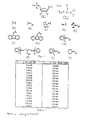
- FIG. 1 presents nucleoside monomer Formula (I) and various substituents that may be appended to Formula (I).
- R' is preferably a 2' orthoester protecting group in the case of RNA synthesis (protecting the 2' ribose hydroxy moiety), H in the case of DNA synthesis. or any other compatible moiety, e.g., ethers, alkyl ethers, esters, halogens, protected amines, and protected hydroxyl moieties; R" can include any moiety as a precursor to the final monomer.
- R" is preferably a phosphoramidite linkage and, more preferably, R" is a phosphoramidite linkage as shown in Formula (1A) wherein R 4 may be any compatible organic ligand: R 1 , R 2 , and R 3 include at least one alkoxy or siloxy substituent, and may be any one of substituents (A), (B), (C), (D), (E), (F), (G), (H), (I), and (K), or compounds of similar molecular weight and steric bulk; BASE is a nucleic acid base which may include adenine, guanine, cytosine, thymine, uracil, N -protected adenine, guanine and cytosine or functional homologues thereof.
- the respective portions of Formula (I) include a central ribose-based sugar having a nucleic base connected to the 1' ribose position, a hydroxy moiety connected to the 3' ribose position. and a silylether connected to the 5' ribose position.
- the broken line attached to each of the substituents (A) through (K) indicates a locus for attachment to the 5' silicon moiety.
- Formula (I) represents a precursor to the phosphoramidite nucleoside for use in oligonucleotide synthesis when R' is not a phosphoramidite moiety.
- a phosphoramidite moiety is preferably attached to the precursor when R" is a hydroxy moiety.
- the 3' OH group is preferably converted to a phosphoramidite linkage by conventional protocols using bisdiisopropylaminemethoxyphosphine, as will be understood by those skilled in the art.
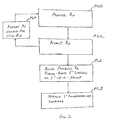
- FIG. 2 depicts an exemplary flow diagram that describes the synthesis of the Formula I precursor (when R" is -OH) followed by phosphoramidite conversion of the Formula I precursor.
- Step P20 includes providing an R x compound corresponding to a silyl group with one or more of the desired substituents, R 1 , R 2 , and R 3 .
- This compound is preferably provided via commercial sources, e.g., where R 1 is an alkyl group as with substituents A and D (see FIG. 1), or by reacting SiCl 4 with an alcohol as with substituents B and K, or by reacting SiCl 4 with sodium salt of silanol or alcohol as with substituent E.
- Step P22 includes reacting the R x compound with an appropriate alcohol or silanol.
- the product may be purified or used as is or with minor purification.
- Step P24 includes repeating steps P20 and P22 up to one more time for triple substitution of the intermediate reaction product.
- Each repeat cycle of Step P20 may provide a new R x corresponding to one of substituents A-K of FIG. 1, or R x may remain the same. It is preferred to include at least one alkoxy or siloxy substituent selected from substituents A-K. because these substituents enhance fluoride lability of the 5' silylether.
- Step P26 includes substituting the silyl group derived from Step P24 for the hydrogen connected to the 5' oxygen of the nucleoside of Formula (I).
- the substitution reaction is preferably facilitated by the addition of an imidazole catalyst, and is site-specific for the 5' hydroxyl.
- a nucleoside moiety including a specific BASE is preferably combined with the silyl group in the presence of the imidazole catalyst and reacted at room temperature for one hour or more.
- Step P28 includes attaching a phosphoramidite functional group to the 3' hydroxyl of the silyl protected product derived from Step P26.
- a suitable solvent e.g., anhydrous dichloromethane
- the phosphorylation reaction conducts a site specific phosphoramidite substitution of the hydrogen connected to the 3' oxygen of Formula (I).
- FIG. 3 depicts a detailed reaction process including Steps P30-P36, which also embody Steps P20 through P26 of FIG. 2.
- Steps P30-P36 which also embody Steps P20 through P26 of FIG. 2.
- bis-trimethylsitoxy-dichlorosilane and bis-tritylglycerol were synthesized separately, combined, and then used to protect the 5'-OH of a 2'-deoxythymidine nucleoside.
- the reagents utilized in this example can be obtained from a variety of commercial sources, e.g., Aldrich Chemical of Milwaukee, WI.
- Step P30 included synthesis of bis-trimethoxy-dichlorosilane.
- Trimethylsilanol (“TMSO - OH”) was formed by adding 10.4 moles of hexamethylsilazane (84 ml) to a stirred solution including 0.4 moles of glacial acetic acid (22.8 ml) in 400 ml of distilled water at 0° C. The aqueous phase was removed and washed twice with 100 ml of ether. The ether washes were combined with the silanol phase and stored at -20° C to freeze out the excess water. The liquid solution was decanted and dried over potassium carbonate for 75 min, diluted to 750ml with ether, passed through a 0.45 ⁇ m filter and used in the next synthesis. Nuclear magnetic resonance analysis indicated the formation of disiloxane in an amount ranging from about three to four mole percent relative to product.
- TMSO - Na + Sodium trimethylsilanate
- Trichloro-trimethylsiloxy-silane was prepared by reacting an aliquot of the sodium trimethylsilanate solution containing 0.663 moles of sodium trimethylsilanate with 0.597 moles (68.5 ml) of tetrachlorosilane.
- the trimethylsilanate solution was added by cannula to a mechanically stirred solution of the tetrachlorosilane 500 ml of ether at 0° C.
- the salt was removed by centrifugation (8000 rpm for 10-15 min). and the solution was decanted off.
- the ether was removed in vacuo and the product was distilled at atmospheric pressure.
- Bis-trimethylsiloxy-dichlorosilane was synthesized by reacting 0.3681 moles of trichlorotrimethylsilane in the crude reaction product with a 1.1 molar equivalent of trimethylsilanol prepared as before.
- the trimethylsilanol was cannulated to a mechanically stirred solution including the crude trichlorotrimethylsilane reaction product and 1.47 moles (205 ml) of triethylamine in 1000 g of ether at 0°C.
- the solution was filtered under argon and the solvent was removed in vacuo .
- the product was fractionally distilled over calcium hydride at 60°C and a pressure of 4 mm Hg to yield the bis-trimethylsiloxy-dichlorosilane reaction product and complete Step P30.
- Step P32 included synthesis of 1,3- O -bistrityletherglygerol.
- the 1,3- O -bistrityletherglygerol was prepared by adding 0.304 moles (28g) of dry glycerol to 0.608 moles (169.52 g) of triphenylmethylchloride in 400 ml of pyridine solvent at 0°C. The reaction continued to completion overnight at room temperature. The product was purified on silica gel after an aqueous workup, and then crystallized to complete Step P32.
- Step P34 included combining the products from Steps P30 and P32.
- Step P36 included addition of the product from step P34 to a thymidine nucleoside.
- Step P36 The product derived from Step P36 was reacted to form a 5'- O -silyl protected 3'- O -diisopropylmethoxyphosphine-thymidine.
- a 1.783 mmole (1.824 g) aliquot of the 5'- O -silyl thymidine reaction product from Step P36 was dissolved with 654 ⁇ l of bis-diisopropylmethoxyphosphine in 20 ml of anhydrous dichloromethane to form a reaction mixture.
- a 0.5 M quantity of tetrazole was mixed with 1.7 ml of acetonitrile and added to the reaction mixture with stirring for 8 hours at room temperature.
- Table 1 presents fluoride lability results that were obtained from various compounds that were made according to Example 1 from the various substituents of FIG. 1.
- Table 1 is provided immediately beneath FIG. 1 for easy reference thereto.
- the first formulation listed in Table 1 derived from a combination of substituents A, A, and B as R 1 , R 2 , and R 3 .
- FIG. 1 and Table 1 include substituents that have actually been found to work in the laboratory, but are not meant to be comprehensive lists of all substituents that will work. Additionally, any compatible alkoxy or siloxy substituent may be used having a molecular weight and/or steric bulk that approximates the substituents of FIG. 1 and Table 1.
- the number of useful substituents is very large, and will permit the incorporation of a chromophore, e.g., a dansyl moiety, into a silyl group corresponding to one of the R x positions of Formula I.
- the second column includes a comparison of the time to a complete reaction that removed the fluoride labile silyl group. The time to a complete reaction was determined by thin layer chromatography from a solution including the respective Formula (I) precursors in a tetrahydrofuran solvent mixed with a molar fraction of the precursor and five equimolar fractions of tetrabutylammonium fluoride. The precursors having lower reaction times are more preferred, with the I-I',E,E precursor being most preferred.
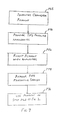
- FIG. 4 depicts a generalized schematic block process diagram for using silyl protecting groups to synthesize polymers. This process generally lends itself to any polymer synthesis, but preferred embodiments include the synthesis of sugar chains, such as oligosaccharides, oligonucleotides, and the like.
- Step P38 includes preparation of a first chain including at least one monomer having a silyl protecting group.
- This chain is preferably a nucleotide chain or functional homologue thereof.
- the preparation step preferably includes attaching the first chain to an insoluble support, such as a polystyrene support.
- an insoluble support such as a polystyrene support.
- the use of a polystyrene-based support is most preferred due to the tendency of fluoride ion to attack and degrade glass.
- the reaction can also occur in solution without a solid phase support, but this mode of reaction enhances the difficulty in purification of the final product.
- the support is preferably bound to the 3' end of the first nucleotide.
- the silylether bond will, accordingly, be located at the 5' ribose position for a 3' to 5' direction specific synthesis.
- a reverse direction (5' to 3') synthesis is possible, but the reverse direction synthesis is less preferred because of increased costs associated with commercially available reagents.
- Step P40 includes deprotecting the first chain by removing the silyl protecting group. This step preferably involves fluoride assisted cleavage of the silylether (Si-O) bond.
- Step P42 includes providing a monomer having a silyl protecting group.
- the monomer is preferably a phosphoramidite nucleoside having a 5' silyl protecting group.
- the nucleoside preferably has a second protecting group comprising an orthoester at the 2' ribose position.
- Step P44 includes coupling or reacting the monomer of Step P42 with the deprotected chain of Step P40.
- the coupling reaction generally follows established conventional protocols for phosphoramidite coupling reactions, with the exception that substituted tetrazole catalysts can provide enhanced yields in some RNA syntheses, and may be advantageously utilized as a replacement for the conventional tetrazole catalyst.
- the coupling reaction will not be complete in each cycle as some deprotected chains will fail to react with the phosphoramidite nucleoside of Step P42. Therefore.
- the coupling step is preferably completed by capping the unreacted chains to prevent the production of quasi-full length chains that lack a few nucleotides of the true full length sequence. The shortened chains are later easily removed in column purification. Capping is preferably conducted by the addition of commercially available standard mixtures including acetic anhydride ("Ac 2 O”) and N-methyl imidazole or dimethylaminopyridine (“DMAP").
- Step P46 includes repeating Steps P38, P40, P42. and P44 until the number of cycles is sufficient to provide a full length chain including the desired nucleotide sequence.
- Step P42 can vary for each respective cycle by providing a nucleoside having a base corresponding to the desired sequence.
- Step P48 includes oxidation of the phosphite triester chain linkage to form a phosphotriester linkage. Oxidation is preferably conducted by the addition of t -butylperoxide in toluene. It will be understood, however, that oxidation is not completely conventional because Step P48 is conducted after the full length sequence is constructed. It is often desirable to conduct Step P48 prior to step P50 because the deprotection conditions that may exist in Step P50 will degrade the phosphite triester linkage.
- Step P50 includes removal of remaining protecting groups.
- Step P50 preferably includes a final acid deprotection for removal of the preferred orthoesters.
- Oligonucleotide synthesis was conducted on a Gene Assemble Plus synthesizer from Phannacia of Milwaukee, Wisconsin. The protocols can be adapted by those skilled in the art to any commercially available synthesizer.
- a solid support was used for all syntheses, and included a thymidine polystyrene support with succinate linker from Pharmacia packed in 0.2 or 1.O ⁇ mole columns purchased form Miligen of Milford, Massachusetts.
- the silyl deprotection reagent is as follows: 0.5M aqueous HF solution purchased from Mallinkrodt and 3.5M triethylamine ("TEA") solution in N -methylpyrrolidone ("NMP").
- wash solvents were acetonitrile ("MeCN”) and a 1:1 mixture of TEA:NMP. Amidites were dissolved to 0.1M in acetonitrile.
- the coupling catalyst was 0.45M tetrazole for DNA synthesis and 0.15M S-ethyl-tetrazole for RNA synthesis.
- the coupling time for DNA synthesis was one minute and in four minutes for RNA synthesis.
- Table 2 includes an outline of the oligonucleotide synthesis cycle conditions following the generalized process depicted in FIG. 4.
- P52 5' silyl deprotection 0.5 M HF & 3.5M TEA in NMP 20
- P54 Wash 1:1 TEA/NMP 24
- P56 Wash MeCN 100
- P58 Couple 15 eq. Amidite/100 eq. tertrazole
- P64 Wash MeCN 20 P66: Wash 1:1 TEA/NMP 24
- the support column is removed from the synthesizer at the conclusion of the chain-elongation cycles that are conducted according to Table 2.
- a deprotection mixture is prepared to contain 200 mg of disodium-2-cobamoyl-2-cyanoethylene-1,1-ditiolate trihydrate ("dithio sodium salt") in 800 ml of dimethyl formamide (“DMF").
- the deprotection mixture is syringed through the column for fifteen minutes to remove methyl protecting groups on phophotriesters.
- the column is next washed with distilled water then acetone, and air dried.
- the support is removed and placed in a seated vial containing a mixture of 750 ⁇ l NH 4 OH and 250 ⁇ l ethanol for a sixty minute incubation at 65°C (16 hr for N -benzoyl-adenosine and N -isobutyrl-guanosine) to remove base protecting groups and cleave oligonucleotide from the support.
- the liquid is removed from the vial, dried down. resuspended in water, quantified and analyzed by reverse phase or ion exchange high pressure liquid chromatography ("HPLC").
- RNA synthesis requires some slight differences with respect to the DNA synthesis protocols of Table 2. Orthoesters are used as 2'-OH protecting groups for RNA synthesis. and Step P58 utilizes 0. 15M S -ethyl-tetrazole in place of the tetrazole catalyst in Table 2. Following NH 4 OH deprotection, the product is dried down and redissolved in 0.05M potassium phosphate buffer (pH 3.0) and incubated at 65°C for 1 hr. Acid deprotection of homopolymers of rA and rC have failed at room temperature but do work for homopolymers of U. This failure is presumed to occur due to secondary structure, but heating of the samples will result in successful deprotection.
- RNA products are preferably analyzed by HPLC with no further workup.
- high salt e.g. NaCl
- Acid deprotection is preferably followed by the addition of 0.15M tris (pH 8.5) for 30 min at 65°C to remove 2'- O -formyl groups, which are byproducts of acid deprotection. 2'- O -formyl groups are easily removed above pH 7.
- RNA products are preferably analyzed by HPLC with no further workup.
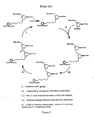
- FIG. 5 depicts the reactions involved in synthesizing an oligonucleotide according to the Table 2 protocol with reference to Steps P52 and P58 indicating the repetitive nature of the cycle.
- R' is preferably a 2' protecting group, H, or any other non-reactive group, and the remaining variables are as described in reference to Formula (I).
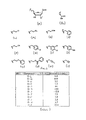
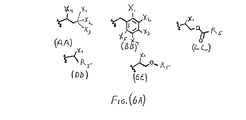
- FIG. 6 depicts Formula (II), which represents a 2' protected nucleoside precursor for use in synthesizing RNA.
- the R' is a 2' orthoester group corresponding to R' of Formula (I) (see FIG. 1);
- BASE' preferably includes a moiety selected from the group consisting of adenine. guanine, cytosine, uracil, or functional homologues thereof, and R 6 can be any substituent but preferably is a silyl ether group, hydrogen, hydroxyl, or organic ligand.
- Formula (IIa) is a particularly preferred noncyclic orthoeester for use as R' in Formula (I) and Formula (II).
- R is preferably one of substituents (AA), (BB), (CC), (DD), and (EE) as shown in FIG. 6A.
- X 1 , X 2 , X 3 , X 4 , and X 5 can be any compatible ligand, are preferably a hydrogen, halogen, alkyl group, or cyano substituent; and R 5 is can be any compatible organic ligand.
- R' even more preferably comprises Formula (IIa) having as R one of the substituents (L), (M), (N), (O), (P), (Q), (S), (T), (U), (V), and (X). The remaining variables are as described in reference to Formula (I).
- the broken line attached to each of the substituents (L) through (X) indicates a locus for R group attachment to an oxygen of the 2' orthoester.
- Table 3 is presented directly beneath FIG. 6 for easy reference thereto.
- the first column of Table 3 includes a description of the synthesized compound., e.g., the first entry describes a compound wherein all R substituents are (L) moieties.
- the second column of Table 3 describes the half life of the compound in a pH 2 environment, as determined by HPLC.
- the compounds of Table 3 and the substituents of FIG. 6 provide an exemplary list of compounds that form suitable orthoester protecting groups. Those skilled in the art will understand that numerous other suitable compounds exist having similar effect on the basicity of the oxygens in the orthoester. Each orthoester protected nucleoside has different acid lability.
- N -benzoyl cytidine and uridine are comparable, while 6- N -benzoyl-adenosine and 2- N -isobutyryl-guanosine are both about 3 times more stable. Therefore, the most preferred orthoesters for use in oligonucleotide synthesis were tri-2-butyne orthoester for C and U nucleosides and triphenoxyethyl orthoester for A and G nucleosides.
- FIG. 7 depicts a schematic process flow diagram for the synthesis of orthoester protected precursors according to Formula (II), and the subsequent use of these precursors to obtain the precursor of Formula (I) for application in the process of FIG. 2.
- Step P68 includes synthesis of an orthoester reagent.
- This step preferably includes the reaction of trimethylorthoformate and an alcohol that but for the hydroxy moiety of the alcohol corresponds to the substituents (L) through (X) in FIG. 6.
- These reagents are preferably combined for reaction in the presence of a catalytic amount of p -toluenesulfonic acid.
- Methanol is removed during the reaction by distilling at atmospheric pressure and temperatures greater than 100 C to drive reaction forward.
- Step P70 includes providing a ribonucleoside that is protected at the 5' and 3' ribose oxygens.
- the preferred protected nucleosides are 5', 3'- O -tetraisopropylsiloxyl-nucleosides, which may be purchased from Monomer Sciences of Huntsville. Alabama.
- the tetraisopropylsiloxyl moieties are hereinafter referred to as TIPS protecting groups.
- Step P72 includes reacting the protected nucleosides of Step P72 with the orthoester reagent of Step P68. Except for uridine nucleosides, the reaction with the preferred TIPS nucleoside is preferably conducted in a dibutylphthalate solvent with high vacuum distillation of the alcohol byproduct to improve the yield which. otherwise, typically ranges from 20% to 60%. The reaction with uridine nucleosides are best facilitated by using no solvent.
- Step P74 includes removal of the 5', 3'-TIPS protecting group from the reaction product of Step P72. Removal of the preferred TIPS groups is preferably conducted by reaction with triethylamine-hydorfluoride in acetonitrile.
- Step P76 includes use of the reaction product from Step P74 in step P26 of FIG. 2. in order to provide a 2'-orthoester-protected phosphoramidite nucieoside in Step P42 of the process depicted in FIG. 4.
- An orthoester reagent was synthesized from 2-butene-1-ol.
- a reaction mixture was prepared including a 2.90 mole quantity (203.3 g) of redistilled 2-butyne-1-ol, a 0.935 mole quantity (102.3 ml) of trimethyl orthoformate (0.935 moles. 102.3 ml), and a catalytic amount (0.018 moles, 4.69 g) of p -toluenesulfonic acid were dissolved in 100 ml dioxane.
- the dioxane solvent was distilled off under reduced pressure. Four repeat cycles were conducted wherein an additional 150 ml quantity of dioxane solvent was added to the reaction mixture subsequently removed by distillation.
- the resultant orthoester product was used in the synthesis of 2'- O -butyne orthoester uridine.
- a reaction mixture was mixed to include a 5.11 mmole quantity (2.973 g) of 5'. 3'-O-TIPS-uridine, a 0.61 mmole quantity (153 mg) of p-toluene sulfonic acid, and a 30.55 mmole quantity (6.73 g) of tri(2-butyne)-orthoester.
- the reaction mixture was heated under high vacuum at 65°C for 3 hours. A 1 ml quantity of triethylamine was added to quench the reaction. The 5'.
- 3' TIPS groups was cleaved by the addition of 5 ml 1.0M HF, 2.0M triethylamine in acetonitrile. The cleavage reaction was complete after 1 hour. The solvent was removed in vacuo . and the residue was purified on silica gel to provide a 60.3% yield.
- the orthoester product was also utilized in the synthesis of 2'- O -butyneorthoester-4- N -benzoyl cytidine.
- the procedure was identical to that described in the preceding paragraph, except that 5', 3'- O -TIPS-(N-benzoyl)-cytidine was substituted for the 5', 3'- O -TIPS-uridine.
- a phenoxyethyl orthoester was utilized in the synthesis of 2'- O -phenoxyethanol orthoester- N -benzoyl adenosine.
- a reaction mixture was prepared to include a 15 mmole quantity (9.2 g) of 5', 3'- O -TIPS-( N -benzoyl) adenosine dissolved in 50 ml of dioxane solvent with a 0.75 mmole quantity (188 mg) of p-toluene sulfonic acid and a 45 mmole quantity (19.1 g) of triphenoxyethanol orthoester. The reaction mixture was heated to 65°C and left to incubate overnight at that temperature..
- Triethylamine was added to quench the reaction, and the solution was passed over silica gel to remove an excess amount of the orthoester reagent. The collected fractions including the desired reaction product were combined and the solvent was removed in vacuo . The 5' and 3' TIPS protecting groups were removed by the addition of a 30 ml solution including 1.0M HF and 2.0M triethylamine in acetonitrile. The yield of the desired reaction product was 19%. 2'- O -phenoxyethylorthoester- N -isobutryl guanosine was prepared by a similar procedure.
- Example 2 A synthesis of 3'- O -diisopropylmethoxyphosphine-thymidine monomer was conducted as described in Example 1, and used to synthesize a thymidine homopolymer according to the DNA synthesis protocols set forth in Example 2.
- FIG. 8 depicts a high pressure liquid chromatography ("HPLC") trace of the reaction products.
- the X-axis represents time in tenths of minutes.
- the Y-axis represents a relative spectral absorption at a wavelength of 260 nm.
- Each peak is labeled with a computer-generated area underlying the peak.
- the "Area Percent" column identifies a relative abundance of the reaction product associated with each peak. Two significant observations arise from the results depicted in FIG. 8. First, a 98% yield of the full length reaction product is as good as compared to conventional yields for DNA synthesis having more than five connected monomer. Second, there is a diminimished relative abundance of longer-retained products at times greater than about 0.15 minutes. The essential absence of these large products simplifies the purification precess.
- the polyadenylated homopolymer sequence corresponding to Sequence ID No. 2 was synthesized by the DNA protocols set forth in Example 2. Comparative results were obtained from the conventional dimethyoxytrityl protocols set forth by ABI of Foster City, California.
- a silyl protected phosphoramidite adenosine nucleoside monomer was prepared in an identical manner with respect to Example 1, except an N -benzoyl-deoxyadenosine nucleoside was substituted for the thymidine nucleoside.
- FIG. 9 depicts a HPLC trace for the oligonucleotide products that derived from the silyl protected monomers indicating a 92% relative abundance of the full length product and a total 0.68% relative abundance of longer retained impurities.
- FIG. 10 depicts a comparative HPLC trace of oligonucleotide products that derived from the conventional dimethoxytrityl protocols indicating an 87% relative abundance of the full length product and a 1.99% relative abundance of longer retained impurities.
- RNA nucleoside monomer precursors were synthesized as in Example 3. These precursors included 2'- O -butyne orthoester uridine, 2'-O-butyneorthoester-4- N -benzoyl cytidine. and 2'- O -phenoxyethyl orthoester- N -benzoyl adenosine.
- a 5'- O -silyl protecting group and ed a 3'- O -diisopropylmethoxyphosphine moiety were added to the respective precursors as in Example 1 to provide monomers for synthesis according to the protocols set forth in Example 2.
- Oligonucleotides including (rA) 9 T (Sequence ID No. 3), (rC) 9 T (Sequence ID No. 4) and (rU) 9 T (Sequence ID No. 5) were synthesized as described in Example 2 with the exception that 0.15M S-ethyl-tetrazole in acetonitrile was used as coupling catalyst. The time allocated to the coupling reaction (Step P58) was, accordingly, extended to four minutes. Deprotection was similar to deoxynucleotide polymers with the exception that thio-salt deprotection time was increased to 30 minutes and the NH 4 OH contact time extended overnight.
- FIG. 11 depicts the HPLC trace for (rU) 9 T.
- FIG. 12 depicts the HPLC trace for (rC) 9 T.
- FIG. 13 depicts the HPLC trace for (rA) 9 T. With the exception of (rC) 9 T, these traces indicate excellent homopolymer yields.
- Sequence ID No. 6 is a substrate template for ribozyme cleavage.
- Sequence ID No. 9 is a corresponding ribozyme sequence.
- Sequence ID No. 7 is a mixed polymer.
- Sequence ID No. 8 is the same as Sequence ID No. 7 with cytidine replaced by uridine.
- the #6 sequence and corresponding ribozyme sequence # 9 were synthesized by dimethoxytrityl chemistry using standard protocols set forth by ABI of Foster City, California.
- Sequence #9 includes the same length and base composition as sequence # 7, but arranged in a different sequential order.
- Ion exchange HPLC analysis of crude oligonucleotides yielded the following results in Table 5.
- Overall crude product yields were significantly more for oligonucleotides synthesized via this invention.
- Table 5 facilitates a comparative analysis of the full length product yields that derive from silyl protecting group chemistry versus analogous yields from the conventional dimethoxytrityl protecting group chemistry.
- COMPARISON OF OLIGONUCLEOSIDE YIELDS BETWEEN SILYL PROTECTING GROUP PROTOCOLS AND CONVENTIONAL PHOSPHORAMIDITE PROTOCOLS Sequence ID No. Dimethoxytrityl Chemistry Silyl Chemistry 6 45% 37% 7 72% 8 75% 9 62% Table 5.
- Oligonucleotides corresponding to Sequence Nos. 6 were synthesized by both methods. The respective oligonucleotide products were purified by HPLC. Both of the #6 sequences were labelled with P 32 via kinase reaction according to conventional protocols, and incubated with the No. 9 sequence. Time points were generated on polyacrylamide gel electrophoresis ("PAGE") to analyze the rate and extent to which the No. 6 sequences incurred cleavage. Table 6 includes the PAGE results. COMPARISON OF KINETIC DATA FOR CLEAVAGE OF RIBOZYME SUBSTRATE Dimethoxytrityl Chemistry Silyl Chemistry % Substrate Uncleaved 17% 18% Initial Rate 0.703 min -1 0.831 min -1
Landscapes
- Chemical & Material Sciences (AREA)
- Organic Chemistry (AREA)
- Molecular Biology (AREA)
- Life Sciences & Earth Sciences (AREA)
- Health & Medical Sciences (AREA)
- Biochemistry (AREA)
- Engineering & Computer Science (AREA)
- Genetics & Genomics (AREA)
- General Health & Medical Sciences (AREA)
- Biotechnology (AREA)
- Saccharide Compounds (AREA)
- Macromolecular Compounds Obtained By Forming Nitrogen-Containing Linkages In General (AREA)
- Polyurethanes Or Polyureas (AREA)
Applications Claiming Priority (3)
| Application Number | Priority Date | Filing Date | Title |
|---|---|---|---|
| US08/488,878 US5889136A (en) | 1995-06-09 | 1995-06-09 | Orthoester protecting groups in RNA synthesis |
| US488878 | 1995-06-09 | ||
| PCT/US1996/009915 WO1996041809A1 (en) | 1995-06-09 | 1996-06-07 | Novel protecting groups and use thereof in an improved process for oligonucleotide synthesis |
Publications (3)
| Publication Number | Publication Date |
|---|---|
| EP0775149A1 EP0775149A1 (en) | 1997-05-28 |
| EP0775149A4 EP0775149A4 (en) | 1999-02-24 |
| EP0775149B1 true EP0775149B1 (en) | 2004-09-22 |
Family
ID=23941485
Family Applications (1)
| Application Number | Title | Priority Date | Filing Date |
|---|---|---|---|
| EP96919324A Expired - Lifetime EP0775149B1 (en) | 1995-06-09 | 1996-06-07 | Novel protecting groups and use thereof in an improved process for oligonucleotide synthesis |
Country Status (9)
| Country | Link |
|---|---|
| US (2) | US5889136A (da) |
| EP (1) | EP0775149B1 (da) |
| JP (2) | JP4138000B2 (da) |
| AT (1) | ATE277067T1 (da) |
| DE (1) | DE69633432T2 (da) |
| DK (1) | DK0775149T3 (da) |
| ES (1) | ES2229271T3 (da) |
| PT (1) | PT775149E (da) |
| WO (1) | WO1996041809A1 (da) |
Families Citing this family (234)
| Publication number | Priority date | Publication date | Assignee | Title |
|---|---|---|---|---|
| US6605712B1 (en) * | 1990-12-20 | 2003-08-12 | Arch Development Corporation | Gene transcription and ionizing radiation: methods and compositions |
| US5889136A (en) * | 1995-06-09 | 1999-03-30 | The Regents Of The University Of Colorado | Orthoester protecting groups in RNA synthesis |
| DE19928591A1 (de) | 1998-06-22 | 1999-12-23 | Roxana Havlina | Herstellung von Polymeren aus nukleotidischen und/oder nicht-nukleotidischen Bausteinen auf enzymatischem Weg |
| AU6270499A (en) * | 1998-09-29 | 2000-04-17 | Phylos, Inc. | Synthesis of codon randomized nucleic acids |
| US6069243A (en) * | 1998-10-06 | 2000-05-30 | Isis Pharmaceuticals, Inc. | Process for oligonucleotide synthesis |
| US20050233329A1 (en) * | 2002-02-20 | 2005-10-20 | Sirna Therapeutics, Inc. | Inhibition of gene expression using duplex forming oligonucleotides |
| US20080039414A1 (en) * | 2002-02-20 | 2008-02-14 | Sima Therapeutics, Inc. | RNA interference mediated inhibition of gene expression using chemically modified short interfering nucleic acid (siNA) |
| US8202979B2 (en) * | 2002-02-20 | 2012-06-19 | Sirna Therapeutics, Inc. | RNA interference mediated inhibition of gene expression using chemically modified short interfering nucleic acid |
| US8273866B2 (en) * | 2002-02-20 | 2012-09-25 | Merck Sharp & Dohme Corp. | RNA interference mediated inhibition of gene expression using chemically modified short interfering nucleic acid (SINA) |
| CA2398282A1 (en) * | 2000-02-11 | 2001-08-16 | Ribozyme Pharmaceuticals, Inc. | Method and reagent for the modulation and diagnosis of cd20 and nogo gene expression |
| US20050032733A1 (en) * | 2001-05-18 | 2005-02-10 | Sirna Therapeutics, Inc. | RNA interference mediated inhibition of gene expression using chemically modified short interfering nucleic acid (SiNA) |
| WO2003070918A2 (en) | 2002-02-20 | 2003-08-28 | Ribozyme Pharmaceuticals, Incorporated | Rna interference by modified short interfering nucleic acid |
| US7833992B2 (en) * | 2001-05-18 | 2010-11-16 | Merck Sharpe & Dohme | Conjugates and compositions for cellular delivery |
| US7491805B2 (en) * | 2001-05-18 | 2009-02-17 | Sirna Therapeutics, Inc. | Conjugates and compositions for cellular delivery |
| US7135565B2 (en) * | 2000-07-28 | 2006-11-14 | Agilent Technologies, Inc. | Synthesis of polynucleotides using combined oxidation/deprotection chemistry |
| US20080032942A1 (en) * | 2000-08-30 | 2008-02-07 | Mcswiggen James | RNA interference mediated treatment of Alzheimer's disease using short interfering nucleic acid (siNA) |
| US20050209179A1 (en) * | 2000-08-30 | 2005-09-22 | Sirna Therapeutics, Inc. | RNA interference mediated treatment of Alzheimer's disease using short interfering nucleic acid (siNA) |
| US20040242523A1 (en) * | 2003-03-06 | 2004-12-02 | Ana-Farber Cancer Institue And The Univiersity Of Chicago | Chemo-inducible cancer gene therapy |
| US8034791B2 (en) | 2001-04-06 | 2011-10-11 | The University Of Chicago | Activation of Egr-1 promoter by DNA damaging chemotherapeutics |
| EP1390075B1 (en) * | 2001-04-06 | 2012-01-18 | The University of Chicago | Chemotherapeutic induction of egr-1 promoter activity in gene therapy |
| US20050222066A1 (en) * | 2001-05-18 | 2005-10-06 | Sirna Therapeutics, Inc. | RNA interference mediated inhibition of vascular endothelial growth factor and vascular endothelial growth factor receptor gene expression using short interfering nucleic acid (siNA) |
| US20060142226A1 (en) * | 2001-05-18 | 2006-06-29 | Sirna Therapeutics, Inc. | RNA interference mediated inhibition of cholesteryl ester transfer protein (CETP) gene expression using short interfering nucleic acid (siNA) |
| US20050288242A1 (en) * | 2001-05-18 | 2005-12-29 | Sirna Therapeutics, Inc. | RNA interference mediated inhibition of RAS gene expression using short interfering nucleic acid (siNA) |
| US20050014172A1 (en) * | 2002-02-20 | 2005-01-20 | Ivan Richards | RNA interference mediated inhibition of muscarinic cholinergic receptor gene expression using short interfering nucleic acid (siNA) |
| US20060142225A1 (en) * | 2001-05-18 | 2006-06-29 | Sirna Therapeutics, Inc. | RNA interference mediated inhibition of cyclin dependent kinase-2 (CDK2) gene expression using short interfering nucleic acid (siNA) |
| US20050164967A1 (en) * | 2001-05-18 | 2005-07-28 | Sirna Therapeutics, Inc. | RNA interference mediated inhibition of platelet-derived endothelial cell growth factor (ECGF1) gene expression using short interfering nucleic acid (siNA) |
| US20070270579A1 (en) * | 2001-05-18 | 2007-11-22 | Sirna Therapeutics, Inc. | RNA interference mediated inhibition of gene expression using short interfering nucleic acid (siNA) |
| US9994853B2 (en) | 2001-05-18 | 2018-06-12 | Sirna Therapeutics, Inc. | Chemically modified multifunctional short interfering nucleic acid molecules that mediate RNA interference |
| US20050136436A1 (en) * | 2001-05-18 | 2005-06-23 | Sirna Therapeutics, Inc. | RNA interference mediated inhibition of G72 and D-amino acid oxidase (DAAO) gene expression using short interfering nucleic acid (siNA) |
| US20050159376A1 (en) * | 2002-02-20 | 2005-07-21 | Slrna Therapeutics, Inc. | RNA interference mediated inhibition 5-alpha reductase and androgen receptor gene expression using short interfering nucleic acid (siNA) |
| US20050182007A1 (en) * | 2001-05-18 | 2005-08-18 | Sirna Therapeutics, Inc. | RNA interference mediated inhibition of interleukin and interleukin receptor gene expression using short interfering nucleic acid (SINA) |
| US20050124566A1 (en) * | 2001-05-18 | 2005-06-09 | Sirna Therapeutics, Inc. | RNA interference mediated inhibition of myostatin gene expression using short interfering nucleic acid (siNA) |
| US20080161256A1 (en) * | 2001-05-18 | 2008-07-03 | Sirna Therapeutics, Inc. | RNA interference mediated inhibition of gene expression using short interfering nucleic acid (siNA) |
| US7517864B2 (en) * | 2001-05-18 | 2009-04-14 | Sirna Therapeutics, Inc. | RNA interference mediated inhibition of vascular endothelial growth factor and vascular endothelial growth factor receptor gene expression using short interfering nucleic acid (siNA) |
| US20050196765A1 (en) * | 2001-05-18 | 2005-09-08 | Sirna Therapeutics, Inc. | RNA interference mediated inhibition of checkpoint Kinase-1 (CHK-1) gene expression using short interfering nucleic acid (siNA) |
| US20040198682A1 (en) * | 2001-11-30 | 2004-10-07 | Mcswiggen James | RNA interference mediated inhibition of placental growth factor gene expression using short interfering nucleic acid (siNA) |
| US20060241075A1 (en) * | 2001-05-18 | 2006-10-26 | Sirna Therapeutics, Inc. | RNA interference mediated inhibition of desmoglein gene expression using short interfering nucleic acid (siNA) |
| US20050159382A1 (en) * | 2001-05-18 | 2005-07-21 | Sirna Therapeutics, Inc. | RNA interference mediated inhibition of polycomb group protein EZH2 gene expression using short interfering nucleic acid (siNA) |
| US20050164966A1 (en) * | 2001-05-18 | 2005-07-28 | Sirna Therapeutics, Inc. | RNA interference mediated inhibition of type 1 insulin-like growth factor receptor gene expression using short interfering nucleic acid (siNA) |
| US20050153915A1 (en) * | 2001-05-18 | 2005-07-14 | Sirna Therapeutics, Inc. | RNA interference mediated inhibition of early growth response gene expression using short interfering nucleic acid (siNA) |
| US20050124567A1 (en) * | 2001-05-18 | 2005-06-09 | Sirna Therapeutics, Inc. | RNA interference mediated inhibition of TRPM7 gene expression using short interfering nucleic acid (siNA) |
| US20050119212A1 (en) * | 2001-05-18 | 2005-06-02 | Sirna Therapeutics, Inc. | RNA interference mediated inhibition of FAS and FASL gene expression using short interfering nucleic acid (siNA) |
| US20050267058A1 (en) * | 2001-05-18 | 2005-12-01 | Sirna Therapeutics, Inc. | RNA interference mediated inhibition of placental growth factor gene expression using short interfering nucleic acid (sINA) |
| US20050148530A1 (en) * | 2002-02-20 | 2005-07-07 | Sirna Therapeutics, Inc. | RNA interference mediated inhibition of vascular endothelial growth factor and vascular endothelial growth factor receptor gene expression using short interfering nucleic acid (siNA) |
| US20050233996A1 (en) * | 2002-02-20 | 2005-10-20 | Sirna Therapeutics, Inc. | RNA interference mediated inhibition of hairless (HR) gene expression using short interfering nucleic acid (siNA) |
| US20070042983A1 (en) * | 2001-05-18 | 2007-02-22 | Sirna Therapeutics, Inc. | RNA interference mediated inhibition of gene expression using short interfering nucleic acid (siNA) |
| US20050164224A1 (en) * | 2001-05-18 | 2005-07-28 | Sirna Therapeutics, Inc. | RNA interference mediated inhibition of cyclin D1 gene expression using short interfering nucleic acid (siNA) |
| US20050176665A1 (en) * | 2001-05-18 | 2005-08-11 | Sirna Therapeutics, Inc. | RNA interference mediated inhibition of hairless (HR) gene expression using short interfering nucleic acid (siNA) |
| US20050159380A1 (en) * | 2001-05-18 | 2005-07-21 | Sirna Therapeutics, Inc. | RNA interference mediated inhibition of angiopoietin gene expression using short interfering nucleic acid (siNA) |
| US20080188430A1 (en) * | 2001-05-18 | 2008-08-07 | Sirna Therapeutics, Inc. | RNA interference mediated inhibition of hypoxia inducible factor 1 (HIF1) gene expression using short interfering nucleic acid (siNA) |
| US20050209180A1 (en) * | 2001-05-18 | 2005-09-22 | Sirna Therapeutics, Inc. | RNA interference mediated inhibition of hepatitis C virus (HCV) expression using short interfering nucleic acid (siNA) |
| US20050080031A1 (en) * | 2001-05-18 | 2005-04-14 | Sirna Therapeutics, Inc. | Nucleic acid treatment of diseases or conditions related to levels of Ras, HER2 and HIV |
| US20050159379A1 (en) * | 2001-05-18 | 2005-07-21 | Sirna Therapeutics, Inc | RNA interference mediated inhibition of gastric inhibitory polypeptide (GIP) and gastric inhibitory polypeptide receptor (GIPR) gene expression using short interfering nucleic acid (siNA) |
| US20050196767A1 (en) * | 2001-05-18 | 2005-09-08 | Sirna Therapeutics, Inc. | RNA interference mediated inhibition of GRB2 associated binding protein (GAB2) gene expression using short interfering nucleic acis (siNA) |
| US20050130181A1 (en) * | 2001-05-18 | 2005-06-16 | Sirna Therapeutics, Inc. | RNA interference mediated inhibition of wingless gene expression using short interfering nucleic acid (siNA) |
| US20050233997A1 (en) * | 2001-05-18 | 2005-10-20 | Sirna Therapeutics, Inc. | RNA interference mediated inhibition of matrix metalloproteinase 13 (MMP13) gene expression using short interfering nucleic acid (siNA) |
| US20060019913A1 (en) * | 2001-05-18 | 2006-01-26 | Sirna Therapeutics, Inc. | RNA interference mediated inhibtion of protein tyrosine phosphatase-1B (PTP-1B) gene expression using short interfering nucleic acid (siNA) |
| US20050054598A1 (en) * | 2002-02-20 | 2005-03-10 | Sirna Therapeutics, Inc. | RNA interference mediated inhibition hairless (HR) gene expression using short interfering nucleic acid (siNA) |
| US20050287128A1 (en) * | 2001-05-18 | 2005-12-29 | Sirna Therapeutics, Inc. | RNA interference mediated inhibition of TGF-beta and TGF-beta receptor gene expression using short interfering nucleic acid (siNA) |
| US20060211642A1 (en) * | 2001-05-18 | 2006-09-21 | Sirna Therapeutics, Inc. | RNA inteference mediated inhibition of hepatitis C virus (HVC) gene expression using short interfering nucleic acid (siNA) |
| US20050143333A1 (en) * | 2001-05-18 | 2005-06-30 | Sirna Therapeutics, Inc. | RNA interference mediated inhibition of interleukin and interleukin receptor gene expression using short interfering nucleic acid (SINA) |
| US20050119211A1 (en) * | 2001-05-18 | 2005-06-02 | Sirna Therapeutics, Inc. | RNA mediated inhibition connexin gene expression using short interfering nucleic acid (siNA) |
| US20050256068A1 (en) * | 2001-05-18 | 2005-11-17 | Sirna Therapeutics, Inc. | RNA interference mediated inhibition of stearoyl-CoA desaturase (SCD) gene expression using short interfering nucleic acid (siNA) |
| US20050164968A1 (en) * | 2001-05-18 | 2005-07-28 | Sirna Therapeutics, Inc. | RNA interference mediated inhibition of ADAM33 gene expression using short interfering nucleic acid (siNA) |
| US20050191638A1 (en) * | 2002-02-20 | 2005-09-01 | Sirna Therapeutics, Inc. | RNA interference mediated treatment of polyglutamine (polyQ) repeat expansion diseases using short interfering nucleic acid (siNA) |
| US20050054596A1 (en) * | 2001-11-30 | 2005-03-10 | Mcswiggen James | RNA interference mediated inhibition of vascular endothelial growth factor and vascular endothelial growth factor receptor gene expression using short interfering nucleic acid (siNA) |
| US20050182006A1 (en) * | 2001-05-18 | 2005-08-18 | Sirna Therapeutics, Inc | RNA interference mediated inhibition of protein kinase C alpha (PKC-alpha) gene expression using short interfering nucleic acid (siNA) |
| US20040219671A1 (en) * | 2002-02-20 | 2004-11-04 | Sirna Therapeutics, Inc. | RNA interference mediated treatment of parkinson disease using short interfering nucleic acid (siNA) |
| US20050153914A1 (en) * | 2001-05-18 | 2005-07-14 | Sirna Therapeutics, Inc. | RNA interference mediated inhibition of MDR P-glycoprotein gene expression using short interfering nucleic acid (siNA) |
| US20050176666A1 (en) * | 2001-05-18 | 2005-08-11 | Sirna Therapeutics, Inc. | RNA interference mediated inhibition of GPRA and AAA1 gene expression using short interfering nucleic acid (siNA) |
| US20050227935A1 (en) * | 2001-05-18 | 2005-10-13 | Sirna Therapeutics, Inc. | RNA interference mediated inhibition of TNF and TNF receptor gene expression using short interfering nucleic acid (siNA) |
| US20050079610A1 (en) * | 2001-05-18 | 2005-04-14 | Sirna Therapeutics, Inc. | RNA interference mediated inhibition of Fos gene expression using short interfering nucleic acid (siNA) |
| US20050124568A1 (en) * | 2001-05-18 | 2005-06-09 | Sirna Therapeutics, Inc. | RNA interference mediated inhibition of acetyl-CoA-carboxylase gene expression using short interfering nucleic acid (siNA) |
| US20050176664A1 (en) * | 2001-05-18 | 2005-08-11 | Sirna Therapeutics, Inc. | RNA interference mediated inhibition of cholinergic muscarinic receptor (CHRM3) gene expression using short interfering nucleic acid (siNA) |
| US20050187174A1 (en) * | 2001-05-18 | 2005-08-25 | Sirna Therapeutics, Inc. | RNA interference mediated inhibition of intercellular adhesion molecule (ICAM) gene expression using short interfering nucleic acid (siNA) |
| US20050137155A1 (en) * | 2001-05-18 | 2005-06-23 | Sirna Therapeutics, Inc. | RNA interference mediated treatment of Parkinson disease using short interfering nucleic acid (siNA) |
| US20050282188A1 (en) * | 2001-05-18 | 2005-12-22 | Sirna Therapeutics, Inc. | RNA interference mediated inhibition of gene expression using short interfering nucleic acid (siNA) |
| US20050233344A1 (en) * | 2001-05-18 | 2005-10-20 | Sirna Therapeutics, Inc. | RNA interference mediated inhibition of platelet derived growth factor (PDGF) and platelet derived growth factor receptor (PDGFR) gene expression using short interfering nucleic acid (siNA) |
| US20040209831A1 (en) * | 2002-02-20 | 2004-10-21 | Mcswiggen James | RNA interference mediated inhibition of hepatitis C virus (HCV) gene expression using short interfering nucleic acid (siNA) |
| US20050182009A1 (en) * | 2001-05-18 | 2005-08-18 | Sirna Therapeutics, Inc. | RNA interference mediated inhibition of NF-Kappa B / REL-A gene expression using short interfering nucleic acid (siNA) |
| US20050075304A1 (en) * | 2001-11-30 | 2005-04-07 | Mcswiggen James | RNA interference mediated inhibition of vascular endothelial growth factor and vascular endothelial growth factor receptor gene expression using short interfering nucleic acid (siNA) |
| US20070203333A1 (en) * | 2001-11-30 | 2007-08-30 | Mcswiggen James | RNA interference mediated inhibition of vascular endothelial growth factor and vascular endothelial growth factor receptor gene expression using short interfering nucleic acid (siNA) |
| US20040138163A1 (en) * | 2002-05-29 | 2004-07-15 | Mcswiggen James | RNA interference mediated inhibition of vascular edothelial growth factor and vascular edothelial growth factor receptor gene expression using short interfering nucleic acid (siNA) |
| US20060009409A1 (en) | 2002-02-01 | 2006-01-12 | Woolf Tod M | Double-stranded oligonucleotides |
| EP1572902B1 (en) * | 2002-02-01 | 2014-06-11 | Life Technologies Corporation | HIGH POTENCY siRNAS FOR REDUCING THE EXPRESSION OF TARGET GENES |
| ATE556714T1 (de) | 2002-02-01 | 2012-05-15 | Life Technologies Corp | Doppelsträngige oligonukleotide |
| US9657294B2 (en) | 2002-02-20 | 2017-05-23 | Sirna Therapeutics, Inc. | RNA interference mediated inhibition of gene expression using chemically modified short interfering nucleic acid (siNA) |
| US20050137153A1 (en) * | 2002-02-20 | 2005-06-23 | Sirna Therapeutics, Inc. | RNA interference mediated inhibition of alpha-1 antitrypsin (AAT) gene expression using short interfering nucleic acid (siNA) |
| EP1432724A4 (en) | 2002-02-20 | 2006-02-01 | Sirna Therapeutics Inc | RNA inhibition mediated inhibition of MAP KINASE GENES |
| US9181551B2 (en) | 2002-02-20 | 2015-11-10 | Sirna Therapeutics, Inc. | RNA interference mediated inhibition of gene expression using chemically modified short interfering nucleic acid (siNA) |
| US20050222064A1 (en) * | 2002-02-20 | 2005-10-06 | Sirna Therapeutics, Inc. | Polycationic compositions for cellular delivery of polynucleotides |
| US20050096284A1 (en) * | 2002-02-20 | 2005-05-05 | Sirna Therapeutics, Inc. | RNA interference mediated treatment of polyglutamine (polyQ) repeat expansion diseases using short interfering nucleic acid (siNA) |
| EP1474433A4 (en) * | 2002-02-20 | 2005-02-23 | Sirna Therapeutics Inc | TARGET LOCALIZATION TARGETED BY RNA INTERFERENCE AND TARGET VALIDATION WITH SHORT INTERFERING NUCLEIC ACID (siNA) |
| US20100075423A1 (en) * | 2002-06-12 | 2010-03-25 | Life Technologies Corporation | Methods and compositions relating to polypeptides with rnase iii domains that mediate rna interference |
| US20040248094A1 (en) * | 2002-06-12 | 2004-12-09 | Ford Lance P. | Methods and compositions relating to labeled RNA molecules that reduce gene expression |
| GB2406169B (en) * | 2002-06-12 | 2006-11-01 | Ambion Inc | Methods and compositions relating to labeled rna molecules that reduce gene expression |
| WO2004015075A2 (en) * | 2002-08-08 | 2004-02-19 | Dharmacon, Inc. | Short interfering rnas having a hairpin structure containing a non-nucleotide loop |
| US20040029275A1 (en) * | 2002-08-10 | 2004-02-12 | David Brown | Methods and compositions for reducing target gene expression using cocktails of siRNAs or constructs expressing siRNAs |
| US7923547B2 (en) | 2002-09-05 | 2011-04-12 | Sirna Therapeutics, Inc. | RNA interference mediated inhibition of gene expression using chemically modified short interfering nucleic acid (siNA) |
| US20040231231A1 (en) * | 2002-12-20 | 2004-11-25 | Cataldo Dominic A. | Use of colloidal clays for sustained release of active ingredients |
| US20040198640A1 (en) | 2003-04-02 | 2004-10-07 | Dharmacon, Inc. | Stabilized polynucleotides for use in RNA interference |
| US20070179100A1 (en) * | 2003-04-09 | 2007-08-02 | Muthiah Manoharan | Protected monomers |
| CA2522184A1 (en) * | 2003-04-17 | 2004-11-04 | The Trustees Of Columbia University In The City Of New York | Desmoglein 4 is a novel gene involved in hair growth |
| JP4991288B2 (ja) | 2003-04-17 | 2012-08-01 | アルナイラム ファーマシューティカルズ, インコーポレイテッド | 二本鎖iRNA剤、および二本鎖iRNA剤の対合の安定性を調節する方法。 |
| EP3222294A1 (en) | 2003-04-30 | 2017-09-27 | Sirna Therapeutics, Inc. | Conjugates and compositions for cellular delivery |
| JP2007505158A (ja) * | 2003-05-21 | 2007-03-08 | ボード オブ リージェンツ ザ ユニバーシティー オブ テキサス システム | 心肥大および心不全の処置としてのプロテインキナーゼC−μ(PKD)の阻害 |
| US7304203B2 (en) * | 2003-09-18 | 2007-12-04 | Mayo Foundation For Medical Education And Research | Transgenic TIEG non-human animals |
| EP2708541B1 (en) | 2003-11-13 | 2015-01-28 | Isis Pharmaceuticals, Inc. | 5,6-dihydroxy-isoindole derivatives as linkers for oligomer solid phase synthesis |
| WO2005078094A2 (en) * | 2004-02-06 | 2005-08-25 | Dharmacon, Inc. | Stabilized rnas as transfection controls and silencing reagents |
| US20090280567A1 (en) * | 2004-02-06 | 2009-11-12 | Dharmacon, Inc. | Stabilized sirnas as transfection controls and silencing reagents |
| KR101147147B1 (ko) * | 2004-04-01 | 2012-05-25 | 머크 샤프 앤드 돔 코포레이션 | Rna 간섭의 오프 타겟 효과 감소를 위한 변형된폴리뉴클레오타이드 |
| JP2007531794A (ja) * | 2004-04-05 | 2007-11-08 | アルニラム ファーマスーティカルズ インコーポレイテッド | オリゴヌクレオチドの合成および精製に使用する方法および反応試薬 |
| EP1747022A4 (en) * | 2004-04-23 | 2010-03-31 | Univ Columbia | INHIBITION OF HAIRLESS PROTEIN MRNA |
| US10508277B2 (en) | 2004-05-24 | 2019-12-17 | Sirna Therapeutics, Inc. | Chemically modified multifunctional short interfering nucleic acid molecules that mediate RNA interference |
| IL162276A0 (en) * | 2004-06-01 | 2005-11-20 | Hadasit Med Res Service | Nucleic acid molecules as heparanase potent inhibitors, compositions and methods of use thereof |
| WO2006033730A2 (en) * | 2004-08-20 | 2006-03-30 | Dharmacon, Inc. | Novel polynucleotide synthesis labeling chemistry |
| US7427675B2 (en) * | 2004-08-23 | 2008-09-23 | Isis Pharmaceuticals, Inc. | Compounds and methods for the characterization of oligonucleotides |
| CN101076546B (zh) * | 2004-09-02 | 2011-10-26 | Isis药物公司 | 用于低聚物合成的聚合珠 |
| US7923207B2 (en) * | 2004-11-22 | 2011-04-12 | Dharmacon, Inc. | Apparatus and system having dry gene silencing pools |
| US20060166234A1 (en) * | 2004-11-22 | 2006-07-27 | Barbara Robertson | Apparatus and system having dry control gene silencing compositions |
| US7935811B2 (en) * | 2004-11-22 | 2011-05-03 | Dharmacon, Inc. | Apparatus and system having dry gene silencing compositions |
| US20060142228A1 (en) * | 2004-12-23 | 2006-06-29 | Ambion, Inc. | Methods and compositions concerning siRNA's as mediators of RNA interference |
| WO2007086881A2 (en) | 2005-02-14 | 2007-08-02 | Sirna Therapeutics, Inc. | Cationic lipids and formulated molecular compositions containing them |
| US20060223777A1 (en) * | 2005-03-29 | 2006-10-05 | Dharmacon, Inc. | Highly functional short hairpin RNA |
| EP1871426B1 (en) | 2005-04-15 | 2017-06-07 | The Regents of The University of California | Small activating rna molecules and their use |
| US20090176725A1 (en) * | 2005-08-17 | 2009-07-09 | Sirna Therapeutics Inc. | Chemically modified short interfering nucleic acid molecules that mediate rna interference |
| US7759471B2 (en) | 2005-10-31 | 2010-07-20 | Agilent Technologies, Inc. | Monomer compositions for the synthesis of RNA, methods of synthesis, and methods of deprotection |
| US20070255054A1 (en) * | 2005-12-30 | 2007-11-01 | Affymetrix, Inc. | Oligonucleotide synthesis with intermittent and post synthetic oxidation |
| AU2007299705B2 (en) * | 2006-09-22 | 2012-09-06 | Dharmacon, Inc. | Duplex oligonucleotide complexes and methods for gene silencing by RNA interference |
| US7999087B2 (en) * | 2006-11-15 | 2011-08-16 | Agilent Technologies, Inc. | 2′-silyl containing thiocarbonate protecting groups for RNA synthesis |
| EP2094718A4 (en) * | 2006-11-20 | 2010-03-10 | Integrated Dna Tech Inc | METHOD FOR RNA DESILYLATION |
| US8242258B2 (en) * | 2006-12-03 | 2012-08-14 | Agilent Technologies, Inc. | Protecting groups for RNA synthesis |
| US20080206851A1 (en) * | 2007-02-28 | 2008-08-28 | Dellinger Douglas J | Methods and compositions for RNA synthesis |
| EP2147009A4 (en) * | 2007-05-18 | 2014-01-08 | Dharmacon Inc | NOVEL CHROMOPHORE SILYL PROTECTION GROUPS AND THEIR USE IN THE CHEMICAL SYNTHESIS OF OLIGONUCLEOTIDES |
| WO2008148068A1 (en) * | 2007-05-23 | 2008-12-04 | Mannkind Corporation | Multicistronic vectors and methods for their design |
| US7845686B2 (en) * | 2007-12-17 | 2010-12-07 | S & B Technical Products, Inc. | Restrained pipe joining system for plastic pipe |
| AU2009206225B2 (en) | 2008-01-25 | 2015-04-23 | Multivir Inc. | p53 biomarkers |
| US8188060B2 (en) | 2008-02-11 | 2012-05-29 | Dharmacon, Inc. | Duplex oligonucleotides with enhanced functionality in gene regulation |
| EP2408916A2 (en) | 2009-03-19 | 2012-01-25 | Merck Sharp&Dohme Corp. | RNA INTERFERENCE MEDIATED INHIBITION OF CONNECTIVE TISSUE GROWTH FACTOR (CTGF) GENE EXPRESSION USING SHORT INTERFERING NUCLEIC ACID (siNA) |
| US20120029054A1 (en) | 2009-03-19 | 2012-02-02 | Merck Sharp & Dohme Corp. | RNA Interference Mediated Inhibition of GATA Binding Protein 3 (GATA3) Gene Expression Using Short Intefering Nucleic Acid (siNA) |
| JP2012520684A (ja) | 2009-03-19 | 2012-09-10 | メルク・シャープ・エンド・ドーム・コーポレイション | 低分子干渉核酸(siNA)を用いたBTBandCNCHomology1(塩基性ロイシンジッパー転写因子1)(Bach1)遺伝子発現のRNA干渉媒介性阻害 |
| EP2408458A1 (en) | 2009-03-19 | 2012-01-25 | Merck Sharp&Dohme Corp. | RNA INTERFERENCE MEDIATED INHIBITION OF SIGNAL TRANSDUCER AND ACTIVATOR OF TRANSCRIPTION 6 (STAT6) GENE EXPRESSION USING SHORT INTERFERING NUCLEIC ACID (siNA) |
| JP2012521760A (ja) | 2009-03-27 | 2012-09-20 | メルク・シャープ・エンド・ドーム・コーポレイション | 低分子干渉核酸(siNA)を用いたアポトーシスシグナル調節キナーゼ1(ASK1)遺伝子発現のRNA干渉媒介性阻害 |
| EP2411520A2 (en) | 2009-03-27 | 2012-02-01 | Merck Sharp&Dohme Corp. | RNA INTERFERENCE MEDIATED INHIBITION OF THE THYMIC STROMAL LYMPHOPOIETIN (TSLP) GENE EXPRESSION USING SHORT INTERFERING NUCLEIC ACID (siNA) |
| WO2010111471A2 (en) | 2009-03-27 | 2010-09-30 | Merck Sharp & Dohme Corp. | RNA INTERFERENCE MEDIATED INHIBITION OF SIGNAL TRANSDUCER AND ACTIVATOR OF TRANSCRIPTION 1 (STAT1) GENE EXPRESSION USING SHORT INTERFERING NUCLEIC ACID (siNA) |
| WO2010111497A2 (en) | 2009-03-27 | 2010-09-30 | Merck Sharp & Dohme Corp. | RNA INTERFERENCE MEDIATED INHIBITION OF THE INTERCELLULAR ADHESION MOLECULE 1 (ICAM-1)GENE EXPRESSION USING SHORT INTERFERING NUCLEIC ACID (siNA) |
| EP2411018A2 (en) | 2009-03-27 | 2012-02-01 | Merck Sharp&Dohme Corp. | RNA INTERFERENCE MEDIATED INHIBITION OF THE NERVE GROWTH FACTOR BETA CHAIN (NGFß) GENE EXPRESSION USING SHORT INTERFERING NUCLEIC ACID (SINA) |
| US9409983B2 (en) | 2009-07-23 | 2016-08-09 | The Board Of Trustess Of The University Of Illinois | Methods and compositions involving PBEF inhibitors for lung inflammation conditions and diseases |
| US9045752B2 (en) | 2010-03-11 | 2015-06-02 | The Regents Of The University Of California | NKX3-1 saRNA and KLF4 saRNA and uses thereof |
| US9145556B2 (en) | 2010-04-13 | 2015-09-29 | Life Technologies Corporation | Compositions and methods for inhibition of nucleic acids function |
| US9045751B2 (en) | 2010-04-28 | 2015-06-02 | The Regents Of The University Of California | Modified small activating RNA molecules and methods of use |
| EP3330377A1 (en) | 2010-08-02 | 2018-06-06 | Sirna Therapeutics, Inc. | Rna interference mediated inhibition of catenin (cadherin-associated protein), beta 1 (ctnnb1) gene expression using short interfering nucleic acid (sina) |
| WO2012019168A2 (en) | 2010-08-06 | 2012-02-09 | Moderna Therapeutics, Inc. | Engineered nucleic acids and methods of use thereof |
| US9029341B2 (en) | 2010-08-17 | 2015-05-12 | Sirna Therapeutics, Inc. | RNA interference mediated inhibition of hepatitis B virus (HBV) gene expression using short interfering nucleic acid (siNA) |
| WO2012027467A1 (en) | 2010-08-26 | 2012-03-01 | Merck Sharp & Dohme Corp. | RNA INTERFERENCE MEDIATED INHIBITION OF PROLYL HYDROXYLASE DOMAIN 2 (PHD2) GENE EXPRESSION USING SHORT INTERFERING NUCLEIC ACID (siNA) |
| EP2625189B1 (en) | 2010-10-01 | 2018-06-27 | ModernaTX, Inc. | Engineered nucleic acids and methods of use thereof |
| WO2012058210A1 (en) | 2010-10-29 | 2012-05-03 | Merck Sharp & Dohme Corp. | RNA INTERFERENCE MEDIATED INHIBITION OF GENE EXPRESSION USING SHORT INTERFERING NUCLEIC ACIDS (siNA) |
| AU2012236099A1 (en) | 2011-03-31 | 2013-10-03 | Moderna Therapeutics, Inc. | Delivery and formulation of engineered nucleic acids |
| WO2013036799A2 (en) | 2011-09-09 | 2013-03-14 | Fred Hutchinson Cancer Research Center | Methods and compositions involving nkg2d inhibitors and cancer |
| US9464124B2 (en) | 2011-09-12 | 2016-10-11 | Moderna Therapeutics, Inc. | Engineered nucleic acids and methods of use thereof |
| DE19216461T1 (de) | 2011-10-03 | 2021-10-07 | Modernatx, Inc. | Modifizierte nukleoside, nukleotide und nukleinsäuren und verwendungen davon |
| CN107266391B (zh) | 2011-10-18 | 2020-04-17 | 迪克纳制药公司 | 胺阳离子脂质及其用途 |
| CA3018046A1 (en) | 2011-12-16 | 2013-06-20 | Moderna Therapeutics, Inc. | Modified nucleoside, nucleotide, and nucleic acid compositions |
| US9572897B2 (en) | 2012-04-02 | 2017-02-21 | Modernatx, Inc. | Modified polynucleotides for the production of cytoplasmic and cytoskeletal proteins |
| US9254311B2 (en) | 2012-04-02 | 2016-02-09 | Moderna Therapeutics, Inc. | Modified polynucleotides for the production of proteins |
| WO2013151665A2 (en) | 2012-04-02 | 2013-10-10 | modeRNA Therapeutics | Modified polynucleotides for the production of proteins associated with human disease |
| US9283287B2 (en) | 2012-04-02 | 2016-03-15 | Moderna Therapeutics, Inc. | Modified polynucleotides for the production of nuclear proteins |
| US20150299696A1 (en) | 2012-05-02 | 2015-10-22 | Sirna Therapeutics, Inc. | SHORT INTERFERING NUCLEIC ACID (siNA) COMPOSITIONS |
| CA2878314A1 (en) | 2012-07-16 | 2014-01-23 | Kyowa Hakko Kirin Co., Ltd. | Rnai pharmaceutical composition for suppressing expression of kras gene |
| WO2014045126A2 (en) | 2012-09-18 | 2014-03-27 | Uti Limited Partnership | Treatment of pain by inhibition of usp5 de-ubiquitinase |
| PL2922554T3 (pl) | 2012-11-26 | 2022-06-20 | Modernatx, Inc. | Na zmodyfikowany na końcach |
| WO2014134179A1 (en) | 2013-02-28 | 2014-09-04 | The Board Of Regents Of The University Of Texas System | Methods for classifying a cancer as susceptible to tmepai-directed therapies and treating such cancers |
| CN105142614A (zh) | 2013-03-14 | 2015-12-09 | 迪克纳制药公司 | 用于配制阴离子试剂的方法 |
| US8980864B2 (en) | 2013-03-15 | 2015-03-17 | Moderna Therapeutics, Inc. | Compositions and methods of altering cholesterol levels |
| EP3041934A1 (en) | 2013-09-03 | 2016-07-13 | Moderna Therapeutics, Inc. | Chimeric polynucleotides |
| WO2015048744A2 (en) | 2013-09-30 | 2015-04-02 | Moderna Therapeutics, Inc. | Polynucleotides encoding immune modulating polypeptides |
| EP3052521A1 (en) | 2013-10-03 | 2016-08-10 | Moderna Therapeutics, Inc. | Polynucleotides encoding low density lipoprotein receptor |
| US20170002064A1 (en) | 2013-11-08 | 2017-01-05 | The Board Of Regents Of The University Of Texas System | Vh4 antibodies against gray matter neuron and astrocyte |
| EP3581654B1 (en) | 2013-12-27 | 2021-03-31 | Dicerna Pharmaceuticals, Inc. | Methods and compositions for the specific inhibition of glycolate oxidase (hao1) by double-stranded rna |
| US20170204152A1 (en) | 2014-07-16 | 2017-07-20 | Moderna Therapeutics, Inc. | Chimeric polynucleotides |
| US10278986B2 (en) | 2014-08-14 | 2019-05-07 | The Regents Of The University Of Colorado, A Body Corporate | Antibody-siRNA conjugates and uses therefor |
| US9712774B1 (en) * | 2016-01-14 | 2017-07-18 | Omnivision Technologies, Inc. | Method and system for implementing dynamic ground sharing in an image sensor with pipeline architecture |
| AU2017213404A1 (en) | 2016-01-29 | 2018-09-20 | Kyowa Kirin Co., Ltd. | Nucleic acid conjugate |
| JP2019513371A (ja) | 2016-04-01 | 2019-05-30 | アビディティー バイオサイエンシーズ エルエルシー | 核酸ポリペプチド組成物とその使用 |
| EP3436585B1 (en) | 2016-04-01 | 2022-07-20 | Avidity Biosciences, Inc. | Kras nucleic acids and uses thereof |
| WO2017173297A1 (en) | 2016-04-01 | 2017-10-05 | Avidity Biosciences Llc | Beta-catenin nucleic acids and uses thereof |
| WO2017173301A1 (en) | 2016-04-01 | 2017-10-05 | Avidity Biosciences Llc | Egfr nucleic acids and uses thereof |
| US20170283795A1 (en) | 2016-04-01 | 2017-10-05 | Avidity Biosciences Llc | Phosphatidylinositol-3-kinase nucleic acids and uses thereof |
| TWI746590B (zh) | 2016-06-30 | 2021-11-21 | 日商協和麒麟股份有限公司 | 核酸複合體 |
| US11584932B2 (en) | 2016-11-01 | 2023-02-21 | The Research Foundation For The State University Of New York | 5-halouracil-modified microRNAs and their use in the treatment of cancer |
| US11236337B2 (en) | 2016-11-01 | 2022-02-01 | The Research Foundation For The State University Of New York | 5-halouracil-modified microRNAs and their use in the treatment of cancer |
| MX2019008199A (es) | 2017-01-06 | 2019-11-25 | Avidity Biosciences Llc | Composiciones de acido nucleico polipeptido y metodos de induccion de la omision de exon. |
| GB201711809D0 (en) | 2017-07-21 | 2017-09-06 | Governors Of The Univ Of Alberta | Antisense oligonucleotide |
| EP3691657A4 (en) | 2017-10-04 | 2021-07-21 | Avidity Biosciences, Inc. | NUCLEIC ACID POLYPEPTIDE COMPOSITIONS AND USES THEREOF |
| AU2018378812B2 (en) | 2017-12-06 | 2025-05-22 | Avidity Biosciences, Inc. | Compositions and methods of treating muscle atrophy and myotonic dystrophy |
| US11897911B2 (en) | 2018-03-07 | 2024-02-13 | Sanofi | Nucleotide precursors, nucleotide analogs and oligomeric compounds containing the same |
| CN113614535B (zh) | 2018-10-31 | 2024-08-16 | 亚利桑那大学评议会 | 用于辐射诱导的肺损伤的生物标志物和使用方法 |
| AU2019390097A1 (en) | 2018-11-30 | 2021-07-15 | Kyowa Kirin Co., Ltd. | Nucleic acid conjugate |
| IL312067B2 (en) | 2018-12-21 | 2025-08-01 | Avidity Biosciences Inc | Anti-transferrin receptor antibodies and uses thereof |
| WO2020219820A1 (en) | 2019-04-25 | 2020-10-29 | Avidity Biosciences, Inc. | Nucleic acid compositions and methods of multi-exon skipping |
| US12006499B2 (en) | 2019-06-06 | 2024-06-11 | Avidity Biosciences, Inc. | Una amidites and uses thereof |
| CN114375296A (zh) | 2019-06-06 | 2022-04-19 | 艾维迪提生物科学公司 | 核酸多肽组合物及其用途 |
| CN114728999A (zh) | 2019-09-05 | 2022-07-08 | 赛诺菲 | 含有核苷酸类似物的寡核苷酸 |
| US20230287425A1 (en) | 2020-03-18 | 2023-09-14 | Dicerna Pharmacuticals Inc. | Compositions and methods for inhibiting angptl3 expression |
| WO2021188390A1 (en) | 2020-03-19 | 2021-09-23 | Avidity Biosciences, Inc. | Compositions and methods of treating facioscapulohumeral muscular dystrophy |
| SI4126066T1 (sl) | 2020-03-27 | 2026-04-30 | Avidity Biosciences, Inc. | Sestavki in postopki zdravljenja mišične distrofije |
| WO2021262919A2 (en) | 2020-06-26 | 2021-12-30 | The Research Foundation For The State University Of New York | 5-halouracil-modified micrornas and their use in the treatment of cancer |
| US20230266325A1 (en) | 2020-06-30 | 2023-08-24 | Lunglife Ai, Inc. | Methods for detecting lung cancer |
| CA3190481A1 (en) | 2020-08-04 | 2022-02-10 | Dicerna Pharmaceuticals, Inc. | Compositions and methods for inhibiting plp1 expression |
| TW202221120A (zh) | 2020-08-04 | 2022-06-01 | 美商黛瑟納製藥公司 | 用於治療代謝症候群之組成物及方法 |
| US12435336B2 (en) | 2020-08-05 | 2025-10-07 | Dicerna Pharmaceuticals, Inc. | Compositions and methods for inhibiting LPA expression |
| EP4232455A2 (en) | 2020-10-20 | 2023-08-30 | Sanofi | Novel ligands for asialoglycoprotein receptor |
| PE20250400A1 (es) | 2021-04-12 | 2025-02-11 | Dicerna Pharmaceuticals Inc | Composiciones y metodos para inhibir cetohexoquinasa |
| CA3209418A1 (en) | 2021-04-14 | 2022-10-20 | Utsav SAXENA | Compositions and methods for modulating pnpla3 expression |
| WO2022223515A2 (en) | 2021-04-19 | 2022-10-27 | Novo Nordisk A/S | Compositions and methods for inhibiting nuclear receptor subfamily 1 group h member 3 (nr1h3) expression |
| EP4347820A1 (en) | 2021-05-28 | 2024-04-10 | Novo Nordisk A/S | Compositions and methods for inhibiting mitochondria amidoxime reducing component 1 (marc1) expression |
| EP4347110A4 (en) | 2021-05-31 | 2025-04-09 | Genscript USA Inc. | Electrografted films for DNA synthesis |
| EP4392556A1 (en) | 2021-08-25 | 2024-07-03 | Dicerna Pharmaceuticals, Inc. | Compositions and methods for inhibiting ?lpha-1 antitrypsin expression |
| CN118265544A (zh) | 2021-09-16 | 2024-06-28 | 艾维迪提生物科学公司 | 治疗面肩肱型肌营养不良的组合物和方法 |
| JP2024543195A (ja) | 2021-12-01 | 2024-11-19 | ディセルナ ファーマシューティカルズ インコーポレイテッド | Apoc3発現を調節するための組成物及び方法 |
| US12071621B2 (en) | 2022-04-05 | 2024-08-27 | Avidity Biosciences, Inc. | Anti-transferrin receptor antibody-PMO conjugates for inducing DMD exon 44 skipping |
| US20230374522A1 (en) | 2022-04-15 | 2023-11-23 | Dicerna Pharmaceuticals, Inc. | Compositions and methods for modulating scap activity |
| CN119173631A (zh) | 2022-05-12 | 2024-12-20 | 迪克纳制药公司 | 用于抑制mapt表达的组合物和方法 |
| IL316843A (en) | 2022-05-13 | 2025-01-01 | Dicerna Pharmaceuticals Inc | Compounds and methods for inhibiting SNCA deactivation |
| EP4532772A1 (en) | 2022-05-24 | 2025-04-09 | Lunglife Ai, Inc. | Methods for detecting circulating genetically abnormal cells |
| TWI868755B (zh) | 2022-06-24 | 2025-01-01 | 丹麥商諾佛 儂迪克股份有限公司 | 抑制跨膜絲胺酸蛋白酶6(tmprss6)表現的組成物及方法 |
| WO2024040041A1 (en) | 2022-08-15 | 2024-02-22 | Dicerna Pharmaceuticals, Inc. | Regulation of activity of rnai molecules |
| TW202430191A (zh) | 2022-10-11 | 2024-08-01 | 德商百靈佳殷格翰國際股份有限公司 | 用於治療伴有晚期纖維化及/或硬化之nash的方法 |
| TW202430192A (zh) | 2022-10-11 | 2024-08-01 | 德商百靈佳殷格翰國際股份有限公司 | 用於治療nash之劑量方案 |
| TW202430637A (zh) | 2022-11-16 | 2024-08-01 | 美商戴瑟納製藥股份有限公司 | Stat3靶向性寡核苷酸及其用途 |
| KR20250124879A (ko) | 2022-12-22 | 2025-08-20 | 일라이 릴리 앤드 캄파니 | 올리고뉴클레오티드 단편 및 이를 사용하여 rnai 작용제를 제조하는 방법 |
| WO2024233864A2 (en) | 2023-05-10 | 2024-11-14 | Dicerna Pharmaceuticals, Inc. | Galnac-conjugated rnai oligonucleotides |
| EP4735602A2 (en) | 2023-06-27 | 2026-05-06 | Atrium Therapeutics, Inc. | Compositions and methods of using prkag2-targeting antibody-oligonucleotide conjugates abstract |
| AU2024308906A1 (en) | 2023-06-30 | 2026-02-05 | Atrium Therapeutics, Inc. | Compositions and methods of using pln-targeting antibody-oligonucleotide conjugates |
Family Cites Families (10)
| Publication number | Priority date | Publication date | Assignee | Title |
|---|---|---|---|---|
| US4458066A (en) * | 1980-02-29 | 1984-07-03 | University Patents, Inc. | Process for preparing polynucleotides |
| US4415732A (en) * | 1981-03-27 | 1983-11-15 | University Patents, Inc. | Phosphoramidite compounds and processes |
| JPS6280289A (ja) * | 1985-10-03 | 1987-04-13 | Yamasa Shoyu Co Ltd | アルコ−ルの脱酸素化方法 |
| US5015739A (en) * | 1988-04-22 | 1991-05-14 | Schering Corporation | Processes for preparation of cyclopentyl purine derivatives |
| KR920002143B1 (ko) * | 1988-07-11 | 1992-03-12 | 다이호 야꾸힝고오교 가부시끼가이샤 | 5-치환 우리딘 유도체 및 그의 제조 중간체 |
| DD295855A5 (de) * | 1988-12-30 | 1991-11-14 | Fzb Biotechnik Gmbh,De | Verfahren zur herstellung markierter nucleoside, nucleotide und oligonucleotide unter verwendung von fluoreszenzfarbstoffen |
| US4999428A (en) * | 1989-04-14 | 1991-03-12 | Schering Corporation | Process for preparing cyclopentyl purine derivatives |
| US5210264A (en) * | 1992-01-10 | 1993-05-11 | Isis Pharmaceuticals, Inc. | S-(2,4-dichlorobenzyl)-β-cyanoethyl phosphorothioate diester |
| AU5162993A (en) * | 1992-09-23 | 1994-04-12 | Integrated Dna Technologies, Inc. | Siloxy oligonucleotide analogs |
| US5889136A (en) * | 1995-06-09 | 1999-03-30 | The Regents Of The University Of Colorado | Orthoester protecting groups in RNA synthesis |
-
1995
- 1995-06-09 US US08/488,878 patent/US5889136A/en not_active Expired - Lifetime
-
1996
- 1996-06-07 WO PCT/US1996/009915 patent/WO1996041809A1/en not_active Ceased
- 1996-06-07 JP JP50323897A patent/JP4138000B2/ja not_active Expired - Lifetime
- 1996-06-07 DE DE69633432T patent/DE69633432T2/de not_active Expired - Lifetime
- 1996-06-07 PT PT96919324T patent/PT775149E/pt unknown
- 1996-06-07 ES ES96919324T patent/ES2229271T3/es not_active Expired - Lifetime
- 1996-06-07 AT AT96919324T patent/ATE277067T1/de not_active IP Right Cessation
- 1996-06-07 EP EP96919324A patent/EP0775149B1/en not_active Expired - Lifetime
- 1996-06-07 DK DK96919324T patent/DK0775149T3/da active
-
1997
- 1997-12-19 US US08/994,824 patent/US6008400A/en not_active Expired - Lifetime
-
2007
- 2007-12-27 JP JP2007337539A patent/JP2008138005A/ja active Pending
Also Published As
| Publication number | Publication date |
|---|---|
| JP2008138005A (ja) | 2008-06-19 |
| ES2229271T3 (es) | 2005-04-16 |
| DK0775149T3 (da) | 2005-01-10 |
| DE69633432D1 (de) | 2004-10-28 |
| JP4138000B2 (ja) | 2008-08-20 |
| EP0775149A4 (en) | 1999-02-24 |
| DE69633432T2 (de) | 2005-09-22 |
| US5889136A (en) | 1999-03-30 |
| JPH10511691A (ja) | 1998-11-10 |
| PT775149E (pt) | 2004-11-30 |
| US6008400A (en) | 1999-12-28 |
| WO1996041809A1 (en) | 1996-12-27 |
| ATE277067T1 (de) | 2004-10-15 |
| EP0775149A1 (en) | 1997-05-28 |
Similar Documents
| Publication | Publication Date | Title |
|---|---|---|
| EP0775149B1 (en) | Novel protecting groups and use thereof in an improved process for oligonucleotide synthesis | |
| US5625050A (en) | Modified oligonucleotides and intermediates useful in nucleic acid therapeutics | |
| US6590093B1 (en) | Orthoester protecting groups | |
| EP0882059B1 (en) | Solid phase synthesis of oligonucleotide n3-'p5'- phosphoramidates | |
| US5695979A (en) | Inhibition of reverse transcriptase by phosphorodithioates | |
| EP0815114B1 (en) | Nucleic acid synthesis using photoremovable protecting groups | |
| US5856464A (en) | Selective capping solution phase oligonucleotide synthesis | |
| US5869696A (en) | Universal solid supports and methods for their use | |
| MXPA96004355A (en) | Oligonucleotides and used modified intermediaries in nucleic acids therapeuti | |
| WO2008037568A2 (en) | Reversible terminators for efficient sequencing by synthesis | |
| EP0090789A1 (en) | Chemical DNA synthesis | |
| WO2005014609A2 (en) | Method of producing a highly stereoregular phosphorus atom-modified nucleotide analogue | |
| AU8264298A (en) | Purification of oligomers | |
| EP0552185A1 (en) | Synthesis of oligonucleotides | |
| EP3296312B1 (en) | Synthesis of protected 3'-amino 5'-phosphoramidite nucleoside monomers | |
| US5552539A (en) | Process for the synthesis of ribonucleic acid (RNA) using a novel deprotection reagent | |
| US5864031A (en) | Process for preparing 5-dithio-modified oligonucleotides | |
| WO1990012022A1 (en) | Polynucleotide phosphorodithioates as therapeutic agents for retroviral infections | |
| CA2424716A1 (en) | Process for producing multiple oligonucleotides on a solid support | |
| US20050182241A1 (en) | Universal support for nucleic acid synthesis | |
| JP4229470B2 (ja) | オリゴヌクレオチドn3’→p5’ホスホルアミデートの固相合成 | |
| HK1252664B (en) | Synthesis of protected 3'-amino 5'-phosphoramidite nucleoside monomers | |
| Wang | Synthesis of oligonucleotides containing a sulfide or sulfone backbone for binding & nuclease stability studies | |
| JP2006507334A (ja) | 2’−o−トリ置換シリルオキシメチル−リボヌクレオシド誘導体およびその製造方法 | |
| HK1103090A (en) | Synthesis of protected 3'-amino nucleoside monomers |
Legal Events
| Date | Code | Title | Description |
|---|---|---|---|
| PUAI | Public reference made under article 153(3) epc to a published international application that has entered the european phase |
Free format text: ORIGINAL CODE: 0009012 |
|
| AK | Designated contracting states |
Kind code of ref document: A1 Designated state(s): AT BE CH DE DK ES FI FR GB GR IE IT LI LU MC NL PT SE |
|
| 17P | Request for examination filed |
Effective date: 19970619 |
|
| RIN1 | Information on inventor provided before grant (corrected) |
Inventor name: CARUTHERS, MARVIN, H. Inventor name: SCARINGE, STEPHEN |
|
| RHK1 | Main classification (correction) |
Ipc: C07H 21/00 |
|
| A4 | Supplementary search report drawn up and despatched |
Effective date: 19990113 |
|
| AK | Designated contracting states |
Kind code of ref document: A4 Designated state(s): AT BE CH DE DK ES FI FR GB GR IE IT LI LU MC NL PT SE |
|
| 17Q | First examination report despatched |
Effective date: 20010628 |
|
| GRAP | Despatch of communication of intention to grant a patent |
Free format text: ORIGINAL CODE: EPIDOSNIGR1 |
|
| GRAS | Grant fee paid |
Free format text: ORIGINAL CODE: EPIDOSNIGR3 |
|
| GRAA | (expected) grant |
Free format text: ORIGINAL CODE: 0009210 |
|
| AK | Designated contracting states |
Kind code of ref document: B1 Designated state(s): AT BE CH DE DK ES FI FR GB GR IE IT LI LU MC NL PT SE |
|
| REG | Reference to a national code |
Ref country code: GB Ref legal event code: FG4D |
|
| REG | Reference to a national code |
Ref country code: CH Ref legal event code: EP |
|
| REG | Reference to a national code |
Ref country code: IE Ref legal event code: FG4D |
|
| REF | Corresponds to: |
Ref document number: 69633432 Country of ref document: DE Date of ref document: 20041028 Kind code of ref document: P |
|
| REG | Reference to a national code |
Ref country code: CH Ref legal event code: NV Representative=s name: ISLER & PEDRAZZINI AG |
|
| REG | Reference to a national code |
Ref country code: SE Ref legal event code: TRGR Ref country code: PT Ref legal event code: SC4A Free format text: AVAILABILITY OF NATIONAL TRANSLATION Effective date: 20041008 |
|
| REG | Reference to a national code |
Ref country code: GR Ref legal event code: EP Ref document number: 20040403582 Country of ref document: GR |
|
| REG | Reference to a national code |
Ref country code: ES Ref legal event code: FG2A Ref document number: 2229271 Country of ref document: ES Kind code of ref document: T3 |
|
| ET | Fr: translation filed | ||
| PLBE | No opposition filed within time limit |
Free format text: ORIGINAL CODE: 0009261 |
|
| STAA | Information on the status of an ep patent application or granted ep patent |
Free format text: STATUS: NO OPPOSITION FILED WITHIN TIME LIMIT |
|
| 26N | No opposition filed |
Effective date: 20050623 |
|
| REG | Reference to a national code |
Ref country code: CH Ref legal event code: PCAR Free format text: ISLER & PEDRAZZINI AG;POSTFACH 1772;8027 ZUERICH (CH) |
|
| PGFP | Annual fee paid to national office [announced via postgrant information from national office to epo] |
Ref country code: LU Payment date: 20080618 Year of fee payment: 13 |
|
| PGFP | Annual fee paid to national office [announced via postgrant information from national office to epo] |
Ref country code: MC Payment date: 20080529 Year of fee payment: 13 Ref country code: PT Payment date: 20080604 Year of fee payment: 13 |
|
| PGFP | Annual fee paid to national office [announced via postgrant information from national office to epo] |
Ref country code: GR Payment date: 20080515 Year of fee payment: 13 |
|
| REG | Reference to a national code |
Ref country code: PT Ref legal event code: MM4A Free format text: LAPSE DUE TO NON-PAYMENT OF FEES Effective date: 20091207 |
|
| PG25 | Lapsed in a contracting state [announced via postgrant information from national office to epo] |
Ref country code: MC Free format text: LAPSE BECAUSE OF NON-PAYMENT OF DUE FEES Effective date: 20090630 |
|
| PG25 | Lapsed in a contracting state [announced via postgrant information from national office to epo] |
Ref country code: PT Free format text: LAPSE BECAUSE OF NON-PAYMENT OF DUE FEES Effective date: 20091207 |
|
| PGFP | Annual fee paid to national office [announced via postgrant information from national office to epo] |
Ref country code: AT Payment date: 20100610 Year of fee payment: 15 |
|
| PG25 | Lapsed in a contracting state [announced via postgrant information from national office to epo] |
Ref country code: GR Free format text: LAPSE BECAUSE OF NON-PAYMENT OF DUE FEES Effective date: 20100107 |
|
| PGFP | Annual fee paid to national office [announced via postgrant information from national office to epo] |
Ref country code: BE Payment date: 20100615 Year of fee payment: 15 |
|
| PG25 | Lapsed in a contracting state [announced via postgrant information from national office to epo] |
Ref country code: LU Free format text: LAPSE BECAUSE OF NON-PAYMENT OF DUE FEES Effective date: 20090607 |
|
| BERE | Be: lapsed |
Owner name: THE *REGENTS OF THE UNIVERSITY OF COLORADO Effective date: 20110630 |
|
| PG25 | Lapsed in a contracting state [announced via postgrant information from national office to epo] |
Ref country code: AT Free format text: LAPSE BECAUSE OF NON-PAYMENT OF DUE FEES Effective date: 20110607 |
|
| REG | Reference to a national code |
Ref country code: AT Ref legal event code: MM01 Ref document number: 277067 Country of ref document: AT Kind code of ref document: T Effective date: 20110607 |
|
| PG25 | Lapsed in a contracting state [announced via postgrant information from national office to epo] |
Ref country code: BE Free format text: LAPSE BECAUSE OF NON-PAYMENT OF DUE FEES Effective date: 20110630 |
|
| REG | Reference to a national code |
Ref country code: FR Ref legal event code: PLFP Year of fee payment: 20 |
|
| PGFP | Annual fee paid to national office [announced via postgrant information from national office to epo] |
Ref country code: SE Payment date: 20150629 Year of fee payment: 20 Ref country code: DK Payment date: 20150625 Year of fee payment: 20 Ref country code: FI Payment date: 20150629 Year of fee payment: 20 Ref country code: CH Payment date: 20150629 Year of fee payment: 20 Ref country code: GB Payment date: 20150629 Year of fee payment: 20 Ref country code: DE Payment date: 20150629 Year of fee payment: 20 Ref country code: ES Payment date: 20150626 Year of fee payment: 20 |
|
| PGFP | Annual fee paid to national office [announced via postgrant information from national office to epo] |
Ref country code: FR Payment date: 20150617 Year of fee payment: 20 Ref country code: IE Payment date: 20150630 Year of fee payment: 20 Ref country code: NL Payment date: 20150626 Year of fee payment: 20 |
|
| PGFP | Annual fee paid to national office [announced via postgrant information from national office to epo] |
Ref country code: IT Payment date: 20150625 Year of fee payment: 20 |
|
| REG | Reference to a national code |
Ref country code: DE Ref legal event code: R071 Ref document number: 69633432 Country of ref document: DE |
|
| REG | Reference to a national code |
Ref country code: NL Ref legal event code: MK Effective date: 20160606 |
|
| REG | Reference to a national code |
Ref country code: DK Ref legal event code: EUP Effective date: 20160607 |
|
| REG | Reference to a national code |
Ref country code: CH Ref legal event code: PL |
|
| REG | Reference to a national code |
Ref country code: GB Ref legal event code: PE20 Expiry date: 20160606 |
|
| REG | Reference to a national code |
Ref country code: IE Ref legal event code: MK9A |
|
| PG25 | Lapsed in a contracting state [announced via postgrant information from national office to epo] |
Ref country code: GB Free format text: LAPSE BECAUSE OF EXPIRATION OF PROTECTION Effective date: 20160606 |
|
| REG | Reference to a national code |
Ref country code: SE Ref legal event code: EUG |
|
| REG | Reference to a national code |
Ref country code: ES Ref legal event code: FD2A Effective date: 20160926 |
|
| PG25 | Lapsed in a contracting state [announced via postgrant information from national office to epo] |
Ref country code: IE Free format text: LAPSE BECAUSE OF EXPIRATION OF PROTECTION Effective date: 20160607 |
|
| PG25 | Lapsed in a contracting state [announced via postgrant information from national office to epo] |
Ref country code: ES Free format text: LAPSE BECAUSE OF EXPIRATION OF PROTECTION Effective date: 20160608 |