EP0762391A1 - Verfahren zur Herstellung eines magnetischen Aufzeichnungsmediums - Google Patents
Verfahren zur Herstellung eines magnetischen Aufzeichnungsmediums Download PDFInfo
- Publication number
- EP0762391A1 EP0762391A1 EP96113918A EP96113918A EP0762391A1 EP 0762391 A1 EP0762391 A1 EP 0762391A1 EP 96113918 A EP96113918 A EP 96113918A EP 96113918 A EP96113918 A EP 96113918A EP 0762391 A1 EP0762391 A1 EP 0762391A1
- Authority
- EP
- European Patent Office
- Prior art keywords
- cleaning
- calendering treatment
- magnetic
- lubricant
- magnetic layer
- Prior art date
- Legal status (The legal status is an assumption and is not a legal conclusion. Google has not performed a legal analysis and makes no representation as to the accuracy of the status listed.)
- Withdrawn
Links
- 230000005291 magnetic effect Effects 0.000 title claims abstract description 148
- 238000004519 manufacturing process Methods 0.000 title claims abstract description 45
- 238000011282 treatment Methods 0.000 claims abstract description 99
- 238000003490 calendering Methods 0.000 claims abstract description 72
- 238000000034 method Methods 0.000 claims abstract description 67
- 238000004140 cleaning Methods 0.000 claims abstract description 61
- 239000000314 lubricant Substances 0.000 claims abstract description 54
- 239000011538 cleaning material Substances 0.000 claims abstract description 27
- 239000000463 material Substances 0.000 claims description 56
- 238000000576 coating method Methods 0.000 claims description 43
- 239000011248 coating agent Substances 0.000 claims description 40
- 239000006247 magnetic powder Substances 0.000 claims description 28
- 239000002904 solvent Substances 0.000 claims description 27
- 239000011230 binding agent Substances 0.000 claims description 22
- 238000001035 drying Methods 0.000 claims description 22
- 239000004745 nonwoven fabric Substances 0.000 claims description 14
- 230000008018 melting Effects 0.000 claims description 11
- 238000002844 melting Methods 0.000 claims description 11
- 239000004744 fabric Substances 0.000 claims description 9
- 229920001821 foam rubber Polymers 0.000 claims description 3
- JOYRKODLDBILNP-UHFFFAOYSA-N Ethyl urethane Chemical compound CCOC(N)=O JOYRKODLDBILNP-UHFFFAOYSA-N 0.000 claims description 2
- 230000001050 lubricating effect Effects 0.000 abstract description 18
- 239000000835 fiber Substances 0.000 abstract description 12
- 230000000694 effects Effects 0.000 abstract description 11
- 239000000126 substance Substances 0.000 abstract description 6
- 230000007423 decrease Effects 0.000 abstract description 3
- 239000010410 layer Substances 0.000 description 76
- ZWEHNKRNPOVVGH-UHFFFAOYSA-N 2-Butanone Chemical compound CCC(C)=O ZWEHNKRNPOVVGH-UHFFFAOYSA-N 0.000 description 42
- 229920005989 resin Polymers 0.000 description 35
- 239000011347 resin Substances 0.000 description 35
- 239000000243 solution Substances 0.000 description 19
- QMMJWQMCMRUYTG-UHFFFAOYSA-N 1,2,4,5-tetrachloro-3-(trifluoromethyl)benzene Chemical compound FC(F)(F)C1=C(Cl)C(Cl)=CC(Cl)=C1Cl QMMJWQMCMRUYTG-UHFFFAOYSA-N 0.000 description 11
- 229910000859 α-Fe Inorganic materials 0.000 description 11
- UQSXHKLRYXJYBZ-UHFFFAOYSA-N Iron oxide Chemical compound [Fe]=O UQSXHKLRYXJYBZ-UHFFFAOYSA-N 0.000 description 10
- 229910052751 metal Inorganic materials 0.000 description 10
- 239000002184 metal Substances 0.000 description 10
- 229920001577 copolymer Polymers 0.000 description 9
- 239000000843 powder Substances 0.000 description 9
- 235000014113 dietary fatty acids Nutrition 0.000 description 8
- 239000000194 fatty acid Substances 0.000 description 8
- 229930195729 fatty acid Natural products 0.000 description 8
- 150000004665 fatty acids Chemical class 0.000 description 8
- BZHJMEDXRYGGRV-UHFFFAOYSA-N Vinyl chloride Chemical compound ClC=C BZHJMEDXRYGGRV-UHFFFAOYSA-N 0.000 description 7
- 230000005294 ferromagnetic effect Effects 0.000 description 7
- 239000000203 mixture Substances 0.000 description 7
- 239000002245 particle Substances 0.000 description 7
- OKKJLVBELUTLKV-UHFFFAOYSA-N Methanol Chemical compound OC OKKJLVBELUTLKV-UHFFFAOYSA-N 0.000 description 6
- ZMXDDKWLCZADIW-UHFFFAOYSA-N N,N-Dimethylformamide Chemical compound CN(C)C=O ZMXDDKWLCZADIW-UHFFFAOYSA-N 0.000 description 6
- YXFVVABEGXRONW-UHFFFAOYSA-N Toluene Chemical compound CC1=CC=CC=C1 YXFVVABEGXRONW-UHFFFAOYSA-N 0.000 description 6
- 239000000853 adhesive Substances 0.000 description 6
- 230000001070 adhesive effect Effects 0.000 description 6
- 150000001298 alcohols Chemical class 0.000 description 6
- AYTAKQFHWFYBMA-UHFFFAOYSA-N chromium(IV) oxide Inorganic materials O=[Cr]=O AYTAKQFHWFYBMA-UHFFFAOYSA-N 0.000 description 6
- 230000000052 comparative effect Effects 0.000 description 6
- UKMSUNONTOPOIO-UHFFFAOYSA-N docosanoic acid Chemical compound CCCCCCCCCCCCCCCCCCCCCC(O)=O UKMSUNONTOPOIO-UHFFFAOYSA-N 0.000 description 6
- XEEYBQQBJWHFJM-UHFFFAOYSA-N iron Substances [Fe] XEEYBQQBJWHFJM-UHFFFAOYSA-N 0.000 description 6
- 229920005749 polyurethane resin Polymers 0.000 description 6
- 229920001187 thermosetting polymer Polymers 0.000 description 6
- 230000015572 biosynthetic process Effects 0.000 description 5
- 150000001875 compounds Chemical class 0.000 description 5
- 230000002708 enhancing effect Effects 0.000 description 5
- 150000002148 esters Chemical class 0.000 description 5
- 150000002194 fatty esters Chemical class 0.000 description 5
- 150000002484 inorganic compounds Chemical class 0.000 description 5
- 229910010272 inorganic material Inorganic materials 0.000 description 5
- VLKZOEOYAKHREP-UHFFFAOYSA-N n-Hexane Chemical compound CCCCCC VLKZOEOYAKHREP-UHFFFAOYSA-N 0.000 description 5
- BARWIPMJPCRCTP-UHFFFAOYSA-N oleic acid oleyl ester Natural products CCCCCCCCC=CCCCCCCCCOC(=O)CCCCCCCC=CCCCCCCCC BARWIPMJPCRCTP-UHFFFAOYSA-N 0.000 description 5
- BARWIPMJPCRCTP-CLFAGFIQSA-N oleyl oleate Chemical compound CCCCCCCC\C=C/CCCCCCCCOC(=O)CCCCCCC\C=C/CCCCCCCC BARWIPMJPCRCTP-CLFAGFIQSA-N 0.000 description 5
- 230000035945 sensitivity Effects 0.000 description 5
- PNEYBMLMFCGWSK-UHFFFAOYSA-N Alumina Chemical compound [O-2].[O-2].[O-2].[Al+3].[Al+3] PNEYBMLMFCGWSK-UHFFFAOYSA-N 0.000 description 4
- OKTJSMMVPCPJKN-UHFFFAOYSA-N Carbon Chemical compound [C] OKTJSMMVPCPJKN-UHFFFAOYSA-N 0.000 description 4
- ZQPPMHVWECSIRJ-UHFFFAOYSA-N Oleic acid Natural products CCCCCCCCC=CCCCCCCCC(O)=O ZQPPMHVWECSIRJ-UHFFFAOYSA-N 0.000 description 4
- 235000021355 Stearic acid Nutrition 0.000 description 4
- WYURNTSHIVDZCO-UHFFFAOYSA-N Tetrahydrofuran Chemical compound C1CCOC1 WYURNTSHIVDZCO-UHFFFAOYSA-N 0.000 description 4
- 125000004429 atom Chemical group 0.000 description 4
- GLYJVQDYLFAUFC-UHFFFAOYSA-N butyl hexadecanoate Chemical compound CCCCCCCCCCCCCCCC(=O)OCCCC GLYJVQDYLFAUFC-UHFFFAOYSA-N 0.000 description 4
- 239000006229 carbon black Substances 0.000 description 4
- 238000006243 chemical reaction Methods 0.000 description 4
- 239000002131 composite material Substances 0.000 description 4
- 239000000470 constituent Substances 0.000 description 4
- JHIVVAPYMSGYDF-UHFFFAOYSA-N cyclohexanone Chemical compound O=C1CCCCC1 JHIVVAPYMSGYDF-UHFFFAOYSA-N 0.000 description 4
- 230000008021 deposition Effects 0.000 description 4
- POULHZVOKOAJMA-UHFFFAOYSA-N dodecanoic acid Chemical compound CCCCCCCCCCCC(O)=O POULHZVOKOAJMA-UHFFFAOYSA-N 0.000 description 4
- ZQPPMHVWECSIRJ-MDZDMXLPSA-N elaidic acid Chemical compound CCCCCCCC\C=C\CCCCCCCC(O)=O ZQPPMHVWECSIRJ-MDZDMXLPSA-N 0.000 description 4
- 238000010894 electron beam technology Methods 0.000 description 4
- IPCSVZSSVZVIGE-UHFFFAOYSA-N hexadecanoic acid Chemical compound CCCCCCCCCCCCCCCC(O)=O IPCSVZSSVZVIGE-UHFFFAOYSA-N 0.000 description 4
- QXJSBBXBKPUZAA-UHFFFAOYSA-N isooleic acid Natural products CCCCCCCC=CCCCCCCCCC(O)=O QXJSBBXBKPUZAA-UHFFFAOYSA-N 0.000 description 4
- QIQXTHQIDYTFRH-UHFFFAOYSA-N octadecanoic acid Chemical compound CCCCCCCCCCCCCCCCCC(O)=O QIQXTHQIDYTFRH-UHFFFAOYSA-N 0.000 description 4
- OQCDKBAXFALNLD-UHFFFAOYSA-N octadecanoic acid Natural products CCCCCCCC(C)CCCCCCCCC(O)=O OQCDKBAXFALNLD-UHFFFAOYSA-N 0.000 description 4
- 229920006122 polyamide resin Polymers 0.000 description 4
- 229920000139 polyethylene terephthalate Polymers 0.000 description 4
- 239000005020 polyethylene terephthalate Substances 0.000 description 4
- 238000006116 polymerization reaction Methods 0.000 description 4
- 239000008117 stearic acid Substances 0.000 description 4
- 229920005992 thermoplastic resin Polymers 0.000 description 4
- 235000021357 Behenic acid Nutrition 0.000 description 3
- XEKOWRVHYACXOJ-UHFFFAOYSA-N Ethyl acetate Chemical compound CCOC(C)=O XEKOWRVHYACXOJ-UHFFFAOYSA-N 0.000 description 3
- VYPSYNLAJGMNEJ-UHFFFAOYSA-N Silicium dioxide Chemical compound O=[Si]=O VYPSYNLAJGMNEJ-UHFFFAOYSA-N 0.000 description 3
- 239000000654 additive Substances 0.000 description 3
- 229940116226 behenic acid Drugs 0.000 description 3
- 230000008901 benefit Effects 0.000 description 3
- 125000004432 carbon atom Chemical group C* 0.000 description 3
- 239000003431 cross linking reagent Substances 0.000 description 3
- 238000010586 diagram Methods 0.000 description 3
- 229920001971 elastomer Polymers 0.000 description 3
- 238000010438 heat treatment Methods 0.000 description 3
- 239000006249 magnetic particle Substances 0.000 description 3
- 229920001721 polyimide Polymers 0.000 description 3
- XLYOFNOQVPJJNP-UHFFFAOYSA-N water Substances O XLYOFNOQVPJJNP-UHFFFAOYSA-N 0.000 description 3
- WRIDQFICGBMAFQ-UHFFFAOYSA-N (E)-8-Octadecenoic acid Natural products CCCCCCCCCC=CCCCCCCC(O)=O WRIDQFICGBMAFQ-UHFFFAOYSA-N 0.000 description 2
- SRBSSROHORQGBO-UHFFFAOYSA-N 11-methyldodecyl octadecanoate Chemical compound CCCCCCCCCCCCCCCCCC(=O)OCCCCCCCCCCC(C)C SRBSSROHORQGBO-UHFFFAOYSA-N 0.000 description 2
- LGEZTMRIZWCDLW-UHFFFAOYSA-N 14-methylpentadecyl octadecanoate Chemical compound CCCCCCCCCCCCCCCCCC(=O)OCCCCCCCCCCCCCC(C)C LGEZTMRIZWCDLW-UHFFFAOYSA-N 0.000 description 2
- NHUXFMNHQIITCP-UHFFFAOYSA-N 2-butoxyethyl octadecanoate Chemical compound CCCCCCCCCCCCCCCCCC(=O)OCCOCCCC NHUXFMNHQIITCP-UHFFFAOYSA-N 0.000 description 2
- LQJBNNIYVWPHFW-UHFFFAOYSA-N 20:1omega9c fatty acid Natural products CCCCCCCCCCC=CCCCCCCCC(O)=O LQJBNNIYVWPHFW-UHFFFAOYSA-N 0.000 description 2
- SJIDAAGFCNIAJP-UHFFFAOYSA-N 6-methylheptyl octadecanoate Chemical compound CCCCCCCCCCCCCCCCCC(=O)OCCCCCC(C)C SJIDAAGFCNIAJP-UHFFFAOYSA-N 0.000 description 2
- QSBYPNXLFMSGKH-UHFFFAOYSA-N 9-Heptadecensaeure Natural products CCCCCCCC=CCCCCCCCC(O)=O QSBYPNXLFMSGKH-UHFFFAOYSA-N 0.000 description 2
- VTYYLEPIZMXCLO-UHFFFAOYSA-L Calcium carbonate Chemical compound [Ca+2].[O-]C([O-])=O VTYYLEPIZMXCLO-UHFFFAOYSA-L 0.000 description 2
- 229910020630 Co Ni Inorganic materials 0.000 description 2
- 229910002440 Co–Ni Inorganic materials 0.000 description 2
- 239000004593 Epoxy Substances 0.000 description 2
- 229910000640 Fe alloy Inorganic materials 0.000 description 2
- KFZMGEQAYNKOFK-UHFFFAOYSA-N Isopropanol Chemical compound CC(C)O KFZMGEQAYNKOFK-UHFFFAOYSA-N 0.000 description 2
- 239000005639 Lauric acid Substances 0.000 description 2
- LRHPLDYGYMQRHN-UHFFFAOYSA-N N-Butanol Chemical compound CCCCO LRHPLDYGYMQRHN-UHFFFAOYSA-N 0.000 description 2
- 239000005642 Oleic acid Substances 0.000 description 2
- 235000021314 Palmitic acid Nutrition 0.000 description 2
- 239000004642 Polyimide Substances 0.000 description 2
- HVUMOYIDDBPOLL-XWVZOOPGSA-N Sorbitan monostearate Chemical compound CCCCCCCCCCCCCCCCCC(=O)OC[C@@H](O)[C@H]1OC[C@H](O)[C@H]1O HVUMOYIDDBPOLL-XWVZOOPGSA-N 0.000 description 2
- GWEVSGVZZGPLCZ-UHFFFAOYSA-N Titan oxide Chemical compound O=[Ti]=O GWEVSGVZZGPLCZ-UHFFFAOYSA-N 0.000 description 2
- 229920001807 Urea-formaldehyde Polymers 0.000 description 2
- XLOMVQKBTHCTTD-UHFFFAOYSA-N Zinc monoxide Chemical compound [Zn]=O XLOMVQKBTHCTTD-UHFFFAOYSA-N 0.000 description 2
- MCMNRKCIXSYSNV-UHFFFAOYSA-N Zirconium dioxide Chemical compound O=[Zr]=O MCMNRKCIXSYSNV-UHFFFAOYSA-N 0.000 description 2
- IJCWFDPJFXGQBN-RYNSOKOISA-N [(2R)-2-[(2R,3R,4S)-4-hydroxy-3-octadecanoyloxyoxolan-2-yl]-2-octadecanoyloxyethyl] octadecanoate Chemical compound CCCCCCCCCCCCCCCCCC(=O)OC[C@@H](OC(=O)CCCCCCCCCCCCCCCCC)[C@H]1OC[C@H](O)[C@H]1OC(=O)CCCCCCCCCCCCCCCCC IJCWFDPJFXGQBN-RYNSOKOISA-N 0.000 description 2
- PZQBWGFCGIRLBB-NJYHNNHUSA-N [(2r)-2-[(2s,3r,4s)-3,4-dihydroxyoxolan-2-yl]-2-octadecanoyloxyethyl] octadecanoate Chemical compound CCCCCCCCCCCCCCCCCC(=O)OC[C@@H](OC(=O)CCCCCCCCCCCCCCCCC)[C@H]1OC[C@H](O)[C@H]1O PZQBWGFCGIRLBB-NJYHNNHUSA-N 0.000 description 2
- AMZKGJLFYCZDMJ-WRBBJXAJSA-N [2,2-dimethyl-3-[(z)-octadec-9-enoyl]oxypropyl] (z)-octadec-9-enoate Chemical compound CCCCCCCC\C=C/CCCCCCCC(=O)OCC(C)(C)COC(=O)CCCCCCC\C=C/CCCCCCCC AMZKGJLFYCZDMJ-WRBBJXAJSA-N 0.000 description 2
- 238000005299 abrasion Methods 0.000 description 2
- NIXOWILDQLNWCW-UHFFFAOYSA-N acrylic acid group Chemical group C(C=C)(=O)O NIXOWILDQLNWCW-UHFFFAOYSA-N 0.000 description 2
- 229910045601 alloy Inorganic materials 0.000 description 2
- 239000000956 alloy Substances 0.000 description 2
- DTOSIQBPPRVQHS-PDBXOOCHSA-N alpha-linolenic acid Chemical compound CC\C=C/C\C=C/C\C=C/CCCCCCCC(O)=O DTOSIQBPPRVQHS-PDBXOOCHSA-N 0.000 description 2
- 235000020661 alpha-linolenic acid Nutrition 0.000 description 2
- 150000004945 aromatic hydrocarbons Chemical class 0.000 description 2
- 239000012298 atmosphere Substances 0.000 description 2
- TZCXTZWJZNENPQ-UHFFFAOYSA-L barium sulfate Chemical compound [Ba+2].[O-]S([O-])(=O)=O TZCXTZWJZNENPQ-UHFFFAOYSA-L 0.000 description 2
- DHAZIUXMHRHVMP-UHFFFAOYSA-N butyl tetradecanoate Chemical compound CCCCCCCCCCCCCC(=O)OCCCC DHAZIUXMHRHVMP-UHFFFAOYSA-N 0.000 description 2
- 229910052799 carbon Inorganic materials 0.000 description 2
- 229940090961 chromium dioxide Drugs 0.000 description 2
- IAQWMWUKBQPOIY-UHFFFAOYSA-N chromium(4+);oxygen(2-) Chemical compound [O-2].[O-2].[Cr+4] IAQWMWUKBQPOIY-UHFFFAOYSA-N 0.000 description 2
- 238000009826 distribution Methods 0.000 description 2
- SZVJSHCCFOBDDC-UHFFFAOYSA-N ferrosoferric oxide Chemical compound O=[Fe]O[Fe]O[Fe]=O SZVJSHCCFOBDDC-UHFFFAOYSA-N 0.000 description 2
- 238000009499 grossing Methods 0.000 description 2
- 150000002430 hydrocarbons Chemical class 0.000 description 2
- 229910052739 hydrogen Inorganic materials 0.000 description 2
- 125000004435 hydrogen atom Chemical class [H]* 0.000 description 2
- 125000002887 hydroxy group Chemical group [H]O* 0.000 description 2
- 230000001939 inductive effect Effects 0.000 description 2
- 239000011261 inert gas Substances 0.000 description 2
- 229910052742 iron Inorganic materials 0.000 description 2
- 229940078545 isocetyl stearate Drugs 0.000 description 2
- 150000002576 ketones Chemical class 0.000 description 2
- 229960004488 linolenic acid Drugs 0.000 description 2
- KQQKGWQCNNTQJW-UHFFFAOYSA-N linolenic acid Natural products CC=CCCC=CCC=CCCCCCCCC(O)=O KQQKGWQCNNTQJW-UHFFFAOYSA-N 0.000 description 2
- 150000002739 metals Chemical class 0.000 description 2
- 238000002156 mixing Methods 0.000 description 2
- WQEPLUUGTLDZJY-UHFFFAOYSA-N n-Pentadecanoic acid Natural products CCCCCCCCCCCCCCC(O)=O WQEPLUUGTLDZJY-UHFFFAOYSA-N 0.000 description 2
- 229910052759 nickel Inorganic materials 0.000 description 2
- IIGMITQLXAGZTL-UHFFFAOYSA-N octyl octadecanoate Chemical compound CCCCCCCCCCCCCCCCCC(=O)OCCCCCCCC IIGMITQLXAGZTL-UHFFFAOYSA-N 0.000 description 2
- 235000021313 oleic acid Nutrition 0.000 description 2
- MOQRZWSWPNIGMP-UHFFFAOYSA-N pentyl octadecanoate Chemical compound CCCCCCCCCCCCCCCCCC(=O)OCCCCC MOQRZWSWPNIGMP-UHFFFAOYSA-N 0.000 description 2
- 239000005011 phenolic resin Substances 0.000 description 2
- 229920002037 poly(vinyl butyral) polymer Polymers 0.000 description 2
- 229920000728 polyester Polymers 0.000 description 2
- 229920001225 polyester resin Polymers 0.000 description 2
- 239000004645 polyester resin Substances 0.000 description 2
- 229920000570 polyether Polymers 0.000 description 2
- -1 polyethylene terephthalate Polymers 0.000 description 2
- 229920001296 polysiloxane Polymers 0.000 description 2
- 230000005855 radiation Effects 0.000 description 2
- 229910052761 rare earth metal Inorganic materials 0.000 description 2
- 239000005060 rubber Substances 0.000 description 2
- 239000001587 sorbitan monostearate Substances 0.000 description 2
- 235000011076 sorbitan monostearate Nutrition 0.000 description 2
- 229940035048 sorbitan monostearate Drugs 0.000 description 2
- 239000001589 sorbitan tristearate Substances 0.000 description 2
- 235000011078 sorbitan tristearate Nutrition 0.000 description 2
- 229960004129 sorbitan tristearate Drugs 0.000 description 2
- PRAKJMSDJKAYCZ-UHFFFAOYSA-N squalane Chemical compound CC(C)CCCC(C)CCCC(C)CCCCC(C)CCCC(C)CCCC(C)C PRAKJMSDJKAYCZ-UHFFFAOYSA-N 0.000 description 2
- 238000004381 surface treatment Methods 0.000 description 2
- TUNFSRHWOTWDNC-HKGQFRNVSA-N tetradecanoic acid Chemical compound CCCCCCCCCCCCC[14C](O)=O TUNFSRHWOTWDNC-HKGQFRNVSA-N 0.000 description 2
- YLQBMQCUIZJEEH-UHFFFAOYSA-N tetrahydrofuran Natural products C=1C=COC=1 YLQBMQCUIZJEEH-UHFFFAOYSA-N 0.000 description 2
- XOLBLPGZBRYERU-UHFFFAOYSA-N tin dioxide Chemical compound O=[Sn]=O XOLBLPGZBRYERU-UHFFFAOYSA-N 0.000 description 2
- OYHQOLUKZRVURQ-NTGFUMLPSA-N (9Z,12Z)-9,10,12,13-tetratritiooctadeca-9,12-dienoic acid Chemical compound C(CCCCCCC\C(=C(/C\C(=C(/CCCCC)\[3H])\[3H])\[3H])\[3H])(=O)O OYHQOLUKZRVURQ-NTGFUMLPSA-N 0.000 description 1
- DHKHKXVYLBGOIT-UHFFFAOYSA-N 1,1-Diethoxyethane Chemical compound CCOC(C)OCC DHKHKXVYLBGOIT-UHFFFAOYSA-N 0.000 description 1
- RYHBNJHYFVUHQT-UHFFFAOYSA-N 1,4-Dioxane Chemical compound C1COCCO1 RYHBNJHYFVUHQT-UHFFFAOYSA-N 0.000 description 1
- QIJNJJZPYXGIQM-UHFFFAOYSA-N 1lambda4,2lambda4-dimolybdacyclopropa-1,2,3-triene Chemical compound [Mo]=C=[Mo] QIJNJJZPYXGIQM-UHFFFAOYSA-N 0.000 description 1
- LDXJRKWFNNFDSA-UHFFFAOYSA-N 2-(2,4,6,7-tetrahydrotriazolo[4,5-c]pyridin-5-yl)-1-[4-[2-[[3-(trifluoromethoxy)phenyl]methylamino]pyrimidin-5-yl]piperazin-1-yl]ethanone Chemical compound C1CN(CC2=NNN=C21)CC(=O)N3CCN(CC3)C4=CN=C(N=C4)NCC5=CC(=CC=C5)OC(F)(F)F LDXJRKWFNNFDSA-UHFFFAOYSA-N 0.000 description 1
- WZFUQSJFWNHZHM-UHFFFAOYSA-N 2-[4-[2-(2,3-dihydro-1H-inden-2-ylamino)pyrimidin-5-yl]piperazin-1-yl]-1-(2,4,6,7-tetrahydrotriazolo[4,5-c]pyridin-5-yl)ethanone Chemical compound C1C(CC2=CC=CC=C12)NC1=NC=C(C=N1)N1CCN(CC1)CC(=O)N1CC2=C(CC1)NN=N2 WZFUQSJFWNHZHM-UHFFFAOYSA-N 0.000 description 1
- TWJNQYPJQDRXPH-UHFFFAOYSA-N 2-cyanobenzohydrazide Chemical compound NNC(=O)C1=CC=CC=C1C#N TWJNQYPJQDRXPH-UHFFFAOYSA-N 0.000 description 1
- 239000004925 Acrylic resin Substances 0.000 description 1
- 229920000178 Acrylic resin Polymers 0.000 description 1
- 229910052580 B4C Inorganic materials 0.000 description 1
- 229910052582 BN Inorganic materials 0.000 description 1
- 229910000873 Beta-alumina solid electrolyte Inorganic materials 0.000 description 1
- PZNSFCLAULLKQX-UHFFFAOYSA-N Boron nitride Chemical compound N#B PZNSFCLAULLKQX-UHFFFAOYSA-N 0.000 description 1
- DPUOLQHDNGRHBS-UHFFFAOYSA-N Brassidinsaeure Natural products CCCCCCCCC=CCCCCCCCCCCCC(O)=O DPUOLQHDNGRHBS-UHFFFAOYSA-N 0.000 description 1
- DKPFZGUDAPQIHT-UHFFFAOYSA-N Butyl acetate Natural products CCCCOC(C)=O DKPFZGUDAPQIHT-UHFFFAOYSA-N 0.000 description 1
- 229920002284 Cellulose triacetate Polymers 0.000 description 1
- ZAMOUSCENKQFHK-UHFFFAOYSA-N Chlorine atom Chemical compound [Cl] ZAMOUSCENKQFHK-UHFFFAOYSA-N 0.000 description 1
- URXZXNYJPAJJOQ-UHFFFAOYSA-N Erucic acid Natural products CCCCCCC=CCCCCCCCCCCCC(O)=O URXZXNYJPAJJOQ-UHFFFAOYSA-N 0.000 description 1
- 229910017061 Fe Co Inorganic materials 0.000 description 1
- YCKRFDGAMUMZLT-UHFFFAOYSA-N Fluorine atom Chemical compound [F] YCKRFDGAMUMZLT-UHFFFAOYSA-N 0.000 description 1
- 229910001030 Iron–nickel alloy Inorganic materials 0.000 description 1
- OYHQOLUKZRVURQ-HZJYTTRNSA-N Linoleic acid Chemical compound CCCCC\C=C/C\C=C/CCCCCCCC(O)=O OYHQOLUKZRVURQ-HZJYTTRNSA-N 0.000 description 1
- 239000004640 Melamine resin Substances 0.000 description 1
- 229920000877 Melamine resin Polymers 0.000 description 1
- NTIZESTWPVYFNL-UHFFFAOYSA-N Methyl isobutyl ketone Chemical compound CC(C)CC(C)=O NTIZESTWPVYFNL-UHFFFAOYSA-N 0.000 description 1
- UIHCLUNTQKBZGK-UHFFFAOYSA-N Methyl isobutyl ketone Natural products CCC(C)C(C)=O UIHCLUNTQKBZGK-UHFFFAOYSA-N 0.000 description 1
- 229910039444 MoC Inorganic materials 0.000 description 1
- 235000021360 Myristic acid Nutrition 0.000 description 1
- TUNFSRHWOTWDNC-UHFFFAOYSA-N Myristic acid Natural products CCCCCCCCCCCCCC(O)=O TUNFSRHWOTWDNC-UHFFFAOYSA-N 0.000 description 1
- MKYBYDHXWVHEJW-UHFFFAOYSA-N N-[1-oxo-1-(2,4,6,7-tetrahydrotriazolo[4,5-c]pyridin-5-yl)propan-2-yl]-2-[[3-(trifluoromethoxy)phenyl]methylamino]pyrimidine-5-carboxamide Chemical compound O=C(C(C)NC(=O)C=1C=NC(=NC=1)NCC1=CC(=CC=C1)OC(F)(F)F)N1CC2=C(CC1)NN=N2 MKYBYDHXWVHEJW-UHFFFAOYSA-N 0.000 description 1
- AFCARXCZXQIEQB-UHFFFAOYSA-N N-[3-oxo-3-(2,4,6,7-tetrahydrotriazolo[4,5-c]pyridin-5-yl)propyl]-2-[[3-(trifluoromethoxy)phenyl]methylamino]pyrimidine-5-carboxamide Chemical compound O=C(CCNC(=O)C=1C=NC(=NC=1)NCC1=CC(=CC=C1)OC(F)(F)F)N1CC2=C(CC1)NN=N2 AFCARXCZXQIEQB-UHFFFAOYSA-N 0.000 description 1
- 239000000020 Nitrocellulose Substances 0.000 description 1
- CTQNGGLPUBDAKN-UHFFFAOYSA-N O-Xylene Chemical compound CC1=CC=CC=C1C CTQNGGLPUBDAKN-UHFFFAOYSA-N 0.000 description 1
- 239000004952 Polyamide Substances 0.000 description 1
- 239000004962 Polyamide-imide Substances 0.000 description 1
- 239000004721 Polyphenylene oxide Substances 0.000 description 1
- 239000004372 Polyvinyl alcohol Substances 0.000 description 1
- 229910052581 Si3N4 Inorganic materials 0.000 description 1
- 239000002174 Styrene-butadiene Substances 0.000 description 1
- 239000005083 Zinc sulfide Substances 0.000 description 1
- NNLVGZFZQQXQNW-ADJNRHBOSA-N [(2r,3r,4s,5r,6s)-4,5-diacetyloxy-3-[(2s,3r,4s,5r,6r)-3,4,5-triacetyloxy-6-(acetyloxymethyl)oxan-2-yl]oxy-6-[(2r,3r,4s,5r,6s)-4,5,6-triacetyloxy-2-(acetyloxymethyl)oxan-3-yl]oxyoxan-2-yl]methyl acetate Chemical compound O([C@@H]1O[C@@H]([C@H]([C@H](OC(C)=O)[C@H]1OC(C)=O)O[C@H]1[C@@H]([C@@H](OC(C)=O)[C@H](OC(C)=O)[C@@H](COC(C)=O)O1)OC(C)=O)COC(=O)C)[C@@H]1[C@@H](COC(C)=O)O[C@@H](OC(C)=O)[C@H](OC(C)=O)[C@H]1OC(C)=O NNLVGZFZQQXQNW-ADJNRHBOSA-N 0.000 description 1
- FJWGYAHXMCUOOM-QHOUIDNNSA-N [(2s,3r,4s,5r,6r)-2-[(2r,3r,4s,5r,6s)-4,5-dinitrooxy-2-(nitrooxymethyl)-6-[(2r,3r,4s,5r,6s)-4,5,6-trinitrooxy-2-(nitrooxymethyl)oxan-3-yl]oxyoxan-3-yl]oxy-3,5-dinitrooxy-6-(nitrooxymethyl)oxan-4-yl] nitrate Chemical compound O([C@@H]1O[C@@H]([C@H]([C@H](O[N+]([O-])=O)[C@H]1O[N+]([O-])=O)O[C@H]1[C@@H]([C@@H](O[N+]([O-])=O)[C@H](O[N+]([O-])=O)[C@@H](CO[N+]([O-])=O)O1)O[N+]([O-])=O)CO[N+](=O)[O-])[C@@H]1[C@@H](CO[N+]([O-])=O)O[C@@H](O[N+]([O-])=O)[C@H](O[N+]([O-])=O)[C@H]1O[N+]([O-])=O FJWGYAHXMCUOOM-QHOUIDNNSA-N 0.000 description 1
- 238000010521 absorption reaction Methods 0.000 description 1
- 230000001133 acceleration Effects 0.000 description 1
- 239000011354 acetal resin Substances 0.000 description 1
- 239000006230 acetylene black Substances 0.000 description 1
- 239000002253 acid Substances 0.000 description 1
- 230000002378 acidificating effect Effects 0.000 description 1
- 150000001252 acrylic acid derivatives Chemical class 0.000 description 1
- 229920000800 acrylic rubber Polymers 0.000 description 1
- 125000003647 acryloyl group Chemical group O=C([*])C([H])=C([H])[H] 0.000 description 1
- 230000002411 adverse Effects 0.000 description 1
- GZCGUPFRVQAUEE-SLPGGIOYSA-N aldehydo-D-glucose Chemical compound OC[C@@H](O)[C@@H](O)[C@H](O)[C@@H](O)C=O GZCGUPFRVQAUEE-SLPGGIOYSA-N 0.000 description 1
- 229920000180 alkyd Polymers 0.000 description 1
- 125000000217 alkyl group Chemical group 0.000 description 1
- JZQOJFLIJNRDHK-CMDGGOBGSA-N alpha-irone Chemical compound CC1CC=C(C)C(\C=C\C(C)=O)C1(C)C JZQOJFLIJNRDHK-CMDGGOBGSA-N 0.000 description 1
- 239000002280 amphoteric surfactant Substances 0.000 description 1
- 239000003945 anionic surfactant Substances 0.000 description 1
- QVGXLLKOCUKJST-UHFFFAOYSA-N atomic oxygen Chemical compound [O] QVGXLLKOCUKJST-UHFFFAOYSA-N 0.000 description 1
- AYJRCSIUFZENHW-DEQYMQKBSA-L barium(2+);oxomethanediolate Chemical compound [Ba+2].[O-][14C]([O-])=O AYJRCSIUFZENHW-DEQYMQKBSA-L 0.000 description 1
- 239000011324 bead Substances 0.000 description 1
- 230000033228 biological regulation Effects 0.000 description 1
- 238000007664 blowing Methods 0.000 description 1
- INAHAJYZKVIDIZ-UHFFFAOYSA-N boron carbide Chemical compound B12B3B4C32B41 INAHAJYZKVIDIZ-UHFFFAOYSA-N 0.000 description 1
- NTXGQCSETZTARF-UHFFFAOYSA-N buta-1,3-diene;prop-2-enenitrile Chemical compound C=CC=C.C=CC#N NTXGQCSETZTARF-UHFFFAOYSA-N 0.000 description 1
- MTAZNLWOLGHBHU-UHFFFAOYSA-N butadiene-styrene rubber Chemical compound C=CC=C.C=CC1=CC=CC=C1 MTAZNLWOLGHBHU-UHFFFAOYSA-N 0.000 description 1
- 229910000019 calcium carbonate Inorganic materials 0.000 description 1
- 125000003178 carboxy group Chemical group [H]OC(*)=O 0.000 description 1
- 239000004359 castor oil Substances 0.000 description 1
- 235000019438 castor oil Nutrition 0.000 description 1
- 239000003093 cationic surfactant Substances 0.000 description 1
- 239000001913 cellulose Substances 0.000 description 1
- 229920002678 cellulose Polymers 0.000 description 1
- 239000000919 ceramic Substances 0.000 description 1
- 239000003795 chemical substances by application Substances 0.000 description 1
- 239000000460 chlorine Substances 0.000 description 1
- 229910052801 chlorine Inorganic materials 0.000 description 1
- 239000011247 coating layer Substances 0.000 description 1
- 239000010941 cobalt Substances 0.000 description 1
- 229910017052 cobalt Inorganic materials 0.000 description 1
- GUTLYIVDDKVIGB-UHFFFAOYSA-N cobalt atom Chemical compound [Co] GUTLYIVDDKVIGB-UHFFFAOYSA-N 0.000 description 1
- 229910052681 coesite Inorganic materials 0.000 description 1
- 238000009500 colour coating Methods 0.000 description 1
- 238000009833 condensation Methods 0.000 description 1
- 230000005494 condensation Effects 0.000 description 1
- 238000007796 conventional method Methods 0.000 description 1
- 229910052906 cristobalite Inorganic materials 0.000 description 1
- 239000013078 crystal Substances 0.000 description 1
- 125000004122 cyclic group Chemical group 0.000 description 1
- 230000003247 decreasing effect Effects 0.000 description 1
- 230000007547 defect Effects 0.000 description 1
- 230000000593 degrading effect Effects 0.000 description 1
- 239000003599 detergent Substances 0.000 description 1
- 229910003460 diamond Inorganic materials 0.000 description 1
- 239000010432 diamond Substances 0.000 description 1
- QDOXWKRWXJOMAK-UHFFFAOYSA-N dichromium trioxide Chemical compound O=[Cr]O[Cr]=O QDOXWKRWXJOMAK-UHFFFAOYSA-N 0.000 description 1
- 239000003085 diluting agent Substances 0.000 description 1
- JVSWJIKNEAIKJW-UHFFFAOYSA-N dimethyl-hexane Natural products CCCCCC(C)C JVSWJIKNEAIKJW-UHFFFAOYSA-N 0.000 description 1
- 238000007606 doctor blade method Methods 0.000 description 1
- 238000005108 dry cleaning Methods 0.000 description 1
- 239000000806 elastomer Substances 0.000 description 1
- 239000000839 emulsion Substances 0.000 description 1
- 239000003822 epoxy resin Substances 0.000 description 1
- DPUOLQHDNGRHBS-KTKRTIGZSA-N erucic acid Chemical compound CCCCCCCC\C=C/CCCCCCCCCCCC(O)=O DPUOLQHDNGRHBS-KTKRTIGZSA-N 0.000 description 1
- 238000004299 exfoliation Methods 0.000 description 1
- 230000001747 exhibiting effect Effects 0.000 description 1
- 238000001125 extrusion Methods 0.000 description 1
- 239000011737 fluorine Substances 0.000 description 1
- 229910052731 fluorine Inorganic materials 0.000 description 1
- 230000009477 glass transition Effects 0.000 description 1
- 150000004676 glycans Chemical class 0.000 description 1
- ZEMPKEQAKRGZGQ-XOQCFJPHSA-N glycerol triricinoleate Natural products CCCCCC[C@@H](O)CC=CCCCCCCCC(=O)OC[C@@H](COC(=O)CCCCCCCC=CC[C@@H](O)CCCCCC)OC(=O)CCCCCCCC=CC[C@H](O)CCCCCC ZEMPKEQAKRGZGQ-XOQCFJPHSA-N 0.000 description 1
- 229910052598 goethite Inorganic materials 0.000 description 1
- FUZZWVXGSFPDMH-UHFFFAOYSA-M hexanoate Chemical compound CCCCCC([O-])=O FUZZWVXGSFPDMH-UHFFFAOYSA-M 0.000 description 1
- 229930195733 hydrocarbon Natural products 0.000 description 1
- 239000001257 hydrogen Substances 0.000 description 1
- XLYOFNOQVPJJNP-UHFFFAOYSA-M hydroxide Chemical compound [OH-] XLYOFNOQVPJJNP-UHFFFAOYSA-M 0.000 description 1
- AEIXRCIKZIZYPM-UHFFFAOYSA-M hydroxy(oxo)iron Chemical compound [O][Fe]O AEIXRCIKZIZYPM-UHFFFAOYSA-M 0.000 description 1
- BDAGIHXWWSANSR-NJFSPNSNSA-N hydroxyformaldehyde Chemical compound O[14CH]=O BDAGIHXWWSANSR-NJFSPNSNSA-N 0.000 description 1
- 238000005470 impregnation Methods 0.000 description 1
- 239000001023 inorganic pigment Substances 0.000 description 1
- 239000012948 isocyanate Substances 0.000 description 1
- 150000002513 isocyanates Chemical class 0.000 description 1
- 229920003049 isoprene rubber Polymers 0.000 description 1
- 238000007759 kiss coating Methods 0.000 description 1
- 238000004898 kneading Methods 0.000 description 1
- 229960004232 linoleic acid Drugs 0.000 description 1
- ZLNQQNXFFQJAID-UHFFFAOYSA-L magnesium carbonate Chemical compound [Mg+2].[O-]C([O-])=O ZLNQQNXFFQJAID-UHFFFAOYSA-L 0.000 description 1
- 239000001095 magnesium carbonate Substances 0.000 description 1
- 229910000021 magnesium carbonate Inorganic materials 0.000 description 1
- 230000005415 magnetization Effects 0.000 description 1
- 229940043265 methyl isobutyl ketone Drugs 0.000 description 1
- 239000011259 mixed solution Substances 0.000 description 1
- 239000012046 mixed solvent Substances 0.000 description 1
- 230000004048 modification Effects 0.000 description 1
- 238000012986 modification Methods 0.000 description 1
- CWQXQMHSOZUFJS-UHFFFAOYSA-N molybdenum disulfide Chemical compound S=[Mo]=S CWQXQMHSOZUFJS-UHFFFAOYSA-N 0.000 description 1
- 229910052982 molybdenum disulfide Inorganic materials 0.000 description 1
- JXTPJDDICSTXJX-UHFFFAOYSA-N n-Triacontane Natural products CCCCCCCCCCCCCCCCCCCCCCCCCCCCCC JXTPJDDICSTXJX-UHFFFAOYSA-N 0.000 description 1
- 125000005487 naphthalate group Chemical group 0.000 description 1
- 229920001220 nitrocellulos Polymers 0.000 description 1
- 239000002736 nonionic surfactant Substances 0.000 description 1
- 229920001778 nylon Polymers 0.000 description 1
- 239000003921 oil Substances 0.000 description 1
- 230000010355 oscillation Effects 0.000 description 1
- 239000001301 oxygen Substances 0.000 description 1
- 229910052760 oxygen Inorganic materials 0.000 description 1
- 125000000951 phenoxy group Chemical group [H]C1=C([H])C([H])=C(O*)C([H])=C1[H] 0.000 description 1
- 229920003023 plastic Polymers 0.000 description 1
- 239000004033 plastic Substances 0.000 description 1
- 229920002492 poly(sulfone) Polymers 0.000 description 1
- 229920000058 polyacrylate Polymers 0.000 description 1
- 229920002647 polyamide Polymers 0.000 description 1
- 229920002312 polyamide-imide Polymers 0.000 description 1
- 229920002857 polybutadiene Polymers 0.000 description 1
- 229920001610 polycaprolactone Polymers 0.000 description 1
- 239000004632 polycaprolactone Substances 0.000 description 1
- 229920000515 polycarbonate Polymers 0.000 description 1
- 239000004417 polycarbonate Substances 0.000 description 1
- 229920000647 polyepoxide Polymers 0.000 description 1
- 239000009719 polyimide resin Substances 0.000 description 1
- 229920001228 polyisocyanate Polymers 0.000 description 1
- 239000005056 polyisocyanate Substances 0.000 description 1
- 229920000098 polyolefin Polymers 0.000 description 1
- 229920006324 polyoxymethylene Polymers 0.000 description 1
- 229920001282 polysaccharide Polymers 0.000 description 1
- 239000005017 polysaccharide Substances 0.000 description 1
- 229920002635 polyurethane Polymers 0.000 description 1
- 239000004814 polyurethane Substances 0.000 description 1
- 229920002451 polyvinyl alcohol Polymers 0.000 description 1
- 230000002265 prevention Effects 0.000 description 1
- 230000008569 process Effects 0.000 description 1
- 238000010926 purge Methods 0.000 description 1
- 150000003254 radicals Chemical class 0.000 description 1
- 150000002910 rare earth metals Chemical class 0.000 description 1
- 230000002829 reductive effect Effects 0.000 description 1
- 230000001172 regenerating effect Effects 0.000 description 1
- 230000008929 regeneration Effects 0.000 description 1
- 238000011069 regeneration method Methods 0.000 description 1
- 230000000754 repressing effect Effects 0.000 description 1
- 239000011369 resultant mixture Substances 0.000 description 1
- 238000007763 reverse roll coating Methods 0.000 description 1
- 239000004576 sand Substances 0.000 description 1
- 229910052594 sapphire Inorganic materials 0.000 description 1
- 229920006395 saturated elastomer Polymers 0.000 description 1
- 238000000926 separation method Methods 0.000 description 1
- HBMJWWWQQXIZIP-UHFFFAOYSA-N silicon carbide Chemical compound [Si+]#[C-] HBMJWWWQQXIZIP-UHFFFAOYSA-N 0.000 description 1
- 229910010271 silicon carbide Inorganic materials 0.000 description 1
- 239000000377 silicon dioxide Substances 0.000 description 1
- HQVNEWCFYHHQES-UHFFFAOYSA-N silicon nitride Chemical compound N12[Si]34N5[Si]62N3[Si]51N64 HQVNEWCFYHHQES-UHFFFAOYSA-N 0.000 description 1
- 229920002545 silicone oil Polymers 0.000 description 1
- 229920002050 silicone resin Polymers 0.000 description 1
- 235000010356 sorbitol Nutrition 0.000 description 1
- 229940032094 squalane Drugs 0.000 description 1
- 229910052682 stishovite Inorganic materials 0.000 description 1
- 229910000018 strontium carbonate Inorganic materials 0.000 description 1
- 239000011115 styrene butadiene Substances 0.000 description 1
- 229920003048 styrene butadiene rubber Polymers 0.000 description 1
- 125000001424 substituent group Chemical group 0.000 description 1
- BDHFUVZGWQCTTF-UHFFFAOYSA-M sulfonate Chemical compound [O-]S(=O)=O BDHFUVZGWQCTTF-UHFFFAOYSA-M 0.000 description 1
- 230000003746 surface roughness Effects 0.000 description 1
- 239000000725 suspension Substances 0.000 description 1
- 229920003002 synthetic resin Polymers 0.000 description 1
- 239000000057 synthetic resin Substances 0.000 description 1
- 238000012360 testing method Methods 0.000 description 1
- 229920002803 thermoplastic polyurethane Polymers 0.000 description 1
- 238000012546 transfer Methods 0.000 description 1
- 229910052905 tridymite Inorganic materials 0.000 description 1
- MTPVUVINMAGMJL-UHFFFAOYSA-N trimethyl(1,1,2,2,2-pentafluoroethyl)silane Chemical compound C[Si](C)(C)C(F)(F)C(F)(F)F MTPVUVINMAGMJL-UHFFFAOYSA-N 0.000 description 1
- UONOETXJSWQNOL-UHFFFAOYSA-N tungsten carbide Chemical compound [W+]#[C-] UONOETXJSWQNOL-UHFFFAOYSA-N 0.000 description 1
- ITRNXVSDJBHYNJ-UHFFFAOYSA-N tungsten disulfide Chemical compound S=[W]=S ITRNXVSDJBHYNJ-UHFFFAOYSA-N 0.000 description 1
- 238000011144 upstream manufacturing Methods 0.000 description 1
- 238000009834 vaporization Methods 0.000 description 1
- 230000008016 vaporization Effects 0.000 description 1
- 239000002759 woven fabric Substances 0.000 description 1
- 229910052724 xenon Inorganic materials 0.000 description 1
- FHNFHKCVQCLJFQ-UHFFFAOYSA-N xenon atom Chemical compound [Xe] FHNFHKCVQCLJFQ-UHFFFAOYSA-N 0.000 description 1
- 239000008096 xylene Substances 0.000 description 1
- 229910052984 zinc sulfide Inorganic materials 0.000 description 1
- DRDVZXDWVBGGMH-UHFFFAOYSA-N zinc;sulfide Chemical compound [S-2].[Zn+2] DRDVZXDWVBGGMH-UHFFFAOYSA-N 0.000 description 1
- 229910006297 γ-Fe2O3 Inorganic materials 0.000 description 1
Images

Classifications
-
- G—PHYSICS
- G11—INFORMATION STORAGE
- G11B—INFORMATION STORAGE BASED ON RELATIVE MOVEMENT BETWEEN RECORD CARRIER AND TRANSDUCER
- G11B5/00—Recording by magnetisation or demagnetisation of a record carrier; Reproducing by magnetic means; Record carriers therefor
- G11B5/84—Processes or apparatus specially adapted for manufacturing record carriers
Definitions
- This invention relates to a method for the production of a magnetic recording medium to be used for the purpose of recording and regenerating images, sounds, data, etc.
- the practice of subjecting the deposited magnetic layer to a calendering treatment for the purpose of improving the surface smoothness of the magnetic layer has been in vogue.
- This calendering treatment is implemented, for example, by the use of a plurality of mirror-ground metallic rolls longitudinally arranged in a row and similarly mirror-ground resinous or metallic calender rolls.
- the supporting material having the magnetic layer applied thereon is passed in a heated and pressed state between the calender rolls, the surface of the magnetic layer which directly contacts the metallic rolls acquires extremely high smoothness.
- the constituent components of the magnetic layer such as, for example, the binder component are transferred from the surface of the magnetic layer to the surface of the metallic roll and deposited fast thereon.
- the deposit of this nature induces the infliction of a dent on the surface of the magnetic layer, brings about an adverse effect on the surface smoothness of the magnetic layer, and results in the occurrence of a dropout.
- JP-A-01-312731, JP-A-02-28458, and JP-A-04-228111, for example has a proposal to the effect that the removal of the adhesive dirt from the surfaces of the metallic rolls is accomplished without a sacrifice of productivity by performing an extra calendering treatment on a web which has been deprived of the magnetic layer subsequently to the regular calendering treatment.
- JP-A-02-28458 concerns a method for cleaning the surfaces of the metallic rolls by moving a cleaning member relative to the direction of width of contact of the metallic rolls and cites a non-woven fabric or a non-woven fabric impregnated with a solvent or a detergent as a typical example of the cleaning member.
- JP-A-04-228111 discloses a calender roll cleaning apparatus provided with a cleaning tape for wiping the surfaces of metallic rolls and an elastic belt formed of an elastomer and makes a proposal to the effect that the cleaning tape (provided with an abrasive layer) is pressed against the calender rolls by virtue of the pressure exerted by the elastic belt from the rear surface side of the calender rolls.
- JP-A-01-312731 which simply resides in performing the calendering treatment on the web, however, is at a disadvantage in failing to effect thorough removal of a dirt that adheres fast (as by seizure or discoloring) to the metallic rolls. This method does not preclude the adhesion of an adhesive dirt to the surfaces of the metallic rolls.
- JP-A-02-28458 and JP-A-04-228111 pay no due consideration to the thorough prevention of the cleaning member or the cleaning tape from being worn by the high-speed contact thereof at an elevated temperature with the surfaces of the metallic rolls and have the possibility of inducing secondary deposition of an adhesive dirt owing to the wear of the cleaning member, for example.
- An object of this invention is to provide a magnetic recording medium excelling in quality and enjoying high yield of production while precluding the aforementioned problems attendant on the calendering treatment. More particularly, this invention has an object of providing a method for the production of a magnetic recording medium which is capable of (1) precluding the adhesion of the components of the magnetic layer to the surfaces of the metallic rolls during the calendering treatment and (2) cleaning the surfaces of the metallic rolls while repressing to the fullest possible extent the abrasion of the cleaning material and the secondary deposition of defoliated fibers even when the adhesion of the components of the magnetic layer is suffered to occur.
- this invention provides a method for the production of a magnetic recording medium by applying to one surface of a nonmagnetic supporting material a magnetic coating material comprising a magnetic powder and a binder thereby forming a magnetic layer, drying the applied magnetic layer, and thereafter subjecting the dried magnetic layer to a calendering treatment, which method further comprises a step of pretreating metallic rolls for use in the calendering treatment prior to starting the production, the pretreating step comprising the steps of cleaning the surfaces of the metallic rolls to be used for the calendering treatment with a solvent and subsequently treating the surfaces of the metallic rolls with a lubricant-containing solution.
- this invention provides a method for the production of a magnetic recording medium by applying to one surface of a nonmagnetic supporting material a magnetic coating material comprising a magnetic powder and a binder thereby forming a magnetic layer, drying the applied magnetic layer, and thereafter subjecting the dried magnetic layer to a calendering treatment, wherein the calendering treatment includes an operation of cleaning surfaces of metallic rolls and the cleaning operation comprises intermittently or continuously cleaning the surfaces of the metallic rolls for use in the calendering treatment with a cleaning material impregnated with a lubricant.
- this invention provides a method for the production of a magnetic recording medium by applying to one surface of a nonmagnetic supporting material a magnetic coating material comprising a magnetic powder and a binder thereby forming a magnetic layer, drying the applied magnetic layer, and thereafter subjecting the dried magnetic layer to a calendering treatment, wherein the method further comprises a step of pretreating metallic rolls for use in said calendering treatment prior to starting the production, said pretreating step comprises the steps of cleaning the surfaces of said metallic rolls to be used for said calendering treatment with a solvent and subsequently treating said surfaces of said metallic rolls with a lubricant-containing solution, said calendering treatment includes an operation of cleaning surfaces of metallic rolls, and said cleaning operation comprises intermittently or continuously cleaning said surfaces of said metallic rolls for use in said calendering treatment with a cleaning material impregnated with a lubricant.
- said lubricant to be used in this invention has a melting point not higher than the temperature at which said calendering treatment is carried out.
- the method for the production of a magnetic recording medium which comprises preparatorily cleaning the surfaces of the metallic rolls to be used for the calendering treatment and thereafter subjecting the surfaces of the metallic rolls to a lubricating treatment with a lubricant-containing solution permits the calendering treatment to be stably carried out without entailing fast adhesion of an extraneous substance to the surfaces of the metallic rolls and the method for the production of a magnetic recording medium which comprises intermittently or continuously cleaning the surfaces of the metallic rolls to be used for the calendering treatment with a cleaning material impregnated with a lubricant manifests an effect of preventing the cleaning material from shedding fibers, precluding the heretofore problematic phenomenon of dropout ascribable to exfoliated fibers, and avoiding a decline in the yield of production.
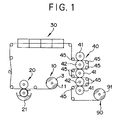
- Fig. 1 is a schematic production process diagram showing one example of the method for the production of a magnetic recording medium according to this invention
- Fig. 2 is a schematic production process diagram showing another example of the method for the production of a magnetic recording medium according to this invention.
- an unwinding device 10 which is provided with a roll 11 having a nonmagnetic supporting material 3 wound thereon is disposed on the most upstream side. From the roll 11 onward toward the downstream side, an applying device 20 for a magnetic coating material 21, a drying device 30, a device 40 for a calendering treatment, and a rewinding device 90 are sequentially disposed as main devices in the order mentioned.
- the essence of the first aspect of this invention concerns a step for pretreating the metallic rolls to be used for the calendering treatment prior to starting the production.
- This pretreating step comprises preparatorily cleaning the surfaces of the metallic rolls to be used for the calendering treatment with a solvent and thereafter subjecting the surfaces of the metallic rolls to a lubricating treatment with a lubricant-containing solution.
- the device 40 for a calendering treatment is provided with a plurality of calender rolls 41, 42 which are arranged in a row as shown in Fig. 1.
- the supporting material having a magnetic layer formed thereon is passed as pressed and heated between the calender rolls.
- the calender roll 41 is disposed on the side for contact with the front surface of the magnetic layer and the calender roll 42 is disposed on the side for contact with the rear surface of the supporting material (the side not be formed the magnetic layer).
- the calender roll 41 on the side for contact with the front surface of the magnetic layer is a metallic roll (metallic roll 41) and the calender roll 42 on the side for contact with the rear surface of the supporting material may be a resinous roll or a metallic roll, whichever better suits the occasion.
- the resin to be used for the resinous roll such plastic substances as epoxy, polyesters, nylons, polyimide, and polyimidamide which are resistant to heat may be cited.
- the resin may have carbon, a metal, and other inorganic compounds incorporated by kneading therein.
- these calender rolls 41 and 42 are used as composition at about three to seven stages (5 stages of composed rolls shown in Fig. 1).
- the temperature of the calendering treatment is preferably not less than 70°C more preferably not less than 80 °C.
- the linear pressureunder which the composite ribbon (the supporting material bearing the magnetic layer) is nipped between the opposed rolls is preferably not less than 200 kg/cm, morepreferably not less than 300 kg/cm.
- the calendering treatment described above is carried out at all for the purpose of heightening the surface smoothness of the magnetic recording medium and enhancing the electromagnetic conversion characteristic thereof consequently.
- the metallic rolls 41 (and the calender rolls 42 as well) are naturally in a cleaned state.
- the constituent components of the magnetic layer are inevitably liable to be transferred as an adhesive dirt to the metallic rolls 41 during the initial stage of the calendering treatment.
- the constituent components of the magnetic layer are transferred to the metallic rolls, they serve as cores of the so-called dirt and then quickly disseminate the dirt throughout the entire surfaces of the metallic rolls.
- This invention subjects the surfaces of the metallic rolls to a lubricating treatment with a lubricant-containing solution in addition to the cleaning with a solvent.
- the method for implementing the lubricating treatment has no particular restriction. It has only to be capable of forming a film of lubricant on the surfaces of the metallic rolls 41.
- One preferred method for effecting the lubricating treatment comprises preparing a lubricant-containing solution by causing a solvent to contain therein a lubricant at a ratio in the approximate range of 1 ⁇ 10 wt%, based on the amount of the solvent, applying the lubricant-containing solution to the surfaces of the metallic rolls 41 with the aid of nonwoven fabric, sponge, cellulose sponge, foam rubber, synthetic resin sponge, or the like which can be impregnated with the lubricant-containing solution, and drying the formed film.
- the application of the lubricant-containing solution may be performed either manually or automatically with a mechanical device.
- the lubricant to be used herein has a melting point not exceeding the temperature at which the calendering treatment is carried out.
- the lubricant to be selected herein is equal to that in the magnetic layer.
- fatty acids such as lauric acid, myristic acid, palmitic acid, stearic acid, oleic acid, linoleic acid, linolenic acid, behenic acid, erucic acid, and elaidic acid; fatty esters such as butyl myristate, butyl palmitate, butyl stearate, sorbitan monostearate, sorbitan distearate, sorbitan tristearate, oleyl oleate, isocetyl stearate, isotridecyl stearate, octyl stearate, isooctyl stearate, amyl stearate, butoxyethyl stearate, and neopentyl glycol dioleate; fatty acid amides, various silicones, modified silicones, castor oil, and squalane may be cited. These lubricants may be cited. These lubricants may
- the solvents which are generally usable for dissolving the lubricant include ketones such as methylethyl ketone, methyl-isobutyl ketone, and cyclohexanone; aromatic hydrocarbons such as toluene and xylene; esters such as ethyl acetate and butyl acetate; alcohols such as isopropanol and butanol; and dioxane, tetrahydrofuran, dimethyl formamide, hexane, and hydrocarbons having chlorine as a substituent may be cited.
- the solvent which is used for the cleaning prior to the lubricating treatment may be suitably selected from among the solvents that are cited above.
- This solvent may be used as mixed with water of an amount not too large to induce suspension and separation of opaque particles in the resultant mixture.
- the method to be used for the cleaning with a solvent is not particularly limited. It may be selected from among various known methods that are available at all for this purpose.
- the applying device 20 is provided with means which serves to deposit the magnetic coating material 21 on one surface of the nonmagnetic supporting material 3 drawn from the roll 11. As a result, a coating to be used for forming the magnetic layer is obtained.
- the method of application to be actually used may be selected from among various known methods available at all for the application such as, for example, the extrusion nozzle coating method, reverse roll coating method, gravure roll coating method, knife coater method, doctor blade coating method, kiss coating method, color coating method, and slide bead coating method.
- the coating thickness is in the approximate range of 0.05 - 8.0 ⁇ m on dry basis.
- the surface of the nonmagnetic supporting material 3, more often than not, is generally treated prior to the application of the magnetic coating material 21 thereto for the purpose of cleaning and surface adjustment by any of various known methods such as, for example, the wet cleaning using water or a solvent, the dry cleaning using a nonwoven fabric or a woven fabric of fine fibers as a wiper, and the noncontact type cleaning using compressed air, a vacuum, or ionized air.
- the surface of the nonmagnetic supporting material 3 is often treated for the purpose of exalting the fastness of adhesion of the magnetic coating material 21 and the nonmagnetic supporting material 3 and improving the coating surface by various known noncontact methods such as corona discharge, irradiation with the ultraviolet light, and irradiation with the electron beam.
- the surface of the nonmagnetic supporting material 3 may be further treated with a water type undercoating solution, an emulsion type undercoating solution, or a solvent type undercoating solution either independently or in combination with the surface treatment mentioned above for the purpose of enhancing the fastness of adhesion.
- a water type undercoating solution an emulsion type undercoating solution, or a solvent type undercoating solution either independently or in combination with the surface treatment mentioned above for the purpose of enhancing the fastness of adhesion.
- an undercoating layer which is formed of a coating material prepared by dispersing a nonmagnetic inorganic pigment in a binder may be used. This application of the undercoating layer may be carried out also in combination with the surface treatment mentioned above.
- the magnetic layer is generally formed singly, two or more magnetic layers may be jointly formed for the purpose of imparting an enhanced function to the magnetic recording medium.
- the deposition of the plurality of magnetic layers may be attained by any of known methods such as, for example, the wet-on-dry method and the wet-on-wet method.
- the wet surface of the magnetic coating layer deposited on the nonmagnetic supporting material 3 may be subjected to various treatments such as smoothing and regulation of coating thickness.
- the smoothing may be accomplished by any of various known means such as a contact method, in which film or bar made of resinous, metallic, or ceramic substance is adapted to slide on a given surface and non-contact method, in which a permanent magnet or an electromagnet adapted to harness a magnetic field and an ultrasonic wave adapted to utilize oscillation are applied for adjusting the surface.
- These means may be used either singly or in combination, depending on the kind of characteristic demanded.
- the magnetic layer After the magnetic layer has been deposited, it must be exposed to a magnetic field, though not illustrated in the drawing, for the purpose of orienting the magnetic particles in the deposited layer.
- This orientation may be made in a longitudinal direction, a vertical direction, or an oblique direction relative to the direction of travel of the medium.
- the orientation of the magnetic particles in a prescribed direction may be attained by any of various known means available for the generation of a magnetic field such as, for example, permanent magnets represented by ferrite magnets and rare earth magnets, electromagnets, and solenoids. A plurality of these means for magnetic field generation, when necessary, may be simultaneously used.
- a suitable predrying step may precede the step of orientation or may proceed simultaneously therewith.
- the drying device 30 is disposed after the site for the treatment of orienting the magnetic field of the deposited magnetic layer along the course of the production.
- the drying device 30 is installed for the purpose of drying the layer (magnetic layer) of the magnetic coating material 21 deposited on one surface of the nonmagnetic supporting material 3.
- the drying device 30 is generally provided therein with any of various known drying means such as the hot air blower, farinfrared radiation unit, electric heater, and a vacuum drier.
- the drying device 30 is adapted to generate a drying temperature in the approximate range of 50-200°C and impart a varying suitable temperature distribution pattern to the drying zone formed therein.
- the temperature conditions actually used are suitably set by considering such factors as the ability of the nonmagnetic supporting material 3 to resist heat and the kind and concentration of the solvent in the magnetic coating material in view of the amount of the solvent which remains in the medium when the deposited layer is ultimately hardened as specifically described hereinbelow.
- the gaseous atmosphere in the drying device furnace
- the ordinary air or an inert gas may be used as the gaseous atmosphere in the drying device.
- the device 40 for a calendering treatment for the next step is installed, as already described, for the purpose of exalting the surface smoothness of the magnetic recording medium and enhancing the electromagnetic conversion characteristic thereof consequently.
- the calender rolls to be used for the calendering treatment are subjected to a treatment preparatorily to the start of the production as described above, the transfer of the constituent components of the magnetic layer as an adhesive dirt to the rolls which is liable to occur during the initial stage of the production never happens.
- the device 40 for the calendering treatment is provided with a plurality of auxiliary rolls 45 adapted to smooth the calendering treatment in addition to the metallic rolls 41 and the calender rolls 42 mentioned above.
- the rewinding device 90 is installed for the purpose of provisionally taking up on a rewinding roll 91 a magnetic recording medium which has undergone the series of such steps as the application of the coating, drying, and calendering treatment mentioned above and has consequently acquired a decent appearance (hereinafter referred to as "green film of magnetic recording medium").
- the "green film of magnetic recording medium" rewound as described above is subjected to a hardening treatment at the next step of hardening the deposited layer either directly in the rolled state or after being left standing for a prescribed length of time or after being unwound provisionally and then rewound when the hardening is effected by heating as specifically described afterward. It is subjected to a hardening treatment at the step of hardening the deposited layer before it is rewound on the rewinding roll 91 when the hardening is effected by means of electron beams (or ultraviolet radiation) as specifically described hereinbelow.
- the hardening treatment by heating is effectively carried out, for example, at a temperature in the range of 40°C - 80 °C for a period in the approximate range of 24 - 48 hours.
- the hardening treatment by the exposure to electron beams is advantageously effected by using an electron beam accelerator having an acceleration voltage in the range of 100 kV - 750 kV, preferably 150 kV - 300 kV, at an absorption dosage in the range of 20 - 200 kilogray(Gy).
- the exposure to the electron rays be carried out in the atmosphere of an inert gas such as N 2 , He, or CO 2 having an oxygen concentration of not more than 1%. This is because the O 3 generated by the exposure to electron rays should be prevented from seizing radicals.
- the hardening treatment is effected by exposure to ultraviolet light
- the exposure to the ultraviolet light may be carried out by means of an ultraviolet light bulb such as, for example, a xenon discharge bulb or a hydrogen discharge bulb.
- the hardened green film is formed in a prescribed shape by the use of a slitter and then subjected to a secondary fabrication to produce a magnetic recording medium (such as, for example, a magnetic tape).
- a magnetic recording medium such as, for example, a magnetic tape
- Fig. 2 depicts another aspect of this invention.
- like parts found in Fig. 1 are denoted by like reference numerals and adapted to fulfill like functions.
- the invention illustrated in Fig. 2 is characterized by a cleaning operation which is performed on the metallic rolls 41 during the course of the production.
- this cleaning operation is characterized in that the surfaces of the metallic rolls to be used for the production are intermittently or continuously cleaned by the use of a cleaning material impregnated with a lubricant.
- the cleaning material to be used is variable with such factors as the material of the metallic rolls, the surface thereof, and the temperature and speed of the fabrication.
- the cleaning material to be favorably used nonwoven fabric, foamed urethane sheet, cleaning cloth, and foam rubber sponge which are capable of being impregnated with a lubricant may be cited.
- the lubricant for impregnating the cleaning material may be suitably selected from among the lubricants cited above.
- the lubricant appropriately has a melting point not higher than the temperature at which the calendering treatment is carried out.
- the magnetic layer of the magnetic recording medium contains a lubricant, it is appropriate that the lubricant to be selected herein is equal to that in the magnetic layer.
- the impregnation can be attained by rewinding the cleaning cloth of a prescribed length, immersing the rewound cleaning cloth in a methyl ethyl ketone (MEK) solution containing butyl stearate, then blowing purging air through a filter against the cleaning cloth, again rewinding the wet cleaning cloth, and causing expulsion of methyl ethyl ketone (MEK) by vaporization thereby enabling butyl stearate to be lodged in the cleaning cloth.
- MEK methyl ethyl ketone
- the amount of butyl stearate lodged in the cleaning cloth may be adjusted arbitrarily by proportionately varying the concentration of butyl stearate in the methyl ethyl ketone (MEK) solution.
- the content of the lubricant in the cleaning material is in the approximate range of 0. 1 - 50 wt%.
- the cleaning operation may be manually carried out, it is preferably implemented by disposing cleaning devices 43 one each opposite the individual metallic rolls 41 as shown in Fig. 2 and causing the cleaning material impregnated with the lubricant to contact the surfaces of the metallic rolls intermittently or continuously and clean the surfaces.
- the cleaning devices 43 may be of any of various known types. The devices that are disclosed in JP-A-02-28458 and JP-A-04-228111, for example, may be used. In this case again, it is of course necessary to use the cleaning material as impregnated with the lubricant.
- This invention is effective not only in giving necessary cleaning to the surfaces of the metallic rolls 41 but also in preventing to the fullest possible extent the cleaning material from being abraded or from inducing secondary adhesion of exfoliated fibers to the surfaces of the metallic rolls 41 even when the cleaning material is caused to contact the surfaces of the metallic rolls 41 at an elevated temperature with high-speed friction.
- the invention which concerns the step of pretreating the metallic rolls 41 for use in the calendering treatment prior to the start of the production as illustrated in Fig. 1 and the invention which concerns the cleaning operation performed on the metallic rolls 41 during the course of production as illustrated in Fig. 2 may be carried out either singly or in combination.
- the lubricating treatment by the use of the cleaning material may be effected so that the cleaning material will be impregnated with the lubricant either in the entire surface thereof or in only the opposite end parts thereof which contact the parts of the calender rolls not touched by the surface of the magnetic layer.
- the method for the production of a magnetic recording medium according to this invention allows the calendering treatment to be applied invariably and fully effectively to all the types of composite ribbons, no matter whether they are provided on only one surface or on both surfaces thereof with magnetic layers or they are provided with the so-called backcoat layers.
- the magnetic coating material 21 contains a magnetic powder, a binder, and a solvent as main components thereof.
- a magnetic powder of iron oxide As concrete examples of the magnetic powder to be used herein, a magnetic powder of iron oxide, a powder of a frromagnetic metal, a plate hexagonal ferrite, and chromium dioxide may be cited.
- Co compound means a compound which harnesses the magnetic anisotropy of cobalt for enhancing the coercive force thereof.
- the ferromagnetic metal for use as the magnetic powder herein Fe, Ni, Co, and alloys thereof may be cited.
- the magnetic powders having such ferromagnetic metals as ⁇ -Fe, Fe-Co, Fe-Ni, Fe-Co-Ni, Co, and Co-Ni as main components thereof they appropriately contain relevant metals (Fe, Co, Ni, etc.) or alloys at concentrations of not less than 70 wt%, preferably not less than 75 wt%.
- the amount of Co atoms is in the range of 5 - 40 wt%, preferably 6 - 35 wt%, based on the amount of Fe atoms.
- the ferromagnetic metal powders having Fe and/or Co as a main component thereof additionally contain any of the rare earth elements including Y.
- These ferromagnetic metal powders may be formed of particles having an oxidized surface or a partially carbonized or nitridized surface or of particles having a carbonaceous coating.
- the ferromagnetic metal powders mentioned above may contain a hydroxide or an oxide in a small amount.
- the plate hexagonal ferrite is a magnetic powder formed of hexagonal plate particles having axes of easy magnetization in a direction perpendicular to the plates thereof.
- the plate hexagonal ferrite Ba-ferrite, Sr-ferrite, Pb-ferrite, Ca-ferrite, the ferrites substituted with a metallic atom having a valency equalling the total of valencies of the Fe atoms thereof, and hexagonal Co powder may be cited.
- the magnetic powder when necessary, may be a magnetic powder of CrO 2 crystals in needle shape.
- the magnetic powder is generally contained in the magnetic layer in an amount in the approximate range of 100 - 2000 wt%, based on 100 wt% of the binder.
- the content of the magnetic powder in the magnetic layer is in the range of 50 - 95 wt%, preferably 55 - 90 wt%, based on the total amount of the magnetic layer. If the content of the magnetic powder is unduly large, the magnetic layer will tend to entail such defects as lowered durability because the amount of the resin and other additives in the magnetic layer is proportionately decreased. If this content is unduly small, the magnetic layer will be incapable of producing a high regeneration output.
- the magnetic powders enumerated above may be used either singly or in the form of a combination of two or more species.
- the binder to be used for the magnetic powder thermoplastic resins, thermosetting or reactive resins, and resins modified to acquire sensitivity to electron rays may be cited. These binders may be properly combined to suit the characteristic of the medium and the conditions of the production process.
- the thermoplastic resin appropriately has a softening temperature of not more than 150°C, an average molecular weight in the range of 5000 - 200000, and a polymerization degree in the approximate range of 50 - 2000.
- the thermosetting resin, reactive resin, and resin modified to acquire sensitivity to electron rays have average molecular weights and degrees of polymerization on the par with those of the thermoplastic resin. These resins are caused to acquire infinite molecular weights by the reaction of condensation or addition when the magnetic layer which has undergone the steps of coating, drying, and calendering is subsequently heated and/or exposed to electron rays.
- thermoplastic resin vinyl chloride type copolymers, polyurethane resin, (meth)acrylic resin, polyester resin, acrylonitrile-butadiene type copolymers, polyamide resin, polyvinyl butyral, nitrocellulose, styrene-butadiene type copolymers, polyvinyl alcohol resin, acetal resin, epoxy type resins, phenoxy type resins, polyether resin, polyfunctional polyethers such as polycaprolactone, polyamide resins, polyimide resins, phenol resins, polybutadiene elastomer, chlorinated rubber, acrylic rubber, isoprene rubber, and epoxy-modified rubbers may be cited.
- thermosetting resin polycondensing phenol resins, epoxy resin, polyurethane-setting resin, urea resin, butyral resin, formal resin, melamine resin, alkyd resin, silicone resin, acrylic reactive resin, polyamide resin, epoxy-polyamide resin, saturated polyester resin, and urea formaldehyde resin may be cited.
- those which have a hydroxyl group at the terminal or in the side chain thereof are reactive resins which are at an advantage in being capable of easily utilizing the cross-linkage using isocyanate and the modification by the electron ray cross-linkage.
- These reactive resins may further contain at the terminal or in the side chain thereof such polar groups as acidic polar groups and basic polar groups which are represented by -COOH, -SO 3 M, -OSO 3 M, -OPO 3 M, -PO 3 M, -PO 2 M, -N + R 3 Cl - , and -NR 2 .
- polar groups as acidic polar groups and basic polar groups which are represented by -COOH, -SO 3 M, -OSO 3 M, -OPO 3 M, -PO 3 M, -PO 2 M, -N + R 3 Cl - , and -NR 2 .
- M stands for H, Li, Na, K, -NR 4 , or -NHR 3 and R for an al
- the resins mentioned above may be used either singly or in the form of a combination of two or more species.
- the combination of a vinyl chloride type copolymer with a polyurethane resin is used particularly advantageously.
- the vinyl chloride type copolymer has a vinyl chloride content in the range of 60 - 95 wt%, preferably 60 - 90 wt% and an average polymerization degree in the approximate range of 100 - 500.
- the polyurethane resin which is used in combination with the vinyl chloride type resin is particularly effective in improving the wear resistance of the magnetic layer and the fastness of adhesion of the magnetic layer to the supporting material. It has been polymerized to a number average molecular weight in the approximate range of 500 - 200000 and has a Q value (weight average molecular weight/number average molecular weight) in the approximate range of 1.5 - 4.
- At least two different species of urethane resin exhibiting glass transition points, Tg, in the range of -20 °C ⁇ Tg ⁇ 80 °C, in the binder to be used are used in a total amount in the range of 10 - 90 wt% based on the amount of the binder.
- the inclusion of the plurality of species of polyurethane resin has an advantage of attaining proper balance among the stability of travel of the medium, the susceptibility of the magnetic layer to the calendering treatment, and the electromagnetic conversion characteristic of the magnetic recording medium at an elevated temperature.
- the vinyl chloride type copolymer and the polyurethane resin are advantageously used at a gravimetric mixing ratio in the range of 10 : 90 - 90 : 10.
- the combination of these resins may additionally incorporate therein various known resins in a total amount of not more than 20 wt% based on the total amount of the combination.
- cross-linking agent for setting the binder resin any of various species of polyisocyanate can be used.
- the cross-linking agent content in the binder resin is appropriately in the range of 1 - 50 wt%, based on 100 wt% of the resin.
- the cross-linking agent is capable of improving the durability of the deposited layer by being three-dimensionally bound as with the hydroxyl group contained in the binder resin.
- thermosetting resin for the purpose of hardening the reactive or the thermosetting resin mentioned above, it suffices to subject the resin to a thermosetting treatment which is effected by heating as described above.
- the copolymer mentioned above may be modified to acquire sensitivity to electron rays by the introduction therein of a (meth)acrylic type double bond formed of a (meth)acryloyl group by the known technique.
- the resin modified to acquire the sensitivity to electron rays may incorporate therein any of known polyfunctional acrylates in an amount in the range of 1 - 50 wt% for the purpose of exalting the ratio of cross-linkage thereof.
- the binder using the resin modified to acquire the sensitivity to electron rays can be set by the method using electron rays or the method using ultraviolet light described above.
- the binder which contains an electron ray setting resin further incorporates therein any of the known photopolymerizing sensitizers.
- the solvent to be contained in the magnetic coating material is not particularly limited. It may be suitably selected in due consideration of the solubility, compatibility, and drying efficiency of the binder. As concrete examples of the solvent effectively usable herein, such diluents or solvents as ketones, aromatic hydrocarbons, esters, alcohols, tetrahydrofuran, and dimethyl formamide may be cited. These solvents may be used either singly or in the form of a combination of two or more members mixed at an arbitrary ratio.
- the magnetic coating material generally contains a lubricant.
- a lubricant In the various known lubricants, it is particularly advantageous to use a fatty acid and/or a fatty ester.
- the fatty acid monobasic fatty acids having 12 - 24 carbon atoms (possibly containing an unsaturated bond or a branch) may be cited.
- fatty ester monofatty esters, difatty esters, and trifatty esters formed to react monobasic fatty acids having 10 - 24 carbon atoms (possibly containing an unsaturated bond or a branch) with one of alcohols such as cyclic or polysaccharide-reduced alcohols (such as sorbitans and sorbitols), monovalent, divalent, trivalent, tetravalent, pentavalent, and hexavalent alcohols of 2 - 22 carbon atoms (possibly containing an unsaturated bond or a branch) may be cited.
- alcohols such as cyclic or polysaccharide-reduced alcohols (such as sorbitans and sorbitols)
- These lubricants may be used either singly or in the
- the monobasic fatty acid lauric acid, myristic acid, palmitic acid, stearic acid, oleic acid, linolic acid, linolenic acid, behenic acid, crucic acid, and elaidic acid may be cited.
- fatty ester butyl myristate, butyl palmitate, butyl stearate, neopentyl glycol dioleate, sorbitan monostearate, sorbitan distearate, sorbitan tristearate, oleyl oleate, isocetyl stearate, isotridecyl stearate, octyl stearate, isooctyl stearate, amyl stearate, and butoxyethyl stearate may be cited.
- the content of the fatty acid and/or fatty ester in the magnetic layer appropriately is in the range of 0.1 - 20 wt%, preferably 1 - 15 wt%, based on the total amount of the magnetic powder.
- the lubricant may be contained in a larger amount on the backcoat layer side so that it will be transferred to the surface of the magnetic layer and consequently utilized for exalting the surface lubricity of the magnetic layer.
- the magnetic coating material generally contains such additives as enable this coating material to manifest a lubricating effect, an antistatic effect, a dispersing effect, and a plasticizing effect.
- additives for example, silicone oils, fluorine oils, alcohols containing a fluorine-substituted hydrocarbon group, paraffins, nonionic surfactants, cationic surfactants, anionic surfactants, and amphoteric surfactants are effectively usable as such additives.
- the magnetic coating material may contain inorganic compounds.
- inorganic compounds As concrete examples of the inorganic compound usable effectively herein, ⁇ -alumina, ⁇ -alumina, ⁇ -alumina, ⁇ -alumina, ⁇ -alumina, dichromium trioxide, ⁇ -iron oxide, goethite, SiO 2 , ZnO, TiO 2 , ZrO 2 , SnO 2 , silicon nitride, boron nitride, silicon carbide, titanium carbide, molybdenum carbide, boron carbide, tungsten carbide, calcium carbonate, barium carbonate, strontium carbonate, magnesium carbonate, barium sulfate, zinc sulfide, molybdenum disulfide, tungsten disulfide, and artificial diamond may be cited. These inorganic compounds may be used either singly or in the form of a combination of two or more species.
- the inorganic compound is used in an amount in the range of 0.1 - 20 wt% based on the amount of the magnetic powder.
- the magnetic coating material may contain carbon black.
- carbon black As concrete examples of the carbon black, furnace carbon black, thermal carbon black, and acetylene black may be cited.
- the particle size of the carbon black may be arbitrarily set. It can be selected so as to suit the balance (surface roughness) among the properties demanded by the medium such as the electric resistance, friction characteristic, and output at the shortest recording wavelength.
- the plurality of species of carbon black may be used either singly or in the form of a combination of two or more species. One selected species may be used with the particle size distribution suitably selected.
- the magnetic coating material may contain the powder of a nonferromagnetic organic substance.
- the nonmagnetic supporting material on which the magnetic coating material is deposited may be any of the known films.
- the materials for these films include polyesters such as polyethylene terephthalate (PET) and polyeythylene naphthalate (PEN), polyolefins, polyamides, polyimides, polyamide imides, polysulfone cellulose triacetate, and polycarbonate,
- a magnetic coating material of the following composition was prepared for the formation of a magnetic layer.
- Magnetic powder of iron alloy 100 parts by weight Vinyl chloride type copolymer (produced by Nippon Zeon K.K. and marketed under product code of "MR-110,” polymerization degree 300, polar group - SO 3 K) 12 parts by weight
- Polyurethane resin produced by Toyo Boseki Co., Ltd. and marketed under product code of "UR-8700,” containing Na sulfonate) 8 parts by weight ⁇ -Al 2 O 3 (produced by Sumitomo Chemical Co., Ltd. and marketed under product code of "HIT-60A,” average particle diameter 0.20 ⁇ m) 10 parts by weight Methylethyl ketone 45 parts by weight Toluene 45 parts by weight Cyclohexanone 10 parts by weight
- This composition was dispersed in a sand grind mill for 5 hours, made to add 1 part by weight of butyl stearate, 1 part by weight of stearic acid, and 50 parts by weight of a solvent, and further dispersed therein for 1 hour.
- the resultant magnetic coating material was mixed with 30 parts by weight of a curing agent (produced by Nippon Polyurethane Kogyo K.K. and marketed under trademark designation of "Coronate L”) and the produced mixture was passed through a filter to prepare a coating material for the formation of a magnetic layer.
- a curing agent produced by Nippon Polyurethane Kogyo K.K. and marketed under trademark designation of "Coronate L
- a magnetic recording medium was produced as a sample in accordance with the following procedure using the coating material.
- the step of pretreatment was carried out prior to the start of the production.
- the surfaces of the metallic rolls 41 were cleaned with a methyl ethyl ketone (MEK)/methanol (1/1: weight ratio) mixed solvent.
- MEK methyl ethyl ketone
- a lubricant-containing solution was produced by mixing methyl ethyl ketone (MEK)/methanol/oleyl oleate (49.5/49.5/1.0: weight ratio) and a non-woven fabric was impregnated with this solution (lubricant content in non-woven fabric: about 5 wt%).
- the oleyl oleate had a melting point of -15°C.
- a magnetic recording medium (magnetic tape) was continuously produced in a total length of 1000 m.
- a nonmagnetic supporting material 9.8 ⁇ m in thickness, made of polyethylene terephthalate (PET)
- PET polyethylene terephthalate
- the coating material for the formation of the magnetic layer mentioned above was deposited so much as to produce, on drying, a coating of a thickness of 3.0 ⁇ m.
- the deposited coating was dried subsequent to the application of an oriented magnetic field of 5000 gauses thereto.
- the coating was subjected to a calendering treatment using a temperature of 90 °C, a linear pressure of 200 kg/cm, and a condition of 5 nips and taken up on the rewinding roll.
- the surfaces of the metallic rolls which had been used for the calendering treatment were subsequently examined in search of any sign of the so-called seizure.
- the magnetic tape which had undergone the calendering treatment mentioned above was further given a thermosetting treatment at 70 °C for 24 hours and then sliced into ribbons, 3/4 inch in width, to produce video tapes of the D2 format grade.
- the video tapes were tested for dropout.
- Example 1 A sample was produced by faithfully following the procedure of Example 1, while changing the oleyl oleate (lubricant) used during the lubricating treatment (the step of pretreatment) to myristic acid (melting point: 53.9°C). This sample was rated in the same manner as in Example 1.
- the lubricating treatment was omitted and a simple cleaning treatment using a solvent was performed.
- the nonwoven fabric impregnated with a hexane/butyl stearate mixed solution (98.0/2.0: weight ratio) and then dried (the cleaning material) was attached to the cleaning rolls.
- the cleaning rolls were set so as to contact onto the metallic rolls and were rotated in the direction opposite to the direction of rotation of the metallic rolls, at a rate of 5 mm/sec of the nonwoven fabric.
- a sample was produced by repeating the procedure of Example 1 excepting the cleaning treatment mentioned above. It was rated in the same manner as in Example 1.
- the butyl stearate had a melting point of 21.3 °C.
- Example 3 A sample was produced by faithfully following the procedure of Example 3, while changing the butyl stearate (lubricant) to stearic acid (melting point: 69.6 °C). It was rated in the same manner as in Example 3.
- the sample was rated in the same manner as in Example 1.
- the sample was rated in the same manner as in Example 1.
- Example 1 A sample was produced by faithfully following the procedure of Example 1, while additionally using the same cleaning rolls as used in Example 3 during the calendering treatment. The sample was rated in the same manner as in Example 1.
- Example 1 A sample was produced by following the procedure of Example 1, while omitting the lubricating treatment at the pretreating step. The sample was rated in the same manner as in Example 1.
- Example 3 A sample was produced by following the procedure of Example 3, while changing the butyl stearate to behenic acid (melting point: 79.9 °C) and the temperature of the calendering treatment to 75 °C. The sample was rated in the same manner as in Example 3.
- Example 5 A sample was produced by following the procedure of Example 5, while omitting the lubricating treatment at the pretreating step. The sample was rated in the same manner as in Example 5.
- Example 6 A sample was produced by following the procedure of Example 6, while omitting the lubricating treatment at the pretreating step. The sample was rated in the same manner as in Example 6.
- the surfaces of the metallic rolls were wiped with a nonwoven fabric impregnated with methyl ethyl ketone (MEK) and the nonwoven fabric was then visually examined in search of any sign of dirt adhering thereto.
- MEK methyl ethyl ketone
- a given magnetic tape was played on a recorder (produced by Sony Corporation and marketed under product code of "DVR-10") and then tested for dropout by means of a dropout counter (produced by Shibasoku K.K.) operated under the conditions of 10 ⁇ sec-12 dB.
- a given magnetic tape was played on a recorder (produced by Victor Company of Japan, Ltd and marketed under product code of "VTR BR7000A") and tested for dropout by means of a dropout counter (produced by Shibasoku K.K.) operated under the conditions of 15 ⁇ sec-30 dB.
- the method for the production of a magnetic recording medium which comprises preparatorily cleaning the surfaces of the metallic rolls to be used for the calendering treatment and thereafter subjecting the surfaces of the metallic rolls to a lubricating treatment with a lubricant-containing solution permits the calendering treatment to be stably carried out without entailing fast adhesion of an extraneous substance to the surfaces of the metallic rolls, and the method for the production of a magnetic recording medium which comprises intermittently or continuously cleaning the surfaces of the metallic rolls to be used for the calendering treatment with a cleaning material impregnated with a lubricant manifests an effect of preventing the cleaning material from shedding fibers, precluding the heretofore problematic phenomenon of dropout ascribable to exfoliated fibers, and avoiding a decline in the yield of production.
Landscapes
- Manufacturing Of Magnetic Record Carriers (AREA)
- Registering, Tensioning, Guiding Webs, And Rollers Therefor (AREA)
- Application Of Or Painting With Fluid Materials (AREA)
Applications Claiming Priority (2)
| Application Number | Priority Date | Filing Date | Title |
|---|---|---|---|
| JP246604/95 | 1995-08-31 | ||
| JP24660495A JPH0973627A (ja) | 1995-08-31 | 1995-08-31 | 磁気記録媒体の製造方法 |
Publications (1)
| Publication Number | Publication Date |
|---|---|
| EP0762391A1 true EP0762391A1 (de) | 1997-03-12 |
Family
ID=17150887
Family Applications (1)
| Application Number | Title | Priority Date | Filing Date |
|---|---|---|---|
| EP96113918A Withdrawn EP0762391A1 (de) | 1995-08-31 | 1996-08-30 | Verfahren zur Herstellung eines magnetischen Aufzeichnungsmediums |
Country Status (2)
| Country | Link |
|---|---|
| EP (1) | EP0762391A1 (de) |
| JP (1) | JPH0973627A (de) |
Citations (4)
| Publication number | Priority date | Publication date | Assignee | Title |
|---|---|---|---|---|
| JPH01312732A (ja) * | 1988-06-13 | 1989-12-18 | Konica Corp | 磁気記録媒体のカレンダー処理装置 |
| JPH04258812A (ja) * | 1991-02-08 | 1992-09-14 | Hitachi Maxell Ltd | 磁気記録媒体の製造法 |
| US5198243A (en) * | 1990-07-02 | 1993-03-30 | Sony Corporation | Calendering roll cleaning apparatus |
| EP0572224A1 (de) * | 1992-05-27 | 1993-12-01 | Teijin Limited | Biaxial orientiertes Polyesterfilmlaminat |
-
1995
- 1995-08-31 JP JP24660495A patent/JPH0973627A/ja not_active Withdrawn
-
1996
- 1996-08-30 EP EP96113918A patent/EP0762391A1/de not_active Withdrawn
Patent Citations (4)
| Publication number | Priority date | Publication date | Assignee | Title |
|---|---|---|---|---|
| JPH01312732A (ja) * | 1988-06-13 | 1989-12-18 | Konica Corp | 磁気記録媒体のカレンダー処理装置 |
| US5198243A (en) * | 1990-07-02 | 1993-03-30 | Sony Corporation | Calendering roll cleaning apparatus |
| JPH04258812A (ja) * | 1991-02-08 | 1992-09-14 | Hitachi Maxell Ltd | 磁気記録媒体の製造法 |
| EP0572224A1 (de) * | 1992-05-27 | 1993-12-01 | Teijin Limited | Biaxial orientiertes Polyesterfilmlaminat |
Non-Patent Citations (2)
| Title |
|---|
| DATABASE WPI Week 9005, Derwent World Patents Index; AN 90-034035, XP002014697 * |
| DATABASE WPI Week 9243, Derwent World Patents Index; AN 92-354878, XP002014696 * |
Also Published As
| Publication number | Publication date |
|---|---|
| JPH0973627A (ja) | 1997-03-18 |
Similar Documents
| Publication | Publication Date | Title |
|---|---|---|
| US4448842A (en) | Magnetic recording medium | |
| EP1246172A1 (de) | Verfahren zur Herstellung eines magnetischen Aufzeichnungsmittels | |
| US6372302B1 (en) | Process for producing a magnetic recording medium | |
| US4428974A (en) | Process for producing magnetic recording material | |
| JPH0312370B2 (de) | ||
| EP0734015B2 (de) | Magnetisches Aufzeichnungsmedium | |
| DE3527858C2 (de) | ||
| EP0782132B1 (de) | Verfahren zur Herstellung eines magnetischen Aufzeichnungsträgers | |
| US4666754A (en) | Magnetic recording medium | |
| US5419943A (en) | Magnetic recording medium having a magnetic layer with a Tg of 80° C.° C. | |
| US4780366A (en) | Magnetic recording medium for image recording | |
| US6153295A (en) | Magnetic recording medium | |
| US4959263A (en) | Magnetic recording medium | |
| JPH08241515A (ja) | 磁気記録媒体 | |
| JP3170197B2 (ja) | 磁気記録媒体の製造方法 | |
| US5073439A (en) | Magnetic recording medium comprising a vinyl chloride based resin group containing an epoxy group or a polar or both and further a polyurethane resin containing three hydroxyl groups and one polar group | |
| DE60020809T2 (de) | Verfahren zur herstellung eines magnetischen aufzeichnungsmediums | |
| US6117484A (en) | Method for producing magnetic recording medium | |
| JPS62137718A (ja) | 磁気記録ディスクの製造方法 | |
| JP3488297B2 (ja) | 磁気記録媒体の製造方法 | |
| US4673590A (en) | Process for preparing a magnetic recording medium | |
| JPH0973627A (ja) | 磁気記録媒体の製造方法 | |
| KR100204622B1 (ko) | 자기 기록 매체 | |
| JP2004158071A (ja) | 磁気テープおよびその製造方法 | |
| JPS6370924A (ja) | 磁気記録媒体の製造方法 |
Legal Events
| Date | Code | Title | Description |
|---|---|---|---|
| PUAI | Public reference made under article 153(3) epc to a published international application that has entered the european phase |
Free format text: ORIGINAL CODE: 0009012 |
|
| 17P | Request for examination filed |
Effective date: 19961204 |
|
| AK | Designated contracting states |
Kind code of ref document: A1 Designated state(s): DE LU |
|
| 17Q | First examination report despatched |
Effective date: 19991229 |
|
| GRAG | Despatch of communication of intention to grant |
Free format text: ORIGINAL CODE: EPIDOS AGRA |
|
| GRAG | Despatch of communication of intention to grant |
Free format text: ORIGINAL CODE: EPIDOS AGRA |
|
| GRAH | Despatch of communication of intention to grant a patent |
Free format text: ORIGINAL CODE: EPIDOS IGRA |
|
| STAA | Information on the status of an ep patent application or granted ep patent |
Free format text: STATUS: THE APPLICATION IS DEEMED TO BE WITHDRAWN |
|
| 18D | Application deemed to be withdrawn |
Effective date: 20011002 |