EP0762377A2 - Ansteuerungsverfahren für eine Flüssigkristallvorrichtung - Google Patents
Ansteuerungsverfahren für eine Flüssigkristallvorrichtung Download PDFInfo
- Publication number
- EP0762377A2 EP0762377A2 EP96113100A EP96113100A EP0762377A2 EP 0762377 A2 EP0762377 A2 EP 0762377A2 EP 96113100 A EP96113100 A EP 96113100A EP 96113100 A EP96113100 A EP 96113100A EP 0762377 A2 EP0762377 A2 EP 0762377A2
- Authority
- EP
- European Patent Office
- Prior art keywords
- liquid crystal
- driving
- pulses
- crystal device
- duration
- Prior art date
- Legal status (The legal status is an assumption and is not a legal conclusion. Google has not performed a legal analysis and makes no representation as to the accuracy of the status listed.)
- Withdrawn
Links
Images









Classifications
-
- G—PHYSICS
- G02—OPTICS
- G02F—OPTICAL DEVICES OR ARRANGEMENTS FOR THE CONTROL OF LIGHT BY MODIFICATION OF THE OPTICAL PROPERTIES OF THE MEDIA OF THE ELEMENTS INVOLVED THEREIN; NON-LINEAR OPTICS; FREQUENCY-CHANGING OF LIGHT; OPTICAL LOGIC ELEMENTS; OPTICAL ANALOGUE/DIGITAL CONVERTERS
- G02F1/00—Devices or arrangements for the control of the intensity, colour, phase, polarisation or direction of light arriving from an independent light source, e.g. switching, gating or modulating; Non-linear optics
- G02F1/01—Devices or arrangements for the control of the intensity, colour, phase, polarisation or direction of light arriving from an independent light source, e.g. switching, gating or modulating; Non-linear optics for the control of the intensity, phase, polarisation or colour
- G02F1/13—Devices or arrangements for the control of the intensity, colour, phase, polarisation or direction of light arriving from an independent light source, e.g. switching, gating or modulating; Non-linear optics for the control of the intensity, phase, polarisation or colour based on liquid crystals, e.g. single liquid crystal display cells
- G02F1/133—Constructional arrangements; Operation of liquid crystal cells; Circuit arrangements
-
- G—PHYSICS
- G09—EDUCATION; CRYPTOGRAPHY; DISPLAY; ADVERTISING; SEALS
- G09G—ARRANGEMENTS OR CIRCUITS FOR CONTROL OF INDICATING DEVICES USING STATIC MEANS TO PRESENT VARIABLE INFORMATION
- G09G3/00—Control arrangements or circuits, of interest only in connection with visual indicators other than cathode-ray tubes
- G09G3/20—Control arrangements or circuits, of interest only in connection with visual indicators other than cathode-ray tubes for presentation of an assembly of a number of characters, e.g. a page, by composing the assembly by combination of individual elements arranged in a matrix no fixed position being assigned to or needed to be assigned to the individual characters or partial characters
- G09G3/34—Control arrangements or circuits, of interest only in connection with visual indicators other than cathode-ray tubes for presentation of an assembly of a number of characters, e.g. a page, by composing the assembly by combination of individual elements arranged in a matrix no fixed position being assigned to or needed to be assigned to the individual characters or partial characters by control of light from an independent source
- G09G3/36—Control arrangements or circuits, of interest only in connection with visual indicators other than cathode-ray tubes for presentation of an assembly of a number of characters, e.g. a page, by composing the assembly by combination of individual elements arranged in a matrix no fixed position being assigned to or needed to be assigned to the individual characters or partial characters by control of light from an independent source using liquid crystals
- G09G3/3611—Control of matrices with row and column drivers
- G09G3/3622—Control of matrices with row and column drivers using a passive matrix
- G09G3/3629—Control of matrices with row and column drivers using a passive matrix using liquid crystals having memory effects, e.g. ferroelectric liquid crystals
- G09G3/3637—Control of matrices with row and column drivers using a passive matrix using liquid crystals having memory effects, e.g. ferroelectric liquid crystals with intermediate tones displayed by domain size control
-
- G—PHYSICS
- G09—EDUCATION; CRYPTOGRAPHY; DISPLAY; ADVERTISING; SEALS
- G09G—ARRANGEMENTS OR CIRCUITS FOR CONTROL OF INDICATING DEVICES USING STATIC MEANS TO PRESENT VARIABLE INFORMATION
- G09G2310/00—Command of the display device
- G09G2310/06—Details of flat display driving waveforms
-
- G—PHYSICS
- G09—EDUCATION; CRYPTOGRAPHY; DISPLAY; ADVERTISING; SEALS
- G09G—ARRANGEMENTS OR CIRCUITS FOR CONTROL OF INDICATING DEVICES USING STATIC MEANS TO PRESENT VARIABLE INFORMATION
- G09G2310/00—Command of the display device
- G09G2310/06—Details of flat display driving waveforms
- G09G2310/061—Details of flat display driving waveforms for resetting or blanking
-
- G—PHYSICS
- G09—EDUCATION; CRYPTOGRAPHY; DISPLAY; ADVERTISING; SEALS
- G09G—ARRANGEMENTS OR CIRCUITS FOR CONTROL OF INDICATING DEVICES USING STATIC MEANS TO PRESENT VARIABLE INFORMATION
- G09G2310/00—Command of the display device
- G09G2310/06—Details of flat display driving waveforms
- G09G2310/065—Waveforms comprising zero voltage phase or pause
-
- G—PHYSICS
- G09—EDUCATION; CRYPTOGRAPHY; DISPLAY; ADVERTISING; SEALS
- G09G—ARRANGEMENTS OR CIRCUITS FOR CONTROL OF INDICATING DEVICES USING STATIC MEANS TO PRESENT VARIABLE INFORMATION
- G09G3/00—Control arrangements or circuits, of interest only in connection with visual indicators other than cathode-ray tubes
- G09G3/20—Control arrangements or circuits, of interest only in connection with visual indicators other than cathode-ray tubes for presentation of an assembly of a number of characters, e.g. a page, by composing the assembly by combination of individual elements arranged in a matrix no fixed position being assigned to or needed to be assigned to the individual characters or partial characters
- G09G3/2007—Display of intermediate tones
- G09G3/2011—Display of intermediate tones by amplitude modulation
-
- G—PHYSICS
- G09—EDUCATION; CRYPTOGRAPHY; DISPLAY; ADVERTISING; SEALS
- G09G—ARRANGEMENTS OR CIRCUITS FOR CONTROL OF INDICATING DEVICES USING STATIC MEANS TO PRESENT VARIABLE INFORMATION
- G09G3/00—Control arrangements or circuits, of interest only in connection with visual indicators other than cathode-ray tubes
- G09G3/20—Control arrangements or circuits, of interest only in connection with visual indicators other than cathode-ray tubes for presentation of an assembly of a number of characters, e.g. a page, by composing the assembly by combination of individual elements arranged in a matrix no fixed position being assigned to or needed to be assigned to the individual characters or partial characters
- G09G3/2007—Display of intermediate tones
- G09G3/2014—Display of intermediate tones by modulation of the duration of a single pulse during which the logic level remains constant
-
- G—PHYSICS
- G09—EDUCATION; CRYPTOGRAPHY; DISPLAY; ADVERTISING; SEALS
- G09G—ARRANGEMENTS OR CIRCUITS FOR CONTROL OF INDICATING DEVICES USING STATIC MEANS TO PRESENT VARIABLE INFORMATION
- G09G3/00—Control arrangements or circuits, of interest only in connection with visual indicators other than cathode-ray tubes
- G09G3/20—Control arrangements or circuits, of interest only in connection with visual indicators other than cathode-ray tubes for presentation of an assembly of a number of characters, e.g. a page, by composing the assembly by combination of individual elements arranged in a matrix no fixed position being assigned to or needed to be assigned to the individual characters or partial characters
- G09G3/2007—Display of intermediate tones
- G09G3/207—Display of intermediate tones by domain size control
Definitions
- This invention relates to a method of driving a liquid crystal device having a pair of substrates with liquid crystal provided therebetween, in particular, to a method of driving a liquid crystal device having a pair of substrates oppositely positioned, on each of which a transparent electrode and an orientation film are provided in the order given, and between which liquid crystal is encapsulated.
- Ferroelectric liquid crystal displays are superior, generally having the following features (1) to (3):
- Such a ferroelectric liquid crystal display has a structure as schematically illustrated in, e.g., Fig. 22.
- the display has a transparent substrate 1a made of, for example, glass; a transparent electrode layer 2a made from indium tin oxide (conductive oxide in which indium is doped with tin) provided thereon; and a laminate A in which as a liquid crystal orientation film, for example, an oblique SiO-deposited film 3a is successively formed on the electrode layer 2a, and similarly, a transparent substrate 1b made of, for example, glass; a transparent electrode layer 2b provided thereon; and a laminate B in which as a liquid crystal orientation film, for example, an oblique SiO-deposited film 3b is successively formed on the electrode layer 2b, with the deposition layers 3a and 3b oppositely positioned, and ferroelectric liquid crystal 5 encapsulated in a liquid crystal gap formed by inserting spacers 4 for making a predetermined cell gap therebetween.
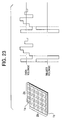
- the X-Y matrix drive method As a method of driving the ferroelectric liquid crystal display, the X-Y matrix drive method is used, which is shown in Fig. 23.
- 1 H one horizontal scanning period or one line selection period
- bipolar application of voltage causes each select pulse to have a duration of 63.5/2 ⁇ s. From the row side of electrodes (the electrode 2b), select pulses are sent, while from the column side (the electrode 2a), data pulses are sent.
- the ferroelectric liquid crystal display has the above advantages, it is known that the display has, as a problem, a difficulty in gradation display. That is, because the conventional ferroelectric liquid crystal display is stable in only two states, it has been regarded as inappropriate for a gradation display as used in video displays.
- the ferroelectric liquid crystal device e.g., an interface-stabilized type ferroelectric liquid crystal device
- the orientation direction of which with respect to an externally applied electric field E is switched between mode 1 and mode 2, as shown in Fig. 24.
- This change in the molecular orientation is observed as a change in transmittance when the liquid crystal device is provided between polarizing plates positioned perpendicular to each other.
- the transmittance rapidly changes from 0 to 100% at threshold voltage V th .
- This voltage width at which the transmittance changes is, in general, not more than 1 V.
- the V th also changes depending upon a minute move in the cell gap. Consequently, in accordance with a conventional liquid crystal device, it is difficult to make a stable voltage width in the transmittance versus applied voltage curve, and as a result, it is difficult or impossible to perform gradation display by controlling the voltage.
- countermeasures such as a method of controlling gradation by adjusting the area of pixels with sub-pixels provided (area gradation method); and a method of controlling gradation by utilizing the high speed switching characteristics of ferroelectric liquid crystal, thereby increasing switching in one field (time integration method).
- area gradation method a method of controlling gradation by adjusting the area of pixels with sub-pixels provided
- time integration method a method of controlling gradation by utilizing the high speed switching characteristics of ferroelectric liquid crystal, thereby increasing switching in one field
- the method is inferior on a cost effectiveness basis in consideration of device production and a method of driving.
- the time integration method it is required to use liquid crystal which is responsive at an extremely high speed (the nano-second order response), therefore, not only the method but also a combination of the method and the Area Gradation method hardly have practicability.
- a ferroelectric liquid crystal display capable of controlling gradation display by dispersing alumina particles having a diameter of 0.3-2 ⁇ m on an orientation film in order to control the inversion of ferroelectric liquid crystal by applying a voltage to the particles dispersed.
- a liquid crystal display device especially, a ferroelectric liquid crystal display device, that realizes analog gradation display while maintaining high contrast.
- analog gradation display is achieved by making distribution in the effective electric field strength applied to the liquid crystal in one pixel, in order to broaden a threshold voltage width for switching between the bi-stable conditions of the liquid crystal in one pixel.
- the liquid crystal device of the previous invention is based on this fact, and has a pair of substrates with liquid crystal provided therebetween, in which regions of different threshold voltages for switching the liquid crystal are finely distributed.
- the liquid crystal device of the previous invention can be formed such that a pair of substrates are oppositely positioned over a predetermined distance, on each of which a transparent electrode and an orientation film are provided in the order given, and between the substrates ferroelectric liquid crystal is encapsulated.
- regions of different threshold voltages are finely distributed means that when the transmittance caused by inverted domains is 25%, there are 300 domains, and preferably 600 domains, each having a diameter of 1 ⁇ m, in a field of view having an area of 1 mm 2 , and further means that within the domains a threshold voltage width is not less than 1 V in the range of transmittance of 10-99%.
- Such inverted domains are, e.g., black domains in white domains, or the reverse thereof.
- V th1 is defined as the threshold voltage at a transmittance of 10%
- V th2 is defined as the threshold voltage at a transmittance of 90%
- Fig. 27A when transmittance is 25%, there emerges domains MD, each having a diameter of not less than 1 ⁇ m at the rate of not less than 300 domains per mm 2 . Fine light-transmitted portions by these microdomains realize a display image (transmittance) of half tones. Such a structure formed by these microdomains appear to resemble a so-called starry sky, therefore it is hereinafter referred as a "starlight texture".
- Fig. 27A it is possible to enlarge the light-transmitted portions MD, as shown by dashed lines (transmittance increases), or reduce them (transmittance decreases) by controlling the applied voltage, or otherwise to increase or decrease the number of the microdomains with each size maintained. That is, it is possible to optionally change transmittance by applying a voltage.
- Fig. 25 it is extremely difficult for the device shown in Fig. 25 to perform gradation display because, as shown in Fig. 27B, an extremely narrow threshold voltage width simply causes light-transmitted portions D caused by the applied voltage to increase or to disappear.
- ultrafine particles may be dispersed in the liquid crystal 5 in the liquid crystal cell shown in Fig. 22.
- E eff ( ⁇ 2 / ( ⁇ 1 d 2 + ⁇ 2 d 1 ) ) ⁇ V gap
- d 2 represents the diameter of an ultrafine particle 10
- ⁇ 2 the dielectric constant of the ultrafine particles
- d 1 the thickness of the liquid crystal 5 excluding the ultrafine particles 10
- ⁇ 1 the dielectric constant of the liquid crystal
- the following relation is therefore derived: E eff ⁇ E gap
- E eff the liquid crystal is affected by a lower electric field, E eff , compared with the case when the ultrafine particles are not added (E gap ).
- adding ultrafine particles whose dielectric constant is greater than that of the liquid crystal ( ⁇ 2 > ⁇ 1 ) derives the following relation: E eff > E gap .
- E eff the liquid crystal is affected by a greater electric field, E eff , compared with the case when the ultrafine particles are not added (E gap ).
- the starlight texture disclosed by the previous invention is suitable to realize continuous gradation.
- a variety of transmittances that is, a plurality of gradation levels
- the applied voltages e.g., the magnitude, pulse duration, and so forth
- ultrafine particles added in other words, by applying a plurality of voltages.
- simply adding ultrafine particles as in a conventional method results in only a structure as shown in Fig. 27B.
- adding ultrafine particles each having a diameter of 0.3-2 ⁇ m, in a minute gap which is approximately 2 ⁇ m cannot achieve the intended display performance.
- the particle portion causes irregularity in display colors, which will be detailed in comparative examples as described below.
- the previous invention provides target performance without such phenomena occurring.
- particles to be added to the liquid crystal it is possible to use particles capable of producing a distribution in an effective electric field applied to the liquid crystal 5 provided between the transparent substrates 2a and 2b facing each other, e.g., a mixture of particles made of plural materials having different dielectric constants. In such a manner, the existence of particles with different dielectric constants enables the formation of dielectric constant distribution within each pixel.
- particles having the same dielectric constant when used as the particles to be added, they may have different sizes.
- the existence of the particles that have dielectric constants which are not different but are of different sizes achieves distribution in the thickness of the liquid crystal.
- an external electric field is uniformly applied between the transparent substrates 2a and 2b in one pixel
- distribution is achieved in an effective electric field strength applied to the liquid crystal within the pixel, so that analog gradation display is realized in one pixel.
- the distribution of the sizes of the particles, distribution that is to some extent broad is preferred, because it enables superior analog gradation display.
- particles to be added to the liquid crystal have surfaces of not less than pH 2.0. This is because a value of less than pH 2.0 means too much acidity, and the liquid crystal readily deteriorates due to protons.
- the amount of the particles is not particularly limited, and may be appropriately determined in consideration of desired analog gradation and so forth.
- the particles are preferred to be added into the liquid crystal at the rate of not more than 50% and not less than 0.001% by weight. Excessive addition of the particles causes the liquid crystal to condense to form the starlight texture, and it may be difficult for liquid crystal to be injected.
- Usable particles may be made of carbon black and/or titanium oxide.
- the carbon black is preferred to be pyrolytic carbon black produced by the furnace method while the titanium oxide is expected to be amorphous titanium oxide.
- the pyrolytic carbon black produced by the furnace method has relatively broad particle size distribution, while the amorphous titanium oxide has good surface characteristics and superior durability.
- the usable particles are preferred to each have, in the primary particle state in which the particles do not condense, a size of not more than one-half of the liquid crystal cell gap, which is not more than 0.4 ⁇ m, and particularly not more than 0.1 ⁇ m.
- the standard deviation of the size distribution is preferred to be not less than 9.0 nm because the value enables the transmittance to gradually change.
- the particles are preferred to have a specific gravity of from 0.1 to 10 times as much as the liquid crystal in order to prevent the particles from precipitating when they are dispersed in the liquid crystal, while the particles are preferred to have surfaces processed with, for example, a silane coupling agent so that they are sufficiently dispersed.
- the particles need to be present between the electrodes facing each other, however the location of the particles is not particularly limited, and may be in the liquid crystal, in the orientation film of the liquid crystal, or on the orientation film of liquid crystal.
- the structure of the liquid crystal device may be similar to that of the liquid crystal device shown in Fig. 22 (in particular, a ferroelectric liquid crystal device).
- the driving method may be the same as that shown in Fig. 23.
- the display gray scale by using the above-described microdomain texture since the scales are obtained by changing the voltage of data pulses, the pulses are always applied in the whole one frame.
- Fig. 29 there are shown threshold characteristics regarding the liquid crystal device of the previous invention.
- hysteresis is generated in transmittance change with respect to the applied voltage.
- ⁇ V distribution width of thresholds that shows gradation
- H ⁇ V hysteresis width
- V minimum threshold voltage
- the mentioned "hysteresis” is the hysteresis in the relation between the applied electric field strength and transmittance
- the hysteresis width (H ⁇ V) is expected to be as small as possible.
- An object of the present invention is to provide a method of driving a liquid crystal device, which allows analog gradation display to be controlled, without depending upon the particles being added to the liquid crystal material, while the features of the previous invention are achieved.
- the present inventors paid attention to, for example, driving waveforms used to drive a liquid crystal device, and attempted to determine whether or not it is possible to control the distribution width of thresholds that show gradation ( ⁇ V), the hysteresis width (H ⁇ V) determining the number of gradations, and the minimum threshold voltage (V th ).
- the present invention has been achieved, without any change of materials and with more complete analog gradation realized by controlling factors such as selecting a driving waveform, or combining some driving waveforms.
- controlling the factors are as follows:
- a method of driving a liquid crystal device in which liquid crystal is provided between a pair of substrates and regions of different threshold voltages for switching the liquid crystal are distributed, wherein reset pulses are applied to the liquid crystal device, the reset pulses having durations required for returning the molecules of the liquid crystal to the initial state (which means that the whole liquid crystal molecules are simultaneously re-orientated in one direction, for example, they turn to be black as the transmittance is null).
- the reset pulses are applied in each field.
- the pulse duration is not less than 1 H (namely, not less than the double of select pulse duration), and further to be 1 H ⁇ (1.5 to 2.0).
- one pixel analog gradation display is performed by including particles in the liquid crystal of this device so that fine domains of different threshold voltages for enabling analog gradation are distributed.
- Pulses for reducing a change in electric field strength caused by data pulses are superimposed on the reset pulses.
- a method of driving a liquid crystal device in which liquid crystal is provided between a pair of substrates and regions of different threshold voltages for switching the liquid crystal are distributed, wherein a relaxation duration required for returning the molecules of the liquid crystal to the initial state is provided between a reset pulse and a select pulse.
- the duration encouraging the molecules of the liquid crystal to return to the initial state, is provided in each field.
- the relaxation duration provided in the reset pulses is a positive multiple of (1/2) H, in particular, one to ten times as long as (1/2) H. Since the value (1/2) H corresponds to one select pulse, multiplying the duration by a positive number means that a relaxation duration can be generated by using a circuit configuration similar to that for generating select pulses.
- one pixel analog gradation display is performed by including particles in the liquid crystal of this device so that fine domains of different threshold voltages for enabling analog gradation are distributed.
- a method of driving a liquid crystal device in which liquid crystal is provided between a pair of substrates and regions of different threshold voltages for switching the liquid crystal are distributed, wherein a duration for writing the black level is provided between a reset pulse and a select pulse.
- the duration for writing the black level is provided in each field.
- the duration for writing the black level is not less than 1 H and not more than 1 ms. Excessive black writing duration is not proper because it causes the white level to deteriorate.
- one pixel analog gradation display is performed by including particles in the liquid crystal of this device so that fine domains of different threshold voltages for enabling analog gradation are distributed.
- a method of driving a liquid crystal device in which liquid crystal is provided between a pair of substrates and regions of different threshold voltages for switching the liquid crystal are distributed, wherein electric field orientation-processed pulses for returning the molecules of the liquid crystal to the initial state are applied before select pulses are applied.
- the electric field orientation-processed pulses for returning the molecules of the liquid crystal to the initial state are applied in each field.
- the product of the applied voltage and pulse duration of the electric field orientation-processed pulse is not less than 15 V ⁇ ms.
- one pixel analog gradation display is performed by including particles in the liquid crystal of this device so that fine domains of different threshold voltages for enabling analog gradation are distributed.
- a method of driving a liquid crystal device in which liquid crystal is provided between a pair of substrates and regions of different threshold voltages for switching the liquid crystal are distributed, wherein AC pulses are applied, the frequency of which is not less than a frequency which causes molecules of the liquid crystal to have the negative anisotropy of dielectric constant.
- the AC pulses may be applied, out of the periods in which reset pulses and select pulses are given in the respective fields.
- the high-frequency AC pulses of not less than 30 kHz and having a voltage of not more than 30 V, setting its pulse duration to not more than (1/2) H, in consideration of both the switching characteristics of the liquid crystal molecules and the maintenance of memory effects.
- one pixel analog gradation display is performed by including particles in the liquid crystal of this device so that fine domains of different threshold voltages for enabling analog gradation are distributed.
- a method of driving a liquid crystal device in which liquid crystal is provided between a pair of substrates and regions of different threshold voltages for switching the liquid crystal are distributed, wherein attenuation pulses having voltages of not more than threshold voltage are applied.
- the attenuation pulses may applied, out of the periods in which reset pulses and select pulses are given in the respective fields.
- the attenuation pulses are applied in order to neutralize ions present in the interface between orientation films provided on the substrates and the liquid crystal.
- the product of the voltage and the duration of the maximum pulse included in the attenuation pulses will not be more than 1/2 of Data Voltage ⁇ (1/2) H. This is because switching caused by the select pulse can be prevented.
- one pixel analog gradation display is performed by including particles in the liquid crystal of this device so that fine domains of different threshold voltages for enabling analog gradation are distributed.
- the structure, the materials, and so forth of the liquid crystal device may be similar to those in the previous invention, such as the particles present between a pair of the substrates facing each other, so that a description thereof will be omitted hereinafter.
- the liquid crystal orientation films it is possible to use transparent glass plates as the substrates, indium tin oxide or the like as the electrode layers, and rubbing-processed polyimide layers or oblique SiO-deposited films as the liquid crystal orientation films.
- ferroelectric liquid crystal may be used as the liquid crystal.
- Fig. 1 is a waveform chart showing a driving waveform used to drive a liquid crystal device in accordance with example 1 of the present invention.
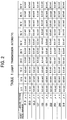
- Fig. 2 is a table showing the applied voltage and the transmittance at the black level caused by reset pulse durations.
- Fig. 3 is waveform chart showing a driving waveform used to drive a liquid crystal device in accordance with comparative example 1 of the present invention.
- Fig. 4 is a graph showing the relation between the applied voltage and transmittance in the liquid crystal device in accordance with the comparative example 1.
- Fig. 5 is a waveform chart showing a driving waveform used to drive a liquid crystal device in accordance with example 2 of the present invention.
- Fig. 6 is a graph showing the relation between the applied voltage and transmittance in the liquid crystal device in accordance with the example 2.
- Fig. 7 is a graph showing the relation between reset relaxation durations and the transmittance at the black level in the liquid crystal device in accordance with the example 2.
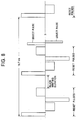
- Fig. 8 is waveform chart showing a driving waveform used to drive a liquid crystal device in accordance with example 3 of the present invention.
- Fig. 9 is a graph showing the relation between duration for writing black and hysteresis H ⁇ V in the liquid crystal device in accordance with example 3.
- Fig. 10 is a graph showing the relation between duration for writing black and a change rate of the white level in the liquid crystal device in accordance with example 3.
- Fig. 11 is a waveform chart showing a driving waveform used to drive a liquid crystal device in accordance of the comparative example 2.
- Fig. 12 is a graph showing the relation between the applied voltage and transmittance in the liquid crystal device in accordance with the comparative example 2.
- Fig. 13 is waveform chart showing a driving waveform used to drive a liquid crystal device in accordance with example 4 of the present invention.
- Fig. 14 is a table showing the applied voltages and the hysteresis widths in the liquid crystal device in accordance with the example 4.
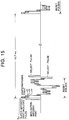
- Fig. 15 is a waveform chart showing a driving waveform used to drive a liquid crystal device in accordance with example 5 of the present invention.
- Fig. 16 is a table showing the voltage of superimposed part-included pulses and the transmittance at the black level in the liquid crystal device in accordance with the example 5.
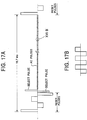
- Fig. 17A is a waveform chart showing a driving waveform used to drive a liquid crystal device in accordance with example 6 of the present invention.
- Fig. 17B is an enlarged chart showing part of the driving waveform shown in Fig. 17A.
- Fig. 18 is a graph showing the relation between AC pulse voltages and electro-optical characteristics in the liquid crystal device in accordance with the example 6.
- Fig. 19 is a graph showing the relation between AC pulse durations and electro-optical characteristics in the liquid crystal device in accordance with the example 6.
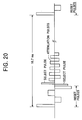
- Fig. 20 is a waveform chart showing a driving waveform used to drive a liquid crystal device in accordance with Example 7 of the present invention.
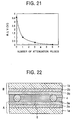
- Fig. 21 is a graph showing the relation between the number of attenuation pulses applied to the liquid crystal device in accordance with example 7 and hysteresis.
- Fig. 22 is a schematic section view of a conventional ferroelectric liquid crystal device.
- Fig. 23 has a schematic perspective view and a driving waveform chart showing the X-Y simple matrix drive method employed in the conventional ferroelectric liquid crystal device.
- Fig. 24 is a model chart showing ferroelectric liquid crystal.
- Fig. 25 is a transmittance-versus-applied voltage characteristic chart showing the threshold voltages of a conventional liquid crystal device.
- Fig. 26 is a transmittance-versus-applied voltage characteristic chart showing the threshold voltages of a liquid crystal device as the previous invention.
- Fig. 27A is a schematic explanatory chart showing the change of transmittance in switching the liquid crystal device as the previous invention.
- Fig. 27B is a schematic explanatory chart showing the change of transmittance in switching the liquid crystal device having no gradation as the previous invention.
- Fig. 28 is schematic explanatory chart showing an effective electric field in the liquid crystal of the liquid crystal device as the previous invention.
- Fig. 29 is a transmittance-applied voltage characteristic chart showing a hysteresis width in the liquid crystal device as the previous invention.
- a liquid crystal cell As shown in Fig. 22, on a glass substrate on which a transparent indium tin oxide film (sheet resistivity 100 ⁇ /cm 2 ) 40 nm thick is provided by sputtering techniques, an oblique SiO-deposited film as a liquid crystal orientation film 50 nm thick was formed with vacuum deposition techniques by heating (resistance heating) a tantalum boat (made by Nihon Backsmetal Co., Ltd.) containing SiO powder (purity 99.99%, made by Furuuchi Kagaku Co., Ltd.). During production, vacuum deposition was performed so that a normal on the substrate and a vertical line on the deposition source formed an angle of 85°.
- a liquid crystal cell was fabricated by using the following: two substrates processed by the above manner; spacers each having a diameter of 1.6 ⁇ m (Shinshikyu made by Catalysts & Chemicals Industries Co., Ltd.); and an ultraviolet hardening adhesive (Photolec made by Sekisuifine Chemical Co., Ltd.) so that the directions of oblique SiO-deposited films were positioned in anti-parallel alignment to each other.
- Ferroelectric liquid crystal (YS-C100 made by Chisso Corporation), in which titanium oxide (IT-OA made by Idemitsu Kosan Co., Ltd.) is uniformly dispersed at 1% by weight, was injected into the cell gap of this liquid crystal cell so that a liquid crystal device was obtained.
- a reset pulse intended for uniformly returning once to the initial state the director of the liquid crystal caused to change by the previously written voltage, was applied each time just before writing.
- a reset pulse 2 is changed depending upon transmission intensity at the black level, while a reset pulse 1 is for its electrical neutralization, therefore intensity in these areas is the same.
- a reset pulse 4 is determined in the same manner such that an extinction position is shifted by an angle of the memory cone, while a reset pulse 3 is intended for electrical neutralization at the white level.
- the reset pulses 2 and 4 are equal to each other, and the reset pulses 1 and 3 are equal to each other. The reset pulses 2 and 4 may not be applied.
- the reset pulses 2 and 4 have different durations, the reset pulses 1 or 3 for electrical neutralization are applied.
- the sum of the durations of the reset pulses 1 to 4 is set to a sufficient magnitude (that is, preferably, not less than 1 H, and not less than two times the duration of select pulse), based on the present invention.
- the value of this reset pulse should be not less than 5 V, normally, e.g., 40 V, in consideration of the withstand voltage of an integrated circuit and uniform resetting.
- the waveforms of the reset pulses 1 to 4 are changed such that field strength is changed depending upon not only voltage but also mainly on the pulse duration, because of resetting with respect to each stable position in consideration of bi-stability of the ferroelectric liquid crystal molecules.
- Field Strength ⁇ Time pulse duration
- a pulse duration is used in a wider range than the limited range of field strength, although it has a limitation due to the human senses (e.g. flicker resulting from black-white change caused by the switching of liquid crystal).
- Fig. 2 The relation between the reset pulse durations and the black level are shown in Fig. 2 (TABLE 1). It is understood that maintaining the pulse duration for a certain period, in particular, maintaining the pulse duration for more than 63.5 ⁇ s (if the pulse duration is 63.5 ⁇ s, a voltage to be applied can be set to not less than 40 V) causes the black level to be reduced to 8.5 mV, and there is shown uniform orientation in the layer of the ferroelectric liquid crystal. Electro-optical measurement was performed by setting the pulse duration to 127 ⁇ s, and the applied voltage to 25 V, and as a result, the hysteresis H ⁇ V was 3 V. The black level can be sufficiently reduced and H ⁇ V can be decreased, so that analog gradation can be preferably realized.
- a liquid crystal device was produced, and driven by using a driving waveform as shown in Fig. 5.
- a feature of this waveform lies in the introduction of a duration between reset pulses and select pulses, this duration being introduced from the viewpoint of relaxing the connection of electronic polarization caused by spontaneous polarization of liquid crystal molecules and polarization of an orientation film. This enables resetting to be smoothly performed, and enables the reduction of an electric field intensity area.
- a waveform having no relaxation duration causes the intense anchoring of liquid crystal molecules close to the orientation films, and as result, an extra electric field intensity area is required for the inversion of liquid crystal.
- a reset pulse is intended for uniformly returning once to the initial state the director of liquid crystal caused to change by previously written voltage, each time just before writing.
- a select pulse is for writing the gray level showing gradation. In this measurement, its voltage was raised or lowered by 1 V.
- FIG. 6 A graph showing the relation between the applied voltage and transmittance as shown in Fig. 6 was obtained.
- the graph shows different transmittance depending upon voltages, and a broad threshold width (6 V) for the switching between the bi-stable modes of ferroelectric liquid crystal.
- the graph implies a possibility of gradation expression.
- the reset pulse was determined in accordance with the manner as shown in example 1, and by changing a period for applying a voltage of 0 V just before applying the reset pulse, the transmittance at the black level after the change was measured. The results are shown in Fig. 7. It is understood therefrom that the black level rapidly dropped when the relaxation duration was not less than 31.75 ⁇ s.
- This relaxation duration corresponds to a positive multiple of a reset pulse duration, precisely to a value of (63.5/2) ⁇ s multiplied by one or greater.
- a liquid crystal device was produced, and driven by using a driving waveform as shown in Fig. 8.
- the relation between the writing duration and hysteresis is shown in Fig. 9.
- the writing duration is preferred to be 63.5 ⁇ s or longer.
- the hysteresis H ⁇ V
- black writing causes the transmittance in which the white level is reduced.
- the relation is shown in Fig. 10. Since a black writing duration of 1.5 ms caused the white level to decrease by as much as 10%, the black writing duration should be not more than 1 ms for maintaining the white level.
- this black level is determined by data voltage, however it hardly needs saying that the voltage is less than the threshold voltage of liquid crystal molecules.
- the reset pulse itself should be similar in the case of example 1.
- a feature of this waveform lies in the reduction of hysteresis by using a driving waveform so that a select pulse is applied after a black status is once created among reset pulses in each field.
- a liquid crystal device was driven.
- the liquid crystal device was produced in accordance with the same manner as shown in example 1. According to a graph (Fig. 12) showing the relation between the applied voltage and transmittance which were measured, H ⁇ V showing hysteresis was 2 V.
- a liquid crystal device was produced.
- the liquid crystal device was driven.
- a feature of this waveform lies in both the reduction of hysteresis by using a waveform such as to return the layer structure of liquid crystal molecules to the initial state, and a contribution to the stability of the layer structure.
- the select pulse is for writing the gray level. In this measurement, its voltage was raised or lowered by 1 V.
- a liquid crystal device was produced. By using a driving waveform as shown in Fig. 15, the liquid crystal device was driven.
- the transmittance at the black level was examined. Under crossed Nicols conditions, by using a driving waveform as described below and shown in Fig. 15, the liquid crystal device was driven, and the light transmission intensity at the black level was monitored. The voltage of a select pulse was fixed to 20 V.
- a feature of this waveform lies in the predetermined transformation of reset pulses by using superimposed part-included pulses in order to prevent each stable position from not being completely reset by change in electric field strength of the reset pulses due to data voltage.
- a liquid crystal device was produced.
- the liquid crystal device was driven.
- a feature of this waveform lies in enhancing the stability of memory effects by applying AC pulses whose frequency is not less than a frequency for ferroelectric liquid crystal molecules to have the negative anisotropy of dielectric constant, in other words, AC pulses of high-frequency (not less than a frequency than that of the select pulse) for acting on the anisotropy of dielectric constant of ferroelectric liquid crystal molecules, and in controlling the threshold width of gradation, hysteresis, and a threshold.
- the select pulse is for writing the gray level. In this measurement, its voltage was raised or lowered by 1 V.
- Fig. 18 there are shown ⁇ V, H ⁇ V, and V th when the AC pulse duration was fixed to 5 ⁇ s and the voltage was changed.
- Fig. 18 shows that the liquid crystal device has preferred characteristics when the AC pulse voltage is not more than 30 V.
- Fig. 19 there are shown ⁇ V, H ⁇ V, and V th when the applied voltage was fixed to 5 V and the pulse duration was changed.
- Fig. 19 shows that the liquid crystal device has preferred characteristics when the pulse duration is not more than (1/2) H.
- a liquid crystal device was produced.
- the liquid crystal device was driven.
- the attenuation pulses are formed by gradually decreasing the applied voltage within a period in which a time for resetting and selecting is deducted from 1 H, such as 5 V, -5 V, 4 V, -4 V, 3 V, -3 V, 2 V, -2 V, 1 V, and -1 V.
- the pulse duration is determined, based on the relation between the number of the attenuation pulses and the memory durations in one frame.
- a feature of this waveform lies in the introduction of pulses for neutralizing ions present in bulk in the interface between liquid crystal and orientation films. Such neutralization is performed by applying low-frequency attenuation pulses capable of effecting ions in a liquid crystal device in each frame.
- the select pulse is for writing the gray level showing gradation. In this measurement, its voltage was raised or lowed by 1 V.
- Fig. 21 Table 3
- H ⁇ V when the Voltage-Transmittance curve was measured by changing the number of attenuation pulses.
- the results show that applying low-frequency attenuation pulses enables H ⁇ V to be almost completely canceled.
- the product of the maximum voltage of an attenuation pulse and its width may be not more than half of the product, Data Voltage ⁇ (63.5 / 2) ⁇ s.
- the present invention has been achieved, without any change of materials and with more complete analog gradation realized by controlling factors such as selecting a driving waveform, or combining some driving waveforms.
- factors such as selecting a driving waveform, or combining some driving waveforms.
- Such controlling the factors are as follows: (1) applying reset pulses and setting relaxation durations for returning liquid crystal molecules or a liquid crystal layer structure to the initial state; (2) introducing electric field orientation-processed pulses, black level writing, or superimposed part-included pulses f H for compensating the negative effects of data voltage; or (3) introducing high-frequency AC stabilized pulses or low-frequency attenuation pulses for enhancing memory effects and relaxing the polarization of liquid crystal molecules and the orientation film.
- liquid crystal devices suitable for display devices are, in particular, preferred in realizing gradation (half tones).
- the liquid crystal device according to the present invention may be applied to optical filters and shutters, the display of office automation equipment, screens, phase control devices for wobbling, and so forth.
- the above-described method of driving enables any of these to have performance over the known arts.
- the liquid crystal device used in the present invention has a pair of substrates with liquid crystal provided therebetween, and in the liquid crystal, regions for switching the liquid crystal, having different threshold voltages are finely distributed. Due to such distribution, in one pixel, the emergence of fine regions (micro-domains) with different threshold voltages (V th ) causes the transmittance of the micro-domains to change with a relatively slow rate, in accordance with the applied voltage. In one domain, when liquid crystal molecules are bi-stable, the domain has memory effects, and a still image which is free from flicker is realized. Because one pixel is formed by domains of the ⁇ m-order having different threshold voltages, analog display of continuous gradation, with a high contrast is realized.
- the method of driving a liquid crystal device in accordance with the present invention realizes analog gradation display, maintaining a high contrast, by selecting a waveform from a plurality of driving waveforms or by using any combination of the waveforms.
- the analog gradation display is performed by applying reset pulses and setting relaxation duration for returning liquid crystal molecules or a liquid crystal layer structure to the initial state, the introduction of electric field orientation-processed pulses, black level writing, by introducing superimposed part-included pulses f H for compensating the negative effects of data voltage, and by introducing high-frequency AC pulses or low-frequency attenuation pulses for enhancing memory effects and relaxing the polarization of liquid crystal molecules and the orientation film.
Landscapes
- Physics & Mathematics (AREA)
- Chemical & Material Sciences (AREA)
- Crystallography & Structural Chemistry (AREA)
- Engineering & Computer Science (AREA)
- General Physics & Mathematics (AREA)
- Nonlinear Science (AREA)
- Computer Hardware Design (AREA)
- Theoretical Computer Science (AREA)
- Mathematical Physics (AREA)
- Optics & Photonics (AREA)
- Liquid Crystal (AREA)
- Liquid Crystal Display Device Control (AREA)
Applications Claiming Priority (2)
| Application Number | Priority Date | Filing Date | Title |
|---|---|---|---|
| JP7233385A JPH0954307A (ja) | 1995-08-18 | 1995-08-18 | 液晶素子の駆動方法 |
| JP233385/95 | 1995-08-18 |
Publications (2)
| Publication Number | Publication Date |
|---|---|
| EP0762377A2 true EP0762377A2 (de) | 1997-03-12 |
| EP0762377A3 EP0762377A3 (de) | 1997-12-03 |
Family
ID=16954273
Family Applications (1)
| Application Number | Title | Priority Date | Filing Date |
|---|---|---|---|
| EP96113100A Withdrawn EP0762377A3 (de) | 1995-08-18 | 1996-08-14 | Ansteuerungsverfahren für eine Flüssigkristallvorrichtung |
Country Status (3)
| Country | Link |
|---|---|
| EP (1) | EP0762377A3 (de) |
| JP (1) | JPH0954307A (de) |
| KR (1) | KR970011946A (de) |
Cited By (1)
| Publication number | Priority date | Publication date | Assignee | Title |
|---|---|---|---|---|
| US8957887B2 (en) | 2010-12-29 | 2015-02-17 | Samsung Display Co., Ltd. | Electrophoretic display apparatus and method of driving the same |
Families Citing this family (6)
| Publication number | Priority date | Publication date | Assignee | Title |
|---|---|---|---|---|
| JP4678935B2 (ja) * | 1999-11-22 | 2011-04-27 | 株式会社半導体エネルギー研究所 | 液晶表示装置の駆動方法 |
| JP2002215116A (ja) * | 2001-01-23 | 2002-07-31 | Sony Corp | 液晶表示装置及びその駆動方法 |
| JP3804502B2 (ja) * | 2001-09-27 | 2006-08-02 | カシオ計算機株式会社 | 液晶表示装置の駆動方法 |
| KR100908656B1 (ko) * | 2002-12-12 | 2009-07-21 | 엘지디스플레이 주식회사 | 강유전성 액정표시장치의 감마전압 설정방법 |
| US8933869B2 (en) | 2008-03-27 | 2015-01-13 | Citizen Holdings Co., Ltd. | Ferroelectric liquid crystal panel driving method and liquid crystal display device |
| US20240353713A1 (en) * | 2023-04-19 | 2024-10-24 | Meta Platforms Technologies, Llc | Switchable alignment layer for liquid crystal displays capture |
Family Cites Families (13)
| Publication number | Priority date | Publication date | Assignee | Title |
|---|---|---|---|---|
| US4712877A (en) * | 1985-01-18 | 1987-12-15 | Canon Kabushiki Kaisha | Ferroelectric display panel of varying thickness and driving method therefor |
| SE8504760D0 (sv) * | 1985-10-14 | 1985-10-14 | Sven Torbjorn Lagerwall | Electronic addressing of ferroelectric liquid crystal devices |
| KR910001848B1 (ko) * | 1986-02-06 | 1991-03-28 | 세이꼬 엡슨 가부시끼가이샤 | 화상 표시 장치 |
| DE3815399A1 (de) * | 1987-05-08 | 1988-11-17 | Seikosha Kk | Verfahren zur ansteuerung einer optischen fluessigkristalleinrichtung |
| JPS6418194A (en) * | 1987-07-14 | 1989-01-20 | Seikosha Kk | Driving of liquid crystal display device |
| US5010328A (en) * | 1987-07-21 | 1991-04-23 | Thorn Emi Plc | Display device |
| NL8703040A (nl) * | 1987-12-16 | 1989-07-17 | Philips Nv | Werkwijze voor het besturen van een passieve ferro-elektrisch vloeibaar kristal weergeefinrichting. |
| US5151803A (en) * | 1989-01-09 | 1992-09-29 | Matsushita Electric Industrial Co., Ltd. | Pixel-gap controlled ferroelectric liquid crystal display device and its driving method |
| GB2249653B (en) * | 1990-10-01 | 1994-09-07 | Marconi Gec Ltd | Ferroelectric liquid crystal devices |
| JP3096877B2 (ja) * | 1992-08-24 | 2000-10-10 | キヤノン株式会社 | 液晶素子の駆動法 |
| US5469281A (en) * | 1992-08-24 | 1995-11-21 | Canon Kabushiki Kaisha | Driving method for liquid crystal device which is not affected by a threshold characteristic change |
| JP3456493B2 (ja) * | 1992-10-24 | 2003-10-14 | ソニー株式会社 | 液晶素子 |
| US5490000A (en) * | 1992-12-07 | 1996-02-06 | Casio Computer Co., Ltd. | Deformed helix ferroelectric liquid crystal display device and method of driving |
-
1995
- 1995-08-18 JP JP7233385A patent/JPH0954307A/ja active Pending
-
1996
- 1996-08-14 EP EP96113100A patent/EP0762377A3/de not_active Withdrawn
- 1996-08-17 KR KR1019960034064A patent/KR970011946A/ko not_active Ceased
Cited By (1)
| Publication number | Priority date | Publication date | Assignee | Title |
|---|---|---|---|---|
| US8957887B2 (en) | 2010-12-29 | 2015-02-17 | Samsung Display Co., Ltd. | Electrophoretic display apparatus and method of driving the same |
Also Published As
| Publication number | Publication date |
|---|---|
| JPH0954307A (ja) | 1997-02-25 |
| EP0762377A3 (de) | 1997-12-03 |
| KR970011946A (ko) | 1997-03-27 |
Similar Documents
| Publication | Publication Date | Title |
|---|---|---|
| US6016133A (en) | Passive matrix addressed LCD pulse modulated drive method with pixel area and/or time integration method to produce coray scale | |
| US5495352A (en) | Liquid crystal display device with stripe-shaped unevennesses on the electrodes | |
| EP0595219B1 (de) | Ferroelektrische Flüssigkristall-Vorrichtung | |
| US20070279541A1 (en) | Method of driving liquid crystal display device | |
| US6384887B1 (en) | Liquid crystal devices comprising a multitude of domains having different threshold voltages for switching liquid crystals | |
| US6297865B1 (en) | Liquid crystal element having polarization moderating properties | |
| JP3371342B2 (ja) | 液晶素子の駆動方法 | |
| JPH0954307A (ja) | 液晶素子の駆動方法 | |
| US7224417B2 (en) | Nematic liquid crystal bistable display device with grey level | |
| JP2997866B2 (ja) | 強誘電性液晶表示素子 | |
| US6072455A (en) | Driving method for liquid crystal device | |
| US5539553A (en) | Liquid crystal device with an electrically neutral interface between the liquid crystal and orientation layer | |
| KR100337771B1 (ko) | 액정 디바이스 | |
| JP3308071B2 (ja) | 液晶素子 | |
| JP3276417B2 (ja) | 強誘電性液晶表示素子の駆動方法 | |
| JPH1144871A (ja) | 液晶素子の駆動方法 | |
| JPH1062753A (ja) | 液晶素子の駆動方法 | |
| JP3176079B2 (ja) | 光学変調素子 | |
| Wakita et al. | AC-field-stabilized matrix ferroelectric LCD | |
| JP3219709B2 (ja) | 液晶素子、液晶装置、及び液晶素子の駆動方法 | |
| JP3525222B2 (ja) | 強誘電性液晶の配向制御方法およびそれを用いた表示素子 | |
| JPS6249608B2 (de) | ||
| JPH09230312A (ja) | 液晶装置 | |
| JPH0943641A (ja) | 強誘電性液晶表示素子 | |
| JPH06186532A (ja) | 液晶電気光学装置 |
Legal Events
| Date | Code | Title | Description |
|---|---|---|---|
| PUAI | Public reference made under article 153(3) epc to a published international application that has entered the european phase |
Free format text: ORIGINAL CODE: 0009012 |
|
| AK | Designated contracting states |
Kind code of ref document: A2 Designated state(s): DE FR GB |
|
| PUAL | Search report despatched |
Free format text: ORIGINAL CODE: 0009013 |
|
| AK | Designated contracting states |
Kind code of ref document: A3 Designated state(s): DE FR GB |
|
| 17P | Request for examination filed |
Effective date: 19980423 |
|
| STAA | Information on the status of an ep patent application or granted ep patent |
Free format text: STATUS: THE APPLICATION HAS BEEN WITHDRAWN |
|
| 18W | Application withdrawn |
Withdrawal date: 20020215 |