EP0761640B1 - Verfahren zur Herstellung von 2-(4-Hydroxyphenoxy)-propionsäureestern - Google Patents
Verfahren zur Herstellung von 2-(4-Hydroxyphenoxy)-propionsäureestern Download PDFInfo
- Publication number
- EP0761640B1 EP0761640B1 EP96113730A EP96113730A EP0761640B1 EP 0761640 B1 EP0761640 B1 EP 0761640B1 EP 96113730 A EP96113730 A EP 96113730A EP 96113730 A EP96113730 A EP 96113730A EP 0761640 B1 EP0761640 B1 EP 0761640B1
- Authority
- EP
- European Patent Office
- Prior art keywords
- hydroxyphenoxy
- acid
- propionic
- preparing
- esters
- Prior art date
- Legal status (The legal status is an assumption and is not a legal conclusion. Google has not performed a legal analysis and makes no representation as to the accuracy of the status listed.)
- Expired - Lifetime
Links
- AQIHDXGKQHFBNW-UHFFFAOYSA-N 2-(4-hydroxyphenoxy)propanoic acid Chemical compound OC(=O)C(C)OC1=CC=C(O)C=C1 AQIHDXGKQHFBNW-UHFFFAOYSA-N 0.000 title claims description 19
- 150000002148 esters Chemical class 0.000 title claims description 17
- 238000000034 method Methods 0.000 title description 10
- 238000002360 preparation method Methods 0.000 title description 3
- VEXZGXHMUGYJMC-UHFFFAOYSA-N Hydrochloric acid Chemical compound Cl VEXZGXHMUGYJMC-UHFFFAOYSA-N 0.000 claims description 42
- LFQSCWFLJHTTHZ-UHFFFAOYSA-N Ethanol Chemical compound CCO LFQSCWFLJHTTHZ-UHFFFAOYSA-N 0.000 claims description 31
- 239000002253 acid Substances 0.000 claims description 19
- -1 tetrahydrofurfuryl Chemical group 0.000 claims description 19
- 230000032050 esterification Effects 0.000 claims description 16
- 238000005886 esterification reaction Methods 0.000 claims description 16
- 238000004519 manufacturing process Methods 0.000 claims description 15
- IXCSERBJSXMMFS-UHFFFAOYSA-N hydrogen chloride Substances Cl.Cl IXCSERBJSXMMFS-UHFFFAOYSA-N 0.000 claims description 14
- 229910000041 hydrogen chloride Inorganic materials 0.000 claims description 14
- 125000002496 methyl group Chemical group [H]C([H])([H])* 0.000 claims description 14
- ZAMOUSCENKQFHK-UHFFFAOYSA-N Chlorine atom Chemical compound [Cl] ZAMOUSCENKQFHK-UHFFFAOYSA-N 0.000 claims description 11
- CPELXLSAUQHCOX-UHFFFAOYSA-N Hydrogen bromide Chemical compound Br CPELXLSAUQHCOX-UHFFFAOYSA-N 0.000 claims description 11
- WTEOIRVLGSZEPR-UHFFFAOYSA-N boron trifluoride Chemical class FB(F)F WTEOIRVLGSZEPR-UHFFFAOYSA-N 0.000 claims description 11
- 229910052801 chlorine Inorganic materials 0.000 claims description 9
- 239000000460 chlorine Substances 0.000 claims description 9
- 229910052739 hydrogen Inorganic materials 0.000 claims description 9
- 150000001875 compounds Chemical class 0.000 claims description 7
- 125000001495 ethyl group Chemical group [H]C([H])([H])C([H])([H])* 0.000 claims description 7
- 229910015900 BF3 Inorganic materials 0.000 claims description 5
- WKBOTKDWSSQWDR-UHFFFAOYSA-N Bromine atom Chemical compound [Br] WKBOTKDWSSQWDR-UHFFFAOYSA-N 0.000 claims description 5
- PXGOKWXKJXAPGV-UHFFFAOYSA-N Fluorine Chemical compound FF PXGOKWXKJXAPGV-UHFFFAOYSA-N 0.000 claims description 5
- UFHFLCQGNIYNRP-UHFFFAOYSA-N Hydrogen Chemical compound [H][H] UFHFLCQGNIYNRP-UHFFFAOYSA-N 0.000 claims description 5
- 150000007513 acids Chemical class 0.000 claims description 5
- 239000001257 hydrogen Substances 0.000 claims description 5
- 229910000042 hydrogen bromide Inorganic materials 0.000 claims description 5
- 125000000959 isobutyl group Chemical group [H]C([H])([H])C([H])(C([H])([H])[H])C([H])([H])* 0.000 claims description 5
- 125000001449 isopropyl group Chemical group [H]C([H])([H])C([H])(*)C([H])([H])[H] 0.000 claims description 5
- 125000004108 n-butyl group Chemical group [H]C([H])([H])C([H])([H])C([H])([H])C([H])([H])* 0.000 claims description 5
- 125000004123 n-propyl group Chemical group [H]C([H])([H])C([H])([H])C([H])([H])* 0.000 claims description 5
- 125000000999 tert-butyl group Chemical group [H]C([H])([H])C(*)(C([H])([H])[H])C([H])([H])[H] 0.000 claims description 5
- BMYNFMYTOJXKLE-UHFFFAOYSA-N 3-azaniumyl-2-hydroxypropanoate Chemical compound NCC(O)C(O)=O BMYNFMYTOJXKLE-UHFFFAOYSA-N 0.000 claims description 4
- 150000001242 acetic acid derivatives Chemical class 0.000 claims description 4
- 239000012736 aqueous medium Substances 0.000 claims description 4
- 125000001424 substituent group Chemical group 0.000 claims description 4
- ITMCEJHCFYSIIV-UHFFFAOYSA-N triflic acid Chemical class OS(=O)(=O)C(F)(F)F ITMCEJHCFYSIIV-UHFFFAOYSA-N 0.000 claims description 4
- 150000001298 alcohols Chemical class 0.000 claims description 3
- GDTBXPJZTBHREO-UHFFFAOYSA-N bromine Substances BrBr GDTBXPJZTBHREO-UHFFFAOYSA-N 0.000 claims description 3
- 229910052794 bromium Inorganic materials 0.000 claims description 3
- 125000005448 ethoxyethyl group Chemical group [H]C([H])([H])C([H])([H])OC([H])([H])C([H])([H])* 0.000 claims description 3
- 229910052731 fluorine Inorganic materials 0.000 claims description 3
- 239000011737 fluorine Substances 0.000 claims description 3
- 150000002431 hydrogen Chemical class 0.000 claims description 2
- 125000003158 alcohol group Chemical group 0.000 claims 1
- FKRCODPIKNYEAC-UHFFFAOYSA-N ethyl propionate Chemical compound CCOC(=O)CC FKRCODPIKNYEAC-UHFFFAOYSA-N 0.000 claims 1
- OKKJLVBELUTLKV-UHFFFAOYSA-N Methanol Chemical compound OC OKKJLVBELUTLKV-UHFFFAOYSA-N 0.000 description 36
- AQIHDXGKQHFBNW-ZCFIWIBFSA-N (2r)-2-(4-hydroxyphenoxy)propanoic acid Chemical class OC(=O)[C@@H](C)OC1=CC=C(O)C=C1 AQIHDXGKQHFBNW-ZCFIWIBFSA-N 0.000 description 12
- 239000000047 product Substances 0.000 description 11
- VEXZGXHMUGYJMC-UHFFFAOYSA-M Chloride anion Chemical compound [Cl-] VEXZGXHMUGYJMC-UHFFFAOYSA-M 0.000 description 10
- 239000002904 solvent Substances 0.000 description 10
- 238000010992 reflux Methods 0.000 description 9
- IJGRMHOSHXDMSA-UHFFFAOYSA-N Atomic nitrogen Chemical compound N#N IJGRMHOSHXDMSA-UHFFFAOYSA-N 0.000 description 8
- QAOWNCQODCNURD-UHFFFAOYSA-N Sulfuric acid Chemical compound OS(O)(=O)=O QAOWNCQODCNURD-UHFFFAOYSA-N 0.000 description 8
- 238000006243 chemical reaction Methods 0.000 description 8
- CSCPPACGZOOCGX-UHFFFAOYSA-N Acetone Chemical compound CC(C)=O CSCPPACGZOOCGX-UHFFFAOYSA-N 0.000 description 6
- YXFVVABEGXRONW-UHFFFAOYSA-N Toluene Chemical compound CC1=CC=CC=C1 YXFVVABEGXRONW-UHFFFAOYSA-N 0.000 description 6
- 238000004140 cleaning Methods 0.000 description 6
- 239000000203 mixture Substances 0.000 description 6
- XLYOFNOQVPJJNP-UHFFFAOYSA-N water Substances O XLYOFNOQVPJJNP-UHFFFAOYSA-N 0.000 description 6
- 238000004821 distillation Methods 0.000 description 5
- 239000012535 impurity Substances 0.000 description 5
- 150000001732 carboxylic acid derivatives Chemical class 0.000 description 4
- UUYSCNGPNOYZMC-UHFFFAOYSA-N methyl 2-(4-hydroxyphenoxy)propanoate Chemical compound COC(=O)C(C)OC1=CC=C(O)C=C1 UUYSCNGPNOYZMC-UHFFFAOYSA-N 0.000 description 4
- QCRNRMFLUDDTDA-UHFFFAOYSA-N methyl 2-hydroxy-2-phenoxypropanoate Chemical compound COC(=O)C(C)(O)OC1=CC=CC=C1 QCRNRMFLUDDTDA-UHFFFAOYSA-N 0.000 description 4
- 229910052757 nitrogen Inorganic materials 0.000 description 4
- 125000000217 alkyl group Chemical group 0.000 description 3
- 239000003054 catalyst Substances 0.000 description 3
- 238000000746 purification Methods 0.000 description 3
- 230000007306 turnover Effects 0.000 description 3
- GXEMMZPHKGLVPF-SECBINFHSA-N (2R)-2-hydroxy-2-phenoxypropanoic acid Chemical compound O[C@](C(=O)O)(C)OC1=CC=CC=C1 GXEMMZPHKGLVPF-SECBINFHSA-N 0.000 description 2
- 125000001494 2-propynyl group Chemical group [H]C#CC([H])([H])* 0.000 description 2
- LRHPLDYGYMQRHN-UHFFFAOYSA-N N-Butanol Chemical compound CCCCO LRHPLDYGYMQRHN-UHFFFAOYSA-N 0.000 description 2
- DTQVDTLACAAQTR-UHFFFAOYSA-N Trifluoroacetic acid Chemical compound OC(=O)C(F)(F)F DTQVDTLACAAQTR-UHFFFAOYSA-N 0.000 description 2
- 239000003377 acid catalyst Substances 0.000 description 2
- 230000003197 catalytic effect Effects 0.000 description 2
- 239000007795 chemical reaction product Substances 0.000 description 2
- ZXEKIIBDNHEJCQ-UHFFFAOYSA-N isobutanol Chemical compound CC(C)CO ZXEKIIBDNHEJCQ-UHFFFAOYSA-N 0.000 description 2
- KQNPFQTWMSNSAP-UHFFFAOYSA-N isobutyric acid Chemical compound CC(C)C(O)=O KQNPFQTWMSNSAP-UHFFFAOYSA-N 0.000 description 2
- 150000004702 methyl esters Chemical class 0.000 description 2
- ZNQVEEAIQZEUHB-UHFFFAOYSA-N 2-ethoxyethanol Chemical compound CCOCCO ZNQVEEAIQZEUHB-UHFFFAOYSA-N 0.000 description 1
- HBAQYPYDRFILMT-UHFFFAOYSA-N 8-[3-(1-cyclopropylpyrazol-4-yl)-1H-pyrazolo[4,3-d]pyrimidin-5-yl]-3-methyl-3,8-diazabicyclo[3.2.1]octan-2-one Chemical class C1(CC1)N1N=CC(=C1)C1=NNC2=C1N=C(N=C2)N1C2C(N(CC1CC2)C)=O HBAQYPYDRFILMT-UHFFFAOYSA-N 0.000 description 1
- 0 C*[C+](C)Oc(c(C=I=C)c1*)c(*)c(N2CC2)c1O Chemical compound C*[C+](C)Oc(c(C=I=C)c1*)c(*)c(N2CC2)c1O 0.000 description 1
- 125000006539 C12 alkyl group Chemical group [H]C([H])([H])C([H])([H])C([H])([H])C([H])([H])C([H])([H])C([H])([H])C([H])([H])C([H])([H])C([H])([H])C([H])([H])C([H])([H])C([H])([H])* 0.000 description 1
- 125000000304 alkynyl group Chemical group 0.000 description 1
- 239000011230 binding agent Substances 0.000 description 1
- 230000015572 biosynthetic process Effects 0.000 description 1
- 150000001733 carboxylic acid esters Chemical class 0.000 description 1
- 150000001735 carboxylic acids Chemical class 0.000 description 1
- 238000011109 contamination Methods 0.000 description 1
- 239000006184 cosolvent Substances 0.000 description 1
- 239000003814 drug Substances 0.000 description 1
- 229940079593 drug Drugs 0.000 description 1
- 150000004820 halides Chemical class 0.000 description 1
- 229910052736 halogen Inorganic materials 0.000 description 1
- 150000002367 halogens Chemical class 0.000 description 1
- 239000013067 intermediate product Substances 0.000 description 1
- 239000007788 liquid Substances 0.000 description 1
- 239000002609 medium Substances 0.000 description 1
- 239000000155 melt Substances 0.000 description 1
- UUYSCNGPNOYZMC-SSDOTTSWSA-N methyl (2r)-2-(4-hydroxyphenoxy)propanoate Chemical compound COC(=O)[C@@H](C)OC1=CC=C(O)C=C1 UUYSCNGPNOYZMC-SSDOTTSWSA-N 0.000 description 1
- XMJHPCRAQCTCFT-UHFFFAOYSA-N methyl chloroformate Chemical compound COC(Cl)=O XMJHPCRAQCTCFT-UHFFFAOYSA-N 0.000 description 1
- 238000002156 mixing Methods 0.000 description 1
- 125000002347 octyl group Chemical group [H]C([*])([H])C([H])([H])C([H])([H])C([H])([H])C([H])([H])C([H])([H])C([H])([H])C([H])([H])[H] 0.000 description 1
- 238000005191 phase separation Methods 0.000 description 1
- 150000004672 propanoic acids Chemical class 0.000 description 1
- 235000019260 propionic acid Nutrition 0.000 description 1
- 239000012429 reaction media Substances 0.000 description 1
- 239000011541 reaction mixture Substances 0.000 description 1
- SNOOUWRIMMFWNE-UHFFFAOYSA-M sodium;6-[(3,4,5-trimethoxybenzoyl)amino]hexanoate Chemical compound [Na+].COC1=CC(C(=O)NCCCCCC([O-])=O)=CC(OC)=C1OC SNOOUWRIMMFWNE-UHFFFAOYSA-M 0.000 description 1
- 238000003756 stirring Methods 0.000 description 1
- 238000003860 storage Methods 0.000 description 1
- 238000003786 synthesis reaction Methods 0.000 description 1
- YNJBWRMUSHSURL-UHFFFAOYSA-N trichloroacetic acid Chemical compound OC(=O)C(Cl)(Cl)Cl YNJBWRMUSHSURL-UHFFFAOYSA-N 0.000 description 1
Classifications
-
- C—CHEMISTRY; METALLURGY
- C07—ORGANIC CHEMISTRY
- C07C—ACYCLIC OR CARBOCYCLIC COMPOUNDS
- C07C69/00—Esters of carboxylic acids; Esters of carbonic or haloformic acids
- C07C69/66—Esters of carboxylic acids having esterified carboxylic groups bound to acyclic carbon atoms and having any of the groups OH, O—metal, —CHO, keto, ether, acyloxy, groups, groups, or in the acid moiety
- C07C69/67—Esters of carboxylic acids having esterified carboxylic groups bound to acyclic carbon atoms and having any of the groups OH, O—metal, —CHO, keto, ether, acyloxy, groups, groups, or in the acid moiety of saturated acids
- C07C69/708—Ethers
- C07C69/712—Ethers the hydroxy group of the ester being etherified with a hydroxy compound having the hydroxy group bound to a carbon atom of a six-membered aromatic ring
-
- C—CHEMISTRY; METALLURGY
- C07—ORGANIC CHEMISTRY
- C07C—ACYCLIC OR CARBOCYCLIC COMPOUNDS
- C07C67/00—Preparation of carboxylic acid esters
- C07C67/08—Preparation of carboxylic acid esters by reacting carboxylic acids or symmetrical anhydrides with the hydroxy or O-metal group of organic compounds
Definitions
- the present invention relates to a method for manufacturing of 2- (4-hydroxyphenoxy) propionic acid esters, especially of 2- (4-hydroxyphenoxy) propionic acid methyl ester of high purity through multi-stage implementation of the esterification approach of the corresponding 2- (4-hydroxyphenoxy) propionic acids with an alcohol in the presence of a distillable acid selected from hydrochloric acid, hydrobromic acid, hydrogen chloride, Hydrogen bromide, halogenated acetic acid derivatives, trifluoromethanesulfonic acid, Boron trifluoride and compounds in aqueous Medium release the aforementioned distillable acids without additional Cleaning operation.
- a distillable acid selected from hydrochloric acid, hydrobromic acid, hydrogen chloride, Hydrogen bromide, halogenated acetic acid derivatives, trifluoromethanesulfonic acid, Boron trifluoride and compounds in aqueous Medium release the aforementioned distillable acids without additional Cleaning operation.
- carboxylic acid esters by implementing one Carboxylic acid with an alcohol in the presence of catalytic Amounts of an acid are e.g. from Houben-Weyl, Methods of Organic Chemistry, Volume 5E, 1985, pages 658 to 663). Typical yields are in the range of 72 to 96%. It is therefore essential to obtain high purity esters additional cleaning operations, e.g. a distillation, perform.
- the present invention was therefore based on the object to remedy the aforementioned disadvantages, in particular a procedure to develop high hydroxyphenoxypropionic acid esters To produce purity without further cleaning operations and thus reducing cleaning losses.
- the method according to the invention can be carried out as follows become:
- the implementation of the invention can be both continuous also discontinuously at temperatures of 20 to 150 ° C, preferred 40 to 130 ° C, particularly preferably 50 to 120 ° C and one Pressure from 0.05 to 5 bar, preferably 0.5 to 2 bar, particularly preferably normal pressure (atmospheric pressure) usually through Mixing a distillable acid into a mixture of 2- (4-hydroxyphenoxy) propionic acids II and an alcohol III (one fresh or recovered from one of the reaction sequences Alcohol) and then removing the alcohol and, if necessary other volatile components in vacuum at temperatures from 30 to 100 ° C, preferably 50 to 90 ° C and a pressure of 15 to 720 mbar, preferably 20 to 700 mbar, particularly preferred 30 to 650 mbar, carried out without purification of the bottom product become.
- the bottom product is according to the invention without purification another one to nine times (a total of two to ten times), preferably one to four times (a total of two to five times), particularly preferably once or twice (in total two to three times) at temperatures of 20 to 150 ° C, preferably 40 to 130 ° C, particularly preferably 50 to 120 ° C and a pressure of 0.05 up to 5 bar, preferably 0.5 to 2 bar, particularly preferably normal pressure (Atmospheric pressure) usually by adding one distillable acid to a mixture of 2- (4-hydroxyphenoxy) propionic acids II and an alcohol III and subsequent removal alcohol and possibly other volatile components in vacuum at temperatures from 30 to 100 ° C, preferably 50 to 90 ° C and a pressure of 15 to 720 mbar, preferably 20 to 700 mbar, particularly preferably 30 to 650 mbar, without cleaning of the bottom product implemented.
- the molar ratio of alcohol III to 2- (4-hydroxyphenoxy) propionic acid II is usually 1: 1 to 30: 1, preferred 1.5: 1 to 20: 1, particularly preferably 2: 1 to 15: 1.
- the molar ratio of distillable acid to alcohol III is usually 0.0001: 1 to 0.1: 1, preferably 0.001: 1 to 0.05: 1, particularly preferably 0.005: 1 to 0.03: 1.
- distillable acids are hydrochloric acid, hydrobromic acid, hydrogen chloride, hydrogen bromide, and halogenated acetic acid derivatives such as trichloroacetic acid, trifluoroacetic acid, trifluoromethanesulfonic acid and boron trifluoride, as well as of further compounds, which release such distillable acids in an aqueous medium (for example, methyl chloroformate + H 2 O ⁇ methanol, CO 2 , Hydrogen chloride), preferably hydrochloric acid, hydrogen chloride and boron trifluoride, particularly preferably hydrochloric acid and hydrogen chloride.
- an aqueous medium for example, methyl chloroformate + H 2 O ⁇ methanol, CO 2 , Hydrogen chloride
- the process according to the invention is both for esterification of racemic 2- (4-hydroxyphenoxy) propionic acids, as well as for the chiral enantiomers, preferably those with an enantiomer ratio of R: S of less than 5:95, particularly preferred less than 2:98, or greater than 95: 5, especially preferably greater than 98: 2, suitable.
- R: S an enantiomer ratio of R: S of less than 5:95, particularly preferred less than 2:98, or greater than 95: 5, especially preferably greater than 98: 2, suitable.
- the removal then begins of the solvent in a vacuum of the first esterification stage.
- excess alcohol together with water of reaction, or water already contained in the acid, if possible quickly and when using methanol as the alcohol component preferably under reduced pressure around the water content to increase in the distillate, distilled off. Doing so simultaneously a large part of the previously added acid is also removed.
- the Temperature of the product melt is set so that the Product is barely liquid and easy to stir.
- the second esterification stage begins with the Dosing of fresh alcohol and a preferably reduced one Amount of acid. If to achieve the desired turnover two esterification stages are sufficient, one of the comparable amount of alcohol used in the first stage. If three or more esterification stages to achieve the desired Degrees of turnover are required, so at the second and all subsequent stages of esterification except the last stage amount of alcohol used in an advantageous manner clearly can be reduced (e.g. by a third).
- the second and all following Distillation phases are carried out in analogy to the first.
- 2- (4-Hydroxyphenoxy) propionic acid ester stands out without the Need for a purification level, through a purity of > 99%, a water content of ⁇ 0.1%, a halide content of ⁇ 100 ppm, an organic halogen content of ⁇ 50 ppm and one Content of further contaminating individual compounds, in particular Hydroxyphenoxy-propionic acid oligomers of ⁇ 0.1%.
- the product can be used without further cleaning operations used for subsequent implementations, or for storage and the transport is assembled (e.g. shingled).
- the compounds I, II and III are preferred in which R 1 is methyl and R 2 , R 3 , R 4 and R 5 are each hydrogen.
- the 2- (4-hydroxyphenoxy) propionic acid esters I are suitable as Intermediate products in crop protection and drug synthesis.
- Example 2 Analogously to Example 1, 149 g in the first esterification stage Methanol from a distillate of the third esterification stage of the Example 1 used. 196 g (100%) were obtained [content: 99.7%] methyl 2- (4-hydroxyphenoxy) propionate (0.1% Hydroxyphenoxypropionic acid).
Landscapes
- Chemical & Material Sciences (AREA)
- Organic Chemistry (AREA)
- Organic Low-Molecular-Weight Compounds And Preparation Thereof (AREA)
- Furan Compounds (AREA)
Description
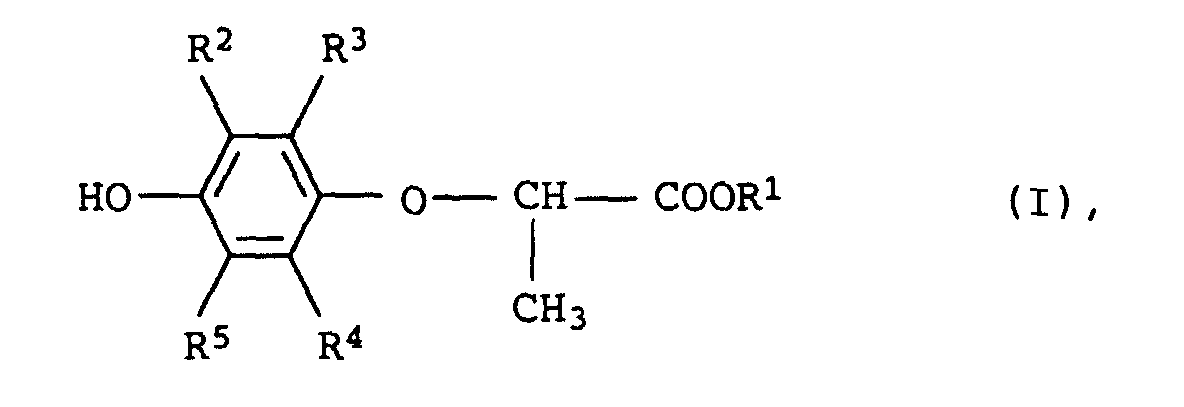
- R1
- C1- bis C18-Alkyl, C2- bis C8-Alkinyl, Tetrahydrofurfuryl oder C3- bis C18-Alkoxyalkyl und
- R2,R3,R4,R5
- Wasserstoff, C1- bis C4-Alkyl, Fluor, Chlor oder Brom
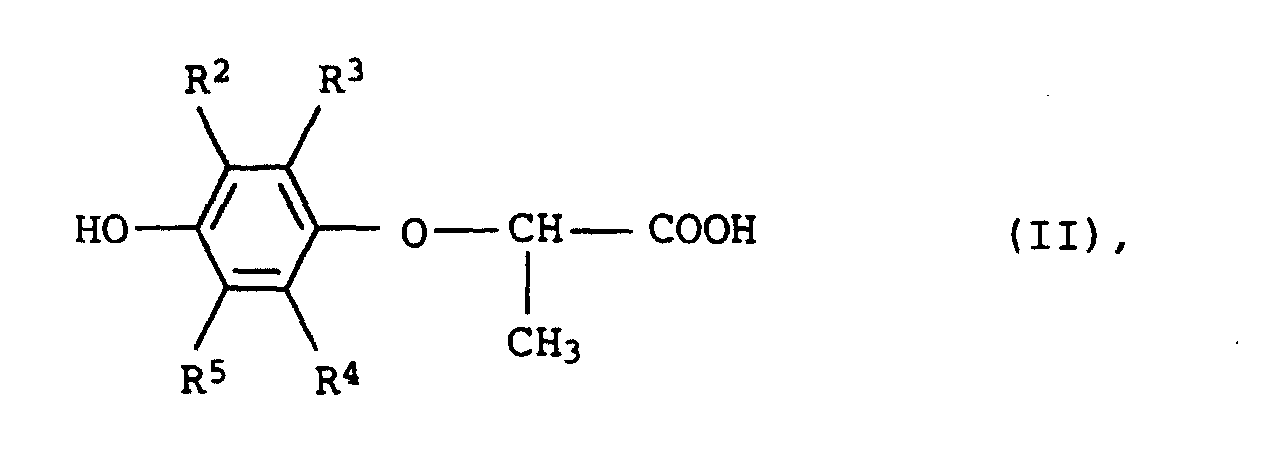
- R1
-
- C1- bis C18-Alkyl, bevorzugt C1- bis C12-Alkyl, besonders bevorzugt C1- bis C8-Alkyl wie Methyl, Ethyl, n-Propyl, iso-Propyl, n-Butyl, iso-Butyl, tert-Butyl, Ethylhexyl,
- C3- bis C18-Alkoxyalkyl, bevorzugt C3- bis C12-Alkoxyalkyl, bevorzugt C3- bis C8-Alkoxyalkyl wie Methoxyethyl und Ethoxyethyl,
- C2- bis C8-Alkinyl, bevorzugt Propargyl,
- Tetrahydrofurfuryl,
- R2,R3,R4,R5
-
- Wasserstoff,
- C1- bis C4-Alkyl wie Methyl, Ethyl, n-Propyl, iso-Propyl, n-Butyl, iso-Butyl und tert-Butyl, bevorzugt Methyl und Ethyl, besonders bevorzugt Methyl,
- Fluor, Chlor oder Brom.
| Beispiel Nr. | Hydroxyphenoxypropionsäuremethylester [Gehalt in %] | Hydroxyphenoxypropionsäure [Gehalt in %] | Chlorid [Gehalt in ppm] |
| 8 | 99,6 | 0,1 | 27 |
| 9 | 99,7 | 0,1 | 41 |
| 10 | 99,7 | 0,1 | 36 |
| 11 | 99,6 | 0,1 | 33 |
| 12 | 99,7 | 0,1 | 35 |
| Beispiel Nr. | Alkohol | R-Hydroxyphenoxypropionsäure-......-ester | Gehalt [%] |
| 13 | Ethanol | -ethyl- | 99,4 |
| 14 | n-Butanol | -n-butyl- | 99,5 |
| 15 | iso-Butanol | -iso-butyl- | 99,5 |
| 16 | Ethoxyethanol | -ethoxyethyl- | 99,4 |
Claims (11)
- Verfahren zur Herstellung von 2-(4-Hydroxyphenoxy)-propionsäureestern der allgemeinen Formel Iin der
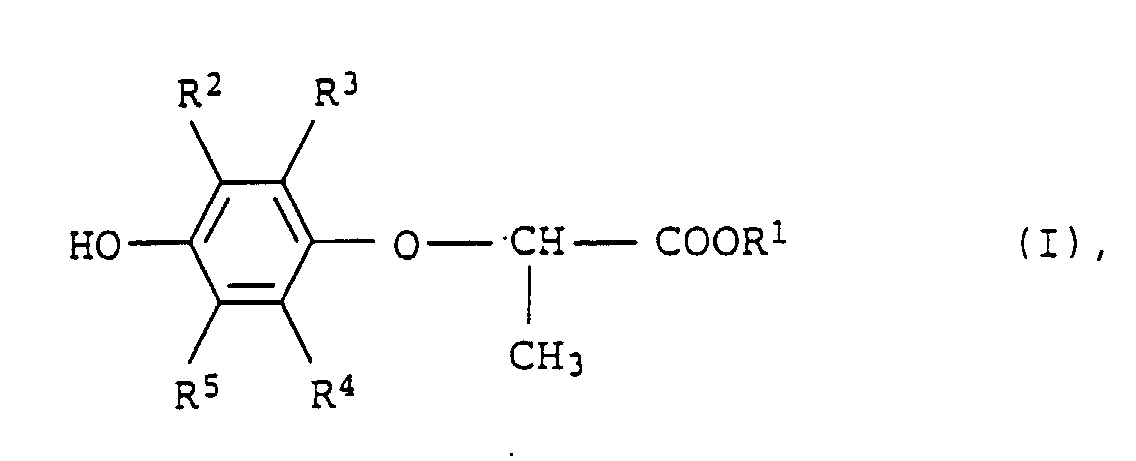
- R1
- C1- bis C18-Alkyl, C2- bis C8-Alkinyl, Tetrahydrofurfuryl oder C3- bis C18-Alkoxyalkyl und
- R2,R3,R4,R5
- Wasserstoff, C1- bis C4-Alkyl, Fluor, Chlor oder Brom
in der R2, R3, R4 und R5 die oben genannten Bedeutungen haben, mit Alkoholen der allgemeinen Formel III R1-OH (III), in der R1 die oben genannten Bedeutungen hat, dadurch gekennzeichnet, daß man die Veresterung der 2-(4-Hydroxyphenoxy)-propionsäuren II bei Temperaturen von 20 bis 150°C und einem Druck von 0,05 bis 5 bar zwei- bis zehnmal mit einem Alkohol III in Gegenwart einer destillierbaren Säure ausgewählt aus Salzsäure, Bromwasserstoffsäure, Chlorwasserstoff, Bromwasserstoff, halogenierten Essigsäurederivaten, Trifluormethansulfonsäure, Bortrifluorid und Verbindungen, die in wäßrigem Medium die vorstehend gennanten destillierbaren Säuren freisetzen, durchführt.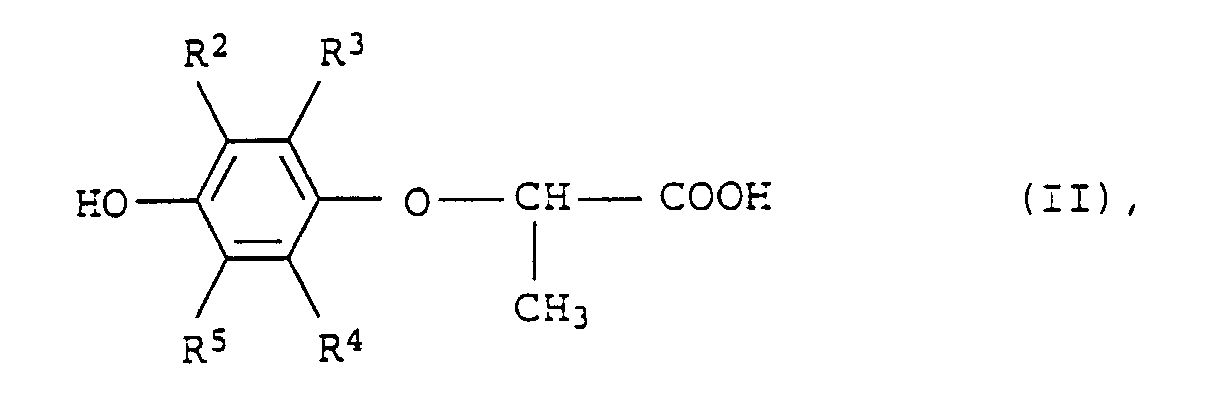
- Verfahren zur Herstellung von 2-(4-Hydroxyphenoxy)-propionsäureestern I nach Anspruch 1, dadurch gekennzeichnet, daß man den überschüssigen Alkohol III im Vakuum entfernt.
- Verfahren zur Herstellung von 2-(4-Hydroxyphenoxy)-propionsäureestern I nach den Ansprüchen 1 bis 2, dadurch gekennzeichnet, daß man die 2-(4-Hydroxyphenoxy)-propionsäureester I nicht reinigt.
- Verfahren zur Herstellung von 2-(4-Hydroxyphenoxy)-propionsäureestern I nach den Ansprüchen 1 bis 3, dadurch gekennzeichnet, daß man die 2-(4-Hydroxyphenoxy)-propionsäure II zwei- bis fünfmal mit einem Alkohol III umsetzt.
- Verfahren zur Herstellung von 2-(4-Hydroxyphenoxy)-propionsäureestern I nach den Ansprüchen 1 bis 4, dadurch gekennzeichnet, daß man den Alkohol III zur 2-(4-Hydroxyphenoxy)propionsäure II im Molverhältnis von 1:1 bis 30:1 einsetzt.
- Verfahren zur Herstellung von 2-(4-Hydroxyphenoxyl-propionsäureestern I nach den Ansprüchen 1 bis 5, dadurch gekennzeichnet, daß man die destillierbare Säure zum Alkohol III im Molverhältnis von 0,0001:1 bis 0,1:1 einsetzt.
- Verfahren zur Herstellung von 2-(4-Hydroxyphenoxy)-propionsäureestern I nach den Ansprüchen 1 bis 6, dadurch gekennzeichnet, daß der Substituent R1 Methyl, Ethyl, n-Propyl, iso-Propyl, n-Butyl, iso-Butyl, tert-Butyl, Ethylhexyl, Methoxyethyl, Propargyl-, Tetrahydrofurfuryl- und Ethoxyethyl bedeutet.
- Verfahren zur Herstellung von 2- (4-HYdroxyphenoxy)-propionsäureestern I nach den Ansprüchen 1 bis 7, dadurch gekennzeichnet, daß der Substituent R1 Methyl bedeutet.
- Verfahren zur Herstellung von 2-(4-Hydroxyphenoxy)-propionsäureestern I nach den Ansprüchen 1 bis 8, dadurch gekennzeichnet, daß die Substituenten R2, R3, R4 und R5 wasserstoff bedeuten.
- Verfahren zur Herstellung von 2-(4-Hydroxyphenoxy)-propionsäureestern I nach den Ansprüchen 1 bis 9, dadurch gekennzeichnet, daß man 2-(4-Hydroxyphenoxy)-propionsäuren II mit einem Enantiomerenverhältnis R:S von kleiner als 5:95 oder größer als 95:5 einsetzt.
- Verfahren zur Herstellung von 2-(4-Hydroxyphenoxy)-propionsäureestern I nach den Ansprüchen 1 bis 10, dadurch gekennzeichnet, daß man als destillierbare Säure Salzsäure oder Chlorwasserstoff einsetzt.
Applications Claiming Priority (2)
| Application Number | Priority Date | Filing Date | Title |
|---|---|---|---|
| DE19532815 | 1995-09-06 | ||
| DE19532815A DE19532815A1 (de) | 1995-09-06 | 1995-09-06 | Verfahren zur Herstellung von 2-(4-Hydroxyphenoxy)-propionsäureestern |
Publications (2)
| Publication Number | Publication Date |
|---|---|
| EP0761640A1 EP0761640A1 (de) | 1997-03-12 |
| EP0761640B1 true EP0761640B1 (de) | 1999-12-01 |
Family
ID=7771355
Family Applications (1)
| Application Number | Title | Priority Date | Filing Date |
|---|---|---|---|
| EP96113730A Expired - Lifetime EP0761640B1 (de) | 1995-09-06 | 1996-08-28 | Verfahren zur Herstellung von 2-(4-Hydroxyphenoxy)-propionsäureestern |
Country Status (4)
| Country | Link |
|---|---|
| US (1) | US5886209A (de) |
| EP (1) | EP0761640B1 (de) |
| JP (1) | JPH09124555A (de) |
| DE (2) | DE19532815A1 (de) |
Families Citing this family (6)
| Publication number | Priority date | Publication date | Assignee | Title |
|---|---|---|---|---|
| EP2270117A3 (de) * | 1998-12-28 | 2011-04-27 | Idemitsu Kosan Co., Ltd. | Organische elektrolumineszenzvorrichtung |
| CN101016237B (zh) * | 2006-02-10 | 2013-10-23 | 上海生农生化制品有限公司 | 一种r(+)-2-(4-羟基苯氧基)-丙酸的合成方法 |
| CN105753656A (zh) * | 2016-04-26 | 2016-07-13 | 张家港市三联化工科技有限公司 | (r)-(+)-2-(4-羟基苯氧基)丙酸甲酯的合成方法 |
| CN107253912B (zh) * | 2017-05-02 | 2020-07-31 | 江苏永凯化学有限公司 | 氰氟草酯的合成方法 |
| CN108129303A (zh) * | 2017-12-26 | 2018-06-08 | 苏州开元民生科技股份有限公司 | 一种r-(+)-2-(4-羟基苯氧基)丙酸甲酯的制备方法 |
| CN109651140A (zh) * | 2018-12-12 | 2019-04-19 | 江苏中旗科技股份有限公司 | 一种氰氟草酯原药的合成方法 |
Family Cites Families (2)
| Publication number | Priority date | Publication date | Assignee | Title |
|---|---|---|---|---|
| DE3336199A1 (de) * | 1983-10-05 | 1985-04-25 | Hoechst Ag, 6230 Frankfurt | Veresterung phenolgruppenhaltiger carbonsaeuren |
| GB8621689D0 (en) * | 1986-09-09 | 1986-10-15 | Ici Plc | Liquid crystal material |
-
1995
- 1995-09-06 DE DE19532815A patent/DE19532815A1/de not_active Withdrawn
-
1996
- 1996-08-28 DE DE59603767T patent/DE59603767D1/de not_active Expired - Fee Related
- 1996-08-28 EP EP96113730A patent/EP0761640B1/de not_active Expired - Lifetime
- 1996-09-04 JP JP8234443A patent/JPH09124555A/ja active Pending
- 1996-09-06 US US08/708,213 patent/US5886209A/en not_active Expired - Fee Related
Also Published As
| Publication number | Publication date |
|---|---|
| US5886209A (en) | 1999-03-23 |
| JPH09124555A (ja) | 1997-05-13 |
| DE59603767D1 (de) | 2000-01-05 |
| DE19532815A1 (de) | 1997-03-13 |
| EP0761640A1 (de) | 1997-03-12 |
Similar Documents
| Publication | Publication Date | Title |
|---|---|---|
| DD233126A5 (de) | Verfahren zur herstellung von pyridin-n-oxiden | |
| DE2349496A1 (de) | Verfahren zur herstellung von dl-threobeta-p-methylsulfonylphenylserinderivaten | |
| EP0761640A1 (de) | Verfahren zur Herstellung von 2-(4-Hydroxyphenoxy)-propionsäureestern | |
| DE2133458B2 (de) | Verfahren zur herstellung von polyacetylalkylendiaminen | |
| DE2607294A1 (de) | Verfahren zur herstellung von 2-amino-1-butanol | |
| EP1309574B1 (de) | Verfahren zur reinigung von 2-chlor-5-chlormethylthiazol | |
| DE2611069C2 (de) | Verfahren zur Herstellung einer Lösung von Triäthylendiamin in 1,2-Propylenglykol | |
| DD150741A5 (de) | Verfahren zur herstellung von 2',6'-dialkyl-n-(alkoxymethyl)-2-chloracetaniliden | |
| DE19835866B4 (de) | Verfahren zur Herstellung von 5-Perfluoralkyluracilderivaten | |
| EP0529631B1 (de) | Verfahren zur Herstellung von 2-(Methylthio)-dinatriumbarbiturat | |
| CH645623A5 (en) | 2-Methyl-3-acetoxy-4,5-bis(halomethyl)pyridines, process for their preparation and process for the preparation of pyridoxin | |
| EP0457725B1 (de) | Verfahren zur Herstellung von 2,3-Dibrompropionylchlorid | |
| EP0647614B1 (de) | Verfahren zur Herstellung von 5-Fluoranthranilsäure | |
| DE3940572A1 (de) | Verfahren zur herstellung eines bis(3,3-bis(4-hydroxy-alkylphenyl)-butansaeure) diolesters | |
| EP0705815B1 (de) | Verfahren zur Herstellung von N-Arylaminoacrylsäurederivaten | |
| EP0055796A1 (de) | Verfahren zur Herstellung von wasserfreiem 2-Hydroxy-3-chlorpropyltrialkylammoniumchlorid | |
| EP0758648A1 (de) | Substituierte 4H-Pyrane mit einer modulierende Wirkung auf Kaliumkanäle | |
| JPH029576B2 (de) | ||
| EP0003107B1 (de) | Verfahren zur Herstellung von Furancarbonsäureanilid | |
| DE3236096A1 (de) | In der 7- oder 8-stellung chlor- oder trifluormethylsubstituierte n-(chinol-4-yl)-anthranilsaeureester, verfahren zu ihrer herstellung und diese verbindungen enthaltende arzneimittel | |
| DE2331665A1 (de) | Dialkylaminoalkylester von arylaliphatischen saeuren und ihre saeureadditionssalze und verfahren zu deren herstellung | |
| EP0128279B1 (de) | Verfahren zur Herstellung von 6-Methylnicotinsäureester | |
| DE2415061A1 (de) | Verfahren zur herstellung von 2nitrobenzaldehyd | |
| DE3733754C2 (de) | ||
| DE946543C (de) | Verfahren zur Herstellung von Dialkylxanthinabkoemmlingen |
Legal Events
| Date | Code | Title | Description |
|---|---|---|---|
| PUAI | Public reference made under article 153(3) epc to a published international application that has entered the european phase |
Free format text: ORIGINAL CODE: 0009012 |
|
| 17P | Request for examination filed |
Effective date: 19961218 |
|
| AK | Designated contracting states |
Kind code of ref document: A1 Designated state(s): BE CH DE FR GB IT LI NL |
|
| 17Q | First examination report despatched |
Effective date: 19980424 |
|
| GRAG | Despatch of communication of intention to grant |
Free format text: ORIGINAL CODE: EPIDOS AGRA |
|
| GRAG | Despatch of communication of intention to grant |
Free format text: ORIGINAL CODE: EPIDOS AGRA |
|
| GRAG | Despatch of communication of intention to grant |
Free format text: ORIGINAL CODE: EPIDOS AGRA |
|
| GRAG | Despatch of communication of intention to grant |
Free format text: ORIGINAL CODE: EPIDOS AGRA |
|
| GRAH | Despatch of communication of intention to grant a patent |
Free format text: ORIGINAL CODE: EPIDOS IGRA |
|
| GRAH | Despatch of communication of intention to grant a patent |
Free format text: ORIGINAL CODE: EPIDOS IGRA |
|
| GRAA | (expected) grant |
Free format text: ORIGINAL CODE: 0009210 |
|
| AK | Designated contracting states |
Kind code of ref document: B1 Designated state(s): BE CH DE FR GB IT LI NL |
|
| REG | Reference to a national code |
Ref country code: CH Ref legal event code: EP |
|
| REF | Corresponds to: |
Ref document number: 59603767 Country of ref document: DE Date of ref document: 20000105 |
|
| GBT | Gb: translation of ep patent filed (gb section 77(6)(a)/1977) |
Effective date: 19991214 |
|
| ITF | It: translation for a ep patent filed | ||
| ET | Fr: translation filed | ||
| PLBE | No opposition filed within time limit |
Free format text: ORIGINAL CODE: 0009261 |
|
| STAA | Information on the status of an ep patent application or granted ep patent |
Free format text: STATUS: NO OPPOSITION FILED WITHIN TIME LIMIT |
|
| 26N | No opposition filed | ||
| REG | Reference to a national code |
Ref country code: GB Ref legal event code: IF02 |
|
| PGFP | Annual fee paid to national office [announced via postgrant information from national office to epo] |
Ref country code: NL Payment date: 20050803 Year of fee payment: 10 |
|
| PGFP | Annual fee paid to national office [announced via postgrant information from national office to epo] |
Ref country code: FR Payment date: 20050809 Year of fee payment: 10 |
|
| PGFP | Annual fee paid to national office [announced via postgrant information from national office to epo] |
Ref country code: GB Payment date: 20050824 Year of fee payment: 10 |
|
| PGFP | Annual fee paid to national office [announced via postgrant information from national office to epo] |
Ref country code: DE Payment date: 20050825 Year of fee payment: 10 |
|
| PGFP | Annual fee paid to national office [announced via postgrant information from national office to epo] |
Ref country code: CH Payment date: 20050830 Year of fee payment: 10 |
|
| PGFP | Annual fee paid to national office [announced via postgrant information from national office to epo] |
Ref country code: BE Payment date: 20051014 Year of fee payment: 10 |
|
| PG25 | Lapsed in a contracting state [announced via postgrant information from national office to epo] |
Ref country code: LI Free format text: LAPSE BECAUSE OF NON-PAYMENT OF DUE FEES Effective date: 20060831 Ref country code: CH Free format text: LAPSE BECAUSE OF NON-PAYMENT OF DUE FEES Effective date: 20060831 Ref country code: BE Free format text: LAPSE BECAUSE OF NON-PAYMENT OF DUE FEES Effective date: 20060831 |
|
| PGFP | Annual fee paid to national office [announced via postgrant information from national office to epo] |
Ref country code: IT Payment date: 20060831 Year of fee payment: 11 |
|
| PG25 | Lapsed in a contracting state [announced via postgrant information from national office to epo] |
Ref country code: NL Free format text: LAPSE BECAUSE OF NON-PAYMENT OF DUE FEES Effective date: 20070301 Ref country code: DE Free format text: LAPSE BECAUSE OF NON-PAYMENT OF DUE FEES Effective date: 20070301 |
|
| REG | Reference to a national code |
Ref country code: CH Ref legal event code: PL |
|
| GBPC | Gb: european patent ceased through non-payment of renewal fee |
Effective date: 20060828 |
|
| NLV4 | Nl: lapsed or anulled due to non-payment of the annual fee |
Effective date: 20070301 |
|
| REG | Reference to a national code |
Ref country code: FR Ref legal event code: ST Effective date: 20070430 |
|
| PG25 | Lapsed in a contracting state [announced via postgrant information from national office to epo] |
Ref country code: GB Free format text: LAPSE BECAUSE OF NON-PAYMENT OF DUE FEES Effective date: 20060828 |
|
| BERE | Be: lapsed |
Owner name: *BASF A.G. Effective date: 20060831 |
|
| PG25 | Lapsed in a contracting state [announced via postgrant information from national office to epo] |
Ref country code: FR Free format text: LAPSE BECAUSE OF NON-PAYMENT OF DUE FEES Effective date: 20060831 |
|
| PG25 | Lapsed in a contracting state [announced via postgrant information from national office to epo] |
Ref country code: IT Free format text: LAPSE BECAUSE OF NON-PAYMENT OF DUE FEES Effective date: 20070828 |