EP0760002B1 - Detection of mutation by resolvase cleavage - Google Patents
Detection of mutation by resolvase cleavage Download PDFInfo
- Publication number
- EP0760002B1 EP0760002B1 EP95918266A EP95918266A EP0760002B1 EP 0760002 B1 EP0760002 B1 EP 0760002B1 EP 95918266 A EP95918266 A EP 95918266A EP 95918266 A EP95918266 A EP 95918266A EP 0760002 B1 EP0760002 B1 EP 0760002B1
- Authority
- EP
- European Patent Office
- Prior art keywords
- dna
- nucleic acid
- test
- bacteriophage
- heteroduplex
- Prior art date
- Legal status (The legal status is an assumption and is not a legal conclusion. Google has not performed a legal analysis and makes no representation as to the accuracy of the status listed.)
- Expired - Lifetime
Links
- 230000035772 mutation Effects 0.000 title claims abstract description 69
- 102000018120 Recombinases Human genes 0.000 title abstract description 37
- 108010091086 Recombinases Proteins 0.000 title abstract description 37
- 238000003776 cleavage reaction Methods 0.000 title description 47
- 230000007017 scission Effects 0.000 title description 45
- 238000001514 detection method Methods 0.000 title description 29
- 108020004414 DNA Proteins 0.000 claims abstract description 249
- 238000012360 testing method Methods 0.000 claims abstract description 103
- 150000007523 nucleic acids Chemical class 0.000 claims abstract description 99
- 108020004707 nucleic acids Proteins 0.000 claims abstract description 94
- 102000039446 nucleic acids Human genes 0.000 claims abstract description 94
- 108091027305 Heteroduplex Proteins 0.000 claims abstract description 83
- 238000000034 method Methods 0.000 claims abstract description 79
- 108010064144 endodeoxyribonuclease VII Proteins 0.000 claims abstract description 60
- 241000701533 Escherichia virus T4 Species 0.000 claims abstract description 35
- 239000002773 nucleotide Substances 0.000 claims description 67
- 125000003729 nucleotide group Chemical group 0.000 claims description 67
- 108090000623 proteins and genes Proteins 0.000 claims description 39
- 239000012634 fragment Substances 0.000 claims description 26
- 102000004190 Enzymes Human genes 0.000 claims description 25
- 108090000790 Enzymes Proteins 0.000 claims description 25
- 241000700605 Viruses Species 0.000 claims description 21
- 238000012408 PCR amplification Methods 0.000 claims description 19
- 210000004027 cell Anatomy 0.000 claims description 15
- 108010011732 Steroid 21-Hydroxylase Proteins 0.000 claims description 14
- 241001515965 unidentified phage Species 0.000 claims description 14
- 238000000137 annealing Methods 0.000 claims description 13
- 102000014169 Steroid 21-Hydroxylase Human genes 0.000 claims description 12
- 108700020796 Oncogene Proteins 0.000 claims description 11
- 210000003527 eukaryotic cell Anatomy 0.000 claims description 10
- 108091008146 restriction endonucleases Proteins 0.000 claims description 10
- 241001112695 Clostridiales Species 0.000 claims description 8
- 102000044209 Tumor Suppressor Genes Human genes 0.000 claims description 8
- 108700025716 Tumor Suppressor Genes Proteins 0.000 claims description 8
- 238000012217 deletion Methods 0.000 claims description 8
- 230000037430 deletion Effects 0.000 claims description 8
- 239000007787 solid Substances 0.000 claims description 8
- 240000004808 Saccharomyces cerevisiae Species 0.000 claims description 7
- 239000011324 bead Substances 0.000 claims description 7
- 238000004925 denaturation Methods 0.000 claims description 7
- 230000036425 denaturation Effects 0.000 claims description 7
- 102100024458 Cyclin-dependent kinase inhibitor 2A Human genes 0.000 claims description 6
- 102000012410 DNA Ligases Human genes 0.000 claims description 6
- 108010061982 DNA Ligases Proteins 0.000 claims description 6
- 108010008532 Deoxyribonuclease I Proteins 0.000 claims description 6
- 102000007260 Deoxyribonuclease I Human genes 0.000 claims description 6
- 241000701832 Enterobacteria phage T3 Species 0.000 claims description 6
- 102100021519 Hemoglobin subunit beta Human genes 0.000 claims description 6
- 108091005904 Hemoglobin subunit beta Proteins 0.000 claims description 6
- 201000000582 Retinoblastoma Diseases 0.000 claims description 6
- 241001493065 dsRNA viruses Species 0.000 claims description 6
- 238000003780 insertion Methods 0.000 claims description 6
- 230000037431 insertion Effects 0.000 claims description 6
- 239000002753 trypsin inhibitor Substances 0.000 claims description 6
- 101100436483 Mus musculus Atp7a gene Proteins 0.000 claims description 5
- 102000008186 Collagen Human genes 0.000 claims description 4
- 108010035532 Collagen Proteins 0.000 claims description 4
- 102100022317 Dihydropteridine reductase Human genes 0.000 claims description 4
- 108090000820 Rhodopsin Proteins 0.000 claims description 4
- 235000014680 Saccharomyces cerevisiae Nutrition 0.000 claims description 4
- 208000029664 classic familial adenomatous polyposis Diseases 0.000 claims description 4
- 229920001436 collagen Polymers 0.000 claims description 4
- 230000005291 magnetic effect Effects 0.000 claims description 4
- 108010015014 pyruvate dehydrogenase E1alpha subunit Proteins 0.000 claims description 4
- 238000006467 substitution reaction Methods 0.000 claims description 4
- NCYCYZXNIZJOKI-IOUUIBBYSA-N 11-cis-retinal Chemical compound O=C/C=C(\C)/C=C\C=C(/C)\C=C\C1=C(C)CCCC1(C)C NCYCYZXNIZJOKI-IOUUIBBYSA-N 0.000 claims description 3
- 101710169336 5'-deoxyadenosine deaminase Proteins 0.000 claims description 3
- OQRXBXNATIHDQO-UHFFFAOYSA-N 6-chloropyridine-3,4-diamine Chemical compound NC1=CN=C(Cl)C=C1N OQRXBXNATIHDQO-UHFFFAOYSA-N 0.000 claims description 3
- 102100031126 6-phosphogluconolactonase Human genes 0.000 claims description 3
- 108010029731 6-phosphogluconolactonase Proteins 0.000 claims description 3
- 102000055025 Adenosine deaminases Human genes 0.000 claims description 3
- 102000013455 Amyloid beta-Peptides Human genes 0.000 claims description 3
- 108010090849 Amyloid beta-Peptides Proteins 0.000 claims description 3
- 102100021569 Apoptosis regulator Bcl-2 Human genes 0.000 claims description 3
- 102100022641 Coagulation factor IX Human genes 0.000 claims description 3
- 201000003883 Cystic fibrosis Diseases 0.000 claims description 3
- 102100028843 DNA mismatch repair protein Mlh1 Human genes 0.000 claims description 3
- 108010028196 Dihydropteridine Reductase Proteins 0.000 claims description 3
- 206010013801 Duchenne Muscular Dystrophy Diseases 0.000 claims description 3
- 108010076282 Factor IX Proteins 0.000 claims description 3
- 102000001690 Factor VIII Human genes 0.000 claims description 3
- 108010054218 Factor VIII Proteins 0.000 claims description 3
- 101710113436 GTPase KRas Proteins 0.000 claims description 3
- 108010018962 Glucosephosphate Dehydrogenase Proteins 0.000 claims description 3
- 101000971171 Homo sapiens Apoptosis regulator Bcl-2 Proteins 0.000 claims description 3
- 101000577853 Homo sapiens DNA mismatch repair protein Mlh1 Proteins 0.000 claims description 3
- 101001134036 Homo sapiens DNA mismatch repair protein Msh2 Proteins 0.000 claims description 3
- 208000023105 Huntington disease Diseases 0.000 claims description 3
- 102000018251 Hypoxanthine Phosphoribosyltransferase Human genes 0.000 claims description 3
- 108010091358 Hypoxanthine Phosphoribosyltransferase Proteins 0.000 claims description 3
- 108010025020 Nerve Growth Factor Proteins 0.000 claims description 3
- 102000015336 Nerve Growth Factor Human genes 0.000 claims description 3
- 102000043276 Oncogene Human genes 0.000 claims description 3
- 102000007981 Ornithine carbamoyltransferase Human genes 0.000 claims description 3
- 101710198224 Ornithine carbamoyltransferase, mitochondrial Proteins 0.000 claims description 3
- 102100036286 Purine nucleoside phosphorylase Human genes 0.000 claims description 3
- 102000019197 Superoxide Dismutase Human genes 0.000 claims description 3
- 108010012715 Superoxide dismutase Proteins 0.000 claims description 3
- 102000007537 Type II DNA Topoisomerases Human genes 0.000 claims description 3
- 108010046308 Type II DNA Topoisomerases Proteins 0.000 claims description 3
- 230000001580 bacterial effect Effects 0.000 claims description 3
- 208000005980 beta thalassemia Diseases 0.000 claims description 3
- 108010085377 beta-N-Acetylhexosaminidases Proteins 0.000 claims description 3
- 102000007478 beta-N-Acetylhexosaminidases Human genes 0.000 claims description 3
- 201000010099 disease Diseases 0.000 claims description 3
- 208000037265 diseases, disorders, signs and symptoms Diseases 0.000 claims description 3
- 229960004222 factor ix Drugs 0.000 claims description 3
- 229960000301 factor viii Drugs 0.000 claims description 3
- 229940053128 nerve growth factor Drugs 0.000 claims description 3
- 108010009099 nucleoside phosphorylase Proteins 0.000 claims description 3
- 230000022983 regulation of cell cycle Effects 0.000 claims description 3
- 108010009392 Cyclin-Dependent Kinase Inhibitor p16 Proteins 0.000 claims 1
- 108700039887 Essential Genes Proteins 0.000 claims 1
- QNAYBMKLOCPYGJ-REOHCLBHSA-N L-alanine Chemical compound C[C@H](N)C(O)=O QNAYBMKLOCPYGJ-REOHCLBHSA-N 0.000 claims 1
- COLNVLDHVKWLRT-QMMMGPOBSA-N L-phenylalanine Chemical compound OC(=O)[C@@H](N)CC1=CC=CC=C1 COLNVLDHVKWLRT-QMMMGPOBSA-N 0.000 claims 1
- 102000008109 Mixed Function Oxygenases Human genes 0.000 claims 1
- 108010074633 Mixed Function Oxygenases Proteins 0.000 claims 1
- 102100040756 Rhodopsin Human genes 0.000 claims 1
- 235000004279 alanine Nutrition 0.000 claims 1
- 108700021031 cdc Genes Proteins 0.000 claims 1
- COLNVLDHVKWLRT-UHFFFAOYSA-N phenylalanine Natural products OC(=O)C(N)CC1=CC=CC=C1 COLNVLDHVKWLRT-UHFFFAOYSA-N 0.000 claims 1
- 239000002585 base Substances 0.000 description 32
- YBJHBAHKTGYVGT-ZKWXMUAHSA-N (+)-Biotin Chemical compound N1C(=O)N[C@@H]2[C@H](CCCCC(=O)O)SC[C@@H]21 YBJHBAHKTGYVGT-ZKWXMUAHSA-N 0.000 description 24
- 108091032973 (ribonucleotides)n+m Proteins 0.000 description 24
- 238000011534 incubation Methods 0.000 description 24
- 238000002372 labelling Methods 0.000 description 24
- 230000015572 biosynthetic process Effects 0.000 description 22
- 238000006243 chemical reaction Methods 0.000 description 19
- 239000000047 product Substances 0.000 description 19
- LFQSCWFLJHTTHZ-UHFFFAOYSA-N Ethanol Chemical compound CCO LFQSCWFLJHTTHZ-UHFFFAOYSA-N 0.000 description 18
- 239000013615 primer Substances 0.000 description 17
- PEDCQBHIVMGVHV-UHFFFAOYSA-N Glycerine Chemical compound OCC(O)CO PEDCQBHIVMGVHV-UHFFFAOYSA-N 0.000 description 15
- 239000000499 gel Substances 0.000 description 14
- 239000013598 vector Substances 0.000 description 14
- 108091028043 Nucleic acid sequence Proteins 0.000 description 13
- 102100038223 Phenylalanine-4-hydroxylase Human genes 0.000 description 12
- 229960002685 biotin Drugs 0.000 description 12
- 235000020958 biotin Nutrition 0.000 description 12
- 239000011616 biotin Substances 0.000 description 12
- 239000000975 dye Substances 0.000 description 12
- 238000009396 hybridization Methods 0.000 description 12
- 230000002285 radioactive effect Effects 0.000 description 12
- 238000004458 analytical method Methods 0.000 description 11
- 101150036331 pah gene Proteins 0.000 description 11
- 239000000523 sample Substances 0.000 description 10
- XLYOFNOQVPJJNP-UHFFFAOYSA-N water Chemical compound O XLYOFNOQVPJJNP-UHFFFAOYSA-N 0.000 description 10
- 102000003960 Ligases Human genes 0.000 description 9
- 108090000364 Ligases Proteins 0.000 description 9
- 108091034117 Oligonucleotide Proteins 0.000 description 9
- 239000002299 complementary DNA Substances 0.000 description 9
- 230000009946 DNA mutation Effects 0.000 description 8
- 230000000295 complement effect Effects 0.000 description 8
- 238000002264 polyacrylamide gel electrophoresis Methods 0.000 description 8
- 239000011541 reaction mixture Substances 0.000 description 8
- 239000003155 DNA primer Substances 0.000 description 7
- 206010064571 Gene mutation Diseases 0.000 description 7
- AVXURJPOCDRRFD-UHFFFAOYSA-N Hydroxylamine Chemical compound ON AVXURJPOCDRRFD-UHFFFAOYSA-N 0.000 description 7
- 239000000872 buffer Substances 0.000 description 7
- 230000029087 digestion Effects 0.000 description 7
- 239000012153 distilled water Substances 0.000 description 7
- 238000002474 experimental method Methods 0.000 description 7
- GNBHRKFJIUUOQI-UHFFFAOYSA-N fluorescein Chemical compound O1C(=O)C2=CC=CC=C2C21C1=CC=C(O)C=C1OC1=CC(O)=CC=C21 GNBHRKFJIUUOQI-UHFFFAOYSA-N 0.000 description 7
- 102000004169 proteins and genes Human genes 0.000 description 7
- 102100031780 Endonuclease Human genes 0.000 description 6
- ZHNUHDYFZUAESO-UHFFFAOYSA-N Formamide Chemical compound NC=O ZHNUHDYFZUAESO-UHFFFAOYSA-N 0.000 description 6
- 230000008859 change Effects 0.000 description 6
- 239000013024 dilution buffer Substances 0.000 description 6
- 229920002401 polyacrylamide Polymers 0.000 description 6
- 239000011535 reaction buffer Substances 0.000 description 6
- FWBHETKCLVMNFS-UHFFFAOYSA-N 4',6-Diamino-2-phenylindol Chemical compound C1=CC(C(=N)N)=CC=C1C1=CC2=CC=C(C(N)=N)C=C2N1 FWBHETKCLVMNFS-UHFFFAOYSA-N 0.000 description 5
- 241000894006 Bacteria Species 0.000 description 5
- 102000053602 DNA Human genes 0.000 description 5
- SHIBSTMRCDJXLN-UHFFFAOYSA-N Digoxigenin Natural products C1CC(C2C(C3(C)CCC(O)CC3CC2)CC2O)(O)C2(C)C1C1=CC(=O)OC1 SHIBSTMRCDJXLN-UHFFFAOYSA-N 0.000 description 5
- 108010042407 Endonucleases Proteins 0.000 description 5
- 241000725303 Human immunodeficiency virus Species 0.000 description 5
- 241001465754 Metazoa Species 0.000 description 5
- 239000004677 Nylon Substances 0.000 description 5
- 108010069013 Phenylalanine Hydroxylase Proteins 0.000 description 5
- 108010090804 Streptavidin Proteins 0.000 description 5
- DPKHZNPWBDQZCN-UHFFFAOYSA-N acridine orange free base Chemical compound C1=CC(N(C)C)=CC2=NC3=CC(N(C)C)=CC=C3C=C21 DPKHZNPWBDQZCN-UHFFFAOYSA-N 0.000 description 5
- 238000000376 autoradiography Methods 0.000 description 5
- DZBUGLKDJFMEHC-UHFFFAOYSA-N benzoquinolinylidene Natural products C1=CC=CC2=CC3=CC=CC=C3N=C21 DZBUGLKDJFMEHC-UHFFFAOYSA-N 0.000 description 5
- QONQRTHLHBTMGP-UHFFFAOYSA-N digitoxigenin Natural products CC12CCC(C3(CCC(O)CC3CC3)C)C3C11OC1CC2C1=CC(=O)OC1 QONQRTHLHBTMGP-UHFFFAOYSA-N 0.000 description 5
- SHIBSTMRCDJXLN-KCZCNTNESA-N digoxigenin Chemical compound C1([C@@H]2[C@@]3([C@@](CC2)(O)[C@H]2[C@@H]([C@@]4(C)CC[C@H](O)C[C@H]4CC2)C[C@H]3O)C)=CC(=O)OC1 SHIBSTMRCDJXLN-KCZCNTNESA-N 0.000 description 5
- ZMMJGEGLRURXTF-UHFFFAOYSA-N ethidium bromide Chemical compound [Br-].C12=CC(N)=CC=C2C2=CC=C(N)C=C2[N+](CC)=C1C1=CC=CC=C1 ZMMJGEGLRURXTF-UHFFFAOYSA-N 0.000 description 5
- 229960005542 ethidium bromide Drugs 0.000 description 5
- 229920001778 nylon Polymers 0.000 description 5
- 239000008188 pellet Substances 0.000 description 5
- QKNYBSVHEMOAJP-UHFFFAOYSA-N 2-amino-2-(hydroxymethyl)propane-1,3-diol;hydron;chloride Chemical compound Cl.OCC(N)(CO)CO QKNYBSVHEMOAJP-UHFFFAOYSA-N 0.000 description 4
- 108020004705 Codon Proteins 0.000 description 4
- 108020004635 Complementary DNA Proteins 0.000 description 4
- 108020004394 Complementary RNA Proteins 0.000 description 4
- 229920000742 Cotton Polymers 0.000 description 4
- -1 DNA or RNA Chemical class 0.000 description 4
- KCXVZYZYPLLWCC-UHFFFAOYSA-N EDTA Chemical compound OC(=O)CN(CC(O)=O)CCN(CC(O)=O)CC(O)=O KCXVZYZYPLLWCC-UHFFFAOYSA-N 0.000 description 4
- 101000889812 Enterobacteria phage T4 Endonuclease Proteins 0.000 description 4
- 241000238631 Hexapoda Species 0.000 description 4
- 101710163270 Nuclease Proteins 0.000 description 4
- 108010021757 Polynucleotide 5'-Hydroxyl-Kinase Proteins 0.000 description 4
- 102000008422 Polynucleotide 5'-hydroxyl-kinase Human genes 0.000 description 4
- 108091081062 Repeated sequence (DNA) Proteins 0.000 description 4
- ISAKRJDGNUQOIC-UHFFFAOYSA-N Uracil Chemical compound O=C1C=CNC(=O)N1 ISAKRJDGNUQOIC-UHFFFAOYSA-N 0.000 description 4
- XSQUKJJJFZCRTK-UHFFFAOYSA-N Urea Chemical compound NC(N)=O XSQUKJJJFZCRTK-UHFFFAOYSA-N 0.000 description 4
- 238000010804 cDNA synthesis Methods 0.000 description 4
- 239000003184 complementary RNA Substances 0.000 description 4
- OPTASPLRGRRNAP-UHFFFAOYSA-N cytosine Chemical compound NC=1C=CNC(=O)N=1 OPTASPLRGRRNAP-UHFFFAOYSA-N 0.000 description 4
- RWSXRVCMGQZWBV-WDSKDSINSA-N glutathione Chemical compound OC(=O)[C@@H](N)CCC(=O)N[C@@H](CS)C(=O)NCC(O)=O RWSXRVCMGQZWBV-WDSKDSINSA-N 0.000 description 4
- 239000000891 luminescent agent Substances 0.000 description 4
- 239000012528 membrane Substances 0.000 description 4
- 108020004999 messenger RNA Proteins 0.000 description 4
- 229910000489 osmium tetroxide Inorganic materials 0.000 description 4
- 239000012285 osmium tetroxide Substances 0.000 description 4
- 239000013612 plasmid Substances 0.000 description 4
- 239000000126 substance Substances 0.000 description 4
- HRPVXLWXLXDGHG-UHFFFAOYSA-N Acrylamide Chemical compound NC(=O)C=C HRPVXLWXLXDGHG-UHFFFAOYSA-N 0.000 description 3
- 241000203809 Actinomycetales Species 0.000 description 3
- 229930024421 Adenine Natural products 0.000 description 3
- GFFGJBXGBJISGV-UHFFFAOYSA-N Adenine Chemical compound NC1=NC=NC2=C1N=CN2 GFFGJBXGBJISGV-UHFFFAOYSA-N 0.000 description 3
- 241000701242 Adenoviridae Species 0.000 description 3
- 101150076489 B gene Proteins 0.000 description 3
- 230000007023 DNA restriction-modification system Effects 0.000 description 3
- 241000450599 DNA viruses Species 0.000 description 3
- 101000877444 Enterobacteria phage T4 Recombination endonuclease VII Proteins 0.000 description 3
- 208000031886 HIV Infections Diseases 0.000 description 3
- 206010020460 Human T-cell lymphotropic virus type I infection Diseases 0.000 description 3
- 241000714260 Human T-lymphotropic virus 1 Species 0.000 description 3
- 241000714259 Human T-lymphotropic virus 2 Species 0.000 description 3
- 241000713772 Human immunodeficiency virus 1 Species 0.000 description 3
- 241000713340 Human immunodeficiency virus 2 Species 0.000 description 3
- 241000222712 Kinetoplastida Species 0.000 description 3
- 241000186360 Mycobacteriaceae Species 0.000 description 3
- 241000187479 Mycobacterium tuberculosis Species 0.000 description 3
- 241000589970 Spirochaetales Species 0.000 description 3
- 241000223109 Trypanosoma cruzi Species 0.000 description 3
- 102100039169 [Pyruvate dehydrogenase [acetyl-transferring]]-phosphatase 1, mitochondrial Human genes 0.000 description 3
- 229960000643 adenine Drugs 0.000 description 3
- 108700010877 adenoviridae proteins Proteins 0.000 description 3
- 230000003321 amplification Effects 0.000 description 3
- 238000003556 assay Methods 0.000 description 3
- 230000000694 effects Effects 0.000 description 3
- 238000001502 gel electrophoresis Methods 0.000 description 3
- 238000007169 ligase reaction Methods 0.000 description 3
- 238000012986 modification Methods 0.000 description 3
- 230000004048 modification Effects 0.000 description 3
- 238000003199 nucleic acid amplification method Methods 0.000 description 3
- 230000008439 repair process Effects 0.000 description 3
- 241000701161 unidentified adenovirus Species 0.000 description 3
- 241000701447 unidentified baculovirus Species 0.000 description 3
- 241000589969 Borreliella burgdorferi Species 0.000 description 2
- 102100034157 DNA mismatch repair protein Msh2 Human genes 0.000 description 2
- 108010014303 DNA-directed DNA polymerase Proteins 0.000 description 2
- 102000016928 DNA-directed DNA polymerase Human genes 0.000 description 2
- 241000588724 Escherichia coli Species 0.000 description 2
- 208000001914 Fragile X syndrome Diseases 0.000 description 2
- 108010024636 Glutathione Proteins 0.000 description 2
- 101000980932 Homo sapiens Cyclin-dependent kinase inhibitor 2A Proteins 0.000 description 2
- 241000589901 Leptospiraceae Species 0.000 description 2
- 241000829100 Macaca mulatta polyomavirus 1 Species 0.000 description 2
- 206010068871 Myotonic dystrophy Diseases 0.000 description 2
- 101150019587 PDH gene Proteins 0.000 description 2
- 101150094497 PDH-E1 ALPHA gene Proteins 0.000 description 2
- 108091000080 Phosphotransferase Proteins 0.000 description 2
- 102000004330 Rhodopsin Human genes 0.000 description 2
- 108091081021 Sense strand Proteins 0.000 description 2
- 208000000389 T-cell leukemia Diseases 0.000 description 2
- 208000028530 T-cell lymphoblastic leukemia/lymphoma Diseases 0.000 description 2
- 241000589884 Treponema pallidum Species 0.000 description 2
- 241000589904 Treponema pallidum subsp. pertenue Species 0.000 description 2
- 101710088929 Voltage-dependent L-type calcium channel subunit alpha-1S Proteins 0.000 description 2
- JLCPHMBAVCMARE-UHFFFAOYSA-N [3-[[3-[[3-[[3-[[3-[[3-[[3-[[3-[[3-[[3-[[3-[[5-(2-amino-6-oxo-1H-purin-9-yl)-3-[[3-[[3-[[3-[[3-[[3-[[5-(2-amino-6-oxo-1H-purin-9-yl)-3-[[5-(2-amino-6-oxo-1H-purin-9-yl)-3-hydroxyoxolan-2-yl]methoxy-hydroxyphosphoryl]oxyoxolan-2-yl]methoxy-hydroxyphosphoryl]oxy-5-(5-methyl-2,4-dioxopyrimidin-1-yl)oxolan-2-yl]methoxy-hydroxyphosphoryl]oxy-5-(6-aminopurin-9-yl)oxolan-2-yl]methoxy-hydroxyphosphoryl]oxy-5-(6-aminopurin-9-yl)oxolan-2-yl]methoxy-hydroxyphosphoryl]oxy-5-(6-aminopurin-9-yl)oxolan-2-yl]methoxy-hydroxyphosphoryl]oxy-5-(6-aminopurin-9-yl)oxolan-2-yl]methoxy-hydroxyphosphoryl]oxyoxolan-2-yl]methoxy-hydroxyphosphoryl]oxy-5-(5-methyl-2,4-dioxopyrimidin-1-yl)oxolan-2-yl]methoxy-hydroxyphosphoryl]oxy-5-(4-amino-2-oxopyrimidin-1-yl)oxolan-2-yl]methoxy-hydroxyphosphoryl]oxy-5-(5-methyl-2,4-dioxopyrimidin-1-yl)oxolan-2-yl]methoxy-hydroxyphosphoryl]oxy-5-(5-methyl-2,4-dioxopyrimidin-1-yl)oxolan-2-yl]methoxy-hydroxyphosphoryl]oxy-5-(6-aminopurin-9-yl)oxolan-2-yl]methoxy-hydroxyphosphoryl]oxy-5-(6-aminopurin-9-yl)oxolan-2-yl]methoxy-hydroxyphosphoryl]oxy-5-(4-amino-2-oxopyrimidin-1-yl)oxolan-2-yl]methoxy-hydroxyphosphoryl]oxy-5-(4-amino-2-oxopyrimidin-1-yl)oxolan-2-yl]methoxy-hydroxyphosphoryl]oxy-5-(4-amino-2-oxopyrimidin-1-yl)oxolan-2-yl]methoxy-hydroxyphosphoryl]oxy-5-(6-aminopurin-9-yl)oxolan-2-yl]methoxy-hydroxyphosphoryl]oxy-5-(4-amino-2-oxopyrimidin-1-yl)oxolan-2-yl]methyl [5-(6-aminopurin-9-yl)-2-(hydroxymethyl)oxolan-3-yl] hydrogen phosphate Polymers Cc1cn(C2CC(OP(O)(=O)OCC3OC(CC3OP(O)(=O)OCC3OC(CC3O)n3cnc4c3nc(N)[nH]c4=O)n3cnc4c3nc(N)[nH]c4=O)C(COP(O)(=O)OC3CC(OC3COP(O)(=O)OC3CC(OC3COP(O)(=O)OC3CC(OC3COP(O)(=O)OC3CC(OC3COP(O)(=O)OC3CC(OC3COP(O)(=O)OC3CC(OC3COP(O)(=O)OC3CC(OC3COP(O)(=O)OC3CC(OC3COP(O)(=O)OC3CC(OC3COP(O)(=O)OC3CC(OC3COP(O)(=O)OC3CC(OC3COP(O)(=O)OC3CC(OC3COP(O)(=O)OC3CC(OC3COP(O)(=O)OC3CC(OC3COP(O)(=O)OC3CC(OC3COP(O)(=O)OC3CC(OC3COP(O)(=O)OC3CC(OC3CO)n3cnc4c(N)ncnc34)n3ccc(N)nc3=O)n3cnc4c(N)ncnc34)n3ccc(N)nc3=O)n3ccc(N)nc3=O)n3ccc(N)nc3=O)n3cnc4c(N)ncnc34)n3cnc4c(N)ncnc34)n3cc(C)c(=O)[nH]c3=O)n3cc(C)c(=O)[nH]c3=O)n3ccc(N)nc3=O)n3cc(C)c(=O)[nH]c3=O)n3cnc4c3nc(N)[nH]c4=O)n3cnc4c(N)ncnc34)n3cnc4c(N)ncnc34)n3cnc4c(N)ncnc34)n3cnc4c(N)ncnc34)O2)c(=O)[nH]c1=O JLCPHMBAVCMARE-UHFFFAOYSA-N 0.000 description 2
- ZKHQWZAMYRWXGA-KNYAHOBESA-N [[(2r,3s,4r,5r)-5-(6-aminopurin-9-yl)-3,4-dihydroxyoxolan-2-yl]methoxy-hydroxyphosphoryl] dihydroxyphosphoryl hydrogen phosphate Chemical compound C1=NC=2C(N)=NC=NC=2N1[C@@H]1O[C@H](COP(O)(=O)OP(O)(=O)O[32P](O)(O)=O)[C@@H](O)[C@H]1O ZKHQWZAMYRWXGA-KNYAHOBESA-N 0.000 description 2
- 239000002253 acid Substances 0.000 description 2
- 150000007513 acids Chemical class 0.000 description 2
- 239000011543 agarose gel Substances 0.000 description 2
- 239000003513 alkali Substances 0.000 description 2
- 238000004873 anchoring Methods 0.000 description 2
- 238000013459 approach Methods 0.000 description 2
- 230000008901 benefit Effects 0.000 description 2
- 239000004202 carbamide Substances 0.000 description 2
- 238000004587 chromatography analysis Methods 0.000 description 2
- 238000010367 cloning Methods 0.000 description 2
- 239000013599 cloning vector Substances 0.000 description 2
- 239000012141 concentrate Substances 0.000 description 2
- 229940104302 cytosine Drugs 0.000 description 2
- 239000005547 deoxyribonucleotide Substances 0.000 description 2
- 125000002637 deoxyribonucleotide group Chemical group 0.000 description 2
- VHJLVAABSRFDPM-QWWZWVQMSA-N dithiothreitol Chemical compound SC[C@@H](O)[C@H](O)CS VHJLVAABSRFDPM-QWWZWVQMSA-N 0.000 description 2
- XZSDLFHCPIUHJB-UHFFFAOYSA-N formamide;urea Chemical compound NC=O.NC(N)=O XZSDLFHCPIUHJB-UHFFFAOYSA-N 0.000 description 2
- 230000037433 frameshift Effects 0.000 description 2
- 238000007429 general method Methods 0.000 description 2
- 229960003180 glutathione Drugs 0.000 description 2
- UYTPUPDQBNUYGX-UHFFFAOYSA-N guanine Chemical compound O=C1NC(N)=NC2=C1N=CN2 UYTPUPDQBNUYGX-UHFFFAOYSA-N 0.000 description 2
- 238000011068 loading method Methods 0.000 description 2
- 239000000463 material Substances 0.000 description 2
- 244000005700 microbiome Species 0.000 description 2
- 239000000203 mixture Substances 0.000 description 2
- 239000003607 modifier Substances 0.000 description 2
- 238000010369 molecular cloning Methods 0.000 description 2
- 201000006938 muscular dystrophy Diseases 0.000 description 2
- 102000020233 phosphotransferase Human genes 0.000 description 2
- 239000013600 plasmid vector Substances 0.000 description 2
- 208000015768 polyposis Diseases 0.000 description 2
- 238000002360 preparation method Methods 0.000 description 2
- 238000004153 renaturation Methods 0.000 description 2
- 230000010076 replication Effects 0.000 description 2
- 238000012163 sequencing technique Methods 0.000 description 2
- 239000011550 stock solution Substances 0.000 description 2
- 239000012536 storage buffer Substances 0.000 description 2
- 239000000758 substrate Substances 0.000 description 2
- 239000006228 supernatant Substances 0.000 description 2
- RWQNBRDOKXIBIV-UHFFFAOYSA-N thymine Chemical compound CC1=CNC(=O)NC1=O RWQNBRDOKXIBIV-UHFFFAOYSA-N 0.000 description 2
- 210000001519 tissue Anatomy 0.000 description 2
- 229940035893 uracil Drugs 0.000 description 2
- 238000007794 visualization technique Methods 0.000 description 2
- OSBLTNPMIGYQGY-UHFFFAOYSA-N 2-amino-2-(hydroxymethyl)propane-1,3-diol;2-[2-[bis(carboxymethyl)amino]ethyl-(carboxymethyl)amino]acetic acid;boric acid Chemical compound OB(O)O.OCC(N)(CO)CO.OC(=O)CN(CC(O)=O)CCN(CC(O)=O)CC(O)=O OSBLTNPMIGYQGY-UHFFFAOYSA-N 0.000 description 1
- CVOFKRWYWCSDMA-UHFFFAOYSA-N 2-chloro-n-(2,6-diethylphenyl)-n-(methoxymethyl)acetamide;2,6-dinitro-n,n-dipropyl-4-(trifluoromethyl)aniline Chemical compound CCC1=CC=CC(CC)=C1N(COC)C(=O)CCl.CCCN(CCC)C1=C([N+]([O-])=O)C=C(C(F)(F)F)C=C1[N+]([O-])=O CVOFKRWYWCSDMA-UHFFFAOYSA-N 0.000 description 1
- BUOYTFVLNZIELF-UHFFFAOYSA-N 2-phenyl-1h-indole-4,6-dicarboximidamide Chemical compound N1C2=CC(C(=N)N)=CC(C(N)=N)=C2C=C1C1=CC=CC=C1 BUOYTFVLNZIELF-UHFFFAOYSA-N 0.000 description 1
- FWMNVWWHGCHHJJ-SKKKGAJSSA-N 4-amino-1-[(2r)-6-amino-2-[[(2r)-2-[[(2r)-2-[[(2r)-2-amino-3-phenylpropanoyl]amino]-3-phenylpropanoyl]amino]-4-methylpentanoyl]amino]hexanoyl]piperidine-4-carboxylic acid Chemical compound C([C@H](C(=O)N[C@H](CC(C)C)C(=O)N[C@H](CCCCN)C(=O)N1CCC(N)(CC1)C(O)=O)NC(=O)[C@H](N)CC=1C=CC=CC=1)C1=CC=CC=C1 FWMNVWWHGCHHJJ-SKKKGAJSSA-N 0.000 description 1
- 229920000936 Agarose Polymers 0.000 description 1
- 108700028369 Alleles Proteins 0.000 description 1
- 108090001008 Avidin Proteins 0.000 description 1
- BTBUEUYNUDRHOZ-UHFFFAOYSA-N Borate Chemical compound [O-]B([O-])[O-] BTBUEUYNUDRHOZ-UHFFFAOYSA-N 0.000 description 1
- 108020004703 Cruciform DNA Proteins 0.000 description 1
- GUBGYTABKSRVRQ-WFVLMXAXSA-N DEAE-cellulose Chemical compound OC1C(O)C(O)C(CO)O[C@H]1O[C@@H]1C(CO)OC(O)C(O)C1O GUBGYTABKSRVRQ-WFVLMXAXSA-N 0.000 description 1
- 108020001019 DNA Primers Proteins 0.000 description 1
- 108020003215 DNA Probes Proteins 0.000 description 1
- 239000003298 DNA probe Substances 0.000 description 1
- 101150090149 E1 ALPHA gene Proteins 0.000 description 1
- 241000701959 Escherichia virus Lambda Species 0.000 description 1
- 208000034454 F12-related hereditary angioedema with normal C1Inh Diseases 0.000 description 1
- 208000028782 Hereditary disease Diseases 0.000 description 1
- 241000282412 Homo Species 0.000 description 1
- 101000902365 Homo sapiens Dihydropteridine reductase Proteins 0.000 description 1
- 101000611338 Homo sapiens Rhodopsin Proteins 0.000 description 1
- 241000124008 Mammalia Species 0.000 description 1
- 208000024556 Mendelian disease Diseases 0.000 description 1
- 101001029315 Mus musculus Forkhead box protein D2 Proteins 0.000 description 1
- 108010085793 Neurofibromin 1 Proteins 0.000 description 1
- 108091092724 Noncoding DNA Proteins 0.000 description 1
- 108020004485 Nonsense Codon Proteins 0.000 description 1
- 229910019142 PO4 Inorganic materials 0.000 description 1
- 108010010677 Phosphodiesterase I Proteins 0.000 description 1
- 102000045595 Phosphoprotein Phosphatases Human genes 0.000 description 1
- 108700019535 Phosphoprotein Phosphatases Proteins 0.000 description 1
- 102000004160 Phosphoric Monoester Hydrolases Human genes 0.000 description 1
- 108090000608 Phosphoric Monoester Hydrolases Proteins 0.000 description 1
- OAICVXFJPJFONN-UHFFFAOYSA-N Phosphorus Chemical compound [P] OAICVXFJPJFONN-UHFFFAOYSA-N 0.000 description 1
- 108010092799 RNA-directed DNA polymerase Proteins 0.000 description 1
- 241000712907 Retroviridae Species 0.000 description 1
- 229920005654 Sephadex Polymers 0.000 description 1
- 239000012507 Sephadex™ Substances 0.000 description 1
- BQCADISMDOOEFD-UHFFFAOYSA-N Silver Chemical compound [Ag] BQCADISMDOOEFD-UHFFFAOYSA-N 0.000 description 1
- 108020004682 Single-Stranded DNA Proteins 0.000 description 1
- 241000194017 Streptococcus Species 0.000 description 1
- NINIDFKCEFEMDL-UHFFFAOYSA-N Sulfur Chemical compound [S] NINIDFKCEFEMDL-UHFFFAOYSA-N 0.000 description 1
- 210000001744 T-lymphocyte Anatomy 0.000 description 1
- 239000008051 TBE buffer Substances 0.000 description 1
- 241000589886 Treponema Species 0.000 description 1
- 239000007983 Tris buffer Substances 0.000 description 1
- 241000222714 Trypanosomatidae Species 0.000 description 1
- 241000700618 Vaccinia virus Species 0.000 description 1
- 150000001413 amino acids Chemical group 0.000 description 1
- 210000004102 animal cell Anatomy 0.000 description 1
- 238000000211 autoradiogram Methods 0.000 description 1
- UDSAIICHUKSCKT-UHFFFAOYSA-N bromophenol blue Chemical compound C1=C(Br)C(O)=C(Br)C=C1C1(C=2C=C(Br)C(O)=C(Br)C=2)C2=CC=CC=C2S(=O)(=O)O1 UDSAIICHUKSCKT-UHFFFAOYSA-N 0.000 description 1
- 238000005119 centrifugation Methods 0.000 description 1
- 239000003153 chemical reaction reagent Substances 0.000 description 1
- 239000003795 chemical substances by application Substances 0.000 description 1
- 238000004440 column chromatography Methods 0.000 description 1
- 238000004132 cross linking Methods 0.000 description 1
- 238000013461 design Methods 0.000 description 1
- 238000003745 diagnosis Methods 0.000 description 1
- 238000010790 dilution Methods 0.000 description 1
- 239000012895 dilution Substances 0.000 description 1
- 239000003792 electrolyte Substances 0.000 description 1
- 238000001962 electrophoresis Methods 0.000 description 1
- 238000005516 engineering process Methods 0.000 description 1
- 230000001747 exhibiting effect Effects 0.000 description 1
- 230000005294 ferromagnetic effect Effects 0.000 description 1
- MHMNJMPURVTYEJ-UHFFFAOYSA-N fluorescein-5-isothiocyanate Chemical compound O1C(=O)C2=CC(N=C=S)=CC=C2C21C1=CC=C(O)C=C1OC1=CC(O)=CC=C21 MHMNJMPURVTYEJ-UHFFFAOYSA-N 0.000 description 1
- 238000001917 fluorescence detection Methods 0.000 description 1
- BEJCLBBNYWQFPP-UHFFFAOYSA-N formamide;prop-2-enamide;urea Chemical compound NC=O.NC(N)=O.NC(=O)C=C BEJCLBBNYWQFPP-UHFFFAOYSA-N 0.000 description 1
- 230000007614 genetic variation Effects 0.000 description 1
- 238000003505 heat denaturation Methods 0.000 description 1
- 208000016861 hereditary angioedema type 3 Diseases 0.000 description 1
- BHEPBYXIRTUNPN-UHFFFAOYSA-N hydridophosphorus(.) (triplet) Chemical compound [PH] BHEPBYXIRTUNPN-UHFFFAOYSA-N 0.000 description 1
- 230000003993 interaction Effects 0.000 description 1
- 239000000543 intermediate Substances 0.000 description 1
- 238000002955 isolation Methods 0.000 description 1
- 239000012160 loading buffer Substances 0.000 description 1
- 238000004519 manufacturing process Methods 0.000 description 1
- 239000003550 marker Substances 0.000 description 1
- 238000002703 mutagenesis Methods 0.000 description 1
- 231100000350 mutagenesis Toxicity 0.000 description 1
- 230000000869 mutational effect Effects 0.000 description 1
- 230000003472 neutralizing effect Effects 0.000 description 1
- 230000001293 nucleolytic effect Effects 0.000 description 1
- 230000001717 pathogenic effect Effects 0.000 description 1
- 229910052698 phosphorus Inorganic materials 0.000 description 1
- 239000011574 phosphorus Substances 0.000 description 1
- 238000011533 pre-incubation Methods 0.000 description 1
- 238000003793 prenatal diagnosis Methods 0.000 description 1
- 125000002924 primary amino group Chemical group [H]N([H])* 0.000 description 1
- 230000002035 prolonged effect Effects 0.000 description 1
- 238000000746 purification Methods 0.000 description 1
- 238000009877 rendering Methods 0.000 description 1
- 238000011160 research Methods 0.000 description 1
- 230000001177 retroviral effect Effects 0.000 description 1
- 230000002441 reversible effect Effects 0.000 description 1
- 238000012552 review Methods 0.000 description 1
- 108020004418 ribosomal RNA Proteins 0.000 description 1
- 238000012216 screening Methods 0.000 description 1
- 230000035945 sensitivity Effects 0.000 description 1
- 229910052709 silver Inorganic materials 0.000 description 1
- 239000004332 silver Substances 0.000 description 1
- 125000006850 spacer group Chemical group 0.000 description 1
- 238000003860 storage Methods 0.000 description 1
- 229910052717 sulfur Inorganic materials 0.000 description 1
- 239000011593 sulfur Substances 0.000 description 1
- 150000003573 thiols Chemical class 0.000 description 1
- 229940113082 thymine Drugs 0.000 description 1
- 230000009466 transformation Effects 0.000 description 1
- 230000017105 transposition Effects 0.000 description 1
- LENZDBCJOHFCAS-UHFFFAOYSA-N tris Chemical compound OCC(N)(CO)CO LENZDBCJOHFCAS-UHFFFAOYSA-N 0.000 description 1
- 230000003612 virological effect Effects 0.000 description 1
- 230000004304 visual acuity Effects 0.000 description 1
- 238000003260 vortexing Methods 0.000 description 1
- NLIVDORGVGAOOJ-MAHBNPEESA-M xylene cyanol Chemical compound [Na+].C1=C(C)C(NCC)=CC=C1C(\C=1C(=CC(OS([O-])=O)=CC=1)OS([O-])=O)=C\1C=C(C)\C(=[NH+]/CC)\C=C/1 NLIVDORGVGAOOJ-MAHBNPEESA-M 0.000 description 1
Images

Classifications
-
- C—CHEMISTRY; METALLURGY
- C12—BIOCHEMISTRY; BEER; SPIRITS; WINE; VINEGAR; MICROBIOLOGY; ENZYMOLOGY; MUTATION OR GENETIC ENGINEERING
- C12Q—MEASURING OR TESTING PROCESSES INVOLVING ENZYMES, NUCLEIC ACIDS OR MICROORGANISMS; COMPOSITIONS OR TEST PAPERS THEREFOR; PROCESSES OF PREPARING SUCH COMPOSITIONS; CONDITION-RESPONSIVE CONTROL IN MICROBIOLOGICAL OR ENZYMOLOGICAL PROCESSES
- C12Q1/00—Measuring or testing processes involving enzymes, nucleic acids or microorganisms; Compositions therefor; Processes of preparing such compositions
- C12Q1/68—Measuring or testing processes involving enzymes, nucleic acids or microorganisms; Compositions therefor; Processes of preparing such compositions involving nucleic acids
- C12Q1/6813—Hybridisation assays
- C12Q1/6827—Hybridisation assays for detection of mutation or polymorphism
-
- C—CHEMISTRY; METALLURGY
- C12—BIOCHEMISTRY; BEER; SPIRITS; WINE; VINEGAR; MICROBIOLOGY; ENZYMOLOGY; MUTATION OR GENETIC ENGINEERING
- C12Q—MEASURING OR TESTING PROCESSES INVOLVING ENZYMES, NUCLEIC ACIDS OR MICROORGANISMS; COMPOSITIONS OR TEST PAPERS THEREFOR; PROCESSES OF PREPARING SUCH COMPOSITIONS; CONDITION-RESPONSIVE CONTROL IN MICROBIOLOGICAL OR ENZYMOLOGICAL PROCESSES
- C12Q1/00—Measuring or testing processes involving enzymes, nucleic acids or microorganisms; Compositions therefor; Processes of preparing such compositions
- C12Q1/68—Measuring or testing processes involving enzymes, nucleic acids or microorganisms; Compositions therefor; Processes of preparing such compositions involving nucleic acids
- C12Q1/6876—Nucleic acid products used in the analysis of nucleic acids, e.g. primers or probes
- C12Q1/6883—Nucleic acid products used in the analysis of nucleic acids, e.g. primers or probes for diseases caused by alterations of genetic material
- C12Q1/6886—Nucleic acid products used in the analysis of nucleic acids, e.g. primers or probes for diseases caused by alterations of genetic material for cancer
-
- C—CHEMISTRY; METALLURGY
- C12—BIOCHEMISTRY; BEER; SPIRITS; WINE; VINEGAR; MICROBIOLOGY; ENZYMOLOGY; MUTATION OR GENETIC ENGINEERING
- C12Q—MEASURING OR TESTING PROCESSES INVOLVING ENZYMES, NUCLEIC ACIDS OR MICROORGANISMS; COMPOSITIONS OR TEST PAPERS THEREFOR; PROCESSES OF PREPARING SUCH COMPOSITIONS; CONDITION-RESPONSIVE CONTROL IN MICROBIOLOGICAL OR ENZYMOLOGICAL PROCESSES
- C12Q1/00—Measuring or testing processes involving enzymes, nucleic acids or microorganisms; Compositions therefor; Processes of preparing such compositions
- C12Q1/68—Measuring or testing processes involving enzymes, nucleic acids or microorganisms; Compositions therefor; Processes of preparing such compositions involving nucleic acids
- C12Q1/6876—Nucleic acid products used in the analysis of nucleic acids, e.g. primers or probes
- C12Q1/6888—Nucleic acid products used in the analysis of nucleic acids, e.g. primers or probes for detection or identification of organisms
- C12Q1/689—Nucleic acid products used in the analysis of nucleic acids, e.g. primers or probes for detection or identification of organisms for bacteria
-
- C—CHEMISTRY; METALLURGY
- C12—BIOCHEMISTRY; BEER; SPIRITS; WINE; VINEGAR; MICROBIOLOGY; ENZYMOLOGY; MUTATION OR GENETIC ENGINEERING
- C12Q—MEASURING OR TESTING PROCESSES INVOLVING ENZYMES, NUCLEIC ACIDS OR MICROORGANISMS; COMPOSITIONS OR TEST PAPERS THEREFOR; PROCESSES OF PREPARING SUCH COMPOSITIONS; CONDITION-RESPONSIVE CONTROL IN MICROBIOLOGICAL OR ENZYMOLOGICAL PROCESSES
- C12Q2600/00—Oligonucleotides characterized by their use
- C12Q2600/156—Polymorphic or mutational markers
Definitions
- a gene mutation can be a single nucleotide change or multiple nucleotide changes in a DNA sequence encoding an essential protein.
- a single nucleotide change or multiple nucleotide changes can result in a frame shift, a stop codon, or a non-conservative amino acid substitution in a gene, each of which can independently render the encoded protein inactive.
- a gene mutation can be harmless, resulting in a protein product with no detectable change in function (i.e., a harmless gene polymorphism). Mutations in repetitive DNA can also lead to disease, as in, for example, human fragile-X syndrome, spinal and bulbar muscular dystrophy, and myotonic dystrophy.
- a mutant nucleic acid which includes a single nucleotide change or multiple nucleotide changes will form one or more base pair mismatches after denaturation and subsequent annealing with the corresponding wild type and complementary nucleic acid.
- G:A, C:T, C:C, G:G, A:A, T:T, C:A, and G:T represent the eight possible single base pair mismatches which can be found in a nucleic acid heteroduplex, wherein U is substituted for T when a nucleic acid strand is RNA.
- Nucleic acid loops can form when at least one strand of a heteroduplex includes a deletion, substitution, insertion, transposition, or inversion of DNA or RNA.
- the resolvases e.g., X-solvases of yeast and bacteriophage T4, Jensch et al., EMBO J. 8, 4325 (1989)
- X-solvases of yeast and bacteriophage T4 are nucleolytic enzymes capable of catalyzing the resolution of branched DNA intermediates (e.g., DNA cruciforms) which can involve hundreds of nucleotides. In general, these enzymes are active close to the site of DNA distortion (Bhattacharyya et al., J. Mol. Biol. 221, 1191 (1991)).
- T4 Endonuclease VII the product of gene 49 of bacteriophage T4 (Kleff et al., EMBO J.
- T4 Endonuclease VII has been shown to recognize DNA cruciforms (Bhattacharyya et al., supra; Mizuuchi et al., supra) and DNA loops (Kleff et al., supra), and it may be involved in patch repair.
- Bacteriophage T7 Endonuclease I has also been shown to recognize and cleave DNA cruciforms (West, Ann. Rev. Biochem. 61, 603 (1992)).
- Eukaryotic resolvases particularly from the yeast Saccharomyces cerevisiae , have been shown to recognize and cleave cruciform DNA (West, supra; Jensch, et al., EMBO J. 8, 4325 (1989)).
- S1 nuclease is capable of recognizing and cleaving DNA mismatches formed when a test DNA and a control DNA are annealed to form a heteroduplex (Shenk et al., Proc. Natl. Acad. Sci. 72, 989 (1975)). However, the rate of cleavage is unacceptably slow (Dodgson et al., Biochemistry 16, 2374 (1977)).
- the Mut Y repair protein of E. coli is also capable of detecting and cleaving DNA mismatches. However, the Mut Y repair protein is only capable of detecting 50% of the total number of mutations occurring in a mutant DNA segment (Lu et al ., Genomics 14; 249 (1992)).
- the invention features a method for detecting one or more mutations in an isolated test nucleic acid which preferentially hybridizes to an isolated control DNA.
- the method includes:
- the resolvase is a bacteriophage resolvase, preferably either bacteriophage T4 Endonuclease VII or bacteriophage T7 Endonuclease I; or the resolvase is a eukaryotic resolvase, preferably a resolvase from the yeast Saccharomyces cerevisiae, more preferably any one of Endo X1, Endo X2, or Endo X3 resolvases from the yeast Saccharomyces cerevisiae .
- the test nucleic acid and/or control DNA is derived from any one of a eukaryotic cell, eubacterial cell, a bacteriophage, a DNA virus, or an RNA virus.
- Preferred RNA viruses includes human T-cell leukemia virus and human immunodeficiency virus, preferably any one of HTLV-I, HTLV-II, HIV-1, or HIV-2.
- Preferred DNA viruses include any one of the family Adenoviridae, Papovavirldae, or Herpetoviridae .
- control DNA is isolated from an oncogene or a tumor suppressor gene of a eukaryotic cell, preferably a mammalian oncogene or a mammalian tumor suppressor gene.
- the mammalian oncogene is any one of the abl, akt, crk, erb-A, erb-B, ets, fes/fps, fgr, fms, fos, jun, kit, mil/raf, mos, myb, myc, H-ras, K-ras, rel, ros, sea, sis, ski, src, or yes oncogenes and the tumor suppressor gene is any one of the p53, retinoblastoma, preferably RB1, adenomatous polyposis coli, NF-1, MF-2, MLH-1, MTS-1, MSH-2, or human non-polyposis genes.
- control DNA is isolated from any one of the ⁇ -globin, phenylalanine hydroxylase, ⁇ 1 -antitrypsin, 21-hydroxylase, pyruvate dehydrogenase E1 ⁇ -subunit, dihydropteridine reductase, rhodopsin, ⁇ -amyloid, nerve growth factor, superoxide dismutase, Huntington's disease, cystic fibrosis, adenosine deaminase, ⁇ -thalassemia, ornithine transcarbamylase, collagen, bcl-2, ⁇ -hexosaminidase, topoisomerase II, hypoxanthine phosphoribosyltransferase, phenylalanine 4-monooxygenase, Factor VIII, Factor IX, nucleoside phosphorylase, glucose-6-phosphate dehydrogenase, phosphoribosyltransferase, Duchenne
- control DNA is a gene encoding a cell cycle control protein, preferably p21, p27, or p16.
- control DNA is isolated from a eubacterial cell, preferably of the order Spirochaetales, Kinetoplastida or Actinomycetales, more preferably of the family Treponemataceae, Trypanosomatidae, or Mycobacteriaceae , most preferably of the species Mycobacterium tuberculosis, Treponema pallidum, Treponema per pneumonia, Borrelia burgdorferi, or Trypanosoma cruzi .
- control DNA is a restriction enzyme fragment; the control DNA is produced by PCR amplification; the control DNA is produced by propagation in any one of a eukaryotic cell, a bacteriophage, a eubacterial cell, an insect virus, preferably a baculovirus derived vector, or an animal virus.
- animal virus is a Simian Virus-40 or an adenovirus derived vector.
- test DNA is equal to or greater than 100 nucleotides in length; and either the resolvase reaction of step (c) is carried out in the presence of DNA ligase or the heteroduplex is contacted with DNA ligase following the resolvase reaction of step (c).
- the invention features a method wherein prior to step (c) above, the isolated control DNA and/or isolated test nucleic acid are tagged with at least one detection moiety, the detection moiety being a radioactive nucleotide, preferably 32 P, 33 P, or an 35 S labelled nucleotide; biotin; digoxygenin; a luminescent agent, preferably a fluorescent nucleotide, more preferably a fluorescein labelled nucleotide; a dye, preferably ethidium bromide, acridine orange, DAPI, a Hoechst dye; or an enzyme.
- the control DNA is tagged with a detection moiety only at a 5' end.
- the invention features a method wherein between step (c) and (d) above, the heteroduplex is tagged with at least one detection moiety; the detection moiety being a radioactive nucleotide, preferably 32 p, 33 P, or an 35 S labelled nucleotide; biotin; digoxigenin; a luminescent agent, preferably a fluorescent nucleotide, more preferably a fluorescein labelled nucleotide; a dye, preferably ethidium bromide, acridine orange, DAPI, a Hoechst dye; or an enzyme.
- the heteroduplex is tagged with a detection moiety only at a 5' end.
- the invention features a method wherein the heteroduplex is bound at a single 5' end to a solid support, preferably the solid support is an avidin-, or streptavidin-coated surface, a streptavidin-ferromagnetic bead, or a nylon membrane.
- the invention also features a method for detecting one or more mutations in an isolated test DNA which preferably hybridizes to an isolated control DNA.
- the method includes:
- the test DNA and/or control DNA is derived from any one of a eukaryotic cell, eubacterial cell, a bacteriophage, a DNA virus, or an RNA virus.
- Preferred RNA viruses include human T-cell leukemia virus and human immunodeficiency virus, preferably any one of HTLV-I, HTLV-II, HIV-1, or HIV-2.
- Preferred DNA viruses include any one of the family Adenoviridae, Papovaviridae , or Herpetoviridae .
- control DNA is isolated from an oncogene or a tumor suppressor gene of a eukaryotic cell, preferably a mammalian oncogene or a mammalian tumor suppressor gene.
- the mammalian oncogene is any one of the abl, akt, crk, erb-A, erb-B, ets, fes/fps, fgr, fms, fos, jun, kit, mil/raf, mos, myb, myc, H-ras, K-ras, rel, ros, sea, sis, ski, src, or yes oncogenes and the tumor suppressor gene is any one of the p53, retinoblastoma, preferably RB1, adenomatous polyposis coli, NF-1, NF-2, MLH-1, MTS-1, MSH-2, or human non-polyposis genes.
- control DNA is isolated from any one of the ⁇ -globin, phenylalanine hydroxylase, ⁇ 1 -antitrypsin, 21-hydroxylase, pyruvate dehydrogenase E1 ⁇ -subunit, dihydropteridine reductase, rhodopsin, ⁇ -amyloid, nerve growth factor, superoxide dismutase, Huntington's disease, cystic fibrosis, adenosine deaminase, ⁇ -thalassemia, ornithine transcarbamylase, collagen, bcl-2, ⁇ -hexosaminidase, topoisomerase II, hypoxanthine phosphoribosyltransferase, phenylalanine 4-monooxygenase, Factor VIII, Factor IX, nucleoside phosphorylase, glucose-6-phosphate dehydrogenase, phosphoribosyltransferase, Duchenne
- control DNA is a gene encoding a cell cycle control protein, preferably p21, p27, or p16.
- control DNA is isolated from a eubacterial cell, preferably of the order Spirochaetales, Kinetoplastida or Actinomycetales, more preferably of the family Treponemataceae, Trypoanosomatidae, or Mycobacteriaceae, most preferably of the species Mycobacterium tuberculosis, Treponema pallidum, Treponema per pneumonia, Borrelia burgdorferi, or Trypanosoma cruzi.
- control DNA is a restriction enzyme fragment; the control DNA is produced by PCR amplification; the control DNA is produced by propagation in any one of a eukaryotic cell, a bacteriophage, a eubacterial cell, an insect virus, preferably a baculovirus derived vector, or an animal virus.
- animal virus is a Simian Virus-40 or an adenovirus derived vector.
- test DNA is equal to or greater than 100 nucleotides in length; and either the T4 endonuclease VII reaction of step (c) is carried out in the presence of DNA ligase or the heteroduplex is contacted with DNA ligase following the T4 endonuclease VII reaction of step (c).
- the invention features a method where prior to step (c) above, the isolated control DNA and/or isolated test DNA are tagged with at least one detection moiety, the detection moiety being a radioactive nucleotide, preferably 32 P, 33 P, or an 35 S labelled nucleotide; biotin; digoxygenin; a luminescent agent, preferably a fluorescent nucleotide, more preferably a fluorescein labelled nucleotide; a dye, preferably ethidium bromide, acridine orange, DAPI, a Hoechst dye; or an enzyme.
- the control DNA is tagged with a detection moiety only at the 5' end.
- the invention features a method wherein between step (c) and (d) above, the heteroduplex is tagged with at least one detection moiety; the detection moiety being a radioactive nucleotide, preferably 32 P, 33 P, or an 35 S labelled nucleotide; biotin; digoxigenin; a luminescent agent, preferably a fluorescent nucleotide, more preferably a fluorescein labelled nucleotide; a dye, preferably ethidium bromide, acridine orange, DAPI, a Hoechst dye; or an enzyme.
- the heteroduplex is tagged with a detection moiety only at a 5' end.
- kits for the detection of mutations.
- such kits will include at least one resolvase capable of detecting a mutation.
- the kit will include bacteriophage T4 Endonuclease VII in a suitable buffer and will optionally include isolated control DNA and pre-formed heteroduplexes with which to standardize reaction conditions.
- isolated nucleic acid refers to a nucleic acid segment or fragment which is not immediately contiguous with (i.e., covalently linked to) both of the nucleic acids with which it is immediately contiguous in the naturally occurring genome of the organism from which the nucleic acid is derived.
- the term therefore, includes, for example, a nucleic acid which is incorporated into a vector.
- DNA can be incorporated into bacteriophage, virus, or plasmid vectors capable of autonomous replication.
- RNA can be converted into DNA by reverse transcriptase and subsequently incorporated into bacteriophage, virus, or plasmid vectors capable of autonomous replication.
- isolated nucleic acid also includes a nucleic acid which exists as a separate molecule independent of other nucleic acids such as a nucleic acid fragment produced by chemical means or restriction endonuclease treatment.
- homologous refers to the nucleotide sequence similarity between two nucleic acids. When a first nucleotide sequence is identical to a second nucleotide sequence, then the first and second nucleotide sequences are 100% homologous. The homology between any two nucleic acids is a direct function of the number of matching nucleotides at a given position in the sequence, e.g., if half of the total number of nucleotides in two nucleic acids are the same then they are 50% homologous.
- an isolated test nucleic acid and a control nucleic acid are at least 90% homologous.
- an isolated test nucleic acid and a control nucleic acid are at least 95% homologous, more preferably at least 99% homologous.
- a mutation refers to a nucleotide sequence change (i.e., a nucleotide substitution, deletion, or insertion) in an isolated nucleic acid.
- An isolated nucleic acid which bears a mutation has a nucleic acid sequence that is statistically different in sequence from a homologous nucleic acid isolated from a corresponding wild-type population. Examples of mutation bearing nucleic acid sequences which statistically differ in sequence from a homologous or a related nucleic acid isolated from a corresponding wild-type population have been reported (Balazs et al., Am. J. Hum. Genet. 44, 182 (1989); Sommer et al., Mayo Clin. Proc.
- a mutation in an isolated test or control nucleic acid which contains between 1 and 50 nucleotide sequence changes (inclusive).
- a mutation in an isolated test or control nucleic acid will contain between 1 and 10 nucleotide sequence changes (inclusive), more preferably between 1 and 7 nucleotide sequence changes (inclusive).
- a duplex may be either a homoduplex or a heteroduplex that forms between nucleic acids because of the orientation of the nucleotides on the RNA or DNA strands; certain bases attract and bond to each other to form multiple Watson-Crick base pairs.
- adenine in one strand of DNA or RNA pairs with thymine in an opposing complementary DNA strand, or with uracil in an opposing complementary RNA strand.
- heteroduplex a structure formed between two annealed, complementary, and homologous nucleic acid strands (e.g., an annealed isolated test and control nucleic acid) in which one or more nucleotides in the first strand is unable to appropriately base pair with the second opposing, complementary and homologous nucleic acid strand because of one or more mutations.
- heteroduplexes include those which exhibit a point mutation (i.e., bubble), insertion or deletion mutation (i.e., bulge), each of which has been disclosed in Bhattacharya and Lilley, Nucl. Acids. Res. 17, 6821-6840 (1989).
- mismatch means that a nucleotide in one strand of DNA or RNA does not or cannot pair through Watson-Crick base pairing and ⁇ -stacking interactions with a nucleotide in an opposing complementary DNA or RNA strand.
- adenine in one strand of DNA or RNA would form a mismatch with adenine in an opposing complementary DNA or RNA strand.
- a first nucleotide cannot pair with a second nucleotide in an opposing complementary DNA or RNA strand if the second nucleotide is absent (i.e., an unmatched nucleotide).
- a control DNA is DNA having a nucleotide sequence that is statistically indistinguishable in sequence from homologous DNA obtained from a corresponding wild-type population.
- a control DNA is at least 20 nucleotides in length.
- a control DNA is between 100 and 40,000 nucleotides in length, more preferably between 150 and 5000 nucleotides in length.
- a test nucleic acid is DNA or RNA, each of which bears at least one mutation.
- a test nucleic acid is statistically distinguishable in sequence from homologous DNA obtained from a corresponding wild-type population.
- a test nucleic acid is at least 20 nucleotides in length.
- a test nucleic acid is between 100 and 40,000 nucleotides in length, more preferably between 150 and 5000 nucleotides in length.
- duplex The formation of a duplex is accomplished by annealing two homologous and complementary nucleic acid strands in a hybridization reaction.
- the hybridization reaction can be made to be highly specific by adjustment of the hybridization conditions (often referred to as hybridization stringency) under which the hybridization reaction takes place, such that hybridization between two nucleic acid strands will not form a stable duplex, e.g., a duplex that retains a region of double-strandedness under normal stringency conditions, unless the two nucleic acid strands contain a certain number of nucleotides in specific sequences which are substantially, or completely, complementary.
- hybridization stringency the hybridization conditions under which the hybridization reaction takes place
- the phrase "preferentially hybridize” as used herein refers to a nucleic acid strand which anneals to and forms a stable duplex, either a homoduplex or a heteroduplex, under normal hybridization conditions with a second complementary and homologous nucleic acid strand, and which does not form a stable duplex with other nucleic acid molecules under the same normal hybridization conditions.
- "Normal hybridization or normal stringency conditions” are those hybridization or stringency conditions which are disclosed below.
- bacteriophage T4 endonuclease VII a resolvase which is known to cleave Holliday-structures as well as branched or looped DNA structures, is also capable of recognizing and cleaving heteroduplexes with a single nucleotide mismatch.
- This unexpected property of bacteriophage T4 endonuclease VII has allowed us to rapidly detect mutations in a test nucleic acid which includes at least one mutation.
- the results indicate that resolvases, in particular, bacteriophage T4 endonuclease VII, are useful for detecting mutations in a test nucleic acid, in particular, single base pair mutations.
- T4 Endonuclease VII was prepared as described by Kosak and Kemper (Kosak et al., Eur. J. Biochem. 194, 779 (1990)). Stock solutions were maintained at 3,700 U/ ⁇ l.
- the T4 Endonuclease VII reaction buffer used in the assay was prepared as a 10X concentrate as previously described (Kosak et al., supra).
- the heteroduplex annealing buffer was prepared as a 2X concentrate as previously described (cotton, Methods in Molecular Biology 9, 39 (1991)).
- Control and test DNA was prepared by PCR amplification (for a review on PCR, see Ausubel, F.M., Current Protocols in Molecular Biology, Chapter 15, Greene Publishing Associates, Inc. and John Wiley & Sons, Inc (1993)).
- human genomic DNA e.g., ⁇ -globin, phenylalanine hydroxylase (i.e., PAH), and ⁇ 1 -antitrypsin human genomic DNA
- plasmid DNA e.g., a human 21-hydroxylase gene plasmid and a mouse mottled Menkes gene plasmid DNA
- cDNA e.g., human pyruvate dehydrogenase-E1 ⁇ subunit (i.e., PDH E1 ⁇ ), human dihydropteridine reductase (i.e., DHPR) cDNA, and human rhodopsin cDNA).
- PAH gene The PAH gene mutations IVS12 nt1 and R408W were each individually PCR amplified using primers A and B as previously described (DiLella et al., Lancet 1, 497 (1988)). Exon 2 of the PAH gene was PCR amplified using the primers 5'-GCA TCT TAT CCT GTA GGA AA-3' (SEQ ID NO:1) and 5'-AGT ACT GAC CTC AAA TAA GC-3'(SEQ ID NO:2). The PCR conditions were 105s at 95°C, 150s at 58°C, and 3 min at 72°C for 35 cycles.
- 21-hydroxylase gene A 340 bp fragment of the normal (i.e., wild-type) and mutant 21-hydroxylase B genes were each individually amplified using the primers 5'-CTG CTG TGG AAC TGG TGG AA-3' (SEQ ID NO:3) and 5'-ACA GGT AAG TGG CTC AGG TC-3' (SEQ ID NO:4). A 178 bp section of the normal and mutant 21-hydroxylase B gene were each individually amplified using the primers 5'-GCT CTT GAG CTA TAA GTG G-3' (SEQ ID NO:5) and 5'-GGG AGG TCG GGC TGC AGC A-3' (SEQ ID NO:6).
- the normal 21-hydroxylase B gene and the 21-hydroxylase A gene were each amplified using the primers 5'-CTG CAC AGC GGC CTG CTG AA-3' (SEQ ID NO:7) and 5'-CAG TTC AGG ACA AGG AGA GG-3' (SEQ ID NO:8).
- PCR conditions for amplification of the 21-hydroxylase A and normal or mutant B gene fragments was 105s at 95°C, 150s at 62°C, and 3 min at 72°C.
- the DNA sequence of the A and B genes, as well as mutant alleles thereof, can be found in Rodriques et al. (EMBO J. 6, 1653-1661 (1987)) and Cotton et al., supra.
- ⁇ -globin gene mutations (-87 (C->T), frameshift codon 6 (-A), nonsense codon 39 (C->T) and sickle mutation codon 6 (A->T) were each amplified using primers a and b, the IVS II-745 mutation was amplified using primers c and d as previously described (Dianzani et al., Genomics 11, 48 (1991)).
- the ⁇ 1 -antitrypsin gene was amplified as described (Forrest et al., Prenatal Diagnosis 12, 133 (1992)).
- the PDH E1 ⁇ gene (PDH gene mutations 13A, 18A, and 31A) were amplified using primers PDH-P and PDH-E as previously described (Dahl et al., Am. J. Hum. Genet. 47, 286 (1990)).
- the DHPR gene was amplified using the primers GD and F as previously described (Smooker et al., Biochemistry 32, 6443 (1990)).
- the mouse mottled menkes gene (MMK) was amplified as described previously.
- the rhodopsin gene (mutation 83 (Asp->Ser in codon 15) was amplified as previously described (Sullivan et al., Arch. Ophthalmol. 111, 1512 (1993)).
- PCR amplification products were purified by agarose (1.5%) gel electrophoresis, electroeluted onto Whatman I paper and then eluted with 1X TE (pH 8.0).
- a control DNA was 5/end-labelled with [gamma- 32 P] using T4 polynucleotide kinase (Boehringer-Mannheim).
- T4 polynucleotide kinase Tetra-bindse
- the labelled control DNA was ethanol precipitated, and the pellet washed three times with 70% ethanol to remove unincorporated label. The washed DNA pellet was resuspended in distilled water to give approximately 5 ng 5'end-labelled DNA/ ⁇ l.
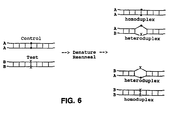
- Single-stranded DNA was prepared by denaturing double-stranded test DNA and double-stranded control DNA with heat (i.e., between 90°C and 100°C inclusive). Alternatively, denaturation can be accomplished at lower temperatures by well-known modifications, for example, by adding glycerol to the denaturation buffer. As is shown in Figure 6, after renaturation (see below), four double-stranded duplexes can be formed.
- bacteriophage T4 endonuclease VII is capable of cleaving a single base pair mismatch in each heteroduplex shown above, whereas, in general, homoduplexes are not cleaved.
- each heteroduplex is cleaved by bacteriophage T4 endonuclease VII, one or more mismatches in a heteroduplex can be readily detected. Similarly, unmatched base pairs are also detected in a heteroduplex with this method.
- test nucleic acid is RNA, preferably mRNA
- heat denaturation will serve to produce RNA free of intrastrand nucleotide base pairing, thereby rendering the denatured test RNA a superior template for heteroduplex formation (see Sambrook et al., supra ) .
- control and test nucleic acids can be denatured independently, either by heat or alkali, and mixed together in order to form heteroduplexes.
- Heteroduplex formation between control and test DNA was performed in 50 ⁇ l (total volume) containing 1X annealing buffer as previously described (Cotton, supra ) except that the annealing temperature was at 65°C for 1 hour followed by 20 min at room temperature. Calculations of DNA concentration were based on 50-60 ng unlabelled DNA (10X excess) and 5 ng of 5' end-labelled DNA per single reaction. Heteroduplexes were prepared in 'bulk' in 50 ⁇ l volume and the pellet resuspended in the appropriate volume of distilled water. For example, if six reactions were required then 300 ng mutant DNA and 30 ng of labelled wild type DNA was used. After heteroduplex formation, the pellet was resuspended in 30 ⁇ l distilled water (i.e., 5 ⁇ l distilled water is taken per single reaction).
- Homoduplexes were prepared in order to determine whether bacteriophage endonuclease VII can non-specifically cleave homoduplexes. An identical procedure was performed in order to prepare labelled homoduplex DNA except that an excess amount of unlabelled control DNA was annealed with labelled control DNA.
- EMC Enzyme Mismatch Cleavage Assay
- Heteroduplexes were prepared in a 1:1 ratio of unlabelled control and unlabelled test DNA.
- the conditions used for heteroduplex formation were identical to those described above except that 25 ng of each of the DNA samples was used per reaction.
- the resolvase digestion was performed on 50 ng of unlabelled heteroduplex DNA, and the products of digestion were 5' end-labelled in a total of 10 ⁇ l of 1X kinase buffer, 2 units of 5' polynucleotide kinase, and 1 ⁇ l of a 1/10 dilution of fresh [gamma- 32 P] ATP.
- the sample was denatured at 70°C for 10 min, and the reaction mixture was ethanol precipitated.
- the pellet was washed 3 times in 70% ethanol, dried briefly, resuspended in 5 ⁇ l formamide-urea loading dye, and analyzed on a denaturing polyacrylamide gel as described above.
- FIG. 6 schematically describes how a single mutation in a test DNA has four chances of being detected in each of the two heteroduplexes formed in these experiments.
- Each heteroduplex includes two mismatched DNA strands which can be cleaved by a resolvase, preferably bacteriophage T4 Endonuclease VII.
- a resolvase preferably bacteriophage T4 Endonuclease VII.
- To be effective in detecting mutations at least one strand in the pair of mismatches of each set must be cleaved. In most cases, excess unlabelled test DNA was used, and thus only cleavage of DNA strands containing the two mismatched bases present in the labelled probe were assayed.
- Experimental results are summarized in Table 2 below:
- the PAH E1 ⁇ 13A gene includes a C - ⁇ A mutation 87 bp 3' to the 5' terminal end of the specific mutant gene studied (i.e., F205L).
- the resulting heteroduplexes contained C*.T and A.G* mismatches which could be detected with bacteriophage T4 endonuclease VII ( Figure 1).
- lanes 1, 2, and 3 are samples of control homoduplex DNA (i.e., lanes C) after incubation with hydroxylamine (i.e., lanes HA) for 0, 1, and 2 hrs.
- Lanes 4, 5, and 6 are samples of heteroduplex DNA including test DNA (i.e., lanes 13A) after incubation with hydroxylamine for 0, 1, and 2 hr, respectively.
- Lanes 7, 8, and 9 are samples of homoduplex DNA (i.e., lanes C) after incubation with 0, 1000, and 3000 units of T4 Endonuclease VII, respectively.
- Lanes 10-14 inclusive represent digestion of heteroduplex DNA including test DNA after incubation with 0, 250, 1000, 2000, and 3000 units of T4 Endonuclease VII, respectively.
- a 87 bp fragment was observed on a denaturing acrylamide gel due to the fact that hydroxylamine is only capable of modifying a mismatched cytosine.
- EMC las 10-14
- a single band slightly larger than 87 bp fragment was observed indicating cleavage 3' of the C* in the C*.T mismatch.
- a drawing beneath an autoradiograph is a schematic representation of the two types of heteroduplexes that were formed in each experiment.
- a broken line represents a control DNA strand, and a straight line represents a test DNA strand.
- Arrows denote endonuclease cleavage sites on the end-labelled strand in each heteroduplex.
- a (•) represents a radioactively labelled nucleotide.
- a shaded triangle ( ⁇ ) represents the actual cleavage site in a CCM reaction.
- a superscript ( 3 ) refers to band sizes observed by EMC which were found to be larger than the expected band sizes determined by CCM.
- M denotes 5' end-labelled Hae III digested ⁇ X174 DNA.
- a 254 bp genomic DNA segment from the PAH gene of a patient homozygous for a G -> A mutation (IVS12 (ntl)) was prepared by PCR-amplification. This particular PAH gene mutation occurs 191 bp 3' from the 5' end of the PCR amplified product (see Figure 2). 5' end-labelled control DNA was annealed to unlabelled test DNA in order to form a heteroduplex. After cleavage with bacteriophage T4 endonuclease VII, two bands, one slightly large than 191 bp and another slightly larger than 54 bp band, were observed ( Figure 2).
- lanes 1 to 4 inclusive are samples of control homoduplex DNA (i.e., lanes C) after incubation with 0, 250, 500, and 1000 units of T4 Endonuclease VII and lanes 5 to 8 inclusive are samples of heteroduplex DNA consisting of control and test DNA after incubation with 0, 250, 500, and 1000 units of T4 Endonuclease VII, respectively.
- These autoradiograms indicate DNA mismatches near a G* (G*.T mismatch) and C* ( A.C* mismatch) respectively.
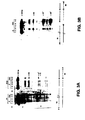
- FIG. 3A is an autoradiograph of CCM and EMC analysis of this test PAH gene segment.
- Lanes 1, 2, and 3 are samples of control homoduplex DNA (i.e., lanes C) after incubation with hydroxylamine for 0, 1, and 1.5 hr.
- Lanes 4, 5, and 6 are samples of heteroduplex containing control and test DNA (i.e., lanes PAH) after incubation with hydroxylamine for 0, 1 and 1.5 hr, respectively.
- Lanes 7 to 11 inclusive are samples of control homoduplex after incubation with 0, 1000, 2000, 2500, and 3000 units of T4 Endonuclease VII.
- Lanes 12 and 13 are samples of PAH heteroduplex after incubation with 0 and 1000 units of T4 Endonuclease VII, respectively.
- Fig. 3B is an autoradiograph of post-digestion 5' end-labelling (described below) of the PAH gene containing the same heterozygous C -> G mutation in Exon 2.
- Lanes 1, 2, and 3 are samples of control homoduplex DNA (i.e., lanes C) after incubation with 0, 250, and 1000 units of T4 Endonuclease VII, and lanes 4 to 8 inclusive are samples of heteroduplex containing control DNA and test DNA (i.e., PAH) after incubation with 0, 100, 250, 500, and 1000 units of T4 Endonuclease VII, respectively.
- Heteroduplex cleavage by T4 Endonuclease VII results in new nucleotide 3' OH and 5' PO 4 ends.
- 5'-end labelling involves only labelling the 5' OH ends of amplified DNA with [gamma- 32 P] ATP using 5' T4 polynucleotide kinase. Hence any fragments 3' to a heteroduplex cleavage site will NOT be observed on autoradiography.
- post-digestion 5'end-labelling allowed detection of a 60 base pair fragment previously undetected in Fig. 3A. For example, post digestion 5'-end labelling of the heteroduplex analyzed in Fig.
- FIG. 3A allowed detection of new bands slightly larger than 60 and 73 bp bands on the autoradiograph (see Fig. 3B). Taken together, comparison of Figs. 3A and 3B showed that by adding a post-digestion 5'-end labelling step after bacteriophage T4 endonuclease VII cleavage, an extra cleavage due to the one mutation could be identified.
- a 204 bp segment of a mutant 21-hydroxylase A gene was PCR amplified from plasmid DNA (see above).
- the DNA segment contained a T -> A mutation at nucleotide 1004 of the 21-hydroxylase A gene. This mutation is 110 bp 3' from the 5' end of the gene segment. Annealing a single-stranded control DNA to a single-stranded test DNA resulted in a heteroduplex containing both A.A* and T*.T mismatches.
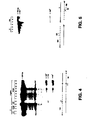
- EMC with 5' end-labelled control DNA detected two bands on denaturing polyacrylamide gels; one slightly greater than 110 bp and the other slightly greater than 94 bp (Figure 4).
- lanes 1 and 2 represent samples of control homoduplex DNA (i.e., lanes C) after incubation with osmium tetroxide (OT) for 0 and 5 min
- lanes 3 and 4 represent samples control homoduplex DNA after incubation with 0 and 250 units of T4 Endonuclease VII.
- Lanes 5 and 6 represent samples of heteroduplex DNA containing control and test DNA (i.e., 204 bp mutant 21-hydroxylase A gene segment) after incubation with OT for 0 and 5 minutes.
- Lanes 7 and 8 are samples after incubation with 0 and 250 units of T4 Endonuclease VII, respectively.
- Lanes 9, 10, and 11 are samples of test DNA after incubation with 500 units of T4 Endonuclease VII for 1, 3, and 16 hr.
- Lanes 12, 13, and 14 are samples of test DNA after incubation with 1000 units of T4 Endonuclease VII for 1, 3, and 16 hr at 37°, respectively.
- Type 5 DNA deletions forming a heteroduplex loop
- PDH E1 ⁇ 18A is a 797 base pair fragment of a mutant PDH gene which includes a deletion of two deoxyadenosines 631 bp away from the 5' end of the gene segment.
- EMC detected a single band slightly greater than 166 bp signifying cleavage near the 'TT' loop only (data not shown).
- Post-digestion 5' end-labelling of the same segment showed two bands, one slightly greater than 166 bp produced by cleavage near the 'TT' loop and the other slightly greater than 631 bp produced by cleavage near the 'AA' position on the opposing strand (Fig. 5).
- lanes 1, 2, and 3 are samples of control homoduplex DNA (i.e., lanes C) after incubation with 0, 500, and 1000 units of T4 Endonuclease VII.
- Lanes 4 to 7 inclusive are samples of test heteroduplex containing control DNA and test DNA after incubation with 0, 500, 1000, and 2000 units of T4 Endonuclease VII, respectively.
- Bacteriophage endonuclease VII is one example of a resolvase known to cleave DNA cruciforms. Additional resolvases with similar activity include bacteriophage T7 endonuclease I, and the S . cerevisiae cruciform cleaving enzymes Endo X1, Endo X2, and Endo X3 (reviewed in West, supra ) . Methods for purifying bacteriophage T7 endonuclease I (deMassy et al., J. Mol. Biol. 193, 359 (1987)), Endo X1 (West and Korner, PNAS 82, 6445 (1985); West et al., J.
- Endo X3 is capable of detecting C.C mismatches in much the same way as bacteriophage T4 endonuclease VII, indicating that the yeast resolvases, like bacteriophage T4 endonuclease VII, are also capable of recognizing and cleaving near single base-pair mismatches in a heteroduplex.
- each enzyme can be purified by methods disclosed above.
- the ability of each purified resolvase to detect mutations may be examined by using the assays described herein.
- bacteriophage T4 endonuclease VII is capable of detecting one or more base-pair mismatches in a heteroduplex.
- the art-skilled will recognize that these methods are not limited to any specific nucleic acid sequence disclosed herein.
- a DNA restriction fragment of known or unknown DNA sequence which is suspected of bearing at least one DNA mutation may be used as a test DNA in the formation of a heteroduplex.
- the DNA restriction fragment will be at least 20 base pairs in length. More preferably, the DNA restriction fragment will be between 50 and 40,000 base pairs in length inclusive, and most preferably between 100 and 5000 base pairs in length inclusive.
- a test DNA template suspected of harboring at least one DNA mutation and for which at least a partial DNA sequence is known can be used as a source of PCR-amplified test DNA.
- a DNA template must include: 1) a region suspected of harboring at least one DNA mutation and 2) include sufficient DNA flanking a suspected mutation to serve as a template for DNA oligonucleotide primer hybridization and PCR amplification.
- the PCR amplified region is the intervening region between the 3' ends of the two DNA oligonucleotide primers hybridized to the DNA template. This intervening region harbors at least one DNA mutation.
- PCR amplification is performed by first hybridizing two DNA oligonucleotide primers to a DNA template harboring at least one DNA mutation, then completing multiple rounds of PCR amplification; the PCR amplified DNA being used as test DNA for heteroduplex formation as described above.
- the design of the two DNA oligonucleotide primers used to amplify a DNA template and prepare test DNA are guided by the DNA sequence flanking a suspected mutation site and two important parameters: 1) DNA oligonucleotide primer size, and 2) the size of the intervening region between the 3' ends of the DNA oligonucleotide primers hybridized to a DNA template.
- a DNA oligonucleotide primer will be at least 12 nucleotides in length. More preferably, a DNA oligonucleotide primer will be between 15 and 50 nucleotides in length inclusive, most preferably between 15 and 25 nucleotides in length inclusive.
- the size of the intervening region between the 3' ends of the two DNA oligonucleotides hybridized to a DNA template will be governed by 1) the well known size limitations of templates amplified by PCR, and 2) the resolving power of a particular gel (i.e., polyacrylamide or agarose gel) used to detect resolvase cleavage sites (see below).
- the intervening region between the 3' ends of the two DNA oligonucleotides hybridized to a DNA template will be at least 50 base pairs in length inclusive. Recent advances in PCR technology have allowed amplification of up to 40 kb of DNA. Preferably, the intervening region will be between 100 and 40,000 base pairs in length inclusive, more preferably between 150 and 5000 base pairs in length inclusive. Those skilled in the art will appreciate that where the flanking DNA sequence is only partially known, a degenerate DNA oligonucleotide primer may be used to prepare test DNA by PCR amplification.
- template DNA suspected of harboring at least one DNA mutation can be subcloned into a suitable cloning vector and amplified using known DNA oligonucleotide primers which hybridize to the cloning vector and are adjacent to the insertion site of the DNA template.
- no template DNA sequence information is required because the DNA oligonucleotide primers used for PCR amplification hybridize to a vector of known DNA sequence and not the inserted template DNA.
- the BluescriptTM vector can be used to subclone a DNA template into an acceptor site according to the manufacturer's instructions (Stratagene Cloning Systems, La Jolla, CA, Product Catalogue (1992)).
- the T7 and T3 DNA primers of the Bluescript vector can be used to PCR amplify the inserted DNA template (or concomitantly to sequence the inserted DNA template).
- Other commercially available sub-cloning vectors may also be used. These include, without limitation, phage lambda based insertion vectors and other prokaryotic and eukaryotic vectors (i.e., bacteriophage, insect virus (baculovirus), or animal virus (SV-40 or adenovirus) based vectors described by Stratagene, supra, and Sambrook et al., supra).
- the PCR amplified test DNA template can be used as a source of test DNA to make heteroduplexes for cleavage with a resolvase, preferably bacteriophage T4 endonuclease VII.
- a vector which includes a DNA insert bearing at least one DNA mutation may be first amplified by propagation in bacteria, phage, insect or animal cells prior to PCR amplification (see Sambrook et al., supra). If sufficient DNA is available (i.e., at least 1 nanogram), the PCR amplification step can be eliminated.
- RNA suspected of bearing at least one mutation may be purified from cells or tissues by techniques well-known in the art.
- RNA may be optionally purified by olido-dT chromatography to prepare mRNA (see for example Sambrook et al., supra and Ausubel et al., supra).
- oligo-dT chromatography will not be necessary.
- Purified RNA or mRNA will be heat denatured in order to ensure complete single-strandedness and hybridized with control DNA (i.e., a control cDNA) in order to form RNA:DNA heteroduplexes.
- RNA:DNA duplexes A method for forming RNA:DNA duplexes are well known in the art and have been described in detail (see Sambrook et al., supra, pp. 7.62-7.65). After formation of an RNA:DNA heteroduplex, the EMC method described above can be used to detect mismatches produced by mispairing between the cDNA and the RNA.
- the control DNA will be 5' end-labelled while the RNA will not be labelled.
- RNA can be uniformally labelled by adding radiolabelled uracil to living cells or tissues.
- the invention is particularly useful for detecting single base pair mutations in cloned DNA, for example, those mutations introduced during experimental manipulation of the cloned DNA (e.g., transformation, mutagenesis, PCR amplification, or after prolonged storage or freeze:thaw cycles).
- a DNA segment can be used to form a heteroduplex, wherein the control DNA is DNA not subjected to experimental manipulation and the test DNA is DNA subjected to experimental manipulation.
- the methods described herein can be used as a quick and inexpensive screen to check for mutations in any cloned nucleic acid.
- type bacteria and viruses can also be used to type bacteria and viruses.
- type is meant to characterize an isogeneic bacterial or viral strain by detecting one or more nucleic acid mutations that distinguishes the particular strain from other strains of the same or related bacteria or virus.
- bacteria or viruses which share specific DNA mutations would be of similar type.
- genetic variation of the human immunodeficiency virus has led to the isolation of distinct HIV types, each bearing distinguishing gene mutations (Lopez-Galindez et al., PNAS 88, 4280 (1991)).
- test DNAs of particular interest for typing include test DNA isolated from viruses of the family Retroviridae, preferably the human T-lymphocyte viruses or human immunodeficiency virus, in particular any one of HTLV-I, HTLV-II, HIV-1, or HIV-2.
- retroviral RNA can be reverse transcribed and conveniently subcloned in vaccinia virus vectors for the production of DNA (see Yammamoto et al., J. Immunol. 144, 1999; Nixon et al., Nature 33, 484 (1988); Hu et al., WO 87/02038; and references therein).
- test DNAs of interest for typing include DNA viruses of the family Adenoviridae , Papovaviridae, or Herpetoviridae , as well as test DNA isolated from microorganisms that are pathogenic to mammals, preferably humans.
- Preferred microorganisms for typing include bacteria of the order Spirochaetales, preferably of the genus Treponema or Borrella; the order Kinetoplastida , preferably of the species Trypanosoma cruzi; the order Actinomycetales, preferably of the family Mycobacteriaceae, more preferably of the species Mycobacterium tuberculosis; or the genus Streptococcus.
- Our methods are also useful for detecting mutations in repetitive DNA associated with a mammalian disease.
- one or more mutations in repetitive DNA is associated with human fragile-X syndrome, spinal and bulbar muscular dystrophy, and myotonic dystrophy (Caskey et al., supra).
- Repetitive DNA from each of these genes can serve as a test nucleic acid in the methods described herein.
- one or more deoxyribonucleotides i.e., dNTPs: dA, dG, dC, or T
- radioactive phosphorus or sulfur e.g., 32 P, 33 P, or 35 S
- 0.1-50 ⁇ Ci of one or more radioactively labelled dNTPs can be added to a PCR reaction, and excess label removed by Sephadex G-50 column chromatography (i.e., a spin column).
- test DNA or control DNA can be tagged with biotin (Tizard et al., PNAS 87, 4514 (1990)) before heteroduplex formation or after heteroduplex formation and cleavage. Methods for the detection of biotinylated DNA after polyacrylamide gel electrophoresis have been disclosed (Ausubel et al., supra Chapter 7).
- test or control DNA may be tagged with fluorescent dNTPs (i.e., fluorescein, see Ansorge et al., Nucl.
- wedge-shaped spacers may be used to create a field gradient or incorporate a buffer gradient, an electrolyte gradient, or an acrylamide step gradient.
- Formamide may be included in a standard denaturing polyacrylamide gel or longer gels may also be employed (80 to 100 cm).
- electrophoretic techniques have been described in detail (Ausubel et al ., supra Chapter 7).
- Cleavage products larger than 2kb can be specifically cut with a restriction enzyme in order to decrease fragment size.
- Those art-skilled will understand that the choice of a particular restriction enzyme to specifically cut a large cleavage product will be governed by a restriction enzyme map of the particular DNA to be analyzed.
- a large cleavage product can be electrophoresed on a denaturing (i.e., alkaline) agarose gel and directly visualized by reagents (e.g., stains or dyes) which interact with DNA, for example silver, ethidium bromide, acridine orange, 4,6-diamidino-2-phenylindol (i.e., DAPI), Hoechst dyes, and the like (see Sambrook et al., supra and Bassam et al., Anal. Biochem.
- reagents e.g., stains or dyes
- DNA for example silver, ethidium bromide, acridine orange, 4,6-diamidino-2-phenylindol (i.e., DAPI), Hoechst dyes, and the like (see Sambrook et al., supra and Bassam et al., Anal. Biochem.
- the electrophoresed DNA can be transferred to a membrane, for example, DEAE-cellulose, nylon, or other suitable membrane, the transferred and membrane-bound DNA being visualized by filter hybridization with a radioactive or non-radioactive (i.e., biotin, digoxigenin, fluorescein) tagged probe followed by autoradiography, streptavidin-alkaline phosphatase, digoxygenin visualization techniques (see ClonTech Product Catalogue, 1989/1990; Boehringer Mannheim Catalog (1993)), or fluorescence detection.
- a radioactive or non-radioactive i.e., biotin, digoxigenin, fluorescein
- Hemi-biotinylated test or control DNA can be prepared by adding one 5' end biotin tagged oligonucleotide primer to a PCR amplification reaction. In such a PCR reaction, only one DNA strand includes a biotin tag at the 5'end. After PCR amplification, the test and control DNAs are denatured, either independently or together, annealed, and allowed to form heteroduplexes. The heteroduplexes are subsequently bound to a solid support.
- Preferred solid supports include avidin- or streptavidin-coated surfaces, for example, avidin- or streptavidin-coated microtitre dishes, or streptavidin-coated ferromagnetic beads.
- Methods for anchoring hemi-biotinylated DNA to magnetic beads have been described (Hultman et al., BioTechniques 10, 84 (1991); Kaneoka et al., BioTechniques 10, 30 (1991)).
- the anchored heteroduplex is cleaved on both strands with a resolvase, preferably bacteriophage T4 endonuclease VII.
- biotin is used to tag newly exposed 5' ends, and the magnetic beads are concentrated by microfuge centrifugation.
- the supernatant or beads can be assayed for biotinylated (i.e., cleaved) DNA by gel electrophoresis (see above) or more conveniently by the use of streptavidin-alkaline phosphatase visualization techniques (Bethesda Research Laboratories Catalogue and Reference Guide (1989); Clontech Catalog (1989/1990)).
- hemi-biotinylated DNA tagged at one 5' end with biotin can be tagged with an additional detection moiety at the other 5' end after binding to an avidin- or streptovidin-coated surface, preferably a fluorescent nucleotide (i.e., a fluorescein labelled nucleotide, see Clontech Catalog (1989/1990) is tagged to the other 5'end or a radioactive nucleotide is used to tag the other 5' end.
- a fluorescent nucleotide i.e., a fluorescein labelled nucleotide, see Clontech Catalog (1989/1990
- a radioactive nucleotide is used to tag the other 5' end.
- the supernatant After binding to a surface which includes avidin or streptavidin, followed by resolvase cleavage, preferably cleavage with bacteriophage T4 endonuclease VII, the supernatant can be analyzed for fluorescence or radioactivity.
- a DNA oligonucleotide primer for PCR can be tagged with a detection moiety such as digoxigenin. After amplification and duplex formation, tagged DNA is anchored to a surface bearing an antibody capable of binding digoxigenin (see Boehringer Mannheim Catalog (1993)).
- DNA can be tagged with a detection moiety such as an oligo dT tail and bound to a nylon support via ultraviolet light crosslinking of the oligo-dT tail to the nylon support. The unique nucleic acid sequence is held to the nylon support through the oligo-dT tail and is available for duplex formation.
- DNA can be further tagged at an unbound end with biotin, a fluorescent nucleotide, or a radioactive nucleotide, then, after duplex formation, cleaved with a resolvase, preferably bacteriophage T4 endonuclease VII. After cleavage, released nucleic acid can be detected by appropriate methods described above.
- Clontech has disclosed amino modifiers and thiol modifiers which could be used to tag DNA with biotin, FITC, or other fluorophores (Clontech Catalog (1989/1990)).
- ligase i.e., E. coli or preferably T4 ligase
- E. coli or preferably T4 ligase may be included in the cleavage reaction mixture of any resolvase described herein.
- T4 Endonuclease VII and a heteroduplex DNA substrate this method is preferably carried out as follows.
- T4 Endonuclease VII 10-1000 U/ ⁇ l, preferably 30-100 U/ ⁇ l diluted to the desired concentration in Enzyme Dilution Buffer (10 mM Tris-HCl, pH 8.0, 50% glycerol (in autoclaved H 2 O), 0.1 mM glutathione, 100 ⁇ gl ml BSA (nuclease free)) and 1 ⁇ l of T4 ligase (at least 10 U/ ⁇ l, preferably 10-1000 U/ ⁇ l, more preferably 50-150 U/ ⁇ l) diluted to the desired concentration in Ligase Storage Buffer (50 mM KCl, 10 mM Tris-HCl, pH 7.4, 0.1 mM EDTA, 1 mM dithiothreitol, 200 ⁇ g/ml BSA, 50% glycerol) are added to initiate the reaction.
- Enzyme Dilution Buffer 10 mM Tris-HCl, pH 8.0, 50% glycerol (
- the tubes are spun briefly to bring down any droplets on the sides of the tubes, and the reaction mixtures are incubated for 1-3 hours at 25°C.
- a zero enzyme control is preferably incubated in parallel; this reaction mixture is identical to that described above except that the ligase and T4 Endonuclease VII are replaced with 2 ⁇ l of Enzyme Dilution Buffer.
- Formamide loading buffer (95% formamide, 20 mM EDTA, 0.05% bromophenol blue, 0.05% xylene cyanol) is added to the reaction mixture, and the mixture is heated to 100°C for 2 minutes and immediately loaded onto an 8% denaturing acrylamide sequencing gel (0.8 mm thick gel) (8% acrylamide-bis (29:1), 7 M urea) using a well-forming comb, instead of a sharktooth comb, to capture the entire 15 ⁇ l; alternatively, a lesser volume may be loaded for analysis.
- formamide loading buffer 95% formamide, 20 mM EDTA, 0.05% bromophenol blue, 0.05% xylene cyanol
- the gel is run at 50 W for 2-3 hours in 1X TBE buffer (0.089 M Tris-base, 0.089 M borate, 0.002 M EDTA), and the cleavage products visualized by autoradiography and compared with radiolabelled size markers (for example, BioMarkerTM EXT Plus, ⁇ X174 HaeIII, BioMarkerTM High, or BioMarkerTM Low markers; available from AT Biochem, Malvern, PA or New England Biolabs, Beverly, MA).
- radiolabelled size markers for example, BioMarkerTM EXT Plus, ⁇ X174 HaeIII, BioMarkerTM High, or BioMarkerTM Low markers; available from AT Biochem, Malvern, PA or New England Biolabs, Beverly, MA.
- the ligase reaction is carried out after pre-incubation of the heteroduplex with T4 Endonuclease VII as follows.
- T4 Endonuclease VII 10-1000 U/ ⁇ l, preferably 100-1000 U/ ⁇ l
- Enzyme Dilution Buffer 10 mM Tris-HCl, pH 8.0, 50% glycerol (in autoclaved H 2 O), 0.1 mM glutathione, 100 ⁇ gl ml BSA (nuclease free)
- the tubes are spun briefly to bring down any droplets on the sides of the tubes, and the reaction mixtures are incubated for 1 hour at 37°C.
- a zero enzyme control is preferably incubated in parallel; this reaction mixture is identical to that described above except that the T4 Endonuclease VII is replaced with 1 ⁇ l of Enzyme Dilution Buffer.
- 1 ⁇ l of T4 ligase (at least 500 U/ ⁇ l, preferably 500-5000 U/ ⁇ l, more preferably 1500-2500 U/ ⁇ l) diluted to the desired concentration in Ligase Storage Buffer (50 mM KCl, 10 mM Tris-HCl, pH 7.4, 0.1 mM EDTA, 1 mM dithiothreitol, 200 ⁇ g/ml BSA, 50% glycerol) is added, and the reaction mixtures are incubated for an additional 1-12 hours (preferably 3 hours) at 16-37°C (preferably 25°C).
Landscapes
- Chemical & Material Sciences (AREA)
- Life Sciences & Earth Sciences (AREA)
- Organic Chemistry (AREA)
- Proteomics, Peptides & Aminoacids (AREA)
- Health & Medical Sciences (AREA)
- Zoology (AREA)
- Analytical Chemistry (AREA)
- Wood Science & Technology (AREA)
- Engineering & Computer Science (AREA)
- Genetics & Genomics (AREA)
- Immunology (AREA)
- Microbiology (AREA)
- Bioinformatics & Cheminformatics (AREA)
- Molecular Biology (AREA)
- Biophysics (AREA)
- Physics & Mathematics (AREA)
- General Health & Medical Sciences (AREA)
- Biochemistry (AREA)
- Biotechnology (AREA)
- General Engineering & Computer Science (AREA)
- Pathology (AREA)
- Hospice & Palliative Care (AREA)
- Oncology (AREA)
- Measuring Or Testing Involving Enzymes Or Micro-Organisms (AREA)
- Saccharide Compounds (AREA)
- Dental Preparations (AREA)
- Investigating Or Analysing Biological Materials (AREA)
Applications Claiming Priority (3)
| Application Number | Priority Date | Filing Date | Title |
|---|---|---|---|
| US23253094A | 1994-04-25 | 1994-04-25 | |
| US232530 | 1994-04-25 | ||
| PCT/US1995/004852 WO1995029251A1 (en) | 1994-04-25 | 1995-04-21 | Detection of mutation by resolvase cleavage |
Publications (3)
| Publication Number | Publication Date |
|---|---|
| EP0760002A1 EP0760002A1 (en) | 1997-03-05 |
| EP0760002A4 EP0760002A4 (en) | 1999-09-08 |
| EP0760002B1 true EP0760002B1 (en) | 2003-08-27 |
Family
ID=22873505
Family Applications (1)
| Application Number | Title | Priority Date | Filing Date |
|---|---|---|---|
| EP95918266A Expired - Lifetime EP0760002B1 (en) | 1994-04-25 | 1995-04-21 | Detection of mutation by resolvase cleavage |
Country Status (8)
| Country | Link |
|---|---|
| US (2) | US5698400A (enExample) |
| EP (1) | EP0760002B1 (enExample) |
| JP (1) | JPH09512428A (enExample) |
| AT (1) | ATE248224T1 (enExample) |
| AU (1) | AU693198B2 (enExample) |
| CA (1) | CA2188660C (enExample) |
| DE (1) | DE69531612D1 (enExample) |
| WO (1) | WO1995029251A1 (enExample) |
Families Citing this family (159)
| Publication number | Priority date | Publication date | Assignee | Title |
|---|---|---|---|---|
| US5846717A (en) | 1996-01-24 | 1998-12-08 | Third Wave Technologies, Inc. | Detection of nucleic acid sequences by invader-directed cleavage |
| US5994069A (en) * | 1996-01-24 | 1999-11-30 | Third Wave Technologies, Inc. | Detection of nucleic acids by multiple sequential invasive cleavages |
| US6872816B1 (en) * | 1996-01-24 | 2005-03-29 | Third Wave Technologies, Inc. | Nucleic acid detection kits |
| US5851770A (en) * | 1994-04-25 | 1998-12-22 | Variagenics, Inc. | Detection of mismatches by resolvase cleavage using a magnetic bead support |
| AU693198B2 (en) * | 1994-04-25 | 1998-06-25 | Avitech Diagnostics, Inc. | Detection of mutation by resolvase cleavage |
| CA2220467A1 (en) * | 1995-05-11 | 1996-11-14 | Arild Lagerkvist | Detection of mismatches by resolvase cleavage on a solid support |
| US5824471A (en) * | 1995-06-05 | 1998-10-20 | Brigham And Women's Hospital | Detection of mismatches by cleavage of nucleic acid heteroduplexes |
| US20080160524A1 (en) * | 1996-01-24 | 2008-07-03 | Third Wave Technologies, Inc. | Methods and Compositions for Detecting Target Sequences |
| US7122364B1 (en) * | 1998-03-24 | 2006-10-17 | Third Wave Technologies, Inc. | FEN endonucleases |
| US5985557A (en) | 1996-01-24 | 1999-11-16 | Third Wave Technologies, Inc. | Invasive cleavage of nucleic acids |
| US6706471B1 (en) | 1996-01-24 | 2004-03-16 | Third Wave Technologies, Inc. | Detection of nucleic acid sequences by invader-directed cleavage |
| US7195871B2 (en) * | 1996-01-24 | 2007-03-27 | Third Wave Technologies, Inc | Methods and compositions for detecting target sequences |
| US6875572B2 (en) | 1996-01-24 | 2005-04-05 | Third Wave Technologies, Inc. | Nucleic acid detection assays |
| US5869245A (en) * | 1996-06-05 | 1999-02-09 | Fox Chase Cancer Center | Mismatch endonuclease and its use in identifying mutations in targeted polynucleotide strands |
| EP0964929B1 (en) * | 1996-06-05 | 2004-10-20 | Fox Chase Cancer Center | Mismatch endonucleases and uses thereof in identifying mutations in targeted polynucleotide strands |
| CA2273204C (en) | 1996-11-29 | 2008-10-14 | Third Wave Technologies, Inc. | Fen-1 endonucleases, mixtures and cleavage methods |
| US6548247B1 (en) * | 1997-04-16 | 2003-04-15 | Trevigen, Inc. | Detection and mapping of point mutations using partial digestion |
| US6027898A (en) * | 1997-08-18 | 2000-02-22 | Transgenomic, Inc. | Chromatographic method for mutation detection using mutation site specifically acting enzymes and chemicals |
| EP1023463A4 (en) * | 1997-10-09 | 2003-01-02 | Transgenomic Inc | MODIFICATION OF DOUBLE-STRANDED DNA TO IMPROVE CHROMATOGRAPHIC SEPARATIONS OF MATCHED ION POLYNUCLEOTIDES |
| EP1030933A4 (en) | 1997-10-14 | 2003-01-02 | Transgenomic Inc | EXAMINATION OF NICKED DNA USING MATCHING IONIC POLYNUCLEOTIDE CHROMATOGRAPHY |
| JP2001521729A (ja) | 1997-10-30 | 2001-11-13 | トランスジエノミツク・インコーポレーテツド | ポリヌクレオチドの高分離の液体クロマトグラフィー分離方法 |
| US8182991B1 (en) | 1997-11-26 | 2012-05-22 | Third Wave Technologies, Inc. | FEN-1 endonucleases, mixtures and cleavage methods |
| US6297010B1 (en) * | 1998-01-30 | 2001-10-02 | Genzyme Corporation | Method for detecting and identifying mutations |
| CA2319712A1 (en) * | 1998-02-04 | 1999-08-12 | Variagenics, Inc. | Mismatch detection techniques |
| US6183958B1 (en) | 1998-05-06 | 2001-02-06 | Variagenics, Inc. | Probes for variance detection |
| US6485648B1 (en) | 1998-05-18 | 2002-11-26 | Transgenomic, Inc. | MIPC column cleaning system and process |
| US7225079B2 (en) * | 1998-08-04 | 2007-05-29 | Transgenomic, Inc. | System and method for automated matched ion polynucleotide chromatography |
| US20030175723A1 (en) * | 1998-08-04 | 2003-09-18 | Gjerde Douglas T. | Methods and compositions for mutation analysis |
| US20070161010A1 (en) * | 1998-08-04 | 2007-07-12 | Gjerde Douglas T | Methods and compositions for mutation analysis |
| US6150105A (en) | 1998-08-20 | 2000-11-21 | Genetic Assays, Inc. | Methods of screening nucleic acids for nucleotide variations |
| GB9826247D0 (en) * | 1998-11-30 | 1999-01-20 | Nycomed Pharma As | Method |
| US6673908B1 (en) * | 1999-02-22 | 2004-01-06 | Nuvelo, Inc. | Tumor necrosis factor receptor 2 |
| US6221635B1 (en) * | 1999-05-06 | 2001-04-24 | The Wistar Institute | Methods for solid-phase amplification of DNA template (SPADT) using multiarrays |
| SE9902741D0 (sv) * | 1999-07-19 | 1999-07-19 | Boerries Kemper | Method for the enrichment of heteroduplexes and its use in mutation detection |
| US6420112B2 (en) * | 1999-07-21 | 2002-07-16 | The Regents Of The University Of California | DNA attachment to support structures |
| US6524794B1 (en) | 1999-10-29 | 2003-02-25 | Decode Genetics Ehf. | Identical-by-descent fragment enrichment |
| CA2397341A1 (en) * | 2000-01-13 | 2001-07-19 | Dhanesh Gohel | Ferrofluid based arrays |
| US6391557B1 (en) | 2000-02-22 | 2002-05-21 | Fox Chase Cancer Center | Nucleic acid molecule encoding a mismatch endonuclease and methods of use thereof |
| US6699980B1 (en) | 2000-02-28 | 2004-03-02 | Fox Chase Cancer Center | Nucleic acid molecule encoding a mismatch endonuclease and methods of use thereof |
| RU2175015C1 (ru) * | 2000-03-01 | 2001-10-20 | Институт молекулярной биологии им. В.А. Энгельгардта РАН | Способ определения точечных нуклеотидных замен в днк микобактерий, способ диагностики устойчивости микобактерий к рифампицину, биочип для осуществления этих способов |
| AU4563401A (en) * | 2000-03-11 | 2001-09-24 | Freshgene Inc | Methods for detection of differences in nucleic acids |
| US6653079B2 (en) | 2000-03-13 | 2003-11-25 | Freshgene, Inc. | Methods for detection of differences in nucleic acids |
| US6656686B2 (en) * | 2000-03-21 | 2003-12-02 | Ovidiu Platica | Method of simultaneous detection of base changes (SDBC) in expressed genes |
| WO2001075167A1 (en) * | 2000-03-31 | 2001-10-11 | Fred Hutchinson Cancer Research Center | Reverse genetic strategy for identifying functional mutations in genes of known sequence |
| GB0021286D0 (en) * | 2000-08-30 | 2000-10-18 | Gemini Genomics Ab | Identification of drug metabolic capacity |
| AU2001297524A1 (en) * | 2000-11-15 | 2002-09-19 | Third Wave Technologies, Inc. | Fen endonucleases |
| WO2002063043A1 (en) * | 2001-02-07 | 2002-08-15 | Krzysztof Kucharczyk | Multitemperature single strand conformation polymorphism (msscp) |
| US6428964B1 (en) | 2001-03-15 | 2002-08-06 | Exact Sciences Corporation | Method for alteration detection |
| US20030092157A1 (en) * | 2001-03-16 | 2003-05-15 | Hayden Michael R. | Compositions, screening systems and methods for modulating HDL cholesterol and triglyceride levels |
| US20040053236A1 (en) * | 2001-03-30 | 2004-03-18 | Mccallum Claire M. | Reverse genetic strategy for identifying functional mutations in genes of known sequences |
| AU2002305019A1 (en) * | 2001-05-25 | 2002-12-09 | University Of British Columbia | Diagnostic methods for cardiovascular disease, low hdl-cholesterol levels, and high triglyceride levels |
| US8182986B1 (en) * | 2001-07-12 | 2012-05-22 | Discoverx | Assays for nucleic acid modifying enzymes |
| WO2003031580A2 (en) * | 2001-10-05 | 2003-04-17 | Transgenomic, Inc. | Methods and compositions for mutation analysis by liquid chromatography |
| MXPA04003926A (es) * | 2001-10-24 | 2004-06-18 | Singulex Inc | Metodos para detectar haplotipos geneticos por interaccion con sondas. |
| WO2003064679A2 (en) * | 2002-01-30 | 2003-08-07 | Id Biomedical Corporation | Methods for detecting vancomycin-resistant microorganisms and compositions therefor |
| US6821733B2 (en) * | 2002-02-07 | 2004-11-23 | Panomics, Inc. | Methods and compositions for detecting differences between nucleic acids |
| US6878530B2 (en) | 2002-02-07 | 2005-04-12 | Panomics, Inc. | Methods for detecting polymorphisms in nucleic acids |
| US20030220844A1 (en) * | 2002-05-24 | 2003-11-27 | Marnellos Georgios E. | Method and system for purchasing genetic data |
| US20040002156A1 (en) * | 2002-06-26 | 2004-01-01 | Stratagene | Selective cloning of homoduplex nucleic acids |
| AU2003254298A1 (en) | 2002-08-02 | 2004-02-23 | Stratatech Corporation | Species specific dna detection |
| US7141371B2 (en) * | 2002-09-06 | 2006-11-28 | State Of Oregon Acting By And Through The State Board Of Higher Education On Behalf Of The University Of Oregon | Methods for detecting and localizing DNA mutations by microarray |
| US20060003333A1 (en) * | 2002-11-19 | 2006-01-05 | Singulex, Inc. | Preparation of defined highly labeled probes |
| EP2112229A3 (en) | 2002-11-25 | 2009-12-02 | Sequenom, Inc. | Methods for identifying risk of breast cancer and treatments thereof |
| CA2510381C (en) | 2002-12-18 | 2014-07-08 | Third Wave Technologies, Inc. | Detection of small nucleic acids |
| US8206904B2 (en) * | 2002-12-18 | 2012-06-26 | Third Wave Technologies, Inc. | Detection of nucleic acids |
| US7297780B2 (en) | 2003-01-06 | 2007-11-20 | Third Wave Technologies, Inc. | Reactive functional groups for preparation of modified nucleic acid |
| US7316903B2 (en) * | 2003-03-28 | 2008-01-08 | United States Of America As Represented By The Department Of Health And Human Services | Detection of nucleic acid sequence variations using phase Mu transposase |
| US7833714B1 (en) * | 2003-04-11 | 2010-11-16 | Affymetrix, Inc. | Combinatorial affinity selection |
| US6998963B2 (en) * | 2003-07-24 | 2006-02-14 | Hunt Technologies, Inc. | Endpoint receiver system |
| US20090088982A1 (en) * | 2003-07-31 | 2009-04-02 | Fukushima Noelle H | Co-detection of single polypeptide and polynucleotide molecules |
| JP4339062B2 (ja) * | 2003-09-30 | 2009-10-07 | 富士フイルム株式会社 | ミスマッチ領域検出方法 |
| WO2005061728A1 (en) * | 2003-12-16 | 2005-07-07 | Institut Curie | Methods and compositions for assaying mutations in nucleic acids |
| US7462451B2 (en) * | 2004-04-26 | 2008-12-09 | Third Wave Technologies, Inc. | Compositions for modifying nucleic acids |
| WO2006022628A1 (en) * | 2004-07-22 | 2006-03-02 | Sequenom, Inc. | Methods for identifying risk of type ii diabetes and treatments thereof |
| JP2008520245A (ja) * | 2004-11-23 | 2008-06-19 | ワン,シャオ・ビン | 切断−増幅法による核酸多様性の検出 |
| US20060160102A1 (en) | 2005-01-18 | 2006-07-20 | Hossein Fakhrai-Rad | Identification of rare alleles by enzymatic enrichment of mismatched heteroduplexes |
| DK1885882T3 (da) * | 2005-05-10 | 2011-04-11 | State Of Oregon Acting By & Through The State Board Of Higher Eduction On Behalf Of The University O | Fremgangsmåder til kortlægning af polymorfier og polymorfi-mikroarray |
| US20070207455A1 (en) * | 2005-11-17 | 2007-09-06 | Third Wave Technologies, Inc. | Compositions and methods for detecting an HCV-1 subtype |
| KR100652903B1 (ko) * | 2005-12-21 | 2006-12-04 | 한국과학기술연구원 | 초흡수성 고분자를 함유한 제습제의 제조 방법 및 그 제조장치 |
| US8679741B2 (en) * | 2006-05-31 | 2014-03-25 | Sequenom, Inc. | Methods and compositions for the extraction and amplification of nucleic acid from a sample |
| WO2007143097A1 (en) | 2006-06-01 | 2007-12-13 | Third Wave Technologies, Inc. | Detection of nucleic acids |
| WO2007140599A1 (en) | 2006-06-05 | 2007-12-13 | Cancer Care Ontario | Assessment of risk for colorectal cancer |
| US7902345B2 (en) | 2006-12-05 | 2011-03-08 | Sequenom, Inc. | Detection and quantification of biomolecules using mass spectrometry |
| US8173370B2 (en) * | 2007-02-08 | 2012-05-08 | Sequenom, Inc. | Nucleic acid-based tests for RHD typing, gender determination and nucleic acid quantification |
| EP2243834A1 (en) | 2007-03-05 | 2010-10-27 | Cancer Care Ontario | Assessment of risk for colorectal cancer |
| AU2008230813B2 (en) | 2007-03-26 | 2014-01-30 | Sequenom, Inc. | Restriction endonuclease enhanced polymorphic sequence detection |
| JP2010527241A (ja) * | 2007-05-14 | 2010-08-12 | インサイト ジェネティクス, インコーポレイテッド | 単一のヌクレオチドバリエーションについての核酸をスクリーニングする方法 |
| GB0713183D0 (en) * | 2007-07-06 | 2007-08-15 | King S College London | Method |
| EP2195452B1 (en) | 2007-08-29 | 2012-03-14 | Sequenom, Inc. | Methods and compositions for universal size-specific polymerase chain reaction |
| MX2010002613A (es) * | 2007-09-07 | 2010-08-04 | Third Wave Tech Inc | Metodos y aplicaciones para la cuantificacion del blanco. |
| EP2271772B1 (en) | 2008-03-11 | 2014-07-16 | Sequenom, Inc. | Nucleic acid-based tests for prenatal gender determination |
| JP5651022B2 (ja) * | 2008-03-15 | 2015-01-07 | ホロジック,インコーポレーテッド | 増幅反応中の核酸分子を分析するための組成物及び方法 |
| US8206926B2 (en) | 2008-03-26 | 2012-06-26 | Sequenom, Inc. | Restriction endonuclease enhanced polymorphic sequence detection |
| US8962247B2 (en) | 2008-09-16 | 2015-02-24 | Sequenom, Inc. | Processes and compositions for methylation-based enrichment of fetal nucleic acid from a maternal sample useful for non invasive prenatal diagnoses |
| US8476013B2 (en) | 2008-09-16 | 2013-07-02 | Sequenom, Inc. | Processes and compositions for methylation-based acid enrichment of fetal nucleic acid from a maternal sample useful for non-invasive prenatal diagnoses |
| EP3722810A3 (en) | 2009-02-11 | 2021-01-13 | Caris MPI, Inc. | Molecular profiling of tumors |
| EP3514244B1 (en) | 2009-04-03 | 2021-07-07 | Sequenom, Inc. | Nucleic acid preparation methods |
| US20110091931A1 (en) * | 2009-04-24 | 2011-04-21 | Colby Pharmaceutical Company | Methods and Kits for Determining Oxygen Free Radical (OFR) Levels in Animal and Human Tissues as a Prognostic Marker for Cancer and Other Pathophysiologies |
| EP2494077A4 (en) | 2009-10-27 | 2013-08-21 | Caris Mpi Inc | MOLECULAR PROFILING FOR PERSONALIZED MEDICINE |
| WO2011084772A2 (en) | 2009-12-21 | 2011-07-14 | Northwestern University | Allelic disorders caused by mutations in trpv4 |
| CA2785020C (en) | 2009-12-22 | 2020-08-25 | Sequenom, Inc. | Processes and kits for identifying aneuploidy |
| US10233501B2 (en) | 2010-10-19 | 2019-03-19 | Northwestern University | Biomarkers predictive of predisposition to depression and response to treatment |
| US20150225792A1 (en) | 2014-01-17 | 2015-08-13 | Northwestern University | Compositions and methods for identifying depressive disorders |
| US20150218639A1 (en) | 2014-01-17 | 2015-08-06 | Northwestern University | Biomarkers predictive of predisposition to depression and response to treatment |
| US10093981B2 (en) | 2010-10-19 | 2018-10-09 | Northwestern University | Compositions and methods for identifying depressive disorders |
| US8361720B2 (en) | 2010-11-15 | 2013-01-29 | Exact Sciences Corporation | Real time cleavage assay |
| US8916344B2 (en) | 2010-11-15 | 2014-12-23 | Exact Sciences Corporation | Methylation assay |
| US9637792B2 (en) | 2011-02-02 | 2017-05-02 | Mayo Foundation For Medical Education And Research | Digital sequence analysis of DNA methylation |
| US8460872B2 (en) | 2011-04-29 | 2013-06-11 | Sequenom, Inc. | Quantification of a minority nucleic acid species |
| US8993341B2 (en) | 2011-05-12 | 2015-03-31 | Exact Sciences Corporation | Removal of PCR inhibitors |
| CN107312774A (zh) | 2011-05-12 | 2017-11-03 | 精密科学公司 | 核酸的分离 |
| US8808990B2 (en) | 2011-05-12 | 2014-08-19 | Exact Sciences Corporation | Serial isolation of multiple DNA targets from stool |
| EP2794904B1 (en) | 2011-12-22 | 2017-09-06 | Ibis Biosciences, Inc. | Amplification of a sequence from a ribonucleic acid |
| EP2820129A1 (en) | 2012-03-02 | 2015-01-07 | Sequenom, Inc. | Methods and processes for non-invasive assessment of genetic variations |
| US10504613B2 (en) | 2012-12-20 | 2019-12-10 | Sequenom, Inc. | Methods and processes for non-invasive assessment of genetic variations |
| US9920361B2 (en) | 2012-05-21 | 2018-03-20 | Sequenom, Inc. | Methods and compositions for analyzing nucleic acid |
| AU2013205064B2 (en) | 2012-06-04 | 2015-07-30 | Gen-Probe Incorporated | Compositions and Methods for Amplifying and Characterizing HCV Nucleic Acid |
| AU2013290102B2 (en) | 2012-07-13 | 2018-11-15 | Sequenom, Inc. | Processes and compositions for methylation-based enrichment of fetal nucleic acid from a maternal sample useful for non-invasive prenatal diagnoses |
| US9212392B2 (en) | 2012-09-25 | 2015-12-15 | Exact Sciences Corporation | Normalization of polymerase activity |
| US9896728B2 (en) | 2013-01-29 | 2018-02-20 | Arcticrx Ltd. | Method for determining a therapeutic approach for the treatment of age-related macular degeneration (AMD) |
| US11060145B2 (en) | 2013-03-13 | 2021-07-13 | Sequenom, Inc. | Methods and compositions for identifying presence or absence of hypermethylation or hypomethylation locus |
| CA2902916C (en) | 2013-03-14 | 2018-08-28 | Mayo Foundation For Medical Education And Research | Detecting neoplasm |
| US20150232931A1 (en) | 2013-09-20 | 2015-08-20 | The Regents Of The University Of Michigan | Compositions and methods for the analysis of radiosensitivity |
| WO2015066695A1 (en) | 2013-11-04 | 2015-05-07 | Exact Sciences Corporation | Multiple-control calibrators for dna quantitation |
| US9909181B2 (en) | 2013-12-13 | 2018-03-06 | Northwestern University | Biomarkers for post-traumatic stress states |
| WO2015095689A1 (en) | 2013-12-19 | 2015-06-25 | Exact Sciences Corporation | Synthetic nucleic acid control molecules |
| US11365447B2 (en) | 2014-03-13 | 2022-06-21 | Sequenom, Inc. | Methods and processes for non-invasive assessment of genetic variations |
| US10184154B2 (en) | 2014-09-26 | 2019-01-22 | Mayo Foundation For Medical Education And Research | Detecting cholangiocarcinoma |
| EP3230744B1 (en) | 2014-12-12 | 2021-05-12 | Exact Sciences Development Company, LLC | Compositions and methods for performing methylation detection assays |
| EP3230476B1 (en) | 2014-12-12 | 2020-02-05 | Exact Sciences Development Company, LLC | Zdhhc1 for normalizing methylation detection assays |
| CN121204237A (zh) | 2015-03-27 | 2025-12-26 | 精密科学公司 | 检测食管疾病 |
| EP3344784A4 (en) | 2015-08-31 | 2019-07-10 | Mayo Foundation for Medical Education and Research | DETECTION OF GASTRIC NEOPLASM |
| US10704081B2 (en) | 2015-10-30 | 2020-07-07 | Exact Sciences Development Company, Llc | Multiplex amplification detection assay |
| EP3405589A1 (en) * | 2016-01-22 | 2018-11-28 | Vyome Biosciences Pvt. Ltd. | Method of detecting and treating p. acnes and kit thereof |
| US10385406B2 (en) | 2016-05-05 | 2019-08-20 | Exact Sciences Development Company, Llc | Detection of lung neoplasia by analysis of methylated DNA |
| US20170321286A1 (en) | 2016-05-05 | 2017-11-09 | Exact Sciences Corporation | Detection of lung neoplasia by amplification of rna sequences |
| ES2963227T3 (es) | 2016-07-19 | 2024-03-26 | Exact Sciences Corp | Moléculas de control de ácido nucleico de organismos no humanos |
| CA3029842A1 (en) | 2016-07-19 | 2018-01-25 | Exact Sciences Development Company, Llc | Methylated control dna |
| EP3507298B1 (en) | 2016-09-02 | 2023-08-30 | Mayo Foundation for Medical Education and Research | Detecting hepatocellular carcinoma |
| US20200016594A1 (en) | 2016-09-30 | 2020-01-16 | The Governing Council Of The University Of Toronto | System for identifying and targeting individual cells within a heterogeneous population for selective extraction of cellular content |
| KR102892245B1 (ko) | 2017-01-27 | 2025-11-27 | 이그젝트 싸이언스 디블롭먼트 컴패니, 엘엘씨 | 메틸화된 dna 분석에 의한 결장 신조직형성의 검출 |
| US10934592B2 (en) | 2017-02-28 | 2021-03-02 | Mayo Foundation For Medical Education And Research | Detecting prostate cancer |
| US10934594B2 (en) | 2017-11-30 | 2021-03-02 | Mayo Foundation For Medical Education And Research | Detecting breast cancer |
| US10648025B2 (en) | 2017-12-13 | 2020-05-12 | Exact Sciences Development Company, Llc | Multiplex amplification detection assay II |
| AU2019247652B2 (en) | 2018-04-02 | 2025-07-17 | Enumera Molecular, Inc. | Methods, systems, and compositions for counting nucleic acid molecules |
| US11408030B2 (en) | 2018-09-10 | 2022-08-09 | Andy Madrid | Test for detecting Alzheimer's disease |
| EP4369356A3 (en) | 2018-11-30 | 2024-07-24 | Caris MPI, Inc. | Next-generation molecular profiling |
| US12584177B2 (en) | 2019-01-24 | 2026-03-24 | Mayo Foundation For Medical Education And Research | Detecting endometrial cancer |
| WO2020206170A1 (en) | 2019-04-02 | 2020-10-08 | Progenity, Inc. | Methods, systems, and compositions for counting nucleic acid molecules |
| CN113811622B (zh) | 2019-04-03 | 2024-09-17 | 梅约医学教育与研究基金会 | 在血浆中检测胰腺导管腺癌 |
| CN114651070A (zh) | 2019-09-16 | 2022-06-21 | 精密科学公司 | 结构和温度依赖性瓣状核酸内切酶底物 |
| WO2021087275A1 (en) | 2019-10-31 | 2021-05-06 | Mayo Foundation For Medical Education And Research | Detecting ovarian cancer |
| CA3163319A1 (en) | 2019-12-02 | 2021-06-10 | Caris Mpi, Inc. | Pan-cancer platinum response predictor |
| EP4135592A4 (en) | 2020-04-17 | 2024-04-17 | Exact Sciences Corporation | INgestible sample collection device |
| KR20230049122A (ko) | 2020-08-19 | 2023-04-12 | 메이오 파운데이션 포 메디칼 에쥬케이션 앤드 리써치 | 비호지킨 림프종의 검출 |
| EP4214243A4 (en) | 2020-09-21 | 2025-06-18 | Enumera Molecular, Inc. | COMPOSITIONS AND METHODS FOR ISOLATING CELL-FREE DNA |
| WO2023011660A1 (en) | 2021-08-06 | 2023-02-09 | Sansure Biotech Inc. | Compositions for liquefying a viscous biological sample, combination products, liquefying agents, and kits thereof, and methods and application thereof |
| WO2026055641A1 (en) | 2024-09-06 | 2026-03-12 | Exact Sciences Corporation | Methods and compositions for preparing biomolecule analytes from complex samples |
| WO2026188202A1 (en) | 2025-03-07 | 2026-09-10 | Exact Sciences Corporation | Characterizing marker-specific identifiers from highly multiplexed assays |
Family Cites Families (11)
| Publication number | Priority date | Publication date | Assignee | Title |
|---|---|---|---|---|
| US4683202A (en) * | 1985-03-28 | 1987-07-28 | Cetus Corporation | Process for amplifying nucleic acid sequences |
| US5217863A (en) * | 1988-02-04 | 1993-06-08 | Medical Research Council | Detection of mutations in nucleic acids |
| GB8802508D0 (en) * | 1988-02-04 | 1988-03-02 | Medical Res Council | Detection of mutations in nucleic acids |
| WO1989009835A1 (en) * | 1988-04-08 | 1989-10-19 | The Salk Institute For Biological Studies | Ligase-based amplification method |
| US5556750A (en) * | 1989-05-12 | 1996-09-17 | Duke University | Methods and kits for fractionating a population of DNA molecules based on the presence or absence of a base-pair mismatch utilizing mismatch repair systems |
| US5459039A (en) * | 1989-05-12 | 1995-10-17 | Duke University | Methods for mapping genetic mutations |
| CA2113716A1 (en) * | 1991-07-19 | 1993-02-04 | Robert E. Wagner, Jr. | Method for detection of mutations |
| WO1993020233A1 (en) * | 1992-03-27 | 1993-10-14 | University Of Maryland At Baltimore | Detection of gene mutations with mismatch repair enzymes |
| FR2709761B1 (fr) * | 1993-09-10 | 1995-11-24 | Pasteur Institut | Procédé de détection de molécules contenant des mésappariements nucléotidiques et de localisation de ces mésappariements, et application à la détection de substitutions ou de délétions de bases . |
| US5851770A (en) * | 1994-04-25 | 1998-12-22 | Variagenics, Inc. | Detection of mismatches by resolvase cleavage using a magnetic bead support |
| AU693198B2 (en) * | 1994-04-25 | 1998-06-25 | Avitech Diagnostics, Inc. | Detection of mutation by resolvase cleavage |
-
1995
- 1995-04-21 AU AU24253/95A patent/AU693198B2/en not_active Ceased
- 1995-04-21 WO PCT/US1995/004852 patent/WO1995029251A1/en not_active Ceased
- 1995-04-21 AT AT95918266T patent/ATE248224T1/de not_active IP Right Cessation
- 1995-04-21 CA CA002188660A patent/CA2188660C/en not_active Expired - Fee Related
- 1995-04-21 JP JP7527754A patent/JPH09512428A/ja active Pending
- 1995-04-21 EP EP95918266A patent/EP0760002B1/en not_active Expired - Lifetime
- 1995-04-21 DE DE69531612T patent/DE69531612D1/de not_active Expired - Lifetime
-
1996
- 1996-09-16 US US08/714,626 patent/US5698400A/en not_active Expired - Fee Related
-
1997
- 1997-09-02 US US08/922,169 patent/US5958692A/en not_active Expired - Fee Related
Also Published As
| Publication number | Publication date |
|---|---|
| EP0760002A1 (en) | 1997-03-05 |
| WO1995029251A1 (en) | 1995-11-02 |
| CA2188660C (en) | 2005-01-18 |
| DE69531612D1 (de) | 2003-10-02 |
| CA2188660A1 (en) | 1995-11-02 |
| AU2425395A (en) | 1995-11-16 |
| US5958692A (en) | 1999-09-28 |
| EP0760002A4 (en) | 1999-09-08 |
| ATE248224T1 (de) | 2003-09-15 |
| US5698400A (en) | 1997-12-16 |
| AU693198B2 (en) | 1998-06-25 |
| JPH09512428A (ja) | 1997-12-16 |
Similar Documents
| Publication | Publication Date | Title |
|---|---|---|
| AU693198B2 (en) | Detection of mutation by resolvase cleavage | |
| EP1053352B1 (en) | Mismatch detection techniques | |
| EP0850315B1 (en) | Detection of mismatches by resolvase cleavage using a magnetic bead support | |
| US5866337A (en) | Method to detect mutations in a nucleic acid using a hybridization-ligation procedure | |
| US7316903B2 (en) | Detection of nucleic acid sequence variations using phase Mu transposase | |
| JP3421036B2 (ja) | Dna配列の解析のための化学的方法 | |
| US4656127A (en) | Method of detecting mutations in DNA and RNA | |
| US6379896B1 (en) | Probes for variance detection | |
| US6045994A (en) | Selective restriction fragment amplification: fingerprinting | |
| US5952176A (en) | Glycosylase mediated detection of nucleotide sequences at candidate loci | |
| JP4859325B2 (ja) | カンジダ種の検出および定量化のためのポリヌクレオチドプローブ | |
| EP0843736B1 (en) | Detection of mismatches by resolvase cleavage on a solid support | |
| WO1992016657A1 (en) | Method of identifying a nucleotide present at a defined position in a nucleic acid | |
| WO1997009444A9 (en) | Detection of mismatches by resolvase cleavage using a magnetic bead support | |
| KR20070011354A (ko) | 취약 x염색체 증후군과 같은 strp의 검출 방법 | |
| AU716070B2 (en) | Detection of mutation by resolvase cleavage | |
| Bannwarth et al. | Rapid identification of unknown heteroplasmic mitochondrial DNA mutations with mismatch-specific surveyor nuclease | |
| US20030022163A1 (en) | Detection of repeated nucleic acid sequences | |
| US20040029142A1 (en) | Concatenation-based nucleic acid detection compositions and methods | |
| WO2006051991A1 (ja) | 核酸の増幅および検出方法 |
Legal Events
| Date | Code | Title | Description |
|---|---|---|---|
| PUAI | Public reference made under article 153(3) epc to a published international application that has entered the european phase |
Free format text: ORIGINAL CODE: 0009012 |
|
| 17P | Request for examination filed |
Effective date: 19961125 |
|
| AK | Designated contracting states |
Kind code of ref document: A1 Designated state(s): AT BE CH DE DK ES FR GB GR IE IT LI LU MC NL PT SE |
|
| A4 | Supplementary search report drawn up and despatched |
Effective date: 19990727 |
|
| AK | Designated contracting states |
Kind code of ref document: A4 Designated state(s): AT BE CH DE DK ES FR GB GR IE IT LI LU MC NL PT SE |
|
| RAP1 | Party data changed (applicant data changed or rights of an application transferred) |
Owner name: AVITECH DIAGNOSTICS, INC. |
|
| 17Q | First examination report despatched |
Effective date: 20000726 |
|
| GRAH | Despatch of communication of intention to grant a patent |
Free format text: ORIGINAL CODE: EPIDOS IGRA |
|
| GRAS | Grant fee paid |
Free format text: ORIGINAL CODE: EPIDOSNIGR3 |
|
| GRAA | (expected) grant |
Free format text: ORIGINAL CODE: 0009210 |
|
| AK | Designated contracting states |
Designated state(s): AT BE CH DE DK ES FR GB GR IE IT LI LU MC NL PT SE |
|
| PG25 | Lapsed in a contracting state [announced via postgrant information from national office to epo] |
Ref country code: NL Free format text: LAPSE BECAUSE OF FAILURE TO SUBMIT A TRANSLATION OF THE DESCRIPTION OR TO PAY THE FEE WITHIN THE PRESCRIBED TIME-LIMIT Effective date: 20030827 Ref country code: LI Free format text: LAPSE BECAUSE OF FAILURE TO SUBMIT A TRANSLATION OF THE DESCRIPTION OR TO PAY THE FEE WITHIN THE PRESCRIBED TIME-LIMIT Effective date: 20030827 Ref country code: IT Free format text: LAPSE BECAUSE OF FAILURE TO SUBMIT A TRANSLATION OF THE DESCRIPTION OR TO PAY THE FEE WITHIN THE PRE;WARNING: LAPSES OF ITALIAN PATENTS WITH EFFECTIVE DATE BEFORE 2007 MAY HAVE OCCURRED AT ANY TIME BEFORE 2007. THE CORRECT EFFECTIVE DATE MAY BE DIFFERENT FROM THE ONE RECORDED.SCRIBED TIME-LIMIT Effective date: 20030827 Ref country code: FR Free format text: LAPSE BECAUSE OF FAILURE TO SUBMIT A TRANSLATION OF THE DESCRIPTION OR TO PAY THE FEE WITHIN THE PRESCRIBED TIME-LIMIT Effective date: 20030827 Ref country code: CH Free format text: LAPSE BECAUSE OF FAILURE TO SUBMIT A TRANSLATION OF THE DESCRIPTION OR TO PAY THE FEE WITHIN THE PRESCRIBED TIME-LIMIT Effective date: 20030827 Ref country code: BE Free format text: LAPSE BECAUSE OF FAILURE TO SUBMIT A TRANSLATION OF THE DESCRIPTION OR TO PAY THE FEE WITHIN THE PRESCRIBED TIME-LIMIT Effective date: 20030827 Ref country code: AT Free format text: LAPSE BECAUSE OF FAILURE TO SUBMIT A TRANSLATION OF THE DESCRIPTION OR TO PAY THE FEE WITHIN THE PRESCRIBED TIME-LIMIT Effective date: 20030827 |
|
| REG | Reference to a national code |
Ref country code: GB Ref legal event code: FG4D |
|
| REG | Reference to a national code |
Ref country code: CH Ref legal event code: EP |
|
| REG | Reference to a national code |
Ref country code: IE Ref legal event code: FG4D |
|
| REF | Corresponds to: |
Ref document number: 69531612 Country of ref document: DE Date of ref document: 20031002 Kind code of ref document: P |
|
| PG25 | Lapsed in a contracting state [announced via postgrant information from national office to epo] |
Ref country code: SE Free format text: LAPSE BECAUSE OF FAILURE TO SUBMIT A TRANSLATION OF THE DESCRIPTION OR TO PAY THE FEE WITHIN THE PRESCRIBED TIME-LIMIT Effective date: 20031127 Ref country code: GR Free format text: LAPSE BECAUSE OF FAILURE TO SUBMIT A TRANSLATION OF THE DESCRIPTION OR TO PAY THE FEE WITHIN THE PRESCRIBED TIME-LIMIT Effective date: 20031127 Ref country code: DK Free format text: LAPSE BECAUSE OF FAILURE TO SUBMIT A TRANSLATION OF THE DESCRIPTION OR TO PAY THE FEE WITHIN THE PRESCRIBED TIME-LIMIT Effective date: 20031127 |
|
| PG25 | Lapsed in a contracting state [announced via postgrant information from national office to epo] |
Ref country code: DE Free format text: LAPSE BECAUSE OF FAILURE TO SUBMIT A TRANSLATION OF THE DESCRIPTION OR TO PAY THE FEE WITHIN THE PRESCRIBED TIME-LIMIT Effective date: 20031128 |
|
| PG25 | Lapsed in a contracting state [announced via postgrant information from national office to epo] |
Ref country code: ES Free format text: LAPSE BECAUSE OF FAILURE TO SUBMIT A TRANSLATION OF THE DESCRIPTION OR TO PAY THE FEE WITHIN THE PRESCRIBED TIME-LIMIT Effective date: 20031208 |
|
| PG25 | Lapsed in a contracting state [announced via postgrant information from national office to epo] |
Ref country code: PT Free format text: LAPSE BECAUSE OF FAILURE TO SUBMIT A TRANSLATION OF THE DESCRIPTION OR TO PAY THE FEE WITHIN THE PRESCRIBED TIME-LIMIT Effective date: 20040127 |
|
| NLV1 | Nl: lapsed or annulled due to failure to fulfill the requirements of art. 29p and 29m of the patents act | ||
| REG | Reference to a national code |
Ref country code: CH Ref legal event code: PL |
|
| PGFP | Annual fee paid to national office [announced via postgrant information from national office to epo] |
Ref country code: FR Payment date: 20040420 Year of fee payment: 10 |
|
| PGFP | Annual fee paid to national office [announced via postgrant information from national office to epo] |
Ref country code: MC Payment date: 20040426 Year of fee payment: 10 |
|
| PGFP | Annual fee paid to national office [announced via postgrant information from national office to epo] |
Ref country code: IE Payment date: 20040428 Year of fee payment: 10 |
|
| PGFP | Annual fee paid to national office [announced via postgrant information from national office to epo] |
Ref country code: LU Payment date: 20040510 Year of fee payment: 10 |
|
| PGFP | Annual fee paid to national office [announced via postgrant information from national office to epo] |
Ref country code: BE Payment date: 20040528 Year of fee payment: 10 |
|
| PLBE | No opposition filed within time limit |
Free format text: ORIGINAL CODE: 0009261 |
|
| STAA | Information on the status of an ep patent application or granted ep patent |
Free format text: STATUS: NO OPPOSITION FILED WITHIN TIME LIMIT |
|
| 26N | No opposition filed |
Effective date: 20040528 |
|
| EN | Fr: translation not filed | ||
| PGFP | Annual fee paid to national office [announced via postgrant information from national office to epo] |
Ref country code: GB Payment date: 20050413 Year of fee payment: 11 |
|
| PG25 | Lapsed in a contracting state [announced via postgrant information from national office to epo] |
Ref country code: LU Free format text: LAPSE BECAUSE OF NON-PAYMENT OF DUE FEES Effective date: 20050421 Ref country code: IE Free format text: LAPSE BECAUSE OF NON-PAYMENT OF DUE FEES Effective date: 20050421 |
|
| PG25 | Lapsed in a contracting state [announced via postgrant information from national office to epo] |
Ref country code: MC Free format text: LAPSE BECAUSE OF NON-PAYMENT OF DUE FEES Effective date: 20050430 |
|
| PG25 | Lapsed in a contracting state [announced via postgrant information from national office to epo] |
Ref country code: GB Free format text: LAPSE BECAUSE OF NON-PAYMENT OF DUE FEES Effective date: 20060421 |
|
| GBPC | Gb: european patent ceased through non-payment of renewal fee |
Effective date: 20060421 |