EP0754787B1 - Spinning method and spinning frame for spinning blended yarns - Google Patents
Spinning method and spinning frame for spinning blended yarns Download PDFInfo
- Publication number
- EP0754787B1 EP0754787B1 EP96111390A EP96111390A EP0754787B1 EP 0754787 B1 EP0754787 B1 EP 0754787B1 EP 96111390 A EP96111390 A EP 96111390A EP 96111390 A EP96111390 A EP 96111390A EP 0754787 B1 EP0754787 B1 EP 0754787B1
- Authority
- EP
- European Patent Office
- Prior art keywords
- spinning
- fluctuation
- blending
- slivers
- frame
- Prior art date
- Legal status (The legal status is an assumption and is not a legal conclusion. Google has not performed a legal analysis and makes no representation as to the accuracy of the status listed.)
- Expired - Lifetime
Links
Images

Classifications
-
- D—TEXTILES; PAPER
- D01—NATURAL OR MAN-MADE THREADS OR FIBRES; SPINNING
- D01G—PRELIMINARY TREATMENT OF FIBRES, e.g. FOR SPINNING
- D01G13/00—Mixing, e.g. blending, fibres; Mixing non-fibrous materials with fibres
-
- D—TEXTILES; PAPER
- D02—YARNS; MECHANICAL FINISHING OF YARNS OR ROPES; WARPING OR BEAMING
- D02G—CRIMPING OR CURLING FIBRES, FILAMENTS, THREADS, OR YARNS; YARNS OR THREADS
- D02G3/00—Yarns or threads, e.g. fancy yarns; Processes or apparatus for the production thereof, not otherwise provided for
- D02G3/22—Yarns or threads characterised by constructional features, e.g. blending, filament/fibre
- D02G3/34—Yarns or threads having slubs, knops, spirals, loops, tufts, or other irregular or decorative effects, i.e. effect yarns
-
- D—TEXTILES; PAPER
- D01—NATURAL OR MAN-MADE THREADS OR FIBRES; SPINNING
- D01H—SPINNING OR TWISTING
- D01H5/00—Drafting machines or arrangements ; Threading of roving into drafting machine
- D01H5/18—Drafting machines or arrangements without fallers or like pinned bars
- D01H5/32—Regulating or varying draft
- D01H5/36—Regulating or varying draft according to a pre-arranged pattern, e.g. to produce slubs
Definitions
- the invention relates to a spinning method and a spinning frame for spinning blended yarns.
- the object underlying the present invention is to provide a spinning method and a spinning frame for spinning blended yarns which impart a natural, comfortable feel to the user or wearer.
- Another object underlying the present invention is to provide a spinning method and a spinning frame for spinning blended yarns which impart a natural, comfortable feel and can yet be manufactured on an industrial scale.
- the invention provides a spinning method for spinning blended yarns wherein a plurality of different types of fibres are mixed which each other and wherein a 1/f fluctuation is imparted to the blending ratio of the different fibres.
- a spinning frame for spinning a plurality of different fibres into a blended yarn comprising a separate feeding unit for each different type of fibre bundle and wherein each feeding unit is adapted and controlled so that the amount of fibre bundles being fed is varied in accordance with a 1/f fluctuation, whereupon the different types of fibre bundles are mixed with each other and spun together such that the blending ratio of the different types of fibre bundles varies with a 1/f fluctuation.
- the blended yarns obtained by the spinning method and the spinning frame according to the invention provide a natural and comfortable feel to the user or wearer wherein the ratio by which the different types of yarn are blended does not vary randomly, but instead varies with a specific correlation, namely a correlation with a 1/f fluctuation.
- 1/f fluctuation is defined and understood as a power spectrum, with a frequency component f, which is proportional to 1/f k , wherein k is approximately 1.
- the blending slivers or mixed rovings obtained according to the invention ultimately form a blended yarn in which the blending ratio does not vary randomly, rather it varies with a specific correlation, in particular a 1/f fluctuation. Therefore, the yarn has a natural irregularity which provides a special aesthetic beauty and comfortable wear.
- woven fabrics or knitted fabrics made from such a blended yarn achieved according to the invention in which the blending ratio varies with a 1/f fluctuation will also have a 1/f fluctuation.
- Such products have a special feel and colour density after dyeing that varies with a 1/f fluctuation, and provides a special aesthetic beauty and comfortable wear to the user or wearer.
- Another advantage according to the invention resides in that woven fabrics with a natural irregular feel of hand-spun yarn can be produced on an industrial scale and at low cost.
- a sound, a melody or a breeze of wind, the intensity of which varies with a 1/f fluctuation can be used as a signal for controlling a spinning frame according to the invention in order to carry out the spinning of blended yarn with the advantageous properties outlined above.
- a drawing frame, a roving frame, a spinning frame or other frames are used in the manufacture of blended yarn.
- Fibre bundles used in these frames are formed from short fibres or filaments of natural fibres, regenerated cellulose fibres, or synthetic fibres, or mixtures thereof. Slivers are used for a drawing frame or a roving frame, while rovings are used for a spinning frame.
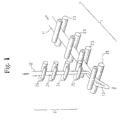
- Fig. 1 shows diagramatically the drafting units of a drawing frame for producing blended yarn.
- different types of fibre slivers are drafted separately using a base sliver drafting unit 1 and a sliver blending drafting unit 2, which are then combined to form blended slivers 13.
- the base sliver drafting unit 1 drafts base slivers 11 by means of base feed rollers 23 and a base front roller 21 cooperating with opposite pressure rollers.
- the sliver blending drafting unit 2 drafts the blending slivers 12 by means of blending feed rollers 24 and a blending front roller 22 which cooperate with opposite pressure rollers.
- the blending slivers 12 so drafted are mixed with the base slivers 11 at the base front roller 21 and output as blended slivers 13.
- the frame is also equipped with a base front motor 211, a blending front motor 221, a base feed motor 231 and a blending feed motor 241 in order to control and drive the base front roller 21, the blending front roller 22, the base feed rollers 23 and the blending feed rollers 24, resp.
- These motors 211, 221, 231 and 241 are controlled in turn by means of a controller 3 wherein the speed of each motor is set by the motor speed setter 31, a 1/f fluctuation signal generator 32, and a blending ratio variation setter 33.
- Each of the motors 211, 221, 231 and 241 is operated and rotated in accordance with the set values thereof, wherein the speed is controlled precisely by feedback on corresponding drivers 34 which receive feedback signals from corresponding speed detectors 25 detecting the respective motors 211, 221, 231 and 241.
- Blended spinning can also be accomplished by a similar mechanism using a roving frame or a spinning frame at any arbitrary blending ratio.
- 1/f fluctuation signals are derived from a numerical sequence y1, y2, y3, ... formed by multiplying n coefficients a1, a2, a3, ... an, on a random sequence of numbers x1, x2, x3, .
- yj can be expressed by Equation 1 indicated below. It should be noted herein that the sequence of numerical values forming y1, y2, y3, ... has a 1/f spectrum. For further details, reference is made to "Biological Signaling", Chapter 10, in “Biological Rhythms and Fluctuations", published by Corona Publishers, Ltd..
- Equation 1 x is virtually any arbitrary random number, and n represents the n-th term which determines the lower limit of the frequency range of the 1/f spectrum.
- a sequence of numerical values having a 1/f fluctuation is obtained in two steps using the 1/f fluctuation signal generator 32 provided in the arrangement according to Fig. 2.
- a computer for example, generates a sequence of random numbers, x.
- a certain number n of coefficients a stored in a storage device, are successively multiplied on the random numbers, and then a sequence of numerical values y is obtained by linear transformation.
- This numerical sequence, y has a 1/f spectrum and can be used as a sequence of numerical values having a 1/f fluctuation.
- An example of a numerical sequence with a 1/f fluctuation so obtained is shown in the numerical sequence indicated below.
- the weight per unit length for the blended slivers 13 to be manufactured and a reference value "a" for the blending ratio of the base slivers 11 and the blending slivers 12 being fed are determined, and a 1/f fluctuation "b" is imparted on said reference value "a".
- the reference value "a” is set at 50% for a blending of equal parts of base slivers 11 and blending slivers 12.
- the speed of each motor 211, 221, 231 and 241 is set in the motor speed setter 31 as a function of the weight per unit length of the base slivers 11 and the blending slivers 12 which are being fed and from the reference value "a" for the blending ratio.
- a numerical sequence with a 1/f fluctuation is set in the motor speed setter 31, and a degree of variation "c" having a 1/f fluctuation for the blending ratio is set in the blending ratio variation setter 33.
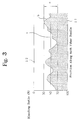
- a variation of ⁇ 20% for a reference value of 50% is set, in other words, the degree of variation "c" is set between 30% and 70%.
- the relationship between the blending ratio and the position along with a fibre bundle is shown in Fig. 3 of the drawings.
- the 1/f fluctuation signals are applied to the base feed motor 231, and then, as the base feed rollers 23 rotate, the base slivers 11 are drawn-in at a speed having a 1/f fluctuation and drafted at the base slivers drafting unit 1, wherein slivers having a 1/f fluctuation are output from the base front roller 21.
- 1/f fluctuation signals of reverse phase to those signals applied to the base feed motor 231 are applied to the blending feed motor 241.
- the blending feed rollers 24 rotate, the blending slivers 12 are drawn-in at a speed having a 1/f fluctuation of reverse phase (corresponding to the 1/f fluctuation signals of reverse phase) to that of the base slivers 11 and are drafted by the sliver blending drafting unit 2. Therefore, blending slivers having a 1/f fluctuation of reverse phase to that of the base slivers 11 are output from the blending front roller 22.
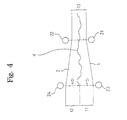
- the drafting unit 1 and the drafting unit 2 are operated together in this manner in order to produce blended slivers 13 in which the proportion "d" of each type of fibre varies in accordance with the 1/f fluctuation signals. Also, the blended slivers 13 which have passed through the drafting unit 1 and the drafting unit 2 have a 1/f fluctuation of mutually reversed phase to ultimately produce the blended slivers 13 of a constant weight per unit length. The blending ratio of these blended slivers 13 is shown in Fig. 4 of the drawings.
Landscapes
- Engineering & Computer Science (AREA)
- Textile Engineering (AREA)
- Mechanical Engineering (AREA)
- Yarns And Mechanical Finishing Of Yarns Or Ropes (AREA)
- Spinning Or Twisting Of Yarns (AREA)
- Preliminary Treatment Of Fibers (AREA)
Applications Claiming Priority (3)
| Application Number | Priority Date | Filing Date | Title |
|---|---|---|---|
| JP203806/95 | 1995-07-18 | ||
| JP20380695 | 1995-07-18 | ||
| JP7203806A JP2860455B2 (ja) | 1995-07-18 | 1995-07-18 | 混紡機 |
Publications (2)
| Publication Number | Publication Date |
|---|---|
| EP0754787A1 EP0754787A1 (en) | 1997-01-22 |
| EP0754787B1 true EP0754787B1 (en) | 1999-12-08 |
Family
ID=16480044
Family Applications (1)
| Application Number | Title | Priority Date | Filing Date |
|---|---|---|---|
| EP96111390A Expired - Lifetime EP0754787B1 (en) | 1995-07-18 | 1996-07-15 | Spinning method and spinning frame for spinning blended yarns |
Country Status (7)
| Country | Link |
|---|---|
| US (1) | US5752295A (enExample) |
| EP (1) | EP0754787B1 (enExample) |
| JP (1) | JP2860455B2 (enExample) |
| KR (1) | KR100253619B1 (enExample) |
| CN (1) | CN1062038C (enExample) |
| DE (1) | DE69605488T2 (enExample) |
| TW (1) | TW358125B (enExample) |
Families Citing this family (7)
| Publication number | Priority date | Publication date | Assignee | Title |
|---|---|---|---|---|
| US6023925A (en) * | 1997-11-21 | 2000-02-15 | Burlington Industries, Inc. | Production of color blended yarn |
| JP3334075B2 (ja) | 1998-09-02 | 2002-10-15 | 日清紡績株式会社 | 複合糸の製造方法、及びその複合糸 |
| CN1263175A (zh) * | 1999-02-12 | 2000-08-16 | 日清纺织株式会社 | 复合纱的制造方法及其复合纱 |
| JP3334081B2 (ja) | 1999-02-12 | 2002-10-15 | 日清紡績株式会社 | 複合糸の製造方法、及びその複合糸 |
| DE03466019T1 (de) * | 2003-04-03 | 2005-05-04 | Saurer Czech A S | Rotorgesponnenes mehrkomponentengarn |
| CN110004546B (zh) * | 2019-04-22 | 2021-10-22 | 浙江名蒙纺织科技有限公司 | 混纺纱的生产方法 |
| CN113668114A (zh) * | 2021-09-24 | 2021-11-19 | 百隆东方股份有限公司 | 一种基于音乐的色纺段彩纱的加工方法 |
Family Cites Families (14)
| Publication number | Priority date | Publication date | Assignee | Title |
|---|---|---|---|---|
| US2728112A (en) * | 1947-04-22 | 1955-12-27 | Ralph C Berker | Gill drawing frame |
| NL84888C (enExample) * | 1953-01-19 | |||
| US3327356A (en) * | 1963-09-03 | 1967-06-27 | S O M Andreani & C | Method of and apparatus for parallelizing and blending textile fibers |
| US3447206A (en) * | 1967-10-24 | 1969-06-03 | Whitin Machine Works | Draw frame for blending fibers |
| US3664115A (en) * | 1970-04-06 | 1972-05-23 | Celanese Corp | Method of making a semi-continuous filament combination yarn |
| US3918127A (en) * | 1973-09-17 | 1975-11-11 | Braschler & Cie | Apparatus for blending rovings |
| US4041690A (en) * | 1975-11-05 | 1977-08-16 | Tuscarora Cotton Mill | Novelty yarn and method for making same |
| JPS5719806A (en) * | 1980-07-09 | 1982-02-02 | Toyota Central Res & Dev Lab Inc | Fluctuation driving device |
| JPS6399330A (ja) * | 1986-10-15 | 1988-04-30 | Ootori Kiko Kk | 繊維原料の混綿装置 |
| IL90789A0 (en) * | 1988-08-05 | 1990-01-18 | Rieter Ag Maschf | Textile machine with drawframes |
| JPH0274632A (ja) * | 1988-09-08 | 1990-03-14 | Japan Exlan Co Ltd | 複合糸の製造法 |
| US5022123A (en) * | 1988-09-29 | 1991-06-11 | Murata Kikai Kabushiki Kaisha | Draft mechanism having roller pairs connected to draft ratio controlled motors by timing belts |
| DE4103525A1 (de) * | 1990-04-09 | 1991-10-10 | Truetzschler & Co | Vorrichtung zum verziehen von faserbaendern, z. b. aus baumwolle, chemiefaser u. dergl. |
| JP2964061B2 (ja) * | 1994-03-03 | 1999-10-18 | 日清紡績株式会社 | 撚糸方法及び撚糸機 |
-
1995
- 1995-07-18 JP JP7203806A patent/JP2860455B2/ja not_active Expired - Fee Related
-
1996
- 1996-05-03 TW TW085105307A patent/TW358125B/zh active
- 1996-05-06 CN CN96102218A patent/CN1062038C/zh not_active Expired - Fee Related
- 1996-05-28 KR KR1019960018096A patent/KR100253619B1/ko not_active Expired - Fee Related
- 1996-07-02 US US08/674,718 patent/US5752295A/en not_active Expired - Fee Related
- 1996-07-15 EP EP96111390A patent/EP0754787B1/en not_active Expired - Lifetime
- 1996-07-15 DE DE69605488T patent/DE69605488T2/de not_active Expired - Fee Related
Also Published As
| Publication number | Publication date |
|---|---|
| EP0754787A1 (en) | 1997-01-22 |
| DE69605488T2 (de) | 2000-07-20 |
| KR100253619B1 (ko) | 2000-05-01 |
| JPH0931766A (ja) | 1997-02-04 |
| HK1011054A1 (en) | 1999-07-02 |
| CN1140773A (zh) | 1997-01-22 |
| CN1062038C (zh) | 2001-02-14 |
| KR970006569A (ko) | 1997-02-21 |
| DE69605488D1 (de) | 2000-01-13 |
| JP2860455B2 (ja) | 1999-02-24 |
| TW358125B (en) | 1999-05-11 |
| US5752295A (en) | 1998-05-19 |
Similar Documents
| Publication | Publication Date | Title |
|---|---|---|
| EP0669414B1 (en) | Spinning method and spinning frame | |
| EP0754787A1 (en) | Spinning method and spinning frame for spinning blended yarns | |
| JPH08302538A (ja) | 織成方法 | |
| EP0679745B1 (en) | Weaving method and reed for weaving | |
| EP0685581B1 (en) | A method of and a machine for producing yarn using air intermingling | |
| EP0670381B1 (en) | Twisting method and twisting frame | |
| US20020152738A1 (en) | Composite yarn and method of manufacturing it | |
| HK1011054B (en) | Spinning method and spinning frame for spinning blended yarns | |
| US5813210A (en) | Twisting method and twisting frame utilizing I/F fluctuations | |
| JP2000303271A (ja) | 複合糸の製造方法、及びその複合糸 | |
| JP3433273B2 (ja) | 経編機のビーム制御装置及び制御方法 | |
| HK1011053B (en) | Spinning method and spinning frame | |
| HK1011055B (en) | Twisting method and twisting frame | |
| JP3433272B2 (ja) | 経編機のビーム及びそのビーム巻取装置 | |
| JPH07316954A (ja) | 織機及び織成方法 | |
| HK1011056B (en) | A method of and a machine for producing yarn using air intermingling | |
| HK1011057B (en) | Weaving method and reed for weaving |
Legal Events
| Date | Code | Title | Description |
|---|---|---|---|
| PUAI | Public reference made under article 153(3) epc to a published international application that has entered the european phase |
Free format text: ORIGINAL CODE: 0009012 |
|
| AK | Designated contracting states |
Kind code of ref document: A1 Designated state(s): DE FR GB |
|
| 17P | Request for examination filed |
Effective date: 19970616 |
|
| GRAG | Despatch of communication of intention to grant |
Free format text: ORIGINAL CODE: EPIDOS AGRA |
|
| 17Q | First examination report despatched |
Effective date: 19981221 |
|
| GRAG | Despatch of communication of intention to grant |
Free format text: ORIGINAL CODE: EPIDOS AGRA |
|
| GRAH | Despatch of communication of intention to grant a patent |
Free format text: ORIGINAL CODE: EPIDOS IGRA |
|
| GRAH | Despatch of communication of intention to grant a patent |
Free format text: ORIGINAL CODE: EPIDOS IGRA |
|
| GRAA | (expected) grant |
Free format text: ORIGINAL CODE: 0009210 |
|
| AK | Designated contracting states |
Kind code of ref document: B1 Designated state(s): DE FR GB |
|
| REF | Corresponds to: |
Ref document number: 69605488 Country of ref document: DE Date of ref document: 20000113 |
|
| ET | Fr: translation filed | ||
| PLBE | No opposition filed within time limit |
Free format text: ORIGINAL CODE: 0009261 |
|
| STAA | Information on the status of an ep patent application or granted ep patent |
Free format text: STATUS: NO OPPOSITION FILED WITHIN TIME LIMIT |
|
| 26N | No opposition filed | ||
| REG | Reference to a national code |
Ref country code: GB Ref legal event code: IF02 |
|
| PGFP | Annual fee paid to national office [announced via postgrant information from national office to epo] |
Ref country code: GB Payment date: 20020701 Year of fee payment: 7 |
|
| PGFP | Annual fee paid to national office [announced via postgrant information from national office to epo] |
Ref country code: FR Payment date: 20020717 Year of fee payment: 7 |
|
| PGFP | Annual fee paid to national office [announced via postgrant information from national office to epo] |
Ref country code: DE Payment date: 20020927 Year of fee payment: 7 |
|
| PG25 | Lapsed in a contracting state [announced via postgrant information from national office to epo] |
Ref country code: GB Free format text: LAPSE BECAUSE OF NON-PAYMENT OF DUE FEES Effective date: 20030715 |
|
| PG25 | Lapsed in a contracting state [announced via postgrant information from national office to epo] |
Ref country code: DE Free format text: LAPSE BECAUSE OF NON-PAYMENT OF DUE FEES Effective date: 20040203 |
|
| GBPC | Gb: european patent ceased through non-payment of renewal fee |
Effective date: 20030715 |
|
| PG25 | Lapsed in a contracting state [announced via postgrant information from national office to epo] |
Ref country code: FR Free format text: LAPSE BECAUSE OF NON-PAYMENT OF DUE FEES Effective date: 20040331 |
|
| REG | Reference to a national code |
Ref country code: FR Ref legal event code: ST |