EP0752590A2 - Klemmenblock für Elektizitätszähler - Google Patents
Klemmenblock für Elektizitätszähler Download PDFInfo
- Publication number
- EP0752590A2 EP0752590A2 EP96110343A EP96110343A EP0752590A2 EP 0752590 A2 EP0752590 A2 EP 0752590A2 EP 96110343 A EP96110343 A EP 96110343A EP 96110343 A EP96110343 A EP 96110343A EP 0752590 A2 EP0752590 A2 EP 0752590A2
- Authority
- EP
- European Patent Office
- Prior art keywords
- contact
- contact element
- terminal block
- terminal
- axis
- Prior art date
- Legal status (The legal status is an assumption and is not a legal conclusion. Google has not performed a legal analysis and makes no representation as to the accuracy of the status listed.)
- Granted
Links
- 230000005611 electricity Effects 0.000 title claims abstract description 8
- 239000004020 conductor Substances 0.000 claims description 27
- 230000009471 action Effects 0.000 claims description 3
- 230000007246 mechanism Effects 0.000 claims description 3
- 238000012360 testing method Methods 0.000 description 14
- 238000005259 measurement Methods 0.000 description 9
- 125000006850 spacer group Chemical group 0.000 description 6
- 230000007935 neutral effect Effects 0.000 description 5
- 230000013011 mating Effects 0.000 description 3
- 238000000926 separation method Methods 0.000 description 3
- 238000010276 construction Methods 0.000 description 2
- 239000012777 electrically insulating material Substances 0.000 description 2
- 238000003780 insertion Methods 0.000 description 2
- 230000037431 insertion Effects 0.000 description 2
- 238000000034 method Methods 0.000 description 2
- 230000008569 process Effects 0.000 description 2
- 230000002040 relaxant effect Effects 0.000 description 2
- 229910000906 Bronze Inorganic materials 0.000 description 1
- 241001295925 Gegenes Species 0.000 description 1
- 239000010974 bronze Substances 0.000 description 1
- 238000006243 chemical reaction Methods 0.000 description 1
- 239000011248 coating agent Substances 0.000 description 1
- 238000000576 coating method Methods 0.000 description 1
- KUNSUQLRTQLHQQ-UHFFFAOYSA-N copper tin Chemical compound [Cu].[Sn] KUNSUQLRTQLHQQ-UHFFFAOYSA-N 0.000 description 1
- 238000005260 corrosion Methods 0.000 description 1
- 230000007797 corrosion Effects 0.000 description 1
- 230000001419 dependent effect Effects 0.000 description 1
- 238000013461 design Methods 0.000 description 1
- 238000011161 development Methods 0.000 description 1
- 230000018109 developmental process Effects 0.000 description 1
- 230000005489 elastic deformation Effects 0.000 description 1
- 238000005265 energy consumption Methods 0.000 description 1
- 210000003746 feather Anatomy 0.000 description 1
- 239000000463 material Substances 0.000 description 1
- 239000002184 metal Substances 0.000 description 1
- 238000012986 modification Methods 0.000 description 1
- 230000004048 modification Effects 0.000 description 1
- 230000002093 peripheral effect Effects 0.000 description 1
- 230000000284 resting effect Effects 0.000 description 1
Images



Classifications
-
- G—PHYSICS
- G01—MEASURING; TESTING
- G01R—MEASURING ELECTRIC VARIABLES; MEASURING MAGNETIC VARIABLES
- G01R11/00—Electromechanical arrangements for measuring time integral of electric power or current, e.g. of consumption
- G01R11/02—Constructional details
- G01R11/04—Housings; Supporting racks; Arrangements of terminals
Definitions
- the invention relates to a terminal block for electricity meters according to the preamble of claim 1.
- Electricity meter i.e. Meters for measuring or recording the consumption of electrical energy usually have a terminal block, via which the meter can be connected to the phases and to the neutral conductor of an electrical supply network and via the elements inside the meter, the current measurement path and the voltage measurement path, e.g. the respective current coil and voltage coil are connected.
- the respective voltage tab must be returned to its original state, i.e. the electrical connection between the current terminal and the voltage terminal must be restored, for which the above steps must be carried out in reverse order.
- the object of the invention is to show a terminal block which considerably simplifies the authentication test.
- a terminal block is designed according to the characterizing part of claim 1.
- the electrical connection or bridge between the current terminal and the voltage terminal of the respective terminal arrangement is formed by a first, resilient contact element which bears against a contact surface provided on a second contact element.
- the electrical bridge can then be interrupted in a particularly simple and reliable manner in one embodiment of the invention in that the first contact element is resiliently pushed away by the second contact element and / or one of the two contact elements is moved or pivoted away such that the electrical connection between the two Elements is broken. In the latter case, too, a reliable interruption is ensured by the spring action.
- the electrical connection or bridge between the current terminal and the voltage terminal of the respective terminal arrangement is likewise formed by a resilient contact element. This is pressed by a fixing element against a contact or contact surface provided on the second contact element. By loosening the fixing element, the resilient contact element pivots away from the contact or contact surface due to its spring action or by relaxing, so that a reliable interruption is again ensured.
- the actuation e.g. the loosening of a single fixing element, for example a screw
- the interruption takes place by pushing away the resilient contact element, this loosening of a single fixing element is also not necessary.
- the invention further relates to a dispenser according to claim 14.
- 1 is a terminal block for an electrical meter, namely for a three-phase 4-wire electricity meter, specifically for connecting this meter to the three-phase three-phase network and to the associated neutral wire.
- the flowing current and the applied voltage for each phase are recorded by means of their own coil, namely with the current coil 2 and with the voltage coil 3 for determining the energy consumption.
- the two ends of the coil 3 for the voltage are connected to the phase and the neutral conductor and accordingly to the current terminal of the terminal arrangement 4 for the phase and the terminal arrangement 6 for the neutral conductor.
- the current of the corresponding phase flows through the coil 2 and is accordingly connected to the current terminal of the terminal arrangement 4 of this phase and a further current terminal 5, which is likewise provided separately for each phase and is used to continue the conductor of this phase which is passed through the counter.
- each terminal arrangement 4 has a total of three connections 7, 8 and 9, of which the connections 7 and 8 form the current terminal and the connection 9 the voltage terminal and of which the connection 7 for connecting the counter to the Conductor of one phase, the connection 8 for connecting one end of the current coil 2 and the connection 9 for connecting the voltage coil 3.
- the connections 7 and 8 are firmly connected to one another via a conductor 10 forming the current terminal.
- a laterally projecting contact and stop element 11 is fastened by means of a screw 11 ', against the underside of which a resilient contact element 12 designed as a curved leaf spring or arc spring rests with one end or with the contact surface 12' there, the other end of which a screw 13 is held on a conductor 14 which has the terminal 9 and forms the voltage terminal.
- a resilient contact element 12 designed as a curved leaf spring or arc spring rests with one end or with the contact surface 12' there, the other end of which a screw 13 is held on a conductor 14 which has the terminal 9 and forms the voltage terminal.
- the voltage coil 3 is connected to the current terminal 7/8 via the resilient contact element 12.
- the terminal arrangement 6 has a plurality of connections 6 'and 6 ". All connections 6', 6 ', 7, 8, 9 and also the connections of the current terminal 5 are accessible from the front 17 of the terminal block.
- 1 'in the figures represents the housing of the terminal block 1, which consists of electrically insulating material and essentially forms the closed rear side 16 of this terminal block.
- the two connections 7 and 8 in the clamping arrangement 4 are offset from one another in the direction of the X-axis on the terminal block 1 or on its housing 1 ', and the connection 9 in the Y-axis opposite the port 8 offset. Furthermore, the individual terminal arrangements 4, 6 and 5 are also offset from one another on the terminal block 1 in the direction of the Y axis.
- the contact element 12 designed as a leaf spring rests with a spring force acting in the direction of the Z-axis with its free end from below against the contact element 11 or against a contact surface formed by the latter, which faces the rear side 16.
- the X, Y and Z axes form three perpendicular to each other running spatial axes.
- the closed rear side 16 and the open front side 17 of the terminal block 1 are each defined by the XY plane.
- the electrical stamp 15 To interrupt the connection between the contact elements 1 1 and 12, so that loosening the screw 11 'and pivoting away of the contact element 11 during the authentication test are not required. It is then also possible to design the plunger 15 as an electrode, via which the contact element 12 is then swiveled away from the contact element 11, i. after the connection between the two contact elements has been interrupted, the voltage coil 3 is connected to the calibrated voltage source for the authentication test.
- Fig. 3 shows in a similar representation as Fig. 2 as a further possible embodiment, a terminal arrangement 4a, which differs from the terminal arrangement 4 of Fig. 2 only in that instead of the contact element 12, a contact element 12a is again formed as an arc spring, which cooperates with the contact pin or element 18 or with the contact surface 19 formed at the top of this contact element and facing the front of the terminal block.
- the arch spring forming the contact element 12a is fastened again with its lower leg in FIG. 3 to the conductor 14 in a suitable manner. The free end of the other leg interacts with the contact 19.
- the contact element 12a or the arc spring forming this contact element is shaped such that the free end of the upper leg of the spring or the contact surface 20 there is removed from the contact surface 19 in the relaxed state of the spring (FIG. 3), so that the current measurement path and Voltage measurement path are separated.
- the contact element 18 is provided on the conductor 10.
- the contact element 18 is designed as a contact pin.
- the contact surface 20 forms a spherical surface.
- the contact surface 20 is pressed against the contact surface 19 by means of a screw 21, which engages approximately in the middle of the upper leg of the contact element 12a, with elastic deformation of the contact element.
- the screw 21 engages with its thread in an internal thread of a bolt-shaped spacer 22, the length of which is selected such that when the upper leg of the contact element 12a bears against the spacer 22 with the screw 21 fully tightened and thus between this spacer and the head the screw 21 is clamped so that the end having the contact surface 20 resiliently abuts against the contact surface 19 with a sufficient spring force, ie the latter protrudes somewhat above the level of the contact surface of the spacer 22 in the direction of the Z axis.
- the maximum deformation of the contact element 12a is limited by the spacer 22 when the connection between the current path and the voltage path is closed.
- the screw 21 is easily accessible with a tool (screwdriver) from the front of the terminal block 1. To disconnect the screw 21 is loosened, whereby the upper leg of the contact element 12a lifts from the contact surface 19 while relaxing.
- a clamp arrangement 4b which uses a leaf spring-like contact element 12b instead of a bow-spring-shaped contact element.
- This is provided at one end with an opening for the screw 23 which engages through the opening in an internal thread which is provided on the conductor 14.
- the contact element is located between the head of the screw 23 and the conductor 14. At the free end, the contact element in turn forms a contact surface 24 which interacts with a contact surface 25 on a contact element or bolt 26 which is connected to the conductor 10.
- the screw 23 is formed on the underside of its head resting against the contact element 12b in such a way that there is sufficient friction between the screw 23 or its head and the contact element 12b.
- the contact element 12b is clamped between the head of this screw and the conductor, in such a way that the contact surface 24 rests resiliently against the contact surface 25.
- the contact surface 25 and the head of the screw in turn face the front of the terminal block, so that the screw 23 is easily accessible from there.
- the contact element 12b is thereby pivoted counterclockwise by the frictional force acting between the head of the screw 23 and this contact element in the illustration (top view) chosen for FIGS. 5 and 6, and until the electrical Connection between the contact elements 12b and 26 is interrupted and the contact element 12b bears with a bearing surface 27 provided there against a stop or housing wall 28.
- the contact surface 27 is formed by an inclined surface at the end remote from the contact surface 24. If the screw 23 is tightened to close the electrical connection, the contact element 12b is first dragged along or rotated, until the contact surfaces 24 and 25 abut against one another and these are tightened and pivoted leading longitudinal side of the contact element 12b comes to rest against the contact surface 28. In the embodiment shown, this long side includes an angle greater than 90 °, preferably an angle of 135 °, with the contact surface 27.
- the contact element 12, 12a or 12b is made of a material, e.g. Spring bronze manufactured, which has good spring properties and also high conductivity.
- the contact elements 12 / 12a / 12b and 11/18/26 are also coated with a corrosion-resistant coating, which also means that low contact resistances can be maintained over a long period of time.
- FIGS. 8 and 9 show a terminal arrangement 4c, which consists of the contact element 12c designed as a bow spring, which is connected to the conductor 14 with a leg 30 via the rivet or the screw 31 and thereby also held on the housing of the terminal block is.
- Free leg 32 interacts with a leaf spring-like counter-contact 33, which is angled several times and fastened at one end to the conductor 10 by means of a screw 34 and is thus also held on the housing 1 'of the terminal block.
- the mating contact 33 is bent in an S- or nose-shaped manner, so that this contact, starting from the free end, forms a nose-like section with an inclined surface 34 and then a contact surface 35, in such a way that for establishing the connection between the Contact element 12 and the counter contact 33 the free leg is pressed down and thereby slides on the inclined surface 34, namely by pushing the mating contact 33, which is designed as a leaf spring, until finally the free end of the leg 32 engages on the surface 35 (FIG.
- the contact element 12c which is designed as a bow spring, rests resiliently against the surface 35 with the free end of the leg 32 on the latching nose of the mating contact 33.
- the contact bridge can be opened by simply pushing the counter-contact 33, which acts like a leaf spring, to the side or by pressing the leg 32 down.
- FIGS. 10 and 11 show as a further embodiment a terminal arrangement 4d, in which a clamp-like contact 36 and 37 is provided on the conductor 10 and on the conductor 14, respectively, the contact 37 being attached to the conductor 14 by means of a screw 38 and a sleeve 39 is attached.
- the screw 38 is passed through the sleeve 39.
- the yoke area of the U-shaped contact 37 is clamped between the head of the screw 38 and the sleeve 39, which in turn is supported on the conductor 14.
- a metal rod is provided as contact element 12d, which has a high electrical conductivity and is held in both contacts 36 and 37 for closing the contact bridge. To open the contact bridge, the contact element 12d can be easily removed, since this protrudes with a greater length over the side of the contact 37 facing away from the contact 36 and can be easily grasped by a corresponding tool at this length.
- FIG. 12 shows a further embodiment of a terminal arrangement 4e, in which a contact element 41 designed as a leaf spring is connected to the conductor 14 via the screw 42.
- a counter-contact 43 which is also designed as a leaf spring, is connected to the conductor 10 via a screw 42 '.
- Both contacts 41 and 43 each have a funnel-like opening 44 at the free ends of their mutually facing legs, into each of which a frustoconical end 45 of the contact element 12e, which in this embodiment is again rod-shaped, can be inserted.
- the contact bridge can be opened by removing the contact element 12e.
- the screws 13, 21, 23, 31 and 42 provided on the conductor 14 and the sleeve 39 are each provided with an annular groove which enables the so-called “ohm plug” to be connected during the test, in particular the certification test.
- the terminal arrangement 4 , 4a, 4b, 4c, 4d, 4e are characterized by low costs and also by the fact that the conversion of newly certified meters is possible without any problems.
- FIGS. 13-17 show a dispenser 50 which is particularly suitable for the terminal block 4e of FIG. 12 or for the delivery and insertion of the rod-shaped contact elements 12e there.
- the dispenser 50 can also be used for other rod-like contact elements, e.g. Contact elements 12d, as well as generally used for the delivery and insertion of cylindrical electrical components in terminal arrangements.
- the dispenser 50 consists of a housing 51 made of electrically insulating material, preferably of plastic, which forms in the upper area an interior 53 which can be closed by a cover 52 and which is suitable for receiving a multiplicity of contact elements 12e, in such a way that all contact elements 12e are each arranged with their axes parallel to one another and with their peripheral surfaces abutting one another in the interior 53.
- the interior 53 has a rectangular or square cross section.
- the interior 53 has an inclined bottom surface 54, on which the interior 53 merges into an outlet shaft 55.
- the shaft 55 has a cross section such that in this shaft the contact elements 12e form a single-track row in which the contact elements directly adjoin one another in the longitudinal direction L of the shaft and are oriented with their axes perpendicular to the longitudinal extent L of the row.
- the shaft 55 is formed on a housing section 56 protruding in a straight line and trunk-like manner above the underside of the plastic housing 51. At the lower end, the housing section 56 is chamfered laterally and open, so that the contact elements 12e there increasingly protrude laterally with their two ends from the housing section 56.
- the housing section 56 forms two eyelet-like supports 57 which are arranged offset in the longitudinal direction of the contact elements 12e and form the support for the lowermost contact element 12e. Furthermore, a dispenser opening 58 is provided in the area of the supports 57, the width of which is equal to or approximately the same as the diameter of a contact element 12e, so that the bottom contact element 12e extends radially to the axis of this contact element in an axial direction and perpendicular to the longitudinal extension L of the shaft 55 the lower end of this shaft can be pulled out.
- the arrangement is also such that, starting from the lower end of the shaft 55 or from the supports 57 there, the second and all further contact elements 12e are held securely in the shaft 55 and the bottom contact element can only be removed from the supports 57 as a result that this lowermost contact element 12e and with it also all other contact elements 12e located in the shaft 55 are raised somewhat relative to the shaft or to the housing section 56.
- the respective contact element 12e is inserted into the two leaf spring-like contacts 41 and 43 in such a way that with the aid of the dispenser 50 the lowest contact element 12e in the shaft 55 or on the supports 57 there with the two conical ends 45 into the openings 44 of contacts 41 and 43 is used.
- This contact element is then moved out of the shaft 55 by laterally moving the dispenser or the housing section 56 away, so that the contact element 12e is then mounted in the manner shown in FIG. 12.
- a pressure plate 60 is provided on the inside of the cover 52 via a spring 59 which bears against the uppermost contact elements 12e and biases it into shaft 55 for movement.
- the dispenser can also be used for the contact elements 12d and generally for cylindrical electrical components, for example Fuses are used that are to be used in resilient contact arrangements, etc.
Landscapes
- Physics & Mathematics (AREA)
- General Physics & Mathematics (AREA)
- Connections Arranged To Contact A Plurality Of Conductors (AREA)
- Measuring Leads Or Probes (AREA)
- Measurement Of Resistance Or Impedance (AREA)
Abstract
Description
- Die Erfindung bezieht sich auf einen Klemmenblock für Elektrizitätszähler gemäß Oberbegriff Patentanspruch 1.
- Elektrizitätszähler, d.h. Zähler zum Messen bzw. Erfassen des Verbrauchs an elektrischer Energie besitzen üblicherweise einen Klemmenblock, über den die Zähler an die Phasen sowie an den Null-Leiter eines elektrischen Versorgungsnetze anschließbar ist und über den zählerintern die Elemente des Strommeßpfades und des Spannungsmeßpfades, z.B. die jeweilige Stromspule und Spannungsspule angeschlossen sind.
- Für jeden gewerblich genutzten Elektrizitätszähler ist vor seiner Verwendung eine Beglaubigungsprüfung vorgeschrieben. Bei dieser Prüfung ist es u.a. erforderlich, den für jede Phase gesondert vorgesehenen Spannungsmeßpfad von dem zugehörigen Strommeßpfad zu trennen, um diesen Spannungsmeßpfad an eine geeichte Spannungsquelle anschließen zu können. Um diese Trennung durchführen zu können, weist die Klemmenanordnung für jede Phase bei herkömmlichen Klemmenblöcken zwischen der Stromklemme und der Spannungsklemme eine elektrische Brücke in Form einer sogenannte Spannungslasche auf, die mit jeweils einer Schraube an der Spannungsklemme und der Stromklemme befestigt ist und für eine elektrische Trennung gelöst werden kann. Um bei der Beglaubigungsprüfung den inneren Spannungsanschluß an die geeichte Spannungsquelle anschließen zu können, sind daher bisher in aufwendiger Weise folgende Schritte nötig:
- Lösen der Befestigungsschraube für die Spannungslasche an der Stromklemme;
- lösen der Befestigungsschraube für die Spannungslasche an der Spannungsklemme;
- zurückziehen der Spannungslasche auf die Spannungsklemme;
- sichern der Spannungslasche gegen Verrutschen durch leichtes Wiederanziehen der Befestigungsschraube an der Spannungsklemme.
- Erst dann kann eine leitende Verbindung zu der geeichten Spannungsquelle hergestellt werden, und zwar entweder über einen geeigneten Stecker oder aber durch Aufsetzen eines Federstiftes auf die Spannungsklemme.
- Am Ende des Prüfvorgangs muß die jeweilige Spannungslasche wieder in ihren Ausgangszustand zurückgebracht werden, d.h. es muß die elektrische Verbindung zwischen der Stromklemme und der Spannungsklemme wieder hergestellt werden, wofür die oben genannten Schritte in umgekehrter Reihenfolge durchgeführt werden müssen.
- Der vorgenannte Vorgang ist sehr aufwendig und erfordert auch ein sehr genaues Arbeiten.
- Aufgabe der Erfindung ist es, einen Klemmenblock aufzuzeigen, der die Beglaubigungsprüfung wesentlich vereinfacht.
- Zur Lösung dieser Aufgabe ist ein Klemmenblock entsprechend dem kennzeichnenden Teil des Patentanspruches 1 ausgebildet.
- Bei einer möglichen Ausführungsform des erfindungsgemäßen Klemmenblocks ist die elektrische Verbindung bzw. Brücke zwischen der Stromklemme und der Spannungsklemme der jeweiligen Klemmenanordnung von einem ersten, federnden Kontaktelement gebildet, welches gegen eine an einem zweiten Kontaktelement vorgesehene Anlagefläche anliegt. Die elektrische Brücke kann dann bei einer Ausführungsform der Erfindung in besonders einfacher und auch zuverlässiger Weise dadurch unterbrochen werden, daß das erste Kontaktelement von dem zweiten Kontaktelement federnd weggedrückt und/oder eines der beiden Kontaktelemente so wegbewegt oder weggeschwenkt wird, daß die elektrische Verbindung zwischen beiden Elementen unterbrochen ist. Auch im letzten Fall ist durch die Federwirkung eine zuverlässige Unterbrechung gewährleistet.
- Bei einer weiteren möglichen Ausführungsform ist die elektrische Verbindung bzw. Brücke zwischen der Stromklemme und der Spannungsklemme der jeweiligen Klemmenanordnung ebenfalls von einem federnden Kontaktelement gebildet. Dieses wird durch ein Fixierelement gegen eine an dem zweiten Kontaktelement vorgesehene Anlage- bzw. Kontaktfläche angedrückt. Durch Lösen des Fixierelementes schwenkt das federnde Kontaktelement durch seine Federwirkung bzw. durch Entspannen von der Anlage- oder Kontaktfläche weg, so daß wiederum eine zuverlässige Unterbrechung gewährleistet ist.
- Bei dem erfindungsgemäßen Klemmenblock ist für die Vorbereitung der Beglaubigungsprüfung allenfalls das Betätigen, z.B. das Lösen eines einzigen Fixierelementes, beispielsweise Schraube, je Phase notwendig. Erfolgt die Unterbrechung durch Wegdrücken des federndes Kontaktelementes, so entfällt auch dieses Lösen eines einzigen Fixierelementes.
- Die Erfindung bezieht sich weiterhin auf einen Spender nach Anspruch 14.
- Weiterbildungen der Erfindung sind Gegenstand der Unteransprüche.
- Die Erfindung wird im Folgenden anhand der Figuren an einem Ausführungsbeispiel näher erläutert. Es zeigen:
- Fig. 1
- in schematischer Darstellung und in Draufsicht einen Klemmenblock eines Elektrizitätszählers, wobei lediglich die Klemmenanordnung für eine Phase zusammen mit der Klemme für den Null-Leiter wiedergegeben ist;
- Fig. 2
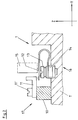
- in vergrößerter Darstellung einen Schnitt entsprechend der Linie I-1 durch die dortige Klemmenanordnung;
- Fig. 3 und 4
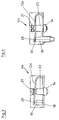
- Schnitt-Darstellungen wie Fig. 2 bei einer weiteren möglichen Ausführungsform, und zwar bei geschlossener und geöffneter Kontaktbrücke;
- Fig. 5 und 6
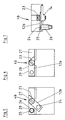
- in vereinfachter Darstellung und in Draufsicht eine weitere Ausführung der Klemmenanordnung, und zwar bei geöffneter und geschlossener Kontaktbrücke;
- Fig. 7
- eine Seiten-Darstellung, teilweise im Schnitt, der Klemmenanordnung der Fig. 6;
- Fig. 8 und 9
- in vereinfachter Darstellung und in Seitenansicht eine weitere Ausführung der Klemmenanordnung, und zwar bei geöffneter und geschlossener Kontaktbrücke;
- Fig. 10 und 11
- in vereinfachter Darstellung und in Seitenansicht bzw. in einem Schnitt entsprechend der Linie II-II der Fig. 10 eine weitere Ausführungsform der Klemmenanordnung;
- Fig. 12
- in Seitenansicht und teilweise im Schnitt eine weitere Ausführungsform der Klemmenanordnung bei geschlossener Kontaktbrücke;
- Fig. 13 - 16
- in unterschiedlichen Ansichten sowie teilweise geschnitten einen Spender, der für die Kontaktelemente, insbesondere der Klemmenanordnung der Fig. 12 geeignet ist;
- Fig. 17
- in vergrößerter Detaildarstellung den Kopf des Spenders der Fig. 13 - 16.
- In den Figuren 1 und 2 ist 1 ein Klemmenblock für einen Elektrozähler, nämlich für einen Dreiphasen-4-Leiter-Stromzähler, und zwar zum Anschluß dieses Zählers an das Dreiphasen-Drehstromnetz und an den zugehörigen Null-Leiter. Im Meßwerk werden der fließende Strom und die anliegende Spannung für jede Phase jeweils mittels einer eigenen Spule, nämlich mit der Stromspule 2 und mit der Spannungsspule 3 für die Ermittlung des Energieverbrauchs erfaßt. Beim Einsatz des Zählers sind die beiden Enden der Spule 3 für die Spannung mit der Phase und dem Null-Leiter und dementsprechend mit der Stromklemme der Klemmanordnung 4 für die Phase und der Klemmenanordnung 6 für den Nulleiter verbunden. Die Spule 2 wird von dem Strom der entsprechenden Phase durchströmt und ist dementsprechend mit der Stromklemme der Klemmenanordnung 4 dieser Phase und einer weiteren Stromklemme 5 verbunden, die ebenfalls für jede Phase gesondert vorgesehen ist und zum Weiterführen des durch den Zähler hindurchgeführten Leiters dieser Phase dient.
- Für die Beglaubigungsprüfung des Zählers ist es notwendig, die Spannungsspule 3 jeder Phase von der Stromklemme der zugehörigen Phase bzw. Klemmenanordnung 4 zu trennen, um diese Spannungsspule 3 an eine geeichte Spannungsquelle anschließen zu können. Um diese elektrische Trennung vornehmen zu können, weist jede Klemmanordnung 4 insgesamt drei Anschlüsse 7, 8 und 9 auf, von denen die Anschlüsse 7 und 8 die Stromklemme und der Anschluß 9 die Spannungsklemme bilden und von denen der Anschluß 7 zum Anschließen des Zählers an den Leiter einer Phase, der Anschluß 8 zum Anschließen eines Endes der Stromspule 2 und der Anschluß 9 zum Anschließen der Spannungsspule 3 dienen. Die Anschlüsse 7 und 8 sind über einen die Stromklemme bildenden Leiter 10 fest miteinander verbunden. An dem Leiter 10 ist mittels einer Schraube 11' ein seitlich überstehendes Kontakt- und Anschlagelement 11 befestigt, gegen dessen Unterseite ein als gebogene Blattfeder oder Bogenfeder ausgebildetes federndes Kontaktelement 12 mit einem Ende bzw. mit der dortigen Kontaktfläche 12' anliegt, dessen anderes Ende über eine Schraube 13 an einem Leiter 14 gehalten ist, der die Klemme 9 aufweist und die Spannungsklemme bildet.
- Über das federnde Kontaktelement 12 ist die Spannungsspule 3 bei betriebsbereitem Zähler mit der Stromklemme 7/8 verbunden. Die Klemmenanordnung 6 besitzt bei der dargestellten Ausführungsform mehrere Anschlüsse 6' und 6". Sämtliche Anschlüsse 6', 6', 7, 8, 9 sowie auch die Anschlüsse der Stromklemme 5 sind von der Vorderseite 17 des Klemmenblocks zugänglich. Mit 1' ist in den Figuren das aus elektrisch isolierendem Material bestehende Gehäuse des Klemmenblocks 1 wiedergegeben, welches im wesentlichen die geschlossene Rückseite 16 dieses Klemmenblocks bildet.
- Für die Beglaubigungsprüfung ist es dann lediglich notwendig, beispielsweise die Schraube 11' zu lösen und das als abgewinkelte Lasche ausgebildete Kontaktelement 11 soweit weg zu schwenken, daß das freie Ende des federnden Kontaktelementes 12 außer Eingriff mit dem Kontaktelement 11 kommt und die elektrische Verbindung unterbrochen ist. Mit Hilfe einer speziellen, an der Schraube 13 bzw. an der dortigen Ringnut angreifenden Anschlußklemme (Ohm-Stecker) kann dann die jeweilige Spannungsspule 3 unabhängig von der Phase an die geeichte Spannungsquelle für die Beglaubigungsprüfung angeschlossen werden.
- Nach Abschluß dieser Prüfung wird das jeweilige Kontaktelement 11 wieder in seine Ausgangsstellung zurückgeschwenkt und die Schraube 11' festgezogen, so daß das Kontaktelement 12 mit seinem freien Ende wiederum gegen die Unterseite des Kontaktelementes 11 anliegt und damit die elektrische Verbindung zwischen der Klemme 9 und dem Leiter 10 und damit mit dem übrigen Teil der Klemmenanordnung 4 wieder hergestellt ist.
- Wie die Figuren 1 und 2 zeigen, sind bei der Klemmanordnung 4 die beiden Anschlüsse 7 und 8 in Richtung der X-Achse gegeneinander versetzt an dem Klemmenblock 1 bzw. an dessen Gehäuse 1' vorgesehen, und der Anschluß 9 in der Y-Achse gegenüber dem Anschluß 8 versetzt. Weiterhin sind auch die einzelnen Klemmenanordnungen 4, 6 und 5 in Richtung der Y-Achse gegeneinander versetzt am Klemmenblock 1 vorgesehen.
- Das als Blattfeder ausgebildete Kontaktelement 12 liegt mit einer in Richtung der Z-Achse wirkenden Federkraft mit seinem freien Ende von unten her gegen das Kontaktelement 1 1 bzw. gegen eine von diesem gebildete, der Rückseite 16 zugwandte Kontaktfläche an. Die X-, Y- und Z-Achsen bilden dabei drei senkrecht zueinander verlaufende Raumachsen. Die geschlossene Rückseite 16 und die offene Vorderseite 17 des Klemmenblocks 1 sind jeweils durch die X-Y-Ebene definiert.
- Wie in der Fig. 2 mit unterbrochenen Linien angedeutet ist, ist es bei der Beglaubigungsprüfung in besonders einfacher Weise auch möglich, durch einen auf das federnde Kontaktelement 12 von der Vorderseite 17 des Klemmenblocks 1 her in Richtung der Z-Achse einwirkenden Stempel 15 die elektrische Verbindung zwischen den Kontaktelementen 1 1 und 12 zu unterbrechen, so daß ein Lösen der Schraube 11' und ein Wegschwenken des Kontaktelementes 11 bei der Beglaubigungsprüfung entfallen. Hierbei ist es dann auch möglich, den Stempel 15 als Elektrode auszubilden, über die dann nach dem Wegschwenken des Kontaktelementes 12 vom Kontaktelement 11, d.h. nach der Unterbrechung der Verbindung zwischen beiden Kontaktelementen die Spannungsspule 3 für die Beglaubigungsprüfung mit der geeichten Spannungsquelle verbunden wird.
- Die Fig. 3 zeigt in ähnlicher Darstellung wie Fig. 2 als weitere mögliche Ausführungsform eine Klemmenanordnung 4a, die sich von der Klemmenanordnung 4 der Fig. 2 lediglich dadurch unterscheidet, daß anstelle des Kontaktelementes 12 ein wiederum als Bogenfeder ausgebildetes Kontaktelement 12a vorgesehen ist, das mit dem Kontaktstift oder -element 18 bzw. mit der an diesem Kontaktelement oben gebildeten und der Vorderseite des Klemmenblockes zugewandten Kontaktfläche 19 zusammenwirkt. Die das Kontaktelement 12a bildende Bogenfeder ist mit seinem in der Fig. 3 unteren Schenkel wieder an dem Leiter 14 in geeigneter Weise befestigt. Das freie Ende des anderen Schenkels wirkt mit dem Kontakt 19 zusammen. Das Kontaktelement 12a bzw. die dieses Kontaktelement bildende Bogenfeder ist so geformt, daß das freie Ende des oberen Schenkels der Feder bzw. die dortige Kontaktfläche 20 im entspannten Zustand der Feder von der Kontaktfläche 19 entfernt ist (Fig. 3), so daß Strommeßpfad und Spannungsmeßpfad getrennt sind. Das Kontaktelement 18 ist an dem Leiter 10 vorgesehen. Das Kontaktelement 18 ist als Kontaktbolzen ausgebildet. Die Kontaktfläche 20 bildet eine Kugelfläche.
- Zum Herstellen der Verbindung zwischen dem Strommeßpfad und dem Spannungsmeßpfad wird mittels einer Schraube 21, die etwa in der Mitte des oberen Schenkels des Kontaktelementes 12a angreift, dessen Kontaktfläche 20 unter elastischer Verformung des Kontaktelementes gegen die Kontaktfläche 19 angedrückt. Die Schraube 21 greift mit ihrem Gewinde in ein Innengewinde eines bolzenförmigen Abstandhalters 22 ein, dessen Länge so gewählt ist, daß dann, wenn der oberen Schenkel des Kontaktelementes 12a gegen den Abstandhalter 22 bei vollständig festgezogener Schraube 21 anliegt und somit zwischen diesem Abstandhalter und dem Kopf der Schraube 21 festgeklemmt ist, das die Kontaktfläche 20 aufweisende Ende mit einer ausreichenden Federkraft federnd gegen die Kontaktfläche 19 anliegt, d.h. letztere steht in Richtung der Z-Achse etwas über das Niveau der Anlagefläche des Abstandhalters 22 vor.
- Durch den Abstandhalter 22 wird die maximale Verformung des Kontaktelementes 12a beim Schließen der Verbindung zwischen dem Strompfad und dem Spannungspfad begrenzt.
- Die Schraube 21 ist mit einem Werkzeug (Schraubenzieher) von der Vorderseite des Klemmenblockes 1 her bequem zugänglich. Zum Trennen der Verbindung wird die Schraube 21 gelöst, wodurch der obere Schenkel des Kontaktelementes 12a unter Entspannung von der Kontaktfläche 19 abhebt.
- Vorteile der Klemmenanordnung 4a sind u.a.,
- daß nur jeweils eine Schraube 21 gelöst oder festgezogen werden muß daß diese Schraube von der Vorderseite des Klemmblockes bequem zugänglich ist,
- daß die Klemmenanordnung in Klemmenblöcke vorhandener Konstruktion eingesetzt werden können, d.h. dort keine konstruktiven Änderungen notwendig sind, und
- daß das Festziehen und Lösen der Schraube 21 und damit das Schließen und Öffnen der elektrischen Verbindung im Einhand-Betrieb möglich sind.
- Die Fig. 5 - 7 zeigen als weitere mögliche Ausführungsform eine Klemmenanordnung 4b, welches anstelle eines bogenfederartig ausgebildeten Kontaktelementes ein blattfederartiges Kontaktelement 12b verwendet. Dieses ist an einem Ende mit einer Öffnung für die Schraube 23 versehen, welche durch die Öffnung hindurch in ein Innengewinde eingreift, welches an dem Leiter 14 vorgesehen ist. Das Kontaktelement befindet sich zwischen dem Kopf der Schraube 23 und dem Leiter 14. Am freien Ende bildet das Kontaktelement wiederum eine Kontaktfläche 24, die mit einer Kontaktfläche 25 an einem Kontaktelement oder -bolzen 26 zusammenwirkt, welcher mit dem Leiter 10 verbunden ist.
- Die Schraube 23 ist an der gegen das Kontaktelement 12b anliegenden Unterseite ihres Kopfes so ausgebildet, daß eine ausreichende Reibung zwischen der Schraube 23 bzw. deren Kopf und dem Kontaktelement 12b besteht. Bei geschlossener Verbindung zwischen den Kontaktelementen 12b und 26 und bei festgezogener Schraube 23 ist das Kontaktelement 12b zwischen dem Kopf dieser Schraube und dem Leiter eingespannt und zwar derart, daß die Kontaktfläche 24 federnd gegen die Kontaktfläche 25 anliegt. Die Kontaktfläche 25 und auch der Kopf der Schraube sind wiederum der Vorderseite des Klemmenblockes zugewandt, so daß die Schraube 23 von dort leicht zugänglich ist.
- Wird die Schraube 23 gelöst, so wird hierdurch das Kontaktelement 12b durch die zwischen dem Kopf der Schraube 23 und diesem Kontaktelement wirkende Reibungskraft bei der für die Fig. 5 und 6 gewählten Darstellung (Draufsicht) im Gegenuhrzeigersinn geschwenkt, und zwar solange, bis die elektrische Verbindung zwischen den Kontaktelementen 12b und 26 unterbrochen ist und das Kontaktelement 12b mit einer dort vorgesehenen Anlagefläche 27 gegen einen Anschlag bzw. Gehäusewand 28 anliegt. Die Anlagefläche 27 ist von einer Schrägfläche an dem der Kontaktfläche 24 entfernt liegenden Ende gebildet. Wird zum Schließen der elektrischen Verbindung die Schraube 23 angezogen, so wird hierbei zunächst das Kontaktelement 12b mitgeschleppt bzw. mitgedreht, und zwar solange, bis die Kontaktflächen 24 und 25 gegeneinander anliegen und die bei diesem Festdrehen und Schwenken vorauseilende Längsseite des Kontaktelementes 12b gegen die Anlagefläche 28 zur Anlage kommt. Bei der dargestellten Ausführungsform schließt diese Längsseite mit der Anlagefläche 27 einen Winkel größer als 90°, vorzugsweise einen Winkel von 135° ein.
- Die besonderen Vorteile der Klemmenanordnung 4b sind u.a.,
- daß wiederum nur eine Schraube gelöst bzw. festgezogen werden muß,
- daß keine Änderungen an der vorhandenen Konstruktion eines Klemmenblockes notwendig sind und
- daß das Öffnen und Lösen im Einhandbetrieb möglich ist.
- Um die erforderliche Andrückkraft zwischen den Kontaktflächen 11/12', 19 /20 und 24/25 über lange Zeit sicher gewährleisten zu können, ist das Kontaktelement 12, 12a bzw. 12b aus einem Werkstoff, z.B. Federbronze hergestellt, der gute Federeigenschaften sowie gleichzeitig auch eine hohe Leitfähigkeit aufweist. Die Kontaktelemente 12/12a/12b und 11/18/26 sind weiterhin mit einer korrosionsunempfindlichen Beschichtung überzogen, wodurch ebenfalls niedrige Übergangswiderstände über eine lange Zeitdauer eingehalten werden können.
- Als weitere mögliche Ausführungsform zeigen die Fig. 8 und 9 eine Klemmenanordnung 4c, die aus dem als Bügelfeder ausgebildeten Kontaktelement 12c besteht, welches mit einem Schenkel 30 über den Niet oder die Schraube 31 mit dem Leiter 14 verbunden und hierdurch auch am Gehäuse des Klemmenblockes gehalten ist.
- Freie Schenkel 32 wirkt mit einem blattfederartigen Gegenkontakt 33 zusammen, der mehrfach abgewinkelt und mit einem Ende mittels einer Schraube 34 an dem Leiter 10 befestigt und damit auch am Gehäuse 1' des Klemmenblockes gehalten ist. An seinem freien Ende ist der Gegenkontakt 33 S- oder nasen-förmig umgebogen, so daß dieser Kontakt ausgehend von dem freien Ende einen nasenartigen Abschnitt mit Schrägfläche 34 und daran anschließend eine Kontaktfläche 35 bilden, und zwar derart, daß zum Herstellen der Verbindung zwischen dem Kontaktelement 12 und dem Gegenkontakt 33 der freie Schenkel nach unten gedrückt wird und hierbei an der Schrägfläche 34 gleitet, und zwar unter Zur-Seite-Drücken des als Blattfeder ausgebildeten Gegenkontaktes 33, bis schließlich das freie Ende des Schenkels 32 an der Fläche 35 einrastet (Fig. 9) und damit das als Bügelfeder ausgebildete Kontaktelement 12c mit dem freien Ende des Schenkels 32 an der Rastnase des Gegenkontaktes 33 eingerastet federnd gegen die Fläche 35 anliegt. Das Öffnen der Kontaktbrücke ist durch einfaches Zur-Seite-Drücken des blattfederartig wirkenden Gegenkontaktes 33 oder durch Niederdrücken des Schenkels 32 möglich.
- Die Fig. 10 und 11 zeigen als weitere Ausführungsform eine Klemmenanordnung 4d, bei der am Leiter 10 und an dem Leiter 14 jeweils ein klemmbügelartiger Kontakt 36 bzw. 37 vorgesehen ist, wobei der Kontakt 37 mittels einer Schraube 38 und einer Hülse 39 am Leiter 14 befestigt ist. Die Schraube 38 ist durch die Hülse 39 hindurchgeführt. Der joch-Bereich des U-förmigen Kontaktes 37 ist zwischen dem Kopf der Schraube 38 und der Hülse 39 festgeklemmt, die sich ihrerseits auf dem Leiter 14 abstützt. Als Kontaktelement 12d ist ein Metallstab vorgesehen, der eine hohe elektrische Leitfähigkeit aufweist und zum Schließen der Kontaktbrücke in beiden Kontakten 36 und 37 gehalten ist. Zum Öffnen der Kontaktbrücke kann das Kontaktelement 12d leicht entfernt werden, da dieses mit einer größeren Länge über die dem Kontakt 36 abgewandte Seite des Kontaktes 37 wegsteht und an dieser Länge leicht von einem entsprechenden Werkzeug erfaßt werden kann.
- Die Fig. 12 zeigt als weitere Ausführungsform eine Klemmenanordnung 4e, bei der mit dem Leiter 14 ein als Blattfeder ausgeführtes Kontaktelement 41 über die Schraube 42 verbunden ist. Mit dem Leiter 10 ist über eine Schraube 42' ein ebenfalls als Blattfeder ausgebildeter Gegenkontakt 43 verbunden. Beide Kontakte 41 und 43 besitzen an den freien Enden ihrer einander zugewandten Schenkel jeweils eine trichterartige Öffnung 44, in welche jeweils ein kegelstumpfförmig ausgebildetes Ende 45 des auch bei dieser Ausführungsform wiederum stabförmig ausgeführten Kontaktelementes 12e eingesetzt werden kann. Durch Entfernen des Kontaktelementes 12e kann die Kontaktbrücke geöffnet werden.
- Die an dem Leiter 14 vorgesehenen Schrauben 13, 21, 23, 31 und 42 und die Hülse 39 sind jeweils mit einer Ringnut versehen, die den Anschluß des sog. ,,Ohm-Steckers" bei der Prüfung, insbesondere Beglaubigungsprüfung ermöglicht. Die Klemmenanordnung 4, 4a, 4b, 4c, 4d, 4e zeichnen sich durch geringe Kosten sowie auch dadurch aus, daß der Umbau von neu zu beglaubigenden Zählern problemlos möglich ist.
- Die Fig. 13 - 17 zeigen einen Spender 50, der insbesondere für den Klemmenblock 4e der Fig. 12 bzw. für die Abgabe und das Einsetzen der dortigen stabförmigen Kontaktelemente 12e geeignet ist. Der Spender 50 kann aber auch für andere stabartige Kontaktelemente, z.B. Kontaktelemente 12d, sowie ganz allgemein zur Abgabe und zum Einsetzen von zylinderförmigen elektrischen Bauelementen in Klemmenanordnungen dienen.
- Der Spender 50 besteht aus einem aus elektrisch isolierenden Material, vorzugsweise aus Kunststoff hergestellten Gehäuse 51, welches im oberen Bereich einen durch einen Deckel 52 verschließbaren Innenraum 53 bildet, der zur Aufnahme einer Vielzahl von Kontaktelementen 12e geeignet ist, und zwar derart, daß sämtliche Kontaktelemente 12e jeweils mit ihren Achsen parallel zueinander und mit ihren Umfangsflächen aneinander anliegend im Innenraum 53 angeordnet sind. Der Innenraum 53 besitzt hierfür einen rechteckförmigen oder quadratischen Querschnitt. Weiterhin besitzt der Innenraum 53 eine schräge Bodenfläche 54, an der der Innenraum 53 in einen Auslaß-Schacht 55 übergeht. Der Schacht 55 besitzt einen Querschnitt derart, daß in diesen Schacht die Kontaktelemente 12e eine einspurige Reihe bilden, in der die Kontaktelemente in Längsrichtung L des Schachtes unmittelbar aneinander anschließen und mit ihren Achsen senkrecht zur Längserstreckung L der Reihe orientiert wird. Der Schacht 55 ist an einem über der Unterseite des Kunststoffgehäuses 51 geradlinig und rüsselartig wegstehenden Gehäuseabschnitt 56 gebildet. Am unteren Ende ist der Gehäuseabschnitt 56 seitlich abgeschrägt und offen, so daß die Kontaktelemente 12e dort zunehmend mit ihren beiden Enden seitlich aus dem Gehäuseabschnitt 56 wegstehen.
- Am unteren, dem Innenraum 53 entfernt liegenden Ende bildet der Gehäuseabschnitt 56 zwei ösenartige Auflagen 57, die in Längsrichtung der Kontaktelemente 12e versetzt angeordnet sind und die Auflage für das unterste Kontaktelement 12e bilden. Weiterhin ist im Bereich der Auflagen 57 eine Spenderöffnung 58 vorgesehen, deren Breite gleich oder in etwa gleich dem Durchmesser eines Kontaktelementes 12e ist, so daß das jeweils unterste Kontaktelement 12e in einer Achsrichtung radial zur Achse dieses Kontaktelementes und senkrecht zur Längserstreckung L des Schachtes 55 aus dem unteren Ende dieses Schachtes herausgezogen werden kann. Die Anordnung ist weiterhin so getroffen, daß ausgehend von dem unteren Ende des Schachtes 55 bzw. von den dortigen Auflagen 57 das zweite sowie auch alle weiteren Kontaktelemente 12e sicher im Schacht 55 gehalten sind und das unterste Kontaktelement aus den Auflagen 57 nur dadurch entnommen werden kann, daß dieses unterste Kontaktelement 12e und mit diesem auch alle übrigen, im Schacht 55 befindlichen Kontaktelemente 12e etwas relativ zum Schacht bzw. zum Gehäuseabschnitt 56 angehoben werden.
- Das Einsetzen des jeweiligen Kontaktelementes 12e in die beiden blattfederartig ausgebildeten Kontakte 41 und 43 erfolgt derart, daß mit Hilfe des Spenders 50 das unterste, im Schacht 55 bzw. an den dortigen Auflagen 57 anliegende Kontaktelement 12e mit den beiden kegelförmigen Enden 45 in die Öffnungen 44 der Kontakte 41 und 43 eingesetzt wird. Anschließend wird dieses Kontaktelement durch seitliches Wegbewegen des Spenders bzw. des Gehäuseabschnittes 56 aus dem Schacht 55 herausbewegt, so daß das Kontaktelement 12e dann in der in der Fig. 12 dargestellten Weise montiert ist. Um sicherzustellen, daß jeweils eine ausreichende Menge an Kontaktelementen 12e im Schacht 55 vorhanden ist und die Kontaktelemente weiterhin in den Schacht 55 nachgefördert weden, ist an der Innenseite des Deckels 52 über eine Feder 59 eine Druckplatte 60 vorgesehen, die gegen die obersten Kontaktelemente 12e anliegt und diese für eine Bewegung in den Schacht 55 vorspannt.
- Wie oben bereits ausgeführt wurde, kann der Spender auch für die Kontaktelemente 12d sowie allgemein für zylindrische elektrische Bauelemente, beispielsweise Sicherungen verwendet werden, die in federnde Kontaktanordnungen usw. eingesetzt werden sollen.
- Die Erfindung wurde voranstehend an einem Ausführungsbeispiel beschrieben. Es versteht sich, daß zahlreiche Änderungen sowie Abwandlungen möglich sind, ohne daß dadurch der der Erfindung zugrundeliegende Erfindungsgedanke verlassen wird.
-
- 1
- Klemmenblock
- 1'
- Gehäuse
- 2, 3
- Spule
- 4, 4a, 4b
- Klemmenanordnung
- 4c, 4d, 4e
- Klemmenanordnung
- 5, 6
- Klemmenanordnung
- 6', 6", 7, 8, 9
- Anschluß
- 10
- Leiter
- 11'
- Schraube
- 11
- Kontaktelement
- 12, 12a, 12b
- Kontaktelement
- 12c, 12d, 12e
- Kontaktelement
- 12'
- Kontaktfläche
- 13
- Schraube
- 14
- Leiter
- 15
- Stempel
- 16
- Rückseite
- 17
- Vorderseite
- 18
- Kontaktelement
- 19, 20
- Kontaktfläche
- 21
- Schraube
- 22
- Abstandhalter
- 23
- Schraube
- 24, 25
- Kontaktfläche
- 26
- Kontaktelement
- 27
- Anlagefläche
- 28
- Anschlag
- 29
- Anlagefläche
- 30
- Schenkel
- 31
- Niet oder Schraube
- 32
- Schenkel
- 33
- Gegenkontakt
- 34
- Schrägfläche
- 35
- Kontakt- oder Rastfläche
- 36, 37
- Kontakt
- 38
- Schraube
- 39
- Hülse
- 40
- freies Ende
- 41
- Kontakt
- 42, 42'
- Schraube
- 43
- Gegenkontakt
- 44
- Öffnung
- 45
- Kegelende
- 50
- Spender
- 51
- Gehäuse
- 52
- Deckel
- 53
- Gehäuseinnenraum
- 54
- Gehäuseboden
- 55
- Schacht
- 56
- Gehäuseabschnitt
- 57
- Auflage
- 58
- Spenderöffnung
- 59
- Feder
- 60
- Druckplatte
Claims (15)
- Klemmenblock für Elektrizitätszähler, mit wenigstens einer Klemmenanordnung (4), die eine Stromklemme (7, 8) zum Anschließen des Zählers an einen Leiter einer Phase eines elektrischen Versorgungsnetzes sowie zum Anschließen eines Strompfades (2) eines Meßwerkes des Zählers und eine Spannungsklemme (9) zum Anschließen eines Spannungspfades des Meßwerkes aufweist, wobei die Spannungsklemme (9) über eine von einer Vorderseite (17) des Klemmenblocks zugängliche, lösbare Kontaktbrücke (11, 18, 26, 12, 12a, 12b, 12c, 12d, 12e) mit der Stromklemme (7, 8) verbunden ist, dadurch gekennzeichnet, daß die lösbare Kontaktbrücke wenigstens ein als Federelement ausgebildeten Kontaktelement (12, 12a, 12b, 12c, 37, 36, 41, 42) aufweist.
- Klemmenblock nach Anspruch 1, dadurch gekennzeichnet, daß die lösbare Kontaktbrücke von wenigstens einem als Federelement ausgebildeten ersten Kontaktelement (12, 12a, 12b) gebildet ist, welches mit seinem freien Ende gegen eine an einem zweiten Kontaktelement (11, 18, 26) vorgesehene Kontaktfläche anliegt, wobei eines der beiden Kontaktelemente (11, 18, 26, 12, 12a, 12b) mit der Stromklemme (7, 8) und das andere Kontaktelement mit der Spannungsklemme (9) verbunden ist.
- Klemmenblock nach Anspruch 1 oder 2, dadurch gekennzeichnet, daß das als Federelement ausgebildete erste Kontaktelement (12, 12c) an einer der Vorderseite (17) des Klemmenblocks (1) abgewandte Kontaktfläche (11, 35) anliegt.
- Klemmenblock nach Anspruch 1 oder 2, dadurch gekennzeichnet, daß das als Federelement ausgebildete erste Kontaktelement (12a, 12b) an einer der Vorderseite (17) des Klemmenblocks (1) zugewandte Kontaktfläche anliegt.
- Klemmenblock nach einem der Ansprüche 1 - 4, dadurch gekennzeichnet, daß das erste Kontaktelement (12, 12a, 12b, 12c) bogenfederartig ausgeführt ist oder eine Bogen- oder Blattfeder ist.
- Klemmenblock nach einem der Ansprüche 1 - 5, dadurch gekennzeichnet, daß das erste Kontaktelement (12, 12a, 12b) mit dem dritten Anschluß (9) verbunden ist.
- Klemmenblock nach einem der Ansprüche 1 - 6, dadurch gekennzeichnet, daß eines der beiden Kontaktelemente, vorzugsweise das zweite Kontaktelement (11) verstellbar, vorzugsweise verschwenkbar derart vorgesehen ist, daß es durch Verstellen oder Verschwenken außer Eingriff mit dem anderen Kontaktelement gebracht werden kann, wobei das verschwenkbare Kontaktelement (11) vorzugsweise durch eine Schraube (11') gesichert ist.
- Klemmenblock nach einem der Ansprüche 1 - 7, dadurch gekennzeichnet, daß die Anschlüsse (7, 8) der Stromklemme in einer ersten Achsrichtung (X-Achse) am Klemmenblock (1) gegeneinander versetzt vorgesehen sind, daß der Anschluß (9) der Spannungsklemme in einer zweiten, senkrecht zur ersten Achsrichtung verlaufenden Achsrichtung (Y-Achse) gegenüber der Stromklemme (7, 8) versetzt am Klemmenblock (1) vorgesehen ist, und daß das erste Kontaktelement (12) mit seinem freien Ende mit einer in einer dritten Achsrichtung (Z-Achse) wirkenden Federkraft gegen die Anlagefläche des zweiten Kontaktes (11) anliegt, wobei die dritte Achsrichtung (Z-Achse) senkrecht zur ersten und auch senkrecht zur zweiten Achsrichtung liegt.
- Klemmenblock nach einem der Ansprüche 1 - 8, dadurch gekennzeichnet, daß die Anschlüsse (7, 8) der Stromklemme in einer ersten Achsrichtung (X-Achse) am Klemmenblock (1) gegeneinander versetzt vorgesehen sind, daß der Anschluß (9) der Spannungsklemme in einer zweiten, senkrecht zur ersten Achsrichtung verlaufenden Achsrichtung (Y-Achse) gegenüber der Stromklemme (7, 8) versetzt am Klemmenblock (1) vorgesehen ist, und daß das erste Kontaktelement (12a, 12b) mit seinem freien Ende gegen eine in einer dritten Achsrichtung (Z-Achse) wirkende Federkraft durch ein Fixierelement, vorzugsweise durch eine Schraube (21, 23) gegen die Anlagefläche des zweiten Kontaktes (18, 26) anliegt, wobei die dritte Achsrichtung (Z-Achse) senkrecht zur ersten und auch senkrecht zur zweiten Achsrichtung liegt.
- Klemmenblock nach einem der vorhergehenden Ansprüche, dadurch gekennzeichnet, daß ein Kontaktelement (11, 12b) in einer Ebene schwenkbar ist, die durch die erste und zweite Achsrichtung (X-Achse, Y-Achse) definiert ist.
- Klemmenblock nach einem der vorhergehenden Ansprüche, gekennzeichnet durch ein vorzugsweise von einer Schraube (21, 23) gebildetes Fixierelement zum Andrücken des federnden Kontaktelementes (12a, 12b) gegen das zweite Kontaktelement (18, 26) bei einem gleichzeitigen elastischen Spannen des ersten Kontaktelementes (12a, 12b).
- Klemmenblock nach einem der vorhergehenden Ansprüche, dadurch gekennzeichnet, daß das erste Kontaktelement (12b) blattfederartig ausgeführt ist und an einem Ende schwenkbar an einer das Fixierelement bildenden Schraube (23) gehalten ist und am anderen Ende eine Kontaktfläche (24) bildet, die mit einer Kontaktfläche (25) des zweiten Kontaktelementes (26) zusammenwirkt, und daß der gegen das erste Kontaktelement (12b) anliegende Schraubenkopf und/oder das erste Kontaktelement so ausgeführt sind, daß beim Lösen der Schraube (23) das erste Kontaktelement für ein Lösen oder Öffnen der Kontaktbrücke und beim Festziehen der Schraube für ein Schließen der Kontaktbrücke mitgeschwenkt wird, und daß wenigstens ein Anschlag (28) vorgesehen ist, der die Schwenkbewegung des ersten Kontaktelementes (12b) auf einen für das Lösen und Schließen der Kontaktbrücke benötigten Schwenk-Winkelbereich begrenzt.
- Klemmenblock nach einem der vorhergehenden Ansprüche, dadurch gekennzeichnet, daß die lösbare Kontaktbrücke ein stab- oder zylinderförmiges Kontaktelement (12e, 12d) aus elektrisch leitendem Material ist.
- Spender für langgestreckte elektrische Bauelemente insbesondere für Kontaktelemente (12e), und zu deren Montage zwischen Kontakten, gekennzeichnet durch ein Gehäuse (51) mit einem Schacht (55) zur Aufnahme einer Vielzahl von Bauelementen (12e), diejeweils mit ihrer Längserstreckung parallel zueinander und senkrecht zur Längsachse (L) des Schachtes (55) angeordnet sind sowie mit einer an einem Ende des Schachtes (55) gebildeten Anlagefläche (57) für das jeweils erste, abzugebende Bauelement (12e) und einer an der Anlagefläche (57) vorgesehenen Spenderöffnung (58), die sich mit einer Querschnittsabmessung in Längsrichtung des Schachtes (55) und mit einer zweiten Querschnittsabmessung in Längsrichtung der Bauelemente (12e) erstreckt,wobei vorzugsweise der Querschnitt des Schachtes so gewählt ist, daß die Bauelemente (12e) im Schacht (55) eine einspurige Reihe bilden,und/oderwobei vorzugsweise der Schacht (55) mit seinem anderen Ende in einen Innenraum (53) des Gehäuses (50) mündet, der zur Aufnahme einer Vielzahl von Bauelementen (12e) dient,und/oderwobei eine unter der Wirkung eines Federelementes (59) stehende Druckplatte (60) zum Nachfördern der Bauelemente (12e) an das mit der Spenderöffnung (58) versehene Ende des Schachtes (55) vorgesehen ist.
- Spender nach Anspruch 14, dadurch gekennzeichnet, daß die Bauelemente Kontaktelemente (12e) zur Verwendung bei einem Klemmenblock nach einem der Ansprüche 1 - 13 sind.
Priority Applications (1)
| Application Number | Priority Date | Filing Date | Title |
|---|---|---|---|
| SI9630079T SI0752590T1 (en) | 1995-07-07 | 1996-06-27 | Contacts for electricity meter |
Applications Claiming Priority (10)
| Application Number | Priority Date | Filing Date | Title |
|---|---|---|---|
| DE19524820 | 1995-07-07 | ||
| DE19524820 | 1995-07-07 | ||
| DE19526287 | 1995-07-19 | ||
| DE1995126287 DE19526287A1 (de) | 1995-07-07 | 1995-07-19 | Klemmenblock für Elektrizitätszähler |
| DE19549068 | 1995-12-29 | ||
| DE19549068 | 1995-12-29 | ||
| DE19613162 | 1996-04-02 | ||
| DE19613162 | 1996-04-02 | ||
| DE19615253 | 1996-04-18 | ||
| DE19615253A DE19615253A1 (de) | 1995-12-29 | 1996-04-18 | Klemmenblock für Elektrizitätszähler |
Publications (3)
| Publication Number | Publication Date |
|---|---|
| EP0752590A2 true EP0752590A2 (de) | 1997-01-08 |
| EP0752590A3 EP0752590A3 (de) | 1997-03-05 |
| EP0752590B1 EP0752590B1 (de) | 1999-05-26 |
Family
ID=27512462
Family Applications (1)
| Application Number | Title | Priority Date | Filing Date |
|---|---|---|---|
| EP96110343A Revoked EP0752590B1 (de) | 1995-07-07 | 1996-06-27 | Klemmenblock für Elektrizitätszähler |
Country Status (3)
| Country | Link |
|---|---|
| EP (1) | EP0752590B1 (de) |
| AT (1) | ATE180573T1 (de) |
| ES (1) | ES2134539T3 (de) |
Cited By (1)
| Publication number | Priority date | Publication date | Assignee | Title |
|---|---|---|---|---|
| CN104062496A (zh) * | 2014-07-03 | 2014-09-24 | 国家电网公司 | 一种便携移动式电量测试记录仪及其优化方法 |
Family Cites Families (2)
| Publication number | Priority date | Publication date | Assignee | Title |
|---|---|---|---|---|
| CA1049099A (en) * | 1975-01-02 | 1979-02-20 | Sangamo Electric Company | Retrofit demand meter |
| US4104588A (en) * | 1977-01-28 | 1978-08-01 | Wyman Westberry | Tamper prevention apparatus for watt-hour meter |
-
1996
- 1996-06-27 ES ES96110343T patent/ES2134539T3/es not_active Expired - Lifetime
- 1996-06-27 EP EP96110343A patent/EP0752590B1/de not_active Revoked
- 1996-06-27 AT AT96110343T patent/ATE180573T1/de active
Cited By (2)
| Publication number | Priority date | Publication date | Assignee | Title |
|---|---|---|---|---|
| CN104062496A (zh) * | 2014-07-03 | 2014-09-24 | 国家电网公司 | 一种便携移动式电量测试记录仪及其优化方法 |
| CN104062496B (zh) * | 2014-07-03 | 2017-03-22 | 江苏省电力公司宿迁供电公司 | 一种便携移动式电量测试记录仪及其优化方法 |
Also Published As
| Publication number | Publication date |
|---|---|
| EP0752590A3 (de) | 1997-03-05 |
| EP0752590B1 (de) | 1999-05-26 |
| ES2134539T3 (es) | 1999-10-01 |
| ATE180573T1 (de) | 1999-06-15 |
Similar Documents
| Publication | Publication Date | Title |
|---|---|---|
| DE102015119247B4 (de) | Verbindungsklemme | |
| EP2153492B1 (de) | Klemmstelle zum anschliessen eines ringkabelschuhs an ein elektrisches gerät | |
| EP3121904B1 (de) | Klemmenbauelement | |
| DE19529028B4 (de) | Elektrische Federkraftklemme | |
| CH631579A5 (de) | Elektrische klemme zum anbringen an einer tragschiene. | |
| EP0730785A1 (de) | Anschlussklemme für elektrische installationen | |
| EP3345257A1 (de) | Halterahmen für steckverbindermodule | |
| DE4409612C2 (de) | Elektrische Vorrichtung zum Verbinden elektrischer Leiter, insbesondere Reihenklemme | |
| DE68909510T2 (de) | Steckverbindung für eine Mikrowelleneinheit. | |
| EP0752590B1 (de) | Klemmenblock für Elektrizitätszähler | |
| DE19530947C2 (de) | Klemmblock für Elektrizitätszähler | |
| EP2874250B1 (de) | Elektrisches Installationsgerät | |
| DE19531115A1 (de) | Anschlußklemme | |
| DE19615253A1 (de) | Klemmenblock für Elektrizitätszähler | |
| DE1100123B (de) | Klemme fuer elektrische Leiter | |
| DE20209246U1 (de) | Adapterplatte | |
| DE2730680C2 (de) | Schraubenlose Klemme für elektrische Leiter | |
| EP0141086B1 (de) | Anschlussklemme für Niederspannungsanlage, insbesondere Schaltgeräte | |
| DE19537253C2 (de) | Kippschalter | |
| EP0336251A2 (de) | Schraubklemme | |
| EP2874251B1 (de) | Elektrisches Installationsgerät | |
| DE29520909U1 (de) | Elektrisches Schaltgerät | |
| DE3130318A1 (de) | Elektrisches installationsgeraet, insbesondere steckdose oder schalter mit schraubenlosen anschlussklemmen | |
| DE10030339C1 (de) | Befestigungsvorrichtung | |
| EP1204164B1 (de) | Schraubenlose Anschlussklemmenanordnung sowie elektrischer Apparat mit einer solchen |
Legal Events
| Date | Code | Title | Description |
|---|---|---|---|
| PUAI | Public reference made under article 153(3) epc to a published international application that has entered the european phase |
Free format text: ORIGINAL CODE: 0009012 |
|
| AK | Designated contracting states |
Kind code of ref document: A2 Designated state(s): AT BE CH DE DK ES FI FR GB GR IE IT LI LU MC NL PT SE |
|
| AX | Request for extension of the european patent |
Free format text: SI PAYMENT 960726 |
|
| PUAL | Search report despatched |
Free format text: ORIGINAL CODE: 0009013 |
|
| AK | Designated contracting states |
Kind code of ref document: A3 Designated state(s): AT BE CH DE DK ES FI FR GB GR IE IT LI LU MC NL PT SE |
|
| AX | Request for extension of the european patent |
Free format text: SI PAYMENT 960726 |
|
| 17P | Request for examination filed |
Effective date: 19970402 |
|
| GRAG | Despatch of communication of intention to grant |
Free format text: ORIGINAL CODE: EPIDOS AGRA |
|
| GRAG | Despatch of communication of intention to grant |
Free format text: ORIGINAL CODE: EPIDOS AGRA |
|
| GRAH | Despatch of communication of intention to grant a patent |
Free format text: ORIGINAL CODE: EPIDOS IGRA |
|
| 17Q | First examination report despatched |
Effective date: 19981105 |
|
| GRAH | Despatch of communication of intention to grant a patent |
Free format text: ORIGINAL CODE: EPIDOS IGRA |
|
| GRAA | (expected) grant |
Free format text: ORIGINAL CODE: 0009210 |
|
| AK | Designated contracting states |
Kind code of ref document: B1 Designated state(s): AT BE CH DE DK ES FI FR GB GR IE IT LI LU MC NL PT SE |
|
| AX | Request for extension of the european patent |
Free format text: SI PAYMENT 19960726 |
|
| PG25 | Lapsed in a contracting state [announced via postgrant information from national office to epo] |
Ref country code: SE Free format text: THE PATENT HAS BEEN ANNULLED BY A DECISION OF A NATIONAL AUTHORITY Effective date: 19990526 Ref country code: NL Free format text: LAPSE BECAUSE OF FAILURE TO SUBMIT A TRANSLATION OF THE DESCRIPTION OR TO PAY THE FEE WITHIN THE PRESCRIBED TIME-LIMIT Effective date: 19990526 Ref country code: IT Free format text: LAPSE BECAUSE OF FAILURE TO SUBMIT A TRANSLATION OF THE DESCRIPTION OR TO PAY THE FEE WITHIN THE PRE;WARNING: LAPSES OF ITALIAN PATENTS WITH EFFECTIVE DATE BEFORE 2007 MAY HAVE OCCURRED AT ANY TIME BEFORE 2007. THE CORRECT EFFECTIVE DATE MAY BE DIFFERENT FROM THE ONE RECORDED.SCRIBED TIME-LIMIT Effective date: 19990526 Ref country code: GR Free format text: LAPSE BECAUSE OF NON-PAYMENT OF DUE FEES Effective date: 19990526 Ref country code: GB Free format text: LAPSE BECAUSE OF FAILURE TO SUBMIT A TRANSLATION OF THE DESCRIPTION OR TO PAY THE FEE WITHIN THE PRESCRIBED TIME-LIMIT Effective date: 19990526 Ref country code: FI Free format text: LAPSE BECAUSE OF NON-PAYMENT OF DUE FEES Effective date: 19990526 |
|
| REF | Corresponds to: |
Ref document number: 180573 Country of ref document: AT Date of ref document: 19990615 Kind code of ref document: T |
|
| REG | Reference to a national code |
Ref country code: CH Ref legal event code: EP |
|
| PG25 | Lapsed in a contracting state [announced via postgrant information from national office to epo] |
Ref country code: LU Free format text: LAPSE BECAUSE OF NON-PAYMENT OF DUE FEES Effective date: 19990627 |
|
| PG25 | Lapsed in a contracting state [announced via postgrant information from national office to epo] |
Ref country code: BE Free format text: LAPSE BECAUSE OF NON-PAYMENT OF DUE FEES Effective date: 19990630 |
|
| REF | Corresponds to: |
Ref document number: 59601981 Country of ref document: DE Date of ref document: 19990701 |
|
| PG25 | Lapsed in a contracting state [announced via postgrant information from national office to epo] |
Ref country code: IE Free format text: LAPSE BECAUSE OF NON-PAYMENT OF DUE FEES Effective date: 19990726 |
|
| REG | Reference to a national code |
Ref country code: IE Ref legal event code: FG4D Free format text: GERMAN |
|
| REG | Reference to a national code |
Ref country code: CH Ref legal event code: NV Representative=s name: LUCHS & PARTNER PATENTANWAELTE |
|
| PGFP | Annual fee paid to national office [announced via postgrant information from national office to epo] |
Ref country code: DE Payment date: 19990820 Year of fee payment: 4 |
|
| PG25 | Lapsed in a contracting state [announced via postgrant information from national office to epo] |
Ref country code: PT Free format text: LAPSE BECAUSE OF FAILURE TO SUBMIT A TRANSLATION OF THE DESCRIPTION OR TO PAY THE FEE WITHIN THE PRESCRIBED TIME-LIMIT Effective date: 19990826 Ref country code: DK Free format text: LAPSE BECAUSE OF FAILURE TO SUBMIT A TRANSLATION OF THE DESCRIPTION OR TO PAY THE FEE WITHIN THE PRESCRIBED TIME-LIMIT Effective date: 19990826 |
|
| REG | Reference to a national code |
Ref country code: ES Ref legal event code: FG2A Ref document number: 2134539 Country of ref document: ES Kind code of ref document: T3 |
|
| ET | Fr: translation filed | ||
| GBV | Gb: ep patent (uk) treated as always having been void in accordance with gb section 77(7)/1977 [no translation filed] |
Effective date: 19990526 |
|
| BERE | Be: lapsed |
Owner name: INDUSTRIE-TECHNIK FROSCHL G.M.B.H. Effective date: 19990630 |
|
| PG25 | Lapsed in a contracting state [announced via postgrant information from national office to epo] |
Ref country code: MC Free format text: LAPSE BECAUSE OF NON-PAYMENT OF DUE FEES Effective date: 19991231 |
|
| PLBI | Opposition filed |
Free format text: ORIGINAL CODE: 0009260 |
|
| PLBF | Reply of patent proprietor to notice(s) of opposition |
Free format text: ORIGINAL CODE: EPIDOS OBSO |
|
| 26 | Opposition filed |
Opponent name: SIEMENS BUILDING TECHNOLOGIES AG Effective date: 20000225 |
|
| REG | Reference to a national code |
Ref country code: IE Ref legal event code: MM4A |
|
| PGFP | Annual fee paid to national office [announced via postgrant information from national office to epo] |
Ref country code: FR Payment date: 20000612 Year of fee payment: 5 |
|
| PGFP | Annual fee paid to national office [announced via postgrant information from national office to epo] |
Ref country code: AT Payment date: 20000613 Year of fee payment: 5 |
|
| PGFP | Annual fee paid to national office [announced via postgrant information from national office to epo] |
Ref country code: CH Payment date: 20000628 Year of fee payment: 5 |
|
| PGFP | Annual fee paid to national office [announced via postgrant information from national office to epo] |
Ref country code: ES Payment date: 20000720 Year of fee payment: 5 |
|
| PLBF | Reply of patent proprietor to notice(s) of opposition |
Free format text: ORIGINAL CODE: EPIDOS OBSO |
|
| PLBF | Reply of patent proprietor to notice(s) of opposition |
Free format text: ORIGINAL CODE: EPIDOS OBSO |
|
| PLBF | Reply of patent proprietor to notice(s) of opposition |
Free format text: ORIGINAL CODE: EPIDOS OBSO |
|
| PG25 | Lapsed in a contracting state [announced via postgrant information from national office to epo] |
Ref country code: DE Free format text: LAPSE BECAUSE OF NON-PAYMENT OF DUE FEES Effective date: 20010403 |
|
| PG25 | Lapsed in a contracting state [announced via postgrant information from national office to epo] |
Ref country code: AT Free format text: LAPSE BECAUSE OF NON-PAYMENT OF DUE FEES Effective date: 20010627 |
|
| PG25 | Lapsed in a contracting state [announced via postgrant information from national office to epo] |
Ref country code: ES Free format text: LAPSE BECAUSE OF NON-PAYMENT OF DUE FEES Effective date: 20010628 |
|
| PG25 | Lapsed in a contracting state [announced via postgrant information from national office to epo] |
Ref country code: LI Free format text: LAPSE BECAUSE OF NON-PAYMENT OF DUE FEES Effective date: 20010630 Ref country code: CH Free format text: LAPSE BECAUSE OF NON-PAYMENT OF DUE FEES Effective date: 20010630 |
|
| REG | Reference to a national code |
Ref country code: CH Ref legal event code: PL |
|
| PG25 | Lapsed in a contracting state [announced via postgrant information from national office to epo] |
Ref country code: FR Free format text: LAPSE BECAUSE OF NON-PAYMENT OF DUE FEES Effective date: 20020228 |
|
| PLAB | Opposition data, opponent's data or that of the opponent's representative modified |
Free format text: ORIGINAL CODE: 0009299OPPO |
|
| PLBQ | Unpublished change to opponent data |
Free format text: ORIGINAL CODE: EPIDOS OPPO |
|
| R26 | Opposition filed (corrected) |
Opponent name: SIEMENS BUILDING TECHNOLOGIES AG Effective date: 20000225 |
|
| RDAH | Patent revoked |
Free format text: ORIGINAL CODE: EPIDOS REVO |
|
| PLAB | Opposition data, opponent's data or that of the opponent's representative modified |
Free format text: ORIGINAL CODE: 0009299OPPO |
|
| PLBQ | Unpublished change to opponent data |
Free format text: ORIGINAL CODE: EPIDOS OPPO |
|
| R26 | Opposition filed (corrected) |
Opponent name: SIEMENS BUILDING TECHNOLOGIES AG Effective date: 20000225 |
|
| RDAG | Patent revoked |
Free format text: ORIGINAL CODE: 0009271 |
|
| STAA | Information on the status of an ep patent application or granted ep patent |
Free format text: STATUS: PATENT REVOKED |
|
| 27W | Patent revoked |
Effective date: 20020722 |