EP0742834B1 - Verfahren zur herstellung von viralen vektoren von mindestens 20kb durch intermolekulare homologe rekombination in einer prokaryotischen zelle - Google Patents
Verfahren zur herstellung von viralen vektoren von mindestens 20kb durch intermolekulare homologe rekombination in einer prokaryotischen zelle Download PDFInfo
- Publication number
- EP0742834B1 EP0742834B1 EP95941755A EP95941755A EP0742834B1 EP 0742834 B1 EP0742834 B1 EP 0742834B1 EP 95941755 A EP95941755 A EP 95941755A EP 95941755 A EP95941755 A EP 95941755A EP 0742834 B1 EP0742834 B1 EP 0742834B1
- Authority
- EP
- European Patent Office
- Prior art keywords
- sequence
- vector
- genome
- dna
- adenovirus
- Prior art date
- Legal status (The legal status is an assumption and is not a legal conclusion. Google has not performed a legal analysis and makes no representation as to the accuracy of the status listed.)
- Expired - Lifetime
Links
- 238000000034 method Methods 0.000 title claims abstract description 61
- 239000013603 viral vector Substances 0.000 title claims abstract description 28
- 238000005215 recombination Methods 0.000 title claims description 17
- 230000006798 recombination Effects 0.000 title claims description 16
- 239000013598 vector Substances 0.000 claims abstract description 59
- 230000003612 virological effect Effects 0.000 claims abstract description 51
- 239000002245 particle Substances 0.000 claims abstract description 26
- 208000015181 infectious disease Diseases 0.000 claims abstract description 20
- 230000002458 infectious effect Effects 0.000 claims abstract description 19
- 241000282414 Homo sapiens Species 0.000 claims abstract description 18
- 238000002744 homologous recombination Methods 0.000 claims abstract description 9
- 230000006801 homologous recombination Effects 0.000 claims abstract description 9
- 230000001225 therapeutic effect Effects 0.000 claims abstract description 8
- 239000012634 fragment Substances 0.000 claims description 68
- 108020004414 DNA Proteins 0.000 claims description 63
- 241000700605 Viruses Species 0.000 claims description 36
- 241000701161 unidentified adenovirus Species 0.000 claims description 34
- 108091029865 Exogenous DNA Proteins 0.000 claims description 23
- 239000002773 nucleotide Substances 0.000 claims description 20
- 125000003729 nucleotide group Chemical group 0.000 claims description 20
- 238000010367 cloning Methods 0.000 claims description 13
- 210000001236 prokaryotic cell Anatomy 0.000 claims description 12
- 230000001413 cellular effect Effects 0.000 claims description 11
- 101150047856 Cav2 gene Proteins 0.000 claims description 10
- 102000012605 Cystic Fibrosis Transmembrane Conductance Regulator Human genes 0.000 claims description 10
- 108010079245 Cystic Fibrosis Transmembrane Conductance Regulator Proteins 0.000 claims description 10
- 230000037430 deletion Effects 0.000 claims description 10
- 238000012217 deletion Methods 0.000 claims description 10
- 238000004519 manufacturing process Methods 0.000 claims description 10
- 241000588724 Escherichia coli Species 0.000 claims description 9
- 238000003780 insertion Methods 0.000 claims description 9
- 230000037431 insertion Effects 0.000 claims description 9
- 108090000765 processed proteins & peptides Proteins 0.000 claims description 8
- 241000282465 Canis Species 0.000 claims description 7
- 210000004962 mammalian cell Anatomy 0.000 claims description 7
- 230000035772 mutation Effects 0.000 claims description 7
- 229920001184 polypeptide Polymers 0.000 claims description 7
- 238000002360 preparation method Methods 0.000 claims description 7
- 102000004196 processed proteins & peptides Human genes 0.000 claims description 7
- 230000010076 replication Effects 0.000 claims description 7
- 206010028980 Neoplasm Diseases 0.000 claims description 6
- 108020003175 receptors Proteins 0.000 claims description 5
- 238000006467 substitution reaction Methods 0.000 claims description 5
- 241001529453 unidentified herpesvirus Species 0.000 claims description 5
- 241001430294 unidentified retrovirus Species 0.000 claims description 4
- 241000271566 Aves Species 0.000 claims description 3
- 241000283690 Bos taurus Species 0.000 claims description 3
- 102000004127 Cytokines Human genes 0.000 claims description 3
- 108090000695 Cytokines Proteins 0.000 claims description 3
- 108010069091 Dystrophin Proteins 0.000 claims description 3
- 102000001039 Dystrophin Human genes 0.000 claims description 3
- 108010074338 Lymphokines Proteins 0.000 claims description 3
- 102000008072 Lymphokines Human genes 0.000 claims description 3
- 241001529936 Murinae Species 0.000 claims description 3
- 108091028043 Nucleic acid sequence Proteins 0.000 claims description 3
- 239000003446 ligand Substances 0.000 claims description 3
- 239000000137 peptide hydrolase inhibitor Substances 0.000 claims description 3
- 108010039209 Blood Coagulation Factors Proteins 0.000 claims description 2
- 102000015081 Blood Coagulation Factors Human genes 0.000 claims description 2
- 102000004310 Ion Channels Human genes 0.000 claims description 2
- 108090000862 Ion Channels Proteins 0.000 claims description 2
- -1 antibodies Proteins 0.000 claims description 2
- 239000003114 blood coagulation factor Substances 0.000 claims description 2
- 238000004113 cell culture Methods 0.000 claims description 2
- 239000000122 growth hormone Substances 0.000 claims description 2
- 239000002596 immunotoxin Substances 0.000 claims description 2
- 230000002637 immunotoxin Effects 0.000 claims description 2
- 231100000608 immunotoxin Toxicity 0.000 claims description 2
- 229940051026 immunotoxin Drugs 0.000 claims description 2
- 230000004048 modification Effects 0.000 claims description 2
- 238000012986 modification Methods 0.000 claims description 2
- 241000702421 Dependoparvovirus Species 0.000 claims 1
- 229940042399 direct acting antivirals protease inhibitors Drugs 0.000 claims 1
- 239000003053 toxin Substances 0.000 claims 1
- 231100000765 toxin Toxicity 0.000 claims 1
- 108700012359 toxins Proteins 0.000 claims 1
- 238000001415 gene therapy Methods 0.000 abstract description 6
- 239000008194 pharmaceutical composition Substances 0.000 abstract description 2
- 108090000623 proteins and genes Proteins 0.000 description 81
- 210000004027 cell Anatomy 0.000 description 48
- 241001135569 Human adenovirus 5 Species 0.000 description 27
- 239000013612 plasmid Substances 0.000 description 22
- 108091034117 Oligonucleotide Proteins 0.000 description 19
- 102000004169 proteins and genes Human genes 0.000 description 16
- 108020004707 nucleic acids Proteins 0.000 description 14
- 102000039446 nucleic acids Human genes 0.000 description 14
- 150000007523 nucleic acids Chemical class 0.000 description 14
- 238000010276 construction Methods 0.000 description 13
- 241000714474 Rous sarcoma virus Species 0.000 description 12
- 102000004190 Enzymes Human genes 0.000 description 10
- 108090000790 Enzymes Proteins 0.000 description 10
- 230000000692 anti-sense effect Effects 0.000 description 10
- 241000894006 Bacteria Species 0.000 description 9
- 230000002950 deficient Effects 0.000 description 9
- 230000029087 digestion Effects 0.000 description 9
- 102100038909 Caveolin-2 Human genes 0.000 description 8
- 101000740981 Homo sapiens Caveolin-2 Proteins 0.000 description 8
- 238000003786 synthesis reaction Methods 0.000 description 8
- 102100021244 Integral membrane protein GPR180 Human genes 0.000 description 7
- 238000007796 conventional method Methods 0.000 description 7
- 239000002299 complementary DNA Substances 0.000 description 6
- 230000006870 function Effects 0.000 description 6
- 108091008146 restriction endonucleases Proteins 0.000 description 6
- 101150069452 z gene Proteins 0.000 description 6
- 241000598171 Human adenovirus sp. Species 0.000 description 5
- 101710124413 Portal protein Proteins 0.000 description 5
- 101710083205 SAR-endolysin Proteins 0.000 description 5
- 101710092804 Tail tube protein gp19 Proteins 0.000 description 5
- 108010005774 beta-Galactosidase Proteins 0.000 description 5
- 239000013615 primer Substances 0.000 description 5
- 230000001105 regulatory effect Effects 0.000 description 5
- 238000001890 transfection Methods 0.000 description 5
- FWMNVWWHGCHHJJ-SKKKGAJSSA-N 4-amino-1-[(2r)-6-amino-2-[[(2r)-2-[[(2r)-2-[[(2r)-2-amino-3-phenylpropanoyl]amino]-3-phenylpropanoyl]amino]-4-methylpentanoyl]amino]hexanoyl]piperidine-4-carboxylic acid Chemical compound C([C@H](C(=O)N[C@H](CC(C)C)C(=O)N[C@H](CCCCN)C(=O)N1CCC(N)(CC1)C(O)=O)NC(=O)[C@H](N)CC=1C=CC=CC=1)C1=CC=CC=C1 FWMNVWWHGCHHJJ-SKKKGAJSSA-N 0.000 description 4
- 108020005544 Antisense RNA Proteins 0.000 description 4
- 241000725303 Human immunodeficiency virus Species 0.000 description 4
- 102000011755 Phosphoglycerate Kinase Human genes 0.000 description 4
- 108700008625 Reporter Genes Proteins 0.000 description 4
- 101001099217 Thermotoga maritima (strain ATCC 43589 / DSM 3109 / JCM 10099 / NBRC 100826 / MSB8) Triosephosphate isomerase Proteins 0.000 description 4
- 230000009471 action Effects 0.000 description 4
- 230000001580 bacterial effect Effects 0.000 description 4
- 102000005936 beta-Galactosidase Human genes 0.000 description 4
- 201000010099 disease Diseases 0.000 description 4
- 208000037265 diseases, disorders, signs and symptoms Diseases 0.000 description 4
- 238000004806 packaging method and process Methods 0.000 description 4
- 238000012546 transfer Methods 0.000 description 4
- KXLUWEYBZBGJRZ-POEOZHCLSA-N Canin Chemical compound O([C@H]12)[C@]1([C@](CC[C@H]1C(=C)C(=O)O[C@@H]11)(C)O)[C@@H]1[C@@]1(C)[C@@H]2O1 KXLUWEYBZBGJRZ-POEOZHCLSA-N 0.000 description 3
- 241000701157 Canine mastadenovirus A Species 0.000 description 3
- GPFVKTQSZOQXLY-UHFFFAOYSA-N Chrysartemin A Natural products CC1(O)C2OC2C34OC3(C)CC5C(CC14)OC(=O)C5=C GPFVKTQSZOQXLY-UHFFFAOYSA-N 0.000 description 3
- 102000007644 Colony-Stimulating Factors Human genes 0.000 description 3
- 108010071942 Colony-Stimulating Factors Proteins 0.000 description 3
- 102000004594 DNA Polymerase I Human genes 0.000 description 3
- 108010017826 DNA Polymerase I Proteins 0.000 description 3
- 239000003155 DNA primer Substances 0.000 description 3
- 108010054576 Deoxyribonuclease EcoRI Proteins 0.000 description 3
- 241000829100 Macaca mulatta polyomavirus 1 Species 0.000 description 3
- 241000124008 Mammalia Species 0.000 description 3
- 241001465754 Metazoa Species 0.000 description 3
- 241000699666 Mus <mouse, genus> Species 0.000 description 3
- 108700019146 Transgenes Proteins 0.000 description 3
- 230000003321 amplification Effects 0.000 description 3
- 229940047120 colony stimulating factors Drugs 0.000 description 3
- 230000009089 cytolysis Effects 0.000 description 3
- 239000000284 extract Substances 0.000 description 3
- 238000000338 in vitro Methods 0.000 description 3
- 238000001727 in vivo Methods 0.000 description 3
- 238000003199 nucleic acid amplification method Methods 0.000 description 3
- 230000008520 organization Effects 0.000 description 3
- 230000036961 partial effect Effects 0.000 description 3
- 244000052769 pathogen Species 0.000 description 3
- 230000001717 pathogenic effect Effects 0.000 description 3
- 239000013600 plasmid vector Substances 0.000 description 3
- 230000008488 polyadenylation Effects 0.000 description 3
- 239000002243 precursor Substances 0.000 description 3
- 230000008569 process Effects 0.000 description 3
- 239000000047 product Substances 0.000 description 3
- 238000011160 research Methods 0.000 description 3
- 239000002356 single layer Substances 0.000 description 3
- 208000030507 AIDS Diseases 0.000 description 2
- 108010052875 Adenine deaminase Proteins 0.000 description 2
- 102100025064 Cellular tumor antigen p53 Human genes 0.000 description 2
- HEDRZPFGACZZDS-UHFFFAOYSA-N Chloroform Chemical compound ClC(Cl)Cl HEDRZPFGACZZDS-UHFFFAOYSA-N 0.000 description 2
- 101150026402 DBP gene Proteins 0.000 description 2
- 102000016928 DNA-directed DNA polymerase Human genes 0.000 description 2
- 108010014303 DNA-directed DNA polymerase Proteins 0.000 description 2
- 108010054218 Factor VIII Proteins 0.000 description 2
- 102000001690 Factor VIII Human genes 0.000 description 2
- 101000907783 Homo sapiens Cystic fibrosis transmembrane conductance regulator Proteins 0.000 description 2
- 208000026350 Inborn Genetic disease Diseases 0.000 description 2
- 108090000174 Interleukin-10 Proteins 0.000 description 2
- 108010002350 Interleukin-2 Proteins 0.000 description 2
- 108090001005 Interleukin-6 Proteins 0.000 description 2
- 108700018351 Major Histocompatibility Complex Proteins 0.000 description 2
- 229940124158 Protease/peptidase inhibitor Drugs 0.000 description 2
- 108020005202 Viral DNA Proteins 0.000 description 2
- 229960004150 aciclovir Drugs 0.000 description 2
- MKUXAQIIEYXACX-UHFFFAOYSA-N aciclovir Chemical compound N1C(N)=NC(=O)C2=C1N(COCCO)C=N2 MKUXAQIIEYXACX-UHFFFAOYSA-N 0.000 description 2
- 108010050122 alpha 1-Antitrypsin Proteins 0.000 description 2
- 230000008901 benefit Effects 0.000 description 2
- AIYUHDOJVYHVIT-UHFFFAOYSA-M caesium chloride Chemical compound [Cl-].[Cs+] AIYUHDOJVYHVIT-UHFFFAOYSA-M 0.000 description 2
- 239000001506 calcium phosphate Substances 0.000 description 2
- 229910000389 calcium phosphate Inorganic materials 0.000 description 2
- 235000011010 calcium phosphates Nutrition 0.000 description 2
- 238000005119 centrifugation Methods 0.000 description 2
- 238000012411 cloning technique Methods 0.000 description 2
- 239000003184 complementary RNA Substances 0.000 description 2
- 238000001378 electrochemiluminescence detection Methods 0.000 description 2
- 229960000301 factor viii Drugs 0.000 description 2
- 229960002963 ganciclovir Drugs 0.000 description 2
- IRSCQMHQWWYFCW-UHFFFAOYSA-N ganciclovir Chemical compound O=C1NC(N)=NC2=C1N=CN2COC(CO)CO IRSCQMHQWWYFCW-UHFFFAOYSA-N 0.000 description 2
- 208000016361 genetic disease Diseases 0.000 description 2
- 238000010353 genetic engineering Methods 0.000 description 2
- 102000056427 human CFTR Human genes 0.000 description 2
- 238000010348 incorporation Methods 0.000 description 2
- NOESYZHRGYRDHS-UHFFFAOYSA-N insulin Chemical compound N1C(=O)C(NC(=O)C(CCC(N)=O)NC(=O)C(CCC(O)=O)NC(=O)C(C(C)C)NC(=O)C(NC(=O)CN)C(C)CC)CSSCC(C(NC(CO)C(=O)NC(CC(C)C)C(=O)NC(CC=2C=CC(O)=CC=2)C(=O)NC(CCC(N)=O)C(=O)NC(CC(C)C)C(=O)NC(CCC(O)=O)C(=O)NC(CC(N)=O)C(=O)NC(CC=2C=CC(O)=CC=2)C(=O)NC(CSSCC(NC(=O)C(C(C)C)NC(=O)C(CC(C)C)NC(=O)C(CC=2C=CC(O)=CC=2)NC(=O)C(CC(C)C)NC(=O)C(C)NC(=O)C(CCC(O)=O)NC(=O)C(C(C)C)NC(=O)C(CC(C)C)NC(=O)C(CC=2NC=NC=2)NC(=O)C(CO)NC(=O)CNC2=O)C(=O)NCC(=O)NC(CCC(O)=O)C(=O)NC(CCCNC(N)=N)C(=O)NCC(=O)NC(CC=3C=CC=CC=3)C(=O)NC(CC=3C=CC=CC=3)C(=O)NC(CC=3C=CC(O)=CC=3)C(=O)NC(C(C)O)C(=O)N3C(CCC3)C(=O)NC(CCCCN)C(=O)NC(C)C(O)=O)C(=O)NC(CC(N)=O)C(O)=O)=O)NC(=O)C(C(C)CC)NC(=O)C(CO)NC(=O)C(C(C)O)NC(=O)C1CSSCC2NC(=O)C(CC(C)C)NC(=O)C(NC(=O)C(CCC(N)=O)NC(=O)C(CC(N)=O)NC(=O)C(NC(=O)C(N)CC=1C=CC=CC=1)C(C)C)CC1=CN=CN1 NOESYZHRGYRDHS-UHFFFAOYSA-N 0.000 description 2
- 238000013507 mapping Methods 0.000 description 2
- 230000007246 mechanism Effects 0.000 description 2
- 108020004999 messenger RNA Proteins 0.000 description 2
- 239000000203 mixture Substances 0.000 description 2
- 101150111388 pac gene Proteins 0.000 description 2
- 244000045947 parasite Species 0.000 description 2
- 230000000644 propagated effect Effects 0.000 description 2
- 238000000746 purification Methods 0.000 description 2
- RXWNCPJZOCPEPQ-NVWDDTSBSA-N puromycin Chemical compound C1=CC(OC)=CC=C1C[C@H](N)C(=O)N[C@H]1[C@@H](O)[C@H](N2C3=NC=NC(=C3N=C2)N(C)C)O[C@@H]1CO RXWNCPJZOCPEPQ-NVWDDTSBSA-N 0.000 description 2
- 230000001177 retroviral effect Effects 0.000 description 2
- 230000020382 suppression by virus of host antigen processing and presentation of peptide antigen via MHC class I Effects 0.000 description 2
- 238000013518 transcription Methods 0.000 description 2
- 230000035897 transcription Effects 0.000 description 2
- QORWJWZARLRLPR-UHFFFAOYSA-H tricalcium bis(phosphate) Chemical compound [Ca+2].[Ca+2].[Ca+2].[O-]P([O-])([O-])=O.[O-]P([O-])([O-])=O QORWJWZARLRLPR-UHFFFAOYSA-H 0.000 description 2
- 238000011144 upstream manufacturing Methods 0.000 description 2
- 230000029812 viral genome replication Effects 0.000 description 2
- BRZYSWJRSDMWLG-DJWUNRQOSA-N (2r,3r,4r,5r)-2-[(1s,2s,3r,4s,6r)-4,6-diamino-3-[(2s,3r,4r,5s,6r)-3-amino-4,5-dihydroxy-6-[(1r)-1-hydroxyethyl]oxan-2-yl]oxy-2-hydroxycyclohexyl]oxy-5-methyl-4-(methylamino)oxane-3,5-diol Chemical compound O1C[C@@](O)(C)[C@H](NC)[C@@H](O)[C@H]1O[C@@H]1[C@@H](O)[C@H](O[C@@H]2[C@@H]([C@@H](O)[C@H](O)[C@@H]([C@@H](C)O)O2)N)[C@@H](N)C[C@H]1N BRZYSWJRSDMWLG-DJWUNRQOSA-N 0.000 description 1
- 108091032973 (ribonucleotides)n+m Proteins 0.000 description 1
- BFSVOASYOCHEOV-UHFFFAOYSA-N 2-diethylaminoethanol Chemical compound CCN(CC)CCO BFSVOASYOCHEOV-UHFFFAOYSA-N 0.000 description 1
- OPIFSICVWOWJMJ-AEOCFKNESA-N 5-bromo-4-chloro-3-indolyl beta-D-galactoside Chemical compound O[C@@H]1[C@@H](O)[C@@H](O)[C@@H](CO)O[C@H]1OC1=CNC2=CC=C(Br)C(Cl)=C12 OPIFSICVWOWJMJ-AEOCFKNESA-N 0.000 description 1
- 229920001817 Agar Polymers 0.000 description 1
- 102100022712 Alpha-1-antitrypsin Human genes 0.000 description 1
- 241000710929 Alphavirus Species 0.000 description 1
- 101000583086 Bunodosoma granuliferum Delta-actitoxin-Bgr2b Proteins 0.000 description 1
- 238000011740 C57BL/6 mouse Methods 0.000 description 1
- 101150104494 CAV1 gene Proteins 0.000 description 1
- 101150029409 CFTR gene Proteins 0.000 description 1
- UXVMQQNJUSDDNG-UHFFFAOYSA-L Calcium chloride Chemical compound [Cl-].[Cl-].[Ca+2] UXVMQQNJUSDDNG-UHFFFAOYSA-L 0.000 description 1
- 108010035563 Chloramphenicol O-acetyltransferase Proteins 0.000 description 1
- 102100022641 Coagulation factor IX Human genes 0.000 description 1
- 108091026890 Coding region Proteins 0.000 description 1
- 108020004635 Complementary DNA Proteins 0.000 description 1
- 206010010144 Completed suicide Diseases 0.000 description 1
- 201000003883 Cystic fibrosis Diseases 0.000 description 1
- 241000701022 Cytomegalovirus Species 0.000 description 1
- 206010011831 Cytomegalovirus infection Diseases 0.000 description 1
- 101150074155 DHFR gene Proteins 0.000 description 1
- 102000053602 DNA Human genes 0.000 description 1
- 102000052510 DNA-Binding Proteins Human genes 0.000 description 1
- 101710096438 DNA-binding protein Proteins 0.000 description 1
- 229920002307 Dextran Polymers 0.000 description 1
- 238000002965 ELISA Methods 0.000 description 1
- 206010014561 Emphysema Diseases 0.000 description 1
- 108010076282 Factor IX Proteins 0.000 description 1
- 208000015872 Gaucher disease Diseases 0.000 description 1
- 108700039691 Genetic Promoter Regions Proteins 0.000 description 1
- 108091005904 Hemoglobin subunit beta Proteins 0.000 description 1
- 208000031220 Hemophilia Diseases 0.000 description 1
- 208000009292 Hemophilia A Diseases 0.000 description 1
- 241000282412 Homo Species 0.000 description 1
- 241000701109 Human adenovirus 2 Species 0.000 description 1
- XQFRJNBWHJMXHO-RRKCRQDMSA-N IDUR Chemical compound C1[C@H](O)[C@@H](CO)O[C@H]1N1C(=O)NC(=O)C(I)=C1 XQFRJNBWHJMXHO-RRKCRQDMSA-N 0.000 description 1
- 102000008394 Immunoglobulin Fragments Human genes 0.000 description 1
- 108010021625 Immunoglobulin Fragments Proteins 0.000 description 1
- 108700005091 Immunoglobulin Genes Proteins 0.000 description 1
- 102100023915 Insulin Human genes 0.000 description 1
- 108090001061 Insulin Proteins 0.000 description 1
- 102000014150 Interferons Human genes 0.000 description 1
- 108010050904 Interferons Proteins 0.000 description 1
- 108010063738 Interleukins Proteins 0.000 description 1
- 102000015696 Interleukins Human genes 0.000 description 1
- 108010025815 Kanamycin Kinase Proteins 0.000 description 1
- 108060001084 Luciferase Proteins 0.000 description 1
- 241000699670 Mus sp. Species 0.000 description 1
- 208000021642 Muscular disease Diseases 0.000 description 1
- 201000009623 Myopathy Diseases 0.000 description 1
- 241001045988 Neogene Species 0.000 description 1
- 108700020796 Oncogene Proteins 0.000 description 1
- 241000283973 Oryctolagus cuniculus Species 0.000 description 1
- 240000007594 Oryza sativa Species 0.000 description 1
- 235000007164 Oryza sativa Nutrition 0.000 description 1
- 238000012408 PCR amplification Methods 0.000 description 1
- 208000009608 Papillomavirus Infections Diseases 0.000 description 1
- 102000035195 Peptidases Human genes 0.000 description 1
- 108091005804 Peptidases Proteins 0.000 description 1
- 241001135910 Phage M13mp18 Species 0.000 description 1
- ISWSIDIOOBJBQZ-UHFFFAOYSA-N Phenol Chemical compound OC1=CC=CC=C1 ISWSIDIOOBJBQZ-UHFFFAOYSA-N 0.000 description 1
- 108010076504 Protein Sorting Signals Proteins 0.000 description 1
- 101710149951 Protein Tat Proteins 0.000 description 1
- 208000002903 Thalassemia Diseases 0.000 description 1
- 241000030538 Thecla Species 0.000 description 1
- 108010022394 Threonine synthase Proteins 0.000 description 1
- 102000006601 Thymidine Kinase Human genes 0.000 description 1
- 108020004440 Thymidine kinase Proteins 0.000 description 1
- 108700009124 Transcription Initiation Site Proteins 0.000 description 1
- 241000700618 Vaccinia virus Species 0.000 description 1
- 108700005077 Viral Genes Proteins 0.000 description 1
- 108010027570 Xanthine phosphoribosyltransferase Proteins 0.000 description 1
- JLCPHMBAVCMARE-UHFFFAOYSA-N [3-[[3-[[3-[[3-[[3-[[3-[[3-[[3-[[3-[[3-[[3-[[5-(2-amino-6-oxo-1H-purin-9-yl)-3-[[3-[[3-[[3-[[3-[[3-[[5-(2-amino-6-oxo-1H-purin-9-yl)-3-[[5-(2-amino-6-oxo-1H-purin-9-yl)-3-hydroxyoxolan-2-yl]methoxy-hydroxyphosphoryl]oxyoxolan-2-yl]methoxy-hydroxyphosphoryl]oxy-5-(5-methyl-2,4-dioxopyrimidin-1-yl)oxolan-2-yl]methoxy-hydroxyphosphoryl]oxy-5-(6-aminopurin-9-yl)oxolan-2-yl]methoxy-hydroxyphosphoryl]oxy-5-(6-aminopurin-9-yl)oxolan-2-yl]methoxy-hydroxyphosphoryl]oxy-5-(6-aminopurin-9-yl)oxolan-2-yl]methoxy-hydroxyphosphoryl]oxy-5-(6-aminopurin-9-yl)oxolan-2-yl]methoxy-hydroxyphosphoryl]oxyoxolan-2-yl]methoxy-hydroxyphosphoryl]oxy-5-(5-methyl-2,4-dioxopyrimidin-1-yl)oxolan-2-yl]methoxy-hydroxyphosphoryl]oxy-5-(4-amino-2-oxopyrimidin-1-yl)oxolan-2-yl]methoxy-hydroxyphosphoryl]oxy-5-(5-methyl-2,4-dioxopyrimidin-1-yl)oxolan-2-yl]methoxy-hydroxyphosphoryl]oxy-5-(5-methyl-2,4-dioxopyrimidin-1-yl)oxolan-2-yl]methoxy-hydroxyphosphoryl]oxy-5-(6-aminopurin-9-yl)oxolan-2-yl]methoxy-hydroxyphosphoryl]oxy-5-(6-aminopurin-9-yl)oxolan-2-yl]methoxy-hydroxyphosphoryl]oxy-5-(4-amino-2-oxopyrimidin-1-yl)oxolan-2-yl]methoxy-hydroxyphosphoryl]oxy-5-(4-amino-2-oxopyrimidin-1-yl)oxolan-2-yl]methoxy-hydroxyphosphoryl]oxy-5-(4-amino-2-oxopyrimidin-1-yl)oxolan-2-yl]methoxy-hydroxyphosphoryl]oxy-5-(6-aminopurin-9-yl)oxolan-2-yl]methoxy-hydroxyphosphoryl]oxy-5-(4-amino-2-oxopyrimidin-1-yl)oxolan-2-yl]methyl [5-(6-aminopurin-9-yl)-2-(hydroxymethyl)oxolan-3-yl] hydrogen phosphate Polymers Cc1cn(C2CC(OP(O)(=O)OCC3OC(CC3OP(O)(=O)OCC3OC(CC3O)n3cnc4c3nc(N)[nH]c4=O)n3cnc4c3nc(N)[nH]c4=O)C(COP(O)(=O)OC3CC(OC3COP(O)(=O)OC3CC(OC3COP(O)(=O)OC3CC(OC3COP(O)(=O)OC3CC(OC3COP(O)(=O)OC3CC(OC3COP(O)(=O)OC3CC(OC3COP(O)(=O)OC3CC(OC3COP(O)(=O)OC3CC(OC3COP(O)(=O)OC3CC(OC3COP(O)(=O)OC3CC(OC3COP(O)(=O)OC3CC(OC3COP(O)(=O)OC3CC(OC3COP(O)(=O)OC3CC(OC3COP(O)(=O)OC3CC(OC3COP(O)(=O)OC3CC(OC3COP(O)(=O)OC3CC(OC3COP(O)(=O)OC3CC(OC3CO)n3cnc4c(N)ncnc34)n3ccc(N)nc3=O)n3cnc4c(N)ncnc34)n3ccc(N)nc3=O)n3ccc(N)nc3=O)n3ccc(N)nc3=O)n3cnc4c(N)ncnc34)n3cnc4c(N)ncnc34)n3cc(C)c(=O)[nH]c3=O)n3cc(C)c(=O)[nH]c3=O)n3ccc(N)nc3=O)n3cc(C)c(=O)[nH]c3=O)n3cnc4c3nc(N)[nH]c4=O)n3cnc4c(N)ncnc34)n3cnc4c(N)ncnc34)n3cnc4c(N)ncnc34)n3cnc4c(N)ncnc34)O2)c(=O)[nH]c1=O JLCPHMBAVCMARE-UHFFFAOYSA-N 0.000 description 1
- 108020002494 acetyltransferase Proteins 0.000 description 1
- 102000005421 acetyltransferase Human genes 0.000 description 1
- 239000002253 acid Substances 0.000 description 1
- 208000037919 acquired disease Diseases 0.000 description 1
- 238000012387 aerosolization Methods 0.000 description 1
- 239000008272 agar Substances 0.000 description 1
- 229940024142 alpha 1-antitrypsin Drugs 0.000 description 1
- 229960000723 ampicillin Drugs 0.000 description 1
- AVKUERGKIZMTKX-NJBDSQKTSA-N ampicillin Chemical compound C1([C@@H](N)C(=O)N[C@H]2[C@H]3SC([C@@H](N3C2=O)C(O)=O)(C)C)=CC=CC=C1 AVKUERGKIZMTKX-NJBDSQKTSA-N 0.000 description 1
- 230000001093 anti-cancer Effects 0.000 description 1
- 239000000427 antigen Substances 0.000 description 1
- 230000000890 antigenic effect Effects 0.000 description 1
- 108091007433 antigens Proteins 0.000 description 1
- 102000036639 antigens Human genes 0.000 description 1
- 230000027455 binding Effects 0.000 description 1
- 230000004071 biological effect Effects 0.000 description 1
- 230000008827 biological function Effects 0.000 description 1
- 230000015572 biosynthetic process Effects 0.000 description 1
- 210000004369 blood Anatomy 0.000 description 1
- 239000008280 blood Substances 0.000 description 1
- 238000010804 cDNA synthesis Methods 0.000 description 1
- 239000001110 calcium chloride Substances 0.000 description 1
- 229910001628 calcium chloride Inorganic materials 0.000 description 1
- 201000011510 cancer Diseases 0.000 description 1
- 101150055766 cat gene Proteins 0.000 description 1
- 230000008859 change Effects 0.000 description 1
- 238000006243 chemical reaction Methods 0.000 description 1
- 238000000749 co-immunoprecipitation Methods 0.000 description 1
- 230000015271 coagulation Effects 0.000 description 1
- 238000005345 coagulation Methods 0.000 description 1
- 238000011109 contamination Methods 0.000 description 1
- 238000009109 curative therapy Methods 0.000 description 1
- 230000007547 defect Effects 0.000 description 1
- 230000002074 deregulated effect Effects 0.000 description 1
- 238000001514 detection method Methods 0.000 description 1
- 238000011161 development Methods 0.000 description 1
- 102000004419 dihydrofolate reductase Human genes 0.000 description 1
- 238000010790 dilution Methods 0.000 description 1
- 239000012895 dilution Substances 0.000 description 1
- 230000000694 effects Effects 0.000 description 1
- 238000004520 electroporation Methods 0.000 description 1
- 238000005516 engineering process Methods 0.000 description 1
- 230000006862 enzymatic digestion Effects 0.000 description 1
- 230000002255 enzymatic effect Effects 0.000 description 1
- 238000011156 evaluation Methods 0.000 description 1
- 238000002474 experimental method Methods 0.000 description 1
- 238000000605 extraction Methods 0.000 description 1
- 229960004222 factor ix Drugs 0.000 description 1
- 230000003328 fibroblastic effect Effects 0.000 description 1
- 230000004927 fusion Effects 0.000 description 1
- 108020001507 fusion proteins Proteins 0.000 description 1
- 102000037865 fusion proteins Human genes 0.000 description 1
- 239000000499 gel Substances 0.000 description 1
- 230000002068 genetic effect Effects 0.000 description 1
- 101150106093 gpt gene Proteins 0.000 description 1
- 230000003394 haemopoietic effect Effects 0.000 description 1
- 230000002440 hepatic effect Effects 0.000 description 1
- 239000005556 hormone Substances 0.000 description 1
- 229940088597 hormone Drugs 0.000 description 1
- 230000007236 host immunity Effects 0.000 description 1
- 210000005260 human cell Anatomy 0.000 description 1
- 230000006698 induction Effects 0.000 description 1
- 230000028709 inflammatory response Effects 0.000 description 1
- 230000002401 inhibitory effect Effects 0.000 description 1
- 229940125396 insulin Drugs 0.000 description 1
- 230000010354 integration Effects 0.000 description 1
- 229940047124 interferons Drugs 0.000 description 1
- 229940047122 interleukins Drugs 0.000 description 1
- 238000007917 intracranial administration Methods 0.000 description 1
- 238000007918 intramuscular administration Methods 0.000 description 1
- 238000007912 intraperitoneal administration Methods 0.000 description 1
- 230000002601 intratumoral effect Effects 0.000 description 1
- 238000001990 intravenous administration Methods 0.000 description 1
- 238000002955 isolation Methods 0.000 description 1
- 210000003292 kidney cell Anatomy 0.000 description 1
- 239000002502 liposome Substances 0.000 description 1
- 210000004185 liver Anatomy 0.000 description 1
- 210000004698 lymphocyte Anatomy 0.000 description 1
- 230000000527 lymphocytic effect Effects 0.000 description 1
- 239000003550 marker Substances 0.000 description 1
- 238000000520 microinjection Methods 0.000 description 1
- 238000001823 molecular biology technique Methods 0.000 description 1
- 238000010172 mouse model Methods 0.000 description 1
- 230000003387 muscular Effects 0.000 description 1
- 238000002703 mutagenesis Methods 0.000 description 1
- 231100000350 mutagenesis Toxicity 0.000 description 1
- 230000002956 necrotizing effect Effects 0.000 description 1
- 101150091879 neo gene Proteins 0.000 description 1
- 229940127073 nucleoside analogue Drugs 0.000 description 1
- 230000003204 osmotic effect Effects 0.000 description 1
- 238000003752 polymerase chain reaction Methods 0.000 description 1
- 238000001556 precipitation Methods 0.000 description 1
- 230000003449 preventive effect Effects 0.000 description 1
- 230000001737 promoting effect Effects 0.000 description 1
- 235000019833 protease Nutrition 0.000 description 1
- 230000002685 pulmonary effect Effects 0.000 description 1
- 229950010131 puromycin Drugs 0.000 description 1
- 238000011084 recovery Methods 0.000 description 1
- 230000002829 reductive effect Effects 0.000 description 1
- 230000000717 retained effect Effects 0.000 description 1
- 235000009566 rice Nutrition 0.000 description 1
- 210000002966 serum Anatomy 0.000 description 1
- 230000035939 shock Effects 0.000 description 1
- 238000002741 site-directed mutagenesis Methods 0.000 description 1
- 238000002415 sodium dodecyl sulfate polyacrylamide gel electrophoresis Methods 0.000 description 1
- 239000000243 solution Substances 0.000 description 1
- 238000001228 spectrum Methods 0.000 description 1
- 238000010186 staining Methods 0.000 description 1
- 238000010561 standard procedure Methods 0.000 description 1
- 238000007920 subcutaneous administration Methods 0.000 description 1
- 239000006228 supernatant Substances 0.000 description 1
- 238000001356 surgical procedure Methods 0.000 description 1
- 230000009897 systematic effect Effects 0.000 description 1
- 231100000331 toxic Toxicity 0.000 description 1
- 230000002588 toxic effect Effects 0.000 description 1
- 238000013519 translation Methods 0.000 description 1
- 239000002753 trypsin inhibitor Substances 0.000 description 1
- 239000003981 vehicle Substances 0.000 description 1
- 210000003462 vein Anatomy 0.000 description 1
- 238000001262 western blot Methods 0.000 description 1
Images

Classifications
-
- C—CHEMISTRY; METALLURGY
- C12—BIOCHEMISTRY; BEER; SPIRITS; WINE; VINEGAR; MICROBIOLOGY; ENZYMOLOGY; MUTATION OR GENETIC ENGINEERING
- C12N—MICROORGANISMS OR ENZYMES; COMPOSITIONS THEREOF; PROPAGATING, PRESERVING, OR MAINTAINING MICROORGANISMS; MUTATION OR GENETIC ENGINEERING; CULTURE MEDIA
- C12N15/00—Mutation or genetic engineering; DNA or RNA concerning genetic engineering, vectors, e.g. plasmids, or their isolation, preparation or purification; Use of hosts therefor
- C12N15/09—Recombinant DNA-technology
- C12N15/63—Introduction of foreign genetic material using vectors; Vectors; Use of hosts therefor; Regulation of expression
- C12N15/79—Vectors or expression systems specially adapted for eukaryotic hosts
- C12N15/85—Vectors or expression systems specially adapted for eukaryotic hosts for animal cells
- C12N15/86—Viral vectors
-
- A—HUMAN NECESSITIES
- A61—MEDICAL OR VETERINARY SCIENCE; HYGIENE
- A61P—SPECIFIC THERAPEUTIC ACTIVITY OF CHEMICAL COMPOUNDS OR MEDICINAL PREPARATIONS
- A61P31/00—Antiinfectives, i.e. antibiotics, antiseptics, chemotherapeutics
- A61P31/12—Antivirals
-
- A—HUMAN NECESSITIES
- A61—MEDICAL OR VETERINARY SCIENCE; HYGIENE
- A61P—SPECIFIC THERAPEUTIC ACTIVITY OF CHEMICAL COMPOUNDS OR MEDICINAL PREPARATIONS
- A61P31/00—Antiinfectives, i.e. antibiotics, antiseptics, chemotherapeutics
- A61P31/12—Antivirals
- A61P31/20—Antivirals for DNA viruses
- A61P31/22—Antivirals for DNA viruses for herpes viruses
-
- A—HUMAN NECESSITIES
- A61—MEDICAL OR VETERINARY SCIENCE; HYGIENE
- A61P—SPECIFIC THERAPEUTIC ACTIVITY OF CHEMICAL COMPOUNDS OR MEDICINAL PREPARATIONS
- A61P43/00—Drugs for specific purposes, not provided for in groups A61P1/00-A61P41/00
-
- A—HUMAN NECESSITIES
- A61—MEDICAL OR VETERINARY SCIENCE; HYGIENE
- A61P—SPECIFIC THERAPEUTIC ACTIVITY OF CHEMICAL COMPOUNDS OR MEDICINAL PREPARATIONS
- A61P7/00—Drugs for disorders of the blood or the extracellular fluid
-
- C—CHEMISTRY; METALLURGY
- C12—BIOCHEMISTRY; BEER; SPIRITS; WINE; VINEGAR; MICROBIOLOGY; ENZYMOLOGY; MUTATION OR GENETIC ENGINEERING
- C12N—MICROORGANISMS OR ENZYMES; COMPOSITIONS THEREOF; PROPAGATING, PRESERVING, OR MAINTAINING MICROORGANISMS; MUTATION OR GENETIC ENGINEERING; CULTURE MEDIA
- C12N15/00—Mutation or genetic engineering; DNA or RNA concerning genetic engineering, vectors, e.g. plasmids, or their isolation, preparation or purification; Use of hosts therefor
- C12N15/09—Recombinant DNA-technology
- C12N15/10—Processes for the isolation, preparation or purification of DNA or RNA
-
- C—CHEMISTRY; METALLURGY
- C12—BIOCHEMISTRY; BEER; SPIRITS; WINE; VINEGAR; MICROBIOLOGY; ENZYMOLOGY; MUTATION OR GENETIC ENGINEERING
- C12N—MICROORGANISMS OR ENZYMES; COMPOSITIONS THEREOF; PROPAGATING, PRESERVING, OR MAINTAINING MICROORGANISMS; MUTATION OR GENETIC ENGINEERING; CULTURE MEDIA
- C12N7/00—Viruses; Bacteriophages; Compositions thereof; Preparation or purification thereof
-
- A—HUMAN NECESSITIES
- A61—MEDICAL OR VETERINARY SCIENCE; HYGIENE
- A61K—PREPARATIONS FOR MEDICAL, DENTAL OR TOILETRY PURPOSES
- A61K48/00—Medicinal preparations containing genetic material which is inserted into cells of the living body to treat genetic diseases; Gene therapy
-
- C—CHEMISTRY; METALLURGY
- C12—BIOCHEMISTRY; BEER; SPIRITS; WINE; VINEGAR; MICROBIOLOGY; ENZYMOLOGY; MUTATION OR GENETIC ENGINEERING
- C12N—MICROORGANISMS OR ENZYMES; COMPOSITIONS THEREOF; PROPAGATING, PRESERVING, OR MAINTAINING MICROORGANISMS; MUTATION OR GENETIC ENGINEERING; CULTURE MEDIA
- C12N2710/00—MICROORGANISMS OR ENZYMES; COMPOSITIONS THEREOF; PROPAGATING, PRESERVING, OR MAINTAINING MICROORGANISMS; MUTATION OR GENETIC ENGINEERING; CULTURE MEDIA dsDNA viruses
- C12N2710/00011—Details
- C12N2710/10011—Adenoviridae
- C12N2710/10311—Mastadenovirus, e.g. human or simian adenoviruses
- C12N2710/10321—Viruses as such, e.g. new isolates, mutants or their genomic sequences
-
- C—CHEMISTRY; METALLURGY
- C12—BIOCHEMISTRY; BEER; SPIRITS; WINE; VINEGAR; MICROBIOLOGY; ENZYMOLOGY; MUTATION OR GENETIC ENGINEERING
- C12N—MICROORGANISMS OR ENZYMES; COMPOSITIONS THEREOF; PROPAGATING, PRESERVING, OR MAINTAINING MICROORGANISMS; MUTATION OR GENETIC ENGINEERING; CULTURE MEDIA
- C12N2710/00—MICROORGANISMS OR ENZYMES; COMPOSITIONS THEREOF; PROPAGATING, PRESERVING, OR MAINTAINING MICROORGANISMS; MUTATION OR GENETIC ENGINEERING; CULTURE MEDIA dsDNA viruses
- C12N2710/00011—Details
- C12N2710/10011—Adenoviridae
- C12N2710/10311—Mastadenovirus, e.g. human or simian adenoviruses
- C12N2710/10341—Use of virus, viral particle or viral elements as a vector
- C12N2710/10343—Use of virus, viral particle or viral elements as a vector viral genome or elements thereof as genetic vector
Definitions
- the present invention relates to a method for preparing a viral vector in vitro in a prokaryotic cell and its application for producing an infectious viral particle intended for therapeutic use and, in particular, use in gene therapy.
- retroviral vectors are among the most used due to the simplicity of their genome.
- they exhibit two major drawbacks that limit their systematic use: on the one hand, they mainly infect dividing cells and on the other hand, due to their random integration into the host cell genome, the risk of mutagenesis insertional is not negligible.
- many teams set out to develop other types of vectors including mention may be made of those derived from adenoviruses, viruses associated with adenoviruses (AAV), poxvirus and herpes virus.
- AAV adenoviruses
- poxvirus poxvirus
- herpes virus Generally their organization and their cycle infection are widely described in the literature accessible to those skilled in the art.
- Adenoviruses have been found in many species animals, have a broad host spectrum, are not very pathogenic and do not have the disadvantages of retroviruses since they replicate in quiescent cells and are non-integrative. As an indication, their genome consists of a molecule linear and double-stranded DNA of about 36 kb carrying more than thirty genes, both early genes necessary for viral replication (E1 to E4) and genes late structure (L1 to L5) (see Figure 1).
- adenoviral vectors are obtained by deletion of at least part of the viral genes (in particular of the E1 region essential for viral replication) which are replaced by therapeutic genes Consequently, they are propagated in a line cellular, called complementation, which provides in trans viral functions deleted to generate a viral vector particle defective for replication but capable of infecting a host cell.
- complementation a line cellular, called complementation, which provides in trans viral functions deleted to generate a viral vector particle defective for replication but capable of infecting a host cell.
- the 293 line established from human embryonic kidney cells, which complements adenoviruses defective for E1 function is commonly used (Graham et al., 1977, J. Gen. Virol., 36, 59-72).
- adenoviral vectors The techniques for preparing adenoviral vectors are widely described in literature (see in particular Graham and Prevec, Methods in Molecular Biology, Vol 7; Gene Transfer and Expression Protocols; Ed: E.J. Murray, 1991, The Human Press Inc., Clinton, NJ).
- One of the most widely used methods is to generate the recombinant adenoviral vector in complementation cells transfected with a bacterial plasmid carrying the gene of interest subcloned within its region of adenoviral insertion and the adenoviral genome.
- the latter is cleaved by a suitable restriction enzyme to reduce the infectivity of viral DNA and increase the efficiency of isolation of recombinant adenoviruses.
- the ligation between two DNA fragments generated by conventional techniques molecular biology and carrying respectively the 5 'and 3' parts of the adenoviral vector recombinant can also be used.
- the transfection of the ligation mixture in complementation cells theoretically allows to encapsulate the genome of the recombinant adenovirus to form an infectious particle. This technology is ineffective and its application limited by the limited number of restriction sites appropriate and unique.
- E. coli Escherichia coli
- a recombinant adenoviral vector by homologous intermolecular recombination between a plasmid containing the genome of an adenovirus type 5 and an insert carrying an exogenous DNA sequence. surrounded by adenoviral sequences A and B ( Figure 2).
- This process leads to the replacement in the adenoviral genome of the targeted region located between A and B with the exogenous sequence.
- the transfection of the recombinant adenoviral vector thus generated in an adequate complementation line gives rise to an infectious viral particle which can be used without prior purification step to infect a host cell. Background noise (contamination by parental viral particles) is reduced or even eliminated.
- E. coli recBC sbcBC is particularly advantageous for promoting intermolecular recombination between any two DNA fragments.
- the method of the present invention is based on the exploitation of the endogenous enzymatic activities of the prokaryotic cells involved in homologous recombination, this technique of intermolecular recombination had already been described for the cloning of small inserts in the bacterial vectors (Bubeck et al. 1993, Nucleic Acids Research, 21 , 3601-3602) or to generate, by intramolecular recombination, hybrid genes (Calogero et al., 1992, FEMS Microbiology Letters, 97 , 41-44; Caramori et al., 1991, Gene, 98 , 37- 44).
- this recombination technology had never been used in prokaryotic cells to generate infectious viral vectors (capable of being packaged into infectious viral particles).
- the method of the invention has the advantage over the prior techniques of being rapid, particularly efficient and requiring only a few manipulations in vitro .
- it can be implemented with DNA fragments generated by PCR. (Polymerase Chain Reaction) thus avoiding the steps of subcloning the exogenous DNA sequence in the insertion region of the viral genome.
- PCR Polymerase Chain Reaction
- the present invention relates to a process for preparing in a prokaryotic cell a recombinant viral vector of at least 20 kb derived from a parental virus in the genome from which an exogenous DNA sequence is inserted, by recombination intermolecular between (i) a first DNA fragment comprising all or part of said genome of the parental virus and (ii) a second DNA fragment comprising said exogenous DNA sequence surrounded by flanking sequences A and B homologous to (i).
- the present invention is particularly advantageous when it comes to preparing a recombinant viral vector of at minus 20 kb and more particularly of a vector having a genome with a length of 80 to 120% of that of the corresponding wild virus genome, in particular 90 to 110% and preferably 95 to 105%.
- a recombinant viral vector is obtained from a parental virus modified to carry to an appropriate site in the viral genome and express an exogenous DNA sequence.
- Parental viruses likely to be used in the context of the invention are, for example, alphaviruses, retroviruses, poxvirus and in particular vaccinia virus or canarypox.
- AAV adenoviruses
- parental adenovirus is very wide. It may be an adenovirus of human, canine, avian, bovine, murine, ovine, porcine or simian origin or else a hybrid adenovirus comprising fragments of adenoviral genome of different origins. Particular preference will be given to an adenovirus of human origin of serotype C and preferably an adenovirus of type 2 or 5 or else an adenovirus of animal origin of type CAV-1 or CAV-2 (canine), DAV (avian) or else BAd (bovine). These viruses and their genome are described in the literature (see for example Zakharchuk et al., 1993, Arch.
- a method according to the invention relates to the preparation of a recombinant viral vector for the transfer and expression of an exogenous DNA sequence in a host cell.
- exogenous DNA sequence is meant a nucleic acid which comprises coding sequences and regulatory sequences allowing the expression of said coding sequences and wherein the coding sequences are sequences that do not are not normally present in the genome of a parental virus used in the present invention or if they are in a different genomic context.
- the exogenous DNA sequence may consist of one or several genes.
- the regulatory sequences can be of any origin.
- the exogenous DNA sequence can code for an antisense RNA and / or an mRNA which will then be translated into protein of interest.
- She can be from genomic type, complementary DNA type (cDNA) or mixed type (minigene, in which at least one intron is deleted). It can code for a mature protein, a precursor of a mature protein, in particular a precursor intended to be secreted and thereby comprising a signal peptide, a chimeric protein from the fusion of sequences of various origins or a mutant of a natural protein with improved or modified biological properties.
- a mutant can be obtained by mutation, deletion, substitution and / or addition of one or more nucleotide (s) of the gene encoding the natural protein.
- an exogenous DNA sequence in use in the present invention can also comprise a non-therapeutic gene, for example a gene coding for a selection marker making it possible to select or identify the transfected host cells.
- a non-therapeutic gene for example a gene coding for a selection marker making it possible to select or identify the transfected host cells.
- Mention may be made of the neo gene (coding for neomycin phosphotransferase) which confers resistance to the antibiotic G418, the dhfr gene . (Dihydrofolate Reductase), the CAT gene (Chloramphenicol Acetyl transferase), the pac gene (Puromycin Acetyl-Transferase) or even the gpt gene (Xanthine Guanine Phosphoribosyl Transferase).
- a gene used in the present invention can be placed under the control of elements appropriate for its expression in a host cell.
- elements appropriate means all the elements necessary for its transcription into RNA (Antisense RNA or mRNA) and the translation of an mRNA into protein.
- the promoter is of particular importance. It can be a constitutive promoter or a regulatable promoter and it can be isolated from any gene of eukaryotic or even viral origin Alternatively, it may be the natural promoter of the gene in question Generally, a promoter used in the present invention, can be modified so as to contain regulatory sequences.
- tissue-specific promoters we can cite those of the immunoglobulin genes when we seek to target expression in lymphocyte host cells and the ⁇ 1-antitrypsin gene for liver-specific expression.
- promoters of the TK-HSV-1 gene herpes virus type 1 thymidine kinase
- mouse or human PGK Phospho Glycerate kinase
- the early promoter of SV40 virus Simian Virus 40
- retroviral LTR a retroviral LTR
- adenoviral promoter MLP including human adenovirus type 2.
- the method according to the invention implements a recombination mechanism intermolecular counterpart. Generally, it consists of the exchange of homologous sequences between two DNA fragments. These sequences can be identical or substantially homologous. In other words the degree of homology sequences A and B with the corresponding part of the first DNA fragment can be variable but must be sufficient to allow intermolecular recombination. For the purposes of the present invention, it is preferable that it be greater than 70%, advantageously greater than 80%, preferably greater than 90% and in any case quite preferred around 100%. In addition, a short region of homology can be sufficient (at least 10 consecutive nucleotides common between sequences A and B and their homologous sequences in the first DNA fragment).
- the length of the sequences A and B is preferably included between 10 bp and 10 kb, advantageously 20 bp and 5 kb, preferably 30 bp and 2 kb and, most preferably 40 bp and 1 kb.
- a method according to the invention leads to the replacement of the genetic material located between the sequences of the first DNA fragment homologous to sequences A and B by the exogenous sequence.
- This exchange intermolecular generates a circular recombinant viral vector in the form a prokaryotic vector (plasmid, cosmid or phage) allowing its manipulation and / or its propagation in the prokaryotic cell
- a prokaryotic vector Plasmid or phage
- the insertion region of the exogenous sequence may be located at any position in the viral genome, it is preferred to avoid the cis- acting regions necessary for replication.
- the latter include in particular the 5 ′ and 3 ′ LTRs as well as the packaging signal in the case of retroviruses and the 5 ′ and 3 ′ ITRs and the packaging region in the case of adenoviruses. It is indicated that the insertion region can be directed at various positions depending on the homologous sequences A and B chosen.
- the first DNA fragment comprises all or part of the genome of the parental virus in use in the context of the invention. It can be the genome of a wild virus or of the genome of a virus derived therefrom by deletion, addition and / or substitution of one or more nucleotides. In particular, it can be deleted one or more genes in whole or in part
- the first DNA fragment is preferably included in a conventional vector.
- the choice of this is very wide, but we can more particularly cite pBR322, p polyII or even p poly III * I (Lathe et al., 1987, Gene, 57 , 193-201).
- the first DNA fragment is preferably linearized at the level of the region in which it is intended to target the insertion.
- it can be cleaved by one or more restriction enzymes whose sites are located between the sequences of the first DNA fragment homologous to the sequences A and B, but also at the level of the latter although this embodiment is not not preferred.
- restriction sites to be used according to the parental virus selected is within the reach of those skilled in the art.
- such sites can also be created by conventional techniques of site-directed mutagenesis.
- the second DNA fragment in use in the present invention carries in particular the exogenous DNA sequence surrounded by sequences A and B involved in the Intermolecular recombination It is preferred to use a linear DNA fragment. he can be generated by PCR, excised from any vector or produced by synthetic or any conventional method in the field of art. As example, a second DNA fragment in use in the context of the present invention can be obtained by amplification of the exogenous DNA sequence from a vector from the prior art or from a suitable genomic library or cDNA using appropriate primers provided at their 5 ′ ends with the sequences A and B.
- a second DNA fragment can also include plasmid sequences at its 5 ′ and 3 ′ ends, which can optionally be used as sequences A and B insofar as they are homologous to the plasmid sequences contained in the first DNA fragment.
- a method according to the invention is used for the preparation of a recombinant viral vector defective for replication.
- This term designates a vector incapable of completing a cycle autonomous infectious in a host cell.
- the genome of these vectors defective lacks one or more genes essential for replication, genes early and / or late genes. They can be deleted in whole or in part or returned non-functional by mutation (addition, deletion and / or substitution of one or more nucleotides).
- a process according to the invention can allow the preparation a recombinant adenoviral vector devoid of all or part of the E1, E2 regions, E3 and / or E4.
- a recombinant adenoviral vector derived from a human adenovirus type 5 (Ad5) in which it is envisaged to insert an exogenous DNA sequence in place of the E1 region can use (i) a vector comprising the Ad5 genome cleaved by the enzyme Cla I (restriction site located in position 918 of the Ad5 genome as disclosed in the Genebank database under the reference M73260) and ( ii) a DNA fragment comprising a sequence A homologous to the adenoviral packaging region, the exogenous DNA sequence followed by a sequence B homologous to the sequence coding for the protein pIX.
- a vector poning the adenoviral genome cleaved by the enzyme Spe I position 27082 of the genome Ad5
- a DNA fragment comprising a sequence A homologous at the 5 ′ end of the region E2
- the exogenous DNA sequence and a sequence B homologous at the 3 ′ end of the E4 region will make it possible to prepare a recombinant adenoviral vector into which the exogenous DNA sequence is inserted in place of the E3 region.
- these particular embodiments are only cited as examples.
- the method according to the invention can be used to introduce deletions, mutations and / or substitutions in a particular region of a viral genome.
- a method according to the invention can also be used to insert at least two DNA fragments into the viral genome, for example intermolecular recombination between (i) a first DNA fragment comprising all or part of said genome of the parental virus, (ii) a second DNA fragment comprising a first part of said exogenous DNA sequence provided at its 5 'end with said flanking sequences A and (iii) a third DNA fragment comprising a second part of said exogenous DNA sequence provided at its 3 'end with said flanking sequences B; said second and third DNA fragments comprising a homologous sequence overlapping at their respective 3 'and 5' ends.
- these homologous sequences between the second and third DNA fragments meet the same homology and length criteria as sequences A and B.
- This specific embodiment is particularly advantageous for the cloning of large exogenous sequences.
- a method according to the invention can be implemented in any prokaryotic cell and in particular in a bacterium derived from a strain of Escherichia coli.
- a recBC sbcBC strain such as, for example, the CES200, CES201, W5449 and BJ5183 strains (Hanahan, 1983, J. Mol. Biol., 166 , 557-580).
- the quantities of first and second DNA fragments may vary. We prefer to use a concentration 10 times more important second fragment compared to the first.
- the introduction of the fragments of DNA in a prokaryotic cell and the recovery of the vector from these same cells are produced using general genetic engineering and cloning techniques molecular detailed in Maniatis et al. (1989, Laboratory Manual, Cold Spring Harbor, Laboratory Press, Cold Spring Harbor, NY).
- the cells can be transfected according to standard techniques well known in the art. the skilled person. Mention may in particular be made of the calcium phosphate technique, DEAE dextran technique, electroporation, shock-based methods osmotic, microinjection or methods based on the use of liposomes.
- the mammalian cell is advantageously a cell of complementation and in particular cell 293 in the context of a drifting vector of an adenovirus Viral particles can be recovered from the supernatant of culture, but also cells according to conventional protocols.
- the present invention also covers the use of an infectious viral particle or of a recombinant viral vector prepared according to a method according to the invention, for the therapeutic or surgical treatment of the human body and in particular by gene therapy.
- a method according to the invention is more particularly intended for the preventive or curative treatment of diseases such as genetic diseases (hemophilia; thalassemia, emphysema, Gaucher disease, cystic fibrosis, Duchene or Becker myopathy ...) cancers, diseases viral (AIDS., herpes or cytomegalovirus or papillomavirus infections).
- the vectors and viral particles prepared by a method according to the invention can be introduced either in vitro into a host cell removed from the patient, or directly in vivo in the organism to be treated.
- the host cell is a human cell and, preferably, a pulmonary, fibroblastic, muscular, hepatic, lymphocytic cell or a cell of the hematopoietic line.
- the present invention also relates to a pharmaceutical composition
- a pharmaceutical composition comprising a therapeutically effective amount of an infectious viral particle or a recombinant viral vector prepared according to a method according to the invention, in combination with a pharmaceutically acceptable vehicle
- a composition pharmaceutical can be prepared according to the techniques commonly used and administered by any known route of administration, for example systemically (especially intravenous, intratracheal, intraperitoneal, intramuscular, subcutaneous intratumoral or intracranial) or by aerosolization or instillation intrapulmonary.
- the present invention also relates to the use of a viral particle infectious or a recombinant viral vector prepared according to a method according to the invention, for the expression of a DNA sequence of interest in a system cellular.
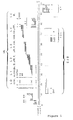
- Figure 1 is a schematic representation of the genome of the human adenovirus of type 5 (represented in arbitrary units from 0 to 100), indicating the location of the different genes.
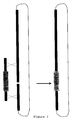
- Figure 2 illustrates an intermolecular recombination process between two DNA fragments.
- the plasmid sequences are represented by a thin line, the viral sequences with a bold line and the exogenous sequence with a hatched box.
- Figure 3 is a schematic representation of the corresponding pTG3614 vector to p polyll in which the genome of a recombinant adenovirus modified in the E1 region by insertion of an expression cassette for the human FIX gene.
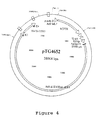
- Figure 4 is a schematic representation of the corresponding pTG4652 vector p polyII into which the genome of a modified recombinant adenovirus is cloned in the E1, E3 and E4 regions by insertion of an expression cassette for the human CF gene and partial deletions.
- the constructions described below are made according to the general techniques of genetic engineering and molecular biology detailed in Maniatis et al (1989, supra ).
- the protruding 5 ′ restriction sites can be converted into blunt sites by treatment with the large Klenow fragment of E.coli DNA polymerase, while the protruding 3 ′ sites are treated with T4 polymerase.
- the protocol as described in PCR Protocols-A guide to methods and applications (1990, ed Innis, Gelfand, Sninsky and White, Academic Press Inc) is applied.
- the cells are transfected by conventional methods and are cultured according to the supplier's recommendations.
- the fragments inserted into the different constructions described below are indicated precisely according to their position in the genome of Ad5 as disclosed in the Genebank database under reference M73260.
- EXAMPLE 1 Construction of a recombinant viral vector derived from an adenovirus human type 5 in the form of a bacterial plasmid
- the left end of the Ad5 genome (nucleotides 1 to 935) is synthesized by PCR using the oligonucleotide primers oTG6597 (SEQ ID NO: 1) and oTG6598 (SEQ ID NO: 2) The first hybridizes to 21 first nucleotides of ITR 5 ′ and presents a Pac I site, immediately upstream of the viral sequences, and an Eco RI site used for cloning.
- the second primer allows the introduction of the Sal I and then Bgl II sites downstream of the viral sequences
- the template used in this reaction is the genomic DNA of Ad5 prepared according to conventional methods
- the fragment thus amplified is digested with Eco RI and Bg III and it is cloned into the plasmid p polyII (Lathe et al., 1987. supra) previously cleaved by these same two restriction enzymes to obtain pTG1692.
- the DNA fragment corresponding to the right end of the Ad5 genome (nucleotides 35103 to 35935) is prepared according to the same principle using the pair of oligonucleotides oTG6599 (SEQ ID NO: 3) and oTG6597 (SEQ ID NO: 1).
- PTG1693 is constructed by inserting the amplified fragment digested with Eco RI and Bg / II into the same sites of p polyII.
- a Bg / II- Bam HI fragment carrying the amplified sequences is excised from pTG1693, so as to introduce it into the Bg / II site of pTG1692 downstream of the 5 'adenoviral sequences.
- the pTG3601 thus obtained is linearized between the left and right ends of the Ad5 genome by digestion with restriction enzymes Bg / II or Sal I.
- the ends thus generated are made blunt by the action of the klenow fragment of DNA polymerase I of E. coli .
- BJ5183 bacteria made competent by a treatment with calcium chloride are co-transformed with the preceding preparation and the genomic DNA of Ad5.
- the colonies obtained are analyzed by restriction mapping.
- a clone designated pTG3602 generated by homologous intermolecular recombination is selected in which the adenoviral sequences (nucleotides 936 to 35102) have been inserted between the two fragments produced by PCR, so as to generate a plasmid vector comprising the complete genome of Ad5 - pTG3602 is produced in C600 bacteria (Huynh et al., 1985 DNA cloning, Volume 1, ed. Glover, IRL Press Limited: Oxford, England p56-110).
- the viral genome is released by the action of the restriction enzyme Pac I.
- 293 cells cultivated in a monolayer are transfected with the product of this digestion by the calcium phosphate precipitation technique.
- Other sensitive cells can also be used, for example the A549 cells (ATCC CCL185).
- the cells are grown under agar for 9 to 14 days, a period during which the appearance of lysis plaques on the cell carpet testifies to the production of infectious viral particles and therefore, to the capacity of the Ad5 genome from pTG3602 to replicate.
- a plasmid is used in which the Lac Z reporter gene coding for ⁇ -galactosidase is placed in a viral context; for example a plasmid derived from pMLP-Adk7 (Stratford-Perricaudet and Perricaudet, 1991, Human Gene Transfer, 219, 51-61) comprising the 5 'sequences of Ad 5 (nucleotides 1 to 458), the promoter MLP Ad2, the Lac Z gene, the SV40 virus polyadenylation signal and the sequences Ad5 between nucleotides 3329 to 6241.
- pMLP-Adk7 Stratford-Perricaudet and Perricaudet, 1991, Human Gene Transfer, 219, 51-61
- Ad 5 nucleotides 1 to 458
- the promoter MLP Ad2 the Lac Z gene
- the SV40 virus polyadenylation signal the sequences Ad5 between nucleotides 3329 to 6241.
- the expression cassette for the Lac Z gene surrounded by adenoviral sequences is excised by the action of the restriction enzymes Bsr GI (position 192 on the Ad5 genome) and Pst I (position 3788) and then purified.
- PTG3602 is linearized at the Cla I site (position 918) and then treated with klenow.
- the two fragments obtained are co-transformed into competent BJ5183 bacteria. Recombination at the level of the homologous adenoviral sequences results in the replacement of the E1 region of Ad5 (nucleotides 459 to 3328) by the cassette for expression of the reporter gene in the plasmid pTG3603.
- An expression cassette for the gene coding for the protein gp19 of the E3 region of Ad5 is assembled in the bacteriophage M13mp18 (Gibco BRL) by cloning two PCR fragments, one corresponding to the 3 'LTR of RSV (Rous Sarcoma Virus) (oligonucleotide primers oTG5892-SEQ ID NO: 4 and 5893-SEQ ID NO: 5) and the other to the sequence coding for gp19 (oTG5455-SEQ ID NO: 6 and 5456-SEQ ID NO : 7).
- the vector M13TG1683 is obtained, the expression cassette of which is excised by Xba I digestion.
- pucl9 comprising the sequences of Ad5 extending from nucleotides 21562 to 35826.
- the pTG1697 thus obtained has adenoviral sequences which extend from the Bam HI site (position 21562) to the ITR 3 '(position 35935) in which the E3 region is replaced by a gp19 expression cassette under the control of the constitutive promoter RSV.
- the Dra I fragment (position 22444 and 35142 on the Ad5 genome) is purified, and co-introduced into the competent BJ-5183 bacteria with pTG3602 linearized by Spe I and treated with klenow.
- the recombinants carrying a recombinantly generated plasmid are screened for the presence of the RSV promoter.
- the pTG3605, plasmid vector carrying the genome of Ad-gp19 +, is thus highlighted.
- infectious viral genome power of the plasmid pTG3605 is tested according to the protocol already described above.
- the production of a functional gp19 protein is followed by co-immunoprecipitation of the antigens of the major histocompatibility complex of class I and the latter (Burgert and Kvist, 1985, Cell, 41 , 987-997).
- BJ-5183 cells are co-transformed with the Dra I fragment isolated from pTG1697 mentioned above and the Spe I fragment (Klenow) isolated from pTG3603. The resulting plasmid is tested under the same conditions as above.
- the cDNA encoding the human FIX was cloned as a Bam HI fragment in the plasmid pTG381. In the latter, the non-coding 5 ′ end of the FIX gene has been modified so as to comply with Kozak rules.
- the plasmid pTG381 is described in the publication of patent FR 2 600 334.
- the FIX gene is recloned in the Bam HI site of pTG6512, to give pTG4375.
- pTG6512 is derived from the vector pTG6511 after deletion of the major late promoter (MLP) of Ad2 and replacement with a polylinker. As an indication, the construction of pTG6511 is detailed in Example 1 of international application WO 94/28152.
- the murine PGK promoter is isolated by conventional methods from mouse genomic DNA according to Adra et al. (1987, Gene 60 , 65-74) or using suitable primers created from the sequence data disclosed in the Genebank database under the reference XI5339. Pst I restriction sites are included at the 5 'ends of the primers in order to facilitate the subsequent cloning steps.
- the fragment carrying the PGK promoter is treated with T4 polymerase and then introduced upstream of the human FIX gene into the Hpa I site of pTG4375, of which a so-called "replacement" fragment is excised by digestion Msc l comprising the FIX cassette surrounded by E1 adenoviral sequences. (185bp in 5 'and 2045bp in 3').
- the vector pTG9551 carrying the thermosensitive mutation is generated by homologous recombination in BJ cells between pTG3601 digested with Bg / II and the purified genomic DNA of the Ad5Hts 125 virus (Ensinger and Ginsberg, 1972, J. Virol. 10 , 328-339) .
- the genome thus reconstituted is released by Pac I digestion and transfected into 293 cells which are incubated at 32 ° C for the production of viral particles (the non-permissive temperature is 39 ° C).
- the E2A defect can also be generated by partial deletion of the coding regions of the DBP gene while avoiding the regions covering other reading frames.
- the construction is carried out by homologous recombination between pTG3601 Bg / II and the viral DNA prepared from the H5d1802 virus (Rice and Klessig, 1985, J. Virol. 56 , 767-778).
- the viruses can be produced in an appropriate complementation line trans-complementing the DBP function, for example the line, 293 transfected with a vector allowing the constitutive or regulated expression of the DBP gene.
- the adenoviral sequences covering the E3 and E4 regions are subcloned into the vector p poly II and deleted using conventional molecular biology techniques.
- the E3 sequences (positions 28592 to 30470) are eliminated by Xba I digestion and the E4 sequences (positions 32994 to 34998).
- the adenoviral genome thus modified is reconstituted by homologous recombination between a replacement fragment carrying these modifications isolated from the preceding vector and pTG3603 digested by Spe I.
- the expression cassettes of the CFTR and gp19 genes indicated above are introduced into pTG8595 in replacement of the Lac Z gene by co-transformation of the BJ5183 cells with the Pac I - Bst EII fragment isolated from pTG8585 and the vector pTG8595 linearized by Cla I PTG4652 (FIG. 4) is generated which can be propagated in a cell line complementing the defective E1 and E4 functions as described in international application WO94 / 28152.
- Viral particles are amplified, cells lysed and total cell extracts are analyzed for expression of the CFTR gene by Western blot (SDS-PAGE gel 8%). Filters are incubated in the presence of a 1/5000 dilution of the antibody monoclonal MAB 1104 directed against a synthetic peptide corresponding to acids amines 722 to 734 of the human CFTR protein. Detection is carried out by the ECL method (Enhanced ChemiLuminescence; Amersham kit). We observe in extracts of cells infected with AdTG4652 a band of high intensity and enough diffuse corresponding to a product of high molecular weight comigrant with a CFTR witness. This band is not present in the extracts from the parental virus pTG8595 which does not contain the CFTR expression cassette.
- EXAMPLE 2 Construction of a recombinant viral vector derived from Adenovirus canine 2 (CAV2) as a bacterial plasmid
- the CAV 2 genome is cloned into ppolyII Sfil-NotI 14 (Lathe et al., 1987, supra ) and modified to generate recombinant vectors using the appropriate sites according to the same methods as those used in the case of manipulation of Ad5.
- the left ends (nucleotides 1 to 810 according to the numbering of the sequence D04368 from Genebank) and the right ends (nucleotides ⁇ 27600 at the end) are synthesized by PCR between the pairs of oligonucleotide primers oTG6974 (SEQ ID NO: 8) and oTG6975 ( SEQ ID NO: 9) and oTG6976 (SEQ ID NO: 10) and oTG6974, respectively.
- Competent bacteria BJ5183 are co-transformed with the plasmid thus obtained linearized with Pst I and the DNA of CAV2.
- the introduction of the missing viral sequences is carried out by homologous recombination.
- the CAV2 genome carried by the resulting piasmide is excised via the Not I sites introduced during the PCR and then transfected into a monolayer of MDCK cells (ATCC CCL34). The following steps are described in Example 1.
- the genomic DNA of CAV2 virus (strain Toronto A 26/61; ATCC VR-800) is prepared by the conventional technique (amplification on renal dog line MDCK GHK ..., lysis of cells, purification of viruses by centrifugation on chloride cesium, treatment with proteinase k and finally phenol / chloroform extraction).
- the CAV2 genome which is 31 kbp in length, is introduced into a plasmid vector by homologous recombination. To do this, the left and right ends of the CAV2 genome are isolated by PCR and enzymatic digestion by incorporating a Not I site immediately beyond the 5 'and 3' ITRs.
- the vector pTG4457 is obtained by introduction into p poly II of the 5 'part of the viral genome to the Bst BI site (position 870) followed by the 3' part from the Sal I site (position 27800).
- the complete genome can be reconstituted by cotransformation between genomic DNA (100 to 500 ng) and pTG4457 digested with Bst BI (10 to 100 ng).
- the viral genome can be excised from the preceding vector pTG5406 by Not I digestion . It is checked that the DNA is infectious by transfection of 1 to 5 ⁇ g in the MDCK or GHK dog cells. We observe the production of beaches.
- the recombinant vector is obtained in the following way:
- CAV2 The left end of CAV2 is subcloned and modified so as to delete the coding sequences E1A in full and E1B in part. This is carried out by Nar I digestion and then reintroduction of a fragment amplified by PCR covering the packaging region, the promoter region. E1A and the transcription initiation site
- the primers are designed so as to also integrate a unique restriction site Xba I.
- pTG5407 into which the CAT or Lac Z gene (pTG5408) is introduced at the Xba I site.
- the latter is digested with Xho I and the 3 'part of the viral genome is inserted in the form of a Sal I fragment (position 27800 at the end of the 3' ITR).
- the vector pTG5409 thus obtained is linearized by Sal I and cotransformed in E. coli BJ5183 with the CAV-2 genome digested by Swa I.
- a canine adenoviral vector is obtained carrying the CAT reporter gene in place of the E1 region.
Landscapes
- Health & Medical Sciences (AREA)
- Life Sciences & Earth Sciences (AREA)
- Chemical & Material Sciences (AREA)
- Engineering & Computer Science (AREA)
- Genetics & Genomics (AREA)
- Organic Chemistry (AREA)
- Bioinformatics & Cheminformatics (AREA)
- Zoology (AREA)
- Wood Science & Technology (AREA)
- Biotechnology (AREA)
- Biomedical Technology (AREA)
- General Engineering & Computer Science (AREA)
- General Health & Medical Sciences (AREA)
- Virology (AREA)
- Microbiology (AREA)
- Medicinal Chemistry (AREA)
- Biochemistry (AREA)
- Molecular Biology (AREA)
- Pharmacology & Pharmacy (AREA)
- Biophysics (AREA)
- Veterinary Medicine (AREA)
- Plant Pathology (AREA)
- Public Health (AREA)
- Physics & Mathematics (AREA)
- Animal Behavior & Ethology (AREA)
- Chemical Kinetics & Catalysis (AREA)
- General Chemical & Material Sciences (AREA)
- Nuclear Medicine, Radiotherapy & Molecular Imaging (AREA)
- Communicable Diseases (AREA)
- Oncology (AREA)
- Crystallography & Structural Chemistry (AREA)
- Immunology (AREA)
- Diabetes (AREA)
- Hematology (AREA)
- Micro-Organisms Or Cultivation Processes Thereof (AREA)
- Medicines Containing Material From Animals Or Micro-Organisms (AREA)
- Medicines That Contain Protein Lipid Enzymes And Other Medicines (AREA)
- Pharmaceuticals Containing Other Organic And Inorganic Compounds (AREA)
- Medicines Containing Antibodies Or Antigens For Use As Internal Diagnostic Agents (AREA)
- Saccharide Compounds (AREA)
Claims (18)
- verfahren zur Herstellung eines rekombinanten viralen Vektors von mindestens 20 kb in einer prokaryotischen Zelle, wobei der Vektor von einem Stammvirus abgeleitet wird, in dessen Genom durch intermolekulare Rekombination zwischen (i) einem ersten DNA-Fragment, welches das gesamte oder einen Teil des Genoms des Virus umfasst, und (ii) einem zweiten DNA-Fragment, welches eine exogene DNA-Sequenz, die von den zu (i) homologen, flankierenden Sequenzen A und B eingerahmt wird, umfasst, eine exogene DNA-Sequenz eingefügt wird.
- Verfahren gemäß Anspruch 1, dadurch gekennzeichnet, dass es sich bei dem Stammvirus um ein Adenovirus, Retrovirus, ein mit dem Adenovirus verwandtes Virus, ein Pockenvirus oder ein Herpesvirus handelt.
- Verfahren gemäß Anspruch 2, dadurch gekennzeichnet, dass es sich bei dem Stammvirus um ein menschliches, ein Hunde-, Vogel-, Rinder-, Maus-, Schafs-, Schweine- oder Affenadenovirus oder ein hybrides Adenovirus handelt.
- Verfahren gemäß Anspruch 3, dadurch gekennzeichnet, dass das Stammvirus ein Hundevirus des CAV-2-Typs ist.
- Verfahren gemäß Anspruch 3, dadurch gekennzeichnet, dass das Stammvirus ein humanes Adenovirus des Serotyps C ist.
- Verfahren gemäß Anspruch 5, dadurch gekennzeichnet, dass das Stammvirus ein humanes Adenovirus des Typs 5 ist.
- Verfahren nach einem der Ansprüche 1 bis 6, dadurch gekennzeichnet, dass die exogene DNA-Sequenz für ein Polypeptid von therapeutischem Interesse aus der Gruppe der Koagulationsfaktoren, Wachstumshormone, Zytokine, Lymphokine, tumorsuppressiven Polypeptide, zellulären Rezeptoren, zellulären Rezeptorliganden, Proteaseinhibitoren, Antikörper, Toxine, Immunotoxine, Dystrophine oder Polypeptide, die in die zellulären Ionenkanäle eingreifen, wie das CFTR-Protein, kodiert.
- Verfahren nach einem der Ansprüche 1 bis 7, dadurch gekennzeichnet, dass die homologen, flankierenden Sequenzen A und B eine Länge von 10 bp bis 10 kb, vorteilhafterweise von 20 bp bis 5 kb, bevorzugt von 30 bp bis 2 kb, und besonders bevorzugt von 40 bp bis 1 kb aufweisen.
- Verfahren nach einem der Ansprüche 1 bis 8, dadurch gekennzeichnet, dass das erste DNA-Fragment auf Höhe des Insertionsbereichs der exogenen Sequenz linearisiert ist.
- Verfahren nach einem der Ansprüche 1 bis 9 zur Herstellung eines rekombinanten viralen Vektörs, der für die Replikation defektiv ist.
- Verfahren gemäß Anspruch 10 zur Herstellung eines rekombinanten adenoviralen Vektors, dem die gesamte oder ein Teil wenigstens eines für die Replikation essentiellen Bereichs E1, E2 und/oder E4 fehlt.
- Verfahren gemäß Anspruch 11, dadurch gekennzeichnet, dass dem rekombinanten adenoviralen Vektor außerdem ein Teil oder der gesamte Bereich E3 fehlt.
- Verfahren nach einem der Ansprüche 1 bis 12 zur Herstellung eines rekombinanten viralen Vektors von wenigstens 30 kb.
- Verfahren nach den Ansprüchen 1 bis 13 durch intermolekulare Rekombination zwischen (i) einem ersten DNA-Fragment, welches das gesamte oder einen Teil des Genoms des Stammvirus umfasst, (ii) einem zweiten DNA-Fragment, welches einen ersten Teil der DNA-Sequenz von Interesse, welche an ihrem 5'-Ende mit der flankierenden Sequenz A versehen ist, enthält, und (iii) einem dritten DNA-Fragment, welches einen zweiten Teil der DNA-Sequenz von Interesse, welche an ihrem 3'-Ende mit der flankierenden Sequenz B versehen ist, enthält, wobei die zweiten und dritten DNA-Fragmente an ihren jeweiligen 3'-und 5'-Enden eine homologe Sequenz aufweisen.
- Verfahren nach einem der Ansprüche 1 bis 14 zum Einführen einer Modifikation durch Deletion, Mutation und/oder Substitution eines oder mehrerer Nukleotide oder einer exogenen DNA-Sequenz in ein virales Genom.
- Verfahren nach einem der Ansprüche 1 bis 15, dadurch gekennzeichnet, dass die prokaryotische Zelle von einem Escherichia coli recBc sbcBc-Stamm herrührt.
- Verfahren zur Herstellung eines infektiösen viralen Partikels, welches einen rekombinanten viralen Vektor enthält, der durch Anwendung eines Verfahrens gemäß einem der Ansprüche 1 bis 16 erhalten wurde, wobei man(a) den rekombinanten viralen Vektor in eine Säugetierzelle einführt, um eine transfizierte Säugetierzelle zu erzeugen,(b) die transfizierte Säugetierzelle unter geeigneten Bedingungen kultiviert, um die Produktion des viralen Partikels zu ermöglichen,(c) das virale Partikel aus der in Stufe (b) erhaltenen Zellkultur gewinnt.
- Verwendung eines E. coli recBC sbcBC-Stammes zur Klonierung von DNA-Fragmenten in einen Vektor gemäß Anspruch 1 durch intermolekulare homologe Rekombination.
Applications Claiming Priority (3)
| Application Number | Priority Date | Filing Date | Title |
|---|---|---|---|
| FR9414470A FR2727689A1 (fr) | 1994-12-01 | 1994-12-01 | Nouveau procede de preparation d'un vecteur viral |
| FR9414470 | 1994-12-01 | ||
| PCT/FR1995/001590 WO1996017070A1 (fr) | 1994-12-01 | 1995-12-01 | Procede de preparation d'un vecteur viral par recombinaison homologue intermoleculaire |
Publications (4)
| Publication Number | Publication Date |
|---|---|
| EP0742834A1 EP0742834A1 (de) | 1996-11-20 |
| EP0742834B1 true EP0742834B1 (de) | 2000-09-20 |
| EP0742834B2 EP0742834B2 (de) | 2005-08-03 |
| EP0742834B9 EP0742834B9 (de) | 2005-12-28 |
Family
ID=9469390
Family Applications (1)
| Application Number | Title | Priority Date | Filing Date |
|---|---|---|---|
| EP95941755A Expired - Lifetime EP0742834B9 (de) | 1994-12-01 | 1995-12-01 | Verfahren zur herstellung von viralen vektoren von mindestens 20kb durch intermolekulare homologe rekombination in einer prokaryotischen zelle |
Country Status (13)
| Country | Link |
|---|---|
| US (3) | US6110735A (de) |
| EP (1) | EP0742834B9 (de) |
| JP (1) | JP3989541B2 (de) |
| AT (1) | ATE196507T1 (de) |
| AU (1) | AU707208B2 (de) |
| CA (1) | CA2182303C (de) |
| DE (2) | DE69518910T3 (de) |
| DK (1) | DK0742834T4 (de) |
| ES (1) | ES2150595T5 (de) |
| FR (1) | FR2727689A1 (de) |
| GR (1) | GR3035050T3 (de) |
| PT (1) | PT742834E (de) |
| WO (1) | WO1996017070A1 (de) |
Families Citing this family (72)
| Publication number | Priority date | Publication date | Assignee | Title |
|---|---|---|---|---|
| FR2727689A1 (fr) * | 1994-12-01 | 1996-06-07 | Transgene Sa | Nouveau procede de preparation d'un vecteur viral |
| FR2730504B1 (fr) * | 1995-02-13 | 1997-03-28 | Rhone Poulenc Rorer Sa | Procede de preparation de genomes d'adenovirus recombinants |
| US6720140B1 (en) * | 1995-06-07 | 2004-04-13 | Invitrogen Corporation | Recombinational cloning using engineered recombination sites |
| US6143557A (en) * | 1995-06-07 | 2000-11-07 | Life Technologies, Inc. | Recombination cloning using engineered recombination sites |
| FR2761689B1 (fr) | 1997-04-02 | 1999-06-25 | Transgene Sa | Fibre adenovirale modifiee et adenovirus cibles |
| AU8067698A (en) * | 1997-06-09 | 1998-12-30 | Genvec, Inc. | Chimeric vectors comprising a phage packaging site and a portion derived from a genome of a eukaryotic virus |
| FR2766091A1 (fr) | 1997-07-18 | 1999-01-22 | Transgene Sa | Composition antitumorale a base de polypeptide immunogene de localisation cellulaire modifiee |
| WO1999015686A1 (en) | 1997-09-23 | 1999-04-01 | Genvec, Inc. | Plasmids for construction of eukaryotic viral vectors |
| CN101125873A (zh) * | 1997-10-24 | 2008-02-20 | 茵维特罗根公司 | 利用具重组位点的核酸进行重组克隆 |
| DE69836092T2 (de) * | 1997-10-24 | 2007-05-10 | Invitrogen Corp., Carlsbad | Rekombinatorisches klonieren unter verwendung von nukleinsaüren mit rekombinationsstellen |
| US5922576A (en) * | 1998-02-27 | 1999-07-13 | The John Hopkins University | Simplified system for generating recombinant adenoviruses |
| US6670188B1 (en) * | 1998-04-24 | 2003-12-30 | Crucell Holland B.V. | Packaging systems for human recombinant adenovirus to be used in gene therapy |
| US6413776B1 (en) | 1998-06-12 | 2002-07-02 | Galapagos Geonomics N.V. | High throughput screening of gene function using adenoviral libraries for functional genomics applications |
| US7691370B2 (en) * | 1998-10-15 | 2010-04-06 | Canji, Inc. | Selectivity replicating viral vector |
| DE60042969D1 (de) * | 1999-03-02 | 2009-10-29 | Life Technologies Corp | Zubereitungen und methoden zur verwendung in rekombinatorischem klonen von nukleinsäuren |
| EP1248851A2 (de) * | 1999-12-07 | 2002-10-16 | Genethon III | Fuer den transfer in zielzellen bestimmte vektoren, die von dem genom von hunde-adenoviren abgeleitet sind |
| ATE391789T1 (de) * | 1999-12-10 | 2008-04-15 | Invitrogen Corp | Verwendung einer vielzahl von rekombinationsstellen mit einzigartiger spezifität beim rekombinatorischen klonen |
| ES2394877T3 (es) * | 2000-08-14 | 2013-02-06 | The Government Of The United States Of America As Represented By The Secretary Of The Department Of Health And Human Services | Recombinación homóloga mejorada mediada por proteínas de recombinación de lambda |
| US7198924B2 (en) * | 2000-12-11 | 2007-04-03 | Invitrogen Corporation | Methods and compositions for synthesis of nucleic acid molecules using multiple recognition sites |
| GB0027501D0 (en) * | 2000-11-10 | 2000-12-27 | Astrazeneca Ab | Vector |
| JP2004513638A (ja) * | 2000-11-10 | 2004-05-13 | アストラゼネカ・アクチエボラーグ | ベクター |
| US8071314B2 (en) * | 2001-12-14 | 2011-12-06 | President And Fellows Of Harvard College | Immunocellular receptors related to neurological disorders and therapeutic uses thereof |
| US7521242B2 (en) * | 2003-05-09 | 2009-04-21 | The United States Of America As Represented By The Department Of Health And Human Services | Host cells deficient for mismatch repair and their use in methods for inducing homologous recombination using single-stranded nucleic acids |
| CN103484486B (zh) * | 2003-07-02 | 2018-04-24 | 维莱尼姆公司 | 葡聚糖酶,编码它们的核酸以及制备和使用它们的方法 |
| ES2356154T3 (es) | 2003-07-21 | 2011-04-05 | Transgene S.A. | Citoquinas multifuncionales. |
| DK1649023T3 (da) | 2003-07-21 | 2008-10-06 | Transgene Sa | Polypeptid med forbedret cytosindeaminaseaktivitet |
| DE602004027538D1 (de) | 2003-12-01 | 2010-07-15 | Life Technologies Corp | Rekombinationsstellen enthaltende nukleinsäuremoleküle und verfahren zur verwendung davon |
| US7674621B2 (en) | 2004-05-21 | 2010-03-09 | The United States Of America As Represented By The Department Of Health And Human Services | Plasmids and phages for homologous recombination and methods of use |
| US20060234347A1 (en) * | 2005-04-13 | 2006-10-19 | Harding Thomas C | Targeting multiple angiogenic pathways for cancer therapy using soluble tyrosine kinase receptors |
| US20090181078A1 (en) | 2006-09-26 | 2009-07-16 | Infectious Disease Research Institute | Vaccine composition containing synthetic adjuvant |
| EP2468300B1 (de) | 2006-09-26 | 2017-12-20 | Infectious Disease Research Institute | Impfstoffzusammensetzung mit einem synthetischen Adjuvans |
| CL2008000249A1 (es) | 2007-01-30 | 2008-05-30 | Transgene Sa | Uso de una molecula de acido nucleico que codifica al menos un polipeptido e2 del papilomavirus, un vector o una particula virica infecciosa que la comprenda para tratar una infeccion permanente por papilomavirus causada por al menos un papilomavirus |
| US8470977B2 (en) | 2008-03-14 | 2013-06-25 | Transgene S.A. | Antibody against the CSF-1R |
| CA2744294A1 (en) | 2009-01-13 | 2010-07-22 | Transgene Sa | Use of a saccharomyces cerevisiae mitochondrial nucleic acids fraction for immune stimulation |
| PT2382474E (pt) | 2009-01-20 | 2015-06-03 | Transgene Sa | Icam-1 solúvel como biomarcador para a previsão de uma resposta terapêutica |
| BRPI1009892A2 (pt) | 2009-03-24 | 2016-03-15 | Transgène S A | método ex-vivo para avaliar a eficácia de um tratamento em um paciente, e, kit para testar se um paciente está respondendo terapeuticamente a um método de tratamento compreendendo administração de uma composição imunogênica |
| BRPI1010512A2 (pt) | 2009-04-17 | 2016-03-15 | Transgène S A | "método ex vivo para avaliar a eficácia de um tratamento envolvendo a administração de uma composição imunogênica a um paciente, e, uso de níveis de linfócitos t ativados (cd3 + cd69+) como um biomarcador" |
| CA2764374C (en) | 2009-06-05 | 2019-11-19 | Infectious Disease Research Institute | Synthetic glucopyranosyl lipid adjuvants |
| US20110015256A1 (en) * | 2009-07-16 | 2011-01-20 | Ihab Mamdouh Ishak Sadek | Delivery of restriction endonucleases to treat hiv, cancer, and other medical conditions |
| CA2770075C (en) | 2009-08-07 | 2021-08-24 | Perrine Martin | Composition for treating hbv infection |
| NZ616304A (en) | 2011-04-08 | 2016-01-29 | Immune Design Corp | Immunogenic compositions and methods of using the compositions for inducing humoral and cellular immune responses |
| PL2811981T3 (pl) | 2012-02-07 | 2019-09-30 | Infectious Disease Research Institute | Ulepszone formulacje adiuwantowe zawierające agonistę TLR4 oraz sposoby ich zastosowania |
| SMT201800368T1 (it) | 2012-05-16 | 2018-09-13 | Immune Design Corp | Vaccini per l'infezione da virus-2 herpes simplex |
| JP6430949B2 (ja) | 2012-10-23 | 2018-11-28 | エモリー ユニバーシティ | Gm−csfとil−4のコンジュゲート、組成物、ならびにそれに関連する方法 |
| CA2909221A1 (en) | 2013-04-18 | 2014-10-23 | Immune Design Corp. | Gla monotherapy for use in cancer treatment |
| US9463198B2 (en) | 2013-06-04 | 2016-10-11 | Infectious Disease Research Institute | Compositions and methods for reducing or preventing metastasis |
| CA2975432A1 (en) | 2015-02-13 | 2016-08-18 | Transgene Sa | Immunotherapeutic vaccine and antibody combination therapy |
| CA3023022A1 (en) | 2016-05-04 | 2017-11-09 | Transgene Sa | Combination therapy with cpg tlr9 ligand |
| RU2761870C2 (ru) | 2016-05-16 | 2021-12-13 | Инфекшес Дизис Рисёрч Инститьют | Состав, содержащий агонист tlr, и способы применения |
| EP3463300A1 (de) | 2016-06-01 | 2019-04-10 | Infectious Disease Research Institute | Nanoalum-partikel mit einem leimungsmittel |
| MX2019003161A (es) | 2016-09-20 | 2019-05-27 | Boehringer Ingelheim Vetmedica Gmbh | Nuevo sitio de insercion orf70 de ehv. |
| UY37408A (es) | 2016-09-20 | 2018-03-23 | Boehringer Ingelheim Vetmedica Gmbh | Vacuna de vectores contra el virus de la gripe “a” porcina |
| ES2956050T3 (es) | 2016-09-20 | 2023-12-12 | Boehringer Ingelheim Vetmedica Gmbh | Vectores de adenovirus caninos |
| MX391049B (es) | 2016-09-20 | 2025-03-21 | Boehringer Ingelheim Vetmedica Gmbh | Nuevos promotores |
| WO2018069316A2 (en) | 2016-10-10 | 2018-04-19 | Transgene Sa | Immunotherapeutic product and mdsc modulator combination therapy |
| CN110418650A (zh) | 2016-11-16 | 2019-11-05 | 免疫治疗有限公司 | 用于治疗过敏的核酸 |
| EP3612556B8 (de) | 2017-04-22 | 2024-11-20 | Immunomic Therapeutics, Inc. | Verbesserte lamp konstrukte |
| WO2018204534A1 (en) | 2017-05-02 | 2018-11-08 | Immunomic Therapeutics, Inc. | Lamp (lysosomal associated membrane protein) constructs comprising cancer antigens |
| EP3678695A1 (de) | 2017-09-08 | 2020-07-15 | Infectious Disease Research Institute | Liposomale formulierungen enthaltend saponin und verwendungsverfahren |
| JP2021523185A (ja) | 2018-05-15 | 2021-09-02 | イミュノミック セラピューティックス, インコーポレイテッドImmunomic Therapeutics, Inc. | アレルゲンを含む改善されたlamp構築物 |
| TWI852977B (zh) | 2019-01-10 | 2024-08-21 | 美商健生生物科技公司 | 前列腺新抗原及其用途 |
| US12680122B2 (en) | 2019-10-08 | 2026-07-14 | Trustees Of Boston College | Proteins containing multiple, different unnatural amino acids and methods of making and using such proteins |
| KR20220083773A (ko) | 2019-10-18 | 2022-06-20 | 이뮤노믹 쎄라퓨틱스, 인크. | 암 항원을 포함하는 개선된 lamp 구축물 |
| EP4061405A1 (de) | 2019-11-18 | 2022-09-28 | Janssen Biotech, Inc. | Impfstoffe auf der basis von mutantem calr und jak2 und deren verwendungen |
| TW202144388A (zh) | 2020-02-14 | 2021-12-01 | 美商健生生物科技公司 | 在卵巢癌中表現之新抗原及其用途 |
| TW202144389A (zh) | 2020-02-14 | 2021-12-01 | 美商健生生物科技公司 | 在多發性骨髓瘤中表現之新抗原及其用途 |
| JP2023517011A (ja) | 2020-03-05 | 2023-04-21 | ネオティーエックス セラピューティクス リミテッド | 免疫細胞を用いて癌を治療するための方法および組成物 |
| WO2021209897A1 (en) | 2020-04-13 | 2021-10-21 | Janssen Biotech, Inc. | Psma and steap1 vaccines and their uses |
| EP4175664A2 (de) | 2020-07-06 | 2023-05-10 | Janssen Biotech, Inc. | Prostata-neoantigene und ihre verwendungen |
| WO2022009049A1 (en) | 2020-07-06 | 2022-01-13 | Janssen Biotech, Inc. | Prostate neoantigens and their uses |
| WO2022009051A1 (en) | 2020-07-06 | 2022-01-13 | Janssen Biotech, Inc. | A method for determining responsiveness to prostate cancer treatment |
| CA3247515A1 (en) | 2022-04-10 | 2023-10-19 | Immunomic Therapeutics, Inc. | Bicistronic lamp constructions comprising genes that enhance the immune response and methods of their use |
Family Cites Families (6)
| Publication number | Priority date | Publication date | Assignee | Title |
|---|---|---|---|---|
| US5585362A (en) | 1989-08-22 | 1996-12-17 | The Regents Of The University Of Michigan | Adenovirus vectors for gene therapy |
| GB9001766D0 (en) * | 1990-01-25 | 1990-03-28 | Univ Court Of The University O | Vaccines |
| FR2705361B1 (fr) | 1993-05-18 | 1995-08-04 | Centre Nat Rech Scient | Vecteurs viraux et utilisation en thérapie génique. |
| WO1995003400A1 (en) * | 1993-07-23 | 1995-02-02 | Johns Hopkins University School Of Medicine | Recombinationally targeted cloning in yeast artificial chromosomes |
| FR2727689A1 (fr) * | 1994-12-01 | 1996-06-07 | Transgene Sa | Nouveau procede de preparation d'un vecteur viral |
| US5582362A (en) * | 1995-03-31 | 1996-12-10 | Johnson; John R. | Center feed toilet paper dispenser |
-
1994
- 1994-12-01 FR FR9414470A patent/FR2727689A1/fr active Granted
-
1995
- 1995-12-01 EP EP95941755A patent/EP0742834B9/de not_active Expired - Lifetime
- 1995-12-01 AT AT95941755T patent/ATE196507T1/de active
- 1995-12-01 DK DK95941755T patent/DK0742834T4/da active
- 1995-12-01 ES ES95941755T patent/ES2150595T5/es not_active Expired - Lifetime
- 1995-12-01 DE DE69518910T patent/DE69518910T3/de not_active Expired - Lifetime
- 1995-12-01 WO PCT/FR1995/001590 patent/WO1996017070A1/fr not_active Ceased
- 1995-12-01 AU AU43068/96A patent/AU707208B2/en not_active Expired
- 1995-12-01 JP JP51834696A patent/JP3989541B2/ja not_active Expired - Lifetime
- 1995-12-01 CA CA002182303A patent/CA2182303C/fr not_active Expired - Lifetime
- 1995-12-01 US US08/682,794 patent/US6110735A/en not_active Expired - Lifetime
- 1995-12-01 DE DE69518910A patent/DE69518910D1/de not_active Expired - Lifetime
- 1995-12-01 PT PT95941755T patent/PT742834E/pt unknown
-
1999
- 1999-12-21 US US09/467,952 patent/US6281000B1/en not_active Expired - Lifetime
-
2000
- 2000-12-12 GR GR20000402737T patent/GR3035050T3/el unknown
-
2001
- 2001-08-27 US US09/938,491 patent/US7067310B2/en not_active Expired - Lifetime
Non-Patent Citations (1)
| Title |
|---|
| NUCLEIC ACIDS RESEARCH, vol. 21, n°22, 1993 pages 5192-5197, OLINER, J.D. ET AL.'In vivo cloining of PCR products in E. coli' * |
Also Published As
| Publication number | Publication date |
|---|---|
| CA2182303C (fr) | 2005-06-21 |
| DK0742834T3 (da) | 2001-01-29 |
| ATE196507T1 (de) | 2000-10-15 |
| DE69518910T4 (de) | 2006-02-09 |
| US6110735A (en) | 2000-08-29 |
| FR2727689B1 (de) | 1997-02-28 |
| EP0742834B2 (de) | 2005-08-03 |
| DE69518910D1 (de) | 2000-10-26 |
| AU707208B2 (en) | 1999-07-08 |
| EP0742834A1 (de) | 1996-11-20 |
| DK0742834T4 (da) | 2005-08-22 |
| CA2182303A1 (fr) | 1996-06-06 |
| WO1996017070A1 (fr) | 1996-06-06 |
| ES2150595T3 (es) | 2000-12-01 |
| US20020090715A1 (en) | 2002-07-11 |
| AU4306896A (en) | 1996-06-19 |
| PT742834E (pt) | 2001-03-30 |
| JPH09509330A (ja) | 1997-09-22 |
| FR2727689A1 (fr) | 1996-06-07 |
| EP0742834B9 (de) | 2005-12-28 |
| ES2150595T5 (es) | 2005-12-01 |
| GR3035050T3 (en) | 2001-03-30 |
| US7067310B2 (en) | 2006-06-27 |
| DE69518910T2 (de) | 2001-03-29 |
| US6281000B1 (en) | 2001-08-28 |
| JP3989541B2 (ja) | 2007-10-10 |
| DE69518910T3 (de) | 2006-07-13 |
Similar Documents
| Publication | Publication Date | Title |
|---|---|---|
| EP0742834B2 (de) | Verfahren zur herstellung von viralen vektoren von mindestens 20kb durch intermolekulare homologe rekombination in einer prokaryotischen zelle | |
| EP0784693B1 (de) | Virale vektoren für die gentherapie | |
| EP0919627B1 (de) | Neue Komplementations-Zelllinien für defekte adenovirale Vektoren | |
| EP0842279B1 (de) | Hilfsvirus für die herstellung von rekombinanten virusvektoren | |
| EP1016711B1 (de) | Verfahren zur Inaktivierung vom umhüllten Viren in einem Viruspräparat mit Adenoviren | |
| EP1032695B1 (de) | Adenovirale vektoren und eine methode zur reduktion von homologer rekombination | |
| WO1995026411A2 (en) | Composition and methods for creating syngeneic recombinant virus-producing cells | |
| EP0988391B1 (de) | Rekombinante adenovirale vektoren, die eine spleissequenz enthalten | |
| EP1002120B1 (de) | Chimäre adenovirale vektoren | |
| FR2748753A1 (fr) | Nouveaux vecteurs adenoviraux pour la therapie genique | |
| FR2737221A1 (fr) | Nouveaux vecteurs viraux pour la therapie genique |
Legal Events
| Date | Code | Title | Description |
|---|---|---|---|
| PUAI | Public reference made under article 153(3) epc to a published international application that has entered the european phase |
Free format text: ORIGINAL CODE: 0009012 |
|
| AK | Designated contracting states |
Kind code of ref document: A1 Designated state(s): AT BE CH DE DK ES FR GB GR IE IT LI LU MC NL PT SE |
|
| 17P | Request for examination filed |
Effective date: 19961202 |
|
| 17Q | First examination report despatched |
Effective date: 19990701 |
|
| GRAG | Despatch of communication of intention to grant |
Free format text: ORIGINAL CODE: EPIDOS AGRA |
|
| GRAG | Despatch of communication of intention to grant |
Free format text: ORIGINAL CODE: EPIDOS AGRA |
|
| GRAH | Despatch of communication of intention to grant a patent |
Free format text: ORIGINAL CODE: EPIDOS IGRA |
|
| GRAH | Despatch of communication of intention to grant a patent |
Free format text: ORIGINAL CODE: EPIDOS IGRA |
|
| RTI1 | Title (correction) |
Free format text: METHOD OF PREPARING A VIRAL VECTOR OF AT LEAST 20KB BY INTERMOLECULAR RECOMBINATION IN A PROCARYOTIC CELL |
|
| GRAA | (expected) grant |
Free format text: ORIGINAL CODE: 0009210 |
|
| AK | Designated contracting states |
Kind code of ref document: B1 Designated state(s): AT BE CH DE DK ES FR GB GR IE IT LI LU MC NL PT SE |
|
| REF | Corresponds to: |
Ref document number: 196507 Country of ref document: AT Date of ref document: 20001015 Kind code of ref document: T |
|
| REG | Reference to a national code |
Ref country code: CH Ref legal event code: NV Representative=s name: MICHELI & CIE INGENIEURS-CONSEILS Ref country code: CH Ref legal event code: EP |
|
| REF | Corresponds to: |
Ref document number: 69518910 Country of ref document: DE Date of ref document: 20001026 |
|
| REG | Reference to a national code |
Ref country code: IE Ref legal event code: FG4D Free format text: FRENCH |
|
| ITF | It: translation for a ep patent filed | ||
| REG | Reference to a national code |
Ref country code: ES Ref legal event code: FG2A Ref document number: 2150595 Country of ref document: ES Kind code of ref document: T3 |
|
| GBT | Gb: translation of ep patent filed (gb section 77(6)(a)/1977) |
Effective date: 20001110 |
|
| REG | Reference to a national code |
Ref country code: DK Ref legal event code: T3 |
|
| REG | Reference to a national code |
Ref country code: PT Ref legal event code: SC4A Free format text: AVAILABILITY OF NATIONAL TRANSLATION Effective date: 20001212 |
|
| PLBE | No opposition filed within time limit |
Free format text: ORIGINAL CODE: 0009261 |
|
| PLBQ | Unpublished change to opponent data |
Free format text: ORIGINAL CODE: EPIDOS OPPO |
|
| PLAA | Information modified related to event that no opposition was filed |
Free format text: ORIGINAL CODE: 0009299DELT |
|
| PLBI | Opposition filed |
Free format text: ORIGINAL CODE: 0009260 |
|
| 26N | No opposition filed | ||
| 26 | Opposition filed |
Opponent name: NOVARTIS AG PATENT AND TRADEMARK DEPT. Effective date: 20010620 |
|
| D26N | No opposition filed (deleted) | ||
| PLBF | Reply of patent proprietor to notice(s) of opposition |
Free format text: ORIGINAL CODE: EPIDOS OBSO |
|
| NLR1 | Nl: opposition has been filed with the epo |
Opponent name: NOVARTIS AG PATENT AND TRADEMARK DEPT. |
|
| REG | Reference to a national code |
Ref country code: GB Ref legal event code: IF02 |
|
| PLBF | Reply of patent proprietor to notice(s) of opposition |
Free format text: ORIGINAL CODE: EPIDOS OBSO |
|
| PLBF | Reply of patent proprietor to notice(s) of opposition |
Free format text: ORIGINAL CODE: EPIDOS OBSO |
|
| RDAH | Patent revoked |
Free format text: ORIGINAL CODE: EPIDOS REVO |
|
| RTI2 | Title (correction) |
Free format text: METHOD OF PREPARING A VIRAL VECTOR OF AT LEAST 20KB BY INTERMOLECULAR RECOMBINATION IN A PROCARYOTIC CELL |
|
| APAC | Appeal dossier modified |
Free format text: ORIGINAL CODE: EPIDOS NOAPO |
|
| APBQ | Date of receipt of statement of grounds of appeal recorded |
Free format text: ORIGINAL CODE: EPIDOSNNOA3O |
|
| APBU | Appeal procedure closed |
Free format text: ORIGINAL CODE: EPIDOSNNOA9O |
|
| APAA | Appeal reference recorded |
Free format text: ORIGINAL CODE: EPIDOS REFN |
|
| PUAH | Patent maintained in amended form |
Free format text: ORIGINAL CODE: 0009272 |
|
| STAA | Information on the status of an ep patent application or granted ep patent |
Free format text: STATUS: PATENT MAINTAINED AS AMENDED |
|
| 27A | Patent maintained in amended form |
Effective date: 20050803 |
|
| AK | Designated contracting states |
Kind code of ref document: B2 Designated state(s): AT BE CH DE DK ES FR GB GR IE IT LI LU MC NL PT SE |
|
| REG | Reference to a national code |
Ref country code: DK Ref legal event code: T4 |
|
| REG | Reference to a national code |
Ref country code: CH Ref legal event code: AEN Free format text: MAINTIEN DU BREVET DONT L'ETENDUE A ETE MODIFIEE |
|
| NLR2 | Nl: decision of opposition |
Effective date: 20050803 |
|
| APAH | Appeal reference modified |
Free format text: ORIGINAL CODE: EPIDOSCREFNO |
|
| REG | Reference to a national code |
Ref country code: SE Ref legal event code: RPEO |
|
| GBTA | Gb: translation of amended ep patent filed (gb section 77(6)(b)/1977) | ||
| REG | Reference to a national code |
Ref country code: ES Ref legal event code: DC2A Date of ref document: 20050822 Kind code of ref document: T5 |
|
| REG | Reference to a national code |
Ref country code: GR Ref legal event code: EP Ref document number: 20050403209 Country of ref document: GR |
|
| NLR3 | Nl: receipt of modified translations in the netherlands language after an opposition procedure | ||
| REG | Reference to a national code |
Ref country code: DE Ref legal event code: R082 Ref document number: 69518910 Country of ref document: DE Representative=s name: KILIAN KILIAN & PARTNER, DE |
|
| PGFP | Annual fee paid to national office [announced via postgrant information from national office to epo] |
Ref country code: LU Payment date: 20141118 Year of fee payment: 20 Ref country code: DK Payment date: 20141117 Year of fee payment: 20 |
|
| PGFP | Annual fee paid to national office [announced via postgrant information from national office to epo] |
Ref country code: SE Payment date: 20141230 Year of fee payment: 20 Ref country code: GB Payment date: 20141218 Year of fee payment: 20 Ref country code: IE Payment date: 20141118 Year of fee payment: 20 Ref country code: ES Payment date: 20141224 Year of fee payment: 20 Ref country code: MC Payment date: 20141118 Year of fee payment: 20 Ref country code: GR Payment date: 20141125 Year of fee payment: 20 Ref country code: CH Payment date: 20141215 Year of fee payment: 20 |
|
| PGFP | Annual fee paid to national office [announced via postgrant information from national office to epo] |
Ref country code: NL Payment date: 20141123 Year of fee payment: 20 Ref country code: PT Payment date: 20141117 Year of fee payment: 20 Ref country code: AT Payment date: 20141117 Year of fee payment: 20 |
|
| PGFP | Annual fee paid to national office [announced via postgrant information from national office to epo] |
Ref country code: DE Payment date: 20141211 Year of fee payment: 20 Ref country code: IT Payment date: 20141223 Year of fee payment: 20 |
|
| PGFP | Annual fee paid to national office [announced via postgrant information from national office to epo] |
Ref country code: FR Payment date: 20141215 Year of fee payment: 20 |
|
| PGFP | Annual fee paid to national office [announced via postgrant information from national office to epo] |
Ref country code: BE Payment date: 20141230 Year of fee payment: 20 |
|
| REG | Reference to a national code |
Ref country code: DE Ref legal event code: R071 Ref document number: 69518910 Country of ref document: DE |
|
| REG | Reference to a national code |
Ref country code: NL Ref legal event code: MK Effective date: 20151130 |
|
| REG | Reference to a national code |
Ref country code: PT Ref legal event code: MM4A Free format text: MAXIMUM VALIDITY LIMIT REACHED Effective date: 20151201 |
|
| REG | Reference to a national code |
Ref country code: CH Ref legal event code: PL |
|
| REG | Reference to a national code |
Ref country code: GB Ref legal event code: PE20 Expiry date: 20151130 |
|
| REG | Reference to a national code |
Ref country code: IE Ref legal event code: MK9A |
|
| REG | Reference to a national code |
Ref country code: AT Ref legal event code: MK07 Ref document number: 196507 Country of ref document: AT Kind code of ref document: T Effective date: 20151201 |
|
| PG25 | Lapsed in a contracting state [announced via postgrant information from national office to epo] |
Ref country code: GB Free format text: LAPSE BECAUSE OF EXPIRATION OF PROTECTION Effective date: 20151130 Ref country code: IE Free format text: LAPSE BECAUSE OF EXPIRATION OF PROTECTION Effective date: 20151201 |
|
| REG | Reference to a national code |
Ref country code: SE Ref legal event code: EUG |
|
| PG25 | Lapsed in a contracting state [announced via postgrant information from national office to epo] |
Ref country code: PT Free format text: LAPSE BECAUSE OF EXPIRATION OF PROTECTION Effective date: 20151209 |
|
| REG | Reference to a national code |
Ref country code: GR Ref legal event code: MA Ref document number: 20050403209 Country of ref document: GR Effective date: 20151202 |
|
| REG | Reference to a national code |
Ref country code: ES Ref legal event code: FD2A Effective date: 20160329 Ref country code: DK Ref legal event code: EUP Effective date: 20151201 |
|
| PG25 | Lapsed in a contracting state [announced via postgrant information from national office to epo] |
Ref country code: ES Free format text: LAPSE BECAUSE OF EXPIRATION OF PROTECTION Effective date: 20151202 |