EP0738260B2 - Schädlingsbekämpfungsmittel - Google Patents
Schädlingsbekämpfungsmittel Download PDFInfo
- Publication number
- EP0738260B2 EP0738260B2 EP95905110A EP95905110A EP0738260B2 EP 0738260 B2 EP0738260 B2 EP 0738260B2 EP 95905110 A EP95905110 A EP 95905110A EP 95905110 A EP95905110 A EP 95905110A EP 0738260 B2 EP0738260 B2 EP 0738260B2
- Authority
- EP
- European Patent Office
- Prior art keywords
- alkyl
- och
- phenyl
- unsubstituted
- ome
- Prior art date
- Legal status (The legal status is an assumption and is not a legal conclusion. Google has not performed a legal analysis and makes no representation as to the accuracy of the status listed.)
- Expired - Lifetime
Links
- 0 CO*=C(C(*)=O)c1c(CON=C(*)C(*)=O)cccc1 Chemical compound CO*=C(C(*)=O)c1c(CON=C(*)C(*)=O)cccc1 0.000 description 15
- MMWWUASZHHWKRT-VJTNSFAASA-N C/C(/C(/C)=N/OCc(cccc1)c1/C(/C(OC)=O)=C\OC)=N\OCC(F)(F)F Chemical compound C/C(/C(/C)=N/OCc(cccc1)c1/C(/C(OC)=O)=C\OC)=N\OCC(F)(F)F MMWWUASZHHWKRT-VJTNSFAASA-N 0.000 description 1
- LYWIQEWRLHNKKE-KYCCRHGSSA-N C/C(/C(/C)=N/OCc(cccc1)c1/C(/C(OC)=O)=N\OC)=N\N(c1ccccc1)c1ccccc1 Chemical compound C/C(/C(/C)=N/OCc(cccc1)c1/C(/C(OC)=O)=N\OC)=N\N(c1ccccc1)c1ccccc1 LYWIQEWRLHNKKE-KYCCRHGSSA-N 0.000 description 1
- VYGCYVKGLSVURN-VLOBPLCISA-N CC(COc(cc1)ccc1/C(/C(/C)=N/OCc(cccc1)c1/C(/C(OC)=O)=C\OC)=N\OC)(C1)C1(F)F Chemical compound CC(COc(cc1)ccc1/C(/C(/C)=N/OCc(cccc1)c1/C(/C(OC)=O)=C\OC)=N\OC)(C1)C1(F)F VYGCYVKGLSVURN-VLOBPLCISA-N 0.000 description 1
Classifications
-
- C—CHEMISTRY; METALLURGY
- C07—ORGANIC CHEMISTRY
- C07D—HETEROCYCLIC COMPOUNDS
- C07D213/00—Heterocyclic compounds containing six-membered rings, not condensed with other rings, with one nitrogen atom as the only ring hetero atom and three or more double bonds between ring members or between ring members and non-ring members
- C07D213/02—Heterocyclic compounds containing six-membered rings, not condensed with other rings, with one nitrogen atom as the only ring hetero atom and three or more double bonds between ring members or between ring members and non-ring members having three double bonds between ring members or between ring members and non-ring members
- C07D213/04—Heterocyclic compounds containing six-membered rings, not condensed with other rings, with one nitrogen atom as the only ring hetero atom and three or more double bonds between ring members or between ring members and non-ring members having three double bonds between ring members or between ring members and non-ring members having no bond between the ring nitrogen atom and a non-ring member or having only hydrogen or carbon atoms directly attached to the ring nitrogen atom
- C07D213/60—Heterocyclic compounds containing six-membered rings, not condensed with other rings, with one nitrogen atom as the only ring hetero atom and three or more double bonds between ring members or between ring members and non-ring members having three double bonds between ring members or between ring members and non-ring members having no bond between the ring nitrogen atom and a non-ring member or having only hydrogen or carbon atoms directly attached to the ring nitrogen atom with hetero atoms or with carbon atoms having three bonds to hetero atoms with at the most one bond to halogen, e.g. ester or nitrile radicals, directly attached to ring carbon atoms
- C07D213/72—Nitrogen atoms
- C07D213/76—Nitrogen atoms to which a second hetero atom is attached
- C07D213/77—Hydrazine radicals
-
- A—HUMAN NECESSITIES
- A01—AGRICULTURE; FORESTRY; ANIMAL HUSBANDRY; HUNTING; TRAPPING; FISHING
- A01N—PRESERVATION OF BODIES OF HUMANS OR ANIMALS OR PLANTS OR PARTS THEREOF; BIOCIDES, e.g. AS DISINFECTANTS, AS PESTICIDES OR AS HERBICIDES; PEST REPELLANTS OR ATTRACTANTS; PLANT GROWTH REGULATORS
- A01N37/00—Biocides, pest repellants or attractants, or plant growth regulators containing organic compounds containing a carbon atom having three bonds to hetero atoms with at the most two bonds to halogen, e.g. carboxylic acids
- A01N37/36—Biocides, pest repellants or attractants, or plant growth regulators containing organic compounds containing a carbon atom having three bonds to hetero atoms with at the most two bonds to halogen, e.g. carboxylic acids containing at least one carboxylic group or a thio analogue, or a derivative thereof, and a singly bound oxygen or sulfur atom attached to the same carbon skeleton, this oxygen or sulfur atom not being a member of a carboxylic group or of a thio analogue, or of a derivative thereof, e.g. hydroxy-carboxylic acids
-
- A—HUMAN NECESSITIES
- A01—AGRICULTURE; FORESTRY; ANIMAL HUSBANDRY; HUNTING; TRAPPING; FISHING
- A01N—PRESERVATION OF BODIES OF HUMANS OR ANIMALS OR PLANTS OR PARTS THEREOF; BIOCIDES, e.g. AS DISINFECTANTS, AS PESTICIDES OR AS HERBICIDES; PEST REPELLANTS OR ATTRACTANTS; PLANT GROWTH REGULATORS
- A01N37/00—Biocides, pest repellants or attractants, or plant growth regulators containing organic compounds containing a carbon atom having three bonds to hetero atoms with at the most two bonds to halogen, e.g. carboxylic acids
- A01N37/44—Biocides, pest repellants or attractants, or plant growth regulators containing organic compounds containing a carbon atom having three bonds to hetero atoms with at the most two bonds to halogen, e.g. carboxylic acids containing at least one carboxylic group or a thio analogue, or a derivative thereof, and a nitrogen atom attached to the same carbon skeleton by a single or double bond, this nitrogen atom not being a member of a derivative or of a thio analogue of a carboxylic group, e.g. amino-carboxylic acids
- A01N37/50—Biocides, pest repellants or attractants, or plant growth regulators containing organic compounds containing a carbon atom having three bonds to hetero atoms with at the most two bonds to halogen, e.g. carboxylic acids containing at least one carboxylic group or a thio analogue, or a derivative thereof, and a nitrogen atom attached to the same carbon skeleton by a single or double bond, this nitrogen atom not being a member of a derivative or of a thio analogue of a carboxylic group, e.g. amino-carboxylic acids the nitrogen atom being doubly bound to the carbon skeleton
-
- A—HUMAN NECESSITIES
- A01—AGRICULTURE; FORESTRY; ANIMAL HUSBANDRY; HUNTING; TRAPPING; FISHING
- A01N—PRESERVATION OF BODIES OF HUMANS OR ANIMALS OR PLANTS OR PARTS THEREOF; BIOCIDES, e.g. AS DISINFECTANTS, AS PESTICIDES OR AS HERBICIDES; PEST REPELLANTS OR ATTRACTANTS; PLANT GROWTH REGULATORS
- A01N43/00—Biocides, pest repellants or attractants, or plant growth regulators containing heterocyclic compounds
- A01N43/02—Biocides, pest repellants or attractants, or plant growth regulators containing heterocyclic compounds having rings with one or more oxygen or sulfur atoms as the only ring hetero atoms
- A01N43/24—Biocides, pest repellants or attractants, or plant growth regulators containing heterocyclic compounds having rings with one or more oxygen or sulfur atoms as the only ring hetero atoms with two or more hetero atoms
- A01N43/26—Biocides, pest repellants or attractants, or plant growth regulators containing heterocyclic compounds having rings with one or more oxygen or sulfur atoms as the only ring hetero atoms with two or more hetero atoms five-membered rings
- A01N43/28—Biocides, pest repellants or attractants, or plant growth regulators containing heterocyclic compounds having rings with one or more oxygen or sulfur atoms as the only ring hetero atoms with two or more hetero atoms five-membered rings with two hetero atoms in positions 1,3
-
- A—HUMAN NECESSITIES
- A01—AGRICULTURE; FORESTRY; ANIMAL HUSBANDRY; HUNTING; TRAPPING; FISHING
- A01N—PRESERVATION OF BODIES OF HUMANS OR ANIMALS OR PLANTS OR PARTS THEREOF; BIOCIDES, e.g. AS DISINFECTANTS, AS PESTICIDES OR AS HERBICIDES; PEST REPELLANTS OR ATTRACTANTS; PLANT GROWTH REGULATORS
- A01N43/00—Biocides, pest repellants or attractants, or plant growth regulators containing heterocyclic compounds
- A01N43/02—Biocides, pest repellants or attractants, or plant growth regulators containing heterocyclic compounds having rings with one or more oxygen or sulfur atoms as the only ring hetero atoms
- A01N43/24—Biocides, pest repellants or attractants, or plant growth regulators containing heterocyclic compounds having rings with one or more oxygen or sulfur atoms as the only ring hetero atoms with two or more hetero atoms
- A01N43/26—Biocides, pest repellants or attractants, or plant growth regulators containing heterocyclic compounds having rings with one or more oxygen or sulfur atoms as the only ring hetero atoms with two or more hetero atoms five-membered rings
- A01N43/28—Biocides, pest repellants or attractants, or plant growth regulators containing heterocyclic compounds having rings with one or more oxygen or sulfur atoms as the only ring hetero atoms with two or more hetero atoms five-membered rings with two hetero atoms in positions 1,3
- A01N43/30—Biocides, pest repellants or attractants, or plant growth regulators containing heterocyclic compounds having rings with one or more oxygen or sulfur atoms as the only ring hetero atoms with two or more hetero atoms five-membered rings with two hetero atoms in positions 1,3 with two oxygen atoms in positions 1,3, condensed with a carbocyclic ring
-
- A—HUMAN NECESSITIES
- A01—AGRICULTURE; FORESTRY; ANIMAL HUSBANDRY; HUNTING; TRAPPING; FISHING
- A01N—PRESERVATION OF BODIES OF HUMANS OR ANIMALS OR PLANTS OR PARTS THEREOF; BIOCIDES, e.g. AS DISINFECTANTS, AS PESTICIDES OR AS HERBICIDES; PEST REPELLANTS OR ATTRACTANTS; PLANT GROWTH REGULATORS
- A01N43/00—Biocides, pest repellants or attractants, or plant growth regulators containing heterocyclic compounds
- A01N43/34—Biocides, pest repellants or attractants, or plant growth regulators containing heterocyclic compounds having rings with one nitrogen atom as the only ring hetero atom
- A01N43/36—Biocides, pest repellants or attractants, or plant growth regulators containing heterocyclic compounds having rings with one nitrogen atom as the only ring hetero atom five-membered rings
-
- A—HUMAN NECESSITIES
- A01—AGRICULTURE; FORESTRY; ANIMAL HUSBANDRY; HUNTING; TRAPPING; FISHING
- A01N—PRESERVATION OF BODIES OF HUMANS OR ANIMALS OR PLANTS OR PARTS THEREOF; BIOCIDES, e.g. AS DISINFECTANTS, AS PESTICIDES OR AS HERBICIDES; PEST REPELLANTS OR ATTRACTANTS; PLANT GROWTH REGULATORS
- A01N43/00—Biocides, pest repellants or attractants, or plant growth regulators containing heterocyclic compounds
- A01N43/34—Biocides, pest repellants or attractants, or plant growth regulators containing heterocyclic compounds having rings with one nitrogen atom as the only ring hetero atom
- A01N43/40—Biocides, pest repellants or attractants, or plant growth regulators containing heterocyclic compounds having rings with one nitrogen atom as the only ring hetero atom six-membered rings
-
- A—HUMAN NECESSITIES
- A01—AGRICULTURE; FORESTRY; ANIMAL HUSBANDRY; HUNTING; TRAPPING; FISHING
- A01N—PRESERVATION OF BODIES OF HUMANS OR ANIMALS OR PLANTS OR PARTS THEREOF; BIOCIDES, e.g. AS DISINFECTANTS, AS PESTICIDES OR AS HERBICIDES; PEST REPELLANTS OR ATTRACTANTS; PLANT GROWTH REGULATORS
- A01N43/00—Biocides, pest repellants or attractants, or plant growth regulators containing heterocyclic compounds
- A01N43/34—Biocides, pest repellants or attractants, or plant growth regulators containing heterocyclic compounds having rings with one nitrogen atom as the only ring hetero atom
- A01N43/46—Biocides, pest repellants or attractants, or plant growth regulators containing heterocyclic compounds having rings with one nitrogen atom as the only ring hetero atom rings with more than six members
-
- A—HUMAN NECESSITIES
- A01—AGRICULTURE; FORESTRY; ANIMAL HUSBANDRY; HUNTING; TRAPPING; FISHING
- A01N—PRESERVATION OF BODIES OF HUMANS OR ANIMALS OR PLANTS OR PARTS THEREOF; BIOCIDES, e.g. AS DISINFECTANTS, AS PESTICIDES OR AS HERBICIDES; PEST REPELLANTS OR ATTRACTANTS; PLANT GROWTH REGULATORS
- A01N43/00—Biocides, pest repellants or attractants, or plant growth regulators containing heterocyclic compounds
- A01N43/64—Biocides, pest repellants or attractants, or plant growth regulators containing heterocyclic compounds having rings with three nitrogen atoms as the only ring hetero atoms
- A01N43/647—Triazoles; Hydrogenated triazoles
- A01N43/653—1,2,4-Triazoles; Hydrogenated 1,2,4-triazoles
-
- A—HUMAN NECESSITIES
- A01—AGRICULTURE; FORESTRY; ANIMAL HUSBANDRY; HUNTING; TRAPPING; FISHING
- A01N—PRESERVATION OF BODIES OF HUMANS OR ANIMALS OR PLANTS OR PARTS THEREOF; BIOCIDES, e.g. AS DISINFECTANTS, AS PESTICIDES OR AS HERBICIDES; PEST REPELLANTS OR ATTRACTANTS; PLANT GROWTH REGULATORS
- A01N43/00—Biocides, pest repellants or attractants, or plant growth regulators containing heterocyclic compounds
- A01N43/72—Biocides, pest repellants or attractants, or plant growth regulators containing heterocyclic compounds having rings with nitrogen atoms and oxygen or sulfur atoms as ring hetero atoms
- A01N43/84—Biocides, pest repellants or attractants, or plant growth regulators containing heterocyclic compounds having rings with nitrogen atoms and oxygen or sulfur atoms as ring hetero atoms six-membered rings with one nitrogen atom and either one oxygen atom or one sulfur atom in positions 1,4
-
- A—HUMAN NECESSITIES
- A01—AGRICULTURE; FORESTRY; ANIMAL HUSBANDRY; HUNTING; TRAPPING; FISHING
- A01N—PRESERVATION OF BODIES OF HUMANS OR ANIMALS OR PLANTS OR PARTS THEREOF; BIOCIDES, e.g. AS DISINFECTANTS, AS PESTICIDES OR AS HERBICIDES; PEST REPELLANTS OR ATTRACTANTS; PLANT GROWTH REGULATORS
- A01N55/00—Biocides, pest repellants or attractants, or plant growth regulators, containing organic compounds containing elements other than carbon, hydrogen, halogen, oxygen, nitrogen and sulfur
-
- C—CHEMISTRY; METALLURGY
- C07—ORGANIC CHEMISTRY
- C07C—ACYCLIC OR CARBOCYCLIC COMPOUNDS
- C07C251/00—Compounds containing nitrogen atoms doubly-bound to a carbon skeleton
- C07C251/32—Oximes
- C07C251/50—Oximes having oxygen atoms of oxyimino groups bound to carbon atoms of substituted hydrocarbon radicals
- C07C251/60—Oximes having oxygen atoms of oxyimino groups bound to carbon atoms of substituted hydrocarbon radicals of hydrocarbon radicals substituted by carboxyl groups
-
- C—CHEMISTRY; METALLURGY
- C07—ORGANIC CHEMISTRY
- C07C—ACYCLIC OR CARBOCYCLIC COMPOUNDS
- C07C251/00—Compounds containing nitrogen atoms doubly-bound to a carbon skeleton
- C07C251/72—Hydrazones
- C07C251/74—Hydrazones having doubly-bound carbon atoms of hydrazone groups bound to hydrogen atoms or to acyclic carbon atoms
- C07C251/76—Hydrazones having doubly-bound carbon atoms of hydrazone groups bound to hydrogen atoms or to acyclic carbon atoms to carbon atoms of a saturated carbon skeleton
-
- C—CHEMISTRY; METALLURGY
- C07—ORGANIC CHEMISTRY
- C07C—ACYCLIC OR CARBOCYCLIC COMPOUNDS
- C07C251/00—Compounds containing nitrogen atoms doubly-bound to a carbon skeleton
- C07C251/72—Hydrazones
- C07C251/74—Hydrazones having doubly-bound carbon atoms of hydrazone groups bound to hydrogen atoms or to acyclic carbon atoms
- C07C251/78—Hydrazones having doubly-bound carbon atoms of hydrazone groups bound to hydrogen atoms or to acyclic carbon atoms to carbon atoms of an unsaturated carbon skeleton
- C07C251/80—Hydrazones having doubly-bound carbon atoms of hydrazone groups bound to hydrogen atoms or to acyclic carbon atoms to carbon atoms of an unsaturated carbon skeleton the carbon skeleton containing rings
-
- C—CHEMISTRY; METALLURGY
- C07—ORGANIC CHEMISTRY
- C07C—ACYCLIC OR CARBOCYCLIC COMPOUNDS
- C07C255/00—Carboxylic acid nitriles
- C07C255/49—Carboxylic acid nitriles having cyano groups bound to carbon atoms of six-membered aromatic rings of a carbon skeleton
- C07C255/54—Carboxylic acid nitriles having cyano groups bound to carbon atoms of six-membered aromatic rings of a carbon skeleton containing cyano groups and etherified hydroxy groups bound to the carbon skeleton
-
- C—CHEMISTRY; METALLURGY
- C07—ORGANIC CHEMISTRY
- C07C—ACYCLIC OR CARBOCYCLIC COMPOUNDS
- C07C255/00—Carboxylic acid nitriles
- C07C255/61—Carboxylic acid nitriles containing cyano groups and nitrogen atoms being part of imino groups bound to the same carbon skeleton
-
- C—CHEMISTRY; METALLURGY
- C07—ORGANIC CHEMISTRY
- C07D—HETEROCYCLIC COMPOUNDS
- C07D231/00—Heterocyclic compounds containing 1,2-diazole or hydrogenated 1,2-diazole rings
- C07D231/02—Heterocyclic compounds containing 1,2-diazole or hydrogenated 1,2-diazole rings not condensed with other rings
- C07D231/10—Heterocyclic compounds containing 1,2-diazole or hydrogenated 1,2-diazole rings not condensed with other rings having two or three double bonds between ring members or between ring members and non-ring members
- C07D231/12—Heterocyclic compounds containing 1,2-diazole or hydrogenated 1,2-diazole rings not condensed with other rings having two or three double bonds between ring members or between ring members and non-ring members with only hydrogen atoms, hydrocarbon or substituted hydrocarbon radicals, directly attached to ring carbon atoms
-
- C—CHEMISTRY; METALLURGY
- C07—ORGANIC CHEMISTRY
- C07D—HETEROCYCLIC COMPOUNDS
- C07D233/00—Heterocyclic compounds containing 1,3-diazole or hydrogenated 1,3-diazole rings, not condensed with other rings
- C07D233/54—Heterocyclic compounds containing 1,3-diazole or hydrogenated 1,3-diazole rings, not condensed with other rings having two double bonds between ring members or between ring members and non-ring members
- C07D233/56—Heterocyclic compounds containing 1,3-diazole or hydrogenated 1,3-diazole rings, not condensed with other rings having two double bonds between ring members or between ring members and non-ring members with only hydrogen atoms or radicals containing only hydrogen and carbon atoms, attached to ring carbon atoms
-
- C—CHEMISTRY; METALLURGY
- C07—ORGANIC CHEMISTRY
- C07D—HETEROCYCLIC COMPOUNDS
- C07D249/00—Heterocyclic compounds containing five-membered rings having three nitrogen atoms as the only ring hetero atoms
- C07D249/02—Heterocyclic compounds containing five-membered rings having three nitrogen atoms as the only ring hetero atoms not condensed with other rings
- C07D249/08—1,2,4-Triazoles; Hydrogenated 1,2,4-triazoles
-
- C—CHEMISTRY; METALLURGY
- C07—ORGANIC CHEMISTRY
- C07D—HETEROCYCLIC COMPOUNDS
- C07D295/00—Heterocyclic compounds containing polymethylene-imine rings with at least five ring members, 3-azabicyclo [3.2.2] nonane, piperazine, morpholine or thiomorpholine rings, having only hydrogen atoms directly attached to the ring carbon atoms
- C07D295/04—Heterocyclic compounds containing polymethylene-imine rings with at least five ring members, 3-azabicyclo [3.2.2] nonane, piperazine, morpholine or thiomorpholine rings, having only hydrogen atoms directly attached to the ring carbon atoms with substituted hydrocarbon radicals attached to ring nitrogen atoms
- C07D295/08—Heterocyclic compounds containing polymethylene-imine rings with at least five ring members, 3-azabicyclo [3.2.2] nonane, piperazine, morpholine or thiomorpholine rings, having only hydrogen atoms directly attached to the ring carbon atoms with substituted hydrocarbon radicals attached to ring nitrogen atoms substituted by singly bound oxygen or sulfur atoms
- C07D295/084—Heterocyclic compounds containing polymethylene-imine rings with at least five ring members, 3-azabicyclo [3.2.2] nonane, piperazine, morpholine or thiomorpholine rings, having only hydrogen atoms directly attached to the ring carbon atoms with substituted hydrocarbon radicals attached to ring nitrogen atoms substituted by singly bound oxygen or sulfur atoms with the ring nitrogen atoms and the oxygen or sulfur atoms attached to the same carbon chain, which is not interrupted by carbocyclic rings
- C07D295/088—Heterocyclic compounds containing polymethylene-imine rings with at least five ring members, 3-azabicyclo [3.2.2] nonane, piperazine, morpholine or thiomorpholine rings, having only hydrogen atoms directly attached to the ring carbon atoms with substituted hydrocarbon radicals attached to ring nitrogen atoms substituted by singly bound oxygen or sulfur atoms with the ring nitrogen atoms and the oxygen or sulfur atoms attached to the same carbon chain, which is not interrupted by carbocyclic rings to an acyclic saturated chain
-
- C—CHEMISTRY; METALLURGY
- C07—ORGANIC CHEMISTRY
- C07D—HETEROCYCLIC COMPOUNDS
- C07D295/00—Heterocyclic compounds containing polymethylene-imine rings with at least five ring members, 3-azabicyclo [3.2.2] nonane, piperazine, morpholine or thiomorpholine rings, having only hydrogen atoms directly attached to the ring carbon atoms
- C07D295/22—Heterocyclic compounds containing polymethylene-imine rings with at least five ring members, 3-azabicyclo [3.2.2] nonane, piperazine, morpholine or thiomorpholine rings, having only hydrogen atoms directly attached to the ring carbon atoms with hetero atoms directly attached to ring nitrogen atoms
- C07D295/28—Nitrogen atoms
- C07D295/30—Nitrogen atoms non-acylated
-
- C—CHEMISTRY; METALLURGY
- C07—ORGANIC CHEMISTRY
- C07D—HETEROCYCLIC COMPOUNDS
- C07D317/00—Heterocyclic compounds containing five-membered rings having two oxygen atoms as the only ring hetero atoms
- C07D317/08—Heterocyclic compounds containing five-membered rings having two oxygen atoms as the only ring hetero atoms having the hetero atoms in positions 1 and 3
- C07D317/10—Heterocyclic compounds containing five-membered rings having two oxygen atoms as the only ring hetero atoms having the hetero atoms in positions 1 and 3 not condensed with other rings
- C07D317/14—Heterocyclic compounds containing five-membered rings having two oxygen atoms as the only ring hetero atoms having the hetero atoms in positions 1 and 3 not condensed with other rings with substituted hydrocarbon radicals attached to ring carbon atoms
- C07D317/18—Radicals substituted by singly bound oxygen or sulfur atoms
-
- C—CHEMISTRY; METALLURGY
- C07—ORGANIC CHEMISTRY
- C07D—HETEROCYCLIC COMPOUNDS
- C07D317/00—Heterocyclic compounds containing five-membered rings having two oxygen atoms as the only ring hetero atoms
- C07D317/08—Heterocyclic compounds containing five-membered rings having two oxygen atoms as the only ring hetero atoms having the hetero atoms in positions 1 and 3
- C07D317/44—Heterocyclic compounds containing five-membered rings having two oxygen atoms as the only ring hetero atoms having the hetero atoms in positions 1 and 3 ortho- or peri-condensed with carbocyclic rings or ring systems
- C07D317/46—Heterocyclic compounds containing five-membered rings having two oxygen atoms as the only ring hetero atoms having the hetero atoms in positions 1 and 3 ortho- or peri-condensed with carbocyclic rings or ring systems condensed with one six-membered ring
- C07D317/48—Methylenedioxybenzenes or hydrogenated methylenedioxybenzenes, unsubstituted on the hetero ring
- C07D317/50—Methylenedioxybenzenes or hydrogenated methylenedioxybenzenes, unsubstituted on the hetero ring with only hydrogen atoms, hydrocarbon or substituted hydrocarbon radicals, directly attached to atoms of the carbocyclic ring
- C07D317/58—Radicals substituted by nitrogen atoms
-
- C—CHEMISTRY; METALLURGY
- C07—ORGANIC CHEMISTRY
- C07D—HETEROCYCLIC COMPOUNDS
- C07D333/00—Heterocyclic compounds containing five-membered rings having one sulfur atom as the only ring hetero atom
- C07D333/02—Heterocyclic compounds containing five-membered rings having one sulfur atom as the only ring hetero atom not condensed with other rings
- C07D333/04—Heterocyclic compounds containing five-membered rings having one sulfur atom as the only ring hetero atom not condensed with other rings not substituted on the ring sulphur atom
- C07D333/06—Heterocyclic compounds containing five-membered rings having one sulfur atom as the only ring hetero atom not condensed with other rings not substituted on the ring sulphur atom with only hydrogen atoms, hydrocarbon or substituted hydrocarbon radicals, directly attached to the ring carbon atoms
- C07D333/22—Radicals substituted by doubly bound hetero atoms, or by two hetero atoms other than halogen singly bound to the same carbon atom
-
- C—CHEMISTRY; METALLURGY
- C07—ORGANIC CHEMISTRY
- C07C—ACYCLIC OR CARBOCYCLIC COMPOUNDS
- C07C2601/00—Systems containing only non-condensed rings
- C07C2601/02—Systems containing only non-condensed rings with a three-membered ring
Definitions
- the invention relates to novel pesticidally active compounds of the formula I and to the isomers, and isomer mixtures, thereof which are possible, in which either
- the compounds according to the invention have fungicidal, acaricidal and insecticidal properties and are suitable as active ingredients for use in agriculture, horticulture and the hygiene field.
- the invention furthermore also relates to a process for the preparation of the compounds according to the invention, and to fungicidal, acaricidal and insecticidal compositions which comprise such compounds as active ingredients, and to the use of such compounds and compositions for controlling phytopathogenic fungi, Acarina and insects and for preventing such an attack.
- the compounds of the formula I exist in optically active form.
- the compounds exist in any case in [E] and/or [Z] forms, merely because of the presence of the aliphatic, the oximino and the hydrazono double bonds. Furthermore, atropisomerism may exist.
- the formula I is intended to embrace all these isomeric forms which are possible and their mixtures, for example racemic mixtures, and any [E/Z] mixtures.
- WO 90/07493 discloses methyl esters of aldimino and ketimino-oxy-ortho-tolylacrylic acid as fungicides, which are structurally different from the compounds of the present invention.
- Halogen is fluorine, chlorine, bromine or iodine, in particular fluorine, chlorine or bromine, especially fluorine or chlorine.
- Alkyl is either straight-chain, for example methyl, ethyl, n-propyl, n-butyl, n-hexyl, n-octyl, n-decyl, n-dodecyl, n-hexadecyl or n-octadecyl, or branched, for example isopropyl, isobutyl, sec-butyl, tert-butyl, isopentyl, neopentyl or isohexyl.
- Alkenyl is straight-chain or branched alkenyl, for example vinyl, 1-methylvinyl, allyl, 1-butenyl, isopropenyl, in particular allyl.
- Alkynyl is, for example, ethynyl, 1-propynyl or 1-butynyl, in particular propargyl.
- Cycloalkyl is to be understood as meaning cyclopropyl, cyclobutyl, cyclopentyl or cyclohexyl.
- Halogen-substituted groups such as haloalkyl and haloalkoxy can be partially or fully halogenated by identical or different substituents.
- haloalkyl are methyl which is mono- to trisubstituted by fluorine, chlorine and/or bromine, such as CHF 2 , CF 3 or CH 2 Cl; ethyl which is mono- to pentasubstituted by fluorine, chlorine and/or bromine, such as CH 2 CF 3 , CF 2 CF 3 , CF 2 CCl 3 , CF 2 CHCl 2 , CF 2 CHF 2 , CF 2 CFCl 2 , CH 2 CH 2 Cl, CF 2 CHBr 2 , CF 2 CHCIF, CF 2 CHBrF or CCIFCHCIF; trifluoromethyl is very particularly preferred.
- Straight-chain C 1 -C 4 alkylenedioxy is -O-CH 2 -O-, -O-CH 2 CH 2 -O-, -O-CH 2 CH 2 CH 2 -O- or -O-CH 2 CH 2 CH 2 CH 2 -O-.
- Aryl is, for example, phenyl or naphthyl, in particular phenyl.
- Heterocyclyl is a 5- to 7-membered aromatic or non-aromatic ring having one to three hetero atoms selected from the group consisting of N, O and S.
- Preferred are aromatic 5and 6-membered rings which have a nitrogen atom as hetero atom and, if appropriate, a further hetero atom, preferably nitrogen or sulfur, in particular nitrogen.
- the term of the 5- to 7-membered ring which is formed by R 3 and R 4 together with the nitrogen atom to which they are bonded encompasses, in particular, pyrrolidine, piperidine, morpholine, thiomorpholine, hexamethyleneimine, imidazole, pyrazole, pyrrole, 1,2,4-triazole, 1,2,3-triazole, tetrazole, isoxazole, oxazole, isoxazolidine, oxazolidine; thiazole, isothiazole, thiazoline and isothiazolidine.
- the compounds of the formula I can be prepared as follows:
- a compound of the formula in which A, Y and R 1 to R 3 are as defined above is reacted with methoxymethylenetriphenylphosphorane analogously to the method described in EP-A-178 826) to form compounds wherein X is CH; or with O-methylhydroxylamine (or a salt thereof) analogously to the method described in EP-A-254 426 to form compounds wherein X is N.
- novel compounds of the formulae II, IV, VII, VIII and IX are also provided by the invention, in particular the compounds of formulae II.1 and II.2
- compounds of the formula I have a microbicidal spectrum for controlling phytopathogenic microorganisms, in particular fungi, which is particularly favourable for practical requirements. They have very advantageous curative, preventive and, in particular, systemic properties and can be used for protecting a large number of crop plants.
- active ingredients of the formula I the pests which are found on plants or parts of plants (fruits, flowers, foliage, stalks, tubers, roots) of various crops of useful plants can be contained or destroyed, and even parts of plants which are formed at a later point in time remain free from phytopathogenic microorganisms.
- Compounds of the formula I are active for example against phytopathogenic fungi which belong to the following classes: Fungi imperfecti (in particular Botrytis, furthermore Pyricularia, Helminthosporium, Fusarium, Septoria, Cercospora, Cercosporella and Altemaria); Basidiomycetes (for example Rhizoctonia, Hemileia, Pucoinia); Ascomycetes (for example Venturia and Erysiphe, Podosphaera, Monilinia, Uncinula); Oomycetes (for example Phytophthora, Peronospora, Bremia, Pythium, Plasmopara).
- Fungi imperfecti in particular Botrytis, furthermore Pyricularia, Helminthosporium, Fusarium, Septoria, Cercospora, Cercosporella and Altemaria
- Basidiomycetes for example Rhizoctonia, Hemileia, Pucoinia
- Ascomycetes for
- Compounds of the formula I are furthermore valuable active ingredients against insects and Acarina which are found on useful plants and ornamentals in agriculture and horticulture, in particular in crops of rice, cotton, vegetables and fruit, and in forests, and are well tolerated by warm-blooded species, fish and plants.
- the compounds I are particularly suitable for controlling insects in crops of rice, fruit and vegetables, in particular plant-injurious insects.
- Other fields of application for the active ingredients of the invention are the protection of stored products and materials and, in the hygiene sector, in particular the protection of domestic animals and productive livestock.
- the compounds of the formula I are active against all or individual development stages of normally sensitive, but also resistant, pest species. Their activity can become apparent, for example, from the destruction of the pests, either immediately or only after some time has elapsed, for example during molting, or from reduced oviposition and/or hatching rates.
- the abovementioned animal pests include, for example: from the order Lepidoptera, for example, Acleris spp., Adoxophyes spp., Aegeria spp., Agrotis spp., Alabama argillaceae, Amylois spp., Anticarsia gemmatalis, Archips spp., Argyrotaenia spp., Autographa spp., Busseola fusca, Cadra cautella, Carposina nipponensis, Chilo spp., Choristoneura spp., Clysia ambiguella, Cnaphalocrocis spp., Cnephasia spp., Cochylis spp., Coleophora spp., Crocidolomia binotalis, Cryptophlebia leucotreta, Cydia spp., Diatraea spp., Diparopsis castanea, E
- Trogoderma spp. from the order Orthoptera, for example, Blatta spp., Blattella spp., Gryllotalpa spp., Leucophaea maderae, Locusta spp., Periplaneta spp. and Schistocerca spp.; from the order Isoptera, for example, Reticulitermes spp.; from the order Psocoptera, for example, Liposcelis spp.; from the order Anoplura, for example, Haematopinus spp., Linognathus spp., Pediculus spp., Pemphigus spp.
- Phylloxera spp. from the order Mallophaga, for example, Damalinea spp. and Trichodectes spp.; from the order Thysanoptera, for example, Frankliniella spp., Hercinothrips spp., Taeniothrips spp., Thrips palmi, Thrips tabaci and Scirtothrips aurantii; from the order Heteroptera, for example, Cimex spp., Distantiella theobroma, Dysdercus spp., Euchistus spp. Eurygaster spp.
- Leptocorisa spp. Nezara spp., Piesma spp., Rhodnius spp., Sahlbergella singularis, Scotinophara spp. and Triatoma spp.; from the order Homoptera, for example, Aleurothrixus floccosus, Aleyrodes brassicae, Aonidiella spp., Aphididae, Aphis spp., Aspidiotus spp., Bemisia tabaci, Ceroplaster spp., Chrysomphalus aonidium, Chrysomphalus dictyospermi, Coccus hesperidum, Empoasca spp., Eriosoma larigerum, Erythroneura spp., Gascardia spp., Laodelphax spp., Lecanium corni, Lepidosaphes spp., Macrosiphus spp
- Vespa spp. from the order Diptera, for example, Aedes spp., Antherigona soccata, Bibio hortulanus, Calliphora erythrocephala, Ceratitis spp., Chrysomyia spp., Culex spp., Cuterebra spp., Dacus spp., Drosophila melanogaster, Fannia spp., Gastrophilus spp., Glossina spp., Hypoderma spp., Hyppobosca spp., Liriomyza spp., Lucilia spp., Melanagromyza spp., Musca spp., Oestrus spp., Orseolia spp., Oscinella frit, Pegomyia hyoscyami, Phorbia spp., Rhagoletis pomonella, Sciara spp., Stom
- Siphonaptera for example, Ceratophyllus spp. and Xenopsylla cheopis
- Thysanura for example, Lepisma saccharina
- Acarina for example, Acarus siro, Aceria sheldoni, Aculus pointedendali, Amblyomma spp., Argas spp., Boophilus spp., Brevipalpus spp., Bryobia praetiosa, Calipitrimerus spp., Chorioptes spp., Dermanyssus gallinae,.Eotetranychus carpini, Eriophyes spp., Hyalomma spp., Ixodes spp., Olygonychus pratensis, Omithodoros spp., Panonychus spp., Phyllocoptruta
- Target crops for crop-protecting use are, within the scope of the invention, for example the following types of plants: cereals (wheat, barley, rye, oats, rice, maize, sorghum and related species); beet (sugar and fodder beet); pome fruit, stone fruit and soft fruit (apples, pears, plums, peaches, almonds, cherries, strawberries, raspberries and blackberries); pulses (beans, lentils, peas, soya beans); oil crops (oilseed rape, mustard, poppy, olives, sunflowers, coconut, castor, cocoa, groundnuts); cucurbits (pumpkin, cucumbers, melons); fibre plants (cotton, flax, hemp, jute); citrus fruit (oranges, lemons, grapefruit, tangerines); vegetables (spinach, lettuce, asparagus, cabbages, carrots, onions, tomatoes, potatoes, bell pepper); the laurel family (avocado, cinammon, camphor), and plants
- the action of the compounds of the formula I according to the invention and of the compositions comprising them can be broadened considerably and adapted to prevailing circumstances by adding other microbicides, insecticides and/or acaricides.
- suitable additives organophosphorus compounds, nitrophenols and derivatives, formamidines, ureas, carbamates, pyrethroids, chlorinated hydrocarbons and Bacillus thuringiensis preparations.
- active ingredients of the formula I are used in the form of compositions and can be applied to the area or plants to be treated simultaneously or in succession with other active ingredients.
- active ingredients can be fertilizers, trace element mediators or other preparations which have an effect on plant growth.
- Selective herbicides and also insecticides, fungicides, bactericides, nematicides, molluscicides or mixtures of a plurality of these preparations, with or without other carriers conventionally used in the art of formulation, surfactants or other application-enhancing additives, can also be used.
- Suitable carriers and additives can be solid or liquid and are those substances which are expedient in the art of formulation, for example natural or regenerated mineral substances, solvents, dispersants, wetting agents, tackifiers, thickeners, binders or fertilizers.
- aromatic hydrocarbons preferably the fractions C 8 to C 12 , for example xylene mixtures or substituted naphthalenes, phthalates such as dibutyl phthalate or dioctyl phthalate, aliphatic hydrocarbons such as cyclohexane or paraffins, alcohols and glycols as well as their ethers and esters, such as ethanol, ethylene glycol, ethylene glycol monomethyl ether or ethyl ether, ketones such as cyclohexanone, strongly polar solvents, such as N-methyl-2-pyrrolidone, dimethyl sulfoxide or dimethylformamide, and unepoxidized or epoxidized vegetable oils, such as epoxidized coconut oil or soya oil; or water.
- aromatic hydrocarbons preferably the fractions C 8 to C 12
- phthalates such as dibutyl phthalate or dioctyl phthalate
- aliphatic hydrocarbons such as cyclohe
- Particularly advantageous application enhancing additives which may result in a greatly reduced rate of application are, moreover, natural (animal or vegetable) or synthetic phospholipids from the series of the cephalins and lecithins, which can be obtained from, for example, soya beans.
- Suitable surface-active compounds are, depending on the nature of the active ingredient of the formula I to be formulated, non-ionic, cationic and/or anionic surfactants which have good emulsifying, dispersing and wetting properties. Surfactants are also to be understood as meaning surfactant mixtures.
- Suitable anionic surfactants can be so-called water-soluble salts and also water-soluble synthetic surface-active compounds.
- Soaps are the alkali metal salts, alkaline earth metal salts or substituted or unsubstituted ammonium salts of higher fatty acids (C 10 -C 22 ), for example the sodium salts or potassium salts of oleic or stearic acid, or of natural mixtures of fatty acids which can be obtained from, for example, coconut oil or tallow oil.
- the fatty acid methyltaurates must also be mentioned.
- Suitable non-ionic surfactants are polyglycol ether derivatives of aliphatic or cycloaliphatic alcohols, saturated or unsaturated fatty acids and alkylphenols which have 3 to 30 glycol ether groups and 8 to 20 carbon atoms in the (aliphatic) hydrocarbon radical and 6 to 18 carbon atoms in the alkyl radical of the alkylphenols.
- non-ionic surfactans are nonylphenol polyethoxyethanols, castor oil polyglycol ethers, polypropylene/polyethylene oxide adducts, tributylphenoxypolyethoxyethanol, polyethylene glycol and octylphenoxypolyethoxyethanol.
- Suitable substances are fatty acid esters of polyoxyethylene sorbitan, such as polyoxyethylene sorbitan trioleate.
- the agrochemical preparations comprise 0.1 to 99 %, in particular 0.1 to 95 %, of active ingredient of the formula I, 99.9 to 1 %, in particular 99.9 to 5 %, of a solid or liquid additive and 0 to 25 %, in particular 0.1 to 25 %, of a surfactant.
- compositions are more preferred as commercial products, the end consumer will, as a rule, use dilute compositions.
- compositions i.e. the compositions, preparations or combinations comprising the active ingredient of the formula I together or without a solid or liquid additive
- an extender for example a solvent (mixture), a solid carrier and, if appropriate, surface-active compounds (surfactants).
- a preferred process for applying an active ingredient of the formula I or an agrochemical composition which comprises at least one of these active ingredients, is application to the foliage (foliar application). Frequency and rate of application depend on the danger of attack by the pathogen in question.
- the active ingredients of the formula I can also reach the plant via the soil through the root system (systemic action) by drenching the locus of the plant with a liquid preparation or by incorporating the substances in solid form into the soil, for example in the form of granules (soil application). In the case of paddy rice, such granules can be metered out into the flooded rice field.
- the compounds of the formula I can be applied to seed kernels (coating), either by soaking the kernels in a liquid preparation of the active ingredient or by coating them with a solid preparation.
- seed kernels coating
- any type of plant propagation material can be protected using the compounds of the formula I, for example seed, roots or stalks.
- the invention refers also to seeds treated with a compound of formula I.
- the compounds of the formula I are used as pure compounds or, preferably, together with the auxiliaries conventionally used in the art of formulation. To this end, they are advantageously processed in the known manner, for example to give emulsion concentrates, spreadable pastes, directly sprayable or dilutable solutions, dilute emulsions, wettable powders, soluble powders, dusts, granules, and encapsulations, for example in polymeric substances.
- the methods of application such as spraying, atomizing, dusting, broadcasting, painting on or pouring, as well as the nature of the compositions are selected to suit the intended aims and the prevailing circumstances.
- Favourable rates of application are, as a rule, 1 g to 2 kg of active ingredient (a.i.) per ha, preferably 25 g to 800 g of a.i./ha, particularly preferably 50 g to 400 g of a.i./ha.
- dosage rates of 0.001 g to 1.0 g of active ingredient are advantageously used per kg of seed.
- a R 1 R 2 R 3 or NR 3 R 4 Physical data** 1.1 NMe Me Me 6-CF 3 -2-pyridyl 2.17/2.19 1.3 NMe Me ⁇ 6-CF 3 -2-pyridyl 1.4 NMe Me H phenyl 1.5 NMe Me Me phenyl 2.09/2.18 1.6 NMe ⁇ Me phenyl 1.7 NMe Me Me 4-CF 3 -2-pyridyl m.p.
- Wettable powders a) b) c) Active ingredient of Table 1-7 25 % 50 % 75 % Sodium lignosulfonate 5 % 5 % - Sodium lauryl sulfate 3 % - 5% Sodium diisobutylnaphthalenesulfonate - 6 % 10 % Octylphenol polyethylene glycol ether - 2 % - (7-8 mol of ethylene oxide) Highly disperse silica 5 % 10 % 10 % Kaolin 62 % 27 % -
- Emulsions of any desired dilution can be prepared from this concentrate by diluting it with water.
- Dusts a) b) Active ingredient of Table 1-7 5 % 8% Talc 95% - Kaolin - 92 %
- the active ingredient is mixed with the additives, and the mixture is ground and moistened with water. This mixture is extruded and subsequently dried in a stream of air.
- the finely ground active ingredient is mixed intimately with the additives. This gives a suspension concentrate from which suspensions of any desired dilution can be prepared by diluting it with water.
- Example B-1 Action against Phytophthora infestans on tomatoes
- Tomato plants cv. "Roter Gnom" are grown for three weeks and then sprayed with a zoospore suspension of the fungus and incubated in a cabinet at 18 to 20° and saturated atmospheric humidity. The humidification is interrupted after 24 hours. After the plants have dried, they are sprayed with a mixture which comprises the active ingredient, formulated as a wettable powder, at a concentration of 200 ppm. After the spray coating has dried, the plants are returned to the humid chamber for 4 days. Number and size of the typical leaf spots which have developed after this period are used to assess the activity of the test substances.
- the active ingredient formulated as a wettable powder, is applied at a concentration of 60 ppm (relative, to the soil volume) to the soil surface of three-week old tomato plants cv. "Roter Gnom" in pots. After the plants have been left to stand for three days, the underside of the leaves is sprayed with a zoospore suspension of Phytophthora infestans. The plants are then kept for 5 days in a spray cabinet at 18 to 20°C and saturated atmospheric humidity. After this period, typical leaf spots develop, whose number and size are used for assessing the activity of the test substances.
- Example B-2 Action against Plasmopara viticola (Bert. et Curt.) (Berl. et De Toni) on vines
- Vine cuttings cv. "Chasselas” are grown in the greenhouse. When they have reached the 10-leaf stage, 3 plants are sprayed with a mixture (200 ppm of active ingredient). After the spray coating on the plants has dried, the leaf underside is inoculated uniformly with a spore suspension of the fungus. The plants are subsequently kept in a humid chamber for 8 days. After this period, the disease symptoms of the control plants are clearly developed. Number and size of the lesions on the treated plants are used to assess the activity of the test substances.
- Grape cuttings cv. "Chasselas” are grown in the greenhouse and, when they have reached the 10-leaf stage, are inoculated on the underside of the leaves with a spore suspension of Plasmopara viticola. After the plants have remained for 24 hours in a humid cabinet, they are sprayed with a mixture of active ingredient (200 ppm of active ingredient). The plants are subsequently kept for 7 more days in the humid cabinet. After this period, the disease symptoms have developed on the control plants. Number and size of the lesions on the treated plants are used to assess the activity of the test substances. In comparison with the control plants, the infestation of plants which have been treated with active ingredients of the formula 1 is 20 % or less.
- Example B-3 Action against Pythium debaryanum on sugar beet (Beta vulgaris)
- the fungus is grown on sterile oat grains and added to a mixture of soil and sand. This inoculated soil is filled into flower pots and sugar beet seeds are sown.
- the test preparations formulated as wettable powders, are poured over the soil in the form of an aqueous suspension (20 ppm of active ingredient relative to the soil volume).
- the pots are placed in a greenhouse for 2-3 weeks at 20-24°C. All the time, the soil is kept uniformly moist by spraying it gently with water.
- the fungus is grown on sterile oat grains and added to a mixture of soil and sand.
- This inoculated soil is filled into flower pots and sugar beet seeds which have been dressed with the test preparations, formulated as seed-dressing powders (1000 ppm of active ingredient relative to the weight of the seeds), are sown.
- the pots together with the seeds are placed in a greenhouse at 20-24°C for 2-3 weeks.
- the soil is kept uniformly moist by gently spraying it with water.
- the emergence of the sugar beet plants and the proportion of healthy and diseased plants is determined.
- Example B-4 Residual-protective action against Cercospora arachidicola on groundnuts
- Groundnut plants 10 to 15 cm high are sprayed to drip point with an aqueous spray mixture (0.02 % of active ingredient) and, 48 hours later, inoculated with a conidia suspension of the fungus.
- the plants are incubated for 72 hours at 21 ° and high atmospheric humidity and subsequently placed in a greenhouse until the typical leaf spots have developed.
- the action of the active ingredient is assessed 12 days after the inoculation on the basis of the number and size of the leaf spots. Active ingredients of the formula I cause a reduction in leaf spots to less than approximately 10 % of the leaf surface area. In some cases, the disease is reduced completely (0-5 % infestation).
- wheat plants are sprayed to drip point with an aqueous spray mixture (0.02 % of active ingredient) and, 24 hours later, inoculated with a ureidospore suspension of the fungus. After an incubation time of 48 hours (conditions: relative humidity of 95 to 100 % at 20°), the plants are placed in a greenhouse at 22°. 12 days after the inoculation, the development of rust pustules is assessed.
- an aqueous spray mixture (0.006 % of active ingredient relative to the soil volume) is poured next to wheat plants. Any contact of the spray mixture with aerial parts of the plants is carefully avoided. 48 hours later, the plants are inoculated with a ureidospore suspension of the fungus. After an incubation time of 48 hours (conditions: relative humidity of 95 to 100 % at 20°), the plants are placed in a greenhouse at 22°. 12 days after the inoculation, the development of rust pustules is assessed. Compounds of the formula I, in particular those of Table 1, in particular No. 1.5, 1.24, 1.117, 2.74, cause a marked reduction in fungus infestation, in some cases down to 10-0 %.
- Example B-6 Action against Pyricularia oryzae on rice
- Rice plants are grown for two weeks and then sprayed to drip point with an aqueous spray mixture (0.02 % of active ingredient), and, 48 hours later, inoculated with a conidia suspension of the fungus.
- the fungus infestation is assessed 5 days after the inoculation, during which period the relative atmospheric humidity was kept at 95 to 100 % and the temperature at 22°.
- aqueous spray mixture (0.006 % of active ingredient relative to the soil volume) is poured next to 2-week old rice plants. Contact of the spray mixture with the aerial parts of the plants is carefully avoided. The pots are then filled with such an amount of water that the lowest parts of the stems of the rice plants are submerged. After 96 hours, the plants.are inoculated with a conidia suspension of the fungus and kept for 5 days at a relative atmospheric humidity of 95 to 100 % and a temperature of 24°C. In many cases, compounds of the formula I prevent the development of disease on the infected plants.
- Apple cuttings having fresh shoots 10 to 20 cm in length are sprayed to drip point with a spray mixture (0.02 % of active ingredient) and, 24 hours later, inoculated with a conidia suspension of the fungus.
- the plants are incubated for 5 days at a relative atmospheric humidity of 90 to 100 % and kept in a greenhouse for a further 10 days at 20 to 24°.
- the infestation with scab was assessed 15 days after the inoculation.
- Most of the compounds of the formula I of one of Tables 1, 2 or 3 have a sustainable action against scab diseases.
- Example B-8 Action against Erysiphe graminis on barley
- aqueous spray mixture (0.002 % of active ingredient relative to the soil volume) is poured next to barley plants approximately 8 cm high. Contact of the spray mixture with aerial parts of the plants is carefully avoided. 48 hours later, the plants are dusted with conidia of the fungus. The inoculated plants are placed in a greenhouse at 22°. The fungus infestation is assessed 10 days after the inoculation.
- Compounds of the formula I in particular compounds No. 1.117, 2.24 and 3.24, are generally capable of reducing the disease to less than 20 %, in some cases also completely.
- Example B-9 Action against Podosphaera leucotricha on apple shoots
- Apple cuttings having fresh shoots approximately 15 cm long are sprayed with a spray mixture (0.06 % of active ingredient).
- the treated plants are inoculated with a conidia suspension of the fungus and placed in a controlled-environment cabinet at a relative atmospheric humidity of 70 % and at 20°C.
- the fungus infestation is assessed 12 days after the inoculation.
- Active ingredients of the formula I allow the disease to be reduced to less than 20 %. Control plants show a disease level of 100 %.
- Example B-10 Action against Botrytis cinerea on apple fruits. Residual- protective action
- Artificially wounded apples are treated by applying dropwise a spray mixture (0.02 % of active ingredient) to the wounds.
- the treated fruits are subsequently inoculated with a spore suspension of the fungus and incubated for one week at high atmospheric humidity and at approximately 20°C.
- the fungicidal action of the test substance is deduced from the number of wounds showing signs of rot.
- Active ingredients of the formula I are capable of reducing the spread of rot, in some cases completely.
- Example B-11 Action against Helminthosporium gramineum
- Wheat grains are contaminated with a spore suspension of the fungus and allowed to dry.
- the contaminated grains are dressed with a suspension of the test substance (600 ppm of active ingredient relative to the weight of the seeds).
- the grains After two days, the grains are arranged in suitable dishes containing agar, and, after a further four days, the development of fungal colonies around the grains is assessed.
- the test substance is assessed on the basis of the number and size of the fungal colonies.
- a good action, i.e. inhibition of fungal colonies, is shown, in some cases, by compounds of the formula I.
- Example B-12 Action against Colletotrichum lagenarium on cucumbers
- Cucumber plants are grown for two weeks and then sprayed with a spray mixture (concentration 0.002 %). After 2 days, the plants are inoculated with a spore suspension (1.5 x 10 5 spores/ml) of the fungus and incubated for 36 hours at 23° and high atmospheric humidity. The incubation is then continued at normal atmospheric humidity at approximately 22-23°C. The fungus infestation which has developed is assessed 8 days after the inoculation. Untreated, but infected, control plants show a fungus infestation of 100 %. A virtually complete inhibition of the infestation with disease is shown, in some cases, by compounds of the formula I, in particular by No. 1.5 and 3.24.
- Example B-13 Action against Fusarium nivale on rye
- Rye cv. Tetrahell naturally infected with Fusarium nivale, is dressed with the test fungicide using a mixing roller, the following concentrations being used: 20 or 6 ppm of a.i. (relative to the weight of the seed).
- the infected and treated rye is drilled in October in a field in 3 m plots of 6 seed furrows. 3 replicates per concentration.
- test plants are grown under normal field conditions (preferably in a region with a complete covering of snow during the winter months).
- the percentage of Fusarium-infested plants is counted immediately after the snow has melted. In the present case, the number of infested plants was lower than 5 %. The plants which emerged had a healthy appearance.
- Example B-14 Action against Septoria nodorum on wheat
- the treated plants are inoculated with a conidia suspension of the fungus.
- the plants are subsequently incubated for 2 days at a relative atmospheric humidity of 90-100 % and placed in a greenhouse at 20-24°C for a further 10 days. 13 days after the inoculation, the fungus infestation is assessed. Less than 1 % of the wheat plants were infested.
- Example B-15 Action against Rhizoctonia solani on rice
- the soil around 10-day old rice plants was watered with a suspension (spray mixture) prepared with a formulated test substance without aerial parts of the plants coming into contact with the suspension.
- a suspension spray mixture
- the plants were inoculated by placing a stem of barley straw infected with Rhizoctonia solani between the rice plants of each pot.
- the fungus infestation is assessed. Fewer than 5 % of the rice plants are infested. The plants had a healthy appearance.
- 12-day old rice plants are sprayed with a suspension prepared with formulated test substances.
- inoculation is carried out by placing a stem of barley straw, infected with Rhizoctonia solani, between the rice plants of each pot.
- the plants were scored after incubation for 6 days in a controlled-environment cabinet at 29°C day-time and 26°C night-time temperature and a relative atmospheric humidity of 95 %.
- Untreated, but inoculated, control plants showed a fungal infestation of 100 %.
- Compounds of the formula I cause in some cases complete inhibition of the infestation with disease.
- Example B-16 Action against Aphis craccivora
- Pea seedlings are populated with Aphis craccivora, subsequently sprayed with a spray mixture comprising 400 ppm of active ingredient and then incubated at 20°.
- the percentage reduction in population is determined after 3 and 6 days by comparing the number of dead aphids on the treated and the untreated plants. In this test, compounds of Tables 1-7 have a good action.
- Maize seedlings are sprayed with an aqueous emulsion spray mixture comprising 400 ppm of active ingredient, then, after the spray coating has dried on, populated with 10 second instar larvae of Diabrotica balteata and subsequently placed in a plastic container.
- the percentage reduction in population is determined after 6 days by comparing the number of dead larvae of the treated and untreated plants.
- compounds of Tables 1-7 have a good action.
- compounds No. 1.5,1.24. 2.24, 3.24, 4.14, isomer 1, 4.117, both isomers, 4.121, 4.170, 5.9, isomer 1 and 5.51, isomer 1 have an action of over 80 %.
- Example B-18 Action against Heliothis virescens
- Young soya bean plants are sprayed with an aqueous emulsion spray mixture comprising 400 ppm of active ingredient, then, after the spray coating has dried on, populated with 10 first instar caterpillars of Heliothis virescens and subsequently placed in a plastic container.
- the percentage reduction in population and the feeding damage are determined after 6 days by comparing the number of dead caterpillars and the feeding damage of the treated and untreated plants.
- compounds of Tables 1-7 show a good action. In particular, 4.14, isomer 1, 4.18, 4.117, both isomers, 4.121, 5.9, isomer 1, and 5.52, isomer 1, have an action of over 80 %.
- Example B-19 Action against Spodoptera littoralis
- Young soya bean plants are sprayed with an aqueous emulsion spray mixture comprising 400 ppm of active ingredient, then, after the spray coating has dried on, populated with 10 third instar caterpillars of Spodoptera littoralis and subsequently placed in a plastic container.
- the percentage reduction in population and the percentage reduction in feeding damage are determined after 3 days by comparing the number of dead caterpillars and the feeding damage of the treated and untreated plants.
- compounds of Tables 1-7 show a good action. In particular, compounds No. 1.5, 1.24. 2.24, 3.24, 4.18, 5.9, isomer 1, and 5.52, isomer 1, have an action of over 80 %.
- Example B-20 Action against Tetranychus urticae
- Young bean plants are populated with a mixed population of Tetranychus urticae, then, 1 day later, sprayed with an aqueous emulsion spray mixture comprising 400 ppm of active ingredient, incubated for 6 days at 25° and subsequently evaluated.
- the percentage reduction in population is determined by comparing the number of dead eggs, larvae and adults on the treated and untreated plants.
- compounds of Tables 1-6 show a good action.
- compounds No. 1.5, 1.24, 2.24 und 3.24, 4.5, isomer 1, 4.14, isomer 1, 4.117, both isomers, 5.9, isomer 1, and 5.52, isomer 1 have an action of over 80 %.
- Example B-21 Action against Boophilus microplus
Landscapes
- Chemical & Material Sciences (AREA)
- Organic Chemistry (AREA)
- Life Sciences & Earth Sciences (AREA)
- Agronomy & Crop Science (AREA)
- Pest Control & Pesticides (AREA)
- Plant Pathology (AREA)
- Health & Medical Sciences (AREA)
- Engineering & Computer Science (AREA)
- Dentistry (AREA)
- General Health & Medical Sciences (AREA)
- Wood Science & Technology (AREA)
- Zoology (AREA)
- Environmental Sciences (AREA)
- Agricultural Chemicals And Associated Chemicals (AREA)
- Plural Heterocyclic Compounds (AREA)
- Pyridine Compounds (AREA)
- Organic Low-Molecular-Weight Compounds And Preparation Thereof (AREA)
- Pharmaceuticals Containing Other Organic And Inorganic Compounds (AREA)
Claims (45)
- Verbindung der Formel I
 a)X ein N-Atom ist undY OCH3 oder NHCH3 ist, oderb)und worin weiterhinX CH ist undY OCH3 ist,A ein O-Atom oder die Gruppe NR4 ist;R1 C1-C4-Alkyl; Cyclopropyl; Cyano oder Methylthio ist;R2 Wasserstoff; C1-C6-Alkyl; C3-C6-Cycloalkyl; Phenyl, das unabhängig unsubstituiert oder monosubstituiert bis disubstituiert ist mit Halogen, C1-C4-Alkyl, C1-C4-Alkoxy, C1-C2-Halogenalkyl, C1-C2-Halogenalkoxy, C3-C6-Alkenyloxy, C3-C6-Alkinyloxy, C1-C4-Alkylendioxy, Cyano oder Nitro; Thienyl ist;R3 Wasserstoff; C1-C6-Alkyl; C1-C6-Halogenalkyl mit 1 bis 5 Halogenatomen; C1-C4-Alkoxy-C1-C2-Alkyl; C2-C4-Alkenyl-C1-C2-Alkyl, das unsubstituiert oder substituiert ist mit 1 bis 3 Halogenatomen; C2-C4-Alkinyl-C1-C2-Alkyl; C3-C6-Cycloalkyl, das unsubstituiert oder substituiert ist mit 1 bis 4 Halogenatomen; C3-C6-Cycloalkyl-C1-C4-Alkyl, das unsubstituiert oder substituiert ist mit 1 bis 4 Halogenatomen; Cyano-C1-C4-Alkyl;
C1-C4-Alkoxycarbonyl-C1-C2-Alkyl; Phenyl-C1-C3-Alkyl, das unsubstituiert oder substituiert ist mit Halogen, C1-C3-Alkyl, C1-C4-Alkoxy, C1-C4-Halogenalkyl, Cyano, Nitro, C1-C4-Alkylendioxy, wobei die Phenylgruppe monosubstituiert bis disubstituiert sein kann mit identischen oder verschiedenen Substituenten;
Phenyl, das unabhängig unsubstituiert oder monosubstituiert bis disubstituiert ist mit C1-C4-Alkyl, C1-C4-Alkoxy, Halogen, C1-C2-Halogenalkyl mit 1 bis 3 Halogenatomen, Nitro oder Cyano;
Pyridiyl, das unabhängig unsubstituiert oder monosubstituiert bis disubstituiert ist mit C1-C4-Alkyl, C1-C4-Alkoxy, Halogen, C1-C2-Halogenalkyl mit 1 bis 3 Halogenatomen, Nitro oder Cyano; ist,R4 C1-C4-Alkyl; Phenyl; ist, oder
worinR3 und R4 zusammen mit dem Stickstoffatom, an welches sie gebunden sind, einen gesättigten oder ungesättigten 5- bis 7-gliedrigen Ring bilden, der unsubstituiert oder substituiert ist mit C1-C4-Alkyl, und welcher 1 bis 3 zusätzliche Heteroatome aufweisen kann, ausgewählt aus N, O und S. - Verbindung der Formel I nach Anspruch 1, worinX CH oder N ist,Y OCH3 ist,A O oder N-R4 ist,R1 Methyl; Cyclopropyl oder Methylthio ist;R2 Methyl; Cyclopropyl; Phenyl, das unabhängig unsubstituiert oder mono- bis disubstituiert ist mit Halogen, C1-C4-Alkyl, C1-C4-Alkoxy, C1-C2-Alkyl, das substituiert ist mit 1 bis 5 Halogenatomen, C1-C2-Halogenalkoxy, C3-C6-Alkenyloxy, C3-C6-Alkinyloxy, C1-C4-Alkylendioxy, Cyano oder Nitro; oder Thienyl ist; und worinR3 wie in Formel I beschrieben ist, undR4 Methyl oder Phenyl ist, oderworinR3 und R4 zusammen mit dem Stickstoffatom, an welches sie gebunden sind, entweder Pyrrolidin, Piperidin, Morpholin, Thiomorpholin, Hexamethylenimin, Imidazol, Pyrazol, Pyrrol, 1,2,4-Triazol oder 1,2,3-Triazol sind.
- Verbindung der Formel I nach Anspruch 1, worin:X N ist,Y NHCH3 ist,A O oder N-R4 ist,R1 Methyl, Cyclopropyl oder Methylthio ist;R2 Methyl, Cyclopropyl; Phenyl, das unabhängig unsubstituiert oder monosubstituiert bis disubstituiert ist mit Halogen, C1-C4-Alkyl, C1-C4-Alkoxy, C1-C2-Alkyl, das substituiert ist mit 1 bis 5 Halogenatomen, C1-C2-Halogenalkoxy, C3-C6-Alkenyloxy, C3-C6-Alkinyloxy, C1-C4-Alkylendioxy, Cyano oder Nitro; oder Thienyl ist, und worinR3 wie in Formel I beschrieben istR4 Methyl oder Phenyl ist, oderR3 und R4 zusammen mit dem Stickstoffatom, an welches sie gebunden sind, entweder Pyrrolidin, Piperidin, Morpholin, Thiomorpholin, Hexamethylenimin, Imidazol, Pyrazol, Pyrrol, 1,2,4-Triazol oder 1,2,3-Triazol sind.
- Verbindung der Formel I nach Anspruch 1, worin:A ein O-Atom ist,R1 Methyl ist,R2 Methyl; Phenyl, das unabhängig unsubstituiert oder mono- bis disubstituiert ist mit Halogen, C1-C4-Alkyl, C1-C4-Alkoxy, C1-C2-Alkyl, das substituiert ist mit 1 bis 5 Halogenatomen, C1-C2-Halogenalkoxy, C3-C6-Alkenyloxy, C3-C6-Alkinyloxy, C1-C4-Alkylendioxy, Cyano oder Nitro, oder Thienyl ist; undR3 C1-C6-Alkyl ist.
- Verbindung der Formel I nach Anspruch 1, worin:R1 Methyl ist,R2 Methyl ist undR3 wie in Anspruch 1 beschrieben ist undR4 Methyl oder Phenyl ist, oderR3 und R4 zusammen mit dem Stickstoffatom, an welches sie gebunden sind, einen gesättigten oder ungesättigten 5- bis 7-gliedrigen Ring bilden, der unsubstituiert oder substituiert ist mit C1-C4-Alkyl, und der 1 bis 3 zusätzliche Heteroatome aufweisen kann, ausgewählt aus N, O und S.
- Verbindung der Formel I nach Anspruch 1, worin:R3 Wasserstoff, C1-C4-Alkyl; C1-C4-Halogenalkyl mit 1 bis 3 Halogenatomen;
C1-C2-Alkoxy-C1-C2-Alkyl; Propenyl, das unsubstituiert oder substituiert ist mit 1 bis 3 Halogenatomen; Propargyl; C3-C6-Cycloalkyl; C3-C6-Cycloalkylmethyl, das unsubstituiert oder substituiert ist mit 1 bis 2 Halogenatomen; Cyano-C1-C2-Alkyl;
C1-C2-Alkoxycarbonyl-C1-C2-Alkyl, Phenyl-C1-C2-Alkyl, das unsubstituiert oder substituiert ist mit Halogen, Methyl, Methoxy, Halogenmethyl mit 1 bis 3 Halogenatomen, Cyano, Nitro oder C1-C2-Alkylendioxy, wobei die Phenylgruppe monosubstituiert bis disubstituiert sein kann mit identischen oder verschiedenen Substituenten;
Phenyl, das unabhängig unsubstituiert oder monosubstituiert bis disubstituiert ist mit Halogen, Methyl, Methoxy, Halogenmethyl mit 1 bis 3 Halogenatomen, Cyano oder Nitro; oder Pyridyl, das unabhängig unsubstituiert oder monosubstituiert bis disubstituiert ist mit Halogen, Methyl, Methoxy, Halogenmethyl mit 1 bis 3 Halogenatomen, Cyano oder Nitro, ist;R4 Methyl oder Phenyl ist; oder worinR3 und R4 zusammen mit dem Stickstoffatom, an welches sie gebunden sind, einen gesättigten oder ungesättigten 5- bis 7-gliedrigen Ring bilden, der unsubstituiert oder substituiert ist mit C1-C4-Alkyl, und welcher 1 bis 3 zusätzliche Heteroatome aufweisen kann, ausgewählt aus N, O und S. - Verbindung der Formel I nach Anspruch 6, worinR3 und R4 zusammen mit dem Stickstoffatom, an welches sie gebunden sind, Triazolyl, Morpholinyl, 2,6-Dimethylmorpholinyl, Azepinyl, Piperidyl oder Pyrrolidinyl sind.
- Verbindung der Formel I nach Anspruch 1, worin:A ein O-Atom ist,R1 Methyl ist,R2 Methyl; Phenyl, das unabhängig unsubstituiert oder monosubstituiert bis disubstituiert ist mit Halogen, C1-C4-Alkyl, C1-C4-Alkoxy, C1-C2-Alkyl, das substituiert ist mit 1 bis 5 Halogenatomen, C1-C2-Halogenalkoxy, C3-C6-Alkenyloxy, C3-C6-Alkinyloxy, C1-C4-Alkylendioxy, Cyano oder Nitro; oder Thienyl ist; und worinR3 Wasserstoff; C1-C4-Alkyl; C1-C4-Halogenalkyl mit 1 bis 3 Halogenatomen;
C1-C2-Alkoxy-C1-C2-Alkyl; Propenyl, das unsubstituiert oder substituiert ist mit 1 bis 3 Halogenatomen; Propargyl;
C3-C6-Cycloalkyl; C3-C6-Cycloalkylmethyl, das unsubstituiert oder substituiert ist mit 1 bis 2 Halogenatomen; Cyano-C1-C6-Alkyl;
C1-C2-Alkoxycarbonyl-C1-C2-Alkyl; Phenyl-C1-C2-Alkyl, das unsubstituiert oder substituiert ist mit Halogen, Methyl, Methoxy, Halogenmethyl mit 1 bis 3 Halogenatomen, Cyano, Nitro oder
C1-C2-Alkylendioxy, wobei die Phenylgruppe monosubstituiert bis disubstituiert sein kann mit identischen oder verschiedenen Substituenten;
Phenyl, das unabhängig unsubstituiert oder monosubstituiert bis disubstituiert ist mit Halogen, Methyl, Methoxy, Halogenmethyl mit 1 bis 3 Halogenatomen, Cyano oder Nitro; oder Pyridyl, das unabhängig unsubstituiert oder monosubstituiert bis disubstituiert ist
mit Halogen, Methyl, Methoxy, Halogenmethyl mit 1 bis 3 Halogenatomen, Cyano oder Nitro, ist. - Verbindung der Formel I nach Anspruch 8, worin:A ein O-Atom ist,R1 Methyl ist,R2 Methyl; Phenyl, das unabhängig unsubstituiert oder mono- bis disubstituiert ist mit Halogen, Methyl, Methoxy, Trifluormethyl oder Trifluormethoxy ist; undR3 Methyl ist.
- Verbindung der Formel I nach Anspruch 1, worin:A NCH3 ist,R1 Methyl ist,R2 Methyl; Phenyl, das unabhängig unsubstituiert oder mono- bis disubstituiert ist mit Halogen, Methyl, Methoxy, Trifluormethyl oder Trifluormethoxy ist;R3 Methyl; Phenyl, das unabhängig unsubstituiert oder monosubstituiert bis disubstituiert ist mit Halogen, Methyl, Methoxy, Halogenmethyl mit 1 bis 3 Halogenatomen, Cyano oder Nitro; oder
Pyridyl, das unabhängig unsubstituiert oder monosubstituiert bis disubstituiert ist mit Halogen, Methyl, Methoxy, Halogenmethyl mit 1 bis 3 Halogenatomen, Cyano oder Nitro, ist. - Zusammensetzung zum Bekämpfen von Schädlingen, umfassend als aktiven Bestandteil eine Verbindung nach einem der Ansprüche 1 bis 10 zusammen mit einem geeigneten Träger.
- Verfahren zum Bekämpfen und Verhindern von Schädlingen, umfassend das Anwenden einer Verbindung nach einem der Ansprüche 1 bis 10 auf die Schädlinge oder ihre Umgebung.
- Verbindung der Formel II

A und R1-R3 wie oben für Formel I in Anspruch 1 definiert sind, ausgenommen Verbindungen, worin R1 Methylthio ist. - Verbindungen der Formeln II.1 und II.2 nach Anspruch 13

- Verbindung der Formel IV
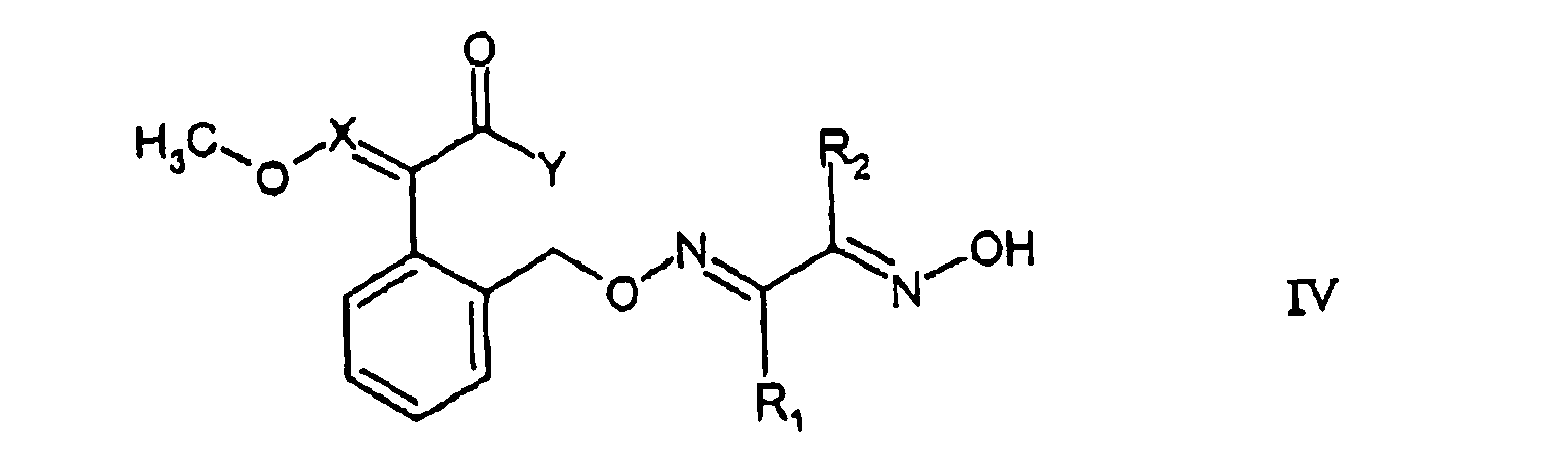
X, Y, A, R1 und R2 wie für Formel I in Anspruch 1 definiert sind. - Verbindung der Formel VII
 a)X ein N-Atom ist undY OR11 oder N(R12)R13 ist, oderb)und worin weiterhin:X CH ist undY OR11 ist,R11 C1-C4-Alkyl ist;R12 und R13 unabhängig Wasserstoff oder C1-C4-Alkyl sind;A ein O-Atom oder die Gruppe NR4 ist;R1 C1-C4-Alkyl, Halogen-C1-C4-Alkyl, Cyclopropyl, Cyano oder Methylthio ist;R2 Wasserstoff, C1-C6-Alkyl, C3-C6-Cycloalkyl, eine Gruppe
 D Reste sind, die identisch oder verschieden sind und Halogen, C1-C4-Alkyl, C1-C4-Alkoxy, C1-C2-Malogenalkyl, C1-C2-Halogenalkoxy, C3-C6-Alkenyloxy, C3-C6-Alkinyloxy, C1-C4-Alkylendioxy, Cyano oder Nitro sind;n 0, 1, 2, 3 oder 4 ist;Z -O-, -O-(C1-C4-Alkyl)-, -(C1-C4-Alkyl)-O-, -S(O)m-, -(C1-C4-Alkyl)-S-(O)m-, -S(O)m-(C1-C4-Alkyl)- ist,m 0, 1 oder 2 ist,B C1-C6-Alkyl, Halogen-C1-C6-Alkyl, C3-C6-Cycloalkyl ist oder C2-C6-Alkenyl oder C2-C4-Alkinyl-C1-C2-Alkyl ist, wobei jedes davon unsubstituiert oder substituiert ist mit 1 bis 3 Halogenatomen, oder Aryl oder Heterocyclyl ist, wobei jedes von diesen beiden unabhängig unsubstituiert oder mono- bis pentasubstituiert ist mit C1-C6-Alkyl, Halogen-C1-C6-Alkyl, Halogen, C1-C6-Alkoxy oder Halogen-C1-C6-Alkoxy, oder einer Gruppe
R5, R6, R7, R8 und R9 unabhängig Wasserstoff, C1-C4-Alkyl oder Halogen sind undp 0, 1, 2 oder 3 ist;R3 Wasserstoff, C1-C6-Alkyl, C1-C6-Halogenalkyl mit 1 bis 5 Halogenatomen, C1-C4-Alkoxy-C1-C2-Alkyl, C2-C4-Alkenyl-C1-C2-Alkyl, das unsubstituiert oder substituiert ist mit 1 bis 3 Halogenatomen, C2-C4-Alkinyl-C1-C2-Alkyl, C3-C6-Cycloalkyl, das unsubstituiert oder substituiert ist mit 1 bis 4 Halogenatomen, C3-C6-Cycloalkyl-C1-C4-Alkyl, das unsubstituiert oder substituiert ist mit 1 bis 4 Halogenatomen, Cyano-C1-C4-Alkyl;
C1-C4-Alkoxycarbonyl-C1-C2-Alkyl, C1-C4-Alkoxycarbamoyl-C1-C2-Alkyl, Phenyl-C1-C3-Alkyl, das unsubstituiert oder substituiert ist mit Halogen, C1-C3-Alkyl, C1-C4-Alkoxy, C1-C4-Halogenalkyl, Cyano, Nitro oder C1-C4-Alkylendioxy, wobei die Phenylgruppe monosubstituiert bis trisubstituiert sein kann mit identischen oder verschiedenen Substituenten;
Phenyl, das unabhängig unsubstituiert oder mono- bis disubstituiert ist mit C1-C4-Alkyl, C1-C4-Alkoxy, Halogen, C1-C2-Halogenalkyl mit 1 bis 3 Halogenatomen, Nitro oder Cyano, oder Pyridyl, das unabhängig unsubstituiert oder mono- bis disubstituiert ist mit C1-C4-Alkyl, C1-C4-Alkoxy, Halogen, C1-C2-Halogenalkyl mit 1 bis 3 Halogenatomen, Nitro oder Cyano, ist;R4 C1-C4-Alkyl, Phenyl ist, oderR3 und R4 zusammen mit dem Stickstoffatom, an welches sie gebunden sind, einen gesättigten oder ungesättigten 5- bis 7-gliedrigen Ring bilden, der unsubstituiert oder substituiert ist mit C1-C4-Alkyl, und der 1 bis 3 zusätzliche Heteroatome aufweisen kann, ausgewählt aus N, O und S. - Verbindung der Formel VIII

A, Y und R1-R3 wie für Formel VII in Anspruch 16 definiert sind. - Verbindung der Formel IX
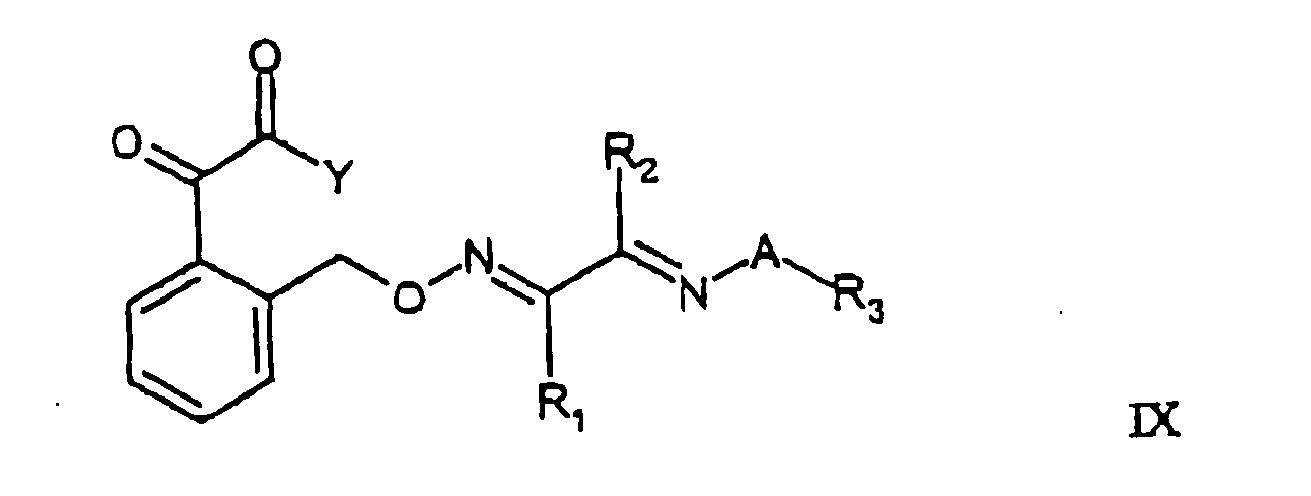
A, Y und R1-R3 wie für Formel VII in Anspruch 16 definiert sind. - Verbindung der Formel I
 a)X ein N-Atom ist undY OCH3 oder NHCH3 ist, oderb)und worin weiterhinX CH ist undY OCH3 ist,A ein O-Atom oder die Gruppe NR4 ist;R1 Halogen-C1-C4-Alkyl ist;R2 C1-C4-Alkyl oder Cyclopropyl ist;R3 Wasserstoff; C1-C6-Alkyl; C1-C6-Halogenalkyl mit 1 bis 5 Halogenatomen; C1-C4-Alkoxy-C1-C2-Alkyl; C2-C4-Alkenyl-C1-C2-Alkyl, das unsubstituiert oder substituiert ist mit 1 bis 3 Halogenatomen; C2-C4-Alkinyl-C1-C2-Alkyl; C3-C6-Cycloalkyl, das unsubstituiert oder substituiert ist mit 1 bis 4 Halogenatomen; C3-C6-Cycloalkyl-C1-C4-Alkyl, das unsubstituiert oder substituiert ist mit 1 bis 4 Halogenatomen; Cyano-C1-C4-Alkyl;
C1-C4-Alkoxycarbonyl-C1-C2-Alkyl; Phenyl-C1-C3-Alkyl, das unsubstituiert oder substituiert ist mit Halogen, C1-C3-Alkyl, C1-C4-Alkoxy, C1-C4-Halogenalkyl, Cyano, Nitro, C1-C4-Alkylendioxy, wobei die Phenylgruppe monosubstituiert bis trisubstituiert sein kann durch identische oder verschiedene Substituenten;
Phenyl, das unabhängig unsubstituiert oder mono- bis disubstituiert ist mit C1-C4-Alkyl, C1-C4-Alkoxy, Halogen, C1-C2-Halogenalkyl mit 1 bis 3 Halogenatomen, Nitro oder Cyano, oder Pyridiyl, das unabhängig unsubstituiert oder mono- bis disubstituiert ist mit C1-C4-Alkyl, C1-C4-Alkoxy, Halogen, C1-C2-Halogenalkyl mit 1 bis 3 Halogenatomen, Nitro oder Cyano, ist;R4 C1-C4-Alkyl oder Phenyl; ist, oderR3 und R4 zusammen mit dem Stickstoffatom, an welches sie gebunden sind, einen gesättigten oder ungesättigten 5- bis 7-gliedrigen Ring bilden, der unsubstituiert oder substituiert ist mit C1-C4-Alkyl, und welcher 1 bis 3 zusätzliche Heteroatome aufweisen kann, ausgewählt aus N, O und S. - Verbindung der Formel I
 X CH ist;Y OCH3 ist;R1 CH3 ist;A Sauerstoff ist;R2 4-Methylphenyl oder 4-Allyloxyphenyl oder 4-(3-Trifluormethylbenzyloxy)phenyl oder 4-(2,2-Dichlorcyclopropylmethoxy)phenyl ist undR3 CH3 ist.
 - Verbindung der Formel I
 a)X ein N-Atom ist undY OR11 oder N(R12)R13 ist, oderb)und worin weiterhin:X CH ist undY OR11 ist,R11 C1-C4-Alkyl ist;R12 und R13 unabhängig Wasserstoff oder C1-C4-Alkyl sind;A ein O-Atom oder die Gruppe NR4 ist;R1 C1-C4-Alkyl, Halogen-C1-C4-Alkyl, Cyclopropyl, Cyano oder Methylthio ist;R2 eine Gruppe
 D Reste sind, die identisch oder verschieden sind und C1-C4-Alkoxy, C1-C2-Halogenalkoxy, C3-C6-Alkenyloxy, C1-C4-Alkylendioxy sind;n 0, 1, 2, 3 oder 4 ist;Z -(C1-C4-Alkyl)-O-, -S(O)m-, -(C1-C4-Alkyl)-S-(O)m-, -S(O)m-(C1-C4-Alkyl)- ist,m 0, 1 oder 2 ist,B Halogen-C1-C6-Alkyl, C3-C6-Cycloalkyl ist oder C2-C6-Alkenyl oder C2-C4-Alkinyl-Ci-C2-Alkyl ist, von welchem jedes unsubstituiert oder substituiert ist mit 1 bis 3 Halogenatomen, oder Aryl oder Heterocyclyl ist, wobei jedes von diesen beiden unabhängig unsubstituiert oder mono- bis pentasubstituiert ist mit C1-C6-Alkyl, Halogen-C1-C6-Alkyl, Halogen, C1-C6-Alkoxy oder Halogen-C1-C6-Alkoxy, oder eine Gruppe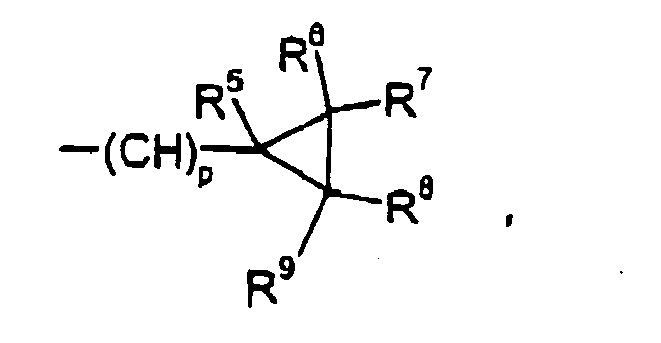
R5, R6, R7, R8 und R9 unabhängig Wasserstoff, C1-C4-Alkyl oder Halogen sind undp 0, 1, 2 oder 3 ist;R3 Wasserstoff, C1-C6-Alkyl, C1-C6-Halogenalkyl mit 1 bis 5 Halogenatomen, C1-C4-Alkoxy-C1-C2-Alkyl, C2-C4-Alkenyl-C1-C2-Alkyl, das unsubstituiert oder substituiert ist mit 1 bis 3 Halogenatomen, C2-C4-Alkinyl-C1-C2-Alkyl, C3-C6-Cycloalkyl, das unsubstituiert oder substituiert ist mit 1 bis 4 Halogenatomen, C3-C6-Cycloalkyl-C1-C4-Alkyl, das unsubstituiert oder substituiert ist mit 1 bis 4 Halogenatomen, Cyano-C1-C4-Alkyl;
C1-C4-Alkoxycarbonyl-C1-C2-Alkyl, C1-C4-Alkoxycarbamoyl-C1-C2-Alkyl, Phenyl-C1-C3-Alkyl, das unsubstituiert oder substituiert ist mit Halogen, C1-C3-Alkyl, C1-C4-Alkoxy, C1-C4-Halogenalkyl, Cyano, Nitro oder C1-C4-Alkylendioxy, wobei die Phenylgruppe monosubstituiert bis trisubstituiertsein kann mit identischen oder verschiedenen Substituenten;
Phenyl, das unsubstituiert oder unabhängig mono- bis disubstituiert ist mit C1-C4-Alkyl, C1-C4-Alkoxy, Halogen, C1-C2-Halogenalkyl mit 1 bis 3 Halogenatomen, Nitro oder Cyano, oder Pyridyl, das unabhängig unsubstituiert oder mono- bis disubstituiert ist mit C1-C4-Alkyl, C1-C4-Alkoxy, Halogen, C1-C2-Halogenalkyl mit 1 bis 3 Halogenatomen, Nitro oder Cyano ist;R4 C1-C4-Alkyl, Phenyl ist, oderR3 und R4 zusammen mit dem Stickstoffatom, an welches sie gebunden sind, einen gesättigten oder ungesättigten 5- bis 7-gliedrigen Ring bilden, der unsubstituiert oder substituiert ist mit C1-C4-Alkyl, und der 1 bis 3 zusätzliche Heteroatome aufweisen kann, ausgewählt aus N, O und S. - Verbindung der Formel I nach Anspruch 21, worin:X ein N-Atom ist;Y OR11 ist;R11 C1-C4-Alkyl ist, und worinA, R1, R2 und R3 wie in Anspruch 21 definiert sind.
- Verbindung der Formel I nach Anspruch 21, worin:X ein N-Atom ist;Y N(R12)R13 ist;R12 und R13 unabhängig ein Wasserstoffatom oder C1-C4-Alkyl sind; und worinA, R1, R2 und R3 wie in Anspruch 21 definiert sind.
- Verbindung der Formel I nach Anspruch 21, worin die X = C-Doppelbindung in der E-Form ist.
- Verbindung der Formel I nach Anspruch 21, worin entwedera)X ein N-Atom ist undY OCH3 oder NHCH3 ist, oderb)und worin weiterhin:X CH ist undY OCH3 ist,A ein O-Atom oder die Gruppe NR4 ist;R1 C1-C4-Alkyl, Halogen-C1-C4-Alkyl, Cyclopropyl, Cyano oder Methylthio ist;R2 eine Gruppe

 D Reste sind, die identisch oder verschieden sind und C1-C4-Alkoxy, C1-C2-Halogenalkoxy, C3-C6-Alkinyloxy, C1-C4-Alkylendioxy sind;n 0, 1, 2, 3 oder 4 ist;Z -(C1-C4-Alkyl)-O-, -S(O)m-, -(C1-C4-Alkyl)-S-(O)m-, -S(O)m- C1-C4-Alkyl)- ist,m 0, 1 oder 2 ist,B Halogen-C1-C6-Alkyl, C3-C6-Cycloalkyl ist oder C2-C6-Alkenyl oder C2-C4-Alkinyl-C1-C2-Alkyl ist, von welchem jedes unsubstituiert oder substituiert ist mit 1 bis 3 Halogenatomen, oder Aryl oder Heterocyclyl ist, wobei jedes von diesen beiden unabhängig unsubstituiert oder monosubstituiert- bis pentasubstituiert ist mit C1-C6-Alkyl, Halogen-C1-C6-Alkyl, Halogen, C1-C6-Alkoxy oder Halogen-C1-C6-Alkoxy, oder eine Gruppe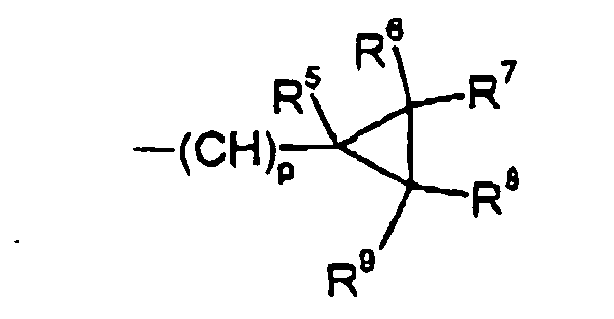
R5, R6, R7, R8 und R9 unabhängig Wasserstoff, C1-C4-Alkyl oder Halogen sind undp 0, 1, 2 oder 3 ist;R3 Wasserstoff, C1-C6-Alkyl, C1-C6-Halogenalkyl mit 1 bis 5 Halogenatomen, C1-C4-Alkoxy-C1-C2-Alkyl, C2-C4-Alkenyl-C1-C2-Alkyl, das unsubstituiert oder substituiert ist mit 1 bis 3 Halogenatomen, C2-C4-Alkinyl-C1-C2-Alkyl, C3-C6-Cycloalkyl, das unsubstituiert oder substituiert ist mit 1 bis 4 Halogenatomen, C3-C6-Cycloalkyl-C1-C4-Alkyl, das unsubstituiert oder substituiert ist mit 1 bis 4 Halogenatomen, Cyano-C1-C4-Alkyl;
C1-C4-Alkoxycarbonyl-C1-C2-Alkyl, Phenyl-C1-C3-Alkyl, das unsubstituiert oder substituiert ist mit Halogen, C1-C3-Alkyl, C1-C4-Alkoxy, C1-C4-Halogenalkyl, Cyano, Nitro, C1-C4-Alkylendioxy, wobei die Phenylgruppe monosubstituiert bis trisubstituiert sein kann mit identischen oder verschiedenen Substituenten;
Phenyl, das unabhängig unsubstituiert oder mono- bis disubstituiert ist mit C1-C4-Alkyl, C1-C4-Alkoxy, Halogen, C1-C2-Halogenalkyl mit 1 bis 3 Halogenatomen, Nitro oder Cyano, oder Pyridyl, das unsubstituiert oder unabhängig mono- bis disubstituiert ist mit C1-C4-Alkyl, C1-C4-Alkoxy, Halogen, C1-C2-Halogenalkyl mit 1 bis 3 Halogenatomen, Nitro oder Cyano ist;R4 C1-C4-Alkyl oder Phenyl ist, oderR3 und R4 zusammen mit dem Stickstoffatom, an welches sie gebunden sind, einen gesättigten oder ungesättigten 5- bis 7-gliedrigen Ring bilden, der unsubstituiert oder substituiert ist mit C1-C4-Alkyl, und der 1 bis 3 zusätzliche Heteroatome aufweisen kann, ausgewählt aus N, O und S. - Verbindung der Formel I gemäß Anspruch 25, worin:X N ist undY OCH3 ist.
- Verbindung der Formel I nach Anspruch 25, worinX CH ist.
- Verbindung der Formel I nach Anspruch 25, worin:X N ist,Y NHCH3 ist, undR1 CH3, Cylopropyl oder CN ist.
- Verbindung der Formel I nach Anspruch 25, worinA Sauerstoff, NCH3 oder n-C6H5 ist.
- Verbindung der Formel I nach Anspruch 25, worinR1 Methyl, Cyclopropyl oder Cyano ist.
- Verbindung der Formel I nach Anspruch 25, worinR2 eine Gruppe
 Z (C1-C4-Alkyl)-O-, -S(O)2-, (C1-C4-Alkyl)-S(O)2-, S(O)2-(C1-C4-Alkyl)- ist.
 - Verbindung der Formel I nach Anspruch 25, worin:R2 eine Gruppe
 B Halogen-C1-C4-Alkyl ist oder C2-C4-Alkenyl oder C2-C4-Alkinyl-C1-C2-Alkyl ist, wobei jedes von diesen unsubstituietrt oder substituiert ist mit 1 bis 3 Halogenatomen, oder Aryl oder Aryl, das unabhängig monosubstituiert oder disubstituiert ist mit C1-C2-Alkyl, Halogen-C1-C2-Alkyl, Halogen, C1-C2-Alkoxy oder Halogen-C1-C2-Alkoxy, ist, oder eine Gruppe
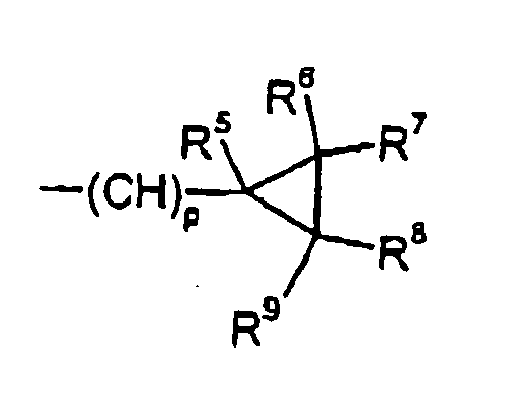 R5, R6, R7, R8 und R9 unabhängig Wasserstoff, C1-C4-Alkyl oder Halogen sind undp 0, 1, 2 oder 3 ist.
 - Verbindung der Formel I nach Anspruch 25, worinR2 eine Phenylgruppe ist, die substituiert ist in der 4-Position mit -Z-B.
- Verfahren zur Herstellung einer Verbindung der Formel I nach Anspruch 21, umfassendA) zum Herstellen einer Verbindung der Formel I, worin Y N(R12)R13 ist: Umsetzen einer Verbindung der Formel I, worin Y OR11 ist, mit HN(R12)R13 in einem Lösungsmittel bei 0 °C bis 40 °C;B) zum Herstellen einer Verbindung der Formel I, worin X, Y, A und R1-R3 wie in Anspruch 21 definiert sind, für Formel I (und worin R3 nicht Wasserstoff ist): Umsetzen eines Oxims der allgemeinen Formel II

A und R1-R3 wie oben definiert sind, mit einem Benzylderivat der allgemeinen Formel
X und Y wie oben definiert sind und U eine Austrittsgruppe ist, in einem inerten organischen Verdünnungsmittel in der Gegenwart einer Base und in der Gegenwart oder Abwesenheit eines Phasentransferkatalysators bei 0 °C bis 50 °C;C) Herstellen einer Verbindung der Formel I, worin A Sauerstoff ist und X, Y und R1-R3 wie in Anspruch 21 für Formel I definiert sind: Umsetzen eines Oxims der allgemeinen Formel IV
X, Y, R1 und R2 wie oben definiert sind, mit einer Verbindung der allgemeinen Formel V
U-R3 V
worinR3 wie in Formel I definiert ist und U wie unter Formel III definiert ist (und worin R3 weder Wasserstoff noch Phenyl noch Pyridyl ist);D) zum Herstellen einer Verbindung der Formel IV, worin X, Y, R1 und R2 wie in Anspruch 21 für Formel definiert sind:
Umsetzen eines Ketons der allgemeinen Formel VI E) zum Herstellen einer Verbindung der Formel I, worin A, X, Y und R1-R3 wie in Anspruch 21 für Formel I definiert sind (und worin R3 nicht Wasserstoff ist):
Umsetzen eines Enols oder Oxims der allgemeinen Formel VII
A, X, Y und R1-R3 wie oben definiert sind, mit einem Methylierungsmittel, z.B. Methyliodid, Dimethylsulfat oder Diazomethan, in der Gegenwart einer Base in einem geeigneten Lösungsmittel. - Zusammensetzung zum Bekämpfen von Schädlingen, umfassend als aktive Bestandteile eine Verbindung nach einem der Ansprüche 21 bis 33 zusammen mit einem geeigneten Träger.
- Verwendung einer Verbindung der Formel I nach Anspruch 21 zum Bekämpfen von Schädlingen.
- Verfahren zum Bekämpfen und Verhindern von Schädlingen, umfassend das Anwenden einer Verbindung nach einem der Ansprüche 21 bis 33 auf Schädlinge oder ihre Umgebung.
- Verfahren nach Anspruch 37, worin der Samen behandelt wird.
- Samen, der behandelt worden ist nach Anspruch 38.
- Verbindung der Formel II

A und R1-R3 wie für Formel I in Anspruch 21 definiert sind, ausgenommen Verbindungen, worin R1 Methylthio ist. - Verbindung der Formel IV

X, Y, R1 und R2 wie für Formel I in Anspruch 21 definiert sind, ausgenommen Verbindungen, worin R1 Methylthio ist. - Verbindung der Formel
worin
X Y R1 Z* n B oder D CH OMe Me - 2 3-F-5-CF3 CH OMe Me - 2 3,4-Methylendioxy CH OMe Me O 0 Allyl- CH OMe SMe - 1 4-Methyl CH OMe Et - 1 4-Methyl CH OMe Me - 1 4-Isobutyl- CH OMe Me O 0 Propargyl- CH OMe Me O 0 2,2,2-Trifluorethyl CH OMe CN - 1 4-Methyl CH OMe CN - 1 4-Chor CH OMe CN - 2 3,4-Dichlor CH OMe CN O 0 -CF3 CH OMe CN - 1 3-CF3 CH OMe CN - 1 2-Chlor CH OMe CN - 1 4-Fluor CH OMe Me O 0 Phenyl CH OMe Me O 0 -CH2CH=CCl2 CH OMe Me O 0 -CH2-CH=CF2 CH OMe Me O 0 -CH2CH=CBr2 CH OMe Me O 0 4-Cl-Phenyl CH OMe Me O 0 4-F-Phenyl CH OMe Me S 0 Phenyl CH OMe Me -CH2O- 0 Phenyl CH OMe Me -OCH2- 0 Phenyl N OMe Me - 1 3-CF3 N OMe Me - 1 4-Chlor N OMe Me - 1 3-Chlor N OMe Me - 1 2-Fluor N OMe Me - 1 4-Methyl N OMe Me O 0 4-Methyl- N OMe Me - 1 4-Brom N OMe Me - 1 4-Fluor N OMe Me - 2 3-F-5-CF3 N OMe Me - 0 - N OMe Me - 1 2-Methyl N OMe Me - 1 3-Brom N OMe Me - 2 3,4-Methylendioxy N OMe Me O 0 Allyl N OMe SMe - 1 4-Methyl N OMe Et - 1 4-Methyl N OMe Me - 1 4-Isobutyl N OMe Me O 0 Propargyl N OMe Me O 0 2,2,2-Trifluorethyl N OMe Me O 0 Ethyl N OMe CN - 1 4-Methyl N OMe CN - 1 4-Chlor N OMe CN - 2 3,4-Dichlor N OMe CN O 0 -CF3 N OMe CN - 1 3-CF3 N OMe CN - 1 2-Chlor N OMe CN - 1 4-Fluor N OMe Me O 0 Phenyl N OMe Me O 0 -CH2CH=CCl2 N OMe Me O 0 -CH2CH=CF2 N OMe Me O 0 -CH2CH=CBr2 N OMe Me O 0 4-Cl-Phenyl N OMe Me O 0 4-F-Phenyl N OMe Me S 0 Phenyl N OMe Me -CH2O- 0 Phenyl N OMe Me -OCH2- 0 Phenyl N NHCH3 Me - 2 3-Fluor-5-CF3 N NHCH3 Me - 0 - N NHCH3 Me - 2 3,4-Methylendioxy N NHCH3 Me O 0 Allyl N NHCH3 SMe - 1 4-Methyl N NHCH3 Et - 1 4-Methyl N NHCH3 Me - 1 4-Isobutyl N NHCH3 Me O 0 Propargyl N NHCH3 Me O 0 2,2,2,-Trifluorethyl N NHCH3 CN - 1 4-Methyl N NHCH3 CN - 1 4-Chlor N NHCH3 CN - 2 3,4-Dichlor N NHCH3 CN O 0 -CF3 N NHCH3 CN - 1 -3-CF3 N NHCH3 CN - 1 2-Chlor N NHCH3 CN - 1 4-Fluor N NHCH3 Me O 0 Phenyl N NHCH3 Me O 0 -CH2CH=CCl2 N NHCH3 Me O 0 -CH2CH=CF2 N NHCH3 Me O 0 -CH2CH=CBr2 N NHCH3 Me O 0 4-Cl-Phenyl N NHCH3 Me O 0 4-F-Phenyl N NHCH3 Me S 0 Phenyl N NHCH3 Me -CH2O- 0 Phenyl N NHCH3 Me -OCH2- 0 Phenyl CH OCH3 Me O 0 n-Propyl CH OCH3 Me O 0 3,3-Dimethyl-allyl CH OCH3 Me O 0 2-Methyl-allyl CH OCH3 Me O 0 3-Methyl-allyl CH OCH3 Me O 0 Allyl CH OCH3 Me O 0 Propargyl CH NHCH3 Me O 0 Allyl CH NHCH3 Me O 0 Propargyl CH OCH3 Me -OCH2- 0 3-CF3-Phenyl CH OCH3 Me -OCH2- 0 C6H11 CH OCH3 Me -OCH2- 0 Phenyl CH OCH3 Me -OCH2- 0 4-F-Phenyl CH OCH3 Me -OCH2- 0 Phenyl CH OCH3 Me -OCH2- 0 4-CF3-Phenyl CH OCH3 Me -OCH2- 0 4-Br-Phenyl CH OCH3 Me -OCH2- 0 4-CH3-Phenyl CH OCH3 Me -OCH2- 0 4-OCH3-Phenyl CH OCH3 Me -OCH2- 0 2-CF3-Phenyl CH OCH3 Me -OCH2- 0 2-F-Phenyl CH OCH3 Me -OCH2- 0 2-Cl-Phenyl CH OCH3 Me -OCH2- 0 2-Br-Phenyl CH OCH3 Me -OCH2- 0 3-F-Phenyl CH OCH3 Me -OCH2- 0 3-Cl-Phenyl CH OCH3 Me -OCH2- 0 3-Br-Phenyl N OCH3 Me -OCH2 0 Allyl N OCH3 Me -OCH2- 0 3-CF3-Phenyl N NHCH3 Me -OCH2- 0 3-CF3-Phenyl N OCH3 Me - 1 2-CF3 N OCH3 Me - 1 2-CH3 N NHCH3 Me - 1 2-CF3 N NHCH3 Me - 1 2-CH3 CH OCH3 CN - - H CH OCH3 CN O 0 CH3 CH OCH3 CN - 1 4-t-Butyl CH OCH3 CN O 0 Phenyl CH OCH3 Me O 0 CF2CHF2 CH OCH3 Me O 0 CF2CHCl2 CH OCH3 Me O 0 CF2CHBr2 N OCH3 Me O 0 CF2CHFCF3 N OCH3 Me O 0 CF2CHF2 N OCH3 Me O 0 CF2CHFCF3 N NHCH3 Me O 0 CF2CHF2 N NHCH3 Me O 0 CF2CHFCF3 CH OCH3 Me - 1 4-t-Butyl CH OCH3 Me -OCH2- 1 4-Cl-Phenyl CH OMe CN O 0 Phenyl N OCH3 Me -SO2- 0 Et N NHCH3 Me -SO2 0 Et CH OCH3 Me -OCH2- 0 SiMe3 CH OCH3 Me O 0 CF2CHFCl CH OCH3 Me O 0 CF2CHFBr CH OCH3 Me O 0 CF2CHFCF3 CH OCH3 Me S 0 Et CH OCH3 Me S 0 n-C3H7 CH OCH3 Me -SCH2- 0 3-CF3-Phenyl CH OCH3 Me -SO2CH2- 0 3-CF3-Phenyl CH OCH3 Me -SO2CH2- 1 3-CF3-Phenyl Das Symbol "-" in Spalte Z bedeutet, dass die Verbindung keinen Substituenten -Z-B aufweist. - Verbindung der Formel

X, Y, A, R1, R3, R6, R7 und p die folgenden Bedeutungen aufweisen:X Y A R1 R3 R6 R7 p CH OCH3 NMe Me Me Cl Cl 1 CH OCH3 NMe Me Me F F 1 CH OCH3 NMe Me Et F F 1 CH OCH3 NMe Me Me Br Br 1 CH OCH3 NPh Me Me Cl Cl 1 CH OCH3 NPh Me Et Cl Cl 1 CH OCH3 O Me Me Cl Cl 1 CH OCH3 O Me Me F F 1 CH OCH3 O Me H F F 1 CH OCH3 O Me C3H7 Cl Cl 1 CH OCH3 O Me Δ Cl Cl 1 CH OCH3 O Δ Me Cl Cl 1 CH OCH3 O Me Δ Cl Cl 1 CH OCH3 O Me Me Br Br 1 CH OCH3 O Me Me Cl Cl 2 CH OCH3 O Me Me F F 2 N OCH3 NMe Me Me Cl Cl 1 N OCH3 NMe Me Me F F 1 N OCH3 NMe Me Et F F 1 N OCH3 NMe Me Br Br 1 N OCH3 NPh Me Me Cl Cl 1 N OCH3 NPh Me Et Cl Cl 1 N OCH3 O Me Me Cl Cl 1 N OCH3 O Me Me F F 1 N OCH3 O Me H F F 1 N OCH3 O Me C3H7 Cl Cl 1 N OCH3 O Me Δ Cl Cl 1 N OCH3 O Δ Me Cl Cl 1 N OCH3 0 Me Δ Cl Cl 1 N OCH3 O Me Me Br Br 1 N OCH3 O Me Me Cl Cl 2 N OCH3 O Me Me F F 2 N NHCH3 NMe Me Me Cl Cl 1 N NHCH3 NMe Me Me F F 1 N NHCH3 NMe Me Et F F 1 N NHCH3 NMe Me Br Br 1 CH OCH3 O Me Me H H 1 N OCH3 O Me Me Cl Cl 1 N NHCH3 O Me Me Cl Cl 1 N NHCH3 O Me Me F F 1 N NHCH3 O Me H F F 1 N NHCH3 O Me Me Cl Cl 2 N NHCH3 O Me Me F F 2 


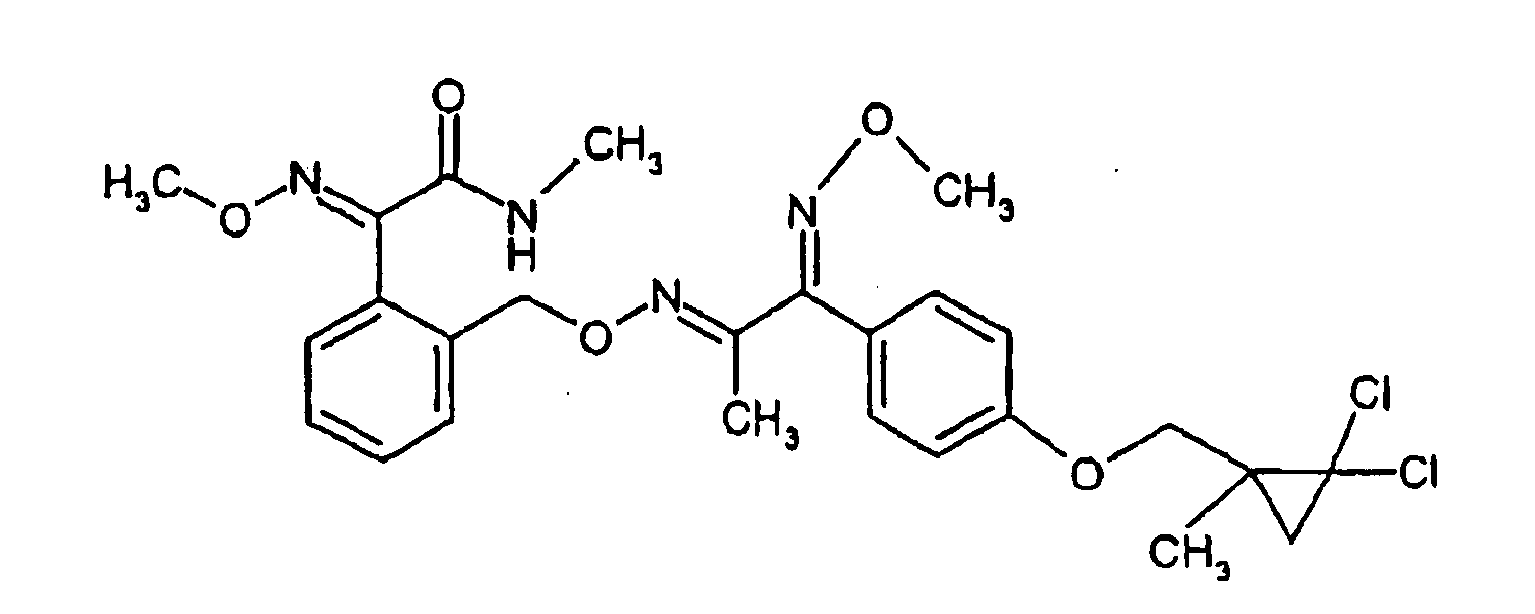


- Verbindung der Formel

X, Y, R1, Z*, n, B oder D die folgenden Bedeutungen aufweisen:X Y R1 Z* n B oder D CH OCH3 Me O 0 Allyl CH OCH3 Me - 1 4-Br N OCH3 Me O 0 Allyl N OCH3 Me - 1 4-Br N NHCH3 Me O - Allyl N NHCH3 Me - 1 4-Br CH OCH3 Me - 1 4-Methyl- N OCH3 Me - 1 4-Methyl N NHCH3 Me - 1 4-Methyl - Verbindung der Formel

Y, A, R1, R2, R3 und NR3R4 die folgenden Bedeutungen aufweisen:Y A R1 R2 R3 oder NR3R4 OEt NMe Me Me Me OEt NMe Me Δ 6-CF3-2-Pyridyl OEt NMe Me H Phenyl OEt NMe Me Me Phenyl OEt NMe Δ Me Phenyl OEt NPh Me Me Phenyl OEt NPh Me Δ Phenyl OEt NPh Δ Me Phenyl OEt O Me Me Me OEt O Δ Me Me OEt O Me Δ Me OEt O Me H Me OEt O Me Me Phenyl OEt O Me Me Benzyl OEt O Me Me 3-CF3-2-Pyridyl OEt O Me Me 3-CF2-Phenyl NH2 NMe Me Δ 3-CF3-Phenyl NH2 NMe Me Me 4-CF3-Phenyl NH2 NMe Me Me 2-Chlorphenyl NH2 NMe Me Me 3-Chlorphenyl NH2 NMe Me Me 4-Chlorphenyl NH2 O Me Me Methoxymethyl NH2 O Me Δ Methoxymethyl NH2 O Δ Me Methoxymethyl NH2 O Me Me Ethoxymethyl NH2 O Me Me CF3CH2 NH2 O Δ Me CF3CH2 NH2 O Me H CF3CH2 NH2 O Me H CF3CH2CH2 NH2 O Me Me CF3CH2CH2 NH2 O Me Me CF3CH2CH2CH2 NH2 O Δ Me CF3CH2CH2CH2 NHEt NMe Me Δ 3-CF3-Phenyl NHEt NMe Me Me 4-CF3-Phenyl NHEt NMe Me Me 2-Chlorphenyl NHEt NMe Me Me 3-Chlorphenyl NHEt NMe Me Me 4-Chlorphenyl NHEt O Me Me Phenyl NHEt O Me Me Me NHEt O Me Me Benzyl NHEt O Me Me Et NHEt O Δ Me Et NHEt O Me Δ Et NHEt O Me H Et NHEt O Me Me Methoxymethyl NHEt O Me Δ Methoxymethyl NHEt O Δ Me Methoxymethyl NHEt O Me Me Ethoxymethyl NHEt O Me Me Cyanomethyl NHEt O Me Me H NHEt O Me Me CF3CH2 NHEt O Δ Me CF3CH2 NHEt O Me H CF3CH2 NHEt O Me H CF3CH2CH2 NHEt O Me Me CF3CH2CH2 NHEt O Me Me CF3CH2CH2CH2 NHEt O Δ Me CF3CH2CH2CH2 N(Me)2 NMe Me Δ 3-CF3-Phenyl N(Me)2 NMe Me Me 4-CF3-Phenyl N(Me)2 NMe Me Me 2-Chlorphenyl N(Me)2 NMe Me Me 3-Chlorphenyl N(Me)2 NMe Me Me 4-Chlorphenyl N(Me)2 O Me Me Methoxymethyl N(ME)2 O Me Δ Methoxymethyl N(Me)2 O Δ Me Methoxymethyl N(Me)2 O Me Me Ethoxymethyl N(Me)2 O Me Me CF3CH2 N(Me)2 O Δ Me CF3CH2 N(Me)2 O Me H CF3CH2 N(Me)2 O Me H CF3CH2CH2 N(Me)2 O Me Me CF3CH2CH2 N(Me)2 O Me Me CF3CH2CH2CH2 N(Me)2 O Δ Me CF3CH2CH2CH2
Applications Claiming Priority (8)
| Application Number | Priority Date | Filing Date | Title |
|---|---|---|---|
| CH1294 | 1994-01-05 | ||
| CH1294 | 1994-01-05 | ||
| CH12/94 | 1994-01-05 | ||
| CH2117/94 | 1994-07-01 | ||
| CH211794 | 1994-07-01 | ||
| CH211794 | 1994-07-01 | ||
| PCT/EP1994/004318 WO1995018789A1 (en) | 1994-01-05 | 1994-12-27 | Pesticides |
| US08/526,859 US5756426A (en) | 1994-01-05 | 1995-09-11 | Phenyl acetic acid derivatives as pesticides |
Publications (3)
| Publication Number | Publication Date |
|---|---|
| EP0738260A1 EP0738260A1 (de) | 1996-10-23 |
| EP0738260B1 EP0738260B1 (de) | 2001-08-29 |
| EP0738260B2 true EP0738260B2 (de) | 2006-12-13 |
Family
ID=27171714
Family Applications (1)
| Application Number | Title | Priority Date | Filing Date |
|---|---|---|---|
| EP95905110A Expired - Lifetime EP0738260B2 (de) | 1994-01-05 | 1994-12-27 | Schädlingsbekämpfungsmittel |
Country Status (15)
| Country | Link |
|---|---|
| US (3) | US5756426A (de) |
| EP (1) | EP0738260B2 (de) |
| CN (1) | CN1152007C (de) |
| AP (1) | AP654A (de) |
| AU (1) | AU690190B2 (de) |
| CA (1) | CA2179418C (de) |
| CZ (1) | CZ291625B6 (de) |
| FI (1) | FI962712A7 (de) |
| HU (1) | HU219157B (de) |
| IL (1) | IL112227A (de) |
| LV (1) | LV11684B (de) |
| MD (1) | MD1315C2 (de) |
| NO (1) | NO307045B1 (de) |
| SK (1) | SK88096A3 (de) |
| WO (1) | WO1995018789A1 (de) |
Families Citing this family (70)
| Publication number | Priority date | Publication date | Assignee | Title |
|---|---|---|---|---|
| US5965613A (en) * | 1989-12-12 | 1999-10-12 | Novartis Finance Corporation | Derivatives of acrylic acid |
| EP0738260B2 (de) * | 1994-01-05 | 2006-12-13 | Bayer CropScience AG | Schädlingsbekämpfungsmittel |
| PT738259E (pt) * | 1994-02-04 | 2001-01-31 | Basf Ag | Derivados do acido fenilacetico processo e produtos intermediarios para sua preparacao e agentes que os contem |
| ES2196054T3 (es) | 1994-02-04 | 2003-12-16 | Basf Ag | Derivados de acido fenilacetico, procedimiento y productos intermedios para su obtencion y agentes que contienen los mismos. |
| CH689228A5 (de) * | 1994-10-07 | 1998-12-31 | Novartis Ag | Oximether, sowie diese enthaltende Pflanzenschutzmittel. |
| BR9509733A (pt) * | 1994-11-17 | 1997-10-21 | Novartos Ag | Derivados de éter o-benzil oxima e seu uso como pesticidas |
| PT820435E (pt) * | 1995-04-08 | 2001-10-30 | Basf Ag | Processo para a preparacao de isomeros essencialmente puros de alfa-bis-oximas |
| KR19990014856A (ko) * | 1995-05-17 | 1999-02-25 | 미디암 디, 메코너헤이 | 살진균성 시클릭 아미드 |
| DE69621933T2 (de) * | 1995-06-22 | 2002-11-28 | Bayer Ag | Pestizide tris-oximino heterocyclische verbindungen |
| DE69631249T2 (de) * | 1995-07-04 | 2004-12-09 | Bayer Cropscience Ag | Triazoline und isoxazoline bis-oxime -derivate und ihre verwendung als pestizide |
| ATE207883T1 (de) * | 1995-07-27 | 2001-11-15 | Basf Ag | Phenylessigsäurederivate, verfahren und zwischenprodukte zu ihrer herstellung und ihre verwendung als schädlingsbekämpfungsmittel und fungizide |
| DE19528651A1 (de) * | 1995-08-04 | 1997-02-06 | Basf Ag | Hydroximsäurederivate, Verfahren zu ihrer Herstellung und sie enthaltende Mittel |
| DE69637267T2 (de) * | 1995-08-15 | 2008-06-26 | Bayer Cropscience Ag | Pestizide indazol-derivate |
| KR19990037656A (ko) * | 1995-08-17 | 1999-05-25 | 스타르크, 카르크 | 살진균성 혼합물 |
| WO1997006680A1 (de) * | 1995-08-17 | 1997-02-27 | Basf Aktiengesellschaft | Fungizide mischungen eines oximethercarbonsäureamids mit fenarimol |
| JP3883575B2 (ja) * | 1995-08-17 | 2007-02-21 | ビーエーエスエフ アクチェンゲゼルシャフト | 殺菌剤混合物 |
| PL324979A1 (en) * | 1995-08-17 | 1998-06-22 | Basf Ag | Fungicidal mixture |
| DE59603364D1 (de) * | 1995-08-17 | 1999-11-18 | Basf Ag | Fungizide mischungen eines oximethercarbonsäureamids mit einem morpholin- oder piperidinderivat |
| US5994382A (en) * | 1995-08-17 | 1999-11-30 | Basf Aktiengesellschaft | Fungicidal mixtures |
| AR004012A1 (es) | 1995-10-10 | 1998-09-30 | Basf Ag | Derivados de acido fenilacetico, procedimientos para su obtencion, su uso para preparar composiciones para combatir animales u hongos nocivos, lascomposiciones asi obtenidas y los procedimientos de aplicacion de dichas composiciones. |
| DE19539324A1 (de) * | 1995-10-23 | 1997-04-24 | Basf Ag | Phenylessigsäurederivate, Verfahren und Zwischenprodukte zu ihrer Herstellung und sie enthaltende Mittel |
| DE19540361A1 (de) * | 1995-10-30 | 1997-05-07 | Basf Ag | Phenylessigsäurederivate, Verfahren und Zwischenprodukte zu ihrer Herstellung und ihre Verwendung zur Bekämpfung von Schadpilzen und tierischen Schädlingen |
| ES2144774T3 (es) * | 1995-11-02 | 2000-06-16 | Basf Ag | Derivados de acido piridilacetico, procedimiento y productos intermedios para su obtencion, y su empleo. |
| DE19540989A1 (de) * | 1995-11-03 | 1997-05-07 | Basf Ag | Pyridylessigsäurederivate, Verfahren und Zwischenprodukte zu ihrer Herstellung und sie enthaltende Mittel |
| DE19542629A1 (de) * | 1995-11-15 | 1997-05-22 | Basf Ag | Azinooximether, Verfahren und Zwischenprodukte zu ihrer Herstellung und ihre Verwendung zur Bekämpfung von Schadpilzen und tierischen Schädlingen |
| DE19545094A1 (de) * | 1995-12-04 | 1997-06-05 | Basf Ag | Phenylessigsäurederivate, Verfahren und Zwischenprodukte zu ihrer Herstellung und sie enthaltende Mittel |
| CN1238337C (zh) * | 1995-12-07 | 2006-01-25 | 拜尔公开股份有限公司 | 农药 |
| CN1111155C (zh) * | 1995-12-07 | 2003-06-11 | 拜尔公开股份有限公司 | 农药的制备方法 |
| DE19548783A1 (de) * | 1995-12-27 | 1997-07-03 | Basf Ag | Cyaniminooximether, Verfahren und Zwischenprodukte zu ihrer Herstellung und ihre Verwendung zur Bekämpfung von Schadpilzen und tierischen Schädlingen |
| DE59605241D1 (de) * | 1996-01-03 | 2000-06-21 | Novartis Ag | Verfahren zur Herstellung o-Chlor-Methyl-Phenylglyoxylsäure-Derivaten |
| WO1997037968A1 (en) * | 1996-04-11 | 1997-10-16 | Shionogi & Co., Ltd. | α-ALKOXYIMINOBENZYL DERIVATIVES AND AGRICULTURAL CHEMICALS CONTAINING THEM AS ACTIVE INGREDIENTS |
| ATE210632T1 (de) * | 1996-06-12 | 2001-12-15 | Bayer Ag | Pestizide |
| US5973001A (en) * | 1996-08-05 | 1999-10-26 | Basf Aktiengesellshcaft | Fungicidal mixtures of an oxime ether carboxylic acid amide with cymoxanil |
| AR013891A1 (es) * | 1996-12-20 | 2001-01-31 | Novartis Ag | Compuestos activos pesticidas, un proceso para su preparacion, una composicion pesticida, un proceso para la preparacion de una composicionpesticida, intermediarios para la preparacion, un metodo para controlar plagas y el material de propagacion de plantas. |
| DE19708940A1 (de) | 1997-03-05 | 1998-09-10 | Basf Ag | Hydroximsäurehalogenide, Verfahren zur ihrer Herstellung und ihre Verwendung |
| WO1998054125A1 (en) * | 1997-05-27 | 1998-12-03 | Novartis Ag | O-benzyl oxime ethers and their use as pesticides |
| AR015821A1 (es) * | 1997-05-27 | 2001-05-30 | Bayer Ag | Compuestos organicos |
| CO5050364A1 (es) | 1997-05-28 | 2001-06-27 | Basf Ag | Metodo para controlar hongos nocivos |
| US6245798B1 (en) | 1997-05-30 | 2001-06-12 | Basf Aktiengesellschaft | Fungicidal mixtures |
| KR20010013341A (ko) | 1997-06-04 | 2001-02-26 | 스타르크, 카르크 | 살진균성 혼합물 |
| GB9718366D0 (en) * | 1997-08-29 | 1997-11-05 | Ciba Geigy Ag | Novel combinations |
| HUP0102874A3 (en) * | 1998-05-14 | 2003-04-28 | Basf Ag | Pesticidal and fungicidal bisoximether derivatives production and intermediates and use thereof |
| US6313344B1 (en) | 1998-05-27 | 2001-11-06 | Bayer Aktiengesellschaft | Organic compounds |
| AR020488A1 (es) * | 1998-09-22 | 2002-05-15 | Bayer Ag | Compuestos plaguicidas de bis-oxima |
| GB9820582D0 (en) * | 1998-09-22 | 1998-11-11 | Novartis Ag | Organic compounds |
| HUP0104376A3 (en) * | 1998-11-20 | 2002-12-28 | Basf Ag | Method for producing alkenyl-substituted bis(oximether) derivatives |
| GB9827163D0 (en) | 1998-12-10 | 1999-02-03 | Novartis Ag | Organic compounds |
| EP1137627A1 (de) * | 1998-12-10 | 2001-10-04 | Bayer Aktiengesellschaft | Verfahren zur herstellung von zwischenprodukten für die strobilurin synthese |
| AU1007400A (en) * | 1999-01-27 | 2000-08-03 | Dow Agrosciences Llc | Aryl and heteroarylcyclopropyl oxime ethers and their use as fungicides and insecticides |
| GB9908530D0 (en) | 1999-04-14 | 1999-06-09 | Novartis Ag | Organic compounds |
| JP2003516384A (ja) * | 1999-12-06 | 2003-05-13 | バイエル アクチェンゲゼルシャフト | 殺微生物剤、殺虫剤及び殺ダニ剤効果を有するn−フェニルカルバメート |
| MXPA02004965A (es) | 1999-12-07 | 2002-09-18 | Basf Ag | Metodo para producir cloruros del acido o-clorometilbenzoico. |
| US6313339B1 (en) | 2000-02-17 | 2001-11-06 | Ronald Ross, Jr. | Aryl and heteroarylcylopropyl oxime ethers and their use as fungicides and insecticides |
| DE60102308T2 (de) * | 2000-01-21 | 2004-07-29 | Dow Agrosciences Llc, Indianapolis | Aryl und heteroarylcyclopropyl oxime Ether und ihre Verwendung als Fungicide und Insektizide |
| KR100422883B1 (ko) * | 2001-03-26 | 2004-03-12 | 학교법인고려중앙학원 | 항균물질 페닐아세틱 에시드 및 소디움 페닐아세테이트을유효성분으로 하는 고추역병 방제용 살균제 조성물 |
| DE10209145A1 (de) * | 2002-03-01 | 2003-09-04 | Bayer Cropscience Ag | Halogenbenzole |
| WO2004043150A1 (de) | 2002-11-12 | 2004-05-27 | Basf Aktiengesellschaft | Verfahren zur ertragssteigerung bei glyphosate resistenten leguminosen |
| US7161026B1 (en) | 2005-07-08 | 2007-01-09 | Property Development Corporation International, Ltd, Inc. | Method of preparation of methyl-benzyl-ketone |
| KR20080061408A (ko) * | 2005-10-28 | 2008-07-02 | 바스프 에스이 | 유해 진균에 대한 저항성을 유도하는 방법 |
| AU2007224578A1 (en) * | 2006-03-10 | 2007-09-20 | Basf Se | Method for improving the tolerance of plants to chilling temperatures and/or frost |
| KR20080111058A (ko) * | 2006-03-14 | 2008-12-22 | 바스프 에스이 | 세균증에 대해 식물의 내성을 유도하는 방법 |
| PT2001294T (pt) | 2006-03-24 | 2017-01-13 | Basf Se | Método para combater fungos fitopatogénicos |
| MX2009011456A (es) | 2007-04-23 | 2009-11-05 | Basf Se | Aumento de la productividad de las plantas por combinacion de agentes quimicos con modificaciones transgenicas. |
| WO2011005325A1 (en) * | 2009-07-09 | 2011-01-13 | Spray Away Bed Bugs Llc | Compositions and methods of use pertaining to insecticide |
| US20120129696A1 (en) | 2009-07-28 | 2012-05-24 | Basf Se | Method for increasing the level of free amino acids in storage tissues of perennial plants |
| NZ598965A (en) | 2009-09-25 | 2013-03-28 | Basf Se | Method for reducing pistillate flower abortion in plants using at least one strobilurin |
| US20130085066A1 (en) * | 2010-05-31 | 2013-04-04 | Basf Se | Method for Increasing the Health of a Plant |
| EP3047731A1 (de) | 2015-01-21 | 2016-07-27 | Basf Se | Verfahren zur Bekämpfung von Sojabohnenrost mittels Behandlung von Sojabohnen mit (2E)-2-[3-substituierten-2 [[(E)-[(2E)-2-Alkoxyimino-1-Methyl-2-Phenyl-Ethylidene]Amino]Oxymethyl]Phenyl]-2-Methoxymin-N-Methyl-Acet-Amiden |
| AR115870A1 (es) | 2018-07-31 | 2021-03-10 | Sumitomo Chemical Co | MÉTODO PARA CONTROLAR EL HONGO DE LA ROYA DE LA SOJA QUE TIENE RESISTENCIA AL INHIBIDOR DE SITIO Qₒ |
| CN117142982A (zh) * | 2023-08-11 | 2023-12-01 | 沈阳思拓新材料技术有限公司 | 一种2-异亚硝基苯丙酮的合成方法 |
Citations (2)
| Publication number | Priority date | Publication date | Assignee | Title |
|---|---|---|---|---|
| EP0738259A1 (de) † | 1994-02-04 | 1996-10-23 | Basf Aktiengesellschaft | Phenylessigsäurederivate, verfahren und zwischenprodukte zu ihrer herstellung und sie enthaltende mittel |
| EP0741694A1 (de) † | 1994-02-04 | 1996-11-13 | Basf Aktiengesellschaft | Phenylessigsäurederivate, verfahren und zwischenprodukte zu ihrer herstellung und sie enthaltende mittel |
Family Cites Families (14)
| Publication number | Priority date | Publication date | Assignee | Title |
|---|---|---|---|---|
| DE2621102A1 (de) * | 1976-05-10 | 1977-11-24 | Schering Ag | Propan-1,2-diondioxime, schaedlingsbekaempfungsmittel enthaltend diese verbindungen sowie verfahren zu ihrer herstellung |
| DE3039269A1 (de) * | 1980-10-17 | 1982-05-19 | Bayer Ag, 5090 Leverkusen | Hydroxamsaeureester, verfahren zu ihrer herstellung, ihre verwendung in schaedlingsbekaempfungsmitteln und zwischenprodukte dafuer |
| EP0370629B2 (de) * | 1988-11-21 | 1998-01-07 | Zeneca Limited | Fungizide |
| HUT52421A (en) * | 1988-12-23 | 1990-07-28 | Janos Puglits | Control gear for automatic operating the clutch of motor vehicles |
| EP0403618B2 (de) * | 1988-12-29 | 2004-04-28 | Bayer Aktiengesellschaft | Aldimino- oder ketimino-oxy-ortho-tolylacrylsäure-methylester, ihre herstellung und diese enthaltende fungizide |
| US5104872A (en) * | 1989-08-22 | 1992-04-14 | Nihon Hohyaku Co., Ltd. | N-(substituted benzyloxy) imine derivatives and method of use thereof |
| PH11991042549B1 (de) * | 1990-06-05 | 2000-12-04 | ||
| DE59109047D1 (de) * | 1990-06-27 | 1998-10-08 | Basf Ag | O-Benzyl-Oximether und diese Verbindungen enthaltende Pflanzenschutzmittel |
| GB9018408D0 (en) * | 1990-08-22 | 1990-10-03 | Ici Plc | Fungicides |
| JPH06504538A (ja) * | 1991-01-30 | 1994-05-26 | ゼネカ・リミテッド | 殺菌剤 |
| NZ242290A (en) * | 1991-04-15 | 1994-12-22 | Zeneca Ltd | Pyridyl and pyrimidinyl substituted oxime-o-benzyl ether derivatives; preparatory processes, fungicidal compositions and an intermediate |
| CH686307A5 (de) * | 1991-04-19 | 1996-02-29 | Ciba Geigy Ag | Oximether des 3-Methoxy-2-(o-tolyl)acrylsouremethylesters, Verfahren zu ihrer Herstellung und fungizide Mittel, die diese als Wirkstoffe enthalten. |
| EP0738260B2 (de) * | 1994-01-05 | 2006-12-13 | Bayer CropScience AG | Schädlingsbekämpfungsmittel |
| CN1082503C (zh) * | 1994-06-10 | 2002-04-10 | 巴斯福股份公司 | α-甲氧基亚氨基羧酸的甲基酰胺的制备方法及其中间体 |
-
1994
- 1994-12-27 EP EP95905110A patent/EP0738260B2/de not_active Expired - Lifetime
- 1994-12-27 CZ CZ19961990A patent/CZ291625B6/cs not_active IP Right Cessation
- 1994-12-27 CA CA002179418A patent/CA2179418C/en not_active Expired - Fee Related
- 1994-12-27 SK SK880-96A patent/SK88096A3/sk unknown
- 1994-12-27 AP APAP/P/1996/000820A patent/AP654A/en active
- 1994-12-27 FI FI962712A patent/FI962712A7/fi unknown
- 1994-12-27 CN CNB941947785A patent/CN1152007C/zh not_active Expired - Fee Related
- 1994-12-27 MD MD96-0291A patent/MD1315C2/ro unknown
- 1994-12-27 WO PCT/EP1994/004318 patent/WO1995018789A1/en not_active Ceased
- 1994-12-27 AU AU13851/95A patent/AU690190B2/en not_active Ceased
- 1994-12-27 HU HU9601839A patent/HU219157B/hu not_active IP Right Cessation
-
1995
- 1995-01-03 IL IL11222795A patent/IL112227A/xx not_active IP Right Cessation
- 1995-09-11 US US08/526,859 patent/US5756426A/en not_active Expired - Lifetime
-
1996
- 1996-07-04 NO NO962823A patent/NO307045B1/no not_active IP Right Cessation
- 1996-07-24 LV LVP-96-314A patent/LV11684B/en unknown
-
1997
- 1997-11-12 US US08/968,143 patent/US5981585A/en not_active Expired - Fee Related
-
1999
- 1999-06-22 US US09/338,236 patent/US6313166B1/en not_active Expired - Fee Related
Patent Citations (2)
| Publication number | Priority date | Publication date | Assignee | Title |
|---|---|---|---|---|
| EP0738259A1 (de) † | 1994-02-04 | 1996-10-23 | Basf Aktiengesellschaft | Phenylessigsäurederivate, verfahren und zwischenprodukte zu ihrer herstellung und sie enthaltende mittel |
| EP0741694A1 (de) † | 1994-02-04 | 1996-11-13 | Basf Aktiengesellschaft | Phenylessigsäurederivate, verfahren und zwischenprodukte zu ihrer herstellung und sie enthaltende mittel |
Also Published As
| Publication number | Publication date |
|---|---|
| MD1315C2 (ro) | 2000-06-30 |
| HU9601839D0 (en) | 1996-10-28 |
| HU219157B (hu) | 2001-02-28 |
| AU1385195A (en) | 1995-08-01 |
| HUT74980A (en) | 1997-03-28 |
| NO962823D0 (no) | 1996-07-04 |
| IL112227A0 (en) | 1995-03-30 |
| CZ291625B6 (cs) | 2003-04-16 |
| CN1141032A (zh) | 1997-01-22 |
| AP9600820A0 (en) | 1996-07-31 |
| LV11684A (lv) | 1997-02-20 |
| SK88096A3 (en) | 1996-12-04 |
| EP0738260A1 (de) | 1996-10-23 |
| CN1152007C (zh) | 2004-06-02 |
| IL112227A (en) | 1999-11-30 |
| AU690190B2 (en) | 1998-04-23 |
| NO307045B1 (no) | 2000-01-31 |
| CA2179418C (en) | 2004-06-22 |
| LV11684B (en) | 1997-06-20 |
| MD960291A (en) | 1997-10-31 |
| US6313166B1 (en) | 2001-11-06 |
| MD1315B1 (en) | 1999-09-30 |
| WO1995018789A1 (en) | 1995-07-13 |
| NO962823L (no) | 1996-07-04 |
| US5756426A (en) | 1998-05-26 |
| EP0738260B1 (de) | 2001-08-29 |
| US5981585A (en) | 1999-11-09 |
| FI962712A7 (fi) | 1996-08-16 |
| FI962712A0 (fi) | 1996-07-01 |
| CA2179418A1 (en) | 1995-07-13 |
| AP654A (en) | 1998-07-31 |
| CZ199096A3 (en) | 1996-10-16 |
Similar Documents
| Publication | Publication Date | Title |
|---|---|---|
| US6313166B1 (en) | Phenyl acetic acid derivatives as pesticides | |
| CA2240738C (en) | Pesticidal composition containing thiamethoxam and fungicides | |
| EP0865424B1 (de) | Pestizide | |
| WO1994005642A1 (en) | Indazole derivatives | |
| JPH07224015A (ja) | ビニルカルボン酸誘導体 | |
| AU708591B2 (en) | O-benzyl oxime ether derivatives and their use in crop protection compositions | |
| DE69637267T2 (de) | Pestizide indazol-derivate | |
| KR100347836B1 (ko) | 살충제 | |
| WO1995029889A1 (en) | Perhaloalkoxybenzenophenone hydrazones and their use as pesticides | |
| MXPA98004532A (en) | Pesticide |
Legal Events
| Date | Code | Title | Description |
|---|---|---|---|
| PUAI | Public reference made under article 153(3) epc to a published international application that has entered the european phase |
Free format text: ORIGINAL CODE: 0009012 |
|
| 17P | Request for examination filed |
Effective date: 19960802 |
|
| AK | Designated contracting states |
Kind code of ref document: A1 Designated state(s): AT BE CH DE DK ES FR GB GR IE IT LI LU MC NL PT SE |
|
| AX | Request for extension of the european patent |
Free format text: LT PAYMENT 960802;SI PAYMENT 960802 |
|
| RAX | Requested extension states of the european patent have changed |
Free format text: LT PAYMENT 960802;SI PAYMENT 960802 |
|
| RAP1 | Party data changed (applicant data changed or rights of an application transferred) |
Owner name: NOVARTIS AG |
|
| 17Q | First examination report despatched |
Effective date: 19971218 |
|
| RAP1 | Party data changed (applicant data changed or rights of an application transferred) |
Owner name: NOVARTIS-ERFINDUNGEN VERWALTUNGSGESELLSCHAFT M.B.H |
|
| RAP1 | Party data changed (applicant data changed or rights of an application transferred) |
Owner name: NOVARTIS-ERFINDUNGEN VERWALTUNGSGESELLSCHAFT M.B. Owner name: NOVARTIS AG |
|
| GRAG | Despatch of communication of intention to grant |
Free format text: ORIGINAL CODE: EPIDOS AGRA |
|
| GRAG | Despatch of communication of intention to grant |
Free format text: ORIGINAL CODE: EPIDOS AGRA |
|
| GRAH | Despatch of communication of intention to grant a patent |
Free format text: ORIGINAL CODE: EPIDOS IGRA |
|
| RAP1 | Party data changed (applicant data changed or rights of an application transferred) |
Owner name: SYNGENTA PARTICIPATIONS AG |
|
| RAP1 | Party data changed (applicant data changed or rights of an application transferred) |
Owner name: BAYER AKTIENGESELLSCHAFT |
|
| GRAH | Despatch of communication of intention to grant a patent |
Free format text: ORIGINAL CODE: EPIDOS IGRA |
|
| GRAA | (expected) grant |
Free format text: ORIGINAL CODE: 0009210 |
|
| AK | Designated contracting states |
Kind code of ref document: B1 Designated state(s): AT BE CH DE DK ES FR GB GR IE IT LI LU MC NL PT SE |
|
| AX | Request for extension of the european patent |
Free format text: LT PAYMENT 19960802;SI PAYMENT 19960802 |
|
| LTIE | Lt: invalidation of european patent or patent extension | ||
| PG25 | Lapsed in a contracting state [announced via postgrant information from national office to epo] |
Ref country code: AT Free format text: LAPSE BECAUSE OF FAILURE TO SUBMIT A TRANSLATION OF THE DESCRIPTION OR TO PAY THE FEE WITHIN THE PRESCRIBED TIME-LIMIT Effective date: 20010829 |
|
| REF | Corresponds to: |
Ref document number: 204853 Country of ref document: AT Date of ref document: 20010915 Kind code of ref document: T |
|
| REG | Reference to a national code |
Ref country code: CH Ref legal event code: EP |
|
| REG | Reference to a national code |
Ref country code: CH Ref legal event code: NV Representative=s name: E. BLUM & CO. PATENTANWAELTE |
|
| REG | Reference to a national code |
Ref country code: IE Ref legal event code: FG4D |
|
| REF | Corresponds to: |
Ref document number: 69428127 Country of ref document: DE Date of ref document: 20011004 |
|
| ET | Fr: translation filed | ||
| PGFP | Annual fee paid to national office [announced via postgrant information from national office to epo] |
Ref country code: SE Payment date: 20011126 Year of fee payment: 8 |
|
| REG | Reference to a national code |
Ref country code: DK Ref legal event code: T3 |
|
| PG25 | Lapsed in a contracting state [announced via postgrant information from national office to epo] |
Ref country code: MC Free format text: LAPSE BECAUSE OF NON-PAYMENT OF DUE FEES Effective date: 20011227 Ref country code: LU Free format text: LAPSE BECAUSE OF NON-PAYMENT OF DUE FEES Effective date: 20011227 |
|
| REG | Reference to a national code |
Ref country code: GB Ref legal event code: IF02 Ref country code: ES Ref legal event code: FG2A Ref document number: 2162633 Country of ref document: ES Kind code of ref document: T3 |
|
| REG | Reference to a national code |
Ref country code: PT Ref legal event code: SC4A Free format text: AVAILABILITY OF NATIONAL TRANSLATION Effective date: 20011122 |
|
| REG | Reference to a national code |
Ref country code: GR Ref legal event code: EP Ref document number: 20010402186 Country of ref document: GR |
|
| PLBI | Opposition filed |
Free format text: ORIGINAL CODE: 0009260 |
|
| PLBF | Reply of patent proprietor to notice(s) of opposition |
Free format text: ORIGINAL CODE: EPIDOS OBSO |
|
| 26 | Opposition filed |
Opponent name: BASF AKTIENGESELLSCHAFT PATENTE, MARKEN UND LIZENZ Effective date: 20020529 |
|
| NLR1 | Nl: opposition has been filed with the epo |
Opponent name: BASF AKTIENGESELLSCHAFT PATENTE, MARKEN UND LIZENZ |
|
| PLBF | Reply of patent proprietor to notice(s) of opposition |
Free format text: ORIGINAL CODE: EPIDOS OBSO |
|
| PG25 | Lapsed in a contracting state [announced via postgrant information from national office to epo] |
Ref country code: SE Free format text: LAPSE BECAUSE OF NON-PAYMENT OF DUE FEES Effective date: 20021228 |
|
| PLBF | Reply of patent proprietor to notice(s) of opposition |
Free format text: ORIGINAL CODE: EPIDOS OBSO |
|
| RAP2 | Party data changed (patent owner data changed or rights of a patent transferred) |
Owner name: BAYER CROPSCIENCE AG |
|
| NLT2 | Nl: modifications (of names), taken from the european patent patent bulletin |
Owner name: BAYER CROPSCIENCE AG |
|
| EUG | Se: european patent has lapsed | ||
| PLAY | Examination report in opposition despatched + time limit |
Free format text: ORIGINAL CODE: EPIDOSNORE2 |
|
| PLBC | Reply to examination report in opposition received |
Free format text: ORIGINAL CODE: EPIDOSNORE3 |
|
| PLAY | Examination report in opposition despatched + time limit |
Free format text: ORIGINAL CODE: EPIDOSNORE2 |
|
| PLBC | Reply to examination report in opposition received |
Free format text: ORIGINAL CODE: EPIDOSNORE3 |
|
| PLAT | Information related to reply to examination report in opposition deleted |
Free format text: ORIGINAL CODE: EPIDOSDORE3 |
|
| PLAY | Examination report in opposition despatched + time limit |
Free format text: ORIGINAL CODE: EPIDOSNORE2 |
|
| PLAY | Examination report in opposition despatched + time limit |
Free format text: ORIGINAL CODE: EPIDOSNORE2 |
|
| PLBC | Reply to examination report in opposition received |
Free format text: ORIGINAL CODE: EPIDOSNORE3 |
|
| PGFP | Annual fee paid to national office [announced via postgrant information from national office to epo] |
Ref country code: IE Payment date: 20051115 Year of fee payment: 12 |
|
| PGFP | Annual fee paid to national office [announced via postgrant information from national office to epo] |
Ref country code: PT Payment date: 20051117 Year of fee payment: 12 |
|
| PGFP | Annual fee paid to national office [announced via postgrant information from national office to epo] |
Ref country code: DK Payment date: 20051212 Year of fee payment: 12 |
|
| PGFP | Annual fee paid to national office [announced via postgrant information from national office to epo] |
Ref country code: AT Payment date: 20051220 Year of fee payment: 12 |
|
| PUAH | Patent maintained in amended form |
Free format text: ORIGINAL CODE: 0009272 |
|
| STAA | Information on the status of an ep patent application or granted ep patent |
Free format text: STATUS: PATENT MAINTAINED AS AMENDED |
|
| 27A | Patent maintained in amended form |
Effective date: 20061213 |
|
| AK | Designated contracting states |
Kind code of ref document: B2 Designated state(s): AT BE CH DE DK ES FR GB GR IE IT LI LU MC NL PT SE |
|
| AX | Request for extension of the european patent |
Extension state: LT SI |
|
| PG25 | Lapsed in a contracting state [announced via postgrant information from national office to epo] |
Ref country code: IE Free format text: LAPSE BECAUSE OF NON-PAYMENT OF DUE FEES Effective date: 20061227 |
|
| REG | Reference to a national code |
Ref country code: CH Ref legal event code: AEN Free format text: AUFRECHTERHALTUNG DES PATENTES IN GEAENDERTER FORM |
|
| NLR2 | Nl: decision of opposition |
Effective date: 20061213 |
|
| REG | Reference to a national code |
Ref country code: CH Ref legal event code: PUE Owner name: BAYER CROPSCIENCE AG Free format text: BAYER AKTIENGESELLSCHAFT# #51368 LEVERKUSEN (DE) -TRANSFER TO- BAYER CROPSCIENCE AG#ALFRED-NOBEL-STRASSE 50#40789 MONHEIM (DE) |
|
| PG25 | Lapsed in a contracting state [announced via postgrant information from national office to epo] |
Ref country code: DK Free format text: LAPSE BECAUSE OF FAILURE TO SUBMIT A TRANSLATION OF THE DESCRIPTION OR TO PAY THE FEE WITHIN THE PRESCRIBED TIME-LIMIT Effective date: 20070313 |
|
| REG | Reference to a national code |
Ref country code: GR Ref legal event code: EP Ref document number: 20070400655 Country of ref document: GR |
|
| NLR3 | Nl: receipt of modified translations in the netherlands language after an opposition procedure | ||
| ET3 | Fr: translation filed ** decision concerning opposition | ||
| PG25 | Lapsed in a contracting state [announced via postgrant information from national office to epo] |
Ref country code: PT Free format text: LAPSE BECAUSE OF NON-PAYMENT OF DUE FEES Effective date: 20070627 |
|
| REG | Reference to a national code |
Ref country code: ES Ref legal event code: DC2A Date of ref document: 20070215 Kind code of ref document: T5 |
|
| REG | Reference to a national code |
Ref country code: PT Ref legal event code: MM4A Free format text: LAPSE DUE TO NON-PAYMENT OF FEES Effective date: 20070627 |
|
| REG | Reference to a national code |
Ref country code: IE Ref legal event code: MM4A |
|
| REG | Reference to a national code |
Ref country code: CH Ref legal event code: PFA Owner name: BAYER CROPSCIENCE AG Free format text: BAYER CROPSCIENCE AG#ALFRED-NOBEL-STRASSE 50#40789 MONHEIM (DE) -TRANSFER TO- BAYER CROPSCIENCE AG#ALFRED-NOBEL-STRASSE 50#40789 MONHEIM (DE) |
|
| PGFP | Annual fee paid to national office [announced via postgrant information from national office to epo] |
Ref country code: NL Payment date: 20071203 Year of fee payment: 14 |
|
| PGFP | Annual fee paid to national office [announced via postgrant information from national office to epo] |
Ref country code: ES Payment date: 20080118 Year of fee payment: 14 |
|
| PGFP | Annual fee paid to national office [announced via postgrant information from national office to epo] |
Ref country code: GR Payment date: 20071128 Year of fee payment: 14 |
|
| PLAB | Opposition data, opponent's data or that of the opponent's representative modified |
Free format text: ORIGINAL CODE: 0009299OPPO |
|
| PG25 | Lapsed in a contracting state [announced via postgrant information from national office to epo] |
Ref country code: GR Free format text: LAPSE BECAUSE OF NON-PAYMENT OF DUE FEES Effective date: 20070704 |
|
| PGFP | Annual fee paid to national office [announced via postgrant information from national office to epo] |
Ref country code: BE Payment date: 20080709 Year of fee payment: 14 |
|
| BERE | Be: lapsed |
Owner name: *BAYER CROPSCIENCE A.G. Effective date: 20081231 |
|
| NLV4 | Nl: lapsed or anulled due to non-payment of the annual fee |
Effective date: 20090701 |
|
| PG25 | Lapsed in a contracting state [announced via postgrant information from national office to epo] |
Ref country code: BE Free format text: LAPSE BECAUSE OF NON-PAYMENT OF DUE FEES Effective date: 20081231 |
|
| PG25 | Lapsed in a contracting state [announced via postgrant information from national office to epo] |
Ref country code: NL Free format text: LAPSE BECAUSE OF NON-PAYMENT OF DUE FEES Effective date: 20090701 |
|
| REG | Reference to a national code |
Ref country code: ES Ref legal event code: FD2A Effective date: 20081229 |
|
| PG25 | Lapsed in a contracting state [announced via postgrant information from national office to epo] |
Ref country code: ES Free format text: LAPSE BECAUSE OF NON-PAYMENT OF DUE FEES Effective date: 20081229 |
|
| PGFP | Annual fee paid to national office [announced via postgrant information from national office to epo] |
Ref country code: FR Payment date: 20101224 Year of fee payment: 17 |
|
| PGFP | Annual fee paid to national office [announced via postgrant information from national office to epo] |
Ref country code: CH Payment date: 20101215 Year of fee payment: 17 |
|
| PGFP | Annual fee paid to national office [announced via postgrant information from national office to epo] |
Ref country code: IT Payment date: 20101222 Year of fee payment: 17 Ref country code: GB Payment date: 20101222 Year of fee payment: 17 |
|
| PGFP | Annual fee paid to national office [announced via postgrant information from national office to epo] |
Ref country code: DE Payment date: 20101203 Year of fee payment: 17 |
|
| REG | Reference to a national code |
Ref country code: CH Ref legal event code: PL |
|
| GBPC | Gb: european patent ceased through non-payment of renewal fee |
Effective date: 20111227 |
|
| REG | Reference to a national code |
Ref country code: FR Ref legal event code: ST Effective date: 20120831 |
|
| REG | Reference to a national code |
Ref country code: DE Ref legal event code: R119 Ref document number: 69428127 Country of ref document: DE Effective date: 20120703 |
|
| PG25 | Lapsed in a contracting state [announced via postgrant information from national office to epo] |
Ref country code: LI Free format text: LAPSE BECAUSE OF NON-PAYMENT OF DUE FEES Effective date: 20111231 Ref country code: CH Free format text: LAPSE BECAUSE OF NON-PAYMENT OF DUE FEES Effective date: 20111231 Ref country code: DE Free format text: LAPSE BECAUSE OF NON-PAYMENT OF DUE FEES Effective date: 20120703 Ref country code: GB Free format text: LAPSE BECAUSE OF NON-PAYMENT OF DUE FEES Effective date: 20111227 |
|
| PG25 | Lapsed in a contracting state [announced via postgrant information from national office to epo] |
Ref country code: IT Free format text: LAPSE BECAUSE OF NON-PAYMENT OF DUE FEES Effective date: 20111227 |
|
| PG25 | Lapsed in a contracting state [announced via postgrant information from national office to epo] |
Ref country code: FR Free format text: LAPSE BECAUSE OF NON-PAYMENT OF DUE FEES Effective date: 20120102 |