EP0736624B1 - Webstuhl zum dreiachsigen Weben - Google Patents
Webstuhl zum dreiachsigen Weben Download PDFInfo
- Publication number
- EP0736624B1 EP0736624B1 EP96104813A EP96104813A EP0736624B1 EP 0736624 B1 EP0736624 B1 EP 0736624B1 EP 96104813 A EP96104813 A EP 96104813A EP 96104813 A EP96104813 A EP 96104813A EP 0736624 B1 EP0736624 B1 EP 0736624B1
- Authority
- EP
- European Patent Office
- Prior art keywords
- warp
- yarn
- weft
- discs
- weaving machine
- Prior art date
- Legal status (The legal status is an assumption and is not a legal conclusion. Google has not performed a legal analysis and makes no representation as to the accuracy of the status listed.)
- Expired - Lifetime
Links
Images








Classifications
-
- D—TEXTILES; PAPER
- D03—WEAVING
- D03D—WOVEN FABRICS; METHODS OF WEAVING; LOOMS
- D03D41/00—Looms not otherwise provided for, e.g. for weaving chenille yarn; Details peculiar to these looms
- D03D41/004—Looms for three-dimensional fabrics
-
- D—TEXTILES; PAPER
- D03—WEAVING
- D03D—WOVEN FABRICS; METHODS OF WEAVING; LOOMS
- D03D41/00—Looms not otherwise provided for, e.g. for weaving chenille yarn; Details peculiar to these looms
Definitions
- This invention relates to triaxial weaving machines comprising an upright framing which at the top supports a rotary cage for applying warp spools and driving them to unroll their yarns and for compensating the length differences between the lengths of warp yarns delivered and the ones entrained, a stationary device positioned underneath for rearranging the warp yarns from a preceding circular distribution to a subsequent planar two-plane distribution thereof, an assembly positioned underneath for creating a warp-yarn Z -system and a warp-yarn S -system, respectively, a shed-forming and weft laying-in attachment positioned underneath, and, finally, a section of the machine accommodating the triaxially woven fabric.
- a "Triaxial Weaving" prospectus (particularly relevant): Prospectus No. F-16645; TW 2000 Triaxial Weaving Machine produced by Barber-Colman Company , Textile Machinery Division (Address: 1300 Rock Street, Rockford, Illinois, U.S.A., 61101).
- US-A-4 105 052 discloses a triaxial weaving machine according to the preamble of claim 1, respectively claim 10.
- warp yarns are conducted through and shifted to and fro, respectively (creating a Z -system and an S -system of the warp, respectively), according to a program by heddles, i.e. elements similar to platines. It is an enormous work to thread the heddles when creating a warp, and it is hardly possible to detect the respective heddle which got unthreaded in the course of weaving because the heddles move and therefore continuously change their position.
- a mechanism for spontaneous compensating the length differences of the warp yarns is arranged in the middle of a warp-spool collar. It is extremely inconvenient to draw in the yarns (from the outer side of the warp-spool collar to the inside thereof and downwards) when preparing a warp, and it is especially complicated to draw in a broken yarn.
- the weaving preparations for a triaxial weaving machine essentially differ from those for biaxial ones.
- a triaxial weaving machine is introduced into a weaving room furnished for manufacturing biaxial woven fabrics, it occupies quite an amount of additional space and staff has to be additionally trained.
- all main elements of the proposed machine without exception are rotational, which fact by itself results in a possible increase of the manufacturing capacity of the machine.
- the warp spools being arranged in two levels it is possible, in comparison to the prior art, to increase the extent of the warp spools and the total mass of the warp.
- a pair of trusses traversing the respective two warp spools and supporting guiding bars, suitably three per spool, and short-circuit (disconnection) bars, two per spool, with the warp yarns being led from each warp spool at the inner side of the machine upwards around the inner guiding bar belonging to the respective three-bar group, then reoriented to the outer side of the machine and led over the said two disconnecting bars and the middle bar of the said guiding-bar group and, finally, around the outer guiding bar of the three-bar group downwards by the outer side of the respective spool.
- warp yarns are led near the outer border of the machine, which makes them easily surveyable and accessible.
- the said cage of the machine provides ribbed arcuate rods, suitably four 90-grade rods, one per each spool, with two opposing rods of the said four rods positioned in an appropriate horizontal plane and the other two opposing rods positioned in another horizontal plane (mounting reasons), with the warp yarns being led from above downwards by the outer mantle surface of the said arcuate rods.
- the spirally wound shaft according to the invention for shifting the warp yarns of the warp-yarn Z -system and the warp-yarn S -system, respectively, along the path of the weft suitably comprises four ridges with each of them terminating, at the end where a warp yarn leaves the warp-yarn Z/S -system and enters the warp-yarn S/Z -system, by a pusher for assisting the transfer of the yarns from one warp-yarn system to the other one.
- the invention foresees two embodiments of spirally wound shafts, one of them providing zigzag-shaped ridges and the other one providing smooth (continuous) ridges.
- the cam spindle of the invention consists of a plurality of radially emphasized annular discs and a plurality of radially emphasized annular cam-shaped spacers, the discs and the spacers being arranged alternatingly, with the thickness of the discs being negligibly small and the peripheral contour of the discs being square with rounded corners, the discs being incorporated to form an assembly so that they are uniformly oriented with their rounded corners residing in flush with the generatrices of the spindle, whereas the spacers are basically circular elements, whose outer diameter equals the sides of the square of the discs, and one, two, or three cams being formed integrally with them, the cam(s) each being oriented to the respective corner(s) of the square of the discs.
- the weft shaft of the invention consists of a plurality of radially emphasized annular discs and a plurality of annular spacers, the discs and the spacers being arranged alternatingly, with the thickness of the discs being negligibly small and the discs each being basically an annular element, whose outer diameter equals that of the spacers, and comprising prongs which each consists of three sections, namely a radial section connected to the basic ring of the disc, a tangential section connected, by one of its ends, to the said radial section, and a further radial section formed integrally with another end of the said tangential section and oriented to the axis of the disc, so that the three said sections of the prong create a cavity, whose bottom resides in the plane of the weft shaft, which includes the axis of the weft shaft.
- the outer edge of the tangential section of the prong is formed smoothly arcuately, which makes it possible to beat up the weft lying underneath to the woven fabric.
- the weft shaft of the invention consists of a plurality of radially emphasized annular discs and a plurality of cam spacers, the discs and the spacers being arranged alternatingly, with the thickness of the discs being negligibly small and the discs each being basically an annular element, whose outer diameter equals that of an annular base of the cam spacers, and comprising prongs which each consists of three sections, namely a radial section connected to the basic ring of the disc, a tangential section connected, by one of its ends, to the said radial section, and a further radial section formed integrally with another end of the said tangential section and oriented to the axis of the disc, so that the three said sections of the prong create a cavity, whose bottom resides in the plane of the weft shaft, which includes the axis of the weft shaft.
- the cam of the cam spacer is positioned so that its radial edge being rear edge with respect to the rotation flushes with the bottom of the said cavity, and the outer edge of the tangential section of the prong is formed smoothly arcuately, which makes it possible to beat up the weft lying underneath to the woven fabric.
- the proposed machine is designed by starting from a stationary framework 100. It consists of four uprights 1 positioned on corners of a square field and interconnected at the top by a top cross 102 composed of interconnecting legs 2 residing over the diagonals of the said square field. Onto the legs 2 a flange collar 3 of a housing of a deep-groove-type radial ball bearing 5 or the like is fastened by screws 4 from above in the middle of their junction.
- Each upright 1 provides an inwardly projected cantilever beam 11 (see Fig. 5) superposed by a respective leg 2 and spaced from the latter.
- An annular rail 10 is placed on the free ends of the cantilever beams 11 and appropriately fixed.
- One of four sides of the base of the framework of the machine is chosen to be the front side (the weaver's working place), the opposite side is thus the rear side of the machine (a cloth beam resides there) and the two remaining sides are lateral sides.
- an upper traverse 19 and a lower traverse 32 are fixed on the pertaining two uprights 1 of each lateral side.
- a vertical bearing plate 33 for supporting a weaving assembly of the machine is fastened on each pair of the traverses 19 and 32 on their outer side, suitably in the middle between the uprights 1.
- a respective mechanical outfit such as bearings 31 of the cloth beam, a support 37 for an electromotor 20 for propelling the weaving assembly, a support 38 for an electromotor 12 for rotating the rotary cage provided with warp spools etc.
- a scaffold 34 which surrounds it and is provided with a respective guardrail and appropriate access steps 35.
- a rotary cage 104 for receiving the warp spools is incorporated into the framework 100 of the machine by means of the adjustably incorporated top bearing 5, whereby the cage 104 is essentially retained in the radial direction, and by means of the annular rail 10, whereby the cage 104 is supported in vertical direction.
- the cage 104 consists of four vertical legs 14 forming edges of a square-base parallelepiped, which suitably corresponds to one half of the base square area of the framework 100.
- the legs 14 occupy practically the entire vertical clearance between the top legs 2 above and the upper traverses 19 below.
- At their lower end the legs 14 are interconnected on their outer side by means of bars 18, and at their upper end they are interconnected by a top cross 104' (Fig. 4) fastened on top surfaces of the legs 14.
- the top cross 104' interconnects, similarly to the top cross 102, the legs 14 in diagonal directions of the respective square base.
- a hollow flanged shaft 9 (Fig. 8) is inserted from below in the middle of the top cross 104' and fastened thereto by means of a further set of screws 4, the shaft 9 protruding up through the cross 104' and being held in the top bearing 5.
- Free ends of arms 39 of the top cross 104' radially project beyond the annular rail 10 and to their front surfaces a ring gear 6 is fastened.
- the outer diameter of the ring gear 6 suitably corresponds to the horizontal clearance between the bearing plates 33.
- a rolling assembly 107 resting on the rail 10 is attached from below to each arm of the top cross 104'.
- the cage 104 together with all pertaining parts and the warp spools is, as an autonomous assembly, suspended from above on the rail 10.
- the support 38 for an electromotor is fastened to a respective cantilever beam 11 and holds the electromotor 12, whose axis provides a pinion mating the ring gear 6.
- a horizontal truss 13 is fastened at the outer side of the legs, with two trusses 13 which reside at two opposite sides of the cage being arranged at a specific level and the other two trusses 13 which reside at the other two opposite sides of the cage being arranged at the other level.
- each pair of trusses 13 there belong two pairs of bearings 15 (one pair on each side of the cage) for suspending the shafts of the warp spools, the bearings 15 being fastened to the legs 14 in the planes which cross the trusses 13 belonging to the latter and spaced down from them.
- bearings 15 there are foreseen eight bearings for suspending four warp spools (one warp spool per cageside), with two opposite warp spools being positioned in one level and the remaining two warp spools being positioned in the other level.
- each leg 14 of the cage provides a respective electromotor (not shown), whose arrangement and configuration depend on the design of warp drums (of prior art) for warp spools.
- the electromotors are energized by means of a rotary sliding contact (known per se ) over cables introduced from outside through the hollow shaft 9.
- ribbed arcuate 90-grade circular-section rods 17 are fastened to the legs 14 by means of radial web girders 16 (Fig. 6), the rods 17 constituting a full ring with two opposite rods 17 positioned in a specific level and the remaining two opposite rods positioned in another level (similarly to the arrangement of the warp spools).
- a layout of rods makes it possible to obtain a spacing between a last yarn of a spool 43 and a first yarn of a neighbouring spool 43, which is equal to a common spacing between two neighbouring yarns of a respective spool.
- the rods 17 are designed to have disc-type annular ribs 59, which are suitably mutually equidistant.
- the bearing plates 33 support a weaving assembly 108 incorporated there by quick assembling and disassembling, preferably requiring two steps - insertion and turning, and turning and removal, respectively.
- the following functions are realized in the weaving assembly 108:
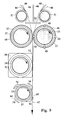
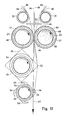
- the weaving assembly 108 comprises, at the top, two mutually parallel, smooth, spaced intake rollers 21, which create a gap port (see also Figs. 9 to 11 and 21 to 23, respectively).
- two horizontally shaped lateral-shutter masks 22 are arranged, which are intended to define the weaving width, i.e. the position of the respective border yarns of the warp.
- a pair of mutually parallel spirally wound shafts 23 is positioned, which nearly touch each other and serve for shifting the warp yarns along the weft.
- a cam spindle 24 i.e.
- a spindle for forming/closing the shed is arranged, which is superposed with respect to a weft shaft 25, i.e. a shaft for laying in and beating up a weft yarn.
- a weft shaft 25' i.e. a spindle for forming/closing the shed, for laying in and beating up a weft yarn is arranged below one of the said shafts.
- the weft shaft 25, the cam spindle 24 and the spirally wound shafts 23 are provided with toothed pulleys (Fig. 3), with a toothed belt 28 (alternatively a chain) being placed enveloping them as well as a toothed pulley 27 of the already mentioned electromotor 20.
- tension pulleys 29 are arranged at its back side.
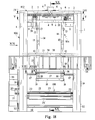
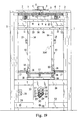
- weft shaft 25' and the spirally wound shafts 23 are provided with toothed pulleys (Fig. 19), with a toothed belt 28 (alternatively a chain) being placed enveloping them as well as a toothed pulley 27 of the already mentioned electromotor 20.
- a first guiding roll 26 for woven fabric and parallelly to it, below the bearings 31 of the cloth beam 44, a further guiding roll 26 for the woven fabric are incorporated.
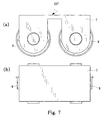
- the rolling assembly 107 (Fig. 7) consists of a holder 7 and of two flanged rollers 8 positioned in running direction one after another, whose axes are suitably oriented to the middle of the machine.
- the flanges of the rollers 8 reside at the inner side of the rail 10.
- Each horizontal truss 13 is designed to have three pairs of bearings 36 for supporting journal pins of guiding bars 60, i.e. suitably a pair at each end and a pair in the middle of the truss 13. Between the pair (each of two pairs) of bearings 36 arranged at the end of the truss and the one arranged in the middle thereof, each truss 13 is designed to have two bearings 61 for supporting two short-circuit (disconnecting) bars 40.
- appropriate control riders one per warp yarn
- the disconnecting bars 40 are positioned over the disconnecting bars 40, the riders being supported by the yarns at a distance from the bars 40. If a yarn gets broken, the force to retain the rider at a distance over the bar 40 disappears; the rider drops onto the bar 40, it establishes a short circuit and hence an impulse to stop the machine.
- the lateral shutter mask 22 is designed to have an arcuate recess 62 (Fig. 13) so that the intake rollers 21 and the lateral shutter masks 22 create, in plan, an essentially oblong hole to rearrange the distribution of warp yarns 46, which are slowly rotatably shifted (in the direction of arrow A in Fig. 13) together with the cage 104 from the preceding circular funnel-kind layout over the rollers 21 to a subsequent planar two-plane distribution thereof in the weaving assembly 108.
- the recess 62 is positioned nonconcentrically in the mask 22, which in turn is actually positioned concentrically in the machine, with the axis of symmetry of the recess 62 residing in the given case, in plan, in flush with a mantle generatrix of the roller 21, namely the one which receives the respective yarn.
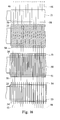
- the spirally wound shaft 23 of Figs. 14 and 15 is constructed similarly to a four-thread screw, whose threads as such are essentially zigzag-shaped.
- the said threads are constructed in the form of four lamellar ridges 63 (of negligible thickness) wound spirally along a cylindrical surface, the ridges being mutually parallel and creating uniform spiral grooves 57.
- each ridge 63 is composed of regularly gauged length sections, which in this case are circumferential sections 48 and spiral (inclined) sections 56, respectively, which in assembled state form a zigzag-shaped spiral.
- All the circumferential sections 48 are equal to each other and positioned by their ends to reside in flush with a generatrix of the mantle of the cylinder, and all the inclined sections 56 are mutually equal and positioned by their ends to reside in flush with the (same) generatrix of the mantle of the cylinder.
- the ridges 63 of a respective shaft 23 are left-handed and the ones of the other shaft 23 right-handed.
- each ridge 63 terminates in a pusher 49 (for controlled shifting of a yarn being a last yarn 46 at a respective moment, from one shaft 23 to another one, the respective yarn representing there a new starting yarn), which is suitably designed to freely enter the working area of the neighbouring shaft 23 when rotating.
- the mantle configuration of the shaft 23 of Figs. 14 and 15 is practically composed of ridges 63 as separate components and of spacers arranged therebetween, the said components and spacers being positionally correctly fixed on the body of the shaft 23.
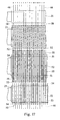
- Figs. 16 and 17 show a modified embodiment of the shaft 23, whose ridges 58 are smooth (continuous) spirals.
- the cam spindle 24 provides a mantle configuration composed of a plurality of radially emphasized annular discs 50 (of a negligible thickness) and a plurality of radially emphasized annular cam-shaped spacers 51, the discs and the spacers being arranged alternatingly, with the density of the discs and spacers corresponding to two spacers 51 per spiral groove 57 of the shaft 23.
- the peripheral contour of the discs 50 is square with rounded corners (Figs. 9 to 11), the discs being incorporated to form an assembly so that their rounded corners reside in flush with the generatrices of the spindle.
- the spacers 51 in turn are basically circular elements, whose outer diameter equals the sides of the square of the discs 50, and have one or more cams 52 being formed integrally with them, whose outer contour prevailingly corresponds to that of the discs 50; merely at the tip of the cam, the latter is shortened to an extent required to guide a yarn between the discs 50.
- the number of the cams 52 at individual spacers 51 as well as the circumferential position (orientation) thereof in an assembled spindle 24 depend on the intended kind of the triaxial woven fabric. In the weaving assembly 108, the cam spindle 24 is arranged so that when the shed is closed (Fig. 9), the discs 50 butt against the warp, with the side of the disc 50 being parallel to the warp.
- the proposed cam spindle 24 makes it possible to create weaves providing four wefts in its repeat of pattern, i.e. it can create sixteen different weaves.
- a cam spindle can also be foreseen for e.g. six wefts, which results in sixty-four different weaves so that, as to the weaves, all customers' demands can be met.
- the weft shaft 25, too, provides a mantle configuration composed of a plurality of radially emphasized annular discs 64 (of a negligible thickness) and a plurality of annular spacers 53, the discs and the spacers being arranged alternatingly.
- the graduation of the configuration corresponds to that of the spirally wound shaft 23. All discs 64, on the one hand, and all spacers 53, on the other hand, are equal to each other.
- the disc 64 consists of a ring (no reference numeral) which, observed in axial direction, registers with the spacer 53, and of formed prongs 54 - four in the given embodiment.
- the prong 54 comprises three main sections (no separate reference numerals): a radial section connected to the basic ring of the disc, a tangential section connected, by one of its ends, to the said radial section, and a further radial section formed integrally with the other end of the said tangential section and oriented to the axis of the disc.
- the three said sections of the prong 54 arranged in the above-mentioned manner create a cavity 65.
- the bottom of one respective cavity 65 and the bottom of an opposite cavity 65 reside in the same plane, which is the diametral plane of the weft shaft.
- the tangential section of the prong 54 is oriented contrary to the rotation of the weft shaft 25.
- the spacers 53 are simple rings.
- the weft shaft 25' provides a mantle configuration composed of a plurality of radially emphasized annular discs 64 (of a negligible thickness) and a plurality of cam spacers 53', the discs and the spacers being arranged alternatingly.
- the graduation of the configuration corresponds to that of the spirally wound shaft 23.
- All discs 64, on the one hand, and all spacers 53', on the other hand, are equal to each other.
- the disc 64 consists of a basic ring (no reference numeral) which, observed in radial direction, registers with the basic ring of the spacer 53', and of formed prongs 54 - four in the given embodiment.
- the prong 54 comprises three main sections (no separate reference numerals): a radial section connected to the basic ring of the disc, a tangential section connected, by one of its ends, to the said radial section, and a further radial section formed integrally with the other end of the said tangential section and oriented to the axis of the disc.
- the three said sections of the prong 54 arranged in the above-mentioned manner create a cavity 65.
- the bottom of one respective cavity 65 and the bottom of an opposite cavity 65 reside in the same plane, which is the diametral plane of the weft shaft.
- the tangential section of the prong 54 is oriented contrary to the rotation of the weft shaft 25'.
- the cam spacer 53' each consists of a basic ring (no reference numeral) and a radial cam 66.
- the said cam is designed to provide a straight rear edge flushing with the bottom of the cavity 65.
- the invention makes it possible to lay in wefts irrespective of whether the machine operates continuously or discontinuously. If the machine works continuously, the weft is laid in by air/water jet techniques or by projectile-type devices, if discontinuously, then other techniques can be applied as well.
- the travelling of a weft carrier is synchronized with the rotation of the cam spindle 24 and the weft shaft 25, i.e.
- the cams 52 are arranged forming a spiral along the cam spindle 24 and a channel (for the travelling of the weft carrier) formed by the cavities 65 is coiled forming an analogous helix; at the other approach the cams 52 reside in flush with a generatrix of the cam spindle 24 and the said channel of the weft shaft 25 is straight and in flush with the mantle generatrix of the weft shaft 25.
- the travelling of a weft carrier is synchronized with the rotation of the weft shaft 25', i.e.
- the cams 66 are arranged forming a spiral along the weft shaft 25' and a channel (for the travelling of the weft carrier) formed by the cavities 65 is coiled forming an analogous helix; at the other approach the cams 66 reside in flush with a generatrix of the weft shaft 25'.
- the said channel of the weft shaft 25' is then straight and in flush with the mantle generatrix of the weft shaft 25'.
- each bearing plate 33 a recess 30 (Fig. 3) is provided, which corresponds to the cavity 65 and is located in registry with cavities 65 of a respective longitudinal series of prongs 54 when the bottom of cavities 65 lies in a horizontal plane.
- a device (not shown) known per se for placing a weft carrier 55 (Fig. 10) is arranged at this position.
- rollers (rider weights) 45 (Fig. 12) belong, which as such are loose parts that can be lost.
- the roller 45 provides two intermediate circumferential ribs (partitions) in addition to the end ribs so that the working length of the roller is divided into three sections.
- the ends of the roller 45 are spherical. The rollers 45 thus touch each other substantially spotwise without interfering with each other when tilting, rising and lowering individually in the course of the operation of the machine.
- the machine is designed to apply four warp spools 43 (Fig. 8).
- the yarns of each warp spool 43 are wound onto a warp shaft 41, which in turn is inserted in respective bearings 15 and connected torque-transferringly with an unwinding motor (not shown).
- Reels 42 carrying the warp spools 43 are placed so that, initially, free ends of yarns are suspended at the radially outer side thereof.
- the yarns 46 of a respective spool 43 are arranged to run at the radially inner side of the spool upwards to the nearest central guiding bar 60 placed on trusses 13, whereupon they are deflected to run horizontally over the short-circuit (disconnecting) bars 40 up the end pair of guiding bars 60.
- warp yarns run radially outwards up the outer border of the machine (a similarity to the machines for manufacturing biaxial woven fabrics).
- the yarns 46 are stretched by placing the burdening rollers 45 in the space between the outer guiding bars 60.
- Each burdening roller 45 is foreseen to stretch a plurality of yarns.
- the yarns 46 so stretched are disposed equidistantly on the ribbed arcuate rods 17, then controlled by the spiral grooves 57 of the shafts 23 and laid between the discs 50 of the cam spindle 24 and the discs 64 of the weft shaft 25.
- the final step of laying the warp is to put the control riders onto the yarns over the short-circuit (disconnecting) bars 40.
- the unwinding propelling of spools 43, the rotation of the respective parts of the weaving assembly 108 and of the cloth beam 44 mutually correspond to each other.
- the unwinding electromotor of a respective warp spool switches on when the tension of the warp exceeds a predetermined value.
- the advance at unwinding the warp is constant and each weft is followed by a warp unwinding step.
- the spirally wound shafts 23 hold the tense warp yarns in their spiral grooves 57.
- the warp yarns 46 move transversely along them, with the yarns belonging to one of them moving in one direction ( Z warp) and those belonging to the other one moving in another direction ( S warp).
- the respective pusher 49 departs and pushes it to the port of a just released groove of the neighbouring shaft 23.
- each yarn when reaching the end of the shaft one yarn at one end of each shaft per 90° of the rotation of shafts 23 changes the system of yarns (from Z to S and from S to Z , respectively).
- the mantle configuration of the cam spindle 24 is assembled for forming a shed according to a predetermined weave pattern.
- the warp yarns are shifted to either direction along the weft so that a respective yarn of the S/Z system in each subsequent step of forming the sheds resides at a location which is progressed for one pitch along the shaft 24 in comparison with its previous location.
- the weft shaft 25 (alternatively: the weft shaft 25') of the invention also serves as a loom batten, here a rotational one.
- the warp yarns are shifted to either direction along the weft after the weft was laid in and the shed was closed (Fig. 9).
- the prongs 54 beat up (by their back edges) the weft just laid in to a woven fabric 47.
- the machine provides no oscillating parts, so that the working capacity of the machine of the invention can be significantly increased in comparison with that of known machines. Since the forming of the warp proceeds from inside outwards, which is similar to techniques with machines for manufacturing biaxial woven fabrics, and since the weaving preparation as such is essentially equal to that for biaxial woven fabrics, the incorporation of machines for manufacturing triaxial woven fabrics in a weaving room for manufacturing biaxial woven fabrics does not require any extra training of the workers nor any additional investments in the weaving preparation.
- the warp yarns are easily accessible on a prevailing length thereof; if a yarn breaks, it can be simply and quickly incorporated into the woven fabric by means of an auxiliary thread. The aim of the invention has thus been achieved.
Landscapes
- Engineering & Computer Science (AREA)
- Textile Engineering (AREA)
- Looms (AREA)
Claims (18)
- Triaxial-Webmaschine mit:und einem Abschnitt für die Aufnahme eines dreiaxial gewebten Stoffes, dadurch gekennzeichnet, daßeinem aufrechtstehenden Rahmen, welcher an der Oberseite einen drehbaren Käfig (104) zum Anbringen von Kettspulen (43) und deren Antreiben für das Abrollen ihrer Fäden und zum Kompensieren der Längendifferenzen zwischen den zugeführten und den abgeführten Fadenlängen abstützt,einer stationären Vorrichtung (21, 22), die unterhalb des drehbaren Käfigs mit zwei Aufnahmerollen (21) zum Umstellen der Kettfäden von einer vorherigen kreisförmigen Verteilung in eine nachfolgende planare Zweiebenen-Verteilung derselben positioniert ist,einer Vorrichtung (23), die unterhalb der stationären Vorrichtung zum Erzeugen eines Kettfaden-Z-Systems bzw. eines Kettfaden-S-Systems positioniert ist,einer Webfachbildungsvorrichtung (24) und einer Schußeinlegevorrichtung (25), die unterhalb der Vorrichtung (23) zum Erzeugen eines Kettfaden-Z-Systems bzw. eines Kettfaden-S-Systems positioniert ist,der drehbare Käfig (104) Kettspulen (43) aufweist, die in zwei Ebenen angeordnet sind;die stationäre Vorrichtung aus den beiden Aufnahmerollen (21) und zwei seitlichen Abdeckmasken (22), die unterhalb der Aufnahmerollen angeordnet sind, zusammengesetzt ist;die Vorrichtung zum Erzeugen eines Kettfaden-Z-Systems bzw. eines Kettfaden-S-Systems aus zwei spiralförmig gewundenen Wellen (23) zusammengesetzt ist;die Webfachbildungsvorrichtung aus einer Nockenspindel (24) besteht, die unterhalb einer der spiralförmig gewundenen Wellen (23) positioniert ist; und daßdie Schußeinlegevorrichtung und eine Anschlagvorrichtung aus einer Schußwelle (25) besteht.
- Triaxial-Webmaschine nach Anspruch 1, dadurch gekennzeichnet, daß in jeder Ebene der Kettspulen in dem drehbaren Käfig (104) ein Paar Träger (13) angeordnet sind, welche die jeweiligen beiden Kettspulen (43) und zweckmäßigerweise drei Stützführungsstangen (60) pro Spule, und zwei Kurzschluß-, d.h. Trennstäbe (40) pro Spule durchqueren, wobei die Kettfäden (46) von jeder Kettspule (43) an der Innenseite der Maschine nach oben um die innere Führungsstange (60) herumgeführt werden, die zu der jeweiligen Drei-Stangen-Gruppe gehört, dann zur Außenseite der Maschine zurückgerichtet werden und über die beiden Trennstäbe (40) und die mittlere Stange (60) der Führungsstangen-Gruppe und schließlich um die äußere Führungsstange (60) der Drei-Stangen-Gruppe herum nach unten über die Außenseite der jeweiligen Spule (43) geführt werden.
- Triaxial-Webmaschine nach Anspruch 1, dadurch gekennzeichnet, daß unterhalb der unteren Kettspulenebene der Käfig (104) zweckmäßigerweise vier gerippte bogenförmige 90-Grad-Stangen (17) mit jeweils einer pro Spule (43) aufweist, wobei zwei einander gegenüberliegende Stangen der vier Stangen in einer geeigneten horizontalen Ebene positioniert sind und die anderen beiden einander gegenüberliegenden Stangen in einer anderen horizontalen Ebene positioniert sind, wobei die Kettfäden (46) von oben nach unten über die äußere Mantelfläche der bogenförmigen Stangen (17) geführt werden.
- Triaxial-Webmaschine nach Anspruch 1, dadurch gekennzeichnet, daß die spiralförmig gewundene Welle (23) zum Verschieben der Kettfäden des Kettfaden-Z-Systems bzw. des Kettfaden-S-Systems entlang des Pfades des Schusses zweckmäßigerweise vier Rippen (63; 58) aufweist, von denen jede an das Ende, an dem ein Kettfaden das Kettfaden-Z/S-System verläßt und in das Kettfaden-S/Z-System eintritt, über einen Mitnehmer (49) angrenzt, um die Übertragung der Fäden von dem einen Kettfaden-System zu dem anderen zu unterstützen.
- Triaxial-Webmaschine nach Anspruch 4, dadurch gekennzeichnet, daß die Rippen (63) zickzackförmig sind und zweckmäßigerweise jeweils aus vier Umfangsabschnitten (48) und vier schrägen Abschnitten (56) zusammengesetzt ist.
- Triaxial-Webmaschine nach Anspruch 4, dadurch gekennzeichnet, daß die Rippen (58) jeweils eine gleichmäßig fortlaufende Spirale sind.
- Triaxial-Webmaschine nach Anspruch 1, dadurch gekennzeichnet, daß die Nockenspindel (24) aus einer Mehrzahl von radial vorstehenden, ringförmigen Scheiben (50) und einer Mehrzahl von radial vorstehenden, ring- und nockenförmigen Abstandsstücken (51) zusammengesetzt ist, wobei die Scheiben und die Abstandsstücke wechselweise angeordnet sind, wobei die Dicke der Scheiben unbedeutend gering ist und der Umriß der Scheiben quadratisch mit abgerundeten Ecken ist, wobei die Scheiben einbezogen sind, um eine Verbindung zu bilden, so daß sie mit ihren abgerundeten Ecken, die in einer Ebene mit den Mantellinien der Spindel liegen, gleichmäßig ausgerichtet sind, wohingegen die Abstandsstücke grundsätzlich kreisförmige Elemente sind, deren Außendurchmesser gleich den Seiten des Quadrats der Scheiben (50) ist, und wobei ein, zwei oder drei Nocken (52) einstückig mit ihnen ausgebildet sind, wobei der (die) Nocken jeweils zu der (den) jeweiligen Ecke(n) des Quadrats der Scheiben (50) ausgerichtet ist (sind).
- Triaxial-Webmaschine nach Anspruch 1, dadurch gekennzeichnet, daß die Kettwelle (25) aus einer Mehrzahl von radial vorstehenden, ringförmigen Scheiben (64) und einer Mehrzahl von ringförmigen Abstandsstücken (53) zusammengesetzt ist, wobei die Scheiben (64) und die Abstandsstücke (53) wechselweise angeordnet sind, wobei die Dicke der Scheiben unbedeutend gering ist, und wobei die Scheiben jeweils grundsätzlich ein ringförmiges Element sind, dessen Außendurchmesser gleich dem der Abstandsstücke ist, und Zinken (54) aufweisen, welche jeweils aus drei Abschnitten bestehen, nämlich einem radialen Abschnitt, der mit dem Basisring der Scheibe verbunden ist, einem tangentialen Abschnitt, der über eines seiner Enden mit dem radialen Abschnitt verbunden ist, und einem weiteren radialen Abschnitt, der einstückig mit einem anderen Ende des tangentialen Abschnitts ausgebildet ist und zu der Achse der Scheibe ausgerichtet ist, so daß die drei Abschnitte des Zinkens (54) eine Kammer (65) bilden, deren Boden in der Ebene der Schußwelle liegt, welche die Achse der Schußwelle aufweist.
- Triaxial-Webmaschine nach Anspruch 8, dadurch gekennzeichnet, daß der äußere Rand des tangentialen Abschnitts des Zinkens (54) gleichmäßig bogenförmig ausgebildet ist, wodurch es möglich ist, den Schuß, der unterhalb des gewebten Stoffes liegt, anzuschlagen.
- Triaxial-Webmaschine mit:und einem Abschnitt für die Aufnahme eines dreiaxial gewebten Stoffes, dadurch gekennzeichnet, daßeinem aufrechtstehenden Rahmen, welcher an der Oberseite einen drehbaren Käfig (104) zum Anbringen von Kettspulen (43) und deren Antreiben für das Abrollen ihrer Fäden und zum Kompensieren der Längendifferenzen zwischen den zugeführten und den abgeführten Fadenlängen abstützt,einer stationären Vorrichtung (21, 22), die unterhalb des Käfigs mit zwei Aufnahmerollen (21) zum Umstellen der Kettfäden von einer vorherigen kreisförmigen Verteilung in eine nachfolgende planare Zweiebenen-Verteilung derselben positioniert ist,einer Vorrichtung (23), die unterhalb der stationären Vorrichtung zum Erzeugen eines Kettfaden-Z-Systems bzw. eines Kettfaden-S-Systems positioniert ist,einer Webfachbildungs- und Schußeinlegevorrichtung, die unterhalb der Vorrichtung (23) positioniert ist,der drehbare Käfig (104) Kettspulen (43) aufweist, die in zwei Ebenen angeordnet sind;die stationäre Vorrichtung aus den beiden Aufnahmerollen (21) und zwei seitlichen Abdeckmasken (22), die unterhalb der Aufnahmerollen angeordnet sind, zusammengesetzt ist;die Vorrichtung aus zwei spiralförmig gewundenen Wellen (23) zusammengesetzt ist; und daßeine Webfachbildungs-, Schußeinlege- und Schußanschlagwelle (25') unterhalb einer der spiralförmigen Wellen (23) positioniert ist.
- Triaxial-Webmaschine nach Anspruch 10, dadurch gekennzeichnet, daß in jeder Ebene der Kettspulen in dem drehbaren Käfig (104) ein Paar Träger (13) angeordnet sind, welche die jeweiligen beiden Kettspulen (43) und zweckmäßigerweise drei Stützführungsstangen (60) pro Spule, und zwei Kurzschluß-, d.h. Trennstäbe (40) pro Spule durchqueren, wobei die Kettfäden (46) von jeder Kettspule (43) an der Innenseite der Maschine nach oben um die innere Führungsstange (60) herumgeführt werden, die zu der jeweiligen Drei-Stangen-Gruppe gehört, dann zur Außenseite der Maschine zurückgerichtet werden und über die beiden Trennstäbe (40) und die mittlere Stange (60) der Führungsstangen-Gruppe und schließlich um die äußere Führungsstange (60) der Drei-Stangen-Gruppe herum nach unten über die Außenseite der jeweiligen Spule (43) geführt werden.
- Triaxial-Webmaschine nach Anspruch 10, dadurch gekennzeichnet, daß unterhalb der unteren Kettspulenebene der Käfig (104) zweckmäßigerweise vier gerippte bogenförmige 90-Grad-Stangen (17) mit jeweils einer pro Spule (43) aufweist, wobei zwei einander gegenüberliegende Stangen der vier Stangen in einer geeigneten horizontalen Ebene positioniert sind und die anderen beiden einander gegenüberliegenden Stangen in einer anderen horizontalen Ebene positioniert sind, wobei die Kettfäden (46) von oben nach unten über die äußere Mantelfläche der bogenförmigen Stangen (17) geführt werden.
- Triaxial-Webmaschine nach Anspruch 10, dadurch gekennzeichnet, daß die spiralförmig gewundene Welle (23) zum Verschieben der Kettfäden des Kettfaden-Z-Systems bzw. des Kettfaden-S-Systems entlang des Pfades des Schusses zweckmäßigerweise vier Rippen (63; 58) aufweist, von denen jede an das Ende, an dem ein Kettfaden das Kettfaden-Z/S-System verläßt und in das Kettfaden-S/Z-System eintritt, über einen Mitnehmer (49) angrenzt, um die Übertragung der Fäden von dem einen Kettfaden-System zu dem anderen zu unterstützen.
- Triaxial-Webmaschine nach Anspruch 13, dadurch gekennzeichnet, daß die Rippen (63) zickzackförmig sind und zweckmäßigerweise jeweils aus vier Umfangsabschnitten (48) und vier schrägen Abschnitten (56) zusammengesetzt ist.
- Triaxial-Webmaschine nach Anspruch 13, dadurch gekennzeichnet, daß die Rippen (58) jeweils eine gleichmäßig fortlaufende Spirale sind.
- Triaxial-Webmaschine nach Anspruch 10, dadurch gekennzeichnet, daß die Schußwelle (25') aus einer Mehrzahl von radial vorstehenden, ringförmigen Scheiben (64) und einer Mehrzahl von Nockenabstandsstücken (53') zusammengesetzt ist, wobei die Scheiben (64) und die Abstandsstücke (53') wechselweise angeordnet sind, wobei die Dicke der Scheiben unbedeutend gering ist, und wobei die Scheiben jeweils grundsätzlich ein ringförmiges Element sind, dessen Außendurchmesser gleich dem eines Basisringes der Abstandsstücke ist, und Zinken (54) aufweisen, welche jeweils aus drei Abschnitten bestehen, nämlich einem radialen Abschnitt, der mit dem Basisring der Scheibe verbunden ist, einem tangentialen Abschnitt, der über eines seiner Enden mit dem radialen Abschnitt verbunden ist, und einem weiteren radialen Abschnitt, der einstückig mit einem anderen Ende des tangentialen Abschnitts ausgebildet ist und zu der Achse der Scheibe ausgerichtet ist, so daß die drei Abschnitte des Zinkens (54) eine Kammer (65) bilden, deren Boden in der Ebene der Schußwelle liegt, welche die Achse der Schußwelle aufweist.
- Triaxial-Webmaschine nach Anspruch 10, dadurch gekennzeichnet, daß der äußere Rand des tangentialen Abschnitts des Zinkens (54) gleichmäßig bogenförmig ausgebildet ist, wodurch es möglich ist, den Schuß, der unterhalb des gewebten Stoffes liegt, anzuschlagen.
- Triaxial-Webmaschine nach Anspruch 16, dadurch gekennzeichnet, daß der Nocken (66) einen geraden hinteren Rand aufweist, der in der Ebene des Bodens der Kammer (65) liegt.
Applications Claiming Priority (4)
| Application Number | Priority Date | Filing Date | Title |
|---|---|---|---|
| SI9500115A SI9500115A (sl) | 1995-04-07 | 1995-04-07 | Stroj za izdelavo triaksialne tkanine |
| SI9500115 | 1995-04-07 | ||
| SI9600010 | 1996-01-15 | ||
| SI9600010A SI9600010A (sl) | 1996-01-15 | 1996-01-15 | Ventilski zamašek |
Publications (2)
| Publication Number | Publication Date |
|---|---|
| EP0736624A1 EP0736624A1 (de) | 1996-10-09 |
| EP0736624B1 true EP0736624B1 (de) | 2000-02-09 |
Family
ID=26665253
Family Applications (1)
| Application Number | Title | Priority Date | Filing Date |
|---|---|---|---|
| EP96104813A Expired - Lifetime EP0736624B1 (de) | 1995-04-07 | 1996-03-26 | Webstuhl zum dreiachsigen Weben |
Country Status (3)
| Country | Link |
|---|---|
| US (1) | US5713395A (de) |
| EP (1) | EP0736624B1 (de) |
| DE (1) | DE69606571D1 (de) |
Families Citing this family (1)
| Publication number | Priority date | Publication date | Assignee | Title |
|---|---|---|---|---|
| DE102011009641B4 (de) | 2011-01-27 | 2013-04-04 | Puma SE | Verfahren zum Herstellen eines Schuhoberteils eines Schuhs, insbesondere eines Sportschuhs |
Family Cites Families (21)
| Publication number | Priority date | Publication date | Assignee | Title |
|---|---|---|---|---|
| GB1460531A (en) * | 1974-01-09 | 1977-01-06 | Pink W B | Combined warp-shedding and reed device |
| US4015637A (en) * | 1974-11-11 | 1977-04-05 | N.F. Doweave, Inc. | Triaxial fabric forming machine and components thereof |
| US3999578A (en) * | 1975-08-11 | 1976-12-28 | Barber-Colman Company | Triaxial weaving machine with heddle shifting means and method |
| US3985159A (en) * | 1975-10-07 | 1976-10-12 | Barber-Colman Company | Heddle transfer apparatus and method for triaxial weaving machine |
| US4036262A (en) * | 1976-01-29 | 1977-07-19 | Barber-Colman Company | Triaxial weaving machine with warp strand guides |
| US4105052A (en) * | 1976-02-24 | 1978-08-08 | Barber-Colman Company | Modular construction for triaxial weaving machine |
| FR2344658A1 (fr) * | 1976-03-18 | 1977-10-14 | Stst | Disques leve-fil |
| US4031922A (en) * | 1976-03-25 | 1977-06-28 | Barber-Colman Company | Vertically arranged triaxial weaving machine |
| US4006759A (en) * | 1976-04-21 | 1977-02-08 | Barber-Colman Company | Locked toggle beater drive for triaxial weaving machine |
| US3998250A (en) * | 1976-05-03 | 1976-12-21 | Barber-Colman Company | Heddle transfer stop motion in a triaxial weaving machine |
| US4022250A (en) * | 1976-05-14 | 1977-05-10 | Barber-Colman Company | Rapiers with guide means for use in a vertical weaving machine |
| US4022253A (en) * | 1976-05-14 | 1977-05-10 | Barber-Colman Company | Rapiers with means for limiting rapier head divergence during weft-yarn transfer |
| US4046173A (en) * | 1976-05-17 | 1977-09-06 | Barber-Colman Company | Triaxial weaving machine with heddle shedding means |
| US4040451A (en) * | 1976-08-23 | 1977-08-09 | Barber-Colman Company | Triaxial weaving machine having heddles with weftwise lateral projections |
| US4170249A (en) * | 1978-09-25 | 1979-10-09 | Barber-Colman Company | Warp length compensator for a triaxial weaving machine |
| YU28682A (en) * | 1982-02-10 | 1985-03-20 | Edvard Sitar | Disc-type weaving apparatus |
| CH653387A5 (de) * | 1982-02-19 | 1985-12-31 | Rueti Ag Maschf | Reihenfachwebmaschine mit einem webrotor. |
| US4512373A (en) * | 1983-05-09 | 1985-04-23 | Barber-Colman Company | Feeding and guiding means for triaxial fabric forming machine |
| IT1251683B (it) * | 1991-10-11 | 1995-05-19 | Dima Ricerche Tecnolog Srl | Tessuto tetrassiale e macchina di tessitura per la sua fabbricazione |
| US5375627A (en) * | 1993-09-08 | 1994-12-27 | Howa Machinery, Ltd. | Method and weaving machine for producing multi-axial fabric |
| DE69500352D1 (de) * | 1994-01-26 | 1997-07-24 | Danilo Jaksic | Jacquardmaschine |
-
1996
- 1996-03-26 EP EP96104813A patent/EP0736624B1/de not_active Expired - Lifetime
- 1996-03-26 DE DE69606571T patent/DE69606571D1/de not_active Expired - Lifetime
- 1996-03-27 US US08/624,750 patent/US5713395A/en not_active Expired - Fee Related
Also Published As
| Publication number | Publication date |
|---|---|
| DE69606571D1 (de) | 2000-03-16 |
| US5713395A (en) | 1998-02-03 |
| EP0736624A1 (de) | 1996-10-09 |
Similar Documents
| Publication | Publication Date | Title |
|---|---|---|
| US3871413A (en) | Shuttle arrangement for a circular loom for a tape yarn | |
| EP0426878A1 (de) | Dreidimensionales gebilde und herstellungsverfahren dazu | |
| EP0736624B1 (de) | Webstuhl zum dreiachsigen Weben | |
| EP3987093B1 (de) | Anordnung einer webmaschine und fadenspeicher mit zugehöriger fadenspannvorrichtung | |
| US5511588A (en) | Electromagnetically activated jacquard machine with rotating lifting roll | |
| GB2123857A (en) | Circular loom | |
| US6257283B1 (en) | Method and apparatus for manufacturing textile articles with an underlying warp and an additional warp | |
| EP4488431A1 (de) | Schärmaschine mit spule mit unabhängig motorisiertem leasing | |
| US3709262A (en) | Circular weaving machine | |
| JPH04100955A (ja) | 厚地織物用オサ打ち装置 | |
| JP3401123B2 (ja) | 部分整経機械のヤーン分割装置 | |
| US5617905A (en) | Circular-weaving machine with vertically moving heddles | |
| CN113584682B (zh) | 一种生产平面三向织物的圆织机 | |
| US3724513A (en) | Loom having a common frame for the warp and cloth beams | |
| KR20010037753A (ko) | 원형직기 | |
| JPH0411043A (ja) | 三次元織物及びその製織方法 | |
| KR100872551B1 (ko) | 정경기용 경사빔 및 이를 이용하여 제직된 직물 | |
| CN221320251U (zh) | 一种能织造变化斜纬不同纬密的织布机 | |
| RU2181153C1 (ru) | Ткацкий станок | |
| US626149A (en) | L desmarais | |
| KR200175825Y1 (ko) | 원형직기 | |
| RU2840905C2 (ru) | Круглоткацкая машина и способы формирования на ней тканых многослойных оболочек | |
| US3604468A (en) | Shedding device for weaving machine | |
| JP2503642B2 (ja) | 織機における機仕掛け準備用受け台 | |
| JP2551707B2 (ja) | 布地の織り方法および織機 |
Legal Events
| Date | Code | Title | Description |
|---|---|---|---|
| PUAI | Public reference made under article 153(3) epc to a published international application that has entered the european phase |
Free format text: ORIGINAL CODE: 0009012 |
|
| AK | Designated contracting states |
Kind code of ref document: A1 Designated state(s): BE CH DE IT LI |
|
| 17P | Request for examination filed |
Effective date: 19970409 |
|
| 17Q | First examination report despatched |
Effective date: 19980914 |
|
| GRAG | Despatch of communication of intention to grant |
Free format text: ORIGINAL CODE: EPIDOS AGRA |
|
| GRAG | Despatch of communication of intention to grant |
Free format text: ORIGINAL CODE: EPIDOS AGRA |
|
| GRAH | Despatch of communication of intention to grant a patent |
Free format text: ORIGINAL CODE: EPIDOS IGRA |
|
| GRAH | Despatch of communication of intention to grant a patent |
Free format text: ORIGINAL CODE: EPIDOS IGRA |
|
| GRAA | (expected) grant |
Free format text: ORIGINAL CODE: 0009210 |
|
| AK | Designated contracting states |
Kind code of ref document: B1 Designated state(s): BE CH DE IT LI |
|
| PG25 | Lapsed in a contracting state [announced via postgrant information from national office to epo] |
Ref country code: IT Free format text: LAPSE BECAUSE OF FAILURE TO SUBMIT A TRANSLATION OF THE DESCRIPTION OR TO PAY THE FEE WITHIN THE PRE;WARNING: LAPSES OF ITALIAN PATENTS WITH EFFECTIVE DATE BEFORE 2007 MAY HAVE OCCURRED AT ANY TIME BEFORE 2007. THE CORRECT EFFECTIVE DATE MAY BE DIFFERENT FROM THE ONE RECORDED.SCRIBED TIME-LIMIT Effective date: 20000209 |
|
| REG | Reference to a national code |
Ref country code: CH Ref legal event code: EP |
|
| REF | Corresponds to: |
Ref document number: 69606571 Country of ref document: DE Date of ref document: 20000316 |
|
| RAP2 | Party data changed (patent owner data changed or rights of a patent transferred) |
Owner name: JAKSIC, DANILO |
|
| RIN2 | Information on inventor provided after grant (corrected) |
Free format text: JAKSIC, DANILO |
|
| PG25 | Lapsed in a contracting state [announced via postgrant information from national office to epo] |
Ref country code: DE Free format text: LAPSE BECAUSE OF FAILURE TO SUBMIT A TRANSLATION OF THE DESCRIPTION OR TO PAY THE FEE WITHIN THE PRESCRIBED TIME-LIMIT Effective date: 20000510 |
|
| REG | Reference to a national code |
Ref country code: CH Ref legal event code: NV Representative=s name: KATZAROV S.A. |
|
| EN | Fr: translation not filed | ||
| PLBE | No opposition filed within time limit |
Free format text: ORIGINAL CODE: 0009261 |
|
| STAA | Information on the status of an ep patent application or granted ep patent |
Free format text: STATUS: NO OPPOSITION FILED WITHIN TIME LIMIT |
|
| 26N | No opposition filed | ||
| PGFP | Annual fee paid to national office [announced via postgrant information from national office to epo] |
Ref country code: BE Payment date: 20050401 Year of fee payment: 10 |
|
| PGFP | Annual fee paid to national office [announced via postgrant information from national office to epo] |
Ref country code: CH Payment date: 20050614 Year of fee payment: 10 |
|
| PG25 | Lapsed in a contracting state [announced via postgrant information from national office to epo] |
Ref country code: LI Free format text: LAPSE BECAUSE OF NON-PAYMENT OF DUE FEES Effective date: 20060331 Ref country code: CH Free format text: LAPSE BECAUSE OF NON-PAYMENT OF DUE FEES Effective date: 20060331 Ref country code: BE Free format text: LAPSE BECAUSE OF NON-PAYMENT OF DUE FEES Effective date: 20060331 |
|
| REG | Reference to a national code |
Ref country code: CH Ref legal event code: PL |
|
| BERE | Be: lapsed |
Owner name: *JAKSIC DANILO Effective date: 20060331 |