EP0729945B1 - Eine eine squariliumverbindung enthaltende photopolymerisierbare zusammensetzung - Google Patents
Eine eine squariliumverbindung enthaltende photopolymerisierbare zusammensetzung Download PDFInfo
- Publication number
- EP0729945B1 EP0729945B1 EP95932192A EP95932192A EP0729945B1 EP 0729945 B1 EP0729945 B1 EP 0729945B1 EP 95932192 A EP95932192 A EP 95932192A EP 95932192 A EP95932192 A EP 95932192A EP 0729945 B1 EP0729945 B1 EP 0729945B1
- Authority
- EP
- European Patent Office
- Prior art keywords
- compound
- photopolymerizable composition
- acid
- squarylium compound
- squarylium
- Prior art date
- Legal status (The legal status is an assumption and is not a legal conclusion. Google has not performed a legal analysis and makes no representation as to the accuracy of the status listed.)
- Expired - Lifetime
Links
- 0 CC1(C)c(c(cccc2)c2cc2)c2N(*)C1=C[C@@](C([C@]1C=C2N(*)c3ccc(cccc4)c4c3C2(C)C)O)C1OC Chemical compound CC1(C)c(c(cccc2)c2cc2)c2N(*)C1=C[C@@](C([C@]1C=C2N(*)c3ccc(cccc4)c4c3C2(C)C)O)C1OC 0.000 description 1
Classifications
-
- G—PHYSICS
- G03—PHOTOGRAPHY; CINEMATOGRAPHY; ANALOGOUS TECHNIQUES USING WAVES OTHER THAN OPTICAL WAVES; ELECTROGRAPHY; HOLOGRAPHY
- G03F—PHOTOMECHANICAL PRODUCTION OF TEXTURED OR PATTERNED SURFACES, e.g. FOR PRINTING, FOR PROCESSING OF SEMICONDUCTOR DEVICES; MATERIALS THEREFOR; ORIGINALS THEREFOR; APPARATUS SPECIALLY ADAPTED THEREFOR
- G03F7/00—Photomechanical, e.g. photolithographic, production of textured or patterned surfaces, e.g. printing surfaces; Materials therefor, e.g. comprising photoresists; Apparatus specially adapted therefor
- G03F7/004—Photosensitive materials
- G03F7/027—Non-macromolecular photopolymerisable compounds having carbon-to-carbon double bonds, e.g. ethylenic compounds
- G03F7/028—Non-macromolecular photopolymerisable compounds having carbon-to-carbon double bonds, e.g. ethylenic compounds with photosensitivity-increasing substances, e.g. photoinitiators
- G03F7/031—Organic compounds not covered by group G03F7/029
-
- C—CHEMISTRY; METALLURGY
- C07—ORGANIC CHEMISTRY
- C07D—HETEROCYCLIC COMPOUNDS
- C07D209/00—Heterocyclic compounds containing five-membered rings, condensed with other rings, with one nitrogen atom as the only ring hetero atom
- C07D209/56—Ring systems containing three or more rings
- C07D209/58—[b]- or [c]-condensed
- C07D209/60—Naphtho [b] pyrroles; Hydrogenated naphtho [b] pyrroles
-
- C—CHEMISTRY; METALLURGY
- C09—DYES; PAINTS; POLISHES; NATURAL RESINS; ADHESIVES; COMPOSITIONS NOT OTHERWISE PROVIDED FOR; APPLICATIONS OF MATERIALS NOT OTHERWISE PROVIDED FOR
- C09B—ORGANIC DYES OR CLOSELY-RELATED COMPOUNDS FOR PRODUCING DYES, e.g. PIGMENTS; MORDANTS; LAKES
- C09B57/00—Other synthetic dyes of known constitution
- C09B57/007—Squaraine dyes
-
- G—PHYSICS
- G03—PHOTOGRAPHY; CINEMATOGRAPHY; ANALOGOUS TECHNIQUES USING WAVES OTHER THAN OPTICAL WAVES; ELECTROGRAPHY; HOLOGRAPHY
- G03F—PHOTOMECHANICAL PRODUCTION OF TEXTURED OR PATTERNED SURFACES, e.g. FOR PRINTING, FOR PROCESSING OF SEMICONDUCTOR DEVICES; MATERIALS THEREFOR; ORIGINALS THEREFOR; APPARATUS SPECIALLY ADAPTED THEREFOR
- G03F7/00—Photomechanical, e.g. photolithographic, production of textured or patterned surfaces, e.g. printing surfaces; Materials therefor, e.g. comprising photoresists; Apparatus specially adapted therefor
- G03F7/004—Photosensitive materials
- G03F7/027—Non-macromolecular photopolymerisable compounds having carbon-to-carbon double bonds, e.g. ethylenic compounds
- G03F7/028—Non-macromolecular photopolymerisable compounds having carbon-to-carbon double bonds, e.g. ethylenic compounds with photosensitivity-increasing substances, e.g. photoinitiators
- G03F7/029—Inorganic compounds; Onium compounds; Organic compounds having hetero atoms other than oxygen, nitrogen or sulfur
Definitions
- the present invention relates to a photopolymerizable composition containing a squarylium compound. Since the photopolymerizable composition has the high sensitivity to from visible lights having the wavelength of not less than 600 nm to near infrared lights, it is useful as a red light sensitive component in visible laser recording materials such as PS plate for laser direct plate making, dry film resist, digital proof and holograph, and panchromatic photosensitive materials such as color hologram photosensitive material, full color designation photosensitive material containing a photopolymerizable composition in a microcapsule, as well as light sensitive materials such as coating agent and adhesive for which visible to near infrared lights sources are used.
- visible laser recording materials such as PS plate for laser direct plate making, dry film resist, digital proof and holograph, and panchromatic photosensitive materials
- color hologram photosensitive material full color designation photosensitive material containing a photopolymerizable composition in a microcapsule
- light sensitive materials such as coating agent and adhesive for which visible to near infrared lights sources
- a photopolymerizable composition using a squarylium compound as a sensitizing dye and an azinium salt as a radical generator for example, JP-A 63-142346
- a photopolymerizable composition using hexaarylbisimidazole for example, JP-A 5-27436
- a photopolymerizable composition using a metal-allene complex for example, JP-A 5-17525)
- a benzoindolenium salt compound represented by the above formula (A) has the maximum absorption wavelength at 673 nm.
- the benzoindolenium salt compound has a problem that, although it can effectively sensitize various red lasers, for example, He-Ne laser, Kr laser, short wavelength semiconductor laser due to the above property, since it has the low solubility in an organic solvent or a monomer, the higher concentration in a photosensitizer solution can not be obtained and, therefore, the use of solvents having the low toxicity, for example, methyl ethyl ketone is limited.
- the benzoindolenium salt compound has also a problem that, since it is easily degraded in the dark even when stored with the light screened in a photosensitizer solution, the photosensitizer solution is discolored in a red region and the photosensitivity of the solution to the red light is remarkably lowered in a short period of time.
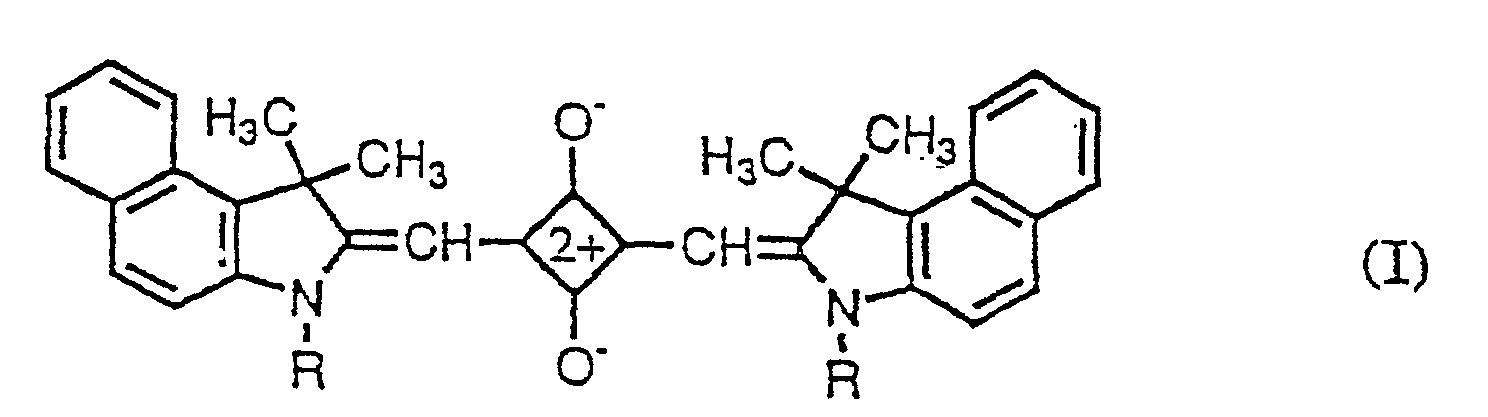
- the present invention relates to a photopolymerizable composition which comprises a squarylium compound represented by the formula (I): wherein R represents lower alkyl having 2 to 8 carbon atoms, a radical generator and an addition-polymerizable compound having at least one ethylenic unsaturated double bond.
- examples of lower alkyl having 2 to 8 carbon atoms are straight or branched alkyls such as ethyl, propyl, isopropyl, butyl, isobutyl, sec-butyl, tert-butyl, 2-ethylbutyl, pentyl, isopentyl, neopentyl, 3-ethylpentyl, tert-pentyl, hexyl, isohexyl, heptyl and octyl.
- halogen represents chlorine, bromine or iodine.
- a raw compound (II) can be obtained according to a process described in Monatsh.Chem., 31 , 123 (1910) or a similar process thereto.
- Compound (III) can be prepared by reacting Compound (II) with an equivalent to a large excess amount of compound RX in a solvent or without a solvent under heating for 1 to 24 hours.
- solvent to be used are methyl isobutyl ketone, diisobutyl ketone, xylene, toluene and butanol.
- Compound (I) can be obtained by reacting Compound (III) with 0.5 equivalent of Compound (IV) at 90 to 110 °C for 1 to 24 hours in a solvent in the presence of 1 to 2 equivalents of a basic compound.
- a basic compound are triethylamine, quinoline and pyridine.
- the solvent are alcohols such as ethanol, butanol, isobutylalcohol, pentanol, hexanol, heptanol and octanol, and a mixed solvent of the above alcohol and an aromatic hydrocarbon such as benzene, toluene or xylene.
- Intermediates and the desired compounds in the above process can be isolated and purified by the purification method, conventionally used in organic synthetic chemistry, such as filtration, extraction, washing, drying, concentration, crystallization, and various kinds of chromatography. Alternatively, intermediates can be used in the next reaction without purification.
- Compound (I) may be obtained as crystals comprising Compound (I) and an organic solvent such as benzene, toluene, xylene or alcohol and these crystals may be used as the present squarylium compound.
- the photopolymerizable composition can be prepared by mixing Compound (I), a radical generator and an addition-polymerizable compound (hereinafter, also referred to as "ethylenic compound”) having at least one ethylenic unsaturated double bond and, if necessary, a binder and the conventional additive (such as thermal polymerization-inhibitor and plasticizer).
- ethylenic compound an addition-polymerizable compound having at least one ethylenic unsaturated double bond and, if necessary, a binder and the conventional additive (such as thermal polymerization-inhibitor and plasticizer).
- radical generator examples include s-triazine compounds substituted with at least one trihalomethyl group (such as 2,4,6-tris(trichloromethyl)-s-triazine, 2-(4-methoxyphenyl)-4,6-bis(trichloromethyl)-s-triazine and 2-(4-methoxy-1)-naphthyl)-4,6-bis(trichloromethyl)-s-triazine); organic peroxide compounds (such as 3,3',4,4'-tetrakis(tert-butyldioxycarbonyl)benzophenone); N-phenylglycines (such as N-phenylglycine, p-chloro-N-phenylglycine and m-methyl-N-phenylglycine); aromatic sulfonyl halide compounds (such as benzenesulfonyl chloride and p-toluenesulfonyl chloride); imi
- the present photopolymerization initiator system is composed of a squarylium compound and a radical generator.
- An amount of the radical generator to be used in the photopolymerization initiator is 0.1 to 100 parts by weight (hereinafter, part(s) by weight is referred to as "part(s)"), preferably 1 to 50 parts relative to 1 part of the squarylium compound.
- ethylenic compound may be any compounds which have at least one ethylenic unsaturated double bond, which addition-polymerize by means of radicals produced when the photopolymerizable composition is exposed to the light, and which cause hardening and insolubilization of the photopolymerizable composition.
- monomers and oligomers having at least one ethylenic unsaturated double bond and polymers having at least one ethylenic unsaturated double bond in a main or side chain are used alone or in combination.
- Examples of the monomer having at least one ethylenic unsaturated double bond are unsaturated carboxylic acids, esters of an unsaturated carboxylic acid and monohydroxy compound, esters of an unsaturated carboxylic acid and aliphatic polyhydroxy compound, esters of an unsaturated carboxylic acid and aromatic polyhydroxy compound, and esters obtained by esterification of an unsaturated carboxylic acid, polyvalent carboxylic acid and polyhydroxy compound.
- unsaturated carboxylic acid examples include acrylic acid, methacrylic acid, itaconic acid, crotonic acid and maleic acid.
- ester of the unsaturated carboxylic acid and the monohydroxy compound are acrylates such as methyl acrylate, butyl acrylate, 2-phenoxyethyl acrylate, p-chlorophenyl acrylate, 2-(1-naphthyloxy)ethyl acrylate, o-biphenyl acrylate, pentachlorophenyl acrylate, 2,4,6-tribromophenyl acrylate, 2-naphthyl acrylate, 2-(2-naphthyloxy)ethyl acrylate, trifluoroethyl acrylate, tetrafluoropropyl acrylate, dibromopropyl acrylate, ethyl-2-chloro acrylate and tetrahydrofurfuryl acrylate, and compounds wherein an acrylic acid part is replaced by methacrylic acid in the above acrylates, as well as derivatives thereof.
- acrylates such as
- ester of the unsaturated carboxylic acid and the aliphatic polyhydroxy compound are acrylates such as ethylene glycol diacrylate, triethylene glycol diacrylate, tetraethylene glycol diacrylate, propylene glycol diacrylate, neopentyl glycol diacrylate, 1,3-butanediol diacrylate, 1,4-cyclohexanediol diacrylate, hexanediol diacrylate, trimethylolpropane triacrylate, trimethylolethane triacrylate, trimethylolpropane tris(acryloyloxypropyl) ether, pentaerythritol diacrylate, pentaerythritol triacrylate, pentaerythritol tetraacrylate, dipentaerythritol diacrylate, dipentaerythritol triacrylate, dipentaerythritol tetraacrylate, dipentaerythrito
- ester of the unsaturated carboxylic acid and the aromatic polyhydroxy compound examples include hydroquinone diacrylate, hydroquinone dimethacrylate, resorcin diacrylate, resorcin dimethacrylate and pyrogallol triacrylate, as well as esters of an unsaturated carboxylic acid and aromatic polyhydroxy compound derivative such as EO-modified bisphenol A diacrylate and tris( ⁇ -acryloyloxyethyl)-s-cyanurate.
- ester obtained by esterification of the unsaturated carboxylic acid, polyvalent carboxylic acid and polyhydroxy compound are a condensation product from acrylic acid, phthalic acid and ethylene glycol, a condensation product from acrylic acid, maleic acid and diethylene glycol, a condensation product from methacrylic acid, terephthalic acid and pentaerythritol, a condensation product from acrylic acid, adipic acid, butanediol and glycerin, a condensation product from acrylic acid, trimellitic acid and diethylene glycol.
- the other examples of the monomer or oligomer having at least one ethylenic unsaturated double bond used in the present invention are acrylic amides such as ethylenebisacrylamide, allyl esters such as diacryl phthalate and prepolymer thereof, vinyl group-containing compounds such as divinyl phthalate, urethane acrylate such as a condensation product from glycerin dimethacrylate and hexamethylene diisocyanate, N-vinylcarbazole, and N-vinylpyrrolidone.
- Examples of the polymer having an ethylenic unsaturated double bond on a main chain are polyesters obtained by polycondensation of an unsaturated divalent carboxylic acid and dihydroxy compound, polyamides obtained by polycondensation of an unsaturated divalent carboxylic acid and diamine.
- polymer having an ethylenic unsaturated double bond on a side chain examples include polycondensation products from a divalent carboxylic acid having an unsaturated bond on a side chain such as itaconic acid, propylidenesuccinic acid, ethylidenemalonic acid, and dihydroxy or diamine compound.
- polymers having a functional group such as a hydroxy group, halogenated methyl group or epoxy group on a side chain may be used, such as a polymer obtained by polymeric reaction of polyvinyl alcohol, poly(2-hydroxyethyl methacrylate), epoxy resin or phenoxy resin polyepichlorohydrine, with an unsaturated carboxylic acid such as acrylic acid, methacrylic acid or crotonic acid.
- binder examples include a polymethacrylate or partial hydrolysate thereof, a polyacrylate or partial hydrolysate thereof, polyvinyl acetate or a partial hydrolysate thereof, a vinyl acetate-ethylene copolymer or partial hydrolysate thereof, polystyrene, polyvinyl formal, polyvinylbutyral, polychloroprene, polyvinyl chloride, chlorinated polyethylene, chlorinated polypropylene, phenol novolak or cresol novolak resin, polyvinyl phenol, vinyl phenol-methacrylate copolymer, polyethylene oxide, polymethyl isopropenyl ketone, methacrylate-phenyl isopropenyl ketone copolymer, polyurethane, polyamide, polycarbonate, polyethylene terephthalate, polybutylene terephthalate, acetylcellulose, acetylbutylcellulose, nitrocellulose, polyvinyl carbazole or a derivative thereof
- thermal polymerization-inhibitor examples include p-tert-butylcatechol, hydroquinone and chloranyl.
- plasticizer examples include diethylhexyl phthalate, diisobutyl phthalate, tricresyl phosphate, diethylhexyl cebacate and diethylhexyl adipate.
- An amount of the squarylium compound and that of the radical generator to be used in the photopolymerizable composition are 0.1 to 30 parts, preferably 0.5 to 5 parts, and 1 to 50 parts, preferably 2 to 30 parts relative to 100 parts of the ethylenic compound, respectively.
- An amount of the binder to be used is 10 to 1000 parts, preferably 60 to 200 parts relative to 100 parts of the ethylenic compound.
- solubilities of Compounds 1 to 9 are shown as a relative value based on the standard of the solubility of Compound (A) in Table 2.
- Compound Relative value of solubility 1 37 2 12 3 14 4 95 5 4.4 6 30 7 111 8 38 9 6.8 A 1.0
- the solubility of the squarylium compound in chlorobenzene was obtained according to the same procedures as those in Test Example 1 except for using chlorobenzene in place of ethyl cellosolve.
- the solubilities of Compounds 1 to 9 are shown as a relative value based on the solubility of Compound (A) in Table 3.
- the solubility of the squarylium compound in methyl ethyl ketone was obtained according to the same procedures as those in Test Example 1 except for using methyl ethyl ketone in place of ethyl cellosolve.
- the solubilities of Compounds 1 to 9 are shown as a relative value based on the standard of the solubility of Compound (A) in Table 4.
- Compound Relative value of solubility 1 6.8 2 3.5 3 4.4 4 103 5 1.8 6 11 7 131 8 42 9 4.7 A 1.0
- Compound 1 is a known compound described in JP-A 3-126581 and Compound 4 is a known compound described in JP-A 1-178493 and they can be obtained according to a method described in US4,830,786.
- degraded rates of squarylium Compounds 1 to 9 are shown as a relative value based on the degraded rate of Compound (A) in Table 5.
- Compound Relative value of degraded rate 1 0.34 2 0.25 3 0.24 4 0.29 5 0.15 6 0.28 7 0.31 8 0.32 9 0.26 A 1.0
- the degraded rate of squarylium Compounds 1 to 9 are shown as a relative value based on the degraded rate of Compound (A) in Table 6.
- Compound Relative value of degraded rate 1 0.51 2 0.48 3 0.44 4 0.60 5 0.42 6 0.46 7 0.56 8 0.43 9 0.52 A 1.0
- This photosensitive solution was spin-coated on an aluminium plate treated with grinding and anodic oxidation, at 1000 rpm so that the dry-state thickness became 2 ⁇ m.
- a 10% aqueous polyvinyl alcohol (Kurarey Poval 706) solution was spin-coated at 1500 rpm so that the dry-state thickness became 1 ⁇ m to give a over-coat layer.
- a step tablet was piled closely on the resulting photosensitive layer, and the rays having the wavelength around 630, 650 or 680 nm were irradiated from 3kw ultra-high pressure mercury lamp through a glass filter.
- the rays having the wavelength around 630 nm (155 ⁇ J/cm 2 ⁇ s) were obtained by passing the rays from the above mercury lamp through a colored glass filter R-61, an interference filter KL-63 (both were manufactured by Toshiba Glass Co., Ltd.) and a heat rays absorbing filter HA-30 (manufactured by HOYA Corporation), the rays having the wavelength around 650 nm (177 ⁇ J/cm 2 ⁇ s) were obtained by passing the rays from the above mercury lamp through a colored glass filter R-63, an interference filter KL-65 (both were manufactured by Toshiba Glass Co., Ltd.) and HA-30 and the rays having the wavelength around 680 nm (88 ⁇ J/cm 2 ⁇ s) were obtained by passing the rays from the above mercury lamp through a glass filter R-66, an interference filter KL-68 (both were manufactured by Toshiba Glass Co., Ltd.) and HA-30.
- Sensitivity (mJ/cm 2 ) Compound 630 nm 650 nm 680 nm 1 0.47 0.40 0.37 2 0.47 0.40 0.37 3 0.39 0.40 0.26 4 0.39 0.40 0.37 5 0.47 0.56 0.28 6 0.56 0.40 0.37 7 0.47 0.40 0.37 A 0.91 0.56 0.65
- a photopolymerizable composition which contains a squarylium compound which is excellent in the solubility in an organic solvent and is stably present in a photosensitizer solution, which has the high sensitivity to visible lights having the wavelength of not lower than 600 nm to near infrared lights and which is stable upon storage.
Landscapes
- Chemical & Material Sciences (AREA)
- Organic Chemistry (AREA)
- Physics & Mathematics (AREA)
- Spectroscopy & Molecular Physics (AREA)
- General Physics & Mathematics (AREA)
- Inorganic Chemistry (AREA)
- Indole Compounds (AREA)
- Polymerisation Methods In General (AREA)
- Organic Low-Molecular-Weight Compounds And Preparation Thereof (AREA)
- Addition Polymer Or Copolymer, Post-Treatments, Or Chemical Modifications (AREA)
- Materials For Photolithography (AREA)
Claims (2)
- Photopolymerisierbare Zusammensetzung, welche eine Squarylium-Verbindung der Formel (I):in welcher R einen Niederalkylrest mit 2 bis 8 Kohlenstoffatomen darstellt, einen Radikalbildner und eine additionspolymerisierbare Verbindung mit mindestens einer ethylenisch ungesättigten Doppelbindung umfaßt.
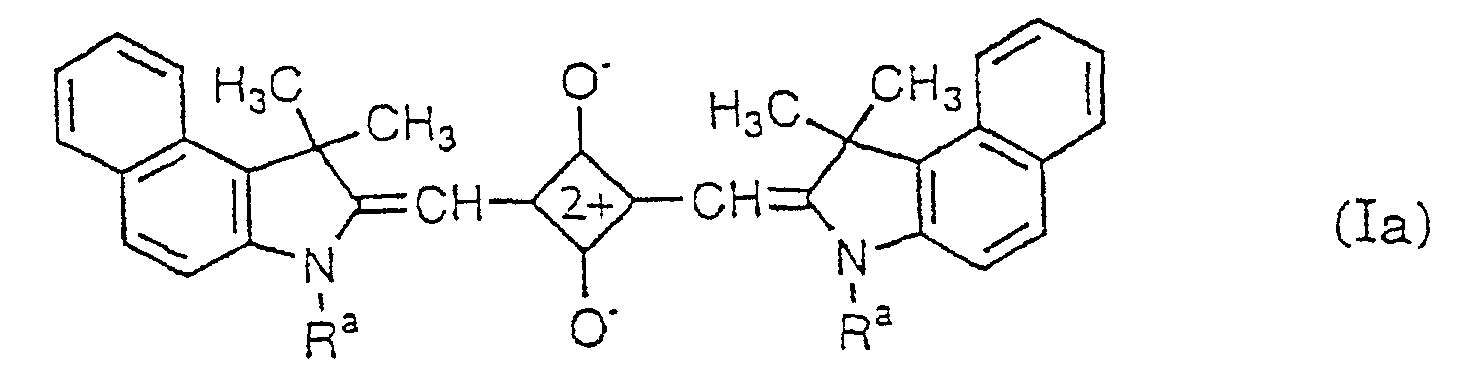
- Squarylium-Verbindung der Formel (Ia):in welcher Ra eine Propyl-, Isopropyl-, Isobutyl-, Pentyl-, Isopentyl- oder Hexylgruppe darstellt.
Applications Claiming Priority (4)
| Application Number | Priority Date | Filing Date | Title |
|---|---|---|---|
| JP22656894 | 1994-09-21 | ||
| JP226568/94 | 1994-09-21 | ||
| JP22656894 | 1994-09-21 | ||
| PCT/JP1995/001894 WO1996009289A1 (fr) | 1994-09-21 | 1995-09-20 | Composition photopolymerisable contenant un compose au squarylium |
Publications (3)
| Publication Number | Publication Date |
|---|---|
| EP0729945A1 EP0729945A1 (de) | 1996-09-04 |
| EP0729945A4 EP0729945A4 (de) | 1998-10-14 |
| EP0729945B1 true EP0729945B1 (de) | 2002-02-27 |
Family
ID=16847207
Family Applications (1)
| Application Number | Title | Priority Date | Filing Date |
|---|---|---|---|
| EP95932192A Expired - Lifetime EP0729945B1 (de) | 1994-09-21 | 1995-09-20 | Eine eine squariliumverbindung enthaltende photopolymerisierbare zusammensetzung |
Country Status (6)
| Country | Link |
|---|---|
| US (1) | US5681685A (de) |
| EP (1) | EP0729945B1 (de) |
| JP (1) | JP3404046B2 (de) |
| CA (1) | CA2176931A1 (de) |
| DE (1) | DE69525609T2 (de) |
| WO (1) | WO1996009289A1 (de) |
Families Citing this family (8)
| Publication number | Priority date | Publication date | Assignee | Title |
|---|---|---|---|---|
| US6232038B1 (en) * | 1998-10-07 | 2001-05-15 | Mitsubishi Chemical Corporation | Photosensitive composition, image-forming material and image-forming method employing it |
| KR100735134B1 (ko) * | 1999-12-16 | 2007-07-03 | 교와 핫꼬 케미칼 가부시키가이샤 | 스쿠아리리움 화합물 및 이를 함유한 광학적 기록 매체 |
| JP4512281B2 (ja) * | 2001-02-22 | 2010-07-28 | 富士フイルム株式会社 | ネガ型平版印刷版原版 |
| KR20040097204A (ko) | 2002-04-08 | 2004-11-17 | 교와 핫꼬 케미카루 가부시키가이샤 | 광중합성 조성물 |
| US20050058911A1 (en) * | 2003-09-17 | 2005-03-17 | Konica Minolta Medical & Graphic, Inc. | Holographic recording medium, holographic recording method and holographic information medium |
| TW200720842A (en) * | 2005-10-24 | 2007-06-01 | Kyowa Hakko Chemical Co Ltd | A squarilium compound and the short-wave length source photo polymerization composition using thereof |
| JP5270114B2 (ja) * | 2007-06-15 | 2013-08-21 | 富士フイルム株式会社 | 固体撮像素子 |
| KR101413075B1 (ko) * | 2011-12-26 | 2014-06-30 | 제일모직 주식회사 | 컬러필터용 감광성 수지 조성물 및 이를 이용한 컬러필터 |
Citations (2)
| Publication number | Priority date | Publication date | Assignee | Title |
|---|---|---|---|---|
| JPH01178493A (ja) * | 1988-01-07 | 1989-07-14 | Ricoh Co Ltd | 光情報記録媒体 |
| US5190849A (en) * | 1989-10-12 | 1993-03-02 | Canon Kabushiki Kaisha | Optical recording medium containing carboxylic acid-base metallic complex and squarylium-base or croconium-base dye |
Family Cites Families (13)
| Publication number | Priority date | Publication date | Assignee | Title |
|---|---|---|---|---|
| JPS60224674A (ja) * | 1984-04-23 | 1985-11-09 | Mitsubishi Chem Ind Ltd | 2,4−ビス(1’,3’,3’−トリアルキル−2’−メチレンインドリノ)シクロブテンジイリウム−1,3−ジオレ−ト類 |
| US4743531A (en) * | 1986-11-21 | 1988-05-10 | Eastman Kodak Company | Dye sensitized photographic imaging system |
| US4743530A (en) * | 1986-11-21 | 1988-05-10 | Eastman Kodak Company | Negative working photoresists responsive to longer wavelengths and novel coated articles |
| JP2567238B2 (ja) * | 1987-03-25 | 1996-12-25 | 日本化薬株式会社 | 集光用樹脂板 |
| JPH0820734B2 (ja) * | 1988-08-11 | 1996-03-04 | 富士写真フイルム株式会社 | 感光性組成物及びそれを用いた光重合性組成物 |
| CA2000855A1 (en) * | 1988-11-17 | 1990-05-17 | Mohammad Z. Ali | Triazine photoinitiators in a ternary system for addition polymerization |
| EP0379200A3 (de) * | 1989-01-19 | 1991-11-13 | Mitsubishi Kasei Corporation | Photopolymerisierbare Zusammensetzung |
| JPH03505005A (ja) * | 1989-03-27 | 1991-10-31 | ユナイテッド テクノロジーズ コーポレーション | アクティブ集積光学装置および光学集積装置の製作方法 |
| CA2033821A1 (en) * | 1990-01-12 | 1991-07-13 | Evan D. Laganis | Photopolymerizable compositions sensitive to longer wavelength visible actinic radiation |
| US5147758A (en) * | 1991-02-19 | 1992-09-15 | E. I. Du Pont De Nemours And Company | Red sensitive photopolymerizable compositions |
| JP2988756B2 (ja) * | 1991-04-26 | 1999-12-13 | 協和醗酵工業株式会社 | 光重合開始剤およびこれを含有する光重合性組成物 |
| JP2871181B2 (ja) * | 1991-07-09 | 1999-03-17 | ブラザー工業株式会社 | 光硬化型組成物 |
| JPH06263732A (ja) * | 1993-03-12 | 1994-09-20 | Mitsubishi Kasei Corp | シクロブテン系化合物,その製法並びにスクアリリウム系化合物の製造法 |
-
1995
- 1995-09-20 JP JP51075296A patent/JP3404046B2/ja not_active Expired - Fee Related
- 1995-09-20 US US08/648,136 patent/US5681685A/en not_active Expired - Fee Related
- 1995-09-20 CA CA002176931A patent/CA2176931A1/en not_active Abandoned
- 1995-09-20 DE DE69525609T patent/DE69525609T2/de not_active Expired - Fee Related
- 1995-09-20 EP EP95932192A patent/EP0729945B1/de not_active Expired - Lifetime
- 1995-09-20 WO PCT/JP1995/001894 patent/WO1996009289A1/ja not_active Ceased
Patent Citations (2)
| Publication number | Priority date | Publication date | Assignee | Title |
|---|---|---|---|---|
| JPH01178493A (ja) * | 1988-01-07 | 1989-07-14 | Ricoh Co Ltd | 光情報記録媒体 |
| US5190849A (en) * | 1989-10-12 | 1993-03-02 | Canon Kabushiki Kaisha | Optical recording medium containing carboxylic acid-base metallic complex and squarylium-base or croconium-base dye |
Also Published As
| Publication number | Publication date |
|---|---|
| CA2176931A1 (en) | 1996-03-28 |
| EP0729945A4 (de) | 1998-10-14 |
| JP3404046B2 (ja) | 2003-05-06 |
| EP0729945A1 (de) | 1996-09-04 |
| WO1996009289A1 (fr) | 1996-03-28 |
| DE69525609D1 (de) | 2002-04-04 |
| DE69525609T2 (de) | 2002-09-19 |
| US5681685A (en) | 1997-10-28 |
Similar Documents
| Publication | Publication Date | Title |
|---|---|---|
| JP2538992B2 (ja) | 光重合性組成物 | |
| US5147758A (en) | Red sensitive photopolymerizable compositions | |
| EP0211615A2 (de) | Photopolymerisierbare Zusammensetzung | |
| EP0619520B1 (de) | Photopolymerisierbare Zusammensetzung | |
| US5681685A (en) | Photopolymerizable composition containing squarylium compound | |
| KR20040097204A (ko) | 광중합성 조성물 | |
| JPS5819315A (ja) | 光重合性組成物 | |
| EP0555058B1 (de) | (Oxo)Sulfoniumkomplex, diese enthaltende polymerisierbare Zusammensetzung und Verfahren zur Polymerisation | |
| JP3324279B2 (ja) | 光重合性組成物 | |
| JPWO1996009289A1 (ja) | スクアリリウム化合物を含有する光重合性組成物 | |
| KR970005533B1 (ko) | 단량체부를 함유한 할로메틸-1,3,5-트리아진 및 이를 포함하는 감방사성 조성물 | |
| US5756258A (en) | Photopolymerizable composition containing an addition polymerizable compound, a radical-producing agent and a squarylium compound | |
| EP1113335B1 (de) | Photopolymerisierbare Zusammensetungen | |
| KR100377643B1 (ko) | 이기능성 트리아진계 화합물 및 광개시제 | |
| JPH06295061A (ja) | 光重合性組成物 | |
| JPWO1994001806A1 (ja) | 光重合性組成物 | |
| JP3324266B2 (ja) | 光重合性組成物及び感光材料 | |
| US6007965A (en) | Photopolymerizable compositions including squarylium compounds | |
| JPS63180946A (ja) | 高感度光重合性組成物 | |
| JPH0980751A (ja) | 光重合性組成物 | |
| JPH0643641A (ja) | 光重合性組成物 | |
| JP3324349B2 (ja) | 光重合性組成物及び感光材料 | |
| JP3473259B2 (ja) | 光重合性組成物 | |
| JPH08179504A (ja) | 光重合性組成物 | |
| CA1331533C (en) | Photopolymerizable composition |
Legal Events
| Date | Code | Title | Description |
|---|---|---|---|
| PUAI | Public reference made under article 153(3) epc to a published international application that has entered the european phase |
Free format text: ORIGINAL CODE: 0009012 |
|
| AK | Designated contracting states |
Kind code of ref document: A1 Designated state(s): BE CH DE FR GB LI NL |
|
| 17P | Request for examination filed |
Effective date: 19960925 |
|
| A4 | Supplementary search report drawn up and despatched |
Effective date: 19980827 |
|
| AK | Designated contracting states |
Kind code of ref document: A4 Designated state(s): BE CH DE FR GB LI NL |
|
| 17Q | First examination report despatched |
Effective date: 19991103 |
|
| GRAG | Despatch of communication of intention to grant |
Free format text: ORIGINAL CODE: EPIDOS AGRA |
|
| GRAG | Despatch of communication of intention to grant |
Free format text: ORIGINAL CODE: EPIDOS AGRA |
|
| GRAH | Despatch of communication of intention to grant a patent |
Free format text: ORIGINAL CODE: EPIDOS IGRA |
|
| RIN1 | Information on inventor provided before grant (corrected) |
Inventor name: MATSUSHITA, SHOSHIRO Inventor name: KINOSHITA, HIROTAKA Inventor name: TOYODA, HIROSHI Inventor name: SHIMIZU, IKUO Inventor name: KOSEKI, KENICHI Inventor name: YAMAOKA, TSUGUO |
|
| GRAH | Despatch of communication of intention to grant a patent |
Free format text: ORIGINAL CODE: EPIDOS IGRA |
|
| REG | Reference to a national code |
Ref country code: GB Ref legal event code: IF02 |
|
| GRAA | (expected) grant |
Free format text: ORIGINAL CODE: 0009210 |
|
| AK | Designated contracting states |
Kind code of ref document: B1 Designated state(s): BE CH DE FR GB LI NL |
|
| REG | Reference to a national code |
Ref country code: CH Ref legal event code: EP |
|
| REF | Corresponds to: |
Ref document number: 69525609 Country of ref document: DE Date of ref document: 20020404 |
|
| ET | Fr: translation filed | ||
| REG | Reference to a national code |
Ref country code: CH Ref legal event code: NV Representative=s name: BOVARD AG PATENTANWAELTE |
|
| PLBE | No opposition filed within time limit |
Free format text: ORIGINAL CODE: 0009261 |
|
| STAA | Information on the status of an ep patent application or granted ep patent |
Free format text: STATUS: NO OPPOSITION FILED WITHIN TIME LIMIT |
|
| 26N | No opposition filed |
Effective date: 20021128 |
|
| PGFP | Annual fee paid to national office [announced via postgrant information from national office to epo] |
Ref country code: NL Payment date: 20040905 Year of fee payment: 10 |
|
| PGFP | Annual fee paid to national office [announced via postgrant information from national office to epo] |
Ref country code: FR Payment date: 20040908 Year of fee payment: 10 |
|
| PGFP | Annual fee paid to national office [announced via postgrant information from national office to epo] |
Ref country code: GB Payment date: 20040915 Year of fee payment: 10 |
|
| PGFP | Annual fee paid to national office [announced via postgrant information from national office to epo] |
Ref country code: DE Payment date: 20040916 Year of fee payment: 10 |
|
| PGFP | Annual fee paid to national office [announced via postgrant information from national office to epo] |
Ref country code: CH Payment date: 20040929 Year of fee payment: 10 |
|
| PGFP | Annual fee paid to national office [announced via postgrant information from national office to epo] |
Ref country code: BE Payment date: 20041122 Year of fee payment: 10 |
|
| PG25 | Lapsed in a contracting state [announced via postgrant information from national office to epo] |
Ref country code: GB Free format text: LAPSE BECAUSE OF NON-PAYMENT OF DUE FEES Effective date: 20050920 |
|
| PG25 | Lapsed in a contracting state [announced via postgrant information from national office to epo] |
Ref country code: LI Free format text: LAPSE BECAUSE OF NON-PAYMENT OF DUE FEES Effective date: 20050930 Ref country code: CH Free format text: LAPSE BECAUSE OF NON-PAYMENT OF DUE FEES Effective date: 20050930 Ref country code: BE Free format text: LAPSE BECAUSE OF NON-PAYMENT OF DUE FEES Effective date: 20050930 |
|
| PG25 | Lapsed in a contracting state [announced via postgrant information from national office to epo] |
Ref country code: NL Free format text: LAPSE BECAUSE OF NON-PAYMENT OF DUE FEES Effective date: 20060401 Ref country code: DE Free format text: LAPSE BECAUSE OF NON-PAYMENT OF DUE FEES Effective date: 20060401 |
|
| REG | Reference to a national code |
Ref country code: CH Ref legal event code: PL |
|
| GBPC | Gb: european patent ceased through non-payment of renewal fee |
Effective date: 20050920 |
|
| PG25 | Lapsed in a contracting state [announced via postgrant information from national office to epo] |
Ref country code: FR Free format text: LAPSE BECAUSE OF NON-PAYMENT OF DUE FEES Effective date: 20060531 |
|
| NLV4 | Nl: lapsed or anulled due to non-payment of the annual fee |
Effective date: 20060401 |
|
| REG | Reference to a national code |
Ref country code: FR Ref legal event code: ST Effective date: 20060531 |
|
| BERE | Be: lapsed |
Owner name: *KYOWA HAKKO KOGYO CO. LTD Effective date: 20050930 |