EP0722917B2 - Dispersionspulverfliesenkleber - Google Patents
Dispersionspulverfliesenkleber Download PDFInfo
- Publication number
- EP0722917B2 EP0722917B2 EP96100718A EP96100718A EP0722917B2 EP 0722917 B2 EP0722917 B2 EP 0722917B2 EP 96100718 A EP96100718 A EP 96100718A EP 96100718 A EP96100718 A EP 96100718A EP 0722917 B2 EP0722917 B2 EP 0722917B2
- Authority
- EP
- European Patent Office
- Prior art keywords
- parts
- dispersion powder
- cement
- tile adhesive
- dispersion
- Prior art date
- Legal status (The legal status is an assumption and is not a legal conclusion. Google has not performed a legal analysis and makes no representation as to the accuracy of the status listed.)
- Expired - Lifetime
Links
Classifications
-
- C—CHEMISTRY; METALLURGY
- C04—CEMENTS; CONCRETE; ARTIFICIAL STONE; CERAMICS; REFRACTORIES
- C04B—LIME, MAGNESIA; SLAG; CEMENTS; COMPOSITIONS THEREOF, e.g. MORTARS, CONCRETE OR LIKE BUILDING MATERIALS; ARTIFICIAL STONE; CERAMICS; REFRACTORIES; TREATMENT OF NATURAL STONE
- C04B28/00—Compositions of mortars, concrete or artificial stone, containing inorganic binders or the reaction product of an inorganic and an organic binder, e.g. polycarboxylate cements
- C04B28/02—Compositions of mortars, concrete or artificial stone, containing inorganic binders or the reaction product of an inorganic and an organic binder, e.g. polycarboxylate cements containing hydraulic cements other than calcium sulfates
- C04B28/06—Aluminous cements
-
- C—CHEMISTRY; METALLURGY
- C04—CEMENTS; CONCRETE; ARTIFICIAL STONE; CERAMICS; REFRACTORIES
- C04B—LIME, MAGNESIA; SLAG; CEMENTS; COMPOSITIONS THEREOF, e.g. MORTARS, CONCRETE OR LIKE BUILDING MATERIALS; ARTIFICIAL STONE; CERAMICS; REFRACTORIES; TREATMENT OF NATURAL STONE
- C04B2111/00—Mortars, concrete or artificial stone or mixtures to prepare them, characterised by specific function, property or use
- C04B2111/00474—Uses not provided for elsewhere in C04B2111/00
- C04B2111/00663—Uses not provided for elsewhere in C04B2111/00 as filling material for cavities or the like
- C04B2111/00672—Pointing or jointing materials
Definitions
- the invention relates to a dispersion powder fleece adhesive and its use for bonding ceramics on young screed.
- This tile adhesive is particularly useful when laying tiles on still young ones Suitable for cement screeds.
- tiles and slabs are usually laid using the thin-bed method.
- the tiles - the term tiles in the following includes tiles and plates, in particular on a ceramic basis - in the thin bed process on a suitably prepared surface, e.g. B. laid a hardened cement screed. It is essential that the cement screed is essentially hardened, which takes at least 28 days in practice and under normal weather conditions. During the curing process, the volume of the cement screed is reduced due to hydration and shrinkage. During this time, laying tiles on the screed involves considerable risk. The tile ceramic laid on such a screed is rigid and not deformable. A change in volume of the screed cannot be compensated for by the ceramic rigidly connected to the screed.
- Tile adhesives in powder form which are mixed with water at the place of use by the consumer, are known.
- An essential component of these tile adhesives are, in addition to a high proportion of fillers, plastic dispersions serving as adhesives, and optionally further proportions of plasticizers, setting accelerators and the like.
- tile adhesives lead to a more or less rigid bond between the screed and the tile.
- the stress relief such glue is low. They are therefore not suitable for laying tiles on young screeds.
- Tile adhesives based on liquid synthetic resin dispersions are also known. These essentially exist from a synthetic resin dispersion as a binder as well as from fillers, plasticizers and thickeners. You can lead to a plastic bond between the screed and the tile covering. The bond is caused by drying out reached. However, drying out is due to the inclusion of the adhesive due to the tile covering and the high water content of the still young screed. Such an adhesive type is therefore also unsuitable.
- the object of the present invention is therefore to provide a tile adhesive which is in powder form comes onto the market in a simple manner with water from the consumer immediately before consumption spreadable and flowable dispersion can be made, which is highly plastic and a quick bond guaranteed and is therefore suitable for laying tile on young cement screeds.
- This object is achieved by the dispersion powder tile adhesive of claims 1-5.
- This dispersion powder tile adhesive is used according to the invention for gluing ceramics on young screed.
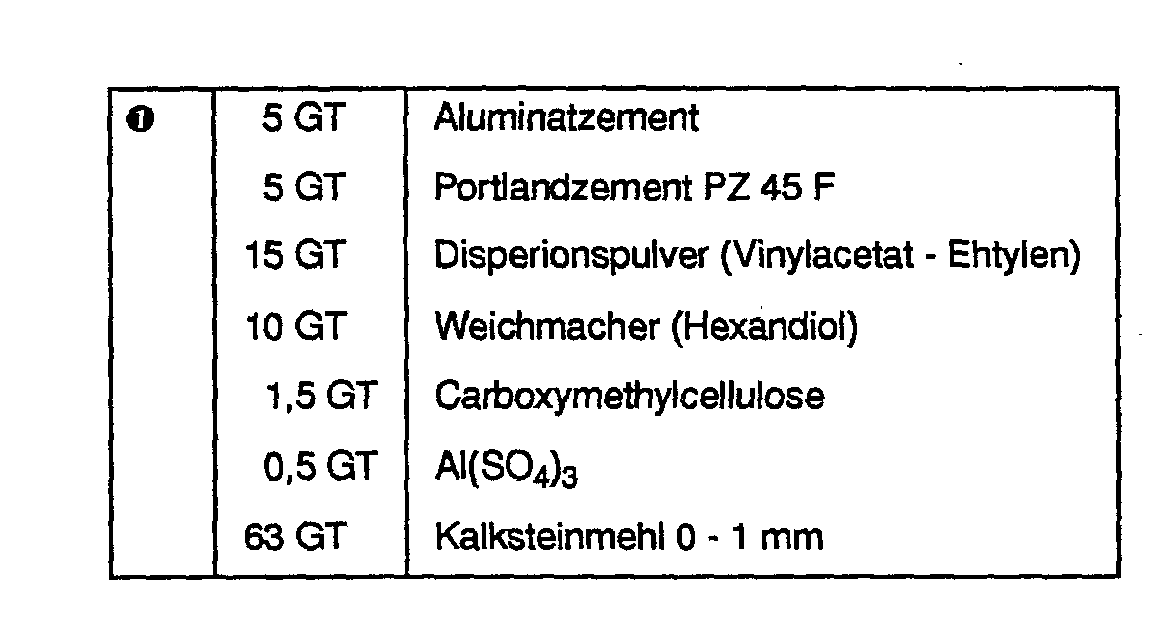
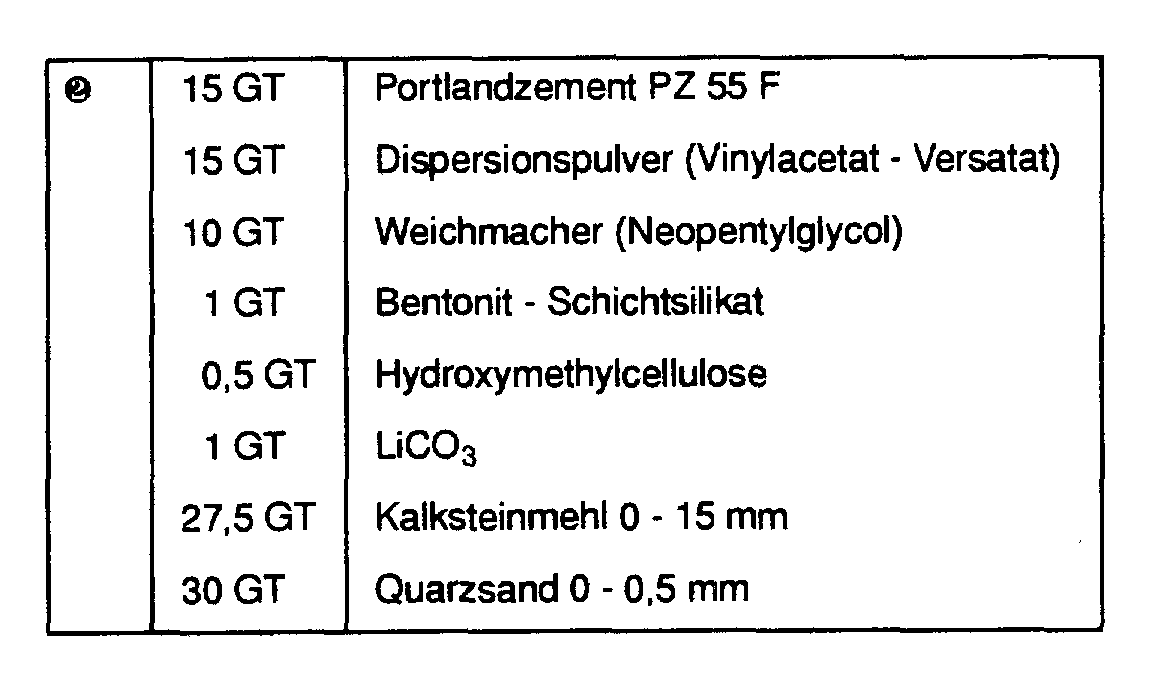
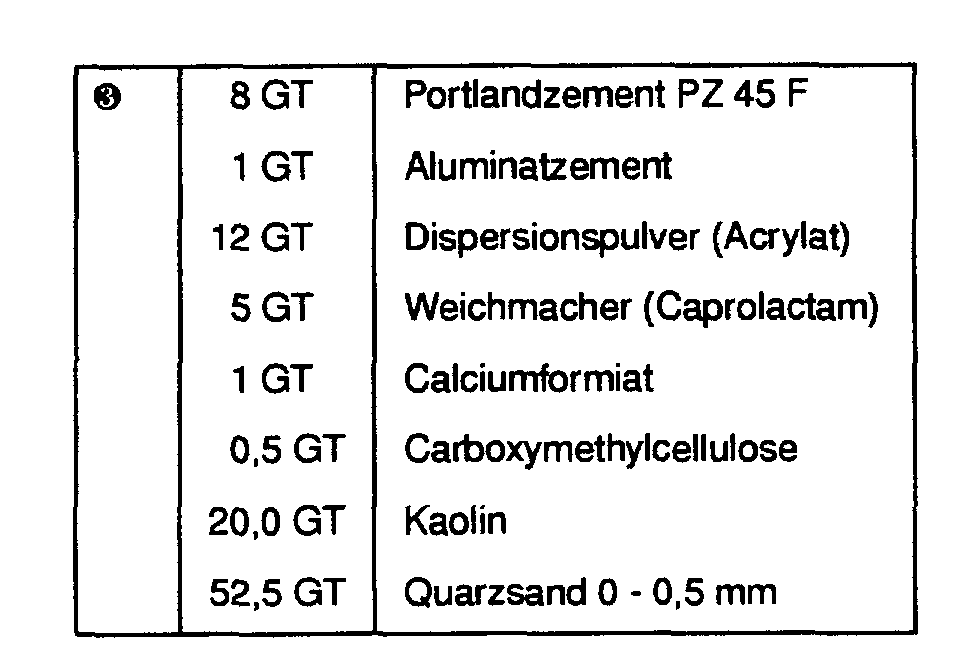
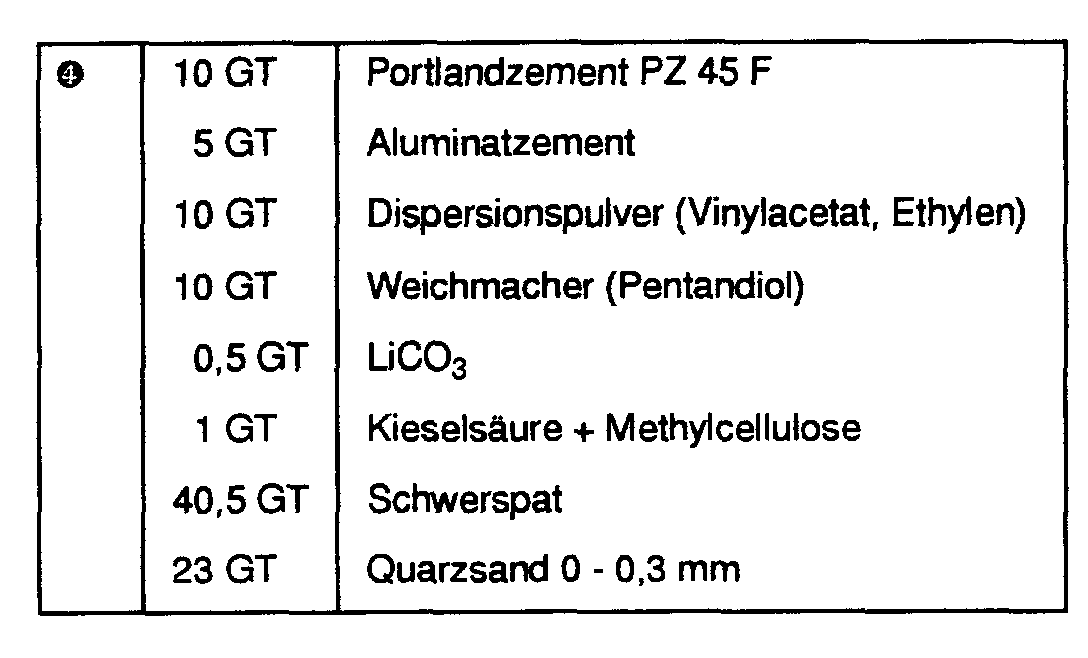
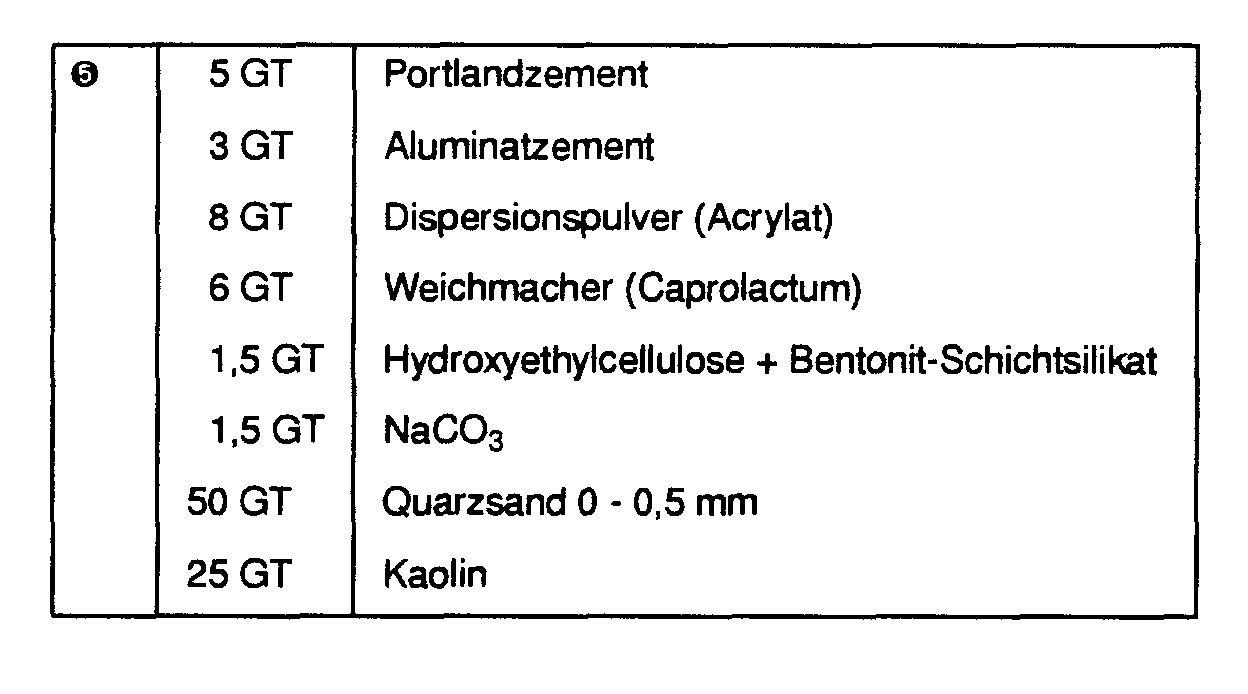
- the essential components in the dispersion powder tile adhesive are, based in each case on 100 parts by weight:
- Dispersion powder which is present in the mixture in an amount of 7 to 21 parts, preferably 8 to 15 parts.
- the dispersion powder consists of a base of plastic dispersions, which are suitable, preferably were dried by spray drying. These plastic dispersions can be made from suitable homo- or Copolymers or mixtures thereof can be constructed. Suitable copolymers are, for example, copolymers from ethylene vinyl acetate (EVA), vinyl acetate versatate, polyacrylates and methacrylates of different acrylic acid esters Chain length etc.
- EVA ethylene vinyl acetate
- Such dispersion powders based on dried plastic dispersions are commercially available available.
- cement which is in a proportion of 7 to 17 parts, preferably 8 to 13 parts available.
- This cement can be Portland cement or aluminate cement, but a mixture is preferred from Portland cement, e.g. based on the total mixture of 5 to 8 parts of Portland cement and 3 to 5 parts of aluminate cement.
- the weight ratio of plastic dispersion powder and cement in Range is from 0.4 to 3.0.
- a thickener selected from cellulose ether derivatives is preferably in an amount of 0.5 to 2 parts 0.8 to 1.5 parts, present in the mixture.
- cellulose ether derivatives are hydroxymethyl cellulose, methyl cellulose, hydroxyethyl cellulose, carboxymethyl cellulose.
- the plasticizer is present in the mixture in an amount of 1.5 to 17 parts.
- the amount depends on essentially according to the type of plastic dispersion powder used, its amount and also according to the type of plasticizer used.
- a preferred plasticizer is caprolactam.
- the plasticizer is preferably used in an amount of 2.0 to 10 parts used.
- the mixture further contains a setting accelerator in an amount of 0.2 to 2, preferably 0.5 to 1.5 parts.
- Suitable setting accelerators are, for example, Na 2 CO 3 , NaHCO 3 , NaAlO 2 , K 2 CO 3 , Al (SO 4 ) 3 , Ca (OOCH) 2 , N (C 2 H 5 O) 3 , LiCO 3 or combinations thereof.
- the bulk of the mix is made up of fillers. These are in a quantity of at least 50 Parts, preferably 60 to 80 parts before. Suitable fillers are, for example, quartz sand, chalk and talc.
- the dispersion powder tile adhesive according to the invention also contains preferably 0.5-2 parts by weight of a further thickener, which consists of swellable silicates, e.g. Layered silicates (e.g. bentonites, alapulgites, kaolinites) and polyacrylates or combinations thereof is selected.
- a further thickener which consists of swellable silicates, e.g. Layered silicates (e.g. bentonites, alapulgites, kaolinites) and polyacrylates or combinations thereof is selected.
- the constituents contained in the mixture can be mixed in the usual way and then to corresponding Containers are filled.
- Mixtures according to the invention have a maturation time of about 5 minutes.
- the open time is approx. 20 Minutes and processing time about 1 hour. They harden very quickly, so that appropriately laid tiles are fully walkable after only 24 hours and are fully resilient after about 7 days.
- the thin bed used to lay the tiles has a thickness which generally does not exceed 5 mm.
- the thin bed is processed in the usual way with an appropriate toothed trowel.
- Fresh anhydrite or plaster screeds should not be more than contain approx. 0.5% residual moisture and must be primed before laying.
- tile adhesive according to the invention can also be used to apply tiles Use other substrates as screed, for example you can also use dry, screwed-on substrates Use chipboard or stuck parquet or wooden planks.
- the dispersion powder tile adhesive according to the invention can also be used as a jointing compound for the laid Tiles are used.
- the ratio of cement to dispersion powder is too high here.
- the adhesive is not plastic enough.
- tile adhesives (commercially available) that are not suitable: B 38 GT Portland cement 5 GT Dispersion powder (vinyl acetate - ethylene) 53 GT quartz sand 3 GT limestone 1 GT hydroxyethyl
Landscapes
- Chemical & Material Sciences (AREA)
- Engineering & Computer Science (AREA)
- Ceramic Engineering (AREA)
- Chemical Kinetics & Catalysis (AREA)
- Inorganic Chemistry (AREA)
- Materials Engineering (AREA)
- Structural Engineering (AREA)
- Organic Chemistry (AREA)
- Adhesives Or Adhesive Processes (AREA)
- Curing Cements, Concrete, And Artificial Stone (AREA)
- Finishing Walls (AREA)
- Processing Of Solid Wastes (AREA)
Description
Die auf einem solchen Estrich verlegte Fliesenkeramik ist starr und nicht verformbar. Eine Volumenänderung des Estrichs kann durch die mit dem Estrich starr verbundene Keramik nicht ausgeglichen werden. Es kommt bei solchen früh mit Fliesen belegten Estrichen zu Aufwölbungen, zum Abscheren der Fliesen oder zur Rißbildung in der Fliesen-Keramik.
Es besteht deshalb ein erhebliches Bedürfnis nach einem Fliesenkleber, der auch schon auf einen nicht vollständig ausgehärteten Zementestrich aufgetragen werden kann, ohne daß die Gefahr besteht, daß die Schwindspannungen während des Aushärteprozesses des Estriches nicht vollständig aufgenommen und kompensiert werden.
Ein wesentlicher Bestandteil dieser Fliesenkleber sind neben einem hohem Anteil an Füllstoffen als Klebemittel dienende Kunststoffdispersionen, sowie gegebenenfalls weitere Anteile an Weichmachern, Abbindebeschleunigern und dergleichen.
| B | 50 GT | Aluminatzement |
| 20 GT | Kalksteinmehl | |
| 15 GT | Dispersionspulver (Vinylacetat - Ethylen) | |
| 1 GT | Methylcellulose | |
| 14 GT | Quarzsand |

| B | 38 GT | Portlandzement |
| 5 GT | Dispersionspulver (Vinylacetat - Ethylen) | |
| 53 GT | Quarzsand | |
| 3 GT | Kalksteinmehl | |
| 1 GT | Hydroxyethylcellulose |
Claims (6)
- Dispersionspulverfliesenkleber in Pulverform für keramische Platten und Fliesen, der jeweils bezogen auf 100 Gew.-Teile, enthältund worin das GewichtsverhältnisKunststoffdispersionspulver 7 bis 21 TeileZement 7 bis 17 Teileein Verdickungsmittel ausgewählt aus Celluloseetherderivaten, 0,5 bis 2 TeileWeichmacher 1,5 bis 17 TeileAbbindebeschleuniger 0,2 bis 2 TeileFüllstoffe mindestens 50 Teile,
Kunststoffdispersionspulver zu Zement im Bereich von 0,4 bis 3,0 liegt. - Dispersionspulverfliesenkleber gemäß Anspruch 1, dadurch gekennzeichnet, dass als Zement eine Mischung aus Portlandzement und Aluminatzement vorliegt.
- Dispersionspulverfliesenkleber gemäß Anspruch 1, dadurch gekennzeichnet, dass das Dispersionspulver aus einer getrockneten Kunststoffdispersion auf Basis von Ethylenvinylacetat, Vinylacetat-Versatat oder Polyacrylaten aufgebaut ist.
- Dispersionspulverfliesenkleber gemäß einem der vorhergehenden Ansprüche, dadurch gekennzeichnet, daß zusätzlich als Verdickungsmittel quellfähige Silikate und/oder Polyacrylate in Gewichtsmengen von 0,5 bis 2 Teilen vorliegen.
- Dispersionspulverfliesenkleber gemäß einem der vorhergehenden Ansprüche, dadurch gekennzeichnet, daß als Füllstoff Kreide, Quarzsand, Talkum alleine oder im Gemisch vorliegen.
- Verwendung eines Dispersionspulverfliesenkleber gemäß einem der Ansprüche 1-5 zum Verkleben von Keramik auf jungem Estrich.
Applications Claiming Priority (2)
| Application Number | Priority Date | Filing Date | Title |
|---|---|---|---|
| DE29500747U DE29500747U1 (de) | 1995-01-18 | 1995-01-18 | Dispersionspulverfliesenkleber |
| DE29500747U | 1995-01-18 |
Publications (3)
| Publication Number | Publication Date |
|---|---|
| EP0722917A1 EP0722917A1 (de) | 1996-07-24 |
| EP0722917B1 EP0722917B1 (de) | 1999-08-04 |
| EP0722917B2 true EP0722917B2 (de) | 2003-04-16 |
Family
ID=8002650
Family Applications (1)
| Application Number | Title | Priority Date | Filing Date |
|---|---|---|---|
| EP96100718A Expired - Lifetime EP0722917B2 (de) | 1995-01-18 | 1996-01-18 | Dispersionspulverfliesenkleber |
Country Status (5)
| Country | Link |
|---|---|
| EP (1) | EP0722917B2 (de) |
| AT (1) | ATE182864T1 (de) |
| DE (2) | DE29500747U1 (de) |
| DK (1) | DK0722917T4 (de) |
| ES (1) | ES2136330T5 (de) |
Families Citing this family (14)
| Publication number | Priority date | Publication date | Assignee | Title |
|---|---|---|---|---|
| DE19746206A1 (de) * | 1997-10-18 | 1999-04-22 | Mike Wiegand | Fliesenkleber und Fugenmasse (kombiniert) |
| DE19853489A1 (de) | 1998-11-19 | 2000-05-25 | Wacker Chemie Gmbh | Verwendung von Schutzkolloid-stabilisierten Vinylaromat-1,3-Dien-Mischpolymerisaten in Baukleber-Rezepturen |
| DE19916117B4 (de) * | 1999-04-09 | 2005-08-25 | Franken Maxit Mauermörtel GmbH & Co. | Hochlochplanziegel deckelnde Dünnbettmörtelauftragsschicht |
| FR2813880A1 (fr) * | 2000-09-11 | 2002-03-15 | Cesa Sa | Produit de substitution du platre |
| DE10109841C2 (de) * | 2001-03-22 | 2003-10-30 | Wacker Polymer Systems Gmbh | Trockenmörtel mit verbesserten Verarbeitungseigenschaften, Verfahren zu deren Herstellung, sowie deren Verwendung |
| DE102004030121A1 (de) * | 2004-06-22 | 2006-01-19 | Pci Augsburg Gmbh | Hydraulisch abbindender Klebemörtel |
| DE102008021451A1 (de) * | 2008-04-29 | 2009-11-05 | Construction Research & Technology Gmbh | Verwendung von flexiblen Dichtschlämmen zur Nachbehandlung junger Betonkörper |
| WO2011015508A1 (de) | 2009-08-06 | 2011-02-10 | Construction Research & Technology Gmbh | Dispersionspulver-fliesenkleber |
| WO2013086722A1 (en) | 2011-12-15 | 2013-06-20 | Dow Global Technologies Llc | Dry mix formulations containing carboxylated styrene-butadiene redispersible polymer powders and alumina rich containing cements |
| MX2015003442A (es) * | 2012-09-19 | 2015-06-22 | Hercules Inc | Morteros secos con largo tiempo abierto y factor de agua aumentado. |
| US10029944B2 (en) | 2014-05-22 | 2018-07-24 | Laticrete International, Inc. | Modified cement tile adhesive and grout |
| BR112018001645A2 (pt) | 2015-08-31 | 2018-09-18 | Wacker Chemie Ag | pacote de aditivos |
| CN113292284A (zh) * | 2021-05-25 | 2021-08-24 | 河北三棵树涂料有限公司 | 一种双组份隔音地面瓷砖胶及其制备方法 |
| CN116764519A (zh) * | 2023-04-12 | 2023-09-19 | 广东合睿智造新材料有限公司 | 一种防脱落瓷砖胶的制备设备与制备方法 |
Family Cites Families (6)
| Publication number | Priority date | Publication date | Assignee | Title |
|---|---|---|---|---|
| DE2534564B2 (de) * | 1975-08-02 | 1977-06-30 | Ardex Chemie GmbH Chemische Fabrik Wirten, 5810 Witten-Annen | Zementestrichmischung |
| GB1498297A (en) * | 1976-02-09 | 1978-01-18 | Building Adhesives Ltd | Composition for use in the installation of ceramic tiles |
| DE3005748C2 (de) * | 1980-02-15 | 1984-05-03 | Wilhelm Schön KG, 4428 Rosendahl | Trockenmörtelmischung zum Verlegen von Fliesen, Kacheln, Platten und anderen Belägen |
| DE3937431A1 (de) * | 1989-11-10 | 1991-05-16 | Knauf Westdeutsche Gips | Verschleissschicht fuer nutzboeden |
| DE59309448D1 (de) * | 1992-06-06 | 1999-04-22 | Clariant Gmbh | Verwendung von carboxymethylierten Methylhydroxyethyl- oder Methylhydroxypropylcelluloseethern und daraus erhältliche Zementmischungen |
| US5366550A (en) * | 1993-04-02 | 1994-11-22 | Tec Incorporated | Latex modified cement-based thin set adhesive |
-
1995
- 1995-01-18 DE DE29500747U patent/DE29500747U1/de not_active Expired - Lifetime
-
1996
- 1996-01-18 ES ES96100718T patent/ES2136330T5/es not_active Expired - Lifetime
- 1996-01-18 DK DK96100718T patent/DK0722917T4/da active
- 1996-01-18 EP EP96100718A patent/EP0722917B2/de not_active Expired - Lifetime
- 1996-01-18 DE DE59602576T patent/DE59602576D1/de not_active Expired - Lifetime
- 1996-01-18 AT AT96100718T patent/ATE182864T1/de active
Non-Patent Citations (3)
| Title |
|---|
| Brochüre PCI Everflex, Juni 1994 † |
| Derwent Abstract von JP-A-04114943, 31.08.90 † |
| Derwent Abstract von JP-A-9300644, 24.03.93 † |
Also Published As
| Publication number | Publication date |
|---|---|
| ES2136330T5 (es) | 2004-01-01 |
| ATE182864T1 (de) | 1999-08-15 |
| DE59602576D1 (de) | 1999-09-09 |
| DK0722917T3 (da) | 1999-12-06 |
| DK0722917T4 (da) | 2003-05-19 |
| EP0722917B1 (de) | 1999-08-04 |
| EP0722917A1 (de) | 1996-07-24 |
| DE29500747U1 (de) | 1995-03-09 |
| ES2136330T3 (es) | 1999-11-16 |
Similar Documents
| Publication | Publication Date | Title |
|---|---|---|
| EP0722917B1 (de) | Dispersionspulverfliesenkleber | |
| WO2011015508A1 (de) | Dispersionspulver-fliesenkleber | |
| DE202013012912U1 (de) | Zweikomponenten-Bodenspachtel | |
| DE2264075B2 (de) | Mit anmachwasser bis zur fluessigen, pumpfaehigen konsistenz anmachbare moertelmischung fuer die herstellung von estrichen | |
| DE202015009909U1 (de) | Schnelltrocknende Baustoffzusammensetzung auf Basis eines mineralischen Hybridbindemittels | |
| EP1833770A1 (de) | Selbstverlaufende bodenspachtelmasse mit verbesserter oberfl[chengl[tte | |
| DE3742913C2 (de) | ||
| EP0427064A2 (de) | Hydraulisches Bindemittel und seine Verwendung | |
| DE2534564B2 (de) | Zementestrichmischung | |
| DE102010034874B4 (de) | Mineralische Bindemittelzusammensetzung und diese enthaltende bauchemische Produkte | |
| DE2359290A1 (de) | Fliessfaehige baustoffmasse mit hoher fruehfestigkeit | |
| DE3040077C2 (de) | Verputztrockenmörtel und dessen Verwendung | |
| DE10331758B4 (de) | Verfahren zu deren Herstellung einer nicht abgebundenen Betonmischung und Verwendung eines Gemisches als Betonverdicker | |
| DE3785460T2 (de) | Schlamm fuer selbst-ausnivellierenden estrich und ein trockenprodukt zu seiner herstellung. | |
| DE1943634B2 (de) | Verfahren zur Herstellung eines horizontalen Bodenbelags aus einer Masse auf der Bais eines Anhydritbinders | |
| DE3014155A1 (de) | Fugenzement | |
| DE19751512B4 (de) | Verwendung von Proteinkonzentraten pflanzlichen Ursprungs in Zement-basierten Klebemörteln sowie die dadurch erhältlichen Zement-basierten Klebemörtel | |
| DE10159339B4 (de) | Spachtelmasse sowie Verwendung einer derartigen Spachtelmasse | |
| DE102011002115B4 (de) | Estrichzusammensetzung und Verfahren zur Herstellung einer Estrichzusammensetzung | |
| DE10159337B4 (de) | Spachtelmasse sowie Verwendung einer derartigen Spachtelmasse | |
| EP3822241A1 (de) | Fugenmörtel auf trockenmörtelbasis und dessen verwendung | |
| DE802502C (de) | Herstellung von Presskoerpern | |
| CH660197A5 (de) | Fussbodenausgleichsmasse. | |
| DE2156476A1 (de) | Verfahren zur herstellung von estrichen | |
| DE1951171C3 (de) | Mörtelgrundstoffmischung |
Legal Events
| Date | Code | Title | Description |
|---|---|---|---|
| PUAI | Public reference made under article 153(3) epc to a published international application that has entered the european phase |
Free format text: ORIGINAL CODE: 0009012 |
|
| AK | Designated contracting states |
Kind code of ref document: A1 Designated state(s): AT BE CH DE DK ES FR GB GR IE IT LI LU MC NL PT SE |
|
| 17P | Request for examination filed |
Effective date: 19960912 |
|
| 17Q | First examination report despatched |
Effective date: 19971107 |
|
| GRAG | Despatch of communication of intention to grant |
Free format text: ORIGINAL CODE: EPIDOS AGRA |
|
| GRAG | Despatch of communication of intention to grant |
Free format text: ORIGINAL CODE: EPIDOS AGRA |
|
| GRAH | Despatch of communication of intention to grant a patent |
Free format text: ORIGINAL CODE: EPIDOS IGRA |
|
| GRAH | Despatch of communication of intention to grant a patent |
Free format text: ORIGINAL CODE: EPIDOS IGRA |
|
| GRAA | (expected) grant |
Free format text: ORIGINAL CODE: 0009210 |
|
| AK | Designated contracting states |
Kind code of ref document: B1 Designated state(s): AT BE CH DE DK ES FR GB GR IE IT LI LU MC NL PT SE |
|
| PG25 | Lapsed in a contracting state [announced via postgrant information from national office to epo] |
Ref country code: GR Free format text: LAPSE BECAUSE OF FAILURE TO SUBMIT A TRANSLATION OF THE DESCRIPTION OR TO PAY THE FEE WITHIN THE PRESCRIBED TIME-LIMIT Effective date: 19990804 |
|
| REF | Corresponds to: |
Ref document number: 182864 Country of ref document: AT Date of ref document: 19990815 Kind code of ref document: T |
|
| REG | Reference to a national code |
Ref country code: CH Ref legal event code: EP |
|
| GBT | Gb: translation of ep patent filed (gb section 77(6)(a)/1977) |
Effective date: 19990805 |
|
| REF | Corresponds to: |
Ref document number: 59602576 Country of ref document: DE Date of ref document: 19990909 |
|
| REG | Reference to a national code |
Ref country code: IE Ref legal event code: FG4D Free format text: GERMAN |
|
| ITF | It: translation for a ep patent filed | ||
| REG | Reference to a national code |
Ref country code: CH Ref legal event code: NV Representative=s name: BUECHEL & PARTNER AG PATENTBUERO |
|
| REG | Reference to a national code |
Ref country code: ES Ref legal event code: FG2A Ref document number: 2136330 Country of ref document: ES Kind code of ref document: T3 |
|
| ET | Fr: translation filed | ||
| REG | Reference to a national code |
Ref country code: PT Ref legal event code: SC4A Free format text: AVAILABILITY OF NATIONAL TRANSLATION Effective date: 19990818 |
|
| REG | Reference to a national code |
Ref country code: DK Ref legal event code: T3 |
|
| PG25 | Lapsed in a contracting state [announced via postgrant information from national office to epo] |
Ref country code: LU Free format text: LAPSE BECAUSE OF NON-PAYMENT OF DUE FEES Effective date: 20000118 |
|
| PG25 | Lapsed in a contracting state [announced via postgrant information from national office to epo] |
Ref country code: MC Free format text: THE PATENT HAS BEEN ANNULLED BY A DECISION OF A NATIONAL AUTHORITY Effective date: 20000131 |
|
| PLBQ | Unpublished change to opponent data |
Free format text: ORIGINAL CODE: EPIDOS OPPO |
|
| PLBI | Opposition filed |
Free format text: ORIGINAL CODE: 0009260 |
|
| PLBF | Reply of patent proprietor to notice(s) of opposition |
Free format text: ORIGINAL CODE: EPIDOS OBSO |
|
| PG25 | Lapsed in a contracting state [announced via postgrant information from national office to epo] |
Ref country code: IE Free format text: LAPSE BECAUSE OF NON-PAYMENT OF DUE FEES Effective date: 20000621 |
|
| 26 | Opposition filed |
Opponent name: AKZO NOBEL N.V. Effective date: 20000428 |
|
| REG | Reference to a national code |
Ref country code: IE Ref legal event code: FD4D |
|
| NLR1 | Nl: opposition has been filed with the epo |
Opponent name: AKZO NOBEL N.V. |
|
| PLBF | Reply of patent proprietor to notice(s) of opposition |
Free format text: ORIGINAL CODE: EPIDOS OBSO |
|
| PLBF | Reply of patent proprietor to notice(s) of opposition |
Free format text: ORIGINAL CODE: EPIDOS OBSO |
|
| REG | Reference to a national code |
Ref country code: GB Ref legal event code: IF02 |
|
| PLAW | Interlocutory decision in opposition |
Free format text: ORIGINAL CODE: EPIDOS IDOP |
|
| PLAW | Interlocutory decision in opposition |
Free format text: ORIGINAL CODE: EPIDOS IDOP |
|
| PLAW | Interlocutory decision in opposition |
Free format text: ORIGINAL CODE: EPIDOS IDOP |
|
| PUAH | Patent maintained in amended form |
Free format text: ORIGINAL CODE: 0009272 |
|
| STAA | Information on the status of an ep patent application or granted ep patent |
Free format text: STATUS: PATENT MAINTAINED AS AMENDED |
|
| 27A | Patent maintained in amended form |
Effective date: 20030416 |
|
| AK | Designated contracting states |
Designated state(s): AT BE CH DE DK ES FR GB GR IE IT LI LU MC NL PT SE |
|
| GBTA | Gb: translation of amended ep patent filed (gb section 77(6)(b)/1977) | ||
| REG | Reference to a national code |
Ref country code: SE Ref legal event code: RPEO |
|
| REG | Reference to a national code |
Ref country code: CH Ref legal event code: AEN Free format text: AUFRECHTERHALTUNG DES PATENTES IN GEAENDERTER FORM |
|
| REG | Reference to a national code |
Ref country code: DK Ref legal event code: EBP |
|
| ET3 | Fr: translation filed ** decision concerning opposition | ||
| REG | Reference to a national code |
Ref country code: ES Ref legal event code: DC2A Date of ref document: 20030709 Kind code of ref document: T5 |
|
| PGFP | Annual fee paid to national office [announced via postgrant information from national office to epo] |
Ref country code: PT Payment date: 20040114 Year of fee payment: 9 |
|
| PGFP | Annual fee paid to national office [announced via postgrant information from national office to epo] |
Ref country code: ES Payment date: 20040130 Year of fee payment: 9 |
|
| PG25 | Lapsed in a contracting state [announced via postgrant information from national office to epo] |
Ref country code: ES Free format text: LAPSE BECAUSE OF NON-PAYMENT OF DUE FEES Effective date: 20050119 |
|
| PG25 | Lapsed in a contracting state [announced via postgrant information from national office to epo] |
Ref country code: PT Free format text: LAPSE BECAUSE OF NON-PAYMENT OF DUE FEES Effective date: 20050718 |
|
| REG | Reference to a national code |
Ref country code: PT Ref legal event code: MM4A Effective date: 20050718 |
|
| REG | Reference to a national code |
Ref country code: ES Ref legal event code: FD2A Effective date: 20050119 |
|
| PGFP | Annual fee paid to national office [announced via postgrant information from national office to epo] |
Ref country code: DK Payment date: 20110124 Year of fee payment: 16 |
|
| PGFP | Annual fee paid to national office [announced via postgrant information from national office to epo] |
Ref country code: SE Payment date: 20110121 Year of fee payment: 16 Ref country code: NL Payment date: 20110126 Year of fee payment: 16 |
|
| PGFP | Annual fee paid to national office [announced via postgrant information from national office to epo] |
Ref country code: IT Payment date: 20120125 Year of fee payment: 17 |
|
| REG | Reference to a national code |
Ref country code: NL Ref legal event code: V1 Effective date: 20120801 |
|
| REG | Reference to a national code |
Ref country code: SE Ref legal event code: EUG |
|
| REG | Reference to a national code |
Ref country code: DK Ref legal event code: EBP |
|
| PG25 | Lapsed in a contracting state [announced via postgrant information from national office to epo] |
Ref country code: SE Free format text: LAPSE BECAUSE OF NON-PAYMENT OF DUE FEES Effective date: 20120119 |
|
| PG25 | Lapsed in a contracting state [announced via postgrant information from national office to epo] |
Ref country code: DK Free format text: LAPSE BECAUSE OF NON-PAYMENT OF DUE FEES Effective date: 20120131 Ref country code: NL Free format text: LAPSE BECAUSE OF NON-PAYMENT OF DUE FEES Effective date: 20120801 |
|
| PGFP | Annual fee paid to national office [announced via postgrant information from national office to epo] |
Ref country code: FR Payment date: 20130227 Year of fee payment: 18 Ref country code: GB Payment date: 20130201 Year of fee payment: 18 Ref country code: CH Payment date: 20130124 Year of fee payment: 18 |
|
| PGFP | Annual fee paid to national office [announced via postgrant information from national office to epo] |
Ref country code: AT Payment date: 20130125 Year of fee payment: 18 |
|
| PGFP | Annual fee paid to national office [announced via postgrant information from national office to epo] |
Ref country code: DE Payment date: 20130328 Year of fee payment: 18 Ref country code: BE Payment date: 20130301 Year of fee payment: 18 |
|
| BERE | Be: lapsed |
Owner name: *PCI AUGSBURG G.M.B.H. Effective date: 20140131 |
|
| REG | Reference to a national code |
Ref country code: DE Ref legal event code: R119 Ref document number: 59602576 Country of ref document: DE |
|
| REG | Reference to a national code |
Ref country code: CH Ref legal event code: PL |
|
| REG | Reference to a national code |
Ref country code: AT Ref legal event code: MM01 Ref document number: 182864 Country of ref document: AT Kind code of ref document: T Effective date: 20140118 |
|
| GBPC | Gb: european patent ceased through non-payment of renewal fee |
Effective date: 20140118 |
|
| REG | Reference to a national code |
Ref country code: DE Ref legal event code: R119 Ref document number: 59602576 Country of ref document: DE Effective date: 20140801 |
|
| PG25 | Lapsed in a contracting state [announced via postgrant information from national office to epo] |
Ref country code: CH Free format text: LAPSE BECAUSE OF NON-PAYMENT OF DUE FEES Effective date: 20140131 Ref country code: DE Free format text: LAPSE BECAUSE OF NON-PAYMENT OF DUE FEES Effective date: 20140801 Ref country code: LI Free format text: LAPSE BECAUSE OF NON-PAYMENT OF DUE FEES Effective date: 20140131 |
|
| REG | Reference to a national code |
Ref country code: FR Ref legal event code: ST Effective date: 20140930 |
|
| PG25 | Lapsed in a contracting state [announced via postgrant information from national office to epo] |
Ref country code: GB Free format text: LAPSE BECAUSE OF NON-PAYMENT OF DUE FEES Effective date: 20140118 Ref country code: AT Free format text: LAPSE BECAUSE OF NON-PAYMENT OF DUE FEES Effective date: 20140118 Ref country code: FR Free format text: LAPSE BECAUSE OF NON-PAYMENT OF DUE FEES Effective date: 20140131 |
|
| PG25 | Lapsed in a contracting state [announced via postgrant information from national office to epo] |
Ref country code: BE Free format text: LAPSE BECAUSE OF NON-PAYMENT OF DUE FEES Effective date: 20140131 |
|
| PG25 | Lapsed in a contracting state [announced via postgrant information from national office to epo] |
Ref country code: IT Free format text: LAPSE BECAUSE OF NON-PAYMENT OF DUE FEES Effective date: 20140118 |