EP0716629B1 - Werkzeugwechseleinrichtung für manipulatoren - Google Patents
Werkzeugwechseleinrichtung für manipulatoren Download PDFInfo
- Publication number
- EP0716629B1 EP0716629B1 EP94927540A EP94927540A EP0716629B1 EP 0716629 B1 EP0716629 B1 EP 0716629B1 EP 94927540 A EP94927540 A EP 94927540A EP 94927540 A EP94927540 A EP 94927540A EP 0716629 B1 EP0716629 B1 EP 0716629B1
- Authority
- EP
- European Patent Office
- Prior art keywords
- tool
- changing device
- rotary
- housing
- fixed part
- Prior art date
- Legal status (The legal status is an assumption and is not a legal conclusion. Google has not performed a legal analysis and makes no representation as to the accuracy of the status listed.)
- Expired - Lifetime
Links
- 230000008878 coupling Effects 0.000 claims abstract description 20
- 238000010168 coupling process Methods 0.000 claims abstract description 20
- 238000005859 coupling reaction Methods 0.000 claims abstract description 20
- 239000012530 fluid Substances 0.000 claims abstract description 12
- 125000006850 spacer group Chemical group 0.000 claims description 5
- 239000003566 sealing material Substances 0.000 description 2
- 238000013459 approach Methods 0.000 description 1
- 230000005540 biological transmission Effects 0.000 description 1
- 239000003795 chemical substances by application Substances 0.000 description 1
- 238000010276 construction Methods 0.000 description 1
- 239000000498 cooling water Substances 0.000 description 1
- 230000001771 impaired effect Effects 0.000 description 1
- 238000003780 insertion Methods 0.000 description 1
- 230000037431 insertion Effects 0.000 description 1
- 239000007788 liquid Substances 0.000 description 1
- 239000000463 material Substances 0.000 description 1
- 238000003466 welding Methods 0.000 description 1
Images


Classifications
-
- B—PERFORMING OPERATIONS; TRANSPORTING
- B25—HAND TOOLS; PORTABLE POWER-DRIVEN TOOLS; MANIPULATORS
- B25J—MANIPULATORS; CHAMBERS PROVIDED WITH MANIPULATION DEVICES
- B25J15/00—Gripping heads and other end effectors
- B25J15/04—Gripping heads and other end effectors with provision for the remote detachment or exchange of the head or parts thereof
- B25J15/0491—Gripping heads and other end effectors with provision for the remote detachment or exchange of the head or parts thereof comprising end-effector racks
-
- B—PERFORMING OPERATIONS; TRANSPORTING
- B25—HAND TOOLS; PORTABLE POWER-DRIVEN TOOLS; MANIPULATORS
- B25J—MANIPULATORS; CHAMBERS PROVIDED WITH MANIPULATION DEVICES
- B25J19/00—Accessories fitted to manipulators, e.g. for monitoring, for viewing; Safety devices combined with or specially adapted for use in connection with manipulators
- B25J19/0025—Means for supplying energy to the end effector
- B25J19/0029—Means for supplying energy to the end effector arranged within the different robot elements
- B25J19/0041—Means for supplying energy to the end effector arranged within the different robot elements having rotary connection means
-
- Y—GENERAL TAGGING OF NEW TECHNOLOGICAL DEVELOPMENTS; GENERAL TAGGING OF CROSS-SECTIONAL TECHNOLOGIES SPANNING OVER SEVERAL SECTIONS OF THE IPC; TECHNICAL SUBJECTS COVERED BY FORMER USPC CROSS-REFERENCE ART COLLECTIONS [XRACs] AND DIGESTS
- Y10—TECHNICAL SUBJECTS COVERED BY FORMER USPC
- Y10S—TECHNICAL SUBJECTS COVERED BY FORMER USPC CROSS-REFERENCE ART COLLECTIONS [XRACs] AND DIGESTS
- Y10S483/00—Tool changing
- Y10S483/901—Robot end effectors
-
- Y—GENERAL TAGGING OF NEW TECHNOLOGICAL DEVELOPMENTS; GENERAL TAGGING OF CROSS-SECTIONAL TECHNOLOGIES SPANNING OVER SEVERAL SECTIONS OF THE IPC; TECHNICAL SUBJECTS COVERED BY FORMER USPC CROSS-REFERENCE ART COLLECTIONS [XRACs] AND DIGESTS
- Y10—TECHNICAL SUBJECTS COVERED BY FORMER USPC
- Y10T—TECHNICAL SUBJECTS COVERED BY FORMER US CLASSIFICATION
- Y10T483/00—Tool changing
- Y10T483/17—Tool changing including machine tool or component
Definitions
- the invention relates to a tool changing device for manipulators, which has a rotary connection for fluid supply lines of the tool with the further features in the preamble of the main claim.
- Such a tool changing device is known from EP-A-0 288 744.
- a rotary connection for fluid supply lines of the tool which has a fixed part with ring channels and a rotating part with branch channels.
- the ring channels are arranged on the inner circumference of the fixed part and are positioned one behind the other in the direction of the output axis of rotation of the manipulator.
- the fixed part and the rotating part are joined in the direction of the output rotation axis of the manipulator.
- this has the disadvantage that the seals between the ring channels can be damaged during assembly. Due to the circumferential arrangement of the ring channels, the seal depends exclusively on the quality of the seals arranged between the ring channels and their expansion volume. It is not possible to re-tighten damaged seals during assembly or to compensate for tolerance errors.
- FR-A-2 596 495 shows a rotary and drive connection for the arm parts of a robot.
- Hydraulic rotary cylinders are provided for driving the arm parts which can be rotated relative to one another.
- the rotating cylinder located on the rotated arm part is supplied by an external hydraulic pump via a rotating connection which is arranged between the arm parts.
- the rotary connection forms an integral part of the robot, the two parts of the rotary connection being rigidly connected to one arm part each.
- the rotary connection has branch channels and ring channels arranged concentrically around the axis of rotation.
- EP-B1 0 164 091 Another tool changing device for manipulators is known from EP-B1 0 164 091, which, however, has no rotary connection for the fluidic supply lines. Here the necessary freedom of movement of the tool is achieved through the flexibility of the connected supply lines.
- the invention solves this problem with the features in the main claim.
- the inventive design of the turned part has the advantage that the seals can no longer be damaged during assembly and are therefore less impaired in their function during operation.
- the rotary connection according to the invention is less sensitive to tolerances. It has a better fit and tightness. Overall, there is a high level of operational reliability and a smaller overall length. This is of great importance with regard to heavy-weight tools and large support moments.
- the design of the rotary connection according to the invention also makes it possible to hold the fixed and rotating part together in an adjustable clamping connection and thereby to be able to adjust the contact pressure and travel of the seals if necessary.
- the adjustment of the clamping connection can be realized in a simple and precise manner by means of the storage and an adjustment of the housing parts. It is advantageous to arrange a support element between the fixed and rotating part to absorb tilting forces and to reduce the sliding friction in normal loads.
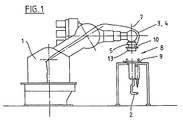
- Figure 1 shows a manipulator (1) with a tool changing device (8) and a tool (2).
- the manipulator is designed as a preferably six-axis industrial robot. It has electrical and fluid supply lines (3, 4) which are led from the robot (1) via the tool changing device (8) to the tool (2). Cooling water, oil or compressed air for fluid drives or the like. Other liquid or gaseous media are transferred to the tool via the fluid supply lines (3).
- the tool changing device (8) enables the manipulator (1) to hold various tools (2) and at the same time to establish the supply connection during mechanical coupling.
- the tool changing device (8) has a rotary connection (13) with which at least the fluid supply lines (3), and possibly also the electrical supply lines (4), can be rotatably connected to the tool (2) when coupled.
- the rotary connection (13) consists of a manipulator-side fixed part (14) and a rotating part (15) that is rotatable and assigned to the tool side.
- the manipulator (1) has a hand (5) at the front end with a hand flange (6) which can be rotated about the output rotation axis (7).
- a torque support (17) protrudes from the housing of the hand (5), on which the fixed part (14) of the rotary connection (13) is supported.
- the tool changing device (8) is designed in a similar way to the coupling construction known from EP-B1 0 164 091.
- the coupling part (9) connected to the tool (2) and the manipulator-side coupling part (10) are joined axially in the direction of the output rotation axis (7).
- a centering device (11) provided with indexes the opposite rotational position is precisely aligned when coupling.
- a clamping device (12) which is driven by the hand flange (6), comes into operation, which axially approaches the two coupling parts (9, 10) via a bayonet guide along the axis (7) and interlocks them.
- the coupling parts (9, 10) and the tensioning device (12) and the centering device (11) can be designed differently as required.
- plug connections (18) for the fluid supply lines (3) and, if appropriate, also for the electrical supply lines (4) (not shown in FIG. 2) are closed.
- the line sections coming from the rotary part (15) of the rotary connection (13) are coupled to the line sections continuing on the tool (2) via the plug connections (18).
- the plug connections (18) consist of plugs on the tool-side coupling part (9), which fit into matching sockets on the rotary connection (13) are introduced.
- the arrangement can also be reversed.
- the plug connections (18) can also be partially blind-closed on the rotary connection (13) if there is no line requirement on the tool side.
- the fixed part (14) and the rotating part (15) of the rotating connection (13) are designed as ring disks which are rotatably guided relative to one another.
- the fixed part (14) and the rotating part (15) touch on a contact plane (16) which is aligned transversely to the output axis (7) of the manipulator (1) or the hand flange (6).
- the fixed part (14) has a plurality of ring channels (19) with elastic seals (21) in between, which are arranged in concentric circles around the output rotation axis (7).
- the seals (21) consist of a suitable sealing material and a suitable expanding agent, e.g. a compressed O-ring, a pressure pad or the like, which pushes the sealing material upwards and compensates for wear.
- the seals (21) protrude slightly above the ring disk surface of the fixed part (14).
- the rotating part (15) rests on the seals (21), with a small gap to the surface of the ring disk of the fixed part (14).
- the ring channels (19) are open towards the contact plane (16) and each correspond to an associated branch channel (20) in the rotating part (15).
- the branch channels (20) each lead to a plug connection (18).
- the ring channels (19) are each connected to a fluid supply line (3) supplied on the manipulator side.
- the rotary connection (13) allows the tool (2) with the hand flange (6) to rotate as desired, the fluid supply means being transmitted to the tool (2) via the ring channels (19) and the branch channels (20).
- the fixed part (14) is held on the hand (5) via the torque support (17).
- the rotating part (15) is connected to the housing (23) and the tool (2) via the coupling parts (9, 10) and the centering device (11).
- the tool (2) can rotate around the axis (7) as required.
- the rotary connection (13) can also have sliding contacts (22) for the rotary transmission of electrical supply lines (4).
- the exemplary embodiment shown is control voltages that are transmitted.
- higher voltages and currents for the tool e.g. Welding currents or the like can be transmitted with corresponding fixed and turned parts.
- the disk-shaped and compact rotary connection (13) is mounted in a housing (23) by means of radial / axial bearings (30, 31), for example in the form of roller bearings.
- the bearing (30) is preferably designed as a thrust bearing with a conical roller or cone ring.
- the housing (23) consists of a lower housing part (24) screwed to the hand flange (6) and an upper housing part (25). Both housing parts (24, 25) have annular housing flanges (26, 27) projecting radially to the axis (7) with which they grip around the rotary connection (13) in the manner of pliers.
- the radial / axial bearings (30, 31) are also arranged on the housing flanges (26, 27).
- the housing parts (24, 25) are inserted into one another along the axis (7) and screwed together (28) with the insertion of a ground-in spacer (29). Via the screw connection (28) and the spacer (29), the radial / axial bearings (30, 31) and thus the clamping connection between the fixed part (14) and rotating part (15) set.
- the distance between the housing flanges (26, 27) and thus the tension connection between the fixed and rotating part (14, 15) can be changed by replacing the spacer (29). This allows the contact pressure and the height of the seals (21) or the distance between the washer surfaces of the rotating and fixed part (14, 15) to be influenced as required.
- the housing (23) is attached to the manipulator-side hand flange (6) and connected on the other side to the tensioning device (12) in the coupling part (10).
- the hand flange (6) turns a little after the axial joining of the coupling parts (9, 10), the clamping device (12) being actuated via the rotation and pulling the coupling parts (9, 10) together.
- the radial / axial bearings (30, 31) allow the housing (23) to be rotated relative to the already coupled plug connection (18), the fixed part (14) and the rotating part (15).
- the fixed part (14), the rotating part (15) and the coupling part (9) do not rotate with it.
- Figure 3 shows a variant.
- a support element (32) is arranged in the area of the contact plane (16), which is preferably designed as a slide ring made of plastic or another suitable material. It is placed around the outside of the ring channels (19) and the seals (21).
- the support element (32) is guided on a step on the fixed part (14) and has a slight distance from the rotating part (15). It absorbs the tipping forces or tipping moments that may occur during operation by supporting the rotating part (15) that starts up when tipping.
- the support element (32) ensures the aforementioned distance between the fixed and rotating part (14, 15) and prevents overloading of the seals (21). In addition, sliding friction is reduced under normal load.
- roller bearing (31) is also dispensed with.
- an axial and radial guide (33) in the form of a stepped collar is provided between the housing flange (27) and the rotating part (15).
- the tension connection between the fixed and the rotating part (14, 15) can be adjusted in the same way as in the embodiment of FIG. 2.
Landscapes
- Engineering & Computer Science (AREA)
- Robotics (AREA)
- Mechanical Engineering (AREA)
- Manipulator (AREA)
- Automatic Tool Replacement In Machine Tools (AREA)
Abstract
Description
- Die Erfindung betrifft eine Werkzeugwechseleinrichtung für Manipulatoren, welche einen Drehanschluß für fluidische Versorungsleitungen des Werkzeuges mit den weiteren Merkmalen im Oberbegriff des Hauptanspruches aufweist.
- Eine solche Werkzeugwechseleinrichtung ist aus der EP-A-0 288 744 bekannt. In der Werkzeugwechseleinrichtung ist ein Drehanschluß für fluidische Versorungsleitungen des Werkzeuges vorhanden, der ein Festteil mit Ringkanälen und ein Drehteil mit Stichkanälen aufweist. Die Ringkanäle sind am innenliegenden Umfang des Festteiles angeordnet und dabei in Richtung der Abtriebsdrehachse des Manipulators hintereinander positioniert. Bei der Montage des Drehanschlusses werden Festteil und Drehteil in Richtung der Abtriebsdrehachse des Manipulators zusammengefügt. Bei der vorbekannten Anordnung der Ringkanäle hat dies den Nachteil, daß bei der Montage die Dichtungen zwischen den Ringkanälen beschädigt werden können. Durch die umfangsseitige Anordnung der Ringkanäle hängt die Abdichtung ausschließlich von der Qualität der zwischen den Ringkanälen angeordneten Dichtungen und deren Expansionsvolumen ab. Es besteht keine Möglichkeit, bei der Montage beschädigte Dichtungen nachzuspannen oder auch Toleranzfehler auszugleichen.
- Die FR-A-2 596 495 zeigt eine Dreh- und Antriebsverbindung für die Armteile eines Roboters. Für den Antrieb der relativ zueinander drehbaren Armteile sind hydraulische Drehzylinder vorgesehen. Der am gedrehten Armteil befindliche Drehzylinder wird von einer externen Hydraulikpumpe über einen Drehanschluß versorgt, der zwischen den Armteilen angeordnet ist. Der Drehanschluß bildet einen festen Bestandteil des Roboters, wobei die beiden Teile des Drehanschlusses mit jeweils einem Armteil starr verbunden sind. Der Drehanschluß weist Stichkanäle und konzentrisch um die Drehachse angeordnete Ringkanäle auf.
- Aus der EP-B1 0 164 091 ist eine weitere Werkzeugwechseleinrichtung für Manipulatoren bekannt, die allerdings keinen Drehanschluß für die fluidischen Versorgungsleitungen aufweist. Hier wird die nötige Bewegungsfreiheit des Werkzeuges über die Flexibilität der angeschlossenen Versorgungsleitungen erreicht.
- Es ist Aufgabe der vorliegenden Erfindung, eine Werkzeugwechseleinrichtung für Manipulatoren mit einem Drehanschluß aufzuzeigen, der eine höhere Montage- und Betriebssicherheit besitzt.
- Die Erfindung löst diese Aufgabe mit den Merkmalen im Hauptanspruch.
Die erfindungsgemäße Ausbildung des Drehteils hat den Vorteil, daß bei der Montage die Dichtungen nicht mehr beschädigt werden können und daher in ihrer Funktion im Betrieb weniger beeinträchtigt sind. Außerdem ist der erfindungsgemäße Drehanschluß weniger toleranzempfindlich. Er hat eine bessere Paßgenauigkeit und Dichtigkeit. Insgesamt ergibt sich eine hohe Betriebssicherheit und zudem eine kleinere Baulänge. Dies ist von hoher Bedeutung mit Hinblick auf schwergewichtige Werkzeuge und große Stützmomente. - Die erfindungsgemäße Ausbildung des Drehanschlusses ermöglicht es auch, das Fest- und Drehteil in einem einstellbaren Spannschluß zusammenzuhalten und dadurch gegebenenfalls Anpreßkraft und -weg der Dichtungen einstellen zu können. Zu diesem Zweck ist vorteilhaft, den in einer flachen Plattenform bauenden Drehanschluß in einem zangenförmig umgebenden Gehäuse zu lagern. Die Verstellung des Spannschlusses läßt sich dabei auf einfache und genaue Weise über die Lagerung und eine Verstellung der Gehäuseteile realisieren. Vorteilhaft ist dabei die Anordnung eines Stützelementes zwischen Fest- und Drehteil zur Aufnahme von Kippkräften und zur Verringerung der Gleitreibung im normalen Belastungsfall.
- In den Unteransprüchen sind weitere vorteilhafte Ausgestaltungen der Erfindung angegeben.
- Die Erfindung ist in den Zeichnungen beispielsweise und schematisch dargestellt. Im einzelnen zeigen:
- Figur 1:
- eine Übersichtsdarstellung eines Manipulators mit einer Werkzeugwechseleinrichtung und einem Werkzeug,
- Figur 2:
- in vergrößerter und abgebrochener Darstellung einen Querschnitt durch die Werkzeugwechseleinrichtung und den Drehanschluß und
- Figur 3:
- eine Variante zu Figur 2 im Halbschnitt mit einem Stützelement zwischen Fest- und Drehteil.
- Figur 1 zeigt einen Manipulator (1) mit einer Werkzeugwechseleinrichtung (8) und einem Werkzeug (2). Der Manipulator ist als vorzugsweise sechsachsiger Industrieroboter ausgebildet. Er besitzt elektrische und fluidische Versorgungsleitungen (3,4), die vom Roboter (1) über die Werkzeugwechseleinrichtung (8) zum Werkzeug (2) geführt werden. Über die fluidischen Versorgungsleitungen (3) werden Kühlwasser, Öl oder Druckluft für fluidische Antriebe oder dgl. andere flüssige oder gasförmige Medien zum Werkzeug übertragen. Die Werkzeugwechseleinrichtung (8) ermöglicht es dem Manipulator (1), verschiedene Werkzeuge (2) aufzunehmen und beim mechanischen Ankuppeln zugleich die Versorgungsverbindung herzustellen.
- Die Werkzeugwechseleinrichtung (8) hat einen Drehanschluß (13), mit dem beim Ankoppeln zumindest die fluidischen Versorgungsleitungen (3), gegebenenfalls auch die elektrischen Versorgungsleitungen (4), zum Werkzeug (2) drehbar durchgeschaltet werden können. Der Drehanschluß (13) besteht aus einem manipulatorseitigen Festteil (14) und einem dem gegenüber rotierfähigen und der Werkzeugseite zugeordneten Drehteil (15).
- Der Manipulator (1) hat am vorderen Ende eine Hand (5) mit einem um die Abtriebsdrehachse (7) drehbaren Handflansch (6). Vom Gehäuse der Hand (5) ragt eine Momentenstütze (17) vor, an der das Festteil (14) des Drehanschlusses (13) abgestützt ist.
- Die Werkzeugwechseleinrichtung (8) ist, abgesehen vom Drehanschluß (13), in ähnlicher Weise wie die aus der EP-B1 0 164 091 vorbekannte Kupplungskonstruktion ausgebildet. Beim Ankuppeln werden das mit dem Werkzeug (2) verbundene Kupplungsteil (9) und das manipulatorseitige Kupplungsteil (10) axial in Richtung der Abtriebsdrehachse (7) zusammengefügt. Mittels einer mit Indexen versehenen Zentriervorrichtung (11) wird die gegenseite Drehlage beim Ankuppeln exakt ausgerichtet. Anschließend tritt eine vom Handflansch (6) drehend angetriebene Spannvorrichtung (12) in Funktion, die die beiden Kupplungsteile (9,10) über eine Bajonnetführung axial längs der Achse (7) einander annähert und gegenseitig verriegelt. Die Kupplungsteile (9,10) sowie die Spannvorrichtung (12) und die Zentriervorrichtung (11) können je nach Bedarf unterschiedlich ausgebildet sein.
- Beim Ineinandergreifen der Kupplungsteile (9,10) werden auch Steckverbindungen (18) für die fluidischen Versorgungsleitungen (3) und gegebenenfalls auch für die elektrischen Versorgungsleitungen (4) (in Fig. 2 nicht dargestellt) geschlossen. Über die Steckverbindungen (18) werden die aus dem Drehteil (15) des Drehanschlusses (13) kommenden Leitungsabschnitte mit den am Werkzeug (2) weiterführenden Leitungsabschnitten gekuppelt. Im gezeigten Ausführungsbeispiel bestehen die Steckverbindungen (18) aus Steckern am werkzeugseitigen Kupplungsteil (9), die in passende Buchsen am Drehanschluß (13) eingeführt werden. Die Anordnung kann auch umgekehrt sein. Die Steckverbindungen (18) können auch am Drehanschluß (13) teilweise blindgeschlossen sein, falls werkzeugseitg kein Leitungsbedarf vorhanden ist. Wie Figur (2) verdeutlicht, sind mehrere Steckverbindungen (18) rund um die Achse (7) verteilt am Drehanschluß (13) angeordnet.
- Das Festteil (14) und das Drehteil (15) des Drehanschlusses (13) sind als drehbar gegeneinander geführte Ringscheiben ausgebildet. Das Festteil (14) und das Drehteil (15) berühren sich an einer Kontaktebene (16), welche quer zur Abtriebsachse (7) des Manipulators (1) bzw. des Handflansches (6) ausgerichtet ist. Das Festteil (14) weist mehrere Ringkanäle (19) mit dazwischenliegenden elastischen Dichtungen (21) auf, die in konzentrischen Kreisen um die Abtriebsdrehachse (7) angeordnet sind.
- Die Dichtungen (21) bestehen aus einem geeigneten Dichtwerkstoff und einem in der Nut darunterliegenden geeigneten expandierenden Mittel, z.B. einem komprimierten O-Ring, einem Druckkissen oder dergleichen, welches den Dichtwerkstoff nach oben drückt und den Verschleiß kompensiert. Die Dichtungen (21) ragen etwas über die Ringscheiben-Oberfläche des Festteils (14). Das Drehteil (15) liegt auf den Dichtungen (21) auf, wobei ein kleiner Spalt zur Oberfläche der Ringscheibe des Festteils (14) besteht.
- Die Ringkanäle (19) sind zur Kontaktebene (16) hin offen und korrespondieren hierbei jeweils mit einem zugehörigem Stichkanal (20) im Drehteil (15). Die Stichkanäle (20) führen jeweils zu einer Steckverbindung (18). Die Ringkanäle (19) sind jeweils mit einer manipulatorseitig zugeführten fluidischen Versorgungsleitung (3) verbunden.
- Durch den Drehanschluß (13) kann das Werkzeug (2) mit dem Handflansch (6) beliebig drehen, wobei die fluidischen Versorgungsmittel über die Ringkanäle (19) und die Stichkanäle (20) zum Werkzeug (2) übertragen werden. Das Festteil (14) ist über die Momentenstütze (17) an der Hand (5) gehalten. Das Drehteil (15) ist über die Kupplungsteile (9,10) und die Zentriervorrichtung (11) mit dem Gehäuse (23) und dem Werkzeug (2) verbunden. Es kann sich mit dem Werkzeug (2) beliebig um die Achse (7) drehen.
- Wie Figur 2 verdeutlicht, kann der Drehanschluß (13) auch Schleifkontakte (22) für die Drehübertragung elektrischer Versorgungsleitungen (4) aufweisen. Im gezeigten Ausführungsbeispiel handelt es sich um Steuerspannungen, die übertragen werden. Ergänzend können über dem Drehanschluß (13) auch höhere Spannungen und Ströme für das Werkzeug, z.B. Schweißströme oder dgl. mit ensprechenden Fest- und Drehteilen übertragen werden.
- Der scheibenförmige und kompakte Drehanschluß (13) ist in einem Gehäuse (23) mittels Radial/Axiallager (30,31), z.B. in Form von Wälzlagern, gelagert. Das Lager (30) ist vorzugsweise als Drucklager mit einem kegelförmigen Rollen- oder Kegelkranz ausgebildet. Das Gehäuse (23) besteht aus einem mit dem Handflansch (6) verschraubten unteren Gehäuseteil (24) und einem oberen Gehäuseteil (25). Beide Gehäuseteile (24,25) besitzen ringförmige radial zur Achse (7) vorspringende Gehäuseflansche (26,27) mit denen sie den Drehanschluß (13) zangenförmig umgreifen. An den Gehäuseflanschen (26,27) sind auch die Radial/Axiallager (30,31) angeordnet. Die Gehäuseteile (24,25) sind längs der Achse (7) ineinandergesteckt und unter Einlage einer eingeschliffenen Distanzscheibe (29) miteinander verschraubt (28). Über die Verschraubung (28) und die Distanzscheibe (29) werden die Radial/Axiallager (30,31) und damit der Spannschluß zwischen Festteil (14) und Drehteil (15) eingestellt. Der Abstand zwischen den Gehäuseflanschen (26,27) und damit der Spannschluß zwischen Fest- und Drehteil (14,15) kann durch Austausch der Distanzscheibe (29) verändert werden. Damit läßt sich die Anpreßkraft und das Höhenmaß der Dichtungen (21) bzw. der Abstand zwischen den Ringscheiben-Oberflächen von Dreh- und Festteil (14,15) bedarfsgerecht beeinflussen.
- Das Gehäuse (23) ist am manipulatorseitigen Handflansch (6) befestigt und auf der anderen Seite mit der Spannvorrichtung (12) im Kupplungsteil (10) verbunden. Beim Ankuppeln des Werkzeuges (2) dreht der Handflansch (6) nach dem axialen Zusammenfügen der Kupplungsteile (9,10) ein Stück, wobei die Spannvorrichtung (12) über die Drehung betätigt wird und die Kupplungsteile (9,10) zusammenzieht. Die Radial/Axiallager (30,31) ermöglichen hierbei die Spanndrehung des Gehäuses (23) gegenüber der bereits gekuppelten Steckverbindung (18), dem Festteil (14) und dem Drehteil (15). Das Festteil (14), das Drehteil (15) und das Kupplungsteil (9) drehen sich dabei nicht mit.
- Figur 3 zeigt eine Variante. Zwischen Fest- und Drehteil (14,15) ist im Bereich der Kontaktebene (16) ein Stützelement (32) angeordnet, welches vorzugsweise als Gleitring aus Kunststoff oder einem anderen geeigneten Material ausgebildet ist. Er ist außen um die Ringkanäle (19) und die Dichtungen (21) gelegt. Das Stützelement (32) liegt an einer Stufe geführt auf dem Festteil (14) und hat einen geringfügigen Abstand zum Drehteil (15). Es nimmt die im Betrieb unter Last eventuell auftretenden Kippkräfte bzw. Kippmomente auf, indem es das beim Kippen anlaufende Drehteil (15) abstützt. Das Stützelement (32) sichert dabei den vorerwähnten Abstand zwischen Fest- und Drehteil (14,15) und verhindert eine Überlastung der Dichtungen (21). Zudem wird die Gleitreibung im normalen Belastungsfall vermindert.
- Im Ausführungsbeispiel von Figur 3 ist außerdem auf das Wälzlager (31) verzichtet. Statt dessen ist eine axiale und radiale Führung (33) in Form eines abgestuften Bundes zwischen dem Gehäuseflansch (27) und dem Drehteil (15) vorgesehen. Der Spannschluß zwischen Fest- und Drehteil (14,15) ist in gleicher Weise wie beim Ausführungsbeispiel von Figur 2 einstellbar.
-
- 1
- Manipulator, Roboter
- 2
- Werkzeug
- 3
- Versorgungsleitung, fluidisch
- 4
- Versorgungsleitung, elektrisch
- 5
- Hand
- 6
- Handflansch
- 7
- Abtriebsdrehachse, Handachse
- 8
- Werkzeugwechseleinrichtung
- 9
- Kupplungsteil, Werkzeugseite
- 10
- Kupplungsteil, Manipulatorseite
- 11
- Zentriervorrichtung
- 12
- Spannvorrichtung
- 13
- Drehanschluß
- 14
- Festteil
- 15
- Drehteil
- 16
- Kontaktebene
- 17
- Momentenstütze
- 18
- Steckverbindung
- 19
- Ringkanal
- 20
- Stichkanal
- 21
- Dichtung
- 22
- Schleifkontakte
- 23
- Gehäuse
- 24
- Gehäuseteil
- 25
- Gehäuseteil
- 26
- Gehäuseflansch
- 27
- Gehäuseflansch
- 28
- Verschraubung
- 29
- Distanzscheibe
- 30
- Radial/Axiallager
- 31
- Radial/Axiallager
- 32
- Stützelement, Gleitring
- 33
- Führung
Claims (6)
- Werkzeugwechseleinrichtung für Manipulatoren mit einem Drehanschluß für fluidische Versorgungsleitungen des Werkzeugs, der ein Festteil (14) und ein Drehteil (15) mit Ringkanälen (19) und Stichkanälen (20) aufweist, dadurch gekennzeichnet, daß die Kontaktebene (16) von Dreh- und Festteil (14,15) quer zur Abtriebsdrehachse (7) des Manipulators (1) ausgerichtet ist, und die Ringkanäle (19) in konzentrischen Kreisen um die Abtriebsdrehachse (7) angeordnet sind, wobei das Festteil (14) und das Drehteil (15) des Drehanschlusses (13) plan aneinanderliegen und im Gehäuse (23) des manipulatorseitigen Kupplungsteils (10) längs der Abtriebsdrehachse (7) in einem einstellbaren Spannschluß zusammengehalten sind.
- Werkzeugwechseleinrichtung nach Anspruch 1, dadurch gekennzeichnet, daß das Gehäuse (23) zwei Gehäuseteile (24,25) aufweist, die den Drehanschluß (13) zangenförmig umschließen.
- Werkzeugwechseleinrichtung nach Anspruch 1 oder 2, dadurch gekennzeichnet, daß die Gehäuseteile (24,25) durch eine Verschraubung (28) und eine Distanzscheibe (29) miteinander verbunden sind.
- Werkzeugwechseleinrichtung nach Anspruch 1, 2 oder 3, dadurch gekennzeichnet, daß die Gehäuseteile (24,25) radial vorstehende Gehäuseflansche (26,27) aufweisen, an denen zumindest das Festteil (14) über ein Radial/Axiallager (30) gelagert ist.
- Werkzeugwechseleinrichtung nach Anspruch 1 oder einem der folgenden, dadurch gekennzeichnet, daß zwischen Festteil (14) und Drehteil (15) neben den Dichtungen (21) ein Stützelement (32) angeordnet ist.
- Werkzeugwechseleinrichtung nach Anspruch 5, dadurch gekennzeichnet, daß das Stützelement (32) als außenliegender Gleitring ausgebildet ist.
Applications Claiming Priority (3)
| Application Number | Priority Date | Filing Date | Title |
|---|---|---|---|
| DE9313310U | 1993-09-04 | ||
| DE9313310U DE9313310U1 (de) | 1993-09-04 | 1993-09-04 | Werkzeugwechseleinrichtung für Manipulatoren |
| PCT/EP1994/002916 WO1995007168A1 (de) | 1993-09-04 | 1994-09-02 | Werkzeugwechseleinrichtung für manipulatoren |
Publications (2)
| Publication Number | Publication Date |
|---|---|
| EP0716629A1 EP0716629A1 (de) | 1996-06-19 |
| EP0716629B1 true EP0716629B1 (de) | 1997-03-26 |
Family
ID=6897650
Family Applications (1)
| Application Number | Title | Priority Date | Filing Date |
|---|---|---|---|
| EP94927540A Expired - Lifetime EP0716629B1 (de) | 1993-09-04 | 1994-09-02 | Werkzeugwechseleinrichtung für manipulatoren |
Country Status (4)
| Country | Link |
|---|---|
| US (1) | US5624364A (de) |
| EP (1) | EP0716629B1 (de) |
| DE (2) | DE9313310U1 (de) |
| WO (1) | WO1995007168A1 (de) |
Families Citing this family (18)
| Publication number | Priority date | Publication date | Assignee | Title |
|---|---|---|---|---|
| SE9903681L (sv) * | 1999-10-13 | 2001-04-14 | Olof Hansson Med Truconex Engi | Anordning vid robot |
| DE10057787A1 (de) * | 2000-11-22 | 2002-06-06 | Siemens Ag | Einrichtung zum Wechseln von Saugpipetten |
| DE10143186A1 (de) * | 2001-09-04 | 2003-03-27 | Stemmann Technik Gmbh | Drehdurchführung endseitig eines Roboterarms |
| CN102079094B (zh) * | 2009-11-26 | 2013-11-06 | 鸿富锦精密工业(深圳)有限公司 | 机器人结构 |
| US8296923B2 (en) * | 2007-11-29 | 2012-10-30 | Spirit Aerosystems, Inc. | Modular numerically controlled system |
| DE102008018556A1 (de) * | 2008-04-12 | 2009-10-15 | Bayerische Motoren Werke Aktiengesellschaft | Handhabungsgerät in einem Fahrzeug und Verfahren zum Betrieb des Handhabungsgeräts |
| US20100180711A1 (en) | 2009-01-19 | 2010-07-22 | Comau, Inc. | Robotic end effector system and method |
| US8992113B2 (en) * | 2009-06-08 | 2015-03-31 | Re2, Inc. | Robust manual connector for robotic arm end effector |
| US8382177B2 (en) * | 2009-06-11 | 2013-02-26 | Re2, Inc. | Quick-change finger for robotic gripper |
| US10076844B2 (en) | 2009-08-10 | 2018-09-18 | Re2, Inc. | Automated tool change assembly for robotic arm |
| TWI453100B (zh) * | 2010-01-11 | 2014-09-21 | Hon Hai Prec Ind Co Ltd | 機器人結構 |
| DE202012100384U1 (de) | 2012-02-06 | 2013-05-10 | Kuka Systems Gmbh | Kupplungseinrichtung |
| DE102012208098A1 (de) * | 2012-05-15 | 2013-11-21 | Kuka Roboter Gmbh | Roboterarm mit einer Justagevorrichtung |
| JP6099916B2 (ja) * | 2012-09-25 | 2017-03-22 | 株式会社ダイヘン | ワーク搬送ロボット |
| US10471605B2 (en) * | 2017-04-26 | 2019-11-12 | Ready Robotics | Programmable adapters for detachably connecting robotic peripherals to adaptively retool robots |
| CN108942913A (zh) * | 2018-09-10 | 2018-12-07 | 长春工业大学 | 一种气动驱动工业机器人结构 |
| EP3800014A1 (de) * | 2019-10-01 | 2021-04-07 | SMW-AUTOBLOK Spannsysteme GmbH | Roboter zum greifen und/oder halten von gegenständen |
| US20220212307A1 (en) * | 2021-01-06 | 2022-07-07 | Machina Labs, Inc. | System and Method for Selectively Treating Part with Ultrasonic Vibrations |
Family Cites Families (10)
| Publication number | Priority date | Publication date | Assignee | Title |
|---|---|---|---|---|
| US4611377A (en) * | 1984-06-04 | 1986-09-16 | Eoa Systems, Inc. | Interchangeable robot end-of-arm tooling system |
| DE3421452C2 (de) * | 1984-06-08 | 1986-05-22 | Kuka Schweissanlagen + Roboter Gmbh, 8900 Augsburg | Vorrichtung zum automatischen Erfassen bzw. Lösen eines Werkzeugträgers bei einem Manipulator |
| SU1301697A1 (ru) * | 1985-11-13 | 1987-04-07 | Предприятие П/Я А-1477 | Стыковочное устройство |
| US4767257A (en) * | 1985-12-23 | 1988-08-30 | Mitsubishi Denki Kabushiki Kaisha | Industrial robot |
| US4683912A (en) * | 1986-03-06 | 1987-08-04 | General Motors Corporation | Rotary coupler for a robot |
| FR2596495B1 (fr) * | 1986-03-25 | 1988-09-09 | Aoip Kremlin Robotique | Dispositif pour relier fluidiquement deux pieces en mouvement de rotation relatif, et robot comprenant un tel dispositif |
| SE462645B (sv) * | 1987-03-31 | 1990-08-06 | Asea Ab | Anordning vid industrirobotar avseende verktygsbyte |
| US4809747A (en) * | 1987-07-31 | 1989-03-07 | General Motors Corporation | Quick disconnect device |
| US5205701A (en) * | 1990-06-04 | 1993-04-27 | Canon Kabushiki Kaisha | Industrial robot |
| DE4103376C1 (de) * | 1991-02-05 | 1992-08-06 | Ott Maschinentechnik Gmbh, 8960 Kempten, De |
-
1993
- 1993-09-04 DE DE9313310U patent/DE9313310U1/de not_active Expired - Lifetime
-
1994
- 1994-09-02 EP EP94927540A patent/EP0716629B1/de not_active Expired - Lifetime
- 1994-09-02 WO PCT/EP1994/002916 patent/WO1995007168A1/de not_active Ceased
- 1994-09-02 DE DE59402251T patent/DE59402251D1/de not_active Expired - Fee Related
- 1994-09-02 US US08/617,819 patent/US5624364A/en not_active Expired - Fee Related
Also Published As
| Publication number | Publication date |
|---|---|
| WO1995007168A1 (de) | 1995-03-16 |
| US5624364A (en) | 1997-04-29 |
| DE9313310U1 (de) | 1994-11-17 |
| EP0716629A1 (de) | 1996-06-19 |
| DE59402251D1 (de) | 1997-04-30 |
Similar Documents
| Publication | Publication Date | Title |
|---|---|---|
| WO1995007168A1 (de) | Werkzeugwechseleinrichtung für manipulatoren | |
| DE3312862C2 (de) | ||
| DE3306526C2 (de) | ||
| DE3347423A1 (de) | Vorrichtung zum automatischen auswechseln und kuppeln von greifern an robotern oder handhabungsgeraeten | |
| DE19525574C1 (de) | Spannvorrichtung zum genauen gegenseitigen Fixieren zweier Bauteile | |
| DE3300361C2 (de) | ||
| EP0103242B1 (de) | Einrichtung zum Spannen und Zentrieren von zwei zusammenschweissenden Teilen | |
| EP3672765A1 (de) | Drehdurchführung für eine handhabungseinheit | |
| DE102021114663A1 (de) | Kopplungsmechanismus für roboter-werkzeugwechsler mit erhöhter torsionssteifigkeit und reduziertem spiel | |
| EP2198258B1 (de) | Antriebseinheit zur prüfung von getrieben und vorrichtung zur prüfung von getrieben | |
| EP1123784B1 (de) | Werkzeugadapter an einer Roboterschnittstelle | |
| DE4238700C1 (de) | Vorrichtung zur Befestigung von Verbindungselementen an Rohrleitungen | |
| EP3444065B1 (de) | Nullpunktspannmodul | |
| DE69105281T2 (de) | Durchflussregler für Rohrverbinder. | |
| DE202011002899U1 (de) | Werkzeugwechsler für einen Roboterarm mit einer Drehdurchführung für Medien | |
| DE29808801U1 (de) | Drehanschluß mit modularen Baueinsätzen | |
| DE3310070C2 (de) | Schnellkupplung für Greifer von Industrierobotern | |
| EP0627975B1 (de) | Vorrichtung zum manipulieren von gegenständen | |
| EP0901877A2 (de) | Drehdurchführung für Drehvorrichtungen, insbesondere für Handhabungseinrichtungen und Industrieroboter | |
| DE3312673A1 (de) | Greifer fuer industrieroboter | |
| EP0940230B1 (de) | Kupplung zur Verbindung von Werkstückgreifern mit einer Handhabungseinrichtung | |
| DE10245899B4 (de) | Anschlussadapter für einen Industrieroboter | |
| DE29923752U1 (de) | Kupplung zur Verbindung von Werkstückgreifern mit einer Handhabungseinrichtung | |
| EP2279828B1 (de) | Aufspanneinrichtung und Bearbeitungseinrichtung | |
| DD234556A5 (de) | Anordnung fuer den automatischen kuehlwasseranschluss an wassergekuehlten kombinationselektroden fuer lichtbogenoefen |
Legal Events
| Date | Code | Title | Description |
|---|---|---|---|
| PUAI | Public reference made under article 153(3) epc to a published international application that has entered the european phase |
Free format text: ORIGINAL CODE: 0009012 |
|
| 17P | Request for examination filed |
Effective date: 19960117 |
|
| AK | Designated contracting states |
Kind code of ref document: A1 Designated state(s): DE FR IT SE |
|
| GRAG | Despatch of communication of intention to grant |
Free format text: ORIGINAL CODE: EPIDOS AGRA |
|
| 17Q | First examination report despatched |
Effective date: 19960701 |
|
| GRAH | Despatch of communication of intention to grant a patent |
Free format text: ORIGINAL CODE: EPIDOS IGRA |
|
| GRAH | Despatch of communication of intention to grant a patent |
Free format text: ORIGINAL CODE: EPIDOS IGRA |
|
| GRAA | (expected) grant |
Free format text: ORIGINAL CODE: 0009210 |
|
| AK | Designated contracting states |
Kind code of ref document: B1 Designated state(s): DE FR IT SE |
|
| REF | Corresponds to: |
Ref document number: 59402251 Country of ref document: DE Date of ref document: 19970430 |
|
| ET | Fr: translation filed | ||
| PLBE | No opposition filed within time limit |
Free format text: ORIGINAL CODE: 0009261 |
|
| STAA | Information on the status of an ep patent application or granted ep patent |
Free format text: STATUS: NO OPPOSITION FILED WITHIN TIME LIMIT |
|
| 26N | No opposition filed | ||
| PGFP | Annual fee paid to national office [announced via postgrant information from national office to epo] |
Ref country code: FR Payment date: 19980826 Year of fee payment: 5 Ref country code: DE Payment date: 19980826 Year of fee payment: 5 |
|
| PGFP | Annual fee paid to national office [announced via postgrant information from national office to epo] |
Ref country code: SE Payment date: 19980916 Year of fee payment: 5 |
|
| PG25 | Lapsed in a contracting state [announced via postgrant information from national office to epo] |
Ref country code: SE Free format text: THE PATENT HAS BEEN ANNULLED BY A DECISION OF A NATIONAL AUTHORITY Effective date: 19990929 |
|
| EUG | Se: european patent has lapsed |
Ref document number: 94927540.8 |
|
| PG25 | Lapsed in a contracting state [announced via postgrant information from national office to epo] |
Ref country code: FR Free format text: LAPSE BECAUSE OF NON-PAYMENT OF DUE FEES Effective date: 20000531 |
|
| PG25 | Lapsed in a contracting state [announced via postgrant information from national office to epo] |
Ref country code: DE Free format text: LAPSE BECAUSE OF NON-PAYMENT OF DUE FEES Effective date: 20000701 |
|
| REG | Reference to a national code |
Ref country code: FR Ref legal event code: ST |
|
| PG25 | Lapsed in a contracting state [announced via postgrant information from national office to epo] |
Ref country code: IT Free format text: LAPSE BECAUSE OF NON-PAYMENT OF DUE FEES;WARNING: LAPSES OF ITALIAN PATENTS WITH EFFECTIVE DATE BEFORE 2007 MAY HAVE OCCURRED AT ANY TIME BEFORE 2007. THE CORRECT EFFECTIVE DATE MAY BE DIFFERENT FROM THE ONE RECORDED. Effective date: 20050902 |