EP0716151B1 - High magnetic flux denscity, low iron loss, grainoriented electromagnetic steel sheet and a method for making - Google Patents
High magnetic flux denscity, low iron loss, grainoriented electromagnetic steel sheet and a method for making Download PDFInfo
- Publication number
- EP0716151B1 EP0716151B1 EP95119146A EP95119146A EP0716151B1 EP 0716151 B1 EP0716151 B1 EP 0716151B1 EP 95119146 A EP95119146 A EP 95119146A EP 95119146 A EP95119146 A EP 95119146A EP 0716151 B1 EP0716151 B1 EP 0716151B1
- Authority
- EP
- European Patent Office
- Prior art keywords
- steel sheet
- weight percent
- decarburization
- annealing
- rolling
- Prior art date
- Legal status (The legal status is an assumption and is not a legal conclusion. Google has not performed a legal analysis and makes no representation as to the accuracy of the status listed.)
- Expired - Lifetime
Links
- XEEYBQQBJWHFJM-UHFFFAOYSA-N Iron Chemical compound [Fe] XEEYBQQBJWHFJM-UHFFFAOYSA-N 0.000 title claims description 61
- 229910000831 Steel Inorganic materials 0.000 title claims description 60
- 239000010959 steel Substances 0.000 title claims description 60
- 229910052742 iron Inorganic materials 0.000 title claims description 27
- 230000004907 flux Effects 0.000 title claims description 15
- 238000000034 method Methods 0.000 title description 32
- 238000000137 annealing Methods 0.000 claims description 63
- 238000001953 recrystallisation Methods 0.000 claims description 37
- 238000005261 decarburization Methods 0.000 claims description 26
- 238000005097 cold rolling Methods 0.000 claims description 17
- 229910052782 aluminium Inorganic materials 0.000 claims description 12
- 238000004519 manufacturing process Methods 0.000 claims description 12
- 238000005121 nitriding Methods 0.000 claims description 11
- 238000000746 purification Methods 0.000 claims description 8
- 238000000926 separation method Methods 0.000 claims description 8
- 239000003795 chemical substances by application Substances 0.000 claims description 7
- 239000012298 atmosphere Substances 0.000 claims description 6
- 239000000203 mixture Substances 0.000 claims description 6
- UFHFLCQGNIYNRP-UHFFFAOYSA-N Hydrogen Chemical compound [H][H] UFHFLCQGNIYNRP-UHFFFAOYSA-N 0.000 claims description 5
- 238000005098 hot rolling Methods 0.000 claims description 5
- 229910052739 hydrogen Inorganic materials 0.000 claims description 5
- 239000001257 hydrogen Substances 0.000 claims description 5
- 239000012299 nitrogen atmosphere Substances 0.000 claims description 5
- 229910052710 silicon Inorganic materials 0.000 claims description 5
- 239000012467 final product Substances 0.000 claims description 3
- 238000010422 painting Methods 0.000 claims description 2
- 238000007792 addition Methods 0.000 claims 2
- 239000013078 crystal Substances 0.000 description 46
- 239000000047 product Substances 0.000 description 19
- 239000002244 precipitate Substances 0.000 description 15
- 238000005096 rolling process Methods 0.000 description 15
- 229910000976 Electrical steel Inorganic materials 0.000 description 12
- 239000003112 inhibitor Substances 0.000 description 10
- 229910052711 selenium Inorganic materials 0.000 description 10
- 238000010438 heat treatment Methods 0.000 description 8
- 238000013507 mapping Methods 0.000 description 8
- 238000010586 diagram Methods 0.000 description 7
- 229910052757 nitrogen Inorganic materials 0.000 description 6
- 229910052717 sulfur Inorganic materials 0.000 description 6
- 230000015572 biosynthetic process Effects 0.000 description 5
- 230000006872 improvement Effects 0.000 description 5
- IJGRMHOSHXDMSA-UHFFFAOYSA-N Atomic nitrogen Chemical compound N#N IJGRMHOSHXDMSA-UHFFFAOYSA-N 0.000 description 4
- 229910052799 carbon Inorganic materials 0.000 description 4
- 230000000694 effects Effects 0.000 description 4
- 239000011159 matrix material Substances 0.000 description 4
- 230000005764 inhibitory process Effects 0.000 description 3
- 230000007246 mechanism Effects 0.000 description 3
- 238000001556 precipitation Methods 0.000 description 3
- 230000008569 process Effects 0.000 description 3
- 239000007787 solid Substances 0.000 description 3
- 238000011282 treatment Methods 0.000 description 3
- 230000008859 change Effects 0.000 description 2
- 239000011162 core material Substances 0.000 description 2
- 238000005259 measurement Methods 0.000 description 2
- 239000002245 particle Substances 0.000 description 2
- 229910052698 phosphorus Inorganic materials 0.000 description 2
- 230000004931 aggregating effect Effects 0.000 description 1
- 230000000052 comparative effect Effects 0.000 description 1
- 238000009749 continuous casting Methods 0.000 description 1
- 238000002425 crystallisation Methods 0.000 description 1
- 230000008025 crystallization Effects 0.000 description 1
- 230000000881 depressing effect Effects 0.000 description 1
- 230000003292 diminished effect Effects 0.000 description 1
- 238000009826 distribution Methods 0.000 description 1
- 238000011156 evaluation Methods 0.000 description 1
- 239000012535 impurity Substances 0.000 description 1
- 238000009776 industrial production Methods 0.000 description 1
- 230000005381 magnetic domain Effects 0.000 description 1
- 230000003446 memory effect Effects 0.000 description 1
- 229910052751 metal Inorganic materials 0.000 description 1
- 230000004048 modification Effects 0.000 description 1
- 238000012986 modification Methods 0.000 description 1
- 230000003647 oxidation Effects 0.000 description 1
- 238000007254 oxidation reaction Methods 0.000 description 1
- 230000000644 propagated effect Effects 0.000 description 1
- 238000011084 recovery Methods 0.000 description 1
Images



Classifications
-
- H—ELECTRICITY
- H01—ELECTRIC ELEMENTS
- H01F—MAGNETS; INDUCTANCES; TRANSFORMERS; SELECTION OF MATERIALS FOR THEIR MAGNETIC PROPERTIES
- H01F1/00—Magnets or magnetic bodies characterised by the magnetic materials therefor; Selection of materials for their magnetic properties
- H01F1/01—Magnets or magnetic bodies characterised by the magnetic materials therefor; Selection of materials for their magnetic properties of inorganic materials
- H01F1/03—Magnets or magnetic bodies characterised by the magnetic materials therefor; Selection of materials for their magnetic properties of inorganic materials characterised by their coercivity
- H01F1/12—Magnets or magnetic bodies characterised by the magnetic materials therefor; Selection of materials for their magnetic properties of inorganic materials characterised by their coercivity of soft-magnetic materials
- H01F1/14—Magnets or magnetic bodies characterised by the magnetic materials therefor; Selection of materials for their magnetic properties of inorganic materials characterised by their coercivity of soft-magnetic materials metals or alloys
- H01F1/16—Magnets or magnetic bodies characterised by the magnetic materials therefor; Selection of materials for their magnetic properties of inorganic materials characterised by their coercivity of soft-magnetic materials metals or alloys in the form of sheets
- H01F1/18—Magnets or magnetic bodies characterised by the magnetic materials therefor; Selection of materials for their magnetic properties of inorganic materials characterised by their coercivity of soft-magnetic materials metals or alloys in the form of sheets with insulating coating
-
- C—CHEMISTRY; METALLURGY
- C21—METALLURGY OF IRON
- C21D—MODIFYING THE PHYSICAL STRUCTURE OF FERROUS METALS; GENERAL DEVICES FOR HEAT TREATMENT OF FERROUS OR NON-FERROUS METALS OR ALLOYS; MAKING METAL MALLEABLE, e.g. BY DECARBURISATION OR TEMPERING
- C21D8/00—Modifying the physical properties by deformation combined with, or followed by, heat treatment
- C21D8/12—Modifying the physical properties by deformation combined with, or followed by, heat treatment during manufacturing of articles with special electromagnetic properties
-
- C—CHEMISTRY; METALLURGY
- C21—METALLURGY OF IRON
- C21D—MODIFYING THE PHYSICAL STRUCTURE OF FERROUS METALS; GENERAL DEVICES FOR HEAT TREATMENT OF FERROUS OR NON-FERROUS METALS OR ALLOYS; MAKING METAL MALLEABLE, e.g. BY DECARBURISATION OR TEMPERING
- C21D8/00—Modifying the physical properties by deformation combined with, or followed by, heat treatment
- C21D8/12—Modifying the physical properties by deformation combined with, or followed by, heat treatment during manufacturing of articles with special electromagnetic properties
- C21D8/1244—Modifying the physical properties by deformation combined with, or followed by, heat treatment during manufacturing of articles with special electromagnetic properties the heat treatment(s) being of interest
- C21D8/1255—Modifying the physical properties by deformation combined with, or followed by, heat treatment during manufacturing of articles with special electromagnetic properties the heat treatment(s) being of interest with diffusion of elements, e.g. decarburising, nitriding
-
- C—CHEMISTRY; METALLURGY
- C21—METALLURGY OF IRON
- C21D—MODIFYING THE PHYSICAL STRUCTURE OF FERROUS METALS; GENERAL DEVICES FOR HEAT TREATMENT OF FERROUS OR NON-FERROUS METALS OR ALLOYS; MAKING METAL MALLEABLE, e.g. BY DECARBURISATION OR TEMPERING
- C21D8/00—Modifying the physical properties by deformation combined with, or followed by, heat treatment
- C21D8/12—Modifying the physical properties by deformation combined with, or followed by, heat treatment during manufacturing of articles with special electromagnetic properties
- C21D8/1244—Modifying the physical properties by deformation combined with, or followed by, heat treatment during manufacturing of articles with special electromagnetic properties the heat treatment(s) being of interest
- C21D8/1272—Final recrystallisation annealing
-
- C—CHEMISTRY; METALLURGY
- C21—METALLURGY OF IRON
- C21D—MODIFYING THE PHYSICAL STRUCTURE OF FERROUS METALS; GENERAL DEVICES FOR HEAT TREATMENT OF FERROUS OR NON-FERROUS METALS OR ALLOYS; MAKING METAL MALLEABLE, e.g. BY DECARBURISATION OR TEMPERING
- C21D9/00—Heat treatment, e.g. annealing, hardening, quenching or tempering, adapted for particular articles; Furnaces therefor
- C21D9/46—Heat treatment, e.g. annealing, hardening, quenching or tempering, adapted for particular articles; Furnaces therefor for sheet metals
-
- C—CHEMISTRY; METALLURGY
- C22—METALLURGY; FERROUS OR NON-FERROUS ALLOYS; TREATMENT OF ALLOYS OR NON-FERROUS METALS
- C22C—ALLOYS
- C22C38/00—Ferrous alloys, e.g. steel alloys
- C22C38/02—Ferrous alloys, e.g. steel alloys containing silicon
-
- H—ELECTRICITY
- H01—ELECTRIC ELEMENTS
- H01F—MAGNETS; INDUCTANCES; TRANSFORMERS; SELECTION OF MATERIALS FOR THEIR MAGNETIC PROPERTIES
- H01F1/00—Magnets or magnetic bodies characterised by the magnetic materials therefor; Selection of materials for their magnetic properties
- H01F1/01—Magnets or magnetic bodies characterised by the magnetic materials therefor; Selection of materials for their magnetic properties of inorganic materials
- H01F1/03—Magnets or magnetic bodies characterised by the magnetic materials therefor; Selection of materials for their magnetic properties of inorganic materials characterised by their coercivity
- H01F1/12—Magnets or magnetic bodies characterised by the magnetic materials therefor; Selection of materials for their magnetic properties of inorganic materials characterised by their coercivity of soft-magnetic materials
- H01F1/14—Magnets or magnetic bodies characterised by the magnetic materials therefor; Selection of materials for their magnetic properties of inorganic materials characterised by their coercivity of soft-magnetic materials metals or alloys
- H01F1/147—Alloys characterised by their composition
- H01F1/14766—Fe-Si based alloys
- H01F1/14775—Fe-Si based alloys in the form of sheets
-
- C—CHEMISTRY; METALLURGY
- C21—METALLURGY OF IRON
- C21D—MODIFYING THE PHYSICAL STRUCTURE OF FERROUS METALS; GENERAL DEVICES FOR HEAT TREATMENT OF FERROUS OR NON-FERROUS METALS OR ALLOYS; MAKING METAL MALLEABLE, e.g. BY DECARBURISATION OR TEMPERING
- C21D3/00—Diffusion processes for extraction of non-metals; Furnaces therefor
- C21D3/02—Extraction of non-metals
- C21D3/04—Decarburising
-
- C—CHEMISTRY; METALLURGY
- C21—METALLURGY OF IRON
- C21D—MODIFYING THE PHYSICAL STRUCTURE OF FERROUS METALS; GENERAL DEVICES FOR HEAT TREATMENT OF FERROUS OR NON-FERROUS METALS OR ALLOYS; MAKING METAL MALLEABLE, e.g. BY DECARBURISATION OR TEMPERING
- C21D8/00—Modifying the physical properties by deformation combined with, or followed by, heat treatment
- C21D8/12—Modifying the physical properties by deformation combined with, or followed by, heat treatment during manufacturing of articles with special electromagnetic properties
- C21D8/1216—Modifying the physical properties by deformation combined with, or followed by, heat treatment during manufacturing of articles with special electromagnetic properties the working step(s) being of interest
- C21D8/1233—Cold rolling
Definitions
- the present invention relates to a method for making a grainoriented electromagnetic steel sheet which exhibits high magnetic flux density and low iron loss and which possesses excellent magnetic properties.
- EP 0 184 891 A1 and EP 0 588 342 A1 disclose methods for producing grain-oriented silicon steel sheets having high magnetic flux densities.
- EP0577124 A2 and EP0534432 A2 disclose a intriding treatment during decarburization annealing or subsequently to that, respectively.
- Grainoriented electromagnetic steel sheets have been predominantly used as iron cores of transformers and other electric equipment. These applications demand excellent magnetic properties, i.e. high magnetic flux density (B 8 ) and low iron loss (W 17/50 ).
- N.P. Goss proposed the basic two-step rolling production method for grainoriented electromagnetic steel sheets, improved production methods which realize better magnetic flux density and iron loss values have been introduced virtually every year.
- Japanese Patent Publication No. 40-15644 discloses a method utilizing an AlN precipitation phase
- Japanese Patent Publication No. 51-13469 discloses the use of a small amount of Sb, Se and/or S as inhibitors. Magnetic flux densities (B 8 ) exceeding 1.89T have been achieved through these methods.
- the above-mentioned method utilizing a small amount of Sb, Se and/or S which was discovered by the inventors of the present invention, can provide products having a magnetic flux density (B 8 ) of more than 1.90T and an iron loss (W 17/50 ) of less than 1.05 W/kg.
- B 8 magnetic flux density
- W 17/50 iron loss
- the transmition Kossel instrument developed by inventors of the present invention, can effectively measure crystal orientation by the Kossel method.
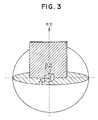
- the angle of the steel sheet to the rolling direction, RD, and the angle of the steel sheet to the normal direction, ND represent conical solid angles RD and ND, respectively.
- a silicon steel slab having a composition comprising 0.068 weight percent of C, 3.34 weight percent of Si, 0.076 weight percent of Mn, 0.030 weight percent of Sb, 0.012 weight percent of Mo, 0.025 weight percent of Al, 0.019 weight percent of Se, 0.004 weight percent of P, 0.003 weight percent of S, 0.0072 weight percent of N, and the balance substantially Fe, was heated at 1380°C for 4 hours to separate and dissolve inhibitors in the silicon steel, and then was hot rolled to a hot-rolled plate 2.2 mm thick. After homogenizing annealing at 1050°C, the plate was finished to a thickness of 0.23 mm by two cold-rollings with an intermediate annealing at 1030°C between the cold-rollings. warm rolling at 250°C constituted the second rolling.
- decarburization and primary recrystallization annealing was performed on the cold-rolled sheet at 840°C in a humid hydrogen atmosphere having a dew point of 50°C.
- the sheet was rapidly heated at a rate of more than 10°/min in a recovery and subsequent recrystallization temperature region of 450°C to 840°C.
- nitriding was performed on the steel sheet surface in a nitrogen atmosphere having a dew point of -20°C or less so as to enhance the nitrogen concentration of the steel sheet surface while preventing oxidation.
- the secondary recrystallizing annealing was performed at 850°C for 15 hours. Secondary recrystallized grains, highly oriented in the Goss direction, were subsequently propagated by raising the temperature to 1050°C at 10°C/min. Thereafter, a purification annealing was conducted at 1200°C.
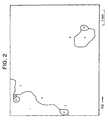
- Fig. 2 is a schematic diagram of a typical computer color map illustrating crystal boundary between a secondary recrystallized grain with Goss orientation and adjacent secondary recrystallized grains in the sheet product.
- five small crystal grains of approximately 0.2 to 1.4 mm marked with the numbers “2", “5", “6”, “9”, and “10” in Fig. 2, formed either in a large secondary recrystallized grain of 35.7 mm with Goss orientation, or along the grain boundary.
- the crystal orientation of the electromagnetic steel sheet often can be defined more accurately by measuring an angle in a parallel plane to the steel sheet plane, ⁇ , an angle in a plane which is normal to the steel sheet plane and includes RD, ⁇ , and an angle in a plane normal to the above two planes, ⁇ , as shown in Fig. 3, rather than defining orientation with the solid conical angles RD and ND as shown in Fig. 1. This is because the majority of the large secondary recrystallized grains in the invention are very close to Goss orientation. Therefore, the crystal orientation of the electromagnetic steel sheet can be more accurately expressed through the angles ⁇ , ⁇ , and ⁇ .
- the orientation of the large secondary recrystallized grains shown in Fig. 2 is -1.0° for ⁇ , 0° for ⁇ , and -1.0° for ⁇ , thus indicating that the secondary grains have almost ideal Goss orientation.
- the five small secondary recrystallized grains in Fig. 2 do not possess the predominant orientation.
- the averages ⁇ , ⁇ , and ⁇ of those five small recrystallized grains are 14.5°, 8.9°, and 9.6°, respectively. It is noteworthy that ⁇ is nearly twice as large as ⁇ and ⁇ .
- the orientation of crystal grains in a conventionally produced electromagnetic steel sheet was measured using the Kossel method.
- the above specified nitriding step after decarburization and primary recrystallization annealing was not performed, and the heat treatment at 850°C was also eliminated from the secondary recrystallization annealing. Instead, the propagation of the secondary recrystallized grains with Goss orientation was conducted by heating from 850°C to 1050°C at a rate of 10°C/hour alone.
- the conventional sheet product was also obtained purification annealed at 1200°C.
- the magnetic properties, magnetic flux density and iron loss of the conventional sheet product were inferior to those of the sheet product made according to the present invention.
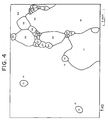
- Fig. 4 is a schematic diagram of a typical computer color map illustrating crystal boundaries between a secondary recrystallized grain with Goss orientation and adjacent secondary recrystallized grains in a conventionally-produced sheet product.
- the large secondary Goss grain partially shown in upper-left of Fig. 4 is 21 mm in diameter, while the large secondary Goes grain partially shown in lower-right of Fig. 4 is 32 mm in diameter.
- the mechanism for maintaining the Goss orientation of the aggregate texture i.e. the structure memory effect, is poor.
- the secondary crystallized grains become larger, and the iron loss is too high for the high magnetic flux density.
- the present invention avoids this problem.
- the cause of the relatively low iron core loss exhibited in the invention is the propagation of small crystal grains of approximately 0.2 to 0.4 mm in the large secondary recrystallized grain or along the grain boundary, as shown in Fig. 2. Further, it should be noted that the five small crystal grains shown in Fig. 2 are oriented with high a values and low ⁇ and ⁇ values.
- the low iron loss can be effectively achieved by predominantly forming small grains in which the (110) plane rotates on the [001] axis, and by avoiding the formation of small grains in the (111) plane, in the matrix of a secondary recrystallized grain with Goss orientation or at grain boundaries.
- the relative arrangement of MnSe precipitate to the matrix shown in the middle of Fig. 5, is (012) MnSa //(110) ⁇ , and [100] MnSa //[001] ⁇ , as reported in Journal of the Japan Institute of Metals, Vol. 49, No. 1, page 15, (1985); it is thought that in crystal grains with Goss orientation, small precipitates of MnSe form stably in the [100] axis direction.
- the lattice constant of [001] axis direction of the MnSe precipitates is 0.5462 (nm), and is somewhat smaller than the lattice constant of the [001] axis direction in the two large secondary Goss grains.
- the schematic diagram of the small grain shown in the left of Fig. 5, suggests that the lattice constant of the small grain becomes the same as the lattice constant of the MnSe precipitate by rotating approximately 17° from the [001] axis, i.e. by ⁇ rotation.
- Primary grains, which exhibit a 17° ⁇ rotation only, are well-stabilized by MnSe precipitation. As primary grains are consumed very little by the secondary Goss grains, the separation and dissolving of MnSe precipitate in the primary grains are reduced as compared with crystal grains having other orientations.
- Fig. 6(a), (b), and (c) schematically and sequentially show the process in which small grains slightly deviated from [001] axis remain unconsumed by the secondary Goes grain at the initial stage of secondary recrystallization annealing.
- Fig. 6 demonstrates that the small crystal grains slightly deviated from [001] axis (shaded in the figure) are enveloped but not consumed by the secondary Goss grain.
- the MnSe precipitate shown in Fig. 5 stably precipitates in the shaded small crystal grains, and will separate and dissolve at a slower rate as compared with crystal grains having other orientations.
- Si about 2.5 to 4.0 weight percent.
- Si content is limited to the range from about 2.5 to 4.0 weight percent.
- Al about 0.005 to 0.06 weight percent .
- Al forms fine AlN precipitates by combining with N present in the steel sheet.
- AlN precipitates effectively act as strong inhibitors.
- An Al content of less than about 0.005 weight percent does not permit the formation of sufficient quantities of fine AlN precipitates, thus secondary grains fail to propagate sufficiently in the Goss direction.
- an Al content of more than about 0.06 weight percent causes insufficient propagation of Goss grains. Therefore, Al content is limited to the range from about 0.005 to 0.06 weight percent.
- Sb and Mo may be incorporated in the steel sheet in addition to Si and Al in order to further stabilize the large secondary Goss grains.
- Sb depresses normal propagation of the primary crystal grains and promotes the propagation of the secondary crystal grains with ⁇ 110 ⁇ 001> orientation after decarburization and primary recrystallization annealing and during secondary recrystallization annealing, thereby improving the magnetic properties of the steel sheet. Therefore, Sb is preferably used as an inhibitor in conjunction with AlN, as well as with MnSe and MnS as described below. However, Sb content of less than about 0.005 weight percent does not effectively produce the inhibition effect. On the other hand, a content of more than about 0.2 weight percent not only causes poor cold rolling formability, but also deteriorates the magnetic properties of the sheet. Thus, an Sb content ranging from about 0.005 to 0.2 weight percent is utilized in the invention.
- Mo about 0.003 to 0.1 weight percent.
- Mo like Sb, is a useful element for depressing the normal propagation of primary crystal grains.
- Mo content of less than about 0.003 weight percent does not effectively produce the inhibition effect.
- a content of more than about 0.1 weight percent causes poor cold rolling formability and poor magnetic properties in the sheet.
- Mo content is controlled to about 0.003 to 0.1 weight percent in the invention.
- Mn about 0.02 to 0.2 weight percent.
- Mn is a useful element for forming MnSe and MnS inhibitors, as described below. Mn also effectively promotes improved brittleness during hot rolling, as well as improved cold rolling formability. A Mn content of less than about 0.02 weight percent does not produce the inhibition effect. On the other hand, a content of more than about 0.2 weight percent deteriorates the magnetic properties of the sheet. Thus, it is preferred that Mn content range from about 0.02 to 0.2 weight percent.
- the steel sheet further preferably contains approximately 0.005 to 0.05 weight percent of Se and S, and approximately 0.001 to 0.020 weight percent of N as inhibitor forming elements, as well as approximately 0.005 to 0.10 weight percent of C.
- Se and S form fine precipitates with Mn in the steel, and these precipitates act as strong inhibitors much like AlN.
- C greatly contributes to the fining of crystal grains and the control of texture by ⁇ modification. However, these components are removed from the steel sheet during purification annealing.
- crystal grains are large secondary crystal grains each having a diameter of about 5 to 50 mm, and each having the [001] axis within about 5° to the rolling direction, RD, and the (110) plane within about 5° to the normal direction, ND, of the sheet plane (in other words, (110) plane tilts within about 5° of the sheet plane).
- This structure is critical for the following reasons.
- the orientation of the [001] axis within about 5° to the rolling direction (RD) and the (110) plane within about 5° to the normal direction (ND) of the sheet plane ensures that the grain orientation is close to Goss orientation.
- both the deviation of the [001] axis to the rolling direction and the deviation of the [110] axis to the normal direction of the sheet plane are within about 3°.
- the content of such Gossoriented grains is less than about 95%, the magnetic properties, in particular magnetic flux density, do not improve sufficiently.
- the percentage of Gossoriented grains should be at least about 95%.
- the particle size of the Goss oriented grains is about 5 to 50 mm, and preferably about 10 to 20 mm, because when the particle size is less than about 5 mm or more than about 50 mm, iron loss improvement is diminished.
- this relative angle ranges from about 2 to 30°, preferably about 2 to 15°.
- the orientation of the small crystal grains expressed through angles ⁇ , ⁇ , and ⁇ satisfies the relations ⁇ ⁇ about 2°, ⁇ ⁇ about 1.5 ⁇ , and ⁇ ⁇ about 1.5 ⁇ , because excellent magnetic properties can be achieved when these relations are satisfied.
- Preferable angle relations are ⁇ ⁇ about 5°, ⁇ ⁇ about 2.0 ⁇ , and ⁇ ⁇ about 2.0 ⁇ .
- the size of the crystal grains ranges from about 0.05 to 2 mm, preferably about 0.1 to 1.0 mm.
- the slab After forming a slab having a predetermined thickness from molten steel having a composition in accordance with the invention by continuous casting or ingot blooming, the slab is heated to between about 1,350° and 1,380°C in order to completely dissolve inhibitor components such as Al, Se, and S. Then, after hot rolling and annealing (if necessary) to a hot-rolled steel plate, the steel plate is finished to a final product thickness of about 0.15 to 0.5 mm by one cold rolling step or two cold rolling steps with an intermediate annealing step.
- Decarburization and primary recrystallization annealing is very important for obtaining a secondary recrystallized texture in accordance with the present invention.
- the decarburization and primary recrystallization annealing is carried out in a humid hydrogen atmosphere at about 800° to 880°C for about 1 to 10 minutes.
- the decarburization and primary recrystallization annealing involves heating the steel sheet to a predetermined constant temperature in which a rapid heating rate of more than about 10°C/min. is employed from 450°C (the recovering and recrystallizing temperature) to the predetermined constant temperature. A heating rate less than about 10°C/min. does not cause enough primary crystal grain aggregates having ⁇ 110 ⁇ 001> orientation to form.
- a nitriding is performed on the steel sheet in a nitrogen atmosphere having a low dew point.
- the nitriding can be performed during the second half of the decarburization and primary recrystallization annealing.
- the dew point of the atmosphere during nitridation should be less than about -20°C, because satisfactory improvement in the magnetic properties cannot be achieved at a dew point exceeding about -20°C.
- the N concentration at the steel sheet surface increases by 20 to 200 ppm through such nitriding.
- the secondary recrystallized texture essential to the invention is not obtainable without nitriding, even if the steel content and the heating rate during decarburization and annealing are in accordance with the invention.
- the sheet After applying an annealing separation agent substantially comprising MgO to the steel sheet surface, the sheet is annealed for secondary recrystallization at about 840° to 870°C for about 10 to 20 hours. It is preferable that the sheet is heated from the above temperature to a temperature between approximately 1,050° to 1,100°C at a heating rate of about 8° to 15°C/min immediately after the application of the annealing separation agent in order to propagate secondary grains which are highly oriented in the Goss direction. The sheet is also preferably annealed for purification at about 1,200° to 1,250°C for about 5 to 20 hours.
- Magnetic domain subdividing treatments such as plasma irradiation and laser irradiation may also be applied to the sheet product to lower iron loss.
- a silicon steel slab comprising 0.068 weight percent of C, 3.44 weight percent of Si, 0.079 weight percent of Mn, 0.024 weight percent of Al, 0.002 weight percent of P, 0.002 weight percent of S, 0.024 weight percent of Se, 0.0076 weight percent of N, and the balance substantially Fe, was heated at 1,420°C for 3 hours to separate and dissolve inhibitors in the silicon steel, and thereafter hot rolled to form a hot-rolled plate 2.3 mm thick. After homogenizing annealing at 1,020°C, the hot rolled plate was finished to a thickness of 0.23 mm by two cold rolling steps with an intermediate annealing at 1,050°C. The second rolling step was rolling at 250°C.
- the cold rolled sheet was decarburization and primary recrystallization annealed at 850°C in a humid hydrogen atmosphere, where rapid heating at a rate of 15°C/min. was carried out from 450°C to 850°C (850°C represented the predetermined constant temperature). Further, during the second half of the decarburization annealing step, nitriding was carried out at 800°C for 1.2 minutes in a nitrogen atmosphere having a dew point of -30°C, which increased the nitrogen concentration of the steel sheet surface by 80 ppm to 0.0145 weight percent.
- the steel sheet was annealed for secondary recrystallization at 850°C for 15 hours, then heated at a rate of 10°C/min from the annealing temperature to 1,050°C to propagate secondary grains highly oriented in the Goes direction. The sheet was then annealed for purification at 1,200°C.
- sample (b) for the production of sample (b), a similar process to that used for sample (a) was applied to a silicon steel slab comprising 0.074 weight percent of C, 3.58 weight percent of Si, 0.082 weight percent of Mn, 0.031 weight percent of Sb, 0.013 weight percent of Mo, 0.026 weight percent of Al, 0.003 weight percent of P, 0.002 weight percent of S, 0.019 weight percent of Se, 0.0065 weight percent of N, and the balance substantially Fe.
- samples (a) and (b) were measured using the Kossel method and analyzed by computer color mapping with an image analyzer.
- Silicon steel slabs each having a composition as shown in Table 1, were heated to 1,360°C, and hot rolled to hot-rolled plates 2.3 mm thick. Then, after homogenizing annealing at 1,000°C, the plates were finished to a sheet 0.23 mm thick by two cold rolling steps with an intermediate annealing step at 980°C.
- Decarburization and primary crystallization annealing and nitriding under the conditions shown in Table 2 were performed on the cold rolled sheet. After applying an annealing separation agent substantially comprising MgO on the steel sheet surface, secondary recrystallization annealing was performed at 850°C for 15 hours. Then each steel sheet was heated at a rate of 8°C/min. from 850°C to 1,080°C, which was followed by a purification annealing at 1,200°C.
- Table 3 shows the results of magnetic property evaluations performed on these sheet products, as well as measurements of large secondary Goss grain size, small secondary grain size, and crystal orientation as determined through computer color mapping. Table 3 reveals that the electromagnetic steel sheets produced according to the present invention have magnetic properties superior to the sheets of comparative examples.
Landscapes
- Chemical & Material Sciences (AREA)
- Engineering & Computer Science (AREA)
- Physics & Mathematics (AREA)
- Materials Engineering (AREA)
- Organic Chemistry (AREA)
- Metallurgy (AREA)
- Mechanical Engineering (AREA)
- Electromagnetism (AREA)
- Crystallography & Structural Chemistry (AREA)
- Thermal Sciences (AREA)
- Manufacturing & Machinery (AREA)
- Dispersion Chemistry (AREA)
- Power Engineering (AREA)
- Manufacturing Of Steel Electrode Plates (AREA)
- Soft Magnetic Materials (AREA)
Applications Claiming Priority (6)
| Application Number | Priority Date | Filing Date | Title |
|---|---|---|---|
| JP30089494 | 1994-12-05 | ||
| JP30089494 | 1994-12-05 | ||
| JP300894/94 | 1994-12-05 | ||
| JP16195895 | 1995-06-28 | ||
| JP16195895A JP3598590B2 (ja) | 1994-12-05 | 1995-06-28 | 磁束密度が高くかつ鉄損の低い一方向性電磁鋼板 |
| JP161958/95 | 1995-06-28 |
Publications (2)
| Publication Number | Publication Date |
|---|---|
| EP0716151A1 EP0716151A1 (en) | 1996-06-12 |
| EP0716151B1 true EP0716151B1 (en) | 2002-07-31 |
Family
ID=26487902
Family Applications (1)
| Application Number | Title | Priority Date | Filing Date |
|---|---|---|---|
| EP95119146A Expired - Lifetime EP0716151B1 (en) | 1994-12-05 | 1995-12-05 | High magnetic flux denscity, low iron loss, grainoriented electromagnetic steel sheet and a method for making |
Country Status (7)
| Country | Link |
|---|---|
| US (2) | US5702541A (ko) |
| EP (1) | EP0716151B1 (ko) |
| JP (1) | JP3598590B2 (ko) |
| KR (1) | KR100266552B1 (ko) |
| CN (1) | CN1071799C (ko) |
| CA (1) | CA2164466A1 (ko) |
| DE (1) | DE69527602T2 (ko) |
Families Citing this family (40)
| Publication number | Priority date | Publication date | Assignee | Title |
|---|---|---|---|---|
| US5885371A (en) * | 1996-10-11 | 1999-03-23 | Kawasaki Steel Corporation | Method of producing grain-oriented magnetic steel sheet |
| US6083326A (en) * | 1996-10-21 | 2000-07-04 | Kawasaki Steel Corporation | Grain-oriented electromagnetic steel sheet |
| IT1290171B1 (it) * | 1996-12-24 | 1998-10-19 | Acciai Speciali Terni Spa | Procedimento per il trattamento di acciaio al silicio, a grano orientato. |
| IT1290173B1 (it) * | 1996-12-24 | 1998-10-19 | Acciai Speciali Terni Spa | Procedimento per la produzione di lamierino di acciaio al silicio a grano orientato |
| IT1290977B1 (it) * | 1997-03-14 | 1998-12-14 | Acciai Speciali Terni Spa | Procedimento per il controllo dell'inibizione nella produzione di lamierino magnetico a grano orientato |
| IT1290978B1 (it) * | 1997-03-14 | 1998-12-14 | Acciai Speciali Terni Spa | Procedimento per il controllo dell'inibizione nella produzione di lamierino magnetico a grano orientato |
| BR9800978A (pt) | 1997-03-26 | 2000-05-16 | Kawasaki Steel Co | Chapas elétricas de aço com grão orientado tendo perda de ferro muito baixa e o processo de produção da mesma |
| EP0892072B1 (en) * | 1997-07-17 | 2003-01-22 | Kawasaki Steel Corporation | Grain-oriented electrical steel sheet excellent in magnetic characteristics and production process for same |
| KR100538595B1 (ko) * | 1997-07-17 | 2006-03-22 | 제이에프이 스틸 가부시키가이샤 | 자기특성이우수한방향성전자강판및그의제조방법 |
| US6200395B1 (en) | 1997-11-17 | 2001-03-13 | University Of Pittsburgh - Of The Commonwealth System Of Higher Education | Free-machining steels containing tin antimony and/or arsenic |
| IT1299137B1 (it) * | 1998-03-10 | 2000-02-29 | Acciai Speciali Terni Spa | Processo per il controllo e la regolazione della ricristallizzazione secondaria nella produzione di lamierini magnetici a grano orientato |
| KR19990088437A (ko) * | 1998-05-21 | 1999-12-27 | 에모또 간지 | 철손이매우낮은고자속밀도방향성전자강판및그제조방법 |
| DE69916743T2 (de) | 1998-10-27 | 2004-09-23 | Jfe Steel Corp. | Elektrostahlblech und dessen Herstellungsverfahren |
| US6206983B1 (en) | 1999-05-26 | 2001-03-27 | University Of Pittsburgh - Of The Commonwealth System Of Higher Education | Medium carbon steels and low alloy steels with enhanced machinability |
| KR100359622B1 (ko) * | 1999-05-31 | 2002-11-07 | 신닛뽄세이테쯔 카부시키카이샤 | 고자장 철손 특성이 우수한 고자속밀도 일방향성 전자 강판 및 그의 제조방법 |
| EP1162280B1 (en) * | 2000-06-05 | 2013-08-07 | Nippon Steel & Sumitomo Metal Corporation | Method for producing a grain-oriented electrical steel sheet excellent in magnetic properties |
| IT1317894B1 (it) * | 2000-08-09 | 2003-07-15 | Acciai Speciali Terni Spa | Procedimento per la regolazione della distribuzione degli inibitorinella produzione di lamierini magnetici a grano orientato. |
| US6676771B2 (en) * | 2001-08-02 | 2004-01-13 | Jfe Steel Corporation | Method of manufacturing grain-oriented electrical steel sheet |
| JP4258349B2 (ja) * | 2002-10-29 | 2009-04-30 | Jfeスチール株式会社 | 方向性電磁鋼板の製造方法 |
| JP2007314826A (ja) * | 2006-05-24 | 2007-12-06 | Nippon Steel Corp | 鉄損特性に優れた一方向性電磁鋼板 |
| CN102041440B (zh) * | 2011-01-16 | 2012-01-25 | 首钢总公司 | 一种高磁感取向硅钢的生产方法 |
| JP5360272B2 (ja) | 2011-08-18 | 2013-12-04 | Jfeスチール株式会社 | 方向性電磁鋼板の製造方法 |
| US9805851B2 (en) | 2011-10-20 | 2017-10-31 | Jfe Steel Corporation | Grain-oriented electrical steel sheet and method of producing the same |
| JP6090553B2 (ja) * | 2011-11-24 | 2017-03-08 | Jfeスチール株式会社 | 三相変圧器用鉄心 |
| FR2990246B1 (fr) | 2012-05-03 | 2014-05-02 | Hydromecanique & Frottement | Chemise de moteur a combustion interne |
| CN102787276B (zh) | 2012-08-30 | 2014-04-30 | 宝山钢铁股份有限公司 | 一种高磁感取向硅钢及其制造方法 |
| CN103834856B (zh) * | 2012-11-26 | 2016-06-29 | 宝山钢铁股份有限公司 | 取向硅钢及其制造方法 |
| KR101642281B1 (ko) | 2014-11-27 | 2016-07-25 | 주식회사 포스코 | 방향성 전기강판 및 이의 제조방법 |
| CN108368562B (zh) * | 2015-12-11 | 2021-07-20 | 日本制铁株式会社 | 成形品的制造方法及成形品 |
| WO2019013351A1 (ja) * | 2017-07-13 | 2019-01-17 | 新日鐵住金株式会社 | 方向性電磁鋼板及びその製造方法 |
| KR102080166B1 (ko) * | 2017-12-26 | 2020-02-21 | 주식회사 포스코 | 방향성 전기강판 및 그의 제조방법 |
| CN111542630B (zh) | 2017-12-28 | 2021-11-30 | 杰富意钢铁株式会社 | 取向性电磁钢板 |
| EP3812478B1 (en) * | 2018-06-21 | 2024-04-10 | Nippon Steel Corporation | Grain-oriented electrical steel sheet with excellent magnetic characteristics |
| EP3831976B1 (en) * | 2018-07-31 | 2025-01-08 | Nippon Steel Corporation | Grain-oriented electromagnetic steel sheet |
| CN109112283A (zh) * | 2018-08-24 | 2019-01-01 | 武汉钢铁有限公司 | 低温高磁感取向硅钢的制备方法 |
| CN109402513B (zh) * | 2018-12-12 | 2020-01-07 | 武汉钢铁有限公司 | 一种高磁感取向硅钢生产方法 |
| JP6813134B2 (ja) * | 2019-01-31 | 2021-01-13 | Jfeスチール株式会社 | 方向性電磁鋼板およびそれを用いた鉄心 |
| JP7364966B2 (ja) * | 2020-06-24 | 2023-10-19 | 日本製鉄株式会社 | 方向性電磁鋼板の製造方法 |
| KR20250071287A (ko) * | 2022-11-15 | 2025-05-21 | 닛폰세이테츠 가부시키가이샤 | 방향성 전자 강판 및 그 제조 방법 |
| WO2025070796A1 (ja) * | 2023-09-27 | 2025-04-03 | 日本製鉄株式会社 | 方向性電磁鋼板、及び方向性電磁鋼板の製造方法 |
Citations (2)
| Publication number | Priority date | Publication date | Assignee | Title |
|---|---|---|---|---|
| EP0534432A2 (en) * | 1991-09-26 | 1993-03-31 | Nippon Steel Corporation | Process for production of oriented electrical steel sheet having excellent magnetic properties |
| EP0577124A2 (en) * | 1992-07-02 | 1994-01-05 | Nippon Steel Corporation | Grain oriented electrical steel sheet having high magnetic flux density and ultra low iron loss and process for producing the same |
Family Cites Families (6)
| Publication number | Priority date | Publication date | Assignee | Title |
|---|---|---|---|---|
| JPS5920745B2 (ja) * | 1980-08-27 | 1984-05-15 | 川崎製鉄株式会社 | 鉄損の極めて低い一方向性珪素鋼板とその製造方法 |
| JPS57145963A (en) * | 1981-03-04 | 1982-09-09 | Hitachi Metals Ltd | Material for magnetic head and its manufacture |
| JPS60121222A (ja) * | 1983-12-02 | 1985-06-28 | Kawasaki Steel Corp | 一方向性珪素鋼板の製造方法 |
| DE3571464D1 (en) * | 1985-03-05 | 1989-08-17 | Nippon Steel Corp | Grain-oriented silicon steel sheet and process for producing the same |
| DE69121953T2 (de) * | 1990-04-13 | 1997-04-10 | Kawasaki Steel Co | Verfahren zum Herstellen kornorientierter Elektrobleche mit geringen Eisenverlusten |
| EP0588342B1 (en) * | 1992-09-17 | 2000-07-12 | Nippon Steel Corporation | Grain-oriented electrical steel sheet and material having very high magnetic flux density and method of manufacturing same |
-
1995
- 1995-06-28 JP JP16195895A patent/JP3598590B2/ja not_active Expired - Fee Related
- 1995-12-05 CA CA002164466A patent/CA2164466A1/en not_active Abandoned
- 1995-12-05 KR KR1019950046893A patent/KR100266552B1/ko not_active Expired - Lifetime
- 1995-12-05 CN CN95121635A patent/CN1071799C/zh not_active Expired - Lifetime
- 1995-12-05 DE DE69527602T patent/DE69527602T2/de not_active Expired - Lifetime
- 1995-12-05 US US08/567,779 patent/US5702541A/en not_active Expired - Lifetime
- 1995-12-05 EP EP95119146A patent/EP0716151B1/en not_active Expired - Lifetime
-
1997
- 1997-05-16 US US08/858,064 patent/US5800633A/en not_active Expired - Lifetime
Patent Citations (2)
| Publication number | Priority date | Publication date | Assignee | Title |
|---|---|---|---|---|
| EP0534432A2 (en) * | 1991-09-26 | 1993-03-31 | Nippon Steel Corporation | Process for production of oriented electrical steel sheet having excellent magnetic properties |
| EP0577124A2 (en) * | 1992-07-02 | 1994-01-05 | Nippon Steel Corporation | Grain oriented electrical steel sheet having high magnetic flux density and ultra low iron loss and process for producing the same |
Also Published As
| Publication number | Publication date |
|---|---|
| JP3598590B2 (ja) | 2004-12-08 |
| CA2164466A1 (en) | 1996-06-06 |
| DE69527602T2 (de) | 2002-11-28 |
| US5702541A (en) | 1997-12-30 |
| JPH08213225A (ja) | 1996-08-20 |
| DE69527602D1 (de) | 2002-09-05 |
| CN1071799C (zh) | 2001-09-26 |
| US5800633A (en) | 1998-09-01 |
| CN1138107A (zh) | 1996-12-18 |
| EP0716151A1 (en) | 1996-06-12 |
| KR100266552B1 (ko) | 2000-09-15 |
| KR960023141A (ko) | 1996-07-18 |
Similar Documents
| Publication | Publication Date | Title |
|---|---|---|
| EP0716151B1 (en) | High magnetic flux denscity, low iron loss, grainoriented electromagnetic steel sheet and a method for making | |
| EP1108794B1 (en) | Electrical steel sheet suitable for compact iron core and manufacturing method therefor | |
| EP2025766B1 (en) | Process for producing grain-oriented magnetic steel sheet with high magnetic flux density | |
| EP0959142A2 (en) | Grain oriented electromagnetic steel sheet and manufacturing method thereof | |
| KR100484989B1 (ko) | 자기특성이 우수한 전자강판 및 그 제조방법 | |
| JPH11310857A (ja) | 無方向性電磁鋼板およびその製造方法 | |
| EP0897993B1 (en) | Electromagnetic steel sheet having excellent magnetic properties and production method thereof | |
| JPH1143746A (ja) | 極めて鉄損の低い方向性電磁鋼板及びその製造方法 | |
| JP2001303261A (ja) | 張力付与異方性被膜を有する低鉄損一方向性電磁鋼板 | |
| JPH055126A (ja) | 無方向性電磁鋼板の製造方法 | |
| JP3551849B2 (ja) | 一方向性電磁鋼板用の一次再結晶焼鈍板 | |
| JPH0121851B2 (ko) | ||
| EP3812478B1 (en) | Grain-oriented electrical steel sheet with excellent magnetic characteristics | |
| JP6056675B2 (ja) | 方向性電磁鋼板の製造方法 | |
| EP1116798B1 (en) | Hot rolled electrical steel sheet excellent in magnetic characteristics and corrosion resistance and method for production thereof | |
| JPH04224624A (ja) | 磁気特性に優れた電磁鋼板の製造方法 | |
| JP2000345305A (ja) | 高磁場鉄損の優れた高磁束密度一方向性電磁鋼板とその製造方法 | |
| JP2525721B2 (ja) | 磁気特性の優れた高磁束密度一方向性電磁鋼板の製造方法 | |
| JPH11172382A (ja) | 磁気特性に優れた電磁鋼板およびその製造方法 | |
| WO2025187780A1 (ja) | 方向性電磁鋼板用の熱延焼鈍鋼板 | |
| WO2025187789A1 (ja) | 方向性電磁鋼板用の熱延焼鈍鋼板 | |
| WO2025187781A1 (ja) | 方向性電磁鋼板用の熱延焼鈍鋼板 | |
| WO2025187773A1 (ja) | 方向性電磁鋼板の製造方法 | |
| WO2025187779A1 (ja) | 方向性電磁鋼板用の熱延焼鈍鋼板 | |
| JP2525722B2 (ja) | 磁気特性の優れた高磁束密度一方向性電磁鋼板の製造方法 |
Legal Events
| Date | Code | Title | Description |
|---|---|---|---|
| PUAI | Public reference made under article 153(3) epc to a published international application that has entered the european phase |
Free format text: ORIGINAL CODE: 0009012 |
|
| AK | Designated contracting states |
Kind code of ref document: A1 Designated state(s): DE FR GB |
|
| 17P | Request for examination filed |
Effective date: 19961211 |
|
| 17Q | First examination report despatched |
Effective date: 19990709 |
|
| GRAG | Despatch of communication of intention to grant |
Free format text: ORIGINAL CODE: EPIDOS AGRA |
|
| GRAG | Despatch of communication of intention to grant |
Free format text: ORIGINAL CODE: EPIDOS AGRA |
|
| GRAH | Despatch of communication of intention to grant a patent |
Free format text: ORIGINAL CODE: EPIDOS IGRA |
|
| GRAH | Despatch of communication of intention to grant a patent |
Free format text: ORIGINAL CODE: EPIDOS IGRA |
|
| GRAA | (expected) grant |
Free format text: ORIGINAL CODE: 0009210 |
|
| AK | Designated contracting states |
Kind code of ref document: B1 Designated state(s): DE FR GB |
|
| REG | Reference to a national code |
Ref country code: GB Ref legal event code: FG4D |
|
| REF | Corresponds to: |
Ref document number: 69527602 Country of ref document: DE Date of ref document: 20020905 |
|
| ET | Fr: translation filed | ||
| PLBE | No opposition filed within time limit |
Free format text: ORIGINAL CODE: 0009261 |
|
| STAA | Information on the status of an ep patent application or granted ep patent |
Free format text: STATUS: NO OPPOSITION FILED WITHIN TIME LIMIT |
|
| 26N | No opposition filed |
Effective date: 20030506 |
|
| PGFP | Annual fee paid to national office [announced via postgrant information from national office to epo] |
Ref country code: GB Payment date: 20041201 Year of fee payment: 10 |
|
| PG25 | Lapsed in a contracting state [announced via postgrant information from national office to epo] |
Ref country code: GB Free format text: LAPSE BECAUSE OF NON-PAYMENT OF DUE FEES Effective date: 20051205 |
|
| GBPC | Gb: european patent ceased through non-payment of renewal fee |
Effective date: 20051205 |
|
| PGFP | Annual fee paid to national office [announced via postgrant information from national office to epo] |
Ref country code: DE Payment date: 20141202 Year of fee payment: 20 |
|
| PGFP | Annual fee paid to national office [announced via postgrant information from national office to epo] |
Ref country code: FR Payment date: 20141208 Year of fee payment: 20 |
|
| REG | Reference to a national code |
Ref country code: DE Ref legal event code: R071 Ref document number: 69527602 Country of ref document: DE |