EP0711311B1 - Heterogeneous polymerisation in carbon dioxide - Google Patents
Heterogeneous polymerisation in carbon dioxide Download PDFInfo
- Publication number
- EP0711311B1 EP0711311B1 EP94922683A EP94922683A EP0711311B1 EP 0711311 B1 EP0711311 B1 EP 0711311B1 EP 94922683 A EP94922683 A EP 94922683A EP 94922683 A EP94922683 A EP 94922683A EP 0711311 B1 EP0711311 B1 EP 0711311B1
- Authority
- EP
- European Patent Office
- Prior art keywords
- carbon dioxide
- segment
- surfactant
- heterogeneous
- mixture according
- Prior art date
- Legal status (The legal status is an assumption and is not a legal conclusion. Google has not performed a legal analysis and makes no representation as to the accuracy of the status listed.)
- Expired - Lifetime
Links
- CURLTUGMZLYLDI-UHFFFAOYSA-N Carbon dioxide Chemical compound O=C=O CURLTUGMZLYLDI-UHFFFAOYSA-N 0.000 title claims description 70
- 239000001569 carbon dioxide Substances 0.000 title claims description 35
- 229910002092 carbon dioxide Inorganic materials 0.000 title claims description 35
- 239000000178 monomer Substances 0.000 claims abstract description 72
- 239000004094 surface-active agent Substances 0.000 claims abstract description 53
- 238000000034 method Methods 0.000 claims abstract description 29
- 239000011541 reaction mixture Substances 0.000 claims abstract description 25
- 238000012674 dispersion polymerization Methods 0.000 claims abstract description 8
- 230000000379 polymerizing effect Effects 0.000 claims abstract description 6
- 229920000642 polymer Polymers 0.000 claims description 41
- 239000003999 initiator Substances 0.000 claims description 40
- 238000006116 polymerization reaction Methods 0.000 claims description 39
- PPBRXRYQALVLMV-UHFFFAOYSA-N Styrene Chemical compound C=CC1=CC=CC=C1 PPBRXRYQALVLMV-UHFFFAOYSA-N 0.000 claims description 28
- 239000004793 Polystyrene Substances 0.000 claims description 24
- 230000002209 hydrophobic effect Effects 0.000 claims description 23
- 229920002223 polystyrene Polymers 0.000 claims description 20
- OZAIFHULBGXAKX-UHFFFAOYSA-N 2-(2-cyanopropan-2-yldiazenyl)-2-methylpropanenitrile Chemical compound N#CC(C)(C)N=NC(C)(C)C#N OZAIFHULBGXAKX-UHFFFAOYSA-N 0.000 claims description 19
- 238000006243 chemical reaction Methods 0.000 claims description 19
- 229920001577 copolymer Polymers 0.000 claims description 16
- OKTJSMMVPCPJKN-UHFFFAOYSA-N Carbon Chemical compound [C] OKTJSMMVPCPJKN-UHFFFAOYSA-N 0.000 claims description 15
- 229910052799 carbon Inorganic materials 0.000 claims description 15
- 229920000428 triblock copolymer Polymers 0.000 claims description 15
- 239000000203 mixture Substances 0.000 claims description 13
- 229920002313 fluoropolymer Polymers 0.000 claims description 11
- 239000004811 fluoropolymer Substances 0.000 claims description 11
- 239000000693 micelle Substances 0.000 claims description 11
- KPUWHANPEXNPJT-UHFFFAOYSA-N disiloxane Chemical class [SiH3]O[SiH3] KPUWHANPEXNPJT-UHFFFAOYSA-N 0.000 claims description 10
- 238000007720 emulsion polymerization reaction Methods 0.000 claims description 10
- 229920003176 water-insoluble polymer Polymers 0.000 claims description 8
- 229920001400 block copolymer Polymers 0.000 claims description 7
- 229910052731 fluorine Inorganic materials 0.000 claims description 7
- 239000011737 fluorine Substances 0.000 claims description 7
- NIXOWILDQLNWCW-UHFFFAOYSA-N acrylic acid group Chemical group C(C=C)(=O)O NIXOWILDQLNWCW-UHFFFAOYSA-N 0.000 claims description 5
- 125000001165 hydrophobic group Chemical group 0.000 claims description 5
- 229920000578 graft copolymer Polymers 0.000 claims description 4
- 239000007788 liquid Substances 0.000 claims description 4
- YCKRFDGAMUMZLT-UHFFFAOYSA-N Fluorine atom Chemical compound [F] YCKRFDGAMUMZLT-UHFFFAOYSA-N 0.000 claims description 3
- BZHJMEDXRYGGRV-UHFFFAOYSA-N Vinyl chloride Chemical compound ClC=C BZHJMEDXRYGGRV-UHFFFAOYSA-N 0.000 claims description 3
- FPYJFEHAWHCUMM-UHFFFAOYSA-N maleic anhydride Chemical compound O=C1OC(=O)C=C1 FPYJFEHAWHCUMM-UHFFFAOYSA-N 0.000 claims description 3
- 238000010557 suspension polymerization reaction Methods 0.000 claims description 3
- 239000008241 heterogeneous mixture Substances 0.000 claims 8
- 125000001153 fluoro group Chemical group F* 0.000 claims 4
- SGPGESCZOCHFCL-UHFFFAOYSA-N Tilisolol hydrochloride Chemical compound [Cl-].C1=CC=C2C(=O)N(C)C=C(OCC(O)C[NH2+]C(C)(C)C)C2=C1 SGPGESCZOCHFCL-UHFFFAOYSA-N 0.000 claims 1
- 229920003169 water-soluble polymer Polymers 0.000 abstract 2
- 239000012071 phase Substances 0.000 description 44
- OKKJLVBELUTLKV-UHFFFAOYSA-N Methanol Chemical compound OC OKKJLVBELUTLKV-UHFFFAOYSA-N 0.000 description 39
- WYURNTSHIVDZCO-UHFFFAOYSA-N Tetrahydrofuran Chemical compound C1CCOC1 WYURNTSHIVDZCO-UHFFFAOYSA-N 0.000 description 28
- -1 poly(ethylene oxide) Polymers 0.000 description 19
- 239000000243 solution Substances 0.000 description 18
- XLYOFNOQVPJJNP-UHFFFAOYSA-N water Substances O XLYOFNOQVPJJNP-UHFFFAOYSA-N 0.000 description 15
- XKRFYHLGVUSROY-UHFFFAOYSA-N Argon Chemical compound [Ar] XKRFYHLGVUSROY-UHFFFAOYSA-N 0.000 description 14
- 230000015572 biosynthetic process Effects 0.000 description 14
- XDTMQSROBMDMFD-UHFFFAOYSA-N Cyclohexane Chemical compound C1CCCCC1 XDTMQSROBMDMFD-UHFFFAOYSA-N 0.000 description 11
- 239000002245 particle Substances 0.000 description 11
- 150000003254 radicals Chemical class 0.000 description 10
- 238000003786 synthesis reaction Methods 0.000 description 10
- AJDIZQLSFPQPEY-UHFFFAOYSA-N 1,1,2-Trichlorotrifluoroethane Chemical compound FC(F)(Cl)C(F)(Cl)Cl AJDIZQLSFPQPEY-UHFFFAOYSA-N 0.000 description 8
- LHGMHYDJNXEEFG-UHFFFAOYSA-N 4-[4-(dimethylamino)phenyl]iminocyclohexa-2,5-dien-1-one Chemical compound C1=CC(N(C)C)=CC=C1N=C1C=CC(=O)C=C1 LHGMHYDJNXEEFG-UHFFFAOYSA-N 0.000 description 8
- 229910052786 argon Inorganic materials 0.000 description 7
- 239000002904 solvent Substances 0.000 description 7
- 238000005160 1H NMR spectroscopy Methods 0.000 description 6
- HEDRZPFGACZZDS-UHFFFAOYSA-N Chloroform Chemical compound ClC(Cl)Cl HEDRZPFGACZZDS-UHFFFAOYSA-N 0.000 description 6
- YXFVVABEGXRONW-UHFFFAOYSA-N Toluene Chemical compound CC1=CC=CC=C1 YXFVVABEGXRONW-UHFFFAOYSA-N 0.000 description 6
- 239000003995 emulsifying agent Substances 0.000 description 6
- 239000000839 emulsion Substances 0.000 description 6
- 239000012300 argon atmosphere Substances 0.000 description 5
- 239000012530 fluid Substances 0.000 description 5
- 238000003756 stirring Methods 0.000 description 5
- JUJWROOIHBZHMG-UHFFFAOYSA-N Pyridine Chemical compound C1=CC=NC=C1 JUJWROOIHBZHMG-UHFFFAOYSA-N 0.000 description 4
- UIIMBOGNXHQVGW-UHFFFAOYSA-M Sodium bicarbonate Chemical compound [Na+].OC([O-])=O UIIMBOGNXHQVGW-UHFFFAOYSA-M 0.000 description 4
- HEDRZPFGACZZDS-MICDWDOJSA-N Trichloro(2H)methane Chemical compound [2H]C(Cl)(Cl)Cl HEDRZPFGACZZDS-MICDWDOJSA-N 0.000 description 4
- 238000004458 analytical method Methods 0.000 description 4
- 239000003153 chemical reaction reagent Substances 0.000 description 4
- 230000009477 glass transition Effects 0.000 description 4
- 238000002211 ultraviolet spectrum Methods 0.000 description 4
- 239000003643 water by type Substances 0.000 description 4
- YSQGYEYXKXGAQA-UHFFFAOYSA-N 2,2,3,3,4,4,5,5,6,6,7,7,8,8,8-pentadecafluorooctyl prop-2-enoate Chemical compound FC(F)(F)C(F)(F)C(F)(F)C(F)(F)C(F)(F)C(F)(F)C(F)(F)COC(=O)C=C YSQGYEYXKXGAQA-UHFFFAOYSA-N 0.000 description 3
- WEVYAHXRMPXWCK-UHFFFAOYSA-N Acetonitrile Chemical compound CC#N WEVYAHXRMPXWCK-UHFFFAOYSA-N 0.000 description 3
- UHOVQNZJYSORNB-UHFFFAOYSA-N Benzene Chemical compound C1=CC=CC=C1 UHOVQNZJYSORNB-UHFFFAOYSA-N 0.000 description 3
- ZMXDDKWLCZADIW-UHFFFAOYSA-N N,N-Dimethylformamide Chemical compound CN(C)C=O ZMXDDKWLCZADIW-UHFFFAOYSA-N 0.000 description 3
- 238000005481 NMR spectroscopy Methods 0.000 description 3
- PNEYBMLMFCGWSK-UHFFFAOYSA-N aluminium oxide Inorganic materials [O-2].[O-2].[O-2].[Al+3].[Al+3] PNEYBMLMFCGWSK-UHFFFAOYSA-N 0.000 description 3
- 238000010539 anionic addition polymerization reaction Methods 0.000 description 3
- 150000001875 compounds Chemical class 0.000 description 3
- 238000009826 distribution Methods 0.000 description 3
- 239000000463 material Substances 0.000 description 3
- 238000005192 partition Methods 0.000 description 3
- 239000003505 polymerization initiator Substances 0.000 description 3
- 230000008569 process Effects 0.000 description 3
- 238000000425 proton nuclear magnetic resonance spectrum Methods 0.000 description 3
- GETTZEONDQJALK-UHFFFAOYSA-N (trifluoromethyl)benzene Chemical compound FC(F)(F)C1=CC=CC=C1 GETTZEONDQJALK-UHFFFAOYSA-N 0.000 description 2
- MYRTYDVEIRVNKP-UHFFFAOYSA-N 1,2-Divinylbenzene Chemical compound C=CC1=CC=CC=C1C=C MYRTYDVEIRVNKP-UHFFFAOYSA-N 0.000 description 2
- ZRZHXNCATOYMJH-UHFFFAOYSA-N 1-(chloromethyl)-4-ethenylbenzene Chemical compound ClCC1=CC=C(C=C)C=C1 ZRZHXNCATOYMJH-UHFFFAOYSA-N 0.000 description 2
- YAUZKNDNVSEDKE-UHFFFAOYSA-N 1-iodoprop-2-enylbenzene Chemical compound C=CC(I)C1=CC=CC=C1 YAUZKNDNVSEDKE-UHFFFAOYSA-N 0.000 description 2
- SMZOUWXMTYCWNB-UHFFFAOYSA-N 2-(2-methoxy-5-methylphenyl)ethanamine Chemical compound COC1=CC=C(C)C=C1CCN SMZOUWXMTYCWNB-UHFFFAOYSA-N 0.000 description 2
- GOXQRTZXKQZDDN-UHFFFAOYSA-N 2-Ethylhexyl acrylate Chemical compound CCCCC(CC)COC(=O)C=C GOXQRTZXKQZDDN-UHFFFAOYSA-N 0.000 description 2
- DXIJHCSGLOHNES-UHFFFAOYSA-N 3,3-dimethylbut-1-enylbenzene Chemical compound CC(C)(C)C=CC1=CC=CC=C1 DXIJHCSGLOHNES-UHFFFAOYSA-N 0.000 description 2
- CSCPPACGZOOCGX-UHFFFAOYSA-N Acetone Chemical compound CC(C)=O CSCPPACGZOOCGX-UHFFFAOYSA-N 0.000 description 2
- NIXOWILDQLNWCW-UHFFFAOYSA-M Acrylate Chemical compound [O-]C(=O)C=C NIXOWILDQLNWCW-UHFFFAOYSA-M 0.000 description 2
- KAKZBPTYRLMSJV-UHFFFAOYSA-N Butadiene Chemical compound C=CC=C KAKZBPTYRLMSJV-UHFFFAOYSA-N 0.000 description 2
- 229920002943 EPDM rubber Polymers 0.000 description 2
- DGAQECJNVWCQMB-PUAWFVPOSA-M Ilexoside XXIX Chemical compound C[C@@H]1CC[C@@]2(CC[C@@]3(C(=CC[C@H]4[C@]3(CC[C@@H]5[C@@]4(CC[C@@H](C5(C)C)OS(=O)(=O)[O-])C)C)[C@@H]2[C@]1(C)O)C)C(=O)O[C@H]6[C@@H]([C@H]([C@@H]([C@H](O6)CO)O)O)O.[Na+] DGAQECJNVWCQMB-PUAWFVPOSA-M 0.000 description 2
- RRHGJUQNOFWUDK-UHFFFAOYSA-N Isoprene Chemical compound CC(=C)C=C RRHGJUQNOFWUDK-UHFFFAOYSA-N 0.000 description 2
- 229920003171 Poly (ethylene oxide) Polymers 0.000 description 2
- PMZURENOXWZQFD-UHFFFAOYSA-L Sodium Sulfate Chemical compound [Na+].[Na+].[O-]S([O-])(=O)=O PMZURENOXWZQFD-UHFFFAOYSA-L 0.000 description 2
- 238000000862 absorption spectrum Methods 0.000 description 2
- XECAHXYUAAWDEL-UHFFFAOYSA-N acrylonitrile butadiene styrene Chemical compound C=CC=C.C=CC#N.C=CC1=CC=CC=C1 XECAHXYUAAWDEL-UHFFFAOYSA-N 0.000 description 2
- 229920000122 acrylonitrile butadiene styrene Polymers 0.000 description 2
- 239000004676 acrylonitrile butadiene styrene Substances 0.000 description 2
- 150000001298 alcohols Chemical class 0.000 description 2
- 239000012298 atmosphere Substances 0.000 description 2
- 230000008901 benefit Effects 0.000 description 2
- 238000012512 characterization method Methods 0.000 description 2
- 238000000576 coating method Methods 0.000 description 2
- 238000007334 copolymerization reaction Methods 0.000 description 2
- 239000006185 dispersion Substances 0.000 description 2
- AUZONCFQVSMFAP-UHFFFAOYSA-N disulfiram Chemical compound CCN(CC)C(=S)SSC(=S)N(CC)CC AUZONCFQVSMFAP-UHFFFAOYSA-N 0.000 description 2
- 239000012990 dithiocarbamate Substances 0.000 description 2
- 229920001971 elastomer Polymers 0.000 description 2
- 238000010828 elution Methods 0.000 description 2
- SUPCQIBBMFXVTL-UHFFFAOYSA-N ethyl 2-methylprop-2-enoate Chemical compound CCOC(=O)C(C)=C SUPCQIBBMFXVTL-UHFFFAOYSA-N 0.000 description 2
- 238000000605 extraction Methods 0.000 description 2
- ZYMKZMDQUPCXRP-UHFFFAOYSA-N fluoro prop-2-enoate Chemical compound FOC(=O)C=C ZYMKZMDQUPCXRP-UHFFFAOYSA-N 0.000 description 2
- 238000010438 heat treatment Methods 0.000 description 2
- 229920001519 homopolymer Polymers 0.000 description 2
- 239000013033 iniferter Substances 0.000 description 2
- 230000000977 initiatory effect Effects 0.000 description 2
- KWGKDLIKAYFUFQ-UHFFFAOYSA-M lithium chloride Chemical compound [Li+].[Cl-] KWGKDLIKAYFUFQ-UHFFFAOYSA-M 0.000 description 2
- WGOPGODQLGJZGL-UHFFFAOYSA-N lithium;butane Chemical compound [Li+].CC[CH-]C WGOPGODQLGJZGL-UHFFFAOYSA-N 0.000 description 2
- VLKZOEOYAKHREP-UHFFFAOYSA-N n-Hexane Chemical class CCCCCC VLKZOEOYAKHREP-UHFFFAOYSA-N 0.000 description 2
- 239000003960 organic solvent Substances 0.000 description 2
- 229920001451 polypropylene glycol Polymers 0.000 description 2
- 238000001556 precipitation Methods 0.000 description 2
- 239000011164 primary particle Substances 0.000 description 2
- 238000010926 purge Methods 0.000 description 2
- AOJFQRQNPXYVLM-UHFFFAOYSA-N pyridin-1-ium;chloride Chemical compound [Cl-].C1=CC=[NH+]C=C1 AOJFQRQNPXYVLM-UHFFFAOYSA-N 0.000 description 2
- UMJSCPRVCHMLSP-UHFFFAOYSA-N pyridine Natural products COC1=CC=CN=C1 UMJSCPRVCHMLSP-UHFFFAOYSA-N 0.000 description 2
- 239000005060 rubber Substances 0.000 description 2
- 238000000926 separation method Methods 0.000 description 2
- 239000011734 sodium Substances 0.000 description 2
- 229910052708 sodium Inorganic materials 0.000 description 2
- 229910000030 sodium bicarbonate Inorganic materials 0.000 description 2
- 229910052938 sodium sulfate Inorganic materials 0.000 description 2
- 230000006641 stabilisation Effects 0.000 description 2
- 238000011105 stabilization Methods 0.000 description 2
- 239000003381 stabilizer Substances 0.000 description 2
- 239000000126 substance Substances 0.000 description 2
- 239000000725 suspension Substances 0.000 description 2
- CIHOLLKRGTVIJN-UHFFFAOYSA-N tert‐butyl hydroperoxide Chemical compound CC(C)(C)OO CIHOLLKRGTVIJN-UHFFFAOYSA-N 0.000 description 2
- VZGDMQKNWNREIO-UHFFFAOYSA-N tetrachloromethane Chemical compound ClC(Cl)(Cl)Cl VZGDMQKNWNREIO-UHFFFAOYSA-N 0.000 description 2
- YLQBMQCUIZJEEH-UHFFFAOYSA-N tetrahydrofuran Natural products C=1C=COC=1 YLQBMQCUIZJEEH-UHFFFAOYSA-N 0.000 description 2
- 238000009281 ultraviolet germicidal irradiation Methods 0.000 description 2
- 238000005292 vacuum distillation Methods 0.000 description 2
- KDGNCLDCOVTOCS-UHFFFAOYSA-N (2-methylpropan-2-yl)oxy propan-2-yl carbonate Chemical compound CC(C)OC(=O)OOC(C)(C)C KDGNCLDCOVTOCS-UHFFFAOYSA-N 0.000 description 1
- RQHGZNBWBKINOY-PLNGDYQASA-N (z)-4-tert-butylperoxy-4-oxobut-2-enoic acid Chemical compound CC(C)(C)OOC(=O)\C=C/C(O)=O RQHGZNBWBKINOY-PLNGDYQASA-N 0.000 description 1
- HSLFISVKRDQEBY-UHFFFAOYSA-N 1,1-bis(tert-butylperoxy)cyclohexane Chemical compound CC(C)(C)OOC1(OOC(C)(C)C)CCCCC1 HSLFISVKRDQEBY-UHFFFAOYSA-N 0.000 description 1
- ZWSICHXNVFXDHH-UHFFFAOYSA-N 1,2,2,3,3,4,4,5,5,6-decafluoro-7-oxabicyclo[4.1.0]heptane Chemical compound FC1(F)C(F)(F)C(F)(F)C(F)(F)C2(F)C1(F)O2 ZWSICHXNVFXDHH-UHFFFAOYSA-N 0.000 description 1
- UEVFYGLYGZACQJ-UHFFFAOYSA-N 1,2,3,4,5-pentafluoro-6-prop-1-en-2-ylbenzene Chemical compound CC(=C)C1=C(F)C(F)=C(F)C(F)=C1F UEVFYGLYGZACQJ-UHFFFAOYSA-N 0.000 description 1
- ARAOLTCZMIFYMK-UHFFFAOYSA-N 1,2,3,4,5-pentafluoro-6-prop-1-enylbenzene Chemical compound CC=CC1=C(F)C(F)=C(F)C(F)=C1F ARAOLTCZMIFYMK-UHFFFAOYSA-N 0.000 description 1
- BEQKKZICTDFVMG-UHFFFAOYSA-N 1,2,3,4,6-pentaoxepane-5,7-dione Chemical compound O=C1OOOOC(=O)O1 BEQKKZICTDFVMG-UHFFFAOYSA-N 0.000 description 1
- LVJZCPNIJXVIAT-UHFFFAOYSA-N 1-ethenyl-2,3,4,5,6-pentafluorobenzene Chemical compound FC1=C(F)C(F)=C(C=C)C(F)=C1F LVJZCPNIJXVIAT-UHFFFAOYSA-N 0.000 description 1
- KFZYYXVIZOVAFO-UHFFFAOYSA-N 1-ethenyl-4-(iodomethyl)benzene Chemical compound ICC1=CC=C(C=C)C=C1 KFZYYXVIZOVAFO-UHFFFAOYSA-N 0.000 description 1
- DAEXAGHVEUWODX-UHFFFAOYSA-N 1-fluoroethenylbenzene Chemical compound FC(=C)C1=CC=CC=C1 DAEXAGHVEUWODX-UHFFFAOYSA-N 0.000 description 1
- HQOVXPHOJANJBR-UHFFFAOYSA-N 2,2-bis(tert-butylperoxy)butane Chemical compound CC(C)(C)OOC(C)(CC)OOC(C)(C)C HQOVXPHOJANJBR-UHFFFAOYSA-N 0.000 description 1
- XMNIXWIUMCBBBL-UHFFFAOYSA-N 2-(2-phenylpropan-2-ylperoxy)propan-2-ylbenzene Chemical compound C=1C=CC=CC=1C(C)(C)OOC(C)(C)C1=CC=CC=C1 XMNIXWIUMCBBBL-UHFFFAOYSA-N 0.000 description 1
- WYGWHHGCAGTUCH-UHFFFAOYSA-N 2-[(2-cyano-4-methylpentan-2-yl)diazenyl]-2,4-dimethylpentanenitrile Chemical compound CC(C)CC(C)(C#N)N=NC(C)(C#N)CC(C)C WYGWHHGCAGTUCH-UHFFFAOYSA-N 0.000 description 1
- LIZVXGBYTGTTTI-UHFFFAOYSA-N 2-[(4-methylphenyl)sulfonylamino]-2-phenylacetic acid Chemical compound C1=CC(C)=CC=C1S(=O)(=O)NC(C(O)=O)C1=CC=CC=C1 LIZVXGBYTGTTTI-UHFFFAOYSA-N 0.000 description 1
- IIMCDFSTCOSVLK-UHFFFAOYSA-N 2-[(tert-butyldiazenyl)methyl]butanenitrile Chemical compound CCC(C#N)CN=NC(C)(C)C IIMCDFSTCOSVLK-UHFFFAOYSA-N 0.000 description 1
- ZAZJGBCGMUKZEL-UHFFFAOYSA-N 2-[ethyl(1,1,2,2,3,3,4,4,5,5,6,6,7,7,8,8,8-heptadecafluorooctylsulfonyl)amino]ethyl prop-2-enoate Chemical compound C=CC(=O)OCCN(CC)S(=O)(=O)C(F)(F)C(F)(F)C(F)(F)C(F)(F)C(F)(F)C(F)(F)C(F)(F)C(F)(F)F ZAZJGBCGMUKZEL-UHFFFAOYSA-N 0.000 description 1
- HTRLKEJGRJZZPW-UHFFFAOYSA-N 2-ethenyl-1,3,5-tris(trifluoromethyl)benzene Chemical compound FC(F)(F)C1=CC(C(F)(F)F)=C(C=C)C(C(F)(F)F)=C1 HTRLKEJGRJZZPW-UHFFFAOYSA-N 0.000 description 1
- KBKNKFIRGXQLDB-UHFFFAOYSA-N 2-fluoroethenylbenzene Chemical compound FC=CC1=CC=CC=C1 KBKNKFIRGXQLDB-UHFFFAOYSA-N 0.000 description 1
- KQCSQWMHCAFBDD-UHFFFAOYSA-N 2-methoxy-2,4-dimethylpentanenitrile Chemical compound COC(C)(C#N)CC(C)C KQCSQWMHCAFBDD-UHFFFAOYSA-N 0.000 description 1
- JJRDRFZYKKFYMO-UHFFFAOYSA-N 2-methyl-2-(2-methylbutan-2-ylperoxy)butane Chemical compound CCC(C)(C)OOC(C)(C)CC JJRDRFZYKKFYMO-UHFFFAOYSA-N 0.000 description 1
- RQXPGOCXZHCXDG-UHFFFAOYSA-N 3,3,3-trifluoroprop-1-en-2-ylbenzene Chemical class FC(F)(F)C(=C)C1=CC=CC=C1 RQXPGOCXZHCXDG-UHFFFAOYSA-N 0.000 description 1
- FRIBMENBGGCKPD-UHFFFAOYSA-N 3-(2,3-dimethoxyphenyl)prop-2-enal Chemical compound COC1=CC=CC(C=CC=O)=C1OC FRIBMENBGGCKPD-UHFFFAOYSA-N 0.000 description 1
- PYSRRFNXTXNWCD-UHFFFAOYSA-N 3-(2-phenylethenyl)furan-2,5-dione Chemical compound O=C1OC(=O)C(C=CC=2C=CC=CC=2)=C1 PYSRRFNXTXNWCD-UHFFFAOYSA-N 0.000 description 1
- XVMSFILGAMDHEY-UHFFFAOYSA-N 6-(4-aminophenyl)sulfonylpyridin-3-amine Chemical compound C1=CC(N)=CC=C1S(=O)(=O)C1=CC=C(N)C=N1 XVMSFILGAMDHEY-UHFFFAOYSA-N 0.000 description 1
- NLHHRLWOUZZQLW-UHFFFAOYSA-N Acrylonitrile Chemical compound C=CC#N NLHHRLWOUZZQLW-UHFFFAOYSA-N 0.000 description 1
- OMPJBNCRMGITSC-UHFFFAOYSA-N Benzoylperoxide Chemical compound C=1C=CC=CC=1C(=O)OOC(=O)C1=CC=CC=C1 OMPJBNCRMGITSC-UHFFFAOYSA-N 0.000 description 1
- 239000005046 Chlorosilane Substances 0.000 description 1
- QPLDLSVMHZLSFG-UHFFFAOYSA-N Copper oxide Chemical compound [Cu]=O QPLDLSVMHZLSFG-UHFFFAOYSA-N 0.000 description 1
- 239000005751 Copper oxide Substances 0.000 description 1
- VGGSQFUCUMXWEO-UHFFFAOYSA-N Ethene Chemical compound C=C VGGSQFUCUMXWEO-UHFFFAOYSA-N 0.000 description 1
- 239000005977 Ethylene Substances 0.000 description 1
- IAYPIBMASNFSPL-UHFFFAOYSA-N Ethylene oxide Chemical compound C1CO1 IAYPIBMASNFSPL-UHFFFAOYSA-N 0.000 description 1
- 238000005967 Finkelstein reaction Methods 0.000 description 1
- MHAJPDPJQMAIIY-UHFFFAOYSA-N Hydrogen peroxide Chemical compound OO MHAJPDPJQMAIIY-UHFFFAOYSA-N 0.000 description 1
- YIVJZNGAASQVEM-UHFFFAOYSA-N Lauroyl peroxide Chemical compound CCCCCCCCCCCC(=O)OOC(=O)CCCCCCCCCCC YIVJZNGAASQVEM-UHFFFAOYSA-N 0.000 description 1
- WHXSMMKQMYFTQS-UHFFFAOYSA-N Lithium Chemical compound [Li] WHXSMMKQMYFTQS-UHFFFAOYSA-N 0.000 description 1
- CERQOIWHTDAKMF-UHFFFAOYSA-M Methacrylate Chemical compound CC(=C)C([O-])=O CERQOIWHTDAKMF-UHFFFAOYSA-M 0.000 description 1
- FXHOOIRPVKKKFG-UHFFFAOYSA-N N,N-Dimethylacetamide Chemical compound CN(C)C(C)=O FXHOOIRPVKKKFG-UHFFFAOYSA-N 0.000 description 1
- 239000007832 Na2SO4 Substances 0.000 description 1
- KEAYESYHFKHZAL-UHFFFAOYSA-N Sodium Chemical compound [Na] KEAYESYHFKHZAL-UHFFFAOYSA-N 0.000 description 1
- 229920000147 Styrene maleic anhydride Polymers 0.000 description 1
- XTXRWKRVRITETP-UHFFFAOYSA-N Vinyl acetate Chemical compound CC(=O)OC=C XTXRWKRVRITETP-UHFFFAOYSA-N 0.000 description 1
- KBKNKFIRGXQLDB-VOTSOKGWSA-N [(e)-2-fluoroethenyl]benzene Chemical compound F\C=C\C1=CC=CC=C1 KBKNKFIRGXQLDB-VOTSOKGWSA-N 0.000 description 1
- JEAIVVDKUUARLF-UHFFFAOYSA-N acetyloxycarbonylperoxycarbonyl acetate Chemical compound CC(=O)OC(=O)OOC(=O)OC(C)=O JEAIVVDKUUARLF-UHFFFAOYSA-N 0.000 description 1
- 239000002253 acid Substances 0.000 description 1
- 150000001252 acrylic acid derivatives Chemical class 0.000 description 1
- 229920006397 acrylic thermoplastic Polymers 0.000 description 1
- HFBMWMNUJJDEQZ-UHFFFAOYSA-N acryloyl chloride Chemical compound ClC(=O)C=C HFBMWMNUJJDEQZ-UHFFFAOYSA-N 0.000 description 1
- 125000000217 alkyl group Chemical group 0.000 description 1
- 150000001408 amides Chemical class 0.000 description 1
- 150000001414 amino alcohols Chemical class 0.000 description 1
- 239000008346 aqueous phase Substances 0.000 description 1
- 125000003118 aryl group Chemical group 0.000 description 1
- 235000019400 benzoyl peroxide Nutrition 0.000 description 1
- DKVNPHBNOWQYFE-UHFFFAOYSA-N carbamodithioic acid Chemical compound NC(S)=S DKVNPHBNOWQYFE-UHFFFAOYSA-N 0.000 description 1
- 229950005499 carbon tetrachloride Drugs 0.000 description 1
- 150000001735 carboxylic acids Chemical class 0.000 description 1
- 239000003054 catalyst Substances 0.000 description 1
- 230000003197 catalytic effect Effects 0.000 description 1
- YACLQRRMGMJLJV-UHFFFAOYSA-N chloroprene Chemical compound ClC(=C)C=C YACLQRRMGMJLJV-UHFFFAOYSA-N 0.000 description 1
- KOPOQZFJUQMUML-UHFFFAOYSA-N chlorosilane Chemical compound Cl[SiH3] KOPOQZFJUQMUML-UHFFFAOYSA-N 0.000 description 1
- 238000004587 chromatography analysis Methods 0.000 description 1
- 238000005345 coagulation Methods 0.000 description 1
- 230000015271 coagulation Effects 0.000 description 1
- 239000011248 coating agent Substances 0.000 description 1
- 238000001246 colloidal dispersion Methods 0.000 description 1
- 239000000084 colloidal system Substances 0.000 description 1
- 230000000052 comparative effect Effects 0.000 description 1
- 239000002131 composite material Substances 0.000 description 1
- 239000000470 constituent Substances 0.000 description 1
- 238000001816 cooling Methods 0.000 description 1
- 229910000431 copper oxide Inorganic materials 0.000 description 1
- 239000006184 cosolvent Substances 0.000 description 1
- 238000004132 cross linking Methods 0.000 description 1
- BLCKNMAZFRMCJJ-UHFFFAOYSA-N cyclohexyl cyclohexyloxycarbonyloxy carbonate Chemical compound C1CCCCC1OC(=O)OOC(=O)OC1CCCCC1 BLCKNMAZFRMCJJ-UHFFFAOYSA-N 0.000 description 1
- BSVQJWUUZCXSOL-UHFFFAOYSA-N cyclohexylsulfonyl ethaneperoxoate Chemical compound CC(=O)OOS(=O)(=O)C1CCCCC1 BSVQJWUUZCXSOL-UHFFFAOYSA-N 0.000 description 1
- 238000000354 decomposition reaction Methods 0.000 description 1
- LSXWFXONGKSEMY-UHFFFAOYSA-N di-tert-butyl peroxide Chemical compound CC(C)(C)OOC(C)(C)C LSXWFXONGKSEMY-UHFFFAOYSA-N 0.000 description 1
- 150000001993 dienes Chemical class 0.000 description 1
- 238000000113 differential scanning calorimetry Methods 0.000 description 1
- 238000004090 dissolution Methods 0.000 description 1
- 238000001035 drying Methods 0.000 description 1
- 230000000694 effects Effects 0.000 description 1
- 239000003792 electrolyte Substances 0.000 description 1
- 239000003480 eluent Substances 0.000 description 1
- 125000004185 ester group Chemical group 0.000 description 1
- 150000002148 esters Chemical class 0.000 description 1
- 125000005670 ethenylalkyl group Chemical group 0.000 description 1
- RTZKZFJDLAIYFH-UHFFFAOYSA-N ether Substances CCOCC RTZKZFJDLAIYFH-UHFFFAOYSA-N 0.000 description 1
- BFMKFCLXZSUVPI-UHFFFAOYSA-N ethyl but-3-enoate Chemical compound CCOC(=O)CC=C BFMKFCLXZSUVPI-UHFFFAOYSA-N 0.000 description 1
- 238000001704 evaporation Methods 0.000 description 1
- 230000008020 evaporation Effects 0.000 description 1
- 239000000284 extract Substances 0.000 description 1
- 239000000835 fiber Substances 0.000 description 1
- 239000010408 film Substances 0.000 description 1
- 238000001914 filtration Methods 0.000 description 1
- 239000012467 final product Substances 0.000 description 1
- 125000003709 fluoroalkyl group Chemical group 0.000 description 1
- XUCNUKMRBVNAPB-UHFFFAOYSA-N fluoroethene Chemical compound FC=C XUCNUKMRBVNAPB-UHFFFAOYSA-N 0.000 description 1
- 238000005194 fractionation Methods 0.000 description 1
- 239000012634 fragment Substances 0.000 description 1
- 238000010528 free radical solution polymerization reaction Methods 0.000 description 1
- 239000007789 gas Substances 0.000 description 1
- PGFXOWRDDHCDTE-UHFFFAOYSA-N hexafluoropropylene oxide Chemical compound FC(F)(F)C1(F)OC1(F)F PGFXOWRDDHCDTE-UHFFFAOYSA-N 0.000 description 1
- 238000004128 high performance liquid chromatography Methods 0.000 description 1
- 239000002563 ionic surfactant Substances 0.000 description 1
- 239000010410 layer Substances 0.000 description 1
- 229910052744 lithium Inorganic materials 0.000 description 1
- 229920002521 macromolecule Polymers 0.000 description 1
- KJJBSBKRXUVBMX-UHFFFAOYSA-N magnesium;butane Chemical compound [Mg+2].CCC[CH2-].CCC[CH2-] KJJBSBKRXUVBMX-UHFFFAOYSA-N 0.000 description 1
- 238000004519 manufacturing process Methods 0.000 description 1
- 230000007246 mechanism Effects 0.000 description 1
- 125000000325 methylidene group Chemical group [H]C([H])=* 0.000 description 1
- 239000002808 molecular sieve Substances 0.000 description 1
- QYZFTMMPKCOTAN-UHFFFAOYSA-N n-[2-(2-hydroxyethylamino)ethyl]-2-[[1-[2-(2-hydroxyethylamino)ethylamino]-2-methyl-1-oxopropan-2-yl]diazenyl]-2-methylpropanamide Chemical compound OCCNCCNC(=O)C(C)(C)N=NC(C)(C)C(=O)NCCNCCO QYZFTMMPKCOTAN-UHFFFAOYSA-N 0.000 description 1
- 239000007764 o/w emulsion Substances 0.000 description 1
- SRSFOMHQIATOFV-UHFFFAOYSA-N octanoyl octaneperoxoate Chemical compound CCCCCCCC(=O)OOC(=O)CCCCCCC SRSFOMHQIATOFV-UHFFFAOYSA-N 0.000 description 1
- 150000002894 organic compounds Chemical class 0.000 description 1
- 239000012044 organic layer Substances 0.000 description 1
- PNJWIWWMYCMZRO-UHFFFAOYSA-N pent‐4‐en‐2‐one Natural products CC(=O)CC=C PNJWIWWMYCMZRO-UHFFFAOYSA-N 0.000 description 1
- SNGREZUHAYWORS-UHFFFAOYSA-N perfluorooctanoic acid Chemical group OC(=O)C(F)(F)C(F)(F)C(F)(F)C(F)(F)C(F)(F)C(F)(F)C(F)(F)F SNGREZUHAYWORS-UHFFFAOYSA-N 0.000 description 1
- 229920005548 perfluoropolymer Polymers 0.000 description 1
- 239000003208 petroleum Substances 0.000 description 1
- 238000005191 phase separation Methods 0.000 description 1
- 125000001997 phenyl group Chemical group [H]C1=C([H])C([H])=C(*)C([H])=C1[H] 0.000 description 1
- 229920001084 poly(chloroprene) Polymers 0.000 description 1
- 229920003229 poly(methyl methacrylate) Polymers 0.000 description 1
- 229920001296 polysiloxane Polymers 0.000 description 1
- 239000004800 polyvinyl chloride Substances 0.000 description 1
- LPNYRYFBWFDTMA-UHFFFAOYSA-N potassium tert-butoxide Chemical compound [K+].CC(C)(C)[O-] LPNYRYFBWFDTMA-UHFFFAOYSA-N 0.000 description 1
- 239000002244 precipitate Substances 0.000 description 1
- 239000002243 precursor Substances 0.000 description 1
- 238000002360 preparation method Methods 0.000 description 1
- 238000012545 processing Methods 0.000 description 1
- 239000000047 product Substances 0.000 description 1
- 238000010526 radical polymerization reaction Methods 0.000 description 1
- 230000009257 reactivity Effects 0.000 description 1
- 238000001226 reprecipitation Methods 0.000 description 1
- 239000011347 resin Substances 0.000 description 1
- 229920005989 resin Polymers 0.000 description 1
- 230000000717 retained effect Effects 0.000 description 1
- 238000006798 ring closing metathesis reaction Methods 0.000 description 1
- 238000012216 screening Methods 0.000 description 1
- URGAHOPLAPQHLN-UHFFFAOYSA-N sodium aluminosilicate Chemical compound [Na+].[Al+3].[O-][Si]([O-])=O.[O-][Si]([O-])=O URGAHOPLAPQHLN-UHFFFAOYSA-N 0.000 description 1
- 235000017557 sodium bicarbonate Nutrition 0.000 description 1
- 235000011152 sodium sulphate Nutrition 0.000 description 1
- 239000007787 solid Substances 0.000 description 1
- 229920003048 styrene butadiene rubber Polymers 0.000 description 1
- QAOWNCQODCNURD-UHFFFAOYSA-N sulfuric acid Substances OS(O)(=O)=O QAOWNCQODCNURD-UHFFFAOYSA-N 0.000 description 1
- KQYLUTYUZIVHND-UHFFFAOYSA-N tert-butyl 2,2-dimethyloctaneperoxoate Chemical compound CCCCCCC(C)(C)C(=O)OOC(C)(C)C KQYLUTYUZIVHND-UHFFFAOYSA-N 0.000 description 1
- OPQYOFWUFGEMRZ-UHFFFAOYSA-N tert-butyl 2,2-dimethylpropaneperoxoate Chemical compound CC(C)(C)OOC(=O)C(C)(C)C OPQYOFWUFGEMRZ-UHFFFAOYSA-N 0.000 description 1
- SWAXTRYEYUTSAP-UHFFFAOYSA-N tert-butyl ethaneperoxoate Chemical compound CC(=O)OOC(C)(C)C SWAXTRYEYUTSAP-UHFFFAOYSA-N 0.000 description 1
- 125000000999 tert-butyl group Chemical group [H]C([H])([H])C(*)(C([H])([H])[H])C([H])([H])[H] 0.000 description 1
- ISXSCDLOGDJUNJ-UHFFFAOYSA-N tert-butyl prop-2-enoate Chemical compound CC(C)(C)OC(=O)C=C ISXSCDLOGDJUNJ-UHFFFAOYSA-N 0.000 description 1
- BFKJFAAPBSQJPD-UHFFFAOYSA-N tetrafluoroethene Chemical group FC(F)=C(F)F BFKJFAAPBSQJPD-UHFFFAOYSA-N 0.000 description 1
- 239000002562 thickening agent Substances 0.000 description 1
- 238000012546 transfer Methods 0.000 description 1
- 238000013022 venting Methods 0.000 description 1
- 125000000391 vinyl group Chemical group [H]C([*])=C([H])[H] 0.000 description 1
- 229920002554 vinyl polymer Polymers 0.000 description 1
Images
Classifications
-
- C—CHEMISTRY; METALLURGY
- C08—ORGANIC MACROMOLECULAR COMPOUNDS; THEIR PREPARATION OR CHEMICAL WORKING-UP; COMPOSITIONS BASED THEREON
- C08F—MACROMOLECULAR COMPOUNDS OBTAINED BY REACTIONS ONLY INVOLVING CARBON-TO-CARBON UNSATURATED BONDS
- C08F2/00—Processes of polymerisation
- C08F2/04—Polymerisation in solution
- C08F2/06—Organic solvent
- C08F2/08—Organic solvent with the aid of dispersing agents for the polymer
-
- C—CHEMISTRY; METALLURGY
- C08—ORGANIC MACROMOLECULAR COMPOUNDS; THEIR PREPARATION OR CHEMICAL WORKING-UP; COMPOSITIONS BASED THEREON
- C08F—MACROMOLECULAR COMPOUNDS OBTAINED BY REACTIONS ONLY INVOLVING CARBON-TO-CARBON UNSATURATED BONDS
- C08F290/00—Macromolecular compounds obtained by polymerising monomers on to polymers modified by introduction of aliphatic unsaturated end or side groups
- C08F290/08—Macromolecular compounds obtained by polymerising monomers on to polymers modified by introduction of aliphatic unsaturated end or side groups on to polymers modified by introduction of unsaturated side groups
- C08F290/14—Polymers provided for in subclass C08G
- C08F290/148—Polysiloxanes
-
- Y—GENERAL TAGGING OF NEW TECHNOLOGICAL DEVELOPMENTS; GENERAL TAGGING OF CROSS-SECTIONAL TECHNOLOGIES SPANNING OVER SEVERAL SECTIONS OF THE IPC; TECHNICAL SUBJECTS COVERED BY FORMER USPC CROSS-REFERENCE ART COLLECTIONS [XRACs] AND DIGESTS
- Y10—TECHNICAL SUBJECTS COVERED BY FORMER USPC
- Y10S—TECHNICAL SUBJECTS COVERED BY FORMER USPC CROSS-REFERENCE ART COLLECTIONS [XRACs] AND DIGESTS
- Y10S516/00—Colloid systems and wetting agents; subcombinations thereof; processes of
- Y10S516/01—Wetting, emulsifying, dispersing, or stabilizing agents
-
- Y—GENERAL TAGGING OF NEW TECHNOLOGICAL DEVELOPMENTS; GENERAL TAGGING OF CROSS-SECTIONAL TECHNOLOGIES SPANNING OVER SEVERAL SECTIONS OF THE IPC; TECHNICAL SUBJECTS COVERED BY FORMER USPC CROSS-REFERENCE ART COLLECTIONS [XRACs] AND DIGESTS
- Y10—TECHNICAL SUBJECTS COVERED BY FORMER USPC
- Y10S—TECHNICAL SUBJECTS COVERED BY FORMER USPC CROSS-REFERENCE ART COLLECTIONS [XRACs] AND DIGESTS
- Y10S526/00—Synthetic resins or natural rubbers -- part of the class 520 series
- Y10S526/942—Polymerization in the presence of a liquid co2 diluent
-
- Y—GENERAL TAGGING OF NEW TECHNOLOGICAL DEVELOPMENTS; GENERAL TAGGING OF CROSS-SECTIONAL TECHNOLOGIES SPANNING OVER SEVERAL SECTIONS OF THE IPC; TECHNICAL SUBJECTS COVERED BY FORMER USPC CROSS-REFERENCE ART COLLECTIONS [XRACs] AND DIGESTS
- Y10—TECHNICAL SUBJECTS COVERED BY FORMER USPC
- Y10T—TECHNICAL SUBJECTS COVERED BY FORMER US CLASSIFICATION
- Y10T428/00—Stock material or miscellaneous articles
- Y10T428/12—All metal or with adjacent metals
- Y10T428/12493—Composite; i.e., plural, adjacent, spatially distinct metal components [e.g., layers, joint, etc.]
- Y10T428/12535—Composite; i.e., plural, adjacent, spatially distinct metal components [e.g., layers, joint, etc.] with additional, spatially distinct nonmetal component
- Y10T428/12556—Organic component
- Y10T428/12569—Synthetic resin
-
- Y—GENERAL TAGGING OF NEW TECHNOLOGICAL DEVELOPMENTS; GENERAL TAGGING OF CROSS-SECTIONAL TECHNOLOGIES SPANNING OVER SEVERAL SECTIONS OF THE IPC; TECHNICAL SUBJECTS COVERED BY FORMER USPC CROSS-REFERENCE ART COLLECTIONS [XRACs] AND DIGESTS
- Y10—TECHNICAL SUBJECTS COVERED BY FORMER USPC
- Y10T—TECHNICAL SUBJECTS COVERED BY FORMER US CLASSIFICATION
- Y10T428/00—Stock material or miscellaneous articles
- Y10T428/13—Hollow or container type article [e.g., tube, vase, etc.]
- Y10T428/1352—Polymer or resin containing [i.e., natural or synthetic]
- Y10T428/1369—Fiber or fibers wound around each other or into a self-sustaining shape [e.g., yarn, braid, fibers shaped around a core, etc.]
Definitions
- This invention relates generally to the polymerization of hydrophobic monomers, and more specifically relates to the heterogeneous polymerization of hydrophobic monomers in a carbon dioxide continuous phase.
- Emulsion polymerization is a heterogeneous process often used by industry to polymerize a wide variety of monomers using free radical mechanisms. It involves the polymerization of monomers in the form of emulsions or latexes.
- Polymers commonly formed by emulsion include acrylics, styrenics, polyvinylchloride (PVC), styrene-butadiene rubber, ethylene-propylenediene terpolymer-based (EPDM), polystyrene, acrylonitrile- butadiene-styrene copolymer (ABS), neoprene rubber, ethyl-vinyl acetate, styrene-maleic anhydride, tetrafluroethylene, and vinyl fluoride.
- PVC polyvinylchloride
- EPDM ethylene-propylenediene terpolymer-based
- ABS acrylonitrile- butadiene-styrene
- low molar mass ionic surfactants have enjoyed the most use in water-based emulsion polymerizations because they work so efficiently to stabilize the ionic double layer of the emulsion or colloid particles which prevents particle coagulation.
- polymeric surfactants have also been utilized to stabilize emulsion polymerizations. See Piirma, Polymeric Surfactants in 42 Surfactant Science Series (Marcel Dekker, New York 1992). This class of surfactants stabilizes colloidal particles by steric, rather than ionic, means.
- Steric stabilization of emulsions can be advantageous in that (a) steric systems are much less sensitive to fluctuations and increases in electrolyte concentrations, (b) they work well at high and low solids contents, and (c) they stabilize aqueous and nonaqueous dispersions equally well. See Napper, Polymeric Stabilization of Colloidal Dispersions (Academic Press, New York 1983). Many nonionic polymeric surfactants are available; the most common of these are basically block copolymers of poly(ethylene oxide) (PEO) and poly(propylene oxide) (PPO).
- PEO poly(ethylene oxide)
- PPO poly(propylene oxide)
- the polymer After polymerization, the polymer must be coagulated and isolated from the aqueous phase for further processing (except for that which is destined for use in water-borne coatings).
- the large volume of water remaining comprising the continuous phase must be properly handled, as it becomes contaminated with organic compounds such as residual monomers, stabilizers, and other materials that are difficult to remove. As a result, it would be desirable to provide a different medium for the continuous phase that can be easily decontaminated.
- a fluid other than water comprises the continuous phase medium.
- the present invention includes as a first aspect a method of carrying out the heterogenous polymerization of monomers that form a water-insoluble polymer.
- the method comprises providing a heterogeneous reaction mixture comprising carbon dioxide, a monomer, and a surfactant and polymerizing the monomer in the reaction mixture.
- the method is suitable for both suspension and emulsion polymerizations.
- the present invention includes as a second aspect a heterogeneous reaction mixture useful for carrying out the heterogenous polymerization of a monomer that forms a water-insoluble polymer.
- the reaction mixture comprises a carbon dioxide, the monomer, and a surfactant.
- the surfactant useful for carrying out the heterogenous polymerization of a hydrophobic monomer comprises a first hydrophobic group covalently joined to a second carbon-dioxide soluble group, wherein the carbon-dioxide soluble group preferably comprises a fluorinated siliconated component a
- the polymerization initiator suitable for use in a heterogeneous polymerization carried out with a carbon dioxide continuous phase preferably comprises a first carbon dioxide-soluble group comprising a fluoropolymer covalently joined to a second free-radical forming group.
- CO 2 as the continuous phase medium rather than water is advantageous for a number of reasons.
- Carbon dioxide (CO 2 ) has been employed as a polymerization medium.
- European Patent Application 0301532 discloses the polymerization of acrylic acid monomer, a comonomer. CO 2 , and an initiator. The CO 2 can be used in a supercritical fluid phase. The resulting copolymer is useful as a thickening agent.
- Hartmann et al., U.S. Patent No. 4,748,220 disclose a polymerization of monoethylenically unsaturated carboxylic acids, their amides and esters, and aminoalcohols in supercritical CO 2 .
- the present invention is directed to a method of carrying out the heterogeneous polymerization of a hydrophobic monomer.
- the steps of the method comprise providing a reaction mixture comprising a carbon dioxide (CO 2 ) continuous phase, and a hydrophobic dispersed phase comprising a surfactant and a hydrophobic monomer dissolved therein, then polymerizing the monomer in the reaction mixture.
- CO 2 carbon dioxide
- a heterogeneous reaction is one in which the polymerization is carried out through the use of media that create at least two separate phases.
- One phase is termed the continuous phase", which comprises a fluid, and the other is termed the “dispersed phase”, comprising the monomer or monomers to be polymerized.
- the monomer is stabilized in the dispersed phase by a surfactant (also known as an emulsifier, or a stabilizer) that reduces the surface tension between the phases.
- heterogeneous reaction is intended to encompass both suspension polymerizations, in which any polymerization initiator is preferentially solubilized in the dispersed phase, and emulsion reactions, in which any polymerization initiator is preferentially solubilized in the continuous phase.
- a compound is "preferentially solubilized” in one phase over another when it is more soluble in that phase.
- the present invention is preferably carried out by emulsion polymerization.
- the generally accepted view of emulsion polymerization is described in Harkins, J. Amer. Chem. Soc . 69:1428 (1947), and further developed in Smith and Ewart, J. Chem. Phys. 16:592 (1948).
- a classical oil-in-water (O/W) emulsion polymerization generally includes as reagents water, a water-insoluble monomer, a water-soluble initiator, and an emulsifier. As the monomer is insoluble in the continuous phase (water), it is dispersed as droplets, which are stabilized by the surface active emulsifier, and is also solubilized in micelles formed by the emulsifier.
- the initiator is soluble in the continuous water phase. Upon its decomposition to form radicals, the initiator initiates the polymerization of the trace amount of monomer dissolved in the water-rich phase. As the molecular weight of the macromolecule increases, it eventually becomes insoluble in water, at which time it precipitates to form a primary particle. These primary particles can coalesce to form larger particles which become stabilized by the surface active emulsifier present in the system.
- the CO 2 can be employed in a liquid, vapor, or supercritical phase. If liquid CO 2 , is used, the temperature of the reaction should be below 31°C. Preferably, the CO 2 in the continuous phase is in a "supercritical" phase. As used herein, “supercritical” means that a fluid medium is at a temperature that is sufficiently high that it cannot be liquified by pressure.
- the thermodynamic properties of CO 2 are reported in Hyatt, J. Org. Chem. 49 :5097-5101 (1984); therein, it is stated that the critical temperature of CO 2 is about 31°C; thus the method of the present invention should be carried out at a temperature above 31°C.
- the reaction temperature should be chosen to provide sufficient heat energy to initiate and propagate the polymerization. Preferably, the reaction temperature will be between 50°C and 200°C, and more preferably will be between 50°C and 100°C.
- the method of the present invention includes a dispersed phase comprising a monomer stabilized by a surfactant.
- the surfactant provided to the reaction mixture should be one that is surface active in CO 2 and thus partitions itself at the CO 2 -monomer/polymer interface. Such a surfactant should cause the formation of micelles in the CO 2 and thus create a dispersed phase that permits the polymerization to follow the Smith-Ewart kinetics described above.
- the surfactant is generally present in the reaction mixture in a concentration of between 0.01 and 30 percent by weight.
- the surfactants can be nonreactive in the polymerization or can react with and thereby be included with the forming polymer. See, e.g., U.S. Patent Nos. 4,592,933 and 4,429,666 for exemplary reactive surfactants.
- the surfactant contains a segment that is soluble in CO 2 ("CO 2 -philic").
- CO 2 -philic segments include a fluorine-containing segment or a siloxane-containing segment.
- a "fluoropolymer” has its conventional meaning in the art. See generally Fluoropolymers (L. Wall, Ed. 1972)(Wiley-Interscience Division of John Wiley & Sons); see also Fluorine-Containing Polymers, 7 Encyclopedia of Polymer Science and Engineering 256 (H. Mark et al. Eds., 2d Ed. 1985).
- fluoropolymers are those formed from: fluoroacrylate monomers such as 2-(N-ethylperfluorooctanesulfonamido) ethyl acrylate (“EtFOSEA”), 2-(N-ethylperflooctanesulfonamido) ethyl methacrylate (“EtFOSEMA”), 2-(N-methylperfluorooctanesulfonamido) ethyl acrylate (“MeFOSEA”), 2-(N-methylperflooctanesulfonamido) ethyl methacrylate (“MeFOSEMA”), 1,1-Dihydroperfluorooctyl acrylate (“FOA”), and 1,1-Dihydroperfluorooctyl acrylate (“FOMA”); fluoroolefin monomers such as tetrafluoroethylene, fluorostyrene monomers such as
- the surfactant also comprises a hydrophobic group, such as a polystyrene group, that is "CO 2 -phobic," and is covalently linked to said CO 2 -soluble group, such as a fluoropolymer.
- a hydrophobic group such as a polystyrene group, that is "CO 2 -phobic," and is covalently linked to said CO 2 -soluble group, such as a fluoropolymer.
- Such copolymers can take many forms; two exemplary forms are graft copolymers having a CO 2 -soluble backbone and hydrophobic branches attached thereto and triblock copolymers having a central hydrophobic portion attached at opposite ends to one of a pair of CO 2 -soluble portions are preferred.
- Triblock copolymers often exhibit markedly different properties than their individuals constituents, as the individual segments of the copolymers tend to phase separate; the chemical bond between the segments prevents macroscopic phase separation, so microdomains tend to form.
- the CO 2 -soluble end portions extend into the CO 2 continuous phase, but the hydrophobic portions can aggregate to form the core of a micelle.
- the fluoropolymer segment be a perfluoropolymer such as dihydroperfluorooctyl acrylate.
- a preferred triblock copolymer surfactant comprises poly(1,1-dihydroperfluorooctyl acrylate) end blocks and a polystyrene center block.
- Suitable monomers for use with this invention are those that form water-insoluble polymers.
- Exemplary monomers forming such polymers include vinyl monomers such as vinyl chloride and vinyl acetate, ethylene, acrylonitrile, dienes such as isoprene and butadiene, styrenics such as styrene and t-butyl styrene, chloroprene, acrylic monomers such as alkylmethyl acrylates, fluoromonomers as given above, and maleic anhydride.
- Particularly suitable hydrophobic monomers can be selected from the group consisting of styrene monomers, acrylic monomers, vinyl chloride monomers, olefinic monomers, fluoroolefinic monomers, fluoroacrylate monomers, fluorostyrenic monomers, and maleic anhydride monomers.
- the method is suitable for polymerizations of a single monomer or copolymerizations of more than one hydrophobic monomer, and can also be used to produce copolymers of hydrophobic and hydrophilic monomers.
- monomers that provide cross-linking and branching such as divinyl benzene and di-triacrylates, can also be included.
- the monomer can be included in the reaction mixture in proportions ranging from 1 to 70 percent by weight.
- the heterogeneous reaction can optionally include a free radical initiator that accelerates the polymerization.
- the initiator is chosen based on its solubility characteristics: it should preferentially solubilize in the dispersed phase for a suspension reaction, or in the CO 2 continuous phase for an emulsion reaction.
- the initiator is included in the solution in a concentration ranging from 0.001 to 20 percent by weight.
- Organic free radical initiators include, but are not limited to, the following: acetylcyclohexanesulfonyl peroxide; diacetyl peroxydicarbonate; dicyclohexyl peroxydicarbonate; di-2-ethylhexyl peroxydicarbonate; tert-butyl perneodecanoate; 2,2'-azobis (methoxy-2,4-dimethylvaleronitrile; tert-butyl perpivalate; dioctanoyl peroxide; dilauroyl peroxide; 2,2'-azobis (2,4-dimethylvaleronitrile); tert-butylazo-2-cyanobutane; dibenzoyl peroxide; tert-butyl per-2-ethylhexanoate; tert-butyl
- Initiators that preferentially solubilize in CO 2 include a CO 2 -philic segment (typically a fluorinated or siloxane segment) and a free radical-producing segment; thus the attachment of a fluorinated or siloxane segment to the free radical initiators listed above produces initiators that can be used with the present invention.
- a particularly preferred CO 2 -soluble initiator is that of Formula XIII:
- the polymerizing step of the present invention can be carried out by polymerization methods using apparatus and conditions known to those skilled in this art.
- the reaction begins by heating the reaction vessel to a temperature above 31°C (generally between 50°C and 200°C).
- the initiator, monomer or monomers, surfactant, and CO 2 are added to the vessel.
- the mixture is allowed to polymerize for between about 2 and 24 hours, and preferably is stirred as the reaction proceeds.
- the polymer can be collected by methods such as venting of the CO 2 or by fractionation.
- the surfactant is fractionated from the CO 2 and polymer by reducing temperature and pressure and thus is able to be reused. After separation, the polymer can be collected by conventional means.
- the polymers of the present invention may be retained in the CO 2 , dissolved in a separate solvent, and sprayed onto a surface. After the CO 2 and solvent evaporate, the polymer forms a coating on the surface.
- the polymer formed by the present invention can also be used to form molded articles, such as valves and bottles, films, fibers, resins, and matrices for composite materials.
- M means molar concentration
- NMR nuclear magnetic resonance
- MHz means megahertz
- GPC gas phase chromatography
- ⁇ means angstroms
- UV means ultraviolet
- g means grams
- mol means moles
- ml means milliliters
- °C means degrees Celsius
- s means seconds
- h means hours
- psig means pounds per square inch (gauge)
- M n means number merger molecular weight
- MWD means molecular weight distribution
- f means functionality
- ppm means parts per million
- T g means glass transition temperature
- nm means nanometers
- mg means milligrams
- rpm means revolution per minute
- psi means pounds per square inch.
- Pyridine (EM Science) was purified by vacuum distillation. Tetrahydrofuran (Fisher Certified Grade) (THF) was refluxed over sodium and distilled under an argon atmosphere. Acryloyl chloride (Aldrich) was purified by vacuum distillation. Azobisisobutyro-nitrile (Kodak) (AIBN) was recrystallized from methanol. 1,1-Dihydroperfluorooctyl acrylate (3M) (FOA) was passed through columns of decolorizing carbon and alumina. Cyclohexane (Phillips Petroleum Company) was stirred over concentrated sulfuric acid for approximately two weeks, decanted and distilled from a sodium dispersion under argon.
- Styrene (Fisher) was vacuum distilled from dibutyl magnesium following three freeze-thaw cycles.
- p -Vinylbenzyl chloride (Kodak) was passed through an alumina column under argon atmosphere
- p -Vinylbenzyl iodide was synthesized from p -vinylbenzyl chloride using the Finkelstein reaction.
- Carbon dioxide (Matheson, 99.5%) was purified by passing through columns of molecular sieves and reduced copper oxide catalyst (BASF R3-11).
- Tetraethylthiuram disulfide (TD, Aldrich) was recrystallized twice from methanol and the purity was checked by 1 H NMR.
- Toluene (Fisher, Certified Grade) was distilled under argon over sodium metal. 1,1-Dihydroperfluorooctyl methacrylate (3M) (FOMA) and 2-ethylhexyl acrylate (Aldrich) and styrene (Aldrich) were passed through a column of alumina prior to use. All glassware was rigorously cleaned and flame-dried prior to use.
- 3M 1,1-Dihydroperfluorooctyl methacrylate
- Aldrich 2-ethylhexyl acrylate
- Aldrich styrene
- Polystyrene standards (Showa Denko) were used to determine the molecular mass and molecular weight distribution. Macromolecular end groups were analyzed by 1 H NMR, UV analyses, and by GPC analyses on another Waters GPC instrument with a Waters 996 photodiode array detector which measures the UV spectrum of each elution of the polymer.
- 4,4'-Azobis-4-cyanopentanoyl chloride was prepared from the acid analog by the method described in Smith, Makromol. Chem. 103 :301 (1967). 0.022 mol (7.124 g) of 4,4'-azobis-4-cyanopentanoyl chloride in 160 ml of dry THF was added drop-wise to a solution of 0.039 mol (20.302 g) of perfluorinated alcohol and a catalytic amount of pyridine in 60 ml of Freon 113 at room temperature and stirred for 3 hours under inert atmosphere.
- the initiator used in an emulsion polymerization should be preferentially soluble in CO 2 and partition itself into the continuous CO 2 phase over the hydrophobic dispersed phase in order to benefit from Smith-Ewart kinetics.
- the fluorinated azo-initiator synthesized above meets this solubility criterion.
- This molecule is very soluble in CO 2 and decomposes in an analogous fashion to AIBN.
- the highly fluorinated nature of this molecule imparts the desirable solubility/ insolubility profile; it is insoluble in most organic solvents (benzene, toluene, cyclohexane, acetonitrile, carbontetrachloride, dimethylformamide, dimethylacetamide); insoluble in many hydrophobic monomers (styrene, t-butyl styrene, acrylic acid); insoluble in water; and soluble in Freon-113 and CO 2 .
- organic solvents benzene, toluene, cyclohexane, acetonitrile, carbontetrachloride, dimethylformamide, dimethylacetamide
- hydrophobic monomers styrene, t-butyl styrene, acrylic acid
- insoluble in water and soluble in Freon-113 and CO 2 .
- Anionic Polymerization The anionic polymerization of styrene was conducted in a one-neck 500 ml round-bottomed flask equipped with a magnetic stir bar and rubber septum under a 5-8 psig (0.34 - 0.55 bar) argon atmosphere. The polymerization was initiated with sec-butyllithium and stirred overnight at room temperature. The polymerization was functionally terminated by the addition of a two-fold excess of ethylene oxide followed by the addition of vinylbenzyl iodide. The polymer was precipitated in a ten-fold excess of methanol, dissolved in THF to remove unreacted vinylbenzyl iodide and reprecipitated in methanol. The polymer was then dried in vacuo overnight and stored at -8°C.
- the polymer was recovered by precipitation of the polymerization solution into a large excess of methanol and drying.
- the resulting polymer was purified twice by dissolution in THF and reprecipitation into methanol.
- the telechelic polystyrene produced by this method was then characterized (see Table 1).
- the molecular weight of the polymer was determined by GPC.
- the presence of the residual initiator and the functionality of the end groups were determined by 1 H NMR and by UV analyses as described previously. See Turner et al., Macromolecles 23: 1856-1859 (1990).
- Synthesis of Telechelic Polystyrenes Sample ID M n (GPC) MWD f ( % ) 1 3.3K 1.5 1.9 2 5.6K 1.8 1.8 3 8.8K 2.1 2.0
- the telechelic polystyrenes were also analyzed by a Waters GPC with a photodiode array detector which can give an elution time-peak intensity-UV absorption spectra 3-dimensional plot.
- the functionality can also be calculated from the 3-D GPC plot.
- a calculated amount of PS macromonomer as synthesized in Example 5.A, FOA and AIBN were added to a round bottom flask and deoxygenated. The synthesis is depicted in Scheme 1 below. A mixture of Freon-113 and THF were added under argon and the flask was placed in a water bath at 60°C for approximately 48 h. The PFOA-g-PS copolymer was precipitated in methanol, extracted several times with cyclohexane, and dried to constant weight at ambient temperature in vacuo.
- the copolymer produced by this method is a graft copolymer having a "CO 2 -philic" PFOA backbone with hydrophobic PS branches. After extraction to remove any unincorporated macromonomer, the poly (FOA-g-PS) copolymer is soluble in CO 2 at 3500 psi (241.3 bar), 60°C (10 wt%) .
- the dithiocarbamate radical is less reactive and is not effective in initiating the polymerization of acrylate monomers.
- the polymerization solution was precipitated into methanol to give 4.88 g of polymer (81.3% yield).
- the block copolymers were purified by Soxhelet extraction with cyclohexane to remove any unreacted prepolymer.
- the copolymer of sample 1, with the short FOA block is soluble in THF, CHCl 3 and hot cyclohexane.
- About 5 wt% of the polymer product is soluble in cyclohexane at room temperature which was found to be by 1 H NMR to be mainly unreacted polystyrene.
- Samples 2 and 3, with longer FOA blocks, were Soxhlet extracted with hot cyclohexane.
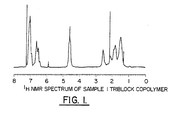
- the purified triblock polymers were characterized with 1 H NMR and DSC.
- 1 H NMR spectra show the resonances of both styrene and FOA repeating units.
- the peak at 4.61 ppm is due to the methylene of the ester group of FOA and the aromatic resonances (6.3 - 7.3 ppm) are due to the phenyl ring of styrene. From the ratio of the area of the two peaks the chemical composition and the molecular mass was calculated ( Table 2 ).
- the solubility of the block copolymers are quite different from the homopolymers.
- the FOA homopolymer is soluble in Freon-113 and CO 2 but insoluble in common organic solvents.
- the sample 1 block copolymer is soluble in THF and CHCl 3 .
- the fluorinated block becomes longer (sample 2) or the center block become shorter (sample 3)
- the copolymer is insoluble in THF or CHCl 3 , but is soluble in Freon-113 and CO 2 .
- a 450ml Autoclave Engineers o-ring closure, stirred autoclave with a modular furnace and process controller was used as the high pressure polymerization reactor. Pressure was measured with Sensotec Model TJE pressure transducer. Three rupture disks with a burst pressure of 690 bar are present in the system and all of the components were connected to argon to maintain an inert atmosphere at all times.
- the reactor was heated to 60°C and purged with argon for 1-2 hours. 1.35g (1 mol% to monomer) of AIBN dissolved in a minimal amount of THF were injected into the reactor. Following the rapid evaporation of THF, 99.5g of FOMA (50 mol%) and 35.5g of 2-Ethylhexyl acrylate (50 mol%) were introduced under argon atmosphere. The reactor was then rapidly pressurized to 345 bar with CO 2 . The reaction was allowed to stir for 24 hours. The reactor was then cooled to room temperature and the polymer was collected into an erlenmeyer flask, washed with methanol and dried in vacuo overnight (yield 75%).
- the polymerizations commenced by first heating a high pressure reactor to 60°C (with AIBN as the initiator) or 75°C (with the fluoro-azo initiator) and purging with argon for 1-2 hours.
- the initiator was dissolved in 77.5g (17 wt %) of degassed styrene.
- the solution was rapidly added to the reactor followed by the addition of CO 2 to the desired pressure.
- the reaction was stirred for 8 hours at a rate of 500 rpm. Following cooling of the reactor, the polymer was collected, washed with methanol and dried in vacuo overnight.
- the yield of the polymer increased substantially with the inclusion of the fluoro-azo initiator and a surfactant having a CO 2 -philic portion.
- Anionic polymerization was conducted in a one-neck 500 ml, round-bottomed flask equipped with a magnetic stir bar and rubber sepla under a 6-8 psig. argon atmosphere.
- the flask was charged with 2.25 ml of styrene in about 100 ml of dry cycolohexane.
- the polymerization was then initiated by the addition of 3.63 ml of a 1.38 M solution of sec-butyllithlum in cyclohexane.
- the resulting orange-red solution was then allowed to stir for about two hours after which about 2 ml of dry tetrahydrofuran was added to the solution.
- the resulting polymer was soluble in CO 2 at 60°C and 5000 psi (344.7 bar).
- the precursor polystyrene backing the fluorinated group was less soluble in CO 2 .
Landscapes
- Chemical & Material Sciences (AREA)
- Chemical Kinetics & Catalysis (AREA)
- Medicinal Chemistry (AREA)
- Polymers & Plastics (AREA)
- Organic Chemistry (AREA)
- Health & Medical Sciences (AREA)
- Addition Polymer Or Copolymer, Post-Treatments, Or Chemical Modifications (AREA)
- Organic Low-Molecular-Weight Compounds And Preparation Thereof (AREA)
- Emulsifying, Dispersing, Foam-Producing Or Wetting Agents (AREA)
- Polymerisation Methods In General (AREA)
- Polymerization Catalysts (AREA)
- Graft Or Block Polymers (AREA)
- Carbon And Carbon Compounds (AREA)
Applications Claiming Priority (3)
| Application Number | Priority Date | Filing Date | Title |
|---|---|---|---|
| US08/099,905 US5312882A (en) | 1993-07-30 | 1993-07-30 | Heterogeneous polymerization in carbon dioxide |
| US99905 | 1993-07-30 | ||
| PCT/US1994/008273 WO1995004085A1 (en) | 1993-07-30 | 1994-07-22 | Heterogeneous polymerisation in carbon dioxide |
Publications (3)
| Publication Number | Publication Date |
|---|---|
| EP0711311A1 EP0711311A1 (en) | 1996-05-15 |
| EP0711311A4 EP0711311A4 (en) | 1999-01-07 |
| EP0711311B1 true EP0711311B1 (en) | 2003-10-15 |
Family
ID=22277184
Family Applications (1)
| Application Number | Title | Priority Date | Filing Date |
|---|---|---|---|
| EP94922683A Expired - Lifetime EP0711311B1 (en) | 1993-07-30 | 1994-07-22 | Heterogeneous polymerisation in carbon dioxide |
Country Status (12)
| Country | Link |
|---|---|
| US (7) | US5312882A (enExample) |
| EP (1) | EP0711311B1 (enExample) |
| JP (1) | JP3476016B2 (enExample) |
| AT (1) | ATE252115T1 (enExample) |
| AU (1) | AU7370794A (enExample) |
| CA (1) | CA2168423C (enExample) |
| DE (2) | DE711311T1 (enExample) |
| DK (1) | DK0711311T3 (enExample) |
| ES (1) | ES2208658T3 (enExample) |
| PT (1) | PT711311E (enExample) |
| SG (1) | SG72676A1 (enExample) |
| WO (1) | WO1995004085A1 (enExample) |
Families Citing this family (118)
| Publication number | Priority date | Publication date | Assignee | Title |
|---|---|---|---|---|
| US5780553A (en) * | 1993-07-30 | 1998-07-14 | University Of North Carolina At Chapel Hill | Heterogeneous polymerizations in carbon dioxide |
| AU3004395A (en) * | 1994-07-08 | 1996-02-09 | Minnesota Mining And Manufacturing Company | Superatmospheric reaction |
| US5559198A (en) * | 1994-07-08 | 1996-09-24 | Minnesota Mining And Manufacturing Company | Process for preparing poly(vinyl trifluoroacetate) and poly(vinyltrifluoroacetate/vinyl ester) copolymers in supercritical Co.sub. |
| US6148644A (en) | 1995-03-06 | 2000-11-21 | Lever Brothers Company, Division Of Conopco, Inc. | Dry cleaning system using densified carbon dioxide and a surfactant adjunct |
| US5618894A (en) * | 1995-03-10 | 1997-04-08 | The University Of North Carolina | Nonaqueous polymerization of fluoromonomers |
| US5674957A (en) * | 1995-03-10 | 1997-10-07 | The University Of North Carolina At Chapel Hill | Nonaqueous polymerization of fluoromonomers |
| US5527865A (en) * | 1995-03-24 | 1996-06-18 | The University Of North Carolina At Chapel Hill | Multi-phase polymerization process |
| US6057409A (en) * | 1995-04-03 | 2000-05-02 | Xerox Corporation | Supercritical polymerization processes |
| US5840820A (en) * | 1995-04-13 | 1998-11-24 | The University Of North Carolina At Chapel Hill | Olefin metathesis reactions in carbon dioxide medium |
| WO1996037535A1 (en) * | 1995-05-25 | 1996-11-28 | The University Of North Carolina At Chapel Hill | Method of preparing poly(phenylene oxides) in carbon dioxide |
| DE19681433T1 (de) * | 1995-06-06 | 1998-05-07 | Univ North Carolina | Verfahren für die Herstellung von Polyester in Kohlendioxid |
| US5663237A (en) * | 1995-06-15 | 1997-09-02 | The University Of Akron | Graft copolymerization in supercritical media |
| EP0856011A2 (en) * | 1995-10-17 | 1998-08-05 | The University Of North Carolina At Chapel Hill | Heterogeneous polymerizations in carbon dioxide |
| US5783082A (en) | 1995-11-03 | 1998-07-21 | University Of North Carolina | Cleaning process using carbon dioxide as a solvent and employing molecularly engineered surfactants |
| US5814678A (en) * | 1996-02-02 | 1998-09-29 | University Technology Corp. | Chemical reactions in water-in-carbon dioxide microemulsions and control thereof |
| US5733998A (en) * | 1996-03-26 | 1998-03-31 | The University Of Akron | Method, dispersing agent and initiator for the dispersion polymerization of isobutylene |
| US5688870A (en) * | 1996-04-10 | 1997-11-18 | Air Products And Chemicals, Inc. | Process for preparing water dispersible polymer powders |
| US5733964A (en) * | 1996-06-20 | 1998-03-31 | Board Of Regents, The University Of Texas System | Surfactants for heterogeneous processes in liquid or supercritical CO2 |
| US5725987A (en) * | 1996-11-01 | 1998-03-10 | Xerox Corporation | Supercritical processes |
| US5714299A (en) * | 1996-11-04 | 1998-02-03 | Xerox Corporation | Processes for toner additives with liquid carbon dioxide |
| US5860467A (en) | 1996-12-03 | 1999-01-19 | The University Of North Carolina At Chapel Hill | Use of CO2 -soluble materials in making molds |
| US6288202B1 (en) | 1997-04-11 | 2001-09-11 | The University Of North Carolina At Chapel Hill | Synthesis of polycarbonates using Co2 |
| USH1839H (en) * | 1997-04-17 | 2000-02-01 | Xerox Corporation | Supercritical fluid processes |
| GB9800936D0 (en) * | 1997-05-10 | 1998-03-11 | Univ Nottingham | Biofunctional polymers |
| US6306564B1 (en) | 1997-05-27 | 2001-10-23 | Tokyo Electron Limited | Removal of resist or residue from semiconductors using supercritical carbon dioxide |
| US6500605B1 (en) | 1997-05-27 | 2002-12-31 | Tokyo Electron Limited | Removal of photoresist and residue from substrate using supercritical carbon dioxide process |
| TW539918B (en) | 1997-05-27 | 2003-07-01 | Tokyo Electron Ltd | Removal of photoresist and photoresist residue from semiconductors using supercritical carbon dioxide process |
| US5789505A (en) * | 1997-08-14 | 1998-08-04 | Air Products And Chemicals, Inc. | Surfactants for use in liquid/supercritical CO2 |
| US6010542A (en) * | 1997-08-29 | 2000-01-04 | Micell Technologies, Inc. | Method of dyeing substrates in carbon dioxide |
| US6127000A (en) * | 1997-10-10 | 2000-10-03 | North Carolina State University | Method and compositions for protecting civil infrastructure |
| US6001418A (en) | 1997-12-16 | 1999-12-14 | The University Of North Carolina At Chapel Hill | Spin coating method and apparatus for liquid carbon dioxide systems |
| AU2290399A (en) | 1998-01-28 | 1999-08-16 | Cambridge University Technical Services Limited | The use of compressed co2 in chemical reactions |
| US6120613A (en) | 1998-04-30 | 2000-09-19 | Micell Technologies, Inc. | Carbon dioxide cleaning and separation systems |
| US6506259B1 (en) | 1998-04-30 | 2003-01-14 | Micell Technologies, Inc. | Carbon dioxide cleaning and separation systems |
| US5977045A (en) * | 1998-05-06 | 1999-11-02 | Lever Brothers Company | Dry cleaning system using densified carbon dioxide and a surfactant adjunct |
| GB9813573D0 (en) * | 1998-06-24 | 1998-08-19 | Ici Plc | Addition polymerisation |
| US7064070B2 (en) * | 1998-09-28 | 2006-06-20 | Tokyo Electron Limited | Removal of CMP and post-CMP residue from semiconductors using supercritical carbon dioxide process |
| US6277753B1 (en) | 1998-09-28 | 2001-08-21 | Supercritical Systems Inc. | Removal of CMP residue from semiconductors using supercritical carbon dioxide process |
| US6479708B1 (en) | 1998-11-18 | 2002-11-12 | The Regents Of The University Of California | Biphasic catalysis in water/carbon dioxide micellar systems |
| US6054179A (en) * | 1998-11-30 | 2000-04-25 | Xerox Corporation | Processes for the preparation of colorants |
| CA2257028C (en) * | 1998-12-24 | 2003-11-18 | Fracmaster Ltd. | Liquid co2/hydrocarbon oil emulsion fracturing system |
| GB9902463D0 (en) * | 1999-02-05 | 1999-03-24 | Univ Cambridge Tech | Manufacturing porous cross-linked polymer monoliths |
| US6191215B1 (en) * | 1999-03-05 | 2001-02-20 | Basf Aktiengesellschaft | Process for the preparation of pulverulent polymers by polymerization in supercritical carbon dioxide in the presence of polyoxyalkylene-polysiloxane copolymers |
| WO2000059950A1 (en) * | 1999-04-08 | 2000-10-12 | The University Of North Carolina At Chapel Hill | Polymerization of non-fluorinated monomers in carbon dioxide |
| US6258910B1 (en) | 1999-06-09 | 2001-07-10 | Occidental Chemical Corporation | Polymerizing vinyl chloride in carbon dioxide |
| US6211422B1 (en) * | 1999-07-13 | 2001-04-03 | North Carolina State University | Enzyme catalysis in carbon dioxide fluids |
| WO2001014289A2 (en) * | 1999-08-20 | 2001-03-01 | North Carolina State University | Polymer-bound catalysts for use in carbon dioxide |
| US6747179B1 (en) | 1999-08-20 | 2004-06-08 | North Carolina State University | Carbon dioxide-soluble polymers and swellable polymers for carbon dioxide applications |
| US6403663B1 (en) | 1999-09-20 | 2002-06-11 | North Carolina State University | Method of making foamed materials using surfactants and carbon dioxide |
| US6686438B1 (en) * | 1999-09-24 | 2004-02-03 | University Of Pittsburgh | Carbon dioxide-philic compounds and methods of synthesis thereof |
| JP5073902B2 (ja) | 1999-11-02 | 2012-11-14 | 東京エレクトロン株式会社 | 多数のワークピースを超臨界処理する方法及び装置 |
| US6748960B1 (en) | 1999-11-02 | 2004-06-15 | Tokyo Electron Limited | Apparatus for supercritical processing of multiple workpieces |
| US6509138B2 (en) | 2000-01-12 | 2003-01-21 | Semiconductor Research Corporation | Solventless, resistless direct dielectric patterning |
| AU2001229921A1 (en) | 2000-02-02 | 2001-08-14 | Robert D. Lousenberg | Linear copolymers of fluorocarbon-hydrocarbon monomers synthesized in carbon dioxide |
| JP2004517159A (ja) * | 2000-03-01 | 2004-06-10 | ノース・キャロライナ・ステイト・ユニヴァーシティ | 二酸化炭素を使用するブレンドされた熱可塑性ポリマーの発泡体の製造方法 |
| EP1277233A2 (en) * | 2000-04-25 | 2003-01-22 | Tokyo Electron Corporation | Method of depositing metal film and metal deposition cluster tool including supercritical drying/cleaning module |
| US6451287B1 (en) | 2000-05-26 | 2002-09-17 | Smithkline Beecham Corporation | Fluorinated copolymer surfactants and use thereof in aerosol compositions |
| AU2002211258A1 (en) * | 2000-09-26 | 2002-04-08 | North Carolina State University | Phosphate fluorosurfactants for use in carbon dioxide |
| US20020077435A1 (en) * | 2000-10-09 | 2002-06-20 | Desimone Joseph M. | Methods for preparing polymers in carbon dioxide having reactive functionality |
| DE10054114A1 (de) * | 2000-10-31 | 2002-05-16 | Dupont Performance Coatings | Verfahren zur Herstellung von Pulverlackzusammensetzungen |
| US6753360B2 (en) | 2000-12-22 | 2004-06-22 | Ford Global Technologies, Llc | System and method of preparing a reinforced polymer by supercritical fluid treatment |
| US6469073B1 (en) | 2000-12-22 | 2002-10-22 | Ford Global Technologies, Inc. | System and method of delaminating a layered silicate material by supercritical fluid treatment |
| US6632531B2 (en) | 2001-02-15 | 2003-10-14 | Rohm And Haas Company | Porous particles, their aqueous dispersions, and method of preparation |
| US6896905B2 (en) * | 2001-02-15 | 2005-05-24 | Rohm And Haas Company | Porous particles, their aqueous dispersions, and method of preparation |
| US7658989B2 (en) * | 2001-03-28 | 2010-02-09 | North Carolina State University | Nano-and micro-cellular foamed thin-walled material, and processes and apparatuses for making the same |
| EP1404438A2 (en) * | 2001-07-12 | 2004-04-07 | Eastman Kodak Company | A surfactant assisted nanomaterial generation process |
| KR100601229B1 (ko) * | 2001-11-12 | 2006-07-19 | 다이킨 고교 가부시키가이샤 | 플루오로 중합체의 제조 방법 |
| US6737225B2 (en) | 2001-12-28 | 2004-05-18 | Texas Instruments Incorporated | Method of undercutting micro-mechanical device with super-critical carbon dioxide |
| JP2005516405A (ja) * | 2002-01-25 | 2005-06-02 | 東京エレクトロン株式会社 | 超臨界二酸化炭素プロセス中の汚染物の形成を低減する方法 |
| US6924086B1 (en) | 2002-02-15 | 2005-08-02 | Tokyo Electron Limited | Developing photoresist with supercritical fluid and developer |
| JP2006508521A (ja) * | 2002-02-15 | 2006-03-09 | 東京エレクトロン株式会社 | 溶剤浴と超臨界co2を用いたレジストの乾燥 |
| CN1296771C (zh) * | 2002-03-04 | 2007-01-24 | 东京毅力科创株式会社 | 在晶片处理中低电介质材料的钝化方法 |
| US7387868B2 (en) | 2002-03-04 | 2008-06-17 | Tokyo Electron Limited | Treatment of a dielectric layer using supercritical CO2 |
| GB0205868D0 (en) * | 2002-03-13 | 2002-04-24 | Univ Nottingham | Polymer composite with internally distributed deposition matter |
| US6765030B2 (en) * | 2002-03-22 | 2004-07-20 | The University Of North Carolina At Chapel Hill | Methods of forming polymeric structures using carbon dioxide and polymeric structures formed therapy |
| US20040072706A1 (en) * | 2002-03-22 | 2004-04-15 | Arena-Foster Chantal J. | Removal of contaminants using supercritical processing |
| US7169540B2 (en) * | 2002-04-12 | 2007-01-30 | Tokyo Electron Limited | Method of treatment of porous dielectric films to reduce damage during cleaning |
| US6846380B2 (en) * | 2002-06-13 | 2005-01-25 | The Boc Group, Inc. | Substrate processing apparatus and related systems and methods |
| US20040177867A1 (en) * | 2002-12-16 | 2004-09-16 | Supercritical Systems, Inc. | Tetra-organic ammonium fluoride and HF in supercritical fluid for photoresist and residue removal |
| US20040112409A1 (en) * | 2002-12-16 | 2004-06-17 | Supercritical Sysems, Inc. | Fluoride in supercritical fluid for photoresist and residue removal |
| US20040154647A1 (en) * | 2003-02-07 | 2004-08-12 | Supercritical Systems, Inc. | Method and apparatus of utilizing a coating for enhanced holding of a semiconductor substrate during high pressure processing |
| US20040231707A1 (en) * | 2003-05-20 | 2004-11-25 | Paul Schilling | Decontamination of supercritical wafer processing equipment |
| US6806993B1 (en) | 2003-06-04 | 2004-10-19 | Texas Instruments Incorporated | Method for lubricating MEMS components |
| US6951769B2 (en) | 2003-06-04 | 2005-10-04 | Texas Instruments Incorporated | Method for stripping sacrificial layer in MEMS assembly |
| US7163380B2 (en) | 2003-07-29 | 2007-01-16 | Tokyo Electron Limited | Control of fluid flow in the processing of an object with a fluid |
| US20070185343A1 (en) * | 2004-02-26 | 2007-08-09 | Universiteit Gent | Metal complexes for use in olefin metathesis and atom group transfer reactions |
| US7250374B2 (en) | 2004-06-30 | 2007-07-31 | Tokyo Electron Limited | System and method for processing a substrate using supercritical carbon dioxide processing |
| US7307019B2 (en) * | 2004-09-29 | 2007-12-11 | Tokyo Electron Limited | Method for supercritical carbon dioxide processing of fluoro-carbon films |
| US7491036B2 (en) | 2004-11-12 | 2009-02-17 | Tokyo Electron Limited | Method and system for cooling a pump |
| US7291565B2 (en) | 2005-02-15 | 2007-11-06 | Tokyo Electron Limited | Method and system for treating a substrate with a high pressure fluid using fluorosilicic acid |
| US20060185693A1 (en) * | 2005-02-23 | 2006-08-24 | Richard Brown | Cleaning step in supercritical processing |
| US20060186088A1 (en) * | 2005-02-23 | 2006-08-24 | Gunilla Jacobson | Etching and cleaning BPSG material using supercritical processing |
| US8241708B2 (en) | 2005-03-09 | 2012-08-14 | Micron Technology, Inc. | Formation of insulator oxide films with acid or base catalyzed hydrolysis of alkoxides in supercritical carbon dioxide |
| US7550075B2 (en) * | 2005-03-23 | 2009-06-23 | Tokyo Electron Ltd. | Removal of contaminants from a fluid |
| US7399708B2 (en) * | 2005-03-30 | 2008-07-15 | Tokyo Electron Limited | Method of treating a composite spin-on glass/anti-reflective material prior to cleaning |
| US7442636B2 (en) * | 2005-03-30 | 2008-10-28 | Tokyo Electron Limited | Method of inhibiting copper corrosion during supercritical CO2 cleaning |
| US7789971B2 (en) | 2005-05-13 | 2010-09-07 | Tokyo Electron Limited | Treatment of substrate using functionalizing agent in supercritical carbon dioxide |
| EP1741729B1 (en) * | 2005-07-07 | 2008-03-12 | Solvay Solexis S.p.A. | Polymerization process |
| JP4652299B2 (ja) * | 2005-09-14 | 2011-03-16 | 株式会社リコー | トナー及びその製造方法、並びに現像剤、トナー入り容器、プロセスカートリッジ、画像形成方法及び画像形成装置 |
| US8084367B2 (en) * | 2006-05-24 | 2011-12-27 | Samsung Electronics Co., Ltd | Etching, cleaning and drying methods using supercritical fluid and chamber systems using these methods |
| EP2049578A1 (en) * | 2006-08-11 | 2009-04-22 | The University of North Carolina At Chapel Hill | Process of fluoromonomer polymerization |
| JP5369287B2 (ja) * | 2006-09-15 | 2013-12-18 | 株式会社リコー | トナーの製造方法 |
| JP5162866B2 (ja) * | 2006-09-15 | 2013-03-13 | 株式会社リコー | トナーの製造方法及びトナー |
| US7745566B2 (en) * | 2007-01-23 | 2010-06-29 | Ferro Corporation | Methods for the purification of polymers |
| GB0709033D0 (en) * | 2007-05-11 | 2007-06-20 | 3M Innovative Properties Co | Melt-Processible fluoropolymers having long-chain branches, Methods of preparing them and uses thereof |
| US7923517B2 (en) | 2007-11-09 | 2011-04-12 | Ricoh Company, Ltd. | Polymer microparticles and production method for the same |
| RU2385334C2 (ru) * | 2008-05-28 | 2010-03-27 | Некоммерческая организация Учреждение Институт проблем химической физики Российской академии наук (ИПХФ РАН) | Способ непрерывного получения изделий из пенополистирола и установка для его осуществления |
| GB0812742D0 (en) * | 2008-07-11 | 2008-08-20 | Critical Pharmaceuticals Ltd | Process |
| CN101735370B (zh) * | 2009-12-09 | 2014-04-02 | 恒昌涂料(惠阳)有限公司 | 超临界聚合方法制备水溶性固体苯丙树脂及其应用 |
| JP5853349B2 (ja) * | 2010-03-08 | 2016-02-09 | 株式会社リコー | ポリマー粒子及びその製造方法 |
| US8846810B2 (en) * | 2010-03-08 | 2014-09-30 | Ricoh Company, Ltd. | Polymer particle and method for producing the same |
| JP5605034B2 (ja) * | 2010-07-09 | 2014-10-15 | 株式会社野田スクリーン | フッ素系共重合体、フッ素系共重合体の製造方法およびコーティング剤 |
| FR2986235B1 (fr) * | 2012-01-31 | 2015-02-06 | Rhodia Operations | Stabilisants reactifs poly(n-vinyl lactame) vivants pour polymerisation en phase dispersee |
| US9546316B2 (en) | 2012-11-12 | 2017-01-17 | Saudi Arabian Oil Company | Densifying carbon dioxide with a dispersion of carbon dioxide-philic water capsules |
| RU2550873C2 (ru) * | 2013-07-01 | 2015-05-20 | Федеральное государственное бюджетное образовательное учреждение высшего образования "Московский государственный университет имени М.В. Ломоносова" (МГУ) | Способ синтеза сополимеров акрилонитрила с акриловой кислотой |
| CN106281285B (zh) * | 2015-06-08 | 2018-12-21 | 中国石油化工股份有限公司 | 一种二氧化碳可溶发泡剂及其制备方法 |
| MX373003B (es) | 2015-09-11 | 2020-05-20 | Praxair Technology Inc | Composicion de fluido de fracturacion. |
| CN121108967A (zh) * | 2025-08-13 | 2025-12-12 | 德仕能源科技集团股份有限公司 | 一种压裂液辅助二氧化碳吞吐采油方法 |
Family Cites Families (17)
| Publication number | Priority date | Publication date | Assignee | Title |
|---|---|---|---|---|
| GB330438A (en) * | 1929-07-20 | 1930-06-12 | Norman Kershaw | Improvements in or relating to collapsible bellows for photographic cameras and the like |
| US3191513A (en) * | 1963-05-06 | 1965-06-29 | Donald C Turner | Bellows construction |
| US3375767A (en) * | 1966-01-07 | 1968-04-02 | Polaroid Corp | Camera bellows and method of construction |
| US3522228A (en) * | 1966-05-19 | 1970-07-28 | Sumitomo Chemical Co | Novel method for polymerizing a vinyl compound in the presence of a carbon dioxide medium |
| CH1926768A4 (enExample) * | 1968-12-24 | 1971-03-31 | ||
| US3658717A (en) * | 1969-07-07 | 1972-04-25 | Atlas Chem Ind | Surfactants for solvent/water systems and textile treating compositions |
| CH634480A5 (de) * | 1977-11-25 | 1983-02-15 | Schwarzkopf Gmbh Hans | Unter druck stehendes aerosolpraeparat. |
| JPS56152739A (en) * | 1980-04-25 | 1981-11-26 | Tanabe Seiyaku Co Ltd | Production of microcapsule |
| JPS57149367A (en) * | 1981-03-11 | 1982-09-14 | Shin Etsu Chem Co Ltd | Peeling and dehydrating composition |
| DE3609829A1 (de) * | 1986-03-22 | 1987-09-24 | Basf Ag | Verfahren zur herstellung von pulverfoermigen vernetzten copolymerisaten |
| US5045220A (en) * | 1987-06-03 | 1991-09-03 | Chevron Research Company | Increasing the viscosity of CO2 solutions |
| BR8803785A (pt) * | 1987-07-30 | 1989-02-21 | Goodrich Co B F | Copolimero de acido acrilico e processo para fazer um polimero de acido acrilico |
| US4933404A (en) * | 1987-11-27 | 1990-06-12 | Battelle Memorial Institute | Processes for microemulsion polymerization employing novel microemulsion systems |
| US5266205A (en) * | 1988-02-04 | 1993-11-30 | Battelle Memorial Institute | Supercritical fluid reverse micelle separation |
| JPH0320346A (ja) * | 1989-06-16 | 1991-01-29 | Sekisui Chem Co Ltd | 塩化ビニル樹脂組成物 |
| EP0671464B1 (en) * | 1991-08-26 | 1997-12-29 | Daikin Industries, Ltd. | Solvent composition comprising mixture of polyfluoroalkane and lower alcohol |
| AU3004395A (en) * | 1994-07-08 | 1996-02-09 | Minnesota Mining And Manufacturing Company | Superatmospheric reaction |
-
1993
- 1993-07-30 US US08/099,905 patent/US5312882A/en not_active Expired - Lifetime
-
1994
- 1994-02-17 US US08/198,224 patent/US5382623A/en not_active Expired - Lifetime
- 1994-07-22 DK DK94922683T patent/DK0711311T3/da active
- 1994-07-22 JP JP50589795A patent/JP3476016B2/ja not_active Expired - Fee Related
- 1994-07-22 EP EP94922683A patent/EP0711311B1/en not_active Expired - Lifetime
- 1994-07-22 DE DE0711311T patent/DE711311T1/de not_active Ceased
- 1994-07-22 AU AU73707/94A patent/AU7370794A/en not_active Abandoned
- 1994-07-22 DE DE69433242T patent/DE69433242T2/de not_active Expired - Fee Related
- 1994-07-22 CA CA002168423A patent/CA2168423C/en not_active Expired - Fee Related
- 1994-07-22 WO PCT/US1994/008273 patent/WO1995004085A1/en not_active Ceased
- 1994-07-22 AT AT94922683T patent/ATE252115T1/de not_active IP Right Cessation
- 1994-07-22 PT PT94922683T patent/PT711311E/pt unknown
- 1994-07-22 SG SG1996008793A patent/SG72676A1/en unknown
- 1994-07-22 ES ES94922683T patent/ES2208658T3/es not_active Expired - Lifetime
- 1994-09-01 US US08/299,516 patent/US5451633A/en not_active Expired - Lifetime
-
1995
- 1995-01-25 US US08/378,550 patent/US5506317A/en not_active Expired - Lifetime
- 1995-05-18 US US08/443,478 patent/US5589105A/en not_active Expired - Lifetime
-
1996
- 1996-08-09 US US08/694,771 patent/US5639836A/en not_active Expired - Lifetime
- 1996-12-06 US US08/760,939 patent/US5679737A/en not_active Expired - Lifetime
Also Published As
| Publication number | Publication date |
|---|---|
| US5679737A (en) | 1997-10-21 |
| SG72676A1 (en) | 2000-05-23 |
| ATE252115T1 (de) | 2003-11-15 |
| DK0711311T3 (da) | 2004-02-16 |
| US5451633A (en) | 1995-09-19 |
| JP3476016B2 (ja) | 2003-12-10 |
| US5589105A (en) | 1996-12-31 |
| US5312882A (en) | 1994-05-17 |
| DE69433242D1 (de) | 2003-11-20 |
| DE711311T1 (de) | 1998-06-25 |
| JPH09503798A (ja) | 1997-04-15 |
| US5382623A (en) | 1995-01-17 |
| DE69433242T2 (de) | 2004-08-19 |
| EP0711311A4 (en) | 1999-01-07 |
| CA2168423A1 (en) | 1995-02-09 |
| US5639836A (en) | 1997-06-17 |
| CA2168423C (en) | 2002-07-09 |
| EP0711311A1 (en) | 1996-05-15 |
| WO1995004085A1 (en) | 1995-02-09 |
| US5506317A (en) | 1996-04-09 |
| ES2208658T3 (es) | 2004-06-16 |
| AU7370794A (en) | 1995-02-28 |
| PT711311E (pt) | 2004-03-31 |
Similar Documents
| Publication | Publication Date | Title |
|---|---|---|
| US5382623A (en) | Heterogeneous polymerization in carbon dioxide | |
| US5739223A (en) | Method of making fluoropolymers | |
| US5863612A (en) | Method of making fluoropolymers | |
| US5688879A (en) | Method of making fluoropolymers | |
| EP0770096B1 (en) | Superatmospheric reaction | |
| US4920160A (en) | Polymeric particles and their preparation | |
| Min et al. | Surface modification of polystyrene latex particles via atom transfer radical polymerization | |
| EP0804491B1 (en) | Aqueous microemulsion polymerization of tetrafluoroethylene | |
| Bleger et al. | Particle nucleation during microemulsion polymerization of methyl methacrylate | |
| Okubo et al. | Formation mechanism of anomalous “golf ball-like” composite polymer particles by seeded emulsion polymerization | |
| US5780553A (en) | Heterogeneous polymerizations in carbon dioxide | |
| EP1339755A1 (en) | Methods for preparing polymers in carbon dioxide having reactive functionality | |
| David et al. | Synthesis and dispersion copolymerization of poly (2‐methyl‐2‐oxazoline) macromers with cinnamoyl end groups | |
| JPH11513733A (ja) | 二酸化炭素中での不均一重合 | |
| KR100546797B1 (ko) | 소수성 시드 입자를 이용한 단분산성 고분자 입자의제조방법 | |
| JPH03205428A (ja) | 水性エチレン・ビニルエステル系共重合体分散液ならびにその製造法、およびそれを含む樹脂組成物 | |
| MXPA97007267A (en) | Procedure of polymerization of multiple fa |
Legal Events
| Date | Code | Title | Description |
|---|---|---|---|
| PUAI | Public reference made under article 153(3) epc to a published international application that has entered the european phase |
Free format text: ORIGINAL CODE: 0009012 |
|
| 17P | Request for examination filed |
Effective date: 19960213 |
|
| AK | Designated contracting states |
Kind code of ref document: A1 Designated state(s): AT BE CH DE DK ES FR GB GR IE IT LI LU MC NL PT SE |
|
| RHK1 | Main classification (correction) |
Ipc: C08F 2/12 |
|
| DET | De: translation of patent claims | ||
| A4 | Supplementary search report drawn up and despatched |
Effective date: 19981118 |
|
| AK | Designated contracting states |
Kind code of ref document: A4 Designated state(s): AT BE CH DE DK ES FR GB GR IE IT LI LU MC NL PT SE |
|
| 17Q | First examination report despatched |
Effective date: 19990406 |
|
| GRAH | Despatch of communication of intention to grant a patent |
Free format text: ORIGINAL CODE: EPIDOS IGRA |
|
| GRAS | Grant fee paid |
Free format text: ORIGINAL CODE: EPIDOSNIGR3 |
|
| GRAA | (expected) grant |
Free format text: ORIGINAL CODE: 0009210 |
|
| AK | Designated contracting states |
Kind code of ref document: B1 Designated state(s): AT BE CH DE DK ES FR GB GR IE IT LI LU MC NL PT SE |
|
| REG | Reference to a national code |
Ref country code: GB Ref legal event code: FG4D Ref country code: CH Ref legal event code: EP |
|
| REG | Reference to a national code |
Ref country code: IE Ref legal event code: FG4D |
|
| REF | Corresponds to: |
Ref document number: 69433242 Country of ref document: DE Date of ref document: 20031120 Kind code of ref document: P |
|
| REG | Reference to a national code |
Ref country code: SE Ref legal event code: TRGR |
|
| REG | Reference to a national code |
Ref country code: CH Ref legal event code: NV Representative=s name: R. A. EGLI & CO. PATENTANWAELTE |
|
| REG | Reference to a national code |
Ref country code: DK Ref legal event code: T3 |
|
| REG | Reference to a national code |
Ref country code: GR Ref legal event code: EP Ref document number: 20040400027 Country of ref document: GR |
|
| REG | Reference to a national code |
Ref country code: PT Ref legal event code: SC4A Free format text: AVAILABILITY OF NATIONAL TRANSLATION Effective date: 20040109 |
|
| REG | Reference to a national code |
Ref country code: ES Ref legal event code: FG2A Ref document number: 2208658 Country of ref document: ES Kind code of ref document: T3 |
|
| ET | Fr: translation filed | ||
| PG25 | Lapsed in a contracting state [announced via postgrant information from national office to epo] |
Ref country code: LU Free format text: LAPSE BECAUSE OF NON-PAYMENT OF DUE FEES Effective date: 20040722 Ref country code: IE Free format text: LAPSE BECAUSE OF NON-PAYMENT OF DUE FEES Effective date: 20040722 Ref country code: GB Free format text: LAPSE BECAUSE OF NON-PAYMENT OF DUE FEES Effective date: 20040722 Ref country code: AT Free format text: LAPSE BECAUSE OF NON-PAYMENT OF DUE FEES Effective date: 20040722 |
|
| PG25 | Lapsed in a contracting state [announced via postgrant information from national office to epo] |
Ref country code: SE Free format text: LAPSE BECAUSE OF NON-PAYMENT OF DUE FEES Effective date: 20040723 Ref country code: ES Free format text: LAPSE BECAUSE OF NON-PAYMENT OF DUE FEES Effective date: 20040723 |
|
| PG25 | Lapsed in a contracting state [announced via postgrant information from national office to epo] |
Ref country code: MC Free format text: LAPSE BECAUSE OF NON-PAYMENT OF DUE FEES Effective date: 20040731 Ref country code: LI Free format text: LAPSE BECAUSE OF NON-PAYMENT OF DUE FEES Effective date: 20040731 Ref country code: CH Free format text: LAPSE BECAUSE OF NON-PAYMENT OF DUE FEES Effective date: 20040731 Ref country code: BE Free format text: LAPSE BECAUSE OF NON-PAYMENT OF DUE FEES Effective date: 20040731 |
|
| PG25 | Lapsed in a contracting state [announced via postgrant information from national office to epo] |
Ref country code: DK Free format text: LAPSE BECAUSE OF NON-PAYMENT OF DUE FEES Effective date: 20040802 |
|
| PLBE | No opposition filed within time limit |
Free format text: ORIGINAL CODE: 0009261 |
|
| STAA | Information on the status of an ep patent application or granted ep patent |
Free format text: STATUS: NO OPPOSITION FILED WITHIN TIME LIMIT |
|
| ET1 | Fr: translation filed ** revision of the translation of the patent or the claims | ||
| 26N | No opposition filed |
Effective date: 20040716 |
|
| BERE | Be: lapsed |
Owner name: THE *UNIVERSITY OF NORTH CAROLINA AT CHAPEL HILL Effective date: 20040731 |
|
| PG25 | Lapsed in a contracting state [announced via postgrant information from national office to epo] |
Ref country code: NL Free format text: LAPSE BECAUSE OF NON-PAYMENT OF DUE FEES Effective date: 20050201 Ref country code: DE Free format text: LAPSE BECAUSE OF NON-PAYMENT OF DUE FEES Effective date: 20050201 |
|
| PG25 | Lapsed in a contracting state [announced via postgrant information from national office to epo] |
Ref country code: GR Free format text: LAPSE BECAUSE OF NON-PAYMENT OF DUE FEES Effective date: 20050203 |
|
| EUG | Se: european patent has lapsed | ||
| REG | Reference to a national code |
Ref country code: DK Ref legal event code: EBP |
|
| REG | Reference to a national code |
Ref country code: CH Ref legal event code: PL |
|
| GBPC | Gb: european patent ceased through non-payment of renewal fee |
Effective date: 20040722 |
|
| PG25 | Lapsed in a contracting state [announced via postgrant information from national office to epo] |
Ref country code: FR Free format text: LAPSE BECAUSE OF NON-PAYMENT OF DUE FEES Effective date: 20050331 |
|
| NLV4 | Nl: lapsed or anulled due to non-payment of the annual fee |
Effective date: 20050201 |
|
| PG25 | Lapsed in a contracting state [announced via postgrant information from national office to epo] |
Ref country code: PT Free format text: LAPSE BECAUSE OF NON-PAYMENT OF DUE FEES Effective date: 20050422 |
|
| REG | Reference to a national code |
Ref country code: FR Ref legal event code: ST |
|
| REG | Reference to a national code |
Ref country code: IE Ref legal event code: MM4A |
|
| PG25 | Lapsed in a contracting state [announced via postgrant information from national office to epo] |
Ref country code: IT Free format text: LAPSE BECAUSE OF NON-PAYMENT OF DUE FEES;WARNING: LAPSES OF ITALIAN PATENTS WITH EFFECTIVE DATE BEFORE 2007 MAY HAVE OCCURRED AT ANY TIME BEFORE 2007. THE CORRECT EFFECTIVE DATE MAY BE DIFFERENT FROM THE ONE RECORDED. Effective date: 20050722 |
|
| REG | Reference to a national code |
Ref country code: ES Ref legal event code: FD2A Effective date: 20040723 |
|
| REG | Reference to a national code |
Ref country code: PT Ref legal event code: MM4A Effective date: 20050422 |
|
| BERE | Be: lapsed |
Owner name: THE *UNIVERSITY OF NORTH CAROLINA AT CHAPEL HILL Effective date: 20040731 |
|
| PG25 | Lapsed in a contracting state [announced via postgrant information from national office to epo] |
Ref country code: PT Free format text: LAPSE BECAUSE OF NON-PAYMENT OF DUE FEES Effective date: 20040722 |