EP0702390B1 - Antireflection type cathode-ray tube and method of manufacturing the same - Google Patents
Antireflection type cathode-ray tube and method of manufacturing the same Download PDFInfo
- Publication number
- EP0702390B1 EP0702390B1 EP95114413A EP95114413A EP0702390B1 EP 0702390 B1 EP0702390 B1 EP 0702390B1 EP 95114413 A EP95114413 A EP 95114413A EP 95114413 A EP95114413 A EP 95114413A EP 0702390 B1 EP0702390 B1 EP 0702390B1
- Authority
- EP
- European Patent Office
- Prior art keywords
- optical
- film
- optical interfering
- spray nozzle
- film forming
- Prior art date
- Legal status (The legal status is an assumption and is not a legal conclusion. Google has not performed a legal analysis and makes no representation as to the accuracy of the status listed.)
- Expired - Lifetime
Links
- 238000004519 manufacturing process Methods 0.000 title claims description 15
- 239000010408 film Substances 0.000 claims description 285
- 230000003287 optical effect Effects 0.000 claims description 181
- 230000002452 interceptive effect Effects 0.000 claims description 179
- 239000007921 spray Substances 0.000 claims description 95
- 239000011248 coating agent Substances 0.000 claims description 56
- 238000000576 coating method Methods 0.000 claims description 56
- 238000000034 method Methods 0.000 claims description 26
- 239000007787 solid Substances 0.000 claims description 22
- 239000000126 substance Substances 0.000 claims description 22
- 238000002156 mixing Methods 0.000 claims description 15
- 239000012788 optical film Substances 0.000 claims description 14
- OAICVXFJPJFONN-UHFFFAOYSA-N Phosphorus Chemical compound [P] OAICVXFJPJFONN-UHFFFAOYSA-N 0.000 claims description 12
- 239000003960 organic solvent Substances 0.000 claims description 9
- 230000003746 surface roughness Effects 0.000 claims description 4
- 239000000243 solution Substances 0.000 description 180
- 238000009835 boiling Methods 0.000 description 34
- 239000002245 particle Substances 0.000 description 32
- 230000004313 glare Effects 0.000 description 27
- 238000005507 spraying Methods 0.000 description 21
- 230000003247 decreasing effect Effects 0.000 description 17
- 230000015556 catabolic process Effects 0.000 description 11
- 238000006731 degradation reaction Methods 0.000 description 11
- 238000005406 washing Methods 0.000 description 11
- 238000001035 drying Methods 0.000 description 10
- KFZMGEQAYNKOFK-UHFFFAOYSA-N Isopropanol Chemical compound CC(C)O KFZMGEQAYNKOFK-UHFFFAOYSA-N 0.000 description 9
- LRHPLDYGYMQRHN-UHFFFAOYSA-N N-Butanol Chemical compound CCCCO LRHPLDYGYMQRHN-UHFFFAOYSA-N 0.000 description 9
- 230000001788 irregular Effects 0.000 description 8
- AMQJEAYHLZJPGS-UHFFFAOYSA-N N-Pentanol Chemical compound CCCCCO AMQJEAYHLZJPGS-UHFFFAOYSA-N 0.000 description 6
- 230000000052 comparative effect Effects 0.000 description 6
- 230000001105 regulatory effect Effects 0.000 description 6
- 239000002904 solvent Substances 0.000 description 6
- 239000000203 mixture Substances 0.000 description 5
- 230000008569 process Effects 0.000 description 5
- 230000009467 reduction Effects 0.000 description 5
- XNWFRZJHXBZDAG-UHFFFAOYSA-N 2-METHOXYETHANOL Chemical compound COCCO XNWFRZJHXBZDAG-UHFFFAOYSA-N 0.000 description 4
- 230000000694 effects Effects 0.000 description 4
- 238000011156 evaluation Methods 0.000 description 4
- 238000002474 experimental method Methods 0.000 description 4
- 238000005259 measurement Methods 0.000 description 4
- XOLBLPGZBRYERU-UHFFFAOYSA-N tin dioxide Chemical compound O=[Sn]=O XOLBLPGZBRYERU-UHFFFAOYSA-N 0.000 description 4
- BOTDANWDWHJENH-UHFFFAOYSA-N Tetraethyl orthosilicate Chemical compound CCO[Si](OCC)(OCC)OCC BOTDANWDWHJENH-UHFFFAOYSA-N 0.000 description 3
- 230000002776 aggregation Effects 0.000 description 3
- 238000004220 aggregation Methods 0.000 description 3
- 238000010586 diagram Methods 0.000 description 3
- 238000010894 electron beam technology Methods 0.000 description 3
- 239000011521 glass Substances 0.000 description 3
- 238000004528 spin coating Methods 0.000 description 3
- LFQSCWFLJHTTHZ-UHFFFAOYSA-N Ethanol Chemical compound CCO LFQSCWFLJHTTHZ-UHFFFAOYSA-N 0.000 description 2
- VYPSYNLAJGMNEJ-UHFFFAOYSA-N Silicium dioxide Chemical compound O=[Si]=O VYPSYNLAJGMNEJ-UHFFFAOYSA-N 0.000 description 2
- 230000002411 adverse Effects 0.000 description 2
- 230000035571 calor Effects 0.000 description 2
- 238000001816 cooling Methods 0.000 description 2
- -1 e.g. Chemical class 0.000 description 2
- 239000007788 liquid Substances 0.000 description 2
- POAOYUHQDCAZBD-UHFFFAOYSA-N 2-butoxyethanol Chemical compound CCCCOCCO POAOYUHQDCAZBD-UHFFFAOYSA-N 0.000 description 1
- DDFHBQSCUXNBSA-UHFFFAOYSA-N 5-(5-carboxythiophen-2-yl)thiophene-2-carboxylic acid Chemical compound S1C(C(=O)O)=CC=C1C1=CC=C(C(O)=O)S1 DDFHBQSCUXNBSA-UHFFFAOYSA-N 0.000 description 1
- PXGOKWXKJXAPGV-UHFFFAOYSA-N Fluorine Chemical compound FF PXGOKWXKJXAPGV-UHFFFAOYSA-N 0.000 description 1
- 239000007864 aqueous solution Substances 0.000 description 1
- 238000010420 art technique Methods 0.000 description 1
- 208000003464 asthenopia Diseases 0.000 description 1
- 230000015572 biosynthetic process Effects 0.000 description 1
- 230000008859 change Effects 0.000 description 1
- 229910052681 coesite Inorganic materials 0.000 description 1
- 150000001875 compounds Chemical class 0.000 description 1
- 229910052906 cristobalite Inorganic materials 0.000 description 1
- 230000002950 deficient Effects 0.000 description 1
- 230000000593 degrading effect Effects 0.000 description 1
- 230000003111 delayed effect Effects 0.000 description 1
- 239000000428 dust Substances 0.000 description 1
- 238000005530 etching Methods 0.000 description 1
- 235000019441 ethanol Nutrition 0.000 description 1
- 239000010419 fine particle Substances 0.000 description 1
- 229910052731 fluorine Inorganic materials 0.000 description 1
- 239000011737 fluorine Substances 0.000 description 1
- 239000005337 ground glass Substances 0.000 description 1
- 230000006872 improvement Effects 0.000 description 1
- 230000000670 limiting effect Effects 0.000 description 1
- 230000036961 partial effect Effects 0.000 description 1
- 229910052710 silicon Inorganic materials 0.000 description 1
- 239000010703 silicon Substances 0.000 description 1
- 150000003377 silicon compounds Chemical class 0.000 description 1
- 239000000377 silicon dioxide Substances 0.000 description 1
- 239000012798 spherical particle Substances 0.000 description 1
- 229910052682 stishovite Inorganic materials 0.000 description 1
- 229910052905 tridymite Inorganic materials 0.000 description 1
- XLYOFNOQVPJJNP-UHFFFAOYSA-N water Substances O XLYOFNOQVPJJNP-UHFFFAOYSA-N 0.000 description 1
Images


Classifications
-
- H—ELECTRICITY
- H01—ELECTRIC ELEMENTS
- H01J—ELECTRIC DISCHARGE TUBES OR DISCHARGE LAMPS
- H01J29/00—Details of cathode-ray tubes or of electron-beam tubes of the types covered by group H01J31/00
- H01J29/86—Vessels; Containers; Vacuum locks
- H01J29/89—Optical or photographic arrangements structurally combined or co-operating with the vessel
- H01J29/896—Anti-reflection means, e.g. eliminating glare due to ambient light
-
- H—ELECTRICITY
- H01—ELECTRIC ELEMENTS
- H01J—ELECTRIC DISCHARGE TUBES OR DISCHARGE LAMPS
- H01J9/00—Apparatus or processes specially adapted for the manufacture, installation, removal, maintenance of electric discharge tubes, discharge lamps, or parts thereof; Recovery of material from discharge tubes or lamps
- H01J9/24—Manufacture or joining of vessels, leading-in conductors or bases
-
- C—CHEMISTRY; METALLURGY
- C03—GLASS; MINERAL OR SLAG WOOL
- C03C—CHEMICAL COMPOSITION OF GLASSES, GLAZES OR VITREOUS ENAMELS; SURFACE TREATMENT OF GLASS; SURFACE TREATMENT OF FIBRES OR FILAMENTS MADE FROM GLASS, MINERALS OR SLAGS; JOINING GLASS TO GLASS OR OTHER MATERIALS
- C03C17/00—Surface treatment of glass, not in the form of fibres or filaments, by coating
- C03C17/006—Surface treatment of glass, not in the form of fibres or filaments, by coating with materials of composite character
- C03C17/007—Surface treatment of glass, not in the form of fibres or filaments, by coating with materials of composite character containing a dispersed phase, e.g. particles, fibres or flakes, in a continuous phase
-
- C—CHEMISTRY; METALLURGY
- C03—GLASS; MINERAL OR SLAG WOOL
- C03C—CHEMICAL COMPOSITION OF GLASSES, GLAZES OR VITREOUS ENAMELS; SURFACE TREATMENT OF GLASS; SURFACE TREATMENT OF FIBRES OR FILAMENTS MADE FROM GLASS, MINERALS OR SLAGS; JOINING GLASS TO GLASS OR OTHER MATERIALS
- C03C2217/00—Coatings on glass
- C03C2217/20—Materials for coating a single layer on glass
- C03C2217/21—Oxides
- C03C2217/211—SnO2
-
- C—CHEMISTRY; METALLURGY
- C03—GLASS; MINERAL OR SLAG WOOL
- C03C—CHEMICAL COMPOSITION OF GLASSES, GLAZES OR VITREOUS ENAMELS; SURFACE TREATMENT OF GLASS; SURFACE TREATMENT OF FIBRES OR FILAMENTS MADE FROM GLASS, MINERALS OR SLAGS; JOINING GLASS TO GLASS OR OTHER MATERIALS
- C03C2217/00—Coatings on glass
- C03C2217/20—Materials for coating a single layer on glass
- C03C2217/21—Oxides
- C03C2217/213—SiO2
-
- C—CHEMISTRY; METALLURGY
- C03—GLASS; MINERAL OR SLAG WOOL
- C03C—CHEMICAL COMPOSITION OF GLASSES, GLAZES OR VITREOUS ENAMELS; SURFACE TREATMENT OF GLASS; SURFACE TREATMENT OF FIBRES OR FILAMENTS MADE FROM GLASS, MINERALS OR SLAGS; JOINING GLASS TO GLASS OR OTHER MATERIALS
- C03C2217/00—Coatings on glass
- C03C2217/40—Coatings comprising at least one inhomogeneous layer
- C03C2217/43—Coatings comprising at least one inhomogeneous layer consisting of a dispersed phase in a continuous phase
- C03C2217/44—Coatings comprising at least one inhomogeneous layer consisting of a dispersed phase in a continuous phase characterized by the composition of the continuous phase
- C03C2217/45—Inorganic continuous phases
- C03C2217/452—Glass
-
- C—CHEMISTRY; METALLURGY
- C03—GLASS; MINERAL OR SLAG WOOL
- C03C—CHEMICAL COMPOSITION OF GLASSES, GLAZES OR VITREOUS ENAMELS; SURFACE TREATMENT OF GLASS; SURFACE TREATMENT OF FIBRES OR FILAMENTS MADE FROM GLASS, MINERALS OR SLAGS; JOINING GLASS TO GLASS OR OTHER MATERIALS
- C03C2217/00—Coatings on glass
- C03C2217/40—Coatings comprising at least one inhomogeneous layer
- C03C2217/43—Coatings comprising at least one inhomogeneous layer consisting of a dispersed phase in a continuous phase
- C03C2217/46—Coatings comprising at least one inhomogeneous layer consisting of a dispersed phase in a continuous phase characterized by the dispersed phase
- C03C2217/47—Coatings comprising at least one inhomogeneous layer consisting of a dispersed phase in a continuous phase characterized by the dispersed phase consisting of a specific material
- C03C2217/475—Inorganic materials
- C03C2217/476—Tin oxide or doped tin oxide
-
- C—CHEMISTRY; METALLURGY
- C03—GLASS; MINERAL OR SLAG WOOL
- C03C—CHEMICAL COMPOSITION OF GLASSES, GLAZES OR VITREOUS ENAMELS; SURFACE TREATMENT OF GLASS; SURFACE TREATMENT OF FIBRES OR FILAMENTS MADE FROM GLASS, MINERALS OR SLAGS; JOINING GLASS TO GLASS OR OTHER MATERIALS
- C03C2217/00—Coatings on glass
- C03C2217/40—Coatings comprising at least one inhomogeneous layer
- C03C2217/43—Coatings comprising at least one inhomogeneous layer consisting of a dispersed phase in a continuous phase
- C03C2217/46—Coatings comprising at least one inhomogeneous layer consisting of a dispersed phase in a continuous phase characterized by the dispersed phase
- C03C2217/47—Coatings comprising at least one inhomogeneous layer consisting of a dispersed phase in a continuous phase characterized by the dispersed phase consisting of a specific material
- C03C2217/475—Inorganic materials
- C03C2217/478—Silica
-
- C—CHEMISTRY; METALLURGY
- C03—GLASS; MINERAL OR SLAG WOOL
- C03C—CHEMICAL COMPOSITION OF GLASSES, GLAZES OR VITREOUS ENAMELS; SURFACE TREATMENT OF GLASS; SURFACE TREATMENT OF FIBRES OR FILAMENTS MADE FROM GLASS, MINERALS OR SLAGS; JOINING GLASS TO GLASS OR OTHER MATERIALS
- C03C2217/00—Coatings on glass
- C03C2217/70—Properties of coatings
- C03C2217/73—Anti-reflective coatings with specific characteristics
- C03C2217/732—Anti-reflective coatings with specific characteristics made of a single layer
-
- C—CHEMISTRY; METALLURGY
- C03—GLASS; MINERAL OR SLAG WOOL
- C03C—CHEMICAL COMPOSITION OF GLASSES, GLAZES OR VITREOUS ENAMELS; SURFACE TREATMENT OF GLASS; SURFACE TREATMENT OF FIBRES OR FILAMENTS MADE FROM GLASS, MINERALS OR SLAGS; JOINING GLASS TO GLASS OR OTHER MATERIALS
- C03C2217/00—Coatings on glass
- C03C2217/70—Properties of coatings
- C03C2217/73—Anti-reflective coatings with specific characteristics
- C03C2217/734—Anti-reflective coatings with specific characteristics comprising an alternation of high and low refractive indexes
-
- C—CHEMISTRY; METALLURGY
- C03—GLASS; MINERAL OR SLAG WOOL
- C03C—CHEMICAL COMPOSITION OF GLASSES, GLAZES OR VITREOUS ENAMELS; SURFACE TREATMENT OF GLASS; SURFACE TREATMENT OF FIBRES OR FILAMENTS MADE FROM GLASS, MINERALS OR SLAGS; JOINING GLASS TO GLASS OR OTHER MATERIALS
- C03C2217/00—Coatings on glass
- C03C2217/70—Properties of coatings
- C03C2217/77—Coatings having a rough surface
-
- C—CHEMISTRY; METALLURGY
- C03—GLASS; MINERAL OR SLAG WOOL
- C03C—CHEMICAL COMPOSITION OF GLASSES, GLAZES OR VITREOUS ENAMELS; SURFACE TREATMENT OF GLASS; SURFACE TREATMENT OF FIBRES OR FILAMENTS MADE FROM GLASS, MINERALS OR SLAGS; JOINING GLASS TO GLASS OR OTHER MATERIALS
- C03C2218/00—Methods for coating glass
- C03C2218/10—Deposition methods
- C03C2218/11—Deposition methods from solutions or suspensions
- C03C2218/112—Deposition methods from solutions or suspensions by spraying
-
- C—CHEMISTRY; METALLURGY
- C03—GLASS; MINERAL OR SLAG WOOL
- C03C—CHEMICAL COMPOSITION OF GLASSES, GLAZES OR VITREOUS ENAMELS; SURFACE TREATMENT OF GLASS; SURFACE TREATMENT OF FIBRES OR FILAMENTS MADE FROM GLASS, MINERALS OR SLAGS; JOINING GLASS TO GLASS OR OTHER MATERIALS
- C03C2218/00—Methods for coating glass
- C03C2218/10—Deposition methods
- C03C2218/11—Deposition methods from solutions or suspensions
- C03C2218/113—Deposition methods from solutions or suspensions by sol-gel processes
-
- H—ELECTRICITY
- H01—ELECTRIC ELEMENTS
- H01J—ELECTRIC DISCHARGE TUBES OR DISCHARGE LAMPS
- H01J2209/00—Apparatus and processes for manufacture of discharge tubes
- H01J2209/01—Generalised techniques
- H01J2209/012—Coating
-
- H—ELECTRICITY
- H01—ELECTRIC ELEMENTS
- H01J—ELECTRIC DISCHARGE TUBES OR DISCHARGE LAMPS
- H01J2229/00—Details of cathode ray tubes or electron beam tubes
- H01J2229/89—Optical components associated with the vessel
- H01J2229/8913—Anti-reflection, anti-glare, viewing angle and contrast improving treatments or devices
- H01J2229/8915—Surface treatment of vessel or device, e.g. controlled surface roughness
Definitions
- the present invention relates to a reflection reduction type cathode-ray tube obtained by forming an antireflection film on the outer surface of the image display portion of a cathode-ray tube and, more particularly, to a reflection reduction type cathode-ray tube, the antireflection film of which is made of a multi-layered optical interfering film having fine depressions and projections, and a method of manufacturing the same.
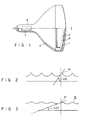
- a cathode-ray tube has an envelope consisting of a glass panel 1 and a funnel 2.
- a phosphor screen 3 is formed on the inner surface of the panel 1, and an electron gun assembly 5 is arranged in a neck 4 of the funnel 2.
- this phosphor screen 3 is scanned with electron beams emitted from the electron gun assembly 5, thereby displaying an image.
- the cathode-ray tube shown in FIG. 1 is a color picture tube.
- a shadow mask 6 is arranged in the color picture tube to oppose the phosphor screen 3.
- the outer surface (outer surface of the image display portion) of the glass panel 1 forms a mirror surface.
- external light is reflected by this outer surface.
- the reflected external light overlaps an image formed on the phosphor screen 3 to degrade the contrast of the image seen through the panel 1.
- this reflection of the external light causes eye fatigue.
- a method of imparting antireflection to the outer surface of the panel conventionally includes, for example, a method of forming depressions and projections on the outer surface of the panel (non-glare process) to diffuse and reflect the external light, so that an apparent reflectance is decreased.
- the method of making depressions and projections on the outer panel surface includes a method of mechanically or chemically treating the outer surface of the panel to directly form depressions and projections on the outer surface of the panel, and a method of coating an alcohol-soluble silicon compound, e.g., silicon alkoxide, on the outer surface of the panel by spraying and thereafter baking the coated compound, thereby forming a coating film having depressions and projections.
- the image seen through the panel is not clear due to the depressions and projections of the surface of the panel, and the resolution is lowered due to the non-glare process. Since the entire panel forms a ground glass plate, the screen is whitened to lower the contrast.
- a method of solving the problems of the panel subjected to the non-glare process there is developed a method of forming a smooth, multi-layered optical interfering film on the outer surface of the panel by spin coating, so that the reflectance is decreased by the interference of light.
- an antireflection film accompanying no degradation in resolution or a decrease in contrast can be formed.
- dust may attach to the panel or the film thickness tends to be non-uniform, thus degrading the yield.
- a spin coating system requires large-sized facilities, e.g., an apparatus for rotating a member to place a coating target thereon, leading to a high manufacturing cost.
- a method of manufacturing a cathode-ray tube having at least two optical layers on the outer surface of a faceplate including the step of forming a first optical film by coating a first optical interfering film forming solution on one surface of a faceplate through an external mixing type air spray nozzle, while scanning the air spray nozzle, the faceplate having the other surface formed with a phosphor screen, and the air spray nozzle being adapted to mix the first optical interfering film forming solution and air outside the spray nozzle, and the step of forming a second optical film by coating a second optical interfering film forming solution on the first optical film through the air spray nozzle, while scanning the external mixing type air spray nozzle, thus forming an optical interfering film including the first and second optical films, wherein each of the step of forming the first optical film and the step of forming the second optical film is performed by maintaining a temperature of the faceplate at 20 to 50°C, setting flow rates of each optical interfering film forming
- a cathode-ray tube comprising a vacuum envelope including a faceplate, a phosphor screen formed on an inner surface of the faceplate, and a multi-layered optical interfering film formed on an outer surface of the faceplate, having an outer surface formed with a plurality of depressions and projections, and having an average angle ⁇ a of inclination and an average peak gap Sm, which are defined in the international standards ISO 4287/1-1984 of surface roughness of depressions and projections, and respectively satisfy relations expressed by following inequalities: 0.1° ⁇ ⁇ a ⁇ 0.5° 10 ⁇ m ⁇ Sm ⁇ 50 ⁇ m
- Such a cathode-ray tube can be manufactured in accordance with, e.g., the method of manufacturing the cathode-ray tube according to the first aspect.
- This method does not require large-size equipment unlike in spin coating, so that an antireflection film can be easily formed at a low cost.
- the film having depressions and projections is defined as described above, a cathode-ray tube having small degradation or no degradation in resolution and contrast can be obtained.
- the present invention concerns an improvement, especially cost reduction, of an antireflection film to be formed on the outer surface of the display surface of a cathode-ray tube.
- the first aspect of the present invention provides a method of manufacturing a cathode-ray tube including an improved manufacturing process of an antireflection film.
- the cathode-ray tube of the first aspect of the present invention basically, a plurality of types of optical interfering film forming solutions are coated on the outer surface of the faceplate (image display portion) of the cathode-ray tube to form a multi-layered film having at least two layers, and this multi-layered film is baked, thereby forming an antireflection film comprising a multi-layered optical interfering film on the outer surface of the image display portion.
- the characteristic feature of this method resides in that i) an external mixing type air spray nozzle for mixing an optical interfering film forming solution and air outside the air spray nozzle is used as the coating means; ii) the optical interfering film forming solution is sprayed from the air spray nozzle while scanning the air spray nozzle on the outer surface of the image display portion, thereby coating the optical interfering film forming solution; iii) as the coating conditions in use of the air spray nozzle, the flow rates of optical interfering film forming solution and air from the air spray nozzle are set to 10 to 30 cc/min and 80 to 140 l/min, respectively, the scanning speed of the spray with respect to the outer surface of the image display portion is set to 250 to 750 mm/sec, and the temperature of the outer surface of the image display portion before coating the optical interfering film forming solution is set to 20 to 50°C; and iv) each optical interfering film forming solution contains 1 to 5 wt% of a solid substance and 10 to 30% of an
- the second aspect of the present invention provides a cathode-ray tube having an improved antireflection film.
- a cathode-ray tube in which an antireflection film comprising a multi-layered optical interfering film having fine depressions and projections is formed on the outer surface of the image display portion thereof, and an average angle ⁇ a of inclination and an average peak gap Sm of the depressions and projections film which are defined in the international standards ISO 4287/1-1984 respectively satisfy 0.1° ⁇ ⁇ a ⁇ 0.5° 10 ⁇ m ⁇ Sm ⁇ 50 ⁇ m
- the parameters indicating the surface roughness of a film having depressions and projections include a maximum height Rmax and a ten-point average roughness Rz defined in the JIS standards B0601.
- a film having depressions and projections regulated by these parameters is shown in, e.g., Jpn. Pat. Appln. KOKAI Publication Nos. 63-80451 and 1-286240.
- the maximum height Rmax and the ten-point average roughness Rz must be decreased.
- the obtained film is not very effective as an antireflection film comprising an optical interfering film.
- the distal end portions of the projecting portions must be formed as moderate slopes.
- the parameters that concern the shape of the distal end portions of the projecting portions include the average angle ⁇ a of inclination defined in the international standards ISO 4287/1-1984.
- FIGS. 2 and 3 show graphs for explaining the depressions and projections of antireflection films.
- the average angle ⁇ a of inclination is large, the angle of the distal end portions of projecting portions 10 becomes small, as shown in FIG. 2, thus forming the projecting portions 10 to be sharp.
- the average angle ⁇ a of inclination is small, the angle of the distal end portions of projecting portions 10 becomes large, as shown in FIG. 3 ( ⁇ ai), thus forming a film having depressions and projections close to a smooth film and having projecting portions 10 having moderate slopes. Therefore, to obtain an antireflection film comprising an optical interfering film having an irregular surface, the average angle ⁇ a of inclination must be regulated.
- Parameters that express the pitch of the projections include an average peak gap Sm.
- the average peak gap Sm In order to obtain a refection reducing film comprising an optical interfering film having an irregular surface with an invisible irregular pattern without causing glare of the screen and degradation in resolution, the average peak gap Sm must be regulated.
- the outer surface of the image display portion usually has projecting portions with an average angle ⁇ a of inclination of 1.5° to 3.0°.
- the average angle ⁇ a of inclination is expressed as 0.1° ⁇ ⁇ a ⁇ 0.5° preferably 0.1° ⁇ ⁇ a ⁇ 0.3° and more preferably 0.1° ⁇ ⁇ a ⁇ 0.2°
- Sm may be set to satisfy 10 ⁇ m ⁇ Sm ⁇ 50 ⁇ m preferably 10 ⁇ m ⁇ Sm ⁇ 30 ⁇ m and more preferably 10 ⁇ m ⁇ Sm ⁇ 20 ⁇ m
- a film which can be used as an optical interfering film is obtained.
- an antireflection film having small degradation in resolution and contrast can be obtained.
- the type of air spray nozzle, the spraying conditions, and the compositions of the optical interfering film forming solutions must be limited.
- the diameter of the particles of the optical interfering film forming solution to be sprayed from the air spray nozzle must be decreased.
- the diameter of the particles of the optical interfering film forming solution can be controlled by the type of spray nozzle and the flow rates of the optical interfering forming solution and air from the spray nozzle.
- an air spray sprays an optical interfering film forming solution in the form of fine particles by mixing with air when the flow rate of air is increased relative to the flow rate of the optical interfering film forming solution, the diameter of the particles of the optical interfering film forming solution can be decreased.
- This particle diameter reduction includes to relatively decrease the flow rate of the optical interfering film forming solution and to increase the flow rate of air.
- the solution When, however, the flow rate of the optical interfering film forming solution is decreased, the solution must be coated many times in order to obtain a predetermined film thickness, which is disadvantageous in terms of production.
- the flow rate of the optical interfering film forming solution from the air spray nozzle is set to 10 to 30 cc/min, preferably 15 to 25 cc/min, and more preferably 20 cc/min, and the flow rate of air is set to 80 to 140 l/min, preferably 100 to 120 l/min, and more preferably 110 l/min.
- the particles of the optical interfering film forming solution sprayed from the air spray nozzle are deformed into a crater-like shape upon colliding with and attaching to the outer surface of the image display portion.
- the attaching particles of the optical interfering film forming solution are not dried at once but left to stand still, the depressions and the projections of the craters are moderated into moderate slopes.
- the particles are dried after the depressions and the projections are moderated into moderate slopes in this manner, the obtained film can be smoothly.
- the projections tends to aggregate adjacent particles of the optical interfering film forming solution, thus forming circular patterns having a large pitch of corrugations, which adversely affects glare of the screen.
- the drying time of the particles of the optical interfering film forming solution attaching to the outer surface of the image display portion may be carefully controlled.
- the drying time of the particles of the optical interfering film forming solution can vary depending on parameters such as the temperature of the outer surface of the image display portion before coating the optical interfering film forming solution, the content of a solid substance of the optical interfering film forming solution and the boiling point of the solvent of the optical interfering film forming solution, the scanning speed of the optical interfering film forming solution sprayed with respect to the outer surface of the image display portion, and the like.
- An appropriate scanning speed may be 250 to 750 mm/sec when the flow rates of the optical interfering film forming solution and air from the air spray nozzle are regulated in the manner as described above.
- the temperature of the outer surface of the image display portion before coating the optical interfering film forming solution if it is decreased, the depressions and projections due to the particles of the optical interfering film forming solution attaching to the outer surface of the image display portion can be moderated regardless of the composition of the optical interfering film forming solution. In this case, however, drying takes time, leading to glare of the screen caused by the aggregation of the particles of the optical interfering film forming solution. In order to decrease the temperature below room temperature, a cooling device is required, which is not preferable in terms of productivity. When the temperature of the outer surface of the image display portion before coating the optical interfering film forming solution is increased, the optical interfering film forming solution is dried quickly, so that the distal end portions of the projecting portions of the formed film become sharp.
- the average angle ⁇ a of inclination of the projecting portions of the optical interfering film formed by an optical interfering film forming solution which contains 10 to 30% of an organic solvent having a boiling temperature of 120 to 200°C and 1 to 5 wt% of a solid substance, can be set to satisfy 0.1° ⁇ ⁇ a ⁇ 0.5°
- the temperature of the outer surface of the image display portion, the content of the solid substance, and the content of the solvent can be changed as required by changing the composition of each optical interfering film forming solution.
- a multi-layered antireflection film is formed by using the method of the present invention, not only a required antireflection film can be easily formed on the outer surface of the image display portion at a low cost in accordance with spraying, but also an anti-reflection film having a shape close to that of a smooth film can be obtained.
- an antireflection film is used, a cathode-ray tube having a sufficiently high resolution and contrast can be obtained.
- an effect of decreasing the apparent reflectance without decreasing the reflectance of the optical interfering film too much can also be expected due to the slight non-glare effect obtained by the depression and the projections of the optical interfering film.
- FIG. 4 is a schematic diagram of a color picture tube as an arrangement of the cathode-ray tube according to the present invention.
- This color picture tube has an envelope consisting of a glass panel 1 and a funnel 2 integrally bonded to the panel 1.
- the panel 1 is obtained by forming a skirt portion 13 around an effective portion 12 of the display surface.
- a phosphor screen 3 comprising three color phosphor layers that emit blue, green, and red light beams are formed on the inner surface of the effective portion 12 of the panel 1.
- a shadow mask 6 is arranged on the inner side of the phosphor screen 3 to oppose it.
- An electron gun assembly 5 for emitting three electron beams is disposed in a neck 4 of the funnel 2.
- the three electron beams emitted from the electron gun assembly 5 are deflected by a magnetic field generated by a deflecting unit (not shown) mounted on the outer surface of the funnel 2 to horizontally and vertically scan the phosphor screen 3 through the shadow mask 6, thereby displaying a color image.
- an antireflection film 15 comprising a multi-layered optical interfering film is formed on the outer surface of the effective portion 12 (image display portion) of the panel 1 that displays the image.
- the antireflection film 15 of this embodiment is constituted by multi-layered films combined with optical layers having different refraction, respectively layer.
- the depressions and the projections of the surface of the outermost layer of the antireflection film 15 have an average angle ⁇ a of inclination and an average peak gap Sm, both defined in the international standards ISO 4287/1-1984, respectively satisfying 0.1° ⁇ ⁇ a ⁇ 0.5°, as shown in FIG. 3, and 10 ⁇ m ⁇ Sm ⁇ 50 ⁇ m.
- the average angle ⁇ a of inclination preferably satisfies 0.1° ⁇ ⁇ a ⁇ 0.3° and more preferably 0.1° ⁇ ⁇ a ⁇ 0.2° and the average peak gap Sm preferably satisfies 10 ⁇ m ⁇ Sm ⁇ 30 ⁇ m and more preferably 10 ⁇ m ⁇ Sm ⁇ 20 ⁇ m
- this color picture tube To manufacture this color picture tube, first, a color picture tube having no antireflection film on the outer surface of the effective portion 12 of the panel 1 is manufactured by a known method.
- the outer surface of the effective portion 12 of the panel 1 is cleaned by etching it with an aqueous solution of fluorine, ammonium fluoride, or the like and by washing it with water, thereby forming an antireflection film comprising a multi-layered optical interfering film consisting of layers having different refractive index, respectively.
- FIG. 5 is a schematic diagram showing the distal end portion of an arrangement of this spray nozzle. As shown in FIG. 5, the distal end portion of this external mixing type spray nozzle has a main body 60 divided into a liquid cap 51 having a solution discharge port 53 and air cap 52 having an air discharge port 54.
- an optical interfering film forming solution is discharged from the solution discharge port 53 of the liquid cap 51 as shown in arrow 501, and air is discharged from the air discharge port 54 of the air cap 52 as shown in arrow 502.
- air and the optical interfering film forming solution are mixed and sprayed in the direction indicated by arrows.
- the flow rate of the optical interfering film forming solution from the air spray nozzle is set to 10 to 30 cc/min, preferably 15 to 25 cc/min, and more preferably 20 cc/min
- the flow rate of air is set to 80 to 140 l/min, preferably 100 to 120 l/min, and more preferably 110 l/min
- the scanning speed of the spray with respect to the outer surface of the effective portion 12 is set to 250 to 750 mm/sec and preferably 300 to 500 mm/sec
- the temperature of the outer surface of the effective portion 12 before coating the optical interfering film forming solution is set to 20°C to 50°C.
- the antireflection film 15 to be formed on the outer surface of the effective portion 12 of the panel 1 is constituted by a multilayered optical interfering film having irregular surface, and an average angle ⁇ a of inclination and an average peak gap Sm, both defined in the international standards ISO 4287/1-1984, of the projecting portions of the irregular films respectively satisfy 0.1° ⁇ ⁇ a ⁇ 0.5° 10 ⁇ ⁇ Sm ⁇ 50 ⁇ m then a film having fine depressions and projections close to a moderate-slope smooth film, the distal end portions of the projecting portions of which have a small angle, is formed.
- an antireflection film constituted by a high-quality multi-layered optical interfering film having small degradation in resolution and contrast, similarly as in the multi-layered optical interfering film comprising ordinary smooth films, can be obtained.
- the antireflection film 15 comprising such a multi-layer optical interfering film can be stably formed in accordance with spraying by limiting the type of spray nozzle, the spraying conditions, the drying time of the optical interfering film forming solutions coated on the outer surface of the effective portion 12 of the panel 1, and the compositions of the optical interfering film forming solutions.
- the particle diameter of the particles of the optical interfering film forming solution to be sprayed from the air spray nozzle can be decreased.
- the diameter of the particles of the optical interfering film forming solution can be controlled by the type of spray nozzle and the spraying conditions, i.e., the flow rates of optical interfering forming solution and air from the spray nozzle.
- an external mixing type air spray nozzle for mixing an optical interfering film forming solution and air outside the spray nozzle was suitable to make spray particles smaller.
- this particle diameter reduction includes a method of relatively decreasing the flow rate of the optical interfering film forming solution and a method of increasing the flow rate of air.
- the solution must be coated many times to obtain a predetermined film thickness, which is disadvantageous in terms of production.
- the particles of the optical interfering film forming solution often rebound from the outer surface of the effective portion 12 of the panel 1, thereby decreasing the coating efficiency.
- the flow rates of optical interfering film forming solution and air are most preferably set to 10 to 30 cc/min and 80 to 140 l/min, respectively, and to obtain an optical interfering film to be formed which has a good average peak gap Sm satisfying 10 ⁇ m ⁇ Sm ⁇ 20 ⁇ m the flow rates of optical interfering film forming solution and air are most preferably set to 20 cc/min and 110 l/min, respectively.
- the flow rate of the solution preferably set to as large as possible and the flow rate of the air preferably set to as small as possible.
- the particles of the optical interfering film forming solution sprayed from the air spray nozzle are deformed into a crater-like shape upon colliding with and attaching to the outer surface of the effective portion 12 of the panel 1.
- the attaching particles of the optical interfering film forming solution are not dried at once but left to stand still, the depressions and projections of the craters are gradually moderated into moderate slopes.
- the depressions and projections are aggregate adjacent particles of the optical interfering film forming solution, thus forming circular patterns having a large pitch of projections. Then, glare of the screen is adversely affected.
- an anti-reflection film as a moderate-slope irregular film
- the drying time of the particles of the optical interfering film forming solution sprayed with the air spray nozzle varies depending on the scanning speed of the optical interfering film forming solution sprayed with respect to the outer surface of the effective portion 12 of the panel 1, the temperature of the outer surface of the effective portion 12 of the panel 1 before coating the optical interfering film forming solution, the boiling point of the optical interfering film forming solution and the content of the solid substance of the optical interfering film forming solution, and the like.
- the scanning speed of the optical interfering film forming solution sprayed with respect to the outer surface of the effective portion 12 of the panel 1 if it is excessively low, the amount of solution per unit area coated by one scanning operation is increased to delay drying, leading to glare of the screen caused by the aggregation of the particles of the optical interfering film forming solution. If it is excessively high, the number of times of the scanning operation must be increased, posing a problem in productivity.
- FIG. 7 shows the relationship between the scanning speed of the optical interfering film forming solution sprayed with respect to the outer surface of the effective portion of the panel and the average peak gap Sm of the optical interfering film to be formed.
- the temperature of the outer surface of the effective portion of the panel before coating the optical interfering film forming solution is set to 30°C and the flow rates of the optical interfering film forming solution and air from the air spray nozzle are respectively set to 20 cc/min and 100 l/min.
- an appropriate scanning speed with which the average peak gap Sm of the optical interfering film to be formed can apparently satisfy 10 ⁇ m ⁇ Sm ⁇ 50 ⁇ m may be 250 mm/sec or more, but if the scanning speed is too high, a large number of coating times are required. Therefore the scanning speed may be 250 to 750 mm/sec and preferably 300 to 500 mm/sec.
- the temperature of the outer surface of the effective portion of the panel before coating the optical interfering film forming solution if it is low, the projections of the particles of the optical interfering film forming solution attaching to the outer surface of the image display portion can be moderated almost regardless of the composition of the optical interfering film forming solution. In this case, however, drying takes time, leading to glare of the screen. In order to decrease the temperature below room temperature (20°C), a cooling device is required, which is not preferable in terms of productivity.
- the optical interfering film forming solution is dried quickly, so that the distal end portions of the projecting portions of the formed film having depressions and projections become sharp, causing a degradation in resolution. Therefore, regarding the temperature of the outer surface of the effective portion of the panel before coating the optical interfering film forming solution, this temperature must be set to such a value with which glare of the screen is not caused and the distal end portions of the projecting portions of the optical interfering film are moderated.
- the boiling point of the optical interfering film forming solution and the content of the solid substance of the optical interfering film forming solution it has become obvious from the result of experiments that the boiling point of the optical interfering film forming solution and the content of the high-boiling organic solvent, having a boiling point of 120°C to 200°C, and the coating solution are corelated to each other.
- the relationship between the temperature of the outer surface of the effective portion of the panel and the average angle ⁇ a of inclination of the depressions and projections of the optical interfering film to be formed was examined by using optical interfering film forming solutions containing different amounts of methyl cellosolve (boiling point: 124.5°C) as the high-boiling solvent.
- Curves 19a, 19b, and 19c shown in FIG. 8 respectively indicate the relationships between the temperatures of the outer surface of the effective portion of the panel and the average angles ⁇ a of inclination of the projections of the optical interfering films to be formed when the contents of methyl cellosolve in the optical interfering film forming solutions each containing 2.0 wt% of the solid substance are set to 30%, 10%, and 0%, respectively, under the conditions that the flow rates of optical interfering film forming solution and air from the air spray nozzle are respectively set to 20 cc/min and 110 l/min, and the scanning speed of the optical interfering film forming solution sprayed with respect to the outer surface of the effective portion of the panel is set to 350 mm/sec.
- FIG. 9 shows the relationship between the content of the solid substance of the optical interfering film forming solution and the average angle ⁇ a of inclination of the corrugations.
- Curves 20a, 20b, and 20c respectively indicate the relationships between the contents of the solid substance and the average angles ⁇ a of inclination of the projections of the optical interfering films to be formed when the contents of methyl cellosolve are set to 30%, 10%, and 0% with respect to the coating solution, respectively, under the conditions that the flow rates of the optical interfering film forming solution and air from the spray nozzle are respectively set to 20 cc/min and 110 l/min, the scanning speed of the optical interfering film forming solution sprayed with respect to the outer surface of the effective portion of the panel is set to 350 mm/sec, and the temperature of the outer surface of the effective portion of the panel before coating the optical interfering film forming solution is set to 30°C.
- the flow rates of the optical interfering film forming solution and air from the air spray nozzle are respectively set to 10 to 30 cc/min and 80 to140 cc/min
- the scanning speed of the spray with respect to the outer surface of the effective portion is set to 250 to 750 mm/sec
- the temperature of the outer surface of the effective portion before coating the optical interfering film forming solution is set to 20 to 50°C
- an optical interfering film forming solution containing 1 to 5 wt% of a solid substance and 10 to 30% of a high-boiling organic solvent having a boiling point of 120°C to 200°C is sprayed
- the average angle ⁇ a of inclination and the average peak gap Sm of the corrugations of the optical interfering film to be formed can be respectively set to satisfy 0.1° ⁇ ⁇ a ⁇ 0.5° 10 ⁇ m ⁇ Sm ⁇ 50 ⁇ m
- the flow rates of the optical interfering film forming solution and air are respectively set to
- a solution A is a high-refraction optical interfering film forming solution
- a solution B is an intermediate-refraction optical interfering film forming solution
- a solution C is a low-refraction optical interfering film forming solution.
- Solution A High-Refraction Optical Interfering Film Forming Solution
- ethyl silicate solution dispersed with fine SnO 2 particles (solid substance: 3 wt%) 20% selective light-absorbing dye (solid substance: 20 wt%) 5% ethyl alcohol (boiling point: 78.32°C) 25% isopropyl alcohol (boiling point: 82.4°C) 18% n-butyl alcohol (boiling point: 117.25°C) 18% n-pentyl alcohol (boiling point: 138.25°C) 4% methyl cellosolve (boiling point: 124.5°C) 8% butyl cellosolve (boiling point: 171.2°C) 2% Solution B (Intermediate-Refraction Optical Interfering Film Forming Solution) ethyl silicate solution dispersed with fine SnO 2 particles (solid substance: 3 wt%) 50% isopropyl alcohol (boiling point: 82.4
- the outer surface of the effective portion of the panel of a color picture tube was cleaned by washing.
- the outer surface of the effective portion was heated to 30°C.
- As the air spray nozzle an Air Atomizing Nozzle PF 1650 + PA 67228-45°C (trade name) available from Spraying System was used.
- the solution A was coated and dried to obtain a coating film.
- the outer surface of the effective portion of this panel was set to 30°C and the solution C was coated and dried under the same conditions as those for coating the solution A, thus obtaining a coating film. Thereafter, the outer surface of the effective portion of this panel was heated to 200°C and baked.
- An antireflection film comprising a two-layered optical interfering film (a high-refraction layer and a low-refraction layer) was thus obtained.
- the average angle of inclination (deg), the average peak gap ( ⁇ m), and the luminous regular reflection factor (%) of the obtained antireflection film were measured. Also, glare and resolution were evaluated. Table 1 shows the results of the measurement and evaluation. o and x shown as the judgment of glare and resolution indicate that the corresponding layer has no problem and is thus good, and defective, respectively.
- an intermediate-refraction film having a refractive index of about 1.55 to 1.60 can be obtained.
- the multi-layered optical interfering film which is useful as the antireflection film has a luminous regular reflection factor falling within a range of about 1.8 or smaller.
- the outer surface of the effective portion of the panel of a color picture tube was cleaned by washing in the same manner as in Example 1.
- the outer surface of the effective portion was heated to 30°C.
- As the air spray nozzle an Air Atomizing Nozzle PF 1650 + PA 67228-45°C manufactured by Spraying System was used.
- the solution B was coated and dried to obtain a coating film.
- the outer surface of the effective portion of this panel was set to 30°C and the solution A was coated and dried under the same conditions as those for coating the solution B, thus obtaining a coating film.
- the solution C was coated on the obtained film and dried under the same conditions as those for coating the solution B to obtain a coating film. Thereafter, the outer surface of the effective portion of this panel was heated to 200°C and baked.
- An antireflection film comprising a two-layered optical interfering film (an intermediate-refraction layer, a high-refraction layer and a low-refraction layer) was thus obtained.
- the average angle of inclination (deg), the average peak gap ( ⁇ m), and the luminous regular reflection factor (%) of the obtained antireflection film were measured in the same manner as in Example 1. Also, the glare and resolution were evaluated. Table 1 shows the results of the measurement and evaluation.
- the outer surface of the effective portion of the panel of a color picture tube was cleaned by washing in the same manner as in Example 1.
- the outer surface of the effective portion was heated to 30°C.
- As the air spray nozzle an Air Atomizing Nozzle PF 1650 + PA 67228-45°C available from Spraying System was used.
- the solution B was coated and dried to obtain a coating film.
- the outer surface of the effective portion of this panel was set to 30°C again, and the solution A was coated and dried under the same conditions as those for coating the solution B, thus obtaining a coating film.
- the outer surface of the effective portion of this panel was set to 30°C again, and the solution C was coated and dried under the same conditions as those for coating the solution A, thus obtaining a coating film. Thereafter, the outer surface of the effective portion of this panel was heated to 200°C and baked. An antireflection film comprising a three-layered optical interfering film (an intermediate-refraction layer, a high-refraction layer, and a low-refraction layer) was thus obtained.
- the average angle of inclination (deg), the average peak gap ( ⁇ m), and the luminous regular reflection factor (%) of the obtained antireflection film were measured. Also, the glare and resolution were evaluated. Table 1 shows the results of the measurement and evaluation.
- the outer surface of the effective portion of the panel of a color picture tube was cleaned by washing in the same manner as in Example 1.
- the outer surface of the effective portion was heated to 30°C.
- As the air spray nozzle an Air Atomizing Nozzle PF 1650 + PA 67228-45°C available from Spraying System was used.
- the solution A was coated and dried to obtain a coating film.
- the outer surface of the effective portion of this panel was set to 30°C again, and the solution C was coated and dried under the same conditions as those for coating the solution A, thus obtaining a coating film. Thereafter, the outer surface of the effective portion of this panel was heated to 200°C and baked.
- An antireflection film comprising a two-layered optical interfering film (a high-refraction layer and a low-refraction layer) was thus obtained.
- the average angle of inclination (deg), the average peak gap ( ⁇ m), and the luminous regular reflection factor (%) of the obtained antireflection film were measured. Also, the glare and resolution were evaluated. Table 1 shows the results of the measurement and evaluation.
- the outer surface of the effective portion of the panel of a color picture tube was cleaned by washing in the same manner as in Example 1.
- the outer surface of the effective portion was heated to 50°C.
- an Air Atomizing Nozzle PF 1650 + PA 67228-45°C available from Spraying System was used as the air spray nozzle.
- the solution A and air were coated and dried to obtain a coating film.
- the outer surface of the effective portion of this panel was set to 30°C again, and the solution C was coated and dried under the same conditions as those for coating the solution A, thus obtaining a coating film. Thereafter, the outer surface of the effective portion of this panel was heated to 200°C and baked. An antireflection film comprising a two-layered optical interfering film (a high-refraction layer and a low-refraction layer) was thus obtained.
- the outer surface of the effective portion of the panel of a color picture tube was cleaned by washing in the same manner as in Example 1.
- the outer surface of the effective portion was heated to 60°C.
- As the air spray nozzle an Air Atomizing Nozzle PF 1650 + PA 67228-45°C available from Spraying System was used.
- the solution A was coated and dried to obtain a coating film.
- the outer surface of the effective portion of this panel was set to 30°C and the solution C was coated and dried under the same conditions as those for coating the solution A, thus obtaining a coating film. In this case, the effective portion of the panel became whitish.
- the outer surface of the effective portion of the panel of a color picture tube was cleaned by washing in the same manner as in Example 1.
- the outer surface of the effective portion was heated to 30°C.
- As the air spray nozzle an Air Atomizing Nozzle PF 1650 + PA 67228-45°C available from Spraying System was used.
- the solution A was coated and dried to obtain a coating film.
- the outer surface of the effective portion of this panel was heated to 50°C and the solution C was coated and dried under the same conditions as those for coating the solution A, thus obtaining a coating film.
- the outer surface of the effective portion of the panel of a color picture tube was cleaned by washing in the same manner as in Example 1.
- the outer surface of the effective portion was heated to 30°C.
- an Air Atomizing Nozzle PF 1650 + PA 67228-45°C available from Spraying System was used as the air spray nozzle.
- the solution A and air were coated and dried. Glare occurred on the outer surface of the effective portion of the panel.
- the outer surface of the effective portion of the panel of a color picture tube was cleaned by washing in the same manner as in Example 1.
- the outer surface of the effective portion was heated to 30°C.
- As the air spray nozzle an Air Atomizing Nozzle PF 1650 + PA 67228-45°C available from Spraying System was used.
- the solution A was coated and dried. Glare occurred on the outer surface of the effective portion of the panel.
- the outer surface of the effective portion of the panel of a color picture tube was cleaned by washing in the same manner as in Example 1.
- the outer surface of the effective portion was heated to 30°C.
- an Air Atomizing Nozzle PF 1650 + PA 67228-45°C available from Spraying System was used as the air spray nozzle.
- the solution A and air were coated and dried. Glare occurred on the outer surface of the effective portion of the panel.
- the average angle ⁇ a of inclination and average peak gap Sm of the formed refraction layer respectively satisfy 0.1° ⁇ ⁇ a ⁇ 0.5° 10 ⁇ m ⁇ Sm ⁇ 50 ⁇ m
- the average peak gap of the formed refraction layer was increased to cause opaquing and glare.
- a color picture tube has been described.
- the present invention can also be applied to a cathode-ray tube other than a color picture tube.
Landscapes
- Chemical & Material Sciences (AREA)
- Engineering & Computer Science (AREA)
- Geochemistry & Mineralogy (AREA)
- Materials Engineering (AREA)
- Composite Materials (AREA)
- Life Sciences & Earth Sciences (AREA)
- Chemical Kinetics & Catalysis (AREA)
- General Chemical & Material Sciences (AREA)
- Manufacturing & Machinery (AREA)
- Dispersion Chemistry (AREA)
- Organic Chemistry (AREA)
- Vessels, Lead-In Wires, Accessory Apparatuses For Cathode-Ray Tubes (AREA)
- Surface Treatment Of Optical Elements (AREA)
- Formation Of Various Coating Films On Cathode Ray Tubes And Lamps (AREA)
- Manufacture Of Electron Tubes, Discharge Lamp Vessels, Lead-In Wires, And The Like (AREA)
- Application Of Or Painting With Fluid Materials (AREA)
Applications Claiming Priority (4)
| Application Number | Priority Date | Filing Date | Title |
|---|---|---|---|
| JP22128294 | 1994-09-16 | ||
| JP221282/94 | 1994-09-16 | ||
| JP7157258A JPH08138581A (ja) | 1994-09-16 | 1995-06-23 | 反射防止型陰極線管およびその製造方法 |
| JP157258/95 | 1995-06-23 |
Publications (2)
| Publication Number | Publication Date |
|---|---|
| EP0702390A1 EP0702390A1 (en) | 1996-03-20 |
| EP0702390B1 true EP0702390B1 (en) | 1998-11-11 |
Family
ID=26484779
Family Applications (1)
| Application Number | Title | Priority Date | Filing Date |
|---|---|---|---|
| EP95114413A Expired - Lifetime EP0702390B1 (en) | 1994-09-16 | 1995-09-13 | Antireflection type cathode-ray tube and method of manufacturing the same |
Country Status (7)
| Country | Link |
|---|---|
| EP (1) | EP0702390B1 (https=) |
| JP (1) | JPH08138581A (https=) |
| KR (1) | KR100205130B1 (https=) |
| CN (1) | CN1052106C (https=) |
| DE (1) | DE69505928T2 (https=) |
| MY (1) | MY116638A (https=) |
| TW (1) | TW303474B (https=) |
Families Citing this family (1)
| Publication number | Priority date | Publication date | Assignee | Title |
|---|---|---|---|---|
| US10059622B2 (en) * | 2012-05-07 | 2018-08-28 | Guardian Glass, LLC | Anti-reflection glass with tin oxide nanoparticles |
Family Cites Families (9)
| Publication number | Priority date | Publication date | Assignee | Title |
|---|---|---|---|---|
| US2536764A (en) * | 1947-04-05 | 1951-01-02 | American Optical Corp | Method of forming a reflection reducing coating |
| NL8302460A (nl) * | 1983-07-11 | 1985-02-01 | Philips Nv | Werkwijze voor het verminderen van de reflectie van een doorzichtig beeldscherm en beeldscherm met verminderde reflectie. |
| JPS60218747A (ja) * | 1984-04-13 | 1985-11-01 | Hitachi Ltd | ブラウン管の製造方法 |
| US4560581A (en) * | 1985-04-15 | 1985-12-24 | Rca Corporation | Method for preparing lithium-silicate glare-reducing coating |
| JPH0831306B2 (ja) | 1986-09-22 | 1996-03-27 | ソニー株式会社 | 高精細度陰極線管装置の製造方法 |
| JPS6421844A (en) * | 1987-07-16 | 1989-01-25 | Toshiba Corp | Manufacture of color cathode-ray |
| JP3072991B2 (ja) | 1988-05-13 | 2000-08-07 | 株式会社日立製作所 | 陰極線管 |
| US5189337A (en) * | 1988-09-09 | 1993-02-23 | Hitachi, Ltd. | Ultrafine particles for use in a cathode ray tube or an image display face plate |
| KR930011088A (ko) * | 1991-11-26 | 1993-06-23 | 이헌조 | 음극선관의 도전성 피막 형성방법 |
-
1995
- 1995-06-23 JP JP7157258A patent/JPH08138581A/ja active Pending
- 1995-09-06 TW TW084109324A patent/TW303474B/zh active
- 1995-09-09 MY MYPI95002679A patent/MY116638A/en unknown
- 1995-09-13 EP EP95114413A patent/EP0702390B1/en not_active Expired - Lifetime
- 1995-09-13 DE DE69505928T patent/DE69505928T2/de not_active Expired - Fee Related
- 1995-09-15 CN CN95115165A patent/CN1052106C/zh not_active Expired - Fee Related
- 1995-09-16 KR KR1019950030562A patent/KR100205130B1/ko not_active Expired - Fee Related
Also Published As
| Publication number | Publication date |
|---|---|
| KR100205130B1 (ko) | 1999-07-01 |
| EP0702390A1 (en) | 1996-03-20 |
| DE69505928D1 (de) | 1998-12-17 |
| TW303474B (https=) | 1997-04-21 |
| MY116638A (en) | 2004-03-31 |
| DE69505928T2 (de) | 1999-06-02 |
| CN1124875A (zh) | 1996-06-19 |
| KR960012253A (ko) | 1996-04-20 |
| CN1052106C (zh) | 2000-05-03 |
| JPH08138581A (ja) | 1996-05-31 |
Similar Documents
| Publication | Publication Date | Title |
|---|---|---|
| US11267750B2 (en) | Translucent structure | |
| US5122709A (en) | Antistatic cathode ray tube with lobe like projections and high gloss and hardness | |
| US5652477A (en) | Multilayer antistatic/antireflective coating for display device | |
| KR19980019170A (ko) | 음극선관 | |
| US6339286B1 (en) | Cathode ray tube with a nonglare multi-layered film | |
| JPH05299034A (ja) | 陰極線管及びその表示面用塗布液 | |
| EP0702390B1 (en) | Antireflection type cathode-ray tube and method of manufacturing the same | |
| CN1153252C (zh) | 导电性防反射膜和阴极射线管 | |
| JPH0588001A (ja) | 陰極線管のフエース部外表面の反射防止膜形成方法 | |
| EP1205961B1 (en) | Method of treating surface of face panel used for image display device, and image display device comprising the treated face panel | |
| JPH05314930A (ja) | 反射防止型陰極線管 | |
| US6424086B1 (en) | Color cathode-ray tube having nonglare means on internal surface of faceplate | |
| EP0758139B1 (en) | Process of manufacturing a cathode-ray tube with an anti-glare, anti-static, dark faceplate coating | |
| JP2000323075A (ja) | 陰極線管 | |
| KR100447656B1 (ko) | 평면 브라운관용 패널 | |
| KR100378043B1 (ko) | 표시 장치에 대한 다층 대전방지/반사방지 코팅 | |
| JP2002062403A (ja) | 光吸収性反射防止体 | |
| JPH03179649A (ja) | 反射防止型陰極線管およびその製造方法 | |
| JPH052988A (ja) | 表示装置の反射防止膜形成方法 | |
| CN1129351A (zh) | 阴极射线管上抗眩光及抗静电的涂层 | |
| CN1295335A (zh) | 改进对比度的彩色阴极射线管及其制造 | |
| JPH04334852A (ja) | 表示装置の反射防止膜形成方法 | |
| JPH08138580A (ja) | 陰極線管用パネル | |
| JPH11250837A (ja) | 陰極線管用パネル | |
| JPH0794089A (ja) | 陰極線管の反射帯電防止膜形成方法 |
Legal Events
| Date | Code | Title | Description |
|---|---|---|---|
| PUAI | Public reference made under article 153(3) epc to a published international application that has entered the european phase |
Free format text: ORIGINAL CODE: 0009012 |
|
| 17P | Request for examination filed |
Effective date: 19951009 |
|
| AK | Designated contracting states |
Kind code of ref document: A1 Designated state(s): DE FR GB |
|
| 17Q | First examination report despatched |
Effective date: 19970320 |
|
| GRAG | Despatch of communication of intention to grant |
Free format text: ORIGINAL CODE: EPIDOS AGRA |
|
| GRAG | Despatch of communication of intention to grant |
Free format text: ORIGINAL CODE: EPIDOS AGRA |
|
| GRAH | Despatch of communication of intention to grant a patent |
Free format text: ORIGINAL CODE: EPIDOS IGRA |
|
| GRAH | Despatch of communication of intention to grant a patent |
Free format text: ORIGINAL CODE: EPIDOS IGRA |
|
| GRAA | (expected) grant |
Free format text: ORIGINAL CODE: 0009210 |
|
| AK | Designated contracting states |
Kind code of ref document: B1 Designated state(s): DE FR GB |
|
| REF | Corresponds to: |
Ref document number: 69505928 Country of ref document: DE Date of ref document: 19981217 |
|
| ET | Fr: translation filed | ||
| PLBE | No opposition filed within time limit |
Free format text: ORIGINAL CODE: 0009261 |
|
| STAA | Information on the status of an ep patent application or granted ep patent |
Free format text: STATUS: NO OPPOSITION FILED WITHIN TIME LIMIT |
|
| 26N | No opposition filed | ||
| REG | Reference to a national code |
Ref country code: GB Ref legal event code: IF02 |
|
| PGFP | Annual fee paid to national office [announced via postgrant information from national office to epo] |
Ref country code: DE Payment date: 20060907 Year of fee payment: 12 |
|
| PGFP | Annual fee paid to national office [announced via postgrant information from national office to epo] |
Ref country code: FR Payment date: 20060908 Year of fee payment: 12 |
|
| PGFP | Annual fee paid to national office [announced via postgrant information from national office to epo] |
Ref country code: GB Payment date: 20060913 Year of fee payment: 12 |
|
| GBPC | Gb: european patent ceased through non-payment of renewal fee |
Effective date: 20070913 |
|
| PG25 | Lapsed in a contracting state [announced via postgrant information from national office to epo] |
Ref country code: DE Free format text: LAPSE BECAUSE OF NON-PAYMENT OF DUE FEES Effective date: 20080401 |
|
| REG | Reference to a national code |
Ref country code: FR Ref legal event code: ST Effective date: 20080531 |
|
| PG25 | Lapsed in a contracting state [announced via postgrant information from national office to epo] |
Ref country code: FR Free format text: LAPSE BECAUSE OF NON-PAYMENT OF DUE FEES Effective date: 20071001 |
|
| PG25 | Lapsed in a contracting state [announced via postgrant information from national office to epo] |
Ref country code: GB Free format text: LAPSE BECAUSE OF NON-PAYMENT OF DUE FEES Effective date: 20070913 |