EP0701494B1 - Microstructurally refined multiphase castings - Google Patents
Microstructurally refined multiphase castings Download PDFInfo
- Publication number
- EP0701494B1 EP0701494B1 EP94916087A EP94916087A EP0701494B1 EP 0701494 B1 EP0701494 B1 EP 0701494B1 EP 94916087 A EP94916087 A EP 94916087A EP 94916087 A EP94916087 A EP 94916087A EP 0701494 B1 EP0701494 B1 EP 0701494B1
- Authority
- EP
- European Patent Office
- Prior art keywords
- casting
- particulate material
- casting method
- primary
- carbide
- Prior art date
- Legal status (The legal status is an assumption and is not a legal conclusion. Google has not performed a legal analysis and makes no representation as to the accuracy of the status listed.)
- Expired - Lifetime
Links
- 238000005266 casting Methods 0.000 title claims abstract description 157
- 239000011651 chromium Substances 0.000 claims abstract description 65
- 229910052804 chromium Inorganic materials 0.000 claims abstract description 60
- VYZAMTAEIAYCRO-UHFFFAOYSA-N Chromium Chemical compound [Cr] VYZAMTAEIAYCRO-UHFFFAOYSA-N 0.000 claims abstract description 48
- 239000000155 melt Substances 0.000 claims abstract description 45
- 239000011236 particulate material Substances 0.000 claims abstract description 41
- 229910045601 alloy Inorganic materials 0.000 claims abstract description 19
- 239000000956 alloy Substances 0.000 claims abstract description 19
- 229910052751 metal Inorganic materials 0.000 claims abstract description 19
- 239000002184 metal Substances 0.000 claims abstract description 19
- 229910001092 metal group alloy Inorganic materials 0.000 claims abstract description 13
- 238000007711 solidification Methods 0.000 claims abstract description 6
- 230000008023 solidification Effects 0.000 claims abstract description 6
- 150000001247 metal acetylides Chemical class 0.000 claims description 44
- 238000000034 method Methods 0.000 claims description 41
- 229910001037 White iron Inorganic materials 0.000 claims description 40
- 239000000843 powder Substances 0.000 claims description 35
- 239000002245 particle Substances 0.000 claims description 33
- 229910052799 carbon Inorganic materials 0.000 claims description 25
- 239000000203 mixture Substances 0.000 claims description 25
- XEEYBQQBJWHFJM-UHFFFAOYSA-N iron Substances [Fe] XEEYBQQBJWHFJM-UHFFFAOYSA-N 0.000 claims description 23
- OKTJSMMVPCPJKN-UHFFFAOYSA-N Carbon Chemical compound [C] OKTJSMMVPCPJKN-UHFFFAOYSA-N 0.000 claims description 20
- 238000010438 heat treatment Methods 0.000 claims description 18
- 239000011159 matrix material Substances 0.000 claims description 18
- 229910000604 Ferrochrome Inorganic materials 0.000 claims description 14
- UFGZSIPAQKLCGR-UHFFFAOYSA-N chromium carbide Chemical compound [Cr]#C[Cr]C#[Cr] UFGZSIPAQKLCGR-UHFFFAOYSA-N 0.000 claims description 14
- 229910003470 tongbaite Inorganic materials 0.000 claims description 14
- 230000005496 eutectics Effects 0.000 claims description 12
- 238000001816 cooling Methods 0.000 claims description 11
- 229910052742 iron Inorganic materials 0.000 claims description 10
- 229910052750 molybdenum Inorganic materials 0.000 claims description 9
- 229910052796 boron Inorganic materials 0.000 claims description 6
- 229910052759 nickel Inorganic materials 0.000 claims description 6
- 229910052710 silicon Inorganic materials 0.000 claims description 6
- 239000012535 impurity Substances 0.000 claims description 4
- 229910052748 manganese Inorganic materials 0.000 claims description 4
- 229910052717 sulfur Inorganic materials 0.000 claims description 4
- 229910052802 copper Inorganic materials 0.000 claims description 3
- 230000008018 melting Effects 0.000 claims description 3
- 238000002844 melting Methods 0.000 claims description 3
- 150000002736 metal compounds Chemical class 0.000 claims description 3
- 239000012159 carrier gas Substances 0.000 claims description 2
- 238000002791 soaking Methods 0.000 claims description 2
- 238000010899 nucleation Methods 0.000 abstract description 13
- 235000000396 iron Nutrition 0.000 abstract description 8
- 239000003795 chemical substances by application Substances 0.000 abstract description 6
- 230000006911 nucleation Effects 0.000 abstract description 6
- 239000006023 eutectic alloy Substances 0.000 abstract description 2
- 239000012071 phase Substances 0.000 description 31
- 238000011081 inoculation Methods 0.000 description 26
- 239000000463 material Substances 0.000 description 14
- 238000007792 addition Methods 0.000 description 13
- 239000002054 inoculum Substances 0.000 description 11
- CWYNVVGOOAEACU-UHFFFAOYSA-N Fe2+ Chemical compound [Fe+2] CWYNVVGOOAEACU-UHFFFAOYSA-N 0.000 description 10
- PXHVJJICTQNCMI-UHFFFAOYSA-N Nickel Chemical compound [Ni] PXHVJJICTQNCMI-UHFFFAOYSA-N 0.000 description 10
- VYPSYNLAJGMNEJ-UHFFFAOYSA-N Silicium dioxide Chemical compound O=[Si]=O VYPSYNLAJGMNEJ-UHFFFAOYSA-N 0.000 description 8
- 230000000694 effects Effects 0.000 description 8
- 238000012360 testing method Methods 0.000 description 8
- 238000004458 analytical method Methods 0.000 description 7
- 238000002347 injection Methods 0.000 description 7
- 239000007924 injection Substances 0.000 description 7
- 239000011572 manganese Substances 0.000 description 7
- 229910000734 martensite Inorganic materials 0.000 description 6
- 239000000126 substance Substances 0.000 description 6
- ZOXJGFHDIHLPTG-UHFFFAOYSA-N Boron Chemical compound [B] ZOXJGFHDIHLPTG-UHFFFAOYSA-N 0.000 description 5
- 230000015572 biosynthetic process Effects 0.000 description 5
- 238000005336 cracking Methods 0.000 description 5
- 239000007789 gas Substances 0.000 description 5
- 230000000007 visual effect Effects 0.000 description 5
- ZOKXTWBITQBERF-UHFFFAOYSA-N Molybdenum Chemical compound [Mo] ZOKXTWBITQBERF-UHFFFAOYSA-N 0.000 description 4
- 229910001566 austenite Inorganic materials 0.000 description 4
- 230000001419 dependent effect Effects 0.000 description 4
- 229910001338 liquidmetal Inorganic materials 0.000 description 4
- 238000004519 manufacturing process Methods 0.000 description 4
- 239000011733 molybdenum Substances 0.000 description 4
- 239000004576 sand Substances 0.000 description 4
- 229910001209 Low-carbon steel Inorganic materials 0.000 description 3
- 230000007423 decrease Effects 0.000 description 3
- 230000006872 improvement Effects 0.000 description 3
- 230000003287 optical effect Effects 0.000 description 3
- 230000000704 physical effect Effects 0.000 description 3
- -1 7C3 carbides Chemical class 0.000 description 2
- RYGMFSIKBFXOCR-UHFFFAOYSA-N Copper Chemical compound [Cu] RYGMFSIKBFXOCR-UHFFFAOYSA-N 0.000 description 2
- NINIDFKCEFEMDL-UHFFFAOYSA-N Sulfur Chemical compound [S] NINIDFKCEFEMDL-UHFFFAOYSA-N 0.000 description 2
- 239000005864 Sulphur Substances 0.000 description 2
- RTAQQCXQSZGOHL-UHFFFAOYSA-N Titanium Chemical compound [Ti] RTAQQCXQSZGOHL-UHFFFAOYSA-N 0.000 description 2
- 230000009471 action Effects 0.000 description 2
- 238000005275 alloying Methods 0.000 description 2
- 230000009286 beneficial effect Effects 0.000 description 2
- 230000008901 benefit Effects 0.000 description 2
- 239000010949 copper Substances 0.000 description 2
- 239000013078 crystal Substances 0.000 description 2
- 238000009826 distribution Methods 0.000 description 2
- 238000005516 engineering process Methods 0.000 description 2
- BHEPBYXIRTUNPN-UHFFFAOYSA-N hydridophosphorus(.) (triplet) Chemical compound [PH] BHEPBYXIRTUNPN-UHFFFAOYSA-N 0.000 description 2
- 239000007788 liquid Substances 0.000 description 2
- WPBNNNQJVZRUHP-UHFFFAOYSA-L manganese(2+);methyl n-[[2-(methoxycarbonylcarbamothioylamino)phenyl]carbamothioyl]carbamate;n-[2-(sulfidocarbothioylamino)ethyl]carbamodithioate Chemical compound [Mn+2].[S-]C(=S)NCCNC([S-])=S.COC(=O)NC(=S)NC1=CC=CC=C1NC(=S)NC(=O)OC WPBNNNQJVZRUHP-UHFFFAOYSA-L 0.000 description 2
- 238000005088 metallography Methods 0.000 description 2
- 238000012986 modification Methods 0.000 description 2
- 230000004048 modification Effects 0.000 description 2
- 229910052758 niobium Inorganic materials 0.000 description 2
- 239000010955 niobium Substances 0.000 description 2
- GUCVJGMIXFAOAE-UHFFFAOYSA-N niobium atom Chemical compound [Nb] GUCVJGMIXFAOAE-UHFFFAOYSA-N 0.000 description 2
- 229910001562 pearlite Inorganic materials 0.000 description 2
- 230000008569 process Effects 0.000 description 2
- 230000009467 reduction Effects 0.000 description 2
- 238000007670 refining Methods 0.000 description 2
- 230000000717 retained effect Effects 0.000 description 2
- 239000010703 silicon Substances 0.000 description 2
- 239000000377 silicon dioxide Substances 0.000 description 2
- 239000000243 solution Substances 0.000 description 2
- 238000003756 stirring Methods 0.000 description 2
- 229910052715 tantalum Inorganic materials 0.000 description 2
- GUVRBAGPIYLISA-UHFFFAOYSA-N tantalum atom Chemical compound [Ta] GUVRBAGPIYLISA-UHFFFAOYSA-N 0.000 description 2
- 239000010936 titanium Substances 0.000 description 2
- 229910052719 titanium Inorganic materials 0.000 description 2
- WFKWXMTUELFFGS-UHFFFAOYSA-N tungsten Chemical compound [W] WFKWXMTUELFFGS-UHFFFAOYSA-N 0.000 description 2
- 229910052721 tungsten Inorganic materials 0.000 description 2
- 239000010937 tungsten Substances 0.000 description 2
- 229910052720 vanadium Inorganic materials 0.000 description 2
- GPPXJZIENCGNKB-UHFFFAOYSA-N vanadium Chemical compound [V]#[V] GPPXJZIENCGNKB-UHFFFAOYSA-N 0.000 description 2
- 229910052845 zircon Inorganic materials 0.000 description 2
- GFQYVLUOOAAOGM-UHFFFAOYSA-N zirconium(iv) silicate Chemical compound [Zr+4].[O-][Si]([O-])([O-])[O-] GFQYVLUOOAAOGM-UHFFFAOYSA-N 0.000 description 2
- 229910001141 Ductile iron Inorganic materials 0.000 description 1
- 241000196324 Embryophyta Species 0.000 description 1
- XUIMIQQOPSSXEZ-UHFFFAOYSA-N Silicon Chemical compound [Si] XUIMIQQOPSSXEZ-UHFFFAOYSA-N 0.000 description 1
- 229910000831 Steel Inorganic materials 0.000 description 1
- 239000000654 additive Substances 0.000 description 1
- 230000002411 adverse Effects 0.000 description 1
- 238000003483 aging Methods 0.000 description 1
- 230000008859 change Effects 0.000 description 1
- 150000001875 compounds Chemical class 0.000 description 1
- 239000000470 constituent Substances 0.000 description 1
- 230000003247 decreasing effect Effects 0.000 description 1
- 230000003111 delayed effect Effects 0.000 description 1
- 230000001627 detrimental effect Effects 0.000 description 1
- 238000011161 development Methods 0.000 description 1
- 230000003628 erosive effect Effects 0.000 description 1
- 230000001747 exhibiting effect Effects 0.000 description 1
- 239000000284 extract Substances 0.000 description 1
- 238000011049 filling Methods 0.000 description 1
- 239000010419 fine particle Substances 0.000 description 1
- 239000012530 fluid Substances 0.000 description 1
- 238000007656 fracture toughness test Methods 0.000 description 1
- 238000007542 hardness measurement Methods 0.000 description 1
- 239000011261 inert gas Substances 0.000 description 1
- 229910052500 inorganic mineral Inorganic materials 0.000 description 1
- 238000007689 inspection Methods 0.000 description 1
- 230000001788 irregular Effects 0.000 description 1
- 238000011068 loading method Methods 0.000 description 1
- 238000003754 machining Methods 0.000 description 1
- 238000004452 microanalysis Methods 0.000 description 1
- 239000011707 mineral Substances 0.000 description 1
- 235000010755 mineral Nutrition 0.000 description 1
- 229910052760 oxygen Inorganic materials 0.000 description 1
- 238000001556 precipitation Methods 0.000 description 1
- 238000012545 processing Methods 0.000 description 1
- 230000001737 promoting effect Effects 0.000 description 1
- 230000002829 reductive effect Effects 0.000 description 1
- 238000011160 research Methods 0.000 description 1
- 238000004513 sizing Methods 0.000 description 1
- 239000007790 solid phase Substances 0.000 description 1
- 230000000087 stabilizing effect Effects 0.000 description 1
- 239000010959 steel Substances 0.000 description 1
- 239000000725 suspension Substances 0.000 description 1
- 238000009827 uniform distribution Methods 0.000 description 1
- 238000005303 weighing Methods 0.000 description 1
Images



Classifications
-
- C—CHEMISTRY; METALLURGY
- C22—METALLURGY; FERROUS OR NON-FERROUS ALLOYS; TREATMENT OF ALLOYS OR NON-FERROUS METALS
- C22C—ALLOYS
- C22C37/00—Cast-iron alloys
- C22C37/06—Cast-iron alloys containing chromium
-
- B—PERFORMING OPERATIONS; TRANSPORTING
- B22—CASTING; POWDER METALLURGY
- B22D—CASTING OF METALS; CASTING OF OTHER SUBSTANCES BY THE SAME PROCESSES OR DEVICES
- B22D19/00—Casting in, on, or around objects which form part of the product
- B22D19/14—Casting in, on, or around objects which form part of the product the objects being filamentary or particulate in form
-
- B—PERFORMING OPERATIONS; TRANSPORTING
- B22—CASTING; POWDER METALLURGY
- B22D—CASTING OF METALS; CASTING OF OTHER SUBSTANCES BY THE SAME PROCESSES OR DEVICES
- B22D27/00—Treating the metal in the mould while it is molten or ductile ; Pressure or vacuum casting
- B22D27/04—Influencing the temperature of the metal, e.g. by heating or cooling the mould
Definitions
- the present invention relates to multiphase castings of high chromium hypereutectic white iron alloys, and is particularly concerned with a casting method by which it is possible to refine a primary phase which forms out of a melt in a two phase region of a eutectic system.
- a primary phase forms by a nucleation and growth process.
- the size and distribution of the primary phase is determined, inter alia, by the cooling rate in the temperature interval between the liquidus and solidus. In general, the faster the cooling rate the finer the grain size and distribution of the primary solid phase.
- AU-A-28865/84 in relation to white cast irons, both with hypoeutectic and hypereutectic compositions.
- AU-A-28865/84 sought to alleviate problems which had been identified in producing relatively thick section castings of high chromium hypereutectic white iron, by paying closer attention to the manufacturing variables in order to decrease the primary carbide size and to make the microstructure substantially constant throughout the casting section.
- the wear resistant properties of white irons including high chromium hypereutectic white irons, have been known for many years, and the latter alloys are used in the formation of wear resistant parts for lining pumps, pipes, nozzles, mixers and similar devices which are used to convey fluids containing abrasive particles, for example in mineral processing plants.
- AU-A-28865/84 aimed to overcome the disadvantages of low fracture toughness and cracking by providing, in a high chromium hypereutectic white iron casting having a volume fraction of primary carbides in excess of 20% substantially throughout the alloy, a primary carbide mean cross-sectional dimension not greater than 75 ⁇ m.
- AU-A-28865/84 also proposed the addition of carbide forming elements molybdenum, boron, titanium, tungsten, vanadium, tantalum and niobium to increase the volume fraction of primary carbides due to their strong carbide forming action. These elements are absorbed within the M 7 C 3 carbides of the high chromium hypereutectic melt, to the limit of their solubility. Beyond the limit of their solubility, they form secondary or precipitated carbides within the matrix to provide some microhardening of the matrix and some increase in erosive wear resistance.
- the carbide forming elements are present in the metallic form in an amount exceeding about 1.0 wt.%, they provided nucleating sites for the M 7 C 3 primary carbides to an extent resulting in grain refinement of the M 7 C 3 carbides.
- the resultant carbides may at least in part come out of solution and that care was therefore required to ensure they were substantially uniformly dispersed in the melt at the time of pouring. It was also suggested in relation to the inclusion of metallic carbide forming elements to be desirable that the period for which the melt was held prior to pouring be kept to a minimum so as to avoid excessive growth of the carbide particles.
- the carbide forming elements may according to AU-A-28865/84 be added as their carbides in fine particulate form.
- the fine particulate carbides may at least partially remain in suspension rather than go fully into solution in the melt and that this was particularly likely where the degree of superheating of the melt was limited. Again, therefore, care was required to ensure that the particulate carbides were substantially uniformly dispersed in the melt at the time of pouring the melt.
- AU-A-28865/84 discloses the importance of increasing the volume fraction of primary carbides present in a ferrous alloy, by including carbide forming elements in metallic form or adding the carbides in particulate form, it has not hitherto been known to add particles to the pour of a eutectic alloy system at a level sufficient to undercool the molten alloy.
- United States Patent US-A-3282683 proposed the manufacture of an improved white iron having smaller, so-called undercooled or plate-type, carbides and increased toughness by the addition to the melt in the ladle, prior to pouring, of a carbide stabilizing or metastabilizing agent selected from a large number of elements. Similar undercooling by the addition of carbide metastabilizing agents to a nodular cast iron melt in the ladle is proposed in United States Patent US-A-2821473.
- a method of casting a high chromium hypereutectic white iron alloy which comprises a M 7 C 3 carbide primary phase dispersed in a eutectic phase, the method comprising:
- the particulate material optimises the conditions for promoting the formation of a fine grain structure by maximising primary phase nucleation after the pour has started and thereby minimising primary phase growth, without the need for special moulds, chill plates and/or metal inserts.
- no separate stirring of the melt is required to ensure that the particulate material is thoroughly dispersed since the particulate material can be adequately dispersed as it is introduced to the melt during the pour or by movement of the melt in the mould as it is poured.
- the present invention reduces the time during which primary phase growth can occur, thereby better controlling the grain refinement, and optimises the uniform dispersal of the particulate material and therefore of primary phase nucleation without the need for separate stirring equipment for the melt in the ladle, thereby better controlling the uniform distribution of the primary phase.
- the particulate material may also act as a seed to provide primary phase nucleation and increased primary phase volumes, but the primary phase volume proportion is better able to be increased by virtue of the grain refinement allowing more primary phase constituent (e.g. carbon for carbide primary phase) to be included in the initial melt while avoiding the problems of the prior art, such as cracking.
- a further advantage of the present invention is that it may allow a larger pouring window for the casting, which is highly beneficial in practice. Without the addition of the particulate material a melt must generally be poured within a narrow temperature window to ensure the desired physical properties are achieved, for example no more than 15 °C above liquidus, which is very difficult to achieve under foundry conditions.
- the increased rate of cooling provided during the pour by the addition of the particulate material in accordance with the invention allows the pouring window to be increased, for example upto 30°C or more above liquidus in the case of the previous 15 °C window, while maintaining or even reducing the final size of the primary phase.
- the particulate material is preferably added to the melt uniformly through the pour, but the addition may be varied, interrupted or delayed if, for example, the same degree of grain refinement is not required throughout the casting.
- the particulate material may be introduced to the final pour of the melt in any suitable manner, but preferably by injection through a nozzle. Injection may be performed in a carrier gas of, for example, compressed air or inert gas. Suitable injection equipment is the Wedron FF40 powder injection system or powder injection equipment manufactured by Foseco. The pour may be performed in the usual manner, for example by top or bottom casting from a ladle or from a tundish.
- the amount of fine particulate material added to the melt may be dependent upon a variety of conditions, for example the degree of superheat, the level of undercooling required, the desired volume fraction of primary phase, the size of the casting and the degree of grain refinement.
- the rate is in the range of 0.1 to 5% of the final casting weight, below which the effect may be minimal and above which the grain refinement may not be able to be controlled satisfactorily.
- a preferred range is from about 0.5% to about 1% of the final casting weight.
- any type of element or compound that is not detrimental to the casting may be used as the particulate material, since the primary requirement is that the particulate material extracts heat from the melt and by that undercooling initiates multiple primary phase nuclei.
- Suitable types of material will vary with the melt.
- the particulate material is a metal or inorganic metal compound.
- the material is capable of at least partially melting and/or dissolving in the melt, but the material may be absorbed, at least in part, within the primary phase.
- One type of material that is suitable is a metal that is an integral part of the usual melt composition, such as particulate iron, white iron (eg. 27% Cr) or steel.
- metal or metal compounds which may be suitable are those which have a strong primary phase seeding action including those mentioned in AU-A-28865/84, namely one or more of molybdenum, boron, titanium, tungsten, vanadium, tantalum and niobium, whether as the metal or in carbide form.
- Still other materials which may be most suitable are those having a compatible crystallographic structure with the primary phase, for example, high carbon ferrochrome and chromium carbide, since they can act as seeding sites for the primary phase in addition to providing rapid undercooling.
- the particulate material which is conveniently in powder form, preferably has a maximum particle size of no more than 200 ⁇ m, more preferably no more than 150 ⁇ m, since particles that are too large may provide the required thermal mass effect but be ineffective in providing the desired grain refinement. Particles that are too small, for example with a maximum particle size of less than 5 to 10 ⁇ m, may be effective as a heat sink but may not be effective as seeding agents if they fully dissolve in the melt. More preferably the mean particle size of the particles is in the range 20 to 100 ⁇ m and the maximum particle size is no more than 75 ⁇ m. It may be advantageous for the maximum particle size to be no more than 50 ⁇ m.
- the primary phase can grow as a coarse, discrete phase.
- the principal objective of the research that led to the present invention was to refine the microstructure of thick section hypereutectic white iron castings significantly more than was possible using conventional prior art casting technology.
- Hypereutectic white irons have offered the potential for significant wear improvement because of the high volumes of the very hard M 7 C 3 primary carbides which could be formed.
- the casting microstructure could not be produced at a fine enough size to give sufficient physical properties for a practical casting.
- the maximum carbon level in the prior art has been dictated by the maximum size of primary carbide which is subsequently formed and which determines the soundness of the final casting.
- High chromium hypereutectic white iron comprises from about 3 to about 8.5 wt% carbon, from about 20 to about 45 wt% chromium and optional alloying additions of one or more of copper, manganese, molybdenum, silicon and nickel as well as boron and other carbide forming elements, balance predominantly iron and incidental impurities including elements derived from the particulate material.
- the alloying additives in the molten metal composition preferably include, by weight up to about 15% manganese, up to about 10% molybdenum, up to about 10% nickel, up to about 3% silicon, up to about 5% copper and up to about 2% boron as well as up to about 10% derived from the particulate material.
- each of phosphorous and sulphur may also be included.
- Preferred compositions consist essentially of 4 to 5.5 wt% C, 28 to 37 wt% Cr, 1 to 4 wt% Mn, 0.1 to 1 wt% Si, 0.5 to 1.5 wt% Mo, less than 1 wt% Ni, less than 0.1 wt% P, less than 0.1 wt% S, balance Fe and incidental impurities.
- the M 7 C 3 primary carbides can be substantially uniformly distributed throughout the casting with a mean cross-sectional dimension in a range of about 10 to 50 ⁇ m, preferably 15 to 45 ⁇ m, most preferably 20 to 30 ⁇ m.
- the mean cross-sectional dimension of the M 7 C 3 primary carbides (hereinafter sometimes referred to as the "carbide size") is dependent among other things on the degree of superheat and the size of the casting, and acceptable castings may be produced with M 7 C 3 primary carbide mean cross-sectional sizes above these ranges but with more freedom being permitted by the invention in the degree of superheat during casting and/or in the size of the casting.
- high chromium hypereutectic white iron castings with cross-sectional dimensions of 50 to 100 mm or more can readily be made by the invention with acceptable physical properties without the use of internal chills or the like.
- the optimum pouring temperature at which the particulate material is added to a melt is dependent on the liquidus temperature, casting section size, and the amount of powder added, and the preferred pouring temperature for a high chromium hypereutectic white iron melt may be defined by the formula: liquidus + A + 15B where
- the formula is aimed primarily at achieving a carbide size of 25 ⁇ m.
- the M 7 C 3 primary carbides in the high chromium hypereutectic white iron will normally exist in a matrix of eutectic carbide and martensite with retained austenite.
- the M 7 C 3 primary carbides will generally be acicular and with much the same aspect ratio as in the prior art white irons. Because of the relatively small M 7 C 3 primary carbides achievable by the method of the invention, it is now practical to subject the high chromium hypereutectic white iron castings to hardening by heat treatment without cracking the castings. Secondary carbides may develop as a result of heat treatment or from the melt.
- the heat treatment may be an age hardening procedure such as by soaking at from 750 to 1050°C for, for example 2 to 5 hours at 900 to 1000°C, followed by air or furnace cooling.
- the casting may be subjected to a heat treatment such as cryogenic chilling, for example down to minus 200°C.
- the minimum M 7 C 3 primary carbide content in the high chromium hypereutectic white iron is preferably of the order of 20 volume %, but a far higher M 7 C 3 primary carbide content, for example up to 50 volume % or higher is possible. Such levels of M 7 C 3 primary carbide content would lead to very brittle castings and possibly cracking without the grain refinement also achievable by the present invention.
- the eutectic phase is generally accepted as containing of the order of 30% eutectic M 7 C 3 carbides.
- a chromium carbide powder having a particle size range of minus 150 ⁇ m was injected into the liquid metal at a delivery rate of 10 kg of powder per tonne of liquid metal (1%) in two different ways: a) by addition to the ladle at about 100°C superheat (ladle inoculation) shortly before pouring into the casting mould; b) by introduction into the molten stream during filling of the mould (mould inoculation).
- the castings were of an impeller having a maximum thickness of 150 mm.
- the section analyzed had a thickness of 40 mm.
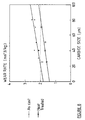
- the fractured surface of the mould inoculated impeller exhibited an appearance typical of a fine grain structure throughout the 40 mm thickness of the casting, and Figure 3 illustrates the results of a Vickers Hardness traverse through the full thickness.
- a surface hardness of about 780 HV dropped to about 650 HV at a depth of about 8-10 mm below the surface.
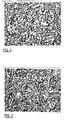
- the ladle inoculated casting showed a hypereutectic microstructure consisting of primary M 7 C 3 carbides having a mean cross-sectional dimension of 40 ⁇ m with a matrix of eutectic carbides with martensite and retained austenite. There was no evidence of undissolved chromium carbide in the microstructure.
- the mould insulated casting showed a fine hypereutectic microstructure consisting of primary M 7 C 3 carbides having a mean cross-sectional dimension of less than 25 ⁇ m (and therefore about half of the ladle inoculated sample) with very fine eutectic carbides in an austenite/martensite matrix.
- Some relatively coarse carbide particles were evidence, typical of partially dissolved chromium carbide.
- the martensite was present as a consistent layer around all primary and eutectic carbides and appears to have initiated at the carbide/ferrous matrix interface with growth occurring into the austenite phase. Its presence would tend to enhance wear resistance and lower the toughness of the material.
- the larger particles in the powder are inefficient in seeding the primary carbides in the microstructure.
- the powder also contained a substantial amount of very fine particles that are nominally less than 10 ⁇ m. These particles would fully dissolve in the melt and would be effective in rapidly reducing the temperature of the liquid but would not be effective as seeding agents for carbide formation.
- a maximum particle size of about 75 ⁇ m is considered appropriate.
- the introduction of 1 wt% chromium carbide powder to the stream of melt was sufficient to rapidly undercool the liquid metal from a superheat of about 5°C to a temperature just below the liquidus and within the two phase (liquid + carbide) region due to a thermal mass effect and thereby restrict the growth of the primary M 7 C 3 carbides.
- the chromium carbide powder having the same crystal structure and a higher melting point than the primary M 7 C 3 carbides, acted as a compatible and effective seeding agent for nucleating multiple primary carbides in the casting.
- This example considered a high chromium hypereutectic white iron casting containing 5.5 wt% carbon and mould inoculated with chromium carbide powder at a rate of 1% of the final casting weight.
- the composition, conditions and results of the as cast material are set out in Table 2.
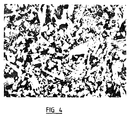
- the photomicrograph of Figure 4 (mag: 100x) illustrates the hypereutectic microstructure exhibiting a high volume fraction of primary M 7 C 3 carbides with some irregular CrC carbides being evident. Higher magnifications illustrate the ferrous matrix showing some martensite and secondary carbide precipitants.
- mould inoculation with 1 wt% chromium carbide powder of a high chromium hypereutectic white iron melt which has a carbon content of 5.5 wt% is effective in maintaining a primary M 7 C 3 carbide mean cross-sectional dimension below about 50 ⁇ m.
- the addition of the inoculation powder to the melt compensated for the adverse effects of the higher carbon content.
- This example describes the effect of increasing the degree of superheat to 30°C on the mould inoculation with 1 wt% chromium carbide powder of a standard high chromium hypereutectic white iron. It also examines the role of the original CrC inoculating particles in the final microstructure of the casting.
- compositions, conditions and results of the as cast 30°C superheat material are set out in Table 3.
- FIG. 5 A secondary electron image of the microstructure of the 30°C superheat mould inoculated casting is shown in Figure 5. Dark central cores in the three relatively coarse carbides were shown by microanalysis to contain chromium only and were consistent with the stoichemistry of the Cr 7 C 3 carbides. Lighter outer rims of these castings contain iron and chromium consistent with the stoichemistry of (Fe, Cr) 7 C 3 carbides. This shows that the partially dissolved Cr 7 C 3 powder particles have acted as seeds for the growth of (Fe, Cr) 7 C 3 carbides in the microstructure.
- Example 3 compares the casting of Example 3 with two castings from identical melts but with one casting identically mould inoculated except at a superheat of 15°C and with the other casting not inoculated at all. This was used to show that the thermal mass cooling of the molten metal by the inoculation may be a method of expanding the relatively small range of pour temperatures which have been applicable in the past for the manufacture of high chromium hypereutectic white iron castings with acceptable carbide sizes.
- the mould inoculation of a high chromium hypereutectic white iron melt with 1 wt% chromium carbide at a superheat of 30 ° C produced a primary carbide size of 50 ⁇ m. This is similar to the same melt cast at a superheat of 15°C with no inoculation. However, as compared to the shrinkage described in Example 3, the casting at a superheat of 15°C with no inoculation was sound.
- a casting thickness of 50 mm is equivalent to a final casting weight of 100 kg and a casting thickness of 100 mm is equivalent to a final casting weight of 500 kg.
- This example compares mould inoculation using 1) high carbon ferrochrome (Fe-Cr) powder (-75 ⁇ m), 2) CrC powder (1-150 ⁇ m) and 3) iron powder (-200 ⁇ m) of high chromium hypereutectic white iron melts at injection rates ranging from 1 to about 2.5% of the final casting weight and at superheats varying from 10 to 40°C, to determine the effect of the variables on microstructure, hardness and wear resistance compared with the standard high chromium hypereutectic white iron. All trials were carried out on an impeller weighing 450 kg.
- a sizing analysis shows that the approximately 90% of the powder has a particle size between 10 and 60 ⁇ m.
- Chemical analysis shows the following wt% composition: 8.42% C, 69.1% Cr, 0.71 Mn, 1.31% Si, 0.06% Mo and 0.27% Ni.
- Table 4 sets out the chemical composition of the castings examined. Sample pieces 70 x 50 x 40 mm were cast with the impellers for each melt and were tested by 1) visual examination, 2) metallography, 3) hardness testing, 4) wear testing, and 5) chemical analysis. The chemical analysis results set out in Table 4 show that all samples were within specification. The chemical analysis also showed the presence of sulphur and phosphorous, but each at less than 0.05 wt% and of boron but at least than 0.002 wt%.
- Eductor wear tests were carried on ten of the sixteen samples as shown in Table 6 with the tests being performed at a 30 ° angle and a velocity of 20 m/s. The testing was carried out using 10 kg of medium Silica River Sand (SRS) W300 d85 (485 ⁇ m). Wear rate 1 was measured at the surface of the sample while wear rate 2 was measured in from the cast surface.
- SRS Silica River Sand
- samples A851 and A866 are of standard high chromium hypereutectic white iron with no inoculant while samples A858 and A859 are from high carbon and high chromium melts.
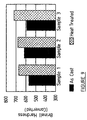
- Figure 8 graphically illustrates the trend to improved wear resistance with finer primary carbides in the SRS W300 wear medium.
- Figure 8 also illustrates the further improvement in wear rate following a heat treatment of four of the samples of Example 5, as shown in Table 7.
- Eductor wear test conditions were the same as in Example 5. The heat treatment was carried out by heating the castings to 950°C and holding for 4.5 hours, followed by air cooling.
- This example considered the effect of heat treating three high chromium hypereutectic white iron castings which have been mould inoculated with about 1% final casting weight of minus 75 ⁇ m Fe-Cr powder and poured at superheats of from 25 to 27°C.
- the after-casting heat treatment comprised heating the castings to 950°C and holding for 4.5 hours, followed by air cooling.
- the castings were of various pump parts and all had the same wt% composition of Cr 30.7, C 4.5, Mn 2, Si 0.57, Mo 0.94, Ni 0.57, B O, S 0.03, P 0.04, Fe balance.
- the melt was the same for all castings and had a liquidus of 1355 °C.
- the castings were tested 1) by visual examination, 2) by metallograph and 3) for hardness, all both before and after heat treating.
- microstructures were typical of a high chromium hypereutectic white iron with fine primary carbide sizes of 20-25 ⁇ m cross-sectional dimension uniformly spread throughout the matrix.
- the results of the analyses and details of the matrices are set out in Tables 8 and 9, respectively.
- a substantial advantage of the casting method of the present invention is that a relatively small M 7 C 3 primary carbide cross-sectional size can be readily achieved in an inexpensive, quick and uncomplicated manner using existing casting equipment. This is achieved by introducing a particulate material to the molten metal composition at the last possible moment, actually during the pour of the melt into the casting mould, to achieve a degree of undercooling which in turn promotes the formation of the fine grain structure by maximising the number of primary -carbide nuclei and thereby minimising their growth. The addition of the cooling powder in this way allows a greater pouring window for the casting which is highly beneficial in foundry practice.
- substantially larger castings for example upto 3000 kg
- Past practice has only achieved 100 ⁇ m mean cross-sectional primary carbides in 100 mm cross-sectional castings without internal chills.
- Similar sized and larger tough castings can be readily made by the present invention with a primary carbide mean cross-section of 50 ⁇ m and less, preferably in the range 20 - 30 ⁇ m.
- these microstructures can be achieved with carbon contents of 5.5 wt% and higher leading to increased carbide volumes and wear resistance.
- the relatively small primary carbide size increases the wear resistance of the castings and the fracture toughness, as well as allowing heat treatments to be performed to further increase the hardness and wear resistance.
Landscapes
- Engineering & Computer Science (AREA)
- Mechanical Engineering (AREA)
- Chemical & Material Sciences (AREA)
- Materials Engineering (AREA)
- Metallurgy (AREA)
- Organic Chemistry (AREA)
- Refinement Of Pig-Iron, Manufacture Of Cast Iron, And Steel Manufacture Other Than In Revolving Furnaces (AREA)
- Physical Or Chemical Processes And Apparatus (AREA)
- Production Of Liquid Hydrocarbon Mixture For Refining Petroleum (AREA)
- Continuous Casting (AREA)
- Molds, Cores, And Manufacturing Methods Thereof (AREA)
- Pharmaceuticals Containing Other Organic And Inorganic Compounds (AREA)
- Manufacture Of Metal Powder And Suspensions Thereof (AREA)
- Optical Elements Other Than Lenses (AREA)
- Manufacture Of Alloys Or Alloy Compounds (AREA)
- Mold Materials And Core Materials (AREA)
Applications Claiming Priority (4)
| Application Number | Priority Date | Filing Date | Title |
|---|---|---|---|
| AUPL894893 | 1993-05-21 | ||
| AUPL8948/93 | 1993-05-21 | ||
| AUPL894893 | 1993-05-21 | ||
| PCT/AU1994/000264 WO1994027763A1 (en) | 1993-05-21 | 1994-05-20 | Microstructurally refined multiphase castings |
Publications (3)
| Publication Number | Publication Date |
|---|---|
| EP0701494A1 EP0701494A1 (en) | 1996-03-20 |
| EP0701494A4 EP0701494A4 (en) | 1997-10-22 |
| EP0701494B1 true EP0701494B1 (en) | 2001-04-25 |
Family
ID=3776912
Family Applications (1)
| Application Number | Title | Priority Date | Filing Date |
|---|---|---|---|
| EP94916087A Expired - Lifetime EP0701494B1 (en) | 1993-05-21 | 1994-05-20 | Microstructurally refined multiphase castings |
Country Status (18)
| Country | Link |
|---|---|
| US (1) | US5803152A (enExample) |
| EP (1) | EP0701494B1 (enExample) |
| JP (1) | JP3435162B2 (enExample) |
| CN (1) | CN1053130C (enExample) |
| AT (1) | ATE200749T1 (enExample) |
| AU (1) | AU698777B2 (enExample) |
| BR (1) | BR9406545A (enExample) |
| CA (1) | CA2161959C (enExample) |
| DE (2) | DE69427149T2 (enExample) |
| ES (1) | ES2157982T3 (enExample) |
| GB (1) | GB2292705B (enExample) |
| IN (1) | IN181991B (enExample) |
| MY (1) | MY111100A (enExample) |
| NZ (1) | NZ266400A (enExample) |
| RU (1) | RU2156176C2 (enExample) |
| UA (1) | UA42721C2 (enExample) |
| WO (1) | WO1994027763A1 (enExample) |
| ZA (1) | ZA943507B (enExample) |
Families Citing this family (42)
| Publication number | Priority date | Publication date | Assignee | Title |
|---|---|---|---|---|
| US6460595B1 (en) * | 1999-02-23 | 2002-10-08 | General Electric Company | Nucleated casting systems and methods comprising the addition of powders to a casting |
| SE522667C2 (sv) * | 2000-05-16 | 2004-02-24 | Proengco Tooling Ab | Förfarande för framställning av en legering baserad på järn innehållande kromkarbid med inlöst volfram och en sådan legering |
| US6689312B2 (en) * | 2001-11-28 | 2004-02-10 | Sg Alternatives, L.L.C. | Alloy composition and improvements in mold components used in the production of glass containers |
| AU2003902535A0 (en) * | 2003-05-22 | 2003-06-05 | Weir Warman Ltd | Wear resistant cast iron |
| CA2585499C (en) * | 2003-10-27 | 2014-05-13 | Global Tough Alloys Pty Ltd | Improved wear resistant alloy |
| CN1946876B (zh) * | 2004-02-16 | 2011-07-27 | 凯文·弗朗西斯·道曼 | 表面耐磨堆焊铁合金材料 |
| US20050211475A1 (en) * | 2004-04-28 | 2005-09-29 | Mirchandani Prakash K | Earth-boring bits |
| US9428822B2 (en) | 2004-04-28 | 2016-08-30 | Baker Hughes Incorporated | Earth-boring tools and components thereof including material having hard phase in a metallic binder, and metallic binder compositions for use in forming such tools and components |
| EP2351865A1 (en) | 2004-10-27 | 2011-08-03 | Global Tough Alloys Pty Ltd | Improved wear resitant alloy |
| EP2351866B1 (en) | 2004-10-27 | 2014-11-26 | Global Tough Alloys Pty Ltd | Improved wear resistant alloy |
| US8637127B2 (en) | 2005-06-27 | 2014-01-28 | Kennametal Inc. | Composite article with coolant channels and tool fabrication method |
| US7687156B2 (en) | 2005-08-18 | 2010-03-30 | Tdy Industries, Inc. | Composite cutting inserts and methods of making the same |
| EP2327856B1 (en) | 2006-04-27 | 2016-06-08 | Kennametal Inc. | Modular fixed cutter earth-boring bits, modular fixed cutter earth-boring bit bodies, and related methods |
| CN102764893B (zh) | 2006-10-25 | 2015-06-17 | 肯纳金属公司 | 具有改进的抗热开裂性的制品 |
| US8790439B2 (en) | 2008-06-02 | 2014-07-29 | Kennametal Inc. | Composite sintered powder metal articles |
| US8025112B2 (en) | 2008-08-22 | 2011-09-27 | Tdy Industries, Inc. | Earth-boring bits and other parts including cemented carbide |
| US8272816B2 (en) | 2009-05-12 | 2012-09-25 | TDY Industries, LLC | Composite cemented carbide rotary cutting tools and rotary cutting tool blanks |
| US8201610B2 (en) | 2009-06-05 | 2012-06-19 | Baker Hughes Incorporated | Methods for manufacturing downhole tools and downhole tool parts |
| US8308096B2 (en) | 2009-07-14 | 2012-11-13 | TDY Industries, LLC | Reinforced roll and method of making same |
| US9643236B2 (en) | 2009-11-11 | 2017-05-09 | Landis Solutions Llc | Thread rolling die and method of making same |
| RU2407606C1 (ru) * | 2009-12-01 | 2010-12-27 | Открытое акционерное общество "Нижнетагильский металлургический комбинат" (ОАО "НТМК") | Способ получения непрерывнолитой заготовки повышенного качества |
| CN102146546B (zh) * | 2010-02-09 | 2015-12-02 | 徐州胜海机械制造科技有限公司 | 一种用于固体物料输送管的高流动性高耐磨性合金材料 |
| DE102010018228A1 (de) * | 2010-04-23 | 2011-10-27 | Rheinisch-Westfälische Technische Hochschule Aachen | Metallhybrid-Verbundgussteil |
| CN102985197A (zh) * | 2010-05-20 | 2013-03-20 | 贝克休斯公司 | 形成钻地工具的至少一部分的方法,以及通过此类方法形成的制品 |
| EP2571646A4 (en) | 2010-05-20 | 2016-10-05 | Baker Hughes Inc | METHOD OF FORMING AT LEAST ONE PART OF AN EARTHING TOOL |
| WO2011146752A2 (en) * | 2010-05-20 | 2011-11-24 | Baker Hughes Incorporated | Methods of forming at least a portion of earth-boring tools, and articles formed by such methods |
| US8800848B2 (en) | 2011-08-31 | 2014-08-12 | Kennametal Inc. | Methods of forming wear resistant layers on metallic surfaces |
| US9016406B2 (en) | 2011-09-22 | 2015-04-28 | Kennametal Inc. | Cutting inserts for earth-boring bits |
| CN102851570A (zh) * | 2012-03-14 | 2013-01-02 | 宁波市圣盾机械制造有限公司 | 热磨机的高碳高铬磨片铸件 |
| US9284631B2 (en) | 2014-05-16 | 2016-03-15 | Roman Radon | Hypereutectic white iron alloys comprising chromium and nitrogen and articles made therefrom |
| US9580777B1 (en) * | 2016-02-08 | 2017-02-28 | Roman Radon | Hypereutectic white iron alloys comprising chromium, boron and nitrogen and articles made therefrom |
| MA44552B1 (fr) * | 2016-06-24 | 2020-11-30 | Weir Minerals Australia Ltd | Fontes blanches résistantes à l'érosion et à la corrosion |
| RU2652922C1 (ru) * | 2017-12-05 | 2018-05-03 | Юлия Алексеевна Щепочкина | Сплав на основе железа |
| RU2652928C1 (ru) * | 2017-12-05 | 2018-05-03 | Юлия Алексеевна Щепочкина | Сплав на основе железа |
| RU2663950C1 (ru) * | 2018-01-09 | 2018-08-13 | Юлия Алексеевна Щепочкина | Сплав |
| CN108776150B (zh) * | 2018-06-06 | 2020-05-19 | 东北大学 | 一种研究凝固过程中非金属夹杂物形成和转变的方法 |
| CN110724871B (zh) * | 2019-11-29 | 2021-08-13 | 南昌航空大学 | 一种过共晶高铬铸铁穿孔机导板的制备方法 |
| KR102538088B1 (ko) * | 2021-09-24 | 2023-05-26 | 창원대학교 산학협력단 | 석출강화 열처리에 의한 고크롬백주철의 제조방법 |
| US12084732B2 (en) | 2022-03-29 | 2024-09-10 | Townley Foundry & Machine Co., Inc. | Hypereutectic white iron alloy comprising chromium, boron and nitrogen and cryogenically hardened articles made therefrom |
| CN114752840B (zh) * | 2022-05-11 | 2023-06-16 | 长沙威尔保新材料有限公司 | 高铬白口抗磨铸铁部件与金属部件的直接连接方法 |
| CN114645186B (zh) * | 2022-05-11 | 2023-03-24 | 长沙威尔保新材料有限公司 | 一种可电焊高铬白口抗磨铸铁及制备方法 |
| CN115354208B (zh) * | 2022-07-25 | 2023-10-31 | 安徽新马铸造科技有限公司 | 一种高铬合金复合耐磨钢球 |
Family Cites Families (17)
| Publication number | Priority date | Publication date | Assignee | Title |
|---|---|---|---|---|
| GB405842A (en) * | 1932-05-02 | 1934-02-15 | Ver Stahlwerke Ag | Method of preventing coarse crystallisation at the solidification of metallic castings |
| GB491341A (en) * | 1936-07-15 | 1938-08-31 | Metal Carbides Corp | Improvements in or relating to the casting of metal |
| US3844776A (en) * | 1969-06-16 | 1974-10-29 | Ford Motor Co | Method of casting inoculated metals |
| US3662810A (en) * | 1969-09-02 | 1972-05-16 | Howmet Corp | Method of internal nucleation of a casting |
| CA994573A (en) * | 1972-08-07 | 1976-08-10 | Massachusetts Institute Of Technology | Method for preparing liquid-solid alloy and product |
| DE2554782C3 (de) * | 1975-12-05 | 1983-04-07 | Caspers, Karl-Heinz, 8500 Nürnberg | Verfahren und Vorrichtung zur Impfbehandlung von Gußeisenschmelzen |
| SU569887A1 (ru) * | 1976-01-04 | 1977-08-25 | Предприятие П/Я М-5539 | Устройство дл измерени давлени |
| JPS5418426A (en) * | 1977-07-12 | 1979-02-10 | Kawasaki Steel Co | Prevention of internal defect in steel ingot |
| JPS5471726A (en) * | 1977-11-19 | 1979-06-08 | Kawasaki Steel Co | Preventing of interior defect of casted steel lump |
| JPS5575855A (en) * | 1978-11-30 | 1980-06-07 | Hitachi Metals Ltd | Adding method of inoculant |
| RO80621A2 (ro) * | 1980-03-04 | 1983-02-01 | Institutul Politehnic,Ro | Racitor pentru piese turnate si procedeu de realizare |
| JPS575813A (en) * | 1980-06-13 | 1982-01-12 | Sumitomo Metal Ind Ltd | Method of adding rare earth element containing material to molten steel |
| US4420460A (en) * | 1982-12-02 | 1983-12-13 | Lockheed Missiles & Space Company, Inc. | Grain refinement of titanium alloys |
| ZA844074B (en) * | 1983-05-30 | 1986-04-30 | Vickers Australia Ltd | Abrasion resistant materials |
| SU1329909A1 (ru) * | 1985-06-10 | 1987-08-15 | Электрометаллургический Завод "Днепроспецсталь" Им.А.Н.Кузьмина | Способ получени стальных слитков |
| SU1650346A1 (ru) * | 1988-03-17 | 1991-05-23 | Предприятие П/Я В-2573 | Устройство дл обработки расплава порошками |
| JPH059632A (ja) * | 1991-07-03 | 1993-01-19 | Sekisui Chem Co Ltd | 亜鉛基合金製鋳物及びその製造方法 |
-
1994
- 1994-05-20 IN IN379CA1994 patent/IN181991B/en unknown
- 1994-05-20 AU AU67894/94A patent/AU698777B2/en not_active Expired
- 1994-05-20 RU RU95122579/02A patent/RU2156176C2/ru active
- 1994-05-20 UA UA95114923A patent/UA42721C2/uk unknown
- 1994-05-20 WO PCT/AU1994/000264 patent/WO1994027763A1/en not_active Ceased
- 1994-05-20 MY MYPI94001303A patent/MY111100A/en unknown
- 1994-05-20 NZ NZ266400A patent/NZ266400A/en not_active IP Right Cessation
- 1994-05-20 EP EP94916087A patent/EP0701494B1/en not_active Expired - Lifetime
- 1994-05-20 US US08/545,783 patent/US5803152A/en not_active Expired - Lifetime
- 1994-05-20 DE DE69427149T patent/DE69427149T2/de not_active Expired - Lifetime
- 1994-05-20 DE DE4493399T patent/DE4493399T1/de not_active Withdrawn
- 1994-05-20 ES ES94916087T patent/ES2157982T3/es not_active Expired - Lifetime
- 1994-05-20 CA CA002161959A patent/CA2161959C/en not_active Expired - Lifetime
- 1994-05-20 ZA ZA943507A patent/ZA943507B/xx unknown
- 1994-05-20 CN CN94192778A patent/CN1053130C/zh not_active Expired - Lifetime
- 1994-05-20 JP JP50001395A patent/JP3435162B2/ja not_active Expired - Lifetime
- 1994-05-20 AT AT94916087T patent/ATE200749T1/de active
- 1994-05-20 GB GB9522398A patent/GB2292705B/en not_active Expired - Lifetime
- 1994-05-20 BR BR9406545A patent/BR9406545A/pt not_active IP Right Cessation
Also Published As
| Publication number | Publication date |
|---|---|
| GB2292705A (en) | 1996-03-06 |
| HK1010351A1 (en) | 1999-06-17 |
| CN1126961A (zh) | 1996-07-17 |
| EP0701494A1 (en) | 1996-03-20 |
| ES2157982T3 (es) | 2001-09-01 |
| JPH08510298A (ja) | 1996-10-29 |
| ATE200749T1 (de) | 2001-05-15 |
| ZA943507B (en) | 1995-01-23 |
| NZ266400A (en) | 1997-09-22 |
| GB9522398D0 (en) | 1996-01-03 |
| GB2292705B (en) | 1997-01-15 |
| CA2161959C (en) | 2009-12-08 |
| AU698777B2 (en) | 1998-11-05 |
| US5803152A (en) | 1998-09-08 |
| WO1994027763A1 (en) | 1994-12-08 |
| DE69427149D1 (de) | 2001-05-31 |
| EP0701494A4 (en) | 1997-10-22 |
| IN181991B (enExample) | 1998-11-28 |
| BR9406545A (pt) | 1996-01-02 |
| MY111100A (en) | 1999-08-30 |
| DE69427149T2 (de) | 2001-11-22 |
| DE4493399T1 (de) | 1996-08-22 |
| RU2156176C2 (ru) | 2000-09-20 |
| CA2161959A1 (en) | 1994-12-08 |
| UA42721C2 (uk) | 2001-11-15 |
| CN1053130C (zh) | 2000-06-07 |
| AU6789494A (en) | 1994-12-20 |
| JP3435162B2 (ja) | 2003-08-11 |
Similar Documents
| Publication | Publication Date | Title |
|---|---|---|
| EP0701494B1 (en) | Microstructurally refined multiphase castings | |
| Jain et al. | Refinement of primary carbides in hypereutectic high-chromium cast irons: a review | |
| EP3089839B1 (en) | Centrifugal cast composite metal product | |
| EP0147422A1 (en) | Tough, wear- and abrasion-resistant, high chromium hypereutectic white iron | |
| Seah et al. | Effect of the cooling rate on the dendrite arm spacing and the ultimate tensile strength of cast iron | |
| JP4548263B2 (ja) | 耐摩耗性に優れた鋳鉄品の製造方法 | |
| JPH08506143A (ja) | エンジニアリング・フェラス・メタル類 | |
| Bedolla-Jacuinde | Niobium in cast irons | |
| El-Fawkhry et al. | Eliminating heat treatment of Hadfield steel in stress abrasion wear applications | |
| Hemanth et al. | Effect of cooling rate on eutectic cell count, grain size, microstructure, and ultimate tensile strength of hypoeutectic cast iron | |
| US6013141A (en) | Cast iron indefinite chill roll produced by the addition of niobium | |
| KIANI et al. | Graphite phase formation in Al-alloyed ductile irons | |
| US20040079450A1 (en) | Nodular graphite cast iron with high strength and high toughness | |
| Zhi et al. | Effect of fluctuation and modification on microstructure and impact toughness of 20 wt.% Cr hypereutectic white cast iron. Einfluss durch Partikelzugaben und Modifikationen auf die Mikrostruktur und die Kerbschlagzähigkeit von übereutektischem weißen Gusseisen mit 20 Gew.‐% Cr | |
| RU2765474C1 (ru) | Способ получения износостойких высокопрочных отливок из чугуна | |
| HK1010351B (en) | Microstructurally refined multiphase castings | |
| Gagné et al. | Effect of wall thickness on the graphite morphology and properties of D5-S austenitic ductile iron | |
| SU1560608A1 (ru) | Чугун | |
| JP2648482B2 (ja) | 被削性に優れた球状黒鉛鋳鉄 | |
| JP3383180B2 (ja) | 高耐摩耗性冷間圧延用複合ワークロール | |
| Ashrafizadeh et al. | Solidification structures and mechanical properties of Zn–27Al alloy cast in metal moulds | |
| Zaczyński et al. | Occurrence of Chunky graphite in ductile cast iron solution strengthened by silicon | |
| JPH05331590A (ja) | 鋳型内黒鉛球状化処理合金及び黒鉛球状化処理方法 | |
| Hemanth | Solidification behavior of water-cooled and subzero-chilled cast iron on mechanical properties | |
| SU1585370A1 (ru) | Модификатор дл чугуна |
Legal Events
| Date | Code | Title | Description |
|---|---|---|---|
| PUAI | Public reference made under article 153(3) epc to a published international application that has entered the european phase |
Free format text: ORIGINAL CODE: 0009012 |
|
| 17P | Request for examination filed |
Effective date: 19951213 |
|
| AK | Designated contracting states |
Kind code of ref document: A1 Designated state(s): AT BE CH DE DK ES FR GB IT LI NL SE |
|
| RBV | Designated contracting states (corrected) |
Designated state(s): AT BE CH DE DK ES FR GB IT LI NL SE |
|
| A4 | Supplementary search report drawn up and despatched |
Effective date: 19970909 |
|
| AK | Designated contracting states |
Kind code of ref document: A4 Designated state(s): AT BE CH DE DK ES FR GB IT LI NL SE |
|
| 17Q | First examination report despatched |
Effective date: 19980624 |
|
| GRAG | Despatch of communication of intention to grant |
Free format text: ORIGINAL CODE: EPIDOS AGRA |
|
| GRAG | Despatch of communication of intention to grant |
Free format text: ORIGINAL CODE: EPIDOS AGRA |
|
| GRAH | Despatch of communication of intention to grant a patent |
Free format text: ORIGINAL CODE: EPIDOS IGRA |
|
| GRAH | Despatch of communication of intention to grant a patent |
Free format text: ORIGINAL CODE: EPIDOS IGRA |
|
| GRAA | (expected) grant |
Free format text: ORIGINAL CODE: 0009210 |
|
| AK | Designated contracting states |
Kind code of ref document: B1 Designated state(s): AT BE CH DE DK ES FR GB IT LI NL SE |
|
| PG25 | Lapsed in a contracting state [announced via postgrant information from national office to epo] |
Ref country code: LI Free format text: LAPSE BECAUSE OF FAILURE TO SUBMIT A TRANSLATION OF THE DESCRIPTION OR TO PAY THE FEE WITHIN THE PRESCRIBED TIME-LIMIT Effective date: 20010425 Ref country code: CH Free format text: LAPSE BECAUSE OF FAILURE TO SUBMIT A TRANSLATION OF THE DESCRIPTION OR TO PAY THE FEE WITHIN THE PRESCRIBED TIME-LIMIT Effective date: 20010425 |
|
| REF | Corresponds to: |
Ref document number: 200749 Country of ref document: AT Date of ref document: 20010515 Kind code of ref document: T |
|
| REG | Reference to a national code |
Ref country code: CH Ref legal event code: EP |
|
| REF | Corresponds to: |
Ref document number: 69427149 Country of ref document: DE Date of ref document: 20010531 |
|
| ITF | It: translation for a ep patent filed | ||
| PG25 | Lapsed in a contracting state [announced via postgrant information from national office to epo] |
Ref country code: DK Free format text: LAPSE BECAUSE OF FAILURE TO SUBMIT A TRANSLATION OF THE DESCRIPTION OR TO PAY THE FEE WITHIN THE PRESCRIBED TIME-LIMIT Effective date: 20010725 |
|
| REG | Reference to a national code |
Ref country code: ES Ref legal event code: FG2A Ref document number: 2157982 Country of ref document: ES Kind code of ref document: T3 |
|
| EN | Fr: translation not filed | ||
| REG | Reference to a national code |
Ref country code: CH Ref legal event code: PL |
|
| REG | Reference to a national code |
Ref country code: GB Ref legal event code: IF02 |
|
| EN | Fr: translation not filed |
Free format text: BO 01/38 PAGES: 263, IL Y A LIEU DE SUPPRIMER: LA MENTION DE LA NON REMISE. LA REMISE EST PUBLIEE DANS LE PRESENT BOPI |
|
| ET | Fr: translation filed | ||
| PLBE | No opposition filed within time limit |
Free format text: ORIGINAL CODE: 0009261 |
|
| STAA | Information on the status of an ep patent application or granted ep patent |
Free format text: STATUS: NO OPPOSITION FILED WITHIN TIME LIMIT |
|
| 26N | No opposition filed | ||
| PGFP | Annual fee paid to national office [announced via postgrant information from national office to epo] |
Ref country code: GB Payment date: 20020515 Year of fee payment: 9 |
|
| PG25 | Lapsed in a contracting state [announced via postgrant information from national office to epo] |
Ref country code: GB Free format text: LAPSE BECAUSE OF NON-PAYMENT OF DUE FEES Effective date: 20030520 |
|
| GBPC | Gb: european patent ceased through non-payment of renewal fee |
Effective date: 20030520 |
|
| PGFP | Annual fee paid to national office [announced via postgrant information from national office to epo] |
Ref country code: ES Payment date: 20120607 Year of fee payment: 19 |
|
| PGFP | Annual fee paid to national office [announced via postgrant information from national office to epo] |
Ref country code: AT Payment date: 20120426 Year of fee payment: 19 |
|
| PGFP | Annual fee paid to national office [announced via postgrant information from national office to epo] |
Ref country code: DE Payment date: 20130515 Year of fee payment: 20 Ref country code: SE Payment date: 20130513 Year of fee payment: 20 |
|
| PGFP | Annual fee paid to national office [announced via postgrant information from national office to epo] |
Ref country code: FR Payment date: 20130531 Year of fee payment: 20 Ref country code: NL Payment date: 20130510 Year of fee payment: 20 Ref country code: BE Payment date: 20130531 Year of fee payment: 20 Ref country code: IT Payment date: 20130514 Year of fee payment: 20 |
|
| REG | Reference to a national code |
Ref country code: DE Ref legal event code: R071 Ref document number: 69427149 Country of ref document: DE |
|
| REG | Reference to a national code |
Ref country code: NL Ref legal event code: V4 Effective date: 20140520 |
|
| BE20 | Be: patent expired |
Owner name: *WARMAN INTERNATIONAL LTD Effective date: 20140520 |
|
| REG | Reference to a national code |
Ref country code: SE Ref legal event code: EUG |
|
| REG | Reference to a national code |
Ref country code: AT Ref legal event code: MK07 Ref document number: 200749 Country of ref document: AT Kind code of ref document: T Effective date: 20140520 |
|
| REG | Reference to a national code |
Ref country code: ES Ref legal event code: FD2A Effective date: 20140807 |
|
| PG25 | Lapsed in a contracting state [announced via postgrant information from national office to epo] |
Ref country code: DE Free format text: LAPSE BECAUSE OF EXPIRATION OF PROTECTION Effective date: 20140521 |
|
| PG25 | Lapsed in a contracting state [announced via postgrant information from national office to epo] |
Ref country code: ES Free format text: LAPSE BECAUSE OF EXPIRATION OF PROTECTION Effective date: 20140521 |