EP0683795B2 - Continuous process and apparatus for the halogenation of elastomers - Google Patents
Continuous process and apparatus for the halogenation of elastomers Download PDFInfo
- Publication number
- EP0683795B2 EP0683795B2 EP94903784A EP94903784A EP0683795B2 EP 0683795 B2 EP0683795 B2 EP 0683795B2 EP 94903784 A EP94903784 A EP 94903784A EP 94903784 A EP94903784 A EP 94903784A EP 0683795 B2 EP0683795 B2 EP 0683795B2
- Authority
- EP
- European Patent Office
- Prior art keywords
- elastomer
- solution
- process according
- halogenating agent
- reactor
- Prior art date
- Legal status (The legal status is an assumption and is not a legal conclusion. Google has not performed a legal analysis and makes no representation as to the accuracy of the status listed.)
- Expired - Lifetime
Links
Images
Classifications
-
- C—CHEMISTRY; METALLURGY
- C08—ORGANIC MACROMOLECULAR COMPOUNDS; THEIR PREPARATION OR CHEMICAL WORKING-UP; COMPOSITIONS BASED THEREON
- C08F—MACROMOLECULAR COMPOUNDS OBTAINED BY REACTIONS ONLY INVOLVING CARBON-TO-CARBON UNSATURATED BONDS
- C08F8/00—Chemical modification by after-treatment
- C08F8/18—Introducing halogen atoms or halogen-containing groups
- C08F8/20—Halogenation
-
- C—CHEMISTRY; METALLURGY
- C08—ORGANIC MACROMOLECULAR COMPOUNDS; THEIR PREPARATION OR CHEMICAL WORKING-UP; COMPOSITIONS BASED THEREON
- C08C—TREATMENT OR CHEMICAL MODIFICATION OF RUBBERS
- C08C19/00—Chemical modification of rubber
- C08C19/12—Incorporating halogen atoms into the molecule
- C08C19/14—Incorporating halogen atoms into the molecule by reaction with halogens
-
- C—CHEMISTRY; METALLURGY
- C08—ORGANIC MACROMOLECULAR COMPOUNDS; THEIR PREPARATION OR CHEMICAL WORKING-UP; COMPOSITIONS BASED THEREON
- C08F—MACROMOLECULAR COMPOUNDS OBTAINED BY REACTIONS ONLY INVOLVING CARBON-TO-CARBON UNSATURATED BONDS
- C08F210/00—Copolymers of unsaturated aliphatic hydrocarbons having only one carbon-to-carbon double bond
- C08F210/04—Monomers containing three or four carbon atoms
- C08F210/08—Butenes
- C08F210/10—Isobutene
- C08F210/12—Isobutene with conjugated diolefins, e.g. butyl rubber
Definitions
- the present invention relates to a continuous process for the halogenation of elastomers, in which a halogenating agent is introduced into a solution of an unsaturated elastomer in an organic solvent and in which the said halogenating agent is mixed in a continuous stream of the said elastomer solution, thus dissolving the said halogenating agent and causing it to react with the said elastomer in the same continuous stream.
- US Patent 3,966,692 has described a process for the halogenation of elastomer solutions of high viscosity (from 1500 to 6000 cps) which are made to flow through a pipe in such a way that the Reynolds number is less than 100, the process being carried out under pressure, so as to assist the dissolution of the halogen and avoid the formation of gas bubbles, which would interfere with the laminar character of the flow.
- the inventors of the present invention have now found that the use of a stream of an elastomer solution of lower viscosity (for example ⁇ 1000 cps), kept in turbulent motion and avoiding flow inversion phenomena, makes it possible to improve the dispersion and diffusion of the halogen, avoiding high local concentrations of halogen which result in significant degradation of the elastomer chain.
- a stream of an elastomer solution of lower viscosity for example ⁇ 1000 cps
- this objective is achieved by a continuous process as described in claim 1.
- the said objective is achieved by use of a tubular reactor as described in claim 15.
- Preferred embodiments of the present invention are described in the dependent claims.
- the continuous process provided by the present invention is characterized in that the said continuous stream of elastomer solution is kept in turbulent motion without flow inversion phenomena during the course of the reaction between the said halogenating agent and the said elastomer.
- the turbulence of the solution is assisted by means of mechanical means which promote turbulence, which means may be static or dynamic, such as Raschig rings inserted into the said reactor, in which the organic solution of the elastomer is caused to flow continuously.
- an inert gas is added to the said elastomer solution, in order to assist the dispersion of the halogen, increase the turbulence and reduce the local concentrations of halogenating agent and of the halogenidric acid thus formed.
- the addition of the halogenating agent to the continuous stream of the said elastomer solution is carried out at atmospheric pressure, given the high speed of the reaction under the operating conditions employed.
- the local concentration of halogen is reduced and the distribution and diffusion of the same is increased, thus giving a more homogeneous and consistent halogenated product.
- the local excess of halogen is avoided and the degradation of the elastomer chain is hampered.
- the viscosity of the solution does not vary significantly after the halogenation.
- the presence of the inert gas assists the evolution of the halogenidric acid formed.
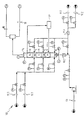
- the apparatus, according to the invention, for the halogenation of the elastomers is indicated as a whole by 10 and is intended to operate either with a gaseous halogenating agent, such as chlorine, led in through an introduction line 11.1, or - alternatively - with a liquid halogenating agent, such as bromine, fed in through an introduction line 11.2.
- a gaseous halogenating agent such as chlorine
- a liquid halogenating agent such as bromine
- 12.1 and 12.2 indicate the lines for Introducing the agents for diluting the halogenating agents: an inert gas for chlorine and for bromine (line 12.1) and an organic solvent for bromine (line 12.2).
- 13 indicates a line for introducing a solution of an unsaturated elastomer in an organic solvent.
- the organic solution of the unsaturated elastomer to be halogenated is caused to flowupwards in a tubular column 14, constituting a reactor, in which Is placed a plurality of Raschig rings 15 or similar, static or dynamic, means for promoting turbulence.
- the gaseous halogen is introduced into the column reactor 14 via distributors 16, located Immediately up-stream - according to the direction of flow of the elastomer solution - from each bed of Raschig rings.
- the gaseous stream of halogen Is subdivided via a plurality of distributors 16, so as to dilute the local amount of hal-ogen introduced into the reactor 14.
- the gaseous stream of halogen is introduced into the reactor 14 by means of a single distributor 16.
- the stream of gaseous halogen can be diluted, as stated, with an inert gas such as nitrogen. In that case, greater turbulence in the reactor 14 results and the dispersion of the halogen is assisted.
- the system does not have to be kept under superatmospheric pressure, which simplifies the degassing on leaving the reactor 14.
- the apparatus 10 is also suitable for the use of a liquid halogenating agent, such as bromine (feed line 11.2).
- a liquid halogenating agent such as bromine
- Turbulence is created immediately and excellent dispersion of the bromine in the elastomer solution is achieved.
- the turbulence can be increased by introducing inert gas into the reactor 14 via the distributors 16.
- the process according to the invention can be performed with any elastomer which can react with halogens and which can be dispersed in an inert organic solvent
- the said process is applicable to the halogenation of butyl rubber either with chlorine or with bromine.
- This rubber is very soluble in hexane but many other solvents can also be used for the same purpose.
- the text which follows will refer to the chlorination or bromination of butyl rubber, which has been dissolved in hexane.
- the viscosity of the butyl rubber dissolved in hexane should not exceed 1000 cps but should preferably be between 100 and 500 cps. This is easily achieved with butyl rubber concentrations of the order of 10% in hexane. Given that, at a particular temperature, the viscosity of the polymer solutions is a function of the molecular weight as well as of the concentration, it is necessary, when varying the grades of butyl rubber, to adjust the concentration so as to have a suitable viscosity. If the viscosity is lowered excessively, the turbulence, the dispersion and the diffusion of the halogen are improved but the productivity is lowered. Raising the viscosity excessively has the opposite effect. When butyl rubber is halogenated with chlorine or bromine, the temperature should be kept at between 10 and 40°C.
- the halogen can be introduced from a single distributor 16 or from a plurality of distributors 16 at various heights in the column 14. In the latter case, locally increased concentrations of halogen are avoided, leading to a halogenated product of a higher quality.
- the best dispersion of halogen is assisted by dilution. Where chlorine is used, it is preferable to dilute it with an inert gas such as nitrogen or others, chosen as desired.
- the ratio of inert gas/chlorine can be varied at will, taking account of the fact that increasing the said ratio assists turbulence, dispersion of the halogen and degassing but, at the same time, consumption and dimensions are increased. It has been found that a volumetric ratio of nitrogen/chlorine of about 4 or 5 is an excellent compromise.
- the halogen can be added in amounts related to the unsaturation of the elastomer.
- a solvent preferably the same solvent as that used to dilute the elastomer.
- a dilution to 10% can be optimal, but obviously does not impose a limitation on the process according to the invention.
- This dilution can be effected by means of any apparatus adapted to give good mixing, for example a static mixer 11.3.
- the bromine thus diluted can be added at one or more points of the column reactor 14, or immediately upstream from the latter - in the direction of the flow of the elastomer solution - in a suitable mixer, such as the mixer 13.1.
- a suitable mixer such as the mixer 13.1.
- reaction time required to complete the halogenation reaction depends on the temperature, and on the type and concentration of the elastomer and of the halogen.
- the length of the reaction column 14 can however be varied so as to make the reaction go to completion.
- washing with water after the degassing can be sufficient to remove all traces of acid and of unreacted halogen.
- a final wash with an alkaline solution is advisable. In that case, the consumption of the neutralising solution is greatly reduced.
- the method which consists in vaporising and separating off the solvent by passing the solution into stirred hot water is preferred, given the low viscosity and concentration of the solution.
- the reactor 14 was made of glass and consisted of tubular units superposed to form a column. Each unit had an internal diameter of 20 mm and a height of 150 mm and was provided with a distributor 16 and a layer of glass Raschig rings 15 of dimensions 5 x 5 mm.
- the distributors 16 consisted of type G 4 glass frits.
- the butyl rubber used had a viscosimetric molecular weight of about 500,000 and an unsaturation of 2.3%.
- the chlorine was introduced only from the first distributor 16 - with reference to the direction of the flow of the elastomer solution - after having been diluted with nitrogen beforehand.
- the feed rates were respectively 2.5 Nl/h of chlorine and 12 Nl/h of nitrogen.
- the rubber obtained had a chlorine content of 1.15% whilst the viscosimetric molecular weight was reduced by 2.2%.
- Example No. 1 The experiment of Example No. 1 was repeated, but the same gas mixture (divided into two equal parts) was introduced simultaneously from the first and second distributor 16 of the reactor 14 - with reference to the direction of flow of the elastomer solution.
- the rubber obtained showed no reduction in the molecular weight whilst the chlorine content was 1.2%.
- the rubber used had a viscosimetric molecular weight of about 390,000 and an unsaturation of 2%.
- the gas mixture was obtained by diluting 3 Nl/h of chlorine with 3 Nl/h of nitrogen and was introduced from the third distributor 16 - with reference to the direction of flow of the elastomer solution.
- the residence time in the reaction zone of the column 14 before degassing was 30 seconds under these conditions.
- the rubber obtained had a chlorine content of 1.10% and the molecular weight showed a reduction of 10%.
- the Mooney viscosity ML 1+8 (125°C) changed from 53.5 to 47.5.
- a 9.8% solution in hexane was prepared. This solution was introduced into the reactor at a temperature of 17°C with a feed rate of 6 l/h. Under these conditions, the viscosity was 220 cps.
- the gas mixture was obtained by diluting 4 Nl/h of chlorine with 20 Nl/h of nitrogen and was introduced from the second distributor 16 - with reference to the direction of flow of the elastomer solution.
- the residence time in the reaction zone before degassing was 60 seconds under these conditions.
- the rubber obtained had a chlorine content of 1.38%.
- the molecular weight fell by 5%.
- the Mooney viscosity ML 1+8 (125°C) changed from 52.5 to 51.5.
- a 9.8% solution was prepared and was introduced into the reactor 14 at a feed rate of 6 l/h at 25°C Under these conditions the viscosity of the solution was 180 cps.
- Bromine was added to the solution with a feed rate of 20 g/h of bromine diluted to 10% in hexane.
- the bromine solution was fed from the second distributor 16 - with reference to the direction of flow of the elastomer solution - together with 17 Nl/h of nitrogen.
- the residence time in the reaction zone of the column 14 before degassing was about 1 minute under these conditions.
- the rubber obtained had a bromine content of 2.25% and the viscosimetric molecular weight showed a reduction of 15%.
- a 9.8% solution was prepared and was introduced into the reactor at a feed rate of 6 l/h at 25°C. Under these conditions the viscosity of the solution was 180 cps.
- Undiluted bromine was added to the solution at a feed rate of 18 g/h, the bromine being fed from the first distributor 16 - with reference to the direction of flow of the elastomer solution -together with 17 Nl/h of nitrogen.
- the residence time in the reaction zone before degassing was about 90 seconds under these conditions.
- the rubber obtained had a bromine content of 1.90% and the viscosimetric molecular weight fell by 20%.
- the Mooney viscosity ML 1+8 (125°C) changed from 52 to 37.
Landscapes
- Chemical & Material Sciences (AREA)
- Health & Medical Sciences (AREA)
- Chemical Kinetics & Catalysis (AREA)
- Medicinal Chemistry (AREA)
- Polymers & Plastics (AREA)
- Organic Chemistry (AREA)
- General Chemical & Material Sciences (AREA)
- Addition Polymer Or Copolymer, Post-Treatments, Or Chemical Modifications (AREA)
- Organic Low-Molecular-Weight Compounds And Preparation Thereof (AREA)
Applications Claiming Priority (3)
| Application Number | Priority Date | Filing Date | Title |
|---|---|---|---|
| ITTO930081 | 1993-02-10 | ||
| ITTO930081A IT1270944B (it) | 1993-02-10 | 1993-02-10 | Procedimento continuo e impianto di alogenazione di elastomeri. |
| PCT/EP1993/003552 WO1994018244A1 (en) | 1993-02-10 | 1993-12-10 | Continuous process and apparatus for the halogenation of elastomers |
Publications (3)
| Publication Number | Publication Date |
|---|---|
| EP0683795A1 EP0683795A1 (en) | 1995-11-29 |
| EP0683795B1 EP0683795B1 (en) | 1997-02-05 |
| EP0683795B2 true EP0683795B2 (en) | 2003-07-09 |
Family
ID=11411103
Family Applications (1)
| Application Number | Title | Priority Date | Filing Date |
|---|---|---|---|
| EP94903784A Expired - Lifetime EP0683795B2 (en) | 1993-02-10 | 1993-12-10 | Continuous process and apparatus for the halogenation of elastomers |
Country Status (12)
| Country | Link |
|---|---|
| US (1) | US5637649A (it) |
| EP (1) | EP0683795B2 (it) |
| JP (1) | JP3985239B2 (it) |
| KR (1) | KR100299372B1 (it) |
| CN (1) | CN1052242C (it) |
| AU (1) | AU5811494A (it) |
| CA (1) | CA2152274C (it) |
| DE (1) | DE69308043T3 (it) |
| IT (1) | IT1270944B (it) |
| RU (1) | RU2148589C1 (it) |
| TW (1) | TW357162B (it) |
| WO (1) | WO1994018244A1 (it) |
Cited By (1)
| Publication number | Priority date | Publication date | Assignee | Title |
|---|---|---|---|---|
| EP0784648B2 (en) † | 1994-10-05 | 2010-10-27 | Great Lakes Chemical Corporation | Continuous bromination process and products thereof |
Families Citing this family (14)
| Publication number | Priority date | Publication date | Assignee | Title |
|---|---|---|---|---|
| RU2186788C1 (ru) * | 2001-01-12 | 2002-08-10 | Открытое акционерное общество Научно-исследовательский институт "Ярсинтез" | Непрерывный способ галоидирования бутилкаучука |
| CA2443101A1 (en) * | 2001-04-02 | 2002-10-10 | Otkrynoe Aktsionernoe Obschestvo "Nizhnekamskneftekhim" | Method for continuously producing halogenated elastomers and device for carrying out said method |
| RU2263682C2 (ru) * | 2001-04-02 | 2005-11-10 | Открытое акционерное общество "Нижнекамскнефтехим" | Способ непрерывного получения галогенированных эластомеров и устройство для его осуществления |
| RU2255092C2 (ru) * | 2003-08-18 | 2005-06-27 | Открытое акционерное общество "Нижнекамскнефтехим" | Непрерывный способ галоидирования эластомеров |
| RU2265613C2 (ru) * | 2003-12-08 | 2005-12-10 | Максимов Денис Александрович | Галогенирование полимеров |
| KR101473542B1 (ko) * | 2010-01-20 | 2014-12-16 | 란세스 인터내쇼날 에스에이 | 고분자량 브로민화 고무를 제조하기 위한 공통 용매 방법 |
| SG182558A1 (en) * | 2010-01-20 | 2012-08-30 | Lanxess Int Sa | Common solvent process for producing high molecular weight halogenated rubber |
| CN102219868A (zh) * | 2010-11-23 | 2011-10-19 | 罗圣君 | 一种高粘度氯化橡胶及其生产方法 |
| RU2468037C2 (ru) * | 2010-12-16 | 2012-11-27 | Открытое акционерное общество "СИБУР Холдинг" (ОАО "СИБУР Холдинг") | Способ получения галобутилкаучука |
| JP5864738B2 (ja) * | 2011-07-20 | 2016-02-17 | ランクセス・インターナショナル・ソシエテ・アノニム | 臭素化ブチルゴムの製造方法 |
| CN102382223A (zh) * | 2011-09-08 | 2012-03-21 | 北京化工大学 | 一种制备溴化丁基橡胶的方法 |
| CN102702409A (zh) * | 2012-06-07 | 2012-10-03 | 北京石油化工学院 | 溶液法制备丁基胶液直接生产卤化丁基橡胶的工艺 |
| RU2641273C1 (ru) * | 2017-04-26 | 2018-01-16 | Федеральное Государственное Бюджетное Учреждение Науки Институт Биохимической Физики Им. Н.М. Эмануэля Российской Академии Наук (Ибхф Ран) | Способ химической модификации эластомеров в растворе хлорсодержащего углеводорода |
| RU2698826C1 (ru) * | 2018-04-28 | 2019-08-30 | Общество с ограниченной ответственностью "ГалоЭластомеры" | Способ твердофазной галоидной модификации синтетических и природных каучуков в двухшнековом экструдере непрерывного действия |
Citations (5)
| Publication number | Priority date | Publication date | Assignee | Title |
|---|---|---|---|---|
| US2964489A (en) † | 1956-07-16 | 1960-12-13 | Exxon Research Engineering Co | Process of chlorinating butyl rubber and vulcanizing the chlorinated product |
| US3099644A (en) † | 1959-10-06 | 1963-07-30 | Exxon Research Engineering Co | Continuous chlorination and bromination of butyl rubber |
| US4043833A (en) † | 1975-01-23 | 1977-08-23 | L. & C. Steinmuller Gmbh | Method of and device for cleaning the slot-like openings of distribution and collection pipes in an ion exchanger column |
| US5039405A (en) † | 1989-03-06 | 1991-08-13 | Officine Augusto Cattini & C. S.P.A. | Disconnector for the protection of the watermain, with particular reference to medical plants |
| US5177233A (en) † | 1990-04-19 | 1993-01-05 | Wacker Chemie Gmbh | Catalyst system and use for the preparation of 1,2-dichloroethane |
Family Cites Families (7)
| Publication number | Priority date | Publication date | Assignee | Title |
|---|---|---|---|---|
| US2291574A (en) * | 1938-08-12 | 1942-07-28 | Jasco Inc | Method for the chlorination of polymeric compounds |
| FR2194727A2 (en) * | 1970-10-23 | 1974-03-01 | Veba Chemie Ag | Halogenated olefin polymers |
| US3700632A (en) * | 1971-06-08 | 1972-10-24 | Air Prod & Chem | Readily extruded chlorinated copolymers and process of preparing same |
| US3966692A (en) * | 1974-06-10 | 1976-06-29 | Cities Service Company | Process for halogenating rubber |
| US4254240A (en) * | 1979-09-10 | 1981-03-03 | Exxon Research & Engineering Co. | Continuous process for the preparation of bromochlorinated butyl rubber |
| US4384072A (en) * | 1981-09-30 | 1983-05-17 | Exxon Research & Engineering Co. | Process for the manufacture of halogenated elastomers |
| EP0124278B1 (en) * | 1983-04-01 | 1989-11-02 | Exxon Research And Engineering Company | Improved process for the manufacture of halogenated polymers |
-
1993
- 1993-02-10 IT ITTO930081A patent/IT1270944B/it active IP Right Grant
- 1993-11-10 TW TW082109419A patent/TW357162B/zh not_active IP Right Cessation
- 1993-11-25 CN CN93114751A patent/CN1052242C/zh not_active Expired - Lifetime
- 1993-12-10 US US08/446,840 patent/US5637649A/en not_active Expired - Lifetime
- 1993-12-10 CA CA002152274A patent/CA2152274C/en not_active Expired - Lifetime
- 1993-12-10 EP EP94903784A patent/EP0683795B2/en not_active Expired - Lifetime
- 1993-12-10 WO PCT/EP1993/003552 patent/WO1994018244A1/en not_active Ceased
- 1993-12-10 DE DE69308043T patent/DE69308043T3/de not_active Expired - Lifetime
- 1993-12-10 AU AU58114/94A patent/AU5811494A/en not_active Abandoned
- 1993-12-10 JP JP51755894A patent/JP3985239B2/ja not_active Expired - Lifetime
- 1993-12-10 RU RU95120001A patent/RU2148589C1/ru active
- 1993-12-10 KR KR1019950702885A patent/KR100299372B1/ko not_active Expired - Lifetime
Patent Citations (5)
| Publication number | Priority date | Publication date | Assignee | Title |
|---|---|---|---|---|
| US2964489A (en) † | 1956-07-16 | 1960-12-13 | Exxon Research Engineering Co | Process of chlorinating butyl rubber and vulcanizing the chlorinated product |
| US3099644A (en) † | 1959-10-06 | 1963-07-30 | Exxon Research Engineering Co | Continuous chlorination and bromination of butyl rubber |
| US4043833A (en) † | 1975-01-23 | 1977-08-23 | L. & C. Steinmuller Gmbh | Method of and device for cleaning the slot-like openings of distribution and collection pipes in an ion exchanger column |
| US5039405A (en) † | 1989-03-06 | 1991-08-13 | Officine Augusto Cattini & C. S.P.A. | Disconnector for the protection of the watermain, with particular reference to medical plants |
| US5177233A (en) † | 1990-04-19 | 1993-01-05 | Wacker Chemie Gmbh | Catalyst system and use for the preparation of 1,2-dichloroethane |
Non-Patent Citations (5)
| Title |
|---|
| ACS Symposium Series 65, Chemical Reactions Engineering, Houston, 1978, P. Magnussen et al., pp. 337-347 † |
| AIChE Journal, 25, (1979), pp. 246-258 † |
| AIChE Journal, 30, (1984), pp. 363-368 † |
| THE CANADIAN JOURNAL OF CHEMICAL ENGINEERING, vol. 60, 1982, pages 136 - 140 † |
| Unit Operations of Chemical Engineering, (1976), pp. 249-250, 709 † |
Cited By (1)
| Publication number | Priority date | Publication date | Assignee | Title |
|---|---|---|---|---|
| EP0784648B2 (en) † | 1994-10-05 | 2010-10-27 | Great Lakes Chemical Corporation | Continuous bromination process and products thereof |
Also Published As
| Publication number | Publication date |
|---|---|
| ITTO930081A0 (it) | 1993-02-10 |
| DE69308043T3 (de) | 2004-04-01 |
| US5637649A (en) | 1997-06-10 |
| CN1090853A (zh) | 1994-08-17 |
| EP0683795B1 (en) | 1997-02-05 |
| WO1994018244A1 (en) | 1994-08-18 |
| EP0683795A1 (en) | 1995-11-29 |
| TW357162B (en) | 1999-05-01 |
| JP3985239B2 (ja) | 2007-10-03 |
| IT1270944B (it) | 1997-05-26 |
| AU5811494A (en) | 1994-08-29 |
| KR100299372B1 (ko) | 2001-10-22 |
| ITTO930081A1 (it) | 1994-08-10 |
| CN1052242C (zh) | 2000-05-10 |
| DE69308043D1 (de) | 1997-03-20 |
| CA2152274A1 (en) | 1994-08-18 |
| KR960700279A (ko) | 1996-01-19 |
| DE69308043T2 (de) | 1997-05-22 |
| JPH08506136A (ja) | 1996-07-02 |
| RU2148589C1 (ru) | 2000-05-10 |
| CA2152274C (en) | 1998-12-15 |
Similar Documents
| Publication | Publication Date | Title |
|---|---|---|
| EP0683795B2 (en) | Continuous process and apparatus for the halogenation of elastomers | |
| KR100415889B1 (ko) | 염화알릴의제조방법및이방법에유용한반응기 | |
| KR910008786B1 (ko) | 할로겐화 중합체의 개선된 제조방법 | |
| US4110521A (en) | Continuous polymerization apparatus and process | |
| US5315044A (en) | Process for production of 1,1,1-trifluoro-2,2-dichloroethane | |
| KR840008668A (ko) | 할로겐화 중합체의 개선된 제조방법 | |
| RU95120001A (ru) | Непрерывный способ и устройство для галогенирования эластомеров | |
| US3054831A (en) | Halogenation of organic compounds over a narrow temperature range | |
| EP0773915B1 (en) | Purification of allyl chloride | |
| US3966692A (en) | Process for halogenating rubber | |
| KR20040058047A (ko) | 삼플루오르화질소 제조 반응기 | |
| EP0000052A1 (en) | Chlorination or chlorosulfonation of polyethylene in mixed solvent | |
| IE51446B1 (en) | Manufacture of alkane sulphonyl chlorides | |
| US3494844A (en) | Continuous photohalogenation of hydrocarbons | |
| RU2186788C1 (ru) | Непрерывный способ галоидирования бутилкаучука | |
| EP1396505A1 (en) | Method for continuously producing halogenated elastomers and device for carrying out said method | |
| TERAMOTO et al. | Effect of bubble size on the selectivity of consecutive gas-liquid reactions | |
| JP2600165B2 (ja) | 塩素化およびクロロスルホン化ポリオレフインの製法 | |
| US4072728A (en) | Process for the preparation of 1,2-dichloroethane in two reaction zones by reacting chlorine with not more than 102 mole percent of ethylene | |
| JPH07196546A (ja) | 高塩素化パラフイン類の製造方法 | |
| US4473508A (en) | Process for the production of γ-chloroacetoacetic acid chloride | |
| CN1333199A (zh) | 一种直接氯化制二氯乙烷的方法 | |
| EP1199297A1 (en) | Method of continuously producing a cyclododecanone compound | |
| HU212465B (en) | Process and apparatus for producing 1,2-dichloro-ethane with heat-utilization | |
| JPS61138603A (ja) | クロロスルホン化ポリエチレンの製造法 |
Legal Events
| Date | Code | Title | Description |
|---|---|---|---|
| PUAI | Public reference made under article 153(3) epc to a published international application that has entered the european phase |
Free format text: ORIGINAL CODE: 0009012 |
|
| 17P | Request for examination filed |
Effective date: 19950616 |
|
| AK | Designated contracting states |
Kind code of ref document: A1 Designated state(s): BE DE FR GB IT NL |
|
| GRAG | Despatch of communication of intention to grant |
Free format text: ORIGINAL CODE: EPIDOS AGRA |
|
| 17Q | First examination report despatched |
Effective date: 19960510 |
|
| GRAH | Despatch of communication of intention to grant a patent |
Free format text: ORIGINAL CODE: EPIDOS IGRA |
|
| GRAH | Despatch of communication of intention to grant a patent |
Free format text: ORIGINAL CODE: EPIDOS IGRA |
|
| GRAA | (expected) grant |
Free format text: ORIGINAL CODE: 0009210 |
|
| AK | Designated contracting states |
Kind code of ref document: B1 Designated state(s): BE DE FR GB IT NL |
|
| PG25 | Lapsed in a contracting state [announced via postgrant information from national office to epo] |
Ref country code: IT Free format text: LAPSE BECAUSE OF FAILURE TO SUBMIT A TRANSLATION OF THE DESCRIPTION OR TO PAY THE FEE WITHIN THE PRESCRIBED TIME-LIMIT;WARNING: LAPSES OF ITALIAN PATENTS WITH EFFECTIVE DATE BEFORE 2007 MAY HAVE OCCURRED AT ANY TIME BEFORE 2007. THE CORRECT EFFECTIVE DATE MAY BE DIFFERENT FROM THE ONE RECORDED. Effective date: 19970205 |
|
| REF | Corresponds to: |
Ref document number: 69308043 Country of ref document: DE Date of ref document: 19970320 |
|
| ET | Fr: translation filed | ||
| PLBQ | Unpublished change to opponent data |
Free format text: ORIGINAL CODE: EPIDOS OPPO |
|
| PLBI | Opposition filed |
Free format text: ORIGINAL CODE: 0009260 |
|
| PLBF | Reply of patent proprietor to notice(s) of opposition |
Free format text: ORIGINAL CODE: EPIDOS OBSO |
|
| 26 | Opposition filed |
Opponent name: EXXON CHEMICAL COMPANY Effective date: 19971105 |
|
| NLR1 | Nl: opposition has been filed with the epo |
Opponent name: EXXON CHEMICAL COMPANY |
|
| PLBF | Reply of patent proprietor to notice(s) of opposition |
Free format text: ORIGINAL CODE: EPIDOS OBSO |
|
| PLBQ | Unpublished change to opponent data |
Free format text: ORIGINAL CODE: EPIDOS OPPO |
|
| PLAB | Opposition data, opponent's data or that of the opponent's representative modified |
Free format text: ORIGINAL CODE: 0009299OPPO |
|
| R26 | Opposition filed (corrected) |
Opponent name: EXXON CHEMICAL COMPANY Effective date: 19971105 |
|
| NLR1 | Nl: opposition has been filed with the epo |
Opponent name: EXXON CHEMICAL COMPANY |
|
| PGFP | Annual fee paid to national office [announced via postgrant information from national office to epo] |
Ref country code: BE Payment date: 19990910 Year of fee payment: 7 |
|
| PLBQ | Unpublished change to opponent data |
Free format text: ORIGINAL CODE: EPIDOS OPPO |
|
| PLAB | Opposition data, opponent's data or that of the opponent's representative modified |
Free format text: ORIGINAL CODE: 0009299OPPO |
|
| R26 | Opposition filed (corrected) |
Opponent name: EXXON CHEMICAL COMPANY Effective date: 19971105 |
|
| RDAH | Patent revoked |
Free format text: ORIGINAL CODE: EPIDOS REVO |
|
| PG25 | Lapsed in a contracting state [announced via postgrant information from national office to epo] |
Ref country code: BE Free format text: LAPSE BECAUSE OF NON-PAYMENT OF DUE FEES Effective date: 20001231 |
|
| NLR1 | Nl: opposition has been filed with the epo |
Opponent name: EXXON CHEMICAL COMPANY |
|
| APAC | Appeal dossier modified |
Free format text: ORIGINAL CODE: EPIDOS NOAPO |
|
| APAE | Appeal reference modified |
Free format text: ORIGINAL CODE: EPIDOS REFNO |
|
| BERE | Be: lapsed |
Owner name: PRESSINDUSTRIA A.G. Effective date: 20001231 |
|
| REG | Reference to a national code |
Ref country code: GB Ref legal event code: IF02 |
|
| APAC | Appeal dossier modified |
Free format text: ORIGINAL CODE: EPIDOS NOAPO |
|
| PLAW | Interlocutory decision in opposition |
Free format text: ORIGINAL CODE: EPIDOS IDOP |
|
| PLAW | Interlocutory decision in opposition |
Free format text: ORIGINAL CODE: EPIDOS IDOP |
|
| PUAH | Patent maintained in amended form |
Free format text: ORIGINAL CODE: 0009272 |
|
| STAA | Information on the status of an ep patent application or granted ep patent |
Free format text: STATUS: PATENT MAINTAINED AS AMENDED |
|
| 27A | Patent maintained in amended form |
Effective date: 20030709 |
|
| AK | Designated contracting states |
Designated state(s): BE DE FR GB IT NL |
|
| NLR2 | Nl: decision of opposition |
Effective date: 20030709 |
|
| NLR3 | Nl: receipt of modified translations in the netherlands language after an opposition procedure | ||
| ET3 | Fr: translation filed ** decision concerning opposition | ||
| APAH | Appeal reference modified |
Free format text: ORIGINAL CODE: EPIDOSCREFNO |
|
| PLAB | Opposition data, opponent's data or that of the opponent's representative modified |
Free format text: ORIGINAL CODE: 0009299OPPO |
|
| REG | Reference to a national code |
Ref country code: GB Ref legal event code: 732E Free format text: REGISTERED BETWEEN 20090521 AND 20090527 |
|
| NLS | Nl: assignments of ep-patents |
Owner name: PRESSINDUSTRIA S.R.L. Effective date: 20090429 |
|
| REG | Reference to a national code |
Ref country code: FR Ref legal event code: TP |
|
| PGFP | Annual fee paid to national office [announced via postgrant information from national office to epo] |
Ref country code: GB Payment date: 20121227 Year of fee payment: 20 |
|
| PGFP | Annual fee paid to national office [announced via postgrant information from national office to epo] |
Ref country code: FR Payment date: 20121217 Year of fee payment: 20 |
|
| PGFP | Annual fee paid to national office [announced via postgrant information from national office to epo] |
Ref country code: DE Payment date: 20121213 Year of fee payment: 20 |
|
| PGFP | Annual fee paid to national office [announced via postgrant information from national office to epo] |
Ref country code: NL Payment date: 20121219 Year of fee payment: 20 |
|
| REG | Reference to a national code |
Ref country code: DE Ref legal event code: R071 Ref document number: 69308043 Country of ref document: DE |
|
| REG | Reference to a national code |
Ref country code: NL Ref legal event code: V4 Effective date: 20131210 |
|
| REG | Reference to a national code |
Ref country code: GB Ref legal event code: PE20 Expiry date: 20131209 |
|
| PG25 | Lapsed in a contracting state [announced via postgrant information from national office to epo] |
Ref country code: GB Free format text: LAPSE BECAUSE OF EXPIRATION OF PROTECTION Effective date: 20131209 Ref country code: DE Free format text: LAPSE BECAUSE OF EXPIRATION OF PROTECTION Effective date: 20131211 |