EP0682880B1 - Gamma-aminobutyric acid-enriched food material and method for producing Gamma-aminobutyric acid - Google Patents
Gamma-aminobutyric acid-enriched food material and method for producing Gamma-aminobutyric acid Download PDFInfo
- Publication number
- EP0682880B1 EP0682880B1 EP94118505A EP94118505A EP0682880B1 EP 0682880 B1 EP0682880 B1 EP 0682880B1 EP 94118505 A EP94118505 A EP 94118505A EP 94118505 A EP94118505 A EP 94118505A EP 0682880 B1 EP0682880 B1 EP 0682880B1
- Authority
- EP
- European Patent Office
- Prior art keywords
- aminobutyric acid
- rice
- germs
- acid
- wheat
- Prior art date
- Legal status (The legal status is an assumption and is not a legal conclusion. Google has not performed a legal analysis and makes no representation as to the accuracy of the status listed.)
- Expired - Lifetime
Links
- BTCSSZJGUNDROE-UHFFFAOYSA-N gamma-aminobutyric acid Chemical compound NCCCC(O)=O BTCSSZJGUNDROE-UHFFFAOYSA-N 0.000 title claims description 136
- OGNSCSPNOLGXSM-UHFFFAOYSA-N (+/-)-DABA Natural products NCCC(N)C(O)=O OGNSCSPNOLGXSM-UHFFFAOYSA-N 0.000 title claims description 68
- 229960003692 gamma aminobutyric acid Drugs 0.000 title claims description 68
- 239000000463 material Substances 0.000 title claims description 27
- 235000014106 fortified food Nutrition 0.000 title claims description 10
- 238000004519 manufacturing process Methods 0.000 title claims description 6
- 241000209094 Oryza Species 0.000 claims description 63
- 235000007164 Oryza sativa Nutrition 0.000 claims description 63
- 235000009566 rice Nutrition 0.000 claims description 63
- 244000052616 bacterial pathogen Species 0.000 claims description 56
- 235000015099 wheat brans Nutrition 0.000 claims description 16
- 241000209140 Triticum Species 0.000 claims description 15
- 235000021307 Triticum Nutrition 0.000 claims description 15
- 239000002253 acid Substances 0.000 claims description 13
- XLYOFNOQVPJJNP-UHFFFAOYSA-N water Substances O XLYOFNOQVPJJNP-UHFFFAOYSA-N 0.000 claims description 10
- 238000004587 chromatography analysis Methods 0.000 claims description 7
- 238000005342 ion exchange Methods 0.000 claims description 7
- 238000007598 dipping method Methods 0.000 claims description 5
- WHUUTDBJXJRKMK-UHFFFAOYSA-N Glutamic acid Natural products OC(=O)C(N)CCC(O)=O WHUUTDBJXJRKMK-UHFFFAOYSA-N 0.000 description 10
- WHUUTDBJXJRKMK-VKHMYHEASA-N L-glutamic acid Chemical compound OC(=O)[C@@H](N)CCC(O)=O WHUUTDBJXJRKMK-VKHMYHEASA-N 0.000 description 10
- 235000013922 glutamic acid Nutrition 0.000 description 10
- 239000004220 glutamic acid Substances 0.000 description 10
- QTBSBXVTEAMEQO-UHFFFAOYSA-N Acetic acid Chemical compound CC(O)=O QTBSBXVTEAMEQO-UHFFFAOYSA-N 0.000 description 6
- VEXZGXHMUGYJMC-UHFFFAOYSA-N Hydrochloric acid Chemical compound Cl VEXZGXHMUGYJMC-UHFFFAOYSA-N 0.000 description 6
- 206010020772 Hypertension Diseases 0.000 description 6
- KRKNYBCHXYNGOX-UHFFFAOYSA-N citric acid Chemical compound OC(=O)CC(O)(C(O)=O)CC(O)=O KRKNYBCHXYNGOX-UHFFFAOYSA-N 0.000 description 6
- 235000013305 food Nutrition 0.000 description 6
- 239000007788 liquid Substances 0.000 description 6
- 238000000034 method Methods 0.000 description 6
- NBIIXXVUZAFLBC-UHFFFAOYSA-N Phosphoric acid Chemical compound OP(O)(O)=O NBIIXXVUZAFLBC-UHFFFAOYSA-N 0.000 description 4
- QAOWNCQODCNURD-UHFFFAOYSA-N Sulfuric acid Chemical compound OS(O)(=O)=O QAOWNCQODCNURD-UHFFFAOYSA-N 0.000 description 4
- 244000269722 Thea sinensis Species 0.000 description 4
- KWYUFKZDYYNOTN-UHFFFAOYSA-M Potassium hydroxide Chemical compound [OH-].[K+] KWYUFKZDYYNOTN-UHFFFAOYSA-M 0.000 description 3
- HEMHJVSKTPXQMS-UHFFFAOYSA-M Sodium hydroxide Chemical compound [OH-].[Na+] HEMHJVSKTPXQMS-UHFFFAOYSA-M 0.000 description 3
- 230000000694 effects Effects 0.000 description 3
- 150000007522 mineralic acids Chemical class 0.000 description 3
- 150000007524 organic acids Chemical class 0.000 description 3
- 235000005985 organic acids Nutrition 0.000 description 3
- BJEPYKJPYRNKOW-REOHCLBHSA-N (S)-malic acid Chemical compound OC(=O)[C@@H](O)CC(O)=O BJEPYKJPYRNKOW-REOHCLBHSA-N 0.000 description 2
- 241001465754 Metazoa Species 0.000 description 2
- CDBYLPFSWZWCQE-UHFFFAOYSA-L Sodium Carbonate Chemical compound [Na+].[Na+].[O-]C([O-])=O CDBYLPFSWZWCQE-UHFFFAOYSA-L 0.000 description 2
- 230000002378 acidificating effect Effects 0.000 description 2
- BJEPYKJPYRNKOW-UHFFFAOYSA-N alpha-hydroxysuccinic acid Natural products OC(=O)C(O)CC(O)=O BJEPYKJPYRNKOW-UHFFFAOYSA-N 0.000 description 2
- 229910000147 aluminium phosphate Inorganic materials 0.000 description 2
- 230000036772 blood pressure Effects 0.000 description 2
- 235000013339 cereals Nutrition 0.000 description 2
- 238000004140 cleaning Methods 0.000 description 2
- 239000001630 malic acid Substances 0.000 description 2
- 235000011090 malic acid Nutrition 0.000 description 2
- 238000005498 polishing Methods 0.000 description 2
- 235000018102 proteins Nutrition 0.000 description 2
- 102000004169 proteins and genes Human genes 0.000 description 2
- 108090000623 proteins and genes Proteins 0.000 description 2
- 238000000926 separation method Methods 0.000 description 2
- 229920000856 Amylose Polymers 0.000 description 1
- 102000004190 Enzymes Human genes 0.000 description 1
- 108090000790 Enzymes Proteins 0.000 description 1
- 102000008214 Glutamate decarboxylase Human genes 0.000 description 1
- 108091022930 Glutamate decarboxylase Proteins 0.000 description 1
- 241000282414 Homo sapiens Species 0.000 description 1
- 108091005804 Peptidases Proteins 0.000 description 1
- 239000004365 Protease Substances 0.000 description 1
- 102100037486 Reverse transcriptase/ribonuclease H Human genes 0.000 description 1
- 150000007513 acids Chemical class 0.000 description 1
- 239000000654 additive Substances 0.000 description 1
- 235000001014 amino acid Nutrition 0.000 description 1
- 150000001413 amino acids Chemical class 0.000 description 1
- 239000000872 buffer Substances 0.000 description 1
- AXCZMVOFGPJBDE-UHFFFAOYSA-L calcium dihydroxide Chemical compound [OH-].[OH-].[Ca+2] AXCZMVOFGPJBDE-UHFFFAOYSA-L 0.000 description 1
- 239000000920 calcium hydroxide Substances 0.000 description 1
- 229910001861 calcium hydroxide Inorganic materials 0.000 description 1
- 210000003169 central nervous system Anatomy 0.000 description 1
- 238000005119 centrifugation Methods 0.000 description 1
- 238000006243 chemical reaction Methods 0.000 description 1
- 235000009508 confectionery Nutrition 0.000 description 1
- 238000006114 decarboxylation reaction Methods 0.000 description 1
- 238000000354 decomposition reaction Methods 0.000 description 1
- 230000003247 decreasing effect Effects 0.000 description 1
- 239000012153 distilled water Substances 0.000 description 1
- 239000008157 edible vegetable oil Substances 0.000 description 1
- 238000000855 fermentation Methods 0.000 description 1
- 230000004151 fermentation Effects 0.000 description 1
- 238000001914 filtration Methods 0.000 description 1
- 235000013373 food additive Nutrition 0.000 description 1
- 239000002778 food additive Substances 0.000 description 1
- 235000011194 food seasoning agent Nutrition 0.000 description 1
- 238000003801 milling Methods 0.000 description 1
- 239000002858 neurotransmitter agent Substances 0.000 description 1
- 235000015097 nutrients Nutrition 0.000 description 1
- 239000008363 phosphate buffer Substances 0.000 description 1
- 239000000843 powder Substances 0.000 description 1
- 239000002243 precursor Substances 0.000 description 1
- 239000002994 raw material Substances 0.000 description 1
- 238000007873 sieving Methods 0.000 description 1
- 229910000029 sodium carbonate Inorganic materials 0.000 description 1
- 239000001488 sodium phosphate Substances 0.000 description 1
- 229910000162 sodium phosphate Inorganic materials 0.000 description 1
- 239000000126 substance Substances 0.000 description 1
- 239000006228 supernatant Substances 0.000 description 1
- 239000002344 surface layer Substances 0.000 description 1
- RYFMWSXOAZQYPI-UHFFFAOYSA-K trisodium phosphate Chemical compound [Na+].[Na+].[Na+].[O-]P([O-])([O-])=O RYFMWSXOAZQYPI-UHFFFAOYSA-K 0.000 description 1
Images




Classifications
-
- A—HUMAN NECESSITIES
- A23—FOODS OR FOODSTUFFS; TREATMENT THEREOF, NOT COVERED BY OTHER CLASSES
- A23L—FOODS, FOODSTUFFS OR NON-ALCOHOLIC BEVERAGES, NOT OTHERWISE PROVIDED FOR; PREPARATION OR TREATMENT THEREOF
- A23L33/00—Modifying nutritive qualities of foods; Dietetic products; Preparation or treatment thereof
- A23L33/10—Modifying nutritive qualities of foods; Dietetic products; Preparation or treatment thereof using additives
- A23L33/17—Amino acids, peptides or proteins
- A23L33/175—Amino acids
-
- A—HUMAN NECESSITIES
- A23—FOODS OR FOODSTUFFS; TREATMENT THEREOF, NOT COVERED BY OTHER CLASSES
- A23L—FOODS, FOODSTUFFS OR NON-ALCOHOLIC BEVERAGES, NOT OTHERWISE PROVIDED FOR; PREPARATION OR TREATMENT THEREOF
- A23L7/00—Cereal-derived products; Malt products; Preparation or treatment thereof
- A23L7/10—Cereal-derived products
- A23L7/152—Cereal germ products
-
- A—HUMAN NECESSITIES
- A61—MEDICAL OR VETERINARY SCIENCE; HYGIENE
- A61P—SPECIFIC THERAPEUTIC ACTIVITY OF CHEMICAL COMPOUNDS OR MEDICINAL PREPARATIONS
- A61P9/00—Drugs for disorders of the cardiovascular system
- A61P9/12—Antihypertensives
Definitions
- the present invention relates to a ⁇ -aminobutyric acid-enriched food material and a method for producing ⁇ -aminobutyric acid. More precisely, it relates to a ⁇ -aminobutyric acid-enriched food material to be prepared by dipping at least one material chosen from among germs of rice, rice bran containing germs, whole rice, germs of wheat and wheat bran containing germs in water under pre-determined conditions so as to greatly increase the content of ⁇ -aminobutyric acid in the material due to the activity of the endogenous enzyme therein. It also relates to a method for producing ⁇ -aminobutyric acid by extracting the ⁇ -aminobutyric acid-enriched food material with an acid followed by purifying and concentrating the resulting extract by ion-exchanging chromatography.
- ⁇ -Aminobutyric acid is a kind of amino acid that is produced by decarboxylation of glutamic acid in living organisms, and it is known that the acid plays an important role in the central nervous system as a neurotransmitter and, in addition, has a function to lower the blood pressure in animals including human beings.
- ⁇ -aminobutyric acid is produced by fermentation, which, however, is not satisfactory in view of its cost. It is thus an object of the present invention to provide food materials from which a higher concentration of ⁇ -aminobutyric acid may be taken and to provide a method for producing a safe and low-priced ⁇ -aminobutyric acid.
- This object could be achieved on the basis of the finding that a high concentration of glutamic acid which is a precursor of ⁇ -aminobutyric acid is contained in the surface layer parts of germs, rice grains and wheat grains and that the glutamic acid is rapidly converted into ⁇ -aminobutyric acid while dipped in water.
- the present invention provides a ⁇ -aminobutyric acid-enriched food material which is obtainable by dipping (holding) at least one material chosen from among germs of rice, rice bran containing germs, whole rice, germs of wheat and wheat bran containing germs in water at a pH of from 2.5 to 7.5 and at 80°C or lower. It also provides a method for producing ⁇ -aminobutyric acid by extracting the ⁇ -aminobutyric acid-enriched food material with an acid followed by purifying the resulting extract by ion-exchanging chromatography.
- Fig. 1 is a graph showing the relationship between ⁇ -aminobutyric acid accumulated and the decrement in the glutamic acid content in the process of Example 1.
- Fig. 2 is a graph showing ⁇ -aminobutyric acid accumulated in the process of Example 2.
- Fig. 3 is a graph showing ⁇ -aminobutyric acid accumulated in the process of Example 3.
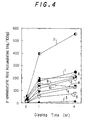
- Fig. 4 is a graph showing ⁇ -aminobutyric acid accumulated in the process of Example 4.
- Fig. 5 is a separation chart of ⁇ -aminobutyric acid by ion-exchanging chromatography in the process of Example 5.
- Fig. 6 is a graph showing ⁇ -aminobutyric acid accumulated in the process of Example 6.
- Varieties of rice and wheat to be used in the present invention are not specifically defined, but preferred are those having a high proportion by weight of germs such as giant germ rice as well as those capable of producing a large amount of ⁇ -aminobutyric acid (e.g., rice of Hokkai No. 269, and wheat of Shirasagi-komugi).
- Whole rice may be easily prepared by cleaning rice in an ordinary rice-cleaning mill (for example, RMA-150 Model, made by Yanagisawa Seisaku-sho KK) to remove rice bran therefrom. Germs may be separated from whole rice by polishing it in a rice-polishing mill (for example, TM5 Model, made by Satake Seisaku-sho KK) followed by sieving the resulting albumen-derived rice powder and bran through a suitable sieve (of around 32-mesh) to separate germs therefrom.
- an ordinary rice-cleaning mill for example, RMA-150 Model, made by Yanagisawa Seisaku-sho KK
- Germs may be separated from whole rice by polishing it in a rice-polishing mill (for example, TM5 Model, made by Satake Seisaku-sho KK) followed by sieving the resulting albumen-derived rice powder and bran through a suitable sieve (of around 32-mesh) to separate germs therefrom.
- germs of wheat and wheat bran containing germs may be obtained by milling wheat in a wheat mill (for example, Pullar Type Test Mill, made by Pullar Co.) to separate wheat bran (fine wheat bran, coarse wheat bran) therefrom.
- the thus-separated wheat bran (especially, fine wheat bran) is then sieved through a sieve of around 50-mesh or a finer sieve than that to be employed for obtaining germs of rice to further separate germs of wheat therefrom.
- the wheat bran preferred is fine wheat bran.
- water having a pH of from 2.5 to 7.5, preferably from 3.0 to 7.0, more preferably from 5.5 to 6.0 is added to at least one material chosen from among the above-mentioned germs of rice, rice bran containing germs, whole rice, germs of wheat and wheat bran containing germs, in an amount of from 2 to 10 times as large as the amount of the material, and shaken at 80°C or lower, generally at a temperature of from 10 to 70°C and at a shaking speed of from 50 to 150 strokes/min for a period of 20 minutes or more, generally from 20 minutes to 48 hours, preferably at a shaking speed of from 80 to 120 strokes/min for a period of from 1 to 48 hours, more preferably at 40°C and at a shaking speed of 100 strokes/min for a period of from 4 to 48 hours.
- Acids may be used for adjusting the pH value of the water to be used, which may be either organic acids or inorganic acids.
- organic acids such as acetic acid, citric acid and malic acid
- inorganic acids such as hydrochloric acid, sulfuric acid and phosphoric acid.
- Alkalis may also be used for the same purpose, which include, for example, sodium hydroxide, potassium hydroxide, calcium hydroxide, sodium carbonate and sodium phosphate.
- the glutamate decarboxylase existing in germs acts on the glutamic acid therein to convert the acid into ⁇ -aminobutyric acid.
- the protease in germs, etc. also acts on proteins therein to decompose them into glutamic acid. Accordingly, the conversion of glutamic acid into ⁇ -aminobutyric acid is effected efficiently by the treatment.
- the ⁇ -aminobutyric acid content in its germs may be increased to about 400 mg/100 g.
- the ⁇ -aminobutyric acid content in "Gabaron Tea” is about 170 mg per 100 g of the dry leaves, ⁇ -aminobutyric acid can be accumulated in the germs of Koshihikari rice in an amount of 2 times or more than that in "Gabaron Tea" by the treatment.
- ⁇ -aminobutyric acid is taken from “Gabaron Tea” or germs
- "Gabaron Tea” shall be extracted and diluted with hot water and the thus-diluted extract is drunk while germs may directly be eaten as they are in whole rice or in food materials without being diluted. Accordingly, germs may be utilized as more effective ⁇ -aminobutyric acid sources.
- an acid is added to at least one food material of germs of rice, rice bran containing germs, whole rice, germs of wheat and wheat bran containing germs that have been treated by the above-mentioned dipping treatment to thereby extract the acid from the material.
- an acid chosen from among inorganic acids such as hydrochloric acid, sulfuric acid and phosphoric acid and organic acids such as acetic acid, citric acid and malic acid is added to the material, by which the material is made acidic, preferably strongly acidic to have a pH of from 1 to 2, and thereafter the material is shaken at a temperature of from 0 to 70°C, preferably from 10 to 40°C, and at a shaking speed of from 50 to 150 strokes/min for 5 minutes to 2 hours, preferably at a shaking speed of 100 strokes/min for one hour, to thereby extract ⁇ -aminobutyric acid from the material.
- the resulting extract is subjected to solid-liquid separation, for example, by centrifugation (3000 rpm, 10 minutes) or filtration to recover the supernatant (liquid extract).
- the liquid extract is purified and concentrated by ion-exchanging chromatography.
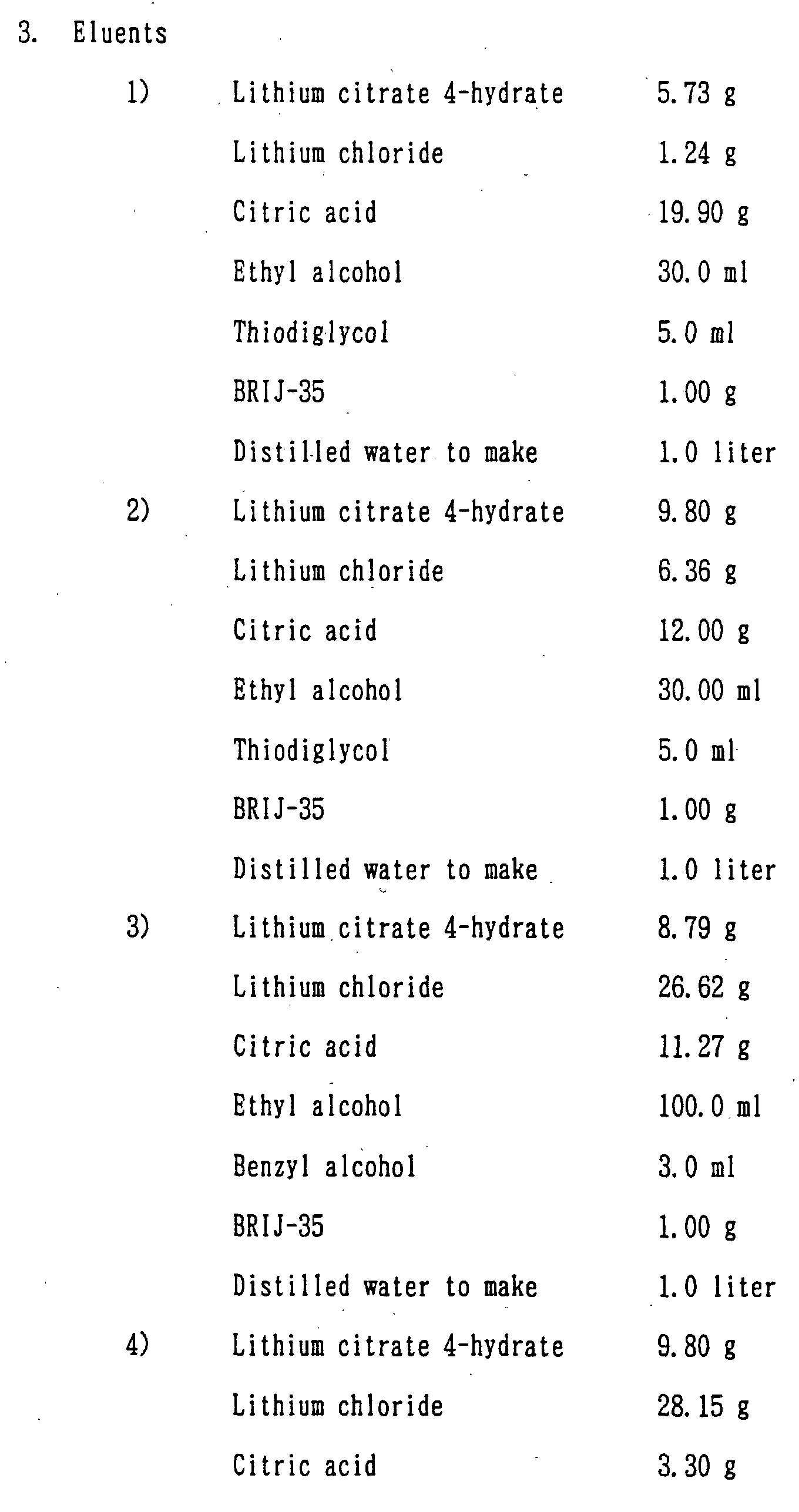
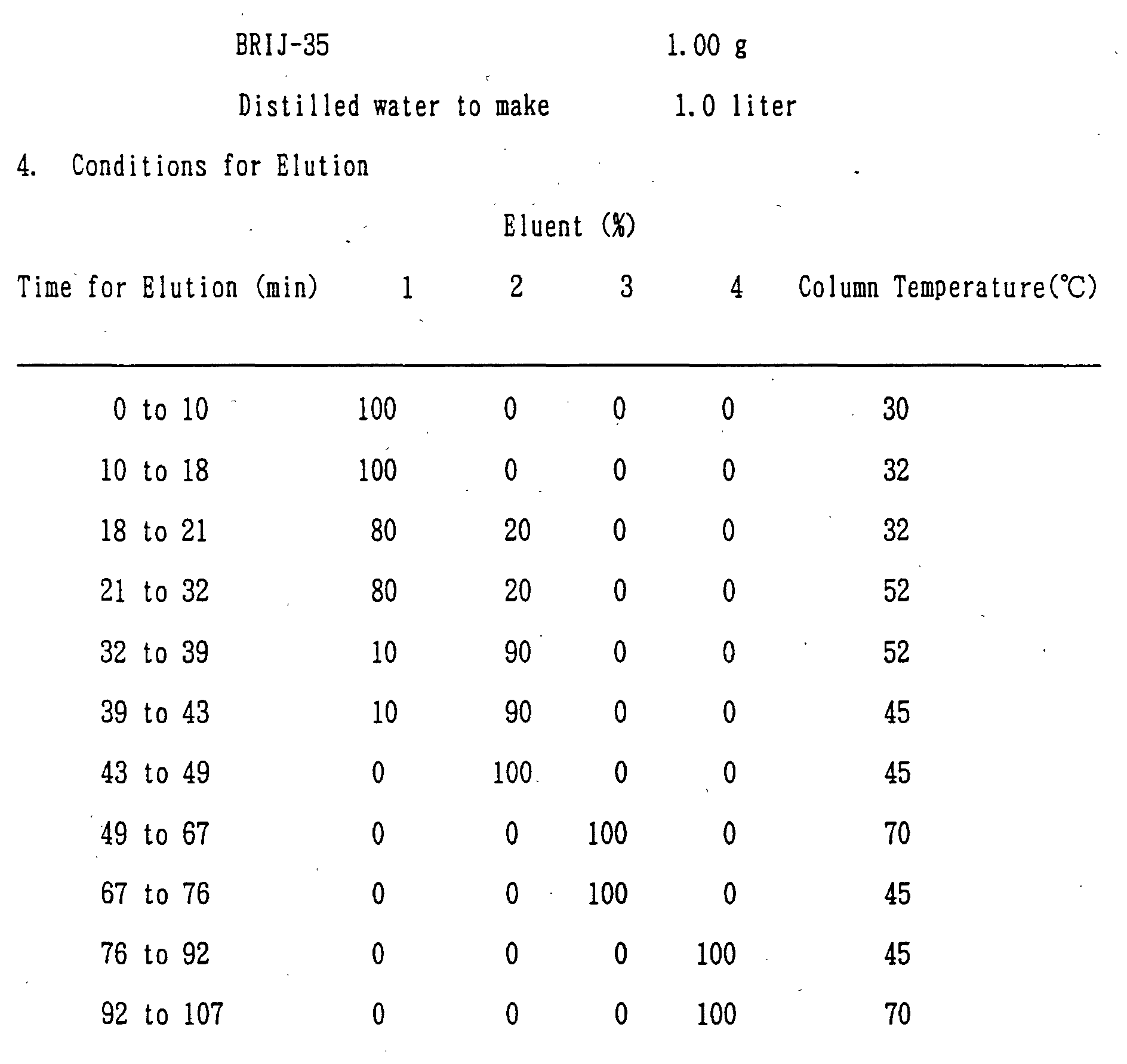
- the ion-exchanging chromatography may be conducted, for example, under the conditions shown in Table 1 below, thereby giving a pure ⁇ -aminobutyric acid.
- the thus-obtained ⁇ -aminobutyric acid is sweet and tasty and may be utilized as a food additive or seasoning.
- the amount of the acid to be used for this purpose may be determined according to the intended object.
- food materials containing a high concentration of ⁇ -aminobutyric acid and a high-purity ⁇ -aminobutyric acid are obtained from at least one material chosen from among germs of rice, rice bran containing germs, whole rice, germs of wheat and wheat bran containing germs, which have heretofore been utilized only as sources for edible oil, by simple operation.
- Such ⁇ -aminobutyric acid-enriched food materials and high-purity ⁇ -aminobutyric acid may be utilized as particular nutrient foods or additives to foods for patients suffering from hypertension.
- ⁇ -aminobutyric acid 4 ml of distilled water were added to 0.2 g of germs derived from Koshihikari rice and shaken at 40°C and at a shaking speed of 100 strokes/min, by which ⁇ -aminobutyric acid Precipitated.
- ⁇ -aminobutyric acid was accumulated rapidly with decrease of glutamic acid and reached 360 mg/100 g after 8 hours.
- the ⁇ -aminobutyric acid content in non-treated germs is about 25 mg/100 g, it is noted that the ⁇ -aminobutyric acid content in the thus-treated germs increased to 14.4 times.
- Germs of Koshihikari rice were treated at a temperature of from 30 to 70 °C in the same manner as in Example 1 to produce ⁇ -aminobutyric acid.
- the results are shown in Fig. 2, from which it is noted that 40°C is the optimum treating temperature at which the amount of ⁇ -aminobutyric acid produced was the highest and the producing speed was also the highest.
- Germs of Koshihikari rice were treated at a pH of from 3 to 8 in the same manner as in Example 1 to produce ⁇ -aminobutyric acid.
- the results are shown in Fig. 3, from which it is noted that the optimum pH range in producing ⁇ -aminobutyric acid by the treatment is from 5.5 to 6.0 whilst the amount of ⁇ -aminobutyric acid produced suddenly decreased under the alkaline condition.
- Germs derived from different 10 varieties of rice shown in Table 2 below were treated under the same conditions as those in Example 1 to produce ⁇ -aminobutyric acid.
- Table 2 shows the characteristics of rice used and the weight of germs in rice. The results are shown in Fig. 4, from which it is noted that the amount of ⁇ -aminobutyric acid formed greatly varied, depending on the variety of rice used. Briefly, Takanari rice did not almost produce the acid, while Hokkai No. 269 rice produced the acid in an amount of 2 times as large as that produced by Koshihikari rice. Amount (by weight) of Germs in Rice Variety of Rice Characteristics Amount. of Germs (wt. %) 1. Koshihikari Eating-quality rice 3.5 2.
- Hokkai No. 269 rice gave ⁇ -aminobutyric acid of 560 mg/100 g, after treated for 4 hours.
- the amount of the acid produced by Hok kai No. 269 rice is about 3 times as large as that produced by "Gabaron Tea".
- Hokkai No. 269 rice is giant-germ rice, having germs of nearly 3 times as large as those in ordinary rice, and it is the best as the raw material for producing ⁇ -aminobutyric acid.
- Germs of Hokkai No. 269 rice were treated for 4 hours under the same conditions as those in Example 1 to produce a liquid containing ⁇ -aminobutyric acid N hydrochloric acid was added to the liquid in an amount of 1/5 of the liquid and shaken at a shaking speed of 100 strokes/min to extract ⁇ -aminobutyric acid therefrom at 30°C for a time more than 5 minutes.
- the resulting extract was centrifuged for 10 minutes at 3000 rpm to remove the insoluble substances therefrom and then subjected to ion-exchanging chromatography under the same conditions as those shown in Table 1 above to separate ⁇ -aminobutyric acid therefrom. The results are shown in Fig. 5.
Landscapes
- Life Sciences & Earth Sciences (AREA)
- Health & Medical Sciences (AREA)
- Chemical & Material Sciences (AREA)
- Engineering & Computer Science (AREA)
- Food Science & Technology (AREA)
- Nutrition Science (AREA)
- Polymers & Plastics (AREA)
- Mycology (AREA)
- Proteomics, Peptides & Aminoacids (AREA)
- Organic Chemistry (AREA)
- Bioinformatics & Cheminformatics (AREA)
- Pharmacology & Pharmacy (AREA)
- Cardiology (AREA)
- Animal Behavior & Ethology (AREA)
- General Health & Medical Sciences (AREA)
- Public Health (AREA)
- Veterinary Medicine (AREA)
- Nuclear Medicine, Radiotherapy & Molecular Imaging (AREA)
- Heart & Thoracic Surgery (AREA)
- Medicinal Chemistry (AREA)
- General Chemical & Material Sciences (AREA)
- Chemical Kinetics & Catalysis (AREA)
- Coloring Foods And Improving Nutritive Qualities (AREA)
- Medicines Containing Plant Substances (AREA)
- Cereal-Derived Products (AREA)
- Grain Derivatives (AREA)
- Acyclic And Carbocyclic Compounds In Medicinal Compositions (AREA)
Description
- The present invention relates to a γ-aminobutyric acid-enriched food material and a method for producing γ-aminobutyric acid. More precisely, it relates to a γ-aminobutyric acid-enriched food material to be prepared by dipping at least one material chosen from among germs of rice, rice bran containing germs, whole rice, germs of wheat and wheat bran containing germs in water under pre-determined conditions so as to greatly increase the content of γ-aminobutyric acid in the material due to the activity of the endogenous enzyme therein. It also relates to a method for producing γ-aminobutyric acid by extracting the γ-aminobutyric acid-enriched food material with an acid followed by purifying and concentrating the resulting extract by ion-exchanging chromatography.
- γ-Aminobutyric acid is a kind of amino acid that is produced by decarboxylation of glutamic acid in living organisms, and it is known that the acid plays an important role in the central nervous system as a neurotransmitter and, in addition, has a function to lower the blood pressure in animals including human beings.
- Recently, it has been found that the content of γ-aminobutyric acid in tea leaves may be increased to 5 to 10 times by anaerobically treating raw tea leaves. At present, such tea having an increased content of γ-aminobutyric acid has been commercially sold by various makers as "Gabaron Tea" (trade name). "Gabaron Tea" has been proved to have an effect of curing hypertension by animal tests and has been utilized by persons suffering from hypertension as an easy means to cure hypertension without minding its side effect.
- It is said necessary to perorally take a large amount of γ-aminobutyric acid so as to lower the blood pressure in hypertension. For "Gabaron Tea", however, it is difficult to take a large amount of γ-aminobutyric acid therefrom since the tea is diluted when extracted with hot water. This will be the reason why "Gabaron Tea" is considered ineffective against hypertension by some persons.
- At present, γ-aminobutyric acid is produced by fermentation, which, however, is not satisfactory in view of its cost. It is thus an object of the present invention to provide food materials from which a higher concentration of γ-aminobutyric acid may be taken and to provide a method for producing a safe and low-priced γ-aminobutyric acid.
- This object could be achieved on the basis of the finding that a high concentration of glutamic acid which is a precursor of γ-aminobutyric acid is contained in the surface layer parts of germs, rice grains and wheat grains and that the glutamic acid is rapidly converted into γ-aminobutyric acid while dipped in water.
- Specifically, the present invention provides a γ-aminobutyric acid-enriched food material which is obtainable by dipping (holding) at least one material chosen from among germs of rice, rice bran containing germs, whole rice, germs of wheat and wheat bran containing germs in water at a pH of from 2.5 to 7.5 and at 80°C or lower. It also provides a method for producing γ-aminobutyric acid by extracting the γ-aminobutyric acid-enriched food material with an acid followed by purifying the resulting extract by ion-exchanging chromatography.
- Fig. 1 is a graph showing the relationship between γ-aminobutyric acid accumulated and the decrement in the glutamic acid content in the process of Example 1.
- Fig. 2 is a graph showing γ-aminobutyric acid accumulated in the process of Example 2.
- Fig. 3 is a graph showing γ-aminobutyric acid accumulated in the process of Example 3.
- Fig. 4 is a graph showing γ-aminobutyric acid accumulated in the process of Example 4.
- Fig. 5 is a separation chart of γ-aminobutyric acid by ion-exchanging chromatography in the process of Example 5.
- Fig. 6 is a graph showing γ-aminobutyric acid accumulated in the process of Example 6.
- Varieties of rice and wheat to be used in the present invention are not specifically defined, but preferred are those having a high proportion by weight of germs such as giant germ rice as well as those capable of producing a large amount of γ-aminobutyric acid (e.g., rice of Hokkai No. 269, and wheat of Shirasagi-komugi).
- Whole rice may be easily prepared by cleaning rice in an ordinary rice-cleaning mill (for example, RMA-150 Model, made by Yanagisawa Seisaku-sho KK) to remove rice bran therefrom. Germs may be separated from whole rice by polishing it in a rice-polishing mill (for example, TM5 Model, made by Satake Seisaku-sho KK) followed by sieving the resulting albumen-derived rice powder and bran through a suitable sieve (of around 32-mesh) to separate germs therefrom.
- On the other hand, germs of wheat and wheat bran containing germs may be obtained by milling wheat in a wheat mill (for example, Pullar Type Test Mill, made by Pullar Co.) to separate wheat bran (fine wheat bran, coarse wheat bran) therefrom. The thus-separated wheat bran (especially, fine wheat bran) is then sieved through a sieve of around 50-mesh or a finer sieve than that to be employed for obtaining germs of rice to further separate germs of wheat therefrom. As the wheat bran, preferred is fine wheat bran.
- To prepare a γ-aminobutyric acid-enriched food material, water having a pH of from 2.5 to 7.5, preferably from 3.0 to 7.0, more preferably from 5.5 to 6.0 is added to at least one material chosen from among the above-mentioned germs of rice, rice bran containing germs, whole rice, germs of wheat and wheat bran containing germs, in an amount of from 2 to 10 times as large as the amount of the material, and shaken at 80°C or lower, generally at a temperature of from 10 to 70°C and at a shaking speed of from 50 to 150 strokes/min for a period of 20 minutes or more, generally from 20 minutes to 48 hours, preferably at a shaking speed of from 80 to 120 strokes/min for a period of from 1 to 48 hours, more preferably at 40°C and at a shaking speed of 100 strokes/min for a period of from 4 to 48 hours. Acids may be used for adjusting the pH value of the water to be used, which may be either organic acids or inorganic acids. Preferred are organic acids such as acetic acid, citric acid and malic acid, and inorganic acids such as hydrochloric acid, sulfuric acid and phosphoric acid. Alkalis may also be used for the same purpose, which include, for example, sodium hydroxide, potassium hydroxide, calcium hydroxide, sodium carbonate and sodium phosphate.
- By the treatment, the glutamate decarboxylase existing in germs acts on the glutamic acid therein to convert the acid into γ-aminobutyric acid. During the treatment, the protease in germs, etc. also acts on proteins therein to decompose them into glutamic acid. Accordingly, the conversion of glutamic acid into γ-aminobutyric acid is effected efficiently by the treatment.
- Where Koshihikari rice, which is the most popular variety of rice to be boiled to eat, is subjected to the above-mentioned treatment, the γ-aminobutyric acid content in its germs may be increased to about 400 mg/100 g. Considering the fact that the γ-aminobutyric acid content in "Gabaron Tea" is about 170 mg per 100 g of the dry leaves, γ-aminobutyric acid can be accumulated in the germs of Koshihikari rice in an amount of 2 times or more than that in "Gabaron Tea" by the treatment.
- Where γ-aminobutyric acid is taken from "Gabaron Tea" or germs, "Gabaron Tea" shall be extracted and diluted with hot water and the thus-diluted extract is drunk while germs may directly be eaten as they are in whole rice or in food materials without being diluted. Accordingly, germs may be utilized as more effective γ-aminobutyric acid sources.
- To produce γ-aminobutyric acid, an acid is added to at least one food material of germs of rice, rice bran containing germs, whole rice, germs of wheat and wheat bran containing germs that have been treated by the above-mentioned dipping treatment to thereby extract the acid from the material. Concretely, an acid chosen from among inorganic acids such as hydrochloric acid, sulfuric acid and phosphoric acid and organic acids such as acetic acid, citric acid and malic acid is added to the material, by which the material is made acidic, preferably strongly acidic to have a pH of from 1 to 2, and thereafter the material is shaken at a temperature of from 0 to 70°C, preferably from 10 to 40°C, and at a shaking speed of from 50 to 150 strokes/min for 5 minutes to 2 hours, preferably at a shaking speed of 100 strokes/min for one hour, to thereby extract γ-aminobutyric acid from the material. Next, the resulting extract is subjected to solid-liquid separation, for example, by centrifugation (3000 rpm, 10 minutes) or filtration to recover the supernatant (liquid extract).
- Next, the liquid extract is purified and concentrated by ion-exchanging chromatography. The ion-exchanging chromatography may be conducted, for example, under the conditions shown in Table 1 below, thereby giving a pure γ -aminobutyric acid. The thus-obtained γ-aminobutyric acid is sweet and tasty and may be utilized as a food additive or seasoning. The amount of the acid to be used for this purpose may be determined according to the intended object.

- According to the present invention that has been described in detail hereinabove, food materials containing a high concentration of γ-aminobutyric acid and a high-purity γ-aminobutyric acid are obtained from at least one material chosen from among germs of rice, rice bran containing germs, whole rice, germs of wheat and wheat bran containing germs, which have heretofore been utilized only as sources for edible oil, by simple operation. Such γ-aminobutyric acid-enriched food materials and high-purity γ-aminobutyric acid may be utilized as particular nutrient foods or additives to foods for patients suffering from hypertension.
- The present invention will be explained in more detail by means of the following examples, which, however, are not intended to restrict the scope of the present invention.
- 4 ml of distilled water were added to 0.2 g of germs derived from Koshihikari rice and shaken at 40°C and at a shaking speed of 100 strokes/min, by which γ-aminobutyric acid Precipitated. Precisely, as shown in Fig. 1, γ -aminobutyric acid was accumulated rapidly with decrease of glutamic acid and reached 360 mg/100 g after 8 hours. Considering the fact that the γ-aminobutyric acid content in non-treated germs is about 25 mg/100 g, it is noted that the γ-aminobutyric acid content in the thus-treated germs increased to 14.4 times. After 20 minutes from the start of the treatment, the decrement in the glutamic acid content became small relative to the amount of the γ-aminobutyric acid formed. From this, it is presumed that glutamic acid was supplemented by decomposition of proteins, etc. during the treatment.
- Germs of Koshihikari rice were treated at a temperature of from 30 to 70 °C in the same manner as in Example 1 to produce γ-aminobutyric acid. The results are shown in Fig. 2, from which it is noted that 40°C is the optimum treating temperature at which the amount of γ-aminobutyric acid produced was the highest and the producing speed was also the highest.
- Germs of Koshihikari rice were treated at a pH of from 3 to 8 in the same manner as in Example 1 to produce γ-aminobutyric acid. The results are shown in Fig. 3, from which it is noted that the optimum pH range in producing γ-aminobutyric acid by the treatment is from 5.5 to 6.0 whilst the amount of γ -aminobutyric acid produced suddenly decreased under the alkaline condition.
- Germs derived from different 10 varieties of rice shown in Table 2 below were treated under the same conditions as those in Example 1 to produce γ-aminobutyric acid. Table 2 shows the characteristics of rice used and the weight of germs in rice. The results are shown in Fig. 4, from which it is noted that the amount of γ-aminobutyric acid formed greatly varied, depending on the variety of rice used. Briefly, Takanari rice did not almost produce the acid, while Hokkai No. 269 rice produced the acid in an amount of 2 times as large as that produced by Koshihikari rice.
Amount (by weight) of Germs in Rice Variety of Rice Characteristics Amount. of Germs (wt. %) 1. Koshihikari Eating-quality rice 3.5 2. Aya Low-amylose rice 3.5 3. Takanari High-yield rice 3.0 4. Ohchikara Giant-grain rice 3.6 5. Kitakaori Sweet-smelling rice 2.7 6. Chugoku No. 137 Giant-germ rice 10.3 7. Hokkai No. 269 Giant-germ rice 9.0 8. Chugoku-mochi No.120 For rice cake 2.4 9. Himenomochi For rice cake 3.0 10. Hoshiyutaka Long-grain 4.3 - It has been found that Hokkai No. 269 rice gave γ-aminobutyric acid of 560 mg/100 g, after treated for 4 hours. The amount of the acid produced by Hok kai No. 269 rice is about 3 times as large as that produced by "Gabaron Tea". Hokkai No. 269 rice is giant-germ rice, having germs of nearly 3 times as large as those in ordinary rice, and it is the best as the raw material for producing γ-aminobutyric acid.
- Germs of Hokkai No. 269 rice were treated for 4 hours under the same conditions as those in Example 1 to produce a liquid containing γ-aminobutyric acid N hydrochloric acid was added to the liquid in an amount of 1/5 of the liquid and shaken at a shaking speed of 100 strokes/min to extract γ-aminobutyric acid therefrom at 30°C for a time more than 5 minutes. Next, the resulting extract was centrifuged for 10 minutes at 3000 rpm to remove the insoluble substances therefrom and then subjected to ion-exchanging chromatography under the same conditions as those shown in Table 1 above to separate γ-aminobutyric acid therefrom. The results are shown in Fig. 5. Next, the thus-separated γ-aminobutyric acid was collected, using a fraction collector. By the operation, obtained were 5.2 mg of γ-aminobutyric acid from one g of germs of Hokkai No. 269 rice.
- 8 ml of 1 M phosphate buffer (pH 5.5) were added to 0.5 g of fine wheat bran derived from Shirasagi-komugi (a variety of wheat) and shaken at 40°C at a shaking speed of 100 strokes/min, by which precipitated γ-aminobutyric acid, as shown in Fig. 6. Precisely, γ-aminobutyric acid began to precipitate after shaking the germs for 2 hours or more along with the buffer and reached 63.7 mg/100 g after 8 hours.
Claims (2)
- A γ-aminobutyric acid-enriched food material obtainable by dipping at least one material chosen from among germs of rice, rice bran containing germs, whole rice, germs of wheat and wheat bran containing germs in water at a pH of from 2.5 to 7.5 and at 80°C or lower.
- A method for producing γ-aminobutyric acid, characterized by extracting a γ-aminobutyric acid-enriched food material, which is obtainable by dipping at least one material chosen from among germs of rice, rice bran containing germs, whole rice, germs of wheat and wheat bran containing germs in water at a pH of from 2.5 to 7.5 and at 80°C or lower, with an acid followed by purifying the resulting extract by ion-exchanging chromatography.
Applications Claiming Priority (3)
| Application Number | Priority Date | Filing Date | Title |
|---|---|---|---|
| JP6027581A JP2590423B2 (en) | 1994-02-01 | 1994-02-01 | Food material enriched in γ-aminobutyric acid |
| JP27581/94 | 1994-02-01 | ||
| JP2758194 | 1994-02-01 |
Publications (3)
| Publication Number | Publication Date |
|---|---|
| EP0682880A2 EP0682880A2 (en) | 1995-11-22 |
| EP0682880A3 EP0682880A3 (en) | 1997-06-25 |
| EP0682880B1 true EP0682880B1 (en) | 2002-09-11 |
Family
ID=12224940
Family Applications (1)
| Application Number | Title | Priority Date | Filing Date |
|---|---|---|---|
| EP94118505A Expired - Lifetime EP0682880B1 (en) | 1994-02-01 | 1994-11-24 | Gamma-aminobutyric acid-enriched food material and method for producing Gamma-aminobutyric acid |
Country Status (4)
| Country | Link |
|---|---|
| US (1) | US5472730A (en) |
| EP (1) | EP0682880B1 (en) |
| JP (1) | JP2590423B2 (en) |
| DE (1) | DE69431347T2 (en) |
Cited By (1)
| Publication number | Priority date | Publication date | Assignee | Title |
|---|---|---|---|---|
| CN111742833A (en) * | 2020-07-27 | 2020-10-09 | 西藏自治区农牧科学院农产品开发与食品科学研究所 | Highland barley germination device and method for enriching gamma-aminobutyric acid |
Families Citing this family (37)
| Publication number | Priority date | Publication date | Assignee | Title |
|---|---|---|---|---|
| JP2704493B2 (en) * | 1994-02-18 | 1998-01-26 | 京都府 | Production method of fermented food |
| JP2810993B2 (en) * | 1995-10-24 | 1998-10-15 | 農林水産省中国農業試験場長 | Defatted food material enriched in γ-aminobutyric acid |
| JPH09140361A (en) * | 1995-11-17 | 1997-06-03 | Kenya Fujii | Rice bran gaba water and its production |
| US5817329A (en) * | 1997-02-28 | 1998-10-06 | Gardiner; Paul T. | Nutritional supplement for increased muscle size and strength for body builders |
| EP1048224B1 (en) * | 1999-04-26 | 2005-08-17 | Toyo Shinyaku Co., Ltd. | Method for enriching gamma-aminobutyric acid in green grass leaves |
| CA2316764A1 (en) * | 1999-09-02 | 2001-03-02 | Toyo Shinyaku Co., Ltd. | Food using y-aminobutyric acid-enriched cruciferous plant |
| JP4084916B2 (en) * | 2000-06-21 | 2008-04-30 | 株式会社東洋新薬 | Antihypertensive food containing raw material derived from wheat |
| WO2002071873A1 (en) * | 2001-03-14 | 2002-09-19 | Soushin Corporation | Functional cereals |
| JP4982922B2 (en) * | 2001-03-29 | 2012-07-25 | 株式会社林原 | Method for producing food material with increased γ-aminobutyric acid content |
| TWI262949B (en) * | 2002-08-15 | 2006-10-01 | Food Industry Res & Dev Inst | Monascus purpureus mutants and their use in preparing fermentation products having hypotensive activity |
| JP4409879B2 (en) * | 2003-08-04 | 2010-02-03 | 株式会社ファンケル | Method for enriching γ-aminobutyric acid and grains obtained by the method |
| JP2006014732A (en) * | 2004-05-31 | 2006-01-19 | Mitsuwa Foods Kk | METHOD FOR PRODUCING WHEAT GERM HIGHLY CONTAINING gamma-AMINOBUTYRIC ACID AND WHEAT FLOUR MIXED WITH THE SAME |
| JP2006087328A (en) * | 2004-09-22 | 2006-04-06 | Kikkoman Corp | Low-salt soy sauce |
| JP2007008904A (en) * | 2005-07-04 | 2007-01-18 | Unitika Ltd | Agent for prevention/amelioration of hypertension |
| JP2007049910A (en) * | 2005-08-16 | 2007-03-01 | Hitachi Plant Technologies Ltd | Method and apparatus for producing γ-aminobutyric acid |
| JP2008050269A (en) * | 2006-08-22 | 2008-03-06 | Gekkeikan Sake Co Ltd | Oral ingestion material |
| JP5220325B2 (en) * | 2007-02-28 | 2013-06-26 | 株式会社日清製粉グループ本社 | Antiallergic agent |
| JP5061970B2 (en) * | 2007-05-17 | 2012-10-31 | 株式会社サタケ | Grain having increased content of functional ingredient and method for producing the same |
| US8399037B2 (en) * | 2007-05-17 | 2013-03-19 | Satake Corporation | Grain or legume having increased content of functional component and a manufacturing method thereof |
| JP5045937B2 (en) * | 2008-02-27 | 2012-10-10 | 株式会社サタケ | Grain germ or method for increasing functional components of flour containing grain germ |
| JP5838016B2 (en) * | 2010-02-24 | 2015-12-24 | 株式会社マエダ | Method for producing GABA glutinous grain containing GABA and its product |
| JP2012055211A (en) * | 2010-09-07 | 2012-03-22 | Maeda:Kk | Method for producing gaba-containing gaba barley, and product of the gaba barley |
| JP6149249B2 (en) * | 2011-03-04 | 2017-06-21 | 京都府 | Method for manufacturing pickles |
| CN103533846B (en) | 2011-03-17 | 2015-11-25 | 柳本広二 | Germinated grain, its production method, food containing it, and BDNF production promoter |
| JP5893895B2 (en) * | 2011-11-09 | 2016-03-23 | 株式会社明治 | Production method of food material containing .GAMMA.-aminobutyric acid. |
| JPWO2014061262A1 (en) * | 2012-10-19 | 2016-09-05 | 株式会社小倉屋柳本 | High GABA content germinated soybean and method for producing the same |
| CN103250862A (en) * | 2013-04-01 | 2013-08-21 | 安徽禾粒源食品有限公司 | Sugar-free rice protein milk product and its production technology |
| CN103393013B (en) * | 2013-07-11 | 2014-08-13 | 四川农业大学 | A preparation method and product of germinated wheat grains rich in gamma-aminobutyric acid |
| CN103664666B (en) * | 2013-12-02 | 2015-09-09 | 宁波江东仑斯福环保科技有限公司 | A kind of method extracting γ-aminobutyric acid from barley germs |
| CN104621564B (en) * | 2015-02-05 | 2017-09-08 | 南京农业大学 | A kind of pulled figs product and its production method rich in gamma aminobutyric acid |
| CN105410224A (en) * | 2015-12-24 | 2016-03-23 | 福建省裕荣香茶业有限公司 | Conversion device for increasing content of [gamma]-aminobutyric acid in white tea and operation method thereof |
| US12501904B2 (en) | 2017-03-06 | 2025-12-23 | Corn Products Development, Inc. | Method of preparing thermally inhibited grain |
| US20180249720A1 (en) * | 2017-03-06 | 2018-09-06 | Corn Products Development, Inc. | Thermally inhibited grain |
| CN109805259A (en) * | 2017-11-21 | 2019-05-28 | 王文华 | A kind of Mai Fupi powder or okara powder generate the preparation method of the fiber diet of aminobutyric acid containing y- |
| JP7697806B2 (en) * | 2021-03-29 | 2025-06-24 | 株式会社ニップン | Method for enriching gamma-aminobutyric acid |
| CN113261636A (en) * | 2021-07-01 | 2021-08-17 | 中国科学院成都生物研究所 | Method for high yield of gamma-aminobutyric acid and application thereof |
| JP7628381B2 (en) * | 2022-01-20 | 2025-02-10 | 株式会社ニップン | Method for producing GABA-enriched pet food |
Family Cites Families (3)
| Publication number | Priority date | Publication date | Assignee | Title |
|---|---|---|---|---|
| GB1539756A (en) * | 1976-06-03 | 1979-01-31 | Japan Natural Food Co Ltd | Process for preparing food products containing a lactic bacteria-fermented product of a cereal germ |
| US4786647A (en) * | 1986-06-30 | 1988-11-22 | University Of Florida | Method for eliciting anxiolysis |
| US5215750A (en) * | 1991-09-04 | 1993-06-01 | Keane Ii Michael A | L-glutamine and vitamin-containing compositions effective for inducing weight loss and for weight control |
-
1994
- 1994-02-01 JP JP6027581A patent/JP2590423B2/en not_active Expired - Lifetime
- 1994-08-29 US US08/297,597 patent/US5472730A/en not_active Expired - Fee Related
- 1994-11-24 EP EP94118505A patent/EP0682880B1/en not_active Expired - Lifetime
- 1994-11-24 DE DE69431347T patent/DE69431347T2/en not_active Expired - Fee Related
Cited By (1)
| Publication number | Priority date | Publication date | Assignee | Title |
|---|---|---|---|---|
| CN111742833A (en) * | 2020-07-27 | 2020-10-09 | 西藏自治区农牧科学院农产品开发与食品科学研究所 | Highland barley germination device and method for enriching gamma-aminobutyric acid |
Also Published As
| Publication number | Publication date |
|---|---|
| EP0682880A3 (en) | 1997-06-25 |
| US5472730A (en) | 1995-12-05 |
| DE69431347T2 (en) | 2003-05-08 |
| JP2590423B2 (en) | 1997-03-12 |
| JPH07213252A (en) | 1995-08-15 |
| DE69431347D1 (en) | 2002-10-17 |
| EP0682880A2 (en) | 1995-11-22 |
Similar Documents
| Publication | Publication Date | Title |
|---|---|---|
| US5472730A (en) | γ-aminobutyric acid-enriched food material and method for producing γ-aminobutyric acid | |
| CN101668436B (en) | Salicornia spp.-derived salt and its production process | |
| KR101724311B1 (en) | Composition for low-salt food or beverage | |
| US4293583A (en) | Process for debittering a protein hydrolysate and the debittered hydrolysate obtained by this process | |
| EP0443813A1 (en) | Protein-rich products of brewer's spent grain origin | |
| CN112481343A (en) | Method for producing collagen peptide by using cod skin raw material | |
| JP2001521728A (en) | Production of hydrolysates | |
| CN1092624A (en) | Natural ginkgo juice beverage and processing technology thereof | |
| KR101889485B1 (en) | Method for preparing natural seasoning and Natural seasoning prepared by the method | |
| JP3559487B2 (en) | Mineral-rich oyster extract and method for producing the same | |
| JP2813771B2 (en) | Method for producing γ-aminobutyric acid | |
| JPH11151072A (en) | Soy food material enriched in γ-aminobutyric acid | |
| KR101455209B1 (en) | seasonings containing collagen by using byproduct of dried yellow pollack | |
| CN111758967A (en) | Giant salamander collagen peptide composition and application thereof | |
| JP2003024015A (en) | Food material highly containing gamma-aminobutyric acid from sesame as raw material and method for producing the same | |
| US20230329262A1 (en) | Method of manufacturing processed chickpea milk | |
| JP2631200B2 (en) | Production method of fermented seasoning from chicken bone material | |
| JP2810993B2 (en) | Defatted food material enriched in γ-aminobutyric acid | |
| JP3441704B2 (en) | Moromi vinegar, brown sugar fermented beverage and production method thereof | |
| WO2005082163A1 (en) | Food material enriched with free amino acid and process for producing the same | |
| KR101861337B1 (en) | Method for preparing natural seasoning and Natural seasoning prepared by the method | |
| KR101713868B1 (en) | Fish sauce having enhanced safety and reduced fermentation period and preparing process thereof | |
| JP2001046013A (en) | Method for producing seasoning liquid | |
| JP4346266B2 (en) | Health food and manufacturing method | |
| JP2916666B2 (en) | Treatment of Shochu distillation residue |
Legal Events
| Date | Code | Title | Description |
|---|---|---|---|
| PUAI | Public reference made under article 153(3) epc to a published international application that has entered the european phase |
Free format text: ORIGINAL CODE: 0009012 |
|
| AK | Designated contracting states |
Kind code of ref document: A2 Designated state(s): CH DE FR GB IT LI |
|
| PUAL | Search report despatched |
Free format text: ORIGINAL CODE: 0009013 |
|
| AK | Designated contracting states |
Kind code of ref document: A3 Designated state(s): CH DE FR GB IT LI |
|
| 17P | Request for examination filed |
Effective date: 19970811 |
|
| 17Q | First examination report despatched |
Effective date: 20000914 |
|
| GRAG | Despatch of communication of intention to grant |
Free format text: ORIGINAL CODE: EPIDOS AGRA |
|
| GRAG | Despatch of communication of intention to grant |
Free format text: ORIGINAL CODE: EPIDOS AGRA |
|
| GRAG | Despatch of communication of intention to grant |
Free format text: ORIGINAL CODE: EPIDOS AGRA |
|
| GRAH | Despatch of communication of intention to grant a patent |
Free format text: ORIGINAL CODE: EPIDOS IGRA |
|
| RAP1 | Party data changed (applicant data changed or rights of an application transferred) |
Owner name: NATIONAL AGRICULTURAL RESEARCH ORGANIZATION |
|
| GRAH | Despatch of communication of intention to grant a patent |
Free format text: ORIGINAL CODE: EPIDOS IGRA |
|
| RTI1 | Title (correction) |
Free format text: GAMMA-AMINOBUTYRIC ACID-ENRICHED FOOD MATERIAL AND METHOD FOR PRODUCING GAMMA-AMINOBUTYRIC ACID |
|
| GRAA | (expected) grant |
Free format text: ORIGINAL CODE: 0009210 |
|
| AK | Designated contracting states |
Kind code of ref document: B1 Designated state(s): CH DE FR GB IT LI |
|
| REG | Reference to a national code |
Ref country code: GB Ref legal event code: FG4D |
|
| REG | Reference to a national code |
Ref country code: CH Ref legal event code: EP |
|
| REG | Reference to a national code |
Ref country code: CH Ref legal event code: NV Representative=s name: E. BLUM & CO. PATENTANWAELTE |
|
| REF | Corresponds to: |
Ref document number: 69431347 Country of ref document: DE Date of ref document: 20021017 |
|
| ET | Fr: translation filed | ||
| PLBE | No opposition filed within time limit |
Free format text: ORIGINAL CODE: 0009261 |
|
| STAA | Information on the status of an ep patent application or granted ep patent |
Free format text: STATUS: NO OPPOSITION FILED WITHIN TIME LIMIT |
|
| 26N | No opposition filed |
Effective date: 20030612 |
|
| PGFP | Annual fee paid to national office [announced via postgrant information from national office to epo] |
Ref country code: GB Payment date: 20061027 Year of fee payment: 13 |
|
| PGFP | Annual fee paid to national office [announced via postgrant information from national office to epo] |
Ref country code: FR Payment date: 20061127 Year of fee payment: 13 Ref country code: CH Payment date: 20061127 Year of fee payment: 13 |
|
| PGFP | Annual fee paid to national office [announced via postgrant information from national office to epo] |
Ref country code: IT Payment date: 20061130 Year of fee payment: 13 |
|
| PGFP | Annual fee paid to national office [announced via postgrant information from national office to epo] |
Ref country code: DE Payment date: 20061229 Year of fee payment: 13 |
|
| REG | Reference to a national code |
Ref country code: CH Ref legal event code: PFA Owner name: NATIONAL AGRICULTURAL RESEARCH ORGANIZATION Free format text: NATIONAL AGRICULTURAL RESEARCH ORGANIZATION#1-1, KANNONDAI 3-CHOME TSUKUBA-SHI#IBARAKI (JP) -TRANSFER TO- NATIONAL AGRICULTURAL RESEARCH ORGANIZATION#1-1, KANNONDAI 3-CHOME TSUKUBA-SHI#IBARAKI (JP) |
|
| GBPC | Gb: european patent ceased through non-payment of renewal fee |
Effective date: 20071124 |
|
| PG25 | Lapsed in a contracting state [announced via postgrant information from national office to epo] |
Ref country code: LI Free format text: LAPSE BECAUSE OF NON-PAYMENT OF DUE FEES Effective date: 20071130 Ref country code: CH Free format text: LAPSE BECAUSE OF NON-PAYMENT OF DUE FEES Effective date: 20071130 |
|
| REG | Reference to a national code |
Ref country code: CH Ref legal event code: PL |
|
| PG25 | Lapsed in a contracting state [announced via postgrant information from national office to epo] |
Ref country code: DE Free format text: LAPSE BECAUSE OF NON-PAYMENT OF DUE FEES Effective date: 20080603 |
|
| REG | Reference to a national code |
Ref country code: FR Ref legal event code: ST Effective date: 20080930 |
|
| PG25 | Lapsed in a contracting state [announced via postgrant information from national office to epo] |
Ref country code: GB Free format text: LAPSE BECAUSE OF NON-PAYMENT OF DUE FEES Effective date: 20071124 |
|
| PG25 | Lapsed in a contracting state [announced via postgrant information from national office to epo] |
Ref country code: FR Free format text: LAPSE BECAUSE OF NON-PAYMENT OF DUE FEES Effective date: 20071130 |
|
| PG25 | Lapsed in a contracting state [announced via postgrant information from national office to epo] |
Ref country code: IT Free format text: LAPSE BECAUSE OF NON-PAYMENT OF DUE FEES Effective date: 20071124 |