EP0673978A1 - Isoindolinazopigmente - Google Patents
Isoindolinazopigmente Download PDFInfo
- Publication number
- EP0673978A1 EP0673978A1 EP95103717A EP95103717A EP0673978A1 EP 0673978 A1 EP0673978 A1 EP 0673978A1 EP 95103717 A EP95103717 A EP 95103717A EP 95103717 A EP95103717 A EP 95103717A EP 0673978 A1 EP0673978 A1 EP 0673978A1
- Authority
- EP
- European Patent Office
- Prior art keywords
- alkyl
- halogen
- mono
- phenyl
- alkoxy
- Prior art date
- Legal status (The legal status is an assumption and is not a legal conclusion. Google has not performed a legal analysis and makes no representation as to the accuracy of the status listed.)
- Withdrawn
Links
- 239000000049 pigment Substances 0.000 title claims abstract description 28
- -1 4,6-dimethyl-1H-pyrazolo(3,4-b)-pyrid-3-yl Chemical group 0.000 claims abstract description 138
- 229910052736 halogen Inorganic materials 0.000 claims abstract description 87
- 150000002367 halogens Chemical class 0.000 claims abstract description 84
- 125000001997 phenyl group Chemical group [H]C1=C([H])C([H])=C(*)C([H])=C1[H] 0.000 claims abstract description 56
- 125000003917 carbamoyl group Chemical group [H]N([H])C(*)=O 0.000 claims abstract description 40
- 125000004453 alkoxycarbonyl group Chemical group 0.000 claims abstract description 28
- 125000004448 alkyl carbonyl group Chemical group 0.000 claims abstract description 21
- 125000002496 methyl group Chemical group [H]C([H])([H])* 0.000 claims abstract description 20
- 125000001624 naphthyl group Chemical group 0.000 claims abstract description 18
- 125000002924 primary amino group Chemical group [H]N([H])* 0.000 claims abstract description 18
- 125000000020 sulfo group Chemical group O=S(=O)([*])O[H] 0.000 claims abstract description 18
- 230000008878 coupling Effects 0.000 claims abstract description 14
- 238000010168 coupling process Methods 0.000 claims abstract description 14
- 238000005859 coupling reaction Methods 0.000 claims abstract description 14
- 125000005236 alkanoylamino group Chemical group 0.000 claims abstract description 11
- 125000003236 benzoyl group Chemical group [H]C1=C([H])C([H])=C(C([H])=C1[H])C(*)=O 0.000 claims abstract description 10
- 125000001797 benzyl group Chemical group [H]C1=C([H])C([H])=C(C([H])=C1[H])C([H])([H])* 0.000 claims abstract description 10
- 125000005545 phthalimidyl group Chemical group 0.000 claims abstract description 10
- 125000000051 benzyloxy group Chemical group [H]C1=C([H])C([H])=C(C([H])=C1[H])C([H])([H])O* 0.000 claims abstract description 5
- 125000001584 benzyloxycarbonyl group Chemical group C(=O)(OCC1=CC=CC=C1)* 0.000 claims abstract description 5
- 125000000951 phenoxy group Chemical group [H]C1=C([H])C([H])=C(O*)C([H])=C1[H] 0.000 claims abstract description 5
- 125000006678 phenoxycarbonyl group Chemical group 0.000 claims abstract description 5
- UYWQUFXKFGHYNT-UHFFFAOYSA-N phenylmethyl ester of formic acid Natural products O=COCC1=CC=CC=C1 UYWQUFXKFGHYNT-UHFFFAOYSA-N 0.000 claims abstract description 5
- 125000004433 nitrogen atom Chemical group N* 0.000 claims abstract description 4
- 125000000008 (C1-C10) alkyl group Chemical group 0.000 claims description 80
- 125000000027 (C1-C10) alkoxy group Chemical group 0.000 claims description 38
- 239000001257 hydrogen Substances 0.000 claims description 30
- 229910052739 hydrogen Inorganic materials 0.000 claims description 30
- 125000001424 substituent group Chemical group 0.000 claims description 23
- 125000002887 hydroxy group Chemical group [H]O* 0.000 claims description 15
- 125000004169 (C1-C6) alkyl group Chemical group 0.000 claims description 13
- 125000004093 cyano group Chemical group *C#N 0.000 claims description 12
- 125000004435 hydrogen atom Chemical class [H]* 0.000 claims description 12
- 239000000203 mixture Substances 0.000 claims description 10
- 125000004191 (C1-C6) alkoxy group Chemical group 0.000 claims description 8
- 125000002023 trifluoromethyl group Chemical group FC(F)(F)* 0.000 claims description 8
- 238000006243 chemical reaction Methods 0.000 claims description 7
- 125000006702 (C1-C18) alkyl group Chemical group 0.000 claims description 6
- 150000001412 amines Chemical class 0.000 claims description 6
- 125000004397 aminosulfonyl group Chemical group NS(=O)(=O)* 0.000 claims description 6
- 238000000034 method Methods 0.000 claims description 5
- 125000000449 nitro group Chemical group [O-][N+](*)=O 0.000 claims description 5
- 239000011368 organic material Substances 0.000 claims description 5
- 238000002360 preparation method Methods 0.000 claims description 5
- 150000004984 aromatic diamines Chemical class 0.000 claims description 4
- 239000003960 organic solvent Substances 0.000 claims description 4
- 230000000485 pigmenting effect Effects 0.000 claims description 3
- 125000001140 1,4-phenylene group Chemical group [H]C1=C([H])C([*:2])=C([H])C([H])=C1[*:1] 0.000 claims description 2
- 229920000642 polymer Polymers 0.000 claims description 2
- 125000003178 carboxy group Chemical group [H]OC(*)=O 0.000 abstract description 6
- 125000001989 1,3-phenylene group Chemical group [H]C1=C([H])C([*:1])=C([H])C([*:2])=C1[H] 0.000 abstract description 2
- 125000000217 alkyl group Chemical group 0.000 abstract 25
- JCXJVPUVTGWSNB-UHFFFAOYSA-N nitrogen dioxide Inorganic materials O=[N]=O JCXJVPUVTGWSNB-UHFFFAOYSA-N 0.000 abstract 18
- 229910006069 SO3H Inorganic materials 0.000 abstract 12
- 125000003545 alkoxy group Chemical group 0.000 abstract 10
- 125000000623 heterocyclic group Chemical group 0.000 abstract 2
- 125000003282 alkyl amino group Chemical group 0.000 abstract 1
- UFHFLCQGNIYNRP-UHFFFAOYSA-N Hydrogen Chemical compound [H][H] UFHFLCQGNIYNRP-UHFFFAOYSA-N 0.000 description 26
- OKKJLVBELUTLKV-UHFFFAOYSA-N Methanol Chemical compound OC OKKJLVBELUTLKV-UHFFFAOYSA-N 0.000 description 15
- QTBSBXVTEAMEQO-UHFFFAOYSA-N Acetic acid Chemical compound CC(O)=O QTBSBXVTEAMEQO-UHFFFAOYSA-N 0.000 description 11
- 150000002431 hydrogen Chemical class 0.000 description 11
- 150000003254 radicals Chemical class 0.000 description 11
- 239000002904 solvent Substances 0.000 description 11
- ZMXDDKWLCZADIW-UHFFFAOYSA-N N,N-Dimethylformamide Chemical compound CN(C)C=O ZMXDDKWLCZADIW-UHFFFAOYSA-N 0.000 description 9
- HEMHJVSKTPXQMS-UHFFFAOYSA-M Sodium hydroxide Chemical compound [OH-].[Na+] HEMHJVSKTPXQMS-UHFFFAOYSA-M 0.000 description 9
- 239000004922 lacquer Substances 0.000 description 7
- 239000000243 solution Substances 0.000 description 7
- ZAMOUSCENKQFHK-UHFFFAOYSA-N Chlorine atom Chemical compound [Cl] ZAMOUSCENKQFHK-UHFFFAOYSA-N 0.000 description 6
- LYCAIKOWRPUZTN-UHFFFAOYSA-N Ethylene glycol Chemical compound OCCO LYCAIKOWRPUZTN-UHFFFAOYSA-N 0.000 description 6
- LRHPLDYGYMQRHN-UHFFFAOYSA-N N-Butanol Chemical compound CCCCO LRHPLDYGYMQRHN-UHFFFAOYSA-N 0.000 description 6
- YXFVVABEGXRONW-UHFFFAOYSA-N Toluene Chemical compound CC1=CC=CC=C1 YXFVVABEGXRONW-UHFFFAOYSA-N 0.000 description 6
- XLYOFNOQVPJJNP-UHFFFAOYSA-N water Substances O XLYOFNOQVPJJNP-UHFFFAOYSA-N 0.000 description 6
- SECXISVLQFMRJM-UHFFFAOYSA-N N-Methylpyrrolidone Chemical compound CN1CCCC1=O SECXISVLQFMRJM-UHFFFAOYSA-N 0.000 description 5
- 229960000583 acetic acid Drugs 0.000 description 5
- 125000002777 acetyl group Chemical group [H]C([H])([H])C(*)=O 0.000 description 5
- VEXZGXHMUGYJMC-UHFFFAOYSA-N Hydrochloric acid Chemical compound Cl VEXZGXHMUGYJMC-UHFFFAOYSA-N 0.000 description 4
- 229920000877 Melamine resin Polymers 0.000 description 4
- FXHOOIRPVKKKFG-UHFFFAOYSA-N N,N-Dimethylacetamide Chemical compound CN(C)C(C)=O FXHOOIRPVKKKFG-UHFFFAOYSA-N 0.000 description 4
- 239000000460 chlorine Substances 0.000 description 4
- 229910052801 chlorine Inorganic materials 0.000 description 4
- 150000001875 compounds Chemical class 0.000 description 4
- 238000006193 diazotization reaction Methods 0.000 description 4
- 125000001495 ethyl group Chemical group [H]C([H])([H])C([H])([H])* 0.000 description 4
- 239000012362 glacial acetic acid Substances 0.000 description 4
- 238000004519 manufacturing process Methods 0.000 description 4
- 239000011541 reaction mixture Substances 0.000 description 4
- LPXPTNMVRIOKMN-UHFFFAOYSA-M sodium nitrite Chemical compound [Na+].[O-]N=O LPXPTNMVRIOKMN-UHFFFAOYSA-M 0.000 description 4
- 239000004925 Acrylic resin Substances 0.000 description 3
- 229920000178 Acrylic resin Polymers 0.000 description 3
- UHOVQNZJYSORNB-UHFFFAOYSA-N Benzene Chemical compound C1=CC=CC=C1 UHOVQNZJYSORNB-UHFFFAOYSA-N 0.000 description 3
- WKBOTKDWSSQWDR-UHFFFAOYSA-N Bromine atom Chemical compound [Br] WKBOTKDWSSQWDR-UHFFFAOYSA-N 0.000 description 3
- 0 C*=C(C)[C@](**C(*I)=C1)C1N Chemical compound C*=C(C)[C@](**C(*I)=C1)C1N 0.000 description 3
- LFQSCWFLJHTTHZ-UHFFFAOYSA-N Ethanol Chemical compound CCO LFQSCWFLJHTTHZ-UHFFFAOYSA-N 0.000 description 3
- XEKOWRVHYACXOJ-UHFFFAOYSA-N Ethyl acetate Chemical compound CCOC(C)=O XEKOWRVHYACXOJ-UHFFFAOYSA-N 0.000 description 3
- 239000004640 Melamine resin Substances 0.000 description 3
- 229920000180 alkyd Polymers 0.000 description 3
- 238000002425 crystallisation Methods 0.000 description 3
- 230000008025 crystallization Effects 0.000 description 3
- 125000000664 diazo group Chemical group [N-]=[N+]=[*] 0.000 description 3
- 229920001971 elastomer Polymers 0.000 description 3
- GWVMLCQWXVFZCN-UHFFFAOYSA-N isoindoline Chemical class C1=CC=C2CNCC2=C1 GWVMLCQWXVFZCN-UHFFFAOYSA-N 0.000 description 3
- 229910052751 metal Inorganic materials 0.000 description 3
- 239000002184 metal Substances 0.000 description 3
- 125000000956 methoxy group Chemical group [H]C([H])([H])O* 0.000 description 3
- 125000004454 (C1-C6) alkoxycarbonyl group Chemical group 0.000 description 2
- 125000004916 (C1-C6) alkylcarbonyl group Chemical group 0.000 description 2
- 125000005916 2-methylpentyl group Chemical group 0.000 description 2
- CSCPPACGZOOCGX-UHFFFAOYSA-N Acetone Chemical compound CC(C)=O CSCPPACGZOOCGX-UHFFFAOYSA-N 0.000 description 2
- LCGLNKUTAGEVQW-UHFFFAOYSA-N Dimethyl ether Chemical compound COC LCGLNKUTAGEVQW-UHFFFAOYSA-N 0.000 description 2
- IAZDPXIOMUYVGZ-WFGJKAKNSA-N Dimethyl sulfoxide Chemical compound [2H]C([2H])([2H])S(=O)C([2H])([2H])[2H] IAZDPXIOMUYVGZ-WFGJKAKNSA-N 0.000 description 2
- IAZDPXIOMUYVGZ-UHFFFAOYSA-N Dimethylsulphoxide Chemical compound CS(C)=O IAZDPXIOMUYVGZ-UHFFFAOYSA-N 0.000 description 2
- XEEYBQQBJWHFJM-UHFFFAOYSA-N Iron Chemical compound [Fe] XEEYBQQBJWHFJM-UHFFFAOYSA-N 0.000 description 2
- KFZMGEQAYNKOFK-UHFFFAOYSA-N Isopropanol Chemical compound CC(C)O KFZMGEQAYNKOFK-UHFFFAOYSA-N 0.000 description 2
- PXHVJJICTQNCMI-UHFFFAOYSA-N Nickel Chemical compound [Ni] PXHVJJICTQNCMI-UHFFFAOYSA-N 0.000 description 2
- CTQNGGLPUBDAKN-UHFFFAOYSA-N O-Xylene Chemical compound CC1=CC=CC=C1C CTQNGGLPUBDAKN-UHFFFAOYSA-N 0.000 description 2
- ISWSIDIOOBJBQZ-UHFFFAOYSA-N Phenol Chemical compound OC1=CC=CC=C1 ISWSIDIOOBJBQZ-UHFFFAOYSA-N 0.000 description 2
- NBIIXXVUZAFLBC-UHFFFAOYSA-N Phosphoric acid Chemical compound OP(O)(O)=O NBIIXXVUZAFLBC-UHFFFAOYSA-N 0.000 description 2
- QAOWNCQODCNURD-UHFFFAOYSA-N Sulfuric acid Chemical compound OS(O)(=O)=O QAOWNCQODCNURD-UHFFFAOYSA-N 0.000 description 2
- WYURNTSHIVDZCO-UHFFFAOYSA-N Tetrahydrofuran Chemical compound C1CCOC1 WYURNTSHIVDZCO-UHFFFAOYSA-N 0.000 description 2
- 125000000738 acetamido group Chemical group [H]C([H])([H])C(=O)N([H])[*] 0.000 description 2
- 239000000654 additive Substances 0.000 description 2
- 150000001298 alcohols Chemical class 0.000 description 2
- 125000005138 alkoxysulfonyl group Chemical group 0.000 description 2
- 229910052782 aluminium Inorganic materials 0.000 description 2
- XAGFODPZIPBFFR-UHFFFAOYSA-N aluminium Chemical compound [Al] XAGFODPZIPBFFR-UHFFFAOYSA-N 0.000 description 2
- 239000000010 aprotic solvent Substances 0.000 description 2
- 239000002585 base Substances 0.000 description 2
- GDTBXPJZTBHREO-UHFFFAOYSA-N bromine Substances BrBr GDTBXPJZTBHREO-UHFFFAOYSA-N 0.000 description 2
- 229910052794 bromium Inorganic materials 0.000 description 2
- 125000000484 butyl group Chemical group [H]C([*])([H])C([H])([H])C([H])([H])C([H])([H])[H] 0.000 description 2
- 229920001727 cellulose butyrate Polymers 0.000 description 2
- MVPPADPHJFYWMZ-UHFFFAOYSA-N chlorobenzene Chemical compound ClC1=CC=CC=C1 MVPPADPHJFYWMZ-UHFFFAOYSA-N 0.000 description 2
- 125000006310 cycloalkyl amino group Chemical group 0.000 description 2
- XBDQKXXYIPTUBI-UHFFFAOYSA-N dimethylselenoniopropionate Natural products CCC(O)=O XBDQKXXYIPTUBI-UHFFFAOYSA-N 0.000 description 2
- 239000006185 dispersion Substances 0.000 description 2
- 238000000921 elemental analysis Methods 0.000 description 2
- 150000002148 esters Chemical class 0.000 description 2
- 125000001301 ethoxy group Chemical group [H]C([H])([H])C([H])([H])O* 0.000 description 2
- 125000003754 ethoxycarbonyl group Chemical group C(=O)(OCC)* 0.000 description 2
- 125000000031 ethylamino group Chemical group [H]C([H])([H])C([H])([H])N([H])[*] 0.000 description 2
- 238000001914 filtration Methods 0.000 description 2
- 238000000227 grinding Methods 0.000 description 2
- 125000004051 hexyl group Chemical group [H]C([H])([H])C([H])([H])C([H])([H])C([H])([H])C([H])([H])C([H])([H])* 0.000 description 2
- 125000001245 hexylamino group Chemical group [H]N([*])C([H])([H])C([H])([H])C([H])([H])C([H])([H])C(C([H])([H])[H])([H])[H] 0.000 description 2
- 125000003707 hexyloxy group Chemical group [H]C([H])([H])C([H])([H])C([H])([H])C([H])([H])C([H])([H])C([H])([H])O* 0.000 description 2
- WGCNASOHLSPBMP-UHFFFAOYSA-N hydroxyacetaldehyde Natural products OCC=O WGCNASOHLSPBMP-UHFFFAOYSA-N 0.000 description 2
- 239000000976 ink Substances 0.000 description 2
- 125000000959 isobutyl group Chemical group [H]C([H])([H])C([H])(C([H])([H])[H])C([H])([H])* 0.000 description 2
- 125000001972 isopentyl group Chemical group [H]C([H])([H])C([H])(C([H])([H])[H])C([H])([H])C([H])([H])* 0.000 description 2
- 125000001449 isopropyl group Chemical group [H]C([H])([H])C([H])(*)C([H])([H])[H] 0.000 description 2
- 239000000463 material Substances 0.000 description 2
- 125000001160 methoxycarbonyl group Chemical group [H]C([H])([H])OC(*)=O 0.000 description 2
- 125000000250 methylamino group Chemical group [H]N(*)C([H])([H])[H] 0.000 description 2
- 125000001971 neopentyl group Chemical group [H]C([*])([H])C(C([H])([H])[H])(C([H])([H])[H])C([H])([H])[H] 0.000 description 2
- LQNUZADURLCDLV-UHFFFAOYSA-N nitrobenzene Chemical compound [O-][N+](=O)C1=CC=CC=C1 LQNUZADURLCDLV-UHFFFAOYSA-N 0.000 description 2
- 125000001147 pentyl group Chemical group C(CCCC)* 0.000 description 2
- 239000004033 plastic Substances 0.000 description 2
- 229920003023 plastic Polymers 0.000 description 2
- 239000000843 powder Substances 0.000 description 2
- 239000002244 precipitate Substances 0.000 description 2
- 125000001501 propionyl group Chemical group O=C([*])C([H])([H])C([H])([H])[H] 0.000 description 2
- 125000001436 propyl group Chemical group [H]C([*])([H])C([H])([H])C([H])([H])[H] 0.000 description 2
- 238000010992 reflux Methods 0.000 description 2
- 229920005989 resin Polymers 0.000 description 2
- 239000011347 resin Substances 0.000 description 2
- 229920002050 silicone resin Polymers 0.000 description 2
- 235000010288 sodium nitrite Nutrition 0.000 description 2
- 239000008096 xylene Substances 0.000 description 2
- RYHBNJHYFVUHQT-UHFFFAOYSA-N 1,4-Dioxane Chemical compound C1COCCO1 RYHBNJHYFVUHQT-UHFFFAOYSA-N 0.000 description 1
- CBCKQZAAMUWICA-UHFFFAOYSA-N 1,4-phenylenediamine Chemical compound NC1=CC=C(N)C=C1 CBCKQZAAMUWICA-UHFFFAOYSA-N 0.000 description 1
- 238000005160 1H NMR spectroscopy Methods 0.000 description 1
- SBASXUCJHJRPEV-UHFFFAOYSA-N 2-(2-methoxyethoxy)ethanol Chemical compound COCCOCCO SBASXUCJHJRPEV-UHFFFAOYSA-N 0.000 description 1
- XNWFRZJHXBZDAG-UHFFFAOYSA-N 2-METHOXYETHANOL Chemical compound COCCO XNWFRZJHXBZDAG-UHFFFAOYSA-N 0.000 description 1
- GDYVSJJYOYUODR-UHFFFAOYSA-N 2-benzyl-1h-pyrazol-5-one Chemical compound N1C(=O)C=CN1CC1=CC=CC=C1 GDYVSJJYOYUODR-UHFFFAOYSA-N 0.000 description 1
- RXQNKKRGJJRMKD-UHFFFAOYSA-N 5-bromo-2-methylaniline Chemical compound CC1=CC=C(Br)C=C1N RXQNKKRGJJRMKD-UHFFFAOYSA-N 0.000 description 1
- FERIUCNNQQJTOY-UHFFFAOYSA-M Butyrate Chemical compound CCCC([O-])=O FERIUCNNQQJTOY-UHFFFAOYSA-M 0.000 description 1
- FERIUCNNQQJTOY-UHFFFAOYSA-N Butyric acid Natural products CCCC(O)=O FERIUCNNQQJTOY-UHFFFAOYSA-N 0.000 description 1
- OYPRJOBELJOOCE-UHFFFAOYSA-N Calcium Chemical compound [Ca] OYPRJOBELJOOCE-UHFFFAOYSA-N 0.000 description 1
- 235000013162 Cocos nucifera Nutrition 0.000 description 1
- 244000060011 Cocos nucifera Species 0.000 description 1
- RYGMFSIKBFXOCR-UHFFFAOYSA-N Copper Chemical compound [Cu] RYGMFSIKBFXOCR-UHFFFAOYSA-N 0.000 description 1
- 239000004593 Epoxy Substances 0.000 description 1
- 239000001856 Ethyl cellulose Substances 0.000 description 1
- ZZSNKZQZMQGXPY-UHFFFAOYSA-N Ethyl cellulose Chemical compound CCOCC1OC(OC)C(OCC)C(OCC)C1OC1C(O)C(O)C(OC)C(CO)O1 ZZSNKZQZMQGXPY-UHFFFAOYSA-N 0.000 description 1
- DGAQECJNVWCQMB-PUAWFVPOSA-M Ilexoside XXIX Chemical compound C[C@@H]1CC[C@@]2(CC[C@@]3(C(=CC[C@H]4[C@]3(CC[C@@H]5[C@@]4(CC[C@@H](C5(C)C)OS(=O)(=O)[O-])C)C)[C@@H]2[C@]1(C)O)C)C(=O)O[C@H]6[C@@H]([C@H]([C@@H]([C@H](O6)CO)O)O)O.[Na+] DGAQECJNVWCQMB-PUAWFVPOSA-M 0.000 description 1
- WHXSMMKQMYFTQS-UHFFFAOYSA-N Lithium Chemical compound [Li] WHXSMMKQMYFTQS-UHFFFAOYSA-N 0.000 description 1
- FYYHWMGAXLPEAU-UHFFFAOYSA-N Magnesium Chemical compound [Mg] FYYHWMGAXLPEAU-UHFFFAOYSA-N 0.000 description 1
- PWHULOQIROXLJO-UHFFFAOYSA-N Manganese Chemical compound [Mn] PWHULOQIROXLJO-UHFFFAOYSA-N 0.000 description 1
- GRYLNZFGIOXLOG-UHFFFAOYSA-N Nitric acid Chemical compound O[N+]([O-])=O GRYLNZFGIOXLOG-UHFFFAOYSA-N 0.000 description 1
- IOVCWXUNBOPUCH-UHFFFAOYSA-M Nitrite anion Chemical compound [O-]N=O IOVCWXUNBOPUCH-UHFFFAOYSA-M 0.000 description 1
- 239000000020 Nitrocellulose Substances 0.000 description 1
- 239000004952 Polyamide Substances 0.000 description 1
- ZLMJMSJWJFRBEC-UHFFFAOYSA-N Potassium Chemical compound [K] ZLMJMSJWJFRBEC-UHFFFAOYSA-N 0.000 description 1
- NINIDFKCEFEMDL-UHFFFAOYSA-N Sulfur Chemical compound [S] NINIDFKCEFEMDL-UHFFFAOYSA-N 0.000 description 1
- 229920001807 Urea-formaldehyde Polymers 0.000 description 1
- HCHKCACWOHOZIP-UHFFFAOYSA-N Zinc Chemical compound [Zn] HCHKCACWOHOZIP-UHFFFAOYSA-N 0.000 description 1
- 230000002378 acidificating effect Effects 0.000 description 1
- NIXOWILDQLNWCW-UHFFFAOYSA-N acrylic acid group Chemical group C(C=C)(=O)O NIXOWILDQLNWCW-UHFFFAOYSA-N 0.000 description 1
- 229910052783 alkali metal Inorganic materials 0.000 description 1
- 229910000147 aluminium phosphate Inorganic materials 0.000 description 1
- ZHNUHDYFZUAESO-OUBTZVSYSA-N aminoformaldehyde Chemical compound N[13CH]=O ZHNUHDYFZUAESO-OUBTZVSYSA-N 0.000 description 1
- 239000003849 aromatic solvent Substances 0.000 description 1
- 125000003118 aryl group Chemical group 0.000 description 1
- 229910052788 barium Inorganic materials 0.000 description 1
- DSAJWYNOEDNPEQ-UHFFFAOYSA-N barium atom Chemical compound [Ba] DSAJWYNOEDNPEQ-UHFFFAOYSA-N 0.000 description 1
- 230000015572 biosynthetic process Effects 0.000 description 1
- QHIWVLPBUQWDMQ-UHFFFAOYSA-N butyl prop-2-enoate;methyl 2-methylprop-2-enoate;prop-2-enoic acid Chemical compound OC(=O)C=C.COC(=O)C(C)=C.CCCCOC(=O)C=C QHIWVLPBUQWDMQ-UHFFFAOYSA-N 0.000 description 1
- 239000011575 calcium Substances 0.000 description 1
- 229910052791 calcium Inorganic materials 0.000 description 1
- 239000005018 casein Substances 0.000 description 1
- BECPQYXYKAMYBN-UHFFFAOYSA-N casein, tech. Chemical compound NCCCCC(C(O)=O)N=C(O)C(CC(O)=O)N=C(O)C(CCC(O)=N)N=C(O)C(CC(C)C)N=C(O)C(CCC(O)=O)N=C(O)C(CC(O)=O)N=C(O)C(CCC(O)=O)N=C(O)C(C(C)O)N=C(O)C(CCC(O)=N)N=C(O)C(CCC(O)=N)N=C(O)C(CCC(O)=N)N=C(O)C(CCC(O)=O)N=C(O)C(CCC(O)=O)N=C(O)C(COP(O)(O)=O)N=C(O)C(CCC(O)=N)N=C(O)C(N)CC1=CC=CC=C1 BECPQYXYKAMYBN-UHFFFAOYSA-N 0.000 description 1
- 235000021240 caseins Nutrition 0.000 description 1
- 229920002678 cellulose Polymers 0.000 description 1
- 229920002301 cellulose acetate Polymers 0.000 description 1
- 229920006217 cellulose acetate butyrate Polymers 0.000 description 1
- 229920003086 cellulose ether Polymers 0.000 description 1
- 239000003795 chemical substances by application Substances 0.000 description 1
- 239000011248 coating agent Substances 0.000 description 1
- 238000000576 coating method Methods 0.000 description 1
- 229910017052 cobalt Inorganic materials 0.000 description 1
- 239000010941 cobalt Substances 0.000 description 1
- GUTLYIVDDKVIGB-UHFFFAOYSA-N cobalt atom Chemical compound [Co] GUTLYIVDDKVIGB-UHFFFAOYSA-N 0.000 description 1
- 238000009833 condensation Methods 0.000 description 1
- 230000005494 condensation Effects 0.000 description 1
- 238000001816 cooling Methods 0.000 description 1
- 229910052802 copper Inorganic materials 0.000 description 1
- 239000010949 copper Substances 0.000 description 1
- 150000004292 cyclic ethers Chemical class 0.000 description 1
- 125000001995 cyclobutyl group Chemical group [H]C1([H])C([H])([H])C([H])(*)C1([H])[H] 0.000 description 1
- 125000001511 cyclopentyl group Chemical group [H]C1([H])C([H])([H])C([H])([H])C([H])(*)C1([H])[H] 0.000 description 1
- 125000001559 cyclopropyl group Chemical group [H]C1([H])C([H])([H])C1([H])* 0.000 description 1
- 150000004985 diamines Chemical class 0.000 description 1
- IJKVHSBPTUYDLN-UHFFFAOYSA-N dihydroxy(oxo)silane Chemical compound O[Si](O)=O IJKVHSBPTUYDLN-UHFFFAOYSA-N 0.000 description 1
- 238000001035 drying Methods 0.000 description 1
- 238000004043 dyeing Methods 0.000 description 1
- 239000000839 emulsion Substances 0.000 description 1
- 239000003822 epoxy resin Substances 0.000 description 1
- RTZKZFJDLAIYFH-UHFFFAOYSA-N ether Substances CCOCC RTZKZFJDLAIYFH-UHFFFAOYSA-N 0.000 description 1
- 229920001249 ethyl cellulose Polymers 0.000 description 1
- 235000019325 ethyl cellulose Nutrition 0.000 description 1
- 239000011888 foil Substances 0.000 description 1
- LNEPOXFFQSENCJ-UHFFFAOYSA-N haloperidol Chemical compound C1CC(O)(C=2C=CC(Cl)=CC=2)CCN1CCCC(=O)C1=CC=C(F)C=C1 LNEPOXFFQSENCJ-UHFFFAOYSA-N 0.000 description 1
- 238000010438 heat treatment Methods 0.000 description 1
- 239000012442 inert solvent Substances 0.000 description 1
- 230000002401 inhibitory effect Effects 0.000 description 1
- 229910052742 iron Inorganic materials 0.000 description 1
- OWFXIOWLTKNBAP-UHFFFAOYSA-N isoamyl nitrite Chemical compound CC(C)CCON=O OWFXIOWLTKNBAP-UHFFFAOYSA-N 0.000 description 1
- PXZQEOJJUGGUIB-UHFFFAOYSA-N isoindolin-1-one Chemical class C1=CC=C2C(=O)NCC2=C1 PXZQEOJJUGGUIB-UHFFFAOYSA-N 0.000 description 1
- 229910052744 lithium Inorganic materials 0.000 description 1
- 239000011777 magnesium Substances 0.000 description 1
- 229910052749 magnesium Inorganic materials 0.000 description 1
- 229910052748 manganese Inorganic materials 0.000 description 1
- 239000011572 manganese Substances 0.000 description 1
- JDSHMPZPIAZGSV-UHFFFAOYSA-N melamine Chemical compound NC1=NC(N)=NC(N)=N1 JDSHMPZPIAZGSV-UHFFFAOYSA-N 0.000 description 1
- 239000000155 melt Substances 0.000 description 1
- 238000002844 melting Methods 0.000 description 1
- 230000008018 melting Effects 0.000 description 1
- 150000002739 metals Chemical class 0.000 description 1
- 238000010327 methods by industry Methods 0.000 description 1
- 150000007522 mineralic acids Chemical class 0.000 description 1
- 239000000025 natural resin Substances 0.000 description 1
- 229910052759 nickel Inorganic materials 0.000 description 1
- 229910017604 nitric acid Inorganic materials 0.000 description 1
- 150000002826 nitrites Chemical class 0.000 description 1
- 229920001220 nitrocellulos Polymers 0.000 description 1
- 150000007524 organic acids Chemical class 0.000 description 1
- 239000003973 paint Substances 0.000 description 1
- 125000004115 pentoxy group Chemical group [*]OC([H])([H])C([H])([H])C([H])([H])C(C([H])([H])[H])([H])[H] 0.000 description 1
- 229920001568 phenolic resin Polymers 0.000 description 1
- 229920006391 phthalonitrile polymer Polymers 0.000 description 1
- 230000019612 pigmentation Effects 0.000 description 1
- 229920002647 polyamide Polymers 0.000 description 1
- 229920000515 polycarbonate Polymers 0.000 description 1
- 239000004417 polycarbonate Substances 0.000 description 1
- 229920000647 polyepoxide Polymers 0.000 description 1
- 229920000728 polyester Polymers 0.000 description 1
- 229920000151 polyglycol Polymers 0.000 description 1
- 239000010695 polyglycol Substances 0.000 description 1
- 229920001228 polyisocyanate Polymers 0.000 description 1
- 239000005056 polyisocyanate Substances 0.000 description 1
- 238000006116 polymerization reaction Methods 0.000 description 1
- 229920000098 polyolefin Polymers 0.000 description 1
- 229920002635 polyurethane Polymers 0.000 description 1
- 239000004814 polyurethane Substances 0.000 description 1
- 239000004800 polyvinyl chloride Substances 0.000 description 1
- 229920000915 polyvinyl chloride Polymers 0.000 description 1
- 229910052700 potassium Inorganic materials 0.000 description 1
- 239000011591 potassium Substances 0.000 description 1
- 239000000047 product Substances 0.000 description 1
- BDERNNFJNOPAEC-UHFFFAOYSA-N propan-1-ol Chemical compound CCCO BDERNNFJNOPAEC-UHFFFAOYSA-N 0.000 description 1
- 235000019260 propionic acid Nutrition 0.000 description 1
- 239000003586 protic polar solvent Substances 0.000 description 1
- IUVKMZGDUIUOCP-BTNSXGMBSA-N quinbolone Chemical compound O([C@H]1CC[C@H]2[C@H]3[C@@H]([C@]4(C=CC(=O)C=C4CC3)C)CC[C@@]21C)C1=CCCC1 IUVKMZGDUIUOCP-BTNSXGMBSA-N 0.000 description 1
- 239000000376 reactant Substances 0.000 description 1
- 230000035484 reaction time Effects 0.000 description 1
- 230000009257 reactivity Effects 0.000 description 1
- 150000003839 salts Chemical class 0.000 description 1
- 125000002914 sec-butyl group Chemical group [H]C([H])([H])C([H])([H])C([H])(*)C([H])([H])[H] 0.000 description 1
- 229910052708 sodium Inorganic materials 0.000 description 1
- 239000011734 sodium Substances 0.000 description 1
- 238000003756 stirring Methods 0.000 description 1
- 229910052712 strontium Inorganic materials 0.000 description 1
- CIOAGBVUUVVLOB-UHFFFAOYSA-N strontium atom Chemical compound [Sr] CIOAGBVUUVVLOB-UHFFFAOYSA-N 0.000 description 1
- IIACRCGMVDHOTQ-UHFFFAOYSA-N sulfamic acid Chemical compound NS(O)(=O)=O IIACRCGMVDHOTQ-UHFFFAOYSA-N 0.000 description 1
- 239000011593 sulfur Substances 0.000 description 1
- 229910052717 sulfur Inorganic materials 0.000 description 1
- 239000000725 suspension Substances 0.000 description 1
- 238000003786 synthesis reaction Methods 0.000 description 1
- 229920003002 synthetic resin Polymers 0.000 description 1
- 239000000057 synthetic resin Substances 0.000 description 1
- 125000000999 tert-butyl group Chemical group [H]C([H])([H])C(*)(C([H])([H])[H])C([H])([H])[H] 0.000 description 1
- 125000001973 tert-pentyl group Chemical group [H]C([H])([H])C([H])([H])C(*)(C([H])([H])[H])C([H])([H])[H] 0.000 description 1
- YLQBMQCUIZJEEH-UHFFFAOYSA-N tetrahydrofuran Natural products C=1C=COC=1 YLQBMQCUIZJEEH-UHFFFAOYSA-N 0.000 description 1
- 239000002966 varnish Substances 0.000 description 1
- 238000005406 washing Methods 0.000 description 1
- 239000011701 zinc Substances 0.000 description 1
- 229910052725 zinc Inorganic materials 0.000 description 1
Classifications
-
- C—CHEMISTRY; METALLURGY
- C09—DYES; PAINTS; POLISHES; NATURAL RESINS; ADHESIVES; COMPOSITIONS NOT OTHERWISE PROVIDED FOR; APPLICATIONS OF MATERIALS NOT OTHERWISE PROVIDED FOR
- C09B—ORGANIC DYES OR CLOSELY-RELATED COMPOUNDS FOR PRODUCING DYES, e.g. PIGMENTS; MORDANTS; LAKES
- C09B29/00—Monoazo dyes prepared by diazotising and coupling
- C09B29/0003—Monoazo dyes prepared by diazotising and coupling from diazotized anilines
- C09B29/0011—Monoazo dyes prepared by diazotising and coupling from diazotized anilines from diazotized anilines directly substituted by a heterocyclic ring (not condensed)
-
- C—CHEMISTRY; METALLURGY
- C09—DYES; PAINTS; POLISHES; NATURAL RESINS; ADHESIVES; COMPOSITIONS NOT OTHERWISE PROVIDED FOR; APPLICATIONS OF MATERIALS NOT OTHERWISE PROVIDED FOR
- C09B—ORGANIC DYES OR CLOSELY-RELATED COMPOUNDS FOR PRODUCING DYES, e.g. PIGMENTS; MORDANTS; LAKES
- C09B56/00—Azo dyes containing other chromophoric systems
-
- C—CHEMISTRY; METALLURGY
- C09—DYES; PAINTS; POLISHES; NATURAL RESINS; ADHESIVES; COMPOSITIONS NOT OTHERWISE PROVIDED FOR; APPLICATIONS OF MATERIALS NOT OTHERWISE PROVIDED FOR
- C09B—ORGANIC DYES OR CLOSELY-RELATED COMPOUNDS FOR PRODUCING DYES, e.g. PIGMENTS; MORDANTS; LAKES
- C09B57/00—Other synthetic dyes of known constitution
- C09B57/04—Isoindoline dyes
Definitions
- the new isoindolineazo pigments can be present in the azo or hydrazoform or in the form of an equilibrium mixture.
- the invention also relates to the production of these pigments and to their use for pigmenting high molecular weight organic materials.
- Isoindolines represent an interesting class of pigments for the yellow to red and brown to black color range.
- Azo pigments based on isoindolines have not yet been described. Only azo pigments based on isoindolinones (DE-A-29 01 121 and EP-A-22 076) are known.
- the object of the invention was to provide new azo pigments based on isoindoline with advantageous application properties and in this way to enable an increased range of variation with regard to the desired color and the desired application properties.
- the benzene ring D can carry up to 4 of the following substituents: halogen, nitro, carboxy, carbamoyl, C1-C6-alkyl and / or C1-C6-alkoxy. However, it is preferably unsubstituted.
- 1,3-phenylene and very particularly 1,4-phenylene can be mentioned as bridge members L.
- the benzene and naphthalene rings can carry up to two identical or different of the following substituents: halogen, nitro, carboxy, sulfo, sulfonamido, which can be mono- or disubstituted by C1-C10 alkylcarbonyl, C1-C10 alkyl, C1 -C10-alkoxy, C1-C10-alkylcarbonyl, C1-C10-alkoxycarbonyl, formylamino, C2-C10-alkanoylamino or carbamoyl, which can be substituted once or twice by C1-C10-alkyl.
- aromatic rings are preferably unsubstituted.
- isoindolineazo pigments I contain groups which can be lacquered, such as carboxy or sulfo, they can also be present in lacquered form, ie as metal salts.
- Suitable metals are e.g. Lithium, sodium, potassium, strontium, barium, aluminum, copper, iron, cobalt, nickel and especially magnesium, calcium, zinc and manganese.
- a semi-condensate II with an aromatic diamine III is first converted into an amine of the formula IV in an organic solvent which is inert under the reaction conditions implemented, which is then diazotized in the usual manner and coupled with a coupling component KH (V), it being surprising that the amine IV is so stable in the acidic medium that it can be diazotized.
- Inert organic solvents for the preparation of the amine IV are, as described in the earlier German patent application P 43 41 769.8, polar protic solvents such as mono- or polyhydric aromatic alcohols and aliphatic alcohols, ether alcohols, open-chain and cyclic ethers, dipolar aprotic solvents and aromatic solvents such as nitrobenzene, toluene and chlorobenzene.
- polar protic solvents such as mono- or polyhydric aromatic alcohols and aliphatic alcohols, ether alcohols, open-chain and cyclic ethers, dipolar aprotic solvents and aromatic solvents such as nitrobenzene, toluene and chlorobenzene.
- phenol C1-C6 alcohols, preferably C1-C4 alkanols such as ethanol, propanol, isopropanol, butanol and especially methanol; Ethylene glycol mono- and di (C1-C6) alkyl ethers such as ethylene glycol mono- and dimethyl ether, oligo- and polyglycols and glycol ethers such as diethylene glycol monomethyl ether, dioxane and tetrahydrofuran; Dimethyl sulfoxide and amidic solvents such as dimethylformamide, dimethylacetamide and N-methylpyrrolidone. Mixtures of these solvents are also suitable, e.g. Dimethylacetamide / alkanol, phenol / alkanol.
- the amount of solvent is not critical per se and is generally 5 to 100 g, preferably 10 to 50 g per g II.
- Semi-condensate II and diamine III are advantageously used in an approximately equimolar ratio.
- the semi-condensates II are known per se or can be prepared in a known manner by reacting the corresponding iminoaminoisoindolenines, trichlorisoindolenines and correspondingly activated derivatives or directly from the corresponding o-phthalonitriles with methylene-active (C-H-acidic) compounds.
- reaction of II with III is carried out at 0 to 100.degree. C., in particular at 30 to 80.degree.
- the temperature to be selected also depends on the reflux temperature of the solvent used.
- the procedure is generally such that a mixture of solvent and semi-condensate II, if desired heated, is initially introduced and the aromatic diamine III is added. The addition can take place continuously.
- the amine IV is then expediently isolated and, as is customary, diazotized and coupled to the coupling component V.
- Particularly suitable solvents for the diazotization are dipolar aprotic solvents such as N-methylpyrrolidone, dimethylformamide and dimethylacetamide as well as water and also mixtures of these solvents.
- the diazotization is carried out in the presence of an organic acid such as acetic acid (glacial acetic acid) and propionic acid or an inorganic acid such as hydrochloric acid, sulfuric acid, nitric acid and phosphoric acid.
- an organic acid such as acetic acid (glacial acetic acid) and propionic acid
- an inorganic acid such as hydrochloric acid, sulfuric acid, nitric acid and phosphoric acid.
- Suitable diazotizing agents are the compounds usually used for this purpose, such as alkali metal nitrites, in particular sodium nitrite, organic nitrites, in particular glycol nitrite and isoamyl nitrite, and nitrosylsulfuric acid.
- the concentration of the reaction mixture is determined by its stirrability.
- the reaction temperature depends on the reactivity and stability of the reactants and their solubility and is generally from -20 to 50 ° C, preferably 0 to 5 ° C.
- the pH required for the coupling (usually a pH of 4 to 6) is adjusted by adding a base such as sodium hydroxide solution and the coupling component, advantageously in one of the above-mentioned solvent, an alcohol or a mixture of these solvents, optionally by adding base (for example sodium hydroxide solution), added.
- a base such as sodium hydroxide solution and the coupling component
- the reaction mixture can be worked up to the isoindolineazo pigments I in a customary manner by filtering off the pigments after the mixture has cooled, optionally washing and drying with an inert solvent such as dimethylformamide, dimethylacetamide or N-methylpyrrolidone or glacial acetic acid, alcohols and / or water .
- an inert solvent such as dimethylformamide, dimethylacetamide or N-methylpyrrolidone or glacial acetic acid, alcohols and / or water .
- the pigments can be used directly in the form obtained, or only a conventional grinding and / or a customary solvent treatment, if appropriate in the presence of additives which influence the crystallization, will be carried out.
- the crystallization control can also take place during the synthesis by measures known per se, such as the addition of crystallization-inhibiting additives, the action of shear forces during the reaction and the addition of grinding media and / or targeted temperature control.
- the isoindoline azo pigments can be produced in a targeted manner in good yield and purity.
- the isoindolineazo pigments I obtainable in this way can advantageously be used for dyeing high molecular weight organic materials.
- the production of printing inks and varnishes and the pigmentation of plastics are particularly worth mentioning.
- materials to be colored are: natural resins; Synthetic resins (polymerization and condensation resins) such as alkyd resins, acrylic resins, epoxy resins, aminoformaldehyde resins such as melamine and urea resins; Cellulose ethers and esters such as ethyl cellulose, nitrocellulose, cellulose acetate and butyrate; Polyurethanes; Polyvinylchloride; Rubber, chlorinated rubber; Polyolefins; Polyamides; Polyester; Epoxy esters; Polycarbonates; Phenoplasts; Rubber; Casein; Silicone and silicone resins as well as mixtures of the materials mentioned.
- natural resins Synthetic resins (polymerization and condensation resins) such as alkyd resins, acrylic resins, epoxy resins, aminoformaldehyde resins such as melamine and urea resins
- Cellulose ethers and esters such as ethyl cellulose, nitrocellulose, cellulose acetate and butyrate
- the high molecular weight organic materials can be in the form of plastic masses, melts, solutions, emulsions or dispersions. Solutions or dispersions are preferably used in the manufacture of lacquers and printing inks. Examples of preferred lacquer systems are alkyd / melamine resin lacquers, acrylic / melamine resin lacquers, cellulose acetate / cellulose butyrate lacquers and two-component lacquers based on acrylic resins which can be crosslinked with polyisocyanate.
- a solution of 15.9 g (0.05 mol) of the diazo component obtained in a) in 100 ml of N-methylpyrrolidone was concentrated at room temperature with 15 ml. Hydrochloric acid added. After cooling to 0 ° C., 15 ml of 23% by weight sodium nitrite solution were added dropwise.
- reaction mixture was warmed to room temperature and filtered.
- the isolated precipitate was washed with N-methylpyrrolidone and water and dried at 80 ° C.
- Example 2 Analogously to Example 1, the isoindoline azo pigments listed in the table below were prepared (coupling pH 3 to 5) and incorporated into the coating system mentioned above.
Landscapes
- Chemical & Material Sciences (AREA)
- Organic Chemistry (AREA)
- Cosmetics (AREA)
- Compositions Of Macromolecular Compounds (AREA)
- Nitrogen Condensed Heterocyclic Rings (AREA)
- Plural Heterocyclic Compounds (AREA)
- Indole Compounds (AREA)
Abstract
Isoindolinazopigmente der allgemeinen Formel I <IMAGE> mit folgender Bedeutung der Variablen A: Rest einer methylenaktiven Verbindung oder =S; L: gegebenenfalls substituiertes 1,4-Phenylen, 1,3-Phenylen oder 1,5-Naphthylen; K: Rest einer Kupplungskomponente K-H; Benzolring D gegebenenfalls substituiert, sowie ihre Herstellung und ihre Verwendung zum Pigmentieren von hochpolymeren organischen Materialien.
Description
- Die vorliegende Erfindung betrifft neue Isoindolinazopigmente der allgemeinen Formel I

in der die Variablen folgende Bedeutung haben: - A
- einen Rest der Formeln

- R¹
- Cyano;
Carbamoyl, das durch
C₁-C₁₀-Alkylcarbonyl, Benzoyl, C₁-C₁₀-Alkoxycarbonyl, Phenoxycarbonyl oder Benzyloxycarbonyl, wobei Benzoyl, Phenoxy und Benzyloxy durch Halogen, Nitro, Sulfo, C₁-C₁₀-Alkyl, Formylamino, C₂-C₁₀-Alkanoylamino und/oder Phthalimidyl substituiert sein können;
Phenyl, das durch Halogen, Cyano, Nitro, Sulfo und/oder Trifluormethyl substituiert sein kann;
Carbazoyl oder Ureidocarbonyl, deren endständige Stickstoffatome ein- oder zweifach durch C₁-C₁₀-Alkyl oder Benzyl, das die oben genannten Substituenten tragen kann, substituiert sein können;
einen heterocyclischen Rest der Formeln
- Z
- -O-, -S- oder -NH-,
- R⁶
- Halogen, Nitro, Sulfo, C₁-C₆-Alkyl oder C₁-C₆-Alkoxy,
- R⁷
- Halogen,
- p
- 0 bis 2 und
- q
- 1 bis 4
bedeutet; - R²
- unabhängig voneinander Wasserstoff, C₁-C₁₀-Alkyl, Phenyl oder Naphthyl, das jeweils durch Halogen, Nitro, Sulfo, C₁-C₁₀-Alkyl und/oder C₁-C₁₀-Alkoxy substituiert sein kann;
- R³
- C₁-C₁₀-Alkyl, Amino, Benzoylamino, Carboxy, Carbamoyl oder C₁-C₁₀-Alkoxycarbonyl;
- R⁴
- Wasserstoff oder Phenyl, das bis zu zwei der folgenden Substituenten tragen kann: Halogen, Nitro, Sulfo, Carboxy, Carbamoyl, C₁-C₁₀-Alkyl, C₁-C₁₀-Alkoxy oder C₁-C₁₀-Alkoxycarbonyl;
- R⁵
- Halogen oder Nitro;
- X
- -O- oder -NR⁸-wobei R⁸ Wasserstoff oder C₁-C₁₀-Alkyl bedeutet;
- m
- 0 bis 4;
- L
- 1,4-Phenylen, 1,3-Phenylen oder 1,5-Naphthylen, das jeweils folgende Substituenten tragen kann: Halogen, Nitro, Carboxy, Sulfo, Sulfonamido, das ein- oder zweifach durch C₁-C₁₀-Alkyl substituiert sein kann, C₁-C₁₀-Alkyl, C₁-C₁₀-Alkoxy, C₁-C₁₀-Alkylcarbonyl, C₁-C₁₀-Alkoxycarbonyl, Formylamino, C₂-C₁₀-Alkanoylamino und/oder Carbamoyl, das ein- oder zweifach durch C₁-C₁₀-Alkyl substituiert sein kann;
- K
- den Rest einer Kupplungskomponente der Formel


- R⁸
- Wasserstoff, Halogen, Nitro, Sulfo, C₁-C₁₀-Alkyl, C₁-C₁₀-Alkoxy, C₁-C₁₀-Alkoxycarbonyl und/oder Carbamoyl, das ein- oder zweifach durch C₁-C₁₀-Alkyl substituiert sein kann;
- R⁹
- C₁-C₁₀-Alkyl, das durch Amino, Mono- oder Di(C₁-C₁₀-alkyl)-amino substituiert sein kann;
- R¹⁰
- Wasserstoff, Halogen, Cyano, Sulfo, C₁-C₁₀-Alkylcarbonyl, C₁-C₁₀-Alkoxycarbonyl oder Carbamoyl, das ein- oder zweifach durch C₁-C₁₀-Alkyl substituiert sein kann;
- R¹¹
- Methyl oder Phenyl, das folgende Substituenten tragen kann: Halogen, Hydroxy, Nitro, Sulfo, C₁-C₁₀-Alkyl, C₁-C₁₀-Alkoxy, C₁-C₁₀-Alkylcarbonyl, C₁-C₁₀-Alkoxycarbonyl, Formylamino, C₂-C₁₀-Alkanoylamino, Carboxy, Carbamoyl, das ein- oder zweifach durch C₁-C₁₀-Alkyl substituiert sein kann, Mono- oder Di-(C₁-C₁₀-alkyl)- oder -(phenyl)-aminosulfonyl und/oder C₁-C₁₀-Alkoxy- oder Phenoxysulfonyl;
- R¹²
- Wasserstoff, Halogen, Hydroxy, Sulfo, C₁-C₁₀-Alkyl, C₁-C₁₀-Alkoxy, C₁-C₁₀-Alkylcarbonyl, Carbamoyl, das ein- oder zweifach durch C₁-C₁₀-Alkyl substituiert sein kann, und/oder Mono-(C₁-C₁₀-alkyl)- oder -(phenyl)-aminosulfonyl;
- R¹³
- gleiche oder verschiedene Reste: Wasserstoff, C₁-C₁₀-Alkyl oder C₁-C₁₀-Alkylcarbonyl;
- R¹⁴
- Hydroxy oder einen Rest der Formel
-NH-R²⁰
wobei R²⁰ Wasserstoff, Phenyl, das die bei dem Rest R¹⁰ für Phenyl genannten Substituenten tragen kann, oder einen heterocyclischen Rest der Formeln
- R¹⁵
- Phenyl oder Naphthyl, das jeweils die bei dem Rest R¹⁰ für Phenyl genannten Substituenten tragen kann, oder einen der bei dem Rest R¹⁴ genannten heterocyclischen Reste R²⁰;
- R¹⁶
- Methyl oder einen Rest der Formel -NH-R¹⁵;
- R¹⁷
- Wasserstoff oder Sulfo;
- R¹⁸
- Wasserstoff oder Hydroxy;
- R¹⁹
- Halogen;
- Y
- -O- oder -CH₂-;
- Z
- =O oder =S;
- Die neuen Isoindolinazopigmente können je nach Art der Kupplungskomponente in der Azo- oder der Hydrazoform oder in Form eines Gleichgewichtsgemisches vorliegen.
- Außerdem betrifft die Erfindung die Herstellung dieser Pigmente sowie ihre Verwendung zum Pigmentieren von hochmolekularen organischen Materialien.
- Isoindoline stellen eine interessante Pigmentklasse für den gelben bis roten sowie braunen bis schwarzen Farbtonbereich dar.
- Azopigmente auf der Basis von Isoindolinen wurden noch nicht beschrieben. Es sind lediglich Azopigmente auf der Basis von Isoindolinonen (DE-A-29 01 121 und EP-A-22 076) bekannt.
- Der Erfindung lag die Aufgabe zugrunde, neue Azopigmente auf der Basis von Isoindolin mit vorteilhaften Anwendungseigenschaften bereitzustellen und auf diese Weise eine vergrößerte Variationsbreite hinsichtlich des gewünschten Farbtons und der gewünschten Anwendungseigenschaften zu ermöglichen.
- Demgemäß wurden die Isoindolinazopigmente der eingangs definierten Formel I gefunden.
- Weiterhin wurde ein Verfahren zur Herstellung der Isoindolinazopigmente I gefunden, welches dadurch gekennzeichnet ist, daß man ein Halbkondensat der Formel II

mit einem aromatischen Diamin der Formel III
H₂N―L―NH₂ III
in einem unter den Reaktionsbedingungen inerten organischen Lösungsmittel umsetzt und das erhaltene Amin der Formel IV
diazotiert und mit einer Kupplungskomponente K-H (V) kuppelt. - Nicht zuletzt wurde die Verwendung der Isoindolinazopigmente I zum Pigmentieren von hochpolymeren organischen Materialien gefunden.
- Der Benzolring D kann bis zu 4 der folgenden Substituenten tragen: Halogen, Nitro, Carboxy, Carbamoyl, C₁-C₆-Alkyl und/oder C₁-C₆-Alkoxy. Vorzugsweise ist er jedoch unsubstituiert.
- Geeignete Reste A entsprechen neben Schwefel vor allem den folgenden Resten methylenaktiver Verbindungen mit den Formeln (AI) bis (AXI):

wobei R¹ folgende Bedeutung hat:
Cyano;
Carbamoyl, das durch 3,3,5,5-Tetramethyl-4-piperidyl oder
durch C₁-C₁₈-Alkyl, C₁-C₁₀-Alkoxycarbonyl, Benzyl, Phenyl oder Naphthyl substituiert sein kann, wobei diese Substituenten ihrerseits durch Halogen, Cyano, Nitro, Sulfo, C₁-C₁₀-Alkyl, C₁-C₁₀-Alkoxy, C₁-C₁₀-Alkylcarbonyl, Formylamino, C₂-C₁₀-Alkanoylamino, C₁-C₁₀-Alkoxycarbonyl, insbesondere Acetyl, Mono- oder Di(C₁-C₁₀-alkyl)amino, Benzoylamino, Aminosulfonyl, Mono- oder Di-(C₁-C₁₀-alkyl)aminosulfonyl, Phenylazo, 3,3,5,5-Tetramethyl-4-piperidyl, Phthalimidyl, Carbamoyl, das ein- oder zweifach durch C₁-C₁₀-Alkyl substituiert sein kann, und/oder Trifluormethyl substituiert sein können;
C₁-C₁₀-Alkylcarbonyl, Benzoyl, C₁-C₁₀-Alkoxycarbonyl, Phenoxycarbonyl oder Benzyloxycarbonyl, wobei Benzoyl, Phenoxy und Benzyloxy durch Halogen, Nitro, Sulfo, C₁-C₁₀-Alkyl, Formylamino, C₂-C₁₀-Alkanoylamino und/oder Phthalimidyl substituiert sein können;
Phenyl, das durch Halogen, Cyano, Nitro, Sulfo und/oder Trifluormethyl substituiert sein kann;
Carbazoyl oder Ureidocarbonyl, deren endständige Stickstoffatome ein- oder zweifach durch C₁-C₁₀-Alkyl oder Benzyl, das die obengenannten Substituenten tragen kann, substituiert sein können;
einen heterocyclischen Rest der Formeln
wobei - Z
- -O-, -S- oder -NH-,
- R⁶
- Halogen, Nitro, Sulfo, C₁-C₆-Alkyl oder C₁-C₆-Alkoxy,
- R⁷
- Halogen,
- p
- 0 bis 2 und
- q
- 1 bis 4 bedeutet;

- R³
- C₁-C₁₀-Alkyl, insbesondere Methyl, Amino, Benzoylamino, Carboxy, Carbamoyl oder C₁-C₁₀-Alkoxycarbonyl;
- R⁴
- Wasserstoff oder Phenyl, das bis zu zwei der folgenden Substituenten tragen kann: Halogen, insbesondere Chlor, Nitro, Sulfo, Carboxy, Carbamoyl, C₁-C₁₀-Alkyl, C₁-C₁₀-Alkoxy oder C₁-C₁₀-Alkoxycarbonyl;

- X
- -O- oder -NR⁸-
wobei R⁸ Wasserstoff oder C₁-C₁₀-Alkyl, insbesondere Methyl, bedeutet; - R⁵
- Halogen, insbesondere Chlor, oder Nitro;
- m
- 0 bis 4;

- Als Brückenglieder L sind neben 1,5-Naphthylen besonders 1,3-Phenylen und ganz besonders 1,4-Phenylen zu nennen.
- Die Benzol- und Naphthalinringe können dabei bis zu zwei gleiche oder verschiedene der folgenden Substituenten tragen: Halogen, Nitro, Carboxy, Sulfo, Sulfonamido, das ein- oder zweifach durch C₁-C₁₀-Alkylcarbonyl substituiert sein kann, C₁-C₁₀-Alkyl, C₁-C₁₀-Alkoxy, C₁-C₁₀-Alkylcarbonyl, C₁-C₁₀-Alkoxycarbonyl, Formylamino, C₂-C₁₀-Alkanoylamino oder Carbamoyl, das ein- oder zweifach durch C₁-C₁₀-Alkyl substituiert sein kann.
- Bevorzugt sind hierbei die Substituenten Chlor, Brom, Methyl, Methoxy, Sulfo, Sulfonamido und Carbamoyl.
- Vorzugsweise sind die aromatischen Ringe jedoch unsubstituiert.
- Geeignete Reste K der Kupplungskomponenten K-H (V) entsprechen den Formeln (KI) bis (KXVIII):

wobei R¹ die obengenannte Bedeutung hat;
wobei Y -O- oder -CH₂- bedeutet;

wobei Z für =O oder =S steht und R² die obengenannte Bedeutung hat;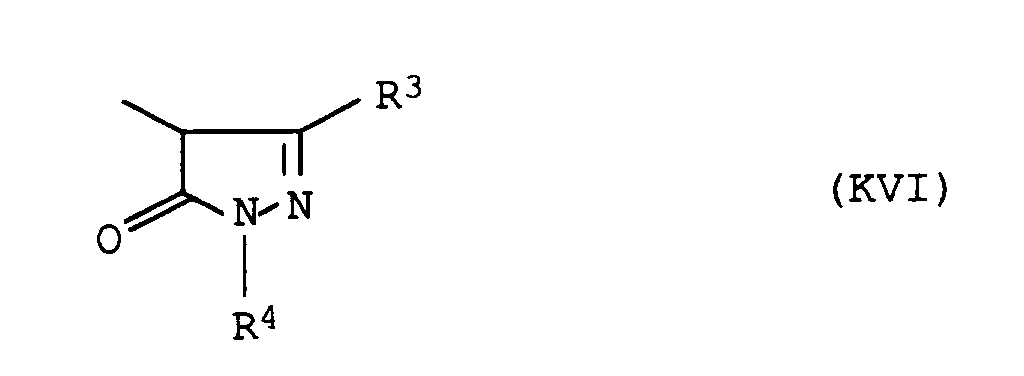
wobei R³ und R⁴ die obengenannte Bedeutung haben;
wobei R³ die obengenannte Bedeutung hat, q für 1 bis 4 steht und - R⁸
- Wasserstoff, Halogen, Nitro, Sulfo, C₁-C₁₀-Alkyl, C₁-C₁₀-Alkoxy, C₁-C₁₀-Alkoxycarbonyl und/oder Carbamoyl, das ein- oder zweifach durch C₁-C₁₀-Alkyl substituiert sein kann, bedeutet;

- R⁹
- C₁-C₁₀-Alkyl, das durch Amino, Mono- oder Di-(C₁-C₁₀-alkyl)amino substituiert sein kann;
- R¹⁰
- Wasserstoff, Halogen, Cyano, Sulfo, C₁-C₁₀-Alkylcarbonyl, C₁-C₁₀-Alkoxycarbonyl oder Carbamoyl, das ein- oder zweifach durch C₁-C₁₀-Alkyl substituiert sein kann;

- R¹¹
- Methyl oder Phenyl, das folgende Substituenten tragen kann: Halogen, Hydroxy, Nitro, Sulfo, C₁-C₁₀-Alkyl, C₁-C₁₀-Alkoxy, C₁-C₁₀-Alkoxycarbonyl, Formylamino, C₂-C₁₀-Alkanoylamino, Carbamoyl, das ein- oder zweifach durch C₁-C₁₀-Alkyl substituiert sein kann, Mono- oder Di-(C₁-C₁₀-alkyl)- oder -(phenyl)-aminosulfonyl und/oder C₁-C₁₀-Alkoxy- oder Phenoxysulfonyl;
- R¹²
- Wasserstoff, Halogen, Hydroxy, Sulfo, C₁-C₁₀-Alkyl, C₁-C₁₀-Alkoxy, C₁-C₁₀-Alkylcarbonyl, Carbamoyl, das ein- oder zweifach durch C₁-C₁₀-Alkyl substituiert sein kann, und/oder Mono-(C₁-C₁₀-alkyl)- oder -(phenyl)-aminosulfonyl;

- R¹³
- gleiche oder verschiedene der Reste Wasserstoff, C₁-C₁₀-Alkyl oder C₁-C₁₀-Alkylcarbonyl bedeutet;

- R¹⁴
- Hydroxy oder einen Rest der Formel
-NH-R²⁰
bedeutet, in der R²⁰ für Wasserstoff, Phenyl, das die bei R¹⁰ für Phenyl genannten Substituenten tragen kann, oder einen heterocyclischen Rest der Formeln

- R¹⁵
- Phenyl oder Naphthyl, das jeweils die bei R¹⁰ für Phenyl genannten Substituenten tragen kann, oder einen der bei R¹⁴ genannten heterocyclischen Reste R²⁰;
- R¹⁶
- Methyl oder einen Rest der Formel -NH-R¹⁵;

- R¹⁷
- Wasserstoff oder Sulfo;
- R¹⁸
- Wasserstoff oder Hydroxy;
- R¹⁹
- Halogen.
- Dabei sind als Reste bevorzugter Kupplungskomponenten die Reste der Formeln (KIV) und (KVI) hervorzuheben.
- Von den vorstehend aufgeführten Resten seien beispielhaft genannt:
- C₁-C₁₈-Alkyl, bevorzugt C₁-C₁₀-Alkyl, besonders bevorzugt C₁-C₆-Alkyl, wie Methyl, Ethyl, Propyl, Isopropyl, Butyl, Isobutyl, sec.-Butyl, tert.-Butyl, Pentyl, Isopentyl, Neopentyl, tert.-Pentyl, Hexyl und 2-Methylpentyl, insbesondere Methyl und Ethyl;
- C₁-C₁₀-Alkoxy, bevorzugt C₁-C₆-Alkoxy, wie Methoxy, Ethoxy, Propoxy, Isopropoxy, Butoxy, Isobutoxy, sec.-Butoxy, tert.-Butoxy, Pentyloxy und Hexyloxy, insbesondere Methoxy und Ethoxy;
- C₁-C₁₀-Alkylcarbonyl, bevorzugt C₁-C₆-Alkylcarbonyl, wie Acetyl, Propionyl, insbesondere Acetyl;
- C₁-C₁₀-Alkoxycarbonyl, bevorzugt C₁-C₆-Alkoxycarbonyl, wie insbesondere Methoxycarbonyl und Ethoxycarbonyl;
- Mono- und Di-(C₁-C₁₀-alkyl)-, bevorzugt -(C₁-C₆-alkyl)amino, wie Methylamino, Ethylamino, Propylamino, Isopropylamino, Butylamino, Pentylamino und Hexylamino, insbesondere Methylamino und Ethylamino; Cycloalkylamino wie Cyclopropyl-, Cyclobutyl-, Cyclopentyl- und Cyclohexylamino; Dimethylamino, Diethylamino, Dipropylamino, Diisopropylamino und Methylethylamino;
- C₂-C₁₀-Alkanoylamino, bevorzugt C₂-C₇-Alkanoylamino: insbesondere Acetylamino;
- Mono- und Di-(C₁-C₁₀-alkyl)-, bevorzugt -(C₁-C₆-alkyl)aminosulfonyl: Methyl- und Ethylaminosulfonyl;
- C₁-C₁₀-Alkoxysulfonyl, bevorzugt C₁-C₆-Alkoxysulfonyl: Methoxy- und Ethoxysulfonyl;
- Halogen: insbesondere Chlor und Brom.
- Enthalten die Isoindolinazopigmente I verlackbare Gruppen wie Carboxy oder Sulfo, so können diese auch in verlackter Form, d.h. als Metallsalze vorliegen.
- Geeignete Metalle sind dabei z.B. Lithium, Natrium, Kalium, Strontium, Barium, Aluminium, Kupfer, Eisen, Cobalt, Nickel und besonders Magnesium, Calcium, Zink und Mangan.
- Beim erfindungsgemäßen Verfahren zur Herstellung der Isoindolinazopigmente I wird zunächst ein Halbkondensat II mit einem aromatischen Diamin III in einem unter den Reaktionsbedingungen inerten organischen Lösungsmittel zu einem Amin der Formel IV

umgesetzt, das anschließend dann in üblicher Weise diazotiert und mit einer Kupplungskomponente K-H (V) gekuppelt wird, wobei überraschend ist, daß das Amin IV im sauren Medium so stabil ist, daß es diazotiert werden kann. - Als inerte organische Lösungsmittel für die Herstellung des Amins IV sind, wie in der älteren deutschen Patentanmeldung P 43 41 769.8 beschrieben, polare protische Lösungsmittel wie ein- oder mehrwertige aromatische Alkohole und aliphatische Alkohole, Etheralkohole, offenkettige und cyclische Ether, dipolaraprotische Lösungsmittel und aromatische Lösungsmittel wie Nitrobenzol, Toluol und Chlorbenzol geeignet.
- Im einzelnen seien z.B. genannt: Phenol, C₁-C₆-Alkohole, bevorzugt C₁-C₄-Alkanole wie Ethanol, Propanol, Isopropanol, Butanol und vor allem Methanol; Ethylenglykolmono- und -di-(C₁-C₆)alkylether wie Ethylenglykolmono- und -dimethylether, Oligo- und Polyglykole und -glykolether wie Diethylenglykolmonomethylether, Dioxan und Tetrahydrofuran; Dimethylsulfoxid und amidische Lösungsmittel wie Dimethylformamid, Dimethylacetamid und N-Methylpyrrolidon. Geeignet sind auch Mischungen dieser Lösungsmittel, z.B. Dimethylacetamid/Alkanol, Phenol/Alkanol.
- Die Menge Lösungsmittel ist an sich nicht kritisch und beträgt in der Regel 5 bis 100 g, vorzugsweise 10 bis 50 g je g II.
- Halbkondensat II und Diamin III werden zweckmäßigerweise in etwa äquimolarem Verhältnis eingesetzt.
- Die Halbkondensate II sind an sich bekannt oder können in bekannter Weise durch Umsetzung der entsprechenden Iminoaminoisoindolenine, Trichlorisoindolenine und entsprechend aktivierter Derivate oder direkt aus den entsprechenden o-Phthalodinitrilen mit methylenaktiven (C-H-aciden) Verbindungen hergestellt werden.
- In der Regel wird die Umsetzung von II mit III bei 0 bis 100⁰C, insbesondere bei 30 bis 80°C vorgenommen. Die zu wählende Temperatur hängt dabei auch von der Rückflußtemperatur des verwendeten Lösungsmittels ab.
- Üblicherweise arbeitet man bei Normaldruck. Man kann die Umsetzung jedoch auch unter Druck durchführen.
- Gängige Reaktionszeiten sind etwa 10 min bis 5 h, wobei die Reaktion meist schon nach der Aufheizphase beendet ist.
- Verfahrenstechnisch geht man im allgemeinen so vor, daß man ein gewünschtenfalls erwärmtes Gemisch aus Lösungsmittel und Halbkondensat II vorlegt und das aromatische Diamin III zugibt. Die Zugabe kann dabei kontinuierlich erfolgen.
- Das Amin IV wird dann zweckmäßigerweise isoliert und wie allgemein üblich diazotiert und mit der Kupplungskomponente V gekuppelt.
- Als Lösungsmittel eignen sich für die Diazotierung insbesondere dipolar-aprotische Lösungsmittel wie N-Methylpyrrolidon, Dimethylformamid und Dimethylacetamid sowie Wasser und auch Mischungen dieser Lösungsmittel.
- Die Diazotierung wird in Gegenwart einer organischen Säure wie Essigsäure (Eisessig) und Propionsäure oder einer anorganischen Säure wie Salzsäure, Schwefelsäure, Salpetersäure und Phosphorsäure durchgeführt.
- Geeignete Diazotierungsmittel sind die üblicherweise für diesen Zweck eingesetzten Verbindungen wie Alkalimetallnitrite, insbesondere Natriumnitrit, organische Nitrite, insbesondere Glykolnitrit und Isoamylnitrit, und Nitrosylschwefelsäure.
- Die Konzentration des Reaktionsgemisches wird durch dessen Rührfähigkeit bestimmt.
- Die Reaktionstemperatur hängt von der Reaktivität und Stabilität der Reaktionspartner und ihrer Löslichkeit ab und beträgt im allgemeinen -20 bis 50°C, bevorzugt 0 bis 5°C.
- Nach abgeschlossener Diazotierung, die wenige Minuten bis einige Stunden dauern kann, wird der für die Kupplung erforderliche pH-Wert (in der Regel ein pH-Wert von 4 bis 6) durch Zugabe einer Base wie Natronlauge eingestellt und die Kupplungskomponente, zweckmäßigerweise in einem der oben genannten Lösungsmittel, einem Alkohol oder einem Gemisch dieser Lösungsmittel, gegebenenfalls durch Basenzusatz (z.B. Natronlauge), gelöst, zugegeben.
- Die Aufarbeitung des Reaktionsgemisches auf die Isoindolinazopigmente I kann in üblicher Weise vorgenommen werden, indem man die Pigmente nach dem Abkühlen der Mischung abfiltriert, gegebenenfalls mit einem inerten Lösungsmittel wie Dimethylformamid, Dimethylacetamid oder N-Methylpyrrolidon oder Eisessig, Alkoholen und/oder Wasser wäscht und trocknet.
- Je nach den Anforderungen für die Anwendung kann man die Pigmente direkt in der anfallenden Form verwenden oder wird man erst eine übliche Mahlung und/oder eine übliche Lösungsmittelbehandlung gegebenenfalls in Gegenwart die Kristallisation beeinflussender Additive vornehmen. Selbstverständlich kann die Kristallisationssteuerung auch bereits bei der Synthese durch an sich bekannte Maßnahmen wie den Zusatz kristallisationshemmender Additive, die Einwirkung von Scherkräften während der Umsetzung sowie den Zusatz von Mahlkörpern und/oder gezielte Temperaturführung erfolgen.
- Mit Hilfe des erfindungsgemäßen Verfahrens können die Isoindolinazopigmente gezielt in guter Ausbeute und Reinheit hergestellt werden.
- Die so erhältlichen Isoindolinazopigmente I können vorteilhaft zum Färben von hochmolekularen organischen Materialien verwendet werden. Insbesondere seien die Herstellung von Druckfarben und Lacken sowie die Pigmentierung von Kunststoffen genannt.
- Beispiele für zu färbende Materialien sind: natürliche Harze; Kunstharze (Polymerisations- und Kondensationsharze) wie Alkydharze, Acrylharze, Epoxidharze, Aminoformaldehydharze wie Melamin- und Harnstoffharze; Celluloseether und -ester wie Ethylcellulose, Nitrocellulose, Celluloseacetat und -butyrat; Polyurethane; Polyvinylchloride; Kautschuk, Chlorkautschuk; Polyolefine; Polyamide; Polyester; Epoxyester; Polycarbonate; Phenoplaste; Gummi; Casein; Silikon und Silikonharze sowie auch Mischungen der genannten Materialien.
- Die hochmolekularen organischen Materialien können beim Färben als plastische Massen, Schmelzen, Lösungen, Emulsionen oder Dispersionen vorliegen. Bei der Lack- und Druckfarbenherstellung verwendet man bevorzugt Lösungen oder Dispersionen. Als Beispiele für bevorzugte Lacksysteme seien Alkyd/Melaminharzlacke, Acryl/Melaminharzlacke, Celluloseacetat/Cellulosebutyratlacke und Zweikomponentenlacke auf Basis mit Polyisocyanat vernetzbarer Acrylharze genannt.
- Herstellung von Isoinolinazopigmenten der Formel

-
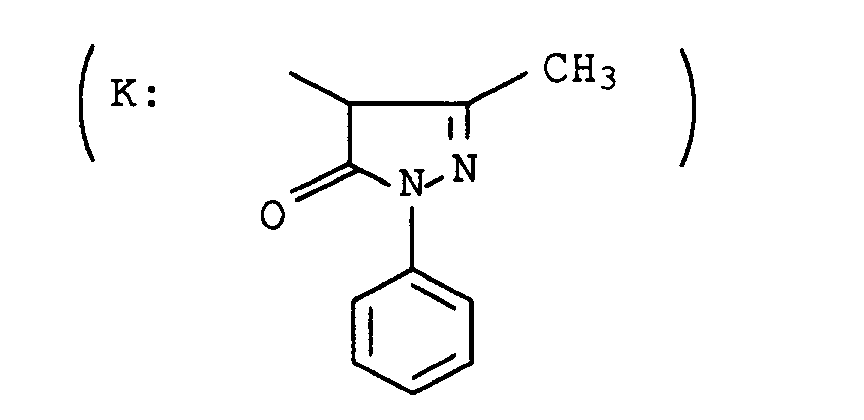
- Zu einer Suspension von 22,6 g des Halbkondensats
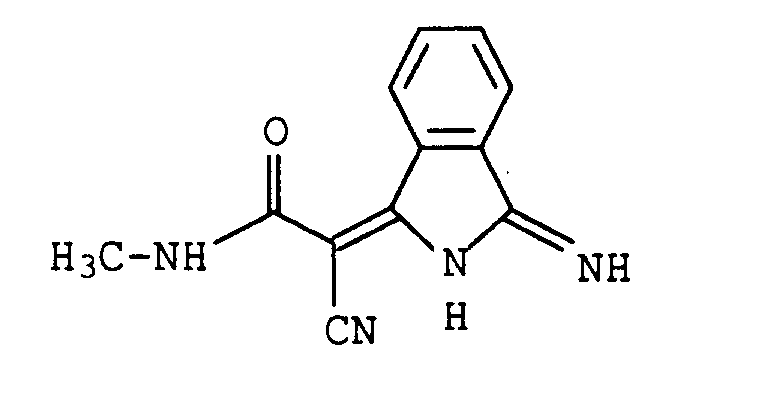
in 300 ml Methanol wurden bei Raumtemperatur 10,8 g p-Phenylendiamin, gelöst in 100 ml Methanol, zugetropft. Die Reaktionsmischung wurde dann 1h unter Rückfluß gerührt. - Anschließend wurde das Lösungsmittel zur Hälfte abdestilliert und der Niederschlag durch Filtrieren isoliert, mit Methanol und Wasser gewaschen und getrocknet.
- Es wurden 28,7 g der Verbindung

als rotes Pulver mit dem Schmelzpunkt 285°C erhalten, was einer Ausbeute von 90,5 % entspricht. -
Elementaranalyse: C: gef. 68,0 (ber. 68,1); H: gef. 4,9 (ber. 4,8); O: gef. 5,5 (ber. 5,0); N: gef. 21,9 (ber. 22,1);
MS: m/e= 317,0 (C₁₈H₁₅ON₅⁺);
¹H-NMR(DMSO-d₆; TMS):
2,72 - 2,73 (d, 1H, NH-CH₃);
2,80 - 2,82 (d, 2H, NH-CH₃);
3,73 (s, Wasser); 5,29 (s; breit); 5,41 (s; breit);
6,67 - 6,72 (m, 2H, arom.);
6,94 - 6,97 (d, 0,6H, arom.); 7,49 - 7,52 (d, 1,4H, arom.) ;
7,68 - 7,71 (m, 2H, arom.); 8,0 - 8,1 (m, 0,6H, arom.),
8,25 - 8,37 (m, 1,4H, arom.); 9,91 - 9,94 (q, 1H, NH-CH₃);
11,27 (breit); 12,01 (bewegl. Protonen) ppm;
DC (Merck-Kieselgel 60 F₂₅₄, Aluminiumfolie-Fertigplatten):
Rf (Aceton): 0,8;
Rf (n-Butanol/Eisessig/Wasser Vol. 3:1:1): 0,82;
Rf (Toluol/Eisessig/Essigsäureethylester Vol. 7:1:1): 0,45. - Eine Lösung von 15,9 g (0,05 mol) der in a) erhaltenen Diazokomponente in 100 ml N-Methylpyrrolidon wurde bei Raumtemperatur mit 15 ml konz. Salzsäure versetzt. Nach Abkühlen auf 0°C wurden 15 ml 23 gew.-%ige Natriumnitritlösung zugetropft.
- Nach einstündigem Rühren bei 0 - 5°C wurden zunächst 0,5 g Amidosulfonsäure und dann 9,5 g (0,055 mol) N-Phenylmethylpyrazolon, gelöst in 100 ml Methanol und 3 ml 30 gew.-%iger Natronlauge, zugegeben. Der pH-Wert wurde bei 4 bis 5 gehalten.
- Nachdem keine Diazokomponente mehr detektierbar war (nach 2 h), wurde das Reaktionsgemisch auf Raumtemperatur erwärmt und filtriert.
- Der isolierte Niederschlag wurde mit N-Methylpyrrolidon und Wasser gewaschen und bei 80°C getrocknet.
- Es wurden 24,1 g des Zielproduktes als rotes Pulver erhalten, was einer Ausbeute von 96 % entspricht.
Elementaranalyse: C: gef. 66,5 (ber. 66,92); H: gef. 4,5 (ber. 4,41); O: gef. 6,3 (ber. 6,37); N: gef. 22,1 (ber. 22,3). - Zur Beurteilung der Koloristik wurden 1 g Pigment und 9,5 g einer Einbrennlackmischung aus 70 Gew.-% Kokosalkydharz (60 gew.-%ig in Xylol) und 30 Gew.-% Melaminharz (55 gew.-%ig in Butanol/Xylol) in einem Attritor angerieben, auf Blech aufgetragen, abgelüftet und 30 min bei 120°C eingebrannt.
- Es wurde eine rote Lackierung erhalten.
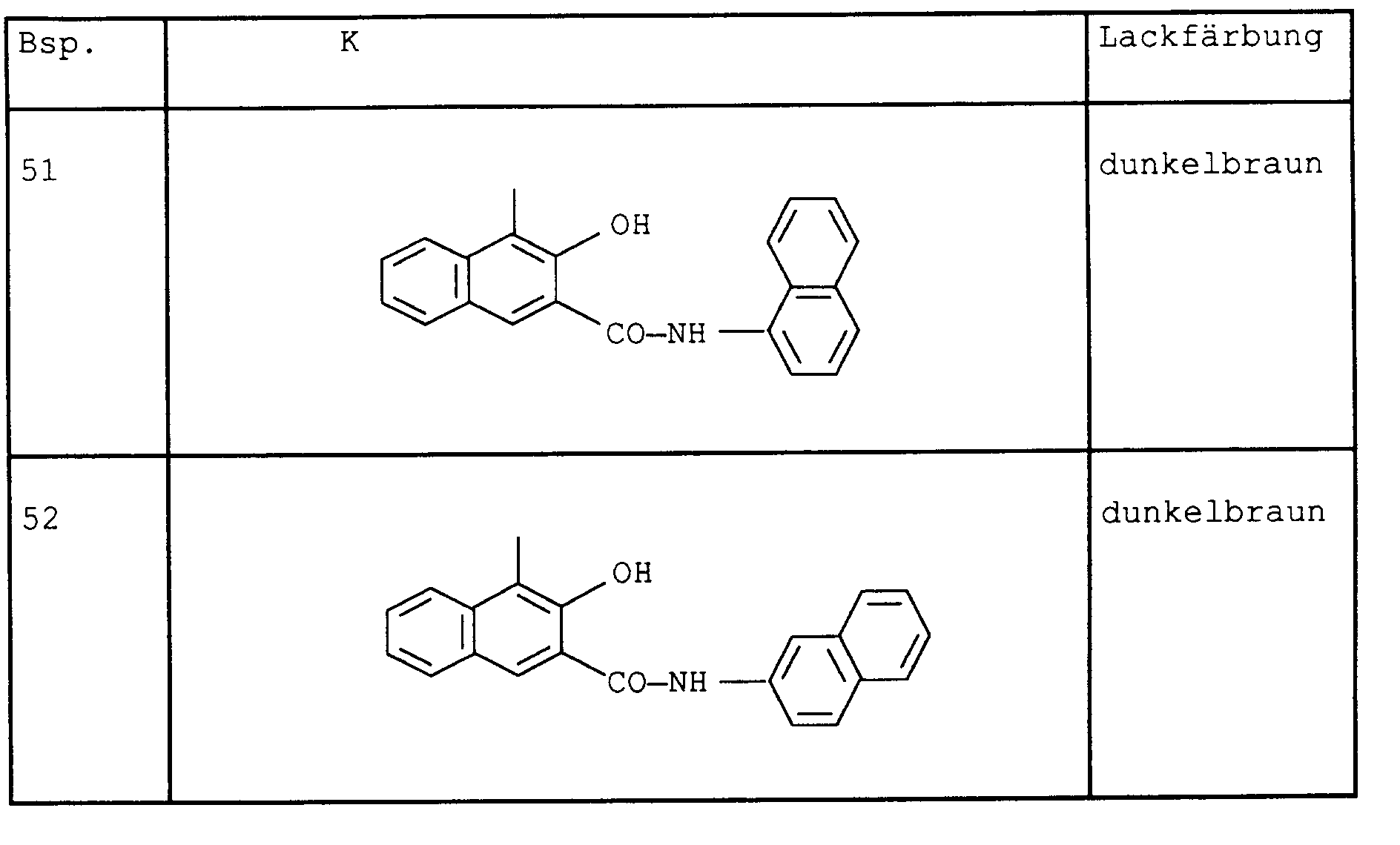
- Analog Beispiel 1 wurden die in der folgenden Tabelle aufgeführten Isoindolinazopigmente hergestellt (Kupplungs-pH-Wert 3 bis 5) und in das obengenannte Lacksystem eingearbeitet.


wobei die Pigmente in der Azo- oder der Hydrazoform oder in Form eines Gleichgewichtsgemisches zwischen diesen Formen vorliegen können und die enthaltenen verlackbaren Gruppen verlackt sein können.

wobei die Variablen folgende Bedeutung haben:
Claims (4)
- Isoindolinazopigmente der allgemeinen Formel I
 A einen Rest der Formeln
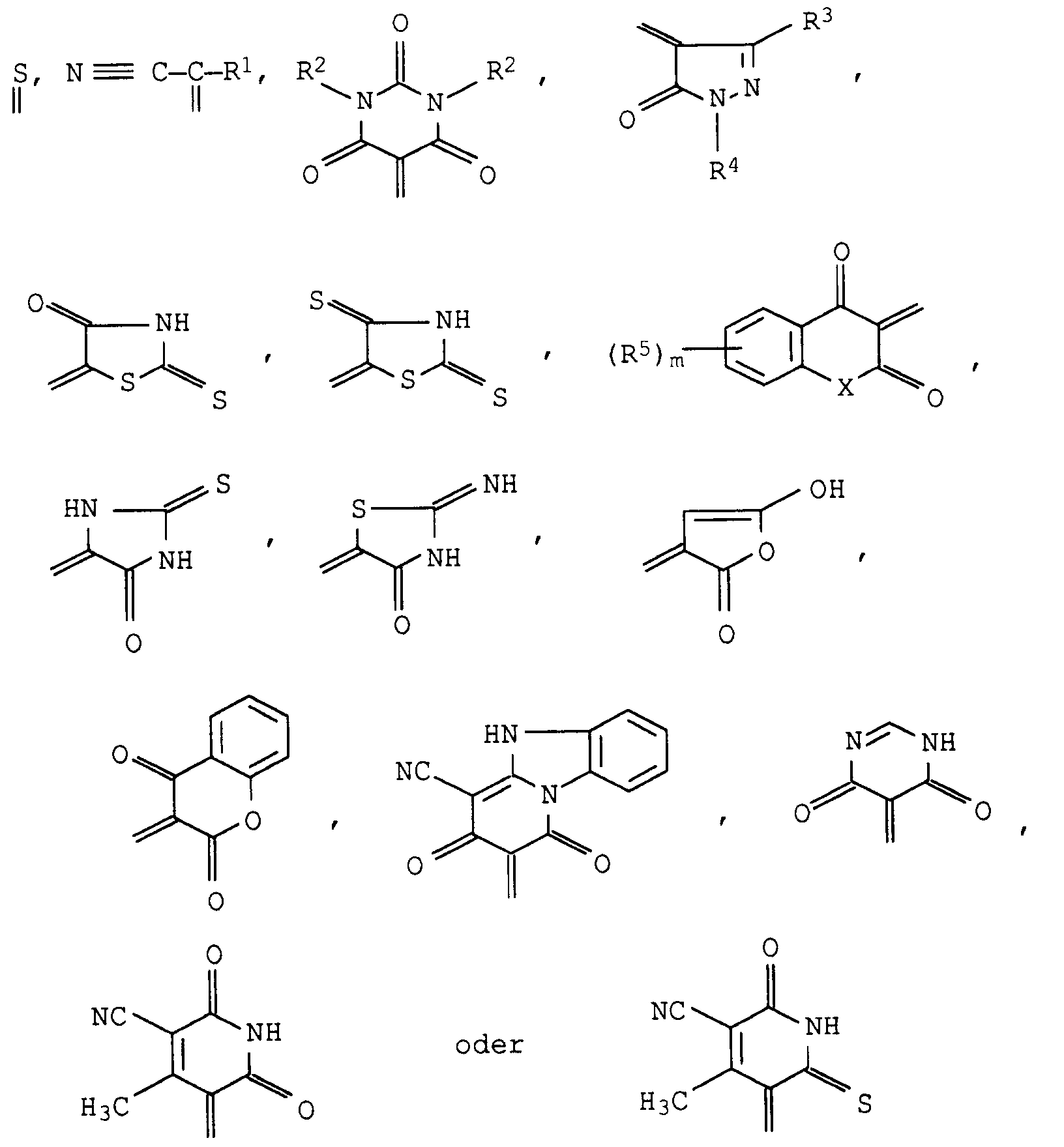 R¹ Cyano;
Carbamoyl, das durch
C₁-C₁₀-Alkylcarbonyl, Benzoyl, C₁-C₁₀-Alkoxycarbonyl, Phenoxycarbonyl oder Benzyloxycarbonyl, wobei Benzoyl, Phenoxy und Benzyloxy durch Halogen, Nitro, Sulfo, C₁-C₁₀-Alkyl, Formylamino, C₂-C₁₀-Alkanoylamino und/oder Phthalimidyl substituiert sein können;
Phenyl, das durch Halogen, Cyano, Nitro, Sulfo und/oder Trifluormethyl substituiert sein kann;
Carbazoyl oder Ureidocarbonyl, deren endständige Stickstoffatome ein- oder zweifach durch C₁-C₁₀-Alkyl oder Benzyl, das die oben genannten Substituenten tragen kann, substituiert sein können;
einen heterocyclischen Rest der Formeln Z -O-, -S- oder -NH-,R⁶ Halogen, Nitro, Sulfo, C₁-C₆-Alkyl oder C₁-C₆-Alkoxy,R⁷ Halogen,p 0 bis 2 undq 1 bis 4
bedeutet;R² unabhängig voneinander Wasserstoff, C₁-C₁₀-Alkyl, Phenyl oder Naphthyl, das jeweils durch Halogen, Nitro, Sulfo, C₁-C₁₀-Alkyl und/oder C₁-C₁₀-Alkoxy substituiert sein kann;R³ C₁-C₁₀-Alkyl, Amino, Benzoylamino, Carboxy, Carbamoyl oder C₁-C₁₀-Alkoxycarbonyl;R⁴ Wasserstoff oder Phenyl, das bis zu zwei der folgenden Substituenten tragen kann: Halogen, Nitro, Sulfo, Carboxy, Carbamoyl, C₁-C₁₀-Alkyl, C₁-C₁₀-Alkoxy oder C₁-C₁₀-Alkoxycarbonyl;R⁵ Halogen oder Nitro;X -O- oder -NR⁸-wobei R⁸ Wasserstoff oder C₁-C₁₀-Alkyl bedeutet;m 0 bis 4;L 1,4-Phenylen, 1,3-Phenylen oder 1,5-Naphthylen, das jeweils folgende Substituenten tragen kann: Halogen, Nitro, Carboxy, Sulfo, Sulfonamido, das ein- oder zweifach durch C₁-C₁₀-Alkyl substituiert sein kann, C₁-C₁₀-Alkyl, C₁-C₁₀-Alkoxy, C₁-C₁₀-Alkylcarbonyl, C₁-C₁₀-Alkoxycarbonyl, Formylamino, C₂-C₁₀-Alkanoylamino und/oder Carbamoyl, das ein- oder zweifach durch C₁-C₁₀-Alkyl substituiert sein kann;K den Rest einer Kupplungskomponente der Formel
 R⁸ Wasserstoff, Halogen, Nitro, Sulfo, C₁-C₁₀-Alkyl, C₁-C₁₀-Alkoxy, C₁-C₁₀-Alkoxycarbonyl und/oder Carbamoyl, das ein- oder zweifach durch C₁-C₁₀-Alkyl substituiert sein kann;R⁹ C₁-C₁₀-Alkyl, das durch Amino, Mono- oder Di(C₁-C₁₀-alkyl)-amino substituiert sein kann;R¹⁰ Wasserstoff, Halogen, Cyano, Sulfo, C₁-C₁₀-Alkylcarbonyl, C₁-C₁₀-Alkoxycarbonyl oder Carbamoyl, das ein- oder zweifach durch C₁-C₁₀-Alkyl substituiert sein kann;R¹¹ Methyl oder Phenyl, das folgende Substituenten tragen kann: Halogen, Hydroxy, Nitro, Sulfo, C₁-C₁₀-Alkyl, C₁-C₁₀-Alkoxy, C₁-C₁₀-Alkylcarbonyl, C₁-C₁₀-Alkoxycarbonyl, Formylamino, C₂-C₁₀-Alkanoylamino, Carboxy, Carbamoyl, das ein- oder zweifach durch C₁-C₁₀-Alkyl substituiert sein kann, Mono- oder Di-(C₁-C₁₀-alkyl)- oder -(phenyl)-aminosulfonyl und/oder C₁-C₁₀-Alkoxy- oder Phenoxysulfonyl;R¹² Wasserstoff, Halogen, Hydroxy, Sulfo, C₁-C₁₀-Alkyl, C₁-C₁₀-Alkoxy, C₁-C₁₀-Alkylcarbonyl, Carbamoyl, das ein- oder zweifach durch C₁-C₁₀-Alkyl substituiert sein kann, und/oder Mono-(C₁-C₁₀-alkyl)- oder -(phenyl)-aminosulfonyl;R¹³ gleiche oder verschiedene Reste: Wasserstoff, C₁-C₁₀-Alkyl oder C₁-C₁₀-Alkylcarbonyl;R¹⁴ Hydroxy oder einen Rest der Formel
-NH-R²⁰
wobei R²⁰ Wasserstoff, Phenyl, das die bei dem Rest R¹⁰ für Phenyl genannten Substituenten tragen kann, oder einen heterocyclischen Rest der Formeln R¹⁵ Phenyl oder Naphthyl, das jeweils die bei dem Rest R¹⁰ für Phenyl genannten Substituenten tragen kann, oder einen der bei dem Rest R¹⁴ genannten heterocyclischen Reste R²⁰;R¹⁶ Methyl oder einen Rest der Formel -NH-R¹⁵;R¹⁷ Wasserstoff oder Sulfo;R¹⁸ Wasserstoff oder Hydroxy;R¹⁹ Halogen;Y -O- oder -CH₂-;Z =O oder =S;der Benzolring D durch Halogen, Nitro, Carboxy, Carbamoyl, C₁-C₁₀-Alkyl und/oder C₁-C₁₀-Alkoxy substituiert sein kann;
wobei die Pigmente in der Azo- oder der Hydrazoform oder in Form eines Gleichgewichtsgemisches zwischen diesen Formen vorliegen können und die enthaltenen verlackbaren Gruppen verlackt sein können. - Isoindolinazopigmente der Formel I nach Anspruch 1, in derA einen Rest der Formel
 L 1,4-Phenylen undK einen der Reste der Formelnbedeutet.
- Verfahren zur Herstellung von Isoindolinazopigmenten der Formel I gemäß Anspruch 1, dadurch gekennzeichnet, daß man ein Halbkondensat der Formel II

H₂N―L―NH₂ III
in einem unter den Reaktionsbedingungen inerten organischen Lösungsmittel umsetzt und das erhaltene Amin der Formel IV
- Verwendung von Isoindolinazopigmenten der Formel I gemäß Anspruch 1 zum Pigmentieren von hochpolymeren organischen Materialien.
Applications Claiming Priority (2)
| Application Number | Priority Date | Filing Date | Title |
|---|---|---|---|
| DE4409902 | 1994-03-23 | ||
| DE4409902A DE4409902A1 (de) | 1994-03-23 | 1994-03-23 | Isoindolinazopigmente |
Publications (1)
| Publication Number | Publication Date |
|---|---|
| EP0673978A1 true EP0673978A1 (de) | 1995-09-27 |
Family
ID=6513537
Family Applications (1)
| Application Number | Title | Priority Date | Filing Date |
|---|---|---|---|
| EP95103717A Withdrawn EP0673978A1 (de) | 1994-03-23 | 1995-03-15 | Isoindolinazopigmente |
Country Status (4)
| Country | Link |
|---|---|
| US (1) | US5484901A (de) |
| EP (1) | EP0673978A1 (de) |
| JP (1) | JPH07258565A (de) |
| DE (1) | DE4409902A1 (de) |
Cited By (1)
| Publication number | Priority date | Publication date | Assignee | Title |
|---|---|---|---|---|
| CN109153859A (zh) * | 2016-04-22 | 2019-01-04 | 大日精化工业株式会社 | 黑色偶氮颜料和着色剂 |
Families Citing this family (4)
| Publication number | Priority date | Publication date | Assignee | Title |
|---|---|---|---|---|
| DE19545464A1 (de) * | 1995-12-06 | 1997-06-12 | Bayer Ag | Benzimidazol-isoindoleninfarbstoffe |
| DE19632921A1 (de) * | 1996-08-16 | 1998-02-19 | Bayer Ag | Benzoxazolylisoindolenine |
| JP4714532B2 (ja) * | 2005-09-02 | 2011-06-29 | 東洋インキScホールディングス株式会社 | カラーフィルタ用着色組成物およびカラーフィルタ |
| EP3798271A1 (de) * | 2019-09-30 | 2021-03-31 | BASF Colors & Effects GmbH | Isoindolinderivate |
Citations (7)
| Publication number | Priority date | Publication date | Assignee | Title |
|---|---|---|---|---|
| FR1537299A (fr) * | 1966-09-09 | 1968-08-23 | Bayer Ag | Procédé de préparation de nouveaux dérivés de l'isoindoline |
| JPS5430221A (en) * | 1977-08-11 | 1979-03-06 | Dainichi Seika Kogyo Kk | Preparation of azo pigments |
| DE2901121A1 (de) * | 1978-04-27 | 1979-11-08 | Dainichiseika Color Chem | Azopigmente |
| JPS5649757A (en) * | 1980-08-01 | 1981-05-06 | Dainichi Seika Kogyo Kk | Azo pigment |
| JPS57123260A (en) * | 1981-01-26 | 1982-07-31 | Dainichi Seika Kogyo Kk | Coloring method of organic material |
| EP0190692A2 (de) * | 1985-02-05 | 1986-08-13 | BASF Aktiengesellschaft | Bis-isoindolinpigmente und ihre Verwendung |
| EP0211272A2 (de) * | 1985-08-01 | 1987-02-25 | Dainichiseika Color & Chemicals Mfg. Co. Ltd. | Azoverbindung und dieselbe enthaltende farbige Zusammensetzung |
Family Cites Families (6)
| Publication number | Priority date | Publication date | Assignee | Title |
|---|---|---|---|---|
| CH567551A5 (de) * | 1973-01-09 | 1975-10-15 | Ciba Geigy Ag | |
| DE2909645A1 (de) * | 1979-03-12 | 1980-09-18 | Basf Ag | Schwerloesliche isoindolinfarbstoffe und deren verwendung |
| US4314938A (en) * | 1979-06-19 | 1982-02-09 | Ciba-Geigy Corporation | Iminoisoindolinone pigments containing phenylazoacetoacetyl-aminophenylene groups |
| JPS5655456A (en) * | 1980-08-01 | 1981-05-16 | Dainichi Seika Kogyo Kk | Azo pigment |
| DE3525751A1 (de) * | 1985-07-19 | 1987-01-22 | Basf Ag | Verwendung von 3-iminoisoindolinverbindungen und neue 3-aminoisoindolinverbindungen |
| JPS62174268A (ja) * | 1986-01-29 | 1987-07-31 | Dainichi Color & Chem Mfg Co Ltd | アゾ顔料およびその製造方法 |
-
1994
- 1994-03-23 DE DE4409902A patent/DE4409902A1/de not_active Withdrawn
-
1995
- 1995-03-15 EP EP95103717A patent/EP0673978A1/de not_active Withdrawn
- 1995-03-22 JP JP7063137A patent/JPH07258565A/ja not_active Withdrawn
- 1995-03-22 US US08/408,307 patent/US5484901A/en not_active Expired - Fee Related
Patent Citations (8)
| Publication number | Priority date | Publication date | Assignee | Title |
|---|---|---|---|---|
| FR1537299A (fr) * | 1966-09-09 | 1968-08-23 | Bayer Ag | Procédé de préparation de nouveaux dérivés de l'isoindoline |
| JPS5430221A (en) * | 1977-08-11 | 1979-03-06 | Dainichi Seika Kogyo Kk | Preparation of azo pigments |
| DE2901121A1 (de) * | 1978-04-27 | 1979-11-08 | Dainichiseika Color Chem | Azopigmente |
| FR2424302A1 (fr) * | 1978-04-27 | 1979-11-23 | Dainichiseika Color Chem | Pigments azoiques et leur procede de preparation |
| JPS5649757A (en) * | 1980-08-01 | 1981-05-06 | Dainichi Seika Kogyo Kk | Azo pigment |
| JPS57123260A (en) * | 1981-01-26 | 1982-07-31 | Dainichi Seika Kogyo Kk | Coloring method of organic material |
| EP0190692A2 (de) * | 1985-02-05 | 1986-08-13 | BASF Aktiengesellschaft | Bis-isoindolinpigmente und ihre Verwendung |
| EP0211272A2 (de) * | 1985-08-01 | 1987-02-25 | Dainichiseika Color & Chemicals Mfg. Co. Ltd. | Azoverbindung und dieselbe enthaltende farbige Zusammensetzung |
Non-Patent Citations (3)
| Title |
|---|
| CHEMICAL ABSTRACTS, vol. 91, no. 8, 20 August 1979, Columbus, Ohio, US; abstract no. 58690v, page 87; * |
| CHEMICAL ABSTRACTS, vol. 95, no. 14, 5 October 1981, Columbus, Ohio, US; abstract no. 117055z, page 80; * |
| CHEMICAL ABSTRACTS, vol. 98, no. 4, 24 January 1983, Columbus, Ohio, US; abstract no. 18108z, page 74; * |
Cited By (2)
| Publication number | Priority date | Publication date | Assignee | Title |
|---|---|---|---|---|
| CN109153859A (zh) * | 2016-04-22 | 2019-01-04 | 大日精化工业株式会社 | 黑色偶氮颜料和着色剂 |
| CN109153859B (zh) * | 2016-04-22 | 2019-09-24 | 大日精化工业株式会社 | 黑色偶氮颜料和着色剂 |
Also Published As
| Publication number | Publication date |
|---|---|
| DE4409902A1 (de) | 1995-09-28 |
| JPH07258565A (ja) | 1995-10-09 |
| US5484901A (en) | 1996-01-16 |
Similar Documents
| Publication | Publication Date | Title |
|---|---|---|
| DE1768892A1 (de) | Verfahren zur Herstellung von Disazopigmenten | |
| EP0158888B1 (de) | Disazoverbindungen, Verfahren zu ihrer Herstellung und ihre Verwendung | |
| DE2236250C2 (de) | Neue Disazo-Pigmente, deren Herstellung und Verwendung | |
| EP0241413B1 (de) | Neue Aminsalze von Azoverbindungen | |
| EP0673978A1 (de) | Isoindolinazopigmente | |
| DE2425594A1 (de) | Iminoisoindolinpigmente und verfahren zu deren herstellung | |
| DE2244035C3 (de) | Disazopigmente, Verfahren zu deren Herstellung und ihre Verwendung zum Pigmentieren von hochmolekularem organischen Material | |
| EP0867477B1 (de) | Polycyclische Verbindungen | |
| EP0101954B1 (de) | Isoindolazine, Verfahren zu ihrer Herstellung sowie ihre Verwendung | |
| DE2457687B2 (de) | Azofarbstoffe, deren Herstellung und Verwendung zum Farben von Lacken, Druckfarben oder Kunststoffen | |
| EP0359708B1 (de) | Monoazoverbindungen mit langkettigen Alkylresten | |
| EP0657507A2 (de) | Verfahren zur Herstellung von unsymmetrischen Bisisoindolinpigmenten | |
| EP0591105A2 (de) | Bisazo-, Bisazomethin- und Azo-azomethinverbindungen | |
| DE2429286C2 (de) | Neue Disazopigmente, Verfahren zu deren Herstellung und deren Verwendung | |
| EP0271818B1 (de) | Isoindolin-Metallkomplexe | |
| DE2145422B2 (de) | Neue Disazopigmente | |
| CH627200A5 (en) | Process for preparing new monoazo pigments and use thereof for pigmenting macromolecular organic material | |
| EP0000737B1 (de) | Monoazopigmente der Acetoacetylaminobenzimidazolonreihe, Verfahren zu deren Herstellung, und deren Verwendung zum Pigmentieren von hochmolekularem organischem Material | |
| DE1644127A1 (de) | Verfahren zur Herstellung von Disazopigmenten | |
| EP0064952B1 (de) | Neue Monoazopigmente | |
| DE2556430A1 (de) | Neue disazopigmente und verfahren zu deren herstellung und verwendung | |
| DE2305071C2 (de) | Wasserunlösliche Disazomethinfarbstoffe, Verfahren zu ihrer Herstellung und ihre Verwendung | |
| EP0022076B1 (de) | Iminoisoindolinonfarbstoffe, Verfahren zu deren Herstellung und deren Verwendung | |
| AT278200B (de) | Verfahren zur herstellung von neuen farbstoffen der perylenreihe | |
| EP0015570A1 (de) | Isoindolinpigmente und deren Verwendung |
Legal Events
| Date | Code | Title | Description |
|---|---|---|---|
| PUAI | Public reference made under article 153(3) epc to a published international application that has entered the european phase |
Free format text: ORIGINAL CODE: 0009012 |
|
| 17P | Request for examination filed |
Effective date: 19950801 |
|
| AK | Designated contracting states |
Kind code of ref document: A1 Designated state(s): CH DE FR GB IT LI |
|
| STAA | Information on the status of an ep patent application or granted ep patent |
Free format text: STATUS: THE APPLICATION HAS BEEN WITHDRAWN |
|
| 18W | Application withdrawn |
Withdrawal date: 19980515 |