EP0672094B1 - Hydrophilic polyoxyethylene pressure sensitive adhesives - Google Patents
Hydrophilic polyoxyethylene pressure sensitive adhesives Download PDFInfo
- Publication number
- EP0672094B1 EP0672094B1 EP94901248A EP94901248A EP0672094B1 EP 0672094 B1 EP0672094 B1 EP 0672094B1 EP 94901248 A EP94901248 A EP 94901248A EP 94901248 A EP94901248 A EP 94901248A EP 0672094 B1 EP0672094 B1 EP 0672094B1
- Authority
- EP
- European Patent Office
- Prior art keywords
- adhesive
- pressure sensitive
- poly
- plasticizer
- sensitive adhesive
- Prior art date
- Legal status (The legal status is an assumption and is not a legal conclusion. Google has not performed a legal analysis and makes no representation as to the accuracy of the status listed.)
- Expired - Lifetime
Links
- -1 polyoxyethylene Polymers 0.000 title claims abstract description 115
- 239000004820 Pressure-sensitive adhesive Substances 0.000 title claims abstract description 72
- 229920003171 Poly (ethylene oxide) Polymers 0.000 title claims abstract description 48
- 230000001070 adhesive effect Effects 0.000 claims abstract description 86
- 239000000853 adhesive Substances 0.000 claims abstract description 80
- 229920001223 polyethylene glycol Polymers 0.000 claims abstract description 74
- 239000002243 precursor Substances 0.000 claims abstract description 61
- 239000004014 plasticizer Substances 0.000 claims abstract description 54
- 238000000034 method Methods 0.000 claims abstract description 16
- LYCAIKOWRPUZTN-UHFFFAOYSA-N Ethylene glycol Chemical group OCCO LYCAIKOWRPUZTN-UHFFFAOYSA-N 0.000 claims abstract description 8
- 239000004599 antimicrobial Substances 0.000 claims abstract description 7
- XLYOFNOQVPJJNP-UHFFFAOYSA-N water Substances O XLYOFNOQVPJJNP-UHFFFAOYSA-N 0.000 claims description 40
- 239000000203 mixture Substances 0.000 claims description 36
- 239000010410 layer Substances 0.000 claims description 20
- 238000006243 chemical reaction Methods 0.000 claims description 19
- 150000004985 diamines Chemical class 0.000 claims description 18
- 150000002009 diols Chemical class 0.000 claims description 14
- LFQSCWFLJHTTHZ-UHFFFAOYSA-N Ethanol Chemical compound CCO LFQSCWFLJHTTHZ-UHFFFAOYSA-N 0.000 claims description 13
- 150000003254 radicals Chemical class 0.000 claims description 12
- 238000000576 coating method Methods 0.000 claims description 11
- 238000002156 mixing Methods 0.000 claims description 11
- IJGRMHOSHXDMSA-UHFFFAOYSA-N Atomic nitrogen Chemical compound N#N IJGRMHOSHXDMSA-UHFFFAOYSA-N 0.000 claims description 10
- 150000001412 amines Chemical class 0.000 claims description 10
- 239000011248 coating agent Substances 0.000 claims description 10
- 238000004891 communication Methods 0.000 claims description 10
- 150000001298 alcohols Chemical class 0.000 claims description 9
- 239000003792 electrolyte Substances 0.000 claims description 9
- 239000001257 hydrogen Substances 0.000 claims description 9
- 229910052739 hydrogen Inorganic materials 0.000 claims description 9
- 238000010526 radical polymerization reaction Methods 0.000 claims description 9
- 239000012790 adhesive layer Substances 0.000 claims description 8
- 238000011065 in-situ storage Methods 0.000 claims description 8
- 230000001225 therapeutic effect Effects 0.000 claims description 8
- SMZOUWXMTYCWNB-UHFFFAOYSA-N 2-(2-methoxy-5-methylphenyl)ethanamine Chemical compound COC1=CC=C(C)C=C1CCN SMZOUWXMTYCWNB-UHFFFAOYSA-N 0.000 claims description 7
- NIXOWILDQLNWCW-UHFFFAOYSA-N 2-Propenoic acid Natural products OC(=O)C=C NIXOWILDQLNWCW-UHFFFAOYSA-N 0.000 claims description 7
- NIXOWILDQLNWCW-UHFFFAOYSA-M Acrylate Chemical compound [O-]C(=O)C=C NIXOWILDQLNWCW-UHFFFAOYSA-M 0.000 claims description 7
- 150000001875 compounds Chemical class 0.000 claims description 7
- 239000003999 initiator Substances 0.000 claims description 7
- 125000005647 linker group Chemical group 0.000 claims description 7
- 125000005515 organic divalent group Chemical group 0.000 claims description 7
- 125000003178 carboxy group Chemical group [H]OC(*)=O 0.000 claims description 6
- 239000012039 electrophile Substances 0.000 claims description 6
- 230000000699 topical effect Effects 0.000 claims description 6
- ZVEMLYIXBCTVOF-UHFFFAOYSA-N 1-(2-isocyanatopropan-2-yl)-3-prop-1-en-2-ylbenzene Chemical compound CC(=C)C1=CC=CC(C(C)(C)N=C=O)=C1 ZVEMLYIXBCTVOF-UHFFFAOYSA-N 0.000 claims description 5
- UFHFLCQGNIYNRP-UHFFFAOYSA-N Hydrogen Chemical compound [H][H] UFHFLCQGNIYNRP-UHFFFAOYSA-N 0.000 claims description 5
- 239000012948 isocyanate Substances 0.000 claims description 5
- 150000002513 isocyanates Chemical class 0.000 claims description 5
- 229910052757 nitrogen Inorganic materials 0.000 claims description 5
- 230000005855 radiation Effects 0.000 claims description 5
- QVGXLLKOCUKJST-UHFFFAOYSA-N atomic oxygen Chemical compound [O] QVGXLLKOCUKJST-UHFFFAOYSA-N 0.000 claims description 4
- 125000002915 carbonyl group Chemical group [*:2]C([*:1])=O 0.000 claims description 4
- 150000003857 carboxamides Chemical group 0.000 claims description 4
- RBQRWNWVPQDTJJ-UHFFFAOYSA-N methacryloyloxyethyl isocyanate Chemical compound CC(=C)C(=O)OCCN=C=O RBQRWNWVPQDTJJ-UHFFFAOYSA-N 0.000 claims description 4
- 125000002496 methyl group Chemical group [H]C([H])([H])* 0.000 claims description 4
- 239000001301 oxygen Substances 0.000 claims description 4
- 229910052760 oxygen Inorganic materials 0.000 claims description 4
- 230000000379 polymerizing effect Effects 0.000 claims description 4
- VZCYOOQTPOCHFL-UHFFFAOYSA-N trans-butenedioic acid Natural products OC(=O)C=CC(O)=O VZCYOOQTPOCHFL-UHFFFAOYSA-N 0.000 claims description 4
- IEJPPSMHUUQABK-UHFFFAOYSA-N 2,4-diphenyl-4h-1,3-oxazol-5-one Chemical compound O=C1OC(C=2C=CC=CC=2)=NC1C1=CC=CC=C1 IEJPPSMHUUQABK-UHFFFAOYSA-N 0.000 claims description 3
- HRPVXLWXLXDGHG-UHFFFAOYSA-N Acrylamide Chemical compound NC(=O)C=C HRPVXLWXLXDGHG-UHFFFAOYSA-N 0.000 claims description 3
- 239000002253 acid Substances 0.000 claims description 3
- 125000004356 hydroxy functional group Chemical group O* 0.000 claims description 3
- DCUFMVPCXCSVNP-UHFFFAOYSA-N methacrylic anhydride Chemical compound CC(=C)C(=O)OC(=O)C(C)=C DCUFMVPCXCSVNP-UHFFFAOYSA-N 0.000 claims description 3
- 239000012038 nucleophile Substances 0.000 claims description 3
- 239000000758 substrate Substances 0.000 claims description 3
- VOBUAPTXJKMNCT-UHFFFAOYSA-N 1-prop-2-enoyloxyhexyl prop-2-enoate Chemical compound CCCCCC(OC(=O)C=C)OC(=O)C=C VOBUAPTXJKMNCT-UHFFFAOYSA-N 0.000 claims description 2
- 239000004593 Epoxy Substances 0.000 claims description 2
- VZCYOOQTPOCHFL-OWOJBTEDSA-N Fumaric acid Chemical compound OC(=O)\C=C\C(O)=O VZCYOOQTPOCHFL-OWOJBTEDSA-N 0.000 claims description 2
- CERQOIWHTDAKMF-UHFFFAOYSA-M Methacrylate Chemical compound CC(=C)C([O-])=O CERQOIWHTDAKMF-UHFFFAOYSA-M 0.000 claims description 2
- DAKWPKUUDNSNPN-UHFFFAOYSA-N Trimethylolpropane triacrylate Chemical compound C=CC(=O)OCC(CC)(COC(=O)C=C)COC(=O)C=C DAKWPKUUDNSNPN-UHFFFAOYSA-N 0.000 claims description 2
- 150000008065 acid anhydrides Chemical class 0.000 claims description 2
- 125000003342 alkenyl group Chemical group 0.000 claims description 2
- 125000005250 alkyl acrylate group Chemical group 0.000 claims description 2
- 125000003118 aryl group Chemical group 0.000 claims description 2
- 229960004424 carbon dioxide Drugs 0.000 claims description 2
- 235000011089 carbon dioxide Nutrition 0.000 claims description 2
- 238000005886 esterification reaction Methods 0.000 claims description 2
- UYMKPFRHYYNDTL-UHFFFAOYSA-N ethenamine Chemical compound NC=C UYMKPFRHYYNDTL-UHFFFAOYSA-N 0.000 claims description 2
- VOZRXNHHFUQHIL-UHFFFAOYSA-N glycidyl methacrylate Chemical compound CC(=C)C(=O)OCC1CO1 VOZRXNHHFUQHIL-UHFFFAOYSA-N 0.000 claims description 2
- 150000004820 halides Chemical class 0.000 claims description 2
- 150000002431 hydrogen Chemical class 0.000 claims description 2
- 125000004435 hydrogen atom Chemical group [H]* 0.000 claims description 2
- 229920013746 hydrophilic polyethylene oxide Polymers 0.000 claims description 2
- 125000000555 isopropenyl group Chemical group [H]\C([H])=C(\*)C([H])([H])[H] 0.000 claims description 2
- VZCYOOQTPOCHFL-UPHRSURJSA-N maleic acid Chemical compound OC(=O)\C=C/C(O)=O VZCYOOQTPOCHFL-UPHRSURJSA-N 0.000 claims description 2
- FPYJFEHAWHCUMM-UHFFFAOYSA-N maleic anhydride Chemical compound O=C1OC(=O)C=C1 FPYJFEHAWHCUMM-UHFFFAOYSA-N 0.000 claims description 2
- FQPSGWSUVKBHSU-UHFFFAOYSA-N methacrylamide Chemical compound CC(=C)C(N)=O FQPSGWSUVKBHSU-UHFFFAOYSA-N 0.000 claims description 2
- 150000005846 sugar alcohols Polymers 0.000 claims description 2
- 238000005809 transesterification reaction Methods 0.000 claims description 2
- 229940096522 trimethylolpropane triacrylate Drugs 0.000 claims description 2
- 229920001567 vinyl ester resin Polymers 0.000 claims description 2
- 239000008177 pharmaceutical agent Substances 0.000 claims 1
- 239000003814 drug Substances 0.000 abstract description 14
- 238000002360 preparation method Methods 0.000 abstract description 9
- 238000012377 drug delivery Methods 0.000 abstract description 4
- 239000004480 active ingredient Substances 0.000 abstract description 3
- 239000000243 solution Substances 0.000 description 38
- 239000000463 material Substances 0.000 description 28
- 239000007787 solid Substances 0.000 description 23
- 239000000126 substance Substances 0.000 description 19
- WCUXLLCKKVVCTQ-UHFFFAOYSA-M Potassium chloride Chemical compound [Cl-].[K+] WCUXLLCKKVVCTQ-UHFFFAOYSA-M 0.000 description 18
- 229920000642 polymer Polymers 0.000 description 18
- 239000008367 deionised water Substances 0.000 description 16
- 229910021641 deionized water Inorganic materials 0.000 description 16
- 238000006116 polymerization reaction Methods 0.000 description 12
- 229920002556 Polyethylene Glycol 300 Polymers 0.000 description 11
- RIWRBSMFKVOJMN-UHFFFAOYSA-N 2-methyl-1-phenylpropan-2-ol Chemical compound CC(C)(O)CC1=CC=CC=C1 RIWRBSMFKVOJMN-UHFFFAOYSA-N 0.000 description 10
- 239000005058 Isophorone diisocyanate Substances 0.000 description 9
- NIMLQBUJDJZYEJ-UHFFFAOYSA-N isophorone diisocyanate Chemical compound CC1(C)CC(N=C=O)CC(C)(CN=C=O)C1 NIMLQBUJDJZYEJ-UHFFFAOYSA-N 0.000 description 9
- 238000003475 lamination Methods 0.000 description 9
- 239000001103 potassium chloride Substances 0.000 description 9
- 235000011164 potassium chloride Nutrition 0.000 description 9
- 235000002639 sodium chloride Nutrition 0.000 description 9
- 238000003756 stirring Methods 0.000 description 9
- CIWBSHSKHKDKBQ-JLAZNSOCSA-N Ascorbic acid Chemical compound OC[C@H](O)[C@H]1OC(=O)C(O)=C1O CIWBSHSKHKDKBQ-JLAZNSOCSA-N 0.000 description 8
- HEDRZPFGACZZDS-UHFFFAOYSA-N Chloroform Chemical compound ClC(Cl)Cl HEDRZPFGACZZDS-UHFFFAOYSA-N 0.000 description 8
- LCGLNKUTAGEVQW-UHFFFAOYSA-N Dimethyl ether Chemical compound COC LCGLNKUTAGEVQW-UHFFFAOYSA-N 0.000 description 7
- 239000004020 conductor Substances 0.000 description 7
- 239000007822 coupling agent Substances 0.000 description 7
- YMWUJEATGCHHMB-UHFFFAOYSA-N Dichloromethane Chemical compound ClCCl YMWUJEATGCHHMB-UHFFFAOYSA-N 0.000 description 6
- MHAJPDPJQMAIIY-UHFFFAOYSA-N Hydrogen peroxide Chemical compound OO MHAJPDPJQMAIIY-UHFFFAOYSA-N 0.000 description 6
- 229920002565 Polyethylene Glycol 400 Polymers 0.000 description 6
- DNIAPMSPPWPWGF-UHFFFAOYSA-N Propylene glycol Chemical compound CC(O)CO DNIAPMSPPWPWGF-UHFFFAOYSA-N 0.000 description 6
- ZMANZCXQSJIPKH-UHFFFAOYSA-N Triethylamine Chemical compound CCN(CC)CC ZMANZCXQSJIPKH-UHFFFAOYSA-N 0.000 description 6
- 235000010323 ascorbic acid Nutrition 0.000 description 6
- 239000011668 ascorbic acid Substances 0.000 description 6
- 239000000499 gel Substances 0.000 description 6
- 229920000728 polyester Polymers 0.000 description 6
- 238000012360 testing method Methods 0.000 description 6
- 229940124597 therapeutic agent Drugs 0.000 description 6
- 229920002554 vinyl polymer Polymers 0.000 description 6
- 239000004698 Polyethylene Substances 0.000 description 5
- BQCADISMDOOEFD-UHFFFAOYSA-N Silver Chemical compound [Ag] BQCADISMDOOEFD-UHFFFAOYSA-N 0.000 description 5
- 239000000178 monomer Substances 0.000 description 5
- 239000003961 penetration enhancing agent Substances 0.000 description 5
- 229920000573 polyethylene Polymers 0.000 description 5
- 150000003839 salts Chemical class 0.000 description 5
- 229910052709 silver Inorganic materials 0.000 description 5
- 239000004332 silver Substances 0.000 description 5
- 125000000391 vinyl group Chemical group [H]C([*])=C([H])[H] 0.000 description 5
- QKPKBBFSFQAMIY-UHFFFAOYSA-N 2-ethenyl-4,4-dimethyl-1,3-oxazol-5-one Chemical compound CC1(C)N=C(C=C)OC1=O QKPKBBFSFQAMIY-UHFFFAOYSA-N 0.000 description 4
- BAPJBEWLBFYGME-UHFFFAOYSA-N Methyl acrylate Chemical compound COC(=O)C=C BAPJBEWLBFYGME-UHFFFAOYSA-N 0.000 description 4
- 239000011149 active material Substances 0.000 description 4
- 239000013543 active substance Substances 0.000 description 4
- 229960005070 ascorbic acid Drugs 0.000 description 4
- WERYXYBDKMZEQL-UHFFFAOYSA-N butane-1,4-diol Chemical compound OCCCCO WERYXYBDKMZEQL-UHFFFAOYSA-N 0.000 description 4
- 229920001577 copolymer Polymers 0.000 description 4
- 125000005442 diisocyanate group Chemical group 0.000 description 4
- 238000002565 electrocardiography Methods 0.000 description 4
- 150000002148 esters Chemical class 0.000 description 4
- 238000011156 evaluation Methods 0.000 description 4
- 238000012544 monitoring process Methods 0.000 description 4
- 239000000546 pharmaceutical excipient Substances 0.000 description 4
- 229920006267 polyester film Polymers 0.000 description 4
- 239000004814 polyurethane Substances 0.000 description 4
- 229920002635 polyurethane Polymers 0.000 description 4
- 239000000047 product Substances 0.000 description 4
- 239000002904 solvent Substances 0.000 description 4
- 230000003068 static effect Effects 0.000 description 4
- 210000003813 thumb Anatomy 0.000 description 4
- PEDCQBHIVMGVHV-UHFFFAOYSA-N Glycerine Chemical compound OCC(O)CO PEDCQBHIVMGVHV-UHFFFAOYSA-N 0.000 description 3
- WOBHKFSMXKNTIM-UHFFFAOYSA-N Hydroxyethyl methacrylate Chemical compound CC(=C)C(=O)OCCO WOBHKFSMXKNTIM-UHFFFAOYSA-N 0.000 description 3
- 229920002176 Pluracol® Polymers 0.000 description 3
- 239000002202 Polyethylene glycol Substances 0.000 description 3
- KWYUFKZDYYNOTN-UHFFFAOYSA-M Potassium hydroxide Chemical compound [OH-].[K+] KWYUFKZDYYNOTN-UHFFFAOYSA-M 0.000 description 3
- 229910021607 Silver chloride Inorganic materials 0.000 description 3
- YXFVVABEGXRONW-UHFFFAOYSA-N Toluene Chemical compound CC1=CC=CC=C1 YXFVVABEGXRONW-UHFFFAOYSA-N 0.000 description 3
- 206010052428 Wound Diseases 0.000 description 3
- 208000027418 Wounds and injury Diseases 0.000 description 3
- 150000001408 amides Chemical class 0.000 description 3
- 230000000845 anti-microbial effect Effects 0.000 description 3
- 239000007864 aqueous solution Substances 0.000 description 3
- 230000008859 change Effects 0.000 description 3
- 239000003795 chemical substances by application Substances 0.000 description 3
- 230000000052 comparative effect Effects 0.000 description 3
- AXCXNCAUYZRGHF-UHFFFAOYSA-N dibutoxy(phenyl)borane Chemical compound CCCCOB(OCCCC)C1=CC=CC=C1 AXCXNCAUYZRGHF-UHFFFAOYSA-N 0.000 description 3
- 229940079593 drug Drugs 0.000 description 3
- 125000002887 hydroxy group Chemical group [H]O* 0.000 description 3
- 208000015181 infectious disease Diseases 0.000 description 3
- 238000004519 manufacturing process Methods 0.000 description 3
- 229920005862 polyol Polymers 0.000 description 3
- 150000003077 polyols Chemical class 0.000 description 3
- 230000008569 process Effects 0.000 description 3
- HKZLPVFGJNLROG-UHFFFAOYSA-M silver monochloride Chemical compound [Cl-].[Ag+] HKZLPVFGJNLROG-UHFFFAOYSA-M 0.000 description 3
- 230000037317 transdermal delivery Effects 0.000 description 3
- PUPZLCDOIYMWBV-UHFFFAOYSA-N (+/-)-1,3-Butanediol Chemical compound CC(O)CCO PUPZLCDOIYMWBV-UHFFFAOYSA-N 0.000 description 2
- 229920002818 (Hydroxyethyl)methacrylate Polymers 0.000 description 2
- OZAIFHULBGXAKX-UHFFFAOYSA-N 2-(2-cyanopropan-2-yldiazenyl)-2-methylpropanenitrile Chemical compound N#CC(C)(C)N=NC(C)(C)C#N OZAIFHULBGXAKX-UHFFFAOYSA-N 0.000 description 2
- XMLYCEVDHLAQEL-UHFFFAOYSA-N 2-hydroxy-2-methyl-1-phenylpropan-1-one Chemical compound CC(C)(O)C(=O)C1=CC=CC=C1 XMLYCEVDHLAQEL-UHFFFAOYSA-N 0.000 description 2
- OMIGHNLMNHATMP-UHFFFAOYSA-N 2-hydroxyethyl prop-2-enoate Chemical compound OCCOC(=O)C=C OMIGHNLMNHATMP-UHFFFAOYSA-N 0.000 description 2
- DXPPIEDUBFUSEZ-UHFFFAOYSA-N 6-methylheptyl prop-2-enoate Chemical compound CC(C)CCCCCOC(=O)C=C DXPPIEDUBFUSEZ-UHFFFAOYSA-N 0.000 description 2
- QGZKDVFQNNGYKY-UHFFFAOYSA-O Ammonium Chemical compound [NH4+] QGZKDVFQNNGYKY-UHFFFAOYSA-O 0.000 description 2
- XKRFYHLGVUSROY-UHFFFAOYSA-N Argon Chemical compound [Ar] XKRFYHLGVUSROY-UHFFFAOYSA-N 0.000 description 2
- JOYRKODLDBILNP-UHFFFAOYSA-N Ethyl urethane Chemical class CCOC(N)=O JOYRKODLDBILNP-UHFFFAOYSA-N 0.000 description 2
- XEEYBQQBJWHFJM-UHFFFAOYSA-N Iron Chemical compound [Fe] XEEYBQQBJWHFJM-UHFFFAOYSA-N 0.000 description 2
- CSNNHWWHGAXBCP-UHFFFAOYSA-L Magnesium sulfate Chemical compound [Mg+2].[O-][S+2]([O-])([O-])[O-] CSNNHWWHGAXBCP-UHFFFAOYSA-L 0.000 description 2
- CERQOIWHTDAKMF-UHFFFAOYSA-N Methacrylic acid Chemical compound CC(=C)C(O)=O CERQOIWHTDAKMF-UHFFFAOYSA-N 0.000 description 2
- FAPWRFPIFSIZLT-UHFFFAOYSA-M Sodium chloride Chemical compound [Na+].[Cl-] FAPWRFPIFSIZLT-UHFFFAOYSA-M 0.000 description 2
- XSQUKJJJFZCRTK-UHFFFAOYSA-N Urea Chemical class NC(N)=O XSQUKJJJFZCRTK-UHFFFAOYSA-N 0.000 description 2
- 239000000654 additive Substances 0.000 description 2
- 229910052783 alkali metal Inorganic materials 0.000 description 2
- 238000013459 approach Methods 0.000 description 2
- 230000015572 biosynthetic process Effects 0.000 description 2
- 239000002131 composite material Substances 0.000 description 2
- 230000003750 conditioning effect Effects 0.000 description 2
- 238000010276 construction Methods 0.000 description 2
- 238000004132 cross linking Methods 0.000 description 2
- 125000000118 dimethyl group Chemical group [H]C([H])([H])* 0.000 description 2
- SZXQTJUDPRGNJN-UHFFFAOYSA-N dipropylene glycol Chemical compound OCCCOCCCO SZXQTJUDPRGNJN-UHFFFAOYSA-N 0.000 description 2
- 230000000694 effects Effects 0.000 description 2
- 229920001971 elastomer Polymers 0.000 description 2
- 239000000806 elastomer Substances 0.000 description 2
- 125000001033 ether group Chemical class 0.000 description 2
- 239000011521 glass Substances 0.000 description 2
- 239000008240 homogeneous mixture Substances 0.000 description 2
- 238000002347 injection Methods 0.000 description 2
- 239000007924 injection Substances 0.000 description 2
- 229940035535 iodophors Drugs 0.000 description 2
- KWGKDLIKAYFUFQ-UHFFFAOYSA-M lithium chloride Chemical compound [Li+].[Cl-] KWGKDLIKAYFUFQ-UHFFFAOYSA-M 0.000 description 2
- 238000003760 magnetic stirring Methods 0.000 description 2
- QSHDDOUJBYECFT-UHFFFAOYSA-N mercury Chemical compound [Hg] QSHDDOUJBYECFT-UHFFFAOYSA-N 0.000 description 2
- 229910052753 mercury Inorganic materials 0.000 description 2
- UQDUPQYQJKYHQI-UHFFFAOYSA-N methyl laurate Chemical compound CCCCCCCCCCCC(=O)OC UQDUPQYQJKYHQI-UHFFFAOYSA-N 0.000 description 2
- 238000005065 mining Methods 0.000 description 2
- 239000003921 oil Substances 0.000 description 2
- KJIFKLIQANRMOU-UHFFFAOYSA-N oxidanium;4-methylbenzenesulfonate Chemical compound O.CC1=CC=C(S(O)(=O)=O)C=C1 KJIFKLIQANRMOU-UHFFFAOYSA-N 0.000 description 2
- 229920000151 polyglycol Polymers 0.000 description 2
- 239000010695 polyglycol Substances 0.000 description 2
- 239000005056 polyisocyanate Substances 0.000 description 2
- 229920001228 polyisocyanate Polymers 0.000 description 2
- 229920001451 polypropylene glycol Polymers 0.000 description 2
- 238000011084 recovery Methods 0.000 description 2
- 238000007086 side reaction Methods 0.000 description 2
- NDVLTYZPCACLMA-UHFFFAOYSA-N silver oxide Chemical compound [O-2].[Ag+].[Ag+] NDVLTYZPCACLMA-UHFFFAOYSA-N 0.000 description 2
- 229910001220 stainless steel Inorganic materials 0.000 description 2
- 239000010935 stainless steel Substances 0.000 description 2
- 238000002646 transcutaneous electrical nerve stimulation Methods 0.000 description 2
- 238000013271 transdermal drug delivery Methods 0.000 description 2
- 229940086542 triethylamine Drugs 0.000 description 2
- WRIDQFICGBMAFQ-UHFFFAOYSA-N (E)-8-Octadecenoic acid Natural products CCCCCCCCCC=CCCCCCCC(O)=O WRIDQFICGBMAFQ-UHFFFAOYSA-N 0.000 description 1
- VNQXSTWCDUXYEZ-UHFFFAOYSA-N 1,7,7-trimethylbicyclo[2.2.1]heptane-2,3-dione Chemical compound C1CC2(C)C(=O)C(=O)C1C2(C)C VNQXSTWCDUXYEZ-UHFFFAOYSA-N 0.000 description 1
- ARIWANIATODDMH-AWEZNQCLSA-N 1-lauroyl-sn-glycerol Chemical compound CCCCCCCCCCCC(=O)OC[C@@H](O)CO ARIWANIATODDMH-AWEZNQCLSA-N 0.000 description 1
- HBKBEZURJSNABK-MWJPAGEPSA-N 2,3-dihydroxypropyl (1r,4ar,4br,10ar)-1,4a-dimethyl-7-propan-2-yl-2,3,4,4b,5,6,10,10a-octahydrophenanthrene-1-carboxylate Chemical compound C([C@@H]12)CC(C(C)C)=CC1=CC[C@@H]1[C@]2(C)CCC[C@@]1(C)C(=O)OCC(O)CO HBKBEZURJSNABK-MWJPAGEPSA-N 0.000 description 1
- OVSKIKFHRZPJSS-UHFFFAOYSA-N 2,4-D Chemical compound OC(=O)COC1=CC=C(Cl)C=C1Cl OVSKIKFHRZPJSS-UHFFFAOYSA-N 0.000 description 1
- DXCHWXWXYPEZKM-UHFFFAOYSA-N 2,4-ditert-butyl-6-[1-(3,5-ditert-butyl-2-hydroxyphenyl)ethyl]phenol Chemical compound C=1C(C(C)(C)C)=CC(C(C)(C)C)=C(O)C=1C(C)C1=CC(C(C)(C)C)=CC(C(C)(C)C)=C1O DXCHWXWXYPEZKM-UHFFFAOYSA-N 0.000 description 1
- OAYXUHPQHDHDDZ-UHFFFAOYSA-N 2-(2-butoxyethoxy)ethanol Chemical compound CCCCOCCOCCO OAYXUHPQHDHDDZ-UHFFFAOYSA-N 0.000 description 1
- FTALTLPZDVFJSS-UHFFFAOYSA-N 2-(2-ethoxyethoxy)ethyl prop-2-enoate Chemical compound CCOCCOCCOC(=O)C=C FTALTLPZDVFJSS-UHFFFAOYSA-N 0.000 description 1
- 229920000536 2-Acrylamido-2-methylpropane sulfonic acid Polymers 0.000 description 1
- XHZPRMZZQOIPDS-UHFFFAOYSA-N 2-Methyl-2-[(1-oxo-2-propenyl)amino]-1-propanesulfonic acid Chemical compound OS(=O)(=O)CC(C)(C)NC(=O)C=C XHZPRMZZQOIPDS-UHFFFAOYSA-N 0.000 description 1
- RUZAHKTXOIYZNE-UHFFFAOYSA-N 2-[2-[bis(carboxymethyl)amino]ethyl-(2-hydroxyethyl)amino]acetic acid;iron(2+) Chemical compound [Fe+2].OCCN(CC(O)=O)CCN(CC(O)=O)CC(O)=O RUZAHKTXOIYZNE-UHFFFAOYSA-N 0.000 description 1
- FWWXYLGCHHIKNY-UHFFFAOYSA-N 2-ethoxyethyl prop-2-enoate Chemical compound CCOCCOC(=O)C=C FWWXYLGCHHIKNY-UHFFFAOYSA-N 0.000 description 1
- LQJBNNIYVWPHFW-UHFFFAOYSA-N 20:1omega9c fatty acid Natural products CCCCCCCCCCC=CCCCCCCCC(O)=O LQJBNNIYVWPHFW-UHFFFAOYSA-N 0.000 description 1
- GNSFRPWPOGYVLO-UHFFFAOYSA-N 3-hydroxypropyl 2-methylprop-2-enoate Chemical compound CC(=C)C(=O)OCCCO GNSFRPWPOGYVLO-UHFFFAOYSA-N 0.000 description 1
- OSDLLIBGSJNGJE-UHFFFAOYSA-N 4-chloro-3,5-dimethylphenol Chemical compound CC1=CC(O)=CC(C)=C1Cl OSDLLIBGSJNGJE-UHFFFAOYSA-N 0.000 description 1
- HIQIXEFWDLTDED-UHFFFAOYSA-N 4-hydroxy-1-piperidin-4-ylpyrrolidin-2-one Chemical compound O=C1CC(O)CN1C1CCNCC1 HIQIXEFWDLTDED-UHFFFAOYSA-N 0.000 description 1
- NUXLDNTZFXDNBA-UHFFFAOYSA-N 6-bromo-2-methyl-4h-1,4-benzoxazin-3-one Chemical compound C1=C(Br)C=C2NC(=O)C(C)OC2=C1 NUXLDNTZFXDNBA-UHFFFAOYSA-N 0.000 description 1
- ZCYVEMRRCGMTRW-UHFFFAOYSA-N 7553-56-2 Chemical compound [I] ZCYVEMRRCGMTRW-UHFFFAOYSA-N 0.000 description 1
- QSBYPNXLFMSGKH-UHFFFAOYSA-N 9-Heptadecensaeure Natural products CCCCCCCC=CCCCCCCCC(O)=O QSBYPNXLFMSGKH-UHFFFAOYSA-N 0.000 description 1
- RSWGJHLUYNHPMX-UHFFFAOYSA-N Abietic-Saeure Natural products C12CCC(C(C)C)=CC2=CCC2C1(C)CCCC2(C)C(O)=O RSWGJHLUYNHPMX-UHFFFAOYSA-N 0.000 description 1
- 229920002126 Acrylic acid copolymer Polymers 0.000 description 1
- 108010001478 Bacitracin Proteins 0.000 description 1
- 241000894006 Bacteria Species 0.000 description 1
- OKTJSMMVPCPJKN-UHFFFAOYSA-N Carbon Chemical compound [C] OKTJSMMVPCPJKN-UHFFFAOYSA-N 0.000 description 1
- BVKZGUZCCUSVTD-UHFFFAOYSA-L Carbonate Chemical class [O-]C([O-])=O BVKZGUZCCUSVTD-UHFFFAOYSA-L 0.000 description 1
- 229920013683 Celanese Polymers 0.000 description 1
- 229920003043 Cellulose fiber Polymers 0.000 description 1
- GHXZTYHSJHQHIJ-UHFFFAOYSA-N Chlorhexidine Chemical compound C=1C=C(Cl)C=CC=1NC(N)=NC(N)=NCCCCCCN=C(N)N=C(N)NC1=CC=C(Cl)C=C1 GHXZTYHSJHQHIJ-UHFFFAOYSA-N 0.000 description 1
- GUTLYIVDDKVIGB-OUBTZVSYSA-N Cobalt-60 Chemical compound [60Co] GUTLYIVDDKVIGB-OUBTZVSYSA-N 0.000 description 1
- RYGMFSIKBFXOCR-UHFFFAOYSA-N Copper Chemical compound [Cu] RYGMFSIKBFXOCR-UHFFFAOYSA-N 0.000 description 1
- OCUCCJIRFHNWBP-IYEMJOQQSA-L Copper gluconate Chemical class [Cu+2].OC[C@@H](O)[C@@H](O)[C@H](O)[C@@H](O)C([O-])=O.OC[C@@H](O)[C@@H](O)[C@H](O)[C@@H](O)C([O-])=O OCUCCJIRFHNWBP-IYEMJOQQSA-L 0.000 description 1
- 241001442234 Cosa Species 0.000 description 1
- 235000013175 Crataegus laevigata Nutrition 0.000 description 1
- XZMCDFZZKTWFGF-UHFFFAOYSA-N Cyanamide Chemical compound NC#N XZMCDFZZKTWFGF-UHFFFAOYSA-N 0.000 description 1
- FBPFZTCFMRRESA-FSIIMWSLSA-N D-Glucitol Natural products OC[C@H](O)[C@H](O)[C@@H](O)[C@H](O)CO FBPFZTCFMRRESA-FSIIMWSLSA-N 0.000 description 1
- FBPFZTCFMRRESA-JGWLITMVSA-N D-glucitol Chemical compound OC[C@H](O)[C@@H](O)[C@H](O)[C@H](O)CO FBPFZTCFMRRESA-JGWLITMVSA-N 0.000 description 1
- CWYNVVGOOAEACU-UHFFFAOYSA-N Fe2+ Chemical class [Fe+2] CWYNVVGOOAEACU-UHFFFAOYSA-N 0.000 description 1
- 244000043261 Hevea brasiliensis Species 0.000 description 1
- ARIWANIATODDMH-UHFFFAOYSA-N Lauric acid monoglyceride Natural products CCCCCCCCCCCC(=O)OCC(O)CO ARIWANIATODDMH-UHFFFAOYSA-N 0.000 description 1
- WHNWPMSKXPGLAX-UHFFFAOYSA-N N-Vinyl-2-pyrrolidone Chemical compound C=CN1CCCC1=O WHNWPMSKXPGLAX-UHFFFAOYSA-N 0.000 description 1
- 229930193140 Neomycin Natural products 0.000 description 1
- 239000005642 Oleic acid Substances 0.000 description 1
- ZQPPMHVWECSIRJ-UHFFFAOYSA-N Oleic acid Natural products CCCCCCCCC=CCCCCCCCC(O)=O ZQPPMHVWECSIRJ-UHFFFAOYSA-N 0.000 description 1
- YGYAWVDWMABLBF-UHFFFAOYSA-N Phosgene Chemical compound ClC(Cl)=O YGYAWVDWMABLBF-UHFFFAOYSA-N 0.000 description 1
- 239000004952 Polyamide Substances 0.000 description 1
- 229920000604 Polyethylene Glycol 200 Polymers 0.000 description 1
- 108010093965 Polymyxin B Proteins 0.000 description 1
- 229920002396 Polyurea Polymers 0.000 description 1
- 229920001131 Pulp (paper) Polymers 0.000 description 1
- KHPCPRHQVVSZAH-HUOMCSJISA-N Rosin Natural products O(C/C=C/c1ccccc1)[C@H]1[C@H](O)[C@@H](O)[C@@H](O)[C@@H](CO)O1 KHPCPRHQVVSZAH-HUOMCSJISA-N 0.000 description 1
- VMHLLURERBWHNL-UHFFFAOYSA-M Sodium acetate Chemical compound [Na+].CC([O-])=O VMHLLURERBWHNL-UHFFFAOYSA-M 0.000 description 1
- 229920002125 Sokalan® Polymers 0.000 description 1
- 244000028419 Styrax benzoin Species 0.000 description 1
- 235000000126 Styrax benzoin Nutrition 0.000 description 1
- 235000008411 Sumatra benzointree Nutrition 0.000 description 1
- XEFQLINVKFYRCS-UHFFFAOYSA-N Triclosan Chemical compound OC1=CC(Cl)=CC=C1OC1=CC=C(Cl)C=C1Cl XEFQLINVKFYRCS-UHFFFAOYSA-N 0.000 description 1
- ZJCCRDAZUWHFQH-UHFFFAOYSA-N Trimethylolpropane Chemical compound CCC(CO)(CO)CO ZJCCRDAZUWHFQH-UHFFFAOYSA-N 0.000 description 1
- 150000008062 acetophenones Chemical class 0.000 description 1
- 150000001252 acrylic acid derivatives Chemical class 0.000 description 1
- 229920000122 acrylonitrile butadiene styrene Polymers 0.000 description 1
- HFBMWMNUJJDEQZ-UHFFFAOYSA-N acryloyl chloride Chemical compound ClC(=O)C=C HFBMWMNUJJDEQZ-UHFFFAOYSA-N 0.000 description 1
- 239000012711 adhesive precursor Substances 0.000 description 1
- 239000002390 adhesive tape Substances 0.000 description 1
- 238000013019 agitation Methods 0.000 description 1
- 239000000783 alginic acid Substances 0.000 description 1
- 125000002947 alkylene group Chemical group 0.000 description 1
- 239000003242 anti bacterial agent Substances 0.000 description 1
- 230000000843 anti-fungal effect Effects 0.000 description 1
- 229940088710 antibiotic agent Drugs 0.000 description 1
- 229940121375 antifungal agent Drugs 0.000 description 1
- 239000003963 antioxidant agent Substances 0.000 description 1
- 230000003078 antioxidant effect Effects 0.000 description 1
- 235000006708 antioxidants Nutrition 0.000 description 1
- 229910052786 argon Inorganic materials 0.000 description 1
- 239000012298 atmosphere Substances 0.000 description 1
- 125000000751 azo group Chemical group [*]N=N[*] 0.000 description 1
- 229960003071 bacitracin Drugs 0.000 description 1
- 229930184125 bacitracin Natural products 0.000 description 1
- CLKOFPXJLQSYAH-ABRJDSQDSA-N bacitracin A Chemical compound C1SC([C@@H](N)[C@@H](C)CC)=N[C@@H]1C(=O)N[C@@H](CC(C)C)C(=O)N[C@H](CCC(O)=O)C(=O)N[C@@H]([C@@H](C)CC)C(=O)N[C@@H]1C(=O)N[C@H](CCCN)C(=O)N[C@@H]([C@@H](C)CC)C(=O)N[C@H](CC=2C=CC=CC=2)C(=O)N[C@@H](CC=2N=CNC=2)C(=O)N[C@H](CC(O)=O)C(=O)N[C@@H](CC(N)=O)C(=O)NCCCC1 CLKOFPXJLQSYAH-ABRJDSQDSA-N 0.000 description 1
- 230000008901 benefit Effects 0.000 description 1
- 229960002130 benzoin Drugs 0.000 description 1
- RWCCWEUUXYIKHB-UHFFFAOYSA-N benzophenone Chemical compound C=1C=CC=CC=1C(=O)C1=CC=CC=C1 RWCCWEUUXYIKHB-UHFFFAOYSA-N 0.000 description 1
- 239000012965 benzophenone Substances 0.000 description 1
- 230000005540 biological transmission Effects 0.000 description 1
- 230000036760 body temperature Effects 0.000 description 1
- 229930006711 bornane-2,3-dione Natural products 0.000 description 1
- 230000005587 bubbling Effects 0.000 description 1
- 239000004202 carbamide Chemical class 0.000 description 1
- 229910052799 carbon Inorganic materials 0.000 description 1
- 150000001732 carboxylic acid derivatives Chemical class 0.000 description 1
- 230000003197 catalytic effect Effects 0.000 description 1
- 238000012512 characterization method Methods 0.000 description 1
- 239000007795 chemical reaction product Substances 0.000 description 1
- 239000003638 chemical reducing agent Substances 0.000 description 1
- 229960003260 chlorhexidine Drugs 0.000 description 1
- 229960002152 chlorhexidine acetate Drugs 0.000 description 1
- YZIYKJHYYHPJIB-UUPCJSQJSA-N chlorhexidine gluconate Chemical compound OC[C@@H](O)[C@@H](O)[C@H](O)[C@@H](O)C(O)=O.OC[C@@H](O)[C@@H](O)[C@H](O)[C@@H](O)C(O)=O.C1=CC(Cl)=CC=C1NC(=N)NC(=N)NCCCCCCNC(=N)NC(=N)NC1=CC=C(Cl)C=C1 YZIYKJHYYHPJIB-UUPCJSQJSA-N 0.000 description 1
- 229960003333 chlorhexidine gluconate Drugs 0.000 description 1
- 239000000084 colloidal system Substances 0.000 description 1
- 238000009833 condensation Methods 0.000 description 1
- 230000005494 condensation Effects 0.000 description 1
- 239000002482 conductive additive Substances 0.000 description 1
- 229920001940 conductive polymer Polymers 0.000 description 1
- 238000001816 cooling Methods 0.000 description 1
- 229910052802 copper Inorganic materials 0.000 description 1
- 239000010949 copper Substances 0.000 description 1
- 238000002425 crystallisation Methods 0.000 description 1
- 230000008025 crystallization Effects 0.000 description 1
- 238000007766 curtain coating Methods 0.000 description 1
- 230000002939 deleterious effect Effects 0.000 description 1
- ISAOCJYIOMOJEB-UHFFFAOYSA-N desyl alcohol Natural products C=1C=CC=CC=1C(O)C(=O)C1=CC=CC=C1 ISAOCJYIOMOJEB-UHFFFAOYSA-N 0.000 description 1
- 229940028356 diethylene glycol monobutyl ether Drugs 0.000 description 1
- 239000003085 diluting agent Substances 0.000 description 1
- 230000003292 diminished effect Effects 0.000 description 1
- 238000004821 distillation Methods 0.000 description 1
- 238000001035 drying Methods 0.000 description 1
- 230000009977 dual effect Effects 0.000 description 1
- 238000010894 electron beam technology Methods 0.000 description 1
- 238000005516 engineering process Methods 0.000 description 1
- 230000002708 enhancing effect Effects 0.000 description 1
- 239000005038 ethylene vinyl acetate Substances 0.000 description 1
- 238000001704 evaporation Methods 0.000 description 1
- 230000008020 evaporation Effects 0.000 description 1
- 230000007717 exclusion Effects 0.000 description 1
- 239000000945 filler Substances 0.000 description 1
- 239000012530 fluid Substances 0.000 description 1
- 229920002313 fluoropolymer Polymers 0.000 description 1
- 239000004811 fluoropolymer Substances 0.000 description 1
- 238000011010 flushing procedure Methods 0.000 description 1
- 239000006260 foam Substances 0.000 description 1
- 239000011888 foil Substances 0.000 description 1
- 238000009472 formulation Methods 0.000 description 1
- 230000000855 fungicidal effect Effects 0.000 description 1
- 239000000417 fungicide Substances 0.000 description 1
- 239000011245 gel electrolyte Substances 0.000 description 1
- 239000007863 gel particle Substances 0.000 description 1
- 238000007429 general method Methods 0.000 description 1
- 235000011187 glycerol Nutrition 0.000 description 1
- 125000003827 glycol group Chemical group 0.000 description 1
- 239000003102 growth factor Substances 0.000 description 1
- 235000019382 gum benzoic Nutrition 0.000 description 1
- 238000010438 heat treatment Methods 0.000 description 1
- 125000004051 hexyl group Chemical group [H]C([H])([H])C([H])([H])C([H])([H])C([H])([H])C([H])([H])C([H])([H])* 0.000 description 1
- 229920006158 high molecular weight polymer Polymers 0.000 description 1
- 229920001519 homopolymer Polymers 0.000 description 1
- 239000003906 humectant Substances 0.000 description 1
- 239000000017 hydrogel Substances 0.000 description 1
- 229920001477 hydrophilic polymer Polymers 0.000 description 1
- 125000002768 hydroxyalkyl group Chemical group 0.000 description 1
- 230000000774 hypoallergenic effect Effects 0.000 description 1
- 239000005457 ice water Substances 0.000 description 1
- 230000003993 interaction Effects 0.000 description 1
- 239000011630 iodine Substances 0.000 description 1
- 229910052740 iodine Inorganic materials 0.000 description 1
- 150000008040 ionic compounds Chemical class 0.000 description 1
- 229910052742 iron Inorganic materials 0.000 description 1
- IQPQWNKOIGAROB-UHFFFAOYSA-N isocyanate group Chemical group [N-]=C=O IQPQWNKOIGAROB-UHFFFAOYSA-N 0.000 description 1
- QXJSBBXBKPUZAA-UHFFFAOYSA-N isooleic acid Natural products CCCCCCCC=CCCCCCCCCC(O)=O QXJSBBXBKPUZAA-UHFFFAOYSA-N 0.000 description 1
- WABPQHHGFIMREM-UHFFFAOYSA-N lead(0) Chemical compound [Pb] WABPQHHGFIMREM-UHFFFAOYSA-N 0.000 description 1
- 239000007788 liquid Substances 0.000 description 1
- MHCFAGZWMAWTNR-UHFFFAOYSA-M lithium perchlorate Chemical compound [Li+].[O-]Cl(=O)(=O)=O MHCFAGZWMAWTNR-UHFFFAOYSA-M 0.000 description 1
- 229910001486 lithium perchlorate Inorganic materials 0.000 description 1
- UEGPKNKPLBYCNK-UHFFFAOYSA-L magnesium acetate Chemical compound [Mg+2].CC([O-])=O.CC([O-])=O UEGPKNKPLBYCNK-UHFFFAOYSA-L 0.000 description 1
- 239000011654 magnesium acetate Substances 0.000 description 1
- 235000011285 magnesium acetate Nutrition 0.000 description 1
- 229940069446 magnesium acetate Drugs 0.000 description 1
- 229910052943 magnesium sulfate Inorganic materials 0.000 description 1
- 235000019341 magnesium sulphate Nutrition 0.000 description 1
- 239000011159 matrix material Substances 0.000 description 1
- 238000010907 mechanical stirring Methods 0.000 description 1
- 229940127554 medical product Drugs 0.000 description 1
- 239000012528 membrane Substances 0.000 description 1
- 229910052751 metal Inorganic materials 0.000 description 1
- 239000002184 metal Substances 0.000 description 1
- 230000004048 modification Effects 0.000 description 1
- 238000012986 modification Methods 0.000 description 1
- 229920003052 natural elastomer Polymers 0.000 description 1
- 229920001194 natural rubber Polymers 0.000 description 1
- 229960004927 neomycin Drugs 0.000 description 1
- 231100000344 non-irritating Toxicity 0.000 description 1
- 239000004745 nonwoven fabric Substances 0.000 description 1
- ZQPPMHVWECSIRJ-KTKRTIGZSA-N oleic acid Chemical compound CCCCCCCC\C=C/CCCCCCCC(O)=O ZQPPMHVWECSIRJ-KTKRTIGZSA-N 0.000 description 1
- JCGNDDUYTRNOFT-UHFFFAOYSA-N oxolane-2,4-dione Chemical compound O=C1COC(=O)C1 JCGNDDUYTRNOFT-UHFFFAOYSA-N 0.000 description 1
- LCCNCVORNKJIRZ-UHFFFAOYSA-N parathion Chemical compound CCOP(=S)(OCC)OC1=CC=C([N+]([O-])=O)C=C1 LCCNCVORNKJIRZ-UHFFFAOYSA-N 0.000 description 1
- 150000002978 peroxides Chemical class 0.000 description 1
- JRKICGRDRMAZLK-UHFFFAOYSA-L persulfate group Chemical group S(=O)(=O)([O-])OOS(=O)(=O)[O-] JRKICGRDRMAZLK-UHFFFAOYSA-L 0.000 description 1
- 229920003023 plastic Polymers 0.000 description 1
- 239000004033 plastic Substances 0.000 description 1
- 230000010287 polarization Effects 0.000 description 1
- 229920000191 poly(N-vinyl pyrrolidone) Polymers 0.000 description 1
- 229920000233 poly(alkylene oxides) Polymers 0.000 description 1
- 229920002401 polyacrylamide Polymers 0.000 description 1
- 229920002647 polyamide Polymers 0.000 description 1
- 229920000139 polyethylene terephthalate Polymers 0.000 description 1
- 239000005020 polyethylene terephthalate Substances 0.000 description 1
- 229920005644 polyethylene terephthalate glycol copolymer Polymers 0.000 description 1
- 229920000024 polymyxin B Polymers 0.000 description 1
- 229960005266 polymyxin b Drugs 0.000 description 1
- 229920002451 polyvinyl alcohol Polymers 0.000 description 1
- ZLMJMSJWJFRBEC-AKLPVKDBSA-N potassium-42 Chemical group [42K] ZLMJMSJWJFRBEC-AKLPVKDBSA-N 0.000 description 1
- 150000003141 primary amines Chemical group 0.000 description 1
- MCSINKKTEDDPNK-UHFFFAOYSA-N propyl propionate Chemical compound CCCOC(=O)CC MCSINKKTEDDPNK-UHFFFAOYSA-N 0.000 description 1
- 230000001681 protective effect Effects 0.000 description 1
- 239000000376 reactant Substances 0.000 description 1
- 239000011541 reaction mixture Substances 0.000 description 1
- 230000004044 response Effects 0.000 description 1
- 238000007789 sealing Methods 0.000 description 1
- 229910001923 silver oxide Inorganic materials 0.000 description 1
- 239000000779 smoke Substances 0.000 description 1
- 239000001632 sodium acetate Substances 0.000 description 1
- 235000017281 sodium acetate Nutrition 0.000 description 1
- 239000011780 sodium chloride Substances 0.000 description 1
- UKLNMMHNWFDKNT-UHFFFAOYSA-M sodium chlorite Chemical compound [Na+].[O-]Cl=O UKLNMMHNWFDKNT-UHFFFAOYSA-M 0.000 description 1
- 229960002218 sodium chlorite Drugs 0.000 description 1
- 239000001509 sodium citrate Substances 0.000 description 1
- NLJMYIDDQXHKNR-UHFFFAOYSA-K sodium citrate Chemical compound O.O.[Na+].[Na+].[Na+].[O-]C(=O)CC(O)(CC([O-])=O)C([O-])=O NLJMYIDDQXHKNR-UHFFFAOYSA-K 0.000 description 1
- GCLGEJMYGQKIIW-UHFFFAOYSA-H sodium hexametaphosphate Chemical compound [Na]OP1(=O)OP(=O)(O[Na])OP(=O)(O[Na])OP(=O)(O[Na])OP(=O)(O[Na])OP(=O)(O[Na])O1 GCLGEJMYGQKIIW-UHFFFAOYSA-H 0.000 description 1
- 239000000600 sorbitol Substances 0.000 description 1
- 238000003860 storage Methods 0.000 description 1
- 150000003467 sulfuric acid derivatives Chemical class 0.000 description 1
- 238000010345 tape casting Methods 0.000 description 1
- 238000002560 therapeutic procedure Methods 0.000 description 1
- 238000012719 thermal polymerization Methods 0.000 description 1
- KSBAEPSJVUENNK-UHFFFAOYSA-L tin(ii) 2-ethylhexanoate Chemical compound [Sn+2].CCCCC(CC)C([O-])=O.CCCCC(CC)C([O-])=O KSBAEPSJVUENNK-UHFFFAOYSA-L 0.000 description 1
- 231100000331 toxic Toxicity 0.000 description 1
- 230000002588 toxic effect Effects 0.000 description 1
- KHPCPRHQVVSZAH-UHFFFAOYSA-N trans-cinnamyl beta-D-glucopyranoside Natural products OC1C(O)C(O)C(CO)OC1OCC=CC1=CC=CC=C1 KHPCPRHQVVSZAH-UHFFFAOYSA-N 0.000 description 1
- 238000012546 transfer Methods 0.000 description 1
- 229910052723 transition metal Inorganic materials 0.000 description 1
- 229960003500 triclosan Drugs 0.000 description 1
- ILWRPSCZWQJDMK-UHFFFAOYSA-N triethylazanium;chloride Chemical compound Cl.CCN(CC)CC ILWRPSCZWQJDMK-UHFFFAOYSA-N 0.000 description 1
- 230000029663 wound healing Effects 0.000 description 1
Images

Classifications
-
- C—CHEMISTRY; METALLURGY
- C09—DYES; PAINTS; POLISHES; NATURAL RESINS; ADHESIVES; COMPOSITIONS NOT OTHERWISE PROVIDED FOR; APPLICATIONS OF MATERIALS NOT OTHERWISE PROVIDED FOR
- C09J—ADHESIVES; NON-MECHANICAL ASPECTS OF ADHESIVE PROCESSES IN GENERAL; ADHESIVE PROCESSES NOT PROVIDED FOR ELSEWHERE; USE OF MATERIALS AS ADHESIVES
- C09J171/00—Adhesives based on polyethers obtained by reactions forming an ether link in the main chain; Adhesives based on derivatives of such polymers
- C09J171/02—Polyalkylene oxides
-
- C—CHEMISTRY; METALLURGY
- C09—DYES; PAINTS; POLISHES; NATURAL RESINS; ADHESIVES; COMPOSITIONS NOT OTHERWISE PROVIDED FOR; APPLICATIONS OF MATERIALS NOT OTHERWISE PROVIDED FOR
- C09J—ADHESIVES; NON-MECHANICAL ASPECTS OF ADHESIVE PROCESSES IN GENERAL; ADHESIVE PROCESSES NOT PROVIDED FOR ELSEWHERE; USE OF MATERIALS AS ADHESIVES
- C09J171/00—Adhesives based on polyethers obtained by reactions forming an ether link in the main chain; Adhesives based on derivatives of such polymers
-
- H—ELECTRICITY
- H01—ELECTRIC ELEMENTS
- H01B—CABLES; CONDUCTORS; INSULATORS; SELECTION OF MATERIALS FOR THEIR CONDUCTIVE, INSULATING OR DIELECTRIC PROPERTIES
- H01B1/00—Conductors or conductive bodies characterised by the conductive materials; Selection of materials as conductors
- H01B1/06—Conductors or conductive bodies characterised by the conductive materials; Selection of materials as conductors mainly consisting of other non-metallic substances
- H01B1/12—Conductors or conductive bodies characterised by the conductive materials; Selection of materials as conductors mainly consisting of other non-metallic substances organic substances
- H01B1/122—Ionic conductors
-
- H—ELECTRICITY
- H01—ELECTRIC ELEMENTS
- H01B—CABLES; CONDUCTORS; INSULATORS; SELECTION OF MATERIALS FOR THEIR CONDUCTIVE, INSULATING OR DIELECTRIC PROPERTIES
- H01B1/00—Conductors or conductive bodies characterised by the conductive materials; Selection of materials as conductors
- H01B1/20—Conductive material dispersed in non-conductive organic material
-
- H—ELECTRICITY
- H01—ELECTRIC ELEMENTS
- H01M—PROCESSES OR MEANS, e.g. BATTERIES, FOR THE DIRECT CONVERSION OF CHEMICAL ENERGY INTO ELECTRICAL ENERGY
- H01M10/00—Secondary cells; Manufacture thereof
- H01M10/05—Accumulators with non-aqueous electrolyte
- H01M10/052—Li-accumulators
-
- H—ELECTRICITY
- H01—ELECTRIC ELEMENTS
- H01M—PROCESSES OR MEANS, e.g. BATTERIES, FOR THE DIRECT CONVERSION OF CHEMICAL ENERGY INTO ELECTRICAL ENERGY
- H01M10/00—Secondary cells; Manufacture thereof
- H01M10/05—Accumulators with non-aqueous electrolyte
- H01M10/056—Accumulators with non-aqueous electrolyte characterised by the materials used as electrolytes, e.g. mixed inorganic/organic electrolytes
- H01M10/0564—Accumulators with non-aqueous electrolyte characterised by the materials used as electrolytes, e.g. mixed inorganic/organic electrolytes the electrolyte being constituted of organic materials only
- H01M10/0565—Polymeric materials, e.g. gel-type or solid-type
-
- C—CHEMISTRY; METALLURGY
- C08—ORGANIC MACROMOLECULAR COMPOUNDS; THEIR PREPARATION OR CHEMICAL WORKING-UP; COMPOSITIONS BASED THEREON
- C08L—COMPOSITIONS OF MACROMOLECULAR COMPOUNDS
- C08L2666/00—Composition of polymers characterized by a further compound in the blend, being organic macromolecular compounds, natural resins, waxes or and bituminous materials, non-macromolecular organic substances, inorganic substances or characterized by their function in the composition
- C08L2666/02—Organic macromolecular compounds, natural resins, waxes or and bituminous materials
- C08L2666/14—Macromolecular compounds according to C08L59/00 - C08L87/00; Derivatives thereof
- C08L2666/22—Macromolecular compounds not provided for in C08L2666/16 - C08L2666/20
-
- Y—GENERAL TAGGING OF NEW TECHNOLOGICAL DEVELOPMENTS; GENERAL TAGGING OF CROSS-SECTIONAL TECHNOLOGIES SPANNING OVER SEVERAL SECTIONS OF THE IPC; TECHNICAL SUBJECTS COVERED BY FORMER USPC CROSS-REFERENCE ART COLLECTIONS [XRACs] AND DIGESTS
- Y02—TECHNOLOGIES OR APPLICATIONS FOR MITIGATION OR ADAPTATION AGAINST CLIMATE CHANGE
- Y02E—REDUCTION OF GREENHOUSE GAS [GHG] EMISSIONS, RELATED TO ENERGY GENERATION, TRANSMISSION OR DISTRIBUTION
- Y02E60/00—Enabling technologies; Technologies with a potential or indirect contribution to GHG emissions mitigation
- Y02E60/10—Energy storage using batteries
-
- Y—GENERAL TAGGING OF NEW TECHNOLOGICAL DEVELOPMENTS; GENERAL TAGGING OF CROSS-SECTIONAL TECHNOLOGIES SPANNING OVER SEVERAL SECTIONS OF THE IPC; TECHNICAL SUBJECTS COVERED BY FORMER USPC CROSS-REFERENCE ART COLLECTIONS [XRACs] AND DIGESTS
- Y10—TECHNICAL SUBJECTS COVERED BY FORMER USPC
- Y10S—TECHNICAL SUBJECTS COVERED BY FORMER USPC CROSS-REFERENCE ART COLLECTIONS [XRACs] AND DIGESTS
- Y10S428/00—Stock material or miscellaneous articles
- Y10S428/913—Material designed to be responsive to temperature, light, moisture
-
- Y—GENERAL TAGGING OF NEW TECHNOLOGICAL DEVELOPMENTS; GENERAL TAGGING OF CROSS-SECTIONAL TECHNOLOGIES SPANNING OVER SEVERAL SECTIONS OF THE IPC; TECHNICAL SUBJECTS COVERED BY FORMER USPC CROSS-REFERENCE ART COLLECTIONS [XRACs] AND DIGESTS
- Y10—TECHNICAL SUBJECTS COVERED BY FORMER USPC
- Y10T—TECHNICAL SUBJECTS COVERED BY FORMER US CLASSIFICATION
- Y10T428/00—Stock material or miscellaneous articles
- Y10T428/28—Web or sheet containing structurally defined element or component and having an adhesive outermost layer
- Y10T428/2839—Web or sheet containing structurally defined element or component and having an adhesive outermost layer with release or antistick coating
-
- Y—GENERAL TAGGING OF NEW TECHNOLOGICAL DEVELOPMENTS; GENERAL TAGGING OF CROSS-SECTIONAL TECHNOLOGIES SPANNING OVER SEVERAL SECTIONS OF THE IPC; TECHNICAL SUBJECTS COVERED BY FORMER USPC CROSS-REFERENCE ART COLLECTIONS [XRACs] AND DIGESTS
- Y10—TECHNICAL SUBJECTS COVERED BY FORMER USPC
- Y10T—TECHNICAL SUBJECTS COVERED BY FORMER US CLASSIFICATION
- Y10T428/00—Stock material or miscellaneous articles
- Y10T428/28—Web or sheet containing structurally defined element or component and having an adhesive outermost layer
- Y10T428/2852—Adhesive compositions
-
- Y—GENERAL TAGGING OF NEW TECHNOLOGICAL DEVELOPMENTS; GENERAL TAGGING OF CROSS-SECTIONAL TECHNOLOGIES SPANNING OVER SEVERAL SECTIONS OF THE IPC; TECHNICAL SUBJECTS COVERED BY FORMER USPC CROSS-REFERENCE ART COLLECTIONS [XRACs] AND DIGESTS
- Y10—TECHNICAL SUBJECTS COVERED BY FORMER USPC
- Y10T—TECHNICAL SUBJECTS COVERED BY FORMER US CLASSIFICATION
- Y10T428/00—Stock material or miscellaneous articles
- Y10T428/31504—Composite [nonstructural laminate]
Definitions
- This invention relates to hydrophilic poly(ethylene oxide) (PEO) pressure sensitive adhesives and medical products using such adhesives.
- PEO poly(ethylene oxide)
- hydrophilic pressure sensitive adhesives based on PEO polymer networks have been prepared. Examples of hydrophilic pressure sensitive adhesives based on PEO polymer networks are disclosed in U.S. Pat. No. 4,684,558 (Keusch et al.); U.S. Pat. No. 4,706,680 (Keusch et al.); and U.S. Pat. No. 4,777,954 (Keusch et al.) which teach the preparation of an adhesive poly(ethylene oxide) hydrogel sheet by subjecting an aqueous PEO solution to high energy radiation.
- European Patent Publication 0 271 292 (Ansell) teaches the preparation of a skin friendly PSA by reacting a polyfunctional isocyanate with a polyoxyalkylene diol monoalkyl ether and a hydroxyl-containing ester of (meth)acrylic acid and then crosslinking the polymer (optionally in the presence of 40 to 65% water) by means of irradiation.
- U.S. Pat. No. 4,273,135 discloses poly(oxyethylene) (also known as PEO) as one of the non-ionic synthetic hydrophilic polymers useful as a conductive material for a biomedical electrode and suggests plasticization with alcohols as a means of imparting conformability.
- PEO poly(oxyethylene)
- the current invention provides a family of hydrophilic pressure sensitive adhesives based on plasticized poly(ethylene oxide) (PEO) derived networks.
- PEO plasticized poly(ethylene oxide)
- Poly(ethylene oxide) derived networks or “PEO derived networks” means networks derived from poly(ethylene oxide) or copolymers of poly(ethylene oxide) connecting polymer chains formed from ethylenically unsaturated moieties.
- PEO derived networks are prepared by free-radically polymerizing oligomeric precursors of difunctional (i.e., telechelic) poly(ethylene glycol) (PEG) which has been end-capped with ethylenically unsaturated functionality.
- difunctional (i.e., telechelic) poly(ethylene glycol) (PEG) which has been end-capped with ethylenically unsaturated functionality.
- the oligomeric precursor used to prepare adhesives of the present invention has a low viscosity, is readily processable, and is free of solvents that must be removed after polymerization, i.e., solventless. Further, the crosslink density of the precursor is predetermined. Also, the adhesives can be prepared rapidly and reliably without requiring specialized equipment and without generating concerns about potentially toxic or irritating unreacted low molecular weight monomers.
- the method of the invention permits great latitude in the choice of formulation used, allowing one to tailor performance attributes over a wide range. This latitude for PEO pressure sensitive adhesives was previously unavailable in the prior art.
- essentially non-volatile polar plasticizers provide a wider latitude in imparting "feel" and adhesive characteristics to the resulting hydrophilic pressure sensitive adhesive.
- the essentially non-volatile polar plasticizers also serve as a humectant to help retain moisture under ambient conditions and prevent the resulting hydrophilic PEO pressure sensitive adhesive gel from embrittling due to water evaporation. Otherwise, a PEO polymer plasticized with essentially volatile plasticizers will have a very short useful life in ambient conditions.
- Such essentially non-volatile polar plasticizers cannot be used with oligomeric precursors in the methods taught by Keusch et al. referenced above because the essentially non-volatile polar plasticizers will seriously reduce the crosslinking efficiency. Also, such essentially non-volatile polar plasticizers cannot be used in the Shikinami-Takiron or Allen et al. approaches because an isocyanate moiety will not be able to discriminate between such plasticizers and the polyol meant for reaction.
- the present invention is also different from the teaching of Larimore et al. because Larimore et al. teach toward requiring coating and drying to prepare a conformable cohesive film. No curing step is described or contemplated. Larimore et al. do not therefore teach the in situ preparation of the hydrophilic pressure sensitive adhesives in a solventless fashion using oligomeric precursors in the presence of essentially non-volatile polar plasticizers.
- the hydrophilic pressure sensitive adhesives of the present invention comprise a crosslinked, swellable PEO derived network formed by free radical polymerization of at least one oligomeric precursor of Formula I: X-Y-[(CH 2 CH 2 O) n -R-O-] p -(CH 2 CH 2 O) n -CH 2 CH 2 -Y-X I wherein X are monovalent moieties having ethylenic unsaturation,
- the PEO derived network comprises from 4 to 60 weight percent of the pressure sensitive adhesive and the essentially non-volatile polar plasticizer comprises from 96 to 40 weight percent of the pressure sensitive adhesive in order to render the PEO derived network pressure sensitive adhesive.
- n(p+1) being between 45 and 450 is satisfied when the telechelic polyethylene glycol moiety has a molecular weight ranging from about 2,000 to about 20,000.
- the essentially non-volatile polar plasticizer is a hydroxy-containing plasticizer selected from the group consisting of monohydric alcohols, polyhydric alcohols, aromatic alcohols, and mixtures of water and such alcohols where the amount of alcohol is sufficient to render the plasticizer essentially non-volatile.
- hydrophilic pressure sensitive adhesives of the present invention can also contain an electrolyte.
- the ionically conductive, hydrophilic pressure sensitive adhesive can be used as a component in biomedical electrodes.
- the process of preparing hydrophilic pressure sensitive adhesives of the present invention involves subjecting a mixture of the telechelic PEG oligomeric precursor and essentially non-volatile polar plasticizer to a source of free radicals to induce free radical polymerization of the oligomeric precursor in the presence of plasticizer to form a PEO derived pressure sensitive adhesive.
- Non-limiting examples of methods of free radical polymerization include using free radicals generated from thermal, redox, or photochemical initiators as well as those due to exposure of the mixture to actinic radiation.
- a feature of the present invention is the solventless preparation of a PEO derived network plasticized by essentially non-volatile polar plasticizer to form hydrophilic pressure sensitive adhesives.
- Another feature of the present invention is the formation of hydrophilic pressure sensitive adhesives having electrolyte therein to render the adhesive ionically conductive.
- An advantage of the present invention is the ease of solventless, in situ polymerization of a PEO pressure sensitive adhesive that is resistant to loss of plasticity due the presence of essentially non-volatile polar plasticizer.
- FIG. 1 is a top plan view of a biomedical electrode containing hydrophilic pressure sensitive adhesive of the present invention.
- FIG. 2 is an exploded sectional view of the biomedical electrode of FIG. 1.
- FIG. 3 is a sectional view of a medical mammalian skin covering containing hydrophilic, pressure sensitive adhesive of the present invention.
- FIG. 4 is a sectional view of a pharmaceutical delivery device containing hydrophilic, pressure sensitive adhesive of the present invention.
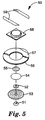
- FIG. 5 is an exploded view of a biomedical electrode using the hydrophilic, pressure sensitive adhesive of the present invention and described in the Examples.
- Hydrophilic PEO pressure sensitive adhesives of the present invention are prepared by exposing to a source of free radicals a difunctional oligomeric precursor containing a poly(ethylene glycol) moiety in the presence of essentially non-volatile, polar plasticizer compatible with this polymer in an amount to render the resulting PEO derived network a pressure sensitive adhesive.
- the oligomeric precursor should be present in an amount ranging from 4 to 60 weight percent of the final PEO pressure sensitive adhesive with the balance comprising essentially non-volatile polar plasticizer.
- Insufficient precursor amounts can lead to difficulty during polymerization, yielding a polymer network having inadequate cohesive strength. Excessive precursor can lead to a resulting polymeric network having an excessive modulus, which diminishes adhesive properties.
- the molecular weight of the telechelic poly(ethylene glycol) in the oligomeric precursor can affect adhesive properties since that telechelic poly(ethylene glycol) moiety in the polymer determines the crosslink density of the resulting polymer network. Insufficient molecular weight results in a brittle, tack free elastomer. Excessive molecular weight results in diminished cohesive strength.
- molecular weights (number average) for the telechelic poly(ethylene glycol) range from about 2,000 to about 20,000 g/mole. Molecular weights in this region polymerize to yield a polymer having an appropriate balance of tack and cohesive strength necessary for providing a pressure sensitive adhesive after plasticization.
- the optimum balance of adhesive properties is obtained when the weight percent of polymer network ranges from about 15 to about 25 weight percent and the molecular weight for the telechelic poly(ethylene glycol) ranges from about 6,000 to about 12,000 g/mole.
- Poly(ethylene glycol) homopolymers terminated with either hydroxyl or primary amine functionality are commercially available within the preferred molecular weight range and serve as suitable moieties to the desired oligomeric precursors.
- lower molecular PEG diols or diamines can be condensed with coupling agents, for example, diisocyanates (to provide polyurethanes and polyureas) or diacids or esters (to provide polyesters and polyamides) to give moieties to the oligomeric precursors of appropriate molecular weight by proper choice of reactant ratios.
- any of these materials are useful in the preparation of the free-radically curable telechelic PEG oligomeric precursors.
- the level of coupling agent be kept relatively low.
- the molecular weight of the starting PEG should not be less than about 400 g/mole for these chain extended precursors.
- the telechelic oligomeric precursors useful in the present invention can be prepared by reaction of the diol or diamine precursors described above with an electrophile having ethylenic unsaturation, (X in Formula I above), and such other functionality that, upon reaction with the PEG diol or diamine, not only an X group, but also an amide, substituted amide, amine, urea, urethane, carbonate, ester, or ether moiety is provided.
- an electrophile having ethylenic unsaturation (X in Formula I above)
- Nonlimiting examples of the types of functionality required in such electrophilic compounds include acid halide, acid anhydride, cyclic anhydride, and azlactones, each of which provides an amide moiety on reaction with the amine and an ester functionality on reaction with the alcohol; isocyanate, which provides a urea moiety on reaction with the amine and a urethane moiety on reaction with the alcohol; benzyl halide, which provides a substituted amine moiety on reaction with the amine and an ether moiety on reaction with the alcohol; and epoxy or acrylate, each of which provide a substituted amine moiety on reaction with the amine.
- Nonlimiting examples of electrophiles suitable for reaction with the PEG diol or diamine precursors to produce the telechelic oligomeric precursors of the present invention include but are not limited to isocyanatoethyl methacrylate; alkenyl azlactones such as vinyl dimethyl azlactone and isopropenyl azlactone; m-isopropenyl-alpha, alpha-dimethyl benzyl isocyanate; glycidyl methacrylate; acryloyl ethyl carbonic anhydride; maleic anhydride; methacrylic anhydride,; and multifunctional acrylates such as hexanediol diacrylate and trimethylol propane triacrylate.
- the alcohol can also be derivatized through an esterification reaction with, for example, acrylic acid, or through a transesterification reaction with, for example, an alkyl acrylate.
- the diol or diamine can be reacted first with a compound containing two electrophilic groups, e.g. a diisocyanate, (or with a compound such as phosgene) and the resultant product reacted in a second step with a nucleophile, e.g. , an amine or an alcohol, to provide the terminally difunctional oligomeric precursors.
- a nucleophile e.g. , an amine or an alcohol
- Nonlimiting examples of such nucleophiles include hydroxyethyl acrylate, hydroxyethyl methacrylate, and hydroxypropyl methacrylate.
- Such an approach is also useful when an excess of coupling agent is used to prepare the chain extended PEG as described above.
- the resulting telechelic oligomeric precursor can be represented by Formula I identified above.
- R is represented by Formula II below: wherein Z is selected from the group consisting of -O- and -NH- and R"' is a divalent C 1 to C 4 alkyl radical.
- the organic divalent linking group Y is generated upon reaction of the electrophile with the diamine or diol and is chosen so as to activate the ethylenically unsaturated monovalent X group towards free radical polymerization.
- the Y group accomplishes this by changing the electron density of X.
- Y is selected from the group of structures containing aromatic moieties which, when bound to X, yield vinyl pyridinyl or styrenic-type functionalities; structures containing carboxyl moieties which when bound to X at the oxygen side yield vinyl ester or isopropenyl ester-type functionalities; structures containing carboxyl moieties which when bound to X at the carbonyl side yield acrylate, methacrylate, maleate, fumarate, and itaconate-type functionalities; structures containing carboxamide moieties which when bound to X at the nitrogen side yield N-vinyl amide and N-isopropenyl amide-type functionality; and structures containing carboxamide moieties which when bound to X at the carbonyl side yield acrylamide, methacrylamide, and maleimide-type functionalities.
- the amount of oligomeric precursor of Formula I ranges from 4 to 60 weight percent (and preferably 15 to 25 weight percent) of the hydrophilic pressure sensitive adhesive.
- the essentially, non-volatile, polar plasticizer is present in an amount preferably ranging from 96 to 40 (and preferably ranging from about 85 to 75) weight percent prior to in situ polymerization.
- the plasticizer serves to minimize the crystallization of the PEG moiety of the polymeric network at ambient and mammalian body temperatures, increase the compliance of the polymeric network to give pressure sensitive adhesive properties and conformability to mammalian bodies and other curved surfaces, and modify the tack or thumb appeal of the pressure sensitive adhesive.
- the plasticizer can also serve as a solvent to dissolve other additives including initiators, electrolytes, and pharmacologically active components.
- the plasticizer is essentially non-volatile because using water alone as the plasticizer for the oligomeric precursor of Formula I above yields materials with poor to moderate tack which are prone to rapid loss of moisture and a concomitant change into a leathery material when exposed to ambient conditions.
- preferred essentially non-volatile, polar plasticizers are hydroxy-containing plasticizers miscible with both water and the precursor, including those selected from the group consisting of alcohols, mixtures of alcohols, and mixtures of water and alcohols such that the mixture of alcohol, water, and oligomeric precursor is liquid in the uncured state and displays pressure sensitive tack once polymerized in situ.
- the alcohol should have low volatility to minimize dryout problems and should not greatly interfere with the subsequent polymerization of the oligomeric precursor.
- Nonlimiting examples of suitable alcohols include glycerin, propylene glycol, dipropylene glycol, sorbitol, 1,3-butanediol, 1,4-butanediol, trimethylol propane, and ethylene glycol and derivatives given by Formula III: MO(CH 2 CH 2 O) m H III wherein M is selected from the group consisting of hydrogen and C 1 through C 6 alkyl, and m is an integer of about 1 to about 25.
- the essentially non-volatile, polar plasticizer is a mixture of water and 300 or 400 molecular weight (weight average) polyethylene glycol.
- solventless polymerization of the oligomeric precursor in the presence of the plasticizer is accomplished by exposing it to a source of free radicals.
- free radicals may be generated by thermal, redox, or photochemical means or by exposure of the material to a source of actinic radiation.
- Suitable thermal initiators include azo compounds, peroxides, and persulfates and when the latter two groups are used in combination with a reducing agent such ascorbic acid or a bisulfite compound and optionally, a catalytic amount of a transition metal salt such as iron or copper, redox generation of radicals may occur even at sub-ambient temperatures.
- a photoinitiator When visible or ultraviolet light is used for curing, a photoinitiator is included. Suitable photoinitiators include benzoin ethers, benzophenone and derivatives thereof, acyl phosphine oxides, acetophenone derivatives, camphorquinone, and the like. Suitable light sources to effect this cure include medium pressure mercury lamps and low intensity "black light” fluorescent bulbs. Initiator is generally used at a concentration of from about 0.05% to about 5%.
- Additives can also be incorporated into the mixture for altering properties of the resulting hydrophilic pressure sensitive adhesive.
- Nonlimiting examples include low levels of copolymerizable vinyl monomers and non-functionalized compatible polymers.
- Low levels of copolymerizable vinyl monomers can serve to accelerate the rate of polymerization, particularly when the functionalized PEG moiety in Formula I is capped with a relatively sluggish end-group such as the alpha-methyl styryl moiety obtained from m-isopropenyl-alpha, alpha-dimethyl benzyl isocyanate.
- Preferred copolymerizable monomers include acrylic acid and methacrylic acid and their ammonium and alkali metal salts, N-vinyl pyrrolidone, acrylamide, 2-acrylamido-2-methyl propane sulfonic acid and its ammonium and alkali metal salts, hydroxylethyl acrylate, hydroxyethyl methacrylate, 2-ethoxyethyl acrylate, 2-ethoxyethyl methacrylate, and 2-(2-ethoxyethoxy)ethyl acrylate.
- the amount of copolymerizable vinyl monomer preferably comprises from about 2 to about 15 weight percent of the total weight of resulting pressure sensitive adhesive.
- Non-functionalized compatible polymers can enhance the viscosity of the oligomeric precursor prior to polymerization to impart better coatability for, for example, pattern coating of the resulting hydrophilic pressure sensitive adhesive.
- Suitable polymers include those that are hydrophilic and compatible in the precursor/plasticizer mixture including moderate and high molecular weight poly(ethylene oxide), poly(acrylic acid), poly(N-vinyl pyrrolidone), poly(vinyl alcohol), and poly(acrylamide).
- the precursor/plasticizer mixture can be coated via any of a variety of conventional coating methods, such as roll coating, knife coating, or curtain coating, or can be extruded.
- the low viscosity of the mixture allows for injection into cavities of, for example, a monitoring biomedical electrode for electrocardiography (ECG), or pattern coating of the adhesive precursor is possible, particularly with viscosity enhancement.
- ECG electrocardiography
- the mixture can be coated directly on to the flexible substrate of choice prior to in situ polymerization, including metal foils and metallized polymeric films for conductive adhesives, or can be coated and cured on a release liner to yield a transfer adhesive. In this latter application, it is desirable to embed a tissue paper or non-woven fabric scrim in the precursor to allow for ease of handling.
- Polymerizing is best accomplished with the exclusion of oxygen, either in an inert atmosphere such as nitrogen or argon, or by covering the precursor with a non-oxygen permeable film.
- this film cover should be substantially transparent to the wavelengths of interest.
- the hydrophilic PEO pressure sensitive adhesives of the present invention are useful in a variety of applications including use as high moisture vapor transmissive wound or burn dressings, as adhesives used in transdermal drug delivery, as repulpable adhesives in, for example, splicing applications in the paper industry, and as conductive adhesives or gels in biomedical electrode applications.
- a high degree of pressure sensitive adhesive tack may not be required when, for instance, a non-conductive, hypoallergenic pressure sensitive adhesive borders the conductive adhesive in the electrode construction.
- the adhesives prepared according to the present invention possess sufficient cohesive strength to achieve generally more cohesion than adhesiveness in use allowing for clean removal from skin.
- adhesives do not have internal integrity required for applications such as hydrophilic contact lenses or membranes which must withstand large pressure differentials.
- various biocompatible and/or therapeutic and/or ionically-conductive materials can be included in the adhesive.
- adhesives of the present invention can be used as conductive adhesive in a biomedical electrode with the addition of an ionically-conductive electrolyte to the adhesive.
- electrolyte include ionic salts dissolved in the adhesive to provide ionic conductivity and can include magnesium acetate, magnesium sulfate, sodium acetate, sodium chloride, lithium chloride, lithium perchlorate, sodium citrate, and preferably potassium chloride to enhance ionic conductivity of the hydrophilic pressure sensitive adhesive.
- a redox couple such as a mixture of ferric and ferrous salts such as sulfates and gluconates can be added.
- the amounts of these ionic salts present in adhesives of the present invention are relatively small, from about 0.5 to 7 percent by weight of the adhesive, and about 2 to 5 weight percent.
- a redox couple When a redox couple is used, the biomedical electrode can recover from an overload potential.
- U.S. Pat. No. 4,846,185 (Carim) discloses a redox couple totalling not more than about 20 percent by weight of the adhesive.
- Hydrophilic, PEO pressure sensitive adhesives of the present invention can also be used in the delivery of pharmaceuticals to or through mammalian skin, such as topical or transdermal drug delivery systems.
- the pharmaceutical or other active ingredient can be compounded with the adhesive after polymerization, minimizing any possible deleterious interaction of the pharmaceutical or active ingredient with the polymerizing process.
- a type of therapeutic procedure both involving application of electrical current to skin of a patient and a pharmaceutical is iontophoresis, which delivers an iontophoretically active pharmaceutical to or through mammalian skin with aid of an electrical current.
- the hydrophilic, PEO pressure sensitive adhesive can also be used in therapeutic mammalian skin coverings, such as dressings, wound closure materials, tapes, and the like.
- other biologically active materials can be added to the adhesive of the present invention after polymerization without deleteriously affecting the biologically active material.
- nonlimiting examples of such other biologically active materials include broad spectrum antimicrobial agents where it is desired to reduce bacteria levels to minimize infection risk or treat the effects of infections at the skin or skin openings of a mammalian patient. Broad spectrum antimicrobial agents are disclosed in U.S. Pat. No. 4,310,509.
- Nonlimiting examples of other antimicrobial agents include parachlorometaxylenol; triclosan; chlorhexidine and its salts such as chlorhexidine acetate and chlorhexidine gluconate; iodine; iodophors; poly-N-vinyl pyrrolidone-iodophors; silver oxide, silver and its salts, antibiotics (e.g., neomycin, bacitracin, and polymyxin B).
- Antimicrobial agents can be included in the adhesive after polymerization in a weight from about 0.01 percent to about 10 percent by weight of the total adhesive.
- biocompatible and/or therapeutic materials can be added to the adhesive such as compounds to buffer the pH of the adhesive to provide a non-irritating pH for use with sensitive mammalian skin tissue or to otherwise maximize antimicrobial activity.
- penetration enhancing agents or excipients can be added to the adhesive when the pharmaceutical or other active agent for topical or transdermal delivery so requires.
- Biomedical electrodes employing hydrophilic, pressure sensitive adhesives of the present invention having electrolyte contained therein are useful for diagnostic and therapeutic purposes.
- a biomedical electrode comprises a conductive medium contacting mammalian skin and a means for electrical communication interacting between the conductive medium and electrical diagnostic, therapeutic, or electrosurgical equipment.
- FIGS. 1 and 2 show either a disposable diagnostic electrocardiogram (ECG) or a transcutaneous electrical nerve stimulation (TENS) electrode 10 on a release liner 12.
- Electrode 10 includes a field 14 of a biocompatible and adhesive conductive medium for contacting mammalian skin of a patient upon removal of protective release liner 12.
- Electrode 10 includes means for electrical communication 16 comprising a conductor member having a conductive interface portion 18 contacting field 14 of conductive medium and a tab portion 20 extending beyond field 14 of conductive medium for mechanical and electrical contact with electrical instrumentation (not shown).
- Means 16 for electrical communication includes a conductive layer 26 coated on at least the side 22 contacting field 14 of conductive medium.
- a typical ECG conductor member 16 will comprise a strip of material having a thickness of about 0.05-0.2 millimeters, such as polyester film and have a coating 26 on side 22 of silver/silver chloride of about 2.5-12 micrometers, and preferably about 5 micrometers thick thereon.
- a polyester film commercially available as "Mellinex” 505-300, 329, or 339 film from ICI Americas of Hopewell, VA coated with a silver/silver chloride ink commercially available as "R-300” ink from Ercon, Inc. of Waltham, MA.
- a TENS conductor member 16 can be made of a nonwoven web, such as a web of polyester/cellulose fibers commercially available as "Manniweb” web from Lydall, Inc. of Troy, NY and have a carbon ink layer 26 commercially available as "SS24363” ink from Acheson Colloids Company of Port Huron, MI on side 22 thereof.
- a nonwoven web such as a web of polyester/cellulose fibers commercially available as "Manniweb” web from Lydall, Inc. of Troy, NY and have a carbon ink layer 26 commercially available as "SS24363” ink from Acheson Colloids Company of Port Huron, MI on side 22 thereof.
- an adhesively-backed polyethylene tape can be applied to tab portion 20 on side 24 opposite side 22 having the conductive coating 26.
- a surgical tape commercially available from 3M Company as "Blenderm” tape can be employed for this purpose.
- Non-limiting examples of biomedical electrodes which can use hydrophilic, pressure sensitive adhesives of the present invention as conductive adhesive fields include electrodes disclosed in U.S. Pat. Nos. 4,527,087; 4,539,996; 4,554,924; 4,848,353 (all Engel); 4,846,185 (Carim); 4,771,713 (Roberts); 4,715,382 (Strand); 5,012,810 (Strand et al.); 5,133,356 (Bryan et al.); and 5,215,087 (Anderson).
- hydrophilic pressure sensitive adhesives of the present invention can also be characterized as gels having pressure sensitive adhesive properties
- the adhesives can also be used as the gelled contact in a conventional gel electrolyte biomedical electrode having a snap-eyelet means of electrical communication. Further description of such biomedical electrodes are found in U.S. Pat. Nos. 3,805,769 (Sessions); 3,845,757 (Weyer); and 4,640,289 (Craighead).
- biomedical electrodes are those marketed by a number of companies (including Minnesota Mining and Manufacturing Company which markets using the brand "Red Dot"), including those snap-type monitoring electrodes typified by the exploded view of an electrode 50 shown in FIG. 5.
- a metallic stud 51 (such as stainless steel eyelet No. 304 commercially available from companies such as Eyelets for Industry of Thomaston, CN) joins a plastic, metallic plated eyelet 52 (such as an ABS plastic eyelet silver-plated and chlorided commercially available from Micron Products of Fitchburg, MA) through an aperture in a polymeric backing 53 (such as front label stock of printed white polyethylene commercially available from Prime Graphics of West Chicago, IL).
- the inner surface of the polymeric backing is coated with an adhesive (such as a phenolic-cured smoke crepe natural rubber based adhesive).
- a wood pulp scrim 54 such as an "Airtex 399" scrim commercially available from James River Corporation of Green Bay, WI
- Scrim 54 and adhesive 55 reside in a cavity of a 0.16 cm thick polyethylene foam 56 coated with either 12 grains of a 91:9 isooctyl acrylate:N-vinyl-2-pyrrolidone copolymer pressure sensitive adhesive or 18 grains of a 94:6 isooctyl acrylate:acrylic acid copolymer tackified with a "Foral" branded colophony acid rosin, such as "Foral AX" or "Foral 85” rosins commercially available from Hercules Corporation present in an amount of about 35-40 weight percent of the copolymer solids.
- the pressure sensitive adhesive is covered by a tabbed antifungal liner 57 (such as 83 pound bleached release paper under the brand "Polyslik S-8004" treated with "Calgon TK-100” brand fungicide, both liner and treatment commercially available from H.P. Smith Company of Chicago, IL). Scrim 54 and adhesive 55 are protected by a cap 58, (such as a 0.25 mm "PETG” polyester film commercially available from Weiss Company of Chicago, IL) secured in place by dual strips 59 of adhesive tape (such as "3M” brand “Type 2185” tape).
- a tabbed antifungal liner 57 such as 83 pound bleached release paper under the brand "Polyslik S-8004" treated with "Calgon TK-100” brand fungicide, both liner and treatment commercially available from H.P. Smith Company of Chicago, IL.
- Scrim 54 and adhesive 55 are protected by a cap 58, (such as a 0.25 mm "PETG” polyester film commercially
- Biomedical electrodes marketed by a number of companies, and the components used in such electrodes, provide combinations of alternative materials useful as snap-type monitoring biomedical electrodes to incorporate hydrophilic pressure sensitive adhesive of the present invention.
- the removal of conductive gel and its supporting structure from the center of a commercially available monitoring biomedical electrode and the replacement with hydrophilic pressure sensitive adhesive of the present invention can provide a superior biomedical electrode.
- such electrodes can be manufactured using equipment described in U.S. Pat. No. 4,640,289 (Craighead).
- the means for electrical communication can be an electrically conductive tab extending from the periphery of the biomedical electrodes such as that seen in U.S. Pat. No. 4,848,353 or can be a conductor member extending through a slit or seam in an insulating backing member, such as that seen in U.S. Pat. No. 5,012,810.
- the means for electrical communication can be an eyelet or other snap-type connector such as that disclosed in U.S. Pat. Nos. 4,640,289 and 4,846,185.
- the means for electrical communication can be a lead wire such as that seen in U.S. Pat. No. 4,771,783.
- a hydrophilic, pressure sensitive adhesive of the present invention, containing an electrolyte can reside as a field of conductive adhesive on a biomedical electrode for diagnostic, therapeutic, or electrosurgical purposes.
- Medical skin coverings employing hydrophilic, PEO pressure sensitive adhesives of the present invention, optionally having antimicrobial and other biologically active agents contained therein, are useful for treatment of mammalian skin or mammalian skin openings, preferably against the possibility of infection.
- FIG. 3 shows a sectional view of a medical skin covering 30 having a backing material 32, a layer 34 of pressure sensitive adhesive of the present invention coated on backing material 32, and protected until use by a release liner 36.
- antimicrobial 38 is contained in layer 34 by adding agent 38 to the adhesive prior to coating on backing material 32.
- the release liner 36 is removed and the layer 34 of pressure sensitive adhesive can be applied to the skin of the patient as a part of a medical tape, a wound dressing, a bandage of general medicinal utility, or other medical device having water moisture absorbing properties.
- the adhesive layer 34 may be coated on a layer of backing material 32 selected from any of several backing materials having a high moisture vapor transmission rate for use as medical tapes, dressings, bandages, and the like.
- Suitable backing materials include those disclosed in U.S. Patents 3,645,835 and 4,595,001.
- Other examples of a variety of films commercially available as extrudable polymers include "Hytrel R 4056" and “Hytrel R 3548" branded polyester elastomers available from E.I. DuPont de Nemours and Company of Wilmington, Delaware, "Estane” branded polyurethanes available from B.F. Goodrich of Cleveland, Ohio or "Q-thane” branded polyurethanes available from K.J. Quinn & Co. of Malden, Massachusetts.
- the layer 34 of adhesive combined with a layer 32 of suitable backing material can be used as a dressing.
- Hydrophilic, PEO pressure sensitive adhesives of the present invention can be used as discrete gel particles dispersed in a continuous pressure sensitive adhesive matrix to form a two phase composite useful in medical applications, as described in PCT Publication WO 91/09633.
- the adhesive layer 34 can be coated on the backing layer 32 by a variety of processes, including, direct coating, lamination, and hot lamination.
- the release liner 36 can thereafter be applied using direct coating, lamination, and hot lamination.
- the methods of lamination and hot lamination involve the application of pressure, or heat and pressure, respectively, on the layer of adhesive layer 34 to the backing material layer 32.
- the temperature for hot lamination ranges from about 50°C to about 250°C, and the pressures applied to both lamination and hot lamination range from 0.1 Kg/cm 2 to about 50 Kg/cm 2 .
- compositions employing hydrophilic, pressure sensitive adhesives of the present invention, optionally having a topical. transdermal, or iontophoretic therapeutic agent and excipients, solvents, or penetration enhancing agents contained therein, are useful for delivery of pharmaceuticals or other active agents to or through mammalian skin.
- FIG. 4 shows a sectional view of a transdermal or topical drug delivery device 40 having a backing layer 42, a layer 44 containing hydrophilic, PEO pressure sensitive adhesive of the present invention coated thereon and protected by a release liner 46.
- Other layers can be present between layer 42 and layer 44 to house pharmaceuticals or other therapeutic agents.
- pharmaceutical and other agents 48 are dispersed in adhesive layer 44.
- the backing layer 42 can be any backing material known to those skilled in the art and useful for drug delivery devices.
- Non-limiting examples of such backing materials are polyethylene, ethylene-vinyl acetate copolymer, polyethylene-aluminum-polyethylene composites, and "ScotchPakTM” brand backings commercially available from Minnesota Mining and Manufacturing Company of St. Paul, Minnesota (3M).
- the release liner 46 can be any release liner material known to those skilled in the art.
- Non-limiting examples of such release liners commercially available include siliconized polyethylene terephthalate films commercially available from H.P. Smith Co. and fluoropolymer coated polyester films commercially available from 3M under the brand "ScotchPakTM" release liners.
- the therapeutic agent 48 can be any therapeutically active material known to those skilled in the art and approved for delivery topically to or transdermally or iontophoretically through the skin of a patient.
- therapeutic agents useful in transdermal delivery devices are any active drug or salts of those drugs, used in topical or transdermal applications, or growth factors for use in enhancing wound healing.
- Other therapeutic agents identified as drugs or pharmacologically active agents are disclosed in U.S. Patent Nos. 4,849,224 and 4,855,294, and PCT Patent Publication WO 89/07951.
- Excipients or penetration enhancing agents are also known to those skilled in the art.
- Non-limiting examples of penetration enhancing agents include ethanol, methyl laurate, oleic acid, isopropyl myristate, and glycerol monolaurate.
- Other penetration enhancing agents known to those skilled in the art are disclosed in U.S. Patent Nos. 4,849,224; and 4,855,294 and PCT Patent Publication WO 89/07951.
- the method of manufacturing a transdermal delivery device depends on its construction.
- the drug delivery device 40 shown in FIG. 4 can be prepared using the following general method.
- a solution is prepared by dissolving the therapeutic agent 48 and such optional excipients as are desired in a suitable solvent and mixed into either plasticizer prior to forming the adhesive, during the formation of the adhesive, or directly into the already formed adhesive.
- the resulting loaded adhesive is coated on the backing layer 42.
- a release liner 46 is applied to cover loaded adhesive layer 44.
- Isophorone diisocyanate IPDI (available from Aldrich Chemical Company, Milwaukee, Wisconsin) in the amounts shown in Table I was added portionwise over the course of several minutes, so as to maintain a temperature below 45°C. Stirring was continued until either 10 minutes had elapsed, or the solution became too viscous to satisfactorily stir.
- the mixing paddle was withdrawn, 2-vinyl-4,4-dimethyl-2-oxazolin-5-one, VDM, (available from S.N.P.E., Princeton, New Jersey) in the amounts shown in Table I was charged in one portion, the mixture shaken or hand stirred as appropriate to obtain a homogeneous mixture, capped, and left in the dark overnight at room temperature.
- the approximate molecular weight of the resulting chain extended, functionalized, poly(ethylene glycol) oligomeric precursor is shown in Table I and was calculated based on first principles with the assumption that the diamine and diisocyanate are of high purity and that the reactions go to completion with no side reactions.
- the percent solids of the 2,000 and 4,000 mw oligomeric precursors were adjusted slightly by addition of 0.8 g and 0.4 g, respectively, of a 1/1 mix of PEG 300 and water so that all of these materials were at 60% solids in a 1/1 PEG 300/water mixture. Portions of each were diluted to 30% solids (5 g of 60% plus 5 g of 1/1 PEG 300/water) and 10% solids (4 g of 60% and 20 g of 1/1 PEG 300/water) and 0.5% 2-hydroxy-2-methyl-1-phenyl-propan-1-one photoinitiator (available from Ciba-Geigy Corporation, Hawthorne, New York under the brand "Darocur 1173”) was charged to each.
- Example 6 To 6 g of Example 6 (30% solids VDM capped “Jeffamine ED-6000" poly(ethylene oxide) in PEG 200) was charged 0.03 g 2-hydroxy-2-methyl-1-phenyl-propan-1-one photoinitiator ("Darocur 1173”) and the resulting solution cured and evaluated as described above and given a tack value of 3.
- a 4 g portion of the 30% solids solutions of Examples 7 through 10 were diluted further to 20% solids with 2 g of the respective plasticizers, 0.03 g of photoinitiator (“Darocur 1173”) charged, and cured and evaluated as described above, also all giving tack values of 3.
- plasticizers are useful for preparation of the adhesives described in the present disclosure.
- a 6,000 molecular weight difunctional acrylate terminated poly(ethylene glycol) oligomer was prepared by dissolving 20 g (6.66 milliequivalents) 6,000 mw PEG (available from Fluka Chemical Corporation, Ronkonkoma, New York) in 20 g methylene chloride in a 100 milliliter round bottom flask equipped with magnetic stirring bar, charging 1.01 g (10 millimoles) triethylamine (available from Aldrich Chemical Company, Milwaukee, Wisconsin), and with magnetic stirring while cooling in an ice water bath charging 0.66 g (7.3 millimoles - 10% excess) acryloyl chloride dropwise.
- Example 17 0.70 g 2-vinyl-4,4-dimethyl-2-oxazolin-5-one, VDM, charged. 2 g of the resulting 30% solids solution was diluted with 4 g "Carbowax” PEG 350 monomethyl ether and 0.03 g "Darocur 1173" charged. Curing and tack evaluation on this 10% solids solution gave a tack value of 4.
- Example 18 0.78 g isocyanatoethyl methacrylate, (available from Showa Rhodia Chemicals K.K., Tokyo, Japan) charged. 2 g of the resulting 30% solids solution was diluted with 2 g "Carbowax” PEG 350 monomethyl ether and 0.02 g "Darocur 1173" added. Curing and tack evaluation on this 15% solids solution gave a tack value of 2.
- Example 19 1.01 g m-isopropenyl-alpha,alpha-dimethyl benzyl isocyanate (available from American Cyanamide, Wayne, New Jersey under the brand "m-TMI") charged. 6 g of the resulting 30% solids solution was diluted with 2.55 g "Carbowax” PEG 350 monomethyl ether and 0.45 g acrylic acid (available from BASF Corporation, Parsippany, New Jersey) and 0.03 g "Darocur 1173" added. Curing and tack evaluation on this 20% solids solution also containing 5% acrylic acid gave a tack value of 2.
- Example 20 0.77 g methacrylic anhydride (available from Aldrich Chemical Company, Milwaukee, Wisconsin) charged. 6 g of the resulting 30% solids solution was diluted with 2.82 g "Carbowax” PEG 350 monomethyl ether and 0.18 g acrylic acid and 0.03 g "Darocur 1173" added. Curing and tack evaluation on this 20% solids solution also containing 2% acrylic acid gave a tack value of 2.
- Portions were cured photochemically and assessed using the procedure described above after charging 0.05% "Darocur 1173" photoinitiator.
- Thermal polymerization was also conducted by adding to a portion 0.1% azo-bis(isobutyronitrile) (available from E.I. Dupont, Wilmington, Delaware under the brand "Vazo 64"), sealing in a polyethylene bag, and submersing in a 80°C water bath for 30 minutes. In each case the resulting adhesive had a tack value of 4.
- a second 1600 g portion of the capped oligomer solution was diluted in similar fashion but further had 76.2 g of a 300,000 molecular weight poly(ethylene oxide) (available from Union Carbide, Danbury, CT under the brand "Polyox N-750") dissolved in it.
- This 21/4/30/30/2 oligomer/KCl/PEG 400/water/PEO 300K solution had a Brookfield viscosity of 1300 centipoise.
- Example 25 Using the same procedure and scale described for Example 25, a second batch of precursor was prepared. The only difference was that the IPDI and VDM charges were changed slightly, using 1594 g IPDI and 530 g VDM resulting in a somewhat softer, more chain extended precursor. 2914 g of this precursor was diluted with 211.5 g PEG 300 and 831.5 g deionized water into which 22.9 g potassium chloride and 0.48 g sodium chlorite (available from Aldrich Chemical Company, Milwaukee, Wisconsin) had been dissolved. To this precursor was charged 20 g "Darocur 1173" photoinitiator. A 20 miililiter syringe was filled with this and an 18 gauge needle attached.
- the gel-filled blank electrode 50 depicted in Figure 5 formed a test electrode unit. Two electrode units, joined together adhesive surface to adhesive surface to form an electrode pair. This electrode pair was then tested in order to characterize its electrical response in comparison to the American National Standard developed by the Association for the Advancement of Medical Instrumentation for disposable ECG electrodes (approved 17 December 1991 by the American National Standards Institute).
- the guideline values specified by this standard for such electrode pairs are:
Landscapes
- Chemical & Material Sciences (AREA)
- Chemical Kinetics & Catalysis (AREA)
- Physics & Mathematics (AREA)
- Organic Chemistry (AREA)
- General Chemical & Material Sciences (AREA)
- Spectroscopy & Molecular Physics (AREA)
- Engineering & Computer Science (AREA)
- Manufacturing & Machinery (AREA)
- Dispersion Chemistry (AREA)
- Electrochemistry (AREA)
- General Physics & Mathematics (AREA)
- Inorganic Chemistry (AREA)
- Condensed Matter Physics & Semiconductors (AREA)
- Materials For Medical Uses (AREA)
- Adhesives Or Adhesive Processes (AREA)
- Medicinal Preparation (AREA)
- Electrotherapy Devices (AREA)
- Adhesive Tapes (AREA)
Applications Claiming Priority (3)
| Application Number | Priority Date | Filing Date | Title |
|---|---|---|---|
| US983688 | 1992-12-01 | ||
| US07/983,688 US5489624A (en) | 1992-12-01 | 1992-12-01 | Hydrophilic pressure sensitive adhesives |
| PCT/US1993/010536 WO1994012585A1 (en) | 1992-12-01 | 1993-11-03 | Hydrophilic polyoxyethylene pressure sensitive adhesives |
Publications (2)
| Publication Number | Publication Date |
|---|---|
| EP0672094A1 EP0672094A1 (en) | 1995-09-20 |
| EP0672094B1 true EP0672094B1 (en) | 1997-09-24 |
Family
ID=25530056
Family Applications (1)
| Application Number | Title | Priority Date | Filing Date |
|---|---|---|---|
| EP94901248A Expired - Lifetime EP0672094B1 (en) | 1992-12-01 | 1993-11-03 | Hydrophilic polyoxyethylene pressure sensitive adhesives |
Country Status (6)
| Country | Link |
|---|---|
| US (3) | US5489624A (enExample) |
| EP (1) | EP0672094B1 (enExample) |
| JP (1) | JP4331261B2 (enExample) |
| CN (1) | CN1066183C (enExample) |
| DE (1) | DE69314184T2 (enExample) |
| WO (1) | WO1994012585A1 (enExample) |
Cited By (12)
| Publication number | Priority date | Publication date | Assignee | Title |
|---|---|---|---|---|
| US7332218B1 (en) | 1999-07-14 | 2008-02-19 | Eic Laboratories, Inc. | Electrically disbonding materials |
| US8206738B2 (en) | 2001-05-01 | 2012-06-26 | Corium International, Inc. | Hydrogel compositions with an erodible backing member |
| US8273405B2 (en) | 2001-05-01 | 2012-09-25 | A.V. Topcheiv Institute of Petrochemical Synthesis, Russian Academy of Sciences | Water-absorbent adhesive compositions and associated methods of manufacture and use |
| USRE44145E1 (en) | 2000-07-07 | 2013-04-09 | A.V. Topchiev Institute Of Petrochemical Synthesis | Preparation of hydrophilic pressure sensitive adhesives having optimized adhesive properties |
| US8481059B2 (en) | 2001-05-01 | 2013-07-09 | A.V. Topchiev Institute Of Petrochemical Synthesis, Russian Academy Of Sciences | Hydrogel compositions |
| US8541021B2 (en) | 2001-05-01 | 2013-09-24 | A.V. Topchiev Institute Of Petrochemical Synthesis | Hydrogel compositions demonstrating phase separation on contact with aqueous media |
| US8753669B2 (en) | 2001-05-01 | 2014-06-17 | A.V. Topchiev Institute Of Petrochemical Synthesis, Russian Academy Of Sciences | Two-phase, water-absorbent bioadhesive composition |
| US8784879B2 (en) | 2009-01-14 | 2014-07-22 | Corium International, Inc. | Transdermal administration of tamsulosin |
| US8821901B2 (en) | 2001-05-01 | 2014-09-02 | A.V. Topchiev Institute Of Petrochemical Synthesis Russian Academy Of Sciences | Method of preparing polymeric adhesive compositions utilizing the mechanism of interaction between the polymer components |
| US8840918B2 (en) | 2001-05-01 | 2014-09-23 | A. V. Topchiev Institute of Petrochemical Synthesis, Russian Academy of Sciences | Hydrogel compositions for tooth whitening |
| US9144552B2 (en) | 2004-01-30 | 2015-09-29 | A.V. Topchiev Institute Of Petrochemical Synthesis, Russian Academy Of Sciences | Rapidly dissolving film for delivery of an active agent |
| US9242021B2 (en) | 2004-08-05 | 2016-01-26 | Corium International, Inc. | Adhesive composition |
Families Citing this family (136)
| Publication number | Priority date | Publication date | Assignee | Title |
|---|---|---|---|---|
| DE69517816T2 (de) | 1994-09-14 | 2000-12-28 | Minnesota Mining & Mfg | Matrix für transdermale wirkstofffreisetzung |
| US6673852B1 (en) | 1995-07-11 | 2004-01-06 | Nihon Kohden Corporation | Conductive composition for biological electrode |
| US6495627B1 (en) * | 1995-07-11 | 2002-12-17 | Nihon Kohden Corporation | Conductive composition for biological electrode |
| US8455710B2 (en) * | 1997-09-22 | 2013-06-04 | Argentum Medical, Llc | Conductive wound dressings and methods of use |
| AU4743696A (en) * | 1995-12-29 | 1997-07-28 | Minnesota Mining And Manufacturing Company | Use of pendant photoreactive moieties on polymer precursors to prepare hydrophilic pressure sensitive adhesives |
| US5813981A (en) * | 1995-12-29 | 1998-09-29 | Minnesota Mining And Manufacturing Company | Tab style electrode |
| EP0869979B1 (en) * | 1995-12-29 | 2000-11-08 | Minnesota Mining And Manufacturing Company | Use of pendant free-radically polymerizable moieties with polar polymers to prepare hydrophilic pressure sensitive adhesive compositions |
| US5827184A (en) * | 1995-12-29 | 1998-10-27 | Minnesota Mining And Manufacturing Company | Self-packaging bioelectrodes |
| US6135953A (en) * | 1996-01-25 | 2000-10-24 | 3M Innovative Properties Company | Multi-functional biomedical electrodes |
| JP4112620B2 (ja) * | 1996-02-26 | 2008-07-02 | スリーエム カンパニー | 低温条件で使用するための感圧接着剤 |
| US5874143A (en) | 1996-02-26 | 1999-02-23 | Minnesota Mining And Manufacturing Company | Pressure sensitive adhesives for use on low energy surfaces |
| WO1997041568A1 (en) * | 1996-04-29 | 1997-11-06 | Minnesota Mining And Manufacturing Company | Electrical conductor for biomedical electrodes and biomedical electrodes prepared therefrom |
| US5797902A (en) * | 1996-05-10 | 1998-08-25 | Minnesota Mining And Manufacturing Company | Biomedical electrode providing early detection of accidental detachment |
| US5947961A (en) * | 1996-05-10 | 1999-09-07 | Minnesota Mining And Manufacturing Company | Biomedical electrode having skin-equilibrating adhesive at its perimeter and method for using same |
| US5744239A (en) * | 1996-09-27 | 1998-04-28 | Minnesota Mining And Manufacturing Company | Addition of antimicrobial agents to pavement marking materials |
| US6096328A (en) * | 1997-06-06 | 2000-08-01 | The Procter & Gamble Company | Delivery system for an oral care substance using a strip of material having low flexural stiffness |
| US6007532A (en) | 1997-08-29 | 1999-12-28 | 3M Innovative Properties Company | Method and apparatus for detecting loss of contact of biomedical electrodes with patient skin |
| US20020180605A1 (en) * | 1997-11-11 | 2002-12-05 | Ozguz Volkan H. | Wearable biomonitor with flexible thinned integrated circuit |
| US7786562B2 (en) * | 1997-11-11 | 2010-08-31 | Volkan Ozguz | Stackable semiconductor chip layer comprising prefabricated trench interconnect vias |
| US5965154A (en) * | 1998-03-17 | 1999-10-12 | Plc Holding, L.L.C. | Adhesive matrix type transdermal patch and method of manufacturing same |
| US6071585A (en) * | 1998-06-30 | 2000-06-06 | Ncr Corporation | Printable sheet with removable label and method for producing same |
| US7351249B2 (en) * | 1998-11-06 | 2008-04-01 | Neomend, Inc. | Systems, methods, and compositions for achieving closure of suture sites |
| KR20010099995A (ko) * | 1998-12-29 | 2001-11-09 | 로날드 디. 맥크레이 | 열-활성화 접착제 |
| US6183770B1 (en) | 1999-04-15 | 2001-02-06 | Acutek International | Carrier patch for the delivery of agents to the skin |
| US6200265B1 (en) | 1999-04-16 | 2001-03-13 | Medtronic, Inc. | Peripheral memory patch and access method for use with an implantable medical device |
| US6669663B1 (en) * | 1999-04-30 | 2003-12-30 | Medtronic, Inc. | Closed loop medicament pump |
| US6356779B1 (en) | 1999-06-04 | 2002-03-12 | 3M Innovative Properties Company | Universally functional biomedical electrode |
| JP4558997B2 (ja) * | 1999-06-07 | 2010-10-06 | スリーエム イノベイティブ プロパティズ カンパニー | ポリウレア系接着剤、それから製造される物品、ならびにそれを製造および使用する方法 |
| US6232366B1 (en) | 1999-06-09 | 2001-05-15 | 3M Innovative Properties Company | Pressure sensitive conductive adhesive having hot-melt properties and biomedical electrodes using same |
| US6331018B1 (en) | 1999-06-30 | 2001-12-18 | Ncr Corporation | Label sheet |
| PL200936B1 (pl) | 1999-07-02 | 2009-02-27 | Procter & Gamble | Układ dostarczający do jamy ustnej substancję do jej pielęgnacji i zastosowanie żywicy organosiloksanowej do wytwarzania układu dostarczającego |
| US6429235B1 (en) | 1999-08-27 | 2002-08-06 | Cognis Corporation | Energy-curable composition for making a pressure sensitive adhesive |
| WO2001019421A1 (en) * | 1999-09-16 | 2001-03-22 | Medicotest A/S | Adhesive for establishing a contact between a device and the skin of a mammal |
| US6495229B1 (en) * | 1999-09-17 | 2002-12-17 | Avery Dennison Corporation | Pattern coated adhesive article |
| WO2001047403A1 (en) | 1999-12-28 | 2001-07-05 | Kimberly-Clark Worldwide, Inc. | Use-dependent indicator system for absorbent articles |
| KR100734981B1 (ko) | 1999-12-28 | 2007-07-06 | 킴벌리-클라크 월드와이드, 인크. | 조절-방출 항균제를 함유하는 와이퍼 |
| US6734157B2 (en) | 1999-12-28 | 2004-05-11 | Kimberly-Clark Worldwide, Inc. | Controlled release anti-microbial hard surface wiper |
| JP2001332304A (ja) * | 2000-05-24 | 2001-11-30 | Sony Corp | 電解質およびそれを用いた電池 |
| AU7323001A (en) | 2000-07-07 | 2002-01-21 | Av Topchiev Inst Petrochemical | Preparation of hydrophilic pressure sensitive adhesives having optimized adhesive properties |
| US20030194374A1 (en) * | 2001-01-17 | 2003-10-16 | Xanodyne Pharmacal, Inc. | Compositions including a visual marker and method of use thereof |
| US7062312B2 (en) * | 2001-01-17 | 2006-06-13 | Pediamed Pharmaceuticals, Inc. | Combination and method including a visual marker for determining compliance with a medication regimen |
| WO2002064668A1 (en) * | 2001-02-09 | 2002-08-22 | Microban Products Company | Antimicrobial superfinish and method of making |
| US6699551B2 (en) | 2001-02-09 | 2004-03-02 | Ncr Corporation | Printable form with removable label and method for producing same |
| US6623825B2 (en) * | 2001-03-14 | 2003-09-23 | 3M Innovative Properties Company | Method of detackifying an edge face of a roll of tape |
| US8428682B1 (en) * | 2006-06-16 | 2013-04-23 | Orbital Research Inc. | Wet or dry electrode, other sensors, actuators, or markers with a novel adhesive collar |
| US20030082225A1 (en) * | 2001-10-19 | 2003-05-01 | Mason Paul Arthur | Sterile, breathable patch for treating wound pain |
| US20040077747A1 (en) * | 2002-02-05 | 2004-04-22 | Payne Stephen A. | Antimicrobial superfinish and method of making |
| US7136691B2 (en) * | 2002-09-04 | 2006-11-14 | 3M Innovative Properties Company | Biomedical electrodes |
| US8524200B2 (en) | 2002-09-11 | 2013-09-03 | The Procter & Gamble Company | Tooth whitening products |
| US20060216523A1 (en) * | 2003-08-19 | 2006-09-28 | Shunsuke Takaki | Pressure-sensitive adhesive tape and pressure-sensitive adhesive composition for medical adhesive tape |
| DE10344411A1 (de) | 2003-09-25 | 2005-04-28 | Roehm Gmbh | Hydrogel |
| US20050196604A1 (en) * | 2004-03-05 | 2005-09-08 | Unifoil Corporation | Metallization process and product produced thereby |
| US20070281004A1 (en) * | 2004-08-25 | 2007-12-06 | He Vicky Y | Polymeric Film |
| US7999023B2 (en) * | 2004-12-03 | 2011-08-16 | 3M Innovative Properties Company | Process for making pressure sensitive adhesive hydrogels |
| EP2412306B1 (en) * | 2005-03-09 | 2017-08-30 | DELTA, Dansk Elektronik, Lys & Akustik | A three-dimensional adhesive device having a microelectronic system embedded therein |
| USD1112766S1 (en) * | 2005-05-03 | 2026-02-10 | Beekley Corporation | Adhesive-backed temporary tattoo cover made of flexible material |
| JP2006346368A (ja) * | 2005-06-20 | 2006-12-28 | Transcutaneous Technologies Inc | イオントフォレーシス装置及びその製造方法 |
| US20070027426A1 (en) * | 2005-06-24 | 2007-02-01 | Transcutaneous Technologies Inc. | Iontophoresis device to deliver active agents to biological interfaces |
| US20090214625A1 (en) * | 2005-07-15 | 2009-08-27 | Mizuo Nakayama | Drug delivery patch |
| WO2007026672A1 (ja) * | 2005-08-29 | 2007-03-08 | Transcu Ltd. | イオントフォレーシス用汎用性電解液組成物 |
| RU2008114490A (ru) * | 2005-09-15 | 2009-10-20 | ТиТиАй ЭЛЛЕБО, ИНК. (JP) | Устройство ионтофореза стержневого типа |
| RU2008114830A (ru) * | 2005-09-16 | 2009-10-27 | ТиТиАй ЭЛЛЕБО, ИНК. (JP) | Устройство ионтофореза катетерного типа |
| KR20080066712A (ko) * | 2005-09-30 | 2008-07-16 | 티티아이 엘뷰 가부시키가이샤 | 관능화된 미세바늘 경피 약물 전달 시스템, 장치 및 방법 |
| WO2007041118A1 (en) | 2005-09-30 | 2007-04-12 | Tti Ellebeau, Inc. | Iontophoretic device and method of delivery of active agents to biological interface |
| US20070078376A1 (en) * | 2005-09-30 | 2007-04-05 | Smith Gregory A | Functionalized microneedles transdermal drug delivery systems, devices, and methods |
| AU2006299520A1 (en) * | 2005-09-30 | 2007-04-12 | Tti Ellebeau, Inc. | Iontophoresis device to deliver multiple active agents to biological interfaces |
| US20070083186A1 (en) * | 2005-09-30 | 2007-04-12 | Darrick Carter | Transdermal drug delivery systems, devices, and methods employing novel pharmaceutical vehicles |
| WO2007041526A2 (en) * | 2005-09-30 | 2007-04-12 | Transcutaneous Technologies Inc. | Iontophoresis apparatus and method to deliver antibiotics to biological interfaces |
| US20070078374A1 (en) * | 2005-09-30 | 2007-04-05 | Transcutaneous Technologies Inc. | Iontophoretic delivery of vesicle-encapsulated active agents |
| JP2009509685A (ja) * | 2005-09-30 | 2009-03-12 | Tti・エルビュー株式会社 | 損傷組織の治癒を増強するための血管新生因子の送達のためのイオントフォレーシス装置及び方法 |
| US20070149916A1 (en) * | 2005-12-22 | 2007-06-28 | Alza Corporation | Dry matrices as drug reservoirs in electrotransport applications |
| US20080033338A1 (en) * | 2005-12-28 | 2008-02-07 | Smith Gregory A | Electroosmotic pump apparatus and method to deliver active agents to biological interfaces |
| WO2007079190A2 (en) * | 2005-12-29 | 2007-07-12 | Tti Ellebeau, Inc. | Device and method for enhancing immune response by electrical stimulation |
| JP2009522011A (ja) * | 2005-12-30 | 2009-06-11 | Tti・エルビュー株式会社 | 活性物質を生体界面に送達するイオントフォレーシスシステム、装置及び方法 |
| EP1981402B1 (en) * | 2006-02-06 | 2016-08-10 | The Board Of Trustees Of The Leland Stanford Junior University | Non-invasive cardiac monitor |
| WO2007123707A1 (en) * | 2006-03-30 | 2007-11-01 | Tti Ellebeau, Inc. | Controlled release membrane and methods of use |
| DE102006039909A1 (de) * | 2006-08-25 | 2008-03-13 | Bayer Cropscience Ag | Verfahren zum Herstellen von 3-Dihalomethyl-pyrazol-4-carbonsäurederivaten |
| WO2008027440A2 (en) * | 2006-08-29 | 2008-03-06 | Tti Ellebeau, Inc. | An iontophoresis device and method for operation with a usb (universal serial bus) power source |
| US20080114282A1 (en) * | 2006-09-05 | 2008-05-15 | Transcu Ltd. | Transdermal drug delivery systems, devices, and methods using inductive power supplies |
| US7829116B2 (en) * | 2006-11-14 | 2010-11-09 | Momentive Performance Materials Inc. | Adhesive-forming composition and blend of adhesives obtained therefrom |
| US7976951B2 (en) | 2006-11-14 | 2011-07-12 | Momentive Performance Materials Inc. | Laminate containing an adhesive-forming composition |
| US8062783B2 (en) | 2006-12-01 | 2011-11-22 | Tti Ellebeau, Inc. | Systems, devices, and methods for powering and/or controlling devices, for instance transdermal delivery devices |
| JPWO2008087803A1 (ja) * | 2007-01-16 | 2010-05-06 | 国立大学法人北海道大学 | 抗酸化成分を封入したイオントフォレーシス用リポソーム製剤 |
| DE102007005296A1 (de) | 2007-02-02 | 2008-08-07 | Bayer Cropscience Ag | Verfahren zum Herstellen von Dihaloacetessigsäurealkylestern |
| US7816412B2 (en) * | 2007-02-23 | 2010-10-19 | Conmed Corporation | Electrically conductive hydrogels |
| RU2482841C2 (ru) * | 2007-05-18 | 2013-05-27 | ТиТиАй Эллебо, Инк. | Устройства для трансдермальной доставки, обеспечивающие улучшенное высвобождение действующего начала через биологическую поверхность |
| JP2010187707A (ja) * | 2007-06-12 | 2010-09-02 | Hokkaido Univ | インスリンを封入したイオントフォレーシス用リポソーム製剤 |
| CN102067385B (zh) * | 2008-05-01 | 2014-03-26 | 3M创新有限公司 | 可拉伸传导连接器 |
| US8700118B2 (en) * | 2008-05-01 | 2014-04-15 | 3M Innovative Properties Company | Biomedical sensor system |
| WO2009153019A1 (en) * | 2008-06-19 | 2009-12-23 | Lts Lohmann Therapie-Systeme Ag | Composition for transdermal delivery of cationic active agents |
| AR073575A1 (es) * | 2008-09-10 | 2010-11-17 | Transcu Ltd | Aparato y metodo para dispensar basados en hpc liquidos viscosos en sustratos porosos por ejemplo proceso continuo basado en bandas |
| US20100075532A1 (en) * | 2008-09-25 | 2010-03-25 | Tyco Healthcare Group Lp | Fluorescent Marker for Detecting Gel or Lack of Gel |
| EP2349566B1 (en) | 2008-10-03 | 2016-01-06 | Micronics, Inc. | Microfluidic apparatus and methods for performing blood typing and crossmatching |
| US8781576B2 (en) | 2009-03-17 | 2014-07-15 | Cardiothrive, Inc. | Device and method for reducing patient transthoracic impedance for the purpose of delivering a therapeutic current |
| WO2010107707A2 (en) | 2009-03-17 | 2010-09-23 | Savage Walter T | External defibrillator |
| CA2768859C (en) * | 2009-08-10 | 2017-03-21 | Summetria, Llc | Cooling products and methods |
| JP5604154B2 (ja) * | 2010-04-02 | 2014-10-08 | 株式会社メニコン | ポリマー材料、眼用レンズ及びコンタクトレンズ |
| WO2011143490A2 (en) | 2010-05-12 | 2011-11-17 | Irhythm Technologies, Inc. | Device features and design elements for long-term adhesion |
| US10029816B2 (en) | 2010-05-26 | 2018-07-24 | Avery Dennison Retail Information Services, Llc | Pressure sensitive labels for use in a cold transfer method and process for making |
| US8548557B2 (en) * | 2010-08-12 | 2013-10-01 | Covidien Lp | Medical electrodes |
| US9402999B2 (en) * | 2012-05-04 | 2016-08-02 | Ethicon Endo-Surgery, Inc. | Transdermal medical patch |
| EP2890415B1 (en) | 2012-08-28 | 2020-09-23 | 3M Innovative Properties Company | Chlorhexidine gluconate compositions, resin systems and articles |
| AU2013331240B8 (en) | 2012-10-17 | 2016-11-24 | The Procter & Gamble Company | Strip for the delivery of an oral care active and methods for applying oral care actives |
| JP6198849B2 (ja) | 2013-01-24 | 2017-09-20 | アイリズム・テクノロジーズ・インコーポレイテッドiRhythm Technologies,Inc. | 生理学的信号をモニターする電子装置、及び該電子装置の部分を除去交換する方法 |
| WO2014168841A1 (en) | 2013-04-08 | 2014-10-16 | Irhythm Technologies, Inc | Skin abrader |
| US10386377B2 (en) | 2013-05-07 | 2019-08-20 | Micronics, Inc. | Microfluidic devices and methods for performing serum separation and blood cross-matching |
| CN103409097A (zh) * | 2013-05-28 | 2013-11-27 | 常熟市金亿复合材料有限公司 | 一种装饰板用粘结剂的加工工艺 |
| US9616243B2 (en) | 2013-06-14 | 2017-04-11 | Cardiothrive, Inc. | Dynamically adjustable multiphasic defibrillator pulse system and method |
| US9907970B2 (en) | 2013-06-14 | 2018-03-06 | Cardiothrive, Inc. | Therapeutic system and method using biphasic or multiphasic pulse waveform |
| US9656094B2 (en) | 2013-06-14 | 2017-05-23 | Cardiothrive, Inc. | Biphasic or multiphasic pulse generator and method |
| US10279189B2 (en) | 2013-06-14 | 2019-05-07 | Cardiothrive, Inc. | Wearable multiphasic cardioverter defibrillator system and method |
| US10149973B2 (en) | 2013-06-14 | 2018-12-11 | Cardiothrive, Inc. | Multipart non-uniform patient contact interface and method of use |
| US9833630B2 (en) | 2013-06-14 | 2017-12-05 | Cardiothrive, Inc. | Biphasic or multiphasic pulse waveform and method |
| CN105579494B (zh) | 2013-09-30 | 2018-04-27 | 3M创新有限公司 | 有机硅-聚醚共聚物、包含其的粘合剂和医用制品及其制备方法 |
| EP2886578A1 (en) | 2013-12-20 | 2015-06-24 | Nitto Denko Corporation | Hydrophilic skin adhesive |
| EP4218580A1 (en) | 2014-10-31 | 2023-08-02 | Irhythm Technologies, Inc. | Wireless physiological monitoring device and systems |
| EP3237056B1 (en) | 2014-12-22 | 2020-06-03 | 3M Innovative Properties Company | Biomedical electrode comprising discontinuous primer layer |
| US10161895B2 (en) | 2014-12-23 | 2018-12-25 | 3M Innovative Properties Company | Electronic moisture sensor |
| US11079340B2 (en) | 2014-12-23 | 2021-08-03 | 3M Innovative Properties Company | Methods of monitoring wetness utilizing a resonant circuit |
| US10835499B2 (en) | 2015-12-30 | 2020-11-17 | Corium, Inc. | Systems and methods for long term transdermal administration |
| US11831097B2 (en) * | 2016-06-30 | 2023-11-28 | The University Of Akron | UV-curable contact stabilization coating material for electrical contact surfaces |
| JP6788829B2 (ja) * | 2016-09-29 | 2020-11-25 | 東レ株式会社 | 医療デバイスおよびその製造方法 |
| US10828500B2 (en) | 2017-12-22 | 2020-11-10 | Cardiothrive, Inc. | External defibrillator |
| CN108199046B (zh) * | 2017-12-26 | 2020-10-30 | 欣旺达电子股份有限公司 | 粘结剂及锂离子电池 |
| CN107929805B (zh) * | 2018-01-10 | 2021-08-10 | 四川大学 | 一种促进伤口愈合的金属/水凝胶复合敷料及其制备方法 |
| US12534641B2 (en) | 2019-04-01 | 2026-01-27 | Solventum Intellectual Properties Company | Process for making pressure sensitive adhesive hydrogels |
| FR3103491B1 (fr) * | 2019-11-27 | 2021-10-22 | Michelin & Cie | Composition auto-obturante pour objet pneumatique |
| CN115052915A (zh) | 2019-11-29 | 2022-09-13 | 昭和电工材料株式会社 | 含有具有聚氧亚烷基链的化合物的组合物 |
| TW202128951A (zh) | 2019-11-29 | 2021-08-01 | 日商昭和電工材料股份有限公司 | 固化性組成物套組及物品 |
| KR102563372B1 (ko) | 2020-02-12 | 2023-08-03 | 아이리듬 테크놀로지스, 아이엔씨 | 비-침습적 심장 모니터 및 기록된 심장 데이터를 사용하여 환자의 생리학적 특성을 추론하는 방법 |
| EP3878482A1 (en) * | 2020-03-11 | 2021-09-15 | Nitto Belgium NV | Electrically switchable adhesives for application on skin and related products and uses |
| KR20230047455A (ko) | 2020-08-06 | 2023-04-07 | 아이리듬 테크놀로지스, 아이엔씨 | 점착성 생리학적 모니터링 장치 |
| WO2022032118A1 (en) | 2020-08-06 | 2022-02-10 | Irhythm Technologies, Inc. | Electrical components for physiological monitoring device |
| US20240317923A1 (en) * | 2020-12-23 | 2024-09-26 | Peters Surgical | A Hemostatic Tissue Adhesive Composition Comprising An NCO-Terminated Urethane Preprolymer |
| USD1063079S1 (en) | 2021-08-06 | 2025-02-18 | Irhythm Technologies, Inc. | Physiological monitoring device |
| WO2023114742A1 (en) | 2021-12-13 | 2023-06-22 | Irhythm Technologies, Inc. | Non-invasive cardiac monitor and methods of inferring or predicting a physiological characteristic of a patient |
Family Cites Families (34)
| Publication number | Priority date | Publication date | Assignee | Title |
|---|---|---|---|---|
| US3509234A (en) * | 1965-08-13 | 1970-04-28 | Ford Motor Co | Radiation curable paint binders containing vinyl monomers and a hydroxylated polymer reacted with a polyisocyanate and an hydroxyl alkyl acrylate |
| US3928299A (en) * | 1971-04-30 | 1975-12-23 | Bayer Ag | Polymers which contain urethane groups and which are cross-linkable by vinyl polymerisation |
| US4273135A (en) * | 1977-08-19 | 1981-06-16 | Minnesota Mining And Manufacturing Company | Biomedical electrode |
| US4233425A (en) * | 1978-11-15 | 1980-11-11 | The Dow Chemical Company | Addition polymerizable polyethers having pendant ethylenically unsaturated urethane groups |
| US4517326A (en) * | 1981-06-15 | 1985-05-14 | Freeman Chemical Corporation | Aqueous liquid filled polyurethane gels and method of making the same |
| US4914223A (en) * | 1981-10-29 | 1990-04-03 | Minnesota Mining And Manufacturing Company | Acrylamidoacylated oligomers |
| US4777276A (en) * | 1981-10-29 | 1988-10-11 | Minnesota Mining And Manufacturing Company | Acrylamidoacylated oligomers |
| US4996243A (en) * | 1981-10-29 | 1991-02-26 | Minnesota Mining And Manufacturing Company | Curable acrylamido oligomer compositions with initiator, and cured products |
| US4837290A (en) * | 1981-10-29 | 1989-06-06 | Minnesota Mining And Manufacturing Company | Acrylamidoacylated oligomers |
| US4650817A (en) * | 1982-07-16 | 1987-03-17 | C. R. Bard, Inc. | Physiologically compatible adhesive composition |
| US4497914A (en) * | 1982-07-16 | 1985-02-05 | C. R. Bard, Inc. | Breathable ostomy gasket composition |
| JPS6067581A (ja) * | 1983-09-21 | 1985-04-17 | Nitto Electric Ind Co Ltd | 感圧接着性フィルム又はテ−プの改質方法 |
| DE3581188D1 (de) * | 1984-07-24 | 1991-02-07 | Key Pharma | Klebende schicht zur transdermalen freigabe. |
| US4714655A (en) * | 1985-10-04 | 1987-12-22 | Avery International Corporation | Pressure-sensitive adhesive containing heat-sensitive materials, and method of making the same |
| US4777954A (en) * | 1986-06-30 | 1988-10-18 | Nepera Inc. | Conductive adhesive medical electrode assemblies |
| US4684558A (en) * | 1986-06-30 | 1987-08-04 | Nepera Inc. | Adhesive polyethylene oxide hydrogel sheet and its production |
| US4706680A (en) * | 1986-06-30 | 1987-11-17 | Nepera Inc. | Conductive adhesive medical electrode assemblies |
| ES2040263T3 (es) * | 1986-12-06 | 1993-10-16 | Smith & Nephew Plc | Adhesivos, su preparacion y uso. |
| GB8716559D0 (en) * | 1987-07-14 | 1987-08-19 | Secr Defence | Ion conductors |
| US4925908A (en) * | 1987-12-11 | 1990-05-15 | Avery International Corporation | Acrylic based emulsion polymers |
| JP2685792B2 (ja) * | 1988-04-15 | 1997-12-03 | 株式会社クラレ | 新規架橋共重合体、そのゲルおよびその構造体 |
| US4855077A (en) * | 1988-04-20 | 1989-08-08 | Takiron Co., Ltd. | Sticking agent of ionic-conductive polymer |
| ATE144403T1 (de) * | 1988-09-26 | 1996-11-15 | Hartmann Paul Ag | Wundverband |
| US5143071A (en) * | 1989-03-30 | 1992-09-01 | Nepera, Inc. | Non-stringy adhesive hydrophilic gels |
| US5106629A (en) * | 1989-10-20 | 1992-04-21 | Ndm Acquisition Corp. | Transparent hydrogel wound dressing |
| US5059424A (en) * | 1989-11-01 | 1991-10-22 | Ndm Acquisition Corp. | Hydrogel wound dressing product |
| US5112618A (en) * | 1989-11-01 | 1992-05-12 | Ndm Acquisition Corp. | Hydrogel wound dressing product |
| US5115801A (en) * | 1990-05-02 | 1992-05-26 | Ndm Acquisition Corp. | Hydrogel burn dressing product |
| GB2257151A (en) * | 1991-06-24 | 1993-01-06 | Clinic Aid Ltd | Skin-contacting device containing conductive adhesive |
| US5232702A (en) * | 1991-07-22 | 1993-08-03 | Dow Corning Corporation | Silicone pressure sensitive adhesive compositons for transdermal drug delivery devices and related medical devices |
| US5154706A (en) * | 1991-08-07 | 1992-10-13 | Ndm Acquisition Corp. | Wound dressing for deep wounds |
| US5160328A (en) * | 1991-08-07 | 1992-11-03 | Ndm Acquisition Corp. | Hydrogel bandage |
| DE69125484T2 (de) * | 1991-08-07 | 1997-10-02 | Hartmann Paul Ag | Wundverband auf Rolle |
| US5382451A (en) * | 1992-04-06 | 1995-01-17 | Minnesota Mining And Manufacturing | Method for coating adhesive polymers |
-
1992
- 1992-12-01 US US07/983,688 patent/US5489624A/en not_active Expired - Lifetime
-
1993
- 1993-11-03 JP JP51314394A patent/JP4331261B2/ja not_active Expired - Fee Related
- 1993-11-03 DE DE69314184T patent/DE69314184T2/de not_active Expired - Lifetime
- 1993-11-03 EP EP94901248A patent/EP0672094B1/en not_active Expired - Lifetime
- 1993-11-03 WO PCT/US1993/010536 patent/WO1994012585A1/en not_active Ceased
- 1993-12-01 CN CN93121125A patent/CN1066183C/zh not_active Expired - Fee Related
-
1996
- 1996-01-05 US US08/583,406 patent/US5660178A/en not_active Expired - Lifetime
- 1996-01-05 US US08/583,456 patent/US5536768A/en not_active Expired - Lifetime
Cited By (24)
| Publication number | Priority date | Publication date | Assignee | Title |
|---|---|---|---|---|
| US7465492B2 (en) | 1999-07-14 | 2008-12-16 | Eic Laboratories, Inc. | Electrically disbondable compositions and related methods |
| US7968188B2 (en) | 1999-07-14 | 2011-06-28 | Eic Laboratories, Inc. | Electrically disbonding materials |
| US7332218B1 (en) | 1999-07-14 | 2008-02-19 | Eic Laboratories, Inc. | Electrically disbonding materials |
| USRE44145E1 (en) | 2000-07-07 | 2013-04-09 | A.V. Topchiev Institute Of Petrochemical Synthesis | Preparation of hydrophilic pressure sensitive adhesives having optimized adhesive properties |
| USRE45666E1 (en) | 2000-07-07 | 2015-09-08 | A.V. Topchiev Institute Of Petrochemical Synthesis | Preparation of hydrophilic pressure sensitive adhesives having optimized adhesive properties |
| US8481059B2 (en) | 2001-05-01 | 2013-07-09 | A.V. Topchiev Institute Of Petrochemical Synthesis, Russian Academy Of Sciences | Hydrogel compositions |
| US8821901B2 (en) | 2001-05-01 | 2014-09-02 | A.V. Topchiev Institute Of Petrochemical Synthesis Russian Academy Of Sciences | Method of preparing polymeric adhesive compositions utilizing the mechanism of interaction between the polymer components |
| US8481071B2 (en) | 2001-05-01 | 2013-07-09 | Corium International, Inc. | Hydrogel compositions with an erodible backing member |
| US8541021B2 (en) | 2001-05-01 | 2013-09-24 | A.V. Topchiev Institute Of Petrochemical Synthesis | Hydrogel compositions demonstrating phase separation on contact with aqueous media |
| US8617647B2 (en) | 2001-05-01 | 2013-12-31 | A.V. Topchiev Institutes of Petrochemical Synthesis, Russian Academy of Sciences | Water-absorbent adhesive compositions and associated methods of manufacture and use |
| US8728445B2 (en) | 2001-05-01 | 2014-05-20 | A.V. Topchiev Institute Of Petrochemical Synthesis, Russian Academy Of Sciences | Hydrogel Compositions |
| US8741331B2 (en) | 2001-05-01 | 2014-06-03 | A. V. Topchiev Institute of Petrochemicals Synthesis, Russian Academy of Sciences | Hydrogel compositions with an erodible backing member |
| US8753669B2 (en) | 2001-05-01 | 2014-06-17 | A.V. Topchiev Institute Of Petrochemical Synthesis, Russian Academy Of Sciences | Two-phase, water-absorbent bioadhesive composition |
| US9532935B2 (en) | 2001-05-01 | 2017-01-03 | A. V. Topchiev Institute of Petrochemical Synthesis, Russian Academy of Sciences | Hydrogel compositions for tooth whitening |
| US8273405B2 (en) | 2001-05-01 | 2012-09-25 | A.V. Topcheiv Institute of Petrochemical Synthesis, Russian Academy of Sciences | Water-absorbent adhesive compositions and associated methods of manufacture and use |
| US8840918B2 (en) | 2001-05-01 | 2014-09-23 | A. V. Topchiev Institute of Petrochemical Synthesis, Russian Academy of Sciences | Hydrogel compositions for tooth whitening |
| US9084723B2 (en) | 2001-05-01 | 2015-07-21 | A. V. Topchiev Institute of Petrochemical Synthesis, Russian Academy of Sciences | Hydrogel compositions with an erodible backing member |
| US9089481B2 (en) | 2001-05-01 | 2015-07-28 | A. V. Topchiev Institute of Petrochemical Synthesis, Russian Academy of Sciences | Hydrogel compositions demonstrating phase separation on contact with aqueous media |
| US8206738B2 (en) | 2001-05-01 | 2012-06-26 | Corium International, Inc. | Hydrogel compositions with an erodible backing member |
| US9127140B2 (en) | 2001-05-01 | 2015-09-08 | A. V. Topchiev Institute of Petrochemical Synthesis, Russian Academy of Sciences | Water-absorbent adhesive compositions and associated methods of manufacture and use |
| US9259504B2 (en) | 2001-05-01 | 2016-02-16 | A. V. Topchiev Institute of Petrochemical Synthesis, Russian Academy of Sciences | Non-electrically conductive hydrogel composition |
| US9144552B2 (en) | 2004-01-30 | 2015-09-29 | A.V. Topchiev Institute Of Petrochemical Synthesis, Russian Academy Of Sciences | Rapidly dissolving film for delivery of an active agent |
| US9242021B2 (en) | 2004-08-05 | 2016-01-26 | Corium International, Inc. | Adhesive composition |
| US8784879B2 (en) | 2009-01-14 | 2014-07-22 | Corium International, Inc. | Transdermal administration of tamsulosin |
Also Published As
| Publication number | Publication date |
|---|---|
| CN1066183C (zh) | 2001-05-23 |
| CN1101065A (zh) | 1995-04-05 |
| DE69314184T2 (de) | 1998-05-14 |
| JPH08504853A (ja) | 1996-05-28 |
| US5536768A (en) | 1996-07-16 |
| DE69314184D1 (de) | 1997-10-30 |
| JP4331261B2 (ja) | 2009-09-16 |
| US5489624A (en) | 1996-02-06 |
| EP0672094A1 (en) | 1995-09-20 |
| WO1994012585A1 (en) | 1994-06-09 |
| US5660178A (en) | 1997-08-26 |
Similar Documents
| Publication | Publication Date | Title |
|---|---|---|
| US5536768A (en) | Hydrophilic pressure sensitive adhesives | |
| KR101134219B1 (ko) | 감압 접착성 히드로겔의 제조 방법 | |
| US5985990A (en) | Use of pendant free-radically polymerizable moieties with polar polymers to prepare hydrophilic pressure sensitive adhesive compositions | |
| EP0481042B1 (en) | Amphoteric hydrogel for medical devices | |
| US5846558A (en) | Ionically conductive adhesives prepared from zwitterionic materials and medical devices using such adhesives | |
| US5779632A (en) | Biomedical electrode comprising polymerized microemulsion pressure sensitive adhesive compositions | |
| US6709716B2 (en) | Microemulsion compositions and methods of making and using same | |
| EP0869979B1 (en) | Use of pendant free-radically polymerizable moieties with polar polymers to prepare hydrophilic pressure sensitive adhesive compositions | |
| EP0322098B1 (en) | Pressure-sensitive adhesives and bioelectrodes constructed with the adhesive | |
| KR20060117269A (ko) | 중합체 하이드로겔 조성물 | |
| EP0869977A1 (en) | Use of pendant photoreactive moieties on polymer precursors to prepare hydrophilic pressure sensitive adhesives | |
| JP2005213455A (ja) | 導電性粘着剤組成物、その製造法ならびに導電性粘着剤組成物を用いた生体用電極 | |
| US20220154041A1 (en) | Process for making pressure sensitive adhesive hydrogels | |
| JP2803886B2 (ja) | 導電性ゲルおよびこれを用いた電極用パッド |
Legal Events
| Date | Code | Title | Description |
|---|---|---|---|
| PUAI | Public reference made under article 153(3) epc to a published international application that has entered the european phase |
Free format text: ORIGINAL CODE: 0009012 |
|
| 17P | Request for examination filed |
Effective date: 19950630 |
|
| AK | Designated contracting states |
Kind code of ref document: A1 Designated state(s): DE FR GB IT |
|
| GRAG | Despatch of communication of intention to grant |
Free format text: ORIGINAL CODE: EPIDOS AGRA |
|
| 17Q | First examination report despatched |
Effective date: 19960819 |
|
| GRAH | Despatch of communication of intention to grant a patent |
Free format text: ORIGINAL CODE: EPIDOS IGRA |
|
| GRAH | Despatch of communication of intention to grant a patent |
Free format text: ORIGINAL CODE: EPIDOS IGRA |
|
| GRAA | (expected) grant |
Free format text: ORIGINAL CODE: 0009210 |
|
| AK | Designated contracting states |
Kind code of ref document: B1 Designated state(s): DE FR GB IT |
|
| REF | Corresponds to: |
Ref document number: 69314184 Country of ref document: DE Date of ref document: 19971030 |
|
| ET | Fr: translation filed | ||
| ITF | It: translation for a ep patent filed | ||
| PLBE | No opposition filed within time limit |
Free format text: ORIGINAL CODE: 0009261 |
|
| STAA | Information on the status of an ep patent application or granted ep patent |
Free format text: STATUS: NO OPPOSITION FILED WITHIN TIME LIMIT |
|
| 26N | No opposition filed | ||
| REG | Reference to a national code |
Ref country code: GB Ref legal event code: IF02 |
|
| PG25 | Lapsed in a contracting state [announced via postgrant information from national office to epo] |
Ref country code: IT Free format text: LAPSE BECAUSE OF NON-PAYMENT OF DUE FEES Effective date: 20051103 |
|
| PGFP | Annual fee paid to national office [announced via postgrant information from national office to epo] |
Ref country code: FR Payment date: 20101123 Year of fee payment: 18 |
|
| PGFP | Annual fee paid to national office [announced via postgrant information from national office to epo] |
Ref country code: DE Payment date: 20101027 Year of fee payment: 18 |
|
| PGFP | Annual fee paid to national office [announced via postgrant information from national office to epo] |
Ref country code: GB Payment date: 20101103 Year of fee payment: 18 |
|
| GBPC | Gb: european patent ceased through non-payment of renewal fee |
Effective date: 20111103 |
|
| REG | Reference to a national code |
Ref country code: FR Ref legal event code: ST Effective date: 20120731 |
|
| REG | Reference to a national code |
Ref country code: DE Ref legal event code: R119 Ref document number: 69314184 Country of ref document: DE Effective date: 20120601 |
|
| PG25 | Lapsed in a contracting state [announced via postgrant information from national office to epo] |
Ref country code: GB Free format text: LAPSE BECAUSE OF NON-PAYMENT OF DUE FEES Effective date: 20111103 |
|
| PG25 | Lapsed in a contracting state [announced via postgrant information from national office to epo] |
Ref country code: FR Free format text: LAPSE BECAUSE OF NON-PAYMENT OF DUE FEES Effective date: 20111130 |
|
| PG25 | Lapsed in a contracting state [announced via postgrant information from national office to epo] |
Ref country code: DE Free format text: LAPSE BECAUSE OF NON-PAYMENT OF DUE FEES Effective date: 20120601 |