EP0661865B1 - Telecommunications apparatus - Google Patents
Telecommunications apparatus Download PDFInfo
- Publication number
- EP0661865B1 EP0661865B1 EP94308987A EP94308987A EP0661865B1 EP 0661865 B1 EP0661865 B1 EP 0661865B1 EP 94308987 A EP94308987 A EP 94308987A EP 94308987 A EP94308987 A EP 94308987A EP 0661865 B1 EP0661865 B1 EP 0661865B1
- Authority
- EP
- European Patent Office
- Prior art keywords
- distinctive ring
- cadence
- distinctive
- ring
- received
- Prior art date
- Legal status (The legal status is an assumption and is not a legal conclusion. Google has not performed a legal analysis and makes no representation as to the accuracy of the status listed.)
- Expired - Lifetime
Links
- 238000000034 method Methods 0.000 claims description 20
- 238000012544 monitoring process Methods 0.000 claims 1
- 238000010586 diagram Methods 0.000 description 5
- 230000006870 function Effects 0.000 description 4
- 238000001514 detection method Methods 0.000 description 3
- 238000004458 analytical method Methods 0.000 description 2
- 230000004044 response Effects 0.000 description 2
- 230000005540 biological transmission Effects 0.000 description 1
- 238000006243 chemical reaction Methods 0.000 description 1
- 230000007246 mechanism Effects 0.000 description 1
- 230000000630 rising effect Effects 0.000 description 1
Images

Classifications
-
- H—ELECTRICITY
- H04—ELECTRIC COMMUNICATION TECHNIQUE
- H04M—TELEPHONIC COMMUNICATION
- H04M19/00—Current supply arrangements for telephone systems
- H04M19/02—Current supply arrangements for telephone systems providing ringing current or supervisory tones, e.g. dialling tone or busy tone
- H04M19/04—Current supply arrangements for telephone systems providing ringing current or supervisory tones, e.g. dialling tone or busy tone the ringing-current being generated at the substations
- H04M19/041—Encoding the ringing signal, i.e. providing distinctive or selective ringing capability
-
- H—ELECTRICITY
- H04—ELECTRIC COMMUNICATION TECHNIQUE
- H04M—TELEPHONIC COMMUNICATION
- H04M1/00—Substation equipment, e.g. for use by subscribers
- H04M1/71—Substation extension arrangements
- H04M1/715—Substation extension arrangements using two or more extensions per line
-
- H—ELECTRICITY
- H04—ELECTRIC COMMUNICATION TECHNIQUE
- H04N—PICTORIAL COMMUNICATION, e.g. TELEVISION
- H04N1/00—Scanning, transmission or reproduction of documents or the like, e.g. facsimile transmission; Details thereof
- H04N1/32—Circuits or arrangements for control or supervision between transmitter and receiver or between image input and image output device, e.g. between a still-image camera and its memory or between a still-image camera and a printer device
- H04N1/327—Initiating, continuing or ending a single-mode communication; Handshaking therefor
- H04N1/32704—Establishing a communication with one of a facsimile and another telecommunication apparatus sharing a single line
- H04N1/32706—Type of the other apparatus
- H04N1/32708—Telephone
-
- H—ELECTRICITY
- H04—ELECTRIC COMMUNICATION TECHNIQUE
- H04N—PICTORIAL COMMUNICATION, e.g. TELEVISION
- H04N1/00—Scanning, transmission or reproduction of documents or the like, e.g. facsimile transmission; Details thereof
- H04N1/32—Circuits or arrangements for control or supervision between transmitter and receiver or between image input and image output device, e.g. between a still-image camera and its memory or between a still-image camera and a printer device
- H04N1/327—Initiating, continuing or ending a single-mode communication; Handshaking therefor
- H04N1/32704—Establishing a communication with one of a facsimile and another telecommunication apparatus sharing a single line
- H04N1/32706—Type of the other apparatus
- H04N1/3271—Telephone answering machine
-
- H—ELECTRICITY
- H04—ELECTRIC COMMUNICATION TECHNIQUE
- H04N—PICTORIAL COMMUNICATION, e.g. TELEVISION
- H04N1/00—Scanning, transmission or reproduction of documents or the like, e.g. facsimile transmission; Details thereof
- H04N1/32—Circuits or arrangements for control or supervision between transmitter and receiver or between image input and image output device, e.g. between a still-image camera and its memory or between a still-image camera and a printer device
- H04N1/327—Initiating, continuing or ending a single-mode communication; Handshaking therefor
- H04N1/32704—Establishing a communication with one of a facsimile and another telecommunication apparatus sharing a single line
- H04N1/32715—Detecting
- H04N1/32717—Detecting a calling tone, e.g. CI
Definitions
- This invention relates to telecommunications apparatus for example to apparatus adapted to respond to a distinctive ring cadence experienced over the public switched telephone network (PSTN).
- PSTN public switched telephone network
- Distinctive ring is a service provided by local telephone companies around the world. This feature is also referred to as “RingMate”, “Identa-Ring”, “Ring Master”, “Personalised Ring” etc.
- the distinctive ring service allows a customer to have a single telephone line over which two or more telephone numbers may be accessed. Such access is enabled by the destination telephone or apparatus responding to a distinctive ring cadence associated with a particular one of the telephone numbers.
- the distinctive ring feature enables a programming of the facsimile machine to recognise only one ring cadence and thus to only answer appropriate calls, i.e., facsimile calls.
- Facsimile machines currently being marketed provide menus of different ring cadences from which to choose. These allow a customer to pick from a long ring, two short rings, one short - one long - one short ring, etc.
- Such an implementation has a number of drawbacks.
- facsimile machines cannot be programmed for a ring cadence supplied by the customer's local telephone company but which is not implemented in the facsimile machine. Further, the customer must know something about the facsimile's ring cadence description and match the description to that which is provided by the local telephone company.
- the ring cadence may begin at any point in time and consists of 700 to 1,000ms of ringing, followed by a 350 to 500ms silent interval, followed by 700 to 1,000ms of ringing, followed by a 3.5 to 4.25 second silent interval.
- the ringing pattern may also consist of 400ms of ringing, followed by a 200ms silent interval, followed by 400ms of ringing, followed by a 200ms silent interval, followed by 800ms of ringing, followed by a 4 second silent interval.
- a similar distinctive ring offering from Bellcore specifies the duration between ring cadences of 3 seconds, with the ring pattern being on-off-on-off-on.
- the first and third “on” segments are identical in duration and “short” (i.e., 200-500ms).
- the second "on” segment is “long” in duration (i.e., 800-1,000ms).
- the resulting ring pattern heard by the customer is thus “short-long-short".
- a controller is responsive to a number of distinctive ring cadences.
- the controller includes a number of output ports, each of which is associated with a respective one of the ring-initiating signals and is arranged to have a telephone, fax, answering machine or some other type of device connected to it.
- the controller upon detecting a distinctive ring signal, prevents it from reaching all other connected devices and diverts it to just the device to which the ring signal is directed.
- an interface device waits to determine if a tone that is characteristic of a facsimile transmission is heard. If such a tone is detected, the call is connected to a facsimile by a local ring action. If no such tone is detected, the call is connected to a telephone via a local ring action.
- additional apparatus is required to enable multiple devices connected to a single telephone line to selectively respond to calls. The addition of such apparatus to control the call routing function adds both expense and complexity to the system.
- An improved telecommunications apparatus is connected to a multi-party line from a source of distinctive ring cadences, said source being operative to apply to said line a distinctive ring cadence for each of a plurality of addresses, and wherein various components of the apparatus are operative to monitor and store distinctive ring data and, thereafter, to compare received distinctive ring data to enable the telecommunications apparatus to respond to said received distinctive ring data.
- the present invention seeks to provide improved telecommunications apparatus.
- telecomunications apparatus as specified in claim 1.
- the preferred embodiment provides a telecommunications device with a distinctive ring cadence response feature requiring little or no additional equipment.
- a telecommunications apparatus is connectable to a line accessible by multiple phone numbers from the public switched telephone network (PSTN).
- PSTN public switched telephone network
- the PSTN identifies which telephone number on the line is being called by applying to the line a distinctive ring cadence.
- the telecommunications apparatus preferably includes a processor, an interface for connecting to the PSTN, a memory for storing a distinctive ring cadence learn procedure and a non-volatile memory.
- the processor is responsive to actuation of the distinctive ring learn procedure to monitor a received ring cadence and to derive distinctive ring data indicating characteristics of the received ring cadence.
- the processor stores the distinctive ring data in the non-volatile memory and thereafter responds to received ring cadences to derive ring data therefrom. That ring data is compared with the stored distinctive ring data and if a substantial match is determined causes the telecommunications apparatus to respond to the ring data.
- sequence as used herein is intended to include: rythm pattern and any type of code suitable for the given purposes.
- Fig. 1 is a block diagram showing plural examples of telecommunications apparatus connected to a single telephone line from a PSTN.
- Fig.2 is a high level block diagram illustrating various components of an embodiment of telecommunications apparatus.
- Fig.3 is a waveform diagram illustrating a received ring signal its conversion to binary-form data.
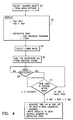
- Fig.4 is a logic flow diagram illustrating an embodiment of method of operating the apparatus of Fig.2.
- a facsimile machine 10 telephone answering machine (TAM) 12 and telephone 14 are all connected in common to a single telephone line 16 emanating from PSTN 18. Fax machine 10, TAM 12 and telephone 14 each respond to a different distinctive ring cadence impressed on line 16 by PSTN 18.
- TAM telephone answering machine
- facsimile machine 10 comprises plural fax mechanisms 20, a microprocessor 22, a random access memory (RAM) 24 and a read only memory (ROM) 26.
- ROM 26 includes the facsimile machines operating system, a ring detection procedure and a learn procedure. The learn procedure enables facsimile machine 10 to "learn" distinctive features of an incoming distinctive ring cadence.
- Facsimile machine 10 includes a network interface unit 34 which provides input/output functions necessary to couple facsimile machine 10 to the PSTN. Most of the I/O functions are directly related to facsimile operations and employ modem 36 for connections to and from bus 28.
- I/O module includes a level detect module 38, isolator 40 and buffer 42. The latter, in combination with microprocessor 22 and ROM 26, enable analysis of an incoming ring cadence and storage of its distinctive features in buffer 42 for later transfer to non-volatile memory 32.
- Level detect circuit 38 is responsive to a received ring signal 44 (see Fig. 3) to detect when ring signal 44 passes through a level 46.
- the output from level detect circuit 38 is square waveform 48.
- the duration of each square wave is indicative of the time between the rising and falling portions of ring signal waveform 44 in relation to level 46.
- the output level from level detect 38 is passed through isolator 40 and is stored in buffer 42 where it is sampled by microprocessor 22.
- Microprocessor 22 is thus able to sample the level in buffer store 42 and to determine the duration that that level is maintained.
- the resultant sampled values are analysed to determine the duration of time that waveform 48 is at the one and zero levels, respectively, so as to obtain characteristics of the distinctive ring signal.
- Facsimile machine 10 in the manner of other prior art facsimiles, includes plural entries in a menu displayable on display 30. By selecting one of the menu entries, the facsimile user can control an aspect of facsimile machine 10. Assuming that one of the menu entries is "answer mode" (box 60), the user may select that entry, causing an indication on display 30 of the various options available thereunder (see box 62). One of the displayed entries that is user-selectable is a "distinctive ring" entry. If the user moves a cursor to "distinctive ring", several alternatives are enabled, one of which is a previously programmed distinctive ring recognition ability and the other of which invokes a "learn” mode.
- the user selects the "learn” mode so as to enable facsimile machine 10 to analyse a specific distinctive ring cadence to which it is to thereafter respond.
- the user dials the fax telephone number from another phone (box 66), thereby causing the PSTN to apply a distinctive ring cadence to NIU 34 in accordance with the telephone number assigned to facsimile machine 10. So long as no ring signal is detected (see decision box 68), the procedure recycles and awaits a ring. Once a ring signal is detected, the procedure moves to decision box 70.
- a first distinctive ring cadence applied to an input line may exhibit a first signal that is foreshortened or otherwise distorted.
- the system waits until the first cadence has finished, a silent period has passed, and a second distinctive ring cadence is received.
- the period between distinctive ring cadences is determined by detecting a time length of a silent period on the incoming telephone line. If the silent period exceeds a first threshold, it is assumed that the silent period is not between two successive ring signals in a single distinctive ring cadence.
- the silent period exceeds a second threshold, it is assumed that the signal, which was thought to be a ring signal and started the silence detection period, was not a ring signal but rather a signal anomaly, i.e., a lightning strike, noise, etc.. If the silent period is determined to be between the first and second thresholds, a valid silent period is assumed.
- the first threshold is set at two seconds and the second threshold is set at five seconds. If the silent period exceeds two seconds, it is assumed that the silent period is not one between two succeeding ring signals in the same cadence. If no distinctive ring cadence is detected before the silent period (time between rings) extends longer than five seconds, it is asumed that no distinctive ring cadence has been received. The procedure then recycles and continues to await for ring detection (box 68). If by contrast, a distinctive ring cadence is received within the two to five second time window, it is analysed, as indicated in box 72, and the resulting data are written to non-volatile memory 32 as the distinctive ring cadence. The written data include time-on and time-off values for the distinctive ring cadence and tolerances may be detected and averaged to obtain a more accurate cadence determination. Thus, N cadences (where N ⁇ 1) may be analysed.
- the time-on/time-off values are now stored in non-volatile memory 32 and the distinctive ring "learn" procedure is complete and the user causes facsimile machine 10 to be placed into the distinctive ring answer mode. Then, when a subsequent distinctive ring cadence is received by NIU 34, it is determined whether the newly recieved cadence matches that stored in non-volatile memory 32. A match is determined if the newly received cadence is within pre-stored tolerance, of the stored cadence. The tolerance values are pre-programmed values stored in memory. If a match is determined, facsimile machine 10 is caused to commence normal fax operations and to enter a standard hand-shaking mode. If no match is found, facsimile machine 10 ignores the ring signal.
- the above-described procedure therefore enables a facsimile machine or any other device to be adapted to any distinctive ring cadence.
- the learn procedure may be operated at any time to accommodate a new ring cadence.
Landscapes
- Engineering & Computer Science (AREA)
- Signal Processing (AREA)
- Multimedia (AREA)
- Telephonic Communication Services (AREA)
- Facsimile Transmission Control (AREA)
- Facsimiles In General (AREA)
Applications Claiming Priority (2)
| Application Number | Priority Date | Filing Date | Title |
|---|---|---|---|
| US16536093A | 1993-12-13 | 1993-12-13 | |
| US165360 | 1993-12-13 |
Publications (2)
| Publication Number | Publication Date |
|---|---|
| EP0661865A1 EP0661865A1 (en) | 1995-07-05 |
| EP0661865B1 true EP0661865B1 (en) | 1999-01-27 |
Family
ID=22598580
Family Applications (1)
| Application Number | Title | Priority Date | Filing Date |
|---|---|---|---|
| EP94308987A Expired - Lifetime EP0661865B1 (en) | 1993-12-13 | 1994-12-02 | Telecommunications apparatus |
Country Status (4)
| Country | Link |
|---|---|
| US (1) | US5537657A (enExample) |
| EP (1) | EP0661865B1 (enExample) |
| JP (1) | JP3718249B2 (enExample) |
| DE (1) | DE69416290T2 (enExample) |
Families Citing this family (26)
| Publication number | Priority date | Publication date | Assignee | Title |
|---|---|---|---|---|
| US5991371A (en) * | 1993-12-07 | 1999-11-23 | Brother Kogyo Kabushiki Kaisha | Communication apparatus |
| US7088990B1 (en) | 1996-02-26 | 2006-08-08 | Nokia Mobile Phones, Ltd. | Communication network terminal supporting a plurality of applications |
| SE505842C2 (sv) * | 1996-05-31 | 1997-10-13 | Anders Edvard Trell | Telefoniförfarande vilket erbjuder abonnenter tillfälliga ytterligare telefonnummer utöver grundabonnemanget |
| TW358283B (en) | 1996-06-26 | 1999-05-11 | Oki Electric Ind Co Ltd | Remote testing device |
| FR2754414B1 (fr) * | 1996-10-07 | 1998-12-24 | Ascom Horlogerie Photographie | Discriminateur de signaux de sonnerie |
| KR100208034B1 (ko) | 1996-12-27 | 1999-07-15 | 윤종용 | 백업 밧테리가 없는 팩시밀리의 활동관리 방법 |
| US6246761B1 (en) * | 1997-07-24 | 2001-06-12 | Nortel Networks Limited | Automatic volume control for a telephone ringer |
| AU1830999A (en) * | 1997-12-19 | 1999-07-12 | Ericsson Inc. | System and method for allowing distinctive alerting |
| GB2341039A (en) * | 1998-08-24 | 2000-03-01 | John David Brownlie | Automatic answering for some telephone-network calls |
| US6687369B1 (en) * | 1999-04-30 | 2004-02-03 | Jorge A. Crespo | Telephone signal discriminator |
| IL135670A0 (en) * | 2000-04-16 | 2001-05-20 | Netgong Ltd | Telephone tuning and signaling system |
| GB2381405A (en) * | 2001-09-21 | 2003-04-30 | Small Planet Technology | Interface which allows plural telephone sets connected to a shared line in a chained fashion to be individually accessed by different telephone numbers |
| US7239693B2 (en) | 2003-06-30 | 2007-07-03 | Bellsouth Intellectual Property Corporation | Network-based timed ring suppression |
| US7113586B2 (en) * | 2003-06-30 | 2006-09-26 | Edward Michael Silver | Caller controlled network-based timed ring suppression |
| US7529564B2 (en) * | 2003-06-30 | 2009-05-05 | At&T Intellectual Property I, L.P. | Timed ring suppressor |
| US7443967B1 (en) | 2003-09-29 | 2008-10-28 | At&T Intellectual Property I, L.P. | Second communication during ring suppression |
| US7838321B2 (en) * | 2005-12-20 | 2010-11-23 | Xerox Corporation | Multiple stage MEMS release for isolation of similar materials |
| US20070155371A1 (en) * | 2005-12-29 | 2007-07-05 | Daigle Brian K | Disablement of simultaneous ringback |
| US7734026B2 (en) | 2005-12-29 | 2010-06-08 | At&T Intellectual Property I, L.P. | User selected caller ID override |
| US20070153990A1 (en) * | 2005-12-29 | 2007-07-05 | Daigle Brian K | User selected caller ID override |
| US20070155370A1 (en) * | 2005-12-29 | 2007-07-05 | Daigle Brian K | Disablement of simultaneous ringback |
| US20070154004A1 (en) * | 2005-12-29 | 2007-07-05 | Daigle Brain K | Sender disablement of simultaneous rings and routed rings |
| US7729488B2 (en) * | 2005-12-29 | 2010-06-01 | At&T Intellectual Property I, L.P. | Celler identification of recipient that answered a simultaneous or routed communication |
| US7606357B2 (en) | 2005-12-29 | 2009-10-20 | At&T Intellectual Property I, L.P. | Caller identification of recipient that answered a simultaneous or routed communication |
| CN101005697A (zh) * | 2006-01-18 | 2007-07-25 | 展讯通信(上海)有限公司 | 一种快速呼叫建立中空中接口消息传送方法 |
| EP2202950B1 (en) | 2008-12-23 | 2015-12-09 | GN Netcom A/S | Adaptive ringtone detector |
Family Cites Families (12)
| Publication number | Priority date | Publication date | Assignee | Title |
|---|---|---|---|---|
| JPS5465404A (en) * | 1977-11-04 | 1979-05-26 | Tamura Electric Works Ltd | Identifying circuit for dial-in pulse signal and calling signal of telephone set |
| JPS6153861A (ja) * | 1984-08-23 | 1986-03-17 | Fujitsu Ltd | 呼出信号検出装置 |
| JPH0740703B2 (ja) * | 1985-12-26 | 1995-05-01 | キヤノン株式会社 | 通信装置 |
| JP2533105B2 (ja) * | 1987-03-20 | 1996-09-11 | 株式会社東芝 | フアクシミリ装置 |
| JPH0265351A (ja) * | 1988-08-30 | 1990-03-06 | Sharp Corp | 留守番電話および着信自動応答規制制御方式 |
| US4910764A (en) * | 1989-04-13 | 1990-03-20 | Product Engineering & Manufacturing, Inc. | Facsimile and voice communications interface device |
| US5062133A (en) * | 1989-07-07 | 1991-10-29 | Logotronix Incorporated | Multi-function telephone call management system |
| US5040209A (en) * | 1989-09-18 | 1991-08-13 | Greenberg Melvin B | Telephone ringing monitoring and control system |
| US5086458A (en) * | 1989-10-02 | 1992-02-04 | Product Engineering & Manufacturing, Inc. | Telephone answering system and apparatus for direct caller selection of a party line extension |
| JPH0817437B2 (ja) * | 1989-11-29 | 1996-02-21 | シャープ株式会社 | ファクシミリ装置 |
| US5142569A (en) * | 1990-04-23 | 1992-08-25 | Data Accessory Corporation | Apparatus for selectively enabling subscriber device to respond to ringing signal in dependence upon ringing cadence |
| JPH0626395B2 (ja) * | 1990-07-04 | 1994-04-06 | 村田機械株式会社 | 端末接続装置 |
-
1994
- 1994-12-02 DE DE69416290T patent/DE69416290T2/de not_active Expired - Fee Related
- 1994-12-02 EP EP94308987A patent/EP0661865B1/en not_active Expired - Lifetime
- 1994-12-13 JP JP33263194A patent/JP3718249B2/ja not_active Expired - Fee Related
-
1995
- 1995-08-31 US US08/523,034 patent/US5537657A/en not_active Expired - Lifetime
Also Published As
| Publication number | Publication date |
|---|---|
| US5537657A (en) | 1996-07-16 |
| JP3718249B2 (ja) | 2005-11-24 |
| DE69416290T2 (de) | 1999-06-02 |
| JPH07240773A (ja) | 1995-09-12 |
| EP0661865A1 (en) | 1995-07-05 |
| DE69416290D1 (de) | 1999-03-11 |
Similar Documents
| Publication | Publication Date | Title |
|---|---|---|
| US5537657A (en) | Telecommunications device with means for learning and responding to a distinctive ring cadence | |
| US5384822A (en) | Computer controlled test facility for a telecommunication switch | |
| US5485511A (en) | Method and apparatus for determining the telephony features assigned to a telephone | |
| US5253289A (en) | Terminal connection device | |
| CA2144744C (en) | Circuit and method for automatic memory dialing | |
| EP0374231A1 (en) | Isdn traffic generator adaptor | |
| US5781626A (en) | Communication device capable of controlling transmission parameters of outputted DTMF signals | |
| US5937046A (en) | Method of selectively connecting a received telephone call by utilizing a calling party number in a keyphone system | |
| EP0265963B1 (en) | Auto dialling facsimile apparatus | |
| US4759049A (en) | Trunk identification system | |
| US6480576B1 (en) | Method and device for detecting path faults in a network | |
| EP0604274B1 (en) | Communication apparatus having audio response function | |
| KR970003418B1 (ko) | 수신모드 원격조정을 위한 팩시밀리 인터페이스 장치 | |
| US6959069B2 (en) | Method for testing subscriber line of private automatic branch exchange using dual-tone multi-frequency signal | |
| KR100584353B1 (ko) | 발신자 식별코드를 이용한 착신 알림방법 | |
| JPS6345946A (ja) | 通信装置 | |
| KR0121972B1 (ko) | 종합정보 통신망 전화기의 호 시험방법 | |
| KR100206304B1 (ko) | 내부 호 처리가 가능한 원격가입자 수용장치 및 그 제어방법 | |
| KR100318962B1 (ko) | 자동중계기에서온후크다이얼링을이용한회선시험장치및방법 | |
| KR100247195B1 (ko) | 다수의키폰장치들을전용선으로연계한시스템에서호출측식별정보송/수신방법 | |
| KR100234089B1 (ko) | 키폰시스템에서 호 연속 전환방법 | |
| JPH02239762A (ja) | 通信端末装置 | |
| KR950005144B1 (ko) | 종합정보통신망 사용자부 기능 시험 방법 | |
| JPH08195799A (ja) | 通信装置 | |
| KR950013136A (ko) | 키폰 시스템에서의 음성안내에 의한 내선호출장치 및 그 방법 |
Legal Events
| Date | Code | Title | Description |
|---|---|---|---|
| PUAI | Public reference made under article 153(3) epc to a published international application that has entered the european phase |
Free format text: ORIGINAL CODE: 0009012 |
|
| AK | Designated contracting states |
Kind code of ref document: A1 Designated state(s): DE FR GB IT |
|
| 17P | Request for examination filed |
Effective date: 19950808 |
|
| 17Q | First examination report despatched |
Effective date: 19971023 |
|
| GRAG | Despatch of communication of intention to grant |
Free format text: ORIGINAL CODE: EPIDOS AGRA |
|
| GRAG | Despatch of communication of intention to grant |
Free format text: ORIGINAL CODE: EPIDOS AGRA |
|
| GRAH | Despatch of communication of intention to grant a patent |
Free format text: ORIGINAL CODE: EPIDOS IGRA |
|
| GRAH | Despatch of communication of intention to grant a patent |
Free format text: ORIGINAL CODE: EPIDOS IGRA |
|
| GRAA | (expected) grant |
Free format text: ORIGINAL CODE: 0009210 |
|
| AK | Designated contracting states |
Kind code of ref document: B1 Designated state(s): DE FR GB IT |
|
| ITF | It: translation for a ep patent filed | ||
| REF | Corresponds to: |
Ref document number: 69416290 Country of ref document: DE Date of ref document: 19990311 |
|
| ET | Fr: translation filed | ||
| PLBE | No opposition filed within time limit |
Free format text: ORIGINAL CODE: 0009261 |
|
| STAA | Information on the status of an ep patent application or granted ep patent |
Free format text: STATUS: NO OPPOSITION FILED WITHIN TIME LIMIT |
|
| 26N | No opposition filed | ||
| REG | Reference to a national code |
Ref country code: GB Ref legal event code: 732E |
|
| REG | Reference to a national code |
Ref country code: FR Ref legal event code: TP |
|
| REG | Reference to a national code |
Ref country code: GB Ref legal event code: IF02 |
|
| PGFP | Annual fee paid to national office [announced via postgrant information from national office to epo] |
Ref country code: IT Payment date: 20061231 Year of fee payment: 13 |
|
| PGFP | Annual fee paid to national office [announced via postgrant information from national office to epo] |
Ref country code: GB Payment date: 20070125 Year of fee payment: 13 |
|
| PGFP | Annual fee paid to national office [announced via postgrant information from national office to epo] |
Ref country code: DE Payment date: 20070228 Year of fee payment: 13 |
|
| PGFP | Annual fee paid to national office [announced via postgrant information from national office to epo] |
Ref country code: FR Payment date: 20070207 Year of fee payment: 13 |
|
| GBPC | Gb: european patent ceased through non-payment of renewal fee |
Effective date: 20071202 |
|
| PG25 | Lapsed in a contracting state [announced via postgrant information from national office to epo] |
Ref country code: DE Free format text: LAPSE BECAUSE OF NON-PAYMENT OF DUE FEES Effective date: 20080701 |
|
| REG | Reference to a national code |
Ref country code: FR Ref legal event code: ST Effective date: 20081020 |
|
| PG25 | Lapsed in a contracting state [announced via postgrant information from national office to epo] |
Ref country code: GB Free format text: LAPSE BECAUSE OF NON-PAYMENT OF DUE FEES Effective date: 20071202 |
|
| PG25 | Lapsed in a contracting state [announced via postgrant information from national office to epo] |
Ref country code: FR Free format text: LAPSE BECAUSE OF NON-PAYMENT OF DUE FEES Effective date: 20071231 |
|
| PG25 | Lapsed in a contracting state [announced via postgrant information from national office to epo] |
Ref country code: IT Free format text: LAPSE BECAUSE OF NON-PAYMENT OF DUE FEES Effective date: 20071202 |