EP0658119B1 - Neue hiv-1-virusisolate eines subtyps und seine differentielle diagnostik, vakzine gegen hiv-1-virusinfektionen dieses subtyps und verfahren zu ihrer herstellung, verwendung der hiv-1-virusisolate - Google Patents
Neue hiv-1-virusisolate eines subtyps und seine differentielle diagnostik, vakzine gegen hiv-1-virusinfektionen dieses subtyps und verfahren zu ihrer herstellung, verwendung der hiv-1-virusisolate Download PDFInfo
- Publication number
- EP0658119B1 EP0658119B1 EP93919158A EP93919158A EP0658119B1 EP 0658119 B1 EP0658119 B1 EP 0658119B1 EP 93919158 A EP93919158 A EP 93919158A EP 93919158 A EP93919158 A EP 93919158A EP 0658119 B1 EP0658119 B1 EP 0658119B1
- Authority
- EP
- European Patent Office
- Prior art keywords
- hiv
- virus
- vaccine
- subtype
- peptides
- Prior art date
- Legal status (The legal status is an assumption and is not a legal conclusion. Google has not performed a legal analysis and makes no representation as to the accuracy of the status listed.)
- Expired - Lifetime
Links
Classifications
-
- C—CHEMISTRY; METALLURGY
- C07—ORGANIC CHEMISTRY
- C07K—PEPTIDES
- C07K14/00—Peptides having more than 20 amino acids; Gastrins; Somatostatins; Melanotropins; Derivatives thereof
- C07K14/005—Peptides having more than 20 amino acids; Gastrins; Somatostatins; Melanotropins; Derivatives thereof from viruses
-
- A—HUMAN NECESSITIES
- A61—MEDICAL OR VETERINARY SCIENCE; HYGIENE
- A61P—SPECIFIC THERAPEUTIC ACTIVITY OF CHEMICAL COMPOUNDS OR MEDICINAL PREPARATIONS
- A61P31/00—Antiinfectives, i.e. antibiotics, antiseptics, chemotherapeutics
- A61P31/12—Antivirals
- A61P31/14—Antivirals for RNA viruses
- A61P31/18—Antivirals for RNA viruses for HIV
-
- C—CHEMISTRY; METALLURGY
- C12—BIOCHEMISTRY; BEER; SPIRITS; WINE; VINEGAR; MICROBIOLOGY; ENZYMOLOGY; MUTATION OR GENETIC ENGINEERING
- C12N—MICROORGANISMS OR ENZYMES; COMPOSITIONS THEREOF; PROPAGATING, PRESERVING, OR MAINTAINING MICROORGANISMS; MUTATION OR GENETIC ENGINEERING; CULTURE MEDIA
- C12N7/00—Viruses; Bacteriophages; Compositions thereof; Preparation or purification thereof
-
- A—HUMAN NECESSITIES
- A61—MEDICAL OR VETERINARY SCIENCE; HYGIENE
- A61K—PREPARATIONS FOR MEDICAL, DENTAL OR TOILETRY PURPOSES
- A61K39/00—Medicinal preparations containing antigens or antibodies
-
- C—CHEMISTRY; METALLURGY
- C12—BIOCHEMISTRY; BEER; SPIRITS; WINE; VINEGAR; MICROBIOLOGY; ENZYMOLOGY; MUTATION OR GENETIC ENGINEERING
- C12N—MICROORGANISMS OR ENZYMES; COMPOSITIONS THEREOF; PROPAGATING, PRESERVING, OR MAINTAINING MICROORGANISMS; MUTATION OR GENETIC ENGINEERING; CULTURE MEDIA
- C12N2740/00—Reverse transcribing RNA viruses
- C12N2740/00011—Details
- C12N2740/10011—Retroviridae
- C12N2740/15011—Lentivirus, not HIV, e.g. FIV, SIV
- C12N2740/15022—New viral proteins or individual genes, new structural or functional aspects of known viral proteins or genes
-
- C—CHEMISTRY; METALLURGY
- C12—BIOCHEMISTRY; BEER; SPIRITS; WINE; VINEGAR; MICROBIOLOGY; ENZYMOLOGY; MUTATION OR GENETIC ENGINEERING
- C12N—MICROORGANISMS OR ENZYMES; COMPOSITIONS THEREOF; PROPAGATING, PRESERVING, OR MAINTAINING MICROORGANISMS; MUTATION OR GENETIC ENGINEERING; CULTURE MEDIA
- C12N2740/00—Reverse transcribing RNA viruses
- C12N2740/00011—Details
- C12N2740/10011—Retroviridae
- C12N2740/16011—Human Immunodeficiency Virus, HIV
- C12N2740/16021—Viruses as such, e.g. new isolates, mutants or their genomic sequences
-
- C—CHEMISTRY; METALLURGY
- C12—BIOCHEMISTRY; BEER; SPIRITS; WINE; VINEGAR; MICROBIOLOGY; ENZYMOLOGY; MUTATION OR GENETIC ENGINEERING
- C12N—MICROORGANISMS OR ENZYMES; COMPOSITIONS THEREOF; PROPAGATING, PRESERVING, OR MAINTAINING MICROORGANISMS; MUTATION OR GENETIC ENGINEERING; CULTURE MEDIA
- C12N2740/00—Reverse transcribing RNA viruses
- C12N2740/00011—Details
- C12N2740/10011—Retroviridae
- C12N2740/16011—Human Immunodeficiency Virus, HIV
- C12N2740/16111—Human Immunodeficiency Virus, HIV concerning HIV env
- C12N2740/16122—New viral proteins or individual genes, new structural or functional aspects of known viral proteins or genes
Definitions
- the invention relates to new HIV-1 virus isolates Subtypes, vaccines against viral infections with this HIV-1 Subtype, process for its manufacture and its use the virus isolates for the production of vaccines and for differential diagnosis.
- Substance suramin Another inhibitor of reverse transcriptase is Substance suramin.However, it is due to its toxicity for the mammalian organism also not for prophylaxis or therapy for HIV viral infections (H. Mitsuya et al. "Suramin Protection of T-Cells in Vitro against Infectivity and Cytopathic Effect of HTLV-III, Science 226 (1984), pages 172-174).
- Gene therapy includes the infiltration of Divide viral nucleic acids into human cells, in particular into the target cells of the HIV virus, for example the CD4 positive cells of the immune system.
- a "antisense" RNA i.e. one complementary to messenger RNA (m-RNA) RNA
- m-RNA messenger RNA
- oligonucleotides can also be used directly or with them chemically related structures that are complementary to m-RNA.
- immunotherapy are given antigens after infection by who expect support for the immune response to HIV becomes.
- the World Health Organization has now estimated at least 13 million people infected with HIV worldwide; no country is free from infections with HIV-1 or HIV-2 or both viruses at the same time. To prevent the AIDS epidemic from spreading further, it is imperative to develop a vaccine to protect against HIV infection.
- the main problem here and also with immunotherapy is the high variability of the HIV virus: a vaccination should and must cover all possible virus variants.
- the present invention provides three new HIV-1 virus isolates, HIV-1 D757 , HIV-1 D747 , HIV-1 D760 , which surprisingly form another independent subtype of the HIV-1 family and were obtained from Indian patients, who showed no typical AIDS symptoms at the time of virus isolation.
- the virus isolates reproduce on fresh mononuclear ones Peripheral blood cells, i.e. lymphocytes and macrophages.
- the invention provides a vaccine with a spectrum of activity against this specific HIV-1 subtype Available.
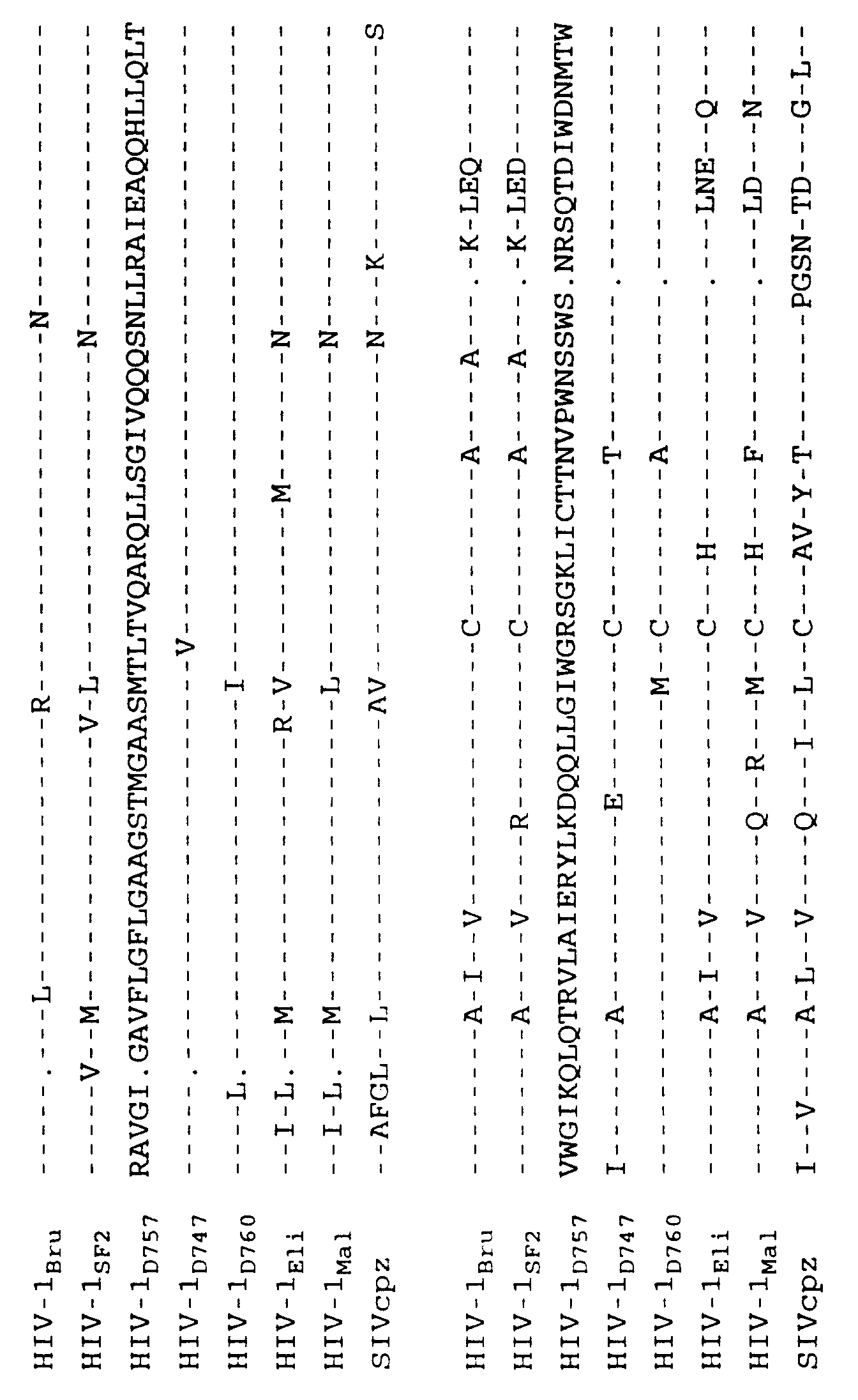
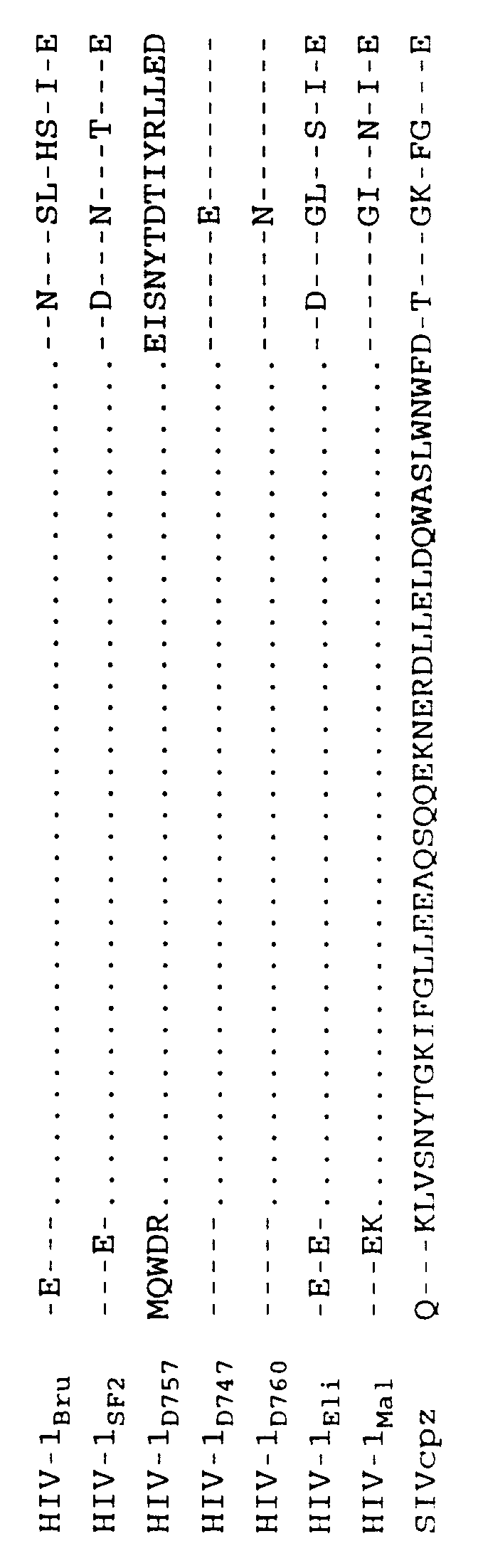
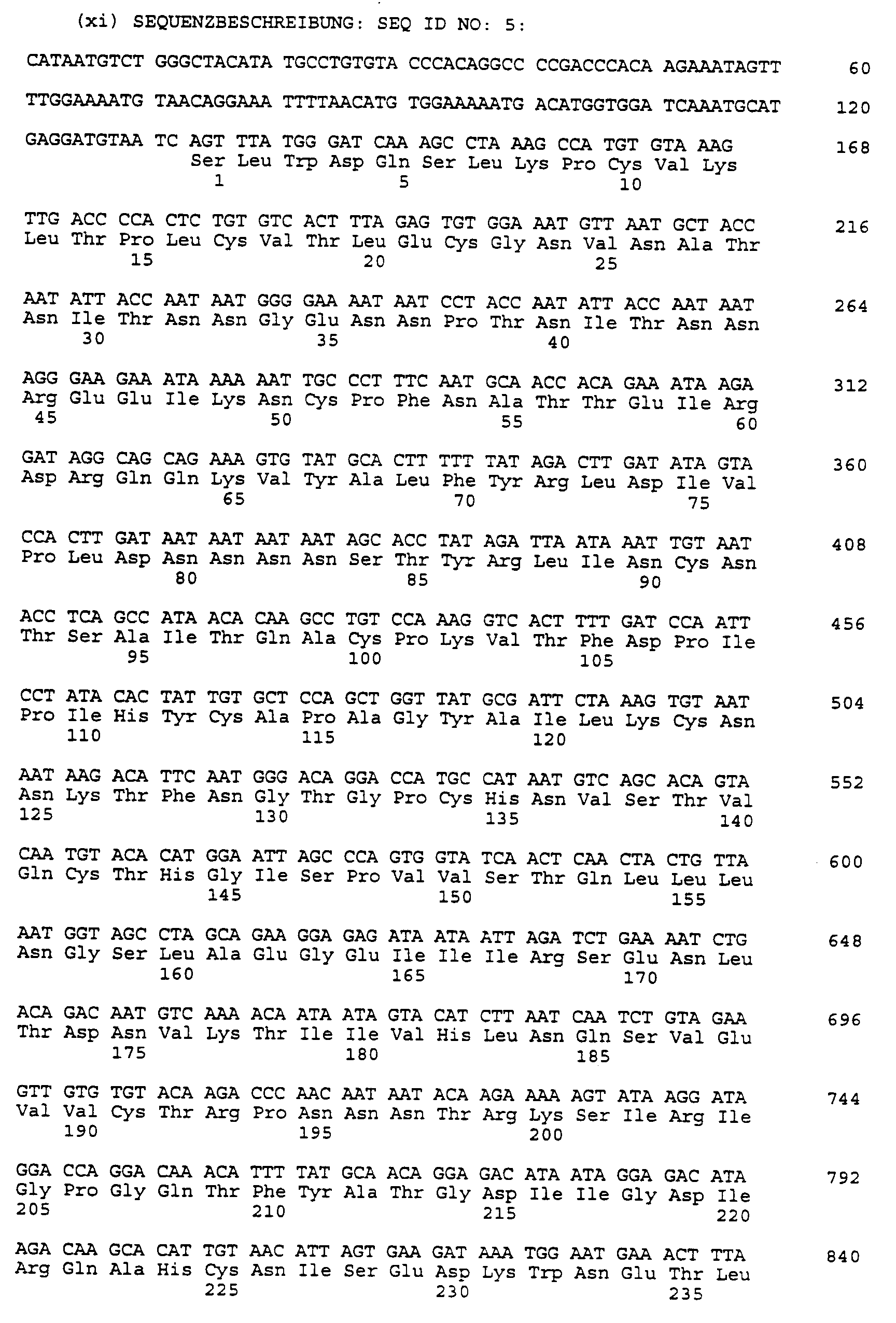
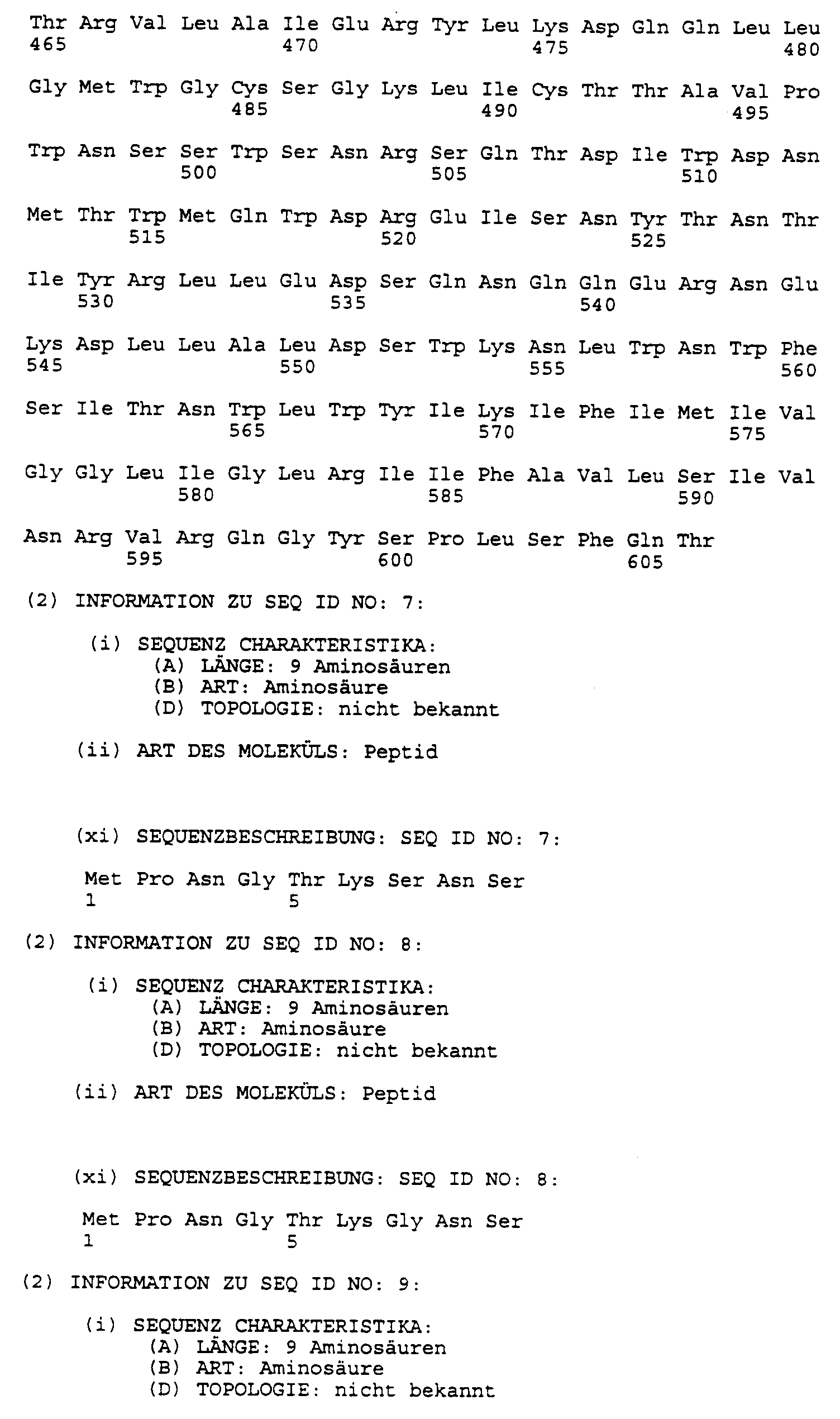
- the peptides are derived from the env range of the invention Strains (see Figure 1).
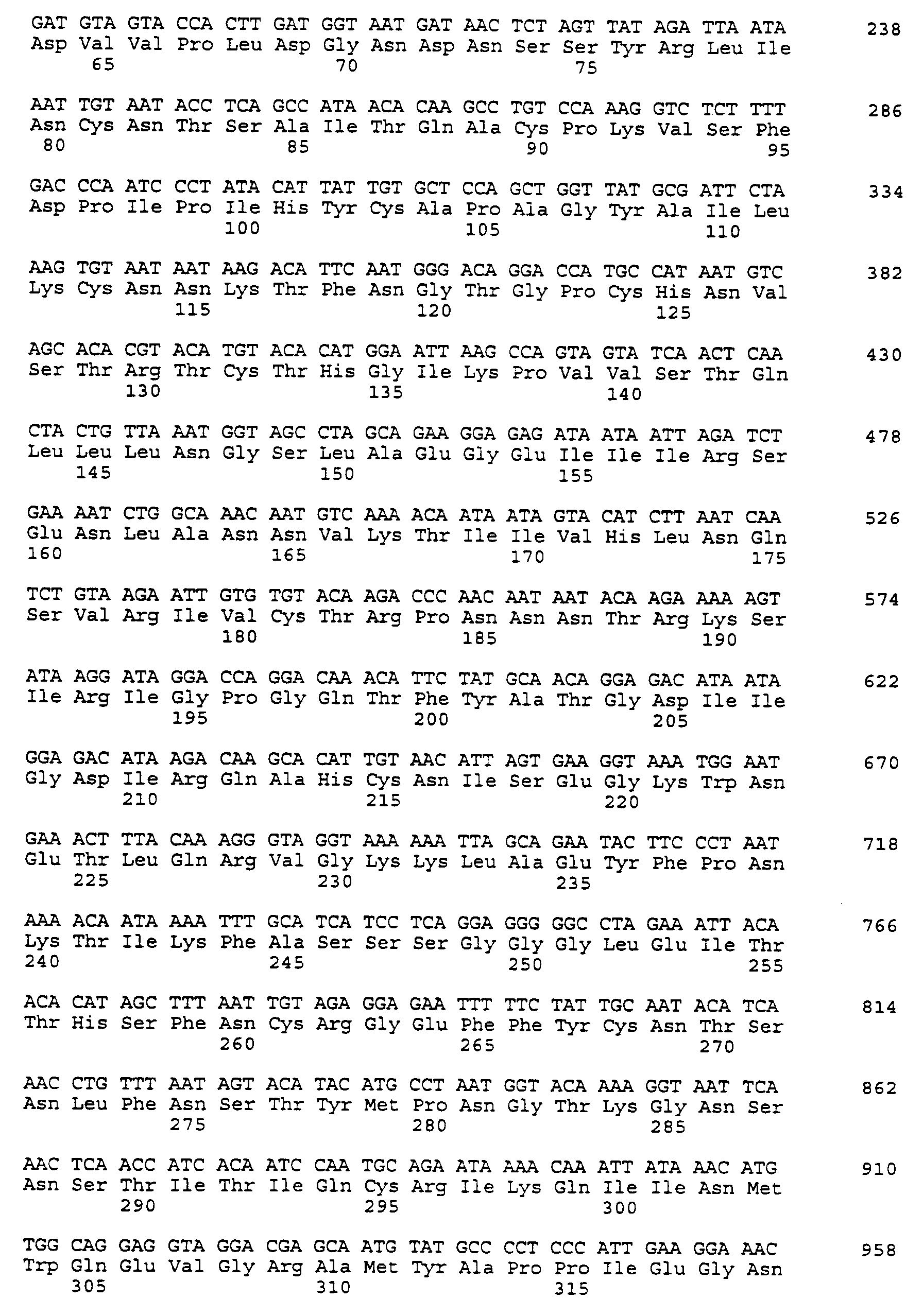
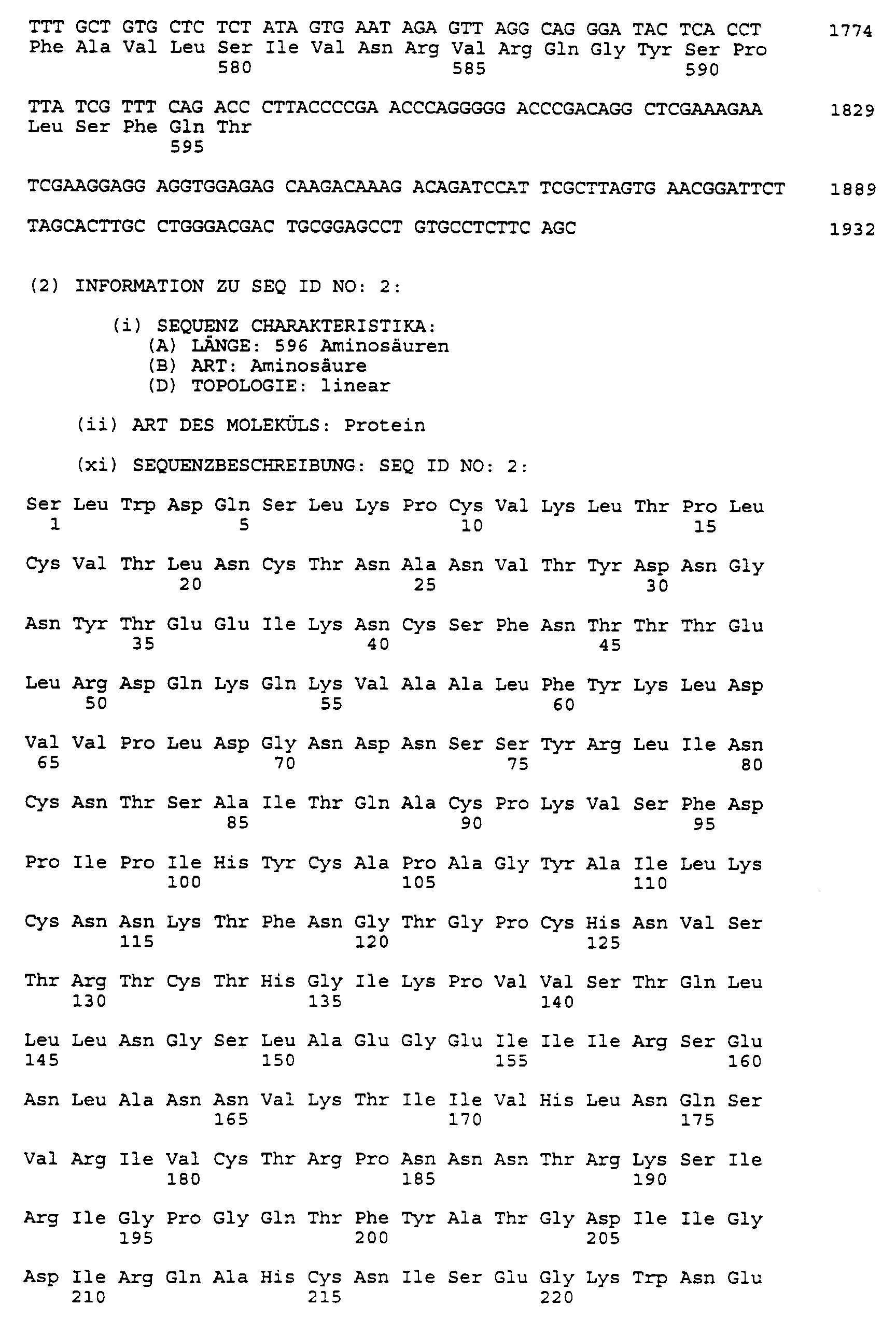
- the nucleotide sequences these viruses are in the env gene over a range of 1.8 kb only 79.4 - 81.6% homologous to viruses of the North American / European Subtypes and 78.9 - 81.2% homologous to the prototype viruses of the Central African subtype.
- the homology is 72.1 - 75.9% or 71.2 - 74.2% (see table). So these viruses stand genetically between these two subtypes and form one another independent subtype, which also differs from those in Cambodia / Kenya and subtypes found in northern Thailand genetic equidistance takes off.
- the peptides according to the invention are produced synthetically and chemically modified if advantageous.
- This Peptides or longer and shorter ones, up to 7 amino acids long sub-peptides are also part of this Invention like its modified forms.
- the invention furthermore also relates to a vaccine which contains peptides from variable regions of other genes of HIV-1 D757 , HIV-1 D747 , HIV-1 D760 as active substance, provided that the deviation from the corresponding sequence of HIV-1 viruses of other subtypes is more than 30%.
- antigens from the viruses according to the invention or peptide combinations or combinations of peptides and antigens can also be used in the vaccine.
- the use of antigens or peptides is preferred, the glycosylation site (NXT / S) directly in front of the loop of the envelope glycoprotein (amino acid 423-450 based on HIV-1 Lai ), which is responsible for binding to the CD4 receptor cysteine 450 (HIV-1 Lai ).
- This glycosylation site is typical of the Indian viruses HIV-1 D757 , HIV-1 D747 and HIV-1 D760 . This glycosylation site does not occur among 29 HIV-1 env genes sequenced worldwide.
- a preferred embodiment of the invention is a vaccine for prophylactic use before infection is used. Another preferred embodiment is that the vaccine is used as an immunotherapeutic is used after the infection and also the range of variants of this subtype.
- the vaccine will either administered for injection with adjuvants or as oral, genital or rectal application form e.g. about Nanoparticles.
- the invention furthermore also relates to a process for the production of a vaccine against HIV-1 virus infections from the viruses HIV-1 D757 , HIV-1 D747 and HIV-1 D760 and the use of these viruses for the production of a vaccine.
- viruses HIV-1 D757 , HIV-1 D747 and HIV-1 D760 are transferred to a suitable host animal and propagated there. After appropriate processing, as is also known in the prior art for other vaccines, the antibodies formed are then used as passive vaccines against HIV virus infections.
- Suitable host animals can be, in particular, suitable monkey species, but also animals that can be immunized without developing HIV symptoms (eg rabbits) (Filice et al., Nature 335, 1988, p. 366 to 369).
- HIV-1 D757 , HIV-1 D747 and HIV-1 D760 are also suitable for the production of a vaccine for protection against HIV-1 virus infections of this subtype.
- a suitable Vector DNA one of which is complementary to the viral m-RNA RNA can be transcribed completely or partially can, transfected into human immune system cells and so brought into humans.
- the viral m-RNA is thus competitively excluded from the further propagation cycle.
- synthetic oligonucleotides be used to neutralize the viral m-RNA.
- HIV-1 D757 , HIV-1 D747 and HIV-1 D760 can also be used for differential diagnosis to distinguish infections with this subtype from other subtypes.
- selected areas of the DNA of HIV-1 D757 , HIV-1 D747 and HIV-1 D760 are used, which either do not occur at all in the prototype HIV-1 Lai or differ significantly (more than 30%). From these areas, peptides or nucleic acids for diagnostics are produced according to the usual methods (labeling with radioactive isotopes, immunofluorescence test, ELISA, etc.).
- HIV-1 D757 , HIV-1 D747 and HIV-1 D760 or antigens, peptides or nucleic acids thereof for the differential diagnosis to distinguish between infections of the subtype, characterized by HIV-1 D757 , HIV- 1 D747 or HIV-1 D760 , and those of the other subtypes of HIV-1, defined by the prototypes HIV-1 Lai (USA / Europe), HIV-1 times (Central Africa), HIV-1 U455 (Uganda / Philippine) and To deploy Northern Thailand.
Landscapes
- Health & Medical Sciences (AREA)
- Life Sciences & Earth Sciences (AREA)
- Chemical & Material Sciences (AREA)
- Organic Chemistry (AREA)
- Genetics & Genomics (AREA)
- Virology (AREA)
- Medicinal Chemistry (AREA)
- General Health & Medical Sciences (AREA)
- Zoology (AREA)
- Biochemistry (AREA)
- Engineering & Computer Science (AREA)
- Wood Science & Technology (AREA)
- Bioinformatics & Cheminformatics (AREA)
- Molecular Biology (AREA)
- General Engineering & Computer Science (AREA)
- Biotechnology (AREA)
- Biomedical Technology (AREA)
- Microbiology (AREA)
- Immunology (AREA)
- Proteomics, Peptides & Aminoacids (AREA)
- Gastroenterology & Hepatology (AREA)
- Biophysics (AREA)
- AIDS & HIV (AREA)
- Chemical Kinetics & Catalysis (AREA)
- General Chemical & Material Sciences (AREA)
- Nuclear Medicine, Radiotherapy & Molecular Imaging (AREA)
- Pharmacology & Pharmacy (AREA)
- Animal Behavior & Ethology (AREA)
- Public Health (AREA)
- Veterinary Medicine (AREA)
- Oncology (AREA)
- Communicable Diseases (AREA)
- Tropical Medicine & Parasitology (AREA)
- Medicines Containing Antibodies Or Antigens For Use As Internal Diagnostic Agents (AREA)
- Peptides Or Proteins (AREA)
- Medicines That Contain Protein Lipid Enzymes And Other Medicines (AREA)
- Preparation Of Compounds By Using Micro-Organisms (AREA)
Description
| Homologie von indischen HIV-1 Isolaten und amerikanisch/europäischen bzw. prototypischen afrikanischen HIV-1 Sequenzen (1,8 kb PCR-Fragment korrespondierend zu Positionen 6129 -7976 von HIV-1Lai) | |||||
| HIV-1 | Lai | SF2 | Eli | Mal | SIVepz |
| D757 | 79.7 (75.7) | 81.6 (75.9) | 81.2 (74.2) | 80.6 (73.7) | 66.1 (61.2) |
| D747 | 79.4 (73.5) | 80.9 (75.6) | 80.7 (72.8) | 78.9 (73.2) | 65.8 (63.2) |
| D760 | 80.7 (72.1) | 81.4 (73.6) | 80.9 (71.2) | 80.2 (71.7) | 66.1 (61.0) |
| Lai | 90.0 (84.1) | 83.7 (76.2) | 82.8 (74.3) | 65.0 (60.1) | |
| SF2 | 83.8 (75.6) | 82.8 (74.6) | 64.3 (62.0) | ||
| Eli | 85.2 (76.9) | 65.7 (61.9) | |||
| Mal | 66.4 (63.2) |










Claims (10)
- Virusisolat HIV-1D747 (ECACC V92082718)
Virusisolat HIV-1D757 (ECACC V92082719) und
Virusisolat HIV-1D760 (ECACC V92082720). - Vakzine gegen HIV-1-Virusinfektionen des durch die Virusisolate gemäß Anspruch 1 definierten indischen Subtyps, dadurch gekennzeichnet, daß sie aus dem Virus HIV-1D757, dem Virus HIV-1D747 und/ oder dem Virus HIV-1D760 hergestellt ist.
- Vakzine nach Anspruch 2 enthaltend als Wirkstoff die Peptide
MPNGTKSNS, MPNGTKGNS, MPNGTKSNL,
RNEKDLLALDSWKN,
Peptide aus der CD4-Bindungsregion mit einer zusätzlichen Glycosylierungsstelle unmittelbar vor dem Cystein 450 (bezogen auf den Prototyp HIV-1Lai) oder
Kombinationen mit diesen Peptiden. - Vakzine gemäß Anspruch 2, dadurch gekennzeichnet, daß die Peptide durch chemische Synthese hergestellt und gegebenenfalls chemisch modifiziert sind.
- Vakzine gegen HIV-1-Virusinfektionen nach Anspruch 2 enthaltend als Wirkstoff Peptide aus variablen Bereichen von HIV-1D757, HIV-1D747 und/oder HIV-1D760, die bei den anderen HIV-1 Subtypen nicht vorkommen.
- Vakzine gemäß der Ansprüche 2 bis 5, dadurch gekennzeichnet, daß sie als Immuntherapeutikum nach der Infektion eingesetzt wird.
- Verfahren zur Herstellung einer Vakzine nach den Ansprüchen 2 bis 5, dadurch gekennzeichnet, daß die Viren HIV-1D757, HIV-1D747 und/oder HIV-1D760 eingesetzt werden.
- Verfahren zur Herstellung eines Passiv-Impfstoffs gegen HIV-Virusinfektionen des durch die Virusisolate gemäß Anspruch 1 definierten indischen Subtyps, dadurch gekennzeichnet, daß er aus Antikörpern gegen die Viren HIV-1D757, HIV-1D747 und/oder HIV-1D760 hergestellt ist.
- Verwendung der Virusisolate HIV-1D757, HIV-1D747 und/ oder HIV-1D760 gemäß Anspruch 1 zur Herstellung von Vakzine zum Schutz vor HIV-1-Virusinfektionen und zur Herstellung von Vakzinen zum therapeutischen Einsatz nach der HIV-1-Virusinfektion.
- Verwendung der Virusisolate nach Anspruch 1 für die Diagnostik zur Differenzierung von HIV-1-Virus-Subtypen.
Applications Claiming Priority (3)
| Application Number | Priority Date | Filing Date | Title |
|---|---|---|---|
| DE4228787 | 1992-08-29 | ||
| DE4228787A DE4228787A1 (de) | 1992-08-29 | 1992-08-29 | Neue HIV-1-Virusisolate eines Subtyps, Vakzine gegen HIV-1-Virusinfektionen dieses Subtyps und Verfahren zu ihrer Herstellung, Verwendung der HIV-1-Virusisolate |
| PCT/EP1993/002275 WO1994005327A1 (de) | 1992-08-29 | 1993-08-25 | Neue hiv-1-virusisolate eines subtyps und seine differentielle diagnostik, vakzine gegen hiv-1-virusinfektionen dieses subtyps und verfahren zu ihrer herstellung, verwendung der hiv-1-virusisolate |
Publications (2)
| Publication Number | Publication Date |
|---|---|
| EP0658119A1 EP0658119A1 (de) | 1995-06-21 |
| EP0658119B1 true EP0658119B1 (de) | 1999-04-28 |
Family
ID=6466722
Family Applications (1)
| Application Number | Title | Priority Date | Filing Date |
|---|---|---|---|
| EP93919158A Expired - Lifetime EP0658119B1 (de) | 1992-08-29 | 1993-08-25 | Neue hiv-1-virusisolate eines subtyps und seine differentielle diagnostik, vakzine gegen hiv-1-virusinfektionen dieses subtyps und verfahren zu ihrer herstellung, verwendung der hiv-1-virusisolate |
Country Status (7)
| Country | Link |
|---|---|
| US (2) | US5965135A (de) |
| EP (1) | EP0658119B1 (de) |
| AT (1) | ATE179332T1 (de) |
| AU (1) | AU4952393A (de) |
| DE (2) | DE4228787A1 (de) |
| ES (1) | ES2133408T3 (de) |
| WO (1) | WO1994005327A1 (de) |
Cited By (1)
| Publication number | Priority date | Publication date | Assignee | Title |
|---|---|---|---|---|
| EP2213299A1 (de) | 2009-01-29 | 2010-08-04 | Michel Vandevelde | Impfstoffzusammensetzung auf der Basis eines Virus mit Zinkfingermotiv(en), ihr Herstellungsverfahren und ihre Anwendung |
Families Citing this family (3)
| Publication number | Priority date | Publication date | Assignee | Title |
|---|---|---|---|---|
| AU2003253255A1 (en) * | 2003-08-18 | 2005-03-07 | All India Institute Of Medical Sciences | An immunodeficiency virus (hiv) dna vaccine and to the process of preparation thereof |
| DE102006012885A1 (de) * | 2006-03-18 | 2007-09-20 | Institut Virion/Serion Gmbh | Diagnostisches Testsystem zum simultanen, quantitativen Nachweis von HIV1 und HIV2 Antikörpern und/oder HIV Antigenen in humanem Probenmaterial |
| CN101088557A (zh) * | 2006-06-12 | 2007-12-19 | 天津市扶素生物技术有限公司 | 用于预防或治疗hiv感染的药用组合物及其应用 |
Family Cites Families (9)
| Publication number | Priority date | Publication date | Assignee | Title |
|---|---|---|---|---|
| US5030449A (en) * | 1988-07-21 | 1991-07-09 | The United States Of America As Represented By The Secretary Of The Department Of Health And Human Services | Synthetic vaccine against AIDS virus |
| GB8714802D0 (en) * | 1987-06-24 | 1987-07-29 | Proteus Biotech Ltd | Synthetic polypeptides |
| US5128319A (en) * | 1987-08-28 | 1992-07-07 | Board Of Regents, The University Of Texas System | Prophylaxis and therapy of acquired immunodeficiency syndrome |
| IL89118A0 (en) * | 1988-02-03 | 1989-08-15 | Microgenesys Inc | Vaccine containing polypeptides derived from the envelope gene of human immunodeficiency virus type 1 |
| FR2657017B1 (fr) * | 1990-01-16 | 1995-08-18 | Clonatec Sa | Peptides derivant de la glycoproteine d'enveloppe du virus-hiv-1, leurs applications a la detection d'une infection due a ce virus et a la vaccination contre le sida. |
| CA2035576A1 (en) * | 1990-02-07 | 1991-08-08 | Alexander R. Neurath | Conformational epitopes of human immunodeficiency virus envelope glycoprotein gp120 hiv-1 |
| JPH06501260A (ja) * | 1990-09-27 | 1994-02-10 | シンテロ ヴァクシーン ディベロップメント ケービー | ヒト免疫不全ウィルスに対する中和抗体の誘発とワクチン接種に用いられるペプチド |
| ES2115622T5 (es) * | 1990-10-17 | 2003-03-16 | Us Health | Clones moleculares de hiv-1 y usos de los mismos. |
| FR2677364A1 (fr) * | 1991-06-05 | 1992-12-11 | Pasteur Institut | Sequences peptidiques de la glycoproteine externe d'enveloppe du retrovirus hiv-1. |
-
1992
- 1992-08-29 DE DE4228787A patent/DE4228787A1/de not_active Withdrawn
-
1993
- 1993-08-25 WO PCT/EP1993/002275 patent/WO1994005327A1/de not_active Ceased
- 1993-08-25 ES ES93919158T patent/ES2133408T3/es not_active Expired - Lifetime
- 1993-08-25 DE DE59309551T patent/DE59309551D1/de not_active Expired - Fee Related
- 1993-08-25 US US08/392,806 patent/US5965135A/en not_active Expired - Fee Related
- 1993-08-25 AU AU49523/93A patent/AU4952393A/en not_active Abandoned
- 1993-08-25 EP EP93919158A patent/EP0658119B1/de not_active Expired - Lifetime
- 1993-08-25 AT AT93919158T patent/ATE179332T1/de not_active IP Right Cessation
-
1999
- 1999-02-25 US US09/257,490 patent/US6248328B1/en not_active Expired - Fee Related
Cited By (1)
| Publication number | Priority date | Publication date | Assignee | Title |
|---|---|---|---|---|
| EP2213299A1 (de) | 2009-01-29 | 2010-08-04 | Michel Vandevelde | Impfstoffzusammensetzung auf der Basis eines Virus mit Zinkfingermotiv(en), ihr Herstellungsverfahren und ihre Anwendung |
Also Published As
| Publication number | Publication date |
|---|---|
| EP0658119A1 (de) | 1995-06-21 |
| ES2133408T3 (es) | 1999-09-16 |
| WO1994005327A1 (de) | 1994-03-17 |
| AU4952393A (en) | 1994-03-29 |
| ATE179332T1 (de) | 1999-05-15 |
| US5965135A (en) | 1999-10-12 |
| US6248328B1 (en) | 2001-06-19 |
| DE59309551D1 (de) | 1999-06-02 |
| DE4228787A1 (de) | 1994-03-03 |
Similar Documents
| Publication | Publication Date | Title |
|---|---|---|
| EP0495896B1 (de) | Vakzine zum schutz vor hiv-virusinfektionen, verfahren zu ihrer herstellung und ihre verwendung als diagnostikum und immuntherapeutikum | |
| DE60125797T2 (de) | Impfstoffzusammesetzung | |
| DE69230068T2 (de) | Immunogene verbindungen mit spezifischem anti-cytokin effekt, methode zur herstellung, pharmazeutische zusammensetzung und reaktionskit der diese enthält | |
| Shaw et al. | HTLV-III infection in brains of children and adults with AIDS encephalopathy | |
| DE3855947T2 (de) | Peptide mit den immunologischen Eigenschaften von HIV-2 | |
| DE69527089T2 (de) | Monoklonale antikörper gegen hiv-1 und davon hergestellte impfstoffe | |
| DE69835031T2 (de) | Neue anti-hiv immunogene (toxoide), herstellungsverfahren und verwendung zur behandlung und vorbeugung von aids | |
| DE3886710T2 (de) | Verfahren zur selektiven inhibierung von hiv. | |
| DE60023300T2 (de) | Verwendung von cpg als adjuvans für hivimpstoff | |
| DE69610295T2 (de) | Von einem retroviralen regulationsprotein abstammende, detoxifierte immunogene, dagegen gerichtete antikörper, verfahren zur deren herstellung und diese immunogene oder antikörper enthaltende, pharmazeutische zusammensetzungen. | |
| DE69129034T2 (de) | Molekulare klone von hiv-1 und deren verwendung | |
| DE69833686T2 (de) | Konstitutive expression von nicht-infektiöser hiv-ähnlicher teilchen | |
| DE69028951T2 (de) | Oligonukleotiden-Sequenzen zur Amplifizierung von HIV-2 und SIV Retrovirusgenomen, ihre Verwendung zur In-vitro-Diagnostik von durch diese Viren verursachten Infektionen | |
| DE69227500T2 (de) | In der Therapie von einer HIV-1-Infektion verwendbare monoklonale Antikörper | |
| DE68914990T2 (de) | Verfahren zur inhibierung der wirkung des menschlichen immunschwäche-virus (hiv) in vivo. | |
| DE3853672T2 (de) | Nichtzurückschlagende RNS-Viren. | |
| DE69420042T2 (de) | Vielfältig verzweigte peptidkonstruktion zur bekämpfung von hiv | |
| DE4228787A1 (de) | Neue HIV-1-Virusisolate eines Subtyps, Vakzine gegen HIV-1-Virusinfektionen dieses Subtyps und Verfahren zu ihrer Herstellung, Verwendung der HIV-1-Virusisolate | |
| DE69120396T2 (de) | Neue verwendung von linomide (r) | |
| DE69132875T2 (de) | Assoziation zwischen einem menschlichen immunschwäche-virus verwandten retrovirus und dem sjoegren-syndrom | |
| DE69126486T2 (de) | Induzierung eines schutzes gegen virale infektionen | |
| DE69615685T2 (de) | Impstoff gegen krankheitserreger, zusammensetzung zur behandlung und vorbeugung von hiv infektionen | |
| DE69011870T2 (de) | Verfahren und zubereitung für die behandlung von hiv-infizierten säugetieren. | |
| DE69332904T2 (de) | Hemmung von hiv-infektion | |
| DE60034243T2 (de) | Rekombinante bifunktionale fusionsproteine zur abtreibung variabler viren |
Legal Events
| Date | Code | Title | Description |
|---|---|---|---|
| PUAI | Public reference made under article 153(3) epc to a published international application that has entered the european phase |
Free format text: ORIGINAL CODE: 0009012 |
|
| 17P | Request for examination filed |
Effective date: 19950202 |
|
| AK | Designated contracting states |
Kind code of ref document: A1 Designated state(s): AT BE CH DE DK ES FR GB GR IE IT LI NL PT SE |
|
| 17Q | First examination report despatched |
Effective date: 19960726 |
|
| GRAG | Despatch of communication of intention to grant |
Free format text: ORIGINAL CODE: EPIDOS AGRA |
|
| GRAG | Despatch of communication of intention to grant |
Free format text: ORIGINAL CODE: EPIDOS AGRA |
|
| GRAH | Despatch of communication of intention to grant a patent |
Free format text: ORIGINAL CODE: EPIDOS IGRA |
|
| GRAH | Despatch of communication of intention to grant a patent |
Free format text: ORIGINAL CODE: EPIDOS IGRA |
|
| GRAA | (expected) grant |
Free format text: ORIGINAL CODE: 0009210 |
|
| AK | Designated contracting states |
Kind code of ref document: B1 Designated state(s): AT BE CH DE DK ES FR GB GR IE IT LI NL PT SE |
|
| PG25 | Lapsed in a contracting state [announced via postgrant information from national office to epo] |
Ref country code: SE Free format text: THE PATENT HAS BEEN ANNULLED BY A DECISION OF A NATIONAL AUTHORITY Effective date: 19990428 Ref country code: NL Free format text: LAPSE BECAUSE OF FAILURE TO SUBMIT A TRANSLATION OF THE DESCRIPTION OR TO PAY THE FEE WITHIN THE PRESCRIBED TIME-LIMIT Effective date: 19990428 Ref country code: GR Free format text: LAPSE BECAUSE OF NON-PAYMENT OF DUE FEES Effective date: 19990428 |
|
| REF | Corresponds to: |
Ref document number: 179332 Country of ref document: AT Date of ref document: 19990515 Kind code of ref document: T |
|
| REG | Reference to a national code |
Ref country code: CH Ref legal event code: NV Representative=s name: SCHMAUDER & PARTNER AG PATENTANWALTSBUERO Ref country code: CH Ref legal event code: EP |
|
| REG | Reference to a national code |
Ref country code: IE Ref legal event code: FG4D Free format text: GERMAN |
|
| REF | Corresponds to: |
Ref document number: 59309551 Country of ref document: DE Date of ref document: 19990602 |
|
| PG25 | Lapsed in a contracting state [announced via postgrant information from national office to epo] |
Ref country code: DK Free format text: LAPSE BECAUSE OF FAILURE TO SUBMIT A TRANSLATION OF THE DESCRIPTION OR TO PAY THE FEE WITHIN THE PRESCRIBED TIME-LIMIT Effective date: 19990728 |
|
| PG25 | Lapsed in a contracting state [announced via postgrant information from national office to epo] |
Ref country code: PT Free format text: LAPSE BECAUSE OF FAILURE TO SUBMIT A TRANSLATION OF THE DESCRIPTION OR TO PAY THE FEE WITHIN THE PRESCRIBED TIME-LIMIT Effective date: 19990729 |
|
| ET | Fr: translation filed | ||
| GBT | Gb: translation of ep patent filed (gb section 77(6)(a)/1977) |
Effective date: 19990813 |
|
| REG | Reference to a national code |
Ref country code: ES Ref legal event code: FG2A Ref document number: 2133408 Country of ref document: ES Kind code of ref document: T3 |
|
| PLBE | No opposition filed within time limit |
Free format text: ORIGINAL CODE: 0009261 |
|
| STAA | Information on the status of an ep patent application or granted ep patent |
Free format text: STATUS: NO OPPOSITION FILED WITHIN TIME LIMIT |
|
| 26N | No opposition filed | ||
| REG | Reference to a national code |
Ref country code: GB Ref legal event code: IF02 |
|
| PGFP | Annual fee paid to national office [announced via postgrant information from national office to epo] |
Ref country code: GB Payment date: 20020819 Year of fee payment: 10 Ref country code: FR Payment date: 20020819 Year of fee payment: 10 |
|
| PGFP | Annual fee paid to national office [announced via postgrant information from national office to epo] |
Ref country code: BE Payment date: 20020822 Year of fee payment: 10 Ref country code: AT Payment date: 20020822 Year of fee payment: 10 |
|
| PGFP | Annual fee paid to national office [announced via postgrant information from national office to epo] |
Ref country code: CH Payment date: 20020823 Year of fee payment: 10 |
|
| PGFP | Annual fee paid to national office [announced via postgrant information from national office to epo] |
Ref country code: IE Payment date: 20020826 Year of fee payment: 10 Ref country code: ES Payment date: 20020826 Year of fee payment: 10 |
|
| PGFP | Annual fee paid to national office [announced via postgrant information from national office to epo] |
Ref country code: DE Payment date: 20020919 Year of fee payment: 10 |
|
| PG25 | Lapsed in a contracting state [announced via postgrant information from national office to epo] |
Ref country code: IE Free format text: LAPSE BECAUSE OF NON-PAYMENT OF DUE FEES Effective date: 20030825 Ref country code: GB Free format text: LAPSE BECAUSE OF NON-PAYMENT OF DUE FEES Effective date: 20030825 Ref country code: AT Free format text: LAPSE BECAUSE OF NON-PAYMENT OF DUE FEES Effective date: 20030825 |
|
| PG25 | Lapsed in a contracting state [announced via postgrant information from national office to epo] |
Ref country code: ES Free format text: LAPSE BECAUSE OF NON-PAYMENT OF DUE FEES Effective date: 20030826 |
|
| PG25 | Lapsed in a contracting state [announced via postgrant information from national office to epo] |
Ref country code: LI Free format text: LAPSE BECAUSE OF NON-PAYMENT OF DUE FEES Effective date: 20030831 Ref country code: CH Free format text: LAPSE BECAUSE OF NON-PAYMENT OF DUE FEES Effective date: 20030831 Ref country code: BE Free format text: LAPSE BECAUSE OF NON-PAYMENT OF DUE FEES Effective date: 20030831 |
|
| BERE | Be: lapsed |
Owner name: CHEMOTHERAPEUTISCHES FORSCHUNGSINSTITUT *GEORG-SPE Effective date: 20030831 |
|
| PG25 | Lapsed in a contracting state [announced via postgrant information from national office to epo] |
Ref country code: DE Free format text: LAPSE BECAUSE OF NON-PAYMENT OF DUE FEES Effective date: 20040302 |
|
| GBPC | Gb: european patent ceased through non-payment of renewal fee | ||
| REG | Reference to a national code |
Ref country code: CH Ref legal event code: PL |
|
| PG25 | Lapsed in a contracting state [announced via postgrant information from national office to epo] |
Ref country code: FR Free format text: LAPSE BECAUSE OF NON-PAYMENT OF DUE FEES Effective date: 20040430 |
|
| REG | Reference to a national code |
Ref country code: IE Ref legal event code: MM4A |
|
| REG | Reference to a national code |
Ref country code: FR Ref legal event code: ST |
|
| REG | Reference to a national code |
Ref country code: ES Ref legal event code: FD2A Effective date: 20030826 |
|
| PG25 | Lapsed in a contracting state [announced via postgrant information from national office to epo] |
Ref country code: IT Free format text: LAPSE BECAUSE OF NON-PAYMENT OF DUE FEES Effective date: 20050825 |