EP0656402A2 - Pigmentzusammensetzung aus modifiziertem Diketopyrrolopyrrol und Aminoalkylacrylatharz - Google Patents
Pigmentzusammensetzung aus modifiziertem Diketopyrrolopyrrol und Aminoalkylacrylatharz Download PDFInfo
- Publication number
- EP0656402A2 EP0656402A2 EP94810662A EP94810662A EP0656402A2 EP 0656402 A2 EP0656402 A2 EP 0656402A2 EP 94810662 A EP94810662 A EP 94810662A EP 94810662 A EP94810662 A EP 94810662A EP 0656402 A2 EP0656402 A2 EP 0656402A2
- Authority
- EP
- European Patent Office
- Prior art keywords
- formula
- diketopyrrolopyrrole
- pigment
- methyl
- der formel
- Prior art date
- Legal status (The legal status is an assumption and is not a legal conclusion. Google has not performed a legal analysis and makes no representation as to the accuracy of the status listed.)
- Granted
Links
- 239000000049 pigment Substances 0.000 title claims abstract description 76
- 239000000203 mixture Substances 0.000 title claims abstract description 36
- 239000004925 Acrylic resin Substances 0.000 title claims abstract description 11
- 229920000178 Acrylic resin Polymers 0.000 title claims abstract description 11
- 125000004103 aminoalkyl group Chemical group 0.000 title 1
- FYNROBRQIVCIQF-UHFFFAOYSA-N pyrrolo[3,2-b]pyrrole-5,6-dione Chemical compound C1=CN=C2C(=O)C(=O)N=C21 FYNROBRQIVCIQF-UHFFFAOYSA-N 0.000 claims abstract description 36
- 239000002245 particle Substances 0.000 claims abstract description 15
- 239000000178 monomer Substances 0.000 claims abstract description 12
- 150000002148 esters Chemical class 0.000 claims abstract description 4
- 150000002894 organic compounds Chemical class 0.000 claims abstract description 4
- QKWILNTYPDJSME-UHFFFAOYSA-N pyrrolo[3,4-c]pyrrole-3,6-dione Chemical compound C1=NC(=O)C2=C1C(=O)N=C2 QKWILNTYPDJSME-UHFFFAOYSA-N 0.000 claims abstract description 4
- 238000007334 copolymerization reaction Methods 0.000 claims abstract description 3
- 125000002496 methyl group Chemical group [H]C([H])([H])* 0.000 claims description 29
- 229910052739 hydrogen Inorganic materials 0.000 claims description 20
- 239000001257 hydrogen Substances 0.000 claims description 20
- 125000001495 ethyl group Chemical group [H]C([H])([H])C([H])([H])* 0.000 claims description 19
- 150000002431 hydrogen Chemical class 0.000 claims description 17
- UFHFLCQGNIYNRP-UHFFFAOYSA-N Hydrogen Chemical compound [H][H] UFHFLCQGNIYNRP-UHFFFAOYSA-N 0.000 claims description 11
- 229910052736 halogen Inorganic materials 0.000 claims description 10
- 150000002367 halogens Chemical class 0.000 claims description 10
- 239000011368 organic material Substances 0.000 claims description 7
- 125000001997 phenyl group Chemical group [H]C1=C([H])C([H])=C(*)C([H])=C1[H] 0.000 claims description 7
- 125000000956 methoxy group Chemical group [H]C([H])([H])O* 0.000 claims description 6
- 229910052788 barium Inorganic materials 0.000 claims description 5
- 229910052791 calcium Inorganic materials 0.000 claims description 5
- 125000001301 ethoxy group Chemical group [H]C([H])([H])C([H])([H])O* 0.000 claims description 5
- 229910052749 magnesium Inorganic materials 0.000 claims description 5
- 229910052751 metal Inorganic materials 0.000 claims description 5
- 239000002184 metal Substances 0.000 claims description 5
- 125000003386 piperidinyl group Chemical group 0.000 claims description 5
- 229910052700 potassium Inorganic materials 0.000 claims description 5
- 125000000719 pyrrolidinyl group Chemical group 0.000 claims description 5
- 229910052708 sodium Inorganic materials 0.000 claims description 5
- 229910052712 strontium Inorganic materials 0.000 claims description 5
- 229910052718 tin Inorganic materials 0.000 claims description 5
- 229910052719 titanium Inorganic materials 0.000 claims description 5
- YNAVUWVOSKDBBP-UHFFFAOYSA-N Morpholine Chemical compound C1COCCN1 YNAVUWVOSKDBBP-UHFFFAOYSA-N 0.000 claims description 4
- 239000004922 lacquer Substances 0.000 claims description 4
- 125000000217 alkyl group Chemical group 0.000 claims description 3
- 125000001797 benzyl group Chemical group [H]C1=C([H])C([H])=C(C([H])=C1[H])C([H])([H])* 0.000 claims description 3
- 150000001875 compounds Chemical class 0.000 claims description 3
- 229910052732 germanium Inorganic materials 0.000 claims description 3
- 125000002883 imidazolyl group Chemical group 0.000 claims description 3
- 125000002757 morpholinyl group Chemical group 0.000 claims description 3
- 125000003226 pyrazolyl group Chemical group 0.000 claims description 3
- 125000000999 tert-butyl group Chemical group [H]C([H])([H])C(*)(C([H])([H])[H])C([H])([H])[H] 0.000 claims description 3
- 125000001425 triazolyl group Chemical group 0.000 claims description 3
- 229910052782 aluminium Inorganic materials 0.000 claims description 2
- 229910052726 zirconium Inorganic materials 0.000 claims description 2
- 239000003086 colorant Substances 0.000 claims 1
- 239000000725 suspension Substances 0.000 description 16
- XLYOFNOQVPJJNP-UHFFFAOYSA-N water Substances O XLYOFNOQVPJJNP-UHFFFAOYSA-N 0.000 description 11
- LRHPLDYGYMQRHN-UHFFFAOYSA-N N-Butanol Chemical compound CCCCO LRHPLDYGYMQRHN-UHFFFAOYSA-N 0.000 description 8
- 238000000034 method Methods 0.000 description 8
- 239000003973 paint Substances 0.000 description 8
- 239000000243 solution Substances 0.000 description 8
- 229920005989 resin Polymers 0.000 description 7
- 239000011347 resin Substances 0.000 description 7
- CTQNGGLPUBDAKN-UHFFFAOYSA-N O-Xylene Chemical compound CC1=CC=CC=C1C CTQNGGLPUBDAKN-UHFFFAOYSA-N 0.000 description 6
- HEMHJVSKTPXQMS-UHFFFAOYSA-M Sodium hydroxide Chemical compound [OH-].[Na+] HEMHJVSKTPXQMS-UHFFFAOYSA-M 0.000 description 6
- 238000003756 stirring Methods 0.000 description 5
- 125000004178 (C1-C4) alkyl group Chemical group 0.000 description 4
- ARXJGSRGQADJSQ-UHFFFAOYSA-N 1-methoxypropan-2-ol Chemical compound COCC(C)O ARXJGSRGQADJSQ-UHFFFAOYSA-N 0.000 description 4
- 238000004043 dyeing Methods 0.000 description 4
- -1 tert-amyl Chemical group 0.000 description 4
- AMEIJSBJFSDMLE-UHFFFAOYSA-N 1,4-bis(4-tert-butylphenyl)pyrrolo[3,4-c]pyrrole-3,6-dione Chemical compound C1=CC(C(C)(C)C)=CC=C1C1=NC(=O)C2=C1C(=O)N=C2C1=CC=C(C(C)(C)C)C=C1 AMEIJSBJFSDMLE-UHFFFAOYSA-N 0.000 description 3
- 239000011248 coating agent Substances 0.000 description 3
- 238000000576 coating method Methods 0.000 description 3
- 230000000694 effects Effects 0.000 description 3
- 229920000642 polymer Polymers 0.000 description 3
- 229920000098 polyolefin Polymers 0.000 description 3
- 238000002360 preparation method Methods 0.000 description 3
- 239000011734 sodium Substances 0.000 description 3
- 239000008096 xylene Substances 0.000 description 3
- POILWHVDKZOXJZ-ARJAWSKDSA-M (z)-4-oxopent-2-en-2-olate Chemical compound C\C([O-])=C\C(C)=O POILWHVDKZOXJZ-ARJAWSKDSA-M 0.000 description 2
- AZUYLZMQTIKGSC-UHFFFAOYSA-N 1-[6-[4-(5-chloro-6-methyl-1H-indazol-4-yl)-5-methyl-3-(1-methylindazol-5-yl)pyrazol-1-yl]-2-azaspiro[3.3]heptan-2-yl]prop-2-en-1-one Chemical compound ClC=1C(=C2C=NNC2=CC=1C)C=1C(=NN(C=1C)C1CC2(CN(C2)C(C=C)=O)C1)C=1C=C2C=NN(C2=CC=1)C AZUYLZMQTIKGSC-UHFFFAOYSA-N 0.000 description 2
- IJGRMHOSHXDMSA-UHFFFAOYSA-N Atomic nitrogen Chemical compound N#N IJGRMHOSHXDMSA-UHFFFAOYSA-N 0.000 description 2
- 0 C(C1)CC2C1CCC*2 Chemical compound C(C1)CC2C1CCC*2 0.000 description 2
- XZMCDFZZKTWFGF-UHFFFAOYSA-N Cyanamide Chemical compound NC#N XZMCDFZZKTWFGF-UHFFFAOYSA-N 0.000 description 2
- 229920003270 Cymel® Polymers 0.000 description 2
- 229920000877 Melamine resin Polymers 0.000 description 2
- 239000000654 additive Substances 0.000 description 2
- 229920000180 alkyd Polymers 0.000 description 2
- 239000003795 chemical substances by application Substances 0.000 description 2
- 238000004040 coloring Methods 0.000 description 2
- 238000001914 filtration Methods 0.000 description 2
- 239000003999 initiator Substances 0.000 description 2
- 239000000976 ink Substances 0.000 description 2
- 229910052740 iodine Inorganic materials 0.000 description 2
- 238000004519 manufacturing process Methods 0.000 description 2
- 239000003791 organic solvent mixture Substances 0.000 description 2
- 150000002902 organometallic compounds Chemical class 0.000 description 2
- 239000004033 plastic Substances 0.000 description 2
- 229920003023 plastic Polymers 0.000 description 2
- 229920000058 polyacrylate Polymers 0.000 description 2
- 239000000843 powder Substances 0.000 description 2
- 239000007787 solid Substances 0.000 description 2
- 239000002966 varnish Substances 0.000 description 2
- 125000000229 (C1-C4)alkoxy group Chemical group 0.000 description 1
- YOBOXHGSEJBUPB-MTOQALJVSA-N (z)-4-hydroxypent-3-en-2-one;zirconium Chemical compound [Zr].C\C(O)=C\C(C)=O.C\C(O)=C\C(C)=O.C\C(O)=C\C(C)=O.C\C(O)=C\C(C)=O YOBOXHGSEJBUPB-MTOQALJVSA-N 0.000 description 1
- IGKHBMWUGKPAGT-UHFFFAOYSA-N 1,4-bis(4-methylphenyl)pyrrolo[3,4-c]pyrrole-3,6-dione Chemical compound C1=CC(C)=CC=C1C1=NC(=O)C2=C1C(=O)N=C2C1=CC=C(C)C=C1 IGKHBMWUGKPAGT-UHFFFAOYSA-N 0.000 description 1
- SMZOUWXMTYCWNB-UHFFFAOYSA-N 2-(2-methoxy-5-methylphenyl)ethanamine Chemical compound COC1=CC=C(C)C=C1CCN SMZOUWXMTYCWNB-UHFFFAOYSA-N 0.000 description 1
- JKNCOURZONDCGV-UHFFFAOYSA-N 2-(dimethylamino)ethyl 2-methylprop-2-enoate Chemical compound CN(C)CCOC(=O)C(C)=C JKNCOURZONDCGV-UHFFFAOYSA-N 0.000 description 1
- NIXOWILDQLNWCW-UHFFFAOYSA-N 2-Propenoic acid Natural products OC(=O)C=C NIXOWILDQLNWCW-UHFFFAOYSA-N 0.000 description 1
- WKBOTKDWSSQWDR-UHFFFAOYSA-N Bromine atom Chemical compound [Br] WKBOTKDWSSQWDR-UHFFFAOYSA-N 0.000 description 1
- ZAMOUSCENKQFHK-UHFFFAOYSA-N Chlorine atom Chemical compound [Cl] ZAMOUSCENKQFHK-UHFFFAOYSA-N 0.000 description 1
- SNRUBQQJIBEYMU-UHFFFAOYSA-N Dodecane Natural products CCCCCCCCCCCC SNRUBQQJIBEYMU-UHFFFAOYSA-N 0.000 description 1
- 239000001856 Ethyl cellulose Substances 0.000 description 1
- ZZSNKZQZMQGXPY-UHFFFAOYSA-N Ethyl cellulose Chemical compound CCOCC1OC(OC)C(OCC)C(OCC)C1OC1C(O)C(O)C(OC)C(CO)O1 ZZSNKZQZMQGXPY-UHFFFAOYSA-N 0.000 description 1
- PXGOKWXKJXAPGV-UHFFFAOYSA-N Fluorine Chemical compound FF PXGOKWXKJXAPGV-UHFFFAOYSA-N 0.000 description 1
- 239000004640 Melamine resin Substances 0.000 description 1
- CERQOIWHTDAKMF-UHFFFAOYSA-N Methacrylic acid Chemical compound CC(=C)C(O)=O CERQOIWHTDAKMF-UHFFFAOYSA-N 0.000 description 1
- 239000000020 Nitrocellulose Substances 0.000 description 1
- 239000004721 Polyphenylene oxide Substances 0.000 description 1
- 239000004793 Polystyrene Substances 0.000 description 1
- NRCMAYZCPIVABH-UHFFFAOYSA-N Quinacridone Chemical compound N1C2=CC=CC=C2C(=O)C2=C1C=C1C(=O)C3=CC=CC=C3NC1=C2 NRCMAYZCPIVABH-UHFFFAOYSA-N 0.000 description 1
- BLRPTPMANUNPDV-UHFFFAOYSA-N Silane Chemical compound [SiH4] BLRPTPMANUNPDV-UHFFFAOYSA-N 0.000 description 1
- XSQUKJJJFZCRTK-UHFFFAOYSA-N Urea Chemical compound NC(N)=O XSQUKJJJFZCRTK-UHFFFAOYSA-N 0.000 description 1
- 229920001807 Urea-formaldehyde Polymers 0.000 description 1
- 239000002253 acid Substances 0.000 description 1
- 239000003929 acidic solution Substances 0.000 description 1
- 238000007605 air drying Methods 0.000 description 1
- 230000001476 alcoholic effect Effects 0.000 description 1
- 125000001931 aliphatic group Chemical group 0.000 description 1
- 229910001854 alkali hydroxide Inorganic materials 0.000 description 1
- 150000008044 alkali metal hydroxides Chemical class 0.000 description 1
- 125000005907 alkyl ester group Chemical group 0.000 description 1
- 150000003863 ammonium salts Chemical class 0.000 description 1
- 239000003945 anionic surfactant Substances 0.000 description 1
- 239000007900 aqueous suspension Substances 0.000 description 1
- 239000002585 base Substances 0.000 description 1
- 239000011230 binding agent Substances 0.000 description 1
- 230000015572 biosynthetic process Effects 0.000 description 1
- 239000004305 biphenyl Substances 0.000 description 1
- GDTBXPJZTBHREO-UHFFFAOYSA-N bromine Substances BrBr GDTBXPJZTBHREO-UHFFFAOYSA-N 0.000 description 1
- 229910052794 bromium Inorganic materials 0.000 description 1
- 239000004202 carbamide Substances 0.000 description 1
- 125000004432 carbon atom Chemical group C* 0.000 description 1
- 239000005018 casein Substances 0.000 description 1
- BECPQYXYKAMYBN-UHFFFAOYSA-N casein, tech. Chemical compound NCCCCC(C(O)=O)N=C(O)C(CC(O)=O)N=C(O)C(CCC(O)=N)N=C(O)C(CC(C)C)N=C(O)C(CCC(O)=O)N=C(O)C(CC(O)=O)N=C(O)C(CCC(O)=O)N=C(O)C(C(C)O)N=C(O)C(CCC(O)=N)N=C(O)C(CCC(O)=N)N=C(O)C(CCC(O)=N)N=C(O)C(CCC(O)=O)N=C(O)C(CCC(O)=O)N=C(O)C(COP(O)(O)=O)N=C(O)C(CCC(O)=N)N=C(O)C(N)CC1=CC=CC=C1 BECPQYXYKAMYBN-UHFFFAOYSA-N 0.000 description 1
- 235000021240 caseins Nutrition 0.000 description 1
- 229920002678 cellulose Polymers 0.000 description 1
- 229920002301 cellulose acetate Polymers 0.000 description 1
- 229920001727 cellulose butyrate Polymers 0.000 description 1
- 229920003086 cellulose ether Polymers 0.000 description 1
- 229910052801 chlorine Inorganic materials 0.000 description 1
- 239000000460 chlorine Substances 0.000 description 1
- 238000009833 condensation Methods 0.000 description 1
- 230000005494 condensation Effects 0.000 description 1
- 125000000113 cyclohexyl group Chemical group [H]C1([H])C([H])([H])C([H])([H])C([H])(*)C([H])([H])C1([H])[H] 0.000 description 1
- 125000001511 cyclopentyl group Chemical group [H]C1([H])C([H])([H])C([H])([H])C([H])(*)C1([H])[H] 0.000 description 1
- 125000002704 decyl group Chemical group [H]C([H])([H])C([H])([H])C([H])([H])C([H])([H])C([H])([H])C([H])([H])C([H])([H])C([H])([H])C([H])([H])C([H])([H])* 0.000 description 1
- 239000002270 dispersing agent Substances 0.000 description 1
- ZITKDVFRMRXIJQ-UHFFFAOYSA-N dodecane-1,2-diol Chemical compound CCCCCCCCCCC(O)CO ZITKDVFRMRXIJQ-UHFFFAOYSA-N 0.000 description 1
- 125000003438 dodecyl group Chemical group [H]C([H])([H])C([H])([H])C([H])([H])C([H])([H])C([H])([H])C([H])([H])C([H])([H])C([H])([H])C([H])([H])C([H])([H])C([H])([H])C([H])([H])* 0.000 description 1
- 229920001971 elastomer Polymers 0.000 description 1
- 229920001249 ethyl cellulose Polymers 0.000 description 1
- 235000019325 ethyl cellulose Nutrition 0.000 description 1
- 239000000835 fiber Substances 0.000 description 1
- 239000000945 filler Substances 0.000 description 1
- 229910052731 fluorine Inorganic materials 0.000 description 1
- 239000011737 fluorine Substances 0.000 description 1
- 239000011521 glass Substances 0.000 description 1
- 125000003187 heptyl group Chemical group [H]C([*])([H])C([H])([H])C([H])([H])C([H])([H])C([H])([H])C([H])([H])C([H])([H])[H] 0.000 description 1
- 125000004051 hexyl group Chemical group [H]C([H])([H])C([H])([H])C([H])([H])C([H])([H])C([H])([H])C([H])([H])* 0.000 description 1
- 125000002887 hydroxy group Chemical group [H]O* 0.000 description 1
- PNDPGZBMCMUPRI-UHFFFAOYSA-N iodine Chemical compound II PNDPGZBMCMUPRI-UHFFFAOYSA-N 0.000 description 1
- 238000002955 isolation Methods 0.000 description 1
- 125000001449 isopropyl group Chemical group [H]C([H])([H])C([H])(*)C([H])([H])[H] 0.000 description 1
- 239000000155 melt Substances 0.000 description 1
- 229910044991 metal oxide Inorganic materials 0.000 description 1
- 150000004706 metal oxides Chemical class 0.000 description 1
- 230000005012 migration Effects 0.000 description 1
- 238000013508 migration Methods 0.000 description 1
- 125000001421 myristyl group Chemical group [H]C([*])([H])C([H])([H])C([H])([H])C([H])([H])C([H])([H])C([H])([H])C([H])([H])C([H])([H])C([H])([H])C([H])([H])C([H])([H])C([H])([H])C([H])([H])C([H])([H])[H] 0.000 description 1
- 125000004108 n-butyl group Chemical group [H]C([H])([H])C([H])([H])C([H])([H])C([H])([H])* 0.000 description 1
- 125000004123 n-propyl group Chemical group [H]C([H])([H])C([H])([H])C([H])([H])* 0.000 description 1
- 239000000025 natural resin Substances 0.000 description 1
- 229920001220 nitrocellulos Polymers 0.000 description 1
- 229910052757 nitrogen Inorganic materials 0.000 description 1
- 239000012299 nitrogen atmosphere Substances 0.000 description 1
- 125000001400 nonyl group Chemical group [H]C([*])([H])C([H])([H])C([H])([H])C([H])([H])C([H])([H])C([H])([H])C([H])([H])C([H])([H])C([H])([H])[H] 0.000 description 1
- 125000002347 octyl group Chemical group [H]C([*])([H])C([H])([H])C([H])([H])C([H])([H])C([H])([H])C([H])([H])C([H])([H])C([H])([H])[H] 0.000 description 1
- 239000012860 organic pigment Substances 0.000 description 1
- 238000010422 painting Methods 0.000 description 1
- 125000000913 palmityl group Chemical group [H]C([*])([H])C([H])([H])C([H])([H])C([H])([H])C([H])([H])C([H])([H])C([H])([H])C([H])([H])C([H])([H])C([H])([H])C([H])([H])C([H])([H])C([H])([H])C([H])([H])C([H])([H])C([H])([H])[H] 0.000 description 1
- 229920001568 phenolic resin Polymers 0.000 description 1
- 230000000485 pigmenting effect Effects 0.000 description 1
- 239000004014 plasticizer Substances 0.000 description 1
- 229920006112 polar polymer Polymers 0.000 description 1
- 239000002798 polar solvent Substances 0.000 description 1
- 229920001643 poly(ether ketone) Polymers 0.000 description 1
- 229920000515 polycarbonate Polymers 0.000 description 1
- 239000004417 polycarbonate Substances 0.000 description 1
- 229920000728 polyester Polymers 0.000 description 1
- 238000006116 polymerization reaction Methods 0.000 description 1
- 229920006380 polyphenylene oxide Polymers 0.000 description 1
- 229920001296 polysiloxane Polymers 0.000 description 1
- 229920002223 polystyrene Polymers 0.000 description 1
- 229920002635 polyurethane Polymers 0.000 description 1
- 239000004814 polyurethane Substances 0.000 description 1
- 229920000915 polyvinyl chloride Polymers 0.000 description 1
- 239000004800 polyvinyl chloride Substances 0.000 description 1
- YKPJEYXZEBLYCI-UHFFFAOYSA-N pyrrolo[3,4-c]pyrrole Chemical compound C1=NC=C2C=NC=C21 YKPJEYXZEBLYCI-UHFFFAOYSA-N 0.000 description 1
- 238000000518 rheometry Methods 0.000 description 1
- 239000005060 rubber Substances 0.000 description 1
- LMHHRCOWPQNFTF-UHFFFAOYSA-N s-propan-2-yl azepane-1-carbothioate Chemical compound CC(C)SC(=O)N1CCCCCC1 LMHHRCOWPQNFTF-UHFFFAOYSA-N 0.000 description 1
- 125000002914 sec-butyl group Chemical group [H]C([H])([H])C([H])([H])C([H])(*)C([H])([H])[H] 0.000 description 1
- 238000000926 separation method Methods 0.000 description 1
- 229910000077 silane Inorganic materials 0.000 description 1
- 229920002545 silicone oil Polymers 0.000 description 1
- 229920002050 silicone resin Polymers 0.000 description 1
- 159000000000 sodium salts Chemical class 0.000 description 1
- 238000009987 spinning Methods 0.000 description 1
- 125000004079 stearyl group Chemical group [H]C([*])([H])C([H])([H])C([H])([H])C([H])([H])C([H])([H])C([H])([H])C([H])([H])C([H])([H])C([H])([H])C([H])([H])C([H])([H])C([H])([H])C([H])([H])C([H])([H])C([H])([H])C([H])([H])C([H])([H])C([H])([H])[H] 0.000 description 1
- 238000003860 storage Methods 0.000 description 1
- 125000001424 substituent group Chemical group 0.000 description 1
- 238000003786 synthesis reaction Methods 0.000 description 1
- 229920003002 synthetic resin Polymers 0.000 description 1
- 239000000057 synthetic resin Substances 0.000 description 1
- JOUDBUYBGJYFFP-FOCLMDBBSA-N thioindigo Chemical compound S\1C2=CC=CC=C2C(=O)C/1=C1/C(=O)C2=CC=CC=C2S1 JOUDBUYBGJYFFP-FOCLMDBBSA-N 0.000 description 1
- 238000009736 wetting Methods 0.000 description 1
Classifications
-
- C—CHEMISTRY; METALLURGY
- C09—DYES; PAINTS; POLISHES; NATURAL RESINS; ADHESIVES; COMPOSITIONS NOT OTHERWISE PROVIDED FOR; APPLICATIONS OF MATERIALS NOT OTHERWISE PROVIDED FOR
- C09B—ORGANIC DYES OR CLOSELY-RELATED COMPOUNDS FOR PRODUCING DYES, e.g. PIGMENTS; MORDANTS; LAKES
- C09B67/00—Influencing the physical, e.g. the dyeing or printing properties of dyestuffs without chemical reactions, e.g. by treating with solvents grinding or grinding assistants, coating of pigments or dyes; Process features in the making of dyestuff preparations; Dyestuff preparations of a special physical nature, e.g. tablets, films
- C09B67/0033—Blends of pigments; Mixtured crystals; Solid solutions
- C09B67/0034—Mixtures of two or more pigments or dyes of the same type
- C09B67/0039—Mixtures of diketopyrrolopyrroles
-
- C—CHEMISTRY; METALLURGY
- C09—DYES; PAINTS; POLISHES; NATURAL RESINS; ADHESIVES; COMPOSITIONS NOT OTHERWISE PROVIDED FOR; APPLICATIONS OF MATERIALS NOT OTHERWISE PROVIDED FOR
- C09B—ORGANIC DYES OR CLOSELY-RELATED COMPOUNDS FOR PRODUCING DYES, e.g. PIGMENTS; MORDANTS; LAKES
- C09B57/00—Other synthetic dyes of known constitution
- C09B57/004—Diketopyrrolopyrrole dyes
-
- C—CHEMISTRY; METALLURGY
- C09—DYES; PAINTS; POLISHES; NATURAL RESINS; ADHESIVES; COMPOSITIONS NOT OTHERWISE PROVIDED FOR; APPLICATIONS OF MATERIALS NOT OTHERWISE PROVIDED FOR
- C09B—ORGANIC DYES OR CLOSELY-RELATED COMPOUNDS FOR PRODUCING DYES, e.g. PIGMENTS; MORDANTS; LAKES
- C09B67/00—Influencing the physical, e.g. the dyeing or printing properties of dyestuffs without chemical reactions, e.g. by treating with solvents grinding or grinding assistants, coating of pigments or dyes; Process features in the making of dyestuff preparations; Dyestuff preparations of a special physical nature, e.g. tablets, films
- C09B67/0001—Post-treatment of organic pigments or dyes
- C09B67/0004—Coated particulate pigments or dyes
- C09B67/0008—Coated particulate pigments or dyes with organic coatings
- C09B67/0013—Coated particulate pigments or dyes with organic coatings with polymeric coatings
Definitions
- the present application relates to a pigment composition
- a pigment composition comprising a diketopyrrolopyrrole pigment on the particle surface of which an organometallic compound or a modified diketopyrrolopyrrole is adsorbed and an aminoalkylacrylate resin and their use for coloring high-molecular organic material.
- U.S. Patent 4,880,472 discloses organic pigments, including Also known are diketopyrrolopyrrole pigments, the particle surface of which is provided with a firmly adhering coating of metal oxides fixed by means of an intermediate layer containing hydroxyl groups, which are likewise distinguished by very good rheological behavior. Such pigment compositions are also suitable for warp-free dyeing of polyolefins.
- EP-A466 646 describes a process for warp-free dyeing of polyolefins in which the particle surface of the pigment, e.g.
- a diketopyrroIopyrroI directly or indirectly with a layer of a polar polymer, e.g. an acrylic polymer based on acrylic acid, methacrylic acid and / or their alkyl esters is coated.
- the acrylic polymer layer is preferably applied over a silane layer, which in turn is adsorbed on a layer of hydrolyzed zirconium acetylacetonate that envelops the particle surface of the pigment.
- C 1 -C 4 alkyl is methyl, ethyl, n-propyl, isopropyl, n-butyl, sec-butyl or tert-butyl.
- C 1 -C 18 alkyl additionally means, for example, n-amyl, tert-amyl, hexyl, heptyl, octyl, 2-ethylhexyl, nonyl, decyl, dodecyl, tetradecyl, hexadecyl or octadecyl.
- C 1 -C 4 alkoxy means, for example, methoxy, ethoxy, n-propoxy, isopropoxy, butyloxy or tert-butyloxy.
- Halogen means, for example, iodine, fluorine, especially bromine and preferably chlorine.
- C 5 -C 6 cycloalkyl stands for example for cyclopentyl and in particular for cyclohexyl.
- Components i), ii) and iii) are preferably used in an amount of 0.5-5% by weight, based on the diketopyrrolopyrrole of the formula.
- a and B are preferably identical and are preferably a group of the formula wherein R 1 is methyl or tert-butyl.
- compositions according to the invention in which a component according to (i) is adsorbed on the particle surface of the pigment of the formula I, in particular a partially hydrolyzed compound of the formula wherein R 3 is methyl or ethyl and R 4 is methyl, ethyl, methoxy or ethoxy.
- R 3 and R 4 are preferably methyl.
- pigment compositions according to the invention in which a component according to (ii) is adsorbed on the particle surface of the pigment of the formula I, in which M + n diketopyrrolopyrrole of the formula VL is a group of the formula - in which M is Na, K, Mg, Ca, Sr or Ba and nn is 1 or 2 and R 6 is hydrogen, and pigment compositions in which the particle surface of the Pigments of formula 1 a component according to (iii) is adsorbed, wherein in the diketopyrrolopyrrole of formula VI one of the radicals R 10 , R 11 , R 12 or R 13 is a group is where m is a number from 2 to 4 and R 14 and R 15 are the same and are hydrogen, methyl or ethyl and Z is morpholine, piperidinyl or pyrrolidinyl.
- pigment compositions according to the invention which contain an acrylic resin according to B, which is obtained by homopolymerizing a monomer of the formula VII in which R 16 , R 17 and R 18 are methyl and q is 1 or 2, in an amount of 4- 10% by weight, based on the diketopyrrolopyrrole of formula 1, contain.
- the pigment compositions according to the invention can be easily, e.g. manufacture by post-treating the pretreated pigment according to Ai), Aii) or Aiii) in aqueous suspension with the acrylic resin with stirring. It can be assumed that the pretreated dry pigment powder, a press cake or a suspension obtained from the pretreatment.
- the acrylic resin can either be dissolved beforehand with water or solidly added to the pigment suspension.
- the suspension can be dispersed using a dispersing unit (e.g. a high-pressure homogenizer or a high-speed stirrer) using customary methods. Most of the time, this is not necessary because the acrylic resins generally have very good wetting properties.
- the pigment content (pretreated pigment Ai), Aii) or Aiii)) in the suspension can be varied within wide limits and can optionally be up to 40% by weight. Suspensions with 5 to 20% by weight of pigment are expediently used.
- the aftertreatment of the pigment with the acrylic resin (B) can be carried out at room temperature, but optionally also at a temperature which is up to about 80 ° C.
- the stirring time varies between 1 and 20 hours.
- filtration aids such as e.g. 0.5 to 15% by weight of an aliphatic 1,2-dihydroxy compound having 8 to 22 C atoms, in particular 1 to 5% by weight of 1,2-dodecanediol, can be used, provided that these have no negative effect when using the pigment compositions according to the invention demonstrate.
- Analog additives e.g. conventional dispersants
- the pigment preparations (Ai), (Aii) and (Aiii) are known and can be prepared by generally customary methods, e.g. by adding the components according to (i), (ii) or (iii) in powder form, in solution or in suspension to an aqueous or alcoholic suspension of the pigment of the formula and stirring the mixture under customary conditions.
- the components according to (Ai) are e.g. in U.S. Patent 4,880,472, (Aii) in U.S. Patent 4,791,204 and (Aiii) in U.S. Patent 5,200,528.
- the acrylic resin according to (B) is also known and can be prepared using customary methods, e.g. in U.S. Patent 4,734,137.
- the pigment compositions according to the invention can be used as pigments for coloring high molecular weight organic material.
- High molecular weight organic materials which can be colored or pigmented with the pigment compositions according to the invention are e.g. Cellulose ethers and esters, such as ethyl cellulose, nitrocellulose, cellulose acetate, cellulose butyrate, natural resins or synthetic resins, such as polymerization resins or condensation resins, such as aminoplastics, in particular urea and melamine-formaldehyde resins, alkyl resins, phenoplasts, polycarbonates, polyolefins, polystyrene, polyvinylchloride , Polyurethanes, polyesters, polyether-ketones, polyphenylene oxides, rubber, casein, silicone and silicone resins, individually or in mixtures.
- Cellulose ethers and esters such as ethyl cellulose, nitrocellulose, cellulose acetate, cellulose butyrate
- natural resins or synthetic resins such as polymerization resins or condensation resins, such as aminoplastics, in
- the high-molecular organic compounds mentioned can be present individually or in mixtures as plastic masses, melts or in the form of spinning solutions, lacquers, paints or printing inks. Depending on the intended use, it proves advantageous to use the pigment compositions according to the invention as toners or in the form of preparations. Based on the high molecular weight organic material to be pigmented, the pigment compositions according to the invention can be used in an amount of 0.01 to 30% by weight, preferably 0.1 to 10% by weight.
- the high molecular weight organic materials and the pigment compositions according to the invention are finely dispersed or dissolved in a common organic solvent or solvent mixture. You can do this by dispersing or dissolving the individual components for yourself or several together, and only then bringing all the components together.
- the dyeings obtained for example in plastics, fibers, paints or prints, stand out due to good general properties such as high color strength, good dispersibility, good overpainting, migration, heat, light and weather resistance as well as low viscosity.
- the pigment compositions according to the invention have improved application properties in the application, such as improved rheology and storage stability, lower separation effects such as floating when using e.g. White pigments, a lower tendency to flocculate and an unexpectedly high gloss of the resulting color. Due to the good rheological properties of these compositions, it is also possible to produce paints and varnishes of high concentration (so-called high loads). Accordingly, they are preferably suitable for dyeing paints, in particular for metallic effect paints.
- K2S208 1% by weight of initiator, based on the monomer
- a solution of 10 g of dimethylaminoethyl methacrylate in 30 g of water is degassed several times, flushed with nitrogen and stirred at 30 ° C. for 5 hours under a nitrogen atmosphere.
- the solution is then diluted with 40 ml of water. First, a highly viscous mass is formed, which then liquefies again.
- Example 1 is repeated with the only exception that instead of the 1,4-diketo-3,6-di (4-tert-butylphenyl) pyrrolo [3,4-c] pyrrole, the same amount by weight 1,4-diketo 3,6-di (4-diphenyl) pyrrolo [3,4-c] pyrrole is used.
- Example 1 is repeated with the only exception that 4% initiator K 2 S 2 0 8 is used instead of 1%.
- the gloss values are measured with a gloss meter (Zehnner ZGM 1020 @) at a 20 ° inclination in accordance with DIN 67 530.
- the coating obtained in this way gives an unexpectedly better gloss compared to painting with an uncoated pigment.
Landscapes
- Chemical & Material Sciences (AREA)
- Organic Chemistry (AREA)
- Chemical Kinetics & Catalysis (AREA)
- Compositions Of Macromolecular Compounds (AREA)
- Paints Or Removers (AREA)
- Inks, Pencil-Leads, Or Crayons (AREA)
Abstract
- A) ein 1,4-Diketopyrrolo[3,4-c]pyrrol-Pigment der Formel

auf dessen Teilchenoberfläche- i) 0,1-10 Gew.%, bezogen auf das Diketopyrrolopyrrol der Formel I, einer partiell hydrolysierten organischen Verbindung ausgewählt aus der Gruppe bestehend aus Chelaten der Formel

oder aus Estern der Formel
oder - ii) 0,1-10 Gew.%, bezogen auf das Diketopyrrolopyrrol der Formel I, eines Diketopyrrolopyrrols der Formel
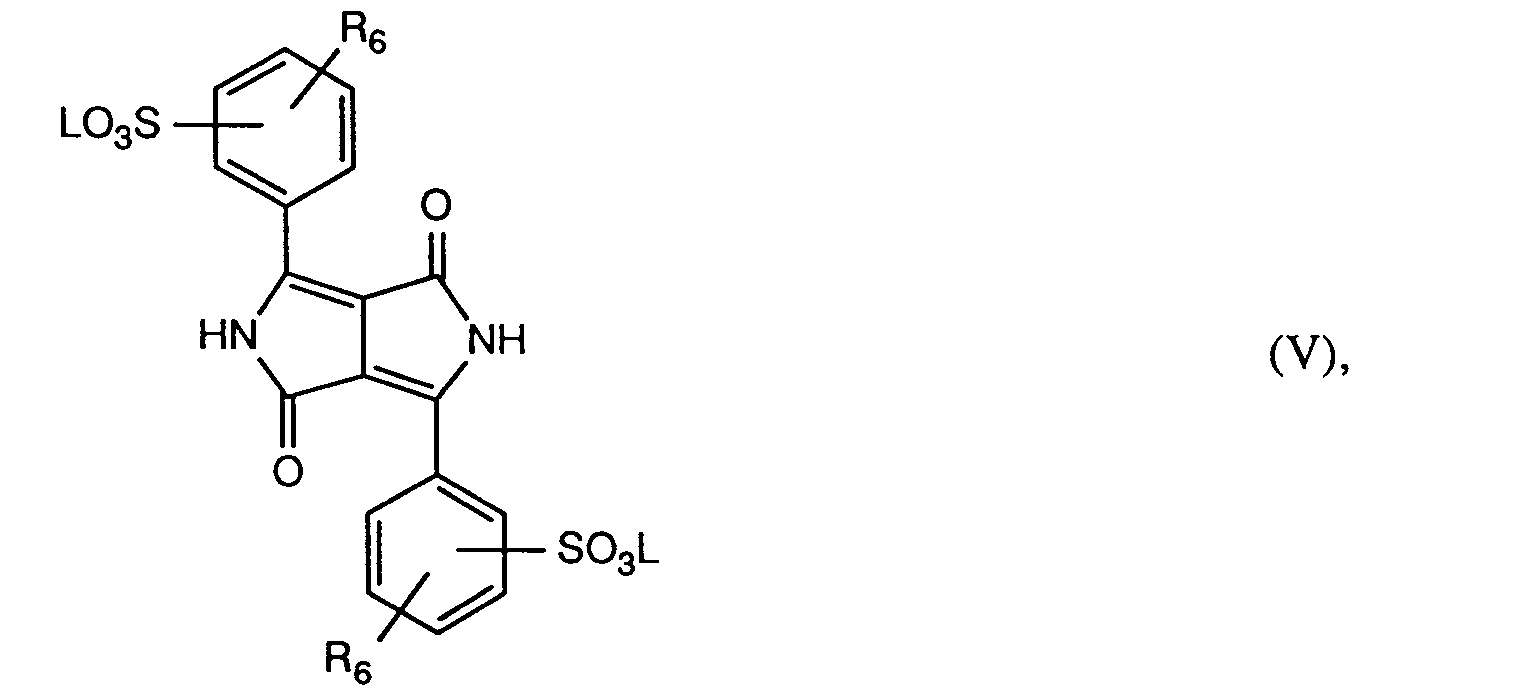
oder - iii) 0,1-10 Gew.%, bezogen auf das Diketopyrrolopyrrol der Formel I, eines Diketopyrrolopyrrols der Formel

adsorbiert sind und
- i) 0,1-10 Gew.%, bezogen auf das Diketopyrrolopyrrol der Formel I, einer partiell hydrolysierten organischen Verbindung ausgewählt aus der Gruppe bestehend aus Chelaten der Formel
- B) 0,1-20 Gew.%, bezogen auf das Diketopyrrolopyrrol der Formel I, eines Acrylharzes erhältlich durch Homopolymerisation eines Monomeren der Formel

oder durch Copolymerisation des gleichen Monomeren mit einem mit letzterem copolimerisierbaren Monomeren.
Description
- Die vorliegende Anmeldung betrifft eine Pigmentzusammensetzung enthaltend ein Diketopyrrolopyrrolpigment auf dessen Teilchenoberfläche eine metallorganische Verbindung oder ein modifiziertes Diketopyrrolopyrrol adsorbiert ist und einen Aminoalkylacrylatharz sowie deren Verwendung zum Einfärben von hochmolkularem organischem Material.
- Aus verschiedenen Publikationen ist bekannt, dass bestimmte Eigenschaften von Pigmenten, darunter auch die Diketopyrrolopyrrole, durch Behandlung mit analogen, leicht modifizierten Produkten und/oder Harzen, verbessert werden können. Das US-Patent 4 791 204 beschreibt z.B. Pigmentzusammensetzungen aus einem Diketopyrrolopyrrolpigment und beispielsweise einem Metall- oder Ammoniumsalz eines sulfonierten Diketopyrrolopyrrols, die sich durch ausserordentlichem rheologischem Verhalten und hohem Glanz der damit erhaltenen Ausfärbungen auszeichnen. Ähnliche Resultate werden gemäss US-Patent 5 200 528 mit Pigmentzusammensetzungen aus einem Diketopyrrolopyrrolpigment und einem mindestens einen Aminoalkoxyrest enthaltenden Diketopyrrolopyrrol erhalten. Aus US-Patent 4 880 472 sind organische Pigmente, u.a. auch Diketopyrrolopyrrolpigmente, bekannt, deren Teilchenoberfläche mit einem festhaftenden, über eine hydroxylgruppenhaltige Zwischenschicht fixierten Überzug aus Metalloxiden versehen ist, welche sich ebenfalls durch ein sehr gutes rheologisches Verhalten auszeichnen. Solche Pigmentzusammensetzungen eignen sich auch zum verzugsfreien Färben von Polyolefinen. Die EP-A466 646 beschreibt ein Verfahren zum verzugsfreien Färben von Polyolefinen, bei dem die Teilchenoberfläche des Pigments, z.B. eines DiketopyrroIopyrroIs, direkt oder indirekt mit einer Schicht eines polaren Polymeren, z.B. eines Acrylpolymeren auf Basis von Acrylsäure, Methacrylsäure und/oder deren Alkylestern, überzogen wird. Bevorzugt wird dabei die Acrylpolymerschicht über eine Silanschicht aufgetragen, die ihrerseits auf einer die Teilchenoberfläche des Pigments umhüllenden Schicht aus hydrolysiertem Zirkonacetylacetonat adsorbiert ist. Aus US-Patent 4 734 137 ist ein Verfahren zur Herstellung von Azo-, Thioindigo und insbesondere Chinacridonpigmenten mit gutem rheologischem Verhalten und hohem Glanz bekannt, welches darin besteht eines der obenerwähnten Pigmente in einem aprotischen polaren Lösungsmittel in Gegenwart eines Alkalyhydroxids und Wasser zu lösen und danach durch Zugabe einer wässrigsauren Lösung eines Aminoalkylacrylatharzes ein Pigmentpräparat auszufällen, das nach der Isolierung nach üblichen Methoden, die gewünschten Eigenschaften besitzt. Eine ähnliche Zusammensetzung, welche ein anionisches Tensid enthält, ist in JP-AO 58-215 461 beschrieben.
- Gemäss der vorliegenden Erfindung ist nun gefunden worden, dass bestimmte Diketopyrrolopyrrolpigmente auf deren Teilchenoberfläche, in bereits bekannter Weise, eine metallorganische Verbindung oder ein modifiziertes Diketopyrrolopyrrol adsorbiert ist und die zusätzlich mit einem Aminoalkylacrylatharz behandelt werden, ganz ungeahnt hohe Eigenschaften, insbesondere Glanz und rheologisches Verhalten, besitzen.
- Die vorliegende Erfindung betrifft demnach eine Pigmentzusammensetzung enthaltend
- A) ein 1,4-Diketopyrrolo[3,4-c]pyrrol-Pigment der Formel

worin A und B unabhängig voneinander eine Gruppe der Formel
bedeuten, worin R1 und R2 unabhängig voneinander Wasserstoff, Halogen, Cl-C,8-Alkyl oder CN ist, auf dessen Teilchenoberfläche- i) 0,1-10 Gew.%, bezogen auf das Diketopyrrolopyrrol der Formel einer partiell hydrolysierten organischen Verbindung ausgewählt aus der Gruppe bestehend aus Chelaten der Formel

worin R3 Methyl oder Ethyl, R4 Methyl, Ethyl, Methoxy oder Ethoxy, X Halogen oder C1-C4-Alkoxy sind und Y Ti oder Sn bedeutet, oder aus Estern der Formel
worin Q ein Metall ausgewählt aus Sn, Si, Pb, Ge, Ti oder Zr ist, und R5 C1-C4-Alkyl bedeutet, oder - ii) 0,1-10 Gew.%, bezogen auf das Diketopyrrolopyrrol der Formel eines Diketopyrrolopyrrols der Formel

worin R6 Wasserstoff, Halogen, C1-C4-Alkyl oder Phenyl ist und L Wasserstoff, eine Gruppe der Formel M+n n, worin M ein Metall ausgewählt aus Na, K, Mg, Ca, Sr, Ba oder AI ist und n die Zahlen 1, 2 oder 3
bedeutet, oder L eine Gruppe N+H(R7)(R8)(R9) ist, worin R7, R8 und R9 unabhängig voneinander Wasserstoff, C1-C4-Alkyl, C5-C6-Cycloalkyl, unsubstitutiertes oder durch C1-C4-Alkyl substituiertes Phenyl oder Benzyl bedeuten, oder - iii) 0,1-10 Gew.%, bezogen auf das Diketopyrrolopyrrol der Formel I, eines Diketopyrrolopyrrols der Formel

worin R10, R11, R12 und R13 unabhängig voneinander Wasserstoff, CI, Br, CH3, OCH3, CN oder Phenyl bedeuten und mindestens einer der Reste R10, R11, R12, und R13 eine Gruppe
- ist, worin
- m eine Zahl von 2 bis 6 und
- p die Zahl 1 oder 2 bedeuten und
- Z einen heterocyclischen Rest aus der Gruppe bestehend aus Imidazolyl, Pyrazolyl,
- Morpholinyl, Piperidinyl, Pyrrolidinyl und Triazolyl,
- oder eine Gruppe -NR14R15bedeutet, worin R14 und R15 unabhängig voneinander Wasserstoff, Methyl oder Ethyl bedeuten,
- adsorbiert sind und
- i) 0,1-10 Gew.%, bezogen auf das Diketopyrrolopyrrol der Formel einer partiell hydrolysierten organischen Verbindung ausgewählt aus der Gruppe bestehend aus Chelaten der Formel
- B) 0,1-20 Gew.%, bezogen auf das Diketopyrrolopyrrol der Formel I, eines Acrylharzes erhältlich durch Homopolymerisation eines Monomeren der Formel

worin R16 Wasserstoff oder Methyl und R17 und R18 unabhängig voneinander Wasserstoff, Methyl oder Ethyl bedeuten und q eine Zahl von 1 bis 6 ist, oder durch Copolymerisation des gleichen Monomeren mit einem mit letzterem copolimerisierbaren Monomeren. - Bedeuten etwaige Substituenten C1-C4-Alkyl, so handelt es sich um Methyl, Ethyl, n-Propyl, Isopropyl, n-Butyl, sec.-Butyl odertert.-Butyl. C1-C18-Alkyl bedeutetzusätzlich z.B. n-Amyl, tert.-Amyl, Hexyl, Heptyl, Octyl, 2-Ethylhexyl, Nonyl, Decyl, Dodecyl, Tetradecyl, Hexadecyl oder Octadecyl. C1-C4-Alkoxy bedeutet z.B. Methoxy, Ethoxy, n-Propoxy, Isopropoxy, Butyloxy oder tert.-Butyloxy. Halogen bedeutet z.B. Jod, Fluor, insbesondere Brom und bevorzugt Chlor. C5-C6-Cycloalkyl steht z.B. für Cyclopentyl und insbesondere für Cyclohexyl.
- Die Komponenten i), ii) und iii) werden bevorzugt in einer Menge von 0,5-5 Gew.%, bezogen auf das Diketopyrrolopyrrol der Formel eingesetzt.
- Im Diketopyrrolopyrrol-Pigment der Formel sind A und B vorzugsweise gleich und bedeuten bevorzugt eine Gruppe der Formel

worin R1 Methyl oder tert.-Butyl ist. - Von besonderem Interesse sind die erfindungsgemässen Pigmentzusammensetzungen, bei denen auf der Teilchenoberfläche des Pigments der Formel I eine Komponente gemäss (i) adsorbiert ist, insbesondere eine partiell hydrolysierte Verbindung der Formel

worin R3 Methyl oder Ethyl und R4 Methyl, Ethyl, Methoxy oder Ethoxy bedeuten. - R3 und R4 sind dabei bevorzugt Methyl.
- Ebenfalls von Interesse sind die erfindungsgemässen Pigmentzusammensetzungen, bei denen auf der Teilchenoberfläche des Pigments der Formel I eine Komponente gemäss (ii) adsorbiert ist, wobei im M+n Diketopyrrolopyrrol der Formel V L eine Gruppe der Formel -, worin M Na, K, Mg, Ca, Sr oder Ba und n n die Zahlen 1 oder 2 bedeuten, und R6 Wasserstoff ist, sowie Pigmentzusammensetzungen, bei denen auf der Teilchenoberläche des Pigments der Formel 1 eine Komponente gemäss (iii) adsorbiert ist, wobei im Diketopyrrolopyrrol der Formel VI einer der Reste R10, R11, R12 oder R13 eine Gruppe

- Besonder bevorzugt werden die erfindungsgemässen Pigmentzusammensetzungen, welche einen Acrylharz gemäss B, der durch Homopolymerisation eines Monomeren der Formel VII, worin R16, R17 und R18 Methyl und q die Zahlen 1 oder 2 bedeuten, erhalten wird, in einer Menge von 4-10 Gew.%, bezogen auf das Diketopyrrolopyrrol der Formel 1, enthalten.
- Die erfindungsgemässen Pigmentzusammensetzungen lassen sich auf einfache Weise, z.B. dadurch herstellen, dass das vorbehandelte Pigment gemäss Ai), Aii) oderAiii) in wässriger Suspension mit dem Acrylharz unter Rühren nachbehandelt wird. Dabei kann vom vorbehandelten trockenen Pigmentpulver, einem Presskuchen oder einer aus der Vorbehandlung anfallenden Suspension ausgegangen werden. Der Acrylharz kann entweder vorgängig mit Wasser gelöst werden oder fest der Pigmentsuspension zugegeben werden.
- Falls nötig kann die Suspension nach üblichen Methoden mit einem Dispergieraggregat (z.B. einem Hochdruckhomogenisator oder einem Hochgeschwindigkeitsrührer) dispergiert werden. Meistens ist dies nicht nötig, da die Acrylharze im allgemeinen sehr gute benetzende Eigenschaften besitzen. Der Pigmentgehalt (vorbehandeltes Pigment Ai), Aii) oder Aiii)) in der Suspension kann in weiten Grenzen variiert werden und kann gegebenenfalls bis zu 40 Gew.% betragen. Zweckmässig setzt man Suspensionen mit 5 bis 20 Gew.% Pigment ein. Die Nachbehandlung des Pigments mit dem Acryl harz (B) kann bei Raumtemperatur, gegebenenfalls aber auch bei bis zu ca. 80°C erhöhter Temperatur, durchgeführt werden. Die Rührdauer variiert zwischen 1 und 20 Stunden. Zur Erleichterung der Filtration des behandelten Pigments können auch Filtrationshilfsmittel, wie z.B. 0,5 bis 15 Gew.% einer aliphatischen 1,2-Dihydroxyverbindung mit 8 bis 22 C-Atomen, insbesondere 1 bis 5 Gew.% 1,2-Dodecandiol, eingesetzt werden, sofern diese keine negative Wirkung bei der Verwendung der erfindungsgemässen Pigmentzusammensetzungen zeigen. Analoge Zusätze (z.B. übliche Dispergiermittel) können auch in üblichen Mengen zurVerbesserung der Dispergierbarkeit des Produktes zugesetzt werden.
- Die Pigmentpräparate (Ai), (Aii) und (Aiii) sind bekannt und können nach allgemein üblichen Methoden hergestellt werden, z.B. durch Zugabe der Komponenten gemäss (i), (ii) oder (iii) in Pulverform, in Lösung oder in Suspension zu einer wässrigen oder alkoholischen Suspension des Pigments der Formel und Verrühren des Gemisches unter üblichen Bedingungen. Die Komponenten gemäss (Ai) sind z.B. in US-Patent 4 880 472, (Aii) in US-Patent 4 791 204 und (Aiii) in US-Patent 5 200 528 beschreiben.
- Der Acrylharz gemäss (B) ist ebenfalls bekannt und kann nach üblichen Methoden, wie z.B. in US-Patent 4 734 137 beschrieben, hergestellt werden.
- Die erfindungsgemässen Pigmentzusammensetzungen können als Pigmente zum Färben von hochmolekularem organischem Material verwendet werden.
- Hochmolekulare organische Materialien, die mit den erfindungsgemässen Pigmentzusammensetzungen gefärbt bzw. pigmentiertwerden können, sind z.B. Celluloseether und -ester, wie Ethylcellulose, Nitrocellulose, Celluloseacetat, Cellulosebutyrat, natürliche Harze oder Kunstharze, wie Polymerisationsharze oder Kondensationsharze, wie Aminoplaste, insbesondere Harnstoff- und Melamin-Formaldehydharze, Alkyldharze, Phenoplaste, Polycarbonate, Polyolefine, Polystyrol, Polyvinylchlorid, Polytetrafluoroethylen, Polyamide, Polyurethane, Polyester, Polyether-ketone, Polyphenylenoxide, Gummi, Casein, Silikon und Silikonharze, einzeln oder in Mischungen.
- Die erwähnten hochmolekularen organischen Verbindungen können einzeln oder in Gemischen als plastische Massen, Schmelzen oder in Form von Spinnlösungen, Lacken, Anstrichstoffen oder Druckfarben vorliegen. Je nach Verwendungszweck erweist es sich als vorteilhaft, die erfindungsgemässen Pigmentzusammensetzungen als Toner oder in Form von Präparaten einzusetzen. Bezogen auf das zu pigmentierende hochmolekulare organische Material kann man die erfindungsgemässen Pigmentzusammensetzungen in einer Menge von 0,01 bis 30 Gew.%, vorzugsweise von 0,1 bis 10 Gew.%, einsetzen.
- Zum Pigmentieren von Lacken und Druckfarben werden die hochmolekularen organischen Materialien und die erfindungsgemässen Pigmentzusammensetzungen gegebenenfalls zusammen mit Zusatzstoffen, wie Füllmitteln, anderen Pigmenten, Siccativen oder Weichmachern, in einem gemeinsamen organischen Lösungsmittel oder Lösungsmittelgemisch fein dispergiert bzw. gelöst. Man kann dabei so verfahren, dass man die einzelnen Komponenten für sich oder auch mehrere gemeinsam dispergiert bzw. löst, und erst hierauf alle Komponenten zusammenbringt.
- Die erhaltenen Färbungen, beispielsweise in Kunststoffen, Fasern, Lacken oder Drucken, zeichnen sich durch gute allgemeine Eigenschaften, wie hohe Farbstärke, gute Dispergierbarkeit, gute Überlackier-, Migrations-, Hitze-, Licht- und Wetterbeständigkeit sowie auch geringe Viskosität aus.
- Ferner weisen die erfindungsgemässen Pigmentzusammensetzungen im Vergleich zu den unmodifizierten Basispigmenten und auch zu den gemäss Stand der Technik behandelten Pigmenten verbesserte anwendungstechnische Eigenschaften in der Applikation auf, wie eine verbesserte Rheologie und Lagerbeständigkeit, geringere Trenneffekte wie Ausschwimmen bei der Mitverwendung von z.B. Weisspigmenten, eine geringere Flockulationstendenz und unerwartet hohen Glanz der damit erhaltenen Ausfärbungen. Infolge der guten rheologischen Eigenschaften dieser Kompositionen ist es auch möglich, Anstrichstoffe und Lacke hoher Konzentration (sogenannte high loadings) herzustellen. Sie eignen sich demnach vorzugsweise zum Färben von Lacken, insbesondere für Metalleffektlackierungen.
- Die folgenden Beispiele erläutern die Erfindung.
- Einer Lösung von 10 g Dimethylaminoethylmethacrylat in 30 g Wasser werden 0,1 g g K2S208 (1 Gew.% Initiator, bezogen auf das Monomere) zugefügt. Die Lösung wird mehrmals entgast, mit Stickstoff gespült und unter Stickstoff-Atmosphäre während 5 Stunden bei 30°C gerührt. Danach wird die Lösung mit 40 ml Wasser verdünnt. Es bildet sich zuerst eine hochviskose Masse, die sich aber wieder verflüssigt.
- b) 21,6 g eines 46,5 %igen wässrigen Presskuchens von 1,4-Diketo-3,6-di (4-tert-butylphenyl)-pyrrolo[3,4-c]pyrrols werden in 78 g Wasser zusammen mit 1,2 g Zr(IV)-acetylacetonat während 2 Stunden dispergiert. Die Suspension wird auf 75°C erhitzt und der pH wird mit 0,2 N wässriger NaOH auf 8,5 gestellt. Die Suspension wird 3 Stunden weitergerührt, wobei der pH auf 6,5 sinkt. Danach werden 3,8 g der Polymerlösung (a) zugegeben und erneut 3 Stunden lang weitergerührt. Anschliessend wird die Suspension filtriert und der Rückstand wird mit Wasser gewaschen und bei 80°C getrocknet und pulverisiert.
- Beispiel 1 wird wiederholt mit der einzigen Ausnahme, dass anstelle des 1,4-Diketo-3,6-di(4-tert.-butylphenyl)-pyrrolo[3,4-c]pyrrols die gleiche Gewichtsmenge 1,4-Diketo-3,6-di(4-diphenyl)-pyrrolo[3,4-c]pyrrol verwendet wird.
- 21,6 g eines 46,5 %igen Presskuchens von 1,4-Diketo-3,6-di(4-tert.-butylphenyl)-pyrrolo[3,4-c]pyrrol werden in 78 g Wasser dispergiert. 0,12 g des Natriumsalzes von 1,4-Diketo-3,6-diphenylpyrrolo[3,4-c]pyrrol-4',4"-disulfonsäure (hergestelltwie in Beispiel 5 von US-Patent4 791 204 beschrieben) werden der Suspension zugegeben, welche anschliessend auf 70°C erhitzt wird. Danach werden langsam 0,13 g CaC12-2H20 zugegeben. Die Suspension wird eine halbe Stunde weitergerührt, filtriert und der Rückstand wird mit Wasser gewaschen. Der Filterkuchen wird in 100 g Wasser aufgenommen und mit 3,8 g der gemäss Beispiel 1a) hergestellten Polymerlösung dispergiert. Die Suspension wird 3 Stunden gerührt, filtriert und der Rückstand wird mit Wasser gewaschen, bei 80°C getrocknet und pulverisiert.
- 31,4 g eines 32 %igen wässrigen Presskuchens von 1,4-Diketo-3,6-di-(4-methylphenyl)-pyrrolo[3,4-c]pyrrol werden in 69 g Wasser zusammen mit 1,2 g Ti(IV)-di-(acetylacetonat)-di(isopropylat) während 2 Stunden dispergiert. Die Suspension wird auf 70°C erhitzt und der pH wird mit 0,2 N wässriger NaOH auf 8,5 gestellt. Die Suspension wird 2 Stunden weitergerührt, wobei der pH auf 6,7 sinkt. Danach werden 3,8 g der gemäss Beispiel 1a hergestellten Polymerlösung zugegeben und erneut 2 Stunden lang weitergerührt. Anschliessend wird die Suspension filtriert und der Rückstand wird mit Wasser gewaschen und bei 80°C getrocknet und pulverisiert.
- Beispiel 1 wird wiederholt mit der einzigen Ausnahme, dass 4 % Initiator K2S208 anstelle von 1 % eingesetzt wird.
- 2 g des gemäss Beispiel 1b) erhaltenen Produktes und 48 g Einbrennlack bestehend aus
- 56 g Alkydharz ALKYDAL® F310 (Bayer AG; 60 %ig in Xylol)
- 13 g Melaminharz CYMEL@ 327 (Cyanamid; 90 %ig in Butanol)
- 25 g Xylol
- 25 g Butanol
- 2,5 g 1-Methoxy-2-Propanol und
- 1 g Silikonöl (1 %ig in Xylol)
- Die Glanzwerte werden mit einem Glanzmesser (Zehntner ZGM 1020@) in 20° Neigung gemäss DIN 67 530 gemessen.
- Die so erhaltene Lackierung ergibt im Vergleich zu einer Lackierung mit einem unbeschichteten Pigment einen ungeahnt besseren Glanz.
- Beim jeweiligen Ersatz des Produktes von Beispiel 1 b) mit den Produkten der Beispiele 2-5 erhält man etwa gleichwertige Resultate.
- Zur Bestimmung des Fliessverhaltens werden die Produkte der Beispiele 1-5 sowie die entsprechnenden unbehandelten Pigmente nach üblichen Methoden in ein Alkyd-Lacksystem (SETAL® 84, Kunstharzfabrick Synthesis BV, Holland; Festkörpergehalt 70 %) eingearbeitet.
- Das Fliessverhalten der Lackanreibungen, welche 12 % Pigment und 42 % Gesamtfestkörper enthalten und deren Pigment/Bindemittel-Verhältnis 0,3 beträgt, wird mit einem HAAKE-Viskosimeter ROTOVISCO® RV12 ermittelt (Messtemperatur: 25°C; Messsystem: SV-SP; Scherbereich: D = 0-100 [1/s]).
- Die mit den Produkten der Beispiele 1-5 erhaltenen Lackanreibungen zeigen gegenüber der mit unbhandelten Pigmenten erhaltenen Lackanreibungen ein deutlich besseres Fliessverhalten (Viskositätswerte).
werden nach üblichen Methoden vermischt. Die Applikation des erhaltenen Farblackes erfolgt durch Ablauf auf Glasplatte. Vor dem Einbrennen im Umluftrockenschrank (30 Minuten bei 120°C) lässt man ca. 30 Minuten bei 25° Neigung abluften.
Claims (12)

worin A und B unabhängig voneinander eine Gruppe der Formel

bedeuten, worin R1 und R2 unabhängig voneinander Wasserstoff, Halogen, C1-C18-Alkyl oder CN ist, auf dessen Teilchenoberfläche

worin R3 Methyl oder Ethyl, R4 Methyl, Ethyl, Methoxy oder Ethoxy, X Halogen oder C1-C4-Alkoxy sind und Y Ti oder Sn bedeutet, oder aus Estern der Formel

worin Q ein Metall ausgewählt aus Sn, Si, Pb, Ge, Ti oder Zr ist, und R5 C1-C4-Alkyl bedeutet, oder

worin R6 Wasserstoff, Halogen, C1-C4-Alkyl oder Phenyl ist und L Wasserstoff, eine Gruppe der For- mel M+n n, worin M ein Metall ausgewählt aus Na, K, Mg, Ca, Sr, Ba oder AI ist und n die Zahlen 1, 2 oder 3 bedeutet, oder L eine Gruppe N+H(R7)(R8)(R9) ist, worin R7, R8 und R9 unabhängig voneinander Wasserstoff, C1-C4-Alkyl, C5-C6-Cycloalkyl, unsubstitutiertes oder durch C1-C4-Alkyl substituiertes Phenyl oder Benzyl bedeuten,
oder

worin R10, R11, R12 und R13 unabhängig voneinander Wasserstoff, CI, Br, CH3, OCH3, CN oder Phenyl bedeuten und mindestens einer der Reste R10, R11, R12, und R13 eine Gruppe

adsorbiert sind und

worin R16 Wasserstoff oder Methyl und R17 und R18 unabhängig voneinander Wasserstoff, Methyl oder Ethyl bedeuten und q eine Zahl von 1 bis 6 ist, oder durch Copolymerisation des gleichen Monomeren mit einem mit letzterem copolimerisierbaren Monomeren.

bedeuten, worin R1 Methyl oder tert.-Butyl ist.

worin R3 Methyl oder Ethyl und R4 Methyl, Ethyl, Methoxy oder Ethoxy bedeuten, adsorbiert ist.

Applications Claiming Priority (3)
| Application Number | Priority Date | Filing Date | Title |
|---|---|---|---|
| CH357593 | 1993-12-01 | ||
| CH357593 | 1993-12-01 | ||
| CH3575/93 | 1993-12-01 |
Publications (3)
| Publication Number | Publication Date |
|---|---|
| EP0656402A2 true EP0656402A2 (de) | 1995-06-07 |
| EP0656402A3 EP0656402A3 (de) | 1996-01-10 |
| EP0656402B1 EP0656402B1 (de) | 2000-12-20 |
Family
ID=4258944
Family Applications (1)
| Application Number | Title | Priority Date | Filing Date |
|---|---|---|---|
| EP94810662A Expired - Lifetime EP0656402B1 (de) | 1993-12-01 | 1994-11-23 | Pigmentzusammensetzung aus modifiziertem Diketopyrrolopyrrol und Aminoalkylacrylatharz |
Country Status (5)
| Country | Link |
|---|---|
| US (1) | US5685901A (de) |
| EP (1) | EP0656402B1 (de) |
| JP (1) | JP3786727B2 (de) |
| CA (1) | CA2136914A1 (de) |
| DE (1) | DE59409613D1 (de) |
Cited By (2)
| Publication number | Priority date | Publication date | Assignee | Title |
|---|---|---|---|---|
| WO2004092174A1 (de) * | 2003-04-16 | 2004-10-28 | Chromeon Gmbh | Pyrrolopyrrole als fluoreszente marker für biomoleküle und sphärische partikel |
| WO2006111493A3 (en) * | 2005-04-21 | 2007-08-23 | Ciba Sc Holding Ag | Pigment formulations |
Families Citing this family (5)
| Publication number | Priority date | Publication date | Assignee | Title |
|---|---|---|---|---|
| US20010015154A1 (en) | 2000-01-27 | 2001-08-23 | Roman Lenz | Ternary pigment compositions |
| US6758891B2 (en) * | 2001-10-09 | 2004-07-06 | Degussa Ag | Carbon-containing material |
| US20030225369A1 (en) * | 2002-05-31 | 2003-12-04 | Kimberly-Clark Worldwide, Inc. | Low profile transpyloric jejunostomy system |
| US7417154B2 (en) | 2003-10-23 | 2008-08-26 | Ciba Specialty Chemicals Corporation | Heat-stable diketopyrrolopyrrole pigment mixtures |
| JP2009029886A (ja) * | 2007-07-25 | 2009-02-12 | Dainichiseika Color & Chem Mfg Co Ltd | 顔料分散剤、顔料組成物、顔料着色剤およびカラーフィルター用着色剤 |
Family Cites Families (10)
| Publication number | Priority date | Publication date | Assignee | Title |
|---|---|---|---|---|
| US3884871A (en) * | 1973-06-29 | 1975-05-20 | Nl Industries Inc | Process for coating pigment particles with organic polymers |
| CH642992A5 (de) * | 1979-06-05 | 1984-05-15 | Sandoz Ag | Feste pigmentzubereitungen. |
| JPS58215461A (ja) * | 1982-06-08 | 1983-12-14 | Sanyo Shikiso Kk | 顔料の製造法 |
| US4880472A (en) * | 1987-06-16 | 1989-11-14 | Ciba-Geigy Corporation | Organic pigments coated with metal oxides |
| JPS61255964A (ja) * | 1985-05-10 | 1986-11-13 | Toyo Soda Mfg Co Ltd | 有機顔料の製造法 |
| US4791204A (en) * | 1985-11-26 | 1988-12-13 | Ciba-Geigy Corporation | 1,4-diketopyrrolo[3,4-c]pyrrole pigments |
| KR0143777B1 (ko) * | 1989-11-28 | 1998-07-01 | 월터 클리웨인, 한스-피터 위트린 | 디케토피롤로피롤을 기재로 하는 물질의 조성물 |
| EP0466646B1 (de) * | 1990-07-11 | 1996-08-28 | Ciba-Geigy Ag | Verfahren zum verzugsfreien Pigmentieren von Polyolefinen |
| EP0511165B1 (de) * | 1991-04-26 | 1996-08-14 | Ciba-Geigy Ag | Neue Diketopyrrolopyrrolverbindungen |
| CH685162A5 (de) * | 1991-05-07 | 1995-04-13 | Ciba Geigy Ag | Pigmentzusammensetzungen. |
-
1994
- 1994-11-23 EP EP94810662A patent/EP0656402B1/de not_active Expired - Lifetime
- 1994-11-23 DE DE59409613T patent/DE59409613D1/de not_active Expired - Fee Related
- 1994-11-29 CA CA002136914A patent/CA2136914A1/en not_active Abandoned
- 1994-11-29 US US08/346,120 patent/US5685901A/en not_active Expired - Fee Related
- 1994-12-01 JP JP29818394A patent/JP3786727B2/ja not_active Expired - Fee Related
Cited By (2)
| Publication number | Priority date | Publication date | Assignee | Title |
|---|---|---|---|---|
| WO2004092174A1 (de) * | 2003-04-16 | 2004-10-28 | Chromeon Gmbh | Pyrrolopyrrole als fluoreszente marker für biomoleküle und sphärische partikel |
| WO2006111493A3 (en) * | 2005-04-21 | 2007-08-23 | Ciba Sc Holding Ag | Pigment formulations |
Also Published As
| Publication number | Publication date |
|---|---|
| US5685901A (en) | 1997-11-11 |
| DE59409613D1 (de) | 2001-01-25 |
| CA2136914A1 (en) | 1995-06-02 |
| JPH07196884A (ja) | 1995-08-01 |
| EP0656402B1 (de) | 2000-12-20 |
| JP3786727B2 (ja) | 2006-06-14 |
| EP0656402A3 (de) | 1996-01-10 |
Similar Documents
| Publication | Publication Date | Title |
|---|---|---|
| EP0296111B1 (de) | Mit Metalloxiden beschichtete organische Pigmente | |
| EP0485441B1 (de) | Neue pigmentzubereitungen auf basis von perylenverbindungen | |
| DE60121993T2 (de) | Rheologieverbesserer und rheologisch verbesserte pigmentpräparate | |
| EP0864613B1 (de) | Pigmentzubereitungen und Verfahren zu ihrer Herstellung | |
| EP0611252B1 (de) | Mit Silanen beschichtete organische Pigmente | |
| EP0511165B1 (de) | Neue Diketopyrrolopyrrolverbindungen | |
| DE60102244T3 (de) | Feste lösung von kupferphthalocyanin in pigmentform und transparente dispersion die diese enthält | |
| EP0504922B1 (de) | Neue Pigmentzubereitungen auf Basis von Dioxazinverbindungen | |
| EP1689817A1 (de) | Pigmentzusammensetzungen aus gelbem disazopigment und organischem pigment | |
| EP1664203B1 (de) | Pigmentzusammensetzungen aus organischen und anorganischen pigmenten | |
| EP1029899B1 (de) | Pigmentzubereitungen auf Basis von Diketopyrrolopyrrolpigmenten mit basischen Perylendispergatoren | |
| EP2406335B1 (de) | Feste pigmentzubereitungen mit phosphorsäure- oder phosphonsäureestern als oberflächenaktive additive | |
| EP0296107A2 (de) | Mit vernetzter Ethylcellulose beschichtete organische Pigmente | |
| EP0717086B1 (de) | Mit Metallphosphatkomplexen und Aminen beschichtete organische Pigmente | |
| EP0296106B1 (de) | Mit über Ethylcellulose fixierten Metalloxiden beschichtete organische Pigmente | |
| EP1658336B1 (de) | Mischkristalle mit derivaten von c.i. pigment red 170 | |
| EP0205510B1 (de) | Pulverpigmente mit verbesserten rheologischen eigenschaften, verfahren zu ihrer herstellung und ihre verwendung mit einem gehalt von mindestens 5% unsubstituiertem chinacridon | |
| EP0659840B1 (de) | Mit Zirkonium oder Titan-Phosphatkomplexen beschichtete organische Pigmente | |
| EP0489421B1 (de) | Pigmentzubereitungen | |
| EP0656402B1 (de) | Pigmentzusammensetzung aus modifiziertem Diketopyrrolopyrrol und Aminoalkylacrylatharz | |
| EP0810268B1 (de) | Bismuthvanadat-Pigmente | |
| DE69737004T2 (de) | Kristallwachstumsmodifikatoren für Perylenpigmente | |
| EP0656403B1 (de) | Pigmentzusammensetzung aus Diketopyrrolopyrrol und Aminoalkylacrylatharz | |
| EP1689818A1 (de) | Pigmentzusammensetzungen aus organishem gelbpigment und phthalocyaninpigment | |
| DE69516467T2 (de) | Feste Lösungen von Pyrrolo-(3,4-c)-pyrrolen mit Chinacridonchinonen |
Legal Events
| Date | Code | Title | Description |
|---|---|---|---|
| PUAI | Public reference made under article 153(3) epc to a published international application that has entered the european phase |
Free format text: ORIGINAL CODE: 0009012 |
|
| AK | Designated contracting states |
Kind code of ref document: A2 Designated state(s): CH DE FR GB IT LI |
|
| PUAL | Search report despatched |
Free format text: ORIGINAL CODE: 0009013 |
|
| AK | Designated contracting states |
Kind code of ref document: A3 Designated state(s): CH DE FR GB IT LI |
|
| 17P | Request for examination filed |
Effective date: 19960626 |
|
| RAP1 | Party data changed (applicant data changed or rights of an application transferred) |
Owner name: CIBA SC HOLDING AG |
|
| RAP3 | Party data changed (applicant data changed or rights of an application transferred) |
Owner name: CIBA SPECIALTY CHEMICALS HOLDING INC. |
|
| 17Q | First examination report despatched |
Effective date: 19990813 |
|
| GRAG | Despatch of communication of intention to grant |
Free format text: ORIGINAL CODE: EPIDOS AGRA |
|
| GRAG | Despatch of communication of intention to grant |
Free format text: ORIGINAL CODE: EPIDOS AGRA |
|
| GRAH | Despatch of communication of intention to grant a patent |
Free format text: ORIGINAL CODE: EPIDOS IGRA |
|
| GRAH | Despatch of communication of intention to grant a patent |
Free format text: ORIGINAL CODE: EPIDOS IGRA |
|
| GRAA | (expected) grant |
Free format text: ORIGINAL CODE: 0009210 |
|
| AK | Designated contracting states |
Kind code of ref document: B1 Designated state(s): CH DE FR GB IT LI |
|
| REG | Reference to a national code |
Ref country code: CH Ref legal event code: EP |
|
| REF | Corresponds to: |
Ref document number: 59409613 Country of ref document: DE Date of ref document: 20010125 |
|
| ITF | It: translation for a ep patent filed | ||
| GBT | Gb: translation of ep patent filed (gb section 77(6)(a)/1977) |
Effective date: 20010201 |
|
| ET | Fr: translation filed | ||
| PLBE | No opposition filed within time limit |
Free format text: ORIGINAL CODE: 0009261 |
|
| STAA | Information on the status of an ep patent application or granted ep patent |
Free format text: STATUS: NO OPPOSITION FILED WITHIN TIME LIMIT |
|
| 26N | No opposition filed | ||
| REG | Reference to a national code |
Ref country code: GB Ref legal event code: IF02 |
|
| PGFP | Annual fee paid to national office [announced via postgrant information from national office to epo] |
Ref country code: FR Payment date: 20021017 Year of fee payment: 9 |
|
| PG25 | Lapsed in a contracting state [announced via postgrant information from national office to epo] |
Ref country code: FR Free format text: LAPSE BECAUSE OF NON-PAYMENT OF DUE FEES Effective date: 20040730 |
|
| REG | Reference to a national code |
Ref country code: FR Ref legal event code: ST |
|
| PGFP | Annual fee paid to national office [announced via postgrant information from national office to epo] |
Ref country code: CH Payment date: 20041013 Year of fee payment: 11 |
|
| PGFP | Annual fee paid to national office [announced via postgrant information from national office to epo] |
Ref country code: DE Payment date: 20051020 Year of fee payment: 12 |
|
| PGFP | Annual fee paid to national office [announced via postgrant information from national office to epo] |
Ref country code: GB Payment date: 20051021 Year of fee payment: 12 |
|
| PG25 | Lapsed in a contracting state [announced via postgrant information from national office to epo] |
Ref country code: IT Free format text: LAPSE BECAUSE OF NON-PAYMENT OF DUE FEES;WARNING: LAPSES OF ITALIAN PATENTS WITH EFFECTIVE DATE BEFORE 2007 MAY HAVE OCCURRED AT ANY TIME BEFORE 2007. THE CORRECT EFFECTIVE DATE MAY BE DIFFERENT FROM THE ONE RECORDED. Effective date: 20051123 |
|
| PG25 | Lapsed in a contracting state [announced via postgrant information from national office to epo] |
Ref country code: LI Free format text: LAPSE BECAUSE OF NON-PAYMENT OF DUE FEES Effective date: 20051130 Ref country code: CH Free format text: LAPSE BECAUSE OF NON-PAYMENT OF DUE FEES Effective date: 20051130 |
|
| REG | Reference to a national code |
Ref country code: CH Ref legal event code: PL |
|
| PG25 | Lapsed in a contracting state [announced via postgrant information from national office to epo] |
Ref country code: DE Free format text: LAPSE BECAUSE OF NON-PAYMENT OF DUE FEES Effective date: 20070601 |
|
| GBPC | Gb: european patent ceased through non-payment of renewal fee |
Effective date: 20061123 |
|
| PG25 | Lapsed in a contracting state [announced via postgrant information from national office to epo] |
Ref country code: GB Free format text: LAPSE BECAUSE OF NON-PAYMENT OF DUE FEES Effective date: 20061123 |