EP0637721B1 - Verfahren zum Klimatisieren eines Gebäudeinnenraumes - Google Patents
Verfahren zum Klimatisieren eines Gebäudeinnenraumes Download PDFInfo
- Publication number
- EP0637721B1 EP0637721B1 EP93810555A EP93810555A EP0637721B1 EP 0637721 B1 EP0637721 B1 EP 0637721B1 EP 93810555 A EP93810555 A EP 93810555A EP 93810555 A EP93810555 A EP 93810555A EP 0637721 B1 EP0637721 B1 EP 0637721B1
- Authority
- EP
- European Patent Office
- Prior art keywords
- temperature
- cooling
- during
- comfort
- air
- Prior art date
- Legal status (The legal status is an assumption and is not a legal conclusion. Google has not performed a legal analysis and makes no representation as to the accuracy of the status listed.)
- Expired - Lifetime
Links
Images
Classifications
-
- F—MECHANICAL ENGINEERING; LIGHTING; HEATING; WEAPONS; BLASTING
- F24—HEATING; RANGES; VENTILATING
- F24F—AIR-CONDITIONING; AIR-HUMIDIFICATION; VENTILATION; USE OF AIR CURRENTS FOR SCREENING
- F24F5/00—Air-conditioning systems or apparatus not covered by F24F1/00 or F24F3/00, e.g. using solar heat or combined with household units such as an oven or water heater
- F24F5/0089—Systems using radiation from walls or panels
- F24F5/0092—Systems using radiation from walls or panels ceilings, e.g. cool ceilings
-
- F—MECHANICAL ENGINEERING; LIGHTING; HEATING; WEAPONS; BLASTING
- F24—HEATING; RANGES; VENTILATING
- F24F—AIR-CONDITIONING; AIR-HUMIDIFICATION; VENTILATION; USE OF AIR CURRENTS FOR SCREENING
- F24F5/00—Air-conditioning systems or apparatus not covered by F24F1/00 or F24F3/00, e.g. using solar heat or combined with household units such as an oven or water heater
- F24F5/0089—Systems using radiation from walls or panels
Definitions
- Low-mass cooling elements in the sense of present invention are coolable elements, for example slats of a cooling ceiling, by means of which thanks to its relatively low heat capacity, it quickly changes to changing Heat loads can be reacted to.
- a chilled ceiling made a notable contribution; is in general but additionally to provide a supply of outside air, giving a further contribution to air conditioning is.
- ventilation aspects of secondary importance Planning information about Chilled ceilings can be found, for example, at Uwe Franzke in of the magazine "Ki climate - Refrigeration - Heating", 1992, pages 9 to 12.
- the air conditioning system described in WO-A-92/10707 avoids this cooling room heat through a cooling ceiling made of concrete, in the pipe are arranged.
- the cooling elements, namely the ceiling, is used as a cold store used during the night and as a heat sink during the day works.
- Chilled ceilings are often installed in offices where several people with a variety of electrical and electronic devices work.
- the one given Heat is dissipated by so-called "silent cooling", whereby the heat by radiation (around 60%) and by Convection from the people and devices to the chilled ceiling is transported.
- the cooling operation only takes place during the times when the heat load occurs, i.e. during the Working hours.
- With the people present in the room also connected to a damp load. So on the chilled ceiling no condensation forms, it must Ceiling temperature above the dew point temperature of the Indoor air can be kept.
- the heat dissipation capacity of a chilled ceiling is small designed so that the required comfort conditions cannot be met, the question arises how to fix this problem.
- a lowering the coolant temperature is generally due to a The formation of condensation is not possible.
- a Increasing ventilation generally makes additional Investment necessary and also affects the Room comfort due to increased air movement. So it seems to be forced to reduce the heat load or to increase the active cooling surface. would have both considerable costs. It is therefore the job of Invention to find a way with less cost connected is.
- the solution arises from a special one Method, namely the method according to claim 1.
- the dependent ones Claims relate to additional features of the process, that are beneficial.
- the method according to the invention for air conditioning relates for example a building interior, especially one Office space, the ceiling of which is at least partially coolable Elements.
- a cooling device and a circulating coolant and discharged to the Environment According to the masonry of the building used as an additional heat sink; periodically during times when there are no jobs this heat sink will take place by means of the Chilled ceiling in the interior caused temperature drop regenerates. Leave with the inventive method yourself with a chilled ceiling that has an instantaneous heat load can not dissipate the necessary comfort conditions produce.
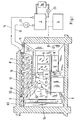
- the cooling system of the office space shown in Fig.1 with the Masonry 2 comprises a chilled ceiling 1, a cooling device 3 and a control and regulating device 4.
- the cold Coolant 12 is with the pump 13 in the flow 11 of the coolable elements 10 of the cooling ceiling (cooling fins) promoted.
- Via a collector not shown the heated coolant 14 back into the Cooling device 3.
- the one recorded in the building interior Heat is applied via a heat exchanger 3a (circulation pump 23) given the environment.
- the room air can enter a chamber 60 through openings 61 above the cooling fins 10 be sucked off, with an invisible fan in the Box 62 generates the necessary vacuum in chamber 60.
- the air passes through the air duct 63 and the vertical pipe 64 returned to the work area.
- the current the air is indicated by arrows 6, 6 '.
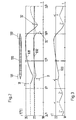
- Figures 2 and 3 show examples of curves which the dependence of the temperature T on the time t during one day - from midnight to midnight.
- Stripe 100 indicates the period during which the The work phase lasts (comfort phase).
- the curves are partly with extended, partly with dashed line.
- the stripped or dashed curve sections correspond to the intervals, during which the cooling device in or out of operation is: arrows 31 mean the start of cooling, the arrows 32 End of cooling.
- the temperature T is during the Night around 24 ° C. With the cooling is already before the start Work phase 100 started. Even after completing the Work phase 100 will continue for a while chilled. After adjusting the cooling takes place because of the im Masonry 2 and in the furnishings of the office stored heat the temperature T again.
- Curve 602 relates to the case that the Chilled ceiling can dissipate the current heat load.
- the Cooling only needs to be performed during comfort phase 100 will.
- the temporary temperature drops on Beginning 101 and end 102 of phase 100 occur since the heat load is not yet or no longer full is trained.
- FIG. 3 shows curve 600 for the small cooling ceiling of the Example, to which curve 601 of FIG. 2 is assigned, but now the inventive method for Commitment comes. Thanks to the night - i.e. during the Regeneration phase - performed cooling that works Masonry as a supplementary heat sink during the day.
- the nighttime cooling can be done intermittently, like it is shown in Figure 3. It can also be continuous be performed.
- comfort conditions Before the start of comfort phase 100, comfort conditions must be met to be restored: for a period of for example 3 hours before the start of phase 100 not cooled, so that the temperature T increases again.
- comfort conditions can also be a shorter duration should be provided if during this duration by means of an additional heater (radiator 8, Fig.1) Room temperature is raised.
- the use of a Auxiliary heating also allows a relatively deep one Minimum temperature of the masonry 2 - for example 18 ° C - to manufacture (this temperature as a over that Storage volume mean value is to be understood).
- the Temperature of the masonry 2 can therefore be the daily average for example, be around 20 ° C.
- the temperature of the coolant in the supply of the cooling ceiling is advantageously kept as low as possible, namely in the Near the dew point temperature. It is possible to do this Keeping the temperature below the dew point, especially when means are provided with which condensing condensation water collected and removed can be. As a rule during the regeneration phase no or a smaller moisture load than during the Comfort phase 100 is present, the coolant temperature can easily be set lower at night than during the day. It can be advantageous if the air is dehumidified.
- the cooling capacity of the Masonry (and / or furnishings) is given and can in the short term, i.e. during a day, not to be influenced.
Landscapes
- Engineering & Computer Science (AREA)
- Life Sciences & Earth Sciences (AREA)
- Sustainable Development (AREA)
- Chemical & Material Sciences (AREA)
- Combustion & Propulsion (AREA)
- Mechanical Engineering (AREA)
- General Engineering & Computer Science (AREA)
- Air Conditioning Control Device (AREA)
- Duct Arrangements (AREA)
- Air-Conditioning For Vehicles (AREA)
- Building Environments (AREA)
Description
- Fig. 1
- einen Büroraum mit einer Kühldecke,
- Fig. 2
- ein Diagramm mit zwei Kurven, die den zeitlichen Verlauf der Temperatur in einem Büroraum darstellen, in dem eine kleine bzw. eine grosse Kühldecke vorliegt und
- Fig. 3
- entsprechend zu Fig.2 einen Temperaturverlauf, der für das erfindungsgemässe Verfahren zu erwarten ist.
Claims (10)
- Verfahren zum Klimatisieren eines Gebäudeinnenraumes, insbesondere eines Büroraumes, der mit massearmen Kühlelementen (10) ausgestattet ist, wobei während Phasen beschränkter Dauer, den sogenannten Komfortphasen (100), Komfortbedingungen eingehalten werden müssen oder zumindest eine minimale Raumtemperatur nicht unterschritten werden darf, wobei das Mauerwerk (2) und/oder Einrichtungsgegenstände des Gebäudes als zusätzliche Wärmesenke genutzt werden und wobei phasenweise während Zeitintervallen zwischen den Komfortphasen die genannte Wärmesenke durch eine mittels der Kühlelemente im Innenraum erzeugten Temperaturabsenkung regeneriert wird.
- Verfahren nach Anspruch 1, dadurch gekennzeichnet, dass die Temperatur der Kühlelemente (10) während den Regenerierphasen tiefer als während den Komfortphasen (100) abgesenkt wird.
- Verfahren nach Anspruch 1 oder 2, dadurch gekennzeichnet, dass die Kühlung während den Regenerierphasen bei kontinuierlichem Betrieb der Kühlvorrichtung (3) ausgeführt wird.
- Verfahren nach Anspruch 1 oder 2, dadurch gekennzeichnet, dass die Kühlung während den Regenerierphasen bei intermittierendem Betrieb der Kühlvorrichtung (3) ausgeführt wird.
- Verfahren nach einem der Ansprüche 1 bis 4, dadurch gekennzeichnet, dass vor Beginn einer Komfortphase (100) Komfortbedingungen mittels kurzdauernden Heizens wieder hergestellt werden.
- Verfahren nach einem der Ansprüche 1 bis 5, dadurch gekennzeichnet, dass der Wärmetransport von dem Mauerwerk (2) und/oder den Einrichtungsgegenständen zu den Kühlelementen (10) mit einer Luftbewegung (6) unterstützt wird.
- Verfahren nach einem der Ansprüche 1 bis 6, dadurch gekennzeichnet, dass im Innenraum die Temperatur mit mindestens einem Sensor (41) überwacht wird und dass aufgrund der Temperaturmessungen der Betrieb der Kühlvorrichtung (3) geregelt wird.
- Verfahren nach einem der Ansprüche 1 bis 7, dadurch gekennzeichnet, dass für die Raumtemperatur während der Komfortphase (100) rund 21 bis 25°C vorgesehen ist und dass die Temperatur des Mauerwerks (2) und/oder der Einrichtungsgegenstände so weit abgesenkt wird, dass sie im Tagesmittel rund 0,5 bis 3 K unter der genannten Raumtemperatur liegt.
- Verfahren nach einem der Ansprüche 1 bis 8, dadurch gekennzeichnet, dass die Luft entfeuchtet wird und die Temperatur der Kühlelemente (10) in der Nähe der Taupunkttemperatur der Luft gehalten wird.
- Verfahren nach einem der Ansprüche 1 bis 9, dadurch gekennzeichnet, dass die Temperatur der Kühlelemente (10) unter der Taupunkttemperatur der Luft gehalten wird.
Priority Applications (4)
| Application Number | Priority Date | Filing Date | Title |
|---|---|---|---|
| EP93810555A EP0637721B1 (de) | 1993-08-06 | 1993-08-06 | Verfahren zum Klimatisieren eines Gebäudeinnenraumes |
| AT93810555T ATE172531T1 (de) | 1993-08-06 | 1993-08-06 | Verfahren zum klimatisieren eines gebäudeinnenraumes |
| ES93810555T ES2124293T3 (es) | 1993-08-06 | 1993-08-06 | Procedimiento de acondicionamiento para el interior de un edificio. |
| DE59309084T DE59309084D1 (de) | 1993-08-06 | 1993-08-06 | Verfahren zum Klimatisieren eines Gebäudeinnenraumes |
Applications Claiming Priority (1)
| Application Number | Priority Date | Filing Date | Title |
|---|---|---|---|
| EP93810555A EP0637721B1 (de) | 1993-08-06 | 1993-08-06 | Verfahren zum Klimatisieren eines Gebäudeinnenraumes |
Publications (2)
| Publication Number | Publication Date |
|---|---|
| EP0637721A1 EP0637721A1 (de) | 1995-02-08 |
| EP0637721B1 true EP0637721B1 (de) | 1998-10-21 |
Family
ID=8215010
Family Applications (1)
| Application Number | Title | Priority Date | Filing Date |
|---|---|---|---|
| EP93810555A Expired - Lifetime EP0637721B1 (de) | 1993-08-06 | 1993-08-06 | Verfahren zum Klimatisieren eines Gebäudeinnenraumes |
Country Status (4)
| Country | Link |
|---|---|
| EP (1) | EP0637721B1 (de) |
| AT (1) | ATE172531T1 (de) |
| DE (1) | DE59309084D1 (de) |
| ES (1) | ES2124293T3 (de) |
Families Citing this family (6)
| Publication number | Priority date | Publication date | Assignee | Title |
|---|---|---|---|---|
| DE19504931C2 (de) * | 1995-02-15 | 2002-06-13 | Bsata Marwan | Einrichtung zur Kühlung und Entfeuchtung von Raumluft |
| WO1998049498A1 (de) * | 1997-04-30 | 1998-11-05 | Ernst Basler + Partner Ag | Verfahren und kühlelement zum kühlen eines büroinnenraumes |
| EP1022518B1 (de) * | 1999-01-25 | 2004-06-09 | LUK Agentur für Luft- und Klimasysteme AG | Verfahren zur Kühlung eines Raumes und Vorrichtung zur Durchführung des Verfahrens |
| EP1022519A1 (de) | 1999-01-25 | 2000-07-26 | Luk Klaus Roschmann | Verfahren zur Kühlung eines Raumes und Vorrichtung zur Durchführung des Verfahrens |
| EP1279899A3 (de) | 2001-07-26 | 2005-10-19 | LUK Agentur für Luft- und Klimasysteme AG | Vorrichtung zur Kühlung eines Raumes |
| DE102016125735B4 (de) * | 2016-12-27 | 2021-12-09 | KLAISS Kälte-Klima GmbH & Co. KG | Vorrichtung zur Kühlung von Gebäuden |
Family Cites Families (2)
| Publication number | Priority date | Publication date | Assignee | Title |
|---|---|---|---|---|
| FR909535A (fr) * | 1944-03-17 | 1946-05-10 | Sulzer Ag | Rafraîchissement et chauffage des locaux avec ventilation et refroidissement d'air |
| GB2208922B (en) * | 1987-08-22 | 1992-04-01 | Rli Byggdata Ab | Temperature control of buildings |
-
1993
- 1993-08-06 EP EP93810555A patent/EP0637721B1/de not_active Expired - Lifetime
- 1993-08-06 ES ES93810555T patent/ES2124293T3/es not_active Expired - Lifetime
- 1993-08-06 AT AT93810555T patent/ATE172531T1/de not_active IP Right Cessation
- 1993-08-06 DE DE59309084T patent/DE59309084D1/de not_active Expired - Fee Related
Also Published As
| Publication number | Publication date |
|---|---|
| ATE172531T1 (de) | 1998-11-15 |
| ES2124293T3 (es) | 1999-02-01 |
| DE59309084D1 (de) | 1998-11-26 |
| EP0637721A1 (de) | 1995-02-08 |
Similar Documents
| Publication | Publication Date | Title |
|---|---|---|
| DE102012204865A1 (de) | Belüftungsvorrichtung | |
| DE102014103668A1 (de) | Verfahren zum Betrieb einer Heiz- und/oder Kühlanlage | |
| DE202012012915U1 (de) | Heiz- und/oder Kühlanlage | |
| EP0177657B1 (de) | System zur Deckung des Energiebedarfes eines Raumes | |
| EP1907761A1 (de) | Vorrichtung und verfahren zur kühlung und entfeuchtung der raumluft | |
| EP3320275A1 (de) | Aktives fenstermodul zur thermischen regulierung eines gebäudes und verfahren | |
| DE102018215677A1 (de) | Laseroszillator | |
| EP0637721A1 (de) | Verfahren zum Klimatisieren eines Gebäudeinnenraumes | |
| EP0308806A2 (de) | Verfahren zur sich selbsttätig anpassenden Steuerung der Temperatur mindestens eines Gebäuderaumes | |
| DE102017219364A1 (de) | Wärmeübertrager und Verfahren zur Desinfektion | |
| DE102007033548A1 (de) | Kühlmodul, technisches Gerät mit einem Kühlmodul sowie Verfahren zur Innenkühlung eines technischen Geräts | |
| DE3836708C2 (de) | ||
| DE2756860C3 (de) | Steuersystem fur die Heizungsanlage eines Mehrfamilienhauses | |
| DE3877280T2 (de) | Temperatursteuerung vom gebaeuden. | |
| EP0985891B1 (de) | Verfahren und Einrichtung zur Beheizung und/oder Kühlung von Räumen | |
| EP0756138A2 (de) | Flächiges Kühl- und Heizelement | |
| DE2323141A1 (de) | Verfahren und vorrichtung zum regeln der temperatur mittels eines stromes untertemperierter luft | |
| DE3304258C2 (de) | Verfahren zum Zwangsentlüften von innenliegenden Sanitärräumen | |
| DE60022314T2 (de) | Lüftungsanlage | |
| DE4137825A1 (de) | Fensterlueftungssystem | |
| EP2655979B1 (de) | Verfahren zur regelung eines wärmeerzeugers eines heizsystems und heizsystem | |
| EP1331455A1 (de) | Lüftungsgerät und Verfahren zur Steuerung eines Lüftungsgeräts | |
| DE102006004104A1 (de) | Einrichtung und Verfahren zum Klimatisieren mindestens eines Raumes eines Gebäudes | |
| EP1331458A1 (de) | Lüftungsgerät und Verfahren zum Betreiben eines Lüftungsgeräts | |
| DE10009257C1 (de) | Verfahren und Vorrichtung zur Verhinderung der Kondensation an Kältebrücken durch künstliche Herbeiführung einer Temperaturinversion |
Legal Events
| Date | Code | Title | Description |
|---|---|---|---|
| PUAI | Public reference made under article 153(3) epc to a published international application that has entered the european phase |
Free format text: ORIGINAL CODE: 0009012 |
|
| AK | Designated contracting states |
Kind code of ref document: A1 Designated state(s): AT BE CH DE DK ES FR GB GR IE IT LI LU MC NL PT SE |
|
| 17P | Request for examination filed |
Effective date: 19950712 |
|
| 17Q | First examination report despatched |
Effective date: 19970212 |
|
| GRAG | Despatch of communication of intention to grant |
Free format text: ORIGINAL CODE: EPIDOS AGRA |
|
| GRAG | Despatch of communication of intention to grant |
Free format text: ORIGINAL CODE: EPIDOS AGRA |
|
| GRAH | Despatch of communication of intention to grant a patent |
Free format text: ORIGINAL CODE: EPIDOS IGRA |
|
| GRAH | Despatch of communication of intention to grant a patent |
Free format text: ORIGINAL CODE: EPIDOS IGRA |
|
| GRAA | (expected) grant |
Free format text: ORIGINAL CODE: 0009210 |
|
| AK | Designated contracting states |
Kind code of ref document: B1 Designated state(s): AT BE CH DE ES FR GB IT LI NL PT |
|
| REF | Corresponds to: |
Ref document number: 172531 Country of ref document: AT Date of ref document: 19981115 Kind code of ref document: T |
|
| REG | Reference to a national code |
Ref country code: CH Ref legal event code: NV Representative=s name: SULZER MANAGEMENT AG Ref country code: CH Ref legal event code: EP |
|
| GBT | Gb: translation of ep patent filed (gb section 77(6)(a)/1977) |
Effective date: 19981022 |
|
| REF | Corresponds to: |
Ref document number: 59309084 Country of ref document: DE Date of ref document: 19981126 |
|
| ITF | It: translation for a ep patent filed | ||
| PG25 | Lapsed in a contracting state [announced via postgrant information from national office to epo] |
Ref country code: PT Free format text: LAPSE BECAUSE OF FAILURE TO SUBMIT A TRANSLATION OF THE DESCRIPTION OR TO PAY THE FEE WITHIN THE PRESCRIBED TIME-LIMIT Effective date: 19990121 |
|
| REG | Reference to a national code |
Ref country code: ES Ref legal event code: FG2A Ref document number: 2124293 Country of ref document: ES Kind code of ref document: T3 |
|
| ET | Fr: translation filed | ||
| PLBE | No opposition filed within time limit |
Free format text: ORIGINAL CODE: 0009261 |
|
| STAA | Information on the status of an ep patent application or granted ep patent |
Free format text: STATUS: NO OPPOSITION FILED WITHIN TIME LIMIT |
|
| 26N | No opposition filed | ||
| REG | Reference to a national code |
Ref country code: GB Ref legal event code: IF02 |
|
| PGFP | Annual fee paid to national office [announced via postgrant information from national office to epo] |
Ref country code: CH Payment date: 20030728 Year of fee payment: 11 Ref country code: NL Payment date: 20030728 Year of fee payment: 11 Ref country code: GB Payment date: 20030728 Year of fee payment: 11 |
|
| PGFP | Annual fee paid to national office [announced via postgrant information from national office to epo] |
Ref country code: AT Payment date: 20030729 Year of fee payment: 11 |
|
| PGFP | Annual fee paid to national office [announced via postgrant information from national office to epo] |
Ref country code: BE Payment date: 20030731 Year of fee payment: 11 |
|
| PGFP | Annual fee paid to national office [announced via postgrant information from national office to epo] |
Ref country code: DE Payment date: 20030805 Year of fee payment: 11 |
|
| PGFP | Annual fee paid to national office [announced via postgrant information from national office to epo] |
Ref country code: ES Payment date: 20030807 Year of fee payment: 11 |
|
| PGFP | Annual fee paid to national office [announced via postgrant information from national office to epo] |
Ref country code: FR Payment date: 20030813 Year of fee payment: 11 |
|
| PG25 | Lapsed in a contracting state [announced via postgrant information from national office to epo] |
Ref country code: GB Free format text: LAPSE BECAUSE OF NON-PAYMENT OF DUE FEES Effective date: 20040806 Ref country code: AT Free format text: LAPSE BECAUSE OF NON-PAYMENT OF DUE FEES Effective date: 20040806 |
|
| PG25 | Lapsed in a contracting state [announced via postgrant information from national office to epo] |
Ref country code: ES Free format text: LAPSE BECAUSE OF NON-PAYMENT OF DUE FEES Effective date: 20040807 |
|
| PG25 | Lapsed in a contracting state [announced via postgrant information from national office to epo] |
Ref country code: LI Free format text: LAPSE BECAUSE OF NON-PAYMENT OF DUE FEES Effective date: 20040831 Ref country code: CH Free format text: LAPSE BECAUSE OF NON-PAYMENT OF DUE FEES Effective date: 20040831 Ref country code: BE Free format text: LAPSE BECAUSE OF NON-PAYMENT OF DUE FEES Effective date: 20040831 |
|
| BERE | Be: lapsed |
Owner name: *SULZER INFRA MANAGEMENT SERVICES A.G. Effective date: 20040831 |
|
| PG25 | Lapsed in a contracting state [announced via postgrant information from national office to epo] |
Ref country code: NL Free format text: LAPSE BECAUSE OF NON-PAYMENT OF DUE FEES Effective date: 20050301 Ref country code: DE Free format text: LAPSE BECAUSE OF NON-PAYMENT OF DUE FEES Effective date: 20050301 |
|
| GBPC | Gb: european patent ceased through non-payment of renewal fee |
Effective date: 20040806 |
|
| REG | Reference to a national code |
Ref country code: CH Ref legal event code: PL |
|
| PG25 | Lapsed in a contracting state [announced via postgrant information from national office to epo] |
Ref country code: FR Free format text: LAPSE BECAUSE OF NON-PAYMENT OF DUE FEES Effective date: 20050429 |
|
| NLV4 | Nl: lapsed or anulled due to non-payment of the annual fee |
Effective date: 20050301 |
|
| REG | Reference to a national code |
Ref country code: FR Ref legal event code: ST |
|
| PG25 | Lapsed in a contracting state [announced via postgrant information from national office to epo] |
Ref country code: IT Free format text: LAPSE BECAUSE OF NON-PAYMENT OF DUE FEES;WARNING: LAPSES OF ITALIAN PATENTS WITH EFFECTIVE DATE BEFORE 2007 MAY HAVE OCCURRED AT ANY TIME BEFORE 2007. THE CORRECT EFFECTIVE DATE MAY BE DIFFERENT FROM THE ONE RECORDED. Effective date: 20050806 |
|
| REG | Reference to a national code |
Ref country code: ES Ref legal event code: FD2A Effective date: 20040807 |
|
| BERE | Be: lapsed |
Owner name: *SULZER INFRA MANAGEMENT SERVICES A.G. Effective date: 20040831 |