EP0633912B1 - Radikalische copolymerisation von acrylaten und vinylaethern - Google Patents
Radikalische copolymerisation von acrylaten und vinylaethern Download PDFInfo
- Publication number
- EP0633912B1 EP0633912B1 EP93908722A EP93908722A EP0633912B1 EP 0633912 B1 EP0633912 B1 EP 0633912B1 EP 93908722 A EP93908722 A EP 93908722A EP 93908722 A EP93908722 A EP 93908722A EP 0633912 B1 EP0633912 B1 EP 0633912B1
- Authority
- EP
- European Patent Office
- Prior art keywords
- vinyl ether
- coating composition
- derived
- monomers
- ether monomers
- Prior art date
- Legal status (The legal status is an assumption and is not a legal conclusion. Google has not performed a legal analysis and makes no representation as to the accuracy of the status listed.)
- Expired - Lifetime
Links
- QYKIQEUNHZKYBP-UHFFFAOYSA-N Vinyl ether Chemical class C=COC=C QYKIQEUNHZKYBP-UHFFFAOYSA-N 0.000 title claims description 74
- 150000003254 radicals Chemical class 0.000 title claims description 27
- 150000001252 acrylic acid derivatives Chemical class 0.000 title description 30
- 238000007334 copolymerization reaction Methods 0.000 title description 2
- 239000000203 mixture Substances 0.000 claims description 56
- 239000000178 monomer Substances 0.000 claims description 54
- -1 ether radicals Chemical class 0.000 claims description 31
- NIXOWILDQLNWCW-UHFFFAOYSA-M Acrylate Chemical compound [O-]C(=O)C=C NIXOWILDQLNWCW-UHFFFAOYSA-M 0.000 claims description 24
- 239000008199 coating composition Substances 0.000 claims description 17
- 239000012949 free radical photoinitiator Substances 0.000 claims description 14
- 239000012952 cationic photoinitiator Substances 0.000 claims description 12
- 125000002947 alkylene group Chemical group 0.000 claims description 9
- 230000005855 radiation Effects 0.000 claims description 8
- 229910052739 hydrogen Inorganic materials 0.000 claims description 7
- 150000002148 esters Chemical class 0.000 claims description 6
- RTZKZFJDLAIYFH-UHFFFAOYSA-N ether Substances CCOCC RTZKZFJDLAIYFH-UHFFFAOYSA-N 0.000 claims description 6
- UHESRSKEBRADOO-UHFFFAOYSA-N ethyl carbamate;prop-2-enoic acid Chemical compound OC(=O)C=C.CCOC(N)=O UHESRSKEBRADOO-UHFFFAOYSA-N 0.000 claims description 6
- 150000001338 aliphatic hydrocarbons Chemical class 0.000 claims description 5
- 150000004945 aromatic hydrocarbons Chemical class 0.000 claims description 5
- 125000004432 carbon atom Chemical group C* 0.000 claims description 5
- 150000002170 ethers Chemical class 0.000 claims description 5
- 229920001228 polyisocyanate Polymers 0.000 claims description 5
- 239000005056 polyisocyanate Substances 0.000 claims description 5
- 229920001296 polysiloxane Polymers 0.000 claims description 5
- 239000004593 Epoxy Substances 0.000 claims description 4
- JOYRKODLDBILNP-UHFFFAOYSA-N Ethyl urethane Chemical compound CCOC(N)=O JOYRKODLDBILNP-UHFFFAOYSA-N 0.000 claims description 4
- 125000000217 alkyl group Chemical group 0.000 claims description 4
- 125000000732 arylene group Chemical group 0.000 claims description 4
- 150000004649 carbonic acid derivatives Chemical class 0.000 claims description 4
- 125000002993 cycloalkylene group Chemical group 0.000 claims description 4
- 229920001281 polyalkylene Polymers 0.000 claims description 4
- 150000003673 urethanes Chemical class 0.000 claims description 4
- 125000001931 aliphatic group Chemical group 0.000 claims description 3
- 150000002334 glycols Chemical class 0.000 claims description 3
- 150000003077 polyols Chemical group 0.000 claims description 3
- BVKZGUZCCUSVTD-UHFFFAOYSA-L Carbonate Chemical compound [O-]C([O-])=O BVKZGUZCCUSVTD-UHFFFAOYSA-L 0.000 claims description 2
- HSFWRNGVRCDJHI-UHFFFAOYSA-N alpha-acetylene Natural products C#C HSFWRNGVRCDJHI-UHFFFAOYSA-N 0.000 claims description 2
- 150000005690 diesters Chemical group 0.000 claims description 2
- 150000002009 diols Chemical group 0.000 claims description 2
- 125000005677 ethinylene group Chemical group [*:2]C#C[*:1] 0.000 claims description 2
- ODIGIKRIUKFKHP-UHFFFAOYSA-N (n-propan-2-yloxycarbonylanilino) acetate Chemical compound CC(C)OC(=O)N(OC(C)=O)C1=CC=CC=C1 ODIGIKRIUKFKHP-UHFFFAOYSA-N 0.000 claims 1
- KWOLFJPFCHCOCG-UHFFFAOYSA-N Acetophenone Chemical group CC(=O)C1=CC=CC=C1 KWOLFJPFCHCOCG-UHFFFAOYSA-N 0.000 claims 1
- 238000009472 formulation Methods 0.000 description 37
- 229960000834 vinyl ether Drugs 0.000 description 31
- UDJZTGMLYITLIQ-UHFFFAOYSA-N 1-ethenylpyrrolidine Chemical compound C=CN1CCCC1 UDJZTGMLYITLIQ-UHFFFAOYSA-N 0.000 description 9
- QNODIIQQMGDSEF-UHFFFAOYSA-N (1-hydroxycyclohexyl)-phenylmethanone Chemical group C=1C=CC=CC=1C(=O)C1(O)CCCCC1 QNODIIQQMGDSEF-UHFFFAOYSA-N 0.000 description 8
- YMWUJEATGCHHMB-UHFFFAOYSA-N Dichloromethane Chemical compound ClCCl YMWUJEATGCHHMB-UHFFFAOYSA-N 0.000 description 6
- 150000001875 compounds Chemical class 0.000 description 6
- 239000003085 diluting agent Substances 0.000 description 6
- 239000012632 extractable Substances 0.000 description 6
- 238000012360 testing method Methods 0.000 description 6
- GCTPMLUUWLLESL-UHFFFAOYSA-N benzyl prop-2-enoate Chemical compound C=CC(=O)OCC1=CC=CC=C1 GCTPMLUUWLLESL-UHFFFAOYSA-N 0.000 description 5
- 239000003999 initiator Substances 0.000 description 5
- WHNWPMSKXPGLAX-UHFFFAOYSA-N N-Vinyl-2-pyrrolidone Chemical compound C=CN1CCCC1=O WHNWPMSKXPGLAX-UHFFFAOYSA-N 0.000 description 4
- 125000002091 cationic group Chemical group 0.000 description 4
- 239000000463 material Substances 0.000 description 4
- UHOVQNZJYSORNB-UHFFFAOYSA-N Benzene Chemical compound C1=CC=CC=C1 UHOVQNZJYSORNB-UHFFFAOYSA-N 0.000 description 3
- XEKOWRVHYACXOJ-UHFFFAOYSA-N Ethyl acetate Chemical compound CCOC(C)=O XEKOWRVHYACXOJ-UHFFFAOYSA-N 0.000 description 3
- 150000008062 acetophenones Chemical class 0.000 description 3
- XUEAJYHEEJKSLM-UHFFFAOYSA-N bis(4-ethenoxybutyl) butanedioate Chemical compound C=COCCCCOC(=O)CCC(=O)OCCCCOC=C XUEAJYHEEJKSLM-UHFFFAOYSA-N 0.000 description 3
- 238000000576 coating method Methods 0.000 description 3
- 229940052303 ethers for general anesthesia Drugs 0.000 description 3
- 238000002474 experimental method Methods 0.000 description 3
- 230000009477 glass transition Effects 0.000 description 3
- 230000006698 induction Effects 0.000 description 3
- 238000006116 polymerization reaction Methods 0.000 description 3
- 230000004044 response Effects 0.000 description 3
- GPHWXFINOWXMDN-UHFFFAOYSA-N 1,1-bis(ethenoxy)hexane Chemical compound CCCCCC(OC=C)OC=C GPHWXFINOWXMDN-UHFFFAOYSA-N 0.000 description 2
- QRMPKOFEUHIBNM-UHFFFAOYSA-N 1,4-dimethylcyclohexane Chemical compound CC1CCC(C)CC1 QRMPKOFEUHIBNM-UHFFFAOYSA-N 0.000 description 2
- VOBUAPTXJKMNCT-UHFFFAOYSA-N 1-prop-2-enoyloxyhexyl prop-2-enoate Chemical compound CCCCCC(OC(=O)C=C)OC(=O)C=C VOBUAPTXJKMNCT-UHFFFAOYSA-N 0.000 description 2
- AKQVBBOVHAEKMA-UHFFFAOYSA-N 4-ethenoxybutyl benzoate Chemical compound C=COCCCCOC(=O)C1=CC=CC=C1 AKQVBBOVHAEKMA-UHFFFAOYSA-N 0.000 description 2
- FIHBHSQYSYVZQE-UHFFFAOYSA-N 6-prop-2-enoyloxyhexyl prop-2-enoate Chemical compound C=CC(=O)OCCCCCCOC(=O)C=C FIHBHSQYSYVZQE-UHFFFAOYSA-N 0.000 description 2
- IJGRMHOSHXDMSA-UHFFFAOYSA-N Atomic nitrogen Chemical compound N#N IJGRMHOSHXDMSA-UHFFFAOYSA-N 0.000 description 2
- 239000002253 acid Substances 0.000 description 2
- 239000012298 atmosphere Substances 0.000 description 2
- 230000008901 benefit Effects 0.000 description 2
- 238000006243 chemical reaction Methods 0.000 description 2
- 238000011156 evaluation Methods 0.000 description 2
- 239000013022 formulation composition Substances 0.000 description 2
- 238000005227 gel permeation chromatography Methods 0.000 description 2
- 239000011521 glass Substances 0.000 description 2
- 229920001519 homopolymer Polymers 0.000 description 2
- 230000007246 mechanism Effects 0.000 description 2
- 229910052760 oxygen Inorganic materials 0.000 description 2
- 229920000642 polymer Polymers 0.000 description 2
- KCTAWXVAICEBSD-UHFFFAOYSA-N prop-2-enoyloxy prop-2-eneperoxoate Chemical compound C=CC(=O)OOOC(=O)C=C KCTAWXVAICEBSD-UHFFFAOYSA-N 0.000 description 2
- 238000003847 radiation curing Methods 0.000 description 2
- 230000009257 reactivity Effects 0.000 description 2
- 238000006467 substitution reaction Methods 0.000 description 2
- 239000000758 substrate Substances 0.000 description 2
- REEBWSYYNPPSKV-UHFFFAOYSA-N 3-[(4-formylphenoxy)methyl]thiophene-2-carbonitrile Chemical compound C1=CC(C=O)=CC=C1OCC1=C(C#N)SC=C1 REEBWSYYNPPSKV-UHFFFAOYSA-N 0.000 description 1
- 206010073306 Exposure to radiation Diseases 0.000 description 1
- WSFSSNUMVMOOMR-UHFFFAOYSA-N Formaldehyde Chemical compound O=C WSFSSNUMVMOOMR-UHFFFAOYSA-N 0.000 description 1
- VZCYOOQTPOCHFL-OWOJBTEDSA-N Fumaric acid Chemical class OC(=O)\C=C\C(O)=O VZCYOOQTPOCHFL-OWOJBTEDSA-N 0.000 description 1
- UFHFLCQGNIYNRP-UHFFFAOYSA-N Hydrogen Chemical compound [H][H] UFHFLCQGNIYNRP-UHFFFAOYSA-N 0.000 description 1
- XYFCBTPGUUZFHI-UHFFFAOYSA-N Phosphine Chemical compound P XYFCBTPGUUZFHI-UHFFFAOYSA-N 0.000 description 1
- 206010034962 Photopsia Diseases 0.000 description 1
- 229930182556 Polyacetal Natural products 0.000 description 1
- 125000003118 aryl group Chemical group 0.000 description 1
- QVGXLLKOCUKJST-UHFFFAOYSA-N atomic oxygen Chemical compound [O] QVGXLLKOCUKJST-UHFFFAOYSA-N 0.000 description 1
- 125000003236 benzoyl group Chemical group [H]C1=C([H])C([H])=C(C([H])=C1[H])C(*)=O 0.000 description 1
- 230000000052 comparative effect Effects 0.000 description 1
- 229920001577 copolymer Polymers 0.000 description 1
- 238000001723 curing Methods 0.000 description 1
- 238000009826 distribution Methods 0.000 description 1
- 239000003822 epoxy resin Substances 0.000 description 1
- LNEPOXFFQSENCJ-UHFFFAOYSA-N haloperidol Chemical compound C1CC(O)(C=2C=CC(Cl)=CC=2)CCN1CCCC(=O)C1=CC=C(F)C=C1 LNEPOXFFQSENCJ-UHFFFAOYSA-N 0.000 description 1
- 239000001257 hydrogen Substances 0.000 description 1
- VZCYOOQTPOCHFL-UPHRSURJSA-N maleic acid Chemical compound OC(=O)\C=C/C(O)=O VZCYOOQTPOCHFL-UPHRSURJSA-N 0.000 description 1
- QSHDDOUJBYECFT-UHFFFAOYSA-N mercury Chemical compound [Hg] QSHDDOUJBYECFT-UHFFFAOYSA-N 0.000 description 1
- 229910052753 mercury Inorganic materials 0.000 description 1
- YCWSUKQGVSGXJO-NTUHNPAUSA-N nifuroxazide Chemical group C1=CC(O)=CC=C1C(=O)N\N=C\C1=CC=C([N+]([O-])=O)O1 YCWSUKQGVSGXJO-NTUHNPAUSA-N 0.000 description 1
- 229910052757 nitrogen Inorganic materials 0.000 description 1
- 239000012299 nitrogen atmosphere Substances 0.000 description 1
- 239000001301 oxygen Substances 0.000 description 1
- 229910000065 phosphene Inorganic materials 0.000 description 1
- 230000000704 physical effect Effects 0.000 description 1
- 229920000647 polyepoxide Polymers 0.000 description 1
- 229920002959 polymer blend Polymers 0.000 description 1
- 229920005862 polyol Polymers 0.000 description 1
- 229920006324 polyoxymethylene Polymers 0.000 description 1
- 239000000376 reactant Substances 0.000 description 1
- 239000007787 solid Substances 0.000 description 1
- 239000002904 solvent Substances 0.000 description 1
- 238000009864 tensile test Methods 0.000 description 1
- VZCYOOQTPOCHFL-UHFFFAOYSA-N trans-butenedioic acid Natural products OC(=O)C=CC(O)=O VZCYOOQTPOCHFL-UHFFFAOYSA-N 0.000 description 1
Classifications
-
- C—CHEMISTRY; METALLURGY
- C09—DYES; PAINTS; POLISHES; NATURAL RESINS; ADHESIVES; COMPOSITIONS NOT OTHERWISE PROVIDED FOR; APPLICATIONS OF MATERIALS NOT OTHERWISE PROVIDED FOR
- C09D—COATING COMPOSITIONS, e.g. PAINTS, VARNISHES OR LACQUERS; FILLING PASTES; CHEMICAL PAINT OR INK REMOVERS; INKS; CORRECTING FLUIDS; WOODSTAINS; PASTES OR SOLIDS FOR COLOURING OR PRINTING; USE OF MATERIALS THEREFOR
- C09D4/00—Coating compositions, e.g. paints, varnishes or lacquers, based on organic non-macromolecular compounds having at least one polymerisable carbon-to-carbon unsaturated bond ; Coating compositions, based on monomers of macromolecular compounds of groups C09D183/00 - C09D183/16
Definitions
- This invention relates to the radiation curing of polymerizable coatings, such as is commercially practiced on many types of substrates. Radiation curing speeds up the application of coatings and generally requires the use of photoinitiators.
- cationic photoinitiators are required by vinyl ethers and epoxy compounds, while free radical photoinitiators are employed with acrylates.
- free radical photoinitiators it is generally preferred to carry out the polymerization in an inert atmosphere such as nitrogen. Otherwise, the polymerization reaction is slowed by the presence of oxygen.
- Materials which are radiation cured with cationic photoinitiators need not avoid air and thus have an advantage over materials which require an inert atmosphere to be most efficiently cured.
- EP-A-0155704 discloses photopolymerizable compositions comprising cyclic vinyl ethers (which are 3,4-dihydro-2H-pyranyl compounds) and urethane acrylates. The compositions are polymerized in the presence of combinations of cationic and free radical photoinitiators.
- WO-A-9 111 466 describes radiation curable compositions comprising an acrylate monomer or oligomer, a divinylether polyacetal oligomer and a cationic photoinitiator.
- a radiation curable coating composition comprising:
- the vinyl ether monomers comprise 0.5 to 20 equivalent percent of the composition.
- Acrylates may be defined generally as compounds which contain the group where R is H or CH 3
- multifunctional acrylates are included in the coating composition in preference to monofunctional acrylates although some monofunctional acrylates could be present.
- the acrylates may be oligomers and/or monomers and preferred formulations include those containing urethane and epoxy oligomers.
- the free radical photoinitiators preferably are acetophenone derivatives or benzoyl diaryl phosphine oxide derivatives.
- Vinyl ether terminated ester monomers may be described by the formula where
- Vinyl ether terminated ether monomers may be obtained by reacting poly(ethyleneoxy), poly(propyleneoxy) or poly(butyleneoxy) glycols, i.e., HO-[-CH 2 CH 2 O] m -H, HO-[-CH(CH 3 )CH 2 O] m ,H, or HO-[-(CH 2 ) 4 O] m -H, respectively, where m has an average value of about 1 to 5 with acetylene or a vinyloxyalkylhalide, for example, 2-chloroethyl vinyl ether. Transvinylation of the glycols with an alkyl vinyl ether may also be used.
- Vinyl ether terminated urethane monomers may be described by the formula where
- the monomers may also be derived from polyisocyanates, such as those described in U.S. Pat. No. 4,433,067.
- polyisocyanate also is intended to include quasi prepolymers of polyisocyanates where the polyisocyanate has been reacted with active hydrogen containing materials, such as polyols.
- Vinyl ether terminated carbonate monomers may be described by the formula where
- Acrylates may be generally defined as compounds which contain the group where R is H or CH 3 .
- acrylates may be oligomers and monomers and may include urethane and epoxy moieties. It has been found that monofunctional acrylates will not react adequately with vinyl ethers, as will be seen in the examples below. However, multifunctional acrylates can react with vinyl ethers until only a small amount of the monomers remain unreacted. Thus, in order that unreacted vinyl ethers may be minimized, multifunctional acrylate oligomers or monomers or both should be present, although monofunctional acrylates could be included to the extent that the end use of the composition permits. Multifunctional acrylates which have been found useful are employed in the examples below. However, other multifunctional acrylates are not excluded. Acrylates which contain acid moieties should be avoided since they may react with vinyl ethers.
- Free radical photoinitiators known in the art may be used, particularly acetophenone derivatives and benzoyl diaryl phosphene oxide derivatives such as are discussed in U.S. Pat. No. 4,999,216.
- One preferred photoinitiator used in the examples below is Irgacure 184, an acetophenone derivative supplied by Ciba-Geigy and having the formula In the examples about 3 pph (parts per hundred) of the photoinitiator is typically used, but more generally an effective amount of about 3 pph ⁇ 2 pph of the composition may be employed depending on the film thickness. The selection of the photoinitiator and the degree of exposure to radiation will be determined experimentally for each formulation.
- the amount of vinyl ethers included in the formulation will depend upon the maximum permissible unreacted vinyl ether in the cured film. Consequently, the vinyl ethers could be substituted for NVP or acrylate diluents to the extent that the particular application would accept unreacted diluents in the cured film.
- the maximum amount of vinyl ethers in the coating formulation may be up to about 30 equivalent %, but typically would be in the range of 0.5 to 20 equivalent %.
- the amount of vinyl ethers which can be included in the formulation will also be affected by the structure of the vinyl ethers used, since their reactivity will depend upon the structure. Thus, the vinyl ether monomers included in the formulas presented above will perform differently with respect to their reactivity with acrylates.
- selection of specific vinyl ethers and the amounts used will be determined from experience with formulations with the boundaries described herein.
- Example 1-3 which follow coating compositions were formulated using urethane-acrylate oligomers and epoxy-acrylate oligomers to demonstrate the advantages of replacing the presently used monomers with vinyl ethers. For example, replacing the monofunctional monomer N-vinyl pyrrolidine and the difunctional monomer hexanediol diacrylate with vinyl ethers.
- the free radical photoinitiator Irgacure 184 (Ciba-Geigy) was used. All of the sample films were irradiated at 450 mJ/cm 2 with an RPC model QC-1202 ultraviolet processor using two medium pressure mercury arc lamps in a nitrogen atmosphere.
- a group of 1.5 mil (0.038 mm) thick films were irradiated to cure and then extracted with methylene chloride in a Soxhlet extractor for 24 hours to determine the amount of unreacted monomers in the films.
- the Tg glass transition temperature was measured on 3 mil (0.076 mm) films which had been cured at 450 mJ/cm 2 using a Rheovibron Model DDV-II-C at 4 Hz.
- the molecular weight distributions were determined using a Perkin-Elmer apparatus with a LC-30 RI detector. Ethyl acetate was used as a solvent and samples were passed through a series of columns as follows: 5 micron/50 A, 5 micron/500 A, and 10 micron/mixed bed.
- a series of formulations were prepared including 70 wt.% UV-893 (a urethane acrylate, Morton) and 15 wt.% of trimethylol propanetriethoxyacrylate (TMPTEA, Sartomer). The remaining 15 wt.% was N-vinyl pyrrolidine (NVP), 4-vinyl oxybutylbenzoate (HBZ), hexanediol diacrylate (HDDA), or bis(4-vinyloxybutyl)succinate (VEX-4030, Allied-Signal). Three pph of Irgacure 184 was included.
- the four types of films were cured as described above and then evaluated for percent extractables, viscosity, tensile strength, elongation modulus, energy at break, Tg, induction time, peak time, percent reacted at peak, and mean and average molecular weight.
- the four formulations were designated A,B,C, and D. Their compositions are given in the table below as weight percent and in brackets, as equivalent percent.
- the bulk of the extractables may be attributed to the photoinitiator. It can be concluded that both the acrylate diluents and the vinyl ethers have reacted with the urethane acrylate and the trifunctional TMPTEA.
- formulations B and D using vinyl ethers are higher than those of acrylate formulations A and C. It will be seen that tensile strength and modulus are altered when vinyl ethers are included. Thus, vinyl ethers can be used to achieve useful film properties.
- the glass transition temperature (TG) for each formulation is shown in the following table.
- the cure response evaluation is reported in the following table.
- Both vinyl ether formulations B and D and conventional monomers A and C appear to react in a similar manner, however, since the reactivity ratio of the vinyl ether is much lower than that of the acrylate, the acrylate should have a propensity to homopolymerize. If crossover to vinyl ether does occur, the growing vinyl ether radical will rapidly crossover to acrylate monomer. Thus, in the early stages of the vinyl ether/acrylate copolymerization, the polymer formed will be predominately acrylate based. In the latter stages of the polymerization, however, the acrylate becomes depleted relative to vinyl ether and formed during the latter stages of the reaction. Crossover to vinyl ether is enhanced.
- a series of formulations were prepared including 55 wt.% UV-893 (a urethane acrylate, Morton) and 30 wt.% of trimethylol propanetriethoxyacrylate (TMPTEA, Sartomer). The remaining 15 wt.% was hexanediol diacrylate (HDDA), bis(4-vinyloxybutyl)succinate (VEX-4030, Allied-Signal) or hexanedioldivinylether (HDDVE). Again, 3 pph of Irgacure 184 was included. The three types of films were cured as described above and then evaluated for viscosity, tensile strength, elongation, modulus, and energy at break.
- HDDA hexanediol diacrylate
- VEX-4030 bis(4-vinyloxybutyl)succinate
- HDDVE hexanedioldivinylether
- a second set of formulations was prepared but in this case using an epoxy acrylate CN 104 (Sartomer).
- the compostions are summarized in the following table as before.
- Three pph of Irgacure 184 was included.
- Formulation H I J K CN104 70% (55.2) 70% (63.5) 70% (55.5) 70% (61.5) TMPTEA 15% (18.6) 15% (21.3) 15% (18.6) 15% (20.6)
- Example 1 The tests described above and reported in Example 1 were carried out on the second set of formulations and the results are shown in the tables below, which correspond to the tables above.
- vinyl ethers are shown to react with the acrylates using a free radical photoinitiator.
- the tensile properties with the vinyl ether compounds (I and K) are similar to those of the more conventional formulation (H and J).
- the film's physical properties may be adjusted by proper selection of the reactive vinyl ethers.
- Tg glass transition temperature
- Two formulations were prepared including 70 wt.% UV-893, 15 wt.% TMPTEA and 15 wt.% VEX-4030.
- a free radical photoinitiator (2 pph Irgacure 184)
- a cationic photoinitiator (1 pph UVI-6990, Union Carbide) were used and for another sample (M) only the free radical photoinitiator was used, as in the examples above.
- the formulations were cured as described above and then evaluated for tensile strength, elongation, modulus and energy at break. The results are given in the following table.
- Formulation Composition % Monomer Unreacted N 15% equivalents NVP 0.4% 85% equivalents BA 2.6% O 15% equivalents HBZ 5.2% 85% equivalents BA 7.9% It can be seen that in the conventional acrylate composition N that all NVP was reacted and only 2.6% of the acrylate was unreacted. However, when the monovinyl ether (HBZ) was substituted, the amount of unreacted acrylate increased substantially and a significant quantity of the i vinyl ether also was unreacted.
- HBZ monovinyl ether
- Example 5 In contrast to the results of Example 5 the use of a multifunctional acrylate instead of the monofunctional acrylate (BA) gave quite different results. Varying amounts of trimethylol propanetriethoxy acrylate (TMPTEA) were mixed with bis(4-vinyloxybutyl)succinate (VEX-4030) and 3 pph Irgacure 184. Cured films (1.5 mil or 0.038 mm) were again produced as described before and extracted with methylene chloride. The results are shown in the following table.
- TMPTEA trimethylol propanetriethoxy acrylate
- VEX-4030 bis(4-vinyloxybutyl)succinate
- Formulation Composition % Monomer Extracted P 15% equivalents 4030 0.1% 85% equivalents TMPTEA Q 20% equivalents 4030 2.3% 80% equivalents TMPTEA R 25% equivalents 4030 75% equivalents TMPTEA 6.7% S 40% equivalents 4030 7.9% 60% equivalents TMPTEA It can be seen that the same ratio of the vinyl ether to the acrylate used in Example 5 produced in this test a much lower amount of unreacted monomers. Consequently, it may be concluded that the multifunctional acrylates permit including significantly more vinyl ether in the formulation than do monofunctional acrylates. It also may be concluded that there is an upper limit on the amount of vinyl ethers which can be included with the acrylates. Comparison of the relative amounts of reactants based on the number of reactive equivalents is believed to provide suitable comparison.
Landscapes
- Chemical & Material Sciences (AREA)
- Life Sciences & Earth Sciences (AREA)
- Engineering & Computer Science (AREA)
- Materials Engineering (AREA)
- Wood Science & Technology (AREA)
- Organic Chemistry (AREA)
- Paints Or Removers (AREA)
- Macromonomer-Based Addition Polymer (AREA)
- Polymerisation Methods In General (AREA)
- Addition Polymer Or Copolymer, Post-Treatments, Or Chemical Modifications (AREA)
Claims (12)
- Strahlenhärtbares Beschichtungsmittel, enthaltend(a) multifunktionelle Acrylatoligomere und -monomere,(b) Vinylethermonomere in einer Menge von bis zu 35 Äquivalent-% des Mittels;(c) eine wirksame Menge eines radikalischen Photoinitiators und keinen kationischen Photoinitiator.
- Beschichtungsmittel nach Anspruch 1, wobei die Vinylethermonomere die Formel
- R' und R"
- für monovalente Reste aus der Gruppe bestehend aus H und Alkylgruppen mit 1-10 Kohlenstoffatomen stehen,
- Z
- für einen zweiwertigen Rest mit einem Molekulargewicht von etwa 28 bis 250 aus der Gruppe bestehend aus Alkylen-, Cycloalkylen- und Polyalkylen-etherresten steht,
- n
- eine ganze Zahl von 1 bis 4 bedeutet und
- B
- von mindestens einem Mitglied der Gruppe bestehend aus aromatischen und aliphatischen Kohlenwasserstoffen, Estern, Ethern, Siloxanen, Urethanen und Carbonaten abgeleitet ist und ein Molekulargewicht von etwa 60 bis 400 aufweist,
- Beschichtungsmittel nach Anspruch 2, wobei die Vinylethermonomere von Estern abgeleitet sind und die Formelworin
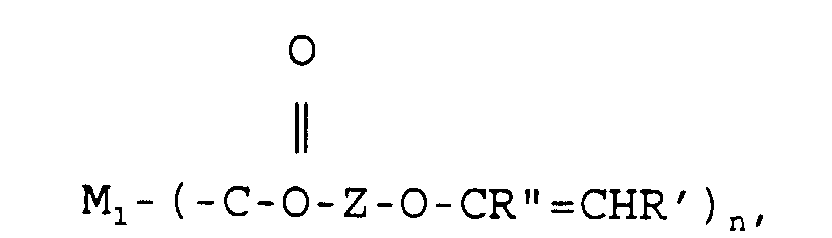
- n
- für 1 bis 4 steht,
- M1
- für einen mono-, di-, tri- oder tetrafunktionellen Rest mit einem Molekulargewicht von 15 bis 180 aus der Gruppe bestehend aus Alkylen-, Arylen-, Aralkylen- und Cycloalkylenresten steht und
- Z, R' und R"
- die in Anspruch 2 angegebenen Bedeutungen haben,
- Beschichtungsmittel nach Anspruch 2, wobei die Vinylethermonomere durch Umsetzung von mindestens einem Mitglied der Gruppe bestehend aus Poly(ethylenoxy)-, Poly (propylenoxy) - oder Poly(butylenoxy) glykolen, worin m einen durchschnittlichen Wert von 1 bis 5 hat, mit einem Acetylen oder einem Vinyloxyalkylhalogenid von Ethern abgeleitet sind.
- Beschichtungsmittel nach Anspruch 2, wobei die Vinylethermonomere von aliphatischen Kohlenwasserstoffen der Formel
- n
- für 1 bis 4 steht,
- M2
- für einen mono-, di-, tri- oder tetrafunktionellen aliphatischen oder cycloaliphatischen Rest mit einem Molekulargewicht von etwa 56 bis 500 steht und
- Z, R' und R"
- die in Anspruch 2 angegebenen Bedeutungen haben,
- Beschichtungsmittel nach Anspruch 2, wobei die Vinylethermonomere von aromatischen Kohlenwasserstoffen der Formel
- n
- für 1 bis 4 steht,
- M3
- für einen mono-, di-, tri- oder tetrafunktionellen aromatischen Rest mit einem Molekulargewicht von etwa 77 bis 500 steht und
- Z, R' und R"
- die in Anspruch 2 angegebenen Bedeutungen haben,
- Beschichtungsmittel nach Anspruch 2, wobei die Vinylethermonomere von einem Polysiloxan der Formel
- n
- für eine ganze Zahl von 2 bis 8 steht,
- A
- für ein Polysiloxan mit n Si-H-Gruppen und einem Molekulargewicht von 140 bis 500 steht und
- R', R" und Z
- die in Anspruch 2 angegebenen Bedeutungen haben,
- Beschichtungsmittel nach Anspruch 2, wobei die Vinylethermonomere (a) von einem Urethan der Formelworin
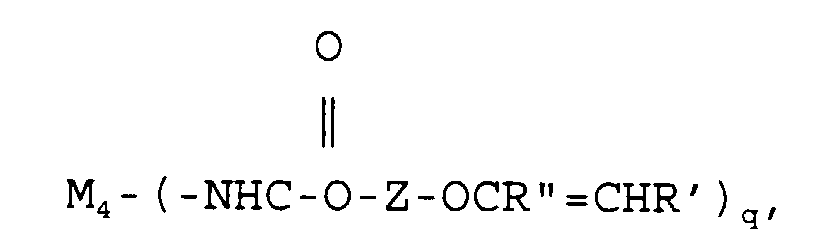
- M4
- für einen mono-, di- oder trifunktionellen Rest aus der Gruppe bestehend aus Alkylen-, Arylen-, Aralkylen- und Cycloalkylenresten steht,
- q
- für 1 bis 3 steht und
- R', R" und Z
- die in Anspruch 2 angegebenen Bedeutungen haben,
oder (b) einen von einem Polyisocyanat abgeleiteten Vinylether darstellen. - Beschichtungsmittel nach Anspruch 2, wobei die Vinylethermonomere von einem Carbonat der Formelworin

- p
- für 0 bis 3 steht,
- R', R" und Z
- die in Anspruch 2 angegebene Bedeutung haben und
- X
- für eine Diester-, Diol- oder Polyol-gruppierung steht,
- Beschichtungsmittel nach Anspruch 1, wobei es sich bei dem radikalischen Photoinitiator um ein Aceto-phenonderivat handelt.
- Beschichtungsmittel nach Anspruch 1, wobei es sich bei dem Acrylat um ein Urethanacrylat-Oligomer oder ein Epoxyacrylat-Oligomer handelt.
- Beschichtungsmittel nach Anspruch 1, wobei die Vinylethermonomere etwa 0,5 bis 20 Äquivalentprozent des Mittels ausmachen.
Applications Claiming Priority (3)
| Application Number | Priority Date | Filing Date | Title |
|---|---|---|---|
| US862618 | 1992-04-01 | ||
| US07/862,618 US5352713A (en) | 1992-04-01 | 1992-04-01 | Free radical co-polymerization of acrylates and vinyl ethers |
| PCT/US1993/003092 WO1993020155A1 (en) | 1992-04-01 | 1993-04-01 | Free radical co-polymerization of acrylates and vinyl ethers |
Publications (2)
| Publication Number | Publication Date |
|---|---|
| EP0633912A1 EP0633912A1 (de) | 1995-01-18 |
| EP0633912B1 true EP0633912B1 (de) | 1998-09-02 |
Family
ID=25338870
Family Applications (1)
| Application Number | Title | Priority Date | Filing Date |
|---|---|---|---|
| EP93908722A Expired - Lifetime EP0633912B1 (de) | 1992-04-01 | 1993-04-01 | Radikalische copolymerisation von acrylaten und vinylaethern |
Country Status (5)
| Country | Link |
|---|---|
| US (1) | US5352713A (de) |
| EP (1) | EP0633912B1 (de) |
| JP (1) | JPH07505439A (de) |
| DE (1) | DE69320797T2 (de) |
| WO (1) | WO1993020155A1 (de) |
Cited By (2)
| Publication number | Priority date | Publication date | Assignee | Title |
|---|---|---|---|---|
| US6822063B2 (en) * | 2002-08-27 | 2004-11-23 | Ecolab Inc. | Highly durable waterborne radiation cured coating |
| WO2005012277A1 (en) * | 2003-08-04 | 2005-02-10 | Matrix Innovation Inc. | New polyether based monomers and highly cross-linked amphiphile resins |
Families Citing this family (10)
| Publication number | Priority date | Publication date | Assignee | Title |
|---|---|---|---|---|
| EP0773977B1 (de) * | 1994-07-13 | 2000-04-05 | AlliedSignal Inc. | Kupplungsreagenzien für beschichtungssysteme, die auf vinylether basieren |
| US5989627A (en) * | 1998-09-28 | 1999-11-23 | Lucent Technologies Inc. | Vinyl ether terminated oligomers and polymers |
| US6204304B1 (en) * | 1998-09-28 | 2001-03-20 | Lucent Technologies Inc. | Vinyl ether-based optical fiber coatings |
| DE10048696A1 (de) * | 2000-09-30 | 2002-04-11 | Basf Ag | Tertiäre Divinylether, Verfahren zu deren Herstellung und deren Verwendung |
| US6842636B2 (en) * | 2002-09-27 | 2005-01-11 | Axelgaard Manufacturing Co., Ltd. | Medical electrode |
| JP4929722B2 (ja) * | 2006-01-12 | 2012-05-09 | 日立化成工業株式会社 | 光硬化型ナノプリント用レジスト材及びパターン形成法 |
| US8007582B2 (en) | 2007-06-08 | 2011-08-30 | Ppg Industries Ohio, Inc. | UV curable coating composition and method of making |
| TW200920785A (en) * | 2007-09-06 | 2009-05-16 | Nippon Paint Co Ltd | Resin composition for hologram recording material, hologram recording material, and method for producing hologram recording medium |
| GB201618118D0 (en) * | 2016-10-26 | 2016-12-07 | Fujifilm Speciality Ink Systems Limited | Printing Ink |
| WO2021154725A1 (en) * | 2020-01-27 | 2021-08-05 | Henkel IP & Holding GmbH | High creep recovery, low modulus polymer systems and methods of making them |
Family Cites Families (15)
| Publication number | Priority date | Publication date | Assignee | Title |
|---|---|---|---|---|
| US4156035A (en) * | 1978-05-09 | 1979-05-22 | W. R. Grace & Co. | Photocurable epoxy-acrylate compositions |
| DE2830927A1 (de) * | 1978-07-14 | 1980-01-31 | Basf Ag | Acylphosphinoxidverbindungen und ihre verwendung |
| DE3133419A1 (de) * | 1981-08-24 | 1983-03-10 | Basf Ag, 6700 Ludwigshafen | Acylphosphinoxidverbindungen und ihre verwendung |
| US4433067A (en) * | 1982-04-23 | 1984-02-21 | Texaco Inc. | Reaction injection molded elastomers prepared from amine terminated polyethers, amine terminated chain extender and aromatic polyisocyanate |
| US4932750A (en) * | 1982-12-09 | 1990-06-12 | Desoto, Inc. | Single-coated optical fiber |
| US4920156A (en) * | 1984-03-23 | 1990-04-24 | Union Carbide Chemicals And Plastics Company Inc. | Blends of cyclic vinyl ether containing compounds and urethane acrylates |
| US4525232A (en) * | 1984-04-16 | 1985-06-25 | Loctite (Ireland) Ltd. | Polymerizable acrylic compositions having vinyl ether additive |
| US4749807A (en) * | 1987-02-17 | 1988-06-07 | Allied-Signal Inc. | Vinyl ether terminated ester oligomers |
| AU615673B2 (en) * | 1988-07-22 | 1991-10-10 | Thomas A. Bush | A pay per view entertainment system |
| US4999216A (en) * | 1989-08-21 | 1991-03-12 | Desoto, Inc. | Method of coating concrete floors with photocurable coatings |
| US5106885A (en) * | 1989-11-03 | 1992-04-21 | Isp Investments Inc. | Radiation curable compositions containing multifunctional vinyl ether monomers and protective coatings formed therefrom |
| US5055357A (en) * | 1990-01-26 | 1991-10-08 | Isp Investments Inc. | Radiation curable cross linkable compositions |
| US5036112A (en) * | 1990-01-26 | 1991-07-30 | Gaf Chemicals Corporation | Cross-linkable vinyl ether polyacetal oligomers |
| US5045572A (en) * | 1990-01-26 | 1991-09-03 | Gaf Chemicals Corporation | Radiation curable cross linkable compositions containing an aliphatic polyfunctional alkenyl ether |
| US5262449A (en) * | 1990-09-10 | 1993-11-16 | Isp Investments Inc. | Radiation curable coating compositions |
-
1992
- 1992-04-01 US US07/862,618 patent/US5352713A/en not_active Expired - Fee Related
-
1993
- 1993-04-01 EP EP93908722A patent/EP0633912B1/de not_active Expired - Lifetime
- 1993-04-01 WO PCT/US1993/003092 patent/WO1993020155A1/en not_active Ceased
- 1993-04-01 JP JP5517711A patent/JPH07505439A/ja active Pending
- 1993-04-01 DE DE69320797T patent/DE69320797T2/de not_active Expired - Fee Related
Cited By (4)
| Publication number | Priority date | Publication date | Assignee | Title |
|---|---|---|---|---|
| US6822063B2 (en) * | 2002-08-27 | 2004-11-23 | Ecolab Inc. | Highly durable waterborne radiation cured coating |
| WO2005012277A1 (en) * | 2003-08-04 | 2005-02-10 | Matrix Innovation Inc. | New polyether based monomers and highly cross-linked amphiphile resins |
| EP1687343A4 (de) * | 2003-08-04 | 2009-05-20 | Matrix Innovation Inc | Neue polyetherbasierte monomere und hochvernetzte amphiphile harze |
| US7842767B2 (en) | 2003-08-04 | 2010-11-30 | Matrix Innovation Inc. | Polyether based monomers and highly cross-linked amphiphile resins |
Also Published As
| Publication number | Publication date |
|---|---|
| DE69320797T2 (de) | 1999-02-11 |
| DE69320797D1 (de) | 1998-10-08 |
| US5352713A (en) | 1994-10-04 |
| WO1993020155A1 (en) | 1993-10-14 |
| JPH07505439A (ja) | 1995-06-15 |
| EP0633912A1 (de) | 1995-01-18 |
Similar Documents
| Publication | Publication Date | Title |
|---|---|---|
| US6376571B1 (en) | Radiation-curable composition having high cure speed | |
| US5352713A (en) | Free radical co-polymerization of acrylates and vinyl ethers | |
| KR100694911B1 (ko) | 액상 경화성 수지 조성물 및 이의 조성물로 코팅된 광섬유 | |
| CA2076504A1 (en) | Radiation curable composition with high temperature oil resistance | |
| CN1305982C (zh) | 用作光纤涂料的可辐射固化组合物 | |
| WO2001000701A1 (en) | Radiation curable coating containing polyfluorooxetane | |
| HK135395A (en) | Cross-linkable casting compositions | |
| JPH02232271A (ja) | コーティング用またはモールディング用組成物 | |
| US7109252B2 (en) | TMXDI-based oligomer and formulations containing it | |
| CN106458735A (zh) | 具有强化聚合物的初级涂料组合物 | |
| EP0187044A2 (de) | Strahlenhärtbare Zusammensetzungen mit einem Makromonomer und Gegenstände davon | |
| US12116508B2 (en) | UV curable adhesive | |
| JPH1149534A (ja) | 被覆光ファイバー用放射線硬化性組成物 | |
| JP2003241032A (ja) | 光ファイバー被覆用樹脂組成物及びそれを用いた光ファイバー心線 | |
| JP3345931B2 (ja) | 紫外線硬化型樹脂組成物及びそれを用いた光ファイバー | |
| JP3341848B2 (ja) | 重合性不飽和ポリウレタン及びこれを用いた紫外線硬化型樹脂組成物 | |
| JP3741446B2 (ja) | 光ファイバ一次被覆用紫外線硬化型樹脂組成物 | |
| EP2318359A2 (de) | Uv-härtbare beschichtungszusammensetzung mit erhöhter wasserfestigkeit und glasfaser damit | |
| JP3208854B2 (ja) | 紫外線硬化型樹脂組成物及びそれを用いた光ファイバー | |
| CN120590669B (zh) | 一种印刷图案装饰聚合物复合板及其制备方法 | |
| CA1335021C (en) | Room temperature curing, alternating isopropenyl- dimethylbenzylisocyanate copolymers having high isocyanate functionality | |
| JP2003212609A (ja) | 光ファイバー被覆用樹脂組成物及びそれを用いた光ファイバー | |
| JP3712078B2 (ja) | 光ファイバ被覆用紫外線硬化型組成物 | |
| WO1998009923A1 (en) | Photo-curable liquid resin composition | |
| JPH04132724A (ja) | 光ファイバ被覆用紫外線硬化型樹脂組成物 |
Legal Events
| Date | Code | Title | Description |
|---|---|---|---|
| PUAI | Public reference made under article 153(3) epc to a published international application that has entered the european phase |
Free format text: ORIGINAL CODE: 0009012 |
|
| 17P | Request for examination filed |
Effective date: 19940908 |
|
| AK | Designated contracting states |
Kind code of ref document: A1 Designated state(s): DE FR GB IT NL |
|
| 17Q | First examination report despatched |
Effective date: 19960318 |
|
| GRAG | Despatch of communication of intention to grant |
Free format text: ORIGINAL CODE: EPIDOS AGRA |
|
| GRAG | Despatch of communication of intention to grant |
Free format text: ORIGINAL CODE: EPIDOS AGRA |
|
| GRAH | Despatch of communication of intention to grant a patent |
Free format text: ORIGINAL CODE: EPIDOS IGRA |
|
| GRAH | Despatch of communication of intention to grant a patent |
Free format text: ORIGINAL CODE: EPIDOS IGRA |
|
| GRAA | (expected) grant |
Free format text: ORIGINAL CODE: 0009210 |
|
| AK | Designated contracting states |
Kind code of ref document: B1 Designated state(s): DE FR GB IT NL |
|
| ITF | It: translation for a ep patent filed | ||
| REF | Corresponds to: |
Ref document number: 69320797 Country of ref document: DE Date of ref document: 19981008 |
|
| ET | Fr: translation filed | ||
| PLBE | No opposition filed within time limit |
Free format text: ORIGINAL CODE: 0009261 |
|
| STAA | Information on the status of an ep patent application or granted ep patent |
Free format text: STATUS: NO OPPOSITION FILED WITHIN TIME LIMIT |
|
| 26N | No opposition filed | ||
| PGFP | Annual fee paid to national office [announced via postgrant information from national office to epo] |
Ref country code: GB Payment date: 20000317 Year of fee payment: 8 |
|
| PGFP | Annual fee paid to national office [announced via postgrant information from national office to epo] |
Ref country code: FR Payment date: 20000405 Year of fee payment: 8 |
|
| PGFP | Annual fee paid to national office [announced via postgrant information from national office to epo] |
Ref country code: DE Payment date: 20000427 Year of fee payment: 8 |
|
| PG25 | Lapsed in a contracting state [announced via postgrant information from national office to epo] |
Ref country code: GB Free format text: LAPSE BECAUSE OF NON-PAYMENT OF DUE FEES Effective date: 20010401 |
|
| PG25 | Lapsed in a contracting state [announced via postgrant information from national office to epo] |
Ref country code: FR Free format text: THE PATENT HAS BEEN ANNULLED BY A DECISION OF A NATIONAL AUTHORITY Effective date: 20010430 |
|
| PGFP | Annual fee paid to national office [announced via postgrant information from national office to epo] |
Ref country code: NL Payment date: 20010430 Year of fee payment: 9 |
|
| GBPC | Gb: european patent ceased through non-payment of renewal fee |
Effective date: 20010401 |
|
| PG25 | Lapsed in a contracting state [announced via postgrant information from national office to epo] |
Ref country code: DE Free format text: LAPSE BECAUSE OF NON-PAYMENT OF DUE FEES Effective date: 20020201 |
|
| REG | Reference to a national code |
Ref country code: FR Ref legal event code: ST |
|
| PG25 | Lapsed in a contracting state [announced via postgrant information from national office to epo] |
Ref country code: NL Free format text: LAPSE BECAUSE OF NON-PAYMENT OF DUE FEES Effective date: 20021101 |
|
| NLV4 | Nl: lapsed or anulled due to non-payment of the annual fee |
Effective date: 20021101 |
|
| PG25 | Lapsed in a contracting state [announced via postgrant information from national office to epo] |
Ref country code: IT Free format text: LAPSE BECAUSE OF NON-PAYMENT OF DUE FEES Effective date: 20050401 |