EP0632307B1 - Linse mit progressiver Brechkraft - Google Patents
Linse mit progressiver Brechkraft Download PDFInfo
- Publication number
- EP0632307B1 EP0632307B1 EP94109792A EP94109792A EP0632307B1 EP 0632307 B1 EP0632307 B1 EP 0632307B1 EP 94109792 A EP94109792 A EP 94109792A EP 94109792 A EP94109792 A EP 94109792A EP 0632307 B1 EP0632307 B1 EP 0632307B1
- Authority
- EP
- European Patent Office
- Prior art keywords
- vision
- lens
- meridional curve
- principal meridional
- distant
- Prior art date
- Legal status (The legal status is an assumption and is not a legal conclusion. Google has not performed a legal analysis and makes no representation as to the accuracy of the status listed.)
- Expired - Lifetime
Links
- 230000000750 progressive effect Effects 0.000 title claims description 57
- 230000004438 eyesight Effects 0.000 claims description 73
- 201000009310 astigmatism Diseases 0.000 claims description 52
- 208000001491 myopia Diseases 0.000 claims description 50
- 238000009826 distribution Methods 0.000 claims description 30
- 230000002123 temporal effect Effects 0.000 claims description 30
- 230000004075 alteration Effects 0.000 description 10
- 230000000007 visual effect Effects 0.000 description 8
- 238000010586 diagram Methods 0.000 description 5
- 230000004308 accommodation Effects 0.000 description 3
- 238000011156 evaluation Methods 0.000 description 2
Images

Classifications
-
- G—PHYSICS
- G02—OPTICS
- G02C—SPECTACLES; SUNGLASSES OR GOGGLES INSOFAR AS THEY HAVE THE SAME FEATURES AS SPECTACLES; CONTACT LENSES
- G02C7/00—Optical parts
- G02C7/02—Lenses; Lens systems ; Methods of designing lenses
- G02C7/06—Lenses; Lens systems ; Methods of designing lenses bifocal; multifocal ; progressive
- G02C7/061—Spectacle lenses with progressively varying focal power
- G02C7/063—Shape of the progressive surface
- G02C7/065—Properties on the principal line
-
- G—PHYSICS
- G02—OPTICS
- G02C—SPECTACLES; SUNGLASSES OR GOGGLES INSOFAR AS THEY HAVE THE SAME FEATURES AS SPECTACLES; CONTACT LENSES
- G02C7/00—Optical parts
- G02C7/02—Lenses; Lens systems ; Methods of designing lenses
- G02C7/06—Lenses; Lens systems ; Methods of designing lenses bifocal; multifocal ; progressive
- G02C7/061—Spectacle lenses with progressively varying focal power
Definitions
- the present invention relates to a progressive power lens used to assist an accommodation power of an eye.
- Such a progressive power lens has a distant vision correcting region (referred to as a "portion for distant vision” hereinafter), a lower near vision correcting region (referred to as a “portion for near vision” hereinafter) and a progressive region (referred to as an "intermediate portion” hereinafter) located between the above upper and lower portions in which a refracting power is continuously changed.
- a portion for distant vision referred to as a "portion for distant vision” hereinafter
- a lower near vision correcting region referred to as a “portion for near vision” hereinafter
- a progressive region referred to as an "intermediate portion” hereinafter
- upper, lower, lower, horizontal and vertical are used to point positions of the progressive power lens in the state that it is actually worn by a user.
- the lower portion of the portion for distant vision is a position within the portion for distant vision close to the intermediate portion.
- the difference between the refracting power of the portion for near vision and the refracting power of the portion for distant vision is called an additional power.
- a progressive power lens of this type in general, when wide clear vision areas of the portions for near and distant vision are kept and coupled by the progressive power range, lens aberrations are concentrated on side areas of the progressive power range. As a result, blurring and distortion of an image occur in these side areas. Therefore, when a user wears spectacles formed of these power lenses and shifts his eyes laterally, he perceives the distortion of an image as the fluctuation of the image and has an unpleasant feeling.
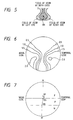
- Fig. 1 is a schematic plan view showing the divisions of regions of a progressive power lens designed symmetrically.
- the progressive power lens has, in the state with it worn by a user, an upper portion F for distant vision, a lower portion N for near vision and an intermediate portion P in which the refracting power is changed continuously between the upper and lower portions F and N.
- the intersecting curve MM' of the object-side lens surface and a cross section along a meridian line passing approximately the center of the lens surface vertically from top to bottom is used as a reference line for expressing specifications such as the additional power of the lens, and is also used as an important reference line in the lens design.
- a center OF for distant vision, an eye point E for distant vision and a center (eye point) ON for near vision are located on the center line MM' as the reference.
- asymmetrical type progressive power lens in which a portion N for near vision comes close to a nasal side when worn by a user, another progressive power lens has been proposed in which a portion N for near vision and an intermediate portion P are arranged asymmetrically (hereinafter referred to as an "asymmetrical type progressive power lens").
- a center line MM' consisting of the intersecting curve of an object-side lens surface and a cross section passing the center OF for distant vision, the eye point E for distant vision and the center ON for near vision is used as a reference line.
- these reference lines will be referred to as "principal meridional curves" hereinafter.
- the principal meridional curve MM' divides the lens surface symmetrically into a nasal side region and a temporal side region.
- the principal meridional curve MM' is displaced toward a nasal side in the intermediate portion P and the portion N for near vision.
- Fig. 3 shows an astigmatism distribution of a known symmetrical type progressive power lens.
- Isoastigmatic difference curves in Fig. 3 are curves formed by linking points which have astigmatisms of 0.50 diopter.
- An area including a principal meridional curve sandwiched by the isoastigmatic difference curves is a clear vision area.
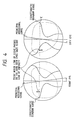
- the lenses are rotated by about 8° to 10°, as shown in Fig. 4, in consideration of the fact that both eyes are converged in accordance with movement of the line of sight from a distant view to a close-range view.
- the principal meridional curve MM' of the lens on the right eye side is inclined counterclockwide at the angle of about 8° to 10° with respect to the vertical direction in the worn condition while that of the lens on the left eye side is inclined clockwide at the same angle with respect to the same direction.
- the right and left eyes look the object through areas having different astigmatisms Therefore, for example, when both eyes look the right side at infinity, the left eye looks at there through an area having a larger astigmatism as compared to the right eye, so that the user feels uncomfortable.
- positions which the lines of sight of the right and left eyes pass are points A and B respectively.
- the points A and B are on a horizontal line C indicated by a broken line.
- the meridional lines MM' of the lenses on the right and left eye sides are inclined counterclockwise and clockwise respectively, so that the point A is located within the clear vision area while the point B is located outside that.
- the left eye looks at the object through the area having the larger astigmatism as compared to the right eye, it is preferable to lessen the astigmatic difference in that area.
- asymmetrical type progressive power lenses in which a principal meridional curve is displaced toward the nasal side in an intermediate portion and a portion for near vision to secure the symmetry of an aberration distribution in the horizontal direction in the worn state thereby to improve visual performance.
- Such asymmetrical type progressive power lenses are disclosed in, e.g., Japanese Patent Publication Nos. 47-9626, 2-39767 and 64-5682.
- the astigmatism distribution is symmetrical in the horizontal direction in the worn state, but lens refracting surfaces of portions for distant and near vision are spherical, so that it is impossible to widen the width of the clear vision area of an intermediate portion connecting the portions for distant and near vision smoothly.
- the astigmatic difference distribution is made symmetrical in the horizontal direction within 15 mm from the principal meridional curve respectively toward the left and right sides in an area where the principal meridional curve is displaced toward the nasal side. Accordingly, with respect to movement of the lines of sight at the time of looking at an object, the absolute values of the astigmatisms to the respective left and right eyes become approximately equal. However, the density of the astigmatisms becomes low on the temporal side region while it becomes high on the nasal side region. As a result, fluctuation and distortion of an image are felt much more in the side areas of the intermediate portion close to the clear vision area thereof where the density of the astigmatisms is highest.
- the astigmatisms at a pair of points spaced the same distance away in the horizontal or vertical direction from an arbitrary point on the principal meridional line are made approximately equal over the entire lens refracting surface.
- the widths of the clear vision areas of portions for distant and near vision are made large, the width of the clear vision area of an intermediate portion is narrowed and the value of the maximum astigmatism is enlarged.
- visual performance is secured to some extent but is not yet sufficient for practical use.
- EP-O 425 802 A3 discloses a progressive power lens with a far vision portion and a near vision portion and an intermediate zone located between the far vision and near vision portion.
- the principal meridional curve passing through the center for distant vision, the geometric center and the center for near vision is displaced toward the nasal side in the intermediate portion and the portion for near vision.
- the astigmatisms at a pair of points spaced the same distance away in the horizontal or vertical direction from an arbitrary point on the principal meridional line are made approximately equal over the entire lens refracting surface so that such a lens encounters the same problems as described above.
- a progressive power lens of the present invention has the features of claim 1. near vision.
- the astigmatism distribution in the horizontal direction in the worn state is asymmetrical with respect to the principal meridional curve in the section F for distant vision. More specifically, the astigmatism distribution in either the portion N for near vision or the portion F or distant vision is sparse in the temporal side region rather than in the nasal side region and a clear vision area in either the section N for near vision or the section F for distant vision is wider in the temporal side region than in the nasal side region.
- the present invention is for the purpose of finding an optimum distribution of astigmatisms on a refracting surface and achieving optimum aberration balance over the entire refracting surface, in a progressive power lens having, along principal meridional curve dividing a lens refracting surface into a nasal side region and a temporal side region, a portion F for distant vision having a refracting power corresponding to a distant view, a portion N for near vision having a refracting power corresponding to a near view and an intermediate portion P, located between the portion for distant vision and the portion for near vision, for continuously connecting the refracting powers of the portions for distant and near vision, as shown in Fig. 2.
- the optimum astigmatism distribution is symmetrical with respect to the principal meridional curve in the intermediate portion P and asymmetrical with respect to the principal meridional curve in the portion N for near vision. Further, it is preferable to make the astigmatism distribution in the section N for near vision and the section F for distant vision sparse on the temporal side rather than on the nasal side.
- an intermediate portion P and a portion N for near vision are asymmetrical with respect to a principal meridional curve and as is apparent from Fig. 2, the respective areas thereof on the nasal side are different from those on the temporal side.
- the astigmatic differences are structured to be symmetrical in the horizontal direction in the section N for near vision, i.e., the astigmatism distributions of the respective nasal and temporal side regions are made to be approximately symmetrical with respect to the principal meridional curve, more than permissible astigmatism is imparted to the temporal side region, so that the width of the clear vision area is limited considerably.
- Man's field of view is larger on the temporal side than on the nasal side. Therefore, when the clear vision area on the temporal side is designed to be large, it is possible to obtain a wider field of view by both eyes formed by overlapping a field of view by the left eye with a field of view by the right eye when looking at a near view.
- the portion N for near vision of the asymmetrical type progressive power lens since the area of the temporal side region is larger than that of the nasal side region, it is easy to widen the clear vision area on the temporal side as well as to make the astigmatism distribution sparse on the temporal side.
- the astigmatism distribution is most dense in side areas of the intermediate portion P close to the clear vision area thereof. That is, there is a limitation on the width of the clear vision area of the intermediate portion P.
- the fact that the lens aberrations are concentrated on the side areas of the progressive power range (i.e., the intermediate portion P) of the progressive power lens is an unavoidable characteristic of the progressive power lens. Therefore, the subject of how to improve visual performance of the progressive power lens depends on to how to structure the lens aberration distribution in these areas where aberrations tend to be concentrated.
- the left and right eyes When looking an object through the intermediate portion P with both eyes, it is preferable for the left and right eyes to use an area along the center of the clear vision area, i.e., an area along the principal meridional curve.
- an area along the center of the clear vision area i.e., an area along the principal meridional curve.
- it is effective to make the densities of the astigmatism distributions in both side areas of the intermediate portion P symmetrical with respect to the principal meridional curve and low and to reduce the value of the maximum astigmatism as small as possible.
- the horizontal symmetry of the astigmatism distribution in the intermediate portion P For keeping the horizontal symmetry of the astigmatism distribution in the intermediate portion P, the asymmetry of the astigmatism distribution in the horizontal direction in the portion F for distant vision occurs inevitably.
- the horizontal symmetry of the astigmatism distribution in the section F for distant vision is effective only at the time when looking at a distant view at infinity with both eyes.
- the objects When looking at objects with both eyes in daily life, the objects are usually located not at infinity but at limited distances. Therefore, when in an area in the vicinity of the eye point E for distant vision, the clear vision area on the temporal side is made wider than that on the nasal side in a similar manner to the portion N for near vision, the field of view by both eyes can be enlarged.
- the clear vision area can be widened in the vicinity of the eye point for near vision (the center ON of the portion for near vision) and especially on the temporal side.
- the field of view by both eyes with respect to near views can be enlarged as shown in Fig. 5 and the concentration of the astigmatisms in the side areas can be mitigated.
- the value of the maximum astigmatism can be reduced and the gradient of the astigmatims can be made gentle while the clear vision area in the vicinity of the eye point for near vision is widened.
- the gradient of the astigmatisms in the horizontal direction can be made gentle and the width of the clear vision area can be widened.
- the astigmatism distribution of the refracting surface is asymmetrical so as to make the clear vision area wider on the temporal side. Therefore, the clear vision area around the eye point E for distant vision is kept sufficiently wide and it is possible to realize a shape of a refracting surface such that the connection between the portion F for distant vision and the intermediate portion P is made smoothly.
- the wider clear vision area can be obtained in looking at an object with both eyes, yet the fluctuation and distortion of an image in the side areas can be limited to a minimum level.
- the value of the maximum astigmatism is 2.5 diopter or more.
- the value of the maximum astigmatism is reduced to be 2.0 diopter.
- the width of the clear vision area of the intermediate portion P is large.
- the maximum difference of the absolute values of the astigmatisms of points spaced away the same distance from the principal meridional curve in the horizontal direction is 0.13 diopter. This value is sufficiently small and then it can be said that the astigmatism distribution is approximately symmetrical with respect to the principal meridional curve.
- the value of the maximum astigmatism is approximately 2.5 diopter in the conventional progressive power lens, as mentioned above, but it is limited to approximately 2.0 diopter in the asymmetrical type progressive power lens of this embodiment.
- the present invention is described by the asymmetrical progressive power lens whose principal meridional curve MM' is linear, as shown in Fig. 2, the present invention is applicable to an asymmetrical progressive power lens whose principal meridional curve MM' is curved toward the nasal side in the shape of a letter S, as shown in Fig. 7.
- the clear vision area of the portion for distant vision is made sufficiently wide for practical use
- the clear vision areas of the intermediate portion and the portion for near vision can be made wide and stable and the fluctuation and distortion of an image can be reduced in the side areas.
- the asymmetrical type progressive power lens with preferable aberration balance can be realized.
Landscapes
- Health & Medical Sciences (AREA)
- Ophthalmology & Optometry (AREA)
- Physics & Mathematics (AREA)
- General Health & Medical Sciences (AREA)
- General Physics & Mathematics (AREA)
- Optics & Photonics (AREA)
- Eyeglasses (AREA)
Claims (6)
- Linse mit progressiver Brechkraft, entlang eines Hauptmeridians (MM'), der eine brechende Fläche der Linse in eine nasalseitige Zone und eine temporalseitige Zone unterteilt, aufweisend: einen Fernteil (F) mit einer Fernsicht entsprechenden Brechkraft, einem Nahteil (N) mit einer Nahsicht entsprechenden Brechkraft und einem Zwischenteil (P), der sich zwischen den beiden Teilen (F, N) befindet, um die Brechkräfte dieser Teile (F, N) kontinuierlich zu verbinden, wobei der Hauptmeridian (MM') durch das geometrische Zentrum (OG), die Mitte des Fernteils (OF) und die Mitte des Nahteils (ON) der Linse verläuft, und wobei die Mitte des Nahteils (ON) nasalseitig gegenüber dem Hauptmeridian (MM') in dem Fernteil (F) versetzt ist,
dadurch gekennzeichnet, dass die Astigmatismusverteilung in im getragenen Zustand der Linse in horizontaler Richtung angenähert symmetrisch bezüglich des Hauptmeridians (MM') im Zwischenteil (P) und asymmetrisch bezüglich des Hauptmeridians (MM') im Nahteil (N) ist, wobei angenähert symmetrisch bedeutet, dass die maximale Differenz des absoluten Astigmatismus von gegenüber dem Meridian um gleiche Strecke beabstandeten Punkten in horizontaler Richtung mit 0,13 Dpt beträgt. - Linse nach Anspruch 1, bei der
die Teile des Hauptmeridians im Nahteil (N) und im Zwischenteil (P) unterschiedlich geneigt sind. - Linse nach Anspruch 1, bei der
die Bereiche des Hauptmeridians im Nahteil (N) und im Zwischenteil (P) sich in dieselbe Richtung erstrecken. - Linse nach einem der vorhergehenden Ansprüche, bei der
eine Klarsichtzone des Nahteils (N) auf der temporalen Seite breiter als auf der nasalen Seite ist, wobei eine Klarsichtzone ein Bereich ist, der den Hauptmeridian eingefaßt von den Isoastigmatismuskurven von 0,5 Dpt enthält. - Linse nach einem der vorhergehenden Ansprüche, bei der
die Astigmatismusverteilung bezüglich des Hauptmeridians (MM') im Fernteil (F) asymmetrisch ist. - Linse nach einem der vorhergehenden Ansprüche, bei der
eine Klarsichtzone im Fernteil (F) auf der temporalen Seite breiter als auf der nasalen Seite ist, wobei eine Klarsichtzone ein Bereich ist, der den von den Isoastigmatiskurven von 0,5 Dpteingefaßten Hauptmeridian enthält.
Applications Claiming Priority (3)
| Application Number | Priority Date | Filing Date | Title |
|---|---|---|---|
| JP184411/93 | 1993-06-29 | ||
| JP18441193 | 1993-06-29 | ||
| JP18441193A JP3381314B2 (ja) | 1993-06-29 | 1993-06-29 | 累進焦点レンズ |
Publications (2)
| Publication Number | Publication Date |
|---|---|
| EP0632307A1 EP0632307A1 (de) | 1995-01-04 |
| EP0632307B1 true EP0632307B1 (de) | 2001-09-12 |
Family
ID=16152703
Family Applications (1)
| Application Number | Title | Priority Date | Filing Date |
|---|---|---|---|
| EP94109792A Expired - Lifetime EP0632307B1 (de) | 1993-06-29 | 1994-06-24 | Linse mit progressiver Brechkraft |
Country Status (4)
| Country | Link |
|---|---|
| US (1) | US5666184A (de) |
| EP (1) | EP0632307B1 (de) |
| JP (1) | JP3381314B2 (de) |
| DE (1) | DE69428235T2 (de) |
Families Citing this family (11)
| Publication number | Priority date | Publication date | Assignee | Title |
|---|---|---|---|---|
| DE69535835D1 (de) * | 1994-10-21 | 2008-10-23 | Carl Zeiss Vision Au Holding | Verbesserter augen-korrekturlinsen-rohling |
| JP3196880B2 (ja) * | 1995-09-22 | 2001-08-06 | ホーヤ株式会社 | 累進多焦点レンズ |
| EP1835328B1 (de) * | 1996-04-04 | 2012-10-17 | Carl Zeiss Vision Australia Holdings Ltd. | Gleitsichtglaselemente und Verfahren zu ihrer Entwicklung und Verwendung |
| DE69836738T2 (de) * | 1998-10-16 | 2007-10-04 | Essilor International | Methode zur Herstellung eines Paars von multifokalen progressiven Brillenlinsen |
| JP4335488B2 (ja) * | 1999-12-22 | 2009-09-30 | エシロール アンテルナショナル | 多焦点プログレッシブ眼鏡レンズ対 |
| US8256895B2 (en) * | 2008-02-20 | 2012-09-04 | Swissphonics Sa | Progressive multifocal ophthalmic lenses identically optimized over a wide range of refractive indices, base curves, and additions |
| US8534834B2 (en) * | 2008-09-30 | 2013-09-17 | Hoya Corporation | Progressive power lens, method of designing progressive power lens and method of evaluating progressive power lens |
| JP2011203705A (ja) * | 2010-03-01 | 2011-10-13 | Seiko Epson Corp | 眼鏡レンズ及びその設計方法 |
| US9028063B2 (en) * | 2011-08-26 | 2015-05-12 | Johnson & Johnson Vision Care, Inc. | Translating presbyopic contact lens pair |
| AU2013283264B2 (en) * | 2012-06-29 | 2017-07-20 | Essilor International | Ophthalmic lenses taking into account the wearer's handedness |
| WO2014001491A1 (en) * | 2012-06-29 | 2014-01-03 | Essilor International (Compagnie Generale D'optique) | A process for determining a pair of progressive ophthalmic lenses |
Family Cites Families (9)
| Publication number | Priority date | Publication date | Assignee | Title |
|---|---|---|---|---|
| FR1509090A (fr) * | 1966-11-29 | 1968-01-12 | Lunetiers Cottet Poichet Soc D | Perfectionnements aux lentilles ophtalmiques à puissance focale progressivement variable |
| DE3016935C2 (de) * | 1980-05-02 | 1991-01-24 | Fa. Carl Zeiss, 7920 Heidenheim | Multifokale Brillenlinse mit gebietsweise gleitendem Brechwert |
| JPS57210320A (en) * | 1981-06-19 | 1982-12-23 | Hoya Corp | Progressive focus lens |
| JPH0690368B2 (ja) * | 1985-07-09 | 1994-11-14 | セイコーエプソン株式会社 | 累進多焦点レンズ及び眼鏡 |
| JPS645682A (en) * | 1987-06-30 | 1989-01-10 | Toshiba Corp | Press fitting equipment |
| JP2573956B2 (ja) * | 1987-07-31 | 1997-01-22 | ホ−ヤ株式会社 | 累進多焦点レンズ |
| JPH0239767A (ja) * | 1988-07-29 | 1990-02-08 | Canon Inc | 画像編集装置 |
| DE4012609A1 (de) * | 1990-04-19 | 1991-10-24 | Zeiss Carl Fa | Gleitsichtflaeche fuer eine gleitsichtbrillenlinse |
| FR2683642B1 (fr) * | 1991-11-12 | 1994-01-14 | Essilor Internal Cie Gle Optique | Lentille ophtalmique multifocale progressive. |
-
1993
- 1993-06-29 JP JP18441193A patent/JP3381314B2/ja not_active Expired - Lifetime
-
1994
- 1994-06-20 US US08/262,486 patent/US5666184A/en not_active Expired - Lifetime
- 1994-06-24 EP EP94109792A patent/EP0632307B1/de not_active Expired - Lifetime
- 1994-06-24 DE DE69428235T patent/DE69428235T2/de not_active Expired - Lifetime
Also Published As
| Publication number | Publication date |
|---|---|
| US5666184A (en) | 1997-09-09 |
| DE69428235D1 (de) | 2001-10-18 |
| EP0632307A1 (de) | 1995-01-04 |
| JP3381314B2 (ja) | 2003-02-24 |
| JPH0720410A (ja) | 1995-01-24 |
| DE69428235T2 (de) | 2002-05-16 |
Similar Documents
| Publication | Publication Date | Title |
|---|---|---|
| US5812238A (en) | Progressive multifocal ophthalmic lens pair | |
| US5488442A (en) | Progressive multifocal ophthalmic lens | |
| JPH0690368B2 (ja) | 累進多焦点レンズ及び眼鏡 | |
| US5864380A (en) | Progressive power lens | |
| EP0702257B1 (de) | Progressive, Presbyopie-korrigierende Brillengläser | |
| EP0632307B1 (de) | Linse mit progressiver Brechkraft | |
| US5784144A (en) | Multifocal spectacle lens | |
| EP1158337B1 (de) | Multifokal-Linse mit progressiver Brechkraft | |
| US5048945A (en) | Progressive power lens | |
| US7048376B2 (en) | Progressive addition power lens | |
| US5506630A (en) | Progressive multifocal lens | |
| US6074061A (en) | Progressive focal lens for eyeglasses | |
| JP3674992B2 (ja) | 累進焦点レンズ | |
| EP0627645A2 (de) | Progressive Multifokallinse | |
| US5523807A (en) | Progressive multifocal lens | |
| JP2503665B2 (ja) | 累進焦点レンズ | |
| JP4450480B2 (ja) | 累進多焦点レンズシリーズ | |
| JP3033110B2 (ja) | 眼鏡用累進焦点レンズ | |
| JP2503664B2 (ja) | 累進焦点レンズ | |
| JP2580683B2 (ja) | 累進多焦点レンズ | |
| JPS63223724A (ja) | 累進多焦点レンズ | |
| JP2503665C (de) |
Legal Events
| Date | Code | Title | Description |
|---|---|---|---|
| PUAI | Public reference made under article 153(3) epc to a published international application that has entered the european phase |
Free format text: ORIGINAL CODE: 0009012 |
|
| AK | Designated contracting states |
Kind code of ref document: A1 Designated state(s): DE FR |
|
| 17P | Request for examination filed |
Effective date: 19950614 |
|
| 17Q | First examination report despatched |
Effective date: 19971204 |
|
| GRAG | Despatch of communication of intention to grant |
Free format text: ORIGINAL CODE: EPIDOS AGRA |
|
| GRAG | Despatch of communication of intention to grant |
Free format text: ORIGINAL CODE: EPIDOS AGRA |
|
| GRAG | Despatch of communication of intention to grant |
Free format text: ORIGINAL CODE: EPIDOS AGRA |
|
| GRAH | Despatch of communication of intention to grant a patent |
Free format text: ORIGINAL CODE: EPIDOS IGRA |
|
| GRAH | Despatch of communication of intention to grant a patent |
Free format text: ORIGINAL CODE: EPIDOS IGRA |
|
| GRAA | (expected) grant |
Free format text: ORIGINAL CODE: 0009210 |
|
| AK | Designated contracting states |
Kind code of ref document: B1 Designated state(s): DE FR |
|
| REF | Corresponds to: |
Ref document number: 69428235 Country of ref document: DE Date of ref document: 20011018 |
|
| ET | Fr: translation filed | ||
| PLBE | No opposition filed within time limit |
Free format text: ORIGINAL CODE: 0009261 |
|
| STAA | Information on the status of an ep patent application or granted ep patent |
Free format text: STATUS: NO OPPOSITION FILED WITHIN TIME LIMIT |
|
| 26N | No opposition filed | ||
| PGFP | Annual fee paid to national office [announced via postgrant information from national office to epo] |
Ref country code: DE Payment date: 20130619 Year of fee payment: 20 |
|
| PGFP | Annual fee paid to national office [announced via postgrant information from national office to epo] |
Ref country code: FR Payment date: 20130624 Year of fee payment: 20 |
|
| REG | Reference to a national code |
Ref country code: DE Ref legal event code: R071 Ref document number: 69428235 Country of ref document: DE |
|
| PG25 | Lapsed in a contracting state [announced via postgrant information from national office to epo] |
Ref country code: DE Free format text: LAPSE BECAUSE OF EXPIRATION OF PROTECTION Effective date: 20140625 |