EP0625914B1 - A dressing - Google Patents
A dressing Download PDFInfo
- Publication number
- EP0625914B1 EP0625914B1 EP93903178A EP93903178A EP0625914B1 EP 0625914 B1 EP0625914 B1 EP 0625914B1 EP 93903178 A EP93903178 A EP 93903178A EP 93903178 A EP93903178 A EP 93903178A EP 0625914 B1 EP0625914 B1 EP 0625914B1
- Authority
- EP
- European Patent Office
- Prior art keywords
- adhesive
- film layer
- layer
- film
- dressing
- Prior art date
- Legal status (The legal status is an assumption and is not a legal conclusion. Google has not performed a legal analysis and makes no representation as to the accuracy of the status listed.)
- Expired - Lifetime
Links
- 239000010410 layer Substances 0.000 claims abstract description 135
- 230000001070 adhesive effect Effects 0.000 claims abstract description 47
- 239000000853 adhesive Substances 0.000 claims abstract description 46
- 239000012790 adhesive layer Substances 0.000 claims abstract description 32
- 229920006254 polymer film Polymers 0.000 claims abstract description 12
- 229920005570 flexible polymer Polymers 0.000 claims abstract description 4
- XLYOFNOQVPJJNP-UHFFFAOYSA-N water Substances O XLYOFNOQVPJJNP-UHFFFAOYSA-N 0.000 claims description 34
- 230000035699 permeability Effects 0.000 claims description 22
- 239000004814 polyurethane Substances 0.000 claims description 20
- 229920002635 polyurethane Polymers 0.000 claims description 19
- 239000000416 hydrocolloid Substances 0.000 claims description 13
- RTZKZFJDLAIYFH-UHFFFAOYSA-N Diethyl ether Chemical compound CCOCC RTZKZFJDLAIYFH-UHFFFAOYSA-N 0.000 claims description 12
- VYPSYNLAJGMNEJ-UHFFFAOYSA-N Silicium dioxide Chemical compound O=[Si]=O VYPSYNLAJGMNEJ-UHFFFAOYSA-N 0.000 claims description 12
- 239000000203 mixture Substances 0.000 claims description 12
- 239000007788 liquid Substances 0.000 claims description 10
- 244000043261 Hevea brasiliensis Species 0.000 claims description 9
- 239000000017 hydrogel Substances 0.000 claims description 9
- 229920003052 natural elastomer Polymers 0.000 claims description 9
- 229920001194 natural rubber Polymers 0.000 claims description 9
- 239000004014 plasticizer Substances 0.000 claims description 9
- 229920001634 Copolyester Polymers 0.000 claims description 6
- 239000002998 adhesive polymer Substances 0.000 claims description 6
- 229910052681 coesite Inorganic materials 0.000 claims description 6
- 229910052906 cristobalite Inorganic materials 0.000 claims description 6
- 239000000377 silicon dioxide Substances 0.000 claims description 6
- 229910052682 stishovite Inorganic materials 0.000 claims description 6
- 229920003051 synthetic elastomer Polymers 0.000 claims description 6
- 229910052905 tridymite Inorganic materials 0.000 claims description 6
- 125000003118 aryl group Chemical group 0.000 claims description 4
- 239000000945 filler Substances 0.000 claims description 4
- 229920000728 polyester Polymers 0.000 claims description 4
- ZFMQKOWCDKKBIF-UHFFFAOYSA-N bis(3,5-difluorophenyl)phosphane Chemical compound FC1=CC(F)=CC(PC=2C=C(F)C=C(F)C=2)=C1 ZFMQKOWCDKKBIF-UHFFFAOYSA-N 0.000 claims description 3
- 239000004721 Polyphenylene oxide Substances 0.000 claims description 2
- 239000003795 chemical substances by application Substances 0.000 claims description 2
- 229920000570 polyether Polymers 0.000 claims description 2
- 239000013536 elastomeric material Substances 0.000 claims 2
- 239000000463 material Substances 0.000 abstract description 44
- 239000010408 film Substances 0.000 description 102
- 239000006260 foam Substances 0.000 description 28
- 239000002313 adhesive film Substances 0.000 description 19
- 229920001971 elastomer Polymers 0.000 description 12
- 238000012360 testing method Methods 0.000 description 12
- 229920000642 polymer Polymers 0.000 description 11
- 239000000806 elastomer Substances 0.000 description 10
- 239000012876 carrier material Substances 0.000 description 9
- -1 colagen Polymers 0.000 description 9
- 239000011505 plaster Substances 0.000 description 8
- 206010052428 Wound Diseases 0.000 description 7
- 208000027418 Wounds and injury Diseases 0.000 description 7
- 239000000654 additive Substances 0.000 description 7
- 239000002861 polymer material Substances 0.000 description 6
- 238000011282 treatment Methods 0.000 description 6
- 239000004820 Pressure-sensitive adhesive Substances 0.000 description 5
- 238000001035 drying Methods 0.000 description 5
- 238000005259 measurement Methods 0.000 description 5
- 239000008186 active pharmaceutical agent Substances 0.000 description 4
- 238000000034 method Methods 0.000 description 4
- 229920000058 polyacrylate Polymers 0.000 description 4
- 239000004372 Polyvinyl alcohol Substances 0.000 description 3
- 239000003963 antioxidant agent Substances 0.000 description 3
- 230000003078 antioxidant effect Effects 0.000 description 3
- 230000003247 decreasing effect Effects 0.000 description 3
- 229920001296 polysiloxane Polymers 0.000 description 3
- 229920002451 polyvinyl alcohol Polymers 0.000 description 3
- 229920006395 saturated elastomer Polymers 0.000 description 3
- 239000007779 soft material Substances 0.000 description 3
- 239000000057 synthetic resin Substances 0.000 description 3
- SNICXCGAKADSCV-JTQLQIEISA-N (-)-Nicotine Chemical compound CN1CCC[C@H]1C1=CC=CN=C1 SNICXCGAKADSCV-JTQLQIEISA-N 0.000 description 2
- GRWFGVWFFZKLTI-IUCAKERBSA-N (-)-α-pinene Chemical compound CC1=CC[C@@H]2C(C)(C)[C@H]1C2 GRWFGVWFFZKLTI-IUCAKERBSA-N 0.000 description 2
- 241000894006 Bacteria Species 0.000 description 2
- 239000004606 Fillers/Extenders Substances 0.000 description 2
- 239000004952 Polyamide Substances 0.000 description 2
- 239000005062 Polybutadiene Substances 0.000 description 2
- 239000004698 Polyethylene Substances 0.000 description 2
- 229920002367 Polyisobutene Polymers 0.000 description 2
- 239000004743 Polypropylene Substances 0.000 description 2
- 239000004793 Polystyrene Substances 0.000 description 2
- 229920001328 Polyvinylidene chloride Polymers 0.000 description 2
- 229920001577 copolymer Polymers 0.000 description 2
- ZSWFCLXCOIISFI-UHFFFAOYSA-N cyclopentadiene Chemical compound C1C=CC=C1 ZSWFCLXCOIISFI-UHFFFAOYSA-N 0.000 description 2
- 230000001419 dependent effect Effects 0.000 description 2
- 239000003814 drug Substances 0.000 description 2
- 150000002148 esters Chemical class 0.000 description 2
- 239000005038 ethylene vinyl acetate Substances 0.000 description 2
- 239000006261 foam material Substances 0.000 description 2
- 238000010438 heat treatment Methods 0.000 description 2
- 239000005556 hormone Substances 0.000 description 2
- 229940088597 hormone Drugs 0.000 description 2
- 210000003127 knee Anatomy 0.000 description 2
- 238000004519 manufacturing process Methods 0.000 description 2
- 239000011159 matrix material Substances 0.000 description 2
- 239000000025 natural resin Substances 0.000 description 2
- 229960002715 nicotine Drugs 0.000 description 2
- SNICXCGAKADSCV-UHFFFAOYSA-N nicotine Natural products CN1CCCC1C1=CC=CN=C1 SNICXCGAKADSCV-UHFFFAOYSA-N 0.000 description 2
- 229920001200 poly(ethylene-vinyl acetate) Polymers 0.000 description 2
- 229920002492 poly(sulfone) Polymers 0.000 description 2
- 229920002647 polyamide Polymers 0.000 description 2
- 229920002857 polybutadiene Polymers 0.000 description 2
- 229920000515 polycarbonate Polymers 0.000 description 2
- 239000004417 polycarbonate Substances 0.000 description 2
- 229920000573 polyethylene Polymers 0.000 description 2
- 229920001155 polypropylene Polymers 0.000 description 2
- 229920002223 polystyrene Polymers 0.000 description 2
- 229920000915 polyvinyl chloride Polymers 0.000 description 2
- 239000004800 polyvinyl chloride Substances 0.000 description 2
- 229920001289 polyvinyl ether Polymers 0.000 description 2
- 229920002620 polyvinyl fluoride Polymers 0.000 description 2
- 239000005033 polyvinylidene chloride Substances 0.000 description 2
- 230000008569 process Effects 0.000 description 2
- 238000004080 punching Methods 0.000 description 2
- 229920005989 resin Polymers 0.000 description 2
- 239000011347 resin Substances 0.000 description 2
- 239000005060 rubber Substances 0.000 description 2
- 239000002904 solvent Substances 0.000 description 2
- 229920003002 synthetic resin Polymers 0.000 description 2
- WTARULDDTDQWMU-RKDXNWHRSA-N (+)-β-pinene Chemical compound C1[C@H]2C(C)(C)[C@@H]1CCC2=C WTARULDDTDQWMU-RKDXNWHRSA-N 0.000 description 1
- WTARULDDTDQWMU-IUCAKERBSA-N (-)-Nopinene Natural products C1[C@@H]2C(C)(C)[C@H]1CCC2=C WTARULDDTDQWMU-IUCAKERBSA-N 0.000 description 1
- DNIAPMSPPWPWGF-GSVOUGTGSA-N (R)-(-)-Propylene glycol Chemical compound C[C@@H](O)CO DNIAPMSPPWPWGF-GSVOUGTGSA-N 0.000 description 1
- HECLRDQVFMWTQS-RGOKHQFPSA-N 1755-01-7 Chemical compound C1[C@H]2[C@@H]3CC=C[C@@H]3[C@@H]1C=C2 HECLRDQVFMWTQS-RGOKHQFPSA-N 0.000 description 1
- 239000004215 Carbon black (E152) Substances 0.000 description 1
- 239000001828 Gelatine Substances 0.000 description 1
- 239000002202 Polyethylene glycol Substances 0.000 description 1
- WTARULDDTDQWMU-UHFFFAOYSA-N Pseudopinene Natural products C1C2C(C)(C)C1CCC2=C WTARULDDTDQWMU-UHFFFAOYSA-N 0.000 description 1
- 206010038743 Restlessness Diseases 0.000 description 1
- 229920002472 Starch Polymers 0.000 description 1
- PPBRXRYQALVLMV-UHFFFAOYSA-N Styrene Natural products C=CC1=CC=CC=C1 PPBRXRYQALVLMV-UHFFFAOYSA-N 0.000 description 1
- 208000002847 Surgical Wound Diseases 0.000 description 1
- 239000004809 Teflon Substances 0.000 description 1
- 229920006362 Teflon® Polymers 0.000 description 1
- 150000001252 acrylic acid derivatives Chemical class 0.000 description 1
- 230000009471 action Effects 0.000 description 1
- 239000004840 adhesive resin Substances 0.000 description 1
- 229920006223 adhesive resin Polymers 0.000 description 1
- 150000001298 alcohols Chemical class 0.000 description 1
- XCPQUQHBVVXMRQ-UHFFFAOYSA-N alpha-Fenchene Natural products C1CC2C(=C)CC1C2(C)C XCPQUQHBVVXMRQ-UHFFFAOYSA-N 0.000 description 1
- MVNCAPSFBDBCGF-UHFFFAOYSA-N alpha-pinene Natural products CC1=CCC23C1CC2C3(C)C MVNCAPSFBDBCGF-UHFFFAOYSA-N 0.000 description 1
- 230000002421 anti-septic effect Effects 0.000 description 1
- 229940064004 antiseptic throat preparations Drugs 0.000 description 1
- 229930006722 beta-pinene Natural products 0.000 description 1
- 150000001732 carboxylic acid derivatives Chemical class 0.000 description 1
- 239000001913 cellulose Substances 0.000 description 1
- 229920002678 cellulose Polymers 0.000 description 1
- 239000003638 chemical reducing agent Substances 0.000 description 1
- 239000011248 coating agent Substances 0.000 description 1
- 238000000576 coating method Methods 0.000 description 1
- 230000000052 comparative effect Effects 0.000 description 1
- 239000000470 constituent Substances 0.000 description 1
- 238000011109 contamination Methods 0.000 description 1
- 239000013039 cover film Substances 0.000 description 1
- 239000006071 cream Substances 0.000 description 1
- 229920006037 cross link polymer Polymers 0.000 description 1
- 238000011161 development Methods 0.000 description 1
- 238000011981 development test Methods 0.000 description 1
- 230000003292 diminished effect Effects 0.000 description 1
- 238000009826 distribution Methods 0.000 description 1
- 229940079593 drug Drugs 0.000 description 1
- 230000000694 effects Effects 0.000 description 1
- 229920005676 ethylene-propylene block copolymer Polymers 0.000 description 1
- 238000001125 extrusion Methods 0.000 description 1
- 239000004744 fabric Substances 0.000 description 1
- LCWMKIHBLJLORW-UHFFFAOYSA-N gamma-carene Natural products C1CC(=C)CC2C(C)(C)C21 LCWMKIHBLJLORW-UHFFFAOYSA-N 0.000 description 1
- 229920000159 gelatin Polymers 0.000 description 1
- 235000019322 gelatine Nutrition 0.000 description 1
- 239000011521 glass Substances 0.000 description 1
- 229920001519 homopolymer Polymers 0.000 description 1
- 239000012943 hotmelt Substances 0.000 description 1
- 229930195733 hydrocarbon Natural products 0.000 description 1
- 150000002430 hydrocarbons Chemical class 0.000 description 1
- 230000001771 impaired effect Effects 0.000 description 1
- 230000001788 irregular Effects 0.000 description 1
- 239000010985 leather Substances 0.000 description 1
- 238000002803 maceration Methods 0.000 description 1
- 239000002480 mineral oil Substances 0.000 description 1
- 239000004745 nonwoven fabric Substances 0.000 description 1
- 239000003921 oil Substances 0.000 description 1
- JRZJOMJEPLMPRA-UHFFFAOYSA-N olefin Natural products CCCCCCCC=C JRZJOMJEPLMPRA-UHFFFAOYSA-N 0.000 description 1
- 238000005457 optimization Methods 0.000 description 1
- 230000001151 other effect Effects 0.000 description 1
- 239000000049 pigment Substances 0.000 description 1
- 229920003023 plastic Polymers 0.000 description 1
- 239000004033 plastic Substances 0.000 description 1
- 229920001223 polyethylene glycol Polymers 0.000 description 1
- 229920001451 polypropylene glycol Polymers 0.000 description 1
- 230000001737 promoting effect Effects 0.000 description 1
- 238000011321 prophylaxis Methods 0.000 description 1
- GRWFGVWFFZKLTI-UHFFFAOYSA-N rac-alpha-Pinene Natural products CC1=CCC2C(C)(C)C1C2 GRWFGVWFFZKLTI-UHFFFAOYSA-N 0.000 description 1
- 230000009467 reduction Effects 0.000 description 1
- 229920002379 silicone rubber Polymers 0.000 description 1
- 238000003892 spreading Methods 0.000 description 1
- 230000007480 spreading Effects 0.000 description 1
- 239000008107 starch Substances 0.000 description 1
- 235000019698 starch Nutrition 0.000 description 1
- 229920006132 styrene block copolymer Polymers 0.000 description 1
- 239000000126 substance Substances 0.000 description 1
- 239000000454 talc Substances 0.000 description 1
- 229910052623 talc Inorganic materials 0.000 description 1
- 239000002562 thickening agent Substances 0.000 description 1
- 239000002759 woven fabric Substances 0.000 description 1
Images

Classifications
-
- A—HUMAN NECESSITIES
- A61—MEDICAL OR VETERINARY SCIENCE; HYGIENE
- A61L—METHODS OR APPARATUS FOR STERILISING MATERIALS OR OBJECTS IN GENERAL; DISINFECTION, STERILISATION OR DEODORISATION OF AIR; CHEMICAL ASPECTS OF BANDAGES, DRESSINGS, ABSORBENT PADS OR SURGICAL ARTICLES; MATERIALS FOR BANDAGES, DRESSINGS, ABSORBENT PADS OR SURGICAL ARTICLES
- A61L15/00—Chemical aspects of, or use of materials for, bandages, dressings or absorbent pads
- A61L15/16—Bandages, dressings or absorbent pads for physiological fluids such as urine or blood, e.g. sanitary towels, tampons
- A61L15/22—Bandages, dressings or absorbent pads for physiological fluids such as urine or blood, e.g. sanitary towels, tampons containing macromolecular materials
- A61L15/26—Macromolecular compounds obtained otherwise than by reactions only involving carbon-to-carbon unsaturated bonds; Derivatives thereof
-
- A—HUMAN NECESSITIES
- A61—MEDICAL OR VETERINARY SCIENCE; HYGIENE
- A61F—FILTERS IMPLANTABLE INTO BLOOD VESSELS; PROSTHESES; DEVICES PROVIDING PATENCY TO, OR PREVENTING COLLAPSING OF, TUBULAR STRUCTURES OF THE BODY, e.g. STENTS; ORTHOPAEDIC, NURSING OR CONTRACEPTIVE DEVICES; FOMENTATION; TREATMENT OR PROTECTION OF EYES OR EARS; BANDAGES, DRESSINGS OR ABSORBENT PADS; FIRST-AID KITS
- A61F13/00—Bandages or dressings; Absorbent pads
- A61F13/02—Adhesive bandages or dressings
- A61F13/0203—Adhesive bandages or dressings with fluid retention members
- A61F13/0206—Adhesive bandages or dressings with fluid retention members with absorbent fibrous layers, e.g. woven or non-woven absorbent pads or island dressings
- A61F13/0209—Adhesive bandages or dressings with fluid retention members with absorbent fibrous layers, e.g. woven or non-woven absorbent pads or island dressings comprising superabsorbent material
-
- A—HUMAN NECESSITIES
- A61—MEDICAL OR VETERINARY SCIENCE; HYGIENE
- A61F—FILTERS IMPLANTABLE INTO BLOOD VESSELS; PROSTHESES; DEVICES PROVIDING PATENCY TO, OR PREVENTING COLLAPSING OF, TUBULAR STRUCTURES OF THE BODY, e.g. STENTS; ORTHOPAEDIC, NURSING OR CONTRACEPTIVE DEVICES; FOMENTATION; TREATMENT OR PROTECTION OF EYES OR EARS; BANDAGES, DRESSINGS OR ABSORBENT PADS; FIRST-AID KITS
- A61F13/00—Bandages or dressings; Absorbent pads
- A61F13/02—Adhesive bandages or dressings
- A61F13/0203—Adhesive bandages or dressings with fluid retention members
- A61F13/0213—Adhesive bandages or dressings with fluid retention members the fluid retention member being a layer of hydrocolloid, gel forming material
-
- A—HUMAN NECESSITIES
- A61—MEDICAL OR VETERINARY SCIENCE; HYGIENE
- A61F—FILTERS IMPLANTABLE INTO BLOOD VESSELS; PROSTHESES; DEVICES PROVIDING PATENCY TO, OR PREVENTING COLLAPSING OF, TUBULAR STRUCTURES OF THE BODY, e.g. STENTS; ORTHOPAEDIC, NURSING OR CONTRACEPTIVE DEVICES; FOMENTATION; TREATMENT OR PROTECTION OF EYES OR EARS; BANDAGES, DRESSINGS OR ABSORBENT PADS; FIRST-AID KITS
- A61F13/00—Bandages or dressings; Absorbent pads
- A61F13/02—Adhesive bandages or dressings
- A61F13/0203—Adhesive bandages or dressings with fluid retention members
- A61F13/0223—Adhesive bandages or dressings with fluid retention members characterized by parametric properties of the fluid retention layer, e.g. absorbency, wicking capacity, liquid distribution
-
- A—HUMAN NECESSITIES
- A61—MEDICAL OR VETERINARY SCIENCE; HYGIENE
- A61F—FILTERS IMPLANTABLE INTO BLOOD VESSELS; PROSTHESES; DEVICES PROVIDING PATENCY TO, OR PREVENTING COLLAPSING OF, TUBULAR STRUCTURES OF THE BODY, e.g. STENTS; ORTHOPAEDIC, NURSING OR CONTRACEPTIVE DEVICES; FOMENTATION; TREATMENT OR PROTECTION OF EYES OR EARS; BANDAGES, DRESSINGS OR ABSORBENT PADS; FIRST-AID KITS
- A61F13/00—Bandages or dressings; Absorbent pads
- A61F13/02—Adhesive bandages or dressings
- A61F13/023—Adhesive bandages or dressings wound covering film layers without a fluid retention layer
-
- A—HUMAN NECESSITIES
- A61—MEDICAL OR VETERINARY SCIENCE; HYGIENE
- A61F—FILTERS IMPLANTABLE INTO BLOOD VESSELS; PROSTHESES; DEVICES PROVIDING PATENCY TO, OR PREVENTING COLLAPSING OF, TUBULAR STRUCTURES OF THE BODY, e.g. STENTS; ORTHOPAEDIC, NURSING OR CONTRACEPTIVE DEVICES; FOMENTATION; TREATMENT OR PROTECTION OF EYES OR EARS; BANDAGES, DRESSINGS OR ABSORBENT PADS; FIRST-AID KITS
- A61F13/00—Bandages or dressings; Absorbent pads
- A61F13/02—Adhesive bandages or dressings
- A61F13/0246—Adhesive bandages or dressings characterised by the skin-adhering layer
- A61F13/0256—Adhesive bandages or dressings characterised by the skin-adhering layer characterized by the parametric properties of the adhesive
-
- A—HUMAN NECESSITIES
- A61—MEDICAL OR VETERINARY SCIENCE; HYGIENE
- A61F—FILTERS IMPLANTABLE INTO BLOOD VESSELS; PROSTHESES; DEVICES PROVIDING PATENCY TO, OR PREVENTING COLLAPSING OF, TUBULAR STRUCTURES OF THE BODY, e.g. STENTS; ORTHOPAEDIC, NURSING OR CONTRACEPTIVE DEVICES; FOMENTATION; TREATMENT OR PROTECTION OF EYES OR EARS; BANDAGES, DRESSINGS OR ABSORBENT PADS; FIRST-AID KITS
- A61F13/00—Bandages or dressings; Absorbent pads
- A61F13/02—Adhesive bandages or dressings
- A61F13/0259—Adhesive bandages or dressings characterised by the release liner covering the skin adhering layer
-
- A—HUMAN NECESSITIES
- A61—MEDICAL OR VETERINARY SCIENCE; HYGIENE
- A61L—METHODS OR APPARATUS FOR STERILISING MATERIALS OR OBJECTS IN GENERAL; DISINFECTION, STERILISATION OR DEODORISATION OF AIR; CHEMICAL ASPECTS OF BANDAGES, DRESSINGS, ABSORBENT PADS OR SURGICAL ARTICLES; MATERIALS FOR BANDAGES, DRESSINGS, ABSORBENT PADS OR SURGICAL ARTICLES
- A61L15/00—Chemical aspects of, or use of materials for, bandages, dressings or absorbent pads
- A61L15/16—Bandages, dressings or absorbent pads for physiological fluids such as urine or blood, e.g. sanitary towels, tampons
- A61L15/22—Bandages, dressings or absorbent pads for physiological fluids such as urine or blood, e.g. sanitary towels, tampons containing macromolecular materials
- A61L15/24—Macromolecular compounds obtained by reactions only involving carbon-to-carbon unsaturated bonds; Derivatives thereof
-
- A—HUMAN NECESSITIES
- A61—MEDICAL OR VETERINARY SCIENCE; HYGIENE
- A61L—METHODS OR APPARATUS FOR STERILISING MATERIALS OR OBJECTS IN GENERAL; DISINFECTION, STERILISATION OR DEODORISATION OF AIR; CHEMICAL ASPECTS OF BANDAGES, DRESSINGS, ABSORBENT PADS OR SURGICAL ARTICLES; MATERIALS FOR BANDAGES, DRESSINGS, ABSORBENT PADS OR SURGICAL ARTICLES
- A61L15/00—Chemical aspects of, or use of materials for, bandages, dressings or absorbent pads
- A61L15/16—Bandages, dressings or absorbent pads for physiological fluids such as urine or blood, e.g. sanitary towels, tampons
- A61L15/42—Use of materials characterised by their function or physical properties
- A61L15/58—Adhesives
-
- A—HUMAN NECESSITIES
- A61—MEDICAL OR VETERINARY SCIENCE; HYGIENE
- A61F—FILTERS IMPLANTABLE INTO BLOOD VESSELS; PROSTHESES; DEVICES PROVIDING PATENCY TO, OR PREVENTING COLLAPSING OF, TUBULAR STRUCTURES OF THE BODY, e.g. STENTS; ORTHOPAEDIC, NURSING OR CONTRACEPTIVE DEVICES; FOMENTATION; TREATMENT OR PROTECTION OF EYES OR EARS; BANDAGES, DRESSINGS OR ABSORBENT PADS; FIRST-AID KITS
- A61F13/00—Bandages or dressings; Absorbent pads
- A61F2013/00361—Plasters
- A61F2013/00544—Plasters form or structure
- A61F2013/00574—Plasters form or structure shaped as a body part
- A61F2013/00578—Plasters form or structure shaped as a body part conformable; soft or flexible, e.g. elastomeric
-
- A—HUMAN NECESSITIES
- A61—MEDICAL OR VETERINARY SCIENCE; HYGIENE
- A61F—FILTERS IMPLANTABLE INTO BLOOD VESSELS; PROSTHESES; DEVICES PROVIDING PATENCY TO, OR PREVENTING COLLAPSING OF, TUBULAR STRUCTURES OF THE BODY, e.g. STENTS; ORTHOPAEDIC, NURSING OR CONTRACEPTIVE DEVICES; FOMENTATION; TREATMENT OR PROTECTION OF EYES OR EARS; BANDAGES, DRESSINGS OR ABSORBENT PADS; FIRST-AID KITS
- A61F13/00—Bandages or dressings; Absorbent pads
- A61F2013/00361—Plasters
- A61F2013/00544—Plasters form or structure
- A61F2013/00582—Properties of backing
- A61F2013/00587—Thickness
-
- A—HUMAN NECESSITIES
- A61—MEDICAL OR VETERINARY SCIENCE; HYGIENE
- A61F—FILTERS IMPLANTABLE INTO BLOOD VESSELS; PROSTHESES; DEVICES PROVIDING PATENCY TO, OR PREVENTING COLLAPSING OF, TUBULAR STRUCTURES OF THE BODY, e.g. STENTS; ORTHOPAEDIC, NURSING OR CONTRACEPTIVE DEVICES; FOMENTATION; TREATMENT OR PROTECTION OF EYES OR EARS; BANDAGES, DRESSINGS OR ABSORBENT PADS; FIRST-AID KITS
- A61F13/00—Bandages or dressings; Absorbent pads
- A61F2013/00361—Plasters
- A61F2013/00544—Plasters form or structure
- A61F2013/00582—Properties of backing
- A61F2013/006—Elastic modulus
-
- A—HUMAN NECESSITIES
- A61—MEDICAL OR VETERINARY SCIENCE; HYGIENE
- A61F—FILTERS IMPLANTABLE INTO BLOOD VESSELS; PROSTHESES; DEVICES PROVIDING PATENCY TO, OR PREVENTING COLLAPSING OF, TUBULAR STRUCTURES OF THE BODY, e.g. STENTS; ORTHOPAEDIC, NURSING OR CONTRACEPTIVE DEVICES; FOMENTATION; TREATMENT OR PROTECTION OF EYES OR EARS; BANDAGES, DRESSINGS OR ABSORBENT PADS; FIRST-AID KITS
- A61F13/00—Bandages or dressings; Absorbent pads
- A61F2013/00361—Plasters
- A61F2013/00544—Plasters form or structure
- A61F2013/00604—Multilayer
- A61F2013/00608—Multilayer with reinforcing layers
-
- A—HUMAN NECESSITIES
- A61—MEDICAL OR VETERINARY SCIENCE; HYGIENE
- A61F—FILTERS IMPLANTABLE INTO BLOOD VESSELS; PROSTHESES; DEVICES PROVIDING PATENCY TO, OR PREVENTING COLLAPSING OF, TUBULAR STRUCTURES OF THE BODY, e.g. STENTS; ORTHOPAEDIC, NURSING OR CONTRACEPTIVE DEVICES; FOMENTATION; TREATMENT OR PROTECTION OF EYES OR EARS; BANDAGES, DRESSINGS OR ABSORBENT PADS; FIRST-AID KITS
- A61F13/00—Bandages or dressings; Absorbent pads
- A61F2013/00361—Plasters
- A61F2013/00655—Plasters adhesive
- A61F2013/00659—Plasters adhesive polymeric base
-
- A—HUMAN NECESSITIES
- A61—MEDICAL OR VETERINARY SCIENCE; HYGIENE
- A61F—FILTERS IMPLANTABLE INTO BLOOD VESSELS; PROSTHESES; DEVICES PROVIDING PATENCY TO, OR PREVENTING COLLAPSING OF, TUBULAR STRUCTURES OF THE BODY, e.g. STENTS; ORTHOPAEDIC, NURSING OR CONTRACEPTIVE DEVICES; FOMENTATION; TREATMENT OR PROTECTION OF EYES OR EARS; BANDAGES, DRESSINGS OR ABSORBENT PADS; FIRST-AID KITS
- A61F13/00—Bandages or dressings; Absorbent pads
- A61F2013/00361—Plasters
- A61F2013/00655—Plasters adhesive
- A61F2013/00676—Plasters adhesive hydrogel
-
- A—HUMAN NECESSITIES
- A61—MEDICAL OR VETERINARY SCIENCE; HYGIENE
- A61F—FILTERS IMPLANTABLE INTO BLOOD VESSELS; PROSTHESES; DEVICES PROVIDING PATENCY TO, OR PREVENTING COLLAPSING OF, TUBULAR STRUCTURES OF THE BODY, e.g. STENTS; ORTHOPAEDIC, NURSING OR CONTRACEPTIVE DEVICES; FOMENTATION; TREATMENT OR PROTECTION OF EYES OR EARS; BANDAGES, DRESSINGS OR ABSORBENT PADS; FIRST-AID KITS
- A61F13/00—Bandages or dressings; Absorbent pads
- A61F2013/00361—Plasters
- A61F2013/00655—Plasters adhesive
- A61F2013/00693—Plasters adhesive oil-based
-
- A—HUMAN NECESSITIES
- A61—MEDICAL OR VETERINARY SCIENCE; HYGIENE
- A61F—FILTERS IMPLANTABLE INTO BLOOD VESSELS; PROSTHESES; DEVICES PROVIDING PATENCY TO, OR PREVENTING COLLAPSING OF, TUBULAR STRUCTURES OF THE BODY, e.g. STENTS; ORTHOPAEDIC, NURSING OR CONTRACEPTIVE DEVICES; FOMENTATION; TREATMENT OR PROTECTION OF EYES OR EARS; BANDAGES, DRESSINGS OR ABSORBENT PADS; FIRST-AID KITS
- A61F13/00—Bandages or dressings; Absorbent pads
- A61F2013/00361—Plasters
- A61F2013/00655—Plasters adhesive
- A61F2013/00697—Plasters adhesive elastomer-, e.g. rubber- based
-
- A—HUMAN NECESSITIES
- A61—MEDICAL OR VETERINARY SCIENCE; HYGIENE
- A61F—FILTERS IMPLANTABLE INTO BLOOD VESSELS; PROSTHESES; DEVICES PROVIDING PATENCY TO, OR PREVENTING COLLAPSING OF, TUBULAR STRUCTURES OF THE BODY, e.g. STENTS; ORTHOPAEDIC, NURSING OR CONTRACEPTIVE DEVICES; FOMENTATION; TREATMENT OR PROTECTION OF EYES OR EARS; BANDAGES, DRESSINGS OR ABSORBENT PADS; FIRST-AID KITS
- A61F13/00—Bandages or dressings; Absorbent pads
- A61F2013/00361—Plasters
- A61F2013/00727—Plasters means for wound humidity control
- A61F2013/00731—Plasters means for wound humidity control with absorbing pads
- A61F2013/0074—Plasters means for wound humidity control with absorbing pads containing foams
-
- A—HUMAN NECESSITIES
- A61—MEDICAL OR VETERINARY SCIENCE; HYGIENE
- A61F—FILTERS IMPLANTABLE INTO BLOOD VESSELS; PROSTHESES; DEVICES PROVIDING PATENCY TO, OR PREVENTING COLLAPSING OF, TUBULAR STRUCTURES OF THE BODY, e.g. STENTS; ORTHOPAEDIC, NURSING OR CONTRACEPTIVE DEVICES; FOMENTATION; TREATMENT OR PROTECTION OF EYES OR EARS; BANDAGES, DRESSINGS OR ABSORBENT PADS; FIRST-AID KITS
- A61F13/00—Bandages or dressings; Absorbent pads
- A61F2013/00361—Plasters
- A61F2013/00727—Plasters means for wound humidity control
- A61F2013/00748—Plasters means for wound humidity control with hydrocolloids or superabsorbers
-
- A—HUMAN NECESSITIES
- A61—MEDICAL OR VETERINARY SCIENCE; HYGIENE
- A61F—FILTERS IMPLANTABLE INTO BLOOD VESSELS; PROSTHESES; DEVICES PROVIDING PATENCY TO, OR PREVENTING COLLAPSING OF, TUBULAR STRUCTURES OF THE BODY, e.g. STENTS; ORTHOPAEDIC, NURSING OR CONTRACEPTIVE DEVICES; FOMENTATION; TREATMENT OR PROTECTION OF EYES OR EARS; BANDAGES, DRESSINGS OR ABSORBENT PADS; FIRST-AID KITS
- A61F13/00—Bandages or dressings; Absorbent pads
- A61F2013/00361—Plasters
- A61F2013/00846—Plasters with transparent or translucent part
-
- A—HUMAN NECESSITIES
- A61—MEDICAL OR VETERINARY SCIENCE; HYGIENE
- A61F—FILTERS IMPLANTABLE INTO BLOOD VESSELS; PROSTHESES; DEVICES PROVIDING PATENCY TO, OR PREVENTING COLLAPSING OF, TUBULAR STRUCTURES OF THE BODY, e.g. STENTS; ORTHOPAEDIC, NURSING OR CONTRACEPTIVE DEVICES; FOMENTATION; TREATMENT OR PROTECTION OF EYES OR EARS; BANDAGES, DRESSINGS OR ABSORBENT PADS; FIRST-AID KITS
- A61F13/00—Bandages or dressings; Absorbent pads
- A61F2013/00361—Plasters
- A61F2013/00855—Plasters pervious to air or vapours
- A61F2013/00868—Plasters pervious to air or vapours thin film
-
- A—HUMAN NECESSITIES
- A61—MEDICAL OR VETERINARY SCIENCE; HYGIENE
- A61F—FILTERS IMPLANTABLE INTO BLOOD VESSELS; PROSTHESES; DEVICES PROVIDING PATENCY TO, OR PREVENTING COLLAPSING OF, TUBULAR STRUCTURES OF THE BODY, e.g. STENTS; ORTHOPAEDIC, NURSING OR CONTRACEPTIVE DEVICES; FOMENTATION; TREATMENT OR PROTECTION OF EYES OR EARS; BANDAGES, DRESSINGS OR ABSORBENT PADS; FIRST-AID KITS
- A61F13/00—Bandages or dressings; Absorbent pads
- A61F2013/00361—Plasters
- A61F2013/00855—Plasters pervious to air or vapours
- A61F2013/00876—Plasters pervious to air or vapours vapour permeability >500 g/mg/24h
-
- A—HUMAN NECESSITIES
- A61—MEDICAL OR VETERINARY SCIENCE; HYGIENE
- A61F—FILTERS IMPLANTABLE INTO BLOOD VESSELS; PROSTHESES; DEVICES PROVIDING PATENCY TO, OR PREVENTING COLLAPSING OF, TUBULAR STRUCTURES OF THE BODY, e.g. STENTS; ORTHOPAEDIC, NURSING OR CONTRACEPTIVE DEVICES; FOMENTATION; TREATMENT OR PROTECTION OF EYES OR EARS; BANDAGES, DRESSINGS OR ABSORBENT PADS; FIRST-AID KITS
- A61F13/00—Bandages or dressings; Absorbent pads
- A61F13/15—Absorbent pads, e.g. sanitary towels, swabs or tampons for external or internal application to the body; Supporting or fastening means therefor; Tampon applicators
- A61F13/15203—Properties of the article, e.g. stiffness or absorbency
- A61F2013/15284—Properties of the article, e.g. stiffness or absorbency characterized by quantifiable properties
- A61F2013/15365—Dimensions
- A61F2013/15373—Calliper, i.e. thickness
Definitions
- the present invention concerns a dressing of the type comprising a skin friendly pressure-sensitive continuous or discontinuous adhesive layer, which is coated on one side with a non-adhesive flexible polymer film, optionally with a flexible foam layer interposed between the film layer and the adhesive layer, and which is optionally coated on the other side with a removable release layer.
- Dressings of the above-mentioned type are extensively used for the treatment of wounds, in particular cronic wounds, burns and surgical wounds.
- Dressings of the above-mentioned type are also used for the treatment of blisters, minor wounds and chafe wounds, as wells as prophylactically to avoid the same, e.g. in connection with the practice of sports or manual labour and the like, where the skin areas, such as heels, elbows, knees and palms of the hand are subject to particularly severe stresses which easily give rise to the above-mentioned minor injures.
- Dressings of the above-mentioned type continue to find new fields of application. It may e.g. be mentioned that such dressings have also been found useful as a transcutaneous dosing means for the dosing of various medicaments, such as hormones or nicotine.
- liquid absorbing bandages e.g. hydrocolloid plasters and hydrogel plasters.
- Hydrogel bandages consist of a liquid abosorbing cross-linked polymer, such as colagen, polyvinyl alcohol and gelatine, as well as of a non-adhesive watertight film having a low water vapour permeability arranged on the side of the bandage which is not intended to face the skin of the patient.
- a hydrogel bandage contains a large amount of water already prior to use. In the cases where the bandage is approximately saturated with water, the bandage is frequently not adhesive and must therefore be secured to the skin in another manner, e.g. by means of a plaster.
- An example of this is the so-called 2ND SKIN® dressing which is commercially available from Spenco Medical Ltd., U.K.
- Other hydrogel bandages having a lower content of water exhibit excellent adhesive properties.
- Certain modified gellable polymers are capable of maintaining a reasonably good adhesive capability, even when they are essentially saturated with water.
- Hydrogel bandages are known e.g. EP Patent Applications 97846 and 415183, SE Published Application 365 410, WO Patent Application 88/6894 and US Patent Specification 4 093 673.
- Hydrocolloid plasters normally consist of
- Such a dressing is known e.g. from the Applicant's own DK Patent Specifications 147 034 and 147 035 (corresponding to US Patent Specifications 4 231 369 and 4 367 632).
- the products mentioned in these consist of an adhesive material consisting of
- elastomers may occur in known dressings, e.g. natural rubber, synthetic resins of a nature similar to natural rubber and silicone rubbers.
- polyisobutylene in a suitable molecular weight distribution is also frequently used as an adhesive material and texture imparting component in dressings, e.g. as stated in US Patent Specification 3 339 546.
- WO Patent Application 90/01911 GB Patent Specification 128 631 and DK Published Application 158 493, which concern bandages that essentially do not contain components which are actively water absorbing. In particular, thin, non-liquid absorbing products are greatly used. Mention may here be made of e.g. the dressing Tegaderm® which is marketed by 3M, the dressing Bioclosure® which is marketed by Johnson & Johnson, the dressing Up-Site® which is marketed by Smith & Nephew, and the dressing Uniflex® which is marketed by Howmedica.
- the thin non-absorbing products are extremely flexible and often transparent. They consist of a non-absorbing adhesive, such as rubber, various acrylates or copolymerisates thereof, polyvinyl ether and synthetic or natural resins and a film cover layer which is frequently watertight, but has a relatively great water vapour permeability. In contrast to the absorbing bandages, this water vapour permeability is very important, because the skin constantly secretes a certain amount of liquid which may give rise to maceration. In case of very suppurating wounds these thin non-absorbing bandages cannot always be applied successfully.
- hydrocolloid bandages as thin as 0.3 mm are now available.
- Such thin hydrocolloid bandages are not always capable of absorbing all the liquid secreted from the skin and possible wounds, and it is thus important that these thin hydrocolloid bandages have a cover film with a reasonably great water vapour permeability.
- This water vapour permeability has no significant importance for the thicker hydrocolloid bandages of e.g. 1.0 mm or more, since these bandages are essentially capable of absorbing the amount of liquid secreted from the skin and possible wounds.
- bandage consisting of a combination of the above-mentioned types of bandages is the one known from the above-mentioned DK Published Application 157 899, in which the bandage has an adhesive layer consisting of various types of adhesives arranged juxtaposed in a pattern.
- the adhesive layer may e.g. contain rubber-like elastomers and liquid absorbing hydrocolloid.
- the foam layer is a non-compressed semi-open cell layer of e.g. polyurethane which, in addition to being flexible, can also be elastic.
- the film layer has a water vapour permeable water impermeable flexible polymer film, such as polyurethane.
- Such bandages containing a foam layer may have an overall thickness of down to about 0.6 mm.
- a common feature of all the above-mentioned bandages is that they are relatively thin, i.e. thinner than 3.0 mm and in particular thinner than 1.0 mm. Furthermore, they are flexible and frequently elastic so that when being used they can be shaped and conform to the bends and shapes of the skin surface.
- the elastic property of the bandages is very essential, because it is precisely this property which enables a bandage to conform to the skin upon movements and the like, and moreover the elasticity of a bandage is of great importance for the comfort when using it.
- each individual one of the constituent layers is sufficiently elastic, since it is the least elastic layer that determines the elasticity of the assembled product.
- the elasticity of the non-adhesive film usually determines the elasticity of the entire dressing, in particular in case of the quite thin dressings, because the adhesive mass is relatively more elastic than even the most elastic non-adhesive polymer film.
- Foam layers frequently also possess a sufficient elasticity, in particular the non-compressed foam layers.
- Bandages containing a polymer foam layer are frequently just as elastic as bandages without a foam layer.
- the film layer on bandages with a foam layer and bandages without a foam layer, respectively, serve several purposes.
- the film layer on bandages having a foam layer serves i.a. to strengthen the foam layer, cf. DK Published Application 147 226, page 5, lines 9-10.
- the film layer on bandages without a foam layer i.e. where the film layer is in direct contact with the adhesive layer, serves to cover the adhesive face facing away from the skin, so that clothes and other objects do not stick to the adhesive.
- the film serves to protect against contaminations and ingress of bacteria, etc. and another essential purpose of the film is to impart a smooth surface to the bandage.
- the film In the use of the bandage the film is subjected to several wear forces, such as rubbing against clothes or other objects, tension and stretching as caused by the movements of the user, as well as removal of the bandage.
- the film has a sufficient strength to resist these external impacts.
- Both the elasticity and strength properties depend upon the composition of the material and the thickness of the film layer, the elasticity of the film decreasing with increasing thickness, and the strength of the film increasing with increasing thickness. Thus, it has been necessary to weigh the desired elasticity and strength properties.
- non-adhesive films in known dressings of the type described in the opening paragraph thus typically have a thickness of 20-40 ⁇ m. Films in this thickness range of a material having a reasonable elasticity can thus essentially satisfy the requirements made both of the elasticity and the wear strength.
- the film materials most used are different polyurethanes, which are selected in particular because of their excellent elastic properties and possibly water vapour permeability properties, but also other polymer types, in particular elastomers, are used as non-adhesive films in dressings.
- the non-adhesive film used for the known dressings thus consists of a polymer material which is relatively soft either per se or after addition of a plasticizer.
- the known dressings consisting of a skin friendly pressure-sensitive adhesive layer and a non-adhesive, relatively soft film, optionally with an elastic foam material layer interposed therebetween, thus have a good flexibility, and the known dressings in which the adhesive layer or the sum of the adhesive layer and the foam layer is 2.0 mm or thinner, have a particularly good flexibility and elasticity, so that they can easily conform to the body to provide great comfort in use.
- the existing dressings have the drawback that after some time they very frequently roll off completely or partly.
- This drawback is caused by the fact that in addition to the desirable elasticity, the non-adhesive, relatively soft film also exhibits a high friction in particular with relation to skin, leather, plastics and certain fabrics.
- the edges of the dressing thus work loose and roll up, causing the adhesive layer to turn away from the skin surface to which it is intended to adhere so that instead it sticks to garments and the like, whereby the dressing is easily torn off or rolled up completely or the foam layer is torn to pieces.
- the embossed bandage surface only gives rise to reduced friction upon rubbing against plain or approximately plain surface. Rubbing against irregular surfaces, such as certain knitted or woven fabric surfaces, frequently causes the resulting friction to be considerably greater than if the bandage surface was not embossed. Additionally, protruding parts and edges on e.g. garments or footwear can very easily grip the bosses and thus cause the bandage to be removed.
- the embossed areas in the bandage frequently collect dirt and bacteria, which is very inexpedient and inacceptable to the users.
- the inventors of the present invention tested how polymer materials having a greater hardness than the materials normally used operated as non-adhesive films in a dressing.
- the surface friction of the non-adhesive film decreased with increasing hardness of the material, but at the same time the elasticity decreased so drastically that the selection of a polymer material having a hardness giving even a tolerably acceptable low value of friction resulted in such an inelastic polymer film that in the employed thicknesses for use for dressings it would be quite inapplicable.
- the film of the higher hardness should be thinner than 10 ⁇ m and preferably 5 ⁇ m or less.
- the dressing having the very thin and relatively hard film was significantly more difficult to remove than the known dressings, because the film broke during removal and thus was not capable of holding the adhesive material together, which was left on the skin in major and minor spots.
- the object of the present invention is thus to provide a dressing which comprises an elastic adhesive layer and a non-adhesive film and optionally an elastic foam layer interposed between these, and which has a sufficient elasticity to conform to the skin surfaces of the body, follow the skin during movement, and where the non-adhesive film has a sufficient wear strength to absorb the forces to which the product is subjected in use, and where the non-adhesive film additionally has a surface of less friction than the surface on existing dressings.
- Another object of the present invention is to provide an elastic dressing comprising an adhesive layer and a non-adhesive film and optionally a foam layer, which dressing does not break easily in use or during removal of the product, and which has a dynamic friction of less than 5 N, preferably less than 4 N, and in particular a friction of less than 3 N, measured as stated below.
- a third object of the present invention is to provide a flexible dressing having a low surface friction, where the non-adhesive film has a sufficient mechanical strength to resist the wear to which it is subjected in the use of the product.
- the dressing of the invention provides a product having a high flexibility and simultaneously a low surface friction.
- the dressing of the invention provides a product which has a sufficient mechanical strength to resist wear in use.
- the present invention has made it possible to achieve a dressing having a lower surface friction than the known dressings, while essentially retaining both the essential elastic property and the essential wear strength.
- the dressing of the invention comprises an adhesive layer coated on one side with a polymer film, optionally with an intermediate polymer foam layer, said polymer film consisting of an uppermost film layer of a material having a relatively high hardness and a lowermost film layer consisting of a material having a relatively low hardness.
- the film layer may have an overall thickness of between 20 and 80 ⁇ m, preferably between 25 and 35 ⁇ m, and particularly about 27 ⁇ m and an E 50% value of between 1.0 and 2.5 N, preferably between 1.0 and 2.0 N.
- the E 50% value is an expression of the force used for stretching the film layer and is thus an expression of the flexibility of the film layer. For some materials the E 50% value is very dependent on the temperature at which it is measured. The E 50% value is moreover linearly dependent on the thickness of the material.
- E 50% is measured according to DS/ISO 1184, the test piece being constructed as a dumb bell sample having a width of 12.5 mm, the initial spacing between the jaws being 100 mm, and the pull rate being 100 mm/min. All measurements are made at about 20 °C.
- the E 50% values of the non-adhesive film layers used for the dressings of the invention have been found to be of the same order as for the non-adhesive film layers used in the known dressings having the higher surface friction.
- the desired water vapour permeability greatly depends upon which type of adhesive and which thickness of the adhesive the film is to be combined with, and upon whether an intermediate foam layer is provided and the thickness and nature of this optional foam layer.
- By nature is meant the porosity of the foam, and whether it is open cell, semi-open cell or closed cell foam.
- the water vapour permeability of the film may be between 2 and 20,000 g/m 2 /24h.
- the film layer can thus have a water vapour permeability of as low as 2 g/m 2 /24h, but a water vapour permeability of above 500/g/m 2 /24h is preferred in case of the non-saturated hydrogel adhesives, while the film is preferably to have a water vapour permeability of above 1000 g/m 2 /24h when used in combination with an essentially non-liquid absorbing adhesive.
- a water vapour permeability of above 500 g/m 2 /24h is preferred.
- the adhesive layer may be of any pressure-sensitive adhesive material which lends itself for use on skin.
- the adhesive layer may e.g. comprise rubber, rubber-like synthetic homopolymers, copolymers or block polymers, polyacrylate and copolymerisates thereof, polyurethane, silicone, polyisobutylene, polyvinyl ether and natural or synthetic resins or mixtures of these.
- the adhesive layer may moreover be a hydrogel adhesive of e.g. one of the previously mentioned types.
- the adhesive matrix may additionally contain various additives, such as plasticizers, thickeners, alcohols and others, as well as optionally hydrocolloids and/or various drugs, such as antiseptics, hormones, nicotine, etc.
- the adhesive layer may be continuous and cover the entire one side of the dressing. It may discontinuous in strips or points or cover an edge width of the product, or the adhesive layer may consist of two or more different adhesives arranged juxtaposed in a pattern, as known from DK Published Application 157 899.
- the adhesive layer preferably has a thickness not exceeding 3 mm and in particular a thickness not exceeding 2 mm. A thickness of between 0.3 and 1.1 mm is particularly preferred.
- this layer may e.g. consist of an open celled, a semi-open celled or a closed celled foam material of e.g. polyurethane, polyacrylate or natural rubber.
- Such an intermediate foam layer preferably has a thickness of between 0.3-1.5 mm.
- the lowermost film layer of the polymeric non-adhesive film consists of a material such as polyurethane, polyethylene, polybutadiene, polyvinyl chloride, polyvinylidene chloride, polyvinyl alcohol, polyacrylate, polysulphone, polystyrene, polypropylene, polyamide, ethylenevinylacetate copolymer, polyester, polycarbonate, polyvinyl fluoride, copolyester ether, synthetic or natural rubbers, silicone and mixtures of these. Particularly preferred are elastomers, such as polyurethane, copolyester ether and synthetic or natural rubbers.
- the lowermost film layer may additionally contain various additives, such as plasticizers, e.g. dioctyl adipate, as well as fillers, e.g. SiO 2 , and pigments.
- the lowermost film layer is of a material which, either per se or after addition of a plasticizer, has a relatively low hardness and is thus very elastic.
- the lowermost film layer preferably has a thickness of between 15 and 70 ⁇ m, in particular of between 15 and 35 ⁇ m.
- the lowermost film may optionally be discontinuous, i.e. the film layer does not cover the entire face, but the film layer is preferably to cover at least 50% of the face, and in particular it is advantageous if each of the non-covered areas does not have an extent of more than 25 mm 2 , preferably less than 10 mm 2 .
- the uppermost film layer of the polymeric non-adhesive film consists of a material such as polyurethane, polyethylene, polybutadiene, polyvinyl chloride, polyvinylidene chloride, polyvinyl alcohol, polyacrylate, polysulphone, polystyrene, polypropylene, polyamide, ethylene vinylacetate copolymer, polyester, polycarbonate, polyvinyl fluoride, copolyester ether, synthetic or natural rubbers, silicone and mixtures of these. Particularly preferred are elastomers, such as polyurethane, copolyester ether and synthetic or natural rubbers.
- the uppermost film layer may additionally contain various additives, such as an antiblocking agent, e.g. SiO 2 , friction-reducing agents, such as SiO 2 and talc which have well-known but only less friction-reducing effects, as well as optionally minor amounts of a plasticizer.
- an antiblocking agent e.g. SiO 2
- friction-reducing agents such as SiO 2 and talc which have well-known but only less friction-reducing effects, as well as optionally minor amounts of a plasticizer.
- the uppermost film layer is of a material having a relatively high hardness and a thickness of up to 10 ⁇ m, in particular of between 2 and 5 ⁇ m.
- This material of the high hardness i.e. a hardness higher than the hardness of the lowermost film material, is thus less elastic than the material of the lower hardness, but since the thickness of the uppermost film layer is smaller than the thickness of the lowermost film layer, the resulting elasticity of the sum of the two film layers is essentially of the same order as the elasticity of the film layers which are used in the known dressings.
- the dressing On its adhesive side the dressing may be provided with a removable cover layer, which can optionally be formed in a manner such that the product can be applied without the adhesive layer being touched by the fingers, as is known from e.g. NO Published Application 156 035 and from EP Patent Application 189 999.
- the dressing may moreover be covered on the film side with a removable cover layer, as is known from e.g. WO Patent Application 90/01915. If the dressing is very thin, such a cover layer is particularly desirable, because it imparts a stiffness to the product which makes it easier to position the product at the moment of application, while preventing the product from sticking together.
- the dressing of the invention can be manufactured in several different ways in principle.
- the manufacture can e.g. take place in the following steps:
- the amount of the mixture applied in b) is of an order such that the lowermost film layer after drying is thicker than the uppermost film layer, the uppermost film layer being preferably smaller than 10 ⁇ m.
- the application of the adhesive material stated in c) can take place in several ways, e.g. by a hot melt method, including extrusion or spreading of the adhesive or by coating with a dissolved or emulsified adhesive material followed by drying.
- the process described in a)-d) can take place in-line, or each step can be performed separately, so that the carrier material with the applied material is rolled up after one or more of the stated steps, optionally after application of a removable cover paper layer.
- cover paper If such cover paper has been applied, it is removed again when the carrier material is rolled out at the beginning of the next step, it being unnecessary to remove the cover paper at the beginning of step c), because bevelling and punching can be performed very well while this cover paper is on.
- the dressing of the invention is useful for all forms of treatment of skin surfaces, and it is particularly useful in the situation where the product is particularly subjected to external impacts, such as friction against other objects and wear.
- the dressing of the invention is thus particularly useful for ambulant treatment where the patients are not physically impaired, for treatment of in bedridden patients, since these patients as well as all other humans are restless in their sleep in many cases, as well as for prophylactic treatment of exposed skin areas, such as heels, elbows, knees and palms.
- the known dressing shown in fig. 1 consists of a non-adhesive polymer film (1), a skin friendly pressure-sensitive adhesive (2) and a removable cover layer (3).
- a foam layer (not shown) is moreover interposed between the film layer (1) and the adhesive layer (2).
- the dressing of the invention which is illustrated in fig. 2, likewise consists of a non-adhesive polymer film (1a), a skin friendly pressure-sensitive adhesive (2) and a removable cover layer (3).
- the non-adhesive film (1a) is a laminate consisting of an uppermost film layer (4) and a lowermost film layer (5).
- the uppermost film layer (4) is of a relatively hard material, and the surface of the film (4) has a relatively low friction.
- the lowermost film layer (5) is of a relatively soft material and is thicker than the uppermost film layer (4).
- the two film layers (4, 5) may consist of a large number of various materials, and the same or a different polymer may be used as the basic component in the two layers.
- polyurethane is used in both layers.
- the two materials must have a sufficient affinity to each other so that they do not delaminate in use.
- the materials are additionally selected on the basis of the water vapour permeability desired.
- the dressing 6 consists of an adhesive (not shown) having a removable cover layer (not shown) as well as an uppermost film layer (7) with a surface which has a low friction, and a lowermost film layer (9) which is applied discontinuously so that there are areas (9) which are not covered by the lowermost film.
- the individual non-covered areas have an extent of 25 mm 2 or below, and in particular below 10 mm 2 .
- the bandange of the invention shown in fig. 4 consists of a skin friendly pressure-sensitive adhesive 12, which is coated with a removable cover layer (13) on one side and is coated on the other side with a foam layer (16) of e.g. semi-open celled polyurethane and a non-adhesive polymer film (11a) consisting of an uppermost film layer (14) and a lowermost film layer (15).
- a skin friendly pressure-sensitive adhesive 12 which is coated with a removable cover layer (13) on one side and is coated on the other side with a foam layer (16) of e.g. semi-open celled polyurethane and a non-adhesive polymer film (11a) consisting of an uppermost film layer (14) and a lowermost film layer (15).
- the layers 12, 13, 14 and 15 correspond to the layers 2, 3, 4 and 5 in the bandage shown in fig. 2.
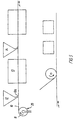
- the apparatus shown in fig. 5 comprises a means (20) on which a roll of carrier material (11) can be mounted, as well as a means (not shown) capable of pulling the carrier material through the various treatment stations.
- the carrier material (10) is pulled off the roll (11), past an application means (12a) in which the uppermost film layer is applied, the application material, which consists of a dissolved polymer and optional additives, fillers, etc., being conveyed from a container (12) to the application means (12a).
- the carrier material with the uppermost film layer is pulled further on through a drying station (13) and past a second application means (14a), which receives application material from a container (14) containing material for the lowermost film layer which consists of a dissolved polymer and optional additives, fillers, etc.
- the carrier material with the two film layers is pulled past a second drying station (15), and then an adhesive layer (16) is fed from an adhesive roll (not shown), said adhesive layer being provided with a removable cover layer on the side facing away from the laminate, said adhesive layer being applied to the film layer by means of an application roller (17), with optional addition of heat to improve the bonding between the adhesive layer and the film laminate.
- the carrier material is moved further on past a bevelling station (18) and a punching station (19).
- a station may be inserted after the drying station (15) for applying a foam layer, which can be bonded to the film layer by slight heating.
- E 50% was measured according to DS/ISO 1184, the test piece being constructed as a dumb bell sample having a width of 12.5 mm, the initial spacing the jaws being 100 mm, and the pull rate being 100 mm/min. The measurements were performed at about 20 °C.
- E 50% , 1st time and E 50% , 5th time were measured according to DS/ISO 1184, the test piece being constructed a dumb bell sample having a width of 12.5 mm, the initial spacing between the jaws being 100 mm, and the pull rate being 510 mm/min. The measurements were performed at about 20 °C.
- Tensile strength and elongation at break were measured according to DS/ISO 1184, the test piece being constructed as a dumb bell sample having a width of 12.5 mm, the initial spacing between the jaws being 100 mm, and the pull rate being 100 mm/min. The measurement were performed at about 20 °C.
- the friction was measured as the dynamic friction according to ISO 8295, 1986, the base used being a teflon coated glass tissue of the type: Acoflon G 13 A from Aco-plast A/S, Helsing ⁇ r, DK, the weight of the carriage being 500 g.
- the water vapour permeability of the films was measured by water contact with the soft PU film as described in ASTM E96-80.
- the E 50% value of the non-adhesive film is of great importance for the flexibility of the dressing.
- E 50% is at the same level as that obtained by using a relatively soft material of the type employed in the known dressings (samples 1 and 2).
- sample 4 With the relatively hard film layer without a laminated lowermost film layer and in a thickness of 10 ⁇ m (sample 4) the E 50% value is at the same level as for the samples 1 and 2. The E 50% value of sample 4 is thus quite good, but on the other hand the tensile strength is inacceptably low.
- samples 5, 6, 7, 8 and 9 have a reduced surface friction with respect to the known products (samples 1 and 2), while the flexibility, elasticity, tensile strength and elongation at break are kept at the same level.
- A Two dressings were moreover manufactured, one according to the invention, hereinafter called A, and one according to the prior art, hereinafter called B.
- the dressings consisted of a 1.00 mm thick adhesive layer and a 27 ⁇ m thick film layer.
- the adhesive composition was identical for the two dressings, viz. the following: Elastomer 24.10% Resin 35.10% Plasticizer 9.75% Antioxidant 1.00% Hydrocolloid 30.00%
- the components for the adhesive matrix were mixed with heating to 135 °C.
- dressing A according to the invention consisted of a 1.00 mm thick adhesive layer, as stated above, as well as a film material coated thereon and having a composition like the film sample no. 7 previously stated (see table 1).
- Dressing B according to the prior art consisted of a 1.00 mm thick adhesive layer, as stated above, and a film layer coated thereon and having a composition like the previously stated film sample no. 1 (see table 1).
- Both faces on both products A and B were coated with a removable cover layer.
- the dressings were bevelled under the action of pressure and heat, as described in DK Published Application 154 747, and punched in oval pieces with a surface area of about 22 cm 2 .
- the dressings were tested via a user test performed as follows:
- Compeed® users received a letter of introduction with instructions, a questionnaire as well as one of each of the dressings A and B.
- the letter of introduction informed the users that they participated in a development test of plasters.
- the user test result shows clearly that the dressing of the invention is a better fit and provides a better comfort than the known dressings, and that these improvements are exclusively due to the fact that the dressing of the invention has a smaller surface friction than the dressing of the prior art.
Landscapes
- Health & Medical Sciences (AREA)
- Engineering & Computer Science (AREA)
- Life Sciences & Earth Sciences (AREA)
- Animal Behavior & Ethology (AREA)
- General Health & Medical Sciences (AREA)
- Public Health (AREA)
- Veterinary Medicine (AREA)
- Biomedical Technology (AREA)
- Vascular Medicine (AREA)
- Chemical & Material Sciences (AREA)
- Heart & Thoracic Surgery (AREA)
- Epidemiology (AREA)
- Materials Engineering (AREA)
- Hematology (AREA)
- Chemical Kinetics & Catalysis (AREA)
- Dermatology (AREA)
- Dispersion Chemistry (AREA)
- Materials For Medical Uses (AREA)
- Pharmaceuticals Containing Other Organic And Inorganic Compounds (AREA)
- Photoreceptors In Electrophotography (AREA)
- Transition And Organic Metals Composition Catalysts For Addition Polymerization (AREA)
Applications Claiming Priority (4)
| Application Number | Priority Date | Filing Date | Title |
|---|---|---|---|
| DK5492 | 1992-01-17 | ||
| DK005492A DK5492A (da) | 1992-01-17 | 1992-01-17 | Hudpladeprodukt |
| DK54/92 | 1992-01-17 | ||
| PCT/DK1993/000011 WO1993013813A1 (en) | 1992-01-17 | 1993-01-15 | A dressing |
Publications (2)
| Publication Number | Publication Date |
|---|---|
| EP0625914A1 EP0625914A1 (en) | 1994-11-30 |
| EP0625914B1 true EP0625914B1 (en) | 2005-03-23 |
Family
ID=8089212
Family Applications (1)
| Application Number | Title | Priority Date | Filing Date |
|---|---|---|---|
| EP93903178A Expired - Lifetime EP0625914B1 (en) | 1992-01-17 | 1993-01-15 | A dressing |
Country Status (8)
| Country | Link |
|---|---|
| US (1) | US5643187A (enExample) |
| EP (1) | EP0625914B1 (enExample) |
| JP (1) | JP3516398B2 (enExample) |
| AT (1) | ATE291443T1 (enExample) |
| DE (1) | DE69333779T2 (enExample) |
| DK (1) | DK5492A (enExample) |
| ES (1) | ES2239314T3 (enExample) |
| WO (1) | WO1993013813A1 (enExample) |
Cited By (2)
| Publication number | Priority date | Publication date | Assignee | Title |
|---|---|---|---|---|
| WO2012170334A3 (en) * | 2011-06-06 | 2013-03-14 | Covidien Lp | Dressings and related methods therefor |
| US8771725B2 (en) | 2007-10-12 | 2014-07-08 | Chesson Laboratory Associates, Inc. | Poly(urea-urethane) compositions useful as topical medicaments and methods of using the same |
Families Citing this family (89)
| Publication number | Priority date | Publication date | Assignee | Title |
|---|---|---|---|---|
| GB9517486D0 (en) * | 1995-08-25 | 1995-10-25 | Innovative Tech Ltd | Wound dressings |
| US5902260A (en) * | 1997-03-14 | 1999-05-11 | Hollister Incorporated | Thin film wound dressing with stretchable foraminous backing layer |
| GB9717357D0 (en) * | 1997-08-16 | 1997-10-22 | Bristol Myers Squibb Co | Multi layered wound dressing |
| DK1086189T3 (da) | 1998-04-21 | 2004-05-17 | Coloplast As | En trykfölsom klæbestofsammensætning |
| DE19820999A1 (de) * | 1998-05-11 | 1999-11-18 | Lohmann Therapie Syst Lts | Laminat zum Aufbringen auf einen Akzeptor |
| JP5037753B2 (ja) | 1998-09-25 | 2012-10-03 | コロプラスト アクティーゼルスカブ | 層状製品の製造方法 |
| DE19925973A1 (de) * | 1999-06-08 | 2000-12-14 | Beiersdorf Ag | Filmpflaster insbesondere zur Abdeckung von Wunden und Verhütung oder Behandlung von Blasen unter Verwendung von Trägerfolien mit verbesserten Gleiteigenschaften und guter Dehnbarkeit, erzielt durch Optimierung der Oberflächenstruktur und -härte |
| DE19925972A1 (de) * | 1999-06-08 | 2000-12-14 | Beiersdorf Ag | Filmpflaster insbesondere zur Abdeckung von Wunden und Verhütung oder Behandlung von Blasen unter Verwendung von Polyurethan-Trägerfolien mit verbesserten Gleiteigenschaften, verbesserter Wasserabweisung und verringerter Anschmutzneigung |
| KR20010036685A (ko) * | 1999-10-11 | 2001-05-07 | 김윤 | 펜타닐을 함유하는 매트릭스형 경피투여제 |
| GB0011053D0 (en) * | 2000-05-09 | 2000-06-28 | Hudson John O | Medical device and use thereof |
| GB0011052D0 (en) * | 2000-05-09 | 2000-06-28 | Hudson John O | Medical device and use thereof |
| AU7323001A (en) | 2000-07-07 | 2002-01-21 | Av Topchiev Inst Petrochemical | Preparation of hydrophilic pressure sensitive adhesives having optimized adhesive properties |
| USRE44145E1 (en) | 2000-07-07 | 2013-04-09 | A.V. Topchiev Institute Of Petrochemical Synthesis | Preparation of hydrophilic pressure sensitive adhesives having optimized adhesive properties |
| US7619130B2 (en) * | 2000-07-18 | 2009-11-17 | Coloplast A/S | Multi-layer wound dressing formed as a single unit |
| US20040237166A1 (en) * | 2000-07-24 | 2004-12-02 | Jerry Potts | Apparel item and method of making and using same |
| WO2002007549A1 (en) * | 2000-07-24 | 2002-01-31 | Holden Perriann M | Protective attachment |
| US6903243B1 (en) | 2000-09-08 | 2005-06-07 | 3M Innovative Properties Company | Multi-layer absorbent wound dressing |
| GB2369799B (en) * | 2000-12-07 | 2004-07-07 | Johnson & Johnson Medical Ltd | Layered polyurethane materials |
| GB0030794D0 (en) * | 2000-12-16 | 2001-01-31 | Hudson John O | Medical device and use thereof |
| DK1523997T3 (en) * | 2001-02-08 | 2015-11-23 | Coloplast As | Foam dressings comprising antimicrobial silver |
| US6706940B2 (en) * | 2001-02-22 | 2004-03-16 | George Medical, L.L.C. | Transparent film dressing and a method for applying and making the same |
| DE60239528D1 (de) * | 2001-05-01 | 2011-05-05 | Corium International Redwood City | Zweiphasige, wasserabsorbierende bioadhäsive zusammenstezung |
| US8840918B2 (en) | 2001-05-01 | 2014-09-23 | A. V. Topchiev Institute of Petrochemical Synthesis, Russian Academy of Sciences | Hydrogel compositions for tooth whitening |
| US20050215727A1 (en) * | 2001-05-01 | 2005-09-29 | Corium | Water-absorbent adhesive compositions and associated methods of manufacture and use |
| US8206738B2 (en) | 2001-05-01 | 2012-06-26 | Corium International, Inc. | Hydrogel compositions with an erodible backing member |
| US8541021B2 (en) | 2001-05-01 | 2013-09-24 | A.V. Topchiev Institute Of Petrochemical Synthesis | Hydrogel compositions demonstrating phase separation on contact with aqueous media |
| US20050113510A1 (en) * | 2001-05-01 | 2005-05-26 | Feldstein Mikhail M. | Method of preparing polymeric adhesive compositions utilizing the mechanism of interaction between the polymer components |
| AU2002308612B2 (en) | 2001-05-01 | 2008-04-10 | A.V. Topchiev Institute Of Petrochemical Synthesis | Hydrogel compositions |
| GB2382305B (en) * | 2001-11-23 | 2004-12-15 | Johnson & Johnson Medical Ltd | Absorbent wound dressings containing a hydrogel layer |
| DK1450740T3 (da) * | 2001-11-23 | 2006-07-31 | Coloplast As | Sårforbinding |
| BR0215068A (pt) | 2001-12-21 | 2004-11-09 | Coloplast As | Dispositivo para cuidar de feridas |
| US20050143694A1 (en) * | 2002-02-15 | 2005-06-30 | Schmidt Nicolai M. | Wound care device |
| US7217853B2 (en) * | 2002-05-24 | 2007-05-15 | Corium International, Inc. | Composition for cushions, wound dressings and other skin-contacting products |
| US20060216267A1 (en) | 2002-08-20 | 2006-09-28 | Kovacs Stephen G | Hydrophobic elastomeric polymer chemistry device for inhibiting the growth of onychomycosis and urushiol-induced allergic contact dermatitis |
| DE60332750D1 (en) * | 2002-10-02 | 2010-07-08 | Coloplast As | Hydrogel |
| AU2003281987A1 (en) * | 2002-11-26 | 2004-06-18 | Coloplast A/S | A dressing |
| DK176790B1 (da) * | 2003-03-31 | 2009-09-07 | Coloplast As | Klubende plaster |
| AU2004246757B2 (en) | 2003-06-19 | 2009-01-08 | Coloplast A/S | A wound care device |
| US7179242B2 (en) | 2003-08-01 | 2007-02-20 | Belzidsky Hugues C | Method of treating deep vein thrombosis |
| EP1720508A1 (en) | 2003-11-28 | 2006-11-15 | Coloplast A/S | An adhesive patch |
| CN102764247B (zh) | 2004-01-30 | 2016-04-20 | 考里安国际公司 | 递送活性剂的快速溶解膜 |
| WO2006002208A2 (en) * | 2004-06-22 | 2006-01-05 | Willat Ergonomic Technologies, Llc | Conformable pod for a manual implement |
| AU2005271259B2 (en) | 2004-08-05 | 2012-01-19 | A.V. Topchiev Institute Of Petrochemical Synthesis | Adhesive composition |
| MX2007005056A (es) | 2004-11-05 | 2007-06-19 | Bristol Myers Squibb Co | Vendaje para heridas al vacio. |
| AU2005319737A1 (en) * | 2004-12-20 | 2006-06-29 | Tommy Andersson | Liouid-resistant protection for an extremity |
| KR100810947B1 (ko) * | 2005-01-28 | 2008-03-10 | 롬 앤드 하아스 컴패니 | 에멀젼 폴리머로부터 제조된 의료용 필름 및 제품 |
| US20080171958A1 (en) * | 2005-02-24 | 2008-07-17 | Boerge Gundersen | Wound Dressing |
| CN101287429A (zh) * | 2005-09-26 | 2008-10-15 | 科洛普拉斯特公司 | 伤口敷贴 |
| US9107982B2 (en) | 2005-11-09 | 2015-08-18 | Paul Hong-Dze Chen | Cultured tissue transplant device |
| US8158141B2 (en) * | 2005-11-09 | 2012-04-17 | Paul Hong-Dze Chen | Cell transplant device for treatment of corneal wound |
| EP1986705B1 (en) * | 2006-02-17 | 2019-04-10 | Coloplast A/S | Foamed pressure sensitive adhesive body comprising hydrocolloids |
| EP1993622B1 (en) * | 2006-03-03 | 2009-07-29 | Coloplast A/S | A wound dressing comprising an anti-inflammatory pain-killing agent and a complex of silver ion and a transitional element of group iv of the periodic system of elements |
| BRPI0601479A (pt) * | 2006-05-03 | 2007-12-18 | Johnson & Johnson Ind Ltda | bandagem adesiva |
| CN101437499A (zh) * | 2006-05-05 | 2009-05-20 | 科洛普拉斯特公司 | 包含交联的聚环氧烷和亲水性吸水剂的压敏粘合剂组合物 |
| ES2289942B1 (es) * | 2006-07-20 | 2008-12-16 | Universidad Autonoma De Madrid | Proceso catalitico para el tratamiento de efluentes de blanqueo de pasta de papel. |
| CA2600249C (en) * | 2006-09-12 | 2014-05-20 | Tyco Healthcare Group Lp | Thin film dressing |
| EP1923077B1 (de) * | 2006-11-07 | 2011-01-12 | Paul Hartmann AG | Mehrschichtige, absorbierende Wundauflage mit einer hydrophilen Wundkontaktschicht |
| CA2690968A1 (en) | 2007-06-19 | 2008-12-24 | Coloplast A/S | Multi-layered adhesive appliance |
| EP2180905B1 (en) * | 2007-07-13 | 2016-09-07 | Coloplast A/S | A medical dressing comprising an antimicrobial agent |
| CN101883543A (zh) * | 2007-10-05 | 2010-11-10 | 布鲁克斯博士创新有限公司 | 身体衬垫 |
| US7943811B2 (en) * | 2007-10-24 | 2011-05-17 | Johnson & Johnson Industrial Ltda. | Adhesive bandage and a process for manufacturing an adhesive bandage |
| AU2008359403A1 (en) * | 2008-07-18 | 2010-01-21 | Coloplast A/S | A body waste collecting device comprising a layered adhesive construction |
| CN102245135B (zh) * | 2008-12-08 | 2015-01-21 | 科洛普拉斯特公司 | 一种包括具有薄膜层的分层粘合剂结构的身体废物收集装置 |
| US8784879B2 (en) | 2009-01-14 | 2014-07-22 | Corium International, Inc. | Transdermal administration of tamsulosin |
| GB0905290D0 (en) | 2009-03-27 | 2009-05-13 | First Water Ltd | Multilayer compositions and dressings |
| US10159825B2 (en) | 2009-09-17 | 2018-12-25 | Zipline Medical, Inc. | Rapid closing surgical closure device |
| WO2011159623A1 (en) | 2010-06-14 | 2011-12-22 | Zipline Medical, Inc. | Methods and apparatus for inhibiting scar formation |
| EP2654633B1 (en) | 2010-12-22 | 2015-05-27 | Coloplast A/S | An ostomy appliance |
| US20140017296A1 (en) | 2011-04-04 | 2014-01-16 | Coloplast A/S | Adhesive Patch |
| US9770370B2 (en) | 2011-09-30 | 2017-09-26 | Coloplast A/S | Adhesive wound dressing |
| US10123800B2 (en) | 2011-11-01 | 2018-11-13 | Zipline Medical, Inc. | Surgical incision and closure apparatus with integrated force distribution |
| US12171432B2 (en) | 2011-11-01 | 2024-12-24 | Zipline Medical, Inc. | Closure apparatuses and methods for ulcers and irregular skin defects |
| US9561034B2 (en) | 2011-11-01 | 2017-02-07 | Zipline Medical, Inc. | Surgical incision and closure apparatus |
| US10123801B2 (en) | 2011-11-01 | 2018-11-13 | Zipline Medical, Inc. | Means to prevent wound dressings from adhering to closure device |
| US8272507B1 (en) | 2011-12-02 | 2012-09-25 | Visionary Products, Inc. | Kit of a plurality of detachable pockets, a detachable pocket, and associated methods |
| US9554944B2 (en) * | 2012-08-20 | 2017-01-31 | Alessandro Barberio | Medical protruded pads or dressings for wound care including use with orthopedic and prosthetic devices |
| GB201222770D0 (en) | 2012-12-18 | 2013-01-30 | Systagenix Wound Man Ip Co Bv | Wound dressing with adhesive margin |
| ES2627759T3 (es) | 2013-04-03 | 2017-07-31 | Coloplast A/S | Un apósito médico |
| KR102354693B1 (ko) * | 2013-07-24 | 2022-01-21 | 집라인 메디칼, 인크. | 수술 절개 및 봉합 장치 |
| KR102353789B1 (ko) | 2014-01-05 | 2022-01-19 | 집라인 메디칼, 인크. | 계장된 상처 봉합 기구 |
| WO2016040695A1 (en) | 2014-09-10 | 2016-03-17 | C.R. Bard, Inc. | Protective dressing for skin-placed medical device |
| DK3253341T3 (en) | 2015-02-02 | 2019-03-25 | Coloplast As | STOMA DEVICE |
| ES2741852T3 (es) | 2015-04-10 | 2020-02-12 | Coloplast As | Dispositivo de ostomía |
| WO2018081795A1 (en) | 2016-10-31 | 2018-05-03 | Zipline Medical, Inc. | Systems and methods for monitoring physical therapy of the knee and other joints |
| WO2018115376A1 (en) | 2016-12-22 | 2018-06-28 | Laboratoire Hra-Pharma | Film applicator assembly |
| BR112020026352A2 (pt) | 2018-07-04 | 2021-03-30 | Coloplast A/S | Curativo de ferida de espuma de célula aberta, e, método para fabricar um curativo de ferida de espuma de célula aberta |
| GB2574074B (en) | 2018-07-27 | 2020-05-20 | Mclaren Applied Tech Ltd | Time synchronisation |
| GB2588236B (en) | 2019-10-18 | 2024-03-20 | Mclaren Applied Ltd | Gyroscope bias estimation |
| US20260000806A1 (en) * | 2024-06-28 | 2026-01-01 | Neenah, Inc. | Hydrocolloid-based wound dressings and methods for the same |
Family Cites Families (27)
| Publication number | Priority date | Publication date | Assignee | Title |
|---|---|---|---|---|
| US2785677A (en) * | 1953-05-04 | 1957-03-19 | Lawrence R Stumpf | Arched protective adhesive bandage |
| US3419006A (en) * | 1966-08-08 | 1968-12-31 | Union Carbide Corp | Novel dressing and use thereof |
| US3972328A (en) | 1975-07-28 | 1976-08-03 | E. R. Squibb & Sons, Inc. | Surgical bandage |
| GB1576522A (en) * | 1977-05-24 | 1980-10-08 | Colorplast International A S | Sealing material for ostomy devices |
| US4285338A (en) * | 1979-10-01 | 1981-08-25 | Lemelson Jerome H | Adhesive bandage |
| DK147035C (da) * | 1980-12-05 | 1984-09-03 | Coloplast As | Hudplade |
| NZ199684A (en) * | 1981-02-13 | 1985-03-20 | Smith & Nephew Ass | Wound dressing;wound facing layer a conformable elastomeric integral net |
| NZ203706A (en) * | 1982-04-22 | 1986-03-14 | Squibb & Sons Inc | Occlusive multi-layer wound dressing and hydrocolloidal granules for wound treatment |
| DE3224194A1 (de) * | 1982-06-29 | 1983-12-29 | Siemens AG, 1000 Berlin und 8000 München | Stirnkontaktierter elektrischer wickelkondensator und verfahren zu seiner herstellung |
| DE3344334C2 (de) * | 1983-12-08 | 1986-11-13 | Lohmann Gmbh & Co Kg, 5450 Neuwied | Folienverband |
| DE3685227D1 (de) * | 1985-01-04 | 1992-06-17 | Squibb & Sons Inc | Wundverband. |
| US4773409A (en) * | 1985-09-20 | 1988-09-27 | E. R. Squibb & Sons, Inc. | Wound dressing |
| US4598004A (en) * | 1985-01-24 | 1986-07-01 | Minnesota Mining And Manufacturing Company | Thin film surgical dressing with delivery system |
| DK154747C (da) * | 1986-10-17 | 1989-05-08 | Coloplast As | Bandage med en hudvenlig, vandabsorberende klaebeskive der paa den ene flade er fast forbundet med en ikke-klaebende daekfilm og paa den anden med et aftageligt beskyttelsesdaekke |
| DK154806C (da) * | 1986-12-19 | 1989-06-26 | Coloplast As | Saarplejemiddel indeholdende et aktivt stof til fremme af saarbehandlingen og fremgangsmaade til fremstilling deraf |
| US5322695A (en) * | 1987-01-09 | 1994-06-21 | Hercon Laboratories Corporation | Moisture-vapor-permeable dressing |
| GB8705985D0 (en) * | 1987-03-13 | 1987-04-15 | Geistlich Soehne Ag | Dressings |
| DK157899C (da) * | 1987-12-15 | 1990-09-03 | Coloplast As | Hudpladeprodukt |
| US5413567A (en) * | 1988-02-29 | 1995-05-09 | Lts Lohmann Therapie-Systeme Gmbh & Co. Kg | Primary packaging for surface-stabilized surgical dressing |
| US4964402A (en) * | 1988-08-17 | 1990-10-23 | Royce Medical Company | Orthopedic device having gel pad with phase change material |
| GB8820563D0 (en) * | 1988-08-31 | 1988-09-28 | Britcair Ltd | Adhesive dressings |
| US5188124A (en) * | 1989-07-19 | 1993-02-23 | Johnson & Johnson Consumer Products, Inc. | Low friction film dressing |
| US5012801A (en) * | 1989-07-19 | 1991-05-07 | Johnson & Johnson Consumer Products, Inc. | Low friction film dressing |
| US5409472A (en) * | 1989-08-03 | 1995-04-25 | Smith & Nephew Plc | Adhesive polymeric foam dressings |
| DE3928858A1 (de) * | 1989-08-31 | 1991-03-07 | Beiersdorf Ag | Vernetzte hydrogele und verfahren zu deren herstellung |
| ES2081477T3 (es) * | 1990-04-24 | 1996-03-16 | Teijin Ltd | Parche. |
| US5167613A (en) * | 1992-03-23 | 1992-12-01 | The Kendall Company | Composite vented wound dressing |
-
1992
- 1992-01-17 DK DK005492A patent/DK5492A/da not_active Application Discontinuation
-
1993
- 1993-01-15 DE DE69333779T patent/DE69333779T2/de not_active Expired - Lifetime
- 1993-01-15 WO PCT/DK1993/000011 patent/WO1993013813A1/en not_active Ceased
- 1993-01-15 EP EP93903178A patent/EP0625914B1/en not_active Expired - Lifetime
- 1993-01-15 US US08/256,593 patent/US5643187A/en not_active Expired - Lifetime
- 1993-01-15 JP JP51208893A patent/JP3516398B2/ja not_active Expired - Lifetime
- 1993-01-15 ES ES93903178T patent/ES2239314T3/es not_active Expired - Lifetime
- 1993-01-15 AT AT93903178T patent/ATE291443T1/de not_active IP Right Cessation
Cited By (3)
| Publication number | Priority date | Publication date | Assignee | Title |
|---|---|---|---|---|
| US8771725B2 (en) | 2007-10-12 | 2014-07-08 | Chesson Laboratory Associates, Inc. | Poly(urea-urethane) compositions useful as topical medicaments and methods of using the same |
| US9259436B2 (en) | 2007-10-12 | 2016-02-16 | Chesson Laboratory Associates, Inc. | Poly(urea-urethane) compositions useful as topical medicaments and methods of using the same |
| WO2012170334A3 (en) * | 2011-06-06 | 2013-03-14 | Covidien Lp | Dressings and related methods therefor |
Also Published As
| Publication number | Publication date |
|---|---|
| JP3516398B2 (ja) | 2004-04-05 |
| DE69333779T2 (de) | 2006-02-02 |
| ATE291443T1 (de) | 2005-04-15 |
| EP0625914A1 (en) | 1994-11-30 |
| US5643187A (en) | 1997-07-01 |
| DK5492D0 (da) | 1992-01-17 |
| DE69333779D1 (de) | 2005-04-28 |
| JPH07502913A (ja) | 1995-03-30 |
| WO1993013813A1 (en) | 1993-07-22 |
| DK5492A (da) | 1993-07-18 |
| ES2239314T3 (es) | 2005-09-16 |
Similar Documents
| Publication | Publication Date | Title |
|---|---|---|
| US5643187A (en) | Dressing | |
| US5012801A (en) | Low friction film dressing | |
| US5188124A (en) | Low friction film dressing | |
| US5840052A (en) | Adhesive dressing applicator | |
| US5409472A (en) | Adhesive polymeric foam dressings | |
| CA1323269C (en) | Thin film surgical dressing with delivery system | |
| EP1421924A2 (en) | Textured breathable films and their use as backing material for bandages | |
| WO1991001706A1 (en) | Adhesive dressings | |
| JPH0442021B2 (enExample) | ||
| EP3427708A1 (en) | Wound dressing assembly | |
| JPS5957654A (ja) | 低粘着性創傷用ドレツシング | |
| JP2024105684A (ja) | 絆創膏及び絆創膏用ポリウレタン不織布 | |
| CA2058421C (en) | Adhesive dressings | |
| JPH119623A (ja) | 医療用粘着テープ | |
| JPH0313902B2 (enExample) | ||
| US6727402B1 (en) | Film plaster using support films with improved sliding properties and good extensibility, achieved by optimising the surface structure and hardness | |
| KR100644377B1 (ko) | 신축성을 가지는 지지필름 | |
| JPH0838543A (ja) | 適合性絆創膏 | |
| JP2001061953A (ja) | 貼付材用フィルム | |
| JP2001058004A (ja) | 貼付材用フィルム | |
| JPH0838544A (ja) | 適合性絆創膏 | |
| JP2002166497A (ja) | 貼付材用フィルム | |
| AU1553802A (en) | Conformable adhesive bandages |
Legal Events
| Date | Code | Title | Description |
|---|---|---|---|
| PUAI | Public reference made under article 153(3) epc to a published international application that has entered the european phase |
Free format text: ORIGINAL CODE: 0009012 |
|
| 17P | Request for examination filed |
Effective date: 19940620 |
|
| AK | Designated contracting states |
Kind code of ref document: A1 Designated state(s): AT BE CH DE DK ES FR GB GR IE IT LI LU MC NL PT SE |
|
| 17Q | First examination report despatched |
Effective date: 19980430 |
|
| GRAP | Despatch of communication of intention to grant a patent |
Free format text: ORIGINAL CODE: EPIDOSNIGR1 |
|
| GRAS | Grant fee paid |
Free format text: ORIGINAL CODE: EPIDOSNIGR3 |
|
| GRAA | (expected) grant |
Free format text: ORIGINAL CODE: 0009210 |
|
| AK | Designated contracting states |
Kind code of ref document: B1 Designated state(s): AT BE CH DE DK ES FR GB GR IE IT LI LU MC NL PT SE |
|
| PG25 | Lapsed in a contracting state [announced via postgrant information from national office to epo] |
Ref country code: NL Free format text: LAPSE BECAUSE OF FAILURE TO SUBMIT A TRANSLATION OF THE DESCRIPTION OR TO PAY THE FEE WITHIN THE PRESCRIBED TIME-LIMIT Effective date: 20050323 Ref country code: LI Free format text: LAPSE BECAUSE OF FAILURE TO SUBMIT A TRANSLATION OF THE DESCRIPTION OR TO PAY THE FEE WITHIN THE PRESCRIBED TIME-LIMIT Effective date: 20050323 Ref country code: CH Free format text: LAPSE BECAUSE OF FAILURE TO SUBMIT A TRANSLATION OF THE DESCRIPTION OR TO PAY THE FEE WITHIN THE PRESCRIBED TIME-LIMIT Effective date: 20050323 Ref country code: BE Free format text: LAPSE BECAUSE OF FAILURE TO SUBMIT A TRANSLATION OF THE DESCRIPTION OR TO PAY THE FEE WITHIN THE PRESCRIBED TIME-LIMIT Effective date: 20050323 Ref country code: AT Free format text: LAPSE BECAUSE OF FAILURE TO SUBMIT A TRANSLATION OF THE DESCRIPTION OR TO PAY THE FEE WITHIN THE PRESCRIBED TIME-LIMIT Effective date: 20050323 |
|
| REG | Reference to a national code |
Ref country code: GB Ref legal event code: FG4D |
|
| REG | Reference to a national code |
Ref country code: CH Ref legal event code: EP |
|
| REG | Reference to a national code |
Ref country code: IE Ref legal event code: FG4D |
|
| REF | Corresponds to: |
Ref document number: 69333779 Country of ref document: DE Date of ref document: 20050428 Kind code of ref document: P |
|
| PG25 | Lapsed in a contracting state [announced via postgrant information from national office to epo] |
Ref country code: GR Free format text: LAPSE BECAUSE OF FAILURE TO SUBMIT A TRANSLATION OF THE DESCRIPTION OR TO PAY THE FEE WITHIN THE PRESCRIBED TIME-LIMIT Effective date: 20050623 Ref country code: DK Free format text: LAPSE BECAUSE OF FAILURE TO SUBMIT A TRANSLATION OF THE DESCRIPTION OR TO PAY THE FEE WITHIN THE PRESCRIBED TIME-LIMIT Effective date: 20050623 |
|
| NLV1 | Nl: lapsed or annulled due to failure to fulfill the requirements of art. 29p and 29m of the patents act | ||
| PG25 | Lapsed in a contracting state [announced via postgrant information from national office to epo] |
Ref country code: PT Free format text: LAPSE BECAUSE OF FAILURE TO SUBMIT A TRANSLATION OF THE DESCRIPTION OR TO PAY THE FEE WITHIN THE PRESCRIBED TIME-LIMIT Effective date: 20050907 |
|
| REG | Reference to a national code |
Ref country code: ES Ref legal event code: FG2A Ref document number: 2239314 Country of ref document: ES Kind code of ref document: T3 |
|
| REG | Reference to a national code |
Ref country code: CH Ref legal event code: PL |
|
| PG25 | Lapsed in a contracting state [announced via postgrant information from national office to epo] |
Ref country code: IE Free format text: LAPSE BECAUSE OF NON-PAYMENT OF DUE FEES Effective date: 20060116 |
|
| PLBE | No opposition filed within time limit |
Free format text: ORIGINAL CODE: 0009261 |
|
| STAA | Information on the status of an ep patent application or granted ep patent |
Free format text: STATUS: NO OPPOSITION FILED WITHIN TIME LIMIT |
|
| PG25 | Lapsed in a contracting state [announced via postgrant information from national office to epo] |
Ref country code: MC Free format text: LAPSE BECAUSE OF NON-PAYMENT OF DUE FEES Effective date: 20060131 Ref country code: LU Free format text: LAPSE BECAUSE OF NON-PAYMENT OF DUE FEES Effective date: 20060131 |
|
| 26N | No opposition filed |
Effective date: 20051227 |
|
| ET | Fr: translation filed | ||
| REG | Reference to a national code |
Ref country code: IE Ref legal event code: MM4A |
|
| PG25 | Lapsed in a contracting state [announced via postgrant information from national office to epo] |
Ref country code: SE Free format text: LAPSE BECAUSE OF FAILURE TO SUBMIT A TRANSLATION OF THE DESCRIPTION OR TO PAY THE FEE WITHIN THE PRESCRIBED TIME-LIMIT Effective date: 20050623 |
|
| PGFP | Annual fee paid to national office [announced via postgrant information from national office to epo] |
Ref country code: FR Payment date: 20120202 Year of fee payment: 20 |
|
| PGFP | Annual fee paid to national office [announced via postgrant information from national office to epo] |
Ref country code: DE Payment date: 20120111 Year of fee payment: 20 |
|
| PGFP | Annual fee paid to national office [announced via postgrant information from national office to epo] |
Ref country code: GB Payment date: 20120111 Year of fee payment: 20 Ref country code: IT Payment date: 20120118 Year of fee payment: 20 |
|
| REG | Reference to a national code |
Ref country code: DE Ref legal event code: R071 Ref document number: 69333779 Country of ref document: DE |
|
| REG | Reference to a national code |
Ref country code: DE Ref legal event code: R071 Ref document number: 69333779 Country of ref document: DE |
|
| REG | Reference to a national code |
Ref country code: GB Ref legal event code: PE20 Expiry date: 20130114 |
|
| PG25 | Lapsed in a contracting state [announced via postgrant information from national office to epo] |
Ref country code: GB Free format text: LAPSE BECAUSE OF EXPIRATION OF PROTECTION Effective date: 20130114 Ref country code: DE Free format text: LAPSE BECAUSE OF EXPIRATION OF PROTECTION Effective date: 20130116 |
|
| PGFP | Annual fee paid to national office [announced via postgrant information from national office to epo] |
Ref country code: ES Payment date: 20120213 Year of fee payment: 20 |
|
| REG | Reference to a national code |
Ref country code: ES Ref legal event code: FD2A Effective date: 20130723 |
|
| PG25 | Lapsed in a contracting state [announced via postgrant information from national office to epo] |
Ref country code: ES Free format text: LAPSE BECAUSE OF EXPIRATION OF PROTECTION Effective date: 20130116 |