EP0616883B1 - Vitrage à couche électroconductrice obtenue par pyrolyse de composés en poudre, utilisable en tant que pare-brise pour automobile - Google Patents
Vitrage à couche électroconductrice obtenue par pyrolyse de composés en poudre, utilisable en tant que pare-brise pour automobile Download PDFInfo
- Publication number
- EP0616883B1 EP0616883B1 EP94109000A EP94109000A EP0616883B1 EP 0616883 B1 EP0616883 B1 EP 0616883B1 EP 94109000 A EP94109000 A EP 94109000A EP 94109000 A EP94109000 A EP 94109000A EP 0616883 B1 EP0616883 B1 EP 0616883B1
- Authority
- EP
- European Patent Office
- Prior art keywords
- glass
- glazing
- layer
- ito
- sheet
- Prior art date
- Legal status (The legal status is an assumption and is not a legal conclusion. Google has not performed a legal analysis and makes no representation as to the accuracy of the status listed.)
- Revoked
Links
Images

Classifications
-
- B—PERFORMING OPERATIONS; TRANSPORTING
- B32—LAYERED PRODUCTS
- B32B—LAYERED PRODUCTS, i.e. PRODUCTS BUILT-UP OF STRATA OF FLAT OR NON-FLAT, e.g. CELLULAR OR HONEYCOMB, FORM
- B32B17/00—Layered products essentially comprising sheet glass, or glass, slag, or like fibres
- B32B17/06—Layered products essentially comprising sheet glass, or glass, slag, or like fibres comprising glass as the main or only constituent of a layer, next to another layer of a specific material
- B32B17/10—Layered products essentially comprising sheet glass, or glass, slag, or like fibres comprising glass as the main or only constituent of a layer, next to another layer of a specific material of synthetic resin
- B32B17/10005—Layered products essentially comprising sheet glass, or glass, slag, or like fibres comprising glass as the main or only constituent of a layer, next to another layer of a specific material of synthetic resin laminated safety glass or glazing
- B32B17/1055—Layered products essentially comprising sheet glass, or glass, slag, or like fibres comprising glass as the main or only constituent of a layer, next to another layer of a specific material of synthetic resin laminated safety glass or glazing characterized by the resin layer, i.e. interlayer
- B32B17/10761—Layered products essentially comprising sheet glass, or glass, slag, or like fibres comprising glass as the main or only constituent of a layer, next to another layer of a specific material of synthetic resin laminated safety glass or glazing characterized by the resin layer, i.e. interlayer containing vinyl acetal
-
- C—CHEMISTRY; METALLURGY
- C03—GLASS; MINERAL OR SLAG WOOL
- C03C—CHEMICAL COMPOSITION OF GLASSES, GLAZES OR VITREOUS ENAMELS; SURFACE TREATMENT OF GLASS; SURFACE TREATMENT OF FIBRES OR FILAMENTS MADE FROM GLASS, MINERALS OR SLAGS; JOINING GLASS TO GLASS OR OTHER MATERIALS
- C03C27/00—Joining pieces of glass to pieces of other inorganic material; Joining glass to glass other than by fusing
- C03C27/06—Joining glass to glass by processes other than fusing
- C03C27/10—Joining glass to glass by processes other than fusing with the aid of adhesive specially adapted for that purpose
-
- B—PERFORMING OPERATIONS; TRANSPORTING
- B32—LAYERED PRODUCTS
- B32B—LAYERED PRODUCTS, i.e. PRODUCTS BUILT-UP OF STRATA OF FLAT OR NON-FLAT, e.g. CELLULAR OR HONEYCOMB, FORM
- B32B17/00—Layered products essentially comprising sheet glass, or glass, slag, or like fibres
- B32B17/06—Layered products essentially comprising sheet glass, or glass, slag, or like fibres comprising glass as the main or only constituent of a layer, next to another layer of a specific material
- B32B17/10—Layered products essentially comprising sheet glass, or glass, slag, or like fibres comprising glass as the main or only constituent of a layer, next to another layer of a specific material of synthetic resin
- B32B17/10005—Layered products essentially comprising sheet glass, or glass, slag, or like fibres comprising glass as the main or only constituent of a layer, next to another layer of a specific material of synthetic resin laminated safety glass or glazing
- B32B17/10009—Layered products essentially comprising sheet glass, or glass, slag, or like fibres comprising glass as the main or only constituent of a layer, next to another layer of a specific material of synthetic resin laminated safety glass or glazing characterized by the number, the constitution or treatment of glass sheets
- B32B17/10036—Layered products essentially comprising sheet glass, or glass, slag, or like fibres comprising glass as the main or only constituent of a layer, next to another layer of a specific material of synthetic resin laminated safety glass or glazing characterized by the number, the constitution or treatment of glass sheets comprising two outer glass sheets
-
- B—PERFORMING OPERATIONS; TRANSPORTING
- B32—LAYERED PRODUCTS
- B32B—LAYERED PRODUCTS, i.e. PRODUCTS BUILT-UP OF STRATA OF FLAT OR NON-FLAT, e.g. CELLULAR OR HONEYCOMB, FORM
- B32B17/00—Layered products essentially comprising sheet glass, or glass, slag, or like fibres
- B32B17/06—Layered products essentially comprising sheet glass, or glass, slag, or like fibres comprising glass as the main or only constituent of a layer, next to another layer of a specific material
- B32B17/10—Layered products essentially comprising sheet glass, or glass, slag, or like fibres comprising glass as the main or only constituent of a layer, next to another layer of a specific material of synthetic resin
- B32B17/10005—Layered products essentially comprising sheet glass, or glass, slag, or like fibres comprising glass as the main or only constituent of a layer, next to another layer of a specific material of synthetic resin laminated safety glass or glazing
- B32B17/10009—Layered products essentially comprising sheet glass, or glass, slag, or like fibres comprising glass as the main or only constituent of a layer, next to another layer of a specific material of synthetic resin laminated safety glass or glazing characterized by the number, the constitution or treatment of glass sheets
- B32B17/10082—Properties of the bulk of a glass sheet
- B32B17/1011—Properties of the bulk of a glass sheet having predetermined tint or excitation purity
-
- B—PERFORMING OPERATIONS; TRANSPORTING
- B32—LAYERED PRODUCTS
- B32B—LAYERED PRODUCTS, i.e. PRODUCTS BUILT-UP OF STRATA OF FLAT OR NON-FLAT, e.g. CELLULAR OR HONEYCOMB, FORM
- B32B17/00—Layered products essentially comprising sheet glass, or glass, slag, or like fibres
- B32B17/06—Layered products essentially comprising sheet glass, or glass, slag, or like fibres comprising glass as the main or only constituent of a layer, next to another layer of a specific material
- B32B17/10—Layered products essentially comprising sheet glass, or glass, slag, or like fibres comprising glass as the main or only constituent of a layer, next to another layer of a specific material of synthetic resin
- B32B17/10005—Layered products essentially comprising sheet glass, or glass, slag, or like fibres comprising glass as the main or only constituent of a layer, next to another layer of a specific material of synthetic resin laminated safety glass or glazing
- B32B17/10165—Functional features of the laminated safety glass or glazing
- B32B17/10174—Coatings of a metallic or dielectric material on a constituent layer of glass or polymer
-
- B—PERFORMING OPERATIONS; TRANSPORTING
- B32—LAYERED PRODUCTS
- B32B—LAYERED PRODUCTS, i.e. PRODUCTS BUILT-UP OF STRATA OF FLAT OR NON-FLAT, e.g. CELLULAR OR HONEYCOMB, FORM
- B32B17/00—Layered products essentially comprising sheet glass, or glass, slag, or like fibres
- B32B17/06—Layered products essentially comprising sheet glass, or glass, slag, or like fibres comprising glass as the main or only constituent of a layer, next to another layer of a specific material
- B32B17/10—Layered products essentially comprising sheet glass, or glass, slag, or like fibres comprising glass as the main or only constituent of a layer, next to another layer of a specific material of synthetic resin
- B32B17/10005—Layered products essentially comprising sheet glass, or glass, slag, or like fibres comprising glass as the main or only constituent of a layer, next to another layer of a specific material of synthetic resin laminated safety glass or glazing
- B32B17/10165—Functional features of the laminated safety glass or glazing
- B32B17/10174—Coatings of a metallic or dielectric material on a constituent layer of glass or polymer
- B32B17/10201—Dielectric coatings
- B32B17/10211—Doped dielectric layer, electrically conductive, e.g. SnO2:F
-
- B—PERFORMING OPERATIONS; TRANSPORTING
- B32—LAYERED PRODUCTS
- B32B—LAYERED PRODUCTS, i.e. PRODUCTS BUILT-UP OF STRATA OF FLAT OR NON-FLAT, e.g. CELLULAR OR HONEYCOMB, FORM
- B32B17/00—Layered products essentially comprising sheet glass, or glass, slag, or like fibres
- B32B17/06—Layered products essentially comprising sheet glass, or glass, slag, or like fibres comprising glass as the main or only constituent of a layer, next to another layer of a specific material
- B32B17/10—Layered products essentially comprising sheet glass, or glass, slag, or like fibres comprising glass as the main or only constituent of a layer, next to another layer of a specific material of synthetic resin
- B32B17/10005—Layered products essentially comprising sheet glass, or glass, slag, or like fibres comprising glass as the main or only constituent of a layer, next to another layer of a specific material of synthetic resin laminated safety glass or glazing
- B32B17/10165—Functional features of the laminated safety glass or glazing
- B32B17/10293—Edge features, e.g. inserts or holes
-
- B—PERFORMING OPERATIONS; TRANSPORTING
- B32—LAYERED PRODUCTS
- B32B—LAYERED PRODUCTS, i.e. PRODUCTS BUILT-UP OF STRATA OF FLAT OR NON-FLAT, e.g. CELLULAR OR HONEYCOMB, FORM
- B32B17/00—Layered products essentially comprising sheet glass, or glass, slag, or like fibres
- B32B17/06—Layered products essentially comprising sheet glass, or glass, slag, or like fibres comprising glass as the main or only constituent of a layer, next to another layer of a specific material
- B32B17/10—Layered products essentially comprising sheet glass, or glass, slag, or like fibres comprising glass as the main or only constituent of a layer, next to another layer of a specific material of synthetic resin
- B32B17/10005—Layered products essentially comprising sheet glass, or glass, slag, or like fibres comprising glass as the main or only constituent of a layer, next to another layer of a specific material of synthetic resin laminated safety glass or glazing
- B32B17/10165—Functional features of the laminated safety glass or glazing
- B32B17/10339—Specific parts of the laminated safety glass or glazing being colored or tinted
-
- B—PERFORMING OPERATIONS; TRANSPORTING
- B32—LAYERED PRODUCTS
- B32B—LAYERED PRODUCTS, i.e. PRODUCTS BUILT-UP OF STRATA OF FLAT OR NON-FLAT, e.g. CELLULAR OR HONEYCOMB, FORM
- B32B17/00—Layered products essentially comprising sheet glass, or glass, slag, or like fibres
- B32B17/06—Layered products essentially comprising sheet glass, or glass, slag, or like fibres comprising glass as the main or only constituent of a layer, next to another layer of a specific material
- B32B17/10—Layered products essentially comprising sheet glass, or glass, slag, or like fibres comprising glass as the main or only constituent of a layer, next to another layer of a specific material of synthetic resin
- B32B17/10005—Layered products essentially comprising sheet glass, or glass, slag, or like fibres comprising glass as the main or only constituent of a layer, next to another layer of a specific material of synthetic resin laminated safety glass or glazing
- B32B17/10165—Functional features of the laminated safety glass or glazing
- B32B17/10339—Specific parts of the laminated safety glass or glazing being colored or tinted
- B32B17/10348—Specific parts of the laminated safety glass or glazing being colored or tinted comprising an obscuration band
-
- B—PERFORMING OPERATIONS; TRANSPORTING
- B32—LAYERED PRODUCTS
- B32B—LAYERED PRODUCTS, i.e. PRODUCTS BUILT-UP OF STRATA OF FLAT OR NON-FLAT, e.g. CELLULAR OR HONEYCOMB, FORM
- B32B17/00—Layered products essentially comprising sheet glass, or glass, slag, or like fibres
- B32B17/06—Layered products essentially comprising sheet glass, or glass, slag, or like fibres comprising glass as the main or only constituent of a layer, next to another layer of a specific material
- B32B17/10—Layered products essentially comprising sheet glass, or glass, slag, or like fibres comprising glass as the main or only constituent of a layer, next to another layer of a specific material of synthetic resin
- B32B17/10005—Layered products essentially comprising sheet glass, or glass, slag, or like fibres comprising glass as the main or only constituent of a layer, next to another layer of a specific material of synthetic resin laminated safety glass or glazing
- B32B17/1055—Layered products essentially comprising sheet glass, or glass, slag, or like fibres comprising glass as the main or only constituent of a layer, next to another layer of a specific material of synthetic resin laminated safety glass or glazing characterized by the resin layer, i.e. interlayer
- B32B17/1077—Layered products essentially comprising sheet glass, or glass, slag, or like fibres comprising glass as the main or only constituent of a layer, next to another layer of a specific material of synthetic resin laminated safety glass or glazing characterized by the resin layer, i.e. interlayer containing polyurethane
-
- B—PERFORMING OPERATIONS; TRANSPORTING
- B32—LAYERED PRODUCTS
- B32B—LAYERED PRODUCTS, i.e. PRODUCTS BUILT-UP OF STRATA OF FLAT OR NON-FLAT, e.g. CELLULAR OR HONEYCOMB, FORM
- B32B17/00—Layered products essentially comprising sheet glass, or glass, slag, or like fibres
- B32B17/06—Layered products essentially comprising sheet glass, or glass, slag, or like fibres comprising glass as the main or only constituent of a layer, next to another layer of a specific material
- B32B17/10—Layered products essentially comprising sheet glass, or glass, slag, or like fibres comprising glass as the main or only constituent of a layer, next to another layer of a specific material of synthetic resin
- B32B17/10005—Layered products essentially comprising sheet glass, or glass, slag, or like fibres comprising glass as the main or only constituent of a layer, next to another layer of a specific material of synthetic resin laminated safety glass or glazing
- B32B17/1055—Layered products essentially comprising sheet glass, or glass, slag, or like fibres comprising glass as the main or only constituent of a layer, next to another layer of a specific material of synthetic resin laminated safety glass or glazing characterized by the resin layer, i.e. interlayer
- B32B17/10788—Layered products essentially comprising sheet glass, or glass, slag, or like fibres comprising glass as the main or only constituent of a layer, next to another layer of a specific material of synthetic resin laminated safety glass or glazing characterized by the resin layer, i.e. interlayer containing ethylene vinylacetate
-
- B—PERFORMING OPERATIONS; TRANSPORTING
- B32—LAYERED PRODUCTS
- B32B—LAYERED PRODUCTS, i.e. PRODUCTS BUILT-UP OF STRATA OF FLAT OR NON-FLAT, e.g. CELLULAR OR HONEYCOMB, FORM
- B32B17/00—Layered products essentially comprising sheet glass, or glass, slag, or like fibres
- B32B17/06—Layered products essentially comprising sheet glass, or glass, slag, or like fibres comprising glass as the main or only constituent of a layer, next to another layer of a specific material
- B32B17/10—Layered products essentially comprising sheet glass, or glass, slag, or like fibres comprising glass as the main or only constituent of a layer, next to another layer of a specific material of synthetic resin
- B32B17/10005—Layered products essentially comprising sheet glass, or glass, slag, or like fibres comprising glass as the main or only constituent of a layer, next to another layer of a specific material of synthetic resin laminated safety glass or glazing
- B32B17/10807—Making laminated safety glass or glazing; Apparatus therefor
- B32B17/10899—Making laminated safety glass or glazing; Apparatus therefor by introducing interlayers of synthetic resin
- B32B17/10935—Making laminated safety glass or glazing; Apparatus therefor by introducing interlayers of synthetic resin as a preformed layer, e.g. formed by extrusion
-
- C—CHEMISTRY; METALLURGY
- C03—GLASS; MINERAL OR SLAG WOOL
- C03C—CHEMICAL COMPOSITION OF GLASSES, GLAZES OR VITREOUS ENAMELS; SURFACE TREATMENT OF GLASS; SURFACE TREATMENT OF FIBRES OR FILAMENTS MADE FROM GLASS, MINERALS OR SLAGS; JOINING GLASS TO GLASS OR OTHER MATERIALS
- C03C17/00—Surface treatment of glass, not in the form of fibres or filaments, by coating
- C03C17/34—Surface treatment of glass, not in the form of fibres or filaments, by coating with at least two coatings having different compositions
- C03C17/42—Surface treatment of glass, not in the form of fibres or filaments, by coating with at least two coatings having different compositions at least one coating of an organic material and at least one non-metal coating
-
- C—CHEMISTRY; METALLURGY
- C03—GLASS; MINERAL OR SLAG WOOL
- C03C—CHEMICAL COMPOSITION OF GLASSES, GLAZES OR VITREOUS ENAMELS; SURFACE TREATMENT OF GLASS; SURFACE TREATMENT OF FIBRES OR FILAMENTS MADE FROM GLASS, MINERALS OR SLAGS; JOINING GLASS TO GLASS OR OTHER MATERIALS
- C03C3/00—Glass compositions
- C03C3/04—Glass compositions containing silica
- C03C3/076—Glass compositions containing silica with 40% to 90% silica, by weight
- C03C3/083—Glass compositions containing silica with 40% to 90% silica, by weight containing aluminium oxide or an iron compound
- C03C3/085—Glass compositions containing silica with 40% to 90% silica, by weight containing aluminium oxide or an iron compound containing an oxide of a divalent metal
- C03C3/087—Glass compositions containing silica with 40% to 90% silica, by weight containing aluminium oxide or an iron compound containing an oxide of a divalent metal containing calcium oxide, e.g. common sheet or container glass
-
- C—CHEMISTRY; METALLURGY
- C03—GLASS; MINERAL OR SLAG WOOL
- C03C—CHEMICAL COMPOSITION OF GLASSES, GLAZES OR VITREOUS ENAMELS; SURFACE TREATMENT OF GLASS; SURFACE TREATMENT OF FIBRES OR FILAMENTS MADE FROM GLASS, MINERALS OR SLAGS; JOINING GLASS TO GLASS OR OTHER MATERIALS
- C03C4/00—Compositions for glass with special properties
- C03C4/02—Compositions for glass with special properties for coloured glass
-
- Y—GENERAL TAGGING OF NEW TECHNOLOGICAL DEVELOPMENTS; GENERAL TAGGING OF CROSS-SECTIONAL TECHNOLOGIES SPANNING OVER SEVERAL SECTIONS OF THE IPC; TECHNICAL SUBJECTS COVERED BY FORMER USPC CROSS-REFERENCE ART COLLECTIONS [XRACs] AND DIGESTS
- Y10—TECHNICAL SUBJECTS COVERED BY FORMER USPC
- Y10S—TECHNICAL SUBJECTS COVERED BY FORMER USPC CROSS-REFERENCE ART COLLECTIONS [XRACs] AND DIGESTS
- Y10S428/00—Stock material or miscellaneous articles
- Y10S428/913—Material designed to be responsive to temperature, light, moisture
-
- Y—GENERAL TAGGING OF NEW TECHNOLOGICAL DEVELOPMENTS; GENERAL TAGGING OF CROSS-SECTIONAL TECHNOLOGIES SPANNING OVER SEVERAL SECTIONS OF THE IPC; TECHNICAL SUBJECTS COVERED BY FORMER USPC CROSS-REFERENCE ART COLLECTIONS [XRACs] AND DIGESTS
- Y10—TECHNICAL SUBJECTS COVERED BY FORMER USPC
- Y10S—TECHNICAL SUBJECTS COVERED BY FORMER USPC CROSS-REFERENCE ART COLLECTIONS [XRACs] AND DIGESTS
- Y10S501/00—Compositions: ceramic
- Y10S501/90—Optical glass, e.g. silent on refractive index and/or ABBE number
- Y10S501/904—Infrared transmitting or absorbing
-
- Y—GENERAL TAGGING OF NEW TECHNOLOGICAL DEVELOPMENTS; GENERAL TAGGING OF CROSS-SECTIONAL TECHNOLOGIES SPANNING OVER SEVERAL SECTIONS OF THE IPC; TECHNICAL SUBJECTS COVERED BY FORMER USPC CROSS-REFERENCE ART COLLECTIONS [XRACs] AND DIGESTS
- Y10—TECHNICAL SUBJECTS COVERED BY FORMER USPC
- Y10S—TECHNICAL SUBJECTS COVERED BY FORMER USPC CROSS-REFERENCE ART COLLECTIONS [XRACs] AND DIGESTS
- Y10S501/00—Compositions: ceramic
- Y10S501/90—Optical glass, e.g. silent on refractive index and/or ABBE number
- Y10S501/905—Ultraviolet transmitting or absorbing
-
- Y—GENERAL TAGGING OF NEW TECHNOLOGICAL DEVELOPMENTS; GENERAL TAGGING OF CROSS-SECTIONAL TECHNOLOGIES SPANNING OVER SEVERAL SECTIONS OF THE IPC; TECHNICAL SUBJECTS COVERED BY FORMER USPC CROSS-REFERENCE ART COLLECTIONS [XRACs] AND DIGESTS
- Y10—TECHNICAL SUBJECTS COVERED BY FORMER USPC
- Y10T—TECHNICAL SUBJECTS COVERED BY FORMER US CLASSIFICATION
- Y10T428/00—Stock material or miscellaneous articles
- Y10T428/24—Structurally defined web or sheet [e.g., overall dimension, etc.]
- Y10T428/24942—Structurally defined web or sheet [e.g., overall dimension, etc.] including components having same physical characteristic in differing degree
- Y10T428/2495—Thickness [relative or absolute]
- Y10T428/24967—Absolute thicknesses specified
- Y10T428/24975—No layer or component greater than 5 mils thick
-
- Y—GENERAL TAGGING OF NEW TECHNOLOGICAL DEVELOPMENTS; GENERAL TAGGING OF CROSS-SECTIONAL TECHNOLOGIES SPANNING OVER SEVERAL SECTIONS OF THE IPC; TECHNICAL SUBJECTS COVERED BY FORMER USPC CROSS-REFERENCE ART COLLECTIONS [XRACs] AND DIGESTS
- Y10—TECHNICAL SUBJECTS COVERED BY FORMER USPC
- Y10T—TECHNICAL SUBJECTS COVERED BY FORMER US CLASSIFICATION
- Y10T428/00—Stock material or miscellaneous articles
- Y10T428/31504—Composite [nonstructural laminate]
- Y10T428/31551—Of polyamidoester [polyurethane, polyisocyanate, polycarbamate, etc.]
-
- Y—GENERAL TAGGING OF NEW TECHNOLOGICAL DEVELOPMENTS; GENERAL TAGGING OF CROSS-SECTIONAL TECHNOLOGIES SPANNING OVER SEVERAL SECTIONS OF THE IPC; TECHNICAL SUBJECTS COVERED BY FORMER USPC CROSS-REFERENCE ART COLLECTIONS [XRACs] AND DIGESTS
- Y10—TECHNICAL SUBJECTS COVERED BY FORMER USPC
- Y10T—TECHNICAL SUBJECTS COVERED BY FORMER US CLASSIFICATION
- Y10T428/00—Stock material or miscellaneous articles
- Y10T428/31504—Composite [nonstructural laminate]
- Y10T428/31551—Of polyamidoester [polyurethane, polyisocyanate, polycarbamate, etc.]
- Y10T428/31598—Next to silicon-containing [silicone, cement, etc.] layer
- Y10T428/31601—Quartz or glass
-
- Y—GENERAL TAGGING OF NEW TECHNOLOGICAL DEVELOPMENTS; GENERAL TAGGING OF CROSS-SECTIONAL TECHNOLOGIES SPANNING OVER SEVERAL SECTIONS OF THE IPC; TECHNICAL SUBJECTS COVERED BY FORMER USPC CROSS-REFERENCE ART COLLECTIONS [XRACs] AND DIGESTS
- Y10—TECHNICAL SUBJECTS COVERED BY FORMER USPC
- Y10T—TECHNICAL SUBJECTS COVERED BY FORMER US CLASSIFICATION
- Y10T428/00—Stock material or miscellaneous articles
- Y10T428/31504—Composite [nonstructural laminate]
- Y10T428/31551—Of polyamidoester [polyurethane, polyisocyanate, polycarbamate, etc.]
- Y10T428/31627—Next to aldehyde or ketone condensation product
- Y10T428/3163—Next to acetal of polymerized unsaturated alcohol [e.g., formal butyral, etc.]
-
- Y—GENERAL TAGGING OF NEW TECHNOLOGICAL DEVELOPMENTS; GENERAL TAGGING OF CROSS-SECTIONAL TECHNOLOGIES SPANNING OVER SEVERAL SECTIONS OF THE IPC; TECHNICAL SUBJECTS COVERED BY FORMER USPC CROSS-REFERENCE ART COLLECTIONS [XRACs] AND DIGESTS
- Y10—TECHNICAL SUBJECTS COVERED BY FORMER USPC
- Y10T—TECHNICAL SUBJECTS COVERED BY FORMER US CLASSIFICATION
- Y10T428/00—Stock material or miscellaneous articles
- Y10T428/31504—Composite [nonstructural laminate]
- Y10T428/31551—Of polyamidoester [polyurethane, polyisocyanate, polycarbamate, etc.]
- Y10T428/31645—Next to addition polymer from unsaturated monomers
- Y10T428/31649—Ester, halide or nitrile of addition polymer
-
- Y—GENERAL TAGGING OF NEW TECHNOLOGICAL DEVELOPMENTS; GENERAL TAGGING OF CROSS-SECTIONAL TECHNOLOGIES SPANNING OVER SEVERAL SECTIONS OF THE IPC; TECHNICAL SUBJECTS COVERED BY FORMER USPC CROSS-REFERENCE ART COLLECTIONS [XRACs] AND DIGESTS
- Y10—TECHNICAL SUBJECTS COVERED BY FORMER USPC
- Y10T—TECHNICAL SUBJECTS COVERED BY FORMER US CLASSIFICATION
- Y10T428/00—Stock material or miscellaneous articles
- Y10T428/31504—Composite [nonstructural laminate]
- Y10T428/31678—Of metal
- Y10T428/31688—Next to aldehyde or ketone condensation product
Definitions
- the present invention relates to a glazing unit provided with an electroconductive coating based on metal oxides obtained by pyrolysis of powdered compounds, usable in particular as a windshield for an automobile.
- the invention relates to a glazing unit comprising such a coating which has a sufficiently low electrical resistance and nevertheless good light transmission in the visible range so that its use as heating glazing for the automobile can be envisaged.
- patent document EP-A-192 009 proposes glazings coated with a layer of pyrolysed ITO (indium tin oxide) obtained from powdered compounds, of thickness 1900 and 3000 Angstroems, having resistances by square which are 11 and 7.5 ohms respectively and light transmission factors of 83 and 82% respectively.
- ITO indium tin oxide
- the 3000 Angstroems layer is purple red in reflection, which aesthetically, harmony with the colors of car bodies, is unlikely to be accepted.
- these pyrolyzed layers have a slight speckling and a light veil which are not at all annoying for glazing used in the building, but which for automotive glazing can be disputed.
- the standards for automobile windshields require that the haze (percentage of diffuse light) is not greater than 0.5%, which is less than what the eye is able to perceive in normal vision. (2 to 3%) and what is accepted for glazing intended for the building industry.
- this prior patent EP 192 009 proposes the production of laminated glazing with an ITO layer, but to facilitate the reducing heat treatment of ITO, it plans to operate said reducing thermal treatment on the laminated glazing produced, with a burner, the burner having the advantage of rapidly heating the ITO layer for treating it, without having time to heat the structure of the glazing, the ITO layer being therefore arranged on an external face of the glazing, directly in contact with the burner flame.
- Document US 4,655,811 proposes layers of ITO deposited under vacuum having resistances per square down to 5 ohms and retaining a light transmission compatible with uses in the automotive field.
- the production costs are high, the production times are long and the increase in thicknesses would further increase these costs and these production times on the one hand and reduce the light transmission too much on the other hand.
- Glazers coated with a stack of layers obtained by vacuum techniques are also known, layers among which is an Ag layer surrounded by dielectric layers.
- These glazings have, like the previous ones already mentioned, an electrical resistance greater than 5 ohms and in addition these layers oxidize and degrade easily, in particular with humidity.
- the glass sheets coated with these layers of layers containing a layer Ag require important precautions when laminating in order to form laminated glazing, because the slightest soiling, the slightest dust screams a visible defect.
- the present invention aims to provide glazing coated with an ITO electroconductive diptt, usable as glazing for the automobile and as a vehicle glazing, capable of being electrically heated thanks to the electrical energy available on the vehicle, including the diptt ITO either risistant, or aesthetic (neutral or identical color that of anti-solar glazing for cars currently used and appriciis, without speckles, without veil, ...) and whose production cost is less expensive than that of glazing be empty.
- glazing having at least one glass plate coated with an ITO layer, obtained by pyrolysis of a pulverulent mixture of a tin compound, in particular DBTO (dibutyltin oxide) and a compound of indium, in particular indium formate, then by reducing treatment of the layer thus obtained, associated with a sheet of a material of the flexible plastic material type with an index approaching more that of the ITO layer than the 'air index.
- ITO dibutyltin oxide
- the ITO layer on a face of glass sheet which allows it to be brought into contact with a flexible material capable of intimately marrying any surface irregularities of the ITO layer, thanks to the high index of this material, the speckles are practically eliminated and in addition the possible hazy appearance of the ITO layer is nonexistent and compatible with regulations.
- the ITO layer has a thickness such that its color is a popular color for automobile glazing, in particular a slightly green color in reflection.
- the ITO layer has a thickness of at least 330 nanometers, which gives it a resistance per square equal to or less than 5 Ohms and preferably a thickness of the order of 350-380 nanometers , which gives it a resistance per square of the order of 4.5 Ohms - 4.0 Ohms.
- the ITO layer has a thickness of the order of 180 nanometers, which gives it a resistance per square of the order of 10 Ohms.
- the glass plate carrying the ITO coating and / or another plate glass associated with it to constitute with it a laminated glazing is in tinted glass in its mass, of the type known as "TSA” or "TSA 2+ ".
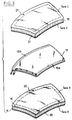
- FIG. 1 shows a glazing unit consisting of a single glass plate 11 coated with a layer 12 of ITO, and associated with a sheet 13 of a flexible material with a refractive index greater than that of the air comprised between the air index and the index of the ITO layer (1.8) and in particular of the order of 1.5, capable of perfectly adhering to the layer 12, of intimately embracing any irregularities, suitable also to be used as it is, that is to say without protection or covering.
- the PU sheet is a two-layer sheet comprising a layer of energy-absorbing thermoplastic PU and a layer of self-healing and anti-laceration thermosetting PU.
- the plate 11 is made of soda-lime-silica glass conventionally used for automobile and building glazing. It may be a clear glass, that is to say a non-colored glass, having a significant light transmission, greater than 90% under a thickness of 4 mm. It may also be a colored glass in its mass capable of providing increased summer comfort for the passengers of the vehicle or of the room equipped with such glasses, due to its reduced energy transmission factor.
- the coloring of the glass is the same as that of the layer, namely green for the layer thicknesses of the order of 350-380 nm or 180 nm.
- these glasses tinted in their mass by iron oxides have properties of absorption of IR radiation, and therefore in general interesting energy properties, thanks to which summer comfort is increased.
- TSA glass containing Fe 2 O 3 can be used in weight proportions of the order of 0.55 to 0.62%, FeO for approximately 0.11 to 0.16%, this which leads to a Fe 2+ / Fe ratio of the order of 0.19 to 0.25, CoO for less than 12 ppm and even preferably for less than 10 ppm.
- T L high light transmission
- T E relatively low energy transmission factor
- TSA 2+ is colored by the same oxides as above but in slightly different proportions.
- automobile glazing according to the invention can be produced with a glass sheet 11 made of “TSA” glass 3 mm thick, covered with an ITO layer of thickness on the order of 350-380 nm or a fortiori around 180 nm, itself covered with polyurethane as described in the earlier patents already cited.
- the glass thickness "TSA” can be slightly greater, and reach up to 3.5 or 4 mm.
- glazings according to the invention with thicknesses of glass to form the plate 11, less than those set out below, are a fortiori possible since this makes it possible to increase the light transmission and that, consequently, the regulations remain satisfactory.
- FIG. 2 shows a laminated glazing with at least two thicknesses of glass, consisting of a first glass plate 15 coated with a layer 16 of ITO associated with a sheet 17 of a material with a refractive index higher than that of the air, between the air index and the index of the ITO layer (1.8) and in particular of the order of 1.5 able to adhere perfectly to layer 16, to marry it intimately any irregularities, also suitable for constituting the plastic interlayer of laminated glazing, also consisting of a second glass plate 18. If desired, additional sheets of glass, plastic interleaves can be added to form a laminated thicker, more resistant.
- the sheet 17 is for example made of PVB (polyvinyl butyral) conventionally used to produce laminated glazings, PVC (polyvinyl chloride), PU (polyurethane).
- PVB polyvinyl butyral
- PVC polyvinyl chloride
- PU polyurethane
- the glass plate 18 and / or optionally the glass plate 15 is advantageously made of colored glass in its mass, with improved energy properties, as said previously in “TSA” or “TSA 2+ ” glass.
- ITO layers 12 and 16 of the embodiments shown in FIGS. 1 and 2 are obtained by pyrolysis of a mixture of powders of an indium compound as an essential constituent, in particular indium formate (InFo) and a compound tin, especially dibutyltin oxide (DBTO).
- InFo and DBTO the weight proportions are of the order of 90% of InFo and 10% of DBTO; the particle sizes are between 5 and 20 microns and preferably between 5 and 15 microns.
- the distribution of the powder mixture on the glass substrate is carried out using installations already described in detail in the European patent documents published under the numbers 125 513, 130 919, 191 258, 189 709, 188 962.
- FIG. 3 shows the same elements as in FIG. 2 and with the same references, namely, the glass sheet 15, carrying the layer 16 of ITO, a second glass sheet 18 free of any layer, but possibly in a glass colored in its mass, of the type "TSA” or “TSA 2+ ”, the sheet 17 of material of the PVB type, of index greater than that of air and possibly colored, the conductive strips 19a and 19b in particular in the form of foils, arranged substantially horizontally and substantially parallel, one in the upper part of the glazing, the other in the lower part.
- the layer 16 of ITO is deposited on face 3.
- This layer 16 is for example deposited at the outlet of the float bath of a flat glass manufacturing installation, on a ribbon of flat glass manufactured in continued.
- This ribbon is cut into rectangles, then according to the developed shape of the windshield or in general glazing to be produced; this then constitutes the plate 15 coated with its layer 16.
- This plate 15 then receives on its face not coated with ITO, that is to say the face which will constitute the face 4 of the laminated glazing, a deposit 20 of enamel at its periphery by a conventional screen printing technique.
- this plate 15 coated with ITO on one side, with its deposit of peripheral enamel on the other, is associated with another glass plate, plate 18, also cut for example from the ribbon emerging from a float line, in clear glass or in mass-tinted glass.
- This flat plate 18 receives on one of its faces, that which will constitute the face 2 of the laminated glazing, a peripheral deposit of enamel 21.
- this deposit 21 on face 2 is annealed.
- the two glass plates 15 and 18 are paired, that is to say superimposed, face 2 against face 3, and curved simultaneously by heating and for example subsidence on a bending frame or skeleton.
- layer 16 is on a convex face, so it is put in light extension by bending of the glass, without any particular precaution and despite this its properties, in particular electrical properties, are not affected.
- the intermediate sheet 17 of material with an index close to that of the ITO layer, in particular PVB, is cut, associated with the foils 19a and 19b in particular by spot hot welding of said foils on the top and bottom edges of the sheet.
- the metallic foil is not cut, but passes on the other side of the PVB through an incision made in the PVB, then descends vertically along the edge of the PVB until 'at the lower strand 19b of foil.
- the two strands 19b and 19a of tinsel, isolated from one another are associated so as to be able to go out in a single place.
- This sheet of PVB type material is then placed between the two glass plates 15 and 18, the strands 19a and 19b of the foil being attached to the layer 16 on the face 3.
- the ends of the strands 19a and 19b leaving the glazing thus produced are available to be connected to the source of electric current of the vehicle on which the glazing will be mounted.
- these strands 19a and 19b can be cut and connected to a particular connection facilitating the connection with the current source.
- TSA glass plate 18
- the plate 18 can be made of a 2.1 mm or 2.2 mm thick "TSA" glass, the plate 15 coated ITO can be made of a conventional clear glass 2.1 to 2.6 mm thick and the sheet 17 can be a PVB 0.76 mm thick.
- TSA glass
- the plate 15 coated ITO can be made of a conventional clear glass 2.1 to 2.6 mm thick
- the sheet 17 can be a PVB 0.76 mm thick.
- the plate 18 is 2.6 mm thick, all other things being equal the coefficient T L drops slightly below 75% for an ITO layer thickness of the order of 350-380 nm, but satisfies the regulations of countries where a T L of only 70% is required. On the other hand, for an ITO layer thickness of the order of 180 nm, the threshold of 75% is satisfied.
- the current supply strips 19a and 19b are not metallic foils, but screen-printed strips, said screen-printed strips are deposited on the upper and lower edges of the glass plate 15 coated with its ITO layer on this ITO layer, therefore on face 3 of laminated glazing after cutting to the dimensions of the finished glazing and after peripheral enameling on face 4 of the same plate 15.
- these screen-printed bands on the plate 15 are annealed.
- the glazing produced is of the type shown in FIG. 1, that is to say with a single glass plate 11 coated ITO in association with a sheet of material of index higher than that of air and as close as possible to that of ITO, for example PU, the conductive strips 14a and 14b are also either screen printed or foil. They are then in contact with the ITO layer.
- the metal foils or the screen-printed strips are masked by a frame of thermoplastic material mounted in situ by the technique known as encapsulation.
- This encapsulation frame can also serve as a cover, protection and insulation for the strand of metallic foil traveling up to its exit from the glazing on the other side of the PU sheet, that is to say not in contact with the ITO layer.
- the good properties of the ITO layer allow its association with mass-tinted glasses.
- the result is glazing with interesting electrical, optical and thermal properties.
- Thicknesses of glass plates have been proposed previously, by virtue of which the regulations are respected, but, of course, thinner thicknesses than those proposed are a fortiori acceptable, the coefficient T L will only be higher.
- this layer allows the bending of its support after deposition, without special precautions even when after bending said layer is arranged on the convex face of its support.
- This filtering can be used as a heated windshield for cars.
Landscapes
- Chemical & Material Sciences (AREA)
- Engineering & Computer Science (AREA)
- Life Sciences & Earth Sciences (AREA)
- Chemical Kinetics & Catalysis (AREA)
- General Chemical & Material Sciences (AREA)
- Geochemistry & Mineralogy (AREA)
- Materials Engineering (AREA)
- Organic Chemistry (AREA)
- Ceramic Engineering (AREA)
- Joining Of Glass To Other Materials (AREA)
- Laminated Bodies (AREA)
- Glass Compositions (AREA)
- Surface Treatment Of Glass (AREA)
- Conductive Materials (AREA)
- Re-Forming, After-Treatment, Cutting And Transporting Of Glass Products (AREA)
- Medicines Containing Material From Animals Or Micro-Organisms (AREA)
- Measurement Of Force In General (AREA)
- Adhesives Or Adhesive Processes (AREA)
Description
- La présente invention concerne un vitrage muni d'un revêtement électroconducteur à base d'oxydes métalliques obtenu par pyrolyse de composés en poudre, utilisable notamment en tant que pare-brise pour automobile.
- En particulier, l'invention concerne un vitrage comprenant un tel revêtement qui présente une résistance électrique suffisamment basse et malgré tout une bonne transmission lumineuse dans le visible pour que son utilisation en tant que vitrage chauffant pour l'automobile puisse être envisagée.
- Il est connu par divers brevets antérieurs de fabriquer des vitrages revêtus de couches conductrices ayant la transmission lumineuse supérieure à 75 % ou 70 % selon les législations, qui autorise leur utilisation en tant que vitrages pour l'automobile et présentant une résistance par carré de l'ordre de 10 ohms et même descendant jusque 5 ohms.
- Ainsi le document de brevet EP-A-192 009 propose des vitrages revêtus d'une couche d'ITO (indium tin oxide) pyrolysée obtenue à partir de composés en poudre, d'épaisseur de 1900 et de 3000 Angstroems, présentant des résistances par carré qui sont respectivement de 11 et de 7,5 ohms et des facteurs de transmission lumineuse respectivement de 83 et 82 %.
- La couche de 3000 Angstroems d'épaisseur est rouge mauve en réflexion, ce qui sur le plan esthétique, harmonie avec les couleurs de carrosseries des voitures, a peu de chance d'être accepté.
- En outre ces couches pyrolysées présentent un léger mouchetis et un léger voile qui ne sont pas du tout génants pour un vitrage utilisé dans le bâtiment, mais qui pour un vitrage automobile peuvent être contestés. Ainsi, les normes pour les pare-brise d'automobiles requièrent que le voile (pourcentage de lumière diffuse) ne soit pas supérieur à 0,5 %, ce qui est inférieur à ce que l'oeil est capable d'apercevoir en vision normale (2 à 3 %) et à ce qui est accepté pour des vitrages destinés au bâtiment.
- Il est à noter que ce brevet antérieur EP 192 009 propose la réalisation de vitrages feuilletés à couche ITO, mais pour faciliter le traitement thermique réducteur de l'ITO, il prévoit d'opérer ledit traitement thermique réducteur sur le vitrage feuilleté réalisé, avec un brûleur, le brûleur ayant l'avantage d'échauffer rapidement la couche d'ITO pour la traiter, sans avoir le temps d'échauffer la structure du vitrage, la couche d'ITO étant pour cela disposée sur une face extérieure du vitrage, directement au contact de la flamme du brûleur.
- Le document de brevet US 4 490 227 propose quant à lui des vitrages revêtus d'une couche d'ITO obtenue par des techniques sous vide, d'épaisseur de l'ordre de 2800 Angstroems, de transmission de l'ordre de 78 %, de résistance au carré approximativement de 7 à 10 ohms.
- Ces couches sous vide sont longues à fabriquer, coûteuses et l'obtention de résistances plus faibles augmenterait le temps de fabrication et le coût d'une part, risquerait de faire franchir les 75 % ou 70 % de transmission requis pour des vitrages automobiles d'autre part.
- Le document US 4 655 811, propose des couches d'ITO déposées sous vide ayant des résistances par carré descendant jusqu'à 5 ohms et conservant une transmission lumineuse compatible avec les utilisations dans le domaine de l'automobile. Les coûts de production sont élevés, les temps de production sont longs et l'augmentation des épaisseurs augmenterait encore ces coûts et ces temps de production d'une part et diminuerait trop la transmission lumineuse d'autre part.
- Sont également connus des vitrages revêtus d'un empilement de couches obtenues par des techniques sous vide, couches parmi lesquelles est présente une couche d'Ag entourée de couches de diélectriques. Ces vitrages ont, comme les précédents déjà mentionnés, une résistance électrique supérieure à 5 ohms et en outre ces couches s'oxydent et se dégradent facilement, notamment à l'humidité. Par ailleurs, les feuilles de verre revêtues de ces empilements de couches contenant une couche d'Ag, nicessitent des pricautions importantes lors de leur feuilletage en vue de constituer des vitrages feuilletis, car la moindre salissure, la moindre poussihre crie un difaut visible.
- La prisente invention vise fournir un vitrage revjtu d'un diptt ilectroconducteur d'ITO, utilisable en tant que vitrage pour l'automobile et en giniral pour vihicule, susceptible d'jtre chauffi ilectriquement grbce l'inergie ilectrique disponible sur le vihicule, dont le diptt ITO soit risistant, soit esthitique (couleur neutre ou identique celle des vitrages anti-solaires pour automobiles utilisis et appriciis actuellement, sans mouchetis, sans voile, ...) et dont le co{t de production soit moins ilevi que celui des vitrages produits sois vide.
- Cette utilisation des vitrages dans l'automobile implique une transmission lumineuse pour l'illuminant A, (TL), importante, qui selon les riglementations doit jtre au moins de 75 % ou 70 %, suivant les ligislations.
- Elle vise de prifirence un vitrage revjtu d'un diptt ilectroconducteur d'ITO ayant une risistance ilectrique par carri igale ou avantageusement infirieure 5 ohms.
- En outre, elle vise aussi de prifirence, un vitrage amiliorant le confort d'iti des passagers du vihicule, donc capable de prisenter malgri la transmission lumineuse importante requise par les riglementations, une transmission inergitique abaissie par rapport un vitrage traditionnel.
- Elle propose pour cela un vitrage ayant au moins une plaque de verre revêtue d'une couche d'ITO, obtenue par pyrolyse d'un mélange pulvérulent d'un composé d'étain, notamment du DBTO (oxyde de dibutylétain) et d'un composé d'indium, en particulier le formiate d'indium, puis par traitement réducteur de la couche ainsi obtenue, associée avec une feuille d'un matériau du type matière plastique souple à indice s'approchant plus de celui de la couche ITO que l'indice de l'air.
- Cette feuille est en un matériau appartenant au groupe suivant :
- PVC (butyral de polyvinyle),
- PVC (chlorure de polyvinyle),
- PU (polyuréthane),
- Grâce à la disposition de la couche ITO sur une face de feuille de verre qui permette sa mise en contact avec un matériau souple apte à épouser intimement les éventuelles irrégularités de surface de la couche ITO, grâce à l'indice élevé de ce matériau, les mouchetis sont pratiquement supprimés et en outre le possible aspect voilé de la couche ITO est inexistant et compatible avec les réglementations.
- Avantageusement, la couche ITO a une épaisseur telle que sa couleur est une couleur appréciée pour les vitrages d'automobile, en particulier une couleur légèrement verte en réflexion.
- Suivant un premier mode de réalisation, la couche d'ITO a une épaisseur d'au moins 330 nanomètres, ce qui lui confère une résistance par carré égale ou inférieure à 5 Ohms et de préférence une épaisseur de l'ordre de 350-380 nanomètres, ce qui lui confère une résistance par carré de l'ordre de 4,5 Ohms - 4,0 Ohms.
- Selon un autre mode de réalisation, la couche ITO a une épaisseur de l'ordre de 180 nanomètres, ce qui lui confère une résistance par carré de l'ordre de 10 Ohms.
- Avantageusement pour conférer au vitrage des propriétés de transmission énergétique améliorée visant à accroître le confort d'été et également pour contribuer à l'amélioration de l'aspect dudit vitrage, la plaque de verre portant le revêtement d'ITO et/ou une autre plaque de verre qui lui est associée pour constituer avec elle un vitrage feuilleté est en verre teinté dans sa masse, du type dit « TSA » ou « TSA2+ ».
- L'invention sera maintenant décrite plus en détail en référence aux figures jointes qui représentent :
- figure 1 : une première variante d'un vitrage selon l'invention, en vue éclatée,
- figure 2 : un vitrage feuilleté ayant selon l'invention une couche d'ITO,
- figure 3 : un vitrage feuilleté selon l'invention ayant reçu ses dépôts d'émail et amenées de courant électrique en vue d'être monté en tant que pare-brise d'automobile.
- La figure 1 montre un vitrage constitué d'une seule plaque de verre 11 revêtue d'une couche 12 d'ITO, et associée à une feuille 13 d'un matériau souple à indice de réfraction supérieur à celui de l'air compris entre l'indice de l'air et l'indice de la couche d'ITO (1,8) et notamment de l'ordre de 1,5, apte à parfaitement adhérer sur la couche 12, à en épouser intimement les éventuelles irrégularités, apte également à être utilisée telle quelle, c'est-à-dire sans protection ou recouvrement.
- Une telle feuille 13, à base de polyuréthane (PU) est décrite en détail dans les documents de brevets publiés en EUROPE sous les numéros 54 491, 132 198, 133 090 et le document de brevet publié en FRANCE sous le numéro 2 398 606. Selon ces brevets, la feuille de PU est une feuille bicouche comprenant une couche de PU thermoplastique absorbeur d'énergie et une couche de PU thermodurcissable autocicatrisante et antilacération.
- La plaque 11 est en verre silico-sodo-calcique utilisé classiquement pour les vitrages automobiles et bâtiments. Il peut s'agir d'un verre clair, c'est-à-dire non coloré, présentant une transmission lumineuse importante, supérieure à 90% sous une épaisseur de 4 mm. Il peut s'agir aussi, d'un verre coloré dans sa masse apte à procurer un confort d'été accru pour les passagers du véhciule ou du local équipé de tels verres, du fait de son facteur de transmission énergétique réduit.
- Avantageusement la coloration du verre est la même que celle de la couche, à savoir vert pour les épaisseurs de couche de l'ordre de 350-380 nm ou 180 nm.
- Ainsi du seul fait de la coloration du verre, les éventuelles légères irrégularités de couleur de la couche sont masquées. En outre la couleur verte est fortement appréciée pour les vitrages automobiles.
- Par ailleurs, ces verres teintés dans leur masse par des oxydes de fer, possèdent des propriétés d'absorption du rayonnement IR, et donc en général des propriétés énergétiques intéressantes, grâce auxquelles le confort d'été est accru.
- Ainsi comme verre coloré, on peut utiliser du verre dit « TSA » contenant Fe2O3 dans des proportions pondérales de l'ordre de 0,55 à 0,62%, FeO pour environ 0,11 à 0,16%, ce qui conduit à un rapport Fe2+/Fe de l'ordre de 0,19 à 0,25, CoO pour moins de 12 ppm et même de préférence pour moins de 10 ppm. Il en résulte des propriétés par exemple pour une épaisseur de 3,85 mm de transmission lumineuse (TL) élevées voisines de 78%, un facteur énergétique de transmission (TE) relativement bas et voisin de 60, ce qui conduit à un rapport TL/TE de l'ordre de 1,30.
- On peut aussi utiliser comme verre coloré, en particulier lorsque la réglementation n'impose qu'une transmission lumineuse de 70%, un verre un peu plus coloré que le « TSA », mais présentant par contre une transmission lumineuse un peu plus faible, à savoir un « TSA2+ ».
- Ce « TSA2+ » est coloré par les mêmes oxydes que précédemment mais dans des proportions légèrement différentes.
- Ainsi les proportions d'oxydes métalliques sont les suivantes :
- Fe2O3 : approximativement compris entre 0,75 et 0,90%
- FeO: approximativement compris entre 0,15 et 0,22%
- CoO : inférieur à 17 ppm et même de préférence inférieur à 10 ppm soit Fe2+/Fe = 0,20 environ.
- Il en résulte pour ce verre « TSA2+ », en 3,85 mm d'épaisseur les propriétés suivantes :
- TL : de l'ordre de 72%
- TE : de l'ordre de 50%
- Ainsi un vitrage automobile selon l'invention peut être réalisé avec une feuille de verre 11 en verre « TSA » d'épaisseur 3 mm, recouvert d'une couche ITO d'épaisseur de l'ordre de 350-380 nm ou a fortiori de l'ordre de 180 nm, elle-même recouverte de polyuréthane comme décrit dans les brevets antérieurs déjà cités. Avec l'épaisseur de couche de 180 nm, l'épaisseur de verre « TSA » peut être légèrement plus importante, et atteindre jusqu'à 3,5 ou 4 mm.
- Il en résulte un vitrage de couleur très légèrement verte en transmission, verte en réflexion ayant une TL compatible avec la réglementation auto (plus de 75%) et une TE de l'ordre de 1,40.
- Si l'on veut à la place du verre « TSA » employer du « TSA2+ », en ayant des coefficients de transmission lumineuse compatibles avec les réglementations, on peut choisir une plaque de verre 11 en verre « TSA2+ » de 3 mm d'épaisseur, de préférence avec une épaisseur de couche de 180 nm. Il en résulte alors pour le vitrage fini un coefficient TL supérieur à 70%, un coefficient TL/TE de l'ordre de 1,50, c'est-à-dire une transmission énergétique réduite et donc un confort d'été amélioré.
- Bien entendu des vitrages selon l'invention avec des épaisseurs de verre pour constituer la plaque 11, inférieures à celles énoncées ci-dessous, sont a fortiori possibles puisque cela permet d'augmenter la transmission lumineuse et qu'en conséquence les réglementations restent satisfaisantes.
- La figure 2 montre un vitrage feuilleté à au moins deux épaisseurs de verre, constitué d'une première plaque de verre 15 revêtue d'une couche 16 d'ITO associée à une feuille 17 d'un matériau à indice de réfraction supérieur à celui de l'air, compris entre l'indice de l'air et l'indice de la couche d'ITO (1,8) et notamment de l'ordre de 1,5 apte à parfaitement adhérer sur la couche 16, à en épouser intimement les éventuelles irrégularités, apte également à constituer l'intercalaire plastique d'un vitrage feuilleté, constitué également d'une seconde plaque de verre 18. Si désiré, des feuilles supplémentaires de verre, d'intercalaires plastiques peuvent être ajoutées pour former un feuilleté plus épais, plus résistant.
- La feuille 17 est par exemple en PVB (butyral de polyvinyle) classiquement utilisé pour réaliser des vitrages feuilletés, en PVC (chlorure de polyvinyle), en PU (polyuréthane).
- La plaque de verre 18 et/ou éventuellement la plaque de verre 15 est avantageusement en verre coloré dans sa masse, à propriétés énergétiques améliorées, comme dit précédemment en verre « TSA » ou « TSA2+ ».
- Les couches 12 et 16 d'ITO des réalisations montrées figures 1 et 2 sont obtenues par pyrolyse d'un mélange de poudres d'un composé d'indium comme constituant essentiel, notamment le formiate d'indium (InFo) et d'un composé d'étain, notamment de l'oxyde de dibutylétain (DBTO). Dans le cas de InFo et DBTO les proportions pondérales sont de l'ordre de 90% de InFo et 10% de DBTO ; les granulométries sont comprises entre 5 et 20 microns et de préférence entre 5 et 15 microns.
- Un tel mélange de InFo et DBTO est décrit dans le document de brevet européen 192 009.
- La distribution du mélange de poudres sur le substrat en verre est faite à l'aide d'installations déjà décrites en détail dans les documents de brevets européens publiés sous les n° 125 513, 130 919, 191 258, 189 709, 188 962.
- Pour pouvoir alimenter électriquement la couche 12 ou 16 des bandes d'amenée de courant sont à mettre en place.
- Un vitrage du type de celui de la figure 2 est montre en vue éclatée plus détaillée, avec tous ses équipements (bandes conductrices dépôts d'émail) en figure 3. On retrouve sur cette figure 3 les mêmes éléments qu'en figure 2 et avec les mêmes références, à savoir, la feuille de verre 15, portant la couche 16 d'ITO, une seconde feuille de verre 18 exempte de toute couche, mais éventuellement en un verre coloré dans sa masse, du type « TSA » ou « TSA2+ », la feuille 17 de matière du type PVB, d'indice supérieur à celui de l'air et éventuellement colorée, les bandes conductrices 19a et 19b notamment sous la forme de clinquants, disposées sensiblement horizontalement et sensiblement parallèles, l'une en partie haute du vitrage, l'autre en partie basse.
- Comme montré sur la figure 3, la couche 16 d'ITO est déposée en face 3. Cette couche 16 est par exemple déposée à la sortie du bain float d'une installation de fabrication de verre plat, sur un ruban de verre plat fabriqué en continu. Ce ruban est découpé en rectangles, puis suivant la forme développée du pare-brise ou en général vitrage à réaliser ; ceci constitue alors la plaque 15 revêtue de sa couche 16. Cette plaque 15 reçoit alors sur sa face non revêtue d'ITO, c'est-à-dire la face qui constituera la face 4 du vitrage feuilleté, un dépôt 20 d'émail à sa périphérie par une technique classique de sérigraphie. Ensuite cette plaque 15 revêtue d'ITO d'un côté, avec son dépôt d'émail périphérique de l'autre, est associée avec une autre plaque de verre, la plaque 18, découpée elle aussi par exemple dans le ruban sortant d'une ligne float, en verre clair ou en verre teinté dans sa masse. Cette plaque 18 plane reçoit sur une de ses faces, celle qui constituera la face 2 du vitrage feuilleté, un dépôt périphérique d'émail 21. Avantageusement, ce dépôt 21 en face 2 est recuit.
- Les deux plaques de verre 15 et 18 sont appairées, c'est-à-dire superposées, face 2 contre face 3, et bombées simultanément par chauffage et par exemple affaissement sur un cadre ou squelette de bombage.
- La plaque 15 seule, ou les deux plaques encore superposées à la suite du bombage, est (sont) alors soumise(s) au traitement réducteur pour valoriser les propriétés de la couche d'ITO 16. Dans les pare-brise de forme bombée classique, la couche 16 est sur une face convexe, elle est donc mise en légère extension par bombage du verre, sans précaution particulière et malgre cela ses propriétés, en particulier électriques ne sont pas affectées.
- La feuille intercalaire 17 de matière à indice voisin de celui de la couche d'ITO, en particulier en PVB, est découpée, associée avec les clinquants 19a et 19b notamment par soudage ponctuel à chaud desdits clinquants sur les bords haut et bas de la feuille. Avantageusement, à une extrémité de la bande haute 19a, le clinquant métallique n'est pas coupé, mais passe de l'autre côté du PVB au travers d'une incision pratiquée dans le PVB, puis descend verticalement le long du bord du PVB jusqu'au niveau du brin inférieur 19b de clinquant. Les deux brins 19b et 19a de clinquant, isolés l'un de l'autre sont associés pour pouvoir sortir en un endroit unique.
- Cette feuille de matière type PVB est alors mise en intercalaire entre les deux plaques de verre 15 et 18, les brins 19a et 19b du clinquant étant accolés à la couche 16 sur la face 3.
- L'ensemble du vitrage ainsi réalisé est feuilleté par les techniques classiques du feuilletage, par pressage, action du vide et de la chaleur. Cette technique de feuilletage étant classique, elle ne sera pas développée ici. Signalons seulement que des pressions de l'ordre de 10 bars, des températures de l'ordre de 130°C peuvent être mises en oeuvre à cet effet pendant des temps de l'ordre de l'heure.
- Les extrémités des brins 19a et 19b sortant du vitrage ainsi réalisé sont disponibles pour être branchés sur la source de courant électrique du véhicule sur lequel le vitrage sera monté.
- Eventuellement, ces brins 19a et 19b peuvent être coupés et reliés a une connexion particulière facilitant la liaison avec la source de courant.
- On peut comme déjà dit utiliser pour la plaque de verre 18 un verre dit "TSA" pour améliorer les qualités énergétiques du vitrage.
- Ainsi la plaque 18 peut être en un verre "TSA" de 2,1 mm ou 2,2 mm d'épaisseur, la plaque 15 revêtue ITO peut être en un verre clair classique de 2,1 à 2,6 mm d'épaisseur et la feuille 17 peut être un PVB de 0,76 mm d'épaisseur. Il en résulte un vitrage d'aspect légèrement verdâtre, de couleur parfaitement uniforme avec un coefficient TL de l'ordre de 77 %, donc en accord avec toutes les réglementations en matière de vitrage auto et un coefficient TE de l'ordre de 50 % soit un rapport TL/TE de l'ordre de 1,5.
- Dans un autre mode de réalisation la plaque 18 a 2,6 mm d'épaisseur, toutes autres choses égales par ailleurs le coefficient TL tombe légèrement en dessous de 75 % pour une épaisseur de couche ITO de l'ordre de 350-380 n.m, mais satisfait la réglementation des pays où un TL de seulement 70 % est éxigé. Par contre, pour une épaisseur de couche ITO de l'ordre de 180 n.m, le seuil de 75 % est satisfait.
- Dans la mesure où les bandes d'amenée de courant 19a et 19b ne sont pas des clinquants métalliques, mais des bandes sérigraphiées, lesdites bandes sérigraphiées sont déposées sur les bords supérieurs et inférieurs de la plaque de verre 15 revêtue de sa couche ITO sur cette couche ITO, donc en face 3 du vitrage feuilleté après découpe aux dimensions du vitrage fini et après émaillage périphérique en face 4 de la même plaque 15.
- Avantageusement, avant association avec l'autre plaque de verre 18 pour bombage, ces bandes sérigraphiées sur la plaque 15 sont recuites.
- Dans la mesure où le vitrage réalisé est du type montré sur la figure 1, c'est-à-dire avec une seule plaque de verre 11 revêtue ITO en association avec une feuille de matière d'indice supérieur à celui de l'air et aussi voisin que possible de celui de l'ITO, par exemple en PU, les bandes conductrices 14a et 14b sont elles aussi soit sérigraphiées soit en clinquants. Elles sont alors en contact avec la couche ITO.
- Dans la mesure où il s'agit de bandes conductrices sérigraphiées, celles-ci peuvent être masquées de l'extérieur par un dépôt d'émail opaque non représenté sur la figure, de préférence continu tout à fait à la périphérie du vitrage, puis dégradé en pointillés du côté du centre du vitrage, la bande conductrice à l'Ag sérigraphiée étant avantageusement déposée en limite de l'émail, à cheval sur les pointillés dudit émail et sur la couche ITO seule.
- Avantageusement pour ce vitrage du type de celui montré sur la figure 1, les clinquants métalliques ou les bandes sérigraphiées sont masqués par un cadre en matière thermoplastique monté in situ par la technique dite d'encapsulation. Ce cadre d'encapsulation peut aussi servir de cache, de protection et d'isolant pour le brin de clinquant métallique cheminant jusqu'à sa sortie du vitrage de l'autre côté de la feuille de PU, c'est-à-dire non en contact avec la couche ITO.
- Bien entendu, une telle encapsulation est particulièrement intéressante dans le cas d'un vitrage selon la figure 3, mais elle peut également être mise en oeuvre sur un autre vitrage, par exemple celui montré figures 2 ou 3.
- Ainsi donc, les bonnes propriétés de la couche ITO permettent son association avec des verres teintés dans leur masse. Il en résulte un vitrage à propriétés électriques, optiques et thermiques intéressantes.
- Des épaisseurs de plaques de verre ont été proposées précédemment grâce auxquelles les réglementations sont respectées, mais bein entendu des épaisseurs plus faibles que celles proposées sont à fortiori acceptables, le coefficient TL n'en sera que plus élevé.
- La solidité de cette couche autorise le bombage de son support après dépôt, sans précaution particulière même lorsqu'après bombage ladite couche est disposée sur la face convexe de son support.
- Ce viltrage peut être utilisé en tant que pare-brise chauffant pour automobile.
Claims (8)
- Vitrage comprenant au moins une feuille en verre silico-sodo-calcique teinté dans sa masse, à transmission énergétique réduite, caractérisée en ce que ladite feuille est formée d'un verre qui contient des oxydes colorants dans les proportions pondérales approximatives suivantes :Fe2O3 de 0,55 à 0,62 %FeO de 0,11 à 0,16%CoO moins de 12 ppm.
- Vitrage selon la revendication 1, caractérisé en ce que le rapport Fe2+/Fe dans le verre formant la feuille est de l'ordre de 0,19 à 0,25.
- Vitrage selon l'une des revendications précédentes, caractérisé en ce que la feuille de verre présente un rapport de la transmission lumineuse sur la transmission énergétique TL/TE de l'ordre de 1,30.
- Vitrage selon l'une des revendications précédentes, caractérisé en ce que la feuille de verre présente une TL d'environ 78% et une TE d'environ 60% notamment pour une épaisseur d'environ 3,85 nm.
- Vitrage comprenant au moins une feuille en verre silico-sodo-calcique teinté dans sa masse, à transmission énergétique réduite, caractérisé en ce que ladite feuille est formée d'un verre qui contient des oxydes colorants dans les proportions pondérales approximatives suivantes :Fe2O3 de 0,75 à 0,90 %FeO de 0,15 à 0,22 %CoO moins de 17 ppm.
- Vitrage selon la revendication 5, caractérisé en ce que le rapport Fe2+/Fe dans le verre formant la feuille est de l'ordre de 0,20.
- Vitrage selon la revendication 5 ou la revendication 6, caractérisé en ce que la feuille de verre présente un rapport de la transmission lumineuse sur la transmission énergétique TL/TE de l'ordre de 1,40 ou 1,50.
- Vitrage selon l'une des revendications précédentes, caractérisé en ce que l'épaisseur de la feuille peut atteindre 3,5 ou 4 mm et que sa teinte est verte.
Applications Claiming Priority (3)
| Application Number | Priority Date | Filing Date | Title |
|---|---|---|---|
| FR8810138A FR2634753B1 (fr) | 1988-07-27 | 1988-07-27 | Vitrage a couche electro-conductrice obtenue par pyrolyse de composes en poudre, utilisable en tant que pare-brise pour automobile |
| FR8810138 | 1988-07-27 | ||
| EP89402097A EP0353140B1 (fr) | 1988-07-27 | 1989-07-25 | Procédé de fabrication d'un vitrage bombé |
Related Parent Applications (1)
| Application Number | Title | Priority Date | Filing Date |
|---|---|---|---|
| EP89402097.3 Division | 1989-07-25 |
Publications (3)
| Publication Number | Publication Date |
|---|---|
| EP0616883A2 EP0616883A2 (fr) | 1994-09-28 |
| EP0616883A3 EP0616883A3 (fr) | 1994-11-30 |
| EP0616883B1 true EP0616883B1 (fr) | 1997-09-17 |
Family
ID=9368839
Family Applications (2)
| Application Number | Title | Priority Date | Filing Date |
|---|---|---|---|
| EP94109000A Revoked EP0616883B1 (fr) | 1988-07-27 | 1989-07-25 | Vitrage à couche électroconductrice obtenue par pyrolyse de composés en poudre, utilisable en tant que pare-brise pour automobile |
| EP89402097A Expired - Lifetime EP0353140B1 (fr) | 1988-07-27 | 1989-07-25 | Procédé de fabrication d'un vitrage bombé |
Family Applications After (1)
| Application Number | Title | Priority Date | Filing Date |
|---|---|---|---|
| EP89402097A Expired - Lifetime EP0353140B1 (fr) | 1988-07-27 | 1989-07-25 | Procédé de fabrication d'un vitrage bombé |
Country Status (12)
| Country | Link |
|---|---|
| US (2) | US5786289A (fr) |
| EP (2) | EP0616883B1 (fr) |
| JP (1) | JP2788294B2 (fr) |
| KR (1) | KR970007318B1 (fr) |
| AT (2) | ATE119471T1 (fr) |
| BR (1) | BR8903659A (fr) |
| CA (1) | CA1340654C (fr) |
| DE (2) | DE68928329T2 (fr) |
| ES (2) | ES2109550T3 (fr) |
| FI (1) | FI102257B (fr) |
| FR (1) | FR2634753B1 (fr) |
| PT (1) | PT91284B (fr) |
Families Citing this family (64)
| Publication number | Priority date | Publication date | Assignee | Title |
|---|---|---|---|---|
| US5593929A (en) * | 1990-07-30 | 1997-01-14 | Ppg Industries, Inc. | Ultraviolet absorbing green tinted glass |
| FR2731696B1 (fr) * | 1995-03-16 | 1997-04-25 | Saint Gobain Vitrage | Feuilles de verre destinees a la fabrication de vitrages |
| FR2721252B1 (fr) | 1994-06-17 | 1996-08-09 | Saint Gobain Vitrage | Vitrage feuilleté à faible transmission énergétique pour véhicule de transport. |
| KR100379564B1 (ko) * | 1994-08-06 | 2003-06-02 | 엘지.필립스 엘시디 주식회사 | 액정표시소자의구조및제조방법 |
| GB9418477D0 (en) * | 1994-09-14 | 1994-11-02 | Glaverbel | A heated glazing panel and a control circuit for use therewith |
| US5525401A (en) * | 1994-10-24 | 1996-06-11 | Decoma International Inc. | Vehicle window and method of making the same |
| FR2727107B1 (fr) | 1994-11-21 | 1996-12-27 | Saint Gobain Vitrage | Vitrage muni d'au moins une couche mince et son procede d'obtention |
| JPH09286039A (ja) * | 1996-04-22 | 1997-11-04 | Komatsu Ltd | 板状複合体およびその製造法 |
| JP4460078B2 (ja) * | 1996-10-17 | 2010-05-12 | サン−ゴバン グラス フランス | グレージング集成体 |
| FR2755962B1 (fr) * | 1996-11-21 | 1998-12-24 | Saint Gobain Vitrage | Vitrage comprenant un substrat muni d'un empilement de couches minces pour la protection solaire et/ou l'isolation thermique |
| DE19704352B4 (de) * | 1997-02-05 | 2005-04-28 | Josef Winter | Widerstands-Heizvorrichtung |
| GB9702777D0 (en) * | 1997-02-11 | 1997-04-02 | Pilkington Plc | Improvements relating to glass and glazing |
| GB9810407D0 (en) * | 1998-05-15 | 1998-07-15 | Triplex Safety Glass Co | Vehicle glazings |
| US6084217A (en) * | 1998-11-09 | 2000-07-04 | Illinois Tool Works Inc. | Heater with PTC element and buss system |
| CA2289868A1 (fr) * | 1998-11-18 | 2000-05-18 | Koichi Sakaguchi | Verre reflechissant la chaleur et double vitrage utilisant ce produit |
| JP2000159546A (ja) * | 1998-11-25 | 2000-06-13 | Nippon Sheet Glass Co Ltd | 熱線反射ガラス及びこれを用いた複層ガラス |
| FR2787440B1 (fr) | 1998-12-21 | 2001-12-07 | Saint Gobain Vitrage | Substrat transparent comportant un revetement antireflet |
| EP1013619A1 (fr) * | 1998-12-22 | 2000-06-28 | Glaverbel | Substrat en verre coloré portant un revêtement |
| US6180921B1 (en) | 1999-10-08 | 2001-01-30 | Visteon Global Technologies, Inc. | Windshield heating device |
| US6455823B1 (en) | 2000-10-06 | 2002-09-24 | Illinois Tool Works Inc. | Electrical heater with thermistor |
| BE1013994A3 (fr) * | 2001-03-06 | 2003-01-14 | Glaverbel | Vitrage pour vehicule. |
| US6734396B2 (en) * | 2001-09-07 | 2004-05-11 | Centre Luxembourgeois De Recherches Pour Le Verre Et La Ceramique S.A. (C.R.V.C.) | Heatable vehicle window with different voltages in different heatable zones |
| JP3849533B2 (ja) * | 2002-01-25 | 2006-11-22 | 日本板硝子株式会社 | ウインドシールド用合わせガラス |
| FR2841894B1 (fr) | 2002-07-03 | 2006-03-10 | Saint Gobain | Substrat transparent comportant un revetement antireflet |
| US6791066B2 (en) | 2002-07-24 | 2004-09-14 | Ppg Industries Ohio, Inc. | Eliminating hot spots at end portions of bus bars of a heatable transparency having an electrically conductive member |
| US7306283B2 (en) | 2002-11-21 | 2007-12-11 | W.E.T. Automotive Systems Ag | Heater for an automotive vehicle and method of forming same |
| WO2005007592A2 (fr) | 2003-07-11 | 2005-01-27 | Pilkington Plc | Vitrage solaire |
| GB2403731A (en) * | 2003-07-11 | 2005-01-12 | Pilkington Plc | Solar control glazing |
| FR2858816B1 (fr) | 2003-08-13 | 2006-11-17 | Saint Gobain | Substrat transparent comportant un revetement antireflet |
| WO2005051856A2 (fr) * | 2003-11-27 | 2005-06-09 | Glamaco Maschinenbau Gmbh | Plaque tridimensionnelle chauffante protegeant contre la lumiere, ainsi que procede et dispositifs pour la production, pour l'impression et/ou pour la coloration de plaques de verre et/ou de plastique tridimensionnellement courbes |
| FR2862961B1 (fr) * | 2003-11-28 | 2006-02-17 | Saint Gobain | Substrat transparent utilisable alternativement ou cumulativement pour le controle thermique, le blindage electromagnetique et le vitrage chauffant. |
| CN100346992C (zh) * | 2004-01-02 | 2007-11-07 | 清华大学 | 一种具有红外反射性能的汽车风挡玻璃的制备方法 |
| CA2559971A1 (fr) * | 2004-03-22 | 2005-09-22 | W.E.T. Automotive Systems Ag | Appareil de chauffage pour vehicule motorise et constitution |
| JP4807515B2 (ja) * | 2004-06-29 | 2011-11-02 | 旭硝子株式会社 | 合わせガラスの製造方法及び製造装置 |
| CA2582453C (fr) * | 2004-09-30 | 2012-11-06 | Watlow Electric Manufacturing Company | Systeme de chauffage modulaire en couches |
| US20060154085A1 (en) * | 2005-01-12 | 2006-07-13 | Visteon Global Technologies, Inc. | Multilayered article having decorative frit layer for vehicle windshield and method for making same |
| DE202005021791U1 (de) * | 2005-04-09 | 2010-03-11 | Saint-Gobain Sekurit Deutschland Gmbh & Co. Kg | Verbundscheibe |
| EP1894901A1 (fr) * | 2006-09-01 | 2008-03-05 | AGC Flat Glass Europe SA | Vitre décorative et fonctionnelle |
| JP4593545B2 (ja) * | 2006-09-26 | 2010-12-08 | 日本板硝子株式会社 | 車両用合わせガラスの製造方法および車両用合わせガラス |
| FR2909996B3 (fr) * | 2006-12-13 | 2009-01-16 | Saint Gobain | Vitrage a coloration selectionnee |
| DE102007004953A1 (de) * | 2007-01-26 | 2008-07-31 | Tesa Ag | Heizelement |
| GB0710808D0 (en) * | 2007-06-06 | 2007-07-18 | Pilkington Automotive Ltd | Tinted laminated vehicle glazing |
| KR101028017B1 (ko) * | 2007-10-01 | 2011-04-13 | 현대자동차주식회사 | 폴리머 후처리 공정을 이용한 무색 투명 fto 전도막제조 방법 |
| US8613161B2 (en) * | 2008-08-20 | 2013-12-24 | Anthony, Inc. | Refrigerator door construction including a laminated package |
| USD612517S1 (en) | 2008-08-20 | 2010-03-23 | Anthony, Inc. | Door |
| DE112011101808T5 (de) | 2010-05-27 | 2013-05-16 | W.E.T.Automotive Systems Ltd. | Heizeinrichtung für ein Kraftfahrzeug und Verfahren zu deren Herstellung |
| US9191997B2 (en) | 2010-10-19 | 2015-11-17 | Gentherm Gmbh | Electrical conductor |
| FR2968091B1 (fr) | 2010-11-26 | 2013-03-22 | Saint Gobain | Substrat transparent comportant un revetement antireflet |
| JP2012144217A (ja) * | 2011-01-14 | 2012-08-02 | Asahi Glass Co Ltd | 自動車用窓ガラス |
| DE102012000977A1 (de) | 2011-04-06 | 2012-10-11 | W.E.T. Automotive Systems Ag | Heizeinrichtung für komplex geformte Oberflächen |
| DE102011121979A1 (de) | 2011-09-14 | 2012-11-22 | W.E.T. Automotive Systems Ag | Temperier-Einrichtung |
| US10201039B2 (en) | 2012-01-20 | 2019-02-05 | Gentherm Gmbh | Felt heater and method of making |
| DE202013003491U1 (de) | 2012-06-18 | 2013-09-20 | W.E.T. Automotive Systems Ag | Flächengebilde mit elektrischer Funktion |
| DE102012017047A1 (de) | 2012-08-29 | 2014-03-06 | W.E.T. Automotive Systems Ag | Elektrische Heizeinrichtung |
| DE102012024903A1 (de) | 2012-12-20 | 2014-06-26 | W.E.T. Automotive Systems Ag | Flächengebilde mit elektrischen Funktionselementen |
| FR3013043B1 (fr) | 2013-11-08 | 2015-11-20 | Saint Gobain | Substrat revetu d'un empilement a couches fonctionnelles presentant des proprietes mecaniques ameliorees |
| JP2017032875A (ja) * | 2015-08-04 | 2017-02-09 | 株式会社フジクラ | 光学装置 |
| JP6871928B2 (ja) * | 2015-12-29 | 2021-05-19 | ピルキントン グループ リミテッド | 積層車両グレージング |
| GB201617577D0 (en) | 2016-10-17 | 2016-11-30 | Pilkington Group Limited | Vehicle glazing |
| FR3071191B1 (fr) * | 2017-09-15 | 2022-04-01 | Saint Gobain | Substrat transparent a couche chauffante ayant des lignes d'ablation se refermant chacune sur elle-meme |
| KR102297722B1 (ko) | 2017-12-08 | 2021-09-03 | 주식회사 엘지화학 | 발열필름 및 이의 제조방법 |
| FR3093105B1 (fr) | 2019-02-22 | 2021-02-26 | Saint Gobain | Feuille de verre revêtue d’une couche de peinture minérale et d’un empilement de couches minces |
| CN117136136A (zh) * | 2021-04-15 | 2023-11-28 | 旭硝子欧洲玻璃公司 | 动态层压窗玻璃 |
| CN115092534B (zh) * | 2022-06-14 | 2024-04-09 | 武汉武耀安全玻璃股份有限公司 | Pet、pu和fg在汽车玻璃包装间隔材料上的应用 |
Family Cites Families (43)
| Publication number | Priority date | Publication date | Assignee | Title |
|---|---|---|---|---|
| US2648754A (en) * | 1947-07-22 | 1953-08-11 | Pittsburgh Plate Glass Co | Electroconductive article |
| US2648254A (en) * | 1947-09-30 | 1953-08-11 | Gen Electric | Logarithmic exposure meter |
| US2755212A (en) * | 1952-08-04 | 1956-07-17 | Libbey Owens Ford Glass Co | Sheet glass |
| USRE25312E (en) * | 1957-02-25 | 1963-01-01 | Glass composition | |
| US3300351A (en) * | 1960-06-07 | 1967-01-24 | Pittsburgh Plate Glass Co | Assemblies of glass sheets |
| DE1153494B (de) * | 1960-06-07 | 1963-08-29 | Pittsburgh Plate Glass Co | Verwendung einer oberen Glasscheibe mit einer Waermeabsorption, die hoeher als die der unteren Glasscheibe ist, beim paarweisen Biegen von Glasscheiben |
| BE759862A (fr) * | 1969-12-11 | 1971-06-04 | Asahi Glass Co Ltd | Nouveau verre gris neutre |
| FR2082459A5 (fr) * | 1970-03-17 | 1971-12-10 | Saint Gobain | |
| US4104076A (en) * | 1970-03-17 | 1978-08-01 | Saint-Gobain Industries | Manufacture of novel grey and bronze glasses |
| FR2082647A5 (en) * | 1970-03-23 | 1971-12-10 | Saint Gobain | Heat absorbing bronze glasses - for architectural use coloured with iron, cobalt, nickel,and selenium |
| GB1331492A (en) * | 1970-06-18 | 1973-09-26 | Pilkington Brothers Ltd | Coloured glasses |
| US3833388A (en) * | 1972-07-26 | 1974-09-03 | Ppg Industries Inc | Method of manufacturing sheet and float glass at high production rates |
| US4073986A (en) * | 1975-05-14 | 1978-02-14 | Ppg Industries, Inc. | Laminated glazing unit with composite interlayer |
| US3974359A (en) * | 1975-06-09 | 1976-08-10 | Ppg Industries, Inc. | Electrically heated transparent laminated glazing unit |
| US4057671A (en) * | 1975-06-27 | 1977-11-08 | Ppg Industries, Inc. | Heated laminated window and method of assembling same |
| FR2456713A1 (fr) * | 1979-05-17 | 1980-12-12 | Emballage Ste Gle Pour | Melanges vitrifiables |
| US4409227A (en) * | 1979-08-09 | 1983-10-11 | The Dow Chemical Co. | 4-(((Heterocyclo)thio)methyl)benzoic acids, esters and amides and their pharmaceutical use |
| FR2496089A1 (fr) * | 1980-12-11 | 1982-06-18 | Saint Gobain Vitrage | Vitrage feuillete de securite |
| SU983094A1 (ru) * | 1981-08-31 | 1982-12-23 | Алма-Атинский научно-исследовательский и проектный институт строительных материалов | Глазурь |
| JPS597043A (ja) * | 1982-07-06 | 1984-01-14 | 株式会社豊田中央研究所 | 熱線遮蔽積層体 |
| US4490227A (en) * | 1982-11-03 | 1984-12-25 | Donnelly Mirrors, Inc. | Process for making a curved, conductively coated glass member and the product thereof |
| US4652494A (en) * | 1983-07-11 | 1987-03-24 | Saint-Gobain Vitrage | Bilayer laminate and preformed sheet for use therein |
| FR2550138B1 (fr) * | 1983-08-04 | 1985-10-11 | Saint Gobain Vitrage | Vitrage a basse emissivite, notamment pour vehicules |
| GB8431894D0 (en) * | 1984-12-18 | 1985-01-30 | Pilkington Brothers Plc | Laminated windows for vehicles |
| FR2584392B1 (fr) * | 1985-07-03 | 1992-02-14 | Saint Gobain Vitrage | Traitement de couches minces d'oxyde metallique ou de metal en vue de modifier leurs caracteristiques |
| DE3584012D1 (de) * | 1985-01-22 | 1991-10-10 | Saint Gobain Vitrage | Verfahren zur herstellung eines pulvers auf basis von indium-formiat zur herstellung einer duennen beschichtung auf einem substrat, insbesondere auf glas. |
| US4866010A (en) * | 1985-02-19 | 1989-09-12 | Ford Motor Company | Nickel ion-free blue glass composition |
| JPS61261234A (ja) * | 1985-05-13 | 1986-11-19 | Nippon Sheet Glass Co Ltd | 透明電導膜付着基体の製造方法 |
| US4655811A (en) * | 1985-12-23 | 1987-04-07 | Donnelly Corporation | Conductive coating treatment of glass sheet bending process |
| US4654067A (en) * | 1986-01-28 | 1987-03-31 | Ford Motor Company | Method for making an electrically heatable windshield |
| US4713359A (en) * | 1986-04-14 | 1987-12-15 | Libbey-Owens-Ford Co. | Infrared absorbing glass compositions |
| US4701425A (en) * | 1986-05-19 | 1987-10-20 | Libbey-Owens-Ford Co. | Infrared and ultraviolet absorbing glass compositions |
| US4744844A (en) * | 1987-01-12 | 1988-05-17 | Ford Motor Company | Method of making a laminated windshield |
| US4792536A (en) * | 1987-06-29 | 1988-12-20 | Ppg Industries, Inc. | Transparent infrared absorbing glass and method of making |
| US4873206A (en) * | 1988-07-05 | 1989-10-10 | Ppg Industries, Inc. | Dark, neutral, gray, nickel-free glass composition |
| US5324374A (en) * | 1988-07-27 | 1994-06-28 | Saint Gobain Vitrage | Laminated glass with an electroconductive layer |
| FR2652037B1 (fr) * | 1989-09-18 | 1992-04-03 | Saint Gobain Vitrage Int | Vitrage feuillete chauffant. |
| US5077133A (en) * | 1990-06-21 | 1991-12-31 | Libbey-Owens-Ford Co. | Infrared and ultraviolet radiation absorbing green glass composition |
| US5112778A (en) * | 1990-01-30 | 1992-05-12 | Libbey-Owens-Ford Co. | Batch composition for making infrared and ultraviolet radiation absorbing green glass |
| US5240886A (en) * | 1990-07-30 | 1993-08-31 | Ppg Industries, Inc. | Ultraviolet absorbing, green tinted glass |
| EP0488110B1 (fr) * | 1990-11-26 | 1996-06-26 | Central Glass Company, Limited | Verre absorbant les rayons infrarouges et ultra-violets |
| JP2528579B2 (ja) * | 1991-12-27 | 1996-08-28 | セントラル硝子株式会社 | 含鉄分・高還元率フリットガラスおよびこれを用いた紫外・赤外線吸収緑色ガラス |
| US5214008A (en) * | 1992-04-17 | 1993-05-25 | Guardian Industries Corp. | High visible, low UV and low IR transmittance green glass composition |
-
1988
- 1988-07-27 FR FR8810138A patent/FR2634753B1/fr not_active Expired - Fee Related
-
1989
- 1989-07-24 BR BR898903659A patent/BR8903659A/pt not_active IP Right Cessation
- 1989-07-25 AT AT89402097T patent/ATE119471T1/de not_active IP Right Cessation
- 1989-07-25 ES ES94109000T patent/ES2109550T3/es not_active Expired - Lifetime
- 1989-07-25 DE DE68928329T patent/DE68928329T2/de not_active Expired - Fee Related
- 1989-07-25 EP EP94109000A patent/EP0616883B1/fr not_active Revoked
- 1989-07-25 DE DE68921519T patent/DE68921519T2/de not_active Expired - Fee Related
- 1989-07-25 EP EP89402097A patent/EP0353140B1/fr not_active Expired - Lifetime
- 1989-07-25 AT AT94109000T patent/ATE158229T1/de not_active IP Right Cessation
- 1989-07-25 ES ES89402097T patent/ES2072310T3/es not_active Expired - Lifetime
- 1989-07-26 JP JP1191574A patent/JP2788294B2/ja not_active Expired - Lifetime
- 1989-07-26 PT PT91284A patent/PT91284B/pt not_active IP Right Cessation
- 1989-07-26 FI FI893581A patent/FI102257B/fi not_active IP Right Cessation
- 1989-07-27 CA CA000606816A patent/CA1340654C/fr not_active Expired - Fee Related
- 1989-07-27 KR KR1019890010619A patent/KR970007318B1/ko not_active Expired - Fee Related
-
1994
- 1994-01-07 US US08/178,655 patent/US5786289A/en not_active Expired - Fee Related
- 1994-05-09 US US08/239,929 patent/US5418025A/en not_active Expired - Fee Related
Also Published As
| Publication number | Publication date |
|---|---|
| ATE158229T1 (de) | 1997-10-15 |
| ES2109550T3 (es) | 1998-01-16 |
| DE68928329T2 (de) | 1998-04-09 |
| CA1340654C (fr) | 1999-07-13 |
| FI102257B1 (fi) | 1998-11-13 |
| FR2634753B1 (fr) | 1992-08-21 |
| EP0616883A3 (fr) | 1994-11-30 |
| KR900001613A (ko) | 1990-02-27 |
| ES2072310T3 (es) | 1995-07-16 |
| DE68921519D1 (de) | 1995-04-13 |
| FI893581A0 (fi) | 1989-07-26 |
| JP2788294B2 (ja) | 1998-08-20 |
| KR970007318B1 (ko) | 1997-05-07 |
| EP0616883A2 (fr) | 1994-09-28 |
| JPH0280353A (ja) | 1990-03-20 |
| US5786289A (en) | 1998-07-28 |
| FI893581L (fi) | 1990-01-28 |
| FR2634753A1 (fr) | 1990-02-02 |
| BR8903659A (pt) | 1990-03-13 |
| DE68921519T2 (de) | 1995-11-09 |
| US5418025A (en) | 1995-05-23 |
| PT91284A (pt) | 1990-02-08 |
| FI102257B (fi) | 1998-11-13 |
| ATE119471T1 (de) | 1995-03-15 |
| EP0353140A1 (fr) | 1990-01-31 |
| EP0353140B1 (fr) | 1995-03-08 |
| DE68928329D1 (de) | 1997-10-23 |
| PT91284B (pt) | 1995-03-01 |
Similar Documents
| Publication | Publication Date | Title |
|---|---|---|
| EP0353140B1 (fr) | Procédé de fabrication d'un vitrage bombé | |
| EP0396449B1 (fr) | Vitrage avec bande filtrante et procédé de fabrication | |
| EP0419321B1 (fr) | Vitrage feuilleté chauffant | |
| AU613353B2 (en) | Method for producing an electrically heated window assembly and resulting article | |
| EP0839122B1 (fr) | Vitrage a revetement antireflet | |
| EP1993829B1 (fr) | Substrat muni d'un empilement de couches minces, empilement a proprietes thermiques | |
| EP0452207B1 (fr) | Composition de verre coloré et vitrage réalisé à partir dudit verre | |
| EP1200256B1 (fr) | Vitrage notamment pour toit de vehicule | |
| US5324374A (en) | Laminated glass with an electroconductive layer | |
| EP0604314B1 (fr) | Compositions de verre destinées à la fabrication de vitrages | |
| CN101243022B (zh) | 红外线反射玻璃板及车窗用夹层玻璃 | |
| FR3105943A1 (fr) | Vitrage feuillete de vehicule et dispositif avec systeme de vision proche infrarouge associe et sa fabrication | |
| EP4514761B1 (fr) | Article verrier, son procédé d'obtention et vitrage automobile comprenant un tel article verrier | |
| EP0136208B1 (fr) | Vitrage à basse émissivité pour véhicules automobiles | |
| CA1337172C (fr) | Vitrage feuillete a couche electro-conductrice | |
| EP3617754B1 (fr) | Substrat transparent comportant un revetement antireflet | |
| EP2861420B1 (fr) | Toit vitré de véhicule automobile | |
| WO2023161574A1 (fr) | Vitrage feuillete | |
| WO2025073495A1 (fr) | Vitrage feuillete pour cockpit de vehicule aerien | |
| WO2021234238A1 (fr) | Procédé de fabrication d'un vitrage feuilleté imprimé |
Legal Events
| Date | Code | Title | Description |
|---|---|---|---|
| PUAI | Public reference made under article 153(3) epc to a published international application that has entered the european phase |
Free format text: ORIGINAL CODE: 0009012 |
|
| AC | Divisional application: reference to earlier application |
Ref document number: 353140 Country of ref document: EP |
|
| AK | Designated contracting states |
Kind code of ref document: A2 Designated state(s): AT BE CH DE ES FR GB IT LI LU NL SE |
|
| PUAL | Search report despatched |
Free format text: ORIGINAL CODE: 0009013 |
|
| AK | Designated contracting states |
Kind code of ref document: A3 Designated state(s): AT BE CH DE ES FR GB IT LI LU NL SE |
|
| 17P | Request for examination filed |
Effective date: 19950128 |
|
| RIN1 | Information on inventor provided before grant (corrected) |
Inventor name: SAUVINET, VINCENT Inventor name: TROUVE, MAURICE Inventor name: HARMAND, HELENE |
|
| 17Q | First examination report despatched |
Effective date: 19950804 |
|
| GRAG | Despatch of communication of intention to grant |
Free format text: ORIGINAL CODE: EPIDOS AGRA |
|
| GRAH | Despatch of communication of intention to grant a patent |
Free format text: ORIGINAL CODE: EPIDOS IGRA |
|
| GRAH | Despatch of communication of intention to grant a patent |
Free format text: ORIGINAL CODE: EPIDOS IGRA |
|
| GRAA | (expected) grant |
Free format text: ORIGINAL CODE: 0009210 |
|
| RAP1 | Party data changed (applicant data changed or rights of an application transferred) |
Owner name: SAINT-GOBAIN VITRAGE |
|
| AC | Divisional application: reference to earlier application |
Ref document number: 353140 Country of ref document: EP |
|
| AK | Designated contracting states |
Kind code of ref document: B1 Designated state(s): AT BE CH DE ES FR GB IT LI LU NL SE |
|
| REF | Corresponds to: |
Ref document number: 158229 Country of ref document: AT Date of ref document: 19971015 Kind code of ref document: T |
|
| REG | Reference to a national code |
Ref country code: CH Ref legal event code: EP |
|
| REF | Corresponds to: |
Ref document number: 68928329 Country of ref document: DE Date of ref document: 19971023 |
|
| ITF | It: translation for a ep patent filed | ||
| REG | Reference to a national code |
Ref country code: CH Ref legal event code: NV Representative=s name: KIRKER & CIE SA |
|
| GBT | Gb: translation of ep patent filed (gb section 77(6)(a)/1977) |
Effective date: 19971211 |
|
| REG | Reference to a national code |
Ref country code: ES Ref legal event code: FG2A Ref document number: 2109550 Country of ref document: ES Kind code of ref document: T3 |
|
| PLBQ | Unpublished change to opponent data |
Free format text: ORIGINAL CODE: EPIDOS OPPO |
|
| PLBI | Opposition filed |
Free format text: ORIGINAL CODE: 0009260 |
|
| PLBF | Reply of patent proprietor to notice(s) of opposition |
Free format text: ORIGINAL CODE: EPIDOS OBSO |
|
| 26 | Opposition filed |
Opponent name: PILKINGTON DEUTSCHLAND GMBH Effective date: 19980616 |
|
| PLBF | Reply of patent proprietor to notice(s) of opposition |
Free format text: ORIGINAL CODE: EPIDOS OBSO |
|
| NLR1 | Nl: opposition has been filed with the epo |
Opponent name: PILKINGTON DEUTSCHLAND GMBH |
|
| PLBF | Reply of patent proprietor to notice(s) of opposition |
Free format text: ORIGINAL CODE: EPIDOS OBSO |
|
| PGFP | Annual fee paid to national office [announced via postgrant information from national office to epo] |
Ref country code: SE Payment date: 19990607 Year of fee payment: 11 |
|
| PGFP | Annual fee paid to national office [announced via postgrant information from national office to epo] |
Ref country code: GB Payment date: 19990625 Year of fee payment: 11 |
|
| PGFP | Annual fee paid to national office [announced via postgrant information from national office to epo] |
Ref country code: AT Payment date: 19990712 Year of fee payment: 11 |
|
| PGFP | Annual fee paid to national office [announced via postgrant information from national office to epo] |
Ref country code: ES Payment date: 19990716 Year of fee payment: 11 |
|
| PGFP | Annual fee paid to national office [announced via postgrant information from national office to epo] |
Ref country code: FR Payment date: 19990722 Year of fee payment: 11 |
|
| PGFP | Annual fee paid to national office [announced via postgrant information from national office to epo] |
Ref country code: LU Payment date: 19990728 Year of fee payment: 11 |
|
| PGFP | Annual fee paid to national office [announced via postgrant information from national office to epo] |
Ref country code: BE Payment date: 19990729 Year of fee payment: 11 |
|
| PGFP | Annual fee paid to national office [announced via postgrant information from national office to epo] |
Ref country code: NL Payment date: 19990730 Year of fee payment: 11 |
|
| PGFP | Annual fee paid to national office [announced via postgrant information from national office to epo] |
Ref country code: DE Payment date: 19990820 Year of fee payment: 11 |
|
| PGFP | Annual fee paid to national office [announced via postgrant information from national office to epo] |
Ref country code: CH Payment date: 19991015 Year of fee payment: 11 |
|
| RDAH | Patent revoked |
Free format text: ORIGINAL CODE: EPIDOS REVO |
|
| RDAG | Patent revoked |
Free format text: ORIGINAL CODE: 0009271 |
|
| STAA | Information on the status of an ep patent application or granted ep patent |
Free format text: STATUS: PATENT REVOKED |
|
| REG | Reference to a national code |
Ref country code: CH Ref legal event code: PL |
|
| 27W | Patent revoked |
Effective date: 20000507 |
|
| GBPR | Gb: patent revoked under art. 102 of the ep convention designating the uk as contracting state |
Free format text: 20000507 |
|
| NLR2 | Nl: decision of opposition |