EP0616613B1 - Fragmente von Prion Proteinen. - Google Patents
Fragmente von Prion Proteinen. Download PDFInfo
- Publication number
- EP0616613B1 EP0616613B1 EP92924777A EP92924777A EP0616613B1 EP 0616613 B1 EP0616613 B1 EP 0616613B1 EP 92924777 A EP92924777 A EP 92924777A EP 92924777 A EP92924777 A EP 92924777A EP 0616613 B1 EP0616613 B1 EP 0616613B1
- Authority
- EP
- European Patent Office
- Prior art keywords
- sequence
- independently
- amino acid
- absent
- synthetic polypeptide
- Prior art date
- Legal status (The legal status is an assumption and is not a legal conclusion. Google has not performed a legal analysis and makes no representation as to the accuracy of the status listed.)
- Revoked
Links
Classifications
-
- C—CHEMISTRY; METALLURGY
- C07—ORGANIC CHEMISTRY
- C07K—PEPTIDES
- C07K16/00—Immunoglobulins [IG], e.g. monoclonal or polyclonal antibodies
- C07K16/18—Immunoglobulins [IG], e.g. monoclonal or polyclonal antibodies against material from animals or humans
-
- C—CHEMISTRY; METALLURGY
- C07—ORGANIC CHEMISTRY
- C07K—PEPTIDES
- C07K14/00—Peptides having more than 20 amino acids; Gastrins; Somatostatins; Melanotropins; Derivatives thereof
- C07K14/435—Peptides having more than 20 amino acids; Gastrins; Somatostatins; Melanotropins; Derivatives thereof from animals; from humans
- C07K14/46—Peptides having more than 20 amino acids; Gastrins; Somatostatins; Melanotropins; Derivatives thereof from animals; from humans from vertebrates
- C07K14/47—Peptides having more than 20 amino acids; Gastrins; Somatostatins; Melanotropins; Derivatives thereof from animals; from humans from vertebrates from mammals
-
- A—HUMAN NECESSITIES
- A61—MEDICAL OR VETERINARY SCIENCE; HYGIENE
- A61K—PREPARATIONS FOR MEDICAL, DENTAL OR TOILETRY PURPOSES
- A61K38/00—Medicinal preparations containing peptides
-
- A—HUMAN NECESSITIES
- A61—MEDICAL OR VETERINARY SCIENCE; HYGIENE
- A61K—PREPARATIONS FOR MEDICAL, DENTAL OR TOILETRY PURPOSES
- A61K39/00—Medicinal preparations containing antigens or antibodies
Definitions
- the present invention relates to synthetic polypeptides.
- synthetic polypeptides which emulate the three-dimensional structures and/or electrostatic surfaces and/or other physical, chemical and structural properties of specific regions of proteins thought to be the involved in the molecular pathology of spongiform encephalopathies. It is of particular interest to the design of immunodiagnostics, vaccines and other medical, veterinary or scientific agents in relation to human, bovine and ovine spongiform encephalopathies.
- Spongiform encephalopathies are a group of degenerative neurological diseases. Examples have been found in a number of species including sheep (where it is known as scrapie), cows (BSE) and humans (Creutzfeldt-Jakob disease (CJD) and kuru) (Review article, Taylor, D.M. Veterinary Record 125 , 413-415 (1989)). Similar con itions have also been found in the wild mink population and in captive kudus (a kind of antelope) and tigers. It has been variously reported that BSE can be transmitted under laboratory conditions to mice and pigs. This crossing of species barriers by the infective agent has led to increased concern that transfer to humans could occur.
- PrP SC prion protein
- PrP SC as used herein should be taken to refer not only to the specific Prion protein identified in sheep but also to those homologous proteins found in many other species which appear to undergo a structural modification as described hereinafter.
- PrP C shall be used in respect of the normal cellular counterpart to PrP SC .
- PrP SC The major problem in the search for a specific diagnostic agent or synthetic vaccine against the scrapie agent PrP SC is that it is almost identical to the natural form of the protein PrP C .
- PrP C The natural function of this protein is not yet understood but the remarkably strong conservation of primary structure between homologous proteins from different species suggests that it has an essential structural or functional role within the organism.
- the responses of the B and T cells of the immune system are not specified by a global recognition of a whole protein but rather by recognition of a small region of the protein surface known as epitopic site.
- Such sites may be formed by a continuous section of peptide chain or may be discontinuous, where separated sections of peptide chain are brought together at the protein surface due to folding of the chain.
- One aim in producing a synthetic peptide vaccine is to mimic the structure of a particular epitope and thereby cause a primary immune response leading to the production of memory B cells which will secrete antibodies on subsequent exposure to the parent protein so producing a greatly enhanced response to secondary infection.
- a similar mechanism via priming of the cytotoxic T cells to respond more vigorously to a particular antigen will also occur.
- our invention relates to certain synthetic polypeptides having at least one antigenic site of a prion protein.
- the prion protein is of a form which only exists in nervous tissue of a mammal suffering from spongiform encephalopathy.
- prion proteins of the type mentioned above comprise six regions of interest, labelled A to F, and two related frame shift peptide sequences, viz:1) a repeating section in region E having undergone a nucleic acid coding sequence frame shift of +1 (FSa) and 2) the repeating section in region E having undergone a nucleic acid coding sequence frame shift of -1 (FSb).
- residues at the N-terminal of the sequence may be present as “R 2 "-or "His-R 2 -,” or “Lys-His-R 2 -” or “R 1 -Lys-His-R 2 -.”
- the preferable residues at the C-terminal may be present as "-Arg”, or "-Arg-Pro,” or “-Arg-Pro-R 4 ,” or “-Arg-Pro-R 4 -R 5 .”
- R 1 if present, is Met
- R 3 is Ala
- R 5 if present, is Ile
- R 4 if present, is Ile.
- preferred sequences Seq. I.D. No: 1 and Seq. I.D. No: 2 of formula I relating to bovine and ovine and to human prion proteins respectively: and
- a particularly preferred sequence according to formula I is Seq. I.D. No: 51
- R 5 is Ile
- R 7 is Tyr
- R 8 is His or Tyr.
- sequences of formula II relating to bovine, ovine and human prion proteins respectively:
- sequences are selected from Seq. I.D. No: 42 and
- R 8 is His or Tyr and R 11 is Ser.
- R 8 is His or Tyr and R 11 is Ser.
- sequences are selected from Seq. I.D. No: 44 and
- Preferred sub-fragments relating to bovines, ovines and humans are respectively:
- R 12 is Gln, R 13 is absent, R 14 is Gly, R 16 is absent, R 17 is Val or Met and R 19 is Ile.
- the present invention includes with its ambit significant sub-fragments of the sequence according to formula IV and a preferred general sub-fragment has the sequence:
- R 14 to R 18 , X and Y are as defined in formula IV and one or more residues within brackets may be present or absent as in formula IV.
- R 14 is Gly
- R 16 is absent
- R 17 is Val or Met.
- R 20 , R 21 , R 23 and R 24 are each independently either Gly or absent;
- R 22 is Gly
- R 23 is absent
- R 26 is Gly or Ser
- R 27 is Ser
- R 28 is Asn
- R 29 is Met.
- R 31 and R 35 are each independently either Ala or Thr;
- R 32 and R 36 are each independently an amino acid residue selected from Ser, Pro and Thr;
- R 33 and R 37 are each independently either Trp or Arg;
- R 34 and R 38 are each independently an amino acid residue selected from Ala, Ser, Pro and Thr; one or more residues within brackets maybe present or absent with the proviso that if they are present they are attached to the rest of the peptide in sequence; and
- X and Y may each independently be absent or independently be one or more, additional amino acid residues.
- R 31 is Ala
- R 32 , R 34 , R 36 and R 38 are each independently either Ser or Pro
- R 33 and R 37 are Arg
- R 35 is Ala
- preferred sequences for -1 frame shifts in region E of ovines differ in some respects to those given for bovines and in a preferred ovine sequence R 31 , R 32 , R 33 , R 35 , R 36 and R 37 correspond to the definitiions given for formula VI above; and R 34 and R 38 are each independently selected from Ser, Pro and Thr.
- R 31 , R 34 , R 35 and R 38 are each Ala, R 32 and R 36 are each independently either Ser or Pro and R 33 and R 37 are both Trp.
- the frame shift may be +1 in the repeat portion of region E and this gives rise to different amino acid sequences. Accordingly, our invention provides a synthetic polypeptide according to formula VII below which relates to a +1 frame shift in the repeat of region E:
- R 39 and R 43 are each independently either Ser or Asn;
- R 40 and R 44 are each independently an amino acid residue selected from Pro, Leu and His,
- R 41 and R 45 are each independently Val or Glu;
- R 42 and R 46 are each independently selected from Val, Ala, Asp and Gly; one or more residues within brackets maybe present or absent with the proviso that if they are present they are attached to the rest of the peptide in sequence; and
- X and Y may each independently be absent or independently be one or more, additional amino acid residues.
- a preferred bovine sequence according to formula VII comprises R 39 and R 43 each being Ser, R 42 and R 46 each being independently either Val or Ala and R 44 being either Pro or Leu; with the other R groups being as defined in formula VII.
- R 42 and R 46 are each independently selected from Val, Ala and Asp.
- R 39 and R 43 are Ser
- R 40 and R 44 are each independently Pro or Leu
- R 41 and R 45 are Val
- R 42 and R 46 are each independently either Asp or Gly.
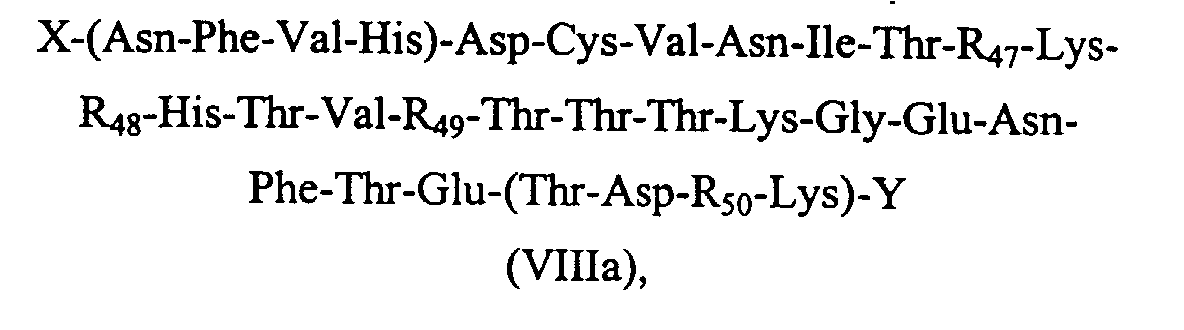
- Our invention also provides a synthetic peptide sequence relating to region F and having either the general formula VIIIa or VIIIb: Wherein
- R 49 is Thr and in formula VIIIb that R 51 is Ile, R 53 is Arg, R 54 is Gln, R 55 is absent, R 56 is Gly, R 57 is Ala and R 58 is absent.
- Synthetic polypeptides according to any one of formulae I to VIIIb above without X and Y being present will of course be useful, for example, in the production of antibodies.
- X or Y may be any length but preferably less than 20 amino acids, more preferably less than 10, eg. 3 to 6.
- a sequence according to any one of formulae I to VIIIb may constitute a protein with X and Y being major portions of the protein with the antigenic sequence being for example, part of an exposed loop on a globular protein.
- X or Y are relatively short sequences, typically 1 to 3 residues long. In most instances X is preferably absent and Y is 1 or 2 residues long, e.g. -Cys or -Gly-Cys.
- Polypeptides according to the invention may be used to raise antibodies which will cross-react with prion proteins produced in a wide range of organisms. Our analyses have shown that since the conformational, topographic and electrostatic properties of polypeptides according to the invention are such that they are highly likely to elicit the production of antibodies which will cross-react with prion proteins from several or many organisms, further advantages may arise from combining several variant polypeptides in a larger polypeptide.
- Such a polypeptide may have the general formula (IX): [L a -F] m - [L b -G] n - L c wherein F and G may each independently be a polypeptide or sub-fragment according to any one of Formulae I to VIIIb, L is a linking sequence, a, b and c are each independently 0 or 1 and m and n are each positive numbers e.g. between 1 and 10 inclusive. L is preferably a short, conformationally flexible section of polypeptide chain such as, for example and without limit (Seq. I.D. No: 38) Gly-Gly-Gly-Gly-Gly, (Seq. I.D.
- each repeat may optionally have a different variant of a polypeptide according to the invention.
- Polyvalent determinant analogues as defined by Formula IX may be either what is referred to as pseudohomopolyvalent, wherein variants of essentially the same determinant analogue are repeated in a single polypeptide chain and/or heteropolyvalent, wherein distinct determinants are included in a single polypeptide.
- pseudohomopolyvalent wherein variants of essentially the same determinant analogue are repeated in a single polypeptide chain and/or heteropolyvalent, wherein distinct determinants are included in a single polypeptide.
- simple homopolyvalent polypeptide immunogens which contai.. multiple copies of the same variant of one of the determinant analogues according to any one of formulae I to VIIIb, would also be expected to be effective, and are also included within the scope of the present invention.
- any antigenically significant subfragments and/or antigenically significant variants of the above-identified polypeptide sequences which retain the general form and function of the parent polypeptide are included within the scope of this invention.
- substitution of any of the specific residues by residues having comparable conformational and/or physical properties, including substitution by rare (but naturally occurring, e.g. D-stereoisomers) or synthetic amino acid analogues is included.
- substitution of a residue by another in the same Set is included within the ambit of the invention; Set 1 - Ala, Val, Leu, Ile, Phe, Tyr, Trp and Met; Set 2 - Ser, Thr, Asn and Gln; Set 3 - Asp and Glu; Set 4 - Lys, His and Arg; Set 5 - Asn and Asp; Set 6 - Glu and Gln; Set 7 - Gly, Ala, Pro, Ser and Thr.
- D-stereoisomers of all amino acid types may be substituted, for example, D-Phe, D-Tyr and D-Trp.
- X and Y if present may independently include one or more segments of protein sequence with the ability to act as a T-cell epitope.
- segments of amino acid sequence of the general formula 1-2-3-4 where 1 is Gly or a charged amino acid (e.g. Lys, His, Arg, Asp or Glu), 2 is a hydrophobic amino acid (e.g. Ile, Leu, Val, Met, Tyr, Phe, Trp, Ala), 3 is either a hydrophobic amino acid (as defined above) or an uncharged polar amino acid (e.g. Asn, Ser, Thr, Pro, Gln, Gly), and 4 is a polar amino acid (e.g.
- Lys, Arg, His, Glu, Asp, Asn, Gln, Ser, Thr, Pro appear to act as T-cell epitopes in at least some instances (Rothbard, J.B. & Taylor, W.R. (1988). A sequence pattern in common to T-cell epitopes. The EMBO Journal 7(1): 93-100). Similarly segments can be of the sequence 1'-2'-3'-4'-5', wherein 1' is equivalent to 1 as defined earlier, 2' to 2, 3' and 4' to 3, and 5' to 4 (ibid).
- T-cell epitopes preferably less than five which may be of the type defined above or may be of other structure and which may be separated by spacer segments of any length or composition, preferably less than five amino acid residues in length and comprising for example residues selected from Gly, Ala, Pro, Asn, Thr, Ser or polyfunctional linkers such as non-a amino acids. It is possible for a C- or N-terminal linker to represent a complete protein, thus obviating the possible need for conjugation to a carrier protein.
- an analogue according to the invention and containing a retro-inverso amino acid may have the formula: where R is any functional group, e.g. a glycine side chain, and A1 and A2 are preferably each a copy of one of the analogues defined herein (but not necessarily the same) attached by its N- or C-terminal end.
- T-cell epitopes may optionally be included as discussed earlier.
- Retro-inverso modification of peptides involves the reversal of one or more peptide bonds to create analogues more resistant than the original molecule to enzymatic degradation and offer one convenient route to the generation of branched immunogens which contain a high concentration of epitope for a medium to large immunogen.
- the use of these compounds in large-scale solution synthesis of retro-inverso analogues of short-chain biologically active peptides has great potential.
- Peptides according to the invention may be synthesised by standard peptide synthesis techniques, for example using either standard 9-fluorenylmethoxycarbonyl (F-Moc) chemistry (see, for example, Atherton, E. and Sheppard, R. C. (1985) J. Chem. Soc. Chem. Comm. 165 ) or standard butyloxycarbonate (T-Boc) chemistry although it is noted that, more recently, the fluorenylmethoxycarbonyl (Fmoc)/tert-butyl system, developed by Sheppard et al has found increasingly wide application (Sheppard, R.C.1986 Science Tools, The LKB Journal 33, 9).
- F-Moc 9-fluorenylmethoxycarbonyl
- T-Boc butyloxycarbonate
- polypeptides according to the invention may be synthesised by any conventional method, either directly using manual or automated peptide synthesis techniques as mentioned above, or indirectly by RNA or DNA synthesis and conventional techniques of molecular biology and genetic engineering. Such techniques may be used to produce hybrid proteins containing one or more of the polypeptides inserted into another polypeptide sequence.
- Another aspect of the present invention therefore provides a DNA molecule coding for at least one synthetic polypeptide according to the invention, preferably incorporated into a suitable expression vector replicable in microorganisms or in mammalian cells.
- the DNA may also be part of the DNA sequence for a longer product e.g. the polypeptides may be expressed as parts of other proteins into which they have been inserted by genetic engineering.
- One practical guide to such techniques is "Molecular cloning: a laboratory manual" by Sambrook, J., Fritsch, E.F. and Maniatis, T. (2nd Edition, 1989).
- analogues incorporating retro-inverso amino acid derivatives cannot be made directly using a recombinant DNA system.
- the basic analogues can, and they can then be purified and chemically linked to the retro-inverso amino-acids using standard peptide/organic chemistry.
- a practical and convenient novel procedure for the solid-phase synthesis on polyamide-type resin of retro-inverso peptides has been described recently [Gazerro, H., Pinori, M. & Verdini, A.S. (1990).
- a new general procedure for the solid-phase synthesis of retro-inverso peptides In "Innovation and Perspectives in Solid Phase Synthesis" Ed. Roger Epton. SPCC (UK) Ltd, Birmingham, UK].
- polypeptides are optionally linked to a carrier molecule, either through chemical groups within the polypeptides themselves or through additional amino acids added at either the C- or N-terminus, and which may be separated from the polypeptides themselves or surrounded by one or more additional amino acids, in order to render them optimal for their immunological function.
- linkages are suitable and include for example use of the side chains of Tyr, Cys and Lys residues.
- Suitable carriers include, for example, purified protein derivative of tuberculin (PPD), tetanus toxoid (TT), cholera toxin and its B subunit, ovalbumin, bovine serum albumin (BSA), soybean trypsin inhibitor (STI), muramyl dipeptide (MDP) and analogues thereof, diphtheria toxoid (DPT), keyhole limpet haemocyanin (KLH) and Braun's lipoprotein although other suitable carriers will be readily apparent to the skilled person.
- PPD tuberculin
- TT tetanus toxoid
- TT cholera toxin and its B subunit
- ovalbumin bovine serum albumin
- STI soybean trypsin inhibitor
- MDP muramyl dipeptide
- DPT diphtheria toxoid
- KLH keyhole limpet haemocyanin
- Braun's lipoprotein although other suitable carriers will be readily apparent to the skilled person
- Polypeptide antigens according to the invention may be reacted with, or synthesised on, the amino termini and different polypeptide antigens may be reacted with the same core or carrier.
- PPD as a carrier for polypeptides according to the invention, a higher titre of antibodies is achieved if the recipient of the polypeptide-PPD conjugate is already tuberculin sensitive, e.g. by virtue of earlier BCG vaccination.
- PPD is expected to be a preferred carrier for use in such countries.
- a lysine residue in the carrier may be coupled to a C-terminal or other cysteine residue in a polypeptide by treatment with N- ⁇ -maleimidobutyryloxy-succinimide (Kitagawa, T. & Ackawa, T. (1976) J. Biochem. 79 , 233).
- a lysine residue in the carrier may be conjugated to a glutamic or aspactic acid residue in the peptide using isobutylchloroformate (Thorell, J.I. De Larson, S.M. (1978) Radioimmunoassay and related techniques: Methodology and clinical applications, p.288).
- Other coupling reactions and reagents have been described in the literature.
- polypeptides may be administered by any route (eg parenteral, nasal, oral, rectal, intra-vaginal), with or without the use of conventional adjuvants (such as aluminium hydroxide or Freund's complete or incomplete adjuvants) and/or other immunopotentiating agents.
- the invention also includes formulation of polypeptides according to the invention in slow-release forms, such as a sub-dermal implant or depot comprising, for example, liposomes (Allison, A.C. & Gregoriadis, G. (1974) Nature (London) 252 , 252) or biodegradable microcapsules manufactured from co-polymers of lactic acid and glycolic acids (Gresser, J. D. and Sanderson, J. E. (1984) in "Biopolymer Controlled Release Systems” pp 127-138, Ed. D. L. Wise).
- Polypeptides according to the invention may be used either alone or linked to an appropriate carrier, as:
- a further aspect of the invention provides a kit for detecting prion proteins or antibodies against prion proteins which comprises at least one synthetic polypeptide according to the invention.
- Antibodies according to the invention are, inter alia , of use in a method of diagnosing mammalian encephalopathies which comprises incubating a sample of tissue or body fluid of mammal with an amount of antibody as described herein and determining whether, and if desired the extent to which and/or rate at which, cross-reaction between said sample and said antibody occurs. Diagnostic kits which contain at least one of said antibodies also form part of this invention.
- a further aspect of the invention provides synthetic polypeptides for use in therapy or prophylaxis of mammalian encephalopathies and/or stimulating the mammalian immune system and/or blocking the cellular binding or aggregation of the prion proteins and for the preparation of medicaments suitable for such uses.
- pharmaceutical compositions containing, as active ingredient, at least one polypeptide or polypeptide-carrier conjugate as described herein in association with one or more pharmaceutically acceptable adjuvants, carriers and/or excipients.
- the compositions may be formulated for oral, rectal, nasal or especially parenteral administration (including intra-CNS administration).
- the invention further provides a method of therapy or prophylaxis of mammalian encephalopathies and/or of stimulating the mammalian immune system and/or of blocking the cellular binding or aggregation of the prion proteins, which comprises administering an amount of a polypeptide as hereinbefore defined, either in isolation or in combination with other agents for the treatment of encephalopathies.
- PrP C and PrP SC Discrimination between natural PrP C and PrP SC is highly desired since PrP C is found in normal subjects and both PrP C and PrP SC are found in a diseased subject.
- peptide sequences according to the invention preferably those relating to regions A, B and C, and significant sub-fragments thereof may be used to discriminate between natural PrP C and infective PrP SC .
- antibodies raised against these peptide sequences and sub-fragments and the nucleotide sequences which code for such peptide sequences and sub-fragments may also be used to discriminate between PrP C and PrP SC .
- the invention provides a method of discriminating between PrP C and PrP SC in which a sample is contacted with a substance selected from peptide sequences according to the invention, preferably those relating to regions A, B and C, and significant sub-fragments thereof, antibodies raised against said sequences and sub-fragments and the presence or absence of PrP SC is determined.
- discrimination may be enhanced by pretreatment of the sample, for example by pre-digestion with enzymes e.g. proteinase K, or denaturation by strong alkali e.g. 6M guanidine hydrochloride or by a combination of such treatments.
- enzymes e.g. proteinase K
- denaturation by strong alkali e.g. 6M guanidine hydrochloride or by a combination of such treatments.
- peptide sequences, antibodies and nucleotide sequences which relate to the specific subject under test, e.g. bovine sequences and antibodies for cattle, ovine sequences and antibodies for sheep.
- any of the peptide analogues, their conjugates, and cocktails thereof may be administered in any suitable adjuvant or delivery system, and more than one adjuvant or delivery system may be combined to form a so-called "super-cocktail".
- Preferred adjuvants and delivery systems include aluminium hydroxide (alum), liposomes, micelles, niosomes, ISCOMS, Brauns lipoprotein and whole-cell or components of microbial animal vaccines.
- a preferred bovine form of formula II (Seq. I.D. No: 41) Ala-Met-Ser-Arg-Pro-Leu-Ile-His-Phe-Gly-Ser-Asp-Tyr-Glu-Asp-Arg-Tyr-Tyr-Arg-Glu-Asn-Met-His-Arg-Gly-Cys (related to Seq. I.D. No: 7) in which the C-terminal Y extension is Gly-Cys according to the invention is synthesised using standard solid-phase Fmoc methodologies.
- the peptide is cleaved from the resin in the presence of trifluroacetic acid and subsequent purification is achieved by gel filtration, ion exhange chromatography and reverse phase high performance liquid chromatography.
- the peptide is conjugated to a variety of carriers by MBS (m-Maleimido-benzoyl-N-hydroxy succinimide ester), a well-known hetero-bifunctional reagent.
- Examples of carriers include KLH, BSA and TT which have been shown to provide necessary immunopotentiating properties to B cell epitopes.
- the peptide carrier conjugates are emulsified in Freund's Complete Adjuvant and are administered intramuscularly to mice. Subsequent booster injections are given in Freund's Incomplete Adjuvant.
- the ensuing serum antibody response is monitored throughout the immunisation schedule by enzyme immunoassay (ELISA) using immobilised antigen (formula II), coupled to BSA, the serum sample under test, and an enzyme-labelled anti-mouse antibody.
- ELISA enzyme immunoassay
- Antibodies to formula II are used as diagnostic reagents for assaying the presence of prion protein in serum, in "cell carriers” in serum and in tissue biopsies of injected animal species.
- a direct enzyme immunoassay can detect the presence of extracted prion protein by its immobilisation onto a solid substrate. Reaction of mouse antisera raised to formula II with native prion protein is detected with an enzyme-labelled anti-mouse antiserum. The reaction is quantified by addition of a suitable substrate and reading the optical density of the colour produced.
- immunohistochemical diagnosis of prion proteins in tissue biopsies can be performed by reacting anti-formula II antibodies with paraffin wax embedded or frozen tissue. Reactions can be detected using a standard indirect immunoperoxidase technique.
- Peptides I, II, BII, III, BIII a, Vb, Vc and VIIIa were synthesised with the C-terminal extension according to the invention.
- the peptides were cleaved from the resin in the presence of trifluoroacetic acid and subsequent purification was achieved by reverse phase high performance liquid chromatography. All peptides had a purity of 85% or more.
- Peptides were conjugated through their C-terminal (peptides II, BII, III, BIII Vb and Vc) or N-terminal (peptide VIIIb) Cys residues. Peptides were dissolved in dimethyl sulphoxide (DMSO) to a concentration of 10 mg/ml. Preactivated ovalbumin (Pierce, Imject Kit) was resuspended in 1 ml of distilled water, and equal volumes of preactivated ovalbumin and peptide were mixed and the solution allowed to stand at room temperature for 3 hours. The conjugate was dialysed overnight against phosphate buffered saline (PBS) to remove the DMSO and unconjugated peptide.
- PBS phosphate buffered saline
- the extent of conjugation was determined by measuring the free-thiol content using an Ellman's assay and by monitoring the increase in the molecular mass of the conjugate by SDS-PAGE (sodium dodecyl sulphate-polyacrylamide gel electrophoresis).
- Antiserum was raised against each of the peptide conjugates in two female New Zealand White rabbits. Each rabbit received an amount of conjugate equivalent to 40 ⁇ g of peptide for both the primary inoculation and the boosters. Rabbits were injected as follows:
- Scrapie-infected brain material was obtained from a Department of Agriculture and had been histopathalogically diagnosed as being scrapie infected.
- BSE-infected brain material was obtained via a government Agriculture Department and had been histopathalogically certified as being BSE infected.
- BSE-free material was obtained through a private source.
- Ha27-30 is brain material obtained from an inbred hamster scrapie model, which has been shown to contain a high level of the scrapie-infective agent. It was used as a positive control.
- a 8 ⁇ M solution of free peptide in PBS was used as the coating antigen.
- Microtitre plates were coated by adding 50 ⁇ l of the antigen concentration to each well and then incubating for 1 hour at 37°C to allow binding to occur. Each well was washed 5 times, for 2 minutes, with 300 ⁇ l of PBS containing 0.05% Tween 20. After washing, the plates were blocked by incubating for 1 hour at 37°C with PBS containing 0.3% Tween 20 and 3% non-fat milk. An aliquot of 50 ⁇ l of primary antibody (i.e. antisera) diluted in PBS was added to the appropriate wells and the plates incubated for 1 hour at 37°C.
- primary antibody i.e. antisera
- the brain homogenates prepared as described earlier were diluted 10-fold in PBS, and 100 ⁇ l of homogenates (containing 30 ⁇ g total protein) were applied to nitrocellulose filters using BRL 96 well vacuum manifold. The filters were dried for 1 hour at room temperature. The filters were then either wet with TBST (10 mM Tris-HCl pH7.4, 150 mM Nacl, 0.05% Tween 20) and PrP detected as described in the immunoblots, or the protein sample further treated. This further treatment of the sample included digestion of the protein on the filter using 100 ⁇ g/ml proteinase K in TBST for 90 minutes at room temperature.
- the proteinase K was inactivated by the addition of PMSF (phenylmethylsulphonyl fluoride) to a concentration of 5 mM in TBST. After protein digestion, some samples were also denatured by incubating the filters in 6M guanidine HCl containing 5 mM PMSF for 10 minutes. The guanidine was removed by 3 washes with TBST prior to incubation with the primary antibody.
- PMSF phenylmethylsulphonyl fluoride
- SDS-PAGE was performed on the brain homogenates, prepared as described previously, using standard techniques.
- the samples within the gel were transferred onto nitrocellulose in a Biorad transblot using Towbin Buffer (25 mM Tris, 190 mM glycine and 0.1% SDS) at 70 mA overnight.
- the nitrocellulose filter was blocked with 5% non-fat milk for 30 minutes at room temperature.
- the primary antibody (i.e. antisera) diluted in TBST was applied for 3 hours at room temperature, the filter washed 3 times for 10 minutes in TBST and the filter incubated for 2 hours at room temperature with the alkaline phosphatase-conjugated swine anti-rabbit immunoglobulin diluted at a dilution of 1:2000.
- the protein bands were detected using the NBT/BCIP (nitro-blue tetrazolium; 5-bromo-4-chloro-3-indolyl phosphate) substrate (Boehringer Mannheim).
- Peptide Vc Excellent titres. These results are exactly as expected. As mentioned previously, antibodies which recognise PrP sc generally only recognise the protein in its denatured state. Infected and uninfected samples, as well as containing PrP sc and/or PrP c in their "native" states, will also contain both PrP forms in various stages of denaturation due to natural protein turnover within cells. For this reason, antibodies would be expected to detect all three untreated samples. However, proteinase K treatment will digest PrP c and any partially denatured PrP sc leading to a loss of antibody recognition in all samples (assuming the antibody only recognises denatured PrP). The addition of guanidine should restore antibody recognition in material which had originally contained PrP sc . Western blots showed up the expected protein bands at the correct molecular weights.
- the titres are reasonable and there are strong positive results from untreated normal and infected bovine brain material.
Landscapes
- Chemical & Material Sciences (AREA)
- Health & Medical Sciences (AREA)
- Organic Chemistry (AREA)
- Life Sciences & Earth Sciences (AREA)
- Medicinal Chemistry (AREA)
- Biophysics (AREA)
- General Health & Medical Sciences (AREA)
- Genetics & Genomics (AREA)
- Biochemistry (AREA)
- Molecular Biology (AREA)
- Proteomics, Peptides & Aminoacids (AREA)
- Immunology (AREA)
- Toxicology (AREA)
- Zoology (AREA)
- Gastroenterology & Hepatology (AREA)
- Peptides Or Proteins (AREA)
- Medicines Containing Antibodies Or Antigens For Use As Internal Diagnostic Agents (AREA)
- Medicines That Contain Protein Lipid Enzymes And Other Medicines (AREA)
- Saccharide Compounds (AREA)
Claims (48)
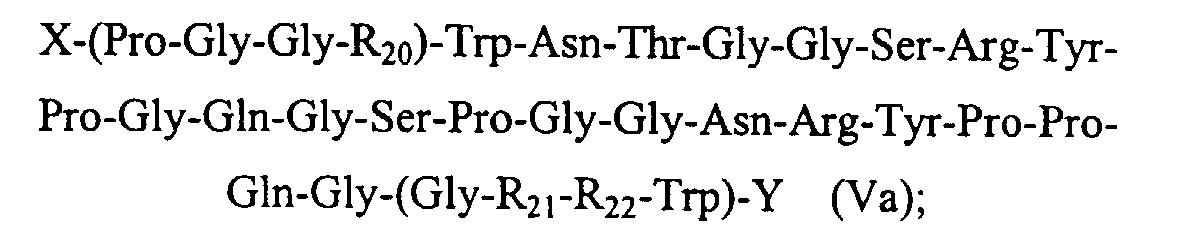
- Synthetisches Polypeptid mit mindestens einer antigenen Stelle eines Prionproteins, umfassend eine Sequenz gemäß den allgemeinen Formeln Va, Vb und Vc:
 und
und wobei
wobei R20, R21, R23 und R24 jeweils unabhängig voneinander entweder Gly sind oder fehlen;R22 entweder Gly oder Thr ist;R25 entweder Thr oder Ser ist;R26 ein aus Gly, Ser und Asn ausgewählter Aminosäurerest ist;R27 und R28 jeweils unabhängig voneinander entweder Asn oder Ser sind;R29 ein aus Met, Leu und Phe ausgewählter Aminosäurerest ist;R30 entweder Val oder Met ist; wobei ein oder mehrere Reste in Klammem vorhanden sein oder fehlen können, mit der Maßgabe, daß sie - wenn sie vorhanden sind - der Reihe nach an das restliche Pepid gebunden sind, und X und Y jeweils unabhängig voneinander fehlen können oder unabhängig voneinander ein oder mehrere weitere Aminosäurereste sein können, mit der Maßgabe, daß - wenn vorhanden - weder X noch Y einen Teil einer Antigeneigenschaft des Prionproteins bereitstellen oder bilden, der in dem entsprechenden Sequenzabschnitt eines natürlichen Prionproteins an die Sequenz grenzt, an die X und Y gebunden sind.
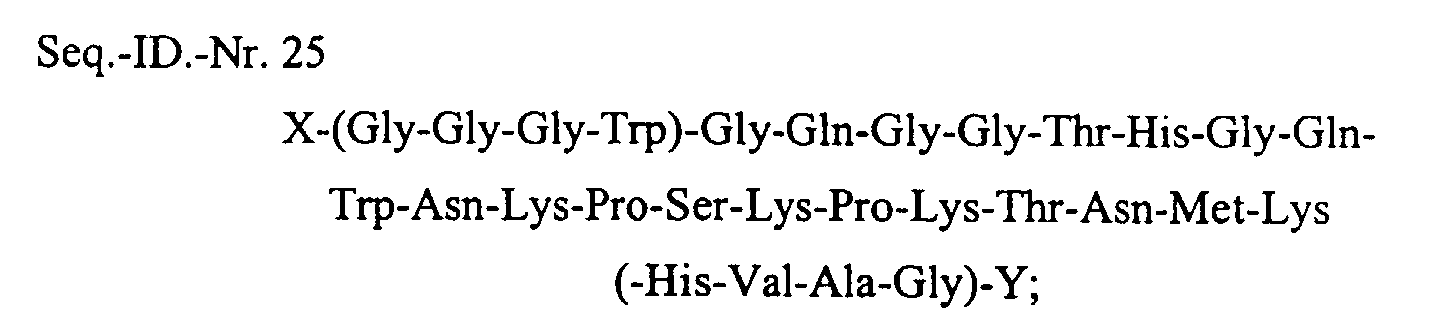
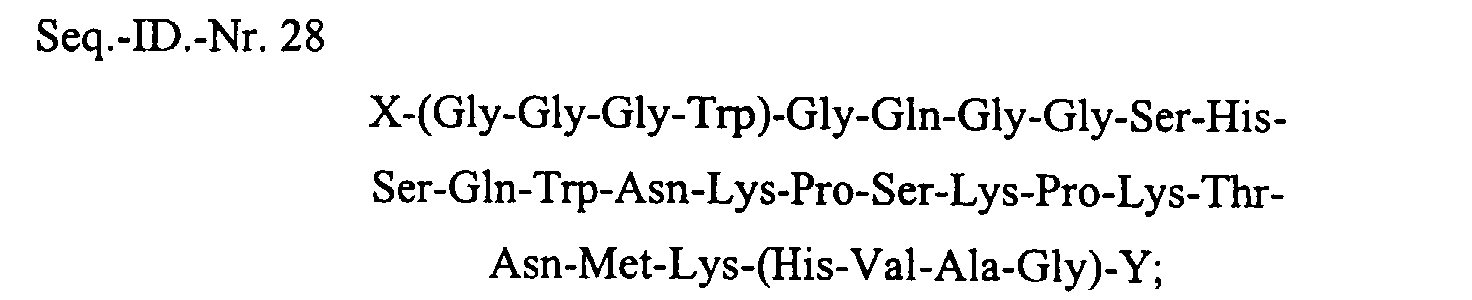
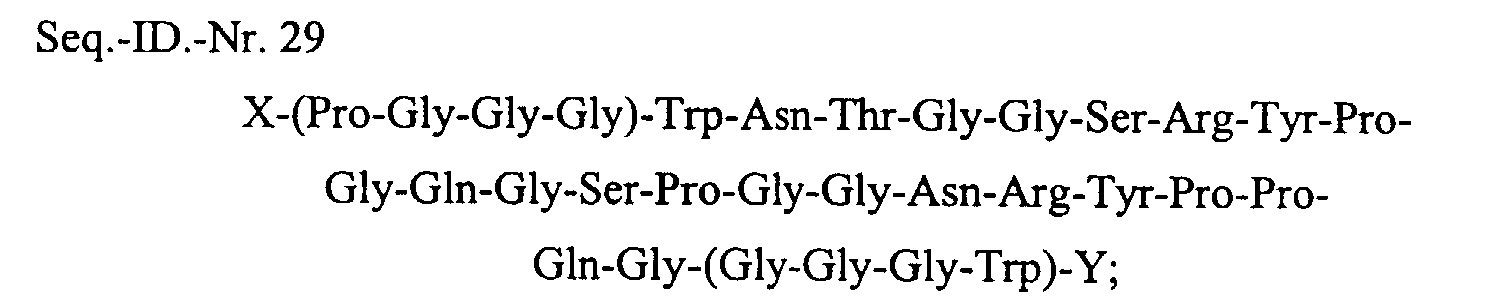
 - Synthetisches Polypeptid nach Anspruch 1, umfassend eine Sequenz, ausgewählt aus:




 und
und

- Synthetisches Polypeptid nach Anspruch 1, ausgewählt aus Seq.-ID.-Nr. 49
 und
und

- Synthetisches Polypeptid mit mindestens einer antigenen Stelle eines Prionproteins, umfassend eine Sequenz gemäß der allgemeinen Formel (I):wobei
 R1 ein aus Met, Leu und Phe ausgewählter Aminosäurerest ist;R2 entweder Met oder Val ist;R3 Ala ist oder fehlt;R4 und R5 unabhängig voneinander ein aus Leu, Ile und Met ausgewählter Aminosäurerest sind; wobei ein oder mehrere Reste in Klammern vorhanden sein oder fehlen können, mit der Maßgabe, daß sie - wenn sie vorhanden sind - der Reihe nach an das restliche Pepid gebunden sind, und X und Y jeweils unabhängig voneinander fehlen können oder unabhängig voneinander ein oder mehrere weitere Aminosäurereste sein können, mit der Maßgabe, daß - wenn vorhanden - weder X noch Y einen Teil einer Antigeneigenschaft des Prionproteins bereitstellen oder bilden, der in dem entsprechenden Sequenzabschnitt eines natürlichen Prionproteins an die Sequenz grenzt, an die X und Y gebunden sind.
 - Synthetisches Polypeptid nach Anspruch 4, umfassend eine Sequenz, ausgewählt ausund


- Synthetisches Polypeptid nach Anspruch 4, bestehend aus der Sequenz

- Signifikantes Subfragment einer Sequenz nach Anspruch 4, das vorzugsweise ausgewählt ist aus:und
 wobei R2, R3, R4, R5, X und Y wie für Formel I definiert sind, und ein oder mehrere Reste in Klammern wie in Formel I fehlen oder vorhanden sein können.
- Subfragment nach Anspruch 7, ausgewählt aus

 und
und

- Synthetisches Polypeptid mit mindestens einer antigenen Stelle eines Prionproteins, umfassend eine Sequenz gemäß der allgemeinen Formel II:wobei
 R4 und R5 die gleiche Bedeutung haben wie in Formel I;R6 entweder Asn oder Ser ist;R7 entweder Tyr oder Trp ist;R8 ein Aminosäurerest ist, ausgewählt aus His, Tyr und Asn;wobei ein oder mehrere Reste in Klammern vorhanden sein oder fehlen können, mit der Maßgabe, daß sie -wenn sie vorhanden sind - der Reihe nach an das restliche Peptid gebunden sind, undX und Y jeweils unabhängig voneinander fehlen können oder unabhängig voneinander ein oder mehrere zusätzliche Aminosäurereste sein können, mit der Maßgabe, daß - wenn vorhanden - weder X noch Y einen Teil einer Antigeneigenschaft des Prionproteins bereitstellen oder bilden, der in dem entsprechenden Sequenzabschnitt eines natürlichen Prionproteins an die Sequenz grenzt, an die X und Y gebunden sind.
 - Synthetisches Polypeptid nach Anspruch 9, umfassend eine Sequenz, ausgewählt aus
 und
und
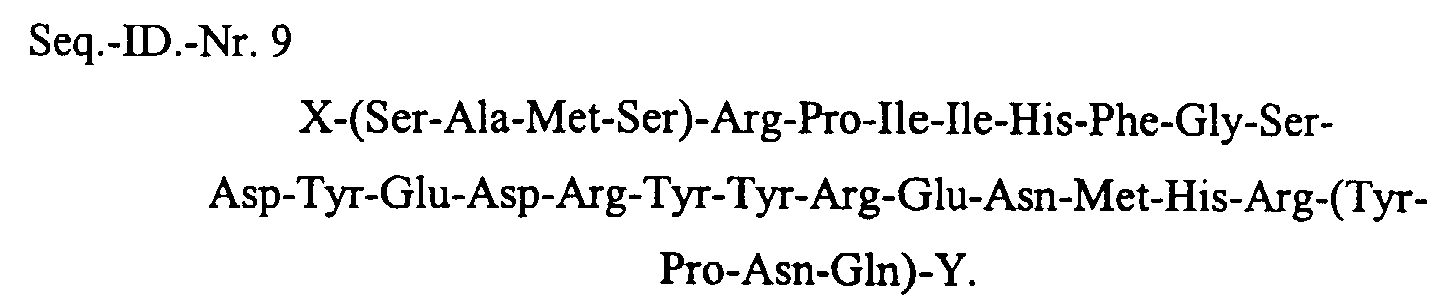
- Signifikantes Subfragment einer Sequenz nach Anspruch 9, das vorzugsweise die Sequenz umfaßt:-wobei R4 bis R7, X und Y wie für Formel II definiert sind, und ein oder mehrere Reste in Klammern vorhanden sein oder fehlen können.

- Synthetisches Polypeptid nach Anspruch 11, ausgewählt ausund


- Subfragment nach Anspruch 11, ausgewählt aus:
 und
und

- Synthetisches Polypeptid mit mindestens einer antigenen Stelle eines Prionproteins, umfassend eine Sequenz gemäß der allgemeinen Formel III:wobei
 R8 ein aus His, Tyr und Asn ausgewählter Aminosäurerest ist,R9 Val oder Met ist;R10 ein aus Gln, Glu und Arg ausgewählter Aminosäurerest ist;R11 Ser oder Asn ist; wobei ein oder mehrere Reste in Klammern vorhanden sein oder fehlen können, mit der Maßgabe daß sie - wenn sie vorhanden sind - der Reihe nach an das restliche Peptid gebunden sind, und X und Y jeweils unabhängig voneinander fehlen können oder unabhängig voneinander ein oder mehrere zusätzliche Aminosäurereste sein können, mit der Maßgabe, daß - wenn vorhanden - weder X noch Y einen Teil einer Antigeneigenschaft des Prionproteins bereitstellen oder bilden, der in dem entsprechenden Sequenzabschnitt eines natürlichen Prionproteins an die Sequenz grenzt, an die X und Y gebunden sind.
 - Synthetisches Polypeptid nach Anspruch 14, umfassend eine Sequenz ausgewählt aus
 und
und

- Synthetisches Polypeptid nach Anspruch 15, ausgewählt ausund


- Signifikantes Subfragment einer Sequenz nach Anspruch 14, das vorzugsweise die Sequenz umfaßt:wobei R9, R10, R11, X und Y wie für Formel (III) definiert sind.

- Subfragment nach Anspruch 17, ausgewählt aus
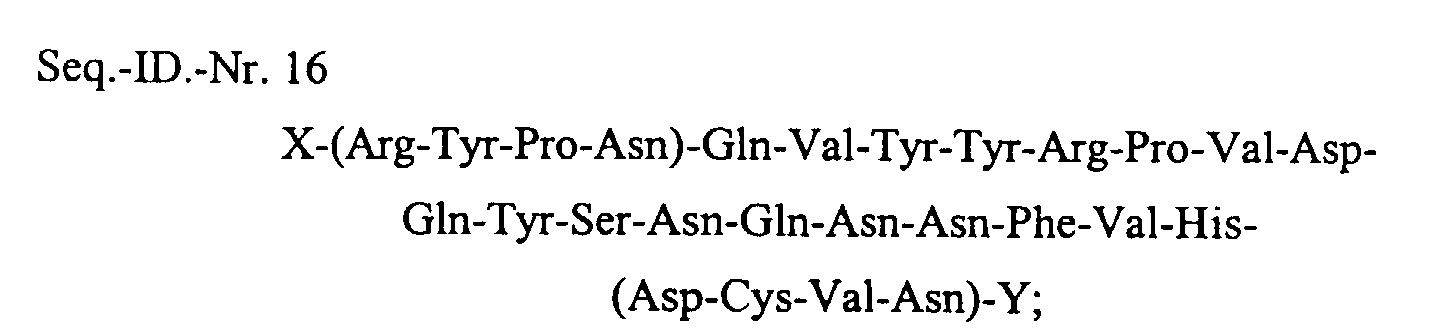 und
und

- Synthetisches Polypeptid mit mindestens einer antigenen Stelle eines Prionproteins, umfassend eine Sequenz gemäß der allgemeinen Formel IV:wobei
 R12 Asp oder Gln ist;R13 Gly ist oder fehlt;R14 Gly oder Arg ist;R15 Ala oder Ser ist;R16 Ser ist oder fehlt;R17 ein aus Ala, Thr, Met und Val ausgewählter Aminosäurerest ist;R18 Val oder Ile ist;R19 Ile oder Met ist; wobei ein oder mehrere Reste in Klammern vorhanden sein oder fehlen können, mit der Maßgabe, daß sie - wenn sie vorhanden sind - der Reihe nach an das restliche Peptid gebunden sind, und X und Y jeweils unabhängig voneinander fehlen können oder unabhängig voneinander ein oder mehrere zusätzliche Aminosäurereste sein können, mit der Maßgabe, daß - wenn vorhanden - weder X noch Y einen Teil einer Antigeneigenschaft des Prionproteins bereitstellen oder bilden, der im entsprechenden Sequenzabschnitt eines natürlichen Prionproteins an die Sequenz grenzt, an die X und Y gebunden sind.
 - Synthetisches Polypeptid nach Anspruch 19, umfassend eine Sequenz, ausgewählt ausund

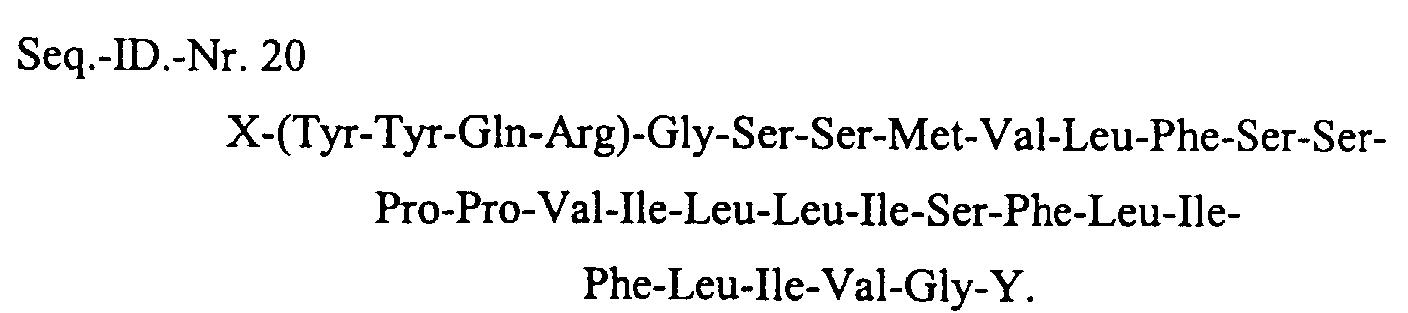
- Signifikantes Subfragment einer Sequenz nach Anspruch 19, das vorzugsweise die Sequenz umfaßt:wobei R14 bis R18, X und Y wie für Formel IV definiert sind, und ein oder mehrere Reste in Klammern wie in Formel IV vorhanden sein oder fehlen können.

- Subfragment nach Anspruch 21, ausgewählt ausund


- Synthetisches Polypeptid mit mindestens einer antigenen Stelle eines Prionproteins, umfassend eine Sequenz gemäß der Formel VI:wobei
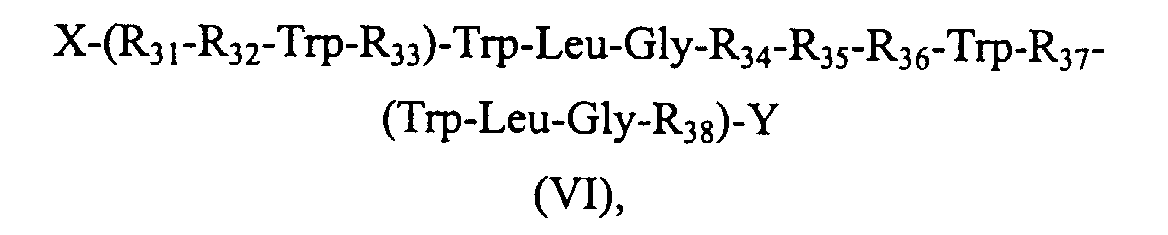 R31 und R35 jeweils unabhängig voneinander entweder Ala oder Thr sind; R32 und R36 jeweils unabhängig voneinander ein aus Ser, Pro und Thr ausgewählter Aminosäurerest sind;R33 und R37 jeweils unabhängig voneinander entweder Trp oder Arg sind;R34 und R38 jeweils unabhängig voneinander ein aus Ala, Ser, Pro, und Thr ausgewählter Aminosäurerest sind; wobei ein oder mehrere Reste in Klammern vorhanden sein oder fehlen können, mit der Maßgabe, daß sie - wenn sie vorhanden sind - der Reihe nach an das restliche Peptid gebunden sind, und X und Y jeweils unabhängig voneinander fehlen können oder unabhängig voneinander ein oder mehrere zusätzliche Aminosäurereste sein können , mit der Maßgabe, daß - wenn vorhanden - weder X noch Y einen Teil einer Antigeneigenschaft des Prionproteins bereitstellen oder bilden, der im entsprechenden Sequenzabschnitt eines natürlichen Prionproteins an die Sequenz grenzt, an die X und Y gebunden sind.
 - Synthetisches Polypeptid mit mindestens einer antigenen Stelle eines Prionproteins, umfassend eine Sequenz gemäß der Formel VII.wobei R39 und R43 jeweils unabhängig voneinander entweder Ser oder Asn sind; R40 und R44 jeweils unabhängig voneinander ein aus Pro, Leu, und His ausgewählter Aminosäurerest sind, R41 und R45 jeweils unabhängig voneinander Val oder Glu sind; R42 und R46 jeweils unabhängig voneinander aus Val, Ala, Asp und Gly ausgewählt sind; wobei ein oder mehrere Reste in Klammern vorhanden sein oder fehlen können, mit der Maßgabe, daß sie - wenn sie vorhanden sind - der Reihe nach an das restliche Peptid gebunden sind, und X und Y jeweils unabhängig voneinander fehlen können oder unabhängig voneinander ein oder mehrere zusätzliche Aminosäurereste sein können, mit der Maßgabe, daß - wenn vorhanden - weder X noch Y einen Teil einer Antigeneigenschaft des Prionproteins bereitstellen oder bilden, der in dem entsprechenden Sequenzabschnitt eines natürlichen Prionproteins an die Sequenz grenzt, an die X und Y gebunden sind.

- Synthetisches Polypeptid mit mindestens einer antigenen Stelle eines Prionproteins, umfassend eine Sequenz gemäß der Formel VIIIa oder VIIIb:
 wobei
wobei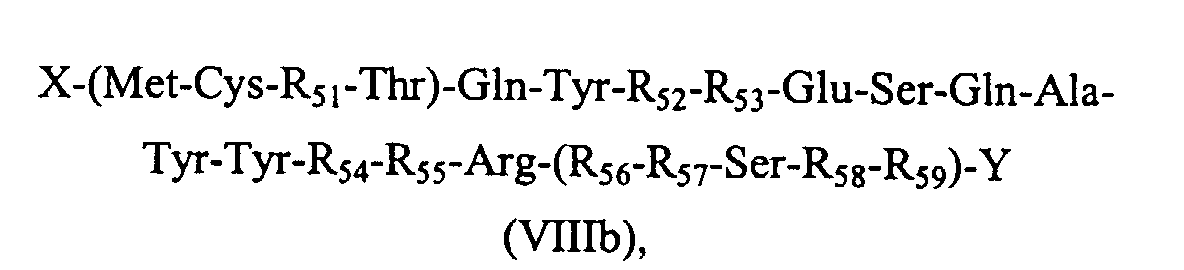 ein oder mehrere Reste in Klammern vorhanden sein oder fehlen können, mit der Maßgabe, daß sie - wenn sie vorhanden sind - der Reihe nach an das restliche Peptid gebunden sind, und X und Y jeweils unabhängig voneinander fehlen können oder unabhängig voneinander ein oder mehrere zusätzliche Aminosäurereste sein können, mit der Maßgabe, daß - wenn vorhanden - weder X noch Y einen Teil einer Antigeneigenschaft des Prionproteins bereitstellen oder bilden, der im entsprechenden Sequenzabschnitt eines natürlichen Prionproteins an die Sequenz grenzt, an die X und Y gebunden sind.R47 entweder Ile oder Val ist;R48 und R52 jeweils unabhängig voneinander entweder Gln oder Glu sind;R49 entweder Val oder Thr ist;R50 entweder Val oder Ile ist;R51 ein aus Ile, Thr und Val ausgewählter Aminosäurerest ist;R52 Gln oder Glu ist;R53 entweder Arg oder Lys ist;R54 entweder Asp oder Gln ist;R55 Gly ist oder fehlt;R56 entweder Gly oder Arg ist;R57 entweder Ala oder Ser ist;R58 Ser ist oder fehlt;R59 ein aus Ala, Thr, Met und Val ausgewählter Aminosäurerest ist;
 - Synthetisches Polypetid nach Anspruch 25, umfassend eine Sequenz , ausgewählt aus:



 und
und

- Subfragment eines synthetischen Polypeptides nach Anspruch 25, ausgewählt ausund


- Synthetisches Polypeptid der allgemeinen Formel (IX);
- Synthetisches Polypeptid, umfassend ein antigen signifikantes Subfragment und/oder eine antigen signifikante Variante der vorstehend identifizierten Polypeptidsequenzen nach einem der Ansprüche 1 bis 27.
- Synthetisches Polypeptid nach einem der vorhergehenden Ansprüche, das zusätzlich ein T-Zellepitop umfaßt.
- Synthetisches Polypeptid nach einem der vorhergehenden Ansprüche, das eine retro-inverso-Aminosäure enthält.
- Synthetisches Polypeptid nach einem der vorhergehenden Ansprüche, das an einen Träger gebunden ist.
- DNA-Molekül, das mindestens ein synthetisches Polypeptid nach einem der Ansprüche 1 bis 30 codiert.
- Impfstoff, umfassend mindestens ein Polypeptid nach einem der Ansprüche 1 bis 31, das die Prophylaxe gegen Enzephalopathien wirksam fördert.
- Kit zum Nachweisen von Prionproteinen oder Antikörpern gegen Prionproteine, das mindestens ein synthetisches Polypeptid nach einem der Ansprüche 1 bis 31 umfaßt.
- Pharmazeutische Zusammensetzung, die als Wirkstoff mindestens ein Polypeptid oder Polypeptid-Träger-Konjugat nach einem der Ansprüche 1 bis 32 zusammen mit einem oder mehreren pharmazeutisch verträglichen Hilfsstoffen, Trägern und/oder Exzipienten enthält.
- Verwendung eines synthetischen Polypeptides nach einem der Ansprüche 1 bis 32 für die Herstellung eines Medikamentes für die therapeutische oder prophylaktische Behandlung von Säugerenzephalopathien und/oder die Blockierung der zellulären Bindung oder Aggregation der Prionproteine.
- Verwendung eines Polypeptides nach einem der Ansprüche 1 bis 32, entweder allein oder in Kombination mit anderen Mitteln, für die Herstellung einer Zusammensetzung zur Therapie oder Prophylaxe von Säugerenzephalopathien und/oder Stimulierung des Säuger-Immunsystems und/oder Blockierung der zellulären Bindung oder Aggregation der Prionproteine.
- Verfahren zum Nachweis von Prionprotein oderAntikörpern gegen Prionprotein oder antigenbindenen Fragmenten davon, umfassend das Inkubieren einer Probe mit mindestens einem Polypeptid nach einem der Ansprüche 1 bis 32.
- Verfahren zur Unterscheidung zwischen PrPC und PrPSC, wobei eine Probe mit einer Substanz in Kontakt gebracht wird, die aus Peptidsequenzen nach einem der Ansprüche 1 bis 32, vorzugsweise aus solchen, die die Bereiche A, B und C betreffen, und signifikanten Subfragmenten davon, Antikörpern, die gegen diese Sequenzen und Subfragmente gezüchtet wurden, ausgewählt ist, und das Vorhandensein oder das Fehlen von PrPSC ermittelt wird.
- Antikörper oder antigenbindendes Fragment davon, der/das spezifisch an ein synthetisches Polypeptid nach einem der Ansprüche 1 bis 31 bindet.
- Kit zum Nachweisen von Prionproteinen oder Antikörpern gegen Prionproteine, das einen Antikörper oder ein antigenbindendes Fragment davon nach Anspruch 41 enthält.
- Pharmazeutische Zusammensetzung, die als Wirkstoff einen Antikörper oder ein antigenbindendes Fragment nach Anspruch 41 zusammen mit einem oder mehreren pharmazeutisch verträglichen Trägern und/oder Exzipienten umfaßt.
- Verwendung eines Antikörpers oder eines antigenbindenden Fragmentes nach Anspruch 41 für die Herstellung einer Zusammensetzung zur Therapie oder Prophylaxe von Säugerenzephalopathien.
- Verfahren zum Nachweisen von Prionproteinen oder Antikörpern gegen Prionproteine, umfassend das Inkubieren einer Probe mit einem Antikörper oder einem antigenbindenden Fragment nach Anspruch 41.
- Antiidiotypischer Antikörper, der gegen einen Antikörper oder ein antigenbindendes Fragment nach Anspruch 41 gezüchtet ist.
- Verfahren zur Herstellung eines synthetischen Polypeptides mit mindestens einer antigenen Stelle eines Prionproteins, wobei das Verfahren die Schritte umfaßt: Kuppeln der Reste mit an sich bekannten chemischen, biologischen oder rekombinanten Techniken und Isolieren des Polypeptides nach einem der Ansprüche 1 bis 31.
- Verfahren zur Herstellung eines Antikörpers, der spezifisch an ein synthetisches Polypeptid bindet, das mindestens eine antigene Stelle eines Prionproteins aufweist, wobei das Verfahren das Immunisieren eines nicht-menschlichen Säugers mit dem Polypeptid und das Isolieren des Antikörpers nach Anspruch 41 umfaßt.
Applications Claiming Priority (5)
| Application Number | Priority Date | Filing Date | Title |
|---|---|---|---|
| GB919125747A GB9125747D0 (en) | 1991-12-03 | 1991-12-03 | Synthetic polypeptides |
| GB9125747 | 1991-12-03 | ||
| GB9214663 | 1992-07-10 | ||
| GB929214663A GB9214663D0 (en) | 1992-07-10 | 1992-07-10 | Synthetic polypeptides |
| PCT/GB1992/002246 WO1993011155A1 (en) | 1991-12-03 | 1992-12-03 | Fragments of prion proteins |
Publications (2)
| Publication Number | Publication Date |
|---|---|
| EP0616613A1 EP0616613A1 (de) | 1994-09-28 |
| EP0616613B1 true EP0616613B1 (de) | 1999-03-17 |
Family
ID=26299955
Family Applications (1)
| Application Number | Title | Priority Date | Filing Date |
|---|---|---|---|
| EP92924777A Revoked EP0616613B1 (de) | 1991-12-03 | 1992-12-03 | Fragmente von Prion Proteinen. |
Country Status (12)
| Country | Link |
|---|---|
| US (3) | US5773572A (de) |
| EP (1) | EP0616613B1 (de) |
| JP (1) | JP4233604B2 (de) |
| AT (1) | ATE177754T1 (de) |
| AU (1) | AU675053B2 (de) |
| CA (1) | CA2124953C (de) |
| DE (1) | DE69228701T2 (de) |
| DK (1) | DK0616613T3 (de) |
| ES (1) | ES2128362T3 (de) |
| GR (1) | GR3029740T3 (de) |
| NZ (1) | NZ246059A (de) |
| WO (1) | WO1993011155A1 (de) |
Families Citing this family (63)
| Publication number | Priority date | Publication date | Assignee | Title |
|---|---|---|---|---|
| US5618673A (en) * | 1991-08-20 | 1997-04-08 | British Technology Group Limited | Oligonucleotides and their use in an assay for encephalopathies |
| CN1091138A (zh) | 1992-08-27 | 1994-08-24 | 迪金研究有限公司 | 疫苗 |
| DE4402756A1 (de) * | 1994-01-31 | 1995-08-03 | Boehringer Mannheim Gmbh | Spezifische Bindungssubstanzen für Antikörper und deren Verwendung für Immunoassays oder Vakzine |
| AUPM411994A0 (en) * | 1994-02-25 | 1994-03-24 | Deakin Research Limited | Epitopes |
| US5948763A (en) * | 1995-06-07 | 1999-09-07 | New York University | Peptides and pharmaceutical compositions thereof for treatment of disorders or diseases associated with abnormal protein folding into amyloid or amyloid-like deposits |
| EP1186662A3 (de) * | 1996-05-29 | 2003-01-15 | McGILL UNIVERSITY | Prionbindendes Proteine und deren Verwendungen |
| GB2319607A (en) * | 1996-11-23 | 1998-05-27 | Electrophoretics International | Detection of prion proteins in mononuclear cells |
| US20020168689A1 (en) * | 1997-02-06 | 2002-11-14 | O'connor Michael | Immunological assay for Spongiform Encephalopathies |
| PT909388E (pt) * | 1997-02-06 | 2004-01-30 | Enfer Technology Ltd | Ensaios imunologicos para encefalopatias espongiformes |
| DE59813703D1 (de) | 1997-02-14 | 2006-10-12 | Deutsches Krebsforsch | Hemmung der prion-vermehrung durch dominant-negative prionprotein-mutanten |
| EP0861900A1 (de) * | 1997-02-21 | 1998-09-02 | Erziehungsdirektion Of The Canton Zurich | Immunologischer Nachweis von Prionen |
| WO1998043484A1 (en) * | 1997-04-01 | 1998-10-08 | Calyx Therapeutics, Inc. | Orally active fraction of momordica charantia, active peptides thereof, and their use in the treatment of diabetes |
| WO1998053838A2 (en) * | 1997-05-30 | 1998-12-03 | Winnacker Ernst Ludwig | A soluble laminin receptor precursor and methods to inhibit its interactions |
| DE19725619A1 (de) * | 1997-06-17 | 1998-12-24 | Fraunhofer Ges Forschung | Peptide als Agonisten und/oder Inhibitoren der Amyloidbildung und Zytotoxizität sowie der Verwendung bei Alzheimer'schen Krankheit, beim Typ II Diabetes mellitus und bei spongiformen Encephalopathien |
| DE19741607A1 (de) * | 1997-09-20 | 1999-03-25 | Prionics Ag | Synthetische Polypeptide zur Diagnose und Therapie von Prionerkrankungen |
| US6211149B1 (en) * | 1998-08-03 | 2001-04-03 | The United States Of America As Represented By The Department Of Health And Human Services | Inhibitors of formation of protease resistant prion protein |
| US6166187A (en) * | 1999-03-05 | 2000-12-26 | The Regents Of The University Of California | Method of concentrating prion proteins in blood samples |
| EP1187920A2 (de) * | 1999-06-09 | 2002-03-20 | Arch Development Corporation | Rekombinante prionänhliche gene, proteine, materialien und verfahren davon |
| MXPA01013186A (es) * | 1999-06-23 | 2002-08-12 | Caprion Pharmaceuticals Inc | Peptidos de la proteina prion y sus usos. |
| US7041807B1 (en) | 1999-06-23 | 2006-05-09 | Caprion Pharmaceuticals, Inc. | Antibodies to a YYX epitope of a mammalian prion protein |
| US6872806B1 (en) * | 1999-06-25 | 2005-03-29 | The Governors Of The University Of Alberta | Polypeptide compositions formed using a coiled-coil template and methods of use |
| US6261790B1 (en) * | 1999-07-15 | 2001-07-17 | The United States Of America As Represented By The Secretary Of Agriculture | Monoclonal antibodies and antibody cocktail for detection of prion protein as an indication of transmissible spongiform encephalopathies |
| US6437102B1 (en) | 1999-11-24 | 2002-08-20 | Bayer Corporation | Method of separating prions from biological materials |
| AU2001251358A1 (en) * | 2000-04-05 | 2001-10-23 | V.I. Technologies, Inc. | Prion-binding ligands and methods of using same |
| US7098317B1 (en) * | 2000-05-23 | 2006-08-29 | Blood Transfusion Center Of Slovenia | Antibodies capable to selectively detect prion PrPSc isoforms |
| DK1158003T4 (da) * | 2000-05-23 | 2013-04-08 | Blood Transfusion Ct Of Slovenia | Antistoffer, som er i stand til selektivt at detektere prion PrP Sc-isoformer |
| AU6887101A (en) * | 2000-06-20 | 2002-01-02 | Caprion Pharmaceuticals, Inc. | Copolymers and methods of treating prion-related diseases |
| NZ515982A (en) * | 2000-12-08 | 2003-09-26 | Fujirebio Kk | Method and monoclonal antibodies for differentiation between abnormal and normal prions |
| IES20010042A2 (en) * | 2001-01-19 | 2002-12-11 | Enfer Technology Ltd | Test for transmissible spongiform encephalopathies |
| US6613505B2 (en) | 2001-04-12 | 2003-09-02 | Bioresource International, Inc. | Composition and method for destruction of infetious prion proteins |
| US20050026165A1 (en) * | 2001-05-31 | 2005-02-03 | Cindy Orser | Detection of conformationally altered proteins and prions |
| EP1395833B1 (de) * | 2001-05-31 | 2013-02-27 | Adlyfe, Inc. | Verfahren zum erkennen von inkorrekt gefalteten proteinen |
| US7939641B2 (en) * | 2002-04-09 | 2011-05-10 | The Scripps Research Institute | Motif-grafted hybrid polypeptides and uses thereof |
| DE10230141B4 (de) * | 2002-07-04 | 2004-07-15 | Priontype Gmbh | Verfahren und Kit zur Anreicherung und zum Nachweis von veränderten Prion-Proteinen (PrPSc) |
| US20060057636A1 (en) * | 2002-08-21 | 2006-03-16 | Peter Heegaard | Composite peptide compounds for diagnosis and treatment of diseases caused by prion proteins |
| US20040072236A1 (en) * | 2002-09-27 | 2004-04-15 | Neil Cashman | PrPSc -interacting molecules and uses thereof |
| CA2836951C (en) | 2002-12-03 | 2017-01-10 | North Carolina State University | Prion protein ligands and methods of use |
| US6979672B2 (en) * | 2002-12-20 | 2005-12-27 | Polichem, S.A. | Cyclosporin-based pharmaceutical compositions |
| EP1449536A1 (de) * | 2003-02-14 | 2004-08-25 | Prionics AG | Prioproteine als therapeutische mittel zur behandlung von AP-1 assoziierten krankheiten |
| US20040192887A1 (en) * | 2003-03-25 | 2004-09-30 | Ralph Zahn | PH-dependent polypeptide aggregation and its use |
| NZ543371A (en) | 2003-04-04 | 2008-04-30 | Pathogen Removal And Diagnosti | Prion protein binding materials and methods of use |
| US7510848B2 (en) * | 2003-04-04 | 2009-03-31 | North Carolina State University | Prion protein binding materials and methods of use |
| NZ580256A (en) | 2003-08-13 | 2011-07-29 | Novartis Vaccines & Diagnostic | Prion-specific peptide reagents comprising the sequence KKRPKPGG |
| US20060035242A1 (en) * | 2004-08-13 | 2006-02-16 | Michelitsch Melissa D | Prion-specific peptide reagents |
| RU2267496C2 (ru) * | 2004-01-15 | 2006-01-10 | Сергей Иванович Черныш | Противоопухолевые и антивирусные пептиды |
| FR2865280B1 (fr) * | 2004-01-20 | 2007-01-12 | Biomerieux Sa | Procede de detection de la prp utilisant une molecule ayant au moins une charge positive et/ou au moins une liaison osidique et un ligand autre qu'un ligand proteique |
| GB0402123D0 (en) * | 2004-01-30 | 2004-03-03 | Protherics Plc | Method |
| GB0416699D0 (en) | 2004-07-27 | 2004-09-01 | Prometic Biosciences Ltd | Prion protein ligands and methods of use |
| US20060057671A1 (en) * | 2004-09-10 | 2006-03-16 | Orser Cindy S | Immobilized probes and methods of detecting conformationally altered prion proteins |
| WO2006076683A2 (en) * | 2005-01-13 | 2006-07-20 | Novartis Vaccines And Diagnostics Inc. | Isolation and detection of pathogenic prions |
| JP5162250B2 (ja) * | 2005-01-13 | 2013-03-13 | ノバルティス バクシンズ アンド ダイアグノスティックス,インコーポレーテッド | プリオン特異的ペプチド試薬を使用するelisaアッセイ |
| AU2006214463B2 (en) * | 2005-02-15 | 2012-08-30 | Presympto, Inc. | Method for detecting misfolded proteins and prions |
| EP1899308B1 (de) | 2005-06-10 | 2012-11-07 | ProMetic BioSciences Limited | Triazine als proteinbindungsliganden |
| EP1931695B1 (de) | 2005-09-09 | 2013-04-10 | Novartis AG | Prionspezifische Peptoidreagentien |
| US20070196863A1 (en) * | 2006-02-17 | 2007-08-23 | Hanson Technologies, Inc. | Prion protein detection |
| EP2156181B1 (de) * | 2006-07-28 | 2015-11-04 | Adlyfe, Inc. | Peptidsonden für diagnostik und therapie |
| BRPI0910550A2 (pt) * | 2008-04-30 | 2015-09-29 | Novartis Ag | ensaio para confôrmeros patogênicos |
| EP2135880A1 (de) | 2008-06-17 | 2009-12-23 | Heinrich-Heine-Universität Düsseldorf | Anti-Prion-Protein-Antikörperfragment |
| US20100233176A1 (en) | 2008-10-06 | 2010-09-16 | Cashman Neil R | Methods and systems for predicting misfolded protein epitopes |
| WO2010075521A1 (en) * | 2008-12-23 | 2010-07-01 | Case Western Reserve University | Compositions and methods of treating cancer |
| CA2753621A1 (en) * | 2009-03-02 | 2010-09-10 | The University Of British Columbia | Antibodies and epitopes specific to misfolded prion protein |
| WO2013166183A2 (en) * | 2012-05-02 | 2013-11-07 | Samuel Bogoch | Replikin sequences and their antibodies for diagnostics, therapeutics, and vaccines against prion and neurodegenerative disorders including alzheimer's disease |
| CN120795059A (zh) | 2018-08-27 | 2025-10-17 | 瑞泽恩制药公司 | 拉曼光谱在下游纯化中的应用 |
Family Cites Families (1)
| Publication number | Priority date | Publication date | Assignee | Title |
|---|---|---|---|---|
| AU4376093A (en) * | 1992-05-15 | 1993-12-13 | Instituto Nazionale Neurologico C. Besta | Soluble prion polypeptides, and methods for detecting and purifying thereof |
-
1992
- 1992-12-03 NZ NZ246059A patent/NZ246059A/en not_active IP Right Cessation
- 1992-12-03 AU AU30892/92A patent/AU675053B2/en not_active Ceased
- 1992-12-03 CA CA002124953A patent/CA2124953C/en not_active Expired - Fee Related
- 1992-12-03 EP EP92924777A patent/EP0616613B1/de not_active Revoked
- 1992-12-03 ES ES92924777T patent/ES2128362T3/es not_active Expired - Lifetime
- 1992-12-03 AT AT92924777T patent/ATE177754T1/de active
- 1992-12-03 DE DE69228701T patent/DE69228701T2/de not_active Expired - Lifetime
- 1992-12-03 US US08/244,701 patent/US5773572A/en not_active Expired - Lifetime
- 1992-12-03 JP JP50959493A patent/JP4233604B2/ja not_active Expired - Fee Related
- 1992-12-03 DK DK92924777T patent/DK0616613T3/da active
- 1992-12-03 WO PCT/GB1992/002246 patent/WO1993011155A1/en not_active Ceased
-
1998
- 1998-05-13 US US09/076,721 patent/US6379905B1/en not_active Expired - Fee Related
-
1999
- 1999-03-19 GR GR990400825T patent/GR3029740T3/el unknown
-
2002
- 2002-04-05 US US10/116,061 patent/US7777011B2/en not_active Expired - Fee Related
Also Published As
| Publication number | Publication date |
|---|---|
| JPH07501798A (ja) | 1995-02-23 |
| GR3029740T3 (en) | 1999-06-30 |
| US6379905B1 (en) | 2002-04-30 |
| AU3089292A (en) | 1993-06-28 |
| DK0616613T3 (da) | 1999-09-27 |
| WO1993011155A1 (en) | 1993-06-10 |
| US7777011B2 (en) | 2010-08-17 |
| EP0616613A1 (de) | 1994-09-28 |
| JP4233604B2 (ja) | 2009-03-04 |
| US20030199013A1 (en) | 2003-10-23 |
| CA2124953C (en) | 2008-02-05 |
| DE69228701D1 (de) | 1999-04-22 |
| ES2128362T3 (es) | 1999-05-16 |
| DE69228701T2 (de) | 1999-07-29 |
| CA2124953A1 (en) | 1993-06-10 |
| ATE177754T1 (de) | 1999-04-15 |
| US5773572A (en) | 1998-06-30 |
| NZ246059A (en) | 1995-08-28 |
| AU675053B2 (en) | 1997-01-23 |
Similar Documents
| Publication | Publication Date | Title |
|---|---|---|
| US6379905B1 (en) | Fragments of prion proteins | |
| US6641813B1 (en) | Methods and reagents for diagnosis of autoantibodies | |
| ES2231907T3 (es) | Epitopos de proteinas del estres. | |
| US6174528B1 (en) | Synthetic peptides and vaccines comprising same | |
| EP0399001A1 (de) | T-zellen-epitope als träger für einen konjugierten impfstoff. | |
| AP211A (en) | Synthetic polypeptides. | |
| Beachey et al. | Protective and nonprotective epitopes of chemically synthesized peptides of the NH2-terminal region of type 6 streptococcal M protein. | |
| JP3307636B2 (ja) | 自己免疫疾患のためのアッセイおよび治療 | |
| AU3960493A (en) | Synthetic polypeptides derived from the HIV envelope glycoprotein | |
| WO1994002508A2 (en) | Polypeptide antigens of mycobacterium bovis | |
| JPH05501202A (ja) | インフルエンザ菌b型の外膜タンパク質p1およびペプチド類 | |
| US6410024B1 (en) | Epitopes of shigella like toxin and their use as vaccine and in diagnosis | |
| AU728185B2 (en) | Calcium binding proteolipid compositions and methods | |
| WO1994000487A1 (en) | Peptide which produces protective immunity against tetanus | |
| US20040229772A1 (en) | Peptides responsive to antibodies against consensus peptide of the CS4-CFA/I family proteins | |
| CA2470421A1 (en) | Use of a novel cell surface protease from group b streptococcus | |
| MXPA98005626A (es) | Composiciones de proteolipido de fijacion de calcio, y metodos |
Legal Events
| Date | Code | Title | Description |
|---|---|---|---|
| PUAI | Public reference made under article 153(3) epc to a published international application that has entered the european phase |
Free format text: ORIGINAL CODE: 0009012 |
|
| 17P | Request for examination filed |
Effective date: 19940610 |
|
| AK | Designated contracting states |
Kind code of ref document: A1 Designated state(s): AT BE CH DE DK ES FR GB GR IE IT LI LU NL PT SE |
|
| 17Q | First examination report despatched |
Effective date: 19960702 |
|
| GRAG | Despatch of communication of intention to grant |
Free format text: ORIGINAL CODE: EPIDOS AGRA |
|
| GRAG | Despatch of communication of intention to grant |
Free format text: ORIGINAL CODE: EPIDOS AGRA |
|
| GRAG | Despatch of communication of intention to grant |
Free format text: ORIGINAL CODE: EPIDOS AGRA |
|
| GRAH | Despatch of communication of intention to grant a patent |
Free format text: ORIGINAL CODE: EPIDOS IGRA |
|
| GRAH | Despatch of communication of intention to grant a patent |
Free format text: ORIGINAL CODE: EPIDOS IGRA |
|
| GRAA | (expected) grant |
Free format text: ORIGINAL CODE: 0009210 |
|
| AK | Designated contracting states |
Kind code of ref document: B1 Designated state(s): AT BE CH DE DK ES FR GB GR IE IT LI LU NL PT SE |
|
| REF | Corresponds to: |
Ref document number: 177754 Country of ref document: AT Date of ref document: 19990415 Kind code of ref document: T |
|
| REG | Reference to a national code |
Ref country code: CH Ref legal event code: NV Representative=s name: A. BRAUN, BRAUN, HERITIER, ESCHMANN AG PATENTANWAE Ref country code: CH Ref legal event code: EP |
|
| REG | Reference to a national code |
Ref country code: IE Ref legal event code: FG4D |
|
| REF | Corresponds to: |
Ref document number: 69228701 Country of ref document: DE Date of ref document: 19990422 |
|
| REG | Reference to a national code |
Ref country code: ES Ref legal event code: FG2A Ref document number: 2128362 Country of ref document: ES Kind code of ref document: T3 |
|
| REG | Reference to a national code |
Ref country code: PT Ref legal event code: SC4A Free format text: AVAILABILITY OF NATIONAL TRANSLATION Effective date: 19990318 |
|
| ET | Fr: translation filed | ||
| REG | Reference to a national code |
Ref country code: DK Ref legal event code: T3 |
|
| PLBQ | Unpublished change to opponent data |
Free format text: ORIGINAL CODE: EPIDOS OPPO |
|
| PLBQ | Unpublished change to opponent data |
Free format text: ORIGINAL CODE: EPIDOS OPPO |
|
| PLBI | Opposition filed |
Free format text: ORIGINAL CODE: 0009260 |
|
| 26 | Opposition filed |
Opponent name: COMMISSARIAT A L'ENERGIE ATOMIQUE Effective date: 19991217 Opponent name: CAPRION PHARMACEUTICALS, INC. Effective date: 19991217 Opponent name: CENTEON PHARMA GMBH Effective date: 19991217 Opponent name: PRIONICS AG Effective date: 19991216 |
|
| PLBF | Reply of patent proprietor to notice(s) of opposition |
Free format text: ORIGINAL CODE: EPIDOS OBSO |
|
| NLR1 | Nl: opposition has been filed with the epo |
Opponent name: COMMISSARIAT A L'ENERGIE ATOMIQUE Opponent name: CAPRION PHARMACEUTICALS, INC. Opponent name: CENTEON PHARMA GMBH Opponent name: PRIONICS AG |
|
| PLAB | Opposition data, opponent's data or that of the opponent's representative modified |
Free format text: ORIGINAL CODE: 0009299OPPO |
|
| R26 | Opposition filed (corrected) |
Opponent name: PRIONICS AG * 19991217 AVENTIS BEHRING GMBH * 1999 Effective date: 19991216 |
|
| PLBF | Reply of patent proprietor to notice(s) of opposition |
Free format text: ORIGINAL CODE: EPIDOS OBSO |
|
| NLR1 | Nl: opposition has been filed with the epo |
Opponent name: COMMISSARIAT A L'ENERGIE ATOMIQUE Opponent name: CAPRION PHARMACEUTICALS, INC. Opponent name: AVENTIS BEHRING GMBH Opponent name: PRIONICS AG |
|
| PLBF | Reply of patent proprietor to notice(s) of opposition |
Free format text: ORIGINAL CODE: EPIDOS OBSO |
|
| PLBF | Reply of patent proprietor to notice(s) of opposition |
Free format text: ORIGINAL CODE: EPIDOS OBSO |
|
| REG | Reference to a national code |
Ref country code: GB Ref legal event code: IF02 |
|
| PLBQ | Unpublished change to opponent data |
Free format text: ORIGINAL CODE: EPIDOS OPPO |
|
| PLAB | Opposition data, opponent's data or that of the opponent's representative modified |
Free format text: ORIGINAL CODE: 0009299OPPO |
|
| R26 | Opposition filed (corrected) |
Opponent name: COMMISSARIAT A L'ENERGIE ATOMIQUE Effective date: 19991217 Opponent name: CAPRION PHARMACEUTICALS, INC. Effective date: 19991217 Opponent name: AVENTIS BEHRING GMBH Effective date: 19991217 Opponent name: PRIONICS AG Effective date: 19991216 |
|
| NLR1 | Nl: opposition has been filed with the epo |
Opponent name: COMMISSARIAT A L'ENERGIE ATOMIQUE Opponent name: CAPRION PHARMACEUTICALS, INC. Opponent name: AVENTIS BEHRING GMBH Opponent name: PRIONICS AG |
|
| RDAF | Communication despatched that patent is revoked |
Free format text: ORIGINAL CODE: EPIDOSNREV1 |
|
| RIC2 | Information provided on ipc code assigned after grant |
Ipc: 7G 01N 33/68 B Ipc: 7A 61K 39/00 B Ipc: 7A 61K 38/00 B Ipc: 7C 07K 14/00 B Ipc: 7C 07K 7/08 B Ipc: 7C 07K 7/06 A |
|
| RIC2 | Information provided on ipc code assigned after grant |
Ipc: 7G 01N 33/68 B Ipc: 7A 61K 39/00 B Ipc: 7A 61K 38/00 B Ipc: 7C 07K 14/00 B Ipc: 7C 07K 7/08 B Ipc: 7C 07K 7/06 A |
|
| APBP | Date of receipt of notice of appeal recorded |
Free format text: ORIGINAL CODE: EPIDOSNNOA2O |
|
| APBQ | Date of receipt of statement of grounds of appeal recorded |
Free format text: ORIGINAL CODE: EPIDOSNNOA3O |
|
| APAA | Appeal reference recorded |
Free format text: ORIGINAL CODE: EPIDOS REFN |
|
| PLAQ | Examination of admissibility of opposition: information related to despatch of communication + time limit deleted |
Free format text: ORIGINAL CODE: EPIDOSDOPE2 |
|
| PLAR | Examination of admissibility of opposition: information related to receipt of reply deleted |
Free format text: ORIGINAL CODE: EPIDOSDOPE4 |
|
| PLBQ | Unpublished change to opponent data |
Free format text: ORIGINAL CODE: EPIDOS OPPO |
|
| PLAB | Opposition data, opponent's data or that of the opponent's representative modified |
Free format text: ORIGINAL CODE: 0009299OPPO |
|
| R26 | Opposition filed (corrected) |
Opponent name: COMMISSARIAT A L'ENERGIE ATOMIQUE Effective date: 19991217 Opponent name: CAPRION PHARMACEUTICALS, INC. Effective date: 19991217 Opponent name: ZLB BEHRING GMBH Effective date: 19991217 Opponent name: PRIONICS AG Effective date: 19991216 |
|
| NLR1 | Nl: opposition has been filed with the epo |
Opponent name: COMMISSARIAT A L'ENERGIE ATOMIQUE Opponent name: CAPRION PHARMACEUTICALS, INC. Opponent name: ZLB BEHRING GMBH Opponent name: PRIONICS AG |
|
| APAH | Appeal reference modified |
Free format text: ORIGINAL CODE: EPIDOSCREFNO |
|
| APBU | Appeal procedure closed |
Free format text: ORIGINAL CODE: EPIDOSNNOA9O |
|
| PLAB | Opposition data, opponent's data or that of the opponent's representative modified |
Free format text: ORIGINAL CODE: 0009299OPPO |
|
| R26 | Opposition filed (corrected) |
Opponent name: COMMISSARIAT A L'ENERGIE ATOMIQUE Effective date: 19991217 Opponent name: CAPRION PHARMACEUTICALS, INC. Effective date: 19991217 Opponent name: ZLB BEHRING GMBH Effective date: 19991217 Opponent name: PRIONICS AG Effective date: 19991216 |
|
| NLR1 | Nl: opposition has been filed with the epo |
Opponent name: COMMISSARIAT A L'ENERGIE ATOMIQUE Opponent name: CAPRION PHARMACEUTICALS, INC. Opponent name: ZLB BEHRING GMBH Opponent name: PRIONICS AG |
|
| REG | Reference to a national code |
Ref country code: CH Ref legal event code: PFA Owner name: PROTEUS MOLECULAR DESIGN LIMITED Free format text: PROTEUS MOLECULAR DESIGN LIMITED#PROTEUS HOUSE, LYME GREEN BUSINESS PARK#MACCLESFIELD, CHESHIRE SK11 0JL (GB) -TRANSFER TO- PROTEUS MOLECULAR DESIGN LIMITED#PROTEUS HOUSE, LYME GREEN BUSINESS PARK#MACCLESFIELD, CHESHIRE SK11 0JL (GB) |
|
| PLAB | Opposition data, opponent's data or that of the opponent's representative modified |
Free format text: ORIGINAL CODE: 0009299OPPO |
|
| R26 | Opposition filed (corrected) |
Opponent name: COMMISSARIAT A L'ENERGIE ATOMIQUE Effective date: 19991217 Opponent name: CAPRION PHARMACEUTICALS, INC. Effective date: 19991217 Opponent name: CSL BEHRING GMBH Effective date: 19991217 Opponent name: PRIONICS AG Effective date: 19991216 |
|
| NLR1 | Nl: opposition has been filed with the epo |
Opponent name: COMMISSARIAT A L'ENERGIE ATOMIQUE Opponent name: CAPRION PHARMACEUTICALS, INC. Opponent name: CSL BEHRING GMBH Opponent name: PRIONICS AG |
|
| RDAD | Information modified related to despatch of communication that patent is revoked |
Free format text: ORIGINAL CODE: EPIDOSCREV1 |
|
| APBM | Appeal reference recorded |
Free format text: ORIGINAL CODE: EPIDOSNREFNO |
|
| APBP | Date of receipt of notice of appeal recorded |
Free format text: ORIGINAL CODE: EPIDOSNNOA2O |
|
| APAH | Appeal reference modified |
Free format text: ORIGINAL CODE: EPIDOSCREFNO |
|
| APBQ | Date of receipt of statement of grounds of appeal recorded |
Free format text: ORIGINAL CODE: EPIDOSNNOA3O |
|
| RAP2 | Party data changed (patent owner data changed or rights of a patent transferred) |
Owner name: PROTHERICS MEDICINES DEVELOPMENT LIMITED |
|
| NLT2 | Nl: modifications (of names), taken from the european patent patent bulletin |
Owner name: PROTHERICS MEDICINES DEVELOPMENT LIMITED Effective date: 20090805 |
|
| PLBP | Opposition withdrawn |
Free format text: ORIGINAL CODE: 0009264 |
|
| PGFP | Annual fee paid to national office [announced via postgrant information from national office to epo] |
Ref country code: IE Payment date: 20101214 Year of fee payment: 19 Ref country code: FR Payment date: 20101224 Year of fee payment: 19 Ref country code: DK Payment date: 20101210 Year of fee payment: 19 Ref country code: AT Payment date: 20101129 Year of fee payment: 19 |
|
| PGFP | Annual fee paid to national office [announced via postgrant information from national office to epo] |
Ref country code: PT Payment date: 20101122 Year of fee payment: 19 Ref country code: LU Payment date: 20110118 Year of fee payment: 19 Ref country code: CH Payment date: 20101215 Year of fee payment: 19 |
|
| APBU | Appeal procedure closed |
Free format text: ORIGINAL CODE: EPIDOSNNOA9O |
|
| PGFP | Annual fee paid to national office [announced via postgrant information from national office to epo] |
Ref country code: GB Payment date: 20101201 Year of fee payment: 19 Ref country code: IT Payment date: 20101218 Year of fee payment: 19 Ref country code: NL Payment date: 20101210 Year of fee payment: 19 Ref country code: GR Payment date: 20101115 Year of fee payment: 19 Ref country code: SE Payment date: 20101213 Year of fee payment: 19 |
|
| PGFP | Annual fee paid to national office [announced via postgrant information from national office to epo] |
Ref country code: DE Payment date: 20101130 Year of fee payment: 19 |
|
| PGFP | Annual fee paid to national office [announced via postgrant information from national office to epo] |
Ref country code: BE Payment date: 20110222 Year of fee payment: 19 Ref country code: ES Payment date: 20110120 Year of fee payment: 19 |
|
| RTI2 | Title (correction) |
Free format text: METHOD FOR DETECTING PRION PROTEINS IN A BOVINE SAMPLE |
|
| PLAB | Opposition data, opponent's data or that of the opponent's representative modified |
Free format text: ORIGINAL CODE: 0009299OPPO |
|
| REG | Reference to a national code |
Ref country code: PT Ref legal event code: MM4A Free format text: LAPSE DUE TO NON-PAYMENT OF FEES Effective date: 20120604 |
|
| R26 | Opposition filed (corrected) |
Opponent name: CSL BEHRING GMBH Effective date: 19991217 Opponent name: CAPRION PHARMACEUTICALS, INC. Effective date: 19991217 Opponent name: PRIONICS AG Effective date: 19991216 |
|
| BERE | Be: lapsed |
Owner name: *PROTEUS MOLECULAR DESIGN LTD Effective date: 20111231 |
|
| REG | Reference to a national code |
Ref country code: NL Ref legal event code: V1 Effective date: 20120701 |
|
| REG | Reference to a national code |
Ref country code: DK Ref legal event code: EBP |
|
| REG | Reference to a national code |
Ref country code: CH Ref legal event code: PL Ref country code: SE Ref legal event code: EUG |
|
| GBPC | Gb: european patent ceased through non-payment of renewal fee |
Effective date: 20111203 |
|
| PG25 | Lapsed in a contracting state [announced via postgrant information from national office to epo] |
Ref country code: PT Free format text: LAPSE BECAUSE OF NON-PAYMENT OF DUE FEES Effective date: 20120604 |
|
| REG | Reference to a national code |
Ref country code: GR Ref legal event code: ML Ref document number: 990400825 Country of ref document: GR Effective date: 20120704 |
|
| REG | Reference to a national code |
Ref country code: FR Ref legal event code: ST Effective date: 20120831 |
|
| REG | Reference to a national code |
Ref country code: IE Ref legal event code: MM4A |
|
| RDAD | Information modified related to despatch of communication that patent is revoked |
Free format text: ORIGINAL CODE: EPIDOSCREV1 |
|
| REG | Reference to a national code |
Ref country code: DE Ref legal event code: R119 Ref document number: 69228701 Country of ref document: DE Effective date: 20120703 |
|
| PG25 | Lapsed in a contracting state [announced via postgrant information from national office to epo] |
Ref country code: IE Free format text: LAPSE BECAUSE OF NON-PAYMENT OF DUE FEES Effective date: 20111203 Ref country code: DE Free format text: LAPSE BECAUSE OF NON-PAYMENT OF DUE FEES Effective date: 20120703 Ref country code: CH Free format text: LAPSE BECAUSE OF NON-PAYMENT OF DUE FEES Effective date: 20111231 Ref country code: SE Free format text: LAPSE BECAUSE OF NON-PAYMENT OF DUE FEES Effective date: 20111204 Ref country code: BE Free format text: LAPSE BECAUSE OF NON-PAYMENT OF DUE FEES Effective date: 20111231 Ref country code: GB Free format text: LAPSE BECAUSE OF NON-PAYMENT OF DUE FEES Effective date: 20111203 Ref country code: LI Free format text: LAPSE BECAUSE OF NON-PAYMENT OF DUE FEES Effective date: 20111231 |
|
| PG25 | Lapsed in a contracting state [announced via postgrant information from national office to epo] |
Ref country code: GR Free format text: LAPSE BECAUSE OF NON-PAYMENT OF DUE FEES Effective date: 20120704 Ref country code: IT Free format text: LAPSE BECAUSE OF NON-PAYMENT OF DUE FEES Effective date: 20111203 |
|
| REG | Reference to a national code |
Ref country code: PT Ref legal event code: MM4A Free format text: MAXIMUM VALIDITY LIMIT REACHED Effective date: 20121203 |
|
| PG25 | Lapsed in a contracting state [announced via postgrant information from national office to epo] |
Ref country code: AT Free format text: LAPSE BECAUSE OF NON-PAYMENT OF DUE FEES Effective date: 20111203 Ref country code: NL Free format text: LAPSE BECAUSE OF NON-PAYMENT OF DUE FEES Effective date: 20120701 Ref country code: DK Free format text: LAPSE BECAUSE OF NON-PAYMENT OF DUE FEES Effective date: 20120102 |
|
| RDAG | Patent revoked |
Free format text: ORIGINAL CODE: 0009271 |
|
| STAA | Information on the status of an ep patent application or granted ep patent |
Free format text: STATUS: PATENT REVOKED |
|
| 27W | Patent revoked |
Effective date: 20121101 |
|
| PG25 | Lapsed in a contracting state [announced via postgrant information from national office to epo] |
Ref country code: FR Free format text: LAPSE BECAUSE OF NON-PAYMENT OF DUE FEES Effective date: 20120102 |
|
| REG | Reference to a national code |
Ref country code: AT Ref legal event code: MA03 Ref document number: 177754 Country of ref document: AT Kind code of ref document: T Effective date: 20121101 |
|
| REG | Reference to a national code |
Ref country code: SE Ref legal event code: ECNC |
|
| REG | Reference to a national code |
Ref country code: SE Ref legal event code: ECNC |
|
| PG25 | Lapsed in a contracting state [announced via postgrant information from national office to epo] |
Ref country code: LU Free format text: LAPSE BECAUSE OF NON-PAYMENT OF DUE FEES Effective date: 20111203 |
|
| REG | Reference to a national code |
Ref country code: SE Ref legal event code: ECNC |
|
| PG25 | Lapsed in a contracting state [announced via postgrant information from national office to epo] |
Ref country code: ES Free format text: LAPSE BECAUSE OF NON-PAYMENT OF DUE FEES Effective date: 20111204 |