EP0609336B1 - Verwendung von prostacyclin-derivaten zur verhinderung oder behandlung von störungen der mikrozirkulation bei gabe von röntgen-, nmr- oder ultraschallkontrastmitteln - Google Patents
Verwendung von prostacyclin-derivaten zur verhinderung oder behandlung von störungen der mikrozirkulation bei gabe von röntgen-, nmr- oder ultraschallkontrastmitteln Download PDFInfo
- Publication number
- EP0609336B1 EP0609336B1 EP92922216A EP92922216A EP0609336B1 EP 0609336 B1 EP0609336 B1 EP 0609336B1 EP 92922216 A EP92922216 A EP 92922216A EP 92922216 A EP92922216 A EP 92922216A EP 0609336 B1 EP0609336 B1 EP 0609336B1
- Authority
- EP
- European Patent Office
- Prior art keywords
- group
- hydroxy
- administration
- ray
- nmr
- Prior art date
- Legal status (The legal status is an assumption and is not a legal conclusion. Google has not performed a legal analysis and makes no representation as to the accuracy of the status listed.)
- Expired - Lifetime
Links
- 0 C*=C*C1*CCC1 Chemical compound C*=C*C1*CCC1 0.000 description 1
Images


Classifications
-
- B—PERFORMING OPERATIONS; TRANSPORTING
- B82—NANOTECHNOLOGY
- B82Y—SPECIFIC USES OR APPLICATIONS OF NANOSTRUCTURES; MEASUREMENT OR ANALYSIS OF NANOSTRUCTURES; MANUFACTURE OR TREATMENT OF NANOSTRUCTURES
- B82Y5/00—Nanobiotechnology or nanomedicine, e.g. protein engineering or drug delivery
-
- A—HUMAN NECESSITIES
- A61—MEDICAL OR VETERINARY SCIENCE; HYGIENE
- A61K—PREPARATIONS FOR MEDICAL, DENTAL OR TOILETRY PURPOSES
- A61K31/00—Medicinal preparations containing organic active ingredients
- A61K31/557—Eicosanoids, e.g. leukotrienes or prostaglandins
-
- A—HUMAN NECESSITIES
- A61—MEDICAL OR VETERINARY SCIENCE; HYGIENE
- A61K—PREPARATIONS FOR MEDICAL, DENTAL OR TOILETRY PURPOSES
- A61K47/00—Medicinal preparations characterised by the non-active ingredients used, e.g. carriers or inert additives; Targeting or modifying agents chemically bound to the active ingredient
- A61K47/50—Medicinal preparations characterised by the non-active ingredients used, e.g. carriers or inert additives; Targeting or modifying agents chemically bound to the active ingredient the non-active ingredient being chemically bound to the active ingredient, e.g. polymer-drug conjugates
- A61K47/69—Medicinal preparations characterised by the non-active ingredients used, e.g. carriers or inert additives; Targeting or modifying agents chemically bound to the active ingredient the non-active ingredient being chemically bound to the active ingredient, e.g. polymer-drug conjugates the conjugate being characterised by physical or galenical forms, e.g. emulsion, particle, inclusion complex, stent or kit
- A61K47/6949—Medicinal preparations characterised by the non-active ingredients used, e.g. carriers or inert additives; Targeting or modifying agents chemically bound to the active ingredient the non-active ingredient being chemically bound to the active ingredient, e.g. polymer-drug conjugates the conjugate being characterised by physical or galenical forms, e.g. emulsion, particle, inclusion complex, stent or kit inclusion complexes, e.g. clathrates, cavitates or fullerenes
- A61K47/6951—Medicinal preparations characterised by the non-active ingredients used, e.g. carriers or inert additives; Targeting or modifying agents chemically bound to the active ingredient the non-active ingredient being chemically bound to the active ingredient, e.g. polymer-drug conjugates the conjugate being characterised by physical or galenical forms, e.g. emulsion, particle, inclusion complex, stent or kit inclusion complexes, e.g. clathrates, cavitates or fullerenes using cyclodextrin
-
- A—HUMAN NECESSITIES
- A61—MEDICAL OR VETERINARY SCIENCE; HYGIENE
- A61K—PREPARATIONS FOR MEDICAL, DENTAL OR TOILETRY PURPOSES
- A61K49/00—Preparations for testing in vivo
- A61K49/0002—General or multifunctional contrast agents, e.g. chelated agents
-
- A—HUMAN NECESSITIES
- A61—MEDICAL OR VETERINARY SCIENCE; HYGIENE
- A61K—PREPARATIONS FOR MEDICAL, DENTAL OR TOILETRY PURPOSES
- A61K9/00—Medicinal preparations characterised by special physical form
- A61K9/10—Dispersions; Emulsions
- A61K9/127—Synthetic bilayered vehicles, e.g. liposomes or liposomes with cholesterol as the only non-phosphatidyl surfactant
-
- A—HUMAN NECESSITIES
- A61—MEDICAL OR VETERINARY SCIENCE; HYGIENE
- A61P—SPECIFIC THERAPEUTIC ACTIVITY OF CHEMICAL COMPOUNDS OR MEDICINAL PREPARATIONS
- A61P9/00—Drugs for disorders of the cardiovascular system
Definitions
- Contrast agents are indispensable aids in medical diagnostics. They allow ever stronger contrast in the preserved ones Images as well as better recognition of the different tissues and organs. Among other things, they can be found in X-ray, ultrasound and magnetic resonance processes their application. This very useful scope there are a variety of undesirable side effects such as Changes in endothelial cells, damage to erythrocytes, interference of the blood coagulation system, disruption of the microcirculation up to complete Hemostasis, exacerbation of existing microcirculation disorder in pathogenic tissue, changes in the blood-brain barrier or negative influence on blood pressure. A special meaning comes the disruption of the microcirculation. The microcirculation is functional the most important part of the circulatory system. In the field of microcirculation the mass exchange takes place.
- microcirculation is disrupted among other things, decrease in blood cell perfused nodes, increase of adhesions of the blood cells on the inner wall of the venules and erythrocyte aggregation to observe. Arteriolar vasomotion is also affected. A number of diseases, not just the cardiovascular system, are due to disturbances in the microcirculation. thats why it is absolutely desirable to have a disruption in microcirculation as an impact avoid giving contrast media or treating it immediately.
- EP-A-0 217 419 discloses a composition for preventing interference when performing angioplasty containing prostacyclin and a angiographic contrast medium.
- EP-A-0 385 859 describes a composition for inhibition or Delaying growth of malignant cancer cells containing Prostacyclin and a radiotherapeutic agent.
- the invention relates to the use of a prostacyclin derivative or corresponding ⁇ -cyclodextrin clathrates or with liposomes encapsulated form for the manufacture of a drug for prevention or Treatment of disorders of the microcirculation when X-ray, NMR or Ultrasound contrast media.
- the present invention particularly preferably relates to the use of the Prostacyclin derivatives iloprost, iloprost clathrate, cicaprost, cicaprost clathrate, Eptaloprost or eptaloprost clathrate.
- the alkyl groups in R 1 are straight-chain or branched-chain alkyl groups with 1-4 C atoms, such as methyl, ethyl, propyl, isopropyl, butyl, isobutyl, tert-butyl.
- the alkyl groups R 1 can optionally be substituted by halogen atoms, methoxy, ethoxy, phenyl or (C 1 -C 2 ) dialkylamines.
- substituents are fluorine, chlorine or bromine atoms, phenyl, dimethylamine, diethylamine, methoxy or ethoxy.
- Preferred alkyl groups R 1 are methyl, ethyl, dimethylaminopropyl.
- Methyl and ethyl may be mentioned as the alkyl group R 2 .
- the hydroxyl groups in R 3 and W can be present as free hydroxyl groups, the hydroxyl group in W preferably being ⁇ -permanent or can be functionally modified, for example by etherification or esterification. Free hydroxy groups are preferred.
- the radicals known to the person skilled in the art are suitable as ether or acyl radicals. Easily cleavable ether residues such as tetrahydropyranyl, tetrahydrofuranyl, ⁇ -ethoxyethyl, trimethylsilyl, dimethyl-tert-butylsilyl, diphenyl-tert-butylsilyl or tribenzylsilyl are preferred.
- Acyl radicals which may be mentioned are, for example, acetyl, propionyl, butyryl or benzoyl.
- Straight-chain or branched saturated alkyl groups come as alkylene group D. with 1-5 carbon atoms, for example methylene, ethylene, 1- or 2-propylene, ethylethylene, trimethylene, tetramethylene, pentamethylene, 1-methyldimethylene, 1-methyltrimethylene, 1-methyltetramethylene.
- inorganic and organic bases are suitable, as are known to the person skilled in the art for the formation of physiologically compatible salts.
- examples include: alkali metal hydroxides such as sodium or potassium hydroxide, alkaline earth metal hydroxides such as calcium hydroxide, ammonia, amines such as ethanolamine, diethanolamine, triethanolamine, N-methylglucamine, morpholine, tris (hydroxymethyl) methylamine, etc.
- the clathrates with ⁇ -, ⁇ - or ⁇ -cyclodextrin are analogous to the regulation WO 87/05294 obtained.
- Preferred clathrates are those with ⁇ -cyclodextrin.
- Liposomes are produced, for example, by the method described in "Pharmacy in our time 11 , 98 (1982)". The preparation of the compounds of the formula I is described in detail in EP 2234 B1 and EP 11591 B1.
- EP 11591 B1 describes the following pharmacological properties for prostacyclin derivatives of the formula I: Reduction of peripheral arterial and coronary vascular resistance, inhibition of platelet aggregation and dissolution of platelet thrombi, myocardial cytoprotection and thus lowering of systemic blood pressure without simultaneously reducing stroke volume and coronary blood flow; Treatment of stroke, prophylaxis and therapy of coronary heart disease, coronary thrombosis, heart attack, peripheral artery disease, arteriosclerosis and thrombosis.
- the new prostaglandin analogues also have antiproliferative properties.
- EP 86404 B1 describes the use of carbacyclins for the prophylaxis and therapy of ischemic attacks in the CNS system, for cytoprotection in the liver and in the pancreas, and the combination with ⁇ -blockers or diuretics.
- WO 86/00808 discloses the cytoprotection of the kidney and the suitability of the prostacyclin derivatives of the formula I for the treatment of organs to be transplanted.
- DE 35 26 362 A1 describes the combination of the prostacyclin derivatives of the formula I with thromboxane antagonists for use in thrombotic or thromboembolic disorders.
- DE 35 44 663 A1 discloses the combination of the prostacyclin derivatives of the formula I with fibrinolytics to prevent rethrombosis after thrombosis.
- DE 36 08 088 A1 describes the clathrates of the carbacyclin derivatives of the formula I. From DE 36 31 169 A1, in addition to the administration forms described in EP 11591 B1, the topical administration form is known.
- contrast media containing particles such as they appear with some ultrasound contrast agents or NMR contrast agents appears even then a dose of the prostacyclin derivatives of formula I for treatment or Avoidance of microcirculation disorders makes sense when examining Disorder of the microcirculation observed in healthy tissue relative is low. Because it must not be overlooked that vascular pathological Conditions, and only then is an investigation generally carried out with Contrast administration, the contrast medium particles flooded into the microcirculation could even exacerbate existing disruptions.
- the prostacyclin derivatives of the formula I can be applied topically or intravascularly (generally, iv).
- the contrast medium is administered intravascularly (ia, iv).
- the dose of prostacyclin derivatives is 1.6-0.0004 ⁇ g / kg body mass, preferably 1.2-0.0004 ⁇ g / kg body mass.
- X-ray, ultrasound and NMR contrast media are used for the combination suitable.
- Preferred contrast agents are iotrolan, iopromide, iohexol, iosimide, metrizamide, salts of amidoacetic acid, iotroxic acid, iopamidol, 5-hydroxyacetamido-2,4,6-triiodo-isophthalic acid- (2,3-dihydroxy-N-methylpropyl) (2hydroxyethyl) - diamide, 3-carbamoyl-5- [N- [2-hydroxyethyl) acetamido] -2,4,6-triiodo-benzoic acid [(1RS, 2SR) -2,3-dihydroxy-1-hydroxymethylpropyl] amide, dispersions of Iodipamide ethyl ester, gadolinium DTPA, gadolinium DOTA, the gadolinium complex of 10 [1-hydroxymethyl-2,3-dihydroxypropyl] -1,4,7-tris (carboxymethyl) -1
- the dose unit of the contrast media can be 1-350 mg iodine / l for X-ray contrast media, 1-1000 ⁇ g particles / kg body weight for ultrasound contrast media and 0.01-0.5 mol for NMR contrast media.
- this information can only serve as a guideline, since the dose of contrast medium is strongly dependent on the desired application.
- prostacyclin derivatives especially those below Claim 2, suitable.
- the dose of prostacyclin derivatives for the combination is already in range given for the separate dose.
- the Iloprost is applied for 5 minutes. after administration of contrast medium, with intra-arterial Application on the same injection route as the contrast medium, with intravenous application via the V. femoralis and with topical application via intestinum / mesentery.
- the iloprost dose is 0.8-1.6 ⁇ g iloprost / kg Body mass in 2.0 ml solution / kg body mass. With topical application 3 drops of this solution are used.
- the number of experimental animals is with intra-arterial application 45, with intravenous application 25 and with topical application 20.
- the control animals receive physiological Saline solution in the appropriate application.
- the number of control animals is 12 for intra-arterial and intravenous administration and for topical application 20.
- the findings are recorded on the anesthetized animal under constant boundary conditions by combined incident light transmitted light intravital microscopy on exposed mesentery / intestine in thermostated bath solution.
- the data is usually recorded in an interval of 5 min. in front the contrast medium up to 15 min. every minute after contrast administration.
- FIG. 1 shows the percentage decrease in the blood cell perfused nodes in the microvascular network of the mesentery when the contrast agent was given compared to the initial conditions and the effect of the iloprost administration.
- FIG. 2 shows the percentage increase in the proportion of aggregated erythrocytes in the total number of cells in the microvascular network of the mesentery when the contrast agent was administered compared to the initial conditions, and the effect of the iloprost administration.
- Animal groups 1 and 2 were treated as in the previous experiment. The mean values or standard deviation are represented as in FIG. 1.
- FIG. 3 shows the number of adherent blood cells on a defined inner wall surface of the mesentery as a function of time. Animal groups 1 and 2 were treated as in the previous experiment. The mean values or standard deviation are represented as in FIG. 1.
- a micro-catheter becomes intravascular Inject the contrast medium into either the common carotid artery. by Aortic arch advanced (intra-arterial injection) or into the femoral vein introduced (intravenous injection).
- the number of nodes perfused with blood cells increases more rapidly with the administration of iloprost.
- the proportion of aggregated erythrocytes in the total number of blood cells in the network decreases more rapidly after administration of iloprost.
- the number of blood cells adhering to the inner wall of the venule increases Iloprost.
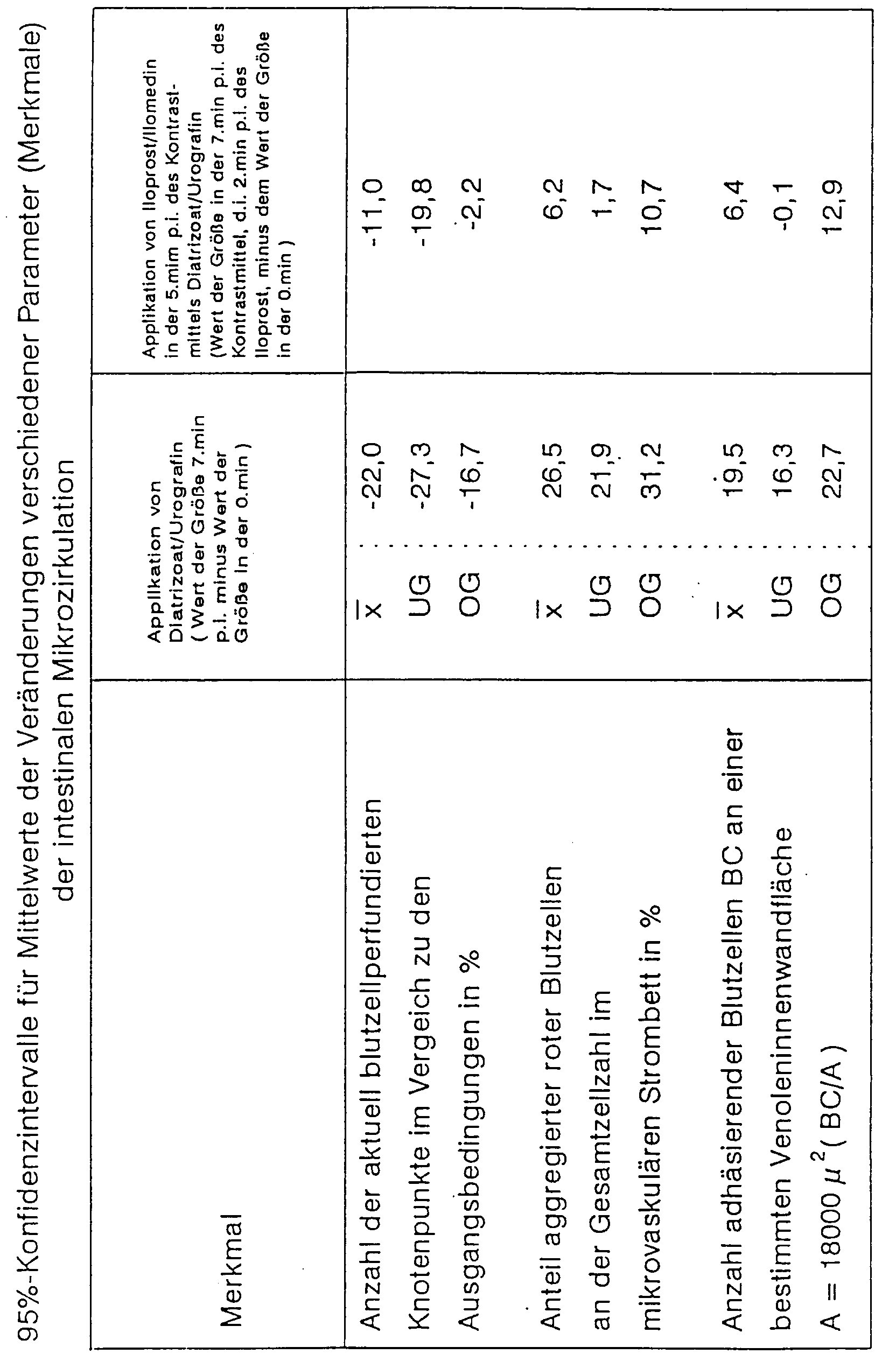
- the following table shows measurement results for the findings described above in the microvascular network of the mucosa of the intestine um.
- One group of animals was injected with a diatrizoate bolus (column 1), a second group received intravenous administration of 0.8 ⁇ g / kg iloprost 5 minutes after injection of the diatrizoate bolus (column 2).
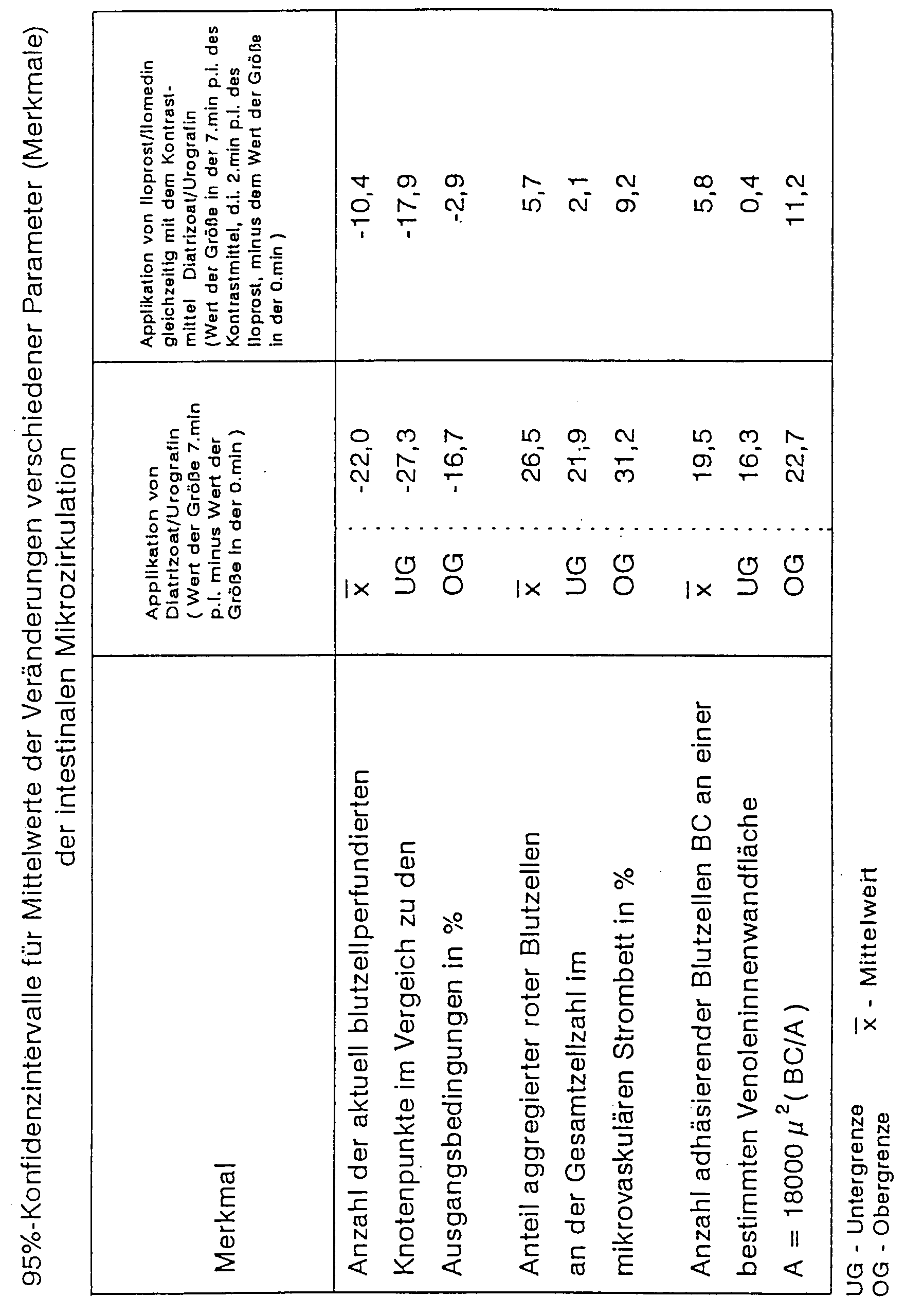
- x denotes the mean, UG the lower limit and OG the upper limit of the confidence interval.
- a micro-catheter becomes intravascular Injection of the contrast medium either in the common carotid artery. by Aortic arch advanced (intra-arterial injection) or into the femoral vein introduced (intravenous injection).
- Iloprost is applied at the same time as the administration of contrast medium, with intravascular application the same injection route as the contrast medium or with topical application via intestinum / mesentery.
- the iloprost dose is 1.6-0.0004 ⁇ g Iloprost / kg body mass in 2.0 ml solution / kg body mass. With topical 3 drops of this solution are used in the application.
- physiological saline solution with the appropriate volume is applied. Due to the small differences in the body mass of the test animals can have an almost identical bolus volume of Approx. 1 ml can be applied.
- the number of test animals is 10 per treatment group.
- the microvascular network is displayed using an intravital microscopic examination unit in a combined incident-transmitted light procedure on the uninjured organ with computer-assisted image processing and processing.
- the vital microscopic findings are carried out under constant macrocirculatory boundary conditions.
- an orienting overview of the complete microvascular network of the entire mesenteric or intestinal segment is obtained - including its further inflows and outflows, branching geometry and hierarchy and functional vessel identification.
- the anatomical vascular identification in the colored histological specimen is carried out after the end of the test as part of the final histopathological examination of all test animals.
- the data is usually recorded in an interval of 5 min. up to 10 min prior to contrast administration. every minute after contrast administration.
- the number of nodes perfused with blood cells increases more rapidly with the administration of iloprost.
- the proportion of aggregated erythrocytes in the total number of blood cells in the network decreases more rapidly after administration of iloprost.
- the number of blood cells adhering to the inner wall of the venule increases Iloprost.
- the frequency spectrum of the arteriolar vasomotion shows smaller deviations from the normal state due to the administration of iloprost than with exclusive application before contrast agents.
Landscapes
- Health & Medical Sciences (AREA)
- Chemical & Material Sciences (AREA)
- Life Sciences & Earth Sciences (AREA)
- General Health & Medical Sciences (AREA)
- Medicinal Chemistry (AREA)
- Pharmacology & Pharmacy (AREA)
- Animal Behavior & Ethology (AREA)
- Public Health (AREA)
- Veterinary Medicine (AREA)
- Engineering & Computer Science (AREA)
- Epidemiology (AREA)
- Bioinformatics & Cheminformatics (AREA)
- Nanotechnology (AREA)
- Crystallography & Structural Chemistry (AREA)
- Biotechnology (AREA)
- Dispersion Chemistry (AREA)
- Molecular Biology (AREA)
- Medical Informatics (AREA)
- General Engineering & Computer Science (AREA)
- Biophysics (AREA)
- Organic Chemistry (AREA)
- Heart & Thoracic Surgery (AREA)
- Nuclear Medicine, Radiotherapy & Molecular Imaging (AREA)
- General Chemical & Material Sciences (AREA)
- Cardiology (AREA)
- Chemical Kinetics & Catalysis (AREA)
- Pharmaceuticals Containing Other Organic And Inorganic Compounds (AREA)
- Medicinal Preparation (AREA)
- Medicines Containing Antibodies Or Antigens For Use As Internal Diagnostic Agents (AREA)
- Acyclic And Carbocyclic Compounds In Medicinal Compositions (AREA)
- Organic Low-Molecular-Weight Compounds And Preparation Thereof (AREA)
- Furan Compounds (AREA)
Description
Als Acylreste seien beispielsweise genannt Acetyl, Propionyl, Butyryl oder Benzoyl.
Die Herstellung der Verbindungen der Formel I wird detailliert in EP 2234 B1
und EP 11591 B1 beschrieben.
Senkung des peripheren arteriellen und koronaren vaskulären Widerstandes, Inhibierung der Thrombozytenaggregation und Auflösung von Plättchenthromben, myocardiale Zytoprotektion und damit Senkung des systemischen Blutdruckes ohne zugleich Schlagvolumen und koronare Durchblutung zu senken; Behandlung von Schlaganfall, Prophylaxe und Therapie koronarer Herzerkrankungen, koronarer Thrombose, des Herzinfarkts, peripherer Arterienerkrankungen, Arteriosklerose und Thrombose. Therapie des Schocks, Inhibierung der Bronchokonstriktion, Inhibierung der Magensäuresekretion und Zytoprotektion der Magen- und Darmschleimhaut; antiallergische Eigenschaften, Senkung des pulmonaren vaskulären Widerstandes und des pulmonaren Blutdruckes, Förderung der Nierendurchblutung, Anwendung an Stelle von Heparin oder als Adjuvans bei der Dialyse oder Hämofiltration, Konservierung von Blutplasmakonserven, besonders von Blutplättchenkonserven, Inhibierung von Geburtswehen, Behandlung von Schwangerschaftstoxikose, Erhöhung der zerebralen Durchblutung etc. Außerdem besitzen die neuen Prostaglandinanaloga antiproliferative Eigenschaften.
In EP 86404 B1 wird die Anwendung von Carbacyclinen zur Prophylaxe und Therapie ischaemischer Attacken des ZNS-Systems, zur Zytoprotektion in der Leber und im Pankreas sowie die Kombination mit β-Blockern oder Diuretika beschrieben. Aus WO 86/00808 ist die Zytoprotektion der Niere sowie die Eignung der Prostacyclinderivate der Formel I zur Behandlung von zu transplantierenden Organen bekannt. In DE 35 26 362 A1 wird die Kombination der Prostacyclinderivate der Formel I mit Thromboxanantagonisten zur Anwendung bei thrombotischen oder thromboembolischen Krankheitsbildern beschrieben.
In DE 36 08 088 A1 sind die Clathrate der Carbacyclinderivate der Formel I beschrieben. Aus DE 36 31 169 A1 ist zusätzlich zu den in EP 11591 B1 beschriebenen Verabreichungsformen die topische Verabreichurlgsform bekannt.
Die Dosis der Prostacyclin-Derivate beträgt 1,6-0,0004 µg/kg Körpermasse, bevorzugt 1,2-0,0004 µg/kg Körpermasse.
Figur 1 zeigt die prozentuale Abnahme der bluttzellperfundierten Knotenpunkte im mikrovaskulären Netzwerk des Mesenteriums bei Kontrastmittelgabe im Vergleich zu den Ausgangsbedingungen sowie die Auswirkung der Iloprost-Gabe. Es werden zwei Tiergruppen verglichen; Gruppe 1 hat zum Zeitpunkt t=0 einen Diatrizoat-Bolus erhalten; Gruppe 2 erhielt nach dem Diatrizoat-Bolus zum Zeitpunkt t=0 einen Iloprost-Bolus von 0.8 µg/kg zum Zeitpunkt t=5. Die Balkendarstellung gibt Mittelwerte x. die aufgesetzten Linien die Standardabweichung S an.
Figur 2 zeigt die prozentuale Zunahme des Anteils aggregierter Erythrozyten an der Gesamtzellzahl im mikrovaskulären Netzwerk des Mesenteriums bei Kontrastmittelgabe im Vergleich zu den Ausgangsbedingungen sowie die Auswirkung der Iloprost-Gabe. Die Tiergruppe 1 und 2 wurden wie im vorstehenden Versuch behandelt. Die Darstellung der Mittelwerte bzw. Standardabweichung erfolgt wie in Figur 1.
Figur 3 zeigt die Anzahl adhärierender Blutzellen an einer definierten Venoleninnenwandfläche des Mesenteriums in Abhängigkeit von der Zeit. Die Tiergruppe 1 und 2 wurden wie im vorstehenden Versuch behandelt. Die Darstellung der Mittelwerte bzw. Standardabweichung erfolgt wie in Figur 1.
- Anzahl der aktuell zellperfundierten Knotenpunkte im mikrovaskularen Netzwerk ( %, prozentuale Änderung der Anzahl im Vergleich zu den Ausgangsbedingungen );
- Anzahl aggreglerter Erythrozyten im mikrovaskulären Strembett ( %, prozentualer Anteil aggregierter Erythrozyten an der Gesamtzellzahl im beobachteten Strombett; als Erythrozytenaggregation wird ein längeres Aneinanderhaften von mindestens 2 bis 3 Erythrozyten beobachtet, wobei die unterschiedlichen Arten der Aggregation nicht differenziert werden );
- Anzahl adhärierender Blutzellen an der Venoleninnenwand ( BZ/A; Anzahl der Blutzellen, die länger als 5 sec am Venolenendothel anhaften - bezogen auf eine definierte Venoleninnenwandfläche A 18000µ2, die bei einem Venolendurchmesser dv = 40µm durch eine axiale Venolenlänge lv = 140µ gegeben ist).
- Arterioläre Vasomotion (Bestimmung des Innendurchmessers einer Arteriole mit einem Durchmesser von ca. 45 µm an einem bestimmten Ort zu jeder Sekunde im ca. 15 minütigen Beobachtungsintervall; Ermittlung des Ampliduden-Frequenz-Spektrums der Vasomotionsschwingung).
Die Darstellung des mikrovaskulären Netzwerkes erfolgt mithilfe einer intravitalmikroskopischen Untersuchungseinheit im kombinierten Auflicht-DurchlichtVerfahren am unverletzten Organ mit computergestützer Bildbearbeitung und -verarbeitung. Die vitalmikroskopischen Befunderhebungen werden unter konstanten makrozirkulatorischen Randbedingungen vorgenommen.
Vor der intravitalmikroskopischen Meßwerterfassung wird jeweils eine orientierende Übersicht über das komplette mikrovaskuläre Netzwerk des gesamten Mesenterial- bzw. Darmsegmentes gewonnen - einschließlich seiner weiteren Zu- und Abflüsse, Verzweigungsgeometrie und -hierarchie und funktionellen Gefäßidentifikation. Die anatomische Gefäßidentifikation im gefärbten histologischen Präparat erfolgt nach Versuchsende im Rahmen der abschliessenden histopathologischen Untersuchung aller Versuchstiere. Die Aufnahme der Daten erfolgt üblicherweise in einem Intervall von 5 min. vor der Kontrastmittelgabe bis 10 min. nach der Kontrastmittelgabe jede Minute.
Der Anteil aggregierter Erythrozyten an der Gesamt-Blutzellzahl im Netzwerk nimmt nach Gabe von Iloprost schneller ab.
x bezeichnet den Mittelwert, UG die Untergrenze und OG die Obergrenze des Konfidenzintervalls.
- Anzahl der aktuell zellperfundierten Knotenpunkte im mikrovaskulären Netzwerk ( %, prozentuale Änderung der Anzahl im Vergleich zu den Ausgangsbedingungen ):
- Anzahl aggregierter Erythrozyten im mikrovaskulären Strombett ( %, prozentualer Anteil aggregierter Erythrozyten an der Gesamtzellzahl im beobachteten Strombett; als Erythrozytenaggregation wird ein längeres Aneinanderhaften von mindestens 2 bis 3 Erythrozyten beobachtet, wobei die unterschiedlichen Arten der Aggregation nicht differenziert werden );
- Anzahl adhärierender Blutzellen an der Venoleninnenwand ( BZ/A; Anzahl der Blutzellen, die länger als 5 sec am Venolenendothel anhaften - bezogen auf eine definierte Venoleninnenwandfläche A 18000µ2, die bei einem Venolendurchmesser dv = 40µm durch eine axiale Venolenlänge lv = 140µ gegeben ist).
Die Meßgrößen werden, wenn nicht anders angegeben in Mikrogefäßen mit Durchmessern ≤ 40 µm bestimmt. Die Messungen der mikrozirkulatorischen Merkmale wird am Mesenterium des Interstinum tenue und der Schleimhaut des Intestinum tenue selbst in kompletten, jeweils identischen Segmenten vorgenommen. Hierzu wird am narkotisierten und thermostatierten Tier das Intestinum operativ exponiert und in eine korperkernwarm thermostatierte Bad-Lösung (Äquivalent zur Intraperitonealflussigkeit) ausgelagert.
Die Darstellung des mikrovaskulären Netzwerkes erfolgt mithilfe einer intravitalmikroskopischen Untersuchungseinheit im kombinierten Auflicht-Durchlichtverfahren am unverletzten Organ mit computergestützer Bildbearbeitung und -verarbeitung. Die vitalmikroskopischen Befunderhebungen werden unter konstanten makrozirkulatorischen Randbedingungen vorgenommen.
Vor der intravitalmikroskopischen Meßwerterfassung wird jeweils eine orientierende Übersicht über das komplette mikrovaskuläre Netzwerk des gesamten Mesenterial- bzw. Darmsegmentes gewonnen - einschließlich seiner weiteren Zu- und Abflüsse, Verzweigungsgeometrie und -hierarchie und funktionellen Gefäßidentifikation. Die anatomische Gefäßidentifikation im gefärbten histologischen Präparat erfolgt nach Versuchsende im Rahmen der abschliessenden histopathologischen Untersuchung aller Versuchstiere. Die Aufnahme der Daten erfolgt üblicherweise in einem Intervall von 5 min. vor der Kontrastmittelgabe bis 10 min. nach der Kontrastmittelgabe jede Minute.
Der Anteil aggregierter Erythrozyten an der Gesamt-Blutzellzahl im Netzwerk nimmt nach Gabe von Iloprost schneller ab.
Claims (9)
- Verwendung eines Prostacyclinderivates oder des entsprechenden β-Cyclodextrin-Clathrates oder der mit Liposomen verkapselten Form zur Herstellung eines Arznemittels zur Verhinderung oder Behandlung von Störungen der Mikrozirkulation bei Gabe von Röntgen-, NMR- oder Ultraschallkontrastmitteln.
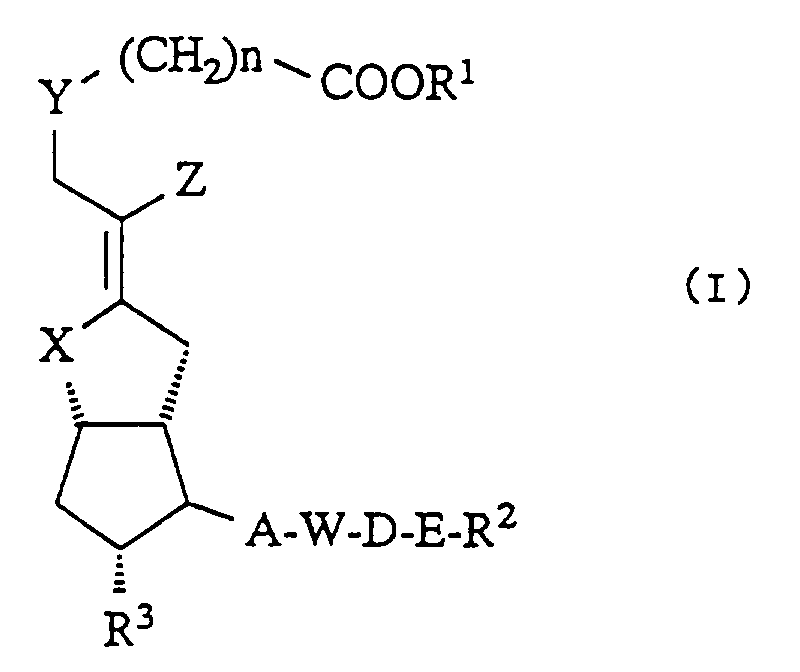
- Verwendung der Prostacyclinderivate der allgemeinen Formel Iworin
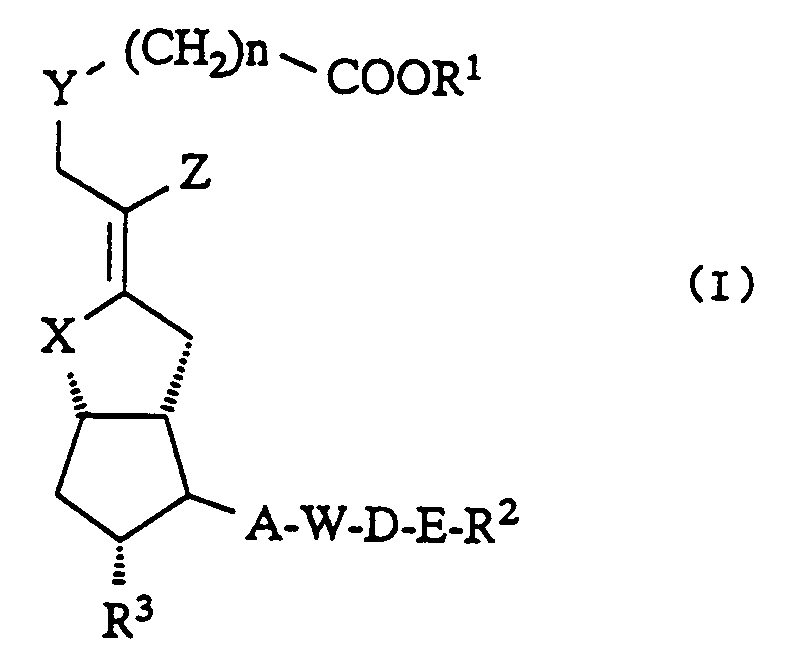 deren Salze mit physiologisch verträglichen Rasen, sowie deren α, β- oder γ-Cyclodextrin-Clathrate sowie deren mit Liposomen verkapselte Form oder Ataprost, Beraprost, BW-15AU, Ciprosten, CS 570, FCE 22509, Naxaprosten, RS-93427, SC 39902 oder Taprosten zur Herstellung eines Arzneimittels zur Verhinderung oder Behandlung von Störungen der Mikrozirkulation bei der Gabe von Röntgen-, Ultraschall- oder NMR-Kontrastmitteln.R1 Wasserstoff oder ein C1-C4-Alkylrest,n 0 bis 3,X,Y unabhängig voneinander eine -CH2-Gruppe oder ein Sauerstoffatom,Z Wasserstoff, Fluor oder CN,A eine trans -CH=CH- oder eine -C=C-Gruppe,W eine freie oder an der Hydroxygruppe funktionell abgewandelte Hydroxymethylengruppe, wobei die Hydroxygruppe α- oder β-ständig sein kann,D eine gradkettige oder verzweigte gesättigte C1-C5-AlkylengruppeE eine -C=C-GruppeR2 eine C1-C2-AlkylgruppeR3 eine freie oder funktionell abgewandelte Hydroxygruppe bedeuten, und falls R1 Wasserstoff bedeutet,
 - Verwendung eines Prostacyclinderivates der allgemeinen Formel Iworin
 deren Salze mit physiologisch verträglichen Basen, sowie deren α, β- oder γ-Cyclodextrin-Clathrate sowie deren mit Liposomen verkapselte Form zur Herstellung eines Arzneimittels zur Verhinderung oder Behandlung von Störungen der Mikrozirkulation bei der Gabe von Röntgen-, Ultraschall- oder NMR-Kontrastmitteln.R1 Wasserstoff oder ein C1-C4-Alkylrest,n 0 bis 3,X,Y unabhängig voneinander eine -CH2-Gruppe oder ein Sauerstoffatom,Z Wasserstoff, Fluor oder CN,A eine trans -CH=CH- oder eine -C=C-Gruppe,W eine freie oder an der Hydroxygruppe funktionell abgewandelte Hydroxymethylengruppe, wobei die Hydroxygruppe α- oder β-ständig sein kann,D eine gradkettige oder verzweigte gesättigte C1-C5-AlkylengruppeE eine -C=C-GruppeR2 eine C1-C2-AlkylgruppeR3 eine freie oder funktionell abgewandelte Hydroxygruppe bedeuten, und falls R1 Wasserstoff bedeutet,
 - Verwendung eines der Prostacyclinderivate Ataprost, Beraprost, BW-15AU, Ciprosten, CS 570, FCE 22509, Naxaprosten, RS-93427, SC 39902 oder Taprosten zur Herstellung eines Arzneimittels zur Verhinderung oder Behandlung von Störungen der Mikrozirkulation bei der Gabe von Röntgen-, NMR- oder Ultraschall-Kontrastmitteln.
- Verwendung von Iloprost oder Iloprost-Clathrat nach Anspruch 3.
- Verwendung von Cicaprost oder Cicaprost-Clathrat nach Anspruch 3.
- Verwendung von Eptaloprost oder Eptaloprost-Clathrat nach Anspruch 3.
- Verwendung von 5-[(E)-(1S,5S,6S,7R)-7-Hydroxy-6-[(3S,4S]-3-hydroxy-4-methyl-1,6-nonadiinyl]-bicyclo[3.3,0]-oct-3-yliden]-pentansäure oder dem entsprechenden Clathrat nach Anspruch 3.
- Verwendung von 5-[(E)-(1S,5S,6S,7R)-7-Hydroxy-6-[(3S,4S)-3-hydroxy-4-methyl-1,6-nonadiinyl]-bicyclo[3.3.0]-oct-3-yliden]-5-fluoro-3-oxa-pentansäure oder dem entsprechenden Clathrat nach Anspruch 3.
Applications Claiming Priority (3)
| Application Number | Priority Date | Filing Date | Title |
|---|---|---|---|
| DE4135193 | 1991-10-22 | ||
| DE4135193A DE4135193C1 (de) | 1991-10-22 | 1991-10-22 | |
| PCT/DE1992/000904 WO1993007875A1 (de) | 1991-10-22 | 1992-10-22 | Verwendung von prostacyclin-derivaten zur verhinderung oder behandlung von störungen der mikrozirkulation bei gabe von röntgen-, nmr- oder ultraschallkontrastmitteln |
Publications (2)
| Publication Number | Publication Date |
|---|---|
| EP0609336A1 EP0609336A1 (de) | 1994-08-10 |
| EP0609336B1 true EP0609336B1 (de) | 1998-01-28 |
Family
ID=6443371
Family Applications (1)
| Application Number | Title | Priority Date | Filing Date |
|---|---|---|---|
| EP92922216A Expired - Lifetime EP0609336B1 (de) | 1991-10-22 | 1992-10-22 | Verwendung von prostacyclin-derivaten zur verhinderung oder behandlung von störungen der mikrozirkulation bei gabe von röntgen-, nmr- oder ultraschallkontrastmitteln |
Country Status (11)
| Country | Link |
|---|---|
| US (1) | US5814301A (de) |
| EP (1) | EP0609336B1 (de) |
| JP (1) | JPH07500585A (de) |
| AT (1) | ATE162718T1 (de) |
| CA (1) | CA2121838A1 (de) |
| DE (2) | DE4135193C1 (de) |
| DK (1) | DK0609336T3 (de) |
| ES (1) | ES2114570T3 (de) |
| GR (1) | GR3026324T3 (de) |
| PT (1) | PT100997B (de) |
| WO (1) | WO1993007875A1 (de) |
Families Citing this family (12)
| Publication number | Priority date | Publication date | Assignee | Title |
|---|---|---|---|---|
| DE4446694A1 (de) * | 1994-12-09 | 1996-06-13 | Schering Ag | Verwendung von Zusätzen zu Kontrastmitteln zur Verbesserung der Bildgebung |
| US6774278B1 (en) | 1995-06-07 | 2004-08-10 | Cook Incorporated | Coated implantable medical device |
| PL328199A1 (en) * | 1996-01-25 | 1999-01-18 | Schering Ag | Improved concentrated intravascular injection and infusion solutions |
| KR100638684B1 (ko) * | 1997-11-14 | 2006-10-27 | 유나이티드 세러퓨틱스 코오포레이션 | 말초 혈관 질환의 치료를 위한 9-데옥시-2',9-알파-메타노-3-옥사-4,5,6-트리노르-3,7-(1',3'-인터페닐렌)-13,14-디하이드로-프로스타글란딘 에프1의 용도 |
| US20020147223A1 (en) * | 1999-06-14 | 2002-10-10 | Hiroshi Maeda | Agent for enhancing accumulation of drugs in tumor tissues |
| WO2000076496A1 (en) * | 1999-06-14 | 2000-12-21 | Toray Industries, Inc. | Tumor tissue accumulation enhancers for drugs |
| DE10115740A1 (de) * | 2001-03-26 | 2002-10-02 | Ulrich Speck | Zubereitung für die Restenoseprophylaxe |
| DE10244847A1 (de) | 2002-09-20 | 2004-04-01 | Ulrich Prof. Dr. Speck | Medizinische Vorrichtung zur Arzneimittelabgabe |
| ES2670872T3 (es) * | 2003-05-22 | 2018-06-01 | United Therapeutics Corporation | Polimorfo de una sal de dietanolamina de treprostinil |
| CA2562614C (en) * | 2004-04-12 | 2013-09-17 | United Therapeutics, Inc. | Use of treprostinil to treat neuropathic diabetic foot ulcers |
| CA3125504C (en) | 2013-03-14 | 2023-10-24 | United Therapeutics Corporation | Solid forms of treprostinil |
| KR20240119159A (ko) * | 2018-09-14 | 2024-08-06 | 파모사 바이오팜 인코포레이티드 | 약산성 약물의 방출 제어를 위한 약제학적 조성물 및 이의 용도 |
Family Cites Families (10)
| Publication number | Priority date | Publication date | Assignee | Title |
|---|---|---|---|---|
| DE2845770A1 (de) * | 1978-10-19 | 1980-04-30 | Schering Ag | Neue prostacyclin-derivate und verfahren zu ihrer herstellung |
| DE3204443A1 (de) * | 1982-02-08 | 1983-08-18 | Schering Ag, 1000 Berlin Und 4619 Bergkamen | Neue carbacycline, verfahren zu ihrer herstellung und ihre verwendung als arzneimittel |
| DE3448257C2 (en) * | 1984-07-25 | 1988-08-18 | Schering Ag, 1000 Berlin Und 4709 Bergkamen, De | Cytoprotective action of prostacyclin derivatives on the kidney |
| US4820732A (en) * | 1985-10-04 | 1989-04-11 | The Upjohn Company | Method and compositions for reducing dysfunction in angioplasty procedures |
| DE3608088C2 (de) * | 1986-03-07 | 1995-11-16 | Schering Ag | Pharmazeutische Präparate, enthaltend Cyclodextrinclathrate von Carbacyclinderivaten |
| US4955878A (en) * | 1986-04-04 | 1990-09-11 | Biotechnology, Inc. | Kit for preventing or treating arterial dysfunction resulting from angioplasty procedures |
| SE459806B (sv) * | 1987-11-23 | 1989-08-07 | Nils Enar Nilsson | Anordning foer foerflyttning av en foersta del relativt en andra del |
| DE3740838A1 (de) * | 1987-11-27 | 1989-06-08 | Schering Ag | Cyclodextrinclathrate von 5-cyano-prostacyclinderivaten und ihre verwendung als arzneimittel |
| CA2010511A1 (en) * | 1989-03-01 | 1990-09-01 | Roberto L. Ceriani | Method of enhancing cancer therapy by administration of unsaturated fatty acids |
| JPH0669966B2 (ja) * | 1989-07-05 | 1994-09-07 | 株式会社ミドリ十字 | 血管造影補助剤 |
-
1991
- 1991-10-22 DE DE4135193A patent/DE4135193C1/de not_active Expired - Fee Related
-
1992
- 1992-10-22 PT PT100997A patent/PT100997B/pt not_active IP Right Cessation
- 1992-10-22 JP JP5507355A patent/JPH07500585A/ja active Pending
- 1992-10-22 CA CA002121838A patent/CA2121838A1/en not_active Abandoned
- 1992-10-22 AT AT92922216T patent/ATE162718T1/de not_active IP Right Cessation
- 1992-10-22 ES ES92922216T patent/ES2114570T3/es not_active Expired - Lifetime
- 1992-10-22 DK DK92922216T patent/DK0609336T3/da active
- 1992-10-22 DE DE59209175T patent/DE59209175D1/de not_active Expired - Fee Related
- 1992-10-22 EP EP92922216A patent/EP0609336B1/de not_active Expired - Lifetime
- 1992-10-22 US US08/232,006 patent/US5814301A/en not_active Expired - Fee Related
- 1992-10-22 WO PCT/DE1992/000904 patent/WO1993007875A1/de not_active Ceased
-
1998
- 1998-03-11 GR GR980400515T patent/GR3026324T3/el unknown
Also Published As
| Publication number | Publication date |
|---|---|
| US5814301A (en) | 1998-09-29 |
| WO1993007875A1 (de) | 1993-04-29 |
| DK0609336T3 (da) | 1998-09-21 |
| CA2121838A1 (en) | 1993-04-29 |
| PT100997B (pt) | 1999-10-29 |
| DE4135193C1 (de) | 1993-03-11 |
| PT100997A (pt) | 1994-01-31 |
| ATE162718T1 (de) | 1998-02-15 |
| ES2114570T3 (es) | 1998-06-01 |
| DE59209175D1 (de) | 1998-03-05 |
| GR3026324T3 (en) | 1998-06-30 |
| JPH07500585A (ja) | 1995-01-19 |
| EP0609336A1 (de) | 1994-08-10 |
Similar Documents
| Publication | Publication Date | Title |
|---|---|---|
| EP0123235B1 (de) | Mikropartikel und Gasblächen enthaltendes Ultraschall-Kontrastmittel | |
| EP1666070B1 (de) | Zubereitung für Restenoseprophylaxe | |
| EP0077752B2 (de) | Flüssige Mischung zur Aufnahme und Stabilisierung von Gasbläschen zur Verwendung als Kontrastmittel für die Ultraschalldiagnostik und deren Herstellung | |
| DE69716104T2 (de) | Chelate und metalchelate zur behandlung von durch freie radikale verursachte zustände | |
| US4499085A (en) | Method of anoxia treatment using prostaglandin analogues | |
| EP0609336A1 (de) | Verwendung von prostacyclin-derivaten zur verhinderung oder behandlung von störungen der mikrozirkulation bei gabe von röntgen-, nmr- oder ultraschallkontrastmitteln | |
| EP0365467A2 (de) | Ultraschallkontrastmittel aus Gasbläschen und Fettsäure-enthaltenden Mikropartikeln | |
| Silvestri et al. | Respiratory distress syndrome from lymphangiography contrast medium | |
| CH646062A5 (de) | Kontrastmittel fuer die angiographie. | |
| DE69020208T2 (de) | Kontrastmittel. | |
| DD297564A5 (de) | Kontrastmedien | |
| DE68906193T2 (de) | Hypersphyxia verursachende zusammensetzung. | |
| DE4406474A1 (de) | Gas enthaltende Mikropartikel, diese enthaltende Mittel, deren Verwendung in der Ultraschalldiagnostik, sowie Verfahren zur Herstellung der Partikel und Mittel | |
| DE60026743T2 (de) | Verwendung von Kontrastmitteln zur Herstellung eines Diagnostischen Mittels für die Darmlumenbildgebung | |
| Lindgren et al. | Intravascular erythrocyte aggregation after intravenous injection of contrast media | |
| DE4446694A1 (de) | Verwendung von Zusätzen zu Kontrastmitteln zur Verbesserung der Bildgebung | |
| EP1053748A1 (de) | Heilmittel für neurologische erkrankungen | |
| DE19530884A1 (de) | Verwendung von Prostan-Derivaten sowie deren Kombination mit Antibiotika zur Behandlung von bakteriellen Infektionen | |
| DE2118219C3 (de) | Neues Röntgenkontrastmittel | |
| Sörensen et al. | Thermography and microangiography in the investigation of local toxic effects of contrast media and anaesthetics | |
| Chalecke et al. | Iodinated Organic Compounds As Contrast Media for Radiographic Diagnoses: VI. Experimental Studies on Emulsions of Ethyl Iodophenylundecylate (Pantopaque) | |
| AT249263B (de) | Röntgenkontrastmittel | |
| DE4124695A1 (de) | Carbacyclinderivate als mittel zur behandlung von psoriasis vulgaris | |
| DE102005008309A1 (de) | Pharmazeutische Mittel enthaltend fluoralkylhaltige Metallkomplexe und Epothilone | |
| Egberts et al. | Fetal acidosis and its effect on lamb lung lamellar body disaturated phosphatidyl choline (DSPC) |
Legal Events
| Date | Code | Title | Description |
|---|---|---|---|
| PUAI | Public reference made under article 153(3) epc to a published international application that has entered the european phase |
Free format text: ORIGINAL CODE: 0009012 |
|
| 17P | Request for examination filed |
Effective date: 19940218 |
|
| AK | Designated contracting states |
Kind code of ref document: A1 Designated state(s): AT BE CH DE DK ES FR GB GR IE IT LI LU NL SE |
|
| 17Q | First examination report despatched |
Effective date: 19960314 |
|
| GRAG | Despatch of communication of intention to grant |
Free format text: ORIGINAL CODE: EPIDOS AGRA |
|
| GRAG | Despatch of communication of intention to grant |
Free format text: ORIGINAL CODE: EPIDOS AGRA |
|
| GRAH | Despatch of communication of intention to grant a patent |
Free format text: ORIGINAL CODE: EPIDOS IGRA |
|
| GRAH | Despatch of communication of intention to grant a patent |
Free format text: ORIGINAL CODE: EPIDOS IGRA |
|
| GRAA | (expected) grant |
Free format text: ORIGINAL CODE: 0009210 |
|
| AK | Designated contracting states |
Kind code of ref document: B1 Designated state(s): AT BE CH DE DK ES FR GB GR IE IT LI LU NL SE |
|
| REF | Corresponds to: |
Ref document number: 162718 Country of ref document: AT Date of ref document: 19980215 Kind code of ref document: T |
|
| REG | Reference to a national code |
Ref country code: CH Ref legal event code: EP |
|
| REF | Corresponds to: |
Ref document number: 59209175 Country of ref document: DE Date of ref document: 19980305 |
|
| REG | Reference to a national code |
Ref country code: CH Ref legal event code: NV Representative=s name: E. BLUM & CO. PATENTANWAELTE |
|
| ITF | It: translation for a ep patent filed | ||
| GBT | Gb: translation of ep patent filed (gb section 77(6)(a)/1977) |
Effective date: 19980429 |
|
| ET | Fr: translation filed | ||
| REG | Reference to a national code |
Ref country code: ES Ref legal event code: FG2A Ref document number: 2114570 Country of ref document: ES Kind code of ref document: T3 |
|
| REG | Reference to a national code |
Ref country code: IE Ref legal event code: FG4D Free format text: 78645 |
|
| REG | Reference to a national code |
Ref country code: DK Ref legal event code: T3 |
|
| PLBE | No opposition filed within time limit |
Free format text: ORIGINAL CODE: 0009261 |
|
| STAA | Information on the status of an ep patent application or granted ep patent |
Free format text: STATUS: NO OPPOSITION FILED WITHIN TIME LIMIT |
|
| 26N | No opposition filed | ||
| PGFP | Annual fee paid to national office [announced via postgrant information from national office to epo] |
Ref country code: DK Payment date: 19990914 Year of fee payment: 8 Ref country code: AT Payment date: 19990914 Year of fee payment: 8 |
|
| PGFP | Annual fee paid to national office [announced via postgrant information from national office to epo] |
Ref country code: SE Payment date: 19990920 Year of fee payment: 8 Ref country code: CH Payment date: 19990920 Year of fee payment: 8 |
|
| PGFP | Annual fee paid to national office [announced via postgrant information from national office to epo] |
Ref country code: NL Payment date: 19990921 Year of fee payment: 8 |
|
| PGFP | Annual fee paid to national office [announced via postgrant information from national office to epo] |
Ref country code: IE Payment date: 19990929 Year of fee payment: 8 |
|
| PGFP | Annual fee paid to national office [announced via postgrant information from national office to epo] |
Ref country code: BE Payment date: 19991004 Year of fee payment: 8 |
|
| PGFP | Annual fee paid to national office [announced via postgrant information from national office to epo] |
Ref country code: GR Payment date: 19991020 Year of fee payment: 8 |
|
| PGFP | Annual fee paid to national office [announced via postgrant information from national office to epo] |
Ref country code: LU Payment date: 19991130 Year of fee payment: 8 |
|
| PGFP | Annual fee paid to national office [announced via postgrant information from national office to epo] |
Ref country code: FR Payment date: 20000911 Year of fee payment: 9 |
|
| PGFP | Annual fee paid to national office [announced via postgrant information from national office to epo] |
Ref country code: GB Payment date: 20000919 Year of fee payment: 9 |
|
| PGFP | Annual fee paid to national office [announced via postgrant information from national office to epo] |
Ref country code: DE Payment date: 20000925 Year of fee payment: 9 |
|
| PGFP | Annual fee paid to national office [announced via postgrant information from national office to epo] |
Ref country code: ES Payment date: 20001010 Year of fee payment: 9 |
|
| PG25 | Lapsed in a contracting state [announced via postgrant information from national office to epo] |
Ref country code: LU Free format text: LAPSE BECAUSE OF NON-PAYMENT OF DUE FEES Effective date: 20001022 Ref country code: IE Free format text: LAPSE BECAUSE OF NON-PAYMENT OF DUE FEES Effective date: 20001022 Ref country code: DK Free format text: LAPSE BECAUSE OF NON-PAYMENT OF DUE FEES Effective date: 20001022 Ref country code: AT Free format text: LAPSE BECAUSE OF NON-PAYMENT OF DUE FEES Effective date: 20001022 |
|
| PG25 | Lapsed in a contracting state [announced via postgrant information from national office to epo] |
Ref country code: SE Free format text: THE PATENT HAS BEEN ANNULLED BY A DECISION OF A NATIONAL AUTHORITY Effective date: 20001030 |
|
| PG25 | Lapsed in a contracting state [announced via postgrant information from national office to epo] |
Ref country code: LI Free format text: LAPSE BECAUSE OF NON-PAYMENT OF DUE FEES Effective date: 20001031 Ref country code: GR Free format text: LAPSE BECAUSE OF NON-PAYMENT OF DUE FEES Effective date: 20001031 Ref country code: CH Free format text: LAPSE BECAUSE OF NON-PAYMENT OF DUE FEES Effective date: 20001031 Ref country code: BE Free format text: LAPSE BECAUSE OF NON-PAYMENT OF DUE FEES Effective date: 20001031 |
|
| BERE | Be: lapsed |
Owner name: SCHERING A.G. Effective date: 20001031 |
|
| PG25 | Lapsed in a contracting state [announced via postgrant information from national office to epo] |
Ref country code: NL Free format text: LAPSE BECAUSE OF NON-PAYMENT OF DUE FEES Effective date: 20010501 |
|
| REG | Reference to a national code |
Ref country code: DK Ref legal event code: EBP |
|
| REG | Reference to a national code |
Ref country code: CH Ref legal event code: PL |
|
| EUG | Se: european patent has lapsed |
Ref document number: 92922216.4 |
|
| NLV4 | Nl: lapsed or anulled due to non-payment of the annual fee |
Effective date: 20010501 |
|
| REG | Reference to a national code |
Ref country code: IE Ref legal event code: MM4A |
|
| PG25 | Lapsed in a contracting state [announced via postgrant information from national office to epo] |
Ref country code: GB Free format text: LAPSE BECAUSE OF NON-PAYMENT OF DUE FEES Effective date: 20011022 |
|
| PG25 | Lapsed in a contracting state [announced via postgrant information from national office to epo] |
Ref country code: ES Free format text: LAPSE BECAUSE OF NON-PAYMENT OF DUE FEES Effective date: 20011023 |
|
| REG | Reference to a national code |
Ref country code: GB Ref legal event code: IF02 |
|
| GBPC | Gb: european patent ceased through non-payment of renewal fee |
Effective date: 20011022 |
|
| PG25 | Lapsed in a contracting state [announced via postgrant information from national office to epo] |
Ref country code: FR Free format text: LAPSE BECAUSE OF NON-PAYMENT OF DUE FEES Effective date: 20020628 |
|
| PG25 | Lapsed in a contracting state [announced via postgrant information from national office to epo] |
Ref country code: DE Free format text: LAPSE BECAUSE OF NON-PAYMENT OF DUE FEES Effective date: 20020702 |
|
| REG | Reference to a national code |
Ref country code: FR Ref legal event code: ST |
|
| REG | Reference to a national code |
Ref country code: ES Ref legal event code: FD2A Effective date: 20021113 |
|
| PG25 | Lapsed in a contracting state [announced via postgrant information from national office to epo] |
Ref country code: IT Free format text: LAPSE BECAUSE OF NON-PAYMENT OF DUE FEES;WARNING: LAPSES OF ITALIAN PATENTS WITH EFFECTIVE DATE BEFORE 2007 MAY HAVE OCCURRED AT ANY TIME BEFORE 2007. THE CORRECT EFFECTIVE DATE MAY BE DIFFERENT FROM THE ONE RECORDED. Effective date: 20051022 |