EP0603268B1 - Benetzungsfaehige silikon-hydrogel-zusammensetzungen und verfahren zu deren herstellung - Google Patents
Benetzungsfaehige silikon-hydrogel-zusammensetzungen und verfahren zu deren herstellung Download PDFInfo
- Publication number
- EP0603268B1 EP0603268B1 EP92919299A EP92919299A EP0603268B1 EP 0603268 B1 EP0603268 B1 EP 0603268B1 EP 92919299 A EP92919299 A EP 92919299A EP 92919299 A EP92919299 A EP 92919299A EP 0603268 B1 EP0603268 B1 EP 0603268B1
- Authority
- EP
- European Patent Office
- Prior art keywords
- silicone
- acid
- containing monomer
- monomer
- hydrogel
- Prior art date
- Legal status (The legal status is an assumption and is not a legal conclusion. Google has not performed a legal analysis and makes no representation as to the accuracy of the status listed.)
- Expired - Lifetime
Links
Classifications
-
- C—CHEMISTRY; METALLURGY
- C08—ORGANIC MACROMOLECULAR COMPOUNDS; THEIR PREPARATION OR CHEMICAL WORKING-UP; COMPOSITIONS BASED THEREON
- C08F—MACROMOLECULAR COMPOUNDS OBTAINED BY REACTIONS ONLY INVOLVING CARBON-TO-CARBON UNSATURATED BONDS
- C08F230/00—Copolymers of compounds having one or more unsaturated aliphatic radicals, each having only one carbon-to-carbon double bond, and containing phosphorus, selenium, tellurium or a metal
- C08F230/04—Copolymers of compounds having one or more unsaturated aliphatic radicals, each having only one carbon-to-carbon double bond, and containing phosphorus, selenium, tellurium or a metal containing a metal
- C08F230/08—Copolymers of compounds having one or more unsaturated aliphatic radicals, each having only one carbon-to-carbon double bond, and containing phosphorus, selenium, tellurium or a metal containing a metal containing silicon
-
- C—CHEMISTRY; METALLURGY
- C08—ORGANIC MACROMOLECULAR COMPOUNDS; THEIR PREPARATION OR CHEMICAL WORKING-UP; COMPOSITIONS BASED THEREON
- C08F—MACROMOLECULAR COMPOUNDS OBTAINED BY REACTIONS ONLY INVOLVING CARBON-TO-CARBON UNSATURATED BONDS
- C08F283/00—Macromolecular compounds obtained by polymerising monomers on to polymers provided for in subclass C08G
- C08F283/12—Macromolecular compounds obtained by polymerising monomers on to polymers provided for in subclass C08G on to polysiloxanes
- C08F283/124—Macromolecular compounds obtained by polymerising monomers on to polymers provided for in subclass C08G on to polysiloxanes on to polysiloxanes having carbon-to-carbon double bonds
-
- C—CHEMISTRY; METALLURGY
- C08—ORGANIC MACROMOLECULAR COMPOUNDS; THEIR PREPARATION OR CHEMICAL WORKING-UP; COMPOSITIONS BASED THEREON
- C08F—MACROMOLECULAR COMPOUNDS OBTAINED BY REACTIONS ONLY INVOLVING CARBON-TO-CARBON UNSATURATED BONDS
- C08F290/00—Macromolecular compounds obtained by polymerising monomers on to polymers modified by introduction of aliphatic unsaturated end or side groups
- C08F290/02—Macromolecular compounds obtained by polymerising monomers on to polymers modified by introduction of aliphatic unsaturated end or side groups on to polymers modified by introduction of unsaturated end groups
- C08F290/06—Polymers provided for in subclass C08G
- C08F290/068—Polysiloxanes
Definitions
- the present invention relates to improved polymeric silicone-containing hydrogel compositions useful for the production of biomedical devices, especially contact lenses.
- Hydrogels have been a desirable material for the preparation of biomedical devices, and have been known since at least Wichterle, et al U.S. Patent No. 3,220,960 which disclosed hydrogels comprising a hydrated polymer of a hydroxyalkyl acrylate or methacrylate crosslinked with a corresponding diester (poly 2-hydroxyethyl methacrylate, known as HEMA).
- a hydrogel is a hydrated crosslinked polymeric system that contains water in an equilibrium state.
- the physical properties of hydrogels can vary widely and are mostly determined by their water content. Since hydrogels exhibit excellent biocompatibility, there has been extensive interest in the use of hydrogels for biomedical devices, especially contact lenses.
- Oxygen permeability, wettability, material strength and stability are but a few of the factors which must be carefully balanced to achieve a useable end-result contact lens. Since the cornea receives its oxygen supply exclusively from contact with the atmosphere, good oxygen permeability is a critical characteristic for any contact lens material.
- High water-containing hydrogels have at times exhibited undesirable mechanical properties. For example, such hydrogels are not easily formed into hydrolytically stable lenses. Further such materials have at times exhibited tearing or other breakage as a result of poor tensile strength. What was needed was a highly oxygen permeable material that was durable and highly wettable. Wettability is important in that if the lens is not sufficiently wettable, it does not remain lubricated and therefore cannot be worn comfortably on the eye. The optimal contact lens would have not only excellent oxygen permeability, but also excellent tear fluid wettability.
- Silicone-containing materials were tried as viable contact lens materials and displayed very good oxygen permeability and durability. However, most silicone-containing materials are largely hydrophobic and therefore not sufficiently wettable. Further, it is believed that such hydrophobicity may cause deposit problems, which may result in discomfort when wearing contact lenses made from these silicone-containing polymers.
- an optimal hydrogel material for biomedical devices such as contact lenses, would have ideal rigidity, high oxygen permeability and a high degree of wettability.
- hydrogels such as silicone-containing hydrogels, and more specifically urethane-containing prepolymeric hydrogels and ethylenically terminated polysiloxane hydrogels
- an amphoteric equimolar mixture of acid-containing and amine-containing comonomers in the monomer mix It is believed that such an amphoteric comonomer mixture reacts with the predominantly hydrophobic silicone-containing monomers and prepolymers to produce highly wettable hydrogels.
- the present invention provides a silicone-containing hydrogel composition
- a silicone-containing hydrogel composition comprising:
- the invention also provides a method for making a wettable silicone-containing hydrogel composition comprising the steps of:
- the present invention relates to methods for improving the wettability of hydrogels, especially silicone-containing hydrogels having ideal rigidity suitable for biomedical applications such as contact lenses.
- the silicone-containing hydrogels of the present invention display improved wettability as a result of the presence of the amphoteric equimolar mixture of acid-containing and amine-containing comonomers in the monomer mix with the silicone-containing monomer or prepolymer.
- Silicone hydrogels are usually prepared by polymerizing a mixture containing at least one silicone-containing monomer and at least one hydrophilic monomer.
- Either the silicone-containing monomer or the hydrophilic monomer may function as a crosslinking agent (a crosslinker being defined as a monomer having multiple polymerizable fuctionalities) or a separate crosslinker may be employed.
- any known silicone-containing monomer may be used in the process of this invention to form the silicone hydrogels of this invention, as will be apparent to one skilled in the art.
- the monomers added to the monomer mix to create the monomeric mixture may be monomers or prepolymers.
- a "prepolymer” is a reaction intermediate polymer of medium molecular weight having polymerizable groups.
- silicon-containing monomers and “hydrophilic monomers” include prepolymers. Examples of such monomers may be found in United States Patent Nos. 4,136,250; 4,153,641; 4,740,533; 5,034,461; and 5,070,215.
- Additional crosslinking agents which may be incorporated into the silicone-containing hydrogel of the present invention include polyvinyl, typically di- or tri-vinyl monomers, most commonly the di- or tri(meth)acrylates of dihydric ethylene glycol, triethylene glycol, butylene glycol, hexane-1,6-diol, thio-diethylene glycol-diacrylate and methacrylate; neopentyl glycol diacrylate; trimethylolpropane triacrylate and the like; N,N'-dihydroxyethylenebisacrylamide and -bismethacrylamides; also diallyl compounds like diallyl phthalate and triallyl cyanurate; divinylbenzene; ethylene glycol divinyl ether; and the (meth)acrylate esters of polyols such as triethanolamine, glycerol, pentanerythritol, butylene glycol, mannitol, and sorbitol.
- illustrations include N,N-methylene-bis-(meth)acrylamide, sulfonated divinylbenzene, and divinylsulfone.
- reaction products of hydroxyalkyl (meth)acrylates with unsaturated isocyanates for example the reaction product of 2-hydroxyethyl methacrylate with 2-isocyanatoethyl methacrylate (IEM) as disclosed in U.S. Patent No. 4,954,587.
- crosslinking agents are polyetherbisurethane-dimethacrylates as described in U.S. Patent No. 4,192,827, and those crosslinkers obtained by reaction of polyethylene glycol, polypropylene glycol and polytetramethylene glycol with 2-isocyanatoethyl methacrylate (IEM) or m-isopropenyl- ⁇ , ⁇ ,-dimethylbenzyl isocyanates (m-TMI), and polysiloxanebisurethane-dimethacrylates as described in U.S. Patent Nos. 4,486,577 and 4,605,712.
- IEM 2-isocyanatoethyl methacrylate
- m-TMI m-isopropenyl- ⁇ , ⁇ ,-dimethylbenzyl isocyanates
- polysiloxanebisurethane-dimethacrylates as described in U.S. Patent Nos. 4,486,577 and 4,605,712.
- Still other known crosslinking agents are the reaction products of polyvinyl alcohol, ethoxylated polyvinyl alcohol or of polyvinyl alcohol-co-ethylene with 0.1 to 10 mol % vinyl isocyanates like IEM or m-TMI.
- One preferred class of suitable silicone-containing prepolymers contemplated by the present invention are bulky polysiloxanylalkyl (meth)acrylic monomers represented by the formula (I): wherein:
- Such bulky monomers include methacryloxypropyl tris(trimethylsiloxy)silane, pentamethyldisiloxanylmethylmethacrylate, tris(trimethylsiloxy)methacryloxy propylsilane, phenyltetramethyldisiloxanylethyl acetate, and methyldi(trimethylsiloxy)methacryloxymethyl silane.
- a further preferred class of silicone-containing prepolymer is a poly(organosiloxane) prepolymer represented by the formula (II): wherein:
- a further preferred class of silicone-containing prepolymers are the monomers having the following schematic representations: (III) E(*D*A"*D*G) a *D*A"*D*E'; or (IV) E(*D*G*D*A") a *D*G*D*E'; where
- a preferred urethane prepolymer is represented by formula (VII): wherein: R 16 is a diradical of a diisocyanate after removal of the isocyanate group, and is most preferably the diradical of isophorone diisocyanate, and m, p and a are the same as previously defined.
- R 16 is a diradical of a diisocyanate after removal of the isocyanate group, and is most preferably the diradical of isophorone diisocyanate
- m, p and a are the same as previously defined.
- the sum of m and a is 3 or 4, and more preferably, a is 1 and m is 3 or 4.
- p is at least 30.
- the monomer mixes employed in this invention can be readily cured to cast shapes by conventional methods such as UV polymerization, or thermal polymerization, or combinations thereof, as commonly used in polymerizing ethylenically unsaturated compounds.
- Representative free radical thermal polymerization initiators are organic peroxides, such as acetal peroxide, lauroyl peroxide, decanoyl peroxide, stearoyl peroxide, benzoyl peroxide. tertiarybutyl peroxypivalate, peroxydicarbonate, and the like, employed in a concentration of about 0.01 to 1 percent by weight of the total monomer mixture.
- UV initiators are those known in the field such as, benzoin methyl ether, benzoin ethyl ether, Darocure tm 1173, 1164, 2273, 1116, 2959, 3331 (EM Industries) and Igracure tm 651 and 184 (Ciba-Geigy).
- Polymerization of the monomer mix may be performed in the presence of a diluent.
- the polymerization product will then be in the form of a gel. If the diluent is nonaqueous, the diluent must be removed from the gel and replaced with water through the use of extraction and hydration protocols well known to those skilled in the art.
- the copolymer of the present invention may also include other monomers as will be apparent to one skilled in the art.
- the monomer mix may include additional hydrophilic monomers such as N-vinyl pyrrolidone and N,N-dimethyl acrylamide, colorants, or UV-absorbing and toughening agents such as those known in the contact lens art.
- the polymers of this invention can be formed into contact lenses by spincasting processes (such as those disclosed in U.S. Pat. Nos. 3,408,429 and 3,496,254), cast molding processes (U.S. Pat Nos. 4,084,459 and 4,197,266), combinations of methods thereof, or any other known method for making contact lenses.
- Polymerization may be conducted either in a spinning mold, or a stationary mold corresponding to a desired contact lens shape.
- the lens may be further subjected to mechanical finishing, as occasion demands.
- Polymerization may also be conducted in an appropriate mold or vessel to form buttons, plates or rods, which may then be processed (e.g., cut or polished via lathe or laser) to give a contact lens having a desired shape.
- the hydrogels the present invention are oxygen transporting, hydrolytically stable, biologically inert, and transparent.
- the monomers and prepolymers employed in accordance with this invention are readily polymerized to form three dimensional networks which permit the transport of oxygen and are optically clear, strong and hydrophilic.
- the relative softness or hardness of the contact lenses fabricated from the resulting polymer of this invention can be varied by decreasing or increasing the molecular weight of the polysiloxane prepolymer endcapped with the activated unsaturated group or by varying the percent of the comonomer. As the ratio of polysiloxane units to end-cap units increases, the softness of the material increases.
- the hydrophilic ethylenically unsaturated dibasic acid monomers of the present invention significantly reduce the contact angle of the surface - a clear indication to those skilled in the field that enhanced wetting has occurred.
- the resulting dibasic acid-treated silicone-containing hydrogels were unexpectedly hydrolytically stable, within an acceptable range, while collecting only an acceptable level of deposits.
- the resulting polymers and copolymers disclosed herein can be boiled and/or autoclaved in water without being damaged whereby sterilization may be achieved.
- an article formed from the disclosed polymers and copolymers may be used, for example, in surgery where an article is needed which is compatible with living tissue or with the mucous membranes.
- hydrogel contact lenses should have oxygen permeabilities with DK values greater than 20 x 10 -11 cm 3 x cm/sec x cm 2 x mmHg (or DK units) and preferably greater than 60 DK. They should have a Young's modulus of elasticity in the range of 5 to 400 g/mm 2 , preferably greater than 20g/mm 2 and as measured by ASTM test method D 1938. Their water content should be between 10 to 80 %, and preferably between 20 to 60%.
- the contact angle which is a measurement of the wettability of the lens, should be less than 80 degrees and should preferably be less than 40 degrees.
- the present invention further provides articles of manufacture which can be used for biomedical devices, such as, contact lenses, surgical devices, heart valves, vessel substitutes, intrauterine devices, membranes and other films, diaphragms, catheters, mouth guards, denture liners, intraocular devices, and especially contact lenses.
- biomedical devices such as, contact lenses, surgical devices, heart valves, vessel substitutes, intrauterine devices, membranes and other films, diaphragms, catheters, mouth guards, denture liners, intraocular devices, and especially contact lenses.
- shaped articles for use in biomedical applications or “biomedical devices” mean the materials disclosed herein have physicochemical properties rendering them suitable for prolonged contact with living tissue, blood and the mucous membranes.
- the present invention contemplates the use of a wide variety of acids and bases (amines) in combination for the purpose of deriving the herein disclosed equimolar amphoteric mix as would be appreciated by those skilled in the field.
- the preferred acids and bases to be used in accordance with the present invention are those which complement reaction with a variety of hydrogels, preferably silicone-containing hydrogel polymers and prepolymers.
- amphoteric is understood to denote a compound or mixture of compounds exhibiting both acid and basic properties due to the inclusion of both an acid and a base (amine) functionality within its structure.
- the presence of two functional groups on these aforementioned amphoteric compounds results in a reduction by one-half of the molar amount needed to be supplied to the reaction, as compared with conventional monofunctional wetting agent used, such as methacrylic acid.
- hydrogel characteristics are drastically affected by even small increases in molar amounts of substituents used in the polymeric mix. For example, while a concentration of acid exceeding 10 weight percent might be desirable from a wettability standpoint, such a concentration may adversely affect other properties of the resulting hydrogel.
- the resulting polymeric film may have undesirable optical characteristics such as cloudiness, etc.
- amphoteric hydrophilic groups are used, only half the weight percent of the amount of monofunctional hydrophilic groups need be used to obtain a comparable effect on the polymeric mixture.
- methyl (meth)acrylate includes both methyl acrylate and methyl methacrylate
- N-alkyl (meth)acrylamide includes both N-alkyl acrylamide and N-alkyl methacrylamide.
- the equimolar acid- and amine-containing monomer mix concentration is from 0.5 weight percent of the polymeric hydrogel mix to 10 weight percent, and preferably from 2 weight percent to 5 weight percent.
- the resulting hydrogels show great promise as a superior material for various biomedical devices such as surgical implants, blood vessels, artificial ureters, artificial breast tissue and membranes intended to come into contact with body fluid outside of the body, e.g., membranes for kidney dialysis and heart/lung machines and the like. It is known that blood, for example, is readily and rapidly damaged when it comes into contact with artificial surfaces. The design of a synthetic surface which is antithrombogenic and nonhemolytic to blood is necessary for prostheses and devices used with blood.
- silicone-containing monomers contemplated by the present invention are urethane-containing prepolymers, and ethylenically terminated polysiloxane-containing monomers, such as, most preferably ⁇ , ⁇ -bis(methacryloxybutyl)polysiloxane (M 2 D 25 ).
- the preferred acid-containing comonomers of the amphoteric monomer mixture are methacrylic acid, 3-methacryl- ⁇ -alanine, 3-acryl- ⁇ -alanine, ⁇ -methacrylamidoalkanoic acid, 2-acrylamido-2-methylpropane sulfonic acid, acrylic acid, itaconic acid, and maleic acid, with 2-acrylamido-2-methylpropane sulfonic acid and methacrylic acid being more preferred.
- the preferred amine-containing comonomers of the amphoteric monomer mixture are 3-(N,N-dimethylamino)propyl methacrylamide, and 2-(N,N-dimethylamino)ethyl methacrylate, with 3-(N,N-dimethylamino)propyl methacrylamide being the most preferred.
- hydrophilic amphoteric equimolar mixtures of acid- and amine-containing comonomers of the present invention significantly reduce the contact angle of the surface - a clear indication to those skilled in the field that enhanced wetting has occurred.
- the resulting treated hydrogels were unexpectedly hydrolytically stable, within an acceptable range.
- the resulting hydrogels also appear to collect only an acceptable level of protein deposits.
- the resulting polymers and copolymers disclosed herein can be boiled and/or autoclaved in water without being damaged whereby sterilization may be achieved.
- an article formed from the disclosed polymers and copolymers may be used, for example, in surgery where an article is needed which is compatible with living tissue or with the mucous membranes.
- a formulation containing the following was prepared: urethane prepolymer derived from isophorone diisocyanate, diethylene glycol, polysiloxanediol of molecular weight 3000 and 2-hydroxyethyl methacrylate, 35 parts; 3-methacryloxypropyl tris(trimethylsiloxy)silane, (TRIS), 35 parts; N,N-dimethyl acrylamide, 30 parts; n-hexanol, 40 parts; benzoin methyl ether, 0.2 part.
- the resulting clear mix was then UV cured into films or filtered through a 1.2 micron filter into a clean glass vial ready for lens casting.
- Polyurethane monomer mix was prepared as in Example 1 with the addition of 2 parts amphoteric pair monomer mix.
- This amphoteric mix is comprised of equimolar acid-containing monomer and an amine-containing monomer.
- the acid-containing monomer is 2-acrylamido-2-methyl propanesulfonic acid (AMPS).
- AMPS 2-acrylamido-2-methyl propanesulfonic acid
- the amine-containing monomer is 3-(N,N-dimethylamino)propyl methacrylamide (DMAPMA).
- ⁇ , ⁇ -Bis(methacryloxybutyl)polysiloxane (M 2 D 25 ) prepared from the reaction of 1,3-bis(4-methacryloxybutyl) disiloxane and 1,1,3,3,5,5-hexamethyl trisiloxane in molar ratio of 1:8.33 was combined with TRIS, N,N-dimethyl acrylamide (DMA), a solvent (hexanol) and an initiator (Darocure-1173, EM Industries) in the following weight ratio: M2D25 13 TRIS 47 DMA 40 n-hexanol 40 Darocure-1173 0.2
- a monomer mixture was prepared by adding two parts of equal molar mixture of 2-acrylamido-2-methyl propanesulfonic acid (AMPS) and 3-(N,N-dimethylamino)propyl methacrylamide (DMAPMA) were added into the monomer mixture resulting from EXAMPLE 3.
- AMPS 2-acrylamido-2-methyl propanesulfonic acid
- DMAPMA 3-(N,N-dimethylamino)propyl methacrylamide
- the resultant formulations from Examples 1 through 4 were placed between glass plates and cured under UV for 2 hours. After the films were released from the glass, they were extracetd with ethanol for 16 hours and then boiled in water for 4 hours and placed in buffered saline at pH 7.4. The hydrogel films were then characterized for mechanical properties, oxygen permeability, contact angle and others.
- the formulation containing the amphoteric monomer mixture gave higher water content and softer hydrogel films.
- the cured films after being extracted with solvent (ethanol) and dried in vacuo, were cut into disks weighing 30 mg with a thickness of 250 microns. They were weighed while dry and were then submerged into buffered saline at pH 7.4 in 12 vials and sealed. After equilibration, the films were then placed in an oven at 80 degrees C. Three vials were taken out after 3, 5, 7 and 14 days and the dry weight and water contents were determined gravimetrically. The hydrolytic stabilities were reported as % weight loss after 14 day testing. Low weight losses are most desirable. Experimentally, it was determined that resultant hydrogels having a weight loss of 7% or less would be considered stable. Polyurethane hydrogel films modified with two parts of methacrylic acid and 2 parts of amphoteric mix as described in Example 2 were compared. Methacrylic Acid (MA) Amphoteric Hydrolytic 14 day wt.loss % 11.5 2.9
- the high level of lysozome uptake is not desirable in contact lenses. Such uptake decreases visual acuity and can result in other eye physiological side effects. While it is desirable to add ionic monomers into the silicone-containing hydrogel to improve wettability, the lysozome uptake level should remain at a low level.
- the amphoteric monomers contain an equimolar amount of acid and amine, and therefore bring no net charge to the resulting hydrogel lenses. It is believed that this results in causing low levels of lysozome uptake while the ionic nature of the amphoteric compounds nevertheless improve wettability of the silicone-containing hydrogels.
- the contact angles of the surface of the films prepared in Examples 1 and 2 were measured by the captive bubble technique.
- the films were submerged in buffered saline solution and a bubble of air was attached to the undersurface of the film.
- the angle made by the intersection of the lens and bubble surfaces was measured using a goniometer.
- a lower contact angle represents a greater degree of hydrophillicity or film surface wettability.
- the contact angles of the control hydrogel films and the films modified with 2 parts of amphoteric mix (Example 2) were compared. Control Amphoteric Contact Angle 38 18
- a polyurethane monomer mix of composition described in Examples 1 and 2 was filtered through a disposable filter of pore size 1.2 microns, into a clean vial.
- 60-90ml of the mix was injected onto a clean plastic mold (for the anterior surface of a lens) and then covered with a second plastic mold (forming the posterior surface of the lens).
- the molds are then compressed and cured for 90 minutes in the presence of ultraviolet light (4200 microwatts).
- the molds were opened mechanically and put in a beaker containing aqueous ethanol.
- the lenses were released from the mold within 10 to 50 minutes.
- the lenses were then extracted with ethanol for 48 hours and boiled in distilled water for 4 hours and inspected for cosmetic quality and dimension. Lenses passing inspection were thermally disinfected in phosphate-buffered saline prior to on-eye evaluation.
- the cast molded lenses described in Example 10 were evaluated on six subjects. In each case, poly(HEMA) lenses were worn in one-eye and test lenses in the other eye. The lenses were analyzed after a minimum of one hour of wear, and optimally for 6 hours, for wettability and surface deposition.
- the wettability rating scale was 0-4 with 0 representing 2/3 of the anterior surface unwetted by the tear film and 4 representing complete wetting.
- the deposition scale was also 0-4 with 0 representing no surface deposit and 4 representing multiple deposits of 0.5mm diameter or larger.
- the results for the lenses made from the control formulation according to Example 1 was 2.0 for wetting and 1.6 for deposit after 1 hour of wear.
- the results showed a wettability rating of 3.0 and deposit rating of 1.0 after 6 hours of wear.
- the results indicate that lenses containing the amphoteric mixture have characteristics superior to the control lenses as well as heightened clinical acceptance.
Landscapes
- Chemical & Material Sciences (AREA)
- Health & Medical Sciences (AREA)
- Chemical Kinetics & Catalysis (AREA)
- Medicinal Chemistry (AREA)
- Polymers & Plastics (AREA)
- Organic Chemistry (AREA)
- Eyeglasses (AREA)
- Compositions Of Macromolecular Compounds (AREA)
- Materials For Medical Uses (AREA)
- Addition Polymer Or Copolymer, Post-Treatments, Or Chemical Modifications (AREA)
- Medicinal Preparation (AREA)
Claims (22)
- Eine Methode zur Herstellung einer benetzbaren silikonhaltigen Hydrogelzusammensetzung, die die Schritte(a) die Bildung einer silikonhaltigen Monomermischung, r umfassend mindestens ein silikonhaltiges Monomer und mindestens ein hydrophiles Monomer, und(b) das Aushärten der aus Schritt (a) resultierenden Monomermischung zur Bildung einer silikonhaltigen Hydrogelzusammensetzung umfaßt,worin in Schritt (a) in der Monomermischung von 0,5 bis 10 Gew.-% der Monomermischung einer amphotheren äquimolaren Mischung aus säure- und aminhaltigen Comonomeren eingeschlossen wird.
- Die Methode nach Anspruch 1, in der besagtes silikonhaltiges Monomer ein urethanhaltiges Prepolymer ist.
- Die Methode nach Anspruch 1, in der besagtes silikonhaltiges Monomer ein ethylenisch endständiges polysiloxanhaltiges Prepolymer ist.
- Die Methode nach Anspruch 1, in der besagtes silikonhaltiges Monomer ein Poly(organosiloxan)-Prepolymer ist, dargestellt durch die Formel:
 A eine aktivierte ungesättigte Gruppe ist, jedes R3-R6 voneinander unabhängig ausgewählt wird aus einem monovalenten Kohlenwasserstoffradikal oder einem halogensubstituierten monovalenten Kohlenwasserstoffradikal mit 1 bis 18 Kohlenstoffatomen, die Etherverbindungen zwischen Kohlenstoffatomen haben können,R7 ein divalentes Kohlenwasserstoffradikal ist mit 1 bis 22 Kohlenstoffatomen, undn 0 oder eine ganze Zahl größer als oder gleich 1 ist.
 - Die Methode nach Anspruch 4, in der A ein Ester oder Amid von einer Acryl- oder Methacrylsäure ist.
- Die Methode nach Anspruch 3, in der besagtes silikonhaltiges Monomer ein voluminöses Polysiloxanylalkyl (meth)acryl-Prepolymer ist mit der Formel:
 X 0 oder NR ist,jedes R unabhängig voneinander Wasserstoff oder Methyl ist, undjedes R1 unabhängig voneinander eine niedrigere Alkyl- oder Phenylgruppe ist, undf 1 oder 3 bis 10 ist.
 - Die Methode nach Anspruch 6, in der besagtes voluminöses Polysiloxanylalkyl (meth)acryl-Prepolymer ausgewählt ist aus der Gruppe bestehend aus Methacryloxypropyl-Tris(trimethylsiloxy)silan, Pentamethyldisiloxanylmethylmethacrylat, Tris(trimethylsiloxy) methacryloxypropylsilan, Phenyltetramethyldisiloxanylethylacetat und Methyldi(trimethylsiloxy) methacryloxymethylsilan.
- Die Methode nach Anspruch 2, in der besagtes urethanhaltiges Prepolymer folgende schematischen Darstellungen aufweist:
E(*D*A"*D*G)a*D*A"*D*E'
oder
E(*D*G*D*A")a*D*G*D*E',
worinD ein Alkyl-Diradikal, ein Alkylcycloalkyl-Diradikal, ein Cycloalkyl-Diradikal, ein Aryl-Diradikal oder ein Alkylaryl-Diradikal mit 6 bis 30 Kohlenstoffatomen bedeutet,G ein Alkyl-Diradikal, ein Cycloalkyl-Diradikal, ein Alkylcycloalkyl-Diradikal, ein Aryl-Diradikal oder ein Alkylaryl-Diradikal mit 1 bis 40 Kohlenstoffatomen bedeutet, und das Ether-, Thio- oder Aminbindungen in der Hauptkette enthalten kann,* eine Urethan- oder Ureidbindung bedeutet,a mindestens 1 ist,A" ein zweiwertiges Polymerradikal bedeutet mit der Formel:worin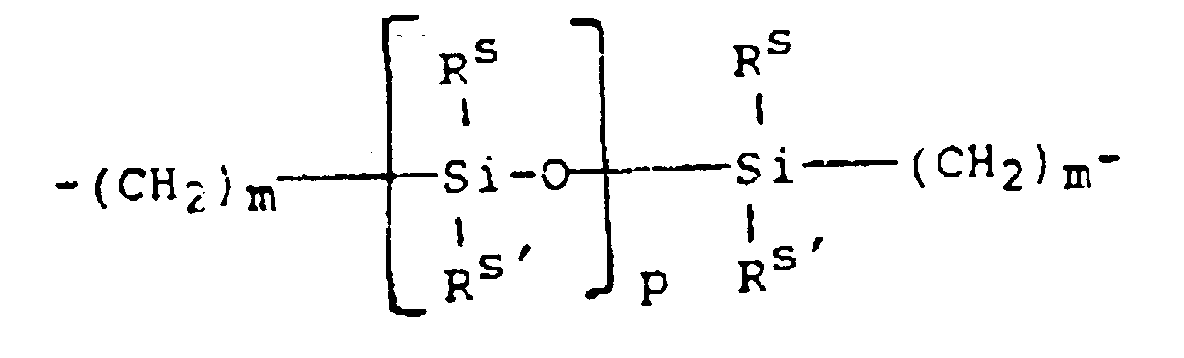 Rs und Rs' unabhängig voneinander eine Alkyl- oder fluorsubstituierte Alkylgruppe mit 1 bis 10 Kohlenstoffatomen bedeuten, die Etherbindungen zwischen Kohlenstoffatomen enthalten kann,m mindestens 1 ist undp ein Anteilgewicht von 400 bis 10.000 vorsieht,E und E' unabhängig voneinander ein polymerisierbares, ungesättigtes, organisches Radikal bedeuten, dargestellt durch die Formel:worin
 R14 ein divalentes Alkylenradikal mit 1 bis 10 Kohlenstoffatomen bedeutet,R12 H oder CH3 bedeutet,R13 H, ein (C1-C6) Alkylradikal oder eine -CO-Y-R15 Gruppe bedeutet, in der Y -O-, -S- oder -NH- ist und R15 ein Alkylradikal mit 1 bis 12 Kohlenstoffatomen ist,X -CO- oder -OCO- ist,Z -O- oder -NH- ist,Ar ein aromatisches Radikal mit 6 bis 30 Kohlenstoffatomen bedeutet,w 0 bis 6 ist,x 0 oder 1 ist,y 0 oder 1 ist undz 0 oder 1 ist.
 - Die Methode nach Anspruch 8, in der besagtes urethanhaltiges Prepolymer durch die folgende Formel dargestellt ist:

R16 ein Diradikal eines Diisocyanats nach Beseitigung der Isocyanatgruppe ist, und m, p und a die gleichen sind wie in Anspruch 8 definiert. - Die Methode nach irgendeinem vorhergehenden Anspruch, in der besagtes säurehaltiges Comonomer ausgewählt ist aus Methacrylsäure, 3-Methacryl-β-alanin, 3-Acryl-β-alanin, α-Methacrylamido-Alkansäure, 2-Acrylamido-2-methylpropan-Sulfonsäure, Acrylsäure, Itaconsäure, Maleinsäure und 2-Acrylamido-2-methylpropan-Sulfonsäure.
- Die Methode nach irgendeinem vorhergehenden Anspruch, in der besagtes aminhaltiges Comonomer ausgewählt ist aus 3-(N,N-dimethylamino)propylmethacrylamid und 2-(N,N-dimethylamino)ethylmethacrylat.
- Die Methode nach irgendeinem vorhergehenden Anspruch, in der die Menge besagter amphothere äquimolare Mischung, die in besagter Monomermischung eingeschlossen ist, 2 bis 5 Gew.-% der Monomermischung ausmacht
- Eine silikonhaltige Hydrogelzusammensetzung, umfassend:(a) eine silikonhaltige Monomermischung, die mindestens ein silikonhaltiges Monomer und mindestens ein hydrophiles Monomer umfaßt, und(b) 0,5 bis 10 Gew.-% besagter Monomermischung einer amphotheren äquimolaren Mischung aus säure- und aminhaltigen Comonomeren.
- Das Hydrogel nach Anspruch 13, in dem besagtes silikonhaltiges Monomer wie in irgendeinem der Ansprüche 2-11 definiert ist.
- Das Hydrogel nach Anspruch 13, in dem besagtes silikonhaltiges Monomer α,ω-Bis(methacryloxybutyl) polysiloxan ist.
- Das Hydrogel nach Anspruch 13, in dem besagtes silikonhaltiges Monomer α,ω-Bis(methacryloxybutyl) polysiloxan ist, besagtes säurehaltiges Monomer Methacrylsäure ist und besagtes aminhaltiges Monomer 3-(N,N-dimethylamino)propylmethacrylamid ist.
- Das Hydrogel nach Anspruch 13, in dem besagtes silikonhaltiges Monomer α,ω-Bis(methacryloxybutyl) polysiloxan ist, besagtes säurehaltiges Monomer 2-Acrylamido-2-methylpropan-Sulfonsäure ist und besagtes aminhaltiges Monomer 3-(N,N-dimethylamino)propylmethacrylamid ist.
- Das Hydrogel nach Anspruch 13, in dem besagtes silikonhaltiges Monomer α,ω-Bis(methacryloxybutyl) polysiloxan ist, besagtes säurehaltiges Monomer Acrylsäure ist und besagtes aminhaltiges Monomer 3-(N,N-dimethylamino)propylmethacrylamid ist.
- Das Hydrogel nach Anspruch 13, in dem besagtes silikonhaltiges Monomer ein urethanhaltiges Prepolymer ist, besagtes säurehaltiges Monomer 2-Acrylamido-2-methylpropan-Sulfonsäure ist und besagtes aminhaltiges Monomer 3-(N,N-dimethylamino)propylmethacrylamid ist.
- Das Hydrogel nach Anspruch 13, in dem besagtes silikonhaltiges Monomer ein urethanhaltiges Prepolymer ist, besagtes säurehaltiges Monomer Acrylsäure ist und besagtes aminhaltiges Monomer 3-(N,N-dimethylamino) propylmethacrylamid ist.
- Eine biomedizinische Vorrichtung aus der Hydrogelzusammensetzung nach irgendeinem der Ansprüche 13-20 hergestellt.
- Eine Kontaktlinse aus der Hydrogelzusammensetzung nach irgendeinem der Ansprüche 13-20 hergestellt.
Applications Claiming Priority (5)
| Application Number | Priority Date | Filing Date | Title |
|---|---|---|---|
| US75864791A | 1991-09-12 | 1991-09-12 | |
| US758647 | 1991-09-12 | ||
| US92227892A | 1992-07-30 | 1992-07-30 | |
| US922278 | 1992-07-30 | ||
| PCT/US1992/007468 WO1993005085A1 (en) | 1991-09-12 | 1992-09-01 | Wettable silicone hydrogel compositions and methods |
Publications (2)
| Publication Number | Publication Date |
|---|---|
| EP0603268A1 EP0603268A1 (de) | 1994-06-29 |
| EP0603268B1 true EP0603268B1 (de) | 1996-12-18 |
Family
ID=27116554
Family Applications (1)
| Application Number | Title | Priority Date | Filing Date |
|---|---|---|---|
| EP92919299A Expired - Lifetime EP0603268B1 (de) | 1991-09-12 | 1992-09-01 | Benetzungsfaehige silikon-hydrogel-zusammensetzungen und verfahren zu deren herstellung |
Country Status (9)
| Country | Link |
|---|---|
| US (1) | US5451617A (de) |
| EP (1) | EP0603268B1 (de) |
| JP (1) | JP3327471B2 (de) |
| BR (1) | BR9206601A (de) |
| CA (1) | CA2116849C (de) |
| DE (1) | DE69216100T2 (de) |
| ES (1) | ES2098531T3 (de) |
| MX (1) | MX9205181A (de) |
| WO (1) | WO1993005085A1 (de) |
Families Citing this family (204)
| Publication number | Priority date | Publication date | Assignee | Title |
|---|---|---|---|---|
| US4990582A (en) * | 1986-07-18 | 1991-02-05 | Salamone Joseph C | Fluorine containing soft contact lens hydrogels |
| US5034461A (en) * | 1989-06-07 | 1991-07-23 | Bausch & Lomb Incorporated | Novel prepolymers useful in biomedical devices |
| US5760100B1 (en) | 1994-09-06 | 2000-11-14 | Ciba Vision Corp | Extended wear ophthalmic lens |
| US7468398B2 (en) | 1994-09-06 | 2008-12-23 | Ciba Vision Corporation | Extended wear ophthalmic lens |
| TW325481B (en) * | 1994-12-05 | 1998-01-21 | Novartis Ag | Silicon-containing polymer having oxygen permeability suitable for ophthalmic applications |
| TW585882B (en) * | 1995-04-04 | 2004-05-01 | Novartis Ag | A method of using a contact lens as an extended wear lens and a method of screening an ophthalmic lens for utility as an extended-wear lens |
| US5932143A (en) * | 1995-11-29 | 1999-08-03 | International Business Machines Corporation | Polycrystalline conducting polymers and precursors thereof having adjustable morphology and physical properties |
| US5928566A (en) | 1995-11-29 | 1999-07-27 | International Business Machines Corporation | Plasticized, antiplasticized and crystalline conducting polymers |
| TW369617B (en) * | 1996-12-06 | 1999-09-11 | Toray Industries | Plastic articles for medical use |
| US6020445A (en) * | 1997-10-09 | 2000-02-01 | Johnson & Johnson Vision Products, Inc. | Silicone hydrogel polymers |
| US6849671B2 (en) | 1998-03-02 | 2005-02-01 | Johnson & Johnson Vision Care, Inc. | Contact lenses |
| US5998498A (en) * | 1998-03-02 | 1999-12-07 | Johnson & Johnson Vision Products, Inc. | Soft contact lenses |
| US20070043140A1 (en) * | 1998-03-02 | 2007-02-22 | Lorenz Kathrine O | Method for the mitigation of symptoms of contact lens related dry eye |
| US7461937B2 (en) * | 2001-09-10 | 2008-12-09 | Johnson & Johnson Vision Care, Inc. | Soft contact lenses displaying superior on-eye comfort |
| US6822016B2 (en) * | 2001-09-10 | 2004-11-23 | Johnson & Johnson Vision Care, Inc. | Biomedical devices containing internal wetting agents |
| US7052131B2 (en) * | 2001-09-10 | 2006-05-30 | J&J Vision Care, Inc. | Biomedical devices containing internal wetting agents |
| US6367929B1 (en) * | 1998-03-02 | 2002-04-09 | Johnson & Johnson Vision Care, Inc. | Hydrogel with internal wetting agent |
| US5962548A (en) * | 1998-03-02 | 1999-10-05 | Johnson & Johnson Vision Products, Inc. | Silicone hydrogel polymers |
| US6943203B2 (en) * | 1998-03-02 | 2005-09-13 | Johnson & Johnson Vision Care, Inc. | Soft contact lenses |
| US6274133B1 (en) | 1998-12-22 | 2001-08-14 | Bausch & Lomb Incorporated | Method for treating extended-wear contact lenses in the eyes |
| US6488375B2 (en) | 1999-10-28 | 2002-12-03 | Ocular Sciences, Inc. | Tinted contact lens and method for making same |
| US7267846B2 (en) | 1999-11-01 | 2007-09-11 | Praful Doshi | Tinted lenses and methods of manufacture |
| US6880932B2 (en) | 1999-11-01 | 2005-04-19 | Praful Doshi | Tinted lenses and methods of manufacture |
| JP2001201723A (ja) * | 2000-01-18 | 2001-07-27 | Asahi Kasei Aimii Kk | 連続装用ソフトコンタクトレンズ |
| JP2003522227A (ja) | 2000-02-07 | 2003-07-22 | バイオコンパティブルズ リミテッド | シリコン含有化合物 |
| MXPA03002322A (es) | 2000-09-19 | 2003-06-24 | Bausch & Lomb | Metodo para aplicar un recubrimiento a lentes polimericas. |
| US6861123B2 (en) | 2000-12-01 | 2005-03-01 | Johnson & Johnson Vision Care, Inc. | Silicone hydrogel contact lens |
| US20040151755A1 (en) * | 2000-12-21 | 2004-08-05 | Osman Rathore | Antimicrobial lenses displaying extended efficacy, processes to prepare them and methods of their use |
| US20020133889A1 (en) * | 2001-02-23 | 2002-09-26 | Molock Frank F. | Colorants for use in tinted contact lenses and methods for their production |
| US20050258408A1 (en) * | 2001-12-20 | 2005-11-24 | Molock Frank F | Photochromic contact lenses and methods for their production |
| US20040150788A1 (en) | 2002-11-22 | 2004-08-05 | Ann-Margret Andersson | Antimicrobial lenses, processes to prepare them and methods of their use |
| US20070138692A1 (en) * | 2002-09-06 | 2007-06-21 | Ford James D | Process for forming clear, wettable silicone hydrogel articles |
| US7071244B2 (en) * | 2002-12-03 | 2006-07-04 | Staar Surgical Company | High refractive index and optically clear copoly (carbosilane and siloxane) elastomers |
| US20050070661A1 (en) * | 2003-09-30 | 2005-03-31 | Frank Molock | Methods of preparing ophthalmic devices |
| US7416737B2 (en) * | 2003-11-18 | 2008-08-26 | Johnson & Johnson Vision Care, Inc. | Antimicrobial lenses, processes to prepare them and methods of their use |
| US7214809B2 (en) | 2004-02-11 | 2007-05-08 | Johnson & Johnson Vision Care, Inc. | (Meth)acrylamide monomers containing hydroxy and silicone functionalities |
| US9248614B2 (en) | 2004-06-30 | 2016-02-02 | Novartis Ag | Method for lathing silicone hydrogel lenses |
| HUE044130T2 (hu) * | 2004-08-27 | 2019-09-30 | Coopervision Int Holding Co Lp | Szilikon-hidrogél kontaktlencsék |
| US9322958B2 (en) | 2004-08-27 | 2016-04-26 | Coopervision International Holding Company, Lp | Silicone hydrogel contact lenses |
| WO2006034547A1 (en) * | 2004-09-29 | 2006-04-06 | Aortech Biomaterials Pty Ltd | Gels |
| US9804295B2 (en) * | 2005-05-05 | 2017-10-31 | Novartis Ag | Ophthalmic devices for sustained delivery of active compounds |
| US7759408B2 (en) * | 2005-12-21 | 2010-07-20 | Bausch & Lomb Incorporated | Silicon-containing monomers end-capped with polymerizable cationic hydrophilic groups |
| US7622512B2 (en) * | 2005-12-21 | 2009-11-24 | Bausch & Lomb Incorporated | Cationic hydrophilic siloxanyl monomers |
| US20070161769A1 (en) * | 2006-01-06 | 2007-07-12 | Schorzman Derek A | Polymerizable silicon-containing monomer bearing pendant cationic hydrophilic groups |
| US7960447B2 (en) * | 2006-04-13 | 2011-06-14 | Bausch & Lomb Incorporated | Cationic end-capped siloxane prepolymer for reduced cross-link density |
| US8623986B2 (en) | 2006-04-20 | 2014-01-07 | Aertech International plc | Gels |
| US7540609B2 (en) * | 2006-06-15 | 2009-06-02 | Coopervision International Holding Company, Lp | Wettable silicone hydrogel contact lenses and related compositions and methods |
| US8231218B2 (en) | 2006-06-15 | 2012-07-31 | Coopervision International Holding Company, Lp | Wettable silicone hydrogel contact lenses and related compositions and methods |
| US7572841B2 (en) | 2006-06-15 | 2009-08-11 | Coopervision International Holding Company, Lp | Wettable silicone hydrogel contact lenses and related compositions and methods |
| US20080102095A1 (en) | 2006-10-31 | 2008-05-01 | Kent Young | Acidic processes to prepare antimicrobial contact lenses |
| WO2008073593A2 (en) * | 2006-10-31 | 2008-06-19 | Johnson & Johnson Vision Care, Inc. | Processes to prepare antimicrobial contact lenses |
| US7968650B2 (en) | 2006-10-31 | 2011-06-28 | Johnson & Johnson Vision Care, Inc. | Polymeric compositions comprising at least one volume excluding polymer |
| US20080100797A1 (en) * | 2006-10-31 | 2008-05-01 | Nayiby Alvarez-Carrigan | Antimicrobial contact lenses with reduced haze and preparation thereof |
| US20080152540A1 (en) * | 2006-12-22 | 2008-06-26 | Bausch & Lomb Incorporated | Packaging solutions |
| US8214746B2 (en) * | 2007-03-15 | 2012-07-03 | Accenture Global Services Limited | Establishment of message context in a collaboration system |
| JP2010524017A (ja) * | 2007-03-30 | 2010-07-15 | ジョンソン・アンド・ジョンソン・ビジョン・ケア・インコーポレイテッド | 膨張剤を使用した、ヘーズの低減した抗菌コンタクトレンズの作成 |
| US20080241225A1 (en) * | 2007-03-31 | 2008-10-02 | Hill Gregory A | Basic processes to prepare antimicrobial contact lenses |
| US7691917B2 (en) | 2007-06-14 | 2010-04-06 | Bausch & Lomb Incorporated | Silcone-containing prepolymers |
| US8119753B2 (en) * | 2007-10-23 | 2012-02-21 | Bausch & Lomb Incorporated | Silicone hydrogels with amino surface groups |
| WO2009079559A1 (en) * | 2007-12-17 | 2009-06-25 | University Of Florida Research Foundation, Inc. | Dry eye treatment by puncta plugs |
| US7802883B2 (en) | 2007-12-20 | 2010-09-28 | Johnson & Johnson Vision Care, Inc. | Cosmetic contact lenses having a sparkle effect |
| US20130203812A1 (en) | 2008-09-30 | 2013-08-08 | Johnson & Johnson Vision Care, Inc. | Ionic silicone hydrogels comprising pharmaceutical and/or nutriceutical components and having improved hydrolytic stability |
| US8470906B2 (en) | 2008-09-30 | 2013-06-25 | Johnson & Johnson Vision Care, Inc. | Ionic silicone hydrogels having improved hydrolytic stability |
| BRPI0923037A2 (pt) * | 2008-12-18 | 2015-12-15 | Novartis Ag | método para produzir lentes de contato de hidrogel de silicone |
| AU2009333223B2 (en) * | 2008-12-30 | 2012-02-23 | Novartis Ag | Tri-functional UV-absorbing compounds and use thereof |
| BRPI1015442A2 (pt) | 2009-03-13 | 2016-04-19 | Cognis Ip Man Gmbh | monômeros e macrômeros para formar hidrogéis |
| EP2432821B1 (de) | 2009-05-22 | 2017-08-30 | Novartis AG | Aktinisch vernetzbare siloxan-haltige copolymere |
| JP5575881B2 (ja) * | 2009-05-22 | 2014-08-20 | ノバルティス アーゲー | 化学線架橋性シロキサン含有コポリマー |
| MY158359A (en) * | 2009-09-15 | 2016-09-30 | Novartis Ag | Prepolymers suitable for making ultra-violet absorbing contact lenses |
| ES2593406T3 (es) * | 2009-10-01 | 2016-12-09 | Coopervision International Holding Company, Lp | Lentes de contacto de hidrogel de silicona y métodos para producir lentes de contacto de hidrogel de silicona |
| CN102639636A (zh) * | 2009-12-07 | 2012-08-15 | 诺瓦提斯公司 | 用于增加接触透镜的离子传输率的方法 |
| TWI483996B (zh) * | 2009-12-08 | 2015-05-11 | Novartis Ag | 具有共價貼合塗層之聚矽氧水凝膠鏡片 |
| WO2011075377A1 (en) * | 2009-12-14 | 2011-06-23 | Novartis Ag | Methods for making silicone hydrogel lenses from water-based lens formulations |
| US8877103B2 (en) | 2010-04-13 | 2014-11-04 | Johnson & Johnson Vision Care, Inc. | Process for manufacture of a thermochromic contact lens material |
| US8697770B2 (en) | 2010-04-13 | 2014-04-15 | Johnson & Johnson Vision Care, Inc. | Pupil-only photochromic contact lenses displaying desirable optics and comfort |
| US9690115B2 (en) | 2010-04-13 | 2017-06-27 | Johnson & Johnson Vision Care, Inc. | Contact lenses displaying reduced indoor glare |
| US9522980B2 (en) | 2010-05-06 | 2016-12-20 | Johnson & Johnson Vision Care, Inc. | Non-reactive, hydrophilic polymers having terminal siloxanes and methods for making and using the same |
| KR102159909B1 (ko) | 2010-07-30 | 2020-09-25 | 알콘 인코포레이티드 | 수분이 풍부한 표면을 갖는 실리콘 히드로겔 렌즈 |
| TWI522395B (zh) | 2010-07-30 | 2016-02-21 | 諾華公司 | 兩親性聚矽氧烷預聚物及其用途 |
| CA2802475C (en) | 2010-07-30 | 2016-11-08 | Alcon Inc. | Method for making uv-absorbing ophthalmic lenses |
| WO2012047964A1 (en) | 2010-10-06 | 2012-04-12 | Novartis Ag | Chain-extended polysiloxane crosslinkers with dangling hydrophilic polymer chains |
| NZ606787A (en) | 2010-10-06 | 2014-11-28 | Novartis Ag | Water-processable silicone-containing prepolymers and uses thereof |
| EP2625216B1 (de) | 2010-10-06 | 2019-06-05 | Novartis AG | Polymerisierbare kettenverlängerte polysiloxane mit seitenständigen hydrophilen gruppen |
| EP2648896B1 (de) | 2010-12-06 | 2014-09-17 | Novartis AG | Verfahren zur herstellung von silikonhydrogelkontaktlinsen |
| EP2652532B1 (de) | 2010-12-13 | 2016-06-08 | Novartis AG | Mit funktionellen gruppen modifizierte ophthalmische linsen und herstellungsverfahren dafür |
| WO2012095293A2 (en) | 2011-01-14 | 2012-07-19 | Cognis Ip Management Gmbh | Process for the synthesis of compounds from cyclic carbonates |
| CN103827175B (zh) | 2011-02-28 | 2016-08-10 | 库柏维景国际控股公司 | 硅酮水凝胶隐形眼镜 |
| EP2681121B1 (de) * | 2011-02-28 | 2018-08-08 | Coopervision International Holding Company, LP. | Silikonhydrogel-kontaktlinsen |
| KR101528997B1 (ko) | 2011-02-28 | 2015-06-15 | 쿠퍼비젼 인터내셔날 홀딩 캄파니, 엘피 | 치수 안정한 실리콘 히드로겔 콘택트 렌즈 |
| BR112013021871B1 (pt) | 2011-02-28 | 2021-01-05 | Coopervision International Holding Company, Lp | lente de contato de silicone hidrogel, lote da dita lente e método de fabricação da mesma |
| EP2681613B1 (de) | 2011-02-28 | 2018-10-24 | CooperVision International Holding Company, LP | Silikonhydrogel-kontaktlinsen |
| MY170510A (en) | 2011-02-28 | 2019-08-08 | Coopervision Int Ltd | Phosphine-containing hydrogel contact lenses |
| HUE042074T2 (hu) | 2011-02-28 | 2019-06-28 | Coopervision Int Holding Co Lp | Szilikon hidrogél kontaktlencsék valamint ezekkel kapcsolatos kompozíciók és eljárások |
| SG192236A1 (en) | 2011-02-28 | 2013-09-30 | Coopervision Int Holding Co Lp | Wettable silicone hydrogel contact lenses |
| US8772367B2 (en) | 2011-03-21 | 2014-07-08 | Momentive Performance Materials Inc. | Siloxane monomers containing hydrolysis resistance carbosiloxane linkage, process for their preparation and thin films containing the same for contact lens application |
| AU2011363044A1 (en) | 2011-03-21 | 2013-09-26 | Momentive Performance Materials Inc. | Siloxane monomers containing hydrolysis resistance carbosiloxane linkage, process for their preparation and thin films containing the same for contact lens application |
| US9170349B2 (en) | 2011-05-04 | 2015-10-27 | Johnson & Johnson Vision Care, Inc. | Medical devices having homogeneous charge density and methods for making same |
| US20130203813A1 (en) | 2011-05-04 | 2013-08-08 | Johnson & Johnson Vision Care, Inc. | Medical devices having homogeneous charge density and methods for making same |
| WO2012170603A1 (en) | 2011-06-09 | 2012-12-13 | Novartis Ag | Silicone hydrogel lenses with nano-textured surfaces |
| CN103917899B (zh) | 2011-10-12 | 2018-04-03 | 诺华股份有限公司 | 通过涂布制备uv吸收性眼用透镜的方法 |
| US9594188B2 (en) | 2011-12-06 | 2017-03-14 | University Of Florida Research Foundation, Inc. | UV blocker loaded contact lenses |
| US8940812B2 (en) * | 2012-01-17 | 2015-01-27 | Johnson & Johnson Vision Care, Inc. | Silicone polymers comprising sulfonic acid groups |
| CN104125969B (zh) * | 2012-02-15 | 2016-11-02 | 帝斯曼知识产权资产管理有限公司 | 聚硅氧烷基嵌段共聚物 |
| US10073192B2 (en) | 2012-05-25 | 2018-09-11 | Johnson & Johnson Vision Care, Inc. | Polymers and nanogel materials and methods for making and using the same |
| US9244196B2 (en) | 2012-05-25 | 2016-01-26 | Johnson & Johnson Vision Care, Inc. | Polymers and nanogel materials and methods for making and using the same |
| US9297929B2 (en) | 2012-05-25 | 2016-03-29 | Johnson & Johnson Vision Care, Inc. | Contact lenses comprising water soluble N-(2 hydroxyalkyl) (meth)acrylamide polymers or copolymers |
| US9395468B2 (en) | 2012-08-27 | 2016-07-19 | Ocular Dynamics, Llc | Contact lens with a hydrophilic layer |
| WO2014093764A1 (en) | 2012-12-14 | 2014-06-19 | Novartis Ag | Amphiphilic siloxane-containing (meth)acrylamides and uses thereof |
| EP2931733B1 (de) | 2012-12-14 | 2016-10-05 | Novartis AG | Tris(trimethyl-siloxy)silanvinylmonomere und verwendungen davon |
| US9103965B2 (en) | 2012-12-14 | 2015-08-11 | Novartis Ag | Amphiphilic siloxane-containing vinylic monomers and uses thereof |
| US10338408B2 (en) | 2012-12-17 | 2019-07-02 | Novartis Ag | Method for making improved UV-absorbing ophthalmic lenses |
| KR101640725B1 (ko) * | 2013-04-30 | 2016-07-18 | 쿠퍼비젼 인터내셔날 홀딩 캄파니, 엘피 | 1급 아민-함유 실리콘 히드로겔 콘택트 렌즈, 및 관련 조성물 및 방법 |
| HUE040618T2 (hu) | 2013-10-31 | 2019-03-28 | Novartis Ag | Eljárás szemészeti lencsék elõállítására |
| EP3570093B1 (de) | 2013-11-15 | 2021-09-15 | Tangible Science, Inc. | Kontaktlinse mit hydrophiler schicht |
| MY183117A (en) | 2013-12-13 | 2021-02-15 | Alcon Inc | Method for making contact lenses |
| CN105829081B (zh) | 2013-12-17 | 2017-12-19 | 诺华股份有限公司 | 具有交联的亲水性涂层的硅水凝胶镜片 |
| US9459377B2 (en) | 2014-01-15 | 2016-10-04 | Johnson & Johnson Vision Care, Inc. | Polymers comprising sulfonic acid groups |
| CA2940207C (en) | 2014-04-25 | 2019-09-10 | Novartis Ag | Hydrophilized carbosiloxane vinylic monomers |
| JP6355821B2 (ja) | 2014-04-25 | 2018-07-11 | ノバルティス アーゲー | カルボシロキサンビニル系モノマー |
| US11002884B2 (en) | 2014-08-26 | 2021-05-11 | Alcon Inc. | Method for applying stable coating on silicone hydrogel contact lenses |
| HUE036999T2 (hu) * | 2014-11-06 | 2018-08-28 | Zeiss Carl Vision Int Gmbh | Eljárás szemüveglencsék elõállítására |
| CN107206119B (zh) | 2014-12-09 | 2021-01-29 | 实体科学公司 | 具有生物相容性层的医疗设备涂层 |
| EP3268804B1 (de) | 2015-03-11 | 2020-11-04 | University of Florida Research Foundation, Inc. | Netzgrössenkontrolle der schmierung bei gemini-hydrogele |
| MY179854A (en) | 2015-05-07 | 2020-11-18 | Alcon Inc | Method for producing contact lenses with durable lubricious coatings thereon |
| JP6680870B2 (ja) | 2015-09-04 | 2020-04-15 | アルコン インク. | その上に耐久性潤滑性コーティングを有するソフトシリコーン医療デバイス |
| EP3344447B1 (de) | 2015-09-04 | 2019-12-11 | Novartis AG | Verfahren zur herstellung von kontaktlinsen mit dauerhaften gleitfähigen beschichtungen darauf |
| US10081142B2 (en) | 2015-12-15 | 2018-09-25 | Novartis Ag | Method for producing contact lenses with a lubricious surface |
| MY184638A (en) | 2015-12-15 | 2021-04-13 | Alcon Inc | Method for applying stable coating on silicone hydrogel contact lenses |
| WO2017145023A1 (en) | 2016-02-22 | 2017-08-31 | Novartis Ag | Soft silicone medical devices |
| US10268053B2 (en) | 2016-02-22 | 2019-04-23 | Novartis Ag | UV/visible-absorbing vinylic monomers and uses thereof |
| JP6546352B2 (ja) | 2016-02-22 | 2019-07-17 | ノバルティス アーゲー | Uv吸収ビニルモノマーおよびその使用 |
| WO2017194095A1 (en) * | 2016-05-10 | 2017-11-16 | Carl Zeiss Vision International Gmbh | Mold and process for preparing spectacle lenses |
| WO2018055491A1 (en) | 2016-09-20 | 2018-03-29 | Novartis Ag | Process for producing contact lenses with durable lubricious coatings thereon |
| DE102017105195A1 (de) | 2017-03-10 | 2018-09-13 | Leibniz-Institut Für Polymerforschung Dresden E.V. | Verfahren zur differenzierten Sequestrierung von Stoffen verschiedener Stoffgruppen mit Hilfe von sulfatierte oder sulfonierte Komponenten enthaltenden Hydrogelen |
| US10843422B2 (en) | 2017-06-07 | 2020-11-24 | Alcon, Inc. | Method for producing silicone hydrogel contact lenses |
| JP6831020B2 (ja) | 2017-06-07 | 2021-02-17 | アルコン インク. | シリコーンヒドロゲルコンタクトレンズ |
| US10875967B2 (en) | 2017-06-07 | 2020-12-29 | Alcon Inc. | Silicone hydrogel contact lenses |
| EP3447475B1 (de) | 2017-08-24 | 2020-06-17 | Alcon Inc. | Verfahren und vorrichtung zur bestimmung eines reibungskoeffizienten an einer probestelle auf einer oberfläche einer kontaktlinse |
| WO2019043577A1 (en) | 2017-08-29 | 2019-03-07 | Novartis Ag | CASTING MOLDING PROCESS FOR PRODUCING CONTACT LENSES |
| MY201826A (en) | 2017-12-13 | 2024-03-19 | Alcon Inc | Method for producing mps-compatible water gradient contact lenses |
| WO2019142132A1 (en) | 2018-01-22 | 2019-07-25 | Novartis Ag | Cast-molding process for producing uv-absorbing contact lenses |
| WO2019162881A1 (en) | 2018-02-26 | 2019-08-29 | Novartis Ag | Silicone hydrogel contact lenses |
| SG11202007012TA (en) | 2018-03-28 | 2020-10-29 | Alcon Inc | Method for making silicone hydrogel contact lenses |
| US11433629B2 (en) | 2018-06-04 | 2022-09-06 | Alcon Inc. | Method for preparing silicone hydrogels |
| WO2019234591A1 (en) | 2018-06-04 | 2019-12-12 | Alcon Inc. | Method for producing silicone hydrogel contact lenses |
| WO2019234593A1 (en) | 2018-06-04 | 2019-12-12 | Alcon Inc. | Method for producing silicone hydrogel contact lenses |
| EP3636207B1 (de) * | 2018-10-11 | 2021-12-29 | Dreve ProDiMed GmbH | Material für die additive herstellung von dreidimensionalen objekten sowie verfahren zur herstellung und verwendung |
| US11061169B2 (en) | 2018-11-15 | 2021-07-13 | Alcon Inc. | Contact lens with phosphorylcholine-modified polyvinylalcohols therein |
| HUE062555T2 (hu) | 2018-12-03 | 2023-11-28 | Alcon Inc | Eljárás bevonatos szilikonhidrogél-kontaktlencsék elõállítására |
| WO2020115570A1 (en) | 2018-12-03 | 2020-06-11 | Alcon Inc. | Method for making coated silicone hydrogel contact lenses |
| US11724471B2 (en) | 2019-03-28 | 2023-08-15 | Johnson & Johnson Vision Care, Inc. | Methods for the manufacture of photoabsorbing contact lenses and photoabsorbing contact lenses produced thereby |
| EP3953744B1 (de) | 2019-04-10 | 2025-08-13 | Alcon Inc. | Verfahren zur herstellung von beschichteten kontaktlinsen |
| MY204149A (en) | 2019-05-13 | 2024-08-09 | Alcon Inc | Method for producing photochromic contact lenses |
| US11602910B2 (en) | 2019-05-28 | 2023-03-14 | Alcon Inc. | Pad transfer printing method for making colored contact lenses |
| WO2020240440A1 (en) | 2019-05-28 | 2020-12-03 | Alcon Inc. | Method for making opaque colored silicone hydrogel contact lenses |
| US12072556B2 (en) | 2019-11-04 | 2024-08-27 | Alcon Inc. | Contact lenses with surfaces having different softness |
| ES2993009T3 (en) | 2019-12-16 | 2024-12-20 | Alcon Inc | Wettable silicone hydrogel contact lenses |
| US20210284778A1 (en) | 2020-03-11 | 2021-09-16 | Alcon Inc. | Photochromic polydiorganosiloxane vinylic crosslinkers |
| WO2021186380A1 (en) | 2020-03-19 | 2021-09-23 | Alcon Inc. | Method for producing embedded or hybrid hydrogel contact lenses |
| TWI788804B (zh) | 2020-03-19 | 2023-01-01 | 瑞士商愛爾康公司 | 用於嵌入式接觸鏡片之高折射率矽氧烷插入物材料 |
| WO2021186383A1 (en) | 2020-03-19 | 2021-09-23 | Alcon Inc. | Embedded silicone hydrogel contact lenses |
| AU2021236973B2 (en) | 2020-03-19 | 2024-05-09 | Alcon Inc. | Insert materials with high oxygen permeability and high refractive index |
| US12116442B2 (en) | 2020-05-07 | 2024-10-15 | Alcon Inc. | Method for producing silicone hydrogel contact lenses |
| WO2021245551A1 (en) | 2020-06-02 | 2021-12-09 | Alcon Inc. | Method for making photochromic contact lenses |
| US12358247B2 (en) | 2020-07-28 | 2025-07-15 | Alcon Inc. | Contact lenses with softer lens surfaces |
| EP4237232B1 (de) | 2020-10-28 | 2024-11-27 | Alcon Inc. | Verfahren zur herstellung photochromer kontaktlinsen |
| HUE070248T2 (hu) | 2020-11-04 | 2025-05-28 | Alcon Inc | Eljárás fotokróm kontaktlencsék elõállítására |
| HUE069913T2 (hu) | 2020-11-04 | 2025-04-28 | Alcon Inc | Eljárás fotokróm kontaktlencsék elõállítására |
| JP7690041B2 (ja) | 2021-02-09 | 2025-06-09 | アルコン インク. | 親水化ポリジオルガノシロキサンビニル架橋剤 |
| EP4304842B1 (de) | 2021-03-08 | 2026-05-06 | Alcon Inc. | Verfahren zur herstellung photofunktioneller kontaktlinsen |
| EP4314118B1 (de) | 2021-03-23 | 2025-04-30 | Alcon Inc. | Polysiloxan-vinylvernetzer mit hohem brechungsindex |
| US12194698B2 (en) | 2021-03-24 | 2025-01-14 | Alcon Inc. | Method for making embedded hydrogel contact lenses |
| US11833771B2 (en) | 2021-04-01 | 2023-12-05 | Alcon Inc. | Method for making photochromic contact lenses |
| EP4313568B1 (de) | 2021-04-01 | 2025-04-30 | Alcon Inc. | Eingebettete hydrogel-kontaktlinsen |
| EP4313569B1 (de) | 2021-04-01 | 2026-03-04 | Alcon Inc. | Eingebettete hydrogel-kontaktlinsen |
| MX2023015075A (es) | 2021-06-14 | 2024-01-18 | Alcon Inc | Lentes de contacto multifocales difractivas de hidrogel de silicona. |
| US12358188B2 (en) | 2022-04-26 | 2025-07-15 | Alcon Inc. | Method for making embedded hydrogel contact lenses |
| WO2023209570A1 (en) | 2022-04-26 | 2023-11-02 | Alcon Inc. | Method for making embedded hydrogel contact lenses |
| WO2023209631A1 (en) | 2022-04-28 | 2023-11-02 | Alcon Inc. | Method for making uv and hevl-absorbing ophthalmic lenses |
| US12638614B2 (en) | 2022-04-29 | 2026-05-26 | Alcon Inc. | Method for making silicone hydrogel contact lenses |
| WO2023218324A1 (en) | 2022-05-09 | 2023-11-16 | Alcon Inc. | Method for making embedded hydrogel contact lenses |
| TW202406713A (zh) | 2022-05-23 | 2024-02-16 | 瑞士商愛爾康公司 | 用於製造hevl過濾性接觸鏡片之方法 |
| EP4529621A1 (de) | 2022-05-23 | 2025-04-02 | Alcon Inc. | Uv/hepl-filtrierende kontaktlinsen |
| KR20240172202A (ko) | 2022-05-25 | 2024-12-09 | 알콘 인코포레이티드 | 내장형 히드로겔 콘택트 렌즈의 제조 방법 |
| JP2025525733A (ja) | 2022-08-17 | 2025-08-07 | アルコン インク. | ハイドロゲルコーティングをその上に有するコンタクトレンズ |
| CN116789902A (zh) * | 2022-10-04 | 2023-09-22 | 北京马普新材料有限公司 | 一种有机硅聚合物及其应用 |
| WO2024161344A1 (en) | 2023-02-02 | 2024-08-08 | Alcon Inc. | Water gradient silicone hydrogel contact lenses |
| TW202441215A (zh) | 2023-02-27 | 2024-10-16 | 瑞士商愛爾康公司 | 用於生產可潤濕矽酮水凝膠接觸鏡片之方法 |
| TW202500366A (zh) | 2023-03-22 | 2025-01-01 | 瑞士商愛爾康公司 | 用於製造嵌入式水凝膠接觸鏡片之方法 |
| WO2024236526A2 (en) | 2023-05-18 | 2024-11-21 | Alcon Inc. | High-energy-violet-absorbing vinylic monomers |
| EP4713721A1 (de) | 2023-05-18 | 2026-03-25 | Alcon Inc. | Uv/hepl-filtrierende silikonhydrogel-kontaktlinsen |
| WO2024241239A1 (en) | 2023-05-25 | 2024-11-28 | Alcon Inc. | Coated silicone hydrogel contact lenses and method for making the same |
| TW202513285A (zh) | 2023-06-01 | 2025-04-01 | 瑞士商愛爾康公司 | 用於製造嵌入式水凝膠接觸鏡片之方法 |
| EP4758195A2 (de) | 2023-08-07 | 2026-06-17 | Alcon Inc. | Uv/hepl-filtrierende silikonhydrogel-kontaktlinsen |
| US20250164823A1 (en) | 2023-11-20 | 2025-05-22 | Alcon Inc. | Embedded contact lens with a high refractive index insert therein |
| US20250362530A1 (en) | 2024-05-22 | 2025-11-27 | Alcon Inc. | Method for making centrally colored contact lenses |
| WO2025243221A1 (en) | 2024-05-22 | 2025-11-27 | Alcon Inc. | Reactive hevl-absorbing dyes |
| US20250361401A1 (en) | 2024-05-22 | 2025-11-27 | Alcon Inc. | Reactive dyes |
| WO2026083258A1 (en) | 2024-10-15 | 2026-04-23 | Alcon Inc. | Composite contact lenses with ultrathin objects |
| US20260118700A1 (en) | 2024-10-29 | 2026-04-30 | Alcon Inc. | Diffractive multifocal contact lens |
| US20260132236A1 (en) | 2024-11-11 | 2026-05-14 | Alcon Inc. | Light absorbers for ophthalmc lens materals and devices |
| WO2026105013A1 (en) | 2024-11-14 | 2026-05-21 | Alcon Inc. | Contact lenses with color filtering zone |
| WO2026139849A1 (en) | 2024-12-23 | 2026-07-02 | Alcon Inc. | Embedded diffractive contact lenses |
| US20260219423A1 (en) | 2025-01-29 | 2026-07-30 | Alcon Inc. | Controlled release of dry eye relief agent from contact lens |
Family Cites Families (41)
| Publication number | Priority date | Publication date | Assignee | Title |
|---|---|---|---|---|
| CS148810B1 (de) * | 1969-06-13 | 1973-05-24 | ||
| US4192827A (en) * | 1974-06-27 | 1980-03-11 | Ciba-Geigy Corporation | Water-insoluble hydrophilic copolymers |
| US3929741A (en) * | 1974-07-16 | 1975-12-30 | Datascope Corp | Hydrophilic acrylamido polymers |
| US4153641A (en) * | 1977-07-25 | 1979-05-08 | Bausch & Lomb Incorporated | Polysiloxane composition and contact lens |
| US4168112A (en) * | 1978-01-05 | 1979-09-18 | Polymer Technology Corporation | Contact lens with a hydrophilic, polyelectrolyte complex coating and method for forming same |
| US4277582A (en) * | 1978-03-03 | 1981-07-07 | Ciba-Geigy Corporation | Water-insoluble hydrophilic copolymers |
| US4224427A (en) * | 1978-06-01 | 1980-09-23 | Ciba-Geigy Corporation | Process for preparing hydrogels as spherical beads of large size |
| US4228269A (en) * | 1978-06-08 | 1980-10-14 | Wesley-Jessen Inc. | Contact lenses of high gas permeability |
| US4192627A (en) * | 1978-09-14 | 1980-03-11 | Casebow Wilfred J | Apparatus for generating electrical power |
| US4163609A (en) * | 1978-10-10 | 1979-08-07 | Neefe Charles W | Self cleaning contact lens |
| US4261875A (en) * | 1979-01-31 | 1981-04-14 | American Optical Corporation | Contact lenses containing hydrophilic silicone polymers |
| US4294974A (en) * | 1979-01-31 | 1981-10-13 | American Optical Corporation | Hydrophilic silicone compounds and contact lenses containing polymers thereof |
| US4267295A (en) * | 1979-02-09 | 1981-05-12 | Syntex (U.S.A.) Inc. | Polymeric compositions and hydrogels formed therefrom |
| US4379864A (en) * | 1979-02-09 | 1983-04-12 | Syntex (U.S.A.) Inc. | Polymeric compositions and hydrogels formed therefrom |
| US4408845A (en) * | 1979-09-24 | 1983-10-11 | Maurice Seiderman | Ionically coagulated hydrophilic polyelectrolyte contact lens |
| US4273734A (en) * | 1979-09-24 | 1981-06-16 | Maurice Seiderman | Casting of polyelectrolytes in hydrogel molds |
| SU1243627A3 (ru) * | 1979-12-05 | 1986-07-07 | Дзе Кендалл Компани (Фирма) | Гелеобразующа композици |
| US4259467A (en) * | 1979-12-10 | 1981-03-31 | Bausch & Lomb Incorporated | Hydrophilic contact lens made from polysiloxanes containing hydrophilic sidechains |
| US4414375A (en) * | 1980-09-02 | 1983-11-08 | Neefe Russell A | Oxygen permeable contact lens material comprising copolymers of multifunctional siloxanyl alkylesters |
| US4369229A (en) * | 1981-01-29 | 1983-01-18 | The Kendall Company | Composite hydrogel-forming article and method of making same |
| US4462665A (en) * | 1981-01-29 | 1984-07-31 | The Kendall Company | Composite hydrogel-forming lens and method of making same |
| US4355147A (en) * | 1981-02-26 | 1982-10-19 | Bausch & Lomb Incorporated | Polysiloxane with polycyclic modifier composition and biomedical devices |
| US4543371A (en) * | 1981-03-05 | 1985-09-24 | Syntex (U.S.A.) Inc. | Polymeric compositions and hydrogels formed therefrom |
| DE3203655A1 (de) * | 1982-02-03 | 1983-08-11 | Polymer Technology Corp., 01887 Wilmington, Mass. | Verfahren zur herstellung von dimensionsstabilen kontaktlinsenmaterialien |
| US4543398A (en) * | 1983-04-28 | 1985-09-24 | Minnesota Mining And Manufacturing Company | Ophthalmic devices fabricated from urethane acrylates of polysiloxane alcohols |
| US4495361A (en) * | 1983-04-29 | 1985-01-22 | Bausch & Lomb Incorporated | Polysiloxane composition with improved surface wetting characteristics and biomedical devices made thereof |
| EP0129840B1 (de) * | 1983-06-24 | 1988-12-28 | Toray Industries, Inc. | Verfahren zur Herstellung von Gegenständen aus Hydrogel |
| US4959074A (en) * | 1984-08-23 | 1990-09-25 | Gergory Halpern | Method of hydrophilic coating of plastics |
| US4605712A (en) * | 1984-09-24 | 1986-08-12 | Ciba-Geigy Corporation | Unsaturated polysiloxanes and polymers thereof |
| CA1222845A (en) * | 1986-02-06 | 1987-06-09 | Progressive Chemical Research Ltd. | Silicone-sulfone and silicone-fluorocarbon-sulfone gas permeable contact lenses and compositions thereof |
| US4861850A (en) * | 1986-02-06 | 1989-08-29 | Progressive Chemical Research, Ltd. | Ophthalamic device from fluoro-silicon polymers |
| US4740533A (en) * | 1987-07-28 | 1988-04-26 | Ciba-Geigy Corporation | Wettable, flexible, oxygen permeable, substantially non-swellable contact lens containing block copolymer polysiloxane-polyoxyalkylene backbone units, and use thereof |
| US4837289A (en) * | 1987-04-30 | 1989-06-06 | Ciba-Geigy Corporation | UV- and heat curable terminal polyvinyl functional macromers and polymers thereof |
| JP2617767B2 (ja) * | 1987-05-29 | 1997-06-04 | チバ―ガイギー アクチエンゲゼルシャフト | 非含水型ソフトコンタクトレンズおよびその製造方法 |
| CS270372B1 (en) * | 1987-12-09 | 1990-06-13 | Sulc Jiri | Method of thin hydrophilic layers formation on surface of articles of non-hydrophilic methacrylic and acrylic polymers |
| US5258490A (en) * | 1987-12-14 | 1993-11-02 | Chang Sing Hsiung | Non-irritating soft gas permeable contact lens and process for producing same |
| US4810764A (en) * | 1988-02-09 | 1989-03-07 | Bausch & Lomb Incorporated | Polymeric materials with high oxygen permeability and low protein substantivity |
| US4954587A (en) * | 1988-07-05 | 1990-09-04 | Ciba-Geigy Corporation | Dimethylacrylamide-copolymer hydrogels with high oxygen permeability |
| US4954586A (en) * | 1989-01-17 | 1990-09-04 | Menicon Co., Ltd | Soft ocular lens material |
| US4929250A (en) * | 1989-03-14 | 1990-05-29 | Ciba-Geigy Corporation | Ultraviolet absorbing lenses and method of making the same |
| US5034461A (en) * | 1989-06-07 | 1991-07-23 | Bausch & Lomb Incorporated | Novel prepolymers useful in biomedical devices |
-
1992
- 1992-09-01 EP EP92919299A patent/EP0603268B1/de not_active Expired - Lifetime
- 1992-09-01 CA CA002116849A patent/CA2116849C/en not_active Expired - Fee Related
- 1992-09-01 DE DE69216100T patent/DE69216100T2/de not_active Expired - Fee Related
- 1992-09-01 ES ES92919299T patent/ES2098531T3/es not_active Expired - Lifetime
- 1992-09-01 JP JP50541493A patent/JP3327471B2/ja not_active Expired - Fee Related
- 1992-09-01 BR BR9206601A patent/BR9206601A/pt not_active IP Right Cessation
- 1992-09-01 WO PCT/US1992/007468 patent/WO1993005085A1/en not_active Ceased
- 1992-09-10 MX MX9205181A patent/MX9205181A/es unknown
-
1993
- 1993-11-02 US US08/145,847 patent/US5451617A/en not_active Expired - Lifetime
Also Published As
| Publication number | Publication date |
|---|---|
| EP0603268A1 (de) | 1994-06-29 |
| WO1993005085A1 (en) | 1993-03-18 |
| DE69216100D1 (de) | 1997-01-30 |
| MX9205181A (es) | 1993-05-01 |
| JP3327471B2 (ja) | 2002-09-24 |
| CA2116849C (en) | 2001-06-12 |
| CA2116849A1 (en) | 1993-03-18 |
| JPH07502547A (ja) | 1995-03-16 |
| ES2098531T3 (es) | 1997-05-01 |
| DE69216100T2 (de) | 1997-06-12 |
| BR9206601A (pt) | 1995-10-17 |
| US5451617A (en) | 1995-09-19 |
Similar Documents
| Publication | Publication Date | Title |
|---|---|---|
| US5451617A (en) | Wettable silicone hydrogel compositions and methods for their manufacture | |
| EP0611380B1 (de) | Zusammensetzungen von benetzbaren siliconhydrogelen und verfahren zu deren herstellung | |
| EP0611379B1 (de) | Zusammensetzungen von benetzbaren siliconhydrogels und verfahren zu deren herstellung | |
| US5496871A (en) | Fumarate and fumaramide siloxane hydrogel compositions | |
| EP0640221B1 (de) | Benetzbare polysiloxan hydrogele | |
| US4254248A (en) | Contact lens made from polymers of polysiloxane and polycyclic esters of acrylic acid or methacrylic acid | |
| US4276402A (en) | Polysiloxane/acrylic acid/polcyclic esters of methacrylic acid polymer contact lens | |
| EP0683799B1 (de) | Fluorsiloxanhydrogele | |
| HK1008746B (en) | Fluorosilicone hydrogels | |
| WO1993005098A1 (en) | Wettable silicone hydrogel compositions and methods | |
| US8101698B2 (en) | Surface active prepolymers with both fluorine-containing groups and hydrophilic groups | |
| US8071704B2 (en) | Prepolymerizable surface active monomers with both fluorine-containing groups and hydrophilic groups | |
| HK1001564B (en) | Wettable silicone hydrogel compositions and methods for their manufacture | |
| US20090012250A1 (en) | Novel polymerizable surface active monomers with both fluorine-containing groups and hydrophilic groups |
Legal Events
| Date | Code | Title | Description |
|---|---|---|---|
| PUAI | Public reference made under article 153(3) epc to a published international application that has entered the european phase |
Free format text: ORIGINAL CODE: 0009012 |
|
| 17P | Request for examination filed |
Effective date: 19940311 |
|
| AK | Designated contracting states |
Kind code of ref document: A1 Designated state(s): DE ES FR GB IE IT |
|
| 17Q | First examination report despatched |
Effective date: 19950328 |
|
| GRAG | Despatch of communication of intention to grant |
Free format text: ORIGINAL CODE: EPIDOS AGRA |
|
| GRAH | Despatch of communication of intention to grant a patent |
Free format text: ORIGINAL CODE: EPIDOS IGRA |
|
| GRAH | Despatch of communication of intention to grant a patent |
Free format text: ORIGINAL CODE: EPIDOS IGRA |
|
| GRAA | (expected) grant |
Free format text: ORIGINAL CODE: 0009210 |
|
| AK | Designated contracting states |
Kind code of ref document: B1 Designated state(s): DE ES FR GB IE IT |
|
| REF | Corresponds to: |
Ref document number: 69216100 Country of ref document: DE Date of ref document: 19970130 |
|
| REG | Reference to a national code |
Ref country code: IE Ref legal event code: FG4D Free format text: 71084 |
|
| ITF | It: translation for a ep patent filed | ||
| ET | Fr: translation filed | ||
| REG | Reference to a national code |
Ref country code: ES Ref legal event code: FG2A Ref document number: 2098531 Country of ref document: ES Kind code of ref document: T3 |
|
| PLBE | No opposition filed within time limit |
Free format text: ORIGINAL CODE: 0009261 |
|
| 26N | No opposition filed | ||
| REG | Reference to a national code |
Ref country code: GB Ref legal event code: IF02 |
|
| PGFP | Annual fee paid to national office [announced via postgrant information from national office to epo] |
Ref country code: IE Payment date: 20020722 Year of fee payment: 11 |
|
| PG25 | Lapsed in a contracting state [announced via postgrant information from national office to epo] |
Ref country code: IE Free format text: LAPSE BECAUSE OF NON-PAYMENT OF DUE FEES Effective date: 20030901 |
|
| REG | Reference to a national code |
Ref country code: IE Ref legal event code: MM4A |
|
| PGFP | Annual fee paid to national office [announced via postgrant information from national office to epo] |
Ref country code: GB Payment date: 20040812 Year of fee payment: 13 |
|
| PGFP | Annual fee paid to national office [announced via postgrant information from national office to epo] |
Ref country code: FR Payment date: 20040902 Year of fee payment: 13 |
|
| PGFP | Annual fee paid to national office [announced via postgrant information from national office to epo] |
Ref country code: ES Payment date: 20040923 Year of fee payment: 13 |
|
| PGFP | Annual fee paid to national office [announced via postgrant information from national office to epo] |
Ref country code: DE Payment date: 20040930 Year of fee payment: 13 |
|
| PG25 | Lapsed in a contracting state [announced via postgrant information from national office to epo] |
Ref country code: IT Free format text: LAPSE BECAUSE OF NON-PAYMENT OF DUE FEES;WARNING: LAPSES OF ITALIAN PATENTS WITH EFFECTIVE DATE BEFORE 2007 MAY HAVE OCCURRED AT ANY TIME BEFORE 2007. THE CORRECT EFFECTIVE DATE MAY BE DIFFERENT FROM THE ONE RECORDED. Effective date: 20050901 Ref country code: GB Free format text: LAPSE BECAUSE OF NON-PAYMENT OF DUE FEES Effective date: 20050901 |
|
| PG25 | Lapsed in a contracting state [announced via postgrant information from national office to epo] |
Ref country code: ES Free format text: LAPSE BECAUSE OF NON-PAYMENT OF DUE FEES Effective date: 20050902 |
|
| PG25 | Lapsed in a contracting state [announced via postgrant information from national office to epo] |
Ref country code: DE Free format text: LAPSE BECAUSE OF NON-PAYMENT OF DUE FEES Effective date: 20060401 |
|
| GBPC | Gb: european patent ceased through non-payment of renewal fee |
Effective date: 20050901 |
|
| PG25 | Lapsed in a contracting state [announced via postgrant information from national office to epo] |
Ref country code: FR Free format text: LAPSE BECAUSE OF NON-PAYMENT OF DUE FEES Effective date: 20060531 |
|
| REG | Reference to a national code |
Ref country code: FR Ref legal event code: ST Effective date: 20060531 |
|
| REG | Reference to a national code |
Ref country code: ES Ref legal event code: FD2A Effective date: 20050902 |