EP0599654B1 - Non-aqueous electrolyte electrochemical cell - Google Patents
Non-aqueous electrolyte electrochemical cell Download PDFInfo
- Publication number
- EP0599654B1 EP0599654B1 EP93309441A EP93309441A EP0599654B1 EP 0599654 B1 EP0599654 B1 EP 0599654B1 EP 93309441 A EP93309441 A EP 93309441A EP 93309441 A EP93309441 A EP 93309441A EP 0599654 B1 EP0599654 B1 EP 0599654B1
- Authority
- EP
- European Patent Office
- Prior art keywords
- positive electrode
- stainless steel
- electrochemical cell
- cell
- corrosion
- Prior art date
- Legal status (The legal status is an assumption and is not a legal conclusion. Google has not performed a legal analysis and makes no representation as to the accuracy of the status listed.)
- Expired - Lifetime
Links
Images
Classifications
-
- H—ELECTRICITY
- H01—ELECTRIC ELEMENTS
- H01M—PROCESSES OR MEANS, e.g. BATTERIES, FOR THE DIRECT CONVERSION OF CHEMICAL ENERGY INTO ELECTRICAL ENERGY
- H01M4/00—Electrodes
- H01M4/02—Electrodes composed of, or comprising, active material
- H01M4/64—Carriers or collectors
- H01M4/66—Selection of materials
- H01M4/661—Metal or alloys, e.g. alloy coatings
-
- C—CHEMISTRY; METALLURGY
- C22—METALLURGY; FERROUS OR NON-FERROUS ALLOYS; TREATMENT OF ALLOYS OR NON-FERROUS METALS
- C22C—ALLOYS
- C22C38/00—Ferrous alloys, e.g. steel alloys
- C22C38/18—Ferrous alloys, e.g. steel alloys containing chromium
- C22C38/40—Ferrous alloys, e.g. steel alloys containing chromium with nickel
- C22C38/44—Ferrous alloys, e.g. steel alloys containing chromium with nickel with molybdenum or tungsten
-
- H—ELECTRICITY
- H01—ELECTRIC ELEMENTS
- H01M—PROCESSES OR MEANS, e.g. BATTERIES, FOR THE DIRECT CONVERSION OF CHEMICAL ENERGY INTO ELECTRICAL ENERGY
- H01M50/00—Constructional details or processes of manufacture of the non-active parts of electrochemical cells other than fuel cells, e.g. hybrid cells
- H01M50/10—Primary casings; Jackets or wrappings
- H01M50/116—Primary casings; Jackets or wrappings characterised by the material
- H01M50/117—Inorganic material
- H01M50/119—Metals
-
- H—ELECTRICITY
- H01—ELECTRIC ELEMENTS
- H01M—PROCESSES OR MEANS, e.g. BATTERIES, FOR THE DIRECT CONVERSION OF CHEMICAL ENERGY INTO ELECTRICAL ENERGY
- H01M50/00—Constructional details or processes of manufacture of the non-active parts of electrochemical cells other than fuel cells, e.g. hybrid cells
- H01M50/50—Current conducting connections for cells or batteries
- H01M50/543—Terminals
- H01M50/545—Terminals formed by the casing of the cells
-
- H—ELECTRICITY
- H01—ELECTRIC ELEMENTS
- H01M—PROCESSES OR MEANS, e.g. BATTERIES, FOR THE DIRECT CONVERSION OF CHEMICAL ENERGY INTO ELECTRICAL ENERGY
- H01M10/00—Secondary cells; Manufacture thereof
- H01M10/05—Accumulators with non-aqueous electrolyte
-
- Y—GENERAL TAGGING OF NEW TECHNOLOGICAL DEVELOPMENTS; GENERAL TAGGING OF CROSS-SECTIONAL TECHNOLOGIES SPANNING OVER SEVERAL SECTIONS OF THE IPC; TECHNICAL SUBJECTS COVERED BY FORMER USPC CROSS-REFERENCE ART COLLECTIONS [XRACs] AND DIGESTS
- Y02—TECHNOLOGIES OR APPLICATIONS FOR MITIGATION OR ADAPTATION AGAINST CLIMATE CHANGE
- Y02E—REDUCTION OF GREENHOUSE GAS [GHG] EMISSIONS, RELATED TO ENERGY GENERATION, TRANSMISSION OR DISTRIBUTION
- Y02E60/00—Enabling technologies; Technologies with a potential or indirect contribution to GHG emissions mitigation
- Y02E60/10—Energy storage using batteries
Definitions
- the present invention relates to a small size electrochemical cell of high capacity.
- the prior art also discloses certain stainless steels which display improved corrosion resistance when used as the cathode current collector of non-aqueous cells.
- EP-A-0441589 identifies an austenitic stainless steel having a high Ni content of 22-25 %.
- FIG. 5 shows a sample constitution of the prior art electrochemical cell with an electric double-layer capacitor.
- a polarisation electrode 3, 3' comprising actuated carbon fibre cloth is provided on each side of which is formed a collector 4, 4' made of aluminium.
- the collector is formed using a plasma spraying method, and the said actuator carbon fibre cloth is welded on a positive electrode case 1, 2 and a negative electrode case 7 using, for example, a laser welding method.
- the said electrodes 3, 3' are coupled to each other by way of separator 5.
- the electrodes are assembled by bending the upper side of the positive electrode case towards the inside after an organic electrolytic liquid is poured into it.
- the electrolytic liquid comprises a solvent in which is melted a tetra-alkylammonium compound, or a tetra alkyl phosphonium compound etc.
- the solvent may comprise an aprotic r-butyl lactone, ethylene carbonate, propylene carbonate etc.
- the aluminium layer sometimes covers the upper side edge of the positive electrode as as shown in figure 6.
- the aluminium on the inside of the positive electrode case comes off and small fragments of it become coupled with the negative electrode case 3. This causes short circuits.
- the aluminium layer does not cover the edge of the stainless steel, it invites divergence between the positive electrode case and the negative electrode case in shielding and this also causes short-circuits.
- an electrochemical cell with organic electrolytic liquid for use at levels of 2- 2.8V is provided whilst anodising of the positive electrode cell, without having an aluminium layer inside, can be suppressed.
- the product cost is decreased and therefore its productivity can be improved.
- An object of the present invention is to provide a small size electrochemical cell having a high capacity.
- Another object of the present invention is to provide a non-aqueous electrolyte electrochemical cell capable of operating at the highest working voltage of 2.8 V.
- Still another object of the present invention is to provide a non-aqueous electrolyte electrochemical cell using stainless steel of low cost for the positive electrode case.
- a further object of the present invention is to provide a non-aqueous electrolyte electrochemical cell using stainless steel having a pitting index between 30.5 and 45 as the positive electrode case.
- the materials of the positive cell comprises a high Ni austenitic stainless steel or according to the present invention a high pressure tightness austenitic Ferrite duplex stainless steel.
- an electrochemical cell operating at the highest working voltage of 2.8V can be obtained by way of the above means.
- a high Ni austenitic stainless steel may include high Cr and higher Mo austenitic stainless steel, which according to JIS standard SUS317J4L shows very good corrosion resistivity even in severe atmospheres.
- Table 1 exhibits the data of chemical components of high Cr high Mo austenitic stainless steel SUS317J4L.
- SUS329J4L which is a kind of austenitic Ferrite duplex stainless steel and of which a representative sample is 25Cr-6Ni-3.5 Mo also shows good corrosion resistibility, although it is slightly inferior to SUS317J4L.
- Table 2 exhibits the data of chemical components of SUS329J4L.
- C Si Mn Ni Cr Mo N % 5.50 24.00 2.50 0.08 ⁇ 0.030 ⁇ 1.00 ⁇ 1.50 to to to to to 7.50 26.00 3.50 0.20
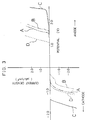
- Figure 2 shows the pitting corrosion potential in relation to different temperatures in an aqueous solution of miscellaneous chlorides.
- a and b in figure 2 show the respective characteristics of SUS317J4L (comparative) and SUS329J4L (used in this invention) and c shows the characteristics of SUS329J1.
- the corrosion resistibility of c is not good.
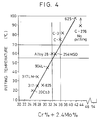
- a and B represent respectively SUS317J4L stainless steel (comparative) and SUS329J4L stainless steel, (in this invention).
- C and D are for comparison purposes of the prior art, and show the voltage/current characteristics of aluminium-laminated SUS329J1, and SUS329J1 stainless steel, respectively.
- Metal dissoluting reaction occurs at the anode electrode (or cathode electrode as for a cell). When the electric voltage is increased, the anode reaction becomes bigger: in the neighbourhood of 1.6 V for A and 1.7 V for B in this invention, and in the neighbourhood of +2.6 V for C and 1.2 V for D in the prior art. All the aforesaid voltages are at the current density of 1 ⁇ A/cm 2 .
- Figure 3 shows profiles at the twelfth sweep in repetition. Since the highest voltage of the cell's cathode electrode (or anode electrode in figure 3) is measured at 1.2V (and +1.6V for the anode electrode of the cell) the maximum usage voltage is 2.8V. A's and B's dissoluting reaction at the positive electrode does not occur because both are at a higher position than the cell's cathode electrode voltage. D has a problem in that its dissolving reaction occurs from -1.2V, which is equivalent to the voltage (1.2V) on the cell's cathode electrode. C's initiating voltage of dissoluting reaction is higher because an oxide film is formed on the surface of the aluminium.
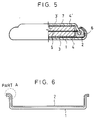
- Figure 4 is extracted from the above, and shows the relationship of the critical temperature for pitting and composition for Fe-Ni-Cr-Mo alloys.
- the corrosion of Fe-Ni-Cr-Mo alloys is tested in a solvent of 4%NaCl + 1 1%Fe 2 (SO 4 ) 3 + 0.01MHCl.
- the positive electrode cases are made with SUS317J4L of high Ni austenitic stainless steel plate of approximately 0.2 mm in thickness and SUS329J4L of high corrosion resistibility austenitic Ferrite duplex stainless steel plate (of 0.2 mm in thickness).
- SUS329J1 with a layer thickness of 0.16 mm and Al-SUS329J1 including an aluminium layer of thickness 40 ⁇ m and a SUS329J1 stainless steel element only of thickness 0.2 mm, as shown in figure 5, is tested.
- an electrochemical cell Electrode
- an active carbon fibre with a specific surface of 2000 m 2 /g to form a polarisable electrode is pressed in the shape of a disc.
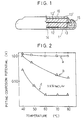
- a disc type cloth is inserted into the inside of the bottom of each of a positive electrode 11 and a negative electrode 16 after an electro-conductive paste 13, 13' is applied like a film.
- the electrodes are dried for 2 hours at a temperature of 100°C after crimping.
- the positive electrode which is processed as above, has a disc-shaped separator 14 set therein, which is made of a glass fibre filter and is subjected to the drying process for 30 minutes at a temperature of 200 °C.
- the electrode is filled with an organic electrolytic liquid.
- the liquid comprises boron fluoride in which tetra ethyl phosphoric acid is dissolved.
- the assembled positive electrode is set into the negative electrode after a polypropylene gasket 15 is forced into the negative electrode.
- Table 4 shows the decrease ratio of capacity and increase ratio of AC impedance (measured at 1 kHz) after 500 hours in an atmosphere at 70°C when 2.8 V is applied.
- the table includes the burr occurring ratio of stainless steel or aluminium burrs when assembling the cell from the positive electrode case and negative electrode case in one form and bending and shielding the edge of the aforesaid positive electrode case towards the inside.
- A, B, C, D show respectively SUS317J4L, SUS329J4L, A l /SUS329J1, and SUS329J1 which are used for the positive electrode of an electrochemical cells.
- the positive electrode case is formed according to the present invention. Moreover, they are without an aluminium layer unlike that of C which has an aluminium layer which suffers from burrs.
- the other prior art positive electrode case which has no aluminium layer shows sharp ratios of change and therefore shows less reliability. Burrs occurring during cell shielding cannot be found in A and B of the present invention and in the case of C there is observed about a 10% burr occurring ratio, comprising burrs of aluminium which come off the aluminium layer.
- polyacene An organic semiconductor, polyacene may be used in the cells.
- Polyacene is a kind of organic conductive material and is capable of releasing and absorbing anions (for example BF 4 -) and/or cations (eg. Li + ). Accordingly, "polyacene” is used as an active material for a rechargeable cell and as a polarisation electrode of a capacitor.
- the cells are assembled in the same manner and conditions of the previous embodiment 1, and the same characteristics are shown in table 5, in which A, B, C, D comprise the same positive electrode cases as in the previous embodiment.
- Polyacene is used for the positive electrode, and Lithium-doped polyacene and propylene carbonate with 0.5 mol. lithium perchlorate dissolved therein is used for the negative electrode.
- the cells are assembled in the same manner and conditions of the first embodiment.
- Table 6 shows the decrease ratio of capacity and increase ratio of AC impedance (measured at 1 kHz) after 500 hours in an atmosphere of 60°C when 3.3 V is applied, and the burr occurring ratio.
- A, B, C, D in table 6 are the same positive electrode cases respectively used in the first embodiment.
- Cell Decrease ratio of capacity %) Increase ratio of AC impedance (%) Burr occurring ratio (%) A - 5.9 + 18 0 B - 6.8 + 23 0 C - 9.7 + 34 7.1 C 28.0 + 76 0
- Manganese dioxide is used for the positive electrode, and Lithium metal and an organic electrolyte liquid of mixed solution of propylene carbonate and DME with 1 mol. lithium perchlorate soluted therein is used for the negative electrode.
- DME comprises 1, 2-dimethoxyethane (CH 3 OCH 2 CH 2 OCH 3 ). Accordingly, the negative electrode is a lithium metal.
- the cells are assembled in the same manner and conditions of the first embodiment. Table 7 shows the same characteristics as in the first embodiment, but the observation is made after 500 hours kept in the atmosphere of 60°C.
- A, B, C, D in Table 7 are the same positive electrode cases respectively as in the first embodiment.
- Cell Decrease ratio of capacity %) Increase ratio of AC impedance (%) Burr occurring ratio (%) A - 3.0 + 12 0 B - 4.8 + 14 0 C - 6.1 + 21 10.2 D - 7.5 + 25 0
- the present invention it is possible to have lower cost, but higher corrosion resistibility materials, to improve the productivity of a cell and moreover to obtain high pressure tightness in an electrochemical cell.
Landscapes
- Chemical & Material Sciences (AREA)
- Chemical Kinetics & Catalysis (AREA)
- Electrochemistry (AREA)
- General Chemical & Material Sciences (AREA)
- Inorganic Chemistry (AREA)
- Engineering & Computer Science (AREA)
- Materials Engineering (AREA)
- Metallurgy (AREA)
- Mechanical Engineering (AREA)
- Organic Chemistry (AREA)
- Secondary Cells (AREA)
- Sealing Battery Cases Or Jackets (AREA)
- Battery Electrode And Active Subsutance (AREA)
- Electric Double-Layer Capacitors Or The Like (AREA)
- Cell Electrode Carriers And Collectors (AREA)
- Primary Cells (AREA)
Applications Claiming Priority (4)
| Application Number | Priority Date | Filing Date | Title |
|---|---|---|---|
| JP317296/92 | 1992-11-26 | ||
| JP31729692 | 1992-11-26 | ||
| JP24159393A JP3195475B2 (ja) | 1992-11-26 | 1993-09-28 | 電気化学セル |
| JP241593/93 | 1993-09-28 |
Publications (2)
| Publication Number | Publication Date |
|---|---|
| EP0599654A1 EP0599654A1 (en) | 1994-06-01 |
| EP0599654B1 true EP0599654B1 (en) | 1998-06-17 |
Family
ID=26535345
Family Applications (1)
| Application Number | Title | Priority Date | Filing Date |
|---|---|---|---|
| EP93309441A Expired - Lifetime EP0599654B1 (en) | 1992-11-26 | 1993-11-26 | Non-aqueous electrolyte electrochemical cell |
Country Status (7)
| Country | Link |
|---|---|
| US (1) | US5478670A (enExample) |
| EP (1) | EP0599654B1 (enExample) |
| JP (1) | JP3195475B2 (enExample) |
| KR (1) | KR940008153A (enExample) |
| CN (1) | CN1132256C (enExample) |
| CA (1) | CA2110024C (enExample) |
| DE (1) | DE69319208T2 (enExample) |
Families Citing this family (15)
| Publication number | Priority date | Publication date | Assignee | Title |
|---|---|---|---|---|
| US5656392A (en) * | 1995-03-20 | 1997-08-12 | Matsushita Electric Industrial Co., Ltd. | Organic electrolyte batteries |
| US6238971B1 (en) * | 1997-02-11 | 2001-05-29 | Micron Technology, Inc. | Capacitor structures, DRAM cell structures, and integrated circuitry, and methods of forming capacitor structures, integrated circuitry and DRAM cell structures |
| US7199997B1 (en) * | 2000-06-09 | 2007-04-03 | U.S. Nanocorp, Inc. | Asymmetric electrochemical supercapacitor and method of manufacture thereof |
| KR20000059235A (ko) * | 2000-07-20 | 2000-10-05 | 라두호 | 기능성 맞춤 브레지어 ×흡입·배기 |
| JP4437036B2 (ja) * | 2003-12-26 | 2010-03-24 | パナソニック株式会社 | 蓄電セル用ケース材料 |
| JP4665513B2 (ja) * | 2004-11-25 | 2011-04-06 | パナソニック株式会社 | コイン型電気化学素子の製造方法 |
| CN101065818B (zh) * | 2004-11-25 | 2010-12-01 | 松下电器产业株式会社 | 扣式电化学元件的制造方法及扣式电化学元件 |
| US7465521B2 (en) * | 2004-12-08 | 2008-12-16 | Greatbatch Ltd. | Nickel-based alloys as positive electrode support materials in electrochemical cells containing nonaqueous electrolytes |
| KR100659850B1 (ko) * | 2005-04-26 | 2006-12-19 | 삼성에스디아이 주식회사 | 페라이트계 서스를 이용한 전지 외장재 및 이를 이용한이차 전지 |
| JP2008269972A (ja) * | 2007-04-20 | 2008-11-06 | Nissan Motor Co Ltd | 非水溶媒二次電池 |
| CN102332602B (zh) * | 2011-01-26 | 2013-11-13 | 东莞新能源科技有限公司 | 圆柱型锂离子电池 |
| CN104170116A (zh) | 2012-01-13 | 2014-11-26 | 永备电池有限公司 | 用以减轻因摄取造成的损害的锂电池结构 |
| JP6327633B2 (ja) * | 2013-09-19 | 2018-05-23 | セイコーインスツル株式会社 | 二相ステンレス鋼からなるダイヤフラム |
| CN109346627A (zh) * | 2018-11-28 | 2019-02-15 | 东莞市电的电子有限公司 | 扣式锂离子电池 |
| CN112701388A (zh) * | 2020-12-28 | 2021-04-23 | 惠州亿纬创能电池有限公司 | 一种钢壳扣式电池的电极壳及包含其的钢壳扣式电池和应用 |
Family Cites Families (10)
| Publication number | Priority date | Publication date | Assignee | Title |
|---|---|---|---|---|
| JPS5528238A (en) * | 1978-08-17 | 1980-02-28 | Matsushita Electric Ind Co Ltd | Flat battery |
| US4824745A (en) * | 1987-02-25 | 1989-04-25 | Bridgestone Corporation | Electric cell comprising a polymeric material film electrode having a collection integrated therewith |
| DE3918963A1 (de) * | 1988-06-20 | 1989-12-21 | Bridgestone Corp | Sekundaerelement mit nichtwaessrigem, fluessigem elektrolyten |
| JPH02126554A (ja) * | 1988-11-07 | 1990-05-15 | Toshiba Battery Co Ltd | 非水溶媒二次電池 |
| US5114811A (en) * | 1990-02-05 | 1992-05-19 | W. Greatbatch Ltd. | High energy density non-aqueous electrolyte lithium cell operational over a wide temperature range |
| US5114810A (en) * | 1990-02-05 | 1992-05-19 | Wilson Greatbatch Ltd. | Cathode current collector material for solid cathode cell |
| JP3023129B2 (ja) * | 1990-02-19 | 2000-03-21 | 鐘紡株式会社 | 有機半導体を用いた湿式コンデンサー |
| JPH0410365A (ja) * | 1990-04-26 | 1992-01-14 | Hitachi Maxell Ltd | リチウム二次電池 |
| JP2951706B2 (ja) * | 1990-09-11 | 1999-09-20 | 旭化成工業株式会社 | 電池部材 |
| JPH05133755A (ja) * | 1991-11-13 | 1993-05-28 | Akai Electric Co Ltd | 診断機能付振動ジヤイロ |
-
1993
- 1993-09-28 JP JP24159393A patent/JP3195475B2/ja not_active Expired - Lifetime
- 1993-11-17 US US08/153,586 patent/US5478670A/en not_active Expired - Lifetime
- 1993-11-24 KR KR1019930025149A patent/KR940008153A/ko not_active Withdrawn
- 1993-11-25 CA CA002110024A patent/CA2110024C/en not_active Expired - Fee Related
- 1993-11-25 CN CN93121448A patent/CN1132256C/zh not_active Expired - Lifetime
- 1993-11-26 EP EP93309441A patent/EP0599654B1/en not_active Expired - Lifetime
- 1993-11-26 DE DE69319208T patent/DE69319208T2/de not_active Expired - Fee Related
Also Published As
| Publication number | Publication date |
|---|---|
| DE69319208T2 (de) | 1998-10-15 |
| CN1132256C (zh) | 2003-12-24 |
| JP3195475B2 (ja) | 2001-08-06 |
| CN1096136A (zh) | 1994-12-07 |
| EP0599654A1 (en) | 1994-06-01 |
| CA2110024C (en) | 1999-06-01 |
| DE69319208D1 (de) | 1998-07-23 |
| JPH06215738A (ja) | 1994-08-05 |
| KR940008153A (ko) | 1994-04-29 |
| US5478670A (en) | 1995-12-26 |
| CA2110024A1 (en) | 1994-05-27 |
Similar Documents
| Publication | Publication Date | Title |
|---|---|---|
| Myung et al. | Electrochemical behavior and passivation of current collectors in lithium-ion batteries | |
| Myung et al. | Electrochemical behavior of current collectors for lithium batteries in non-aqueous alkyl carbonate solution and surface analysis by ToF-SIMS | |
| EP0599654A1 (en) | Non-aqueous electrolyte electrochemical cell | |
| US10615452B2 (en) | High voltage rechargeable magnesium cell | |
| DE60113836T2 (de) | Luftzelle ohne quecksilber | |
| US20030031926A1 (en) | Tab surface treatments for polymer-metal laminate electrochemical cell packages | |
| KR101701785B1 (ko) | 리튬 이온 이차전지용 집전체 및 리튬 이온 이차전지용 양극 | |
| DE102010027699A1 (de) | Batterie | |
| JPWO2001059856A1 (ja) | リチウム二次電池及びその製造方法 | |
| KR102769546B1 (ko) | 전해액 조성물 및 이를 사용하는 이차 전지 | |
| EP4437614A1 (de) | Energiespeicherzelle, verbund aus energiespeicherzellen und herstellungsverfahren | |
| EP0589229A1 (en) | Organic electrolytic solution and organic electrolytic solution cell | |
| EP4333138A1 (de) | Energiespeicherzelle und verfahren zum herstellen einer solchen energiespeicherzelle | |
| KR20150022740A (ko) | 축전 소자 | |
| JP2003257384A (ja) | ボタン型リチウム二次電池ケース用フェライト系ステンレス鋼及び電池ケース | |
| WO2016172280A1 (en) | Sealed separator and tab insulator for use in an electrochemical cell | |
| JP3576948B2 (ja) | 電気化学セル | |
| DE102022203559A1 (de) | Batteriekonfigurationen mit korrosionsbarriere | |
| Basile | Identifying the solid-electrolyte interphase formed on lithium metal electrodes using room temperature ionic liquid based electrolytes. | |
| US20250038361A1 (en) | Electrochemical energy storage element | |
| JP2552442B2 (ja) | 非水電解液電池の製造方法 | |
| US20250030007A1 (en) | Electrochemical energy storage element with a contact sheet metal member and method of manufacturing the same | |
| US20240363972A1 (en) | Electrochemical energy storage element | |
| WO2024127430A1 (en) | A tabless cell for allowing pre-lithiation of its anode | |
| JPH11250872A (ja) | 非水溶媒二次電池 |
Legal Events
| Date | Code | Title | Description |
|---|---|---|---|
| PUAI | Public reference made under article 153(3) epc to a published international application that has entered the european phase |
Free format text: ORIGINAL CODE: 0009012 |
|
| AK | Designated contracting states |
Kind code of ref document: A1 Designated state(s): CH DE FR GB LI |
|
| 17P | Request for examination filed |
Effective date: 19941005 |
|
| 17Q | First examination report despatched |
Effective date: 19960507 |
|
| GRAG | Despatch of communication of intention to grant |
Free format text: ORIGINAL CODE: EPIDOS AGRA |
|
| GRAG | Despatch of communication of intention to grant |
Free format text: ORIGINAL CODE: EPIDOS AGRA |
|
| GRAH | Despatch of communication of intention to grant a patent |
Free format text: ORIGINAL CODE: EPIDOS IGRA |
|
| GRAH | Despatch of communication of intention to grant a patent |
Free format text: ORIGINAL CODE: EPIDOS IGRA |
|
| GRAA | (expected) grant |
Free format text: ORIGINAL CODE: 0009210 |
|
| AK | Designated contracting states |
Kind code of ref document: B1 Designated state(s): CH DE FR GB LI |
|
| REG | Reference to a national code |
Ref country code: CH Ref legal event code: EP |
|
| REF | Corresponds to: |
Ref document number: 69319208 Country of ref document: DE Date of ref document: 19980723 |
|
| ET | Fr: translation filed | ||
| REG | Reference to a national code |
Ref country code: CH Ref legal event code: NV Representative=s name: PATENTANWAELTE SCHAAD, BALASS, MENZL & PARTNER AG |
|
| PLBE | No opposition filed within time limit |
Free format text: ORIGINAL CODE: 0009261 |
|
| 26N | No opposition filed | ||
| REG | Reference to a national code |
Ref country code: GB Ref legal event code: IF02 |
|
| REG | Reference to a national code |
Ref country code: CH Ref legal event code: PUE Owner name: SII MICRO PARTS LTD. Free format text: SEIKO INSTRUMENTS INC.#31-1, 6-CHOME, KAMEIDO#KOTO-KU/TOKYO (JP) -TRANSFER TO- SII MICRO PARTS LTD.#45-1 AZA-MATSUBARA, KAMI-AYASHI#AOBA-KU, SENDAI-SHI, MIYAGI (JP) |
|
| REG | Reference to a national code |
Ref country code: FR Ref legal event code: TP |
|
| PGFP | Annual fee paid to national office [announced via postgrant information from national office to epo] |
Ref country code: DE Payment date: 20071122 Year of fee payment: 15 |
|
| PGFP | Annual fee paid to national office [announced via postgrant information from national office to epo] |
Ref country code: CH Payment date: 20071128 Year of fee payment: 15 |
|
| REG | Reference to a national code |
Ref country code: CH Ref legal event code: PUE Owner name: SEIKO INSTRUMENTS INC. Free format text: SII MICRO PARTS LTD.#45-1 AZA-MATSUBARA, KAMI-AYASHI#AOBA-KU, SENDAI-SHI, MIYAGI (JP) -TRANSFER TO- SEIKO INSTRUMENTS INC.#8 NAKASE 1-CHOME, MIHAMA-KU#CHIBA-SHI, CHIBA 261-8507 (JP) |
|
| PGFP | Annual fee paid to national office [announced via postgrant information from national office to epo] |
Ref country code: GB Payment date: 20071121 Year of fee payment: 15 Ref country code: FR Payment date: 20071108 Year of fee payment: 15 |
|
| REG | Reference to a national code |
Ref country code: FR Ref legal event code: TP |
|
| REG | Reference to a national code |
Ref country code: CH Ref legal event code: PL |
|
| GBPC | Gb: european patent ceased through non-payment of renewal fee |
Effective date: 20081126 |
|
| REG | Reference to a national code |
Ref country code: FR Ref legal event code: ST Effective date: 20090731 |
|
| PG25 | Lapsed in a contracting state [announced via postgrant information from national office to epo] |
Ref country code: LI Free format text: LAPSE BECAUSE OF NON-PAYMENT OF DUE FEES Effective date: 20081130 Ref country code: DE Free format text: LAPSE BECAUSE OF NON-PAYMENT OF DUE FEES Effective date: 20090603 Ref country code: CH Free format text: LAPSE BECAUSE OF NON-PAYMENT OF DUE FEES Effective date: 20081130 |
|
| PG25 | Lapsed in a contracting state [announced via postgrant information from national office to epo] |
Ref country code: GB Free format text: LAPSE BECAUSE OF NON-PAYMENT OF DUE FEES Effective date: 20081126 |
|
| PG25 | Lapsed in a contracting state [announced via postgrant information from national office to epo] |
Ref country code: FR Free format text: LAPSE BECAUSE OF NON-PAYMENT OF DUE FEES Effective date: 20081130 |