EP0593462B1 - Method for upgrading steam cracker tars - Google Patents
Method for upgrading steam cracker tars Download PDFInfo
- Publication number
- EP0593462B1 EP0593462B1 EP91909784A EP91909784A EP0593462B1 EP 0593462 B1 EP0593462 B1 EP 0593462B1 EP 91909784 A EP91909784 A EP 91909784A EP 91909784 A EP91909784 A EP 91909784A EP 0593462 B1 EP0593462 B1 EP 0593462B1
- Authority
- EP
- European Patent Office
- Prior art keywords
- cracking
- hydrocarbon feedstock
- oils
- cracked
- steam
- Prior art date
- Legal status (The legal status is an assumption and is not a legal conclusion. Google has not performed a legal analysis and makes no representation as to the accuracy of the status listed.)
- Expired - Lifetime
Links
- 238000000034 method Methods 0.000 title claims abstract description 75
- 239000011269 tar Substances 0.000 title claims description 58
- 239000000047 product Substances 0.000 claims abstract description 84
- 239000000852 hydrogen donor Substances 0.000 claims abstract description 74
- 239000003085 diluting agent Substances 0.000 claims abstract description 50
- 238000005336 cracking Methods 0.000 claims abstract description 47
- 229930195733 hydrocarbon Natural products 0.000 claims abstract description 43
- 150000002430 hydrocarbons Chemical class 0.000 claims abstract description 43
- 239000004215 Carbon black (E152) Substances 0.000 claims abstract description 42
- 238000010791 quenching Methods 0.000 claims abstract description 40
- 238000006243 chemical reaction Methods 0.000 claims abstract description 36
- 239000012263 liquid product Substances 0.000 claims abstract description 32
- 150000001336 alkenes Chemical class 0.000 claims abstract description 6
- 230000000171 quenching effect Effects 0.000 claims abstract description 5
- 230000003292 diminished effect Effects 0.000 claims abstract description 4
- 239000003921 oil Substances 0.000 claims description 90
- 125000003118 aryl group Chemical group 0.000 claims description 51
- 239000007788 liquid Substances 0.000 claims description 29
- 239000000463 material Substances 0.000 claims description 27
- 239000007789 gas Substances 0.000 claims description 26
- 238000009835 boiling Methods 0.000 claims description 21
- 241000282326 Felis catus Species 0.000 claims description 20
- 239000000203 mixture Substances 0.000 claims description 19
- 239000010692 aromatic oil Substances 0.000 claims description 18
- 125000000524 functional group Chemical group 0.000 claims description 17
- SMWDFEZZVXVKRB-UHFFFAOYSA-N Quinoline Chemical compound N1=CC=CC2=CC=CC=C21 SMWDFEZZVXVKRB-UHFFFAOYSA-N 0.000 claims description 12
- 239000011280 coal tar Substances 0.000 claims description 12
- 238000002791 soaking Methods 0.000 claims description 12
- BBEAQIROQSPTKN-UHFFFAOYSA-N pyrene Chemical compound C1=CC=C2C=CC3=CC=CC4=CC=C1C2=C43 BBEAQIROQSPTKN-UHFFFAOYSA-N 0.000 claims description 10
- 125000000217 alkyl group Chemical group 0.000 claims description 9
- 239000002243 precursor Substances 0.000 claims description 9
- QIGBRXMKCJKVMJ-UHFFFAOYSA-N Hydroquinone Chemical compound OC1=CC=C(O)C=C1 QIGBRXMKCJKVMJ-UHFFFAOYSA-N 0.000 claims description 8
- YNPNZTXNASCQKK-UHFFFAOYSA-N phenanthrene Chemical compound C1=CC=C2C3=CC=CC=C3C=CC2=C1 YNPNZTXNASCQKK-UHFFFAOYSA-N 0.000 claims description 8
- UFWIBTONFRDIAS-UHFFFAOYSA-N Naphthalene Chemical compound C1=CC=CC2=CC=CC=C21 UFWIBTONFRDIAS-UHFFFAOYSA-N 0.000 claims description 7
- 150000001875 compounds Chemical class 0.000 claims description 7
- 238000001816 cooling Methods 0.000 claims description 7
- KAKZBPTYRLMSJV-UHFFFAOYSA-N Butadiene Chemical group C=CC=C KAKZBPTYRLMSJV-UHFFFAOYSA-N 0.000 claims description 6
- 239000000284 extract Substances 0.000 claims description 5
- GVEPBJHOBDJJJI-UHFFFAOYSA-N fluoranthrene Natural products C1=CC(C2=CC=CC=C22)=C3C2=CC=CC3=C1 GVEPBJHOBDJJJI-UHFFFAOYSA-N 0.000 claims description 5
- ISWSIDIOOBJBQZ-UHFFFAOYSA-N phenol group Chemical group C1(=CC=CC=C1)O ISWSIDIOOBJBQZ-UHFFFAOYSA-N 0.000 claims description 5
- 229920006395 saturated elastomer Polymers 0.000 claims description 5
- CXWXQJXEFPUFDZ-UHFFFAOYSA-N tetralin Chemical class C1=CC=C2CCCCC2=C1 CXWXQJXEFPUFDZ-UHFFFAOYSA-N 0.000 claims description 5
- 238000011144 upstream manufacturing Methods 0.000 claims description 4
- 150000001491 aromatic compounds Chemical class 0.000 claims description 3
- QVGXLLKOCUKJST-UHFFFAOYSA-N atomic oxygen Chemical compound [O] QVGXLLKOCUKJST-UHFFFAOYSA-N 0.000 claims description 3
- 230000003197 catalytic effect Effects 0.000 claims description 3
- 125000000391 vinyl group Chemical group [H]C([*])=C([H])[H] 0.000 claims description 3
- 229920002554 vinyl polymer Polymers 0.000 claims description 3
- XBDYBAVJXHJMNQ-UHFFFAOYSA-N 1,2,3,4-tetrahydroanthracene Chemical class C1=CC=C2C=C(CCCC3)C3=CC2=C1 XBDYBAVJXHJMNQ-UHFFFAOYSA-N 0.000 claims description 2
- UXNCDAQNSQBHEN-UHFFFAOYSA-N 1,2,3,4-tetrahydrophenanthrene Chemical class C1=CC2=CC=CC=C2C2=C1CCCC2 UXNCDAQNSQBHEN-UHFFFAOYSA-N 0.000 claims description 2
- QLLUAUADIMPKIH-UHFFFAOYSA-N 1,2-bis(ethenyl)naphthalene Chemical class C1=CC=CC2=C(C=C)C(C=C)=CC=C21 QLLUAUADIMPKIH-UHFFFAOYSA-N 0.000 claims description 2
- UVHXEHGUEKARKZ-UHFFFAOYSA-N 1-ethenylanthracene Chemical class C1=CC=C2C=C3C(C=C)=CC=CC3=CC2=C1 UVHXEHGUEKARKZ-UHFFFAOYSA-N 0.000 claims description 2
- UGMRKNAZEKUAQS-UHFFFAOYSA-N 1-ethenylphenanthrene Chemical class C1=CC2=CC=CC=C2C2=C1C(C=C)=CC=C2 UGMRKNAZEKUAQS-UHFFFAOYSA-N 0.000 claims description 2
- IGGDKDTUCAWDAN-UHFFFAOYSA-N 1-vinylnaphthalene Chemical class C1=CC=C2C(C=C)=CC=CC2=C1 IGGDKDTUCAWDAN-UHFFFAOYSA-N 0.000 claims description 2
- 238000004939 coking Methods 0.000 claims description 2
- 239000001301 oxygen Substances 0.000 claims description 2
- 229910052760 oxygen Inorganic materials 0.000 claims description 2
- 125000003454 indenyl group Chemical class C1(C=CC2=CC=CC=C12)* 0.000 claims 1
- 125000003011 styrenyl group Chemical class [H]\C(*)=C(/[H])C1=C([H])C([H])=C([H])C([H])=C1[H] 0.000 claims 1
- 238000004519 manufacturing process Methods 0.000 abstract description 8
- 238000004227 thermal cracking Methods 0.000 abstract description 5
- IMNFDUFMRHMDMM-UHFFFAOYSA-N N-Heptane Chemical compound CCCCCCC IMNFDUFMRHMDMM-UHFFFAOYSA-N 0.000 description 24
- 238000004230 steam cracking Methods 0.000 description 16
- 238000006731 degradation reaction Methods 0.000 description 13
- 238000005984 hydrogenation reaction Methods 0.000 description 12
- 238000005755 formation reaction Methods 0.000 description 11
- 239000011295 pitch Substances 0.000 description 11
- UFHFLCQGNIYNRP-UHFFFAOYSA-N Hydrogen Chemical compound [H][H] UFHFLCQGNIYNRP-UHFFFAOYSA-N 0.000 description 10
- 230000015572 biosynthetic process Effects 0.000 description 10
- 239000001257 hydrogen Substances 0.000 description 10
- 229910052739 hydrogen Inorganic materials 0.000 description 10
- 238000002474 experimental method Methods 0.000 description 9
- 239000002904 solvent Substances 0.000 description 8
- 239000002641 tar oil Substances 0.000 description 8
- 239000000295 fuel oil Substances 0.000 description 7
- 150000003220 pyrenes Chemical class 0.000 description 6
- 239000000386 donor Substances 0.000 description 5
- 238000012546 transfer Methods 0.000 description 5
- 230000000694 effects Effects 0.000 description 4
- 230000009931 harmful effect Effects 0.000 description 4
- 239000007791 liquid phase Substances 0.000 description 4
- 229920000049 Carbon (fiber) Polymers 0.000 description 3
- 239000004917 carbon fiber Substances 0.000 description 3
- 238000004523 catalytic cracking Methods 0.000 description 3
- 239000003245 coal Substances 0.000 description 3
- -1 ethylene, propylene Chemical group 0.000 description 3
- 238000002156 mixing Methods 0.000 description 3
- 238000012545 processing Methods 0.000 description 3
- 238000000197 pyrolysis Methods 0.000 description 3
- LBUJPTNKIBCYBY-UHFFFAOYSA-N 1,2,3,4-tetrahydroquinoline Chemical compound C1=CC=C2CCCNC2=C1 LBUJPTNKIBCYBY-UHFFFAOYSA-N 0.000 description 2
- XXPBFNVKTVJZKF-UHFFFAOYSA-N 9,10-dihydrophenanthrene Chemical compound C1=CC=C2CCC3=CC=CC=C3C2=C1 XXPBFNVKTVJZKF-UHFFFAOYSA-N 0.000 description 2
- IJGRMHOSHXDMSA-UHFFFAOYSA-N Atomic nitrogen Chemical compound N#N IJGRMHOSHXDMSA-UHFFFAOYSA-N 0.000 description 2
- OKTJSMMVPCPJKN-UHFFFAOYSA-N Carbon Chemical group [C] OKTJSMMVPCPJKN-UHFFFAOYSA-N 0.000 description 2
- UFHFLCQGNIYNRP-VVKOMZTBSA-N Dideuterium Chemical compound [2H][2H] UFHFLCQGNIYNRP-VVKOMZTBSA-N 0.000 description 2
- MWPLVEDNUUSJAV-UHFFFAOYSA-N anthracene Chemical compound C1=CC=CC2=CC3=CC=CC=C3C=C21 MWPLVEDNUUSJAV-UHFFFAOYSA-N 0.000 description 2
- 239000012141 concentrate Substances 0.000 description 2
- 230000002950 deficient Effects 0.000 description 2
- 238000010574 gas phase reaction Methods 0.000 description 2
- 230000000116 mitigating effect Effects 0.000 description 2
- 230000035484 reaction time Effects 0.000 description 2
- 239000003079 shale oil Substances 0.000 description 2
- MYRTYDVEIRVNKP-UHFFFAOYSA-N 1,2-Divinylbenzene Chemical class C=CC1=CC=CC=C1C=C MYRTYDVEIRVNKP-UHFFFAOYSA-N 0.000 description 1
- WPDAVTSOEQEGMS-UHFFFAOYSA-N 9,10-dihydroanthracene Chemical compound C1=CC=C2CC3=CC=CC=C3CC2=C1 WPDAVTSOEQEGMS-UHFFFAOYSA-N 0.000 description 1
- 229910003296 Ni-Mo Inorganic materials 0.000 description 1
- 239000000654 additive Substances 0.000 description 1
- 230000000996 additive effect Effects 0.000 description 1
- 230000029936 alkylation Effects 0.000 description 1
- 238000005804 alkylation reaction Methods 0.000 description 1
- PNEYBMLMFCGWSK-UHFFFAOYSA-N aluminium oxide Inorganic materials [O-2].[O-2].[O-2].[Al+3].[Al+3] PNEYBMLMFCGWSK-UHFFFAOYSA-N 0.000 description 1
- 238000004458 analytical method Methods 0.000 description 1
- 239000002199 base oil Substances 0.000 description 1
- 230000009286 beneficial effect Effects 0.000 description 1
- 239000006227 byproduct Substances 0.000 description 1
- 229910052799 carbon Inorganic materials 0.000 description 1
- 230000015556 catabolic process Effects 0.000 description 1
- 239000003054 catalyst Substances 0.000 description 1
- 238000004517 catalytic hydrocracking Methods 0.000 description 1
- 238000006555 catalytic reaction Methods 0.000 description 1
- 239000000571 coke Substances 0.000 description 1
- 238000006482 condensation reaction Methods 0.000 description 1
- 229910052593 corundum Inorganic materials 0.000 description 1
- 239000010779 crude oil Substances 0.000 description 1
- 238000013461 design Methods 0.000 description 1
- 238000006477 desulfuration reaction Methods 0.000 description 1
- 230000023556 desulfurization Effects 0.000 description 1
- 238000007599 discharging Methods 0.000 description 1
- 238000011143 downstream manufacturing Methods 0.000 description 1
- 238000005516 engineering process Methods 0.000 description 1
- 238000007380 fibre production Methods 0.000 description 1
- 238000005194 fractionation Methods 0.000 description 1
- 239000003502 gasoline Substances 0.000 description 1
- SRSMHCPRTXUJJM-KAHIACEGSA-N hydropyrene Chemical compound C[C@@H]1CC[C@@H]2[C@@H]3[C@H]1CC[C@]1(C)CCC[C@](C)(CC2=C)[C@@H]31 SRSMHCPRTXUJJM-KAHIACEGSA-N 0.000 description 1
- 150000002469 indenes Chemical class 0.000 description 1
- 239000011261 inert gas Substances 0.000 description 1
- 230000001050 lubricating effect Effects 0.000 description 1
- 239000011302 mesophase pitch Substances 0.000 description 1
- VNWKTOKETHGBQD-UHFFFAOYSA-N methane Chemical compound C VNWKTOKETHGBQD-UHFFFAOYSA-N 0.000 description 1
- DDTIGTPWGISMKL-UHFFFAOYSA-N molybdenum nickel Chemical compound [Ni].[Mo] DDTIGTPWGISMKL-UHFFFAOYSA-N 0.000 description 1
- 229910052757 nitrogen Inorganic materials 0.000 description 1
- 239000003208 petroleum Substances 0.000 description 1
- 238000006116 polymerization reaction Methods 0.000 description 1
- 230000001376 precipitating effect Effects 0.000 description 1
- 238000002360 preparation method Methods 0.000 description 1
- 238000010926 purge Methods 0.000 description 1
- 150000003254 radicals Chemical class 0.000 description 1
- 239000000376 reactant Substances 0.000 description 1
- 239000012713 reactive precursor Substances 0.000 description 1
- 230000009257 reactivity Effects 0.000 description 1
- 238000011084 recovery Methods 0.000 description 1
- 229910001220 stainless steel Inorganic materials 0.000 description 1
- 239000010935 stainless steel Substances 0.000 description 1
- 239000007858 starting material Substances 0.000 description 1
- 230000000638 stimulation Effects 0.000 description 1
- 150000003440 styrenes Chemical class 0.000 description 1
- 239000000126 substance Substances 0.000 description 1
- 239000013589 supplement Substances 0.000 description 1
- 230000001629 suppression Effects 0.000 description 1
- 238000012360 testing method Methods 0.000 description 1
- 229910001845 yogo sapphire Inorganic materials 0.000 description 1
Images
Classifications
-
- C—CHEMISTRY; METALLURGY
- C10—PETROLEUM, GAS OR COKE INDUSTRIES; TECHNICAL GASES CONTAINING CARBON MONOXIDE; FUELS; LUBRICANTS; PEAT
- C10G—CRACKING HYDROCARBON OILS; PRODUCTION OF LIQUID HYDROCARBON MIXTURES, e.g. BY DESTRUCTIVE HYDROGENATION, OLIGOMERISATION, POLYMERISATION; RECOVERY OF HYDROCARBON OILS FROM OIL-SHALE, OIL-SAND, OR GASES; REFINING MIXTURES MAINLY CONSISTING OF HYDROCARBONS; REFORMING OF NAPHTHA; MINERAL WAXES
- C10G47/00—Cracking of hydrocarbon oils, in the presence of hydrogen or hydrogen- generating compounds, to obtain lower boiling fractions
- C10G47/32—Cracking of hydrocarbon oils, in the presence of hydrogen or hydrogen- generating compounds, to obtain lower boiling fractions in the presence of hydrogen-generating compounds
- C10G47/34—Organic compounds, e.g. hydrogenated hydrocarbons
-
- C—CHEMISTRY; METALLURGY
- C10—PETROLEUM, GAS OR COKE INDUSTRIES; TECHNICAL GASES CONTAINING CARBON MONOXIDE; FUELS; LUBRICANTS; PEAT
- C10G—CRACKING HYDROCARBON OILS; PRODUCTION OF LIQUID HYDROCARBON MIXTURES, e.g. BY DESTRUCTIVE HYDROGENATION, OLIGOMERISATION, POLYMERISATION; RECOVERY OF HYDROCARBON OILS FROM OIL-SHALE, OIL-SAND, OR GASES; REFINING MIXTURES MAINLY CONSISTING OF HYDROCARBONS; REFORMING OF NAPHTHA; MINERAL WAXES
- C10G69/00—Treatment of hydrocarbon oils by at least one hydrotreatment process and at least one other conversion process
- C10G69/02—Treatment of hydrocarbon oils by at least one hydrotreatment process and at least one other conversion process plural serial stages only
- C10G69/06—Treatment of hydrocarbon oils by at least one hydrotreatment process and at least one other conversion process plural serial stages only including at least one step of thermal cracking in the absence of hydrogen
-
- C—CHEMISTRY; METALLURGY
- C10—PETROLEUM, GAS OR COKE INDUSTRIES; TECHNICAL GASES CONTAINING CARBON MONOXIDE; FUELS; LUBRICANTS; PEAT
- C10G—CRACKING HYDROCARBON OILS; PRODUCTION OF LIQUID HYDROCARBON MIXTURES, e.g. BY DESTRUCTIVE HYDROGENATION, OLIGOMERISATION, POLYMERISATION; RECOVERY OF HYDROCARBON OILS FROM OIL-SHALE, OIL-SAND, OR GASES; REFINING MIXTURES MAINLY CONSISTING OF HYDROCARBONS; REFORMING OF NAPHTHA; MINERAL WAXES
- C10G9/00—Thermal non-catalytic cracking, in the absence of hydrogen, of hydrocarbon oils
Definitions
- the present invention is directed to processes for the production of normally gaseous mono- and di-olefins, particularly ethylene, propylene and butadiene, by thermally cracking a hydrocarbon feedstock in the presence of steam at elevated temperatures which involves introducing a hydrogen donor material, such as hydrotreated steam cracked tar oils, into a stream of steam cracked effluent at or downstream of the point where the furnace effluent reactions are quenched so as to prevent thermal degradation reactions of the steam cracked liquids.
- a hydrogen donor material such as hydrotreated steam cracked tar oils
- U.S. Patent 4,284,139 SWEANY
- SWEANY is directed to a process for upgrading the oil production from a heavy oil reservoir by contacting the heavy oil with a hydrogen donor diluent and subjecting the mixture to thermal cracking in a hydrogen donor diluent furnace.
- the disclosed purpose for doing so is to break down the heavy molecules which already exist in naturally occurring heavy oils.
- SWEANY uses a variation of the conventional HDDD process to enhance the stimulation and upgrading of oil production from heavy oil reserves.
- U.S. Patent 4,430,197, POYNOR et al. is directed to a hydrogen donor diluent cracking process in which heavy hydrocarbonaceous material is thermally cracked in a cracking coil in the presence of a hydrogen donor solvent.
- POYNOR et al. therefore, also uses a variation of a conventional HDDC process, which involves heat soaking, in the presence of a hydrogen donor, pitch obtained from the HDDC process. This heat-soaked pitch is then recycled and cracked in the hydrogen donor diluent process.
- U.S. Patent 4,397,830, UEMURA et al. is directed to a process for producing carbon fibers which involves heat treating a feed stock pitch by mixing 100 parts by volume of a heavy fraction oil boiling not lower than 200°C obtained by steam cracking petroleum with 10 to 200 parts by volume of a hydrogenated oil selected from a group consisting of aromatic nucleus hydrogenated hydrocarbons of appropriate carbon ring number and/or boiling range including hydrogenated cat cracked oil.
- U.S. Patent 4,596,652 is directed to a process for producing a mesophase pitch for carbon filter production, which involves pretreating the raw pitch material at elevated temperature under a pressurized hydrogen atmosphere followed by heat treating the pitch at 350°C to 550°c while supplying the pitch with a hydrogen donor.
- UEMURA et al. and SHIBATANI et al. both teach the use of hydrogen donors to control or modify the heat soaking of pitches to produce preferred feeds for the production of carbon fibers.
- these references disclose that the hydrogen donors mitigate the formation of quinoline insolubles during heat soaking of the starting pitch. Quinoline insolubles are undesirable for carbon fiber production and are conventionally classified as higher molecular weight asphaltenes or coke.
- U.S. Patent 3,755,143, HOSOI et al. teach the pyrolysis of crude oil or fractions thereof, followed by desulfurization by hydrogenation of the polycyclic aromatic tar produced in the pyrolysis reaction followed by alkylation or hydrogenation of the resultant product using the hydrogen produced in the pyrolysis reaction.
- HOSOI et al. disclose the hydrogenation of SCT to produce an improved product using conventional catalysis to accomplish their hydrogenation step.
- U.S. Patent 4,260,474, WERNICKE et al. relate to thermal cracking of heavy fractions of hydrocarbon hydrogenates.
- the disclosed process involves hydrogenation of VGO at a temperature of about 340°C and subsequent recovery of a hydrogenated VGO boiling above about 340°C which is then steam cracked to produce naptha-like cracked yields.
- hydrogenation typically 40% or more of the starting VGO material is converted, i.e., hydrocracked, material boiling above about 340°C in the hydrogenation step.
- U.S. Patent 4,324,935, WERNICKE et al. relates to a similar process to WERNICKE et al., supra, which involves an improved hydrogenation step which results in high quality fractions, i.e., gasoline materials.
- the 200°C-340°C boiling range hydrogenated product is steam cracked and then recycled to the hydrogenation step, which again is more of a hydrocracking than an hydrogenation because of the severity of the conversion of the starting material.
- the present invention is directed to a method of hydrogen donor chemistry wherein polymerization/condensation reactions of asphaltene precursors to form asphaltenes are prevented or mitigated by introducing a hydrogen donor diluent (HDD) material into a steam cracked effluent stream so as to upgrade the tars formed during the production of gaseous olefins.
- HDD hydrogen donor diluent
- this invention provides a process for cracking a hydrocarbon feedstock to produce normally gaseous olefins, said process comprising:
- hydrogen donor diluents or solvents, i.e., hydrotreated aromatic oils (e.g., recycled, hydrogenated oils derived from the steam cracked liquids) are used to upgrade SCT by injecting the HDD at or after the quench point or transfer line exchanger of a gas oil steam cracker furnace in order to prevent thermal degradation reactions of the steam cracked liquids.
- hydrotreated aromatic oils e.g., recycled, hydrogenated oils derived from the steam cracked liquids
- the point of introduction of the hydrogen donor material is selected to minimize heatsoaking time of the steam cracked liquids at elevated temperatures where liquid phase molecular weight growth reactions can proceed readily in the absence of the hydrogen donor.
- the boiling range of the HDD should be selected such that HDD boiling range overlies the boiling range of the steam cracked product liquids to best carry out the hydrogen donor chemistry.
- One embodiment of the present invention is a process for upgrading SCT in which fresh SCT is combined with hydrotreated steam cracked tar (SCT) oil, heavy distillate oil cuts thereof or aromatic oils in order to permit hydrogen donor (transfer) reactions which have been found to result in lower asphaltene formation in the SCT stream.
- the HDD has overlapping boiling ranges with the SCT, and include hydrotreated cat cycle oils, coker gas oils, steam cracked tar oils, and coal tars.
- the HDD is added at or immediately downstream of the point where the furnace effluent is quenched and upstream of the primary fractionator or quench tower since, at the temperatures which normally prevail in steam cracker primary fractionator towers, the molecular weight growth reactions which lead to asphaltene formation are rather fast and are not as easily reversed as they are prevented.
- a preferred embodiment of the present invention is a process for improving the properties of steam cracked tar (SCT) which involves first hydrogenating SCT or distillate cuts of SCT to produce HDD, which is combined with a freshly produced SCT at or after the point where the furnace effluent gas phase reactions are thermally quenched in a gas oil steam cracker in order to prevent subsequent thermal degradation reactions of SCT.
- SCT steam cracked tar
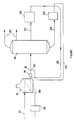
- FIG. 1 is a simplified flowchart of a hydrogen donor solvent recycle system which may be used in accordance with the present invention wherein the HDD is introduced to the SCT at the point of quenching of the steam cracking furnace effluent or a point downstream of the point of quenching of the effluent but upstream of the flash zone of the Primary Fractionator Tower.
- SCT steam cracker tars
- donor diluents or solvents such as whole steam cracked tar (SCT) oil, or a product derived from solvent cuts which are subsequently hydrotreated, for example in a recycled solvent system, may be used for this purpose to upgrade SCT.
- SCT steam cracked tar
- hydrogen donor reactions between SCT and hydrogen donor-containing streams are effective in upgrading SCT by preventing or suppressing the formation of asphaltenes in the SCT which would otherwise occur by thermal degradation reactions.
- SCT whole steam cracked tar
- HDD hydrogen donor-diluents
- suitable hydrogen donor diluents include partially saturated aromatic molecules selected from the group consisting of dihydronaphthalenes, tetrahydronaphthalenes, dihydroanthracenes, dihydrophenanthrenes, tetrahydroanthracenes, tetrahydrophenanthrenes, hydropyrenes, and other hydrogenated aromatic oils, such as steam cracked liquid products, cat cracker cycle oils, coker gas oils, and coal tar liquids.
- hydrogen donor diluents particularly suitable for purposes of the present invention include such materials as tetralin; 9, 10-dihydroanthracene; 9, 10- dihydrophenanthrene; hydropyrene, 1, 2, 3, 4- tetrahydroquinoline, and other similar compounds.
- the hydrogen donor materials may also be mixed streams, for example having generally naphthenoaromatic characteristics.
- partially hydrogenated, condensed, polycyclic aromatic or nitrogen-containing heterocyclic compounds are suitable for purposes of the present invention, with partially hydrogenated catalytic cracking cycle oils, hydrogenated aromatic concentrate streams from dearomatization processes, hydrogenated coker gas oils, and hydrogenated coal tar liquids being preferred hydrogen donor compounds.
- Especially preferred hydrogen donor compounds for purposes of the present invention are materials which have boiling ranges i.e., about 204°C(400 °F) to about 399°C (750 °F), which overlap the liquid products of the steam cracking process, such as hydrotreated catalytic cracking cycle oils, aromatic concentrate streams from dearomatization processes, coker gas oils, coal tar liquids and steam cracked tar oils.
- the present invention is based on the discovery that upon mildly hydrotreating aromatic oils, partially saturated aromatics are formed which are active hydrogen donor molecules which upon reaction with steam cracked liquid products prevent, minimize or suppress molecular weight grovth reactions which form undesirable high molecular weight materials such as asphaltenes.
- Suitable hydrotreated aromatic oils include, but are not restricted to, hydrotreated aromatic rich streams, such as steam cracked tar or steam cracked tar distillates, cat cycle oils, coker gas oils, coal tar liquids, and lube extract streams.
- hydrotreated aromatic oils have boiling ranges similar to the steam cracked liquid products because these hydrogen donor reactions are best effected in the liquid phase, with hydrogenated steam cracked tar oils being most preferred.
- SCT steam cracked tar oil
- hydrotreated aromatic oil such as steam cracked tar oil
- SCT whole steam cracked tar
- a heavy distillate oil cut of SCT may be initially hydrotreated to mildly hydrogenate the contained aromatic ring systems to produce hydrogen donor molecules.
- the hydrogenated oil is injected at, or substantially immediately after, the quench point of a gas oil steam cracker furnace to react with fresh SCT product so as to produce a SCT product of improved quality relative to conventional processes in which non- hydrogenated oils are used to quench the steam cracking reactions.
- the steam cracked liquid product as first produced in the steam cracker furnace, contain free radical molecules, vinyl-aromatic molecules, and other reactive species, and is highly reactive at moderately high temperatures commonly found in the downstream processing of steam cracked liquid product.
- the unsaturated functional groups of such aromatic molecules include those selected from the group consisting of olefinic groups and acetylenic groups.
- such unsaturated functional groups are selected from the groups consisting of indenes, acenapthalenes and other cyclopenteno-aromatics; vinylbenzenes, and other vinyl aromatics having one aromatic ring; divinylbenzenes, vinylnaphthalenes, divinylnaphthalenes, vinylanthracenes, vinylphenanthrenes, and other vinyl- and divinylaromatics having 2 or more aromatic rings.
- This reactivity of such aromatic molecules tends to lead to reactions which significantly downgrade the properties of the liquid product.
- heavy oils may be upgraded in accordance with the present invention.
- Such heavy oils include those oils customarily charged to cracking processes, e.g., whole crudes, and heavy distillate and residual fractions therefrom, and may also broadly include hydrogen deficient oils, such as shale oils, asphalts, tars, pitches, coal tars, heavy synthetic oils and the like, in addition to other oils.
- the process of the present invention is a conversion process wherein SCT or a heavy oil is admixed with an HDD boiling above 127°C (260°F), and preferably within the range 204°C to 566°C (400°F to 1050°F), and reacting the resulting mixture under hydrogen donor diluent reaction conditions.
- SCT or a heavy oil is admixed with an HDD boiling above 127°C (260°F), and preferably within the range 204°C to 566°C (400°F to 1050°F), and reacting the resulting mixture under hydrogen donor diluent reaction conditions.
- HDD high density polyethylene
- the present invention is directed to a process for cracking a hydrocarbon feedstock which involves reacting aromatic molecules containing such unsaturated functional groups with hydrogen donor diluent molecules to inhibit the aromatic molecules containing unsaturated functional groups from reacting to form heavier molecular weight products, and specifically asphaltenes.
- the process for cracking a hydrocarbon feedstock in accordance with the present invention also involves supplying a hydrocarbon feedstock into a high temperature zone heated to a temperature within the range of 426°C to 982°C (800°F - 1800°F) to produce a high temperature product stream comprising such aromatic molecules containing such aromatic functional groups, preferably wherein the temperature is within the range of 676°C to 982°C (1250°F - 1800°F), wherein the high temperature zone is a steam cracker and the hydrocarbon feedstock is subjected to steam cracking conditions to form a resultant high temperature steam cracked product stream comprising the aromatic molecules containing the unsaturated functional groups.
- the high temperature zone is a catalytic cracker. In yet another embodiment where the temperature is within the range of 426°C to 676°C (800°F - 1250°F), the high temperature zone is a coking furnace.
- the process also involves introducing the hydrogen donor diluent into the high temperature steam cracked product stream in an amount up to a level up to about 100% by total weight, preferably wherein the amount of the hydrogen donor diluent level is up to about 60% by total weight of said high temperature steam cracked product stream, and more preferably wherein the level is an amount of the hydrogen donor diluent of at least about 1% by total weight of the high temperature steam cracked product stream.
- the present invention also involves preparing the hydrogen donor diluent for introducing into the high temperature steam cracked product stream by subjecting a stream containing multi-ring aromatic compounds to hydrotreating conditions to form compounds comprising partially saturated rings, wherein the hydrotreating conditions are sufficient to achieve partial saturation, i.e., a hydrogen partial pressure within the range of 689 to 17235 kPa (100 lbs./psig. to 2,500 lbs./psig).
- a hydrogen donor diluent is produced which has a boiling temperature range within the temperature range of 260°C to 482°C (500°F to 900°F), and the resultant high temperature steam cracked product has a steam cracked product temperature within the range of 704°C to 871°C (1300°F to 1600°F).
- the process for cracking a hydrocarbon feedstock of the present invention also involves discharging the high temperature steam cracked product including the steam cracked product temperature into a heat soaking vessel and cooling the steam cracked product stream to a cool down temperature within the range of 149°C to 402°C (300°F to 755°F), and preferably wherein the cool down temperature is within the range of 224°C to 327°C (435°F to 620°F).
- the cooling preferably involves subjecting the high temperature steam cracked product to an indirect heat exchange prior to introducing the hydrogen donor diluent to the steam cracked product to inhibit the reacting of the aromatic molecules containing functional groups to form heavier molecular weight products, wherein the indirect heat exchange reduces the temperature of the steam cracked product to a sufficiently low temperature to inhibit the reaction of the aromatic molecules containing functional groups to form a heavier molecular weight product, and wherein the steam cracked product is maintained at said sufficiently low temperature for a sufficiently long period of time to inhibit the reaction of the aromatic molecules containing functional groups to form heavier molecular weight products.
- the hydrogen donor diluent is preferably introduced to the heat soaking vessel at a temperature within the range of 260°C to 482°C (500°F to 900°F), and the process also involves adding quench oil to the heat soaking vessel in order to quench the reacting of the aromatic molecules containing functional groups to form heavier molecular weight products.
- the quench oil is added as a quenching mixture with the hydrogen donor diluent to the heat soaking vessel to form a quenched mixture having a quenched mixture temperature within the range of 260°C to 343°C (500°F - 650°F), wherein the quenched mixture of the steam cracked product, the hydrogen donor diluent and the quench oil is maintained in the heat soaking vessel for a time sufficient to inhibit the reacting of the aromatic molecules containing the functional group to form heavier molecular weight products, wherein the time is within the range of 1 minute to 240 minutes, and preferably is within the range of 15 to 30 minutes.
- the quench oil is selected from a group of unhydrogenated precursors selected from the group consisting of naphthalene, phenanthrene, pyrene, quinoline, and hydroquinone, and alkyl derivatives of naphthalene, phenanthrene, pyrene, quinoline, and hydroquinone, and alkyl derivatives; the unhydrogenated precursors may also be selected from the group consisting of aromatic molecules containing phenol groups and aromatic molecules containing non-phenolic oxygen substitutes; or the unhydrogenated precursors may be selected from the group consisting of steam cracked quench oils, steam cracked tars, cat cracked tars, cat cracked cycle oils, cat cracked bottoms, coker gas oils, coal tar oils, and aromatic extent oils and cuts of steam cracked quench oils, steam cracked tars, cat cracked tars, cat cracked cycle oils, cat cracked bottoms, coker gas oils, coal tar oils, and aromatic extract oils.
- the present invention is also directed to a process for cracking a hydrocarbon feedstock to produce normally gaseous olefins which involves supplying a hydrocarbon feedstock stream into a high temperature cracking zone to produce high temperature cracked product streams; introducing at least one hydrogen donor diluent into the high temperature cracked product stream; and recovering a liquid product stream containing a diminished asphaltic material content, preferably wherein the introducing step involves injecting the hydrogen donor diluent at or downstream of a point where high temperature cracking reactions are stopped by cooling below high temperature cracking reaction temperatures.
- the cooling in the process for cracking a hydrocarbon feedstock involves subjecting the high temperature steam cracked product to indirect heat exchange to stop the high temperature cracking reactions.
- the high temperature thermal cracking zone has a temperature between 426°C and 982°C (800°F and 1800°F).
- the hydrogen donor diluent is introduced at a rate of 1 to 300 percent on liquid product rate, and is added in an amount up to about 100% by total weight, preferably wherein the amount is up to about 60% by total weight.
- the process for cracking a hydrocarbon feedstock in accordance with the present invention also involves preparation of a hydrogen donor diluent for introduction into the cracked product stream by hydrotreating a stream containing multi- ring aromatic compounds under conditions suitable to form compounds containing both aromatic and partially saturated rings, wherein the hydrogen donor diluent is prepared by hydrogenation of a stock selected from the group consisting of shale oil, coal tars, cracked aromatic oils, and steam cracker liquids, preferably wherein the hydrogen donor diluent is hydrogenated steam cracker tar.
- the hydrogen donor diluent may be selected from the group consisting essentially of partially hydrogenated catalytic cycle oils, lubricating base oil extracts, coker gas oils, steam cracked tar oils, and coal tar liquids, preferably wherein the hydrogen donor diluent is hydrotreated steam cracked oil, and wherein the liquid product steam is steam cracked tars.
- the cracked mixture may be subsequently separated to obtain the spent donor diluent and heavier gas oils.
- the spent diluent may then be partially hydrogenated, so as to regenerate it for return to the cracking step.
- feedline 10 supplies a hydrocarbon stream to be cracked in a cracking furnace 12.
- the furnace effluent is quenched at the furnace outlet by cooling either by indirect heat exchange in transfer line exchanger (TLE) 14, or with direct liquid quench at quench point 30, or by a combination of indirect heat exchange and direct liquid quench.
- TLE transfer line exchanger
- a hydrogen donor diluent (HDD) is introduced at the quench point 30 at the outlet of furnace 12, or if TLE is present, at a point within or downstream of the TLE.
- the hydrogen donor could also be introduced at a point downstream of the point where liquid quench is normally introduced.
- HDD suitable for purposes of the present invention include a myriad of materials, as conventionally used in HDD processes.
- Preferred HDD for purposes of the present invention are materials which have boiling points which overlap the liquid products of the steam cracking process, such as hydrotreated catalytic cracking oils, coker gas oils, steam cracked tar oils, and coal tar liquids.
- the HDD introduced at or after the quench point of the cracking furnace may be obtained by hydrotreating a steam cracked liquid stream, such as a portion of the normal quench oil or other steam cracked liquids subsequently obtained from the fractionation step, or may be supplied from a separate source, particularly for purposes of startup.
- the heated product stream is discharged from furnace 12 through line 16 to fractionator 18.
- the fractionator 18 may be of conventional design and operation, and is essentially a rectifying column from which a number of side-stream products may be drawn, as well as overhead liquid and vapor and bottoms. Although not shown, separate steam strippers may be used with each sidestream to eliminate "light ends" which would be returned to the main column. As shown in Fig. 1, however, the gases and light ends are removed through line 20, a gas oil fraction is removed through line 22, and a bottoms pitch or tar fraction are removed through line 24.
- a portion or all of the gas oil fraction, or of a particular boiling range cut thereof may be passed through line 22 to hydrotreater 26 where it is subjected to hydrotreating or hydrogenation to provide a hydrogen-rich donor diluent which may be returned via line 28 to the quench point 30 of the steam cracking furnace 12.
- Another embodiment of the present invention is to pass a portion or all of the tar or a particular boiling range cut thereof through line 24 to hydrotreater 32 wherein the steamed cracked tars are subjected to hydrotreating to provide a hydrogen-rich donor diluent which is returned via line 34 to the quench point 30 of the steam cracker furnace 12.
- steam cracked oil or other heavy aromatic oil may be separately hydrotreated, for example in hydrotreater 36, and passed to the quench point 30 of cracking furnace 12 via line 38, or to supplement the supply of hydrogen donor diluent from the previously two described streams.
- the main feature of the present invention is that the HDD be introduced to the hydrocarbon stream being cracked at or downstream of the quench point 30 of the steam cracker furnace 12.
- the specific process conditions in the various steps may be more or less conventional, and are subject to considerable variation depending upon feed stock characteristics, product fractions desired, equipment capabilities and the like.
- HDD having boiling points which overlap the boiling points of the steam cracked liquid products.
- the present invention has been generally described with respect to hydrotreating gas oil fractions and pitch or steam cracker tar fractions, it is also envisioned that other steam cracked sidestream fractions separated from the fractionater 18 or otherwise separated can be hydrotreated and can be used as a source of HDD. Nevertheless, as previously described hydrotreated steam cracker tar oils and other heavy aromatic oils are particularly suitable for upgrading steam cracked liquids in accordance with the present invention.
- HDD include unhydrogenated precursors selected from the group consisting of naphthalene and its alkyl derivatives, anthracene and its alkyl derivatives, phenanthrene and its alkyl derivatives, pyrene and its alkyl-substituted derivatives, and other condensed aromatic molecules having 4 or more aromatic rings and their alkyl derivatives, quinoline and its alkyl derivatives, and other nitrogen containing aromatic molecules, hydroquinone and its alkyl derivatives, aromatic molecules containing phenol groups or other oxygen substituents, steam cracked gas oils and cuts thereof, steam cracked quench oils and cuts thereof, steam cracked tars and cuts thereof, cat cracked cycle oils and cuts thereof, cat cracked bottoms and cuts thereof, coker gas oils and cuts thereof, coal tar oils and cuts thereof and aromatic extract oils and cuts thereof.
- unhydrogenated precursors selected from the group consisting of naphthalene and its alkyl derivatives, anthracene and its alkyl derivatives, phenanthrene and its
- the present invention is based upon the discovery that when HDD is mixed with samples of fresh, unheatsoaked steam cracked liquids and the mixture is subsequently heatsoaked, there is a suppression of molecular weight growth reactions such as the reactions which lead to the formation of asphaltenes relative to the case where samples of the same fresh, unheatsoaked steam cracked liquids are heatsoaked without the hydrogen donor diluent present.
- the experimental apparatus used for the heatsoaking experiments is commonly known as a tubing bomb reactor.
- the essence of the reactor is that it is constructed from stainless steel tubing and appropriate fittings, and is capable of operations at high temperatures and pressures.
- the volume of the reactor used for the following described Examples is about 30 cm3.
- the procedure for a typical experiment is to charge about 15 grams of reactants to the tubing bomb and then, after appropriate purging with inert gas and other procedures to assure safe operation, the tubing bomb is inserted into a preheated fluidized sandbath and held there for the desired reaction time. The sample is then removed from the tubing bomb reactor and the sample is analyzed by a variety of techniques to determine the properties of the recovered material.
- One of the principal analytical procedures used is the determination of the asphaltene content using n-heptane as the precipitating solvent.
- Determination of asphaltene content using n-heptane or other paraffinic solvents is a well known technique to determine the amount of high molecular weight material in heavy hydrocarbon oil such as residua, heavy cat cracked products, coker gas oils, and steam cracked tars.
- This example illustrates the harmful effects of heatsoaking steam cracked liquid products.
- a steam cracked tar product obtained from the transfer line of a conventional steam cracker prior to any substantial heatsoaking was subsequently heatsoaked in the test apparatus, as described above, for four hours at 300° C. After this time period the heptane insolubles content of the tar product had increased from about 10% in the unheatsoaked material to about 32% in the heatsoaked material. The increase in heptane insolubles content is indicative of substantial degradation of the tar product.
- This example illustrates the utility of a HDD to mitigate undesirable degradation reactions due to heatsoaking steam cracked tar product.
- the same starting tar product as used in Example 1 was mixed with HDD to a level of 17% by weight HDD in the HDD/tar mixture.
- the HDD used was dihydroanthracene.
- the HDD/tar mixture was heatsoaked for four hours at 300° C. After this time period the heptane insolubles content calculated on a tar only basis had increased from about 10% to only about 20%.
- This example clearly shows the advantage of adding HDD to steam cracked liquid products in order to mitigate degradation reactions.
- This example illustrates the utility of another HDD, hydrogenated pyrene, for mitigating degradation reactions in steam cracked liquid products due to heatsoaking.
- Hydrogenated pyrene was prepared by partially hydrogenating pyrene, an aromatic molecule typical of polycondensed aromatics found in steam cracked tar products. Hydrogenated pyrene was mixed to a level of 17% by weight with the same starting tar product used in Examples 1 and 2. This mixture of HDD and tar was then heatsoaked for four hours at 300° C in the same apparatus used in the previous examples. After this time period, the steam cracked tar product had a heptane insolubles content of about 24% calculated on a tar only basis. This compares to 32% heptane insolubles in a heatsoaked tar without HDD addition as described in Example 1 above.
- This example illustrates that the HDD must have unique hydrogen donating capabilities to be effective for suppressing degradation reactions in steam cracked liquid products. Seventeen parts steam cracked gas oil were mixed with 83 parts of the same steam cracked tar product used in Examples 1 to 3. This mixture was heatsoaked for four hours at 300° C in the same manner as in the previous examples. After this heatsoaking period, the heptane insolubles were measured to be about 30% which is nearly the same amount as originally measured in heatsoaked tar without any additive as described in Example 1. This example illustrates the importance of selecting the proper HDD stream in order to properly effect the hydrogen donor chemistry to suppress degradation reactions. Dihydroanthracene and hydrogenated pyrene are both effective HDD materials as illustrated in Examples 2 and 3. An unhydrogenated aromatic oil such, as steam cracked gas oil, is ineffective as an HDD, as demonstrated in this present example.
- HDD materials such as dihydroanthracene and hydrogenated pyrene are effective for suppressing steam cracked liquid product degradation reactions over a wide concentration range.
- SCT products, 1 and 2 have significantly different asphaltene contents both before any heatsoaking and after heatsoaking in the absence of the HDD, DHA.
- the example illustrates that a fraction of a typical liquid product from a steam cracking process can be hydrogenated using conventional hydrotreating technology to produce an effective HDD.
- Quench Oil typically boiling range of about 220°C to 350°C
- Quench Oil was hydrotreated under mild conditions of about 250°C, 40 barg total pressure, 1 LHSV, and a flowrate of 180 cm3 Hydrogen per 1 cc of liquid feed using a conventional sulfided Ni-Mo/Al2O3 catalyst and a typical hydrotreating apparatus.
Landscapes
- Chemical & Material Sciences (AREA)
- Oil, Petroleum & Natural Gas (AREA)
- Engineering & Computer Science (AREA)
- Chemical Kinetics & Catalysis (AREA)
- General Chemical & Material Sciences (AREA)
- Organic Chemistry (AREA)
- Physics & Mathematics (AREA)
- Thermal Sciences (AREA)
- Production Of Liquid Hydrocarbon Mixture For Refining Petroleum (AREA)
Applications Claiming Priority (3)
| Application Number | Priority Date | Filing Date | Title |
|---|---|---|---|
| US07/517,994 US5215649A (en) | 1990-05-02 | 1990-05-02 | Method for upgrading steam cracker tars |
| PCT/US1991/002993 WO1991017230A1 (en) | 1990-05-02 | 1991-05-01 | Method for upgrading steam cracker tars |
| US517994 | 1995-08-22 |
Publications (2)
| Publication Number | Publication Date |
|---|---|
| EP0593462A1 EP0593462A1 (en) | 1994-04-27 |
| EP0593462B1 true EP0593462B1 (en) | 1996-03-06 |
Family
ID=24062089
Family Applications (1)
| Application Number | Title | Priority Date | Filing Date |
|---|---|---|---|
| EP91909784A Expired - Lifetime EP0593462B1 (en) | 1990-05-02 | 1991-05-01 | Method for upgrading steam cracker tars |
Country Status (6)
| Country | Link |
|---|---|
| US (2) | US5215649A (enExample) |
| EP (1) | EP0593462B1 (enExample) |
| JP (1) | JP3056248B2 (enExample) |
| CA (1) | CA2081773C (enExample) |
| DE (1) | DE69117776T2 (enExample) |
| WO (1) | WO1991017230A1 (enExample) |
Families Citing this family (51)
| Publication number | Priority date | Publication date | Assignee | Title |
|---|---|---|---|---|
| DE4208907C1 (en) * | 1992-03-17 | 1993-04-29 | Mannesmann Ag, 4000 Duesseldorf, De | Prodn. of lower alkene(s) for chemical intermediates and fuels - comprises thermal cracking of hydrocarbon feedstocks and sepn. into streams for compression and condensing into fractions |
| IT1254528B (it) * | 1992-03-18 | 1995-09-25 | Eniricerche Spa | Processo di cracking in presenza di solvente donatore di idrogeno |
| JPH0718265A (ja) * | 1993-07-01 | 1995-01-20 | Kurita Water Ind Ltd | 石油化学プロセス用汚れ防止剤 |
| US7144498B2 (en) * | 2004-01-30 | 2006-12-05 | Kellogg Brown & Root Llc | Supercritical hydrocarbon conversion process |
| US7833408B2 (en) * | 2004-01-30 | 2010-11-16 | Kellogg Brown & Root Llc | Staged hydrocarbon conversion process |
| US7718049B2 (en) * | 2005-07-08 | 2010-05-18 | Exxonmobil Chemical Patents Inc. | Method for processing hydrocarbon pyrolysis effluent |
| US7763162B2 (en) * | 2005-07-08 | 2010-07-27 | Exxonmobil Chemical Patents Inc. | Method for processing hydrocarbon pyrolysis effluent |
| US7780843B2 (en) * | 2005-07-08 | 2010-08-24 | ExxonMobil Chemical Company Patents Inc. | Method for processing hydrocarbon pyrolysis effluent |
| US7674366B2 (en) | 2005-07-08 | 2010-03-09 | Exxonmobil Chemical Patents Inc. | Method for processing hydrocarbon pyrolysis effluent |
| US7749372B2 (en) * | 2005-07-08 | 2010-07-06 | Exxonmobil Chemical Patents Inc. | Method for processing hydrocarbon pyrolysis effluent |
| US7465388B2 (en) * | 2005-07-08 | 2008-12-16 | Exxonmobil Chemical Patents Inc. | Method for processing hydrocarbon pyrolysis effluent |
| US7906010B2 (en) * | 2006-01-13 | 2011-03-15 | Exxonmobil Chemical Patents Inc. | Use of steam cracked tar |
| US7625480B2 (en) * | 2006-05-11 | 2009-12-01 | Exxonmobil Chemical Patents Inc. | Pyrolysis furnace feed |
| WO2008027139A1 (en) * | 2006-08-31 | 2008-03-06 | Exxonmobil Chemical Patents Inc. | Method for upgrading steam cracker tar using pox /cocker |
| WO2008027130A1 (en) * | 2006-08-31 | 2008-03-06 | Exxonmobil Chemical Patents Inc. | Vps tar separation |
| US7560020B2 (en) * | 2006-10-30 | 2009-07-14 | Exxonmobil Chemical Patents Inc. | Deasphalting tar using stripping tower |
| US7744743B2 (en) * | 2006-10-30 | 2010-06-29 | Exxonmobil Chemical Patents Inc. | Process for upgrading tar |
| US20150152338A1 (en) * | 2007-02-06 | 2015-06-04 | Baker Hughes Incorporated | Method for reducing quench oil fouling in cracking processes |
| US20080185316A1 (en) * | 2007-02-06 | 2008-08-07 | Baker Hughes Incorporated | Method for Reducing Quench Oil Fouling in Cracking Processes |
| US7846324B2 (en) * | 2007-03-02 | 2010-12-07 | Exxonmobil Chemical Patents Inc. | Use of heat exchanger in a process to deasphalt tar |
| US7837854B2 (en) * | 2008-01-31 | 2010-11-23 | Exxonmobil Chemical Patents Inc. | Process and apparatus for upgrading steam cracked tar |
| US7837859B2 (en) * | 2008-04-09 | 2010-11-23 | Exxonmobil Chemical Patents Inc. | Process and apparatus for upgrading steam cracked tar using steam |
| US8105479B2 (en) * | 2009-06-18 | 2012-01-31 | Exxonmobil Chemical Patents Inc. | Process and apparatus for upgrading steam cracker tar-containing effluent using steam |
| US8197668B2 (en) * | 2009-07-09 | 2012-06-12 | Exxonmobil Chemical Patents Inc. | Process and apparatus for upgrading steam cracker tar using hydrogen donor compounds |
| US8882991B2 (en) * | 2009-08-21 | 2014-11-11 | Exxonmobil Chemical Patents Inc. | Process and apparatus for cracking high boiling point hydrocarbon feedstock |
| US9039889B2 (en) | 2010-09-14 | 2015-05-26 | Saudi Arabian Oil Company | Upgrading of hydrocarbons by hydrothermal process |
| US9090836B2 (en) | 2011-08-31 | 2015-07-28 | Exxonmobil Chemical Patents Inc. | Upgrading hydrocarbon pyrolysis products |
| CA2845002C (en) * | 2011-08-31 | 2017-02-28 | Exxonmobil Chemical Patents Inc. | Preheating feeds to hydrocarbon pyrolysis products hydroprocessing |
| CN103764799B (zh) * | 2011-08-31 | 2016-08-24 | 埃克森美孚化学专利公司 | 通过加氢处理提质烃热解产物 |
| SG10201606394YA (en) * | 2011-08-31 | 2016-09-29 | Exxonmobil Chem Patents Inc | Upgrading hydrocarbon pyrolysis products by hydroprocessing |
| US9090835B2 (en) | 2012-08-31 | 2015-07-28 | Exxonmobil Chemical Patents Inc. | Preheating feeds to hydrocarbon pyrolysis products hydroprocessing |
| US9102884B2 (en) | 2012-08-31 | 2015-08-11 | Exxonmobil Chemical Patents Inc. | Hydroprocessed product |
| US20140061100A1 (en) * | 2012-08-31 | 2014-03-06 | James R. Lattner | Process for Reducing the Asphaltene Yield and Recovering Waste Heat in a Pyrolysis Process by Quenching with a Hydroprocessed Product |
| US20140174980A1 (en) * | 2012-12-24 | 2014-06-26 | Exxonmobil Research And Engineering Company | Hydrotreated hydrocarbon tar, fuel oil composition, and process for making |
| US20150136655A1 (en) * | 2013-11-19 | 2015-05-21 | Uop Llc | Process for producing hydrogen-rich coal tar |
| ES2659025T3 (es) * | 2014-02-25 | 2018-03-13 | Saudi Basic Industries Corporation | Un procedimiento para la preparación de un material de alimentación para una unidad de hidroprocesamiento |
| US10081769B2 (en) | 2014-11-24 | 2018-09-25 | Husky Oil Operations Limited | Partial upgrading system and method for heavy hydrocarbons |
| WO2016099787A1 (en) | 2014-12-17 | 2016-06-23 | Exxonmobil Chemical Patents Inc. | Methods and systems for treating a hydrocarbon feed |
| ES2807525T3 (es) | 2015-11-30 | 2021-02-23 | Sabic Global Technologies Bv | Procedimiento de producción de materia prima de alta calidad para un proceso de craqueo con vapor |
| SG11201810338QA (en) | 2016-06-20 | 2019-01-30 | Exxonmobil Res & Eng Co | Deasphalting and hydroprocessing of steam cracker tar |
| WO2019164673A1 (en) * | 2018-02-23 | 2019-08-29 | Exxonmobil Chemical Patents Inc. | Hydrocarbon pyrolysis processes |
| SG11202100879TA (en) * | 2018-08-09 | 2021-02-25 | Exxonmobil Chemical Patents Inc | Steam cracking processes and the use of solvents streams produced by solvent-assisted tar conversion processes |
| CN111088068A (zh) * | 2018-10-24 | 2020-05-01 | 中国石油化工股份有限公司 | 一种低硫船用燃料油生产方法 |
| CN111088070A (zh) * | 2018-10-24 | 2020-05-01 | 中国石油化工股份有限公司 | 一种劣质重油处理方法 |
| CN111088074A (zh) * | 2018-10-24 | 2020-05-01 | 中国石油化工股份有限公司 | 一种煤焦油和渣油组合处理工艺 |
| CN111088071A (zh) * | 2018-10-24 | 2020-05-01 | 中国石油化工股份有限公司 | 一种催化油浆处理方法 |
| KR102792036B1 (ko) * | 2019-03-15 | 2025-04-04 | 루머스 테크놀로지 엘엘씨 | 올레핀 제조를 위한 구성 |
| CN114341316A (zh) * | 2019-07-24 | 2022-04-12 | 埃克森美孚化学专利公司 | 用于分馏热解流出物的方法和系统 |
| CN114929840B (zh) * | 2019-11-01 | 2025-05-20 | 埃克森美孚化学专利公司 | 猝灭热解流出物的方法和系统 |
| EP4185664A1 (en) * | 2020-07-21 | 2023-05-31 | ExxonMobil Technology and Engineering Company | Methods of co-processing petroleum distillates and bio-based material through a reaction series |
| CN116426304B (zh) * | 2023-04-13 | 2026-07-07 | 中欣新碳(厦门)材料科技有限公司 | 中间相沥青及其制备方法 |
Family Cites Families (25)
| Publication number | Priority date | Publication date | Assignee | Title |
|---|---|---|---|---|
| US2873245A (en) * | 1954-12-15 | 1959-02-10 | Exxon Research Engineering Co | Heavy oil conversion process |
| US2953513A (en) * | 1956-03-05 | 1960-09-20 | Exxon Research Engineering Co | Hydrogen donor diluent cracking process |
| DE1249851B (de) * | 1964-02-11 | 1967-09-14 | J R Geigy A G Basel (Schweiz) | Morel Ariesheim (Schweiz) j Verfahren zur Herstellung neuer Phenoxyessigsäure amide |
| US3483266A (en) * | 1966-12-20 | 1969-12-09 | Monsanto Co | Thermal dealkylation of alkyl aromatic compounds employing a hydrogen donor and molecular hydrogen |
| US3485883A (en) * | 1966-12-27 | 1969-12-23 | Monsanto Co | Dealkylation of alkyl aromatics using a hydrogenated aromatic hydrogen donor |
| US3429942A (en) * | 1967-10-16 | 1969-02-25 | Dow Chemical Co | Quenching technique for hydrodealkylation of alkyl aromatic hydrocarbon |
| JPS4934527B1 (enExample) * | 1969-04-25 | 1974-09-14 | ||
| US3623973A (en) * | 1969-11-25 | 1971-11-30 | Bethlehem Steel Corp | Process for producing one- and two-ring aromatics from polynuclear aromatic feedstocks |
| US3948759A (en) * | 1973-03-28 | 1976-04-06 | Exxon Research And Engineering Company | Visbreaking a heavy hydrocarbon feedstock in a regenerable molten medium in the presence of hydrogen |
| US4002556A (en) * | 1976-04-12 | 1977-01-11 | Continental Oil Company | Multiple point injection of hydrogen donor diluent in thermal cracking |
| DE2843792A1 (de) * | 1978-10-06 | 1980-04-24 | Linde Ag | Verfahren zum spalten von schweren kohlenwasserstoffen |
| DE2941851A1 (de) * | 1979-10-16 | 1981-05-14 | Linde Ag, 6200 Wiesbaden | Verfahren zur hydrierung schwerer kohlenwasserstoffe |
| US4284139A (en) * | 1980-02-28 | 1981-08-18 | Conoco, Inc. | Process for stimulating and upgrading the oil production from a heavy oil reservoir |
| US4397830A (en) * | 1981-04-13 | 1983-08-09 | Nippon Oil Co., Ltd. | Starting pitches for carbon fibers |
| US4430197A (en) * | 1982-04-05 | 1984-02-07 | Conoco Inc. | Hydrogen donor cracking with donor soaking of pitch |
| US4906442A (en) * | 1982-09-30 | 1990-03-06 | Stone & Webster Engineering Corporation | Process and apparatus for the production of olefins from both heavy and light hydrocarbons |
| US4599470A (en) * | 1982-11-18 | 1986-07-08 | The British Petroleum Company P.L.C. | Process for the transalkylation or dealkylation of alkyl aromatic hydrocarbons |
| JPS59155493A (ja) * | 1983-02-23 | 1984-09-04 | Mitsubishi Petrochem Co Ltd | メソフエ−ズピツチの製造方法 |
| ZA845721B (en) * | 1983-08-01 | 1986-03-26 | Mobil Oil Corp | Process for visbreaking resids in the presence of hydrogen-donor materials |
| US4604185A (en) * | 1985-07-02 | 1986-08-05 | Conoco Inc. | Co-processing of straight run vacuum resid and cracked residua |
| CA1291057C (en) * | 1986-12-19 | 1991-10-22 | Junichi Kubo | Method for hydrocracking heavy fraction oils |
| JPS63243196A (ja) * | 1987-03-30 | 1988-10-11 | Nippon Oil Co Ltd | 重質油の軽質化法 |
| US5021148A (en) * | 1988-11-29 | 1991-06-04 | Carbon Fuels Corporation | Method of refining coal by short residence time partial liquefaction to produce petroleum substitutes and chemical feedstocks |
| US5003119A (en) * | 1988-05-09 | 1991-03-26 | Lummus Crest, Inc. | Manufacture of alkylbenzenes |
| US5045174A (en) * | 1990-03-21 | 1991-09-03 | Exxon Chemical Patents Inc. | Process for the production of heartcut distillate resin precursors |
-
1990
- 1990-05-02 US US07/517,994 patent/US5215649A/en not_active Expired - Lifetime
-
1991
- 1991-05-01 WO PCT/US1991/002993 patent/WO1991017230A1/en not_active Ceased
- 1991-05-01 JP JP3509835A patent/JP3056248B2/ja not_active Expired - Fee Related
- 1991-05-01 CA CA002081773A patent/CA2081773C/en not_active Expired - Fee Related
- 1991-05-01 DE DE69117776T patent/DE69117776T2/de not_active Expired - Fee Related
- 1991-05-01 EP EP91909784A patent/EP0593462B1/en not_active Expired - Lifetime
-
1993
- 1993-03-25 US US08/037,041 patent/US5443715A/en not_active Expired - Fee Related
Also Published As
| Publication number | Publication date |
|---|---|
| DE69117776D1 (de) | 1996-04-11 |
| JP3056248B2 (ja) | 2000-06-26 |
| JPH05508428A (ja) | 1993-11-25 |
| WO1991017230A1 (en) | 1991-11-14 |
| CA2081773C (en) | 1999-12-14 |
| DE69117776T2 (de) | 1996-07-18 |
| EP0593462A1 (en) | 1994-04-27 |
| US5443715A (en) | 1995-08-22 |
| US5215649A (en) | 1993-06-01 |
| CA2081773A1 (en) | 1991-11-03 |
Similar Documents
| Publication | Publication Date | Title |
|---|---|---|
| US5215649A (en) | Method for upgrading steam cracker tars | |
| US6303842B1 (en) | Method of producing olefins from petroleum residua | |
| US8197668B2 (en) | Process and apparatus for upgrading steam cracker tar using hydrogen donor compounds | |
| US4686028A (en) | Upgrading of high boiling hydrocarbons | |
| CN110072974B (zh) | 热解焦油预处理 | |
| US7815791B2 (en) | Process and apparatus for using steam cracked tar as steam cracker feed | |
| US4547284A (en) | Coke production | |
| US4302323A (en) | Catalytic hydroconversion of residual stocks | |
| US4252634A (en) | Thermal hydrocracking of heavy hydrocarbon oils with heavy oil recycle | |
| US4659454A (en) | Hydrocracking of heavy feeds plus light fractions with dispersed dual function catalyst | |
| US4363716A (en) | Cracking of heavy carbonaceous liquid feedstocks utilizing hydrogen donor solvent | |
| KR100644987B1 (ko) | 잔사유 처리 공정 및 장치 | |
| DE69018599T2 (de) | Verfahren zur Umwandlung von Kohlenwasserstoff-Schweröl. | |
| US10000710B2 (en) | Pyrolysis tar upgrading process | |
| US4443325A (en) | Conversion of residua to premium products via thermal treatment and coking | |
| JPS6345438B2 (enExample) | ||
| EP0175511A1 (en) | Visbreaking process | |
| US11473023B2 (en) | Hydrocarbon pyrolysis processes | |
| CA2030277C (en) | Cat cracking feed preparation | |
| US4451354A (en) | Process for upgrading hydrocarbonaceous oils | |
| KR20230146210A (ko) | 폐플라스틱 열분해유의 처리 방법 | |
| US3321395A (en) | Hydroprocessing of metal-containing asphaltic hydrocarbons | |
| AU7785181A (en) | Preparation of needle coke from petroleum | |
| US3984305A (en) | Process for producing low sulfur content fuel oils | |
| CA1246481A (en) | Coking residuum in the presence of hydrogen donor |
Legal Events
| Date | Code | Title | Description |
|---|---|---|---|
| PUAI | Public reference made under article 153(3) epc to a published international application that has entered the european phase |
Free format text: ORIGINAL CODE: 0009012 |
|
| 17P | Request for examination filed |
Effective date: 19921128 |
|
| AK | Designated contracting states |
Kind code of ref document: A1 Designated state(s): BE DE FR GB |
|
| 17Q | First examination report despatched |
Effective date: 19940701 |
|
| GRAH | Despatch of communication of intention to grant a patent |
Free format text: ORIGINAL CODE: EPIDOS IGRA |
|
| GRAA | (expected) grant |
Free format text: ORIGINAL CODE: 0009210 |
|
| AK | Designated contracting states |
Kind code of ref document: B1 Designated state(s): BE DE FR GB |
|
| REF | Corresponds to: |
Ref document number: 69117776 Country of ref document: DE Date of ref document: 19960411 |
|
| ET | Fr: translation filed | ||
| PLBE | No opposition filed within time limit |
Free format text: ORIGINAL CODE: 0009261 |
|
| STAA | Information on the status of an ep patent application or granted ep patent |
Free format text: STATUS: NO OPPOSITION FILED WITHIN TIME LIMIT |
|
| 26N | No opposition filed | ||
| REG | Reference to a national code |
Ref country code: GB Ref legal event code: IF02 |
|
| PGFP | Annual fee paid to national office [announced via postgrant information from national office to epo] |
Ref country code: DE Payment date: 20030530 Year of fee payment: 13 |
|
| PGFP | Annual fee paid to national office [announced via postgrant information from national office to epo] |
Ref country code: GB Payment date: 20040406 Year of fee payment: 14 |
|
| PGFP | Annual fee paid to national office [announced via postgrant information from national office to epo] |
Ref country code: FR Payment date: 20040503 Year of fee payment: 14 |
|
| PGFP | Annual fee paid to national office [announced via postgrant information from national office to epo] |
Ref country code: BE Payment date: 20040603 Year of fee payment: 14 |
|
| PG25 | Lapsed in a contracting state [announced via postgrant information from national office to epo] |
Ref country code: DE Free format text: LAPSE BECAUSE OF NON-PAYMENT OF DUE FEES Effective date: 20041201 |
|
| PG25 | Lapsed in a contracting state [announced via postgrant information from national office to epo] |
Ref country code: GB Free format text: LAPSE BECAUSE OF NON-PAYMENT OF DUE FEES Effective date: 20050501 |
|
| PG25 | Lapsed in a contracting state [announced via postgrant information from national office to epo] |
Ref country code: BE Free format text: LAPSE BECAUSE OF NON-PAYMENT OF DUE FEES Effective date: 20050531 |
|
| BERE | Be: lapsed |
Owner name: *EXXON CHEMICAL PATENTS INC. Effective date: 20050531 |
|
| GBPC | Gb: european patent ceased through non-payment of renewal fee |
Effective date: 20050501 |
|
| PG25 | Lapsed in a contracting state [announced via postgrant information from national office to epo] |
Ref country code: FR Free format text: LAPSE BECAUSE OF NON-PAYMENT OF DUE FEES Effective date: 20060131 |
|
| REG | Reference to a national code |
Ref country code: FR Ref legal event code: ST Effective date: 20060131 |
|
| BERE | Be: lapsed |
Owner name: *EXXON CHEMICAL PATENTS INC. Effective date: 20050531 |