EP0591898B1 - Adhesive compositions, wound dressings and methods - Google Patents
Adhesive compositions, wound dressings and methods Download PDFInfo
- Publication number
- EP0591898B1 EP0591898B1 EP93116017A EP93116017A EP0591898B1 EP 0591898 B1 EP0591898 B1 EP 0591898B1 EP 93116017 A EP93116017 A EP 93116017A EP 93116017 A EP93116017 A EP 93116017A EP 0591898 B1 EP0591898 B1 EP 0591898B1
- Authority
- EP
- European Patent Office
- Prior art keywords
- hydrocolloid
- adhesive
- percent
- adhesive composition
- unsaturated aliphatic
- Prior art date
- Legal status (The legal status is an assumption and is not a legal conclusion. Google has not performed a legal analysis and makes no representation as to the accuracy of the status listed.)
- Expired - Lifetime
Links
- 239000000203 mixture Substances 0.000 title claims description 153
- 239000000853 adhesive Substances 0.000 title claims description 130
- 230000001070 adhesive effect Effects 0.000 title claims description 130
- 238000000034 method Methods 0.000 title claims description 13
- 239000000416 hydrocolloid Substances 0.000 claims description 76
- 229920001519 homopolymer Polymers 0.000 claims description 40
- 125000001931 aliphatic group Chemical group 0.000 claims description 29
- 230000002209 hydrophobic effect Effects 0.000 claims description 27
- 230000002745 absorbent Effects 0.000 claims description 17
- 239000002250 absorbent Substances 0.000 claims description 17
- 230000005855 radiation Effects 0.000 claims description 11
- 239000004820 Pressure-sensitive adhesive Substances 0.000 claims description 9
- 238000013329 compounding Methods 0.000 claims description 5
- 239000004014 plasticizer Substances 0.000 claims description 3
- 230000001678 irradiating effect Effects 0.000 claims description 2
- 206010052428 Wound Diseases 0.000 description 81
- 208000027418 Wounds and injury Diseases 0.000 description 81
- 238000012360 testing method Methods 0.000 description 33
- 239000000523 sample Substances 0.000 description 20
- 239000001768 carboxy methyl cellulose Substances 0.000 description 19
- 229920002134 Carboxymethyl cellulose Polymers 0.000 description 18
- 229920002367 Polyisobutene Polymers 0.000 description 17
- 235000010948 carboxy methyl cellulose Nutrition 0.000 description 17
- 239000008112 carboxymethyl-cellulose Substances 0.000 description 17
- 230000000052 comparative effect Effects 0.000 description 16
- 239000012790 adhesive layer Substances 0.000 description 13
- 229920001971 elastomer Polymers 0.000 description 13
- 239000000463 material Substances 0.000 description 13
- 229920002125 Sokalan® Polymers 0.000 description 12
- 229920001195 polyisoprene Polymers 0.000 description 9
- 229920001577 copolymer Polymers 0.000 description 7
- 239000012530 fluid Substances 0.000 description 7
- 239000000499 gel Substances 0.000 description 7
- 239000005060 rubber Substances 0.000 description 7
- 239000000806 elastomer Substances 0.000 description 6
- 210000000416 exudates and transudate Anatomy 0.000 description 6
- 239000004615 ingredient Substances 0.000 description 6
- 230000005865 ionizing radiation Effects 0.000 description 6
- 239000004584 polyacrylic acid Substances 0.000 description 6
- 230000008591 skin barrier function Effects 0.000 description 6
- PPBRXRYQALVLMV-UHFFFAOYSA-N Styrene Chemical compound C=CC1=CC=CC=C1 PPBRXRYQALVLMV-UHFFFAOYSA-N 0.000 description 5
- 239000000758 substrate Substances 0.000 description 5
- XLYOFNOQVPJJNP-UHFFFAOYSA-N water Substances O XLYOFNOQVPJJNP-UHFFFAOYSA-N 0.000 description 5
- 229920002785 Croscarmellose sodium Polymers 0.000 description 4
- IMNFDUFMRHMDMM-UHFFFAOYSA-N N-Heptane Chemical compound CCCCCCC IMNFDUFMRHMDMM-UHFFFAOYSA-N 0.000 description 4
- 239000002480 mineral oil Substances 0.000 description 4
- 235000010446 mineral oil Nutrition 0.000 description 4
- 239000002245 particle Substances 0.000 description 4
- 229920005989 resin Polymers 0.000 description 4
- 239000011347 resin Substances 0.000 description 4
- 239000000126 substance Substances 0.000 description 4
- 230000008961 swelling Effects 0.000 description 4
- 229920002633 Kraton (polymer) Polymers 0.000 description 3
- 239000004698 Polyethylene Substances 0.000 description 3
- YXFVVABEGXRONW-UHFFFAOYSA-N Toluene Chemical compound CC1=CC=CC=C1 YXFVVABEGXRONW-UHFFFAOYSA-N 0.000 description 3
- 238000010521 absorption reaction Methods 0.000 description 3
- 230000015572 biosynthetic process Effects 0.000 description 3
- 229920001400 block copolymer Polymers 0.000 description 3
- 238000004132 cross linking Methods 0.000 description 3
- 238000001125 extrusion Methods 0.000 description 3
- 238000009472 formulation Methods 0.000 description 3
- 239000011159 matrix material Substances 0.000 description 3
- VLKZOEOYAKHREP-UHFFFAOYSA-N n-Hexane Chemical compound CCCCCC VLKZOEOYAKHREP-UHFFFAOYSA-N 0.000 description 3
- 239000003921 oil Substances 0.000 description 3
- 229920000728 polyester Polymers 0.000 description 3
- -1 polyethylene Polymers 0.000 description 3
- 229920000573 polyethylene Polymers 0.000 description 3
- 229920000642 polymer Polymers 0.000 description 3
- 229920002635 polyurethane Polymers 0.000 description 3
- 239000004814 polyurethane Substances 0.000 description 3
- 239000007787 solid Substances 0.000 description 3
- NIXOWILDQLNWCW-UHFFFAOYSA-M Acrylate Chemical compound [O-]C(=O)C=C NIXOWILDQLNWCW-UHFFFAOYSA-M 0.000 description 2
- 241001427367 Gardena Species 0.000 description 2
- 108010010803 Gelatin Proteins 0.000 description 2
- 229920004940 NATSYN® Polymers 0.000 description 2
- 229920004942 NATSYN® 2210 Polymers 0.000 description 2
- 229920003171 Poly (ethylene oxide) Polymers 0.000 description 2
- DPXJVFZANSGRMM-UHFFFAOYSA-N acetic acid;2,3,4,5,6-pentahydroxyhexanal;sodium Chemical compound [Na].CC(O)=O.OCC(O)C(O)C(O)C(O)C=O DPXJVFZANSGRMM-UHFFFAOYSA-N 0.000 description 2
- 239000002390 adhesive tape Substances 0.000 description 2
- 230000004888 barrier function Effects 0.000 description 2
- 229920005549 butyl rubber Polymers 0.000 description 2
- 230000015556 catabolic process Effects 0.000 description 2
- 239000003795 chemical substances by application Substances 0.000 description 2
- 239000011248 coating agent Substances 0.000 description 2
- 238000000576 coating method Methods 0.000 description 2
- 238000011109 contamination Methods 0.000 description 2
- 239000001767 crosslinked sodium carboxy methyl cellulose Substances 0.000 description 2
- 235000010947 crosslinked sodium carboxy methyl cellulose Nutrition 0.000 description 2
- SWXVUIWOUIDPGS-UHFFFAOYSA-N diacetone alcohol Chemical compound CC(=O)CC(C)(C)O SWXVUIWOUIDPGS-UHFFFAOYSA-N 0.000 description 2
- LOKCTEFSRHRXRJ-UHFFFAOYSA-I dipotassium trisodium dihydrogen phosphate hydrogen phosphate dichloride Chemical compound P(=O)(O)(O)[O-].[K+].P(=O)(O)([O-])[O-].[Na+].[Na+].[Cl-].[K+].[Cl-].[Na+] LOKCTEFSRHRXRJ-UHFFFAOYSA-I 0.000 description 2
- 239000008273 gelatin Substances 0.000 description 2
- 229920000159 gelatin Polymers 0.000 description 2
- 235000019322 gelatine Nutrition 0.000 description 2
- 235000011852 gelatine desserts Nutrition 0.000 description 2
- 230000035876 healing Effects 0.000 description 2
- 238000010030 laminating Methods 0.000 description 2
- 229910052751 metal Inorganic materials 0.000 description 2
- 239000002184 metal Substances 0.000 description 2
- 238000003801 milling Methods 0.000 description 2
- 239000000178 monomer Substances 0.000 description 2
- 239000001814 pectin Substances 0.000 description 2
- 235000010987 pectin Nutrition 0.000 description 2
- 229920001277 pectin Polymers 0.000 description 2
- 239000002953 phosphate buffered saline Substances 0.000 description 2
- 229920000139 polyethylene terephthalate Polymers 0.000 description 2
- 239000005020 polyethylene terephthalate Substances 0.000 description 2
- 229920001296 polysiloxane Polymers 0.000 description 2
- 150000003097 polyterpenes Chemical class 0.000 description 2
- 238000000926 separation method Methods 0.000 description 2
- 235000019812 sodium carboxymethyl cellulose Nutrition 0.000 description 2
- 229920001027 sodium carboxymethylcellulose Polymers 0.000 description 2
- 239000000243 solution Substances 0.000 description 2
- 239000002904 solvent Substances 0.000 description 2
- 238000001228 spectrum Methods 0.000 description 2
- SMZOUWXMTYCWNB-UHFFFAOYSA-N 2-(2-methoxy-5-methylphenyl)ethanamine Chemical compound COC1=CC=C(C)C=C1CCN SMZOUWXMTYCWNB-UHFFFAOYSA-N 0.000 description 1
- NIXOWILDQLNWCW-UHFFFAOYSA-N 2-Propenoic acid Natural products OC(=O)C=C NIXOWILDQLNWCW-UHFFFAOYSA-N 0.000 description 1
- DXPPIEDUBFUSEZ-UHFFFAOYSA-N 6-methylheptyl prop-2-enoate Chemical compound CC(C)CCCCCOC(=O)C=C DXPPIEDUBFUSEZ-UHFFFAOYSA-N 0.000 description 1
- 241000217266 Ansonia Species 0.000 description 1
- ZAMOUSCENKQFHK-UHFFFAOYSA-N Chlorine atom Chemical compound [Cl] ZAMOUSCENKQFHK-UHFFFAOYSA-N 0.000 description 1
- VGGSQFUCUMXWEO-UHFFFAOYSA-N Ethene Chemical compound C=C VGGSQFUCUMXWEO-UHFFFAOYSA-N 0.000 description 1
- JIGUQPWFLRLWPJ-UHFFFAOYSA-N Ethyl acrylate Chemical compound CCOC(=O)C=C JIGUQPWFLRLWPJ-UHFFFAOYSA-N 0.000 description 1
- 239000005977 Ethylene Substances 0.000 description 1
- PXGOKWXKJXAPGV-UHFFFAOYSA-N Fluorine Chemical compound FF PXGOKWXKJXAPGV-UHFFFAOYSA-N 0.000 description 1
- 241000233805 Phoenix Species 0.000 description 1
- 239000005062 Polybutadiene Substances 0.000 description 1
- 208000004210 Pressure Ulcer Diseases 0.000 description 1
- VYPSYNLAJGMNEJ-UHFFFAOYSA-N Silicium dioxide Chemical compound O=[Si]=O VYPSYNLAJGMNEJ-UHFFFAOYSA-N 0.000 description 1
- XTXRWKRVRITETP-UHFFFAOYSA-N Vinyl acetate Chemical compound CC(=O)OC=C XTXRWKRVRITETP-UHFFFAOYSA-N 0.000 description 1
- 230000002378 acidificating effect Effects 0.000 description 1
- 239000013543 active substance Substances 0.000 description 1
- 238000013019 agitation Methods 0.000 description 1
- 150000001336 alkenes Chemical class 0.000 description 1
- 125000000217 alkyl group Chemical group 0.000 description 1
- 125000000129 anionic group Chemical group 0.000 description 1
- 239000004599 antimicrobial Substances 0.000 description 1
- 239000003963 antioxidant agent Substances 0.000 description 1
- 238000013459 approach Methods 0.000 description 1
- 230000005540 biological transmission Effects 0.000 description 1
- 210000001124 body fluid Anatomy 0.000 description 1
- 239000010839 body fluid Substances 0.000 description 1
- 239000003054 catalyst Substances 0.000 description 1
- 230000008859 change Effects 0.000 description 1
- 238000006243 chemical reaction Methods 0.000 description 1
- 239000000460 chlorine Substances 0.000 description 1
- 229910052801 chlorine Inorganic materials 0.000 description 1
- 229920006026 co-polymeric resin Polymers 0.000 description 1
- 230000006835 compression Effects 0.000 description 1
- 238000000748 compression moulding Methods 0.000 description 1
- 229920006037 cross link polymer Polymers 0.000 description 1
- 230000003247 decreasing effect Effects 0.000 description 1
- 239000002781 deodorant agent Substances 0.000 description 1
- 230000006866 deterioration Effects 0.000 description 1
- 239000005038 ethylene vinyl acetate Substances 0.000 description 1
- 238000011156 evaluation Methods 0.000 description 1
- 239000000945 filler Substances 0.000 description 1
- 229910052731 fluorine Inorganic materials 0.000 description 1
- 239000011737 fluorine Substances 0.000 description 1
- 229910021485 fumed silica Inorganic materials 0.000 description 1
- 230000003779 hair growth Effects 0.000 description 1
- 230000036541 health Effects 0.000 description 1
- 239000007970 homogeneous dispersion Substances 0.000 description 1
- 239000008240 homogeneous mixture Substances 0.000 description 1
- 230000036571 hydration Effects 0.000 description 1
- 238000006703 hydration reaction Methods 0.000 description 1
- 229920001477 hydrophilic polymer Polymers 0.000 description 1
- 229920001600 hydrophobic polymer Polymers 0.000 description 1
- 230000006872 improvement Effects 0.000 description 1
- 238000010348 incorporation Methods 0.000 description 1
- 238000001746 injection moulding Methods 0.000 description 1
- 230000002262 irrigation Effects 0.000 description 1
- 238000003973 irrigation Methods 0.000 description 1
- 238000003475 lamination Methods 0.000 description 1
- 239000010410 layer Substances 0.000 description 1
- 238000004519 manufacturing process Methods 0.000 description 1
- 238000005259 measurement Methods 0.000 description 1
- 238000010128 melt processing Methods 0.000 description 1
- QSHDDOUJBYECFT-UHFFFAOYSA-N mercury Chemical compound [Hg] QSHDDOUJBYECFT-UHFFFAOYSA-N 0.000 description 1
- 229910052753 mercury Inorganic materials 0.000 description 1
- 238000012986 modification Methods 0.000 description 1
- 230000004048 modification Effects 0.000 description 1
- 238000000465 moulding Methods 0.000 description 1
- 230000007935 neutral effect Effects 0.000 description 1
- JRZJOMJEPLMPRA-UHFFFAOYSA-N olefin Natural products CCCCCCCC=C JRZJOMJEPLMPRA-UHFFFAOYSA-N 0.000 description 1
- 239000003960 organic solvent Substances 0.000 description 1
- 238000012856 packing Methods 0.000 description 1
- PNJWIWWMYCMZRO-UHFFFAOYSA-N pent‐4‐en‐2‐one Natural products CC(=O)CC=C PNJWIWWMYCMZRO-UHFFFAOYSA-N 0.000 description 1
- 239000002304 perfume Substances 0.000 description 1
- 230000002093 peripheral effect Effects 0.000 description 1
- 230000035699 permeability Effects 0.000 description 1
- 238000005191 phase separation Methods 0.000 description 1
- 229920003023 plastic Polymers 0.000 description 1
- 239000004033 plastic Substances 0.000 description 1
- 238000007747 plating Methods 0.000 description 1
- 229920002857 polybutadiene Polymers 0.000 description 1
- 229920006267 polyester film Polymers 0.000 description 1
- 229920001289 polyvinyl ether Polymers 0.000 description 1
- 238000011176 pooling Methods 0.000 description 1
- 239000000843 powder Substances 0.000 description 1
- 230000002035 prolonged effect Effects 0.000 description 1
- 238000011084 recovery Methods 0.000 description 1
- 238000011160 research Methods 0.000 description 1
- 238000005096 rolling process Methods 0.000 description 1
- 230000037307 sensitive skin Effects 0.000 description 1
- 230000035945 sensitivity Effects 0.000 description 1
- 208000017520 skin disease Diseases 0.000 description 1
- 210000000278 spinal cord Anatomy 0.000 description 1
- 229910001220 stainless steel Inorganic materials 0.000 description 1
- 239000010935 stainless steel Substances 0.000 description 1
- 108010001894 stomadhesive Proteins 0.000 description 1
- 239000009318 stomadhesive Substances 0.000 description 1
- 238000005728 strengthening Methods 0.000 description 1
- 238000006467 substitution reaction Methods 0.000 description 1
- 238000010998 test method Methods 0.000 description 1
- 229920002725 thermoplastic elastomer Polymers 0.000 description 1
- 210000003462 vein Anatomy 0.000 description 1
- 238000005303 weighing Methods 0.000 description 1
Images
Classifications
-
- C—CHEMISTRY; METALLURGY
- C09—DYES; PAINTS; POLISHES; NATURAL RESINS; ADHESIVES; COMPOSITIONS NOT OTHERWISE PROVIDED FOR; APPLICATIONS OF MATERIALS NOT OTHERWISE PROVIDED FOR
- C09J—ADHESIVES; NON-MECHANICAL ASPECTS OF ADHESIVE PROCESSES IN GENERAL; ADHESIVE PROCESSES NOT PROVIDED FOR ELSEWHERE; USE OF MATERIALS AS ADHESIVES
- C09J121/00—Adhesives based on unspecified rubbers
-
- A—HUMAN NECESSITIES
- A61—MEDICAL OR VETERINARY SCIENCE; HYGIENE
- A61L—METHODS OR APPARATUS FOR STERILISING MATERIALS OR OBJECTS IN GENERAL; DISINFECTION, STERILISATION OR DEODORISATION OF AIR; CHEMICAL ASPECTS OF BANDAGES, DRESSINGS, ABSORBENT PADS OR SURGICAL ARTICLES; MATERIALS FOR BANDAGES, DRESSINGS, ABSORBENT PADS OR SURGICAL ARTICLES
- A61L15/00—Chemical aspects of, or use of materials for, bandages, dressings or absorbent pads
- A61L15/16—Bandages, dressings or absorbent pads for physiological fluids such as urine or blood, e.g. sanitary towels, tampons
- A61L15/42—Use of materials characterised by their function or physical properties
- A61L15/58—Adhesives
- A61L15/585—Mixtures of macromolecular compounds
-
- A—HUMAN NECESSITIES
- A61—MEDICAL OR VETERINARY SCIENCE; HYGIENE
- A61L—METHODS OR APPARATUS FOR STERILISING MATERIALS OR OBJECTS IN GENERAL; DISINFECTION, STERILISATION OR DEODORISATION OF AIR; CHEMICAL ASPECTS OF BANDAGES, DRESSINGS, ABSORBENT PADS OR SURGICAL ARTICLES; MATERIALS FOR BANDAGES, DRESSINGS, ABSORBENT PADS OR SURGICAL ARTICLES
- A61L24/00—Surgical adhesives or cements; Adhesives for colostomy devices
- A61L24/04—Surgical adhesives or cements; Adhesives for colostomy devices containing macromolecular materials
- A61L24/043—Mixtures of macromolecular materials
-
- A—HUMAN NECESSITIES
- A61—MEDICAL OR VETERINARY SCIENCE; HYGIENE
- A61L—METHODS OR APPARATUS FOR STERILISING MATERIALS OR OBJECTS IN GENERAL; DISINFECTION, STERILISATION OR DEODORISATION OF AIR; CHEMICAL ASPECTS OF BANDAGES, DRESSINGS, ABSORBENT PADS OR SURGICAL ARTICLES; MATERIALS FOR BANDAGES, DRESSINGS, ABSORBENT PADS OR SURGICAL ARTICLES
- A61L26/00—Chemical aspects of, or use of materials for, wound dressings or bandages in liquid, gel or powder form
- A61L26/0009—Chemical aspects of, or use of materials for, wound dressings or bandages in liquid, gel or powder form containing macromolecular materials
- A61L26/0052—Mixtures of macromolecular compounds
-
- A—HUMAN NECESSITIES
- A61—MEDICAL OR VETERINARY SCIENCE; HYGIENE
- A61L—METHODS OR APPARATUS FOR STERILISING MATERIALS OR OBJECTS IN GENERAL; DISINFECTION, STERILISATION OR DEODORISATION OF AIR; CHEMICAL ASPECTS OF BANDAGES, DRESSINGS, ABSORBENT PADS OR SURGICAL ARTICLES; MATERIALS FOR BANDAGES, DRESSINGS, ABSORBENT PADS OR SURGICAL ARTICLES
- A61L2400/00—Materials characterised by their function or physical properties
- A61L2400/14—Adhesives for ostomy devices
Definitions
- This invention relates to hydrocolloid adhesive compositions having a variety of medical uses, particularly in the field of wound dressings, ostomy care, and prosthesis application.
- this invention also relates to wound dressings, a method of using such wound dressings, ostomy and/or prosthesis adhesives, and to methods of forming a hydrocolloid adhesive composition.
- Hydrocolloid adhesive compositions as well as wound dressings and ostomy products formed from these adhesive compositions, have been known for many years.
- these compositions comprise a blend of a polymer matrix, such as a rubbery elastomer like polyisobutylene, in combination with one or more water-soluble or water-swellable hydrocolloids, such as a dry powdered mixture of pectin, gelatin and carboxymethylcellulose.
- a polymer matrix such as a rubbery elastomer like polyisobutylene
- water-soluble or water-swellable hydrocolloids such as a dry powdered mixture of pectin, gelatin and carboxymethylcellulose.
- the adhesive composition is usually coated on at least one surface of a water-insoluble film. See e.g. , U.S. Patents Nos.
- a commercially available example of a composition of this type is STOMADHESIVE (E. R. Squibb & Sons Inc., Princeton, NJ), which is used as a skin barrier around stomas to prevent skin breakdown by the corrosive fluids discharged by the stoma.
- a major problem with many conventional hydrocolloid adhesive compositions is their susceptibility to breakdown upon exposure to wound exudate and body fluids (i.e. their lack of structural integrity after being hydrated).
- the compositions are used as skin barriers, e.g., around stomas, some absorption of fluid is desirable, but excessive swelling causes the composition to lose its moisture seal with the skin. Leakage occurs and the barrier must be replaced more often than is desirable.
- the adhesive compositions when used as wound dressings, the compositions tend to dissolve upon exposure to wound exudate and form a gel on the surface of the wound.
- the dressing When the dressing is removed, a residue remains on the wound requiring removal, typically by irrigation. When this breakdown occurs the dressings may also lift off the wound and allow leakage of wound exudate onto clothing and bedding.
- U.S. Patent No. 4,551,490 describes a hydrocolloid adhesive composition of a homogenous blend of mineral oil, one or more polyisobutylenes alone or in combination with an elastomer such as butyl rubber, styrene radial or block copolymers, water-soluble hydrocolloid gums, water-swellable cohesive strengthening agents, and a tackifier. Both the elastomer and water-swellable agents are said to add cohesive strength to the composition, while the styrene radial or block copolymers are said to provide extensibility and recovery from modular strains associated with hydration. See also , U.S. Patents Nos. 4,204,540, 4,192,785, and 4,166,051.
- U.S. Patent No. 4,952,618 discloses a hydrocolloid adhesive composition formed from a rubbery elastomeric base having hydrocolloid particles, at least some of which are polycationic, dispersed therein.
- the composition is said to exhibit improved integrity attributable to the polycationic particles contained in the compositions, particularly when combined with anionic hydrocolloid particles, either alone, or further mixed with neutral hydrocolloid particles.
- U.S. Patent Nos. 4,538,603 and 4,728,442 disclose a granular wound packing that is covered with a separate occlusive dressing.
- the occlusive dressing component can include a variety of hydrocolloid materials in combination with one or more pressure sensitive adhesive elastomers, such as polyisobutylene, and one or more thermoplastic elastomers, such as butyl rubber and styrene copolymers.
- hydrocolloid adhesive compositions where one or more of the polymeric components are chemically or physically cross-linked.
- U.S. Patent No. 4,768,503 provides a adhesive composition of one or more chemically cross-linked hydrophilic polymers in combination with a support matrix of a high molecular weight hydrophobic polymer.
- U.S. Patents Nos. 4,477,325 and 4,738,257 describe incorporating into a hydrocolloid composition a mixture of a copolymer resin of ethylene and vinyl acetate (EVA). After mixing and molding, the composition is subjected to ionizing radiation to form cross-linked polymer networks of the EVA or EVA with another cross-linkable resin. The cross-linked matrix is said to provide controlled swelling.
- EVA ethylene and vinyl acetate
- U.S. Patent No. 4,231,369 and European Patent Publication No. 0272149 disclose various hydrocolloid materials dispersed within a physically cross-linked gel-like phase.
- the gel-like phase is comprised of elastomeric materials, such as A-B-A block copolymers, as well as certain ethylene/propylene copolymers, that are said to be physically cross-linked due to phase separation and reformation of the materials after melt processing.
- the hydrocolloid adhesive compositions and associated wound dressings of the present invention exhibit consistently high wet integrity, and thus provide dressings that maintain their form and impart a minimum amount of hydrocolloid residue, if any, to a wound and the surrounding skin.
- the adhesive compositions can be formulated to provide a wide range of absorbency, including high absorbency for wound dressings, and low absorbency for ostomy and prosthesis adhesives, and still maintain optimal wet integrity.
- these adhesive compositions and dressings provide a number of other advantages, including good edge adhesion, high shear holding power, lack of adhesive residue, reduced adhesive cold-flow, good adhesion to skin, and good cohesive strength
- the present invention provides a pressure sensitive adhesive composition
- a pressure sensitive adhesive composition comprising a hydrophobic unsaturated aliphatic homopolymer cross-linked by a dose of radiation, a compatible tackifier, and at least one hydrocolloid absorbent.
- the pressure sensitive adhesive composition exhibits a wet integrity of at least about eighty percent.
- the present invention also provides a wound dressing comprising the above-described pressure sensitive adhesive composition coated on at least a portion of one major surface of a moisture vapor permeable backing. Furthermore, the present invention provides a method of treating a wound comprising applying to the wound the above-described pressure-sensitive adhesive composition.
- the present invention provides an ostomy or prosthesis adhesive comprising the above-described pressure sensitive adhesive composition having an absorbency value of less than about fifty percent at twenty-four hours.
- the ostomy or prosthesis adhesive also preferably exhibits a shear hold value of at least about 500 minutes/500 g.
- the present invention provides a method of forming a pressure sensitive adhesive composition
- a method of forming a pressure sensitive adhesive composition comprising compounding a mixture of a hydrophobic unsaturated aliphatic homopolymer, a compatible tackifier, and at least one hydrocolloid absorbent to form a hydrocolloid adhesive mass, and irradiating the hydrocolloid adhesive mass with a dose of radiation of from about 5 kGy (0.5 Mrad) to about 200 kGy (20 Mrad).
- the hydrocolloid adhesive compositions of the present invention comprise a blend of at least three basic ingredients, viz., the hydrophobic unsaturated aliphatic homopolymer, a compatible tackifier, and at least one hydrocolloid absorbent.
- This mixture of ingredients is exposed to a dose of ionizing radiation which chemically cross-links the hydrophobic unsaturated aliphatic homopolymer component, thereby yielding the high integrity adhesive compositions of the present invention.
- a desired shape e.g. an adhesive sheet
- the complete mixing of the ingredients may be impeded, and the resulting mixture may still need to exposed to a further dose of radiation to deliver the high integrity adhesive compositions of the present invention.
- the hydrophobic unsaturated aliphatic homopolymer can comprise either a straight-chain unsaturated aliphatic homopolymer, a branched unsaturated aliphatic homopolymer, or a combination thereof.
- the hydrophobic unsaturated aliphatic homopolymer can be substituted along its polymer chain with another moiety, such as chlorine, fluorine, or a lower alkyl, and still be considered to fall within the scope of the present invention.
- substitution of other monomers within the polymer chain of the homopolymer e.g., random, block, and sequential copolymers is not considered to be within the present invention.
- hydrophobic unsaturated aliphatic homopolymer refers to organic homopolymers, typically olefin homopolymers, that are substantially water insoluble, and which exhibit a significant degree of unsaturated double bonds in the homopolymer chain and/or branched side chains. While potentially any degree of unsaturation may serve to form the adhesive compositions of the present invention, the hydrophobic unsaturated aliphatic homopolymer preferably exhibits at least about fifty mole percent (50%) unsaturation, and more preferably at least about ninety mole percent (90%) unsaturation. In an especially preferred embodiment, the hydrophobic unsaturated aliphatic homopolymer exhibits virtually one hundred mole percent (100%) unsaturation, i.e. essentially 100% unsaturated double bonds per monomer unit of the homopolymer.
- the hydrophobic unsaturated aliphatic homopolymer comprises an elastomeric homopolymer.
- suitable elastomeric homopolymers include polyisoprene, polybutadiene, and combinations thereof, with polyisoprene being particularly preferred.
- Polyisoprene is commercially available from a number of sources, including Goodyear Chemical Co., Akron, Ohio, under the NATSYN trademark, including Natsyn resin Nos. 2200, 2205,and 2210.
- the hydrophobic unsaturated aliphatic homopolymer preferably comprises from about 20 percent to about 50 percent by weight of the hydrocolloid adhesive compositions of the present invention.
- from about 25 weight percent to about 35 weight percent of the hydrophobic unsaturated aliphatic homopolymer is employed.
- adhesive composition of the present invention that are formulated for ostomy and/or prosthesis attachment preferably comprise from about 35 weight percent to about 45 weight percent of hydrophobic unsaturated aliphatic homopolymer.
- the compatible tackifier can comprise either an elastomeric tackifier, such as polyisobutylene, or a non-elastomeric tackifier, including synthetic polyterpene tackifiers, such as WINGTACK brand tackifiers (e.g., Wingtack 10, Wingtack 86, Wingtack 95, Wingtack Plus, and Wingtack Extra) available from Goodyear Chemical Co., Akron, Ohio, or a combination of elastomeric and non-elastomeric tackifiers.
- a "compatible tackifier” refers to a tackifier that is miscible with the hydrophobic unsaturated aliphatic homopolymer, such that when these components are mixed they form a homogeneous phase.
- the compatible tackifier comprises low molecular weight polyisobutylene (viscosity average molecular weight of from about 20,000 to 70,000, preferably from about 40,000 to about 65,000).
- the compatible tackifier preferably comprises from about 20 weight percent to about 60 weight percent, and more preferably from about 30 weight percent to about 50 weight percent of the hydrocolloid adhesive compositions of the present invention.
- the hydrocolloid absorbent can comprise a natural hydrocolloid, such as pectin, gelatin, or carboxymethylcellulose (CMC) (Aqualon Corp., Wilmington, DE), a semi-synthetic hydrocolloid, such as cross-linked carboxymethylcellulose (X-link CMC) (e.g. Ac-Di-Sol; FMC Corp., Philadelphia, PA), a synthetic hydrocolloid, such as cross-linked polyacrylic acid (PAA) (e.g., CARBOPOL No. 974P; B.F. Goodrich, Brecksville, Ohio), or a combination thereof.
- the hydrocolloid absorbent component comprises from about 5 percent to about 60 percent by weight of the adhesive composition.
- the hydrocolloid absorbent When preparing an adhesive composition for use in a wound dressing the hydrocolloid absorbent preferably comprises from about 20 percent to about 40 percent by weight of the composition, while for an ostomy or prosthesis adhesive the hydrocolloid absorbent preferably comprises from about 5 percent to about 20 percent by weight of the total adhesive composition.
- hydrocolloid absorbents to be used in any one adhesive formulation will depend upon the intended use for that formulation. For example, in preparing an adhesive composition for use with a wound dressing, maximum absorbency without a loss of wet integrity is desired. Thus, a major portion of the hydrocolloid absorbent should comprise natural hydrocolloids that are water soluble, and provide maximum absorbency.
- cross-linked semi-synthetic and synthetic hydrocolloids which are water swellable, but water insoluble, may also be included in the composition to serve as a filler, and/or to help regulate the swelling of adhesive composition.
- the cross-linked semi-synthetic and synthetic hydrocolloids would comprise the majority, if not all, of the hydrocolloid absorbent in the adhesive composition.
- the absorbency of the hydrocolloid adhesive compositions of the present invention can be adjusted based on the particular need.
- the composition will preferably exhibit an absorbency value of less than about 50 percent, and more preferably less than about 20 percent after twenty-four hours of exposure to aqueous fluids.
- the composition when formulating an adhesive composition for use in a wound dressing the composition will preferably exhibit an absorbency of at least 50 percent, and more preferably a absorbency of from about 100 percent to about 500 percent after twenty-four hours of exposure to aqueous fluids.
- PAA cross-linked polyacrylic acid
- the acidic nature of PAA lowers the overall acidity of the adhesive compositions of the present invention from a pH of about 7 to a pH of about 5.
- the pH of the wound exudate will likewise be lowered. This in turn may lead to promotion of more rapid healing of the wound. See e.g. , K. Tsukada et al., "The pH Changes of Pressure Ulcers Related to the healing Process of Wounds", 4 , WOUNDS: A Compendium of Clinical Research and Practice , 16 (Jan.-Feb., 1992).
- PAA has also been observed to reduce the cold-flow of the adhesive layer of wound dressings formed from the adhesive compositions of the present invention
- the adhesive compositions of the present invention may also optionally contain a plasticizer component at from about 0.5 percent to about 10 percent by weight of the total adhesive composition.
- the plasticizer comprises mineral oil (Spectrum Corp., Gardena, CA).
- compositions of the present invention may also contain minor amounts of other ingredients such as antioxidants, deodorants, perfumes, antimicrobials and other pharmacologically active agents as is well known in the art.
- additional elastomers including polypropylene-polyethylene copolymers such as EPSYN resins available from Copolymer Rubber and Chemical Corp., Baton Rouge, LA, can also be included in the compositions of the present invention.
- compositions of the invention are made by compounding the hydrophobic unsaturated aliphatic homopolymer and compatible tackifier with a heavy duty mixer until a homogeneous blend is obtained. Small portions of a dry-blended premix of one or more hydrocolloid absorbents are added and milling continued until a homogeneous dispersion of the absorbents in the adhesive phase is obtained.
- the blended adhesive mass is then molded into sheets for further conversion into wound dressings or formed into shapes such as strips, rings, etc., by any number of means commonly used for converting plastics and elastomers into shapes such as compression or injection molding.
- the blended adhesive mass can also be fed into a heated single-or dual-screw extruder and coated from a standard extrusion die to form adhesive sheets capable of being converted into appropriately shaped materials.
- the adhesive compositions of the present invention are irradiated with a dose of ionizing radiation at from about 5 kGy (0.5 Mrad) to about 200 kGy (20 Mrad), more preferably at a dose of from about 25 kGy (2.5 Mrad) to about 50 kGy (5 Mrad).
- a dose of ionizing radiation at from about 5 kGy (0.5 Mrad) to about 200 kGy (20 Mrad), more preferably at a dose of from about 25 kGy (2.5 Mrad) to about 50 kGy (5 Mrad).
- E-beam and gamma irradiation can serve as the ionizing radiation source used to irradiate the adhesive compositions of the present invention, and thereby chemically cross-link the hydrophobic unsaturated aliphatic homopolymer component of the adhesive composition.
- the degree of cross-linking in the adhesive compositions of the present invention can be gauged by measuring the percent gel content of the hydrophobic unsaturated aliphatic homopolymer component after being exposed to a pre-determined dose of ionizing radiation.
- the irradiated hydrophobic unsaturated aliphatic homopolymer is placed in a nonpolar organic solvent, such as hexane, heptane, or toluene, that is normally capable of dissolving the homopolymer. Any cross-linked homopolymer will form a gel in the solvent, while non-cross-linked homopolymer will dissolve.
- the hydrophobic unsaturated aliphatic homopolymer component of the compositions of the present invention should preferably exhibit at least 50 percent gel content, and more preferably at least 70 percent gel content.
- the specific dosage of radiation required to reach this level of gel content will depend upon the particular hydrophobic unsaturated aliphatic homopolymer chosen for inclusion in the compositions of the present invention.
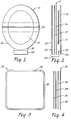
- wound dressing 10 comprises an oval-shaped sheet 12 of the hydrocolloid adhesive composition of the present invention.
- a slightly larger oval-shaped transparent film backing 14 Laminated to the top side (side facing away from the skin when the dressing is in use) is a slightly larger oval-shaped transparent film backing 14.
- An intermediate layer 16 of a conventional pressure-sensitive skin adhesive is used to facilitate lamination.
- the peripheral portion of the film backing 14 and adhesive layer 16 extends beyond the hydrocolloid sheet 12 to assist in adhering the hydrocolloid sheet 12 to the skin.
- a conventional release liner 18 is used to protect the exposed surface of the hydrocolloid sheet 12 and the exposed portion of the adhesive layer 16 prior to use.
- Delivery sheet 20 is attached to the top side of film backing 14 to prevent wrinkling and curling of the edges of backing 14 and adhesive layer 16 after removal of release liner 18.
- Delivery sheet 20 is divided into two sections of approximately equal size and heat-sealed to the top side of film backing 14. Both sections have a non-heat-scaled edge 22 at the center of the dressing to form handles which facilitate grasping and removal of the delivery sheet.
- Delivery sheet 20 supports the exposed periphery of backing 14 and adhesive layer 16 during application of the dressing to the patient. Once the dressing is in place on the skin, delivery sheet 20 is removed.
- Tab 24 comprises aligned rectangularly-shaped extensions of each of the delivery sheet 20, film backing 14 and adhesive layer 16, and further comprises a stiffening member 28 adhered to the adhesive layer 16 to facilitate separation of the tab members from each other.
- the second tab 26 is aligned with tab 24 and comprises a rectangularly-shaped extension of release liner 18.
- a perforation line 30 separates tab 24 from the main oval section of the dressing.
- Tab 24 provides an area for the person applying the dressing to hold onto without touching or otherwise contaminating the adhesive 14 and hydrocolloid sheet 12 in the main oval portion of the dressing.
- tab 24 can be separated from the main oval portion of the dressing along perforation line 30.
- the dressing 10 comprises a second opposing tab (not shown) on the opposite side of the dressing 10 from tab 24 to further facilitate the holding and application of the dressing 10 without contamination of the hydrocolloid sheet 12 or wound site.
- FIGS. 1 and 2 The dressing illustrated in FIGS. 1 and 2 is the presently preferred embodiment of the invention.
- the oval shape reduces dressing size and minimizes edge lift.
- the film backing 14 is preferably a highly moisture vapor permeable film of, for example, porous polyethylene such as that disclosed in U.S. Patent No. 4,539,256 or polyurethane such as that described in U.S. Patent Nos. 3,645,535 or 4,598,004. Moisture vapor permeable films of this type allow the wound exudate to evaporate through the dressing and reduce the pooling of exudate under the dressing.
- the moisture vapor transmission rate of the backing is preferably at least 500 grams/square meter/24 hours when measured at 40°C and 80 percent humidity differential.
- Film backing 14 is preferably about 0.026 mm (1 mil) thick.
- the film backing 14 further comprises a release surface (not shown), such as a low adhesion backsize, coated on the surface of the backing 14 opposite from the hydrocolloid sheet 12 and adhesive layer 16.
- a release surface such as a low adhesion backsize
- TEGADERM No. 1620 dressing 3M Company, St. Paul, MN.
- Adhesive layer 16 is also preferably moisture vapor permeable so as not to detract significantly from the moisture vapor permeability of the film backing 14.
- Suitable medical adhesives of this type such as the copolymer acrylate adhesive and polyvinyl ether adhesive described in U.S. Patent Nos. 4,598,004 and 3,645,535, respectively, are well known.
- the adhesive is preferably about 0.026-0.075 mm (1-3 mils) thick.
- Delivery sheet 22 is preferably a polyester-film with a polyethylene-ethylvinyl acetate heat seal coating available commercially from 3M, under the trademark Scotchpack 1220.
- Hydrocolloid sheet 12 preferably has the composition of Example 28 below and has a thickness between 1.0-1.75 mm (40-70 mils).
- the dressing of FIGS. 3 and 4 represents an alternative embodiment of a wound dressing 32 which incorporates the hydrocolloid adhesive composition of the present invention.
- Dressing 32 comprises a square sheet 34 of the hydrocolloid adhesive composition.
- a Square film backing 36 of the same dimensions as the hydrocolloid sheet is laminated to the top surface (facing away from the skin) of the hydrocolloid sheet by adhesive layer 38.
- Release liner 40 covers the exposed surface of hydrocolloid sheet 34 and extends outwardly from the hydrocolloid sheet on all sides to facilitate grasping of the liner 40 and removal thereof prior to application of the dressing to the wound.
- the materials which can be used to form film backing 34 and adhesive layer 38 are essentially the same as those discussed above in connection with the embodiment of FIGS. 1 and 2.
- the dressing of FIG. 3 is cheaper to manufacture than the dressing of FIG. 1 and is also easier to cut to the dimensions of the wound.
- the hydrocolloid adhesive compositions and dressings of the present invention exhibit increased integrity over other commercially available compositions.
- the compositions and dressings of the invention also exhibit adjustable absorbency, high shear holding power, good adhesion to skin, good cohesive strength, good edge adhesion, reduced adhesive cold-flow, and reduced adhesive residues.
- the integrity, absorbency, 90° peel adhesion, skin adhesion, edge lift, skin adhesive residue, and shear hold force of the compositions of the present invention were determined according to the following test procedures.
- test samples of a dressing are placed in an 6 oz (180 ml) bottle containing 30 ml of phosphate buffered saline solution (pH 7.2) (Sigma Chemical Company, St. Louis, Mo).
- the bottles are capped and agitated on a shaker (Eberbach Co., Ann Arbor, MI) at low speed for a period of 24 hours.
- Remaining test samples are removed, transferred to a metal pan, and dried in a forced-air oven maintained at 65°C until dry (typically overnight; i.e. 12-16 hours) and weighed (W f ).
- Integrity Value W f W i x 100
- compositions of this invention exhibit an Integrity Value of at least about 80 percent and preferably at least about 90 percent. Specific integrity values are reported in Tables 2, 4, and 7 below.
- compositions listed in Tables 2, 4 and 7 below Absorbency data is reported for the dressing compositions listed in Tables 2, 4 and 7 below.
- the absorbency of the compositions of the present invention can be adjusted depending upon the intended use (e.g., ostomy vs. wound dressings).
- the compositions of the present invention exhibit a twenty-four hour absorbency value of at least about fifty percent (50%), and preferably from about one hundred percent (100%) to about five hundred percent (500%).
- the absorbency of the composition should be as low as possible, preferably below about fifty percent (50%), and even more preferably below about twenty percent (20%) after 24 hours of exposure to aqueous fluids.
- Peel adhesion for wound dressings formed from the adhesive compositions of the present invention was measured using a 90° rotary peel adhesion test on an Instron testing machine (Model No. 1122; Instron Corp., Canton, MA).
- a 2.5 cm wide polyester adhesive tape (No. 1280 circuit plating tape; 3M Company) was adhered to a rotatable metal wheel which was mounted on the lower jaw of the Instron machine.
- the sample wound dressings were die cut into 1 cm x 6 cm strips, each of which was placed on the tape covered wheel with the backing facing the operator. The strip was then pressed and adhered to the polyester tape substrate with a 2 kg rubber roller.
- one end of the sample strip was lifted away from the substrate to form a tab, which was clamped onto the upper jaw of the Instron machine.
- the strip was then slowly peeled off the polyester tape substrate at a 90° angle and a crosshead speed of 10 mm/min.
- the peel force was recorded in grams per cm on a chart recorder.
- Adhesion to skin was determined on human volunteers utilizing wound dressings formed from the adhesive compositions of the present invention.
- the volunteers were lying on procedure tables in prone positions with arms at their sides and heads turned to one side.
- two or three strips of the test material were applied on each of the sides of the spinal column and positioned such that the length of each strip was at a right angle to the spinal column.
- the strips were applied without tension or pulling of the skin and there was at least 0.3 cm to 1 cm space between each strip.
- each strip was removed using a conventional adhesion tester having a 11.4 kg test line and a 2.5 cm clip attached to the test line.
- the clip was attached to the edge of the strip which is farthest from the spinal cord, the clip being attached by manually lifting about 1 cm of that edge of the strip and attaching the clip thereto. This orientation permitted the strip to be removed towards the spine so that pull was with the direction of fine hair growth on the back. This was facilitated by positioning the adhesion tester opposite the side of the individual's back from which the strip was to be removed.
- the adhesion tester was aligned with, and was at the same height as, the strip to be removed.
- An example of a suitable adhesion tester for use in this test comprises a conventional motor driven screw with moving carriage and a transducer. Connection to the transducer was a load cell accessory. Removal force placed on the transducer resulted in a signal change which was passed through a readout meter to a strip chart recorder.
- the amount of adhesive residue remaining on the skin of volunteers after a defined amount of time was measured after removal of the wound dressing sample strips in the skin adhesion test described above.
- the amount to which the edge or edges of the sample strips had lifted off the skin was quantified.
- Both edge lift and adhesive residue was subjectively measured by an expert familiar with adhesive tape performance, including edge lift and residue evaluation.
- the test is a modification of ASTM D3654.
- 2.5 cm x 15.2 cm test strips are adhered using light finger pressure to 7.6 x 7.6 cm panels of bright annealed stainless steel which have been prewashed once with diacetone alcohol and thrice with heptane.
- a 5.1 cm x 14 cm auxiliary panel is placed flush with the testing edge of the test panel.
- the test strip is covered with a 2.54 cm x 15.2 cm strip of polyethylene terephthalate film and rolled twice in each direction with a 2 kg roller at a rate of 30.5 cm per minute. The film was removed, then the auxiliary panel is carefully removed from the end of the tape.
- the tape end (about 7.6 cm) is folded back squarely over the center of an adapter hook, with the doubled portion being at least 2.5 cm long.
- the adhering length of the test strip is cut to exactly 2.5 cm in length.
- the test panel is placed in a stand holding both it and the adapter hook in a vertical position.
- a 500 g weight is hung on the adapter hook at a time designated as zero, and the time until the weight and test strip fall is measured.
- the shear holding power is expressed as units of time per 500 g.
- Wound dressings incorporating the hydrocolloid adhesive compositions of the invention were made according to the same general procedure.
- the adhesive phase of the dressing was prepared by compounding a mixture of a combination of dry solids consisting of a cross-linked polyacrylic acid (PAA) (CARBAPOL 974P; B.F. Goodrich, Brecksville, OH), sodium carboxymethylcellulose (CMC) (Aqualon Corp., Wilmington, DE) and cross-linked sodium carboxymethylcellulose (X-link CMC) (Ac-Di-Sol; FMC Corporation, Philadelphia, PA) with a rubber blend of low molecular weight polyisobutylene (PIB) (LM-MH; Exxon Corp., Baton Rouge, LA) and polyisoprene (Natsyn 2210; Goodyear Chemical Co., Akron, OH).
- PAA cross-linked polyacrylic acid
- CMC sodium carboxymethylcellulose
- X-link CMC Ac-Di-Sol
- PIB low molecular weight polyisobutylene
- LM-MH Low molecular weight polyisobutylene
- mineral oil (Spectrum Corp., Gardena, CA) was also blended into the compounded mixture.
- the compounding was performed on a conventional two-roll rubber mill (Ferrel-Birmingham Co., Ansonia, CT), with the dry solids being gradually incorporated into the rubber blend as the mixture was passed repeatedly through the cold-water-chilled rollers during the milling process (typically 7-10 minutes). Entrapped air was removed from the compounded mixture by applying a vacuum of 762 mm of mercury.
- the blended hydrocolloid adhesive mass was then removed from the rubber mill and formed into flat adhesive sheets of about 10 cm by 10 cm and 0.64 mm thick, by compressing the mass in a Carver Laboratory Press (Fred S.
- Carver Inc., Menomonie, WI maintained at approximately 65°C and 110 Mega Pascals (MPa) between two sheets of silicone release paper (Daubert Coated Products, Dipon, IL).
- the release paper was removed from one side of the adhesive sheet, and the adhesive sheet was laminated to a polyurethane backing film coated with an acrylate adhesive copolymer (e.g., TEGADERM transparent dressing; 3M Company, St. Paul, MN).
- TEGADERM transparent dressing 3M Company, St. Paul, MN
- the resulting laminate structures were then die cut into the desired dressing shapes, and were then cross-linked and sterilized with gamma radiation at a dose of approximately 30-50 kGy (3-5 Mrads).
- the dressings for Comparative Examples 14-26 were made using the same formulations and procedures of Examples 1-13, except that the final dressings were not irradiated by a dose of gamma radiation prior to testing.
- Example and Comparative Example wound dressings were clear enough to read through with standard type on 8.5 by 11 inch paper (21.6 cm by 27.9 cm).
- Table 1 Absorbency, wet integrity, dry cohesive strength, and ninety degree peel adhesion for each of the Example and Comparative Example wound dressings is shown in Table 2.
- LM-MH Polyisoprene CMC CARBOPOL (PAA) X-link CMC Min. Oil 1/14 57.5 20 10 5 7.5 0 2/15 45 27.5 12.5 7 6 2 3/16 42.5 30 10 12.5 5 0 4/17 37.5 20 20 12.5 10 0 5/18 47.5 20 10 15 5 2.5 6/19 30 37.5 10 12.5 7.5 2.5 7/20 39 21.5 14.5 13 9 3 8/21 32.5 20 20 15 10 2.5 9/22 42.5 20 10 15 7.5 5 10/23 30 32.5 10 14.5 8.5 4.5 11/24 30 35 20 10 5 0 12/25 45 30 10 5 7.5 2.5 13/26 35 30 20 5 5 5 5 5 5 Absorbency, wet integrity, dry cohesive strength, and ninety-degree peel adhesion for Example wound dressings 1-13 and Comparative Example wound dressings 14-26.
- Example wound dressings 1-13 all exhibit a wet integrity value above 80%, and display varying absorbency values which can be adjusted based upon the intended use. Further, the Example wound dressings all maintain dry cohesive strength (i.e. Pass) as shown by the ninety-degree peel adhesion values obtained for these Example materials.
- a sample material is considered to have sufficient dry cohesive strength to "Pass" the requirements of the compositions of the present invention when the tested sample fails adhesively during peel adhesion testing, i.e. the sample dressing pulls away from the substrate substantially intact.
- a sample material "Fails" to have sufficient dry cohesive strength when the adhesive layer breaks apart and/or delaminates from the backing during peel adhesion testing, leaving a significant portion of the adhesive composition adhered to the testing substrate.
- non-irradiated Comparative Example wound dressings 14-26 either display unacceptable wet integrity and/or fail to maintain cohesive strength when tested for peel adhesion.
- the wound dressing of Comparative Example No. 15 is able to maintain cohesive strength, and thereby register a peel adhesion value of 193 g/cm, it has zero wet integrity.
- the wound dressings of Comparative Examples 16, 20 and 23 maintain wet integrity, but fail cohesively when subjected to a peel adhesion test.
- these comparative materials would disintegrate or fail to remain adhered when applied to an exuding wound and/or would leave excessive adhesive residue both within the wound and on the surrounding skin when removed.
- Example dressings 27-29 The adhesive phase of Example dressings 27-29 was formed as follows. A combination of dry solids consisting of sodium carboxymethylcellulose (CMC) (Aqualon Corp.) and cross-linked sodium carboxymethylcellulose (X-link CMC)(Ac-Di-Sol; FMC Corporation) was combined with low molecular weight polyisobutylene (PIB) (LM-MH; Exxon Corp.) and polyisoprene (Natsyn 2210; Goodyear Chemical Co.) in a conventional kneader-extruder (Ross-AMK Corp.; Hauppauge, NY) to form a hydrocolloid adhesive mass.
- CMC sodium carboxymethylcellulose
- X-link CMC cross-linked sodium carboxymethylcellulose
- PIB low molecular weight polyisobutylene
- LM-MH low molecular weight polyisobutylene
- polyisoprene Naatsyn 2210; Goodyear Chemical Co.
- the mass a homogenous mixture of powder and subber, was passed through a single-screw extruder (Crompton & Knowles, Co., Pawcatuck, CT) while gradually increasing the extrusion temperature along the length of the extruder from about 73°C to about 121-138°C, and maintaining a pressure of about 19.3 Mega Pascals (MPa). Thereafter, the heated mass was passed through an extrusion die onto a web containing a silicone release liner (Daubert Coated Products), and was coated at a thickness of about 0.4 mm and a width of about 20 cm.
- a silicone release liner Dabert Coated Products
- the dressings were prepared by laminating die cut rectangles or squares of the adhesive coated release liner onto a polyurethane backing (Estane resin; 0.04 mm; B.F. Goodrich). Alternatively, the dressings were prepared by first laminating the adhesive to the same backing described above coated with a acrylate copolymer adhesive (isooctyl acrylate/ethyl acrylate/acrylic acid; 70:15:15 with 0.5% of an polyethylene oxide (PEOX) catalyst).
- a acrylate copolymer adhesive isooctyl acrylate/ethyl acrylate/acrylic acid; 70:15:15 with 0.5% of an polyethylene oxide (PEOX) catalyst.
- Example wound dressings were converted to dressings on a conventional roller-convertor apparatus, and were then die cut and packaged in low moisture vapor transmissive (MVT) film of polyethylene/saran/polyethylene terephthalate (Phoenix Health Care Products, Milwaukee, WI).
- MCT low moisture vapor transmissive
- the packaged and unpackaged dressings were then cross-linked and sterilized with a dose of gamma radiation at from about 30 kGy (3 Mrad) to about 50 kGy (50 Mrad).
- the dressings were clear enough to read through on using standard type on 8 1 / 2 by 11 inch (21.6 cm by 27.9 cm) paper.
- Table 3 Specific composition of Example wound dressings 27-29.
- LM-MH Polyisoprene CMC X-link CMC 27 35 31 20 14 28 37.5 30 20 12.5 29 37.5 27.5 20 15
- the three dressings of Examples 27-29 were evaluated in comparison with several commercially available products, including DUODERM EXTRA-THIN wound dressing (a product of Convatec; Squibb and Sons, Inc., Princeton, NJ; believed to be a KRATON-based composition under U.S. Patent No. 4,551,490), TEGASORB wound dressing (a product of 3M Company, St. Paul, MN; a polyisobutylene-based composition under U.S. Patent No. 4,952,618), RESTORE wound dressing (a product of Hollister, Inc., Libertyville, IL; believed to be an ethylene vinyl acetate (EVA)-based composition under U.S.
- DUODERM EXTRA-THIN wound dressing a product of Convatec; Squibb and Sons, Inc., Princeton, NJ; believed to be a KRATON-based composition under U.S. Patent No. 4,551,490
- TEGASORB wound dressing a product of 3M Company,
- Patent Nos. 4,477,325 and 4,738,257), and COMFEEL wound dressing (a product of Coloplast International, Espergaerde, Denmark; believed to be a KRATON-based composition under U.S. Patent No. 4,231,369).
- Example dressings 27-29 and the above-identified comparative products The sample compositions, percent absorbency, percent wet integrity, sample edge lift, skin adhesion (wet and dry), skin residue (wet and dry), and total number of samples remaining on the backs of volunteers at the end of the test period for Example dressings 27-29 and the above-identified comparative products is shown in Table 4.
- both the TEGASORB and RESTORE products were tested on 8 volunteers (4 men and 4 women) using 3 replicates of each sample, and only on dry backs. For all other samples tested, 10 volunteers (5 men and 5 women) were used.
- the COMFEEL product displays a number of other disadvantages, including very low absorbency for a wound dressing, a problem with edge lift, and a lack of adhesive hold, as demonstrated by the fact that snly 26 of the 40 samples applied to the backs of volunteers remained at the end of the test period. Furthermore, the RESTORE, TEGASORB, and DUODERM EXTRA-THIN products display significant skin residue problems after a prolonged period of application. Only the wound dressings of the present invention provide the combined advantages of high absorbency and wet integrity with good skin adhesion both wet and dry, minimal edge lift, and low to no skin residue.
- Three adhesive compositions of the present invention were tested for potential use as ostomy and/or prosthesis adhesives by measuring their shear holding power in minutes/500 g.
- the specific compositions of the adhesives of Examples 30-32 are shown in Table 5. All of these compositions were formed by the same procedures as used in Examples 1-13. In addition, the same non-irradiated composition as that of Example 30 (Comparative Example 33) was tested.
- two commercially available ostomy adhesives were also tested: DUROADHESIVE (a product of Convatec; Squibb and Sons, Inc., Princeton, NJ; believed to be a KRATON-based composition under U.S. Patent No.
- Example adhesives 30-32 Ex. No. LM-MH (PIB) Polyisoprene CMC X-link CMC CARBOPOL (PAA) Min.
- the data of Table 6 show that the adhesive compositions of the present invention exhibit superior shear holding power, a necessary property for an effective ostomy and/or prosthesis adhesive, in comparison to non-irradiated compositions, as well as currently available products.
- these compositions are formulated with low relative absorbency.
- the composition of Example 31 exhibits an absorbency of 12% after 24 hours of exposure to aqueous fluids.
- Two adhesive compositions according to the present invention were formed from the same materials and according to the same procedures as Ex amples 1-13, except that WINGTACK 95 (Goodyear Chemical Co., Akron, OH), a commercially available synthetic polyterpene tackifier was added as an additional component. These compositions were formed into wound dressings according to the same procedures as for Examples 1-13, and were tested for percent absorbency and percent wet integrity according to the procedures previously described. The specific composition, percent absorbency, and percent wet integrity for the wound dressings of Examples 34-35 are shown in Table 7. The data of Table 7 show that even with the inclusion of non-elastic tackifiers, the adhesive compositions of the present invention maintain their advantages of high absorbency combined with high wet integrity.
Landscapes
- Health & Medical Sciences (AREA)
- Public Health (AREA)
- General Health & Medical Sciences (AREA)
- Veterinary Medicine (AREA)
- Chemical & Material Sciences (AREA)
- Epidemiology (AREA)
- Life Sciences & Earth Sciences (AREA)
- Animal Behavior & Ethology (AREA)
- Materials Engineering (AREA)
- Engineering & Computer Science (AREA)
- Hematology (AREA)
- Surgery (AREA)
- Organic Chemistry (AREA)
- Materials For Medical Uses (AREA)
- Adhesives Or Adhesive Processes (AREA)
Applications Claiming Priority (2)
| Application Number | Priority Date | Filing Date | Title |
|---|---|---|---|
| US95661692A | 1992-10-05 | 1992-10-05 | |
| US956616 | 1992-10-05 |
Publications (2)
| Publication Number | Publication Date |
|---|---|
| EP0591898A1 EP0591898A1 (en) | 1994-04-13 |
| EP0591898B1 true EP0591898B1 (en) | 1999-05-26 |
Family
ID=25498452
Family Applications (1)
| Application Number | Title | Priority Date | Filing Date |
|---|---|---|---|
| EP93116017A Expired - Lifetime EP0591898B1 (en) | 1992-10-05 | 1993-10-04 | Adhesive compositions, wound dressings and methods |
Country Status (6)
| Country | Link |
|---|---|
| US (2) | US5622711A (enExample) |
| EP (1) | EP0591898B1 (enExample) |
| JP (1) | JP3574159B2 (enExample) |
| CA (1) | CA2104046C (enExample) |
| DE (1) | DE69325066T2 (enExample) |
| DK (1) | DK0591898T3 (enExample) |
Cited By (1)
| Publication number | Priority date | Publication date | Assignee | Title |
|---|---|---|---|---|
| US7691404B2 (en) | 2000-11-06 | 2010-04-06 | Samyang Corporation | Transdermal delivery system of diclofenac with improved water absorbability and adhesion properties |
Families Citing this family (117)
| Publication number | Priority date | Publication date | Assignee | Title |
|---|---|---|---|---|
| GB9522313D0 (en) * | 1995-11-01 | 1996-01-03 | Bristol Myers Squibb Co | Use of an adhesive composition in the manufacture of a wound dressing |
| US5733570A (en) * | 1996-09-05 | 1998-03-31 | Minnesota Mining And Manufacturing Company | Absorbent dressing |
| US5849325A (en) * | 1996-10-07 | 1998-12-15 | Minnesota Mining And Manufacturing Company | Moisture-regulating adhesive dressing |
| US6479073B1 (en) | 1996-10-07 | 2002-11-12 | 3M Innovative Properties Company | Pressure sensitive adhesive articles and methods for preparing same |
| DK48997A (da) * | 1997-04-30 | 1999-01-05 | Coloplast As | Klæbemiddel samt anvendelse af dette middel |
| JP4477152B2 (ja) * | 1997-05-16 | 2010-06-09 | 株式会社共和 | ストーマ用又は瘡傷用の皮膚保護材 |
| DE69813838T2 (de) | 1997-08-29 | 2004-02-19 | Avery Dennison Corp., Pasadena | Biologische flüssigkeitsabsorbierende druckempfindliche klebstoffe |
| GB9719711D0 (en) | 1997-09-16 | 1997-11-19 | Avery Dennison Corp | Hydrocolloid pressure sensitive adhesive |
| DE69928090T2 (de) | 1998-03-13 | 2006-07-20 | Coloplast A/S | Druckempfindliche klebstoffzusammensetzung |
| ES2241339T3 (es) * | 1998-11-03 | 2005-10-16 | Bristol-Myers Squibb Company | Composiciones adhesivas hidrocoloides. |
| US6143798A (en) * | 1999-01-11 | 2000-11-07 | Jentec, Inc. | Wound dressing |
| FR2790763B1 (fr) * | 1999-03-09 | 2001-06-01 | Lhd Lab Hygiene Dietetique | Nouvelle masse adhesive hydrocolloide presentant une meilleure resistance a la degradation de sa capacite d'absorption apres radiosterilisation |
| US6495229B1 (en) * | 1999-09-17 | 2002-12-17 | Avery Dennison Corporation | Pattern coated adhesive article |
| US6264976B1 (en) * | 1999-11-29 | 2001-07-24 | 3M Innovative Properties Company | Absorbent pad dressing frame delivery system |
| BR0016474A (pt) | 1999-12-17 | 2002-08-20 | Dispositivo protético | |
| US6623465B1 (en) | 2000-02-15 | 2003-09-23 | The Procter & Gamble Company | Absorbent article with water-activatable topical adhesives |
| US6572600B1 (en) | 2000-02-15 | 2003-06-03 | The Procter & Gamble Company | Disposable article with deactivatable adhesive |
| US6566575B1 (en) | 2000-02-15 | 2003-05-20 | 3M Innovative Properties Company | Patterned absorbent article for wound dressing |
| US6565549B1 (en) | 2000-02-15 | 2003-05-20 | The Procter & Gamble Company | Absorbent article with thermally activatable adhesives |
| MXPA02008606A (es) | 2000-03-10 | 2003-04-14 | 3M Innovative Properties Co | Vendajes medicos con adhesivos multiples y metodos de elaboracion. |
| USRE44145E1 (en) | 2000-07-07 | 2013-04-09 | A.V. Topchiev Institute Of Petrochemical Synthesis | Preparation of hydrophilic pressure sensitive adhesives having optimized adhesive properties |
| SE519451C2 (sv) * | 2000-10-02 | 2003-03-04 | Moelnlycke Health Care Ab | Torrt hudvänligt lim som påverkar hudens pH-värde |
| EP1221311A1 (en) * | 2000-12-27 | 2002-07-10 | The Procter & Gamble Company | Method of using an ostomy device |
| US20040087917A1 (en) * | 2000-12-27 | 2004-05-06 | Barakat Mohamed Ali | Method of using an ostomy device |
| DK1523997T3 (en) * | 2001-02-08 | 2015-11-23 | Coloplast As | Foam dressings comprising antimicrobial silver |
| USD473947S1 (en) | 2001-03-12 | 2003-04-29 | 3M Innovative Properties Company | Notched medical dressing |
| GB0110284D0 (en) * | 2001-04-26 | 2001-06-20 | Avery Dennison Corp | Mouldable hydrocolloid adhesive compositions |
| US20050113510A1 (en) | 2001-05-01 | 2005-05-26 | Feldstein Mikhail M. | Method of preparing polymeric adhesive compositions utilizing the mechanism of interaction between the polymer components |
| US8840918B2 (en) | 2001-05-01 | 2014-09-23 | A. V. Topchiev Institute of Petrochemical Synthesis, Russian Academy of Sciences | Hydrogel compositions for tooth whitening |
| DE60239528D1 (de) * | 2001-05-01 | 2011-05-05 | Corium International Redwood City | Zweiphasige, wasserabsorbierende bioadhäsive zusammenstezung |
| US8541021B2 (en) | 2001-05-01 | 2013-09-24 | A.V. Topchiev Institute Of Petrochemical Synthesis | Hydrogel compositions demonstrating phase separation on contact with aqueous media |
| US8206738B2 (en) | 2001-05-01 | 2012-06-26 | Corium International, Inc. | Hydrogel compositions with an erodible backing member |
| US20050215727A1 (en) * | 2001-05-01 | 2005-09-29 | Corium | Water-absorbent adhesive compositions and associated methods of manufacture and use |
| AU2002308612B2 (en) | 2001-05-01 | 2008-04-10 | A.V. Topchiev Institute Of Petrochemical Synthesis | Hydrogel compositions |
| DE60238500D1 (de) | 2001-09-04 | 2011-01-13 | W R Grace & Co A Connecticut Corp | Zweiphasenzusammensetzung aus superabsorbierendem und hydrophobem polymer |
| US20030125680A1 (en) * | 2002-01-02 | 2003-07-03 | Ding Jian Ling | Hydrocolloid bandage |
| US7241709B2 (en) * | 2002-08-26 | 2007-07-10 | E. I Du Pont De Nemours And Company | Penetration resistant life protection articles |
| US7700707B2 (en) | 2002-10-15 | 2010-04-20 | Exxonmobil Chemical Patents Inc. | Polyolefin adhesive compositions and articles made therefrom |
| KR101113341B1 (ko) | 2002-10-15 | 2012-09-27 | 엑손모빌 케미칼 패턴츠 인코포레이티드 | 올레핀 중합용 다중 촉매 시스템 및 이로부터 제조된중합체 |
| US7550528B2 (en) | 2002-10-15 | 2009-06-23 | Exxonmobil Chemical Patents Inc. | Functionalized olefin polymers |
| US7541402B2 (en) | 2002-10-15 | 2009-06-02 | Exxonmobil Chemical Patents Inc. | Blend functionalized polyolefin adhesive |
| US6838589B2 (en) | 2003-02-19 | 2005-01-04 | 3M Innovative Properties Company | Conformable wound dressing |
| US20040241215A1 (en) * | 2003-05-20 | 2004-12-02 | Lipman Roger D. A. | Multi-dressing system for managing skin wounds |
| US20040243042A1 (en) * | 2003-05-20 | 2004-12-02 | Lipman Roger D. A. | Facial masks for managing skin wounds |
| WO2004103416A2 (en) * | 2003-05-20 | 2004-12-02 | Avery Dennison Corporation | Fluid absorbing adhesive paste |
| EP1720508A1 (en) * | 2003-11-28 | 2006-11-15 | Coloplast A/S | An adhesive patch |
| CN102764247B (zh) | 2004-01-30 | 2016-04-20 | 考里安国际公司 | 递送活性剂的快速溶解膜 |
| US20050277860A1 (en) * | 2004-06-14 | 2005-12-15 | Jentec, Inc. | Extended stay-on wound dressing |
| EP1616583B1 (de) * | 2004-07-16 | 2008-06-25 | Collano AG | Heissschmelzzusammensetzung mit Hydrocolloid |
| AU2005271259B2 (en) * | 2004-08-05 | 2012-01-19 | A.V. Topchiev Institute Of Petrochemical Synthesis | Adhesive composition |
| US8864730B2 (en) | 2005-04-12 | 2014-10-21 | Rochester Medical Corporation | Silicone rubber male external catheter with absorbent and adhesive |
| US20070239104A1 (en) * | 2005-09-23 | 2007-10-11 | Feerrar Angela C | Anti acid G/tube pad |
| KR100719433B1 (ko) | 2005-11-25 | 2007-05-17 | 주식회사 원바이오젠 | 점착력이 있는 친수성 폴리우레탄 필름 드레싱재의 제조방법 |
| US20070286878A1 (en) * | 2006-06-07 | 2007-12-13 | Harruna Issifu I | Removable films for sanitizing substrates and methods of use thereof |
| US7858838B2 (en) * | 2006-08-10 | 2010-12-28 | 3M Innovative Properties Company | Conformable wound dressing |
| DE102006049929B4 (de) * | 2006-10-19 | 2012-03-08 | Beiersdorf Ag | Filmbildende Gelkomposition zur Wund- bzw. Hautpflege |
| CA2690968A1 (en) | 2007-06-19 | 2008-12-24 | Coloplast A/S | Multi-layered adhesive appliance |
| CA2711177A1 (en) * | 2007-12-31 | 2009-07-16 | 3M Innovative Properties Company | Medical dressing with edge port and methods of use |
| KR20110041507A (ko) | 2008-07-10 | 2011-04-21 | 쓰리엠 이노베이티브 프로퍼티즈 컴파니 | 점탄성 도광체 |
| AU2008359403A1 (en) * | 2008-07-18 | 2010-01-21 | Coloplast A/S | A body waste collecting device comprising a layered adhesive construction |
| KR20170038100A (ko) | 2008-08-08 | 2017-04-05 | 쓰리엠 이노베이티브 프로퍼티즈 컴파니 | 광을 처리하기 위한 점탄성층을 갖는 도광체 |
| BRPI0914442B1 (pt) * | 2008-10-24 | 2019-07-02 | 3M Innovative Properties Company | Sistema de liberação e de curativo para ferimentos |
| GB0821345D0 (en) * | 2008-11-21 | 2008-12-31 | P Q Silicas Uk Ltd | Composition and dressing with nitric oxide |
| CN102245135B (zh) * | 2008-12-08 | 2015-01-21 | 科洛普拉斯特公司 | 一种包括具有薄膜层的分层粘合剂结构的身体废物收集装置 |
| US8784879B2 (en) | 2009-01-14 | 2014-07-22 | Corium International, Inc. | Transdermal administration of tamsulosin |
| USD612504S1 (en) | 2009-06-16 | 2010-03-23 | 3M Innovative Properties Company | Self-supporting pouch attachment for medical articles |
| USD629910S1 (en) | 2009-06-16 | 2010-12-28 | 3M Innovative Properties Company | Conformable dressing |
| USD629911S1 (en) | 2009-06-16 | 2010-12-28 | 3M Innovative Properties Company | Self-supporting pouch dressing |
| CN104095709B (zh) | 2009-06-16 | 2017-06-13 | 3M创新有限公司 | 具有自支承基底的适形医用敷料 |
| EP2467086B1 (en) | 2009-08-21 | 2016-10-26 | 3M Innovative Properties Company | Kits and products for reducing tissue trauma using water-resistant stress-distributing materials |
| WO2011022525A1 (en) | 2009-08-21 | 2011-02-24 | 3M Innovative Properties Company | Methods and products for illuminating tissue |
| WO2011022023A1 (en) | 2009-08-21 | 2011-02-24 | 3M Innovative Properties Company | Methods and products for reducing tissue trauma using water-absorbing stress-distributing materials |
| EP2498988B1 (en) | 2009-11-09 | 2019-02-27 | 3M Innovative Properties Company | Medical articles and methods of making using miscible composition |
| JP5767235B2 (ja) | 2009-11-09 | 2015-08-19 | スリーエム イノベイティブ プロパティズ カンパニー | 医療用物品及び不混和性材料を用いる製造方法 |
| USD692565S1 (en) * | 2010-06-03 | 2013-10-29 | Smith & Nephew, Inc. | Organ protection layer |
| EP2654633B1 (en) * | 2010-12-22 | 2015-05-27 | Coloplast A/S | An ostomy appliance |
| US9707375B2 (en) | 2011-03-14 | 2017-07-18 | Rochester Medical Corporation, a subsidiary of C. R. Bard, Inc. | Catheter grip and method |
| GB201115182D0 (en) | 2011-09-02 | 2011-10-19 | Trio Healthcare Ltd | Skin contact material |
| KR20140089412A (ko) * | 2011-11-08 | 2014-07-14 | 쓰리엠 이노베이티브 프로퍼티즈 컴파니 | 하이드로콜로이드 조성물 및 이를 포함하는 물품 |
| CA2851868A1 (en) | 2012-02-29 | 2013-09-06 | Hollister Incorporated | Buffered adhesive compositions for skin-adhering products and methods of making same |
| US10470936B2 (en) | 2012-02-29 | 2019-11-12 | Hollister Incorporated | Buffered adhesive compositions for skin-adhering medical products |
| US10092728B2 (en) | 2012-11-20 | 2018-10-09 | Rochester Medical Corporation, a subsidiary of C.R. Bard, Inc. | Sheath for securing urinary catheter |
| JP2015536376A (ja) | 2012-11-20 | 2015-12-21 | スリーエム イノベイティブ プロパティズ カンパニー | ポリオルガノシロキサンブロック及びポリオレフィンブロックを含むブロック共重合体 |
| US9783699B2 (en) | 2012-11-20 | 2017-10-10 | 3M Innovative Properties Co. | Laminates and articles comprising a block copolymer coating comprising polyorganosiloxane and polyolefin |
| US9872969B2 (en) | 2012-11-20 | 2018-01-23 | Rochester Medical Corporation, a subsidiary of C.R. Bard, Inc. | Catheter in bag without additional packaging |
| WO2014149718A1 (en) | 2013-03-11 | 2014-09-25 | 3M Innovative Properties Company | A conformable medical dressing |
| MX2015012482A (es) | 2013-03-14 | 2016-04-21 | 3M Innovative Properties Co | Apositos hidrocoloides para heridas con velocidad de trasnmision de vapor de agua (trva) incrementada. |
| WO2015013093A1 (en) | 2013-07-23 | 2015-01-29 | 3M Innovative Properties Company | Adjustable wound dressing |
| WO2015050749A1 (en) | 2013-10-04 | 2015-04-09 | 3M Innovative Properties Company | Multi-component fibers, nonwoven webs, and articles comprising a polydiorganosiloxane polyamide |
| US10561536B2 (en) | 2013-12-31 | 2020-02-18 | 3M Innovative Properties Company | Conformable drape cover dressing |
| WO2015130608A1 (en) | 2014-02-25 | 2015-09-03 | 3M Innovative Properties Company | Medical dressing |
| WO2016040695A1 (en) | 2014-09-10 | 2016-03-17 | C.R. Bard, Inc. | Protective dressing for skin-placed medical device |
| DK3253341T3 (en) | 2015-02-02 | 2019-03-25 | Coloplast As | STOMA DEVICE |
| ES2741852T3 (es) | 2015-04-10 | 2020-02-12 | Coloplast As | Dispositivo de ostomía |
| KR20160131226A (ko) * | 2015-05-06 | 2016-11-16 | 숭실대학교산학협력단 | 다양한 범위의 소수성을 갖는 하이드로콜로이드의 제조방법 |
| EP3313458A1 (en) | 2015-06-29 | 2018-05-02 | 3M Innovative Properties Company | Anti-microbial articles and methods of using same |
| CN108348632B (zh) | 2015-11-13 | 2022-04-15 | 3M创新有限公司 | 抗微生物制品及其使用方法 |
| CN108430524B (zh) | 2015-11-13 | 2021-07-20 | 3M创新有限公司 | 抗微生物制品及其使用方法 |
| CN109789039B (zh) | 2016-10-07 | 2022-03-22 | 3M创新有限公司 | 可适形伤口敷料和递送系统 |
| WO2018075259A1 (en) | 2016-10-19 | 2018-04-26 | 3M Innovative Properties Company | Anti-microbial articles |
| EP3538044B1 (en) | 2016-11-11 | 2020-06-17 | 3M Innovative Properties Company | Trimmable conformable wound dressing |
| WO2018089742A1 (en) | 2016-11-11 | 2018-05-17 | Avery Dennison Corporation | Rubber-based soft gel skin adhesives |
| GB201713511D0 (en) | 2017-08-23 | 2017-10-04 | Scapa Uk Ltd | Wound dressing |
| MX2020002752A (es) | 2017-09-19 | 2020-07-20 | Bard Inc C R | Dispositivo puente de cateter urinario, sistemas y metodos de estos. |
| JP7304868B2 (ja) | 2017-10-09 | 2023-07-07 | スリーエム イノベイティブ プロパティズ カンパニー | 適合性のある辺縁を有する固定ドレッシング材 |
| WO2020188438A1 (en) | 2019-03-15 | 2020-09-24 | 3M Innovative Properties Company | Tie layer chemistry to promote bonding with silicone adhesive |
| CN115023244A (zh) | 2019-12-09 | 2022-09-06 | 3M创新有限公司 | 抗微生物制品 |
| US11793680B2 (en) | 2020-03-12 | 2023-10-24 | Anne J. Lumsdaine | Compound (multi-layer) waterproof bandage |
| EP4171670A1 (en) | 2020-06-24 | 2023-05-03 | 3M Innovative Properties Company | Collagen-bioglass articles and methods of making the same |
| WO2023031697A1 (en) | 2021-09-01 | 2023-03-09 | 3M Innovative Properties Company | Anti-virus respirator and mask |
| WO2023031696A1 (en) | 2021-09-01 | 2023-03-09 | 3M Innovative Properties Company | Nonwoven with bio particles and methods of making the same |
| EP4448026A1 (en) * | 2021-12-17 | 2024-10-23 | Solventum Intellectual Properties Company | Wound dressings and methods of making the same |
| CN120676925A (zh) | 2023-02-24 | 2025-09-19 | 舒万诺知识产权公司 | 具有热致变色指示剂的医用敷料 |
| CN122095040A (zh) | 2023-11-03 | 2026-05-26 | 舒万诺知识产权公司 | 包含抗微生物剂的聚二有机硅氧烷组合物、制品和方法 |
| WO2025094156A1 (en) | 2023-11-03 | 2025-05-08 | Solventum Intellectual Properties Company | Method of making polydiorganosiloxane adhesive with film backing and articles |
| EP4802016A1 (en) | 2023-11-03 | 2026-09-09 | Solventum Intellectual Properties Company | Method of making polydiorganosiloxane adhesive with mask and articles |
| WO2025094157A1 (en) | 2023-11-03 | 2025-05-08 | Solventum Intellectual Properties Company | Method of making polydiorganosiloxane adhesive with porous substrate and articles |
Family Cites Families (43)
| Publication number | Priority date | Publication date | Assignee | Title |
|---|---|---|---|---|
| US2927868A (en) * | 1958-01-15 | 1960-03-08 | Minnesota Mining & Mfg | Pressure-sensitive adhesive tape |
| US3339546A (en) * | 1963-12-13 | 1967-09-05 | Squibb & Sons Inc | Bandage for adhering to moist surfaces |
| US3532679A (en) * | 1969-04-07 | 1970-10-06 | Robert Steckler | Hydrogels from cross-linked polymers of n-vinyl lactams and alkyl acrylates |
| US3645535A (en) * | 1970-04-23 | 1972-02-29 | Alexander Randolph | Block construction |
| US3980084A (en) * | 1974-01-09 | 1976-09-14 | Hydro Optics, Inc. | Ostomy gasket |
| US3877431A (en) * | 1974-01-09 | 1975-04-15 | Hydro Optics Inc | Ostomy gasket |
| US3972328A (en) * | 1975-07-28 | 1976-08-03 | E. R. Squibb & Sons, Inc. | Surgical bandage |
| JPS52123437A (en) * | 1976-04-09 | 1977-10-17 | Kuraray Co Ltd | Material for protecting surface |
| US4078568A (en) * | 1976-10-12 | 1978-03-14 | Northern Illinois Research, Inc. | Plastic composition and method |
| GB1576522A (en) * | 1977-05-24 | 1980-10-08 | Colorplast International A S | Sealing material for ostomy devices |
| US4192785A (en) * | 1977-06-08 | 1980-03-11 | E. R. Squibb & Sons, Inc. | Ostomy adhesive |
| US4166051A (en) * | 1977-06-08 | 1979-08-28 | E. R. Squibb & Sons, Inc. | Ostomy composition |
| US4204540A (en) * | 1977-06-08 | 1980-05-27 | E. R. Squibb & Sons, Inc. | Ostomy composition |
| US4147831A (en) * | 1977-08-31 | 1979-04-03 | Johnson & Johnson | Pressure-sensitive adhesive compositions |
| JPS5470340A (en) * | 1977-11-16 | 1979-06-06 | Kao Corp | Pressure-sensitive adhesive tape or sheet |
| US4152231A (en) * | 1978-10-26 | 1979-05-01 | Shell Oil Company | Radiation cured polydiene based polymer composition |
| GB2046764B (en) * | 1979-02-08 | 1983-04-20 | Matburn Holdings Ltd | Polymeric sealant compositions |
| US4421822A (en) * | 1979-08-20 | 1983-12-20 | Minnesota Mining And Manufacturing Co. | Ultraviolet polymerization of acrylate monomers using oxidizable tin compounds |
| ZA805066B (en) * | 1979-09-07 | 1981-08-26 | Kingsdown Medical Consultants | Wound dressing |
| US4496357A (en) * | 1981-06-10 | 1985-01-29 | Hollister Incorporated | Skin barrier composition |
| ZA827903B (en) * | 1981-11-27 | 1983-08-31 | Squibb & Sons Inc | A skin barrier |
| NZ203706A (en) * | 1982-04-22 | 1986-03-14 | Squibb & Sons Inc | Occlusive multi-layer wound dressing and hydrocolloidal granules for wound treatment |
| US4538603A (en) * | 1982-04-22 | 1985-09-03 | E. R. Squibb & Sons, Inc. | Dressings, granules, and their use in treating wounds |
| US4477325A (en) * | 1982-07-12 | 1984-10-16 | Hollister Incorporated | Skin barrier composition comprising an irradiated crosslinked ethylene-vinyl acetate copolymer and polyisobutylene |
| US4539256A (en) * | 1982-09-09 | 1985-09-03 | Minnesota Mining And Manufacturing Co. | Microporous sheet material, method of making and articles made therewith |
| US4551490A (en) * | 1983-06-27 | 1985-11-05 | E. R. Squibb & Sons, Inc. | Adhesive composition resistant to biological fluids |
| JPS60123574A (ja) * | 1983-12-07 | 1985-07-02 | Hayakawa Rubber Co Ltd | 表面粘着ゴムシ−ト |
| GB8412595D0 (en) * | 1984-05-17 | 1984-06-20 | Chlor Chem Ltd | Chlorination device |
| WO1986001706A1 (en) * | 1984-09-17 | 1986-03-27 | Brown Steven J | Dental appliance for weight control |
| US4598004A (en) * | 1985-01-24 | 1986-07-01 | Minnesota Mining And Manufacturing Company | Thin film surgical dressing with delivery system |
| US4738257A (en) * | 1986-06-11 | 1988-04-19 | Hollister Incorporated | Occlusive wound care dressing |
| JP2566562B2 (ja) * | 1986-09-11 | 1996-12-25 | 積水化学工業株式会社 | 粘着剤組成物 |
| DK154806C (da) * | 1986-12-19 | 1989-06-26 | Coloplast As | Saarplejemiddel indeholdende et aktivt stof til fremme af saarbehandlingen og fremgangsmaade til fremstilling deraf |
| US5059189A (en) * | 1987-09-08 | 1991-10-22 | E. R. Squibb & Sons, Inc. | Method of preparing adhesive dressings containing a pharmaceutically active ingredient |
| JPS6485267A (ja) * | 1987-09-26 | 1989-03-30 | 新田ゼラチン株式会社 | 粘着剤 |
| US4952618A (en) * | 1988-05-03 | 1990-08-28 | Minnesota Mining And Manufacturing Company | Hydrocolloid/adhesive composition |
| EP0343807A3 (en) * | 1988-05-27 | 1991-01-02 | SMITH & NEPHEW UNITED, INC. | Absorptive adhesive dressing with controlled hydration |
| DE58906975D1 (de) * | 1988-08-02 | 1994-03-24 | Ciba Geigy | Mehrschichtiges Pflaster. |
| CA2072623C (en) * | 1989-11-03 | 2001-03-27 | Matthew T. Scholz | Bioadhesive composition and patch |
| US5270358A (en) * | 1989-12-28 | 1993-12-14 | Minnesota Mining And Manufacturing Company | Composite of a disperesed gel in an adhesive matrix |
| DK148790D0 (da) * | 1990-06-19 | 1990-06-19 | Novo Nordisk As | Farmaceutisk praeparat |
| US5066728A (en) * | 1990-09-27 | 1991-11-19 | Exxon Chemical Patents Inc. | Radiation-reactive phenylbutadiene multiblock copolymers |
| US5429591A (en) * | 1991-07-22 | 1995-07-04 | Nitto Denko Corporation | Absorbent dressing having backing and continuous adhesive layer |
-
1993
- 1993-08-13 CA CA002104046A patent/CA2104046C/en not_active Expired - Fee Related
- 1993-10-01 JP JP24672493A patent/JP3574159B2/ja not_active Expired - Fee Related
- 1993-10-04 DK DK93116017T patent/DK0591898T3/da active
- 1993-10-04 EP EP93116017A patent/EP0591898B1/en not_active Expired - Lifetime
- 1993-10-04 DE DE69325066T patent/DE69325066T2/de not_active Expired - Lifetime
-
1994
- 1994-12-08 US US08/351,890 patent/US5622711A/en not_active Expired - Lifetime
-
1995
- 1995-06-06 US US08/469,023 patent/US5633010A/en not_active Expired - Lifetime
Cited By (1)
| Publication number | Priority date | Publication date | Assignee | Title |
|---|---|---|---|---|
| US7691404B2 (en) | 2000-11-06 | 2010-04-06 | Samyang Corporation | Transdermal delivery system of diclofenac with improved water absorbability and adhesion properties |
Also Published As
| Publication number | Publication date |
|---|---|
| US5622711A (en) | 1997-04-22 |
| DE69325066D1 (de) | 1999-07-01 |
| CA2104046A1 (en) | 1994-04-06 |
| CA2104046C (en) | 1998-09-15 |
| JP3574159B2 (ja) | 2004-10-06 |
| US5633010A (en) | 1997-05-27 |
| EP0591898A1 (en) | 1994-04-13 |
| DE69325066T2 (de) | 1999-10-14 |
| DK0591898T3 (da) | 1999-11-29 |
| JPH06200231A (ja) | 1994-07-19 |
Similar Documents
| Publication | Publication Date | Title |
|---|---|---|
| US5622711A (en) | Adhesive composition for use as a wound dressing or ostomy/prosthesis adhesive | |
| CA1312396C (en) | Hydrocolloid/adhesive composition | |
| US6583220B1 (en) | Biological fluid absorbing pressure sensitive adhesives | |
| AU585443B2 (en) | Occlusive wound care dressing | |
| EP0130061B1 (en) | Adhesive composition resistant to biological fluids | |
| US6303700B1 (en) | Adhesive agent and use of such adhesive agent | |
| US4855335A (en) | Medical moisture resistant adhesive composition for use in the presence of moisture | |
| EP0272149A2 (en) | Medical dresssings | |
| KR102245024B1 (ko) | 증가된 wvtr을 갖는 하이드로콜로이드 상처 드레싱 | |
| GB2094809A (en) | Stoma seal adhesive | |
| JP4541623B2 (ja) | 流体吸収接着性親水コロイド組成物 | |
| EP1675629A1 (en) | An adhesive composition and use of such composition | |
| US6964987B1 (en) | Hydrocolloid adhesive mass with improved resistance to deterioration of its absorption capacity after being sterilized by radiation |
Legal Events
| Date | Code | Title | Description |
|---|---|---|---|
| PUAI | Public reference made under article 153(3) epc to a published international application that has entered the european phase |
Free format text: ORIGINAL CODE: 0009012 |
|
| AK | Designated contracting states |
Kind code of ref document: A1 Designated state(s): DE DK ES FR GB IT |
|
| 17P | Request for examination filed |
Effective date: 19940608 |
|
| GRAG | Despatch of communication of intention to grant |
Free format text: ORIGINAL CODE: EPIDOS AGRA |
|
| 17Q | First examination report despatched |
Effective date: 19980514 |
|
| GRAG | Despatch of communication of intention to grant |
Free format text: ORIGINAL CODE: EPIDOS AGRA |
|
| GRAG | Despatch of communication of intention to grant |
Free format text: ORIGINAL CODE: EPIDOS AGRA |
|
| GRAH | Despatch of communication of intention to grant a patent |
Free format text: ORIGINAL CODE: EPIDOS IGRA |
|
| GRAH | Despatch of communication of intention to grant a patent |
Free format text: ORIGINAL CODE: EPIDOS IGRA |
|
| GRAA | (expected) grant |
Free format text: ORIGINAL CODE: 0009210 |
|
| AK | Designated contracting states |
Kind code of ref document: B1 Designated state(s): DE DK ES FR GB IT |
|
| PG25 | Lapsed in a contracting state [announced via postgrant information from national office to epo] |
Ref country code: IT Free format text: LAPSE BECAUSE OF FAILURE TO SUBMIT A TRANSLATION OF THE DESCRIPTION OR TO PAY THE FEE WITHIN THE PRE;WARNING: LAPSES OF ITALIAN PATENTS WITH EFFECTIVE DATE BEFORE 2007 MAY HAVE OCCURRED AT ANY TIME BEFORE 2007. THE CORRECT EFFECTIVE DATE MAY BE DIFFERENT FROM THE ONE RECORDED.SCRIBED TIME-LIMIT Effective date: 19990526 Ref country code: ES Free format text: THE PATENT HAS BEEN ANNULLED BY A DECISION OF A NATIONAL AUTHORITY Effective date: 19990526 |
|
| REF | Corresponds to: |
Ref document number: 69325066 Country of ref document: DE Date of ref document: 19990701 |
|
| ET | Fr: translation filed | ||
| REG | Reference to a national code |
Ref country code: DK Ref legal event code: T3 |
|
| PLBE | No opposition filed within time limit |
Free format text: ORIGINAL CODE: 0009261 |
|
| STAA | Information on the status of an ep patent application or granted ep patent |
Free format text: STATUS: NO OPPOSITION FILED WITHIN TIME LIMIT |
|
| 26N | No opposition filed | ||
| PGFP | Annual fee paid to national office [announced via postgrant information from national office to epo] |
Ref country code: DK Payment date: 20000921 Year of fee payment: 8 |
|
| PG25 | Lapsed in a contracting state [announced via postgrant information from national office to epo] |
Ref country code: DK Free format text: LAPSE BECAUSE OF NON-PAYMENT OF DUE FEES Effective date: 20011004 |
|
| REG | Reference to a national code |
Ref country code: GB Ref legal event code: IF02 |
|
| REG | Reference to a national code |
Ref country code: DK Ref legal event code: EBP |
|
| PGFP | Annual fee paid to national office [announced via postgrant information from national office to epo] |
Ref country code: GB Payment date: 20100929 Year of fee payment: 18 |
|
| PGFP | Annual fee paid to national office [announced via postgrant information from national office to epo] |
Ref country code: FR Payment date: 20101020 Year of fee payment: 18 |
|
| PGFP | Annual fee paid to national office [announced via postgrant information from national office to epo] |
Ref country code: DE Payment date: 20100929 Year of fee payment: 18 |
|
| GBPC | Gb: european patent ceased through non-payment of renewal fee |
Effective date: 20111004 |
|
| REG | Reference to a national code |
Ref country code: FR Ref legal event code: ST Effective date: 20120629 |
|
| PG25 | Lapsed in a contracting state [announced via postgrant information from national office to epo] |
Ref country code: DE Free format text: LAPSE BECAUSE OF NON-PAYMENT OF DUE FEES Effective date: 20120501 |
|
| REG | Reference to a national code |
Ref country code: DE Ref legal event code: R119 Ref document number: 69325066 Country of ref document: DE Effective date: 20120501 |
|
| PG25 | Lapsed in a contracting state [announced via postgrant information from national office to epo] |
Ref country code: GB Free format text: LAPSE BECAUSE OF NON-PAYMENT OF DUE FEES Effective date: 20111004 Ref country code: FR Free format text: LAPSE BECAUSE OF NON-PAYMENT OF DUE FEES Effective date: 20111102 |