EP0585570A1 - Granulozytenbindende Antikörperkonstrukte, ihre Herstellung und Verwendung - Google Patents
Granulozytenbindende Antikörperkonstrukte, ihre Herstellung und Verwendung Download PDFInfo
- Publication number
- EP0585570A1 EP0585570A1 EP93111172A EP93111172A EP0585570A1 EP 0585570 A1 EP0585570 A1 EP 0585570A1 EP 93111172 A EP93111172 A EP 93111172A EP 93111172 A EP93111172 A EP 93111172A EP 0585570 A1 EP0585570 A1 EP 0585570A1
- Authority
- EP
- European Patent Office
- Prior art keywords
- molecular construct
- antibody
- construct according
- antibody chain
- chain
- Prior art date
- Legal status (The legal status is an assumption and is not a legal conclusion. Google has not performed a legal analysis and makes no representation as to the accuracy of the status listed.)
- Granted
Links
Images

Classifications
-
- C—CHEMISTRY; METALLURGY
- C07—ORGANIC CHEMISTRY
- C07K—PEPTIDES
- C07K16/00—Immunoglobulins [IG], e.g. monoclonal or polyclonal antibodies
- C07K16/18—Immunoglobulins [IG], e.g. monoclonal or polyclonal antibodies against material from animals or humans
-
- C—CHEMISTRY; METALLURGY
- C07—ORGANIC CHEMISTRY
- C07K—PEPTIDES
- C07K16/00—Immunoglobulins [IG], e.g. monoclonal or polyclonal antibodies
- C07K16/18—Immunoglobulins [IG], e.g. monoclonal or polyclonal antibodies against material from animals or humans
- C07K16/28—Immunoglobulins [IG], e.g. monoclonal or polyclonal antibodies against material from animals or humans against receptors, cell surface antigens or cell surface determinants
- C07K16/30—Immunoglobulins [IG], e.g. monoclonal or polyclonal antibodies against material from animals or humans against receptors, cell surface antigens or cell surface determinants from tumour cells
- C07K16/3007—Carcino-embryonic Antigens
-
- A—HUMAN NECESSITIES
- A61—MEDICAL OR VETERINARY SCIENCE; HYGIENE
- A61K—PREPARATIONS FOR MEDICAL, DENTAL OR TOILETRY PURPOSES
- A61K47/00—Medicinal preparations characterised by the non-active ingredients used, e.g. carriers or inert additives; Targeting or modifying agents chemically bound to the active ingredient
- A61K47/50—Medicinal preparations characterised by the non-active ingredients used, e.g. carriers or inert additives; Targeting or modifying agents chemically bound to the active ingredient the non-active ingredient being chemically bound to the active ingredient, e.g. polymer-drug conjugates
- A61K47/51—Medicinal preparations characterised by the non-active ingredients used, e.g. carriers or inert additives; Targeting or modifying agents chemically bound to the active ingredient the non-active ingredient being chemically bound to the active ingredient, e.g. polymer-drug conjugates the non-active ingredient being a modifying agent
- A61K47/68—Medicinal preparations characterised by the non-active ingredients used, e.g. carriers or inert additives; Targeting or modifying agents chemically bound to the active ingredient the non-active ingredient being chemically bound to the active ingredient, e.g. polymer-drug conjugates the non-active ingredient being a modifying agent the modifying agent being an antibody, an immunoglobulin or a fragment thereof, e.g. an Fc-fragment
- A61K47/6835—Medicinal preparations characterised by the non-active ingredients used, e.g. carriers or inert additives; Targeting or modifying agents chemically bound to the active ingredient the non-active ingredient being chemically bound to the active ingredient, e.g. polymer-drug conjugates the non-active ingredient being a modifying agent the modifying agent being an antibody, an immunoglobulin or a fragment thereof, e.g. an Fc-fragment the modifying agent being an antibody or an immunoglobulin bearing at least one antigen-binding site
- A61K47/6851—Medicinal preparations characterised by the non-active ingredients used, e.g. carriers or inert additives; Targeting or modifying agents chemically bound to the active ingredient the non-active ingredient being chemically bound to the active ingredient, e.g. polymer-drug conjugates the non-active ingredient being a modifying agent the modifying agent being an antibody, an immunoglobulin or a fragment thereof, e.g. an Fc-fragment the modifying agent being an antibody or an immunoglobulin bearing at least one antigen-binding site the antibody targeting a determinant of a tumour cell
-
- A—HUMAN NECESSITIES
- A61—MEDICAL OR VETERINARY SCIENCE; HYGIENE
- A61K—PREPARATIONS FOR MEDICAL, DENTAL OR TOILETRY PURPOSES
- A61K47/00—Medicinal preparations characterised by the non-active ingredients used, e.g. carriers or inert additives; Targeting or modifying agents chemically bound to the active ingredient
- A61K47/50—Medicinal preparations characterised by the non-active ingredients used, e.g. carriers or inert additives; Targeting or modifying agents chemically bound to the active ingredient the non-active ingredient being chemically bound to the active ingredient, e.g. polymer-drug conjugates
- A61K47/51—Medicinal preparations characterised by the non-active ingredients used, e.g. carriers or inert additives; Targeting or modifying agents chemically bound to the active ingredient the non-active ingredient being chemically bound to the active ingredient, e.g. polymer-drug conjugates the non-active ingredient being a modifying agent
- A61K47/68—Medicinal preparations characterised by the non-active ingredients used, e.g. carriers or inert additives; Targeting or modifying agents chemically bound to the active ingredient the non-active ingredient being chemically bound to the active ingredient, e.g. polymer-drug conjugates the non-active ingredient being a modifying agent the modifying agent being an antibody, an immunoglobulin or a fragment thereof, e.g. an Fc-fragment
- A61K47/6835—Medicinal preparations characterised by the non-active ingredients used, e.g. carriers or inert additives; Targeting or modifying agents chemically bound to the active ingredient the non-active ingredient being chemically bound to the active ingredient, e.g. polymer-drug conjugates the non-active ingredient being a modifying agent the modifying agent being an antibody, an immunoglobulin or a fragment thereof, e.g. an Fc-fragment the modifying agent being an antibody or an immunoglobulin bearing at least one antigen-binding site
- A61K47/6851—Medicinal preparations characterised by the non-active ingredients used, e.g. carriers or inert additives; Targeting or modifying agents chemically bound to the active ingredient the non-active ingredient being chemically bound to the active ingredient, e.g. polymer-drug conjugates the non-active ingredient being a modifying agent the modifying agent being an antibody, an immunoglobulin or a fragment thereof, e.g. an Fc-fragment the modifying agent being an antibody or an immunoglobulin bearing at least one antigen-binding site the antibody targeting a determinant of a tumour cell
- A61K47/6853—Carcino-embryonic antigens
-
- A—HUMAN NECESSITIES
- A61—MEDICAL OR VETERINARY SCIENCE; HYGIENE
- A61K—PREPARATIONS FOR MEDICAL, DENTAL OR TOILETRY PURPOSES
- A61K51/00—Preparations containing radioactive substances for use in therapy or testing in vivo
- A61K51/02—Preparations containing radioactive substances for use in therapy or testing in vivo characterised by the carrier, i.e. characterised by the agent or material covalently linked or complexing the radioactive nucleus
- A61K51/04—Organic compounds
- A61K51/08—Peptides, e.g. proteins, carriers being peptides, polyamino acids, proteins
- A61K51/10—Antibodies or immunoglobulins; Fragments thereof, the carrier being an antibody, an immunoglobulin or a fragment thereof, e.g. a camelised human single domain antibody or the Fc fragment of an antibody
-
- A—HUMAN NECESSITIES
- A61—MEDICAL OR VETERINARY SCIENCE; HYGIENE
- A61K—PREPARATIONS FOR MEDICAL, DENTAL OR TOILETRY PURPOSES
- A61K51/00—Preparations containing radioactive substances for use in therapy or testing in vivo
- A61K51/02—Preparations containing radioactive substances for use in therapy or testing in vivo characterised by the carrier, i.e. characterised by the agent or material covalently linked or complexing the radioactive nucleus
- A61K51/04—Organic compounds
- A61K51/08—Peptides, e.g. proteins, carriers being peptides, polyamino acids, proteins
- A61K51/10—Antibodies or immunoglobulins; Fragments thereof, the carrier being an antibody, an immunoglobulin or a fragment thereof, e.g. a camelised human single domain antibody or the Fc fragment of an antibody
- A61K51/1093—Antibodies or immunoglobulins; Fragments thereof, the carrier being an antibody, an immunoglobulin or a fragment thereof, e.g. a camelised human single domain antibody or the Fc fragment of an antibody conjugates with carriers being antibodies
-
- A—HUMAN NECESSITIES
- A61—MEDICAL OR VETERINARY SCIENCE; HYGIENE
- A61P—SPECIFIC THERAPEUTIC ACTIVITY OF CHEMICAL COMPOUNDS OR MEDICINAL PREPARATIONS
- A61P35/00—Antineoplastic agents
-
- C—CHEMISTRY; METALLURGY
- C07—ORGANIC CHEMISTRY
- C07K—PEPTIDES
- C07K16/00—Immunoglobulins [IG], e.g. monoclonal or polyclonal antibodies
- C07K16/18—Immunoglobulins [IG], e.g. monoclonal or polyclonal antibodies against material from animals or humans
- C07K16/28—Immunoglobulins [IG], e.g. monoclonal or polyclonal antibodies against material from animals or humans against receptors, cell surface antigens or cell surface determinants
- C07K16/30—Immunoglobulins [IG], e.g. monoclonal or polyclonal antibodies against material from animals or humans against receptors, cell surface antigens or cell surface determinants from tumour cells
-
- G—PHYSICS
- G01—MEASURING; TESTING
- G01N—INVESTIGATING OR ANALYSING MATERIALS BY DETERMINING THEIR CHEMICAL OR PHYSICAL PROPERTIES
- G01N33/00—Investigating or analysing materials by specific methods not covered by groups G01N1/00 - G01N31/00
- G01N33/48—Biological material, e.g. blood, urine; Haemocytometers
- G01N33/50—Chemical analysis of biological material, e.g. blood, urine; Testing involving biospecific ligand binding methods; Immunological testing
- G01N33/53—Immunoassay; Biospecific binding assay; Materials therefor
- G01N33/575—Immunoassay; Biospecific binding assay; Materials therefor for cancer
-
- A—HUMAN NECESSITIES
- A61—MEDICAL OR VETERINARY SCIENCE; HYGIENE
- A61K—PREPARATIONS FOR MEDICAL, DENTAL OR TOILETRY PURPOSES
- A61K39/00—Medicinal preparations containing antigens or antibodies
- A61K2039/505—Medicinal preparations containing antigens or antibodies comprising antibodies
-
- A—HUMAN NECESSITIES
- A61—MEDICAL OR VETERINARY SCIENCE; HYGIENE
- A61K—PREPARATIONS FOR MEDICAL, DENTAL OR TOILETRY PURPOSES
- A61K2121/00—Preparations for use in therapy
-
- A—HUMAN NECESSITIES
- A61—MEDICAL OR VETERINARY SCIENCE; HYGIENE
- A61K—PREPARATIONS FOR MEDICAL, DENTAL OR TOILETRY PURPOSES
- A61K2123/00—Preparations for testing in vivo
-
- A—HUMAN NECESSITIES
- A61—MEDICAL OR VETERINARY SCIENCE; HYGIENE
- A61K—PREPARATIONS FOR MEDICAL, DENTAL OR TOILETRY PURPOSES
- A61K38/00—Medicinal preparations containing peptides
-
- C—CHEMISTRY; METALLURGY
- C07—ORGANIC CHEMISTRY
- C07K—PEPTIDES
- C07K2317/00—Immunoglobulins specific features
- C07K2317/20—Immunoglobulins specific features characterized by taxonomic origin
- C07K2317/24—Immunoglobulins specific features characterized by taxonomic origin containing regions, domains or residues from different species, e.g. chimeric, humanized or veneered
-
- C—CHEMISTRY; METALLURGY
- C07—ORGANIC CHEMISTRY
- C07K—PEPTIDES
- C07K2319/00—Fusion polypeptide
Definitions
- the present invention describes granulocyte-binding antibody constructs derived from the monoclonal mouse antibody MAb BW 250/183 (EP-A1-0 388 914), as well as a process for their preparation and their use.
- the MAk BW 250/183 monoclonal antibody is a mouse monoclonal antibody of the IgG1-Kappa type which is directed against the "nonspecific crossreacting antigen" (NCA) 95 and against the carcinoembryonic antigen (CEA) and does not cause any undesirable cross-reactions with normal human tissues other than the colon mucosa Has. Its binding to granulocytes and granulocyte precursors in the bone marrow also enables therapeutic use.
- NCA nonspecific crossreacting antigen
- CEA carcinoembryonic antigen
- MAb monoclonal antibodies
- antibodies are generally used which have been isolated from rodents, especially from mice.
- rodents especially from mice.
- HAMA anti-mouse immunoglobulin antibodies
- the genes coding for the H and L chains of the xenogeneic MAb were the constant exons (C H 1, H, C H 2, C H 3, C L ) against exons from human immunoglobulin genes (Boulianne, GL, Nobumichi Hozumi, and Marc J. Shulman (1984) Nature 321 , 643-646).
- C H 1, H, C H 2, C H 3, C L constant exons
- human immunoglobulin genes Boianne, GL, Nobumichi Hozumi, and Marc J. Shulman (1984) Nature 321 , 643-646.
- chimeric antibodies still contain about 30% xenogenic protein sequences, so that when they are used in immunotherapy, a patient response, albeit a weaker one, can still be expected (Brüggemann, M., Greg Winter, Herman Waldmann, and Michael S. Neuberger (1989) J. Exp. Med. 170 , 2153-2157).
- antibody chains are now described which are specific for human granulocytes and in which at least the CDR regions of the heavy and light chains originate from the MAb BW 250/183 mouse (EP-A1-0 388 914).
- the remaining parts of molecular constructs made with it, e.g. B. monoclonal antibodies are preferably derived from human antibodies.
- the essential steps in the humanization of an antibody are in general: the cloning and nucleic acid sequence analysis of the specific V H and V L genes, the computer-aided design of the synthetic oligonucleotides for the transfer of the CDR loops to the human V H and V L - Domains and the transfer of the CDR loops to the human V H and V L domains by means of specific mutagenesis (Riechmann, L., Michael Clark, Herman Waldmann, and Greg Winter (1988) Nature 332 , 323-327; Verhoeyen, M ., Cesar Milstein, and Greg Winter (1988) Science 239 , 1534-1536).
- the invention therefore relates to a light antibody chain containing a polypeptide with the amino acid sequence given in Table 1c and a heavy antibody chain containing a polypeptide with the amino acid sequence given in Table 1a, and their functionally equivalent variants.
- functionally equivalent variants are generally understood to mean those variants of the light or heavy antibody chains according to the invention, that bind to human granulocytes or granulocyte precursors, to NCA 95 and CEA, but not to normal human tissues other than the colon mucosa, whereby the amino acid in position 45 (proline) cannot be exchanged for another amino acid in the light antibody chain.
- functionally equivalent variants within the meaning of the invention are those variants of the light or heavy antibody chains according to the invention in which amino acid exchanges are carried out at amino acid positions which have no direct part in the antigen binding, which do not result in structural changes to the domain structures and thus do not impair antigen binding.
- Such amino acid exchanges can lie in the CDRs and in the framework regions of the variable domains.
- Such exchanges can be, for example, conservative exchanges in terms of size, polarity and charge of the amino acid side chain inside and outside the CDRs.
- exchanges between the following amino acid pairs can be involved, as also largely described by Güssow and Seemann: Phe / Tyr; Leu / Met; Val / Ile; Gln / His; Asp / Glu; Arg / Lys; Trp / Arg; Asn / Asp; Gly / Ala; Ser / Thr; Gln / Asp; Gln / Glu; Asn / Glu; His / Arg; His / Asn; Ile / Leu; Ile / met; Leu / Phe; Leu / Val; Val / Met
- Such exchanges can also be non-conservative or arbitrary exchanges outside the CDRs, which do not affect the structure of the domain
- the invention further relates to a molecular construct containing at least one of the antibody chains according to the invention and at least one further amino acid chain linked to the antibody chain, which is different from the antibody chain according to the invention.
- Another object of the invention is a molecular construct consisting of the antibody chain according to Table 1a or 1c and further amino acid chains linked to the sequences mentioned, these amino acid chains being different from the antibody chains according to the invention and preferably being parts of a human antibody, for example parts of the constant regions of the heavy and light chains.
- Special embodiments of such molecular constructs are, for example, a single domain fragment or single chain fragment.
- a single domain fragment is understood to mean a construct containing a single variable antibody domain according to the invention and a single chain fragment is a construct containing a heavy and light antibody chain according to the invention which are linked to one another via a linker.
- the present invention also relates to humanized monoclonal antibodies (humMAk) or functionally active parts thereof which contain the light and heavy antibody chain according to the invention.
- Functionally active parts thereof are, for example, F (ab) or F (ab ') fragments whose hinge region is encoded by one or more hinge exons.
- the molecular constructs according to the invention or the humMAk effector molecules according to the invention can contain, for example, a chelate (e.g. EDTA, DTPA) for complexing metal ions, a toxin (e.g. ricin), a second binding region of other specificity or with catalytic properties or an enzyme. All enzymes which do not occur in the human organism, such as, for example, ⁇ -lactamase or carboxypeptidase, are preferred as enzymes.
- the enzymes which are extracellularly preferably present in low concentrations such as, for example, all lysosomal glucuronidases or all sialidases, preferably the human sialidase, which modifies the sialyl Lew x epitope to Lew x
- Sialidase is particularly advantageous in the treatment of diseases which are associated with an altered function of the granulocytes, such as, for example, sepsis.
- the desialylation of the Sialyl Lew x epitope prevents the interaction of activated granulocytes with the vascular endothelium and thus affects the emigration of the granulocytes from the blood vessel system.
- the constructs according to the invention or the humMAk according to the invention can be used, for example, according to the method of Schwarz (Schwarz, A. & Steinsträsser, A. (1987), A novel approach to TC-99 labeled monoclonal antibodies. J. Nucl. Med., 28, 721) marked with Tc-99m or with Re or Y according to generally known methods.
- the invention generally also includes any other labeling with alpha, beta or gamma emitters.
- the antibody chains according to the invention can be linked to effector molecules either chemically or with the aid of genetic engineering methods using generally known methods.
- the antibody chains themselves can also be chemical or be genetically engineered.
- the molecular construct e.g. B. a humMAK
- the molecular construct does not consist of an intact antibody molecule, but of a Fab or F (ab ') 2 fragment
- the 3' regulatory sequences lost with the removal of the constant part of the antigen (stop Codon, 3 'non-translated region and poly-A addition signal) by the C3 exon, the 3' non-translated region and the poly-A addition signal of an MHC class I gene, preferably a human HLA B27 gene.
- the host cell can be transfected with one or more vector (s) in the context of the genetic engineering production of the antibody chains or the molecular constructs according to the invention.
- one vector contains an operon that codes for a polypeptide derived from a light antibody chain
- a second vector contains, for example, an operon that codes for a polypeptide derived from a heavy antibody chain.
- the two vectors are preferably identical, with the exception of the regions coding for the light and heavy chains, in order to ensure that the expression of the light and heavy chains is as good as possible.
- Other vectors generally contain selectable markers.
- a vector for the transfection of the host cell z.
- B. also a vector can be used which contains both the coding for the light chain and the coding for the heavy chain DNA sequences.
- the DNA sequences that code for the light and heavy chains consist of either genomic Sequences or from cDNA sequences or from a mixture of both.
- the DNA sequences mentioned preferably consist at least partially of genomic DNA.
- the host cell which is used for the expression of the antibody chain (s) according to the invention or the molecular constructs according to the invention is preferably a eukaryotic cell, in particular a mammalian cell, such as, for example, a BHK cell, a CHO cell or a myeloid cell.
- the invention encompasses therapeutic and diagnostic formulations which contain the constructs according to the invention and their production and the use of such formulations in the therapy and diagnosis of diseases, preferably inflammation or tumors metastasizing to the bone marrow, in particular breast cancer, lymphoma, prostate cancer or small cell lung cancer.
- the transfection technology and the cell culture technology are known to the person skilled in the art and are known, for example, from Maniatis (Sambrook, Fritsch, Maniatis; Molecular Cloning, A Laboratory Manual; Gold Spring Harbor Laboratory, pp. 11-44 , 51-127, 133-134, 141, 146, 150-167, 170, 188-193, 197-199, 248-255, 270-294, 310-328, 364-401, 437-506 (1982); Sambrook, Fritsch, Maniatis; Molecular Cloning, A Laboratory Manual, Second Edition; Gold Spring Harbor Press, pp. 16.2-16.22, 16.30-16.40, 16.54-16.55 (1989).
- V-gene sequences of the MAb BW 250/183 mouse are described in EP-A1-388 914 (MAb A): The amino acid positions are numbered according to Wu and Kabat, "Sequences of Proteins of Immunological Interest", US Department of Health and Human Services.
- the myeloma proteins NEW (V H ) and REI (V L ) were used as human recipient V domains (Poljak, RJ, Amzel, LM, Chen, BL, Phizackerley, RP, Saul, F. (1974) Proc. Natl. Acad Sci. USA 71 , 3440-3444; Palm, W., Hilschmann, N. (1973) Z. Physiol. Chem.
- V H and V K genes of the humanized anti-lysozyme antibody D1-3 were used for the mutagenesis. This resulted in the sequences of the first humanized versions of the V H and V K genes of the MAb 250/183 shown in Tables 1a and 1b.
- the humanized V H and V L genes were cloned into expression vectors which contain the human IgG3 gene (DE-A1-3825615) and the human C K gene (Hieter, pA, Maizel, JV, Leder, P. (1982), J.
- pRMH140 Human, RM, Laski, FA, RajBhandary, UL, Sharp, PA, Capecchi, MR (1982) Cell 31 , 137 -146) or pSV2 dhfr (Lee, F., Mulligan, R., Berg, P., Ringold, G. (1981) Nature 294 , 228) transfected in mammalian cells (Wirth, M., Bode, J., Zettlm justifyl, G., Hauser, H. (1988) Gene 73 , 419-426).
- the figure shows that of the murine MAb used for competition in excess, only the MAb BW 250/183 inhibits the binding of the hum 250/183 to its CEA-NCA95-specific epitope, which was fixed on the solid phase, in a dose-dependent manner.
- the MAb BW 431/26 and BW 374/14 which recognize other epitopes on CEA (Bosslet, K., et al., Int. J. Cancer 36 , 75-84, 1985; see above) influence the binding of the hum 250 / 183 just as little as the TF ⁇ -specific MAb BW 494/32 (Bosslet, et al. Cancer Immunol. Immunother. 23 , 185-189, 1986).
- These data show that the humanization of the MAb BW 250/183 did not measurably change the epitope specificity, ie the specificity of the hum 250/183 is identical to that of the mouse MAb BW 250/183.
Landscapes
- Health & Medical Sciences (AREA)
- Life Sciences & Earth Sciences (AREA)
- Chemical & Material Sciences (AREA)
- Immunology (AREA)
- Medicinal Chemistry (AREA)
- General Health & Medical Sciences (AREA)
- Proteomics, Peptides & Aminoacids (AREA)
- Cell Biology (AREA)
- Organic Chemistry (AREA)
- Veterinary Medicine (AREA)
- Pharmacology & Pharmacy (AREA)
- Public Health (AREA)
- Animal Behavior & Ethology (AREA)
- Epidemiology (AREA)
- Engineering & Computer Science (AREA)
- Molecular Biology (AREA)
- Biochemistry (AREA)
- Physics & Mathematics (AREA)
- Biophysics (AREA)
- Genetics & Genomics (AREA)
- Oncology (AREA)
- Optics & Photonics (AREA)
- Bioinformatics & Cheminformatics (AREA)
- Biomedical Technology (AREA)
- Urology & Nephrology (AREA)
- Hematology (AREA)
- Biotechnology (AREA)
- General Physics & Mathematics (AREA)
- General Chemical & Material Sciences (AREA)
- Microbiology (AREA)
- Chemical Kinetics & Catalysis (AREA)
- Food Science & Technology (AREA)
- Analytical Chemistry (AREA)
- Nuclear Medicine, Radiotherapy & Molecular Imaging (AREA)
- Pathology (AREA)
- Peptides Or Proteins (AREA)
- Medicines Containing Antibodies Or Antigens For Use As Internal Diagnostic Agents (AREA)
- Preparation Of Compounds By Using Micro-Organisms (AREA)
- Micro-Organisms Or Cultivation Processes Thereof (AREA)
- Inorganic Compounds Of Heavy Metals (AREA)
Abstract
Description
- Die vorliegende Erfindung beschreibt granulozytenbindende Antikörperkonstrukte, die von dem monoklonalen Mausantikörper MAk BW 250/183 (EP-A1-0 388 914) abgeleitet wurden, sowie ein Verfahren zu ihrer Herstellung und ihre Verwendung.
- Der monoklonale Antikörper MAk BW 250/183 ist ein monoklonaler Mausantikörper des IgG1-Kappa Typs, der gegen das "nonspecific crossreacting antigen" (NCA) 95 und gegen das carcinoembryonale Antigen (CEA) gerichtet ist und keine unerwünschten Kreuzreaktionen mit menschlichen Normalgeweben außer der Colonmucosa hat. Seine Bindung an Granulozyten und Granulozytenvorläufer im Knochenmark ermöglicht auch eine therapeutische Anwendung.
- Bei der therapeutischen Anwendung von monoklonalen Antikörpern (MAk) bei Menschen kommen im allgemeinen Antikörper zum Einsatz, die aus Nagern, vor allem aus Mäusen isoliert wurden. Die wiederholte Applikation hoher Dosen von Antikörpern nicht menschlichen (xenogenen) Ursprungs kann jedoch zu einer Immunreaktion der Patienten führen. Sie entwickeln nach etwa 10 - 14 Tagen anti-Maus Immunglobulin-Antikörper (HAMA). Eine solche Therapie muß deshalb nach 10 Tagen abgebrochen werden und kann nicht wieder aufgenommen werden.
- Mit Hilfe molekularbiologischer Methoden ist es mittlerweile gelungen, die xenogenen Antikörper so zu verändern, daß sie für den Menschen nicht mehr oder nur noch sehr schwach immunogen sind und trotzdem ihre Antigenbindungseigenschaften behalten. In einem ersten Schritt wurden dabei in den Genen, die für die H- und L-Ketten der xenogenen MAk kodieren, die konstanten Exons (CH1, H, CH2, CH3, CL) gegen Exons aus menschlichen Immunglobulingenen ausgetauscht (Boulianne, G.L., Nobumichi Hozumi, and Marc J. Shulman (1984) Nature 321, 643-646). Auf diese Weise erhält man sogenannte chimäre Antikörper, die aus variablen Domänen xenogenen Ursprungs und menschlichen konstanten Bereichen bestehen. Diese chimären Antikörper enthalten noch etwa 30 % xenogene Proteinsequenzen, so daß bei ihrer Verwendung in der Immuntherapie noch immer eine, wenn auch schwächere, Immunreaktion der Patienten zu erwarten ist (Brüggemann, M., Greg Winter, Herman Waldmann, and Michael S. Neuberger (1989) J. Exp. Med. 170, 2153-2157).
- Um die Immunogenität von xenogenen Antikörpern weiter zu reduzieren, wurde von G. Winter und M. Neuberger 1986 eine Technik entwickelt, bei der nur die CDR-Loops der VL- und VH-Domänen der xenogenen Antikörper auf VL- und VH-Domänen von menschlichen Antikörpern übertragen werden (Jones, P.T., Paul H. Dear, Jefferson Foote, Michael S. Neuberger, and Greg Winter (1986) Nature 321, 522-525), ein Vorgang der als "Humanisierung" bezeichnet wird und sich auf der Ebene der VH- und VL-Gene abspielt. Die strukturelle Variabilität der VH- und VL-Domänen beschränkt sich im allgemeinen auf die CDR-Loops ["CDR" steht für Complementarity Determining Regions].
- In der vorliegenden Patentanmeldung werden nun Antikörperketten beschrieben, welche spezifisch für menschliche Granulozyten sind und bei denen zumindest die CDR-Regionen der schweren und leichten Ketten vom Maus MAk BW 250/183 stammen (EP-A1-0 388 914). Die übrigen Teile von damit hergestellten molekularen Konstrukten, z. B. monoklonalen Antikörpern, stammen vorzugsweise von menschlichen Antikörpern.
- Die wesentlichen Schritte bei der Humanisierung eines Antikörpers sind im allgemeinen: die Klonierung und Nukleinsäuresequenzanalyse der spezifischen VH- und VL-Gene, der computerunterstützte Entwurf der synthetischen Oligonukleotide für die Übertragung der CDR-Loops auf die menschlichen VH- und VL-Domänen und die Übertragung der CDR-Loops auf die menschlichen VH- und VL-Domänen mittels spezifischer Mutagenese (Riechmann, L., Michael Clark, Herman Waldmann, and Greg Winter (1988) Nature 332, 323-327; Verhoeyen, M., Cesar Milstein, and Greg Winter (1988) Science 239, 1534-1536).
- Die Durchführung der Humanisierung des MAk BW 250/183 nach dem von Riechmann und Verhoeyen beschriebenen Verfahren führte nun zu einem humMAk, der eine reduzierte Antigenaffinität im Vergleich zum murinen MAk BW 250/183 hat. Überraschenderweise führte aber der Austausch einer weiteren Aminosäure in der VL-Domäne zu einem humMAk, der eine ähnliche Antigenaffinität wie der Maus MAk BW 250/183 hat.
- Gegenstand der Erfindung ist daher eine leichte Antikörperkette, enthaltend ein Polypeptid mit der in Tabelle 1c angegebenen Aminosäuresequenz sowie eine schwere Antikörperkette, enthaltend ein Polypeptid mit der in Tabelle 1a angegebenen Aminosäuresequenz, sowie deren funktionell äquivalente Varianten. Unter funktionell äquivalenten Varianten versteht man im Sinne der Erfindung im allgemeinen solche Varianten der erfindungsgemäßen leichten bzw. schweren Antikörperketten, die an menschliche Granulozyten bzw. Granulozytenvorläufer, an NCA 95 und CEA binden, jedoch nicht an menschlichen Normalgeweben außer der Colonmucosa, wobei bei der leichten Antikörperkette die Aminosäure in Position 45 (Prolin) nicht gegen eine andere Aminosäure ausgetauscht werden darf.
- Des weiteren versteht man unter funktionell äquivalenten Varianten im Sinne der Erfindung solche Varianten der erfindungsgemäßen leichten bzw. schweren Antikörperketten, bei denen an Aminosäurepositionen, welche keinen direkten Anteil an der Antigenbindung haben, solche Aminosäureaustausche vorgenommen werden, die nicht zu strukturellen Veränderungen an den Domänenstrukturen und somit auch nicht zur Beeinträchtigung der Antigenbindung führen.
- Solche Aminosäurenaustausche können in den CDRs und in den Framework-Regionen der variablen Domänen liegen. Solche Austausche können z.B. konservative Austausche in bezug auf Größe, Polarität und Ladung der Aminosäureseitenkette innerhalb und außerhalb der CDRs sein. Es kann sich z.B. um Austausche zwischen folgenden Aminosäurepaaren handeln, wie zum überwiegenden Teil auch bei Güssow und Seemann beschrieben:
Phe/Tyr; Leu/Met; Val/Ile; Gln/His; Asp/Glu; Arg/Lys;
Trp/Arg; Asn/Asp; Gly/Ala; Ser/Thr; Gln/Asp; Gln/Glu;
Asn/Glu; His/Arg; His/Asn; Ile/Leu; Ile/Met; Leu/Phe;
Leu/Val; Val/Met
Solche Austausche können auch nicht konservative oder beliebige Austausche außerhalb der CDRs sein, welche die Struktur der Domänen und die Faltung der CDRs, und die Interaktionen zwischen VH und VL Domänen nicht beeinträchtigen. - Die Erfindung betrifft weiterhin ein molekulares Konstrukt, enthaltend mindestens eine der erfindungsgemäßen Antikörperketten und mindestens eine weitere mit der Antikörperkette verknüpfte Aminosäurekette, die von der erfindungsgemäßen Antikörperkette verschieden ist.
- Ein weiterer Gegenstand der Erfindung ist ein molekulares Konstrukt, bestehend aus der Antikörperkette gemäß Tabelle 1a oder 1c und weitere mit den genannten Sequenzen verknüpfte Aminosäureketten, wobei diese Aminosäureketten verschieden von den erfindungsgemäßen Antikörperketten und vorzugsweise Teile eines humanen Antikörpers sind, beispielsweise Teile der konstanten Bereiche der schweren und leichten Ketten. Spezielle Ausführungsformen solcher molekularer Konstrukte sind beispielsweise ein Single-Domain-Fragment oder Single-Chain-Fragment. Dabei wird unter einem Single-Domain-Fragment ein Konstrukt, enthaltend eine einzelne erfindungsgemäße variable Antikörperdomäne verstanden und unter einem Single-Chain-Fragment ein Konstrukt, enthaltend eine erfindungsgemäße schwere und leichte Antikörperkette, welche über einen Linker miteinander verknüpft sind.
- Die vorliegende Erfindung betrifft auch humanisierte monoklonale Antikörper (humMAk) oder funktionell aktive Teile davon, welche die erfindungsgemäße leichte und schwere Antikörperkette enthalten. Funktionell aktive Teile davon sind beispielsweise F(ab)- oder F(ab')-Fragmente deren Hinge-Region von einem oder mehreren Hinge Exons kodiert werden.
- Ferner können die erfindungsgemäßen molekularen Konstrukte oder die erfindungsgemäßen humMAk Effektormoleküle enthalten, beispielsweise ein Chelat (z. B. EDTA, DTPA) zur Komplexierung von Metallionen, ein Toxin (z.B. Ricin), eine zweite Binderegion anderer Spezifität bzw. mit katalytischen Eigenschaften oder ein Enzym. Als Enzyme sind alle im menschlichen Organismus nicht vorkommenden Enzyme, wie beispielsweise die β-Lactamase oder die Carboxypeptidase bevorzugt. Von den im menschlichen Organismus vorkommenden Enzymen können im allgemeinen die Enzyme verwendet werden, die extrazellulär vorzugweise in geringen Konzentrationen vorkommen, wie beispielsweise alle lysosomalen Glucuronidasen oder alle Sialidasen, vorzugsweise die humane Sialidase, die das Sialyl Lewx Epitop zu Lewx modifiziert. Die Sialidase ist besonders vorteilhaft bei der Behandlung von Erkrankungen, die mit einer veränderten Funktion der Granulozyten einhergehen, wie z.B. der Sepsis. Durch die Desialylierung des Sialyl Lewx Epitops wird die Interaktion von aktivierten Granulozyten mit dem vaskulären Endothel unterbunden und somit die Auswanderung der Granulozyten aus dem Blutgefäßsystem beeinträchtigt. Hierdurch wird der Entzündungsvorgang, welcher extravaskulär abläuft, vermindert oder geblockt. Die erfindungsgemäßen Konstrukte oder die erfindungsgemäßen humMAk können beispielsweise nach der Methode von Schwarz (Schwarz, A. & Steinsträsser, A. (1987), A novel approach to TC-99 labelled monoclonal antibodies. J. Nucl. Med., 28, 721) mit Tc-99m oder gemäß allgemein bekannten Methoden mit Re oder Y markiert werden. Die Erfindung schließt im allgemeinen auch jede beliebige andere Markierung mit Alpha-, Beta- oder Gamma-Strahlern ein.
- Die Verknüpfung der erfindungsgemäßen Antikörperketten mit Effektormolekülen kann entweder chemisch oder mit Hilfe gentechnischer Methoden nach allgemein bekannten Verfahren vorgenommen werden. Die erfindungsgemäßen Antikörperketten selbst können ebenso chemisch oder gentechnisch hergestellt werden. In letzterem Fall werden, wenn das molekulare Konstrukt, z. B. ein humMAK, nicht aus einem intakten Antikörpermolekül besteht, sondern aus einem Fab oder F(ab')₂ Fragment, bei der Konstruktion der Gene für die schweren Ketten die mit der Entfernung des konstanten Teils des Antigens verloren gegangenen 3' Regulationssequenzen (Stop Codon, 3' nicht-translatierter Bereich und poly-A Additionssignal) durch das C3 Exon, den 3' nicht-translatierten Bereich und das poly-A Additionssignal eines MHC Klasse I Gens, vorzugsweise eines menschlichen HLA B27 Gens, ersetzt.
- Generell kann die Wirtszelle im Rahmen der gentechnischen Herstellung der erfindungsgemäßen Antikörperketten bzw. der molekularen Konstrukte mit einem oder mehreren Vektor(en) transfiziert werden. Ein Vektor enthält beispielsweise ein Operon, das für ein von einer leichten Antikörperkette abgeleitetes Polypeptid kodiert und ein zweiter Vektor enthält beispielsweise ein Operon, das für ein von einer schweren Antikörperkette abgeleitetes Polypeptid kodiert. Vorzugsweise sind in diesem Beispiel die beiden Vektoren mit Ausnahme der für die leichten und schweren Ketten kodierenden Bereiche identisch, um eine möglichst gleich gute Expression der leichten und schweren Ketten zu gewährleisten. Weitere Vektoren enthalten im allgemeinen selektierbare Marker.
- Alternativ kann für die Transfektion der Wirtszelle z. B. auch ein Vektor verwendet werden, welcher sowohl die für die leichte Kette kodierenden als auch die für die schwere Kette kodierenden DNA-Sequenzen enthält.
- Die DNA Sequenzen, welche für die leichten und schweren Ketten kodieren, bestehen entweder aus genomischen Sequenzen oder aus cDNA Sequenzen oder aus einer Mischung von beiden. Vorzugsweise bestehen die genannten DNA Sequenzen zumindest teilweise aus genomischer DNA.
- Die Wirtszelle, welche für die Expression der erfindungsgemäßen Antikörperkette(n) bzw. der erfindungsgemäßen molekularen Konstrukte verwendet wird, ist bevorzugt eine eukaryotische Zelle, im besonderen eine Säugerzelle, wie zum Beispiel eine BHK-Zelle, eine CHO-Zelle oder eine myeloide Zelle.
- Weitere Gegenstände der vorliegenden Erfindung sind daher auch Klonierungs- und Expressionsvektoren und transfizierte Zellen. Zudem umfaßt die Erfindung therapeutische und diagnostische Formulierungen, welche die erfindungsgemäßen Konstrukte enthalten und deren Herstellung sowie die Verwendung solcher Formulierungen in der Therapie und Diagnose von Erkrankungen, vorzugsweise Entzündungen oder in das Knochenmark metastasierenden Tumoren, insbesondere Mammakarzinom, Lymphom, Prostatakarzinom oder kleinzelligem Lungenkarzinom.
- Die generellen Methoden, mit denen die Vektoren konstruiert werden können, die Transfektionstechnologie und die Zellkulturtechnologie sind dem Fachmann bekannt und zum Beispiel von Maniatis (Sambrook, Fritsch, Maniatis; Molecular Cloning, A Laboratory Manual; Gold Spring Harbor Laboratory, S. 11-44, 51-127, 133-134, 141, 146, 150-167, 170, 188-193, 197-199, 248-255, 270-294, 310-328, 364-401, 437-506 (1982); Sambrook, Fritsch, Maniatis; Molecular Cloning, A Laboratory Manual, Second Edition; Gold Spring Harbor Press, S. 16.2-16.22, 16.30-16.40, 16.54-16.55 (1989) beschrieben.
- Die vorliegende Erfindung wird nun anhand von Beispielen und durch die Ansprüche näher beschrieben.
- Die V-Gen Sequenzen des Maus MAk BW 250/183 sind in EP-A1-388 914 beschrieben (MAk A):


Die Aminosäurepositionen sind nach Wu und Kabat, "Sequences of Proteins of Immunological Interest", U.S. Department of Health and Human Services", numeriert.
Als menschliche Empfänger V-Domänen wurden die Myelomproteine NEW (VH) und REI (VL) verwendet (Poljak, R.J., Amzel, L.M., Chen, B.L., Phizackerley, R.P., Saul, F. (1974) Proc. Natl. Acad. Sci. USA 71, 3440-3444; Palm, W., Hilschmann, N. (1973) Z. Physiol. Chem. 354, 1651-1654; Palm, W., Hilschmann, N. (1975) Z. Physiol. Chem. 356, 167-191). Beim Entwurf der Oligonukleotide für die Transplantation der CDR Regionen des MAk BW 250/183 auf die menschlichen Empfänger V-Domänen wurde, wie bei Riechmann, L., Michael Clark, Herman Waldmann, and Greg Winter beschrieben (Nature 332, 323-327, 1988), verfahren: - Die Humanisierung wurde nach der von L. Riechmann et al. und Güssow und Seemann (Methods in Enzymology, 203, 99-121, 1991) beschriebenen Methode vorgenommen, wobei bei der schweren Kette zusätzlich zu den CDR Bereichen (Tramontano, A:, Chothia, C., Lesk, A.M. (1990) J. Mol. Biol. 215, 175-182) die Aminosäureposition 27 in NEW von Ser nach Phe verändert, die Aminosäurepositionen 28 NEW und 29 NEW deletiert und die Position 71 NEW von Val nach Arg verändert wurde.
- Daraus resultieren folgende Oligonukleotide für die spezifische Mutagenese:


Für die Mutagenesen wurden die VH und VK Gene des humanisierten anti Lysozym Antikörpers D1-3 (Verhoeyen, M., Michael, Clark, Herman Waldmann, Greg Winter (1988), Nature 332, 323-327) verwendet. Daraus resultierten die in Tab. 1a und 1b dargestellten Sequenzen der ersten humanisierten Versionen der VH und VK Gene des MAk 250/183.

Die humanisierten VH und VL Gene wurden in Expressionsvektoren kloniert, welche das humane IgG3-Gen (DE-A1-3825615) und das humane CK-Gen (Hieter, p.A., Maizel, J.V., Leder, P. (1982), J. Biol. Chem. 257, 1516-1522) enthalten und zusammen mit geeigneten, selektionsmarkertragenden Plasmiden wie z.B. pRMH140 (Hudziak, R.M., Laski, F.A., RajBhandary, U.L., Sharp, P.A., Capecchi, M.R. (1982) Cell 31, 137-146) oder pSV2 dhfr (Lee, F., Mulligan, R., Berg, P., Ringold, G. (1981) Nature 294, 228) in Säugerzellen transfiziert (Wirth, M., Bode, J., Zettlmeißl, G., Hauser, H. (1988) Gene 73, 419-426). - Die Charakterisierung dieser ersten Version des humanisierten Antikörpers (gemäß Beispiel 2) zeigte jedoch eine im Vergleich zum Maus MAk stark reduzierte Affinität zum Antigen.
- Bei einer erneuten Mutagenese der Aminosäuresequenzen wurde bei der VL Domäne zusätzlich zu den CDRs die Aminosäureposition REI 46 von Leu in Pro verändert. Daraus resultierte folgendes Oligonukleotid (250/183 VK CDR2neu) für die Mutagenese des CDR2 der ersten Version des humanisierten 250/183 VK Gens:

Die aus dieser Mutagenese resultierende Sequenz der zweiten Version des humaniserten leichten Ketten V-Gens ist in Tabelle 1c dargestellt.
- Überstände von BHK Zellen, die mit den DNA-Konstrukten der zweiten Version des hum 250/183 transfiziert wurden, wurden auf humMAk Gehalt und Spezifität des humMAk geprüft.
- Hierzu wurden 2 verschiedene ELISA-Tests eingesetzt:
- a) ELISA zur Bestimmung der humanen IgG Konzentration
- b) Epitop-Kompetitions-ELISA auf Festphasenantigen
- a) Der ELISA zur Bestimmung der humanen IgG Konzentration wurde entsprechend der bei Johannson et. al. (J. Immunol. Methods 87, 7-11) beschriebenen Methode durchgeführt.
- Als Festphasenantikörper wurde ein Ziege-Anti-Human-IgG (Southern Biotechnology Associates (Best. Nr. 2040-01)) 1:300 verdünnt. Als Nachweisantikörper diente ein alkalischer phosphatasemarkierter Ziege-Anti-Human-Kappa-Antikörper von der gleichen Firma (Best.Nr.: 2060-04), der in einer Verdünnung von 1:250 eingesetzt wurde.
zu - b) Der Epitop-Kompetitions-ELISA wurde ebenfalls wie bei Johannson et al. (s.o.) beschrieben durchgeführt. Allerdings wurden die Polystyrolplatten mit 75 µl CEA von einer Konzentration von 15 µg/ml gecoatet. Der Transfektomüberstand, der 200 ng/ml hum 250/183 enthielt, wurde mit gleichen Volumen verschiedener Konzentrationen (fortlaufende Verdünnungen 1:2) der murinen Kompetitoren versetzt und 15 Minuten bei Raumtemperatur inkubiert. Anschließend wurde das Gemisch für 20 Stunden bei Raumtemperatur auf die CEA-Festphase gegeben und der CEA-gebundene hum 250/183 mittels eines 1:250 verdünnten, mit alkalischer Phosphatase markierten Ziege- Anti-Human-Kappa-Antikörpers (Best.Nr.: 2060-04) der Firma Southern Biotechnology Associates nachgewiesen.
- Mittels des ELISAs zum Nachweis von humanem IgG konnten Überstände von transfizierten BHK-Zellen gefunden werden, die ca. 200 ng/ml humanes IgG enthielten. Diese Überstände wurden dann in einem Epitop-Kompetitions-ELISA auf Spezifität geprüft.
- Die Figur zeigt, daß von den zur Kompetition im Überschuß eingesetzten murinen MAk nur der MAk BW 250/183 die Bindung des hum 250/183 an sein CEA-NCA95 spezifisches Epitop, welches auf der Festphase fixiert war, dosisabhängig inhibiert. Die MAk BW 431/26 und BW 374/14, die andere Epitope auf CEA erkennen (Bosslet, K., et al., Int. J. Cancer 36, 75-84, 1985; s.o.) beeinflussen die Bindung des hum 250/183 ebenso wenig wie der TFβ-spezifische MAk BW 494/32 (Bosslet, et al. Cancer Immunol. Immunother. 23, 185-189, 1986). Diese Daten zeigen, daß die Humanisierung des MAk BW 250/183 die Epitopspezifität nicht meßbar verändert hat, d.h. die Spezifität des hum 250/183 ist identisch mit der des Maus MAk BW 250/183.


Claims (21)
- Leichte Antikörperkette, enthaltend ein Polypeptid der Aminosäuresequenzoder funktionell äquivalente Varianten davon.
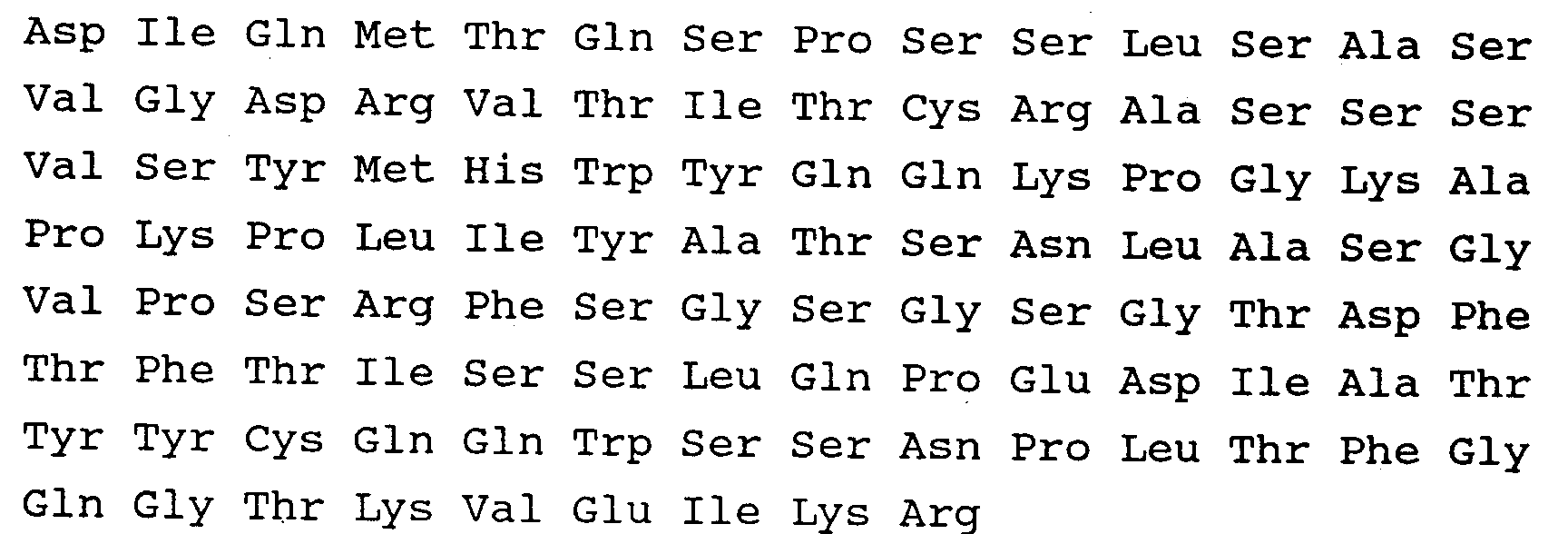
- Schwere Antikörperkette, enthaltend ein Polypeptid der Aminosäuresequenzoder funktionell äquivalente Varianten davon.

- Molekulares Konstrukt enthaltend mindestens eine Antikörperkette nach Anspruch 1 oder 2 und mindestens eine weitere mit der Antikörperkette verknüpfte Aminosäurekette.
- Molekulares Konstrukt nach Anspruch 3, dadurch gekennzeichnet, daß es die Antikörperkette nach Anspruch 1 enthält.
- Molekulares Konstrukt nach Anspruch 3, dadurch gekennzeichnet, daß es die Antikörperkette nach Anspruch 2 enthält.
- Molekulares Konstrukt nach Anspruch 3, dadurch gekennzeichnet, daß es die Antikörperketten nach Anspruch 1 und 2 enthält.
- Molekulares Konstrukt nach Anspruch 3, dadurch gekennzeichnet, daß es ein Single-Chain-Fragment ist.
- Molekulares Konstrukt nach Anspruch 3, dadurch gekennzeichnet, daß es ein Single-Domain-Fragment ist.
- Molekulares Konstrukt nach Anspruch 3, dadurch gekennzeichnet, daß die weiteren Aminosäureketten Teile eines humanen Antikörpers und verschieden von den Sequenzen gemäß Tabelle 1a oder 1c sind.
- Molekulares Konstrukt nach Anspruch 9, dadurch gekennzeichnet, daß es ein humanisierter Antikörper ist.
- Humanisierter Antikörper nach Anspruch 10 oder ein funktionell aktiver Teil davon, dadurch gekennzeichnet, daß er eine leichte Antikörperkette nach Anspruch 1 und eine schwere Antikörperkette nach Anspruch 2 enthält.
- Humanisierter Antikörper nach Anspruch 10, dadurch gekennzeichnet, daß der funktionell aktive Teil ein F(ab)- oder ein F(ab')-Fragment, dessen Hinge-Region von einem oder mehreren Hinge exons kodiert wird, ist.
- Molekulares Konstrukt nach Anspruch 3, dadurch gekennzeichnet, daß es mit einem Effektormolekül verbunden ist.
- Polynukleotid, das für die Antikörperkette nach Anspruch 1 kodiert.
- Polynukleotid, das für die Antikörperkette nach Anspruch 2 kodiert.
- Verfahren zur Herstellung eines molekularen Konstuktes nach Anspruch 3, dadurch gekennzeichnet, daßa) in einem Expressionsvektor ein Operon hergestellt wird, das mindestens ein Polynukleotid nach Anspruch 14 oder 15 enthält;b) der genannte Expressionsvektor in eine Wirtszelle eingebracht wird undc) die Wirtszelle kultiviert undd) das molekulare Konstrukt isoliert wird.
- Verfahren nach Anspruch 16, dadurch gekennzeichnet, daß ein Operon hergestellt wird, bei dessen Konstruktion der für die konstante Region des Immunglobulins kodierende Bereich deletiert und die dadurch verlorengegangene 3'-Regulationssequenz durch das C3-Exon, den 3' nicht-translatierten Bereich und das poly-A Additionssignal eines MHC Klasse I-Gens ersetzt wird.
- Verwendung des molekularen Konstruktes nach Anspruch 3 zum Nachweis von Entzündungen und/oder zum Nachweis von in das Knochenmark metastasierenden Tumoren, vorzugsweise Mammakarzinom, Lymphom, Prostatakarzinom oder kleinzelliges Lungenkarzinom.
- Verwendung des molekularen Konstruktes nach Anspruch 3 zur Herstellung eines Arzneimittels gegen Entzündungen und in das Knochenmark metastasierende Tumore, vorzugsweise Mammakarzinom, Lymphom, Prostatakarzinom oder kleinzelliges Lungenkarzinom.
- Diagnostikum, enthaltend ein molekulares Konstrukt nach Anspruch 3.
- Arzneimittel, enthaltend ein molekulares Konstrukt nach Anspruch 3.
Applications Claiming Priority (2)
| Application Number | Priority Date | Filing Date | Title |
|---|---|---|---|
| DE4225853 | 1992-08-05 | ||
| DE4225853A DE4225853A1 (de) | 1992-08-05 | 1992-08-05 | Granulozytenbindende Antikörperfragmente, ihre Herstellung und Verwendung |
Publications (2)
| Publication Number | Publication Date |
|---|---|
| EP0585570A1 true EP0585570A1 (de) | 1994-03-09 |
| EP0585570B1 EP0585570B1 (de) | 1998-11-18 |
Family
ID=6464877
Family Applications (1)
| Application Number | Title | Priority Date | Filing Date |
|---|---|---|---|
| EP93111172A Expired - Lifetime EP0585570B1 (de) | 1992-08-05 | 1993-07-13 | Granulozytenbindende Antikörperkonstrukte, ihre Herstellung und Verwendung |
Country Status (11)
| Country | Link |
|---|---|
| US (1) | US5645817A (de) |
| EP (1) | EP0585570B1 (de) |
| JP (1) | JPH06205693A (de) |
| KR (1) | KR940005289A (de) |
| AT (1) | ATE173504T1 (de) |
| AU (1) | AU666029B2 (de) |
| CA (1) | CA2101868A1 (de) |
| DE (2) | DE4225853A1 (de) |
| DK (1) | DK0585570T3 (de) |
| ES (1) | ES2123597T3 (de) |
| GR (1) | GR3029385T3 (de) |
Cited By (5)
| Publication number | Priority date | Publication date | Assignee | Title |
|---|---|---|---|---|
| WO1998035988A1 (en) * | 1997-02-14 | 1998-08-20 | Zeneca Limited | Proteins |
| US7264805B2 (en) | 2000-04-05 | 2007-09-04 | Scintec Diagnostics Gmbh | Proteins with a high immunoreactivity and a method for the production thereof |
| WO2011144744A1 (en) | 2010-05-20 | 2011-11-24 | Therapharm Gmbh | Targeted radioactive compound for human cd66 for the treatment of disorders |
| EP3351271A1 (de) | 2017-01-23 | 2018-07-25 | TheraPharm GmbH | Radioimmunkonjugate zur verwendung bei der behandlung von krankheiten im zusammenhang mit knochenmark |
| WO2026082910A1 (en) | 2024-10-17 | 2026-04-23 | Telix Innovations S.A. | Use of a metastable technetium-99 radionuclide-comprising radioimmunoconjugate for dosimetry |
Families Citing this family (6)
| Publication number | Priority date | Publication date | Assignee | Title |
|---|---|---|---|---|
| US5646253A (en) * | 1994-03-08 | 1997-07-08 | Memorial Sloan-Kettering Cancer Center | Recombinant human anti-LK26 antibodies |
| AU7949394A (en) * | 1993-11-19 | 1995-06-06 | Chugai Seiyaku Kabushiki Kaisha | Reconstituted human antibody against human medulloblastomatous cell |
| WO1996007910A1 (en) * | 1994-09-02 | 1996-03-14 | Meiji Milk Products Company Limited | Diagnostic drug for chlamydia infection |
| RU2175290C2 (ru) * | 2000-01-27 | 2001-10-27 | Поляков Виктор Иванович | Ручка управления транспортным средством |
| US7321026B2 (en) * | 2001-06-27 | 2008-01-22 | Skytech Technology Limited | Framework-patched immunoglobulins |
| SI1613350T1 (sl) | 2003-04-09 | 2009-08-31 | Genentech Inc | Zdravljenje avtoimunske bolezni pri bolniku z neustreznim odzivom na inhibitor TNF-alfa |
Citations (5)
| Publication number | Priority date | Publication date | Assignee | Title |
|---|---|---|---|---|
| EP0328404A1 (de) * | 1988-02-12 | 1989-08-16 | Btg International Limited | Modifizierte Antikörper |
| EP0388914A1 (de) * | 1989-03-24 | 1990-09-26 | BEHRINGWERKE Aktiengesellschaft | Monoklonale Antikörper (MAK) gegen tumorassoziierte Antigene, ihre Herstellung und Verwendung |
| WO1991009968A1 (en) * | 1989-12-21 | 1991-07-11 | Celltech Limited | Cd3 specific recombinant antibody |
| WO1992001059A1 (en) * | 1990-07-05 | 1992-01-23 | Celltech Limited | Cdr grafted anti-cea antibodies and their production |
| EP0501215A2 (de) * | 1991-02-28 | 1992-09-02 | BEHRINGWERKE Aktiengesellschaft | Monoklonalantikörper, Linker- und Beta-Glucuronidase enthaltende Fusionsproteine zur Prodrug-Aktivierung, ihre Herstellung und Verwendung |
Family Cites Families (2)
| Publication number | Priority date | Publication date | Assignee | Title |
|---|---|---|---|---|
| SE8203887D0 (sv) * | 1982-06-23 | 1982-06-23 | Kabivitrum Ab | Nya trombininhiberande foreningar |
| CA1336396C (en) * | 1988-07-25 | 1995-07-25 | Kiyoshi Kita | Intraocular anticoagulant including antithrombin iii and method of administration |
-
1992
- 1992-08-05 DE DE4225853A patent/DE4225853A1/de not_active Withdrawn
-
1993
- 1993-07-13 ES ES93111172T patent/ES2123597T3/es not_active Expired - Lifetime
- 1993-07-13 EP EP93111172A patent/EP0585570B1/de not_active Expired - Lifetime
- 1993-07-13 DE DE59309133T patent/DE59309133D1/de not_active Expired - Fee Related
- 1993-07-13 DK DK93111172T patent/DK0585570T3/da active
- 1993-07-13 AT AT93111172T patent/ATE173504T1/de not_active IP Right Cessation
- 1993-08-03 KR KR1019930015019A patent/KR940005289A/ko not_active Ceased
- 1993-08-04 CA CA002101868A patent/CA2101868A1/en not_active Abandoned
- 1993-08-04 JP JP5193241A patent/JPH06205693A/ja active Pending
- 1993-08-04 AU AU44413/93A patent/AU666029B2/en not_active Ceased
-
1995
- 1995-06-02 US US08/459,310 patent/US5645817A/en not_active Expired - Lifetime
-
1999
- 1999-02-12 GR GR990400469T patent/GR3029385T3/el unknown
Patent Citations (5)
| Publication number | Priority date | Publication date | Assignee | Title |
|---|---|---|---|---|
| EP0328404A1 (de) * | 1988-02-12 | 1989-08-16 | Btg International Limited | Modifizierte Antikörper |
| EP0388914A1 (de) * | 1989-03-24 | 1990-09-26 | BEHRINGWERKE Aktiengesellschaft | Monoklonale Antikörper (MAK) gegen tumorassoziierte Antigene, ihre Herstellung und Verwendung |
| WO1991009968A1 (en) * | 1989-12-21 | 1991-07-11 | Celltech Limited | Cd3 specific recombinant antibody |
| WO1992001059A1 (en) * | 1990-07-05 | 1992-01-23 | Celltech Limited | Cdr grafted anti-cea antibodies and their production |
| EP0501215A2 (de) * | 1991-02-28 | 1992-09-02 | BEHRINGWERKE Aktiengesellschaft | Monoklonalantikörper, Linker- und Beta-Glucuronidase enthaltende Fusionsproteine zur Prodrug-Aktivierung, ihre Herstellung und Verwendung |
Cited By (8)
| Publication number | Priority date | Publication date | Assignee | Title |
|---|---|---|---|---|
| WO1998035988A1 (en) * | 1997-02-14 | 1998-08-20 | Zeneca Limited | Proteins |
| US7264805B2 (en) | 2000-04-05 | 2007-09-04 | Scintec Diagnostics Gmbh | Proteins with a high immunoreactivity and a method for the production thereof |
| US7820410B2 (en) | 2000-04-05 | 2010-10-26 | Scintec Diagnostics Gmbh | Proteins with high immunoreactivity and method for their production |
| US9005574B2 (en) | 2000-04-05 | 2015-04-14 | Scintec Diagnostics | Proteins with high immunoreactivity and method for their production |
| WO2011144744A1 (en) | 2010-05-20 | 2011-11-24 | Therapharm Gmbh | Targeted radioactive compound for human cd66 for the treatment of disorders |
| EP3351271A1 (de) | 2017-01-23 | 2018-07-25 | TheraPharm GmbH | Radioimmunkonjugate zur verwendung bei der behandlung von krankheiten im zusammenhang mit knochenmark |
| WO2018134430A1 (en) | 2017-01-23 | 2018-07-26 | Therapharm Gmbh | Radioimmunoconjugate for use in treating bone marrow associated diseases |
| WO2026082910A1 (en) | 2024-10-17 | 2026-04-23 | Telix Innovations S.A. | Use of a metastable technetium-99 radionuclide-comprising radioimmunoconjugate for dosimetry |
Also Published As
| Publication number | Publication date |
|---|---|
| GR3029385T3 (en) | 1999-05-28 |
| AU4441393A (en) | 1994-02-10 |
| EP0585570B1 (de) | 1998-11-18 |
| US5645817A (en) | 1997-07-08 |
| DE59309133D1 (de) | 1998-12-24 |
| ES2123597T3 (es) | 1999-01-16 |
| KR940005289A (ko) | 1994-03-21 |
| CA2101868A1 (en) | 1994-02-06 |
| ATE173504T1 (de) | 1998-12-15 |
| DK0585570T3 (da) | 1999-08-02 |
| DE4225853A1 (de) | 1994-02-10 |
| JPH06205693A (ja) | 1994-07-26 |
| AU666029B2 (en) | 1996-01-25 |
Similar Documents
| Publication | Publication Date | Title |
|---|---|---|
| DE69532940T2 (de) | Verfahren zur Herstellung modifizierter Immunoglobuline mit verminderter Immunogenität der variablen Domänen eines Antikörpers der Maus, Zusammensetzungen, die diese enthalten | |
| DE69429095T2 (de) | Humanisierte antikoerper | |
| DE60116753T2 (de) | Humanisierte antikörper gegen den epidermalen wachstumsfaktorrezeptor | |
| DE69119211T2 (de) | Cdr-gepfropfte anti-cea-antikörper und ihre herstellung | |
| DE69222956T2 (de) | Kleinste erkennungseinheit eines pem-mucin-"tandem repeat"-spezifischen monoklonalen antikoerpers | |
| DE3888172T2 (de) | Rekombinant-antikörper. | |
| DE69331903T2 (de) | Veränderte Antikörper, damit zusammenhängende Produkte und Verfahren | |
| DE69031591T2 (de) | Cd4-spezifischer rekombinanter antikörper | |
| DE3751908T2 (de) | Chimärisches Murine-Mensch-Immunoglobulin, spezifisch für tumorassoziertes 17-1A Antigen | |
| DE69534530T2 (de) | Für b-zell-lymphom und leukämiezellen spezifische immunkonjugate und humane antikörper | |
| DE69434578T2 (de) | Expressionsvektoren die für bispezifische Proteine kodieren, und Verfahren zur Herstellung von biologisch-aktiven bispezifischen Fusionsproteinen in Zellen von Säugetieren | |
| DE69633717T2 (de) | Monoklonale anti-cd6 antikörper zur behandlung und diagnose von psoriasis | |
| DE69221147T2 (de) | Nicht glycosylierter Anti-CD3-IgG-Antikörper | |
| DE69525593T2 (de) | Humanisierte und chimäre monoklonale Antikörper die den Rezeptor für epidermalen Wachstumfaktor (EGF-R) erkennen; diagnostische und therapeutische Verwendung | |
| DE69838454T2 (de) | Natürlicher menschlicher antikörper | |
| DE69734109T2 (de) | Humanisierung von anti-carcinoembryonalen Antigen anti-idiotypischen Antikörper und dessen Verwendung als Tumorvakzin und zur Markierung | |
| DE69532889T2 (de) | Interleukin-5-spezifische rekombinante antikörper | |
| DE69922261T2 (de) | Monoklonale antikörper, antigene sowie diagnose und therapie von bösartigen krankheiten | |
| DE68921364T2 (de) | Verfahren zur Herstellung von Proteinen mittels rekombinanter DNA. | |
| DE69133200T2 (de) | Spezifisch bindende Agentien | |
| EP2600889B1 (de) | Anti-la antikörper und ihre anwendung zum immunotargeting | |
| EP3505536B1 (de) | Antikörper gegen das prostata-spezifische stammzellantigen und dessen verwendung | |
| DE4118120A1 (de) | Tetravalente bispezifische rezeptoren, ihre herstellung und verwendung | |
| WO2004065423A2 (de) | Erkennungsmoleküle zur behandlung und detektion von tumoren | |
| DE68918217T2 (de) | Familie von modifizierten Antikörpern mit hoher Affinität zur Behandlung von Krebs. |
Legal Events
| Date | Code | Title | Description |
|---|---|---|---|
| PUAI | Public reference made under article 153(3) epc to a published international application that has entered the european phase |
Free format text: ORIGINAL CODE: 0009012 |
|
| AK | Designated contracting states |
Kind code of ref document: A1 Designated state(s): AT BE CH DE DK ES FR GB GR IE IT LI LU NL PT SE |
|
| 17P | Request for examination filed |
Effective date: 19940909 |
|
| 17Q | First examination report despatched |
Effective date: 19970110 |
|
| GRAG | Despatch of communication of intention to grant |
Free format text: ORIGINAL CODE: EPIDOS AGRA |
|
| GRAG | Despatch of communication of intention to grant |
Free format text: ORIGINAL CODE: EPIDOS AGRA |
|
| GRAH | Despatch of communication of intention to grant a patent |
Free format text: ORIGINAL CODE: EPIDOS IGRA |
|
| GRAH | Despatch of communication of intention to grant a patent |
Free format text: ORIGINAL CODE: EPIDOS IGRA |
|
| GRAA | (expected) grant |
Free format text: ORIGINAL CODE: 0009210 |
|
| RAP1 | Party data changed (applicant data changed or rights of an application transferred) |
Owner name: HOECHST AKTIENGESELLSCHAFT |
|
| AK | Designated contracting states |
Kind code of ref document: B1 Designated state(s): AT BE CH DE DK ES FR GB GR IE IT LI LU NL PT SE |
|
| REF | Corresponds to: |
Ref document number: 173504 Country of ref document: AT Date of ref document: 19981215 Kind code of ref document: T |
|
| REG | Reference to a national code |
Ref country code: CH Ref legal event code: EP |
|
| REF | Corresponds to: |
Ref document number: 59309133 Country of ref document: DE Date of ref document: 19981224 |
|
| REG | Reference to a national code |
Ref country code: IE Ref legal event code: FG4D Free format text: GERMAN |
|
| REG | Reference to a national code |
Ref country code: ES Ref legal event code: FG2A Ref document number: 2123597 Country of ref document: ES Kind code of ref document: T3 |
|
| ET | Fr: translation filed | ||
| ITF | It: translation for a ep patent filed | ||
| GBT | Gb: translation of ep patent filed (gb section 77(6)(a)/1977) |
Effective date: 19990119 |
|
| REG | Reference to a national code |
Ref country code: PT Ref legal event code: SC4A Free format text: AVAILABILITY OF NATIONAL TRANSLATION Effective date: 19981229 |
|
| REG | Reference to a national code |
Ref country code: DK Ref legal event code: T3 |
|
| PLBE | No opposition filed within time limit |
Free format text: ORIGINAL CODE: 0009261 |
|
| STAA | Information on the status of an ep patent application or granted ep patent |
Free format text: STATUS: NO OPPOSITION FILED WITHIN TIME LIMIT |
|
| 26N | No opposition filed | ||
| PGFP | Annual fee paid to national office [announced via postgrant information from national office to epo] |
Ref country code: DK Payment date: 20000615 Year of fee payment: 8 Ref country code: NL Payment date: 20000615 Year of fee payment: 8 |
|
| PGFP | Annual fee paid to national office [announced via postgrant information from national office to epo] |
Ref country code: SE Payment date: 20000616 Year of fee payment: 8 |
|
| PGFP | Annual fee paid to national office [announced via postgrant information from national office to epo] |
Ref country code: PT Payment date: 20000620 Year of fee payment: 8 |
|
| PGFP | Annual fee paid to national office [announced via postgrant information from national office to epo] |
Ref country code: GR Payment date: 20000623 Year of fee payment: 8 |
|
| PGFP | Annual fee paid to national office [announced via postgrant information from national office to epo] |
Ref country code: LU Payment date: 20000726 Year of fee payment: 8 |
|
| PGFP | Annual fee paid to national office [announced via postgrant information from national office to epo] |
Ref country code: BE Payment date: 20000811 Year of fee payment: 8 |
|
| PG25 | Lapsed in a contracting state [announced via postgrant information from national office to epo] |
Ref country code: LU Free format text: LAPSE BECAUSE OF NON-PAYMENT OF DUE FEES Effective date: 20010713 Ref country code: DK Free format text: LAPSE BECAUSE OF NON-PAYMENT OF DUE FEES Effective date: 20010713 |
|
| PG25 | Lapsed in a contracting state [announced via postgrant information from national office to epo] |
Ref country code: SE Free format text: LAPSE BECAUSE OF NON-PAYMENT OF DUE FEES Effective date: 20010714 |
|
| PG25 | Lapsed in a contracting state [announced via postgrant information from national office to epo] |
Ref country code: GR Free format text: LAPSE BECAUSE OF NON-PAYMENT OF DUE FEES Effective date: 20010731 Ref country code: BE Free format text: LAPSE BECAUSE OF NON-PAYMENT OF DUE FEES Effective date: 20010731 |
|
| PGFP | Annual fee paid to national office [announced via postgrant information from national office to epo] |
Ref country code: IE Payment date: 20010731 Year of fee payment: 9 |
|
| REG | Reference to a national code |
Ref country code: CH Ref legal event code: NV Representative=s name: E. BLUM & CO. PATENTANWAELTE |
|
| REG | Reference to a national code |
Ref country code: GB Ref legal event code: IF02 |
|
| BERE | Be: lapsed |
Owner name: HOECHST A.G. Effective date: 20010731 |
|
| PG25 | Lapsed in a contracting state [announced via postgrant information from national office to epo] |
Ref country code: PT Free format text: LAPSE BECAUSE OF NON-PAYMENT OF DUE FEES Effective date: 20020131 |
|
| PG25 | Lapsed in a contracting state [announced via postgrant information from national office to epo] |
Ref country code: NL Free format text: LAPSE BECAUSE OF NON-PAYMENT OF DUE FEES Effective date: 20020201 |
|
| EUG | Se: european patent has lapsed |
Ref document number: 93111172.8 |
|
| REG | Reference to a national code |
Ref country code: GB Ref legal event code: 732E |
|
| REG | Reference to a national code |
Ref country code: DK Ref legal event code: EBP |
|
| NLV4 | Nl: lapsed or anulled due to non-payment of the annual fee |
Effective date: 20020201 |
|
| REG | Reference to a national code |
Ref country code: PT Ref legal event code: MM4A Free format text: LAPSE DUE TO NON-PAYMENT OF FEES Effective date: 20020131 |
|
| PG25 | Lapsed in a contracting state [announced via postgrant information from national office to epo] |
Ref country code: IE Free format text: LAPSE BECAUSE OF NON-PAYMENT OF DUE FEES Effective date: 20020715 |
|
| REG | Reference to a national code |
Ref country code: IE Ref legal event code: MM4A |
|
| REG | Reference to a national code |
Ref country code: CH Ref legal event code: PFA Owner name: HOECHST AKTIENGESELLSCHAFT Free format text: HOECHST AKTIENGESELLSCHAFT#BRUENINGSTRASSE 50#65929 FRANKFURT AM MAIN (DE) -TRANSFER TO- HOECHST AKTIENGESELLSCHAFT#BRUENINGSTRASSE 50#65929 FRANKFURT AM MAIN (DE) |
|
| PGFP | Annual fee paid to national office [announced via postgrant information from national office to epo] |
Ref country code: DE Payment date: 20080430 Year of fee payment: 16 Ref country code: CH Payment date: 20080715 Year of fee payment: 16 Ref country code: ES Payment date: 20080729 Year of fee payment: 16 |
|
| PGFP | Annual fee paid to national office [announced via postgrant information from national office to epo] |
Ref country code: IT Payment date: 20080725 Year of fee payment: 16 Ref country code: AT Payment date: 20080715 Year of fee payment: 16 |
|
| PGFP | Annual fee paid to national office [announced via postgrant information from national office to epo] |
Ref country code: GB Payment date: 20080722 Year of fee payment: 16 |
|
| REG | Reference to a national code |
Ref country code: CH Ref legal event code: PL |
|
| GBPC | Gb: european patent ceased through non-payment of renewal fee |
Effective date: 20090713 |
|
| REG | Reference to a national code |
Ref country code: FR Ref legal event code: ST Effective date: 20100331 |
|
| PG25 | Lapsed in a contracting state [announced via postgrant information from national office to epo] |
Ref country code: LI Free format text: LAPSE BECAUSE OF NON-PAYMENT OF DUE FEES Effective date: 20090731 Ref country code: FR Free format text: LAPSE BECAUSE OF NON-PAYMENT OF DUE FEES Effective date: 20090731 Ref country code: CH Free format text: LAPSE BECAUSE OF NON-PAYMENT OF DUE FEES Effective date: 20090731 |
|
| PGFP | Annual fee paid to national office [announced via postgrant information from national office to epo] |
Ref country code: FR Payment date: 20080425 Year of fee payment: 16 |
|
| PG25 | Lapsed in a contracting state [announced via postgrant information from national office to epo] |
Ref country code: GB Free format text: LAPSE BECAUSE OF NON-PAYMENT OF DUE FEES Effective date: 20090713 |
|
| PG25 | Lapsed in a contracting state [announced via postgrant information from national office to epo] |
Ref country code: DE Free format text: LAPSE BECAUSE OF NON-PAYMENT OF DUE FEES Effective date: 20100202 Ref country code: AT Free format text: LAPSE BECAUSE OF NON-PAYMENT OF DUE FEES Effective date: 20090713 |
|
| REG | Reference to a national code |
Ref country code: ES Ref legal event code: FD2A Effective date: 20090714 |
|
| PG25 | Lapsed in a contracting state [announced via postgrant information from national office to epo] |
Ref country code: ES Free format text: LAPSE BECAUSE OF NON-PAYMENT OF DUE FEES Effective date: 20090714 |
|
| PG25 | Lapsed in a contracting state [announced via postgrant information from national office to epo] |
Ref country code: IT Free format text: LAPSE BECAUSE OF NON-PAYMENT OF DUE FEES Effective date: 20090713 |