EP0583267B1 - Launderable retroreflective applique - Google Patents
Launderable retroreflective applique Download PDFInfo
- Publication number
- EP0583267B1 EP0583267B1 EP92908657A EP92908657A EP0583267B1 EP 0583267 B1 EP0583267 B1 EP 0583267B1 EP 92908657 A EP92908657 A EP 92908657A EP 92908657 A EP92908657 A EP 92908657A EP 0583267 B1 EP0583267 B1 EP 0583267B1
- Authority
- EP
- European Patent Office
- Prior art keywords
- applique
- retroreflective
- gamma
- binder layer
- binder
- Prior art date
- Legal status (The legal status is an assumption and is not a legal conclusion. Google has not performed a legal analysis and makes no representation as to the accuracy of the status listed.)
- Expired - Lifetime
Links
Images
Classifications
-
- G—PHYSICS
- G02—OPTICS
- G02B—OPTICAL ELEMENTS, SYSTEMS OR APPARATUS
- G02B5/00—Optical elements other than lenses
- G02B5/12—Reflex reflectors
- G02B5/126—Reflex reflectors including curved refracting surface
- G02B5/128—Reflex reflectors including curved refracting surface transparent spheres being embedded in matrix
-
- Y—GENERAL TAGGING OF NEW TECHNOLOGICAL DEVELOPMENTS; GENERAL TAGGING OF CROSS-SECTIONAL TECHNOLOGIES SPANNING OVER SEVERAL SECTIONS OF THE IPC; TECHNICAL SUBJECTS COVERED BY FORMER USPC CROSS-REFERENCE ART COLLECTIONS [XRACs] AND DIGESTS
- Y10—TECHNICAL SUBJECTS COVERED BY FORMER USPC
- Y10T—TECHNICAL SUBJECTS COVERED BY FORMER US CLASSIFICATION
- Y10T428/00—Stock material or miscellaneous articles
- Y10T428/24—Structurally defined web or sheet [e.g., overall dimension, etc.]
- Y10T428/24355—Continuous and nonuniform or irregular surface on layer or component [e.g., roofing, etc.]
- Y10T428/24372—Particulate matter
- Y10T428/24421—Silicon containing
-
- Y—GENERAL TAGGING OF NEW TECHNOLOGICAL DEVELOPMENTS; GENERAL TAGGING OF CROSS-SECTIONAL TECHNOLOGIES SPANNING OVER SEVERAL SECTIONS OF THE IPC; TECHNICAL SUBJECTS COVERED BY FORMER USPC CROSS-REFERENCE ART COLLECTIONS [XRACs] AND DIGESTS
- Y10—TECHNICAL SUBJECTS COVERED BY FORMER USPC
- Y10T—TECHNICAL SUBJECTS COVERED BY FORMER US CLASSIFICATION
- Y10T428/00—Stock material or miscellaneous articles
- Y10T428/25—Web or sheet containing structurally defined element or component and including a second component containing structurally defined particles
- Y10T428/252—Glass or ceramic [i.e., fired or glazed clay, cement, etc.] [porcelain, quartz, etc.]
-
- Y—GENERAL TAGGING OF NEW TECHNOLOGICAL DEVELOPMENTS; GENERAL TAGGING OF CROSS-SECTIONAL TECHNOLOGIES SPANNING OVER SEVERAL SECTIONS OF THE IPC; TECHNICAL SUBJECTS COVERED BY FORMER USPC CROSS-REFERENCE ART COLLECTIONS [XRACs] AND DIGESTS
- Y10—TECHNICAL SUBJECTS COVERED BY FORMER USPC
- Y10T—TECHNICAL SUBJECTS COVERED BY FORMER US CLASSIFICATION
- Y10T428/00—Stock material or miscellaneous articles
- Y10T428/28—Web or sheet containing structurally defined element or component and having an adhesive outermost layer
- Y10T428/2813—Heat or solvent activated or sealable
- Y10T428/2817—Heat sealable
- Y10T428/2826—Synthetic resin or polymer
-
- Y—GENERAL TAGGING OF NEW TECHNOLOGICAL DEVELOPMENTS; GENERAL TAGGING OF CROSS-SECTIONAL TECHNOLOGIES SPANNING OVER SEVERAL SECTIONS OF THE IPC; TECHNICAL SUBJECTS COVERED BY FORMER USPC CROSS-REFERENCE ART COLLECTIONS [XRACs] AND DIGESTS
- Y10—TECHNICAL SUBJECTS COVERED BY FORMER USPC
- Y10T—TECHNICAL SUBJECTS COVERED BY FORMER US CLASSIFICATION
- Y10T428/00—Stock material or miscellaneous articles
- Y10T428/31504—Composite [nonstructural laminate]
- Y10T428/31551—Of polyamidoester [polyurethane, polyisocyanate, polycarbamate, etc.]
- Y10T428/31645—Next to addition polymer from unsaturated monomers
- Y10T428/31649—Ester, halide or nitrile of addition polymer
-
- Y—GENERAL TAGGING OF NEW TECHNOLOGICAL DEVELOPMENTS; GENERAL TAGGING OF CROSS-SECTIONAL TECHNOLOGIES SPANNING OVER SEVERAL SECTIONS OF THE IPC; TECHNICAL SUBJECTS COVERED BY FORMER USPC CROSS-REFERENCE ART COLLECTIONS [XRACs] AND DIGESTS
- Y10—TECHNICAL SUBJECTS COVERED BY FORMER USPC
- Y10T—TECHNICAL SUBJECTS COVERED BY FORMER US CLASSIFICATION
- Y10T428/00—Stock material or miscellaneous articles
- Y10T428/31504—Composite [nonstructural laminate]
- Y10T428/31652—Of asbestos
- Y10T428/31663—As siloxane, silicone or silane
-
- Y—GENERAL TAGGING OF NEW TECHNOLOGICAL DEVELOPMENTS; GENERAL TAGGING OF CROSS-SECTIONAL TECHNOLOGIES SPANNING OVER SEVERAL SECTIONS OF THE IPC; TECHNICAL SUBJECTS COVERED BY FORMER USPC CROSS-REFERENCE ART COLLECTIONS [XRACs] AND DIGESTS
- Y10—TECHNICAL SUBJECTS COVERED BY FORMER USPC
- Y10T—TECHNICAL SUBJECTS COVERED BY FORMER US CLASSIFICATION
- Y10T428/00—Stock material or miscellaneous articles
- Y10T428/31504—Composite [nonstructural laminate]
- Y10T428/31855—Of addition polymer from unsaturated monomers
- Y10T428/31931—Polyene monomer-containing
-
- Y—GENERAL TAGGING OF NEW TECHNOLOGICAL DEVELOPMENTS; GENERAL TAGGING OF CROSS-SECTIONAL TECHNOLOGIES SPANNING OVER SEVERAL SECTIONS OF THE IPC; TECHNICAL SUBJECTS COVERED BY FORMER USPC CROSS-REFERENCE ART COLLECTIONS [XRACs] AND DIGESTS
- Y10—TECHNICAL SUBJECTS COVERED BY FORMER USPC
- Y10T—TECHNICAL SUBJECTS COVERED BY FORMER US CLASSIFICATION
- Y10T428/00—Stock material or miscellaneous articles
- Y10T428/31504—Composite [nonstructural laminate]
- Y10T428/31855—Of addition polymer from unsaturated monomers
- Y10T428/31935—Ester, halide or nitrile of addition polymer
-
- Y—GENERAL TAGGING OF NEW TECHNOLOGICAL DEVELOPMENTS; GENERAL TAGGING OF CROSS-SECTIONAL TECHNOLOGIES SPANNING OVER SEVERAL SECTIONS OF THE IPC; TECHNICAL SUBJECTS COVERED BY FORMER USPC CROSS-REFERENCE ART COLLECTIONS [XRACs] AND DIGESTS
- Y10—TECHNICAL SUBJECTS COVERED BY FORMER USPC
- Y10T—TECHNICAL SUBJECTS COVERED BY FORMER US CLASSIFICATION
- Y10T428/00—Stock material or miscellaneous articles
- Y10T428/31504—Composite [nonstructural laminate]
- Y10T428/31855—Of addition polymer from unsaturated monomers
- Y10T428/31938—Polymer of monoethylenically unsaturated hydrocarbon
Definitions
- the present invention relates to novel retroreflective appliques and articles to which such appliques have been applied.
- retroreflective markings have been attached to clothing.
- retroreflective appliques comprising a monolayer of retroreflective elements, e.g., transparent microspheres with hemispheric reflectors, partially embedded in a layer of binder material, with adhesive backings are bonded to articles of clothing.
- the binder materials in such appliques comprise thermally or chemically cured compositions, e.g., phenolic cured resins, isocyanate cured polymers with active hydrogens such as two part urethanes, and aminoplast- or amine-cured hydroxy functional polymers.
- thermally or chemically cured compositions e.g., phenolic cured resins, isocyanate cured polymers with active hydrogens such as two part urethanes, and aminoplast- or amine-cured hydroxy functional polymers.
- a problem with such appliques is that their retroreflective performance tends to diminish unacceptably when the garment to which they are bonded is washed. After a few washings, the retroreflective brightness of the applique may be reduced to a small fraction, e.g., 5 percent or less, of its original brightness. This decrease is due to loss of retroreflective elements from the surface of the applique and/or degradation of the retroreflective elements, e.g., corrosion of aluminum
- the problem is particularly troublesome when the clothing is subjected to industrial laundering, where the conditions of laundering are often more severe than conventional home laundering.
- the laundering conditions may include wash temperatures of 40° to 90°C (105° to 190°F) and pH of 10 to 12.5, whereas in contrast, typical conditions for home laundering may include temperatures of 4° to 60°C (40° to 140°F) and pH of less than 11.
- home laundering equipment typically subjects the articles being cleaned to less rigorous handling and stress than does industrial laundry equipment.
- the present invention provides novel retroreflective appliques which can be applied to substrates such as fabrics and garments to impart retroreflective properties thereto.
- the appliques of the invention provide unexpected durability. Capable of being applied to fabric substrates, appliques of the invention exhibit surprising resistance to degradation when the article is laundered and retain a surprising degree of retroreflective properties.
- a retroreflective applique applied to a garment which applique comprises a monolayer of retroreflective elements partially embedded in and protruding from the front surface of a binder layer which binder layer comprises an electron-beam cured elastomer characterised in that the elastomer is selected from at least one of chlorosulfonated polyethylene, ethylene copolymers and EPDM polymers.
- the appliques of the invention can have an optional layer of adhesive, preferably hot melt type, on the near surface of the binder layer. Before use this adhesive layer can optionally be covered with a removable release liner.
- the applique is bonded to a substrate, e.g., a piece of fabric or article of clothing, with the adhesive, and in other embodiments the binder layer serves to both secure the retroreflective elements and to bond the applique to a desired substrate. If desired, the applique can be sewn onto a fabric substrate.
- the binder layer of appliques of the invention comprises an elastomeric composition crosslinked or cured by electron beam (“e-beam”) radiation and that said elastomer comprises one of the above specified elastomers.
- e-beam electron beam
- Retroreflective appliques of the invention have been found to exhibit surprising retention of retroreflective brightness when subjected to industrial laundering conditions. This advantageous result is achieved through a combination of increased resistance to loss of retroreflective elements and an increased resistance to degradation of the retroreflective elements, e.g., degradation of the reflector layer. As a result, articles to which appliques of the invention have been applied may be laundered many more times than previously possible while still retaining the desired retroreflective character.
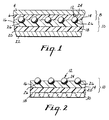
- Applique 10 comprises a monolayer of retroreflective elements 12 partially embedded in and protruding from front surface 14 of binder layer 16. Disposed on rear surface 18 of binder layer 16 is optional adhesive layer 20. Applique 10 is shown with optional release liner 22 which covers the exposed surface of adhesive layer 20. To apply applique 10 to a substrate such as a fabric (not shown), release liner 22 is first removed. Applique 10 is also shown on optional temporary carrier 8 comprising paper sheet 4 and polymer lining 6.
- a typical method of making appliques of the invention comprises arranging retroreflective elements in desired monolayer arrangement on a temporary carrier with the rear portions of the retroreflective elements presented away from the carrier, forming a binder layer over the rear portions of the retroreflective elements, and applying an optional adhesive layer on the back side of the binder layer.
- retroreflective elements 12 will be spherical microspheres 24 having reflectors 26 on the back sides thereof as shown in Figure 1.
- one method for assembling a monolayer of such retroreflective elements is to cascade microspheres onto temporary carrier 8 which secures microspheres 24 in desired arrangement temporarily.
- microspheres 24 can be partially embedded in heat softenable polymer layer 6 on paper sheet 4.
- useful polymer coatings include polyvinyl chloride, polysulfones, polyalkylenes such as polyethylene, polypropylene, and polybutylene, polyesters such as polyethylene terephthalate, and the like.
- polymer layer 6 retains microspheres 24 in desired arrangement.
- Microspheres 24 are typically preferably packed as closely as possible, ideally in their closest hexagonal arrangement, to achieve greater retroreflective brightness and may be so arranged by any convenient applique process, such as printing, screening, cascading, or with a hot can roll.
- retroreflective elements are transparent microspheres having reflectors on the rear surfaces thereof as shown in Figure 1.
- retroreflective elements typically provide satisfactory levels of retroreflective brightness over a wide range of incidence angles, i.e., the angles at which the light strikes the sheeting, a property sometimes referred to as "angularity".
- the microspheres are preferably substantially spherical in shape in order to provide the most uniform and efficient retroreflection. Furthermore, the microspheres are preferably substantially transparent so as to minimize the amount of light absorbed by the microspheres and thereby optimize the amount of light which is retroreflected by sheetings of the invention.
- the microspheres are typically substantially colorless, but, may be colored to produce special effects if desired.
- Microspheres used herein may be made from glass or synthetic resin having the optical properties and physical characteristics taught herein. Glass microspheres are typically preferred because they typically cost less, are harder, and exhibit superior durability to microspheres made of synthetic resins.
- Microspheres used in the present invention will typically have an average diameter of between about 30 and about 200 microns. Microspheres which are smaller than this range may tend to provide lower levels of retroreflection because of diffraction effects, whereas microspheres larger than this range may tend to impart undesirably rough texture to the applique or undesirably reduce the flexibility thereof. Microspheres used in the present invention will typically have a refractive index of between about 1.7 and about 2.0, the range typically considered to be useful in microsphere-based retroreflective products where, as here, the front surfaces of the microspheres are exposed or air-incident.
- microsphere-based retroreflective elements of retroreflective appliques of the invention have reflectors on the rear surfaces thereof.
- reflectors are applied to the rear surfaces of the microspheres after the microspheres have been partially embedded in the carrier, thereby facilitating the arrangement of the microspheres in substantially uniform direction for retroreflection.
- the size of reflectors i.e., how much of the surface of the microspheres which is covered, may be controlled in part by controlling the depth into the carrier to which the microspheres are embedded prior to application of the reflectors thereto.
- metal coatings such as aluminum or silver
- chemically-deposited metal coatings such as silver
- metal-coated plastic films such as aluminum or silver
- metal flakes such as aluminum or silver
- dielectric coatings are typically preferred, because they tend to provide the highest retroreflective brightness.
- the reflective color of silver coatings is typically preferred to that of aluminum coatings, but an aluminum vapor coat is normally more preferred, because silver reflective coatings typically suffer more severe degradation in outdoor exposure than do aluminum coatings.
- U.S. Patent No. 3,700,305 (Bingham) discloses dielectric mirrors or coatings that may be used as reflectors in retroreflective articles of the invention.
- dielectric reflectors An advantage of dielectric reflectors is that appliques made with microspheres having such reflectors may be easily made in a variety of bright colors. Such reflectors are typically subject to degradation under laundering conditions, particularly industrial laundering conditions, and are accordingly used on articles destined for home laundering. Aluminum and silver reflectors typically exhibit substantially greater durability under industrial laundering conditions, but aluminum reflectors often tend to impart a gray color to the applique under ambient conditions.
- Binder layer 16 is typically between about 50 and about 250 microns (2 and 10 mils) thick over the embedded portion of retroreflective elements 12, with thicknesses of between about 75 and about 100 microns (3 and 4 mils) typically being preferred. It will be understood that binder layers having thicknesses outside these ranges may be used. However, if binder layer 16 is too thin, it will not provide sufficient support to retroreflective elements 12 which will may be readily dislodged, whereas increasing the thickness of binder layer 16 leads to increased cost for applique 10 as greater amounts of the binder material are required. Furthermore, at greater thicknesses, greater e-beam dosages will be required to achieve suitable curing and the flexibility of applique 10 typically tends to decrease.
- Binder layer 16 consists essentially of the binder materials, i.e., e-beam curable elastomers, discussed herein with the additives discussed below.
- binder materials i.e., e-beam curable elastomers
- One useful example of such compositions is the HYPALON TM series of polymers, a series of chlorosulphonated polyesters from E.I. du Pont de Nemours & Co. (“du Pont”).
- du Pont chlorosulphonated polyesters from E.I. du Pont de Nemours & Co.
- Such materials are highly flexible, and have been found to be resistant to degradation by exposure to ozone, oxygen, weathering, oil, and many chemicals as well as harsh laundering conditions.
- binder materials offer improved performance as compared to that of binder materials used in previously known retroreflective appliques.
- phenolic-cured nitrile rubbers have been found to be sensitive to high temperature and high pH, resulting in discoloration and loss of retroreflective brightness. The presence of the phenolic functionalities is believed to make such binder layers susceptible to undesirable degradation.
- Two component urethanes have been found to be sensitive to degradation upon exposure to high moisture as well as high temperature and high pH wash conditions. The urethane linkages are believed to make such binder layers susceptible to undesirable degradation.
- Such materials are also typically relatively expensive.
- Moisture-cured one component urethanes suffer similar drawbacks and in addition are slow and difficult to cure controllably. If overcured, such binder layers tend to become insufficiently flexible and subject to loss of retroreflective elements when flexed.
- the binder layer comprises one or more elastomers and typically one or more crosslinkers and one or more coupling agents. If desired, it may also comprise such optional additives as colorants (e.g., pigments, dyes, metal flakes) and stabilizers (e.g., thermal stabilizers and antioxidants such as hindered phenols and light stabilizers such as hindered amines or ultraviolet stabilizers), flame retardants, and flow modifiers (e.g., surfactants such as fluoropolymer silicones).
- colorants for appliques with reflective elements having aluminum reflector layers are black dyes, e.g., metal-azo dyes such as chromium-azo dyes.
- Elastomers which may be used herein are e-beam curable.
- Illustrative examples thereof include chlorosulfonated polyethylenes (e.g., du Pont's HYPALON TM series), ethylene copolymers such as ethylene/vinylacetate, ethylene/acrylate, ethylene/ acrylic acid, and poly(ethylene-co-propylene-co-diene) (“EPDM”) polymers.
- chlorosulfonated polyethylenes e.g., du Pont's HYPALON TM series
- ethylene copolymers such as ethylene/vinylacetate, ethylene/acrylate, ethylene/ acrylic acid
- EPDM poly(ethylene-co-propylene-co-diene)
- elastomers tend to be degraded by e-beam irradiation rather than crosslinked.
- polyisobutylene, butyl rubber (e.g., isoprene/ isobutylene copolymer), and neoprenes are typically not useful herein.
- the binder layer is preferably substantially free of these components.
- crosslinkers which may be used herein include multifunctional monomers and oligomers such as trimethylolpropanetrimethacrylate, pentaerythritol-triacrylate, and triallyl-1,3,5-triazine- 2,4,6(1H,3H,5H)trione.
- Illustrative examples of other useful crosslinkers include 1,6-hexanediol diacrylate, tetraethylene glycol diacrylate, neopentylglycol diacrylate, tripropylene glycol diacrylate, trimethylolpropane ethoxy triacrylate, tris(2-hydroxethyl) isocyanurate triacrylate, dipentaerythritol pentaacrylate, urethane acrylate oligomers (e.g., CN970 series from Sartomer Co. and EBERCRYL TM from Radcure Specialties, Inc.), epoxy acrylate oligomers, and acrylic oligomers.
- 1,6-hexanediol diacrylate 1,6-hexanediol diacrylate, tetraethylene glycol diacrylate, neopentylglycol diacrylate, tripropylene glycol diacrylate, trimethylolpropane ethoxy triacryl
- Crosslinkers may be used alone or in combination of one or more.
- the binder layer will contain up to about 10 weight percent, and preferably between about 0.5 and about 2 weight percent, of crosslinker. If too much crosslinker is used, the resultant binder layer may tend to be insufficiently flexible. Also, because many crosslinkers tend to be susceptible to degradation due to water and high pH, binder layers made with excessive amounts may tend to suffer impaired launderability. If too little crosslinker is used, the resultant binder layer may not be cured sufficiently and thus be subject to degradation, e.g., swelling and retroreflective element loss, under laundering conditions, or require high e-beam dosage to achieve sufficient cure.
- the binder layer be sufficiently cured so as to withstand immersion at room temperature for 24 hours in methylene chloride without dissolving or breaking apart. Acceptable binder layers may swell in this test so long as they do not dissolve or break apart. It will be understood that use of higher e-beam dosages to achieve sufficient curing will typically incur greater processing costs and perhaps slower manufacturing speeds. Also, higher e-beam dosages may lead to degradation of some components of the construction.
- binder layer 16 will comprise a coupling agent, e.g., silane coupling agent, to promote adhesion of binder layer 16 to retroreflective elements 12. Selection of a coupling agent will be based in part upon the particular elastomer, crosslinker (if any), and retroreflective elements which are used.
- a coupling agent e.g., silane coupling agent
- coupling agents include vinyltrimethoxysilane, vinyltriethoxysilane, gamma-methacryloxypropyl-tris-(2-methoxyethoxy)silane, gamma-methacryloxypropyltrimethoxysilane, beta-(3,4-epoxycyclohexy)ethyltrimethoxysilane, gamma-glycidoxypropyltrimethoxysilane, gamma-mercaptopropyltriethoxysilane, gamma-mercaptopropyltrimethoxysilane, gamma-aminopropyltriethoxysilane, and N-beta-(aminoethyl)-gamma-aminopropyltrimethoxysilane.
- coupling agent(s) if used, will be dependent in part upon the binder material and retroreflective elements used. To minimize fading of aluminum reflector layers, it is typically preferred that amino-containing silane coupling agents be avoided.
- Gamma-glycidoxypropyltrimethoxysilane, gamma-mercaptopropyltrimethoxysilane, and gamma-methacryloxypropyltrimethoxysilane have been found to exhibit the best performance among those listed and are preferred.
- the coupling agent may be applied, e.g., by spraying or coating, to the surfaces of the retroreflective elements or to the binder layer prior to its application to the elements or may be incorporated directly into the binder composition.
- Application to the elements provides the advantage of using lesser quantities of coupling agent, which in some instances is relatively expensive, whereas incorporation into the binder composition provides the advantage of eliminating a separate application process curing fabrication of the retroreflective applique.
- binder layer 16 will contain up to about 10 weight percent, and preferably between about 0.1 and about 7 weight percent, of coupling agent. If too little coupling agent is used, the resultant applique may, depending upon the characteristics of the elastomer, tend to under undesirable loss of retroreflective elements. If too much coupling agent is used, it may in some instances impair the physical properties of the binder layer, e.g., mercapto-based agents may cause the binder to swell. Also, the coupling agents are typically relatively expensive as compared to the other components of the appliques.
- Retroreflective brightness was measured using a retroluminometer as described in U.S. defensive publication T987,003 at divergence angles of about 0.2° and entrances angles of about -4°.
- Launderability of appliques was evaluated by washing a piece of fabric to which the subject applique had been applied for the indicated number of cycles in a Milnor System 7 Washing Machine Model 30015M4G from Pellerin Minor Corp. using program no. 5 for medium soiled, colored fabric with the indicated detergent. Each cycle is about 40 minutes in length.
- the washer was loaded with about 5.5 to 6.8 kilograms (12 to 15 pounds) (dry) of laundry and used about 68 liters (18 gallons) of water at the indicated temperature.
- the detergent used was 30 grams of FACTOR TM detergent, a detergent from Fabrilife Chemicals, Inc. containing tetrasodium pyrophosphate, nonylphenoxypoly(ethyleneoxy)ethanol, sodium carbonate, and silica. In some cases, the detergent further included 60 grams of ULTRASIL TM , a pH builder from Pennwalt Corp. believed to contain 40 weight percent NaOH and 60 weight percent sodium metasilicates.
- Glass microspheres having an average diameter of about 40 to 90 microns were partially embedded into a temporary carrier sheet and aluminum specular reflective layers applied to the exposed portions of the microspheres to yield retroreflective elements.
- a binder composition comprising: Amount Component 100 Elastomer - 35 weight percent solution of HYPALON TM 20 in methyl ethyl ketone with about 0.045 weight percent of ZAPON TM X50, black dye from BASF Corp.; 2.1 Coupling Agent - A-189, a gamma-mercaptopropyltrimethoxysilane from Union Carbide Corp.; and 0.35 Crosslinker - trimethylolpropanetrimethacrylate having molecular weight of 338.4 from Aldrich Chemical Co.; coated over the retroreflective elements to a wet thickness of about 300 microns (12 mils) and dried at about 66°C (150°F) for 30 minutes.
- the dried coating was then e-beam irradiated to an exposure of 3 or 5 Mrads at 200 kilovolts to yield the binder layer.
- An Mrad is a megarad where a rad or "radiation absorbed dose" is equal to 1.0 x 10 -5 joules/gram.
- An adhesive layer comprising (1) 100 parts of a 40 percent solids solution of a polyol having a hydroxy equivalent of 3000 in methyl ethyl ketone and (2) 6.5 parts of DESMODUR TM CB-75, a 75 percent solids solution of an aromatic polyisocyanate adduct based on toluene diisocyanate in ethyl acetate from Mobay Corp., was then coated over the rear side of the binder layer to a wet thickness of about 300 microns (12 mils).
- the resultant retroreflective applique was then wet laminated to a polyester fabric (S-551-060 from Milliken & Company, a 3.11 ounce/yard 2 textile polyester) and the construction dried and cured at 65°C (150°F) for 30 minutes.
- the temporary carrier was then stripped from the front of the applique to reveal the silver colored retroreflective surface.
- Launderability of the appliques was evaluated by washing for the indicated number of cycles at a water temperature of about 83°C (180°F).
- the appliques had initial retroreflective brightnesses in candelas per square meter per lux ("cpl") of about 605, 570, 600, and 615, respectively.
- the launderability results obtained are tabulated in Table I.
- Example 2 Two different crosslinkers are examined in Example 2. Except as noted below, retroreflective appliques were made as in Example 1. In Sample 2-1 the crosslinker was 0.35 parts of trimethylolpropanetrimethacrylate, and in Sample 2-2 the crosslinker was 0.35 parts of pentaerythritoltriacrylate. In both cases, the binder composition was coated to a wet thickness of 250 microns (10 mils), oven dried at 65°C (150°F) for 10 minutes, covered with a 25 micron (1 mil) thick silicone coated polyethylene terephthalate film, and exposed to 5 Mrads at 200 kilovolts through the film.
- the binder composition was coated to a wet thickness of 250 microns (10 mils), oven dried at 65°C (150°F) for 10 minutes, covered with a 25 micron (1 mil) thick silicone coated polyethylene terephthalate film, and exposed to 5 Mrads at 200 kilovolts through the film.
- an adhesive composition comprising (1) 100 parts of a 50 percent solids solution of linear saturated polyester in methyl ethyl ketone and toluene and (2) 2.4 parts of DESMODUR TM CB-75 was applied.
- the applique was then wet laminated to a polyester fabric as in Example 1.
- a monolayer of retroreflective elements was prepared as in Example 1.
- a binder composition comprising a solution in toluene of (1) 26.7 weight percent of elastomer, KRATON TM D1320X, and (2) 1.6 weight percent of coupling agent, A-189 was coated over the retroreflective elements to a wet thickness of about 300 microns (12 mils) and dried at about 65°C (150°F) for 30 minutes. The dried coating was then e-beam irradiated to exposures of 0, 3, or 5 Mrads at 200 kilovolts as indicated to yield the binder layer.
- An adhesive layer comprising (1) 100 parts of a 40 percent solids solution in methyl ethyl ketone of polyol having an hydroxy equivalent of 3000 and (2) 8.6 parts of DESMODUR TM CB-75 was then coated over the rear side of the binder layer to 150 microns (6 mils) wet thickness.
- the resultant retroreflective applique was then wet laminated to a PRIMALUX TM fabric (an 80/20 blend of polyester and combed cotton, weight 3 ounce/yard 2 ) from Springs Industries, Inc. The construction was dried and cured at 65°C (150°F) for 30 minutes. The temporary carrier was then stripped from the front of the applique to reveal the silver colored retroreflective surface.
- PRIMALUX TM fabric an 80/20 blend of polyester and combed cotton, weight 3 ounce/yard 2
- the construction was dried and cured at 65°C (150°F) for 30 minutes.
- the temporary carrier was then stripped from the front of the applique to reveal the silver colored retroreflective surface.
- Launderability of the applique was evaluated by washing for the indicated number of cycles at a water temperature of about 74°C (165°F).
- the appliques had initial retroreflective brightnesses (in cpl) of about 660, 645, and 650, respectively.
- the launderability results obtained are tabulated in Table III.
- a monolayer of retroreflective elements was prepared as in Example 1.
- a binder composition comprising: Amount Component 100 Elastomer - solution in methyl ethyl ketone of 35 weight percent percent percent HYPALON TM 20 and 0.045 weight percent ZAPON TM X50; 2.1 Coupling Agent - A-189; 0.35 Crosslinker - trimethylolpropanetrimethacrylate; was coated over the retroreflective elements to a wet thickness of about 375 microns (15 mils). Appliques were then wet laminated to PRIMALUX TM fabric like that used in Example 3, referred to as Sample 4-1, or S-551-060 fabric like that used in Example 1, referred to as Sample 4-2 and dried at about 65°C (150°F) for 30 minutes. The dried composites were then e-beam irradiated to an exposure of 7 or 10 Mrads at 300 kilovolts through the fabrics to yield the binder layers bonded to the respective fabric substrate.
- the temporary carriers were then stripped from the front of the appliques to reveal the retroreflective surfaces which each provided a brightness of about 600 candela per square meter per lux.
- Sample 4-1 had an initial retroreflective brightness of about 625 candela per square meter per lux and a final retroreflective brightness of about 270 candela per square meter per lux.
- Sample 4-2 had an initial retroreflective brightness of about 620 candela per square meter per lux and a final retroreflective brightness of about 300 candela per square meter per lux.
- Sample 4-2 was observed to have retained a somewhat greater degree of its retroreflective brightness than did Sample 4-1. This is believed to be due to the fact that S-551-060 fabric is somewhat stiffer than is PRIMALUX TM fabric.
- An array of retroreflective elements on a temporary carrier was prepared as in Example 1.
- a binder composition comprising: Amount Component 100 Binder Material - 45 weight percent solids emulsion in water of non-ionic acrylic emulsion, RHOPLEX TM HA-8 from Rohm & Haas; 2 Binder Material - 80 weight percent aqueous solution of melamine-formaldehyde resin; and 2 Coupling Agent - Z-6040 from Dow Corning Corp.; was coated over the retroreflective elements to a wet thickness of about 150 microns (6 mils) and dried and cured at 82°C (180°F) for 7 minutes to yield the binder layer.
- a layer of the same composition except further containing 0.2 parts carbon black and 3.0 parts titanium dioxide was coated over the back side of the binder layer to a wet thickness of about 175 microns (7 mils).
- the applique was then wet laminated to a polyester/cotton blend, POTENTIA TM a 3.0 ounce/yard 2 65/35 blend of polyester and combed cotton from Springs Industries, Inc. and the laminate dried and cured at 110°C (230°F) for 7 minutes.
- the temporary carrier was then stripped from the front of the applique to reveal the silver colored retroreflective surface.
- the initial retroreflective brightness was about 605 candela per square meter per lux.
- An array of retroreflective elements on a temporary carrier was prepared as in Example 1.
- a binder composition comprising: Amount Component 100 Binder Material - 20.5 weight percent solids solution in methyl ethyl ketone of nitrile rubber; 13.7 Binder Material - thermosetting phenolic resin; 4.1 Binder Material - dioctyl phthalate plasticizer; 2 Coupling Agent - A-189; and 2 Colorant - dispersion of carbon black and titanium dioxide; was coated over the retroreflective elements to a wet thickness of about 150 microns (6 mils) and dried and cured at 77°C (170°F) for 3 minutes and then 154°C (310°F) for 4 minutes to yield the binder layer.
- An adhesive composition comprising: (1) 100 parts of BOSTIK TM 7660, a 30 weight percent solids solution in methyl ethyl ketone of a polyester diol from Emhart Corp. and (2) 4 parts of BOSCODUR TM No. 22, a 66 weight percent solids solution in ethyl acetate and toluene (1:1) of a polyisocyanate from Emhart Corp., was coated over the back side of the binder layer to a wet thickness of 175 microns (7 mils).
- the applique was then wet laminated to a fabric as in Example 1 and the temporary carrier stripped from the front of the applique to reveal the silver colored retroreflective surface.
- the initial retroreflective brightness was about 560 candela per square meter per lux.
- the fabric had an initial retroreflective brightness of about 630 candela per square meter per lux.
- the launderability results obtained with the appliques of Example 1 and Comparative Examples A, B, and C are tabulated in Table IV.
- the initial retroreflective brightness of Sample 1 was about 605 candela per square meter per lux.
Landscapes
- Physics & Mathematics (AREA)
- General Physics & Mathematics (AREA)
- Optics & Photonics (AREA)
- Optical Elements Other Than Lenses (AREA)
- Laminated Bodies (AREA)
- Adornments (AREA)
- Illuminated Signs And Luminous Advertising (AREA)
Applications Claiming Priority (3)
| Application Number | Priority Date | Filing Date | Title |
|---|---|---|---|
| US697264 | 1985-02-01 | ||
| US69726491A | 1991-05-08 | 1991-05-08 | |
| PCT/US1992/001944 WO1992019993A1 (en) | 1991-05-08 | 1992-03-09 | Launderable retroreflective applique |
Publications (2)
| Publication Number | Publication Date |
|---|---|
| EP0583267A1 EP0583267A1 (en) | 1994-02-23 |
| EP0583267B1 true EP0583267B1 (en) | 1997-05-02 |
Family
ID=24800466
Family Applications (1)
| Application Number | Title | Priority Date | Filing Date |
|---|---|---|---|
| EP92908657A Expired - Lifetime EP0583267B1 (en) | 1991-05-08 | 1992-03-09 | Launderable retroreflective applique |
Country Status (7)
| Country | Link |
|---|---|
| US (1) | US5283101A (enExample) |
| EP (1) | EP0583267B1 (enExample) |
| JP (1) | JP3048062B2 (enExample) |
| CA (1) | CA2107783C (enExample) |
| DE (1) | DE69219465T2 (enExample) |
| ES (1) | ES2101095T3 (enExample) |
| WO (1) | WO1992019993A1 (enExample) |
Families Citing this family (68)
| Publication number | Priority date | Publication date | Assignee | Title |
|---|---|---|---|---|
| US5474827A (en) * | 1994-03-23 | 1995-12-12 | Minnesota Mining And Manufacturing Company | Retroreflective article and method of making the same |
| JP3940782B2 (ja) * | 1994-04-01 | 2007-07-04 | スリーエム カンパニー | 再帰反射性アップリケを有する衣服 |
| TW277152B (enExample) * | 1994-05-10 | 1996-06-01 | Hitachi Chemical Co Ltd | |
| EP0759179B1 (en) * | 1994-05-12 | 2001-11-28 | Minnesota Mining And Manufacturing Company | Retroreflective article and method of making same |
| US5824390A (en) * | 1994-07-22 | 1998-10-20 | Nippon Carbide Kogyo Kabushiki Kaisha | Method for producing retroreflective sheeting using a coupling agent |
| JPH10505921A (ja) * | 1994-09-16 | 1998-06-09 | ミネソタ マイニング アンド マニュファクチャリング カンパニー | 反射性アルミニウム層と化学的に連関するフェノール樹脂を含む再帰反射性物品 |
| DE69507050T2 (de) | 1994-11-23 | 1999-07-15 | Minnesota Mining And Mfg. Co., Saint Paul, Minn. | Retroreflektierender gegenstand mit einer polyether-polyurethan-bindeschicht |
| US5650213A (en) * | 1994-11-30 | 1997-07-22 | Reflective Technologies, Inc. | Retroreflective composition |
| DE69609599T2 (de) * | 1995-03-23 | 2001-04-05 | Minnesota Mining And Mfg. Co., Saint Paul | Retroreflektive auflage |
| US5588156A (en) * | 1995-06-07 | 1996-12-31 | Diamond Safety Gear, Inc. | Article of clothing having high visibility |
| US7289602B1 (en) | 1995-06-23 | 2007-10-30 | Science Applications International Corporation | Portable, digital X-ray apparatus for producing, storing, and displaying electronic radioscopic images |
| US6389105B1 (en) * | 1995-06-23 | 2002-05-14 | Science Applications International Corporation | Design and manufacturing approach to the implementation of a microlens-array based scintillation conversion screen |
| US5631064A (en) * | 1995-09-15 | 1997-05-20 | Minnesota Mining And Manufacturing Company | Retroreflective transfer sheet and applique |
| US5674605A (en) * | 1995-09-15 | 1997-10-07 | Minnesota Mining And Manufacturing Company | Retroreflective transfer sheet and applique |
| US5645938A (en) * | 1995-09-15 | 1997-07-08 | Minnesota Mining And Manufacturing Company | Retroreflective article containing a polyester polyurethane binder layer |
| US5812317A (en) * | 1995-10-26 | 1998-09-22 | Minnesota Mining And Manufacturing Company | Exposed lens retroreflective article having a polymeric intermediate layer disposed between microspheric and reflective layers |
| US6159537A (en) * | 1997-08-01 | 2000-12-12 | 3M Innovative Properties Company | Method of making a retroreflective article that has a binder layer containing an epoxy resin and silicone crosslinked polymer |
| CA2375420A1 (en) | 1999-06-17 | 2000-12-28 | 3M Innovative Properties Company | Retroreflective article having a colored layer containing reflective flakes and a dye covalently bonded to a polymer |
| US6878440B1 (en) | 1999-07-02 | 2005-04-12 | 3M Innovative Properties Company | Pressure sensitive adhesive sheet and production method thereof |
| DE19936464B4 (de) * | 1999-08-03 | 2006-04-06 | Lafarge Braas Gmbh | Farbige Beschichtung |
| KR100694747B1 (ko) | 2000-05-11 | 2007-03-14 | 다우 글로벌 테크놀로지스 인크. | 내열성이 개선된 탄성 물품의 제조 방법 |
| US6676754B1 (en) * | 2000-06-30 | 2004-01-13 | 3M Innovative Properties Company | Coating apparatus and methods of applying a polymer coating |
| US6586067B2 (en) * | 2001-04-02 | 2003-07-01 | Avery Dennison Corporation | Encapsulated lens retroreflective sheeting |
| US20040191481A1 (en) * | 2001-05-31 | 2004-09-30 | Volker Erb | Reflective sheet treated with fluorosilane |
| US20040023019A1 (en) * | 2002-08-02 | 2004-02-05 | 3M Innovative Properties Company | Particulate transfer film with improved bead carrier |
| EP1431449B1 (en) | 2002-12-19 | 2006-06-14 | Industria Bergamasca Rifrangenti S.r.l. | Process for manufacturing retroreflective printed material |
| US20050137266A1 (en) * | 2003-12-23 | 2005-06-23 | Naiyong Jing | Aqueous composition of an oligomeric fluorosilane and use thereof for surface treatment of optical elements |
| US7247386B2 (en) | 2003-12-23 | 2007-07-24 | 3M Innovative Properties Company | Composition of an oligomeric fluorosilane and surface treatment of retroreflective sheet |
| US20050188447A1 (en) * | 2004-02-27 | 2005-09-01 | Gray John W. | Athletic apparel with applied indicia |
| US7110496B1 (en) | 2004-07-21 | 2006-09-19 | Science Applications International Corporation | Portable system and method for non-intrusive radioscopic imaging |
| US7219626B2 (en) * | 2004-07-28 | 2007-05-22 | Nite Glow Industries, Inc. | Pet toy having omnidirectional reflectivity |
| US7204207B2 (en) * | 2004-07-28 | 2007-04-17 | Nite Glow Industries, Inc. | Abrasion resistant omnidirectionally reflective jewelry |
| US9730429B2 (en) | 2004-07-28 | 2017-08-15 | Nite Glow Industries, Inc. | Abrasion resistant omnidirectionally reflective retractable pet leash |
| US20110203533A1 (en) * | 2004-07-28 | 2011-08-25 | Marni Markell Hurwitz | Flat, braided, omnidirectionally reflective collar and leash |
| US6925965B1 (en) * | 2004-07-28 | 2005-08-09 | Nite Glow Industries, Inc. | Omnidirectional reflective pet leash |
| US7204206B2 (en) * | 2004-07-28 | 2007-04-17 | Nite Glow Industries, Inc. | Abrasion resistant omnidirectionally reflective pet leash |
| US9247717B2 (en) | 2004-07-28 | 2016-02-02 | Nite Glow Industries, Inc. | Retractable flat belt reflective pet leash |
| US7549399B2 (en) * | 2004-07-28 | 2009-06-23 | Nite Glow Industries, Inc. | Abrasion resistant omnidirectionally reflective retractable pet leash |
| US7690331B2 (en) * | 2004-07-28 | 2010-04-06 | Nite Glow Industries, Inc | Electroluminescent braided pet leash |
| US7331311B2 (en) * | 2004-07-28 | 2008-02-19 | Nite Glow Industries, Inc. | Abrasion resistant omnidirectionally reflective rope |
| US7246477B2 (en) * | 2004-07-28 | 2007-07-24 | Nite Glow Industries, Inc. | Omnidirectionally reflective horse halter |
| US7252396B2 (en) * | 2004-11-16 | 2007-08-07 | 3M Innovative Properties Company | Retroreflective article having at least one valve and method of making same |
| US20080044627A1 (en) * | 2006-08-17 | 2008-02-21 | Groseclose Rhea G | Reflective decorative surface coating and a decorative water-borne surface coating system having at least one basecoat |
| FR2911152B1 (fr) * | 2007-01-10 | 2009-04-10 | Lainiere De Picardie Bc Soc Pa | Procede de fonctionnalisation d'un substrat textile par pontage sous rayonnement ionisant. |
| US7997235B2 (en) * | 2008-10-02 | 2011-08-16 | NITE Glow INDUSTRIES | Omnidirectionally reflective pet leash |
| US8197074B2 (en) * | 2009-08-21 | 2012-06-12 | Nite Glow Industries, Inc. | Omnidirectionally reflective buoyant rope |
| CN103792604B (zh) | 2012-10-26 | 2016-12-21 | 3M创新有限公司 | 回归反射制品和附饰物 |
| CN103792603B (zh) | 2012-10-26 | 2016-07-06 | 3M创新有限公司 | 回归反射材料及制品 |
| WO2014100335A1 (en) * | 2012-12-20 | 2014-06-26 | 3M Innovative Properties Company | Anti-soiling, abrasion resistant constructions and methods of making |
| JP6065098B2 (ja) * | 2013-02-21 | 2017-01-25 | 日本化成株式会社 | 架橋用樹脂組成物および封止材 |
| WO2015061065A1 (en) * | 2013-10-24 | 2015-04-30 | 3M Innovative Properties Company | Retroreflective articles with anti-staining properties |
| WO2015175024A2 (en) | 2014-01-31 | 2015-11-19 | 3M Innovative Properties Company | Colored retroreflective articles |
| WO2015123582A1 (en) | 2014-02-13 | 2015-08-20 | 3M Innovative Properties Company | Dual cure stain resistant microsphere articles |
| US10215894B2 (en) | 2014-04-30 | 2019-02-26 | 3M Innovative Properties Company | Stain resistant retroreflective articles |
| US10197714B2 (en) | 2014-05-09 | 2019-02-05 | 3M Innovative Properties Company | Colored retroreflective articles |
| WO2015171405A1 (en) | 2014-05-09 | 2015-11-12 | 3M Innovative Properties Company | Retroreflective articles |
| CN104101924A (zh) * | 2014-07-25 | 2014-10-15 | 杭州星华反光材料有限公司 | 一种阻燃反光警示带的制备工艺 |
| US10054724B2 (en) | 2014-09-10 | 2018-08-21 | 3M Innovative Properties Company | Exposed lens retroreflective articles comprising a self-assembled dielectric mirror |
| KR20170065591A (ko) | 2014-09-30 | 2017-06-13 | 쓰리엠 이노베이티브 프로퍼티즈 캄파니 | 착색된 재귀반사성 물품 |
| WO2016109454A1 (en) | 2014-12-30 | 2016-07-07 | 3M Innovative Properties Company | Stain resistant retroreflective articles |
| CN109311265A (zh) | 2016-03-30 | 2019-02-05 | 3M创新有限公司 | 以随机分布的微球的预定图案为特征的制品及其制备方法 |
| CN106154380B (zh) * | 2016-08-31 | 2019-02-22 | 上海通得丽反光材料有限公司 | 阻燃型反光膜及其制作方法 |
| WO2019003158A1 (en) | 2017-06-30 | 2019-01-03 | 3M Innovative Properties Company | ARTICLES HAVING ADHESIVE LAYERS COMPRISING URETHANE ACRYLATE POLYMERS OR ACRYLATE COPOLYMER |
| EP3902883A1 (en) * | 2018-12-27 | 2021-11-03 | 3M Innovative Properties Company | Retroreflective articles containing adhesive compositions including styrenic block co-polymers |
| WO2020217220A1 (en) * | 2019-04-25 | 2020-10-29 | 3M Innovative Properties Company | Retroreflective article comprising multiple locally-laminated layers |
| US20220127433A1 (en) * | 2020-10-22 | 2022-04-28 | Potters Industries, Llc | Durable retroreflective optical elements |
| WO2023203406A1 (en) | 2022-04-19 | 2023-10-26 | 3M Innovative Properties Company | Retroreflective article |
| WO2023203407A1 (en) | 2022-04-19 | 2023-10-26 | 3M Innovative Properties Company | Retroreflective article |
Family Cites Families (10)
| Publication number | Priority date | Publication date | Assignee | Title |
|---|---|---|---|---|
| US3700305A (en) * | 1970-12-14 | 1972-10-24 | Minnesota Mining & Mfg | Retroreflective microspheres having a dielectric mirror on a portion of their surface and retroreflective constructions containing such microspheres |
| GB1539891A (en) * | 1975-01-24 | 1979-02-07 | Rohm & Haas | Fast curing resinous compositions |
| US4025159A (en) * | 1976-02-17 | 1977-05-24 | Minnesota Mining And Manufacturing Company | Cellular retroreflective sheeting |
| US4356233A (en) * | 1981-05-20 | 1982-10-26 | Minnesota Mining And Manufacturing Company | Primed inorganic substrates overcoated with curable protective compositions |
| US4533592A (en) * | 1984-08-02 | 1985-08-06 | Minnesota Mining And Manufacturing Company | Thermally stable flame retardant reflective and retroreflective trim |
| US4637950A (en) * | 1985-05-01 | 1987-01-20 | Minnesota Mining And Manufacturing Company | Delamination-resistant cellular retroreflective sheeting |
| US4678695A (en) * | 1985-12-23 | 1987-07-07 | Minnesota Mining And Manufacturing Company | Encapsulated flattop retroreflective sheeting and method for producing the same |
| US4763985A (en) * | 1986-08-01 | 1988-08-16 | Minnesota Mining And Manufacturing Company | Retroreflective sheet with enhanced brightness |
| US5055347A (en) * | 1988-12-09 | 1991-10-08 | Minnesota Mining And Manufacturing Company | Retroreflective sheeting adapted to be bonded to vulcanizable or curable substrate |
| US4955690A (en) * | 1989-03-24 | 1990-09-11 | Minnesota Mining And Manufacturing Company | Thin caliper retroreflective transfer |
-
1992
- 1992-03-09 CA CA002107783A patent/CA2107783C/en not_active Expired - Fee Related
- 1992-03-09 WO PCT/US1992/001944 patent/WO1992019993A1/en not_active Ceased
- 1992-03-09 DE DE69219465T patent/DE69219465T2/de not_active Expired - Fee Related
- 1992-03-09 ES ES92908657T patent/ES2101095T3/es not_active Expired - Lifetime
- 1992-03-09 EP EP92908657A patent/EP0583267B1/en not_active Expired - Lifetime
- 1992-03-09 JP JP4507875A patent/JP3048062B2/ja not_active Expired - Fee Related
- 1992-09-28 US US07/951,905 patent/US5283101A/en not_active Expired - Lifetime
Also Published As
| Publication number | Publication date |
|---|---|
| CA2107783A1 (en) | 1992-11-09 |
| WO1992019993A1 (en) | 1992-11-12 |
| ES2101095T3 (es) | 1997-07-01 |
| CA2107783C (en) | 2002-05-14 |
| JPH06507253A (ja) | 1994-08-11 |
| JP3048062B2 (ja) | 2000-06-05 |
| EP0583267A1 (en) | 1994-02-23 |
| US5283101A (en) | 1994-02-01 |
| DE69219465T2 (de) | 1997-10-09 |
| DE69219465D1 (de) | 1997-06-05 |
Similar Documents
| Publication | Publication Date | Title |
|---|---|---|
| CA2107783C (en) | Launderable retroreflective applique | |
| EP0512668B1 (en) | Launderable retroreflective applique with colorant | |
| EP0634022B1 (en) | Launderable retroreflective applique with improved retention of retroreflective elements | |
| JPH05111406A5 (enExample) | ||
| EP0255251B1 (en) | Retroreflective sheet with enhanced brightness | |
| EP3140684B1 (en) | Colored retroreflective articles | |
| EP3140683B1 (en) | Retroreflective articles | |
| US5888618A (en) | Fire-resistant, retroreflective structure | |
| EP0498581B1 (en) | Permeable retroreflective sheeting and method for making same | |
| US5207852A (en) | Method for making permeable retroreflective sheeting | |
| US10281623B2 (en) | Colored retroreflective articles | |
| KR19990082103A (ko) | 역반사 시이트 상에 가교된 폴리우레탄 접착제를 사용하는 방법 | |
| JP2003344626A (ja) | 再帰反射性材料 |
Legal Events
| Date | Code | Title | Description |
|---|---|---|---|
| PUAI | Public reference made under article 153(3) epc to a published international application that has entered the european phase |
Free format text: ORIGINAL CODE: 0009012 |
|
| 17P | Request for examination filed |
Effective date: 19931202 |
|
| AK | Designated contracting states |
Kind code of ref document: A1 Designated state(s): DE ES FR GB IT NL SE |
|
| 17Q | First examination report despatched |
Effective date: 19950801 |
|
| GRAG | Despatch of communication of intention to grant |
Free format text: ORIGINAL CODE: EPIDOS AGRA |
|
| GRAH | Despatch of communication of intention to grant a patent |
Free format text: ORIGINAL CODE: EPIDOS IGRA |
|
| GRAH | Despatch of communication of intention to grant a patent |
Free format text: ORIGINAL CODE: EPIDOS IGRA |
|
| GRAA | (expected) grant |
Free format text: ORIGINAL CODE: 0009210 |
|
| ITF | It: translation for a ep patent filed | ||
| AK | Designated contracting states |
Kind code of ref document: B1 Designated state(s): DE ES FR GB IT NL SE |
|
| REF | Corresponds to: |
Ref document number: 69219465 Country of ref document: DE Date of ref document: 19970605 |
|
| ET | Fr: translation filed | ||
| REG | Reference to a national code |
Ref country code: ES Ref legal event code: FG2A Ref document number: 2101095 Country of ref document: ES Kind code of ref document: T3 |
|
| PLBE | No opposition filed within time limit |
Free format text: ORIGINAL CODE: 0009261 |
|
| 26N | No opposition filed | ||
| PGFP | Annual fee paid to national office [announced via postgrant information from national office to epo] |
Ref country code: NL Payment date: 20010219 Year of fee payment: 10 |
|
| PGFP | Annual fee paid to national office [announced via postgrant information from national office to epo] |
Ref country code: SE Payment date: 20010222 Year of fee payment: 10 |
|
| PGFP | Annual fee paid to national office [announced via postgrant information from national office to epo] |
Ref country code: ES Payment date: 20010406 Year of fee payment: 10 |
|
| REG | Reference to a national code |
Ref country code: GB Ref legal event code: IF02 |
|
| PG25 | Lapsed in a contracting state [announced via postgrant information from national office to epo] |
Ref country code: SE Free format text: LAPSE BECAUSE OF NON-PAYMENT OF DUE FEES Effective date: 20020310 Ref country code: ES Free format text: LAPSE BECAUSE OF NON-PAYMENT OF DUE FEES Effective date: 20020310 |
|
| PG25 | Lapsed in a contracting state [announced via postgrant information from national office to epo] |
Ref country code: NL Free format text: LAPSE BECAUSE OF NON-PAYMENT OF DUE FEES Effective date: 20021001 |
|
| EUG | Se: european patent has lapsed |
Ref document number: 92908657.7 |
|
| NLV4 | Nl: lapsed or anulled due to non-payment of the annual fee |
Effective date: 20021001 |
|
| REG | Reference to a national code |
Ref country code: ES Ref legal event code: FD2A Effective date: 20030410 |
|
| PGFP | Annual fee paid to national office [announced via postgrant information from national office to epo] |
Ref country code: GB Payment date: 20070327 Year of fee payment: 16 |
|
| PGFP | Annual fee paid to national office [announced via postgrant information from national office to epo] |
Ref country code: DE Payment date: 20070430 Year of fee payment: 16 |
|
| PGFP | Annual fee paid to national office [announced via postgrant information from national office to epo] |
Ref country code: IT Payment date: 20070528 Year of fee payment: 16 |
|
| PGFP | Annual fee paid to national office [announced via postgrant information from national office to epo] |
Ref country code: FR Payment date: 20070319 Year of fee payment: 16 |
|
| GBPC | Gb: european patent ceased through non-payment of renewal fee |
Effective date: 20080309 |
|
| REG | Reference to a national code |
Ref country code: FR Ref legal event code: ST Effective date: 20081125 |
|
| PG25 | Lapsed in a contracting state [announced via postgrant information from national office to epo] |
Ref country code: DE Free format text: LAPSE BECAUSE OF NON-PAYMENT OF DUE FEES Effective date: 20081001 |
|
| PG25 | Lapsed in a contracting state [announced via postgrant information from national office to epo] |
Ref country code: FR Free format text: LAPSE BECAUSE OF NON-PAYMENT OF DUE FEES Effective date: 20080331 |
|
| PG25 | Lapsed in a contracting state [announced via postgrant information from national office to epo] |
Ref country code: GB Free format text: LAPSE BECAUSE OF NON-PAYMENT OF DUE FEES Effective date: 20080309 |
|
| PG25 | Lapsed in a contracting state [announced via postgrant information from national office to epo] |
Ref country code: IT Free format text: LAPSE BECAUSE OF NON-PAYMENT OF DUE FEES Effective date: 20080309 |