EP0560084A2 - Mechanisch verbesserte Triazin-Harze von hoher Schlagfestigkeit und Herstellungsverfahren - Google Patents
Mechanisch verbesserte Triazin-Harze von hoher Schlagfestigkeit und Herstellungsverfahren Download PDFInfo
- Publication number
- EP0560084A2 EP0560084A2 EP93102335A EP93102335A EP0560084A2 EP 0560084 A2 EP0560084 A2 EP 0560084A2 EP 93102335 A EP93102335 A EP 93102335A EP 93102335 A EP93102335 A EP 93102335A EP 0560084 A2 EP0560084 A2 EP 0560084A2
- Authority
- EP
- European Patent Office
- Prior art keywords
- triazine
- poly
- circuit package
- electronic circuit
- dielectric constant
- Prior art date
- Legal status (The legal status is an assumption and is not a legal conclusion. Google has not performed a legal analysis and makes no representation as to the accuracy of the status listed.)
- Withdrawn
Links
Images

Classifications
-
- H10W99/00—
-
- H—ELECTRICITY
- H05—ELECTRIC TECHNIQUES NOT OTHERWISE PROVIDED FOR
- H05K—PRINTED CIRCUITS; CASINGS OR CONSTRUCTIONAL DETAILS OF ELECTRIC APPARATUS; MANUFACTURE OF ASSEMBLAGES OF ELECTRICAL COMPONENTS
- H05K1/00—Printed circuits
- H05K1/02—Details
- H05K1/03—Use of materials for the substrate
- H05K1/0313—Organic insulating material
- H05K1/0353—Organic insulating material consisting of two or more materials, e.g. two or more polymers, polymer + filler, + reinforcement
- H05K1/0373—Organic insulating material consisting of two or more materials, e.g. two or more polymers, polymer + filler, + reinforcement containing additives, e.g. fillers
-
- H10W70/695—
-
- H—ELECTRICITY
- H05—ELECTRIC TECHNIQUES NOT OTHERWISE PROVIDED FOR
- H05K—PRINTED CIRCUITS; CASINGS OR CONSTRUCTIONAL DETAILS OF ELECTRIC APPARATUS; MANUFACTURE OF ASSEMBLAGES OF ELECTRICAL COMPONENTS
- H05K1/00—Printed circuits
- H05K1/02—Details
- H05K1/03—Use of materials for the substrate
- H05K1/0313—Organic insulating material
- H05K1/032—Organic insulating material consisting of one material
- H05K1/0346—Organic insulating material consisting of one material containing N
-
- H—ELECTRICITY
- H05—ELECTRIC TECHNIQUES NOT OTHERWISE PROVIDED FOR
- H05K—PRINTED CIRCUITS; CASINGS OR CONSTRUCTIONAL DETAILS OF ELECTRIC APPARATUS; MANUFACTURE OF ASSEMBLAGES OF ELECTRICAL COMPONENTS
- H05K1/00—Printed circuits
- H05K1/02—Details
- H05K1/03—Use of materials for the substrate
- H05K1/0313—Organic insulating material
- H05K1/0353—Organic insulating material consisting of two or more materials, e.g. two or more polymers, polymer + filler, + reinforcement
- H05K1/0366—Organic insulating material consisting of two or more materials, e.g. two or more polymers, polymer + filler, + reinforcement reinforced, e.g. by fibres, fabrics
-
- H—ELECTRICITY
- H05—ELECTRIC TECHNIQUES NOT OTHERWISE PROVIDED FOR
- H05K—PRINTED CIRCUITS; CASINGS OR CONSTRUCTIONAL DETAILS OF ELECTRIC APPARATUS; MANUFACTURE OF ASSEMBLAGES OF ELECTRICAL COMPONENTS
- H05K2201/00—Indexing scheme relating to printed circuits covered by H05K1/00
- H05K2201/02—Fillers; Particles; Fibers; Reinforcement materials
- H05K2201/0203—Fillers and particles
- H05K2201/0206—Materials
- H05K2201/0212—Resin particles
-
- Y—GENERAL TAGGING OF NEW TECHNOLOGICAL DEVELOPMENTS; GENERAL TAGGING OF CROSS-SECTIONAL TECHNOLOGIES SPANNING OVER SEVERAL SECTIONS OF THE IPC; TECHNICAL SUBJECTS COVERED BY FORMER USPC CROSS-REFERENCE ART COLLECTIONS [XRACs] AND DIGESTS
- Y10—TECHNICAL SUBJECTS COVERED BY FORMER USPC
- Y10S—TECHNICAL SUBJECTS COVERED BY FORMER USPC CROSS-REFERENCE ART COLLECTIONS [XRACs] AND DIGESTS
- Y10S428/00—Stock material or miscellaneous articles
- Y10S428/901—Printed circuit
-
- Y—GENERAL TAGGING OF NEW TECHNOLOGICAL DEVELOPMENTS; GENERAL TAGGING OF CROSS-SECTIONAL TECHNOLOGIES SPANNING OVER SEVERAL SECTIONS OF THE IPC; TECHNICAL SUBJECTS COVERED BY FORMER USPC CROSS-REFERENCE ART COLLECTIONS [XRACs] AND DIGESTS
- Y10—TECHNICAL SUBJECTS COVERED BY FORMER USPC
- Y10T—TECHNICAL SUBJECTS COVERED BY FORMER US CLASSIFICATION
- Y10T428/00—Stock material or miscellaneous articles
- Y10T428/24—Structurally defined web or sheet [e.g., overall dimension, etc.]
- Y10T428/24802—Discontinuous or differential coating, impregnation or bond [e.g., artwork, printing, retouched photograph, etc.]
- Y10T428/24917—Discontinuous or differential coating, impregnation or bond [e.g., artwork, printing, retouched photograph, etc.] including metal layer
-
- Y—GENERAL TAGGING OF NEW TECHNOLOGICAL DEVELOPMENTS; GENERAL TAGGING OF CROSS-SECTIONAL TECHNOLOGIES SPANNING OVER SEVERAL SECTIONS OF THE IPC; TECHNICAL SUBJECTS COVERED BY FORMER USPC CROSS-REFERENCE ART COLLECTIONS [XRACs] AND DIGESTS
- Y10—TECHNICAL SUBJECTS COVERED BY FORMER USPC
- Y10T—TECHNICAL SUBJECTS COVERED BY FORMER US CLASSIFICATION
- Y10T428/00—Stock material or miscellaneous articles
- Y10T428/25—Web or sheet containing structurally defined element or component and including a second component containing structurally defined particles
- Y10T428/254—Polymeric or resinous material
-
- Y—GENERAL TAGGING OF NEW TECHNOLOGICAL DEVELOPMENTS; GENERAL TAGGING OF CROSS-SECTIONAL TECHNOLOGIES SPANNING OVER SEVERAL SECTIONS OF THE IPC; TECHNICAL SUBJECTS COVERED BY FORMER USPC CROSS-REFERENCE ART COLLECTIONS [XRACs] AND DIGESTS
- Y10—TECHNICAL SUBJECTS COVERED BY FORMER USPC
- Y10T—TECHNICAL SUBJECTS COVERED BY FORMER US CLASSIFICATION
- Y10T428/00—Stock material or miscellaneous articles
- Y10T428/31504—Composite [nonstructural laminate]
Definitions
- This invention relates to the use of triazine resin dielectrics in microelectronic circuit packages, for example, to replace epoxy resins.
- the triazine resins are the polymerization product of the reaction: dicyanate ---> triazine.
- dicyanate diphenyl hexafluoro isopropane NCO-C6H4-C3F6-C6H4-OCN is suitably initiated to form the highly cross-linked polymer poly (symmetrical - triazine).
- the triazine polymer may be a polymeric reaction product of (1) a first dicynate having the formula NCO-R1-OCN, and (2) a second dicynate having the formula NCO-R2-OCN, where the R's are independently aromatics or aliphatics.
- R1 is diphenyl hexafluoropropane, -C6H4-((CF3)C(CF3))-C6H4- and R2 is bisphenol M, -C6H4-((CH3)C(CH3))-C6H4-((CH3)C(CH3))-C6H4-.
- the resulting triazine polymer has a low dielectric constant, and is chemically resistant to processing.
- the polymer could be used as a dielectric material in multi-layer electronic circuit packages, that is, in an analogous manner to FR-4 polyepoxide.
- triazine polymers as dielectrics has been limited because of the mechanical properties heretofore associated with triazine polymers. Specifically, triazines are brittle. Triazines fracture and microcrack during such processing steps as drilling, punching, and thermal cycling.
- a further drawback of triazines is that when used with particulate or fibrous fillers, for example, glass cloth or aramid fibers, the dielectric constant is increased to the range of 3.2 to 3.5. This is unsatisfactory for high clock speed microelectronic circuit packages.
- dispersed thermoplastic polymeric fillers are used to reduce the microcracking and increase the fracture toughness of the triazine polymer, while preserving the low dielectric constant of the triazine host matrix-based composite.
- the fillers that maintain the dielectric constant below approximately 2.8, while increasing ductility include, solely by way of exemplification and not limitation, UPILEX-R BPDA-ODA, UPILEX-S BPDA-ODA, TEFLON MP-1000, and TEFLON FLUO 300.
- the integrated circuit chip is referred to as the "zero order package.” This chip or zero order package enclosed within its module is referred to as the first level of packaging.
- the integrated circuit chip provides circuit component to circuit component and circuit to circuit interconnection, heat dissipation, and mechanical integrity.
- the second level of packaging is the circuit card.
- a circuit card performs at least four functions. First, the circuit card is employed because the total required circuit or bit count to perform a desired function exceeds the bit count of the first level package, i.e., the chip, and consequently, multiple chips are required to perform the function. Second, the circuit card provides for signal interconnection with other circuit elements. Third, the second level package, i.e., the circuit card, provides a site for components that are not readily integrated into the first level package, i.e., the chip or module. These components include, e.g., capacitors, precision resistors, inductors, electromechanical switches, optical couplers, and the like. Fourth, the second level package provides for thermal management, i.e., heat dissipation. Several cards may, in turn, be mounted on one board.
- Cards and boards may be polymer based or ceramic based.
- a basic process for polymer based composite package fabrication is the "prepreg” process described by George P. Schmitt, Bernd K. Appelt and Jeffrey T. Gotro, "Polymers and Polymer Based Composites for Electronic Applications” in Seraphim, Lasky, and Li, Principles of Electronic Packaging, pages 334-371, previously incorporated herein by reference, and by Donald P. Seraphim, Donald E. Barr, William T. Chen, George P. Schmitt, and Rao R. Tummala, "Printed Circuit Board Packaging” in Tummala and Rymaszewski, Microelectronics Packaging Handbook , pages 853-922, also previously incorporated herein by reference.
- a fibrous body such as a non-woven mat or woven web
- a laminating resin i.e., an adhesive.
- This step includes coating the fibrous body with, for example, an epoxy resin solution, evaporating the solvents associated with the resin, and partially curing the resin.
- the partially cured resin is called a B-stage resin.
- the body of fibrous material and B stage resin is the prepreg.
- the prepreg which is easily handled and stable, may be cut into sheets for subsequent processing.
- Typical resins used to form the prepreg include epoxy resins, cyanate ester resins, polyimides, hydrocarbon based resins, and fluoropolymers.
- One type of prepreg is the FR-4 prepreg.
- FR-4 is a fire retardant epoxy-glass cloth material, where the epoxy resin is the diglycidyl ether of 2,2' - bis(4-hydroxyphenyl) propane. This epoxy resin is also known as the diglycidyl ether of bisphenol-A, (DGEBA).
- DGEBA diglycidyl ether of bisphenol-A
- the fire retardancy of the FR-4 prepreg is obtained by including approximately 15-20 weight percent bromine in the resin. This is done by incorporating the appropriate amount of resins or other brominated compounds.
- Still other bisphenol-A diglycidyl ether resins are used to form rigid circuit boards.
- the resins so used to produce "prepreg" for reinforced laminate compositions for circuit boards are the lower molecular weight bisphenol A diglycidyl ether epoxy resins, including bromine-substituted resins for imparting some degree of flame resistance as disclosed by U.S. Patent 4,782,116.
- Such epoxy resins are of relatively low equivalent weight, in the area of 180 to 200, using non brominated resin for example, so that the epoxy group content is relatively high, i.e., each relatively short repeating unit contains two epoxy groups, which results in an increase in the dielectric constant of the compositions after curing.
- epoxy resin formulations useful in providing prepregs include high functionality resins, such as epoxidized cresol novolacs, and epoxidized derivatives of tris (hydroxyphenyl) methane.
- the multifunctional epoxy resins are characterized by high glass transition temperatures, high thermal stability, and reduced moisture uptake.
- Phenolic cured epoxies as Ciba-Geigy RD86-170 ( TM ) , Ciba-Giegy RD87-211 ( TM ) , Ciba-Geigy RD87-212 ( TM ) , Dow Quatrex (R) 5010 ( TM ) , Shell Epon (R) 1151 ( TM ) , and the like, are also used in forming pre-pregs.
- These epoxies are mixtures of epoxies, with each epoxy having a functionality of at least 2, a phenolic curing agent with a functionality of at least 2, and an imidazole catalyst.
- Cyanate ester resins are also used in forming prepregs.
- One type of cyanate ester resin includes dicyanates reacted with methylene dianiline bis-maleimide. This product may also be reacted with compatible epoxides to yield a three component laminate material.
- One such laminate material is a 50:45:5 (parts by weight) of epoxy: cyanate: maleimide.
- Typical of cyanate ester resins useful in forming prepregs is the product of bisphenol-A dicyanate and epoxy, which polymerizes during lamination to form a crosslinked structure.
- Another class of dielectric substrates are film-adhesive systems. These differ from the above described fiber -resin systems by the use of an adhesive bearing film. Both the adhesive and the film must be carefully selected and matched. This is because of the tendency of the two to separate.
- One polyimide used for the film to carry the adhesive in a film-adhesive system is a polyimide based on diphenylene dianhydride, described in U.S. Patent 4,725,484 to Kiyoshi Kumagawa, Kenji Kuniyasu, Toshiyuki Nishino, and Yuji Matsui for DIMENSIONALLY STABLE POLYIMIDE FILM AND PROCESS FOR PREPARATION THEREOF.
- Some proposed adhesive mixtures contain substantial amounts of the epoxy resin relative to the dicyanate polymer(s), producing an even higher dielectric constant. Also in such compositions the glass transition temperature and processing or curing temperature generally are reduced to such an extent that the thermal stability of the cured prepregs or laminates is unsatisfactory for high temperature processing applications.
- Triazine polymers both homo-polymers and copolymers have similar processability to FR-4 polyepoxide.
- triazine polymers could be used as a dielectric material in multi-layer electronic circuit packages in an analogous manner to FR-4 polyepoxide.
- triazine polymers as dielectrics has been limited because of their poor mechanical properties. Specifically, triazines are brittle. Triazines fracture and microcrack during such processing steps as drilling, punching, and thermal cycling.
- a further drawback of polymerized dicyanates is that when used with particulate or fibrous fillers, for example, glass cloth or aramid fabrics, the dielectric constant is increased to the range of 3.2 to 3.5. This is unsatisfactory for high clock speed microelectronic applications.
- Another object of our invention is to provide a low dielectric constant, thermally stable composite of a triazine for microelectronic circuit packages.
- a still further object of our invention is to provide a free standing triazine film by vacuum lamination.
- dispersed thermoplastic polymeric fillers are used to reduce brittleness and impart microcracking resistance to triazine, while preserving the low dielectric constant of the triazine host matrix.
- Exemplarty fillers included aromatic polyimides and linear poly fluorocarbons.
- the circuit package of the invention has a dispersed polymer reinforced, low dielectric poly (triazine) core, with surface circuitization on at least one exterior surface.
- the surface circuitization is adapted to receive an integrated circuit.
- the poly(triazine) may be a symmetrical, homopolymeric polymerization product of, for example, dicyanate diphenyl hexafluoro isopropane.
- the poly(triazine) may be a copolymer, for example, a copolymer of (1) a first dicynate having the formula NCO-R1-OCN, and (2) a second dicynate having the formula NCO-R2-OCN, where the R's are different moieties chosen from the group consisting of aromatics and aliphatics.
- one of R1 and R2 is diphenyl hexafluoropropane, -C6H4-((CF3)C(CF3))-C6H4- and the other of R1 and R2 is bisphenol M, -C6H4-((CH3)C(CH3))-C6H4-((CH3)C(CH3))-C6H4-.
- the filler is a dispersed, low dielectric constant polymer, such as a poly-tetrafluoroethylene type polymer, or a polyimide.
- exemplary polyimides include aromatic polymeric reaction products of (1) biphenylenetetracarboxylic dianhydride and (2) an aromatic diamine, such as (a) p-phenylene diamine or (b) diamino phenlyene oxide.
- a tough, microcracking resistant, low dielectric constant composite of (a) a triazine, such as poly[symmetrical (dicyanate diphenyl hexafluoro isopropane) triazine], and (b) a low dielectric constant, dispersed, polymeric filler.
- the invention may be understood by reference to the FIGURES.
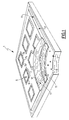
- FIGURE 1 is an isometric view, in partial cutaway, of a microelectronic circuit package incorporating the organic polymeric dielectric of the invention.
- FIGURE 2 is a flow chart of a method for fabricating a microelectronic circuit package incorporating the organic polymeric dielectric of the invention.
- Triazine resins are particulalrly desirable dielectric substrates for electronic circuit packages. Triazines are produced by the reaction 3 dicyanate ---- > tri(azine), 3 NCO-R-OCN---- >-
- One reason for the desirability of poly (triazines) is that, like epoxy resins, poly (triazines) process through a B-stage. This is a particulalr advantage in processing.
- the preferred poly (triazines) of the invention have outstanding high temperature properties, i.e., a glass transition temperature, T g , of 250° Centigrade to 290° Centigrade.
- the preferred poly (trizaines) also have desirable electrical properties, such as a reasonably low dielectric constant, E r , of 2.6 to 3.0.
- thermoplastic filler is dispersed in a triazine percursor, which is then polymerized.
- the incorporation of a thermoplastic filler in the triazine precursor, and the polymerization of the triazine with the dispersed filler results in a poly (triazine) matrix characterized by high resistance to cracking, especially during such operations as punch pressing.
- the preferred fillers are thermally stable fillers that do materially increase the dielectric constant of the composition.
- Exemplary fillers are polyimides and polyfluorocarbons.
- dispersed thermoplastic polymeric fillers are used to reduce brittleness and impart microcracking resistance to triazine, while preserving the low dielectric constant of the triazine host matrix.
- Exemplary fillers included polyimides, especially aromatic polyimides, and polyfluorocarbons, especially aliphatic polyfluorocarbons.
- the circuit package of the invention has a core formed of dispersed thermoplastic polymer filled and reinforced, low dielectric constant, poly (triazine) core, with surface circuitization on at least one exterior surface.
- the surface circuitization is adapted to receive an integrated circuit.
- the poly(triazine) may be a symmetrical, homopolymeric polymerization product of dicyanate diphenyl hexafluoro isopropane. where AR represents C6H4.
- the poly(triazine) may be a copolymer, for example, a copolymer of (1) a first dicynate having the formula NCO-R1-OCN, and (2) a second dicynate having the formula NCO-R2-OCN, where the R's are different moieties chosen from the group consisting of aromatics and aliphatics.
- one of R1 and R2 is diphenyl hexafluoropropane, -C6H4-((CF3)C(CF3))-C6H4- and the other of R1 and R2 is bisphenol M, -C6H4-((CH3)C(CH3))-C6H4-((CH3)C(CH3))-C6H4-.
- the filler is a dispersed, low dielectric constant polymer, such as a poly-fluorocarbon, or a polyimide.
- the preferred fillers have a low enough dielectric constant to maintain the dielectric constant of the composite below approximately 3.0, while increasing the crack resistance of the resulting composite.
- Polyimide fillers meeting these criteria are generally reaction products of (1) tetracarboxylic dianhydrides and (2) aromatic diamines.
- Particularly preferred polyimide fillers are particles and fibers formed of copolymers of
- This copolymer has the structure represented by: where R is or These polyimides include UPILEX-R BPDA-ODA, UPILEX-S BPDA-PDA.
- Polyfluorocarbon fillers meeting these criteria include TEFLON MP-1000, and TEFLON FLUO 300.
- the filler may be in the form of spherical particles, as particles having a mass average particle size of about 5 micrometer to about 15 micrometer.
- the loading of the filler is from about 5 weight percent to about 15 weight percent of the composite.
- the composite is particularly useful as a layer in a multi-layer printed circuit card or board used in electronic packaging.
- the printed circuit board or card, 1, shown in FIGURE 1, and also referred to as an electronic circuit package is capable of and adapted to receive at least one microelectronic integrated circuit chip, 5.
- the IC chip, 5, has leads, 7, for example, signal leads, 7a, a power lead, 7b, and a ground lead, 7c, communicating with corresponding circuit elements in the circuit package, 1, through a chip carrier, 9.
- the circuit package, 1, is a laminate of individual cores, 11, at least one layer or core 11 comprising a substrate of the above described organic polymeric dielectric composite. Individual layers, 11, of the package 1 may carry power cores, buried signal circuitization, or external signal circuitization 17.
- a method of fabricating a circuit board layer for incoproration in a multi-layer circuit board or card includes the steps of providing an organic polymeric film, that is, a poly (triazine) film.
- the polytriazine film is formed by forming a monomeric or pre-polymeric (e.g., a B stage resin) composition of triazine precursors, filler, and polymerization catalyst in a solvent.
- the starting composition may be a monomeric or prepolymeric (B-stage resin) composition of, solely by way of illustration and not limitation, 100 parts of monomer, polymer, or B-stage resin, such as AROCY 6F, about 0.5 to about 1.5 parts polymerization catalyst, as Zinc Octoate, in about 75 to about 125 parts of a solvent, as methyl ethyl ketone (concentrations are based on 100 parts of triazine precursor). About 5 to 45 parts of filler particles are then added to the composition, and stirred with a high shear mixer.
- B-stage resin monomeric or prepolymeric composition of, solely by way of illustration and not limitation, 100 parts of monomer, polymer, or B-stage resin, such as AROCY 6F, about 0.5 to about 1.5 parts polymerization catalyst, as Zinc Octoate, in about 75 to about 125 parts of a solvent, as methyl ethyl ketone (concentrations are based on 100 parts of triazine precursor).
- concentration are
- the monomeric or prepolymeric (B-stage resin) composition may be applied to a suitable substrate, including a fibrous body or mat, or to a sacrificial substrate, for example, by dipping, spraying, or otherwise coating the substrate.
- a suitable substrate including a fibrous body or mat, or to a sacrificial substrate, for example, by dipping, spraying, or otherwise coating the substrate.
- the substrate, or a fibrous body to be coated is fed through a dip tank or bath of the triazine precursors, filler, solvent, and polymerization catalyst.
- a drying step may be carried out at this time.
- the coated sacrificial substrate is laminated to a metal foil, i.e., the core, and the sacrificial substrate is peeled away.
- the monomeric solution is then dried, for example by heating the wet film to drive off solvents, and subsequent polymerization of the triazine. Lamination may be repeated several times to build up a thick layer of laminated material.
- the material is cured to form a poly (triazine) matrix.
- the matrix may be a B-stage resin or a substantially cross-linked matrix.
- Polymerization may be carried out by heating the composition hot enough to react the monomeric constituents of the triazine and form a pre-polymer (B-stage resin), or a substantially fully cross-linked matrix. Pressing or even lamination can be combined with polymerization.
- the monomer, pre-polymer, or B-stage resin may be polymerized in a lamination press.
- Lamination and curing may, alternatively, be carried out in multiple steps, for example in a two-step process, such as 30 minutes at 200 degrees Centigrade followed by 35 minutes at 250 to 300 degrees Centigrade.
- curing is done at elevated temperature, e.g., at a time -temperature program including heating the laminate or composite to 200 degrees Centigrade and maintaining the laminate or composite at 200 degrees Centigrade for ten minutes to an hour, and therafter heating the laminate or composite to 300 degrees Centigrade and maintaining the laminate or composite at 300 degrees Centigrade for ten minutes to an hour or longer. In this way substantially complete cross linking is achieved. Throughout this time the laminate is maintained under pressure.
- the cure may be partial, to obtain a partially cross-linked resin, i.e., a "B-stage” resin, which may be mechanically worked, laminated, and cured.
- a thin sheet of the filled triazine dielectric is formed. These sheets may be built up to form a free standing film of the filled triazine.
- the polytriazine film is formed by forming a monomeric or pre-polymeric (B-stage resin) composition of triazine precursors, filler, and polymerization catalyst in a solvent.
- the monomeric or pre-polymeric composition may be applied to a web, as a fiberglass web or a polymeric web, by drawing the web through a tank of the monomeric or pre-polymeric material, or by spraying the web with monomeric or pre-polymeric material.
- a web is formed of a low dielectric constant material as poly-tetrafluoroethylene.
- a drying step may be carried out at this time.
- the monomer or pre-polymer bearing web is then drawn through curing means to form a pre-preg.
- a plurality of filled poly (triazine) resin pre-preg sheets, optionally with adhesive between the individual sheets, are laminated at elevated temperature and pressure to form a substrate, e.g., a free standing substrate.
- the B-stage resin may be polymerized to cross link the poly (triazide) in a lamination press at an applied pressure of about 2.07 x 10⁶ N/m2 to about 3.45 x 10⁶ N/m2 (about 300 pounds per square inch to about 500 pounds per square inch).
- Subsequent steps include core lamination, power core circuitization, buried signal circuitization, panel lamination, external circuitization, and application of contacts. It is of course to be understood that circuitization and lamination are carried out in various sequences to form power cores, internal circuitization, external circuitization, and contacts, leads, and housings.
- a free-standing film of poly (triazine) may be prepared.
- a polyimide film as a film of a copolymer of 3,3',4,4'-biphenylenetetracarboxylic dianhydride and p-phenylene diamine (commercially known as Upilex (R) S), with a dicyanate precursor of poly (triazine).
- R Upilex
- the opposite surface, or surfaces, of the dicyanate precursor of poly (triazine) may then be coated, for example with a Cu foil, or with a Mylar (R) film.
- the dicyanate precursor of poly (triazine) is then held in compression, for example by drawing a vacuum on bearing surfaces, and heated to form a polymerizate of a sticky, gummy film.
- the Upilex (R) film peeled away, leaving a Cu-poly(triazine) laminate.
- the dicyanate has been coated with a Mylar (R) film
- the Mylar (R) and Upilex (R) films can be peeled away, leaving a free standing poly(triazine) film.
- the poly(triazine) film can be used to form an adhesive between sheets of Cu foil, or to build up a thick film of poly (triazine).
Landscapes
- Engineering & Computer Science (AREA)
- Microelectronics & Electronic Packaging (AREA)
- Macromolecular Compounds Obtained By Forming Nitrogen-Containing Linkages In General (AREA)
- Compositions Of Macromolecular Compounds (AREA)
- Laminated Bodies (AREA)
- Reinforced Plastic Materials (AREA)
Applications Claiming Priority (2)
| Application Number | Priority Date | Filing Date | Title |
|---|---|---|---|
| US07/848,772 US5250347A (en) | 1992-03-10 | 1992-03-10 | Mechanically enhanced, high impact strength triazine resins, and method of preparing same |
| US848772 | 1992-03-10 |
Publications (2)
| Publication Number | Publication Date |
|---|---|
| EP0560084A2 true EP0560084A2 (de) | 1993-09-15 |
| EP0560084A3 EP0560084A3 (en) | 1995-08-16 |
Family
ID=25304227
Family Applications (1)
| Application Number | Title | Priority Date | Filing Date |
|---|---|---|---|
| EP19930102335 Withdrawn EP0560084A3 (en) | 1992-03-10 | 1993-02-15 | Mechanically enhanced, high impact strength triazine resins, and method of preparing same |
Country Status (3)
| Country | Link |
|---|---|
| US (1) | US5250347A (de) |
| EP (1) | EP0560084A3 (de) |
| JP (1) | JP2510065B2 (de) |
Cited By (1)
| Publication number | Priority date | Publication date | Assignee | Title |
|---|---|---|---|---|
| EP0601354A3 (en) * | 1992-12-09 | 1994-08-17 | Ibm | Dicyanate prepolymers, use and preparation thereof. |
Families Citing this family (4)
| Publication number | Priority date | Publication date | Assignee | Title |
|---|---|---|---|---|
| JPH07312468A (ja) * | 1994-05-18 | 1995-11-28 | Yamaichi Electron Co Ltd | フレキシブル回路基板 |
| US6500529B1 (en) * | 2001-09-14 | 2002-12-31 | Tonoga, Ltd. | Low signal loss bonding ply for multilayer circuit boards |
| US6783841B2 (en) | 2001-09-14 | 2004-08-31 | Tonoga, Inc. | Low signal loss bonding ply for multilayer circuit boards |
| JPWO2022211025A1 (de) * | 2021-03-31 | 2022-10-06 |
Family Cites Families (17)
| Publication number | Priority date | Publication date | Assignee | Title |
|---|---|---|---|---|
| DD210405A3 (de) * | 1982-05-20 | 1984-06-06 | Adw Ddr | Verfahren zur herstellung von poly-1,3,5-triazinen |
| US4456712A (en) * | 1982-06-14 | 1984-06-26 | International Business Machines Corporation | Bismaleimide triazine composition |
| JPS62160787A (ja) * | 1986-01-10 | 1987-07-16 | 東レ株式会社 | 回路基板 |
| US4970276A (en) * | 1986-01-23 | 1990-11-13 | Allied-Signal Inc. | Phenolic triazine copolymers based on pure cyanato novolacs |
| US4709008A (en) * | 1986-06-30 | 1987-11-24 | Interez, Inc. | Blend of tris (cyanatophenyl) alkane and bis(cyanatophenyl) alkane |
| US4740584A (en) * | 1986-09-08 | 1988-04-26 | Interez, Inc. | Blend of dicyanate esters of dihydric phenols |
| JPS63159441A (ja) * | 1986-12-23 | 1988-07-02 | Sumitomo Bakelite Co Ltd | 熱硬化性樹脂積層板 |
| JPS6426651A (en) * | 1987-01-06 | 1989-01-27 | Toray Industries | Production of prepreg |
| US4745215A (en) * | 1987-04-03 | 1988-05-17 | International Business Machines Corporation | Fluorine containing dicyanate resins |
| US5206074A (en) * | 1987-04-03 | 1993-04-27 | International Business Machines Corporation | Adhesives on polymide films and methods of preparing them |
| US4784901A (en) * | 1987-04-13 | 1988-11-15 | Japan Gore-Tex, Inc. | Flexible printed circuit board base material |
| US5089660A (en) * | 1988-01-22 | 1992-02-18 | The Dow Chemical Company | Aromatic polycyanate/monocyanate comonomer compositions and polytriazines derived therefrom |
| DE3802979A1 (de) * | 1988-02-02 | 1989-08-10 | Basf Ag | Waermehaertbare harzmischung |
| JP2623714B2 (ja) * | 1988-07-05 | 1997-06-25 | 三菱瓦斯化学株式会社 | ポリエーテルイミド変性シアナト樹脂の製造法 |
| JP2623713B2 (ja) * | 1988-07-05 | 1997-06-25 | 三菱瓦斯化学株式会社 | ポリサルホン変性シアナト樹脂の製造法 |
| DE69033132T2 (de) * | 1989-07-17 | 1999-11-18 | The Dow Chemical Co., Midland | Mesogene Polycyanate und Polycyanamide und ihre hitzegehärteten Gegenstände |
| US5108825A (en) * | 1989-12-21 | 1992-04-28 | General Electric Company | Epoxy/polyimide copolymer blend dielectric and layered circuits incorporating it |
-
1992
- 1992-03-10 US US07/848,772 patent/US5250347A/en not_active Expired - Fee Related
-
1993
- 1993-01-11 JP JP225993A patent/JP2510065B2/ja not_active Expired - Lifetime
- 1993-02-15 EP EP19930102335 patent/EP0560084A3/en not_active Withdrawn
Cited By (1)
| Publication number | Priority date | Publication date | Assignee | Title |
|---|---|---|---|---|
| EP0601354A3 (en) * | 1992-12-09 | 1994-08-17 | Ibm | Dicyanate prepolymers, use and preparation thereof. |
Also Published As
| Publication number | Publication date |
|---|---|
| JP2510065B2 (ja) | 1996-06-26 |
| US5250347A (en) | 1993-10-05 |
| EP0560084A3 (en) | 1995-08-16 |
| JPH0685107A (ja) | 1994-03-25 |
Similar Documents
| Publication | Publication Date | Title |
|---|---|---|
| US5103293A (en) | Electronic circuit packages with tear resistant organic cores | |
| CA1056541A (en) | Heat-resistant resin composition comprising polyaminobismaleimide, polyepoxy compound and aromatic vinyl copolymer and method for using the same | |
| US5527592A (en) | Multilayer article having a planarized outer layer comprising a toughened polycyanurate | |
| US6403221B1 (en) | Epoxy resin composition, and adhesive film and prepreg using the composition, and multilayer printed-wiring board using them, and process for manufacturing the same | |
| JP3184485B2 (ja) | 銅張積層板用樹脂組成物、樹脂付き銅箔、多層銅張り積層板および多層プリント配線板 | |
| KR101398342B1 (ko) | 수지 조성물, 프리프레그, 적층판 및 배선판 | |
| EP0202488B1 (de) | Hitzehärtbare Harzzusammensetzung, Schichtstoff und Herstellungsverfahren | |
| JP2967555B2 (ja) | 熱硬化性樹脂中に分散した熱可塑性ポリマーを含む熱硬化性樹脂組成物 | |
| KR101182026B1 (ko) | 열경화성 수지 조성물 및 그 용도 | |
| US6534181B2 (en) | Styrene-maleic anhydride copolymer and epoxy resin blend crosslinked with multifunctional amine compounds | |
| US5319244A (en) | Triazine thin film adhesives | |
| US5250347A (en) | Mechanically enhanced, high impact strength triazine resins, and method of preparing same | |
| US5206074A (en) | Adhesives on polymide films and methods of preparing them | |
| KR100523913B1 (ko) | 동박 부착 접착시트용 조성물 및 이를 이용한 동박 부착접착시트의 제조방법 | |
| JP2985642B2 (ja) | 金属張り積層板の製造方法 | |
| KR20000028796A (ko) | 빌드업 방법용 열경화성 수지 조성물 | |
| JPH10273532A (ja) | 積層板用樹脂組成物、該組成物を用いたプリプレグ及び積層板 | |
| JP3211608B2 (ja) | 銅張積層板の製法 | |
| JPH0747717B2 (ja) | ポリイミドフィルム上の接着剤及びそれらを製造する方法 | |
| JPH0229012B2 (ja) | Sekisoban | |
| JP2000063545A (ja) | 多層板形成材料及び多層板 | |
| JPS63291442A (ja) | Icチップ搭載用多層板の製造法 | |
| JP2002138199A (ja) | 積層板用樹脂組成物、該組成物を用いたプリプレグ及び積層板 | |
| JPH09254309A (ja) | コンポジット銅張積層板 | |
| JP2001206965A (ja) | 積層板 |
Legal Events
| Date | Code | Title | Description |
|---|---|---|---|
| PUAI | Public reference made under article 153(3) epc to a published international application that has entered the european phase |
Free format text: ORIGINAL CODE: 0009012 |
|
| AK | Designated contracting states |
Kind code of ref document: A2 Designated state(s): DE FR GB |
|
| 17P | Request for examination filed |
Effective date: 19931227 |
|
| PUAL | Search report despatched |
Free format text: ORIGINAL CODE: 0009013 |
|
| AK | Designated contracting states |
Kind code of ref document: A3 Designated state(s): DE FR GB |
|
| 17Q | First examination report despatched |
Effective date: 19970402 |
|
| STAA | Information on the status of an ep patent application or granted ep patent |
Free format text: STATUS: THE APPLICATION IS DEEMED TO BE WITHDRAWN |
|
| 18D | Application deemed to be withdrawn |
Effective date: 19970813 |