EP0546472B1 - Messeinrichtung zur Bestimmung der Konzentration von anorganischen und organischen Verbindungen in einer Probe - Google Patents
Messeinrichtung zur Bestimmung der Konzentration von anorganischen und organischen Verbindungen in einer Probe Download PDFInfo
- Publication number
- EP0546472B1 EP0546472B1 EP92120721A EP92120721A EP0546472B1 EP 0546472 B1 EP0546472 B1 EP 0546472B1 EP 92120721 A EP92120721 A EP 92120721A EP 92120721 A EP92120721 A EP 92120721A EP 0546472 B1 EP0546472 B1 EP 0546472B1
- Authority
- EP
- European Patent Office
- Prior art keywords
- measuring system
- sensor element
- component
- sample
- matrix
- Prior art date
- Legal status (The legal status is an assumption and is not a legal conclusion. Google has not performed a legal analysis and makes no representation as to the accuracy of the status listed.)
- Expired - Lifetime
Links
- 150000002894 organic compounds Chemical class 0.000 title claims description 7
- 239000000975 dye Substances 0.000 claims description 27
- 239000011159 matrix material Substances 0.000 claims description 24
- 229920000642 polymer Polymers 0.000 claims description 20
- OKKJLVBELUTLKV-UHFFFAOYSA-N Methanol Chemical compound OC OKKJLVBELUTLKV-UHFFFAOYSA-N 0.000 claims description 18
- LFQSCWFLJHTTHZ-UHFFFAOYSA-N Ethanol Chemical compound CCO LFQSCWFLJHTTHZ-UHFFFAOYSA-N 0.000 claims description 9
- 125000002496 methyl group Chemical group [H]C([H])([H])* 0.000 claims description 8
- 230000008961 swelling Effects 0.000 claims description 8
- YZCKVEUIGOORGS-OUBTZVSYSA-N Deuterium Chemical compound [2H] YZCKVEUIGOORGS-OUBTZVSYSA-N 0.000 claims description 7
- 229910052805 deuterium Inorganic materials 0.000 claims description 7
- 230000005284 excitation Effects 0.000 claims description 7
- LRHPLDYGYMQRHN-UHFFFAOYSA-N N-Butanol Chemical compound CCCCO LRHPLDYGYMQRHN-UHFFFAOYSA-N 0.000 claims description 6
- 229910052739 hydrogen Inorganic materials 0.000 claims description 6
- 239000001257 hydrogen Substances 0.000 claims description 6
- 150000002484 inorganic compounds Chemical class 0.000 claims description 6
- 230000004044 response Effects 0.000 claims description 6
- 230000035945 sensitivity Effects 0.000 claims description 5
- 150000002431 hydrogen Chemical class 0.000 claims description 4
- 238000006116 polymerization reaction Methods 0.000 claims description 4
- 239000012528 membrane Substances 0.000 claims description 3
- GNBHRKFJIUUOQI-UHFFFAOYSA-N fluorescein Chemical compound O1C(=O)C2=CC=CC=C2C21C1=CC=C(O)C=C1OC1=CC(O)=CC=C21 GNBHRKFJIUUOQI-UHFFFAOYSA-N 0.000 claims description 2
- BDERNNFJNOPAEC-UHFFFAOYSA-N propan-1-ol Chemical compound CCCO BDERNNFJNOPAEC-UHFFFAOYSA-N 0.000 claims description 2
- 230000005855 radiation Effects 0.000 claims description 2
- 150000001263 acyl chlorides Chemical group 0.000 claims 2
- 230000003287 optical effect Effects 0.000 claims 2
- 238000013494 PH determination Methods 0.000 claims 1
- 239000003269 fluorescent indicator Substances 0.000 claims 1
- NGNBDVOYPDDBFK-UHFFFAOYSA-N 2-[2,4-di(pentan-2-yl)phenoxy]acetyl chloride Chemical group CCCC(C)C1=CC=C(OCC(Cl)=O)C(C(C)CCC)=C1 NGNBDVOYPDDBFK-UHFFFAOYSA-N 0.000 description 13
- 239000000243 solution Substances 0.000 description 12
- OZAIFHULBGXAKX-UHFFFAOYSA-N 2-(2-cyanopropan-2-yldiazenyl)-2-methylpropanenitrile Chemical compound N#CC(C)(C)N=NC(C)(C)C#N OZAIFHULBGXAKX-UHFFFAOYSA-N 0.000 description 10
- GZAJOEGTZDUSKS-UHFFFAOYSA-N 5-aminofluorescein Chemical compound C12=CC=C(O)C=C2OC2=CC(O)=CC=C2C21OC(=O)C1=CC(N)=CC=C21 GZAJOEGTZDUSKS-UHFFFAOYSA-N 0.000 description 9
- 238000000034 method Methods 0.000 description 8
- 239000000523 sample Substances 0.000 description 8
- RYHBNJHYFVUHQT-UHFFFAOYSA-N 1,4-Dioxane Chemical compound C1COCCO1 RYHBNJHYFVUHQT-UHFFFAOYSA-N 0.000 description 7
- IMNFDUFMRHMDMM-UHFFFAOYSA-N N-Heptane Chemical compound CCCCCCC IMNFDUFMRHMDMM-UHFFFAOYSA-N 0.000 description 6
- MVPPADPHJFYWMZ-UHFFFAOYSA-N chlorobenzene Chemical compound ClC1=CC=CC=C1 MVPPADPHJFYWMZ-UHFFFAOYSA-N 0.000 description 6
- 238000005259 measurement Methods 0.000 description 6
- 229920002319 Poly(methyl acrylate) Polymers 0.000 description 5
- 150000001298 alcohols Chemical class 0.000 description 5
- 238000013459 approach Methods 0.000 description 5
- 150000001875 compounds Chemical class 0.000 description 5
- 150000004820 halides Chemical class 0.000 description 5
- IJGRMHOSHXDMSA-UHFFFAOYSA-N Atomic nitrogen Chemical compound N#N IJGRMHOSHXDMSA-UHFFFAOYSA-N 0.000 description 4
- CXOFVDLJLONNDW-UHFFFAOYSA-N Phenytoin Chemical compound N1C(=O)NC(=O)C1(C=1C=CC=CC=1)C1=CC=CC=C1 CXOFVDLJLONNDW-UHFFFAOYSA-N 0.000 description 4
- WYURNTSHIVDZCO-UHFFFAOYSA-N Tetrahydrofuran Chemical compound C1CCOC1 WYURNTSHIVDZCO-UHFFFAOYSA-N 0.000 description 4
- 239000003814 drug Substances 0.000 description 4
- 150000002334 glycols Chemical class 0.000 description 4
- 150000002500 ions Chemical class 0.000 description 4
- 229960002036 phenytoin Drugs 0.000 description 4
- 239000000126 substance Substances 0.000 description 4
- UFHFLCQGNIYNRP-UHFFFAOYSA-N Hydrogen Chemical compound [H][H] UFHFLCQGNIYNRP-UHFFFAOYSA-N 0.000 description 3
- 238000010791 quenching Methods 0.000 description 3
- 230000000171 quenching effect Effects 0.000 description 3
- 238000010992 reflux Methods 0.000 description 3
- 125000006850 spacer group Chemical group 0.000 description 3
- QGKMIGUHVLGJBR-UHFFFAOYSA-M (4z)-1-(3-methylbutyl)-4-[[1-(3-methylbutyl)quinolin-1-ium-4-yl]methylidene]quinoline;iodide Chemical compound [I-].C12=CC=CC=C2N(CCC(C)C)C=CC1=CC1=CC=[N+](CCC(C)C)C2=CC=CC=C12 QGKMIGUHVLGJBR-UHFFFAOYSA-M 0.000 description 2
- VEXZGXHMUGYJMC-UHFFFAOYSA-M Chloride anion Chemical compound [Cl-] VEXZGXHMUGYJMC-UHFFFAOYSA-M 0.000 description 2
- GATVIKZLVQHOMN-UHFFFAOYSA-N Chlorodibromomethane Chemical compound ClC(Br)Br GATVIKZLVQHOMN-UHFFFAOYSA-N 0.000 description 2
- LYCAIKOWRPUZTN-UHFFFAOYSA-N Ethylene glycol Chemical compound OCCO LYCAIKOWRPUZTN-UHFFFAOYSA-N 0.000 description 2
- CEAZRRDELHUEMR-URQXQFDESA-N Gentamicin Chemical compound O1[C@H](C(C)NC)CC[C@@H](N)[C@H]1O[C@H]1[C@H](O)[C@@H](O[C@@H]2[C@@H]([C@@H](NC)[C@@](C)(O)CO2)O)[C@H](N)C[C@@H]1N CEAZRRDELHUEMR-URQXQFDESA-N 0.000 description 2
- 229930182566 Gentamicin Natural products 0.000 description 2
- RWNKSTSCBHKHTB-UHFFFAOYSA-N Hexachloro-1,3-butadiene Chemical compound ClC(Cl)=C(Cl)C(Cl)=C(Cl)Cl RWNKSTSCBHKHTB-UHFFFAOYSA-N 0.000 description 2
- NNJVILVZKWQKPM-UHFFFAOYSA-N Lidocaine Chemical compound CCN(CC)CC(=O)NC1=C(C)C=CC=C1C NNJVILVZKWQKPM-UHFFFAOYSA-N 0.000 description 2
- PXHVJJICTQNCMI-UHFFFAOYSA-N Nickel Chemical compound [Ni] PXHVJJICTQNCMI-UHFFFAOYSA-N 0.000 description 2
- 229920002125 Sokalan® Polymers 0.000 description 2
- NIJJYAXOARWZEE-UHFFFAOYSA-N Valproic acid Chemical compound CCCC(C(O)=O)CCC NIJJYAXOARWZEE-UHFFFAOYSA-N 0.000 description 2
- 239000002253 acid Substances 0.000 description 2
- -1 alkyl radical Chemical class 0.000 description 2
- 229960004821 amikacin Drugs 0.000 description 2
- LKCWBDHBTVXHDL-RMDFUYIESA-N amikacin Chemical compound O([C@@H]1[C@@H](N)C[C@H]([C@@H]([C@H]1O)O[C@@H]1[C@@H]([C@@H](N)[C@H](O)[C@@H](CO)O1)O)NC(=O)[C@@H](O)CCN)[C@H]1O[C@H](CN)[C@@H](O)[C@H](O)[C@H]1O LKCWBDHBTVXHDL-RMDFUYIESA-N 0.000 description 2
- DIKBFYAXUHHXCS-UHFFFAOYSA-N bromoform Chemical compound BrC(Br)Br DIKBFYAXUHHXCS-UHFFFAOYSA-N 0.000 description 2
- RYYVLZVUVIJVGH-UHFFFAOYSA-N caffeine Chemical compound CN1C(=O)N(C)C(=O)C2=C1N=CN2C RYYVLZVUVIJVGH-UHFFFAOYSA-N 0.000 description 2
- 239000012876 carrier material Substances 0.000 description 2
- 125000002091 cationic group Chemical group 0.000 description 2
- 150000001805 chlorine compounds Chemical class 0.000 description 2
- 230000006735 deficit Effects 0.000 description 2
- 229940079593 drug Drugs 0.000 description 2
- 238000005516 engineering process Methods 0.000 description 2
- 229960002518 gentamicin Drugs 0.000 description 2
- 229960004194 lidocaine Drugs 0.000 description 2
- 230000007774 longterm Effects 0.000 description 2
- 238000004519 manufacturing process Methods 0.000 description 2
- 238000012544 monitoring process Methods 0.000 description 2
- 229910052757 nitrogen Inorganic materials 0.000 description 2
- DDBREPKUVSBGFI-UHFFFAOYSA-N phenobarbital Chemical compound C=1C=CC=CC=1C1(CC)C(=O)NC(=O)NC1=O DDBREPKUVSBGFI-UHFFFAOYSA-N 0.000 description 2
- 229960002695 phenobarbital Drugs 0.000 description 2
- 229920003229 poly(methyl methacrylate) Polymers 0.000 description 2
- 239000004584 polyacrylic acid Substances 0.000 description 2
- 239000004926 polymethyl methacrylate Substances 0.000 description 2
- 238000004313 potentiometry Methods 0.000 description 2
- 230000008569 process Effects 0.000 description 2
- LOUPRKONTZGTKE-LHHVKLHASA-N quinidine Chemical compound C([C@H]([C@H](C1)C=C)C2)C[N@@]1[C@H]2[C@@H](O)C1=CC=NC2=CC=C(OC)C=C21 LOUPRKONTZGTKE-LHHVKLHASA-N 0.000 description 2
- 150000003254 radicals Chemical class 0.000 description 2
- SQGYOTSLMSWVJD-UHFFFAOYSA-N silver(1+) nitrate Chemical compound [Ag+].[O-]N(=O)=O SQGYOTSLMSWVJD-UHFFFAOYSA-N 0.000 description 2
- 239000007787 solid Substances 0.000 description 2
- 239000007858 starting material Substances 0.000 description 2
- 238000003756 stirring Methods 0.000 description 2
- YLQBMQCUIZJEEH-UHFFFAOYSA-N tetrahydrofuran Natural products C=1C=COC=1 YLQBMQCUIZJEEH-UHFFFAOYSA-N 0.000 description 2
- ZFXYFBGIUFBOJW-UHFFFAOYSA-N theophylline Chemical compound O=C1N(C)C(=O)N(C)C2=C1NC=N2 ZFXYFBGIUFBOJW-UHFFFAOYSA-N 0.000 description 2
- 238000004809 thin layer chromatography Methods 0.000 description 2
- PAAZPARNPHGIKF-UHFFFAOYSA-N 1,2-dibromoethane Chemical compound BrCCBr PAAZPARNPHGIKF-UHFFFAOYSA-N 0.000 description 1
- XMNIXWIUMCBBBL-UHFFFAOYSA-N 2-(2-phenylpropan-2-ylperoxy)propan-2-ylbenzene Chemical compound C=1C=CC=CC=1C(C)(C)OOC(C)(C)C1=CC=CC=C1 XMNIXWIUMCBBBL-UHFFFAOYSA-N 0.000 description 1
- XNWFRZJHXBZDAG-UHFFFAOYSA-N 2-METHOXYETHANOL Chemical compound COCCO XNWFRZJHXBZDAG-UHFFFAOYSA-N 0.000 description 1
- WFSMVVDJSNMRAR-UHFFFAOYSA-N 2-[2-(2-ethoxyethoxy)ethoxy]ethanol Chemical compound CCOCCOCCOCCO WFSMVVDJSNMRAR-UHFFFAOYSA-N 0.000 description 1
- NHQDETIJWKXCTC-UHFFFAOYSA-N 3-chloroperbenzoic acid Chemical compound OOC(=O)C1=CC=CC(Cl)=C1 NHQDETIJWKXCTC-UHFFFAOYSA-N 0.000 description 1
- LRFVTYWOQMYALW-UHFFFAOYSA-N 9H-xanthine Chemical class O=C1NC(=O)NC2=C1NC=N2 LRFVTYWOQMYALW-UHFFFAOYSA-N 0.000 description 1
- 241001136792 Alle Species 0.000 description 1
- VYZAMTAEIAYCRO-UHFFFAOYSA-N Chromium Chemical compound [Cr] VYZAMTAEIAYCRO-UHFFFAOYSA-N 0.000 description 1
- RYGMFSIKBFXOCR-UHFFFAOYSA-N Copper Chemical compound [Cu] RYGMFSIKBFXOCR-UHFFFAOYSA-N 0.000 description 1
- PMATZTZNYRCHOR-CGLBZJNRSA-N Cyclosporin A Chemical compound CC[C@@H]1NC(=O)[C@H]([C@H](O)[C@H](C)C\C=C\C)N(C)C(=O)[C@H](C(C)C)N(C)C(=O)[C@H](CC(C)C)N(C)C(=O)[C@H](CC(C)C)N(C)C(=O)[C@@H](C)NC(=O)[C@H](C)NC(=O)[C@H](CC(C)C)N(C)C(=O)[C@H](C(C)C)NC(=O)[C@H](CC(C)C)N(C)C(=O)CN(C)C1=O PMATZTZNYRCHOR-CGLBZJNRSA-N 0.000 description 1
- 108010036949 Cyclosporine Proteins 0.000 description 1
- RTZKZFJDLAIYFH-UHFFFAOYSA-N Diethyl ether Chemical compound CCOCC RTZKZFJDLAIYFH-UHFFFAOYSA-N 0.000 description 1
- LPHGQDQBBGAPDZ-UHFFFAOYSA-N Isocaffeine Natural products CN1C(=O)N(C)C(=O)C2=C1N(C)C=N2 LPHGQDQBBGAPDZ-UHFFFAOYSA-N 0.000 description 1
- ZOKXTWBITQBERF-UHFFFAOYSA-N Molybdenum Chemical compound [Mo] ZOKXTWBITQBERF-UHFFFAOYSA-N 0.000 description 1
- YXOLAZRVSSWPPT-UHFFFAOYSA-N Morin Chemical compound OC1=CC(O)=CC=C1C1=C(O)C(=O)C2=C(O)C=C(O)C=C2O1 YXOLAZRVSSWPPT-UHFFFAOYSA-N 0.000 description 1
- KEECCEWTUVWFCV-UHFFFAOYSA-N N-acetylprocainamide Chemical compound CCN(CC)CCNC(=O)C1=CC=C(NC(C)=O)C=C1 KEECCEWTUVWFCV-UHFFFAOYSA-N 0.000 description 1
- 239000004793 Polystyrene Substances 0.000 description 1
- BUGBHKTXTAQXES-UHFFFAOYSA-N Selenium Chemical compound [Se] BUGBHKTXTAQXES-UHFFFAOYSA-N 0.000 description 1
- 238000010521 absorption reaction Methods 0.000 description 1
- 150000003926 acrylamides Chemical class 0.000 description 1
- HFBMWMNUJJDEQZ-UHFFFAOYSA-N acryloyl chloride Chemical compound ClC(=O)C=C HFBMWMNUJJDEQZ-UHFFFAOYSA-N 0.000 description 1
- 150000001346 alkyl aryl ethers Chemical class 0.000 description 1
- 125000003277 amino group Chemical group 0.000 description 1
- 229940126575 aminoglycoside Drugs 0.000 description 1
- 238000004458 analytical method Methods 0.000 description 1
- 230000003556 anti-epileptic effect Effects 0.000 description 1
- 239000001961 anticonvulsive agent Substances 0.000 description 1
- 229960003965 antiepileptics Drugs 0.000 description 1
- 229910052787 antimony Inorganic materials 0.000 description 1
- WATWJIUSRGPENY-UHFFFAOYSA-N antimony atom Chemical compound [Sb] WATWJIUSRGPENY-UHFFFAOYSA-N 0.000 description 1
- 229910052785 arsenic Inorganic materials 0.000 description 1
- RQNWIZPPADIBDY-UHFFFAOYSA-N arsenic atom Chemical compound [As] RQNWIZPPADIBDY-UHFFFAOYSA-N 0.000 description 1
- 125000003118 aryl group Chemical group 0.000 description 1
- ZYGHJZDHTFUPRJ-UHFFFAOYSA-N benzo-alpha-pyrone Natural products C1=CC=C2OC(=O)C=CC2=C1 ZYGHJZDHTFUPRJ-UHFFFAOYSA-N 0.000 description 1
- 239000008280 blood Substances 0.000 description 1
- 210000004369 blood Anatomy 0.000 description 1
- 230000036765 blood level Effects 0.000 description 1
- 150000001649 bromium compounds Chemical class 0.000 description 1
- 229950005228 bromoform Drugs 0.000 description 1
- GZUXJHMPEANEGY-UHFFFAOYSA-N bromomethane Chemical compound BrC GZUXJHMPEANEGY-UHFFFAOYSA-N 0.000 description 1
- 125000000484 butyl group Chemical group [H]C([*])([H])C([H])([H])C([H])([H])C([H])([H])[H] 0.000 description 1
- 229910052793 cadmium Inorganic materials 0.000 description 1
- BDOSMKKIYDKNTQ-UHFFFAOYSA-N cadmium atom Chemical compound [Cd] BDOSMKKIYDKNTQ-UHFFFAOYSA-N 0.000 description 1
- 229960001948 caffeine Drugs 0.000 description 1
- VJEONQKOZGKCAK-UHFFFAOYSA-N caffeine Natural products CN1C(=O)N(C)C(=O)C2=C1C=CN2C VJEONQKOZGKCAK-UHFFFAOYSA-N 0.000 description 1
- FFGPTBGBLSHEPO-UHFFFAOYSA-N carbamazepine Chemical compound C1=CC2=CC=CC=C2N(C(=O)N)C2=CC=CC=C21 FFGPTBGBLSHEPO-UHFFFAOYSA-N 0.000 description 1
- 229960000623 carbamazepine Drugs 0.000 description 1
- 239000000298 carbocyanine Substances 0.000 description 1
- 229940097217 cardiac glycoside Drugs 0.000 description 1
- 239000002368 cardiac glycoside Substances 0.000 description 1
- 150000001768 cations Chemical class 0.000 description 1
- 229920002678 cellulose Polymers 0.000 description 1
- 239000001913 cellulose Substances 0.000 description 1
- 230000008859 change Effects 0.000 description 1
- 238000006243 chemical reaction Methods 0.000 description 1
- 229910052804 chromium Inorganic materials 0.000 description 1
- 239000011651 chromium Substances 0.000 description 1
- 229960001265 ciclosporin Drugs 0.000 description 1
- LOUPRKONTZGTKE-UHFFFAOYSA-N cinchonine Natural products C1C(C(C2)C=C)CCN2C1C(O)C1=CC=NC2=CC=C(OC)C=C21 LOUPRKONTZGTKE-UHFFFAOYSA-N 0.000 description 1
- 229910017052 cobalt Inorganic materials 0.000 description 1
- 239000010941 cobalt Substances 0.000 description 1
- GUTLYIVDDKVIGB-UHFFFAOYSA-N cobalt atom Chemical compound [Co] GUTLYIVDDKVIGB-UHFFFAOYSA-N 0.000 description 1
- 239000000356 contaminant Substances 0.000 description 1
- 229920001577 copolymer Polymers 0.000 description 1
- 229910052802 copper Inorganic materials 0.000 description 1
- 239000010949 copper Substances 0.000 description 1
- 235000001671 coumarin Nutrition 0.000 description 1
- 150000004775 coumarins Chemical class 0.000 description 1
- 238000009795 derivation Methods 0.000 description 1
- 238000001514 detection method Methods 0.000 description 1
- LSXWFXONGKSEMY-UHFFFAOYSA-N di-tert-butyl peroxide Chemical compound CC(C)(C)OOC(C)(C)C LSXWFXONGKSEMY-UHFFFAOYSA-N 0.000 description 1
- 238000009792 diffusion process Methods 0.000 description 1
- UVTNFZQICZKOEM-UHFFFAOYSA-N disopyramide Chemical compound C=1C=CC=NC=1C(C(N)=O)(CCN(C(C)C)C(C)C)C1=CC=CC=C1 UVTNFZQICZKOEM-UHFFFAOYSA-N 0.000 description 1
- 229960001066 disopyramide Drugs 0.000 description 1
- 238000001035 drying Methods 0.000 description 1
- 230000009881 electrostatic interaction Effects 0.000 description 1
- 230000007613 environmental effect Effects 0.000 description 1
- 230000032050 esterification Effects 0.000 description 1
- 238000005886 esterification reaction Methods 0.000 description 1
- HAPOVYFOVVWLRS-UHFFFAOYSA-N ethosuximide Chemical compound CCC1(C)CC(=O)NC1=O HAPOVYFOVVWLRS-UHFFFAOYSA-N 0.000 description 1
- 229960002767 ethosuximide Drugs 0.000 description 1
- 125000001495 ethyl group Chemical group [H]C([H])([H])C([H])([H])* 0.000 description 1
- 238000011156 evaluation Methods 0.000 description 1
- 238000002474 experimental method Methods 0.000 description 1
- 238000001914 filtration Methods 0.000 description 1
- 239000007850 fluorescent dye Substances 0.000 description 1
- 230000006870 function Effects 0.000 description 1
- 229910001385 heavy metal Inorganic materials 0.000 description 1
- 125000005842 heteroatom Chemical group 0.000 description 1
- 238000004128 high performance liquid chromatography Methods 0.000 description 1
- 125000002887 hydroxy group Chemical group [H]O* 0.000 description 1
- WGCNASOHLSPBMP-UHFFFAOYSA-N hydroxyacetaldehyde Natural products OCC=O WGCNASOHLSPBMP-UHFFFAOYSA-N 0.000 description 1
- 239000012535 impurity Substances 0.000 description 1
- 239000003999 initiator Substances 0.000 description 1
- 229910010272 inorganic material Inorganic materials 0.000 description 1
- 230000003993 interaction Effects 0.000 description 1
- 230000002452 interceptive effect Effects 0.000 description 1
- 150000004694 iodide salts Chemical class 0.000 description 1
- 239000011133 lead Substances 0.000 description 1
- 230000003908 liver function Effects 0.000 description 1
- 239000000463 material Substances 0.000 description 1
- QSHDDOUJBYECFT-UHFFFAOYSA-N mercury Chemical compound [Hg] QSHDDOUJBYECFT-UHFFFAOYSA-N 0.000 description 1
- 229910052753 mercury Inorganic materials 0.000 description 1
- 229910052751 metal Inorganic materials 0.000 description 1
- 239000002184 metal Substances 0.000 description 1
- 239000000203 mixture Substances 0.000 description 1
- 229910052750 molybdenum Inorganic materials 0.000 description 1
- 239000011733 molybdenum Substances 0.000 description 1
- 239000000178 monomer Substances 0.000 description 1
- UXOUKMQIEVGVLY-UHFFFAOYSA-N morin Natural products OC1=CC(O)=CC(C2=C(C(=O)C3=C(O)C=C(O)C=C3O2)O)=C1 UXOUKMQIEVGVLY-UHFFFAOYSA-N 0.000 description 1
- 235000007708 morin Nutrition 0.000 description 1
- 229960000808 netilmicin Drugs 0.000 description 1
- ZBGPYVZLYBDXKO-HILBYHGXSA-N netilmycin Chemical compound O([C@@H]1[C@@H](N)C[C@H]([C@@H]([C@H]1O)O[C@@H]1[C@]([C@H](NC)[C@@H](O)CO1)(C)O)NCC)[C@H]1OC(CN)=CC[C@H]1N ZBGPYVZLYBDXKO-HILBYHGXSA-N 0.000 description 1
- 229910052759 nickel Inorganic materials 0.000 description 1
- 150000002823 nitrates Chemical class 0.000 description 1
- 150000002826 nitrites Chemical class 0.000 description 1
- 150000002828 nitro derivatives Chemical class 0.000 description 1
- 238000010606 normalization Methods 0.000 description 1
- 239000013307 optical fiber Substances 0.000 description 1
- 229920000620 organic polymer Polymers 0.000 description 1
- 230000035699 permeability Effects 0.000 description 1
- 239000007793 ph indicator Substances 0.000 description 1
- 125000001997 phenyl group Chemical group [H]C1=C([H])C([H])=C(*)C([H])=C1[H] 0.000 description 1
- QWYZFXLSWMXLDM-UHFFFAOYSA-M pinacyanol iodide Chemical class [I-].C1=CC2=CC=CC=C2N(CC)C1=CC=CC1=CC=C(C=CC=C2)C2=[N+]1CC QWYZFXLSWMXLDM-UHFFFAOYSA-M 0.000 description 1
- 229920002239 polyacrylonitrile Polymers 0.000 description 1
- 125000003367 polycyclic group Chemical group 0.000 description 1
- 150000004291 polyenes Chemical class 0.000 description 1
- 229920000193 polymethacrylate Polymers 0.000 description 1
- 229920002223 polystyrene Polymers 0.000 description 1
- 239000002244 precipitate Substances 0.000 description 1
- 230000001376 precipitating effect Effects 0.000 description 1
- 239000002243 precursor Substances 0.000 description 1
- 238000002360 preparation method Methods 0.000 description 1
- 125000002924 primary amino group Chemical group [H]N([H])* 0.000 description 1
- DQMZLTXERSFNPB-UHFFFAOYSA-N primidone Chemical compound C=1C=CC=CC=1C1(CC)C(=O)NCNC1=O DQMZLTXERSFNPB-UHFFFAOYSA-N 0.000 description 1
- 229960002393 primidone Drugs 0.000 description 1
- REQCZEXYDRLIBE-UHFFFAOYSA-N procainamide Chemical compound CCN(CC)CCNC(=O)C1=CC=C(N)C=C1 REQCZEXYDRLIBE-UHFFFAOYSA-N 0.000 description 1
- 229960000244 procainamide Drugs 0.000 description 1
- 125000001436 propyl group Chemical group [H]C([*])([H])C([H])([H])C([H])([H])[H] 0.000 description 1
- 229960001404 quinidine Drugs 0.000 description 1
- 238000010526 radical polymerization reaction Methods 0.000 description 1
- 238000009419 refurbishment Methods 0.000 description 1
- 230000002441 reversible effect Effects 0.000 description 1
- PYWVYCXTNDRMGF-UHFFFAOYSA-N rhodamine B Chemical compound [Cl-].C=12C=CC(=[N+](CC)CC)C=C2OC2=CC(N(CC)CC)=CC=C2C=1C1=CC=CC=C1C(O)=O PYWVYCXTNDRMGF-UHFFFAOYSA-N 0.000 description 1
- 229910052711 selenium Inorganic materials 0.000 description 1
- 239000011669 selenium Substances 0.000 description 1
- 229910001961 silver nitrate Inorganic materials 0.000 description 1
- 230000035943 smell Effects 0.000 description 1
- 239000002904 solvent Substances 0.000 description 1
- 230000003595 spectral effect Effects 0.000 description 1
- 229930002534 steroid glycoside Natural products 0.000 description 1
- 150000008143 steroidal glycosides Chemical class 0.000 description 1
- 229940065721 systemic for obstructive airway disease xanthines Drugs 0.000 description 1
- 229960000278 theophylline Drugs 0.000 description 1
- 231100001274 therapeutic index Toxicity 0.000 description 1
- 229960000707 tobramycin Drugs 0.000 description 1
- NLVFBUXFDBBNBW-PBSUHMDJSA-S tobramycin(5+) Chemical compound [NH3+][C@@H]1C[C@H](O)[C@@H](C[NH3+])O[C@@H]1O[C@H]1[C@H](O)[C@@H](O[C@@H]2[C@@H]([C@@H]([NH3+])[C@H](O)[C@@H](CO)O2)O)[C@H]([NH3+])C[C@@H]1[NH3+] NLVFBUXFDBBNBW-PBSUHMDJSA-S 0.000 description 1
- 238000011144 upstream manufacturing Methods 0.000 description 1
- 210000002700 urine Anatomy 0.000 description 1
- 229960000604 valproic acid Drugs 0.000 description 1
Images


Classifications
-
- G—PHYSICS
- G01—MEASURING; TESTING
- G01N—INVESTIGATING OR ANALYSING MATERIALS BY DETERMINING THEIR CHEMICAL OR PHYSICAL PROPERTIES
- G01N21/00—Investigating or analysing materials by the use of optical means, i.e. using sub-millimetre waves, infrared, visible or ultraviolet light
- G01N21/62—Systems in which the material investigated is excited whereby it emits light or causes a change in wavelength of the incident light
- G01N21/63—Systems in which the material investigated is excited whereby it emits light or causes a change in wavelength of the incident light optically excited
- G01N21/64—Fluorescence; Phosphorescence
- G01N21/6428—Measuring fluorescence of fluorescent products of reactions or of fluorochrome labelled reactive substances, e.g. measuring quenching effects, using measuring "optrodes"
-
- G—PHYSICS
- G01—MEASURING; TESTING
- G01N—INVESTIGATING OR ANALYSING MATERIALS BY DETERMINING THEIR CHEMICAL OR PHYSICAL PROPERTIES
- G01N21/00—Investigating or analysing materials by the use of optical means, i.e. using sub-millimetre waves, infrared, visible or ultraviolet light
- G01N21/62—Systems in which the material investigated is excited whereby it emits light or causes a change in wavelength of the incident light
- G01N21/63—Systems in which the material investigated is excited whereby it emits light or causes a change in wavelength of the incident light optically excited
- G01N21/64—Fluorescence; Phosphorescence
-
- G—PHYSICS
- G01—MEASURING; TESTING
- G01N—INVESTIGATING OR ANALYSING MATERIALS BY DETERMINING THEIR CHEMICAL OR PHYSICAL PROPERTIES
- G01N21/00—Investigating or analysing materials by the use of optical means, i.e. using sub-millimetre waves, infrared, visible or ultraviolet light
- G01N21/75—Systems in which material is subjected to a chemical reaction, the progress or the result of the reaction being investigated
- G01N21/77—Systems in which material is subjected to a chemical reaction, the progress or the result of the reaction being investigated by observing the effect on a chemical indicator
- G01N21/7703—Systems in which material is subjected to a chemical reaction, the progress or the result of the reaction being investigated by observing the effect on a chemical indicator using reagent-clad optical fibres or optical waveguides
- G01N2021/7706—Reagent provision
- G01N2021/773—Porous polymer jacket; Polymer matrix with indicator
-
- G—PHYSICS
- G01—MEASURING; TESTING
- G01N—INVESTIGATING OR ANALYSING MATERIALS BY DETERMINING THEIR CHEMICAL OR PHYSICAL PROPERTIES
- G01N21/00—Investigating or analysing materials by the use of optical means, i.e. using sub-millimetre waves, infrared, visible or ultraviolet light
- G01N21/75—Systems in which material is subjected to a chemical reaction, the progress or the result of the reaction being investigated
- G01N21/77—Systems in which material is subjected to a chemical reaction, the progress or the result of the reaction being investigated by observing the effect on a chemical indicator
- G01N2021/7769—Measurement method of reaction-produced change in sensor
- G01N2021/7786—Fluorescence
Definitions
- Titrimetric determinations e.g. silver nitrate determination according to Fajans
- photometric determinations e.g. photometric determinations
- potentiometric methods using ion-selective electrodes e.g. silver nitrate determination according to Fajans
- ion-selective electrodes e.g. silver nitrate determination according to Fajans
- potentiometric methods using ion-selective electrodes described for example in: Cammann, Working with ion-selective electrodes, Springer-Verlag, 1977, page 72 ff.
- chloride is essentially determined using photometric and potentiometric methods.
- the titrimetric and photometric determinations are very precise, but rather labor intensive and not suitable for continuous measurement.
- the methods using ion-selective membranes are suitable for continuous measurement; their low specificity and their sometimes low long-term stability are disadvantageous.
- a second electrode is required as a reference electrode for each potentiometric measurement.
- a good determination of the concentration of halides and acid halides is possible, for example, with the aid of a measuring device consisting of a sensor element to be brought into contact with the sample, which contains a fluorescence-optical indicator that fluoresces after irradiation with an excitation light source depending on the halide concentration present (AT -B-384 891).
- the indicator which is present in cationic form, comes from the group of (hetero) aromatic, polycyclic compounds and polyene dyes and is covalently in a thin layer via so-called spacer groups, which are arranged between the surface of the support and the indicator molecules, to the surface of a solid support bound.
- the carrier material comes from the group of organic polymers, such as poly (meth) acrylates, poly (meth) acrylamides, polyacrylonitriles, polystyrene or cellulose.
- organic polymers such as poly (meth) acrylates, poly (meth) acrylamides, polyacrylonitriles, polystyrene or cellulose.
- Molecular groups are used here as spacer groups which extend the distance between the solid support and the indicator molecule by at least the length of a CH 2 unit or a phenyl nucleus.
- the spacer groups essentially serve to avoid an interaction between the dye component and the carrier material, which leads to a restricted mobility and thus to a reduced sensitivity of the dye component.
- the immobilized dye can only be quenched sufficiently in cationic form, since the hydrophilicity of the support is not sufficient to allow the chloride ions to penetrate into the support material, so that the dye is quenched only on the support surface. Since the dye is only present in small amounts, the hydrophilicity of the support is only influenced to a very slight extent by electrostatic interactions of the dye cations.
- the invention is therefore essentially the task of avoiding the disadvantages of the known methods and devices for performing these methods and in particular to provide a measuring device which is characterized by high sensitivity and accuracy, allows a continuous measuring process and their Geometry can be tailored to the different areas of application.
- the present invention solves this problem and relates to a measuring device for determining the concentrations of inorganic and organic compounds in a sample, with a sensor to be brought into contact with the sensor, which contains a fluorescence-optical indicator which, after excitation via an excitation light source as a function of the present one Concentration of the inorganic or organic compound to be detected fluoresces. Furthermore, the measuring device has an arrangement for measuring and evaluating the irradiated radiation and the re-emitted fluorescent light.
- Suitable matrix compounds are compounds of the formula I, or copolymers of these compounds, preferably those in which R 1 , R 2 and / or R 3 are hydrogen or methyl, in particular compounds in which R 1 , R 2 and / or R 3 is hydrogen or deuterium.
- the matrix component is produced by radical polymerization of one or more acid chlorides of the formula II using a radical starter.
- Suitable radical initiators are, for example, azo-bis-isobutyronitrile (AIBN), tert-butyl peroxide, m-chloro-perbenzoic acid and dicumyl peroxide, preferably AIBN.
- AIBN azo-bis-isobutyronitrile
- tert-butyl peroxide tert-butyl peroxide
- m-chloro-perbenzoic acid preferably AIBN.
- dicumyl peroxide preferably AIBN.
- functional units here the dye component, for example 4- or 5-aminofluorescein, are covalently immobilized on the linear basic chain of the matrix component.
- the dye is used in a strong deficit, preferably in less than 2 mol%, in particular in the range from 0.01 to 1 mol%, based on the matrix component (a).
- Suitable dye components are, for example, fluorescein or cyanine dyes, but also the known pH indicators and chemiluminescent dyes, in particular dyes which contain hydroxyl or amino groups.
- Examples include fluoresceinamine, rhodamine, coumarins, the phthalo- and carbocyanines and other representatives of the cyanine dyes.
- All alcohols in particular straight-chain or branched C 1 -C 6 alcohols, as well as glycols, for example C 1 -C 4 monoalkyl ether glycol, are generally suitable as swelling components, preferably methanol, ethanol, propanol or butanol and ethylene glycol monomethyl ether and di- and triethylene glycol monoethyl ether are used.
- swelling component which is used in excess, preferably in a 2 to 6-fold excess, based on the matrix component (a)
- the remaining free acid chloride groups of the matrix component (approx. 99%) on which there is still no dye molecule, esterified.
- the source component has the task of dominating the swellability of the overall system.
- the swellability of the matrix and thus the response time (time constant) of the sensor is influenced by varying the alkyl radical (methyl, ethyl via propyl to butyl).
- the permeability of the polymer matrix can thus be specifically adjusted to the hydrophilicity of the dye and the substance to be detected by varying the source component.
- glycols it is even possible to create a hygroscopic polymer matrix.
- the choice of the source component depends on the nature of the dye component, but regardless of its concentration. In the case of hydrophilic dyes, higher alcohols are generally used as the swelling component, while with increasing hydrophobicity of the dye component, short-chain alcohols and glycols are preferred.
- An increasing swellability of the matrix component leads to shorter time constants for the response time of the sensor, the response times being in the range from 0.3 seconds to 25 minutes, in particular in the range from 1 second to 20 minutes. In this way it is possible that the substance to be detected, which causes the fluorescence to be quenched by the dye, penetrates into the polymer matrix, so that it is used as a sensitive element over the entire volume range.
- the invention further relates to a method for detecting organic and inorganic traces with the aid of the measuring devices according to the invention.
- Figure 1 shows schematically a possible simple measuring device according to the invention.
- excitation light falls from a light source (L) onto the sensor element (S) and then passes through the sample space (P).
- the fluorescent light produced falls after passing through the secondary filter (F 2 ), which has the task of filtering out the excitation light onto a light detector (D).
- the electrical signal obtained here is amplified in an amplifier (V), optionally fed to a computing unit (R) and then an analog or digital evaluation (A) supplied. It is also possible to measure the fluorescent light in remission not after passing through a sample space (FIG. 2).
- the sample rooms can e.g. be designed as disposable measuring chambers or as flow cells.
- As light sources e.g. Incandescent lamps, lasers or LED-like arrangements are used that deliver light continuously or in a pulsed manner.
- Absorption filters or interference filters can be used as filters.
- Photoelectric photocells, electron multipliers or photodiodes can be used as light measuring devices.
- concentration of the substance to be determined is determined in the computer unit, although in practice it may often be necessary to reduce the incoming measurement signal or the measured fluorescence intensity by a background component or to carry out a normalization in order to arrive at the actual measurement signal.
- inorganic impurities such as nitrates, nitrites, halides, in particular chlorides, bromides and iodides, metal and Heavy metal ions, for example of lead, cobalt, copper, arsenic, antimony, cadmium, chromium, mercury, molybdenum, tallium, nickel and selenium, but also organic contaminants such as e.g. B. amino and nitro compounds, organic halides, e.g. B. detect bromomethane, chlorodibromomethane, ethylene dibromide, hexachlorobutadiene, bromoform and glycols.
- halides in particular chlorides, bromides and iodides, metal and Heavy metal ions, for example of lead, cobalt, copper, arsenic, antimony, cadmium, chromium, mercury, molybdenum, tallium, nickel and selenium, but also organic contaminants such as e.g. B. amino
- the measuring device according to the invention can be used for determining the pH value.
- phenytoin is particularly suitable in the field of medical technology for determining the concentration of therapeutically important pharmaceuticals (drug monitoring).
- examples of these are phenytoin, phenobarbital, primidone, carbamazepine, ethosuximide, valproic acid, lidocaine, phenytoin, procainamide, N-acetylprocainamide, quinidine, disopyramide, theophylline, caffeine, amicacin, gentamicin, netilmicin, tobramycin, chlorophylline, metamorphinoline, metamorphincinol, metotrecinol, metotrequinol Phenytoin, phenobarbital, lidocaine, phenytoin, amicacin, gentamicin, metotrexate and ciclosporin.
- some pharmaceuticals that have a very narrow therapeutic index such as some antiepileptics, xanthines, cardiac glycosides, antiarhythmics and aminoglycosides, must be dosed very precisely.
- the patient's blood picture, blood level, urine level and liver function are usually closely monitored.
- Sensors that can be used in the field of drug monitoring must have a high level of accuracy and a fast response time.
- the sensitivity of the sensor element of the measuring device according to the invention is up to 0.5 ng / ml, in particular 5 ng / ml with response times of 1 second to 20 minutes, depending on the nature of the dye used and the source component used and the substance to be detected.
- chlorobenzene was used instead of dioxane in the preparation of the polyacrylic acid chloride, and instead of precipitating the polymer into n-heptane, unreacted monomer was removed in a rotary evaporator.
- the acid chloride is mixed with chlorobenzene and AIBN in a 1 liter 3-necked flask with an oil bath, thermometer, N 2 inlet, reflux condenser and drying tube and flushed with nitrogen at room temperature for one hour. Both the starting compounds and the nitrogen were dried before use.
- the mixture is then polymerized at 70 ° C for 7 hours, then the solution is diluted with 200 ml of dioxane and stored in the refrigerator at 4 ° C overnight.
- Unused acid chloride is removed in a rotary evaporator at 70 ° C. under reduced pressure (20-400 mbar) until the distillate no longer smells of acid chloride. As soon as the polymer precipitates, 250 ml of dioxane are added. The polymer solution is then kept tightly closed in the refrigerator.
- Fluoresceinamine is used in strong deficit and completely acylated (thin layer chromatography (TLC) control) for one week at room temperature with stirring.
- the excess alcohol is then spun off and the remaining polymer is dissolved in dioxane.
- the polymer is precipitated in dried n-heptane and dried in vacuo.
- a total of 15 different polymers are thus produced from the 5 batches (A-E), which cover a fluoresceinamine fraction of 2 orders of magnitude and each contain 3 different esterified alcohols.
Landscapes
- Health & Medical Sciences (AREA)
- Chemical & Material Sciences (AREA)
- Immunology (AREA)
- Physics & Mathematics (AREA)
- General Physics & Mathematics (AREA)
- Analytical Chemistry (AREA)
- Biochemistry (AREA)
- General Health & Medical Sciences (AREA)
- Life Sciences & Earth Sciences (AREA)
- Nuclear Medicine, Radiotherapy & Molecular Imaging (AREA)
- Pathology (AREA)
- Chemical Kinetics & Catalysis (AREA)
- Optics & Photonics (AREA)
- Investigating Or Analysing Materials By The Use Of Chemical Reactions (AREA)
- Investigating, Analyzing Materials By Fluorescence Or Luminescence (AREA)
- Investigating Or Analyzing Non-Biological Materials By The Use Of Chemical Means (AREA)
Description
- Zur Bestimmung von organischen sowie anorganischen Spuren gibt es verschiedene Methoden. Seit langem bekannt sind beispielsweise die titrimetrischen Bestimmungen (z.B. Silbernitratbestimmung nach Fajans), photometrische Bestimmungen sowie beispielsweise potentiometrische Verfahren mit Hilfe von ionenselektiven Elektroden (beschrieben z.B. in: Cammann, Das Arbeiten mit ionenselektiven Elektroden, Springer-Verlag, 1977, Seite 72 ff.).
- Die Chloridbestimmung erfolgt in der klinischen Analytik im wesentlichen mit Hilfe photometrischer und potentiometrischer Verfahren. Die titrimetrischen und photometrischen Bestimmungen sind sehr genau, aber eher arbeitsaufwendig und nicht zur kontinuierlichen Messung geeignet. Die Verfahren mit Hilfe ionenselektiver Membranen sind zur kontinuierlichen Messung geeignet, nachteilig sind ihre geringe Spezifität und ihre zum Teil geringe Langzeitstabilität. Außerdem wird bei jeder potentiometrischen Messung eine zweite Elektrode als Referenzelektrode benötigt.
- Eine gute Konzentrationsbestimmung von Halogeniden und Säurehalogeniden ist beispielsweise mit Hilfe einer Meßeinrichtung möglich, die aus einem mit der Probe in Kontakt zu bringenden Sensorelement besteht, welches einen fluoreszenzoptischen Indikator enthält, der nach der Bestrahlung mit einer Anregungslichtquelle in Abhängigkeit von der vorliegenden Halogenidkonzentration fluoresziert (AT-B-384 891). Der Indikator, welcher in kationischer Form vorliegt, stammt dabei aus der Gruppe der (hetero)aromatischen, polycyclischen Verbindungen sowie Polyenfarbstoffe und ist in dünner Schicht kovalent über sogenannte Spacergruppen, welche zwischen der Oberfläche des Träger und den Indikatormolekülen angeordnet sind, an die Oberfläche eines festen Trägers gebunden. Das Trägermaterial stammt aus der Gruppe der organischen Polymere, wie Poly(meth)acrylate, Poly(meth)acrylamide, Polyacrylnitrile, Polystyrol oder Cellulose. Als Spacergruppen werden hier solche Molekülgruppierungen verwendet, welche den Abstand zwischen dem festen Träger und dem Indikatormolekül um mindestens die Länge einer CH2-Einheit oder eines Phenylkernes erweitern.
- Die Spacergruppen dienen im wesentlichen dazu eine Wechselwirkung zwischen der Farbstoffkomponente und dem Trägermaterial, welche zu einer eingeschränkten Beweglichkeit und somit zu einer verminderten Sensitivität der Farbstoffkomponente führt, zu vermeiden.
- Der immobilisierte Farbstoff kann hierbei nur in kationischer Form ausreichend gelöscht werden, da die Hydrophilie des Trägers nicht ausreicht, um die Chloridionen in das Trägermaterial eindringen zu lassen, so daß eine Fluoreszenzlöschung des Farbstoffs nur an der Trägeroberfläche erfolgt. Da der Farbstoff nur in geringen Mengen vorliegt, wird die Hydrophilie des Trägers über elektrostatische Wechselwirkungen der Farbstoffkationen nur in sehr geringem Maße beeinflußt.
- Der Nachteil der im Stand der Technik beschriebenen Verfahren ist, daß sie teilweise sehr arbeitsaufwendig und nicht zur kontinuierlichen Messung geeignet sind. Ferner weisen sie eine geringe Spezifität und Sensitivität sowie zum Teil eine geringe Langzeitstabilität auf.
- Der Erfindung stellt sich daher im wesentlichen die Aufgabe, die genannten Nachteile der bekannten Verfahren bzw. Einrichtungen zur Durchführung dieser Verfahren zu vermeiden und insbesondere eine Meßeinrichtung zur Verfügung zu stellen, welche sich durch eine hohe Empfindlichkeit und Genauigkeit auszeichnet, ein kontinuierliches Meßverfahren erlaubt und deren Geometrie auf die verschiedenen Anwendungsbereiche abgestimmt werden kann.
- Die vorliegende Erfindung löst diese Aufgabe und betrifft eine Meßeinrichtung zur Bestimmung von Konzentrationen anorganischer und organischer Verbindungen in einer Probe, mit einem mit der Probe in Kontakt zu bringenden Sensor, der einen fluoreszenzoptischen Indikator enthält, der nach Anregung über eine Anregungslichtquelle in Abhängigkeit von der vorliegenden Konzentration der zu detektierenden anorganischen oder organischen Verbindung fluoresziert. Ferner besitzt die Meßeinrichtung eine Anordnung zur Messung und Auswertung der eingestrahlten Strahlung und des reemmitierten Fluoreszenzlichtes.
- Die Meßeinrichtung beeinhaltet ein mit der Probe in Kontakt zu bringendes Sensorelement, das aus einer Polymermatrix besteht, die aus
- a) einer Matrixkomponente, welche sich von einer oder mehrerer Einheiten der Formel I ableitet

- R1-
- Wasserstoff, Deuterium oder Methyl bedeutet;
- R2- und R3-
- unabhängig voneinander für Wasserstoff, Deuterium oder Methyl stehen und der Polymerisationsgrad,
- n
- eine ganze Zahl im Bereich von 80 bis 2500, vorzugsweise von 200 bis 2000 ist;
- b) einer Farbstoffkomponente, die kovalent an den Säurechloridgruppen der Matrixkomponente immobilisiert ist und
- c) einer oder mehrerer Quellkomponenten, die kovalent an den verbleibenden freien Säurechloridgruppen der Matrixkomponente gebunden sind,
- Als Matrixverbindung eignen sich Verbindungen der Formel I, oder Copolymere dieser Verbindungen, vorzugsweise solche, in denen R1-, R2- und/oder R3-Wasserstoff oder Methyl sind, insbesondere Verbindungen in denen R1-, R2-und/oder R3-Wasserstoff oder Deuterium bedeuten. Die Matrixkomponente wird durch radikalische Polymerisation eines oder mehrer Säurechloride der Formel II mittels eines Radikalstarters hergestellt.
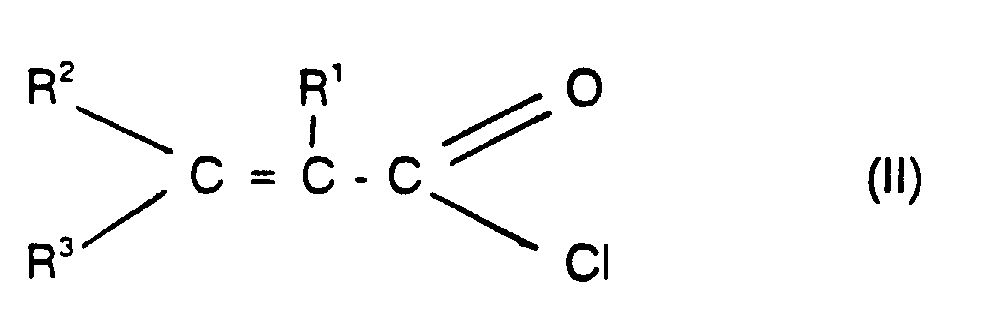
- Als Radikalstarter eignen sich beispielsweise Azo-bis-iso-butyronitril (AIBN), tert.-Butylperoxid, m-Chlor-perbenzoesäure und Dicumylperoxid, vorzugsweise AIBN. An der linearen Grundkette der Matrixkomponente werden in einem darauffolgenden Schritt funktionelle Einheiten, hier die Farbstoffkomponente, beispielsweise 4- oder 5-Aminofluorescein, kovalent immobilisiert.
- Der Farbstoff wird in einem starken Unterschuß, vorzugsweise in weniger als 2 mol-%, insbesondere im Bereich von 0,01 bis 1 mol-%, bezogen auf die Matrixkomponente (a), eingesetzt. Als Farbstoffkomponenten eignen sich beispielsweise Fluorescein- oder Cyaninfarbstoffe, aber auch die bekannten pH-Indikatoren und Chemolumineszenzfarbstoffe, insbesondere Farbstoffe die Hydroxy- oder Aminogruppen enthalten.
- Als Beispiele seien hier Fluoresceinamin, Rhodamine, Coumarine, die Phthalo- und Carbocyanine sowie weitere Vertreter der Cyaninfarbstoffe genannt.
- Als Quellkomponente eignen sich allgemein alle Alkohole, insbesondere geradkettige oder verzweigte C1-C6-Alkohole, sowie Glykole, beispielsweise C1-C4-Monoalkyletherglykol, vorzugsweise werden Methanol, Ethanol, Propanol oder Butanol sowie Ethylenglykolmonomethylether und Di- und Triethylenglykolmonoethylether verwendet. Mit Hilfe der Quellkomponente, die im Überschuß eingesetzt wird, vorzugsweise im 2- bis 6-fachen Überschuß, bezogen auf die Matrixkomponente (a), werden die restlichen freien Säurechloridgruppen der Matrixkomponente (ca. 99 %) an welchen sich noch kein Farbstoffmolekül befindet, verestert. Die Quellkomponente hat die Aufgabe, die Quellbarkeit des Gesamtsystems dominierend zu beeinflussen. Über eine Variation des Alkylrestes (Methyl, Ethyl über Propyl bis Butyl) wird die Quellbarkeit der Matrix und damit die Ansprechzeit (Zeitkonstante) des Sensors beeinflußt. So kann die Permeabilität der Polymermatrix durch Variation der Quellkomponente gezielt auf die Hydrophilie des Farbstoffs und der zu detektierenden Substanz eingestellt werden. Bei Verwendung von Glykolen ist es sogar möglich, eine hygroskopische Polymermatrix zu erzeugen.
- Eine gute Quellbarkeit der Matrixkomponente läßt sich beispielsweise mit Methanol erzielen. Die Wahl der Quellkomponente ist hierbei abhängig von der Natur der Farbstoffkomponente, jedoch unabhängig von deren Konzentration. Bei hydrophilen Farbstoffen werden in der Regel höhere Alkohole als Quellkomponente eingesetzt, während man mit zunehmender Hydrophobie der Farbstoffkomponente kurzkettigere Alkohole und Glykole bevorzugt. Eine zunehmende Quellbarkeit der Matrixkomponente führt hierbei zu kürzeren Zeitkonstanten für die Ansprechzeit des Sensors, wobei die Ansprechzeiten im Bereich von 0,3 Sekunden bis 25 Minuten, insbesondere im Bereich von 1 Sekunde bis 20 Minuten liegen. Auf diese Weise ist es möglich, daß die zu detektierende Substanz, die eine Fluoreszenzlöschung des Farbstoffs hervorruft, in die Polymermatrix eindringt, so daß diese über den gesamten Volumenbereich als sensitives Element genutzt wird.
- In einer weiteren Ausführungsform ist es möglich, verschiedene Quellkomponenten nacheinander in unterschiedlichen Konzentrationen an dem Matrixpolymer zu binden.
- Ferner betrifft die Erfindung ein Verfahren zur Detektion organischer und anorganischer Spuren mit Hilfe der erfindungsgemäßen Meßeinrichtungen.
- Die Detektion kann allgemein auf 3 verschiedenen Wegen erfolgen:
- a) durch Fluoreszenzlöschung
In Gegenwart von organischen oder anorganischen Verbindungen wird hierbei die Fluoreszenzintensität der Farbstoffmoleküle vermindert. Diese sogenannte Fluoreszenzlöschung ist reversibel, d.h. die Fluoreszenzintensität wird erst wieder maximal, wenn alle "Löschmoleküle" aus der Lösung entfernt worden sind; - b) durch eine spektrale Änderung des Fluoreszenzlichtes, d.h., daß die Lage des Maximums des Fluoreszenzlichts in Gegenwart von anorganischen oder organischen Verbindungen verschoben wird
oder aber - c) das Sensorelement enthält eine Vorstufe eines Fluoreszenzfarbstoffes (z.B. Morin), welcher mit der zu detektierenden Verbindung (z.B. Al3+) einen fluoreszierer den Komplex bildet, der dann detektiert wird.
- Figur 1 zeigt schematisch eine mögliche einfache Meßeinrichtung gemäß der Erfindung. Aus einer Lichtquelle (L) fällt Anregungslicht nach dem Passieren eines Primärfilters (F1), auf das Sensorelement (S) und passiert danach den Probenraum (P). Das entstehende Fluoreszenzlicht fällt nach Passieren des Sekundärfilters (F2), welcher die Aufgabe hat, das Anregungslicht herauszufiltern auf einen Lichtdetektor (D). Das hier erhaltene elektrische Signal wird in einem Verstärker (V) verstärkt, gegebenenfalls einer Recheneinheit (R) zugeführt und dann einer analogen oder digitalen Auswertung (A) zugeführt.
Es ist ferner möglich das Fluoreszenzlicht nicht nach Passieren eines Probenraumes, sondern in Remission zu messen (Figur 2). - Die Probenräume können z.B. als Einmalmeßkammern oder als Durchflußzellen ausgeführt sein. Als Lichtquellen können z.B. Glühlampen, Laser oder LED-artige Anordnungen dienen, die kontinuierlich oder gepulst Licht liefern. Als Filter können Absorptionsfilter oder Interferenzfilter eingesetzt werden. Als Lichtmeßeinrichtungen können lichtelektrische Photozellen, Elektronenvervielfacher oder Photodioden eingesetzt werden. In der Rechnereinheit wird die Konzentration des zu bestimmenden Stoffes bestimmt, wobei es in der Praxis oft notwendig werden kann, das ankommende Meßsignal bzw. die gemessene Fluoreszenzintensität um einen Untergrundanteil zu verringern oder eine Normierung durchzuführen, um auf das eigentliche Meßsignal zu kommen.
- Im Bedarfsfall kann es je nach Maßgabe der Erfordernisse zu verschiedenartigen Anordnungen und zur Verwendung anderer Bauteile kommen. So kann es z.B. notwendig werden, die Lichtzufuhr von der Lichtquelle zu dem Sensorelement sowie die Lichtableitung von dem Sensorelement zu den Detektoren mit Hilfe von Lichtwellenleitern (LWL) vorzunehmen (siehe Figur 3). Gegebenenfalls kann bei dieser Anordnung ein Kopplerelement (K) zwischengeschaltet sein.
- Weiterhin ist es möglich, dem Sensorelement semipermeable Membranen vorzuschalten, um die Diffusion der Löscher an die Indikatorschichten selektiver zu gestalten. Zur Trennung des Fluoreszenzsignals des Sensors von einer möglichen Störfluoreszenz des Probenmaterials kann es notwendig werden, optisch undurchlässige Trennschichten zwischen Probe und Sensor einzubauen, welche natürlich löscherdurchlässig sein müssen.
- Mit Hilfe des erfindungsgemäßen Meßeinrichtung lassen sich beispielsweise im Bereich der Umwelttechnik anorganische Verunreinigungen, wie z.B. Nitrate, Nitrite, Halogenide, insbesondere Chloride, Bromide und Iodide, Metall- und Schwermetallionen, beispielsweise von Blei, Cobalt, Kupfer, Arsen, Antimon, Cadmium, Chrom, Quecksilber, Molybdän, Tallium, Nickel und Selen, aber auch organische Verunreinigungen wie z. B. Amino- und Nitroverbindungen, organische Halogenide, z. B. Brommethan, Chlordibrommethan, Ethylendibromid, Hexachlorobutadien, Bromoform und Glykole nachweisen.
- In einer weiteren Ausführungsform läßt sich die erfindungsgemäße Meßeinrichtung zur pH-Wert-Bestimmung einsetzen.
- Ferner ist sie insbesondere im Bereich der Medizintechnik zur Konzentrationsbestimmung von therapeutisch bedeutsamen Pharmaka (Drug Monitoring) geeignet. Beispiele hierfür sind Phenytoin, Phenobarbital, Primidon, Carbamazepin, Ethosuximid, Valproinsäure, Lidocain, Phenytoin, Procainamid, N-azetylprocainamid, Chinidin, Disopyramid, Theophyllin, Coffein, Amicacin, Gentamicin, Netilmicin, Tobramycin, Metotrexat, Chloramphenicol und Ciclosporin, besonders Theophyllin, Phenytoin, Phenobarbital, Lidocain, Phenytoin, Amicacin, Gentamicin, Metotrexat und Ciclosporin.
- So müssen beispielsweise einige Pharmaka, die eine sehr geringe therapeutische Breite besitzen, wie einige Antiepileptika, Xanthine, Herzglykoside, Antiarhytmika und Aminoglykoside sehr genau dosiert werden. Hierzu werden üblicherweise Blutbild, Blutspiegel, Urinspiegel und Leberfunktion des Patienten genau überwacht. Sensoren die im Bereich des Drugmonitoring eingesetzt werden können, müssen eine hohe Genauigkeit und eine schnelle Ansprechzeit aufweisen.
- Die Empfindlichkeit des Sensorelements der erfindungsgemäßen Meßeinrichtung liegt bei bis zu 0,5 ng/ml, insbesondere bei 5 ng/ml bei Ansprechzeiten von 1 Sekunde bis 20 Minuten, je nach Natur des eingesetzten Farbstoffs und der verwendeten Quellkomponente sowie der zu detektierenden Substanz.
- Bei der Herstellung des Polyacrylsäurechlorids wurde im Gegensatz zu anderen in der Literatur beschriebenen Verfahren an Stelle von Dioxan Chlorbenzol verwendet, und anstatt einer Fällung des Polymers in n-Heptan wurde nicht umgesetztes Monomer im Rotationsverdampfer entfernt. Durch diese Maßnahmen konnte der Kontakt mit Luftfeuchtigkeit vermieden werden, der Umsatz von 10 % auf 77 % und der Polymerisationsgrad von anfangs 133 auf 1733 gesteigert werden.
-
200 g Acrylsäurechlorid = 2,2 mol (zuvor bei 92-96 °C destilliert (Fluka)) 200 g Chlorbenzol = 50 %ige Lsg. 723,4 mg AIBN (umkristallisiert) = 0,2 mol-% - In einem 1l 3-Halskolben mit Ölbad, Thermometer, N2-Einleitung, Rückflußkühler und Trockenrohr wird das Säurechlorid mit Chlorbenzol und AIBN vermischt und bei Raumtemperatur eine Stunde mit Stickstoff gespült. Sowohl die Ausgangsverbindungen, als auch der Stickstoff wurden vor Gebrauch getrocknet. Anschließend wird 7 Stunden lang bei 70 °C polymerisiert, danach die Lösung mit 200 ml Dioxan verdünnt und über Nacht im Kühlschrank bei 4°C aufbewahrt.
- Unverbrauchtes Säurechlorid wird im Rotationsverdampfer bei 70 °C bei vermindertem Druck (20-400 mbar) abgetrennt, bis das Destillat nicht mehr nach Säurechlorid riecht. Sobald das Polymer ausfällt, werden 250 ml Dioxan nachgefüllt. Anschließend wird die Polymerlösung gut verschlossen im Kühlschrank aufbewahrt.
- 8,808 g der Polymerlösung werden abgetrennt und mit 40 ml Methanol unter Rückfluß verestert. Das Methanol wird von dem entstehenden Polymethylacrylat (PMA) abgetrennt und das PMA im Vakuum getrocknet und gewogen.
- Ausbeute: 1,6316 g Polymer (PMA)
- Freies Säurechlorid: 125,5 g = 17,5 %
- Ausbeute der Polymerisation: 62,8 %
- Beschreibung der Walter-GPC-Anlage:
- Säulen: Ultrastyrogelsäulen
3 Stück: 500 Å, 103 Å, 104 Å, - Rl-Detektor Walter 410
- Pumpe: Walter Model 510 HPLC-Pumpe
- Lösungsmittel: Tetrahydrofuran (Riedel p.a.)
- Software: Walters Maxima 820
- Standard: PMMA von PSS Polymer Standards Service,
(Molmassen: 1080000, 710000, 530000, 280000, 152000, 96000, 52200, 24400, 13100, 6400, 2030, 1210) - Gewichtsmittel:
- 158278 g/mol
- Polydispersivität:
- 1,64
- Je 90 g der Polymerlösung werden hierzu mit 400 ml Dioxan (Riedel getrocknet) verdünnt und mit einer Fluoresceinaminlösung (Fluka) in Dioxan versetzt und unter Rühren aufbewahrt. In den folgenden Ansätzen A-E werden unterschiedliche Fluoreszeinamin-Konzentrationen bei sonst gleichen Herstellungsbedindungen umgesetzt.
Ansatz [mol-%] Säurechlorid Fluoresceinaminlösung in Dioxan [g] [mol] [mg] [mmol] [ml] A 0,010 mmol 90,26 0,24 9,33 0,027 20 B 0,041 mmol 90,05 0,24 41,3 0,119 20 C 0,082 mmol 90,10 0,24 82,5 0,238 40 D 0,171 mmol 89,95 0,24 175,0 0,504 60 E 0,818 mmol 90,33 0,24 838,7 2,415 100 - Fluoresceinamin wird im starken Unterschuß eingesetzt und eine Woche bei Raumtemperatur unter Rühren vollständig (Dünnschichtchromatrographie (DC)-Kontrolle) acyliert.
- Da durch die geringe Konzentration des Fluoreszeinamins nur relativ wenige Säurechloridgruppen aminiert werden (Ansatz A: 1,0∗10-2 mol-%, Ansatz E: 0,8 mol-%), werden die übrigen noch freien Säurechloridgruppen in getrennten Versuchen mit 3 verschiedenen Alkoholen verestert. Hierzu wird die jeweilige Lösung (Ansatz A-E) in 3 gleiche Teile aufgeteilt und jede Teillösung mit Methanol, Ethanol oder Butanol verestert. Der Alkohol wird im 5fachen Überschuß eingesetzt und 7 Stunden zusammen mit der Polymerlösung unter Rückfluß auf 60 bis 80°C erhitzt.
- Anschließend wird der überschüssige Alkohol abrotiert und das zurückbleibende Polymer in Dioxan gelöst. Das Polymer wird in getrocknetem n-Heptan gefällt und im Vakuum getrocknet.
- Aus den 5 Ansätzen (A-E) werden so insgesamt 15 verschiedene Polymere hergestellt, die einen Fluoreszeinaminanteil von 2 Größenordnungen abdecken und jeweils 3 verschiedene veresterte Alkohole enthalten.
Claims (10)
- Meßeinrichtung zur Bestimmung der Konzentration von anorganischen und organischen Verbindungen in einer Probe, mit einem mit der Probe in Kontakt zu bringenden Sensorelement, welches einen fluoreszenzoptischen Indikator enthält, der nach Anregung über eine Anregungslichtquelle in Abhängigkeit von der vorliegenden Konzentration der zu detektieren den anorganischen oder organischen Verbindung fluoresziert, und mit einer Anordnung zur Messung und Auswertung der eingestrahlten Strahlung und des reemittierten Fluoreszenzlichtes, dadurch gekennzeichnet, daß das mit der Probe in Kontakt zu bringende Sensorelement aus einer Polymermatrix besteht, die aus(a) einer Matrixkomponente, welche sich von einer oder mehrerer Einheiten der Formel I ableitet
 R1- Wasserstoff, Deuterium oder Methyl bedeutet undR2- und R3- unabhängig voneinander für Wasserstoff, Deuterium oder Methyl stehenund der Polymerisationsgrad n eine ganze Zahl im Bereich von 80 bis 2500 istund(b) einer Farbstoffkomponente, die kovalent an den Säurechloridgruppen der Matrixkomponente immobilisiert ist
und(c) einer oder mehrerer Ouellkomponenten, die kovalent an den verbleibenden freien Säurechloridgruppen der Matrixkomponente gebunden sind,herstellbar ist. - Meßeinrichtung nach Anspruch 1, dadurch gekennzeichnet, daß die Farbstoffkomponente der Polymermatrix aus der Gruppe der Fluoresceinfarbstoffe stammt.
- Meßeinrichtung nach Anspruch 1, dadurch gekennzeichnet, daß die Farbstoffkomponente im Bereich von 0,01 bis 1 mol-%, bezogen auf die Matrixkomponente (a) eingesetzt wird.
- Meßeinrichtung nach Anspruch 1, dadurch gekennzeichnet, daß als Quellkomponente Methanol, Ethanol, Propanol und/oder Butanol verwendet werden.
- Meßeinrichtung nach Anspruch 1, dadurch gekennzeichnet, daß die Quellkomponente im 2- bis 6-fachen Überschuß, bezogen auf die Matrixkomponente (a), eingesetzt wird.
- Meßeinrichtung nach Anspruch 1, dadurch gekennzeichnet, daß die Zeitkonstanten für die Ansprechzeit des Sensorelements im Bereich von 1 Sekunde bis 20 Minuten liegen.
- Meßeinrichtung nach Anspruch 1, dadurch gekennzeichnet, daß die Lichtzufuhr von der Lichtquelle zu dem Sensorelement sowie die Lichtableitung von dem Sensorelement zu den Detektoren mit Hilfe von Lichtwellenleiten erfolgt.
- Meßeinrichtung nach Anspruch 1, dadurch gekennzeichnet, daß dem Sensorelement semipermeable Membranen vorgeschaltet sind.
- Meßeinrichtung nach Anspruch 1, dadurch gekennzeichnet, daß die Empfindlichkeit des Sensorelements bei bis zu 0,5 ng/ml liegt.
- Meßeinrichtung nach Anspruch 1, dadurch gekennzeichnet, daß sie zur pH-Wert-Bestimmung eingesetzt wird.
Applications Claiming Priority (2)
| Application Number | Priority Date | Filing Date | Title |
|---|---|---|---|
| DE4140411 | 1991-12-07 | ||
| DE4140411A DE4140411A1 (de) | 1991-12-07 | 1991-12-07 | Messeinrichtung zur bestimmung der konzentration von anorganischen und organischen verbindungen in einer probe |
Publications (2)
| Publication Number | Publication Date |
|---|---|
| EP0546472A1 EP0546472A1 (de) | 1993-06-16 |
| EP0546472B1 true EP0546472B1 (de) | 1997-03-26 |
Family
ID=6446530
Family Applications (1)
| Application Number | Title | Priority Date | Filing Date |
|---|---|---|---|
| EP92120721A Expired - Lifetime EP0546472B1 (de) | 1991-12-07 | 1992-12-04 | Messeinrichtung zur Bestimmung der Konzentration von anorganischen und organischen Verbindungen in einer Probe |
Country Status (7)
| Country | Link |
|---|---|
| EP (1) | EP0546472B1 (de) |
| JP (1) | JPH05256784A (de) |
| KR (1) | KR100232781B1 (de) |
| AU (1) | AU655519B2 (de) |
| BR (1) | BR9204846A (de) |
| CA (1) | CA2084540A1 (de) |
| DE (2) | DE4140411A1 (de) |
Families Citing this family (6)
| Publication number | Priority date | Publication date | Assignee | Title |
|---|---|---|---|---|
| US5747349A (en) * | 1996-03-20 | 1998-05-05 | University Of Washington | Fluorescent reporter beads for fluid analysis |
| CA2331678C (en) * | 1998-05-19 | 2009-09-15 | Cepheid | Multi-channel optical detection system |
| KR100325437B1 (ko) * | 1999-04-17 | 2002-02-21 | 박종희 | 무선통신 선로 증폭회로 |
| CN101975767B (zh) * | 2010-08-13 | 2012-12-05 | 同济大学 | 一种测定水环境中溶解性有机物与金属离子结合潜势的方法 |
| US11662312B2 (en) | 2017-06-27 | 2023-05-30 | Coriolis Pharma Research GmbH | Polysorbate quantification assay |
| DE102019129922A1 (de) * | 2019-08-21 | 2021-02-25 | Endress+Hauser Conducta Gmbh+Co. Kg | Membranlage für eine Sensormembran zur Messung einer Konzentration eines Analyten in einem die Sensormembran berührenden Messfluid |
Family Cites Families (4)
| Publication number | Priority date | Publication date | Assignee | Title |
|---|---|---|---|---|
| US5019350A (en) * | 1986-02-13 | 1991-05-28 | Pfizer Hospital Products, Inc. | Fluorescent polymers |
| US4798738A (en) * | 1986-10-10 | 1989-01-17 | Cardiovascular Devices, Inc. | Micro sensor |
| JPS62263448A (ja) * | 1986-05-30 | 1987-11-16 | ザ・レ−ゲンツ・オブ・ザ・ユニバ−シテイ・オブ・カリフオルニヤ | pH監視装置 |
| US4925268A (en) * | 1988-07-25 | 1990-05-15 | Abbott Laboratories | Fiber-optic physiological probes |
-
1991
- 1991-12-07 DE DE4140411A patent/DE4140411A1/de not_active Ceased
-
1992
- 1992-12-04 AU AU29918/92A patent/AU655519B2/en not_active Ceased
- 1992-12-04 DE DE59208267T patent/DE59208267D1/de not_active Expired - Fee Related
- 1992-12-04 CA CA002084540A patent/CA2084540A1/en not_active Abandoned
- 1992-12-04 BR BR9204846A patent/BR9204846A/pt not_active Application Discontinuation
- 1992-12-04 EP EP92120721A patent/EP0546472B1/de not_active Expired - Lifetime
- 1992-12-05 KR KR1019920023377A patent/KR100232781B1/ko not_active Expired - Fee Related
- 1992-12-07 JP JP4327016A patent/JPH05256784A/ja active Pending
Also Published As
| Publication number | Publication date |
|---|---|
| DE4140411A1 (de) | 1993-06-09 |
| BR9204846A (pt) | 1993-06-15 |
| EP0546472A1 (de) | 1993-06-16 |
| CA2084540A1 (en) | 1993-06-08 |
| KR930013718A (ko) | 1993-07-22 |
| DE59208267D1 (de) | 1997-04-30 |
| AU655519B2 (en) | 1994-12-22 |
| AU2991892A (en) | 1993-06-10 |
| KR100232781B1 (ko) | 1999-12-01 |
| JPH05256784A (ja) | 1993-10-05 |
Similar Documents
| Publication | Publication Date | Title |
|---|---|---|
| DE69330834T2 (de) | Quantitative detektierung von makromolekülen mit hilfe von fluoreszierenden oligonukleotiden | |
| DE3343637C2 (de) | Sensorelement für fluoreszenzoptische pH-Messungen sowie Verfahren zu seiner Herstellung | |
| EP0461392B1 (de) | Testträger zur Bestimmung von Ionen | |
| DE2632556C2 (de) | Lichtzuführung für eine Vorrichtung zur optischen Messung von Stoffkonzentrationen | |
| DE69516272T2 (de) | Optische sensoren | |
| DE2851138A1 (de) | Faseroptische ph-sonde | |
| DE3751190T2 (de) | Sauerstoffkonzentrationsfühler. | |
| EP3051272A2 (de) | Verfahren zur bestimmung von lipiden und anderen störsubstanzen in körperflüssigkeitsproben | |
| WO1999006821A1 (de) | Verfahren und vorrichtung zur referenzierung von fluoreszenzintensitätssignalen | |
| EP0628805B1 (de) | Lumineszenzoptischer Indikator zur Bestimmung der Aktivität von Alkalimetallionen in einer Probenlösung | |
| DE3886084T2 (de) | Chromogenische Cryptahemispherande zum Elektrolytnachweis. | |
| EP0198815A2 (de) | Sensor zur Bestimmung von Elektrolytkonzentrationen | |
| DE3752148T2 (de) | Echtzeitabtastvorrichtung in einem Elektrophoreseapparat zur DNS-Sequenzbestimmung | |
| WO1992010740A1 (de) | Verfahren und vorrichtung zur kontinuierlichen und reversiblen messung der konzentration einer chemischen spezies | |
| DE69513683T2 (de) | Ionensensor und Verfahren zu dessen Herstellung | |
| AT390145B (de) | Verfahren zur bestimmung der konzentration von in einer substanz enthaltenen stoffen, insbesondere von sauerstoff | |
| EP0546472A1 (de) | Messeinrichtung zur Bestimmung der Konzentration von anorganischen und organischen Verbindungen in einer Probe | |
| EP1141729B1 (de) | Optisch-chemischer sensor zur bestimmung von chlorid | |
| EP0397641B1 (de) | Verfahren zur quantitativen Bestimmung zumindest eines chemischen Parameters eines Probenmediums | |
| DE3430935C2 (de) | Verfahren zur Bestimmung der Ionenstärke einer Elektrolytlösung sowie Meßeinrichtung zur Durchführung des Verfahrens | |
| DE2649902C3 (de) | Autoradiografisches Verfahren zur Bestimmung physiologischer Veränderungen in Geweben | |
| EP3249386A1 (de) | Photometer mit quantitativer volumenerfassung | |
| DE20320317U1 (de) | Messvorrichtung | |
| AT384891B (de) | Messeinrichtung zur bestimmung der konzentration von halogeniden und pseudohalogeniden, sowie verfahren zur herstellung eines sensorelementes fuer eine derartige einrichtung | |
| DE102019124795A1 (de) | Optischer pH-Sensor |
Legal Events
| Date | Code | Title | Description |
|---|---|---|---|
| PUAI | Public reference made under article 153(3) epc to a published international application that has entered the european phase |
Free format text: ORIGINAL CODE: 0009012 |
|
| AK | Designated contracting states |
Kind code of ref document: A1 Designated state(s): AT BE CH DE DK ES FR GB GR IT LI NL PT SE |
|
| 17P | Request for examination filed |
Effective date: 19930820 |
|
| 17Q | First examination report despatched |
Effective date: 19951005 |
|
| GRAH | Despatch of communication of intention to grant a patent |
Free format text: ORIGINAL CODE: EPIDOS IGRA |
|
| GRAH | Despatch of communication of intention to grant a patent |
Free format text: ORIGINAL CODE: EPIDOS IGRA |
|
| GRAA | (expected) grant |
Free format text: ORIGINAL CODE: 0009210 |
|
| AK | Designated contracting states |
Kind code of ref document: B1 Designated state(s): DE FR GB |
|
| REF | Corresponds to: |
Ref document number: 59208267 Country of ref document: DE Date of ref document: 19970430 |
|
| GBT | Gb: translation of ep patent filed (gb section 77(6)(a)/1977) |
Effective date: 19970530 |
|
| ET | Fr: translation filed | ||
| PLBE | No opposition filed within time limit |
Free format text: ORIGINAL CODE: 0009261 |
|
| STAA | Information on the status of an ep patent application or granted ep patent |
Free format text: STATUS: NO OPPOSITION FILED WITHIN TIME LIMIT |
|
| 26N | No opposition filed | ||
| PGFP | Annual fee paid to national office [announced via postgrant information from national office to epo] |
Ref country code: DE Payment date: 19991111 Year of fee payment: 8 |
|
| PGFP | Annual fee paid to national office [announced via postgrant information from national office to epo] |
Ref country code: GB Payment date: 19991112 Year of fee payment: 8 |
|
| PGFP | Annual fee paid to national office [announced via postgrant information from national office to epo] |
Ref country code: FR Payment date: 19991123 Year of fee payment: 8 |
|
| PG25 | Lapsed in a contracting state [announced via postgrant information from national office to epo] |
Ref country code: GB Free format text: LAPSE BECAUSE OF NON-PAYMENT OF DUE FEES Effective date: 20001204 |
|
| GBPC | Gb: european patent ceased through non-payment of renewal fee |
Effective date: 20001204 |
|
| PG25 | Lapsed in a contracting state [announced via postgrant information from national office to epo] |
Ref country code: FR Free format text: LAPSE BECAUSE OF NON-PAYMENT OF DUE FEES Effective date: 20010831 |
|
| REG | Reference to a national code |
Ref country code: FR Ref legal event code: ST |
|
| PG25 | Lapsed in a contracting state [announced via postgrant information from national office to epo] |
Ref country code: DE Free format text: LAPSE BECAUSE OF NON-PAYMENT OF DUE FEES Effective date: 20011002 |