EP0541594B1 - Cyclopentanderivate, verfahren zu ihrer herstellung und ihre pharmazeutische verwendung - Google Patents
Cyclopentanderivate, verfahren zu ihrer herstellung und ihre pharmazeutische verwendung Download PDFInfo
- Publication number
- EP0541594B1 EP0541594B1 EP91912997A EP91912997A EP0541594B1 EP 0541594 B1 EP0541594 B1 EP 0541594B1 EP 91912997 A EP91912997 A EP 91912997A EP 91912997 A EP91912997 A EP 91912997A EP 0541594 B1 EP0541594 B1 EP 0541594B1
- Authority
- EP
- European Patent Office
- Prior art keywords
- mol
- cyclopentyl
- title compound
- isolated
- purification
- Prior art date
- Legal status (The legal status is an assumption and is not a legal conclusion. Google has not performed a legal analysis and makes no representation as to the accuracy of the status listed.)
- Expired - Lifetime
Links
- 238000000034 method Methods 0.000 title claims abstract description 26
- 125000001511 cyclopentyl group Chemical class [H]C1([H])C([H])([H])C([H])([H])C([H])(*)C1([H])[H] 0.000 title claims abstract description 5
- 150000001875 compounds Chemical class 0.000 claims abstract description 450
- 150000003839 salts Chemical class 0.000 claims abstract description 8
- 229920000858 Cyclodextrin Polymers 0.000 claims abstract description 7
- -1 6-membered heterocyclic radical Chemical class 0.000 claims description 141
- 239000001257 hydrogen Substances 0.000 claims description 21
- 229910052739 hydrogen Inorganic materials 0.000 claims description 21
- 238000006243 chemical reaction Methods 0.000 claims description 17
- 125000002887 hydroxy group Chemical group [H]O* 0.000 claims description 14
- 125000000008 (C1-C10) alkyl group Chemical group 0.000 claims description 12
- 229910052736 halogen Inorganic materials 0.000 claims description 11
- IAZDPXIOMUYVGZ-UHFFFAOYSA-N Dimethylsulphoxide Chemical compound CS(C)=O IAZDPXIOMUYVGZ-UHFFFAOYSA-N 0.000 claims description 10
- 125000004432 carbon atom Chemical group C* 0.000 claims description 10
- 150000002367 halogens Chemical group 0.000 claims description 10
- 229910052731 fluorine Inorganic materials 0.000 claims description 9
- PXIPVTKHYLBLMZ-UHFFFAOYSA-N Sodium azide Chemical compound [Na+].[N-]=[N+]=[N-] PXIPVTKHYLBLMZ-UHFFFAOYSA-N 0.000 claims description 8
- 150000001412 amines Chemical class 0.000 claims description 8
- 150000002148 esters Chemical class 0.000 claims description 8
- 230000003647 oxidation Effects 0.000 claims description 8
- 238000007254 oxidation reaction Methods 0.000 claims description 8
- 125000002947 alkylene group Chemical group 0.000 claims description 7
- 125000001997 phenyl group Chemical group [H]C1=C([H])C([H])=C(*)C([H])=C1[H] 0.000 claims description 7
- FYSNRJHAOHDILO-UHFFFAOYSA-N thionyl chloride Chemical compound ClS(Cl)=O FYSNRJHAOHDILO-UHFFFAOYSA-N 0.000 claims description 7
- UFHFLCQGNIYNRP-UHFFFAOYSA-N Hydrogen Chemical compound [H][H] UFHFLCQGNIYNRP-UHFFFAOYSA-N 0.000 claims description 6
- 239000011737 fluorine Substances 0.000 claims description 6
- CTSLXHKWHWQRSH-UHFFFAOYSA-N oxalyl chloride Chemical compound ClC(=O)C(Cl)=O CTSLXHKWHWQRSH-UHFFFAOYSA-N 0.000 claims description 6
- 125000000229 (C1-C4)alkoxy group Chemical group 0.000 claims description 5
- GDTBXPJZTBHREO-UHFFFAOYSA-N bromine Chemical compound BrBr GDTBXPJZTBHREO-UHFFFAOYSA-N 0.000 claims description 5
- 125000001153 fluoro group Chemical group F* 0.000 claims description 5
- 229910052760 oxygen Inorganic materials 0.000 claims description 5
- 125000002023 trifluoromethyl group Chemical group FC(F)(F)* 0.000 claims description 5
- 230000015572 biosynthetic process Effects 0.000 claims description 4
- 229910052794 bromium Inorganic materials 0.000 claims description 4
- 239000002502 liposome Substances 0.000 claims description 4
- 125000004430 oxygen atom Chemical group O* 0.000 claims description 4
- 125000004434 sulfur atom Chemical group 0.000 claims description 4
- 125000002373 5 membered heterocyclic group Chemical group 0.000 claims description 3
- CPELXLSAUQHCOX-UHFFFAOYSA-N Hydrogen bromide Chemical compound Br CPELXLSAUQHCOX-UHFFFAOYSA-N 0.000 claims description 3
- KEAYESYHFKHZAL-UHFFFAOYSA-N Sodium Chemical compound [Na] KEAYESYHFKHZAL-UHFFFAOYSA-N 0.000 claims description 3
- 239000003814 drug Substances 0.000 claims description 3
- 125000004185 ester group Chemical group 0.000 claims description 3
- 239000012312 sodium hydride Substances 0.000 claims description 3
- 229910000104 sodium hydride Inorganic materials 0.000 claims description 3
- 125000006527 (C1-C5) alkyl group Chemical group 0.000 claims description 2
- 229920001450 Alpha-Cyclodextrin Polymers 0.000 claims description 2
- XAKBSHICSHRJCL-UHFFFAOYSA-N [CH2]C(=O)C1=CC=CC=C1 Chemical class [CH2]C(=O)C1=CC=CC=C1 XAKBSHICSHRJCL-UHFFFAOYSA-N 0.000 claims description 2
- 239000002671 adjuvant Substances 0.000 claims description 2
- HFHDHCJBZVLPGP-RWMJIURBSA-N alpha-cyclodextrin Chemical compound OC[C@H]([C@H]([C@@H]([C@H]1O)O)O[C@H]2O[C@@H]([C@@H](O[C@H]3O[C@H](CO)[C@H]([C@@H]([C@H]3O)O)O[C@H]3O[C@H](CO)[C@H]([C@@H]([C@H]3O)O)O[C@H]3O[C@H](CO)[C@H]([C@@H]([C@H]3O)O)O3)[C@H](O)[C@H]2O)CO)O[C@@H]1O[C@H]1[C@H](O)[C@@H](O)[C@@H]3O[C@@H]1CO HFHDHCJBZVLPGP-RWMJIURBSA-N 0.000 claims description 2
- 229940043377 alpha-cyclodextrin Drugs 0.000 claims description 2
- WHGYBXFWUBPSRW-FOUAGVGXSA-N beta-cyclodextrin Chemical compound OC[C@H]([C@H]([C@@H]([C@H]1O)O)O[C@H]2O[C@@H]([C@@H](O[C@H]3O[C@H](CO)[C@H]([C@@H]([C@H]3O)O)O[C@H]3O[C@H](CO)[C@H]([C@@H]([C@H]3O)O)O[C@H]3O[C@H](CO)[C@H]([C@@H]([C@H]3O)O)O[C@H]3O[C@H](CO)[C@H]([C@@H]([C@H]3O)O)O3)[C@H](O)[C@H]2O)CO)O[C@@H]1O[C@H]1[C@H](O)[C@@H](O)[C@@H]3O[C@@H]1CO WHGYBXFWUBPSRW-FOUAGVGXSA-N 0.000 claims description 2
- 229960004853 betadex Drugs 0.000 claims description 2
- 239000000969 carrier Substances 0.000 claims description 2
- GDSRMADSINPKSL-HSEONFRVSA-N gamma-cyclodextrin Chemical compound OC[C@H]([C@H]([C@@H]([C@H]1O)O)O[C@H]2O[C@@H]([C@@H](O[C@H]3O[C@H](CO)[C@H]([C@@H]([C@H]3O)O)O[C@H]3O[C@H](CO)[C@H]([C@@H]([C@H]3O)O)O[C@H]3O[C@H](CO)[C@H]([C@@H]([C@H]3O)O)O[C@H]3O[C@H](CO)[C@H]([C@@H]([C@H]3O)O)O[C@H]3O[C@H](CO)[C@H]([C@@H]([C@H]3O)O)O3)[C@H](O)[C@H]2O)CO)O[C@@H]1O[C@H]1[C@H](O)[C@@H](O)[C@@H]3O[C@@H]1CO GDSRMADSINPKSL-HSEONFRVSA-N 0.000 claims description 2
- 229940080345 gamma-cyclodextrin Drugs 0.000 claims description 2
- 125000004433 nitrogen atom Chemical group N* 0.000 claims description 2
- 238000002360 preparation method Methods 0.000 claims description 2
- HFHDHCJBZVLPGP-UHFFFAOYSA-N schardinger α-dextrin Chemical compound O1C(C(C2O)O)C(CO)OC2OC(C(C2O)O)C(CO)OC2OC(C(C2O)O)C(CO)OC2OC(C(O)C2O)C(CO)OC2OC(C(C2O)O)C(CO)OC2OC2C(O)C(O)C1OC2CO HFHDHCJBZVLPGP-UHFFFAOYSA-N 0.000 claims description 2
- 150000002431 hydrogen Chemical group 0.000 claims 6
- PXGOKWXKJXAPGV-UHFFFAOYSA-N Fluorine Chemical compound FF PXGOKWXKJXAPGV-UHFFFAOYSA-N 0.000 claims 1
- 239000000654 additive Substances 0.000 claims 1
- 150000001540 azides Chemical class 0.000 claims 1
- 230000031709 bromination Effects 0.000 claims 1
- 238000005893 bromination reaction Methods 0.000 claims 1
- YLFBFPXKTIQSSY-UHFFFAOYSA-N dimethoxy(oxo)phosphanium Chemical compound CO[P+](=O)OC YLFBFPXKTIQSSY-UHFFFAOYSA-N 0.000 claims 1
- 150000002366 halogen compounds Chemical class 0.000 claims 1
- 229910000042 hydrogen bromide Inorganic materials 0.000 claims 1
- 150000002440 hydroxy compounds Chemical class 0.000 claims 1
- 239000012230 colorless oil Substances 0.000 description 195
- 238000000746 purification Methods 0.000 description 188
- 238000010626 work up procedure Methods 0.000 description 163
- YMWUJEATGCHHMB-UHFFFAOYSA-N Dichloromethane Chemical compound ClCCl YMWUJEATGCHHMB-UHFFFAOYSA-N 0.000 description 110
- IQQDLHGWGKEQDS-SREVYHEPSA-N methyl (z)-hept-2-enoate Chemical compound CCCC\C=C/C(=O)OC IQQDLHGWGKEQDS-SREVYHEPSA-N 0.000 description 84
- XEKOWRVHYACXOJ-UHFFFAOYSA-N Ethyl acetate Chemical compound CCOC(C)=O XEKOWRVHYACXOJ-UHFFFAOYSA-N 0.000 description 72
- 239000000243 solution Substances 0.000 description 71
- RTZKZFJDLAIYFH-UHFFFAOYSA-N Diethyl ether Chemical compound CCOCC RTZKZFJDLAIYFH-UHFFFAOYSA-N 0.000 description 56
- 239000000203 mixture Substances 0.000 description 54
- OKKJLVBELUTLKV-MZCSYVLQSA-N Deuterated methanol Chemical compound [2H]OC([2H])([2H])[2H] OKKJLVBELUTLKV-MZCSYVLQSA-N 0.000 description 52
- CSNNHWWHGAXBCP-UHFFFAOYSA-L Magnesium sulfate Chemical compound [Mg+2].[O-][S+2]([O-])([O-])[O-] CSNNHWWHGAXBCP-UHFFFAOYSA-L 0.000 description 50
- YURNCBVQZBJDAJ-WAYWQWQTSA-N cis-2-heptenoic acid Chemical compound CCCC\C=C/C(O)=O YURNCBVQZBJDAJ-WAYWQWQTSA-N 0.000 description 49
- 238000005160 1H NMR spectroscopy Methods 0.000 description 42
- VLKZOEOYAKHREP-UHFFFAOYSA-N n-Hexane Chemical compound CCCCCC VLKZOEOYAKHREP-UHFFFAOYSA-N 0.000 description 42
- XKRFYHLGVUSROY-UHFFFAOYSA-N Argon Chemical compound [Ar] XKRFYHLGVUSROY-UHFFFAOYSA-N 0.000 description 36
- 239000002904 solvent Substances 0.000 description 33
- WYURNTSHIVDZCO-UHFFFAOYSA-N Tetrahydrofuran Chemical compound C1CCOC1 WYURNTSHIVDZCO-UHFFFAOYSA-N 0.000 description 32
- HEDRZPFGACZZDS-MICDWDOJSA-N Trichloro(2H)methane Chemical compound [2H]C(Cl)(Cl)Cl HEDRZPFGACZZDS-MICDWDOJSA-N 0.000 description 32
- XLYOFNOQVPJJNP-UHFFFAOYSA-N water Chemical compound O XLYOFNOQVPJJNP-UHFFFAOYSA-N 0.000 description 32
- OKKJLVBELUTLKV-UHFFFAOYSA-N Methanol Chemical compound OC OKKJLVBELUTLKV-UHFFFAOYSA-N 0.000 description 27
- 238000004587 chromatography analysis Methods 0.000 description 26
- 229910052943 magnesium sulfate Inorganic materials 0.000 description 25
- 235000019341 magnesium sulphate Nutrition 0.000 description 25
- LFQSCWFLJHTTHZ-UHFFFAOYSA-N Ethanol Chemical compound CCO LFQSCWFLJHTTHZ-UHFFFAOYSA-N 0.000 description 21
- YXFVVABEGXRONW-UHFFFAOYSA-N Toluene Chemical compound CC1=CC=CC=C1 YXFVVABEGXRONW-UHFFFAOYSA-N 0.000 description 20
- 239000002253 acid Substances 0.000 description 20
- GFUGBRNILVVWIE-WAYWQWQTSA-N methyl (z)-hex-2-enoate Chemical compound CCC\C=C/C(=O)OC GFUGBRNILVVWIE-WAYWQWQTSA-N 0.000 description 20
- VYPSYNLAJGMNEJ-UHFFFAOYSA-N Silicium dioxide Chemical compound O=[Si]=O VYPSYNLAJGMNEJ-UHFFFAOYSA-N 0.000 description 19
- 239000012298 atmosphere Substances 0.000 description 19
- 239000000741 silica gel Substances 0.000 description 19
- 229910002027 silica gel Inorganic materials 0.000 description 19
- 229910052786 argon Inorganic materials 0.000 description 18
- 229960004132 diethyl ether Drugs 0.000 description 18
- HEDRZPFGACZZDS-UHFFFAOYSA-N Chloroform Chemical compound ClC(Cl)Cl HEDRZPFGACZZDS-UHFFFAOYSA-N 0.000 description 17
- 229940126062 Compound A Drugs 0.000 description 16
- NLDMNSXOCDLTTB-UHFFFAOYSA-N Heterophylliin A Natural products O1C2COC(=O)C3=CC(O)=C(O)C(O)=C3C3=C(O)C(O)=C(O)C=C3C(=O)OC2C(OC(=O)C=2C=C(O)C(O)=C(O)C=2)C(O)C1OC(=O)C1=CC(O)=C(O)C(O)=C1 NLDMNSXOCDLTTB-UHFFFAOYSA-N 0.000 description 16
- 239000003480 eluent Substances 0.000 description 16
- YLQBMQCUIZJEEH-UHFFFAOYSA-N tetrahydrofuran Natural products C=1C=COC=1 YLQBMQCUIZJEEH-UHFFFAOYSA-N 0.000 description 16
- QTBSBXVTEAMEQO-UHFFFAOYSA-N Acetic acid Chemical compound CC(O)=O QTBSBXVTEAMEQO-UHFFFAOYSA-N 0.000 description 15
- CSCPPACGZOOCGX-UHFFFAOYSA-N Acetone Chemical compound CC(C)=O CSCPPACGZOOCGX-UHFFFAOYSA-N 0.000 description 15
- FAPWRFPIFSIZLT-UHFFFAOYSA-M Sodium chloride Chemical compound [Na+].[Cl-] FAPWRFPIFSIZLT-UHFFFAOYSA-M 0.000 description 15
- 238000001914 filtration Methods 0.000 description 15
- NIONDZDPPYHYKY-PLNGDYQASA-N 2Z-Hexenoic acid Chemical compound CCC\C=C/C(O)=O NIONDZDPPYHYKY-PLNGDYQASA-N 0.000 description 14
- 239000000284 extract Substances 0.000 description 13
- 239000007787 solid Substances 0.000 description 13
- JUJWROOIHBZHMG-UHFFFAOYSA-N Pyridine Chemical compound C1=CC=NC=C1 JUJWROOIHBZHMG-UHFFFAOYSA-N 0.000 description 12
- 125000000217 alkyl group Chemical group 0.000 description 12
- 125000003854 p-chlorophenyl group Chemical group [H]C1=C([H])C(*)=C([H])C([H])=C1Cl 0.000 description 12
- 239000005557 antagonist Substances 0.000 description 10
- 125000004435 hydrogen atom Chemical class [H]* 0.000 description 10
- DSNBHJFQCNUKMA-SCKDECHMSA-N thromboxane A2 Chemical compound OC(=O)CCC\C=C/C[C@@H]1[C@@H](/C=C/[C@@H](O)CCCCC)O[C@@H]2O[C@H]1C2 DSNBHJFQCNUKMA-SCKDECHMSA-N 0.000 description 10
- ZMXDDKWLCZADIW-UHFFFAOYSA-N N,N-Dimethylformamide Chemical compound CN(C)C=O ZMXDDKWLCZADIW-UHFFFAOYSA-N 0.000 description 9
- KWYUFKZDYYNOTN-UHFFFAOYSA-M Potassium hydroxide Chemical compound [OH-].[K+] KWYUFKZDYYNOTN-UHFFFAOYSA-M 0.000 description 9
- ZMANZCXQSJIPKH-UHFFFAOYSA-N Triethylamine Chemical compound CCN(CC)CC ZMANZCXQSJIPKH-UHFFFAOYSA-N 0.000 description 9
- KFZMGEQAYNKOFK-UHFFFAOYSA-N Isopropanol Chemical compound CC(C)O KFZMGEQAYNKOFK-UHFFFAOYSA-N 0.000 description 8
- KRKNYBCHXYNGOX-UHFFFAOYSA-N citric acid Chemical compound OC(=O)CC(O)(C(O)=O)CC(O)=O KRKNYBCHXYNGOX-UHFFFAOYSA-N 0.000 description 7
- 0 **C1CC(*N)C(**)C1 Chemical compound **C1CC(*N)C(**)C1 0.000 description 6
- AZUYLZMQTIKGSC-UHFFFAOYSA-N 1-[6-[4-(5-chloro-6-methyl-1H-indazol-4-yl)-5-methyl-3-(1-methylindazol-5-yl)pyrazol-1-yl]-2-azaspiro[3.3]heptan-2-yl]prop-2-en-1-one Chemical compound ClC=1C(=C2C=NNC2=CC=1C)C=1C(=NN(C=1C)C1CC2(CN(C2)C(C=C)=O)C1)C=1C=C2C=NN(C2=CC=1)C AZUYLZMQTIKGSC-UHFFFAOYSA-N 0.000 description 6
- 125000004189 3,4-dichlorophenyl group Chemical group [H]C1=C([H])C(Cl)=C(Cl)C([H])=C1* 0.000 description 6
- 125000001255 4-fluorophenyl group Chemical group [H]C1=C([H])C(*)=C([H])C([H])=C1F 0.000 description 6
- UHOVQNZJYSORNB-UHFFFAOYSA-N Benzene Chemical compound C1=CC=CC=C1 UHOVQNZJYSORNB-UHFFFAOYSA-N 0.000 description 6
- YCKRFDGAMUMZLT-UHFFFAOYSA-N Fluorine atom Chemical compound [F] YCKRFDGAMUMZLT-UHFFFAOYSA-N 0.000 description 6
- VEXZGXHMUGYJMC-UHFFFAOYSA-N Hydrochloric acid Chemical compound Cl VEXZGXHMUGYJMC-UHFFFAOYSA-N 0.000 description 6
- 229960001701 chloroform Drugs 0.000 description 6
- MNWFXJYAOYHMED-UHFFFAOYSA-N heptanoic acid Chemical compound CCCCCCC(O)=O MNWFXJYAOYHMED-UHFFFAOYSA-N 0.000 description 6
- SHFJWMWCIHQNCP-UHFFFAOYSA-M hydron;tetrabutylazanium;sulfate Chemical compound OS([O-])(=O)=O.CCCC[N+](CCCC)(CCCC)CCCC SHFJWMWCIHQNCP-UHFFFAOYSA-M 0.000 description 6
- BWHMMNNQKKPAPP-UHFFFAOYSA-L potassium carbonate Chemical compound [K+].[K+].[O-]C([O-])=O BWHMMNNQKKPAPP-UHFFFAOYSA-L 0.000 description 6
- UMJSCPRVCHMLSP-UHFFFAOYSA-N pyridine Natural products COC1=CC=CN=C1 UMJSCPRVCHMLSP-UHFFFAOYSA-N 0.000 description 6
- 238000011282 treatment Methods 0.000 description 6
- RIOQSEWOXXDEQQ-UHFFFAOYSA-N triphenylphosphine Chemical compound C1=CC=CC=C1P(C=1C=CC=CC=1)C1=CC=CC=C1 RIOQSEWOXXDEQQ-UHFFFAOYSA-N 0.000 description 6
- FWLWTILKTABGKQ-UHFFFAOYSA-N 1-(bromomethyl)-3-methylbenzene Chemical compound CC1=CC=CC(CBr)=C1 FWLWTILKTABGKQ-UHFFFAOYSA-N 0.000 description 5
- 150000001940 cyclopentanes Chemical class 0.000 description 5
- 239000005457 ice water Substances 0.000 description 5
- 239000003921 oil Substances 0.000 description 5
- HEMHJVSKTPXQMS-UHFFFAOYSA-M sodium hydroxide Inorganic materials [OH-].[Na+] HEMHJVSKTPXQMS-UHFFFAOYSA-M 0.000 description 5
- JOXIMZWYDAKGHI-UHFFFAOYSA-N toluene-4-sulfonic acid Chemical compound CC1=CC=C(S(O)(=O)=O)C=C1 JOXIMZWYDAKGHI-UHFFFAOYSA-N 0.000 description 5
- YURNCBVQZBJDAJ-AATRIKPKSA-N (E)-hept-2-enoic acid Chemical compound CCCC\C=C\C(O)=O YURNCBVQZBJDAJ-AATRIKPKSA-N 0.000 description 4
- JXSPKRUNMHMICQ-UHFFFAOYSA-N 1-(2-bromoethoxy)-4-fluorobenzene Chemical compound FC1=CC=C(OCCBr)C=C1 JXSPKRUNMHMICQ-UHFFFAOYSA-N 0.000 description 4
- QDKWLJJOYIFEBS-UHFFFAOYSA-N 1-fluoro-4-$l^{1}-oxidanylbenzene Chemical group [O]C1=CC=C(F)C=C1 QDKWLJJOYIFEBS-UHFFFAOYSA-N 0.000 description 4
- UMLFTCYAQPPZER-UHFFFAOYSA-N 4-(bromomethyl)benzonitrile Chemical compound BrCC1=CC=C(C#N)C=C1 UMLFTCYAQPPZER-UHFFFAOYSA-N 0.000 description 4
- YYROPELSRYBVMQ-UHFFFAOYSA-N 4-toluenesulfonyl chloride Chemical compound CC1=CC=C(S(Cl)(=O)=O)C=C1 YYROPELSRYBVMQ-UHFFFAOYSA-N 0.000 description 4
- ZAMOUSCENKQFHK-UHFFFAOYSA-N Chlorine atom Chemical compound [Cl] ZAMOUSCENKQFHK-UHFFFAOYSA-N 0.000 description 4
- UIIMBOGNXHQVGW-UHFFFAOYSA-M Sodium bicarbonate Chemical class [Na+].OC([O-])=O UIIMBOGNXHQVGW-UHFFFAOYSA-M 0.000 description 4
- 239000002585 base Substances 0.000 description 4
- KCXMKQUNVWSEMD-UHFFFAOYSA-N benzyl chloride Chemical compound ClCC1=CC=CC=C1 KCXMKQUNVWSEMD-UHFFFAOYSA-N 0.000 description 4
- 229940073608 benzyl chloride Drugs 0.000 description 4
- 239000000460 chlorine Substances 0.000 description 4
- 229910052801 chlorine Inorganic materials 0.000 description 4
- 208000037265 diseases, disorders, signs and symptoms Diseases 0.000 description 4
- 125000005745 ethoxymethyl group Chemical group [H]C([H])([H])C([H])([H])OC([H])([H])* 0.000 description 4
- 210000003734 kidney Anatomy 0.000 description 4
- 239000012074 organic phase Substances 0.000 description 4
- 125000000636 p-nitrophenyl group Chemical group [H]C1=C([H])C(=C([H])C([H])=C1*)[N+]([O-])=O 0.000 description 4
- 125000001037 p-tolyl group Chemical group [H]C1=C([H])C(=C([H])C([H])=C1*)C([H])([H])[H] 0.000 description 4
- 150000003180 prostaglandins Chemical class 0.000 description 4
- 239000007858 starting material Substances 0.000 description 4
- FPGGTKZVZWFYPV-UHFFFAOYSA-M tetrabutylammonium fluoride Chemical compound [F-].CCCC[N+](CCCC)(CCCC)CCCC FPGGTKZVZWFYPV-UHFFFAOYSA-M 0.000 description 4
- 238000002560 therapeutic procedure Methods 0.000 description 4
- NGNBDVOYPDDBFK-UHFFFAOYSA-N 2-[2,4-di(pentan-2-yl)phenoxy]acetyl chloride Chemical compound CCCC(C)C1=CC=C(OCC(Cl)=O)C(C(C)CCC)=C1 NGNBDVOYPDDBFK-UHFFFAOYSA-N 0.000 description 3
- CVKOOKPNCVYHNY-UHFFFAOYSA-N 3-(bromomethyl)benzonitrile Chemical compound BrCC1=CC=CC(C#N)=C1 CVKOOKPNCVYHNY-UHFFFAOYSA-N 0.000 description 3
- BFXHJFKKRGVUMU-UHFFFAOYSA-N 4-fluorobenzenesulfonyl chloride Chemical compound FC1=CC=C(S(Cl)(=O)=O)C=C1 BFXHJFKKRGVUMU-UHFFFAOYSA-N 0.000 description 3
- 125000006418 4-methylphenylsulfonyl group Chemical group 0.000 description 3
- WEVYAHXRMPXWCK-UHFFFAOYSA-N Acetonitrile Chemical compound CC#N WEVYAHXRMPXWCK-UHFFFAOYSA-N 0.000 description 3
- WKBOTKDWSSQWDR-UHFFFAOYSA-N Bromine atom Chemical compound [Br] WKBOTKDWSSQWDR-UHFFFAOYSA-N 0.000 description 3
- WMFOQBRAJBCJND-UHFFFAOYSA-M Lithium hydroxide Chemical compound [Li+].[OH-] WMFOQBRAJBCJND-UHFFFAOYSA-M 0.000 description 3
- IQQDLHGWGKEQDS-VOTSOKGWSA-N Methyl 2-heptenoate Chemical compound CCCC\C=C\C(=O)OC IQQDLHGWGKEQDS-VOTSOKGWSA-N 0.000 description 3
- 239000003513 alkali Substances 0.000 description 3
- 239000007864 aqueous solution Substances 0.000 description 3
- 230000017531 blood circulation Effects 0.000 description 3
- 150000004649 carbonic acid derivatives Chemical class 0.000 description 3
- 125000003178 carboxy group Chemical group [H]OC(*)=O 0.000 description 3
- 238000001816 cooling Methods 0.000 description 3
- 201000010099 disease Diseases 0.000 description 3
- 230000032050 esterification Effects 0.000 description 3
- 238000005886 esterification reaction Methods 0.000 description 3
- 125000001033 ether group Chemical group 0.000 description 3
- 229930195733 hydrocarbon Natural products 0.000 description 3
- 150000004679 hydroxides Chemical class 0.000 description 3
- RAXXELZNTBOGNW-UHFFFAOYSA-N imidazole Natural products C1=CNC=N1 RAXXELZNTBOGNW-UHFFFAOYSA-N 0.000 description 3
- 239000012442 inert solvent Substances 0.000 description 3
- 230000005764 inhibitory process Effects 0.000 description 3
- 125000002496 methyl group Chemical group [H]C([H])([H])* 0.000 description 3
- KDLHZDBZIXYQEI-UHFFFAOYSA-N palladium Substances [Pd] KDLHZDBZIXYQEI-UHFFFAOYSA-N 0.000 description 3
- 229910000027 potassium carbonate Inorganic materials 0.000 description 3
- LPNYRYFBWFDTMA-UHFFFAOYSA-N potassium tert-butoxide Chemical compound [K+].CC(C)(C)[O-] LPNYRYFBWFDTMA-UHFFFAOYSA-N 0.000 description 3
- 238000010992 reflux Methods 0.000 description 3
- FVAUCKIRQBBSSJ-UHFFFAOYSA-M sodium iodide Chemical compound [Na+].[I-] FVAUCKIRQBBSSJ-UHFFFAOYSA-M 0.000 description 3
- 229910052727 yttrium Inorganic materials 0.000 description 3
- RYHBNJHYFVUHQT-UHFFFAOYSA-N 1,4-Dioxane Chemical compound C1COCCO1 RYHBNJHYFVUHQT-UHFFFAOYSA-N 0.000 description 2
- ATLQGZVLWOURFU-UHFFFAOYSA-N 1-(bromomethyl)-3,5-bis(trifluoromethyl)benzene Chemical compound FC(F)(F)C1=CC(CBr)=CC(C(F)(F)F)=C1 ATLQGZVLWOURFU-UHFFFAOYSA-N 0.000 description 2
- RZJGKPNCYQZFGR-UHFFFAOYSA-N 1-(bromomethyl)naphthalene Chemical compound C1=CC=C2C(CBr)=CC=CC2=C1 RZJGKPNCYQZFGR-UHFFFAOYSA-N 0.000 description 2
- ABDDQTDRAHXHOC-QMMMGPOBSA-N 1-[(7s)-5,7-dihydro-4h-thieno[2,3-c]pyran-7-yl]-n-methylmethanamine Chemical compound CNC[C@@H]1OCCC2=C1SC=C2 ABDDQTDRAHXHOC-QMMMGPOBSA-N 0.000 description 2
- ADAKRBAJFHTIEW-UHFFFAOYSA-N 1-chloro-4-isocyanatobenzene Chemical compound ClC1=CC=C(N=C=O)C=C1 ADAKRBAJFHTIEW-UHFFFAOYSA-N 0.000 description 2
- LQZCYXCHWNQBKX-UHFFFAOYSA-N 1-dimethoxyphosphorylheptan-2-one Chemical compound CCCCCC(=O)CP(=O)(OC)OC LQZCYXCHWNQBKX-UHFFFAOYSA-N 0.000 description 2
- GFNKTLQTQSALEJ-UHFFFAOYSA-N 1-isocyanato-4-nitrobenzene Chemical compound [O-][N+](=O)C1=CC=C(N=C=O)C=C1 GFNKTLQTQSALEJ-UHFFFAOYSA-N 0.000 description 2
- HZAXFHJVJLSVMW-UHFFFAOYSA-N 2-Aminoethan-1-ol Chemical compound NCCO HZAXFHJVJLSVMW-UHFFFAOYSA-N 0.000 description 2
- WNEODWDFDXWOLU-QHCPKHFHSA-N 3-[3-(hydroxymethyl)-4-[1-methyl-5-[[5-[(2s)-2-methyl-4-(oxetan-3-yl)piperazin-1-yl]pyridin-2-yl]amino]-6-oxopyridin-3-yl]pyridin-2-yl]-7,7-dimethyl-1,2,6,8-tetrahydrocyclopenta[3,4]pyrrolo[3,5-b]pyrazin-4-one Chemical compound C([C@@H](N(CC1)C=2C=NC(NC=3C(N(C)C=C(C=3)C=3C(=C(N4C(C5=CC=6CC(C)(C)CC=6N5CC4)=O)N=CC=3)CO)=O)=CC=2)C)N1C1COC1 WNEODWDFDXWOLU-QHCPKHFHSA-N 0.000 description 2
- 125000004179 3-chlorophenyl group Chemical group [H]C1=C([H])C(*)=C([H])C(Cl)=C1[H] 0.000 description 2
- VHYFNPMBLIVWCW-UHFFFAOYSA-N 4-Dimethylaminopyridine Chemical compound CN(C)C1=CC=NC=C1 VHYFNPMBLIVWCW-UHFFFAOYSA-N 0.000 description 2
- KVCQTKNUUQOELD-UHFFFAOYSA-N 4-amino-n-[1-(3-chloro-2-fluoroanilino)-6-methylisoquinolin-5-yl]thieno[3,2-d]pyrimidine-7-carboxamide Chemical compound N=1C=CC2=C(NC(=O)C=3C4=NC=NC(N)=C4SC=3)C(C)=CC=C2C=1NC1=CC=CC(Cl)=C1F KVCQTKNUUQOELD-UHFFFAOYSA-N 0.000 description 2
- ZLYBFBAHAQEEQQ-UHFFFAOYSA-N 4-chlorobenzenesulfonyl chloride Chemical compound ClC1=CC=C(S(Cl)(=O)=O)C=C1 ZLYBFBAHAQEEQQ-UHFFFAOYSA-N 0.000 description 2
- CKOZVEHVVHCMGD-UHFFFAOYSA-N 5-[(4-fluorophenyl)methyl]-n,n-dimethyltetrazole-1-carboxamide Chemical compound CN(C)C(=O)N1N=NN=C1CC1=CC=C(F)C=C1 CKOZVEHVVHCMGD-UHFFFAOYSA-N 0.000 description 2
- ROUDCKODIMKLNO-UHFFFAOYSA-N 6-oxo-PGE1 Natural products CCCCCC(O)C=CC1C(O)CC(=O)C1CC(=O)CCCCC(O)=O ROUDCKODIMKLNO-UHFFFAOYSA-N 0.000 description 2
- ROUDCKODIMKLNO-CTBSXBMHSA-N 6-oxoprostaglandin E1 Chemical compound CCCCC[C@H](O)\C=C\[C@H]1[C@H](O)CC(=O)[C@@H]1CC(=O)CCCCC(O)=O ROUDCKODIMKLNO-CTBSXBMHSA-N 0.000 description 2
- QGZKDVFQNNGYKY-UHFFFAOYSA-N Ammonia Chemical compound N QGZKDVFQNNGYKY-UHFFFAOYSA-N 0.000 description 2
- IJGRMHOSHXDMSA-UHFFFAOYSA-N Atomic nitrogen Chemical compound N#N IJGRMHOSHXDMSA-UHFFFAOYSA-N 0.000 description 2
- VTYYLEPIZMXCLO-UHFFFAOYSA-L Calcium carbonate Chemical compound [Ca+2].[O-]C([O-])=O VTYYLEPIZMXCLO-UHFFFAOYSA-L 0.000 description 2
- RGSFGYAAUTVSQA-UHFFFAOYSA-N Cyclopentane Chemical compound C1CCCC1 RGSFGYAAUTVSQA-UHFFFAOYSA-N 0.000 description 2
- YXHKONLOYHBTNS-UHFFFAOYSA-N Diazomethane Chemical compound C=[N+]=[N-] YXHKONLOYHBTNS-UHFFFAOYSA-N 0.000 description 2
- BUDQDWGNQVEFAC-UHFFFAOYSA-N Dihydropyran Chemical compound C1COC=CC1 BUDQDWGNQVEFAC-UHFFFAOYSA-N 0.000 description 2
- XTHFKEDIFFGKHM-UHFFFAOYSA-N Dimethoxyethane Chemical compound COCCOC XTHFKEDIFFGKHM-UHFFFAOYSA-N 0.000 description 2
- HTTJABKRGRZYRN-UHFFFAOYSA-N Heparin Chemical compound OC1C(NC(=O)C)C(O)OC(COS(O)(=O)=O)C1OC1C(OS(O)(=O)=O)C(O)C(OC2C(C(OS(O)(=O)=O)C(OC3C(C(O)C(O)C(O3)C(O)=O)OS(O)(=O)=O)C(CO)O2)NS(O)(=O)=O)C(C(O)=O)O1 HTTJABKRGRZYRN-UHFFFAOYSA-N 0.000 description 2
- DGAQECJNVWCQMB-PUAWFVPOSA-M Ilexoside XXIX Chemical compound C[C@@H]1CC[C@@]2(CC[C@@]3(C(=CC[C@H]4[C@]3(CC[C@@H]5[C@@]4(CC[C@@H](C5(C)C)OS(=O)(=O)[O-])C)C)[C@@H]2[C@]1(C)O)C)C(=O)O[C@H]6[C@@H]([C@H]([C@@H]([C@H](O6)CO)O)O)O.[Na+] DGAQECJNVWCQMB-PUAWFVPOSA-M 0.000 description 2
- 239000003810 Jones reagent Substances 0.000 description 2
- 102000003820 Lipoxygenases Human genes 0.000 description 2
- 108090000128 Lipoxygenases Proteins 0.000 description 2
- WHXSMMKQMYFTQS-UHFFFAOYSA-N Lithium Chemical compound [Li] WHXSMMKQMYFTQS-UHFFFAOYSA-N 0.000 description 2
- YNAVUWVOSKDBBP-UHFFFAOYSA-N Morpholine Chemical compound C1COCCN1 YNAVUWVOSKDBBP-UHFFFAOYSA-N 0.000 description 2
- LRHPLDYGYMQRHN-UHFFFAOYSA-N N-Butanol Chemical compound CCCCO LRHPLDYGYMQRHN-UHFFFAOYSA-N 0.000 description 2
- AYCPARAPKDAOEN-LJQANCHMSA-N N-[(1S)-2-(dimethylamino)-1-phenylethyl]-6,6-dimethyl-3-[(2-methyl-4-thieno[3,2-d]pyrimidinyl)amino]-1,4-dihydropyrrolo[3,4-c]pyrazole-5-carboxamide Chemical compound C1([C@H](NC(=O)N2C(C=3NN=C(NC=4C=5SC=CC=5N=C(C)N=4)C=3C2)(C)C)CN(C)C)=CC=CC=C1 AYCPARAPKDAOEN-LJQANCHMSA-N 0.000 description 2
- 208000006011 Stroke Diseases 0.000 description 2
- DTQVDTLACAAQTR-UHFFFAOYSA-N Trifluoroacetic acid Chemical compound OC(=O)C(F)(F)F DTQVDTLACAAQTR-UHFFFAOYSA-N 0.000 description 2
- 150000007513 acids Chemical class 0.000 description 2
- 125000002252 acyl group Chemical group 0.000 description 2
- UCTWMZQNUQWSLP-UHFFFAOYSA-N adrenaline Chemical compound CNCC(O)C1=CC=C(O)C(O)=C1 UCTWMZQNUQWSLP-UHFFFAOYSA-N 0.000 description 2
- 150000001298 alcohols Chemical class 0.000 description 2
- 125000004390 alkyl sulfonyl group Chemical group 0.000 description 2
- 239000002220 antihypertensive agent Substances 0.000 description 2
- 125000003118 aryl group Chemical group 0.000 description 2
- AYJRCSIUFZENHW-UHFFFAOYSA-L barium carbonate Chemical compound [Ba+2].[O-]C([O-])=O AYJRCSIUFZENHW-UHFFFAOYSA-L 0.000 description 2
- CSKNSYBAZOQPLR-UHFFFAOYSA-N benzenesulfonyl chloride Chemical compound ClS(=O)(=O)C1=CC=CC=C1 CSKNSYBAZOQPLR-UHFFFAOYSA-N 0.000 description 2
- 230000004071 biological effect Effects 0.000 description 2
- 230000036772 blood pressure Effects 0.000 description 2
- 125000000484 butyl group Chemical group [H]C([*])([H])C([H])([H])C([H])([H])C([H])([H])[H] 0.000 description 2
- AXCZMVOFGPJBDE-UHFFFAOYSA-L calcium dihydroxide Chemical compound [OH-].[OH-].[Ca+2] AXCZMVOFGPJBDE-UHFFFAOYSA-L 0.000 description 2
- 239000000920 calcium hydroxide Substances 0.000 description 2
- 229910001861 calcium hydroxide Inorganic materials 0.000 description 2
- 229910052799 carbon Inorganic materials 0.000 description 2
- 210000003169 central nervous system Anatomy 0.000 description 2
- 239000003638 chemical reducing agent Substances 0.000 description 2
- IJOOHPMOJXWVHK-UHFFFAOYSA-N chlorotrimethylsilane Chemical compound C[Si](C)(C)Cl IJOOHPMOJXWVHK-UHFFFAOYSA-N 0.000 description 2
- 238000003776 cleavage reaction Methods 0.000 description 2
- 239000012043 crude product Substances 0.000 description 2
- 125000000753 cycloalkyl group Chemical group 0.000 description 2
- CSJLBAMHHLJAAS-UHFFFAOYSA-N diethylaminosulfur trifluoride Chemical compound CCN(CC)S(F)(F)F CSJLBAMHHLJAAS-UHFFFAOYSA-N 0.000 description 2
- XBDQKXXYIPTUBI-UHFFFAOYSA-N dimethylselenoniopropionate Natural products CCC(O)=O XBDQKXXYIPTUBI-UHFFFAOYSA-N 0.000 description 2
- 125000001495 ethyl group Chemical group [H]C([H])([H])C([H])([H])* 0.000 description 2
- 125000005843 halogen group Chemical group 0.000 description 2
- 229960002897 heparin Drugs 0.000 description 2
- 229920000669 heparin Polymers 0.000 description 2
- 239000003112 inhibitor Substances 0.000 description 2
- 150000007529 inorganic bases Chemical class 0.000 description 2
- 230000000302 ischemic effect Effects 0.000 description 2
- 125000000959 isobutyl group Chemical group [H]C([H])([H])C([H])(C([H])([H])[H])C([H])([H])* 0.000 description 2
- 229910052744 lithium Inorganic materials 0.000 description 2
- 210000004185 liver Anatomy 0.000 description 2
- 238000004519 manufacturing process Methods 0.000 description 2
- 125000001971 neopentyl group Chemical group [H]C([*])([H])C(C([H])([H])[H])(C([H])([H])[H])C([H])([H])[H] 0.000 description 2
- 210000000056 organ Anatomy 0.000 description 2
- 229940094443 oxytocics prostaglandins Drugs 0.000 description 2
- 210000000496 pancreas Anatomy 0.000 description 2
- 230000002093 peripheral effect Effects 0.000 description 2
- 230000000144 pharmacologic effect Effects 0.000 description 2
- 239000012071 phase Substances 0.000 description 2
- 230000010118 platelet activation Effects 0.000 description 2
- 159000000001 potassium salts Chemical class 0.000 description 2
- 238000011321 prophylaxis Methods 0.000 description 2
- 125000001436 propyl group Chemical group [H]C([*])([H])C([H])([H])C([H])([H])[H] 0.000 description 2
- YIBNHAJFJUQSRA-YNNPMVKQSA-N prostaglandin H2 Chemical compound C1[C@@H]2OO[C@H]1[C@H](/C=C/[C@@H](O)CCCCC)[C@H]2C\C=C/CCCC(O)=O YIBNHAJFJUQSRA-YNNPMVKQSA-N 0.000 description 2
- 230000036593 pulmonary vascular resistance Effects 0.000 description 2
- LEHBURLTIWGHEM-UHFFFAOYSA-N pyridinium chlorochromate Chemical compound [O-][Cr](Cl)(=O)=O.C1=CC=[NH+]C=C1 LEHBURLTIWGHEM-UHFFFAOYSA-N 0.000 description 2
- 150000003254 radicals Chemical class 0.000 description 2
- 230000007017 scission Effects 0.000 description 2
- QZAYGJVTTNCVMB-UHFFFAOYSA-N serotonin Chemical compound C1=C(O)C=C2C(CCN)=CNC2=C1 QZAYGJVTTNCVMB-UHFFFAOYSA-N 0.000 description 2
- 238000003756 stirring Methods 0.000 description 2
- 239000000126 substance Substances 0.000 description 2
- 229910052717 sulfur Inorganic materials 0.000 description 2
- 125000000999 tert-butyl group Chemical group [H]C([H])([H])C(*)(C([H])([H])[H])C([H])([H])[H] 0.000 description 2
- HJUGFYREWKUQJT-UHFFFAOYSA-N tetrabromomethane Chemical compound BrC(Br)(Br)Br HJUGFYREWKUQJT-UHFFFAOYSA-N 0.000 description 2
- 238000002054 transplantation Methods 0.000 description 2
- VCGRFBXVSFAGGA-UHFFFAOYSA-N (1,1-dioxo-1,4-thiazinan-4-yl)-[6-[[3-(4-fluorophenyl)-5-methyl-1,2-oxazol-4-yl]methoxy]pyridin-3-yl]methanone Chemical compound CC=1ON=C(C=2C=CC(F)=CC=2)C=1COC(N=C1)=CC=C1C(=O)N1CCS(=O)(=O)CC1 VCGRFBXVSFAGGA-UHFFFAOYSA-N 0.000 description 1
- SKWWLDXJQACQID-JSCDBZNJSA-N (3aS,4R,5R,6aR)-4-[[tert-butyl(diphenyl)silyl]oxymethyl]-5-(oxan-2-yloxy)-3,3a,4,5,6,6a-hexahydro-2H-cyclopenta[b]furan-2-ol Chemical compound O([C@H]1[C@H]([C@@H]2CC(O)O[C@@H]2C1)CO[Si](C(C)(C)C)(C=1C=CC=CC=1)C=1C=CC=CC=1)C1CCCCO1 SKWWLDXJQACQID-JSCDBZNJSA-N 0.000 description 1
- JFKQASGNSCLFLO-FNAHDJPLSA-N (3aS,4R,5R,6aR)-4-[[tert-butyl(diphenyl)silyl]oxymethyl]-5-hydroxy-3,3a,4,5,6,6a-hexahydrocyclopenta[b]furan-2-one Chemical compound O=C1O[C@@H]2C[C@H]([C@H]([C@@H]2C1)CO[Si](C1=CC=CC=C1)(C1=CC=CC=C1)C(C)(C)C)O JFKQASGNSCLFLO-FNAHDJPLSA-N 0.000 description 1
- SKWWLDXJQACQID-DPSZBLHXSA-N (3ar,4s,5r,6as)-4-[[tert-butyl(diphenyl)silyl]oxymethyl]-5-(oxan-2-yloxy)-3,3a,4,5,6,6a-hexahydro-2h-cyclopenta[b]furan-2-ol Chemical compound O([C@H]1[C@@H]([C@H]2CC(O)O[C@H]2C1)CO[Si](C(C)(C)C)(C=1C=CC=CC=1)C=1C=CC=CC=1)C1CCCCO1 SKWWLDXJQACQID-DPSZBLHXSA-N 0.000 description 1
- JFKQASGNSCLFLO-YSFYHYPLSA-N (3ar,4s,5r,6as)-4-[[tert-butyl(diphenyl)silyl]oxymethyl]-5-hydroxy-3,3a,4,5,6,6a-hexahydrocyclopenta[b]furan-2-one Chemical compound C([C@@H]1[C@H]2CC(=O)O[C@H]2C[C@H]1O)O[Si](C(C)(C)C)(C=1C=CC=CC=1)C1=CC=CC=C1 JFKQASGNSCLFLO-YSFYHYPLSA-N 0.000 description 1
- DJMRFVZDZTXPIT-ZYGDZFMBSA-N (3ar,4s,6as)-4-[[tert-butyl(diphenyl)silyl]oxymethyl]-3,3a,4,5,6,6a-hexahydro-2h-cyclopenta[b]furan-2-ol Chemical compound C([C@@H]1[C@H]2CC(O)O[C@H]2CC1)O[Si](C(C)(C)C)(C=1C=CC=CC=1)C1=CC=CC=C1 DJMRFVZDZTXPIT-ZYGDZFMBSA-N 0.000 description 1
- SZEYRRMRYKLNOX-QIJUGHKUSA-N (3ar,4s,6as)-4-[[tert-butyl(diphenyl)silyl]oxymethyl]-3,3a,4,5,6,6a-hexahydrocyclopenta[b]furan-2-one Chemical compound C([C@@H]1[C@H]2CC(=O)O[C@H]2CC1)O[Si](C(C)(C)C)(C=1C=CC=CC=1)C1=CC=CC=C1 SZEYRRMRYKLNOX-QIJUGHKUSA-N 0.000 description 1
- KKUBBAJCNWPXGW-ISPJLFGZSA-N (3as,4r,5r,6ar)-4-[[tert-butyl(diphenyl)silyl]oxymethyl]-5-(oxan-2-yloxy)-3,3a,4,5,6,6a-hexahydrocyclopenta[b]furan-2-one Chemical compound O([C@H]1[C@H]([C@@H]2CC(=O)O[C@@H]2C1)CO[Si](C(C)(C)C)(C=1C=CC=CC=1)C=1C=CC=CC=1)C1CCCCO1 KKUBBAJCNWPXGW-ISPJLFGZSA-N 0.000 description 1
- SKWWLDXJQACQID-YOSKCOINSA-N (3as,4r,5s,6ar)-4-[[tert-butyl(diphenyl)silyl]oxymethyl]-5-(oxan-2-yloxy)-3,3a,4,5,6,6a-hexahydro-2h-cyclopenta[b]furan-2-ol Chemical compound O([C@@H]1[C@H]([C@@H]2CC(O)O[C@@H]2C1)CO[Si](C(C)(C)C)(C=1C=CC=CC=1)C=1C=CC=CC=1)C1CCCCO1 SKWWLDXJQACQID-YOSKCOINSA-N 0.000 description 1
- JFKQASGNSCLFLO-MYGLTJDJSA-N (3as,4r,5s,6ar)-4-[[tert-butyl(diphenyl)silyl]oxymethyl]-5-hydroxy-3,3a,4,5,6,6a-hexahydrocyclopenta[b]furan-2-one Chemical compound C([C@H]1[C@@H]2CC(=O)O[C@@H]2C[C@@H]1O)O[Si](C(C)(C)C)(C=1C=CC=CC=1)C1=CC=CC=C1 JFKQASGNSCLFLO-MYGLTJDJSA-N 0.000 description 1
- 125000002861 (C1-C4) alkanoyl group Chemical group 0.000 description 1
- 125000004178 (C1-C4) alkyl group Chemical group 0.000 description 1
- WSLDOOZREJYCGB-UHFFFAOYSA-N 1,2-Dichloroethane Chemical compound ClCCCl WSLDOOZREJYCGB-UHFFFAOYSA-N 0.000 description 1
- SWFFFUJOWAJJCH-UHFFFAOYSA-N 1-(bromomethyl)-2,4-bis(trifluoromethyl)benzene Chemical compound FC(F)(F)C1=CC=C(CBr)C(C(F)(F)F)=C1 SWFFFUJOWAJJCH-UHFFFAOYSA-N 0.000 description 1
- FFWQLZFIMNTUCZ-UHFFFAOYSA-N 1-(bromomethyl)-2-fluorobenzene Chemical compound FC1=CC=CC=C1CBr FFWQLZFIMNTUCZ-UHFFFAOYSA-N 0.000 description 1
- NVNPLEPBDPJYRZ-UHFFFAOYSA-N 1-(bromomethyl)-4-fluorobenzene Chemical compound FC1=CC=C(CBr)C=C1 NVNPLEPBDPJYRZ-UHFFFAOYSA-N 0.000 description 1
- WZRKSPFYXUXINF-UHFFFAOYSA-N 1-(bromomethyl)-4-methylbenzene Chemical compound CC1=CC=C(CBr)C=C1 WZRKSPFYXUXINF-UHFFFAOYSA-N 0.000 description 1
- JRRDISHSXWGFRF-UHFFFAOYSA-N 1-[2-(2-ethoxyethoxy)ethoxy]-2-methoxyethane Chemical compound CCOCCOCCOCCOC JRRDISHSXWGFRF-UHFFFAOYSA-N 0.000 description 1
- WBUIWNCRDCUIHZ-UHFFFAOYSA-N 1-amino-3-(3,4-dichlorophenyl)urea;hydrochloride Chemical compound Cl.NNC(=O)NC1=CC=C(Cl)C(Cl)=C1 WBUIWNCRDCUIHZ-UHFFFAOYSA-N 0.000 description 1
- LUJMEZGXXZCWCF-UHFFFAOYSA-N 1-amino-3-(4-chlorophenyl)urea;hydrochloride Chemical compound Cl.NNC(=O)NC1=CC=C(Cl)C=C1 LUJMEZGXXZCWCF-UHFFFAOYSA-N 0.000 description 1
- HHIRBXHEYVDUAM-UHFFFAOYSA-N 1-chloro-3-isocyanatobenzene Chemical compound ClC1=CC=CC(N=C=O)=C1 HHIRBXHEYVDUAM-UHFFFAOYSA-N 0.000 description 1
- DZQVXOCNXYDCAW-UHFFFAOYSA-N 1-dimethoxyphosphoryl-3-phenylbutan-2-one Chemical compound COP(=O)(OC)CC(=O)C(C)C1=CC=CC=C1 DZQVXOCNXYDCAW-UHFFFAOYSA-N 0.000 description 1
- DSVGFKBFFICWLZ-UHFFFAOYSA-N 1-fluoro-4-isocyanatobenzene Chemical compound FC1=CC=C(N=C=O)C=C1 DSVGFKBFFICWLZ-UHFFFAOYSA-N 0.000 description 1
- WIRPZDICFIIBRF-UHFFFAOYSA-N 1-isocyanato-4-phenylbenzene Chemical compound C1=CC(N=C=O)=CC=C1C1=CC=CC=C1 WIRPZDICFIIBRF-UHFFFAOYSA-N 0.000 description 1
- 125000001637 1-naphthyl group Chemical group [H]C1=C([H])C([H])=C2C(*)=C([H])C([H])=C([H])C2=C1[H] 0.000 description 1
- HUHXLHLWASNVDB-UHFFFAOYSA-N 2-(oxan-2-yloxy)oxane Chemical class O1CCCCC1OC1OCCCC1 HUHXLHLWASNVDB-UHFFFAOYSA-N 0.000 description 1
- KKZUMAMOMRDVKA-UHFFFAOYSA-N 2-chloropropane Chemical group [CH2]C(C)Cl KKZUMAMOMRDVKA-UHFFFAOYSA-N 0.000 description 1
- 125000002941 2-furyl group Chemical group O1C([*])=C([H])C([H])=C1[H] 0.000 description 1
- 125000001622 2-naphthyl group Chemical group [H]C1=C([H])C([H])=C2C([H])=C(*)C([H])=C([H])C2=C1[H] 0.000 description 1
- WPHUUIODWRNJLO-UHFFFAOYSA-N 2-nitrobenzenesulfonyl chloride Chemical compound [O-][N+](=O)C1=CC=CC=C1S(Cl)(=O)=O WPHUUIODWRNJLO-UHFFFAOYSA-N 0.000 description 1
- 125000004105 2-pyridyl group Chemical group N1=C([*])C([H])=C([H])C([H])=C1[H] 0.000 description 1
- 125000000175 2-thienyl group Chemical group S1C([*])=C([H])C([H])=C1[H] 0.000 description 1
- NYIBPWGZGSXURD-UHFFFAOYSA-N 3,4-dichlorobenzenesulfonyl chloride Chemical compound ClC1=CC=C(S(Cl)(=O)=O)C=C1Cl NYIBPWGZGSXURD-UHFFFAOYSA-N 0.000 description 1
- MFUVCHZWGSJKEQ-UHFFFAOYSA-N 3,4-dichlorphenylisocyanate Chemical compound ClC1=CC=C(N=C=O)C=C1Cl MFUVCHZWGSJKEQ-UHFFFAOYSA-N 0.000 description 1
- HCDMJFOHIXMBOV-UHFFFAOYSA-N 3-(2,6-difluoro-3,5-dimethoxyphenyl)-1-ethyl-8-(morpholin-4-ylmethyl)-4,7-dihydropyrrolo[4,5]pyrido[1,2-d]pyrimidin-2-one Chemical compound C=1C2=C3N(CC)C(=O)N(C=4C(=C(OC)C=C(OC)C=4F)F)CC3=CN=C2NC=1CN1CCOCC1 HCDMJFOHIXMBOV-UHFFFAOYSA-N 0.000 description 1
- NKVJKVMGJABKHV-UHFFFAOYSA-N 3-carboxypropyl(triphenyl)phosphanium;bromide Chemical compound [Br-].C=1C=CC=CC=1[P+](C=1C=CC=CC=1)(CCCC(=O)O)C1=CC=CC=C1 NKVJKVMGJABKHV-UHFFFAOYSA-N 0.000 description 1
- 125000003682 3-furyl group Chemical group O1C([H])=C([*])C([H])=C1[H] 0.000 description 1
- 125000003349 3-pyridyl group Chemical group N1=C([H])C([*])=C([H])C([H])=C1[H] 0.000 description 1
- 125000001541 3-thienyl group Chemical group S1C([H])=C([*])C([H])=C1[H] 0.000 description 1
- MLOSJPZSZWUDSK-UHFFFAOYSA-N 4-carboxybutyl(triphenyl)phosphanium;bromide Chemical compound [Br-].C=1C=CC=CC=1[P+](C=1C=CC=CC=1)(CCCCC(=O)O)C1=CC=CC=C1 MLOSJPZSZWUDSK-UHFFFAOYSA-N 0.000 description 1
- 229960000549 4-dimethylaminophenol Drugs 0.000 description 1
- ICGLPKIVTVWCFT-UHFFFAOYSA-N 4-methylbenzenesulfonohydrazide Chemical compound CC1=CC=C(S(=O)(=O)NN)C=C1 ICGLPKIVTVWCFT-UHFFFAOYSA-N 0.000 description 1
- 125000000339 4-pyridyl group Chemical group N1=C([H])C([H])=C([*])C([H])=C1[H] 0.000 description 1
- MGYGFNQQGAQEON-UHFFFAOYSA-N 4-tolyl isocyanate Chemical compound CC1=CC=C(N=C=O)C=C1 MGYGFNQQGAQEON-UHFFFAOYSA-N 0.000 description 1
- BSYNRYMUTXBXSQ-FOQJRBATSA-N 59096-14-9 Chemical compound CC(=O)OC1=CC=CC=C1[14C](O)=O BSYNRYMUTXBXSQ-FOQJRBATSA-N 0.000 description 1
- BUJKBJKAGAUFKJ-KBRIMQKVSA-N 6-[(1r,2r,5s)-2-fluoro-5-[[(4-fluorophenyl)carbamoylamino]methyl]cyclopentyl]hexanoic acid Chemical compound OC(=O)CCCCC[C@H]1[C@H](F)CC[C@@H]1CNC(=O)NC1=CC=C(F)C=C1 BUJKBJKAGAUFKJ-KBRIMQKVSA-N 0.000 description 1
- YHHIEZNCKVHCAW-KBRIMQKVSA-N 6-[(1r,2r,5s)-2-fluoro-5-[[(4-fluorophenyl)sulfonylamino]methyl]cyclopentyl]hexanoic acid Chemical compound OC(=O)CCCCC[C@H]1[C@H](F)CC[C@@H]1CNS(=O)(=O)C1=CC=C(F)C=C1 YHHIEZNCKVHCAW-KBRIMQKVSA-N 0.000 description 1
- NOGZPJOZATURLI-KBAYOESNSA-N 6-[(1r,2r,5s)-2-fluoro-5-[[(4-methylphenyl)sulfonylamino]methyl]cyclopentyl]hexanoic acid Chemical compound C1=CC(C)=CC=C1S(=O)(=O)NC[C@@H]1[C@@H](CCCCCC(O)=O)[C@H](F)CC1 NOGZPJOZATURLI-KBAYOESNSA-N 0.000 description 1
- RDFBHAGHXSRWHR-DJIMGWMZSA-N 6-[(1r,2s,5r)-2-(benzenesulfonamidomethyl)-5-fluorocyclopentyl]hexanoic acid Chemical compound OC(=O)CCCCC[C@H]1[C@H](F)CC[C@@H]1CNS(=O)(=O)C1=CC=CC=C1 RDFBHAGHXSRWHR-DJIMGWMZSA-N 0.000 description 1
- LJAONYCOZFCTIA-KBRIMQKVSA-N 6-[(1r,2s,5r)-2-[[(4-aminophenyl)carbamoylamino]methyl]-5-fluorocyclopentyl]hexanoic acid Chemical compound C1=CC(N)=CC=C1NC(=O)NC[C@@H]1[C@@H](CCCCCC(O)=O)[C@H](F)CC1 LJAONYCOZFCTIA-KBRIMQKVSA-N 0.000 description 1
- RRPGQBYONXVRGU-KBRIMQKVSA-N 6-[(1r,2s,5r)-2-[[(4-chlorophenyl)carbamoylamino]methyl]-5-fluorocyclopentyl]hexanoic acid Chemical compound OC(=O)CCCCC[C@H]1[C@H](F)CC[C@@H]1CNC(=O)NC1=CC=C(Cl)C=C1 RRPGQBYONXVRGU-KBRIMQKVSA-N 0.000 description 1
- CKTDLZUMRBEOTA-KBRIMQKVSA-N 6-[(1r,2s,5r)-2-[[(4-chlorophenyl)sulfonylamino]methyl]-5-fluorocyclopentyl]hexanoic acid Chemical compound OC(=O)CCCCC[C@H]1[C@H](F)CC[C@@H]1CNS(=O)(=O)C1=CC=C(Cl)C=C1 CKTDLZUMRBEOTA-KBRIMQKVSA-N 0.000 description 1
- CQEAMHPNMFIQJW-ZTFGCOKTSA-N 7-[(1R,2S,5R)-2-[[(4-chlorophenyl)carbamoylamino]methyl]-5-fluorocyclopentyl]heptanoic acid Chemical compound ClC1=CC=C(C=C1)NC(NC[C@@H]1[C@H]([C@@H](CC1)F)CCCCCCC(=O)O)=O CQEAMHPNMFIQJW-ZTFGCOKTSA-N 0.000 description 1
- RORNLUNFEHNHBR-BBWFWOEESA-N 7-[(1r,2r,5s)-2-fluoro-5-[(4-fluorophenyl)sulfonylamino]cyclopentyl]heptanoic acid Chemical compound OC(=O)CCCCCC[C@H]1[C@H](F)CC[C@@H]1NS(=O)(=O)C1=CC=C(F)C=C1 RORNLUNFEHNHBR-BBWFWOEESA-N 0.000 description 1
- UTFKXDKDOCZUEV-ZTFGCOKTSA-N 7-[(1r,2r,5s)-2-fluoro-5-[[(4-fluorophenyl)sulfonylamino]methyl]cyclopentyl]heptanoic acid Chemical compound OC(=O)CCCCCC[C@H]1[C@H](F)CC[C@@H]1CNS(=O)(=O)C1=CC=C(F)C=C1 UTFKXDKDOCZUEV-ZTFGCOKTSA-N 0.000 description 1
- QDYDFOMOVDOSNH-ZTFGCOKTSA-N 7-[(1r,2r,5s)-2-fluoro-5-[[(4-nitrophenyl)carbamoylamino]methyl]cyclopentyl]heptanoic acid Chemical compound OC(=O)CCCCCC[C@H]1[C@H](F)CC[C@@H]1CNC(=O)NC1=CC=C([N+]([O-])=O)C=C1 QDYDFOMOVDOSNH-ZTFGCOKTSA-N 0.000 description 1
- RUCLZSGJEONMDP-BBWFWOEESA-N 7-[(1r,2s,5r)-2-(benzenesulfonamido)-5-fluorocyclopentyl]heptanoic acid Chemical compound OC(=O)CCCCCC[C@H]1[C@H](F)CC[C@@H]1NS(=O)(=O)C1=CC=CC=C1 RUCLZSGJEONMDP-BBWFWOEESA-N 0.000 description 1
- KPAIMAJJEBYMHO-ZTFGCOKTSA-N 7-[(1r,2s,5r)-2-[[(4-chlorophenyl)sulfonylamino]methyl]-5-fluorocyclopentyl]heptanoic acid Chemical compound OC(=O)CCCCCC[C@H]1[C@H](F)CC[C@@H]1CNS(=O)(=O)C1=CC=C(Cl)C=C1 KPAIMAJJEBYMHO-ZTFGCOKTSA-N 0.000 description 1
- ZCYVEMRRCGMTRW-UHFFFAOYSA-N 7553-56-2 Chemical compound [I] ZCYVEMRRCGMTRW-UHFFFAOYSA-N 0.000 description 1
- CYJRNFFLTBEQSQ-UHFFFAOYSA-N 8-(3-methyl-1-benzothiophen-5-yl)-N-(4-methylsulfonylpyridin-3-yl)quinoxalin-6-amine Chemical compound CS(=O)(=O)C1=C(C=NC=C1)NC=1C=C2N=CC=NC2=C(C=1)C=1C=CC2=C(C(=CS2)C)C=1 CYJRNFFLTBEQSQ-UHFFFAOYSA-N 0.000 description 1
- QTBSBXVTEAMEQO-UHFFFAOYSA-M Acetate Chemical compound CC([O-])=O QTBSBXVTEAMEQO-UHFFFAOYSA-M 0.000 description 1
- NLXLAEXVIDQMFP-UHFFFAOYSA-N Ammonia chloride Chemical class [NH4+].[Cl-] NLXLAEXVIDQMFP-UHFFFAOYSA-N 0.000 description 1
- 201000001320 Atherosclerosis Diseases 0.000 description 1
- CPELXLSAUQHCOX-UHFFFAOYSA-M Bromide Chemical compound [Br-] CPELXLSAUQHCOX-UHFFFAOYSA-M 0.000 description 1
- 206010006482 Bronchospasm Diseases 0.000 description 1
- GAWIXWVDTYZWAW-UHFFFAOYSA-N C[CH]O Chemical group C[CH]O GAWIXWVDTYZWAW-UHFFFAOYSA-N 0.000 description 1
- 229940127291 Calcium channel antagonist Drugs 0.000 description 1
- 101100310593 Candida albicans (strain SC5314 / ATCC MYA-2876) SOD4 gene Proteins 0.000 description 1
- 239000004215 Carbon black (E152) Substances 0.000 description 1
- 102000008186 Collagen Human genes 0.000 description 1
- 108010035532 Collagen Proteins 0.000 description 1
- 206010011091 Coronary artery thrombosis Diseases 0.000 description 1
- QOSSAOTZNIDXMA-UHFFFAOYSA-N Dicylcohexylcarbodiimide Chemical compound C1CCCCC1N=C=NC1CCCCC1 QOSSAOTZNIDXMA-UHFFFAOYSA-N 0.000 description 1
- 108010049003 Fibrinogen Proteins 0.000 description 1
- 102000008946 Fibrinogen Human genes 0.000 description 1
- 102100029100 Hematopoietic prostaglandin D synthase Human genes 0.000 description 1
- 101000988802 Homo sapiens Hematopoietic prostaglandin D synthase Proteins 0.000 description 1
- 101000621371 Homo sapiens WD and tetratricopeptide repeats protein 1 Proteins 0.000 description 1
- 101000892274 Human adenovirus C serotype 2 Adenovirus death protein Proteins 0.000 description 1
- 206010020772 Hypertension Diseases 0.000 description 1
- 208000001953 Hypotension Diseases 0.000 description 1
- 208000007914 Labor Pain Diseases 0.000 description 1
- 208000035945 Labour pain Diseases 0.000 description 1
- 102000003960 Ligases Human genes 0.000 description 1
- 108090000364 Ligases Proteins 0.000 description 1
- 208000019695 Migraine disease Diseases 0.000 description 1
- MBBZMMPHUWSWHV-BDVNFPICSA-N N-methylglucamine Chemical compound CNC[C@H](O)[C@@H](O)[C@H](O)[C@H](O)CO MBBZMMPHUWSWHV-BDVNFPICSA-N 0.000 description 1
- 206010028980 Neoplasm Diseases 0.000 description 1
- BUIQRTDBPCHRIR-UHFFFAOYSA-L O[Cr](Cl)(=O)=O Chemical compound O[Cr](Cl)(=O)=O BUIQRTDBPCHRIR-UHFFFAOYSA-L 0.000 description 1
- 208000005764 Peripheral Arterial Disease Diseases 0.000 description 1
- ABLZXFCXXLZCGV-UHFFFAOYSA-N Phosphorous acid Chemical class OP(O)=O ABLZXFCXXLZCGV-UHFFFAOYSA-N 0.000 description 1
- MYHXHCUNDDAEOZ-UHFFFAOYSA-N Prostaglandin A&2% Natural products CCCCCC(O)C=CC1C=CC(=O)C1CC=CCCCC(O)=O MYHXHCUNDDAEOZ-UHFFFAOYSA-N 0.000 description 1
- 229910019020 PtO2 Inorganic materials 0.000 description 1
- 101000820656 Rattus norvegicus Seminal vesicle secretory protein 4 Proteins 0.000 description 1
- 206010039085 Rhinitis allergic Diseases 0.000 description 1
- 101100190148 Saccharomyces cerevisiae (strain ATCC 204508 / S288c) PGA2 gene Proteins 0.000 description 1
- 108010023197 Streptokinase Proteins 0.000 description 1
- QAOWNCQODCNURD-UHFFFAOYSA-L Sulfate Chemical compound [O-]S([O-])(=O)=O QAOWNCQODCNURD-UHFFFAOYSA-L 0.000 description 1
- NINIDFKCEFEMDL-UHFFFAOYSA-N Sulfur Chemical compound [S] NINIDFKCEFEMDL-UHFFFAOYSA-N 0.000 description 1
- 108090000190 Thrombin Proteins 0.000 description 1
- 208000001435 Thromboembolism Diseases 0.000 description 1
- GSEJCLTVZPLZKY-UHFFFAOYSA-N Triethanolamine Chemical compound OCCN(CCO)CCO GSEJCLTVZPLZKY-UHFFFAOYSA-N 0.000 description 1
- HCHKCACWOHOZIP-UHFFFAOYSA-N Zinc Chemical compound [Zn] HCHKCACWOHOZIP-UHFFFAOYSA-N 0.000 description 1
- LXRZVMYMQHNYJB-UNXOBOICSA-N [(1R,2S,4R)-4-[[5-[4-[(1R)-7-chloro-1,2,3,4-tetrahydroisoquinolin-1-yl]-5-methylthiophene-2-carbonyl]pyrimidin-4-yl]amino]-2-hydroxycyclopentyl]methyl sulfamate Chemical compound CC1=C(C=C(S1)C(=O)C1=C(N[C@H]2C[C@H](O)[C@@H](COS(N)(=O)=O)C2)N=CN=C1)[C@@H]1NCCC2=C1C=C(Cl)C=C2 LXRZVMYMQHNYJB-UNXOBOICSA-N 0.000 description 1
- AZFNGPAYDKGCRB-XCPIVNJJSA-M [(1s,2s)-2-amino-1,2-diphenylethyl]-(4-methylphenyl)sulfonylazanide;chlororuthenium(1+);1-methyl-4-propan-2-ylbenzene Chemical compound [Ru+]Cl.CC(C)C1=CC=C(C)C=C1.C1=CC(C)=CC=C1S(=O)(=O)[N-][C@@H](C=1C=CC=CC=1)[C@@H](N)C1=CC=CC=C1 AZFNGPAYDKGCRB-XCPIVNJJSA-M 0.000 description 1
- HPMGDGPTXSTFAU-FKWFRFQNSA-N [(3aS,4R,5S,6aR)-4-[[tert-butyl(diphenyl)silyl]oxymethyl]-2-oxo-3,3a,4,5,6,6a-hexahydrocyclopenta[b]furan-5-yl] phenylmethanesulfonate Chemical compound O=C1O[C@@H]2C[C@@H]([C@H]([C@@H]2C1)CO[Si](C1=CC=CC=C1)(C1=CC=CC=C1)C(C)(C)C)OS(=O)(=O)CC1=CC=CC=C1 HPMGDGPTXSTFAU-FKWFRFQNSA-N 0.000 description 1
- RDHABKISDKQGNF-ZZXHUEHTSA-N [(3ar,4s,5r,6as)-4-[[tert-butyl(diphenyl)silyl]oxymethyl]-2-oxo-3,3a,4,5,6,6a-hexahydrocyclopenta[b]furan-5-yl] benzoate Chemical compound O([C@H]1[C@@H]([C@H]2CC(=O)O[C@H]2C1)CO[Si](C(C)(C)C)(C=1C=CC=CC=1)C=1C=CC=CC=1)C(=O)C1=CC=CC=C1 RDHABKISDKQGNF-ZZXHUEHTSA-N 0.000 description 1
- HPMGDGPTXSTFAU-OVHUPFAXSA-N [(3ar,4s,5r,6as)-4-[[tert-butyl(diphenyl)silyl]oxymethyl]-2-oxo-3,3a,4,5,6,6a-hexahydrocyclopenta[b]furan-5-yl] phenylmethanesulfonate Chemical compound O([C@H]1[C@@H]([C@H]2CC(=O)O[C@H]2C1)CO[Si](C(C)(C)C)(C=1C=CC=CC=1)C=1C=CC=CC=1)S(=O)(=O)CC1=CC=CC=C1 HPMGDGPTXSTFAU-OVHUPFAXSA-N 0.000 description 1
- OCBFFGCSTGGPSQ-UHFFFAOYSA-N [CH2]CC Chemical compound [CH2]CC OCBFFGCSTGGPSQ-UHFFFAOYSA-N 0.000 description 1
- CSCPPACGZOOCGX-WFGJKAKNSA-N acetone d6 Chemical compound [2H]C([2H])([2H])C(=O)C([2H])([2H])[2H] CSCPPACGZOOCGX-WFGJKAKNSA-N 0.000 description 1
- 125000002777 acetyl group Chemical group [H]C([H])([H])C(*)=O 0.000 description 1
- 150000008065 acid anhydrides Chemical class 0.000 description 1
- 230000002378 acidificating effect Effects 0.000 description 1
- 239000004480 active ingredient Substances 0.000 description 1
- YKIOKAURTKXMSB-UHFFFAOYSA-N adams's catalyst Chemical compound O=[Pt]=O YKIOKAURTKXMSB-UHFFFAOYSA-N 0.000 description 1
- 150000008044 alkali metal hydroxides Chemical class 0.000 description 1
- 229910001860 alkaline earth metal hydroxide Inorganic materials 0.000 description 1
- 150000003973 alkyl amines Chemical class 0.000 description 1
- 125000003282 alkyl amino group Chemical group 0.000 description 1
- 201000010105 allergic rhinitis Diseases 0.000 description 1
- 229910021529 ammonia Inorganic materials 0.000 description 1
- 239000003708 ampul Substances 0.000 description 1
- HOPRXXXSABQWAV-UHFFFAOYSA-N anhydrous collidine Natural products CC1=CC=NC(C)=C1C HOPRXXXSABQWAV-UHFFFAOYSA-N 0.000 description 1
- 230000003266 anti-allergic effect Effects 0.000 description 1
- 230000002001 anti-metastasis Effects 0.000 description 1
- 230000001028 anti-proliverative effect Effects 0.000 description 1
- 239000003146 anticoagulant agent Substances 0.000 description 1
- 229940127219 anticoagulant drug Drugs 0.000 description 1
- 229940030600 antihypertensive agent Drugs 0.000 description 1
- 239000012300 argon atmosphere Substances 0.000 description 1
- 125000003710 aryl alkyl group Chemical group 0.000 description 1
- 208000006673 asthma Diseases 0.000 description 1
- QVGXLLKOCUKJST-UHFFFAOYSA-N atomic oxygen Chemical compound [O] QVGXLLKOCUKJST-UHFFFAOYSA-N 0.000 description 1
- 238000010533 azeotropic distillation Methods 0.000 description 1
- PASDCCFISLVPSO-UHFFFAOYSA-N benzoyl chloride Chemical compound ClC(=O)C1=CC=CC=C1 PASDCCFISLVPSO-UHFFFAOYSA-N 0.000 description 1
- 125000003236 benzoyl group Chemical group [H]C1=C([H])C([H])=C(C([H])=C1[H])C(*)=O 0.000 description 1
- AGEZXYOZHKGVCM-UHFFFAOYSA-N benzyl bromide Chemical compound BrCC1=CC=CC=C1 AGEZXYOZHKGVCM-UHFFFAOYSA-N 0.000 description 1
- 239000002876 beta blocker Substances 0.000 description 1
- 229940097320 beta blocking agent Drugs 0.000 description 1
- 125000002619 bicyclic group Chemical group 0.000 description 1
- 239000004305 biphenyl Substances 0.000 description 1
- 235000010290 biphenyl Nutrition 0.000 description 1
- 125000006267 biphenyl group Chemical group 0.000 description 1
- SIPUZPBQZHNSDW-UHFFFAOYSA-N bis(2-methylpropyl)aluminum Chemical compound CC(C)C[Al]CC(C)C SIPUZPBQZHNSDW-UHFFFAOYSA-N 0.000 description 1
- 210000004556 brain Anatomy 0.000 description 1
- 125000001246 bromo group Chemical group Br* 0.000 description 1
- 230000007885 bronchoconstriction Effects 0.000 description 1
- 230000003182 bronchodilatating effect Effects 0.000 description 1
- 125000004063 butyryl group Chemical group O=C([*])C([H])([H])C([H])([H])C([H])([H])[H] 0.000 description 1
- 229910000019 calcium carbonate Inorganic materials 0.000 description 1
- 239000000480 calcium channel blocker Substances 0.000 description 1
- 239000002775 capsule Substances 0.000 description 1
- 125000001589 carboacyl group Chemical group 0.000 description 1
- 150000001732 carboxylic acid derivatives Chemical class 0.000 description 1
- 229940082638 cardiac stimulant phosphodiesterase inhibitors Drugs 0.000 description 1
- 210000000748 cardiovascular system Anatomy 0.000 description 1
- 239000003054 catalyst Substances 0.000 description 1
- 230000003197 catalytic effect Effects 0.000 description 1
- 230000003727 cerebral blood flow Effects 0.000 description 1
- 239000003795 chemical substances by application Substances 0.000 description 1
- 125000002603 chloroethyl group Chemical group [H]C([*])([H])C([H])([H])Cl 0.000 description 1
- 125000004218 chloromethyl group Chemical group [H]C([H])(Cl)* 0.000 description 1
- KOPOQZFJUQMUML-UHFFFAOYSA-N chlorosilane Chemical compound Cl[SiH3] KOPOQZFJUQMUML-UHFFFAOYSA-N 0.000 description 1
- MOCKWYUCPREFCZ-UHFFFAOYSA-N chondroitin sulfate E (GalNAc4,6diS-GlcA), precursor 5a Chemical compound NNC(=O)NC1=CC=CC=C1 MOCKWYUCPREFCZ-UHFFFAOYSA-N 0.000 description 1
- 238000011097 chromatography purification Methods 0.000 description 1
- GRWVQDDAKZFPFI-UHFFFAOYSA-H chromium(III) sulfate Chemical compound [Cr+3].[Cr+3].[O-]S([O-])(=O)=O.[O-]S([O-])(=O)=O.[O-]S([O-])(=O)=O GRWVQDDAKZFPFI-UHFFFAOYSA-H 0.000 description 1
- 229920001436 collagen Polymers 0.000 description 1
- UTBIMNXEDGNJFE-UHFFFAOYSA-N collidine Natural products CC1=CC=C(C)C(C)=N1 UTBIMNXEDGNJFE-UHFFFAOYSA-N 0.000 description 1
- 229940125797 compound 12 Drugs 0.000 description 1
- 229940125758 compound 15 Drugs 0.000 description 1
- 208000029078 coronary artery disease Diseases 0.000 description 1
- 208000002528 coronary thrombosis Diseases 0.000 description 1
- 125000001995 cyclobutyl group Chemical group [H]C1([H])C([H])([H])C([H])(*)C1([H])[H] 0.000 description 1
- 125000000113 cyclohexyl group Chemical group [H]C1([H])C([H])([H])C([H])([H])C([H])(*)C([H])([H])C1([H])[H] 0.000 description 1
- 125000001559 cyclopropyl group Chemical group [H]C1([H])C([H])([H])C1([H])* 0.000 description 1
- 125000002704 decyl group Chemical group [H]C([H])([H])C([H])([H])C([H])([H])C([H])([H])C([H])([H])C([H])([H])C([H])([H])C([H])([H])C([H])([H])C([H])([H])* 0.000 description 1
- 238000000502 dialysis Methods 0.000 description 1
- ZBCBWPMODOFKDW-UHFFFAOYSA-N diethanolamine Chemical compound OCCNCCO ZBCBWPMODOFKDW-UHFFFAOYSA-N 0.000 description 1
- XEYBRNLFEZDVAW-ARSRFYASSA-N dinoprostone Chemical compound CCCCC[C@H](O)\C=C\[C@H]1[C@H](O)CC(=O)[C@@H]1C\C=C/CCCC(O)=O XEYBRNLFEZDVAW-ARSRFYASSA-N 0.000 description 1
- 229960002986 dinoprostone Drugs 0.000 description 1
- KPUWHANPEXNPJT-UHFFFAOYSA-N disiloxane Chemical group [SiH3]O[SiH3] KPUWHANPEXNPJT-UHFFFAOYSA-N 0.000 description 1
- 208000035475 disorder Diseases 0.000 description 1
- 239000006185 dispersion Substances 0.000 description 1
- 238000004090 dissolution Methods 0.000 description 1
- 239000002934 diuretic Substances 0.000 description 1
- 229940030606 diuretics Drugs 0.000 description 1
- 239000003937 drug carrier Substances 0.000 description 1
- 238000001035 drying Methods 0.000 description 1
- 230000000694 effects Effects 0.000 description 1
- 230000008030 elimination Effects 0.000 description 1
- 238000003379 elimination reaction Methods 0.000 description 1
- 239000000839 emulsion Substances 0.000 description 1
- 150000002084 enol ethers Chemical class 0.000 description 1
- KAQKFAOMNZTLHT-VVUHWYTRSA-N epoprostenol Chemical compound O1C(=CCCCC(O)=O)C[C@@H]2[C@@H](/C=C/[C@@H](O)CCCCC)[C@H](O)C[C@@H]21 KAQKFAOMNZTLHT-VVUHWYTRSA-N 0.000 description 1
- 229960001123 epoprostenol Drugs 0.000 description 1
- 238000006266 etherification reaction Methods 0.000 description 1
- 150000002170 ethers Chemical class 0.000 description 1
- 229940052303 ethers for general anesthesia Drugs 0.000 description 1
- 238000001704 evaporation Methods 0.000 description 1
- 230000008020 evaporation Effects 0.000 description 1
- 229940012952 fibrinogen Drugs 0.000 description 1
- 230000003480 fibrinolytic effect Effects 0.000 description 1
- 239000000706 filtrate Substances 0.000 description 1
- 125000004216 fluoromethyl group Chemical group [H]C([H])(F)* 0.000 description 1
- 125000002485 formyl group Chemical class [H]C(*)=O 0.000 description 1
- 230000027119 gastric acid secretion Effects 0.000 description 1
- 230000002496 gastric effect Effects 0.000 description 1
- 210000001156 gastric mucosa Anatomy 0.000 description 1
- 210000002216 heart Anatomy 0.000 description 1
- 238000002615 hemofiltration Methods 0.000 description 1
- DMEGYFMYUHOHGS-UHFFFAOYSA-N heptamethylene Natural products C1CCCCCC1 DMEGYFMYUHOHGS-UHFFFAOYSA-N 0.000 description 1
- 125000003187 heptyl group Chemical group [H]C([*])([H])C([H])([H])C([H])([H])C([H])([H])C([H])([H])C([H])([H])C([H])([H])[H] 0.000 description 1
- 125000005842 heteroatom Chemical group 0.000 description 1
- 125000000623 heterocyclic group Chemical group 0.000 description 1
- 125000004051 hexyl group Chemical group [H]C([H])([H])C([H])([H])C([H])([H])C([H])([H])C([H])([H])C([H])([H])* 0.000 description 1
- CFYRHPJXXCHEFX-UHFFFAOYSA-L hydrogen phosphate;tetrabutylazanium Chemical compound OP([O-])([O-])=O.CCCC[N+](CCCC)(CCCC)CCCC.CCCC[N+](CCCC)(CCCC)CCCC CFYRHPJXXCHEFX-UHFFFAOYSA-L 0.000 description 1
- RCBVKBFIWMOMHF-UHFFFAOYSA-L hydroxy-(hydroxy(dioxo)chromio)oxy-dioxochromium;pyridine Chemical compound C1=CC=NC=C1.C1=CC=NC=C1.O[Cr](=O)(=O)O[Cr](O)(=O)=O RCBVKBFIWMOMHF-UHFFFAOYSA-L 0.000 description 1
- 208000021822 hypotensive Diseases 0.000 description 1
- 230000001077 hypotensive effect Effects 0.000 description 1
- 210000000987 immune system Anatomy 0.000 description 1
- 230000002401 inhibitory effect Effects 0.000 description 1
- 229910017053 inorganic salt Inorganic materials 0.000 description 1
- 210000004347 intestinal mucosa Anatomy 0.000 description 1
- 229910052740 iodine Inorganic materials 0.000 description 1
- 239000011630 iodine Substances 0.000 description 1
- INQOMBQAUSQDDS-UHFFFAOYSA-N iodomethane Chemical compound IC INQOMBQAUSQDDS-UHFFFAOYSA-N 0.000 description 1
- 125000001972 isopentyl group Chemical group [H]C([H])([H])C([H])(C([H])([H])[H])C([H])([H])C([H])([H])* 0.000 description 1
- 125000001449 isopropyl group Chemical group [H]C([H])([H])C([H])(*)C([H])([H])[H] 0.000 description 1
- 125000005956 isoquinolyl group Chemical group 0.000 description 1
- PRFXRIUZNKLRHM-UHFFFAOYSA-N l-prostaglandin B2 Natural products CCCCCC(O)C=CC1=C(CC=CCCCC(O)=O)C(=O)CC1 PRFXRIUZNKLRHM-UHFFFAOYSA-N 0.000 description 1
- OTCKOJUMXQWKQG-UHFFFAOYSA-L magnesium bromide Chemical compound [Mg+2].[Br-].[Br-] OTCKOJUMXQWKQG-UHFFFAOYSA-L 0.000 description 1
- 229910001623 magnesium bromide Inorganic materials 0.000 description 1
- QARBMVPHQWIHKH-UHFFFAOYSA-N methanesulfonyl chloride Chemical compound CS(Cl)(=O)=O QARBMVPHQWIHKH-UHFFFAOYSA-N 0.000 description 1
- KPWRYERRNXWORM-KSZLIROESA-N methyl 7-[(1r,2r,5s)-2-fluoro-5-[(4-fluorophenyl)sulfonylamino]cyclopentyl]heptanoate Chemical compound COC(=O)CCCCCC[C@H]1[C@H](F)CC[C@@H]1NS(=O)(=O)C1=CC=C(F)C=C1 KPWRYERRNXWORM-KSZLIROESA-N 0.000 description 1
- HNZXSOTUGJQIGE-KSZLIROESA-N methyl 7-[(1r,2s,5r)-2-(benzenesulfonamido)-5-fluorocyclopentyl]heptanoate Chemical compound COC(=O)CCCCCC[C@H]1[C@H](F)CC[C@@H]1NS(=O)(=O)C1=CC=CC=C1 HNZXSOTUGJQIGE-KSZLIROESA-N 0.000 description 1
- MZFNIJGQMZESSE-SQNIBIBYSA-N methyl 7-[(1r,2s,5s)-2-(benzenesulfonamido)-5-hydroxycyclopentyl]heptanoate Chemical compound COC(=O)CCCCCC[C@H]1[C@@H](O)CC[C@@H]1NS(=O)(=O)C1=CC=CC=C1 MZFNIJGQMZESSE-SQNIBIBYSA-N 0.000 description 1
- HXBKNKBICCOYTH-SQNIBIBYSA-N methyl 7-[(1r,2s,5s)-2-[(4-fluorophenyl)sulfonylamino]-5-hydroxycyclopentyl]hept-2-enoate Chemical compound COC(=O)C=CCCCC[C@H]1[C@@H](O)CC[C@@H]1NS(=O)(=O)C1=CC=C(F)C=C1 HXBKNKBICCOYTH-SQNIBIBYSA-N 0.000 description 1
- JVOFAOYBAROXJA-SFHVURJKSA-N methyl 7-[(5s)-5-(benzenesulfonamido)cyclopenten-1-yl]heptanoate Chemical compound COC(=O)CCCCCCC1=CCC[C@@H]1NS(=O)(=O)C1=CC=CC=C1 JVOFAOYBAROXJA-SFHVURJKSA-N 0.000 description 1
- 150000004702 methyl esters Chemical class 0.000 description 1
- XJRBAMWJDBPFIM-UHFFFAOYSA-N methyl vinyl ether Chemical compound COC=C XJRBAMWJDBPFIM-UHFFFAOYSA-N 0.000 description 1
- 125000004170 methylsulfonyl group Chemical group [H]C([H])([H])S(*)(=O)=O 0.000 description 1
- 150000007522 mineralic acids Chemical class 0.000 description 1
- 238000002156 mixing Methods 0.000 description 1
- 230000004048 modification Effects 0.000 description 1
- 238000012986 modification Methods 0.000 description 1
- 125000002950 monocyclic group Chemical group 0.000 description 1
- 208000010125 myocardial infarction Diseases 0.000 description 1
- 230000009826 neoplastic cell growth Effects 0.000 description 1
- 238000006386 neutralization reaction Methods 0.000 description 1
- 150000002828 nitro derivatives Chemical class 0.000 description 1
- 229910052757 nitrogen Inorganic materials 0.000 description 1
- VHARROAGRCLEDM-UHFFFAOYSA-N o-benzhydrylhydroxylamine Chemical compound C=1C=CC=CC=1C(ON)C1=CC=CC=C1 VHARROAGRCLEDM-UHFFFAOYSA-N 0.000 description 1
- 150000007524 organic acids Chemical class 0.000 description 1
- 150000007530 organic bases Chemical class 0.000 description 1
- 239000003960 organic solvent Substances 0.000 description 1
- KVNYFPKFSJIPBJ-UHFFFAOYSA-N ortho-diethylbenzene Natural products CCC1=CC=CC=C1CC KVNYFPKFSJIPBJ-UHFFFAOYSA-N 0.000 description 1
- 239000007800 oxidant agent Substances 0.000 description 1
- 239000001301 oxygen Substances 0.000 description 1
- 238000007911 parenteral administration Methods 0.000 description 1
- 125000001147 pentyl group Chemical group C(CCCC)* 0.000 description 1
- 238000003408 phase transfer catalysis Methods 0.000 description 1
- 239000003444 phase transfer catalyst Substances 0.000 description 1
- DGTNSSLYPYDJGL-UHFFFAOYSA-N phenyl isocyanate Chemical compound O=C=NC1=CC=CC=C1 DGTNSSLYPYDJGL-UHFFFAOYSA-N 0.000 description 1
- ZUOUZKKEUPVFJK-UHFFFAOYSA-N phenylbenzene Natural products C1=CC=CC=C1C1=CC=CC=C1 ZUOUZKKEUPVFJK-UHFFFAOYSA-N 0.000 description 1
- 125000000286 phenylethyl group Chemical group [H]C1=C([H])C([H])=C(C([H])=C1[H])C([H])([H])C([H])([H])* 0.000 description 1
- ANRQGKOBLBYXFM-UHFFFAOYSA-M phenylmagnesium bromide Chemical compound Br[Mg]C1=CC=CC=C1 ANRQGKOBLBYXFM-UHFFFAOYSA-M 0.000 description 1
- 239000002571 phosphodiesterase inhibitor Substances 0.000 description 1
- 210000002381 plasma Anatomy 0.000 description 1
- 239000004304 potassium nitrite Substances 0.000 description 1
- 235000010289 potassium nitrite Nutrition 0.000 description 1
- 239000002244 precipitate Substances 0.000 description 1
- 230000035935 pregnancy Effects 0.000 description 1
- 238000004321 preservation Methods 0.000 description 1
- 239000000047 product Substances 0.000 description 1
- 230000001737 promoting effect Effects 0.000 description 1
- 235000019260 propionic acid Nutrition 0.000 description 1
- 125000001501 propionyl group Chemical group O=C([*])C([H])([H])C([H])([H])[H] 0.000 description 1
- MYHXHCUNDDAEOZ-FOSBLDSVSA-N prostaglandin A2 Chemical compound CCCCC[C@H](O)\C=C\[C@H]1C=CC(=O)[C@@H]1C\C=C/CCCC(O)=O MYHXHCUNDDAEOZ-FOSBLDSVSA-N 0.000 description 1
- PRFXRIUZNKLRHM-HKVRTXJWSA-N prostaglandin B2 Chemical compound CCCCC[C@H](O)\C=C\C1=C(C\C=C/CCCC(O)=O)C(=O)CC1 PRFXRIUZNKLRHM-HKVRTXJWSA-N 0.000 description 1
- BHMBVRSPMRCCGG-OUTUXVNYSA-N prostaglandin D2 Chemical compound CCCCC[C@H](O)\C=C\[C@@H]1[C@@H](C\C=C/CCCC(O)=O)[C@@H](O)CC1=O BHMBVRSPMRCCGG-OUTUXVNYSA-N 0.000 description 1
- XEYBRNLFEZDVAW-UHFFFAOYSA-N prostaglandin E2 Natural products CCCCCC(O)C=CC1C(O)CC(=O)C1CC=CCCCC(O)=O XEYBRNLFEZDVAW-UHFFFAOYSA-N 0.000 description 1
- UQOQENZZLBSFKO-POPPZSFYSA-N prostaglandin J2 Chemical compound CCCCC[C@H](O)\C=C\[C@@H]1[C@@H](C\C=C/CCCC(O)=O)C=CC1=O UQOQENZZLBSFKO-POPPZSFYSA-N 0.000 description 1
- 239000002599 prostaglandin synthase inhibitor Substances 0.000 description 1
- BHMBVRSPMRCCGG-UHFFFAOYSA-N prostaglandine D2 Natural products CCCCCC(O)C=CC1C(CC=CCCCC(O)=O)C(O)CC1=O BHMBVRSPMRCCGG-UHFFFAOYSA-N 0.000 description 1
- UKVVPDHLUHAJNZ-PMACEKPBSA-N prostane Chemical group CCCCCCCC[C@H]1CCC[C@@H]1CCCCCCC UKVVPDHLUHAJNZ-PMACEKPBSA-N 0.000 description 1
- 125000006239 protecting group Chemical group 0.000 description 1
- 230000002685 pulmonary effect Effects 0.000 description 1
- 208000002815 pulmonary hypertension Diseases 0.000 description 1
- ZDYVRSLAEXCVBX-UHFFFAOYSA-N pyridinium p-toluenesulfonate Chemical compound C1=CC=[NH+]C=C1.CC1=CC=C(S([O-])(=O)=O)C=C1 ZDYVRSLAEXCVBX-UHFFFAOYSA-N 0.000 description 1
- IUVKMZGDUIUOCP-BTNSXGMBSA-N quinbolone Chemical compound O([C@H]1CC[C@H]2[C@H]3[C@@H]([C@]4(C=CC(=O)C=C4CC3)C)CC[C@@]21C)C1=CCCC1 IUVKMZGDUIUOCP-BTNSXGMBSA-N 0.000 description 1
- 125000005493 quinolyl group Chemical group 0.000 description 1
- 239000000376 reactant Substances 0.000 description 1
- 239000002464 receptor antagonist Substances 0.000 description 1
- 229940044551 receptor antagonist Drugs 0.000 description 1
- 238000007127 saponification reaction Methods 0.000 description 1
- 229940076279 serotonin Drugs 0.000 description 1
- 230000035939 shock Effects 0.000 description 1
- XGVXKJKTISMIOW-ZDUSSCGKSA-N simurosertib Chemical compound N1N=CC(C=2SC=3C(=O)NC(=NC=3C=2)[C@H]2N3CCC(CC3)C2)=C1C XGVXKJKTISMIOW-ZDUSSCGKSA-N 0.000 description 1
- 239000002002 slurry Substances 0.000 description 1
- 229910052708 sodium Inorganic materials 0.000 description 1
- 239000011734 sodium Substances 0.000 description 1
- 235000017557 sodium bicarbonate Nutrition 0.000 description 1
- 229910000030 sodium bicarbonate Inorganic materials 0.000 description 1
- WBHQBSYUUJJSRZ-UHFFFAOYSA-M sodium bisulfate Chemical compound [Na+].OS([O-])(=O)=O WBHQBSYUUJJSRZ-UHFFFAOYSA-M 0.000 description 1
- 229910000342 sodium bisulfate Inorganic materials 0.000 description 1
- 239000012279 sodium borohydride Substances 0.000 description 1
- 229910000033 sodium borohydride Inorganic materials 0.000 description 1
- 239000011780 sodium chloride Substances 0.000 description 1
- 235000009518 sodium iodide Nutrition 0.000 description 1
- 210000002784 stomach Anatomy 0.000 description 1
- 229960005202 streptokinase Drugs 0.000 description 1
- 125000001424 substituent group Chemical group 0.000 description 1
- 238000006467 substitution reaction Methods 0.000 description 1
- 125000000472 sulfonyl group Chemical group *S(*)(=O)=O 0.000 description 1
- 239000011593 sulfur Substances 0.000 description 1
- GFYHSKONPJXCDE-UHFFFAOYSA-N sym-collidine Natural products CC1=CN=C(C)C(C)=C1 GFYHSKONPJXCDE-UHFFFAOYSA-N 0.000 description 1
- 238000003786 synthesis reaction Methods 0.000 description 1
- 230000009885 systemic effect Effects 0.000 description 1
- MHYGQXWCZAYSLJ-UHFFFAOYSA-N tert-butyl-chloro-diphenylsilane Chemical compound C=1C=CC=CC=1[Si](Cl)(C(C)(C)C)C1=CC=CC=C1 MHYGQXWCZAYSLJ-UHFFFAOYSA-N 0.000 description 1
- BCNZYOJHNLTNEZ-UHFFFAOYSA-N tert-butyldimethylsilyl chloride Chemical compound CC(C)(C)[Si](C)(C)Cl BCNZYOJHNLTNEZ-UHFFFAOYSA-N 0.000 description 1
- 125000001981 tert-butyldimethylsilyl group Chemical group [H]C([H])([H])[Si]([H])(C([H])([H])[H])[*]C(C([H])([H])[H])(C([H])([H])[H])C([H])([H])[H] 0.000 description 1
- 125000000037 tert-butyldiphenylsilyl group Chemical group [H]C1=C([H])C([H])=C([H])C([H])=C1[Si]([H])([*]C(C([H])([H])[H])(C([H])([H])[H])C([H])([H])[H])C1=C([H])C([H])=C([H])C([H])=C1[H] 0.000 description 1
- 125000003718 tetrahydrofuranyl group Chemical group 0.000 description 1
- 125000001412 tetrahydropyranyl group Chemical group 0.000 description 1
- 229960004072 thrombin Drugs 0.000 description 1
- 229960000103 thrombolytic agent Drugs 0.000 description 1
- 230000002537 thrombolytic effect Effects 0.000 description 1
- 230000008359 toxicosis Effects 0.000 description 1
- 239000005051 trimethylchlorosilane Substances 0.000 description 1
- FIQMHBFVRAXMOP-UHFFFAOYSA-N triphenylphosphane oxide Chemical compound C=1C=CC=CC=1P(C=1C=CC=CC=1)(=O)C1=CC=CC=C1 FIQMHBFVRAXMOP-UHFFFAOYSA-N 0.000 description 1
- LENZDBCJOHFCAS-UHFFFAOYSA-N tris Chemical compound OCC(N)(CO)CO LENZDBCJOHFCAS-UHFFFAOYSA-N 0.000 description 1
Classifications
-
- C—CHEMISTRY; METALLURGY
- C07—ORGANIC CHEMISTRY
- C07C—ACYCLIC OR CARBOCYCLIC COMPOUNDS
- C07C405/00—Compounds containing a five-membered ring having two side-chains in ortho position to each other, and having oxygen atoms directly attached to the ring in ortho position to one of the side-chains, one side-chain containing, not directly attached to the ring, a carbon atom having three bonds to hetero atoms with at the most one bond to halogen, and the other side-chain having oxygen atoms attached in gamma-position to the ring, e.g. prostaglandins ; Analogues or derivatives thereof
-
- A—HUMAN NECESSITIES
- A61—MEDICAL OR VETERINARY SCIENCE; HYGIENE
- A61P—SPECIFIC THERAPEUTIC ACTIVITY OF CHEMICAL COMPOUNDS OR MEDICINAL PREPARATIONS
- A61P43/00—Drugs for specific purposes, not provided for in groups A61P1/00-A61P41/00
-
- C—CHEMISTRY; METALLURGY
- C07—ORGANIC CHEMISTRY
- C07D—HETEROCYCLIC COMPOUNDS
- C07D215/00—Heterocyclic compounds containing quinoline or hydrogenated quinoline ring systems
- C07D215/02—Heterocyclic compounds containing quinoline or hydrogenated quinoline ring systems having no bond between the ring nitrogen atom and a non-ring member or having only hydrogen atoms or carbon atoms directly attached to the ring nitrogen atom
- C07D215/16—Heterocyclic compounds containing quinoline or hydrogenated quinoline ring systems having no bond between the ring nitrogen atom and a non-ring member or having only hydrogen atoms or carbon atoms directly attached to the ring nitrogen atom with hetero atoms or with carbon atoms having three bonds to hetero atoms with at the most one bond to halogen, e.g. ester or nitrile radicals, directly attached to ring carbon atoms
- C07D215/36—Sulfur atoms
Definitions
- the invention relates to cyclopentane derivatives, processes for their preparation and their use as auxiliaries for pharmacological studies and as medicaments.
- Cyclopentane derivatives have been intensively processed in recent years because prostaglandins derived from the cyclopentane system, such as PGA2, PGB2, PGE2, 6-oxo-PGE1, PGD2, PGF 2 ⁇ , PGJ2 and their analogues, have a wide variety of biological effects, for example on the Circulatory, CNS or immune system.
- the invention relates to cyclopentane derivatives of the formula I wherein R1 or COOR5, where R5 Hydrogen or optionally substituted by halogen, phenyl, C1-C4-alkoxy or di- (C1-C4) alkylamino, C1-C10-alkyl, C3-C10-cycloalkyl, C7-C16-aralkyl, Y-substituted phenacyl or C6-C12 -Aryl or a 5- or 6-membered heterocyclic radical with at least one N, O or S atom, or -CONHR7 with R7 in the meaning hydrogen, C1-C10 alkyl, C6-C12 arylsulfonyl, C1 Can be C10 alkanoyl or C1-C10 alkanesulfonyl, X - (CH2) p -, -CH2-O-, or -CH2-S-, Z, A independently of one another a direct bond, (
- Y1 and Y2 are the same or different and represent Y
- Y is hydrogen, halogen, N3, CF3, OR6, NO2 , NH2, CN, COOR6 or C1-C10 alkyl
- R6 can be hydrogen, C1-C10-alkyl, optionally substituted by halogen C6-C12-aryl or C7-C16-aralkyl and, if R5 is hydrogen, their salts with physiologically compatible bases, as well as the ⁇ -, ⁇ - or ⁇ - Cyclodextrin clathrates, and the compounds of the formula I encapsulated with liposomes.
- 5- or 6-membered heterocyclic radical relates to heterocycles which contain at least one heteroatom, preferably nitrogen, oxygen or sulfur and are mono- or bicyclic. Examples include 2-furyl, 3-furyl, 2-thienyl, 3-thienyl, 2-pyridyl, 3-pyridyl, 4-pyridyl, quinolyl, isoquinolyl.
- the alkyl groups R4, R5, R6, E and Y are straight-chain or branched-chain alkyl groups with 1 to 10 carbon atoms, such as methyl, ethyl, propyl, isopropyl, butyl, isobutyl, tert-butyl, pentyl, isopentyl, Neopentyl, heptyl, hexyl, decyl.
- the alkyl groups R4, R5, R6, E and Y can be substituted by halogen atoms, hydroxyl groups, C1-C4 alkoxy groups, C6-C12 aryl groups, which can be substituted by halogen, di- (C1-C4) alkylamines and tri- (C1-C4) alkyl ammonium.
- Preferred alkyl groups are those which are monosubstituted. Examples of substituents are fluorine, chlorine or bromine atoms, phenyl, Dimethylamino, diethylamino, methoxy, ethoxy.
- R4, R5, R6, E and Y are those with 1-5 carbon atoms, such as.
- aryl groups R5 and R are: phenyl, diphenyl, 1-naphthyl and 2-naphthyl, which can be substituted by 1-3 halogen atoms, a phenyl group, 1-3 alkyl groups, each with 1-4 C atoms, a chloromethyl , Fluoromethyl, carboxyl, C1-C4 alkoxy or hydroxy group.
- the substitution in the 3- and 4-position on the phenyl ring is preferred, for example by fluorine, chlorine, C1-C4alkoxy or trifluoromethyl or in the 4-position by hydroxy.
- the cycloalkyl groups R5 can contain 3-10, preferably 3-6 carbon atoms in the ring.
- the rings can be substituted by alkyl groups with 1-4 carbon atoms. Examples include cyclopropyl, cyclobutyl, cyclopentyl, cyclohexyl, methylcyclopentyl, methylcyclohexyl.
- the C1-C10 alkyl groups mentioned under the definitions should be straight-chain or branched alkyl groups, as have already been mentioned for the above alkyl groups.
- the hydroxyl groups in R2, R3, Y and W can be functionally modified, for example by etherification or esterification, it being possible for the free or modified hydroxyl group in R2 and W to be ⁇ - or ⁇ -permanent, with free hydroxyl groups being preferred.
- the radicals known to the person skilled in the art are suitable as ether and acyl radicals. Easily removable ether residues are preferred, such as, for example, the tetrahydropyranyl, tetrahydrofuranyl, tert-butyldimethylsilyl, tert-butyldiphenylsilyl, tribenzylsilyl residue.
- acyl radicals examples include acetyl, propionyl, butyryl and benzoyl.
- Halogen in the definitions for R5, R6, E and Y means fluorine, chlorine, bromine and iodine.
- the radicals "C1-C10-alkanoyl” or “C1-C10-alkanesulfonyl” for R7 correspond to the aforementioned alkyl groups of the same length, with the difference that they are bonded to a carboxyl group or sulfonyl group. C1-C4 alkanoyl or alkanesulfonyl are preferred.
- Examples include: alkali metal hydroxides such as sodium or potassium hydroxide, alkaline earth metal hydroxides such as calcium hydroxide, ammonia, amines such as ethanolamine, diethanolamine, triethanolamine, N-methylglucamine, morpholine, tris (hydroxymethyl) methylamine, etc
- R1 is the group COOR5 or CONHR7
- R3 is hydrogen, hydroxyl, optionally substituted by halogen C1-C4-alkyl, C6-C12-aryl or C7-C16-aralkyl
- R5 is hydrogen, or optionally substituted by halogen C7-C16 aralkyl, C5-C6-cycloalkyl or C1-C10-alkyl
- R7 C1-C7-alkanoyl, C6-C12-arylsulfonyl or C1-C7-alkanesulfonyl, p 0 to 4 n
- r independently of one another mean 0 or 1.
- R1 the group COOR5
- R3 is hydrogen, hydroxyl, phenyl or phenylethyl
- R5 is hydrogen or methyl
- p 0 to 4 n, r independently of one another mean 0 or 1.
- the compounds of the formula I according to the application can be prepared as described in more detail below: with R1, R2, R3, R4, X, Z in the meanings given above, Hal as bromine or chlorine, A, DE as a direct link, R1 in the meaning of a -COOR5 ester. with R2, R3, R4, A, E, X, Z in the meanings given above, D as alkylene optionally substituted by alkyl, or R1 has the meaning of a -COOR5 ester, R9 as hydrogen or bromine, W -CH (OH) -.
- the compounds of formula I can be prepared according to claim 3 according to the process alternatives described above.
- the starting compounds of the formula II are prepared in accordance with the instructions given in Examples 1g-1n, 24a-24g and 34a-34b.
- the functionally modified hydroxyl groups R2, R3, R4 and W are released by the methods known to the person skilled in the art.
- cleavage of ether protecting groups in an aqueous solution of an organic acid such as acetic acid, propionic acid, citric acid, etc. or in an aqueous solution of an inorganic acid, such as hydrochloric acid, or in the case of tetrahydropyranyl ethers using pyridinium p-toluenesulfonate, is preferred in alcohols as a solvent or using anhydrous magnesium bromide, preferably in diethyl ether as a solvent.
- a water-miscible inert solvent is advantageously added when using aqueous-acidic reaction conditions.
- alcohols such as methanol and ethanol
- ethers such as dimethoxyethane, dioxane and tetrahydrofuran have been found to be suitable, with tetrahydrofuran being preferred.
- the silyl ether protective groups are cleaved off, for example, using tetrabutylammonium fluoride by the methods known to the person skilled in the art.
- suitable solvents are tetrahydrofuran, diethyl ether, dioxane, methylene chloride, etc.
- the cleavage is preferably carried out at temperatures between 20 ° C and 80 ° C.
- the saponification of the acyl groups and esters in COOR5 of the cyclopentane derivatives is carried out according to methods known to the person skilled in the art, such as, for example, with basic catalysts such as e.g. with alkali or alkaline earth carbonates or hydroxides in an alcohol or the aqueous solution of an alcohol.
- basic catalysts such as e.g. with alkali or alkaline earth carbonates or hydroxides in an alcohol or the aqueous solution of an alcohol.
- Aliphatic alcohols such as e.g. Methanol, ethanol, butanol etc. into consideration, but preferably methanol.
- Lithium, sodium and potassium salts may be mentioned as alkali carbonates and hydroxides.
- the lithium and potassium salts are preferred.
- suitable alkaline earth carbonates and hydroxides are calcium carbonate, calcium hydroxide and barium carbonate.
- the reaction is generally carried out at -10 ° C to + 70 ° C, but preferably at
- the introduction of the ester group CO2R5 for R1 or CO2R6 for Y, in which R5 or R6 represents an alkyl group with 1-10 C atoms, is carried out according to those known to the person skilled in the art Methods.
- the esterification with diazo hydrocarbons is carried out, for example, by mixing a solution of the diazo hydrocarbon in an inert solvent, preferably in diethyl ether, with the carboxy compound, dissolved in the same or in another solvent which is also inert, such as methylene chloride.
- Diazoalkanes are either known or can be prepared by known methods [Org. Reactions Vol. 8, pages 389-394 (1954)].
- ester group CO2R5 for R1 or CO2R6 for Y in which R5 or R6 represents a substituted or unsubstituted aryl group, is carried out according to methods known to those skilled in the art.
- the 1-carboxy compounds with the corresponding arylhydroxy compounds with dicyclohexylcarbodiimide in the presence of a suitable base such as e.g. Pyridine, DMAP, triethylamine, in an inert solvent such as e.g. Methylene chloride, ethylene chloride, chloroform, ethyl acetate, tetrahydrofuran, but preferably reacted with chloroform.
- the reaction is carried out at temperatures between -30 ° C and + 50 ° C, preferably at + 10 ° C.
- the cyclopentane derivatives of the formula I with R5 or R6 in the meaning of a hydrogen atom can be converted into salts with suitable amounts of the corresponding inorganic bases with neutralization.
- suitable amounts of the corresponding inorganic bases with neutralization For example, when the corresponding acids are dissolved in water containing stoichiometric amounts of the base, the water is evaporated or after adding a water-miscible solvent, e.g. Alcohol or acetone, the solid inorganic salt.
- the amine salts are prepared in a conventional manner. To do this, the acid is dissolved in a suitable solvent, e.g. Ethanol, acetone, diethyl ether or benzene and add 1 to 5 equivalents of the respective amine to this solution.
- a suitable solvent e.g. Ethanol, acetone, diethyl ether or benzene and add 1 to 5 equivalents of the respective amine to this solution.
- the salt is usually obtained in solid form or is isolated in a conventional manner after evaporation of the solvent.
- the functional modification of the free hydroxyl groups takes place according to the methods known to the person skilled in the art.
- reaction is carried out, for example, with dihydropyran or methyl vinyl ether in methylene chloride or chloroform using catalytic amounts of an acidic condensing agent such as, for example, p-toluenesulfonic acid.
- an acidic condensing agent such as, for example, p-toluenesulfonic acid.
- the particular enol ether is in excess, preferably in 1.2 to 10 times the amount of the theoretical requirement added.
- the reaction normally takes place at -10 ° C to + 30 ° C and is complete after 2 to 45 minutes.
- silyl ether protecting groups for example with t-butyl-diphenylchlorosilane or t-butyl-dimethylchlorosilane in dimethylformamide using a base such as e.g. Imidazole.
- the respective silyl chloride is added in excess, preferably in 1.05 to 4 times the theoretical amount.
- the reaction normally takes place at 0 ° C to 30 ° C and is complete after 1 to 24 hours.
- the acyl protective groups are introduced by reacting a compound of the formula I in a manner known per se with a carboxylic acid derivative, e.g. Acid chloride, acid anhydride, etc., implemented.
- a carboxylic acid derivative e.g. Acid chloride, acid anhydride, etc.
- Cyclodextrin clathrates are obtained analogously to the specification in WO 87/05294.
- Liposomes are produced according to the production process described in "Pharmacy in our time 11 , 98 (1982)".
- the compounds of this invention are useful in the therapy of diseases of the cardiovascular system, the stomach, the pancreas, the liver and the kidney. They have a hypotensive and bronchodilatory effect. They are ideal for inhibiting platelet activation. Consequently, the new TXA2 antagonists of formula I are valuable pharmaceutical active ingredients. In addition, the compounds are characterized by higher selectivity, a significantly longer activity and greater stability compared to similar TXA2 antagonists.
- the new TXA2 antagonists have the typical properties for this class of compounds, such as lowering peripheral arterial, coronary and pulmonary vascular resistance, lowering pulmonary blood pressure, lowering systemic blood pressure without simultaneously lowering stroke volume and coronary blood flow, promoting kidney blood flow and Blood flow to other peripheral organs, increased cerebral blood flow, inhibition of platelet activation and dissolution of thrombi, inhibition of bronchoconstriction, inhibition of gastric acid secretion, cytoprotection of the heart, gastric and intestinal mucosa, liver, cytoprotection in the pancreas and in the kidney, and antiallergic.
- the new TXA2 antagonists are in principle suitable for the treatment of stroke, the prophylaxis and therapy of coronary heart diseases, for example coronary thrombosis, for the treatment of myocardial infarction, peripheral arterial diseases, for the prophylaxis and therapy for other thromboembolic diseases and atherosclerosis, for ischemic attacks of ischemic attacks CNS system and other circulatory disorders of the brain such as migraines, for the treatment of hypertension and for the treatment of diseases that are associated with an increase in pulmonary vascular resistance such as pulmonary hypertension and for the treatment of shock, asthma and allergic rhinitis. They can also be used to inhibit labor pains and to treat pregnancy toxicosis.
- coronary thrombosis for the treatment of myocardial infarction, peripheral arterial diseases, for the prophylaxis and therapy for other thromboembolic diseases and atherosclerosis, for ischemic attacks of ischemic attacks CNS system and other circulatory disorders of the brain such as migraines
- the new TXA2 antagonists can also be used to improve organ function after transplantation, for example in kidney transplantation, to prevent rejection, in place of heparin or as an adjuvant in dialysis or hemofiltration and in the preservation of canned blood plasma, for example canned platelets .
- the new TXA2 antagonists have an antimetastatic effect and antiproliferative properties. In principle, they are suitable for the treatment of neoplasia.
- the new TXA2 antagonists can be used in combination, for example with carbacyclins, prostacyclin and its analogs, 7-oxo-prostacyclins, prostaglandins and their Derivatives and 6-oxo-PGE1 and 6-oxo-9-fluoro-prostaglandin derivatives, with TXA2 synthetase inhibitors, with phosphodiesterase inhibitors, with antagonists and receptor antagonists of various platelet stimulators (eg ADP, thrombin, collagen, PAF ⁇ adrenaline , Serotonin, fibrinogen), with calcium channel blockers, with fibrinolytics and thrombolytics, e.g.
- various platelet stimulators eg ADP, thrombin, collagen, PAF ⁇ adrenaline , Serotonin, fibrinogen
- fibrinolytics and thrombolytics e.g.
- t-PA streptokinase
- heparin and other anticoagulants with cyclooxygenase inhibitors, e.g. acetylsalicylic acid, with inhibitors of lipoxygenases and antagonists with lipoxygenase products, e.g. with nitro compounds, e.g. with vasodilate compounds with antihypertensives such as beta-blockers or with diuretics.
- the dose of the compounds is 0.1-1000 mg / day, preferably 0.1-500 mg / day, even in several partial doses, when administered to the human patient.
- the unit dose for the pharmaceutically acceptable carrier is 0.1-100 mg. Sterile, injectable aqueous or oily solutions are used for parenteral administration.
- Tablets, coated tablets or capsules, for example, are suitable for oral administration.
- the invention thus also relates to medicaments based on the compounds of the general formula I and customary auxiliaries and carriers.
- the active compounds according to the invention are to be used in conjunction with the auxiliaries known and customary in galenics, for example for the production of hypotensive agents.
- the unit dose range for the ampoule is 0.1-100 mg, for the tablet 0.1-100 mg.
- IR (CHCl3) of A 3500-2600, 2950, 2870, 1710, 1670, 1450, 1275, 1190, 1140 and 835 cm ⁇ 1.
- Example 1e The residue obtained according to Example 1e is dissolved in 20 ml of dichloromethane, cooled to 3 ° C., mixed with 10 mg of tetrabutylammonium hydrogen sulfate and the solution of 1.04 g of sodium azide in 3.5 ml of water. The mixture is stirred for 2.5 hours, diluted with dichloromethane, the organic phase is separated off and dried over freshly annealed magnesium sulfate. The after Filtration solution is immediately implemented further.
- 67 g (119 mmol, 72%) of the title compound are isolated as a colorless oil.
- IR (CHCl3) 3070, 3030, 2960, 2930, 2860, 1770, 1600, 1470, 1425, 1365, 1190, 1175, 1110, 1040, 980, 960, 895, 875, 820 and 700 cm ⁇ 1.
- Example 3a 80 mg (210 »mol) of the compound shown in Example 3a are reacted analogously to Example 1 and, after workup and purification, 23 mg (63» mol, 30%) 7- [5 (S) - (benzenesulfonylamino) -cyclopent are isolated -1-enyl] -5 (Z) -heptenoic acid methyl ester and 26 mg (68 »mol, 32%) of the title compound as a colorless oil.
- Example 3b 270 mg (556 »mol) of the compound shown in Example 3b is reacted analogously to Example 1a and 212 mg (556» mol, 100%) is isolated after workup and purification. the title compound as a colorless oil.
- Example 1c 250 mg (724 »mol) of the compound shown in Example 1c are reacted with benzenesulfonyl chloride in analogy to Example 1b and, after workup and purification, 270 mg (556» mol, 77%) of the title compound is isolated as a colorless oil.
- Example 3 26 mg (68 »mol) of the compound shown in Example 3 are reacted analogously to Example 2 and, after working up and purification, 23.6 mg (64» mol, 94%) of the title compound are isolated as a colorless oil.
- 1 H-NMR (CDCl3): ⁇ 1.5-2.2 (m, 11H), 2.34 (t, 2H), 3.3-3.45 (m, 1H), 4.7 (m, 1H), 5.1 (s, NH), 5.2-5.5 (m, 2H), 7.45-7.65 (m, 3H), 7.9 (m, 2H).
- Example 5a 84 mg (210 »mol) of the compound shown in Example 5a are reacted analogously to Example 1 and, after workup and purification, 25 mg (66» mol, 31%) 7- [5 (S) - (4-fluorobenzylsulfonylamino) are isolated -cyclopent-1-enyl] -5 (Z) -heptenoic acid methyl ester and 26 mg (65 »mol, 31%) of the title compound as a colorless oil.
- Example 5b 240 mg (477 »mol) of the compound shown in Example 5b are reacted analogously to Example 1b and, after workup and purification, 175 mg (438» mol, 92%) of the title compound are isolated as a colorless oil.
- Example 1c 250 mg (724 »mol) of the compound shown in Example 1c are reacted with 4-fluorobenzenesulfonic acid chloride in analogy to Example 1b and, after working up and purification, 243 mg (483» mol, 67%) of the title compound are isolated as a colorless oil.
- Example 5 26 mg (65 »mol) of the compound shown in Example 5 are reacted analogously to Example 2 and, after workup and purification, 22.5 mg (58» mol, 89%) of the title compound is isolated as a colorless oil.
- 1 H-NMR (CDCl3): ⁇ 1.5-2.2 (m, 11H), 2.35 (t, 2H), 3.3-3.45 (m, 1H), 4.7 (m, 1H), 5.15 (s, NH), 5.25-5.5 (m, 2H), 7.1-7.3 (m, 2H), 7.9 (m, 2H).
- Example 7a 74 mg (171 »mol) of the compound shown in Example 7a is reacted analogously to Example 1 and, after workup and purification, 29 mg (70» mol, 41%) 7- [5 (S) - (quinone-8- ylsulfonylamino) -cyclopent-1-enyl] -5 (Z) -heptenoic acid methyl ester and 19 mg (44 »mol, 25%) of the title compound as a colorless oil.
- Example 7b 339 mg (632 »mol) of the compound shown in Example 7b are reacted analogously to Example 1a and, after workup and purification, 259 mg (596» mol, 94%) of the title compound are isolated as a colorless oil.
- Example 1c 250 mg (724 »mol) of the compound shown in Example 1c are reacted with quinon-8-ylsulfonic acid chloride in analogy to Example 1b and, after workup and purification, 339 mg (632» mol, 87%) of the title compound are isolated as a colorless oil.
- Example 18 109 mg (284 »mol) of the compound shown in Example 18 are reacted analogously to Example 1 and, after workup and purification, 42 mg (115» mol, 40%) are isolated 7- [5 (S) - (Benzenesulfonylamino) -cyclopent-1-enyl] -heptanoic acid methyl ester and 34 mg (88 »mol, 31%) of the title compound as a colorless oil.
- Example 9 34 mg (88 »mol) of the compound shown in Example 9 are reacted analogously to Example 2 and, after workup and purification, 29 mg (78» mol, 89%) of the title compound are isolated as a colorless oil.
- 1 H-NMR (CDCl3): ⁇ 1.0-1.35 (m, 7H), 1.5-2.05 (m, 8H), 2.35 (t, 2H), 3.3-3, 45 (m, 1H), 4.7 (m, 1H), 4.93 (d, NH), 7.45-7.65 (m, 3H), 7.88 (m, 2H).
- Example 11 33 mg (82 »mol) of the compound shown in Example 11 is reacted analogously to Example 2 and, after workup and purification, 31 mg (80» mol, 97%) of the title compound is isolated as a colorless oil.
- 1 H-NMR (CDCl3): ⁇ 1.05-1.35 (m, 8H), 1.5-2.05 (m, 7H), 2.35 (t, 2H), 3.38 (m, 1H), 4.7 (m, 1H), 4.95 (d, NH), 7.2 (t, 2H), 7.9 (m, 2H).
- Example 20 78 mg (179 »mol) of the compound shown in Example 20 is reacted analogously to Example 1 and, after workup and purification, 24 mg (57» mol, 32%) 7- [5 (S) - (quinone-8- ylsulfonylamino) -cyclopent-1-enyl] -heptanoic acid methyl ester and 19 mg (43 »mol, 24%) of the title compound as a colorless oil.
- Example 13 32 mg (73 »mol) of the compound shown in Example 13 are reacted analogously to Example 2 and, after workup and purification, 26 mg (62» mol, 84%) of the title compound are isolated as a colorless oil.
- n-hexane and ethyl acetate serves as the eluent and diethyl ether as the eluent.
- 108 mg (273 »mol, 45%) of the title compound are isolated as the more polar component, and 48 mg (121» mol, 20%) of the title compound from Example 1a as the non-polar component.
- Example 1a 245 mg (619 »mol) of the compound shown in Example 1a are oxidized analogously to Example 1f and, after working up, 241 mg (612» mol, 99%) of the title compound is isolated as a pale yellow oil.
- Example 15 108 mg (273 »mol) of the compound shown in Example 15 are reacted analogously to Example 1 and, after workup and purification, 9 mg (24» mol, 9%) 7- [5 (S) - (4-toluenesulfonylamino) -cyclopent-1-enyl] -5 (Z) -heptenoic acid methyl ester and 23 mg (60 »mol, 22%) of the title compound each as a colorless oil.
- Example 3a 132 mg (346 »mol) of the compound shown in Example 3a are dissolved in 5 ml of ethyl acetate, 50 mg of Pd / C (5%) are added and the mixture is hydrogenated at 1 atm until the theoretically calculated amount of hydrogen has been absorbed. It is filtered, washed and concentrated. 109 mg (284 »mol, 82%) of the title compound are isolated as a colorless oil.
- Example 5a 141 mg (355 »mol) of the compound shown in Example 5a are hydrogenated analogously to Example 18 and, after working up, 120 mg (300» mol, 84%) of the title compound are isolated as a colorless oil.
- Example 7a 149 mg (344 »mol) of the compound shown in Example 7a are hydrogenated analogously to Example 18 and, after working up, 142 mg (327» mol, 95%) of the title compound are isolated as a colorless oil.
- Example 1b 47 mg (119 »mol) of the compound shown in Example 1b are saponified in analogy to Example 2 and isolated after working up and purification 41 mg (107 »mol, 90%) of the title compound as a colorless oil.
- Example 24a 33 mg (99 »mol) of the compound shown in Example 24a are mixed with 0.4 ml of a 50% KOH solution, 257» l benzyl chloride, 4 mg tetrabutylammonium hydrogen sulfate and stirred intensively at 23 ° C for 18 hours. It is poured into ice water, extracted several times with dichloromethane, the organic phase is dried over magnesium sulfate and excess benzyl chloride is removed by chromatography on 4 analytical thin-layer plates. A mixture of n-hexane and ethyl acetate serves as the eluent and chloroform as the eluent.
- Example 24b 305 mg (532 »mol) of the compound shown in Example 24b are set in analogy to Example 1g and isolated after workup and purification 176 mg (526 »mol, 99%) of the title compound as a colorless oil.
- Example 24c 742 mg (1.30 mmol) of the compound shown in Example 24c is reacted analogously to Example 1 and, after workup and purification, 294 mg (532 »mol, 41%) 7 - [(4RS, 5S) -4-phenyl is isolated -5- (tert-butyldiphenylsilyloxymethyl) cyclopent-1-enyl] -5 (E / Z) -heptenoic acid methyl ester and 337 mg (588 »mol, 45%) of the title compound as a colorless oil.
- Example 24d 1.97 g (3.47 mmol) of the compound shown in Example 24d is reacted analogously to Example 15 and, after workup and purification, 742 mg (1.30 mmol, 37%) of the title compound A and 925 mg (1, 62 mmol, 47%) of the title compound B in each case as a colorless oil.
- Example 24g 11.9 g (20.0 mmol) of the compound shown in Example 24g is reacted analogously to Example 1f and, after working up and purification, 9.39 g (15.8 mmol, 79%) of the title compound is isolated as a colorless oil.
- Example 24a 28 mg (84 »mol) of the compound shown in Example 24a is reacted analogously to Example 24 using 4-cyanobenzyl bromide and, after workup and purification, 14 mg (32» mol, 38%) of the title compound is isolated as a colorless oil.
- Example 24a 29 mg (87 »mol) of the compound shown in Example 24a is reacted analogously to Example 24 using 3,5-bis (trifluoromethyl) benzyl bromide and, after workup and purification, 28 mg (51» mol, 59%) is isolated Title compound as a colorless oil.
- Example 24a 29 mg (87 »mol) of the compound shown in Example 24a is reacted analogously to Example 24 using 1-bromomethylnaphthalene and, after workup and purification, 26 mg (56» mol, 65%) of the title compound is isolated as a colorless oil.
- Example 29a 43 mg (129 »mol) of the compound prepared according to Example 29a is reacted analogously to Example 24 using 1-bromo-2- (4-fluorophenoxy) ethane and, after workup and purification, 12 mg (26» mol, 20%) of the title compound as a colorless oil.
- Example 29b 2.36 g (4.12 mmol) of the compound shown in Example 29b is reacted analogously to Example 1g and, after workup and purification, 1.24 g (3.71 mmol, 90%) of the title compound is isolated as a colorless oil.
- Example 29a 46 mg (129 »mol) of the compound shown in Example 29a is reacted analogously to Example 24 and, after workup and purification, 25 mg (61» mol, 47%) of the title compound is isolated as a colorless oil.
- Example 29a 43 mg (129 »mol) of the compound shown in Example 29a is reacted in analogy to Example 24 using 4-cyanobenzyl bromide and, after workup and purification, 31 mg (71» mol, 55%) of the title compound is isolated as a colorless oil.
- Example 29a 43 mg (129 »mol) of the compound shown in Example 29a is reacted analogously to Example 24 using 3-methylbenzyl bromide and, after workup and purification, 26 mg (61» mol, 47%) of the title compound is isolated as a colorless oil.
- Example 29a 43 mg (129 »mol) of the compound shown in Example 29a is reacted in analogy to Example 24 using 3-cyanobenzyl bromide and, after workup and purification, 36 mg (83» mol, 64%) of the title compound is isolated as a colorless oil.
- Example 34b 33 mg (99 »mol) of the compound shown in Example 34b are reacted in analogy to Example 24 using 1-bromo-2- (4-fluorophenoxy) ethane and, after workup and purification, 17 mg (37» mol, 37%) of the title compound as a colorless oil.
- Example 34b 586 mg (1.02 mmol) of the compound shown in Example 34b is reacted analogously to Example 1g and, after workup and purification, 335 mg (1.00 mmol, 98%) of the title compound is isolated as a colorless oil.
- Example 24c 925 mg (1.62 mmol) of the more polar compound B prepared according to Example 24c is reacted analogously to Example 1 and, after workup and purification, 98 mg (165 »mol, 10%) 7- [4RS, 5S) -4- Phenyl-5- (tert-butyldiphenylsilyloxymethyl) -cyclopent-1-enyl] -5 (E / Z) -heptenoic acid methyl ester and 586 mg (1.04 mmol, 64%) of the title compound as a colorless oil.
- Example 34a 31 mg (93 »mol) of the compound shown in Example 34a is reacted in analogy to Example 24 using benzyl chloride and, after workup and purification, 14 mg (34» mol, 37%) of the title compound is isolated as a colorless oil.
- Example 34a 25 mg (75 »mol) of the compound shown in Example 34a is reacted analogously to Example 24 using 3,5-bis (trifluoromethyl) benzyl bromide and, after workup and purification, 27 mg (49» mol, 66% ) the title compound as a colorless oil.
- Example 34a 23 mg (69 »mol) of the compound shown in Example 34a is reacted analogously to Example 24 using 1-bromomethylnaphthalene and, after workup and purification, 13 mg (28» mol, 41%) of the title compound is isolated as a colorless oil.
- Example 34a 20 mg (60 »mol) of the compound shown in Example 34a is reacted analogously to Example 24 using 4-cyanobenzyl bromide and, after workup and purification, 10 mg (24» mol, 44%) of the title compound is isolated as a colorless oil.
- Example 34a 20 mg (60 »mol) of the compound shown in Example 34a is reacted analogously to Example 24 using 3-methylbenzyl bromide and, after workup and purification, 16 mg (38» mol, 63%) of the title compound is isolated as a colorless oil.
- Example 34a 20 mg (60 »mol) of the compound shown in Example 34a is reacted analogously to Example 24 using 3-cyanobenzyl bromide and, after workup and purification, 17 mg (39» mol, 65%) of the title compound is isolated as a colorless oil.
- Example 41a 43 mg (128 »mol) of the compound shown in Example 41a is reacted analogously to Example 24 using 4-fluorophenoxyethyl bromide and, after workup and purification, 12 mg (26» mol, 20%) of the title compound is isolated as a colorless oil.
- Example 41a 43 mg (129 »mol) of the compound shown in Example 41a are added in analogy Example 24 using benzyl chloride and, after workup and purification, isolated 23 mg (56 »mol, 43%) of the title compound as a colorless oil.
- Example 41a 43 mg (129 »mol) of the compound shown in Example 41a are reacted in analogy to Example 24 using 4-cyanobenzyl bromide and, after workup and purification, 21 mg (48» mol, 37%) of the title compound are isolated as a colorless oil.
- Example 41a 43 mg (129 »mol) of the compound shown in Example 41a is reacted in analogy to Example 24 using 3-methylbenzyl bromide and, after workup and purification, 21 mg (49» mol, 38%) of the title compound is isolated as a colorless oil.
- Example 34a 20 mg (60 »mol) of the compound shown in Example 34a is reacted analogously to Example 24 using 2,4-bis (trifluoromethyl) benzyl bromide and, after workup and purification, 20 mg (37» mol, 61% ) the title compound as a colorless oil.
- Example 34a 20 mg (60 »mol) of the compound shown in Example 34a is reacted analogously to Example 24 using 4-methylbenzyl bromide and, after workup and purification, 15 mg (35» mol, 59%) of the title compound is isolated as a colorless oil.
- Example 34a 20 mg (60 »mol) of the compound shown in Example 34a is reacted analogously to Example 24 using 2-bromomethylnaphtaline and, after workup and purification, 15 mg (33» mol, 50%) of the title compound A and 7 mg ( 14 »mol, 21%) of the title compound B in each case as a colorless oil.
- Example 24a 31 mg (93 »mol) of the compound prepared according to Example 24a are reacted analogously to Example 24 using 1-bromo-2- (4-fluorophenoxy) ethane and, after workup and purification, 15 mg (32» mol, 35%) of the title compound as a colorless oil.
- Example 50a 41 mg (91 »mol) of the compound shown in Example 50a are reacted analogously to Example 15 and, after workup and purification, 21 mg (46» mol, 51%) of the title compound A and 15 mg (33 »mol, 36%) are isolated. ) of the title compound B, in each case as a colorless oil.
- Example 53a 61 mg (142 »mol) of the compound shown in Example 53a are reacted analogously to Example 15 and, after working up and purification, 47 mg (109» mol, 77%) of the title compound A and 12 mg (28 »mol, 20% ) of the title compound B in each case as a colorless oil.
- Example 50b 70 mg (168 »mol) of the compound shown in Example 50b is reacted analogously to Example 50a using dimethyl (2-oxo-heptyl) phosphonate and, after workup and purification, 61 mg (142» mol, 77% ) the title compound as a colorless oil.
- Example 56a 183 mg (404 »mol) of the compound shown in Example 56a is reacted analogously to Example 15 and, after workup and purification, 184 mg (404» mol, 100%) of the title compound is isolated as a colorless oil.
- Example 56b 274 mg (561 »mol) of the compound shown in Example 56b is reacted analogously to Example 50a and, after workup and purification, 183 mg (404» mol, 72%) is isolated the title compound as a colorless oil.
- Example 41a 500 mg (1.5 mmol) of the compound shown in Example 41a is reacted analogously to Example 50b and, after working up, 500 mg (1.5 mmol, 100%) of the title compound is isolated as a colorless oil, which is reacted further without purification.
- Example 56 184 mg (404 »mol) of the compound shown in Example 56 are saponified in analogy to Example 2 and, after workup and purification, 132 mg (300» mol, 74%) of the title compound are isolated as a colorless oil.
- Example 58a 298 mg (695 »mol) of the compound shown in Example 58a are reacted analogously to Example 15 and, after workup and purification, 260 mg (603» mol, 87%) of the title compound are isolated as a colorless oil.
- Example 56b 270 mg (748 »mol) of the compound shown in Example 56b are set in analogy to Example 56a using dimethyl (2-oxo-heptyl) phosphonate and, after workup and purification, isolated 298 mg (695 »mol, 93%) of the title compound as a colorless oil.
- Example 58 260 mg (604 »mol) of the compound shown in Example 58 are saponified analogously to Example 2 and, after workup and purification, 235 mg (564» mol, 93%) of the title compound are isolated as a colorless oil.
- Example 60a 172 mg (372 »mol) of the compound shown in Example 60a is reacted analogously to Example 15 and, after workup and purification, 170 mg (366» mol, 98%) of the title compound is isolated as a colorless oil.
- Example 56b 274 mg (561 »mol) of the compound prepared according to Example 56b is reacted analogously to Example 56a using dimethyl (2-oxo-3-phenyl-butyl) phosphonate and, after workup and purification, 172 mg (372» mol, 66%) of the title compound as a colorless oil.
- Example 60 170 mg (366 »mol) of the compound shown in Example 60 is saponified in analogy to Example 2 and, after workup and purification, 24 mg (53» mol, 15%) of a non-polar component, to which the structure of the title compound A is assigned, and isolated 45 mg (100 »mol, 27%) of a polar component, to which the structure of the title compound B is assigned, in each case as a colorless oil.
- Example 62a 108 mg (207 »mol) of the compound shown in Example 62a are mixed with 1.2 ml of a mixture of acetic acid, water and tetrahydrofuran (65:35:10) and stirred for 15 hours at 23 ° C. The mixture is concentrated, residual acetic acid is removed by repeated azeotropic distillation with toluene and the residue is purified by chromatography on about 20 ml of fine silica gel. 75 mg (171 »mol, 83%) of the title compound are isolated as a colorless oil.
- Example 62d 9 g (19.5 mmol) of the compound shown in Example 62d are reacted analogously to Example 50b and, after working up, 9 g (19.5 mmol, 100%) of the title compound are isolated, which are reacted further without purification.
- Example 62e 22.4 g (32 mmol) of the compound shown in Example 62e is reacted analogously to Example 1g and, after workup and purification, 13.7 g (29.7 mmol, 93%) of the title compound is isolated as a colorless oil.
- Example 62f 19.8 g (33.4 mmol) of the compound shown in Example 62f is reacted analogously to Example 1h and, after workup and purification, 22.4 g (32 mmol, 96%) of the title compound is isolated as a colorless oil.
- Example 62g 25.8 g (44.4 mmol) of the compound shown in Example 62g is reacted analogously to Example 1i and, after workup and purification, 19.9 g (33.4 mmol, 75%) of the title compound is isolated as a colorless oil.
- Example 62h 23.8 g (47.9 mmol) of the compound shown in Example 62h is reacted analogously to Example 1j and, after workup and purification, 25.8 g (44.4 mmol, 93%) of the title compound is isolated as a colorless oil.
- Example 62i 23.8 g (48.1 mmol) of the compound shown in Example 62i are set in analogy to Example 1k and, after workup and purification, isolated 23.8 g (47.9 mmol, 99%) of the title compound as a colorless oil.
- Example 63a 99.5 mg (210 »mol) of the compound shown in Example 63a is reacted analogously to Example 62 and, after workup and purification, 77 mg (198» mol, 94%) of the title compound is isolated as a colorless oil.
- Example 62c 600 mg (1.31 mmol) of the compound shown in Example 62c are set in analogy to Example 62b using 4-phenylsemicarbazide and, after workup and purification, isolated 775 mg (1.31 mmol, 100%) of the title compound as a colorless oil.
- Example 64a 50.6 mg (112 »mol) of the compound shown in Example 64a is reacted analogously to Example 62 and, after workup and purification, 34.9 mg (95» mol, 85%) of the title compound is isolated as a colorless oil.
- Example 64b 127 mg (224 »mol) of the compound shown in Example 64b are saponified in analogy to Example 2 and 69 mg (153» mol, 69%) of the title compound is isolated as a colorless oil after working up and purification.
- Example 65a 57.5 mg (133 »mol) of the compound shown in Example 65a is reacted analogously to Example 62 and, after workup and purification, 40 mg (115» mol, 86%) of the title compound is isolated as a colorless oil.
- Example 65b 126 mg (229 »mol) of the compound shown in Example 65b are saponified analogously to Example 2 and, after workup and purification, 77 mg (178» mol, 78%) of the title compound are isolated as a colorless oil.
- Example 62d 500 mg (1.09 »mol) of the compound shown in Example 62d are reacted analogously to Example 64b using benzyl bromide and, after workup and purification, 134 mg (243» mol, 22%) of the title compound are isolated as a colorless oil.
- Example 66a 36.3 mg (81 »mol) of the compound shown in Example 66a is reacted analogously to Example 62 and, after workup and purification, 23 mg (63» mol, 78%) of the title compound is isolated as a colorless oil.
- Example 66b 68.7 mg (122 »mol) of the compound shown in Example 66b are saponified in analogy to Example 2 and, after workup and purification, 41.4 mg (93» mol, 76%) of the title compound are isolated as a colorless oil.
- Example 62d 1.3 g (2.82 mmol) of the compound shown in Example 62d is reacted analogously to Example 64b using 3-methylbenzyl bromide and, after workup and purification, 424 mg (751 »mol, 27%) of the title compound is isolated as a colorless Oil.
- Example 67a 66.8 mg (148 »mol) of the compound shown in Example 67a is reacted analogously to Example 62 and, after workup and purification, 39.2 mg (107» mol, 72%) of the title compound is isolated as a colorless oil.
- Example 67b 136 mg (238 »mol) of the compound shown in Example 67b is saponified in analogy to Example 2 and, after workup and purification, 87.5 mg (194» mol, 81%) of the title compound is isolated as a colorless oil.
- Example 62d 500 mg (1.09 mmol) of the compound shown in Example 62d is reacted analogously to Example 64b using 4-fluorobenzyl bromide and, after workup and purification, 144 mg (253 »mol, 23%) of the title compound is isolated as a colorless oil.
- Example 68b 252 mg (471 »mol) of the compound shown in Example 68b are reacted analogously to Example 1 and, after workup and purification, 72 mg (134» mol, 28%) of the title compound A and 58 mg (112 »mol, 24%) are isolated. ) of the title compound B in each case as a colorless oil.
- Example 68d 569 mg (889 »mol) of the compound shown in Example 68d are saponified in analogy to Example 2 and, after working up and purification, 399 mg (765» mol, 86%) of the title compound are isolated as a colorless oil.
- Example 68e 300 mg (654 »mol) of the compound shown in Example 68e are reacted analogously to Example 62b and, after working up and purification, 268 mg (453» mol, 69%) of the title compound are isolated as a colorless oil.
- Example 68f 1.2 g (2.61 mmol) of the compound shown in Example 68f is reacted analogously to Example 50b and, after working up, 1.2 g (2.61 mmol, 100%) of the title compound is isolated, which is reacted further without purification .
- Example 68g 2.16 g (3.09 mmol) of the compound shown in Example 68g is reacted analogously to Example 1g and, after workup and purification, 1.2 g (2.61 mmol, 85%) of the title compound is isolated as a colorless oil.
- Example 68 46 mg (101 »mol) of the compound shown in Example 68 are saponified analogously to Example 2 and, after workup and purification, 29 mg (66» mol, 65%) of the title compound are isolated as a colorless oil.
- Example 68c 128 mg (244 »mol) of the compound shown in Example 68c are reacted analogously to Example 62 and, after workup and purification, 84 mg (192» mol, 78%) of the title compound are isolated as a colorless oil.
- Example 71a 137.6 mg (271 »mol) of the compound shown in Example 71a are saponified in analogy to Example 2 and, after workup and purification, 93.8 mg (241» mol, 89%) of the title compound are isolated as a colorless oil.
- Example 71b 248 mg (419 »mol) of the compound shown in Example 71b are reacted analogously to Example 62 and, after workup and purification, 149 mg (294» mol, 70%) of the title compound are isolated as a colorless oil.
- Example 68e 300 mg (654 »mol) of the compound shown in Example 68e are reacted analogously to Example 62b and, after working up and purification, 268 mg (453» mol, 69%) of the title compound are isolated as a colorless oil.
- Example 72a 201 mg (435 »mol) of the compound shown in Example 72a is reacted analogously to Example 62 and, after working up and purification, 89 mg (235» mol, 54%) of the title compound is isolated as a colorless oil.
- Example 72b 800 mg (1.74 mmol) of the compound shown in Example 72b is reacted analogously to Example 1 and, after workup and purification, 201 mg (436 »mol, 25%) of the title compound A and 212 mg (480» mol, 28 %) of the title compound B in each case as a colorless oil.
- Example 68f 1.23 g (2.75 mmol) of the compound shown in Example 68f is reacted analogously to Example 64b and, after workup and purification, 1.18 g (2.56 mmol, 93%) of the title compound is isolated as a colorless oil.
- Example 72 30.7 mg (81 »mol) of the compound shown in Example 72 are saponified analogously to Example 2 and, after workup and purification, 19.8 mg (54» mol, 67%) of the title compound are isolated as a colorless oil.
- Example 74a 76 mg (148 »mol) of the compound shown in Example 74a is reacted analogously to Example 11 and, after workup and purification, 36.4 mg (106» mol, 72%) of the title compound is isolated as a colorless oil.
- Example 72 58 mg (162 »mol) of the compound shown in Example 72 are reacted analogously to Example 1m and, after workup and purification, 76 mg (148» mol, 92%) of the title compound is isolated as a colorless oil.
- Example 74 36 mg (106 »mol) of the compound shown in Example 74 are saponified analogously to Example 2 and, after workup and purification, 8.6 mg (26» mol, 25%) of the title compound are isolated as a colorless oil.
- Example 72b 87.2 mg (189 »mol) of the compound shown in Example 72b are reacted analogously to Example 62 and, after workup and purification, 63.4 mg (168» mol, 89%) of the title compound are isolated as a colorless oil.
- Example 76 53 mg (141 »mol) of the compound shown in Example 76 are saponified in analogy to Example 2 and, after workup and purification, 40 mg (110» mol, 79%) of the title compound are isolated as a colorless oil.
- Example 78e 3.69 g of the substance mixture shown in Example 78e is reacted analogously to Example 1g and, after workup and purification, 943 mg (4.20 mmol 40%) of the title compound B as a non-polar component, and 758 mg (3.10 mmol, 30%) of the title compound A as a polar component, in each case as a colorless oil.
- Example 78f 5.0 g (10.4 mmol) of the compound shown in Example 78f are reacted analogously to Example 1 and, after workup and purification, 3.81 g of a mixture of the two title compounds is isolated as a colorless oil.
- Example 78g 62.6 g (max. 58.3 mol) of the compound shown in Example 78g are reacted analogously to Example 68b and, after working up and purification, 26.8 g (55.7 mmol, 96%) of the title compound are isolated as a colorless oil.
- Example 1k 23.1 g (58.3 mmol) of the compound shown in Example 1k is reacted analogously to Example 1j using carboxypropyltriphenylphosphonium bromide and, after working up, 62.6 g of the title compound is isolated as a crude product which is reacted further without purification.
- Example 78 25 mg (66 »mol) of the compound shown in Example 78 are saponified in analogy to Example 2 and, after workup and purification, 21 mg (57» mol, 87%) of the title compound are isolated as a colorless oil.
- 1 H-NMR (CD3OD): ⁇ 1.4-2.4 (m, 12H), 3.12-3.35 (m, 2H), 4.74 (m, 1H), 5.4-5, 55 (m, 2H), 6.92-7.04 (m, 2H), 28-7.38 (m, 2H).
- Example 78a 80 mg (max. 136 »mol) of the compound shown in Example 78a is reacted in analogy to Example 78 using 4-phenylphenyl isocyanate and, after workup and purification, 25 mg (57» mol, 42%) of the title compound is isolated as colorless oil.
- Example 80 25 mg (57 »mol) of the compound shown in Example 80 are saponified in analogy to Example 2 and, after workup and purification, 14 mg (33» mol, 58%) are isolated Title compound as a colorless oil.
- 1 H-NMR (CD3OD): ⁇ 1.5-2.4 (m, 12H), 3.17-3.35 (m, 2H), 4.78 (m, 1H), 5.4-5, 55 (m, 2H), 7.22-7.6 (m, 9H).
- Example 78a 80 mg (max. 136 »mol) of the compound shown in Example 78a is reacted in analogy to Example 78 using 4-methylphenyl isocyanate and, after workup and purification, 28 mg (74» mol, 55%) of the title compound is isolated as a colorless oil .
- Example 78a 80 mg (max. 136 »mol) of the compound shown in Example 78a is reacted in analogy to Example 78 using 3-chlorophenyl isocyanate and, after workup and purification, 25 mg (63» mol, 46%) of the title compound is isolated as a colorless oil .
- Example 84 25 mg (63 »mol) of the compound shown in Example 84 are saponified in analogy to Example 2 and, after workup and purification, 10 mg (26» mol, 41%) of the title compound are isolated as a colorless oil.
- 1 H-NMR (CD3OD): ⁇ 1.45-2.4 (m, 12H), 3.15-3.35 (m, 2H), 4.76 (m, 1H), 5.4-5, 57 (m, 2H), 6.9-6.98 (m, 1H), 7.15-7.24 (m, 2H), 7.57 (s, 1H).
- Example 78a 80 mg (max. 136 »mol) of the compound prepared according to Example 78a is reacted analogously to Example 78 using phenyl isocyanate and, after workup and purification, 24 mg (66» mol, 49%) of the title compound is isolated as a colorless oil.
- Example 78a 80 mg (max. 136 »mol) of the compound shown in Example 78a is reacted in analogy to Example 78 using 3,4-dichlorophenyl isocyanate and, after workup and purification, 26 mg (60» mol, 44%) of the title compound is isolated as colorless oil.
- Example 88 26 mg (60 »mol) of the compound shown in Example 88 are saponified in analogy to Example 2 and, after workup and purification, 15 mg (36» mol, 60%) of the title compound are isolated as a colorless oil.
- 1 H-NMR (CD3OD): ⁇ 1.5-2.4 (m, 12H), 3.16-3.35 (m, 2H), 4.75 (m, 1H), 5.4-5, 55 (m, 2H), 7.21 (dd, 1H), 7.35 (d, 1H), 7.71 (d, 1H).
- Example 78a 100 mg (max. 170 »mol) of the compound shown in Example 78a is reacted in analogy to Example 78 using 4-nitrophenyl isocyanate and, after workup and purification, 32 mg (79» mol, 46%) of the title compound is isolated as a yellow oil .
- Example 78a 100 mg (max. 170 »mol) of the compound shown in Example 78a is reacted in analogy to Example 78 using 4-chlorophenyl isocyanate and, after workup and purification, 38 mg (101» mol, 59%) of the title compound is isolated as a colorless solid .
- Example 78a 147 mg (max. 250 »mol) of the compound shown in Example 78a are reacted analogously to Example 1b using 2-nitrobenzenesulfonic acid chloride and, after workup and purification, 54 mg (126» mol, 50%) of the title compound are isolated as a colorless oil .
- Example 96 54 mg (126 »mol) of the compound shown in Example 96 are saponified in analogy to Example 2 and, after workup and purification, 48 mg (116» mol, 92%) of the title compound are isolated as a colorless oil.
- 1 H-NMR (CD3OD): ⁇ 1.4-2.4 (m, 12H), 2.99 (dd, 1H), 3.15 (dd, 1H), 4.7 (m, 1H), 5 , 33-5.5- (m, 2H), 7.38-7.48 (m, 3H), 8.03-8.1 (m, 1H).
- Example 78a 147 mg (max. 250 »mol) of the compound shown in Example 78a are reacted analogously to Example 1b using tosyl chloride and 83 mg (209» mol, 84%) of the title compound is isolated as a colorless oil after working up and purification.
- Example 78a 147 mg (max. 250 »mol) of the compound prepared according to Example 78a are reacted analogously to Example 1b using 3,4-dichlorobenzenesulfonic acid chloride and, after workup and purification, 81 mg (179» mol, 72%) of the title compound is isolated as colorless oil.
- Example 100 81 mg (179 »mol) of the compound shown in Example 100 are saponified in analogy to Example 2 and, after workup and purification, 68 mg (155» mol, 87%) of the title compound are isolated as a colorless oil.
- 1 H-NMR (CD3OD): ⁇ 1.4-2.4 (m, 12H), 2.83 (dd, 1H), 2.97 (dd, 1H), 4.7 (m, 1H), 5 , 35-5.5 (m, 2H), 7.73 (m, 2H), 7.98 (d, 1H).
- Example 78a 147 mg (max. 250 »mol) of the compound shown in Example 78a are reacted in analogy to Example 1b using 4-fluorobenzenesulfonic acid chloride and, after workup and purification, 56 mg (139» mol, 56%) of the title compound is isolated as a colorless oil .
- Example 78a 147 mg (max. 250 »mol) of the compound shown in Example 78a are reacted analogously to Example 1b using benzenesulfonyl chloride and, after workup and purification, 51 mg (133» mol, 53%) of the title compound are isolated as a colorless oil.
- Example 104 51 mg (133 »mol) of the compound shown in Example 104 are saponified in analogy to Example 2 and, after workup and purification, 43 mg (116» mol, 88%) of the title compound are isolated as a colorless oil.
- 1 H-NMR (CD3OD): ⁇ 1.4-2.4 (m, 12H), 2.78 (dd, 1H), 2.93 (dd, 1H), 4.7 (m, 1H), 5 , 33-5.5 (m, 2H), 7.52-7.65 (m, 3H), 7.86 (m, 2H).
- Example 78a 147 mg (max. 250 »mol) of the compound shown in Example 78a are reacted in analogy to Example 1b using 4-chlorobenzenesulfonic acid chloride and, after working up and purification, 60 mg (143» mol, 57%) of the title compound is isolated as a colorless oil .
- Example 106 60 mg (143 »mol) of the compound shown in Example 106 is saponified in analogy to Example 2 and, after workup and purification, 45 mg (111» mol, 78%) of the title compound are isolated as a colorless oil.
- 1 H-NMR (CD3OD): ⁇ 1.4-2.4 (m, 12H), 2.8 (dd, 1H), 2.95 (dd, 1H), 4.7 (m, 1H), 5 , 33-5.5 (m, 2H), 7.58 (d, 2H), 7.82 (d, 2H).
- Example 99 20 mg (52 »mol) of the compound shown in Example 99 is reacted analogously to Example 94 and, after workup and purification, 20 mg (52» mol, 99%) of the title compound is isolated as a colorless oil.
- 1 H-NMR (CD3OD): ⁇ 1.2-1.9 (m, 14H), 2.28 (t, 2H), 2.42 (d, 3H) 2.76 (dd, 1H), 2, 92 (dd, 1H), 4.68 (m, 1H), 7.48 (d, 2H), 7.72 (d, 2H).
- Example 79 10 mg (27 »mol) of the compound shown in Example 79 is reacted analogously to Example 94 and, after workup and purification, 10 mg (27» mol, 100%) of the title compound is isolated as a colorless oil.
- 1 H-NMR (CD3OD): ⁇ 1.25-2.0 (m, 14H), 2.26 (t, 2H), 3.1-3.32 (m, 2H), 4.76 (m, 1H), 6.97 (m, 2H), 7.31 (m, 2H).
- Example 113a 129 mg (max. 245 »mol) of the compound shown in Example 113a are reacted in analogy to Example 1b using 4-chlorobenzenesulfonic acid chloride and, after workup and purification, 49 mg (113» mol, 46%) of the title compound are isolated as a colorless oil .
- Example 113b 416 mg (1.47 mmol) of the compound shown in Example 113b is reacted analogously to Example 78a and, after workup and purification, 776 mg (max. 1.47 mmol, approx. 50% strength) of the title compound is isolated as a colorless oil.
- Example 113c 502 mg (1.56 mmol) of the compound shown in Example 113c is reacted analogously to Example 78b and, after workup and purification, 416 mg (1.47 »mol, 94%) of the title compound is isolated as a colorless oil.
- Example 113c 410 mg (1.59 mmol) of the compound shown in Example 113c is reacted analogously to Example 78c and, after workup and purification, 502 mg (1.56 mmol, 98%) of the title compound is isolated as a colorless oil.
- Example 113e 3.75 g of the substance mixture shown in Example 113e are reacted analogously to Example 78d and, after workup and purification, 941 mg (3.95 mmol, 38%) of the title compound B as a non-polar component and 820 mg (3.17 mmol, 31%) of the title compound A as a polar component, in each case as a colorless oil.
- Example 1i 5.08 g (10.3 mmol) of the compound shown in Example 1i is reacted analogously to Example 1g and, after workup and purification, 3.75 g of a mixture of the two title compounds is isolated as a colorless oil.
- Example 113 49 mg (113 »mol) of the compound shown in Example 113 are saponified in analogy to Example 2 and, after workup and purification, 47 mg (112» mol, 99%) of the title compound are isolated as a colorless oil.
- 1 H-NMR (CDCl3): ⁇ 1.35-2.2 (m, 12H), 2.38 (t, 2H), 2.93 (t, 2H), 4.79 (m, 1H), 5 , 35-5.58 (m, 3H), 7.48 (d, 2H), 7.79 (d, 2H).
- Example 113a 129 mg (max. 245 »mol) of the compound shown in Example 113a are reacted analogously to Example 1b using 4-fluorobenzenesulfonic acid chloride and, after workup and purification, 50 mg (120» mol, 49%) of the title compound is isolated as a colorless oil .
- Example 115 50 mg (120 »mol) of the compound shown in Example 115 is saponified in analogy to Example 2 and 44 mg (110» mol, 91%) of the title compound is isolated as a colorless oil after working up and purification.
- 1 H-NMR (CDCl3): ⁇ 1.35-2.2 (m, 12H), 2.38 (t, 2H), 2.92 (t, 2H), 4.77 (m, 1H), 5 , 35-5.58 (m, 3H), 7.2 (m, 2H), 7.79 (m, 2H).
- Example 113a 129 mg (max. 245 »mol) of the compound shown in Example 113a are reacted in analogy to Example 78 using 4-chlorophenyl isocyanate and, after workup and purification, 60 mg (146» mol, 60%) of the title compound is isolated as a colorless oil .
- Example 117 60 mg (146 »mol) of the compound shown in Example 117 are saponified in analogy to Example 2 and, after workup and purification, 42 mg (106» mol, 72%) of the title compound are isolated as a colorless oil.
- 1 H-NMR (CDCl3): ⁇ 1.38-2.2 (m, 12H), 2.36 (t, 2H), 3.2 (t, 2H), 4.78 (m, 1H), 5 , 35-5.48 (m, 2H), 5.58 (t, 1H), 7.15-7.25 (m, 4H), 7.49 (s, 1H).
- Example 113a 129 mg (max. 245 »mol) of the compound shown in Example 113a are reacted in analogy to Example 78 using 4-nitrophenyl isocyanate and, after workup and purification, 53 mg (126» mol, 51%) of the title compound is isolated as a colorless oil .
- Example 121a 55 mg (max. 199 »mol) of the compound prepared according to Example 121a is reacted analogously to Example 62b using 4- (3,4-dichlorophenyl) semicarbazide hydrochloride and, after workup and purification, 75 mg (164» mol , 82%) of the title compound as a colorless oil.
- Example 113d 410 mg (1.59 mmol) of the compound A shown in Example 113d is reacted analogously to Example 50b and, after working up, 440 mg (max. 1.59 mmol) of the title compound is isolated as a colorless oil which is reacted further without purification.
- Example 121 38 mg (83 »mol) of the compound shown in Example 121 are saponified analogously to Example 2 and, after workup and purification, 28 mg (63» mol, 76%) of the title compound are isolated as a colorless oil.
- 1 H-NMR (CDCl3): ⁇ 1.62-2.5 (m, 14H), 2.77-2.88 (m, 0.25H), 4.78 (m, 1H), 5.2- 5.3 (m, 0.25H), 5.42-5.58 (m, 1.75H), 6.52 (d, 0.25H), 7.21 (d, 0.75H), 7, 23-7.4 (m, 2H), 7.72 (dd, 1H), 8.02 (s, 0.75H), 8.28 (s, 0.25H), 9.62 (s, 0, 75H), 10.01 (s, 0.25H).
- Example 121a 165 mg (max. 596 »mol) of the compound prepared according to Example 121a are reacted analogously to Example 62b using 4- (4-chlorophenyl) semicarbazide hydrochloride and, after workup and purification, 198 mg (467» mol, 78 %) of the title compound as a colorless oil.
- Example 124 7 - [(1R, 2S, 5R) -2 - [(E / Z) -3- (4-chlorophenyl) -ureidoiminomethyl] -5-fluoro-cyclopentyl] -5 (Z) -
- Example 123 60 mg (142 »mol) of the compound shown in Example 123 are saponified in analogy to Example 2 and, after workup and purification, 50 mg (122» mol, 86%) of the title compound are isolated as a colorless oil.
- 1 H-NMR (CDCl3): ⁇ 1.62-2.5 (m, 14H), 2.77-2.88 (m, 0.25H), 4.76 (m, 1H), 5.2- 5.3 (m, 0.25H), 5.42-5.58 (m, 1.75H), 6.52 (d, 0.25H), 7.2 (d, 0.75H), 7, 28 (m, 2H), 7.43 (m, 2H), 8.02 (s, 0.75H), 8.24 (s, 0.25H), 9.64 (s, 0.75H), 9 , 98 (s, 0.25H).
- Example 120 22 mg (56 »mol) of the compound shown in Example 120 are reacted analogously to Example 94 and, after workup and purification, 18 mg (44» mol, 79%) of the title compound is isolated as a yellow oil.
- 1 H-NMR (CD3OD): ⁇ 1.25-2, (m, 16H), 2.23 (t, 2H), 3.12-3.36 (m, 2H), 4.76 (m, 1H) ), 7.58 (d, 2H), 8.13 (d, 2H).
- Example 118 20 mg (52 »mol) of the compound shown in Example 118 is reacted analogously to Example 94 and, after workup and purification, 20 mg (50» mol, 96%) of the title compound is isolated as a colorless solid.
- 1 H-NMR (CD3OD): ⁇ 1.25-2 (m, 16H), 2.23 (t, 2H), 3.12-3.32 (m, 2H), 4.75 (m, 1H) , 7.21 (d, 2H), 7.35 (d, 2H).
- Example 116 22 mg (55 »mol) of the compound shown in Example 116 are reacted analogously to Example 94 and, after workup and purification, 19 mg (47» mol, 86%) of the title compound is isolated as a colorless solid.
- 1 H-NMR (CDCl3): ⁇ 1.1-2, (m, 16H), 2.36 (t, 2H), 2.83-3.08 (m, 2H), 4.73 (m, 1H) ), 5.08 (t, 1H), 7.2 (m, 2H), 7.89 (m, 2H).
- Example 114 23 mg (56 »mol) of the compound shown in Example 114 are reacted analogously to Example 94 and, after workup and purification, 20 mg (48» mol, 85%) of the title compound are isolated as a colorless solid.
- 1 H-NMR (CDCl3): ⁇ 1.1-1.95, (m, 16H), 2.3 (t, 2H), 2.76-3, (m, 2H), 4.68 (m, 1H), 5.02 (t, 1H), 7.42 (d, 2H), 7.73 (d, 2H).
- Example 121a 165 mg (max. 596 »mol) of the compound shown in Example 121a is reacted in analogy to Example 62b using 4-fluorobenzenesulfonylhydrazide and, after workup and purification, 225 mg (525» mol, 88%) of the title compound is isolated as a colorless oil .
- Example 129 60 mg (140 »mol) of the compound shown in Example 129 are saponified in analogy to Example 2 and, after workup and purification, 52 mg (125» mol, 90%) of the title compound are isolated as a colorless oil.
- 1 H-NMR (CDCl3): ⁇ 1.54-2.5 (m, 14H), 4.8 (m, 1H), 5.22-5.56 (m, 1H), 7.1-7, 23 (m, 3H).
- Example 121a 55 mg (max. 199 »mol) of the compound shown in Example 121a is reacted in analogy to Example 62b using 4-toluenesulfonylhydrazide and, after workup and purification, 78 mg (192» mol, 97%) of the title compound is isolated as a colorless oil .
- Example 131 39 mg (96 »mol) of the compound shown in Example 131 are saponified analogously to Example 2 and, after workup and purification, 33 mg (84» mol, 88%) of the title compound are isolated as a colorless solid.
- 1 H-NMR (CDCl3): ⁇ 1.55-2.2 (m, 12H), 2.32 (t, 2H), 2.42 (s, 3H), 4.77 (m, 1H), 5 , 23-5.55 (m, 2H), 6.69 (d, 0.1H), 7.13 (d, 0.9H), 7.3 (d, 2H), 7.8 (d, 2H) ).
- Example 130 37 mg (89 »mol) of the compound shown in Example 130 are reacted analogously to Example 94 and, after workup and purification, 14 mg (34» mol, 38%) of the title compound are isolated as a colorless oil.
- 1 H-NMR (CD3OD): ⁇ 1.0-1.75 (m, 15H), 2.08-2.22 (m, 3H), 4.62 (m, 1H), 7.04 (d, 1H), 7.21 (m, 2H), 7.82 (m, 2H)
- Example 124 20 mg (49 »mol) of the compound shown in Example 124 is reacted analogously to Example 94 using PtO2 and, after workup and purification, 11 mg (27» mol, 54%) of the title compound A as a non-polar component, and 8 mg (19 »mol, 39%) of the title compound B in each case as a waxy solid.
Landscapes
- Organic Chemistry (AREA)
- Chemical & Material Sciences (AREA)
- Health & Medical Sciences (AREA)
- Nuclear Medicine, Radiotherapy & Molecular Imaging (AREA)
- Life Sciences & Earth Sciences (AREA)
- Chemical Kinetics & Catalysis (AREA)
- General Chemical & Material Sciences (AREA)
- Medicinal Chemistry (AREA)
- Engineering & Computer Science (AREA)
- Pharmacology & Pharmacy (AREA)
- Bioinformatics & Cheminformatics (AREA)
- Animal Behavior & Ethology (AREA)
- General Health & Medical Sciences (AREA)
- Public Health (AREA)
- Veterinary Medicine (AREA)
- Organic Low-Molecular-Weight Compounds And Preparation Thereof (AREA)
- Pharmaceuticals Containing Other Organic And Inorganic Compounds (AREA)
- Acyclic And Carbocyclic Compounds In Medicinal Compositions (AREA)
- Medicinal Preparation (AREA)
Description
- Die Erfindung betrifft Cyclopentan-Derivate, Verfahren zu ihrer Herstellung sowie ihre Verwendung als Hilfsstoffe für pharmakologische Untersuchungen und als Arzneimittel.
Cyclopentan-Derivate sind in den letzten Jahren intensiv bearbeitet worden, da vom Cyclopentan-System abgeleitete Prostaglandine wie z.B. PGA₂, PGB₂, PGE₂, 6-Oxo-PGE₁, PGD₂, PGF2α, PGJ₂ und ihre Analoga unterschiedlichste biologische Wirkungen z.B. auf das Herz-Kreislauf-, ZNS- oder Immun-System besitzen.
Es wurde überraschenderweise gefunden, daß durch die Einführung eines Fluoratomes oder einer Hydroxygruppe in Position 9 (Prostaglandin-Zählweise) des Prostangerüstes in Kombination mit unterschiedlichsten Strukturmerkmalen in der unteren Kette sowie in Position 11 chemisch und metabolisch stabile Prostaglandin-Analoga erhalten werden, die in der Lage sind, die pharmakologischen Eigenschaften des instabilen Thromboxan-A₂ (TXA₂) bzw. PGH₂ sowie seiner stabilen Analoga wie z.B. U46619 oder U44069 am Rezeptor zu antagonisieren.
Die Verbindungen dieser Erfindung stellen deshalb wertvolle Hilfsmittel zur selektiven Therapie von Erkrankungen, die auf einen Überschuß an TXA₂ bzw. PGH₂ zurückzuführen sind, dar. - Die Erfindung betrifft Cyclopentanderivate der Formel I,

worin
R¹
oder COOR⁵, wobei R⁵
Wasserstoff oder gegebenenfalls durch Halogen, Phenyl, C₁-C₄-Alkoxy oder Di-(C₁-C₄)-alkylamino substituiertes C₁-C₁₀-Alkyl, C₃-C₁₀-Cycloalkyl, C₇-C₁₆-Aralkyl, durch Y substituiertes Phenacyl oder C₆-C₁₂-Aryl oder einen 5- oder 6- gliedrigen heterocyclischen Rest mit wenigstens einem N-, O- oder S-Atom bedeuten kann, oder -CONHR⁷ mit R⁷ in der Bedeutung Wasserstoff, C₁-C₁₀-Alkyl, C₆-C₁₂-Arylsulfonyl, C₁-C₁₀-Alkanoyl oder C₁-C₁₀-Alkansulfonyl sein kann,
X -(CH₂)p-, -CH₂-O-, oder -CH₂-S-,
Z, A unabhängig voneinander eine Direktbindung, (Z)-CH=CH-, (E)-CH=CH-, oder -C≡C-,
p 0 bis 5,
R² Fluor, OH,
n, r unabhängig voneinander 0 bis 2,
R³ OR⁶ oder R⁶,
W eine Direktbindung, eine -[(CH₂)n-V]q-Gruppe, eine -(CH₂)n-V-(CH₂)q-V-Gruppe, eine freie oder funktionell abgewandelte Hydroxymethylengruppe,oder eine freie oder funktionell abgewandelte
-Gruppe, wobei die Hydroxygruppe jeweils α- oder β-ständig sein kann,
q 1 oder 2,
D eine Direktbindung, eine geradkettige gesättigte Alkylengruppe mit 1-5 C-Atomen, eine verzweigte gesättigte Alkylengruppe oder eine geradkettige oder verzweigte ungesättigte Alkylengruppe mit 2-5 C-Atomen, die gegebenenfalls durch Fluoratome substituiert sein können, - (CH₂)n-NH-SO₂-,

-(CH₂)n-NH-NH-SO₂-, oder
V ein O- oder S-Atom,
E eine Direktbindung, -C≡C- oder -CH=CR⁸-, wobei R⁸ Wasserstoff, C₁-C₅-Alkyl, Halogen oder Trifluormethyl,
AWDE gemeinsam eine Direktbindung,
AW gemeinsam eine Direktbindung,
DE gemeinsam eine Direktbindung sein können,
R⁴
C₃-C₁₀-Cycloalkyl oder gegebenenfalls durch Y substituiertes C₁-C₁₀-Alkyl
m 1 oder 2,
Y₁ und Y₂ gleich oder verschieden sind und Y bedeuten,
Y Wasserstoff, Halogen, N₃, CF₃, OR⁶, NO₂, NH₂, CN, COOR⁶ oder C₁-C₁₀-Alkyl,
R⁶ Wasserstoff, C₁-C₁₀-Alkyl, gegebenenfalls durch Halogen substituiertes C₆-C₁₂-Aryl oder C₇-C₁₆-Aralkyl sein kann und, falls R⁵ Wasserstoff bedeutet, deren Salze mit physiologisch verträglichen Basen, sowie die α-, β- oder γ-Cyclodextrinclathrate, sowie die mit Liposomen verkapselten Verbindungen der Formel I bedeuten.
Die Definition 5- oder 6-gliedriger heterocyclischer Rest betrifft Heterocyclen, die wenigstens ein Heteroatom, vorzugsweise Stickstoff, Sauerstoff oder Schwefel enthalten und mono- oder bicyclisch sind. Beispielsweise seien genannt 2-Furyl, 3-Furyl, 2-Thienyl, 3-Thienyl, 2-Pyridyl, 3-Pyridyl, 4-Pyridyl, Chinolyl, Isochinolyl.
Als Alkylgruppen R⁴, R⁵, R⁶, E und Y sind gerad- oder verzweigtkettige Alkylgruppen mit 1 - 10 C-Atomen zu betrachten, wie beispielsweise Methyl, Ethyl, Propyl, Isopropyl, Butyl, Isobutyl, tert.-Butyl, Pentyl, Isopentyl, Neopentyl, Heptyl, Hexyl, Decyl.
Die Alkylgruppen R⁴, R⁵, R⁶, E und Y können substituiert sein durch Halogenatome, Hydroxygruppen, C₁-C₄-Alkoxygruppen, C₆-C₁₂-Arylgruppen, die durch Halogen substituiert sein können, Di-(C₁-C₄)-Alkylamine und Tri-(C₁-C₄)-Alkylammonium. Bevorzugt sind solche Alkylgruppen, die einfach substituiert sind.
Als Substituenten seien beispielsweise genannt Fluor-, Chlor- oder Bromatome, Phenyl, Dimethylamino, Diethylamino, Methoxy, Ethoxy.
Als bevorzugte Alkylgruppen R⁴, R⁵, R⁶, E und Y sind solche mit 1 - 5 C-Atomen, wie z. B. Methyl, Ethyl, Propyl, Isobutyl, Butyl, Neopentyl, tert.-Butyl, Chlorethyl, 1-und 2-Chlorpropyl, Hydroxyethyl und 1- und 2-Hydroxypropyl zu nennen.
Als Arylgruppen R⁵ und R⁶ kommen beispielsweise in Betracht: Phenyl, Diphenyl, 1-Naphthyl und 2-Naphthyl, die substituiert sein können durch 1 - 3 Halogenatome, eine Phenylgruppe, 1 - 3 Alkylgruppen mit jeweils 1 - 4 C-Atomen eine Chlormethyl-, Fluormethyl-, Carboxyl-, C₁-C₄-Alkoxy- oder Hydroxygruppe. Bevorzugt ist die Substitution in 3- und 4-Stellung am Phenylring zum Beispiel durch Fluor, Chlor, C₁-C₄- Alkoxy oder Trifluormethyl oder in 4-Stellung durch Hydroxy.
Die Cycloalkylgruppen R⁵ können im Ring 3-10, vorzugsweise 3-6 Kohlenstoffatome enthalten. Die Ringe können durch Alkylgruppen mit 1-4 Kohlenstoffatomen substituiert sein. Beispielsweise seien genannt Cyclopropyl, Cyclobutyl, Cyclopentyl, Cyclohexyl, Methylcyclopentyl, Methylcyclohexyl.
Die unter den Definitionen genannten C₁-C₁₀-Alkylgruppen sollen geradkettige oder verzweigte Alkylgruppen sein, wie sie für die vorstehenden Alkylgruppen bereits genannt wurden.
Die Hydroxygruppen in R², R³, Y und W können funktionell abgewandelt sein, beispielsweise durch Veretherung oder Veresterung, wobei die freie oder abgewandelte Hydroxygruppe in R² und W α- oder β-ständig sein kann, wobei freie Hydroxygruppen bevorzugt sind.
Als Ether- und Acylreste kommen die dem Fachmann bekannten Reste in Betracht. Bevorzugt sind leicht abspaltbare Etherreste, wie beispielsweise der Tetrahydropyranyl-, Tetrahydrofuranyl-, tert.-Butyldimethylsilyl-, tert.-Butyldiphenylsilyl-, Tribenzylsilylrest. Als Acylreste kommen z.B. Acetyl, Propionyl, Butyryl, Benzoyl in Frage. Halogen in den Definitionen für R⁵, R⁶, E und Y bedeutet Fluor, Chlor, Brom und Iod. Die Reste "C₁-C₁₀-Alkanoyl" oder "C₁-C₁₀-Alkansulfonyl" für R⁷ entsprechen den bereits genannten Alkylgruppen gleicher Länge mit dem Unterschied, daß sie an eine Carboxylgruppe bzw. Sulfonylgruppe gebunden sind. Bevorzugt sind C₁-C₄-Alkanoyl bzw. -Alkansulfonyl.
Zur Salzbildung mit den freien Säuren (R⁵ = H) sind anorganische und organische Basen geeignet, wie sie dem Fachmann zur Bildung physiologisch verträglicher Salze bekannt sind. Beispielsweise seien genannt: Alkalihydroxide, wie Natrium- oder Kaliumhydroxid, Erdalkalihydroxide, wie Calciumhydroxid, Ammoniak, Amine, wie Ethanolamin, Diethanolamin, Triethanolamin, N-Methylglucamin, Morpholin, Tris-(hydroxymethyl)-methylamin u.s.w. - Bevorzugt werden die Verbindungen der Formel I, in denen
R¹ die Gruppe COOR⁵ oder CONHR⁷,
R³ Wasserstoff, Hydroxyl, gegebenenfalls durch Halogen substituiertes C₁-C₄-Alkyl, C₆-C₁₂-Aryl oder C₇-C₁₆-Aralkyl,
R⁵ Wasserstoff, oder gegebenenfalls durch Halogen substituiertes C₇-C₁₆-Aralkyl, C₅-C₆-Cycloalkyl oder C₁-C₁₀-Alkyl
R⁷ C₁-C₇-Alkanoyl, C₆-C₁₂-Arylsulfonyl oder C₁-C₇-Alkansulfonyl,
p 0 bis 4
n,r unabhängig voneinander 0 oder 1 bedeuten. - Besonders bevorzugt werden die Verbindungen der Formel I, in denen
R¹ die Gruppe COOR⁵,
R³ Wasserstoff, Hydroxyl, Phenyl oder Phenylethyl,
R⁵ Wasserstoff oder Methyl,
R⁷ Methansulfonyl,
p 0 bis 4
n, r unabhängig voneinander 0 oder 1 bedeuten. - Die anmeldungsgemäßen Verbindungen der Formel I lassen sich, wie nachfolgend näher beschrieben, herstellen:

mit R¹, R², R³, R⁴, X, Z in den oben angegebenen Bedeutungen,
Hal als Brom oder Chlor,
A, DE als Direktbindung,
R¹ in der Bedeutung eines -COOR⁵-Esters.
mit R², R³, R⁴, A, E, X, Z in den oben angegebenen Bedeutungen,
D als gegebenenfalls durch Alkyl substituiertes Alkylen,oder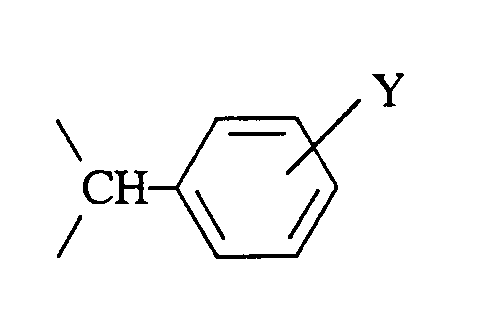
R¹ in der Bedeutung eines -COOR⁵-Esters,
R⁹ als Wasserstoff oder Brom,
W -CH(OH)-.

mit R², R³` R⁴, X, Z, Hal in den oben angegebenen Bedeutungen,
AW, E als Direktbindung,
D in der Bedeutung
-(CH₂)₀-NH-SO₂-,
R¹ in der Bedeutung eines -COOR⁵-Esters.
mit R², R³, R⁴, X, Z in den oben angegebenen Bedeutungen,
AW, E als Direktbindung,
R¹ in der Bedeutung eines -COOR⁵-Esters,
D in der Bedeutung

-(CH₂)n-NH-NH-SO₂-.
mit R², R³, R⁴, X, Z, Hal in den oben angegebenen Bedeutungen,
AW, E als Direktbindung,
D in der Bedeutung
-(CH₂)₁-NH-SO₂-,
R¹ in der Bedeutung eines -COOR⁵-Esters. - Die Verbindungen der Formel I lassen sich nach Anspruch 3 entsprechend den oben beschriebenen Verfahrensalternativen herstellen. Die Ausgangsverbindungen der Formel II werden entsprechend den in den Beispielen 1g-1n, 24a-24g und 34a-34b angegebenen Vorschriften hergestellt.
- Die Reaktionsbedingungen der nachfolgenden Verfahrensstufen sind:
- a) II ⇒ I (Verfahren A)
In Gegenwart von wässrigen Alkali- oder Erdalkalilösungen und unter Verwendung von Phasentransfer-Katalysatoren (wie z.B. Tetrabutylammoniumhydrogenphosphat oder -sulfat) werden Verbindungen der Formel II bei 20 bis 100°C in 1 bis 16 Std. mit dem Reaktanden III als organische Phase oder einer Lösung von III in einem inerten, nicht mit Wasser mischbaren organischen Lösungsmittel umgesetzt, gegebenenfalls, wie in Beispiel 1 beschrieben, ein Fluoratom für R² eingeführt bzw. eine Hydroxylgruppe, wie in den Beispielen 74 und 74a beschrieben, entfernt. - b) II ⇒ IV (Verfahren B)
Die Oxidation von Verbindungen der Formel II erfolgt nach bekannten Verfahren, wie z.B. nach dem von Swern, Collins sowie unter Verwendung von Pyridiniumdichromat bzw. -chlorochromat in Lösungsmitteln wie Dichlormethan, Diethylether, Tetrahydrofuran, Benzol oder Toluol bei -80°C bis -50°C (Swern) bzw. bis +30°C (bei den übrigen Oxidationen) innerhalb von 10 Minuten bis 8 Stunden. - c) IV ⇒ VI (Verfahren B), d) VI ⇒ I (Verfahren B)
Die Umsetzung der Verbindungen IV mit den Phosphonaten V sowie die sich anschließende Reduktion bzw. HBr-Eliminierung erfolgten analog den in der DE-OS 2845770 genannten Bedingungen. - e) II ⇒ VII (Verfahren C)
Die Oxidation der Verbindungen der Formel II wird bevorzugt mit Jones-Reagenz oder Pyridiniumchlorochromat nach den dem Fachmann bekannten Reaktionsbedingungen durchgeführt. Anschließend wird unter üblichen Bedingungen mit Thionylchlorid zum Säurechlorid umgesetzt, unter Phasentransferkatalyse mit wässriger Natriumazidlösung zur Reaktion gebracht und wie in Beispiel 1c beschrieben zu Verbindungen der Formel VIII umgelagert, gegebenenfalls eine C-C-Mehrfachbindung in Z hydriert bzw. ein Fluoratom, wie in Beispiel 1 beschrieben, eingeführt. - f) VII ⇒ VIII (Verfahren C)
Die Umsetzung der Verbindungen der Formel VII zu Verbindungen der Formel VIII erfolgt wie in Beispiel 1c beschrieben. - g) VIII ⇒ I (Verfahren C)
Die Umsetzung der Verbindungen der Formel VIII mit den Verbindungen der Formel IX oder XII erfolgt wie in den dafür genannten Beispielen 1b und 78. - h) IV ⇒ I (Verfahren D)
Die Umsetzung erfolgt in Analogie zu dem in WO 90/02740 (Verfahren C, S. 16) beschriebenen Verfahren. - i) II ⇒ XIV (Verfahren E)
Die Umsetzung der Verbindungen der Formel II zu Verbindungen der Formel XIV erfolgt wie in den Beispielen 78a bis 78c Beschrieben. - k) XIV ⇒ I (Verfahren E)
Die Umsetzung der Verbindungen der Formel XIV mit den Verbindungen der Formel IX oder XII erfolgt wie in den Beispielen 1b und 78 beschrieben. - Die Freisetzung der funktionell abgewandelten Hydroxygruppen R², R³, R⁴ und W erfolgt nach den dem Fachmann bekannten Methoden. Beispielsweise wird die Abspaltung von Etherschutzgruppen in einer wässrigen Lösung einer organischen Säure, wie z.B. Essigsäure, Propionsäure, Zitronensäure u.a. oder in einer wässrigen Lösung einer anorganischen Säure, wie z.B. Salzsäure, oder im Falle von Tetrahydropyranylethern unter Verwendung von Pyridinium-p-Toluolsulfonat, vorzugsweise in Alkoholen als Lösungsmittel oder unter Verwendung von wasserfreiem Magnesiumbromid, vorzugsweise in Diethylether als Lösungsmittel durchgeführt.
Zur Verbesserung der Löslichkeit wird bei Verwendung wässrig-saurer Reaktionsbedingungen zweckmäßigerweise ein mit Wasser mischbares inertes Lösungsmittel zugesetzt. Als geeignet erweisen sich z.B. Alkohole wie Methanol und Ethanol, Ether wie Dimethoxyethan, Dioxan und Tetrahydrofuran, wobei Tetrahydrofüran bevorzugt angewendet wird. - Die Abspaltung der Silyletherschutzgruppen erfolgt beispielsweise mit Tetrabutylammoniumfluorid nach den dem Fachmann bekannten Methoden. Als Lösungsmittel sind beispielsweise Tetrahydrofuran, Diethylether, Dioxan, Methylenchlorid etc. geeignet. Die Abspaltung wird vorzugsweise bei Temperaturen zwischen 20°C und 80°C durchgeführt.
- Die Verseifung der Acylgruppen und ester in COOR⁵ der Cyclopentanderivate wird nach den dem Fachmann bekannten Methoden durchgeführt, wie beispielsweise mit basischen Katalysatoren wie z.B. mit Alkali- oder Erdalkali-carbonaten oder -hydroxiden in einem Alkohol oder der wässrigen Lösung eines Alkohols. Als Alkohole kommen aliphatische Alkohole wie z.B. Methanol, Ethanol, Butanol etc. in Betracht, vorzugsweise jedoch Methanol. Als Alkalicarbonate und -hydroxide seien Lithium-, Natrium- und Kaliumsalze genannt. Bevorzugt sind die Lithium- und Kaliumsalze. Als Erdalkalicarbonate und -hydroxide eignen sich beispielsweise Calciumcarbonat, Calciumhydroxid und Bariumcarbonat. Die Umsetzung erfolgt allgemein bei -10°C bis +70°C, vorzugsweise jedoch bei +25°C.
- Die Einführung der Estergruppe CO₂R⁵ für R¹ bzw. CO₂R⁶ für Y, bei welcher R⁵ bzw. R⁶ eine Alkylgruppe mit 1-10-C-Atomen darstellt, erfolgt nach den dem Fachmann bekannten Methoden. Die Carboxyverbindungen (R⁵ = H bzw. R⁶ = H) werden beispielsweise mit Diazokohlenwasserstoffen in an sich bekannter Weise umgesetzt. Die Veresterung mit Diazokohlenwasserstoffen erfolgt z.B. dadurch, daß eine Lösung des Diazokohlenwasserstoffes in einem inerten Lösungsmittel, vorzugsweise in Diethylether, mit der Carboxyverbindung, gelöst in dem gleichen oder in einem anderen ebenfalls inerten Lösungsmittel, wie z.B. Methylenchlorid, vermischt wird. Nach beendeter Umsetzung in 1 bis 60 Minuten wird das Lösungsmittel entfernt und der Ester in üblicher Weise gereinigt. Diazoalkane sind entweder bekannt oder können nach bekannten Methoden hergestellt werden [Org. Reactions Bd. 8, Seiten 389-394(1954)].
- Die Einführung der Estergruppe CO₂R⁵ für R¹ bzw. CO₂R⁶ für Y, bei welcher R⁵ bzw. R⁶ eine substituierte oder unsubstituierte Arylgruppe darstellt, erfolgt nach den dem Fachmann bekannten Methoden. Beispielsweise werden die 1-Carboxyverbindungen mit den entsprechenden Arylhydroxyverbindungen mit Dicyclohexylcarbodiimid in Gegenwart einer geeigneten Base wie z.B. Pyridin, DMAP, Triethylamin, in einem inerten Lösungsmittel wie z.B. Methylenchlorid, Ethylenchlorid, Chloroform, Essigsäureethylester, Tetrahydrofuran, vorzugsweise jedoch mit Chloroform umgesetzt. Die Reaktion wird bei Temperaturen zwischen -30°C und +50°C, vorzugsweise bei +10°C, durchgeführt.
- Die Cyclopentanderivate der Formel I mit R⁵ bzw. R⁶ in der Bedeutung eines Wasserstoffatomes können mit geeigneten Mengen der entsprechenden anorganischen Basen unter Neutralisierung in Salze überführt werden. Beispielsweise erhält man beim Lösen der entsprechenden Säuren in Wasser, welches stöchiometrische Mengen der Base enthält, nach Abdampfen des Wassers oder nach Zugabe eines mit Wasser mischbaren Lösungsmittels, z.B. Alkohol oder Aceton, das feste anorganische Salz.
- Die Herstellung der Aminsalze erfolgt in üblicher Weise. Dazu löst man die Säure in einem geeigneten Lösungsmittel, wie z.B. Ethanol, Aceton, Diethylether oder Benzol und setzt 1 bis 5 Äquivalente des jeweiligen Amins dieser Lösung zu. Dabei fällt das Salz gewöhnlich in fester Form an oder wird nach Verdampfen des Lösungsmittels in üblicher Weise isoliert.
- Die funktionelle Abwandlung der freien Hydroxygruppen erfolgt nach den dem Fachmann bekannten Methoden. Zur Einführung der Etherschutzgruppen wird beispielsweise mit Dihydropyran oder Methylvinylether in Methylenchlorid oder Chloroform unter Verwendung katalytischer Mengen eines sauren Kondensationsmittels wie z.B. p-Toluolsulfonsäure, umgesetzt. Der jeweilige Enolether wird im Überschuß, vorzugsweise in der 1,2- bis 10-fachen Menge des theoretischen Bedarfs, zugesetzt. Die Umsetzung erfolgt normalerweise bei -10°C bis +30°C und ist nach 2 bis 45 Minuten beendet.
- Zur Einführung von Silyletherschutzgruppen wird beispielsweise mit t-Butyl-diphenylchlorsilan oder t-Butyl-dimethylchlorsilan in Dimethylformamid unter Verwendung einer Base wie z.B. Imidazol, umgesetzt. Das jeweilige Silylchlorid wird im Überschuß, vorzugsweise in der 1,05- bis 4-fachen Menge des theoretischen Bedarfs, zugesetzt. Die Umsetzung erfolgt normalerweise bei 0°C bis 30°C und ist nach 1 bis 24 Stunden beendet.
- Die Einführung der Acylschutzgruppen erfolgt, indem man eine Verbindung der Formel I in an sich bekannter Weise mit einem Carbonsäurederivat, wie z.B. Säurechlorid, Säureanhydrid etc., umsetzt.
- Cyclodextrinclathrate werden analog der Vorschrift in WO 87/05294 erhalten.
- Liposomen werden nach dem in "Pharmazie in unserer Zeit 11, 98 (1982)" beschriebenen Herstellungsverfahren hergestellt.
- Alle stereoisomeren Formen gehören ebenfalls zum Gegenstand der Erfindung.
- Die Verbindungen dieser Erfindung eignen sich zur Therapie von Erkrankungen des cardiovaskulären Systems, des Magens, des Pankreas, der Leber und der Niere. Sie wirken blutdrucksenkend und bronchodilatorisch. Sie sind hervorragend geeignet zur Hemmung der Thrombozytenaktivierung. Folglich stellen die neuen TXA₂-Antagonisten der Formel I wertvolle pharmazeutische Wirkstoffe dar. Darüber hinaus zeichnen sich die Verbindungen durch höhere Selektivität, eine wesentlich längere Wirksamkeit und eine größere Stabilität verglichen mit ähnlichen TXA₂-Antagonisten aus.
Die neuen TXA₂-Antagonisten besitzen die für diese Verbindungsklasse typischen Eigenschaften, wie z.B. Senkung des peripheren arteriellen, des koronaren und des pulmonalen Gefäßwiderstandes, Senkung des pulmonalen Blutdrucks, Senkung des systemischen Blutdrucks ohne zugleich Schlagvolumen und koronare Durchblutung zu senken, Förderung der Nierendurchblutung und der Durchblutung anderer peripherer Organe, Erhöhung der cerebralen Durchblutung, Inhibierung der Thrombozytenaktivierung und Auflösung von Thromben, Inhibierung der Bronchokonstriktion, Inhibierung der Magensäuresekretion, Zytoprotektion des Herzens, der Magen- und Darmschleimhaut, der Leber, Zytoprotektion im Pankreas und in der Niere sowie antiallergische Eigenschaften. Daher sind die neuen TXA₂-Antagonisten prinzipiell geeignet zur Behandlung des Schlaganfalles, der Prophylaxe und Therapie koronarer Herzerkrankungen, zum Beispiel der Koronarthrombose, zur Behandlung des Herzinfarktes, peripherer Arterienerkrankungen, zur Prophylaxe und Therapie bei anderen thromboembolischen Erkrankungen und bei Arteriosklerose, bei ischämischen Attacken des ZNS-Systems und anderer Durchblutungsstörungen des Gehirns wie z.B. der Migräne, zur Behandlung der Hypertonie und zur Behandlung von Krankheiten, die mit einer Erhöhung des pulmonalen Gefäßwiderstandes einhergehen wie z.B. der pulmonalen Hypertonie und zur Therapie des Schocks, des Asthmas und der allergischen Rhinitis. Sie können ferner eingesetzt werden, zur Inhibierung von Geburtswehen und zur Behandlung von Schwangerschaftstoxikosen.
Die neuen TXA₂-Antagonisten können außerdem Anwendung finden zur Verbesserung der Organfunktion nach Transplantation, zum Beispiel bei der Nierentransplantation, zur Verhinderung von Abstoßungsreaktionen, an Stelle von Heparin oder als Adjuvans bei der Dialyse oder Hämofiltration und bei der Konservierung von Blutplasmakonserven, zum Beispiel von Blutplättchenkonserven.
Die neuen TXA₂-Antagonisten besitzen eine antimetastatische Wirkung und antiproliferative Eigenschaften. Sie sind prinzipiell geeignet zur Behandlung von Neoplasien. Die neuen TXA₂-Antagonisten können in Kombination, zum Beispiel mit Carbacyclinen, Prostacyclin und seinen Analoga, 7-Oxo-prostacyclinen, Prostaglandinen und deren Derivate und 6-Oxo-PGE₁- und 6-Oxo-9-Fluor-Prostaglandin-Derivaten, mit TXA₂-Synthetase-Inhibitoren, mit Phosphodiesterase-Inhibitoren, mit Antagonisten und Rezeptorantagonisten verschiedener Thrombozytenstimulatoren (z.B. ADP, Thrombin, Collagen, PAF` Adrenalin, Serotonin, Fibrinogen), mit Calciumantagonisten, mit Fibrinolytika und Thrombolytika, z.B. t-PA, Streptokinase, mit Heparin und anderen Antikoagulanzien, mit Cyclooxygenasehemmern, z.B. Acetylsalicylsäure, mit Hemmstoffen der Lipoxy-genasen sowie Antagonisten von Lipoxygenaseprodukten, mit Vasodilatatoren wie z.B. Nitroverbindungen, mit Antihypertensiva wie z.B. β-Blockern oder mit Diuretika Verwendung finden.
Die Dosis der Verbindungen ist 0,1-1000 mg/Tag, bevorzugt 0,1-500 mg/Tag, auch in mehreren Teildosierungen, wenn sie am menschlichen Patienten verabreicht werden. Die Einheitsdosis für den pharmazeutisch akzeptablen Träger beträgt 0,1-100 mg. Für die parenterale Verabreichung werden sterile, injizierbare wässrige oder ölige Lösungen benutzt. Für die orale Applikation sind beispielsweise Tabletten, Dragees oder Kapseln geeignet.
Die Erfindung betrifft damit auch Arzneimittel auf Basis der Verbindungen der allgemeinen Formel I und üblicher Hilfs- und Trägerstoffe.
Die erfindungsgemäßen Wirkstoffe sollen in Verbindung mit den in der Galenik bekannten und üblichen Hilfsstoffen z.B. zur Herstellung von Blutdrucksenkern dienen. Der Einheitsdosisberich für die Ampulle ist 0,1-100 mg, für die Tablette 0,1-100 mg. - 55 mg (139 »mol) des nach Beispiel 1a dargestellten Alkohols löst man in 2,5 ml wasserfreiem Toluol, versetzt mit 56 »l wasserfreiem Pyridin, kühlt unter einer Atmosphäre aus trockenem Argon auf -60°C und versetzt mit 42 »l Diethylaminoschwefeltrifluorid. Man läßt innerhalb 3,5 Stunden auf 0°C erwärmen, quencht durch Zugabe von 1 ml einer gesättigten Natriumhydrogenkarbonatlösung, verdünnt mit Wasser und extrahiert mehrfach mit Dichlormethan. Die vereinigten organischen Extrakte trocknet man über Magnesiumsulfat und reinigt den nach Lösungsmittelabzug erhaltenen Rückstand durch Chromatographie an 4 analytischen Dünnschichtplatten. Als Laufmittel dient ein Gemisch aus n-Hexan und Aceton, als Elutionsmittel Diethylether. Isoliert werden 20 mg (53 »mol, 38%) 7-[5(S)-(4-Toluolsulfonylamino)-cyclopent-1enyl]-5(Z)-heptensäuremethylester sowie 16 mg (40 »mol, 29%) der Titelverbindung jeweils als farbloses Öl. IR (KBr): 3430, 3310, 3050, 3020, 2940, 2860, 1735, 1600, 1450, 1320, 1240, 1160, 1095, 920, 815, 670, 580 und 550 cm⁻¹.
- Die Lösung von 140 mg (280 »mol) der nach Beispiel 1b dargestellten Verbindung in 1,5 ml Methanol versetzt man mit 20 mg fein pulverisiertem Kaliumkarbonat und erhitzt 1 Stunde auf 70°C. Nach dem erkalten wird mit gesättigter Zitronensäure angesäuert, mit Wasser verdünnt und mehrfach mit Dichlormethan extrahiert. Die vereinigten organischen Extrakte trocknet man über Magnesiumsulfat und reinigt den nach Lösungsmittelabzug erhaltenen Rückstand durch Chromatographie an 2 analytischen Dünnschichtplatten. Als Laufmittel dient ein Gemisch aus n-Hexan und Ethylacetat, als Elutionsmittel Diethylether. Isoliert werden 96 mg (243 »mol, 87%) der Titelverbindung als farbloses Öl. IR (Film): 3600-3200, 3270, 2940, 2870, 1735, 1600, 1450, 1330, 1270, 1160, 1110, 1090, 1025, 815 und 665 cm⁻¹.
-
- Die Lösung von 340 mg (984 »mol) des nach Beispiel 1c dargestellten Amins in 30 ml wasserfreiem Dichlormethan versetzt man mit 1,52 ml Triethylamin, 483 mg p-Toluolsulfonsäurechlorid und rührt 1,5 Stunden bei 23°C unter einer Atmosphäre aus trockenem Argon. Man gießt auf eine halbkonzentrierte Natriumchloridlösung und extrahiert mehrfach mit Dichlormethan. Die vereinigten organischen Extrakte trocknet man über Magnesiumsulfat und reinigt den nach Lösungsmittelabzug erhaltenen Rückstand durch Chromatographie an ca. 70 ml feinem Kieselgel mit einem Gradientensystem aus n-Hexan und Ethylacetat Isoliert werden 330 mg (660 »mol, 67%) der Titelverbindung als farbloses Öl. IR (Film): 3270, 2940, 2870, 1730, 1710, 1600, 1450, 1330, 1270, 1160, 1110, 1090, 1025, 905, 815, 710 und 665 cm⁻¹.
- Die nach Beispiel 1d gewonnene Lösung versetzt man mit 1,47 ml Trifluoressigsäure und erhitzt 6 Stunden zum Rückfluß. Man läßt 14 Stunden bei 23°C stehen, engt ein und reinigt den Rückstand durch Chromatographie an ca. 250 ml feinem Kieselgel mit einem Gradientensystem aus Dichlormethan und Methanol. Isoliert werden 2,0 g (5,79 mmol, 43% bezogen auf Edukt in Beispiel 1e) der Titelverbindung A sowie 1,53 g (3,47 mmol, 26% bezogen auf Edukt in Beispiel 1e) der Titelverbindung B.
IR (CHCl₃) von A: 3500-2600, 2950, 2870, 1710, 1670, 1450, 1275, 1190, 1140 und 835 cm⁻¹.
IR (Film) von B: 3320, 2950, 2870, 1740-1690, 1600, 1550, 1450, 1435, 1270, 1210, 1180, 1110, 1070, 1025 und 710 cm⁻¹. - Den nach Beispiel 1e gewonnenen Rückstand löst man in 20 ml Dichlormethan, kühlt auf 3°C, versetzt mit 10 mg Tetrabutylammoniumhydrogensulfat und der Lösung von 1,04 g Natriumazid in 3,5 ml Wasser. Man rührt 2,5 Stunden, verdünnt mit Dichlormethan, trennt die organische Phase ab und trocknet über frisch geglühtem Magnesiumsulfat. Die nach Filtration erhaltene Lösung wird sofort weiter umgesetzt.
- Die Lösung von 5,0 g (13,4 mmol) der nach Beispiel 1f dargestellten Verbindung in 133 ml wasserfreiem Dichlormethan versetzt man unter Eiskühlung mit 2,13 ml frisch destilliertem Thionylchlorid und läßt 20 Stunden bei 23°C unter einer Atmosphäre aus trockenem Argon rühren. Man engt ein und setzt den erhaltenen Rückstand ohne Reinigung weiter um.
- Die Lösung von 30,2 g (83,9 mmol) des nach Beispiel 1g dargestellten Alkohols in 725 ml Aceton kühlt man auf -15°C, versetzt mit 44 ml einer standardisierten Chromschwefelsäurelösung (Jones-Reagenz), rührt 3 Stunden bei -10°C und zersetzt überschüssiges Oxidationsmittel durch Zugabe von 13 ml Isopropanol. Man verdünnt mit Wasser, extrahiert mehrfach mit Diethylether, wäscht die vereinigten organiaschen Extrakte mit Wasser und gesättigter Natriumchloridlösung und trocknet über Magnesiumsulfat. Den nach Filtration und Lösungsmittelabzug erhaltenen Rückstand reinigt man durch Chromatographie an ca. 1l groben Kieselgel mit einem Gradientensystem aus n-Hexan und Ethylacetat. Isoliert werden 29,3 g (78,3 mmol, 93%) der Titelverbindung als farbloses Öl.
IR (Film): 3600-2500, 3060, 2950, 2860, 1740-1690, 1600, 1580, 1450, 1435, 1360, 1310, 1270, 1170, 1110, 1070, 1025 und 710 cm⁻¹. - Die Lösung von 57,9 g (96,7 mmol) der nach Beispiel 1h dargestellten Verbindung in 124 ml wasserfreiem Tetrahydrofuran versetzt man mit 155 ml einer 1M Lösung von Tetrabutylammoniumfluorid in Tetrahydrofuran und rührt 17 Stunden bei 23°C unter einer Atmosphäre aus trockenem Argon. Man versetzt mit Wasser, extrahiert mehrfach mit Diethylether, wäscht die vereinigten organiaschen Extrakte mit Wasser und gesättigter Natriumchloridlösung und trocknet über Magnesiumsulfat. Den nach Filtration und Lösungsmittelabzug erhaltenen Rückstand reinigt man durch Chromatographie an ca. 2l groben Kieselgel mit einem Gradientensystem aus n-Hexan und Ethylacetat. Isoliert werden 30,2 g (83,8 mmol, 87%) der Titelverbindung als farbloses Öl.
IR (Film): 3600-3200, 3060, 2940, 2860, 1735, 1710, 1600, 1580, 1360, 1310, 1275, 1170, 1110, 1070, 1025 und 715 cm⁻¹. - Die Lösung von 47,9 g (96,7 mmol) der nach Beispiel 1i dargestellten Verbindung in 212 ml wasserfreiem Pyridin kühlt man unter einer Atmosphäre aus trockenem Argon auf 5°C, versetzt innerhalb 30 Minuten mit 29 ml Benzoylchlorid und rührt 1,5 Stunden bei 23°C. Man gießt auf 600 ml Eiswasser, extrahiert mehrfach mit Diethylether, wäscht die vereinigten organiaschen Extrakte mit 2n Salzsäure, Wasser und gesättigter Natriumchloridlösung und trocknet über Magnesiumsulfat. Den nach Filtration und Lösungsmittelabzug erhaltenen Rückstand reinigt man durch Chromatographie an ca. 2l feinem Kieselgel mit einem Gradientensystem aus n-Hexan und Ethylacetat. Isoliert werden 57,9 g (96,7 mmol, 100%) der Titelverbindung als farbloses Öl.
IR (Film): 3070, 3040, 3000, 2950, 2930, 2850, 1735, 1710, 1600, 1450, 1425, 1360, 1310, 1270, 1110, 820, 740 und 705 cm⁻¹. - Die Lösung von 154 g des nach Beispiel 1j dargestellten Rohproduktes in 150 ml Aceton versetzt man mit 33,4 g Kaliumkarbonat, 41,2 g Methyliodid und erwärmt 6 Stunden auf 80°C. Man engt ein, nimmt in 400 ml Dichlormethan auf, wäscht mit Wasser und gesättigter Natriumchloridlösung und trocknet über Magnesiumsulfat. Den nach Filtration und Lösungsmittelabzug erhaltenen Rückstand reinigt man durch Chromatographie an ca. 2l groben Kieselgel mit einem Gradientensystem aus n-Hexan und Ethylacetat. Isoliert werden 47,9 g (96,8 mmol, 88% bezogen auf Edukt in Beispiel 1j) der Titelverbindung als farbloses Öl.
IR (Film): 3600-3200, 3070, 3040, 3000, 2940, 2920, 2850, 1735, 1585, 1460, 1425, 1240, 1165, 1110, 1005, 820, 740 und 700 cm⁻¹. - Zu der Emulsion aus 99,7 g Carboxybutyltriphenylphosphoniumbromid in 256 ml wasserfreiem Tetrahydrofuran und 600 ml wasserfreiem Dimethylsulfoxid gibt man innerhalb einer Stunde portionsweise insgesamt 50g fein pulverisiertes Kalium-tert.-butanolat. Man rührt so lange, bis eine klare rote Lösung entsteht, tropft zügig die Lösung von 43,8 g (110 mmol) der nach Beispiel 1k dargestellten Verbindung in 130 ml wasserfreiem Tetrahydrofuran zu und läßt 2 Stunden bei 23°C unter einer Atmosphäre aus trockenem Argon reagieren. Man gießt in Eiswasser, stellt durch Zugabe einer gesättigten Zitronensäurelösung einen pH-Wert von 4-5 ein und extrahiert mehrfach mit Dichlormethan. Man wäscht mit Wasser und gesättigter Natriumchloridlösung, trocknet über Magnesiumsulfat, filtriert und engt ein. Den erhaltenen Rückstand setzt man ohne Reinigung weiter um.
- Die Lösung von 45,8 g (116 mmol) der nach Beispiel 1l dargestellten Verbindung in 1,4 l wasserfreiem Toluol kühlt man unter einer Atmosphäre aus trockenem Argon auf - 70°C` tropft innerhalb einer Stunde 202 ml einer 1,2M Diisobutylaluminiumhydridlösung in Toluol zu und rührt 1 Stunde. Überschüssiges Reduktionsmittel wird durch Zugabe von 13 ml Isopropanol zersetzt. Man läßt auf 0°C erwärmen, tropft 100 ml Wasser zu und rührt so lange bei 23°C, bis sich ein feinkörniger Niederschlag gebildet hat. Man saugt ab, wäscht mit Dichlormethan nach und isoliert nach Lösungsmittelabzug 43,8 g (110 mmol, 95%) der Titelverbindung als farbloses Öl.
IR (Film): 3600-3200, 3070, 3050, 2940, 2850, 1590, 1465, 1425, 1390, 1360, 1260, 1110, 1010, 940, 820, 740 und 700 cm⁻¹. - Die Lösung von 67 g (119 mmol) des nach Beispiel 1m dargestellten Tosylates in 1,3 l Dimethoxyethan versetzt man mit 136 g Natriumiodid, 118 g Zinkstaub, 79 ml Wasser und erhitzt 16 Stunden unter Rückfluß. Nach dem Erkalten wird von ungelösten Rückständen abfiltriert, das Filtrat auf ca. 200 ml eingeengt, mit Wasser versetzt und mehrfach mit Diethylether extrahiert. Die vereinigten organiaschen Extrakte wäscht man mit 10%iger Natriumhydrogensulfatlösung, Wasser, gesättigter Natriumchloridlösung und trocknet über Magnesiumsulfat. Den nach Filtration und Lösungsmittelabzug erhaltenen Rückstand reinigt man durch Chromatographie an ca. 2l groben Kieselgel mit einem Gradientensystem aus n-Hexan und Ethylacetat. Isoliert werden 45,8 g (116 mmol, 98%) der Titelverbindung als farbloses Öl.
IR (Film): 3070, 3050, 2950, 2930, 2850, 1775, 1590, 1470, 1425, 1165, 1110, 1005, 820, 740 und 705 cm⁻¹. - Die Lösung von 67,3 g (164 mmol) des nach Beispiel 1n dargestellten Alkohols in 260 ml wassertreiem Pyridin versetzt man mit 62,8 g p-Toluolsulfonsäurechlorid und rührt 27 Stunden unter einer Atmosphäre aus trockenem Argon bei 50°C. Man engt ein, versetzt mit Wasser und extrahiert mehrfach mit Dichlormethan. Man wäscht mit Wasser und gesättigter Natriumchloridlösung und trocknet über Magnesiumsulfat. Den nach Filtration und Lösungsmittelabzug erhaltenen Rückstand reinigt man durch Chromatographie an ca. 2l groben Kieselgel mit einem Gradientensystem aus n-Hexan und Ethylacetat. Isoliert werden 67 g (119 mmol, 72%) der Titelverbindung als farbloses Öl.
IR (CHCl₃): 3070, 3030, 2960, 2930, 2860, 1770, 1600, 1470, 1425, 1365, 1190, 1175, 1110, 1040, 980, 960, 895, 875, 820 und 700 cm⁻¹. - Die Lösung von 129 g (251 mmol) (1S,5R,6S,7R)-3-Oxo-6-(tert.-butyldiphenylsilyloxymethyl)-7-benzoyloxy-2-oxabicyclo[3.3.0]octan in 1l Methanol versetzt man mit 14,9 g Kaliumkarbonat und rührt 3 Stunden bei 23°C unter einer Atmosphäre aus trockenem Argon. Man versetzt mit Wasser, neutralisiert durch vorsichtige Zugabe von 2n Salzsäure, engt ein und extrahiert mehrfach mit Dichlormethan. Man wäscht mit Wasser, gesättigter Natriumchloridlösung und trocknet über Magnesiumsulfat. Den nach Filtration und Lösungsmittelabzug erhaltenen Rückstand reinigt man durch Chromatographie an ca. 2l feinem Kieselgel mit einem Gradientensystem aus n-Hexan und Ethylacetat. Isoliert werden 97 g (236 mmol, 94%) der Titelverbindung als farbloses Öl.
IR (Film): 3600-3200, 3070, 3050, 2940, 2960, 1770, 1590, 1430, 1240, 1170, 1115, 1075, 825, 745, 705, 615 und 510 cm⁻¹. - Die Lösung von 16 mg (44 »mol) der nach Beispiel 1 dargestellten Verbindung in 1 ml Methanol versetzt man mit 0,5 ml einer 5%igen Lithiumhydroxidlösung und rührt 1,5 Stunden bei 23°C. Durch Zugabe von gesättigter Zitronensäure wird angesäuert, mit Wasser verdünnt und mehrfach mit Dichlormethan extrahiert. Man wäscht mit Wasser, gesättigter Natriumchloridlösung und trocknet über Magnesiumsulfat. Den nach Filtration und Lösungsmittelabzug erhaltenen Rückstand reinigt man durch Chromatographie an einer analytischen Dünnschichtplatte. Als Laufmittel dient ein Gemisch aus Dichlormethan und Methanol, als Elutionsmittel ein Gemisch aus Chloroform und Isopropanol. Isoliert werden 15,7 mg (41 »mol, 93%) der Titelverbindung als farblosen Feststoff.
IR (KBr): 3600-2400, 3430, 3310, 3050, 3020, 2950, 2930, 2860, 1715, 1600, 1450, 1320, 1240, 1160, 1095, 920, 815, 670, 580 und 550cm⁻¹. - 80 mg (210 »mol) der nach Beispiel 3a dargestellten Verbindung setzt man in Analogie zu Beispiel 1 um und isoliert nach Aufarbeitung und Reinigung 23 mg (63 »mol, 30%) 7-[5(S)-(Benzolsulfonylamino)-cyclopent-1-enyl]-5(Z)-heptensäuremethylester sowie 26 mg (68 »mol, 32%) der Titelverbindung als farbloses Öl.
IR (Film): 3430, 3310, 3040, 3020, 2950, 2860, 1730, 1600, 1450, 1320, 1240, 1160, 1095, 930, 755, 720 und 690 cm⁻¹. - 270 mg (556 »mol) der nach Beispiel 3b dargestellten Verbindung setzt man in Analogie zu Beispiel 1a um und isoliert nach Aufarbeitung und Reinigung 212 mg (556 »mol, 100%) der Titelverbindung als farbloses Öl.
IR (Film): 3600-3200, 3260, 3060, 2930, 2850, 1725, 1445, 1320, 1265, 1160, 1090, 1020 und 735 cm⁻¹. - 250 mg (724 »mol) der nach Beispiel 1c dargestellten Verbindung setzt man in Analogie zu Beispiel 1b mit Benzolsulfonsäurechlorid um und isoliert nach Aufarbeitung und Reinigung 270 mg (556 »mol, 77%) der Titelverbindung als farbloses Öl.
IR (Film): 3270, 3060, 3000, 2950, 2860, 1730, 1715, 1600, 1585, 1450, 1330, 1315, 1270, 1160, 1110, 990, 1025, 910, 755, 715 und 690 cm⁻¹. - 26 mg (68 »mol) der nach Beispiel 3 dargestellten Verbindung setzt man in Analogie zu Beispiel 2 um und isoliert nach Aufarbeitung und Reinigung 23,6 mg (64 »mol, 94%) der Titelverbindung als farbloses Öl.
¹H-NMR (CDCl₃): δ= 1,5-2,2(m, 11H), 2,34(t, 2H), 3,3-3,45(m, 1H), 4,7(m, 1H), 5,1(s, NH), 5,2-5,5(m, 2H), 7,45-7,65(m, 3H), 7,9(m, 2H). - 84 mg (210 »mol) der nach Beispiel 5a dargestellten Verbindung setzt man in Analogie zu Beispiel 1 um und isoliert nach Aufarbeitung und Reinigung 25 mg (66 »mol, 31%) 7-[5(S)-(4-Fluorbenzylsulfonylamino)-cyclopent-1-enyl]-5(Z)-heptensäuremethylester sowie 26 mg (65 »mol, 31%) der Titelverbindung als farbloses Öl.
IR (Film): 3300, 3060, 3020, 2940, 2860, 1735, 1605, 1595, 1490, 1440, 1325, 1250, 1160, 835, 790, 735 und 700 cm⁻¹. -
240 mg (477 »mol) der nach Beispiel 5b dargestellten Verbindung setzt man in Analogie zu Beispiel 1b um und isoliert nach Aufarbeitung und Reinigung 175 mg (438 »mol, 92%) der Titelverbindung als farbloses Öl.
IR (Film): 3600-3200, 3310, 3060, 3020, 2940, 2860, 1730, 1610, 1595, 1490, 1440, 1325, 1250, 1160, 835, 790, 740 und 700 cm⁻¹. - 250 mg (724 »mol) der nach Beispiel 1c dargestellten Verbindung setzt man in Analogie zu Beispiel 1b mit 4-Fluorbenzolsulfonsäurechlorid um und isoliert nach Aufarbeitung und Reinigung 243 mg (483 »mol, 67%) der Titelverbindung als farbloses Öl.
IR (Film): 3270, 3060, 3000, 2950, 2870, 1730, 1710, 1590, 1570, 1490, 1450, 1335, 1270, 1165, 1150, 1090, 1025, 910, 715 und 670 cm⁻¹. - 26 mg (65 »mol) der nach Beispiel 5 dargestellten Verbindung setzt man in Analogie zu Beispiel 2 um und isoliert nach Aufarbeitung und Reinigung 22,5 mg (58 »mol, 89%) der Titelverbindung als farbloses Öl.
¹H-NMR (CDCl₃): δ= 1,5-2,2(m, 11H), 2,35(t, 2H), 3,3-3,45(m, 1H), 4,7(m, 1H), 5,15(s, NH), 5,25-5,5(m, 2H), 7,1-7,3(m, 2H), 7,9(m, 2H). - 74 mg (171 »mol) der nach Beispiel 7a dargestellten Verbindung setzt man in Analogie zu Beispiel 1 um und isoliert nach Aufarbeitung und Reinigung 29 mg (70 »mol, 41%) 7-[5(S)-(Chinon-8-ylsulfonylamino)-cyclopent-1-enyl]-5(Z)-heptensäuremethylester sowie 19 mg (44 »mol, 25%) der Titelverbindung als farbloses Öl.
IR (Film): 3270, 3060, 2950, 2860, 1730, 1610, 1595, 1365, 1490, 1435, 1330, 1265, 1160, 1145, 835, 790, 735 und 700 cm⁻¹. - 339 mg (632 »mol) der nach Beispiel 7b dargestellten Verbindung setzt man in Analogie zu Beispiel 1a um und isoliert nach Aufarbeitung und Reinigung 259 mg (596 »mol, 94%) der Titelverbindung als farbloses Öl.
IR (Film): 3600-3200, 3280, 3060, 3000, 2940, 2860, 1730, 1665, 1610, 1595, 1565, 1490, 1435, 1325, 1215, 1165, 1145, 1090, 835 und 790 cm⁻¹. - 250 mg (724 »mol) der nach Beispiel 1c dargestellten Verbindung setzt man in Analogie zu Beispiel 1b mit Chinon-8-ylsulfonsäurechlorid um und isoliert nach Aufarbeitung und Reinigung 339 mg (632 »mol, 87%) der Titelverbindung als farbloses Öl.
IR (Film): 3270, 3060, 2950, 2860, 1730, 1710, 1675, 1600, 1565, 1490, 1450, 1435, 1330, 1270, 1245, 1165, 1145, 1110, 1070, 1045, 1025, 900, 835, 790 und 715 cm⁻¹. - 19 mg (44 »mol) der nach Beispiel 7 dargestellten Verbindung setzt man in Analogie zu Beispiel 2 um und isoliert nach Aufarbeitung und Reinigung 14 mg (33 »mol, 77%) der Titelverbindung als farbloses Öl.
IR (Film): 3600-2400, 3290, 3060, 2950, 2860, 1710, 1610, 1590, 1360, 1490, 1435, 1330, 1265, 1160, 1145, 835, 790, 735 und 700 cm⁻¹. - 109 mg (284 »mol) der nach Beispiel 18 dargestellten Verbindung setzt man in Analogie zu Beispiel 1 um und isoliert nach Aufarbeitung und Reinigung 42 mg (115 »mol, 40%) 7-[5(S)-(Benzolsulfonylamino)-cyclopent-1-enyl]-heptansäuremethylester sowie 34 mg (88 »mol, 31%) der Titelverbindung als farbloses Öl.
IR (Film): 3370, 3060, 2930, 2860, 1725, 1440, 1325, 1160, 1090, 1070, 930, 755, 720 und 690 cm⁻¹. - 34 mg (88 »mol) der nach Beispiel 9 dargestellten Verbindung setzt man in Analogie zu Beispiel 2 um und isoliert nach Aufarbeitung und Reinigung 29 mg (78 »mol, 89%) der Titelverbindung als farbloses Öl.
¹H-NMR (CDCl₃): δ= 1,0-1,35(m, 7H), 1,5-2,05(m, 8H), 2,35(t, 2H), 3,3-3,45(m, 1H), 4,7(m, 1H), 4,93(d, NH), 7,45-7,65(m, 3H), 7,88(m, 2H). - 120 mg (299 »mol) der nach Beispiel 19 dargestellten Verbindung setzt man in Analogie zu Beispiel 1 um und isoliert nach Aufarbeitung und Reinigung 44 mg (115 »mol, 38%) 7-[5(S)-(4-Fluorbenzylsulfonylamino)-cyclopent-1-enyl]-heptansäuremethylester sowie 33 mg (82 »mol, 27%) der Titelverbindung als farbloses Öl.
IR (Film): 3370, 3070, 2930, 2860, 1730, 1665, 1595, 1490, 1450, 1435, 1330, 1290, 1230, 1160, 1090, 1115, 950, 925, 840 und 820 cm⁻¹. - 33 mg (82 »mol) der nach Beispiel 11 dargestellten Verbindung setzt man in Analogie zu Beispiel 2 um und isoliert nach Aufarbeitung und Reinigung 31 mg (80 »mol, 97%) der Titelverbindung als farbloses Öl.
¹H-NMR (CDCl₃): δ= 1,05-1,35(m, 8H), 1,5-2,05(m, 7H), 2,35(t, 2H), 3,38(m, 1H), 4,7(m, 1H), 4,95(d, NH), 7,2(t, 2H), 7,9(m, 2H). -
- 78 mg (179 »mol) der nach Beispiel 20 dargestellten Verbindung setzt man in Analogie zu Beispiel 1 um und isoliert nach Aufarbeitung und Reinigung 24 mg (57 »mol, 32%) 7-[5(S)-(Chinon-8-ylsulfonylamino)-cyclopent-1-enyl]-heptansäuremethylester sowie 19 mg (43 »mol, 24%) der Titelverbindung als farbloses Öl.
IR (Film): 3270, 3060, 2940, 2850, 1730, 1610, 1595, 1565, 1490, 1435, 1330, 1160, 1140, 835, 795, 735 und 680 cm⁻¹. - 32 mg (73 »mol) der nach Beispiel 13 dargestellten Verbindung setzt man in Analogie zu Beispiel 2 um und isoliert nach Aufarbeitung und Reinigung 26 mg (62 »mol, 84%) der Titelverbindung als farbloses Öl.
IR (Film): 3600-2500, 3400, 3280, 2920, 2850, 1705, 1600, 1510, 1460, 1290, 1085, 1055, 1030 und 735 cm⁻¹. - Die Lösung von 241 mg (612 »mol) der nach Beispiel 15a dargestellten Verbindung löst man in 8 ml wasserfreiem Methanol, kühlt unter einer Atmosphäre aus trockenem Aregon auf -30°C und versetzt portionsweise mit insgesamt 69 mg Natriumborhydrid. Man laßt noch 30 Minuten reagieren, zersetzt überschüssiges Reduktionsmittel durch Zugabe von 120 »l Essigsäure, versetzt mit Wasser und extrahiert mehrfach mit Dichlomethan. Man wäscht mit Wasser, gesättigter Natriumchloridlösung und trocknet über Magnesiumsulfat. Den nach Filtration und Lösungsmittelabzug erhaltenen Rückstand reinigt man durch Chromatographie an 12 analytischen Dünnschichtplatten. Als Laufmittel dient ein Gemisch aus n-Hexan und Ethylacetat, als Elutionsmittel Diethylether. Isoliert werden 108 mg (273 »mol, 45%) der Titelverbindung als polarere Komponente, sowie 48 mg (121 »mol, 20%) der Titelverbindung aus Beispiel 1a als unpolarere Komponente.
IR (Film): 3600-3200, 2950, 2920, 2850, 1730, 1600, 1450, 1325, 1155, 1090, 895, 815, 735 und 670 cm⁻¹. - 245 mg (619 »mol) der nach Beispiel 1a dargestellten Verbindung oxidiert man in Analogie zu Beispiel 1f und isoliert nach Aufarbeitung 241 mg (612 »mol, 99%) der Titelverbindung als blass gelbes Öl.
IR (Film): 3360, 2950, 2920, 2850, 1735, 1600, 1450, 1325, 1155, 1090, 900, 815, 735 und 665 cm⁻¹. - 108 mg (273 »mol) der nach Beispiel 15 dargestellten Verbindung setzt man in Analogie zu Beispiel 1 um und isoliert nach Aufarbeitung und Reinigung 9 mg (24 »mol, 9%) 7-[5(S)-(4-Toluolsulfonylamino)-cyclopent-1-enyl]-5(Z)-heptensäuremethylester sowie 23 mg (60 »mol, 22%) der Titelverbindung jeweils als farbloses Öl.
IR (Film): 3250, 3010, 2960, 2930, 2870, 1730, 1600, 1450, 1380, 1325, 1305, 1290, 1240, 1160, 1095, 925, 910, 815 und 665 cm⁻¹. - 30 mg (76 »mol) der nach Beispiel 16 dargestellten Verbindung verseifte man in Analogie zu Beispiel 2 und isolierte nach Aufarbeitung und Reinigung 14 mg (37 »mol, 48%) der Titelverbindung als farbloses Öl.
IR (Film): 3700-2400, 3260, 3010, 2960, 2930, 2870, 1710, 1600, 1450, 1405, 1380, 1325, 1305, 1290, 1240, 1160, 1095, 925, 910, 815, 665, 620 und 550 cm⁻¹. - 132 mg (346 »mol) der nach Beispiel 3a dargestellten Verbindung löst man in 5 ml Ethylacetat, versetzt mit 50 mg Pd/C (5%ig) und hyriert bei 1 atm, bis die theoretisch berechnete Menge Wasserstoff aufgenommen ist. Man filtriert, wäscht nach und engt ein. Isoliert werden 109 mg (284 »mol, 82%) der Titelverbindung als farbloses Öl.
IR (Film): 3600-3200, 3260, 2930, 2850, 1725, 1445, 1320, 1265, 1160, 1095, 1020 und 735 cm⁻¹. - 141 mg (355 »mol) der nach Beispiel 5a dargestellten Verbindung hydriert man in Analogie zu Beispiel 18 und isoliert nach Aufarbeitung 120 mg (300 »mol, 84%) der Titelverbindung als farbloses Öl.
IR (Film): 3270, 2930, 2850, 1730, 1660, 1600, 1445, 1320, 1260, 1160, 1095, 1020, 925, 840 und 820 cm⁻¹. - 149 mg (344 »mol) der nach Beispiel 7a dargestellten Verbindung hydriert man in Analogie zu Beispiel 18 und isoliert nach Aufarbeitung 142 mg (327 »mol, 95%) der Titelverbindung als farbloses Öl.
IR (Film): 3600-3200, 3520, 3410, 3280, 2940, 2850, 1725, 1665, 1595, 1490, 1455, 1430, 1320, 1160, 1140, 1020, 890, 840, 790, 735 und 675 cm⁻¹. - 30 mg (69 »mol) der nach Beispiel 20 dargestellten Verbindung verseift man in Analogie zu Beispiel 2 und isoliert nach Aufarbeitung und Reinigung 25 mg (59 »mol, 86%) der Titelverbindung als farbloses Öl.
¹H-NMR (CDCl₃): δ= 1,0-1,9(m, 16H), 2,32(t, 2H), 3,4(m, 1H), 4,12(m, 1H), 6,27(d, NH), 7,57(dt, 1H), 7,66(t, 1H), 8,06(dd, 1H), 8,3(dd, 1H), 8,43(dd, 1H), 9,03(dd, 1H). - 47 mg (119 »mol) der nach Beispiel 1b dargestellten Verbindung verseift man in Analogie zu Beispiel 2 und isoliert nach Aufarbeitung und Reinigung 41 mg (107 »mol, 90%) der Titelverbindung als farbloses Öl.
IR (Film): 3600-2400, 3470, 3260, 3000, 2940, 2870, 1710, 1600, 1445, 1320, 1160, 1095, 910, 810, 670, 570 und 550 cm⁻¹. - 19 mg (44 »mol) der nach Beispiel 7b dargestellten Verbindung verseift man in Analogie zu Beispiel 2 und isoliert nach Aufarbeitung und Reinigung 16 mg (38 »mol, 85%) der Titelverbindung als wachsartigen Feststoff.
¹H-NMR (CDCl₃): δ= 1,0-2,35(m, 14H), 3,43(m, 1H), 4,1(m, 1H), 5,15-5,35(m, 2H), 6,47(d, NH), 7,52(dd, 1H), 7,66(t, 1H), 8,04(dd, 1H), 8,27(dd, 1H), 8,43(dd, 1H), 9,03(dd, 1H). - 33 mg (99 »mol) der nach Beispiel 24a dargestellten Verbindung versetzt man mit 0,4 ml einer 50%igen KOH-Lösung, 257 »l Benzylchlorid, 4 mg Tetrabutylammoniumhydrogensulfat und rührt intensiv 18 Stunden bei 23°C. Man gießt in Eiswasser, extahiert mehrfach mit Dichlormethan, trocknet die organische Phase über Magnesiumsulfat und entfernt überschüssiges Benzylchlorid durch Chromatographie an 4 analytischen Dünnschichtplatten. Als Laufmittel dient ein Gemisch aus n-Hexan und Ethylacetat, als Elutionsmittel Chloroform. Den erhaltenen Rückstand verseift man in Analogie zu Beispiel 2 und isoliert nach Aufarbeitung und Reinigung 17 mg (41 »mol, 42%) der Titelverbindung als farbloses Öl.
IR (Film): 3600-2400, 3060, 3030, 2930, 2850, 1710, 1600, 1495, 1455, 1360, 1240, 1210, 1100, 970, 755, 735 und 700 cm⁻¹. - 305 mg (532 »mol) der nach Beispiel 24b dargestellten Verbindung setzt man in Analogie zu Beispiel 1g um und isoliert nach Aufarbeitung und Reinigung 176 mg (526 »mol, 99%) der Titelverbindung als farbloses Öl.
IR (Film): 3600-3200, 3030, 2920, 2850, 1730, 1450, 1435, 1370, 1150, 1045, 755 und 700 cm⁻¹. - 742 mg (1,30 mmol) der nach Beispiel 24c dargestellten Verbindung setzt man in Analogie zu Beispiel 1 um und isoliert nach Aufarbeitung und Reinigung 294 mg (532 »mol, 41%) 7-[(4RS,5S)-4-Phenyl-5-(tert.-butyldiphenylsilyloxymethyl)-cyclopent-1-enyl]-5(E/Z)-heptensäuremethylester sowie 337 mg (588 »mol, 45%) der Titelverbindung als farbloses Öl.
IR (Film): 3070, 3030, 2960, 2930, 2860, 1735, 1600, 1590, 1425, 1110, 820, 740 und 700 cm⁻¹. - 1,97 g (3,47 mmol) der nach Beispiel 24d dargestellten Verbindung setzt man in Analogie zu Beispiel 15 um und isoliert nach Aufarbeitung und Reinigung 742 mg (1,30 mmol, 37%) der Titelverbindung A sowie 925 mg (1,62 mmol, 47%) der Titelverbindung B jeweils als farbloses Öl.
IR (Film) von A: 3600-3200, 3070, 3020, 2950, 2920, 2850, 1735, 1600, 1585, 1450, 1425, 1110, 820, 760, 740 und 700 cm⁻¹.
IR (Film) von B: 3600-3200, 3060, 3020, 2950, 2920, 2850, 1730, 1600, 1590, 1450, 1425, 1265, 1110, 1060, 820, 740 und 700 cm⁻¹. - Die Lösung von 11,82 g (24,0 mmol) der nach Beispiel 24e dargestellten Verbindung in 120 ml wasserfreiem Tetrahydrofuran versetzt man mit 500 mg Cupfer(II)acetat, und kühlt unter einer Atmosphäre aus trockenem Argon auf -78°C. Man gibt 3,04 ml Trimethylchlorsilan und anschließend 12,8 ml einer 3M Lösung von Phenylmagnesiumbromid in Diethylether zu. Nach 45 Minuten gießt man in gesättigte Ammoniumchloridlösung und extrahiert mehrfach mit Dichlormethan. Die vereinigten organischen Extrakte trocknet man über Magnesiumsulfat und reinigt den nach Lösungsmittelabzug erhaltenen Rückstand durch Chromatographie an ca.200 ml feinem Kieselgel. Als Laufmittel dient ein Gradientensystem aus n-Hexan und Ethylacetat. Isoliert werden 9,78 g (17,2 mmol, 72%) der Titelverbindung als farbloses Öl.
IR (Film): 3070, 3030, 2950, 2930, 2850, 1735, 1600, 1465, 1450, 1425, 1110, 1055, 820, 780, 740 und 700 cm⁻¹. - Die Lösung von 5,84 g (11,5 mmol) der nach Beispiel 24f dargestellten Verbindung in 52 ml wasserfreiem Pyridin kühlt man unter einer Atmosphäre aus trockenem Argon auf 3°C, tropft 2,17 ml Methansulfonsäurechlorid zu und rührt noch 2 Stunden bei 3°C. Man versetzt mit Eis, verdünnt mit Wasser und extrahiert mehrfach mit Dichlormethan. Die vereinigten organischen Extrakte trocknet man über Magnesiumsulfat und reinigt den nach Lösungsmittelabzug erhaltenen Rückstand durch Chromatographie an ca. 200 ml feinen Kieselgel. Als Laufmittel dient ein Gradientensystem aus n-Hexan und Ethylacetat. Isoliert werden 4,93 g (10,0 mmol, 87%) der Titelverbindung als farbloses Öl.
IR (Film): 3070, 3040, 2950, 2930, 2850, 1735, 1705, 1585, 1425, 1110, 820, 740 und 700 cm⁻¹. - 11,9 g (20,0 mmol) der nach Beispiel 24g dargestellten Verbindung setzt man in Analogie zu Beispiel 1f um und isoliert nach Aufarbeitung und Reinigung 9,39 g (15,8 mmol, 79%) der Titelverbindung als farbloses Öl.
IR (Film): 3070, 3040, 2940, 2850, 1740, 1590, 1425, 1110, 1075, 1030, 970, 820, 740 und 700 cm⁻¹. - 22,4 g (47,8 mmol) (1S,3RS,5R,6S,7R)-7-(Tetrahydropyran-2-yloxy)-6-(tert.-butyldiphenylsilyloxymethyl)-2-oxabicyclo[3.3.0]octan-3-ol setzt man in Analogie zu Beispiel 1j unter Verwendung von KOH-haltigem Kalium-tert.-butanolat um und isoliert nach Aufarbeitung und Veresterung mit einer etherischen Lösung von Diazomethan nach chromatographischer Reinigung an ca. 1,3 l feinem Kieselgel mit einem Gradientensystem aus n-Hexan und Ethylacetat 21,6 g (36,3 mmol, 76%) der Titelverbindung als farbloses Öl.
IR (Film): 3600-3200, 3070, 3040, 2940, 2850, 1730, 1595, 1425, 1110, 1075, 1025, 970, 820, 740 und 700 cm⁻¹. - 28 mg (84 »mol) der nach Beispiel 24a dargestellten Verbindung setzt man in Analogie zu Beispiel 24 unter Verwendung von 4-Cyanobenzylbromid um und isoliert nach Aufarbeitung und Reinigung 14 mg (32 »mol, 38%) der Titelverbindung als farbloses Öl.
IR (Film): 3600-2400, 3060, 3015, 1930, 2860, 2230, 1705, 1600, 1455, 1435, 1360, 1290, 1240, 1150, 1110, 1090, 970, 795, 755, 700 und 685 cm⁻¹. - 27 mg (81 »mol) der nach Beispiel 24a dargestellten Verbindung setzt man in Analogie zu Beispiel 24 unter Verwendung von 3-Methylbenzylbromid um und isoliert nach Aufarbeitung und Reinigung 23 mg (54 »mol, 67%) der Titelverbindung als farbloses Öl.
IR (Film): 3600-2400, 3060, 3030, 2930, 2860, 1705, 1600, 1450, 1360, 1245, 1160, 1105, 1090, 970, 780, 755 und 700 cm⁻¹. -
- 29 mg (87 »mol) der nach Beispiel 24a dargestellten Verbindung setzt man in Analogie zu Beispiel 24 unter Verwendung von 3,5-Bis(trifluormethyl)benzylbromid um und isoliert nach Aufarbeitung und Reinigung 28 mg (51 »mol, 59%) der Titelverbindung als farbloses Öl.
IR (Film): 3600-2400, 3060, 3030, 2930, 2870, 1710, 1625, 1600, 1455, 1380, 1355, 1280, 1175, 1135, 970, 885, 840, 760, 700 und 680 cm⁻¹. - 29 mg (87 »mol) der nach Beispiel 24a dargestellten Verbindung setzt man in Analogie zu Beispiel 24 unter Verwendung von 1-Brommethylnaphtalin um und isoliert nach Aufarbeitung und Reinigung 26 mg (56 »mol, 65%) der Titelverbindung als farbloses Öl.
IR (Film): 3600-2400, 3060, 3030, 3010, 2930, 2860, 1705, 1600, 1455, 1240, 1165, 1100, 970, 800, 790, 775, 755 und 700 cm⁻¹. - 43 mg (129 »mol) der nach Beispiel 29a dargestellten Verbindung setzt man in Analogie zu Beispiel 24 unter Verwendung von 1-Brom-2-(4-fluorphenoxy)-ethan um und isoliert nach Aufarbeitung und Reinigung 12 mg (26 »mol, 20%) der Titelverbindung als farbloses Öl.
IR (Film): 3600-2400, 3060, 3030, 3010, 2930, 2870, 1710, 1600, 1505, 1455, 1250, 1210, 1130, 100, 1050, 830, 760, 745 und 700 cm⁻¹. - 2,36 g (4,12 mmol) der nach Beispiel 29b dargestellten Verbindung setzt man in Analogie zu Beispiel 1g um und isoliert nach Aufarbeitung und Reinigung 1,24 g (3,71 mmol, 90%) der Titelverbindung als farbloses Öl.
IR (Film): 3600-3200, 3020, 2920, 2850, 1730, 1600, 1450, 1435, 1330, 1150, 1045, 965, 755 und 700 cm⁻¹. - Ausgehend von (1R,3RS,5S,6R,7S)-7-(Tetrahydropyran-2-yloxy)-6-(tert.-butyldiphenylsilyloxymethyl)-2-oxabicyclo[3.3.0]octan-3-ol stellt man in Analogie zu den beschriebenen Beispielen 24b bis 24g 7-[(4RS,5R)-4-Phenyl-5-(tert.-butyldiphenylsilyloxymethyl)-cyclopent-1-enyl]-5(Z)-heptensäuremethylester sowie die Titelverbindung her. Durch Verwendung von frisch sublimiertem Kalium-tert.-butanolat (vgl. Beispiel 24g) wird bezüglich der Doppelbindung in 5 jeweils nur das Z-Isomere erhalten.
- 46 mg (129 »mol) der nach Beispiel 29a dargestellten Verbindung setzt man in Analogie zu Beispiel 24 um und isoliert nach Aufarbeitung und Reinigung 25 mg (61 »mol, 47%) der Titelverbindung als farbloses Öl.
IR (Film): 3600-2400, 3060, 3030, 3010, 2930, 2860, 1710, 1600, 1495, 1455, 1360, 1240, 1210, 1100, 755, 735 und 700 cm⁻¹. - 43 mg (129 »mol) der nach Beispiel 29a dargestellten Verbindung setzt man in Analogie zu Beispiel 24 unter Verwendung von 4-Cyanobenzylbromid um und isoliert nach Aufarbeitung und Reinigung 31 mg (71 »mol, 55%) der Titelverbindung als farbloses Öl.
IR (Film): 3600-2400, 3060, 3030, 2940, 2860, 2230, 1710, 1610, 1450, 1235, 1220, 1130, 1100, 820, 760 und 700 cm⁻¹. -
- 43 mg (129 »mol) der nach Beispiel 29a dargestellten Verbindung setzt man in Analogie zu Beispiel 24 unter Verwendung von 3-Methylbenzylbromid um und isoliert nach Aufarbeitung und Reinigung 26 mg (61 »mol, 47%) der Titelverbindung als farbloses Öl.
IR (Film): 3600-2400, 3060, 3030, 3010, 2940, 2860, 1710, 1600, 1495, 1455, 1360, 1250, 1160, 1105, 1090, 780, 760 und 700 cm⁻¹. - 43 mg (129 »mol) der nach Beispiel 29a dargestellten Verbindung setzt man in Analogie zu Beispiel 24 unter Verwendung von 3-Cyanobenzylbromid um und isoliert nach Aufarbeitung und Reinigung 36 mg (83 »mol, 64%) der Titelverbindung als farbloses Öl.
IR (Film): 3600-2400, 3060, 3030, 3010, 2930, 2860, 2230, 1710, 1600, 1495, 1455, 1435, 1360, 1240, 1150, 1105, 1090, 795, 760, 700 und 685 cm⁻¹. - 33 mg (99 »mol) der nach Beispiel 34b dargestellten Verbindung setzt man in Analogie zu Beispiel 24 unter Verwendung von 1-Brom-2-(4-fluorphenoxy)-ethan um und isoliert nach Aufarbeitung und Reinigung 17 mg (37 »mol, 37%) der Titelverbindung als farbloses Öl.
IR (Film): 3600-2400, 3060, 3030, 3000, 2930, 2870, 2850, 1710, 1600, 1505, 1455, 1250, 1210, 1140, 995, 1050, 825, 760, 745 und 700 cm⁻¹. - 586 mg (1,02 mmol) der nach Beispiel 34b dargestellten Verbindung setzt man in Analogie zu Beispiel 1g um und isoliert nach Aufarbeitung und Reinigung 335 mg (1,00 mmol, 98%) der Titelverbindung als farbloses Öl.
IR (Film): 3600-3200, 3060, 3030, 3000, 2940, 2870, 1735, 1600, 1490, 1450, 1435, 1245, 1175, 1065, 1045, 1030, 945, 865, 760 und 700 cm⁻¹. - 925 mg (1,62 mmol) der nach Beispiel 24c dargestellten polareren Verbindung B setzt man in Analogie zu Beispiel 1 um und isoliert nach Aufarbeitung und Reinigung 98 mg (165 »mol, 10%) 7-[4RS,5S)-4-Phenyl-5-(tert.-butyldiphenylsilyloxymethyl)-cyclopent-1-enyl]-5(E/Z)-heptensäuremethylester sowie 586 mg (1,04 mmol, 64%) der Titelverbindung als farbloses Öl.
IR (Film): 3070, 3020, 3000, 2950, 2930, 2850, 1735, 1600, 1585, 1490, 1465, 1450, 1425, 1360, 1110, 1005, 965, 870, 820, 760, 740 und 700 cm⁻¹. - 31 mg (93 »mol) der nach Beispiel 34a dargestellten Verbindung setzt man in Analogie zu Beispiel 24 unter Verwendung von Benzylchlorid um und isoliert nach Aufarbeitung und Reinigung 14 mg (34 »mol, 37%) der Titelverbindung als farbloses Öl.
IR (Film): 3600-2400, 3060, 3020, 2930, 2850, 1705, 1600, 1490, 1465, 1100, 1070, 1030, 950, 760, 735 und 700 cm⁻¹. - 25 mg (75 »mol) der nach Beispiel 34a dargestellten Verbindung setzt man in Analogie zu Beispiel 24 unter Verwendung von 3,5-Bis-(trifluormethyl)-benzylbromid um und isoliert nach Aufarbeitung und Reinigung 27 mg (49 »mol, 66%) der Titelverbindung als farbloses Öl.
IR (Film): 3600-2400, 3070, 3030, 2940, 2860, 1710, 1610, 1600, 1360, 1280, 1180, 1140, 700 und 680 cm⁻¹. -
- 23 mg (69 »mol) der nach Beispiel 34a dargestellten Verbindung setzt man in Analogie zu Beispiel 24 unter Verwendung von 1-Brommethylnaphtalin um und isoliert nach Aufarbeitung und Reinigung 13 mg (28 »mol, 41%) der Titelverbindung als farbloses Öl.
IR (Film): 3600-2400, 3060, 3020, 3000, 2930, 2850, 1710, 1600, 1505, 1455, 1250, 1220, 1100, 950, 800, 790, 780, 760 und 700 cm⁻¹. - 20 mg (60 »mol) der nach Beispiel 34a dargestellten Verbindung setzt man in Analogie zu Beispiel 24 unter Verwendung von 4-Cyanobenzylbromid um und isoliert nach Aufarbeitung und Reinigung 10 mg (24 »mol, 44%) der Titelverbindung als farbloses Öl.
IR (Film): 3600-2400, 3060, 3030, 2930, 2850, 2220, 1710, 1605, 1505, 1495, 1455, 1415, 1130, 1100, 950, 820, 760 und 700 cm⁻¹. - 20 mg (60 »mol) der nach Beispiel 34a dargestellten Verbindung setzt man in Analogie zu Beispiel 24 unter Verwendung von 3-Methylbenzylbromid um und isoliert nach Aufarbeitung und Reinigung 16 mg (38 »mol, 63%) der Titelverbindung als farbloses Öl.
IR (Film): 3600-2400, 3060, 3030, 2930, 2850, 1710, 1600, 1495, 1455, 1435, 1240, 1155, 1100, 1090, 950, 760 und 700 cm⁻¹. - 20 mg (60 »mol) der nach Beispiel 34a dargestellten Verbindung setzt man in Analogie zu Beispiel 24 unter Verwendung von 3-Cyanobenzylbromid um und isoliert nach Aufarbeitung und Reinigung 17 mg (39 »mol, 65%) der Titelverbindung als farbloses Öl.
IR (Film): 3600-2400, 3060, 3030, 2930, 2860, 2230, 1710, 1600, 1585, 1455, 1435, 1355, 1285, 1200, 1150, 1105, 1085, 795, 760, 700 und 685 cm⁻¹. - 43 mg (128 »mol) der nach Beispiel 41a dargestellten Verbindung setzt man in Analogie zu Beispiel 24 unter Verwendung von 4-Fluorphenoxyethylbromid um und isoliert nach Aufarbeitung und Reinigung 12 mg (26 »mol, 20%) der Titelverbindung als farbloses Öl.
IR (Film): 3600-2400, 3070, 3030, 2930, 2870, 1710, 1600, 1505, 1455, 1250, 1210, 1140, 1100, 1055, 830, 760, 750 und 700 cm⁻¹. - 3,63 g (6,34 mmol) der nach Beispiel 41b dargestellten Verbindung setzt man in Analogie zu Beispiel 1g um und isoliert nach Aufarbeitung und Reinigung 2,05 g (2,04 mmol, 95%) der Titelverbindung als farbloses Öl.
IR (Film): 3600-3200, 3060, 3030, 3000, 2940, 2870, 1735, 1600, 1490, 1450, 1435, 1245, 1220, 1170, 1150, 1070, 1045, 945, 870, 760 und 700 cm⁻¹. - 6,15 g (10,8 mmol) 7-[(1S,2R,3RS,5S)-2-(tert.-Butyldiphenylsilyloxymethyl)-3-phenyl-5-hydroxy-cyclopentyl]-5(Z)-heptensäuremethylester der im Verlauf der unter Beispiel 29b beschriebenen Synthese in Analogie zu Beispiel 24c gewonnen wird, setzt man in Analogie zu Beispiel 1 um und isoliert nach Aufarbeitung und Reinigung 610 mg (1,1 mmol, 10%) 7-[(4RS,5R)-4-Phenyl-5-(tert.-butyldiphenylsilyloxymethyl)-cyclo-pent-1-enyl]-5(Z)-heptensäuremethylester sowie 3,63 g (6,34 mmol, 59%) der Titelverbindung als farbloses Öl.
IR (Film): 3070, 3020, 2950, 2930, 2850, 1735, 1600, 1585, 1425, 1110, 820, 760, 740 und 700 cm⁻¹. - 43 mg (129 »mol) der nach Beispiel 41a dargestellten Verbindung setzt man in Analogie zu Beispiel 24 unter Verwendung von Benzylchlorid um und isoliert nach Aufarbeitung und Reinigung 23 mg (56 »mol, 43%) der Titelverbindung als farbloses Öl.
IR (Film): 3600-2400, 3060, 3030, 2940, 2860, 1710, 1600, 1495, 1450, 1100, 760, 740 und 700 cm⁻¹. - 43 mg (129 »mol) der nach Beispiel 41a dargestellten Verbindung setzt man in Analogie zu Beispiel 24 unter Verwendung von 4-Cyanobenzylbromid um und isoliert nach Aufarbeitung und Reinigung 21 mg (48 »mol, 37%) der Titelverbindung als farbloses Öl.
IR (Film): 3600-2400, 3060, 3030, 2940, 2860, 2230, 1710, 1610, 1455, 1275, 1130, 1100, 820, 780 und 700 cm⁻¹. - 43 mg (129 »mol) der nach Beispiel 41a dargestellten Verbindung setzt man in Analogie zu Beispiel 24 unter Verwendung von 3-Methylbenzylbromid um und isoliert nach Aufarbeitung und Reinigung 21 mg (49 »mol, 38%) der Titelverbindung als farbloses Öl.
IR (Film): 3600-2400, 3060, 3030, 2930, 2850, 1710, 1600, 1455, 1240, 1160, 1100, 950, 780, 760 und 700 cm⁻¹. - 43 mg (129 »mol) der nach Beispiel 41a dargestellten Verbindung setzt man in Analogie zu Beispiel 24 unter Verwendung von 3-Cyanobenzylbromid um und isoliert nach Aufarbeitung und Reinigung 41 mg (94 »mol, 73%) der Titelverbindung als farbloses Öl.
IR (Film): 3600-2400, 3060, 3030, 2940, 2860, 2230, 1710, 1600, 1580, 1450, 1430, 1360, 1240, 1150, 1110, 1090, 950, 795, 760, 700 und 690 cm⁻¹. - 20 mg (60 »mol) der nach Beispiel 34a dargestellten Verbindung setzt man in Analogie zu Beispiel 24 unter Verwendung von 2,4-Bis-(trifluormethyl)-benzylbromid um und isoliert nach Aufarbeitung und Reinigung 20 mg (37 »mol, 61%) der Titelverbindung als farbloses Öl.
IR (Film): 3600-2400, 3030, 3000, 2920, 2850, 1710 1630, 1600, 1455, 1345, 1275, 1170, 1130, 1055, 910, 860, 840, 760 und 700 cm⁻¹. - 20 mg (60 »mol) der nach Beispiel 34a dargestellten Verbindung setzt man in Analogie zu Beispiel 24 unter Verwendung von 4-Methylbenzylbromid um und isoliert nach Aufarbeitung und Reinigung 15 mg (35 »mol, 59%) der Titelverbindung als farbloses Öl.
IR (Film): 3600-2400, 3020, 3000, 2920, 2850, 1705, 1600, 1455, 1100, 1085, 1070, 950, 800, 760 und 700 cm⁻¹. - 20 mg (60 »mol) der nach Beispiel 34a dargestellten Verbindung setzt man in Analogie zu Beispiel 24 unter Verwendung von 2-Brommethylnaphtalin um und isoliert nach Aufarbeitung und Reinigung 15 mg (33 »mol, 50%) der Titelverbindung A sowie 7 mg (14 »mol, 21%) der Titelverbindung B jeweils als farbloses Öl.
IR (Film) von A: 3600-2400, 3060, 3020, 2930, 2850, 1705, 1600, 1490, 1455, 1435, 1410, 1345, 1270, 1240, 1125, 1100, 950, 855, 820, 755 und 700 cm⁻¹.
IR (Film) von B: 3600-2400, 3060, 3030, 2930, 2850, 1705, 1600, 1455, 1435, 1410, 1345, 1125, 1100, 1090, 1070, 970, 950, 855, 815, 755 und 700 cm⁻¹. - 31 mg (93 »mol) der nach Beispiel 24a dargestellten Verbindung setzt man in Analogie zu Beispiel 24 unter Verwendung von 1-Brom-2-(4-fluorphenoxy)-ethan um und isoliert nach Aufarbeitung und Reinigung 15 mg (32 »mol, 35%) der Titelverbindung als farbloses Öl.
IR (Film): 3600-2400, 3060, 3030, 2930, 2870, 1710, 1600, 1505, 1455, 1250, 1210, 1130, 825, 760, 740 und 700 cm⁻¹. - 41 mg (91 »mol) der nach Beispiel 50a dargestellten Verbindung setzt man in Analogie zu Beispiel 15 um und isoliert nach Aufarbeitung und Reinigung 21 mg (46 »mol, 51%) der Titelverbindung A sowie 15 mg (33 »mol, 36%) der Titelverbindung B, jeweils als farbloses Öl.
IR (Film): 3600-3200, 3060, 3030, 2970, 2930, 2850, 1735, 1600, 1495, 1450, 1240, 1125, 970, 760 und 700 cm⁻¹. - Zu der Aufschlämmung von 8 mg Natriumhydrid-Dispersion (55%ig) in 410 »l wasserfreiem Tetrahydrofuran tropft man unter einer Atmosphäre aus trockenem Argon die Lösung von 45 mg Dimethyl-(2-oxo-3S-methyl-oct-5-inyl)-phosphonat in 330 »l Tetrahydrofuran und rührt 20 Minuten bei 23°C. Man kühlt auf -30°C, troft die Lösung von 70 mg (164 »mol) des nach Beispiel 50b dargestellten Aldehyds in 490 »l Tetrahydrofuran zu und rührt 14 Stunden bei -15°C. Man versetzt mit Essigsäure, und extrahiert mehrfach mit Diethylether. Die vereinigten organischen Extrakte wäscht man mit verdünnter Natriumhydrogenkarbonatlösung, trocknet über Magnesiumsulfat und reinigt den nach Lösungsmittelabzug erhaltenen Rückstand durch Chromatographie an 5 analytischen Dünnschichtplatten. Als Laufmittel dient ein Gemisch aus n-Hexan und Ethylacetat, als Elutionsmittel Diethylether. Isoliert werden 41 mg (91 »mol, 55%) der Titelverbindung als farbloses Öl.
IR (Film): 3030, 3000, 2970, 2930, 2870, 1735, 1690, 1665, 1625, 1450, 1435, 1170, 1040, 980, 760 und 700 cm⁻¹. - Zu der unter einer Atmosphäre aus trockenem Argon bei -60°C vorgelegten Lösung von 34 »l frisch destilliertem Oxalylchlorid 690 »l wasserfreiem Dichlormethan tropft man die Lösung von 63 »l Dimethylsulfoxid in 280 »l Dichlormethan, laßt 15 Minuten reagieren und versetzt anschließend mit der Lösung von 114 mg (341 »mol) des nach Beispiel 34a dargestellten Alkohols in 690 »l Dichlormethan. Man läßt 4 Stunden reagieren, versetzt mit 107 »l Triethylamin, gießt in Eiswasser und extrahiert mehrfach mit Dichlormethan. Die vereinigte organischen Extrakte trocknet man über Magnesiumsulfat. Den nach Filtration und Lösungsmittelabzug erhaltenen Rückstand setzt man ohne Reinigung weiter um.
- 15 mg (33 »mol) der nach Beispiel 50 dargestellten Verbindung B setzt man in Analogie zu Beispiel 2 um und isoliert nach Aufarbeitung und Reinigung 5 mg (11 »mol, 33%) einer unpolareren Komponente, der man die Struktur der Titelverbindung A zuordnete sowie 5,3 mg (12 »mol, 36%) einer polareren Komponente, der man die Struktur der Titelverbindung B zuordnete jeweils als farbloses Öl.
IR (Film) von A: 3600-2400, 3060, 3030, 2970, 2930, 2850, 1710, 1600, 1495, 1455, 1435, 1240, 1130, 970, 760 und 700 cm⁻¹.
IR (Film) von B: 3600-2400, 3060, 3030, 2970, 2930, 1710, 1600, 1495, 1455, 1435, 1385, 1240, 1070, 1030, 1015, 970, 760 und 700 cm⁻¹. -
- 21 mg (46 »mol) der nach Beispiel 50 dargestellten Verbindung A setzt man in Analogie zu Beispiel 2 um und isoliert nach Aufarbeitung und Reinigung 17 mg (39 »mol, 84%) der Titelverbindung als farbloses Öl.
IR (Film): 3600-2400, 3080, 3060, 3030, 3000, 2970, 2930, 2870, 1710, 1600, 1495, 1455, 1435, 1405, 1345, 1320, 1240, 1035, 1010, 970, 760 und 700 cm⁻¹. - 61 mg (142 »mol) der nach Beispiel 53a dargestellten Verbindung setzt man in Analogie zu Beispiel 15 um und isoliert nach Aufarbeitung und Reinigung 47 mg (109 »mol, 77%) der Titelverbindung A sowie 12 mg (28 »mol, 20%) der Titelverbindung B jeweils als farbloses Öl.
IR (Film): 3600-3200, 3030, 3000, 2950, 2930, 2850, 1735, 1600, 1450, 1435, 1245, 1170, 1070, 1030, 970, 755 und 700 cm⁻¹. - 70 mg (168 »mol) der nach Beispiel 50b dargestellten Verbindung setzt man in Analogie zu Beispiel 50a unter Verwendung von Dimethyl-(2-oxo-heptyl)-phosphonat um und isoliert nach Aufarbeitung und Reinigung 61 mg (142 »mol, 77%) der Titelverbindung als farbloses Öl.
IR (Film): 3030, 2950, 2930, 2850, 1730, 1690, 1670, 1625, 1450, 1430, 1165, 1070, 980, 760 und 700 cm⁻¹. -
- 12 mg (27 »mol) der nach Beispiel 53 dargestellten Verbindung A setzt man in Analogie zu Beispiel 2 um und isoliert nach Aufarbeitung und Reinigung 5,3 mg (13 »mol, 47%) einer unpolareren Komponente, der man die Struktur der Titelverbindung A zuordnete sowie 4,9 mg (12 »mol, 44%) einer polareren Komponente, der man die Struktur der Titelverbindung B zuordnete jeweils als farbloses Öl.
IR (Film) von A: 3600-2400, 3080, 3060, 3030, 2950, 2930, 2860, 1690, 1600, 1495, 1455, 1305, 1260, 1035, 965, 755 und 700 cm⁻¹.
IR (Film) von B: 3600-2400, 3080, 3060, 3030, 2950, 2930, 2860, 1700, 1600, 1495, 1455, 1340, 1325, 1260, 1135, 1070, 1015, 965, 755 und 700 cm⁻¹. - 33 mg (77 »mol) der nach Beispiel 53 dargestellten Verbindung B setzt man in Analogie zu Beispiel 2 um und isoliert nach Aufarbeitung und Reinigung 17 mg (41 »mol, 53%) der Titelverbindung als farbloses Öl.
IR (Film): 3600-2400, 3080, 3060, 3030, 3000, 2950, 2930, 2860, 1710, 1600, 1495, 1465, 1405, 1345, 1240, 1035, 970, 760 und 700 cm⁻¹. - 183 mg (404 »mol) der nach Beispiel 56a dargestellten Verbindung setzt man in Analogie zu Beispiel 15 um und isoliert nach Aufarbeitung und Reinigung 184 mg (404 »mol, 100%) der Titelverbindung als farbloses Öl.
IR (Film): 3600-3200, 3030, 2960, 2920, 2870, 1735, 1450, 1435, 1245, 1170, 1145, 1025, 970, 760 und 700 cm⁻¹. - 274 mg (561 »mol) der nach Beispiel 56b dargestellten Verbindung setzt man in Analogie zu Beispiel 50a um und isoliert nach Aufarbeitung und Reinigung 183 mg (404 »mol, 72%) der Titelverbindung als farbloses Öl.
IR (Film): 3060, 3030, 3000, 2970, 2930, 2870, 1735, 1690, 1670, 1625, 1450, 1430, 1370, 1170, 1040, 970, 760 und 700 cm⁻¹. - 500 mg (1,5 mmol) der nach Beispiel 41a dargestellten Verbindung setzt man in Analogie zu Beispiel 50b um und isoliert nach Aufarbeitung 500 mg (1,5 mmol, 100%) der Titelverbindung als farbloses Öl, das man ohne Reinigung weiter umsetzt.
- 184 mg (404 »mol) der nach Beispiel 56 dargestellten Verbindung verseift man in Analogie zu Beispiel 2 und isoliert nach Aufarbeitung und Reinigung 132 mg (300 »mol, 74%) der Titelverbindung als farbloses Öl.
IR (Film): 3600-2400, 3060, 3030, 2970, 2950, 1710, 1600, 1455, 1240, 970, 760 und 700 cm⁻¹. - 298 mg (695 »mol) der nach Beispiel 58a dargestellten Verbindung setzt man in Analogie zu Beispiel 15 um und isoliert nach Aufarbeitung und Reinigung 260 mg (603 »mol, 87%) der Titelverbindung als farbloses Öl.
IR (Film): 3600-3200, 3060, 3030, 3000, 2950, 2930, 2850, 1735, 1600, 1450, 1435, 1245, 1170, 1070, 1030, 970, 760 und 700 cm⁻¹. - 270 mg (748 »mol) der nach Beispiel 56b dargestellten Verbindung setzt man in Analogie zu Beispiel 56a unter Verwendung von Dimethyl-(2-oxo-heptyl)-phosphonat um und isoliert nach Aufarbeitung und Reinigung 298 mg (695 »mol, 93%) der Titelverbindung als farbloses Öl.
IR (Film): 3030, 2950, 2920, 2850, 1730, 1690, 1670, 1625, 1450, 1430, 1240, 1165, 980, 760 und 700 cm⁻¹. - 260 mg (604 »mol) der nach Beispiel 58 dargestellten Verbindung verseift man in Analogie zu Beispiel 2 und isoliert nach Aufarbeitung und Reinigung 235 mg (564 »mol, 93%) der Titelverbindung als farbloses Öl.
IR (Film): 3600-2400, 3060, 3030, 2960, 2920, 2850, 1710, 1600, 1450, 1270, 970, 760 und 700 cm⁻¹. - 172 mg (372 »mol) der nach Beispiel 60a dargestellten Verbindung setzt man in Analogie zu Beispiel 15 um und isoliert nach Aufarbeitung und Reinigung 170 mg (366 »mol, 98%) der Titelverbindung als farbloses Öl.
IR (Film): 3600-3200, 3060, 3030, 2960, 2940, 1730, 1600, 1495, 1450, 1240, 1020, 970, 760 und 700 cm⁻¹. - 274 mg (561 »mol) der nach Beispiel 56b dargestellten Verbindung setzt man in Analogie zu Beispiel 56a unter Verwendung von Dimethyl-(2-oxo-3-phenyl-butyl)-phosphonat um und isoliert nach Aufarbeitung und Reinigung 172 mg (372 »mol, 66%) der Titelverbindung als farbloses Öl.
IR (Film): 3060, 3030, 2950, 2930, 2850, 1735, 1690, 1670, 1625, 1490, 1450, 1430, 1370, 1245, 1165, 1070, 1030, 980, 760 und 700 cm⁻¹. - 170 mg (366 »mol) der nach Beispiel 60 dargestellten Verbindung verseift man in Analogie zu Beispiel 2 und isoliert nach Aufarbeitung und Reinigung 24 mg (53 »mol, 15%) einer unpolaren Komponente, der man die Struktur der Titelverbindung A zuordnet, sowie 45 mg (100 »mol, 27%) einer polaren Komponente, der man die Struktur der Titelverbindung B zuordnet, jeweils als farbloses Öl.
IR (Film) von A: 3600-2400, 3060, 3030, 2960, 2940, 1710, 1600, 1500, 1450, 1240, 1020, 970, 760 und 700 cm⁻¹.
IR (Film) von B: 3600-2400, 3060, 3030, 2960, 2950, 1710, 1600, 1495, 1455, 1240, 1030, 1010, 980, 760 und 700 cm⁻¹. - 108 mg (207 »mol) der nach Beispiel 62a dargestellten Verbindung versetzt man mit 1,2 ml eines Gemisches aus Essigsäure, Wasser und Tetrahydrofuran (65:35:10) und rührt 15 Stunden bei 23°C. Man engt ein, entfernt restliche Essigsäure durch wiederholte azeotrope Destillation mit Toluol und reinigt den Rückstand durch Chromatographie an ca. 20 ml feinem Kieselgel. Isoliert werden 75 mg (171 »mol, 83%) der Titelverbindung als farbloses Öl.
IR (Film): 3700-2400, 3090, 3060, 3030, 3010, 2940, 1710, 1490, 1450, 1245, 1035, 1020, 940, 745 und 700 cm⁻¹. - 1,18 g (1,84 mmol) der nach Beispiel 62b dargestellten Verbindung verseift man in Analogie zu Beispiel 2 und isoliert nach Aufarbeitung und Reinigung 943 mg (1,81 mmol, 98%) der Titelverbindung als farbloses Öl.
IR (Film): 3600-2400, 3090, 3060, 3030, 3010, 2940, 2870, 1740, 1710, 1600, 1495, 1450, 1240, 1130, 1115, 1035, 1020, 935, 920, 870, 815, 745 und 705 cm⁻¹. - Die farblose Lösung von 1,0 g (2,18 mmol) der nach Beispiel 62c dargestellten Verbindung in 16 ml wasserfreiem Ethanol versetzt man mit 0,4 ml wasserfreiem Pyridin, 588 mg Diphenylmethoxyamin und erhitzt 3,5 Stunden unter einer Atmosphäre aus trockenem Argon auf 50°C. Man engt ein, nimmt den Rückstand in Dichlormethan auf, wäscht mit Wasser und gesättigter Natriumchloridlösung und reinigt den nach Trocknen über Magnesiumsulfat, Filtration und Einengen erhaltenen Rückstand durch Chromatographie an ca. 50 ml Kieselgel mit einem n-Hexan/Ethylacetat-Gemisch. Isoliert werden 1,18 g (1,84 mmol, 85%) der Titelverbindung als farbloses Öl.
IR (Film): 3070, 3030, 3010, 2950, 2870, 1740, 1715, 1605, 1585, 1495, 1450, 1360, 1275, 1115, 1025, 940, 920, 870, 815, 745, 715 und 705 cm⁻¹. - 9 g (19,5 mmol) der nach Beispiel 62d dargestellten Verbindung setzt man in Analogie zu Beispiel 50b um und isoliert nach Aufarbeitung 9 g (19,5 mmol, 100%) der Titelverbindung, die man ohne Reinigung weiter umsetzt.
- 22,4 g (32 mmol) der nach Beispiel 62e dargestellten Verbindung setzt man in Analogie zu Beispiel 1g um und isoliert nach Aufarbeitung und Reinigung 13,7 g (29,7 mmol, 93%) der Titelverbindung als farbloses Öl.
IR (Film): 3600-3200, 3070, 2950, 2870, 1740, 1720, 1605, 1585, 1450, 1370, 1315, 1275, 1245, 1115, 1075, 1030, 870, 810 und 715 cm⁻¹. - 19,8 g (33,4 mmol) der nach Beispiel 62f dargestellten Verbindung setzt man in Analogie zu Beispiel 1h um und isoliert nach Aufarbeitung und Reinigung 22,4 g (32 mmol, 96%) der Titelverbindung als farbloses Öl.
IR (Film): 3070, 3050, 3010, 2940, 2860, 1740, 1720, 1605, 1590, 1455, 1430, 1275, 1115, 1070, 1025, 825, 740 und 710 cm⁻¹. - 25,8 g (44,4 mmol) der nach Beispiel 62g dargestellten Verbindung setzt man in Analogie zu Beispiel 1i um und isoliert nach Aufarbeitung und Reinigung 19,9 g (33,4 mmol, 75%) der Titelverbindung als farbloses Öl.
IR (Film): 3600-3200, 3070, 3050, 3010, 2940, 2860, 1740, 1590, 1430, 1200, 1110, 1075, 1020, 1000, 870, 825, 740 und 705 cm⁻¹. - 23,8 g (47,9 mmol) der nach Beispiel 62h dargestellten Verbindung setzt man in Analogie zu Beispiel 1j um und isoliert nach Aufarbeitung und Reinigung 25,8 g (44,4 mmol, 93%) der Titelverbindung als farbloses Öl.
IR (Film): 3700-2400, 3070, 3050, 2940, 2860, 1710, 1590, 1430, 1390, 1260, 1200, 1110, 1075, 1045, 1020, 995, 880, 825, 740 und 705 cm⁻¹. - 23,8 g (48,1 mmol) der nach Beispiel 62i dargestellten Verbindung setzt man in Analogie zu Beispiel 1k um und isoliert nach Aufarbeitung und Reinigung 23,8 g (47,9 mmol, 99%) der Titelverbindung als farbloses Öl.
IR (Film): 3600-3200, 3070, 3050, 2940, 2860, 1740, 1590, 1430, 1390, 1375, 1355, 1240, 1110, 1075, 1020, 870, 820, 740 und 705 cm⁻¹. - Die Lösung von 20,7 g (50,4 mmol) der nach Beispiel 62j dargestellten Verbindung in 400 ml wasserfreiem Dichlormethan versetzt man bei 0°C mit 6,83 ml Dihydropyran, 135 mg p-Toluolsulfonsäure und rührt 1,5 Stunden unter einer Atmosphäre aus trockenem Argon. Man verdünnt mit Dichlormethan, wäscht mit einer gesättigten Natriumhydrogenkarbonatlösung, einer gesättigten Natriumchloridlösung und trocknet über Magnesiumsulfat. Den nach Filtration und Lösungsmittelabzug erhaltenen Rückstand reinigt man durch Chromatographie an ca. 300 ml feinem Kieselgel. Isoliert werden 23,8 g (48,1 mmol, 95%) der Titelverbindung als farbloses Öl.
IR (Film): 3070, 3050, 2940, 2860, 1780, 1740, 1590, 1470, 1430, 1390, 1375, 1355, 1245, 1170, 1110, 1075, 1035, 870, 825, 745 und 705 cm⁻¹. - Die Lösung von 1,5 g (2,66 mmol) der nach Beispiel 62k dargestellten Verbindung in 74 ml wasserfreiem Dimethylformamid versetzt man mit 3,32 g Kaliumnitrit und erhitzt unter einer Atmosphäre aus trockenem Argon 16 Stunden auf 85°C. Man engt ein, verdünnt mit Wasser und extrahiert mehrfach mit Dichlormethan. Die vereinigten organischen Extrakte wäscht man mit gesättigter Natriumchloridlösung, trocknet über Magnesiumsulfat und reinigt den nach Lösungsmittelabzug erhaltenen Rückstand durch Chromatographie an ca. 100 ml feinem Kieselgel. Isoliert werden 700 mg (1,70 mmol, 64%) der Titelverbindung als farbloses Öl.
IR (Film): 3600-3200, 3070, 3050, 2940, 2960, 1770, 1590, 1430, 1240, 1170, 1115, 1075, 825, 745, 705, 615 und 510 cm⁻¹. - 2,37 g (5,77 mmol) (1R,5S,6R,7S)-3-Oxo-6-(tert.-butyldiphenylsilyloxymethyl)-7-hydroxy-2-oxabicyclo[3.3.0]octan setzt man in Analogie zu Beispiel 1m um und isoliert nach Aufarbeitung und Reinigung 2,9 g (5,17 mmol, 90%) der Titelverbindung als farbloses Öl.
IR (CHCl₃): 3070, 3050, 3030, 3000, 2960, 2930, 2860, 1770, 1600, 1425, 1365, 1190, 1175, 1110, 1040, 980, 960, 895, 875, 820 und 700 cm⁻¹. - 99,5 mg (210 »mol) der nach Beispiel 63a dargestellten Verbindung setzt man in Analogie zu Beispiel 62 um und isoliert nach Aufarbeitung und Reinigung 77 mg (198 »mol, 94%) der Titelverbindung als farbloses Öl.
IR (Film): 3600-2400, 3380, 3260, 3010, 2950, 2860, 1710, 1670, 1600, 1590, 1500, 1450, 1240, 750 und 690 cm⁻¹. - 345 mg (583 »mol) der nach Beispiel 63b dargestellten Verbindung verseift man in Analogie zu Beispiel 2 und isoliert nach Aufarbeitung und Reinigung 248 mg (418 »mol, 72%) der Titelverbindung als farbloses Öl.
IR (Film): 3600-2400, 3380, 3220, 3100, 3010, 2940, 2870, 1710, 1690, 1590, 1535, 1450, 1320, 1230, 1115, 1030, 1020, 985, 870, 810, 755 und 690 cm⁻¹. - 600 mg (1,31 mmol) der nach Beispiel 62c dargestellten Verbindung setzt man in Analogie zu Beispiel 62b unter Verwendung von 4-Phenylsemicarbazid um und isoliert nach Aufarbeitung und Reinigung 775 mg (1,31 mmol, 100%) der Titelverbindung als farbloses Öl.
IR (Film): 3380, 3200, 3100, 2950, 2870, 1715, 1690, 1595, 1535, 1450, 1275, 1225, 1115, 1035, 1025, 980, 870, 815, 760, 715 und 695 cm⁻¹. - 50,6 mg (112 »mol) der nach Beispiel 64a dargestellten Verbindung setzt man in Analogie zu Beispiel 62 um und isoliert nach Aufarbeitung und Reinigung 34,9 mg (95 »mol, 85%) der Titelverbindung als farbloses Öl.
IR (Film): 3600-2400, 3010, 2930, 2870, 1710, 1620, 1595, 1495, 1455, 1230, 1110, 1085, 1020, 995 und 760 cm⁻¹. - 127 mg (224 »mol) der nach Beispiel 64b dargestellten Verbindung verseift man in Analogie zu Beispiel 2 und isoliert nach Aufarbeitung und Reinigung 69 mg (153 »mol, 69%) der Titelverbindung als farbloses Öl.
IR (Film): 3600-2400, 3010, 2930, 2870, 1710, 1620, 1590, 1495, 1455, 1235, 1115, 1085, 1020, 995, 870, 810 und 760 cm⁻¹. - Die Lösung von 500 mg (1,09 mmol) der nach Beispiel 62d dargestellten Verbindung in 8,5 ml Toluol versetzt man mit 3,5 ml einer 25%igen wässrigen Natriumhydroxidlösung, 50 mg Tetrabutylammoniumhydrogensulfat, 1,03 g 2-Fluorbenzylbromid und rührt das 2-Phasen-System 5 Tage bei 23°C. Man verdünnt mit Wasser, stellt durch Zugebe von gesättigter Zitronensäure einen pH-Wert von 5 ein und extrahiert mehrfach mit Diethylether. Die vereinigten organischen Extrakte trocknet man über Magnesiumsulfat und reinigt den nach Lösungsmittelabzug erhaltenen Rückstand durch Chromatographie an ca. 100 ml Kieselgel mit einem Gemisch aus n-Hexan und Ethylacetat. Isoliert werden 137 mg (241 »mol, 22%) der Titelverbindung als farbloses Öl.
IR (Film): 3070, 3010, 2950, 2870, 1740, 1720, 1620, 1605, 1590, 1495, 1455, 1365, 1315, 1275, 1115, 1025, 870, 815, 760 und 715 cm⁻¹. - 57,5 mg (133 »mol) der nach Beispiel 65a dargestellten Verbindung setzt man in Analogie zu Beispiel 62 um und isoliert nach Aufarbeitung und Reinigung 40 mg (115 »mol, 86%) der Titelverbindung als farbloses Öl.
IR (Film): 3700-2400, 3070, 3030, 3010, 2930, 2870, 1710, 1450, 1240, 1100, 1070, 740 und 700 cm⁻¹. - 126 mg (229 »mol) der nach Beispiel 65b dargestellten Verbindung verseift man in Analogie zu Beispiel 2 und isoliert nach Aufarbeitung und Reinigung 77 mg (178 »mol, 78%) der Titelverbindung als farbloses Öl.
IR (Film): 3600-2400, 3060, 3030, 3010, 2940, 2870, 1710, 1455, 1365, 1260, 1240, 1200, 1115, 1075, 1020, 995, 870, 810, 740 und 700 cm⁻¹. - 500 mg (1.09 »mol) der nach Beispiel 62d dargestellten Verbindung setzt man in Analogie zu Beispiel 64b unter Verwendung von Benzylbromid um und isoliert nach Aufarbeitung und Reinigung 134 mg (243 »mol, 22%) der Titelverbindung als farbloses Öl.
IR (Film): 3070, 3030, 3010, 2940, 2860, 1735, 1720, 1605, 1585, 1450, 1365, 1275, 1115, 1075, 1025, 870, 815, 740, 715 und 700 cm⁻¹. -
- 36,3 mg (81 »mol) der nach Beispiel 66a dargestellten Verbindung setzt man in Analogie zu Beispiel 62 um und isoliert nach Aufarbeitung und Reinigung 23 mg (63 »mol, 78%) der Titelverbindung als farbloses Öl.
IR (Film): 3600-2400, 3010, 2930, 2870, 1710, 1610, 1410, 1245, 1155, 1085, 885, 785, 745 und 700 cm⁻¹. - 68,7 mg (122 »mol) der nach Beispiel 66b dargestellten Verbindung verseift man in Analogie zu Beispiel 2 und isoliert nach Aufarbeitung und Reinigung 41,4 mg (93 »mol, 76%) der Titelverbindung als farbloses Öl.
IR (Film): 3600-2400, 3010, 2940, 2870, 1710, 1610, 1455, 1440, 1355, 1200, 1160, 1115, 1075, 1020, 995, 870, 780, 740 und 695 cm⁻¹. - 1,3 g (2,82 mmol) der nach Beispiel 62d dargestellten Verbindung setzt man in Analogie zu Beispiel 64b unter Verwendung von 3-Methylbenzylbromid um und isoliert nach Aufarbeitung und Reinigung 424 mg (751 »mol, 27%) der Titelverbindung als farbloses Öl.
IR (Film): 3060, 3010, 2940, 2860, 1740, 1720, 1605, 1585, 1450, 1360, 1315, 1275, 1115, 1075, 1025, 780 und 715 cm⁻¹. - 66,8 mg (148 »mol) der nach Beispiel 67a dargestellten Verbindung setzt man in Analogie zu Beispiel 62 um und isoliert nach Aufarbeitung und Reinigung 39,2 mg (107 »mol, 72%) der Titelverbindung als farbloses Öl.
IR (Film): 3600-2400, 3010, 2940, 2870, 1710, 1605, 1510, 1225, 1090, 855 und 825 cm⁻¹. - 136 mg (238 »mol) der nach Beispiel 67b dargestellten Verbindung verseift man in Analogie zu Beispiel 2 und isoliert nach Aufarbeitung und Reinigung 87,5 mg (194 »mol, 81%) der Titelverbindung als farbloses Öl.
IR (Film): 3600-2400, 3010, 2940, 2870, 1710, 1605, 1510, 1225, 1115, 1075, 1020, 995, 855 und 825 cm⁻¹. - 500 mg (1,09 mmol) der nach Beispiel 62d dargestellten Verbindung setzt man in Analogie zu Beispiel 64b unter Verwendung von 4-Fluorbenzylbromid um und isoliert nach Aufarbeitung und Reinigung 144 mg (253 »mol, 23%) der Titelverbindung als farbloses Öl.
IR (Film): 3070, 3010, 2950, 2870, 1740, 1715, 1605, 1510, 1450, 1365, 1315, 1275, 1225, 1115, 1025, 1000, 825 und 715 cm⁻¹. - 72 mg (134 »mol) der nach Beispiel 68 dargestellten Verbindung A setzt man in Analogie zu Beispiel 62 um und isoliert nach Aufarbeitung und Reinigung 46 mg (101 »mol, 76%) der Titelverbindung als farbloses Öl.
IR (Film): 3600-3200, 3060, 3030, 3010, 2940, 2870, 1730, 1600, 1495, 1455, 1240, 1020, 935, 745 und 700 cm⁻¹. -
- 252 mg (471 »mol) der nach Beispiel 68b dargestellten Verbindung setzt man in Analogie zu Beispiel 1 um und isoliert nach Aufarbeitung und Reinigung 72 mg (134 »mol, 28%) der Titelverbindung A sowie 58 mg (112 »mol, 24%) der Titelverbindung B jeweils als farbloses Öl.
IR (Film): 3600-3200, 3060, 3030, 3010, 2940, 2870, 1730, 1600, 1455, 1245, 1020, 935, 870, 820, 745 und 700 cm⁻¹. - Die Lösung von 257 mg (493 »mol) der nach Beispiel 68c dargestellten Verbindung in 10 ml Dichlormethan versetzt man mit der etherischen Lösung von Diazomethan und engt nach beendeter Umsetzung ein. Isoliert werden 262 mg (489 »mol, 99%) der Titelverbindung als farbloses Öl.
IR (Film): 3600-3200, 3070, 3030, 3010, 2950, 2870, 1740, 1455, 1440, 1350, 1200, 1130, 1080, 1025, 975, 910, 870, 815, 745 und 705 cm⁻¹. - 569 mg (889 »mol) der nach Beispiel 68d dargestellten Verbindung verseift man in Analogie zu Beispiel 2 und isoliert nach Aufarbeitung und Reinigung 399 mg (765 »mol, 86%) der Titelverbindung als farbloses Öl.
IR (Film): 3600-2400, 3070, 3030, 3010, 2940, 270, 1730, 1710, 1605, 1495, 1445, 1345, 1245, 1205, 1185, 1130, 1080, 1020, 975, 920, 870, 810, 745 und 705 cm⁻¹. - 300 mg (654 »mol) der nach Beispiel 68e dargestellten Verbindung setzt man in Analogie zu Beispiel 62b um und isoliert nach Aufarbeitung und Reinigung 268 mg (453 »mol, 69%) der Titelverbindung als farbloses Öl.
IR (Film): 3380, 3210, 3100, 3010, 2950, 2870, 1735, 1715, 1690, 1600, 1535, 1450, 1360, 1320, 1275, 1115, 1070, 1030, 970, 870, 815, 760, 715 und 695 cm⁻¹. - 1,2 g (2,61 mmol) der nach Beispiel 68f dargestellten Verbindung setzt man in Analogie zu Beispiel 50b um und isoliert nach Aufarbeitung 1,2 g (2,61 mmol, 100%) der Titelverbindung, die man ohne Reinigung weiter umsetzt.
- 2,16 g (3,09 mmol) der nach Beispiel 68g dargestellten Verbindung setzt man in Analogie zu Beispiel 1g um und isoliert nach Aufarbeitung und Reinigung 1,2 g (2,61 mmol, 85%) der Titelverbindung als farbloses Öl.
IR (Film): 3600-3200, 3060, 3000, 2940, 2860, 1735, 1710, 1600, 1585, 1450, 1355, 1310, 1270, 1110, 1070, 1025, 865, 810 und 710 cm⁻¹. - 59,4 g (99,9 mmol) der in Analogie zu Beispiel 29b dargestellten Verbindung 7-[(1S,2R,3S,5R)-2-(tert.-Butyldiphenylsilyloxymethyl)-3-(tetrahydropyran-2-yloxy)-5-hydroxy-cyclopentyl]-5(Z)-heptensäuremethylester setzt man in Analogie zu Beispiel 1h um und isoliert nach Aufarbeitung und Reinigung 62,5 g (89,4 mmol, 90%) der Titelverbindung als farbloses Öl.
IR (Film): 3070, 3050, 3010, 2950, 2860, 1740, 1715, 1600, 1585, 1450, 1425, 1275, 1110, 1025, 970, 870, 825, 790, 710, 690, 610 und 500 cm⁻¹. -
- 46 mg (101 »mol) der nach Beispiel 68 dargestellten Verbindung verseift man in Analogie zu Beispiel 2 und isoliert nach Aufarbeitung und Reinigung 29 mg (66 »mol, 65%) der Titelverbindung als farbloses Öl.
IR (Film): 3600-2400, 3060, 3030, 3010, 2940, 2870, 1710, 1600, 1495, 1455, 1240, 1020, 935, 745 und 700 cm⁻¹. - 128 mg (244 »mol) der nach Beispiel 68c dargestellten Verbindung setzt man in Analogie zu Beispiel 62 um und isoliert nach Aufarbeitung und Reinigung 84 mg (192 »mol, 78%) der Titelverbindung als farbloses Öl.
IR (Film): 3600-2400, 3060, 3030, 3010, 2940, 1710, 1605, 1495, 1450, 1375, 1245, 1045, 1020, 935, 920, 745 und 700 cm⁻¹. - 137,6 mg (271 »mol) der nach Beispiel 71a dargestellten Verbindung verseift man in Analogie zu Beispiel 2 und isoliert nach Aufarbeitung und Reinigung 93,8 mg (241 »mol, 89%) der Titelverbindung als farbloses Öl.
IR (Film): 3600-2400, 3370, 3010, 2940, 1730-1680, 1600, 1540, 1450, 1375, 1240, 1115, 1045, 760 und 695 cm⁻¹. - 248 mg (419 »mol) der nach Beispiel 71b dargestellten Verbindung setzt man in Analogie zu Beispiel 62 um und isoliert nach Aufarbeitung und Reinigung 149 mg (294 »mol, 70%) der Titelverbindung als farbloses Öl.
IR (Film): 3600-2400, 3380, 3070, 3010, 2950, 2870, 1740-1680, 1600, 1540, 1450, 1360, 1315, 1275, 1175, 1115, 1070, 1030, 940, 760, 715 und 695 cm⁻¹. - 300 mg (654 »mol) der nach Beispiel 68e dargestellten Verbindung setzt man in Analogie zu Beispiel 62b um und isoliert nach Aufarbeitung und Reinigung 268 mg (453 »mol, 69%) der Titelverbindung als farbloses Öl.
IR (Film): 3380, 3210, 3100, 3010, 2950, 2860, 1735, 1715, 1690, 1595, 1530, 1450, 1315, 1275, 1115, 1025, 970, 870, 810, 755, 715 und 695 cm⁻¹. - 201 mg (435 »mol) der nach Beispiel 72a dargestellten Verbindung setzt man in Analogie zu Beispiel 62 um und isoliert nach Aufarbeitung und Reinigung 89 mg (235 »mol, 54%) der Titelverbindung als farbloses Öl.
IR (Film): 3600-3200, 3010, 2940, 2860, 1735, 1610, 1440, 1360, 1250, 1220, 1155, 1100, 1090, 780, 745 und 695 cm⁻¹. - 800 mg (1,74 mmol) der nach Beispiel 72b dargestellten Verbindung setzt man in Analogie zu Beispiel 1 um und isoliert nach Aufarbeitung und Reinigung 201 mg (436 »mol, 25%) der Titelverbindung A sowie 212 mg (480 »mol, 28%) der Titelverbindung B jeweils als farbloses Öl.
IR (Film): 3600-3200, 3010, 2940, 2850, 1730, 1610, 1440, 1360, 1250, 1225, 1155, 1095, 870, 815, 780, 745 und 695 cm⁻¹. -
- 1,23 g (2,75 mmol) der nach Beispiel 68f dargestellten Verbindung setzt man in Analogie zu Beispiel 64b um und isoliert nach Aufarbeitung und Reinigung 1,18 g (2,56 mmol, 93%) der Titelverbindung als farbloses Öl.
IR (Film): 3600-3300, 3010, 2940, 2860, 1740, 1610, 1595, 1440, 1355, 1250, 1200, 1155, 1115, 1075, 1020, 975, 905, 870, 815, 780, 745 und 695 cm⁻¹. - 30,7 mg (81 »mol) der nach Beispiel 72 dargestellten Verbindung verseift man in Analogie zu Beispiel 2 und isoliert nach Aufarbeitung und Reinigung 19,8 mg (54 »mol, 67%) der Titelverbindung als farbloses Öl.
IR (Film): 3600-2400, 3010, 2930, 2860, 1710, 1610, 1590, 1455, 1440, 1360, 1240, 1155, 1100, 1085, 780, 745 und 695 cm⁻¹. - 76 mg (148 »mol) der nach Beispiel 74a dargestellten Verbindung setzt man in Analogie zu Beispiel 11 um und isoliert nach Aufarbeitung und Reinigung 36,4 mg (106 »mol, 72%) der Titelverbindung als farbloses Öl.
IR (Film): 3010, 2930, 2850, 1730, 1610, 1590, 1455, 1410, 1355, 1240, 1160, 1100, 1090, 780, 755 und 695 cm⁻¹. - 58 mg (162 »mol) der nach Beispiel 72 dargestellten Verbindung setzt man in Analogie zu Beispiel 1m um und isoliert nach Aufarbeitung und Reinigung 76 mg (148 »mol, 92%) der Titelverbindung als farbloses Öl.
IR (Film): 3050, 3010, 2950, 2920, 2860, 1735, 1600, 1435, 1360, 1190, 1175, 1095, 975, 945, 885, 815, 780, 745 und 665 cm⁻¹. - 36 mg (106 »mol) der nach Beispiel 74 dargestellten Verbindung verseift man in Analogie zu Beispiel 2 und isoliert nach Aufarbeitung und Reinigung 8,6 mg (26 »mol, 25%) der Titelverbindung als farbloses Öl.
IR (Film): 3600-2400, 3010, 2920, 2850, 1705, 1610, 1590, 1455, 1410, 1355, 1240, 1155, 1105, 1085, 780, 755 und 695 cm⁻¹. - 87,2 mg (189 »mol) der nach Beispiel 72b dargestellten Verbindung setzt man in Analogie zu Beispiel 62 um und isoliert nach Aufarbeitung und Reinigung 63,4 mg (168 »mol, 89%) der Titelverbindung als farbloses Öl.
IR (Film): 3600-3100, 3010, 2950, 2930, 2860, 1735, 1610, 1440, 1360, 1245, 1160, 1100, 780, 745 und 695 cm⁻¹. - 53 mg (141 »mol) der nach Beispiel 76 dargestellten Verbindung verseift man in Analogie zu Beispiel 2 und isoliert nach Aufarbeitung und Reinigung 40 mg (110 »mol, 79%) der Titelverbindung als farbloses Öl.
IR (Film): 3600-2400, 3010, 2930, 2860, 1710, 1610, 1590, 1455, 1430, 1405, 1355, 1245, 1155, 1100, 780, 745 und 695 cm⁻¹. - Die Lösung von 80 mg (max. 136 »mol) des nach Beispiel 78a dargestellten Amins in 1 ml Dichlormethan versetzt man mit 21 »l 4-Fluorphenylisocyanat und rührt 2,5 Stunden bei 23°C. Man reinigt durch Chromatographie an drei analytischen Dünnschichtplatten. Als Laufmittel dient ein Gemisch aus n-Hexan und Ethylacetat, als Elutionsmittel Ethylacetat. Isoliert werden 25 mg (66 »mol, 48%) der Titelverbindung als farbloses Öl.
IR (Film): 3250-3450, 3050, 2950, 2850, 1730, 1640, 1595, 1555, 1515, 1490, 1430, 1325, 1235, 835, 735 und 705 cm⁻¹. - Die Lösung von 747 mg (2,77 mmol) der nach Beispiel 78b dargestellten Verbindung in 24 ml Tetrahydrofuran versetzt man mit 874 mg Triphenylphosphin und erwärmt 3,5 Stunden unter einer Atmosphäre aus trockenem Argon auf 50°C. Anschließend versetzt man mit 3 mi Wasser und erhitzt 1 Stunde zum Rückfluß. Man engt ein, nimmt mit Dichlormethan auf, trocknet über Magnesiumsulfat und isoliert nach Filtration und Lösungsmittelabzug 1,62 g (max. 2,77 mmol) mit Triphenylphosphin und Triphenylphosphinoxid verunreinigtes Amin, das man ohne Reinigung weiter umsetzt.
- Die Lösung von 934 mg (3,04 mmol) des nach Beispiel 78c dargestellten Bromides in 67 ml Dimethylformamid versetzt man mit 839 mg Natriumazid und erwärmt 4 Stunden unter einer Atmosphäre aus trockenem Argon auf 60°C. Man gießt in Eiswasser, extrahiert mehrfach mit Diethylether, trocknet die organische Phase über Magnesiumsulfat und reinigt den nach Filtration und Lösungsmittelabzug erhaltenen Rückstand durch Chromatographie an ca. 200 ml feinem Kieselgel unter Verwendung eines Gradientensystems aus n-Hexan und Ethylacetat. Isoliert werden 747 mg (2,77 mmol, 91%) der Titelverbindung als farbloses Öl.
IR (Film): 2950, 2870, 2100, 1735, 1435, 1360, 1245 und 1160 cm⁻¹. - Die Lösung von 743 mg (3,04 mmol) des nach Beispiel 78d dargestellten Alkohols in 22 ml Acetonitril versetzt man mit 2,05 ml Collidin, 5,05 g Tetrabrommethan, 4,0 g Triphenylphosphin und rührt 17 Stunden bei 23°C unter einer Atmosphäre aus trockenem Argon. Man engt ein und reinigt den erhaltenen Rückstand durch Chromatographie an ca. 200 ml feinem Kieselgel unter Verwendung eines Gradientensystems aus n-Hexan und Ethylacetat. Isoliert werden 934 mg (3,04 mmol, 100%) der Titelverbindung als farbloses Öl.
IR (Film): 2950, 2860, 1735, 1435, 1360, 1245, 1220, 1160 und 950 cm⁻¹. - 3,69 g des nach Beispiel 78e dargestellten Substanzgemisches setzt man in Analogie zu Beispiel 1g um und isoliert nach Aufarbeitung und Reinigung 943 mg (4,20 mmol 40%) der Titelverbindung B als unpolare Komponente, sowie 758 mg (3,10 mmol, 30%) der Titelverbindung A als polare Komponente, jeweils als farbloses Öl.
IR (Film) von A: 3200-3600, 3050, 2950, 2870, 1735, 1435, 1360, 1165, 1040, 945 und 875 cm⁻¹.
IR (Film) von B: 3200-3600, 3050, 2940, 2850, 1735, 1435, 1360, 1200, 1160 und 1025 cm⁻¹. - 5,0 g (10,4 mmol) der nach Beispiel 78f dargestellten Verbindung setzt man in Analogie zu Beispiel 1 um und isoliert nach Aufarbeitung und Reinigung 3,81 g eines Gemisches der beiden Titelverbindungen als farbloses Öl.
- 62,6 g (max. 58,3mol) der nach Beispiel 78g dargestellten Verbindung setzt man in Analogie zu Beispiel 68b um und isoliert nach Aufarbeitung und Reinigung 26,8 g (55,7 mmol, 96%) der Titelverbindung als farbloses Öl.
IR (Film): 3600-3200, 3070, 3040, 2950, 2930, 2850, 1735, 1585, 1460, 1425, 1240, 1160, 1110, 1005, 820, 740 und 700 cm⁻¹. - 23,1 g (58,3 mmol) der nach Beispiel 1k dargestellten Verbindung setzt man in Analogie zu Beispiel 1j unter Verwendung von Carboxypropyltriphenylphosphoniumbromid um und isoliert nach Aufarbeitung 62,6 g der Titelverbindung als Rohprodukt, das ohne Reinigung weiter umgesetzt wird.
- 25 mg (66 »mol) der nach Beispiel 78 dargestellten Verbindung verseift man in Analogie zu Beispiel 2 und isoliert nach Aufarbeitung und Reinigung 21 mg (57 »mol, 87%) der Titelverbindung als farbloses Öl.
¹H-NMR (CD₃OD): δ= 1,4-2,4(m,12H), 3,12-3,35(m,2H), 4,74(m,1H), 5,4-5,55(m,2H), 6,92-7,04(m,2H), 28-7,38(m,2H). - 80 mg (max. 136 »mol) der nach Beispiel 78a dargestellten Verbindung setzt man in Analogie zu Beispiel 78 unter Verwendung von 4-Phenyl-phenylisocyanat um und isoliert nach Aufarbeitung und Reinigung 25 mg (57 »mol, 42%) der Titelverbindung als farbloses Öl.
IR (Film): 32003450, 3030, 2950, 2860, 1735, 1645, 1590, 1550, 1485, 1310, 1265, 1230, 835, 765, 735 und 700 cm⁻¹. - 25 mg (57 »mol) der nach Beispiel 80 dargestellten Verbindung verseift man in Analogie zu Beispiel 2 und isoliert nach Aufarbeitung und Reinigung 14 mg (33 »mol, 58%) der Titelverbindung als farbloses Öl.
¹H-NMR (CD₃OD): δ= 1,5-2,4(m,12H), 3,17-3,35(m,2H), 4,78(m,1H), 5,4-5,55(m,2H), 7,22-7,6(m,9H). - 80 mg (max. 136 »mol) der nach Beispiel 78a dargestellten Verbindung setzt man in Analogie zu Beispiel 78 unter Verwendung von 4-Methylphenylisocyanat um und isoliert nach Aufarbeitung und Reinigung 28 mg (74 »mol, 55%) der Titelverbindung als farbloses Öl.
IR (Film): 3250-3450, 3050, 2950, 2860, 1730, 1640, 1600, 1555, 1515, 1260, 815, 735 und 705 cm⁻¹. - 28 mg (74 »mol) der nach Beispiel 82 dargestellten Verbindung verseift man in Analogie zu Beispiel 2 und isoliert nach Aufarbeitung und Reinigung 14 mg (39 »mol, 52%) der Titelverbindung als farbloses Öl.
¹H-NMR (CD₃OD): δ= 1,45-2,4(m,15H), 3,12-3,34(m,2H), 4,76(m,1H), 5,4-5,55(m,2H), 7,06(d,2H), 7,21(d,2H). - 80 mg (max. 136 »mol) der nach Beispiel 78a dargestellten Verbindung setzt man in Analogie zu Beispiel 78 unter Verwendung von 3-Chlorphenylisocyanat um und isoliert nach Aufarbeitung und Reinigung 25 mg (63 »mol, 46%) der Titelverbindung als farbloses Öl.
IR (Film): 3200-3450, 3040, 2950, 2860, 1730, 1650, 1590, 1550, 1480, 1435, 1420, 1300, 1265, 1230, 1165, 775, 735, 700 und 680 cm⁻¹. - 25 mg (63 »mol) der nach Beispiel 84 dargestellten Verbindung verseift man in Analogie zu Beispiel 2 und isoliert nach Aufarbeitung und Reinigung 10 mg (26 »mol, 41%) der Titelverbindung als farbloses Öl.
¹H-NMR (CD₃OD): δ= 1,45-2,4(m,12H), 3,15-3,35(m,2H), 4,76(m,1H), 5,4-5,57(m,2H), 6,9-6,98(m,1H), 7,15-7,24(m,2H), 7,57(s,1H). - 80 mg (max. 136 »mol) der nach Beispiel 78a dargestellten Verbindung setzt man in Analogie zu Beispiel 78 unter Verwendung von Phenylisocyanat um und isoliert nach Aufarbeitung und Reinigung 24 mg (66 »mol, 49%) der Titelverbindung als farbloses Öl.
IR (Film): 3200-3450, 3050, 2950, 2860, 1730, 1645, 1595, 1550, 1495, 1435, 1310, 1230, 1170, 750, 735 und 695 cm⁻¹. - 24 mg (66 »mol) der nach Beispiel 86 dargestellten Verbindung verseift man in Analogie zu Beispiel 2 und isoliert nach Aufarbeitung und Reinigung 16 mg (46 »mol, 70%) der Titelverbindung als farbloses Öl.
¹H-NMR (CD₃OD): δ= 1,45-2,4(m,12H), 3,12-3,35(m,2H), 4,75(m,1H), 5,4-5,55(m,2H), 6,96(t,1H), 7,2-7,38(m,4H). - 80 mg (max. 136 »mol) der nach Beispiel 78a dargestellten Verbindung setzt man in Analogie zu Beispiel 78 unter Verwendung von 3,4-Dichlorphenylisocyanat um und isoliert nach Aufarbeitung und Reinigung 26 mg (60 »mol, 44%) der Titelverbindung als farbloses Öl.
IR (Film): 3500, 3200-3450, 3010, 2950, 2860, 1730, 1650, 1585, 1540, 1470, 1375, 1265, 1230, 1130, 1025, 815, 735 und 700 cm⁻¹. - 26 mg (60 »mol) der nach Beispiel 88 dargestellten Verbindung verseift man in Analogie zu Beispiel 2 und isoliert nach Aufarbeitung und Reinigung 15 mg (36 »mol, 60%) der Titelverbindung als farbloses Öl.
¹H-NMR (CD₃OD): δ= 1,5-2,4(m,12H), 3,16-3,35(m,2H), 4,75(m,1H), 5,4-5,55(m,2H), 7,21(dd,1H), 7,35(d,1H), 7,71(d,1H). - 100 mg (max. 170 »mol) der nach Beispiel 78a dargestellten Verbindung setzt man in Analogie zu Beispiel 78 unter Verwendung von 4-Nitrophenylisocyanat um und isoliert nach Aufarbeitung und Reinigung 32 mg (79 »mol, 46%) der Titelverbindung als gelbes Öl.
IR (Film): 3200-3450, 3010, 2950, 2870, 1730, 1700, 1670, 1610, 1600, 1550, 1500, 1330, 1300, 1230, 1175, 1110, 850, 735 und 700 cm⁻¹. - 32 mg (79 »mol) der nach Beispiel 90 dargestellten Verbindung verseift man in Analogie zu Beispiel 2 und isoliert nach Aufarbeitung und Reinigung 31 mg (79 »mol, 100%) der Titelverbindung als gelbes Öl.
¹H-NMR (CD₃OD): δ= 1,5-2,4(m,12H), 3,18-3,35(m,2H), 4,76(m,1H), 5,4-5,55(m,2H), 7,58(d,2H), 8,14(d,2H). -
- 100 mg (max. 170 »mol) der nach Beispiel 78a dargestellten Verbindung setzt man in Analogie zu Beispiel 78 unter Verwendung von 4-Chlorphenylisocyanat um und isoliert nach Aufarbeitung und Reinigung 38 mg (101 »mol, 59%) der Titelverbindung als farblosen Feststoff.
IR (KBr): 3200-3450, 3030, 2960, 2850, 1735, 1650, 1590, 1545, 1470, 1420, 1375, 1265, 1230, 1160, 780, 735 und 700 cm⁻¹. - 38 mg (101 »mol) der nach Beispiel 92 dargestellten Verbindung verseift man in Analogie zu Beispiel 2 und isoliert nach Aufarbeitung und Reinigung 33 mg (86 »mol, 85%) der Titelverbindung als farbloses Öl.
¹H-NMR (CD₃OD): δ= 1,45-2,4(m,12H), 3,15-3,35(m,2H), 4,76(m,1H), 5,4-5,55(m,2H), 7,21(dd,2H), 7,35(dd,2H). - Die Lösung von 15 mg (38 mmol) der nach Beispiel 91 dargestellten Verbindung in 1 ml Ethylacetat versetzt man mit 5 mg Palladium auf Kohle (10%ig) und hydriert bei 1 at Wasserstoff. Nach Aufnahme der theoretischen Menge Wasserstoff wird filtriert, eingeengt und der Rückstand an einer analytischen Dünnschichtplatte chromatographisch gereinigt. Als Laufmittel dient ein Gemisch aus Dichlormethan und Ethanol, als Elutionsmittel ein Gemisch aus Trichlormethan und Isopropanol. Isoliert werden 13 mg (36 »mol, 94%) der Titelverbindung als wachsartigen Feststoff.
¹H-NMR (CD₃OD): δ= 1,2-2,0(m,14H), 2,26(t,2H), 3,1-3,3(m,2H), 4,76(m,1H), 6,71(d,2H), 7,08(d,2H). - 16 mg (44 »mol) der nach Beispiel 93 dargestellten Verbindung setzt man in Analogie zu Beispiel 94 um und isoliert nach Aufarbeitung und Reinigung 16 mg (42 »mol, 94%) der Titelverbindung als farblosen Feststoff.
¹H-NMR (Aceton d₆): δ= 1,25-1,9(m, 14H), 2,28(t,2H), 2,5-3,5(s,1H), 3,18(m,1H), 3,32(m,1H), 4,77(m,1H), 5,99(t,1H), 7,21(d,2H), 7,5(d,2H), 8,08(s,1H). - 147 mg (max. 250 »mol) der nach Beispiel 78a dargestellten Verbindung setzt man in Analogie zu Beispiel 1b unter Verwendung von 2-Nitrobenzolsulfonsäurechlorid um und isoliert nach Aufarbeitung und Reinigung 54 mg (126 »mol, 50%) der Titelverbindung als farbloses Öl.
IR (Film): 3200-3400, 3100, 3010, 2950, 2920, 2860, 1730, 1590, 1540, 1435, 1415, 1360, 1165, 1070, 855, 780, 740 und 655 cm⁻¹. - 54 mg (126 »mol) der nach Beispiel 96 dargestellten Verbindung verseift man in Analogie zu Beispiel 2 und isoliert nach Aufarbeitung und Reinigung 48 mg (116 »mol, 92%) der Titelverbindung als farbloses Öl.
¹H-NMR (CD₃OD): δ= 1,4-2,4(m,12H), 2,99(dd,1H), 3,15(dd,1H), 4,7(m,1H), 5,33-5,5-(m,2H), 7,38-7,48(m,3H), 8,03-8,1(m,1H). - 147 mg (max. 250 »mol) der nach Beispiel 78a dargestellten Verbindung setzt man in Analogie zu Beispiel 1b unter Verwendung von Tosylchlorid um und isoliert nach Aufarbeitung und Reinigung 83 mg (209 »mol, 84%) der Titelverbindung als farbloses Öl.
IR (Film): 3200-3400, 3010, 2950, 2870, 1730, 1600, 1435, 1330, 1285, 1160, 1090, 1075, 815 und 665 cm⁻¹. -
- 83 mg (209 »mol) der nach Beispiel 98 dargestellten Verbindung verseift man in Analogie zu Beispiel 2 und isoliert nach Aufarbeitung und Reinigung 69 mg (180 »mol, 86%) der Titelverbindung als farblosen Feststoff.
IR (Film): (CD₃OD): δ= 1,4-1,55(m,1H), 1,63-2,38(m,11H), 2,42(s,3H), 2,77(m,1H), 3,92(m,1H), 4,7(m,1H), 5,33-5,5(m,2H), 7,38(d,2H), 7,72(d,2H). - 147 mg (max. 250 »mol) der nach Beispiel 78a dargestellten Verbindung setzt man in Analogie zu Beispiel 1b unter Verwendung von 3,4-Dichlorbenzolsulfonsäurechlorid um und isoliert nach Aufarbeitung und Reinigung 81 mg (179 »mol, 72%) der Titelverbindung als farbloses Öl.
IR (Film): 3090, 3010, 2950, 2850, 1730, 1565, 1450, 1380, 1170, 1140, 1095, 1030, 885, 825, 780, 735, 710, 675 und 625 cm⁻¹. - 81 mg (179 »mol) der nach Beispiel 100 dargestellten Verbindung verseift man in Analogie zu Beispiel 2 und isoliert nach Aufarbeitung und Reinigung 68 mg (155 »mol, 87%) der Titelverbindung als farbloses Öl.
¹H-NMR (CD₃OD): δ= 1,4-2,4(m,12H), 2,83(dd,1H), 2,97(dd,1H), 4,7(m,1H), 5,35-5,5(m,2H), 7,73(m,2H), 7,98(d,1H). - 147 mg (max. 250 »mol) der nach Beispiel 78a dargestellten Verbindung setzt man in Analogie zu Beispiel 1b unter Verwendung von 4-Fluorbenzolsulfonsäurechlorid um und isoliert nach Aufarbeitung und Reinigung 56 mg (139 »mol, 56%) der Titelverbindung als farbloses Öl.
IR (Film): 3200-3400, 3010, 2950, 2860, 1730, 1600, 1490, 1430, 1330, 1235, 1160, 1090, 840 und 670 cm⁻¹. - 56 mg (139 »mol) der nach Beispiel 102 dargestellten Verbindung verseift man in Analogie zu Beispiel 2 und isoliert nach Aufarbeitung und Reinigung 51 mg (132 »mol, 95%) der Titelverbindung als farbloses Öl.
¹H-NMR (CD₃OD): δ= 1,4-2,36(m,12H), 2,8(dd,1H), 2,95(dd,1H), 4,7(m,1H), 5,33-5,5(m,2H), 7,3(m,2H), 7,9(m,2H). - 147 mg (max. 250 »mol) der nach Beispiel 78a dargestellten Verbindung setzt man in Analogie zu Beispiel 1b unter Verwendung von Benzolsulfonsäurechlorid um und isoliert nach Aufarbeitung und Reinigung 51 mg (133 »mol, 53%) der Titelverbindung als farbloses Öl.
IR (Film): 3200-3400, 3060, 3010, 2950, 2860, 1730, 1445, 1325, 1160, 1095, 755, 720 und 690 cm⁻¹. - 51 mg (133 »mol) der nach Beispiel 104 dargestellten Verbindung verseift man in Analogie zu Beispiel 2 und isoliert nach Aufarbeitung und Reinigung 43 mg (116 »mol, 88%) der Titelverbindung als farbloses Öl.
¹H-NMR (CD₃OD): δ= 1,4-2,4(m,12H), 2,78(dd,1H), 2,93(dd,1H), 4,7(m,1H), 5,33-5,5(m,2H), 7,52-7,65(m,3H), 7,86(m,2H). -
- 147 mg (max. 250 »mol) der nach Beispiel 78a dargestellten Verbindung setzt man in Analogie zu Beispiel 1b unter Verwendung von 4-Chlorbenzolsulfonsäurechlorid um und isoliert nach Aufarbeitung und Reinigung 60 mg (143 »mol, 57%) der Titelverbindung als farbloses Öl.
IR (Film): 3200-3400, 3090, 3010, 2950, 2870, 1730, 1585, 1470, 1435, 1330, 1160, 1090, 1010, 830, 750 und 620 cm⁻¹. - 60 mg (143 »mol) der nach Beispiel 106 dargestellten Verbindung verseift man in Analogie zu Beispiel 2 und isoliert nach Aufarbeitung und Reinigung 45 mg (111 »mol, 78%) der Titelverbindung als farbloses Öl.
¹H-NMR (CD₃OD): δ= 1,4-2,4(m,12H), 2,8(dd,1H), 2,95(dd,1H), 4,7(m,1H), 5,33-5,5(m,2H), 7,58(d,2H), 7,82(d,2H). - 20 mg (52 »mol) der nach Beispiel 99 dargestellten Verbindung setzt man in Analogie zu Beispiel 94 um und isoliert nach Aufarbeitung und Reinigung 20 mg (52 »mol, 99%) der Titelverbindung als farbloses Öl.
¹H-NMR (CD₃OD): δ= 1,2-1,9(m,14H), 2,28(t,2H), 2,42(d,3H) 2,76(dd,1H), 2,92(dd,1H), 4,68(m,1H), 7,48(d,2H), 7,72(d,2H). - 19 mg (51 »mol) der nach Beispiel 105 dargestellten Verbindung setzt man in Analogie zu Beispiel 94 um und isoliert nach Aufarbeitung und Reinigung 19 mg (51 »mol, 100%) der Titelverbindung als farbloses Öl.
¹H-NMR (CD₃OD): δ= 1,2-1,9(m,14H), 2,28(t,2H), 2,77(dd,1H), 2,92(dd,1H), 4,7(m,1H), 7,52-7,66(m,3H), 7,85(m,2H). - 19 mg (47 »mol) der nach Beispiel 107 dargestellten Verbindung setzt man in Analogie zu Beispiel 94 um und isoliert nach Aufarbeitung und Reinigung 17 mg (42 »mol, 89%) der Titelverbindung als farbloses Öl.
¹H-NMR (CD₃OD): δ= 1,2-1,9(m,14H), 2,29(t,2H), 2,81(dd,1H), 2,95(dd,1H), 4,72(m,1H), 7,58(d,2H), 7,82(d,2H). - 19 mg (49 »mol) der nach Beispiel 103 dargestellten Verbindung setzt man in Analogie zu Beispiel 94 um und isoliert nach Aufarbeitung und Reinigung 19 mg (49 »mol, 100%) der Titelverbindung als farbloses Öl.
¹H-NMR (CD₃OD): δ= 1,2-1,96(m,14H), 2,28(t,2H), 2,78(dd,1H), 2,93(dd,1H), 4,72(m,1H), 7,3(m,2H), 7,9(m,2H). - 10 mg (27 »mol) der nach Beispiel 79 dargestellten Verbindung setzt man in Analogie zu Beispiel 94 um und isoliert nach Aufarbeitung und Reinigung 10 mg (27 »mol, 100%) der Titelverbindung als farbloses Öl.
¹H-NMR (CD₃OD): δ= 1,25-2,0(m,14H), 2,26(t,2H), 3,1-3,32(m,2H), 4,76(m,1H), 6,97(m,2H), 7,31(m,2H). - 129 mg (max. 245 »mol) der nach Beispiel 113a dargestellten Verbindung setzt man in Analogie zu Beispiel 1b unter Verwendung von 4-Chlorbenzolsulfonsäurechlorid um und isoliert nach Aufarbeitung und Reinigung 49 mg (113 »mol, 46%) der Titelverbindung als farbloses Öl.
IR (Film): 3200-3400, 3010, 2950, 2860, 1730, 1585, 1435, 1330, 1160, 1090, 830, 750, 735, 700 und 620 cm⁻¹. - 416 mg (1,47 mmol) der nach Beispiel 113b dargestellten Verbindung setzt man in Analogie zu Beispiel 78a um und isoliert nach Aufarbeitung und Reinigung 776 mg (max. 1,47 mmol, ca. 50%ig) der Titelverbindung als farbloses Öl.
- 502 mg (1,56 mmol) der nach Beispiel 113c dargestellten Verbindung setzt man in Analogie zu Beispiel 78b um und isoliert nach Aufarbeitung und Reinigung 416 mg (1,47 »mol, 94%) der Titelverbindung als farbloses Öl.
IR (Film): 2950, 2870, 2100, 1735, 1435, 1360, 1245 und 1160 cm⁻¹. - 410 mg (1,59 mmol) der nach Beispiel 113c dargestellten Verbindung setzt man in Analogie zu Beispiel 78c um und isoliert nach Aufarbeitung und Reinigung 502 mg (1,56 mmol, 98%) der Titelverbindung als farbloses Öl.
IR (Film): 2950, 2870, 1735, 1435, 1360, 1245, 1225, 1170 und 950 cm⁻¹. - 3,75 g des nach Beispiel 113e dargestellten Substanzgemisches setzt man in Analogie zu Beispiel 78d um und isoliert nach Aufarbeitung und Reinigung 941 mg (3,95 mmol, 38%) der Titelverbindung B als unpolare Komponente sowie 820 mg (3,17 mmol, 31%) der Titelverbindung A als polare Komponente, jeweils als farbloses Öl.
IR (Film) von A: 3200-3600, 3050, 2950, 2870, 1735, 1435, 1360, 1165, 1040, 945 und 875 cm⁻¹.
IR (Film) von B: 3200-3600, 3050, 2950, 2860, 1735, 1435, 1360, 1200, 1160 und 1025 cm⁻¹. - 5,08 g (10,3 mmol) der nach Beispiel 1i dargestellten Verbindung setzt man in Analogie zu Beispiel 1g um und isoliert nach Aufarbeitung und Reinigung 3,75 g eines Gemisches der beiden Titelverbindungen als farbloses Öl.
- 49 mg (113 »mol) der nach Beispiel 113 dargestellten Verbindung verseift man in Analogie zu Beispiel 2 und isoliert nach Aufarbeitung und Reinigung 47 mg (112 »mol, 99%) der Titelverbindung als farbloses Öl.
¹H-NMR (CDCl₃): δ= 1,35-2,2(m,12H), 2,38(t,2H), 2,93(t,2H), 4,79(m,1H), 5,35-5,58(m,3H), 7,48(d,2H), 7,79(d,2H). - 129 mg (max. 245 »mol) der nach Beispiel 113a dargestellten Verbindung setzt man in Analogie zu Beispiel 1b unter Verwendung von 4-Fluorbenzolsulfonsäurechlorid um und isoliert nach Aufarbeitung und Reinigung 50 mg (120 »mol, 49%) der Titelverbindung als farbloses Öl.
IR (Film): 3200-3400, 3060, 3010, 2940, 2860, 1730, 1590, 1490, 1435, 1330, 1235, 1165, 1150, 1090, 840, 735, 700 und670 cm⁻¹. -
- 50 mg (120 »mol) der nach Beispiel 115 dargestellten Verbindung verseift man in Analogie zu Beispiel 2 und isoliert nach Aufarbeitung und Reinigung 44 mg (110 »mol, 91%) der Titelverbindung als farbloses Öl.
¹H-NMR (CDCl₃): δ= 1,35-2,2(m,12H), 2,38(t,2H), 2,92(t,2H), 4,77(m,1H), 5,35-5,58(m,3H), 7,2(m,2H), 7,79(m,2H). - 129 mg (max. 245 »mol) der nach Beispiel 113a dargestellten Verbindung setzt man in Analogie zu Beispiel 78 unter Verwendung von 4-Chlorphenylisocyanat um und isoliert nach Aufarbeitung und Reinigung 60 mg (146 »mol, 60%) der Titelverbindung als farbloses Öl.
IR (Film): 3200-3400, 3040, 2950, 2850, 1730, 1650, 1595, 1545, 1470, 1420, 1375, 1260, 1225, 1160, 785, 735 und 700 cm⁻¹. - 60 mg (146 »mol) der nach Beispiel 117 dargestellten Verbindung verseift man in Analogie zu Beispiel 2 und isoliert nach Aufarbeitung und Reinigung 42 mg (106 »mol, 72%) der Titelverbindung als farbloses Öl.
¹H-NMR (CDCl₃): δ= 1,38-2,2(m,12H), 2,36(t,2H), 3,2(t,2H), 4,78(m,1H), 5,35-5,48(m,2H), 5,58(t,1H), 7,15-7,25(m,4H), 7,49(s,1H). - 129 mg (max. 245 »mol) der nach Beispiel 113a dargestellten Verbindung setzt man in Analogie zu Beispiel 78 unter Verwendung von 4-Nitrophenylisocyanat um und isoliert nach Aufarbeitung und Reinigung 53 mg (126 »mol, 51%) der Titelverbindung als farbloses Öl.
IR (Film): 3200-3400, 3080, 3010, 2950, 2860, 1730, 1700, 1670, 1610, 1600, 1550, 1500, 1325, 1300, 1230, 1175, 1110, 850, 735 und 700 cm⁻¹. - 53 mg (126 »mol) der nach Beispiel 119 dargestellten Verbindung verseift man in Analogie zu Beispiel 2 und isoliert nach Aufarbeitung und Reinigung 44 mg (105 »mol, 83%) der Titelverbindung als gelbes Öl.
¹H-NMR (CDCl₃): δ= 1,32-2,15(m,12H), 2,29(t,2H), 3,12(t,2H), 4,72(m,1H), 5,25-5,4(m,2H), 5,5(t,1H), 7,08-7,15(m,4H), 7,4(s,1H). - 55 mg (max. 199 »mol) der nach Beispiel 121a dargestellten Verbindung setzt man in Analogie zu Beispiel 62b unter Verwendung von 4-(3,4-Dichlorphenyl)semicarbazid-Hydrochlorid um und isoliert nach Aufarbeitung und Reinigung 75 mg (164 »mol, 82%) der Titelverbindung als farbloses Öl.
IR (Film): 3360, 3200, 3100, 2940, 1730, 1690, 1580, 1520, 1470, 1390, 1290, 1220, 1130, 1025, 950, 875, 815, 740 und 690 cm⁻¹. - 410 mg (1,59 mmol) der nach Beispiel 113d dargestellten Verbindung A setzt man in Analogie zu Beispiel 50b um und isoliert nach Aufarbeitung 440 mg (max. 1,59 mmol) der Titelverbindung als farbloses Öl, das ohne Reinigung weiter umgesetzt wird.
- 38 mg (83 »mol) der nach Beispiel 121 dargestellten Verbindung verseift man in Analogie zu Beispiel 2 und isoliert nach Aufarbeitung und Reinigung 28 mg (63 »mol, 76%) der Titelverbindung als farbloses Öl.
¹H-NMR (CDCl₃): δ= 1,62-2,5(m,14H), 2,77-2,88(m,0,25H), 4,78(m,1H), 5,2-5,3(m,0,25H), 5,42-5,58(m,1,75H), 6,52(d,0,25H), 7,21(d,0,75H), 7,23-7,4(m,2H), 7,72(dd,1H), 8,02(s,0,75H), 8,28(s,0,25H), 9,62(s,0,75H), 10,01(s,0,25H). - 165 mg (max. 596 »mol) der nach Beispiel 121a dargestellten Verbindung setzt man in Analogie zu Beispiel 62b unter Verwendung von 4-(4-Chlorphenyl)semicarbazid-Hydrochlorid um und isoliert nach Aufarbeitung und Reinigung 198 mg (467 »mol, 78%) der Titelverbindung als farbloses Öl.
IR (Film): 3370, 3200, 3100, 2940, 2870, 1730, 1685, 1590, 1525, 1400, 1310, 1225, 1090, 950, 825 und 740 cm⁻¹. - 60 mg (142 »mol) der nach Beispiel 123 dargestellten Verbindung verseift man in Analogie zu Beispiel 2 und isoliert nach Aufarbeitung und Reinigung 50 mg (122 »mol, 86%) der Titelverbindung als farbloses Öl.
¹H-NMR (CDCl₃): δ= 1,62-2,5(m,14H), 2,77-2,88(m,0,25H), 4,76(m,1H), 5,2-5,3(m,0,25H), 5,42-5,58(m,1,75H), 6,52(d,0,25H), 7,2(d,0,75H), 7,28(m,2H), 7,43(m,2H), 8,02(s,0,75H), 8,24(s,0,25H), 9,64(s,0,75H), 9,98(s,0,25H). - 22 mg (56 »mol) der nach Beispiel 120 dargestellten Verbindung setzt man in Analogie zu Beispiel 94 um und isoliert nach Aufarbeitung und Reinigung 18 mg (44 »mol, 79%) der Titelverbindung als gelbes Öl.
¹H-NMR (CD₃OD): δ= 1,25-2,(m,16H), 2,23(t,2H), 3,12-3,36(m,2H), 4,76(m,1H), 7,58 (d,2H), 8,13(d,2H). - 20 mg (52 »mol) der nach Beispiel 118 dargestellten Verbindung setzt man in Analogie zu Beispiel 94 um und isoliert nach Aufarbeitung und Reinigung 20 mg (50 »mol, 96%) der Titelverbindung als farblosen Feststoff.
¹H-NMR (CD₃OD): δ= 1,25-2(m,16H), 2,23(t,2H), 3,12-3,32(m,2H), 4,75(m,1H), 7,21 (d,2H), 7,35(d,2H). - 22 mg (55 »mol) der nach Beispiel 116 dargestellten Verbindung setzt man in Analogie zu Beispiel 94 um und isoliert nach Aufarbeitung und Reinigung 19 mg (47 »mol, 86%) der Titelverbindung als farblosen Feststoff.
¹H-NMR (CDCl₃): δ= 1,1-2,(m,16H), 2,36(t,2H), 2,83-3,08(m,2H), 4,73(m,1H), 5,08(t,1H), 7,2(m,2H), 7,89(m,2H). - 23 mg (56 »mol) der nach Beispiel 114 dargestellten Verbindung setzt man in Analogie zu Beispiel 94 um und isoliert nach Aufarbeitung und Reinigung 20 mg (48 »mol, 85%) der Titelverbindung als farblosen Feststoff.
¹H-NMR (CDCl₃): δ= 1,1-1,95,(m,16H), 2,3(t,2H), 2,76-3,(m,2H), 4,68(m,1H), 5,02(t,1H), 7,42(d,2H), 7,73(d,2H). - 165 mg (max. 596 »mol) der nach Beispiel 121a dargestellten Verbindung setzt man in Analogie zu Beispiel 62b unter Verwendung von 4-Fluorbenzolsulfonylhydrazid um und isoliert nach Aufarbeitung und Reinigung 225 mg (525 »mol, 88%) der Titelverbindung als farbloses Öl.
IR (Film): 3180, 2950, 2860, 1730, 1710, 1590, 1490, 1435, 1365, 1320, 1235, 1170, 1155, 1090, 835 und 670 cm⁻¹. - 60 mg (140 »mol) der nach Beispiel 129 dargestellten Verbindung verseift man in Analogie zu Beispiel 2 und isoliert nach Aufarbeitung und Reinigung 52 mg (125 »mol, 90%) der Titelverbindung als farbloses Öl.
¹H-NMR (CDCl₃): δ= 1,54-2,5(m,14H), 4,8(m,1H), 5,22-5,56(m,1H), 7,1-7,23(m,3H). - 55 mg (max. 199 »mol) der nach Beispiel 121a dargestellten Verbindung setzt man in Analogie zu Beispiel 62b unter Verwendung von 4-Toluolsulfonylhydrazid um und isoliert nach Aufarbeitung und Reinigung 78 mg (192 »mol, 97%) der Titelverbindung als farbloses Öl.
IR (Film): 3200, 3000, 2950, 2870, 1730, 1710, 1595, 1435, 1360, 1320, 1160, 1090, 1030, 930, 810, 705 und 670 cm⁻¹. - 39 mg (96 »mol) der nach Beispiel 131 dargestellten Verbindung verseift man in Analogie zu Beispiel 2 und isoliert nach Aufarbeitung und Reinigung 33 mg (84 »mol, 88%) der Titelverbindung als farblosen Feststoff.
¹H-NMR (CDCl₃): δ= 1,55-2,2(m,12H), 2,32(t,2H), 2,42(s,3H), 4,77(m,1H), 5,23-5,55(m,2H), 6,69(d,0,1H), 7,13(d,0,9H), 7,3(d,2H), 7,8(d,2H). -
- 37 mg (89 »mol) der nach Beispiel 130 dargestellten Verbindung setzt man in Analogie zu Beispiel 94 um und isoliert nach Aufarbeitung und Reinigung 14 mg (34 »mol, 38%) der Titelverbindung als farbloses Öl.
¹H-NMR (CD₃OD): δ= 1,0-1,75(m,15H), 2,08-2,22(m,3H), 4,62(m,1H), 7,04(d,1H), 7,21(m,2H), 7,82(m,2H) - 19 mg (49 »mol) der nach Beispiel 132 dargestellten Verbindung setzt man in Analogie zu Beispiel 94 um und isoliert nach Aufarbeitung und Reinigung 9 mg (23 »mol, 47%) der Titelverbindung als farbloses Öl.
¹H-NMR (CD₃OD): δ= 1,12-1,94(m,16H), 2,16-2,32(m,3H), 2,92(s,3H), 4,7(m,1H), 7,12(d,1H), 7,37(d,2H), 7,76(d,2H) - 20 mg (49 »mol) der nach Beispiel 124 dargestellten Verbindung setzt man in Analogie zu Beispiel 94 unter Verwendung von PtO₂ um und isoliert nach Aufarbeitung und Reinigung 11 mg (27 »mol, 54%) der Titelverbindung A als unpolare Komponente, sowie 8 mg (19 »mol, 39%) der Titelverbindung B jeweils als wachsartigen Feststoff.
¹H-NMR (CD₃OD) von A: δ= 1,27-2,12(m,15H), 2,23(t,2H), 2,43(m,1H), 4,78(m,2H), 7,22(d,1H), 7,27(d,2H), 7,5(d,2H)
¹H-NMR (CD₃OD) von B: δ= 1,25-2(m,16H), 2,26(t,2H), 2,74(dd,1H), 2,95(dd,1H), 4,76(m,1H), 7,27(d,2H), 7,45(d,2H)
Claims (3)
- Cyclopentanderivate der Formel I,

R¹
Wasserstoff oder gegebenenfalls durch Halogen, Phenyl, C₁-C₄-Alkoxy oder Di-(C₁-C₄)-alkylamino substituiertes C₁-C₁₀-Alkyl, C₃-C₁₀-Cycloalkyl, C₇-C₁₆-Aralkyl, durch Y substituiertes Phenacyl oder C₆-C₁₂-Aryl oder einen 5- oder 6- gliedrigen heterocyclischen Rest mit wenigstens einem N-, O- oder S-Atom bedeuten kann, oder -CONHR⁷ mit R⁷ in der Bedeutung Wasserstoff, C₁-C₁₀-Alkyl, C₆-C₁₂-Arylsulfonyl, C₁-C₁₀-Alkanoyl oder C₁-C₁₀-Alkansulfonyl sein kann,
X -(CH₂)p-, -CH₂-O-, oder -CH₂-S-,
Z, A unabhängig voneinander eine Direktbindung, (Z)-CH=CH-, (E)-CH=CH-, oder -C≡C-,
p 0 bis 5,
R² Fluor, OH,
n, r unabhängig voneinander 0 bis 2,
R³ OR⁶ oder R⁶, wobei R³ nur OR⁶ sein kann, wenn A allein oder zusammen mit W eine Direktbindung bedeutet
W eine Direktbindung, eine -[(CH₂)n-V]q-Gruppe, eine -(CH₂)n-V-(CH₂)q-V-Gruppe, eine freie oder funktionell abgewandelte Hydroxymethylengruppe oder eine freie oder funktionell abgewandelte
q 1 oder 2,
D eine Direktbindung, eine geradkettige gesättigte Alkylengruppe mit 1-5 C-Atomen, eine verzweigte gesättigte Alkylengruppe oder eine geradkettige oder verzweigte ungesättigte Alkylengruppe mit 2-5 C-Atomen, die gegebenenfalls durch Fluoratome substituiert sein können, -(CH₂)n-NH-SO₂-,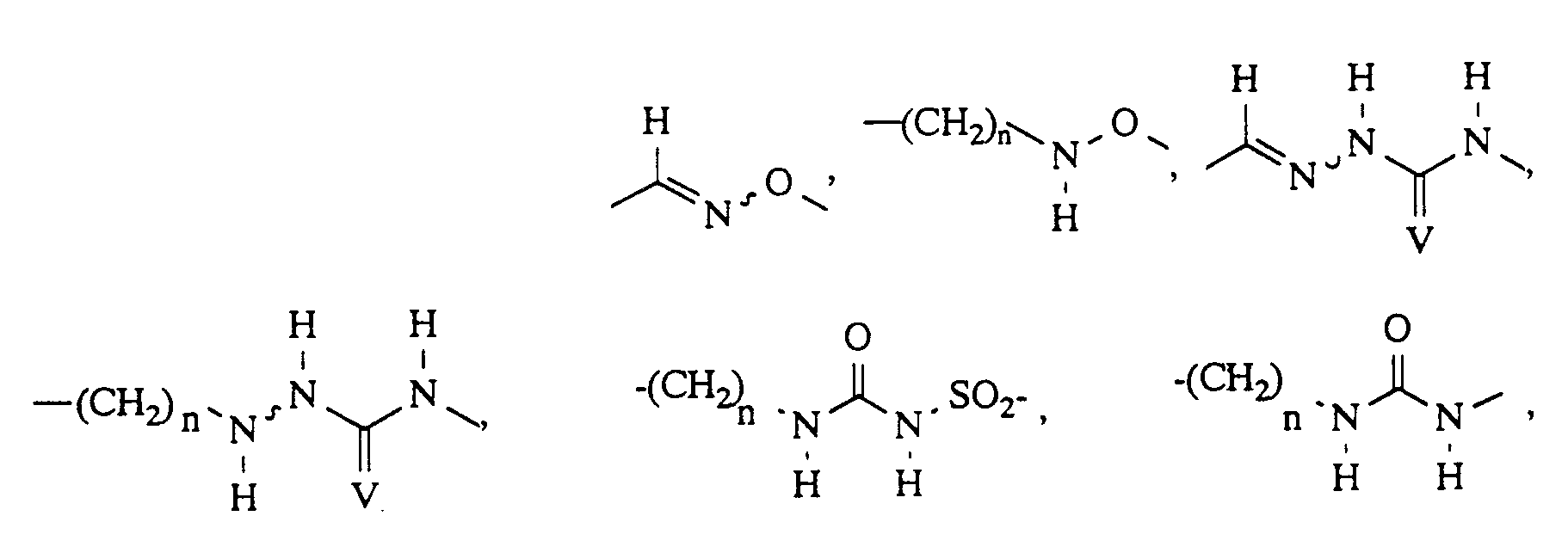

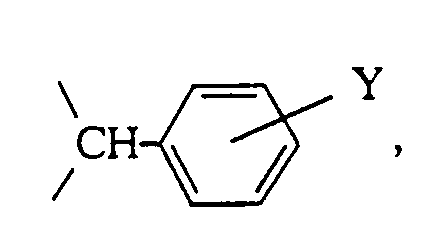
E eine Direktbindung, -C≡C- oder -CH≡CR⁸-, wobei R⁸ Wasserstoff, C₁-C₅-Alkyl, Halogen oder Trifluormethyl,
AWDE gemeinsam eine Direktbindung,
AW gemeinsam eine Direktbindung,
DE gemeinsam eine Direktbindung sein können, R⁴
m 1 oder 2,
Y₁ und Y₂ gleich oder verschieden sind und Y bedeuten,
Y Wasserstoff, Halogen, N₃, CF₃, OR⁶, NO₂, NH₂, CN, COOR⁶ oder C₁-C₁₀-Alkyl,
R⁶ Wasserstoff, C₁-C₁₀-Alkyl, gegebenenfalls durch Halogen substituiertes C₆-C₁₂-Aryl oder C₇-C₁₆-Aralkyl sein kann und, falls R⁵ Wasserstoff bedeutet, deren Salze mit physiologisch verträglichen Basen, sowie die α-, β- oder γ-Cyclodextrinclathrate, sowie die mit Liposomen verkapselten Verbindungen der Formel I bedeuten. - Arzneimittel bestehend aus einer oder mehreren Verbindungen des Anspruchs 1 und üblichen Hilfs-, Träger- und Zusatzstoffen.
- Verfahren zur Herstellung von Cyclopentan-Derivaten der Formel I, dadurch gekennzeichnet, daß man die Hydroxy-Verbindung der Formel II


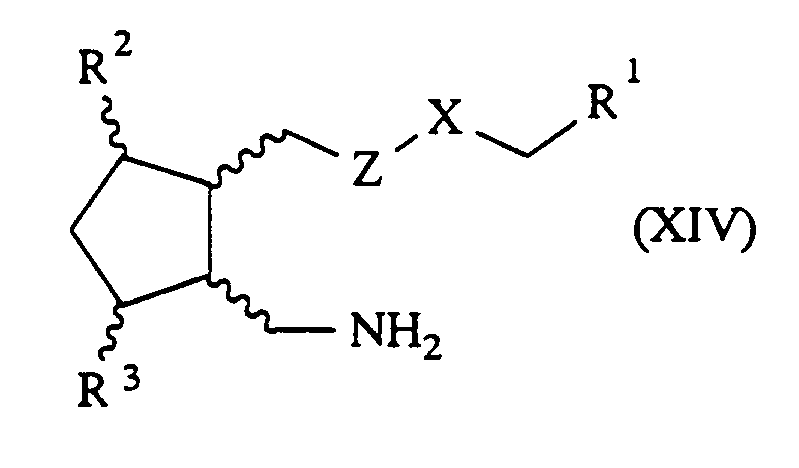
Applications Claiming Priority (3)
| Application Number | Priority Date | Filing Date | Title |
|---|---|---|---|
| DE4024347A DE4024347A1 (de) | 1990-07-27 | 1990-07-27 | Cyclopentanderivate, verfahren zu ihrer herstellung und ihre pharmazeutische verwendung |
| DE4024347 | 1990-07-27 | ||
| PCT/DE1991/000604 WO1992002495A1 (de) | 1990-07-27 | 1991-07-22 | Cyclopentanderivate, verfahren zu ihrer herstellung und ihre pharmazeutische verwendung |
Publications (2)
| Publication Number | Publication Date |
|---|---|
| EP0541594A1 EP0541594A1 (de) | 1993-05-19 |
| EP0541594B1 true EP0541594B1 (de) | 1995-05-03 |
Family
ID=6411402
Family Applications (1)
| Application Number | Title | Priority Date | Filing Date |
|---|---|---|---|
| EP91912997A Expired - Lifetime EP0541594B1 (de) | 1990-07-27 | 1991-07-22 | Cyclopentanderivate, verfahren zu ihrer herstellung und ihre pharmazeutische verwendung |
Country Status (13)
| Country | Link |
|---|---|
| EP (1) | EP0541594B1 (de) |
| JP (1) | JPH06502390A (de) |
| AT (1) | ATE122036T1 (de) |
| AU (1) | AU8221291A (de) |
| CA (1) | CA2088161A1 (de) |
| DE (3) | DE4024347A1 (de) |
| DK (1) | DK0541594T3 (de) |
| ES (1) | ES2074721T3 (de) |
| IE (1) | IE67507B1 (de) |
| IL (1) | IL98970A0 (de) |
| PT (1) | PT98464B (de) |
| WO (1) | WO1992002495A1 (de) |
| ZA (1) | ZA915905B (de) |
Families Citing this family (14)
| Publication number | Priority date | Publication date | Assignee | Title |
|---|---|---|---|---|
| DE4036140A1 (de) * | 1990-11-09 | 1992-05-14 | Schering Ag | 9-halogen-11ss-hydroxy-prostaglandinderivate, verfahren zu ihrer herstellung und ihre verwendung als arzneimittel |
| AU687906B2 (en) * | 1993-12-15 | 1998-03-05 | Alcon Laboratories, Inc. | Use of certain prostaglandin analogues to treat glaucoma and ocular hypertension |
| CA2303764C (en) * | 1997-09-09 | 2005-02-15 | The Procter & Gamble Company | Aromatic c16-c20-substituted tetrahydro prostaglandins useful as fp agonists |
| ID24845A (id) * | 1997-09-09 | 2000-08-24 | Procter & Gamble | Prostaglandin tetrahidro tersubstitusi c16-c20 aromatik yang berguna sebagai agonis fp |
| KR20010023837A (ko) * | 1997-09-09 | 2001-03-26 | 데이비드 엠 모이어 | Fp 작동약으로 유용한 방향족 c16-c20-치환된테트라히드로 프로스타글란딘 |
| US6242493B1 (en) | 1998-03-13 | 2001-06-05 | Merck Frosst Canada & Co. | Carboxylic acids and acylsulfonamides, compositions containing such compounds and methods of treatment |
| WO1999047497A2 (en) * | 1998-03-13 | 1999-09-23 | Merck Frosst Canada & Co. | Carboxylic acids and acylsulfonamides, compositions containing such compounds and methods of treatment |
| CA2364948C (en) | 1999-03-05 | 2011-04-26 | Duke University | C16 unsaturated fp-selective prostaglandins analogs |
| US20020172693A1 (en) | 2000-03-31 | 2002-11-21 | Delong Michell Anthony | Compositions and methods for treating hair loss using non-naturally occurring prostaglandins |
| US20020037914A1 (en) | 2000-03-31 | 2002-03-28 | Delong Mitchell Anthony | Compositions and methods for treating hair loss using C16-C20 aromatic tetrahydro prostaglandins |
| US20020013294A1 (en) | 2000-03-31 | 2002-01-31 | Delong Mitchell Anthony | Cosmetic and pharmaceutical compositions and methods using 2-decarboxy-2-phosphinico derivatives |
| US7323591B2 (en) * | 2006-01-10 | 2008-01-29 | Allergan, Inc. | Substituted cyclopentanes or cyclopentanones as therapeutic agents |
| US8592413B2 (en) | 2008-05-15 | 2013-11-26 | Allergan, Inc. | Therapeutic substituted cyclopentanes |
| CN106928227B (zh) * | 2010-07-15 | 2020-06-30 | 浙江奥翔药业股份有限公司 | 恩替卡韦的合成方法及其中间体化合物 |
Family Cites Families (8)
| Publication number | Priority date | Publication date | Assignee | Title |
|---|---|---|---|---|
| GB1431561A (en) * | 1973-01-31 | 1976-04-07 | Ici Ltd | Cyclopentane derivatives |
| IT1053781B (it) * | 1974-09-25 | 1981-10-10 | Erba C S P A Ora Farmitalia | Omega nor cicloalcil 13.14 deidro prostaglandine |
| FR2349328A1 (fr) * | 1976-04-30 | 1977-11-25 | Roussel Uclaf | Nouveaux derives de la 11-desoxy prostaglandine f2, leur procede de preparation et leur application comme medicaments |
| DE3126924A1 (de) * | 1981-07-03 | 1983-01-20 | Schering Ag, 1000 Berlin Und 4619 Bergkamen | 9-fluor-prostaglandinderivate, verfahren zur herstellung und verwendung als arzneimittel |
| DE3325175A1 (de) * | 1983-07-08 | 1985-01-17 | Schering AG, 1000 Berlin und 4709 Bergkamen | 11-halogen-prostanderivate, verfahren zu ihrer herstellung und ihre verwendung als arzneimittel |
| DE3510978A1 (de) * | 1985-03-22 | 1986-09-25 | Schering AG, Berlin und Bergkamen, 1000 Berlin | Neue 9-halogenprostaglandine, verfahren zu ihrer herstellung und ihre verwendung als arzneimittel |
| JP2716986B2 (ja) * | 1987-07-17 | 1998-02-18 | シエーリング アクチエンゲゼルシヤフト | 9‐ハロゲン‐(z)‐プロスタグランジン誘導体、その製法及び薬剤としてのその使用 |
| DE3923797A1 (de) * | 1989-07-14 | 1991-01-24 | Schering Ag | 9-fluor-prostaglandin-derivate, verfahren zu ihrer herstellung und ihre pharmazeutische verwendung |
-
1990
- 1990-07-27 DE DE4024347A patent/DE4024347A1/de not_active Withdrawn
-
1991
- 1991-07-22 DK DK91912997.3T patent/DK0541594T3/da active
- 1991-07-22 AT AT91912997T patent/ATE122036T1/de not_active IP Right Cessation
- 1991-07-22 ES ES91912997T patent/ES2074721T3/es not_active Expired - Lifetime
- 1991-07-22 CA CA002088161A patent/CA2088161A1/en not_active Abandoned
- 1991-07-22 DE DE59105400T patent/DE59105400D1/de not_active Expired - Lifetime
- 1991-07-22 AU AU82212/91A patent/AU8221291A/en not_active Abandoned
- 1991-07-22 JP JP3512332A patent/JPH06502390A/ja active Pending
- 1991-07-22 EP EP91912997A patent/EP0541594B1/de not_active Expired - Lifetime
- 1991-07-22 WO PCT/DE1991/000604 patent/WO1992002495A1/de not_active Ceased
- 1991-07-22 DE DEDE9100609T patent/DE4191848D2/de not_active Expired - Fee Related
- 1991-07-26 IL IL98970A patent/IL98970A0/xx unknown
- 1991-07-26 ZA ZA915905A patent/ZA915905B/xx unknown
- 1991-07-26 PT PT98464A patent/PT98464B/pt not_active IP Right Cessation
- 1991-07-29 IE IE265491A patent/IE67507B1/en not_active IP Right Cessation
Also Published As
| Publication number | Publication date |
|---|---|
| DE4024347A1 (de) | 1992-01-30 |
| WO1992002495A1 (de) | 1992-02-20 |
| CA2088161A1 (en) | 1992-01-28 |
| PT98464A (pt) | 1992-05-29 |
| EP0541594A1 (de) | 1993-05-19 |
| ES2074721T3 (es) | 1995-09-16 |
| IE912654A1 (en) | 1992-01-29 |
| ZA915905B (en) | 1992-04-29 |
| PT98464B (pt) | 1997-10-31 |
| JPH06502390A (ja) | 1994-03-17 |
| IE67507B1 (en) | 1996-04-03 |
| DK0541594T3 (da) | 1995-10-02 |
| AU8221291A (en) | 1992-03-02 |
| DE59105400D1 (de) | 1995-06-08 |
| DE4191848D2 (de) | 1993-10-07 |
| ATE122036T1 (de) | 1995-05-15 |
| IL98970A0 (en) | 1992-07-15 |
Similar Documents
| Publication | Publication Date | Title |
|---|---|---|
| WO1992002495A1 (de) | Cyclopentanderivate, verfahren zu ihrer herstellung und ihre pharmazeutische verwendung | |
| EP0563358B1 (de) | 9-substituierte bicyclo [3.3.0]octan-derivate verwendbar als txa2-antagonisten | |
| EP0099538A1 (de) | Neue Carbacycline, Verfahren zu ihrer Herstellung und ihre Verwendung als Arzneimittel | |
| DE4225488A1 (de) | Neue Bicyclo[3.3.0]octan-Derivate, Verfahren zu ihrer Herstellung und ihre pharmazeutische Verwendung | |
| EP0558570B1 (de) | Cyclopentanetherderivate, verfahren zu ihrer herstellung und ihre pharmazeutische verwendung | |
| EP0541593B1 (de) | Cyclopentenderivate, verfahren zu ihrer herstellung und ihre pharmazeutische verwendung | |
| EP0474817B1 (de) | Bicyclo [3.3.0]octan-derivate, verfahren zu ihrer herstellung und ihre pharmazeutische verwendung | |
| EP0284547B1 (de) | 6-Oxoprostaglandin-E-Derivate, Verfahren zu ihrer Herstellung und Arzneimittel | |
| EP0434833B1 (de) | 9-fluor-prostaglandin-derivate, verfahren zu ihrer herstellung und ihre pharmazeutische verwendung | |
| EP0358290B1 (de) | 2-Oxa-bicyclo[2.2.1]heptanderivate und diese Verbindungen enthaltende Arzneimittel | |
| DD201788A5 (de) | Verfahren zur herstellung neuer diaryl-imidazol-verbindungen | |
| EP0434832B1 (de) | D8- und D9-PROSTAGLANDIN-DERIVATE, VERFAHREN ZU IHRER HERSTELLUNG UND IHRE PHARMAZEUTISCHE VERWENDUNG | |
| DE4225487A1 (de) | Interphenylen-bicyclo(3.3.0)octan-Derivate, Verfahren zu ihrer Herstellung und ihre pharmazeutische Verwendung | |
| DE4303145A1 (de) | Interphenylen-2-Oxabicyclo(2.2.1)heptan-Derivate, Verfahren zu ihrer Herstellung und ihre pharmazeutische Verwendung | |
| EP0162217A1 (de) | 1,2,4-Triazacycloalkadienderivate | |
| EP0113311B1 (de) | 5-Fluorcarbacycline, Verfahren zu ihrer Herstellung und ihre Verwendung als Arzneimittel | |
| DE4343776A1 (de) | Cyclopentanonderivate, Verfahren zu ihrer Herstellung und ihre pharmazeutische Verwendung | |
| DE3831222A1 (de) | 6-oxo-9-fluor-prostaglandin-derivate verfahren zu ihrer herstellung und ihre pharmazeutische verwendung | |
| EP0155901A1 (de) | Neue Carbacycline, Verfahren zu ihrer Herstellung und ihre Verwendung als Arzneimittel |
Legal Events
| Date | Code | Title | Description |
|---|---|---|---|
| PUAI | Public reference made under article 153(3) epc to a published international application that has entered the european phase |
Free format text: ORIGINAL CODE: 0009012 |
|
| 17P | Request for examination filed |
Effective date: 19921215 |
|
| AK | Designated contracting states |
Kind code of ref document: A1 Designated state(s): AT BE CH DE DK ES FR GB GR IT LI LU NL SE |
|
| 17Q | First examination report despatched |
Effective date: 19940720 |
|
| GRAA | (expected) grant |
Free format text: ORIGINAL CODE: 0009210 |
|
| AK | Designated contracting states |
Kind code of ref document: B1 Designated state(s): AT BE CH DE DK ES FR GB GR IT LI LU NL SE |
|
| REF | Corresponds to: |
Ref document number: 122036 Country of ref document: AT Date of ref document: 19950515 Kind code of ref document: T |
|
| REF | Corresponds to: |
Ref document number: 59105400 Country of ref document: DE Date of ref document: 19950608 |
|
| ITF | It: translation for a ep patent filed | ||
| ET | Fr: translation filed | ||
| REG | Reference to a national code |
Ref country code: GR Ref legal event code: FG4A Free format text: 3016341 |
|
| GBT | Gb: translation of ep patent filed (gb section 77(6)(a)/1977) |
Effective date: 19950812 |
|
| REG | Reference to a national code |
Ref country code: ES Ref legal event code: FG2A Ref document number: 2074721 Country of ref document: ES Kind code of ref document: T3 |
|
| REG | Reference to a national code |
Ref country code: DK Ref legal event code: T3 |
|
| PLBE | No opposition filed within time limit |
Free format text: ORIGINAL CODE: 0009261 |
|
| STAA | Information on the status of an ep patent application or granted ep patent |
Free format text: STATUS: NO OPPOSITION FILED WITHIN TIME LIMIT |
|
| 26N | No opposition filed | ||
| PGFP | Annual fee paid to national office [announced via postgrant information from national office to epo] |
Ref country code: DK Payment date: 19980612 Year of fee payment: 8 |
|
| PGFP | Annual fee paid to national office [announced via postgrant information from national office to epo] |
Ref country code: AT Payment date: 19980616 Year of fee payment: 8 |
|
| PGFP | Annual fee paid to national office [announced via postgrant information from national office to epo] |
Ref country code: SE Payment date: 19980622 Year of fee payment: 8 |
|
| PGFP | Annual fee paid to national office [announced via postgrant information from national office to epo] |
Ref country code: GB Payment date: 19980623 Year of fee payment: 8 |
|
| PGFP | Annual fee paid to national office [announced via postgrant information from national office to epo] |
Ref country code: NL Payment date: 19980629 Year of fee payment: 8 Ref country code: DE Payment date: 19980629 Year of fee payment: 8 |
|
| PGFP | Annual fee paid to national office [announced via postgrant information from national office to epo] |
Ref country code: GR Payment date: 19980630 Year of fee payment: 8 |
|
| PGFP | Annual fee paid to national office [announced via postgrant information from national office to epo] |
Ref country code: LU Payment date: 19980701 Year of fee payment: 8 Ref country code: CH Payment date: 19980701 Year of fee payment: 8 |
|
| PGFP | Annual fee paid to national office [announced via postgrant information from national office to epo] |
Ref country code: ES Payment date: 19980710 Year of fee payment: 8 |
|
| PGFP | Annual fee paid to national office [announced via postgrant information from national office to epo] |
Ref country code: BE Payment date: 19980713 Year of fee payment: 8 |
|
| PG25 | Lapsed in a contracting state [announced via postgrant information from national office to epo] |
Ref country code: DE Free format text: LAPSE BECAUSE OF THE APPLICANT RENOUNCES Effective date: 19990225 |
|
| PG25 | Lapsed in a contracting state [announced via postgrant information from national office to epo] |
Ref country code: LU Free format text: LAPSE BECAUSE OF NON-PAYMENT OF DUE FEES Effective date: 19990722 Ref country code: GB Free format text: LAPSE BECAUSE OF NON-PAYMENT OF DUE FEES Effective date: 19990722 Ref country code: AT Free format text: LAPSE BECAUSE OF NON-PAYMENT OF DUE FEES Effective date: 19990722 |
|
| PG25 | Lapsed in a contracting state [announced via postgrant information from national office to epo] |
Ref country code: ES Free format text: LAPSE BECAUSE OF NON-PAYMENT OF DUE FEES Effective date: 19990723 |
|
| PG25 | Lapsed in a contracting state [announced via postgrant information from national office to epo] |
Ref country code: SE Free format text: THE PATENT HAS BEEN ANNULLED BY A DECISION OF A NATIONAL AUTHORITY Effective date: 19990730 |
|
| PG25 | Lapsed in a contracting state [announced via postgrant information from national office to epo] |
Ref country code: LI Free format text: LAPSE BECAUSE OF NON-PAYMENT OF DUE FEES Effective date: 19990731 Ref country code: GR Free format text: LAPSE BECAUSE OF NON-PAYMENT OF DUE FEES Effective date: 19990731 Ref country code: CH Free format text: LAPSE BECAUSE OF NON-PAYMENT OF DUE FEES Effective date: 19990731 Ref country code: BE Free format text: LAPSE BECAUSE OF NON-PAYMENT OF DUE FEES Effective date: 19990731 |
|
| PG25 | Lapsed in a contracting state [announced via postgrant information from national office to epo] |
Ref country code: DK Free format text: LAPSE BECAUSE OF NON-PAYMENT OF DUE FEES Effective date: 19990802 |
|
| PGFP | Annual fee paid to national office [announced via postgrant information from national office to epo] |
Ref country code: FR Payment date: 20000125 Year of fee payment: 9 |
|
| BERE | Be: lapsed |
Owner name: SCHERING A.G. Effective date: 19990731 |
|
| PG25 | Lapsed in a contracting state [announced via postgrant information from national office to epo] |
Ref country code: NL Free format text: LAPSE BECAUSE OF NON-PAYMENT OF DUE FEES Effective date: 20000201 |
|
| GBPC | Gb: european patent ceased through non-payment of renewal fee |
Effective date: 19990722 |
|
| REG | Reference to a national code |
Ref country code: CH Ref legal event code: PL |
|
| REG | Reference to a national code |
Ref country code: DK Ref legal event code: EBP |
|
| EUG | Se: european patent has lapsed |
Ref document number: 91912997.3 |
|
| NLV4 | Nl: lapsed or anulled due to non-payment of the annual fee |
Effective date: 20000201 |
|
| PG25 | Lapsed in a contracting state [announced via postgrant information from national office to epo] |
Ref country code: FR Free format text: LAPSE BECAUSE OF NON-PAYMENT OF DUE FEES Effective date: 20010330 |
|
| REG | Reference to a national code |
Ref country code: FR Ref legal event code: ST |
|
| REG | Reference to a national code |
Ref country code: ES Ref legal event code: FD2A Effective date: 20000810 |
|
| PG25 | Lapsed in a contracting state [announced via postgrant information from national office to epo] |
Ref country code: IT Free format text: LAPSE BECAUSE OF NON-PAYMENT OF DUE FEES;WARNING: LAPSES OF ITALIAN PATENTS WITH EFFECTIVE DATE BEFORE 2007 MAY HAVE OCCURRED AT ANY TIME BEFORE 2007. THE CORRECT EFFECTIVE DATE MAY BE DIFFERENT FROM THE ONE RECORDED. Effective date: 20050722 |