EP0509832B1 - Polyesterharzzusammensetzung - Google Patents
Polyesterharzzusammensetzung Download PDFInfo
- Publication number
- EP0509832B1 EP0509832B1 EP92303468A EP92303468A EP0509832B1 EP 0509832 B1 EP0509832 B1 EP 0509832B1 EP 92303468 A EP92303468 A EP 92303468A EP 92303468 A EP92303468 A EP 92303468A EP 0509832 B1 EP0509832 B1 EP 0509832B1
- Authority
- EP
- European Patent Office
- Prior art keywords
- liquid crystalline
- lcp
- resin composition
- polyester
- pat
- Prior art date
- Legal status (The legal status is an assumption and is not a legal conclusion. Google has not performed a legal analysis and makes no representation as to the accuracy of the status listed.)
- Expired - Lifetime
Links
- 239000000203 mixture Substances 0.000 title claims abstract description 37
- 229920001225 polyester resin Polymers 0.000 title claims abstract description 18
- 239000004645 polyester resin Substances 0.000 title claims abstract description 18
- 229920001283 Polyalkylene terephthalate Polymers 0.000 claims abstract description 44
- 229920000728 polyester Polymers 0.000 claims abstract description 36
- 239000007788 liquid Substances 0.000 claims abstract description 26
- 239000000155 melt Substances 0.000 claims abstract description 12
- 238000010128 melt processing Methods 0.000 claims abstract description 8
- 125000002947 alkylene group Chemical group 0.000 claims abstract description 6
- 125000004432 carbon atom Chemical group C* 0.000 claims abstract description 5
- -1 aromatic hydroxy carboxylic acids Chemical class 0.000 claims description 36
- 125000003118 aryl group Chemical group 0.000 claims description 12
- 150000001875 compounds Chemical class 0.000 claims description 11
- 229920006149 polyester-amide block copolymer Polymers 0.000 claims description 9
- 125000001424 substituent group Chemical group 0.000 claims description 8
- 150000001555 benzenes Chemical class 0.000 claims description 6
- 239000011256 inorganic filler Substances 0.000 claims description 5
- 229910003475 inorganic filler Inorganic materials 0.000 claims description 5
- 150000004984 aromatic diamines Chemical class 0.000 claims description 4
- ZUOUZKKEUPVFJK-UHFFFAOYSA-N diphenyl Chemical class C1=CC=CC=C1C1=CC=CC=C1 ZUOUZKKEUPVFJK-UHFFFAOYSA-N 0.000 claims description 3
- 150000002790 naphthalenes Chemical class 0.000 claims description 3
- 125000004343 1-phenylethyl group Chemical group [H]C1=C([H])C([H])=C(C([H])=C1[H])C([H])(*)C([H])([H])[H] 0.000 claims description 2
- WKBOTKDWSSQWDR-UHFFFAOYSA-N Bromine atom Chemical compound [Br] WKBOTKDWSSQWDR-UHFFFAOYSA-N 0.000 claims description 2
- ZAMOUSCENKQFHK-UHFFFAOYSA-N Chlorine atom Chemical compound [Cl] ZAMOUSCENKQFHK-UHFFFAOYSA-N 0.000 claims description 2
- 125000001118 alkylidene group Chemical group 0.000 claims description 2
- GDTBXPJZTBHREO-UHFFFAOYSA-N bromine Substances BrBr GDTBXPJZTBHREO-UHFFFAOYSA-N 0.000 claims description 2
- 229910052794 bromium Inorganic materials 0.000 claims description 2
- 239000000460 chlorine Substances 0.000 claims description 2
- 229910052801 chlorine Inorganic materials 0.000 claims description 2
- 125000002496 methyl group Chemical group [H]C([H])([H])* 0.000 claims description 2
- 125000001997 phenyl group Chemical group [H]C1=C([H])C([H])=C(*)C([H])=C1[H] 0.000 claims description 2
- 238000000465 moulding Methods 0.000 abstract description 9
- 230000008602 contraction Effects 0.000 abstract description 5
- 239000000463 material Substances 0.000 abstract description 3
- 229920005989 resin Polymers 0.000 description 12
- 239000011347 resin Substances 0.000 description 12
- 238000000034 method Methods 0.000 description 9
- VYPSYNLAJGMNEJ-UHFFFAOYSA-N Silicium dioxide Chemical compound O=[Si]=O VYPSYNLAJGMNEJ-UHFFFAOYSA-N 0.000 description 8
- 229920000642 polymer Polymers 0.000 description 8
- 239000000470 constituent Substances 0.000 description 7
- 229920001577 copolymer Polymers 0.000 description 6
- 239000011521 glass Substances 0.000 description 5
- FJKROLUGYXJWQN-UHFFFAOYSA-N 4-hydroxybenzoic acid Chemical compound OC(=O)C1=CC=C(O)C=C1 FJKROLUGYXJWQN-UHFFFAOYSA-N 0.000 description 4
- KKEYFWRCBNTPAC-UHFFFAOYSA-N Terephthalic acid Chemical compound OC(=O)C1=CC=C(C(O)=O)C=C1 KKEYFWRCBNTPAC-UHFFFAOYSA-N 0.000 description 4
- 238000004090 dissolution Methods 0.000 description 4
- QQVIHTHCMHWDBS-UHFFFAOYSA-N isophthalic acid Chemical compound OC(=O)C1=CC=CC(C(O)=O)=C1 QQVIHTHCMHWDBS-UHFFFAOYSA-N 0.000 description 4
- 229910052751 metal Inorganic materials 0.000 description 4
- 239000002184 metal Substances 0.000 description 4
- 229920001707 polybutylene terephthalate Polymers 0.000 description 4
- 229920000139 polyethylene terephthalate Polymers 0.000 description 4
- 239000005020 polyethylene terephthalate Substances 0.000 description 4
- 239000011342 resin composition Substances 0.000 description 4
- 239000000243 solution Substances 0.000 description 4
- PNEYBMLMFCGWSK-UHFFFAOYSA-N aluminium oxide Inorganic materials [O-2].[O-2].[O-2].[Al+3].[Al+3] PNEYBMLMFCGWSK-UHFFFAOYSA-N 0.000 description 3
- 238000001816 cooling Methods 0.000 description 3
- 239000000945 filler Substances 0.000 description 3
- 239000000843 powder Substances 0.000 description 3
- 239000000377 silicon dioxide Substances 0.000 description 3
- BYEAHWXPCBROCE-UHFFFAOYSA-N 1,1,1,3,3,3-hexafluoropropan-2-ol Chemical compound FC(F)(F)C(O)C(F)(F)F BYEAHWXPCBROCE-UHFFFAOYSA-N 0.000 description 2
- XBNGYFFABRKICK-UHFFFAOYSA-N 2,3,4,5,6-pentafluorophenol Chemical compound OC1=C(F)C(F)=C(F)C(F)=C1F XBNGYFFABRKICK-UHFFFAOYSA-N 0.000 description 2
- PLIKAWJENQZMHA-UHFFFAOYSA-N 4-aminophenol Chemical compound NC1=CC=C(O)C=C1 PLIKAWJENQZMHA-UHFFFAOYSA-N 0.000 description 2
- 229940090248 4-hydroxybenzoic acid Drugs 0.000 description 2
- 239000005995 Aluminium silicate Substances 0.000 description 2
- 229910052582 BN Inorganic materials 0.000 description 2
- PZNSFCLAULLKQX-UHFFFAOYSA-N Boron nitride Chemical compound N#B PZNSFCLAULLKQX-UHFFFAOYSA-N 0.000 description 2
- VTYYLEPIZMXCLO-UHFFFAOYSA-L Calcium carbonate Chemical compound [Ca+2].[O-]C([O-])=O VTYYLEPIZMXCLO-UHFFFAOYSA-L 0.000 description 2
- QIGBRXMKCJKVMJ-UHFFFAOYSA-N Hydroquinone Chemical compound OC1=CC=C(O)C=C1 QIGBRXMKCJKVMJ-UHFFFAOYSA-N 0.000 description 2
- UQSXHKLRYXJYBZ-UHFFFAOYSA-N Iron oxide Chemical compound [Fe]=O UQSXHKLRYXJYBZ-UHFFFAOYSA-N 0.000 description 2
- 229910052581 Si3N4 Inorganic materials 0.000 description 2
- RTAQQCXQSZGOHL-UHFFFAOYSA-N Titanium Chemical compound [Ti] RTAQQCXQSZGOHL-UHFFFAOYSA-N 0.000 description 2
- 241000276425 Xiphophorus maculatus Species 0.000 description 2
- XLOMVQKBTHCTTD-UHFFFAOYSA-N Zinc monoxide Chemical compound [Zn]=O XLOMVQKBTHCTTD-UHFFFAOYSA-N 0.000 description 2
- MCMNRKCIXSYSNV-UHFFFAOYSA-N Zirconium dioxide Chemical compound O=[Zr]=O MCMNRKCIXSYSNV-UHFFFAOYSA-N 0.000 description 2
- 235000012211 aluminium silicate Nutrition 0.000 description 2
- ADCOVFLJGNWWNZ-UHFFFAOYSA-N antimony trioxide Chemical compound O=[Sb]O[Sb]=O ADCOVFLJGNWWNZ-UHFFFAOYSA-N 0.000 description 2
- QMKYBPDZANOJGF-UHFFFAOYSA-N benzene-1,3,5-tricarboxylic acid Chemical compound OC(=O)C1=CC(C(O)=O)=CC(C(O)=O)=C1 QMKYBPDZANOJGF-UHFFFAOYSA-N 0.000 description 2
- IISBACLAFKSPIT-UHFFFAOYSA-N bisphenol A Chemical compound C=1C=C(O)C=CC=1C(C)(C)C1=CC=C(O)C=C1 IISBACLAFKSPIT-UHFFFAOYSA-N 0.000 description 2
- 230000000052 comparative effect Effects 0.000 description 2
- 239000012765 fibrous filler Substances 0.000 description 2
- 239000003365 glass fiber Substances 0.000 description 2
- 238000001746 injection moulding Methods 0.000 description 2
- 238000011835 investigation Methods 0.000 description 2
- 238000004898 kneading Methods 0.000 description 2
- 238000002156 mixing Methods 0.000 description 2
- 239000000178 monomer Substances 0.000 description 2
- IZUPBVBPLAPZRR-UHFFFAOYSA-N pentachloro-phenol Natural products OC1=C(Cl)C(Cl)=C(Cl)C(Cl)=C1Cl IZUPBVBPLAPZRR-UHFFFAOYSA-N 0.000 description 2
- CYIDZMCFTVVTJO-UHFFFAOYSA-N pyromellitic acid Chemical compound OC(=O)C1=CC(C(O)=O)=C(C(O)=O)C=C1C(O)=O CYIDZMCFTVVTJO-UHFFFAOYSA-N 0.000 description 2
- GHMLBKRAJCXXBS-UHFFFAOYSA-N resorcinol Chemical compound OC1=CC=CC(O)=C1 GHMLBKRAJCXXBS-UHFFFAOYSA-N 0.000 description 2
- HQVNEWCFYHHQES-UHFFFAOYSA-N silicon nitride Chemical compound N12[Si]34N5[Si]62N3[Si]51N64 HQVNEWCFYHHQES-UHFFFAOYSA-N 0.000 description 2
- 238000004381 surface treatment Methods 0.000 description 2
- KKEYFWRCBNTPAC-UHFFFAOYSA-L terephthalate(2-) Chemical compound [O-]C(=O)C1=CC=C(C([O-])=O)C=C1 KKEYFWRCBNTPAC-UHFFFAOYSA-L 0.000 description 2
- CNHDIAIOKMXOLK-UHFFFAOYSA-N toluquinol Chemical compound CC1=CC(O)=CC=C1O CNHDIAIOKMXOLK-UHFFFAOYSA-N 0.000 description 2
- ARCGXLSVLAOJQL-UHFFFAOYSA-N trimellitic acid Chemical compound OC(=O)C1=CC=C(C(O)=O)C(C(O)=O)=C1 ARCGXLSVLAOJQL-UHFFFAOYSA-N 0.000 description 2
- CBCKQZAAMUWICA-UHFFFAOYSA-N 1,4-phenylenediamine Chemical compound NC1=CC=C(N)C=C1 CBCKQZAAMUWICA-UHFFFAOYSA-N 0.000 description 1
- LMXZDVUCXQJEHS-UHFFFAOYSA-N 2-(1-phenylethyl)benzene-1,4-diol Chemical compound C=1C(O)=CC=C(O)C=1C(C)C1=CC=CC=C1 LMXZDVUCXQJEHS-UHFFFAOYSA-N 0.000 description 1
- MQNYRWNTWAJYEI-UHFFFAOYSA-N 2-[2-[2-[2-(2-hydroxyethoxy)phenyl]propan-2-yl]phenoxy]ethanol Chemical compound C=1C=CC=C(OCCO)C=1C(C)(C)C1=CC=CC=C1OCCO MQNYRWNTWAJYEI-UHFFFAOYSA-N 0.000 description 1
- NEQFBGHQPUXOFH-UHFFFAOYSA-N 4-(4-carboxyphenyl)benzoic acid Chemical compound C1=CC(C(=O)O)=CC=C1C1=CC=C(C(O)=O)C=C1 NEQFBGHQPUXOFH-UHFFFAOYSA-N 0.000 description 1
- KAUQJMHLAFIZDU-UHFFFAOYSA-N 6-Hydroxy-2-naphthoic acid Chemical compound C1=C(O)C=CC2=CC(C(=O)O)=CC=C21 KAUQJMHLAFIZDU-UHFFFAOYSA-N 0.000 description 1
- ZOXJGFHDIHLPTG-UHFFFAOYSA-N Boron Chemical compound [B] ZOXJGFHDIHLPTG-UHFFFAOYSA-N 0.000 description 1
- 229910001369 Brass Inorganic materials 0.000 description 1
- OKTJSMMVPCPJKN-UHFFFAOYSA-N Carbon Chemical compound [C] OKTJSMMVPCPJKN-UHFFFAOYSA-N 0.000 description 1
- RYGMFSIKBFXOCR-UHFFFAOYSA-N Copper Chemical compound [Cu] RYGMFSIKBFXOCR-UHFFFAOYSA-N 0.000 description 1
- 239000004593 Epoxy Substances 0.000 description 1
- 238000004566 IR spectroscopy Methods 0.000 description 1
- 239000005909 Kieselgur Substances 0.000 description 1
- 229920000106 Liquid crystal polymer Polymers 0.000 description 1
- 0 Oc1ccc(*c(cc2)ccc2O)cc1 Chemical compound Oc1ccc(*c(cc2)ccc2O)cc1 0.000 description 1
- ZLMJMSJWJFRBEC-UHFFFAOYSA-N Potassium Chemical compound [K] ZLMJMSJWJFRBEC-UHFFFAOYSA-N 0.000 description 1
- GWEVSGVZZGPLCZ-UHFFFAOYSA-N Titan oxide Chemical compound O=[Ti]=O GWEVSGVZZGPLCZ-UHFFFAOYSA-N 0.000 description 1
- ZJCCRDAZUWHFQH-UHFFFAOYSA-N Trimethylolpropane Chemical compound CCC(CO)(CO)CO ZJCCRDAZUWHFQH-UHFFFAOYSA-N 0.000 description 1
- ORLQHILJRHBSAY-UHFFFAOYSA-N [1-(hydroxymethyl)cyclohexyl]methanol Chemical compound OCC1(CO)CCCCC1 ORLQHILJRHBSAY-UHFFFAOYSA-N 0.000 description 1
- 125000000217 alkyl group Chemical group 0.000 description 1
- 239000004411 aluminium Substances 0.000 description 1
- 229910052782 aluminium Inorganic materials 0.000 description 1
- XAGFODPZIPBFFR-UHFFFAOYSA-N aluminium Chemical compound [Al] XAGFODPZIPBFFR-UHFFFAOYSA-N 0.000 description 1
- PZZYQPZGQPZBDN-UHFFFAOYSA-N aluminium silicate Chemical compound O=[Al]O[Si](=O)O[Al]=O PZZYQPZGQPZBDN-UHFFFAOYSA-N 0.000 description 1
- 229910000323 aluminium silicate Inorganic materials 0.000 description 1
- 238000000149 argon plasma sintering Methods 0.000 description 1
- 239000010425 asbestos Substances 0.000 description 1
- 239000011324 bead Substances 0.000 description 1
- 230000015572 biosynthetic process Effects 0.000 description 1
- VCCBEIPGXKNHFW-UHFFFAOYSA-N biphenyl-4,4'-diol Chemical group C1=CC(O)=CC=C1C1=CC=C(O)C=C1 VCCBEIPGXKNHFW-UHFFFAOYSA-N 0.000 description 1
- 229910052796 boron Inorganic materials 0.000 description 1
- 239000010951 brass Substances 0.000 description 1
- 229910000019 calcium carbonate Inorganic materials 0.000 description 1
- 239000000378 calcium silicate Substances 0.000 description 1
- 229910052918 calcium silicate Inorganic materials 0.000 description 1
- 235000012241 calcium silicate Nutrition 0.000 description 1
- OYACROKNLOSFPA-UHFFFAOYSA-N calcium;dioxido(oxo)silane Chemical compound [Ca+2].[O-][Si]([O-])=O OYACROKNLOSFPA-UHFFFAOYSA-N 0.000 description 1
- 239000006229 carbon black Substances 0.000 description 1
- 150000004649 carbonic acid derivatives Chemical class 0.000 description 1
- 239000004927 clay Substances 0.000 description 1
- 239000010949 copper Substances 0.000 description 1
- 229910052802 copper Inorganic materials 0.000 description 1
- NJLLQSBAHIKGKF-UHFFFAOYSA-N dipotassium dioxido(oxo)titanium Chemical compound [K+].[K+].[O-][Ti]([O-])=O NJLLQSBAHIKGKF-UHFFFAOYSA-N 0.000 description 1
- 239000006185 dispersion Substances 0.000 description 1
- 238000001125 extrusion Methods 0.000 description 1
- 239000000835 fiber Substances 0.000 description 1
- 239000011888 foil Substances 0.000 description 1
- 125000000524 functional group Chemical group 0.000 description 1
- 238000005227 gel permeation chromatography Methods 0.000 description 1
- 239000010439 graphite Substances 0.000 description 1
- 229910002804 graphite Inorganic materials 0.000 description 1
- 229920001519 homopolymer Polymers 0.000 description 1
- NWVVVBRKAWDGAB-UHFFFAOYSA-N hydroquinone methyl ether Natural products COC1=CC=C(O)C=C1 NWVVVBRKAWDGAB-UHFFFAOYSA-N 0.000 description 1
- 230000001771 impaired effect Effects 0.000 description 1
- 239000012948 isocyanate Substances 0.000 description 1
- NLYAJNPCOHFWQQ-UHFFFAOYSA-N kaolin Chemical compound O.O.O=[Al]O[Si](=O)O[Si](=O)O[Al]=O NLYAJNPCOHFWQQ-UHFFFAOYSA-N 0.000 description 1
- ZLNQQNXFFQJAID-UHFFFAOYSA-L magnesium carbonate Chemical compound [Mg+2].[O-]C([O-])=O ZLNQQNXFFQJAID-UHFFFAOYSA-L 0.000 description 1
- 239000001095 magnesium carbonate Substances 0.000 description 1
- 229910000021 magnesium carbonate Inorganic materials 0.000 description 1
- 239000011159 matrix material Substances 0.000 description 1
- 229910044991 metal oxide Inorganic materials 0.000 description 1
- 150000004706 metal oxides Chemical class 0.000 description 1
- 239000010445 mica Substances 0.000 description 1
- 229910052618 mica group Inorganic materials 0.000 description 1
- 239000003607 modifier Substances 0.000 description 1
- PCILLCXFKWDRMK-UHFFFAOYSA-N naphthalene-1,4-diol Chemical compound C1=CC=C2C(O)=CC=C(O)C2=C1 PCILLCXFKWDRMK-UHFFFAOYSA-N 0.000 description 1
- RXOHFPCZGPKIRD-UHFFFAOYSA-N naphthalene-2,6-dicarboxylic acid Chemical compound C1=C(C(O)=O)C=CC2=CC(C(=O)O)=CC=C21 RXOHFPCZGPKIRD-UHFFFAOYSA-N 0.000 description 1
- MNZMMCVIXORAQL-UHFFFAOYSA-N naphthalene-2,6-diol Chemical compound C1=C(O)C=CC2=CC(O)=CC=C21 MNZMMCVIXORAQL-UHFFFAOYSA-N 0.000 description 1
- 239000012299 nitrogen atmosphere Substances 0.000 description 1
- 230000003287 optical effect Effects 0.000 description 1
- 239000002245 particle Substances 0.000 description 1
- WXZMFSXDPGVJKK-UHFFFAOYSA-N pentaerythritol Chemical compound OCC(CO)(CO)CO WXZMFSXDPGVJKK-UHFFFAOYSA-N 0.000 description 1
- 238000000711 polarimetry Methods 0.000 description 1
- 229920001748 polybutylene Polymers 0.000 description 1
- 238000006068 polycondensation reaction Methods 0.000 description 1
- 239000011148 porous material Substances 0.000 description 1
- 239000010453 quartz Substances 0.000 description 1
- 229910052895 riebeckite Inorganic materials 0.000 description 1
- 150000004756 silanes Chemical class 0.000 description 1
- 150000004760 silicates Chemical class 0.000 description 1
- HBMJWWWQQXIZIP-UHFFFAOYSA-N silicon carbide Chemical compound [Si+]#[C-] HBMJWWWQQXIZIP-UHFFFAOYSA-N 0.000 description 1
- 229910010271 silicon carbide Inorganic materials 0.000 description 1
- 239000002904 solvent Substances 0.000 description 1
- 239000010935 stainless steel Substances 0.000 description 1
- 229910001220 stainless steel Inorganic materials 0.000 description 1
- 230000003068 static effect Effects 0.000 description 1
- 239000000126 substance Substances 0.000 description 1
- 229920005992 thermoplastic resin Polymers 0.000 description 1
- 239000010936 titanium Substances 0.000 description 1
- 229910052719 titanium Inorganic materials 0.000 description 1
- OGIDPMRJRNCKJF-UHFFFAOYSA-N titanium oxide Inorganic materials [Ti]=O OGIDPMRJRNCKJF-UHFFFAOYSA-N 0.000 description 1
- 239000010456 wollastonite Substances 0.000 description 1
- 229910052882 wollastonite Inorganic materials 0.000 description 1
- 239000011787 zinc oxide Substances 0.000 description 1
- 229910000859 α-Fe Inorganic materials 0.000 description 1
Images


Classifications
-
- C—CHEMISTRY; METALLURGY
- C08—ORGANIC MACROMOLECULAR COMPOUNDS; THEIR PREPARATION OR CHEMICAL WORKING-UP; COMPOSITIONS BASED THEREON
- C08L—COMPOSITIONS OF MACROMOLECULAR COMPOUNDS
- C08L67/00—Compositions of polyesters obtained by reactions forming a carboxylic ester link in the main chain; Compositions of derivatives of such polymers
- C08L67/02—Polyesters derived from dicarboxylic acids and dihydroxy compounds
-
- C—CHEMISTRY; METALLURGY
- C08—ORGANIC MACROMOLECULAR COMPOUNDS; THEIR PREPARATION OR CHEMICAL WORKING-UP; COMPOSITIONS BASED THEREON
- C08L—COMPOSITIONS OF MACROMOLECULAR COMPOUNDS
- C08L67/00—Compositions of polyesters obtained by reactions forming a carboxylic ester link in the main chain; Compositions of derivatives of such polymers
-
- C—CHEMISTRY; METALLURGY
- C08—ORGANIC MACROMOLECULAR COMPOUNDS; THEIR PREPARATION OR CHEMICAL WORKING-UP; COMPOSITIONS BASED THEREON
- C08L—COMPOSITIONS OF MACROMOLECULAR COMPOUNDS
- C08L77/00—Compositions of polyamides obtained by reactions forming a carboxylic amide link in the main chain; Compositions of derivatives of such polymers
- C08L77/12—Polyester-amides
Definitions
- the present invention relates to a polyester resin composition.
- the present invention relates to a resin composition comprising a blend of a polyalkylene terephthalate having a specified melt viscosity and a liquid crystalline polyester.
- liquid crystalline polyesters are thermoplastic resins having various excellent properties such as high strength, high thermal resistance, low coefficient of contraction, low coefficient of linear expansion and high mouldability, they are expensive, thus being industrially disadvantageous.
- a moulding produced by injection-moulding a polyester resin composition comprising a mere blend of LCP and PAT cannot retain the excellent properties of LCP, such as low coefficient of contraction, low coefficient of linear expansion and high thermal resistance, and the strength thereof is seriously impaired.
- LCP is oriented and dispersed in the form of a filament having a diameter of the order of several tens of micrometres in the direction of its flow by the shear stress and elongation stress applied in the melt processing step, which is causative of the undesirable properties of the moulding.
- the present invention relates to a polyester resin composition
- a polyester resin composition comprising a liquid crystalline polyester (LCP) having a melt viscosity of 200 to 2,000 P (20 to 200 Pas) and a polyalkylene terephthalate (PAT) having a melt viscosity of 200 to 5,000 P (20 to 500 Pas) both measured at a shear rate of 1,000 sec -1 at a melt processing temperature and the PAT having 2 to 6 carbon atoms in the alkylene chain thereof, the ratio of liquid crystalline polyester to polyalkylene terephthalate polyester being in the range 40/60 to 99/1 by weight, the ratio of such melt viscosity of the LCP, MV LCP , to that of the PAT, MV PAT , being in the range: 1 3 ⁇ MV LCP MV PAT ⁇ 3 and the liquid crystalline polyester forming a continuous phase in said polyester resin composition.
- LCP liquid crystalline polyester
- PAT polyalkylene terephthalate
- Fig. 1 is an electron photomicrograph of the structure of a section through a product according to the present invention after removal of PAT by dissolution.
- Fig. 2 is an electron photomicrograph of the structure of a section through a product produced by a conventional process after removal of PAT by dissolution.
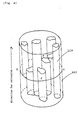
- Fig. 3 is a schematic view of a resin product produced by kneading the blend composition of the present invention comprising LCP and PAT on an extruder and solidifying the resin extruded through the die by cooling.
- Fig. 4 is a schematic view of a resin product produced by kneading an ordinary blend composition comprising LCP and PAT on an extruder and solidifying the resin extruded through the die by cooling.
- the PAT to be used in the present invention is one having a melt viscosity of 200 to 5,000 P (20 to 500 Pas) at a shear rate of 1,000 sec -1 at the melt processing temperature.
- the melt viscosity of the LCP used in the present invention also measured at a shear, rate of 1,000 sec -1 at the melt processing temperature is limited to 200 to 2,000 P (20 to 200 Pas).
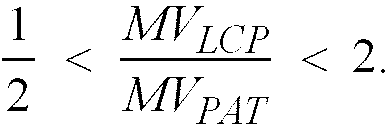
- the ratio of the melt viscosity at a shear rate of 1,000 sec -1 at the melt processing temperature of the LCP, MV LCP , to that of the PAT, MV PAT is in the range: 1 3 ⁇ MV LCP MV PAT ⁇ 3, and is preferably in the range: 1 2 ⁇ MV LCP MV PAT ⁇ 2.
- LCP in a molten blend resin under a shear stress does not form any continuous phase but is easily oriented in the form of a fibre having a, diameter of about several tens of micrometres even when it is used in a large amount.
- continuous LCP phase refers to a phase wherein PAT in the separated particle form is dispersed in LCP to form a two-phase structure as shown in Fig. 1, which is different from a structure in which LCP forms no continuous phase (Fig. 2).
- Figs. 3 and 4 are schematic views of resin products obtained by blending LCP and PAT on an extruder and solidifying the resin extruded through a die thereof by cooling, wherein Fig. 3 shows the product obtained from the resin composition of the present invention and Fig. 4 shows the one obtained from an ordinary resin composition.
- Fig. 1 is an electron photomicrograph taken after removing PAT by dissolution from a section of the product shown in Fig. 3 obtained from the resin composition of the present invention. That section was obtained by cutting through the plane A, B, C, D in Fig. 3, and the section was immersed in HFIP (hexafluoroisopropyl alcohol) at ambient temperature for 24 h.
- HFIP hexafluoroisopropyl alcohol
- Fig. 2 is an electron photomicrograph taken after removing PAT by dissolution from a section of the product shown in Fig. 4 formed by a previously known process. That section was obtained by cutting through the plane E, F, G, H in Fig. 4, and that section was also immersed in HFIP (hexafluoroisopropyl alcohol) at ambient temperature for 24 h.
- HFIP hexafluoroisopropyl alcohol
- polyalkylene terephthalates refers to saturated alkylene terephthalate polymers or copolymers obtained by the polycondensation of terephthalic acid with alkylenediol(s) having 2 to 6 carbon atoms in the alkylene chain as the main components.
- Preferred co-monomers include isophthalic acid, cyclohexanedimethanol, bisphenol A, 2,2-bis( ⁇ -hydroxyethoxyphenyl)propane and halogen-substituted products and esterforming derivatives of them.
- Polyalkylene terephthalate resins each having a branched structure containing a small amount of a polyfunctional monomer such as trimethylolpropane, pentaerythritol, trimellitic acid, pyromellitic acid, trimesic acid or an ester-forming derivative thereof are also usable.
- the degree of polymerisation of the resin is not particularly limited so far as the resin has a viscosity within the above-described range and excellent mouldability.
- polymers include polyalkylene terephthalate homopolymers and copolymers such as polybutylene terephthalate, polybutylene terephthalate/isophthalate copolymer, polyethylene terephthalate, polyethylene terephthalate/isophthalate copolymer polybutylene/cyclohexanedimethylene terephthalate copolymer, polycyclohexanedimethanol terephthalate and polycyclohexanedimethanol terephthalate/isophthalate copolymer.
- polyalkylene terephthalates may be used either alone or in the form of a mixture of two or more of them.
- the liquid crystalline polyesters to be used in the present invention are melt-processable polyesters having such properties that the polymer molecular chains are regularly arranged in parallel in a molten state. Such an oriented state of the molecule is often called "liquid crystalline state” or "nematic phase of liquid crystalline substance". These polymer molecules are usually slender and flat, have a considerably high rigidity along the major axis of the molecule, and usually have chain-extending bonds which are usually coaxial or in parallel with each other.
- an anisotropic molten phase can be confirmed by the conventional polarimetry using crossed nicols. More specifically, the anisotropic molten phase can be confirmed by observing tie molten sample placed on a Leitz hot stage of a Leitz polarising microscope- at x40 magnification in a nitrogen atmosphere. When the polymer of the present invention is tested by placing it between crossed nicols, the polarised light is transmitted even in the molten static state to exhibit optical anisotropy.
- liquid crystalline polymers suitably used in the present invention tend to be substantially insoluble in ordinary solvents and, therefore, they are unsuitable for the solution process. However as described above, these polymers can be easily processed by an ordinary melt process.
- the polymers forming the anisotropic molten phase in the present invention are preferably aromatic polyesters and aromatic polyesteramides. Polyesters partially comprising aromatic polyester and aromatic polyesteramide in the same molecular chain are also preferred.
- liquid crystalline aromatic polyesters and liquid crystalline aromatic polyesteramides comprising att least one compound selected from the group consisting of aromatic hydroxy carboxylic acids, aromatic hydroxy amines and aromatic diamines as the constituent(s).
- the above-described constituents may be used in combination with a molecular weight modifier.
- Preferred examples of the compounds constituting the liquid-crystalline polyesters include naphthalene compounds such as 2,6-naphthalenedicarboxylic acid, 2,6-dihydroxynaphthalene, 1,4-dihydroxynaphthalene and 6-hydroxy-2-naphthoic acid; biphenyl compounds such as 4,4'-diphenyldicarboxylic acid and 4,4'-dihydroxybiphenyl; compounds represented by the following general formulae (I), (II) and (III): wherein X represents a group selected from among alkylenes (C I to C4), alkylidenes, -SO2-, -S- and -CO- and
- Y represents a group selected from among -(CH2) n - (n being 1 to 4) and -O(CH2) n O- (n being I to 4); benzene compounds having a substituent at the P-position, such as p-hydroxybenzoic acid, terephthalic acid, hydroquinone, p-aminophenol and P-phenylenediamine and corresponding benzene compounds having a substituent at the nucleus (the substituent being selected from among chlorine, bromine, methyl, phenyl and 1 -phenylethyl); and benzene compounds having a substituent at the m-position, such as isophthalic acid and resorcinol.
- P-position such as p-hydroxybenzoic acid, terephthalic acid, hydroquinone, p-aminophenol and P-phenylenediamine and corresponding benzene compounds having a substituent at the nucleus (the substituent being selected from among chlorine, bromine
- the liquid crystalline polyester to be used in the present invention may partially comprise a polyalkylene terephthalate forming no anisotropic molten phase in the molecular chain in addition to the above-described constituents.
- the alkyl group of this compound has 2 to 4 carbon atoms.
- one or more compounds selected from among the naphthalene compounds, biphenyl compounds and p-substituted benzene compounds are still preferred as the indispensable constituent(s).
- Particularly preferred examples of the p-substituted benzene compounds include p-hydroxybenzoic acid, methylhydroquinone and 1-phenylethylhydroquinone.
- the liquid crystalline polyesters preferably used in the present invention have a weight-average molecular weight of usually about 2,000 to 200,000, desirably about 10,000 to 50,000 and particularly about 20,000 to 25,000.
- the preferred aromatic polyesteramides have a molecular weight of usually about 5,000 to 50,000, desirably about 10,000 to 30,000, particularly 15,000 to 17,000.
- the molecular weight can be determined by gel permeation chromatography or other standard determination methods conducted without the formation of polymer solution, such as a method wherein terminal groups in a compression-moulded film are determined by infrared spectroscopy. In another method, the sample is dissolved-in pentafluorophenol and the molecular weight thereof is determined by the light scattering method.
- the solution When the aromatic polyester or polyesteramide is dissolved in pentafluorophenol at 60°C to obtain 0.1 weight % solution thereof, the solution usually has an inherent viscosity (I.V.) of at least about 2.0 dl/g, e.g. about 2.0 to 10.0 dl/g.
- I.V. inherent viscosity
- the amount of LCP in the blend composition of the present invention is 40 to 99%, preferably 50 to 99% and still preferably 60 to 99% by weight based on the whole composition.
- the moulding produced from the blend composition of the present invention may contain various fibrous, powdery, granular or platy inorganic fillers.
- the fibrous fillers include inorganic ones such as fibres of glass, asbestos, silica, silica/alumina, alumina, zirconia, boron nitride, silicon nitride, boron, potassium titanate and metal, e.g. stainless steel, aluminium, titanium, copper and brass.
- the powdery or granular fillers include carbon black; graphite; silica; quartz powder; glass bead; milled glass fibre; glass balloon; glass powder; silicates such as calcium silicate, aluminium silicate, kaolin, tale, clay, diatomaceous earth and wollastonite; metal oxides such as iron oxide, titanium oxide, zinc oxide, antimony trioxide and alumina; metal carbonates such as calcium carbonate and magnesium carbonate; ferrite; silicon carbide; silicon nitride; boron nitride and various metal powders.
- silicates such as calcium silicate, aluminium silicate, kaolin, tale, clay, diatomaceous earth and wollastonite
- metal oxides such as iron oxide, titanium oxide, zinc oxide, antimony trioxide and alumina
- metal carbonates such as calcium carbonate and magnesium carbonate
- ferrite silicon carbide; silicon nitride; boron nitride and various metal powders.
- the platy fillers include mica, glass flake and various metal foils.
- inorganic fillers can be used either singly or in combination of two or more of them.
- the fibrous fillers are particularly preferred in the present invention.
- the inorganic filler can be used in the present invention in combination with a known surface treatment depending on the desired properties.
- the surface treatment include functional compounds such as epoxy compounds, isocyanate compounds, titanate compounds and silane compounds.
- These fillers may be previously surface-treated or they may be added in the step of preparing the materials.
- the amount of the inorganic filler to be added is 0 to 50% by weight based on the whole composition.
- Polyethylene terephthalate having a melt viscosity as specified in the attached table, a liquid crystalline polyester A or B which will be described below and a glass fibre each in an amount as specified in the table were kneaded together on a twin-screw extruder to obtain a polyester resin composition.
Landscapes
- Chemical & Material Sciences (AREA)
- Health & Medical Sciences (AREA)
- Chemical Kinetics & Catalysis (AREA)
- Medicinal Chemistry (AREA)
- Polymers & Plastics (AREA)
- Organic Chemistry (AREA)
- Compositions Of Macromolecular Compounds (AREA)
Claims (8)
- Polyesterharzzusammensetzung, die einen flüssigkristallinen Polyester (LCP) mit einer Schmelzviskosität von 200 bis 2000 p (20 bis 200 Pa·s) und ein Polyalkylenterephthalat (PAT) mit einer Schmelzviskosität von 200 bis 5000 p (20 bis 500 Pa·s), beides bei einer Schergeschwindigkeit von 1000 s-1 bei der Schmelzverarbeitungstemperatur gemessen, umfaßt, wobei das PAT 2 bis 6 Kohlenstoffatome in seiner Alkylenkette aufweist, wobei das Verhältnis von flüssigkristallinem Polyester zu Polyalkylenterephthalat-Polyester im Bereich von 40/60 bis 99/1 Gewichtsteilen liegt, wobei das Verhältnis der Schmelzviskosität des LCP, MVLCP, zu der des PAT, MVPAT, im Bereich

- Polyesterharzzusammensetzung gemäß Anspruch 1, wobei das Verhältnis der Schmelzviskosität (p) bei einer Schergeschwindigkeit von 1000 s-1 bei der Schmelzverarbeitungstemperatur des flüssigkristallinen Polyesters, MVLCP, zu der des Polyalkylenterephthalats, MVPAT, im folgenden Bereich liegt:
- Polyesterharzzusammensetzung gemäß Anspruch 1 oder 2, die weiterhin 0 bis 50 Gew.-%, bezogen auf die gesamte Zusammensetzung, eines anorganischen Füllstoffs enthält.
- Polyesterharzzusammensetzung gemäß einem der Ansprüche 1 bis 3, wobei der flüssigkristalline Polyester einen aromatischen Polyester und/oder ein aromatisches Polyesteramid umfaßt.
- Polyesterharzzusammensetzung gemäß Anspruch 4, wobei der flüssigkristalline Polyester sich wiederholende Segmente umfaßt, die von wenigstens einer Verbindung abgeleitet sind, die aus der Gruppe ausgewählt ist, die aus aromatischen Hydroxycarbonsäuren, aromatischen Hydroxyaminen und aromatischen Diaminen besteht.
- Polyesterharzzusammensetzung gemäß Anspruch 5, wobei der flüssigkristalline Polyester sich wiederholende Segmente umfaßt, die von wenigstens einer Verbindung abgeleitet sind, die aus der Gruppe ausgewählt ist, die aus Naphthalinverbindungen, Biphenylverbindungen, Verbindungen, die durch die folgenden allgemeinen Formeln (I), (II) und (III) dargestellt werden:



Benzolverbindungen mit einem Substituenten in der p-Position und entsprechenden Benzolverbindungen mit einem Substituenten am Kern (wobei der Substituent aus Chlor, Brom, Methyl, Phenyl und 1-Phenylethyl ausgewählt ist) sowie Benzolverbindungen mit einem Substituenten in der m-Position besteht. - Polyesterharzzusammensetzung gemäß einem der Ansprüche 1 bis 6, wobei der flüssigkristalline Polyester einen aromatischen Polyester mit einem Gewichtsmittel des Molekulargewichts von 2000 bis 200 000, wünschenswerterweise 10 000 bis 50 000 und am meisten bevorzugt 20 000 bis 25 000 umfaßt.
- Polyesterharzzusammensetzung gemäß einem der Ansprüche 1 bis 7, wobei der flüssigkristalline Polyester ein aromatisches Polyesteramid mit einem Molekulargewicht von 5000 bis 50 000, wünschenswerterweise 10 000 bis 30 000 und am meisten bevorzugt 15 000 bis 17 000 umfaßt.
Applications Claiming Priority (2)
| Application Number | Priority Date | Filing Date | Title |
|---|---|---|---|
| JP3115532A JP3067836B2 (ja) | 1991-04-19 | 1991-04-19 | ポリエステル樹脂組成物 |
| JP115532/91 | 1991-04-19 |
Publications (3)
| Publication Number | Publication Date |
|---|---|
| EP0509832A2 EP0509832A2 (de) | 1992-10-21 |
| EP0509832A3 EP0509832A3 (en) | 1993-01-20 |
| EP0509832B1 true EP0509832B1 (de) | 1997-11-05 |
Family
ID=14664864
Family Applications (1)
| Application Number | Title | Priority Date | Filing Date |
|---|---|---|---|
| EP92303468A Expired - Lifetime EP0509832B1 (de) | 1991-04-19 | 1992-04-16 | Polyesterharzzusammensetzung |
Country Status (5)
| Country | Link |
|---|---|
| EP (1) | EP0509832B1 (de) |
| JP (1) | JP3067836B2 (de) |
| KR (1) | KR960002477B1 (de) |
| AT (1) | ATE159971T1 (de) |
| DE (1) | DE69222969T2 (de) |
Families Citing this family (2)
| Publication number | Priority date | Publication date | Assignee | Title |
|---|---|---|---|---|
| EP0553845B1 (de) * | 1992-01-30 | 1998-04-08 | Kao Corporation | Glanz aufweisende, plastische Spritzgussmasse und Verfahren zu ihrer Verarbeitung |
| CA2136718A1 (en) * | 1992-05-29 | 1993-12-09 | Akzo Nobel Nv | Blend of flexible coil polymer and thermotropic liquid crystalline oligomer |
Family Cites Families (4)
| Publication number | Priority date | Publication date | Assignee | Title |
|---|---|---|---|---|
| DE3065842D1 (en) * | 1979-11-30 | 1984-01-12 | Ici Plc | Compositions of melt-processable polymers having improved processibility, and method of processing |
| US4489190A (en) * | 1980-06-11 | 1984-12-18 | Celanese Corporation | Blend of polyalkylene terephthalate and wholly aromatic polyester |
| US4451611A (en) * | 1981-12-15 | 1984-05-29 | Celanese Corporation | Process for forming blend of polyalkylene terephthalate and wholly aromatic polyester which exhibits an anisotropic melt phase |
| JP2763575B2 (ja) * | 1989-03-31 | 1998-06-11 | ポリプラスチックス株式会社 | ポリアルキレンアリレート樹脂組成物 |
-
1991
- 1991-04-19 JP JP3115532A patent/JP3067836B2/ja not_active Expired - Lifetime
-
1992
- 1992-04-16 DE DE69222969T patent/DE69222969T2/de not_active Expired - Fee Related
- 1992-04-16 EP EP92303468A patent/EP0509832B1/de not_active Expired - Lifetime
- 1992-04-16 AT AT92303468T patent/ATE159971T1/de not_active IP Right Cessation
- 1992-04-20 KR KR1019920006594A patent/KR960002477B1/ko not_active Expired - Fee Related
Also Published As
| Publication number | Publication date |
|---|---|
| KR960002477B1 (ko) | 1996-02-17 |
| KR920019872A (ko) | 1992-11-20 |
| DE69222969T2 (de) | 1998-06-18 |
| JPH04320444A (ja) | 1992-11-11 |
| ATE159971T1 (de) | 1997-11-15 |
| DE69222969D1 (de) | 1997-12-11 |
| EP0509832A3 (en) | 1993-01-20 |
| EP0509832A2 (de) | 1992-10-21 |
| JP3067836B2 (ja) | 2000-07-24 |
Similar Documents
| Publication | Publication Date | Title |
|---|---|---|
| EP0376615B1 (de) | Verfahren zur Verbesserung der Fliessfähigkeit von flüssigkristallinen Harzzusammensetzungen | |
| CA1301392C (en) | Resin composition which exhibits anistotropism when melted | |
| EP3183320B1 (de) | Zusammensetzung mit einem polyaryletherketon und flüssigkristallinem polymer mit niedrigem napthengehalt | |
| EP0653460B1 (de) | Kunstharzzusammensetzung und geformter Gegenstand daraus | |
| JP3320538B2 (ja) | 液晶性ポリエステル樹脂組成物 | |
| EP0346926B1 (de) | Vollaromatischer Polyesterfilm und Verfahren zu dessen Herstellung | |
| EP0273646A2 (de) | Polyesterzusammensetzung | |
| JPH0742400B2 (ja) | 液晶性ポリエステル樹脂組成物 | |
| EP0509832B1 (de) | Polyesterharzzusammensetzung | |
| EP0303449B1 (de) | Polyesterharz-Zusammensetzung | |
| WO1997015631A1 (en) | Synthetic resin composition and molded article thereof | |
| JP2790961B2 (ja) | ブロー成形用又は押出成形用液晶性ポリエステル樹脂組成物及びその成形品 | |
| JPH09227695A (ja) | 摺動性樹脂成形品 | |
| US5314946A (en) | Polyolefin resin compositions, methods of making such compositions, and molded articles formed thereof | |
| JPH11140283A (ja) | 液晶性ポリエステル成形品 | |
| JPH0967575A (ja) | 液晶性ポリエステル樹脂組成物及びその製造方法 | |
| CA2021893A1 (en) | Highly heat-resistant resin composition | |
| JPH0881618A (ja) | 液晶性ポリエステル樹脂組成物 | |
| JPH1053654A (ja) | 射出成形体 | |
| JPH11246653A (ja) | 液晶性ポリエステルの製造方法およびその成形品 | |
| JPH07216198A (ja) | 液晶ポリエステル樹脂組成物およびその製造方法 | |
| JPH0496965A (ja) | 精密成形用樹脂組成物およびその製造方法 |
Legal Events
| Date | Code | Title | Description |
|---|---|---|---|
| PUAI | Public reference made under article 153(3) epc to a published international application that has entered the european phase |
Free format text: ORIGINAL CODE: 0009012 |
|
| AK | Designated contracting states |
Kind code of ref document: A2 Designated state(s): AT BE CH DE DK ES FR GB GR IT LI LU MC NL PT SE |
|
| PUAL | Search report despatched |
Free format text: ORIGINAL CODE: 0009013 |
|
| AK | Designated contracting states |
Kind code of ref document: A3 Designated state(s): AT BE CH DE DK ES FR GB GR IT LI LU MC NL PT SE |
|
| 17P | Request for examination filed |
Effective date: 19930709 |
|
| 17Q | First examination report despatched |
Effective date: 19950510 |
|
| GRAG | Despatch of communication of intention to grant |
Free format text: ORIGINAL CODE: EPIDOS AGRA |
|
| GRAH | Despatch of communication of intention to grant a patent |
Free format text: ORIGINAL CODE: EPIDOS IGRA |
|
| GRAH | Despatch of communication of intention to grant a patent |
Free format text: ORIGINAL CODE: EPIDOS IGRA |
|
| GRAA | (expected) grant |
Free format text: ORIGINAL CODE: 0009210 |
|
| AK | Designated contracting states |
Kind code of ref document: B1 Designated state(s): AT BE CH DE DK ES FR GB GR IT LI LU MC NL PT SE |
|
| PG25 | Lapsed in a contracting state [announced via postgrant information from national office to epo] |
Ref country code: IT Free format text: LAPSE BECAUSE OF FAILURE TO SUBMIT A TRANSLATION OF THE DESCRIPTION OR TO PAY THE FEE WITHIN THE PRE;WARNING: LAPSES OF ITALIAN PATENTS WITH EFFECTIVE DATE BEFORE 2007 MAY HAVE OCCURRED AT ANY TIME BEFORE 2007. THE CORRECT EFFECTIVE DATE MAY BE DIFFERENT FROM THE ONE RECORDED.SCRIBED TIME-LIMIT Effective date: 19971105 Ref country code: LI Free format text: LAPSE BECAUSE OF FAILURE TO SUBMIT A TRANSLATION OF THE DESCRIPTION OR TO PAY THE FEE WITHIN THE PRESCRIBED TIME-LIMIT Effective date: 19971105 Ref country code: NL Free format text: LAPSE BECAUSE OF FAILURE TO SUBMIT A TRANSLATION OF THE DESCRIPTION OR TO PAY THE FEE WITHIN THE PRESCRIBED TIME-LIMIT Effective date: 19971105 Ref country code: GR Free format text: LAPSE BECAUSE OF FAILURE TO SUBMIT A TRANSLATION OF THE DESCRIPTION OR TO PAY THE FEE WITHIN THE PRESCRIBED TIME-LIMIT Effective date: 19971105 Ref country code: DK Free format text: LAPSE BECAUSE OF NON-PAYMENT OF DUE FEES Effective date: 19971105 Ref country code: ES Free format text: THE PATENT HAS BEEN ANNULLED BY A DECISION OF A NATIONAL AUTHORITY Effective date: 19971105 Ref country code: AT Free format text: LAPSE BECAUSE OF FAILURE TO SUBMIT A TRANSLATION OF THE DESCRIPTION OR TO PAY THE FEE WITHIN THE PRESCRIBED TIME-LIMIT Effective date: 19971105 Ref country code: BE Free format text: LAPSE BECAUSE OF FAILURE TO SUBMIT A TRANSLATION OF THE DESCRIPTION OR TO PAY THE FEE WITHIN THE PRESCRIBED TIME-LIMIT Effective date: 19971105 Ref country code: CH Free format text: LAPSE BECAUSE OF FAILURE TO SUBMIT A TRANSLATION OF THE DESCRIPTION OR TO PAY THE FEE WITHIN THE PRESCRIBED TIME-LIMIT Effective date: 19971105 |
|
| REF | Corresponds to: |
Ref document number: 159971 Country of ref document: AT Date of ref document: 19971115 Kind code of ref document: T |
|
| REG | Reference to a national code |
Ref country code: CH Ref legal event code: EP |
|
| REF | Corresponds to: |
Ref document number: 69222969 Country of ref document: DE Date of ref document: 19971211 |
|
| PG25 | Lapsed in a contracting state [announced via postgrant information from national office to epo] |
Ref country code: PT Free format text: LAPSE BECAUSE OF FAILURE TO SUBMIT A TRANSLATION OF THE DESCRIPTION OR TO PAY THE FEE WITHIN THE PRESCRIBED TIME-LIMIT Effective date: 19980205 |
|
| ET | Fr: translation filed | ||
| NLV1 | Nl: lapsed or annulled due to failure to fulfill the requirements of art. 29p and 29m of the patents act | ||
| PG25 | Lapsed in a contracting state [announced via postgrant information from national office to epo] |
Ref country code: LU Free format text: LAPSE BECAUSE OF NON-PAYMENT OF DUE FEES Effective date: 19980416 |
|
| REG | Reference to a national code |
Ref country code: CH Ref legal event code: PL |
|
| PLBE | No opposition filed within time limit |
Free format text: ORIGINAL CODE: 0009261 |
|
| STAA | Information on the status of an ep patent application or granted ep patent |
Free format text: STATUS: NO OPPOSITION FILED WITHIN TIME LIMIT |
|
| 26N | No opposition filed | ||
| PG25 | Lapsed in a contracting state [announced via postgrant information from national office to epo] |
Ref country code: MC Free format text: LAPSE BECAUSE OF NON-PAYMENT OF DUE FEES Effective date: 19981031 |
|
| PGFP | Annual fee paid to national office [announced via postgrant information from national office to epo] |
Ref country code: FR Payment date: 20000322 Year of fee payment: 9 |
|
| PGFP | Annual fee paid to national office [announced via postgrant information from national office to epo] |
Ref country code: GB Payment date: 20000327 Year of fee payment: 9 Ref country code: SE Payment date: 20000327 Year of fee payment: 9 |
|
| PGFP | Annual fee paid to national office [announced via postgrant information from national office to epo] |
Ref country code: DE Payment date: 20010409 Year of fee payment: 10 |
|
| PG25 | Lapsed in a contracting state [announced via postgrant information from national office to epo] |
Ref country code: GB Free format text: LAPSE BECAUSE OF NON-PAYMENT OF DUE FEES Effective date: 20010416 |
|
| PG25 | Lapsed in a contracting state [announced via postgrant information from national office to epo] |
Ref country code: SE Free format text: LAPSE BECAUSE OF NON-PAYMENT OF DUE FEES Effective date: 20010417 |
|
| PG25 | Lapsed in a contracting state [announced via postgrant information from national office to epo] |
Ref country code: FR Free format text: THE PATENT HAS BEEN ANNULLED BY A DECISION OF A NATIONAL AUTHORITY Effective date: 20010430 |
|
| EUG | Se: european patent has lapsed |
Ref document number: 92303468.0 |
|
| GBPC | Gb: european patent ceased through non-payment of renewal fee |
Effective date: 20010416 |
|
| REG | Reference to a national code |
Ref country code: FR Ref legal event code: ST |
|
| PG25 | Lapsed in a contracting state [announced via postgrant information from national office to epo] |
Ref country code: DE Free format text: LAPSE BECAUSE OF NON-PAYMENT OF DUE FEES Effective date: 20021101 |