EP0509271A2 - Siloxi-Polytetrahydrofurane - Google Patents
Siloxi-Polytetrahydrofurane Download PDFInfo
- Publication number
- EP0509271A2 EP0509271A2 EP92105022A EP92105022A EP0509271A2 EP 0509271 A2 EP0509271 A2 EP 0509271A2 EP 92105022 A EP92105022 A EP 92105022A EP 92105022 A EP92105022 A EP 92105022A EP 0509271 A2 EP0509271 A2 EP 0509271A2
- Authority
- EP
- European Patent Office
- Prior art keywords
- group
- poly
- thf
- formula
- radicals
- Prior art date
- Legal status (The legal status is an assumption and is not a legal conclusion. Google has not performed a legal analysis and makes no representation as to the accuracy of the status listed.)
- Withdrawn
Links
Classifications
-
- C—CHEMISTRY; METALLURGY
- C08—ORGANIC MACROMOLECULAR COMPOUNDS; THEIR PREPARATION OR CHEMICAL WORKING-UP; COMPOSITIONS BASED THEREON
- C08G—MACROMOLECULAR COMPOUNDS OBTAINED OTHERWISE THAN BY REACTIONS ONLY INVOLVING UNSATURATED CARBON-TO-CARBON BONDS
- C08G77/00—Macromolecular compounds obtained by reactions forming a linkage containing silicon with or without sulfur, nitrogen, oxygen or carbon in the main chain of the macromolecule
- C08G77/60—Macromolecular compounds obtained by reactions forming a linkage containing silicon with or without sulfur, nitrogen, oxygen or carbon in the main chain of the macromolecule in which all the silicon atoms are connected by linkages other than oxygen atoms
-
- C—CHEMISTRY; METALLURGY
- C08—ORGANIC MACROMOLECULAR COMPOUNDS; THEIR PREPARATION OR CHEMICAL WORKING-UP; COMPOSITIONS BASED THEREON
- C08G—MACROMOLECULAR COMPOUNDS OBTAINED OTHERWISE THAN BY REACTIONS ONLY INVOLVING UNSATURATED CARBON-TO-CARBON BONDS
- C08G18/00—Polymeric products of isocyanates or isothiocyanates
- C08G18/06—Polymeric products of isocyanates or isothiocyanates with compounds having active hydrogen
- C08G18/28—Polymeric products of isocyanates or isothiocyanates with compounds having active hydrogen characterised by the compounds used containing active hydrogen
- C08G18/40—High-molecular-weight compounds
- C08G18/48—Polyethers
- C08G18/50—Polyethers having heteroatoms other than oxygen
- C08G18/5096—Polyethers having heteroatoms other than oxygen containing silicon
-
- C—CHEMISTRY; METALLURGY
- C08—ORGANIC MACROMOLECULAR COMPOUNDS; THEIR PREPARATION OR CHEMICAL WORKING-UP; COMPOSITIONS BASED THEREON
- C08G—MACROMOLECULAR COMPOUNDS OBTAINED OTHERWISE THAN BY REACTIONS ONLY INVOLVING UNSATURATED CARBON-TO-CARBON BONDS
- C08G18/00—Polymeric products of isocyanates or isothiocyanates
- C08G18/06—Polymeric products of isocyanates or isothiocyanates with compounds having active hydrogen
- C08G18/28—Polymeric products of isocyanates or isothiocyanates with compounds having active hydrogen characterised by the compounds used containing active hydrogen
- C08G18/40—High-molecular-weight compounds
- C08G18/61—Polysiloxanes
-
- C—CHEMISTRY; METALLURGY
- C08—ORGANIC MACROMOLECULAR COMPOUNDS; THEIR PREPARATION OR CHEMICAL WORKING-UP; COMPOSITIONS BASED THEREON
- C08G—MACROMOLECULAR COMPOUNDS OBTAINED OTHERWISE THAN BY REACTIONS ONLY INVOLVING UNSATURATED CARBON-TO-CARBON BONDS
- C08G65/00—Macromolecular compounds obtained by reactions forming an ether link in the main chain of the macromolecule
- C08G65/02—Macromolecular compounds obtained by reactions forming an ether link in the main chain of the macromolecule from cyclic ethers by opening of the heterocyclic ring
- C08G65/32—Polymers modified by chemical after-treatment
- C08G65/329—Polymers modified by chemical after-treatment with organic compounds
- C08G65/336—Polymers modified by chemical after-treatment with organic compounds containing silicon
Definitions
- Poly-THF Polytetrahydrofurans
- polyoxibutylene glycols are compounds of the general formula II
- Poly-THF is usually produced by the cationic polymerization of tetrahydrofuran (THF), whereby Bronsted or Lewis acids can be used as catalysts.
- THF tetrahydrofuran
- Bronsted or Lewis acids can be used as catalysts.
- the production of poly-THF is described for example in DE-A 28 01 792, EP-A 241 890 and EP-A 126 471.
- the degree of polymerization n of the poly-THF indicates the number of oxibutane-1,4-diyl units originating from the monomeric THF per poly-THF molecule and can have a value of 3 - corresponding to an average molecular weight MG of 234 daltons - to about 70 - corresponding to an average molecular weight MG of about 5000 daltons. Higher degrees of polymerization are possible, but such poly-THF species are of less technical importance.
- THF polymerization generally results in poly-THF molecules of different chain lengths, that is to say different degrees of polymerization, which is why the poly-THF formed in the polymerization is not a uniform compound, but a statistical mixture of poly-THF that is more or less wide, depending on its type of production Represents individuals of different molecular weights.
- the experimentally determined molecular weight of the poly-THF is therefore a statistical quantity and is referred to here and in the following as "average molecular weight (MG)" or as "average molecular weight”.
- the average molecular weight MG of the poly-THF can be determined by various methods, for example by means of osmometry, gel permeation chromatography or by determining the hydroxyl end groups.
- Poly-THF is used as a diol building block for the production of high-quality polyurethanes and as such has a decisive influence on the properties of the polymers produced from it.
- the properties of these polymers, based on the use of poly-THF as a diol building block, such as high impact strength, high mechanical level without tempering, are determined not only by the amount of poly-THF used for polymer production, but also to a large extent by the type of the poly-THF used.
- the elastic properties of elongation at break and impact strength of a polyurethane produced using poly-THF with an average molecular weight of 2000 daltons differ significantly from those of a polyurethane which was produced under otherwise identical conditions with the addition of poly-THF with an average molecular weight of 1000 daltons .
- poly-THF 250 MW: about 250 daltons, n (degree of polymerization): about 3
- Poly-THF 650 MW: approx. 650 daltons, n: approx. 9
- Poly-THF 1000 MW: approx. 1000 daltons, n: approx.
- Poly-THF 2000 (MW: about 2000 daltons, n: about 27); Poly-THF 2900 (MG: approx. 2900 Dalton, n: approx. 40) and Poly-THF 4500 (MG: approx. 4500 Dalton, n: approx. 62).
- Polytetrahydrofurans with higher average molecular weights generally have a significantly higher viscosity and their softening point is generally at significantly higher temperatures than is the case with polytetrahydrofurans with a relatively low average molecular weight.
- the temperature at the softening point of Poly-THF 250 is -14 ° C, whereas this is already at 26 ° C for Poly-THF 1000 and the viscosity of Poly-THF 250 is 158 mPa 's (at 20 C), meanwhile the viscosity of Poly-THF 1000 is almost twice as high even at a temperature of 30 ° C with 440 mPa 's.
- polyurethanes which contain long-chain, high-molecular poly-THF as a diol building block, are characterized by a particularly favorable low-temperature behavior
- poly-tetrahydrofurans which not only function as conventional poly-tetrahydrofurans as a diol building block and soft segment in polyurethanes and can fill, but are also characterized by better processing properties.
- the present invention was therefore based on the object of finding poly-THF derivatives which, on the one hand, can take over and fill out the function of conventional polytetrahydrofurans as a diol building block in polyurethanes, but on the other hand should differ from conventional polytetrahydrofurans by improved processability and, moreover, that polymer product made therefrom should impart improved properties, such as easier processability. Furthermore was to provide a process for the preparation of such poly-THF derivatives.
- the new siloxi polytetrahydrofurans of the formula I in which the radicals R 1 and R 2 are identical or different and are for a C 1 - to C 10 -alkyl group, a C 2 - to C 10 -alkenyl group, a C 1 - to C 10 -haloalkyl group, a C 1 - C 1 o-aminoalkyl group, a C 1 to C 10 hydroxyalkyl group, a C 6 to C 10 aryl group, a C 7 to C 12 aralkyl group and / or a C 1 to C 10 alkoxy group, the index n is an integer from 2 to 150 and the index m is an integer from 1 to 500.
- a process for the preparation of siloxi-polytetrahydrofurans of the formula I in which the radicals R 1 and R 2 and the indices n and m have the abovementioned meaning which is characterized in that polytetrahydrofuran of the general formula II with a silicon compound of the general formula III in which the groups X and Y are identical or different and stand for a hydrogen atom, a halogen atom, a C 1 - to C 4 -alkoxy group and / or a C 2 - to C 8 -dialkylamino group, in the presence or absence of an acidic or basic catalyst and uses a molar ratio of polytetrahydrofuran II: silicon compound III of 1: 1 to 2: 1.
- new polyurethanes were constructed from diisocyanates, diols and optionally diamines, containing groups of the formula Ia as a diol component in which the radicals R 1 and R 2 and the indices n and m have the meaning given above.
- siloxi-polytetrahydrofurans according to the invention are therefore molecules composed of at least four poly-THF units which are connected to one another via at least one siloxi bridge.
- Siloxi-polytetrahydrofurans according to the invention can also be constructed from up to 501 poly-THF units and from up to 500 siloxi units, namely when the index m has the number 500.
- siloxi-polytetrahydrofurans are preferably produced and used in which the index m has an integer value from 1 to 20.
- the index n of the polytetrahydrofuran units which is also referred to as the degree of polymerization, can have an integer value from 2 to 150. Among the compounds according to the invention, however, preference is given to those in which n has an integer value from 3 to 70. Since the polytetrahydrofurans of certain average molecular weights used to prepare the compounds according to the invention generally consist of a statistical mixture of individual poly-THF macromolecules of different molecular weights, i.e.
- index n of the individual poly-THF units in the compounds according to the invention vary according to the starting material used and that the siloxi-polytetrahydrofurans produced from such polydisperse starting materials are also polydisperse systems.
- the radicals R 1 and R 2 of the siloxy groupings can be the same or different and for a C 1 to C 10 alkyl group, preferably a methyl group, a C 2 to C 10 alkenyl group, preferably a vinyl or allyl group Ci to C 10 -, preferably a Ci to C 4 haloalkyl group, a Ci to C 10 -, preferably a Ci to C 4 aminoalkyl group, a Ci to Cio, preferably a Ci to C 4 - Hydroxyalkyl group is a C 6 - to C io aryl group, preferably a phenyl group, a C 7 to C 12 aralkyl group, preferably a benzyl group and / or a Ci to C 10 , preferably a Ci to C 4 alkoxy group.
- Siloxi-polytetrahydrofurans in which the radicals R 1 and R 2 carry functional groups, such as hydroxyl groups, amino groups and halogen atom
- the siloxi-polytetrahydrofurans can be reacted with polytetrahydrofurans of the general formula 11 with a silicon compound of the general formula III getting produced.
- the groups X and Y may be the same or different, they are expediently the same and, for a hydrogen atom which is generally anionic in character and therefore could also be referred to as a hydrido group, a halogen atom, preferably a fluorine , Chlorine or bromine atom, a C 1 - to C 4 -alkoxy group, preferably for the methoxy group and / or a C 2 - to C 8 -dialkylamino group, preferably for the dimethylamino group.
- a hydrogen atom which is generally anionic in character and therefore could also be referred to as a hydrido group
- a halogen atom preferably a fluorine , Chlorine or bromine atom
- a C 1 - to C 4 -alkoxy group preferably for the methoxy group and / or a C 2 - to C 8 -dialkylamino group, preferably for the dimethylamino group.
- Cycloaliphatic secondary amino groups with 2 to 5 carbon atoms in the ring which may optionally also contain an oxygen atom in the ring, for example the aziridino, pyrrolidino, piperidino or morpholino group, can also represent X and / or Y as dialkylamino groups.
- the radicals R 1 and R 2 of these silylene compounds have the meaning already mentioned. Such silylene compounds are commercially available or can be prepared by known processes, for example by Comprehensive Organometallic Chemistry, Vol. 2, pp. 306-322, Pergamon Press, New York 1982.
- the reaction between the polytetrahydrofurans II and the silylene compounds III can be carried out in the presence or absence of catalysts, and if catalysts are used, depending on the nature of the silylene compounds used, acidic, basic or transition metal catalysts are used.
- Halogenated silylene compounds Illa for example dimethyldichlorosilane used as the starting material
- the reaction is preferably carried out in the presence of an auxiliary base, the task of which is to intercept the hydrogen halide formed in the course of the polycondensation.
- auxiliary base the task of which is to intercept the hydrogen halide formed in the course of the polycondensation.
- bases mineral bases and organic bases
- organic bases are preferred in general, and amines, in particular tertiary amines such as trimethylamine, triethylamine, tripropylamine, tributylamine, trioctylamine, benzyldimethylamine, benzyldibutylamine, dibutylbenzylamine, etc., are generally preferred used in the method according to the invention.
- organic ion exchangers which preferably carry tertiary amino groups as basic centers can also advantageously be used for this purpose.
- the type of polymer matrix on which the organic ion exchanger is based is generally not critical to the success of the process.
- organic and inorganic auxiliary bases are usually used in amounts of 2 to 4, preferably 2 to 2.5, mol per mole of the dihalosilane compound Illa in question.
- organic or inorganic ion exchangers e.g. Hostarex @ 1327 (Hoechst), Amberlite @ LA2 (Rohm & Haas) or Lewatit @ M500 (Bayer) are used, these are added to the reaction mixture in amounts of 2 to 4, preferably 2 to 2.5, equivalents / mol of the dihalo compound Illa .
- reaction of poly-THF with dihalosilanes can also be carried out in the absence of an auxiliary base. It has proven advantageous here to strip the hydrogen halide formed from the organic reaction medium, for example by passing an inert gas, such as nitrogen, through the reaction mixture.
- an inert gas such as nitrogen
- the compounds according to the invention can be produced particularly advantageously in this procedure if the dialkylamine released during the reaction is a relatively volatile compound which can be removed from the reaction mixture by distillation, as a result of which the balance of the reaction is shifted to the side of the compounds according to the invention.
- Bis (dialkylamino) dialkylsilanes can also advantageously in the presence of an acidic catalyst, for example an aliphatic or aromatic C 1 - to C 2 o-carbon or sulfonic acid, an acidic, organic ion exchanger, for example one whose polymer matrix is carboxyl or Carries sulfonic acid groups, an acidic inorganic compounds, for example a zeolite, a bleaching earth, a montmorillonite or acidic aluminum phosphate or in the presence of mineral acids such as hydrochloric, sulfuric or phosphoric acid, with poly-THF to the poly-THF derivatives of the invention .
- an acidic catalyst for example an aliphatic or aromatic C 1 - to C 2 o-carbon or sulfonic acid
- an acidic, organic ion exchanger for example one whose polymer matrix is carboxyl or Carries sulfonic acid groups
- an acidic inorganic compounds for example a zeolite, a
- Dialkyldihydrosilane Illd are preferably reacted with poly-THF in the presence of a transition metal catalyst, preferably a transition metal catalyst from subgroup 8 of the periodic table, particularly preferably a transition metal catalyst from the group of platinum metals, these transition metal catalysts generally in the form of their complex compounds, for example in the form of their halogen -, Phosphine or phosphite complexes can be used.
- a transition metal catalyst preferably a transition metal catalyst from subgroup 8 of the periodic table, particularly preferably a transition metal catalyst from the group of platinum metals
- these transition metal catalysts generally in the form of their complex compounds, for example in the form of their halogen -, Phosphine or phosphite complexes can be used.
- Examples of such complexes are hexachloroplatinic acid (H 2 PtC1 6 ) or tris (triphenylphosphino) rhodium chloride ((Ph 3 P) 3
- These catalysts are employed in amounts of usually 10 -8 to 10 -1, preferably from 10- 7 to 10- 2 mol per mol of the silylene compounds IIId in question a.
- the poly-THF II is reacted in a molar ratio of poly-THF II: silicon compound III of 1: 1 to 2: 1.
- the chain length of the poly-THF derivative formed can be controlled by adjusting this molar ratio. For example, when a poly-THF / dichlorodimethylsilane ratio of 2: 1 is set, a compound I is obtained which contains two poly-THF units linked via a siloxi bridge, whereas a polymer is formed at a molar ratio of 7: 6 there is an average of more than 4 poly-THF units linked via a siloxi bridge.
- the reaction of the silylene compounds III with poly-THF can be carried out in the presence or in the absence of solvents which are inert under the reaction conditions, such as diethyl ether, methyl tert-butyl ether (MTBE), tetrahydrofuran, dioxane, dimethylformamide, toluene, dichloromethane or chloroform .
- solvents which are inert under the reaction conditions
- solvents such as diethyl ether, methyl tert-butyl ether (MTBE), tetrahydrofuran, dioxane, dimethylformamide, toluene, dichloromethane or chloroform .
- the process for the preparation of the poly-THF derivatives according to the invention can be carried out batchwise in conventional reactors, such as stirred tanks, or continuously, for example with the aid of stirred tank cascades or in tubular reactors. If heterogeneous catalysts, such as solid ion exchange resins or montmorillonites, are used, their arrangement in a fixed bed reactor is preferred, and this can be operated in the bottom or trickle mode.
- a reaction temperature of 0 to 200 ° C., preferably 10 to 170 ° C. and particularly preferably 20 to 150 ° C. is used in the process according to the invention.
- the reaction is expediently carried out at atmospheric pressure or under the autogenous pressure of the reaction system; the use of higher pressures is also possible.
- the poly-THF derivatives according to the invention are liquid at room temperature and are distinguished by a relatively low, kinematic viscosity even at high average molecular weights.
- the kinematic viscosity of a siloxi-poly-THF based on poly-THF 250 with an average molecular weight of 1240 daltons at 20 ° C. is 971.4 mPa 's (measured using an Ubbelohde viscometer), whereas poly-THF 1000 at this temperature is present as a solid and generally has to be melted before use.
- RIM reaction injection molding
- the present invention further relates to polyurethanes which contain the poly-THF derivatives according to the invention as a diol component.
- Polyurethanes are understood to mean polyadducts which are caused by the reaction of multi Functional isocyanates, for example di- or triisocyanates, are formed with polyhydric alcohols.
- Multi Functional isocyanates for example di- or triisocyanates
- Polyhydric alcohols are formed with polyhydric alcohols.
- diisocyanate diisocyanatotoluene, diisocyanatonaphthalene, 4,4'-diisocyanatodiphenylmethane and its positional isomers, urethanized 4,4'-diisocyanatodiphenylmethane, polyphenylpolymethylene polyisocyanates, isocyanate group-containing adducts of toluenediisocyanate and trimethylolpropane and / or toluene diisocyanate are used.
- all of the diols, triols and / or polyols normally used for the production of polyurethanes can be used as alcohol building blocks for the production of the polyurethanes according to the invention.
- polyhydric alcohols examples include low molecular weight polyols such as ethylene glycol, glycerol, 1,2-propylene glycol, trimethylolpropane, pentaerythritol, sugar alcohols, sugar and / or starch, polyether polyols such as polyoxyethylene, polyoxypropylene, polyoxyethylene polyoxypropylene mixing and / or Block polymers, polytetrahydrofurans, halogenated polyether polyols, polyester polyols, for example those based on terephthalic acid, phthalic acid, isophthalic acid, hexahydrophthalic acid, succinic acid and / or adipic acid with, for example Ethylene glycol, 1,2-propylene glycol, 1,4-butanediol, 1,6-hexanediol, neopentyl glycol, thiodiglycol, hydroxypivalic acid, hydroxypivalic acid neopentyl
- Diamines whose use in the manufacture of polyurethanes leads to so-called hybrid systems in which polyurethane units are connected to one another via urea bridges can serve as further building blocks for the production of the polyurethanes according to the invention.
- diamines are diethyltoluenediamine, 4,4'-diamino-3,3'-dichlorodiphenylmethane, isobutyl 3,5-diamino-4-chlorobenzoate, methyl methylene-bis-anthranilate, ethylenediamine, 1-amino-3 -aminomethyl-3,5,5-trimethylcyclohexane (isophoronediamine), hexamethylenediamine and / or hydrazine.
- foam stabilizers can be mixed in during the production of the polyurethanes according to the invention.
- hydrolysis stabilizers can be mixed in during the production of the polyurethanes according to the invention.
- oxidation stabilizers can be mixed in during the production of the polyurethanes according to the invention.
- additives such as blowing agents, flame retardants, dyes, fillers and reinforcing agents, in particular glass fibers, can be mixed in during the production of the polyurethanes according to the invention.
- the polyurethanes according to the invention can be produced using the catalysts or catalyst systems usually used for the production of polyurethanes. Both Lewis bases and Lewis acids or mixtures of these catalysts can be used for this. Examples of suitable Lewis bases are diazabicyclooctane, dimethylbenzylamine, bis-dimethylaminomethyl ether, tetramethylguanidine and bis-dimethylaminomethylphenol. Lewis acids which can advantageously be used are, for example, tin diethylhexoate, dibutyltin dilaurate, dibutyltin bisdodecyl mercaptide and lead phenylethyl dithiocarbaminate.
- the polyurethanes according to the invention can be produced by the conventional methods of polyurethane production, for example by mixing the reactive components together. This can be done, for example, using the RIM method using high-pressure or low-pressure mixing.
- the polyurethanes according to the invention can contain the poly-THF derivatives according to the invention in proportions of 5 to 80, preferably 5 to 20 and particularly preferably 5 to 10% by weight, based on the polyol component contained therein.
- the polyurethanes according to the invention have the same advantages over conventional polyurethanes in that they have the same and equivalent properties in that molded polyurethane bodies can be separated from the metal molds of the injection molding machines much more easily, which is why the use of additional release agents, such as silicone oils or waxes, is completely dispensed with or at least restricted in their use can be.
- additional release agents such as silicone oils or waxes
- the addition of internal release agents i.e.
- additives which are added to improve the separability of the polyurethane moldings from the injection mold of the polyurethane reaction mass. This is equivalent to an improvement in the product properties of the polyurethane moldings, since such additives generally diffuse over time from the polyurethane moldings on its surface, which is generally undesirable.
- the OH number of the poly-THF derivatives according to the invention was determined by the acetylation of these compounds using the pyridine / acetic anhydride / diazabicyclooctane system and the subsequent titration of the excess acetic anhydride used by means of an aqueous alkali metal hydroxide solution.
- the dimension of the OH number is mg KOH / g substance.
- the silicon content of the poly-THF derivatives according to the invention was determined by atomic emission spectrometry after their wet ashing with concentrated sulfuric acid and the sodium carbonate / borax digestion of the silicas formed.
- components A and B were mixed together in a mixing ratio (w / w) of 100 (A): 39.7 (B) and pressed into injection molds immediately after they were mixed.
- Component B was an isocyanate prepolymer, which had been prepared by the reaction of diphenylmethane diisocyanate with a mixture of polypropylene oxide diol (average molecular weight: 450 daltons) and dipropylene glycol and which had a free isocyanate group content of 23% by weight.
- the polyurethane test panels produced in this way had the format A4.
- test panels were produced according to a comparison recipe which contained 7.21% by weight of poly-THF 1000 instead of the siloxi-polytetrahydrofuran according to the invention with an otherwise identical composition.
- the polyurethane plates according to the invention were, however, much easier to remove from the injection molds than the comparison plates, which is why the use of an additional separating agent in the plates according to the invention could be dispensed with.
Landscapes
- Chemical & Material Sciences (AREA)
- Health & Medical Sciences (AREA)
- Chemical Kinetics & Catalysis (AREA)
- Medicinal Chemistry (AREA)
- Polymers & Plastics (AREA)
- Organic Chemistry (AREA)
- General Chemical & Material Sciences (AREA)
- Polyurethanes Or Polyureas (AREA)
- Polyethers (AREA)
- Silicon Polymers (AREA)
Abstract
Neue Siloxi-Polytetrahydrofurane der Formel

in der die Reste R1 und R2 gleich oder verschieden sind und für eine Ci- bis C10-Alkylgruppe, eine C2- bis C10-Alkenylgruppe, eine C1- bis C10-Halogenalkylgruppe, eine C1- C10-Aminoalkylgruppe, eine C1- bis C10-Hydroxyalkylgruppe, eine C6- bis C10-Arylgruppe, eine C7- bis C1 2-Aralkylgruppe und/oder eine C1- bis C1 0-Alkoxygruppe stehen, der Index n eine ganze Zahl von 2 bis 150 und der Index m eine ganze Zahl von 1 bis 500 ist, sowie ein Verfahren zu deren Herstellung.
Description
- Unter Polytetrahydrofuranen (Poly-THF) oder Polyoxibutylenglykolen versteht man Verbindungen der allgemeinen Formel II
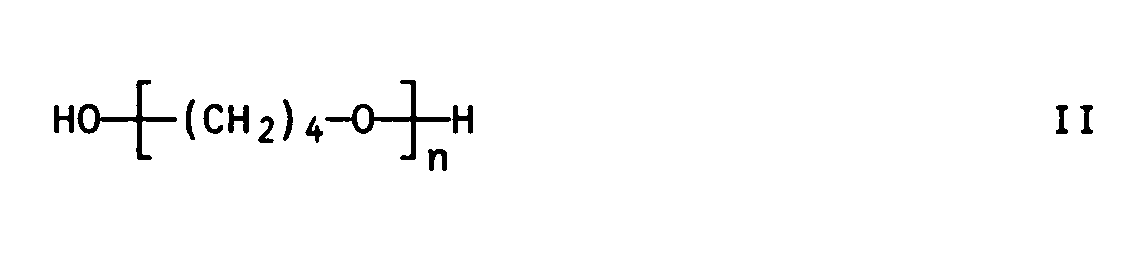
Poly-THF wird in der Regel durch die kationische Polymerisation von Tetrahydrofuran (THF) hergestellt, wobei Brönstedt- oder Lewissäuren als Katalysatoren verwendet werden können. Die Herstellung von Poly-THF wird beispielsweise in DE-A 28 01 792, EP-A 241 890 und EP-A 126 471 beschrieben. Der Polymerisationsgrad n des Poly-THF's gibt die Anzahl der aus dem monomeren THF stammenden Oxi- butan-1,4-diyl-Einheiten pro Poly-THF-Molekül an und kann einen Wert von 3 - entsprechend einem mittleren Molgewicht MG von 234 Dalton - bis etwa 70 - entsprechend einem mittleren Molekulargewicht MG von etwa 5000 Dalton - haben. Höhere Polymerisationsgrade sind möglich, jedoch sind solche Poly-THF-Species von geringerer technischer Bedeutung. Bei der THF-Polymerisation entstehen im allgemeinen Poly-THF-Moleküle unterschiedlicher Kettenlänge, also unterschiedlichen Polymerisationsgrades, weshalb das bei der Polymerisation gebildete Poly-THF keine einheitliche Verbindung, sondern eine je nach seiner Herstellungsart mehr oder weniger breite, statistische Mischung aus Poly-THF-Individuen unterschiedlichen Molekulargewichts darstellt. Das experimentell ermittelte Molekulargewicht des Poly-THF's ist somit eine statistische Größe und wird hier und im folgenden als "mittleres Molekulargewicht (MG)" oder als "mittlere Molmasse" bezeichnet. Das mittlere Molekulargewicht MG des Poly-THF's kann nach verschiedenen Methoden, beispielsweise mittels Osmometrie, Gelpermeationschromatographie oder über die Bestimmung der Hydroxyl-Endgruppen ermittelt werden. - Poly-THF wird als Diol-Baustein zur Herstellung hochwertiger Polyurethane verwendet und beeinflußt als solcher entscheidend die Eigenschaften der daraus hergestellten Polymere. Die auf der Verwendung von Poly-THF als Diol-Baustein beruhenden Eigenschaften dieser Polymere, wie hohe Schlagzähigkeit, hohes mechanisches Niveau ohne Temperung, werden nicht allein von der Menge des zur Polymerherstellung eingesetzten Poly-THF's bestimmt, sondern in wesentlichem Maße auch von der Art des verwendeten Poly-THF. So weichen die elastischen Eigenschaften Bruchdehnung und Schlagzähigkeit eines unter Verwendung von Poly-THF eines mittleren Molekulargewichts von 2000 Dalton hergestellten Polyurethans beispielsweise deutlich von denen eines Polyurethans ab, das unter ansonsten gleichen Bedingungen unter Zusatz von Poly-THF einer mittleren Molmasse von 1000 Dalton produziert wurde. Von besonderem wirtschaftlichen Interesse sind z. B. die folgenden Poly-THF-Sorten: Poly-THF 250 (MG: ca. 250 Dalton, n (Polymerisationsgrad): ca. 3); Poly-THF 650 (MG: ca. 650 Dalton, n: ca. 9); Poly-THF 1000 (MG: ca. 1000 Dalton, n: ca. 14); Poly-THF 2000 (MG: ca. 2000 Dalton, n: ca. 27); Poly-THF 2900 (MG: ca. 2900 Dalton, n: ca. 40) und Poly-THF 4500 (MG: ca. 4500 Dalton, n: ca. 62).
- Polytetrahydrofurane mit höheren mittleren Molekulargewichten haben in der Regel eine deutlich höhere Viskosität und ihr Erweichungspunkt liegt im allgemeinen bei deutlich höheren Temperaturen als dies bei Polytetrahydrofuranen mit relativ niedrigem mittlerem Molekulargewicht der Fall ist. Beispielsweise beträgt die Temperatur beim Erweichungspunkt von Poly-THF 250 -14°C, wohingegen dieser bei Poly-THF 1000 bereits bei 26 ° C liegt und die Viskosität Poly-THF 250 hat einen Wert von 158 mPa ' s (bei 20 C), dieweil die Viskosität von Poly-THF 1000 sogar bei einer Temperatur von 30 ° C mit 440 mPa ' s noch fast doppelt so hoch ist. In Anbetracht dieser Sachverhalte wird deutlich, daß höhermolekulare Poly-Tetrahydrofurane schwieriger und mit einem höheren Aufwand handzuhaben, zu dosieren und zu verarbeiten sind als niedermolekulare Vertreter dieser Polymere.
- Da sich nun aber Polyurethane, welche langkettiges, hochmolekulares Poly-THF als Diol-Baustein enthalten, durch ein besonders günstiges Tieftemperaturverhalten auszeichnen, besteht ein Bedarf nach chemisch modifizierten Poly-Tetrahydrofuranen, die nicht nur die Funktion der herkömmlichen Poly- Tetrahydrofurane als Diol-Baustein und Weichsegment in Polyurethanen übernehmen und ausfüllen können, sondern sich zusätzlich durch bessere Verarbeitungseigenschaften auszeichnen. Des weiteren wäre es außerordentlich wünschenswert, wenn sich als Folge der Verwendung solcher Poly-THF-Derivate auch noch eine verbesserte Verarbeitbarkeit der daraus hergestellten Polymere erzielen ließe.
- Der vorliegenden Erfindung lag somit die Aufgabe zugrunde, Poly-THF-Derivate zu finden, welche einesteils die Funktion herkömmlicher Polytetrahydrofurane als Diol-Baustein in Polyurethanen übernehmen und ausfüllen können, sich aber andernteils gegenüber herkömmlichen Polytetrahydrofuranen durch eine verbesserte Verarbeitbarkeit unterscheiden sollten und außerdem noch dem daraus hergestellten Polymerprodukt verbesserte Eigenschaften, wie eine einfachere Verarbeitbarkeit, verleihen sollten. Des weiteren war ein Verfahren zur Herstellung solcher Poly-THF-Derivate zur Verfügung zu stellen.
- Dementsprechend wurden die neuen Siloxi-Polytetrahydrofurane der Formel I

in der die Reste R1 und R2 gleich oder verschieden sind und für eine C1- bis C10-Alkylgruppe, eine C2- bis C10-Alkenylgruppe, eine C1- bis C10-Halogenalkylgruppe, eine C1- C1 o-Aminoalkylgruppe, eine C1- bis C10-Hydroxyalkylgruppe, eine C6- bis C10-Arylgruppe, eine C7- bis C12-Aralkylgruppe und/oder eine C1- bis C10-Alkoxygruppe, der Index n eine ganze Zahl von 2 bis 150 und der Index m eine ganze Zahl von 1 bis 500 ist, gefunden. - Des weiteren wurde ein Verfahren zur Herstellung von Siloxi-Polytetrahydrofuranen der Formel I
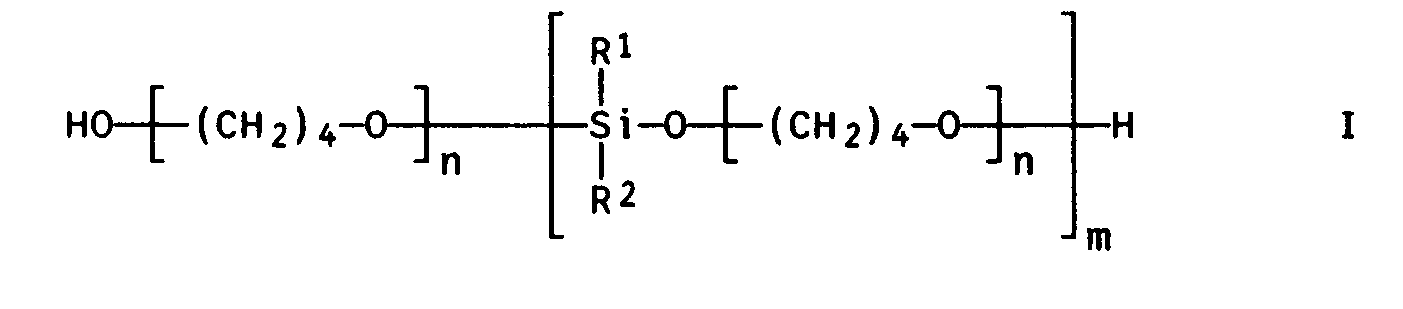
in der die Reste R1 und R2 sowie die Indices n und m die obengenannte Bedeutung haben, gefunden, das dadurch gekennzeichnet ist, daß man Polytetrahydrofuran der allgemeinen Formel II
mit einer Siliciumverbindung der allgemeinen Formel III
in der die Gruppen X und Y gleich oder verschieden sind und für ein Wasserstoffatom, ein Halogenatom, eine C1- bis C4-Alkoxygruppe und/oder eine C2- bis C8-Dialkylaminogruppe stehen, in An- oder Abwesenheit eines sauren oder basischen Katalysators umsetzt und dabei ein Molverhältnis von Polytetrahydrofuran II:Siliciumverbindung III von 1:1 bis 2:1 anwendet. - Außerdem wurden neue Polyurethane, aufgebaut aus Diisocyanaten, Diolen und gegebenenfalls Diaminen, enthaltend als Diol-Baustein Gruppen der Formel la

in der die Reste R1 und R2 sowie die Indices n und m die oben angegebene Bedeutung haben, gefunden. - Die erfindungsgemäßen Siloxi-Polytetrahydrofurane sind also aus mindestens vier Poly-THF-Einheiten, welche über mindestens eine Siloxi-Brücke miteinander verbunden sind, aufgebaute Moleküle. Die erfindungsgemäßen Siloxi-Polytetrahydrofurane können aber auch aus bis zu 501 Poly-THF-Einheiten und aus bis zu 500 Siloxi-Einheiten aufgebaut sein, dann nämlich, wenn der Index m die Zahl 500 hat. Vorzugsweise werden aber Siloxi-Polytetrahydrofurane hergestellt und verwendet, in denen der Index m einen ganzzahligen Wert von 1 bis 20 hat.
- Der Index n der Polytetrahydrofuran-Einheiten, welcher auch als Polymerisationsgrad bezeichnet wird, kann einen ganzzahligen Wert von 2 bis 150 haben. Unter den erfindungsgemäßen Verbindungen sind aber solche bevorzugt, in denen n einen ganzzahligen Wert von 3 bis 70 hat. Da die zur Herstellung der erfindungsgemäßen Verbindungen verwendeten Polytetrahydrofurane bestimmter mittlerer Molekulargewichte in der Regel aus einer statistischen Mischung individueller Poly-THF-Makromoleküle unterschiedlichen Molekulargewichts bestehen, also polydisperse Systeme sind, ergibt sich naturgemäß, daß der Index n der einzelnen Poly-THF-Einheiten in den erfindungsgemäßen Verbindungen entsprechend dem verwendeten Ausgangsmaterial variiert und daß die aus derartigen polydispersen Ausgangsmaterialien erzeugten Siloxi-Polytetrahydrofurane ebenfalls polydisperse Systeme sind.
- Die Reste R1 und R2 der Siloxi-Gruppierungen können gleich oder verschieden sein und für eine C1- bis C10-Alkylgruppe, vorzugsweise eine Methylgruppe, eine C2- bis C10-Alkenylgruppe, vorzugsweise eine Vinyl- oder Allylgruppe, eine Ci- bis C10-, vorzugsweise eine Ci- bis C4-Halogenalkylgruppe, eine Ci- bis C10-, vorzugsweise eine Ci- bis C4-Aminoalkylgruppe, eine Ci- bis Cio-, vorzugsweise eine Ci- bis C4-Hydroxyalkylgruppe eine C6- bis Cio-Arylgruppe, vorzugsweise eine Phenylgruppe, eine C7- bis C12-Aralkylgruppe, vorzugsweise eine Benzylgruppe und/oder eine Ci- bis C10-, vorzugsweise eine Ci- bis C4-Alkoxygruppe stehen. Siloxi-Polytetrahydrofurane, in denen die Reste R1 und R2 funktionelle Gruppen, wie Hydroxygruppen, Aminogruppen und Halogenatome, tragen, können vorteilhaft zur Herstellung hochvernetzter bzw. funktionalisierter Polyurethane Einsatz finden.
- Die Siloxi-Polytetrahydrofurane können erfindungsgemäß durch die Umsetzung Polytetrahydrofuranen der allgemeinen Formel 11

mit einer Siliciumverbindung der allgemeinen Formel III
hergestellt werden. - In den Silylenverbindungen der Formel III können die Gruppen X und Y gleich oder verschieden sein, zweckmäßigerweise sind sie gleich, und für ein Wasserstoffatom, das in der Regel anionischen Charakter hat und demzufolge auch als Hydridogruppe bezeichnet werden könnte, ein Halogenatom, vorzugsweise ein Fluor-, Chlor- oder Bromatom, eine C1- bis C4-Alkoxygruppe, bevorzugt für die Methoxygruppe und/oder eine C2- bis C8-Dialkylaminogruppe, vorzugsweise für die Dimethylaminogruppe, stehen. Als Dialkylaminogruppen können auch cycloaliphatische sekundäre Aminogruppen mit 2 bis 5 Kohlenstoffatomen im Ring, die gegebenenfalls noch ein Sauerstoffatom im Ring enthalten können, beispielsweise die Aziridino-, Pyrrolidino-, Piperidino- oder Morpholinogruppe, für X und/oder Y stehen. Die Reste R1 und R2 dieser Silylenverbindungen haben die bereits erwähnte Bedeutung. Solche Silylenverbindungen sind im Handel erhältlich oder können nach bekannten Verfahren, beispielsweise nach Comprehensive Organometallic Chemistry, Vol. 2, S. 306-322, Pergamon Press, New York 1982 hergestellt werden.
- Die Umsetzung zwischen den Polytetrahydrofuranen II und den Silylenverbindungen III kann in An- oder Abwesenheit von Katalysatoren durchgeführt werden, wobei im Falle der Benutzung von Katalysatoren, je nach der Natur der verwendeten Silylenverbindungen, saure, basische oder Übergangsmetall-Katalysatoren eingesetzt werden.
- Werden halogenierte Silylenverbindungen Illa, z.B. Dimethyldichlorsilan

als Ausgangsmaterial benutzt, so wird die Umsetzung vorzugsweise in Gegenwart einer Hilfsbase ausgeführt, deren Aufgabe es ist, den im Zuge der Polykondensation gebildeten Halogenwasserstoff abzufangen. Dementsprechend können praktisch alle Arten von Basen, Mineralbasen als auch organische Basen, angewandt werden, bevorzugt werden aber im allgemeinen organische Basen und von diesen vorzugsweise Amine, insbesondere tertiäre Amine wie Trimethylamin, Triethylamin, Tripropylamin, Tributylamin, Trioctylamin, Benzyldimethylamin, Benzyldibutylamin, Dibutylbenzylamin usw. im erfindungsgemäßen Verfahren verwendet. Vorteilhaft können aber auch basische, organische lonenaustauscher zu diesem Zweck eingesetzt werden, welche als basische Zentren vorzugsweise tertiäre Aminogruppen tragen. Die Art der dem organischen lonenaustauscher zugrundeliegenden Polymermatrix ist für den Erfolg des Verfahrens im allgemeinen nicht kritisch. - Im Falle der Anwendung organischer als auch anorganischer Hilfsbasen werden diese üblicherweise in Mengen von 2 bis 4, vorzugsweise von 2 bis 2,5 mol pro Mol der betreffenden Dihalogensilanverbindung Illa eingesetzt. Werden basische organische oder anorganische lonenaustauscher, wie z.B. Hostarex@ 1327 (Hoechst), Amberlite@ LA2 (Rohm & Haas) oder Lewatit@ M500 (Bayer) verwendet, so werden diese in Mengen von 2 bis 4, vorzugsweise von 2 bis 2,5 val/Mol der Dihalogenverbindung Illa dem Reaktionsansatz zugeführt.
- Selbstverständlich kann die Umsetzung von Poly-THF mit Dihalogensilanen auch in Abwesenheit einer Hilfsbase ausgeführt werden. Hierbei erweist es sich sich als vorteilhaft, den entstehenden Halogenwasserstoff aus dem organischen Reaktionsmedium zu strippen, beispielsweise indem man ein Inertgas, wie Stickstoff, durch die Reaktionsmischung leitet.
- Die Herstellung der erfindungsgemäßen Verbindungen, ausgehend von Bis(dialkylamino)dialkylsilanen lllc

in denen die Reste R5 bis R8 gleich oder verschieden sind und für eine C1- bis C4-Alkylgruppe stehen können oder in der jeweils die aliphatischen Reste R5 und R6 und/oder R7 und R8 gemeinsam mit dem Stickstoffatom einen 3- bis 6-gliedrigen Ring, beispielsweise einen Aziridin-, Pyrrolidin-, Morpholin- oder Piperidinring, bilden können, und Poly-THF wird vorzugsweise in Abwesenheit eines Katalysators durchgeführt. Besonders vorteilhaft können bei dieser Verfahrensweise die erfindungsgemäßen Verbindungen erzeugt werden, wenn das bei der Umsetzung freigesetzt Dialkylamin eine relativ leichtflüchtige Verbindung ist, die destillativ aus der Reaktionsmischung entfernt werden kann, wodurch das Gleichgewicht der Umsetzung auf die Seite der erfindungsgemäßen Verbindungen verschoben wird. Bis(dialkylamino)-dialkylsilane können aber auch vorteilhaft in Gegenwart eines sauer wirkenden Katalysators, beispielsweise einer aliphatischen oder aromatischen C1- bis C2o-Carbon- oder Sulfonsäure, eines aciden, organischen lonenaustauschers, beispielsweise eines solchen, dessen Polymermatrix Carboxyl- oder Sulfonsäuregruppen trägt, einer sauer wirkenden anorganischen Verbindungen, beispielsweise eines Zeolithen, einer Bleicherde, eines Montmorillonits oder sauren Aluminiumphosphats oder in Gegenwart von Mineralsäuren, wie Salz-, Schwefel- oder Phosphorsäure, mit Poly-THF zu den erfindungsgemäßen Poly-THF-Derivaten umgesetzt werden. - Ebenso wie Bis(dialkylamino)dialkylsilane können auch Bis(dialkoxy)dialkylsilane Illb
- Dialkyldihydrosilane Illd

werden vorzugsweise in Anwesenheit eines Übergangsmetallkatalysators, vorzugsweise eines Übergangsmetallkatalysators aus der 8. Nebengruppe des Periodensystems, besonders bevorzugt eines Übergangsmetallkatalysators aus der Gruppe der Platinmetalle, mit Poly-THF umgesetzt, wobei diese Übergangsmetallkatalysatoren in der Regel in Form ihrer Komplexverbindungen, beispielsweise in Form ihrer Halogen-, Phosphin- oder Phosphit-Komplexe eingesetzt werden können. Beispielhaft für solche Komplexe seien die Hexachloroplatinsäure (H2PtC16) oder das Tris(triphenylphosphino)rhodiumchlorid ((Ph3P)3RhCI) genannt. - Man setzt diese Katalysatoren üblicherweise in Mengen von 10-8 bis 10-1, vorzugsweise von 10-7 bis 10-2 mol pro Mol der betreffenden Silylenverbindungen Illd ein.
- Das Poly-THF II wird in einem Molverhältnis Poly-THF II: Siliciumverbindung III von 1:1 bis 2:1 umgesetzt. Über die Einstellung dieses Molverhältnisses läßt sich die Kettenlänge des entstehenden Poly-THF-Derivates steuern. So erhält man beispielsweise bei Einstellung eines Poly-THF/Dichlordimethylsilan-Verhältnisses von 2:1 eine Verbindung I, welche zwei über eine Siloxibrücke verknüpfte Poly-THF-Einheiten enthält, wohingegen bei einem Molverhältnis von 7:6 ein Polymeres gebildet wird, das aus durchschnittlich mehr als 4 über eine Siloxibrücke verknüpften Poly-THF-Einheiten besteht.
- Die Umsetzung der Silylenverbindungen III mit Poly-THF kann in Gegenwart oder in Abwesenheit von unter den Reaktionsbedingungen inerten Lösungsmitteln, wie Diethylether, Methyl-tert.-butyl-ether (MTBE), Tetrahydrofuran, Dioxan, Dimethylformamid, Toluol, Dichlormethan oder Chloroform ausgeführt werden. Die Anwesenheit von Lösungsmitteln kann sich insbesondere dann vorteilhaft auswirken, wenn die Reaktionsmischung nach beendeter Umsetzung filtriert werden soll, beispielsweise um heterogene Katalysatoren oder um bei der Umsetzung ausgefallene Salze abzutrennen.
- Das Verfahren zur Herstellung der erfindungsgemäßen Poly-THF-Derivate kann diskontinuierlich in an sich herkömmlichen Reaktoren, wie Rührkesseln, oder kontinuierlich, beispielsweise mit Hilfe von Rührkesselkaskaden oder in Rohrreaktoren, durchgeführt werden. Werden Heterogenkatalysatoren, wie feste lonenaustauscherharze oder Montmorillonite verwendet, wird deren Anordnung in einem Festbettreaktor bevorzugt, wobei dieser in der Sumpf- oder Rieselfahrweise betrieben werden kann. In der Regel wird im erfindungsgemäßen Verfahren eine Reaktionstemperatur von 0 bis 200 °C, vorzugsweise von 10 bis 170°C und besonders bevorzugt von 20 bis 150°C angewandt. Zweckmäßigerweise wird die Umsetzung bei Atmosphärendruck oder unter dem Eigendruck des Reaktionssystems betrieben, die Anwendung höherer Drücke ist ebenfalls möglich.
- Die erfindungsgemäßen Poly-THF-Derivate sind bei Raumtemperatur flüssig und zeichnen sich durch eine relativ niedrige, kinematische Viskosität auch bei hohen mittleren Molekulargewichten aus. Beispielsweise beträgt die kinematische Viskosität eines auf Poly-THF 250 basierenden Siloxi-Poly-THF der mittleren Molmasse von 1240 Dalton bei 20 °C 971,4 mPa ' s (gemessen mittels eines Ubbelohde-Viskosimeters), wohingegen Poly-THF 1000 bei dieser Temperatur als Feststoff vorliegt und vor seiner Verwendung im allgemeinen aufgeschmolzen werden muß. Dies führt aber zu einem erhöhten apparativen Aufwand bei der Herstellung von Polyurethan-Formkörpern, insbesondere bei Anwendung der Technik des reaction injection molding (RIM); (Lit.: Christopher W. Macosko: RIM-Fundamentals of Reaction Injection Moulding, Hanser Publishers, New York, 1989). Im Unterschied zu herkömmlichen Polytetrahydrofuranen sind die erfindungsgemäßen Poly-THF-Derivate, insbesondere bei solchen Anwendungen, besser handzuhaben.
- Die vorliegende Erfindung betrifft weiterhin Polyurethane, welche die erfindungsgemäßen Poly-THF-Derivate als Diolkomponente enthalten.
- Unter Polyurethanen werden Polyadditionsprodukte verstanden, welche durch die Reaktion von multifunktionellen Isocyanaten, beispielsweise Di- oder Triisocyanaten, mit mehrwertigen Alkoholen entstehen. Als Isocyanat-Bausteine für die Herstellung der erfindungsgemäßen Polyurethane können praktisch alle zur Polyurethanherstellung geeigneten aliphatischen, alicyclischen und aromatischen Di-, Tri- und Polyisocyanate, wie 1,6-Diisocyanatohexan, Isophoron-diisocyanat, trimeres Isophoron-diisocyanat und/oder trimeres Hexan-diisocyanat, Diisocyanatotoluol, Diisocyanatonaphthalin, 4,4'-Diisocyanato-diphenylmethan und dessen Stellungsisomere, urethanisiertes 4,4'-Diisocyanato-diphenylmethan, Polyphenyl-polymethylenpolyisocyanate, Isocyanatgruppen-haltige Addukte aus Toluoldiisocyanat und Trimethylolpropan und/oder Toluoldiisocyanat-trimer, verwendet werden.
- Als Alkoholbausteine können zur Herstellung der erfindungsgemäßen Polyurethane neben den erfindungsgemäßen Poly-THF-Derivaten alle Diole, Triole und/oder Polyole verwendet werden, wie sie üblicherweise zur Herstellung von Polyurethanen benutzt werden. Beispiele für solche mehrwertigen Alkohole sind niedermolekulare, mehrwertige Alkohole, wie Ethylenglykol, Glycerin, 1,2-Propylenglykol, Trimethylolpropan, Pentaerythrit, Zuckeralkohole, Zucker und/oder Stärkehydrolysate, Polyetherpolyole, wie Polyoxyethylenpolyole, Polyoxypropylenpolyole, Polyoxyethylenglykol-polyoxypropylenpolyol-Misch- und/oder Blockpolymerisate, Polytetrahydrofurane, halogenierte Polyetherpolyole, Polyesterpolyole, beispielsweise solche auf Terephthalsäure-, Phthalsäure-, Isophthalsäure-, Hexahydrophthalsäure-, Bernsteinsäure- und/oder Adipinsäurebasis mit z.B. Ethylenglykol, 1,2-Propylenglykol, 1,4-Butandiol, 1,6-Hexandiol, Neopentylglykol, Thiodiglykol, Hydroxypivalinsäure, Hydroxypivalinsäureneopentylglykolester, Glycerin, Trimethylolpropan und/oder Hexantriol als Alkoholkomponente sowie Polycarbonatpolyole, welche z.B. durch Umestern von Dialkyl- oder Diarylcarbonaten mit Diolen und Triolen erhältlich sind. Selbstverständlich können anstelle der Diole auch die analog reagierenden Thiole eingesetzt werden.
- Als weitere Bausteine zur Herstellung der erfindungsgemäßen Polyurethane können Diamine dienen, deren Verwendung bei der Polyurethan-Herstellung zu sogenannten Hybridsystemen führt, in denen Polyurethan-Einheiten über Harnstoffbrücken miteinander verbunden sind. Beispiele für derartige Diamine sind Diethyltoluylendiamin, 4,4'-Diamino-3,3'-dichlor-diphenylmethan, 3,5-Diamino-4-chlorbenzoesäureisobu- tylester, Methylen-bis-anthranilsäure-methylester, Ethylendiamin, 1-Amino-3-aminomethyl-3,5,5-trimethylcyclohexan (Isophorondiamin), Hexamethylendiamin und/oder Hydrazin.
- Weiterhin können bei der Herstellung der erfindungsgemäßen Polyurethane praktisch alle Arten der üblicherweise bei Polyurethanen eingesetzten Schaum-Stabilisatoren, Hydrolyse-Stabilisatoren, OxidationsStabilisatoren UV-Stabilisatoren als auch Additive, wie Treibmittel, Flammschutzmittel, Farbstoffe, Füllstoffe und Verstärkungsmittel, insbesondere Glasfasern, zugemischt werden.
- Die erfindungsgemäßen Polyurethane können unter Verwendung der üblicherweise zur Herstellung von Polyurethanen eingesetzten Katalysatoren oder Katalysatorsysteme erzeugt werden. Dazu können sowohl Lewis-Basen als auch Lewis-Säuren oder Mischungen dieser Katalysatoren Anwendung finden. Beispiele für geeignete Lewis-Basen sind Diazabicyclooctan, Dimethylbenzylamin, Bis-dimethylaminomethylether, Tetramethylguanidin und Bis-dimethylaminomethyl-phenol. Vorteilhaft verwendbare Lewis-Säuren sind beispielsweise Zinn-diethylhexoate, Dibutylzinn-dilaurat, Dibutylzinn-bis-dodecylmercaptid und Blei-phenyl-ethyl-dithiocarbaminat.
- Die Herstellung der erfindungsgemäßen Polyurethane kann nach den an sich herkömmlichen Verfahren der Polyurethan-Herstellung, beispielsweise durch Zusammenmischen der reaktiven Komponenten, erfolgen. Dabei kann beispielsweise nach dem RIM-Verfahren unter Anwendung der Hochdruck- oder Niederdruck-Vermischung gearbeitet werden.
- Die erfindungsgemäßen Polyurethane können die erfindungsgemäßen Poly-THF-Derivate in Mengenverhältnissen von 5 bis 80, vorzugsweise von 5 bis 20 und besonders bevorzugt von 5 bis 10 Gew.-%, bezogen auf die darin enthaltene Polyolkomponente, enthalten.
- Die erfindungsgemäßen Polyurethane haben bei ansonsten gleichartigen und gleichwertigen Eigenschaften gegenüber herkömmlichen Polyurethanen den Vorteil, daß daraus bestehende Polyurethanformkörper wesentlich leichter aus den Metallformen der Spritzgußmaschinen abgetrennt werden können, weshalb auf den Einsatz zusätzlicher Trennmittel, wie Silikonöle oder Wachse, gänzlich verzichtet oder deren Verwendung zumindest eingeschränkt werden kann. Dies führt zu einer beträchtlichen Vereinfachung des Verfahrens der Polyurethan-Formkörperherstellung, da ein zusätzlicher Arbeitsgang, nämlich die wiederholte Beschichtung der Spritzgußformen mit Trennmittel, eingespart werden kann. Des weiteren kann bei Verwendung der erfindungsgemäßen Polymere die Zugabe von inneren Trennmitteln, d.h. von Additiven, die zur Verbesserung der Abtrennbarkeit der Polyurethan-Formkörper aus der Spritzgußform der Polyurethan-Reaktionsmasse zugesetzt werden, unterbleiben. Dies kommt einer Verbesserung der Produkteigenschaften der Polyurethan-Formkörper gleich, da solche Additive in der Regel mit der Zeit aus dem Polyurethan-Formkörper an dessen Oberfläche diffundieren, was im allgemeinen unerwünscht ist.
- Beispiele:
- Das mittlere Molekulargewicht MG wurde bei den erfindungsgemäßen Poly-THF-Derivaten osmometrisch bestimmt.
- Die OH-Zahl der erfindungsgemäßen Poly-THF-Derivate wurde durch die Acetylierung dieser Verbindungen mit dem System Pyridin/Acetanhydrid/Diazabicyclooctan und die anschließende Titration des angewandten Acetanhydrid-Überschusses mittels wäßriger Alkalihydroxidlösung bestimmt. Die Dimension der OH-Zahl ist mg KOH/g Substanz.
- Der Siliciumgehalt der erfindungsgemäßen Poly-THF-Derivate wurde nach deren Naßveraschung mit konzentrierter Schwefelsäure, und dem Natriumcarbonat/Borax-Aufschluß der dabei entstandenen Kieselsäuren atomemissionsspektrometrisch bestimmt.
- Alle Umsetzungen zur Herstellung der Siloxi-Polytetrahydrofurane wurden in einer Inertgasatmosphäre ausgeführt.
- Darstellung von Bis-poly-THF-dimethylsiloxan aus Poly-THF 250 und Dimethyldichlorsilan.
- In einem 500-ml-Rührkolben wurden 58,0 g Poly-THF 250 (0,25 mol) in 150 ml MTBE und 27,8 g (0,275 mol) Triethylamin vorgelegt.
- Unter stetem Rühren und bei einer Innentemperatur von 25 bis 28 C wurden zu dieser Lösung 16,13 g (0,125 mol) Dimethyldichlorsilan in 100 ml MTBE innerhalb von 1,5 h zugetropft. Nach beendeter Zugabe wurde noch 2 h bei 50 °C weitergerührt und die Reaktionslösung zur Abtrennung ausgefallener Triethylammoniumsalze filtriert. Nach Abdestillieren des Lösungsmittels wurde das gewünschte Produkt in Form eines hellen Öls erhalten.
- Analysen:
- Si-Gehalt: 5,9 Gew.-%
- OH-Zahl: 252
- MG: 444
- CI-Gehalt: < 0,5 Gew.-%
- Darstellung von Bis-poly-THF-dimethylsiloxan aus Poly-THF 1000 und Dimethyldichlorsilan
- Es wurden analog Beispiel 1 250,0 g Poly-THF 1000 (0,25 mol) umgesetzt. Als Lösungsmittel diente THF.
- Analysen:
- Si-Gehalt: 1,2 Gew.-%
- OH-Zahl: 56
- MG: 2000
- CI-Gehalt: < 0,5 Gew.-%
- Darstellung von Bis-poly-THF-methylvinylsilan aus Poly-THF 250 und Methylvinyldichlorsilan
- Es wurde wie in Beispiel 1 verfahren und anstelle des Dimethylchlorsilans 17,63 g (0,125 mol) Methylvinyldichlorsilan umgesetzt.
- Analysen:
- Si-Gehalt: 4,7 Gew.-%
- OH-Zahl: 175
- MG: 640
- CI-Gehalt: < 0,5 Gew.-%
- 1H-Kernresonanzspektrum (NMR) (CDCl3):
- δ 6,0 (m, Vinyl-H); 3,7 (t, Si-O-CH2); 3,65 (m, HO-CH2); 3,4 (m, Polyether); 2,8 (s, OH); 1,6 (m, Polyether); 0,2 (s, CH3Si)
- Darstellung von Bis-poly-THF-methylphenylsilan aus Poly-THF 250 und Methylphenyldichlorsilan
- Es wurde wie in Beispiel 1 gearbeitet und 23,9 g (0,125 mol) Methylphenyldichlorsilan eingesetzt.
- Analysen:
- Si-Gehalt: 4,2 Gew.-%
- OH-Zahl: 162
- MG: 690
- CI-Gehalt: < 0,5 Gew.-%
- Darstellung von Polysiloxi-Polytetrahydrofuran aus Poly-THF 250 und Dimethyldichlorsilan (Molverhältnis 4:3)
- In der Apparatur von Beispiel 1 wurden 58,0 g (0,25 mol) Poly-THF 250 in 250 ml MTBE und 27,8 g (0,275 mol) Triethylamin vorgelegt. Bei einer Innentemperatur von 25 bis 28°C wurden 24,5 g (0,19 mol) Dimethyldichlorsilan innerhalb 1,5 h zugetropft und anschließend noch 2 h bei 50°C gerührt. Das Lösungsmittel wurde abdestilliert und das Produkt als helles Öl erhalten.
- Analysen:
- Si-Gehalt: 6,5 Gew.-%
- OH-Zahl: 173
- MG: 650
- CI-Gehalt: < 0,5 Gew.-%
- Darstellung von Polysiloxi-Poly-Tetrahydrofuran aus Poly-THF 250 und Dimethyldichlorsilan (Molverhältnis 7:6)
- In einem 50 I-Email-Rührkessel wurden 4,5 kg Poly-THF 250 (19,332 mol), 3,7 kg (36,535 mol) Triethylamin und 15 1 MTBE vorgelegt. Unter Rühren wurden bei 18 bis 28°C Innentemperatur 2,14 kg (16,589 mol) Dimethyldichlorsilan gelöst in 2 I MTBE innerhalb von 3 h der Reaktionsmischung zugeführt. Es wurden nochmals 3 I MTBE zugegeben und die Reaktionsmischung weitere 2 h bei 50 °C gerührt. Die ausgefallenen Ammoniumsalze wurden über eine Druckfilternutsche abfiltiert und das Lösungsmittel aus dem Filtrat abdestilliert. Es wurden 5,4 kg eines gelben Öls erhalten.
- Analysen:
- Si-Gehalt: 7,4 Gew.-%
- OH-Zahl: 106
- MG: 1240
- CI-Gehalt: 0,5 Gew.-%
- 1H-NMR (CDCl3):
- δ (ppm): 3,7 (m, Si-O-CH2); 3,65 (m, HO-CH2); 3,4 (m, Polyether); 2,6 (s, OH); 1,6 (m, Polyether); 0,2 (-
- (CH3)2Sl)
- Polysiloxi-Polytetrahydrofuran der Molmasse 5300
- In einer 2 I-Rührapparatur wurden 500 g (0,5 mol) Poly-THF 1000, 500 ml MTBE und 95,4 g (0,943 mol) Triethylamin vorgelegt. Zu dieser Mischung wurden während eines Zeitraums von 5 h und bei einer Temperatur von 25 bis 30 ° C 55,3 g Dimethyldichlorsilan (0,429 mol) zugetropft und anschließend weitere 700 ml MTBE hinzugefügt. Nach beendeter Zugabe wurde nochmals 3 h gerührt und ausgefallene Ammoniumsalze abfiltriert. Aus den Filtraten wurde das Lösungsmittel abdestilliert. Es wurden 533,8 g (100 % Ausbeute) eines farblosen Öls erhalten, das auch nach vierwöchiger Lagerung bei Raumtemperatur noch flüssig war.
- Analysen:
- Si-Gehalt: 2,1 Gew.-%
- OH-Zahl: 25
- MG: 5300
- Herstellung von Polysiloxi-Polytetrahydrofuran aus Poly-THF 650 und Dimethyl-bis-(dimethylamino)silan
- In einer 250 ml-Rührapparatur wurden 65,0 g Poly-THF 650 (0,1 mol), 9,7 g Dimethyl-bis-(dimethylamino)silan (0,067 mol) und 50 ml Chlorbenzol miteinander vermischt und 5 h unter Rückfluß erhitzt. Dabei entwich Dimethylamin. Nach beendeter Reaktion wurde das Lösungsmittel Chlorbenzol abdestilliert, wobei 68,3 g (100 % Ausbeute) eines schwach gelblichen Öls zurückblieben.
- Analysen:
- Si-Gehalt: 2,7 Gew.-%
- OH-Zahl: 54
- MG: 2000
- Herstellung von Polysiloxi-Polytetrahydrofuran aus Poly-THF 650 und Dimethyldihydrosilan
- In einer 250 ml-Rührapparatur wurden 65,0 g Poly-THF 650 (0,1 mol), 4,0 g (0,067 mol) Dimethyldihydrosilan, 100 ml THF und 10 mg H2PtCl6 • 6H20(Hexachloroplatinsäure) in 0,5 ml Butanol miteinander vermischt und auf 50 °C erwärmt. Unter diesen Bedingungen trat eine Wasserstoffentwicklung ein. Nach beendeter Wasserstoffentwicklung wurde die Reaktion abgebrochen und das Lösungsmittel abdestilliert. Es wurden 68,0 g (100 % Ausbeute) eines hellen Öls erhalten.
- Analysen:
- Si-Gehalt: 2,6 Gew.-%
- OH-Zahl: 58
- MG: 1950
- Herstellung von Polysiloxi-Polytetrahydrofuran aus Polytetrahydrofuran 1000 und Dimethyl-bis-methoxysilan
- In einer 2 I-Rührapparatur wurden 500 g (0,5 mol) Poly-THF 1000, 500 ml Toluol, 5,0 g Pivalinsäure und 51,5 g (0,429 mol) Dimethyl-bis-methoxysilan 5 h unter Rückfluß erhitzt und anschließend das Lösungsmittel Toluol und das neu gebildete Methanol abdestilliert. Der Rückstand wurde erneut in 500 ml Toluol gelöst und zur Entfernung der restlichen Carbonsäure mit 500 ml wäßriger 10 gew.-%iger Natriumhydrogencarbonat-Lösung extrahiert. Die organische Phase wurde von Wasser befreit und das Lösungsmittel abdestilliert. Es wurden 510,9 g (97,5 % Ausbeute) eines farblosen Öls erhalten, das auch nach zwölfwöchiger Lagerung bei Raumtemperatur noch flüssig war.
- Analysen:
- Si-Gehalt: 2,2 Gew.-%
- OH-Zahl: 23
- MG: 5000
- Herstellung eines erfindungsgemäßen Polyurethans
- Zur Herstellung von erfindungsgemäßen Polyurethanen wurden die Komponenten A und B im Mischungsverhältnis (w/w) 100(A):39,7(B) miteinander vermischt und unmittelbar nach ihrer Vermischung in Spritzgußformen eingepreßt.
- Komponente A hatte die Zusammensetzung:
- 49,7 Gew.-% Lupranol@ 2042 (Block-copolymeres Polyethertriol mit einer Hydroxylzahl von 2,7 auf der Basis von Trimethylolpropan, 1,2-Propylenoxid und Ethylenoxid)
- 14.41 Gew.-% Diethyltoluylendiamin (Isomerengemisch)
- 7,21 Gew.-% Dimethylsiloxi-Polytetrahydrofuran auf Basis von Poly-THF 250; MG 1070 Dalton
- 0,72 Gew.-% 30 gew.-%ige Lösung von Diazabicyclooctan in Propylenglykol
- 0,14 Gew.-% Dibutylzinn-dilaurat
- 27,9 Gew.-% gemahlene Glasfasern
- Komponente B war ein Isocyanat-Präpolymer, das durch die Umsetzung von Diphenylmethandiisocyanat mit einer Mischung aus Polypropylenoxiddiol (mittleres Molekulargewicht: 450 Dalton) und Dipropylenglykol hergestellt worden war und das einen Gehalt an freien Isocyanatgruppen von 23 Gew.-% hatte.
- Die auf diese Weise hergestellten Polyurethan-Prüfplatten hatten das Format DIN A4.
- Zum Vergleich wurden Prüfplatten nach einer Vergleichsrezeptur produziert, die 7,21 Gew.-% Poly-THF 1000 anstelle des erfindungsgemäßen Siloxi-Polytetrahydrofurans bei ansonsten gleicher Zusammensetzung enthielt.
- Ergebnis der mechanischen Prüfungen:
- Bei der mechanischen Prüfung konnten keine Unterschiede zwischen den erfindungsgemäß hergestellten Polyurethan-Platten und den Vergleichsplatten betreffend die folgenden Eigenschaften festgestellt werden: Reißfestigkeit, Weiterreißfestigkeit, Reißdehnung, Biege-Elastizitätsmodul.
- Die erfindungsgemäßen Polyurethan-Platten ließen sich jedoch wesentlich leichter als die Vergleichsplatten aus den Spritzgußformen abtrennen, weshalb auf den Einsatz eines zusätzlichen Trennmittels bei den erfindungsgemäßen Platten verzichtet werden konnte.
Claims (7)
1. Siloxi-Poly-Tetrahydrofurane der Formel
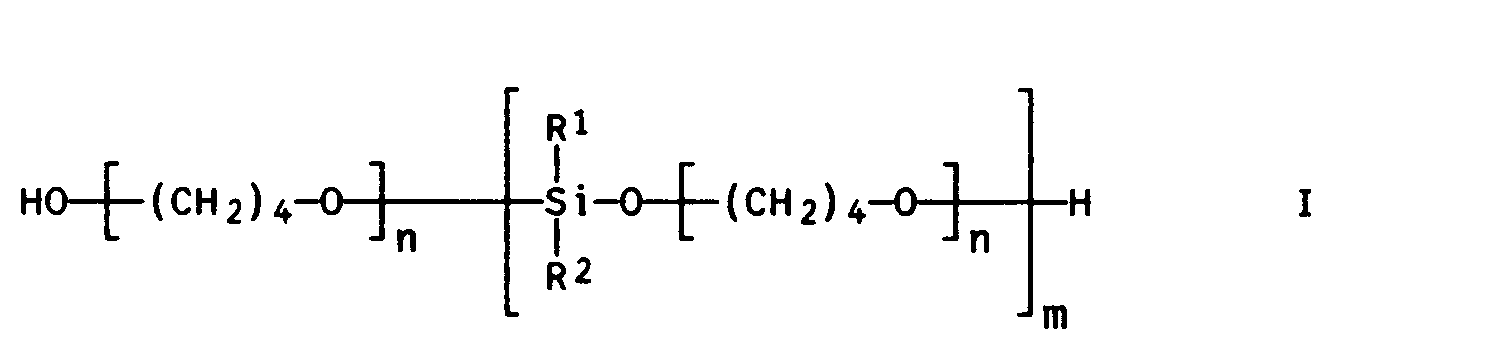
in der die Reste R1 und R2 gleich oder verschieden sind und für eine C1- bis C, o-Alkylgruppe, eine C2- bis C10-Alkenylgruppe, eine Ci- bis C10-Halogenalkylgruppe, eine Ci- C10-Aminoalkylgruppe, eine Cibis C1 0-Hydroxyalkylgruppe, eine C6- bis C1 0-Arylgruppe, eine C7- bis C1 2-Aralkylgruppe und/oder eine Ci- bis C10-Alkoxygruppe stehen, der Index n eine ganze Zahl von 2 bis 150 und der Index m eine ganze Zahl von 1 bis 500 ist.
in der die Reste R1 und R2 gleich oder verschieden sind und für eine C1- bis C, o-Alkylgruppe, eine C2- bis C10-Alkenylgruppe, eine Ci- bis C10-Halogenalkylgruppe, eine Ci- C10-Aminoalkylgruppe, eine Cibis C1 0-Hydroxyalkylgruppe, eine C6- bis C1 0-Arylgruppe, eine C7- bis C1 2-Aralkylgruppe und/oder eine Ci- bis C10-Alkoxygruppe stehen, der Index n eine ganze Zahl von 2 bis 150 und der Index m eine ganze Zahl von 1 bis 500 ist.
2. Verfahren zur Herstellung von Siloxi-Polytetrahydrofuranen der Formel I

in der die Reste R1 und R2 sowie die Indices n und m die in Anspruch 1 genannte Bedeutung haben, dadurch gekennzeichnet, daß man Polytetrahydrofuran der allgemeinen Formel II 
mit einer Siliciumverbindung der allgemeinen Formel III 
in der die Gruppen X und Y gleich oder verschieden sind und für ein Wasserstoffatom, ein Halogenatom, eine C1- bis C4-Alkoxygruppe und/oder eine C2- bis C8-Dialkylaminogruppe stehen, in An- oder Abwesenheit eines Katalysators umsetzt und dabei ein Molverhältnis von Polytetrahydrofuran II:Siliciumverbindung III von 1:1 bis 2:1 anwendet.
in der die Reste R1 und R2 sowie die Indices n und m die in Anspruch 1 genannte Bedeutung haben, dadurch gekennzeichnet, daß man Polytetrahydrofuran der allgemeinen Formel II
mit einer Siliciumverbindung der allgemeinen Formel III
in der die Gruppen X und Y gleich oder verschieden sind und für ein Wasserstoffatom, ein Halogenatom, eine C1- bis C4-Alkoxygruppe und/oder eine C2- bis C8-Dialkylaminogruppe stehen, in An- oder Abwesenheit eines Katalysators umsetzt und dabei ein Molverhältnis von Polytetrahydrofuran II:Siliciumverbindung III von 1:1 bis 2:1 anwendet.
3. Verfahren nach Anspruch 2, dadurch gekennzeichnet, daß man als Siliciumverbindung III ein Dihalogensilan der Formel Illa

verwendet, in der Hal für ein Fluor, Chlor- und/oder Bromatom steht, und die Umsetzung in Gegenwart eines tertiären Amins durchführt.
verwendet, in der Hal für ein Fluor, Chlor- und/oder Bromatom steht, und die Umsetzung in Gegenwart eines tertiären Amins durchführt.
4. Verfahren nach Anspruch 2, dadurch gekennzeichnet, daß man als Siliciumverbindung III ein Dialkoxysilan der Formel Illb
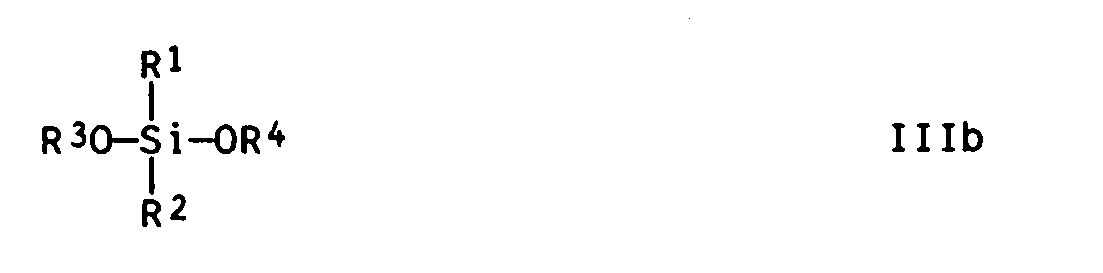
verwendet und der Rest R3 und R4 gleich oder verschieden sind und für C1- bis C4-Alkylgruppen stehen.
verwendet und der Rest R3 und R4 gleich oder verschieden sind und für C1- bis C4-Alkylgruppen stehen.
5. Verfahren nach Anspruch 2, dadurch gekennzeichnet, daß man als Siliciumverbindung III ein Bisdialkylamino-silan der Formel Illc

verwendet, in der die Reste R5 bis R8 gleich oder verschieden sind und für eine C1- bis C4-Alkylgruppe stehen, oder in der jeweils die aliphatischen Reste R5 und R6 und/oder R7 und R8 gemeinsam mit dem Stickstoffatom einen 3- bis 6-gliedrigen Ring bilden können.
verwendet, in der die Reste R5 bis R8 gleich oder verschieden sind und für eine C1- bis C4-Alkylgruppe stehen, oder in der jeweils die aliphatischen Reste R5 und R6 und/oder R7 und R8 gemeinsam mit dem Stickstoffatom einen 3- bis 6-gliedrigen Ring bilden können.
6. Verfahren nach Anspruch 2, dadurch gekennzeichnet, daß man als Siliciumverbindung III ein Dialkyldihydrosilan der Formel Illd
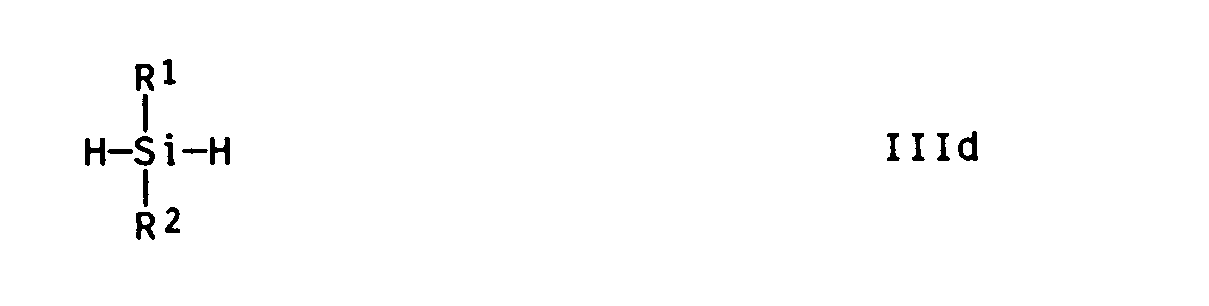
verwendet.
verwendet.
7. Polyurethane, aufgebaut aus Diisocyanaten und Diolen und gegebenenfalls Diaminen, enthaltend als Diol-Baustein Gruppen der Formel la
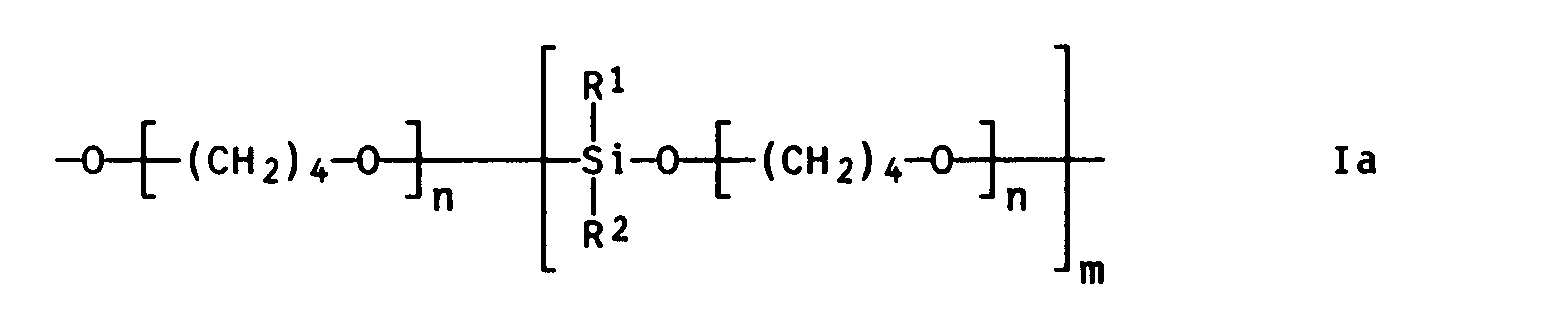
in der die Reste R1 und R2 sowie die Indices n und m die in Anspruch 1 genannte Bedeutung haben.
in der die Reste R1 und R2 sowie die Indices n und m die in Anspruch 1 genannte Bedeutung haben.
Applications Claiming Priority (2)
| Application Number | Priority Date | Filing Date | Title |
|---|---|---|---|
| DE4112271 | 1991-04-15 | ||
| DE19914112271 DE4112271A1 (de) | 1991-04-15 | 1991-04-15 | Siloxi-polytetrahydrofurane |
Publications (2)
| Publication Number | Publication Date |
|---|---|
| EP0509271A2 true EP0509271A2 (de) | 1992-10-21 |
| EP0509271A3 EP0509271A3 (en) | 1992-11-25 |
Family
ID=6429628
Family Applications (1)
| Application Number | Title | Priority Date | Filing Date |
|---|---|---|---|
| EP19920105022 Withdrawn EP0509271A3 (en) | 1991-04-15 | 1992-03-24 | Siloxi-polytetrahydrofuran |
Country Status (3)
| Country | Link |
|---|---|
| EP (1) | EP0509271A3 (de) |
| JP (1) | JPH05156024A (de) |
| DE (1) | DE4112271A1 (de) |
Cited By (2)
| Publication number | Priority date | Publication date | Assignee | Title |
|---|---|---|---|---|
| EP1234829A4 (de) * | 1999-10-28 | 2003-04-16 | Nat Inst Of Advanced Ind Scien | Silikonhaltige polymere |
| EP4692167A1 (de) * | 2024-08-09 | 2026-02-11 | The Boeing Company | Steuerbare verlängerung von flexiblen oligomeren diolen und verfahren dafür |
Families Citing this family (1)
| Publication number | Priority date | Publication date | Assignee | Title |
|---|---|---|---|---|
| JP2025145362A (ja) * | 2024-03-21 | 2025-10-03 | 株式会社豊田中央研究所 | リサイクル可能なポリシリルエーテル樹脂、その製造方法、及び、そのポリシリルエーテル樹脂の分解による原料化合物の製造方法 |
Family Cites Families (6)
| Publication number | Priority date | Publication date | Assignee | Title |
|---|---|---|---|---|
| US4026827A (en) * | 1970-01-24 | 1977-05-31 | Dynamit Nobel Aktiengesellschaft | Preparation of high-molecular weight thermoplastic polyorganosilicic acid esters |
| JPS5331799A (en) * | 1976-09-06 | 1978-03-25 | Mitsubishi Chem Ind Ltd | Low-smoking polyisocyanurate foam |
| US4170697A (en) * | 1977-10-25 | 1979-10-09 | Blount David H | Process for the production of polyisocyanate silicate solid or cellular solid products |
| GB2109803A (en) * | 1981-02-26 | 1983-06-08 | Ici Plc | High molecular weight polyether polyols |
| GB8410480D0 (en) * | 1984-04-24 | 1984-05-31 | Bp Chem Int Ltd | Preparation of polymer polyols |
| US4508889A (en) * | 1984-07-19 | 1985-04-02 | Desoto, Inc. | Preparation of isocyanate-terminated polyurethanes containing amino silanes |
-
1991
- 1991-04-15 DE DE19914112271 patent/DE4112271A1/de not_active Withdrawn
-
1992
- 1992-03-24 EP EP19920105022 patent/EP0509271A3/de not_active Withdrawn
- 1992-04-10 JP JP4090893A patent/JPH05156024A/ja not_active Withdrawn
Cited By (3)
| Publication number | Priority date | Publication date | Assignee | Title |
|---|---|---|---|---|
| EP1234829A4 (de) * | 1999-10-28 | 2003-04-16 | Nat Inst Of Advanced Ind Scien | Silikonhaltige polymere |
| US6753401B1 (en) | 1999-10-28 | 2004-06-22 | National Institute Of Advanced Industrial Science And Technology | Silcon-containing polymers |
| EP4692167A1 (de) * | 2024-08-09 | 2026-02-11 | The Boeing Company | Steuerbare verlängerung von flexiblen oligomeren diolen und verfahren dafür |
Also Published As
| Publication number | Publication date |
|---|---|
| JPH05156024A (ja) | 1993-06-22 |
| EP0509271A3 (en) | 1992-11-25 |
| DE4112271A1 (de) | 1992-10-22 |
Similar Documents
| Publication | Publication Date | Title |
|---|---|---|
| DE3855663T2 (de) | Copolycarbonate | |
| DE3856125T2 (de) | Hitzehärtbares Urethan-Elastomer | |
| DE3877231T2 (de) | Zusammensetzung aus polyurethanharz. | |
| DE69014609T2 (de) | Polyurethan-ionomere in der masse. | |
| AT408886B (de) | Polyisocyanat-modifizierte isomonoolefin-para- alkylstyrol-elastomerzusammensetzung | |
| EP1489129A1 (de) | Organopolysiloxan/Polyharnstoff/Polyurethan-Blockcopolymere | |
| DE3718935C2 (de) | Lagerbeständige Polyolgemische, Verfahren zu ihrer Herstellung und ihre Verwendung zur Herstellung von Polyurethan-Formkörpern | |
| WO2007128629A1 (de) | Hyperverzweigte polyurethane, verfahren zu ihrer herstellung sowie ihre verwendung | |
| EP0610719B1 (de) | Verfahren zur Herstellung von Hydroxylgruppen aufweisenden Verbindungen aus (Polyurethan) Polyharnstoffabfällen | |
| DE1947781A1 (de) | Copolyesterpolyole und daraus hergestellte? Polyurethane | |
| DE1420778B2 (de) | ||
| DE2708267A1 (de) | Thermisch stabile polyurethan- elastomere | |
| EP0060430B1 (de) | Verfahren zur Herstellung von Polymerisaten mit seitenständig gebundenen Polyalkylenoxidketten | |
| DE69620575T2 (de) | Härtbare polymethylsilsesquioxanzusammensetzung | |
| DE2708820A1 (de) | Thermoplastische polyurethan-elastomere | |
| DE3150211C2 (de) | Verfahren zur Herstellung eines Rheologie-Modifiziermittels und dessen Verwendung | |
| DE4336534B4 (de) | Blockcopolyether über Oxonium-Kupplung von Poly(tetramethylenether)glycolen | |
| DE2530676A1 (de) | Verfahren zur verbesserung der physikalischen eigenschaften von polyurethanen und die dabei erhaltenen produkte | |
| DE1745144A1 (de) | Polyurethankunststoffe einschliesslich Schaumstoffen und Verfahren zu ihrer Herstellung | |
| DE4112271A1 (de) | Siloxi-polytetrahydrofurane | |
| EP0696580B1 (de) | Carbonat- und Urethangruppen aufweisende tertiäre Amine und ihre Verwendung als Katalysatoren bei der Herstellung von Polyurethankunststoffen | |
| DE69202094T2 (de) | Verfahren zur Herstellung von Verbindungen mit Aminoendgruppen. | |
| DE1645666B2 (de) | Verfahren zur herstellung von elastomeren polyurethanen | |
| DE2508783A1 (de) | Poly(esteramid) und zu diesem fuehrende lagerungsstabile masse | |
| DE1914458A1 (de) | Herstellung von Polyurethanen und Polyolen |
Legal Events
| Date | Code | Title | Description |
|---|---|---|---|
| PUAI | Public reference made under article 153(3) epc to a published international application that has entered the european phase |
Free format text: ORIGINAL CODE: 0009012 |
|
| PUAL | Search report despatched |
Free format text: ORIGINAL CODE: 0009013 |
|
| AK | Designated contracting states |
Kind code of ref document: A2 Designated state(s): BE CH DE ES FR GB IT LI NL |
|
| AK | Designated contracting states |
Kind code of ref document: A3 Designated state(s): BE CH DE ES FR GB IT LI NL |
|
| STAA | Information on the status of an ep patent application or granted ep patent |
Free format text: STATUS: THE APPLICATION HAS BEEN WITHDRAWN |
|
| 18W | Application withdrawn |
Withdrawal date: 19921125 |