EP0506701B1 - Verbundmembran, verfahren zu ihrer herstellung und ihre verwendung - Google Patents
Verbundmembran, verfahren zu ihrer herstellung und ihre verwendung Download PDFInfo
- Publication number
- EP0506701B1 EP0506701B1 EP91900235A EP91900235A EP0506701B1 EP 0506701 B1 EP0506701 B1 EP 0506701B1 EP 91900235 A EP91900235 A EP 91900235A EP 91900235 A EP91900235 A EP 91900235A EP 0506701 B1 EP0506701 B1 EP 0506701B1
- Authority
- EP
- European Patent Office
- Prior art keywords
- layer
- gas
- membrane
- permselective
- gas mixture
- Prior art date
- Legal status (The legal status is an assumption and is not a legal conclusion. Google has not performed a legal analysis and makes no representation as to the accuracy of the status listed.)
- Expired - Lifetime
Links
- 239000002131 composite material Substances 0.000 title claims abstract description 13
- 238000000034 method Methods 0.000 title claims description 13
- 230000008569 process Effects 0.000 title claims description 8
- 238000000926 separation method Methods 0.000 claims abstract description 14
- 229920000642 polymer Polymers 0.000 claims abstract description 11
- 125000000217 alkyl group Chemical group 0.000 claims abstract description 8
- 125000004432 carbon atom Chemical group C* 0.000 claims abstract description 7
- 239000012528 membrane Substances 0.000 claims description 51
- 239000007789 gas Substances 0.000 claims description 37
- 230000035699 permeability Effects 0.000 claims description 17
- 239000000203 mixture Substances 0.000 claims description 13
- XLYOFNOQVPJJNP-UHFFFAOYSA-N water Substances O XLYOFNOQVPJJNP-UHFFFAOYSA-N 0.000 claims description 11
- 150000001875 compounds Chemical class 0.000 claims description 8
- 229920006125 amorphous polymer Polymers 0.000 claims description 7
- IJGRMHOSHXDMSA-UHFFFAOYSA-N Atomic nitrogen Chemical compound N#N IJGRMHOSHXDMSA-UHFFFAOYSA-N 0.000 claims description 6
- 229910052760 oxygen Inorganic materials 0.000 claims description 5
- 239000011248 coating agent Substances 0.000 claims description 4
- 238000000576 coating method Methods 0.000 claims description 4
- 229910052757 nitrogen Inorganic materials 0.000 claims description 4
- 238000001074 Langmuir--Blodgett assembly Methods 0.000 claims description 3
- QVGXLLKOCUKJST-UHFFFAOYSA-N atomic oxygen Chemical compound [O] QVGXLLKOCUKJST-UHFFFAOYSA-N 0.000 claims description 3
- 239000001301 oxygen Substances 0.000 claims description 3
- 239000011368 organic material Substances 0.000 claims description 2
- 238000004519 manufacturing process Methods 0.000 claims 1
- 239000003960 organic solvent Substances 0.000 claims 1
- 239000010410 layer Substances 0.000 description 55
- CURLTUGMZLYLDI-UHFFFAOYSA-N Carbon dioxide Chemical compound O=C=O CURLTUGMZLYLDI-UHFFFAOYSA-N 0.000 description 20
- 229910002092 carbon dioxide Inorganic materials 0.000 description 10
- 238000007654 immersion Methods 0.000 description 7
- 239000010408 film Substances 0.000 description 5
- 229920000515 polycarbonate Polymers 0.000 description 4
- 239000004417 polycarbonate Substances 0.000 description 4
- YMWUJEATGCHHMB-UHFFFAOYSA-N Dichloromethane Chemical compound ClCCl YMWUJEATGCHHMB-UHFFFAOYSA-N 0.000 description 3
- -1 Polyethylen Polymers 0.000 description 3
- 229920001400 block copolymer Polymers 0.000 description 3
- OGQYPPBGSLZBEG-UHFFFAOYSA-N dimethyl(dioctadecyl)azanium Chemical compound CCCCCCCCCCCCCCCCCC[N+](C)(C)CCCCCCCCCCCCCCCCCC OGQYPPBGSLZBEG-UHFFFAOYSA-N 0.000 description 3
- 125000006273 (C1-C3) alkyl group Chemical group 0.000 description 2
- 125000004178 (C1-C4) alkyl group Chemical group 0.000 description 2
- RTZKZFJDLAIYFH-UHFFFAOYSA-N Diethyl ether Chemical compound CCOCC RTZKZFJDLAIYFH-UHFFFAOYSA-N 0.000 description 2
- CERQOIWHTDAKMF-UHFFFAOYSA-M Methacrylate Chemical compound CC(=C)C([O-])=O CERQOIWHTDAKMF-UHFFFAOYSA-M 0.000 description 2
- NBIIXXVUZAFLBC-UHFFFAOYSA-N Phosphoric acid Chemical compound OP(O)(O)=O NBIIXXVUZAFLBC-UHFFFAOYSA-N 0.000 description 2
- 239000001569 carbon dioxide Substances 0.000 description 2
- 229910052739 hydrogen Inorganic materials 0.000 description 2
- 230000002209 hydrophobic effect Effects 0.000 description 2
- 239000000463 material Substances 0.000 description 2
- 125000004433 nitrogen atom Chemical group N* 0.000 description 2
- 229920001296 polysiloxane Polymers 0.000 description 2
- WSSSPWUEQFSQQG-UHFFFAOYSA-N 4-methyl-1-pentene Chemical compound CC(C)CC=C WSSSPWUEQFSQQG-UHFFFAOYSA-N 0.000 description 1
- NIXOWILDQLNWCW-UHFFFAOYSA-M Acrylate Chemical compound [O-]C(=O)C=C NIXOWILDQLNWCW-UHFFFAOYSA-M 0.000 description 1
- LSNNMFCWUKXFEE-UHFFFAOYSA-M Bisulfite Chemical compound OS([O-])=O LSNNMFCWUKXFEE-UHFFFAOYSA-M 0.000 description 1
- 239000004709 Chlorinated polyethylene Substances 0.000 description 1
- 229920002943 EPDM rubber Polymers 0.000 description 1
- BVMWIXWOIGJRGE-UHFFFAOYSA-N NP(O)=O Chemical compound NP(O)=O BVMWIXWOIGJRGE-UHFFFAOYSA-N 0.000 description 1
- ABLZXFCXXLZCGV-UHFFFAOYSA-N Phosphorous acid Chemical compound OP(O)=O ABLZXFCXXLZCGV-UHFFFAOYSA-N 0.000 description 1
- 239000004952 Polyamide Substances 0.000 description 1
- 239000004642 Polyimide Substances 0.000 description 1
- 239000004743 Polypropylene Substances 0.000 description 1
- 229910006069 SO3H Inorganic materials 0.000 description 1
- QAOWNCQODCNURD-UHFFFAOYSA-L Sulfate Chemical compound [O-]S([O-])(=O)=O QAOWNCQODCNURD-UHFFFAOYSA-L 0.000 description 1
- 229910000147 aluminium phosphate Inorganic materials 0.000 description 1
- 150000001412 amines Chemical class 0.000 description 1
- 150000003863 ammonium salts Chemical class 0.000 description 1
- 230000008901 benefit Effects 0.000 description 1
- 230000005540 biological transmission Effects 0.000 description 1
- BVKZGUZCCUSVTD-UHFFFAOYSA-N carbonic acid Chemical compound OC(O)=O BVKZGUZCCUSVTD-UHFFFAOYSA-N 0.000 description 1
- 150000003857 carboxamides Chemical class 0.000 description 1
- 230000000052 comparative effect Effects 0.000 description 1
- 229920001577 copolymer Polymers 0.000 description 1
- 230000007547 defect Effects 0.000 description 1
- 238000009792 diffusion process Methods 0.000 description 1
- 230000009189 diving Effects 0.000 description 1
- 230000002349 favourable effect Effects 0.000 description 1
- 239000001307 helium Substances 0.000 description 1
- 229910052734 helium Inorganic materials 0.000 description 1
- SWQJXJOGLNCZEY-UHFFFAOYSA-N helium atom Chemical compound [He] SWQJXJOGLNCZEY-UHFFFAOYSA-N 0.000 description 1
- 125000000623 heterocyclic group Chemical group 0.000 description 1
- 229920001519 homopolymer Polymers 0.000 description 1
- 125000001165 hydrophobic group Chemical group 0.000 description 1
- 230000006872 improvement Effects 0.000 description 1
- 238000005259 measurement Methods 0.000 description 1
- 125000004430 oxygen atom Chemical group O* 0.000 description 1
- 125000005010 perfluoroalkyl group Chemical group 0.000 description 1
- 150000003008 phosphonic acid esters Chemical class 0.000 description 1
- PTMHPRAIXMAOOB-UHFFFAOYSA-N phosphoric acid amide group Chemical group P(N)(O)(O)=O PTMHPRAIXMAOOB-UHFFFAOYSA-N 0.000 description 1
- 229920001643 poly(ether ketone) Polymers 0.000 description 1
- 229920002492 poly(sulfone) Polymers 0.000 description 1
- 229920002239 polyacrylonitrile Polymers 0.000 description 1
- 229920002647 polyamide Polymers 0.000 description 1
- 229920000573 polyethylene Polymers 0.000 description 1
- 229920001721 polyimide Polymers 0.000 description 1
- 239000002861 polymer material Substances 0.000 description 1
- 229920000306 polymethylpentene Polymers 0.000 description 1
- 239000011116 polymethylpentene Substances 0.000 description 1
- 229920001155 polypropylene Polymers 0.000 description 1
- 229920006395 saturated elastomer Polymers 0.000 description 1
- 229920002379 silicone rubber Polymers 0.000 description 1
- 239000004945 silicone rubber Substances 0.000 description 1
- 239000002356 single layer Substances 0.000 description 1
- 239000002904 solvent Substances 0.000 description 1
- 230000007480 spreading Effects 0.000 description 1
- 125000004434 sulfur atom Chemical group 0.000 description 1
- 239000010409 thin film Substances 0.000 description 1
Classifications
-
- B—PERFORMING OPERATIONS; TRANSPORTING
- B01—PHYSICAL OR CHEMICAL PROCESSES OR APPARATUS IN GENERAL
- B01D—SEPARATION
- B01D69/00—Semi-permeable membranes for separation processes or apparatus characterised by their form, structure or properties; Manufacturing processes specially adapted therefor
- B01D69/12—Composite membranes; Ultra-thin membranes
- B01D69/1216—Three or more layers
-
- B—PERFORMING OPERATIONS; TRANSPORTING
- B01—PHYSICAL OR CHEMICAL PROCESSES OR APPARATUS IN GENERAL
- B01D—SEPARATION
- B01D53/00—Separation of gases or vapours; Recovering vapours of volatile solvents from gases; Chemical or biological purification of waste gases, e.g. engine exhaust gases, smoke, fumes, flue gases, aerosols
- B01D53/22—Separation of gases or vapours; Recovering vapours of volatile solvents from gases; Chemical or biological purification of waste gases, e.g. engine exhaust gases, smoke, fumes, flue gases, aerosols by diffusion
- B01D53/228—Separation of gases or vapours; Recovering vapours of volatile solvents from gases; Chemical or biological purification of waste gases, e.g. engine exhaust gases, smoke, fumes, flue gases, aerosols by diffusion characterised by specific membranes
-
- B—PERFORMING OPERATIONS; TRANSPORTING
- B01—PHYSICAL OR CHEMICAL PROCESSES OR APPARATUS IN GENERAL
- B01D—SEPARATION
- B01D69/00—Semi-permeable membranes for separation processes or apparatus characterised by their form, structure or properties; Manufacturing processes specially adapted therefor
- B01D69/12—Composite membranes; Ultra-thin membranes
- B01D69/1213—Laminated layers
-
- B—PERFORMING OPERATIONS; TRANSPORTING
- B01—PHYSICAL OR CHEMICAL PROCESSES OR APPARATUS IN GENERAL
- B01D—SEPARATION
- B01D69/00—Semi-permeable membranes for separation processes or apparatus characterised by their form, structure or properties; Manufacturing processes specially adapted therefor
- B01D69/12—Composite membranes; Ultra-thin membranes
- B01D69/122—Separate manufacturing of ultra-thin membranes
-
- B—PERFORMING OPERATIONS; TRANSPORTING
- B01—PHYSICAL OR CHEMICAL PROCESSES OR APPARATUS IN GENERAL
- B01D—SEPARATION
- B01D71/00—Semi-permeable membranes for separation processes or apparatus characterised by the material; Manufacturing processes specially adapted therefor
- B01D71/06—Organic material
- B01D71/70—Polymers having silicon in the main chain, with or without sulfur, nitrogen, oxygen or carbon only
- B01D71/701—Polydimethylsiloxane
-
- B—PERFORMING OPERATIONS; TRANSPORTING
- B01—PHYSICAL OR CHEMICAL PROCESSES OR APPARATUS IN GENERAL
- B01D—SEPARATION
- B01D71/00—Semi-permeable membranes for separation processes or apparatus characterised by the material; Manufacturing processes specially adapted therefor
- B01D71/06—Organic material
- B01D71/76—Macromolecular material not specifically provided for in a single one of groups B01D71/08 - B01D71/74
- B01D71/80—Block polymers
-
- B—PERFORMING OPERATIONS; TRANSPORTING
- B32—LAYERED PRODUCTS
- B32B—LAYERED PRODUCTS, i.e. PRODUCTS BUILT-UP OF STRATA OF FLAT OR NON-FLAT, e.g. CELLULAR OR HONEYCOMB, FORM
- B32B7/00—Layered products characterised by the relation between layers; Layered products characterised by the relative orientation of features between layers, or by the relative values of a measurable parameter between layers, i.e. products comprising layers having different physical, chemical or physicochemical properties; Layered products characterised by the interconnection of layers
- B32B7/02—Physical, chemical or physicochemical properties
-
- C—CHEMISTRY; METALLURGY
- C01—INORGANIC CHEMISTRY
- C01B—NON-METALLIC ELEMENTS; COMPOUNDS THEREOF; METALLOIDS OR COMPOUNDS THEREOF NOT COVERED BY SUBCLASS C01C
- C01B13/00—Oxygen; Ozone; Oxides or hydroxides in general
- C01B13/02—Preparation of oxygen
- C01B13/0203—Preparation of oxygen from inorganic compounds
-
- C—CHEMISTRY; METALLURGY
- C01—INORGANIC CHEMISTRY
- C01B—NON-METALLIC ELEMENTS; COMPOUNDS THEREOF; METALLOIDS OR COMPOUNDS THEREOF NOT COVERED BY SUBCLASS C01C
- C01B13/00—Oxygen; Ozone; Oxides or hydroxides in general
- C01B13/02—Preparation of oxygen
- C01B13/0229—Purification or separation processes
- C01B13/0248—Physical processing only
- C01B13/0251—Physical processing only by making use of membranes
- C01B13/0255—Physical processing only by making use of membranes characterised by the type of membrane
-
- B—PERFORMING OPERATIONS; TRANSPORTING
- B01—PHYSICAL OR CHEMICAL PROCESSES OR APPARATUS IN GENERAL
- B01D—SEPARATION
- B01D2256/00—Main component in the product gas stream after treatment
- B01D2256/10—Nitrogen
-
- B—PERFORMING OPERATIONS; TRANSPORTING
- B01—PHYSICAL OR CHEMICAL PROCESSES OR APPARATUS IN GENERAL
- B01D—SEPARATION
- B01D2256/00—Main component in the product gas stream after treatment
- B01D2256/12—Oxygen
-
- B—PERFORMING OPERATIONS; TRANSPORTING
- B01—PHYSICAL OR CHEMICAL PROCESSES OR APPARATUS IN GENERAL
- B01D—SEPARATION
- B01D2325/00—Details relating to properties of membranes
- B01D2325/02—Details relating to pores or porosity of the membranes
-
- B—PERFORMING OPERATIONS; TRANSPORTING
- B01—PHYSICAL OR CHEMICAL PROCESSES OR APPARATUS IN GENERAL
- B01D—SEPARATION
- B01D2325/00—Details relating to properties of membranes
- B01D2325/02—Details relating to pores or porosity of the membranes
- B01D2325/027—Nonporous membranes
-
- B—PERFORMING OPERATIONS; TRANSPORTING
- B01—PHYSICAL OR CHEMICAL PROCESSES OR APPARATUS IN GENERAL
- B01D—SEPARATION
- B01D2325/00—Details relating to properties of membranes
- B01D2325/20—Specific permeability or cut-off range
-
- B—PERFORMING OPERATIONS; TRANSPORTING
- B01—PHYSICAL OR CHEMICAL PROCESSES OR APPARATUS IN GENERAL
- B01D—SEPARATION
- B01D71/00—Semi-permeable membranes for separation processes or apparatus characterised by the material; Manufacturing processes specially adapted therefor
- B01D71/06—Organic material
- B01D71/50—Polycarbonates
-
- B—PERFORMING OPERATIONS; TRANSPORTING
- B32—LAYERED PRODUCTS
- B32B—LAYERED PRODUCTS, i.e. PRODUCTS BUILT-UP OF STRATA OF FLAT OR NON-FLAT, e.g. CELLULAR OR HONEYCOMB, FORM
- B32B2305/00—Condition, form or state of the layers or laminate
- B32B2305/02—Cellular or porous
- B32B2305/026—Porous
-
- B—PERFORMING OPERATIONS; TRANSPORTING
- B32—LAYERED PRODUCTS
- B32B—LAYERED PRODUCTS, i.e. PRODUCTS BUILT-UP OF STRATA OF FLAT OR NON-FLAT, e.g. CELLULAR OR HONEYCOMB, FORM
- B32B2307/00—Properties of the layers or laminate
- B32B2307/70—Other properties
- B32B2307/724—Permeability to gases, adsorption
-
- C—CHEMISTRY; METALLURGY
- C01—INORGANIC CHEMISTRY
- C01B—NON-METALLIC ELEMENTS; COMPOUNDS THEREOF; METALLOIDS OR COMPOUNDS THEREOF NOT COVERED BY SUBCLASS C01C
- C01B2210/00—Purification or separation of specific gases
- C01B2210/0043—Impurity removed
- C01B2210/0046—Nitrogen
Definitions
- the present invention relates to a composite membrane composed of three layers, which is well suited for the separation of gas mixtures and which contains a permselective layer of regularly arranged amphiphilic molecules.
- a composite membrane for gas separation with a three-layer structure is already known from DE-OS 34 15 624. It contains a support membrane layer made of porous polymer (A), a non-porous, gas-permeable intermediate layer (B) made of polyorganosiloxane and a thin layer of a special polymer that has a favorable O2 / N2 permeability coefficient ratio (selectivity) (C).
- This layer can be obtained by applying a thin film which can be formed on a water surface by the spreading method.
- the gas permeability (permeability) of the gas-permeable intermediate layer (B) is generally much greater than that of the permselective layer.
- the separation selectivity of a membrane is primarily determined by the material of the layer (C). Experience shows, however, that materials with high selectivity have a low permeation coefficient.
- the silicone layer can therefore be applied to the membrane as an outer layer. But you can also by Support membrane layer and the permselective layer are enveloped (see. DE-OS 34 15 624).
- the hydrophobic part of the amphiphilic molecules should have a certain minimum length. It is preferred if the amphiphilic compound in addition to the hydrophobic group (s) as a hydrophilic group has at least one ether, hydroxy, carboxylic acid, amine, carboxamide, ammonium salt, sulfate, sulfonic acid, phosphoric acid, Contains phosphonic acid, phosphonic acid ester, phosphonic acid amide or phosphoric acid amide group.
- the composite membrane according to the invention can be produced by adding a permselective layer (C) to a carrier membrane consisting of a support membrane layer (A) made of porous polymer and a non-porous, gas-permeable layer (B) made of an amorphous polymer with high gas permeability. from organic material.
- the process is characterized in that a water-insoluble polymeric amphiphilic compound which contains one or two alkyl chains with 7-20 carbon atoms per polar hydrophilic group in the molecule and has a molecular weight of more than 5000 is dissolved in an organic volatile solvent , the solution spreads on a water surface, the resulting monomolecular film is compressed by the Langmuir-Blodgett technique and transferred as a monomolecular permselective layer to the immersed carrier membrane.
- Mixtures of amphiphilic compounds can also be used. Different amphiphiles can be used in the individual monomolecular films applied one after the other.
- the permselective monomolecular layer is preferably applied to the gas-permeable layer (B) of the carrier membrane.
- the layer of the amorphous polymer should not be porous and gas permeable.
- the layer thickness is preferably 15 nm to 500 nm, preferably 30 to 250 nm, in particular 50 to 100 nm.
- suitable polymers for the gas-permeable intermediate layer (B) are Block copolymers made of polysiloxane and polycarbonate or poly-4-methylpentene. The method of coating is described in Ward, W.J. III, et al: J. Membr. Sci. 1976, 1, 99.
- the gas mixture to be separated is placed in a container which is sealed by a gas separation membrane with a permselective outer coating facing the gas mixture.
- a gas separation membrane with a permselective outer coating facing the gas mixture.
- a lower pressure is maintained than inside the container and the enriched component of the gas mixture is drawn off.
- the permselective layer of amphiphilic molecules preferably faces the overpressure side.
- the method is also suitable for separating a gas mixture consisting of N2 and O2.
- Example 1 the support membrane was coated with 12 monolayers of polyhexadecyl methacrylate.
- the transfer conditions here are: Sub-phase temperature: 30 ° C Thrust: 10 mN / m Thrust: 10 mN / m Immersion speed: 20 mm / min Exchange speed: 20 mm / min Transfer ratio a) when immersed: approx. 40% b) when diving: 90 - 100%
Landscapes
- Chemical & Material Sciences (AREA)
- Chemical Kinetics & Catalysis (AREA)
- Organic Chemistry (AREA)
- Analytical Chemistry (AREA)
- Inorganic Chemistry (AREA)
- Engineering & Computer Science (AREA)
- General Chemical & Material Sciences (AREA)
- Oil, Petroleum & Natural Gas (AREA)
- Separation Using Semi-Permeable Membranes (AREA)
Abstract
Description
- Die vorliegende Erfindung betrifft eine aus drei Schichten aufgebaute Verbundmembran, die sich gut zur Auftrennung von Gasgemischen eignet und die eine permselektive Schicht aus regelmäßig angeordneten amphiphilen Molekülen enthält.
- In der Technik stellt sich oftmals die Aufgabe, Gasgemische völlig zu trennen oder eine Komponente des Gasgemisches zumindest anzureichern. Diese Aufgabe wird in zunehmendem Maße mit Hilfe von semipermeablen Membranen erfüllt. Diese Membranen lassen Gase je nach Löslichkeit und Diffusionskoeffizienten mit unterschiedlicher Geschwindigkeit passieren.
- Aus der DE-OS 34 15 624 ist bereits eine Verbundmembran zur Gastrennung mit einer Dreischichtstruktur bekannt. Sie enthält eine Stützmembranschicht aus porösem Polymerisat (A), eine nicht-poröse, gaspermeable Zwischenschicht (B) aus Polyorganosiloxan und eine dünne Schicht eines speziellen Polymeren, das ein günstiges O₂/N₂-Permeabilitätskoeffizienten-Verhältnis (Selektivität) aufweist (C). Diese Schicht kann erhalten werden durch Aufbringen eines dünnen Films, der durch das Spreitverfahren auf einer Wasseroberfläche erzeugt werden kann.
- Für die technische Anwendbarkeit solcher Gasseparations-Membranen sind sowohl ihre Permeabilität als auch ihre Selektivität von besonderer Bedeutung.
- Die Permeabilität einer Membran für ein bestimmtes Gas hängt sowohl von der Dicke der aktiven Schicht (= permselektive Schicht), als auch von dem Permeabilitätskoeffizienten für dieses Gas ab. Die Gasdurchlässigkeit (Permeabilität) der gaspermeablen Zwischenschicht (B) ist im allgemeinen wesentlich größer als die der permselektiven Schicht.
- Die Trenn-Selektivität einer Membran wird in erster Linie von dem Material der Schicht (C) bestimmt. Die Erfahrung lehrt jedoch, daß Materialien hoher Selektivität einen geringen Permeationskoeffizienten aufweisen.
- Daher blieben alle Versuche, Polymermaterialien für C zu finden, die sowohl eine hohe Selektivität, als auch einen großen Permeabilitätskoeffizienten aufweisen, bisher erfolglos. Man hat daher nur die Wahl zwischen hochpermeablen und wenig selektiven oder selektiven und wenig permeablen Membranen. Letztere werden heute für technische Anwendungen bevorzugt eingesetzt.
- Um zu akzeptablen Permeationsraten zu gelangen, ist man bestrebt, die Dicke der aktiven Schicht (= permselektive Schicht) so dünn wie möglich zu machen. Dabei setzt allerdings das Auftreten von Defekten, sogenannten pin-holes dem Streben nach immer geringeren Schichtdicken Grenzen.
- So ist es heute möglich, permselektive Schichten mit Schichtdicken von etwa 0,05 bis 0,5 »m (= 50-500 nm) herzustellen. Die Anwendung von Membranen mit solchen Schichtdicken ist möglich geworden, nachdem man gelernt hatte, die in solchen dünnen (permselektiven) Schichten immer auftretenden pin-holes mit Silikongummi quasi zu verstopfen (Henis, J.M.S.; Tripodi, M.K.; Sep. Sci. Technol. 1980, 15, 1059).
- Die Silikonschicht kann also als äußere Schicht auf die Membran aufgebracht werden. Sie kann aber auch durch die Stützmembranschicht und die permselektive Schicht eingehüllt werden (vgl. DE-OS 34 15 624).
- Dennoch sind diese bekannten Membranen gerade in bezug auf ihre Permeabilität noch verbesserungsbedürftig. Es bestand daher die Aufgabe, eine für die Gastrennung geeignete Verbundmembran zu schaffen, die bei guter Selektivität eine erheblich verbesserte Permeabilität aufweist.
- Es wurde nun eine Verbundmembran zur Gastrennung mit einer Dreischichtstruktur gefunden, die aufgebaut ist aus
- A) einer Stützmembranschicht aus porösem Polymerisat,
- B) einer nichtporösen, gaspermeablen Zwischensicht, aus einem amorphen Polymer mit einer hohen Gasdurchlässigkeit,
- C) einer permselektiven Schicht aus regelmäßig angeordneten organischen Molekülen mit einer Schichtdicke von 3 bis 100 nm,
- Der hydrophobe Teil der amphiphilen Moleküle soll eine gewisse Mindestlänge aufweisen. Es ist bevorzugt, wenn die amphiphile Verbindung neben der (den) hydrophoben Gruppe(n) als hydrophile Gruppe mindestens eine Äther-, Hydroxy-, Carbonsäure-, Amin-, Carbonsäureamid-, Ammoniumsalz-, Sulfat-, Sulfonsäure-, Phosphorsäure-, Phosphonsäure-, Phosphonsäureester-, Phosphonsäureamid- oder Phosphorsäureamid-Gruppe enthält.
- Besonders bevorzugt ist es, wenn der polare Teil der amphiphilen Verbindung ausgewählt ist aus den folgenden Gruppen
-OR⁵
-COOR³
-SO₃H
-OSO₃R³
-OPO(OR³)(OR⁴)
-E
-O-E
-NR³-E,
wobei R³ bis R⁷, B und E folgendes bedeuten:
- R³ und R⁴
- unabhänig voneinander H oder C₁-C₃-Alkyl,
- R⁵, R⁶ und R⁷
- unabhängig voneinander H, C₁-C₄-Alkyl, -C₂H₄OH oder -CH₂-CHOH-CH₃, insbesondere H oder CH₃
- B
- einen zweiwertigen organischen Rest, so daß

- E
-


- Als amphiphile Verbindung eignen sich auch Homopolymere und Copolymere, die unter Verwendung der Verbindungen der allgemeinen Formel I
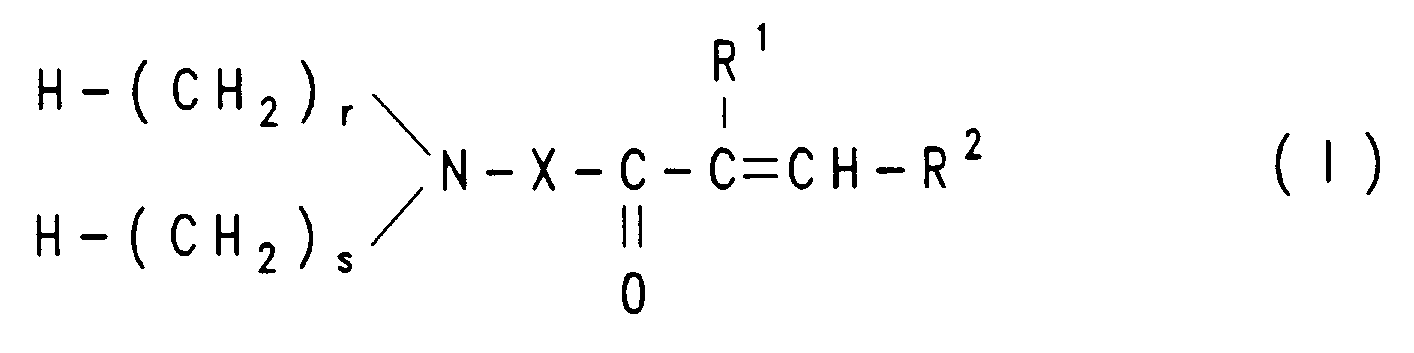
hergestellt werden, in der - R¹
- H, Cl, F, CN oder (CH₂)xH
- R²
- H, (CH₂)uH oder -CH = CH-(CH₂)uH
- X
- eine einfache Bindung, -(CH₂)yY-, CO-(CH₂)y-Y-, -(CH₂CH₂O)y, -CO-(CH₂)y-CO-Z- oder
-CO-(CH₂)YO-(CH₂CH₂-O)V-(CH₂)y-CO-(OCH₂CH₂)t-Y - Z
- -O-(CH₂-CH₂-O-)w
- Y
- O, NH oder Z
- r
- eine Zahl von 7 bis 21
- s
- eine Zahl von 0 bis 24
- x,y,t
- unabhängig voneinander Zahlen von 1 bis 10, und
- u,v,w
- unabhängig voneinander Zahlen von 0 bis 10 bedeuten.
- Die erfindungsgemäße Verbundmembran läßt sich dadurch herstellen, daß man auf eine Trägermembran, die aus einer Stützmembranschicht (A) aus porösem Polymerisat und einer nicht-porösen, gaspermeablen Schicht (B) aus einem amorphen Polymer mit hoher Gasdurchlässigkeit besteht, eine permselektive Schicht (C) aus organischem Material aufträgt. Das Verfahren ist dadurch gekennzeichnet, daß man eine in Wasser nicht lösliche polymere amphiphile Verbindung, die eine oder zwei Alkylketten mit je 7-20 Kohlenstoffatomen pro polarer hydrophiler Gruppe im Molekül enthält und ein Molekulargewicht von über 5000 aufweist, in einem organischen leicht flüchtigen Lösungsmittel löst, die Lösung auf einer Wasseroberfläche spreitet, den entstehenden monomolekularen Film nach der Langmuir-Blodgett-Technik komprimiert und als monomolekulare permselektive Schicht auf die eingetauchte Trägermembran überträgt. Man kann auch Gemische von amphiphilen Verbindungen verwenden. In den einzelnen, nacheinander aufgetragenen monomolekularen Filmen können unterschiedliche Amphiphile eingesetzt werden. Vorzugsweise wird die permselektive monomolekulare Schicht auf die gaspermeable Schicht (B) der Trägermembran aufgebracht.
- Die eingesetzte Trägermembran (= Stützmembran + Zwischenschicht B) läßt sich durch Beschichten eines Mikro- oder Ultrafilters (= A) aus Polysulfon, Polyimid, Polyacrylnitril, Polyamid, Polyetherketon mit den erwähnten amorphen Polymeren herstellen. Die Schicht des amorphen Polymeren soll nicht porös und gaspermeabel sein. Die Schichtdicke beträgt vorzugsweise 15 nm bis 500 nm, vorzugsweise30 bis 250 nm, insbesondere 50 bis 100 nm. Als Polymere für die gaspermeable Zwischenschicht (B) eignen sich z.B. Blockcopolymere aus Polysiloxan und Polycarbonat oder Poly-4-methylpenten. Das Verfahren der Beschichtung wird beschrieben in Ward, W.J. III, et al: J. Membr. Sci. 1976, 1, 99.
- Es ist ein Vorteil des erfindungsgemäßen Verfahrens, daß sich nach der Langmuir-Blodgett-Technik mehrere hochgeordnete und gasselektive Schichten nacheinander auf die Trägermembran aufbringen lassen. Außerdem läßt sich die sehr dünne Schicht mit homogener Dicke aufbringen.
- Um mit Hilfe der erfindungsgemäßen Verbundmembran Gase zu trennen oder zumindest anzureichern, bringt man das aufzutrennende Gasgemisch in einen Behälter, der durch eine Gastrennmembran mit einer dem Gasgemisch zugewandten permselektiven Außenbeschichtung verschlossen ist. Auf der anderen Seite der Gastrennmembran wird ein geringer Druck aufrechterhalten als im Inneren des Behälters und die angereicherte Komponente des Gasgemisches abgezogen. Die permselektive Schicht aus amphiphilen Molekülen ist vorzugsweise der Überdruckseite zugewandt. Das Verfahren eignet sich auch zur Trennung eines aus N₂ und O₂ bestehenden Gasgemisches.
- Die Erfindung wird durch die Beispiele näher erläutert.
- Ein 70 x 70 mm großes Stück einer Trägermembran, bestehend aus einer porösen Trägermembran aus Polypropylen (Celgard 2400), die mit einer 0,5 »m dicken nichtporösen Schicht von Polydimethylsiloxan-Polycarbonat Blockcopolymer beschichtet wurde, wird nach dem Verfahren von Langmuir und Blodgett mit 4 Monolagen 4-Hexa-decyloxybenzaldehyd-4'-nitrophenylhydrazon beschichtet. Hierzu wird ein entsprechend großes Stück aus der Trägermembran herausgeschnitten und auf einen 70 x 90 mm großen Rahmen aus Polycarbonat gespannt. Die zu beschichtende Membran wird unter Reinraumbedingungen mit Wasser abgespült. Zweihundert Mikroliter einer Lösung von 6 mg 4-Hexadecyloxybenzaldehyd-4'-nitrophenylhydrazon in 5 ml Dichlormethan wird bei einer Subphasentemperatur von 20°C auf die Wasseroberfläche einer käuflichen Langmuir-Filmwaage (Filmwaage 2 der Firma MGW Lauda) aufgegeben (gespreitet). Durch Verkleinerung der monofilmbedeckten Wasseroberfläche wird der Schub auf 30 mN/m eingeregelt und bei diesem Wert konstant gehalten. Der Rahmen mit der aufgespannten Membran wird nun senkrecht von oben durch die Wasseroberfläche in die Filmwaage eingetaucht (Eintauchgeschwindigkeit: 20 mm/min) und nach einer kurzen Pause (10 sec.) am unteren Umkehrpunkt wieder heausgenommen (Austauchgeschwindigkeit: 10 mm/min). Sowohl beim Eintauch- als auch beim Austauchvorgang wird dabei eine Monolage auf den Träger übertragen. Nach Beendigung des Austauchvorgangs wird der restliche Monofilm von der Wasseroberfläche abgesaugt und erneut, wie oben beschrieben, ein Monofilm gespreitet, auf 30 mN/m komprimiert und durch Ein- oder Austauchen zwei weitere Monolagen auf die Trägermembran übertragen. Die Übertragungsverhältnisse liegen bei 90 - 100 %.
Die Permeabilitäten für verschiedene Gase (Stickstoff, Sauerstoff und Kohlendioxid) der so hergestellten Dreischichtmembran wurden gemessen. Aus den Messungen ergaben sich folgende Werte für die Permeabilitäten und die Selektivitäten: - Gasfluß bei 25°C (Nm³/m²·Tag·bar)
- N₂: 1,97 O₂: 4,73 CO₂: 27,6
- Selektivität:
- O₂/N₂: 2.4 CO₂/N₂: 14
- Gemäß Beispiel 1 wurde die Trägermembran mit 12 Monolagen Polyhexadecylmethacrylat beschichtet. Die Übertragungsbedingungen hierbei sind:
Subphasentemperatur: 30°C Schub: 10 mN/m Schub: 10 mN/m Eintauchgeschwindigkeit: 20 mm/min Austauchgeschwindigkeit: 20 mm/min Übertragungsverhältnis a) beim Eintauchen: ca. 40 % b) beim Austauchen: 90 - 100 % - Die Permeabilität der so hergestellten Membranen wird wie in Beispiel 1 für die Gase Sauerstoff, Stickstoff, Kohlendioxid und Helium gemessen. Dabei werden folgende Ergebnisse erhalten:
- Gasfluß bei 25°C Nm³/m²·Tag·bar
- N₂: 1,31, O₂: 3,74, CO₂: 19,7; He: 18,4
- Selektivität:
- O₂/N₂: 2,85, CO₂/N₂: 14,8, He/N₂: 14.
Die amphiphilen Moleküle der permselektiven Schicht sollen wasserunlöslich sein und stabile Monoschichten an der Grenzfläche Wasser/Luft ausbilden, insbesondere sollen sie eine Wasserlöslichkeit von weniger als 59/L bei 20°C besitzen. Monoschichten von niedermolekularen amphiphilen Verbindungen sind z. B. bekannt aus de DE-OS 37 24 688. Amphiphile Moleküle enthalten jeweils einen hydrophilen (polaren) "Kopf" und mindestens einen hydrophoben (unpolaren) Rest, beispielsweise eine lange Alkylkette oder Perfluoralkylkette. Als Beispiel für ein ein hochmolekulares Amphiphil sei Polyhexadecylacrylat erwähnt. Andere amphiphile Polymere mit langkettigen Alkylgruppen sind bekannt z. B. aus A. Laschewsky, H. Ringsdorf, G. Schmidt, J. Schneider, J. Am. Chem. Soc. 109 (1987), 788-796. Auf diese Publikationen wird hiermit ausdrücklich Bezug genommen. Vorzugsweise enthalten die niedermolekularen oder monomeren amphiphilen Moleküle der permselektiven Schicht eine oder zwei Alkylketten mit 8 bis 18, insbesondere 8 bis 16, Kohlenstoffatomen pro (polarer) hydrophiler Gruppe.
Claims (6)
- Verbundmembran zur Gastrennung mit einer Dreischichtstruktur, aufgebaut ausA) einer Stützmembranschicht aus porösem Polymerisat,B) einer nichtporösen, gaspermeablen Zwischenschicht, aus einem amorphen Polymer mit einer hohen Gasdurchlässigkeit,C) einer permselektiven Schicht aus regelmäßig angeordneten organischen Molekülen mit einer Schichtdicke von 3 bis 100 nm,wobei die Schichten (A) und (C) die Zwischenschicht (B) einhüllen, dadurch gekennzeichnet, daß die permselektive Schicht (C) aus regelmäßig angeordneten polymeren amphiphilen Molekülen besteht, die eine oder zwei Alkylketten mit je 7 bis 25 Kohlenstoffatomen pro polare hydrophile Gruppe enthalten und ein Molekulargewicht von über 5000 aufweisen.
- Verbundmembran gemäß Anspruch 1, dadurch gekennzeichnet, daß die permselektive Schicht (C) aus mindestens zwei übereinander angeordneten monomolekularen Schichten aus amphiphilen Molekülen besteht.
- Verfahren zur Herstellung einer Verbundmembran gemäß Anspruch 1, wobei man auf eine Trägermembran, die aus einer Stützmembranschicht (A) aus porösen Polymerisat und einer nicht-porösen, gaspermeablen Schicht (B) aus einem amorphen Polymer mit hoher Gasdurchlässigkeit besteht, eine permselektive Schicht (C) aus organischem Material aufträgt, dadurch gekennzeichnet, daß man eine in Wasser nicht lösliche polymere amphiphile Verbindung, die eine oder zwei Alkylketten mit je 7 - 20 Kohlenstoffatomen pro polarer hydrophiler Gruppe im Molekül enthält und ein Molekulargewicht von über 5000 aufweist, in einem organischen leicht flüchtigen Lösungsmittel löst, die Lösung auf einer Wasseroberfläche spreitet, den entstehenden Film nach der Langmuir-Blodgett-Technik kompromiert und als monomolekulare permselektive Schicht auf die eingetauchte Trägermembran überträgt.
- Verfahren nach Anspruch 3, dadurch gekennzeichnet, daß man die permselektive monomolekulare Schicht auf die gaspermeable Schicht (B) der Trägermembran aufbringt.
- Verfahren zum Trennen eines Gasgemischs in angereicherte Komponenten, wobei man das Gasgemisch in einen Behälter bringt, der durch eine Gastrennmembran mit einer dem Gasgemisch zugewandten permselektiven Außenbeschichtung verschlossen ist, man auf der anderen Seite der Gastrennmembran einen geringeren Druck als im Inneren des Behälters aufrecht hält und eine angereicherte Komponente des Gasgemischs abzieht, dadurch gekennzeichnet, daß man die Verbundmembran gemäß Anspruch 1 als Gastrennmembran einsetzt.
- Verfahren nach Anspruch 5, dadurch gekennzeichnet, daß ein aus Stickstoff und Sauerstoff bestehendes Gasgemisch getrennt wird.
Applications Claiming Priority (5)
| Application Number | Priority Date | Filing Date | Title |
|---|---|---|---|
| DE3942867A DE3942867A1 (de) | 1989-12-23 | 1989-12-23 | Verbundmembran, verfahren zu ihrer herstellung und ihre verwendung |
| DE3942867 | 1989-12-23 | ||
| DE4006139A DE4006139A1 (de) | 1990-02-27 | 1990-02-27 | Verbundmembran, verfahren zu ihrer herstellung und ihre verwendung |
| DE4006139 | 1990-02-27 | ||
| PCT/EP1990/002021 WO1991009669A1 (de) | 1989-12-23 | 1990-11-26 | Verbundmembran, verfahren zu ihrer herstellung und ihre verwendung |
Publications (2)
| Publication Number | Publication Date |
|---|---|
| EP0506701A1 EP0506701A1 (de) | 1992-10-07 |
| EP0506701B1 true EP0506701B1 (de) | 1995-03-01 |
Family
ID=25888469
Family Applications (1)
| Application Number | Title | Priority Date | Filing Date |
|---|---|---|---|
| EP91900235A Expired - Lifetime EP0506701B1 (de) | 1989-12-23 | 1990-11-26 | Verbundmembran, verfahren zu ihrer herstellung und ihre verwendung |
Country Status (10)
| Country | Link |
|---|---|
| US (1) | US5342432A (de) |
| EP (1) | EP0506701B1 (de) |
| KR (1) | KR920703191A (de) |
| CA (1) | CA2072016A1 (de) |
| DE (1) | DE59008610D1 (de) |
| DK (1) | DK0506701T3 (de) |
| FI (1) | FI922786A7 (de) |
| GR (1) | GR3015739T3 (de) |
| IE (1) | IE904676A1 (de) |
| WO (1) | WO1991009669A1 (de) |
Cited By (1)
| Publication number | Priority date | Publication date | Assignee | Title |
|---|---|---|---|---|
| US7811359B2 (en) | 2007-01-18 | 2010-10-12 | General Electric Company | Composite membrane for separation of carbon dioxide |
Families Citing this family (7)
| Publication number | Priority date | Publication date | Assignee | Title |
|---|---|---|---|---|
| US5160353A (en) * | 1990-08-30 | 1992-11-03 | E. I. Du Pont De Nemours & Company | Gas separation membrane with ultrathin layer |
| US5702503A (en) * | 1994-06-03 | 1997-12-30 | Uop | Composite gas separation membranes and making thereof |
| US6958085B1 (en) | 2003-03-26 | 2005-10-25 | The United States Of America As Represented By The Administrator Of The National Aeronautics And Space Administration | High performance immobilized liquid membrane for carbon dioxide separations |
| US7922795B2 (en) * | 2005-04-29 | 2011-04-12 | University Of Rochester | Ultrathin nanoscale membranes, methods of making, and uses thereof |
| CN101905125B (zh) * | 2010-07-21 | 2012-06-27 | 杭州水处理技术研究开发中心有限公司 | 聚苯乙烯磺酸盐/聚乙烯亚胺交联纳滤膜的制备方法 |
| JP7261812B2 (ja) * | 2018-03-29 | 2023-04-20 | コンパクト メンブレイン システムズ インコーポレイテッド | 二酸化炭素分離膜および二酸化炭素分離プロセス |
| JP2024060738A (ja) * | 2022-10-20 | 2024-05-07 | セイコーエプソン株式会社 | 気体分離膜 |
Family Cites Families (26)
| Publication number | Priority date | Publication date | Assignee | Title |
|---|---|---|---|---|
| US3892665A (en) * | 1973-10-15 | 1975-07-01 | Standard Oil Co | Membrane method and product |
| US3874986A (en) * | 1974-05-20 | 1975-04-01 | Gen Electric | Laminated porous/non-porous membranes |
| US3980456A (en) * | 1975-03-31 | 1976-09-14 | General Electric Company | Method for sealing breaches in multi-layer ultrathin membrane composites |
| DE3107527A1 (de) * | 1981-02-27 | 1982-09-16 | Klaus Prof. Dr. 8400 Regensburg Heckmann | Hyperfiltrationsmembranen mit trennschichten aus monomolekularen filmen von tensiden |
| JPS5959210A (ja) * | 1982-09-27 | 1984-04-05 | Matsushita Electric Ind Co Ltd | 選択性気体透過複合膜 |
| JPS59160506A (ja) * | 1983-02-28 | 1984-09-11 | Kuraray Co Ltd | 複合中空糸分離膜およびその製造法 |
| JPS59222204A (ja) * | 1983-04-26 | 1984-12-13 | Asahi Glass Co Ltd | ガス分離用複合膜 |
| GB2144344B (en) * | 1983-08-02 | 1986-11-26 | Shell Int Research | Composite dense membrane |
| GB8320797D0 (en) * | 1983-08-02 | 1983-09-01 | Shell Int Research | Very thin dense membrane |
| DE3482378D1 (de) * | 1983-11-26 | 1990-07-05 | Matsushita Electric Industrial Co Ltd | Zusammengesetzte, fuer selektive gastrennung geeignete folien. |
| JPS60137417A (ja) * | 1983-12-23 | 1985-07-22 | Toyota Central Res & Dev Lab Inc | 気体分離部材およびその製造方法 |
| JPS60161703A (ja) * | 1984-01-30 | 1985-08-23 | Teijin Ltd | 気体選択透過膜複合体 |
| US4602922A (en) * | 1984-11-09 | 1986-07-29 | Research Foundation Of State University Of New York | Method of making membranes for gas separation and the composite membranes |
| JPS61129008A (ja) * | 1984-11-28 | 1986-06-17 | Sanyo Chem Ind Ltd | 気体分離用複合膜および製造法 |
| US4851216A (en) * | 1984-12-18 | 1989-07-25 | Dow Corning Corporation | Hydrophilic silicone-organic copolymer elastomers |
| DE3525235C1 (de) * | 1985-07-15 | 1986-11-27 | Gkss - Forschungszentrum Geesthacht Gmbh, 2054 Geesthacht | Verfahren zur Herstellung und Erhoehung der Selektivitaet einer integralasymmetrischen Membran |
| US4781733A (en) * | 1986-07-23 | 1988-11-01 | Bend Research, Inc. | Semipermeable thin-film membranes comprising siloxane, alkoxysilyl and aryloxysilyl oligomers and copolymers |
| JPS63214319A (ja) * | 1987-02-27 | 1988-09-07 | Sanyo Chem Ind Ltd | 分離用複合膜 |
| US4963165A (en) * | 1987-04-27 | 1990-10-16 | Membrane Technology & Research, Inc. | Composite membrane, method of preparation and use |
| US4990165A (en) * | 1987-07-31 | 1991-02-05 | Union Carbide Industrial Gases Technology Corporation | Permeable membranes for enhanced gas separation |
| JPS6467209A (en) * | 1987-09-07 | 1989-03-13 | Matsushita Electric Industrial Co Ltd | Composite membrane having selective permeability to gases |
| JPH0761428B2 (ja) * | 1989-03-09 | 1995-07-05 | 松下電器産業株式会社 | 選択透過性膜およびその製造方法 |
| US5085776A (en) * | 1989-06-02 | 1992-02-04 | Membrane Technology & Research, Inc. | Composite membranes for fluid separations |
| US5002590A (en) * | 1989-09-19 | 1991-03-26 | Bend Research, Inc. | Countercurrent dehydration by hollow fibers |
| US5108464A (en) * | 1989-09-19 | 1992-04-28 | Bend Research, Inc. | Countercurrent dehydration by hollow fibers |
| US5049167A (en) * | 1989-12-13 | 1991-09-17 | Membrane Technology & Research, Inc. | Multilayer interfacial composite membrane |
-
1990
- 1990-11-26 EP EP91900235A patent/EP0506701B1/de not_active Expired - Lifetime
- 1990-11-26 DK DK91900235.2T patent/DK0506701T3/da active
- 1990-11-26 US US07/867,218 patent/US5342432A/en not_active Expired - Fee Related
- 1990-11-26 CA CA002072016A patent/CA2072016A1/en not_active Abandoned
- 1990-11-26 KR KR1019920701489A patent/KR920703191A/ko not_active Withdrawn
- 1990-11-26 FI FI922786A patent/FI922786A7/fi unknown
- 1990-11-26 WO PCT/EP1990/002021 patent/WO1991009669A1/de not_active Ceased
- 1990-11-26 DE DE59008610T patent/DE59008610D1/de not_active Expired - Fee Related
- 1990-12-21 IE IE467690A patent/IE904676A1/en unknown
-
1995
- 1995-04-10 GR GR950400878T patent/GR3015739T3/el unknown
Cited By (1)
| Publication number | Priority date | Publication date | Assignee | Title |
|---|---|---|---|---|
| US7811359B2 (en) | 2007-01-18 | 2010-10-12 | General Electric Company | Composite membrane for separation of carbon dioxide |
Also Published As
| Publication number | Publication date |
|---|---|
| IE904676A1 (en) | 1991-07-17 |
| US5342432A (en) | 1994-08-30 |
| DK0506701T3 (da) | 1995-07-17 |
| GR3015739T3 (en) | 1995-07-31 |
| DE59008610D1 (de) | 1995-04-06 |
| CA2072016A1 (en) | 1991-06-24 |
| WO1991009669A1 (de) | 1991-07-11 |
| KR920703191A (ko) | 1992-12-17 |
| FI922786L (fi) | 1992-06-16 |
| FI922786A0 (fi) | 1992-06-16 |
| FI922786A7 (fi) | 1992-06-16 |
| EP0506701A1 (de) | 1992-10-07 |
Similar Documents
| Publication | Publication Date | Title |
|---|---|---|
| DE69012036T2 (de) | Gastrennungsmembranen auf der Basis von Phenylindan enthaltenden Polyimiden. | |
| DE2831693C2 (de) | ||
| DE60127666T2 (de) | Säurebeständige membranen zur nanofiltration | |
| DE69814891T2 (de) | Zusammengesetzte umkehrosmosemembran und verfahren zu ihrer herstellung | |
| DE69619377T2 (de) | Salze aus aminosäuren in hydrophilen polymeren enthaltende membrane | |
| DE69015320T2 (de) | Membranen aus sulfoniertem Polysulfon auf der Basis von Hexafluorbisphenol-A und Verfahren zum Trennen von Fluiden. | |
| DE2248818C2 (de) | Dünne porenfreie Polycarbonatfolien und -filme | |
| DE2703587C2 (de) | Verfahren zur Herstellung von semipermeablen Membranen | |
| DE69030150T2 (de) | Behandlung von Gastrennungsmembranen aus aromatischen Polyimiden mit oberflächenaktiven Mitteln | |
| DE3716916C2 (de) | ||
| DE3886822T2 (de) | Verfahren zur Herstellung von hochdurchlässigen zusammengesetzten beschichteten Hohlfasermembranen. | |
| DE2539408B2 (de) | Membrane, verfahren zu ihrer herstellung und ihre verwendung zur umgekehrten osmose und ultrafiltration | |
| DE2850998A1 (de) | Membran zur gastrennung und verfahren zu deren herstellung | |
| EP0681862A2 (de) | Verbundmembran und Verfahren zu ihrer Herstellung | |
| EP0506701B1 (de) | Verbundmembran, verfahren zu ihrer herstellung und ihre verwendung | |
| DE69030152T2 (de) | Behandlung von Polyaramid-Gastrennungsmembranen mit oberflächenaktiven Mitteln | |
| DE2431071C2 (de) | Asymmetrische, semipermeable Membranen aus cyclischen Polyharnstoffen und deren Verwendung zur Meerwasserentsalzung oder zur Trennung und Konzentrierung von Stoffgemischen | |
| EP0214360A2 (de) | Verfahren zur Herstellung und Erhöhung der Selektivität einer integralasymmetrischen Membran | |
| DE19600954A1 (de) | Verfahren zum Abtrennen saurer Gase von gasförmigen Mischungen mit Verbundmembranen aus Salz-Polymer-Mischungen | |
| DE3781449T2 (de) | Die verwendung von polycarbonat enthaltenden semipermable membranen fuer die trennung von gasen. | |
| EP0761293A1 (de) | Polyetherimidmembran | |
| EP0218019A1 (de) | Pervaporationsverfahren | |
| DE4006139A1 (de) | Verbundmembran, verfahren zu ihrer herstellung und ihre verwendung | |
| DE3942867A1 (de) | Verbundmembran, verfahren zu ihrer herstellung und ihre verwendung | |
| DE19516908A1 (de) | Verbundmembrane und Verfahren zu ihrer Herstellung |
Legal Events
| Date | Code | Title | Description |
|---|---|---|---|
| PUAI | Public reference made under article 153(3) epc to a published international application that has entered the european phase |
Free format text: ORIGINAL CODE: 0009012 |
|
| 17P | Request for examination filed |
Effective date: 19920516 |
|
| AK | Designated contracting states |
Kind code of ref document: A1 Designated state(s): BE DE DK FR GB GR IT NL SE |
|
| 17Q | First examination report despatched |
Effective date: 19931220 |
|
| GRAA | (expected) grant |
Free format text: ORIGINAL CODE: 0009210 |
|
| AK | Designated contracting states |
Kind code of ref document: B1 Designated state(s): BE DE DK FR GB GR IT NL SE |
|
| REF | Corresponds to: |
Ref document number: 59008610 Country of ref document: DE Date of ref document: 19950406 |
|
| ITF | It: translation for a ep patent filed | ||
| GBT | Gb: translation of ep patent filed (gb section 77(6)(a)/1977) |
Effective date: 19950505 |
|
| ET | Fr: translation filed | ||
| REG | Reference to a national code |
Ref country code: GR Ref legal event code: FG4A Free format text: 3015739 |
|
| REG | Reference to a national code |
Ref country code: DK Ref legal event code: T3 |
|
| PGFP | Annual fee paid to national office [announced via postgrant information from national office to epo] |
Ref country code: FR Payment date: 19951023 Year of fee payment: 6 |
|
| PGFP | Annual fee paid to national office [announced via postgrant information from national office to epo] |
Ref country code: NL Payment date: 19951024 Year of fee payment: 6 |
|
| PGFP | Annual fee paid to national office [announced via postgrant information from national office to epo] |
Ref country code: DK Payment date: 19951025 Year of fee payment: 6 |
|
| PGFP | Annual fee paid to national office [announced via postgrant information from national office to epo] |
Ref country code: SE Payment date: 19951026 Year of fee payment: 6 Ref country code: GB Payment date: 19951026 Year of fee payment: 6 |
|
| PGFP | Annual fee paid to national office [announced via postgrant information from national office to epo] |
Ref country code: BE Payment date: 19951110 Year of fee payment: 6 |
|
| PGFP | Annual fee paid to national office [announced via postgrant information from national office to epo] |
Ref country code: GR Payment date: 19951130 Year of fee payment: 6 |
|
| PLBE | No opposition filed within time limit |
Free format text: ORIGINAL CODE: 0009261 |
|
| STAA | Information on the status of an ep patent application or granted ep patent |
Free format text: STATUS: NO OPPOSITION FILED WITHIN TIME LIMIT |
|
| 26N | No opposition filed | ||
| PG25 | Lapsed in a contracting state [announced via postgrant information from national office to epo] |
Ref country code: DE Effective date: 19960801 |
|
| PG25 | Lapsed in a contracting state [announced via postgrant information from national office to epo] |
Ref country code: GB Effective date: 19961126 Ref country code: DK Effective date: 19961126 |
|
| REG | Reference to a national code |
Ref country code: DK Ref legal event code: EBP |
|
| PG25 | Lapsed in a contracting state [announced via postgrant information from national office to epo] |
Ref country code: SE Effective date: 19961127 |
|
| PG25 | Lapsed in a contracting state [announced via postgrant information from national office to epo] |
Ref country code: BE Effective date: 19961130 |
|
| BERE | Be: lapsed |
Owner name: HOECHST A.G. Effective date: 19961130 |
|
| PG25 | Lapsed in a contracting state [announced via postgrant information from national office to epo] |
Ref country code: GR Free format text: THE PATENT HAS BEEN ANNULLED BY A DECISION OF A NATIONAL AUTHORITY Effective date: 19970531 |
|
| PG25 | Lapsed in a contracting state [announced via postgrant information from national office to epo] |
Ref country code: NL Effective date: 19970601 |
|
| REG | Reference to a national code |
Ref country code: GR Ref legal event code: MM2A Free format text: 3015739 |
|
| GBPC | Gb: european patent ceased through non-payment of renewal fee |
Effective date: 19961126 |
|
| PG25 | Lapsed in a contracting state [announced via postgrant information from national office to epo] |
Ref country code: FR Effective date: 19970731 |
|
| NLV4 | Nl: lapsed or anulled due to non-payment of the annual fee |
Effective date: 19970601 |
|
| EUG | Se: european patent has lapsed |
Ref document number: 91900235.2 |
|
| REG | Reference to a national code |
Ref country code: FR Ref legal event code: ST |
|
| PG25 | Lapsed in a contracting state [announced via postgrant information from national office to epo] |
Ref country code: IT Free format text: LAPSE BECAUSE OF NON-PAYMENT OF DUE FEES;WARNING: LAPSES OF ITALIAN PATENTS WITH EFFECTIVE DATE BEFORE 2007 MAY HAVE OCCURRED AT ANY TIME BEFORE 2007. THE CORRECT EFFECTIVE DATE MAY BE DIFFERENT FROM THE ONE RECORDED. Effective date: 20051126 |