EP0502858B1 - Drahtlacke sowie verfahren zum kontinuierlichen beschichten von drähten - Google Patents
Drahtlacke sowie verfahren zum kontinuierlichen beschichten von drähten Download PDFInfo
- Publication number
- EP0502858B1 EP0502858B1 EP90916208A EP90916208A EP0502858B1 EP 0502858 B1 EP0502858 B1 EP 0502858B1 EP 90916208 A EP90916208 A EP 90916208A EP 90916208 A EP90916208 A EP 90916208A EP 0502858 B1 EP0502858 B1 EP 0502858B1
- Authority
- EP
- European Patent Office
- Prior art keywords
- weight
- wire
- aromatic
- polyester
- relative
- Prior art date
- Legal status (The legal status is an assumption and is not a legal conclusion. Google has not performed a legal analysis and makes no representation as to the accuracy of the status listed.)
- Expired - Lifetime
Links
- 238000000576 coating method Methods 0.000 title claims abstract description 17
- 239000011248 coating agent Substances 0.000 title claims abstract description 14
- 238000000034 method Methods 0.000 title claims abstract description 13
- 239000004922 lacquer Substances 0.000 title abstract description 17
- 239000002904 solvent Substances 0.000 claims abstract description 43
- 229920003055 poly(ester-imide) Polymers 0.000 claims abstract description 29
- -1 alkylene carbonates Chemical class 0.000 claims abstract description 28
- 229920000728 polyester Polymers 0.000 claims abstract description 26
- 239000012948 isocyanate Substances 0.000 claims abstract description 18
- 150000002513 isocyanates Chemical class 0.000 claims abstract description 18
- 125000002887 hydroxy group Chemical group [H]O* 0.000 claims abstract description 16
- 229920005989 resin Polymers 0.000 claims abstract description 13
- 239000011347 resin Substances 0.000 claims abstract description 13
- ISWSIDIOOBJBQZ-UHFFFAOYSA-N phenol group Chemical group C1(=CC=CC=C1)O ISWSIDIOOBJBQZ-UHFFFAOYSA-N 0.000 claims abstract description 11
- IQPQWNKOIGAROB-UHFFFAOYSA-N isocyanate group Chemical group [N-]=C=O IQPQWNKOIGAROB-UHFFFAOYSA-N 0.000 claims abstract description 10
- 150000004945 aromatic hydrocarbons Chemical class 0.000 claims abstract description 9
- 229920001225 polyester resin Polymers 0.000 claims abstract description 8
- 239000004645 polyester resin Substances 0.000 claims abstract description 8
- UFHFLCQGNIYNRP-UHFFFAOYSA-N Hydrogen Chemical compound [H][H] UFHFLCQGNIYNRP-UHFFFAOYSA-N 0.000 claims abstract description 7
- 125000001931 aliphatic group Chemical group 0.000 claims abstract description 7
- 150000001338 aliphatic hydrocarbons Chemical class 0.000 claims abstract description 7
- 125000003118 aryl group Chemical group 0.000 claims abstract description 7
- 229910052739 hydrogen Inorganic materials 0.000 claims abstract description 5
- 239000001257 hydrogen Substances 0.000 claims abstract description 5
- 210000003298 dental enamel Anatomy 0.000 claims description 56
- 239000000203 mixture Substances 0.000 claims description 15
- RUOJZAUFBMNUDX-UHFFFAOYSA-N propylene carbonate Chemical compound CC1COC(=O)O1 RUOJZAUFBMNUDX-UHFFFAOYSA-N 0.000 claims description 11
- 238000004519 manufacturing process Methods 0.000 claims description 8
- 229930195733 hydrocarbon Natural products 0.000 claims description 6
- 150000002430 hydrocarbons Chemical class 0.000 claims description 6
- 238000009835 boiling Methods 0.000 claims description 5
- NTOXAXQNZZXUQQ-UHFFFAOYSA-N C1(OC(=C(C)C)O1)=O Chemical compound C1(OC(=C(C)C)O1)=O NTOXAXQNZZXUQQ-UHFFFAOYSA-N 0.000 claims description 4
- KMTRUDSVKNLOMY-UHFFFAOYSA-N Ethylene carbonate Chemical compound O=C1OCCO1 KMTRUDSVKNLOMY-UHFFFAOYSA-N 0.000 claims description 3
- ZFSLODLOARCGLH-UHFFFAOYSA-N isocyanuric acid Chemical compound OC1=NC(O)=NC(O)=N1 ZFSLODLOARCGLH-UHFFFAOYSA-N 0.000 claims description 2
- LYCAIKOWRPUZTN-UHFFFAOYSA-N Ethylene glycol Chemical compound OCCO LYCAIKOWRPUZTN-UHFFFAOYSA-N 0.000 description 27
- 239000007787 solid Substances 0.000 description 13
- 239000003054 catalyst Substances 0.000 description 12
- 239000011230 binding agent Substances 0.000 description 11
- PEDCQBHIVMGVHV-UHFFFAOYSA-N Glycerine Chemical compound OCC(O)CO PEDCQBHIVMGVHV-UHFFFAOYSA-N 0.000 description 10
- 150000001875 compounds Chemical class 0.000 description 10
- 239000002253 acid Substances 0.000 description 9
- KXGFMDJXCMQABM-UHFFFAOYSA-N 2-methoxy-6-methylphenol Chemical class [CH]OC1=CC=CC([CH])=C1O KXGFMDJXCMQABM-UHFFFAOYSA-N 0.000 description 7
- UHOVQNZJYSORNB-UHFFFAOYSA-N Benzene Chemical compound C1=CC=CC=C1 UHOVQNZJYSORNB-UHFFFAOYSA-N 0.000 description 7
- IHEDBVUTTQXGSJ-UHFFFAOYSA-M 2-[bis(2-oxidoethyl)amino]ethanolate;titanium(4+);hydroxide Chemical compound [OH-].[Ti+4].[O-]CCN(CC[O-])CC[O-] IHEDBVUTTQXGSJ-UHFFFAOYSA-M 0.000 description 6
- LRHPLDYGYMQRHN-UHFFFAOYSA-N N-Butanol Chemical compound CCCCO LRHPLDYGYMQRHN-UHFFFAOYSA-N 0.000 description 6
- DNIAPMSPPWPWGF-UHFFFAOYSA-N Propylene glycol Chemical compound CC(O)CO DNIAPMSPPWPWGF-UHFFFAOYSA-N 0.000 description 6
- ZJCCRDAZUWHFQH-UHFFFAOYSA-N Trimethylolpropane Chemical compound CCC(CO)(CO)CO ZJCCRDAZUWHFQH-UHFFFAOYSA-N 0.000 description 6
- 125000000524 functional group Chemical group 0.000 description 6
- 239000003973 paint Substances 0.000 description 6
- KKEYFWRCBNTPAC-UHFFFAOYSA-N Terephthalic acid Chemical compound OC(=O)C1=CC=C(C(O)=O)C=C1 KKEYFWRCBNTPAC-UHFFFAOYSA-N 0.000 description 5
- 239000002981 blocking agent Substances 0.000 description 5
- 150000004985 diamines Chemical class 0.000 description 5
- QQVIHTHCMHWDBS-UHFFFAOYSA-N isophthalic acid Chemical compound OC(=O)C1=CC=CC(C(O)=O)=C1 QQVIHTHCMHWDBS-UHFFFAOYSA-N 0.000 description 5
- 239000004814 polyurethane Substances 0.000 description 5
- 229920002635 polyurethane Polymers 0.000 description 5
- SBASXUCJHJRPEV-UHFFFAOYSA-N 2-(2-methoxyethoxy)ethanol Chemical compound COCCOCCO SBASXUCJHJRPEV-UHFFFAOYSA-N 0.000 description 4
- WOZVHXUHUFLZGK-UHFFFAOYSA-N dimethyl terephthalate Chemical compound COC(=O)C1=CC=C(C(=O)OC)C=C1 WOZVHXUHUFLZGK-UHFFFAOYSA-N 0.000 description 4
- 235000011187 glycerol Nutrition 0.000 description 4
- 229920005862 polyol Polymers 0.000 description 4
- 150000003077 polyols Chemical class 0.000 description 4
- DVKJHBMWWAPEIU-UHFFFAOYSA-N toluene 2,4-diisocyanate Chemical compound CC1=CC=C(N=C=O)C=C1N=C=O DVKJHBMWWAPEIU-UHFFFAOYSA-N 0.000 description 4
- UPMLOUAZCHDJJD-UHFFFAOYSA-N 4,4'-Diphenylmethane Diisocyanate Chemical compound C1=CC(N=C=O)=CC=C1CC1=CC=C(N=C=O)C=C1 UPMLOUAZCHDJJD-UHFFFAOYSA-N 0.000 description 3
- RYGMFSIKBFXOCR-UHFFFAOYSA-N Copper Chemical compound [Cu] RYGMFSIKBFXOCR-UHFFFAOYSA-N 0.000 description 3
- CTQNGGLPUBDAKN-UHFFFAOYSA-N O-Xylene Chemical compound CC1=CC=CC=C1C CTQNGGLPUBDAKN-UHFFFAOYSA-N 0.000 description 3
- YXFVVABEGXRONW-UHFFFAOYSA-N Toluene Chemical compound CC1=CC=CC=C1 YXFVVABEGXRONW-UHFFFAOYSA-N 0.000 description 3
- 150000007513 acids Chemical class 0.000 description 3
- 125000003178 carboxy group Chemical group [H]OC(*)=O 0.000 description 3
- 150000001735 carboxylic acids Chemical class 0.000 description 3
- 238000006243 chemical reaction Methods 0.000 description 3
- 230000000052 comparative effect Effects 0.000 description 3
- 238000009833 condensation Methods 0.000 description 3
- 230000005494 condensation Effects 0.000 description 3
- 238000004132 cross linking Methods 0.000 description 3
- 150000005676 cyclic carbonates Chemical class 0.000 description 3
- MTHSVFCYNBDYFN-UHFFFAOYSA-N diethylene glycol Chemical compound OCCOCCO MTHSVFCYNBDYFN-UHFFFAOYSA-N 0.000 description 3
- 125000005442 diisocyanate group Chemical group 0.000 description 3
- 238000010438 heat treatment Methods 0.000 description 3
- 239000010410 layer Substances 0.000 description 3
- 125000002924 primary amino group Chemical group [H]N([H])* 0.000 description 3
- 150000003254 radicals Chemical class 0.000 description 3
- 238000005809 transesterification reaction Methods 0.000 description 3
- SRPWOOOHEPICQU-UHFFFAOYSA-N trimellitic anhydride Chemical compound OC(=O)C1=CC=C2C(=O)OC(=O)C2=C1 SRPWOOOHEPICQU-UHFFFAOYSA-N 0.000 description 3
- 239000002966 varnish Substances 0.000 description 3
- 238000004804 winding Methods 0.000 description 3
- 239000008096 xylene Substances 0.000 description 3
- RYSXWUYLAWPLES-MTOQALJVSA-N (Z)-4-hydroxypent-3-en-2-one titanium Chemical compound [Ti].C\C(O)=C\C(C)=O.C\C(O)=C\C(C)=O.C\C(O)=C\C(C)=O.C\C(O)=C\C(C)=O RYSXWUYLAWPLES-MTOQALJVSA-N 0.000 description 2
- YIWUKEYIRIRTPP-UHFFFAOYSA-N 2-ethylhexan-1-ol Chemical compound CCCCC(CC)CO YIWUKEYIRIRTPP-UHFFFAOYSA-N 0.000 description 2
- YBRVSVVVWCFQMG-UHFFFAOYSA-N 4,4'-diaminodiphenylmethane Chemical compound C1=CC(N)=CC=C1CC1=CC=C(N)C=C1 YBRVSVVVWCFQMG-UHFFFAOYSA-N 0.000 description 2
- 239000004215 Carbon black (E152) Substances 0.000 description 2
- RTZKZFJDLAIYFH-UHFFFAOYSA-N Diethyl ether Chemical compound CCOCC RTZKZFJDLAIYFH-UHFFFAOYSA-N 0.000 description 2
- DHMQDGOQFOQNFH-UHFFFAOYSA-N Glycine Chemical compound NCC(O)=O DHMQDGOQFOQNFH-UHFFFAOYSA-N 0.000 description 2
- SECXISVLQFMRJM-UHFFFAOYSA-N N-Methylpyrrolidone Chemical compound CN1CCCC1=O SECXISVLQFMRJM-UHFFFAOYSA-N 0.000 description 2
- ZOIORXHNWRGPMV-UHFFFAOYSA-N acetic acid;zinc Chemical compound [Zn].CC(O)=O.CC(O)=O ZOIORXHNWRGPMV-UHFFFAOYSA-N 0.000 description 2
- 150000001298 alcohols Chemical class 0.000 description 2
- 150000004982 aromatic amines Chemical class 0.000 description 2
- JQVDAXLFBXTEQA-UHFFFAOYSA-N dibutylamine Chemical compound CCCCNCCCC JQVDAXLFBXTEQA-UHFFFAOYSA-N 0.000 description 2
- 230000007613 environmental effect Effects 0.000 description 2
- JBKVHLHDHHXQEQ-UHFFFAOYSA-N epsilon-caprolactam Chemical compound O=C1CCCCCN1 JBKVHLHDHHXQEQ-UHFFFAOYSA-N 0.000 description 2
- 230000032050 esterification Effects 0.000 description 2
- 238000005886 esterification reaction Methods 0.000 description 2
- 150000002148 esters Chemical class 0.000 description 2
- 125000001495 ethyl group Chemical group [H]C([H])([H])C([H])([H])* 0.000 description 2
- 230000002349 favourable effect Effects 0.000 description 2
- NAQMVNRVTILPCV-UHFFFAOYSA-N hexane-1,6-diamine Chemical compound NCCCCCCN NAQMVNRVTILPCV-UHFFFAOYSA-N 0.000 description 2
- 125000005462 imide group Chemical group 0.000 description 2
- ZXEKIIBDNHEJCQ-UHFFFAOYSA-N isobutanol Chemical compound CC(C)CO ZXEKIIBDNHEJCQ-UHFFFAOYSA-N 0.000 description 2
- 229940046892 lead acetate Drugs 0.000 description 2
- 125000002496 methyl group Chemical group [H]C([H])([H])* 0.000 description 2
- SLCVBVWXLSEKPL-UHFFFAOYSA-N neopentyl glycol Chemical compound OCC(C)(C)CO SLCVBVWXLSEKPL-UHFFFAOYSA-N 0.000 description 2
- XNGIFLGASWRNHJ-UHFFFAOYSA-N phthalic acid Chemical compound OC(=O)C1=CC=CC=C1C(O)=O XNGIFLGASWRNHJ-UHFFFAOYSA-N 0.000 description 2
- 239000004848 polyfunctional curative Substances 0.000 description 2
- KIDHWZJUCRJVML-UHFFFAOYSA-N putrescine Chemical compound NCCCCN KIDHWZJUCRJVML-UHFFFAOYSA-N 0.000 description 2
- 239000002994 raw material Substances 0.000 description 2
- 239000007858 starting material Substances 0.000 description 2
- 150000005846 sugar alcohols Polymers 0.000 description 2
- 239000004246 zinc acetate Substances 0.000 description 2
- WVWYODXLKONLEM-UHFFFAOYSA-N 1,2-diisocyanatobutane Chemical compound O=C=NC(CC)CN=C=O WVWYODXLKONLEM-UHFFFAOYSA-N 0.000 description 1
- ZGDSDWSIFQBAJS-UHFFFAOYSA-N 1,2-diisocyanatopropane Chemical compound O=C=NC(C)CN=C=O ZGDSDWSIFQBAJS-UHFFFAOYSA-N 0.000 description 1
- OQBLGYCUQGDOOR-UHFFFAOYSA-L 1,3,2$l^{2}-dioxastannolane-4,5-dione Chemical compound O=C1O[Sn]OC1=O OQBLGYCUQGDOOR-UHFFFAOYSA-L 0.000 description 1
- UFXYYTWJETZVHG-UHFFFAOYSA-N 1,3-diisocyanatobutane Chemical compound O=C=NC(C)CCN=C=O UFXYYTWJETZVHG-UHFFFAOYSA-N 0.000 description 1
- IKYNWXNXXHWHLL-UHFFFAOYSA-N 1,3-diisocyanatopropane Chemical compound O=C=NCCCN=C=O IKYNWXNXXHWHLL-UHFFFAOYSA-N 0.000 description 1
- DKBHJZFJCDOGOY-UHFFFAOYSA-N 1,4-diisocyanato-2-methylbenzene Chemical compound CC1=CC(N=C=O)=CC=C1N=C=O DKBHJZFJCDOGOY-UHFFFAOYSA-N 0.000 description 1
- ALQLPWJFHRMHIU-UHFFFAOYSA-N 1,4-diisocyanatobenzene Chemical compound O=C=NC1=CC=C(N=C=O)C=C1 ALQLPWJFHRMHIU-UHFFFAOYSA-N 0.000 description 1
- OVBFMUAFNIIQAL-UHFFFAOYSA-N 1,4-diisocyanatobutane Chemical compound O=C=NCCCCN=C=O OVBFMUAFNIIQAL-UHFFFAOYSA-N 0.000 description 1
- SBJCUZQNHOLYMD-UHFFFAOYSA-N 1,5-Naphthalene diisocyanate Chemical compound C1=CC=C2C(N=C=O)=CC=CC2=C1N=C=O SBJCUZQNHOLYMD-UHFFFAOYSA-N 0.000 description 1
- DFPJRUKWEPYFJT-UHFFFAOYSA-N 1,5-diisocyanatopentane Chemical compound O=C=NCCCCCN=C=O DFPJRUKWEPYFJT-UHFFFAOYSA-N 0.000 description 1
- VLDPXPPHXDGHEW-UHFFFAOYSA-N 1-chloro-2-dichlorophosphoryloxybenzene Chemical compound ClC1=CC=CC=C1OP(Cl)(Cl)=O VLDPXPPHXDGHEW-UHFFFAOYSA-N 0.000 description 1
- KDLIYVDINLSKGR-UHFFFAOYSA-N 1-isocyanato-4-(4-isocyanatophenoxy)benzene Chemical compound C1=CC(N=C=O)=CC=C1OC1=CC=C(N=C=O)C=C1 KDLIYVDINLSKGR-UHFFFAOYSA-N 0.000 description 1
- HZAXFHJVJLSVMW-UHFFFAOYSA-N 2-Aminoethan-1-ol Chemical compound NCCO HZAXFHJVJLSVMW-UHFFFAOYSA-N 0.000 description 1
- LRQKBLKVPFOOQJ-UHFFFAOYSA-N 2-aminohexanoic acid Chemical class CCCCC(N)C(O)=O LRQKBLKVPFOOQJ-UHFFFAOYSA-N 0.000 description 1
- POAOYUHQDCAZBD-UHFFFAOYSA-N 2-butoxyethanol Chemical compound CCCCOCCO POAOYUHQDCAZBD-UHFFFAOYSA-N 0.000 description 1
- QTWJRLJHJPIABL-UHFFFAOYSA-N 2-methylphenol;3-methylphenol;4-methylphenol Chemical compound CC1=CC=C(O)C=C1.CC1=CC=CC(O)=C1.CC1=CC=CC=C1O QTWJRLJHJPIABL-UHFFFAOYSA-N 0.000 description 1
- WJEKZKWKSNGXCI-UHFFFAOYSA-N 4-hexyl-1,6-bis(8-isocyanatooctyl)-5-octylcyclohexene Chemical compound CCCCCCCCC1C(CCCCCC)CC=C(CCCCCCCCN=C=O)C1CCCCCCCCN=C=O WJEKZKWKSNGXCI-UHFFFAOYSA-N 0.000 description 1
- QNAYBMKLOCPYGJ-UHFFFAOYSA-N Alanine Chemical class CC([NH3+])C([O-])=O QNAYBMKLOCPYGJ-UHFFFAOYSA-N 0.000 description 1
- KXDHJXZQYSOELW-UHFFFAOYSA-N Carbamic acid Chemical class NC(O)=O KXDHJXZQYSOELW-UHFFFAOYSA-N 0.000 description 1
- PIICEJLVQHRZGT-UHFFFAOYSA-N Ethylenediamine Chemical compound NCCN PIICEJLVQHRZGT-UHFFFAOYSA-N 0.000 description 1
- 239000004471 Glycine Substances 0.000 description 1
- 239000005057 Hexamethylene diisocyanate Substances 0.000 description 1
- 229920000877 Melamine resin Polymers 0.000 description 1
- ALQSHHUCVQOPAS-UHFFFAOYSA-N Pentane-1,5-diol Chemical compound OCCCCCO ALQSHHUCVQOPAS-UHFFFAOYSA-N 0.000 description 1
- RTAQQCXQSZGOHL-UHFFFAOYSA-N Titanium Chemical compound [Ti] RTAQQCXQSZGOHL-UHFFFAOYSA-N 0.000 description 1
- 239000000654 additive Substances 0.000 description 1
- 125000005907 alkyl ester group Chemical group 0.000 description 1
- 150000001412 amines Chemical class 0.000 description 1
- 150000001414 amino alcohols Chemical class 0.000 description 1
- 125000003277 amino group Chemical group 0.000 description 1
- 150000005415 aminobenzoic acids Chemical class 0.000 description 1
- 150000008064 anhydrides Chemical class 0.000 description 1
- HFACYLZERDEVSX-UHFFFAOYSA-N benzidine Chemical compound C1=CC(N)=CC=C1C1=CC=C(N)C=C1 HFACYLZERDEVSX-UHFFFAOYSA-N 0.000 description 1
- WPYMKLBDIGXBTP-UHFFFAOYSA-N benzoic acid Chemical compound OC(=O)C1=CC=CC=C1 WPYMKLBDIGXBTP-UHFFFAOYSA-N 0.000 description 1
- 230000015572 biosynthetic process Effects 0.000 description 1
- 230000000903 blocking effect Effects 0.000 description 1
- CDQSJQSWAWPGKG-UHFFFAOYSA-N butane-1,1-diol Chemical compound CCCC(O)O CDQSJQSWAWPGKG-UHFFFAOYSA-N 0.000 description 1
- 125000000484 butyl group Chemical group [H]C([*])([H])C([H])([H])C([H])([H])C([H])([H])[H] 0.000 description 1
- 150000001244 carboxylic acid anhydrides Chemical group 0.000 description 1
- 150000001732 carboxylic acid derivatives Chemical class 0.000 description 1
- 150000001785 cerium compounds Chemical class 0.000 description 1
- 239000007795 chemical reaction product Substances 0.000 description 1
- 239000003795 chemical substances by application Substances 0.000 description 1
- 239000011247 coating layer Substances 0.000 description 1
- 239000000470 constituent Substances 0.000 description 1
- 229930003836 cresol Natural products 0.000 description 1
- 150000001896 cresols Chemical class 0.000 description 1
- 150000003972 cyclic carboxylic anhydrides Chemical group 0.000 description 1
- HPXRVTGHNJAIIH-UHFFFAOYSA-N cyclohexanol Chemical compound OC1CCCCC1 HPXRVTGHNJAIIH-UHFFFAOYSA-N 0.000 description 1
- XCIXKGXIYUWCLL-UHFFFAOYSA-N cyclopentanol Chemical compound OC1CCCC1 XCIXKGXIYUWCLL-UHFFFAOYSA-N 0.000 description 1
- 125000006159 dianhydride group Chemical group 0.000 description 1
- KORSJDCBLAPZEQ-UHFFFAOYSA-N dicyclohexylmethane-4,4'-diisocyanate Chemical compound C1CC(N=C=O)CCC1CC1CCC(N=C=O)CC1 KORSJDCBLAPZEQ-UHFFFAOYSA-N 0.000 description 1
- ZZTCPWRAHWXWCH-UHFFFAOYSA-N diphenylmethanediamine Chemical compound C=1C=CC=CC=1C(N)(N)C1=CC=CC=C1 ZZTCPWRAHWXWCH-UHFFFAOYSA-N 0.000 description 1
- 238000004821 distillation Methods 0.000 description 1
- 125000004185 ester group Chemical group 0.000 description 1
- 238000005194 fractionation Methods 0.000 description 1
- 150000002334 glycols Chemical class 0.000 description 1
- 150000004820 halides Chemical class 0.000 description 1
- 239000000383 hazardous chemical Substances 0.000 description 1
- 229910001385 heavy metal Inorganic materials 0.000 description 1
- RRAMGCGOFNQTLD-UHFFFAOYSA-N hexamethylene diisocyanate Chemical compound O=C=NCCCCCCN=C=O RRAMGCGOFNQTLD-UHFFFAOYSA-N 0.000 description 1
- TZMQHOJDDMFGQX-UHFFFAOYSA-N hexane-1,1,1-triol Chemical compound CCCCCC(O)(O)O TZMQHOJDDMFGQX-UHFFFAOYSA-N 0.000 description 1
- 125000004051 hexyl group Chemical group [H]C([H])([H])C([H])([H])C([H])([H])C([H])([H])C([H])([H])C([H])([H])* 0.000 description 1
- 125000004435 hydrogen atom Chemical group [H]* 0.000 description 1
- 150000002443 hydroxylamines Chemical class 0.000 description 1
- NIMLQBUJDJZYEJ-UHFFFAOYSA-N isophorone diisocyanate Chemical compound CC1(C)CC(N=C=O)CC(C)(CN=C=O)C1 NIMLQBUJDJZYEJ-UHFFFAOYSA-N 0.000 description 1
- 150000002576 ketones Chemical class 0.000 description 1
- 150000003951 lactams Chemical class 0.000 description 1
- PKIYFBICNICNGJ-UHFFFAOYSA-N monooctyl phthalate Chemical class CCCCCCCCOC(=O)C1=CC=CC=C1C(O)=O PKIYFBICNICNGJ-UHFFFAOYSA-N 0.000 description 1
- WHIVNJATOVLWBW-UHFFFAOYSA-N n-butan-2-ylidenehydroxylamine Chemical compound CCC(C)=NO WHIVNJATOVLWBW-UHFFFAOYSA-N 0.000 description 1
- PXSXRABJBXYMFT-UHFFFAOYSA-N n-hexylhexan-1-amine Chemical compound CCCCCCNCCCCCC PXSXRABJBXYMFT-UHFFFAOYSA-N 0.000 description 1
- NAQQTJZRCYNBRX-UHFFFAOYSA-N n-pentan-3-ylidenehydroxylamine Chemical compound CCC(CC)=NO NAQQTJZRCYNBRX-UHFFFAOYSA-N 0.000 description 1
- 125000000740 n-pentyl group Chemical group [H]C([H])([H])C([H])([H])C([H])([H])C([H])([H])C([H])([H])* 0.000 description 1
- SXJVFQLYZSNZBT-UHFFFAOYSA-N nonane-1,9-diamine Chemical compound NCCCCCCCCCN SXJVFQLYZSNZBT-UHFFFAOYSA-N 0.000 description 1
- 150000007524 organic acids Chemical class 0.000 description 1
- 235000005985 organic acids Nutrition 0.000 description 1
- 150000002923 oximes Chemical class 0.000 description 1
- 238000010422 painting Methods 0.000 description 1
- WXZMFSXDPGVJKK-UHFFFAOYSA-N pentaerythritol Chemical compound OCC(CO)(CO)CO WXZMFSXDPGVJKK-UHFFFAOYSA-N 0.000 description 1
- 150000002989 phenols Chemical class 0.000 description 1
- 150000004986 phenylenediamines Chemical class 0.000 description 1
- 229920000058 polyacrylate Polymers 0.000 description 1
- 238000002360 preparation method Methods 0.000 description 1
- 125000001436 propyl group Chemical group [H]C([*])([H])C([H])([H])C([H])([H])[H] 0.000 description 1
- 230000009257 reactivity Effects 0.000 description 1
- 150000003839 salts Chemical class 0.000 description 1
- 238000003860 storage Methods 0.000 description 1
- 150000003457 sulfones Chemical class 0.000 description 1
- 150000003462 sulfoxides Chemical class 0.000 description 1
- 150000003512 tertiary amines Chemical class 0.000 description 1
- 150000000000 tetracarboxylic acids Chemical class 0.000 description 1
- 229920001187 thermosetting polymer Polymers 0.000 description 1
- 150000003568 thioethers Chemical class 0.000 description 1
- 239000010936 titanium Substances 0.000 description 1
- 229910052719 titanium Inorganic materials 0.000 description 1
- 150000003609 titanium compounds Chemical class 0.000 description 1
- RUELTTOHQODFPA-UHFFFAOYSA-N toluene 2,6-diisocyanate Chemical compound CC1=C(N=C=O)C=CC=C1N=C=O RUELTTOHQODFPA-UHFFFAOYSA-N 0.000 description 1
- JOXIMZWYDAKGHI-UHFFFAOYSA-N toluene-4-sulfonic acid Chemical compound CC1=CC=C(S(O)(=O)=O)C=C1 JOXIMZWYDAKGHI-UHFFFAOYSA-N 0.000 description 1
- 150000004998 toluenediamines Chemical class 0.000 description 1
- 230000001988 toxicity Effects 0.000 description 1
- 231100000419 toxicity Toxicity 0.000 description 1
- 150000003623 transition metal compounds Chemical class 0.000 description 1
- ZIBGPFATKBEMQZ-UHFFFAOYSA-N triethylene glycol Chemical compound OCCOCCOCCO ZIBGPFATKBEMQZ-UHFFFAOYSA-N 0.000 description 1
- QXJQHYBHAIHNGG-UHFFFAOYSA-N trimethylolethane Chemical compound OCC(C)(CO)CO QXJQHYBHAIHNGG-UHFFFAOYSA-N 0.000 description 1
- 150000004072 triols Chemical class 0.000 description 1
- XLYOFNOQVPJJNP-UHFFFAOYSA-N water Substances O XLYOFNOQVPJJNP-UHFFFAOYSA-N 0.000 description 1
- GKXVJHDEWHKBFH-UHFFFAOYSA-N xylylenediamine group Chemical group C=1(C(=CC=CC1)CN)CN GKXVJHDEWHKBFH-UHFFFAOYSA-N 0.000 description 1
Classifications
-
- H—ELECTRICITY
- H01—ELECTRIC ELEMENTS
- H01B—CABLES; CONDUCTORS; INSULATORS; SELECTION OF MATERIALS FOR THEIR CONDUCTIVE, INSULATING OR DIELECTRIC PROPERTIES
- H01B3/00—Insulators or insulating bodies characterised by the insulating materials; Selection of materials for their insulating or dielectric properties
- H01B3/18—Insulators or insulating bodies characterised by the insulating materials; Selection of materials for their insulating or dielectric properties mainly consisting of organic substances
- H01B3/30—Insulators or insulating bodies characterised by the insulating materials; Selection of materials for their insulating or dielectric properties mainly consisting of organic substances plastics; resins; waxes
- H01B3/42—Insulators or insulating bodies characterised by the insulating materials; Selection of materials for their insulating or dielectric properties mainly consisting of organic substances plastics; resins; waxes polyesters; polyethers; polyacetals
- H01B3/421—Polyesters
-
- C—CHEMISTRY; METALLURGY
- C08—ORGANIC MACROMOLECULAR COMPOUNDS; THEIR PREPARATION OR CHEMICAL WORKING-UP; COMPOSITIONS BASED THEREON
- C08G—MACROMOLECULAR COMPOUNDS OBTAINED OTHERWISE THAN BY REACTIONS ONLY INVOLVING UNSATURATED CARBON-TO-CARBON BONDS
- C08G18/00—Polymeric products of isocyanates or isothiocyanates
- C08G18/06—Polymeric products of isocyanates or isothiocyanates with compounds having active hydrogen
- C08G18/28—Polymeric products of isocyanates or isothiocyanates with compounds having active hydrogen characterised by the compounds used containing active hydrogen
- C08G18/40—High-molecular-weight compounds
- C08G18/64—Macromolecular compounds not provided for by groups C08G18/42 - C08G18/63
- C08G18/6415—Macromolecular compounds not provided for by groups C08G18/42 - C08G18/63 having nitrogen
- C08G18/6438—Polyimides or polyesterimides
-
- C—CHEMISTRY; METALLURGY
- C09—DYES; PAINTS; POLISHES; NATURAL RESINS; ADHESIVES; COMPOSITIONS NOT OTHERWISE PROVIDED FOR; APPLICATIONS OF MATERIALS NOT OTHERWISE PROVIDED FOR
- C09D—COATING COMPOSITIONS, e.g. PAINTS, VARNISHES OR LACQUERS; FILLING PASTES; CHEMICAL PAINT OR INK REMOVERS; INKS; CORRECTING FLUIDS; WOODSTAINS; PASTES OR SOLIDS FOR COLOURING OR PRINTING; USE OF MATERIALS THEREFOR
- C09D167/00—Coating compositions based on polyesters obtained by reactions forming a carboxylic ester link in the main chain; Coating compositions based on derivatives of such polymers
-
- C—CHEMISTRY; METALLURGY
- C09—DYES; PAINTS; POLISHES; NATURAL RESINS; ADHESIVES; COMPOSITIONS NOT OTHERWISE PROVIDED FOR; APPLICATIONS OF MATERIALS NOT OTHERWISE PROVIDED FOR
- C09D—COATING COMPOSITIONS, e.g. PAINTS, VARNISHES OR LACQUERS; FILLING PASTES; CHEMICAL PAINT OR INK REMOVERS; INKS; CORRECTING FLUIDS; WOODSTAINS; PASTES OR SOLIDS FOR COLOURING OR PRINTING; USE OF MATERIALS THEREFOR
- C09D175/00—Coating compositions based on polyureas or polyurethanes; Coating compositions based on derivatives of such polymers
- C09D175/04—Polyurethanes
-
- C—CHEMISTRY; METALLURGY
- C09—DYES; PAINTS; POLISHES; NATURAL RESINS; ADHESIVES; COMPOSITIONS NOT OTHERWISE PROVIDED FOR; APPLICATIONS OF MATERIALS NOT OTHERWISE PROVIDED FOR
- C09D—COATING COMPOSITIONS, e.g. PAINTS, VARNISHES OR LACQUERS; FILLING PASTES; CHEMICAL PAINT OR INK REMOVERS; INKS; CORRECTING FLUIDS; WOODSTAINS; PASTES OR SOLIDS FOR COLOURING OR PRINTING; USE OF MATERIALS THEREFOR
- C09D179/00—Coating compositions based on macromolecular compounds obtained by reactions forming in the main chain of the macromolecule a linkage containing nitrogen, with or without oxygen, or carbon only, not provided for in groups C09D161/00 - C09D177/00
- C09D179/04—Polycondensates having nitrogen-containing heterocyclic rings in the main chain; Polyhydrazides; Polyamide acids or similar polyimide precursors
- C09D179/08—Polyimides; Polyester-imides; Polyamide-imides; Polyamide acids or similar polyimide precursors
-
- H—ELECTRICITY
- H01—ELECTRIC ELEMENTS
- H01B—CABLES; CONDUCTORS; INSULATORS; SELECTION OF MATERIALS FOR THEIR CONDUCTIVE, INSULATING OR DIELECTRIC PROPERTIES
- H01B3/00—Insulators or insulating bodies characterised by the insulating materials; Selection of materials for their insulating or dielectric properties
- H01B3/18—Insulators or insulating bodies characterised by the insulating materials; Selection of materials for their insulating or dielectric properties mainly consisting of organic substances
- H01B3/30—Insulators or insulating bodies characterised by the insulating materials; Selection of materials for their insulating or dielectric properties mainly consisting of organic substances plastics; resins; waxes
- H01B3/302—Polyurethanes or polythiourethanes; Polyurea or polythiourea
-
- H—ELECTRICITY
- H01—ELECTRIC ELEMENTS
- H01B—CABLES; CONDUCTORS; INSULATORS; SELECTION OF MATERIALS FOR THEIR CONDUCTIVE, INSULATING OR DIELECTRIC PROPERTIES
- H01B3/00—Insulators or insulating bodies characterised by the insulating materials; Selection of materials for their insulating or dielectric properties
- H01B3/18—Insulators or insulating bodies characterised by the insulating materials; Selection of materials for their insulating or dielectric properties mainly consisting of organic substances
- H01B3/30—Insulators or insulating bodies characterised by the insulating materials; Selection of materials for their insulating or dielectric properties mainly consisting of organic substances plastics; resins; waxes
- H01B3/303—Macromolecular compounds obtained by reactions forming a linkage containing nitrogen with or without oxygen or carbon in the main chain of the macromolecule, not provided for in groups H01B3/38 or H01B3/302
Definitions
- the invention also relates to methods for the continuous coating of wires using these wire enamels.
- Wire enamels commonly used today generally represent solutions of the typical binders, such as, for example, polyesters, polyesterimides and hydroxyl-containing polyesters with blocked isocyanates in cresol or other phenolic solvents, if appropriate in combination with commercially available hydrocarbon blends.
- the use of these cresolic or phenolic solvents However, numerous problems are associated, for example odor nuisance and environmental hazards due to the toxicity of these solvents when applying such wire enamels. Efforts are therefore being made to replace these cresolic and phenolic solvents with other suitable solvents. For example, it is known from US Pat. No.
- Wire lacquers are also known from JP-OS 51000531, which contain a combination of an alkylene carbonate and a thermally curing resin containing ester groups as the main constituent. Water can be added to the mixture of thermosetting resin and alkylene carbonate to lower the viscosity of the compositions.
- the object of the present invention was therefore to provide wire enamels which avoid the disadvantages of the known wire enamels mentioned.
- These wire enamels should therefore in particular have the highest possible solids content with a viscosity that is favorable for processing and lead to coatings with good technological properties.
- the wire enamels should be able to be produced from raw materials that are as cheap as possible, while the selected raw material base simultaneously ensures that the application of the wire enamels has the lowest possible environmental impact.
- the present invention also relates to processes for the continuous coating of wires, in which these wire enamels are applied to the wire surface and then baked.
- the lacquers according to the invention have higher solids contents at a viscosity which is favorable for processing on as wire enamels which only contain alkylene carbonates as solvents, so that the enviromental pollution during baking of the enamels is reduced by the enamels of the invention.
- the wire enamels according to the invention have the advantage that aliphatic and aromatic hydrocarbons are readily available and inexpensive solvents which, in contrast to phenolic and cresolic solvents, do not, for example, lead to odor nuisance during processing. Like. Lead. Finally, the good technical property level of the resulting wire coatings is also advantageous.
- polyesterimide resins used are known and are described, for example, in DE-OS 14 45 263 and DE-OS 14 95 100.
- the polyesterimides are prepared in a known manner by esterifying the polyhydric carboxylic acids with the polyhydric alcohols, optionally with the addition of oxicarboxylic acids, and under Use of starting materials containing imide groups. Instead of the free acids and / or alcohols, their reactive derivatives can also be used.
- Terephthalic acid is preferably used as the carboxylic acid component, and ethylene glycol, Glycerin and tris-2-hydroxyethyl isocyanurate, the latter being particularly preferred. The use of tris-2-hydroxyethyl isocyanurate leads to an increase in the softening temperature of the paint film obtained.
- the starting materials containing imide groups can be obtained, for example, by reaction between compounds, one of which must have a five-membered, cyclic carboxylic anhydride group and at least one further functional group, while the other contains at least one further functional group in addition to a primary amino group.
- These further functional groups are primarily carboxyl groups or hydroxyl groups, but they can also be further primary amino groups or carboxylic anhydride groups.
- Examples of compounds having a cyclic carboxylic acid anhydride grouping with a further functional group are, above all, pyromellitic dianhydride and trimellitic anhydride.
- aromatic carboxylic acid anhydrides are also possible, for example the naphthalene tetracarboxylic acid dianhydrides or dianhydrides of tetracarboxylic acids with two benzene nuclei in the molecule, in which the carboxyl groups are in the 3,3'4- and 4'-positions.
- Examples of compounds having a primary amino group and a further functional group are, in particular, diprimeric diamines, for example ethylenediamine, tetramethylene diamine, hexamethylene diamine, nonamethylene diamine and other aliphatic diprimeric diamines.
- aromatic diprimary diamines such as benzidine, diaminodiphenylmethane, diaminodiphenyl ketone, sulfone, sulfoxide, ether and thioether, phenylenediamines, toluenediamines, Xylylenediamines and also diamines with three benzene nuclei in the molecule, such as bis (4-aminophenyl) -, ⁇ , ⁇ '-p-xylene or bis (4-aminophenoxy) - 1,4-benzene, and finally cycloaliphatic diamines, such as the 4, 4'-dicyclohexylmethane diamine.
- amino group-containing compounds with a further functional group are amino alcohols, for example monoethanolamine or monopropanolamines, and also aminocarboxylic acids, such as glycine, aminopropionic acids, aminocaproic acids or aminobenzoic acids.
- transesterification catalysts are used to produce the polyesterimide resins, for example heavy metal salts such as lead acetate, zinc acetate, and furthermore organic titanates, such as e.g. Triethanolamine titanate, cerium compounds and organic acids, e.g. para-toluenesulfonic acid.
- the same transesterification catalysts can be used as crosslinking catalysts in the curing of the polyesterimides - advantageously in a proportion of up to 3% by weight, based on the binder.
- polyesterimides are usually used in the wire enamels according to the invention in amounts of 15 to 60% by weight, preferably 30 to 50% by weight, based on the total weight of the wire enamel.
- polyester resins used are also known and are described, for example, in US Pat. No. 3,342,780 and in EP-B-144 281.
- the polyesters are prepared in a known manner by esterification of polybasic carboxylic acids with polyhydric alcohols in the presence of suitable catalysts. Instead of the free acid, its ester-forming ones can also be used Derivatives are used.
- Alcohols suitable for the production of the polyesters are, for example, ethylene glycol, propylene glycol 1,2 and 1,3, butanediol 1,2, 1,3 and 1,4, pentanediol 1,5, neopentyl glycol, diethylene glycol, triethylene glycol and triols such as glycerin, trimethylolethane, trimethylolpropane and tris-2-hydroxyethyl isocyanurate. Mixtures of ethylene glycol and tris-2-hydroxyethyl isocyanurate are preferably used. The use of tris-2-hydroxyethyl isocyanurate leads to high softening temperatures of the lacquer layer.
- Suitable carboxylic acids are, for example, phthalic acid, isophthalic acid, terephthalic acid and their esterifiable derivatives, such as e.g. the anhydrides, insofar as they exist, and the lower alkyl esters of the acids mentioned, e.g. Methyl, ethyl, propyl, butyl, amyl, hexyl and octyl phthalates, terephthalates and isophthalates. Both the half esters, the dialkyl esters and mixtures of these compounds can be used. The corresponding acid halides of these compounds can also be used.
- polyesters have a ratio of hydroxyl to carboxyl groups from 1.1: 1 to 2.0: 1, preferably from 1.15: 1 to 1.60: 1.
- Catalysts suitable for the production of the polyesters which are used in amounts of 0.01 to 5% by weight, based on the feed mixture, are conventional esterification catalysts. Examples of suitable compounds have already been given in the description of the polyesterimides.
- polyester resins are usually used in quantities in the wire enamels according to the invention from 15 to 55% by weight, preferably from 40 to 50% by weight, based in each case on the total weight of the wire enamel.
- polyesters containing hydroxyl groups and generally having an OH number of 200 to 900 mg KOH / g, preferably from 250 to 750 mg KOH / g and one or more blocked isocyanate adducts, are also known for wire enamels based on polyurethane and described for example in DE-OS 28 40 352 and DE-OS 25 45 912.
- the same structural components (polyol and polycarboxylic acid) and the same reaction conditions as in the production of the polyester wire enamels can be used for the production of the hydroxyl-containing polyesters.
- the isocyanate adducts are prepared by reacting a diisocyanate with a polyol, the amounts of these compounds being chosen so that the NCO: OH equivalent ratio is between 1: 2 and 9: 1.
- the remaining free isocyanate groups of this adduct are reacted with a blocking agent.
- the structure of the isocyanate adduct is advantageously carried out in a solvent which is inert to isocyanate groups and which readily dissolves the resulting polyurethane in the presence of a catalyst at temperatures from 30 to 120.degree.
- suitable diisocyanates are trimethylene diisocyanate, tetramethylene diisocyanate, pentamethylene diisocyanate, hexamethylene diisocyanate, propylene diisocyanate, ethylethylene diisocyanate, 2,3-dimethylethylene diisocyanate, 1-methyltrimethylene diisocyanate, 1,3-cyclopentylene diisocyanate, 1,4-cyclohexylene diisocyanate diisocyanate, 1,2-diisocyanate diisocyanate, 1,2-diisocyanate diisocyanate, 1,2-cyclohexylene diisocyanate, 1,2-diisocyanate, 1,2-diisocyanate, 1,2-diis
- Toluene diisocyanate and bis (4-isocyanatophenyl) methane are preferably used.
- Suitable polyols for adduct formation are trimethylolpropane, neopentyl glycol, glycerol, hexanetriol, pentaerythritol and glycols, such as, for example, ethylene glycol and propylene glycol. Trimethylolpropane is preferably used. An adduct of 1 mol of trimethylolpropane and 3 mol of tolylene diisocyanate and / or bis (4-isocyanatophenyl) methane is very particularly preferably used. Suitable for blocking the free isocyanate groups are all known blocking agents, but it must be ensured that deblocking only occurs at temperatures above 120 ° C.
- Suitable compounds are aliphatic, cycloaliphatic or aromatic alcohols, such as butanol, isobutanol, 2-ethylhexanol, cyclohexanol, cyclopentanol, benzyl alcohol, phenols, cresols; ⁇ -hydroxy alkyl ethers, such as methyl, ethyl, butyl glycol; Amines such as di-n-butylamine, di-n-hexylamine; Oximes such as methyl ethyl ketoxime, diethyl ketoxime; Hydroxylamines and lactams, such as, for example, ⁇ -caprolactam and other compounds which contain a hydrogen atom, the reactivity of which enables the blocking agent to be reacted with the isocyanate.
- aliphatic, cycloaliphatic or aromatic alcohols such as butanol, isobutanol, 2-ethylhexanol, cyclo
- Phenols are used as preferred blocking agents.
- the hydroxyl-containing polyester and the blocked isocyanate adduct are usually present in the wire enamels according to the invention in a total amount of 18 to 40% by weight, preferably of 25 to 35% by weight, based on the total weight of the wire enamel, are used.
- the amount of blocked isocyanate adduct is between 150 and 500 parts by weight per 100 parts by weight of hydroxyl-containing polyester.
- the binders used in the wire enamels according to the invention can be prepared by the known processes of melt condensation or by solution condensation in an adequate solvent, such as, for example N-methylpyrrolidone, methyl diglycol, ethyl diglycol and ethylene glycol can be produced.
- the wire enamels In addition to the binders and hardeners described in the case of polyurethane-based wire enamels, the wire enamels generally also contain crosslinking catalysts.
- the transesterification catalysts already described in particular titanium compounds, such as Triethanolamine titanate used, usually in amounts of 0.5 to 3.0 wt .-%, based on the weight of the binder.
- transition metal compounds and tertiary amines have proven useful as crosslinking catalysts, which are usually used in amounts of 0.5 to 2.0% by weight, based on the total weight of hydroxyl-containing polyester and blocked isocyanate adduct.
- the wire enamels may also contain customary auxiliaries and additives in customary amounts, preferably 0 to 1% by weight, based on the weight of the binder or based on the weight of binder and hardener. Aids for the wire enamels can be used, for example, to improve the flow of phenol or melamine resins or other customary leveling agents, for example based on polyacrylates.
- the wire enamels contain as solvent a mixture of a) one or more cyclic carbonates of the formula (I) where R represents either hydrogen or an aliphatic or cycloaliphatic or aromatic or alkylaromatic radical and b) one or more hydrocarbons.
- This mixture used as solvent for the wire enamels according to the invention preferably contains 95 to 70% by weight, particularly preferably 90 to 80% by weight, cyclic carbonates of the formula (I) and 5 to 30% by weight, particularly preferably 10 to 20 % By weight, hydrocarbons, in each case based on the total weight of the solvent.
- Suitable cyclic carbonates of the formula (I) are ethylene carbonate, propylene carbonate, isobutylene carbonate and 4-phenyl-1,3-dixolane-2-an. Ethylene carbonate, propylene carbonate and isobutylene carbonate are preferably used.
- suitable hydrocarbons are xylene, toluene and mixtures of various aromatic and / or aliphatic hydrocarbons with a boiling range of preferably 100 to 200 ° C, for example
- Various commercially available hydrocarbon mixtures such as, for example, Solvent Naphtha®, an aromatic-rich mixture obtained from the fractionation of light oil from tar distillation, with a boiling range from 150 to 195 ° C, at least 90% of the amount of distillate being to pass at 180 ° C;
- Solvent Naphtha® an aromatic-rich mixture obtained from the fractionation of light oil from tar distillation, with a boiling range from 150 to 195 ° C, at least 90% of the amount of distillate being to pass at 180 ° C
- Different Solvesso® types a solvent containing more than 97 vol.% aromatics with a boiling range of 140 to 200 ° C depending on the type.
- Solvent Naphtha®, xylene and various Solvesso® types are preferred.
- the wire enamels according to the invention can also contain 0 to 10% by weight, based on the total weight of the wire enamel, of further solvents, for example N-methylpyrrolidone, methyl diglycol, ethyl diglycol or ethylene glycol, in particular in the case of the preparation of the binders by means of solution condensation.
- further solvents for example N-methylpyrrolidone, methyl diglycol, ethyl diglycol or ethylene glycol, in particular in the case of the preparation of the binders by means of solution condensation.
- the wire enamels according to the invention usually have viscosities between 50 and 500 mPas at 23 ° C. and a solids content of 25 to 50%.
- the wire enamels are produced using the usual methods. These wire enamels are applied and hardened using conventional wire enamelling machines.
- the required paint film thickness is built up by at least 1 to 10 individual orders, whereby each individual coat of paint is cured without bubbles before the next coat of paint is applied.
- Common coating machines operate at take-off speeds of 5 to 180 m / min, depending on the binder base of the wire enamel and the thickness of the wire to be coated. Typical oven temperatures are between 300 and 550 ° C. Such wire painting machines are known and therefore need not be explained here.
- 420 g of ethylene glycol, 137.1 g of dimethyl terephthalate, 218.4 g of 4,4'-diaminodiphenylmethane and 723.6 g of trimellitic anhydride are converted into polyester imide in the presence of 0.45 g of lead acetate and 0.45 g of zinc acetate by heating to 230 ° C manufactured. This gives 181 g of distillate.
- the acid number of the end product is max. 5 mg KOH / g.
- the hydroxyl content fluctuates between 5% and 6%.
- polyesterimide From 72.8 g ethylene glycol, 118.6 g trishydroxyethyl isocyanurate (THEIC), 102.3 g dimethyl terephthalate, 69.5 g 4,4'-diaminodiphenyl methane, 135.1 g trimellitic anhydride, 48.8 g methyl diglycol and 0.4 g tetra -n-Butyl titanate is produced by heating to 200 ° C. a polyester imide. 59.1 g of distillate are obtained in the reaction.
- the polyesterimide has an acid number of 20 mg KOH / g and an OH number of 270 mg KOH / g.
- a copper wire (diameter 0.5 mm) is coated on a 1-speed coating machine (application system pump / felt) with 8 pull-throughs, with each coating layer being baked directly after the application at a temperature of 500 ° C (oven length 2 , 60 m).
- the take-off speed is between 16 and 20 m / min. varies.
- the wire diameter increases between 0.045 and 0.065 ⁇ m.
- the technological properties of the resulting coatings were tested for elongation and adhesion in accordance with the IEC standard ("IEC Standard Publication 851, Methods of Tests for Winding wires") 851, Parts 1-6. The test results are shown in Table 1.
- a copper wire (diameter 0.71 mm) is coated on a 1-speed coating machine (application systems pump / felt) with 8 passages (increase in wire diameter 0.056 mm), with each layer of coating directly after the application at a temperature of 500 ° C is burned in (oven length 4 m).
- the take-off speed is between 24 and 32 m / min. varies (see Table 2).
- the technological properties of the resulting coating are tested as in Example 1. The test results are shown in Table 2.
- a copper wire (diameter 0.50 mm) is coated on a 1-speed coating machine (application systems pump / felt) with 8 passes (increase in wire diameter of 0.045 mm), with each layer of coating directly after the application at a temperature of 500 ° C is baked (oven length 1.5 m).
- the varnish could be varnished at take-off speeds of up to 50 m / min.
- the resultant coating was tested as in Example 1. The results are shown in Table 4. Table 4 exams Withdrawal speed. (m / min.) 36 Softening temperature (° C) 240-250 Adhesion and elasticity: Winding curl over 0.5 mm mandrel without cracks after pre-stretching (%) 10th
- the lacquer 8 obtained in this way has a viscosity (23 ° C.) of 620 mPas at a solids content of 45.6% (1 g / 1 h / 180 ° C.).
Landscapes
- Chemical & Material Sciences (AREA)
- Spectroscopy & Molecular Physics (AREA)
- Chemical Kinetics & Catalysis (AREA)
- Physics & Mathematics (AREA)
- Organic Chemistry (AREA)
- Engineering & Computer Science (AREA)
- Wood Science & Technology (AREA)
- Materials Engineering (AREA)
- Life Sciences & Earth Sciences (AREA)
- Medicinal Chemistry (AREA)
- Polymers & Plastics (AREA)
- Health & Medical Sciences (AREA)
- Paints Or Removers (AREA)
- Organic Insulating Materials (AREA)
- Insulated Conductors (AREA)
- Processes Specially Adapted For Manufacturing Cables (AREA)
- Application Of Or Painting With Fluid Materials (AREA)
- Manufacturing Of Electric Cables (AREA)
- Treatments For Attaching Organic Compounds To Fibrous Goods (AREA)
- Yarns And Mechanical Finishing Of Yarns Or Ropes (AREA)
Description
- Gegenstand der vorliegenden Erfindung sind Drahtlacke, enthaltend
- A) Polyesterharze oder Polyesterimidharze oder hydroxylgruppenhaltige Polyester zusammen mit einer Isocyanatkomponente, deren freie Isocyanatgruppen vollständig blockiert sind und
- B) Alkylencarbonate der Formel (I)

- Die Erfindung betrifft außerdem Verfahren zum kontinuierlichen Beschichten von Drähten unter Verwendung dieser Drahtlacke.
Heute üblicherweise eingesetzte Drahtlacke stellen im allgemeinen Lösungen der typischen Bindemittel, wie beispielsweise Polyester, Polyesterimide und hydroxylgruppenhaltige Polyester mit blockierten Isocyanaten in Kresol oder anderen phenolischen Lösungsmitteln, ggf. in Kombination mit handelsüblichen Kohlenwasserstoffverschnitten, dar. Mit der Verwendung dieser kresolischen bzw. phenolischen Lösungsmittel sind jedoch zahlreiche Probleme verbunden, beispielsweise Geruchsbelästigungen und Umweltgefährdung aufgrund der Toxizität dieser Lösungsmittel bei Applikation derartiger Drahtlacke. Es bestehen daher Bemühungen, diese kresolischen und phenolischen Lösungsmittel durch andere geeignete Lösungsmittel zu ersetzen. So ist es beispielsweise aus der US-PS 4,609,702 bekannt, Methyldiglykol als alternatives nichtkresolischen Lösungsmittel einzusetzen. Als nachteilig haben sich jedoch die oft nicht vorhandene Lagerstabilität sowie die oft nur unzureichenden Verlaufseigenschaften derartiger Drahtlacke herausgestellt.
Weiterhin ist es aus der JP-OS 31 967/82 vom 20.02.1982 bekannt, Alkylencarbonate oder Mischungen von Alkylencarbonaten mit kresolischen oder phenolischen Lösungsmitteln als Lösungsmittel einzusetzen. Der alleinige Einsatz von Alkylencarbonaten als Lösungsmittel hat jedoch den Nachteil, daß die Lösungen der üblicherweise eingesetzten Bindemittel sehr hohe Viskositäten aufweisen, so daß in den üblicherweise eingesetzten Lackieranlagen nur Drahtlacke mit einem relativ niedrigen Festkörper eingesetzt werden können, was wiederum zu einer starken Umweltbelastung beim Einbrennen derartiger Lacke führt. Zusätzlich ungünstig ist auch der hohe Preis von Alkylencarbonaten im Vergleich zu den üblicherweise in Drahtlacken eingesetzten Lösungsmitteln. Die Kombination von Alkylencarbonaten mit kresolischen Lösungsmitteln ist ebenso aufgrund der bereits aufgeführten Nachteile der Verwendung derartiger Lösungsmittel ungünstig. - Auch aus der JP-OS 51000531 sind Drahtlacke bekannt, die als Hauptbestandteil eine Kombination aus einem Alkylencarbonat und einem thermisch härtenden, estergruppenhaltigen Harz enthalten. Zur Erniedrigung der Viskosität der Zusammensetzungen kann der Mischung aus thermisch härtendem Harz und Alkylencarbonat Wasser zugesetzt werden.
- Der vorliegenden Erfindung lag somit die Aufgabe zugrunde, Drahtlacke zur Verfügung zu stellen, die die genannten Nachteile der bekannten Drahtlacke vermeiden. Diese Drahtlacke sollten daher insbesondere einen möglichst hohen Festkörpergehalt bei einer für die Verarbeitung günstigen Viskosität aufweisen und zu Beschichtungen mit guten technologischen Eigenschaften führen. Die Drahtlacke sollten dabei aus möglichst günstigen Rohstoffen herstellbar sein, wobei durch die gewählte Rohstoffbasis gleichzeitig für eine möglichst geringe Umweltbelastung bei der Applikation der Drahtlacke gesorgt wird.
- Diese Aufgabe wird überraschenderweise gelöst durch Drahtlacke, enthaltend
- A) Polyesterharze oder Polyesterimidharze oder hydroxylgruppenhaltige Polyester, zusammen mit einer Isocyanatkomponente, deren freie Isocyanatgruppen vollständig blockiert sind und
- B) Alkylencarbonate der Formel (I)
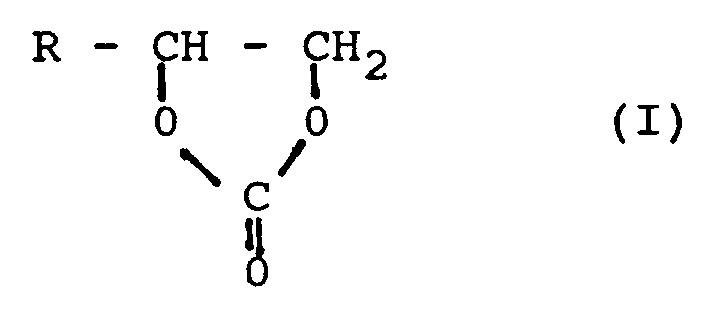
- 1.) 15 bis 55 Gew.-%, bevorzugt 40 bis 50 Gew.-%, bezogen auf das Gesamtgewicht des Drahtlackes, eines oder mehrerer Polyesterharze oder
- 2.) 15 bis 60 Gew.-%, bevorzugt 30 bis 50 Gew.-%, bezogen auf das Gesamtgewicht des Drahtlackes, eines oder mehrerer Polyesterimidharze oder
- 3.) 18 bis 40 Gew.-%, bevorzugt 25 bis 35 Gew.-%, bezogen auf das Gesamtgewicht des Drahtlackes, eines oder mehrerer hydroxylgruppenhaltiger Polyester und einer oder mehrerer Isocyanatkomponenten, deren freie Isocyanatgruppen vollständig blockiert sind, enthalten,
- a) 95 bis 70 Gew.-%, bevorzugt 90 bis 80 Gew.-%, bezogen auf das Gesamtgewicht des Lösungsmittels, cyclische Alkylencarbonate der Formel (I) und
- b) 5 bis 30 Gew.-%, bevorzugt 10 bis 20 Gew.-%, bezogen auf das Gesamtgewicht des Lösungsmittels, aromatische und/oder aliphatische Kohlenwasserstoffe mit einem Siedepunkt zwischen 100 und 200°C als weitere Lösungsmittel (C) enthalten, wobei kresolische und phenolische Lösungsmittel ausgenommen sind.
- Gegenstand der vorliegenden Erfindung sind außerdem Verfahren zum kontinuierlichen Beschichten von Drähten, bei dem diese Drahtlacke auf der Drahtoberfläche appliziert und anschließend eingebrannt werden.
- Es ist überraschend und war nicht vorhersehbar, daß durch Zusatz von aromatischen und/oder aliphatischen Kohlenwasserstoffen zu Drahtlacken, die cyclische Alkylencarbonate als Lösungsmittel enthalten, die Viskosität der Drahtlacke im Vergleich zu Drahtlacken, die nur die Alkylencarbonate als Lösungsmittel enthalten, deutlich erniedrigt wird. Entsprechend weisen die erfindungsgemäßen Lacke bei einer für die Verarbeitung günstigen Viskosität höhere Festkörpergehalte auf als Drahtlacke, die nur Alkylencarbonate als Lösungsmittel enthalten, so daß durch die erfindungsgemäßen Lacke die Umweltbelastung beim Einbrennen der Lacke verringert wird. Dabei ist es überraschend, daß der Zusatz von aromatischen und/oder aliphatischen Kohlenwasserstoffen nicht zu Verträglichkeitsproblemen führt, da diese Lösungsmittel die als Bindemittel in den Drahtlacken eingesetzten Polyester- und Polyesterimidharze nicht lösen.
Weiterhin weisen die erfindungsgemäßen Drahtlacke den Vorteil auf, daß aliphatische und aromatische Kohlenwasserstoffe leicht verfügbare und preisgünstige Lösungsmittel darstellen, die im Gegensatz zu phenolischen und kresolischen Lösungsmitteln bei der Verarbeitung beispielsweise nicht zu einer Geruchsbelästigung u. dgl. führen.
Von Vorteil ist schließlich auch das gute technische Eigenschaftsniveau der resultierenden Drahtbeschichtungen. - Im folgenden sollen nun zunächst die einzelnen Komponenten der erfindungsgemäßen Drahtlacke näher erläutert werden.
- Die verwendeten Polyesterimidharze sind bekannt und sind beispielsweise beschrieben in DE-OS 14 45 263 und DE-OS 14 95 100. Die Herstellung der Polyesterimide erfolgt in bekannter Weise durch Veresterung der mehrwertigen Carbonsäuren mit den mehrwertigen Alkoholen, gegebenenfalls unter Zusatz von Oxicarbonsäuren, und unter Verwendung von imidgruppenhaltigen Ausgangsstoffen. Anstelle der freien Säuren und/oder Alkohole können auch deren reaktionsfähige Derivate eingesetzt werden. Als Carbonsäurekomponente wird vorzugsweise Terephthalsäure eingesetzt, und als mehrwertige Alkohole werden bevorzugt Ethylenglykol, Glycerin und Tris-2-hydroxiethylisocyanurat, wobei letzteres besonders bevorzugt ist, eingesetzt. Die Verwendung von Tris-2-hydroxiethylisocyanurat führt zu einer Erhöhung der Erweichungstemperatur des erhaltenen Lackfilms.
Die imidgruppenhaltigen Ausgangsstoffe können beispielsweise durch Reaktion zwischen Verbindungen erhalten werden, von denen die eine eine fünfgliedrige, cyclische Carbonsäureanhydridgruppierung sowie mindestens noch eine weitere funktionelle Gruppe besitzen muß, während die andere außer einer primären Aminogruppe noch mindestens eine weitere funktionelle Gruppe enthält. Diese weiteren funktionellen Gruppen sind vor allem Carboxylgruppen oder Hydroxylgruppen, es können jedoch auch weitere primäre Aminogruppen oder Carbonsäureanhydridgruppen sein.
Beispiele für Verbindungen mit einer cyclischen Carbonsäureanhydridgruppierung mit einer weiteren funktionellen Gruppe sind vor allem Pyromellithsäuredianhydrid und Trimellithsäureanhydrid. Es kommen jedoch auch andere aromatische Carbonsäureanhydride in Frage, beispielsweise die Naphthalintetracarbonsäuredianhydride oder Dianhydride von Tetracarbonsäuren mit zwei Benzolkernen im Molekül, bei denen die Carboxylgruppen in 3,3'4- und 4'-Stellung stehen. - Beispiele für Verbindungen mit einer primären Aminogruppe sowie einer weiteren funktionellen Gruppe sind insbesondere diprimäre Diamine, z.B. Ethylendiamin, Tetramethylendiamin, Hexamethylendiamin, Nonamethylendiamin und andere aliphatische diprimäre Diamine. Ferner kommen in Betracht aromatische diprimäre Diamine, wie Benzidin, Diaminodiphenylmethan, Diaminodiphenylketon, -sulfon, -sulfoxyd, -ether und -thioether, Phenylendiamine, Toluylendiamine, Xylylendiamine sowie auch Diamine mit drei Benzolkernen im Molekül, wie Bis(4-aminophenyl)-,α,α '-p-xylol oder Bis(4-aminophenoxy)- 1,4-benzol, und schließlich cycloaliphatische Diamine, wie das 4,4'-Dicyclohexylmethandiamin. Als aminogruppenhaltige Verbindungen mit einer weiteren funktionellen Gruppe sind ferner auch Aminoalkohole verwendbar, z.B. Monoethanolamin oder Monopropanolamine, weiterhin Aminocarbonsäuren, wie Glycin, Aminopropionsäuren, Aminocapronsäuren oder Aminobenzoesäuren.
- Zur Herstellung der Polyesterimidharze werden bekannte Umesterungskatalysatoren verwendet, beispielsweise Schwermetallsalze, wie Bleiacetat, Zinkacetat, weiterhin organische Titanate, wie z.B. Triethanolamintitanat, Cerverbindungen sowie organische Säuren, wie z.B. para-Toluolsulfonsäure. Als Vernetzungskatalysatoren bei der Aushärtung der Polyesterimide können die gleichen Umesterungskatalysatoren - zweckmäßigerweise in einem Anteil bis zu 3 Gew.-%, bezogen auf das Bindemittel, - verwendet werden.
- Die Polyesterimide werden in den erfindungsgemäßen Drahtlacken üblicherweise in Mengen von 15 bis 60 Gew.-%, bevorzugt von 30 bis 50 Gew.-%, bezogen auf das Gesamtgewicht des Drahtlackes, eingesetzt.
- Die verwendeten Polyesterharze sind ebenfalls bekannt und beispielsweise beschrieben in der US-PS 3,342,780 und in der EP-B-144 281. Die Herstellung der Polyester erfolgt in bekannter Weise durch Veresterung von mehrwertigen Carbonsäuren mit mehrwertigen Alkoholen in Gegenwart geeigneter Katalysatoren.
Anstelle der freien Säure können auch deren esterbildende Derivate eingesetzt werden.
Für die Herstellung der Polyester geeignete Alkohole sind beispielsweise Ethylenglykol, Propylenglykol-1,2 und 1,3, Butandiol-1,2, - 1,3 und - 1,4, Pentandiol-1,5, Neopentylglykol, Diethylenglykol, Triethylenglykol sowie Triole, wie z.B. Glycerin, Trimethylolethan, Trimethylolpropan und Tris-2-hydroxiethylisocyanurat. Bevorzugt eingesetzt werden Mischungen von Ethylenglykol und Tris-2-hydroxyethylisocyanurat. Die Verwendung von Tris-2-hydroxyethylisocyanurat führt zu hohen Erweichungstemperaturen der Lackschicht. - Geeignete Carbonsäuren sind beispielsweise Phthalsäure, Isophthalsäure, Terephthalsäure sowie deren veresterbaren Derivate, wie z.B. die Anhydride, soweit sie existieren und die niederen Alkylester der genannten Säuren, wie z.B. Methyl-, Ethyl-, Propyl-, Butyl-, Amyl-, Hexyl- und Octylphthalate, -terephthalate und -isophthalate. Einsetzbar sind sowohl die Halbester, die Dialkylester als auch Mischungen dieser Verbindungen. Einsetzbar sind auch die entsprechenden Säurehalogenide dieser Verbindungen.
- Die Mengen der einzelnen Komponenten werden so gewählt, daß die Polyester ein Verhältnis von Hydroxyl- zu Carboxylgruppen von 1,1 : 1 bis 2,0 : 1, bevorzugt von 1,15 :1 bis 1,60 : 1, aufweisen.
- Für die Herstellung der Polyester geeignete Katalysatoren, die in Mengen von 0,01 bis 5 Gew.-%, bezogen auf das Einsatzgemisch, eingesetzt werden, sind übliche Veresterungskatalysatoren. Beispiele für geeignete Verbindungen sind bereits bei der Beschreibung der Polyesterimide aufgeführt.
- Die Polyesterharze werden in den erfindungsgemäßen Drahtlacken üblicherweise in Mengen
von 15 bis 55 Gew.-%, bevorzugt von 40 bis 50 Gew.-%, jeweils bezogen auf das Gesamtgewicht des Drahtlackes, eingesetzt. - Auch die für Drahtlacke auf Polyurethan-Basis eingesetzten Kombinationen aus einem oder mehreren hydroxylgruppenhaltigen Polyestern mit im allgemeinen einer OH-Zahl von 200 bis 900 mg KOH/g, bevorzugt von 250 bis 750 mg KOH/g und einem oder mehreren blockierten Isocyanataddukten sind bereits bekannt und beispielsweise in der DE-OS 28 40 352 und der DE-OS 25 45 912 beschrieben.
- Für die Herstellung der hydroxylgruppenhaltigen Polyester können die gleichen Aufbaukomponenten (Polyol und Polycarbonsäure) und die gleichen Reaktionsbedingungen wie bei der Herstellung der Polyester-Drahtlacke angewandt werden. Für Einzelheiten sei daher auf die Seiten 6 bis 7 dieser Beschreibung verwiesen.
Die Isocyanataddukte werden hergestellt durch Umsetzung eines Diisocyanates mit einem Polyol, wobei die Mengen dieser Verbindungen so gewählt werden, daß das NCO: OH-Äquivalentverhältnis zwischen 1 : 2 und 9 : 1 beträgt. Die restlichen freien Isocyanatgruppen dieses Adduktes werden mit einem Blockierungsmittel umgesetzt.
Es ist aber selbstverständlich auch möglich, die Isocyanate zunächst mit dem Blockierungsmittel und die restlichen, freien Isocyanatgruppen mit dem Polyol umzusetzen. - Der Aufbau des Isocyanatadduktes wird vorteilhafterweise in einem gegenüber Isocyanatgruppen inerten, das entstehende Polyurethan gut lösenden Lösungsmittel in Gegenwart eines Katalysators bei Temperaturen von 30 bis 120°C durchgeführt.
Beispiele von geeigneten Diisocyanaten sind Trimethylendiisocyanat, Tetramethylendiisocyanat, Pentamethylendiisocyanat, Hexamethylendiisocyanat, Propylendiisocyanat, Ethylethylendiisocyanat, 2,3-Dimethylethylendiisocyanat, 1-Methyltrimethylendiisocyanat, 1,3-Cyclopentylendiisocyanat, 1,4-Cyclohexylendiisocyanat, 1,2-Cyclohexylendiisocyanat, 1,3-Phenylendiisocyanat, 1,4-Phenylendiisocyanat, 2,5-Toluylendiisocyanat, 2,6-Toluylendiisocyanat, 4,4'-Bisphenylendiisocyanat, 1,5-Naphthylendiisocyanat, 1,4-Naphthylendiisocyanat, 1-Isocyanatomethyl-5-isocyanato-1,3,3-trimethylcyclohexan, Bis-(4-isocyanatocyclohexyl)methan, Bis-(4-isocyanatophenyl)-methan, 4,4'-Diisocyanatodiphenylether und 2,3-Bis-(8-isocyanatooctyl)-4-octyl-5-hexyl-cyclohexen. - Bevorzugt eingesetzt werden Toluylendiisocyanat und Bis-(4-isocyanatophenyl)-methan.
- Beispiele von geeigneten Polyolen für die Adduktbildung sind Trimethylolpropan, Neopentylglykol, Glycerin, Hexantriol, Pentaerythrit und Glykole, wie z.B. Ethylenglykol und Propylenglykol. Bevorzugt eingesetzt wird Trimethylolpropan. Ganz besonders bevorzugt eingesetzt wird ein Addukt aus 1 mol Trimethylolpropan und 3 mol Toluylendiisocyanat und/oder Bis-(4-isocyanatophenyl)-methan.
Für die Blockierung der freien Isocyanatgruppen geeignet sind alle bekannten Blockierungsmittel, wobei aber gewährleistet sein muß, daß eine Deblockierung erst bei Temperaturen oberhalb von 120°C eintritt. Beispiele für geeignete Verbindungen sind aliphatische, cycloaliphatische oder aromatische Alkohole, wie z.B. Butanol, Isobutanol, 2-Ethylhexanol, Cyclohexanol, Cyclopentanol, Benzylalkohol, Phenole, Kresole; β-Hydroxialkylether, wie z.B. Methyl-, Ethyl-, Butylglykol; Amine, wie z.B. Di-n-butylamin, Di-n-hexylamin; Oxime, wie z.B. Methylethylketoxim, Diethylketoxim; Hydroxylamine und Lactame, wie z.B. ε-Caprolactam sowie andere Verbindungen, die ein Wasserstoffatom enthalten, das durch seine Reaktivität eine Umsetzung des Blockierungsmittels mit dem Isocyanat ermöglicht. - Als bevorzugte Blockierungsmittel werden Phenole eingesetzt.
- Der hydroxylgruppenhaltige Polyester und das blockierte Isocyanataddukt werden in den erfindungsgemäßen Drahtlacken üblicherweise in einer Gesamtmenge von 18 bis 40 Gew.-%, bevorzugt von
25 bis 35 Gew.-%, bezogen auf das Gesamt- gewicht des Drahtlackes, eingesetzt. Die Menge an blockiertem Isocyanataddukt liegt dabei zwischen
150 und 500 Gewichtsteilen je 100 Gewichtsteile hydroxylgruppenhaltigem Polyester. - Die in den erfindungsgemäßen Drahtlacken eingesetzten Bindemittel (Polyester, Polyesterimide, hydroxylgruppenhaltige Polyester zusammen mit einem blockierten Isocyanataddukt) können durch die bekannten Verfahren der Schmelzkondensation oder durch Lösungskondensation in einem adäquaten Lösungsmittel, wie beispielsweise N-Methylpyrrolidon, Methyldiglykol, Ethyldiglykol und Ethylenglykol hergestellt werden.
- Neben den beschriebenen Bindemitteln und Härtern im Falle der Drahtlacke auf Polyurethan-Basis enthalten die Drahtlacke im allgemeinen noch Vernetzungskatalysatoren. Im Falle der Drahtlacke auf Polyester- und Polyesterimid-Basis werden die bereits beschriebenen Umesterungskatalysatoren, insbesondere Titanverbindungen, wie z.B. Triethanolamintitanat, eingesetzt, und zwar üblicherweise in Mengen von 0,5 bis 3,0 Gew.-%, bezogen auf das Gewicht des Bindemittels. Im Falle der Drahtlacke auf Polyurethan-Basis haben sich Übergangsmetallverbindungen sowie tertiäre Amine als Vernetzungskatalysatoren bewährt, die üblicherweise in Mengen von 0,5 bis 2,0 Gew.-%, bezogen auf das Gesamtgewicht von hydroxylgruppenhaltigen Polyester und blockiertem Isocyanataddukt, eingesetzt werden.
- Außerdem können die Drahtlacke ggf. noch übliche Hilfs- und Zusatzstoffe in üblichen Mengen, bevorzugt 0 bis 1 Gew.-%, bezogen auf das Gewicht des Bindemittels bzw. bezogen auf das Gewicht von Bindemittel und Härter enthalten. Als Hilfsmittel für die Drahtlacke können beispielsweise verlaufsverbessernde Phenol- oder Melaminharze oder andere übliche Verlaufsmittel, z.B. auf Basis von Polyacrylaten eingesetzt werden.
- Als erfindungswesentliche Komponente enthalten die Drahtlacke als Lösungsmittel eine Mischung aus a) einem oder mehreren cyclischen Carbonaten der Formel (I)

wobei R entweder Wasserstoff oder einen aliphatischen oder cycloaliphatischen oder aromatischen oder alkylaromatischen Rest darstellt
und b) einem oder mehreren Kohlenwasserstoffen. - Diese als Lösungsmittel für die erfindungsgemäßen Drahtlacke eingesetzte Mischung enthält vorzugsweise 95 bis 70 Gew.-%, besonders bevorzugt 90 bis 80 Gew.-%, cyclische Carbonate der Formel (I) und 5 bis 30 Gew.-%, besonders bevorzugt 10 bis 20 Gew.-%, Kohlenwasserstoffe, jeweils bezogen auf das Gesamtgewicht des Lösungsmittels.
- Beispiele für geeignete cyclische Carbonate der Formel (I) sind Ethylencarbonat, Propylencarbonat, Isobutylencarbonat und 4-Phenyl-1,3-dixolan-2- an. Bevorzugt eingesetzt werden Ethylencarbonat, Propylencarbonat und Isobutylencarbonat.
Beispiele für geeignete Kohlenwasserstoffe sind Xylol, Toluol sowie Mischungen verschiedener aromatischer und/oder aliphatischer Kohlenwasserstoffe mit einem Siedebereich von bevorzugt 100 bis 200°C, beispielsweise verschiedene handelsübliche Kohlenwasserstoffgemische, wie z.B. Solvent Naphtha®, einem bei der Fraktionierung von Leichtöl aus der Teerdestillation erhaltenen aromatenreichen Gemisch, mit einem Siedebereich von 150 bis 195°C, wobei mindestens 90 % der Destillatmenge bei 180°C übergehen sollen; verschiedene Solvesso®-Typen, einem mehr als 97 Vol.-% Aromaten enthaltenden Lösungsmittel mit einem Siedebereich von 140 bis 200 °Cje nach Typ. Bevorzugt eingesetzt werden Solvent Naphtha®, Xylol und verschiedene Solvesso®-Typen. - Ggf. können die erfindungsgemäßen Drahtlacke noch 0 bis 10 Gew.-%, bezogen auf das Gesamtgewicht des Drahtlackes, weiterer Lösungsmittel, beispielsweise N-Methylpyrrolidon, Methyldiglykol, Ethyldiglykol oder Ethylenglykol, insbesondere im Fall der Herstellung der Bindemittel mittels Lösungskondensation, enthalten.
- Die erfindungsgemäßen Drahtlacke weisen üblicherweise bei 23°C Viskositäten zwischen 50 und 500 mPas bei einem Festkörpergehalt von 25 bis 50 % auf.
Die Drahtlacke werden nach den üblichen Verfahren hergestellt.
Diese Drahtlacke werden mittels üblicher Drahtlackiermaschinen aufgebracht und gehärtet. Dabei wird die jeweils erforderliche Lackfilmstärke durch mindestens 1 bis zu 10 Einzelaufträgen aufgebaut, wobei jeder einzelne Lackauftrag vor dem erneuten Lackauftrag blasenfrei ausgehärtet wird. Übliche Lackiermaschinen arbeiten mit Abzugsgeschwindigkeiten von 5 bis 180 m/min, je nach Bindemittelbasis des Drahtlackes und je nach Dicke des zu beschichtenden Drahtes. Typische Ofentemperaturen betragen zwischen 300 und 550°C. Derartige Drahtlackiermaschinen sind aber bekannt und brauchen daher hier nicht näher erläutert werden. - Im folgenden wird nun die Erfindung anhand von Ausführungsbeispielen näher erläutert. Alle Angaben über Teile und Prozente stellen dabei Gewichtsangaben dar, falls nicht ausdrücklich etwas anderes angegeben wird.
- Aus 420 g Ethylenglykol, 137,1 g Dimethylterephthalat, 218,4 g 4,4'-Diaminodiphenylmethan und 723,6 g Trimellithsäureanhydrid wird in Gegenwart von 0,45 g Bleiacetat und 0,45 g Zinkacetat durch Aufheizen auf 230°C ein Polyesterimid hergestellt. Dabei wird 181 g Destillat erhalten. Die Säurezahl des Endproduktes beträgt max. 5 mg KOH/g. Der Hydroxylgehalt schwankt zwischen 5 % und 6 %.
- Aus 72,8 g Ethylenglykol, 118,6 g Trishydroxiethylisocyanurat (THEIC), 102,3 g Dimethylterephthalat, 69,5 g 4,4'-Diaminodiphenylmethan, 135,1 g Trimellithsäureanhydrid, 48,8 g Methyldiglykol und 0,4 g Tetra-n-butyltitanat wird durch Erhitzen auf 200°C ein Polyesterimid hergestellt. Bei der Reaktion fallen 59,1 g Destillat an. Das Polyesterimid hat eine Säurezahl von 20 mg KOH/g und eine OH-Zahl von 270 mg KOH/g.
- Aus 387,3 g Glycerin, 140,9 g Ethylenglykol, 471,4 g Isophthalsäure und 0,4 g Zinn(II)oxalat wird durch Erhitzen auf 230°C ein Polyester mit einer Säurezahl < 5 mg KOH/g und einem OH-Äquivalent von 78 hergestellt.
- In 530,6 g Propylencarbonat werden 318,6 g THEIC-freies Polyesterimid 1 gelöst. Danach werden 132,6 g Solventnaphtha®, 6,8 g Titanacetylacetonat und 5,7 g einer handelsüblichen 80 %igen butanolischen Lösung eines epoximodifizierten Phenolharzes (Auslaufzeit einer 60 %igen butanolischen Lösung bei 23°C = 35 s im DIN 4 Becher) zugegeben. Der so eingestellte Lack 1 hat einen Festkörper (1 g/1 h/180°C) von 32 % bei einer Auslaufzeit (DIN 4 mm Becher 23°C) von 26 Sekunden.
- Ein Kupferdraht (Durchmesser 0,5 mm) wird auf einer 1-Gang-Lackiermaschine (Auftragssystem Pumpe/Filz) mit 8 Durchzügen lackiert, wobei jede Lackschicht jeweils direkt im Anschluß an die Applikation bei einer Temperatur von 500°C eingebrannt wird (Ofenlänge 2,60 m). Die Abzugsgeschwindigkeit wird dabei zwischen 16 und 20 m/min. variiert. Der Drahtdurchmesser nimmt dabei zwischen 0,045 und 0,065 µm zu.
Die Prüfung der technologischen Eigenschaften der resultierenden Beschichtungen bezüglich Dehnung und Haftung erfolgte nach der IEC-Norm ("IEC-Standard Publication 851, Methods of Tests for Winding wires") 851, Teil 1 - 6.
Die Prüfergebnisse sind in Tabelle 1 dargestellt.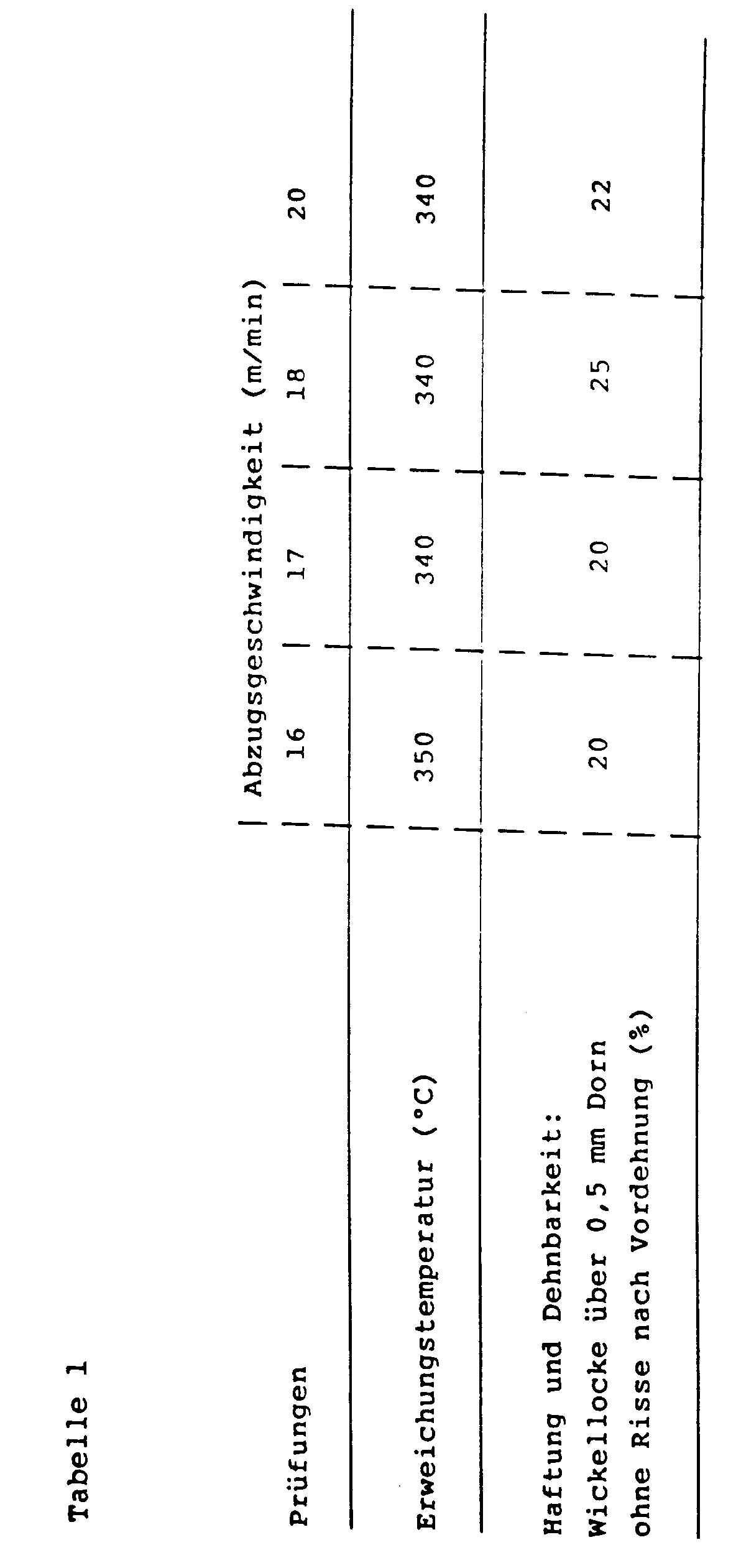
- 472,2 g THEIC-haltiges Polyesterimid 2 werden in 409,8 g Propylencarbonat gelöst. 102,2 g Solvent Naphtha®, 2,1 g einer handelsüblichen 80 %igen butanolischen Lösung eines epoximodifizierten Phenolharzes (eine 60 %ige butanolische Lösung dieses Harzes weist bei 23°C eine Viskosität von 35 s im DIN 4 mm Becher auf) und 8,6 g Triethanolamintitanat werden zugegeben. Der so erhaltene Lack 2 hat bei einer Viskosität von 390 mPas (23°C) einen Festkörper von 44,0 % (1 g/1 h/180°C).
Ein Kupferdraht (Durchmesser 0,71 mm) wird auf einer 1-Gang-Lackiermaschine (Auftragssysteme Pumpe/Filz) mit 8 Durchzügen lackiert (Zunahme des Drahtdurchmessers 0,056 mm), wobei jede Lackschicht jeweils direkt im Anschluß an die Applikation bei einer Temperatur von 500°C eingebrannt wird (Ofenlänge 4 m). Die Abzugsgeschwindigkeit wird dabei zwischen 24 und 32 m/min. variiert (vgl. Tabelle 2).
Die Prüfung der technologischen Eigenschaften der resultierenden Beschichtung erfolgt analog Beispiel 1. Die Prüfergebnisse sind in Tabelle 2 dargestellt.
- 447,6 g THEIC-haltiges Polyesterimidharz 2 werden in 357,1 g Isobutylencarbonat gelöst. Nach der Zugabe von 2,0 g einer handelsüblichen 80 %igen butanolischen Lösung eines epoximodifizierten Phenolharzes (Viskosität einer 60 %igen butanolischen Lösung bei 23°C von 35 s im DIN 4 mm Becher) und 8,1 g Triethanolamintitanat wird der Lack mit 185,2 g Solvent Naphtha® auf eine Viskosität von 330 mPas (23°C) eingestellt. Der Festkörper des so erhaltenen Lackes 3 beträgt 39,2 % (1 g/1 h/180°C).
- Die Applikation dieses Lackes 3 sowie die Prüfung der resultierenden Beschichtung erfolgt analog Beispiel 2. Die Prüfergebnisse sind in Tabelle 3 dargestellt.
Tabelle 3 Prüfungen Abzugsgeschwind. (m/min.) 28 Erweichungstemperatur (°C) 380 Haftung und Dehnbarkeit: Wickellocke über 0,5 mm Dorn ohne Risse nach Vordehnung (%) 25 - In 505,2 g Propylencarbonat werden 291,6 g eines handelsüblichen blockierten Isocyanates aus 3 mol Toluylendiisocyanat, 1 mol Trimethylolpropan und 3 mol Phenol, 65,8 g des Hydroxipolyesters 3 und 2,3 g eines handelsüblichen Katalysator auf Basis eines aromatischen Amins gelöst. Danach werden 135,1 g Xylol zugemischt. Der so erhaltene Lack 4 hat eine DIN 4-Auslaufzeit von 21 s bei 23°C bei einem Festkörper von 28,9 % (1 g/1 h/180°C).
- Ein Kupferdraht (Durchmesser 0,50 mm) wird auf einer 1-Gang-Lackiermaschine (Auftragssysteme Pumpe/Filz) mit 8 Durchzügen lackiert (Zunahme des Drahtdurchmessers von 0,045 mm), wobei jede Lackschicht jeweils direkt im Anschluß an die Applikation bei einer Temperatur von 500°C eingebrannt wird (Ofenlänge 1,5 m). Der Lack ließ sich dabei mit Abzugsgeschwindigkeiten von bis zu 50 m/min lackieren. Die Prüfung der resultierenden Beschichtung erfolgte analog Beispiel 1. Die Ergebnisse sind in Tabelle 4 dargestellt.
Tabelle 4 Prüfungen Abzugsgeschwind. (m/min.) 36 Erweichungstemperatur (°C) 240 - 250 Haftung und Dehnbarkeit: Wickellocke über 0,5 mm Dorn ohne Risse nach Vordehnung (%) 10 - In einem Gemisch aus 532,1 g Propylencarbonat und 133,0 g Solvent Naphtha® werden 360 g THEIC-freies Polyesterimid 1, 6,4 g der in Beispiel 1 beschriebenen 80 %igen butanolischen Lösung eines epoximodifizierten Phenolharzes und 7,7 g Titanacetylacetanat gelöst.
Der so erhaltene Lack 5 hat bei einem Festkörper von 35,4 % (1 g/1 h/180°C) eine Viskosität von 175 mPas bei 23°C. - In 665,1 g Propylencarbonat werden 360 g THEIC-freies Polyesterimid 1 gelöst. Nach Zugabe von 7,7 g Titanacetylacetonat und 6,4 g der in Beispiel 1 beschriebenen 80 %igen butanolischen Lösung eines epoximodifizierten Phenolharzes enthält man einen Lack 6, der bei einem Festkörper von 35,6 % (1 g/1 h/180°C) eine Viskosität bei 23°C von 302 mPas hat.
- In einer Mischung aus 518,4 g Propylencarbonat und 130 g Solvent Naphtha® werden 539,9 g des THEIC-haltigen Polyesterimids 2, 2,4 g der in Beispiel 1 beschriebenen 80 %igen butanolischen LÖsung eines epoximodifizierten Phenolharzes und 9,8 g Triethanolamintitanat gelöst. Bei einem Festkörpergehalt von 45,7 % (1 g/1 h/180°C) hat der so erhaltene Lack 7 eine Viskosität von 470 mPas (23°C).
- In 540,0 g Propylencarbonat werden 450,0 g THEIC-haltiges Polyesterimid 2, 2,0 g der in Beispiel 1 beschriebenen 80 %igen butanolischen Lösung eines epoximodifizierten Phenolharzes und 8,2 g Triethanolamintitanat gelöst. Der so erhaltene Lack 8 hat bei einem Festkörper von 45,6 % (1 g/1 h/180°C) eine Viskosität (23°C) von 620 mPas.
- In 650,8 g Propylencarbonat werden 283 g eines handelsüblichen blockierten Isocyanates aus 3 mol Toluylendiisocyanat, 1 mol Trimethylolpropan und 3 mol Phenol, 64,0 g des Hydroxipolyesters 3 und 2,2 g eines handelsüblichen Katalysators auf Basis eines aromatischen Amins gelöst. Der so erhaltene Lack hat bei einer Auslaufzeit (DIN 4-Becher) von 21 s bei 23°C einen Festkörper von 27,1 % (1 g/1 h/180°C).
dadurch gekennzeichnet, daß sie als Komponente A
Claims (5)
- Verfahren zur Herstellung von Drahtlacken, enthaltendA) Polyesterharze oder Polyesterimidharze oder hydroxylgruppenhaltige Polyester zusammen mit einer Isocyanatkomponente, deren freie Isocyanatgruppen vollständig blockiert sind undB) Alkylencarbonate der Formel (I)wobei R entweder Wasserstoff oder einen aliphatischen oder einen cycloaliphatischen oder einen aromatischen oder einen alkylaromatischen Rest darstellt, dadurch gekennzeichnet, daß sie als Komponente A
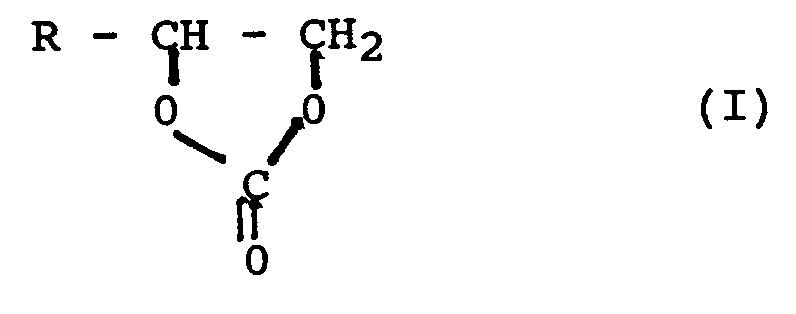 1.) 15 bis 55 Gew.-%, bevorzugt 40 bis 50 Gew.-%, bezogen auf das Gesamtgewicht des Drahtlackes, eines oder mehrerer Polyesterharze oder2.) 15 bis 60 Gew.-%, bevorzugt 30 bis 50 Gew.-%, bezogen auf das Gesamtgewicht des Drahtlackes, eines oder mehrerer Polyesterimidharze oder3.) 18 bis 40 Gew.-%, bevorzugt 25 bis 35 Gew.-%, bezogen auf das Gesamtgewicht des Drahtlackes, eines oder mehrerer hydroxylgruppenhaltiger Polyester und einer oder mehrerer Isocyanatkomponenten, deren freie Isocyanatgruppen vollständig blockiert sind, enthalten,und daß siea) 95 bis 70 Gew.-%, bevorzugt 90 bis 80 Gew.-%, bezogen auf das Gesamtgewicht des Lösungsmittels, cyclische Alkylencarbonate der Formel (I) undb) 5 bis 30 Gew.-%, bevorzugt 10 bis 20 Gew.-%, bezogen auf das Gesamtgewicht des Lösungsmittels, aromatische und/oder aliphatische Kohlenwasserstoffe mit einem Siedepunkt zwischen 100 und 200°C als weitere Lösungsmittel (C) enthalten, wobei kresolische und phenolische Lösungsmittel ausgenommen sind.
 - Verfahren nach Anspruch 1, dadurch gekennzeichnet, daß als cyclische Alkylencarbonate der Formel (I) Ethylencarbonat, Propylencarbonat und/oder Isobutylencarbonat eingesetzt werden.
- Verfahren nach Anspruch 1 oder 2, dadurch gekennzeichnet, daß als weiteres Lösungsmittel (C) aromatische Kohlenwasserstoffe oder Mischungen verschiedener Kohlenwasserstoffe mit einem Gehalt an aromatischen Kohlenwasserstoffen von mindestens 90 Masse-% eingesetzt werden.
- Verfahren nach einem der Ansprüche 1 bis 3, dadurch gekennzeichnet, daß die Drahtlacke als Komponente A ein trishydroxyethylisocyanurathaltiges Polyesterimid enthalten.
- Verfahren zum kontinuierlichen Beschichten von Drähten, bei dem zunächst ein Drahtlack auf der Drahtoberfläche appliziert und anschließend eingebrannt wird, dadurch gekennzeichnet, daß ein Drahtlack, der nach einem Verfahren nach einem der Ansprüche 1 bis 4 hergestellt wurde,eingesetzt wird.
Applications Claiming Priority (3)
| Application Number | Priority Date | Filing Date | Title |
|---|---|---|---|
| DE3938058A DE3938058A1 (de) | 1989-11-16 | 1989-11-16 | Drahtlacke sowie verfahren zum kontinuierlichen beschichten von draehten |
| DE3938058 | 1989-11-16 | ||
| PCT/EP1990/001911 WO1991007469A1 (de) | 1989-11-16 | 1990-10-26 | Drahtlacke sowie verfahren zum kontinuierlichen beschichten von drähten |
Publications (2)
| Publication Number | Publication Date |
|---|---|
| EP0502858A1 EP0502858A1 (de) | 1992-09-16 |
| EP0502858B1 true EP0502858B1 (de) | 1995-01-04 |
Family
ID=6393609
Family Applications (1)
| Application Number | Title | Priority Date | Filing Date |
|---|---|---|---|
| EP90916208A Expired - Lifetime EP0502858B1 (de) | 1989-11-16 | 1990-10-26 | Drahtlacke sowie verfahren zum kontinuierlichen beschichten von drähten |
Country Status (9)
| Country | Link |
|---|---|
| EP (1) | EP0502858B1 (de) |
| JP (1) | JP2674633B2 (de) |
| KR (1) | KR0173130B1 (de) |
| AT (1) | ATE116667T1 (de) |
| BR (1) | BR9007854A (de) |
| DE (2) | DE3938058A1 (de) |
| DK (1) | DK0502858T3 (de) |
| ES (1) | ES2069751T3 (de) |
| WO (1) | WO1991007469A1 (de) |
Families Citing this family (13)
| Publication number | Priority date | Publication date | Assignee | Title |
|---|---|---|---|---|
| DE4307848A1 (de) * | 1993-03-12 | 1994-09-15 | Beck & Co Ag Dr | Verzinnbare Drahtbeschichtungsmittel sowie Verfahren zum kontinuierlichen Beschichten von Drähten |
| DE19632175A1 (de) | 1996-08-09 | 1998-02-12 | Beck & Co Ag Dr | Drahtlacke enthaltend Polyesterimide und/oder Polyamidimide mit Polyoxyalkylendiaminen als molekularen Bausteine |
| DE19648830A1 (de) | 1996-11-26 | 1998-05-28 | Beck & Co Ag Dr | Verfahren zur Herstellung carboxyl- und hydroxylgruppenhaltiger Polyesterimide und deren Verwendung in Drahtlacken |
| CN2811252Y (zh) | 2005-04-06 | 2006-08-30 | 上海振华港口机械(集团)股份有限公司 | 双40英尺岸边集装箱起重机双起升机构 |
| DE102007047492A1 (de) | 2007-10-04 | 2009-04-16 | Elantas Gmbh | Drahtlacke mit guter Haftung auf elektrischen Leitern |
| DE102009003512A1 (de) * | 2009-02-20 | 2010-09-02 | Elantas Gmbh | Umweltfreundlicher lötbarer Drahtlack |
| DE102011003129B4 (de) | 2011-01-25 | 2012-10-04 | Elantas Gmbh | Drahtlack-Zusammensetzung enthaltend Polyole auf Melamin-Basis, deren Verwendung und Verwendung eines Polyols auf Melamin-Basis |
| DE102011006437A1 (de) | 2011-03-30 | 2012-10-04 | Elantas Gmbh | Polyester- oder Polyesterimidharze, welche mit dem cyclischen Imid einer aromatischen Tricarbonsäure terminiert sind, sowie diese enthaltende Drahtlack-Zusammensetzungen |
| DE102011052518A1 (de) | 2011-08-09 | 2013-02-14 | Elantas Gmbh | Lösemittelfreie Drahtlackzusammensetzung |
| KR102193024B1 (ko) | 2019-09-02 | 2020-12-18 | 이종원 | 원심분리용 크기 조절과 마모 대응이 가능한 스크류 콘베어 |
| KR102193025B1 (ko) | 2019-09-02 | 2020-12-18 | 이종원 | 스크류 콘베어 크기 조절과 마모 대응이 가능한 수평형 원심분리장치 |
| CN114044870B (zh) * | 2021-12-02 | 2023-05-26 | 万华化学集团股份有限公司 | 一种聚氨酯扩链剂和制备方法及一种浇注型聚氨酯弹性体和制备方法 |
| CN118027807B (zh) * | 2024-02-04 | 2026-02-27 | 江苏佳禾电子材料有限公司 | 一种无酚型电磁线涂覆用聚酰胺自粘漆及其制备方法和应用 |
Family Cites Families (5)
| Publication number | Priority date | Publication date | Assignee | Title |
|---|---|---|---|---|
| DE2545912A1 (de) * | 1975-10-14 | 1977-04-28 | Wiedeking Chem Fab | Loetbarer drahtlack |
| JPS52151390A (en) * | 1976-06-10 | 1977-12-15 | Nitsushiyoku Aroo Kagaku Kk | Preparation of high solid content alkyd resin solution and vehicle based on its solution |
| AT356776B (de) * | 1977-09-19 | 1980-05-27 | Herberts & Co Gmbh | Verfahren zur herstellung von elektrisch isolierenden, hochflexiblen und/oder loetfaehigen ueberzuegen |
| JPS5731967A (en) * | 1980-08-05 | 1982-02-20 | Toshiba Chem Corp | Composition for insulating paint |
| US4609702A (en) * | 1985-10-22 | 1986-09-02 | General Electric Company | Ether modified polyesterimide resins |
-
1989
- 1989-11-16 DE DE3938058A patent/DE3938058A1/de not_active Withdrawn
-
1990
- 1990-10-26 DK DK90916208.3T patent/DK0502858T3/da active
- 1990-10-26 AT AT90916208T patent/ATE116667T1/de not_active IP Right Cessation
- 1990-10-26 EP EP90916208A patent/EP0502858B1/de not_active Expired - Lifetime
- 1990-10-26 DE DE59008208T patent/DE59008208D1/de not_active Expired - Lifetime
- 1990-10-26 ES ES90916208T patent/ES2069751T3/es not_active Expired - Lifetime
- 1990-10-26 WO PCT/EP1990/001911 patent/WO1991007469A1/de not_active Ceased
- 1990-10-26 JP JP2514763A patent/JP2674633B2/ja not_active Expired - Lifetime
- 1990-10-26 KR KR1019920701108A patent/KR0173130B1/ko not_active Expired - Lifetime
- 1990-10-26 BR BR909007854A patent/BR9007854A/pt not_active IP Right Cessation
Also Published As
| Publication number | Publication date |
|---|---|
| DE59008208D1 (de) | 1995-02-16 |
| WO1991007469A1 (de) | 1991-05-30 |
| DE3938058A1 (de) | 1991-05-23 |
| JPH05501890A (ja) | 1993-04-08 |
| KR0173130B1 (ko) | 1999-03-20 |
| KR927003743A (ko) | 1992-12-18 |
| JP2674633B2 (ja) | 1997-11-12 |
| DK0502858T3 (da) | 1995-05-15 |
| BR9007854A (pt) | 1992-09-22 |
| EP0502858A1 (de) | 1992-09-16 |
| ATE116667T1 (de) | 1995-01-15 |
| ES2069751T3 (es) | 1995-05-16 |
Similar Documents
| Publication | Publication Date | Title |
|---|---|---|
| EP0502858B1 (de) | Drahtlacke sowie verfahren zum kontinuierlichen beschichten von drähten | |
| DE102009003512A1 (de) | Umweltfreundlicher lötbarer Drahtlack | |
| EP1311588B1 (de) | Polyamidimidharzlösung und ihre verwendung zur herstellung von drahtlacken | |
| WO1996027643A1 (de) | Drahtbeschichtungsmittel sowie verfahren zu dessen herstellung | |
| EP0918829B1 (de) | Drahtlacke, enthaltend polyesterimide und/oder polyamidimide mit polyoxyalkylendiaminen als molekulare bausteine | |
| DE2632047C3 (de) | Verwendung von Polyesterurethanlacken | |
| EP0384505B1 (de) | Verfahren zum kontinuierlichen Beschichten von Drähten sowie die Verwendung der so hergestellten Drähte | |
| EP0941273B1 (de) | Verfahren zur herstellung carboxyl- und hydroxylgruppenhaltiger polyesterimide und deren verwendung in drahtlacken | |
| DE1644794A1 (de) | Lackmischung fuer Einbrennlacke | |
| EP0688460B1 (de) | Verzinnbare drahtbeschichtungsmittel sowie verfahren zum kontinuierlichen beschichten von drähten | |
| DE3048434C2 (de) | ||
| DE2032075C3 (de) | Mehrschichtisolierstoffe | |
| DE102011003129B4 (de) | Drahtlack-Zusammensetzung enthaltend Polyole auf Melamin-Basis, deren Verwendung und Verwendung eines Polyols auf Melamin-Basis | |
| WO1997025724A1 (de) | Verfahren zum beschichten von wickel- und profildrähten | |
| DE102008004926A1 (de) | Hochtemperaturbeständiger Elektroisolierlack | |
| EP1199321A1 (de) | Lackbindemittel mit Harnstoff- und/oder Hydantoinstrukturen, ein Verfahren zu ihrer Herstellung und deren Verwendung | |
| DE3241345C2 (de) | ||
| EP0461500A2 (de) | Beschichtungsmittel und seine Verwendung zur Beschichtung hitzeresistenter Substrate | |
| DE1494452C2 (de) | Hochwärmebeständige Überzüge liefernder Elektroisolierlack | |
| DE19738603A1 (de) | Bindemittel für elektrisch isolierende Überzüge |
Legal Events
| Date | Code | Title | Description |
|---|---|---|---|
| PUAI | Public reference made under article 153(3) epc to a published international application that has entered the european phase |
Free format text: ORIGINAL CODE: 0009012 |
|
| 17P | Request for examination filed |
Effective date: 19920321 |
|
| AK | Designated contracting states |
Kind code of ref document: A1 Designated state(s): AT BE CH DE DK ES FR GB IT LI NL SE |
|
| 17Q | First examination report despatched |
Effective date: 19930513 |
|
| GRAA | (expected) grant |
Free format text: ORIGINAL CODE: 0009210 |
|
| AK | Designated contracting states |
Kind code of ref document: B1 Designated state(s): AT BE CH DE DK ES FR GB IT LI NL SE |
|
| REF | Corresponds to: |
Ref document number: 116667 Country of ref document: AT Date of ref document: 19950115 Kind code of ref document: T |
|
| REF | Corresponds to: |
Ref document number: 59008208 Country of ref document: DE Date of ref document: 19950216 |
|
| ET | Fr: translation filed | ||
| ITF | It: translation for a ep patent filed | ||
| GBT | Gb: translation of ep patent filed (gb section 77(6)(a)/1977) |
Effective date: 19950302 |
|
| REG | Reference to a national code |
Ref country code: DK Ref legal event code: T3 |
|
| REG | Reference to a national code |
Ref country code: ES Ref legal event code: FG2A Ref document number: 2069751 Country of ref document: ES Kind code of ref document: T3 |
|
| PLBE | No opposition filed within time limit |
Free format text: ORIGINAL CODE: 0009261 |
|
| STAA | Information on the status of an ep patent application or granted ep patent |
Free format text: STATUS: NO OPPOSITION FILED WITHIN TIME LIMIT |
|
| 26N | No opposition filed | ||
| NLS | Nl: assignments of ep-patents |
Owner name: SCHENECTADY INTERNATIONAL, INC. |
|
| NLT1 | Nl: modifications of names registered in virtue of documents presented to the patent office pursuant to art. 16 a, paragraph 1 |
Owner name: BASF PROJEKTENTWICKLUNGS AKTIENGESELLSCHAFT |
|
| REG | Reference to a national code |
Ref country code: FR Ref legal event code: TP Ref country code: FR Ref legal event code: CD |
|
| REG | Reference to a national code |
Ref country code: CH Ref legal event code: PUE Owner name: BASF PROJEKTENTWICKLUNGS-AKTIENGESELLSCHAFT -DANN Ref country code: CH Ref legal event code: PFA Free format text: DR. BECK & CO. AG TRANSFER- BASF PROJEKTENTWICKLUNGS-AKTIENGESELLSCHAFT |
|
| PGFP | Annual fee paid to national office [announced via postgrant information from national office to epo] |
Ref country code: BE Payment date: 20001020 Year of fee payment: 11 |
|
| PGFP | Annual fee paid to national office [announced via postgrant information from national office to epo] |
Ref country code: DK Payment date: 20001023 Year of fee payment: 11 |
|
| BECA | Be: change of holder's address |
Free format text: 20000119 *SCHENECTADY INTERNATIONAL INC.:2750 BALLTOWN ROAD, SCHENECTADY NEW YORK 12309 |
|
| BECH | Be: change of holder |
Free format text: 20000119 *SCHENECTADY INTERNATIONAL INC. |
|
| PG25 | Lapsed in a contracting state [announced via postgrant information from national office to epo] |
Ref country code: DK Free format text: LAPSE BECAUSE OF NON-PAYMENT OF DUE FEES Effective date: 20011026 |
|
| PG25 | Lapsed in a contracting state [announced via postgrant information from national office to epo] |
Ref country code: BE Free format text: LAPSE BECAUSE OF NON-PAYMENT OF DUE FEES Effective date: 20011031 |
|
| REG | Reference to a national code |
Ref country code: GB Ref legal event code: IF02 |
|
| BERE | Be: lapsed |
Owner name: SCHENECTADY INTERNATIONAL INC. Effective date: 20011031 |
|
| REG | Reference to a national code |
Ref country code: DK Ref legal event code: EBP |
|
| REG | Reference to a national code |
Ref country code: CH Ref legal event code: PUE Owner name: ALTANA ELECTRICAL INSULATION GMBH Free format text: SCHENECTADY INTERNATIONAL INC.#2750 BALLTOWN ROAD#SCHENECTADY NEW YORK 12309 (US) -TRANSFER TO- ALTANA ELECTRICAL INSULATION GMBH#ABELSTRASSE 45#46483 WESEL (DE) |
|
| NLS | Nl: assignments of ep-patents |
Owner name: ALTANA ELECTRICAL INSULATION GMBH |
|
| REG | Reference to a national code |
Ref country code: FR Ref legal event code: TP |
|
| PGFP | Annual fee paid to national office [announced via postgrant information from national office to epo] |
Ref country code: NL Payment date: 20081021 Year of fee payment: 19 |
|
| PGFP | Annual fee paid to national office [announced via postgrant information from national office to epo] |
Ref country code: AT Payment date: 20081016 Year of fee payment: 19 |
|
| PGFP | Annual fee paid to national office [announced via postgrant information from national office to epo] |
Ref country code: SE Payment date: 20091023 Year of fee payment: 20 Ref country code: ES Payment date: 20091029 Year of fee payment: 20 Ref country code: CH Payment date: 20091030 Year of fee payment: 20 Ref country code: DE Payment date: 20091031 Year of fee payment: 20 |
|
| PGFP | Annual fee paid to national office [announced via postgrant information from national office to epo] |
Ref country code: GB Payment date: 20091030 Year of fee payment: 20 Ref country code: FR Payment date: 20091112 Year of fee payment: 20 Ref country code: IT Payment date: 20091029 Year of fee payment: 20 |
|
| REG | Reference to a national code |
Ref country code: NL Ref legal event code: V1 Effective date: 20100501 |
|
| PG25 | Lapsed in a contracting state [announced via postgrant information from national office to epo] |
Ref country code: NL Free format text: LAPSE BECAUSE OF NON-PAYMENT OF DUE FEES Effective date: 20100501 |
|
| PG25 | Lapsed in a contracting state [announced via postgrant information from national office to epo] |
Ref country code: AT Free format text: LAPSE BECAUSE OF NON-PAYMENT OF DUE FEES Effective date: 20091026 |
|
| REG | Reference to a national code |
Ref country code: CH Ref legal event code: PL |
|
| REG | Reference to a national code |
Ref country code: GB Ref legal event code: PE20 Expiry date: 20101025 |
|
| EUG | Se: european patent has lapsed | ||
| PG25 | Lapsed in a contracting state [announced via postgrant information from national office to epo] |
Ref country code: GB Free format text: LAPSE BECAUSE OF EXPIRATION OF PROTECTION Effective date: 20101025 |
|
| REG | Reference to a national code |
Ref country code: ES Ref legal event code: FD2A Effective date: 20120510 |
|
| PG25 | Lapsed in a contracting state [announced via postgrant information from national office to epo] |
Ref country code: ES Free format text: LAPSE BECAUSE OF EXPIRATION OF PROTECTION Effective date: 20101027 |
|
| PG25 | Lapsed in a contracting state [announced via postgrant information from national office to epo] |
Ref country code: DE Free format text: LAPSE BECAUSE OF EXPIRATION OF PROTECTION Effective date: 20101026 |