EP0502612B1 - High-purity iron oxide, and method for production thereof - Google Patents
High-purity iron oxide, and method for production thereof Download PDFInfo
- Publication number
- EP0502612B1 EP0502612B1 EP92300958A EP92300958A EP0502612B1 EP 0502612 B1 EP0502612 B1 EP 0502612B1 EP 92300958 A EP92300958 A EP 92300958A EP 92300958 A EP92300958 A EP 92300958A EP 0502612 B1 EP0502612 B1 EP 0502612B1
- Authority
- EP
- European Patent Office
- Prior art keywords
- wet
- powder
- iron oxide
- particle diameter
- average particle
- Prior art date
- Legal status (The legal status is an assumption and is not a legal conclusion. Google has not performed a legal analysis and makes no representation as to the accuracy of the status listed.)
- Expired - Lifetime
Links
Images




Classifications
-
- C—CHEMISTRY; METALLURGY
- C01—INORGANIC CHEMISTRY
- C01G—COMPOUNDS CONTAINING METALS NOT COVERED BY SUBCLASSES C01D OR C01F
- C01G49/00—Compounds of iron
- C01G49/02—Oxides; Hydroxides
- C01G49/06—Ferric oxide [Fe2O3]
-
- C—CHEMISTRY; METALLURGY
- C01—INORGANIC CHEMISTRY
- C01G—COMPOUNDS CONTAINING METALS NOT COVERED BY SUBCLASSES C01D OR C01F
- C01G49/00—Compounds of iron
- C01G49/0018—Mixed oxides or hydroxides
- C01G49/0036—Mixed oxides or hydroxides containing one alkaline earth metal, magnesium or lead
-
- C—CHEMISTRY; METALLURGY
- C01—INORGANIC CHEMISTRY
- C01G—COMPOUNDS CONTAINING METALS NOT COVERED BY SUBCLASSES C01D OR C01F
- C01G49/00—Compounds of iron
- C01G49/02—Oxides; Hydroxides
-
- C—CHEMISTRY; METALLURGY
- C01—INORGANIC CHEMISTRY
- C01P—INDEXING SCHEME RELATING TO STRUCTURAL AND PHYSICAL ASPECTS OF SOLID INORGANIC COMPOUNDS
- C01P2004/00—Particle morphology
- C01P2004/60—Particles characterised by their size
- C01P2004/61—Micrometer sized, i.e. from 1-100 micrometer
-
- C—CHEMISTRY; METALLURGY
- C01—INORGANIC CHEMISTRY
- C01P—INDEXING SCHEME RELATING TO STRUCTURAL AND PHYSICAL ASPECTS OF SOLID INORGANIC COMPOUNDS
- C01P2006/00—Physical properties of inorganic compounds
- C01P2006/42—Magnetic properties
-
- C—CHEMISTRY; METALLURGY
- C01—INORGANIC CHEMISTRY
- C01P—INDEXING SCHEME RELATING TO STRUCTURAL AND PHYSICAL ASPECTS OF SOLID INORGANIC COMPOUNDS
- C01P2006/00—Physical properties of inorganic compounds
- C01P2006/80—Compositional purity
Definitions
- the present invention relates to high-purity iron oxide as a raw material for ferrites which is produced from iron ore, and to a method for producing the same.
- a common method consists of crushing, classification, and mineral dressing, with the starting material being hematite or magnetite.
- the mineral dressing includes table gravity concentration, flotation, and magnetic separation. These methods are combined with one another or followed by chemical treatments.
- the combination of mineral dressing methods is disclosed in Japanese Patent Publication No. 4536/1990 and Japanese Patent Laid-open No. 11526/1988.
- the chemical treatments following mineral dressing are disclosed in Japanese Patent Laid-open Nos. 295239/1986 and 69527/1989.
- the iron oxide produced as mentioned above is mixed with strontium carbonate and barium carbonate in the production of ferrites.
- the mixing of a plurality of raw materials is accomplished by dry process or wet process, the former consisting of mixing raw materials in dry powder form for several hours in a vibrating rod mill or Eirich mixer, and the latter consisting of mixing raw materials in slurry form (about 50% concentration) for several hours in a mixing ball mill.
- iron oxides which can be used as a raw material for producing ferrites.
- One is produced by pulverizing iron ore as mentioned above, and the other is produced from iron compounds such as iron chloride and iron sulfate.
- the former is inferior to the latter; that is, it contains a large amount of impurities such as SiO2 and Al2O3, which make it unsuitable as a raw material of high-quality ferrites.
- the present inventors carried out extensive studies and, as the result, succeeded in producing from iron ore a high-purity iron oxide containing less than 0.15% SiO2 and less than 0.1% Al2O3.
- This specification describes high-purity iron oxide suitable for use as a raw material for high-quality ferrites.
- a method for producing high-purity iron oxide from iron ore containing gangue minerals including SiO2 and Al2O3 which method comprises the steps:
- the object of the present invention is achieved by the complete removal of gangue minerals in the steps of classification and wet magnetic separation rather than excessive pulverization as in the conventional method.
- the present invention is based on the finding that it is possible to produce high-purity iron oxide containing less than 0.15% SiO2 and less than 0.1% Al2O3, if iron ore is purified by the steps of wet or dry pulverization, classification, and wet magnetic separation.
- high-purity iron oxide is produced by pulverization which is carried out in such a manner as to give a powder having an average particle diameter of 20-150 »m, wet or dry classification which is intended to remove extremely fine particles, and wet magnetic separation which is carried out in a magnetic field of 1000-15000 gauss.
- Iron oxide powder with a uniform particle size suitable for the production of ferrites is produced in two stages.
- the first stage is the production of high-purity iron oxide from iron ore by the complete removal of gangue minerals which is accomplished by a series of steps including ore pulverization, classification, and wet magnetic separation.
- the second stage is the secondary pulverization and classification, which is accomplished by the combination of a wet pulverizing means and a wet cyclone.
- the thus obtained iron oxide fine power is finally dried and calcined.
- the steps of pulverization, classification, and wet magnetic separation in the first stage are carried out in a specific manner.
- the pulverization is carried out in such a manner as to give a powder having an average particle diameter of 20-150 »m.
- the wet magnetic separation is carried out in a magnetic field of 1000-15000 gauss, so that the resulting iron oxide contains less than 0.15% SiO2 and less than 0.1% Al2O3.
- the secondary pulverization and classification should be carried out by the combination of a wet grinding mill and a wet cyclone (25-75 mm in diameter, for example).
- the classification may be repeated by using a wet cyclone of different diameter, if necessary.
- the drying and calcination should preferably be carried out at 200°C or above in an oxidative atmosphere.
- the foregoing steps give rise to a high-purity iron oxide fine powder having a sharp particle size distribution, with the average particle size in the range of 0.8-2 »m, 2-10 »m, and 10-30 »m.
- the wet magnetic separation used in the present invention differs from those employed in Japanese Patent Publication No. 4536/1990 and Japanese Patent Laid-open No. 11526/1988.
- the former needs the addition of ferromagnetic powder and does not yield high-purity products.
- the latter is poor in separation and yields due to excessively fine particles which are liable to hetero-aggregation.
- the method of the present invention yields a high-purity product on account of the specific average particle diameter established in the step of pulverization.
- Pulverization separates gangue minerals (impurities) in the form of fine particles because they are readily ground. Coarse particles resulting from pulverization permit high yields by wet magnetic separation.
- Classification removes gangue minerals (impurities) in the form of fine particles.
- the removal of fine particles is important to prevent the hetero-aggregation of iron oxide powder with gangue minerals in the step of wet magnetic separation. This leads to improved separation.
- the wet magnetic separation permits gangue minerals to be removed completely owing to good dispersion. This leads to the production of iron oxide with extremely low SiO2 and Al2O3 contents.
- the secondary pulverization and classification which is accomplished by the combination of a wet grinding mill and a wet cyclone (of different diameter), yield iron oxide powder having a very sharp particle size distribution because of the control of excessive pulverization.
- the iron oxide powder is finally calcined at 200°C or above in an oxidative atmosphere to reduce the content of Fed by oxidation.
- the present invention provides a method for producing high-purity iron oxide powder with extremely low SiO2 and Al2O3 contents.
- the method consists of pulverization of iron ore into powder with a specific average particle diameter, removal of fine particles of gangue minerals by classification, and wet magnetic separation. This method prevents the aggregation of iron oxide powder with gangue mineral powder and given rise to coarse powder to be fed to magnetic separation, which leads to improved yields.
- the thus obtained high-purity iron oxide powder permits the addition of SiO2 and Al2O3 over a broad range when used as a raw material of high-quality ferrites.
- the high-purity iron oxide powder obtained by wet magnetic separation as mentioned above undergoes secondary pulverization and classification which is carried out by the combination of a wet grinding means and a wet cyclone, and the iron oxide powder is finally dried and calcined.
- the thus obtained powder is very fine and has a sharp particle size distribution. Moreover, it has a low FeO content and a uniform particle size (on account of suppressed sintering at the time of calcination). These properties are desirable for the production of high-quality ferrites.
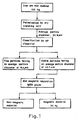
- Fig. 1 is a flow diagram of the production of iron oxide from iron ore in Example 1.
- Fig. 2 is a flow diagram of the production of iron oxide from iron ore in Example 2.
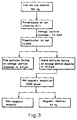
- Fig. 3 is a flow diagram of the production of iron oxide from iron ore in Example 3.
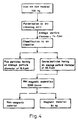
- Fig. 4 is a flow diagram of the production of iron oxide from iron ore in Example 4.
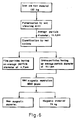
- Fig. 5 is a flow diagram of the production of iron oxide from iron ore in Example 5.
- Fig. 6 is a flow diagram of the production of iron oxide from iron ore in Comparative Example 1.
- Fig. 7 is a flow diagram of the production of iron oxide from iron ore in Comparative Example 2.
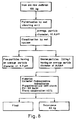
- Fig. 8 is a flow diagram of the production of iron oxide from iron ore in Comparative Example 3.
- Fig. 9 is a flow diagram of the production of the product in Example 6.
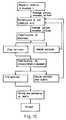
- Fig. 10 is a flow diagram of the production of the product in Example 7.
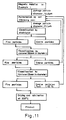
- Fig. 11 is a flow diagram of the production of the product in Example 8.
- Examples 1 to 5 and Comparative Examples 1 to 3 demonstrate the production from iron ore of high-purity iron oxide containing less than 0.15% SiO2 and less than 0.1% Al2O3. Their respective flow diagrams are shown in Figs. 1 to 8. Analytical data of the iron ore and processed iron oxide are given in Table 1.
- Examples 1 to 5 and Comparative Examples 1 to 3 demonstrate that it is possible to produce high-purity iron oxide containing less than 0.15% SiO2 and less than 0.1% Al2O3 by the process which consists of pulverizing iron ore into powder having an average particle diameter of 20-150 »m, removing fine particles from the powder, and removing impurities from the powder by wet magnetic separation in a strong magnetic field of 1000-15000 gauss.
- Examples 6 to 8 and Comparative Examples 4 and 5 demonstrate the production of high-purity iron oxide powder having a uniform particle size from the magnetic arterial obtained as mentioned above.
- the flow diagrams for the production process are given in Figs. 9 to 11.
- the high-purity iron oxide powders (after calcination) obtained in these examples have the characteristic properties as shown in Table 2.
- the high-purity iron oxide (magnetic material) obtained in Example 1 was pulverized into powder having an average particle diameter of 27.2 »m using a wet grinding mill, the powder was separated into fine particles and coarse particles by hydraulic elutriation, the fine particles were further separated into fine particles and coarse particles using a wet cyclone (75 mm in diameter), and the fine particles were dried and calcined at 600°C.
- the coarse particles separated by the elutriator and wet cyclone were returned to the wet vibrating mill.
- Example 7 the fine particles separated by a wet cyclone (50 mm in diameter) in Example 7 were further separated into fine particles and coarse particles using a wet cyclone (25 mm in diameter), and the fine particles were dried and calcined and the coarse particles were returned to the wet vibrating mill.
- the FeO content of the products before calcination was 0.27%, 0.96%, and 1.62%, respectively, and the characteristic properties of the products after calcination are as shown in Table 2. It is noted that the content of fine particles (smaller than 1.0 »m) is low and the particle size distribution is sharp.
- Example 8 The product in Example 8 was made into a barium ferrite, which has the following magnetic properties.
- B r (G) 4120 bH c (Oe) : 2630
- BH max (MG Oe) : 4.1
- Example 6 The same procedure as in Example 6 was repeated according to the flow diagram shown in Fig. 9, except that the cyclone (75 mm in diameter) was replaced by one which is 100 mm in diameter.
- the resulting product was found to have a broader particle size distribution, which is indicated by the fact that the maximum particle diameter is 182.0 »m and the fraction of fine particles smaller than 1.0 »m in particle diameter accounts for 8.5 wt%, while the average particle diameter is 18.2 »m.
- Example 8 The same procedure as in Example 8 was repeated according to the flow diagram shown in Fig. 11, except that the calcination was carried out at 150°C.
- the product was made into a barium ferrite, which has the following magnetic properties.
- B r (G) 3950 bH c (Oe) : 2750 (BH) max (MG Oe) : 3.7 It is apparent that the product in Comparative Example 5 is inferior in magnetic properties to that in Example 8.
Landscapes
- Chemical & Material Sciences (AREA)
- Organic Chemistry (AREA)
- Inorganic Chemistry (AREA)
- Life Sciences & Earth Sciences (AREA)
- General Life Sciences & Earth Sciences (AREA)
- Geology (AREA)
- Manufacture And Refinement Of Metals (AREA)
- Compounds Of Iron (AREA)
Applications Claiming Priority (4)
| Application Number | Priority Date | Filing Date | Title |
|---|---|---|---|
| JP3100547A JPH04254417A (ja) | 1991-02-05 | 1991-02-05 | 微粒高純度酸化鉄の製造方法 |
| JP3100548A JPH04254418A (ja) | 1991-02-05 | 1991-02-05 | 高純度酸化鉄及びその製造方法 |
| JP100547/91 | 1991-02-05 | ||
| JP100548/91 | 1991-02-05 |
Publications (3)
| Publication Number | Publication Date |
|---|---|
| EP0502612A2 EP0502612A2 (en) | 1992-09-09 |
| EP0502612A3 EP0502612A3 (en) | 1993-05-19 |
| EP0502612B1 true EP0502612B1 (en) | 1995-12-06 |
Family
ID=26441557
Family Applications (1)
| Application Number | Title | Priority Date | Filing Date |
|---|---|---|---|
| EP92300958A Expired - Lifetime EP0502612B1 (en) | 1991-02-05 | 1992-02-04 | High-purity iron oxide, and method for production thereof |
Country Status (6)
| Country | Link |
|---|---|
| US (1) | US5316746A (enExample) |
| EP (1) | EP0502612B1 (enExample) |
| KR (1) | KR920016348A (enExample) |
| CN (1) | CN1030187C (enExample) |
| DE (1) | DE69206448T2 (enExample) |
| TW (1) | TW234725B (enExample) |
Families Citing this family (14)
| Publication number | Priority date | Publication date | Assignee | Title |
|---|---|---|---|---|
| JP3436447B2 (ja) * | 1995-08-11 | 2003-08-11 | 新東工業株式会社 | 酸化鉄粉の嵩密度向上方法 |
| US6355178B1 (en) | 1999-04-02 | 2002-03-12 | Theodore Couture | Cyclonic separator with electrical or magnetic separation enhancement |
| CA2453005A1 (fr) * | 2003-12-17 | 2005-06-17 | Fermag Inc. | Procede hydrometallurgique de separation des poussieres d`acieries utilisant un four a arc et pigments obtenus par le procede |
| US8016935B2 (en) * | 2005-06-17 | 2011-09-13 | Ferrinov Inc. | Anti-corrosion pigments coming from dust of an electric arc furnace and containing sacrificial calcium |
| AU2010313421B2 (en) | 2009-10-28 | 2016-04-14 | Magglobal, Llc | Magnetic separator |
| US8708152B2 (en) | 2011-04-20 | 2014-04-29 | Magnetation, Inc. | Iron ore separation device |
| WO2014063211A1 (en) | 2012-10-26 | 2014-05-01 | Vale S.A. | Iron ore concentration process with grinding circuit, dry desliming and dry or mixed (dry and wet) concentration |
| JP5772869B2 (ja) * | 2013-04-24 | 2015-09-02 | 住友金属鉱山株式会社 | 製鉄用ヘマタイトの製造方法 |
| JP5679372B2 (ja) | 2013-07-03 | 2015-03-04 | 住友金属鉱山株式会社 | 製鉄用ヘマタイトの製造方法 |
| JP5776913B2 (ja) | 2014-01-17 | 2015-09-09 | 住友金属鉱山株式会社 | 製鉄用ヘマタイトの製造方法 |
| CN103949339A (zh) * | 2014-05-12 | 2014-07-30 | 长沙矿冶研究院有限责任公司 | 一种回收钒钛磁铁矿中铁和钛的方法 |
| CN105399143B (zh) * | 2015-12-15 | 2018-05-11 | 上海宝钢磁业有限公司 | 一种磷酸铁锂用氧化铁红及其制备方法及应用 |
| CN106634830A (zh) * | 2016-11-21 | 2017-05-10 | 贵州三山研磨有限公司 | 一种棕刚玉磨料生产方法及其段砂装置 |
| US11103876B2 (en) * | 2017-07-18 | 2021-08-31 | Best Process Solutions, Inc. | Incinerator ash wet processing |
Family Cites Families (13)
| Publication number | Priority date | Publication date | Assignee | Title |
|---|---|---|---|---|
| US3007775A (en) * | 1958-11-14 | 1961-11-07 | Int Nickel Co | Production of ferric oxide |
| US3672579A (en) * | 1970-08-10 | 1972-06-27 | Univ Minnesota | Process for beneficiating magnetite iron ore |
| US4133677A (en) * | 1976-04-05 | 1979-01-09 | Toda Kogyo Corp. | Process for producing acicular magnetic metallic particle powder |
| JPS5676510A (en) * | 1979-11-28 | 1981-06-24 | Tdk Corp | Manufacture of magnetic recording material |
| JPS5686646A (en) * | 1979-12-18 | 1981-07-14 | Tomio Ino | Refining method of molding sand |
| US4319988A (en) * | 1980-05-05 | 1982-03-16 | Halomet, Incorporated | Separation of high grade magnetite from fly ash |
| DE3022875A1 (de) * | 1980-06-19 | 1982-01-14 | Bayer Ag, 5090 Leverkusen | Verfahren zur herstellung von eisenoxidpigmenten mit verbesserter reinheit sowie deren verwendung |
| JPS57181554A (en) * | 1981-04-30 | 1982-11-09 | Kanto Denka Kogyo Kk | Magnetic powder for electrophotographic magnetic toner and its manufacture |
| JPS57205324A (en) * | 1981-06-10 | 1982-12-16 | Shoei Insatsu Kk | Manufacture of powder of hard oxide-base magnetic material |
| JPS6125157A (ja) * | 1984-07-13 | 1986-02-04 | Hitachi Metals Ltd | 静電荷像現像剤用キヤリア |
| JPS6236025A (ja) * | 1985-08-07 | 1987-02-17 | Sumitomo Metal Ind Ltd | フェライト用酸化鉄の製造方法 |
| JPS61238901A (ja) * | 1985-04-15 | 1986-10-24 | Kawasaki Steel Corp | 強磁性粉末 |
| JP2672985B2 (ja) * | 1988-10-17 | 1997-11-05 | ケミライト工業株式会社 | 鉄とマンガンを含有する精製溶液およびその製造方法 |
-
1992
- 1992-01-31 KR KR1019920001479A patent/KR920016348A/ko not_active Ceased
- 1992-02-03 CN CN92101423A patent/CN1030187C/zh not_active Expired - Fee Related
- 1992-02-04 EP EP92300958A patent/EP0502612B1/en not_active Expired - Lifetime
- 1992-02-04 DE DE69206448T patent/DE69206448T2/de not_active Expired - Fee Related
- 1992-02-11 TW TW081100932A patent/TW234725B/zh active
-
1993
- 1993-04-16 US US08/048,968 patent/US5316746A/en not_active Expired - Fee Related
Also Published As
| Publication number | Publication date |
|---|---|
| DE69206448D1 (de) | 1996-01-18 |
| CN1030187C (zh) | 1995-11-01 |
| US5316746A (en) | 1994-05-31 |
| DE69206448T2 (de) | 1996-08-01 |
| EP0502612A2 (en) | 1992-09-09 |
| TW234725B (enExample) | 1994-11-21 |
| CN1064853A (zh) | 1992-09-30 |
| KR920016348A (ko) | 1992-09-24 |
| EP0502612A3 (en) | 1993-05-19 |
Similar Documents
| Publication | Publication Date | Title |
|---|---|---|
| EP0502612B1 (en) | High-purity iron oxide, and method for production thereof | |
| US4125460A (en) | Magnetic beneficiation of clays utilizing magnetic particulates | |
| DE2015073A1 (de) | Verfahren zur Abtrennung von magneti sierbaren Teilchen | |
| US4303204A (en) | Upgrading of bauxites, bauxitic clays, and aluminum mineral bearing clays | |
| EP1905048B1 (en) | Process and magnetic reagent for the removal of impurities from minerals | |
| JPH0647315A (ja) | キッシュ・グラファイトの選鉱方法 | |
| CN115069400A (zh) | 一种三水铝石型铝土矿的处理方法 | |
| US4272029A (en) | Upgrading of bauxites, bauxitic clays, and aluminum mineral bearing clays | |
| US3860514A (en) | Method of beneficiating alumina-silica ores | |
| CN116078538A (zh) | 一种含橄榄石的钒钛磁铁矿的选矿方法 | |
| KR100334295B1 (ko) | 고령토에 함유된 산화철과 이산화티탄 제거를 위한 건식정제 방법 | |
| CN1858271A (zh) | 钢渣铁精粉的生产工艺 | |
| JPS5948853B2 (ja) | アナタ−ゼ原料の調製法 | |
| AU2023453894A1 (en) | Method for treating high-iron bauxite | |
| JPH034610B2 (enExample) | ||
| KR100423440B1 (ko) | 제강슬래그중 철분의 분리방법 | |
| JPH04254418A (ja) | 高純度酸化鉄及びその製造方法 | |
| JPH024536B2 (enExample) | ||
| US4117058A (en) | Method of making boron containing strontium ferrite | |
| RU2011416C1 (ru) | Способ обогащения смешанных железных руд | |
| JPH04254417A (ja) | 微粒高純度酸化鉄の製造方法 | |
| JPS6311526A (ja) | フエライト原料用酸化鉄の製造方法 | |
| JPS6197135A (ja) | フェライト用酸化鉄の製造方法 | |
| JPS62283820A (ja) | 赤鉄鉱質鉄鉱石からフエライト製造用酸化鉄を得る方法 | |
| CN120714748A (zh) | 一种钒钛铁精矿选择性磨矿提高铁精矿品位的方法 |
Legal Events
| Date | Code | Title | Description |
|---|---|---|---|
| PUAI | Public reference made under article 153(3) epc to a published international application that has entered the european phase |
Free format text: ORIGINAL CODE: 0009012 |
|
| AK | Designated contracting states |
Kind code of ref document: A2 Designated state(s): BE DE FR GB NL |
|
| PUAL | Search report despatched |
Free format text: ORIGINAL CODE: 0009013 |
|
| AK | Designated contracting states |
Kind code of ref document: A3 Designated state(s): BE DE FR GB NL |
|
| 17P | Request for examination filed |
Effective date: 19930716 |
|
| 17Q | First examination report despatched |
Effective date: 19940610 |
|
| GRAA | (expected) grant |
Free format text: ORIGINAL CODE: 0009210 |
|
| AK | Designated contracting states |
Kind code of ref document: B1 Designated state(s): BE DE FR GB NL |
|
| PGFP | Annual fee paid to national office [announced via postgrant information from national office to epo] |
Ref country code: GB Payment date: 19951206 Year of fee payment: 5 |
|
| PGFP | Annual fee paid to national office [announced via postgrant information from national office to epo] |
Ref country code: FR Payment date: 19951219 Year of fee payment: 5 |
|
| REF | Corresponds to: |
Ref document number: 69206448 Country of ref document: DE Date of ref document: 19960118 |
|
| PGFP | Annual fee paid to national office [announced via postgrant information from national office to epo] |
Ref country code: DE Payment date: 19960125 Year of fee payment: 5 |
|
| PG25 | Lapsed in a contracting state [announced via postgrant information from national office to epo] |
Ref country code: BE Effective date: 19960228 |
|
| PGFP | Annual fee paid to national office [announced via postgrant information from national office to epo] |
Ref country code: NL Payment date: 19960229 Year of fee payment: 5 |
|
| ET | Fr: translation filed | ||
| BERE | Be: lapsed |
Owner name: KAWATETSU MINING CY LTD Effective date: 19960228 Owner name: KAWASAKI STEEL CORP. Effective date: 19960228 |
|
| PLBE | No opposition filed within time limit |
Free format text: ORIGINAL CODE: 0009261 |
|
| 26N | No opposition filed | ||
| PG25 | Lapsed in a contracting state [announced via postgrant information from national office to epo] |
Ref country code: GB Effective date: 19970204 |
|
| PG25 | Lapsed in a contracting state [announced via postgrant information from national office to epo] |
Ref country code: NL Effective date: 19970901 |
|
| GBPC | Gb: european patent ceased through non-payment of renewal fee |
Effective date: 19970204 |
|
| PG25 | Lapsed in a contracting state [announced via postgrant information from national office to epo] |
Ref country code: FR Effective date: 19971030 |
|
| PG25 | Lapsed in a contracting state [announced via postgrant information from national office to epo] |
Ref country code: DE Effective date: 19971101 |
|
| NLV4 | Nl: lapsed or anulled due to non-payment of the annual fee |
Effective date: 19970901 |
|
| REG | Reference to a national code |
Ref country code: FR Ref legal event code: ST |