EP0496286A1 - Verfahren zum Verschweissen von Kabelisolierungen - Google Patents
Verfahren zum Verschweissen von Kabelisolierungen Download PDFInfo
- Publication number
- EP0496286A1 EP0496286A1 EP19920100698 EP92100698A EP0496286A1 EP 0496286 A1 EP0496286 A1 EP 0496286A1 EP 19920100698 EP19920100698 EP 19920100698 EP 92100698 A EP92100698 A EP 92100698A EP 0496286 A1 EP0496286 A1 EP 0496286A1
- Authority
- EP
- European Patent Office
- Prior art keywords
- cable
- insulation
- heating
- carried out
- welding
- Prior art date
- Legal status (The legal status is an assumption and is not a legal conclusion. Google has not performed a legal analysis and makes no representation as to the accuracy of the status listed.)
- Withdrawn
Links
Images
Classifications
-
- H—ELECTRICITY
- H01—ELECTRIC ELEMENTS
- H01B—CABLES; CONDUCTORS; INSULATORS; SELECTION OF MATERIALS FOR THEIR CONDUCTIVE, INSULATING OR DIELECTRIC PROPERTIES
- H01B13/00—Apparatus or processes specially adapted for manufacturing conductors or cables
- H01B13/0023—Apparatus or processes specially adapted for manufacturing conductors or cables for welding together plastic insulated wires side-by-side
-
- B—PERFORMING OPERATIONS; TRANSPORTING
- B29—WORKING OF PLASTICS; WORKING OF SUBSTANCES IN A PLASTIC STATE IN GENERAL
- B29C—SHAPING OR JOINING OF PLASTICS; SHAPING OF MATERIAL IN A PLASTIC STATE, NOT OTHERWISE PROVIDED FOR; AFTER-TREATMENT OF THE SHAPED PRODUCTS, e.g. REPAIRING
- B29C53/00—Shaping by bending, folding, twisting, straightening or flattening; Apparatus therefor
- B29C53/02—Bending or folding
- B29C53/08—Bending or folding of tubes or other profiled members
- B29C53/083—Bending or folding of tubes or other profiled members bending longitudinally, i.e. modifying the curvature of the tube axis
-
- B—PERFORMING OPERATIONS; TRANSPORTING
- B29—WORKING OF PLASTICS; WORKING OF SUBSTANCES IN A PLASTIC STATE IN GENERAL
- B29C—SHAPING OR JOINING OF PLASTICS; SHAPING OF MATERIAL IN A PLASTIC STATE, NOT OTHERWISE PROVIDED FOR; AFTER-TREATMENT OF THE SHAPED PRODUCTS, e.g. REPAIRING
- B29C65/00—Joining or sealing of preformed parts, e.g. welding of plastics materials; Apparatus therefor
- B29C65/02—Joining or sealing of preformed parts, e.g. welding of plastics materials; Apparatus therefor by heating, with or without pressure
- B29C65/34—Joining or sealing of preformed parts, e.g. welding of plastics materials; Apparatus therefor by heating, with or without pressure using heated elements which remain in the joint, e.g. "verlorenes Schweisselement"
- B29C65/3404—Joining or sealing of preformed parts, e.g. welding of plastics materials; Apparatus therefor by heating, with or without pressure using heated elements which remain in the joint, e.g. "verlorenes Schweisselement" characterised by the type of heated elements which remain in the joint
- B29C65/342—Joining or sealing of preformed parts, e.g. welding of plastics materials; Apparatus therefor by heating, with or without pressure using heated elements which remain in the joint, e.g. "verlorenes Schweisselement" characterised by the type of heated elements which remain in the joint comprising at least a single wire, e.g. in the form of a winding
-
- B—PERFORMING OPERATIONS; TRANSPORTING
- B29—WORKING OF PLASTICS; WORKING OF SUBSTANCES IN A PLASTIC STATE IN GENERAL
- B29C—SHAPING OR JOINING OF PLASTICS; SHAPING OF MATERIAL IN A PLASTIC STATE, NOT OTHERWISE PROVIDED FOR; AFTER-TREATMENT OF THE SHAPED PRODUCTS, e.g. REPAIRING
- B29C65/00—Joining or sealing of preformed parts, e.g. welding of plastics materials; Apparatus therefor
- B29C65/02—Joining or sealing of preformed parts, e.g. welding of plastics materials; Apparatus therefor by heating, with or without pressure
- B29C65/34—Joining or sealing of preformed parts, e.g. welding of plastics materials; Apparatus therefor by heating, with or without pressure using heated elements which remain in the joint, e.g. "verlorenes Schweisselement"
- B29C65/3472—Joining or sealing of preformed parts, e.g. welding of plastics materials; Apparatus therefor by heating, with or without pressure using heated elements which remain in the joint, e.g. "verlorenes Schweisselement" characterised by the composition of the heated elements which remain in the joint
- B29C65/3476—Joining or sealing of preformed parts, e.g. welding of plastics materials; Apparatus therefor by heating, with or without pressure using heated elements which remain in the joint, e.g. "verlorenes Schweisselement" characterised by the composition of the heated elements which remain in the joint being metallic
-
- B—PERFORMING OPERATIONS; TRANSPORTING
- B29—WORKING OF PLASTICS; WORKING OF SUBSTANCES IN A PLASTIC STATE IN GENERAL
- B29C—SHAPING OR JOINING OF PLASTICS; SHAPING OF MATERIAL IN A PLASTIC STATE, NOT OTHERWISE PROVIDED FOR; AFTER-TREATMENT OF THE SHAPED PRODUCTS, e.g. REPAIRING
- B29C66/00—General aspects of processes or apparatus for joining preformed parts
- B29C66/01—General aspects dealing with the joint area or with the area to be joined
- B29C66/05—Particular design of joint configurations
- B29C66/10—Particular design of joint configurations particular design of the joint cross-sections
- B29C66/11—Joint cross-sections comprising a single joint-segment, i.e. one of the parts to be joined comprising a single joint-segment in the joint cross-section
- B29C66/112—Single lapped joints
- B29C66/1122—Single lap to lap joints, i.e. overlap joints
-
- B—PERFORMING OPERATIONS; TRANSPORTING
- B29—WORKING OF PLASTICS; WORKING OF SUBSTANCES IN A PLASTIC STATE IN GENERAL
- B29C—SHAPING OR JOINING OF PLASTICS; SHAPING OF MATERIAL IN A PLASTIC STATE, NOT OTHERWISE PROVIDED FOR; AFTER-TREATMENT OF THE SHAPED PRODUCTS, e.g. REPAIRING
- B29C66/00—General aspects of processes or apparatus for joining preformed parts
- B29C66/50—General aspects of joining tubular articles; General aspects of joining long products, i.e. bars or profiled elements; General aspects of joining single elements to tubular articles, hollow articles or bars; General aspects of joining several hollow-preforms to form hollow or tubular articles
- B29C66/51—Joining tubular articles, profiled elements or bars; Joining single elements to tubular articles, hollow articles or bars; Joining several hollow-preforms to form hollow or tubular articles
- B29C66/52—Joining tubular articles, bars or profiled elements
- B29C66/526—Joining bars
-
- B—PERFORMING OPERATIONS; TRANSPORTING
- B29—WORKING OF PLASTICS; WORKING OF SUBSTANCES IN A PLASTIC STATE IN GENERAL
- B29C—SHAPING OR JOINING OF PLASTICS; SHAPING OF MATERIAL IN A PLASTIC STATE, NOT OTHERWISE PROVIDED FOR; AFTER-TREATMENT OF THE SHAPED PRODUCTS, e.g. REPAIRING
- B29C66/00—General aspects of processes or apparatus for joining preformed parts
- B29C66/69—General aspects of joining filaments
-
- B—PERFORMING OPERATIONS; TRANSPORTING
- B29—WORKING OF PLASTICS; WORKING OF SUBSTANCES IN A PLASTIC STATE IN GENERAL
- B29C—SHAPING OR JOINING OF PLASTICS; SHAPING OF MATERIAL IN A PLASTIC STATE, NOT OTHERWISE PROVIDED FOR; AFTER-TREATMENT OF THE SHAPED PRODUCTS, e.g. REPAIRING
- B29C66/00—General aspects of processes or apparatus for joining preformed parts
- B29C66/80—General aspects of machine operations or constructions and parts thereof
- B29C66/81—General aspects of the pressing elements, i.e. the elements applying pressure on the parts to be joined in the area to be joined, e.g. the welding jaws or clamps
- B29C66/814—General aspects of the pressing elements, i.e. the elements applying pressure on the parts to be joined in the area to be joined, e.g. the welding jaws or clamps characterised by the design of the pressing elements, e.g. of the welding jaws or clamps
- B29C66/8141—General aspects of the pressing elements, i.e. the elements applying pressure on the parts to be joined in the area to be joined, e.g. the welding jaws or clamps characterised by the design of the pressing elements, e.g. of the welding jaws or clamps characterised by the surface geometry of the part of the pressing elements, e.g. welding jaws or clamps, coming into contact with the parts to be joined
- B29C66/81431—General aspects of the pressing elements, i.e. the elements applying pressure on the parts to be joined in the area to be joined, e.g. the welding jaws or clamps characterised by the design of the pressing elements, e.g. of the welding jaws or clamps characterised by the surface geometry of the part of the pressing elements, e.g. welding jaws or clamps, coming into contact with the parts to be joined comprising a single cavity, e.g. a groove
-
- B—PERFORMING OPERATIONS; TRANSPORTING
- B29—WORKING OF PLASTICS; WORKING OF SUBSTANCES IN A PLASTIC STATE IN GENERAL
- B29C—SHAPING OR JOINING OF PLASTICS; SHAPING OF MATERIAL IN A PLASTIC STATE, NOT OTHERWISE PROVIDED FOR; AFTER-TREATMENT OF THE SHAPED PRODUCTS, e.g. REPAIRING
- B29C66/00—General aspects of processes or apparatus for joining preformed parts
- B29C66/80—General aspects of machine operations or constructions and parts thereof
- B29C66/83—General aspects of machine operations or constructions and parts thereof characterised by the movement of the joining or pressing tools
- B29C66/832—Reciprocating joining or pressing tools
- B29C66/8322—Joining or pressing tools reciprocating along one axis
-
- B—PERFORMING OPERATIONS; TRANSPORTING
- B29—WORKING OF PLASTICS; WORKING OF SUBSTANCES IN A PLASTIC STATE IN GENERAL
- B29C—SHAPING OR JOINING OF PLASTICS; SHAPING OF MATERIAL IN A PLASTIC STATE, NOT OTHERWISE PROVIDED FOR; AFTER-TREATMENT OF THE SHAPED PRODUCTS, e.g. REPAIRING
- B29C35/00—Heating, cooling or curing, e.g. crosslinking or vulcanising; Apparatus therefor
- B29C35/02—Heating or curing, e.g. crosslinking or vulcanizing during moulding, e.g. in a mould
- B29C2035/0211—Heating or curing, e.g. crosslinking or vulcanizing during moulding, e.g. in a mould resistance heating
-
- B—PERFORMING OPERATIONS; TRANSPORTING
- B29—WORKING OF PLASTICS; WORKING OF SUBSTANCES IN A PLASTIC STATE IN GENERAL
- B29C—SHAPING OR JOINING OF PLASTICS; SHAPING OF MATERIAL IN A PLASTIC STATE, NOT OTHERWISE PROVIDED FOR; AFTER-TREATMENT OF THE SHAPED PRODUCTS, e.g. REPAIRING
- B29C66/00—General aspects of processes or apparatus for joining preformed parts
- B29C66/50—General aspects of joining tubular articles; General aspects of joining long products, i.e. bars or profiled elements; General aspects of joining single elements to tubular articles, hollow articles or bars; General aspects of joining several hollow-preforms to form hollow or tubular articles
- B29C66/51—Joining tubular articles, profiled elements or bars; Joining single elements to tubular articles, hollow articles or bars; Joining several hollow-preforms to form hollow or tubular articles
- B29C66/52—Joining tubular articles, bars or profiled elements
- B29C66/522—Joining tubular articles
- B29C66/5227—Joining tubular articles for forming multi-tubular articles by longitudinally joining elementary tubular articles wall-to-wall (e.g. joining the wall of a first tubular article to the wall of a second tubular article) or for forming multilayer tubular articles
-
- B—PERFORMING OPERATIONS; TRANSPORTING
- B29—WORKING OF PLASTICS; WORKING OF SUBSTANCES IN A PLASTIC STATE IN GENERAL
- B29C—SHAPING OR JOINING OF PLASTICS; SHAPING OF MATERIAL IN A PLASTIC STATE, NOT OTHERWISE PROVIDED FOR; AFTER-TREATMENT OF THE SHAPED PRODUCTS, e.g. REPAIRING
- B29C66/00—General aspects of processes or apparatus for joining preformed parts
- B29C66/70—General aspects of processes or apparatus for joining preformed parts characterised by the composition, physical properties or the structure of the material of the parts to be joined; Joining with non-plastics material
- B29C66/71—General aspects of processes or apparatus for joining preformed parts characterised by the composition, physical properties or the structure of the material of the parts to be joined; Joining with non-plastics material characterised by the composition of the plastics material of the parts to be joined
-
- B—PERFORMING OPERATIONS; TRANSPORTING
- B29—WORKING OF PLASTICS; WORKING OF SUBSTANCES IN A PLASTIC STATE IN GENERAL
- B29C—SHAPING OR JOINING OF PLASTICS; SHAPING OF MATERIAL IN A PLASTIC STATE, NOT OTHERWISE PROVIDED FOR; AFTER-TREATMENT OF THE SHAPED PRODUCTS, e.g. REPAIRING
- B29C66/00—General aspects of processes or apparatus for joining preformed parts
- B29C66/80—General aspects of machine operations or constructions and parts thereof
- B29C66/81—General aspects of the pressing elements, i.e. the elements applying pressure on the parts to be joined in the area to be joined, e.g. the welding jaws or clamps
- B29C66/814—General aspects of the pressing elements, i.e. the elements applying pressure on the parts to be joined in the area to be joined, e.g. the welding jaws or clamps characterised by the design of the pressing elements, e.g. of the welding jaws or clamps
- B29C66/8141—General aspects of the pressing elements, i.e. the elements applying pressure on the parts to be joined in the area to be joined, e.g. the welding jaws or clamps characterised by the design of the pressing elements, e.g. of the welding jaws or clamps characterised by the surface geometry of the part of the pressing elements, e.g. welding jaws or clamps, coming into contact with the parts to be joined
- B29C66/81411—General aspects of the pressing elements, i.e. the elements applying pressure on the parts to be joined in the area to be joined, e.g. the welding jaws or clamps characterised by the design of the pressing elements, e.g. of the welding jaws or clamps characterised by the surface geometry of the part of the pressing elements, e.g. welding jaws or clamps, coming into contact with the parts to be joined characterised by its cross-section, e.g. transversal or longitudinal, being non-flat
- B29C66/81421—General aspects of the pressing elements, i.e. the elements applying pressure on the parts to be joined in the area to be joined, e.g. the welding jaws or clamps characterised by the design of the pressing elements, e.g. of the welding jaws or clamps characterised by the surface geometry of the part of the pressing elements, e.g. welding jaws or clamps, coming into contact with the parts to be joined characterised by its cross-section, e.g. transversal or longitudinal, being non-flat being convex or concave
- B29C66/81423—General aspects of the pressing elements, i.e. the elements applying pressure on the parts to be joined in the area to be joined, e.g. the welding jaws or clamps characterised by the design of the pressing elements, e.g. of the welding jaws or clamps characterised by the surface geometry of the part of the pressing elements, e.g. welding jaws or clamps, coming into contact with the parts to be joined characterised by its cross-section, e.g. transversal or longitudinal, being non-flat being convex or concave being concave
-
- B—PERFORMING OPERATIONS; TRANSPORTING
- B29—WORKING OF PLASTICS; WORKING OF SUBSTANCES IN A PLASTIC STATE IN GENERAL
- B29L—INDEXING SCHEME ASSOCIATED WITH SUBCLASS B29C, RELATING TO PARTICULAR ARTICLES
- B29L2031/00—Other particular articles
- B29L2031/34—Electrical apparatus, e.g. sparking plugs or parts thereof
- B29L2031/3462—Cables
Definitions
- the invention relates to a method for welding insulation of cables according to the preamble of claim 1. So far, it has been customary to heat cables, the insulation of which should be welded, and then to compress them, so that the plastic sheaths welded at the contact points. The cable sheaths were heated, for example, by the mirror welding method known per se.
- the invention is therefore based on the object of specifying a method of the type mentioned above in which the cables can be securely positioned and a reproducible welding result is achieved.
- the invention has the particular advantage that the cable sets produced in this way are very dimensionally stable. They also stay Cable sheaths practically undeformed in the outside area, since the resulting Joule heat is dissipated to the outside by a cooling device. This means that the heat is only effective at those points where a fusion of the cable sheaths is desired.
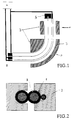
- FIG. 1 shows a schematic representation of the entire arrangement and FIG. 2 shows a cross section through a cable set with a compression mold.
- the cables 1 When the cables are welded, the cables 1 are first placed in shape 3 parallel to one another (see FIG. 1). Due to the cavities or grooves cut out in the mold 3, the individual cables are held together and positioned as soon as the pressure P is exerted on the mold and the individual molded parts are moved together. The cables are then connected to one another and to the power supply 4, as shown in FIG. 1.
- the insulation of the cable 2 is either in contact with the insulation of another cable or with the cooling liquid, provided that it is not cooled by the metallic form 2. Therefore, only the contact point of the insulation of the individual cables is heated and fused when the current passes through. After moving the molds together, the entire device (molds, lines, connections) is expediently lowered into a water bath.
- the cables are provided with cable lugs, for example, for connection to a car battery or to consumers. These cable lugs are connected to the power supply or to each other with shorting bars according to FIG. 1.
- the power supply unit delivers up to 1,000 A at 50 Hz. The current is passed through the cable until the insulation material melts at the points of contact. The remaining surface is cooled by oil or water so that the surface temperature does not reach the melting point of the insulation material.
- the particular advantage of this method is that the welding can be performed in one operation and the finished product takes a predetermined shape, for example a curve arc of 90 o permanent, so that the intended installation geometry can be taken into account already during the manufacture of the cable set.
- the method can be used for all cable insulation. There are no difficulties, for example, with PVC or rubber cores. Even with lines that are insulated with a polyimide, it is possible to reach the melting point and to weld the wires. In such a case, silicone oil is used as the coolant, for example.
- the welding of cores with polyamide insulation is an example here.
- the cores are inserted into the mold and pressed together with a force of 100 N / cm cable length.
- a pressure of approximately 1,000 N / cm2 is therefore required. If the temperature of the softening is increased, then of course one can manage with less pressure.
- the exact setting values must of course be determined experimentally in each individual case, but it is advantageous to use a higher pressure and a lower temperature so that the welding result is optimal.
Landscapes
- Engineering & Computer Science (AREA)
- Mechanical Engineering (AREA)
- Manufacturing & Machinery (AREA)
- Processing Of Terminals (AREA)
- Lining Or Joining Of Plastics Or The Like (AREA)
- Manufacturing Of Electrical Connectors (AREA)
Applications Claiming Priority (2)
| Application Number | Priority Date | Filing Date | Title |
|---|---|---|---|
| DE4101663 | 1991-01-22 | ||
| DE4101663A DE4101663C1 (Direct) | 1991-01-22 | 1991-01-22 |
Publications (1)
| Publication Number | Publication Date |
|---|---|
| EP0496286A1 true EP0496286A1 (de) | 1992-07-29 |
Family
ID=6423411
Family Applications (1)
| Application Number | Title | Priority Date | Filing Date |
|---|---|---|---|
| EP19920100698 Withdrawn EP0496286A1 (de) | 1991-01-22 | 1992-01-17 | Verfahren zum Verschweissen von Kabelisolierungen |
Country Status (11)
| Country | Link |
|---|---|
| US (1) | US5298101A (Direct) |
| EP (1) | EP0496286A1 (Direct) |
| JP (1) | JPH0594859A (Direct) |
| BR (1) | BR9200172A (Direct) |
| CA (1) | CA2059754A1 (Direct) |
| DE (1) | DE4101663C1 (Direct) |
| FI (1) | FI920260L (Direct) |
| HU (1) | HU207602B (Direct) |
| IE (1) | IE920171A1 (Direct) |
| NO (1) | NO920300L (Direct) |
| PT (1) | PT100046A (Direct) |
Families Citing this family (8)
| Publication number | Priority date | Publication date | Assignee | Title |
|---|---|---|---|---|
| DE19512113C2 (de) * | 1995-04-04 | 1997-12-18 | Gerhard Prof Dr Ing Babiel | Formstabilisiertes Batteriekabel |
| US5537742A (en) * | 1995-05-22 | 1996-07-23 | General Signal Corporation | Method for joining multiple conductor cables |
| IL116811A0 (en) * | 1996-01-18 | 1996-07-23 | Dan Pal Tech Plastic Ind | Structures made of panel units and connecting pieces and a method of forming such structures |
| US20050140065A1 (en) * | 2002-05-25 | 2005-06-30 | Hans-Martin Sauer | Method and device for connecting molded parts |
| US8404976B2 (en) * | 2009-01-30 | 2013-03-26 | Fort Wayne Metals Research Products Corporation | Fused wires |
| FR3026672B1 (fr) * | 2014-10-02 | 2017-06-16 | Faurecia Bloc Avant | Procede de fabrication d'une structure de vehicule ayant deux composants en materiau thermoplastique colles par chauffage, et structure de vehicule correspondante |
| DE102015201711A1 (de) * | 2015-02-02 | 2016-08-04 | Bayerische Motoren Werke Aktiengesellschaft | Verfahren zum Kompaktieren von Einzeldrähten |
| GB201802228D0 (en) * | 2018-02-12 | 2018-03-28 | Rolls Royce Plc | Cable harness |
Citations (2)
| Publication number | Priority date | Publication date | Assignee | Title |
|---|---|---|---|---|
| DE168457C (Direct) * | 1900-01-01 | |||
| US4430139A (en) * | 1978-08-15 | 1984-02-07 | Lucas Industries Limited | Apparatus for manufacturing cable |
Family Cites Families (2)
| Publication number | Priority date | Publication date | Assignee | Title |
|---|---|---|---|---|
| US2425294A (en) * | 1944-12-18 | 1947-08-12 | John T Morgan | Method of making insulated multiconductor structures |
| US2489867A (en) * | 1946-06-13 | 1949-11-29 | Belmont Radio Corp | Method for making electrical coils |
-
1991
- 1991-01-22 DE DE4101663A patent/DE4101663C1/de not_active Expired - Lifetime
-
1992
- 1992-01-16 JP JP4246192A patent/JPH0594859A/ja active Pending
- 1992-01-17 EP EP19920100698 patent/EP0496286A1/de not_active Withdrawn
- 1992-01-21 US US07/823,537 patent/US5298101A/en not_active Expired - Fee Related
- 1992-01-21 IE IE017192A patent/IE920171A1/en not_active Application Discontinuation
- 1992-01-21 HU HU9200189A patent/HU207602B/hu not_active IP Right Cessation
- 1992-01-21 BR BR9200172A patent/BR9200172A/pt unknown
- 1992-01-21 FI FI920260A patent/FI920260L/fi unknown
- 1992-01-22 CA CA 2059754 patent/CA2059754A1/en not_active Abandoned
- 1992-01-22 PT PT100046A patent/PT100046A/pt not_active Application Discontinuation
- 1992-01-22 NO NO92920300A patent/NO920300L/no unknown
Patent Citations (2)
| Publication number | Priority date | Publication date | Assignee | Title |
|---|---|---|---|---|
| DE168457C (Direct) * | 1900-01-01 | |||
| US4430139A (en) * | 1978-08-15 | 1984-02-07 | Lucas Industries Limited | Apparatus for manufacturing cable |
Also Published As
| Publication number | Publication date |
|---|---|
| HU207602B (en) | 1993-04-28 |
| NO920300L (no) | 1992-07-23 |
| IE920171A1 (en) | 1992-07-29 |
| JPH0594859A (ja) | 1993-04-16 |
| BR9200172A (pt) | 1992-10-06 |
| HUT60069A (en) | 1992-07-28 |
| FI920260A7 (fi) | 1992-07-23 |
| CA2059754A1 (en) | 1992-07-23 |
| NO920300D0 (no) | 1992-01-22 |
| FI920260L (fi) | 1992-07-23 |
| DE4101663C1 (Direct) | 1992-03-12 |
| HU9200189D0 (en) | 1992-04-28 |
| US5298101A (en) | 1994-03-29 |
| FI920260A0 (fi) | 1992-01-21 |
| PT100046A (pt) | 1994-04-29 |
Similar Documents
| Publication | Publication Date | Title |
|---|---|---|
| EP0022919B1 (de) | Verfahren zum Gewebeimprägnieren durch Harzinjektionen | |
| DE2739021C2 (Direct) | ||
| DE69726468T2 (de) | Vorrichtung und Verfahren zum Verbinden durch Schmelzen von einem Rohr mit Kupplungsstücken | |
| EP3417513B1 (de) | Verfahren und vorrichtung zur abdichtung von kontaktstellen an elektrischen leitungsverbindungen | |
| DE3215503A1 (de) | Elektrisch beheiztes schneidgeraet | |
| EP3867044B1 (de) | Verfahren und einleger zum verschweissen thermoplastischer bauteile | |
| DE60029120T2 (de) | Heizeinrichtung mit einer formbaren induktionsschleife und verfahren für eine beschleunigte härtung der verbundenen teile | |
| EP0496286A1 (de) | Verfahren zum Verschweissen von Kabelisolierungen | |
| EP3609023A1 (de) | Verfahren und vorrichtung zur herstellung einer elektrischen verbindung und elektrische leitung | |
| EP1065037B1 (de) | Verfahren und Vorrichtung zum Beheizen von Spritzgiesswerkzeugen | |
| DE2646233A1 (de) | Schweissgeraet | |
| DE102015117020B4 (de) | Verfahren zum Herstellen einer Leitungsabdichtung eines Leitungsstrangs und Verfahren zur Herstellung einer gedichteten Leitungsverbindung | |
| DE102016121909B4 (de) | Dichtung von Leitungsverbindern | |
| DE69203175T2 (de) | Verfahren für die Herstellung von Leitungslitzen für die elektromechanische Gerätetechnik und Vorrichtung für die Ausführung des Verfahrens. | |
| DE3853564T2 (de) | Leitfähiger Kunststoffartikel. | |
| DE2739418C2 (de) | Verfahren zum Herstellen einer Kontaktverbindung eines lackisolierten Drahtes mit einem Kontaktteil eines elektrischen Bauteiles durch Weichlöten sowie Vorrichtung zur Ausübung des Verfahrens | |
| DE102014017922B4 (de) | Verfahren zur Bauteilverbindung eines Kunststoffbauteils mit einem Fügepartner | |
| DE102015100849A1 (de) | Verfahren und Vorrichtung zum Widerstandsschweißen eines Sandwichblechs | |
| DE10342964A1 (de) | Flachdrahtreparaturwerkzeugsysteme und -verfahren | |
| DE10138610A1 (de) | Verfahren zum gegenseitigen anschliessen elektrischer Leitungen | |
| DE68913534T2 (de) | Verfahren und vorrichtung, die leitfähige polymere zum verbinden von gegenständen verwenden. | |
| DE69611362T2 (de) | Verfahren zum abdichten von einem kabel oder leiterbündel | |
| EP0001557A1 (de) | Verfahren zum Trennen eines eine Vielzahl von Drähten aufweisenden Seiles | |
| DE1919973A1 (de) | Elektrisches Geraet,insbesondere Funkenstrecke,und Verfahren und Vorrichtungen zu seiner Herstellung | |
| DE2720583C3 (de) | Verfahren und Vorrichtung zum Isolieren der Leiter elektrischer Kabel |
Legal Events
| Date | Code | Title | Description |
|---|---|---|---|
| PUAI | Public reference made under article 153(3) epc to a published international application that has entered the european phase |
Free format text: ORIGINAL CODE: 0009012 |
|
| AK | Designated contracting states |
Kind code of ref document: A1 Designated state(s): AT BE CH DE DK ES FR GB GR IT LI LU NL SE |
|
| 17P | Request for examination filed |
Effective date: 19920721 |
|
| 17Q | First examination report despatched |
Effective date: 19940614 |
|
| STAA | Information on the status of an ep patent application or granted ep patent |
Free format text: STATUS: THE APPLICATION IS DEEMED TO BE WITHDRAWN |
|
| 18D | Application deemed to be withdrawn |
Effective date: 19941017 |